
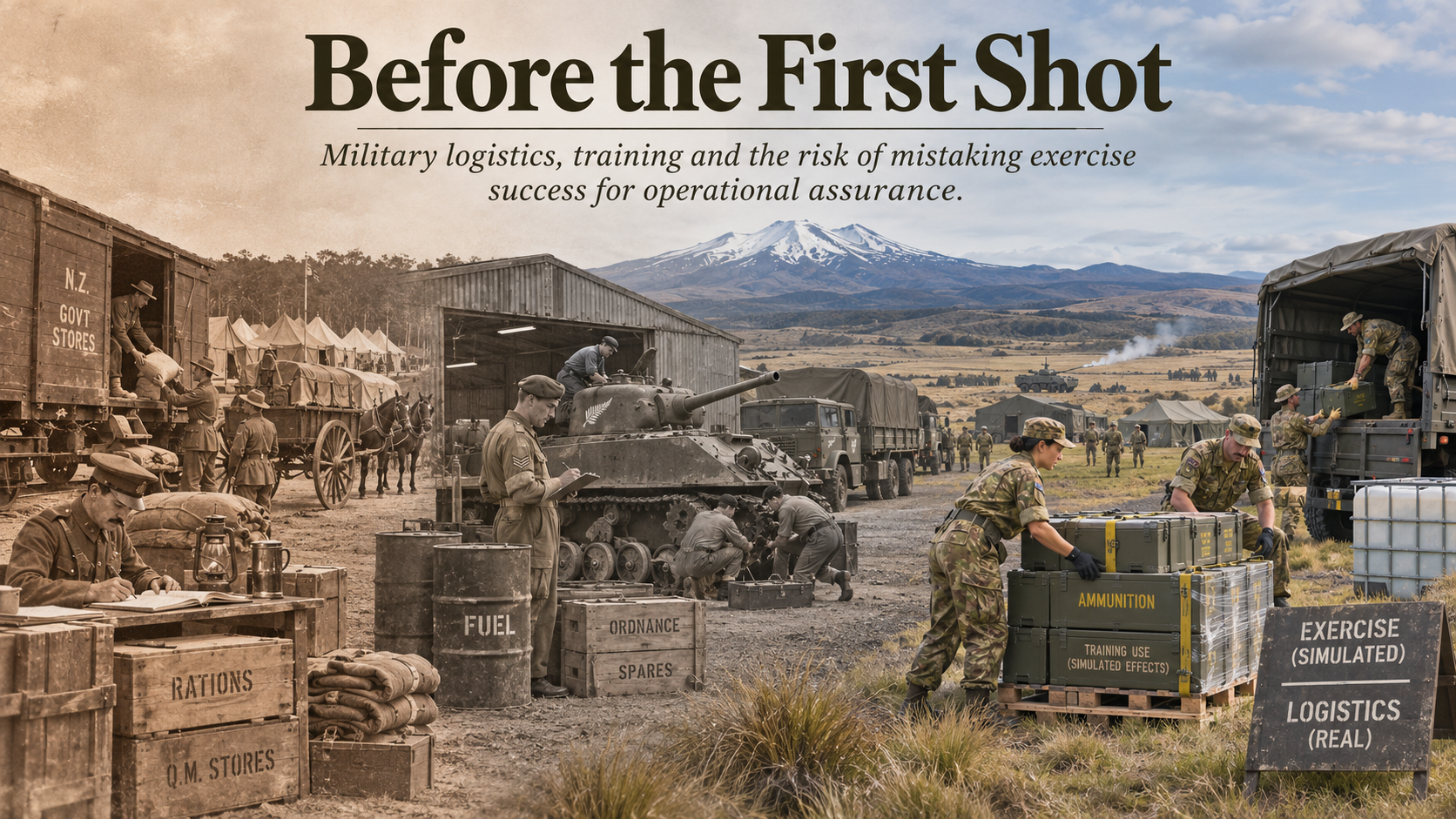
In 1905, Major-General J. M. Babington, commanding New Zealand’s military forces, described a problem that any modern exercise planner would recognise. Realistic manoeuvres had at times been subordinated to the difficulties of feeding the troops.[1]
Military exercises are how an army builds and maintains capability. They let soldiers practise, test new methods, expose weaknesses and prepare for operations. The enemy may be simulated, but the logistics that make the exercise possible are not. Personnel must be moved, equipment prepared, supplies delivered, facilities established, contracts administered and regulations met. Broken equipment needs real repairs, stores must be accounted for, and the money spent is real Defence funding.
New Zealand’s Defence annual reports, from the Volunteer Force of the 1890s to the Territorial Force of the 1960s, show that this distinction has long been understood, even if not in today’s terms. They also show three recurring lessons: inadequate logistics can directly compromise training; the logistics that support training are a genuine military activity in their own right; and innovation and reliability, while complementary, can pull in different directions. They also point to a paradox. The logistics that support an exercise are real, but the logistics that would sustain the operation being rehearsed are often never tested.
Simulated war, real logistics
Military logistics is usually associated with moving, supplying and maintaining forces on operations. Yet these functions do not begin when a force enters a theatre. They start with preparation, mobilisation, deployment and concentration, and continue through the activity itself to recovery and reconstitution. The same processes apply when preparing forces for training.
Before a battalion can conduct a field exercise, its equipment must be serviceable, stores issued, transport arranged and personnel moved. Supplies must be available throughout, and arrangements must be in place to recover people and equipment afterwards. For an international exercise, the list grows to include shipping and aviation, customs clearance, biosecurity, dangerous goods compliance, movement documentation and coordination with allied forces. None of these requirements is simulated because the destination is an exercise.
A truck carrying military equipment to a training area is performing a real transport task. The driver must comply with road rules, the vehicle must be roadworthy, the load must be secured and the movement must be coordinated. The storeman preparing equipment, the clerk processing movement documentation and the planner arranging transport must all deliver the required outcome, whatever military activity they support.
This does not mean all exercise logistics should be formally classified as operational deployment; such classifications carry administrative, legal and command implications that vary with the circumstances. The point concerns the nature of the work itself. The logistics are operational in their execution and consequences, even when their purpose is to enable training.
Contemporary NATO doctrine takes the same view. AJP-4, Allied Joint Doctrine for Sustainment of Operations, addresses sustainment in peace, crisis and conflict, while AJP-4.4, Allied Joint Doctrine for Movement, covers the planning and conduct of movement for both operations and exercises.[2] NATO exercise planning also separates simulated exercise activity from Real Life Support (RLS): the arrangements that sustain the people, facilities and organisations actually conducting the exercise. Simulation can change the conditions the training audience faces, but it cannot suspend the responsibilities of those providing real support.
The distinction is not merely doctrinal. At NATO’s Joint Warfare Centre, a dedicated Real Life Support branch plans transport, accommodation, catering, medical services and other essential arrangements for exercises. Its planners are involved from the outset, because the training audience cannot begin its exercise until the actual people and facilities are ready. The scenario may be fictitious; the support organisation’s obligations are not.[3]
Exercise or operation: what actually differs?
The claim that logistics for training and logistics for operations differ little needs careful qualification. In practical execution, the two have much in common, but some aspects differ significantly.
| Logistics consideration | Military exercise | Actual operation | Assessment |
| Movement planning | Real personnel, vehicles, freight and schedules | Same requirement, potentially under threat | Substantial commonality |
| Stores accounting | Real issues, receipts, custody and financial accountability | Same, often with greater urgency and potential losses | Substantial commonality |
| Equipment maintenance | Real faults, spares, repairs and serviceability | Same, often under degraded conditions | Substantial commonality |
| Supply and replenishment | Real consumption, forecasting and distribution | Same, but consumption may be less predictable | Substantial commonality |
| Contractors and commercial freight | Real commercial services and contractual obligations | Same, with possible war-risk and access complications | Substantial commonality |
| Customs, biosecurity and dangerous goods | Requirements must be met | Requirements remain, subject to relevant authorities or exceptions | Substantial commonality; legal circumstances may differ |
| Medical support | Real injury, illness and emergency response | Same, with potentially far greater casualty demands | Common function, different scale |
| Threat environment | Usually controlled; hostile action simulated | Hostile activity may disrupt or destroy logistics | Significant difference |
| Operational uncertainty | Bounded by exercise objectives and safety controls | Potentially prolonged, unpredictable and adversarial | Significant difference |
| Financial accountability | Real public expenditure | Real public expenditure, sometimes under different authorities | Common obligation |
| Recovery and redeployment | Real return movements and reconciliation | Same, potentially with damaged equipment and casualties | Substantial commonality |
| Acceptable risk | Justified by training value and safety requirements | Justified by operational necessity and mission objectives | Significant difference |
Table 1. Logistics for exercises compared with logistics for operations.
Core logistics functions do not change simply because the supported activity does. What changes is the environment in which they are delivered, the degree of uncertainty, the resources available and the consequences of failure. An operational deployment may face hostile interdiction, combat losses, damaged infrastructure and restricted freedom of movement. A training deployment usually takes place in a far more controlled environment.
That cuts both ways. A preventable failure in the logistics enabling an exercise may be less defensible than one in operations, precisely because so many combat uncertainties are absent. Where the environment is relatively predictable, expectations for dependable logistics should be correspondingly high.
Risk nevertheless differs between training and combat. Exercises have a duty to introduce realistic difficulty, but not to treat avoidable failures in the arrangements enabling training as part of that realism. The United Kingdom’s Health and Safety Executive distinguishes the training benefit of genuine exposure to risk from uncontrolled or inadequately planned exposure. Its guidance stresses progression, proportionality, contingency arrangements and defined cancellation criteria. That guidance is British, not New Zealand law, but its underlying distinction is useful.[4]
Enabling, exercising and developing
Not all exercise logistics serve the same purpose, and three related activities need to be distinguished.
- Enabling logistics ensures the exercising force reaches its destination, receives the resources it needs and can carry out its training: preparing equipment, booking commercial transport, moving freight, establishing accommodation, issuing stores and maintaining vehicles. Success is measured by whether the supported force reliably, safely and economically gets what it needs.
- Exercised logistics is part of the training objectives. A supply unit may be required to establish a distribution point, operate under simulated threat, cope with disrupted communications or sustain a formation under deliberately constrained conditions. Here, discovering limitations can be a legitimate outcome.
- Developmental logistics evaluates new equipment, technology, procedures or organisational arrangements under realistic conditions, such as an improved ration pack, motorised transport or a new information system. The aim is to gather evidence on the capability’s effectiveness, limitations and readiness for wider use.
These categories overlap: the same personnel may perform real logistics tasks while being assessed against exercise objectives. The question is not whether the activity is real, but whether its main purpose is to deliver dependable support, develop a capability, or do both under explicitly defined conditions. Blurring the distinction confuses planning, risk acceptance and performance assessment. A failed trial is useful evidence; a trial the exercising force relied on for food or transport is a support failure.
A recent New Zealand example makes this practical. During Exercises Sangro and Active Edge at Waiouru in 2025, combat service support units simultaneously trained and provided real-life support to another exercising formation. The NZDF recorded 6,080 hot meals, 28,000 litres of diesel and 34 pallets of ammunition delivered, as well as genuine maintenance and repair work. Those quantities were not exercise injects or notional transactions; they were supplies consumed and equipment supported during training.[5]

Feeding the Volunteers
The early development of the New Zealand Army shows directly how reliable logistics and realistic training are linked. In the late nineteenth and early twentieth centuries, the Volunteer Force had significant gaps in its organisation for field supply and transport. Without permanent arrangements for feeding and moving troops, realistic manoeuvres were difficult to conduct.
The 1901 Defence Report records a Wellington infantry battalion making a three-day march through the Wairarapa, carrying its own camping equipment and organising its own commissariat and transport.[6] The march was valued because it exposed soldiers to practical responsibilities that drill-hall training could not reproduce. Here, logistics was part of the training itself.
Improvisation, however, did not scale. In 1904, Babington stressed the need for an organised Army Service Corps, trained in peacetime for supply and transport duties. His concern was not simply the lack of a specialist corps, but that the absence of systematic arrangements undermined the Army’s capacity to operate in the field.[7] His 1905 report, with manoeuvres giving way to the problem of feeding the troops, is one of the clearest historical examples of inadequate enabling logistics compromising tactical training. The lesson was simple: realistic tactical training required a dependable logistics organisation.

Railways, sidings and Territorial camps
The establishment of the Territorial Force after 1910 greatly increased New Zealand’s training requirements. Large numbers of soldiers had to be concentrated, equipped, and sustained for annual camps, requiring coordination among military authorities, the railways, shipping companies, contractors, and local suppliers.
The 1913 Defence Report records the introduction of centralised brigade supply and ordnance arrangements for training camps.[8] Supply depots were established, personnel assigned to issuing and accounting duties, and specialist units employed to provide support. This eased the administrative burden on combat commanders, letting them concentrate on training. It also had a secondary benefit: Army Service Corps personnel gained experience by providing real support.
The following year, large Territorial concentrations showed the scale of movement involved. Troops, horses, artillery, equipment, and supplies travelled by rail and coastal shipping, and special railway sidings were built near several campsites. Transport also influenced where some units could train. In the Canterbury Military District, the difficulty of moving personnel to Kowai contributed to a separate concentration being arranged at Tapawera.[9]
The training programme therefore had to fit the practical limits of the transport network. Logistics did not simply support the exercise once planning was complete; its availability shaped how the exercise was designed and conducted.
Bread for an army in training
The First World War expanded New Zealand’s training and mobilisation requirements on an unprecedented scale. The camps at Trentham and Featherston became major logistics establishments, and supplying food, clothing, equipment, accommodation, transport and medical services required continuous coordination with civilian industries and government departments. By 1917, the Army Service Corps bakeries at Trentham and Featherston were producing about 6,000 and 7,000 pounds of bread a day, respectively.[10]
The consequences of support capacity being overtaken by demand were sometimes more serious than reduced training time. Historian Tim Shoebridge documents the overcrowding of Trentham Camp in 1915 and the deterioration of its basic facilities as reinforcement numbers rose. Twenty-seven recruits died of infectious disease during the winter crisis. This was a complex public-health and camp-management failure, not simply a shortage of rations; it nevertheless shows why the infrastructure enabling military training cannot be treated as a secondary concern.[11]
At that scale, supporting training had become a major military enterprise in its own right. The logistics organisation was responsible for sustaining thousands of soldiers in training, not merely for showing that it knew how to provide those services. At the same time, its personnel gained professional experience by doing their actual jobs, a combination of real service and professional development that would remain characteristic of New Zealand’s military logistics throughout the twentieth century.
Training on a shoestring
After the war, the Army faced sustained financial pressure. The 1918 Defence Report had already identified savings from concentrating training at fewer locations, reducing duplication of administrative staff, instructional equipment, temporary facilities and transport. But it also questioned whether the savings from cutting specialist instructional courses justified the training lost.[12]
Financial restrictions tightened in 1922 and 1923. Territorial camps were cancelled, the School of Instruction was closed and opportunities for collective training were sharply reduced. The effects went beyond the exercises themselves: without collective training, it became harder to retain experienced officers and non-commissioned officers.[13]
The artillery in 1925 offers a particularly relevant example of equipment constraints. Additional horses allowed batteries to undertake tactical movement that had previously been impossible, but pack batteries remained restricted by the lack of mule transport. Improvised arrangements allowed limited training, yet the report acknowledged that these methods would not have been satisfactory in wartime.[14]
The distinction is significant. An organisation can complete a training activity with improvised arrangements without demonstrating the capability operations would require. That some training took place did not remove the equipment deficiency.

Hired lorries and the road to mechanisation
By the 1930s, the Army was increasingly examining the potential of motor transport. The 1937 Defence Report describes trials involving artillery, infantry and commercial motor vehicles, which exposed practical limitations in vehicle speed, cross-country mobility and the suitability of artillery equipment designed for horse traction.[15] Rather than assuming that motorisation would automatically improve effectiveness, the Army evaluated the alternatives.
The 1st Battalions of the Canterbury and Taranaki Regiments then held annual camps using hired motor transport. The vehicles moved troops to and from camp and provided mobility during tactical training, cutting transport costs while allowing soldiers to train over a wider area. The 1938 Defence Report records further development, including district motor-transport pools supplemented by hired commercial vehicles. These arrangements freed more time for field training, reduced fatigue and widened the range of exercises units could undertake.[16]
This is a good example of technological change improving both the enabling logistics and the training itself. It also shows the value of practical experimentation: the Army did not test the new transport in isolation, but assessed whether it actually improved military activity.
Workshops, ration packs and contractors, 1950–1969
The post-war period brought compulsory military training, a reorganised Territorial Force, increasing mechanisation, overseas commitments and growing technical complexity. Together, these placed greater demands on the Army’s supply, transport, maintenance and administrative organisations, and on the civilian firms it increasingly relied upon.
Training and operations competed for the same stores. In 1951, the RNZAOC provided more than 1,000 tons of equipment for Kayforce while effectively running separate issues for training and overseas service. The following year, the loss of stores aboard Wahine meant the force in Korea had to assemble and despatch replacement equipment at short notice, while routine issues to units in training continued.[17]

Maintenance capacity became a recurring constraint. In 1953, civilian workshops overhauled more than 800 vehicles to make enough transport available for training. In 1954, the Waiouru workshops overhauled 80 tanks before the annual camping season, and Territorial workshop units carried out field repairs in camp. Through the mid-1950s, an ageing vehicle fleet and difficulty obtaining spares kept workshop detachments busy with genuine repairs, so that maintenance support and maintenance training happened at the same time. By 1957, the Army was openly reporting that ageing vehicles and a lack of modern equipment were limiting both training and operational effectiveness, and in 1958 fires at Waiouru further strained workshop capacity.[18]
Training also became a test bed. In 1959, a four-man, 24-hour ration pack was trialled during the annual camps of the 1st and 4th Armoured Regiments. In 1960, difficulty supplying some training areas by road encouraged the development of aerial supply and air-dispatcher training with the RNZAF, alongside extensive hiring of equipment, vehicles and buildings. In 1961, a Regular Field Force exercise tested mobilisation procedures and preparation for an air-transported overseas move, and revised 24-hour ration packs were used extensively.[19]

Later reports show the same dual responsibility. An exercise in the Napier–Waiouru area in 1963 included establishing and operating a transport airhead, making movement and support a deliberate training objective. By 1969, RNZAOC field units were being reorganised to undertake the supply tasks they would perform in war during peacetime, rather than relying upon annual camps alone for that experience. The 1969 report also describes commercial shipping arrangements that improved ammunition supply for RNZAF operational training. Both cases depended on real movement and supply arrangements, although only some activities were evaluated as exercises.[20]

The logistics paradox
A paradox lies at the heart of military exercises. The logistics that make training possible are real, but that does not mean the sustainment system represented in the training scenario has been tested. A formation can arrive fully equipped and complete its planned serials without demonstrating that its own supply chain could sustain comparable activity over time. Not every exercise suffers from this. In the author’s experience, however, post-exercise reports rarely make that distinction, and this section addresses the gap.

Some exercises are necessarily short, tightly controlled or focused on particular tactical objectives. Ammunition consumption may be notional, supply vehicles protected from enemy action and the effects of attrition reduced. Such choices can be entirely appropriate where logistics resilience is not among the training objectives. The danger arises when those limitations are forgotten and the exercise is subsequently taken as evidence that the full sustainment system has been validated.
New Zealand’s own recent example shows why the question matters. In the NZDF’s account of Exercise Sangro, combat service support units on the parallel Exercise Active Edge provided the real-life support that gave the troops on Sangro everything they needed to sustain their activities.[21] That was genuine work and genuine training for the logisticians involved. It also means that Sangro’s sustainment was delivered by a separate support organisation working to its own exercise. Whether the exercising force’s own supply chain would have kept pace with the fight Sangro represented, under the friction, losses and competing priorities of a real campaign, is a different question, and not one the published account sets out to answer.
Australian military writers have questioned precisely this tendency. Daniel Chen argues that some major exercises protect combat service support elements from simulated attack and allow contractors to remedy deficiencies directly, reducing the pressure on the tactical supply chain. David Beaumont separately warns that units can deploy with enough supplies to complete an exercise without testing replenishment or commanders’ ability to prioritise scarce resources. These are argued assessments of Australian practice, not findings about New Zealand; they show how apparent exercise success may conceal questions that the exercise never asked.[22]

United States Army writing points to another neglected element: reception, staging, onward movement and integration. These are capabilities in their own right, not simply the administrative prelude to combat training. Major Bryan Quinn argues that they must be practised under realistic conditions if an army expects to deploy into a contested theatre. This also sharpens the difference between moving a force to an exercise and assuming that a simulated force could have been deployed just as effectively.[23]
The 1925 New Zealand artillery report offers a useful corrective. It did not confuse training undertaken with improvised transport with proof that the batteries were properly equipped for war. A modern review should be equally specific: which sustainment functions were tested, which were notional and which were provided by real-life support? Where sustainment is among the objectives, a credible design should impose some cumulative demand, movement friction and competing priorities on the force’s logistics units. Where it is not, the resulting assurance claim should be appropriately narrow.
What did the exercise actually prove?
The question is not merely theoretical. In its 2016 audit of the United States Army’s Pacific Pathways initiative, the Government Accountability Office found that participating exercises created worthwhile opportunities but that the Army had not comprehensively assessed their benefits relative to costs. It also identified difficulties synchronising planning and incorporating the training objectives of supporting units, including transport organisations. The audit did not conclude that the exercises were valueless. It showed that successfully conducting complex activities and proving their overall value are not the same judgement.[24]
That distinction matters whenever a successful movement is achieved through overtime, exceptional intervention, duplicate records, expensive last-minute transport or the efforts of a few unusually experienced people. None of those responses automatically makes an activity unsuccessful. But a post-exercise report that records the force’s arrival without explaining what was required to get it there may overstate the strength and repeatability of the underlying process. The same applies when a new logistics method is tried: judge its contribution against the cost, reliability, and practical consequences of its use, not simply whether the activity finished on time.
When the workaround becomes the standard
A related question is what repeated success can hide. Military people are expected to improvise, and logisticians take pride in finding a way to deliver. That adaptability is indispensable when circumstances change unexpectedly. It can become a weakness, however, if known shortfalls are routinely planned around, exceptional effort is treated as ordinary capacity and temporary workarounds survive without review. At that point, a process that appears dependable may depend on arrangements never formally accepted or adequately resourced.
Sociologist Diane Vaughan used the term normalisation of deviance to describe how departures from accepted standards can gradually come to seem ordinary through repeated use and apparently successful outcomes. Jens Rasmussen’s research on dynamic risk management helps explain how practical decisions can drift towards boundaries under pressure from cost, workload and production demands. The concern is not that every deviation is negligent: there is a difference between a documented and proportionate risk decision, a justified operational improvisation and a habitual departure whose consequences are no longer examined. The historical reports in this article cannot establish that normalisation of deviance characterises the NZDF, and no particular post-exercise report has been analysed here. The concept is a question to test, not a verdict.[25]
NASA has itself identified organisational silence and normalisation of deviance among the cultural lessons of the Columbia accident. The US Army Combat Readiness Center has likewise warned that shortcuts, pressure to meet deadlines and unwritten practices can gradually become accepted routines. Their experiences cannot be transferred wholesale to military exercise planning. They do, however, suggest useful questions: which exceptions recur, who approves them, what does each workaround actually cost and do later exercises demonstrate that the underlying weakness was corrected?[26]
A more useful response than blaming individuals is to make the difference between planned and actual performance visible. Exercise planners and logisticians can specify the services that must not fail, identify which activities are developmental trials, record significant deviations and their owners, and review whether the intended training benefits were realised. Professional challenge is then part of assurance, not an objection to innovation. An organisation that documents both the workaround and the reason for it can learn; one that only records a completed exercise risks mistaking resilience for proof that the original plan was sound.
Conclusion: there is no simulated responsibility
From the Wairarapa route march of 1901 to the supply and workshop duties of the post-war Army, the New Zealand record is consistent. Where logistics was inadequate, training could be reduced; where it was effective, commanders had the time and resources to train. Where transport, rations or supply arrangements were deliberately trialled, exercises also offered useful opportunities to identify improvements. The work of moving, feeding, equipping and repairing a force remained real throughout, even where the tactical situation was not.
Yet real support for an exercise is not by itself evidence that the force’s wartime sustainment has been tested. That conclusion depends on the exercise objectives and what its design actually challenged. The proper response is neither to exclude experimentation from training nor to accept every workaround without question. It is to be clear about the activity being supported, the capability being examined and the consequences of failure. The enemy may be simulated, and the first shot may be blank, but the obligation to provide reliable logistics support is real long before it is fired.
The views expressed in this article are the author’s own and do not represent those of the New Zealand Defence Force.
Notes
[1] “Defence Forces of New Zealand: Annual Report,” Appendix to the Journals of the House of Representatives (AJHR), 1905, H-19.
[2] North Atlantic Treaty Organization, Allied Joint Doctrine for Sustainment of Operations, AJP-4, ed. C, ver. 1 (Brussels: NATO Standardization Office, August 2025), https://www.gov.uk/government/publications/allied-joint-doctrine-for-sustainment-of-operations-ajp-4; North Atlantic Treaty Organization, Allied Joint Doctrine for Movement, AJP-4.4, ed. C, ver. 1 (Brussels: NATO Standardization Office, September 2022), https://www.gov.uk/government/publications/allied-joint-doctrine-for-movement-ajp-44.
[3] Annie Viens, “Real Life Support: Event Management at the JWC,” NATO Joint Warfare Centre, pp. 112–15, https://www.jwc.nato.int/wp-content/uploads/2024/08/25-Real_Life_Support_Event_Management_at_the_JWC-reduced.pdf.
[4] Health and Safety Executive, “HSE’s Position on Realistic Training in the Military,” https://www.hse.gov.uk/services/armedforces/realistic-training.htm.
[5] New Zealand Defence Force, “Keeping Frontline Soldiers Fed and Fighting Key to Combat Success,” 10 April 2025, https://www.nzdf.mil.nz/army/army-news/keeping-frontline-soldiers-fed-and-fighting-key-to-combat-success/.
[6] “Defence Forces of New Zealand,” AJHR, 1901, H-19.
[7] “Defence Forces of New Zealand,” AJHR, 1904, H-19.
[8] “Defence Forces of New Zealand,” AJHR, 1913, H-19.
[9] “Defence Forces of New Zealand,” AJHR, 1914, H-19.
[10] “Defence Forces of New Zealand,” AJHR, 1917, H-19.
[11] Tim Shoebridge, “Getting the Men to War,” NZHistory, Manatū Taonga—Ministry for Culture and Heritage, updated 16 September 2025, https://nzhistory.govt.nz/page/getting-men-war.
[12] “Defence Forces of New Zealand,” AJHR, 1918, H-19.
[13] “Defence Forces of New Zealand,” AJHR, 1922, H-19; “Defence Forces of New Zealand,” AJHR, 1923, H-19.
[14] “Defence Forces of New Zealand,” AJHR, 1925, H-19.
[15] “Defence Forces of New Zealand,” AJHR, 1937, H-19.
[16] “Defence Forces of New Zealand,” AJHR, 1938, H-19.
[17] Defence annual reports, AJHR, 1951 and 1952, H-19.
[18] Defence annual reports, AJHR, 1953–1958, H-19.
[19] Defence annual reports, AJHR, 1959–1961, H-19.
[20] “Report of the Chief of the General Staff,” AJHR, 1963, H-19, 7; “Report of the Ministry of Defence,” AJHR, 1969, H-4, 25–26.
[21] New Zealand Defence Force, “Keeping Frontline Soldiers Fed.”
[22] Daniel Chen, “Combat Service Support on Exercise: The Case for Making Them Vulnerable Again,” Australian Army Research Centre, 30 August 2016, https://researchcentre.army.gov.au/library/land-power-forum/combat-service-support-exercise-case-making-them-vulnerable-again; David Beaumont, “Logistics and the Art of Prioritisation,” Australian Army Research Centre, 24 December 2016, https://researchcentre.army.gov.au/library/land-power-forum/logistics-and-art-prioritisation.
[23] Bryan J. Quinn, “Intratheater Logistics Proficiency: Preparing for the Modern Contested Fight,” Military Review (July–August 2022), https://www.armyupress.army.mil/Journals/Military-Review/English-Edition-Archives/July-August-2022/Quinn/.
[24] US Government Accountability Office, Army Pacific Pathways: Comprehensive Assessment and Planning Needed to Capture Benefits Relative to Costs and Enhance Value for Participating Units, GAO-17-126 (Washington, DC, 2016), https://www.gao.gov/products/gao-17-126.
[25] Diane Vaughan, The Challenger Launch Decision: Risky Technology, Culture, and Deviance at NASA (Chicago: University of Chicago Press, 1996); Jens Rasmussen, “Risk Management in a Dynamic Society: A Modelling Problem,” Safety Science 27, nos. 2–3 (1997): 183–213, https://doi.org/10.1016/S0925-7535(97)00052-0.
[26] National Aeronautics and Space Administration, “Columbia: STS-107 Lessons Learned,” NASA Safety and Mission Assurance, https://sma.nasa.gov/sma-disciplines/accllp/columbia; Chris Acord, “When Cutting Corners Becomes the Norm: How Normalizing Deviance Can Lead to Disaster,” Risk Management Magazine, US Army Combat Readiness Center, 6 July 2025, https://safety.army.mil/MEDIA/Risk-Management-Magazine/ArtMID/7428/ArticleID/8075.
