
The Early Roots of RNZEME and Today’s RNZALR Maintenance Support Trades
Today’s Royal New Zealand Army Logistic Regiment (RNZALR) Maintenance Support tradespeople carry forward the military engineering work associated with RNZEME. When the RNZALR was formed in 1996, it brought together RNZEME, RNZAOC and RNZCT within an integrated logistic organisation.[1] Its workshop trades include Armourers, Automotive Technicians, Electrical Fitters, Electronics Technicians and Maintenance Fitters.[2] Their equipment has changed considerably, but their purpose remains recognisable: keeping the Army’s equipment serviceable and returning it to use when it fails.
For these tradespeople, the nineteenth-century maintenance story remains practically relevant. It records successive generations learning new technologies, maintaining different equipment types, training their replacements and making the case for adequate workshops and technical staffing. These recurring demands provide a contemporary perspective on the service’s foundations before 1917.
The Challenge of Early History
Peter Cape’s Craftsmen in Uniform and Peter Cooke’s Warrior Craftsmen cover the history of the Royal New Zealand Electrical and Mechanical Engineers and its immediate Ordnance predecessors from 1917 onwards. The earlier foundations are harder to trace. They lie among civilian armourers, Defence Stores employees, military artificers and the specialists who maintained the machinery of New Zealand’s coastal defences. Their work crossed administrative boundaries and appeared in records created for purposes other than preserving a corps history.
Cape recognised the problem. Writing in 1976, he described a “curious grey period” in the nineteenth century and reproduced an Archives response explaining that no separate record of armourers and artificers had been identified. Cooke subsequently challenged the familiar account that began with three Wellington artificers in 1892, pointing to a larger technical workforce already serving in the Permanent Militia during the 1880s.[3]
Surviving expenditure records, official reports, and histories of individual armourers help define this earlier service. Read together, they suggest that the foundations of RNZEME developed through the gradual accumulation of skilled personnel, workshops, inspection duties and training arrangements. This was also part of the ancestry of RNZAOC: the provision, custody and maintenance of military equipment developed in close association long before separate corps assumed responsibility for supply and engineering.
British Military Precedents
British forces brought established military trades to New Zealand. Armourers, wheelwrights and blacksmiths supported regiments and batteries, while workshops employed both soldiers and civilians. Cooke describes workshop facilities at Albert Barracks in Auckland and Mount Cook in Wellington during the late 1840s, together with mobile forges used on campaign. These provided an early setting for the military employment of technical skills.[4]
Experience also passed into colonial service through individuals. Cape identifies Patrick Gorman, a former soldier of the 58th Regiment who took his discharge in New Zealand and became an arms cleaner with the Auckland Militia. Such appointments linked the practical maintenance of weapons to the emerging colonial organisation responsible for holding and issuing them.[5]
The Civilian Foundation
The civilian armourers deserve particular attention. Wellington’s maintenance service included Edwin Henry Bradford, Edward Metcalf Smith, and Walter Christie, while David Evitt and, later, George Evitt served in Auckland. They gained experience through several routes: British military service, arms manufacture, commercial gunsmithing, and training in government workshops. Christie’s progression from arms cleaner to assistant armourer is a useful example of practical training within the service. Civilian gunsmiths also repaired government weapons in the districts and supported Volunteer units.[6]

These men worked through a period of substantial change in firearms. Muzzle-loading weapons gave way to breech-loaders, followed by magazine rifles and machine guns. New mechanisms increased the demands on inspection, fitting and repair, while older weapons remained in circulation. The service therefore required both familiarity with successive equipment types and continuity of experience within its workshops.
Early Formal Organisation (1880–81)
By 1880–81, the estimates clearly recognised maintenance as a continuing government function. Under Stores and Magazines, Auckland had provision for an armourer and three arms cleaners. Wellington had an armourer, an assistant and three arms cleaners. These appointments sat alongside storekeepers, clerks and magazine staff.[7] The organisation responsible for weapon custody also provided the people who kept them serviceable.
Coastal Defences Expansion (1880s)
The expansion of coastal defences during the Russian scares of the 1880s greatly widened this technical requirement. The batteries formed part of a harbour-defence scheme in which guns, submarine mines, torpedo boats and, increasingly, electric searchlights had complementary roles. At Wellington, Fort Ballance was intended to cover the harbour approaches and a proposed wartime minefield between Point Gordon and Ward Island; searchlights would illuminate the channel and minefield.[8] These schemes developed over years. Their intended arrangement should not be mistaken for a complete, continuously operational system at every port in 1885.
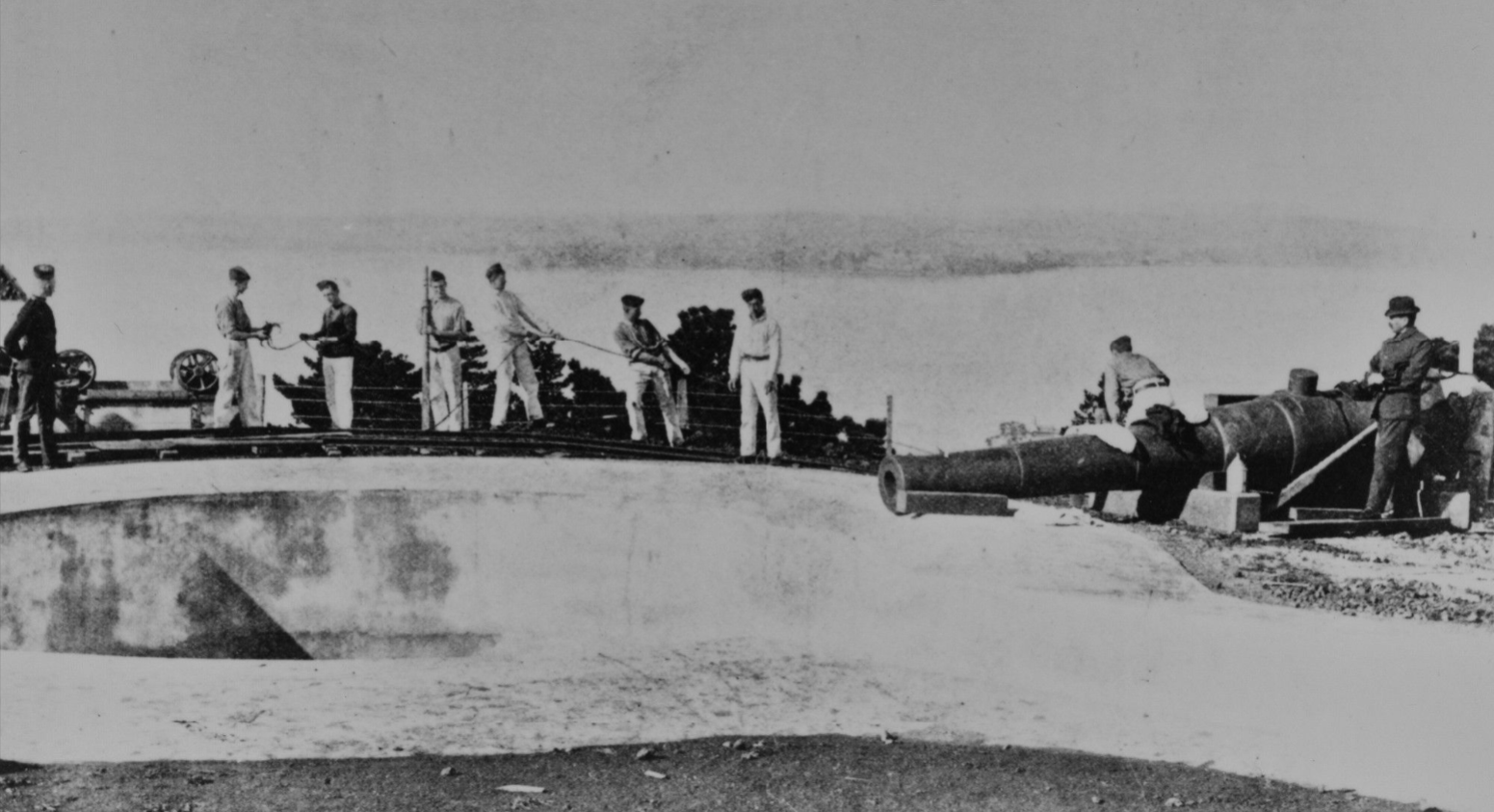
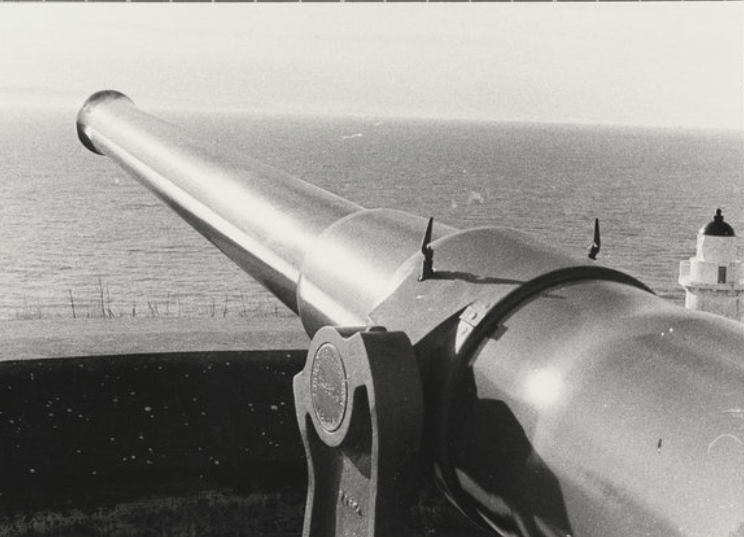
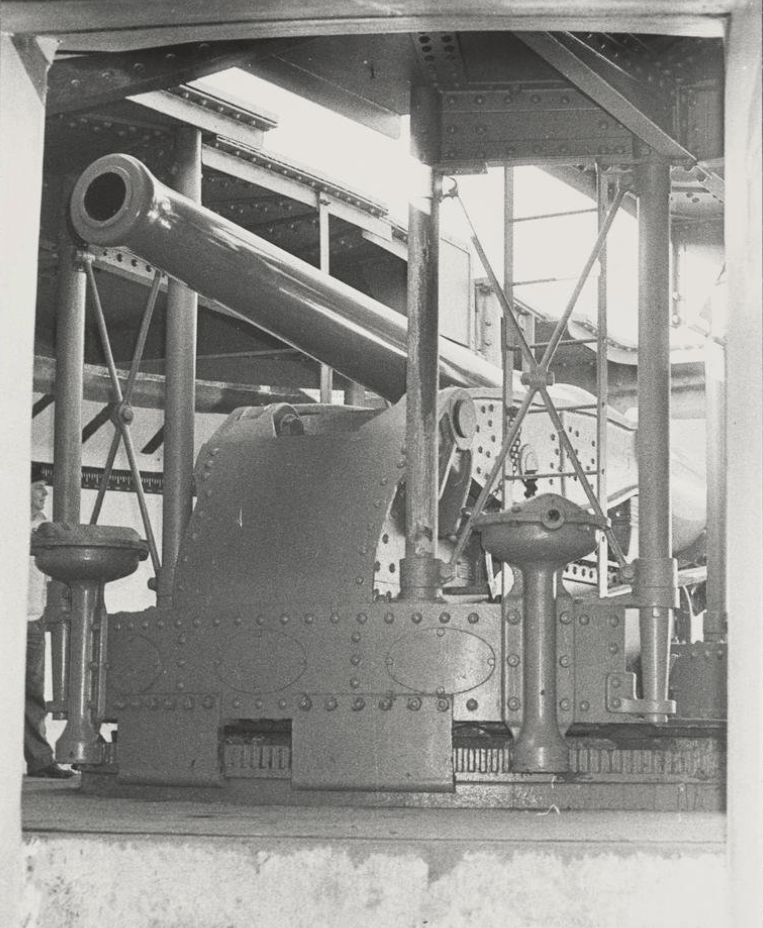
The guns themselves brought substantial machinery into military service. Rifled muzzle-loaders remained alongside the newer breech-loading weapons. Taiaroa Head’s armament over 1885–1905 included 64-pounder and 7-inch muzzle-loaders, a 6-inch disappearing gun, and smaller quick-firing guns.[9] North Head’s 8-inch disappearing guns illustrate the additional complexity of the new mountings: recoil drove the gun down behind cover, compressing air through a system using water and a pressure vessel; the stored energy then raised it again.[10] The engineering requirement extended from the barrel and breech to the carriage, moving joints and pressure machinery.
Another branch of this machinery went afloat. Four Thornycroft spar torpedo boats arrived in 1884 and became associated with the names Waitemata at Auckland, Poneke at Wellington, Defender at Lyttelton and Taiaroa at Port Chalmers. At Magazine Bay, Lyttelton, a purpose-built boatshed and slipway supported Defender from 1885.[11] Cape describes the boats’ compound condensing engines, supplied with steam from locomotive-type boilers, and their single-screw propulsion. Their weapon was an explosive charge carried on a projecting spar.[12] Maintaining this equipment required marine engineering and metalworking skills, as well as knowledge of the weapon itself.
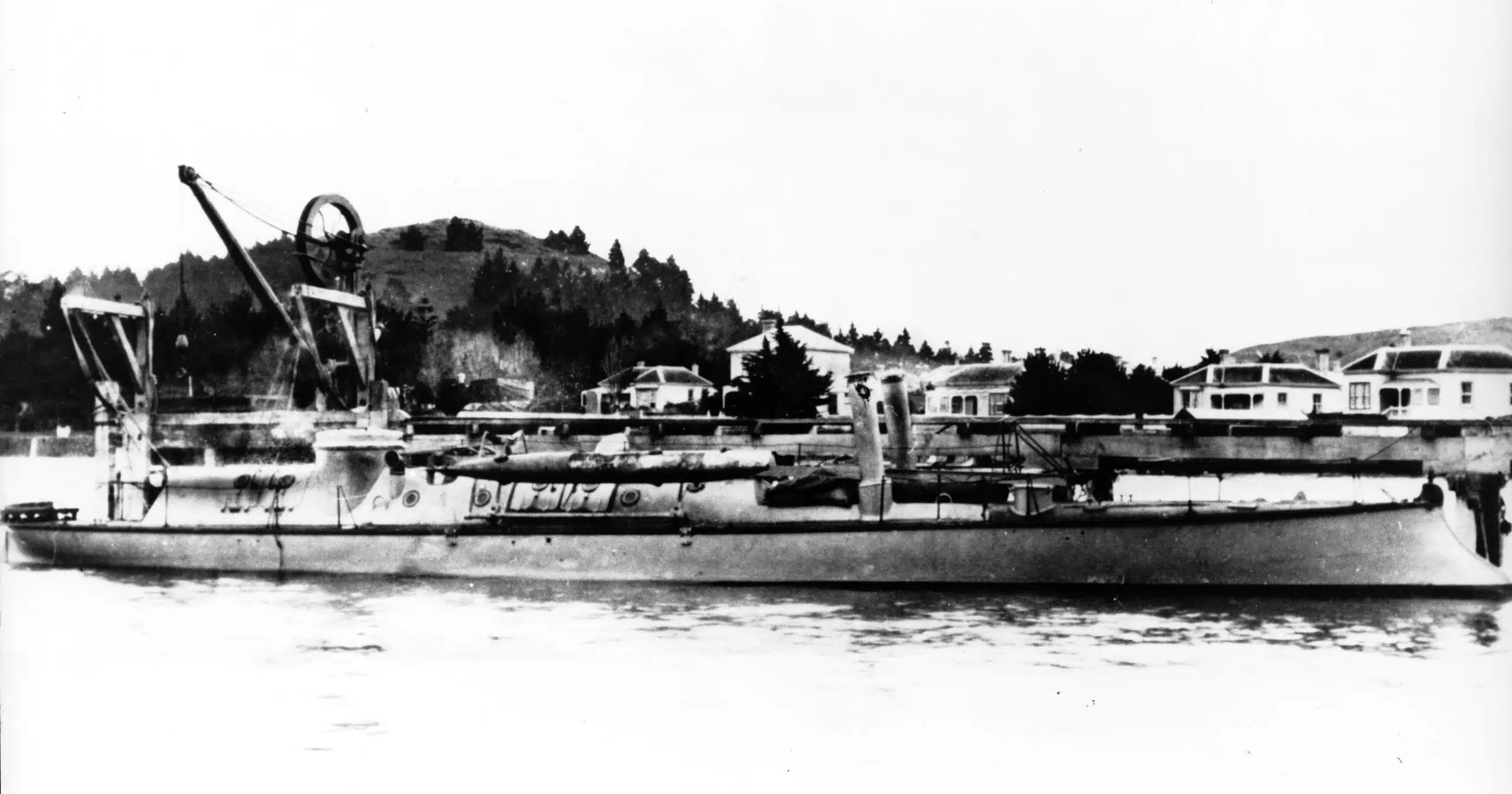
National Museum of the Royal New Zealand Navy, AAA 0007.
Submarine mining added electrical work to the harbour-defence service. Here, submarine meant underwater mines, rather than underwater vessels. Shore-controlled minefields depended on cables, electrical testing and firing apparatus, batteries and observation arrangements. At Torpedo Bay, the developing depot included workshops, fitting rooms and a forge, followed by a connecting-up shed in 1897 and a new test room in 1898. Its test and firing equipment included shutter indicators, while telephones and voice pipes supported communication.[13] The mine was only one part of an installation whose readiness depended on machinery and electrical connections ashore and afloat.
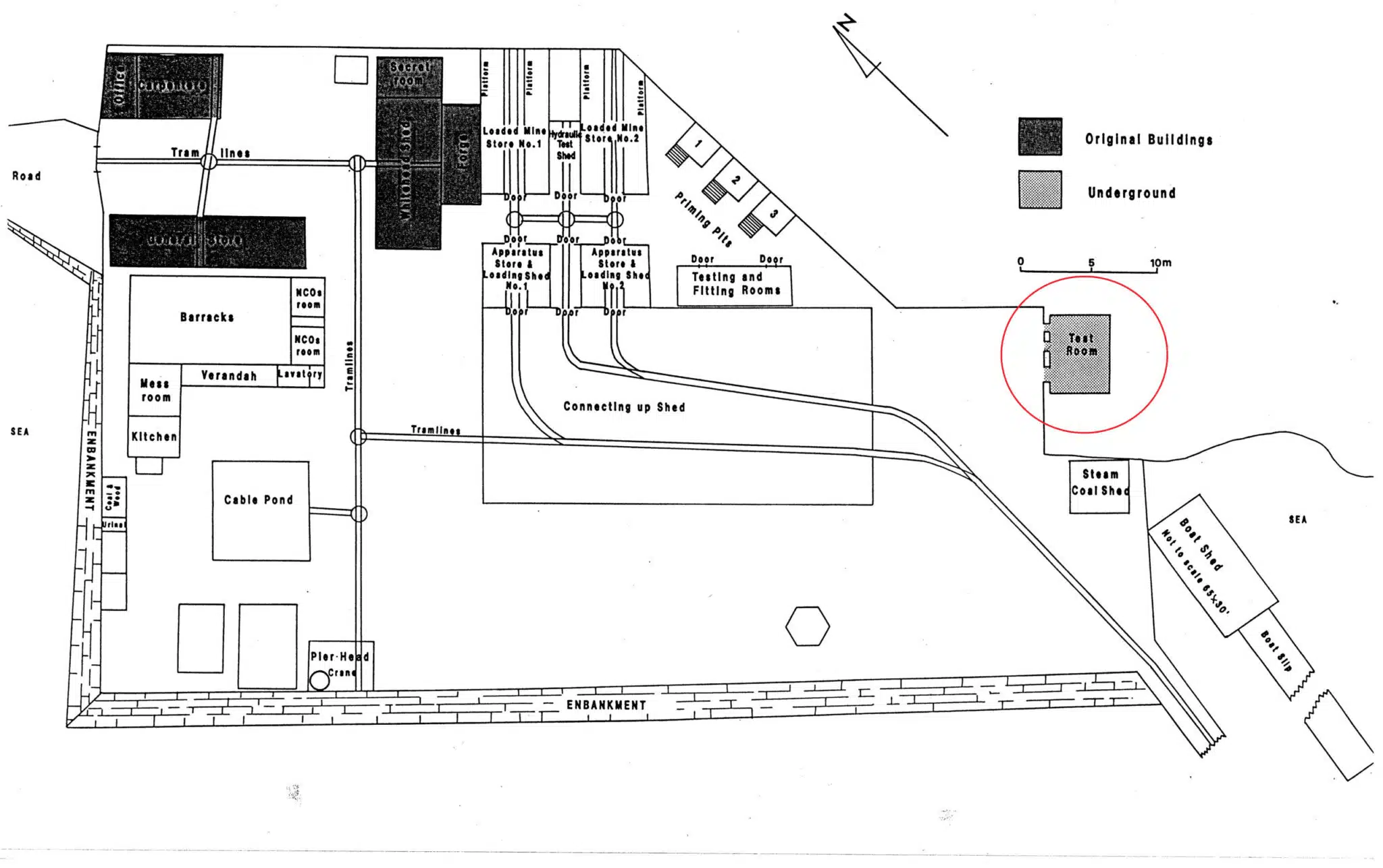
National Museum of the Royal New Zealand Navy
The site’s technical role continued long after submarine mining ceased. The former Torpedo Yard subsequently housed the Devonport Ordnance Workshop from 1925 to 1941, followed by No. 12 Ordnance Workshop from 1941 to 1946. This continued use provides a tangible connection between the nineteenth-century harbour-defence establishment and the Army’s twentieth-century maintenance and repair organisation.
Equipment Range and Maintenance Demands
The following examples show the breadth of equipment encountered before 1917. The equipment and installations are documented; the maintenance demands in the final column are inferred from their construction and function, except where contemporary reports expressly describe the work. They are not a complete allocation of duties to particular trades or units.
| Equipment | Documented New Zealand examples | Maintenance demands |
| Small arms and machine guns | Martini-Henry and .303 rifles in the 1899 report; Maxim inspection and repair training in 1914.[14] | Inspection and repair of actions, firing and feed mechanisms, barrels and fittings; keeping armourers familiar with successive patterns. |
| Coastal guns and mountings | Rifled muzzle-loaders, 6-inch and 8-inch disappearing guns, and smaller quick-firing weapons.[15] | Fitting and metalwork on gun mechanisms and carriages; attention to bearings, traversing gear, recoil and pressure components. |
| Rangefinders and pressure gauges | Taiaroa Head’s 1886 depression rangefinder; Fox’s explicit account of instrument repairs by fitter artificers.[16] | Care of optical and mechanical parts; accurate adjustment and repair of instruments used for ranging and machinery checks. |
| Steam engines, dynamos and searchlights | Fort Takapuna’s engine room and searchlight, added in 1899, with a steam engine driving a dynamo.[17] | Engine and boiler upkeep; lubrication and mechanical adjustment; attention to generators, wiring, connections and lamps. |
| Controlled submarine mines | Torpedo Bay’s batteries, cables, test and firing apparatus and connecting-up facilities.[18] | Testing electrical continuity and insulation; maintaining connections, indicators and associated apparatus. |
| Spar torpedo boats | Thornycroft boats with compound engines, locomotive-type boilers, propellers and spar equipment.[19] | Upkeep of steam plant, propulsion and steering; repair of hull fittings and weapon-handling mechanisms. |
| Ammunition handling machinery | Magazine rails and trolleys at Fort Takapuna; powered ammunition hoists associated with North Head’s 6-inch Mk VII battery, operational by 1911.[20] | Keeping running gear and lifting machinery serviceable; mechanical repairs and attention to corrosion and wear. |
| Communications | Fort Ballance’s ten-line telephone exchange, installed in 1899; telephone and voice-pipe arrangements at the mining base.[21] | Maintaining instruments, lines, connections and fittings through which observers and operators communicated. |
Technical Expertise and Organisational Development (1886–1912)
This range helps explain the employment of fitters, engineers, electricians, carpenters and other artisans within the permanent forces. A serviceable gun barrel alone could not make a battery effective if its mounting, ammunition supply or supporting equipment failed. The later engineering corps’ association with electrical and mechanical work therefore had substantial precedents in the harbour-defence service, even though the men concerned served under different organisations.
Cape’s account of the 1886 organisation places Artillery, Engineers and the Torpedo Corps within the developing permanent forces. The Defence Act transferred the relevant elements of the Armed Constabulary into the Permanent Militia. In his 1887 report, Colonel Sir George Whitmore described the Engineer Corps as skilled military artificers and artisans employed on defence works.[22]
The estimates make the range of appointments particularly clear:
| Financial year | Organisation | Technical appointments provided for |
| 1880–81 | Stores and Magazines, Auckland | One armourer and three arms cleaners |
| 1880–81 | Stores and Magazines, Wellington | One armourer, one armourer’s assistant and three arms cleaners |
| 1886–87 | Engineer Corps | Seventeen artificers, one sergeant-major/foreman and two sergeants |
| 1886–87 | Torpedo Corps | Four engineers, five artificers, an electrician and lecturer, and a Whitehead and submarine instructor |
| 1891–92 | Garrison Artillery | Twelve artificers at seven shillings a day |
| 1898–99 | No. 1 Service Company | Twelve artificers at eight shillings a day |
These were funded appointments, rather than a return proving that every position was occupied throughout each year. They should also be read as separate establishments, not combined into a single corps total. Their importance lies in the continuing recognition of specialist technical employment within both civilian and military organisations.[23]
Technical oversight developed alongside these establishments. Cape records the appointment of Lieutenant A. P. Douglas, RN, in August 1887 to inspect guns, ammunition, equipment and associated stores in the forts. Lieutenant J. Falconer became Inspector of Submarine Mining Stores and Establishments the following month.[24] Inspection responsibilities were becoming more clearly defined alongside operating and repairing the equipment.
Reorganisation altered where the tradesmen served. Cape records that, when the Engineer and Rifle branches were abolished in 1888, qualified personnel could transfer into the remaining branches. Four artificers;T. E. Bryce, W. E. Moore, J. Trainor and H. D. James, transferred from the Engineers to the Garrison Artillery.[25] Their movement is a useful example of continuity through administrative change: the disappearance of a branch did not mean that its skills disappeared from military service.
Beyond the 1892 Myth
This wider picture changes how we should understand the often-repeated 1892 starting point. The short corps histories identify two fitter artificers and one wheeler artificer at Wellington in that year. That local group cannot represent the beginning or the full extent of New Zealand’s military maintenance service. Civilian armourers were already established, other technical trades were funded during the 1880s, and the artillery estimates provided for twelve artificers across the opening years of the 1890s.[26]
Contemporary reports also describe their actual work. The 1892 report on the New Zealand forces credited battery artificers with overhauling guns and mountings, making repairs and improving fittings. Their efforts saved expense and improved efficiency. It also highlighted the limited advancement available to men with substantial technical responsibilities.[27]
Colonel F. J. Fox’s report, presented in 1893, distinguished fitter artificers from wheeler artificers. Fitters required knowledge of fitting, turning and blacksmithing, and repaired instruments such as rangefinders and pressure gauges. He valued their work highly and recommended graded promotion and pay. He also considered ordinary drill and parades an unnecessary demand on men already occupied by specialist duties.[28]
Fox separately proposed teaching artillery artificers selected gunsmithing tasks and using them for annual district inspections of small arms, with necessary repairs charged to the corps holding the damaged weapons. This remained a proposal. It nevertheless shows how training, inspection, repair and accountability were being considered together.[29]
The civilian service continued alongside these military arrangements. Wellington’s armourer and assistant recur through the decade’s expenditure summaries. The 1898–99 provision included salaries of £201 and £156 respectively, together with two arms cleaners at £120 each.[30] These posts help explain why the history cannot be reconstructed from artillery establishments alone.
Not every technical-looking description should be read as a distinct trade. The 1891–92 Torpedo Branch estimates included fourteen men in the combined category of first-class torpedomen and artificers. That is not evidence of fourteen artificers. It records an establishment in which operating duties and technical employment overlapped.[31]
The supporting facilities continued to expand during the 1890s. The 1898 Public Works Statement recorded two concrete cable tanks at Auckland, together with work on the mining depot’s stores, tramway and test room. At Shelly Bay, Wellington, a torpedo-boat shed had been built and its slipway was almost complete; electric-light emplacements were also under construction.[32] Cable storage, workshops, rails, sheds and slipways all enlarged the physical establishment requiring upkeep. They also show that the technical consequences of the 1880s defence programme extended well into the following decade.
By 1899, this small service faced an expanding burden. Colonel A. P. Penton reported that armaments, electric searchlights and installations had increased without a corresponding increase in staff. His report also described the uneven replacement of infantry weapons: North Island forces had received .303 rifles, while the South Island still awaited replacement of its Martini-Henry arms.[33] Equipment development was increasing the demands on the men responsible for maintenance, even where their numbers changed little.
The maritime equipment also changed. The submarine-mining steamers Janie Seddon and Lady Roberts arrived at Wellington in January 1902.[34] These vessels belong to the next stage of development, rather than to the original acquisition of spar torpedo boats in 1884. They extended the story of steam-powered craft serving the harbour defences, with the continuing need to maintain their machinery and hulls.
The opening years of the twentieth century brought further specialisation. Cape records Armourer Sergeants J. Hunter and B. Buckley at Wellington and Lyttelton respectively in 1902, and the arrival of Armourer Staff Sergeant W. E. Luckman at Wellington in August 1903. These appointments strengthened the armourer service’s technical leadership. Workshop accommodation also improved: a Wellington artificers’ workshop was authorised in 1903 and completed in 1905, and an armourers’ workshop was erected at Christchurch in 1907.[35]
The artillery trades were broader than the general term artificer might suggest. Cape records a 1905 establishment of sixteen, comprising nine armament artificers, five carpenters and two painters. By 1913, the authorised total remained sixteen, but actual strength was thirteen.[36] Supporting the weapons and installations required several trades, and the number authorised still exceeded the number available.
Electrical work also passed through successive organisational arrangements. Cape traces the former submarine-mining organisation through No. 2 Service Company into the Royal New Zealand Engineers in 1902. In 1907 it became the Electric Light section of the Royal New Zealand Artillery.[37] This places electrical expertise within the pre-war maintenance story, alongside the more familiar work on guns and small arms. It also illustrates why later corps boundaries cannot simply be projected backwards onto the nineteenth-century service.
Formalising the Armourer Service (1912–1913)
A particularly significant development occurred on 1 May 1912. General Order 118 placed armourers, apart from regimental armourers, in the New Zealand Ordnance Corps. It provided a defined trade organisation and progression for the armourer service. The distinction in title and scope matters: this NZOC preceded the broader New Zealand Army Ordnance Department, and the New Zealand Army Ordnance Corps was constituted in 1917.[38]
The 1913 annual report shows this professional structure taking shape in practice. It listed a senior armourer, an armourer quartermaster-sergeant, five armourer sergeants, an assistant and four apprentices. Five assistants had qualified for appointment as sergeants, while four apprentices began a five-year course, initially on probation. The senior armourer remained at Wellington for technical work and training; district armourers undertook inspection and repair throughout the year.[39]
The following year’s report recorded further technical instruction. Senior district armourers attended a machine-gun course in Wellington under the Chief Armourer and passed examinations in inspecting and repairing Maxim guns. They could then train their assistants. Armourer cadets were also attached to districts to gain field experience.[40] This was a developing system of trade education, examination and supervised practical work before the First World War.
The scope of the RNZA artificers’ work was equally tangible. The 1913 report recorded that they moved and re-erected a former Defence Stores building at Dorset Point to accommodate Garrison Artillery Territorials. The exposed location made the shelter particularly useful during camp.[41] Work of this kind helps explain the presence of carpenters and other trades alongside armament specialists.
These developments did not create one unified maintenance organisation. Armourers, artillery artificers, electrical specialists and regimental tradesmen still worked within different structures. Civilian and military responsibilities also remained interdependent. The efforts to establish a wider Ordnance service therefore concerned how existing work and personnel should be organised, as well as how the service should expand.
Cape traces recommendations for an Ordnance Corps through Babington’s reports in 1904–05 and Kitchener’s visit in 1910. Temporary ordnance depots and training for selected personnel at the 1913 camps were further steps towards a more systematic organisation.[42] The practical experience accumulated in stores, workshops and camp administration supplied a foundation for the demands of wartime mobilisation.
The separate RNZA Army Ordnance Corps Section established in April 1915 illustrates the variety of work gathered under the term ordnance. Its initial establishment of one non-commissioned officer and six gunners at Mahanga Bay was principally concerned with making up artillery ammunition.[43] It formed part of the wider development of Ordnance, but should not be treated as the origin of all repair and maintenance activity: the armourers and artificers discussed here had already been working for decades.
The 1917 Formalisation
The 1917 regulations provided the formal endpoint to this account’s early organisational history. Published in the New Zealand Gazette on 7 June and effective from 1 February, they constituted the NZAOD and NZAOC as permanent military organisations. The Corps establishment separately recognised clerical and stores personnel, armourers and armament artificers.[44] These categories reflected responsibilities with substantial pre-war foundations.
Workshop development continued alongside that reorganisation. The 1917 report recorded an ordnance workshop at Trentham standardising musketry equipment and the Mount Cook armament workshop being used for ordnance work.[45] Established skills and facilities were being adapted to the scale and requirements of the wartime Army.
Legacy: From 1917 to Today
Viewed from 1917, the earlier history is therefore one of accumulated capability. Civilian armourers sustained small arms; military artificers maintained guns, machinery and installations; inspectors checked equipment; and experienced tradesmen trained their successors. The permanent coastal-defence forces of the 1880s were a major stage in that development, while the Defence Stores armourers reveal an older foundation. Together, these overlapping services supplied the people, practices and technical experience inherited by Ordnance and, in time, RNZEME.
Modern Maintenance Support: Continuity and Evolution
That inheritance continues within RNZALR Maintenance Support. The connection is evident in the relationship between established engineering skills and new methods. Today’s Maintenance Fitters use machining, welding and hydraulic fault-finding alongside computer-aided design and 3D printing. Their training covers equipment such as field kitchens, water pumps and fuel dispensing systems.[46] Electronics Technicians maintain communications and night-vision equipment and use automatic test equipment to diagnose faults.[47] The technological range has expanded, but the need to understand equipment, identify faults, and restore serviceability remains central.
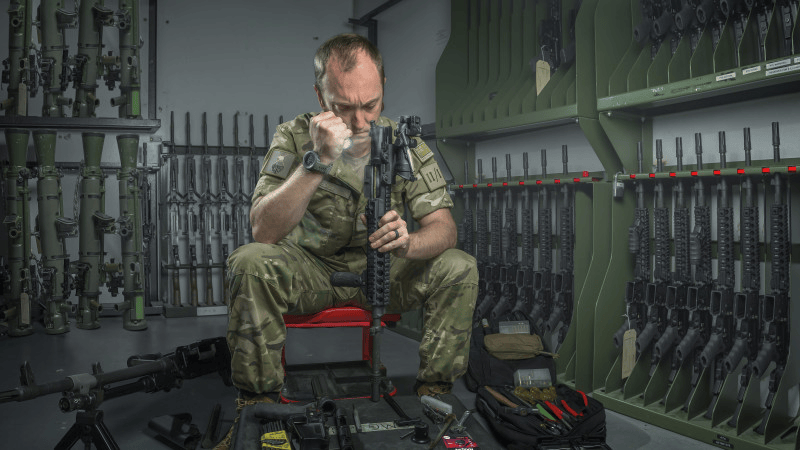
New Zealand Defence Force. Image filename: 20230403_P1024180_NZDF_002.
New equipment also creates an ongoing obligation to train the people who maintain it. After the Bushmaster fleet was delivered in 2023, instructor training covered both operation and maintenance; work integrating enhanced communications equipment has added another technical dimension.[48] The parallel with disappearing guns and electrical harbour defences is the need to develop technical knowledge as equipment enters service. Today’s tools and systems demand their own qualifications and experience.
Developing that experience still takes significant time. The modern Maintenance Fitter apprenticeship takes approximately four years and combines practical work with theoretical study.[49] Electronics Technician development similarly combines formal courses with unit experience and can lead to supervisory and instructional appointments.[50] The early armourer apprenticeships and specialist courses described above therefore have a recognisable contemporary counterpart. Maintaining a technical workforce requires a continuing supply of learners, experienced supervisors and instructors, and people available for immediate repair tasks.
Workshop provision has also continued to evolve. Farrier Lines, opened at Linton in December 2023, includes vehicle lifts, rolling roads, a gantry crane and a range for testing repaired small arms.[51] Burnham’s Te Toki / The Forge followed in November 2025, replacing maintenance accommodation dating from the 1940s.[52] These developments give a modern expression to the problem faced by the earlier service: workshop facilities must suit the equipment, working methods and volume of work expected of their occupants.
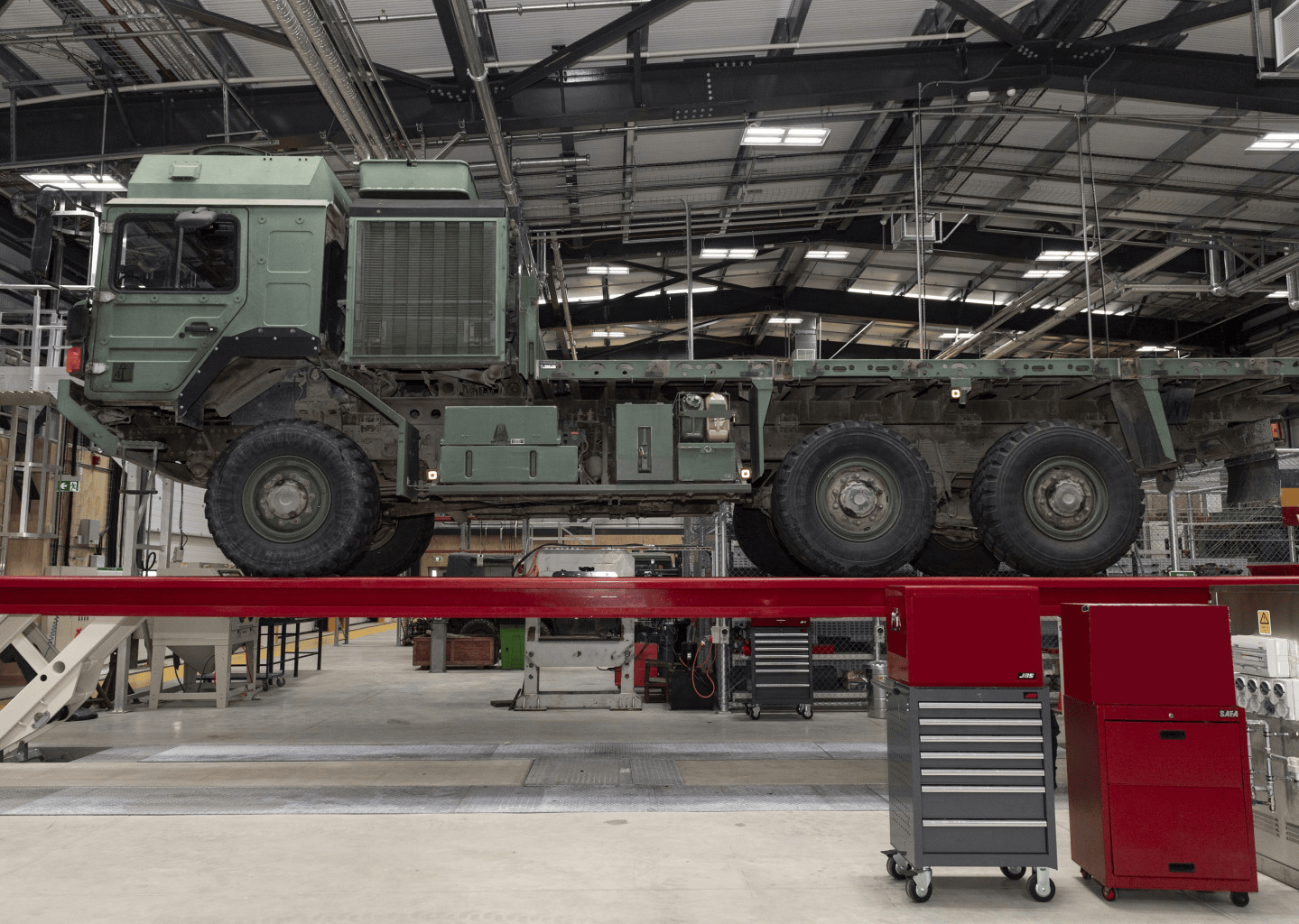
New Zealand Defence Force.
The relationship between trade proficiency and soldiering also remains important. Fox’s concern about the demands of ordinary drill on busy artificers reflected the circumstances of the 1890s. Today’s Maintenance Support personnel must apply their skills in the field as well as in equipped workshops. The 2024 Farriers Trophy explicitly tested expedient repairs under operational pressure in austere conditions, alongside all-arms, technical and recovery skills.[53] Protecting time for trade development and maintaining military readiness are both necessary parts of preparing a deployable maintenance service.
Read as a comparison of responsibilities, the recurring challenges are clear:
| Recurring challenge | Evidence before 1917 | Contemporary relevance |
| Keeping pace with technology | Disappearing mountings, electrical mine systems and searchlights broadened the work beyond small-arms repair. | Electronic diagnosis and computer-aided manufacture add to established mechanical and electrical skills.[54] |
| Developing technical experience | Apprenticeships, district inspections and specialist instruction trained armourers for increasingly demanding work. | Formal qualifications require practical experience and supervision before they produce an experienced tradesperson.[55] |
| Providing suitable workshops | Dedicated workshops and depot facilities developed as maintenance responsibilities expanded. | The Linton and Burnham facilities demonstrate the continuing need to renew maintenance infrastructure.[56] |
| Applying skills under military conditions | Artificers combined technical employment with responsibilities within the permanent forces. | Maintenance Support training includes field repairs, recovery and soldiering under pressure.[57] |
| Matching support to the equipment held | Penton reported growing equipment responsibilities without a corresponding staff increase in 1899.[58] | His warning remains a useful question for capability planning: do trained personnel, tools, spares, facilities and training capacity keep pace with equipment demands? |
The enduring lesson is that technical support must develop with the force it sustains. Acquiring equipment creates a continuing requirement for maintenance knowledge, facilities and practical experience throughout its service life.
For today’s RNZALR Maintenance Support tradespeople, this earlier history extends their professional inheritance beyond RNZEME’s own formation. The armourer inspecting a rifle, the artificer repairing a gun mounting and the electrical specialist testing a harbour-defence installation were addressing versions of a familiar problem: how to keep military equipment dependable when it was needed. Their successors work with different tools and far more complex systems, but the Army’s reliance on skilled people to turn equipment into usable capability endures.
Notes
[1] New Zealand Defence Force, “Chef and Steward Trades—112 Years of Loyal and Dedicated Service,” 19 August 2022, https://www.nzdf.mil.nz/media-centre/news/chef-and-steward-trades-112-years-of-loyal-and-dedicated-service/, for the 1996 formation of RNZALR from the three corps. The contemporary framing does not attempt to retell the intervening history covered by Cape and Cooke.
[2] New Zealand Defence Force, “NZ Army, US and Australian Logisticians Test Their Combat Support Skills,” 2026, https://www.nzdf.mil.nz/media-centre/news/nz-army-us-and-australian-logisticians-test-their-combat-support-skills/, identifying the five workshop trades participating in the Farriers Cup.
[3] Peter Cape, Craftsmen in Uniform: The Corps of Royal New Zealand Electrical and Mechanical Engineers, an Account (Wellington: Corps of Royal New Zealand Electrical and Mechanical Engineers, 1976), 3–4; Peter Cooke, Warrior Craftsmen: Royal New Zealand Electrical & Mechanical Engineers, 1942–1996 (Wellington: Defence of New Zealand Study Group, 2017), 6–7. The supplied extracts cover Cape, pp. 1–15, and Cooke, pp. 6–9.
[4] Cooke, Warrior Craftsmen, 6–7.
[5] Cape, Craftsmen in Uniform, 3–4. Gorman is treated here as an early named example, without assigning an unsupported appointment date.
[6] Robert McKie, “New Zealand Military Armourers, 1840–1900,” To the Warriors Their Arms, 3 June 2025, https://rnzaoc.com/2025/06/03/new-zealand-military-armourers-1840-1900/. [7] Mil Expenditure 1881(4).docx, supplied research summary for the financial year ending 31 March 1881, sec. 8, “Stores and Magazines by depot and port.”
[8] Heritage New Zealand Pouhere Taonga, “Fort Ballance,” List no. 5074, https://www.heritage.org.nz/list-details/5074/Listing. Used for the intended minefield, searchlight coverage and the 1899 telephone exchange; the proposed wartime minefield is not treated as continuously laid in peacetime.
[9] Royal Albatross Centre, “Fort Taiaroa Tours,” https://albatross.org.nz/fort-taiaroa-tours/. The site’s custodians identify the gun types used during 1885–1905 and the surviving 1886 depression rangefinder.
[10] Department of Conservation, North Head: Self-guided Walk, https://www.doc.govt.nz/documents/conservation/historic/by-region/north-head-self-guided-walk.pdf, description of the 8-inch disappearing gun and its pressure mechanism. Engineering New Zealand, “Armstrong Disappearing Gun,” https://www.engineeringnz.org/programmes/heritage/engineering-heritage-records/defence/armstrong-disappearing-gun/, also explains the recoil and return principle of the Taiaroa mounting.
[11] Te Ūaka The Lyttelton Museum, “The Defender of Whakaraupō, Torpedo Boat No. 168,” https://www.teuaka.org.nz/stories/whakatere-moana-maritime/royal-navy/the-defender-of-whakaraupo-torpedo-boat-no-168; Cape, Craftsmen in Uniform, 6–7. Accounts differ over Nordenfelt armament: Te Ūaka describes a gun aboard Defender, whereas the National Museum of the Royal New Zealand Navy, “Spar Torpedo Boats,” https://navymuseum.co.nz/explore/by-collections/ships/spar-torpedo-boats/, states that the New Zealand boats were not fitted with it. Cape describes provision for mounting one.
[12] Cape, Craftsmen in Uniform, 6–7.
[13] National Museum of the Royal New Zealand Navy, “Torpedo Bay Mining Base,” https://navymuseum.co.nz/explore/by-collections/places/torpedo-bay-mining-base/. The account draws on contemporary plans and submarine-mining manuals. Its brick-and-wood test room in an excavated cliff should not be confused with a standard concrete bunker at every installation.
[14] A. P. Penton, report on the Defence Forces of New Zealand, 14 July 1899, AJHR, 1899, H-19, https://paperspast.natlib.govt.nz/parliamentary/AJHR1899-I.2.3.2.26. Defence Forces of New Zealand: Report of the General Officer Commanding the Forces for the Period from 20th June, 1913, to 25th June, 1914, AJHR, 1914, H-19, para. 53, “Armourers,” https://paperspast.natlib.govt.nz/parliamentary/AJHR1914-I.2.3.2.29.
[15] Royal Albatross Centre, “Fort Taiaroa Tours.” Department of Conservation, North Head: Self-guided Walk; Engineering New Zealand, “Armstrong Disappearing Gun.”
[16] Royal Albatross Centre, “Fort Taiaroa Tours.” F. J. Fox, Report on the New Zealand Permanent and Volunteer Forces, AJHR, 1893, H-9, 5–6, 44, https://paperspast.natlib.govt.nz/parliamentary/AJHR1893-I.2.3.2.10.
[17] Department of Conservation, “Fort Takapuna History,” https://www.doc.govt.nz/parks-and-recreation/places-to-go/auckland/places/fort-takapuna-historic-reserve/fort-takapuna-history/. The ammunition-tunnel rails belong to the early fort; the later naval ammunition-store tramway and concrete slide are outside this article’s period.
[18] National Museum of the Royal New Zealand Navy, “Torpedo Bay Mining Base.”
[19] Cape, Craftsmen in Uniform, 6–7.
[20] Department of Conservation, “Fort Takapuna History.” D. G. Veart, North Head: The Development of a Fort, Science and Research Internal Report no. 79 (Department of Conservation, August 1990), 26, 29, https://www.doc.govt.nz/globalassets/documents/science-and-technical/srir79.pdf. The report describes the Mk VII battery’s ammunition hoists and dates its operational readiness to 1911, after arrival of the guns in 1905 and mountings in 1910.
[21] Heritage New Zealand Pouhere Taonga, “Fort Ballance.” National Museum of the Royal New Zealand Navy, “Torpedo Bay Mining Base.”
[22] Cape, Craftsmen in Uniform, 5–7; G. S. Whitmore, report on the New Zealand forces, 25 April 1887, Appendices to the Journals of the House of Representatives (AJHR), 1887, H-12, https://paperspast.natlib.govt.nz/parliamentary/AJHR1887-I.2.2.6.12.
[23] Supplied research summaries: Mil Expenditure 1881(4).docx, Stores and Magazines; Mil Expenditure 1887(2).docx, Engineer and Torpedo Corps establishments; Mil Expenditure 1892.docx, Garrison Artillery; and Mil Expenditure 1899.docx, No. 1 Service Company, citing Estimates B-7, p. 76. Financial years in the table are shown as spans; filenames use the ending year.
[24] Cape, Craftsmen in Uniform, 6–7.
[25] Cape, Craftsmen in Uniform, 9, citing General Order 7, 31 March 1888. Names are reproduced as Cape prints them; their individual service files have not been examined.
[26] “History of the Corps of Royal New Zealand Electrical and Mechanical Engineers,” undated typescript in Adobe Scan 14 Sept 2026.pdf, PDF p. 8; supplied annual expenditure summaries from Mil Expenditure 1891(1).docx onwards. Cape, Craftsmen in Uniform, 9–10, associates a twelve-man group with an order dated 7 December 1898. The earlier estimates already provide for twelve artillery artificers, so 1898 is not used here as the first appearance of that establishment.
[27] Report on the New Zealand forces, AJHR, 1892, H-12, discussion of artificers, https://paperspast.natlib.govt.nz/parliamentary/AJHR1892-I.2.3.3.14.
[28] Fox, Report on the New Zealand Permanent and Volunteer Forces, 5–6, 44.
[29] Fox, Report on the New Zealand Permanent and Volunteer Forces, 5–6, 44.
[30] Mil Expenditure 1899.docx, supplied research summary, Stores and Magazines, citing Estimates B-7, p. 78.
[31] Mil Expenditure 1892.docx, supplied research summary, Torpedo Branch establishment.
[32] W. Hall-Jones, Public Works Statement, AJHR, 1898, D-1, 86, defence works at Auckland and Wellington, https://paperspast.natlib.govt.nz/parliamentary/AJHR1898-I.2.2.2.1. The report distinguishes completed works from those still under construction.
[33] Penton, report on the Defence Forces, AJHR, 1899, H-19.
[34] “The Government Fleet,” Evening Post, 16 January 1902, https://paperspast.natlib.govt.nz/newspapers/EP19020116.2.53, reporting the arrival of the two submarine-mining steamers.
[35] Cape, Craftsmen in Uniform, 10; “History of the Corps,” Adobe Scan 14 Sept 2026.pdf, PDF p. 8, for the 1903 authority and 1905 completion of the Wellington artificers’ workshop. These dates concern that workshop project, not the earliest military workshop facilities at Mount Cook.
[36] Cape, Craftsmen in Uniform, 10, 12.
[37] Cape, Craftsmen in Uniform, 9.
[38] New Zealand Military Forces, General Order 118, “New Zealand Armourers,” 1 May 1912, reproduced in Robert McKie, “Unappreciated Duty: The Forgotten Contribution of New Zealand’s Defence Stores Department in Mobilising the New Zealand Expeditionary Force in 1914” (MA thesis, Massey University, 2022), 70, https://mro.massey.ac.nz/bitstream/10179/17653/1/McKieMAThesis.pdf. The reproduced order, attributed there to John Boyce’s personnel file, has been visually checked. Its title is New Zealand Ordnance Corps (NZOC).
[39] Defence Forces of New Zealand: Report of the General Officer Commanding the Forces for the Period from 28th June, 1912, to 20th June, 1913, AJHR, 1913, H-19, para. 51, “Armourers,” https://paperspast.natlib.govt.nz/parliamentary/AJHR1913-I.2.5.2.34.
[40] Defence Forces of New Zealand, AJHR, 1914, H-19, para. 53, “Armourers.”
[41] Defence Forces of New Zealand, AJHR, 1913, H-19, 24, para. 68, “Permanent Fortifications and Works.”
[42] Cape, Craftsmen in Uniform, 14–15. The recommendations and camp arrangements are successive developments; they are not treated as evidence that all Ordnance functions were newly created at that time.
[43] “History of the Corps,” Adobe Scan 14 Sept 2026.pdf, PDF p. 8. The section’s ammunition role is distinguished from the existing small-arms and armament-repair services.
[44] “New Zealand Army Ordnance Department and New Zealand Army Ordnance Corps Regulations,” New Zealand Gazette, no. 95, 7 June 1917, 2292–93, https://gazette.howison.co.nz/nzg/1917/issue/95/page/2292. February 1 is the effective date, rather than the publication date. The reproduced establishment also appears in Adobe Scan 14 Sept 2026.pdf, PDF pp. 8–10.
[45] Cape, Craftsmen in Uniform, 15, reproducing the 1917 report, item 66; corroborated by “Local and General,” Evening Post, 8 August 1917, https://paperspast.natlib.govt.nz/newspapers/EP19170808.2.41. The report records the workshop as established by 1917; no more precise opening date is inferred here.
[46] New Zealand Defence Force, Defence Careers, “Maintenance Fitter,” accessed 14 September 2026, https://www.defencecareers.mil.nz/army/careers/browse-roles/maintenance-fitter, sections on the role, apprenticeship and trade training.
[47] New Zealand Defence Force, Defence Careers, “Electronics Technician,” accessed 14 September 2026, https://www.defencecareers.mil.nz/army/careers/browse-roles/electronics-technician, sections on equipment, diagnosis, training and career progression.
[48] New Zealand Ministry of Defence, “Protected Mobility Capability Project,” accessed 14 September 2026, https://www.defence.govt.nz/our-work/equip/capability-projects/protected-mobility-capability-project/, section on Protected Vehicle—Medium. The project account distinguishes delivered vehicles and training from communications integration work.
[49] New Zealand Defence Force, Defence Careers, “Maintenance Fitter.”
[50] New Zealand Defence Force, Defence Careers, “Electronics Technician.”
[51] New Zealand Defence Force, “Linton Military Camp Opens State-of-the-art Maintenance Facility to Support NZ Army Equipment,” 6 December 2023, https://www.nzdf.mil.nz/army/army-news/linton-military-camp-opens-state-of-the-art-maintenance-facility-to-support-nz-army-equipment/.
[52] New Zealand Defence Force, “Major Milestone for South Island Logistic Resilience,” 27 November 2025, https://www.nzdf.mil.nz/media-centre/news/major-milestone-for-south-island-logistic-resilience/.
[53] New Zealand Defence Force, “Specialist Trade Skills Celebrated at Trade Competition,” 26 April 2024, https://www.nzdf.mil.nz/media-centre/news/specialist-trade-skills-celebrated-at-trade-competition/, Farriers Trophy section.
[54] New Zealand Defence Force, Defence Careers, “Maintenance Fitter.” New Zealand Defence Force, Defence Careers, “Electronics Technician.”
[55] New Zealand Defence Force, Defence Careers, “Maintenance Fitter.” New Zealand Defence Force, Defence Careers, “Electronics Technician.”
[56] New Zealand Defence Force, “Linton Military Camp Opens State-of-the-art Maintenance Facility.” New Zealand Defence Force, “Major Milestone for South Island Logistic Resilience.”
[57] New Zealand Defence Force, “Specialist Trade Skills Celebrated at Trade Competition,” Farriers Trophy section.
[58] Penton, report on the Defence Forces, AJHR, 1899, H-19.
