
During the 1960s, a soldier of the Royal New Zealand Army Ordnance Corps (RNZAOC) at the Main Ordnance Depot (MOD), Trentham, might have been given a task that would puzzle a modern soldier: inspecting military bicycles. Rows of bicycles, carefully stored and accounted for, formed part of the Army’s inventory. Motor vehicles had long since transformed military transport, yet the humble pushbike remained a practical, economical way to move personnel around camps, depots, and other establishments.
As late as 1968, bicycles were still included in the New Zealand Army’s peacetime scales of entitlement. They were authorised military stores, subject to the same entitlement, accounting, inspection and maintenance requirements as other equipment. The surviving New Zealand Complete Equipment Schedule (NZCES) No. 1/1, the first amendment to schedule No. 1, shows particularly clearly how the Army formally defined a complete item of equipment.[1]
When the Army introduced its layered equipment entitlement arrangements in the early 1960s, it listed the service-pattern bicycle first in the numbered NZCES series. Its schedule illustrates a wider development: the distinction between being authorised an item and holding every accessory that made up its complete outfit.[2]
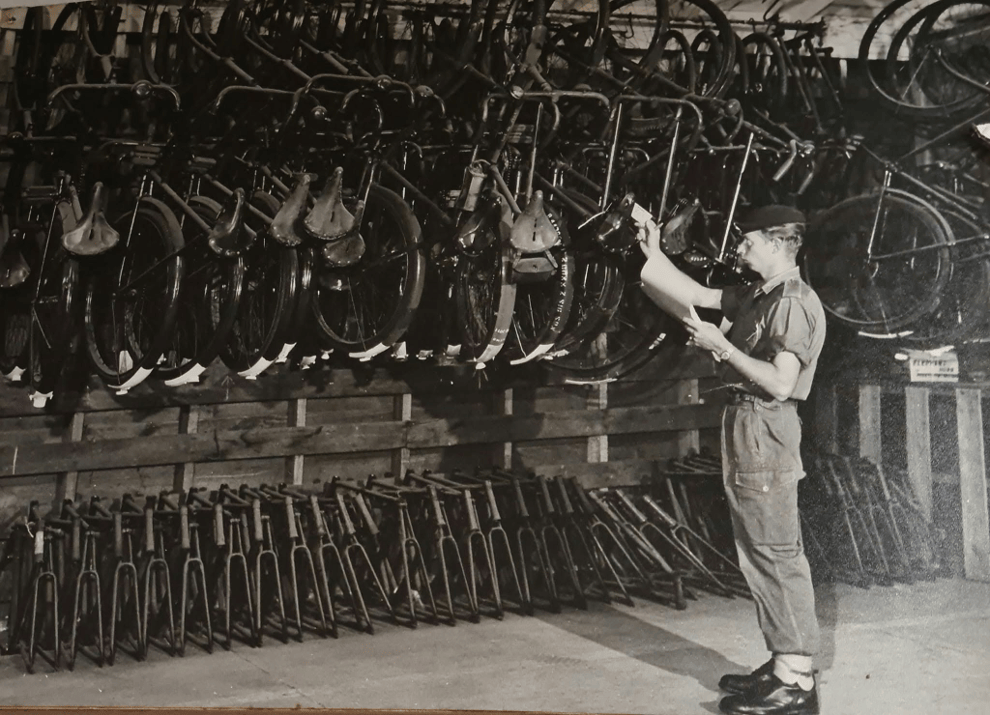
Figure 1. An RNZAOC soldier conducting a stock inspection of military bicycles at the Main Ordnance Depot, Trentham, c. 1960s. Bicycles remained authorised equipment within peacetime holdings; the photograph also shows stored bicycle frames and forks. Photographer and original archival reference not established.
The Bicycle in the Post-War Army
New Zealand soldiers had been familiar with the military bicycle for decades. Even as motor vehicles became standard for heavier, longer-distance tasks, the bicycle remained economical transport for short administrative journeys and movement between dispersed facilities. It needed no fuel, took up little storage space and was comparatively simple to maintain.
At large establishments such as Trentham, Waiouru, Linton and Burnham, the practical appeal was obvious. However, an authorised bicycle scale should not be read as evidence that every unit used bicycles the same way, or that the numbers held always matched the authorised numbers. Entitlement, physical holdings and depot reserves were distinct accounting concepts.
NZCES No. 1/1: More Than a Bicycle
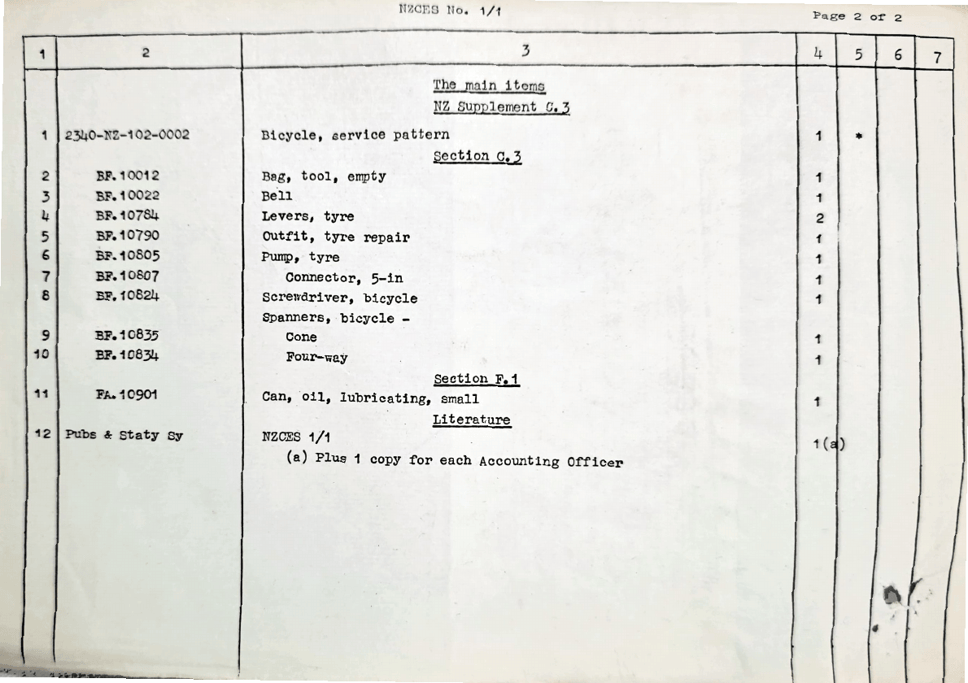
NZCES No. 1/1 identified its principal item as “2340-N2-102-0002 — Bicycle, service pattern”, with a reference to New Zealand Supplement C.3. It then listed the accessories, tools and documentation required for a complete holding. The “/1” suffix shows that this copy is the first amendment, so an earlier, original issue of the schedule must also have existed. The copy supplied is page 2 of 2; neither the first page nor the dates of the original issue and this amendment are available.[3]
| Item | Description | Quantity |
| 1 | Bicycle, service pattern | 1 |
| 2 | Bag, tool, empty | 1 |
| 3 | Bell | 1 |
| 4 | Levers, tyre | 2 |
| 5 | Outfit, tyre repair | 1 |
| 6 | Pump, tyre | 1 |
| 7 | Connector, 5-in | 1 |
| 8 | Screwdriver, bicycle | 1 |
| 9 | Spanner, bicycle, cone | 1 |
| 10 | Spanner, bicycle, four-way | 1 |
| 11 | Can, oil, lubricating, small | 1 |
| 12 | NZCES 1/1 publication | 1* |
* The schedule specifies one copy, with an additional copy for each Accounting Officer.
This inventory is striking precisely because it is so ordinary. A bicycle without its pump or tyre repair kit might still be rideable, but it wouldn’t fully conform to the schedule. NZCES made that difference visible: holding the principal item did not necessarily mean holding its complete outfit.
From Entitlement to Accounting
The entitlement table and the complete equipment schedule answered different questions. The New Zealand Entitlement Table (NZET) set how many principal items a unit or establishment was authorised to hold; the NZCES set out what each complete equipment holding should comprise. Together, they provided a more precise basis for accounting and identifying deficiencies than counting major items alone.[4]
For example, an entitlement to nine bicycles would, if the full schedule applied to each one without modification, imply nine pumps, nine tyre repair outfits and eighteen tyre levers. This illustrates the schedule’s arithmetic; it is not evidence of the component quantities actually recorded at any establishment on a given date.
The principle mattered more as equipment grew more complex. A vehicle, wireless installation or weapon might be physically present yet lack essential ancillary items. A complete equipment schedule let stores staff and accounting officers identify what was missing, and distinguish an operationally useful holding from an incomplete one.
Stocktaking at Trentham
The photograph in Figure 1 makes this administrative system tangible. The soldier stands beside rows of suspended bicycles, papers in hand, checking an item. Consistent with the supplied caption, the activity can reasonably be read as a stock inspection, although the image alone cannot show which ledger or return he was working from.
Inspecting such simple items was part of the same discipline that underpinned Ordnance accountability generally: verifying physical stock against records, identifying discrepancies and maintaining confidence that equipment was available for issue. The frames and forks visible beneath the racks also suggest that bicycle stores were held in more than one form.
Why Was the Bicycle No. 1?
Assigning No. 1 to the service-pattern bicycle is an intriguing detail. It does not show that bicycles were the Army’s highest-priority equipment, nor that the item was chosen deliberately to demonstrate the new system. The surviving second page offers no explanation for the numbering, which may simply reflect the administrative order in which schedules were allocated. Any firmer explanation would require further documentation.
Nevertheless, the bicycle clearly shows the logic of NZCES. If a simple item of transport required an authorised outfit of tools and accessories, then equally disciplined control over complex weapons, vehicles, and communications systems is easy to understand.
An Overlooked Aspect of Army Logistics
At first glance, the photograph might seem an amusing relic of a bygone military era. Instead, it shows the breadth of the RNZAOC inventory and the persistence of simple, economical equipment within a mechanised Army. More importantly, it illustrates the relationship between physical stocks, unit entitlements and complete-equipment accounting.
The NZCES framework was one element of a wider shift from wartime equipment lists towards more layered and detailed control of peacetime entitlements. Its significance lay in standardising what a complete holding meant, rather than simply counting principal articles.
Conclusion
By the late 1960s, the bicycle occupied a modest place alongside the Army’s trucks, armoured vehicles and complex communications equipment. Yet it remained a recognised article of military equipment, held against peacetime entitlements and supported by Ordnance stock.
NZCES No. 1/1 shows how the Army formalised the relationship between an item and the smaller components needed to keep it serviceable. For the RNZAOC soldier checking bicycles at Trentham, stocktaking was routine work. For the historian of military logistics, it offers a concise illustration of a larger principle: accurate accounting requires both an authorised quantity and a clear definition of what complete equipment comprises.
Notes
[1]New Zealand Army, New Zealand Complete Equipment Schedule (NZCES) No. 1/1, “Bicycle, Service Pattern,” 2 of 2 (undated surviving extract supplied for this article). The 1968 continuation of entitlement is reported in the accompanying historical caption, not established independently by this undated page.
[2]Robert McKie, “From Wartime Enumeration to Layered Entitlement Control: Equipment Complexity, Scaling Logic, and the Reform of New Zealand Army Stores Accounting, 1945–1961,” RNZAOC.com, 3 March 2026, https://rnzaoc.com/2026/03/03/from-wartime-enumeration-to-layered-entitlement-control/.
[3]New Zealand Army, NZCES No. 1/1, 2 of 2.
[4]McKie, “From Wartime Enumeration to Layered Entitlement Control.”
