
Building and Sustaining the Crown’s Parihaka Operation, 1879–1881
A note on scope
The terminology in this article is modern. The logistical problems were not. Every logistician who has sat through a briefing on the five Ds — destination, demand, distance, duration and dependency — or heard the principle of centralised control and decentralised execution, might assume these are recent inventions. Parihaka shows they are not: the same problems, solutions and trade-offs are visible in an operation conducted a century before they were formalised in doctrine manuals.
This article treats Parihaka as a logistics case study on how the Crown decided where supplies would enter the district, how a rapidly expanding force would be fed and equipped, how far men and matériel had to travel, how long the commitment might last, and how dependent it would be on shipping, contractors, roads, horses and weather. It does not attempt to retell the wider history of the occupation, or to reach a new judgement on it; that remains the proper work of historians and bodies such as the Waitangi Tribunal. But the analytical focus should not be mistaken for neutrality about what the system did. The roads, stores, transport and supply arrangements examined below were the means by which the Crown concentrated an armed force, occupied Parihaka, arrested its leaders, dispersed its people and dismantled the community’s ability to sustain itself. The logistics cannot be separated from the purpose they served.
Parihaka is well suited to this kind of analysis because it is comparatively well documented and involved a support system that can still be reconstructed from official reports, tenders and contemporary newspapers. Central direction came from Wellington; execution was delegated to district commanders, Defence Stores staff, camp officers, shipmasters, contractors and local non-commissioned officers.
This piece follows that system, not the men who directed it or the people it was directed against, but the roads, ships, stores and contracts that connected the two.
The occupation of Parihaka on 5 November 1881 is generally examined through the colonial government’s decisions, the leadership of Te Whiti-o-Rongomai and Tohu Kākahi, and the peaceful resistance of the people gathered at the settlement. Less attention has been given to the physical and administrative system that made the operation possible.
The force that entered Parihaka did not appear suddenly in November 1881. It was the culmination of more than two years of military preparation on the Taranaki coast. Between 1879 and 1881 the government enlarged the Armed Constabulary, transferred trained personnel into the district, accumulated weapons and ammunition, developed Opunake as a coastal supply point, constructed roads and telegraph lines, established a chain of camps, developed local forage resources and arranged contracts for provisions, transport, fuel and other support.
By November 1881 this system enabled 1,589 members of the Armed Constabulary and Volunteer Force to be assembled, equipped and sustained near Parihaka. It also enabled the government to arrest the settlement’s leaders, disperse much of its population and dismantle houses, fences and cultivations.
The visible event was the advance of 5 November. The less visible story was the logistical network built between Wellington, New Plymouth, Opunake, Rahotu, Pungarehu and the approaches to Parihaka.
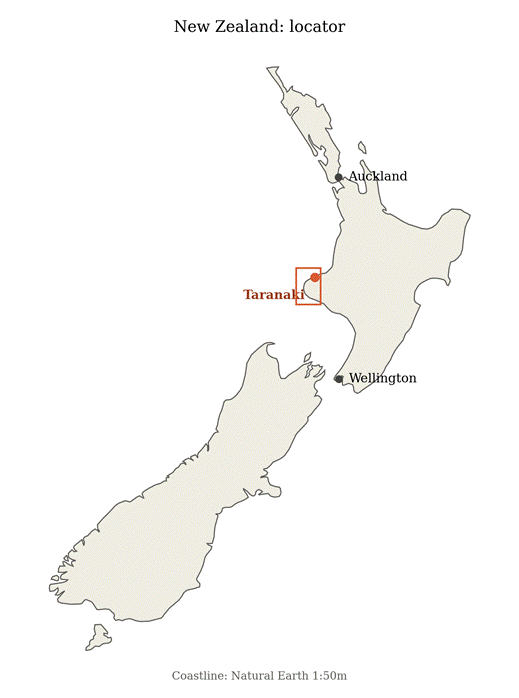
Figure 1. Taranaki within New Zealand.
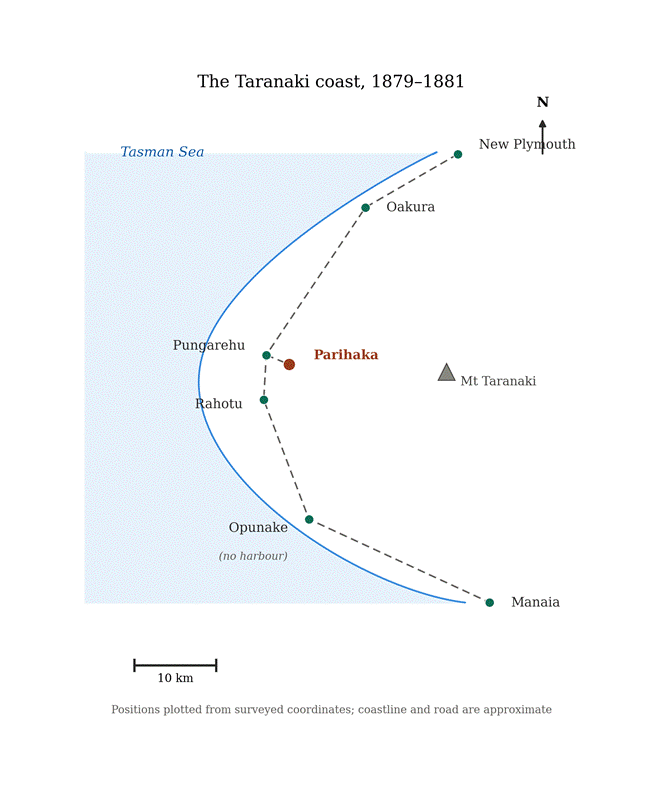
Figure 2. The Taranaki coast, plotted from surveyed coordinates.
Parihaka as a logistical operation
Although New Zealand officials did not employ the term “logistics” in its modern, comprehensive sense, the Parihaka operation required nearly all the functions now associated with military logistics. It involved the acquisition, storage, and issue of supplies; the movement of personnel and matériel; the construction and maintenance of roads and camps; medical support; contracted services; ammunition control; communications; and the recovery or disposal of stores after the operation.
Modern military doctrine defines logistics and sustainment as the planning and execution of support necessary to provide forces with freedom of action, operational reach and prolonged endurance. It encompasses supply, transportation, maintenance, personnel services, health support and associated field services.[1] These later definitions cannot be imposed directly upon an operation conducted in 1881, but they provide a useful framework for interpreting the surviving evidence.
Viewed in this way, the preparations for Parihaka were not a collection of unrelated administrative actions. Roads, camps, stores, ships, contractors, paddocks, telegraph lines and medical arrangements formed an interconnected support system.
The land dispute and the road through Parihaka
The logistical build-up cannot be separated from the dispute over confiscated land.
Parihaka had been established in the midst of the Taranaki confiscation area. Te Whiti and Tohu rejected the justice and legality of the confiscations and objected particularly to the failure to define and protect promised reserves. In 1878 the government began systematic surveys north of the Waingongoro River and advertised land for settlement.
Parihaka responded through peaceful civil disobedience. Survey pegs were removed and, from May 1879, parties began ploughing land claimed by settlers. Later protests included rebuilding fences across the projected coastal road after government parties removed them.
The road was therefore not neutral infrastructure. Its surveyed route cut through Parihaka’s cultivations, while proposed subdivisions between the road and the sea threatened to separate the promised reserve from coastal access. The fences across the road represented both physical boundaries and assertions of ownership.[2]
By April 1881 Parihaka’s population had grown to more than 1,300, making it one of New Zealand’s largest Māori communities. Its inhabitants included people from throughout Taranaki, upper Whanganui, Waikato, Ngāti Maniapoto and Tai Tokerau. The settlement was supported by fertile gardens, pastures and organised communal labour.[3]
The operation therefore brought two sustainment systems into conflict. One supported a colonial force through government stores, contractors, shipping, roads and military camps. The other supported a peaceful Māori community through cultivation, collective labour and regional networks.
Preparing for a West Coast emergency
The government’s logistical build-up began during the West Coast emergency of 1879, and as tensions increased, the Armed Constabulary Reserve was rapidly expanded. By July 1879 it consisted of 870 officers and men, of whom 600 were stationed on the West Coast and another 100 at Wellington. The men were armed with short Snider rifles and described as fully equipped for active service. Large reserves of ammunition and stores were accumulated at the principal stations.[4]
This concentration required considerably more than recruiting additional constables. Each man had to be selected, trained, clothed, armed and equipped before being sent to Taranaki. The Wellington Constabulary depot therefore became an important rear base, preparing personnel for service and issuing the equipment required in the field.
The scale of the preparations was also evident in the arms reserve. In June 1879 Colonel George Whitmore stated that 1,500 stand of arms were held in Wellington, packed in groups of fifty and ready for rapid despatch. Each group was reportedly accompanied by ammunition calculated at 100 rounds per weapon.[5]
This was effectively a pre-positioned mobilisation reserve. The weapons were not merely stored centrally; they had been packaged in quantities suitable for rapid issue or shipment.
The build-up also affected other commands. During June and July 1879 an officer, six non-commissioned officers and fifty-three constables were transferred from the Waikato to meet the demand for trained men on the West Coast. Their departure forced the Waikato command to recruit and train replacements.[6]
Preparation for Parihaka therefore extended beyond Taranaki. It affected recruiting, depot training and the distribution of experienced manpower throughout New Zealand.
Mobilising the Volunteer Force
The Volunteer Force provided a second source of manpower.
During the West Coast alarm of 1879, approximately 1,500 local Volunteers were under arms and training within ten days. Corps from Thames, Wellington, Christchurch, Timaru, Oamaru, Temuka, Picton, Cromwell and Queenstown offered to serve should an outbreak occur.[7]
The response demonstrated enthusiasm, but it exposed a fundamental logistical problem. The Volunteer Force consisted of separate corps scattered across New Zealand. Mobilising them required coordinating unit rolls, arms, ammunition, clothing, rail journeys, coastal shipping, accommodation, food, and baggage.
The colonial arms inventory was mixed. In 1879, 6,053 Snider rifles were already on issue, leaving only 866 in store, although another 3,400 were expected from Britain. At the same time, 9,642 older Enfield rifles remained in store, and another 1,788 were on issue.[8]
By April 1881 the position had improved. The Volunteer Force reported 6,883 Snider rifles on issue and 3,595 in store, with another 500 recently received from Britain. The ammunition reserve included 1,265,884 Snider cartridges and 204,592 rounds for Enfield rifles.[9]
The government therefore possessed sufficient arms and ammunition for a major mobilisation, but only because weapons had been accumulated, maintained and accounted for during the preceding years.
The permanent West Coast force
The Volunteer concentration of November 1881 was superimposed upon a substantial permanent Armed Constabulary presence.
On 31 March 1881 the Armed Constabulary Reserve numbered 717 officers and men throughout New Zealand. Of these, 522 were stationed in the Patea and Taranaki districts, principally at Pungarehu, Rahotu, Opunake, Manaia and other posts along the coast.[10]
The final mobilisation did not create a field organisation from nothing. It expanded an existing network of camps, roads, stores, paddocks and communications.
The permanent force also provided the skilled core needed to absorb the Volunteer contingents. Armed Constabulary personnel knew the roads, camp locations, landing arrangements and local terrain. They served as guides, guards, mounted orderlies, transport workers and store handlers.
Building the road to Parihaka
The military concentration could not be sustained without a reliable road along the Taranaki coast.
During 1879 and 1880 the Armed Constabulary was used extensively as a road-building force. Existing tracks were widened, gradients reduced, bridges and culverts repaired and sections gravelled. The objective was not simply to provide a path for infantry to march. The road had to carry drays, wagons, construction materials, provisions, baggage and ammunition.
Between the Waingongoro River and the western side of the Warmate Plains, approximately fifteen miles of existing road were repaired and widened. Bridges and culverts were substantially improved, nearly three miles were gravelled, and additional contracts were arranged for further gravelling.
On the Stony River–Opunake section, portions of the old road were repaired and new formation constructed. Sections were specifically prepared for dray traffic. The Public Works Statement of 1880 reported that road parties advancing from opposite directions across the Waimate Plains were close to meeting.
Colonel John Mackintosh Roberts organised the work as a military advance rather than as an ordinary civil engineering project. The constables moved cautiously and built defended encampments as the road progressed. Engineering work and operational reach therefore advanced together.[11]
By 1881 the coast road through the Waimate Plains and Parihaka Block had been completed sufficiently for wheeled traffic and more than half had been gravelled. The Public Works Statement openly described it as possessing special political importance.[12]
The distinction between a foot track and a dray road was critical. Infantry could march over ground unsuitable for bulk transport, but a force could not live indefinitely upon what its members carried. Food, ammunition, tents, blankets, tools, fuel and medical stores required wheeled or animal transport.
Road width, gradient, drainage and surface determined how heavily a vehicle could be loaded, how quickly it could travel and whether it could continue after rain. Culverts and bridges were therefore as important to the operation as rifles and ammunition.
Engineer Volunteers
The build-up also drew upon specialist Volunteer engineers.
As tensions increased, redoubts were reoccupied or built, more defensible posts were established at places including Opunake, and the engineer corps offered its services for Parihaka. Wellington submarine-mining engineer volunteers travelled north aboard the government steamer Hinemoa. Twenty-four Hauraki Engineers from Thames reached Auckland before their onward movement was cancelled.[13]
Their mobilisation reflected the anticipated need for personnel familiar with field works, tools, camp construction and technical duties. The precise specialist work performed by the Wellington engineers at Parihaka remains uncertain, but their inclusion demonstrates that the mobilisation was expected to require more than infantry manpower.
The chain of forward camps

The advance towards Parihaka was supported through a succession of temporary camps.
During 1879 and 1880 the Armed Constabulary occupied positions at Kaipipi, Otakeho, Oeo, Oakura, Bayley’s Farm and Werekino. At each site, the men cleared flax, toetoe, and scrub, raised earthworks, dug rifle pits, and prepared the camp for defence. Cookhouses were constructed at Oeo and Oakura.[14]
A field camp required much more than tents. Ground had to be cleared and drained, water sources identified, latrines dug, cooking arrangements established and stores protected from weather and theft. Defensive works had to be completed before the camp could serve as a secure base for road parties, patrols and transport.
Once the force advanced farther along the coast, some camps were abandoned or reduced and the work repeated at a new location. The result was a moving system of temporary bases that progressively extended the government’s operational reach.
Pungarehu developed as the principal forward post. By 1881 it contained huts, tents, cookhouses, store buildings and defensive works. It stood approximately one and a half miles from Parihaka and was being strengthened by the construction of a blockhouse. Rahotu, five miles farther south, occupied a naturally strong position and became the principal concentration area for many of the Volunteer contingents.
Opunake possessed a redoubt capable of accommodating approximately 100 men, while Manaia had accommodation for about eighty.[15]
Opunake as the coastal supply hub

Figure 4. The coast road and forward camps supporting the advance on Parihaka.
The road system depended upon a maritime entry point, and Opunake became the principal coastal logistics hub for the forward area.
Roberts reported that a considerable amount of Armed Constabulary labour was consumed in discharging steamers there. Their cargoes consisted chiefly of stores for the Armed Constabulary, the Telegraph Department, and the Public Works Department. The ration contractor also landed several cargoes at Opunake.[16]
This reveals the interdepartmental character of the supply chain. The same landing operation handled military equipment, food, road-building material and telegraph stores.
Opunake lacked a sheltered harbour. Steamers anchored offshore and passengers and cargo had to be transferred into smaller boats before being taken through the surf. The operation depended upon weather, sea conditions, suitable boats and sufficient labour ashore.
By 1881 the landing arrangement had become a regular government function. A boat manned by Armed Constabulary personnel met arriving vessels and landed both government and civilian stores.[17]
After landing, cargo had to be sorted and loaded onto drays, wagons, or pack animals for inland transport. Every box of ammunition, bag of provisions, bundle of blankets, tent, coil of telegraph wire and road-building tool used in the forward area had to pass through this vulnerable transfer point unless it arrived overland.
Later military terminology described the place where bulk supplies were unloaded and reorganised into unit loads as a bulk-breaking point. A delivery point was the location where loads were transferred from one mode or level of transport to another.[18]
These terms were not used in 1881, but they accurately describe Opunake’s function.
The efficiency of the entire operation depended upon this transfer. Cargo could reach the Taranaki coast on time and still be delayed if the surf was too rough, boats were unavailable, landing parties were insufficient, or inland transport had not arrived.
Opunake was therefore not simply a port of arrival. It was the critical transfer point between the maritime and land components of the supply chain.
Samuel Cosgrave Anderson and Defence Stores
Samuel Cosgrave Anderson, the Defence Storekeeper, provides the clearest connection between the government’s central reserves and the field operation.
Anderson had been Defence Storekeeper since January 1877. His Wellington responsibilities included the custody and issue of arms, ammunition, accoutrements, clothing and other military equipment. He also became involved in wider supply arrangements for the Constabulary.
In July 1880 Anderson invited tenders for oats, bran, carrots, chaff, hay and straw, together with the supply and replacement of horseshoes, for the Wellington Armed Constabulary establishment.[19] Although the tender concerned Wellington, it illustrates the breadth of the Defence Storekeeper’s responsibilities and the range of commodities required to maintain a mounted force.
During the final concentration at Opunake in 1881, Anderson was directly involved in forwarding troops and stores. A contemporary report stated that Captain Taylor of the Armed Constabulary and Anderson were efficiently carrying out arrangements for landing and sending men and matériel towards the camps.[20]
This placed Anderson at the most vulnerable point in the operational supply chain. Stores and personnel arriving by sea had to be landed, sorted and moved inland before congestion developed on the beach. Delays at Opunake could affect the entire mobilisation.
Anderson’s subsequent recognition for clothing and rationing the Volunteers and Constabulary, and for assisting with the transport of Māori removed from Parihaka, reflected the breadth of his contribution.
Contractors as part of the operational system
The colonial government did not possess a permanent organisation large enough to provide every ration, horse, dray, item of forage or temporary service required by the field force.
Private contractors therefore became an extension of the military establishment.
Ration contractors supplied food to the camps. Farmers and merchants supplied forage. Shipowners and coastal shipping companies moved personnel and stores. Carriers provided horses, carts and drays. Local tradesmen supplied farriery and other services.
Contracts reduced the quantity that had to be permanently held in government stores, but they also created dependency. The operation relied upon local availability, commercial performance, contract supervision and private suppliers’ ability to meet a sudden increase in demand.
Modern doctrine recognises contracted support as a means of increasing a deployed force’s capacity without transporting every requirement from its permanent base.[21] The same principle was visible at Parihaka, although expressed through nineteenth-century government tenders and local purchasing.
Supplying food to the camps
Feeding the West Coast force was a continuous requirement from 1879 onwards.
The government relied upon ration contractors for much of the food required by the Armed Constabulary. Roberts confirmed that the contractor landed several cargoes at Opunake, although the surviving report does not identify the individual or firm involved.[22]
Bread or biscuit, meat, tea, sugar and other staples had to be delivered regularly. Fresh meat required local slaughtering or prompt distribution. Flour, biscuits, tea and sugar had to be protected from damp, vermin and loss.
The contractor system did not remove government responsibility. Officials still had to estimate requirements, inspect deliveries, verify quantities and arrange emergency supply when weather prevented a steamer from landing.
The supply chain remained vulnerable at several points:
- vessels could be delayed by weather;
- surf conditions could prevent unloading;
- insufficient drays might be available at Opunake;
- roads could deteriorate after rain;
- stores could be delayed between the beach and the camps;
- food could be present in bulk but fail to reach individuals in a usable form.
What did it take to supply 1,589 men?
The surviving records do not provide a complete manifest of every ration, blanket, cartridge or tent issued for the operation. Nevertheless, the official strength of 1,589 officers and men, combined with contemporary ration and ammunition practices, permits an estimate of the scale of the operation.
These calculations are not surviving issue totals. They indicate the probable order of magnitude.
Two days’ rations
Contemporary New Zealand Volunteer ration scales varied. Some camps provided approximately one and a half pounds each of bread and meat per man daily, while later scales were closer to one pound of bread, three-quarters of a pound of meat and one pound of potatoes.
Applying these ranges to 1,589 men for two days produces the following estimate:
| Commodity | Estimated requirement for two days |
| Bread or biscuit | 3,178–4,767 lb, approximately 1.44–2.16 tonnes |
| Meat | 2,384–4,767 lb, approximately 1.08–2.16 tonnes |
| Potatoes | approximately 3,178 lb, or 1.44 tonnes |
| Sugar, at 3 oz per man daily | approximately 596 lb, or 270 kg |
| Tea, at ½ oz per man daily | approximately 99 lb, or 45 kg |
| Coffee, if issued at ½ oz daily | approximately 99 lb, or 45 kg |
| Salt, at 1 oz per man daily | approximately 199 lb, or 90 kg |
Even the lower estimate represents more than four tonnes of bread, meat and potatoes. Once sugar, tea, salt, packaging, officers’ mess supplies and reserve provisions were included, the two-day food load may have approached five or six tonnes.
Not all of this necessarily travelled in one convoy. Contemporary reports state that the men carried two days’ provisions during the advance, while additional supplies were left in camp or transported.
Ammunition
The ammunition requirement can be estimated more firmly.
A report from Rahotu stated that Volunteers received eighty rounds of ball ammunition each. The official account recorded that the men carried forty additional rounds during the advance. A likely explanation is that forty rounds formed the normal pouch issue and another forty were added as an operational reserve.[23]
For 1,589 men:
- forty rounds each represented 63,560 cartridges;
- eighty rounds each represented 127,120 cartridges.
Not every member necessarily carried a rifle. Staff, medical, mounted and transport personnel may have held different scales. Even so, more than 120,000 rounds is a reasonable estimate of the personal ammunition issued or immediately available.
This was not the whole operational reserve. Additional ammunition accompanied the columns on packhorses, while a larger reserve remained at Pungarehu.
The total number of cartridges positioned in the operational area was therefore probably greater than 127,120.
The colonial reserve could support this demand. In April 1881 the Volunteer Force held 1,265,884 Snider rounds in store.[24] An issue of 127,120 rounds represented approximately one-tenth of that reserve.
Tents and accommodation
The exact number of tents sent to Taranaki has not been identified.
At a reasonable field scale of six to eight men per bell tent, accommodating all 1,589 personnel under canvas would have required:
- approximately 199 tents at eight men per tent;
- approximately 265 tents at six men per tent.
These figures cover sleeping accommodation only. Additional tents or marquees were needed for headquarters, officers, medical treatment, guards, stores, kitchens, messes and ammunition.
Allowing another ten to fifteen per cent for these functions raises the estimated requirement to approximately 220–300 tents and marquees.
Not all had to be newly issued. Huts, redoubts, cookhouses and store buildings at Pungarehu, Rahotu, Opunake and Manaia reduced the number sleeping under canvas.
Nevertheless, evidence indicates that the available camp equipment did not meet the theoretical requirement. A history of the Volunteer Force describes a serious shortage of camp equipment. The Nelson contingent arrived without its own camp gear and received only one blanket per man and tents that were far from watertight.[25]
The shortage was therefore not merely numerical. Some of the canvas supplied was unsuitable for prolonged exposure to Taranaki weather.
Blankets and waterproof sheets
Reports stated that the advancing troops carried a blanket, a coat or greatcoat and a waterproof sheet.
At a minimum scale of one per man, the force required:
- 1,589 blankets;
- 1,589 waterproof or ground sheets.
A ten per cent reserve for hospital use, damage, loss and late reinforcements would raise each requirement to approximately 1,750.
The Nelson experience demonstrates that even the one-blanket scale may have represented the maximum actually available rather than a comfortable allocation.
Blankets and waterproof sheets were bulky. Once wet, they became much heavier and required drying before they could be packed or reissued. The collapse of tents in bad weather placed bedding and clothing at particular risk.
Cooking and mess equipment
A force of 1,589 men could not be efficiently fed from individual cooking fires.
At a notional company or mess strength of eighty to one hundred men, at least sixteen to twenty cooking and ration-distribution groups were required. Each needed:
- camp kettles or boilers;
- meat hooks and knives;
- cutting surfaces;
- buckets and water containers;
- ration bags and boxes;
- fuel;
- serving utensils;
- pannikins, plates and cutlery.
Cookhouses had already been built at Oeo and Oakura, while Pungarehu contained cookhouses, storehouses and mess facilities. The permanent camp network therefore provided a foundation for the expanded force.
Contemporary complaints that some Volunteers lacked plates, pannikins, knives and forks show that mess equipment did not always match the number of men assembled.[26]
Food could be present within the supply system yet remain difficult to distribute or consume.
Water
The sources provide no formal daily water allowance, and even a restricted estimate of three to five litres per man for drinking and cooking would require approximately 4,800 to 7,900 litres each day.
This excludes water needed for washing, hospitals, cooking losses and animals.
For 1,589 men, one week of drinking and cooking water would therefore amount to approximately 34,000–55,000 litres.
Camp selection had to take account of reliable streams or other sources. The division of the force between Rahotu, Pungarehu and positions around Parihaka may partly have reflected the limits of local water supply as well as tactical requirements.
The thirty-three Volunteer corps
On 28 October 1881 the Governor’s proclamation called out no fewer than thirty-three Volunteer corps from the North Island and Nelson. So many additional offers were received that the government rejected some.[27]
This fragmented structure created a considerable administrative burden. The government was not receiving a single homogeneous formation but more than thirty separately organised units, each with its own officers, rolls, uniforms, arms, baggage, and standards of camp equipment.
The forward camps had to receive these corps, confirm their strength, complete equipment issues and integrate them into the two operational columns.
The Wellington contingent alone numbered 231. At a scale of six to eight men per tent, it required between twenty-nine and thirty-nine sleeping tents, in addition to at least 231 blankets, ground sheets and sets of eating equipment.[28]
Horses, forage and local military agriculture
Horses were essential to the operation.
Mounted constables carried messages, patrolled roads and escorted prisoners. Officers required mounts, packhorses carried reserve ammunition and draught animals hauled wagons and drays loaded with provisions, tentage and baggage.
The precise number of horses is unknown, so forage can only be presented as an illustrative scenario.
At approximately twenty-four pounds of combined hay, chaff and grain per horse daily:
| Horses | Daily forage requirement |
| 100 | approximately 2,400 lb, or 1.09 tonnes |
| 150 | approximately 3,600 lb, or 1.63 tonnes |
| 200 | approximately 4,800 lb, or 2.18 tonnes |
A force using 150 horses could therefore consume more than eleven tonnes of forage in one week if grazing did not reduce the requirement.
The 1881 Constabulary report shows that the government had deliberately developed local forage production:
- twenty-three acres of oats at Waihi were cut for hay, converted into chaff and distributed among coastal stations;
- thirty-four acres at Manaia were prepared for cultivation;
- twenty-acre paddocks were established at Opunake and Pungarehu;
- further paddocks were maintained or developed at Egmont, Okato and Pukearuhe.[29]
This amounted to a small military agricultural system. It reduced dependence upon stores landed at Opunake and provided grazing and fodder close to the camps.
The paddocks were as much a part of the military infrastructure as redoubts and magazines.
Wagons, drays and pack animals
The number of vehicles employed is also uncertain, but the estimated ration load helps convey the likely scale.
If a dray could carry between ten and fifteen hundredweight over imperfect roads, five tonnes of provisions alone required approximately seven to eleven dray loads.
That calculation excludes:
- tents and marquees;
- blankets and ground sheets;
- ammunition reserves;
- officers’ baggage;
- camp tools;
- cooking equipment;
- hospital stores;
- forage;
- telegraph and engineering material.
The total number of vehicle movements required for mobilisation and continued occupation must have been considerably greater.
Some stores travelled in repeated shuttle runs between Opunake, Rahotu, and Pungarehu. Packhorses carried high-priority loads, including reserve ammunition, while wagons and drays handled bulk provisions and baggage.
Other vehicles had to remain available for casualties, prisoners, water and the removal of Māori from Parihaka.
A layered distribution system
Later military manuals described supply systems based upon depots, delivery points, pack trains and mobile reserves.[30] Although the terminology belongs to a later period, the surviving evidence suggests that the Parihaka system operated in comparable layers:
- central reserves and procurement at Wellington and other districts;
- coastal shipping to Opunake or New Plymouth;
- transfer through the surf and sorting ashore;
- forward stocks at Rahotu and Pungarehu;
- mobile wagon and packhorse loads;
- personal issues carried by each man.
This structure allowed the force to advance without carrying everything needed for a prolonged occupation. It also preserved reserves behind the columns.
The same arrangement created risk. A delay at any layer could affect the others. Coastal weather could interrupt shipping, insufficient drays could delay inland movement and poor unit distribution could create shortages even when bulk stocks were available.
Telegraph and information logistics
The telegraph was another component of the physical support system.
Telegraph communication required poles, wire, insulators, batteries, tools and trained operators. Roberts’s report that Telegraph Department cargo was landed at Opunake confirms that these materials passed through the same maritime supply chain as rations and military stores.[31]
By 1880 the coastal telegraph had connected the forward district more closely with New Plymouth, Hawera and Wellington.
The telegraph reduced the time required to request supplies, report developments and transmit orders, but it did not remove the need for mounted messengers and local orderlies. Messages still had to be distributed from telegraph offices to camp headquarters, detachments and road parties.
Information was another commodity that had to be moved, received and delivered.
Medical support
The permanent medical organisation was comparatively thin.
Serious cases from the West Coast camps were sent to a hospital established in part of the Immigration Barracks at New Plymouth. The hospital treated an average of approximately fourteen cases a month, while one medical officer supported the West Coast force.[32]
The temporary increase from 522 Armed Constabulary personnel in the district to a combined force of 1,589 placed additional pressure on this limited arrangement.
A later history of the Volunteer Force describes the medical support available during the occupation as rudimentary and unlikely to have coped with a significant number of casualties.[33]
Medical support required hospital tents or buildings, bedding, medicines, dressings, transport for the sick or injured, clean water, suitable food and attendants.
The medical organisation proved adequate principally because no battle occurred. Men nevertheless collapsed during the marches, and prolonged exposure to wet weather created risks of fever and respiratory illness.
Life under canvas
Much of the permanent West Coast force had already spent long periods under canvas.
The 1880 Constabulary report recorded that more than 700 men had been exposed to very wet weather while living largely in tents. Despite this, only one death from sickness was reported.[34]
Maintaining troops under canvas required tent poles, pegs, ropes, blankets, ground sheets and constant repair. Camps needed drainage, latrines, cooking areas and dry storage for provisions and ammunition.
The construction of cookhouses at Oeo and Oakura, and huts at Pungarehu, reflected the limitations of prolonged tented accommodation.
The final mobilisation intensified the problem. Newspaper reports described difficulty obtaining sufficient tents for the arriving Volunteers. A gale at Opunake reportedly flattened many of the Wellington Naval Volunteers’ tents shortly before the march.[35]
Such incidents increased the troops’ workload and put bedding, clothing, and equipment at risk.
Reception, staging and onward movement
Landing the Volunteers was only the first stage of mobilisation.
Units had to be reunited with baggage, supplied with ammunition and camp equipment, assigned accommodation and incorporated into the two operational columns.
In modern terminology this process would be described as reception, staging and onward movement.[36] The terminology is much later, but it accurately describes the sequence.
Opunake and New Plymouth received the units from coastal shipping. Rahotu and Pungarehu staged them while their equipment and ammunition issues were completed. The camps then released formed columns for the movement towards Parihaka.
These camps were not merely sleeping areas. They converted separately raised and transported corps into an organised field force.
Coastal shipping and the Hinemoa

During October and early November 1881, government and commercial vessels, including the Hinemoa, Stella, Huia and Manawatu, transported men and equipment to Taranaki.
On 25 October the Hinemoa embarked 205 personnel from Nelson and Marlborough, together with a six-pounder Armstrong gun. Approximately 4,000 people attended their departure from Nelson.
The vessel was intended to land the contingent at Opunake but was diverted to New Plymouth. The Volunteers then had to march south towards the front.[37]
The incident illustrates the flexibility required of the transport system. A change of landing place affected not only the troops but their baggage, rifles, ammunition, camp equipment and the field gun.
The six-pounder also confirms that the material burden was greater than rifles and personal baggage alone. The gun required its own crew, ammunition, equipment and transport.
Equipping the Volunteers
The rapid mobilisation produced inconsistencies in equipment.
Some corps arrived with complete local issues, while others required additional ammunition, blankets, clothing or camp equipment. One newspaper report alleged that Wellington Volunteers left the government store only partly equipped and that they initially held 40 rounds in their ball bags.[38]
A later account from Rahotu stated that eighty rounds of ball cartridge were issued to each Volunteer.[39]
The reports show that equipping the force was not a single event completed at the home station. Stores continued to be inspected, supplemented and redistributed after the contingents reached Taranaki.
The final concentration
The final force totalled 1,589 officers and men.
Major Charles Pitt commanded a Volunteer column of approximately 945, while Major Arthur Tuke commanded approximately 644 Armed Constabulary and Taranaki Volunteers.[40]
The force was broadly comparable in size to the population of Parihaka, which had exceeded 1,300 earlier in the year. This comparison helps explain the government’s intention to dominate the settlement through overwhelming numbers.
By late October the force had converged upon Rahotu and Pungarehu. The Volunteer component had been drawn from thirty-three separately administered corps and integrated into two battalions supporting the Armed Constabulary.
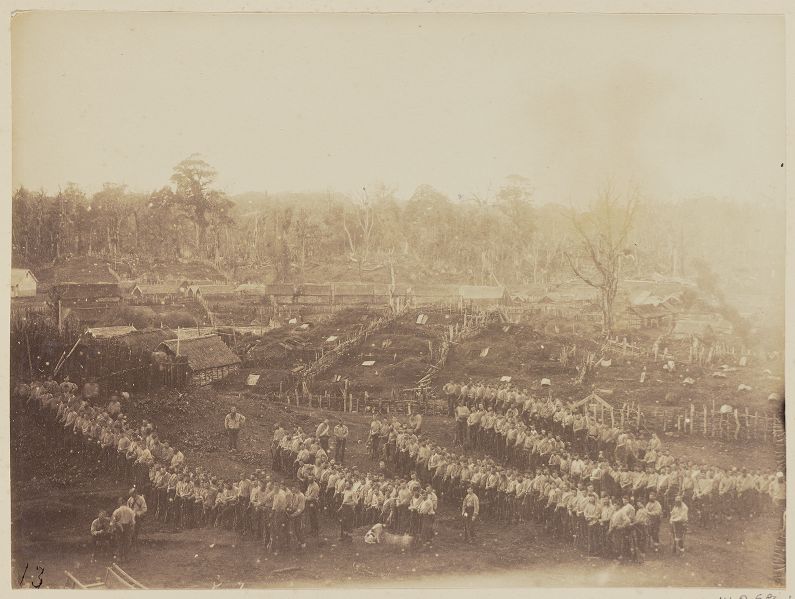
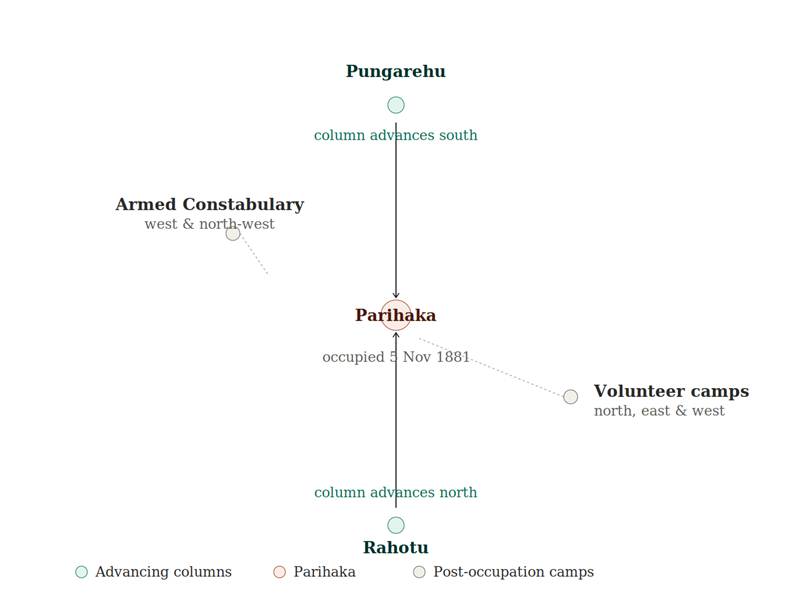
Figure 7. The two columns converging on Parihaka, 5 November 1881.
On 5 November 1881, the two principal columns advanced from Pungarehu and Rahotu.
Contemporary reports stated that the men carried two days’ provisions, blankets, coats or greatcoats, waterproof sheets and ammunition. The official account recorded an additional forty rounds per man.[41]
The load was considerable. A rifle and eighty Snider cartridges represented significant weight. When food, bedding, clothing and personal equipment were added, the march became physically demanding.
Observers described Volunteers struggling in warm weather beneath heavy swags. Several men collapsed or required medical attention.
The individual load was only the first layer of supply. Reserve ammunition travelled on packhorses with the columns, while a larger reserve remained at Pungarehu.
The two days’ provisions represented only the initial operational load. They allowed the columns to leave camp without depending upon immediate replenishment, but they did not sustain the subsequent occupation.
Once the force dispersed around Parihaka, daily delivery of food, forage, fuel, water and other supplies again became necessary.
Friction within the system
The force reached Parihaka and completed its encirclement, but the mobilisation was not seamless.
One newspaper account claimed that seventy-eight Naval Volunteers received only about ten pounds of meat during part of their transport and that plates, pannikins, knives and forks had not been provided. Another contingent reportedly found only about twenty bunks for fifty-eight men.[42]
Such complaints require caution, but they illustrate the difference between holding supplies and delivering them effectively.
A successful system had to provide the right commodity, in the right quantity, at the right place and time, together with the means to use it.
Meat was of limited value without cooking facilities or utensils. Blankets offered little protection if tentage failed and became soaked. Ammunition at a rear depot could not support the force unless transport remained available.
The operation succeeded because the system possessed sufficient overall capacity, not because every part worked efficiently.
Sustaining the occupation
The logistical requirement continued after the troops entered Parihaka.
The force was dispersed among several camps around the settlement. Headquarters and Armed Constabulary elements occupied positions to the west and north-west, while Volunteer camps were established to the north, east and west.
The dispersed arrangement improved control but complicated supply. Provisions, fuel, water and orders had to be distributed among several positions. Ammunition and baggage left at Pungarehu and Rahotu remained under guard.
Fuel was partly obtained locally. In the days following the occupation, men were reported collecting firewood around the camps.[43]
The force also required working parties for searches, guards, escorts and demolition. Horses, carts and personnel had to be allocated among competing requirements.
Transporting prisoners and displaced families
The same transport network that brought troops and stores to Parihaka was also used to remove people from the settlement.
Te Whiti and Tohu were taken by wagon to Pungarehu under mounted escort. During November nearly 1,600 Māori men, women and children were sent under escort towards their home districts.[44]
Some groups were marched overland. Others were taken to Opunake and transported by sea.
The movement required:
- groups to be organised by district;
- escorts to be detailed;
- routes to be selected;
- wagons and drays to be allocated;
- vessels to be scheduled;
- provisions to be supplied during movement.
The transport burden therefore extended beyond supporting the colonial force. It included the coercive dispersal of a civilian population similar in size to the force itself.
Anderson’s recognised involvement in these arrangements demonstrates how closely Defence Stores and transport became connected with government policy.
Demolition as a logistical operation
During November and December 1881 Crown forces dismantled houses and destroyed fences and cultivations at Parihaka.
These actions required logistical organisation. Working parties needed axes, crowbars and other tools. Guards and supervisors had to be provided. Men required rations while engaged in the work, and transport had to remain available.
The destruction of crops was particularly significant. Parihaka’s population had been sustained through extensive gardens, pastures and communal production.
The government therefore sustained its own force while deliberately degrading the system by which Parihaka sustained itself.
Logistics at Parihaka had both a sustaining and a destructive dimension.
Demobilisation and the reverse supply chain
Once the settlement had been occupied and much of its population dispersed, the Volunteer contingents were progressively released.
The process reversed mobilisation. Units returned to Rahotu or Opunake, baggage was assembled, vessels allocated, troops embarked, and weapons, ammunition and equipment accounted for.
Rifles, unused ammunition, tents, blankets and other government property had to be returned, transferred to permanent posts or written off if lost or damaged.
By 20 November only the Taranaki Mounted Rifles remained on active service.[45] In approximately two weeks the support system had to reverse the concentration and return hundreds of Volunteers to their home districts.
Later ordnance manuals described return, inspection, repair, salvage and disposal as integral parts of the supply system.[46] The same principle is evident in contemporary financial records.
The 1880–81 public accounts recorded recoveries from the sale of Constabulary stores, clothing, accoutrements, troop horses and forage, as well as proceeds from Militia and Volunteer arms, ammunition and stores.[47]
Demobilisation therefore created a reverse supply chain. Equipment moved from units to camp stores, from the camps to Opunake and from the coast back to district or central custody.
The permanent Armed Constabulary remained, occupying posts and resuming road construction and patrol duties.
Destination, demand, distance, duration and dependency
The logistical difficulty can be summarised through five connected factors identified in later doctrine: destination, demand, distance, duration and dependency.[48]
- Destination: Parihaka lay beyond the colony’s principal ports and railways. Final movement depended upon surf-landings, roads, drays and packhorses.
- Demand: The supported military population increased from 522 Armed Constabulary personnel in Patea and Taranaki to 1,589 officers and men. The force also had to control and disperse a Parihaka population of more than 1,300.
- Distance: Personnel and stores travelled from Wellington and other districts by rail and sea before transfer to road transport.
- Duration: The requirement extended far beyond the two-day march. It included preparation since 1879, the November concentration, the occupation and the continuing Constabulary presence.
- Dependency: The system depended upon commercial shipping, contractors, horses, roads, paddocks, telegraph communications and favourable weather at Opunake.
A failure in any one area could affect the whole operation.
The financial framework
The cost of preparing for and occupying Parihaka cannot be found in one account.
For 1880–81 the Consolidated Fund appropriations allocated £163,446 11s. 3d. to the Minister of Defence.[49] At the same time, the Public Works Fund included £154,000 for contingent defence, together with substantial votes for roads, telegraph extensions and public buildings.[50]
For 1881–82 the gross Defence vote was £217,014 12s. 2d., of which £75,000 was recoverable from loan funds, leaving a net Consolidated Fund charge of £142,014 12s. 2d.[51]
These figures did not represent Parihaka alone. They included wider expenditure on the Militia, Volunteer, Police, and Armed Constabulary. Nevertheless, they show that the operation drew upon both ordinary Defence appropriations and loan-funded infrastructure.
Its costs were dispersed among:
- Armed Constabulary pay and allowances;
- Militia and Volunteer expenditure;
- arms and ammunition;
- Defence Stores;
- coastal shipping;
- road construction;
- telegraph extension;
- public buildings and redoubts;
- provisions and forage;
- contingent defence;
- transport and miscellaneous services.
The administrative separation concealed the extent to which these activities formed a single operational system.
Parihaka viewed as a logistical system
The operation can be understood as a series of connected support nodes.
Wellington provided personnel, arms, ammunition and central administration. Coastal shipping moved units and bulk supplies to Taranaki. Opunake acted as the maritime transfer and bulk-breaking point. New Plymouth served as an alternative landing point when weather prevented the use of Opunake. Rahotu and Pungarehu provided accommodation, staging and forward stores. Wagons and packhorses carried reserves towards the columns, while individual men carried the final personal load.
The system displayed considerable foresight. Arms were packed for rapid despatch, ammunition and stores were accumulated at principal stations, roads were opened for wheeled traffic, camps were established progressively along the coast, telegraph communications were extended, and paddocks were developed near the forward posts.
By November 1881, the government no longer needed to create a supply system from scratch. It enlarged and accelerated a network that had been under development since 1879.
The force’s operational reach was determined by the network’s reach.
Conclusion
The occupation of Parihaka on 5 November 1881 was not an isolated or improvised military event. It was the culmination of a logistical build-up that began during the West Coast emergency of 1879: two years spent concentrating personnel, accumulating weapons and ammunition, building roads, establishing camps, developing forage resources, extending telegraph communications and turning Opunake into a coastal supply point. By November 1881 the government did not need to build a supply system from nothing — only to enlarge and accelerate one already two years in development.
That system is why the numbers in this article are worth taking seriously, even as estimates rather than surviving issue totals. A force of 1,589 men required tonnes of food and forage, hundreds of tents, thousands of blankets, more than 100,000 rounds of ammunition, and a coastal supply chain that ran through open surf at Opunake. None of it arrived by accident, and none of it was inevitable — it was the product of deliberate choices made over two years, by identifiable officials, using identifiable roads and ships and contracts.
It was also, on its own terms, an imperfect system. The Nelson contingent, leaky tents, the diverted Hinemoa, and the missing plates and cutlery were all signs of a system under strain. It succeeded not because every part worked smoothly, but because it had enough capacity to absorb the parts that didn’t.
None of that capacity was neutral. The same roads that carried rations and ammunition to Rahotu and Pungarehu carried the wagons that took Te Whiti and Tohu into custody and dispersed nearly 1,600 people from their homes. The same working parties that built cookhouses and redoubts later dismantled houses and destroyed the gardens that had sustained Parihaka’s own, larger population. The government sustained its force and dismantled the community’s capacity to sustain itself using the same logistical apparatus, often the same men, in the same weeks.
That is the lesson Parihaka offers for New Zealand’s military logistics history: the systems that feed, clothe, transport and equip a force are never separate from the policy that force carries out. At Parihaka, that apparatus made possible not a battle, but the systematic occupation and dismantling of a peaceful community.
A note on the present
The five factors that shaped the Parihaka operation- destination, demand, distance, duration and dependency are not confined to 1881. They describe a structural problem New Zealand’s military still faces in its most probable operating environment: the Pacific.
Opunake had no harbour. Steamers anchored offshore, and every box of ammunition, bag of rations and coil of telegraph wire had to pass through surf boats before it reached dry land. That transfer point, not the road or the rifle, was the operation’s real constraint. The same problem persists in the Pacific today in different form: American logistics remain unmatched but depend on deep ports and long runways, both of which are scarce across the region, and current commentary on New Zealand’s defence posture argues this is precisely where investment should be directed — vehicles, ships and capabilities built for Pacific conditions rather than for the ports New Zealand’s larger partners can rely on elsewhere.[52] Anderson’s beach parties at Opunake and a modern sealift or littoral capability designed for undeveloped Pacific coastlines are answers to the same question, asked 140 years apart.
The Crown’s advantage in 1881 was not the size of the force it could raise in a crisis, but the network it had already built before the crisis arrived — camps, roads, forage paddocks and standing contracts, developed over two years so that the final concentration was an acceleration rather than a creation. Current strategic writing on New Zealand’s regional posture makes a comparable argument at Pacific scale: with the South China Sea heavily fortified, the less congested Pacific has become a more attractive arena for influence, and whoever secures logistics hubs there first will hold the advantage.[53] Read against Parihaka, this is not a new insight so much as a familiar one restated for a different theatre — pre-positioning and regional access are usually worth more than surge capacity assembled after the fact.
The paper’s account of the Defence Storekeeper’s dependence on contractors, forage, and shipping he did not control has a direct present-day analogue as well. New Zealand’s Defence Industry Strategy now explicitly builds toward shared regional repair capacity through the Partnership for Indo-Pacific Industrial Resilience, on the reasoning that the ability to repair equipment without returning to New Zealand is critical to operational effectiveness.[54] Contracted and locally sourced support extended the Crown’s reach at Opunake in exactly the way it is meant to extend the NZDF’s reach across the Pacific now — and it carried the same trade-off then as it does today: capacity gained through dependency is only as reliable as the party it depends upon.
None of this suggests a direct institutional lineage between the Armed Constabulary’s supply arrangements and NZDF planning today. The doctrine, the technology and the strategic context are entirely different. What carries over is the underlying structure of the problem: a small force, operating at the end of a long and interruptible supply chain, in a theatre with few deep harbours and fewer long runways, dependent on contractors, shipping and weather it cannot control. Parihaka is a reminder that this is not a new condition for New Zealand’s military to solve — only the latest occasion for solving it again.
Notes
[1] Australian Army, “Logistics,” Land Warfare Doctrine 4.0 (2018): 5, 9; U.S.G.U. Army, Field Manual FM 4-0 Sustainment Operations July 2019 (Washington, DC: Department of the Army, 2019), 1-1–1-8.
[2] Judith Binney and Aroha Harris Atholl Anderson, Tangata Whenua: An Illustrated History (Bridget Williams Books, 2014), 264-65.
[3] Atholl Anderson, Tangata Whenua: An Illustrated History, 264.
[4] “Armed Constabulary Force,” Appendix to the Journals of the House of Representatives, 1878 Session II, H-15 ( 1879), https://paperspast.natlib.govt.nz/parliamentary/AJHR1879-II.2.1.9.17.
[5] “The Native Difficulty,” Taranaki Herald, Volume XXVII, Issue 3138, 3 June 1879, https://paperspast.natlib.govt.nz/newspapers/TH18790603.2.10.
[6] “Report on the Armed Constabulary Force,” Appendix to the Journals of the House of Representatives, 1880 Session I, H-10 (1880), https://paperspast.natlib.govt.nz/parliamentary/AJHR1880-I.2.2.3.29.
[7] ” Volunteer Force of New Zealand, (Report On),” Appendix to the Journals of the House of Representatives, 1879 Session I, H-15a (1879), https://paperspast.natlib.govt.nz/parliamentary/AJHR1879-II.2.1.9.18.
[8] ” Volunteer Force of New Zealand, (Report On).”
[9] “Volunteer Force of New Zealand (report on),” Appendix to the Journals of the House of Representatives, 1881 Session I, H-23 (1881), https://paperspast.natlib.govt.nz/parliamentary/AJHR1881-I.2.2.4.33.
[10] “New Zealand Constabulary (Annual Report),” Appendix to the Journals of the House of Representatives, 1881 Session I, H-18 (1881), https://paperspast.natlib.govt.nz/parliamentary/AJHR1881-I.2.2.4.24.
[11] Garry Clayton, The New Zealand Army: A history from the 1840’s to the 1990’s ([Wellington, N.Z.]: New Zealand Army, 1990, 1990), , 34-39; Paul William Gladstone Ian McGibbon, The Oxford companion to New Zealand Military History (Auckland; Melbourne; Oxford: Oxford University Press, 2000, 2000), .
[12] “Public Works Statement by the Honourable Minister for Public Works,” Appendix to the Journals of the House of Representatives 1881 Session I, D-01 (10 August 1881).
[13] Peter D. F. Cooke, Won by the spade: how the Royal New Zealand Engineers built a nation (Exisle Publishing Ltd, 2019), Bibliographies, Non-fiction, 114-15; Peter Cooke and John Crawford, The Territorials (Wellington: Random House New Zealand Ltd, 2011), 78-80.
[14] “Report on the Armed Constabulary Force.”
[15] “New Zealand Constabulary (Annual Report).”
[16] “Report on the Armed Constabulary Force.”
[17] “New Zealand Constabulary (Annual Report).”
[18] Ordnance Manual (War), ed. The War Office (London: His Majestys Stationery Office, 1939), 12-13.
[19] “Constabulary: Tenders,” New Zealand Times, Volume XXXV, Issue 6011 (Wellington) 1880, https://paperspast.natlib.govt.nz/newspapers/NZTIM18800706.2.31.1.
[20] “The Parihaka Meeting,” Timaru Herald, Volume XXXV, Issue 2220 (Timaru), 3 November 1881, https://paperspast.natlib.govt.nz/newspapers/THD18811103.2.45.
[21] Army, Field Manual FM 4-0 Sustainment Operations July 2019, 7-8; Australian Army, “Logistics,” 21-29.
[22] “Report on the Armed Constabulary Force.”
[23] “Report on the Armed Constabulary Force,” Appendix to the Journals of the House of Representatives, 1882 Session I, H-14 (1882), https://paperspast.natlib.govt.nz/parliamentary/AJHR1882-I.2.2.4.16; “The Nelson Battalion,” Colonist, Volume XXV, Issue 3000 (Nelson) 1881, https://paperspast.natlib.govt.nz/newspapers/TC18811103.2.9.
[24] “Volunteer Force of New Zealand (report on).”
[25] Cooke and Crawford, The Territorials, 78-79.
[26] “The Parihaka Difficulty,” New Zealand Herald, Volume XVIII, Issue 6232, 7 November 1881, https://paperspast.natlib.govt.nz/newspapers/NZH18811107.2.6.
[27] Cooke and Crawford, The Territorials, 78-79.
[28] Cooke and Crawford, The Territorials, 79.
[29] “New Zealand Constabulary (Annual Report).”
[30] Ordnance Manual (War), 12–13, 224–35.
[31] “Report on the Armed Constabulary Force.”
[32] “New Zealand Constabulary (Annual Report).”
[33] Cooke and Crawford, The Territorials, 80.
[34] “Report on the Armed Constabulary Force.”
[35] “The Parihaka Meeting.”
[36] Army, Field Manual FM 4-0 Sustainment Operations, July 2019.
[37] Cooke and Crawford, The Territorials, 80.
[38] “Native News,” Westport Times, Volume XV, Issue 1949, 8 November 1881, https://paperspast.natlib.govt.nz/newspapers/WEST18811108.2.9.
[39] “The Nelson Battalion.”
[40] “Report on the Armed Constabulary Force.”
[41] “Report on the Armed Constabulary Force.”
[42] “The Parihaka Difficulty.”
[43] “Parihaka,” New Zealand Herald, Volume XVIII, Issue 6237, 12 November 1881, https://paperspast.natlib.govt.nz/newspapers/NZH18811112.2.36.
[44] “Report on the Armed Constabulary Force.”
[45] Cooke and Crawford, The Territorials, 80.
[46] Ordnance Manual (War); Ordnance Manual (War), War Office, (London: His Majesty’s Printing Office, 1914). https://rnzaoc.files.wordpress.com/2018/08/ordnance-war-manual-1914.pdf.
[47] “Public Accounts of the General Government of New Zealand, for the Financial Year 1880-81 Commencing 1 April 1880 and Ending 31 March 1881,” Appendix to the Journals of the House of Representatives 1881 Session I, B-01 (9 October 1881), https://paperspast.natlib.govt.nz/parliamentary/AJHR1881-I.2.1.3.1.
[48] Australian Army, “Logistics.”
[49] The Honourable J Ballance, The Colonial Treasurer, “Financial Statement By the Colonial Treasurer the Hon Major Atkinson 6th July 1881,” Appendix to the Journals of the House of Representatives, 1881 Session I, B-02 (1881), https://paperspast.natlib.govt.nz/parliamentary/AJHR1881-I.2.1.3.2.
[50] “Appropriations Chargeable on the Public Works Fund for the year ending 31March 1881,” Appendix to the Journals of the House of Representatives, 1880 Session II, B-02B (1880), https://paperspast.natlib.govt.nz/parliamentary/AJHR1880-I.2.1.3.4.
[51] “Appropriations Chargable on the Consolidated Fund 31 March 1882,” Appendix to the Journals of the House of Representatives, 1881 Session II, B-03 (1881), https://paperspast.natlib.govt.nz/parliamentary/AJHR1881-I.2.1.3.3.
[52] Graeme Doull, “In Depth: New Zealand Defence Needs a Pacific-Centric Reset,” Line of Defence Magazine, Spring 2025, Defsec, 3 September 2025, https://defsec.net.nz/2025/09/03/new-zealand-defence-needs-pacific-reset/.
[53] Doull, “Pacific-Centric Reset.”
[54] New Zealand Ministry of Defence, Defence Industry Strategy (Wellington: New Zealand Ministry of Defence, 2025), https://www.defence.govt.nz/assets/Defence-Industry-Strategy.pdf.
Bibliography
“Appropriations Chargable on the Consolidated Fund 31 March 1882.” Appendix to the Journals of the House of Representatives, 1881 Session II, B-03 (1881). https://paperspast.natlib.govt.nz/parliamentary/AJHR1881-I.2.1.3.3.
“Appropriations Chargeable on the Public Works Fund for the Year Ending 31march 1881.” Appendix to the Journals of the House of Representatives, 1880 Session II, B-02B (1880). https://paperspast.natlib.govt.nz/parliamentary/AJHR1880-I.2.1.3.4.
“Armed Constabulary Force.” Appendix to the Journals of the House of Representatives, 1878 Session II, H-15 ( 1879). https://paperspast.natlib.govt.nz/parliamentary/AJHR1879-II.2.1.9.17.
Army, U.S.G.U. Field Manual Fm 4-0 Sustainment Operations July 2019. Washington, DC: Department of the Army, 2019.
Atholl Anderson, Judith Binney and Aroha Harris. Tangata Whenua: An Illustrated History. Bridget Williams Books, 2014.
Australian Army. “Logistics.” Land Warfare Doctrine 4.0 (2018).
Clayton, Garry. The New Zealand Army: A History from the 1840’s to the 1990’s. [Wellington, N.Z.]: New Zealand Army, 1990, 1990. .
“Constabulary: Tenders.” New Zealand Times, Volume XXXV, Issue 6011 (Wellington), 1880. https://paperspast.natlib.govt.nz/newspapers/NZTIM18800706.2.31.1.
Cooke, Peter, and John Crawford. The Territorials. Wellington: Random House New Zealand Ltd, 2011.
Cooke, Peter D. F. Won by the Spade: How the Royal New Zealand Engineers Built a Nation. Exisle Publishing Ltd, 2019. Bibliographies, Non-fiction.
Doull, Graeme. “In Depth: New Zealand Defence Needs a Pacific-Centric Reset.” Line of Defence Magazine, Spring 2025. Defsec, 3 September 2025. https://defsec.net.nz/2025/09/03/new-zealand-defence-needs-pacific-reset/.
Ian McGibbon, Paul William Gladstone. The Oxford Companion to New Zealand Military History. Auckland; Melbourne; Oxford: Oxford University Press, 2000, 2000. .
“The Native Difficulty.” Taranaki Herald, Volume XXVII, Issue 3138, 3 June 1879. https://paperspast.natlib.govt.nz/newspapers/TH18790603.2.10.
“Native News.” Westport Times, Volume XV, Issue 1949, 8 November 1881. https://paperspast.natlib.govt.nz/newspapers/WEST18811108.2.9.
“The Nelson Battalion.” Colonist, Volume XXV, Issue 3000 (Nelson), 1881. https://paperspast.natlib.govt.nz/newspapers/TC18811103.2.9.
“New Zealand Constabulary (Annual Report).” Appendix to the Journals of the House of Representatives, 1881 Session I, H-18 (1881). https://paperspast.natlib.govt.nz/parliamentary/AJHR1881-I.2.2.4.24.
New Zealand Ministry of Defence. Defence Industry Strategy. Wellington: New Zealand Ministry of Defence, 2025. https://www.defence.govt.nz/assets/Defence-Industry-Strategy.pdf.
Ordnance Manual (War). Edited by The War Office. London: His Majestys Stationery Office, 1939.
Ordnance Manual (War). War Office. London: His Majesty’s Printing Office, 1914. https://rnzaoc.files.wordpress.com/2018/08/ordnance-war-manual-1914.pdf.
“Parihaka.” New Zealand Herald, Volume XVIII, Issue 6237, 12 November 1881. https://paperspast.natlib.govt.nz/newspapers/NZH18811112.2.36.
“The Parihaka Difficulty.” New Zealand Herald, Volume XVIII, Issue 6232, 7 November 1881. https://paperspast.natlib.govt.nz/newspapers/NZH18811107.2.6.
“The Parihaka Meeting.” Timaru Herald, Volume XXXV, Issue 2220 (Timaru), 3 November 1881. https://paperspast.natlib.govt.nz/newspapers/THD18811103.2.45.
“Public Accounts of the General Government of New Zealand, for the Financial Year 1880-81 Commencing 1 April 1880 and Ending 31 March 1881.” Appendix to the Journals of the House of Representatives 1881 Session I, B-01 (9 October 1881). https://paperspast.natlib.govt.nz/parliamentary/AJHR1881-I.2.1.3.1.
“Public Works Statement by the Honourable Minister for Public Works.” Appendix to the Journals of the House of Representatives 1881 Session I, D-01 (10 August 1881).
“Report on the Armed Constabulary Force.” Appendix to the Journals of the House of Representatives, 1880 Session I, H-10 (1880). https://paperspast.natlib.govt.nz/parliamentary/AJHR1880-I.2.2.3.29.
“Report on the Armed Constabulary Force.” Appendix to the Journals of the House of Representatives, 1882 Session I, H-14 (1882). https://paperspast.natlib.govt.nz/parliamentary/AJHR1882-I.2.2.4.16.
The Colonial Treasurer, The Honourable J Ballance. “Financial Statement by the Colonial Treasurer the Hon Major Atkinson 6th Ju;Y 1881.” Appendix to the Journals of the House of Representatives, 1881 Session I, B-02 (1881). https://paperspast.natlib.govt.nz/parliamentary/AJHR1881-I.2.1.3.2.
“Volunteer Force of New Zealand (Report on).” Appendix to the Journals of the House of Representatives, 1881 Session I, H-23 (1881). https://paperspast.natlib.govt.nz/parliamentary/AJHR1881-I.2.2.4.33.
” Volunteer Force of New Zealand, (Report on).” Appendix to the Journals of the House of Representatives, 1879 Session I, H-15a (1879). https://paperspast.natlib.govt.nz/parliamentary/AJHR1879-II.2.1.9.18.
