Adaptation Without Interruption

How the 1978 to 1979 Reorganisation Reshaped RNZAOC Supply.

Military logistics must adapt to new equipment, changing force structures, financial constraints and operational demands. The practical test of any change, however, is whether it sustains support to the force throughout. The 1978 to 1979 reorganisation of the Royal New Zealand Army Ordnance Corps (RNZAOC) is a clear New Zealand example. It changed the Corps’ responsibilities, units, establishments, stock accounts, and training role, while food, fuel, and stores still had to reach the Army.

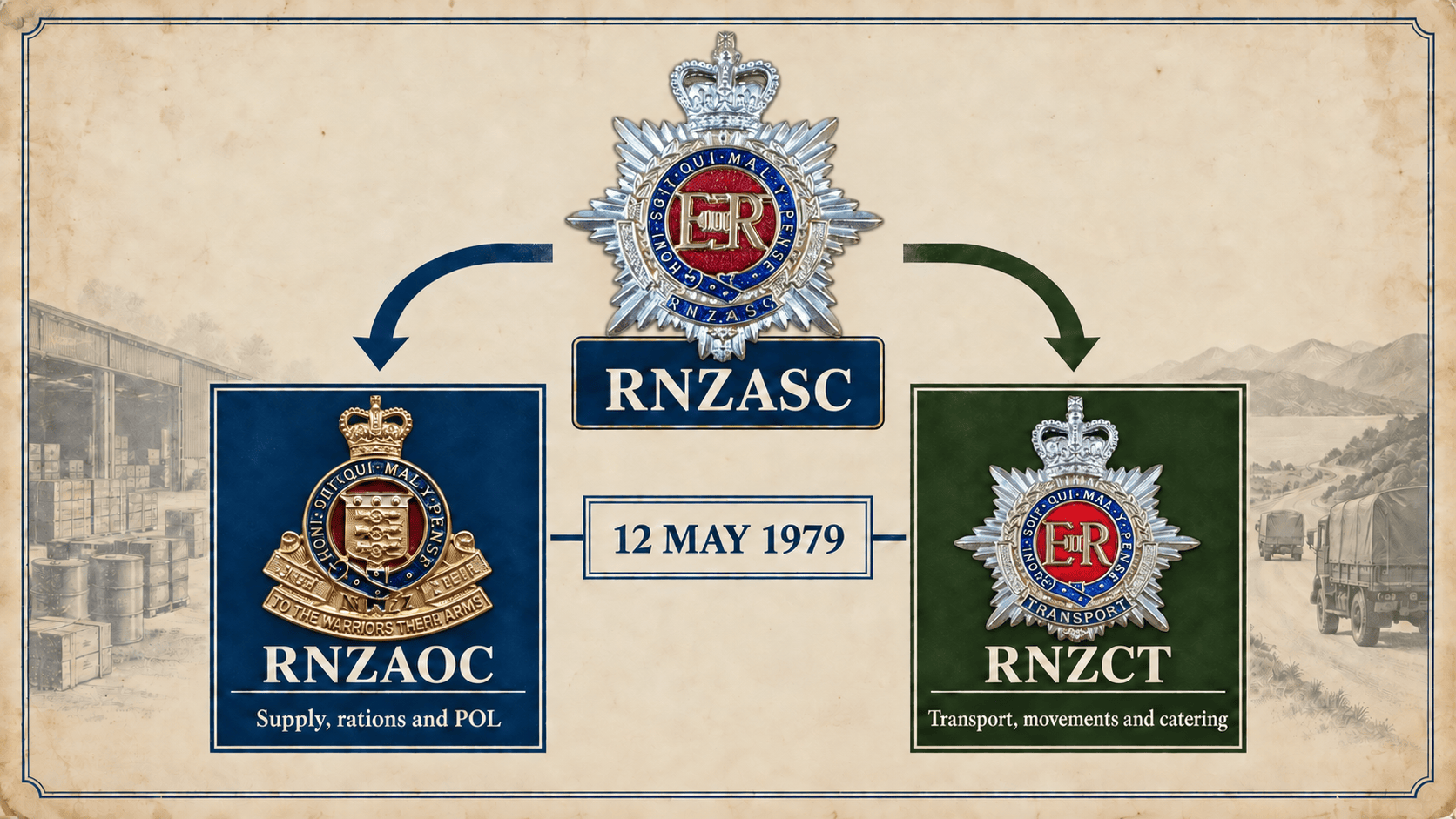
The change made the RNZAOC the Army’s principal supply Corps. From 12 May 1979, it became responsible not only for ordnance stores, ammunition, and technical materiel, but also for foodstuffs, rations, and petroleum, oils and lubricants (POL).[1]

Change was already underway

The formal 1979 transfer was the second stage of a process already underway within the RNZAOC. In July 1978, Pataka described a proposed reorganisation intended to “rationalise the supply chain”. Central Ordnance Depots and Ordnance Field Parks were to be grouped into regional organisations, reducing duplicated stockholding and simplifying the movement of stores from demand to delivery.[2]

The proposal did not promise large Regular Force savings. Its main benefits were expected to be fewer stocking points, lower inventory and storage costs, simpler accounting and better use of people and infrastructure. In October 1978, former RNZASC supply organisations began coming under RNZAOC command for command purposes, and the February 1979 Pataka recorded the practical changes: new titles, altered establishments, repainted signs and the arrival of new personnel.[3]
Why the Army reorganised

The 1978 Defence Review required a rearrangement of Army logistic functions. New Zealand followed the broad direction already adopted in Australia: transport, movements and catering would be grouped in a Corps of Transport, while supply would sit with the RNZAOC.[4]

The date itself carried deliberate symbolism. Major W. Fraser recommended 12 May 1979 because it coincided with the anniversary of the 1910 New Zealand Gazette notice that established the Army Service Corps. The change was therefore both an organisational break and a carefully marked transition from a long-standing corps tradition.[5]

Organisation from 12 May 1979Principal responsibilities
Royal New Zealand Corps of TransportTransport, Defence movements, catering and postal functions.
Royal New Zealand Army Ordnance CorpsSupply, including food, rations, POL, ordnance stores, ammunition and related technical responsibilities.

This division did not separate supply from transport in the field. The RNZAOC held, managed and provided the stocks; the RNZCT provided transport and much of the distribution capability. The implementation order expressly allowed RNZAOC Combat Supplies Platoons to be placed under command of an RNZCT unit when operational circumstances required supplies to be distributed from second-line transport.[6]

What the RNZAOC gained

From 12 May 1979, responsibility for the provision and storage of all foodstuffs and POL, together with the development, evaluation and provision of ration packs, passed from the RNZASC to the RNZAOC.  The accompanying equipment sponsorship was broad: refrigeration and air-conditioning equipment, packaging and packing materials, POL storage and quality-control equipment, water containers, agricultural supplies, and specialist camp and religious stores.[7][8]

The transfer also made clerk/storekeeper and butcher training an RNZAOC School responsibility. It affirmed that food, rations and fuel were technical supply functions requiring professional knowledge, not simply commodities to be bought and issued.

The RNZAOC after 12 May 1979

The new directorates at Headquarters New Zealand Land Force were implemented on 9 April 1979, before the field transfer on 12 May. This enabled the Director of Ordnance Services to assume the necessary policy, technical-control and force-management responsibilities before the new unit structure took effect.[9]

The RNZAOC Directorate controlled a national supply system comprising a base supply battalion, four regional Supply Companies, the New Zealand Advanced Ordnance Depot in Singapore and the RNZAOC School.

Formation or unitSub-unitsPrincipal location or area
1 Base Supply Battalion1 Composite Supply Company; 54 Supply PlatoonTrentham
1 Supply Company12 Ordnance Field Park; 13 Combat Supplies Platoon; 14 Supply PlatoonNgaruawahia and Papakura
2 Supply Company22 Ordnance Field Park; 23 Combat Supplies Platoon; 24 Supply PlatoonLinton
3 Supply Company32 Ordnance Field Park; 33 Combat Supplies Platoon; 34 Supply PlatoonBurnham
4 Supply CompanyHeadquarters 21 Supply Company; 43 Combat Supplies Platoon; 44 Supply Platoon; 47 Petroleum PlatoonWaiouru
New Zealand Advanced Ordnance DepotNew Zealand Supply PlatoonSingapore
RNZAOC SchoolCorps and specialist supply trainingWaiouru

This table shows the principal RNZAOC supply organisation following the 1979 reorganisation. It does not attempt to list every RNZAOC technical, ammunition or workshop-stores appointment and element.

The structure combined static and regional supply, base-level bulk holdings and deployable field capability. It was therefore more than a renaming of RNZASC camp supply depots.

The units transferred to the Corps

Former RNZASC sub-unitNew RNZAOC sub-unitLocation
Composite Platoon, 1 Transport Company13 Combat Supplies Platoon, 1 Supply CompanyPapakura
Supply Section, Papakura Platoon, Northern Company14 Supply Platoon, 1 Supply CompanyPapakura
Headquarters 21 Supply CompanyHeadquarters 21 Supply Company, 4 Supply CompanyWaiouru
4 Platoon, 21 Supply Company43 Combat Supplies Platoon, 4 Supply CompanyWaiouru
Supply Platoon, Waiouru Company44 Supply Platoon, 4 Supply CompanyWaiouru
7 Platoon, 21 Supply Company47 Petroleum Platoon, 4 Supply CompanyWaiouru
New sub-unit23 Combat Supplies Platoon, 2 Supply CompanyLinton
Supply Section, Linton Platoon, Central Company24 Supply Platoon, 2 Supply CompanyLinton
Wellington Supply Platoon, Central Company54 Supply Platoon, 1 Base Supply BattalionTrentham
Composite Platoon, 3 Transport Company33 Combat Supplies Platoon, 3 Supply CompanyBurnham
Burnham Supply Platoon, Southern Company34 Supply Platoon, 3 Supply CompanyBurnham
Supply Platoon, New Zealand Transport CompanyNew Zealand Supply Platoon, NZAODSingapore

The revised numbering made the national pattern clearer. The 14, 24, 34, 44 and 54 Supply Platoons corresponded to Papakura, Linton, Burnham, Waiouru and Trentham. The specialist exception was 47 Petroleum Platoon, which retained the petroleum function of former 7 Platoon, 21 Supply Company, while adopting the Waiouru prefix. Headquarters 21 Supply Company remained as a Territorial Force sub-unit of 4 Supply Company, capable of commanding up to five supply sub-units for training and exercises.[10]

People and capability transferred with the units

The establishment papers show that the reorganisation was not merely an exercise in moving existing posts. Eighty Regular Force supply posts and two civilian posts were transferred to the RNZAOC. There was no increase in the Regular Force establishment, but the Territorial Force supply establishment rose from 123 to 158 posts, a net gain of 35. The increase was required to establish 23 Combat Supplies Platoon at Linton, an entirely new sub-unit.[11]

This demonstrates that rationalisation and capability growth occurred together. Former RNZASC composite platoons became RNZAOC Combat Supplies Platoons; the existing combat-supply and petroleum capabilities of 21 Supply Company were retained, and a new platoon was raised for 2 Task Force Region.

Continuity of expertise was protected. RNZASC personnel employed in supply units were to remain in those units until the RNZAOC had sufficient trained personnel to replace them. They were also required to indicate whether they wished to join the RNZCT or RNZAOC.[12]

The transfer was also a lived transition, not merely an establishment change. Contemporary accounts suggest that some RNZASC and RNZAOC personnel expected difficulties, particularly in the continued supply of rations. In practice, the handover of tasks and the incorporation of transferees proceeded smoothly. The result supports the central lesson of the reorganisation: adaptation was judged not by creating new titles or badges, but by whether the Army continued to receive essential support without interruption.[13]

Accounts, responsibility and continuity

The change was embedded in the accounting system. Northern Company RNZASC’s supply-depot bulk-stock account became that of 1 Supply Company; Waiouru Company’s became 4 Supply Company; the Linton and Trentham Central Company accounts transferred to 2 Supply Company and 1 Base Supply Battalion; and Southern Company’s became 3 Supply Company.[14]

This mattered because stock accounts represented formal custody and accountability. New badges and unit titles could be introduced quickly; transferring account responsibility changed the organisation answerable for receipt, storage, demand, issue and reconciliation of the stores that sustained the Army.

Adaptation without interruption

The 1978 to 1979 reorganisation fundamentally widened the RNZAOC’s role. It placed food, fuel, rations and supply support alongside ordnance stores, ammunition and technical materiel. At the same time, it preserved the interdependence of supply and transport, retained specialist knowledge during the transfer and added a new Territorial Force combat-supply capability at Linton.

The contemporary details differ, but the lesson remains relevant. Logistics must adapt to new systems, new equipment and new operating demands while continuing to sustain the force. In 1979, the decisive measure was not whether the chart changed; it was whether the Army could still feed, fuel and equip its units. That remains the proper measure of logistic adaptation today.[15]

Notes

[1] Army General Staff, Army Reorganisation Instruction No. 11: RNZASC Reorganisation, Army 209/1/142/SD, 24 April 1979, paras. 1-5

[2] The RNZAOC Reorganisation,” Pataka, July 1978, 10-12.

[3] Depot News,” Pataka, February 1979, 3-8.

[4] Julia Millen, Salute to Service: A History of the Royal New Zealand Corps of Transport and Its Predecessors, 1860-1996 (Wellington: Victoria University Press, 1997), 415-16

[5] Julia Millen, Salute to Service: A History of the Royal New Zealand Corps of Transport and Its Predecessors, 1860-1996 (Wellington: Victoria University Press, 1997), 415-16

[6] Ibid., Annex F, para. 9.

[7] Ibid., Annex F, para. 5

[8] Ibid., para. 3g and Annex F, paras. 1-2.

[9] Headquarters New Zealand Defence Force, Army General Staff, Army Reorganisation Establishments, Volume 3, Army 1920/1, April 1979, paras. 3 and 10-15

[10] Army General Staff, Army Reorganisation Instruction No. 11, Annexes D and F, paras. 6-7.

[11] Headquarters New Zealand Defence Force, Army General Staff, Army Reorganisation Establishments, Volume 3, Annex F, “Supply Posts for RNZAOC.”

[12] Army General Staff, Army Reorganisation Instruction No. 11, para. 6c.

[13] Major J. S. Bolton, A History of the Royal New Zealand Army Ordnance Corps (Trentham: RNZAOC, 1992), 224-25

[14] Army General Staff, Army Reorganisation Instruction No. 11, Annex F, para. 8.

[15] Ministry of Defence, Defence Capability Plan 2025 (Wellington: Ministry of Defence, 2025), 39.

1 March: The RNZASC Corps Day

Regimental and Corps days are more than dates in an Army calendar. They preserve the moments when a corps acquired its identity, acknowledge the people who built it, and give serving and former members an opportunity to recognise a shared professional inheritance.

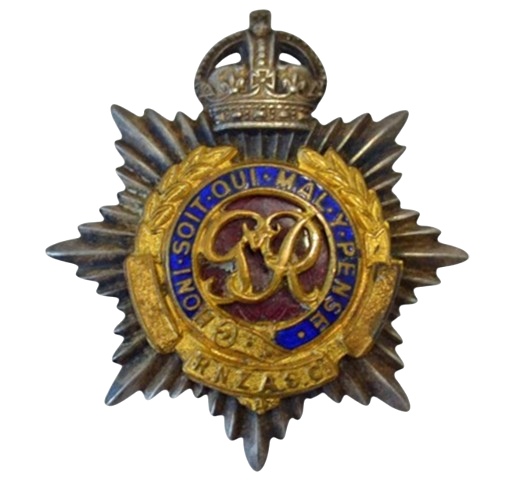
For the Royal New Zealand Army Service Corps (RNZASC), that inheritance was founded on an elementary military truth: an army cannot operate without food, transport and systematic arrangements for supply. The RNZASC Corps Day, originally set for 1 March, recalled the decisive step taken in 1913 towards turning that truth into an organised New Zealand Army capability.

The long road to a Service Corps

The creation of a New Zealand supply and transport organisation was not sudden. Annual defence reports from the early twentieth century repeatedly warned that the Defence Forces lacked the trained personnel and arrangements needed to sustain troops in the field.

In 1903, it was proposed that each military district should have a small company trained in supply and transport. The intention was not to create a large permanent organisation, but a trained nucleus able to expand in war. The following years showed how difficult that was to achieve. Reports noted that a force could not live without food, nor be fed without arrangements made during peace; that mobility would make supply still more difficult; and that realistic manoeuvres were being constrained by the absence of trained supply and transport resources.¹

By 1905, the case was put even more directly: a supply and transport corps was “an absolute necessity if a Force is to act in the field”. Yet the proposed organisation did not immediately materialise. In 1906, the authorities still reported that no transport or supply corps existed, despite repeated requests to establish one. By 1908 and 1909, plans remained focused on raising small district companies capable of meeting peacetime training requirements and expanding on mobilisation.²

These reports are striking because they describe a problem familiar to later generations of logisticians. Operational ambition, training activity and plans for deployment all depended on a sustainment system that could not be improvised after a crisis began.

1 March 1913

The event chosen to commemorate RNZASC Corps Day occurred on 1 March 1913, when four Army Service Corps non-commissioned officers arrived from Britain to help organise the Army Service Corps within the New Zealand Defence Forces.

AppointmentName
Company Quartermaster SergeantJ. J. Wass
Company Sergeant MajorJ. W. F. Cahill
Staff Quartermaster SergeantP. M. Petty
Staff SergeantF. E. Ostler

The 1912-13 annual report recorded that the four men had been lent from Britain to assist with forming and instructing the necessary companies of the Dominion Army Service Corps. Pending its formal establishment, they were employed on supply and transport duties during annual training camps.³

That year also saw the establishment of brigade supply depots and the commencement of specialist instruction for selected officers and non-commissioned officers. The report judged this a “great step” towards the formation and training of the Corps: the principles of Service Corps control of supplies and transport had at last been put into practice.⁴

The four ASC NCOs returned to Britain at the outbreak of the First World War. By then, however, the Corps had been sufficiently established to carry forward its own work.

Establishing Corps Day

In May 1963, Army Headquarters authorised 1 March to be recognised annually as RNZASC Corps Day. The date was deliberately selected to mark the fiftieth anniversary of the 1913 arrival of the four British ASC NCOs and the practical beginning of the New Zealand Army Service Corps organisation.⁵

This was a thoughtful choice. It did not merely commemorate an administrative order or badge. It recognised the moment when an acknowledged capability gap began to be filled by trained people, doctrine, organisation and practical field experience.

At a time when the RNZASC was serving across New Zealand and Southeast Asia, Corps Day also provided an opportunity to connect contemporary supply, transport, catering, movements and petroleum personnel with the Corps’ formative purpose: ensuring that New Zealand soldiers could move, be fed and remain operational.

From RNZASC to RNZCT and RNZALR

The Corps Day tradition continued through later organisational change, although dates and emphases evolved.

The RNZASC was disbanded in 1979, with its responsibilities divided principally between the Royal New Zealand Corps of Transport (RNZCT) and the Royal New Zealand Army Ordnance Corps (RNZAOC). The RNZCT observed its Corps Day on 12 May, marking the 1910 formation of the New Zealand Army Service Corps and retaining the transport and movement strand of the Service Corps inheritance.⁶

The RNZAOC observed 12 July, the anniversary of the 1947 grant of the Royal prefix to the New Zealand Army Ordnance Corps. Its Corps Day recognised the distinct ordnance tradition of accounting for, storing, maintaining and issuing the Army’s weapons, ammunition, equipment and general stores.⁷

The Royal New Zealand Electrical and Mechanical Engineers (RNZEME) observed its Corps Day on 1 December. The date became associated with the Corps’ proud and distinctive culture of skilled maintenance, recovery, technical tradecraft and repair in support of the field force.⁸

With the formation of the Royal New Zealand Army Logistic Regiment (RNZALR) in 1996, the RNZAOC, RNZCT and RNZEME ceased to exist as separate corps. Their people, trades, units and traditions were brought together with Quartermaster functions into a single logistic regiment. The RNZALR observes Corps Day on 4 April.⁹

CorpsCorps DaySignificance
RNZASC1 MarchArrival of four British ASC NCOs in 1913 to organise the Corps in New Zealand
RNZCT12 MayCommemoration of the 1910 formation of the New Zealand Army Service Corps
RNZAOC12 JulyGrant of Royal status to the NZAOC in 1947
RNZEME1 DecemberRNZEME Corps Day and its maintenance tradition
RNZALR4 AprilThe modern Regiment’s annual day of recognition

A continuing inheritance

The separate corps have gone, but their central purpose has not. The RNZALR inherits the RNZASC understanding that an Army must be supplied and moved; the RNZCT tradition of transport and movement control; the RNZAOC responsibility for materiel, ammunition and supply; and the RNZEME commitment to repair, recovery and technical readiness.

Remembering the RNZASC Corps Day therefore does more than recall an early twentieth-century event. It reminds present-day logisticians that the foundations of sustainment endure: trained people, clear responsibility, practical preparation, and the professional determination to ensure that the force can move, fight, and endure.

Notes

1  “Corps Day – RNZASC,” Army Headquarters memorandum and historical enclosure, 1963, 1-2.

2  Ibid., 2.

3  Ibid., 1, 3.

4  Ibid., 3.

5  Ibid., 1, 3.

6  Robert McKie, “RNZAOC Days of Significance,” To the Warriors Their Arms, 11 July 2022.

7  Ibid.

8  “Army Engineers Get Noisy,” Ruapehu Bulletin, 12 December 1995, 10.

9  “RNZALR Corps Day,” Army News, no. 387 (2007), 22; Robert McKie, “Central Districts, RNZAOC Corps Day 2017,” To the Warriors Their Arms, 16 July 2017.


Brigadier General Henry Owen Knox: The Architect of New Zealand Military Logistics and the Formation of the NZASC

As 12 May 2025 marks the 115th anniversary of the New Zealand Army Service Corps (NZASC), it is fitting to reflect on the pioneering figures who laid its foundations and shaped New Zealand’s military logistics capability. Although New Zealand had established military logistics organisations as early as 1862, the formation of the NZASC in 1910 represented the first uniformed logistics branch within the New Zealand military, laying the groundwork for a more structured and professional approach to sustainment and support. This foundational move was later followed by the creation of the New Zealand Army Ordnance Corps (NZAOC) in 1917 and the New Zealand Electrical and Mechanical Engineers (NZEME) in 1942, further expanding and diversifying the nation’s military logistics capabilities.

Originally published in the July 2024 issue of the New Zealand Journal of Military History, this article explores the life and enduring legacy of Brigadier General Henry Owen Knox. It traces his journey from the ranks of the British Army to his critical role in the early development of the NZASC, highlighting his pivotal leadership in reorganising and modernising New Zealand’s military logistics. Knox’s contributions provided a lasting legacy that continues to influence the structure and effectiveness of the Royal New Zealand Army Logistic Regiment (RNZALR) today.

Brigadier General Henry Owen Knox: The Architect of New Zealand Military Logistics and the Formation of the NZASC

The inception of the Royal New Zealand Army Logistic Regiment (RNZALR) in 1996 serves as a testament to the visionary decisions made in 1909, a pivotal moment when the New Zealand Military underwent a comprehensive reorganisation and reequipping initiative under the guidance of Major General Alexander Godley. The primary objective was to elevate the New Zealand Military into a capable, modern force ready to contribute to a broader Imperial defence scheme.

Brigadier General Henry Owen Knox: The Architect of New Zealand Military Logistics and the Formation of the NZASC

Major Henry Owen Knox emerged as a central figure in this transformative journey, leaving an indelible mark on the logistics landscape of the New Zealand Army. Serving under the leadership of Godley, Knox, in collaboration with a cadre of seconded imperial officers, elevated New Zealand’s military capabilities to align with those of the United Kingdom, Australia and Canada. Major Knox’s noteworthy contributions include the establishment of the New Zealand Army Service Corps (NZASC), aligning it with the latest British military logistics innovations.

This article explores the life and enduring legacy of Knox, an esteemed military figure whose unwavering commitment to service and leadership left an indelible mark on the British, Indian, and New Zealand Armies. Knox’s remarkable journey unfolded amidst a dynamic world, spanning continents and pivotal historical periods.  His significant contribution in laying the foundations of the NZASC initiated a series of transformative changes, shifting New Zealand Military Logistics from a static to an operational model. This operational framework proved crucial in sustaining New Zealand’s Forces throughout the conflicts of the 20th century, ultimately culminating in the establishment of the Royal New Zealand Army Logistic Regiment (RNZALR). Major Knox’s enduring impact on New Zealand’s military logistics history is firmly solidified through these historical developments.

Brigadier-General Robert Alexander Carruthers, the Deputy Adjutant and Quartermaster-General of the ANZAC Corps (central figure); Lieutenant Colonel H. O. Knox, the AQMH of the ANZAC Corps; and Captain Loring CTO (Chief Technical Officer ?), seen conversing with Commander L. Lambert on board HMS Canopus. The officer leaning against the ship’s railing is Captain J. G. MacConaghan, the Deputy Assist… Copyright: © IWM Q 13833

Formative Years

Henry Owen Knox, born on 16 January 1874 in Lambeth, Surrey, was the eldest son of the Rt Hon Ralph Knox, later Sir Ralph Knox KCB, who served as the Permanent Under-Secretary of State for War from 1897 to 1901, and Georgina Augustus Chance. Educated at Dulwich, Knox commenced his military journey by being commissioned as Second Lieutenant in the 4th Battalion South Staffordshire Regiment on 8 April 1893.

Transitioning to the Army Service Corps (ASC) as a Probationary Second Lieutenant from the South Staffordshire Regiment in 1896, Knox’s career saw swift advancements, with promotion to Lieutenant on 21 October 1897. While stationed at the ASC’s Portsmouth’s Colewort Barracks, he married Muriel Lucy Roberts, the daughter of Sir Owen Roberts, at London Paddington’s Christ Church on 6 July 1899.

Knox’s commitment extended to the South African War, where he earned promotions and commendations, achieving the rank of captain on 1 January 1901 and receiving the Queen’s South Africa Medal with four clasps on 1 September 1901. His journey led him to the Indian Supply and Transport Corps, where, in 1903, he assumed the role of officer in charge of supplies at Rawul Pindee, now Rawalpindi, Pakistan, often likened to the Aldershot of India. Accompanied by his wife, Knox welcomed the birth of their first son, Ralph Peter Owen Knox, on 5 August 1903.

Returning to the United Kingdom in 1907 after completing his five-year term in India, Knox resumed duties as a peacetime ASC officer. However, amidst what should have been a joyous period, tragedy struck with the birth of his second son, Henry Owen Murray Knox on 5 March 1909, followed by the untimely passing of Knox’s wife the next day. Despite this heart-wrenching loss, Knox found solace in a new chapter of his life, remarrying Elsie Caroline Harker on 28 May 1910.

New Zealand

After the conclusion of the South African War, the Military Forces in New Zealand embarked on a series of reforms to enhance the organisation and capability of the nation’s military, enabling it to contribute effectively to a broader Imperial Defence scheme. In 1910, at the request of the New Zealand Government, Field Marshal Viscount Kitchener inspected New Zealand’s Forces. Kitchener provided several recommendations concerning the ongoing reforms, emphasising the need for a professional Staff Corps to administer the force.

The momentum for these reforms gained further impetus with the appointment of Major General Alexander Godley as the New Zealand Military Forces Commandant in December 1910. Godley was pivotal in revitalising New Zealand’s military organisational framework in his first year, making critical command and staff appointments, promulgating the (Provisional) Regulations for the Military Forces of New Zealand, and making plans to build up the NZASC, which, although gazetted on 12 May 1910 as a designated component of the Defence Forces of New Zealand, remained a paper corps.[1]

The proposed NZASC envisaged eight Transport and Supply Columns, comprising four Mounted Brigade and four Mixed Brigade Transport and Supply Columns, one of each earmarked for allocation to one of New Zealand’s four Military Districts. Despite the existence of the Defence Stores Department, which had fulfilled commissariat functions in New Zealand since 1869, there was a lack of an ASC nucleus from which these new units could evolve.

Acknowledging the highly specialised nature of ASC duties, distinct from combatant staff and regimental officers, and the absence of suitably qualified officers in New Zealand, Godley recommended to the Minister of Defence on 4 January 1911 the lending of services of an experienced Imperial ASC Senior Captain or Major to organise and train New Zealand’s transport and supply services for three years. The Minister of Defence endorsed this recommendation with the Prime Minister cabling the New Zealand High Commissioner in London on 10 January 1910 to approach the Army Council for the:

Services of experienced Army Service Corps major or senior captain required to organise New Zealand Army Service Corps. Engagement for three years. Salary £600 a year consolidated. Pay to include house allowance. Travelling allowance of 12/6d a day and allowance for one horse if kept, will also be granted. [2]

Within two months of receiving New Zealand’s request for an ASC Officer, the Army Council promptly and affirmatively responded to the call. Having already sanctioned nine additional officers to assist Godley, the Council selected Knox, then serving in C (Depot) Company ASC at Aldershot, for service in New Zealand to organise the NZASC. New Zealand agreed to cover the costs of Knox’s secondment, encompassing first-class travel and accommodation for his family. Despite this, Knox, with a desire for a nurse for his children and a motorcar as part of his household, accepted the responsibility for these supplementary expenses. Anticipating the scale of the work required, Knox approached the New Zealand High Commissioner and requested that an ASC Clerk accompany him to assist with the upcoming tasks. However, the New Zealand High Commissioner declined this request. Bestowed with the rank of Temporary Major during his tenure as the Director of Supplies and Transport (DST), New Zealand Forces, Knox departed London with his family, nurse and a motorcar on 13 April 1911 aboard the SS Turakina, arriving in Wellington on 31 May 1911.

Under the guidance of New Zealand Adjutant and Quartermaster-General Colonel Alfred Robin, Knox assumed his duties as the New Zealand DST at the Army General Staff Offices on Wellington’s Buckle Street. His responsibilities encompassed a wide range of functions, including quarters, tender and contracts, personal and freight movement, and presidency on two standing committees related to Drill sheds and the storage and distribution of clothing and equipment to the forces.[3]

Recognising Knox’s extensive duties, he was granted the Temporary Rank of Lieutenant Colonel on 6 September 1911. With Colonel Robin’s appointment as the New Zealand representative at the War Office in London in 1912, Knox assumed the additional role of Quartermaster General (QMG).[4] Despite Knox diligently fulfilling the role of QMG and DST, progress on the formation of the NZASC was slow.

During his tenure as QMG and DST, Knox maintained a functional and collegial relationship with the New Zealand Director of Equipment and Ordnance Stores (DEOS) and head of the Defence Stores Department, Major H. James O’Sullivan. Unlike Knox, O’Sullivan was not an imported Imperial Officer but a long-serving member of the New Zealand Defence Department who had progressed through the ranks from Armed Constabulary Trooper to DEOS. It is assumed that O’Sullivan offered Knox valuable advice on the New Zealand approach to various matters.

Despite Knox’s initial request for an ASC clerk being declined, in September 1912, Knox approached Godley, suggesting the enhancement of the NZASC formation by sending four New Zealand Warrant Officers to England for training or seconding four ASC Warrant Officers to the New Zealand Forces. The latter option was accepted, and four ASC Senior Non-Commissioned Officers (SNCOs) were chosen and dispatched to New Zealand in time for the 1913 Easter camps. [5]  These camps were acclaimed as the most administratively and economically successful thanks to Knox and his four ASC NCOs.

With an additional four ASC officers approved for secondment arriving in New Zealand in February 1914, Knox, having completed twenty years of service and with his three-year secondment nearing its end, began preparations for his return to the United Kingdom in June 1913.

By 1914, Knox had established 16 NZASC companies of approximately 30 men each across the four New Zealand Military Districts, with the new ASC officers serving as Assistant Directors of Supply and Transport (ADST) in each District Headquarters. [6] Although Knox had departed by the time of the 1914 divisional camps, the Inspector General of Imperial Forces, General Sir Ian Hamilton, noted following his inspection that:

The very highest credit is due to the Army Service Corps officers and their men. They have done a first-class service, although as a rule undermanned to an extent that would fill a labor union with horror. When the Army Service Corps units are up to their normal strengths, a suitable system of calling the men up to camp in relays will enable the necessary duties to be carried out as efficiently and with much less strain on the personnel.[7]

Upon departing New Zealand on 13 February 1914, concluding his three-year tour of duty, Knox left behind an uncertain legacy. Possibly due to his commitment as Quartermaster General, Knox had not significantly improved the staffing levels of the NZASC. However, he had laid a framework for improvement, passing the leadership and future growth of the NZASC to the cadre of ASC Officers and NCOs who prepared the NZASC for the challenges of the 1914-18 war. The NZASC emerged from the war with an exemplary record of service.

Knox left New Zealand with a testimonial from New Zealand’s Governor General, acknowledging his “entire satisfaction in the execution of his duties as Quartermaster General and done valuable work during the time that he has been employed by the New Zealand government.”[8]

War Service

After returning home to the United Kingdom via the United States and taking a brief leave of absence, Knox officially retired from the British Army with the rank of Major on 22 July 1914. However, the United Kingdom’s declaration of war upon Germany on 4 August 1914 prompted Knox’s recall to the colours. He was appointed to command the British Expeditionary Force (BEF) Advance Base Depot, to be stationed at Le Havre, France, where he would achieve the lasting honour of being the first soldier of the BEF to set foot in France.[9]

Departing from Newhaven on the SS Brighton at 2 pm on 9 August 1914, Knox, accompanied by five Officers and 13 Other Ranks of ASC Depot of Supply unit No 14, arrived off Boulogne at 6:15 am on 10 August Faced with the absence of a pilot and uncertainty about their identity, the SS Brighton’s Captain, who had never entered that harbour before, was assisted by Knox’s 2IC, Captain C.E. Terry, an enthusiastic yachtsman familiar with the landmarks.[10] As later recalled by Lieutenant (QM) C. Bagg in 1940, as soon as the SS Brighton was tied up, Knox swiftly disembarked, heading for unknown destinations, making him the first British soldier of the BEF to set foot onshore in France.[11]

Knox continued his service in France until he was invalided to England on 1 December 1914 due to bronchitis. Following a swift recovery, Knox then deployed to Egypt. On 4 January 1914, he was appointed to the General Staff as AQMG (Assistant Quartermaster General) to the Australian and New Zealand (ANZAC) Corps. Knox undoubtedly resumed and utilised the many connections he had established during his three years in New Zealand.

Gazetted as a Temporary Lieutenant Colonel on 1 February 1915, Knox retained the position of ANZAC Corps AQMG throughout the ill-fated operations on Gallipoli. Despite being wounded in action on 11 August, he remained present during the evacuation. Mentioned in Dispatches twice, Knox was awarded the Most Distinguished Order of Saint Michael and Saint George Third Class (CMG) on 8 November 1915.

Gallipoli Peninsula, Turkey. c May 1915. An officer, believed to be Colonel H. O. Knox sitting outside two dugouts smoking a cigarette. The dugout on the right belongs to the Assistant Quartermaster General. AWM P02648.002.

Following a stint on the staff of General Headquarters (GHQ) Home Forces, Knox was dispatched to Mesopotamia on 18 August 1916 as the DQMG (Deputy Quartermaster General) with the rank of Temporary Brigadier General of the Mesopotamian Relief Force. This force successfully recaptured Kut and captured Baghdad. Knox received mention twice in dispatches and was appointed as an additional Companion to the Most Eminent Order of the Indian Empire (CIE) on 25 August 1917. On 13 November 1917, Knox was promoted to Lieutenant Colonel in the Regular Army with the Honorary Rank of Brigadier General.

Postwar

Upon Knox’s return home in 1918, he joined the Civil Engineer-in-Chief’s department at the Admiralty. He represented the department on the Naval Inter-Allied Commission, overseeing the dismantling of fortifications on Heligoland.

In recognition of his services during the war, Knox was appointed to the Most Excellent Order of the British Empire (CBE) on 17 October 1919.

Knox experienced another joyous occasion with the birth of a daughter on 23 June 1921. Returning to the retired list as a Colonel (Honorary Brigadier General) on 1 March 1922, limited information about Knox’s post-war life is available. On 16 January 1929, having reached the age limit exempting him from recall, he ceased to belong to the Reserve of Officers.

On 5 May 1955, at a nursing home in Tonbridge, Kent, England, Knox passed away at the age of 81.[12]

Conclusion

In conclusion, Brigadier General Henry Owen Knox is an influential architect of transformation in New Zealand military logistics, leaving an enduring legacy that shaped the evolution of the RNZALR. His journey, spanning continents and crucial historical periods, reflects a life dedicated to unwavering service and leadership across the British, Indian, and New Zealand Armies.

Knox’s crucial involvement in forming the NZASC amid extensive military reorganisation highlights his visionary contributions. Despite enduring personal tragedies, including the untimely loss of his wife, Knox’s resilience solidified his unwavering commitment to service. His leadership in New Zealand from 1911 to 1914 was central in shaping the NZASC and aligning it with cutting-edge British military logistics innovations. Despite initial challenges and a gradual beginning, Knox’s dedication and collaboration with local and imperial officers ultimately resulted in the successful establishment of the NZASC.

Knox’s return to active duty during World War I showcased his continued commitment, where he played a crucial role in the BEF as the ANZAC Corps AQMG at Gallipoli and later as DQMS in Mesopotamia, his services recognised with numerous commendations, including the CMG, CIE and CBE.

Henry Owen Knox,  by Walter Stoneman, negative, 1919, NPG x65577 © National Portrait Gallery, London

Endnotes


[1] Based on the British logistics system the NZASC was to be responsible for the Transport and the supply of forage, rations and fuel. The supply and maintenance of all small-arms, ammunition, accoutrements, clothing, and field equipment Stores was to remain a responsibility of the Defence Stores Department which in 1917 became the New Zealand Army Ordnance Corps. Robert McKie, “Unappreciated duty: the forgotten contribution of New Zealand’s Defence Stores Department in mobilising the New Zealand Expeditionary Force in 1914: a thesis presented in partial fulfilment of the requirements for the degree of Master of Arts in History at Massey University, Manawatu, New Zealand” (Massey University, 2022).

[2] “Henry Owen Knox – Major, New Zealand Staff Corps [Army Service Corps]       “, Archives New Zealand – R22203157 (Wellington) 1911.

[3] Julia Millen, Salute to service: a history of the Royal New Zealand Corps of Transport and its predecessors, 1860-1996 (Wellington: Victoria University Press, 1997, 1997), 44.

[4] The Quartermaster-General was the appointment responsible in the British Army of the early 20th century for those activities, which provided support to combat forces in the fields of administration and logistics. In the 21st Century these activities are described as Combat Service Support (CSS) and comprise Logistic Support, Equipment Support, Medical Support, Administrative Support and Logistic Engineering. In Hierarchical terms a Quartermaster General (QMG) was placed at the Army level, A Deputy Quartermaster General (DQMG) at Corps with Assistant Quartermaster General (AQMG) supporting both QMG and DQMG. Clem Maginniss, An unappreciated field of Endeavour Logistics and the British Expeditionary Force on the Western Front 1914-1918 (Helion, 2018), xxiii.

[5] The ASC SNCOs were; Quartermaster Sergeant John Wass and Staff Sergeant Major John Walter Frederick Cahill from the Horse Transport Branch and Staff Quartermaster Sergeant Philip Petty and Staff Sergeant Frank Ostler of the Supply Branch.  Millen, Salute to service: a history of the Royal New Zealand Corps of Transport and its predecessors, 1860-1996, 45-46.

[6] The ASC Officers that arrive in 1914 were; Captain Norman Chivas Hamilton, Captain Annesley Craven Robinson, Lieutenant Hubert Harvard Wright and Captain Hector Gowans Reid.  Millen, Salute to service: a history of the Royal New Zealand Corps of Transport and its predecessors, 1860-1996, 48.

[7] “H-19 Report on the Defence Forces of New Zealand for the period 20 June 1913 to 25 June 1914,” Appendix to the Journals of the House of Representatives  (1 January 1914), https://paperspast.natlib.govt.nz/parliamentary/AJHR1914-I.2.3.2.29.

[8] “Henry Owen Knox – Major, New Zealand Staff Corps [Army Service Corps]       “.

[9] According to the Entente Cordiale, the United Kingdom had a diplomatic agreement with France to jointly address potential military aggression from the German Empire in Europe. In anticipation of a conflict between the UK and Germany, comprehensive plans were formulated for the British Army to send a “British Expeditionary Force” to France. This force would initially comprise of six infantry divisions and five cavalry brigades with the main body disembarking in France from 13 August 1914.

[10] C.E Terry, “The Britannia Monument,” RASC Journal, September, 1938.

[11] C. Bagg, “Correspondence ” RASC Journal, January, 1941.

[12] “Obituary,” RASC Journal, July, 1955.


By Words We Are Known: The Mottos of New Zealand’s Army Logistic Corps

“Actions speak louder than words; let your words teach and your actions speak.” – Anthony of Padua

Across the military world, mottos occupy a special place in a unit’s identity. Far more than decorative phrases, they encapsulate ethos, tradition, pride, and mission. New Zealand’s Army logistic corps have long embraced this tradition, each adopting a motto that speaks to their distinct contributions to sustaining and enabling military operations. Together, these mottos form a vital cultural bridge to the Royal New Zealand Army Logistic Regiment (RNZALR) of today.

This article explores the historic mottos of New Zealand’s logistic corps — the Royal New Zealand Army Service Corps (RNZASC), Royal New Zealand Corps of Transport (RNZCT), Royal New Zealand Army Ordnance Corps (RNZAOC), and Royal New Zealand Electrical and Mechanical Engineers (RNZEME) — and how their spirit continues in the RNZALR’s regimental motto.

The RNZASC and RNZCT: “Nil Sine Labore” — Nothing Without Labour

The Royal New Zealand Army Service Corps (RNZASC), formed in 1910 and later reorganised into the Royal New Zealand Corps of Transport (RNZCT) in 1979, adopted the Latin motto “Nil Sine Labore”, meaning “Nothing Without Labour.”

  • Meaning and Significance:
    “Nil Sine Labore” captured the essential reality of logistics: success in battle is impossible without the unceasing work of those who provide transport, fuel, rations, and supplies.
  • Wider Context:
    Like the mottos of other Commonwealth service corps (e.g., British Army Service Corps), it stresses the indispensable nature of effort behind the scenes. While combat might capture glory, labour — the unseen supply chain — sustains the force.
  • Legacy:
    The RNZCT’s adoption of the same motto ensured continuity, even as functions evolved from general service to highly mobile modern transport operations.

The RNZAOC: “Sua Tela Tonanti” — To the Warrior Their Arms

The Royal New Zealand Army Ordnance Corps (RNZAOC) proudly carried the Latin motto “Sua Tela Tonanti”, traditionally translated as “To the Warrior His Arms”, though now often rendered as “To the Warrior Their Arms” for inclusiveness.

  • Meaning and Significance:
    This motto embodies the RNZAOC’s role in arming the Army, providing everything from ammunition and weapons to clothing and technical stores. It positions the Corps not as passive administrators, but as an essential enabler of combat power.
  • Wider Context:
    Inherited from the historic British Board of Ordnance, the motto ties the RNZAOC directly to a centuries-old tradition of sustaining armies through mastery over materiel — arms to the Thunderer (Jove), or in modern terms, arms to the Warrior.
  • Legacy:
    The RNZAOC’s operational support philosophy — rapid, flexible, forward-moving supply and repair — deeply influenced New Zealand’s logistic identity into the RNZALR era.

The RNZEME: “Arte et Marte” — By Skill and Fighting

The Royal New Zealand Electrical and Mechanical Engineers (RNZEME) chose the Latin motto “Arte et Marte”, meaning “By Skill and Fighting” or “By Craft and Combat.”

  • Meaning and Significance:
    “Arte et Marte” speaks to the technical excellence demanded of soldiers who kept vehicles, weapons, and equipment operational in all conditions, often under fire. It acknowledges that engineering support is not a civilian function, but a battlefield art practised in war.
  • Wider Context:
    Similar mottos appear across the engineer and technical corps throughout the Commonwealth, blending pride in professionalism with recognition of the combat environment they work within.
  • Legacy:
    RNZEME’s ethos of skilled technical intervention in the face of adversity feeds directly into the RNZALR’s emphasis on innovation, adaptability, and operational effectiveness today.

The RNZALR: “Mā Ngā Hua Tu Tangata” — By Our Actions We Are Known

When the Royal New Zealand Army Logistic Regiment (RNZALR) was formed in 1996 through the amalgamation of the RNZCT, RNZAOC, RNZEME, and the All-Arms Quartermaster functions, it needed a new motto — one that would respect its heritage while uniting its many trades and traditions.

The selected motto, in Te Reo Māori, is “Mā Ngā Hua Tu Tangata”, which translates as “By Our Actions We Are Known.”

  • Meaning and Significance:
    This motto synthesises the underlying spirit of the earlier corps mottos. Labour, provision of arms, technical skill, and combat support all manifest through actions — actions that sustain the force and ultimately define success.
  • Wider Context:
    By choosing a motto in Te Reo Māori, the RNZALR affirmed its place within a distinctly New Zealand military culture. This reflected the nation’s commitment to multiculturalism and honoured Māori and Western traditions.
  • Continuity and Evolution:
    While the words changed, the spirit endures.
    • “Nil Sine Labore” – Nothing is possible without action.
    • “Sua Tela Tonanti” – The arms are provided through action.
    • “Arte et Marte” – Action is both skilled and courageous.
    • “Mā Ngā Hua Tu Tangata” – Actions define reputation.

Thus, the RNZALR motto is not a break with the past but the culmination of it — a living link between generations of logisticians who have sustained New Zealand’s Army from the earliest days to the present.

Conclusion: Living the Legacy

Military mottos are far more than slogans; they are declarations of identity, values, and purpose. In the case of New Zealand’s Army logistics corps, each motto reflects a vital facet of the broader logistics enterprise — from hard work and skilled maintenance to the critical task of arming and equipping the warfighter.

Through “Mā Ngā Hua Tu Tangata”, the RNZALR carries forward these proud traditions, reminding every Logistic Specialist, Movements Operator, Caterer, Maintainer, and Combat Driver that it is through their actions — perhaps unseen by many, but vital to all — that the Army stands strong.