
How the 1978 to 1979 Reorganisation Reshaped RNZAOC Supply.
Military logistics must adapt to new equipment, changing force structures, financial constraints and operational demands. The practical test of any change, however, is whether it sustains support to the force throughout. The 1978 to 1979 reorganisation of the Royal New Zealand Army Ordnance Corps (RNZAOC) is a clear New Zealand example. It changed the Corps’ responsibilities, units, establishments, stock accounts, and training role, while food, fuel, and stores still had to reach the Army.
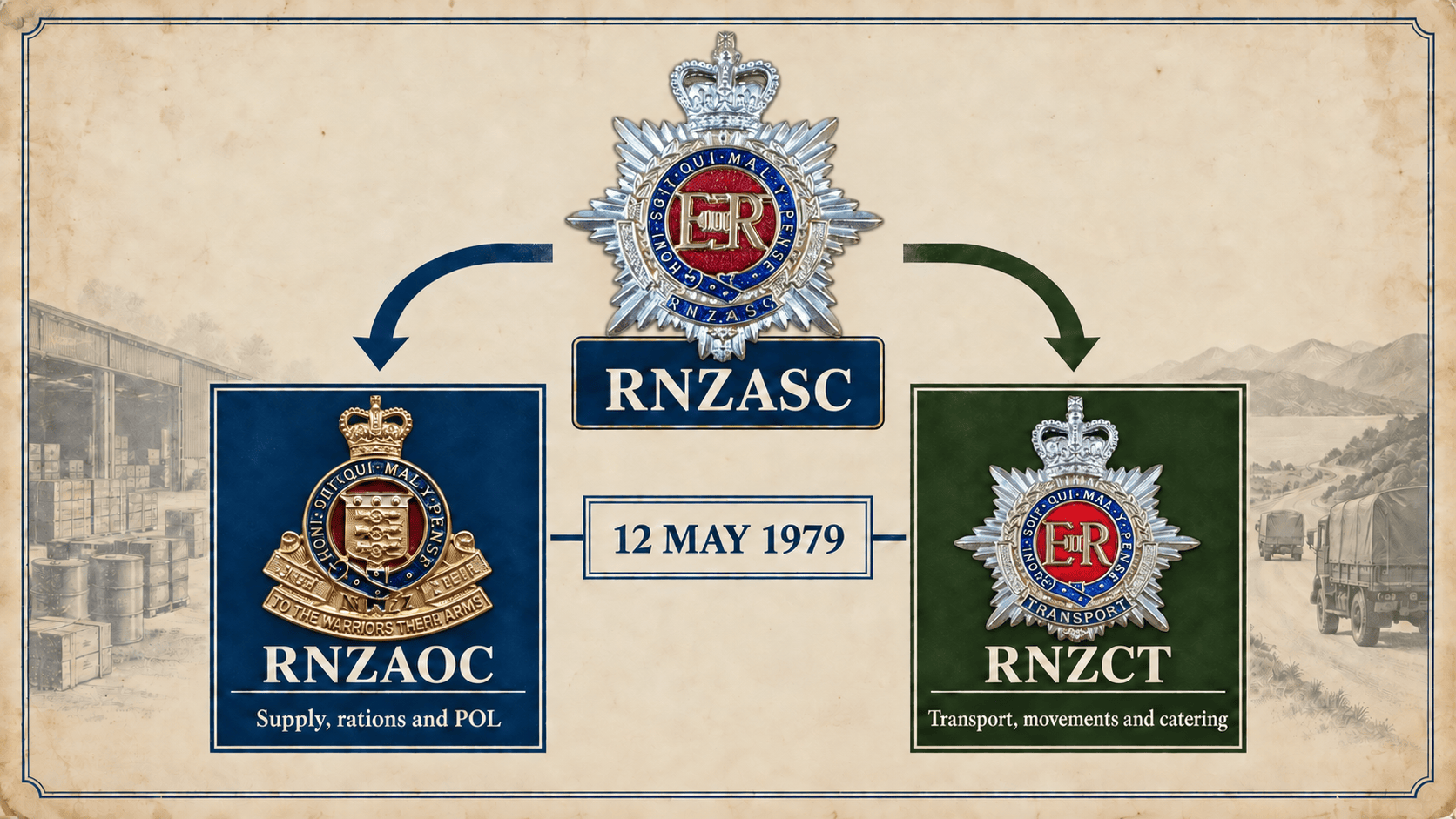
The change made the RNZAOC the Army’s principal supply Corps. From 12 May 1979, it became responsible not only for ordnance stores, ammunition, and technical materiel, but also for foodstuffs, rations, and petroleum, oils and lubricants (POL).[1]
Change was already underway
The formal 1979 transfer was the second stage of a process already underway within the RNZAOC. In July 1978, Pataka described a proposed reorganisation intended to “rationalise the supply chain”. Central Ordnance Depots and Ordnance Field Parks were to be grouped into regional organisations, reducing duplicated stockholding and simplifying the movement of stores from demand to delivery.[2]
The proposal did not promise large Regular Force savings. Its main benefits were expected to be fewer stocking points, lower inventory and storage costs, simpler accounting and better use of people and infrastructure. In October 1978, former RNZASC supply organisations began coming under RNZAOC command for command purposes, and the February 1979 Pataka recorded the practical changes: new titles, altered establishments, repainted signs and the arrival of new personnel.[3]
Why the Army reorganised
The 1978 Defence Review required a rearrangement of Army logistic functions. New Zealand followed the broad direction already adopted in Australia: transport, movements and catering would be grouped in a Corps of Transport, while supply would sit with the RNZAOC.[4]
The date itself carried deliberate symbolism. Major W. Fraser recommended 12 May 1979 because it coincided with the anniversary of the 1910 New Zealand Gazette notice that established the Army Service Corps. The change was therefore both an organisational break and a carefully marked transition from a long-standing corps tradition.[5]
| Organisation from 12 May 1979 | Principal responsibilities |
| Royal New Zealand Corps of Transport | Transport, Defence movements, catering and postal functions. |
| Royal New Zealand Army Ordnance Corps | Supply, including food, rations, POL, ordnance stores, ammunition and related technical responsibilities. |
This division did not separate supply from transport in the field. The RNZAOC held, managed and provided the stocks; the RNZCT provided transport and much of the distribution capability. The implementation order expressly allowed RNZAOC Combat Supplies Platoons to be placed under command of an RNZCT unit when operational circumstances required supplies to be distributed from second-line transport.[6]
What the RNZAOC gained
From 12 May 1979, responsibility for the provision and storage of all foodstuffs and POL, together with the development, evaluation and provision of ration packs, passed from the RNZASC to the RNZAOC. The accompanying equipment sponsorship was broad: refrigeration and air-conditioning equipment, packaging and packing materials, POL storage and quality-control equipment, water containers, agricultural supplies, and specialist camp and religious stores.[7][8]
The transfer also made clerk/storekeeper and butcher training an RNZAOC School responsibility. It affirmed that food, rations and fuel were technical supply functions requiring professional knowledge, not simply commodities to be bought and issued.
The RNZAOC after 12 May 1979
The new directorates at Headquarters New Zealand Land Force were implemented on 9 April 1979, before the field transfer on 12 May. This enabled the Director of Ordnance Services to assume the necessary policy, technical-control and force-management responsibilities before the new unit structure took effect.[9]
The RNZAOC Directorate controlled a national supply system comprising a base supply battalion, four regional Supply Companies, the New Zealand Advanced Ordnance Depot in Singapore and the RNZAOC School.
| Formation or unit | Sub-units | Principal location or area |
| 1 Base Supply Battalion | 1 Composite Supply Company; 54 Supply Platoon | Trentham |
| 1 Supply Company | 12 Ordnance Field Park; 13 Combat Supplies Platoon; 14 Supply Platoon | Ngaruawahia and Papakura |
| 2 Supply Company | 22 Ordnance Field Park; 23 Combat Supplies Platoon; 24 Supply Platoon | Linton |
| 3 Supply Company | 32 Ordnance Field Park; 33 Combat Supplies Platoon; 34 Supply Platoon | Burnham |
| 4 Supply Company | Headquarters 21 Supply Company; 43 Combat Supplies Platoon; 44 Supply Platoon; 47 Petroleum Platoon | Waiouru |
| New Zealand Advanced Ordnance Depot | New Zealand Supply Platoon | Singapore |
| RNZAOC School | Corps and specialist supply training | Waiouru |
This table shows the principal RNZAOC supply organisation following the 1979 reorganisation. It does not attempt to list every RNZAOC technical, ammunition or workshop-stores appointment and element.
The structure combined static and regional supply, base-level bulk holdings and deployable field capability. It was therefore more than a renaming of RNZASC camp supply depots.
The units transferred to the Corps
| Former RNZASC sub-unit | New RNZAOC sub-unit | Location |
| Composite Platoon, 1 Transport Company | 13 Combat Supplies Platoon, 1 Supply Company | Papakura |
| Supply Section, Papakura Platoon, Northern Company | 14 Supply Platoon, 1 Supply Company | Papakura |
| Headquarters 21 Supply Company | Headquarters 21 Supply Company, 4 Supply Company | Waiouru |
| 4 Platoon, 21 Supply Company | 43 Combat Supplies Platoon, 4 Supply Company | Waiouru |
| Supply Platoon, Waiouru Company | 44 Supply Platoon, 4 Supply Company | Waiouru |
| 7 Platoon, 21 Supply Company | 47 Petroleum Platoon, 4 Supply Company | Waiouru |
| New sub-unit | 23 Combat Supplies Platoon, 2 Supply Company | Linton |
| Supply Section, Linton Platoon, Central Company | 24 Supply Platoon, 2 Supply Company | Linton |
| Wellington Supply Platoon, Central Company | 54 Supply Platoon, 1 Base Supply Battalion | Trentham |
| Composite Platoon, 3 Transport Company | 33 Combat Supplies Platoon, 3 Supply Company | Burnham |
| Burnham Supply Platoon, Southern Company | 34 Supply Platoon, 3 Supply Company | Burnham |
| Supply Platoon, New Zealand Transport Company | New Zealand Supply Platoon, NZAOD | Singapore |
The revised numbering made the national pattern clearer. The 14, 24, 34, 44 and 54 Supply Platoons corresponded to Papakura, Linton, Burnham, Waiouru and Trentham. The specialist exception was 47 Petroleum Platoon, which retained the petroleum function of former 7 Platoon, 21 Supply Company, while adopting the Waiouru prefix. Headquarters 21 Supply Company remained as a Territorial Force sub-unit of 4 Supply Company, capable of commanding up to five supply sub-units for training and exercises.[10]
People and capability transferred with the units
The establishment papers show that the reorganisation was not merely an exercise in moving existing posts. Eighty Regular Force supply posts and two civilian posts were transferred to the RNZAOC. There was no increase in the Regular Force establishment, but the Territorial Force supply establishment rose from 123 to 158 posts, a net gain of 35. The increase was required to establish 23 Combat Supplies Platoon at Linton, an entirely new sub-unit.[11]
This demonstrates that rationalisation and capability growth occurred together. Former RNZASC composite platoons became RNZAOC Combat Supplies Platoons; the existing combat-supply and petroleum capabilities of 21 Supply Company were retained, and a new platoon was raised for 2 Task Force Region.
Continuity of expertise was protected. RNZASC personnel employed in supply units were to remain in those units until the RNZAOC had sufficient trained personnel to replace them. They were also required to indicate whether they wished to join the RNZCT or RNZAOC.[12]
The transfer was also a lived transition, not merely an establishment change. Contemporary accounts suggest that some RNZASC and RNZAOC personnel expected difficulties, particularly in the continued supply of rations. In practice, the handover of tasks and the incorporation of transferees proceeded smoothly. The result supports the central lesson of the reorganisation: adaptation was judged not by creating new titles or badges, but by whether the Army continued to receive essential support without interruption.[13]
Accounts, responsibility and continuity
The change was embedded in the accounting system. Northern Company RNZASC’s supply-depot bulk-stock account became that of 1 Supply Company; Waiouru Company’s became 4 Supply Company; the Linton and Trentham Central Company accounts transferred to 2 Supply Company and 1 Base Supply Battalion; and Southern Company’s became 3 Supply Company.[14]
This mattered because stock accounts represented formal custody and accountability. New badges and unit titles could be introduced quickly; transferring account responsibility changed the organisation answerable for receipt, storage, demand, issue and reconciliation of the stores that sustained the Army.
Adaptation without interruption
The 1978 to 1979 reorganisation fundamentally widened the RNZAOC’s role. It placed food, fuel, rations and supply support alongside ordnance stores, ammunition and technical materiel. At the same time, it preserved the interdependence of supply and transport, retained specialist knowledge during the transfer and added a new Territorial Force combat-supply capability at Linton.
The contemporary details differ, but the lesson remains relevant. Logistics must adapt to new systems, new equipment and new operating demands while continuing to sustain the force. In 1979, the decisive measure was not whether the chart changed; it was whether the Army could still feed, fuel and equip its units. That remains the proper measure of logistic adaptation today.[15]
Notes
[1] Army General Staff, Army Reorganisation Instruction No. 11: RNZASC Reorganisation, Army 209/1/142/SD, 24 April 1979, paras. 1-5
[2] The RNZAOC Reorganisation,” Pataka, July 1978, 10-12.
[3] Depot News,” Pataka, February 1979, 3-8.
[4] Julia Millen, Salute to Service: A History of the Royal New Zealand Corps of Transport and Its Predecessors, 1860-1996 (Wellington: Victoria University Press, 1997), 415-16
[5] Julia Millen, Salute to Service: A History of the Royal New Zealand Corps of Transport and Its Predecessors, 1860-1996 (Wellington: Victoria University Press, 1997), 415-16
[6] Ibid., Annex F, para. 9.
[7] Ibid., Annex F, para. 5
[8] Ibid., para. 3g and Annex F, paras. 1-2.
[9] Headquarters New Zealand Defence Force, Army General Staff, Army Reorganisation Establishments, Volume 3, Army 1920/1, April 1979, paras. 3 and 10-15
[10] Army General Staff, Army Reorganisation Instruction No. 11, Annexes D and F, paras. 6-7.
[11] Headquarters New Zealand Defence Force, Army General Staff, Army Reorganisation Establishments, Volume 3, Annex F, “Supply Posts for RNZAOC.”
[12] Army General Staff, Army Reorganisation Instruction No. 11, para. 6c.
[13] Major J. S. Bolton, A History of the Royal New Zealand Army Ordnance Corps (Trentham: RNZAOC, 1992), 224-25
[14] Army General Staff, Army Reorganisation Instruction No. 11, Annex F, para. 8.
[15] Ministry of Defence, Defence Capability Plan 2025 (Wellington: Ministry of Defence, 2025), 39.
