How the 1978 to 1979 Reorganisation Reshaped RNZAOC Supply.
Military logistics must adapt to new equipment, changing force structures, financial constraints and operational demands. The practical test of any change, however, is whether it sustains support to the force throughout. The 1978 to 1979 reorganisation of the Royal New Zealand Army Ordnance Corps (RNZAOC) is a clear New Zealand example. It changed the Corps’ responsibilities, units, establishments, stock accounts, and training role, while food, fuel, and stores still had to reach the Army.
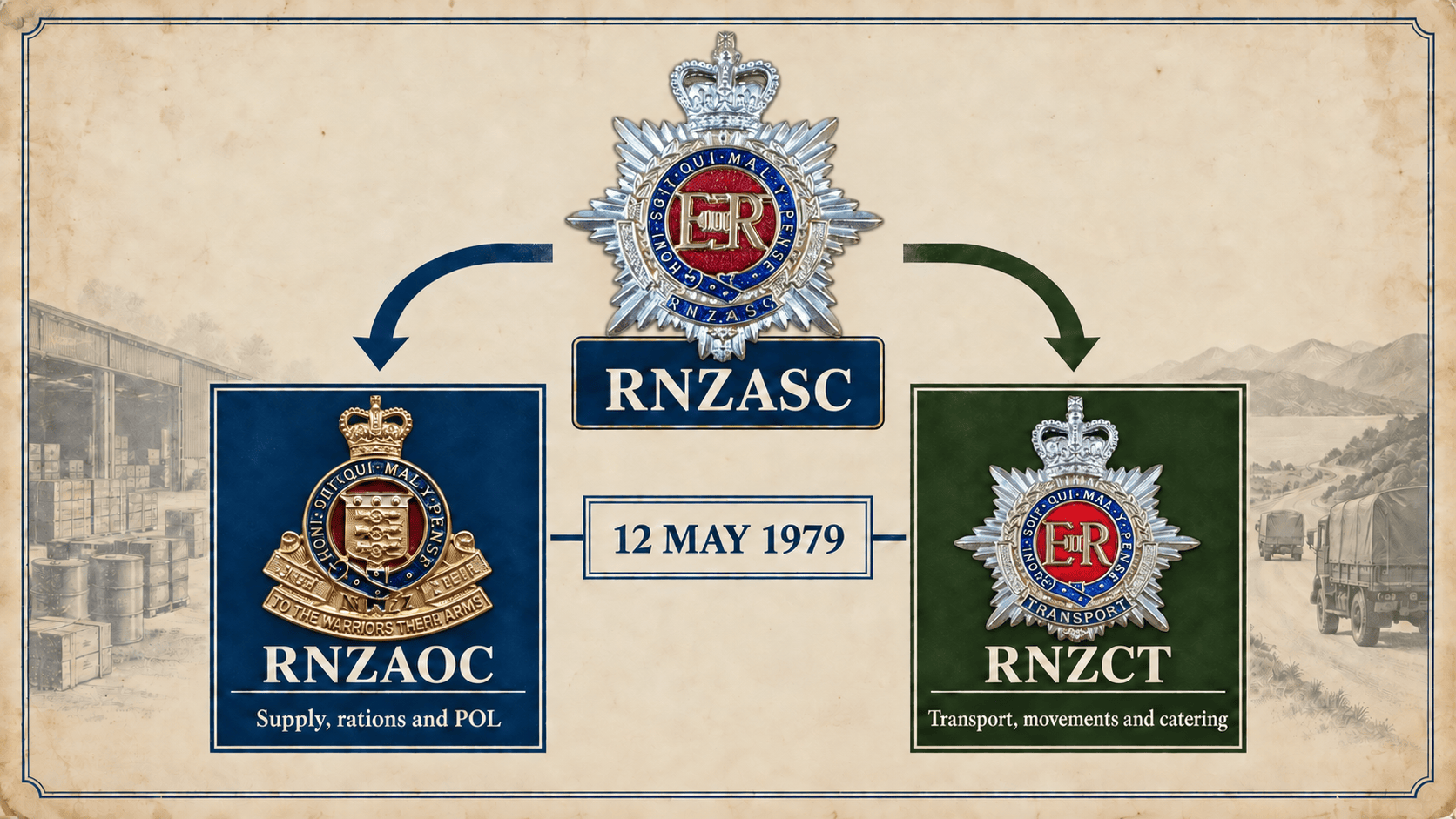
The change made the RNZAOC the Army’s principal supply Corps. From 12 May 1979, it became responsible not only for ordnance stores, ammunition, and technical materiel, but also for foodstuffs, rations, and petroleum, oils and lubricants (POL).[1]
Change was already underway
The formal 1979 transfer was the second stage of a process already underway within the RNZAOC. In July 1978, Pataka described a proposed reorganisation intended to “rationalise the supply chain”. Central Ordnance Depots and Ordnance Field Parks were to be grouped into regional organisations, reducing duplicated stockholding and simplifying the movement of stores from demand to delivery.[2]
The proposal did not promise large Regular Force savings. Its main benefits were expected to be fewer stocking points, lower inventory and storage costs, simpler accounting and better use of people and infrastructure. In October 1978, former RNZASC supply organisations began coming under RNZAOC command for command purposes, and the February 1979 Pataka recorded the practical changes: new titles, altered establishments, repainted signs and the arrival of new personnel.[3]
Why the Army reorganised
The 1978 Defence Review required a rearrangement of Army logistic functions. New Zealand followed the broad direction already adopted in Australia: transport, movements and catering would be grouped in a Corps of Transport, while supply would sit with the RNZAOC.[4]
The date itself carried deliberate symbolism. Major W. Fraser recommended 12 May 1979 because it coincided with the anniversary of the 1910 New Zealand Gazette notice that established the Army Service Corps. The change was therefore both an organisational break and a carefully marked transition from a long-standing corps tradition.[5]
Organisation from 12 May 1979
Principal responsibilities
Royal New Zealand Corps of Transport
Transport, Defence movements, catering and postal functions.
Royal New Zealand Army Ordnance Corps
Supply, including food, rations, POL, ordnance stores, ammunition and related technical responsibilities.
This division did not separate supply from transport in the field. The RNZAOC held, managed and provided the stocks; the RNZCT provided transport and much of the distribution capability. The implementation order expressly allowed RNZAOC Combat Supplies Platoons to be placed under command of an RNZCT unit when operational circumstances required supplies to be distributed from second-line transport.[6]
What the RNZAOC gained
From 12 May 1979, responsibility for the provision and storage of all foodstuffs and POL, together with the development, evaluation and provision of ration packs, passed from the RNZASC to the RNZAOC. The accompanying equipment sponsorship was broad: refrigeration and air-conditioning equipment, packaging and packing materials, POL storage and quality-control equipment, water containers, agricultural supplies, and specialist camp and religious stores.[7][8]
The transfer also made clerk/storekeeper and butcher training an RNZAOC School responsibility. It affirmed that food, rations and fuel were technical supply functions requiring professional knowledge, not simply commodities to be bought and issued.
The RNZAOC after 12 May 1979
The new directorates at Headquarters New Zealand Land Force were implemented on 9 April 1979, before the field transfer on 12 May. This enabled the Director of Ordnance Services to assume the necessary policy, technical-control and force-management responsibilities before the new unit structure took effect.[9]
The RNZAOC Directorate controlled a national supply system comprising a base supply battalion, four regional Supply Companies, the New Zealand Advanced Ordnance Depot in Singapore and the RNZAOC School.
This table shows the principal RNZAOC supply organisation following the 1979 reorganisation. It does not attempt to list every RNZAOC technical, ammunition or workshop-stores appointment and element.
The structure combined static and regional supply, base-level bulk holdings and deployable field capability. It was therefore more than a renaming of RNZASC camp supply depots.
The units transferred to the Corps
Former RNZASC sub-unit
New RNZAOC sub-unit
Location
Composite Platoon, 1 Transport Company
13 Combat Supplies Platoon, 1 Supply Company
Papakura
Supply Section, Papakura Platoon, Northern Company
14 Supply Platoon, 1 Supply Company
Papakura
Headquarters 21 Supply Company
Headquarters 21 Supply Company, 4 Supply Company
Waiouru
4 Platoon, 21 Supply Company
43 Combat Supplies Platoon, 4 Supply Company
Waiouru
Supply Platoon, Waiouru Company
44 Supply Platoon, 4 Supply Company
Waiouru
7 Platoon, 21 Supply Company
47 Petroleum Platoon, 4 Supply Company
Waiouru
New sub-unit
23 Combat Supplies Platoon, 2 Supply Company
Linton
Supply Section, Linton Platoon, Central Company
24 Supply Platoon, 2 Supply Company
Linton
Wellington Supply Platoon, Central Company
54 Supply Platoon, 1 Base Supply Battalion
Trentham
Composite Platoon, 3 Transport Company
33 Combat Supplies Platoon, 3 Supply Company
Burnham
Burnham Supply Platoon, Southern Company
34 Supply Platoon, 3 Supply Company
Burnham
Supply Platoon, New Zealand Transport Company
New Zealand Supply Platoon, NZAOD
Singapore
The revised numbering made the national pattern clearer. The 14, 24, 34, 44 and 54 Supply Platoons corresponded to Papakura, Linton, Burnham, Waiouru and Trentham. The specialist exception was 47 Petroleum Platoon, which retained the petroleum function of former 7 Platoon, 21 Supply Company, while adopting the Waiouru prefix. Headquarters 21 Supply Company remained as a Territorial Force sub-unit of 4 Supply Company, capable of commanding up to five supply sub-units for training and exercises.[10]
People and capability transferred with the units
The establishment papers show that the reorganisation was not merely an exercise in moving existing posts. Eighty Regular Force supply posts and two civilian posts were transferred to the RNZAOC. There was no increase in the Regular Force establishment, but the Territorial Force supply establishment rose from 123 to 158 posts, a net gain of 35. The increase was required to establish 23 Combat Supplies Platoon at Linton, an entirely new sub-unit.[11]
This demonstrates that rationalisation and capability growth occurred together. Former RNZASC composite platoons became RNZAOC Combat Supplies Platoons; the existing combat-supply and petroleum capabilities of 21 Supply Company were retained, and a new platoon was raised for 2 Task Force Region.
Continuity of expertise was protected. RNZASC personnel employed in supply units were to remain in those units until the RNZAOC had sufficient trained personnel to replace them. They were also required to indicate whether they wished to join the RNZCT or RNZAOC.[12]
The transfer was also a lived transition, not merely an establishment change. Contemporary accounts suggest that some RNZASC and RNZAOC personnel expected difficulties, particularly in the continued supply of rations. In practice, the handover of tasks and the incorporation of transferees proceeded smoothly. The result supports the central lesson of the reorganisation: adaptation was judged not by creating new titles or badges, but by whether the Army continued to receive essential support without interruption.[13]
Accounts, responsibility and continuity
The change was embedded in the accounting system. Northern Company RNZASC’s supply-depot bulk-stock account became that of 1 Supply Company; Waiouru Company’s became 4 Supply Company; the Linton and Trentham Central Company accounts transferred to 2 Supply Company and 1 Base Supply Battalion; and Southern Company’s became 3 Supply Company.[14]
This mattered because stock accounts represented formal custody and accountability. New badges and unit titles could be introduced quickly; transferring account responsibility changed the organisation answerable for receipt, storage, demand, issue and reconciliation of the stores that sustained the Army.
Adaptation without interruption
The 1978 to 1979 reorganisation fundamentally widened the RNZAOC’s role. It placed food, fuel, rations and supply support alongside ordnance stores, ammunition and technical materiel. At the same time, it preserved the interdependence of supply and transport, retained specialist knowledge during the transfer and added a new Territorial Force combat-supply capability at Linton.
The contemporary details differ, but the lesson remains relevant. Logistics must adapt to new systems, new equipment and new operating demands while continuing to sustain the force. In 1979, the decisive measure was not whether the chart changed; it was whether the Army could still feed, fuel and equip its units. That remains the proper measure of logistic adaptation today.[15]
Notes
[1] Army General Staff, Army Reorganisation Instruction No. 11: RNZASC Reorganisation, Army 209/1/142/SD, 24 April 1979, paras. 1-5
[2] The RNZAOC Reorganisation,” Pataka, July 1978, 10-12.
[4] Julia Millen, Salute to Service: A History of the Royal New Zealand Corps of Transport and Its Predecessors, 1860-1996 (Wellington: Victoria University Press, 1997), 415-16
[5] Julia Millen, Salute to Service: A History of the Royal New Zealand Corps of Transport and Its Predecessors, 1860-1996 (Wellington: Victoria University Press, 1997), 415-16
[9] Headquarters New Zealand Defence Force, Army General Staff, Army Reorganisation Establishments, Volume 3, Army 1920/1, April 1979, paras. 3 and 10-15
[10] Army General Staff, Army Reorganisation Instruction No. 11, Annexes D and F, paras. 6-7.
[11] Headquarters New Zealand Defence Force, Army General Staff, Army Reorganisation Establishments, Volume 3, Annex F, “Supply Posts for RNZAOC.”
[12] Army General Staff, Army Reorganisation Instruction No. 11, para. 6c.
[13] Major J. S. Bolton, A History of the Royal New Zealand Army Ordnance Corps (Trentham: RNZAOC, 1992), 224-25
[14] Army General Staff, Army Reorganisation Instruction No. 11, Annex F, para. 8.
[15] Ministry of Defence, Defence Capability Plan 2025 (Wellington: Ministry of Defence, 2025), 39.
The Royal New Zealand Army Ordnance Corps did not deploy a formed unit to South Vietnam. There was no RNZAOC depot, field park or company bearing the Corps’ badge. Instead, small numbers of RNZAOC officers, warrant officers, non-commissioned officers and soldiers served throughout the New Zealand and Australian command and logistic systems.
They worked at Headquarters New Zealand V Force in Saigon, Headquarters 1st Australian Task Force at Nui Dat, the 1st Australian Logistic Support Group at Vung Tau, and in the Logistic Support Element originally attached to 161 Battery, Royal New Zealand Artillery. At any one time, the RNZAOC presence was usually only a handful of personnel—approximately two officers and four other ranks—but their responsibilities connected New Zealand units with an extensive multinational supply network.[1]
This was a corps without a unit, but not without a function. Its personnel helped manage the flow of weapons, ammunition, vehicles, technical stores, clothing, equipment and distinctly New Zealand items through a logistic system spanning New Zealand, Australia, South Vietnam and the vast American supply establishment.
Designing the support system
When 161 Battery was selected for service in South Vietnam in 1965, one option considered was to re-equip the battery completely from United States Army stocks. That would have simplified some aspects of supply, but it would also have required the battery to abandon much of its established equipment and procedures.[2]
The arrangements negotiated in Saigon during May and June 1965 instead produced a hybrid system. Colonel Leo Kermode and the Director of Equipment, Lieutenant-Colonel Ron Hassett, worked with Australian and American authorities to divide responsibility for supporting the New Zealand force.[3]
Broadly, the system operated as follows:
Supply source
Principal responsibilities
New Zealand
New Zealand-owned weapons and vehicles, national items, badges, shoulder titles, distinctive clothing and equipment not available from allied sources
United States
Most ammunition, petrol, oils and lubricants, rations, medical supplies, fire-control equipment and other commonly used operational stores
Australia
Clothing, vehicle spares, general stores, technical support, medical support and access to Australian supply and maintenance organisations[4]
A sixteen-man Logistic Support Element was formed under Lieutenant Piers Martin Reid. It contained personnel from several New Zealand corps and was intended to connect 161 Battery with the Australian logistic company supporting the 1st Battalion, Royal Australian Regiment, at Bien Hoa.[5]
The arrangement gave the small New Zealand force access to a logistic establishment far beyond anything it could have deployed independently. It also created an enduring administrative challenge: responsibility for an item depended on who owned it, who normally supplied it, whether it was common to allied forces and which nation was expected to pay for it.
Bien Hoa: making the system work
The New Zealand Logistic Support Element was divided between Saigon and Bien Hoa. Some personnel served at Headquarters New Zealand V Force, while the remainder formed a battery section of the Light Aid Detachment and an augmented stores section supporting 161 Battery.
The original intention was to integrate the New Zealand element with the Australian Logistic Support Company. This did not happen immediately. The stores and workshop personnel initially moved into the Australian area but were subsequently accommodated with the battery, creating a small and comparatively independent New Zealand support organisation.
That arrangement was not entirely satisfactory. On 9 January 1966, the original policy was restored: the New Zealand element was placed under the Australian company’s operational and technical control, its personnel moved into the Australian area, and its stores were amalgamated with Australian holdings.[6]
The integration was important because 161 Battery arrived with several items that were not standard Australian or American equipment. Its Land Rovers, for example, were too small and underpowered for some of the tasks demanded of them, while replacement parts generally had to come from New Zealand. An American depot might hold thousands of vehicle components, but it could not supply a part for a vehicle that the United States Army did not use.
There were also substantial differences in scale. American depots operated in tons, pallet loads and large standard packs. New Zealand might require only a carton or a single component. The American system increasingly relied on computerised accounting, while New Zealand procedures remained largely manual. Requisitions therefore had to be translated not only between national organisations, but between fundamentally different concepts of scale and stock control.[7]
The L5 105-mm pack howitzer created further demands. It was light enough to be carried by helicopter, but tropical conditions reduced helicopter lifting capacity. Trials established that four sorties were required to move one gun, its detachment and twenty-five rounds. The weapon’s light construction also made it susceptible to damage when repeatedly fired at high charges. Maintaining the battery’s operational availability consequently depended upon an effective combination of engineering maintenance and ordnance supply.[8]
From Bien Hoa to Vung Tau and Nui Dat
The Australian commitment expanded from a battalion group into the brigade-sized 1st Australian Task Force during 1966. The task force established its operational base at Nui Dat in Phuoc Tuy Province, while its main logistic base was built approximately thirty-five kilometres away at Vung Tau.
161 Battery moved to Nui Dat on 16 May 1966. Its Logistic Support Element was detached and established within the 1st Australian Logistic Support Group at Vung Tau.[9]
Vung Tau offered port facilities, an airfield and a comparatively secure location, but the logistic base had to be developed on sand hills and a former rubbish tip. From primitive beginnings it grew into a large complex containing more than 1,300 service personnel and approximately 500 locally employed civilians.
Entrance to 1st Australian Logistic Support Group, Vung Tau.
The sand was a constant adversary. Tent pegs worked loose, trenches collapsed, vehicles bogged down and furniture sank into the ground. Fine sand entered weapons, engines, typewriters, stores, food, clothing and bedding. Maintaining an accurate and serviceable stockholding in such conditions required continual preservation, inspection and housekeeping.
At Nui Dat, second-line ordnance support was provided by an Ordnance Field Park. The initial element became the 6th Ordnance Field Park Detachment and, on 1 February 1968, was redesignated as the 1st Ordnance Field Park.
Ordnance Field Park (Det) location on Hill ‘Nui Dat 2’
1967 – New Store Sheds and Control Office HQ Building OFP Nui Dat
At Vung Tau, third-line support was provided successively by the 1st Composite Ordnance Company, the 2nd Composite Ordnance Depot and, from 16 November 1967, the 2nd Advanced Ordnance Depot.[10]
The 2nd Advanced Ordnance Depot included supply-control, stores, ammunition, vehicle, laundry and bath elements. It held approximately 15,000 line items, generally based on ninety days of operating stock together with theatre reserves. New Zealand ordnance personnel posted to the Australian system could therefore find themselves working within an organisation of a scale not encountered at home.[11]
1st Australian Logistic Support Group, Vung Tau, 1971. The former improvised base had developed into a large theatre logistic complex.
The supply chain
New Zealand’s supply system in Vietnam was not a single pipeline. It was a network.
Headquarters New Zealand V Force in Saigon managed national requirements, financial arrangements, local purchase and liaison with allied headquarters. New Zealand-specific stores were forwarded through national channels, while Australian and American organisations supplied most common operational requirements.
Members of V Force HQ in Saigon, 1971. Back row (Left to Right): Sgt Derek Cain RNZEME, Cpl Alby Bron RNZEME, LBdr Bruce Tutauha RNZA, LCpl A Rendell RNZASC, Cpl Bruce Isbister RNZIR, Bdr Tony Hulme? RNZA, Dvr Greg Hutton RNZASC, LCpl Terry Burch RNZSigs, Cpl Pat Cranston RNZIR, Cpl Doug Waugh RNZAOC Front row (Left to Right): Ssgt Ces Hughes RNZIR, WO2 Jack Bingham RNZE, WO2 Cliff Lindsay RNZIR, Capt Buster Hornbrook RNZIR, Lt Col Val Brown RNZIR, Maj Bruce Meldrum RNZAC, WO A. McAsey RNZAF, WO2 Lofty Keys RNZIR
Urgent stores, mail and personnel could be moved by air. RNZAF and allied aircraft connected New Zealand, Singapore, Saigon and Vung Tau. Routine Australian flights also linked Saigon, Vung Tau and Nui Dat.
The principal daily connection between the logistic base and the task force was the road convoy from Vung Tau to Nui Dat. Priority demands, ice and perishables normally moved each day. Ammunition and petroleum products were carried forward three times a week, while ordnance and engineer stores generally moved twice weekly. Including the various classes of supply, 1st Australian Logistic Support Group could be tasked with approximately forty-six truckloads each day, seven days a week.
Each convoy was affected by road conditions, vehicle availability and enemy activity. Daily logistic conferences at Vung Tau considered demands, priorities, transport, road closures, intelligence and the back-loading of salvage. Operationally urgent items could be carried by special vehicle, aircraft, helicopter or watercraft when the normal system was too slow.[12]
Bulk resupply arrived by sea. HMAS Jeparit normally visited at intervals of about six weeks and was frequently loaded close to its 4,300-ton capacity. Ammunition, explosives and vehicles were discharged into barges before the ship came alongside to unload the remainder of its cargo. Other vessels, including HMAS Sydney, supplemented this service during unit rotations and major movements.
The system was vast compared with the number of New Zealanders it supported. Its size offered considerable advantages, but it also made New Zealand-owned equipment difficult to track. An item might pass through a New Zealand headquarters, an Australian depot, an American support unit and a forward Australian ordnance installation before reaching its user.[13]
Ammunition
Ammunition supply was one of the clearest examples of coalition dependence. Approximately ninety per cent of Australian and New Zealand ammunition requirements came from United States sources. The remainder came from Australia and included 105-mm artillery ammunition, 20-pounder ammunition for Centurion tanks and some small-arms ammunition.
Australian ammunition was initially held at a sub-depot at Vung Tau. It was later moved to the United States ammunition establishment at Long Binh, allowing both American- and Australian-supplied ammunition to be issued through one location. Australian and New Zealand ammunition technicians were attached at various times to undertake identification, safety, quality surveillance and disposal duties.
The United States Army logistics complex at Long Binh, 1967. Australian and New Zealand ammunition supply increasingly drew on the American depot system.
American road transport delivered ammunition for the task force directly to the Task Force Maintenance Area at Nui Dat. This reduced double handling, but it did not remove the need for ordnance oversight. Different manufacturers, markings, lots, fuzes and national accounting arrangements still had to be reconciled.[14]
Ammuniton stored in the 1 ALSG by the American bunker system, which was used throughout Vietnam. The ammunition point at Nui Dat contained seven such bunkers cut into the side of a hill. Ammunition was stored in two-point dispersion, and usually only vulnerable items such as pyrotechnics were stored covered because the turnover of stock was rapid. Photo RNZAOC School
Payment arrangements were equally complex. New Zealand initially paid a fixed monthly charge for American support. From 1967, artillery ammunition was charged according to recorded expenditure. A 105-mm round was priced at US$25.62, increasing to US$31.49 in March 1969.
Fuzes became the subject of separate negotiation. New Zealand was presented with a retrospective account of approximately $567,000, but the United States agreed not to charge for the fuzes fitted to more than 120,000 shells fired between 1965 and 1968. At approximately nine dollars per fuze, this represented a substantial saving. The episode nevertheless demonstrated that coalition logistics involved finance and accounting as well as the physical delivery of ammunition.[15]
The wider Australian ordnance framework
The Royal Australian Army Ordnance Corps provided the organisational framework within which most New Zealand ordnance personnel worked. The system included the 2nd Advanced Ordnance Depot at Vung Tau, the Ordnance Field Park at Nui Dat and numerous specialist stores sections supporting workshops, engineer units, armoured units and communications organisations.
Ordnance soldiers did not remain permanently behind wire. Field Park personnel provided forward detachments during major operations, operated bath and water-point equipment, assisted with patrols and perimeter defence, guarded stores and accompanied convoys. At Fire Support Base Coral in May 1968, the forward Task Force Maintenance Area group operated in a position repeatedly attacked by rockets and mortars. Stores and records were damaged, and a complete stocktake was required after the detachment returned.
Even fixed installations remained within range of enemy action. The Ordnance Field Park area at Nui Dat came under mortar fire, while personnel at both Nui Dat and Vung Tau were required to maintain defensive positions and perform sentry and local-security duties. Logistic service in Vietnam could not be separated completely from the operational environment.[16]
New Zealanders in the wider system
Approximately five per cent of New Zealand V Force was employed in the supply chain. At the peak of the New Zealand commitment in November 1968, thirty of the 543 New Zealand personnel in South Vietnam were serving with the 1st Australian Logistic Support Group. Across the entire deployment, 137 New Zealanders from all corps and services served with the group.
These figures must not be mistaken for RNZAOC strength. New Zealanders in 1st Australian Logistic Support Group included personnel from many corps and services. The RNZAOC component was only one part of that wider national contribution.
Some RNZAOC personnel also served at American installations. Corporal Frankie Te Waru Hohepa, for example, worked at the United States Army depot at Long Binh. Such attachments provided direct access to the American supply system and gave New Zealand personnel experience with methods, stock levels and accounting procedures far larger than those normally encountered in New Zealand.[17]
A contemporary Corps newsletter provides a particularly clear picture of this dispersed presence. In 1970, Major Malcolm Ross was serving at Headquarters 1st Australian Logistic Support Group; Lieutenant Maxwell Newnham and Sergeants Rex Pennell and Terence Morrissey were attached to the 2nd Advanced Ordnance Depot at Vung Tau; Corporal Brian Moore was attached to 161 Battery at Nui Dat; and Corporals Ronald Henderson and Joseph Bolton were at Headquarters New Zealand V Force in Saigon. They did not constitute an RNZAOC unit, but collectively formed a small network of ordnance specialists distributed across the principal New Zealand and Australian logistic organisations.[18]
The surviving reports also reveal what these arrangements meant at the individual level. Corporal Joseph Bolton reported that he was attached to the Australians as a local-purchase clerk in the United States Supply Office in Saigon. The appointment placed him at the intersection of the New Zealand, Australian and American supply systems. He also hoped to gain an attachment to the United States Army ammunition sub-depot at Long Binh so that he could return to ammunition work.[19]
The New Zealand headquarters in Saigon underwent several changes of title:
Headquarters New Zealand Army Detachment, 29 June 1964–1 July 1965
Headquarters New Zealand V Force, 2 July 1965–5 March 1972
Headquarters New Zealand Army Training Group Vietnam, 6 March–21 December 1972
Published nominal rolls sometimes combine these headquarters under the general title ‘HQ V Force’. The distinction is nevertheless useful when establishing when and under what organisation an individual served.[20]
RNZAOC personnel in the ordnance and logistic system
The following register is confined to personnel who served in South Vietnam as members of the RNZAOC, in RNZAOC appointments or in direct ordnance-support roles.
It does not include soldiers who served in the New Zealand rifle companies or Army training teams as members of other corps and transferred to the RNZAOC after their Vietnam service. Those personnel are covered in the earlier V Force Ordnance article.
Headquarters New Zealand V Force
Corporal Joseph Seymour Bolton
Sergeant John Walter ‘Boots’ Byrom
Corporal Ronald John Henderson
Warrant Officer Class Two John Edward Hancox
Corporal James Nelson Harvey
Corporal Frankie Te Waru Hohepa
Lance Corporal Kevin Gerard Moriarty
Lance Corporal Colin William Roulston
Lieutenant Mark David Stuart
Sergeant Bruce Raymond Swain
Corporal Barry James Taylor
Corporal William Douglas Waugh
Headquarters 1st Australian Task Force
Corporal Michael Maurice Barker
Private Colin Robert Von Richenbach
1st Australian Logistic Support Group
Corporal Brian William Calvey
Major Arthur John Campbell
Corporal Ernest Reichter Clegg
Captain Gary Malcolm Corkin
Lieutenant Ronald Leslie Cross
Staff Sergeant Alfred Stephenson Day
Captain Kevin John Dreyer
Lieutenant James Bernard Finnerty
Sergeant Dennis Leslie Goldfinch
Corporal Laurence Roy Hawkins
Staff Sergeant Tamamarakau Te Kingi Hiini
Sergeant Arthur James Keeler
Staff Sergeant Derek John Keen
Lieutenant Terence David McBeth
Corporal Phillip Ross Miller
Sergeant Terence Norman Morrissey
Lieutenant Maxwell Frederick Newnham
Staff Sergeant Rex Pennell
Lieutenant Piers Martin Reid
Major Malcolm John Ross
Staff Sergeant Roy Harold Staniford
Sergeant Barry Thomas Thompson
Sergeant Darrell Samuel Todd
Staff Sergeant James William Twist
The New Zealand Governor-General Sir Arthur Porritt chats with Staff Sergeant Rex Pennell during his visit to New Zeland troops in Vung Tau. Captain M.F Newnham is to the right of SSgt Pennell. RNZAOC School
161 Battery Logistic Support Element and attachments
Corporal Laurence Charles Collier
Staff Sergeant Ronald Albert Eveleigh
Lieutenant David Ralph Hughes
Sergeant Maurice John Lynch
Corporal Brian David Moore
Corporal Wilford Stuart Neshausen
Private Stephen Rex Shepherd
Private Stephen Shepherd was an RNZAOC storeman attached to 161 Battery. Although he has sometimes been recorded as a gunner because of that attachment, he remained a member of the RNZAOC throughout his service.
The register reflects the dispersed nature of RNZAOC service in South Vietnam. These personnel did not belong to a single corps unit. They occupied appointments across headquarters, depots, field installations and the logistic element supporting the New Zealand artillery battery.[21]
Withdrawal
The withdrawal of 161 Battery in May 1971 began another demanding phase for the logistic system. Weapons, vehicles, technical equipment and stores had to be identified as New Zealand-owned, Australian-supplied, American-supplied, leased, expendable or suitable for disposal in theatre.
The work could also extend an individual’s service in Vietnam. Sergeant John Byrom’s one-year tour was prolonged specifically so that he could assist with the withdrawal of stores from South Vietnam. His extended tour provides a personal example of the additional accounting, identification and disposal work generated as the New Zealand commitment contracted.[22]
The battery’s non-standard and borrowed holdings, including its M2A2 105-mm howitzers, had to be returned through the appropriate channels. Serviceable New Zealand equipment was prepared for shipment, while surplus and unserviceable stores were accounted for, transferred or disposed of.
The Australian withdrawal required ordnance personnel to maintain support while simultaneously reducing the organisation that provided it. During 1971, the 1st Ordnance Field Park moved most of its organisation from Nui Dat to Vung Tau, leaving a detachment to operate controlled stores, the self-service store, the monthly bulk break and the equipment wash point.
Quarantine regulations required vehicles and equipment returning to Australia to be thoroughly cleaned. Tanks, vehicles and stores exposed to Vietnamese soil had to pass inspection before loading. Other material, including deteriorated tentage, webbing and tarpaulins, could be written off, destroyed or transferred rather than shipped home.
On 15 September 1971, the 1st Ordnance Field Park at Vung Tau assumed responsibility for supporting the remaining Australian forces from the 2nd Advanced Ordnance Depot. Its personnel had to determine a final stock scaling that would meet every remaining operational demand without leaving a large surplus when the force closed.
This required continuous stocktaking, outscaling and reconciliation. The field park still received and issued stores, but its holdings had to decline in step with the force. It closed for business on 31 January 1972. Personnel and equipment then returned to Australia, where the final reconciliation of stock and records continued until June.[23]
New Zealand’s headquarters and training commitment continued until December 1972. Personnel who served with the training teams as members of other corps and subsequently transferred to the RNZAOC fall outside the scope of this article.
Conclusion
The RNZAOC contribution in South Vietnam cannot be measured by unit titles or the size of a formed deployment. There was no New Zealand ordnance depot and no RNZAOC field park. Instead, individual corps personnel were inserted into a multinational system and expected to make it work for a small national force.
They translated New Zealand requirements into Australian and American supply procedures, maintained national accountability, handled technical and general stores, supported ammunition supply, assisted with local purchase and helped sustain 161 Battery and the wider New Zealand contingent.
The arrangement offered New Zealand access to a supply chain of immense capacity, but it also exposed the difficulties of relying on allies whose equipment, accounting systems, stock scales and administrative practices differed from its own.
The achievement of the RNZAOC personnel in Vietnam was therefore one of professional adaptability. Dispersed across Saigon, Vung Tau, Nui Dat and allied installations, they ensured that New Zealand soldiers received the stores, weapons, ammunition and equipment they required. The Corps went to Vietnam without a unit of its own, yet its purpose—providing the warrior with the means to fight—remained unmistakable.
Notes
[1]J. S. Bolton, A History of the Royal New Zealand Army Ordnance Corps (Trentham, New Zealand: Royal New Zealand Army Ordnance Corps, 1992), 193; Ministry for Culture and Heritage, ‘Unit Notes—Vietnam Veterans List,’ VietnamWar.govt.nz, accessed 1 September 2026, https://vietnamwar.govt.nz/unit-notes-vietnam-veterans-list.
[2]Ian McGibbon, New Zealand’s Vietnam War: A History of Combat, Commitment and Controversy (Auckland: Exisle Publishing, 2010), 80–81.
[6]Ian R. Finlayson, Supporting the Commitment: Australian Army Logistics in South Vietnam, 1962–1973 (Cambridge: Cambridge University Press, 2026), 72–73; McGibbon, New Zealand’s Vietnam War, 95–97.
[7]Bolton, History of the Royal New Zealand Army Ordnance Corps, 194.
[11]Bolton, History of the Royal New Zealand Army Ordnance Corps, 194–96.
[12]Bolton, History of the Royal New Zealand Army Ordnance Corps, 196–98; Ordnance Field Park Vietnam Association, ‘About Us,’ accessed 1 September 2026, https://ofpvietnam.wordpress.com/about-us/.
[13]Bolton, History of the Royal New Zealand Army Ordnance Corps, 196–98.
[14]Bolton, History of the Royal New Zealand Army Ordnance Corps, 196.
Eighty Years of Supporting New Zealand’s Infantry Firepower.
New Zealand has contracted Saab to supply 26 Carl-Gustaf M4 weapon systems to replace the Army’s existing M3 systems, which have reached the end of their scheduled service life. Delivery is expected during the first quarter of 2027, with the new weapons intended for the units currently operating the M3, including 1 RNZIR, 2/1 RNZIR, 16 Field Regiment and the Combat School. The contract value has not been publicly disclosed.[1]
Put simply, the acquisition replaces an ageing launcher with a lighter, more capable model. Historically, however, it represents the latest stage in a New Zealand support-weapon lineage extending back to the Second World War—from the Boys anti-tank rifle and the two-pounder and six-pounder guns, through the PIAT, the Wasp-type Universal Carrier flame-thrower, M20 3.5-inch rocket launcher, No. 94 Energa rifle grenade, BAT-family and M40 106 mm recoilless rifles, to the M72, Javelin and successive generations of the 84 mm Carl-Gustaf.
This is a functional rather than strictly linear lineage. The two-pounder and six-pounder were artillery weapons; the Boys, PIAT, Energa and M72 placed anti-armour weapons progressively closer to the individual infantry soldier; the Wasp-type flame carrier provided a short-range incendiary effect from a tracked vehicle; the 120 mm BAT family and M40A1 106 mm recoilless rifle combined substantial firepower with vehicle mobility; and Javelin added a guided, medium-range precision capability. The 17-pounder also formed part of New Zealand’s wider anti-armour capability. These systems frequently overlapped rather than directly replacing one another, but together they reveal how each technological advance created a corresponding logistical transformation.
The post-war record makes that overlap especially clear. New weapons could be held back for lack of training, ammunition, or pamphlets; an infantry battalion could hold five six-pounders alongside one BAT; and allied commonality could determine whether a system was retained, restricted to one unit, or abandoned. Obsolescence was therefore not merely a question of battlefield performance. It could be created by unaffordable training, deteriorating ammunition, disappearing overseas support or insufficient storage and disposal capacity.
The enduring lesson is that introducing a weapon is never simply a matter of purchasing the launcher. The launcher is only the visible element of a much larger system encompassing ammunition, transport, storage, maintenance, technical information, training, simulation, accounting and eventual disposal.
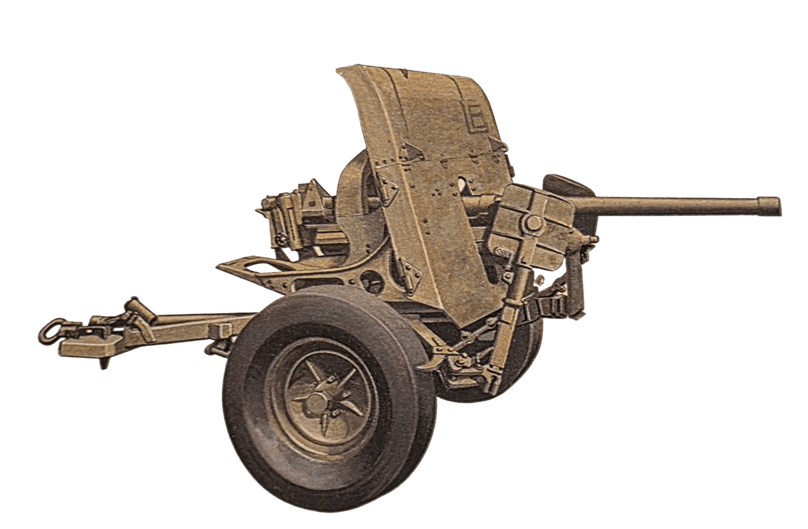
At the beginning of the Second World War, New Zealand intended to form an anti-tank regiment but lacked sufficient anti-tank guns with which to train it. Personnel therefore had to be trained in Britain and Egypt while equipment was progressively obtained. The resulting 7th Anti-Tank Regiment initially operated 40 mm two-pounder guns, some carried on 30-cwt trucks as portées.[2]
The 40 mm two-pounder anti-tank gun on its wheeled carriage. Supporting the weapon required a complete transport system for the gun, detachment, ammunition, tools and spare parts.
The scale of the subsequent expansion was considerable. New Zealand’s equipment and ammunition return for 31 March 1944 recorded 219 two-pounder guns and 423,259 complete rounds.[3] The gun fleet was therefore only the visible element of a much larger holding whose cartridges required depot space, transport, inspection, accounting and distribution.
Logistically, the two-pounder was not merely a gun. Each weapon required a trained detachment, sights, tools, spare parts, ammunition, a towing vehicle or portée, fuel, tyres and workshop support. Moving an anti-tank troop therefore meant moving a small fleet rather than an individual weapon.
The system also depended upon a supply chain capable of delivering heavy ammunition to gun positions. Although the guns were allocated in support of infantry brigades, their mobility and sustainment remained tied to vehicles and artillery supply arrangements. The weapon could not be separated from the transport system that carried it, its crew and its ammunition.
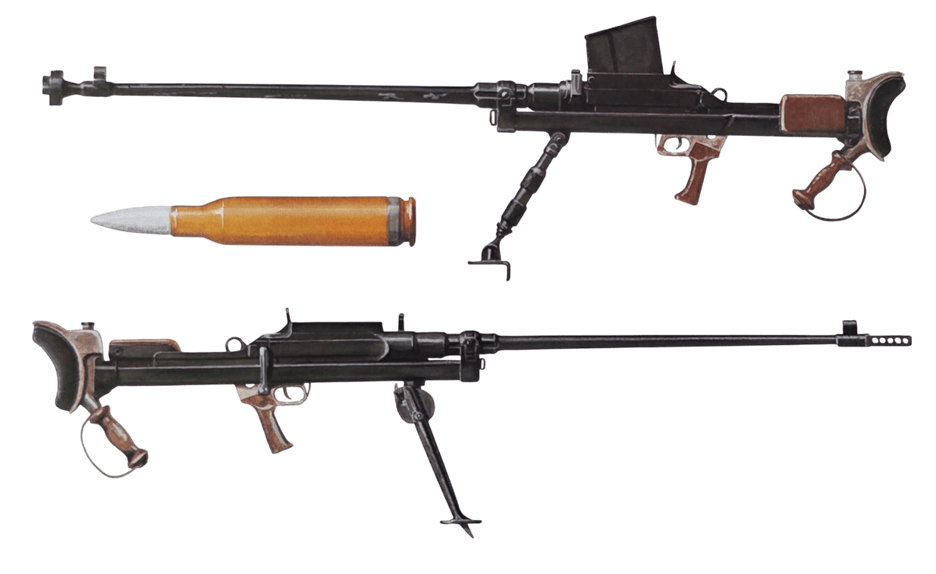
The .55-inch Boys anti-tank rifle provided New Zealand infantry with one of its earliest man-portable anti-armour weapons. New Zealand troops were training with the Boys in Egypt by 1940, and the weapon could also be mounted on carriers and light vehicles. Its bolt-action mechanism was fed from a five-round magazine, but the rifle was heavy, awkward to carry and punishing to fire.
Two views of the .55-inch Boys anti-tank rifle, with its specialised cartridge illustrated separately. The weapon brought anti-armour firepower to infantry units while adding a distinct ammunition requirement to their supply chain.
The Boys represented a different support problem from the two-pounder. It did not require a gun tractor or artillery detachment, but it introduced a specialised armour-piercing cartridge into the infantry ammunition chain. By 31 March 1944, New Zealand’s returns recorded 2,662 Boys rifles and 521,000 rounds of .55-inch armour-piercing ammunition.[4] Magazines, cleaning equipment, spare parts and cartridges had to be distributed to infantry and other units rather than concentrated solely in anti-tank artillery organisations.
Its rapid obsolescence taught another logistical lesson. As enemy armour became thicker, the Boys lost much of its effectiveness against tanks, although it retained some utility against light armour, vehicles and firing positions. A specialised weapon can therefore become operationally marginal before its physical service life or ammunition stocks have been exhausted. The supply system must then manage not only replacement equipment, but the withdrawal, storage and disposal of an ammunition type for which there was no alternative use.
The transition from the two-pounder to the more powerful 57 mm six-pounder during 1942 provides a particularly valuable logistical lesson.
By 31 March 1944, New Zealand’s holdings had grown to 226 six-pounders supported by 650,997 complete rounds. This new family existed alongside the 219 two-pounders and their remaining ammunition rather than immediately displacing them. Expansion consequently multiplied the calibres, cartridge types, ballistic data, spares and storage lines requiring support.
When 7th Anti-Tank Regiment was ordered back into action during the crisis in Egypt, it was part-way through re-equipping. Some two-pounders had already been returned to the ordnance depot, but the replacement six-pounders had not arrived and the associated training had not been completed. Five weapons had to be obtained from an anti-tank training school. Twelve more arrived during the fighting around Minqar Qaim, still covered in protective grease, with many lacking sights. For a time, the regiment had to operate both two-pounders and six-pounders. A photograph taken at El Alamein in October 1942 described the six-pounder as the regiment’s “new” gun.[5]
The 57 mm six-pounder anti-tank gun. Its introduction increased anti-armour capability but required new ammunition, sights, spares and training, while remaining two-pounder weapons and stocks continued to require support.
This was more than an inconvenient equipment change. Two ammunition families had to be supported simultaneously, while crews, maintainers and supply personnel adjusted to the new weapon. Sights, spares, tools and instructional material had to reach the same units as the guns. New equipment arriving without its complete range of ancillaries could not immediately deliver its intended capability.
The six-pounder remained part of the post-war infantry structure. A battalion support company’s anti-tank platoon was authorised six towed guns, while PIATs supplied close anti-armour defence within the rifle platoons. The arrangement placed two very different ammunition systems at separate echelons of the same battalion and shows why weapon lineage should be studied as overlapping layers rather than a single replacement chain.[6]
The experience demonstrates a principle still relevant to the M4 introduction: the outgoing system cannot safely be withdrawn merely because the replacement has been purchased. Withdrawal should be based on the new system achieving a defined level of operational capability, supported by ammunition, trained personnel, technical support and deployable stocks.
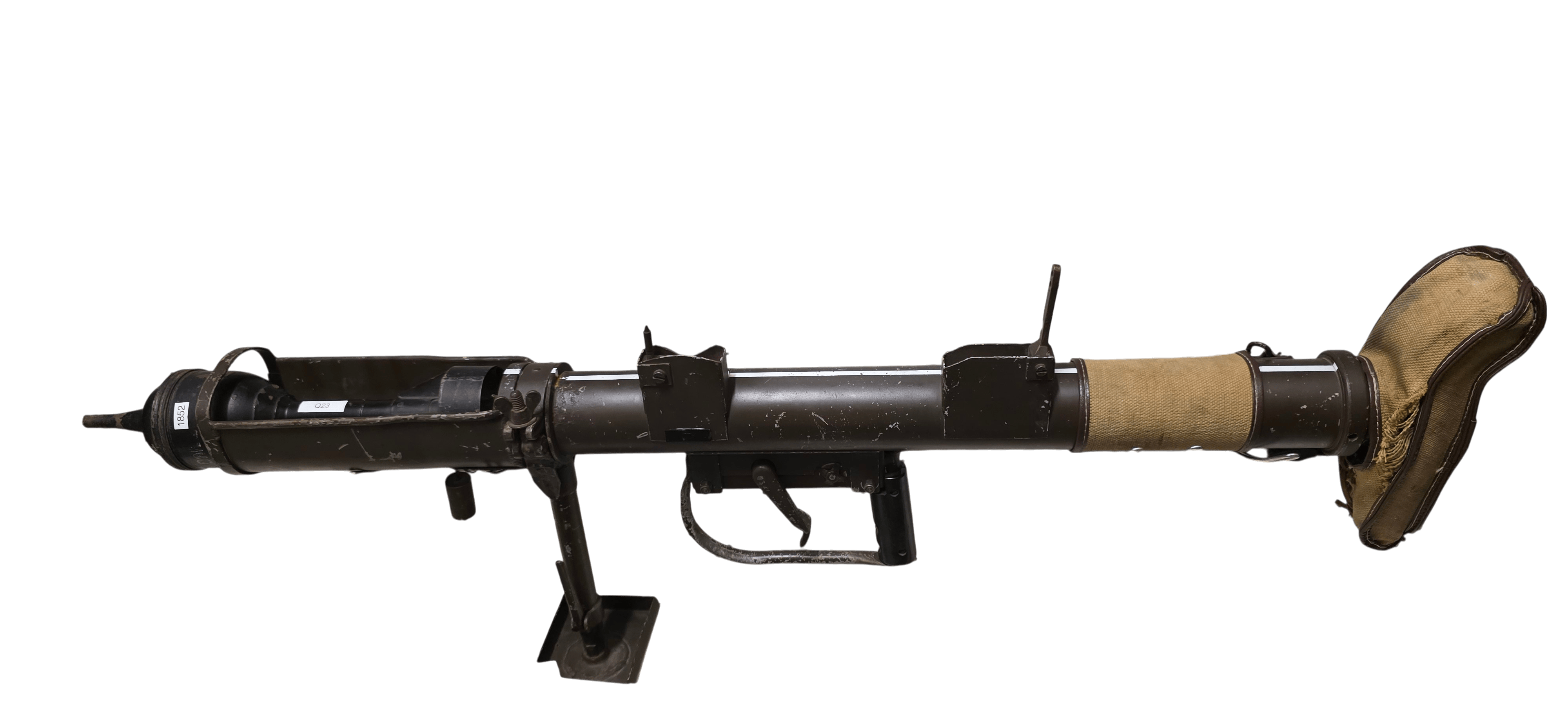
The Projector, Infantry, Anti-Tank—or PIAT—represented a significant organisational and logistical change. New Zealand infantry battalions received the weapon as they prepared for operations in Italy during late 1943. Rather than depending entirely on specialist anti-tank artillery, infantry units now possessed their own close-range anti-armour weapon.
Projector, Infantry, Anti-Tank (PIAT). Its introduction gave infantry units close-range anti-armour firepower, along with responsibility for carrying and supplying its specialised bombs.
This decentralisation brought firepower closer to the soldier, but it also moved part of the anti-tank supply problem into the infantry battalion. PIAT bombs had to be stored, transported and issued through unit ammunition systems down to the companies and platoons most likely to require them. The return for 31 March 1944 recorded 190 PIAT projectors and 6,700 Mk I HEAT bombs, alongside substantial quantities of other anti-tank grenades and mines.[7]
Compared with a towed gun, the PIAT greatly reduced the requirement for specialised vehicles. It did not, however, eliminate the logistical burden. Its ammunition was bulky compared with ordinary small-arms ammunition, and every bomb carried reduced the soldier’s capacity to carry food, water, personal equipment or other ammunition.
The PIAT therefore marked an enduring shift: the infantry gained greater independence from supporting artillery, but the weight and complexity of anti-armour sustainment moved forward with it.
The PIAT formed only part of New Zealand’s wartime anti-tank system. The March 1944 return also recorded 58,000 No. 68 rifle-launched anti-tank grenades, 33,000 No. 74 sticky bombs and 98,000 No. 75 Hawkins grenades or mines. These were supplemented by 124,300 anti-tank mines of Mk I, Mk II, Mk V, Mk VC, local-pattern and American M1A1 types.[8]
These figures reveal an ammunition family rather than a simple progression of weapons. A soldier, section, platoon, battalion anti-tank detachment and specialist regiment could each employ different equipment against the same general target category. Their ammunition differed in method of initiation, explosive filling, packaging, employment, inspection and storage compatibility.
Taken together, the recorded two-pounder and six-pounder cartridges, Boys ammunition, PIAT bombs, anti-tank grenades and mines amounted to approximately 1.9 million individual items by March 1944. That total is not a measure of explosive quantity or storage volume: a rifle cartridge, PIAT bomb and anti-tank mine cannot be treated as equivalent units. Its significance lies in the number and scale of the distinct stock lines that ordnance personnel had to receive, identify, inspect, segregate, account for and eventually dispose of.
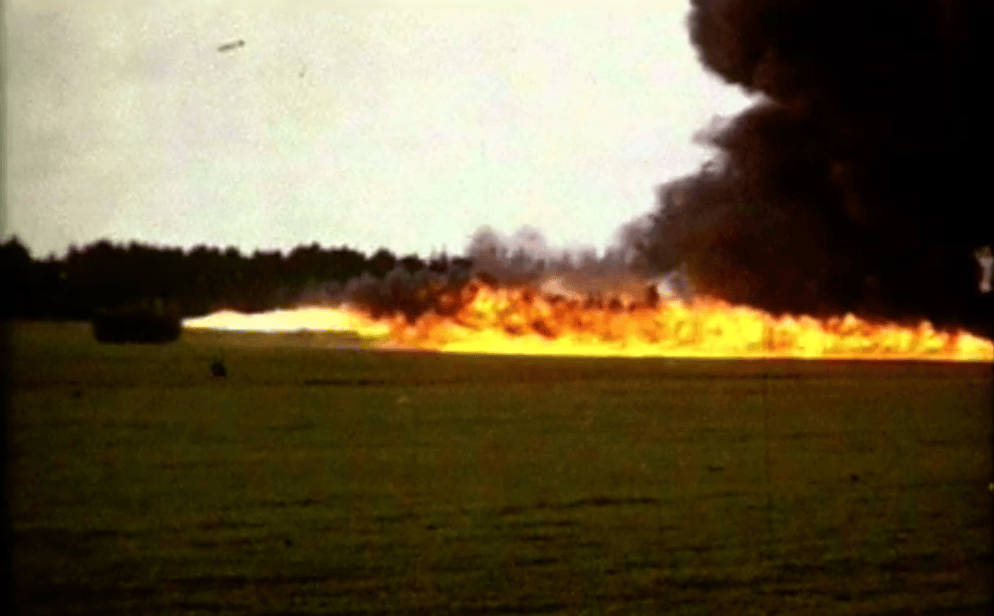
The reconstructed post-war infantry battalion retained a specialised incendiary close-support capability. Its assault-pioneer platoon was authorised three Universal Carriers fitted with flame-throwers. New Zealand’s locally produced LP2 and LP2A carriers were adapted into machine-gun, mortar, six-pounder tractor and flame-carrier configurations. Contemporary New Zealand descriptions use both “flame carrier” and “Wasp” for a Universal Carrier fitted with a flame-thrower; because the surviving evidence does not consistently identify the exact Wasp mark installed in every post-war vehicle, “Wasp-type LP2A flame carrier” is the most defensible description.[9]
A New Zealand Army Wasp flame-thrower carrier in action during a display at Papakura, 1953. Its incendiary capability required a dedicated supply of flame fuel, together with maintenance of the carrier, pressure system and ignition equipment.
The carrier gave pioneers a short-range weapon for supporting infantry against defended buildings, field works and other positions that were difficult to clear with small arms alone. Its effect was incendiary and psychological rather than a simple extension of the anti-tank chain. The vehicle provided mobility and some protection, but the short engagement range made coordination with infantry, smoke and supporting fire essential.
From an ammunition-support perspective, the Wasp sat awkwardly between vehicle, weapon and hazardous-material system. Its consumable load was not a conventional cartridge. Depending on the fitted pattern, it comprised petroleum-based flame fuel—potentially thickened to improve range and adhesion—together with a pressure system and an ignition arrangement. Correct fuel identification, freedom from contamination, leak-free tanks and hoses, sound pressure components and serviceable igniters all affected whether the system could function safely.[10]
Responsibility consequently crossed trade boundaries. Petroleum and supply personnel had to hold and issue the flame fuel; vehicle and workshop staff maintained the carrier, tanks, valves and lines; and ordnance or ammunition personnel controlled any energetic ignition components and advised on their condition and safe handling. The interface between those responsibilities was itself a risk: a complete carrier could be unserviceable because of degraded fuel, a leaking line, an expired pressure component or an unavailable igniter.
The system also fragmented storage capacity. Bulk flame fuel belonged in controlled flammable-liquid storage rather than in a conventional ammunition magazine, while compressed-gas and ignition components required their own appropriate arrangements. Units needed protected space for filled and empty tanks, safe filling and draining, fire response, quarantine of leaking or contaminated equipment, and separation from ignition sources. Residual fuel made returned vehicles and components a continuing hazard during maintenance and disposal. When the Universal Carrier fleet was phased out between 1956 and 1958, the Army therefore had to retire not only a vehicle but a distinct fuel, pressure and ignition support chain.[11]
New Zealand began seeking a PIAT replacement in March 1952 and received 57 American-designed M20 Mk 2 3.5-inch rocket launchers in 1953. PIAT training ceased in late November that year and the older weapon was withdrawn. Eight M20s reached the Regular Force Depot in February 1954, but the District Training Camps and Territorial infantry could not receive their launchers until the required pamphlets and training ammunition arrived. Those conditions were not met until March 1955. The episode is a precise New Zealand example of equipment delivery preceding usable capability.[12]
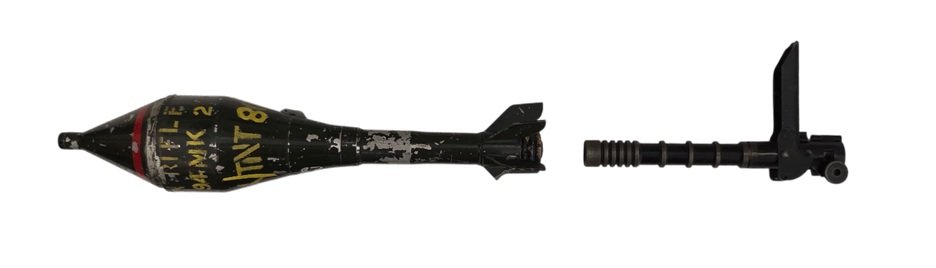
The M20 3.5-inch rocket launcher, shown assembled above and separated into its two main sections below. Its portability depended on an accompanying supply of serviceable rockets, training ammunition and technical publications.
The launcher was a lightweight, two-piece tube employing a magneto-type firing mechanism. Its apparent simplicity could obscure the scale of its ammunition requirement. The rocket was a complete propulsion and warhead system and therefore required protection from rough handling, moisture and temperature extremes. Technical instructions specified individual fibre or metal containers, with three rockets packed in a wooden box weighing approximately 54 pounds—about 24.5 kilograms.[13]
Consequently, a relatively light launcher could generate a disproportionately large transport and storage burden once sufficient rockets were included. The weapon also introduced American-pattern terminology, publications, spares and ammunition into a force still largely based on British equipment.
The end of the M20’s life was equally instructive. By the early 1970s it was used mainly as a lead-in training weapon. Overseas ammunition and spare parts were becoming unavailable, approximately 1,150 of the 1,500 rounds remaining in New Zealand were reported unserviceable, and the launchers had an estimated misfire rate of 40 per cent. The 39 surviving launchers were disposed of in June 1978, five being retained for the Army Museum and the remainder scrapped.[14]
The 3.5-inch launcher demonstrated that reducing launcher weight does not necessarily reduce the total system burden. The decisive measurement is not the weapon alone, but the weight, volume and condition of the complete operational load—including ammunition, sights, spares, publications and training equipment. Unsupported or unserviceable stocks can continue to occupy storage and technical effort long after their operational value has disappeared.
The 75 mm No. 94 Energa anti-tank rifle grenade was introduced alongside the M20 and provided another way to place anti-armour capability directly within the infantry. Rather than requiring a separate launcher, the shaped-charge grenade fired from an adapter fitted to the No. 4 rifle or L1A1 SLR used a special grenade cartridge. Although its theoretical maximum range was about 100 yards, the low velocity made a first-round hit unreliable and the preferred range was 25 to 50 yards.
No. 94 Energa anti-tank rifle grenade and No. 4 rifle launching adaptor. Using the service rifle as the launcher still required a dedicated grenade, adaptor and special launching cartridge.
This appeared to offer considerable logistical economy because the soldier’s rifle also became the launcher. In practice, the system still required the correct projector, grenade, special launching cartridge, sights or aiming method, technical instructions and training. The grenade and its initiating components also remained an ammunition-management responsibility even though the launcher was an ordinary rifle.
The intended distribution shows the resulting ammunition burden. Two soldiers in each of an infantry platoon’s three sections carried two grenades each, while further grenades were held in the company reserve. The weapon avoided issuing a complete second launcher to every user, but depended upon the compatibility of several relatively small components. A missing cup or shortage of launching cartridges could make otherwise serviceable grenades unusable. It also spread anti-armour ammunition across more users, vehicles and storage locations, increasing the need for correct identification, accounting and handling.
A soldier demonstrates a No. 4 rifle fitted with a No. 94 Energa anti-tank grenade and launching adaptor. The system gave individual infantrymen an anti-armour capability using their service rifle, but required specialised grenades, adaptors and launching cartridges.
The transition to the M72 did not remove the Energa everywhere at once. The Army decided to replace it in late 1968 and formally introduced the M72 in late 1970, but 1 RNZIR initially retained Energa for commonality with other forces in 28 Commonwealth Brigade. Tactical standardisation with allies could therefore prolong an ammunition line even after selecting a replacement.
New Zealand’s post-war anti-armour inventory included the British 120 mm BAT family: the BAT L1, L4 MOBAT and L6 WOMBAT recoilless rifles. BAT—Battalion Anti-Tank—provided infantry battalions with heavy direct-fire capability without the recoil system of a conventional gun. Successive MOBAT and WOMBAT developments sought to improve mobility by reducing the weight of the mounting and carriage.
The 120 mm L4 MOBAT recoilless anti-tank gun on its wheeled carriage. Developed as a lighter version of the BAT, it improved weapon mobility while retaining bulky 120 mm ammunition that required substantial transport, handling and storage support.
The School of Infantry received one BAT for evaluation in 1954. Approval to order 18 more followed in February 1955 at a total cost of £68,994 (approximately NZ$4.7 million in June 2026 purchasing power), but staggered shipping delayed full distribution until January 1956.[15][16] Each infantry battalion initially received only one and returned one six-pounder, leaving a mixed holding of five six-pounders and one BAT. That arrangement demanded concurrent 57 mm and 120 mm ammunition, separate technical knowledge, different handling equipment and duplicated training support—an excellent example of how transition fragments storage capacity before it produces a simpler fleet.
The system remained substantial in scale. When 1st Battalion, New Zealand Regiment trained with a 120 mm recoilless anti-tank gun in 1960, a contemporary report described each round as approximately 1.15 meters long and weighing 27 kilograms. Even if the weapon itself became lighter, a useful operational allocation of ammunition still demanded vehicles and significant handling effort.
The family therefore provides an important counterpoint to the later Carl-Gustaf. Reducing the gun’s weight improved tactical movement, particularly when the weapon could be carried or fired from a vehicle, but it did not change the physical burden of the 120 mm ammunition. BAT, MOBAT and WOMBAT also required sights, spotting weapons, mountings, specialist tools and trained crews. Their evolution shows how designers can progressively reduce one part of a system while ammunition and the support chain continue to determine its practical deployability.
In 1961, the New Zealand Army introduced the American M40A1 106 mm recoilless rifle. Despite the designation, its bore was actually 105 mm; the 106 mm title distinguished its ammunition from an earlier, incompatible 105 mm recoilless rifle. Eighteen of the new weapons were checked by the Royal New Zealand Army Ordnance Corps at Trentham before distribution to infantry units for training. Although considerably lighter than the British 120 mm BAT-family weapons then in service, the M40A1 still weighed more than 200 kilograms and was carried on—and normally fired from—a utility vehicle.
The M40A1 106 mm recoilless rifle on its ground mounting, with the spotting rifle above the main barrel. In New Zealand service, its mobility and sustainment depended on the supporting vehicle, mounting, crew and supply of main-armament and spotting ammunition.
The 106 mm RCL combined substantial direct-fire effect with greater tactical mobility than a conventional anti-tank gun. Its logistics nevertheless resembled a small vehicle-mounted weapons system rather than those of a shoulder-fired launcher. The capability depended upon the rifle, vehicle, mounting, sights, tools, crew equipment and large rounds all reaching the same place in serviceable condition. The associated spotting rifle added another weapon, ammunition nature and maintenance requirement to the system.
Mounting the recoilless rifle on a Land Rover reduced the need for a separate gun tractor, but made the vehicle integral to the capability. A vehicle fault, damaged mounting, or fuel shortage could remove the weapon from action even when the rifle itself remained serviceable. Its ammunition was also too large and heavy to be carried forward in useful quantities by the crew alone. The 106 mm RCL therefore demonstrated that vehicle mounting could increase tactical responsiveness while creating a tightly coupled weapon–vehicle–ammunition support chain.
The family transition was not immediate. In March 1968, the Army replaced the WOMBATs held by 1 RNZIR with four M40A1s. The remaining MOBATs and BATs were returned to the Main Ordnance Depot and disposed of, while use of the WOMBAT continued into 1969. The M40A1 then became the Army’s sole heavy anti-tank weapon, concentrating the heavy recoilless-rifle ammunition burden into the 106 mm system.[17]
The Carl-Gustaf M2—designated the L14A1 in New Zealand and wider Commonwealth service—was approved in principle in June 1965, but it did not enter New Zealand service that year. The proposed package of 120 weapons, maintenance parts and two years’ training ammunition was estimated at £304,078 (approximately NZ$16.1 million in June 2026 purchasing power) and was delayed by financial constraints before Treasury vetoed it. Only 22 weapons were eventually acquired, at £560 each (approximately NZ$26,800 in June 2026 purchasing power), and issued in September 1967 solely to 1 RNZIR for commonality with the Commonwealth brigade.[18]
Even this limited introduction brought an important change. The reloadable 84 mm weapon could fire HEAT, high-explosive, smoke, flare, or illumination ammunition. In contrast, New Zealand’s 3.5-inch launcher was restricted to HEAT. The Carl-Gustaf’s smoke and illumination effects could also assume functions previously carried by the 2-inch mortar. One launcher therefore offered a broader infantry-support system, but only if it could procure and sustain several ammunition types.
Logistically, the common launcher offered considerable flexibility. One weapon could deliver several different effects without requiring a separate launcher for every task. However, this shifted complexity into ammunition management. Commanders and logisticians now had to balance anti-armour, high-explosive, smoke, illumination, and training ammunition.
A shortage of the correct nature could leave a unit with ammunition that was technically compatible with its launcher but unsuitable for the target it faced. Supporting the Carl-Gustaf therefore required more sophisticated demand planning than simply counting “84 mm rounds”. Each type had its own tactical purpose, stockholding requirement and expenditure pattern.
The original proposal’s inclusion of two years’ training ammunition was therefore significant. Training stock was not an optional accessory; it was part of the mechanism by which weapon handling and marksmanship could be developed without consuming the war reserve or delaying issue after the launchers arrived.
The first Carl-Gustaf era also demonstrates the risks of a small, ally-dependent fleet. When 28 ANZUK Brigade was disbanded in 1974, the New Zealand system lost much of the British and Australian support it had depended on. Fenton records that a plan to withdraw the weapon was confirmed in March 1976 and was expected to be completed by 1978. That intention should not, however, be treated as evidence of complete retirement. A 1987 inventory still listed the Carl Gustaf M2, and the 2004–05 Military Balance recorded 42 84 mm Carl Gustafs in New Zealand Army service. The surviving evidence therefore suggests that use may have paused, been reduced, or later revived, but that the M2 remained in the Army’s equipment holdings until the M3 replaced it in the early 2010s. The M3 acquisition was consequently a generational replacement within an enduring 84 mm capability, rather than a reintroduction after a three-decade absence.[19]
The 66 mm M72 Light Anti-Armour Weapon introduced another model of support. The Army decided in late 1968 to replace the Energa with the single-shot system and formally introduced it in late 1970. New Zealand troops used the M72 in South Vietnam, where weapons designed for use against armour could also be employed against bunkers and field fortifications. Later versions have remained in New Zealand service as a short-range anti-armour and direct-fire weapon.
Unlike the reloadable Carl-Gustaf, the M72 is a self-contained, single-shot weapon. The rocket is issued inside its disposable telescoping launcher, and New Zealand formally classified the complete item as ammunition rather than as a weapon. This greatly simplifies unit-level maintenance: there is no reusable barrel to inspect after firing and no empty launcher awaiting its next round.
The 66 mm M72 Light Anti-Armour Weapon, with its telescopic launcher extended and rocket displayed separately. Issued as a complete round, it combined ammunition, a protective container, and a disposable launcher, requiring supply planning to account for replacing the entire weapon after each firing.
The apparent simplicity produces its own logistical demands. Every live firing consumes both rocket and launcher. At introduction, each live M72 cost about NZ$45 (approximately NZ$890 in June 2026 purchasing power)—too expensive to meet the minimum practice requirement—so a sub-calibre device was fitted to spent launchers and fired 21 mm rockets costing about NZ$4 each (approximately NZ$80 in June 2026 purchasing power). This conserved operational ammunition but added another calibre, training round, adaptor configuration and accounting problem. Readiness still depended upon holding complete serviceable weapons by lot, shelf life and condition; after firing, the discarded tube became a recovery, safety and disposal issue.
The M72 illustrates the importance of classifying equipment correctly. It looks like a weapon, but in supply terms it is also ammunition, packaging and launcher combined. Forecasting must therefore be based on anticipated expenditure rather than merely the number of soldiers or units to be equipped.[20]
New Zealand selected the Javelin Medium Range Anti-Armour Weapon to provide a guided capability against tanks and other armoured threats at ranges beyond those of its short-range systems. Cabinet approved 24 systems in December 2003, with an approval-to-commit estimate of NZ$23.9 million (approximately NZ$43.1 million in June 2026 purchasing power), and the weapons were delivered in 2006. The acquisition included launchers, missiles, basic support equipment, spares, special tools, training material and indoor and outdoor simulators.[21]
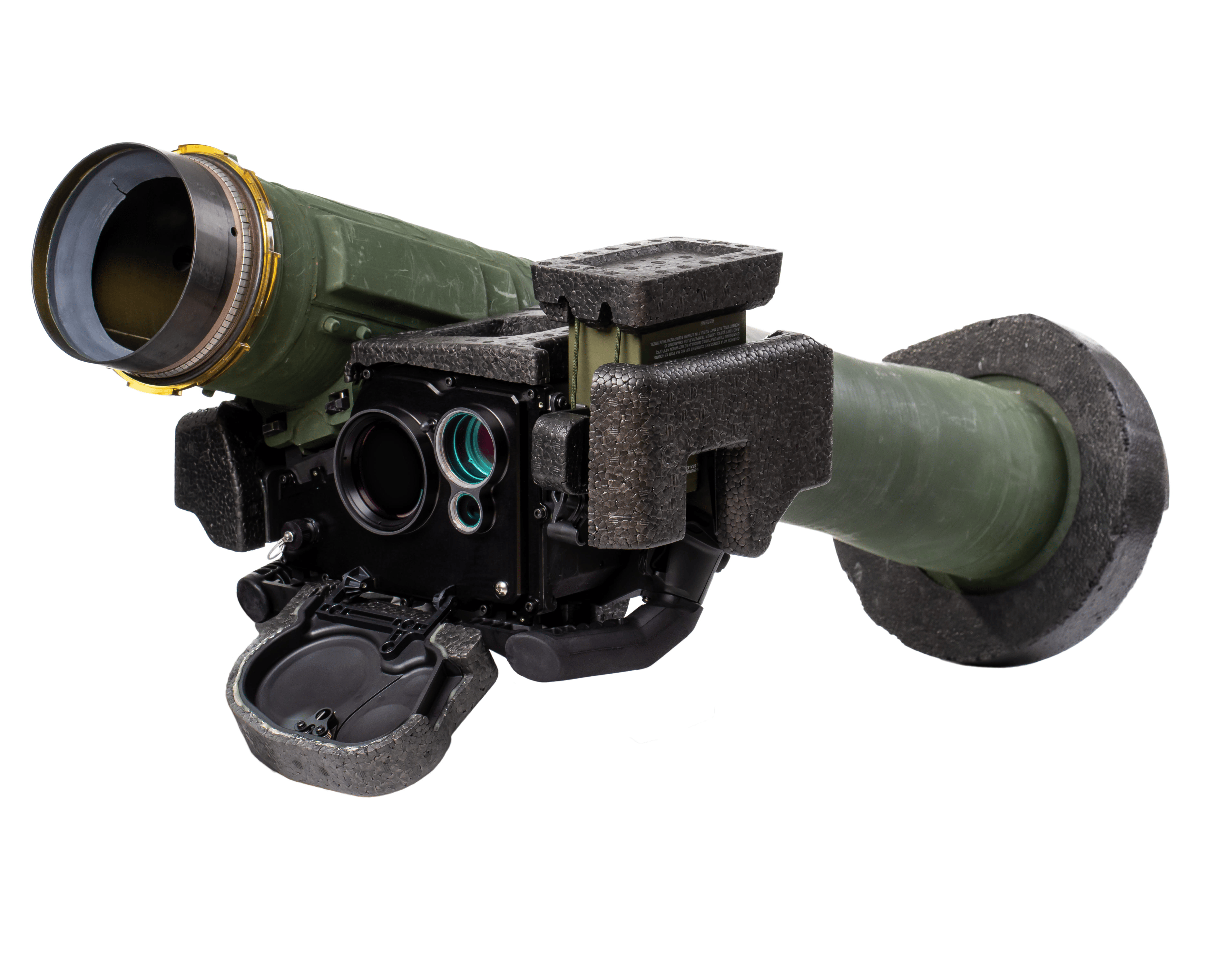
The Javelin anti-armour missile system, showing its launch tube and reusable Command Launch Unit. Its precision capability introduced support requirements for guided missiles, electronic sights, power supplies, software compatibility, and specialist training, alongside conventional ammunition storage and surveillance.
Javelin did not simply replace the M72 or Carl-Gustaf. It added another layer to the anti-armour system. The reusable Command Launch Unit provides sighting, thermal imagery and target acquisition, while each missile is carried in its own launch tube. Once fired, the missile guides itself to the selected target, allowing the crew to move or prepare another round.
The logistical burden is correspondingly different. Javelin requires managing expensive guided missiles, reusable electronic launch units, software and configuration status, power sources, specialist test equipment, spares, and simulator-based training. The thermal sight also gives the system value as a surveillance and target-identification device, which means launch-unit availability matters even when no missile is fired.
Its introduction also demonstrated the vulnerability of a sophisticated weapon to global supply constraints. A manufacturing defect delayed delivery and disrupted the international missile supply. A proposed comprehensive maintenance-support arrangement was judged prohibitively expensive, so additional spares were purchased instead.[22] The episode showed that precision weapons may reduce the number of rounds needed to achieve an effect, but increase dependence upon overseas manufacturers, specialist components and long-lead support arrangements.
Javelin is now itself entering another lifecycle phase. Current plans provide for replacement launch units that can fire newer, longer-range missiles. The system therefore demonstrates that obsolescence in modern weapons may arise not only from barrel wear or structural age, but from electronics, software, interfaces and compatibility with future ammunition.
New Zealand introduced the M3 during the early 2010s. The M3 retained the 84 mm calibre and multi-role characteristics of the earlier Carl-Gustaf while reducing the launcher’s weight through the use of lighter materials. The replacement did not recreate an extinct capability; it renewed the existing 84 mm system with a lighter launcher. The NZDF lists the M3 at approximately 10 kilograms and identifies high explosive, illumination, high-explosive anti-tank and sub-calibre training ammunition among the natures operated with it.[23]
The 84 mm Carl-Gustaf M3 recoilless rifle. Its lighter construction improved infantry mobility while retaining the M2’s multi-role ammunition capability. Supporting the weapon placed greater emphasis on inspection, accurate firing records and barrel-life management.
The reduction in weight improved dismounted mobility, but composite construction placed greater emphasis on inspection, weapon history and barrel-life management. Unlike a simple steel launcher that might be judged largely through physical inspection, the safe life of a modern recoilless weapon also depends upon knowing how it has been used.
The M3’s replacement because it has reached the end of its scheduled life illustrates the lifecycle nature of weapons logistics. A weapon may remain outwardly serviceable while approaching a technical limit established through age, rounds fired or material condition. Accurate configuration and usage records are therefore as important as the physical spare parts held in a depot.
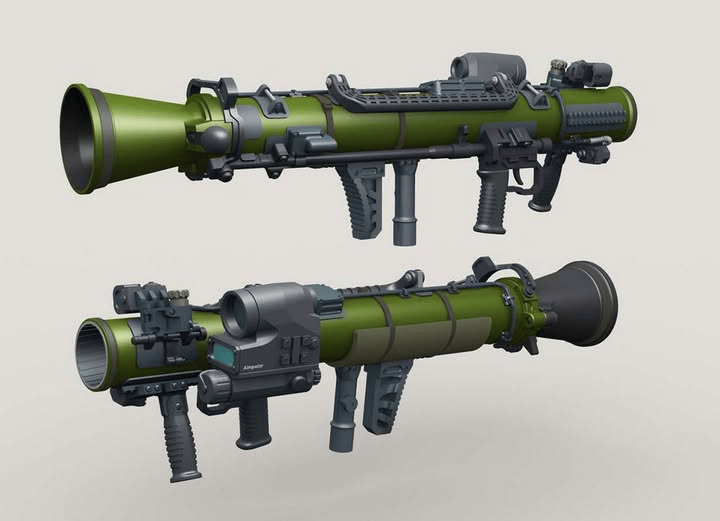
The M4 is shorter than one metre and weighs less than seven kilograms, making it approximately three kilograms lighter than New Zealand’s M3. It remains compatible with legacy Carl-Gustaf ammunition and can also support advanced sights and programmable ammunition.[24]
The 84 mm Carl-Gustaf M4, illustrated from both sides. Its shorter, lighter design retains the multi-role 84 mm ammunition family, while an integrated round counter and provision for advanced sights and programmable ammunition bring new requirements for tracking weapon life and managing configuration.
A particularly important logistical feature is its integrated fired-round counter. Earlier systems depended upon manual logbooks to record full-calibre firings. The M4 automatically records those firings and can distinguish them from sub-calibre training rounds, providing maintainers with more reliable information about remaining weapon life. The counter itself does not require a battery.[25]
This apparently small feature represents a major development in ordnance management. Weapon usage can be based on recorded evidence rather than estimates or incomplete paperwork. It should reduce the risk of either retaining a launcher beyond its safe life or prematurely withdrawing one because its firing history cannot be established.
Nevertheless, backward ammunition compatibility should not be mistaken for complete logistical commonality. The M4 will still require:
New equipment codification and configuration records.
Updated technical publications and maintenance procedures.
M4-specific spares, ancillaries and inspection requirements.
Training for operators, armourers, ammunition personnel and instructors.
Management of sights, interfaces and any associated electronic systems.
Confirmation of the compatibility and remaining life of each ammunition nature and lot.
A controlled plan for withdrawing, preserving, cannibalising or disposing of the M3 fleet.
Integration of the supplied training and simulation systems into enduring training arrangements.
Including training and simulation capabilities in the New Zealand acquisition is therefore especially important. It recognises that the operational capability is created not by the launcher alone, but by the combination of weapon, ammunition, competent personnel and a sustainable training system.
The history of these weapons can also be read as a history of increasingly diverse ammunition. The two-pounder was initially sustained principally with armour-piercing shot. Wartime returns already distinguished complete rounds from separately accounted shells, projectiles, charges, tubes and fuzes, while small-arms ammunition could also be recorded by belt or specialised nature. By the time of the Carl-Gustaf and Javelin, the ammunition family included anti-armour, anti-structure, high-explosive, smoke, illumination, anti-personnel and training effects, together with mechanical or electronic fuzes, rocket motors, spotting cartridges, launch tubes and simulation systems.
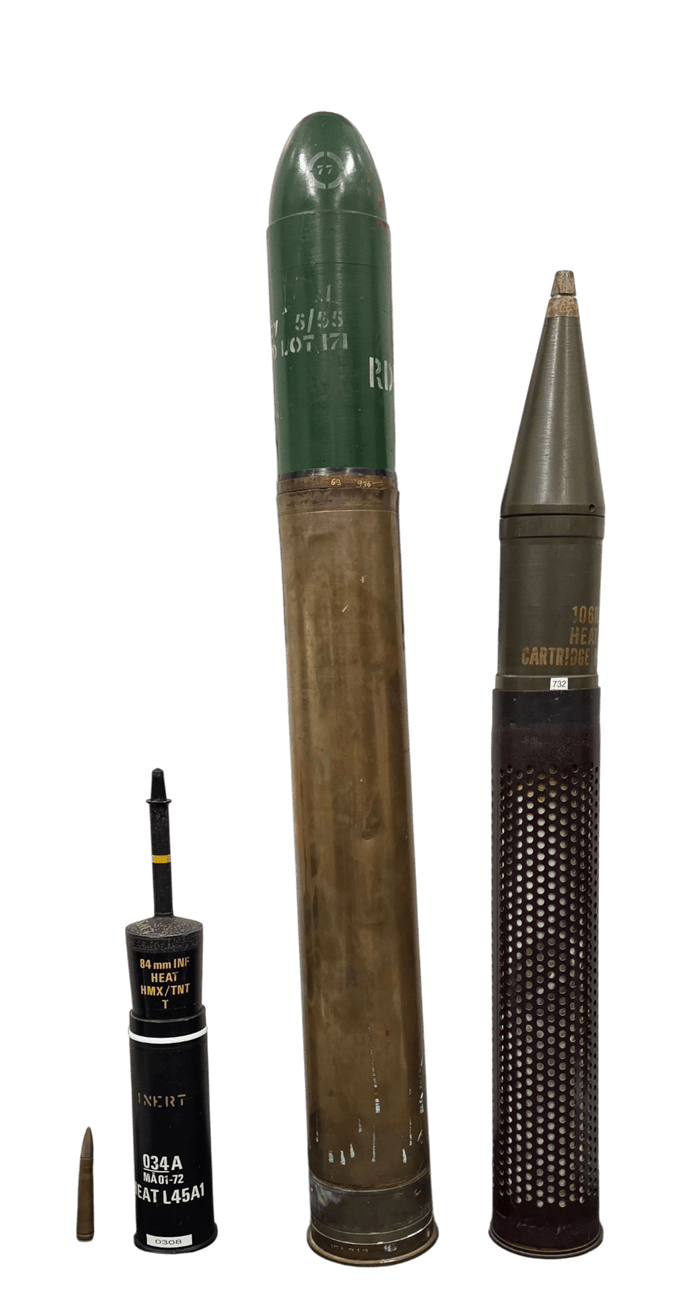
Anti-armour ammunition compared, left to right: .55-inch Boys anti-tank rifle cartridge; 84 mm Carl-Gustaf round; 120 mm BAT round; and 106 mm recoilless-rifle round. The substantial size differences illustrate the varied transport, handling, and storage demands of these weapons.
This distinction is important because calibre alone does not identify the nature of ammunition. Two rounds of the same calibre may have different projectiles, explosive fillings, propelling charges, fuzes, hazard classifications, shelf lives and storage requirements. Conversely, an ammunition system may include several calibres: the 106 mm RCL, for example, also required special .50-inch spotting ammunition, while Carl-Gustaf training could involve 7.62 mm or 20 mm sub-calibre systems. The following table is a comparative technical synthesis rather than a list of every nature ever held in New Zealand service.[26]
The table below identifies the principal ammunition families associated with each system. It does not imply that New Zealand procured every international nature or mark listed. The dated totals quoted above come from compiled equipment and ammunition returns; confirming their underlying archival provenance and establishing individual lot histories would require examining the original returns, ammunition ledgers, vocabulary records, technical publications, and disposal files.
Weapon or ammunition system
Principal ammunition natures associated with the system
Ammunition technical challenge
Two-pounder
Fixed 40 mm quick-firing cartridges with armour-piercing tracer, higher-velocity armour-piercing and capped armour-piercing shot; practice shot; and, in later catalogues, high-explosive shell.
Ammunition Technicians had to distinguish solid shot from explosive shell. Solid armour-piercing shot normally had no explosive filling or conventional projectile fuze, although the complete round still contained a primer, propellant and often a tracer. High-explosive shell introduced a filled, fuzed projectile with different hazards and inspection requirements. Marks, charges and ballistic performance also had to match the gun and sighting data.
Boys anti-tank rifle
.55-inch armour-piercing cartridges, including improved projectile marks; armour-piercing tracer; ball or practice cartridges; proof, drill and dummy rounds.
The Boys was managed more like specialised small-arms ammunition than artillery ammunition, but its cartridges were large, heavy and unique to the weapon. Technicians needed to identify projectile marks and distinguish live, proof, practice, drill and dummy cartridges. Ageing primers and propellant, cartridge corrosion and deteriorating packaging could remain concerns after the weapon had become tactically obsolete.
Six-pounder
Fixed 57 mm cartridges with armour-piercing, capped armour-piercing, capped ballistic-cap and later discarding-sabot shot; high-explosive shell; and practice ammunition.
Several visually similar armour-piercing natures had different penetration and ballistic characteristics. The later discarding-sabot round introduced additional components and a different performance envelope, while high-explosive ammunition introduced a fuzed shell. Identification by complete nomenclature, mark, lot and package—not merely “six-pounder”—was essential.
Seventeen-pounder
Armour-piercing tracer, capped ballistic-cap, discarding-sabot, high-explosive and practice ammunition.
The 17-pounder reinforced the need to manage ammunition by effect and ballistic family. APDS offered greatly improved penetration but had different accuracy and ballistic characteristics from conventional armour-piercing ammunition. The addition of high-explosive shell required separate understanding of its explosive filling and fuze.
PIAT
HE/AT service bombs in successive marks; practice-inert bombs; drill bombs; reusable practice shot; propelling cartridges; and separately packed fuzes.
The PIAT was a component ammunition system. Service bombs were issued with the propelling cartridge installed but the fuze carried separately in a container attached to the bomb. Technicians had to manage the condition and compatibility of bomb, cartridge and fuze; recognise the different live, inert, drill and reusable practice configurations; and protect the damp-proof cardboard carriers. Changes to bomb filling and fuze design between marks complicated identification and surveillance.
Wartime anti-tank grenades and mines
No. 68 rifle-launched anti-tank grenades; No. 74 sticky bombs; No. 75 Hawkins grenades or mines; British Mk I, Mk II, Mk V and Mk VC anti-tank mines; locally produced mines; and American M1A1 mines.
Items intended for the same anti-tank role functioned very differently. Ammunition personnel had to distinguish impact-initiated rifle grenades, adhesive charges, pressure-operated mines and their training or inert equivalents. Different fuzes, safety devices, explosive fillings, package sizes and compatibility requirements prevented the family from being managed as one generic stock.
Wasp-type LP2A flame carrier
Bulk petroleum flame fuel, potentially thickened; pressure or propellant-gas components; and an ignition system, with the exact configuration depending on the fitted pattern.
This was not one conventional round but a cross-trade hazardous-material system. Technicians had to distinguish fuel formulations and ignition components while coordinating tank, valve, line, and pressure-system conditions with vehicle and petroleum specialists. Flammable-liquid storage, compressed-gas control, leak quarantine, residual fuel and contaminated returns consumed capacity outside the conventional explosives magazine.
M20 3.5-inch launcher
New Zealand’s operational holding is recorded as HEAT; the wider M20 family included M28-series HEAT, M29-series practice and M30 white-phosphorus smoke rockets, together with inert and sub-calibre training systems.
Each complete rocket combined warhead, fuze, motor, propellant and igniter. A defect in any component could make the entire round unserviceable. The reported deterioration of about 1,150 of New Zealand’s last 1,500 rounds shows the scale of the surveillance and disposal problem created by ageing motors, energetic components and packaging. Any white-phosphorus nature, if held, would have introduced separate fire, leakage and segregation requirements.
No. 94 Energa
HEAT rifle grenades; practice, practice-marker and drill grenades; and the dedicated grenade-launching cartridges required to project them.
The system depended upon the correct combination of rifle, adapter, grenade and launching cartridge. The normal platoon scale—two soldiers in each section, each carrying two grenades—distributed both ammunition and identification risk widely. Special grenade cartridges could be confused with blank or drill cartridges if package and marking controls failed. Service, practice and drill grenades also required positive differentiation.
BAT, MOBAT and WOMBAT
120 mm HESH service ammunition; canister or flechette anti-personnel natures; practice rounds; and ammunition for the associated spotting weapon.
HESH relied upon the correct functioning of a base fuze after the explosive filling spread across the target surface, whereas canister operated in a fundamentally different manner. The large 120 mm cartridges used recoilless-rifle case arrangements that allowed propellant gases to escape through the breech. Damaged cases or closures therefore required careful assessment. The separate spotting-weapon ammunition added another nature, calibre and lot family to account for and store.
M40A1 106 mm RCL
M344-series HEAT; M346-series HEP-T; M581 anti-personnel flechette; M368 dummy ammunition; and special M48/M48A1 .50-inch spotter-tracer cartridges.
The 106 mm cartridges used perforated cases with internal liners and specialist fuzes. HEAT, high-explosive plastic and flechette projectiles operated differently and could not be treated as one generic nature. The special .50-inch spotter-tracer cartridge was ballistically matched to the main armament and was not ordinary .50-calibre ammunition. Case-liner condition, projectile markings, fuze type and matched spotting ammunition all required technical control.
Carl-Gustaf M2/L14A1
New Zealand’s documented service family included 84 mm HEAT, high-explosive, smoke and flare or illumination ammunition; the wider family also included practice and sub-calibre training systems.
A common launcher could fire rounds producing very different effects. Technicians had to identify the projectile, cartridge, primer and fuze fitted to each nature and ensure that the correct mark was authorised. Smoke and illumination introduced pyrotechnic fillings and storage considerations different from HEAT or high-explosive rounds. If operational use paused while the M2 remained in holdings, preservation, surveillance and stock accounting still continued. Its small fleet and changing allied support arrangements also created orphan-stock risks before its eventual replacement by the M3.
Carl-Gustaf M3
New Zealand publicly identifies HEAT, high-explosive, illumination and sub-calibre training ammunition; the wider family also includes HEDP, smoke and anti-structure rounds.
Retaining the same calibre did not remove the need for compatibility control. Each ammunition mark had to be checked against the launcher, sight, technical publications and approved employment. Different lots could also have different shelf-life or surveillance status. The mix of operational and training natures increased the number of stock lines and minimum holdings required.
M72
The original system was a complete 66 mm HEAT round; later variants include enhanced anti-armour, blast-optimised, multi-purpose and anti-structure effects. New Zealand used 21 mm sub-calibre rockets fired from a device fitted to spent launchers for economical training.
The complete launcher is issued as ammunition: warhead, fuze, rocket motor, firing mechanism and protective tube form one round. Each variant is therefore a separate nature even when all are called “M72”. The training system added a second calibre and reusable adaptor to control. Tube damage, broken seals, corrosion, ageing propellant or unclear markings may condemn the complete live item, which also consumes considerable storage volume relative to its explosive content.
Javelin
Legacy missile rounds with tandem HEAT warheads; later missile variants with improved or multi-purpose warheads; inert, field-handling and simulator systems.
A Javelin round combines a guided missile, launch-tube assembly and battery-coolant unit, while the reusable Command Launch Unit is controlled separately. Ammunition management therefore extends beyond explosives into seekers, electronics, software, connectors, power and cooling components. Missile lot surveillance, environmental history, security classification and launcher–missile software compatibility are as important as visual inspection.
Carl-Gustaf M4
Compatible legacy 84 mm natures plus newer HEAT, HEDP, high-explosive, smoke, illumination, anti-structure, anti-personnel and training rounds. Advanced ammunition includes programmable functions supported by modern fire-control systems.
Backward compatibility creates a broad rather than a simple ammunition family. Ammunition Technicians must know which legacy and new natures are authorised, how programmable or selectable functions are set and verified, and whether ammunition, sight and launcher configurations are compatible. Electronic or programmable fuzes add configuration data and functional status to the traditional checks of filling, fuze, cartridge, primer and packaging.
For Ammunition Technicians, terminology is not simply historical language; it is part of the safety system. A shot is generally a solid projectile and may contain no high-explosive filling or conventional fuze, although it can still contain a tracer. A shell normally contains an explosive, smoke, illuminating or other payload. A fixed cartridge combines the projectile, cartridge case, propelling charge and primer as one loadable item. A bomb, grenade or rocket may combine these functions differently, while a guided missile adds seekers, control electronics, actuators and software.
The PIAT demonstrates the importance of this vocabulary. Its service bomb was not a single sealed round in the modern sense: it included a propelling cartridge but was transported with its fuze separate. The M72 sits at the opposite end of the spectrum. The rocket and disposable launcher together form the issued round, so no enduring weapon remains after firing. Javelin expands the definition further because the ammunition includes a guided missile in a disposable launch tube and a battery-coolant unit, but not the reusable Command Launch Unit.
Markings, colour schemes and nomenclature also changed over time and between British, American, Swedish and NATO systems. Colour provides a useful first indication, but cannot safely be the sole means of identification. The full designation, mark or model, lot number, manufacture date, filling, fuze and package markings must agree with the applicable technical publication. This becomes especially important when live, practice, drill and inert items deliberately reproduce the handling characteristics of service ammunition.
The technical progression was not simply from smaller to larger warheads. It also progressed in initiation and function.
The early armour-piercing shot of the two-pounder and six-pounder relied primarily upon kinetic energy and generally did not require an explosive projectile fuze. Nevertheless, the complete cartridge still contained energetic components in its primer, propellant and tracer. The addition of high-explosive shell required Ammunition Technicians to understand projectile fillings, fuze types, arming arrangements and the effects of deterioration upon both safety and performance.
Shaped-charge ammunition such as the PIAT bomb, Energa grenade, 3.5-inch rocket, M72 and HEAT rounds for the recoilless rifles depended upon the warhead being initiated at the correct stand-off from the target. Fuze design was therefore inseparable from effectiveness. The successive PIAT bomb marks, for example, included changes intended to improve fuze functioning and reliability. A projectile could be physically complete and still fail to deliver its intended effect if the wrong fuze, deteriorated components or an incompatible mark were fitted.
HESH and HEP ammunition introduced a different mechanism. The explosive filling first spread against the target before the base fuze initiated it, producing damaging shock and spalling within the armour or structure. Flechette and canister rounds created yet another functioning sequence, dispersing large numbers of projectiles rather than forming an armour-penetrating jet or blast effect.
Modern programmable ammunition increases the burden again. The Ammunition Technician must understand not only the physical round but also the relationship between the fuze, fire-control unit, programming interface, launcher and software configuration. For Javelin, the seeker, guidance system, missile electronics and battery-coolant unit become part of ammunition serviceability. Traditional knowledge of explosives remains essential, but it must now be combined with configuration management and electronic systems assurance.
Each new ammunition nature also creates a storage problem. A magazine may appear to have sufficient physical space yet still lack legal or safe capacity for the proposed stock. Explosives storage is controlled by the hazard presented by the ammunition, its Net Explosive Quantity, the Hazard Division and Compatibility Group assigned to the packaged configuration, and the quantity-distances separating the magazine from people, buildings and other explosive stores.
This means that different natures of the same calibre may not consume storage capacity in the same way. Solid armour-piercing shot presents a different hazard from fuzed high-explosive shell. Rocket motors, white-phosphorus smoke, illumination rounds, separately packed fuzes, guided missiles and damaged or suspect ammunition may have different compatibility or segregation requirements. The classification may also change depending on whether the fuze is fitted, packed separately in the same container, or held in an independent package.
New ammunition can therefore require one or more of the following:
A new or amended explosive-limit licence and supporting safety assessment.
Confirmation of the Hazard Division, Compatibility Group, Net Explosive Quantity and UN transport classification for each packaged configuration.
A separate magazine, compartment or segregated stack for incompatible natures, pyrotechnics, white phosphorus, separately stored fuzes or other special-risk items.
Controlled temperature or humidity, environmental monitoring or sealed specialist containers for missile and electronic components.
Additional space for serviceable operational stocks, training stocks, proof or surveillance samples, returned ammunition, quarantined lots, damaged items and ammunition awaiting disposal.
New handling equipment, stillages, pallets or racking because the package dimensions and weights differ from existing stocks.
Updated fire plans, emergency response information, security controls and transport documentation.
The practical effect is fragmentation of capacity. A partially empty magazine cannot necessarily accept a new nature if the compatibility rules prohibit mixing, if adding the new Net Explosive Quantity exceeds the licensed limit, or if the required separation from another stack cannot be maintained. Guided weapons may add heightened physical-security requirements, while smoke and illumination natures may require arrangements different from those for conventional HEAT ammunition. The Wasp adds a useful historical reminder that a close-support system can consume hazardous-substance capacity outside the explosives estate as well as magazine space within it.[27]
The March 1944 anti-tank return provides an early example of this fragmentation. More than a million two-pounder and six-pounder cartridges coexisted with over half a million Boys rounds, 6,700 PIAT bombs, 189,000 anti-tank grenades and sticky or Hawkins bombs, and 124,300 mines of six different patterns. Even where aggregate magazine space existed, these articles could not be treated as one interchangeable holding. Each nature required its own identification, packaging, lot control, surveillance, issue arrangements and provision for segregation or separation where necessary.
Unserviceable ammunition consumes capacity too. The late M20 holding—about 1,150 unserviceable rounds within a total of approximately 1,500—is an unusually clear historical example. Until formally condemned, segregated and disposed of, those rounds still demanded secure storage, lot records, technical inspection and space that could not automatically be reassigned to a new nature. The same pressure arises from quarantined lots, misfires, returned rounds, obsolete training stocks and orphaned ammunition for which overseas support has ceased.
Transition between weapons compounds the problem. During the change from the two-pounder to the six-pounder, both ammunition families had to be held concurrently. In 1956 a battalion’s five six-pounders and one BAT required simultaneous 57 mm and 120 mm support; in 1970 Energa stocks were retained for 1 RNZIR even as the M72 entered service. The M3-to-M4 transition should benefit from 84 mm compatibility, but it may still require separate control of older and newer lots, natures cleared only for particular sights or configurations, training ammunition, and M3 stocks awaiting consumption or disposal. At the same time, the M72 and Javelin continue to occupy storage space because they provide different ranges and effects rather than being replaced by the M4.
For the Ammunition Technician, the introduction of a new weapon begins well before its first live firing and continues after the launcher has been withdrawn. The technical workload includes:
Establishing the correct nomenclature, codification, explosive classification and accounting unit for every service, practice, drill and inert nature.
Confirming compatibility among projectile, cartridge, fuze, launcher, sight, software and training system.
Designing storage plans around licensed explosive capacity, compatibility and segregation rather than calibre or physical volume alone.
Conducting surveillance by lot and condition, including inspection of packaging, seals, propellant, fuzes, rocket motors, pyrotechnic fillings, electronics and environmental indicators.
Advising commanders and logisticians on the correct mixture of natures for the expected target set and expenditure rate.
Controlling returns from exercises, particularly opened packages, extended disposable launchers, unused fuzed ammunition, suspect misfires and ammunition exposed to adverse environments.
Planning technical disposal for obsolete, life-expired, damaged or unsupported stocks and their associated components.
Identifying orphan-system risk when a small national holding depends upon allied ammunition, spares, publications, proof facilities or technical advice that may be withdrawn.
The M4 introduction should therefore include a formal ammunition-support workstream. Existing 84 mm stocks need to be identified by complete nature, mark, lot, age, condition and launcher compatibility—not simply counted as “Carl-Gustaf ammunition”. Proposed new natures should be assessed for storage classification, space, surveillance, transport, training and disposal requirements before they arrive. Otherwise, New Zealand could possess a lighter and more capable launcher but lack either the correct mix of rounds or the licensed and segregated magazine capacity needed to sustain it.
Across this lineage, the technology has changed considerably, but the fundamental logistical lessons have remained remarkably consistent.
First, replacement systems must be introduced as complete capability packages. The six-pounders arriving without sights during the fighting in Egypt remain a powerful warning against treating delivery of the principal equipment as the completion of introduction into service. The Javelin acquisition similarly shows why simulators, special tools, spares and support arrangements must be planned with the launcher and missiles rather than added later.
Second, old and new systems will normally coexist during transition. That overlap requires duplicate ammunition, spares, training and technical support. It may appear inefficient, but it provides insurance against the operational gap experienced when two-pounders were returned before sufficient six-pounders were available.
Third, portability transfers rather than eliminates the supply burden. Successive BAT, MOBAT and WOMBAT designs reduced weapon weight, yet their 120 mm rounds remained large and heavy. The Wasp had earlier shown the opposite trade: a carrier could move a large close-support load, but only by coupling the weapon to a tracked vehicle and a distinct flame-fuel chain. The later move from vehicle-mounted recoilless rifles to the Energa, M72 and other shoulder-fired weapons reduced dependence upon gun tractors, portées and dedicated weapon vehicles, but pushed increasingly powerful and varied ammunition into infantry vehicles, carriers and soldiers’ loads.
Fourth, a multi-role launcher requires ammunition planning by effect. Anti-armour, anti-structure, high-explosive, smoke and illumination rounds are not interchangeable simply because they share the same calibre. The value of the Carl-Gustaf lies in its range of effects, but that value exists only when the right mixture of ammunition reaches the user.
Fifth, disposable weapons require a different accounting model. With the M72, expenditure removes both the rocket and the launcher from stock. Demand forecasting, war-reserve calculations, training allocations and disposal planning must therefore treat the entire weapon as a consumable item.
Sixth, precision creates new dependencies. Javelin reduces the need to guide a missile after launch and may achieve an effect with fewer rounds, but it adds electronic launch units, thermal sights, software, power sources, specialist training and exposure to a narrow international supply chain.
Seventh, assess storage capacity by hazard and compatibility rather than floor space alone. A new nature may require a separate stack, compartment or magazine even when existing stores appear partly empty. Old and new stocks, training ammunition, pyrotechnics, separately packed fuzes, suspect lots and ammunition awaiting disposal can rapidly consume the usable rather than the apparent capacity of an ammunition depot.
Eighth, allied commonality is a support resource but also a dependency. Retaining Energa for brigade commonality simplified coalition operations, while the first Carl-Gustaf fleet became difficult to sustain after its British and Australian support network disappeared. Its apparent pause, reduced use or later revival also shows that a capability can remain on the equipment account even when its operational employment changes. Before adopting a nature held only in small quantities, planners need an assured route for resupply, surveillance data, technical advice and eventual disposal.
Finally, information has become part of the weapon system. For Javelin and the M4, configuration status, software and ammunition compatibility are critical; for the M4, round counts and electronic sight information will be as important to sustainment as traditional workshop tools and spare parts.
The Carl-Gustaf M4 is the latest expression of a requirement New Zealand soldiers have carried since the Second World War: the ability to defeat armour, fortified positions and other difficult targets with firepower available close to the infantry.
What has changed is the logistical structure surrounding that requirement. The two-pounder depended upon vehicles, gun crews and an artillery ammunition chain. The Boys, PIAT, rifle grenades and mines dispersed specialised anti-tank ammunition throughout the infantry system, while the Wasp-type flame carrier added a separate vehicle, fuel and ignition chain for close support and the Energa continued the movement of anti-armour capability towards individual soldiers after the war. The 120 mm BAT family and M40A1 106 mm RCL provided heavier recoilless firepower tied to vehicles, while the M72 made the complete launcher a consumable item. The limited L14A1 fleet introduced the multi-role possibilities of the 84 mm family. Although a withdrawal was planned after its allied support base disappeared, the M2 remained within the Army’s holdings—possibly through periods of paused or reduced use—until the lighter M3 replaced it in the early 2010s. Javelin added a guided precision layer, and the M4 adds digital lifecycle information, advanced sighting potential and simulation to the support system.
The history suggests that the success of the M4 acquisition will not ultimately be measured by the number of launchers delivered. It will be measured by whether New Zealand can maintain trained teams, position the correct ammunition natures, manage weapon and ammunition life accurately, provide sufficient licensed and appropriately segregated storage, and sustain the capability when it is deployed.
That is the logistical lineage connecting the Boys rifle and two-pounder of 1940 with the Carl-Gustaf M4 of today.
[1] Janes, “New Zealand to Procure Carl Gustaf M4 Recoilless Rifle,” accessed September 1, 2026; Defensehere, “Saab Secures New Zealand Order for Carl-Gustaf M4,” August 17, 2026. Janes reports 26 systems, first-quarter 2027 delivery, the M3’s scheduled-life status, receiving units and the undisclosed contract value; Defensehere confirms that training and simulation capabilities form part of the procurement.
[2] W. E. Murphy, 2nd New Zealand Divisional Artillery (Wellington: Historical Publications Branch, Department of Internal Affairs, 1966), 8–22.
[3] R”QMG (Quartermaster-Generals) Branch – September 1939 to March 1944,” Archives New Zealand Item No R25541150 (1944).. The file records 219 two-pounder guns and 423,259 complete two-pounder rounds.
[4] “QMG (Quartermaster-Generals) Branch – September 1939 to March 1944.”; Murphy, 2nd New Zealand Divisional Artillery, 8–22.
[5] Murphy, 2nd New Zealand Divisional Artillery, 256–75. The official history describes the incomplete transition during the 1942 crisis, including guns obtained from the training school and six-pounders arriving without all sights fitted.
[6] Damien Marc Fenton, A False Sense of Security: The Force Structure of the New Zealand Army 1946–1978, Occasional Paper no. 1 (Wellington: Centre for Strategic Studies: New Zealand, Victoria University of Wellington, 1998), 18–21.
[7] “QMG (Quartermaster-Generals) Branch – September 1939 to March 1944.”; Fenton, A False Sense of Security, 18–21.
[8] “QMG (Quartermaster-Generals) Branch – September 1939 to March 1944.”. The total comprises 2,100 Mk I, 55,000 Mk II, 39,000 Mk V, 2,000 Mk VC, 19,000 local-pattern and 7,200 M1A1 mines.
[9] Fenton, A False Sense of Security, 18, 21, 26; National Library of New Zealand, “British Commonwealth Occupation of Japan: New Zealand, J Force,” photographic collection, PAColl-4161-01-121, accessed September 1, 2026. Fenton calls the post-war New Zealand configuration a flame-thrower Universal Carrier or flame carrier and records three in the assault-pioneer platoon. The National Library caption describes a J Force demonstration by a “Wasp or Bren carrier with a flame thrower.” The exact mark should therefore not be asserted without a vehicle record or technical schedule.
[10] The Tank Museum, “Fraser Flamethrower Donation,” October 18, 2024; The Tank Museum, “Fraser Flamethrower Collection,” accessed September 1, 2026. The museum identifies the Wasp as a Universal Carrier flame-thrower variant and describes the development of thickened flame fuels and transportable, vehicle-mounted systems. The New Zealand support analysis here is functional: fuel, pressure, ignition and vehicle components had to remain compatible and serviceable even when organisational responsibility was divided among trades.
[11] Fenton, A False Sense of Security, 51. Fenton states that the Universal Carrier was phased out between 1956 and 1958.
[13] United States Department of the Army, Operator and Organizational Maintenance Manual Including Repair Parts and Special Tool Lists for Launcher, Rocket, 3.5-Inch M20A1 W/E and M20A1B1 W/E, TM 9-1055-201-12 (Washington, DC: Headquarters, Department of the Army, 1968), 38–50, especially para. 4-9.
[16] All 2026 equivalents use the Reserve Bank of New Zealand’s all-groups consumers price index through the June 2026 quarter. For amounts before decimalisation on July 10, 1967, the Reserve Bank convention treats £1 as NZ$2. The historical amount was converted at that rate where necessary and adjusted by the CPI ratio for the relevant year or quarter; results are rounded. These figures indicate general purchasing power, not defence-sector price escalation, foreign-exchange value or a replacement-cost estimate. Reserve Bank of New Zealand, “Inflation Calculator,” updated July 21, 2026; Reserve Bank of New Zealand, “Prices (M1),” released August 19, 2026.
[17] Fenton, A False Sense of Security, 119–23, 166–71.
[19] Fenton, A False Sense of Security, 173–74, records a plan confirmed in March 1976 to withdraw the Carl Gustaf by 1978, but not the completion of that plan. Peter Jennings, New Zealand Defence Policy under Labour (MA sub-thesis, Australian National University, 1987), appendix 2, still listed the Carl Gustaf M2 among Army equipment; International Institute for Strategic Studies, The Military Balance 2004–2005 (London: Routledge, 2004), 181, recorded 42 Carl Gustafs; and Janes, “New Zealand to Procure Carl Gustaf M4 Recoilless Rifle,” records that the M3 entered service in the early 2010s. Taken together, these sources support continuity of the type in Army holdings, while leaving open whether operational use was continuous, paused or later revived.
[20] Fenton, A False Sense of Security, 173–74; Nammo, “M72-Series,” accessed September 1, 2026. Nammo’s current product material confirms the continuing 66 mm single-use family and 21 mm sub-calibre training system; the New Zealand introduction costs and classification come from Fenton.
[21] Office of the Auditor-General, Reporting the Progress of Defence Acquisition Projects: Interim Report (Wellington: Office of the Auditor-General, June 2008), 21, 51–52; New Zealand Government, “Goff Announces New Army Capability,” June 29, 2006. The Auditor-General records an approval-to-commit estimate of NZ$23.9 million and two Foreign Military Sales agreements covering launchers, ammunition, basic support, simulators, training material and special tools.
[22] Office of the Auditor-General, Reporting the Progress of Defence Acquisition Projects, 21, 51–52. The report attributes the missile delay to a manufacturing defect affecting worldwide supply and records that comprehensive maintenance support was judged prohibitively expensive, leading to the purchase of additional spares.
[23] New Zealand Defence Force, “Carl Gustaf M3,” accessed September 1, 2026.
[24] Saab, “Carl-Gustaf M4,” product brochure, accessed September 1, 2026; Saab, “Saab’s Latest Carl-Gustaf M4 System Impresses Customers in Live Fire Demonstration,” September 26, 2014.
[25] Saab, “Shot Counter for Carl-Gustaf M4—What Is It?” September 4, 2017. Saab states that the maintenance-free counter requires no batteries, records full-calibre firings and distinguishes sub-calibre training rounds.
[26] Technical synthesis based on Fenton, A False Sense of Security; War Office, Text Book of Ammunition (London: His Majesty’s Stationery Office, 1936, with wartime amendments); United States Department of the Army, TM 9-1055-201-12; New Zealand Defence Force, “Carl Gustaf M3” and “Javelin Medium Range Anti-Armour Weapon”; Nammo, “M72-Series”; and Saab, “Carl-Gustaf M4.” Exact authorised natures, marks and storage classifications are time- and configuration-dependent and must be confirmed against the controlling technical publications.
[27] Environmental Protection Authority, Guide to Classifying Hazardous Substances in New Zealand (Wellington: EPA, 2025), pt. 2.1; WorkSafe New Zealand, “Separation Distances,” accessed September 1, 2026; Health and Safety at Work (Hazardous Substances) Regulations 2017. The article applies these principles analytically; military explosives facilities remain subject to their own approved classifications, licences, safety cases and defence instructions.
What Earlier Ammunition Revolutions Reveal about Sustaining Uncrewed Systems in a Small and Dispersed Force.
RQ-11B Raven complete system. “An unmanned aircraft system is more than its air vehicle: this Raven system includes aircraft, controllers, payloads, batteries, chargers, repair equipment and spares—each potentially requiring a different supply identity.”Credit: U.S. Army.
Recent RNZAOC.com articles have examined two sides of the drone problem. The first reviewed the rise of uncrewed systems as instruments of war in Ukraine, where reconnaissance, strike and electronic attack have become routine features of the battlefield.[1] The second considered drones as logistics enablers for New Zealand’s small, motorised and widely dispersed land force.[2] This paper turns the lens around. It asks what happens when the drone itself, and the network of batteries, payloads, software, spares, launchers and countermeasures around it, becomes an item of supply.
That is not a narrow cataloguing question. Classification determines who demands an item, who may hold it, where it may be stored, how it is inspected, what technical records follow it, how it is issued, when it is counted as expended and how it is recovered or disposed of. A drone can be an aircraft, a weapon platform, a sensor, a communications node, an expendable effector or a guided munition. Its batteries may be ordinary stores for one purpose and dangerous goods for another. Its payload may be ammunition even when the airframe is not. A counter-drone capability may combine radars, electronic-warfare equipment, gun ammunition, interceptor drones and missiles within one tactical system.
The question for the New Zealand Defence Force is therefore not simply, ‘Which class of supply contains drones?’ It is whether existing ammunition, equipment and stores policies can express the several identities of modern uncrewed systems clearly enough to support safe, rapid and accountable operations. The answer should be sought before mass introduction, because history suggests that organisational and technical consequences arrive soon after the new weapon, and usually sooner than the paperwork.
The historical pattern
Ordnance history is full of technologies that first appeared to be a new nature of store and then altered the surrounding logistics system. Quick-firing artillery introduced cartridge cases, more complex fuzes and new inspection and repair work. Mortars created families of bombs, propelling charges and specialised accessories. Wartime expansion turned ammunition supply into a question of magazines, depots, transport, labour and risk. Responsibility moved between artillery and ordnance organisations until duplication and ambiguity could no longer be tolerated.
Historical transition
Logistics consequence
Contemporary drone parallel
Quick-firing and breech-loading artillery ammunition
Specialist inspection, cartridge-case recovery, local repair and refurbishment
Modular repair, battery management, software control and technical data
Rifle grenades to light and medium mortars
New weapons, ammunition natures, training, production and distribution
Movement from commercial systems to standardised drone families
Mackesy’s 1939 modernisation and mobilisation review
Equipment, ammunition, reserves, storage, transport, workshops and trained personnel treated as one capability problem
Acquire drones and countermeasures with the complete support system, not as stand-alone items
Wartime expansion of anti-aircraft, anti-tank and artillery ammunition
More magazines, depots, people, transport and risk-managed storage
Distributed operational holdings and much higher consumption rates
Artillery and ordnance responsibility changes
Duplication, blurred boundaries and eventual consolidation
Potential overlap among aviation, ammunition, signals, engineering and logistics authorities
Inspection and repair of returned ammunition
Recovery, segregation, refurbishment, condemnation and disposal
Post-mission recovery, data sanitisation, battery disposal, technical investigation and demilitarisation
Synthesis of historical and contemporary logistics patterns.
The comparison is not exact. A lithium battery is not a cordite charge, and a software-defined flight controller is not a mechanical fuze. The useful historical point is institutional: each leap created new interfaces between supply, safety, maintenance, training and command. The burden was seldom carried by a single ledger category.
The First World War lesson: new technology creates a technical trade
The Royal New Zealand Artillery’s Army Ordnance Corps Section grew from the need to manage increasingly technical ammunition work. The shift to quick-firing ammunition did more than increase the rate of fire. It created recoverable cartridge cases, inspection tasks and repair activity requiring trained personnel, specialist tools and defined responsibility.[3] The ammunition remained ammunition, but the organisation supporting it acquired characteristics of a technical service.
Modern uncrewed systems pose the same organisational pressure in a different medium. Units may be able to replace a propeller or motor in minutes, but a damaged battery, corrupted flight controller, compromised datalink or unauthorised firmware build carries consequences beyond simple mechanical serviceability. The technical trade must understand configuration, electromagnetic compatibility, data security, airworthiness where applicable, payload integration and the boundary between repair and unsafe improvisation.
The lesson is not that every drone should be handed to an ammunition technician. It is that a new family of stores becomes sustainable only when technical authority, training, inspection standards, repair levels and records mature together. If those elements are separated among different branches, the interfaces must be designed rather than assumed.
The mortar lesson: standardisation eventually defeats proliferation
New Zealand’s experience with grenades and mortars during the Second World War illustrates the transition from improvisation to standardisation. Mortars offered a comparatively simple means of delivering high explosive, smoke and illumination, but their apparent simplicity concealed a system of barrels, bipods, baseplates, sights, bombs, fuzes and propelling increments.[4] A weapon family had to be selected, produced or imported, taught, distributed and supported as a whole.
Early drone adoption commonly begins in the opposite direction: many commercial makes, rapid local modification, small batches and enthusiastic unit-level experimentation. That is useful for learning. It is also the beginning of a proliferation problem. Every additional motor, battery connector, controller, datalink, camera, firmware version and payload interface multiplies the demand for spares, tools, chargers, training and technical knowledge.
The mortar experience suggests that enduring military utility arrives when the force standardises enough of the system to sustain it without extinguishing adaptation. Common interfaces, controlled software baselines, approved payloads and interchangeable consumables matter more than cosmetic uniformity. The policy aim should be disciplined modularity: a limited number of supported families with enough open architecture to accept operationally necessary change.[5]
Local production and the limits of self-sufficiency
New Zealand’s wartime manufacture of munitions demonstrated both the value and the limits of local capacity. Domestic industry could reduce dependence on vulnerable overseas supply, respond to regional demands and build useful competence. Yet production was constrained by machine tools, gauges, energetic materials, skilled labour, quality assurance and access to components.[6] Capacity was not created by declaring an item locally producible; it depended on the entire industrial chain.
New Zealand munitions-factory workers during the Second World War. “Local production required skilled labour, tooling, quality assurance and industrial organisation—not simply a decision to manufacture.”Alexander Turnbull Library record, reference PAColl-5936-43
Drones can create a misleading impression of easy sovereignty because airframes can be printed, cut or assembled locally. The most important components may still be imported: cells, magnets, semiconductors, processors, cameras, radio-frequency components, navigation devices and specialist explosives. Local assembly can provide resilience, faster modification and repair, but it does not remove external dependencies. It changes where those dependencies sit.[7]
A realistic New Zealand policy would distinguish between what must be sovereign, what should be repairable, what can be stockpiled and what will remain dependent on trusted partners. The objective is not autarky. It is the ability to understand chokepoints, substitute components deliberately and continue essential functions when normal commercial supply is interrupted.
Mackesy’s warning: procurement is not capability
Major-General P. J. Mackesy’s May 1939 review of the Military Forces of New Zealand offers a particularly useful bridge between technological modernisation and logistics policy. The Army was not starting from nothing: modern equipment had been ordered and mobilisation planning was already under way. Mackesy’s concern was that partial modernisation did not yet amount to a force that could operate confidently in war. He treated equipment, ammunition, personnel, training, reserves, accommodation, transport and ordnance services as connected parts of one military system.[8]
The response to his Recommendations 42 and 43 is instructive. Modern fighting and technical equipment was considered alongside ammunition reserves and the magazines, garages and storage accommodation needed to support it. The later expansion of the Ordnance Depot and Ordnance Workshops establishments demonstrated the practical consequence: once modern equipment and technical stores entered service, the support organisation beneath them had to grow as well.[9]
The drone parallel is direct without being exact. Buying air vehicles, interceptors or missiles is not the same as creating a sustainable capability. Supply chains, technical data, configuration control, storage, charging, maintenance, trained personnel, repair capacity, transport and reserves must be designed before a crisis. For a small force, the support system is not an administrative attachment to the weapon; it is what makes the weapon operationally real.
The Second World War lesson: quantity becomes infrastructure
Between shortage and surplus lies a logistics problem. Wartime New Zealand had to expand magazines, depots, transport and staffing as the volume and variety of ammunition increased. Once quantities rose, the supporting infrastructure—not only the item—became the limiting factor.[10] The same effect will apply if drones move from boutique capability to mass consumption.
Hopuhopu Military Camp from the air, 1961. “Rail-served warehouses and dispersed magazines at Hopuhopu illustrate how new classes and quantities of materiel create a supporting estate—not merely additional stock.” Whites Aviation Ltd, reference WA-55339-F, Alexander Turnbull Library.
A force may be able to buy a thousand small drones faster than it can create safe charging areas, technical inspection capacity, secure software management, spares holdings, trained maintainers and transport packaging. Counter-drone interceptors and missiles intensify the problem because some are explosive stores requiring established ammunition controls, while others rely on batteries, sensors or radio-frequency components with different storage and maintenance needs.
Quantity also exposes hidden labour. Batteries must be cycled, inspected and recorded. Firmware and cryptographic material must be controlled. Payloads may need separate custody. Training losses must be forecast. Returned items must be quarantined or assessed. Damaged systems may contain sensitive data even when they have little material value. These are infrastructure and workforce demands, not merely procurement line items.
Storage has always been governed by risk rather than space
Ammunition policy traditionally begins with the hazard presented by the store: explosive classification, compatibility, quantity-distance, environmental requirements, security and surveillance. Drone systems add hazards that do not align neatly with their supply identity. A reusable reconnaissance drone may be equipment, its spare lithium batteries dangerous goods, its pyrotechnic recovery device ammunition, and its detachable warhead an explosive store. A one-way attack drone with an integral charge may need to be treated as a complete munition even though much of its body resembles commercial electronics.
Lithium batteries require particular care in transport, state-of-charge management, damaged-battery segregation and fire response. International air-transport guidance treats them through a dedicated dangerous-goods framework, independent of whether the host equipment is military or civilian.[11] That is a useful reminder: supply classification should support demand and accounting, while hazard classification should govern safe handling. The two systems must connect, but they should not be confused.
The practical requirement is a component-level hazard profile linked to the configured system. Stores personnel should be able to answer not only ‘What is this item?’ but ‘What is fitted to it now, what state is the battery in, what software and cryptographic material does it contain, and what restrictions follow from that configuration?’
Dispersion as resilience
New Zealand’s geography and small force structure favour dispersion, but dispersion trades concentration risk for control complexity. Historical ammunition systems distributed holdings through magazines and depots to keep weapons supplied and reduce vulnerability. The creation and movement of those holdings demanded accurate records, inspection routines, transport discipline and clear responsibility.[12]
For drones, dispersed holdings may be essential. A unit that depends on a single central pool of batteries, controllers or payloads is fragile even if the national inventory appears adequate. Yet uncontrolled distribution creates another vulnerability: incompatible fleets, unmanaged software, exhausted batteries, unrecorded losses and technical knowledge concentrated in a few individuals.
A resilient model would combine central assurance with decentralised execution. National or formation authorities would set supported families, configuration rules, safety standards, data requirements and repair policy. Units would hold usable scales, conduct authorised field repair, manage charging and submit reliable consumption and failure data. Distribution would be planned as part of the capability rather than added after procurement.
The 1945 lesson: complexity eventually forces organisational clarity
The evolution of New Zealand Army ammunition responsibilities between 1939 and 1945 shows how growth can expose awkward boundaries. Responsibilities split across artillery, ordnance and administrative organisations produced duplication and uncertainty until wartime experience drove clearer arrangements.[13] Organisational charts eventually caught up with operational reality.
Uncrewed systems sit across similarly awkward boundaries. Aviation authorities may govern airworthiness and airspace. Signals organisations may control spectrum, datalinks and electronic protection. Engineers may support repair and fabrication. Intelligence staffs may own sensor requirements and collected data. Ammunition authorities may govern warheads, initiators and explosive interceptors. Logistics organisations must forecast, store, distribute, recover and dispose of the whole system.
No single branch needs to own every aspect. Someone must, however, own the interfaces. A useful governance model would identify a lead capability authority, supported by named technical authorities for aviation, explosives, spectrum, cyber security, batteries and maintenance. Supply policy should make those relationships visible at the item and configuration levels.
One name, several supply identities
The word ‘drone’ is too broad to function as a supply classification. NATO’s generic classes of supply place ammunition and explosives in Class V, but reusable aircraft, repair parts, fuel and general stores sit elsewhere.[14] A modern uncrewed capability can span several of those identities at the same time. Classification should therefore follow function, configuration, recoverability and hazard—not the popular name of the object.
System or component
Illustrative supply identity
Principal logistics consideration
Reusable reconnaissance or logistics drone
Equipment or major end item
Fleet management, repair, software, batteries and recovery
Reusable armed or delivery drone
Weapon platform and equipment
Platform accountability plus separate control of payloads
One-way attack drone with integral high explosive
Guided munition; Class V
Explosive safety, custody, surveillance, issue and expenditure
Non-explosive one-way kinetic system
Expendable weapon or controlled effector
Authorisation, configuration, loss and expenditure accounting
Reusable counter-drone interceptor
Weapon-system equipment
Turnaround, repair, battery condition and capture risk
Explosive interceptor or surface-to-air missile
Ammunition
Hazard division, compatibility, storage, inspection and life management
Electronic-warfare or directed-energy countermeasure
Equipment
Power, spectrum, software, cooling and technical maintenance
Chaff, flares and pyrotechnic decoys
Ammunition or expendable countermeasure
Explosive controls, issue, carriage and expenditure
Batteries, motors, propellers, sensors and controllers
General stores or repair parts
Compatibility, shelf life, dangerous goods and configuration
Inert, drill or training system
Training equipment or inert representation
Clear marking, segregation and realistic but safe handling
Synthesis of historical and contemporary logistics patterns.
A modular system may change identity when configured. The air vehicle might be reusable equipment in reconnaissance service, an expendable effector when fitted for a one-way mission, and part of an explosive munition after a warhead and initiator are installed. Policy must state which authority approves each configuration and when the corresponding controls begin.
Supply classification is not hazard classification
Three separate questions should be asked of every system. First, what is its supply identity for cataloguing, demand, ownership and financial accounting? Second, what hazards govern storage, handling and transport? Third, what operational controls govern arming, release, spectrum use, data and employment? A single label cannot answer all three.
This distinction prevents two equal and opposite errors. The first is to call every drone ‘ammunition’, thereby applying explosive-store processes to reusable equipment and ordinary components. The second is to call drones ‘commercial off-the-shelf equipment’, thereby overlooking warheads, initiators, pyrotechnics, hazardous batteries, controlled technology and the fact that some systems are intended to be expended on a target.
The appropriate policy instrument may be a classification matrix supported by configuration codes. It should allow a system to be catalogued coherently while generating the additional handling, security, technical and operational controls that its current configuration requires.
Expendable, consumable, attritable and recoverable
Traditional accounting often distinguishes durable equipment from consumable stores. Drones introduce an important middle ground: the attritable item. An attritable system is expected to survive some missions but may be lost at a rate that would be unacceptable for conventional aircraft. It is neither a permanent fleet asset in the traditional sense nor a round of ammunition guaranteed to disappear when used.
Policy should define at least four states. Reusable items are expected to return and remain individually accountable. Recoverable items are intended for retrieval even if not immediately reusable. Attritable items are expected to return when practicable but are planned and funded for significant loss. Expendable items are intended to be consumed in use. The same airframe family may contain more than one state depending on configuration and mission.
These definitions matter because loss does not always mean expenditure. A drone that fails to return may be destroyed, captured, abandoned, missing or awaiting recovery. Each condition has different implications for security, sensitive data, stock records, investigation and replenishment.
Forecasting for attrition and obsolescence
Ammunition forecasting is shaped by rates of fire, scales, training allowances and operational reserves. Drone forecasting must add platform loss, component failure, battery degradation, software obsolescence, training damage and enemy adaptation. Ukrainian reporting has frequently described very high monthly drone losses; such estimates illustrate wartime turnover but should not be adopted as a planning figure for New Zealand without context.[15]
The important planning change is that demand may be driven by iteration as much as consumption. A technically serviceable stock can become operationally obsolete when its control links are defeated, its navigation is jammed or its software cannot accept a required payload. Holding more of one frozen design may create apparent depth without usable resilience.
Forecasts should therefore separate airframes, payloads, batteries, repair parts and mission-system configurations. They should include an innovation allowance, authorised substitution rules and production lead times. Operational data on losses, faults, repair time and mission effectiveness must feed the demand model quickly enough to change purchasing decisions.
The drone supply chain
The apparent simplicity of small drones masks a global supply chain concentrated in batteries, motors, magnets, semiconductors, cameras, processors and radio-frequency components. Recent analysis describes a contest not merely over airframes but over the chokepoints that determine whether they can be produced at scale.[16] For a distant market such as New Zealand, transport time and supplier concentration magnify those risks.
Procurement should map critical components below the level of the finished system. Approved alternatives, second sources, software escrow where appropriate, technical data rights and test procedures may be more valuable than a large holding of proprietary airframes. A component that cannot be authenticated or integrated safely is not a useful substitute merely because it fits mechanically.
The supply chain also includes knowledge. A small force cannot afford a capability whose maintenance logic, diagnostic tools or configuration data remain entirely outside Defence. Contracts should be judged partly by the degree to which they create freedom of action after delivery.
Accounting for configuration
Serial-number accounting remains necessary for valuable, sensitive or reusable systems, but serial numbers alone will not describe operational state. The record must connect the airframe to its battery condition, approved software, radio configuration, payload interface and any controlled components fitted. A practical status model should distinguish:
held but unconfigured stock;
training configuration;
operational configuration;
issued to a unit or detachment;
launched on a mission;
recovered serviceable;
recovered unserviceable;
quarantined for technical, battery, cyber or explosive reasons;
lost, abandoned or captured;
expended; and
demilitarised or disposed of.
The aim is not to create administrative friction around every inexpensive component. It is to apply proportional control at the points where safety, security, operational value or replenishment decisions depend on accurate status. Policy should permit aggregated accounting for low-risk consumables while retaining individual control of critical systems and configured weapons.
Maintenance and the right to repair
A drone force that cannot repair at the edge will consume transport and replacement stock at an unsustainable rate. At the same time, unrestricted modification can introduce airworthiness, electromagnetic, cyber and explosive risks. The solution is a tiered repair policy: authorised operator replacement of selected modules; unit-level diagnosis and exchange; specialist workshop repair; and controlled contractor or depot intervention for tasks beyond Defence competence.
Recent United States Army discussion of a drone-dominant future emphasises rapid learning, realistic training and the practical hurdles of fielding systems at scale.[17] New Zealand should expect the same tension between central assurance and local adaptation. The repair system must be fast enough to preserve operational tempo and disciplined enough to prevent untraceable configurations.
Technical data rights are therefore a logistics requirement. Defence should know whether it can diagnose faults, obtain or manufacture selected spares, load approved software, integrate payloads and continue operating if a vendor disappears. A cheap platform with no repair pathway may be more expensive in readiness terms than a costlier system designed for modular support.
Counter-drone and missile countermeasures
Counter-uncrewed-aircraft systems make the classification problem more visible because one defensive effect can be produced through several supply chains. Detection and identification may rely on radar, electro-optical sensors, acoustic arrays and command software. Defeat may use electronic attack, cyber effects, directed energy, conventional gunfire, reusable interceptor drones, expendable kinetic drones or guided missiles. Protection may include camouflage, hardening, decoys, dispersion and emission control.
Counter-drone defence is a system of systems: detect, identify, decide and defeat. Its logistics therefore extend across sensors, software, networks, effectors and replacement interceptors. Credit: Graphic by Major Anthony R. Padalino, U.S. Army
Each method creates a different logistics signature. Electronic warfare consumes power, spectrum access, cooling capacity, software support and intelligence about threat waveforms. Directed-energy systems exchange ammunition tonnage for electrical generation, thermal management and specialist maintenance. Guns require conventional ammunition, barrels and fire-control support. Interceptor drones may be reusable, attritable or explosive. Missiles remain ammunition-intensive weapons with surveillance, storage-life and magazine requirements. Pyrotechnic decoys, chaff and flares are themselves controlled expendables.
Air and missile defence programmes demonstrate why acquisition must integrate the weapon, sensor, command system, training and sustainment plan rather than treating the interceptor as an isolated purchase.[18] For New Zealand, this is especially important because a small inventory can create a credible capability only if the complete kill chain is available and supportable. A launcher without serviceable missiles, a jammer without current threat libraries or an interceptor without charged batteries is not a partial capability; at the point of need it may be no capability at all.
Counter-drone policy should therefore avoid creating a separate administrative island. It should share a common architecture with the policy for friendly drones: configuration control, spectrum management, battery safety, software assurance, technical investigation, training expenditure and repair. Where an interceptor or missile contains explosives, established ammunition controls should apply. Where the effect is electronic or directed energy, equipment and technical-support rules should govern—but operational authorisation and reporting must still connect to the wider defensive system.
Does New Zealand need a new class of supply?
Probably not. A new universal class labelled ‘drones’ would recreate the ambiguity it seeks to solve. It would place reusable aircraft, explosive munitions, batteries, repair parts, software and electronic-warfare equipment together because they share a popular name rather than a logistics character. Existing equipment, ammunition and general-store categories can remain useful if they are connected by a coherent uncrewed-systems policy.
The stronger case is for an update to policy and process across those categories. The update could establish a common taxonomy; define reusable, recoverable, attritable and expendable states; link supply identity to hazard and operational controls; introduce configuration-aware accounting; set authorised repair levels; manage software and technical data; specify battery and damaged-item procedures; and integrate counter-drone systems and missile countermeasures into the same capability framework.
Controlled trials and policy design should answer that question, not terminology alone. A useful review would map representative systems from purchase to disposal, test the treatment of mixed configurations and identify every hand-off among capability, aviation, ammunition, signals, engineering, security and logistics authorities. The result should be simple at unit level because the complexity has been resolved in policy, data and support design.
Conclusion: the next ordnance transition
The history of New Zealand ammunition support does not provide a ready-made classification for drones. It provides something more useful: a warning about the institutional effects of new weapons. Quick-firing artillery created technical inspection and repair work. Mortars required standardised families of weapons and natures. Mackesy’s 1939 review showed that equipment orders were not capability until matched by ammunition reserves, storage, transport, workshops, trained personnel and mobilisation depth. Wartime quantities demanded depots, magazines, people and transport. Complexity forced clearer organisational responsibility.
Modern drones repeat that pattern across electronics, software, batteries, data and explosives. The central logistics error would be to treat them as either ordinary equipment or ammunition in all circumstances. They are systems whose components and configurations assume different supply, hazard and operational identities.
For a small and dispersed force, clarity matters more than administrative novelty. New Zealand does not necessarily need a new class of supply. It does need policies and processes that can recognise when a drone is equipment, when it is a munition, when its payload changes its status, when its battery creates a separate hazard, and when its loss is an expenditure, a security event, or both. The next ordnance transition will be measured not by how quickly the force buys drones, but by how reliably it can sustain, adapt, control and replace them.
[8]“NZ Forces – Army – Report on the Military Forces of NZ by Major-General Mackesy (22 May 1939),” Archives New Zealand, R18871665 (1939).
[9]“Organisation for National Security, Chiefs of Staff Committee – Recommendations Nos. 42–43 of Mackesy Report – Supply of Modern Equipment for the Army and the Provision of Reserves of Ammunition, September 1939,” Archives New Zealand, R16640388 (1939); “Establishments – Ordnance Corps,” Archives New Zealand, R22441743 (1937–1968).
[18]United States Government Accountability Office, Army Modernization: Air and Missile Defense Efforts Would Benefit from Applying Leading Practices, GAO-25-107491 (Washington, DC: GAO, 2025), https://www.gao.gov/products/gao-25-107491.
Today, 12 July, would have been Corps Day for the Royal New Zealand Army Ordnance Corps. It also marks thirty years since the formation of the Royal New Zealand Army Logistic Regiment and, with it, the disestablishment of the RNZAOC. It is a fitting moment to look back, not with sentimentality but with appreciation for what the Corps actually was and what it left behind.
The RNZAOC was not lost so much as it moved into its next form. From the days of Henry Tucker onwards, the work of the Ordnance soldier was defined by one constant: continual adaptation. Its history is best understood not as that of a fixed institution that came to an end, but as one long process of change that continues today, under a different name.
Formed in war, tested by peace
The role of the Ordnance soldier expanded and contracted as the Army’s needs shifted around it. During the First World War, New Zealand Ordnance personnel served both at home and overseas, in Egypt, Gallipoli, Palestine, France, Belgium and the United Kingdom.
The interwar years brought progress alongside considerable uncertainty, including a period when the New Zealand Army Ordnance Corps came close to ceasing to exist altogether.
Mechanisation and a widening trade
The Second World War forced rapid adaptation once more. Ordnance soldiers served in every theatre in which New Zealand forces took part, adjusting to the demands of increasingly mechanised warfare. Bath and laundry services, ammunition support and specialist technical functions all became central to the Corps’ work during this period.
The later transfer of the Technical Trades to the New Zealand Electrical and Mechanical Engineers fits the same pattern rather than breaking from it. As military technology and technical specialisation advanced, responsibilities moved to where they made most sense — a recurring feature of the Corps’ story, not an exception to it.
A peacetime Corps that kept changing
Adaptation did not stop when the wars ended. Territorial Force personnel became an integral part of the RNZAOC, and the increasingly specialised management of technical stores gave rise to the Auto Parts trade. The Ammunition Technician trade evolved alongside the operational environment and, by the 1970s, had become the Army’s centre of expertise in explosive ordnance disposal.
Further change followed: the integration of women from the Women’s Royal New Zealand Army Corps, and then the transfer of the RNZASC supply trades into the RNZAOC in 1979. Less visibly, Ordnance personnel also adapted to the gradual introduction of electronic stores-management systems, progressing from early mainframe systems to the networked logistics systems in use by 1996.
The Corps at its height
By the mid-1980s, the RNZAOC had reached its peak. 1 Base Supply Battalion was, at the time, regarded as one of the most complex warehouse operations in New Zealand. Supply Companies were located at Hopuhopu, Waiouru, Linton and Burnham. Separately, stores sections were integrated within each RNZEME workshop, while an Advance Ordnance Depot maintained a New Zealand presence in Singapore. It was a Corps operating at scale, both at home and abroad.
That scale did not last. With the end of the Cold War came a peace dividend, and with it a gradual reduction in the size and reach of the Corps through the late 1980s and into the 1990s. This, too, was adaptation rather than decline for its own sake, the Corps reshaping itself to match a changed strategic environment, as it always had.
Towards Formed Deployments
RNZAOC soldiers had already deployed on operations in Korea, Malaya, Malaysia and South Vietnam, and others had served individually on peacekeeping missions. The 1990s added a further dimension, as Ordnance soldiers began deploying on operations as formed contingents, beginning with a Supply Detachment to Somalia, followed by two platoons, a shift that reflected both New Zealand’s changing military commitments and the increasingly integrated role of logistics support.
A Corps Spanning Generations
When the RNZAOC was disestablished in 1996, its youngest member was 17 years old and its oldest was 55. That span was more than a statistic. It represented a Corps that connected multiple generations of officers and soldiers, from those trained in long-established manual systems to those entering an increasingly digital and integrated logistics environment, within a single institution, at a single moment.
Continuity, Not Loss
The formation of the RNZALR did not erase the RNZAOC’s history; it became the next stage in a much longer process of adaptation. Titles, structures and trades changed, but the essential purpose held: to provide the Army with the equipment, ammunition, technical support and supply services needed to train, deploy and operate.
Thirty years on, the most fitting way to remember the RNZAOC is not to mourn its passing, but to recognise its enduring legacy, carried forward today within the RNZALR, particularly through its Supply trade. Adaptation was never evidence of weakness or decline. It was, and remains, one of the Corps’ defining strengths.
Logistics for New Zealand’s Motorised Infantry Future
From 1845 to the present, New Zealand’s military logistics system has continually adapted under pressure. Across the history of the Defence Stores Department, the New Zealand Army Service Corps, the New Zealand Army Ordnance Corps, the Royal New Zealand Army Ordnance Corps, Royal New Zealand Electrical and Mechanical Engineers and Royal New Zealand Corps of Transport and today’s Royal New Zealand Army Logistic Regiment, the pattern is consistent. Each generation entered conflict organised for one set of assumptions, then adapted its structures, equipment, trades and methods as war exposed the limits of the old system.
That pattern is visible across the long history of New Zealand military logistics. Colonial forces moved from ad hoc local supply to centralised control of stores. The late nineteenth century saw the creation of a system capable of supporting breech-loading artillery, harbour defence, and increasingly complex imported weapons. The First and Second World Wars forced expeditionary supply, transport, ordnance, movement control, field catering, mobile repair and ammunition systems to mature at scale. Later reforms adjusted stores accounting, entitlement control, field-force logistics, ration packs, mechanical support, combat clothing, and digital supply systems to suit new technology and new structures.
The lesson is simple. New Zealand Army logistics has rarely succeeded because it possessed mass. It has succeeded when it adapted faster than its circumstances collapsed around it.
That lesson now matters again.
In December 2025, the New Zealand Army formally amalgamated 1st Battalion, Royal New Zealand Infantry Regiment and Queen Alexandra’s Mounted Rifles at Linton Military Camp. The new unit retained the name 1 RNZIR and was organised as a Motorised Infantry Battalion, with one sub-unit retaining the QAMR name. NZDF described the change as enhancing the combat readiness of one of the Army’s key outputs, the Motorised Infantry Battle Group.[1]
The formation of 1 RNZIR as a Motorised Infantry Battalion at Linton provides the organisational trigger for rethinking how New Zealand Army logistics supports a more dispersed and agile force.
This is more than a unit name change. It is a force design signal. If the combat arm is reorganising around a motorised infantry model, then the sustainment system must be examined with the same seriousness. A motorised infantry battalion can only be as agile, lethal and survivable as the logistics system that fuels it, arms it, repairs it, feeds it, moves it and replenishes it.
The danger is that the Army could create a modern combat structure sustained by an older, more predictable and increasingly vulnerable distribution model.
The Future Battlefield and the Logistic Problem
The Future Land Operating Concept 2035 anticipated many of the challenges now visible in Ukraine and other contemporary theatres. It described the future land environment as increasingly connected and monitored, crowded, partnered, lethal and complex. It also acknowledged that, by international standards, the New Zealand Army would remain a small army with limited firepower and protection compared with medium or heavy forces. To remain relevant, it would need a qualitative edge built around agility, precision, interoperability, information advantage and force-multiplier strategies.[2]
That description fits the logistics problem exactly.
The modern battlefield is becoming more transparent. Drones, commercial satellites, electronic surveillance, social media, signals intelligence and persistent sensors make movement easier to detect. Convoys, vehicle parks, fuel points, ammunition dumps, replenishment points and headquarters are no longer safely “behind” the front line. They are part of the target set.
At the same time, forces are becoming more dispersed. Lethality drives dispersion, and dispersion drives logistic complexity. Smaller groups need to operate further apart, for longer, with fewer opportunities for large-scale replenishment. This increases demand for batteries, water, medical stores, ammunition, repair parts, communications equipment, drone components, fuel and specialist technical support at the tactical edge.
Ministry of Defence images of NZ Army personnel testing small UAS at Waiouru
For a large army, this problem may be partly solved by mass. For New Zealand, mass is not available. The answer must be a more intelligent, distributed and layered sustainment system.
Logistic drones should be part of that system.
But none of this is one-directional. A battlefield transparent enough to expose a fuel point is also transparent enough to reveal a drone charging station, an unmanned ground vehicle route, or a field 3D-printing node. Ukraine’s experience since 2022 shows how quickly forces adapt counter-drone measures, including layered air defence, electronic warfare, decoys and dedicated drone-hunting teams. Any New Zealand logistic drone system must therefore assume that the enemy will adapt to it, just as quickly as it seeks to outmanoeuvre the enemy.
Illya Sekirin makes the same point in Rise of the Machines. His central argument is not simply that drones are important, but that technology only becomes decisive when tactics, organisation, procurement, training and strategy are adapted around it. He compares the drone to the tank, noting that tanks existed in the First World War but did not become operationally decisive until armies learned how to organise and fight around them. The same warning applies to logistics. A drone purchased as equipment is not a capability. A drone integrated into sustainment, reconnaissance, protection, maintenance, counter-drone defence and command arrangements may become one.[3]
This is not theoretical. In March 2025, Reuters reported that the commander of Ukraine’s Unmanned Systems Forces warned that NATO armies were not ready for the scale and character of modern drone warfare. His warning was not simply about owning enough drones. It was about the way drones had overturned established doctrine, created a new cost-exchange problem, and forced rapid adaptation in electronic warfare, counter-drone defence, automated targeting and battlefield logistics.[4]
That matters for New Zealand because the point is not the size of Ukraine’s drone programme, which New Zealand cannot and need not copy. The point is the speed of adaptation. Drone warfare is not developing at the pace of traditional platform acquisition. It is developing at the pace of software, commercial manufacturing, field improvisation and battlefield feedback.
A Historical Parallel: The Ordnance Field Park
The New Zealand Divisional Ordnance Field Park of the Second World War provides a useful historical comparison. Formed in July 1941 after the lessons of Greece and Crete, the NZ OFP was a mobile mini ordnance depot supporting the 2nd New Zealand Division. It held spares for the Divisional Workshops and moved forward when workshop elements deployed to support brigades. Its stockholding included motor transport spares, weapon spares and signal stores, carried on vehicles and scaled to support a highly motorised division.[5]
The OFP was not a rear-area warehouse. It was a forward, mobile stockholding system designed to place repair parts and critical stores close enough to the point of need to sustain tempo. When the Division became more mechanised and incorporated an armoured brigade, the OFP reorganised to include separate infantry and armoured sections, later adding reserve vehicle and mobile advanced ordnance depot functions.[6]
The parallel is not exact. The OFP moved spares within a Second World War divisional system. It did not operate through contested, observed airspace under the kind of persistent surveillance now assumed for the future battlefield. Drone logistics inherits the OFP’s logic of forward, mobile stockholding, but it must solve for exposure in a way the OFP never had to.
That principle remains relevant. The OFP solved a problem created by mechanisation, how to keep a mobile force supplied with the spares and controlled stores it needed without waiting for the base depot. Drone logistics solves a related problem created by dispersion and battlefield transparency, how to move small, urgent and high-value items across the last tactical mile without exposing larger vehicles, drivers and replenishment points.
NZ Division OFP on the Move. Noel Kreegher Collection
In that sense, logistic drones are not a rejection of New Zealand Army logistics history. They are a modern expression of it.
Drones Are Not a Replacement for Trucks
The first point must be clear. Logistical drones will not replace trucks, containers, aircraft, ships, fuel tankers, forklifts, ammunition vehicles, recovery vehicles, or logistics specialists. Nor should they be presented as a miracle technology.
Their value lies elsewhere.
Drones offer a way to move small, urgent and high-value loads across the “last tactical mile”, the dangerous and inefficient gap between a combat service support node and the soldier, crew, section, troop or detachment that needs something now. A drone does not need to carry everything. It only needs to carry the thing that prevents the task from failing.
Logistic drones should not be seen as truck replacements. Their value lies in moving small, urgent and mission-critical loads across the final exposed gap.
That might be radio batteries, a replacement optic, a drone battery, a medical pack, blood products, morphine, water, rations, a weapon spare, a fuse, a small quantity of ammunition, a repair component, a cable, a cryptographic item or technical documentation.
Even here, the detail matters. Carrying medical items and ammunition as interchangeable small loads on the same platform class is not a purely logistical choice. Blood products and medical stores carried under recognised medical markings have a different legal status to ammunition. Any drone tasked across both roles will need clear rules on marking, tasking and interchangeability before it reaches the field.
Ukraine also shows that drone logistics is not theoretical. Sekirin notes that larger multirotor drones have been used to carry water, food and ammunition to encircled soldiers, while unmanned ground vehicles have been used to bring supplies forward, evacuate wounded, clear routes and reduce direct exposure of troops. These examples do not remove the need for conventional logistics, but they show how unmanned systems can fill dangerous gaps where trucks, soldiers or stretcher parties would otherwise be exposed.[7]
The scale of this shift should not be understated. General David Petraeus, drawing on repeated visits to Ukrainian units, has observed that armoured vehicles and infantry fighting vehicles are increasingly unable to survive if spotted by an observation drone, prompting some Ukrainian units to stop using human drivers on resupply routes altogether. Remotely driven vehicles instead carry ammunition, food, water and blood products forward and return with casualties.[8] This is not simply a refinement of last-mile delivery. It suggests that on the most exposed routes, the choice may shift from “driver plus drone support” to “no driver at all.”
In this sense, logistic drones are not bulk transport. They are precision distribution.
This has another historical echo. During the Second World War, New Zealand’s movement control system managed the complex movement of troops, stores and equipment by road, rail, sea and air. The 3rd Division’s Movement Control Unit in the Pacific handled 476 ships, averaging 20 vessels per week, with a staff that never exceeded 17 men. It operated in difficult conditions, often with limited port infrastructure, and adapted its methods to local circumstances.[9]
The modern equivalent is not simply moving more tonnage. It is using every available mode intelligently. Trucks, ships, aircraft, landing craft, forklifts, movement operators and drones all become part of a wider distribution network. The principle is not “drone instead of truck”. It is the right mode for the right load, at the right time, with the least exposure.
Logistic Drones as Multi-Role Systems
Logistic drones should not be thought of only as flying delivery vehicles. In many cases, the same platform that carries a small load can also provide information. A drone sent forward with batteries, medical stores or repair parts can confirm the condition of the route, identify damage to tracks or bridges, observe the proposed delivery point, check whether the receiving element has moved, and provide immediate feedback to the combat service support commander.
This gives logistic drones an ISTAR value. They can contribute to local intelligence, surveillance, target acquisition and reconnaissance by observing the ground over which replenishment must occur. Before a vehicle convoy moves, a drone could check a route. Before a replenishment point is opened, a drone could confirm whether the area is clear, concealed and usable. During replenishment, a drone could provide overwatch, detect movement, and warn of threats to the supported force or the logistic element.
Sekirin identifies four characteristics that make drones militarily disruptive: omnipresence, accurate direct fires, discardability and mobility. For logistics, the most important of these is not necessarily direct fire, but omnipresence and mobility. A logistic drone can move a small load, but it can also observe, confirm, warn and report. That means its value lies not only in what it carries, but in what it sees and how quickly it can be repositioned.[10]
This does not mean that every logistic drone should become a strike platform. The more useful model is a family of systems with common components, training, batteries, software and payload standards, but different payload options. Some drones would be optimised for carriage. Some would be optimised for surveillance. Some might carry electronic-warfare or communications relay payloads. A smaller number, under clear command authority, could be armed or fitted for suppressive fire against targets of opportunity that threaten a replenishment operation.
That distinction matters. A drone carrying blood products, medical stores or marked medical supplies raises different legal and ethical issues from a drone carrying ammunition or a weapon payload. Mixing those roles without clear rules would create confusion and risk. If the Army adopts multi-role logistic drones, it will need clear procedures for tasking, marking, payload changeover, authority to arm, control of fires, recovery of unused munitions and post-mission accountability.
For a Motorised Infantry Battalion Group, the most immediate value is probably not in turning supply drones into routine attack drones. It is in using them to support replenishment by seeing first, warning early and reducing exposure. A resupply task could therefore be supported by three drone functions: a reconnaissance drone to check the route and delivery point, a logistic drone to move the load, and, where the threat justifies it, an overwatch or armed drone controlled through normal command and fire-control arrangements.
The Australian-designed SYPAQ Corvo Precision Payload Delivery System provides a useful example of this logic. Developed as a low-cost fixed-wing payload-delivery system, the Corvo PPDS has been supplied to Ukraine and reportedly adapted for reconnaissance and attack roles as well as delivery. Its significance is not that New Zealand should simply buy the same system, but that the design of logistics drones should preserve modularity. Airframes, payload bays, mission software, batteries, training systems, and repair arrangements should enable controlled adaptation rather than lock a platform into a single, narrow role.[11]
A constructed SYPAQ Corvo PPDS drone, sitting atop a stack of flat-packed ones. SYPAQ
The broader lesson is that a drone designed only as a small flying box may quickly become obsolete. A drone family designed around carriage, observation, communications relay and controlled payload change may remain useful for longer.
This would fit the wider argument of this article. Drone logistics is not simply about moving small loads. It is about making sustainment less predictable, less exposed and better informed. A drone that delivers a battery is useful. A drone that delivers a battery and confirms the replenishment route is still usable is more useful. A drone system that can integrate carriage, reconnaissance, communications relay, and protective overwatch is even more useful, provided the roles are controlled rather than improvised.
Logistics in a Contested Drone Environment
Much is now said about operating in a contested environment, but the phrase needs to be understood in practical logistic terms. A contested environment is one in which friendly forces cannot assume that movement, communications, concealment, airspace, supply or evacuation will be uncontested. The enemy is not simply waiting to be engaged by combat troops. It is actively trying to find, disrupt and destroy the systems that allow those combat troops to keep fighting.
For logistics, this changes the problem. A replenishment point is no longer just a place where stores are issued. It is a potential target. A vehicle harbour is not just an administrative pause. It is a detectable pattern. A fuel point, ammunition transfer point, repair team, drone charging site, casualty collection point or field 3D-printing node may all become part of the enemy’s target list. The more predictable the logistic system becomes, the easier it is to find and attack.
Drones intensify this problem because both sides can use them. If friendly forces are sending drones forward to check routes, confirm delivery points, carry stores, and provide overwatch, the opposing force is likely to do the same. Enemy drones may be searching for logistic vehicles, identifying resupply nodes, tracking movement between hides and distribution points, locating command posts, observing unloading activity or waiting for troops to concentrate during replenishment. The danger is not only that a logistic drone may be shot down. The greater danger is that enemy drones may exploit the replenishment process itself to locate and attack the logistics system.
Sekirin describes this as the emergence of battlefield transparency, an operational condition in which movement near the front can be observed and countered. Although his analysis is drawn from Ukraine, the implication for logistics is clear. Supply points, repair nodes, ammunition transfer points, casualty collection points and drone launch sites are all exposed by the same transparency that allows friendly drones to find enemy targets. In that setting, concealment, dispersion and deception are no longer optional fieldcraft. They are logistic survival measures.[12]
The problem is already visible in Ukraine. Reuters has described drone-dominated areas of the front as a “kill zone”, with drones complicating movement, evacuation and routine battlefield activity.[13] Surveillance drones, bomber drones, kamikaze drones and drone-killing drones are all part of the same ecosystem. Both sides use them to find targets, disrupt movement and make routine activity dangerous. For logistics, that means the most dangerous moment may not be the fighting itself, but the pause when vehicles, stores and soldiers concentrate long enough to be seen.
This is why counter-drone protection cannot be treated as someone else’s problem. If logistics units are using drones to find routes and delivery points, enemy drones will look for the same patterns in reverse.
This makes counter-drone protection a logistic requirement. It cannot be treated only as an air defence or combat arms problem. Logistic units will need the ability to detect, avoid, deceive and, where authorised, defeat enemy drones. This may include camouflage, concealment, dispersion, movement discipline, electronic emission control, decoy positions, rapid unloading drills, hardened or concealed charging points, alternate replenishment sites, passive warning systems, electronic countermeasures and short-range physical protection.
Ukraine’s efforts against Shahed-type drones also show the cost-exchange problem. Reuters reported on Ukraine’s layered counter-Shahed effort, highlighting the growing importance of interceptor drones, electronic warfare, and lower-cost countermeasures, as using expensive missiles against cheap drones is economically unsustainable over time.[14] The tactical lesson is clear. Logistic units cannot rely only on high-end air defence. They need low-cost options for warning, concealment, deception, dispersion, and defeat built into their routine.
Physical hardening of routes is another low-cost measure now in routine use. Petraeus has described the main supply routes in Ukraine, which are covered with mesh netting along their entire length to stop drones from striking resupply vehicles, though footage has already shown drones penetrating gaps beneath the mesh.[15] The lesson for New Zealand is not that mesh tunnels are the answer, but that even improvised physical countermeasures are being defeated within months, reinforcing the assumption that any logistic counter-drone measure adopted now must be treated as temporary rather than final.
The old habit of building a replenishment point around convenience will not survive on a monitored battlefield. Logistic sites will need to be selected as tactical positions rather than administrative locations. They will need overhead concealment, covered approaches, rapid entry and exit routes, emission control, and protection against observation from above. Replenishment drills will need to be fast, rehearsed and dispersed, with vehicles and troops spending as little time as possible in one place.
This also affects the design of logistic drone operations. A drone launch site, recovery point or charging location must not become a fixed signature. Batteries, controllers, antennas, maintenance benches, spare parts, and additive manufacturing equipment all create detectable patterns. If these are concentrated in one obvious place, the drone system intended to reduce exposure may instead create a new target.
For the Motorised Infantry Battalion Group, the implication is clear. Drone logistics and counter-drone measures must be developed together. A battalion that can send a drone forward with medical stores but cannot detect an enemy drone observing its replenishment point has only solved half the problem. Likewise, a logistic element that can move stores by drone but cannot conceal, protect or rapidly displace its launch and recovery points may become more vulnerable, not less.
The answer is not to avoid drones. It is to integrate them properly into a contested logistic system. Friendly drones should help logistics see first, move smarter and reduce exposure. Counter-drone measures should help logistics survive when the enemy is trying to do the same. In the future battlefield, every logistics drone sortie should be planned with two questions in mind: what can we see, and what can the enemy see of us?
A Three-Tier Model for New Zealand
The New Zealand Army does not need to copy the drone logistics model of a much larger ally. It needs a small-army model suited to limited people, limited equipment, dispersed operations and an Indo-Pacific operating environment.
In outline, that model runs across three tiers. At the company and combat-team levels, small tactical drones would carry radio batteries, medical supplies, repair parts, documents, small rations, and lightweight ammunition, and would confirm local routes and delivery points. At the Motorised Infantry Battalion Group level, medium-lift drones would move ammunition boxes, larger medical loads, tools, replacement sights, and drone batteries, while also providing route reconnaissance, replenishment overwatch, and communications relay. At brigade or joint level, larger cargo drones and unmanned ground vehicles would move stores between dispersed logistic nodes, reinforce isolated detachments, support forward arming and refuelling, and provide emergency movement when roads are blocked, mined, flooded, observed or under fire.
None of this needs to be built alone. New Zealand’s coalition-dependent posture is exactly the setting in which interoperability multiplies a small army’s reach. Where Australian, United States, British, or Indo-Pacific partners already field logistics drone systems, New Zealand should first look to adopt or adapt those platforms, payload standards, and data links, rather than developing a bespoke architecture from scratch. A small army’s advantage lies in plugging into someone else’s scale, not in reinventing it.
This tiered approach would enable drone logistics to support both warfighting and population-support missions. In the Indo-Pacific, the same systems could assist after cyclones, earthquakes, floods, or volcanic activity, particularly where roads, bridges, wharves, or landing sites are damaged. For New Zealand, this dual-use value matters.
An Indo-Pacific Intra-Theatre Layer
The three-tier model should not exclude larger fixed-wing logistics drones. For New Zealand, the Indo-Pacific operating environment makes them a serious consideration. Many likely tasks will occur across wide maritime distances, dispersed islands, limited ports, short or damaged airstrips, and communities isolated by cyclones, flooding, earthquakes or volcanic activity. In those conditions, a fixed-wing logistic drone may provide a useful bridge between strategic lift and local tactical distribution.
The same geographic logic appears in U.S. Army thinking on Indo-Pacific sustainment. The region’s distances, limited infrastructure, reliance on maritime access and exposure to anti-access/area denial systems mean that ports, airfields and supply depots can no longer be treated as secure or guaranteed. In such an environment, unmanned aerial and ground systems, supported by AI-enabled route planning and predictive logistics, become part of a wider answer to distance, disruption and denied access.[16]
Its value would not lie in replacing C-130s, NH90s, ships, landing craft, or truck movements. It would be in filling the gap between them. A larger fixed-wing drone could move urgent, lightweight, high-value stores between islands, from a main support base to a forward relief point, or from ship to shore, where landing sites are constrained. Loads such as medical stores, radio batteries, water testing kits, satellite communications equipment, repair parts, blood products, mapping equipment or small command-and-control stores are exactly the type of items where speed and reach may matter more than weight.
For that reason, New Zealand should consider a fourth layer in the longer-term model: an intra-theatre fixed-wing logistics drone capability held at joint or operational level. This would sit above the Motorised Infantry Battalion Group model, but should be considered early so that payload standards, charging or fuel arrangements, data links, airspace control, maintenance and interoperability are not designed only around short-range tactical drones.
Tier
Echelon
Platform type
Example loads/roles
1
Company/combat team
Small tactical drones
Radio batteries, medical items, repair parts, documents, small rations, lightweight ammunition, local route checks and delivery-point confirmation
2
Motorised Infantry Battalion Group
Medium-lift drones
Ammunition boxes, larger medical loads, tools, replacement sights, drone batteries, ration modules, route reconnaissance, replenishment overwatch and communications relay
3
Brigade/joint
Larger cargo drones and unmanned ground vehicles
Movement between dispersed logistic nodes, reinforcement of isolated detachments, forward arming and refuelling support, emergency movement when roads are blocked, mined, flooded, observed or under fire
4
Joint/operational intra-theatre
Larger fixed-wing logistics drones
Inter-island movement of urgent medical stores, communications equipment, repair parts, water purification items, batteries, lightweight relief stores and wide-area route or landing-site reconnaissance
This does not change the starting point. The immediate trial should still focus on tier-one and tier-two systems capable of supporting the Motorised Infantry Battalion Group. However, the Indo-Pacific layer should shape the architecture from the beginning. If New Zealand starts with only short-range tactical drones in mind, it may later discover that its payload standards, batteries, data links, training systems and maintenance arrangements do not scale to the very environment in which New Zealand is most likely to operate.
Classes of Supply and the Distribution Network
Coalition logistics doctrine gives this model a sharper edge. The Australian Army’s Land Warfare Doctrine 4-0, Logistics, built on the NATO framework familiar to New Zealand logisticians, divides supply into ten classes, from subsistence through to ammunition, medical stores, repair parts and disaster-relief materiel.[17] That framework is a useful test of where drones add real value and where they do not.
Class
Description
Drone suitability
Comment
I
Subsistence, rations, water and welfare items
Good, limited
Useful for urgent top-ups to isolated posts, but not a substitute for bulk feeding
II
General stores, clothing, individual equipment, tools and maps
Good
Light items can be moved easily, although priority may be lower
III
Fuel and lubricants
Poor
Weight, volume and fire risk make this primarily a truck, tanker or pipeline task
IV
Construction and fortification materials
Poor
Usually too bulky or heavy, except for small tools or fixings
V
Ammunition and explosive ordnance
Good, controlled
Suitable for small urgent natures, not bulk ammunition resupply
VI
Personal demand items
Good, low priority
Light and low risk, but usually less urgent than medical, repair or ammunition loads
VII
Major end items, vehicles, weapons and major equipment
Not suitable
Beyond drone payload limits
VIII
Medical and dental stores
Strong
Often light, urgent and operationally critical
IX
Repair parts
Strong
Well suited to small, forecast-difficult, mission-critical items
X
Non-military programme materiel, including humanitarian and disaster relief stores
Good, selective
Useful in Indo-Pacific relief tasks where access is constrained
The pattern is clear. Drones earn their place where the load is light, time-critical and difficult to forecast. They have little to offer for loads that are heavy, bulky, or hazardous. That is not a weakness in the concept. It is the division of labour the model assumes: trucks and ships carry the mass, drones carry the urgent exception that would otherwise stop the mission.
Doctrine also describes the distribution network as a system of nodes and links, using both automatic “push” replenishment and demand-driven “pull” replenishment. Traditional delivery methods include direct delivery, unit collection, distribution or exchange points, and dumping. Drone delivery is best understood as an additional direct-delivery option layered onto that network. For predictable bulk flows, drones add little. For demand-driven requests for medical stores, repair parts or critical small stores, they may close the gap between the node and the soldier without committing a vehicle or establishing another exposed distribution point.
Aligning Drone Logistics with Doctrine
The case for drone logistics should not rest on novelty. It should be tested against the doctrinal architecture that already governs logistics, including the support dimensions, the functions of combat service support, the types of support, and the enduring principles of logistics.
Doctrine separates logistics into two dimensions. Capability support manages equipment and systems across their life cycle, including acquisition, in-service management, sustainment and disposal. Operations support, delivered as combat service support, provides the tailored resources a force requires to achieve a mission.[18]
Logistic drones sit across both dimensions. In operations, they are combat service support assets that move stores to soldiers. Before operations, they are capability systems that require proper acquisition, training, maintenance, configuration control, cyber protection, spares and disposal plans. A drone fleet that fails in capability support will eventually fail in operations support.
Within the functions of combat service support, drones do not contribute equally. Their strongest relevance is to supply support, maintenance support and health support. They can distribute selected classes of supplies, move urgent repair parts, and deliver time-sensitive medical supplies. They contribute to transport and movement as one mode among many, but they do not replace movement control. Their contribution to personnel services is limited, perhaps small urgent documents or low-volume welfare items. Their contribution to engineer sustainability is also limited, with drones able to move small tools or survey items but not bulk construction materials.
This unevenness is useful. It checks enthusiasm. Drone logistics is not a universal solution. It is a specific tool for supply, maintenance and health support at the tactical edge.
The three-tier model also maps onto doctrinal types of support. Company-level drones resemble integral support, held and operated within the sub-unit. Battalion-group drones provide close support, linking companies to the battalion’s combat service support system. Brigade or joint-level drones provide general support across a wider force. The proposed Indo-Pacific intra-theatre layer sits above this tactical model and belongs more naturally at joint or operational level. It would support movement between islands, bases, ships and forward relief points rather than provide immediate company-level resupply.
Drone logistics should also be judged against the enduring principles of logistics: responsiveness, simplicity, economy, flexibility, balance, foresight, sustainability, survivability and integration.[19]
Drones can improve responsiveness by closing the last tactical mile faster than a scheduled vehicle run. They support economy when they avoid committing a vehicle and crew to a very small load. They improve flexibility when a tiered model allows company, battalion and brigade options. They can improve survivability by reducing exposure of drivers and vehicles on dangerous routes.
But each advantage has a tension. A poorly standardised fleet adds complexity rather than simplicity. Battery, spares and training overheads may erode economy. Over-investment in drones at the expense of trucks and drivers would break balance. A drone charging site becomes a new target set. Integration with RNZALR structures, airspace control, allied data links, and maintenance systems must be deliberately designed.
Read this way, drone logistics is not a departure from established logistic principles. It is a test of whether those principles can be applied to a new technology before the battlefield forces the issue.
Risks and Limits
The risks are real, and they deserve more than a token mention.
Drones can be jammed, hacked, intercepted, shot down, misrouted or grounded by weather. They may expose friendly locations through electronic signatures or predictable flight paths. Payloads are limited. Batteries create their own resupply burden. Maintenance, software updates, cyber protection and operator training all require discipline.
Airspace control is not a footnote. Logistic drones will need to be deconflicted with artillery, aviation, allied forces and, in Indo-Pacific contingencies, civil air traffic. That is an institutional problem as much as a technical one, and it needs to be solved before fleets grow, not after.
Multi-role systems also create command and legal complexity. A drone used for logistics, ISTAR, and strike cannot be treated as a simple store-delivery platform. The Army would need clear rules for payload configuration, authority to arm, control of fires, medical marking, target confirmation, airspace coordination and accountability after the mission. Without those controls, the flexibility of a multi-role drone could become a source of confusion rather than advantage.
Sekirin’s analysis also reinforces the need to develop drone and counter-drone systems together. He argues that UAS and counter-UAS activity must be coordinated so that friendly drones are not jammed or shot down by friendly systems, and that enemy drones are consistently detected and defeated. For logistics, that means counter-drone measures cannot be excluded from the sustainment plan. They must be integrated into replenishment points, repair nodes, drone launch sites, charging areas and movement routes from the beginning.[20]
The contested drone environment also means that logistic units must be given active counter-drone responsibilities. It will not be enough to rely on higher-level air defence or assume that combat units will always provide protection. Replenishment points, repair nodes, casualty collection points, drone launch sites and charging areas will all need organic or closely integrated counter-drone measures. These do not need to begin as complex systems. They may start with detection, warning, concealment, decoys, drills, emission control and simple defeat options. But they must be built into logistic structures from the start, because the enemy’s drones will be hunting the same logistic patterns that friendly drones are trying to exploit.
The Indo-Pacific layer adds further risks. Long-distance fixed-wing drones require navigation resilience, weather tolerance, recovery options, airspace permissions, communications coverage, maintenance depth and reliable launch and recovery procedures. These are not simple tactical systems. They would require joint-level oversight, but the need to solve those problems is precisely why they should be considered early.
But these are not arguments against drone logistics. They are arguments for starting early, deliberately and with realistic expectations of what the first systems will and will not do.
Scaling the Capability
History warns that equipment alone is not capability. Major-General Mackesy’s 1939 report made this point before the language of modern Integrated Logistics Support existed. He was not simply asking whether New Zealand had enough weapons. He was asking whether equipment, ammunition, people, storage, workshops, transport, training and mobilisation arrangements could function as a wartime system.[21]
The same test should be applied to drones.
A drone without trained operators, maintainers, batteries, charging systems, spares, airspace procedures, payload packaging, electronic protection, safety rules and logistic doctrine is not a capability. It is an item on charge.
To avoid this, drone logistics must be scaled properly. The Army should define standard drone loads, standard packaging, standard carriage methods and standard replenishment tasks.
Load type
Possible contents
Platoon emergency resupply
Batteries, water, medical stores and ammunition
Casualty support
Dressings, analgesia, blood products and evacuation aids
Ammunition support
Fuzes, tools, packaging material, labels and inspection equipment
Maintenance support
Belts, filters, cables, optics, lubricants and small assemblies
Signals support
Batteries, antennas, handsets, cables and replacement components
Disaster-relief support
Water purification items, medical stores, communications equipment and lightweight relief supplies
Indo-Pacific intra-theatre support
Medical stores, satellite communications equipment, water testing kits, mapping equipment, repair parts, batteries and small command-and-control stores
This would move drone logistics from novelty to system. It would allow the Army to plan, train, account for, package, prioritise and replenish using drones as part of the sustainment architecture.
Dispersed Logistics for a Transparent Battlefield
A motorised infantry force will require fuel, ammunition, spares, water and maintenance. These are heavy, visible and predictable demands. On a monitored battlefield, predictability is dangerous.
The answer is not to abandon conventional replenishment, but to reduce concentration and increase options. Stores should be held in smaller, dispersed nodes. Replenishment should be more frequent, more varied and less predictable. Some movement should still be by truck, some by protected vehicle, some by foot, some by air, some by water and some by drone.
Drone logistics supports this by enabling smaller quantities to be moved as needed without committing a vehicle column to every task. It can reduce the number of soldiers exposed on routine but dangerous runs. It can support units operating away from main routes. It can help sustain dispersed observation posts, sensor teams, anti-armour teams, engineers, medical teams, communications detachments and dismounted infantry.
It also supports the logic of a motorised infantry battalion. The battalion’s combat power will depend on the ability to shift between mounted and dismounted activity. Its logistics must be able to do the same. Trucks and protected mobility vehicles can move bulk forward. Drones can then move selected stores across the final exposed gap.
In the Indo-Pacific, the same logic applies across distance rather than across the battlefield. A community cut off by a cyclone, an airstrip damaged by flooding or a small island with limited landing options presents the same basic logistic problem: a gap between where stores are held and where they are urgently needed. Fixed-wing logistics drones may help close that gap for selected loads, while ships, aircraft and landing craft continue to move the mass.
Reverse Logistics and the Return Journey
Drone logistics should not be thought of only as forward delivery. It also has a reverse logistics role.
The withdrawal of the 3rd New Zealand Division from the Pacific between 1944 and 1945 showed the scale and complexity of bringing equipment, stores and vehicles home. More than 50,000 ordnance items, 3,274 vehicles, 25 tanks, tonnes of ammunition and large quantities of NZASC supplies had to be recovered, inspected, sorted, repaired, redistributed or disposed of. This was achieved without modern material-handling equipment or information technology, relying instead on infrastructure, discipline, labour, and determined logistical control.[22]
Modern forces must still recover, inspect and redistribute equipment. In a future conflict, drones could assist with the small but urgent reverse movement of repairable components, classified stores, medical samples, damaged optics, electronic modules, batteries, intelligence items and technical evidence. They could also assist ammunition technical staff by moving small components, samples or documentation from forward locations to specialist support nodes.
This reverse flow matters. A distribution system that only pushes stores forward, but cannot recover repairable or accountable items, soon becomes wasteful and blind.
Procurement, Experimentation and Environmental Fit
The Army should not wait for a perfect drone logistics programme.
The history of New Zealand military logistics shows that wartime adaptation often compressed years of development into months. During the Second World War, New Zealand absorbed new vehicles, created workshop systems, expanded ammunition infrastructure, built depots, trained tradesmen, introduced ration systems and deployed new support organisations at a pace that would challenge modern peacetime procurement processes.
Nor was interwar New Zealand simply asleep before 1939. The Army had been updating doctrine, conducting training exercises, experimenting with motor vehicles and artillery modifications, ordering modern equipment and developing mobilisation scales. Its problem was not total ignorance, but the limits imposed by money, personnel and time.[23]
There is another lesson from New Zealand’s post-war history of clothing and equipment. The Army did not always get new equipment right the first time. Combat clothing, tropical uniforms and camouflage shelters were repeatedly trialled, modified, accepted, rejected or left to waste out as experience showed whether they suited New Zealand, Southeast Asia or operational conditions. The development of Drill Green uniforms, tropical combat clothing, DPM, and camouflaged lightweight shelters demonstrates that equipment had to be tested for climate, terrain, user acceptance, durability, camouflage value, local manufacture, and sustainment cost.[24]
That same principle applies to drones. A logistic drone that performs well on a manufacturer’s demonstration field may fail in the wind, rain, bush, dust, humidity, salt air, electromagnetic clutter or austere conditions in which New Zealand forces may operate. Payload claims may not survive rough handling. Battery endurance may collapse in cold weather. Noise and visual signature may expose supported units. A system that appears efficient in a trial may prove difficult to repair, recharge, transport, account for or integrate with existing logistic procedures.
The camouflage shelter trials of the 1960s offer a useful model. The Army did not simply select a pattern from a catalogue. Samples were tested in New Zealand and then by 1 RNZIR and 161 Battery in Southeast Asia under varying terrain, light and climate conditions. User feedback shaped the final direction of the project.[25]
The same method should be used for drone logistics. Soldiers and logisticians should test systems in the field, report what works, identify what fails and force the support system to adapt before procurement locks the Army into the wrong answer.
A better approach would be controlled risk. The Army should buy small numbers of different systems, test them hard, break them, discard weak options, adapt useful ones and scale what works. Trials should not be confined to demonstrations. They should be embedded in field exercises, live firing, logistic rehearsals, disaster relief training and Motorised Infantry Battalion Group development.
Ukraine’s procurement experience reinforces this point. In March 2025, Reuters reported that Ukraine planned to sharply increase purchases of domestically produced FPV drones in 2025, after purchasing more than 1.5 million the previous year. The important lesson for New Zealand is not mass for its own sake. It is the procurement rhythm: domestic adaptation, rapid production, battlefield feedback and the willingness to modify quickly when the enemy adapts.[26]
That procurement rhythm is now visible in Ukraine’s daily logistics and in its factories. Petraeus has described a Ministry of Defence–linked ordering platform, built with limited nonprofit funding rather than a major defence contract, through which units can order drones, components and optics from several hundred pages of listings and receive delivery within days.[27] Whatever New Zealand builds does not need to match this scale, but the underlying model, a fast, unit-facing ordering system tied directly to field feedback, is closer to the procurement rhythm this article is arguing for than a traditional annual bulk-buy cycle.
European militaries are drawing similar conclusions. Reuters reported in June 2026 that European defence leaders were calling for a shift toward mass-produced, lower-cost systems such as drones and interceptors, alongside electromagnetic warfare, air defence and faster procurement.[28] For a small army, that reinforces the need to buy small numbers early, test hard, avoid bespoke over-complexity and keep the learning cycle short.
Most importantly, logisticians and technical trades must be central to the process. New Zealand’s armourers evolved from civilian gunsmiths and part-time artificers into disciplined technical specialists because changing weapons technology demanded inspection, repair, maintenance and local expertise.[29] Drone logistics will require the same kind of technical foundation. Operators, maintainers, battery managers, electronic technicians, payload packers, software support personnel, ammunition specialists, movements staff and supply personnel must all be involved from the beginning.
Whether this becomes a distinct trade, an added skill set within the RNZALR, or a task shared across existing corps is a structural choice the Army will need to make early, before procurement, not after it. That choice will determine who trains whom, which units own the capability, and what current roles absorb the extra load.
Drone logistics is not just an aviation issue. It is a sustainment issue.
Maintenance, Additive Manufacturing and Repair Thresholds
Maintenance support must be integrated into RNZALR and unit support processes, including additive manufacturing where it is safe, economical, and tactically useful.
Drone fleets consume propellers, motors, bearings, arms, connectors, antennas, batteries, housings, landing skids, payload brackets and software updates at a tempo very different from traditional vehicle maintenance. Many of these items are light, fragile, frequently damaged and difficult to forecast accurately. A small stock of controlled spares will still be essential, but 3D printing could reduce downtime by allowing units to produce selected non-critical parts, such as protective housings, battery trays, cable clips, antenna mounts, payload adaptors, guards, brackets, training aids and repair jigs, without waiting for the normal supply chain.
This is not speculative. The United States Army has introduced drone training that includes 3D printing, printer maintenance, CAD and STL file handling, and building and repairing drones using printed components.[30] The United States Marine Corps has also demonstrated the potential of in-house drone production through its HANX project, a modular 3D-printed drone developed by 2nd Maintenance Battalion. Reporting on the project also notes that specialist infrastructure, assembly skills and calibration remain limiting factors.[31] More broadly, additive manufacturing is increasingly being treated as a way to shorten lead times, reduce dependence on long supply chains, and improve the availability of spare parts, particularly where the right digital files, materials, and quality controls are in place.[32]
For the New Zealand Army, the practical model should be controlled and tiered. At operator level, small systems should be maintained by trained users with controlled spares packs and simple replacement thresholds. At the battalion or brigade level, RNZALR-supported drone maintenance cells should carry field printers, approved print files, materials, inspection tools, and standard repair procedures. More complex parts, structural components, and any safety-critical items should remain under technical control, whether produced by an approved workshop, purchased through the supply system, or replaced as an assembly.
New Zealand should not attempt to maintain every cheap drone like a major fleet asset. Many smaller drones should be treated as semi-expendable, with rapid repair or replacement taking priority over prolonged workshop recovery.
Additive manufacturing also introduces risks that must be managed. A printed part is only as good as its material, file, printer settings, operator skill and inspection process. Research into additive manufacturing cyber risk has shown that compromised print files or printer firmware can weaken parts without obvious visual signs, including drone components.[33] For that reason, the Army would need an approved digital parts library, controlled printer settings, material traceability, basic inspection standards and clear rules on what may, and may not, be printed in the field.
Used properly, 3D printing would not be a shortcut around engineering discipline. It would be a way of pushing limited, controlled manufacturing closer to the tactical edge.
What This Would Take
None of this needs to wait for a perfect programme, but it does need a practical starting point.
A realistic first step would be a battalion-level trial of tier-one and tier-two systems within the next one to two years, run alongside Motorised Infantry Battalion Group training and Indo-Pacific disaster-relief exercises rather than as a standalone activity. It would need a small standing cell, likely single figures of trained operators and maintainers per battalion group initially, drawn from existing RNZALR and combat trades rather than a large new establishment. Numbers should be scaled only as trial results justify them.
It would also need a procurement approach that buys several competing systems in small numbers, rather than a single system in bulk, so the Army learns what breaks down before it commits to a fleet.
Australian experience is also relevant. The ADF’s recent investment in small uncrewed aerial systems indicates that regional partners are already moving toward broader adoption of tactical drones.[34] Australia is also investing in counter-drone systems, including low-cost interceptor drones and directed-energy options, in response to lessons from Ukraine and the Middle East.[35] New Zealand should use that momentum. The aim should be interoperability where possible, shared payload standards where practical, and sustainment arrangements that do not isolate New Zealand from the systems its closest partners are already adopting.
At the same time, the joint force should begin a parallel concept trial for larger fixed-wing logistics drones in Indo-Pacific-style scenarios. This does not need to be a major acquisition. It could begin as a proof-of-concept activity using a small number of systems to test inter-island payload movement, ship-to-shore delivery, airspace coordination, communication range, weather tolerance, and recovery procedures. The purpose would be to understand whether such systems can fill a genuine gap between strategic lift and local distribution, not to create another fleet before the requirement is proven.
Multi-role employment should also be included in the trial design. A replenishment serial should not only ask whether a drone can carry the load. It should ask whether the drone system can locate the delivery point, confirm the route, provide overwatch, relay communications, and, under controlled conditions, support the protection of the replenishment activity. The purpose would be to develop procedures before the pressure of operations forces improvisation.
Trial activity should also include enemy drone play. The trial should also include AI-enabled sustainment planning. The U.S. Army article notes that AI can assist logisticians by forecasting demand for fuel, ammunition, medical supplies and spare parts, integrating threat intelligence, terrain and weather data, optimising delivery routes, and helping planners model sustainment under contested conditions.[36]
This direction of travel matters specifically for logistics. Petraeus has argued that unmanned systems in Ukraine are moving from being remotely piloted to being algorithmically piloted, with the operator shifting from controlling each action to approving actions an AI system proposes under a given set of conditions.[37] For sustainment, that trajectory points toward logistics drones that increasingly plan their own routing and flag risks without a human directing every movement, which is a further reason for New Zealand to build its data links, payload standards, and command arrangements to accommodate more autonomy than today’s tactical drones require.
For New Zealand, the practical starting point need not be a large AI programme. It could begin with simple decision-support tools that help a battalion group compare replenishment routes, predict consumption, identify exposed nodes and test whether drone delivery, vehicle movement or pre-positioning is the better option.
Every replenishment serial should assume that opposing forces are using drones to locate, track and target the logistic system. This would force the trial to test concealment, dispersion, counter-drone warning, launch-site protection, rapid displacement and the discipline of operating without creating obvious patterns.
This is a modest first commitment, not a re-equipment programme. Its purpose is to generate the field evidence, on payload, endurance, maintainability, integration, trust, command arrangements, role separation and survivability in a contested drone environment, that the Army cannot get from a concept document alone.
Conclusion
There is a deeper continuity here. Colonial armourers, Defence Stores clerks, wartime ordnance parks, movement control teams and reverse logistics units all did more with less by adapting before failure became visible. Drone logistics is the next step in that same habit, not a break from it.
The creation of the Motorised Infantry Battalion at Linton gives the New Zealand Army an opportunity to rethink both sustainment and combat organisation.
If 1 RNZIR is to be more agile, adaptable, lethal and survivable, then its logistics must be more agile, adaptable, distributed and survivable as well. A motorised infantry force sustained only by predictable vehicle movement, centralised stockholding and traditional replenishment habits risks being organised for yesterday’s battlefield.
Drones will not solve every logistic problem. They will not replace the logistician, the combat driver, the storeman, the ammunition technician, the maintainer, the medic or the movement operator. But they can extend their reach. They can reduce exposure. They can increase responsiveness. They can help a small army make limited resources go further.
They can also make logistics better informed. A drone that delivers stores may also confirm the route, observe the delivery point, warn of threats and support the protection of the replenishment task. Under strict control, selected systems may also provide suppressive or defensive effect against threats of opportunity. That potential should be explored, but not confused with routine carriage. A medical drone, a supply drone and an armed overwatch drone are not the same thing simply because they may share airframes, batteries or software.
In the Indo-Pacific, larger fixed-wing logistics drones may also help close the gap between strategic lift and the final point of need. They should not distract from the immediate tactical requirement, but they should be considered early, as New Zealand’s most likely operating environment is maritime, dispersed, and infrastructure-limited.
But the most important point is that drones are not only a friendly advantage. If New Zealand can use drones to find routes, confirm delivery points and support replenishment, so can an adversary. Future logistic structures must therefore include counter-drone measures as part of their own survival. The logistician of the future will not only move stores. They will have to protect the movement, conceal the node, manage signatures, and understand what the enemy can see from above.
Sekirin’s argument that the drone is the new tank is a useful warning, but the New Zealand lesson is slightly different. The issue is not whether drones alone will decide wars. It is whether the Army can reorganise enough of its sustainment system to exploit them before an adversary exploits them against us. In that sense, the logistic drone is not merely a new delivery method. It is a test of whether a small army can adapt its doctrine, structures, trades, procurement and training quickly enough for the next battlefield.
The next adaptation should also be digital. Drones, counter-drone measures and AI-enabled sustainment should not be treated as separate projects. In a contested Pacific environment, they are connected parts of the same problem: how to move, protect, predict and prioritise sustainment when ports, airfields, roads, communications and supply chains are under pressure.
New Zealand’s logistic advantage has never been mass. It has been adaptation.
[15] David Petraeus, “David Petraeus on What Taiwan Can Learn from Ukraine’s Battlefield Experience” (event transcript, Hudson Institute, July 28, 2025).”
[20] Sekirin and Simms, Rise of the Machines: Drone Warfare in the Russia-Ukraine War – Tactics, Operations, Strategy.
[21] “Mackesy’s Warning: Modernisation, Mobilisation, and Early Integrated Logistics Thinking in the New Zealand Army,” “To the Warrior his Arms” History of the Royal New Zealand Army Ordnance Corps and its predecessors, 2026, accessed 1 July, 2026, https://rnzaoc.com/2026/05/10/mackesys-warning/.
[27] David Petraeus, “David Petraeus on What Taiwan Can Learn from Ukraine’s Battlefield Experience” (event transcript, Hudson Institute, July 28, 2025).”
[32] F. Marinho de Brito et al., “Design Approach for Additive Manufacturing in Spare Part Supply Chains,” IEEE Transactions on Industrial Informatics 17, no. 2 (2021),https://doi.org/10.1109/TII.2020.3029541.
[33] Hammond Pearce et al., “Flaw3d: A trojan-based cyber attack on the physical outcomes of additive manufacturing,” IEEE/ASME Transactions on Mechatronics 27, no. 6 (2022); Sofia Belikovetsky et al., “dr0wned–{Cyber-Physical} attack with additive manufacturing” (paper presented at the 11th USENIX workshop on offensive technologies (WOOT 17), 2017).
[36] Lydia Aguirre, “AI-Driven Sustainment in Contested Logistics — Preparing for LSCO in the Indo-Pacific.”
[37] David Petraeus, “David Petraeus on What Taiwan Can Learn from Ukraine’s Battlefield Experience” (event transcript, Hudson Institute, July 28, 2025).”
New Zealand Army Ammunition Technical Investigation from Shelly Bay to the Ammunition Technician Trade
Training with ammunition has always carried risk. Whether on a rifle range, during grenade training, in artillery practice, during demolition work, or while handling explosives in a depot or field environment, ammunition must function as designed, and soldiers must use it as directed. When either of those things goes wrong, the consequences can be serious and, in the worst cases, fatal.
For the New Zealand Army, the investigation of ammunition-related incidents is one of the important roles performed by Ammunition Technical Officers and Ammunition Technicians. Their purpose is not to assign blame. It is to conduct a technical appraisal of the ammunition, explosives, weapons, stores, and procedures involved, and to determine, as far as the evidence allows, what happened and why.
That distinction matters.
This is a historical and institutional narrative, not a technical investigation report. It draws on inquest records, commission findings and newspaper accounts to trace how the investigative function evolved. It does not attempt to reconstruct failure mechanisms to modern forensic standards, and readers with an Ammunition Technical trade background should read the technical detail in each case as illustrative of the investigative principle at work, not as a substitute for the original findings.
In the aftermath of an ammunition incident, particularly one involving injury or death, there is a natural desire to find an immediate cause. Was the ammunition faulty? Did the weapon fail? Did the operator make a mistake? Was supervision inadequate? Was the drill wrong? These are necessary questions, but they must be answered carefully. The role of the ammunition specialist is to establish the technical facts before drawing conclusions.
A sound ammunition investigation seeks to determine whether the ammunition was serviceable, whether it was being used within its design limitations, whether storage or handling may have affected its condition, whether a batch or lot may require restriction, and whether procedures, training, or equipment need to be amended. It is an evidence-based process, not an exercise in blame.
This article follows two connected stories. The first is the history of selected incidents involving the New Zealand Army and New Zealand military ammunition. The second is the evolution of the specialist technical structure needed to investigate them. Before New Zealand had Ammunition Technical Officers and Ammunition Technicians, accident investigation relied on commissions, coroners, artillery officers, submarine mining specialists, Defence Department officials, police and expert witnesses. Over time, those ad hoc arrangements gave way to formal inspection, proof (test-firing to confirm a batch is safe to use), surveillance (ongoing monitoring of the condition of stored ammunition), and technical control of ammunition.
Where the names of those killed are known, they are included. This is not to sensationalise the incidents, but to ensure that the technical lessons are anchored in the lives of the people who were lost. Ammunition accidents are often discussed in terms of natures (in ammunition terminology, a “nature” is a specific type or mark of munition, tracked separately from other types), batches or lots (ammunition manufactured together and tracked as a group, so a defect found in one can be traced to the rest), fuzes (mechanical or electronic devices that initiate a munition, as distinct from a burning safety fuse), guns, drills and procedures. Those details matter, but they should not obscure the human cost that gave urgency to each investigation.
Before the Ammunition Trade
The early New Zealand ammunition and explosives accidents of the 1890s and early 1900s occurred before the Army had a dedicated technical ammunition trade. These incidents were not investigated by Ammunition Technical Officers or Ammunition Technicians in the modern sense, because that professional structure did not yet exist.
Instead, investigations were conducted through the mechanisms then available: formal commissions, coroners’ inquests, police representation, Defence Department oversight, and the evidence of officers and men with practical experience in artillery, submarine mining, torpedo work, engineering and explosives.
This does not mean that the investigations lacked technical content. On the contrary, the evidence from Shelly Bay, Mahanga Bay and Fort Ballance shows that the inquiries were often highly technical. They examined explosive preparation, initiation, storage, testing, drill, gun mechanisms, breech closure, cartridge case behaviour, detonators, guncotton sensitivity, and the transmission of regulations. What was missing was not technical curiosity, but a permanent New Zealand military organisation whose standing function was to own ammunition inspection, investigation, records, testing and technical assurance.
The significance of the 1891, 1899 and 1904 inquiries is therefore not that they were conducted by ammunition specialists. They were not. Their significance lies in showing why ammunition specialists became necessary.
Shelly Bay, 1891: A Technical Inquiry Before a Technical Trade
On 5 March 1891, a guncotton explosion (guncotton being a nitrocellulose-based high explosive then used in mines and demolition charges) occurred at Shelly Bay during submarine mining work, killing Torpedomen William Densem, aged 22, and William Horrocks Heighton, known as William Ross, aged 35. Torpedoman Cornwall was also seriously injured in the blast.[1] The subsequent inquiry was conducted by two Royal Navy officers, appointed by the Governor through the Admiral commanding the Australian Squadron, who acted as Royal Commissioners tasked with determining the cause of the explosion.[2] The Commissioners found that the accident was caused by the overheating of a loaded primer tin (a sealed container holding percussion primers — small explosive charges used to initiate a larger charge) while its lid was being soldered on. Their report reconstructed the sequence of events in technical detail, identifying the location of the primer tins, the use and reheating of the soldering iron, the presence of dry guncotton, and the way heated gases and flame caused successive detonations.[3]
The Commissioners did not simply ask who was at fault. They examined the process, the workplace, the explosive stores, the instructions in force, and whether War Office memoranda had been properly circulated. Their findings were direct. They stated that solder should not be applied to cases containing guncotton, whether wet or dry, and that live charges fitted with detonators should not be stored in the mine store. They also observed that cases containing guncotton were not properly covered, that periodical testing had not been consistently recorded, and that there was a need for a “permanent responsible head” who could account for torpedo stores and other warlike material in the colony.[4]
That recommendation is especially important. Decades before New Zealand developed the Ammunition Technical Officer and Ammunition Technician structure, the Shelly Bay inquiry had identified the need for centralised technical responsibility for explosives, testing, records, and regulatory compliance.
Submarine and Torpedo Mining Corps annual camp, Shelly Bay, Wellington, c.1899. Photos Ref: 091774-F, Alexander Turnbull Library.
The Commission’s report also demonstrates the value of investigation beyond blame. Captain Falconer, the officer responsible for the submarine mining operations at Shelly Bay, had his practice criticised, but the report also acknowledged his experience and familiarity with submarine mining.[5] The issue was not simply one man’s conduct. It was the wider system: how instructions were issued, how stores were controlled, how testing was recorded, and how dangerous processes were supervised.
In that sense, Shelly Bay stands as an early example of technical investigation into ammunition before there was an ammunition technical branch.
The following year’s Defence report confirms that two separate inquiries ran in parallel: the naval Royal Commission and a distinct civil court process, with the findings of both forwarded to the Government.[6] That dual-track approach, with military and civil investigations running side by side, is itself an early precursor to the layered, multi-source technical investigation later formalised under the Ammunition Technical Officer structure.
Mahanga Bay, 1899: When Experience Was Not Enough
On 7 August 1899, a fatal guncotton explosion occurred at Mahanga Bay during the demolition of an old electric searchlight pedestal at Point Gordon. The inquest into the deaths of Sergeant Octavius Olive, aged 38, Corporal Henry Blick, aged 53, and Sapper William Teague, aged 25, was opened at Mahanga Bay.[7] A fourth man, Sapper John James Head, was also injured in the explosion. Inspector Pender represented the police, Commissioner Tunbridge, Colonel Penton, Commandant of the New Zealand Defence Forces, and other military officers were present, and legal representatives appeared for the relatives of Corporal Blick and Sergeant Olive.[8]
Captain Falconer gave evidence that he had ordered the destruction of the old pedestal and that a guncotton mine had prematurely exploded while the work was being carried out. Sergeant Olive was tamping (packing the explosive firmly into place) the guncotton into a hole in the concrete, Blick was holding the box containing broken guncotton, and Teague was taking guncotton from the box and placing it into the hole. The main wires were reportedly not connected, and the detonators were later found intact, suggesting that the charge had not been fired electrically.[9]
The evidence was technically complex. Captain Falconer stated that he had no theory to explain the explosion and that similar methods had been used many times before without mishap. Torpedo Gunner Broderick of HMS Mildura, who had experience with naval explosives, examined the guncotton and found it satisfactory. Witnesses considered whether the explosion could have been caused by ignition, confinement, friction, percussion, a spark, faulty guncotton, or heating from the sun. Colonel Penton, while unable at that stage to attribute blame, stated that after the accident he would issue instructions that guncotton should be used in a damp state wherever available.[10]
The coronial inquest ultimately absolved the officer in charge of blame. The case was also referred to the Home Office in London for an independent scientific opinion, which upheld the jury’s finding. Following the accident, Penton ordered that all future demolitions be carried out only under “service” conditions and with “service” stores.[11] That sequence- inquest, independent expert review, and a resulting change to procedure- is the technical investigation cycle the modern Ammunition Technical Officer trade was later built to carry out as a matter of course.
Mahanga Bay is valuable because it shows the limits of experience and routine practice. Those involved were trained, experienced, and working according to methods they believed were accepted. Yet an unexplained premature explosion still occurred. The lesson for ammunition specialists is clear: repeated safe use does not prove that a practice is safe in all conditions. Technical investigation must consider not only whether the people were competent, but whether the explosive system, environment, method of preparation, and method of initiation provided adequate safety margins.
Mahanga Bay also reinforces a theme that runs through the history of ammunition incidents: when the technical cause is uncertain, the investigation must resist the temptation to settle too quickly on blame. Colonel Penton’s evidence, that he could not attribute blame at that stage, is precisely the approach later embodied in formal ammunition technical investigation.
Fort Ballance, 1904: Weapon, Ammunition and Drill
On 2 November 1904, Gunner John Amos Palmer of the Royal New Zealand Artillery was killed during firing practice at Fort Ballance when the breech-block of a 12-pounder quick-firer blew out. Several other members of the detachment were injured. The adjourned inquest was resumed at the hospital, with Inspector Ellison appearing for the police, Mr Levi for Palmer’s widow, and Mr Myers watching the case for the Defence Department.[12]
Fort Ballance (including associated positions at Fort Gordon). Permission of the Alexander Turnbull Library, Wellington, New Zealand,
The inquest evidence concentrated on the weapon mechanism, the breech, the firing drill, the cartridge case, gas escape, heating, the number of rounds fired, and whether the gun could have fired unless the breech was properly closed. Members of the gun detachment repeatedly stated that the gun appeared to be in proper order, that the breech was properly closed, and that the correct firing drill had been followed. Bombardier Petersen, Gunner Slines, Gunner Sweeney and Gunner O’Neill each gave evidence from within the gun detachment.[13]
This was not an ammunition-branch technical inquiry. It was a coronial inquiry that relied heavily on practical artillery evidence. In a breech-loading gun of this kind, the cartridge case, expanding under firing pressure, seals the rear of the barrel; if that seal fails, hot gas can escape backwards toward the gun crew, which is why the questions below focus so heavily on the case and the breech. Yet the questions it asked were recognisably ammunition-technical questions. Did the cartridge case expand correctly to seal the breech? Was gas able to escape to the rear? Did electric or percussion firing have any bearing? Was the breech properly closed? Could drill or mechanism have allowed a dangerous condition to develop?
A later report on the inquest into the suicide of Gunner John Hay in 1906 is relevant to the theme of blame. Hay had apparently believed that others blamed him for Palmer’s death, but witnesses stated that they had not heard such blame and that Palmer’s death had been purely accidental.[14]That sad aftermath reinforces why technical investigation must be careful, evidence-based and clearly communicated. When the causes of an ammunition or weapon accident are uncertain, rumour and blame can fill the gap. That is why establishing what happened is only half the task; the other half is preventing unsupported assumptions from hardening into accepted truth.
From Magazine Keepers to Ammunition Technical Specialists
The early inquiries at Shelly Bay, Mahanga Bay, and Fort Ballance show why New Zealand eventually needed a dedicated technical ammunition function. In the nineteenth century, responsibility for ammunition and explosives sat largely with those who managed powder magazines, artillery stores, submarine mining stores and Defence Stores Department holdings.
Ammunition and explosives were imported from Britain and Australia, with powder magazines established at Mount Cook in Wellington and Mount Albert in Auckland. Responsibility for handling and storing these stocks sat with qualified individuals from the British Military Stores Department, Royal Artillery and Royal Engineers. After the withdrawal of Imperial forces in 1870, responsibility for New Zealand’s magazines and ammunition transferred to the Defence Stores Department, with later facilities established at Mount Eden in Auckland and Kaiwharawhara in Wellington.[15]
This early system provided practical control of magazines and ammunition, but it was not yet a specialist ammunition technical branch in the modern sense. When something went wrong, expertise had to be assembled from artillery officers, submarine mining personnel, naval torpedo specialists, police, coroners, commissions and Defence Department representatives.
By the late nineteenth century, New Zealand had also developed local ammunition manufacture. Major John Whitney’s ammunition interests evolved into the Colonial Ammunition Company in 1888, which produced small-arms ammunition for the New Zealand Government. Under the government contract, the state supplied powder while the company manufactured the cartridges. Each batch then underwent government inspection and testing before acceptance.[16]
That inspection process is significant. It shows that the principles later associated with ammunition technical work, inspection, proof, surveillance, testing and acceptance were already present before the formal trade structure existed. However, they were dispersed across different responsibilities rather than held by a single dedicated ammunition technical organisation.
The First World War and its aftermath accelerated the need for specialist technical control. The organisational titles below changed more than once over the following decades, but the underlying job, technical control of ammunition, stayed essentially the same throughout; readers mainly need the end point, that the modern Ammunition Technical Officer and Ammunition Technician titles arrived in 1961. Administrative control of the New Zealand Army Ordnance Section of the Royal New Zealand Artillery passed to the New Zealand Army Ordnance Corps (NZAOC) on its formation in 1917. Concurrently, technical control of ammunition passed to the Inspection Ordnance Officer of the NZAOC.
During the interwar period, the Inspecting Ordnance Officers Branch consisted of only a small number of staff officers. These included Major William Ivory, RNZA, who served from 2 January 1921 to 6 April 1933, and Captain I. R. Withell, B.Sc., RNZA, who served from 1933. The branch expanded rapidly during the Second World War as ammunition depots were established at locations including Ngaruawahia, Waiouru, Makomako, Kuku Valley, Belmont, Mount Somers, Alexandra, Glentunnel and Fairlie. Post-war, the ordnance ammunition trades comprised Inspecting Ordnance Officers and Ammunition Examiners.
In 1961, following United Kingdom practice, the titles changed. The Chief Inspecting Ordnance Officer became the Chief Ammunition Technical Officer; the Senior Inspecting Ordnance Officer became the Senior Ammunition Technical Officer; District Inspecting Ordnance Officers became District Ammunition Technical Officers; Inspecting Ordnance Officers became Ammunition Technical Officers; and Ammunition Examiners became Ammunition Technicians.
Modern NZ Army Ammunition Technician Badge. Dave Theyers Collection
The modern Ammunition Technical Officer and Ammunition Technician structure, therefore, did not appear out of nowhere. It grew out of decades of experience in magazine management, ordnance inspection and proof, ammunition manufacture, explosive accidents, unexploded ordnance, and the need for independent technical advice. The Flaming “A” badge, adopted in 1971, symbolises the hazardous and highly skilled trade, but the professional roots of the role reach much further back to the early colonial handling of powder, guncotton, shells, and small-arms ammunition.
The 1932 Marton bus bombing also illustrates the development of the technical role beyond conventional ammunition.[17] Long before modern Explosive Ordnance Disposal existed as a military speciality, the Inspecting Ordnance Officer was called upon to examine a suspicious explosive device and later give expert evidence in court. The case has been described as a proto-EOD moment because it shows the State turning to a recognised military explosives authority to identify, reconstruct, control and report on an improvised explosive incident.[18]
Brocton Camp, 1918: When the Ammunition Works as Designed
Not every ammunition accident is caused by faulty ammunition.
On 19 April 1918, Lieutenant Randolph Gordon Ridling, New Zealand Rifle Brigade, was instructing reinforcement troops in the use of the Mills bomb at Brocton Camp, Staffordshire. A nervous trainee fumbled a live grenade after removing the pin, panicked, and dived into the corner of the bombing bay. Ridling pulled the man to shelter and was wounded when the grenade exploded. He was later awarded the Albert Medal for his actions.[19]
Public accounts of the incident point to panic and drill breakdown rather than a munition defect. That is exactly why the case is instructive. Even where an initial account suggests operator error, an ammunition technical investigation must still exclude ammunition failure.
Was the grenade correctly issued? Was it serviceable? Was the fuze operating within expected timing? Was the correct type of grenade being used for the training activity? Did the layout of the throwing bay allow an error to become fatal? Were the instructor and trainee positioned so that a failed throw or hesitation could be managed safely?
The ammunition may have functioned exactly as designed, but the incident still required technical understanding. Ammunition investigation is not limited to proving that a round, grenade, shell or fuze failed. It also helps establish when the ammunition did not fail, and when the true lesson lies in training design, supervision, safety margins or drills.
Trentham, 1942: Variability, Realism and Fatal Consequence
The best New Zealand example of the complexity of ammunition investigation is the grenade fatality at Trentham Military Camp on 7 February 1942.
During grenade instruction at the Army School of Instruction, an “emergency grenade” prematurely detonated. The incident resulted in the deaths of Major Richard James Dunlop Davis, New Zealand Staff Corps; Sergeant Robert Andrew Peters; Acting-Sergeant Roland Stephens Thomson; Corporal Richard Mark Geard; and Acting-Sergeant Herbert Henry Wood. Davis, Peters, Thomson and Geard died on 7 February. Wood died of his injuries on 8 February.[20]
Major Richard “Dickie” Davis who, along with four soldiers, died after a grenade detonated during an army training session at the Trentham Army Camp 75 years ago. Photo: Supplied / Upper-Hutt-Leader
The grenade was not a standard factory-produced munition. It was an expedient design based on components of the Mills grenade, adapted for local manufacture. Instead of an integrated, mechanically controlled fuze system, it used a short length of commercial safety fuse, approximately 3 inches long.
The training sequence followed accepted practice at the time. After trainees threw live grenades, the instructor assembled and demonstrated the emergency grenade in front of the class. The fuse was ignited and began to burn. Witnesses observed irregular behaviour, with the fuse appearing to falter or extinguish momentarily. The instructor intervened, flicking the fuse, after which it resumed burning from a lower point. Seconds later, the grenade detonated while still in his hand.
The technical evidence, as reported at the time, did not point neatly to a single simple cause. Lieutenant Colonel I. R. Withell, Chief Inspector of Munitions, gave evidence that the design was not considered inherently unsafe. The nominal burn time was approximately seven seconds, inspection procedures were in place, and instructors were trained to check components before use. Post-incident testing suggested that even damaged or kinked fuses generally burned within expected tolerances.
Yet the system still failed.
The danger lay not necessarily in a single defective item, but in the interaction of several factors: a short, manually prepared length of commercial fuse, variability in fuse burn behaviour, a close-proximity demonstration, and human intervention after ignition. Each factor could be understood in isolation. Together, they eliminated the margin for error.
Cases like this are why technical investigation of ammunition is essential. The question is not simply, “Who made a mistake?” It is, “What combination of design, material, preparation, drill, environment and human intervention allowed a fatal outcome?”
The Trentham case also demonstrates the danger of judging earlier practice only by modern standards. During the Second World War, training placed a premium on realism. Soldiers were expected to handle live munitions and to understand their weight, timing and effect. Modern simulation systems and high-fidelity inert training aids did not exist. In that environment, live and expedient training systems could be considered necessary and reasonable.
The lesson, however, was clear. Realism without adequate control can become unacceptable risk. Modern explosive ordnance training seeks to eliminate unnecessary variability, separate training from explosive hazard wherever possible, use inert or simulated systems when appropriate, and ensure that live ammunition is used only under tightly controlled conditions.
Wartime Unexploded Ammunition: Foxton, Hastings and Napier
Ammunition danger does not end when a range practice or training activity finishes. In January 1945, public warnings were issued after serious accidents involving old ammunition, including a fatal accident to one child and injuries to others at Foxton, and a serious accident to a schoolboy at Napier. The Minister of Defence warned the public, particularly children, not to handle shells, bombs or ammunition of any kind, and to notify the police or nearest army authority instead.[21]
A related Hastings report identified the shell involved in an accident as a six-pounder manufactured in 1902. Although it was described as a “dud”, an Army official pointed out that the projectile still contained a charge and could not be treated as harmless simply because it was old or had apparently failed to function when fired.[22]
These reports are important because they show another side of ammunition technical work: public safety and the management of unexploded ordnance. The Minister noted that live ammunition was being found in former live-firing areas, bombing ranges, sea beaches and other locations. He also acknowledged that, despite stringent regulations and post-practice searches, some unexploded projectiles could remain unrecovered, especially in sandy country.
For Ammunition Technical Officers and Ammunition Technicians, such incidents underscore the enduring principle that ammunition must be treated as dangerous until it has been technically assessed. Age, corrosion, previous handling, or apparent failure do not make ammunition safe. A shell, bomb, grenade or cartridge may remain hazardous long after its original military use has been forgotten.
Waiouru, 1959: Freezing a Nature Pending Technical Findings
On 14 February 1959, two Territorial gunners, Gary Winston Churchill and Brian Roland Haskell, were killed during exercises at Waiouru when a shell apparently exploded in the breech of a 25-pounder gun. Three others were injured. The New Zealand Army withdrew that type of 25-pounder ammunition from use and kept it “frozen” pending receipt of the court of inquiry’s accident report from the United Kingdom, from where the ammunition had been supplied.[23]
The Army’s response shows ammunition control in action at its strongest. It did not simply treat the event as an isolated gun accident. It restricted the ammunition nature pending technical investigation. That decision reflects the core logic of ammunition safety: when there is a possibility of a technical defect, similar ammunition must be controlled until the risk is understood.
The 1959 Waiouru accident sits naturally beside the later FH-2000 accident of 1997. Both involved artillery ammunition, both required technical investigation, and both raised the possibility that the incident was connected to ammunition or fuze performance rather than solely to operator action. Together they show why ammunition investigations must look beyond the individual round and ask whether a wider batch, lot, nature or supply source may be affected.
Waiouru, 1974: The Human Factor in Grenade Training
On 13 February 1974, Sergeant Murray Ken Hudson, Royal New Zealand Infantry Regiment, was killed during grenade training at Waiouru Military Camp. Hudson was supervising a training exercise when Sergeant G. Ferguson accidentally armed a grenade and froze. Hudson ordered him to throw it, then attempted to force the throw by grasping Ferguson’s hand. The grenade exploded, killing both men. Hudson was posthumously awarded the George Cross.[24]
As with Brocton in 1918, the public record points to operator failure and drill breakdown rather than an ammunition defect. But again, this does not remove the need for technical investigation.
In any such incident, an ammunition specialist would still need to confirm the nature of the grenade, its serviceability, the condition and function of the fuze, the timing sequence, and whether any batch- or storage-related concerns existed. Only once those technical questions were answered could the Army properly conclude that the ammunition functioned as designed and that the lesson lay in training, procedure, supervision or range layout.
This distinction is important. A soldier’s hesitation or error may be the visible event, but the purpose of investigation is to identify the system conditions that allowed that error to become fatal. Was the training layout adequate? Was there enough physical separation? Were instructor intervention drills realistic? Were the commands clear? Were safety arcs, pits, bays and emergency actions designed to preserve life once a grenade was armed?
Establishing what failed is not the end of the job. The specialist also helps commanders understand whether the ammunition, the weapon system, the training design and the human factors combined safely, or whether the system relied too heavily on perfect human performance.
Waiouru, 1982: Blind Ammunition and the Continuing Hazard
On 26 June 1982, Army Regular Force cadet Bryce Gawler, aged seventeen, of Rotorua, was killed at a Waiouru training area in an accident involving “blind”, or unexploded, ammunition. Two other cadets were injured: Philip Koziel, aged seventeen, of Nuhaka, near Wairoa, seriously; and Paul Clarkin, aged seventeen, of Hamilton. The injured cadets were taken to Taumarunui Hospital, and the Army convened a court of inquiry to investigate the accident.[25]
This incident connects the wartime warnings about unexploded ammunition in 1945 to the modern training environment. Even on an established military training area, unexploded ammunition remains a serious hazard. The issue is not only whether ammunition functions correctly when fired, but what happens when it fails to function and remains in the field.
Blind ammunition creates a delayed risk. It may be encountered by later users of the range, by soldiers conducting unrelated training, or by personnel who do not recognise the item or understand its condition. The technical questions are therefore broader than the immediate accident: what nature of ammunition was involved, why had it failed to function, how had it remained undetected, what range clearance procedures were in place, and what controls were needed to prevent recurrence?
For ammunition specialists, the 1982 Waiouru incident reinforces the importance of range clearance, reporting of blinds, explosive ordnance recognition, and the principle that unexploded ammunition must be left to qualified personnel.
Waiouru, 1997: Faulty Fuze, Batch Risk and Technical Control
The 9 March 1997 FH-2000 artillery accident at Waiouru provides a modern example of the technical investigation function.
During a live-firing exercise conducted by the 23rd Battalion, Singapore Artillery, at Waiouru Army Camp, a 155 mm artillery round exploded in the barrel of an FH-2000-gun howitzer. Two Singaporean servicemen, Third Sergeant Ronnie Tan Han Chong and Lance Corporal Low Yin Tit, were killed. A further twelve servicemen were injured, including a New Zealand Defence Force staff sergeant who was present as a liaison officer and observer.
A Committee of Inquiry convened by Singapore’s Ministry of Defence found that the most probable cause of the accident was a defective fuze fitted to the 155 mm projectile, according to the published findings; this account does not go further into the specific fault mode than that Committee’s public report does. The defective fuze resulted in the premature explosion of the round. Following the incident, the lot of fuzes from which the defective fuze had come was X-rayed, with approximately 1.3 per cent found to be defective.[26]
The case shows clearly why ammunition technical investigation extends beyond the immediate accident scene. Once a faulty fuze was identified as the likely cause, the question became much wider than the damaged gun and the casualties. Were other fuzes from the same lot unsafe? Had the defect been introduced during manufacture? Was the fault visible through inspection? Had acceptance testing, supplier assurance or sub-contractor control failed? Should the lot be withdrawn, screened, restricted or destroyed?
The technical response had to connect the failed component, the batch, the weapon system and the method of loading. That is the heart of ammunition technical work. It is not enough to know that an explosion occurred. The specialist must determine whether the same conditions exist elsewhere in the stockpile and whether other personnel could be exposed to the same risk.
The Investigative Role of the Ammunition Specialist
Across these incidents, the recurring theme is not blame but understanding.
Ammunition Technical Officers and Ammunition Technicians bring a particular form of expertise to post-incident investigation. They understand ammunition design, fuzing systems, explosives, propellants, packaging, surveillance, storage, deterioration, compatibility, handling and disposal. They are trained to look at the technical system as a whole.
In a post-incident setting, their work may include:
preserving technical evidence before it is disturbed;
identifying the ammunition nature, lot, batch and condition;
examining fragments, fuzes, cartridge cases, propellant, packaging and weapons;
determining whether the ammunition functioned as designed;
assessing whether storage, transport, age, environmental exposure or handling may have affected performance;
considering whether similar ammunition should be quarantined, restricted, inspected, tested or withdrawn;
advising commanders on whether training may continue and under what controls; and
recommending changes to drills, range procedures, supervision, equipment or technical instructions.
In some cases, the finding may be that the ammunition failed. In others, the ammunition may have functioned correctly, and the cause may lie in procedure, handling, supervision or human performance. Frequently, the answer is a combination of factors.
That is why premature blame is dangerous. If investigators assume the operator was at fault, a defective batch may remain in service. If they assume the ammunition was defective, a dangerous training practice may continue unchanged. The technical investigation must remain open to both possibilities until the evidence is understood.
Inspection Before Incident
Technical ammunition work is also preventative.
Inspections can identify deterioration, incorrect packaging, damaged stores, environmental effects, suspect lots, or unsafe conditions before an incident occurs. Ammunition surveillance and technical inspection allow commanders to make informed decisions about what may be issued, what must be restricted, and what should be destroyed.
The 1959 Waiouru and 1997 FH-2000 accidents both show this principle in practice, the first at the level of a single ammunition nature, the second at the level of a fuze batch. In each case, the investigation did not stop with the failed item; it asked whether the same defect existed elsewhere in the stockpile.
The Trentham case shows a different but equally important lesson. Even if individual components appear to function within tolerances, the design of the training system may still be unsafe if it contains uncontrolled variability and depends on human intervention after initiation. Technical safety is not only about whether a component passes inspection. It is also about whether the complete system provides enough margin for error.
From Accident to Doctrine
The development of modern ammunition practice has been shaped by incidents such as these. Every serious occurrence forces the Army to:
Ask whether existing procedures are sufficient.
The lessons are consistent.
Live ammunition must be used only where the training value justifies the risk.
Realism must be subordinate to control.
Systems should not rely on human correction after initiation.
Training design must assume that people may hesitate, misread, freeze or make mistakes.
Unexploded ammunition must be treated as dangerous until technically assessed.
Ammunition defects must be investigated at the batch and stockpile levels, not only at the incident level.
Technical findings must be translated into practical changes.
These principles are now embedded in modern ammunition and explosive ordnance practice. They are the result of experience, investigation and institutional learning.
Conclusion
Ammunition incidents are rarely simple. A primer may explode because heat was applied during preparation. Guncotton may detonate during demolition work despite the presence of experienced personnel and apparently familiar procedures. A breech may fail even when the gun crew believes the weapon is correctly prepared. A grenade may function correctly and still kill because the drill failed. A fuze may be defective, but only reveal itself when combined with a particular loading force. A shell fired decades earlier may still kill or injure because it remains live as unexploded ordnance.
This is why New Zealand Army Ammunition Technical Officers and Ammunition Technicians remain essential.
Their role after an incident is not to ask, “Who is to blame?” Their task is to ask, “What happened, why did it happen, and what must be changed to prevent it happening again?”
That approach honours those who have been injured or killed in ammunition incidents far more effectively than blame ever could. It turns loss into evidence, evidence into lessons, and lessons into safer training for those who follow, just as it has done for more than a century of New Zealand ammunition history.
The history of ammunition accidents in New Zealand military service, from Shelly Bay, Mahanga Bay and Fort Ballance, through Trentham and Waiouru, shows that ammunition safety has always depended on technical knowledge, disciplined investigation, accurate reporting and the willingness to learn from failure. That is the lesson history keeps repeating: each generation encounters its own version of the same failure, sometimes at fatal cost, and each generation has had to relearn that understanding, not blame, is what actually prevents the next one.
For the Ammunition Technical Officer and Ammunition Technician, that remains one of the most important duties of all.
The Trentham 1942 grenade fatality currently provides the strongest New Zealand historical example for explaining the complexity of ammunition technical investigation. The Waiouru 1959 25-pounder accident and the Waiouru 1997 FH-2000 accident provide strong examples of technical control, suspect ammunition, and batch or nature-level risk.
Notes
[1] In Military service, William Horrocks Heighton was known as William Ross. Ross was adopted as a nom de theatre by the deceased when he was following the profession of an actor, and it was by this name that he was universally known among his companions. “An explosion at the forts,” New Zealand Mail, Issue 993, 13 March 1891, https://paperspast.natlib.govt.nz/newspapers/NZMAIL18910313.2.156.17.
[2] “Report on the New Zealand Forces,” Appendix to the Journals of the House of Representatives, 1891 Session II, H-12 (1891).
[26] The 155mm Gun Howitzer Chamber Explosion on 9 Mar 97 in New Zealand “, Mindef News Release (28 June 1997), chrome-extension://efaidnbmnnnibpcajpcglclefindmkaj/https://www.nas.gov.sg/archivesonline/data/pdfdoc/MINDEF_19970628001.pdf.
Modernisation, Mobilisation, and Early Integrated Logistics Thinking in the New Zealand Army
In May 1939, Major-General P. J. Mackesy, C.B., D.S.O., M.C., submitted his report on the Military Forces of New Zealand. Prepared after a short but intensive inspection, the report has not acquired the same place in New Zealand defence history as the earlier assessments associated with Scratchley, Jervois, Fox, Babington, or Kitchener. Those reports, and the reforms or controversies that followed them, are comparatively well recorded. Mackesy’s report, by contrast, remains less visible, despite being written only months before the outbreak of the Second World War and despite its clear relevance to New Zealand’s final pre-war military preparations.
Read in isolation, Mackesy’s report appears to belong to the pre-war world of Imperial defence planning, Territorial Force mobilisation, coast defence, ammunition reserves, mechanisation, and ordnance services. Yet when considered against the principles of modern capability management and Integrated Logistics Support (ILS), it reveals something more enduring. Mackesy did not create integrated logistics thinking in the New Zealand Army, nor did he use the terminology of modern ILS. Rather, his report provides an early and clear example of the same underlying logic, that equipment, ammunition, personnel, training, storage, mobilisation, reserves, finance, procurement lead times, accommodation, and technical support had to be treated as connected parts of one military capability system.
This distinction matters. Mackesy was not arriving to modernise an entirely dormant Army. By 1939, the New Zealand Army was already in the throes of modernisation. Modern equipment had been ordered, some had arrived, and the Army staff were attempting to keep pace with contemporary British doctrine, mechanisation, mobilisation planning, and the implications of modern weapons. The problem was not total inactivity, but incompleteness. Mackesy’s significance lay in reinforcing an existing direction of travel, exposing the remaining gaps, and turning modernisation from a matter of equipment acquisition into a whole-force capability problem.
The later expansion of the New Zealand Army Ordnance Corps (NZAOC) demonstrates why that distinction matters. By 1942, the Ordnance Depot and Ordnance Workshops establishments had both been expanded and treated as Dominion establishments. In other words, manpower was managed nationally across New Zealand rather than permanently assigned to a single depot or workshop. The depot system provided the national machinery for receipt, accounting, storage, issue, and distribution, while the workshop system provided the technical capacity for inspection, repair, modification, maintenance, and specialist support. This wartime growth shows that the support problem Mackesy identified was not theoretical. Once modern equipment, ammunition, vehicles, and technical stores entered service, the Army had to build the support organisation beneath them. In modern ILS terms, the Mission System forced the Support System to expand.
The modern NZDF ILS Capability Management Handbook describes ILS as critical to cost-effective planning, integration, optimisation of through-life support, and the sustainment of safe capability. It links ILS to affordability, Whole-of-Life Cost awareness, preparedness, availability, and Defence resilience. Mackesy was not applying that formal framework in 1939, but his method, and the Army’s subsequent treatment of Recommendations 42 and 43, anticipated many of its principles.
This article, therefore, does not argue that Mackesy invented modern ILS, nor that his report can be used as a direct measure against contemporary logistics practice. Rather, it argues that Mackesy’s report provides a historically useful example of integrated logistics thinking before the term existed. It also offers contemporary logisticians a professional reminder, not a judgment, that military capability is only credible when the support system beneath it is understood, resourced, tested, and sustained.
Put simply, Mackesy was asking whether the Army’s equipment, people, stores, transport, workshops, training and facilities could work together as a real wartime system.
For readers unfamiliar with modern logistics terminology, the central idea is simple. A military capability is more than the equipment listed on an inventory. It also depends on the people trained to use it, the ammunition and spares held for it, the facilities that store and maintain it, the transport that moves it, and the systems that account for and sustain it. Modern ILS gives that idea a formal structure. Mackesy’s report shows that the same logic was already evident in the New Zealand Army’s planning in 1939.
Major-General P. J. Mackesy and the circumstances of the report
Major-General Pierse Joseph “Pat” Mackesy, C.B., D.S.O., M.C., was a senior British Army officer of the Royal Engineers and a decorated veteran of the First World War. He was commissioned into the Royal Engineers in 1902, served in a range of operational and staff appointments, and by the late 1930s was an experienced Imperial officer with a professional background in command, training, mobilisation, and military organisation. His standing mattered because he was not a casual visitor or political commentator, but a senior officer able to assess New Zealand’s forces against contemporary British military practice.
Major-General Pierse Joseph “Pat” Mackesy, C.B., D.S.O., M.C., photographed in 1937, two years before he was asked to report on the Military Forces of New Zealand. Image: Walter Stoneman, National Portrait Gallery, London
His report on the Military Forces of New Zealand was prepared at the request of His Majesty’s Government in New Zealand after the Pacific Defence Conference. The United Kingdom authorities made his services available to the New Zealand Government for a few weeks, and he began his investigations in Auckland on Monday, 1 May 1939. By 22 May 1939, he had submitted his report to Army Headquarters, Wellington.[1]
Mackesy was careful to acknowledge the limits of his inquiry. He stated that it was impossible for one individual, in only three weeks, to investigate in detail all the activities and points of importance connected with the military forces of a country the size of New Zealand. Nevertheless, he had sought to obtain a fair and thorough general view of the problems involved. He also emphasised that his recommendations would require careful investigation before any action could be taken.[2]
He also made clear that the report was not an official British Government or War Office directive. The opinions, views, and recommendations were his own, and he alone was responsible for them. This gave the report a direct and candid tone. Mackesy told the Prime Minister that he understood plain and honest words were required, but he also stressed that where he criticised what he found, he did not intend criticism of individuals or groups. His purpose was to look at conditions as they existed and suggest how they could reasonably be improved.[3]
The timing was significant. The report was written only months before the outbreak of the Second World War, at a moment when the deteriorating international situation was testing New Zealand’s defence assumptions. Mackesy’s task was therefore not academic. He was examining whether the New Zealand Army, particularly its Territorial Force, mobilisation arrangements, equipment, ammunition reserves, training system, accommodation, and ordnance services, could meet the demands likely to be placed upon it in war.
Mackesy in the tradition of British defence inspection reports
Mackesy’s 1939 report also sits within a longer tradition of British officers inspecting, advising upon, and reporting on New Zealand’s defences. He was not the first senior Imperial or British officer to examine the country’s military arrangements, nor was his report an isolated event. From the late nineteenth century onward, New Zealand had repeatedly looked to British professional military expertise to assess its defence organisation, coastal protection, volunteer forces, mobilisation arrangements, and military efficiency.
Among the better-known examples were Major-General Sir Peter Henry Scratchley and Major-General Sir William Francis Drummond Jervois, whose work on colonial defence helped shape the port and coastal defence systems of Australia and New Zealand in the late nineteenth century.[4]
The pattern continued with Lieutenant-Colonel Francis John Fox, appointed Commandant of the New Zealand Permanent Militia in 1892. Fox inspected the Volunteer Force and produced a highly critical 1893 report, which caused a public and political stir for its uncompromising comments on the force’s condition and officers’ fitness for command.[5] Major-General Sir James Melville Babington, Commandant of the New Zealand Defence Forces from 1902, also produced formal reports on the Defence Forces of New Zealand.[6] Field Marshal Horatio Herbert Kitchener, 1st Earl Kitchener, later inspected New Zealand’s forces during his 1910 tour, contributing to the defence reform debate around compulsory military training and the wider reorganisation of Dominion defence.[7]
These earlier inspections and reports are reasonably well recorded in New Zealand defence history. Their recommendations, political reception, and subsequent reforms are traceable through parliamentary papers, newspapers, biographies, and later historical writing.
Mackesy’s report is different. Although it was prepared at a critical moment, only months before the outbreak of the Second World War, it appears to have attracted comparatively little sustained attention. The surviving archival record confirms that Mackesy submitted a formal report on the Military Forces of New Zealand on 22 May 1939, and that a later file addressed Recommendations 42 and 43, concerning modern equipment and ammunition reserves. Yet compared with Scratchley, Jervois, Fox, Babington, and Kitchener, there is a noticeable dearth of readily accessible secondary discussion on Mackesy’s findings and their subsequent influence. One possible reason is timing: war intervened almost immediately, shifting attention from broad reform to urgent mobilisation. Another may lie in Mackesy’s later wartime reputation. Within a year of advising New Zealand, Mackesy was associated with the controversial Norwegian campaign and was recalled after his handling of the Narvik operation enraged Prime Minister Winston Churchill. According to later accounts, Mackesy refused to commit his troops to what he considered “the sheer bloody murder” of an “arctic Gallipoli”, prompting Churchillian accusations of “feebleness and downright cowardice”. Although he avoided court-martial, Mackesy never again held field command.[8] While there is no clear evidence that New Zealand consciously suppressed or distanced itself from Mackesy’s report for that reason, his subsequent fall from favour may have made him a less convenient figure to acknowledge publicly.
That relative silence is significant. Mackesy’s report came at the hinge point between peacetime economy and wartime mobilisation. Unlike some earlier reports, it was not followed by a long period of public debate or gradual reform. The declaration of war rapidly overshadowed the broader recommendations, and attention appears to have narrowed to the most immediately actionable parts of the report, especially Recommendations 42 and 43 on modern equipment and ammunition reserves.[9] The follow-up papers show that these recommendations were implemented as a programme covering ammunition reserves, modern fighting and technical equipment, and the magazine, garage, and storage accommodation required to support them.[10]
For that reason, Mackesy’s report deserves to be recovered and re-examined. It belongs in the same broad tradition as Scratchley, Jervois, Fox, Babington, and Kitchener, but its significance lies in its timing. It was a final pre-war external assessment of the New Zealand Army before the demands of the Second World War forced theory into action. Its relative neglect has obscured the degree to which the Army’s wartime mobilisation priorities, especially modern equipment, ammunition reserves, mechanisation, and storage, were already being framed through a recognisably integrated logistics lens.
A report on the Army as a system
The structure of Mackesy’s report is revealing. Its table of contents moved beyond narrow questions of manpower or equipment and examined Regular Forces, the Territorial Force, the Special Reserve, Cadet Units, training, accommodation, mobilisation preparations, mechanisation, modern fighting equipment, ammunition, trained reserves, publicity, ordnance services, and financial administration.[11]
This breadth is important. In modern capability language, Mackesy was examining a range of inputs that would now be recognised across the PRICIE construct. The NZDF ILS Handbook describes PRICIE as the fundamental inputs to capability, covering Personnel, Research and development, Infrastructure and organisation, Concepts, doctrine and collective training, Information technology, and Equipment, logistics and resources.[12]
Mackesy did not use that vocabulary, but his report covered many of the same areas. He did not treat modern equipment as a stand-alone answer. He saw that equipment without trained personnel, ammunition, storage, transport, maintenance, and mobilisation arrangements did not constitute real military capability.
Mackesy’s central concern was that New Zealand’s military arrangements gave the appearance of a force without necessarily providing the substance of one. His analysis was rooted in a simple but enduring question:
Could the New Zealand Army actually perform the tasks expected of it in war?
He concluded that, under existing conditions, it could not do so with confidence.
Mission System and Support System
The modern NZDF ILS Handbook describes capability from an ILS perspective as the combination of a Mission System and a Support System. The Mission System is the part of the capability that directly performs the operational function, such as aircraft, ships, armour, communications, or, in Mackesy’s case, modern weapons and vehicles. The Support System is the totality of support infrastructure, resources, services, people, processes, and systems that enable the Mission System to be supported and operational objectives to be achieved.[13]
This distinction helps explain why Mackesy’s report remains relevant. His concern was not only that the New Zealand Army lacked sufficient modern Mission Systems, such as contemporary weapons, vehicles, and technical equipment, but also that the supporting system around them was incomplete. Ammunition reserves, trained personnel, mobilisation depth, magazines, garages, stores, training arrangements, and sources of supply all had to be provided if modernisation was to become a real capability.
In modern ILS terms, Mackesy was not simply asking, “What equipment does the Army need?” He was asking, “What system of support is required to make that equipment usable, sustainable, and available in war?”
The modern ILS view of capability as a Mission System supported by an integrated Support System. Although Mackesy did not use this terminology in 1939, his report considered many of the same elements, including personnel, training, equipment, ammunition, reserves, storage, transport, facilities, and supply.
Not modernisation from a standing start
It is important not to overstate Mackesy’s role as though he arrived in New Zealand to instruct an entirely dormant Army to modernise from scratch. By 1939, the New Zealand Army was already in the throes of modernisation. The process was slow, constrained by finance, dependent on British supply, and uneven in its results, but it was real. Since the mid-1930s, the Army had been placing orders for modern equipment, updating mobilisation planning, experimenting with mechanisation, and attempting to keep pace with contemporary British doctrine.
This is an important qualification to the common claim that New Zealand entered the Second World War wholly unprepared and equipped no better than it had been in 1918. The reality was more complex. Material deficiencies remained serious, but the Army was not intellectually or administratively stagnant. From 1934, the Director of Ordnance Services, Major Thomas Joseph King, worked to ensure that key ordnance positions were held by competent and experienced personnel. At the same time, New Zealand staff followed British doctrinal developments as closely as practicable, including changes in Field Service Regulations, mechanisation, training, mobilisation planning, and the implications of modern weapons.[14]
The same was true in the Army Service Corps. Although New Zealand’s transition from horse transport to motor transport was slow, it was already underway by the time Mackesy arrived. As late as the mid-1930s, each military district still retained one horse transport section and only one motor transport section, yet the direction of travel was clear. Major-General J. E. Duigan reported in 1937 that successful wartime transportation depended upon the efficient employment of civil resources and that the Army was now dependent on the motor industry for its mobility. Trials conducted in 1936 and 1937 had shown that motor transport could replace horse-drawn unit transport, and Duigan stated that this would be universally adopted in future. By 1938, despite the limited number of trucks and lorries held by the New Zealand Military Forces, Territorial Army Service Corps units were already conducting increasingly motorised convoy training.[15]
The archival record supports this more nuanced interpretation across both equipment and logistics. A 1938–39 Ordnance file shows a range of modern stores and equipment either on order, received, or being managed through requisition. These included Bren guns and components, Bren gun maintenance spares, 3-inch mortars, 2-pounder anti-tank guns and equipment, wireless sets No. 9 and No. 11, anti-gas equipment, Boys anti-tank rifles, portable cookers, tentage, medical equipment, signalling equipment, and large quantities of ammunition.[16]
The follow-up material to Mackesy’s report makes the same point. In relation to specialised vehicles, it noted that equipment requirements had to be considered as a whole and obtained from the most suitable source. It also recorded that the Army Department’s existing programme already provided for 39 Bren carriers, with six received and a further twelve on order, and eighteen six-wheeled field artillery tractors, with twelve previously ordered tractors already received.
Mackesy’s significance, therefore, was not that he invented the requirement for modernisation. Rather, he validated and sharpened it. He exposed the scale of the gap between partial modernisation and a force capable of mobilisation to the war establishment. The Army had begun to move beyond its First World War equipment base, and its staff were attempting to keep abreast of modern doctrine and equipment trends. Still, the process remained incomplete, under-resourced, and insufficient for the demands that war would impose.
A fair reading is that Mackesy reinforced an existing direction of travel and gave it strategic urgency. He turned modernisation from a series of equipment orders, doctrinal updates, and mobilisation preparations into a whole-force capability problem. The issue was no longer simply whether New Zealand had begun ordering modern equipment. It was a question of whether that equipment, together with trained personnel, ammunition reserves, storage, transport, maintenance, mobilisation depth, and supporting infrastructure, could be integrated into a force ready for war.
The iceberg effect
The modern ILS Handbook uses the “iceberg effect” to explain why ILS is necessary. It notes that capability planning and procurement have traditionally focused on equipment acquisition, while failing to account for Whole of Life Cost and Through Life Management. The visible acquisition cost is on the surface, while beneath it lie the larger, often less visible costs and requirements associated with operations, distribution, maintenance, training, technical data, supply support, test and support equipment, software, and disposal. The Handbook states that all these elements should now be considered early and planned across the life cycle, from policy and strategy to disposal.[17]
The ILS “iceberg effect”, showing how acquisition cost is only the visible portion of capability cost. Mackesy’s 1939 report anticipated this logic by linking modern weapons and vehicles to ammunition reserves, storage, magazines, garages, training, personnel, and procurement lead times.
Mackesy’s report and the follow-up work on Recommendations 42 and 43 show that the Army was already grappling with a similar problem in 1939. Modern weapons could not be considered in isolation. They required ammunition reserves, practice stocks, storage, magazines, garages, trained personnel, replacement depth, and a procurement plan that recognised lead times and sources of supply.
In other words, Mackesy saw beneath the surface of acquisition. He understood that the mere purchase of modern equipment would not solve the Army’s problem unless the less visible support system was also resourced.
The danger of paper capability
One of Mackesy’s most powerful themes was the difference between paper strength and usable strength. His examination of the Auckland defences showed this clearly. The 13th Heavy Battery required 338 all ranks for war manning of the fixed defences, but at the time of his visit, it had only a fraction of that number available. The Fortress Battalion had a war establishment of 773 all ranks, but a strength of only 320, of whom about sixty were considered physically unfit for war service.[18]
This was more than a manpower complaint. Mackesy was testing the force against its assigned task. A unit might exist on paper, but if it could not be manned, trained, equipped, and mobilised when required, it was not a real capability. This is directly comparable with modern capability assurance. Modern ILS and capability management similarly ask whether a capability is available, supportable, deployable, and sustainable, not merely whether it exists on an equipment register or establishment table.
Mackesy’s criticism was especially relevant because the Army’s mobilisation model relied heavily on the Territorial Force expanding rapidly in an emergency. He saw that this expansion would not be simple. Men might have little or no training. Units would need to be built up from inadequate peacetime strengths. Composite units would disintegrate on mobilisation into their component regiments. The gap between peacetime organisation and wartime effectiveness was therefore not administrative. It was operational.
Normalisation of deviance and the acceptance of military risk
A further way to read Mackesy’s report is as an early warning against what would now be called the normalisation of deviance.[19] The New Zealand Army had not suddenly become under-prepared in 1939. Rather, the condition Mackesy described had developed over time. Reduced establishments, obsolete equipment, inadequate reserves, limited training opportunities, insufficient accommodation, and reliance on rapid improvisation had gradually become accepted as normal peacetime conditions.
This was not necessarily the result of neglect by any one individual. Mackesy himself was careful not to criticise individuals or bodies of individuals, and he acknowledged that earlier decisions may have appeared necessary at the time. The problem was more systemic. Successive economies, assumptions, and deferrals had created a situation in which the Army’s deficiencies were visible but had not yet forced decisive correction.[20]
The extent to which these deficiencies had already become visible was demonstrated by the so-called “Four Colonels’ Revolt” of May 1938. Colonels Neil Lloyd Macky, C. R. Spragg, A. S. Wilder, and F. R. Gambrill publicly challenged official assurances about the state of the Territorial Force, arguing that New Zealand’s citizen army had been reduced below what was required for national defence, that recruiting and training were inadequate, and that morale had suffered. Their action breached military regulations and led to their posting to the retired list, but it also exposed the depth of professional unease within the senior Territorial leadership. Mackesy’s report should therefore be read against this background. He was not the first to identify the Army’s weaknesses.[21] Still, his external assessment gave formal shape to concerns that experienced New Zealand officers had already risked their careers to express.
In modern ILS terms, Mackesy was forcing decision-makers to confirm the impact of inaction. The ILS Handbook states that ILS principles include recognising constraints, focusing ILS effort where it will deliver the greatest benefit, and confirming the impact of any inaction.[22] Mackesy’s report did precisely that. He showed that what had become administratively familiar in peace would become dangerous on mobilisation.
The Army could still parade, train, administer, and maintain the outward form of a military system, but the underlying support structure was fragile. It lacked sufficient trained personnel, modern equipment, ammunition reserves, replacement weapons, accommodation, and mobilisation depth. Because those weaknesses had existed for some time without immediate disaster, they risked being accepted as the norm.
The declaration of war changed the calculation. What had been tolerable as a peacetime economy became a mobilisation risk. Mackesy’s report, therefore, demonstrates the danger of treating chronic under-resourcing as an acceptable condition. The absence of an immediate crisis had made shortages familiar, and that familiarity had made them appear manageable. Yet war removes the margin that peacetime under-resourcing depends upon.
Mackesy’s anti-improvisation principle
Mackesy’s report contains one of the clearest statements of the principle that underpins modern ILS. He warned that unless matters had been studied in peace, confusion and unnecessary loss of life and treasure would result when war forced unexpected action. He accepted that improvisation in war was possible but added that improvisation without previous thought and training was a costly expedient.[23]
This is, in essence, the logic of ILS. It exists to prevent an organisation from discovering too late that the ammunition reserve is inadequate, the spares are unavailable, the technical documentation is missing, the training pipeline is incomplete, the facilities are unsuitable, the supply chain lead time is too long, or the force cannot be sustained under operational conditions.
Mackesy’s language was that of 1939. The principle was timeless. A capability must be prepared before it is required. It cannot be wished into existence on mobilisation.
Recommendations 42 and 43, from report to action
The strongest evidence of ILS-like thinking appears in the follow-up work on Mackesy’s Recommendations 42 and 43, concerning the supply of modern equipment for the Army and the provision of ammunition reserves. The memorandum submitted by Major-General J. E. Duigan, Chief of the General Staff, in August 1939 divided the matter into three connected parts.
Part A dealt with the provision of reserve ammunition for weapons already in possession or already ordered. Part B dealt with the provision of modern fighting and technical equipment for the Territorial Force, together with the necessary ammunition reserves for new weapons. Part C addressed the magazine, garage, and storage accommodation required to house the equipment and ammunition covered by Parts A and B.
This structure is crucial. The Army was not simply proposing to buy modern weapons. It was linking weapons to ammunition, reserves, accommodation, garages, magazines, and storage. It also recommended that the projects be considered as a whole and that, if approved in principle, provision be made over a period of years, in line with the time required to obtain the various types of equipment and ammunition. Immediate local expenditure on accommodation was recommended, while enquiries were to be made into the most satisfactory sources of supply, taking account of both cost and delivery date.
This is ILS in all but name. Modern ILS would frame the same issue in terms of supportability, facilities, supply support, support equipment, training consumption, war reserves, procurement phasing, and whole-of-life cost. The 1939 language was different, but the logic was closely aligned.
The same logic is evident in the wartime expansion of the NZAOC. In 1937, the Ordnance establishment was still being framed around peacetime assumptions, limited mechanisation, and a relatively small depot and workshop structure. The Director of Ordnance Services had warned that if any great development of mechanisation occurred during the next five years, the Ordnance Workshop establishment would probably prove inadequate.
By 1942, that warning had become reality. The scale of mobilisation, equipment receipt, ammunition storage, inspection, accounting, repair, and issue had made the pre-war structure insufficient. War Cabinet approved an amended Ordnance Depot establishment of 30 officers and 1,019 other ranks, distributed across Trentham, Northern District, Central District, and Southern District. In parallel, it authorised a revised Ordnance Workshops establishment of 425 all ranks, comprising 15 officers and 410 other ranks, covering the workshops at Trentham, Devonport, and Burnham. Both the Ordnance Depot and Ordnance Workshops establishments were to be treated as Dominion establishments, rather than as separate fixed establishments for each depot or workshop.[24]
The scale of that support system is clearer when the pre-war and wartime establishments are placed side by side.
Ordnance function
Pre-war establishment position, 1937–38
1942 wartime establishment
What changed
Ordnance Depots
Small mixed military and civil establishment, framed around peacetime assumptions and the existing Territorial Force
30 officers and 1,019 other ranks, a total of 1,049, across Trentham, Northern District, Central District, and Southern District
Depot support became a national supply, storage, accounting, receipt, issue, and distribution system
Ordnance Workshops
The limited workshop structure was considered vulnerable if mechanisation expanded. The 1938 Armament Section proposal included 3 officers, 9 WO1 artificers, and 25 other ranks across Trentham, Devonport, and Burnham
15 officers and 410 other ranks, a total of 425, covering Trentham, Devonport, and Burnham
Technical repair, inspection, modification, and maintenance became a national sustainment function
Establishment principle
Localised peacetime structure
Both depot and workshop establishments are treated as Dominion establishments.
This was significant. It meant that NZAOC manpower was being managed as a national support capability, adaptable and transferable in response to the changing pressures of mobilisation, storage, repair, inspection, and distribution. The depots represented the system’s supply, accounting, storage, receipt, issue, and distribution functions. The workshops represented the technical sustainment arm, including armament artificers, instrument artificers, wireless artificers, carpenters and joiners, painters, plumbers and tinsmiths, blacksmiths and welders, electricians, clerks, storemen, and labourers.
Taken together, these two NZAOC establishments show that modernisation did not stop at acquisition. Modern equipment had to be received, inspected, accounted for, stored, issued, repaired, modified, maintained, and technically supported. In modern ILS terms, the Mission System had forced the expansion of the Support System beneath it.
Equipment, ammunition, reserves, and war wastage
The follow-up paper on Recommendations 42 and 43 showed that the Army was already thinking in terms of holdings, orders, war reserves, and annual practice expenditure. In Part A, the schedules showed ammunition held in the Dominion or on order, what was considered necessary as a war reserve, and what expenditure was required for annual practice.[25]
Part B extended this logic to modern weapons and technical equipment. It identified the nature and number of modern weapons and equipment required to replace or supplement obsolete or obsolescent equipment, to complete the Territorial Force war establishment, and to provide a 25 per cent reserve. It also calculated the ammunition required for those new weapons on a similar scale. [26]
This was not a narrow procurement. It was capability planning. It connected equipment to force structure, reserves, ammunition, training, and replacement needs. The inclusion of a 25 per cent reserve reflected an understanding that war consumes equipment as well as ammunition. Weapons break, vehicles wear out, losses occur, and reinforcements require training and equipping. The Army was therefore not planning merely for possession, but for endurance.
The scale of the problem is clearer when the weapon and ammunition returns are viewed across the period from 1939 to 1944. In August 1939, New Zealand’s modernisation remained uneven. Older weapons such as the 18-pounder, 4.5-inch howitzer, 60-pounder, and 6-inch howitzer still formed part of the artillery inventory, while modern weapons such as the 25-pounder, 2-pounder anti-tank gun, Bren gun, Bofors 40-mm anti-aircraft gun, and 3.7-inch anti-aircraft gun were either on order or still being discussed. By March 1944, the position had changed dramatically. Quartermaster General returns show 255 25-pounders, 219 2-pounder anti-tank guns, 226 6-pounder anti-tank guns, 10,991 Bren guns, and very large ammunition holdings, including 920,701 rounds for the 25-pounder, 423,259 rounds for the 2-pounder anti-tank gun, 428,023 rounds for the 3.7-inch anti-aircraft gun, and 608,984 rounds for the Bofors 40-mm. These figures show that Mackesy’s concern was not theoretical. Modernisation required not only weapons, but reserves, ammunition, storage, distribution, trained personnel, and a system capable of sustaining war consumption.
Weapon or ammunition type
1939 position
Later wartime position
Significance
25-pounder guns
Requirement identified
255 by 1944
Modern field artillery standard
2-pounder anti-tank guns
16 On order against 90 required
219 by 1944
Early anti-tank modernisation
6-pounder anti-tank guns
At the prototype stage
226 by 1944
Later response to armour threat
Bren guns
40 available, 312 on order
10,991 by 1944
Expansion of modern infantry firepower
25-pounder ammunition
Initial Requirement of 58000 rounds identified
920,701 rounds by 1944
Shows ammunition burden of modernisation
Bofors 40-mm ammunition
Initial Requirement of 10000 rounds identified
608,984 rounds by 1944
Reflects growth of AA defence requirements
The problem of obsolete equipment
The need for this enlarged Ordnance support system was reinforced by the condition of the equipment itself. The follow-up material to Mackesy’s report made clear that the Territorial Force remained heavily dependent on old equipment. Apart from coastal defences and a few items of modern equipment already obtained or on order for the Field Force, much of the Territorial Force’s equipment remained of the pattern used in the previous war. Existing small arms were insufficient to equip the Territorial Force at war strength, and, except for rifles, there were no reserve weapons to replace war wastage or train reinforcements. [27]
This was a strikingly modern supportability problem. A force may possess equipment, but if that equipment is obsolete, insufficient, unsupported, or lacks reserves, the capability remains fragile. Mackesy and the Army Board understood that modernisation had to address both first-line equipment and depth. It was not enough to equip the first increment of a force. The system had to be capable of replacing losses, training reinforcements, and sustaining the force over time.
Lead time, source of supply, and industrial reality
The follow-up paper also recognised the hard limits imposed by procurement lead times and industrial capacity. It noted that new equipment could not be obtained from Great Britain until more than twelve months after the outbreak of war, and that even if ordered immediately under peace conditions, delivery would take place only over several years, depending on manufacturing time and the priority given to New Zealand’s orders. It also observed that ordering requirements in instalments were uneconomical and would not necessarily produce earlier or more uniform delivery.[28]
This is another point of strong alignment with modern ILS and capability management. Today, this would be described as supply chain risk, industrial capacity, source-of-supply analysis, procurement phasing, delivery risk assessment, and schedule dependency. In 1939, it was practical military administration. New Zealand could not assume that equipment would be available when war came. It had to consider where equipment could be sourced, how long it would take to arrive, what priority New Zealand would receive, and whether local expenditure could begin immediately on the supporting infrastructure.
Facilities as part of the capability
Part C of the follow-up paper addressed magazine, garage, and storage accommodation. It estimated the additional accommodation needed for ammunition already on order, ammunition under Part A, ammunition under Part B, vehicle garage accommodation, and general storage.
This is one of the clearest examples of the programme’s support logic. Modernisation was not treated as complete once weapons or vehicles had been ordered. The Army needed somewhere to store ammunition safely, somewhere to garage vehicles, and somewhere to hold equipment. The capability, therefore, depended on the estate as much as on the equipment itself.
This point is reinforced by the 1940 summary of estimated Army expenditure. Although prepared before Japan entered the war, the report is significant because it was already looking beyond immediate equipment purchases to the infrastructure required for mobilisation, home defence, training, storage, maintenance, and sustainment. In that sense, it anticipated many of the pressures that would later become urgent after the Pacific War began. Alongside weapons, ammunition, vehicles, and general equipment, the summary included provision for buildings, water supply, roads, hospital accommodation, officers’ quarters, ordnance stores, garages, and workshops.[29]
The range of facilities identified in the 1940 expenditure summary shows that infrastructure was being treated as a mobilisation requirement.
Facility or infrastructure item
Evidence from the 1940 expenditure summary
Capability significance
Buildings and camp infrastructure
Buildings, water supply, roads, hospital accommodation, officers’ quarters, and other camp works were included
Shows that mobilisation required a physical estate able to house, train, administer, and sustain an expanded force
Ordnance stores
Provision was included for Ordnance stores
Equipment and ammunition required controlled storage, accounting, preservation, and issue facilities
Weapons, vehicles, instruments, and technical stores required repair, modification, maintenance, and inspection facilities
Magazine and ammunition accommodation
The wider Mackesy follow-up programme identified magazine, garage, and storage accommodation as part of the equipment and ammunition problem
Ammunition reserves were only useful if they could be safely stored, managed, protected, and issued
Roads and water supply
Roads and water supply were included as expenditure items
Camps, depots, magazines, and workshops required basic infrastructure before they could function as military facilities
The table illustrates that facilities were not an administrative afterthought. They were part of the support system that allowed weapons, ammunition, vehicles, stores, and personnel to become usable military capability. The timing sharpens the significance. In 1940, New Zealand was not yet at war with Japan, but the Army was already identifying the estate and infrastructure requirements that would underpin mobilisation and home defence. When the Pacific War later made the threat to New Zealand more immediate, many of these requirements were no longer theoretical.
Training and the human system
Mackesy also understood that trained people were central to capability. His report criticised the absence of regular units, the scattering of regular personnel across instructional and administrative duties, and the lack of a trained force available for mobilisation to protect while the Territorial Force prepared itself. He also noted that officers lacked opportunities to exercise tactical command in peace.[30]
Again, this reflects a whole-system view. Equipment required trained operators, trained commanders, trained instructors, and training areas. The Army’s problem was not merely material. It was institutional. Modern weapons, vehicles, ammunition, stores, workshops, garages, and magazines could not generate capability unless trained personnel existed to use, account for, maintain, repair, distribute, and command them.
The wartime expansion of the NZAOC reinforces this point. By 1942, the Ordnance Depot and Ordnance Workshops establishments had both become Dominion establishments, reflecting the need to manage trained manpower nationally rather than as a series of isolated local appointments. The depots required personnel able to handle receipt, accounting, storage, issue, and distribution, while the workshops required armament artificers, instrument artificers, wireless artificers, tradesmen, clerks, storemen, and labourers able to support increasingly technical equipment. The growth of the NZAOC was therefore not simply an increase in numbers. It was the creation of a trained human support system beneath modernisation.
The modern ILS Handbook identifies training support as one of the 10 ILS elements, involving the resources, skills, and competencies necessary to acquire, operate, support, and dispose of a capability system. It also identifies personnel as a separate ILS element, covering human resources and the prerequisite training, skills, and competencies required to acquire, install, test, train, operate, and support the capability system throughout its life cycle. Mackesy’s concern with Regular Forces, Territorial training, instructors, officers, cadets, and reserves fits closely with that logic.
Mapping Mackesy against the modern 10 ILS elements
The NZDF ILS Handbook lists 10 ILS elements: engineering support, maintenance support, supply support, packaging, handling, storage and transportation, training support, facilities, support and test equipment, personnel, technical data, and computer support.[31] Mackesy’s report and the follow-up work do not align with all these equally, but the comparison is revealing.
NZDF ILS element
The Mackesy-era equivalent visible in the reports
Alignment
Engineering support
Modern equipment selection, mechanisation, suitability of weapons and vehicles
Partial
Maintenance support
Garages, stores, vehicle support implications, mechanisation
Partial
Supply support
Ammunition reserves, war reserve stocks, replacement weapons, source of supply
This mapping helps keep the argument balanced. Mackesy was not applying modern ILS in full. There is little visible evidence of what would now be called technical data management, configuration management, Reliability, Availability, and Maintainability analysis, Level of Repair Analysis, Failure Modes, Effects, and Criticality Analysis, or computer support. But the strongest areas of alignment, supply support, training support, facilities, personnel, storage, transportation, and supportability planning, are precisely the areas most central to whether a mobilisation force could be made real in 1939.
Whole-of-life awareness, not modern Whole of Life Costing
The ILS Handbook states that Whole of Life Cost incorporates all costs attributable to a capability throughout its life cycle, and that many of these costs are incurred during the In-Service phase, even though key cost decisions are made much earlier.[32] Mackesy’s work should not be described as Whole of Life Costing in that modern technical sense. It did not model all costs across acquisition, operation, support, upgrade, and disposal.
However, it did move well beyond simple purchase cost. The follow-up work considered capital costs, ammunition reserves, annual practice expenditure, magazines, garages, storage accommodation, delivery times, sources of supply, and phased expenditure over several years.[33] That was not modern Whole-of-Life Costing, but it was a clear form of whole-of-support awareness.
This distinction matters. It avoids anachronism while preserving the core argument. Mackesy was not using a modern costing model, but he was applying the broader principle that capability costs do not end with equipment acquisition.
Was Mackesy’s report parked?
It would be fair to say that Mackesy’s report was initially parked, but that phrase needs careful handling. It was not simply ignored. Mackesy himself stated that his suggestions would require careful investigation before action could be taken. That gave the Government and the Army Department room to treat the report as a major advisory document rather than to implement it in full immediately.
In May 1939, New Zealand was still technically at peace. Mackesy’s broader recommendations, covering the Regular Force, Territorial Force, training, pay, prestige, reserves, cadets, accommodation, mobilisation, equipment, ammunition, ordnance services, and financial administration, represented a substantial reform agenda. It was unlikely that such a programme would be adopted in its entirety within weeks.
Once war was imminent, however, the position changed. The report appears to have been used selectively, with attention narrowing to those parts that could be translated most directly into urgent military preparedness. Recommendations 42 and 43, dealing with modern equipment and ammunition reserves, received particular attention. A memorandum of 22 September 1939 confirms this shift, noting that the original estimates had been prepared on a peacetime basis and that urgent orders had since been placed for 18-pounder gun ammunition, 4.5-inch howitzer ammunition, and 100 Marmon-Herrington adapters fitted to vehicles.[34]
Mackesy’s report, therefore, became less a comprehensive reform blueprint and more a menu of urgent war-preparedness measures. The deeper structural issues, such as the creation of regular units, institutional training reform, and the broader status of the Army, did not receive the same immediate attention. What moved first were the recommendations most directly connected to mobilisation, equipment, ammunition, mechanisation, storage, and mobility.
ILS as formalised old-fashioned military planning
The comparison with modern ILS should not be overstated. Mackesy was not applying a formal ILS framework. His report does not show modern logistics support analysis records, reliability and maintainability modelling, configuration management databases, digital technical data, performance-based support contracts, or through-life governance structures.
The ILS Handbook describes modern ILS as structured, iterative, life cycle-based, and linked to Through Life Support, Systems Engineering, Logistics Support Analysis, Whole of Life Costing, supportability testing, configuration management, RAM, and other technical disciplines. Mackesy’s 1939 work was not that.
Yet the underlying method is unmistakably aligned. Mackesy and the subsequent Army Board work treated capability as an integrated system. They considered personnel, training, equipment, ammunition, reserves, accommodation, storage, mobilisation, source of supply, lead time, cost, and delivery. The later expansion of the NZAOC Depot and Workshops establishments as Dominion establishments, together with the 1940 expenditure planning for buildings, roads, water supply, ordnance stores, garages, and workshops, shows that this logic moved beyond paper analysis into practical mobilisation planning. The Army understood that a force could not be judged by its nominal existence, or by equipment on order, but by its ability to mobilise, train, store, issue, repair, move, reinforce, and sustain itself under wartime conditions.
This is the essential point. Modern ILS did not invent the idea that a military capability must be supportable. It formalised an older military truth.
Contemporary reflections for logisticians
Mackesy’s report should not be read as a simple checklist against which to judge contemporary logistics practice. The strategic setting, technology, force structure, governance, and scale of modern defence capability are vastly different from those of 1939. Nor should the report be used to imply that modern logisticians are repeating the failures of an earlier generation. Its value lies elsewhere. It provides a historical case study in how supportability, preparedness, and sustainment can determine whether military capability is real or merely assumed.
For contemporary logisticians, the first reflection is that capability must be understood as a system. Mackesy’s report did not treat weapons, vehicles, ammunition, personnel, training, storage, accommodation, and mobilisation as separate subjects. He examined them as interdependent parts of one military problem. The subsequent wartime expansion of NZAOC depots and workshops, and the inclusion of facilities such as stores, garages, workshops, roads, water supply, and accommodation in 1940 planning, reinforce the same point. A capability may be acquired through equipment, but it is delivered through the support system that allows it to be stored, issued, maintained, repaired, moved, supplied, trained, and sustained.
The second reflection is that gaps are easiest to tolerate when they have become familiar. Mackesy did not describe an Army that had suddenly become deficient. He described a force that had adapted over time to shortages, workarounds, obsolescence, limited reserves, inadequate establishments, and constrained training. In modern terms, this highlights the importance of identifying the impact of inaction. A shortage that has been managed for years may still be a real operational risk when circumstances change.
The third reflection is that mobilisation and sustainment cannot be improvised at the point of crisis. Mackesy’s warning about improvisation without previous thought and training remains relevant, not because the conditions of 1939 are directly comparable to today, but because the principle is enduring. Supply chains, storage, maintenance arrangements, trained personnel, technical data, contracts, transport, infrastructure, workshops, and reserves all require time, investment, facilities, and deliberate planning before they are needed.
The fourth reflection is that modernisation is not complete when equipment is ordered. New Zealand was already modernising before Mackesy arrived, with modern equipment received, further items on order, and staff attempting to remain current with British doctrine. Yet Mackesy’s report showed that partial modernisation was not enough. Equipment had to be connected to ammunition reserves, trained users, storage, transport, maintenance, repair, mobilisation depth, and supporting infrastructure. The 1942 Ordnance establishments and the 1940 facilities planning show the practical consequence of that principle: modernisation created a support burden that had to be manned, housed, equipped, and sustained.
Finally, Mackesy’s report demonstrates the value of honest external examination. His assessment was not perfect, nor was it a full implementation plan, but it forced attention onto the relationship between stated capability and actual readiness. For logisticians, that is perhaps the most useful enduring point. The purpose of logistics advice is not simply to support decisions already made, but to clarify what those decisions require if the capability is to be safe, available, supportable, repairable, and sustainable.
Read this way, Mackesy’s report is not a judgment on the present. It is a reminder that logistics has always been central to the credibility of military capability. The language has changed, and modern ILS has formalised the process, but the professional obligation remains familiar: to ensure that capability can be generated, supported, and sustained when required.
Conclusion
Major-General Mackesy’s 1939 report should be read not simply as a criticism of the New Zealand Army, but as a whole-force capability assessment. He arrived when the Army was already modernising, but that modernisation remained incomplete. His value lay in exposing the gap between equipment acquisition and usable military capability.
The follow-up work on Recommendations 42 and 43, together with the later expansion of Ordnance Depot and Ordnance Workshops establishments, demonstrates that this was not an abstract concern. Modern weapons, vehicles, ammunition, and technical stores required reserves, storage, magazines, garages, workshops, trained personnel, accounting systems, repair capacity, and distribution arrangements. The 1940 facilities planning reinforces the same point. Before the Pacific War made the threat to New Zealand more immediate, the Army was already identifying the estate and infrastructure needed to support mobilisation and home defence.
Measured against the modern NZDF ILS Handbook, Mackesy’s work was not ILS in the contemporary technical sense. It lacked the formal structures, terminology, analytical tools, and governance of modern capability management. Yet it clearly reflected the principles that ILS now formalises; early attention to supportability, recognition of whole-of-support requirements, integration of Mission System and Support System considerations, and the need to design capability that can actually be prepared, used, maintained, repaired, and sustained.
For contemporary logisticians, Mackesy’s report is best read as a historical reflection rather than a judgement. It reminds us that logistics is not a secondary activity performed after capability decisions have been made. It is part of the capability itself. Equipment without trained people, ammunition, spares, storage, transport, maintenance, infrastructure, workshops, repair capacity, and mobilisation depth is not a complete military capability.
The terminology has changed, the governance has become more formal, and the tools have become more sophisticated, but the underlying principle remains the same:
A capability is not real until it can be trained, equipped, supplied, stored, moved, maintained, repaired, reinforced, and sustained when required.
Notes
[1] “NZ Forces – Army -Report on the military forces of NZ by Major-General Mackesy (22 May 1939),” Archives New Zealand No R18871665 (1939).
[2] “NZ Forces – Army -Report on the military forces of NZ by Major-General Mackesy (22 May 1939).”
[3] “NZ Forces – Army -Report on the military forces of NZ by Major-General Mackesy (22 May 1939).”
[4] Roderick MacIvor, Citizen Army: The New Zeland Wars Lost Official History (Wellington: Defence of New Zealand Study Group, 2025), 214-15.
[5] Paul William Gladstone Ian McGibbon, The Oxford companion to New Zealand Military History (Auckland; Melbourne; Oxford: Oxford University Press, 2000, 2000), , 180.
[8] N. Smart, Biographical Dictionary of British Generals of the Second World War (Pen & Sword Military, 2005).
[9] “Organisation for National Security, Chiefs of Staff Committee – Recommendations No 42 – 43 of Mackesy report – Supply of modern equipment for the army and the provision of reserves of ammunition, September 1939,” Archives New Zealand No R16640388 (1939).
[10] “Organisation for National Security, Chiefs of Staff Committee – Recommendations No 42 – 43 of Mackesy report – Supply of modern equipment for the army and the provision of reserves of ammunition, September 1939.”
[11] “NZ Forces – Army -Report on the military forces of NZ by Major-General Mackesy (22 May 1939).”
[12] Defence Logistic Command – Integrated Logistics Support Centre of Expertise, Integrated Logistics Support in Capability Management Handbook Third Edition (New Zealand Defence Force, 2022).
[13] Defence Logistic Command – Integrated Logistics Support Centre of Expertise, Integrated Logistics Support in Capability Management Handbook Third Edition.
[15] James Russell, “Brigadier Stanley Crump – An Underappreciated New Zealand Military Logistics Commander: a thesis presented in partial fulfilment of the requirements for the degree of Master of Arts in History at Massey University, Manawatu, New Zealand” (Massey University, 2022).
[16] “QMG (Quartermaster General) – Ordnance “, Archives New Zealand No R18527870 (9 January 1937 – 1939).
[17] Defence Logistic Command – Integrated Logistics Support Centre of Expertise, Integrated Logistics Support in Capability Management Handbook Third Edition.
[18] “NZ Forces – Army -Report on the military forces of NZ by Major-General Mackesy (22 May 1939).”
[19] D. Vaughan, The Challenger Launch Decision: Risky Technology, Culture, and Deviance at NASA (University of Chicago Press, 1996).
[20] “NZ Forces – Army -Report on the military forces of NZ by Major-General Mackesy (22 May 1939).”
[21] Ian McGibbon, The Oxford Companion to New Zealand Military History, 179-80.
[22] Defence Logistic Command – Integrated Logistics Support Centre of Expertise, Integrated Logistics Support in Capability Management Handbook Third Edition.
[23] Defence Logistic Command – Integrated Logistics Support Centre of Expertise, Integrated Logistics Support in Capability Management Handbook Third Edition.
[24] “Establishments – Ordnance corps,” Archives New Zealand No R22441743 (1937-1968).
[25] “Organisation for National Security, Chiefs of Staff Committee – Recommendations No 42 – 43 of Mackesy report – Supply of modern equipment for the army and the provision of reserves of ammunition, September 1939.”
[26] “Organisation for National Security, Chiefs of Staff Committee – Recommendations No 42 – 43 of Mackesy report – Supply of modern equipment for the army and the provision of reserves of ammunition, September 1939.”
[27] “NZ Forces – Army -Report on the military forces of NZ by Major-General Mackesy (22 May 1939).”
[28] “NZ Forces – Army -Report on the military forces of NZ by Major-General Mackesy (22 May 1939).”
[29] “Chief of the General Staff: Gun Ammunition, general army equipment and New Zealand Force numbers,” Archives New Zealand No R22849606 (1940).
[30] “NZ Forces – Army -Report on the military forces of NZ by Major-General Mackesy (22 May 1939).”
[31] Defence Logistic Command – Integrated Logistics Support Centre of Expertise, Integrated Logistics Support in Capability Management Handbook Third Edition.
[32] Defence Logistic Command – Integrated Logistics Support Centre of Expertise, Integrated Logistics Support in Capability Management Handbook Third Edition.
[33] “Organisation for National Security, Chiefs of Staff Committee – Recommendations No 42 – 43 of Mackesy report – Supply of modern equipment for the army and the provision of reserves of ammunition, September 1939.”
[34] The reference to “100 Marmon-Herrington adapters fitted to vehicles” appears to relate to four-wheel-drive conversion equipment supplied by the American firm Marmon-Herrington. These adapters were not simply minor spare parts, but conversion assemblies that allowed standard commercial vehicles, usually built as two-wheel-drive trucks, to be adapted for military use with improved cross-country mobility. Such kits typically involved the fitting of a driven front axle, transfer case, driveline modifications, and associated mounting components. Their inclusion alongside urgent ammunition orders shows that, by September 1939, New Zealand’s preparations were extending beyond stockpiling munitions to improving the field mobility of its vehicle fleet; “Trucks converted with Marmon-Herrington All-Wheel Drive Conversion Kits,” Marmon-Herrington military vehicles, 2002, 2026, https://www.mapleleafup.nl/marmonherrington/truck.html
It began, as many good stories do, with a small, almost forgotten act of kindness.
In 1941, in a munitions factory at Chorley in Lancashire, a young woman named Edith Edna Smith, born 7 December 1921, slipped a handwritten note into an ammunition box. At the time, she was living between Argyle Road, Leyland, Lancashire, and her family home at Providence Place, Gilesgate Moor, Durham. She was barely twenty years old.[1]
Edith was one of the thousands of women working at the vast Royal Ordnance Factory Chorley, one of Britain’s largest wartime filling factories, where artillery ammunition, including 3.7-inch anti-aircraft rounds and 25-pounder field gun ammunition, was prepared for shipment across the world, natures that would later be held in New Zealand depots such as Belmont.[2]
Like many of those workers, she added a simple message, “Carry on the good work”, and signed her name and address, never knowing if it would ever be read.[3]
At the time, Britain and its Empire were still fighting largely alone against Nazi Germany. The early years of the war had not gone well. There had been setbacks across Europe, the threat of invasion remained real, and the country had endured sustained bombing during the Blitz. Victory was far from assured.
In that context, such a message was more than a casual gesture. It was a quiet acknowledgement of the risks faced by those at the front, and a way for those working behind the lines to express solidarity. The women filling and packing ammunition were not distant from the war, they were part of it, contributing directly to the means by which it would be fought.
Her note reflected something characteristic of that period, a shared sense of purpose that extended beyond the individual. It was not written for recognition, nor with any expectation of reply, but as a small act of encouragement from one part of the war effort to another.
Seen from today, in a society that often emphasises the individual, the message carries a different weight. It speaks to a time when the collective mattered more than the personal, and when even the smallest contribution was understood as part of something larger.
That box entered the vast machinery of wartime logistics. It moved through the supply chain, sent first to New Zealand, then to Fiji and then returned to New Zealand, part of the expanding system that supported both Pacific operations and home defence.[4] There it remained.
Explosive Storehouse at the Former Belmont Ammuntion Area in Wellington, now a regional Park.
As the war ended and urgency gave way to accumulation, New Zealand’s ammunition holdings grew into a vast and complex system of depots and magazines. Sites like Belmont, established during the wartime expansion from 1942, became long-term repositories for these stocks.[5] Over time, the problem shifted from shortage to surplus, from supply to storage, accounting, and eventual disposal.
It was into this environment that Joe Bolton, a 20-year-old Ammunition Technician of the Royal New Zealand Army Ordnance Corps (RNZAOC), stepped in the late 1960s.
By 1967, much of the wartime stock had long outlived its original purpose. Clean-ups of ageing ammunition were underway, and it was during one of these that Joe opened the box.
Inside, among the remnants of a war long finished, he found Edith’s note, still legible after twenty-six years. He later noted that several other messages from the Chorley girls had been found among the old ammunition stocks, but Edith’s was the only one that remained clearly legible after more than a quarter of a century.[6]
Rather than discard it, he did something simple, but remarkable.
He wrote back.
By then, Edith had married and was now Edith Mortimer, living at 56 Coronation Avenue, Carville, County Durham, with her husband George William Mortimer. The address she had written in 1941 no longer existed, Providence Place had since been demolished, but the letter still found its way to her. A local postman, drawing on his knowledge of the community, successfully redirected it.
Against all odds, a message sent into the unknown during the Second World War had found its way home.
The story quickly captured attention. It made headlines in New Zealand and Britain, including coverage in the Daily Mirror.[7] What might have been a curiosity became something more enduring.
Joe and Edith began to write to each other.
Across the distance between New Zealand and England, and across the years between wartime youth and post-war adulthood, a genuine friendship developed.
From Ammunition to Innovation
Nearly a decade later, in 1977, the story gained its most human chapter and quietly intersected with a major technological shift in military ordnance.
Joe was in England on a course in Leamington Spa, learning about the then-new “Wheelbarrow” system, a remotely controlled bomb-disposal robot developed by the British Army in the early 1970s. Designed to allow operators to investigate and render safe explosive devices from a distance, it replaced the dangerous “long walk” approach with remote handling and marked a significant advance in explosive ordnance disposal practice.
Joe was among those exposed to this emerging capability at an early stage. His involvement placed him within the small group of practitioners who would go on to help introduce and embed this technology within the New Zealand Army.
56 Coronation Ave Durham, England
A Journey Completed
His visit coincided with the Queen’s Jubilee, giving him a rare opportunity. He took the train north to Durham to visit Edith and her husband, Billy, at their home on Coronation Avenue for the weekend.
Edith, by then in her mid-fifties, was understandably nervous. She knew Joe was an Army officer, and her imagination had filled in the gaps. Would he arrive speaking in a clipped, formal accent, perhaps even dressed like a guardsman in a bearskin? She also knew he was Māori, and, shaped by distance and unfamiliarity, she wasn’t quite sure what to expect.
By Joe’s account, she had taken tranquillisers beforehand to steady her nerves.[8]
When he arrived, those concerns dissolved almost immediately.
They offered him a drink. Joe’s response, that he “could murder a beer”, cut straight through the tension. As he later recalled, the room visibly relaxed.
What followed was not ceremony or formality, but genuine warmth. Edith and Billy, though modest in means, extended generous hospitality and refused to let him pay for anything during his stay.[9]
Edith Mortimer passed away on 9 November 1993, but the note she placed in an ammunition box in 1941, and the connection it created, endured far beyond her lifetime.
The Man Behind the Story
Joe’s actions in replying to Edith’s note reflected something consistent throughout his career.
He served in South Vietnam, was later commissioned, and went on to serve in a range of logistics and ordnance roles within the New Zealand Army, both in New Zealand and overseas.
Major J.S Bolton ATO Conference Dinner, Hopu Hopu Camp, 10 September 1986
Joe Bolton passed away in 2020. He is survived by his wife, Marilyn, who has preserved his account of this story along with the original 1967 newspaper clippings.
The Human Trace in the System
What had begun as a pencilled note in 1941 became, decades later, a meeting between two people connected by chance, history, and simple human decency.
Behind every system, every depot, every stockpile, there are people, and sometimes, even in something as impersonal as an ammunition box, they leave behind a trace of themselves that endures.
Weapons, Ammunition, and the Limits of Capacity in New Zealand, 1941–1944
One of the clearest ways to understand the scale of New Zealand’s 1939-1944 wartime transformation is not through unit establishments or organisational charts, but through the arithmetic of weapons and ammunition.
In 1941, the Army was small, lightly equipped, and operating within clear limits. By 1944, it had become something very different, a force holding thousands of weapons and millions of rounds of ammunition, supported by a nationwide network of depots and storage sites built at speed and under pressure.
At first glance, this appears to be a straightforward story of expansion. More guns, more ammunition, more infrastructure, a system growing to meet the demands of war.
But the detail tells a more complex story.
The Quartermaster-General’s report of 1944 provides a rare snapshot of that transformation. Using mid-1941 as a baseline and March 1944 as an endpoint, it shows not just what New Zealand held, but how rapidly it had to build the system to support it. Weapons were introduced faster than they could be standardised. Ammunition accumulated faster than it could be comfortably stored. Infrastructure expanded, but rarely kept pace.
Running through all of this was a constraint that was less visible but more decisive.
Not space. Not supply. Risk.
Even at the height of expansion, the system was not defined by how much it could hold, but by how safely it could manage what it contained.
Understanding Hazard: The Historical Foundations
The classification of ammunition by hazard category and group behaviour did not emerge fully formed during the Second World War. It was the product of decades of experience across the British and wider imperial ammunition system.
From the late nineteenth century onwards, a series of catastrophic explosions in magazines, depots, and aboard ships forced armies to confront a simple reality: ammunition did not merely burn, it behaved differently depending on its composition, confinement, and quantity. In some cases, a local incident could escalate rapidly through sympathetic detonation, producing catastrophic effects.
By the First World War, this understanding had become embedded in British ordnance practice.
From Experience to Principle
By the interwar period, British ammunition doctrine, which New Zealand inherited directly, had already established a set of hard-learned principles shaped by decades of accidents, battlefield experience, and industrial mishaps.
These included:
Separation of explosives by type, particularly detonators, propellants, and filled shells
Limitation of quantities per magazine, based not on space but on explosive effect
Dispersal of stocks, to prevent a single incident destroying an entire reserve
Recognition of sympathetic detonation, where one explosion could trigger another
Central to these principles was what would later be formalised as Net Explosive Content (NEC).
NEC represents the actual weight of explosive material, not the number of rounds. In practical terms, it provided a way to measure risk. A simple comparison illustrates this:
A single 3.7-inch anti-aircraft round contained a significant high explosive charge, meaning that thousands of such rounds could reach the safe explosive limit of a magazine. By contrast, millions of small arms rounds could be stored without approaching the same threshold.
This distinction mattered. Storage was not governed by how much could be stacked, but by how much explosive effect could be safely contained.
Although the term itself was not always used explicitly in this period, the concept was clearly understood. Magazine limits, spacing distances, and storage policies were already being determined by the total explosive effect that could be safely contained, rather than by available space.
Taken together, these principles map directly to what would later become:
Hazard categories (local versus mass explosion effects)
Compatibility groups (what can safely be stored together)
Net Explosive Content (NEC) limits (how much explosive risk can be safely held in one place)
The Emergence of Category and Group Thinking
By the 1940s, these ideas had been codified in practical terms. CAT X, Y, and Z were the standard hazard classifications used to categorise ammunition hazards:[1]
CAT X (local hazard)
CAT Y (intermediate hazard)
CAT Z (mass explosion hazard)
These categories reflected a long-standing recognition that:
Some ammunition would burn locally
Some would produce blast and fragmentation
Some could detonate in its entirety
Alongside this, British and Dominion forces employed a formal classification system set out in the Classified List of Government Explosives, which defined ammunition by composition, sensitivity, and function.[2]
Government Explosives Groups (Full Classification)
Group 1: Explosives bearing a fire and explosion risk, relatively sensitive to spark or friction, or requiring lead-free conditions, not containing a means of ignition.
Group 2: Explosives liable to decomposition, bearing an explosion risk and capable of functioning by spark or friction, but not containing a means of ignition.
Group 3: Explosives liable to decomposition, presenting primarily a fire risk, and not containing their own means of ignition.
Group 4: Stable explosives presenting a fire or explosion risk, but not containing their own means of ignition.
Group 5: Unboxed shell filled with high explosive, gunpowder, or similar compositions, plugged or fuzed.
Group 6: Boxed ammunition containing high explosive, gunpowder, or propellant, with or without its own means of ignition.
Group 7: Mines, bombs, and underwater ammunition filled with high explosive, plugged, with or without components.
Group 7A: Mines, bombs, and underwater ammunition filled with high explosive and containing their own means of ignition.
Group 8: Mortar and projector ammunition, grenades, and rockets, filled with high explosive or gunpowder, with or without propellant and components.
Group 9: Pyrotechnics, including signalling, illumination, and similar stores.
Group 10: Detonators and initiatory compositions, representing the most sensitive class of explosives.
Group 11: Incendiary and smoke ammunition not containing phosphides, white phosphorus, or flammable liquids.
Group 12: Ammunition containing phosphide or white phosphorus, presenting increased fire and chemical hazard.
Group 13: Chemical ammunition, including toxic or reactive fillings.
Group 14: Special group applicable to naval (H.M. ships) stowage conditions.
Group 15: Incendiary ammunition containing flammable liquids or gels, but not phosphorus.
This system defined what the explosive was. The CAT X/Y/Z system defined what it did in bulk.
From Composition to Behaviour
The interaction between these systems was central to wartime storage:
Group 5 and 7 natures typically aligned with CAT Z, driving magazine limits
Group 6 and 8 natures aligned with CAT Y, forming the bulk of operational stocks
Group 9 and some Group 11 natures aligned with CAT X, presenting mainly fire hazards
Group 10 detonators required strict segregation regardless of quantity
What emerges is a layered system:
A System Understood, but Defined by Limits
By the time of the Second World War, British and Dominion forces, including New Zealand, were operating within this framework in practice, even if the terminology had not yet been fully standardised.
What mattered was not the labels, but the underlying logic: Ammunition storage was governed not by how much space was available, but by how much explosive risk could be safely contained.
This distinction, already understood before the war, would become critical as New Zealand’s ammunition holdings expanded dramatically after 1942.
A Force Built on Scarcity
In mid-1941, New Zealand’s position was defined by limitation. Equipment existed, but in constrained quantities, and often of obsolescent types.[3]
At the end of 1941, New Zealand possessed just 164 artillery pieces of all classes.
Ammunition holdings reflected the same reality. Total gun ammunition stocks stood at 108,299 rounds, sufficient for training and limited contingencies, but not for sustained operations.
This was not a failure; it was a priority. New Zealand sat low in the imperial allocation system, and much of what it required existed on paper rather than in depots.
Yet even at this early stage, the nature of the ammunition held imposed constraints that were not immediately visible in the headline numbers.
Artillery Equipment and Ammunition Holdings, c. June–December 1941
Type
Weapon System
Qty
Rounds Held
Approx Rds per Gun
Field
BL 60-pdr Mk I
6
2,704
451
Field
BL 6-inch 26-cwt How
14
6,268
448
Field
QF 4.5-inch Howitzer
19
14,074
741
Field
QF 3.7-inch Howitzer
9
2,589
288
Field
18-pdr QF Mk II
60
45,285
755
Coast
6-inch (Mk VII, XXI, XXIV)
20
5,529
276
Coast
BL 6-inch Mk V (EOC)
2
310
155
Coast
BL 4-inch Mk VII
14
4,531
323
Coast
QF 12-pdr Naval
8
2,595
324
Coast
6-pdr Hotchkiss
6
1,775
296
AA
QF 3-inch 20 cwt AA
4
22,639
5,660
At first glance, these figures reinforce the impression of scarcity, limited guns, modest ammunition stocks, and a force not yet configured for large-scale war. But read more closely, they reveal something more important.
The distribution of ammunition was uneven, and that unevenness mattered. Field artillery sat broadly within a band of 300 to 750 rounds per gun, reflecting a balance between capability and constraint. Coast artillery, while lower in rounds per gun, involved larger calibres and fixed locations, concentrating risk geographically. It is, however, the anti-aircraft line that stands apart with over 22,000 rounds held for just four guns. Taken together, these figures point to a subtle but important conclusion.
While the number of guns was small, the ammunition required to sustain them already imposed technical and safety constraints on the system. Storage was not simply a matter of space, but of how much explosive weight could be safely contained, how it was distributed, and how it could be managed.
In effect, even before the 1942 surge, the ammunition system was operating within the limits of explosive risk. This was not yet a crisis. But the conditions were already set, and the expansion that followed would not introduce complexity. It would multiply it.
The Shock of 1942: Demand Without Precedent
The entry of Japan into the war in December 1941 transformed the situation overnight.
Mobilisation surged. By mid-1942, New Zealand forces peaked at over 121,000 personnel, with roughly 200,000 troops in New Zealand when the Home Guard is included, all requiring equipment, weapons, and ammunition.[4]
The requirement was no longer incremental growth, it was exponential expansion, and the system responded.
Between July 1941 and March 1944, New Zealand received 2,507 artillery pieces. Modern field artillery supplemented rather than replaced obsolescent systems, resulting in a mixed and transitional inventory shaped as much by availability as by design.
At the outset in mid-1941, New Zealand’s field artillery reflected a largely First World War-era structure, including:
BL 60-pounder Mk I (6)
BL 60-pounder Mk I
BL 6-inch 26-cwt howitzer (14)
BL 6-inch 26-cwt howitzer
18-pounder QF Mk II field guns (60)
18-pounder QF Mk I field guns
3.7-inch howitzers (9)
3.7-inch howitzer
4.5-inch howitzers (19)
4.5-inch howitzer
Between 1941 and 1944, new equipment was introduced in significant numbers, most notably:
Ordnance QF 25-pounder Mk II (255 received), which became the core field artillery system
25-pounder (18/25-pdr conversions) (12)
155mm M1917A1 guns (26 received, 12 retained)
At the same time, older systems were not immediately withdrawn. Instead, they were retained and, in some cases, augmented:
18-pounders increased from 60 to 104
6-inch 26-cwt howitzers increased from 14 to 18
4.5-inch howitzers increased from 19 to 27
Additional equipment further complicated the inventory with Italian weapons captured in North Africa impressed into service for home defence:
Cannone da 77/28 Modello 05 (14 received, 10 held)
Cannone da 65/17 Modello 13 (17 received and retained)
Other systems, such as the 75mm pack howitzer (37 received), appear not to have been retained in New Zealand holdings, reflecting redistribution or operational allocation elsewhere.
This was not a clean transition from old to new. It was an accumulation driven by urgency, resulting in a heterogeneous mix of legacy, modern, and foreign-pattern equipment.
Alongside this, large numbers of anti-tank weapons were introduced, reflecting the growing importance of anti-armour defence across both home defence and expeditionary roles. This included the Ordnance QF 2-pounder and QF 6-pounder anti-tank guns, which formed the backbone of towed capability, supported by infantry-operated systems such as the Projector, Infantry, Anti-Tank (PIAT) and the Rifle, Anti-Tank, .55-inch Boys. These were further reinforced by a wide range of munitions, including rifle grenades and substantial stocks of anti-tank mines.
At the same time, there was a dramatic expansion in anti-aircraft capability, from just 4 guns in 1941 to 770 received within 12 months. This comprised a mix of heavy and light systems, including approximately 300 3.7-inch heavy anti-aircraft guns, forming the backbone of high-altitude defence, and around 470 40mm Bofors systems designed to counter low-level and fast-moving aircraft.
What makes this expansion particularly striking is not simply the increase in numbers, but the scale and diversity of the system that accompanied it. Anti-aircraft defence required not just guns, but:
Large quantities of high explosive, time-fuzed, and specialised ammunition
Fire control equipment, including predictors and, later, radar integration
Trained crews capable of sustained high-rate firing
Unlike field artillery, anti-aircraft weapons consumed ammunition at significantly higher rates. Even a single engagement could see a battery expend thousands of rounds. Scaled across hundreds of guns, this created an immediate and substantial demand on ammunition stocks, storage capacity, and distribution systems.
The increase from 4 to 770 guns was not simply numerical; it introduced one of the most ammunition-intensive and explosive-heavy systems within the New Zealand logistical structure.
By March 1944, holdings stood at 2,279 pieces of equipment, even after disposals and transfers. This was not simply growth. It was the rapid modernisation of an entire force.[5]
Ammunition: The True Weight of War
If weapons represent capability, ammunition represents sustainability.
From a baseline of 108,299 rounds, New Zealand received 4,614,189 rounds of artillery ammunition between July 1941 and March 1944. By March 1944, total artillery holdings had reached 4,722,488 rounds, spanning:
28 calibres
47 distinct types, including high explosive, armour-piercing, semi-armour piercing, smoke, chemical, and other specialised natures
This expansion was closely tied to the rapid growth in weapon systems, particularly anti-aircraft and anti-tank artillery.
The increase from just four anti-aircraft guns in 1941 to 770 within 12 months was matched by a corresponding surge in ammunition holdings. By March 1944, anti-aircraft ammunition alone had reached substantial levels, including:
428,023 rounds of 3.7-inch heavy anti-aircraft ammunition
608,984 rounds of 40 mm ammunition
22,639 rounds of 3-inch 20-cwt ammunition
26,400 rounds of 37 mm ammunition
Taken together, this represents more than 1 million rounds of anti-aircraft ammunition, a scale that far exceeded the holdings of many individual field artillery natures.
But anti-aircraft ammunition was only one part of the picture. New Zealand had also accumulated very substantial holdings of anti-tank ammunition. By March 1944, stocks included:
650,997 rounds of Ordnance QF 6-pounder ammunition
423,259 rounds of Ordnance QF 2-pounder ammunition
791,043 rounds of 37 mm anti-tank ammunition
Together, these amounted to 1,865,299 rounds of dedicated anti-tank gun ammunition. This was a remarkable figure, reflecting the central place anti-tank defence had assumed in modern war. Unlike older artillery systems, anti-tank weapons were expected to be held ready for sudden, intense action, often at short notice and in dispersed positions. Their ammunition, therefore, imposed not merely a storage burden, but a readiness burden across the whole logistics system.
Tank-related ammunition added a further layer of scale. Armoured fighting vehicles and associated weapons drew upon large quantities of machine-gun ammunition, particularly for Besa 7.92 mm guns, of which holdings reached:
215,500 rounds of Besa 7.92 mm Ball
3,690,000 rounds of Besa 7.92 mm Ball and Tracer
2,336,000 rounds of Besa 7.92 mm Ball, Tracer, and AP
This gave a combined total of 6,241,500 rounds of Besa ammunition alone. To this can be added 521,000 rounds of Boys .55-inch armour-piercing ammunition, showing that anti-armour defence still extended beyond gun systems into older infantry anti-tank weapons.
At the infantry level, anti-tank holdings were also substantial. Stocks included:
Significant holdings of anti-tank mines, including 55,000 Mark II, 39,000 Mark V, 19,000 Local Pattern, and 7,200 M1A1 mines
These figures show that anti-tank capability was not confined to specialist guns. It was distributed across the force, from artillery and armoured units to infantry and field defences. In practical terms, this meant that anti-tank ammunition had to be stored, handled, moved, and issued across a much wider range of locations and unit types than many conventional artillery natures.
What makes this particularly significant is not just the quantity, but the nature of the ammunition itself. Anti-aircraft and anti-tank rounds were predominantly high-explosive, armour-piercing, or fused, designed for rapid, sustained fire under combat conditions. Much of this ammunition possessed what would now be recognised as high-hazard or mass-explosion characteristics. Unlike field artillery, where expenditure could be episodic, anti-aircraft and anti-tank systems were designed for immediate response to fast-moving threats. Even limited operational activity could consume large quantities of ammunition. Scaled across hundreds of guns, armoured vehicles, and infantry anti-tank weapons, this created an immediate and sustained demand on:
ammunition production and supply
storage capacity and magazine limits
handling, transport, and distribution systems
The expansion of anti-aircraft, tank, and anti-tank capability did not simply add to the total volume of ammunition. It introduced some of the most explosive-intensive, logistically demanding, and operationally sensitive natures within the entire system.
This helps explain why, despite the overall scale of artillery ammunition holdings, the distribution and behaviour of specific natures, particularly anti-aircraft, anti-tank, and other high explosive stocks, mattered far more than the total number of rounds.
This was not passive stock. New Zealand actively sustained operations, issuing over 839,000 rounds to Pacific forces. The scale is striking. But even this does not fully capture the weight of the system.
Beyond Artillery: The Full Ammunition Burden
Artillery ammunition formed only one part of a much larger inventory. By 1944, New Zealand was holding:
Hundreds of millions of rounds of small arms ammunition, including .303, .300, 7.92 9mm, and .45
Millions of mortar bombs and grenades, across multiple calibres and natures
Large stocks of anti-tank mines and infantry munitions
Substantial quantities of bulk explosives, including gelignite, ammonal, and monobel
Hundreds of thousands of detonators, fuzes, and explosive accessories
Taken together, this represented not just an increase in scale, but a transformation in the structure of the ammunition system.
Quantity Versus Risk
At first glance, the system appears dominated by sheer volume, particularly small arms ammunition, which alone ran into the hundreds of millions of rounds. Yet this volume was deceptive.
Small arms ammunition, despite its quantity, sat largely within what would now be understood as low-hazard categories, contributing relatively little to overall explosive risk.
By contrast, a much smaller proportion of holdings, particularly:
Artillery high-explosive ammunition
Anti-aircraft ammunition
Mortar bombs and grenades
Bulk explosives and demolition stores
carried significantly greater explosive weight and hazard.
These natures, which broadly align with mass-explosion characteristics, were the true drivers of risk within the system. What emerges is a clear distinction between:
The largest part of the system by quantity was small arms ammunition
The most significant part of the system by risk, high explosive and sensitive stores
In practical terms, this meant:
Storage capacity was not defined by how much could be physically held
It was defined by how much explosive hazard could be safely contained
A relatively small proportion of ammunition types effectively dictated the limits of the entire system, shaping:
Magazine design and spacing
Storage allocation
Handling and transport procedures
By 1944, New Zealand’s ammunition system had expanded to a scale that would have been unimaginable in 1941. Yet it remained constrained, not by shortage, but by the characteristics of the ammunition itself.
The true weight of war was not measured in the number of rounds held, but in the explosive risk carried by a small proportion of them.
Ammunition Infrastructure: Building a System to Carry the Weight
The rapid expansion in ammunition holdings between 1941 and 1944 did not occur in isolation. It drove a parallel transformation of New Zealand’s ammunition infrastructure, shifting it from a small, centralised network into a dispersed, nationwide system designed to manage both scale and risk.
Before the war, ammunition storage in New Zealand was limited in capacity and geographically concentrated. Facilities at Fort Balance, Ōhakea, and Hopuhopu reflected peacetime requirements, designed to store, inspect, and maintain relatively modest stocks. They were not intended to support a rapidly expanding force preparing for sustained operations at home and overseas.
From 1939, and particularly after 1941, this system came under immediate and sustained pressure. As new weapons and ammunition arrived in increasing quantities, existing magazine capacity was quickly exceeded. At the same time, responsibility for ammunition shifted toward a more specialised ordnance system, requiring a corresponding expansion in personnel, facilities, and technical oversight.
This pressure was not only physical. It was organisational.
A minute by the Quartermaster General, dated 12 October 1941, provides a clear snapshot of the ammunition organisation at the point when expansion was beginning to accelerate. At that time, the entire ammunition system was supported by a remarkably small workforce.[6]
Military personnel consisted of:
1 Captain
1 Lieutenant
1 Staff Sergeant
2 Corporals
These were supported by 12 civilian staff, comprising:
10 civilians at Fort Ballance
2 civilians at the Waikato magazines
In total, the national ammunition organisation was being sustained by just 17 personnel.
This was, in effect, a peacetime structure attempting to absorb a wartime influx. The system’s operational level remained heavily dependent on civilian labour, while military oversight was limited to a small supervisory cadre.
The implications were immediate. Ammunition was arriving in increasing quantities, magazine construction was expanding, and responsibilities were growing to include inspection, repair, preservation, accounting, and safe custody across multiple locations. Yet the manpower to manage this system remained minimal.
The response, as reflected in the same documentation, was an urgent move to expand and militarise the ammunition organisation. Civilian staff were to be replaced, and a dedicated military establishment was to be created to operate within camps, fortress areas, and dispersed magazine sites.
This moment marks a critical transition. By late 1941, the constraint on New Zealand’s ammunition system was no longer simply one of supply or storage. It was organisational. The system had reached the limits of what a small, peacetime manpower structure could sustain.
A Distributed National System
By the height of the war, New Zealand’s ammunition system had evolved into a layered structure:
Primary depots holding bulk reserves
Sub-depots and forward storage sites supporting regional forces
Inspection and repair facilities ensuring serviceability
Transport systems linking depots to operational units
This network extended across both islands. In the north, Ardmore, Hopuhopu, and Kelm’s Road formed key nodes. In the central districts, Waiouru and Makomako supported training and mobilisation. Around Wellington, Trentham and Belmont provided access to major ports. In the south, Glentunnel, Mount Somers, Fairlie, and Alexandra formed a dispersed magazine system supporting both storage and distribution.
Alongside Army facilities, RNZAF and naval ammunition depots were significantly expanded, developing into large, specialised sites with multiple magazines and dedicated handling infrastructure.
What emerged was not simply a collection of storage locations, but an integrated national system designed for distribution, dispersal, and continuity under pressure.
From Storage to Risk Management
This expansion marked a fundamental shift in approach. Pre-war ammunition storage had relied on centralisation, limited magazine numbers, and relatively small holdings. Wartime conditions made that model untenable.
In its place, a new system was implemented based on established ordnance principles:
Dispersal of stocks across multiple locations
Separation of hazardous natures
Increased spacing between magazines
Strict limits on explosive quantities per site
These measures were not new in theory, but the scale at which they were applied in New Zealand during the war was unprecedented. Storage was no longer simply about capacity; it was about controlling the effects of failure. Distance, separation, and containment became the primary tools for managing the risk of fire and sympathetic detonation.
Built Under Pressure, Proven Under Load
The expansion of ammunition infrastructure from 1941 onward was the result of a deliberate construction programme directed by Army Headquarters following War Cabinet approval. It reflected both the scale of wartime demand and a clear understanding that ammunition posed a distinct and enduring hazard.[7]
New magazine areas were established in locations selected for their ability to balance access with safety, often remote, dispersed, and deliberately concealed. Sites such as Ardmore, Waiouru, Makomako, Belmont, and Glentunnel were developed with these principles in mind.
Construction was carried out under persistent constraints. Difficult terrain, poor weather, and manpower shortages slowed progress, and in some cases ammunition stocks accumulated faster than permanent facilities could be completed, requiring temporary storage in the open. Despite these pressures, the underlying design principles were consistently applied:
magazines separated by distance
explosive quantities strictly controlled
traverses constructed to contain blast
depots dispersed to prevent catastrophic loss
This was not a system designed to eliminate risk, that was never possible. It was a system designed to manage it, absorb it, and prevent local incidents from becoming national disasters.
Its effectiveness would ultimately be demonstrated under operational conditions on 26 February 1945.
Glentunnel Ammunition Area 1943
At Glentunnel, one of the South Island magazine areas constructed as part of this expansion, an accidental explosion destroyed Storehouse No. 10 and its contents. The detonation was complete, reducing the building to debris.[8]
Yet despite the scale of the explosion, there were no casualties, and, more importantly, no propagation beyond the single magazine.[9] Adjacent storehouses remained intact, and no sympathetic detonation occurred.[10]
As later recorded in official accounts, this was the only storehouse lost to an accidental explosion during the period, and it demonstrated the effectiveness of traversing.
This outcome was not incidental. It was the direct result of the system described above.
Glentunnel Depot 1956, arrow indicating ESH 10
Magazines at Glentunnel had been excavated into the hillsides, arranged in sequence, and separated by earth traverses designed to absorb and deflect blast effects. The loss of one storehouse, while total at the local level, was contained at the system level.
Set against the wider wartime experience, where ammunition accidents could destroy entire depots, the distinction is clear. Where other systems failed through sympathetic detonation, Glentunnel did not.
What this demonstrates is fundamental. The constraint governing ammunition storage was not space, but risk.
The infrastructure built between 1941 and 1944 was not simply an expansion of capacity. It was a system engineered to ensure that when failure occurred, it remained localised.
Glentunnel provides a rare and definitive example that this system worked.
A System Built for Scale, But Constrained by Hazard
Despite the rapid expansion of infrastructure, capacity never fully aligned with demand.
The planning behind this expansion was itself a significant ordnance achievement. The allocation of space, calculation of permissible explosive limits, and matching of ammunition types to suitable storage were all undertaken without the benefit of modern ERP systems, digital inventory tools, or automated hazard-management software. Instead, this work fell to the small Inspecting Ordnance Officer staff, operating under the Chief Inspector of Munitions and Chief Inspecting Ordnance Officer, Lieutenant Colonel I. R. Withell. Their calculations relied on manual returns, local storage data, and technical information drawn from the latest Ammunition Bulletins issued by the Chief Inspector of Armaments in the United Kingdom and dispatched to New Zealand. In practical terms, the wartime ammunition storage system was built not only with concrete, timber, earthworks, and labour, but also through painstaking clerical discipline, technical judgement, and professional ordnance expertise.
By 1944, the manpower required to sustain this system reflected the scale of the transformation that had taken place since 1941.
As at 31 March 1944, the Ammunition Section and associated repair elements comprised an establishment of 159 personnel, with an actual strength of 150. The organisation was now distributed across Army Headquarters and the Northern, Central, and Southern Districts, with a dedicated Ammunition Repair Section responsible for inspection and maintenance.
In total, the system was supported by 10 officers and 140 other ranks.
This stood in stark contrast to October 1941, when the entire ammunition system had been sustained by just a handful of military personnel supported by civilian labour. What had emerged by 1944 was a fully militarised and professionalised organisation capable of managing both the scale and the risk inherent in modern warfare.
At the outset of the war, New Zealand possessed just 13-gun ammunition magazines, largely concentrated in a small number of established sites.[11] These were sufficient for pre-war holdings, but wholly inadequate for the scale of expansion that followed.
By March 1944, this had grown to:
351 ammunition magazines distributed across the country
A total storage capacity of approximately 2¾ million cubic feet
This represents not just growth, but a transformation from a centralised, peacetime system into a dispersed, national network of ammunition storage and handling facilities.
Yet even this expansion did not resolve the underlying constraint.
As large volumes of ammunition, particularly high explosive and anti-aircraft stocks, entered the system:
Magazine capacity was limited by Net Explosive Content (NEC) thresholds, not physical space
Safety distances between magazines imposed hard limits on how much could be held at any one site
In practical terms, a depot could appear only partially full yet already be at its safe operating limit. At peak inflow, this tension was evident:
Ammunition was temporarily stored in the open and would remain a feature or many depots well into the post-war years
Stocks were frequently redistributed between sites
New magazine construction struggled to keep pace with arrivals
Even by the end of the war, the system remained under pressure. The return of ammunition from overseas, combined with retained reserves and the steady recovery of ammunition from disbanded and demobilising Home Defence units, quickly absorbed any remaining capacity.
The Quantitative Reality
The numbers tell the story clearly:
Yet the expansion in infrastructure did not translate into unlimited storage.
Because:
A relatively small proportion of ammunition, particularly CAT Z, Groups 5 and 7 high explosive natures, consumed a disproportionate share of allowable capacity
Lower-risk ammunition, such as small arms, occupied space but contributed little to the overall hazard
New Zealand built hundreds of magazines to store its wartime ammunition. In the end, it was not space that defined the system, but the limits imposed by explosive risk.
Lessons from Expansion
Looking back over the period from 1941 to 1944, what stands out is not just how much New Zealand built, but how the system actually behaved under pressure.
At the beginning, the problem appeared straightforward. There was not enough, not enough guns, not enough ammunition, not enough capacity. By 1944, that problem had been solved. New Zealand held more weapons, more ammunition, and more infrastructure than anyone in 1941 could reasonably have imagined. Yet the pressure never truly went away.
The reason lies in a constraint that was less visible, but more decisive. The system was never limited by how much it could hold. It was limited by explosive risk. More magazines could be built, depots expanded, and stocks redistributed, but the underlying characteristics of the ammunition could not be changed. That constraint remained constant, regardless of scale.
The expansion itself was not linear. New equipment arrived, but older systems were not immediately replaced. Instead, they remained in service, supplemented rather than withdrawn. The result was a heterogeneous force, combining First World War-era guns, modern British equipment, and whatever could be obtained under wartime conditions. The same pattern is evident in the ammunition, where diversity increased alongside volume.
On paper, the system appears enormous, particularly when small arms ammunition is included. Yet this volume is misleading. The majority of rounds sat within comparatively low-risk categories. The real constraint lay in a much smaller proportion of high-explosive and sensitive natures. These dictated how the entire system had to be organised, stored, and managed.
Before the war, ammunition could be held in a small number of centralised locations. By 1944, it had to be dispersed across the country. This was not simply a matter of efficiency or expansion. It was a matter of survivability. A failure at one site could not be allowed to compromise the entire reserve. Dispersion was therefore not optional, it was essential.
Even then, the system remained under constant pressure. Construction struggled to keep pace with inflow. Ammunition was stored in the open, stocks were redistributed between sites, and depots that appeared only partially full were already at their safe operating limits.
Use added a further layer of complexity. Some weapons remained largely static within the system. Others did not. Anti-aircraft weapons, in particular, transformed the problem. Their rate of expenditure turned stockpiles into flow systems, where sustainability depended not only on what was held, but on how quickly it could be replaced.
What is perhaps most revealing is that the pressure did not end with the war. As units demobilised and overseas stocks returned, the system was required to absorb them. What had once been a problem of shortage became a problem of accumulation. The infrastructure that had struggled to manage inflow now had to accommodate return and retention.
Seen in this light, the story is not one of shortage followed by surplus, but of balance.
New Zealand built a system capable of sustaining a modern force, supporting overseas operations, and managing vast quantities of ammunition. But it never escaped the limits imposed by the nature of what it held.
In the end, the system was not defined by how much it could store, but by how safely it could manage its contents.
[2] Minisry of Transport, “Rules for the packing, stowage and labeling of explosives for carriage by sea,” Circular No 1895 (T152 recised) (1951).
[3] “Appendices to Report on QMG (Quartermaster-General’s) Branch,” Archives New Zealand Item No R25541151 (30 June 1944), .
[4] “Appendices to Report on QMG (Quartermaster-General’s) Branch.”
[5] “Appendices to Report on QMG (Quartermaster-General’s) Branch.”
[6] Deputy Quartermaster General 228/2/6 Ammunition Section _ NZ Army ordnance Corps Dated 13 Oct 1941 “Establishments – Ordnance corps “, Archives New Zealand No R22441743 (9 January 1937 – 1946).
[7] Major J.S Bolton, A History of the Royal New Zealand Army Ordnance Corps (Trentham: RNZAOC, 1992).
[8] “Explosion Heard Over Wide Area,” Greymouth Evening Star, 2 March 1945.
[9] “No Casualties Reported,” Waikato Times, 28 February 1945; “Ammunition Explosion at Glentunnel,” Evening Post, 28 February 1945.
[10] “Glentunnel Explosion Follow-up,” Evening Post, 13 April 1945; “Ammunition Store Destroyed,” Evening Post, 28 February 1945.
[11] “Establishments – Ordnance corps,” Archives New Zealand No R22441743 (1937-1968).