Ad Hoc UBREs

NZAOD and New Zealand Army Bulk Refuelling in Malaysia, 1985–1989

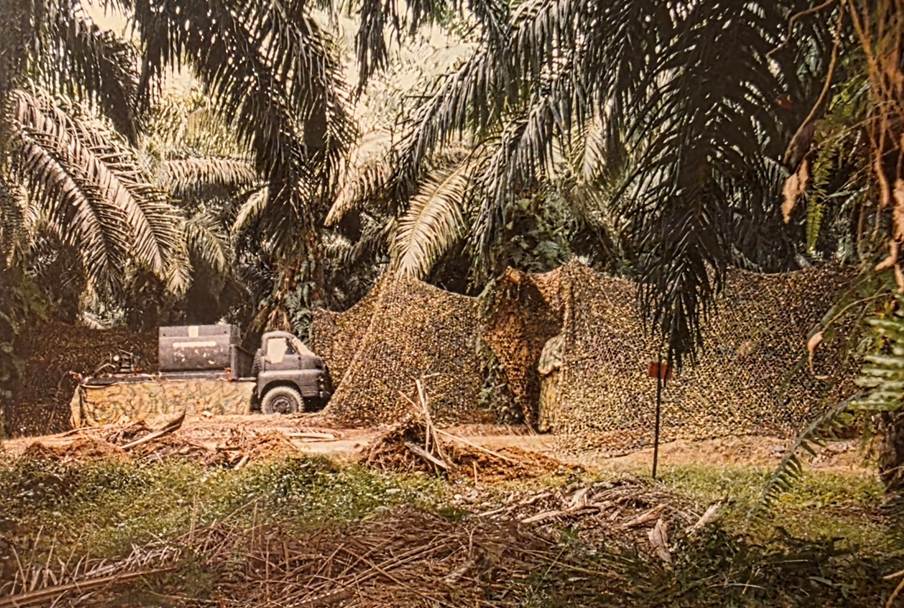
The photographs accompanying this article show New Zealand Army Unit Bulk Refuelling Equipment (UBRE) in practical field use during exercises in Malaysia in the second half of the 1980s. The vehicles were operated by the New Zealand Advanced Ordnance Depot (NZAOD) in Singapore, supporting New Zealand forces training in the region during the final years of New Zealand Force Southeast Asia.

Evidence now places NZAOD’s truck-mounted bulk fuel support in Malaysia from at least Exercise Pemburu Rusa in 1985 through to Exercise Taiha Tombak XI in 1989, the final exercise for NZAOD. These images provide a rare visual record of how New Zealand’s tactical bulk refuelling capability appeared in service, not as a polished catalogue item or purpose-designed military refuelling module, but as a pragmatic, improvised system assembled from available tanks, pumps, hoses, fittings, and vehicle platforms.

The images are important because they show the reality behind later Army correspondence, which described the in-service New Zealand UBRE as an “ad hoc combination” of equipment. That description was not an exaggeration. By the late 1980s, the New Zealand UBRE was a field-engineered arrangement based around a 2000-litre rigid tank, a pallet-mounted dispensing pack, and an RL Bedford truck. The system worked, but it was never an ideal or fully purpose-designed solution. It was a practical answer to a practical problem, moving and issuing fuel forward in conditions where jerrycans alone were too slow, labour-intensive, and inefficient.

The ad hoc New Zealand UBRE

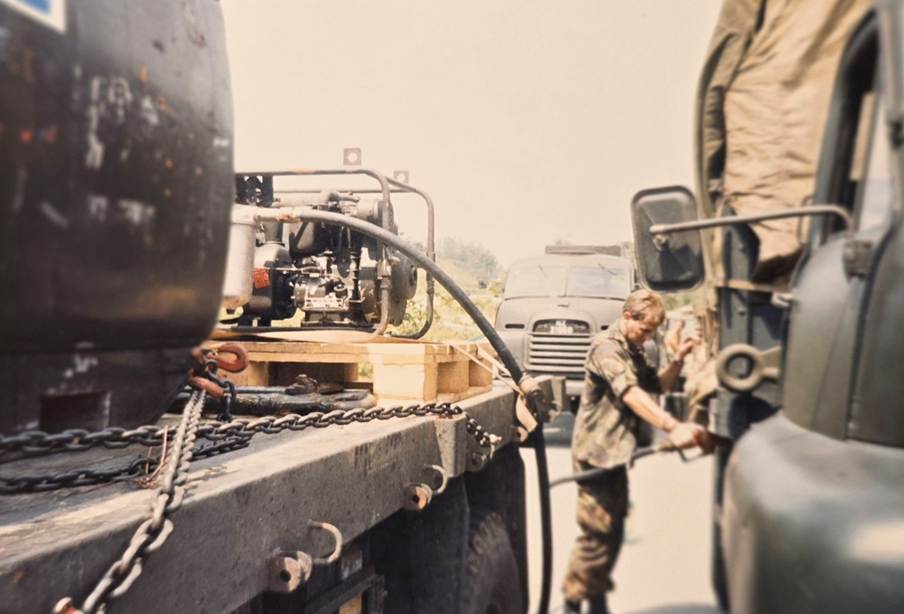
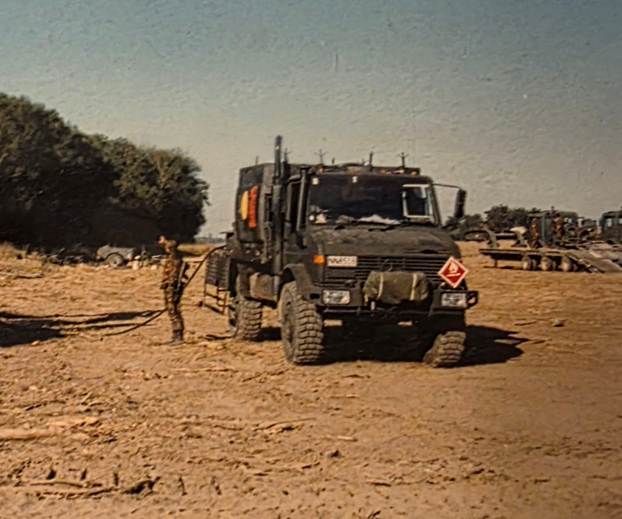
In its typical late-1980s form, the New Zealand UBRE consisted of a 2000-litre rigid fuel tank shackled or otherwise secured to the deck of an RL truck in NZAOD and a UNIMOG truck for NZ-based units. Nearby, a palletised dispensing pack was mounted, containing a pump, filter, meter, hoses, and fittings. Some pumps were self-contained, consisting of a pump, filter, and meter within a robust frame. Other pumps were made up of separate pump, filter, and meter components that were often grouped together on a pallet base and secured with steel banding tape.

The tank and dispensing pack were connected by two-inch hoses using camlock fittings. These fittings could be wired shut, but they required constant checking during movement, as vibration and road travel could work them loose. Fuel was dispensed to vehicles through a one-inch hose. In some cases, this could be fitted to a hose reel, but more often the hose was simply wound around the dispensing pack for stowage.

In New Zealand, a UBRE could be configured to dispense petrol, diesel, or Aviation Turbine Fuel. However, in Singapore, the NZAOD UBREs were configured specifically for petrol, then commonly referred to as MT Gas. Each issue was recorded on an MD638 Issue Sheet in litres, based on the meter reading. This detail is important. Although the equipment itself was improvised, the accounting and control of fuel remained formalised. The operator had to issue fuel, read the meter, record the quantity, and maintain a written record of consumption. In that sense, the UBRE was not merely a pump and tank on the back of a truck; it was part of a wider supply and accountability system.

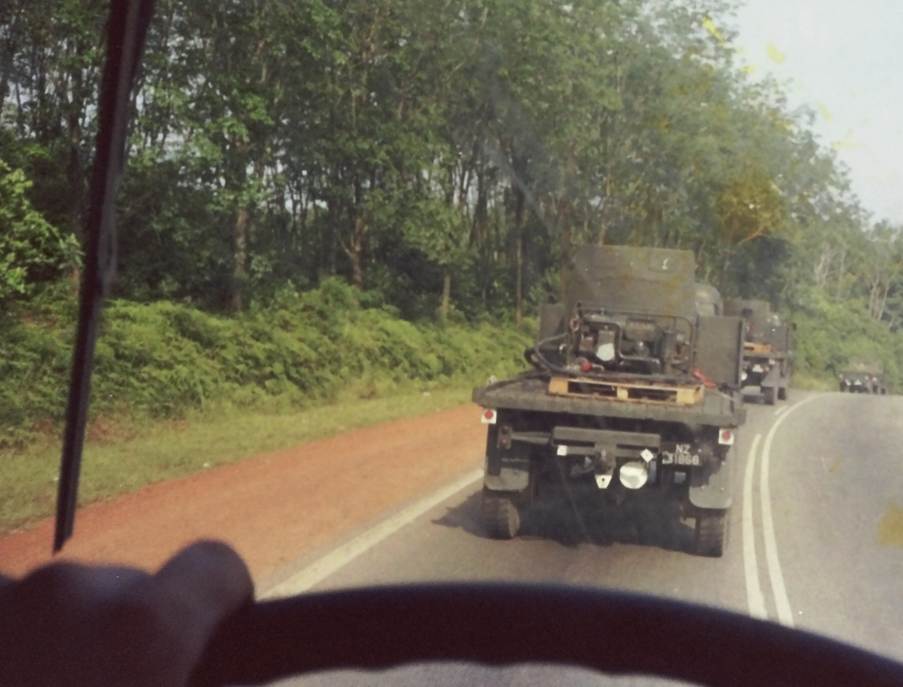
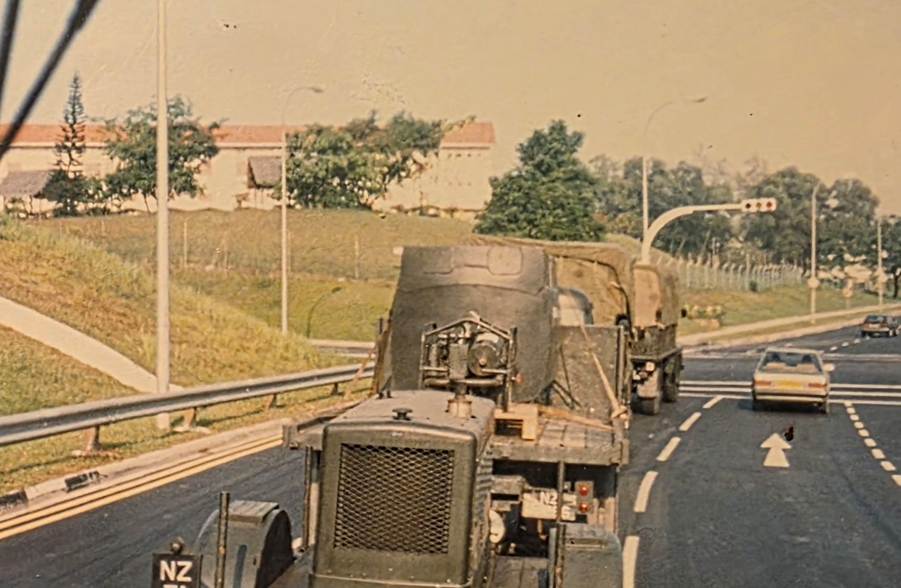
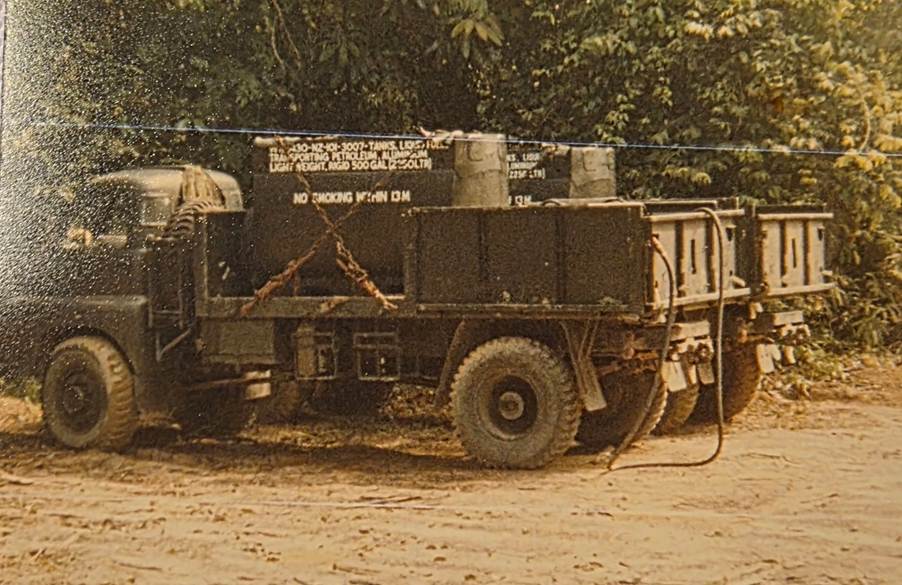
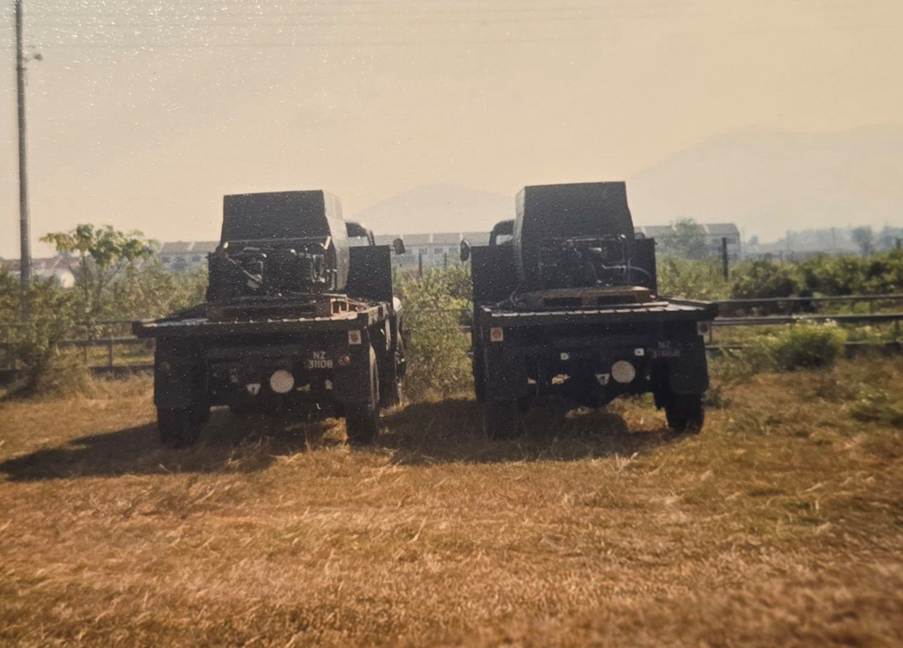
The photographs show the dispensing pack either sitting exposed on the truck deck, with hoses visible around the tank and pump assembly or with the vehicle sideboards remaining fitted. The arrangement was functional, but it relied heavily on operator vigilance, routine checks, and practical experience.

Taiha Tombak X

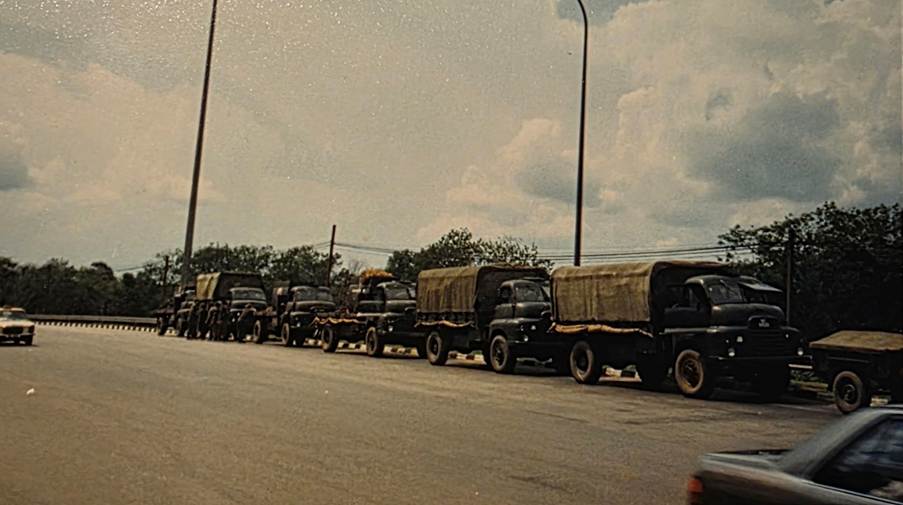
Several photographs show the UBREs in convoy or road movement. These views make clear how exposed the equipment was. The dispensing pack, hose work, and tank fittings sat on the open deck, secured for movement but still vulnerable to vibration, weather, and rough roads. This was the kind of operating environment that made loose couplings, leaking fittings, and constant equipment checks an everyday concern.

Pemburu Rusa 88

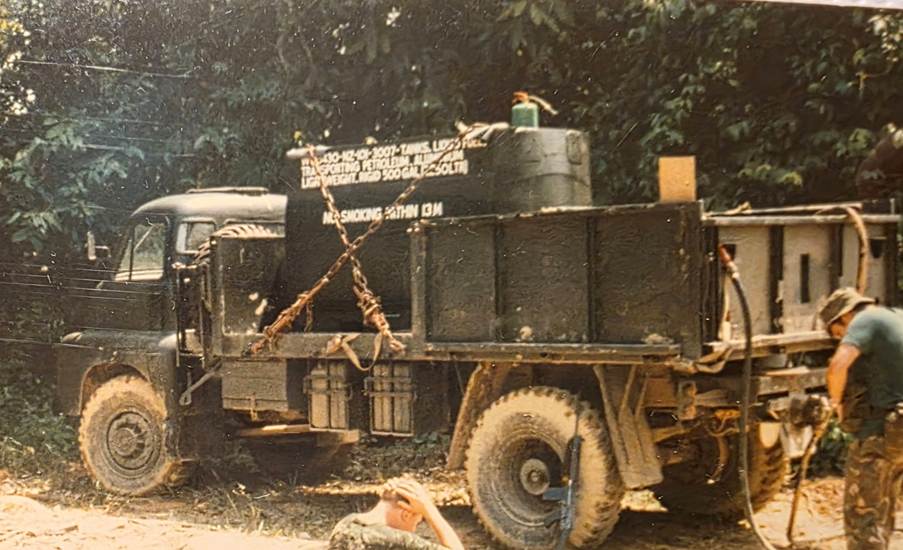
Other images give a clearer side view of the RL-mounted UBRE. The large rectangular tank dominates the deck, with the dispensing pack positioned at the rear. The visible placarding, external hose work, and “No Smoking within 13M” markings highlight its role as a fuel-carrying and fuel-dispensing vehicle rather than a general cargo truck. The images also illustrate one of the central compromises of the system. The RL provided mobility and load-carrying capacity, but the refuelling equipment was not integrated into the vehicle as it would be in a purpose-built tanker or modern fuel module. It was mounted onto the truck, rather than designed as part of it.

Taiha Tombak IX

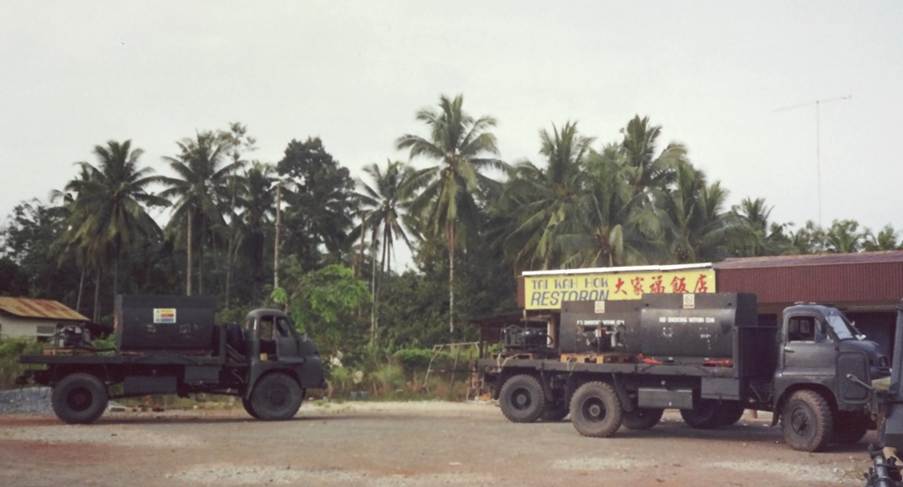
One of the most useful photographs shows three UBRE-equipped vehicles together in Malaysia. Rather than isolated refuellers, the image captures a small mobile fuel element, with each RL carrying a 2000-litre rigid tank and associated dispensing equipment. This gives a better sense of how the ad hoc UBRE capability could be grouped to support exercises, providing a dispersed yet practical bulk refuelling capacity. It also highlights the variation within the system. Although each vehicle performed the same broad role, the equipment was not a fully standardised, purpose-designed refuelling module. It was a collection of workable configurations assembled from available tanks, pumps, hoses, fittings, and vehicle platforms. That flexibility was useful in the field, but it also created challenges for maintenance, training, and safety.

Lunch stop Taiha Tombak XI

A mobile field fuel point

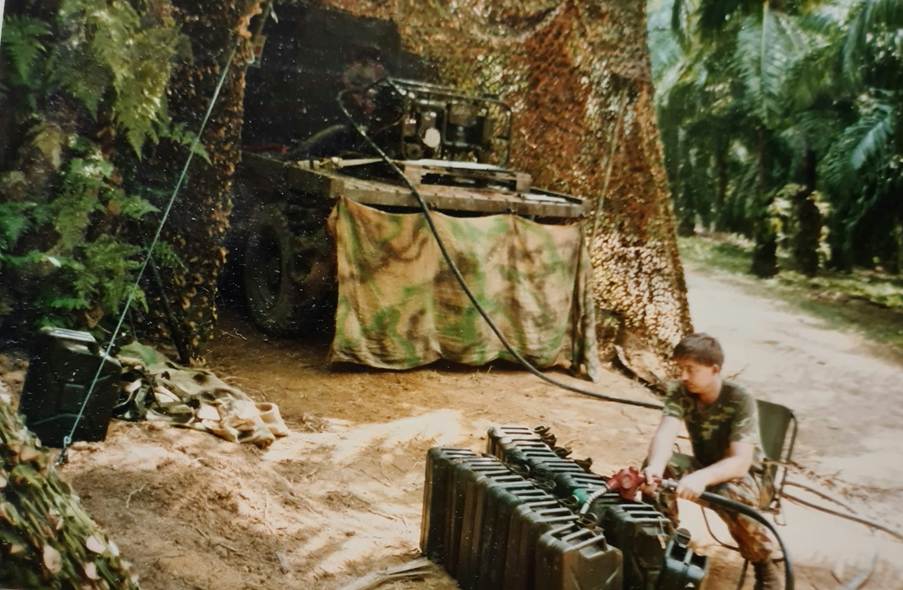
The wider photographic set adds further detail to how these improvised UBREs were actually operated. They were not simply trucks carrying fuel tanks. In the field, they could be established as temporary fuel issue points, with warning signs, no-smoking controls, drums used to mark or control the area, and fuel dispensed by hose directly into vehicles or into containers.

Pemburu Rusa 88

One image shows a controlled fuel point layout, with drums and signage forming a visible boundary around the dispensing area. Others show UBREs in harbour, in hides, on roads, and at exercise locations, demonstrating that the system was used as a mobile field fuel capability rather than as static depot equipment.

UBRE Hide Taiha Tombak XI

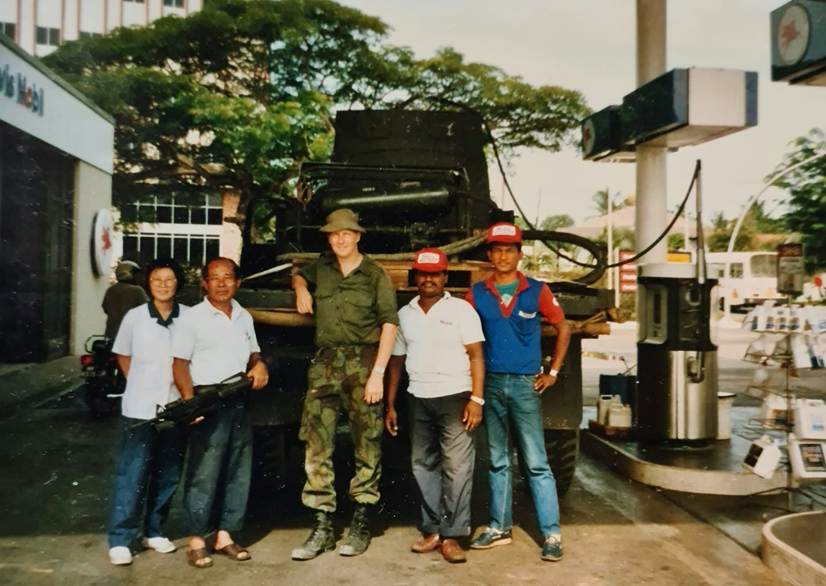
The photographs also show fuel being issued directly to vehicles and, in some cases, into jerrycans or other containers.

Taiha Tombak XI

This confirms that the UBREs were not limited to bulk vehicle refuelling alone. They could support vehicle replenishment, container filling, and local redistribution of MT Gas as required. The equipment was flexible, but that flexibility came from operator skill and improvisation rather than from a formally integrated design.

Kerbsiode convoy refuelling Taiha Tombak X

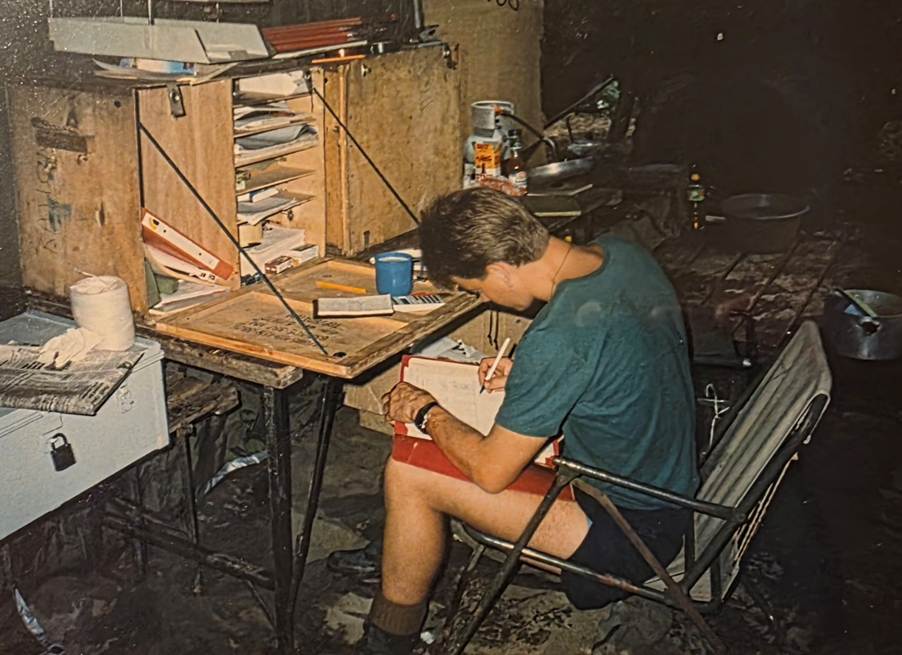
One photograph of field administration is particularly useful. It shows the paperwork side of the operation, reinforcing that the fuel issue remained formally controlled even when the equipment was improvised. Issues were measured with the meter and recorded in litres on the MD638 Issue and Receipt Sheet. At the end of each day, the MD638 issue and receipt sheets would be reconciled, and the balance would be entered on an AFNZ 28 Supplies and POL Ledger Card. This was then checked against the physical stock by dipping the tank. The result was a daily record of receipts, issues, book balance, and actual balance, with allowance made for normal tolerances, spillage, and calculated measurement variation. The UBRE may have been ad hoc in construction, but the discipline surrounding fuel accounting remained intact.

The activities shown in these photographs should be read as a snapshot rather than a complete record of NZAOD Petroleum Operator activity in Southeast Asia. They capture the principal known examples where UBREs were utilised in Malaysia between 1985 and 1989, but Petroleum Operators also supported New Zealand Transport Squadron activity and other exercises or depot requirements. They also supported helicopter refuelling for 141 Flight RNZAF. The UBREs were therefore only one visible part of a wider petroleum support function that linked vehicle movement, air support, depot supply, and field sustainment during New Zealand’s final years in Singapore and Malaysia.

Reconciling 638s Taiha Tombak X

The introduction of the UBRE idea

During this period, the term UBRE itself was not widely understood outside the Petroleum Operator community. It appears to have entered New Zealand Army usage through officers and soldiers who had been exposed to British petroleum doctrine and equipment, including Phil Green and H. J. Carson. Carson and Green were officers who had seen British UBRE mounted on Bedford or similar standard trucks during their time on the long petroleum course in the United Kingdom. They brought the concept back into New Zealand service, where it was discussed, adapted, and reinforced through Petroleum Operator courses.

British Army UBRE

In this sense, UBRE was not just a piece of equipment. It was a British idea filtered through New Zealand circumstances and given practical form by petroleum operators who understood that the Army needed something better than jerrycans alone, even if a fully engineered solution was not yet available.

Earlier New Zealand Petroleum Operators in Southeast Asia included Billy Vince, Stu McIntosh, Ian “Butch” Hay, Alan Barnes, Brian Calvey, John Weeds, and A. J. Weston. This list is not exclusive, and any omissions are regretted. Their service provides important continuity to the later NZAOD UBRE story. The ad hoc RL-mounted UBREs of the late 1980s did not appear in isolation. They developed from an established petroleum support presence in Southeast Asia, shaped by earlier operators, older equipment, field expedients, and the practical demands of supporting New Zealand forces in Malaysia and Singapore.

Earlier evidence, Exercise Pemburu Rusa, 1985

The use of NZAOD bulk fuel equipment in Malaysia can now be pushed back before the 1987–1989 photographic record. A contemporary recollection titled “Driving in Malaysia, An Experience” records that, after arriving in Singapore in late August 1985, Staff Sergeant Stu McKintosh recalls his first introduction to driving on the Malay Peninsula came during Exercise Pemburu Rusa, conducted between 2 and 31 October 1985. After initially driving the escort Land Rover for an RT-25 rough-terrain forklift, he soon found himself driving an RL fitted with a single 2000-litre tank on about four refuelling runs back to Singapore.[1]

Each trip took around two hours one way, despite the distance being only about sixty miles, with road conditions, traffic, and local driving habits contributing to the slow journey. This account is important because it confirms that NZAOD was operating truck-mounted bulk fuel arrangements in Malaysia before the later Taiha Tombak photographs. It does not prove that the exact UBRE configuration seen in the later images was already in routine use, but it does show that RL-mounted fuel carriage and refuelling support formed part of NZAOD’s exercise support system by late 1985.

It also reinforces a recurring theme in the photographic evidence, fuel support in Malaysia was never simply a technical matter. It required drivers and petroleum operators to move heavy, fuel-carrying vehicles over long distances and through demanding traffic conditions while maintaining the safety and accountability expected of military fuel operations.

The 1985 Pemburu Rusa experience helps explain the later Taiha Tombak arrangements. By the time larger exercises were being supported in the late 1980s, NZAOD already had practical experience moving fuel-carrying RLs between Singapore and Malaysian exercise areas. The later ad hoc UBREs therefore appear less as a sudden invention and more as the development of an existing pattern, using RL trucks, rigid tanks, pumps, filters, meters, hoses, local commercial support, and Petroleum Operator trade knowledge to create a mobile refuelling capability suited to New Zealand’s needs in Southeast Asia.

Exercise Taiha Tombak IX, 1987

The Taiha Tombak series provides a clearer sequence of NZAOD UBRE employment in the closing years of the New Zealand presence in Singapore. Two UBREs were sent on Exercise Taiha Tombak IX in 1987, conducted in Pahang State. Their use shows that, by 1987, the RL-mounted UBRE had moved beyond an occasional solution and had become part of the expected NZAOD support package for major exercises.

Taiha Tombak IX

With only a limited pool of NZAOD personnel available to support Exercise Taiha Tombak IX, soldiers were employed across multiple roles as required. At different stages of the exercise, Corporal Flo Tamehana and Lance Corporals Terry Read, Richard Tyler, and Rob McKie worked within the Petroleum Section. Their role was to operate the UBREs, handle fuel issues, maintain the dispensing equipment, and support kerbside or field refuelling as required by the exercise.

The exercise arrangement required repeated resupply runs to keep the UBREs filled. When operating in Johor State, this was normally achieved by returning to Singapore. However, when the exercises moved farther north up the Malay Peninsula, returning to Singapore was no longer practical. In those cases, fixed fuel sources were arranged through contracted commercial fuel companies, such as Mobil, using civilian service stations or commercial fuel points in or near the exercise area. In practical terms, the UBREs operated either as a shuttle-based bulk fuel link between Singapore and the deployed force, or as a mobile distribution system refilled from contracted civilian fuel infrastructure closer to the exercise.[2]

Exercise Pemburu Rusa, 1988

A further NZAOD detachment deployed on Exercise Pemburu Rusa in 1988 for approximately eight weeks, operating out of the Chaa Airfield area in Johor State. This confirms that UBRE use by NZAOD was not limited to the larger Taiha Tombak exercise series, but formed part of a wider pattern of field fuel support in Malaysia during the late 1980s.

The Petroleum Operators on Exercise Pemburu Rusa in 1988 were Lance Corporals Terry Read, Richard Tyler and Rob McKie. Their task was to keep the UBREs supplied and operational during the eight-week deployment, including repeated resupply runs from Chaa Airfield back to Singapore.

The exercise arrangement required repeated resupply runs from the exercise area back to Singapore to refill the UBREs. These were usually conducted as overnight trips. The fuel vehicles would leave the exercise area, complete the approximately two-hour road move back to Singapore, refuel overnight in barracks, and return to the exercise area the following morning. In practical terms, the UBREs were operating as a shuttle-based bulk fuel link between Singapore’s fixed support base and the deployed exercise area in Johor.

This routine again highlights the practical value of the RL-mounted UBRE, as well as the workload imposed on petroleum operators. They had to combine long-distance driving, refuelling, vehicle checks, field distribution, and ordinary detachment duties over an extended period. The UBRE was not just a piece of equipment, it was part of a daily sustainment rhythm connecting the depot base in Singapore with the deployed field force in Malaysia.

Exercise Taiha Tombak X, 1988

The operational value of these improvised UBREs is well illustrated by Exercise Taiha Tombak X, a brigade-size exercise conducted annually with the Malaysian Armed Forces in the states of Perak and Kedah. New Zealand involvement included 1 RNZIR, 141 Flight, the New Zealand Force Hospital, the New Zealand Military Police Unit, New Zealand Workshops, New Zealand Transport Squadron, and NZAOD. The NZAOD detachment was small, only fourteen personnel, but it carried a wide sustainment burden, including expendables, clothing, ammunition, water, POL, and rations.

The detachment’s Petroleum Section was central to the exercise. It consisted of Lance Corporals Terry Read, Rob McKie and “Monkey” Siemonek. Preparation began as early as March, with requirements being developed for the units to be supported during the exercise.

The move from Singapore to the exercise area took three days and covered approximately 800 kilometres. The Brigade Maintenance Area (BMA) moved first, followed by 1 RNZIR. At Tampin, the first overnight stop, the cooks established a kitchen while the petroleum operators refuelled the convoy. On that first night, two UBREs were emptied and then refuelled in the township of Tampin. The next day, as the BMA moved north towards Taiping, Terry Read and Monkey Siemonek remained behind to refuel 1 RNZIR, while Rob McKie left the convoy at Tapah and established a kerbside refuelling point just to top up vehicles so they could complete the move to Taiping.

Advance Partt Packet Taiha Tombak X

This detail is important because it shows the UBREs doing exactly what they were intended to do: extending the force’s reach by allowing fuel to be staged, issued, replenished, and repositioned during a long road move. The vehicles were not simply carrying reserve fuel. They enabled movement over distance, supported a staggered convoy, and allowed different elements to be topped up at key points along the route.

Once the exercise began, based at an airfield in Taiping, the petroleum operators’ workload was relentless. The account records that the detachment worked up to twenty hours a day. A typical Petroleum Operator’s day began with stand-to half an hour before first light, followed by washing, breakfast, first parade of vehicles, and morning briefing from 0700 to 0900. From 0900 to 1900, the petroleum operators could be driving to Butterworth to refuel, conduct taskings, and carry out unit duties. From 1900 to 0300, they could be setting up distribution points deep in the exercise area.

The exercise also demonstrates that petroleum support was not limited to operating the pump. The Petroleum Section had to move with the force, establish distribution points, carry out long refuelling runs, maintain its own vehicles and equipment, and continue with ordinary unit duties such as camouflage, sentry duties, mess fatigues, rubbish duties, and defensive tasks. The UBRE was therefore part of a wider field routine, not a standalone technical asset.

The comparison with Malaysian refuelling practice is also revealing. The account describes Malaysian soldiers refuelling from a 3-ton Mercedes-Benz truck loaded with 44-gallon drums. A vehicle would pull alongside, fuel would be pumped from a rotary pump into a jerrycan, then emptied into the vehicle, with a soldier recording each 20-litre increment. Much of this was done by the light of a kerosene lamp.

This comparison highlights the relative efficiency of the New Zealand UBRE, improvised though it was. The New Zealand system was still crude by later standards, but its tank, pump, meter, filter, and hose arrangement allowed measured fuel to be issued directly from the vehicle.

The circumstances surrounding Exercise Taiha Tombak X also demonstrate the improvisational culture behind the system. For this large exercise, held in the vicinity of Taiping, three UBREs were to be provided by NZAOD. There were enough trucks, 2000-litre rigid tanks, and pumps available to assemble three refuelling vehicles, but there was a shortfall of one meter and filter, essential items if the third dispensing pack was to be completed and fuel issues properly measured. In the days immediately before deployment, a filter unit and nozzle-mounted meter were sourced locally from Hong Tec Hin Hardware in Singapore. These were then fitted on the night before the vehicles were deployed.

That episode says much about the character of New Zealand Army logistics in Singapore during the late 1980s. The capability existed, but it relied on local initiative, trade knowledge, and the ability to solve practical problems quickly. The third UBRE was not completed because the system was neither elegant nor well-resourced. It was completed because the soldiers involved understood what was needed, found the missing components, and made the equipment work in time for the exercise.

That improvisation was also a by-product of the early Petroleum Operator courses. With scarce equipment, much of it purchased in the late 1960s and by the late 1980s approaching twenty years of age, course time was often spent taking the equipment apart, reassembling it, understanding how the pumps, filters, meters, hoses, and fittings worked, and learning how to produce a workable dispensing pack from whatever was available. The term UBRE itself was not yet common Army language, but within the Petroleum Operator community, it became shorthand for a capability learned from British practice, adapted through coursework, and made practical with New Zealand equipment. This created operators who understood the equipment at a practical level, not just as users, but as soldiers capable of maintaining, adapting, and making it function on a shoestring.

Taiping Airfield Taiha Tombak X

In Singapore, that training culture proved decisive. When the exercise requirement exceeded the available complete sets, the solution was not to wait for a formal procurement process, but to identify the shortfall, source suitable commercial components locally, and integrate them into the third UBRE overnight. The photographs of local civilian fuel infrastructure and support activity reinforce the wider reality of NZAOD operations in Singapore. Military capability often depended on a close working knowledge of local suppliers, workshops, hardware stores, and commercial fuel facilities. In this environment, sustainment was not a neat separation between military and civilian systems. It was a practical blend of Army need, local knowledge, commercial availability, and the initiative of experienced ordnance soldiers.

It was a classic example of small-army improvisation, where formal requirements, limited holdings, ageing equipment, and operational deadlines met the practical ingenuity of the depot floor.

Kerbside refuelling and the return move

The return move from Taiping further demonstrates how the UBREs were used as a mobile refuelling chain. After the exercise ended, the detachment moved back to Taiping to join 1 RNZIR for the move back to Singapore. The Petroleum Operators again set up a kerbside. Once Terry Read and “Monkey” Siemonek’s trucks were empty, they refuelled and moved down the route to establish a kerbside at Tampins. Rob McKie completed refuelling at 2000 hours and then departed to set up another kerbside at Tapah.

The scale of the work was considerable. The first vehicles left Taiping at 0600 hours and were due at Tapah by 0800. At Tampins, Terry Read and “Monkey” Siemonek were busy from the arrival of the first vehicles and refuelled 120 vehicles. By the end of the exercise, the Petroleum Section had issued 55,000 litres of MT Gas. The same detachment also issued 48,000 litres of water, while general stores achieved 100 per cent demand satisfaction.

These figures convert the photographs from interesting images into a measurable logistics story. The UBREs were not incidental vehicles in the background of an exercise. They were central to moving the force, and their operators were responsible for tens of thousands of litres of fuel during long road moves, at field distribution points, and on return-route kerbsides.[3]

Exercise Taiha Tombak XI, 1989

In 1989, three UBREs again participated in Exercise Taiha Tombak XI. The exercise took place in Perak and Penang states and, like the previous year’s Taiha Tombak X, required long road moves, route replenishment, field fuel points, and repeated coordination between the deployed force and available fuel sources. This exercise was significant because it would be the final major exercise for NZAOD before the end of New Zealand’s permanent presence in Singapore.

By this stage, the RL-mounted UBRE was a proven, if imperfect, solution. Across several years of Malaysian deployments, it had supported long-distance movement, kerbside refuelling, field distribution points, route replenishment, and wider exercise sustainment. Although the equipment remained improvised, the method was by then well understood. Petroleum Operators knew how to assemble, check, move, refill, operate, account for fuel, and keep the system working under field conditions.

The Petroleum Operators supporting Taiha Tombak XI were Corporals Heather Thomas and Richard Tyler, and Lance Corporal Rob McKie. Their participation marked the endpoint of the visible NZAOD UBRE story in Malaysia. Its value lay not only in the equipment itself, but in the trade knowledge, local initiative, field routine, and hard-won experience built around it.

Topping up in Butterworth Taiha Tombak XI

Taiha Tombak XI was the last Malaysian exercise of this type for the NZAOD. By the end of 1989, New Zealand’s permanent force presence in South East Asia had drawn to a close, and the remaining New Zealand elements had redeployed from Singapore back to New Zealand. With that redeployment, a distinctive chapter in New Zealand’s post-war military logistics ended. For the NZAOD Petroleum Operators, the Malaysian UBRE deployments represented a small but important example of practical field logistics, where limited equipment, local adaptation, and experienced soldiers combined to sustain operations over distance.

Later Army Review and the Wider UBRE Problem

The NZAOD photographs and exercise accounts help explain why the Army became increasingly concerned about UBRE by the early 1990s. They show a capability that worked, but which depended heavily on adaptation, operator judgement, and equipment that had never become a fully purpose-designed military refuelling system.

Official correspondence from 1991 confirmed the problem. Army records described the existing UBRE as an ad hoc combination of equipment, much of it using items that had been in service since before 1975. The same review noted that the equipment was in poor repair, was unsafe, and failed to meet hazardous-substances transport requirements, although temporary waivers had been arranged.

By late 1991, UBRE had therefore become more than a practical refuelling asset. It had become a safety, capability-definition, and interoperability problem. Papers considered by the Army Capital Acquisition Management Committee noted that the existing UBRE had undergone an Army Maintenance Area Technical Services engineering review, which found “extremely serious safety hazards” in the equipment. The issue was not simply one of age or maintenance. The Army also lacked a clearly defined user requirement, with AST 57.2 identifying a nominal requirement for 20 UBRE sets but providing insufficient detail on the required characteristics or performance.[4]

Following the Army restructuring, this figure was questioned. Army Maintenance Area Technical Services estimated that ten to twelve refurbished sets might be sufficient, using the existing 2000-litre rigid tanks as the basis for a modified system. The preferred interim solution was pragmatic rather than ambitious. Instead of immediate replacement, which was expected to cost more than $60,000 per set, AMA Technical Services proposed refurbishing the existing tanks and replacing the hoses, connections, and associated equipment with safer and more suitable components at an estimated cost of $10,000 to $20,000 per set.[5]

The role UBRE was meant to fulfil remained significant. It was required for first-line resupply to units needing immediate bulk fuel replenishment when other methods were impractical or cost-ineffective. It was also required to provide kerbside refuelling facilities at second line, mobile bulk refuelling facilities for RNZAF helicopters supporting ground forces, and mobile bulk refuelling facilities for civil aid or emergency tasks in New Zealand and overseas.

At the same time, New Zealand was closely watching Australian developments. The Australian Army was moving towards different UBRE systems for armoured and general-purpose wheeled requirements. For New Zealand, this raised a choice between adopting the Australian solution, including a separate RNZAC refuelling capability, or developing a modular New Zealand UBRE system while maintaining interoperability through standardised pumping and distribution equipment.

This context is important because the system’s shortcomings did not make it irrelevant. On the contrary, UBRE was essential because it filled a real operational need. It allowed petroleum operators to move beyond purely manual fuel distribution and gave commanders a more efficient means of sustaining vehicles, aircraft support, and mobile formations in the field.

Towards safer Unimog-mounted UBREs

By 1991, safety and legislative concerns had begun to force a more formal approach to UBRE mounting and carriage. The earlier RL-mounted arrangements had demonstrated their value in Malaysia. Still, they also exposed the weaknesses of carrying fuel tanks and dispensing equipment on open vehicle decks using improvised restraints. As transport and dangerous goods compliance became harder to ignore, the Army moved towards a more secure mounting system based on two 2000-litre rigid tanks carried on the deck of a Unimog.

To enable this, the original rigid tanks were modified from their earlier design. Reinforced forklift lifting channels were added, pressure relief valves were fitted, and the original gate valves were replaced with more modern ball valves. The mounting system allowed each 2000-litre tank to be tied down to the platform by screw-tightened rods, four per tank, providing a much more positive restraint than chains or straps. The whole platform was then secured to the Unimog with twistlocks, providing a safer, more controlled method of carriage.

.

Unimog UBRE, Ex Ivanhoe 1991

This represented an important step in the evolution of the New Zealand Army UBRE. The basic concept remained the same, a mobile bulk fuel system built around 2000-litre rigid tanks and a dispensing capability, but the method of securing the load had changed. The improvised logic of the RL-mounted UBRE was being replaced by a more engineered solution that better recognised the hazards of carrying flammable liquids over distance and across rough military routes.

This development did not immediately erase the earlier ad hoc systems. Instead, it marked the transition between the field expedients of the 1980s and the more regulated fuel-handling environment of the 1990s. The same small-army need remained, to move bulk fuel forward and issue it efficiently, but by 1991, the equipment was being reshaped by safety requirements, dangerous goods legislation, and the lessons learned from years of operating improvised UBREs in New Zealand, Singapore, and Malaysia.

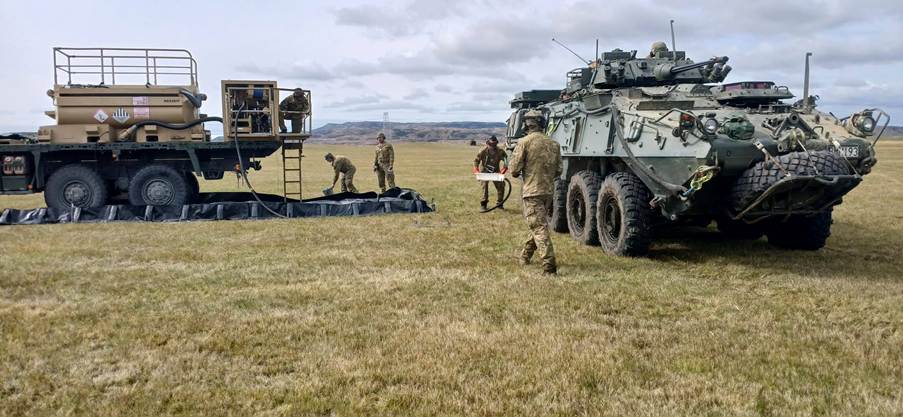
The ad hoc UBRE would soldier on for another decade. Although safer mounting arrangements were introduced, the Army did not yet have a fully purpose-built replacement. As a result, the modified UBRE capability continued in service through the 1990s, bridging the gap between improvised field equipment and a formalised bulk refuelling system. That transition was finally completed in 2002, when the purpose-built Unit Bulk Refuelling Equipment Mk1 entered service, incorporating dedicated pumps, meters, and filters as part of a more deliberate and standardised capability.

For NZAOD in Singapore, this capability was particularly valuable. Exercises in Malaysia placed New Zealand vehicles and units into demanding tropical conditions, often operating away from fixed support facilities. Bulk fuel support had to be mobile, flexible, and responsive. The ad hoc UBREs shown in these photographs were therefore not curiosities. They were part of the everyday sustainment machinery that allowed New Zealand forces to train and operate in Southeast Asia during the final years of New Zealand’s long military presence in Singapore.

The images also speak to the professionalism of the Petroleum Operator trade. Operating this equipment was not simply a matter of turning on a pump. It required fuel-handling knowledge, an understanding of bonding and earthing, awareness of fire and environmental risks, pump operation, filter and meter management, hose discipline, vehicle-loading awareness, accounting discipline, and constant attention to leaks and loose fittings. In the absence of a purpose-designed system, safe operation depended heavily on the skill and judgement of the operators.

The options before the Army were therefore familiar small-army choices. Australian equipment offered a possible route to interoperability but raised questions about compatibility with New Zealand’s vehicle fleet and the need to support both A vehicles and B vehicles. Existing New Zealand equipment could be modified, but only at increasing cost and without fully resolving the underlying design limitations. The choice was whether to extend the life of an improvised but familiar capability, adopt an overseas design, or invest in a more suitable New Zealand solution.

These photographs capture the capability before that reassessment fully overtook it. They show UBRE in its late-1980s form, practical, rugged, improvised, and imperfect. They also show a period when New Zealand Army petroleum support was evolving from the older world of jerrycans, drums, and field expedients towards a more technical and regulated bulk fuel environment. In that sense, the ad hoc UBREs used by NZAOD in Singapore and Malaysia were transitional equipment. They belonged to an era when sustainment capability was often created through adaptation, local initiative, and trade knowledge.

Current NZ Army UBRE

Their importance lies in that very imperfection. They remind us that logistics history is not only about formal establishments, new equipment projects, or official doctrine. It is also about the equipment that soldiers actually used, the compromises they managed, and the practical systems that kept vehicles moving, exercises running, and commanders supported. Between 1985 and 1989, on Malaysian roads, in jungle hides, at temporary fuel points, and beside civilian fuel infrastructure, these ad hoc UBREs did exactly that. Their continued operation into the 1990s and eventual replacement by the Unit Bulk Refuelling Equipment Mk1 in 2002 confirm their place as an important bridge between improvisation and modern military fuel distribution.

Notes

[1] Stuart McIntosh, “Driving in Malaysia – An Experience,” RNZAOC Pataka Magazine  (1986): 39-43.

[2] “A Suppliers Oddity – Exercise Taiaha Tombak IX 1987,” RNZAOC Pataka Magazine  (June 1987): 33-34.

[3] “Exercise Taiaha Tombak X 1988,” RNZAOC Pataka Magazine  (June 1989).

[4] “Equipment and Supplies – Overall Policy – Unit Bulk Refuelling Equipment (UBRE),” Archives New Zealand No R7934641  (1983 – 1991).

[5] “Equipment and Supplies – Overall Policy – Army Development Policy and Procedures,” Archives New Zealand No R7934660  (1983 – 1991).


A Familiar Face on the Range

Anyone who has served in a Commonwealth military will remember the Figure 11 and Figure 12 targets. They were fixtures of range days, instantly recognisable, unforgiving, and oddly memorable. From early-morning details to hot afternoons on dusty butts, generations of soldiers learned their craft by trying to hit those stark silhouettes advancing from as far as 300 metres, often with nothing more than iron sights, steady breathing, and discipline drilled into muscle memory.

The figures themselves were deliberately generic. Across British and Commonwealth forces, the enemy on the range was rarely given a name or nationality. Instead, the targets presented a stylised armed figure, frequently with a vaguely German or Soviet look, a helmet pulled low, a rifle clutched across the chest, advancing directly toward the firer. The intent was clear: to remove individuality, to create a neutral and repeatable representation of threat, and to focus the shooter on fundamentals rather than identity.

For many, the challenge was as much psychological as technical. Watching those figures appear, advance, or snap into view, the shooter had seconds to judge range, align sights, and fire accurately. Hits were counted, misses remembered, and lessons learned the hard way. These targets were not just pieces of card or board; they were tools that shaped confidence, competence, and trust in one’s weapon.

Against that familiar backdrop, the Malaysian Figure 12/59 target stands out as something more personal and more revealing of its historical context. While it follows the same Commonwealth tradition of silhouette training targets, its imagery departs from the deliberately anonymous style seen elsewhere.

Rather than a faceless or neutral opponent, the Malaysian target presents a distinctly stylised image of a Malayan Communist Party guerrilla. The figure wears a cap marked with a star, carries a rifle in a confrontational posture, and is given an exaggerated, angry, almost ferocious expression. The face is not neutral. It is antagonistic, emotive, and unmistakably hostile.

This reflects the environment in which the target was conceived. During the Malayan Emergency and its long aftermath, the threat was not abstract. It was internal, insurgent, and personal. The enemy was known, named, and encountered in jungles, villages, and patrol bases. Training aids reflected that reality. The target was not just something to shoot at; it was a visual reminder of a very real adversary faced by Malaysian security forces.

In this way, the Figure 12/59 target bridges two traditions. It sits firmly within the shared Commonwealth range culture familiar to soldiers from Britain, Australia, New Zealand, and beyond, yet it also carries the imprint of a uniquely Malaysian conflict. It demonstrates how even something as mundane as a range target can reveal more profound truths about history, threat perception, and the lived experience of soldiers.

For veterans, seeing such a target today can be unexpectedly evocative. It recalls the crack of rifles, shouted orders, and the quiet satisfaction of a well-placed shot. But it also reminds us that behind every silhouette, generic or otherwise, lies a specific story shaped by geography, politics, and conflict.

In that sense, the Figure 12 and Figure 11 targets may be universal, but the Malaysian Figure 12/59 tells a story that is distinctly its own.