The Missing Nail

Batteries, Logistics and the Digitised Army.

For want of a nail the shoe was lost.
For want of a shoe the horse was lost.
For want of a horse the rider was lost.
For want of a rider the message was lost.
For want of a message the battle was lost.
For want of a battle the kingdom was lost.
And all for the want of a horseshoe nail.

— Traditional proverb

Armies have always been shaped by what they consume. For centuries, horses needed fodder; mechanised forces came to depend on fuel. Today, much of a soldier’s ability to see, communicate and fight depends on electricity stored in batteries. The more sophisticated our equipment becomes, the easier it is to overlook the comparatively humble item that keeps it working.

A drone without a charged battery is grounded. So is a radio or a night-vision device. Ukraine has made battery consumption impossible to ignore, but drones did not invent this problem. From East Timor to Iraq and Afghanistan, distant deployments have exposed the danger of assuming that small, essential stores will somehow be available when needed.

For a digitised Army, the missing nail may now be a battery. The question is whether our logistics arrangements make that vulnerability visible before an operation exposes it.

The New Zealand Defence Force (NZDF) should establish, initially on a trial basis, a national Class XI, Battlefield Energy: a distinct, accountable means of forecasting, holding, reporting and sustaining operational batteries and stored electrical energy. Critical battery supply should also be recognised as a national resilience concern. A new classification is not a substitute for good logistics, but it could give this requirement the visibility and ownership it currently lacks.
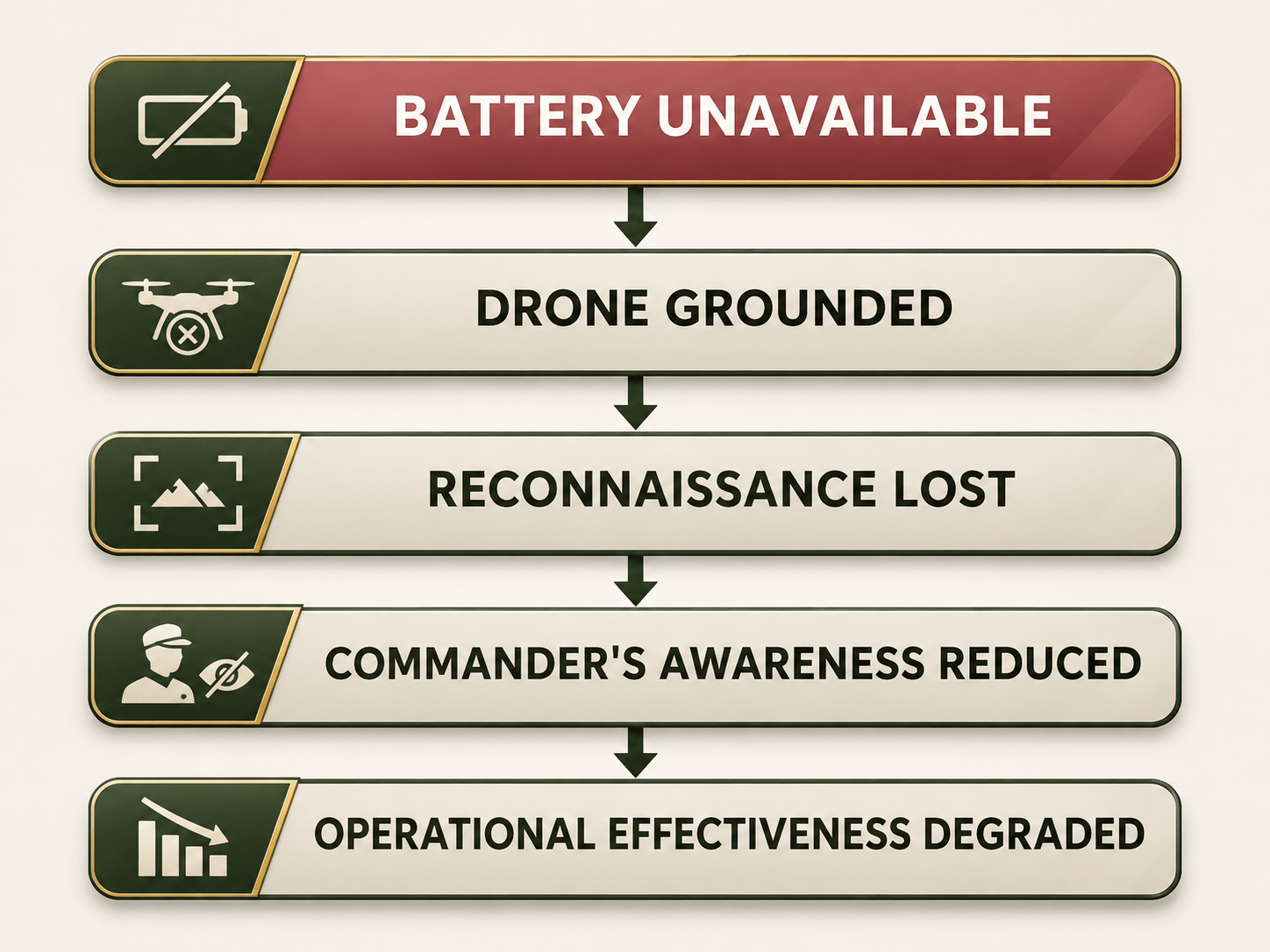
For want of a battery: a seemingly minor logistics shortfall can progressively undermine reconnaissance, situational awareness and operational effectiveness. The sequence illustrates a potential dependency, not a documented incident.

The digitised Army has an energy problem

The New Zealand Army’s Future Land Operating Concept 2035 (FLOC 35) envisages a light, agile and increasingly digitised force, with better situational awareness, networked soldiers, sensors and autonomous systems. Such capabilities matter most to a small Army seeking an advantage in information and responsiveness.[1]

Almost every one of those advantages depends on electricity. A night-vision device without power cannot help a soldier see. A drone without a charged battery cannot reconnoitre. A radio network without power cannot keep a command post connected. Buying the equipment does not keep it running. Batteries, charging infrastructure, generators, cables, and moving charged and depleted packs are part of the capability, not an afterthought.

FLOC 35 itself recognises vulnerable supply chains, the value of redundancy and the potential of tactical power generation and smart metering. Recognising the issue in a concept, however, is not the same as routinely measuring a formation’s electrical endurance and assigning responsibility for maintaining it.[2]

Therein lies the paradox. The more the Army, and the wider NZDF, relies on digital systems to compensate for its small size, the more a poorly forecast electrical requirement can erode the very advantage those systems were intended to provide. A force can possess sophisticated equipment and still lose its effectiveness for want of the energy to use it.

Project Convergence brings the issue home

New Zealand’s participation in Project Convergence Capstone 6 (PCC6) in 2026 adds a local dimension. In his post-activity report of 18 August 2026, Deputy Chief of Army Brigadier Hamish Gibbons identified power generation and energy resilience as increasingly important operational considerations. Paragraph 17 describes power as a finite resource that requires deliberate planning and management by commanders, with decisions on consumption, battery replacement, charging cycles, and sustainment becoming more important at all tactical echelons.[3]

New Zealand Army personnel participating in the US-led Project Convergence experimentation programme. Experiments involving advanced communications, sensors and integrated systems illustrate the growing importance of sustaining electrical power across the modern force. Photograph: NZDF.

This is not evidence of an NZDF-wide battery shortage, nor proof that current supply classifications have failed. It is something more useful for the present argument: a contemporary New Zealand reason to test whether our planning, stocks and charging arrangements can sustain emerging capabilities under realistic conditions.

In August 2026, John Mabes of the US Army Center for Army Lessons Learned described electrical power as a fifth essential logistics commodity, as critical as food, water, fuel and ammunition. Drawing on observations at the Joint Readiness Training Center, he highlighted a lack of battery standardisation, poor energy planning, inadequate charging infrastructure and lithium-ion safety, as well as the practical value of a “round-robin” charging network.[4]

Mabes is not proposing a new formal supply class. His analysis does, however, reinforce a simple point: a formation needs to forecast and manage electrical endurance as seriously as traditional commodities. For New Zealand, Class XI could make that responsibility explicit.

We have run short before

During the 2003 invasion of Iraq, the US Government Accountability Office documented a near-crisis in military battery supply. Monthly worldwide demand for two military lithium-battery types, the BA-5590 and BA-5390, rose from below 20,000 before September 2001 to 330,600 in April 2003. That same month, the Marines reported only a two-day supply in theatre; by May, back orders had reached around 900,000.[5]

The failure was not simply a slow supplier. The Army’s war reserve requirement of 180,000 BA-5590s covered only the first 45 days of operations, yet nearly 620,000 were demanded in the first two months. Item managers had no wartime forecasting model; funding had fallen short for several years and industrial capacity could not increase quickly enough. With a six-month production lead time, an urgent order did not solve an immediate shortage.[6]

The problem even entered popular accounts of the war, notably Evan Wright’s Generation Kill. The more important lesson, however, lies in the documented mismatch between peacetime assumptions and operational consumption.[7]

New Zealand is not immune to the difficulties of distant sustainment. Contemporary reporting identified equipment delays associated with East Timor. A shelved draft review of the Bamiyan Provincial Reconstruction Team in Afghanistan later described substandard boots, faulty rifle components and too few infrared sights, although the commander who shelved it disputed its accuracy.[8]

Veterans of those deployments have also described battery shortages in discussions with the author. Recollections from East Timor suggest that planners expected batteries to be readily available in Darwin, without sufficiently accounting for local availability or replenishment times. Afghanistan veterans recall reliance on American stocks and attempts to source replacements locally, including less suitable carbon-zinc batteries obtained through Pakistan.[9]

These are personal recollections, not independently verified official findings on consumption or shortages. Their warning is nonetheless worth hearing: neither the local market nor an allied supply system can be treated as a substitute for a tested sustainment plan.

Batteries are not just another item of stores

The word “battery” conceals a wide range of commodities, from specialist military packs to ordinary AA cells. Different chemistries, shelf lives, voltages, performance limits and transport requirements all affect what can safely and reliably replace what.

Consider specialist military batteries such as the disposable BA-5590 and rechargeable BB-2590 used with military communications equipment. They are not interchangeable with whatever happens to be available on a supermarket shelf. The battery choice affects not only cost but also weight carried, charging requirements and the entire replenishment cycle.[10]

A 2009 US Army comparison shows how much that choice matters. For a seven-day mission, one SINCGARS radio needed seven disposable BA-5590s but only three of the higher-capacity BA-5390s, cutting the soldier’s load by around 3 kilograms and battery cost by 60 per cent. Among rechargeables, three BB-2590s did the work of five older BB-390s. Yet, as the article’s title noted, the improved batteries were sitting unordered in Army inventory.[11] Rechargeable options can reduce what is carried and discarded, but they depend on functioning chargers, power generation and a reliable rotation of charged and depleted packs.
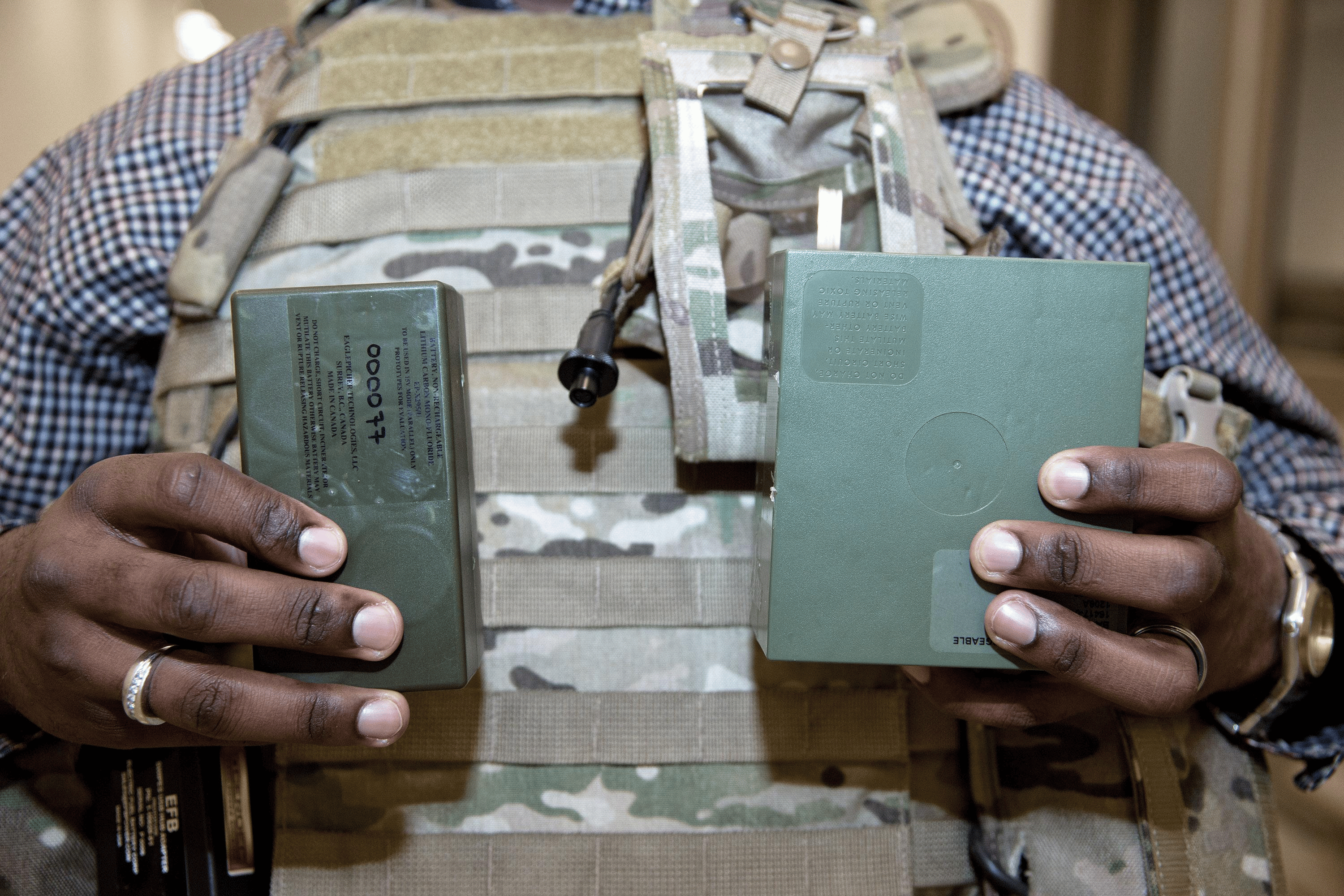
An American military electronics engineer demonstrates battery technology intended to reduce the size and weight of the batteries carried by soldiers. Specialist military batteries differ in performance, compatibility, serviceability and replenishment requirements. Photograph: US Department of Defense.

Ordinary commercial cells matter as well. The AN/PVS-14 night-vision monocular uses one AA battery, and similar cells support a variety of smaller sensors, sights and receivers. Their availability and quality can be just as consequential to an individual soldier as the supply of specialised packs.[12]

The accumulated burden can be substantial. Recent US reporting describes soldiers carrying 7 to 9 kilograms of batteries on a 72-hour mission, with some specialists carrying nearly 14 kilograms. A 2011 US Army account put the figure at around 70 individual batteries on a typical 72-hour mission in Afghanistan.[13] Because devices from different manufacturers often use different battery types, that burden is both a supply problem and a physical one.

Treating commercial cells as trivial general stores is therefore a mistake. A lithium AA and a carbon-zinc AA may look alike but perform very differently under load or in cold conditions. The real requirement extends beyond counting boxes: the right energy must be available, in a usable state, for the right equipment and at the right time.

Supply classes follow the battlefield
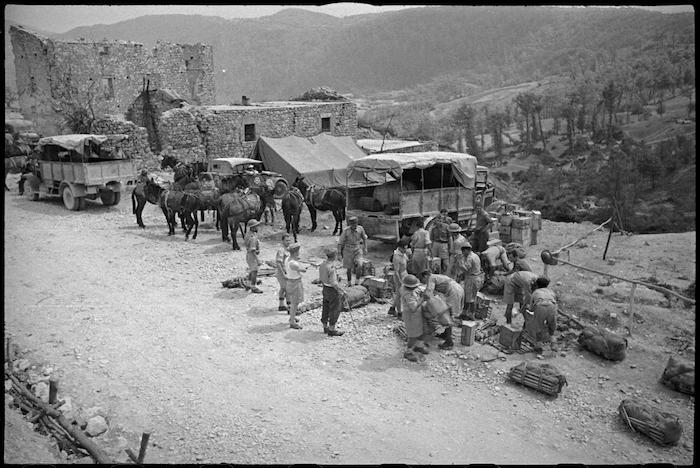
New Zealand soldiers prepare a mule train to carry rations and ammunition forward in the Terelle sector, Italy, 14 May 1944. Military logistics has continually adapted to changes in transport and the commodities required to sustain operations. Photograph: George Kaye, Alexander Turnbull Library.

Supply classes are tools for organising responsibility and understanding demand, not sacred categories. When mechanisation made petroleum indispensable, fuel required distinct doctrine, forecasting and distribution. Wartime US quartermaster arrangements reflected the transition from horses to motor transport, while post-war cataloguing had to account for expanding inventories of equipment and spares.[14]

NATO uses five broad classes, which allies have agreed to provide to one another. The familiar ten-class scheme derives from US Army doctrine, and the additional classes remain national. Australian and New Zealand doctrine follows this pattern: Land Warfare Doctrine 4-0 identifies ten classes, including petroleum, ammunition, major equipment and repair parts.[15] National adaptation therefore has a precedent, although any new class must be mapped clearly to allied reporting.

ClassCategoryExamples
ISubsistenceFood, drinking water and forage
IIClothing, individual equipment and general storesUniforms, personal equipment, tentage, tools and administrative supplies
IIIPetroleum, oils and lubricantsBulk and packaged fuel, oils, hydraulic fluids and greases (IIIa: aviation fuel)
IVConstruction and barrier materialsTimber, sandbags, barbed wire and fortification stores
VAmmunition and explosivesSmall-arms ammunition, artillery and mortar rounds, missiles, mines and pyrotechnics
VIPersonal-demand itemsToiletries, snacks and other personal items, usually sold through canteens or exchanges
VIIMajor end itemsComplete equipment such as vehicles, artillery and weapon systems
VIIIMedical materielPharmaceuticals, medical equipment and blood products
IXRepair parts and componentsSpare parts, assemblies and maintenance kits
XNon-military programmesMateriel for civil affairs, reconstruction and humanitarian support
XI (proposed)Battlefield energyOperational batteries and energy-storage modules, managed by charge state and serviceability and linked to charging and generation

Classes of supply as set out in Australian Army doctrine, with the proposed Class XI added. NATO’s five-class system uses the same numbers for Classes I–V but defines some differently: its Class II, for example, covers all items with an authorised allowance, including weapons, vehicles and spare parts. Classes VI–X are national extensions, and definitions vary between nations. Source: adapted from Australian Army, Land Warfare Doctrine 4-0: Logistics (2018), 25–26.

A proposed Class XI would not turn batteries into ammunition or alter Class V. The analogy is one of operational consequence: like ammunition, electrical energy may be exhausted at a predictable or unexpectedly rapid rate, and shortages can have immediate consequences. Batteries also require attention to charging, serviceability, storage, safety, and disposal.

The case for a distinct class is strongest when an essential resource is scattered across existing categories and becomes difficult to forecast as a whole. Class XI should not create duplicate catalogue items. It should make the operational dependency on stored energy visible across units, equipment types and Services.
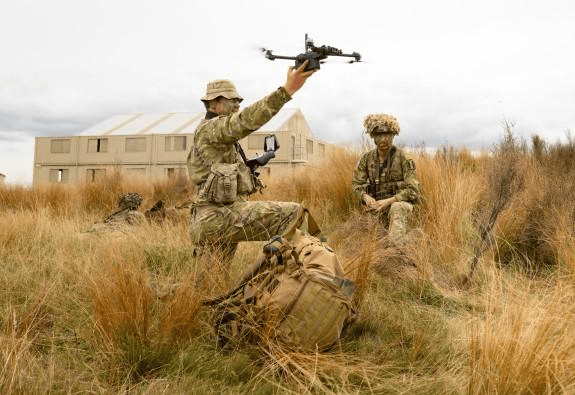
Modern reconnaissance depends upon more than the aircraft itself. Uncrewed aerial vehicles, control equipment and communications systems all require a reliable supply of electrical energy. Photograph: NZDF.

What others are learning

Ukraine shows the scale and urgency of demand for drone batteries, and what can go wrong when they are treated as ordinary commodities. One Ukrainian manufacturer aims to produce up to 10,000 battery units a day across dispersed, protected sites, while acknowledging that imported components still play a role. In May 2026, a National Guard soldier reported that drone batteries for his unit had been classed as non-military goods and bought through a lowest-price tender. The winning supplier allegedly substituted cheaper, lower-rated cells that risked thermal runaway when charged to specification. These accounts do not provide a complete, audited picture of consumption, but the lesson is clear: how a battery is classified can shape how it is bought, and quality, traceability and assured access matter as much as quantity.[16]

The United States has also moved towards a department-wide battery strategy, mandated by Congress, with standardisation a primary focus. The US Army’s Small Tactical Universal Battery offers eight capacities in a single physical and electrical design, reducing the weight and tracking burden of multiple battery types. These efforts suggest that interoperability is not only about communications or information systems; common power arrangements can matter too.[17]

Australia’s Guided Weapons and Explosive Ordnance Enterprise offers a parallel in thinking about resilience. Batteries and munitions are different industries, but both raise questions about assured stocks, domestic capacity and acceptable dependence on international suppliers. Self-reliance need not mean making everything ourselves. For New Zealand, it means deciding which battery types it can safely rely on allies or markets to provide, and which it must hold or be able to source with confidence.[18]

New Zealand should learn from such work without waiting for NATO to create a Class XI designation. National classification and coalition interoperability are compatible, provided existing codes and reporting requirements remain intact.

Allies and markets have their own priorities

The deterioration of New Zealand’s defence relationship with the United States after the 1985 nuclear-ships dispute demonstrated that political circumstances can affect defence access. By late 1986, the military reported that spare parts for US-made aircraft were taking significantly longer to obtain and that, although a logistics agreement remained in force, New Zealand no longer received the priority given to allies. Today’s relationships are different, and batteries are not a treaty obligation, but assured priority in another country’s supply system should never be assumed.[19]

The COVID-19 pandemic provided a more recent reminder: governments restricted exports of critical goods when domestic requirements became urgent. Long-standing trading relationships did not remove the pressure to prioritise national needs.[20]

Battery and drone supply chains are exposed to comparable industrial and political disruption. In 2024, China restricted exports of key drone components to Ukraine and Russia, and separately halted battery sales to a US drone maker over its dealings with Taiwan. Controls also run in the other direction: the United States has legislated to exclude Chinese batteries from its military systems from 2028. In a regional crisis, partners, civilian industry and emergency services might all seek the same components. Allied support remains essential, but it should complement a planned national reserve rather than replace it.[21]

Why this matters for New Zealand

New Zealand already applies a reserve principle to liquid fuels. Its minimum stockholding obligation, in force since January 2025, requires fuel importers to hold 28 days of petrol, 24 days of jet fuel and 21 days of diesel, rising to 28 days of diesel for importers with more than 10 per cent market share from July 2028.[22]

Batteries are not bulk diesel, and a fixed national days-of-cover target cannot simply be copied across. The underlying question is nevertheless familiar: how long must an essential service or deployed force operate when overseas replenishment cannot be relied upon? New Zealand’s distance from suppliers and its Pacific operating environment make that a practical question, not an academic one.

A small force can also be more disciplined about this problem. Demand can be assessed by equipment, mission, operating tempo and unit, while new procurement can reduce unnecessary proliferation of incompatible battery families. Build that assessment into capability introduction, rather than leaving it until a system reaches its first demanding exercise or deployment. Making it routine is precisely what a Class XI framework would be for.

The case for Class XI

US Army researchers demonstrate a wearable power-generation system designed to reduce the battery load carried by soldiers. Battery sustainment involves more than replacement stocks: it requires charging, power generation and the ability to restore electrical endurance in the field. Photograph: US Army, 2026.

The NZDF should test establishing Class XI, Battlefield Energy, as a national supply class with a responsible policy owner and an agreed scope. It would bring operational batteries and stored-energy modules into a common planning and reporting view, including charge state, serviceability and likely endurance. Generators, fuel and major equipment would retain their established identities; the new class would connect their energy dependencies rather than catalogue the same assets twice.

  1. Recognition and ownership. Set clear boundaries for Class XI and map every affected item to the existing allied supply framework. Assign ownership for policy, forecasting and reserves, with defined responsibilities across the three Services and deployed units. The objective is not another headquarters organisation but a clear answer to the question: who is responsible for electrical endurance?
  2. Forecasting and visibility. Plan energy demand by equipment, battery type, mission duration, operating conditions and expected activity. Report charged, discharged, serviceable and unavailable stocks, and forecast hours, days or sorties of electrical endurance where practical. The important measure is usable energy, not simply the number of packages on a shelf.
  3. Quality, resilience and compatibility. Treat operational batteries as controlled items, procured against specification with quality assurance and supplier traceability rather than bought as general stores. Determine reserves from realistic scenarios without allied or commercial resupply, rather than arbitrary warehouse targets. Prefer qualified common interfaces and battery families where appropriate, and protect charging, power conversion and distribution. Consider domestic testing, servicing and recycling where safe and economically sensible, without assuming that New Zealand can manufacture every cell.
  4. National resilience. Share the NZDF’s critical battery requirements with whole-of-government fuel security and emergency management planning, so that defence, emergency services and essential industries are not unknowingly competing for the same stocks in a crisis.
  5. Trial, measure and refine. Building on lessons from Project Convergence, test the arrangements in realistic land and joint exercises, recording actual use, recharge times, stock-outs, failures and administrative effort. Use existing digital logistics systems wherever possible. A new class that merely generates another spreadsheet will have failed its own purpose.
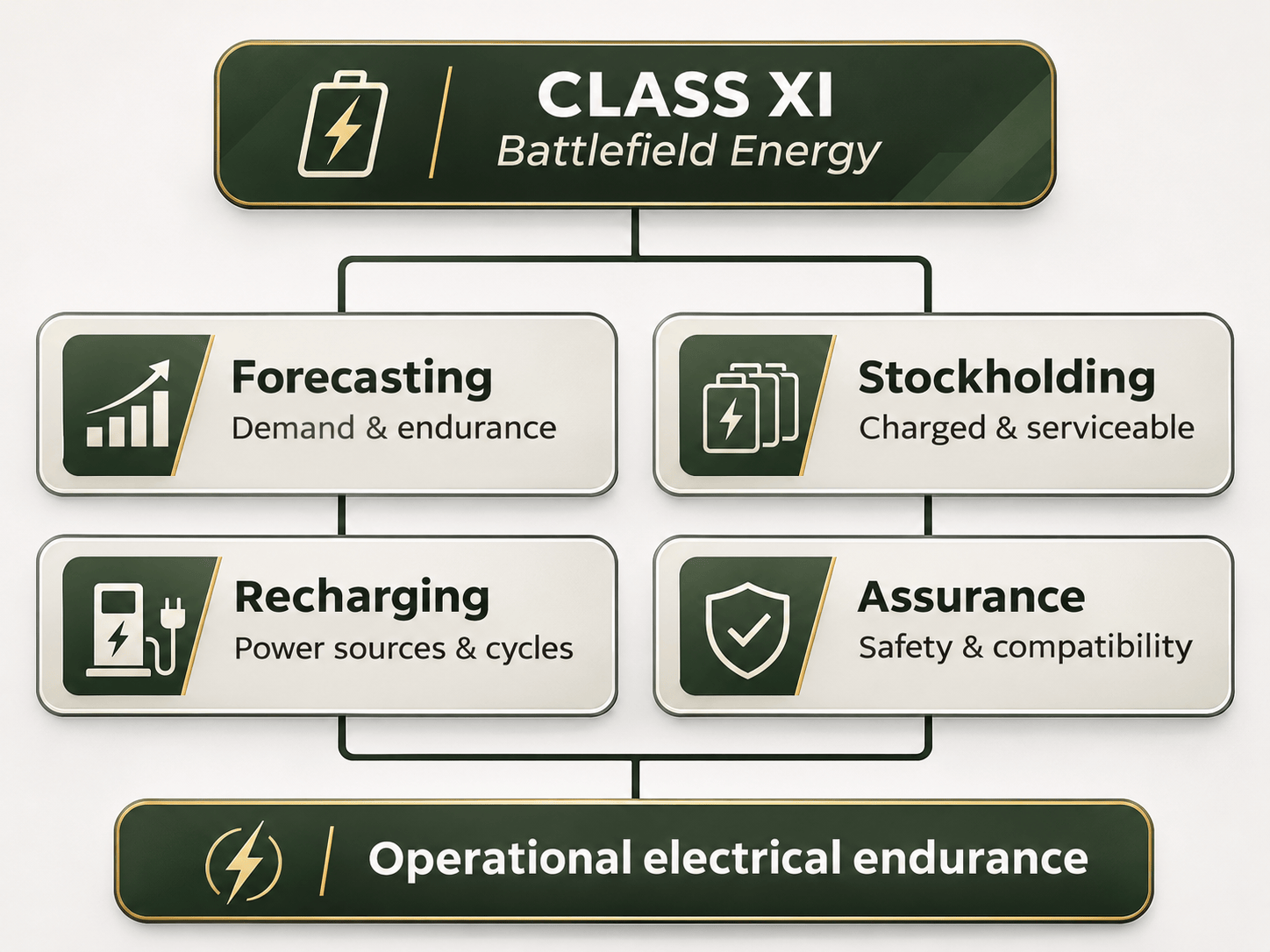
Proposed Class XI management model. Forecasting, battery availability, charging capacity, safety and compatibility are brought together to establish electrical endurance. The model is a proposal, not current NZDF doctrine.

The strongest objection: do we need another class?

The obvious objection is that the NZDF already catalogues and manages batteries. They can be identified by stock number, equipment application and existing supply arrangements. Why introduce another class instead of improving the systems we already have? That objection deserves a serious answer.

Identification is not the same as operational visibility. A stock system may show how many batteries are held without revealing whether a formation can sustain a week of radio operation, drone sorties or night surveillance. If existing arrangements already provide that view, a new classification may be unnecessary. If they do not, Class XI offers a way to make demand, reserves, serviceability and command responsibility visible together. Its value must be demonstrated in use, not asserted through a new label.

A sharper version of the objection is that a battery management policy within existing classes would achieve the same result at less cost. Perhaps it would. But classification is not merely a label: it shapes who owns a resource, how it is forecast and how it is bought. The Ukrainian drone batteries bought by lowest-price tender were reportedly procured that way because they had been classed as non-military goods. A policy without a category depends on continued attention; a class builds that attention into planning, reporting and procurement. A trial is the proper way to establish which approach works better.

Several narrower objections have already been addressed. Class XI would not make batteries legally or technically ammunition, nor require allies to adopt a New Zealand category. It does not assume that New Zealand can manufacture every specialist battery. It should draw on existing inventory and logistics data, adding new measures only where charge state, battery health, and electrical endurance genuinely require them. If Class XI adds administrative effort without improving readiness, it should be changed or abandoned.

Conclusion: the nail has changed

New Zealand’s military logisticians have long adapted to changes in what an Army consumes. Fodder gave way to fuel; complex equipment brought ever more demanding requirements for specialist parts and maintenance. Electrical endurance is the next challenge, already shaping how soldiers see, communicate and operate sophisticated systems.

FLOC 35 envisaged a more technologically enabled Army. PCC6 has now given New Zealand practical reasons to examine the energy arrangements needed to sustain it. Class XI would not produce a single watt of electricity, but, properly designed, it could give commanders a clearer view of their available power, likely consumption and capacity to keep operating. It could also give the wider government a clearer picture of which battery dependencies matter in a national crisis.

A small Army cannot afford to rediscover the cost of an overlooked commodity each time it introduces new equipment. The requirement is straightforward: electrical endurance must be as visible, measurable and accountable as fuel and ammunition. The proposal for Class XI deserves to be tested against that requirement.

For want of a nail, a kingdom was lost. The nail has changed, but the lesson has not. Better to find the missing battery in an exercise than to have an operation find it for us.

The views expressed in this article are the author’s own and do not represent those of the New Zealand Defence Force.

Notes

[1] New Zealand Army, Future Land Operating Concept 2035: Integrated Land Missions, 2nd ed. (Wellington: New Zealand Defence Force, 2017), 10–11, 16–17, 75–78. The concept is a statement of future capability direction, not evidence that every system described had entered service.

[2] New Zealand Army, Future Land Operating Concept 2035, 76–78, sections “Equipment Redundancy” and “Combat Services: Fielding the Force.”

[3] New Zealand Army, “Post Activity Report: Deputy Chief of Army Visit to United States (Project Convergence Capstone 6), 24–27 July 2026,” DCA Minute 086/2026, 18 August 2026, para. 17, 3 (PDF p. 4), in New Zealand Defence Force, OIA-2026-5916 Convergence Capstone (official-information release, 29 October 2026), https://www.nzdf.mil.nz/assets/Uploads/DocumentLibrary/OIA-2026-5916-Convergence-Capstone.pdf; Phil Pennington, “Desert Wargames Tax Batteries, Feed Tech Wishlist,” RNZ, 3 November 2026, https://www.rnz.co.nz/news/politics/2306252/desert-wargames-tax-batteries-feed-tech-wishlist.

[4] John Mabes, “Powering the Digitized Battlefield,” US Army Center for Army Lessons Learned, 28 August 2026, https://www.army.mil/article/294958/powering_the_digitized_battlefield. The publication refers to electrical power as a fifth essential commodity; it does not propose a formally numbered fifth class of supply.

[5] US Government Accountability Office, Defense Logistics: Actions Needed to Improve the Availability of Critical Items during Current and Future Operations, GAO-05-275 (Washington, DC: GAO, 8 April 2005), https://www.gao.gov/assets/a245975.html.

[6] GAO, Defense Logistics.

[7] Evan Wright, Generation Kill (New York: Berkley Caliber, 2004); Generation Kill, written by David Simon, Ed Burns and Evan Wright, aired 2008 on HBO, television miniseries; “Review: Generation Kill—The Iraq War, Batteries Not Included,” Gizmodo, July 2008, https://gizmodo.com/review-generation-kill-the-iraq-war-batteries-not-inc-5025094.

[8] “Our Faulty War: The Afghanistan Report They Fought to Keep Secret,” New Zealand Herald, 26 March 2017, https://www.nzherald.co.nz/nz/our-faulty-war-the-afghanistan-report-they-fought-to-keep-secret/KASEQM27OIATWFRQ3VRVR2Q47Q.

[9] New Zealand Defence Force veterans of the East Timor and Afghanistan deployments, interviews and discussions with the author, 2014–2026; names withheld.

[10] Jeff Shepard, “EaglePicher Releases BA-5590 Battery with SOCI,” EEPower, 31 January 2005, https://eepower.com/new-industry-products/eaglepicher-releases-ba-5590-battery-with-soci/; “BA 5590 Lithium Battery,” Defense Update, 2 January 2004, https://defense-update.com/20040102_ba-5590-lithium-battery.html; “BA-5390/U Lithium Battery,” Defense Update, accessed 15 November 2026, https://defense-update.com/?p=9581.

[11] Edric Thompson, “Improved Battery Technology Sitting Unordered in Army Inventory,” US Army (CERDEC Public Affairs), 18 June 2009, https://www.army.mil/article/22916/improved_battery_technology_sitting_unordered_in_army_inventory.

[12] Program Executive Office Soldier, “Monocular Night Vision Device (MNVD), AN/PVS-14,” PEO Soldier Portfolio, accessed 15 November 2026, https://peo360portfolio.com/product-details/product/175; Sydney J. Freedberg Jr., “Army Lab Pushes Standardized Batteries for Frontline Soldiers: STUB and OSCAR,” Breaking Defense, 10 November 2023, https://breakingdefense.com/?p=21564.

[13] Freedberg, “Army Lab Pushes Standardized Batteries”; T’Jae Gibson, “Army Unburdens Soldiers through Battery Innovations,” US Army, 16 June 2011, https://www.army.mil/article-amp/53283/army_unburdens_soldiers_through_battery_innovations.

[14] US War Department, Field Manual 10-10 (Washington, DC: War Department, n.d.), table of contents, HyperWar, https://ibiblio.org/hyperwar/USA/ref/FM/PDFs/FM10-10.PDF; Joint Chiefs of Staff, Joint Bulk Petroleum and Water Doctrine, Joint Publication 4-03 (Washington, DC: Joint Chiefs of Staff, 11 January 2016; validated 30 November 2017), I-1, https://irp.fas.org/doddir/dod/jp4_03.pdf; Defense Logistics Agency, “History of the Federal Catalog System,” DLA News, accessed 15 November 2026, https://www.dla.mil/About-DLA/News/Energy/Article/1098692/history-of-the-federal-catalog-system/.

[15] Australian Army, Land Warfare Doctrine 4-0: Logistics (2018), 25–26, “Classes of Supply”; North Atlantic Treaty Organization, NATO Logistics Handbook (Brussels: NATO, November 2012), 27, annex to chap. 2, “Classes of Supply.” Australian Classes I–V are based on NATO standardisation arrangements; Classes VI–X extend the system for national requirements.

[16] Julia Struck-Feshchenko, “More Range, More Payload: Ukraine’s Race to Build Better Drone Batteries,” Kyiv Post, 23 September 2026, https://www.kyivpost.com/post/85244; “Taiwan Becomes Third-Largest Supplier of Batteries for Ukrainian Drones,” Militarnyi, accessed 15 November 2026, https://militarnyi.com/?p=484626; Olena Mukhina, “Ukrainian Soldier Says Supplier Swapped Ordered Drone Batteries for Cheaper Cells That Risk Thermal Runaway at Front,” Euromaidan Press, 19 May 2026, https://euromaidanpress.com/?p=406983.

[17] Lauren C. Williams, “Pentagon Readies New Battery Strategy amid Growing Drone Demands,” Defense One, 18 August 2025, https://www.defenseone.com/technology/2025/08/pentagon-readies-new-battery-strategy-amid-growing-drone-demands/407502/; Dan Lafontaine, “Army Accelerates Adoption of Advanced Batteries through S&T Integration,” US Army, 18 August 2025, https://www.army.mil/article/287894; Sean McLachlan and Todd Goodson, “Best Practices on Operationalizing Battlefield Energy,” US Army, 18 August 2025, https://www.army.mil/article-amp/287897/best_practices_on_operationalizing_battlefield_energy.

[18] Pat Conroy, “Address to the National Press Club” (speech, Canberra, 30 October 2024), Australian Government Defence Ministers, https://minister.defence.gov.au/speeches/2024-10-30/address-national-press-club; Alice Nason and Tom Corben, “GWEO Rockets Up the US Alliance Agenda, but Australia Isn’t Close to Self-Sufficiency,” The Strategist (Australian Strategic Policy Institute), 3 September 2024, https://www.aspistrategist.org.au/gweo-rockets-up-the-us-alliance-agenda-but-australia-isnt-close-to-self-sufficiency/.

[19] David Barber, “New Zealand Military Says Defense Rift with US Hurts,” Christian Science Monitor, 14 October 1986, https://www.csmonitor.com/1986/1014/opact-f.html; “Australia, New Zealand, United States (ANZUS),” GlobalSecurity.org, accessed 15 November 2026, https://www.globalsecurity.org/military/world/int/anzus.htm.

[20] Congressional Research Service, Export Restrictions in Response to the COVID-19 Pandemic, IF11551 (Washington, DC: Congressional Research Service, updated 25 August 2020), https://sgp.fas.org/crs/natsec/IF11551.pdf; Krzysztof Pelc, “Can COVID-Era Export Restrictions Be Deterred?” Canadian Journal of Political Science 53, no. 2 (2020): 349–56, https://doi.org/10.1017/S0008423920000578.

[21] Aosheng Pusztaszeri, “Why China’s UAV Supply Chain Restrictions Weaken Ukraine’s Negotiating Power,” Center for Strategic and International Studies, 16 December 2024, https://www.csis.org/analysis/why-chinas-uav-supply-chain-restrictions-weaken-ukraines-negotiating-power; Associated Press, “Ukraine Is a Global Leader in Drone Wars—with One Big Vulnerability,” 1News, 18 October 2026, https://www.1news.co.nz/2026/10/18/ukraine-is-a-global-leader-in-drone-wars-with-one-big-vulnerability/; James Trevey, Adrian Yao, and Samm Gillard, “Why the Pentagon’s Drone Revolution Could Run Out of Power,” RealClearDefense, 29 September 2026, https://www.realcleardefense.com/military-strategy/articles/why-the-pentagons-drone-revolution-could-run-out-of-power-2026-09-29.

[22] Ministry of Business, Innovation and Employment, “Minimum Stockholding Obligation,” accessed 15 November 2026, https://www.mbie.govt.nz/building-and-energy/energy-and-natural-resources/energy-generation-and-markets/liquid-fuel-market/fuel-security-in-new-zealand/minimum-stockholding-obligation; Fuel Industry (Improving Fuel Resilience) Amendment Act 2023.



From Cordite to Code

What Earlier Ammunition Revolutions Reveal about Sustaining Uncrewed Systems in a Small and Dispersed Force.

RQ-11B Raven complete system. “An unmanned aircraft system is more than its air vehicle: this Raven system includes aircraft, controllers, payloads, batteries, chargers, repair equipment and spares—each potentially requiring a different supply identity.”Credit: U.S. Army.

Recent RNZAOC.com articles have examined two sides of the drone problem. The first reviewed the rise of uncrewed systems as instruments of war in Ukraine, where reconnaissance, strike and electronic attack have become routine features of the battlefield.[1] The second considered drones as logistics enablers for New Zealand’s small, motorised and widely dispersed land force.[2] This paper turns the lens around. It asks what happens when the drone itself, and the network of batteries, payloads, software, spares, launchers and countermeasures around it, becomes an item of supply.

That is not a narrow cataloguing question. Classification determines who demands an item, who may hold it, where it may be stored, how it is inspected, what technical records follow it, how it is issued, when it is counted as expended and how it is recovered or disposed of. A drone can be an aircraft, a weapon platform, a sensor, a communications node, an expendable effector or a guided munition. Its batteries may be ordinary stores for one purpose and dangerous goods for another. Its payload may be ammunition even when the airframe is not. A counter-drone capability may combine radars, electronic-warfare equipment, gun ammunition, interceptor drones and missiles within one tactical system.

The question for the New Zealand Defence Force is therefore not simply, ‘Which class of supply contains drones?’ It is whether existing ammunition, equipment and stores policies can express the several identities of modern uncrewed systems clearly enough to support safe, rapid and accountable operations. The answer should be sought before mass introduction, because history suggests that organisational and technical consequences arrive soon after the new weapon, and usually sooner than the paperwork.

The historical pattern

Ordnance history is full of technologies that first appeared to be a new nature of store and then altered the surrounding logistics system. Quick-firing artillery introduced cartridge cases, more complex fuzes and new inspection and repair work. Mortars created families of bombs, propelling charges and specialised accessories. Wartime expansion turned ammunition supply into a question of magazines, depots, transport, labour and risk. Responsibility moved between artillery and ordnance organisations until duplication and ambiguity could no longer be tolerated.

Historical transitionLogistics consequenceContemporary drone parallel
Quick-firing and breech-loading artillery ammunitionSpecialist inspection, cartridge-case recovery, local repair and refurbishmentModular repair, battery management, software control and technical data
Rifle grenades to light and medium mortarsNew weapons, ammunition natures, training, production and distributionMovement from commercial systems to standardised drone families
Mackesy’s 1939 modernisation and mobilisation reviewEquipment, ammunition, reserves, storage, transport, workshops and trained personnel treated as one capability problemAcquire drones and countermeasures with the complete support system, not as stand-alone items
Wartime expansion of anti-aircraft, anti-tank and artillery ammunitionMore magazines, depots, people, transport and risk-managed storageDistributed operational holdings and much higher consumption rates
Artillery and ordnance responsibility changesDuplication, blurred boundaries and eventual consolidationPotential overlap among aviation, ammunition, signals, engineering and logistics authorities
Inspection and repair of returned ammunitionRecovery, segregation, refurbishment, condemnation and disposalPost-mission recovery, data sanitisation, battery disposal, technical investigation and demilitarisation
Synthesis of historical and contemporary logistics patterns.

The comparison is not exact. A lithium battery is not a cordite charge, and a software-defined flight controller is not a mechanical fuze. The useful historical point is institutional: each leap created new interfaces between supply, safety, maintenance, training and command. The burden was seldom carried by a single ledger category.

The First World War lesson: new technology creates a technical trade

The Royal New Zealand Artillery’s Army Ordnance Corps Section grew from the need to manage increasingly technical ammunition work. The shift to quick-firing ammunition did more than increase the rate of fire. It created recoverable cartridge cases, inspection tasks and repair activity requiring trained personnel, specialist tools and defined responsibility.[3] The ammunition remained ammunition, but the organisation supporting it acquired characteristics of a technical service.

Modern uncrewed systems pose the same organisational pressure in a different medium. Units may be able to replace a propeller or motor in minutes, but a damaged battery, corrupted flight controller, compromised datalink or unauthorised firmware build carries consequences beyond simple mechanical serviceability. The technical trade must understand configuration, electromagnetic compatibility, data security, airworthiness where applicable, payload integration and the boundary between repair and unsafe improvisation.

The lesson is not that every drone should be handed to an ammunition technician. It is that a new family of stores becomes sustainable only when technical authority, training, inspection standards, repair levels and records mature together. If those elements are separated among different branches, the interfaces must be designed rather than assumed.

The mortar lesson: standardisation eventually defeats proliferation

New Zealand’s experience with grenades and mortars during the Second World War illustrates the transition from improvisation to standardisation. Mortars offered a comparatively simple means of delivering high explosive, smoke and illumination, but their apparent simplicity concealed a system of barrels, bipods, baseplates, sights, bombs, fuzes and propelling increments.[4] A weapon family had to be selected, produced or imported, taught, distributed and supported as a whole.

Early drone adoption commonly begins in the opposite direction: many commercial makes, rapid local modification, small batches and enthusiastic unit-level experimentation. That is useful for learning. It is also the beginning of a proliferation problem. Every additional motor, battery connector, controller, datalink, camera, firmware version and payload interface multiplies the demand for spares, tools, chargers, training and technical knowledge.

The mortar experience suggests that enduring military utility arrives when the force standardises enough of the system to sustain it without extinguishing adaptation. Common interfaces, controlled software baselines, approved payloads and interchangeable consumables matter more than cosmetic uniformity. The policy aim should be disciplined modularity: a limited number of supported families with enough open architecture to accept operationally necessary change.[5]

Local production and the limits of self-sufficiency

New Zealand’s wartime manufacture of munitions demonstrated both the value and the limits of local capacity. Domestic industry could reduce dependence on vulnerable overseas supply, respond to regional demands and build useful competence. Yet production was constrained by machine tools, gauges, energetic materials, skilled labour, quality assurance and access to components.[6] Capacity was not created by declaring an item locally producible; it depended on the entire industrial chain.

New Zealand munitions-factory workers during the Second World War. “Local production required skilled labour, tooling, quality assurance and industrial organisation—not simply a decision to manufacture.”Alexander Turnbull Library record, reference PAColl-5936-43

Drones can create a misleading impression of easy sovereignty because airframes can be printed, cut or assembled locally. The most important components may still be imported: cells, magnets, semiconductors, processors, cameras, radio-frequency components, navigation devices and specialist explosives. Local assembly can provide resilience, faster modification and repair, but it does not remove external dependencies. It changes where those dependencies sit.[7]

A realistic New Zealand policy would distinguish between what must be sovereign, what should be repairable, what can be stockpiled and what will remain dependent on trusted partners. The objective is not autarky. It is the ability to understand chokepoints, substitute components deliberately and continue essential functions when normal commercial supply is interrupted.

Mackesy’s warning: procurement is not capability

Major-General P. J. Mackesy’s May 1939 review of the Military Forces of New Zealand offers a particularly useful bridge between technological modernisation and logistics policy. The Army was not starting from nothing: modern equipment had been ordered and mobilisation planning was already under way. Mackesy’s concern was that partial modernisation did not yet amount to a force that could operate confidently in war. He treated equipment, ammunition, personnel, training, reserves, accommodation, transport and ordnance services as connected parts of one military system.[8]

The response to his Recommendations 42 and 43 is instructive. Modern fighting and technical equipment was considered alongside ammunition reserves and the magazines, garages and storage accommodation needed to support it. The later expansion of the Ordnance Depot and Ordnance Workshops establishments demonstrated the practical consequence: once modern equipment and technical stores entered service, the support organisation beneath them had to grow as well.[9]

The drone parallel is direct without being exact. Buying air vehicles, interceptors or missiles is not the same as creating a sustainable capability. Supply chains, technical data, configuration control, storage, charging, maintenance, trained personnel, repair capacity, transport and reserves must be designed before a crisis. For a small force, the support system is not an administrative attachment to the weapon; it is what makes the weapon operationally real.

The Second World War lesson: quantity becomes infrastructure

Between shortage and surplus lies a logistics problem. Wartime New Zealand had to expand magazines, depots, transport and staffing as the volume and variety of ammunition increased. Once quantities rose, the supporting infrastructure—not only the item—became the limiting factor.[10] The same effect will apply if drones move from boutique capability to mass consumption.

Hopuhopu Military Camp from the air, 1961. “Rail-served warehouses and dispersed magazines at Hopuhopu illustrate how new classes and quantities of materiel create a supporting estate—not merely additional stock.” Whites Aviation Ltd, reference WA-55339-F, Alexander Turnbull Library.

A force may be able to buy a thousand small drones faster than it can create safe charging areas, technical inspection capacity, secure software management, spares holdings, trained maintainers and transport packaging. Counter-drone interceptors and missiles intensify the problem because some are explosive stores requiring established ammunition controls, while others rely on batteries, sensors or radio-frequency components with different storage and maintenance needs.

Quantity also exposes hidden labour. Batteries must be cycled, inspected and recorded. Firmware and cryptographic material must be controlled. Payloads may need separate custody. Training losses must be forecast. Returned items must be quarantined or assessed. Damaged systems may contain sensitive data even when they have little material value. These are infrastructure and workforce demands, not merely procurement line items.

Storage has always been governed by risk rather than space

Ammunition policy traditionally begins with the hazard presented by the store: explosive classification, compatibility, quantity-distance, environmental requirements, security and surveillance. Drone systems add hazards that do not align neatly with their supply identity. A reusable reconnaissance drone may be equipment, its spare lithium batteries dangerous goods, its pyrotechnic recovery device ammunition, and its detachable warhead an explosive store. A one-way attack drone with an integral charge may need to be treated as a complete munition even though much of its body resembles commercial electronics.

Lithium batteries require particular care in transport, state-of-charge management, damaged-battery segregation and fire response. International air-transport guidance treats them through a dedicated dangerous-goods framework, independent of whether the host equipment is military or civilian.[11] That is a useful reminder: supply classification should support demand and accounting, while hazard classification should govern safe handling. The two systems must connect, but they should not be confused.

The practical requirement is a component-level hazard profile linked to the configured system. Stores personnel should be able to answer not only ‘What is this item?’ but ‘What is fitted to it now, what state is the battery in, what software and cryptographic material does it contain, and what restrictions follow from that configuration?’

Dispersion as resilience

New Zealand’s geography and small force structure favour dispersion, but dispersion trades concentration risk for control complexity. Historical ammunition systems distributed holdings through magazines and depots to keep weapons supplied and reduce vulnerability. The creation and movement of those holdings demanded accurate records, inspection routines, transport discipline and clear responsibility.[12]

For drones, dispersed holdings may be essential. A unit that depends on a single central pool of batteries, controllers or payloads is fragile even if the national inventory appears adequate. Yet uncontrolled distribution creates another vulnerability: incompatible fleets, unmanaged software, exhausted batteries, unrecorded losses and technical knowledge concentrated in a few individuals.

A resilient model would combine central assurance with decentralised execution. National or formation authorities would set supported families, configuration rules, safety standards, data requirements and repair policy. Units would hold usable scales, conduct authorised field repair, manage charging and submit reliable consumption and failure data. Distribution would be planned as part of the capability rather than added after procurement.

The 1945 lesson: complexity eventually forces organisational clarity

The evolution of New Zealand Army ammunition responsibilities between 1939 and 1945 shows how growth can expose awkward boundaries. Responsibilities split across artillery, ordnance and administrative organisations produced duplication and uncertainty until wartime experience drove clearer arrangements.[13] Organisational charts eventually caught up with operational reality.

Uncrewed systems sit across similarly awkward boundaries. Aviation authorities may govern airworthiness and airspace. Signals organisations may control spectrum, datalinks and electronic protection. Engineers may support repair and fabrication. Intelligence staffs may own sensor requirements and collected data. Ammunition authorities may govern warheads, initiators and explosive interceptors. Logistics organisations must forecast, store, distribute, recover and dispose of the whole system.

No single branch needs to own every aspect. Someone must, however, own the interfaces. A useful governance model would identify a lead capability authority, supported by named technical authorities for aviation, explosives, spectrum, cyber security, batteries and maintenance. Supply policy should make those relationships visible at the item and configuration levels.

One name, several supply identities

The word ‘drone’ is too broad to function as a supply classification. NATO’s generic classes of supply place ammunition and explosives in Class V, but reusable aircraft, repair parts, fuel and general stores sit elsewhere.[14] A modern uncrewed capability can span several of those identities at the same time. Classification should therefore follow function, configuration, recoverability and hazard—not the popular name of the object.

System or componentIllustrative supply identityPrincipal logistics consideration
Reusable reconnaissance or logistics droneEquipment or major end itemFleet management, repair, software, batteries and recovery
Reusable armed or delivery droneWeapon platform and equipmentPlatform accountability plus separate control of payloads
One-way attack drone with integral high explosiveGuided munition; Class VExplosive safety, custody, surveillance, issue and expenditure
Non-explosive one-way kinetic systemExpendable weapon or controlled effectorAuthorisation, configuration, loss and expenditure accounting
Reusable counter-drone interceptorWeapon-system equipmentTurnaround, repair, battery condition and capture risk
Explosive interceptor or surface-to-air missileAmmunitionHazard division, compatibility, storage, inspection and life management
Electronic-warfare or directed-energy countermeasureEquipmentPower, spectrum, software, cooling and technical maintenance
Chaff, flares and pyrotechnic decoysAmmunition or expendable countermeasureExplosive controls, issue, carriage and expenditure
Batteries, motors, propellers, sensors and controllersGeneral stores or repair partsCompatibility, shelf life, dangerous goods and configuration
Inert, drill or training systemTraining equipment or inert representationClear marking, segregation and realistic but safe handling
Synthesis of historical and contemporary logistics patterns.

A modular system may change identity when configured. The air vehicle might be reusable equipment in reconnaissance service, an expendable effector when fitted for a one-way mission, and part of an explosive munition after a warhead and initiator are installed. Policy must state which authority approves each configuration and when the corresponding controls begin.

Supply classification is not hazard classification

Three separate questions should be asked of every system. First, what is its supply identity for cataloguing, demand, ownership and financial accounting? Second, what hazards govern storage, handling and transport? Third, what operational controls govern arming, release, spectrum use, data and employment? A single label cannot answer all three.

This distinction prevents two equal and opposite errors. The first is to call every drone ‘ammunition’, thereby applying explosive-store processes to reusable equipment and ordinary components. The second is to call drones ‘commercial off-the-shelf equipment’, thereby overlooking warheads, initiators, pyrotechnics, hazardous batteries, controlled technology and the fact that some systems are intended to be expended on a target.

The appropriate policy instrument may be a classification matrix supported by configuration codes. It should allow a system to be catalogued coherently while generating the additional handling, security, technical and operational controls that its current configuration requires.

Expendable, consumable, attritable and recoverable

Traditional accounting often distinguishes durable equipment from consumable stores. Drones introduce an important middle ground: the attritable item. An attritable system is expected to survive some missions but may be lost at a rate that would be unacceptable for conventional aircraft. It is neither a permanent fleet asset in the traditional sense nor a round of ammunition guaranteed to disappear when used.

Policy should define at least four states. Reusable items are expected to return and remain individually accountable. Recoverable items are intended for retrieval even if not immediately reusable. Attritable items are expected to return when practicable but are planned and funded for significant loss. Expendable items are intended to be consumed in use. The same airframe family may contain more than one state depending on configuration and mission.

These definitions matter because loss does not always mean expenditure. A drone that fails to return may be destroyed, captured, abandoned, missing or awaiting recovery. Each condition has different implications for security, sensitive data, stock records, investigation and replenishment.

Forecasting for attrition and obsolescence

Ammunition forecasting is shaped by rates of fire, scales, training allowances and operational reserves. Drone forecasting must add platform loss, component failure, battery degradation, software obsolescence, training damage and enemy adaptation. Ukrainian reporting has frequently described very high monthly drone losses; such estimates illustrate wartime turnover but should not be adopted as a planning figure for New Zealand without context.[15]

The important planning change is that demand may be driven by iteration as much as consumption. A technically serviceable stock can become operationally obsolete when its control links are defeated, its navigation is jammed or its software cannot accept a required payload. Holding more of one frozen design may create apparent depth without usable resilience.

Forecasts should therefore separate airframes, payloads, batteries, repair parts and mission-system configurations. They should include an innovation allowance, authorised substitution rules and production lead times. Operational data on losses, faults, repair time and mission effectiveness must feed the demand model quickly enough to change purchasing decisions.

The drone supply chain

The apparent simplicity of small drones masks a global supply chain concentrated in batteries, motors, magnets, semiconductors, cameras, processors and radio-frequency components. Recent analysis describes a contest not merely over airframes but over the chokepoints that determine whether they can be produced at scale.[16] For a distant market such as New Zealand, transport time and supplier concentration magnify those risks.

Procurement should map critical components below the level of the finished system. Approved alternatives, second sources, software escrow where appropriate, technical data rights and test procedures may be more valuable than a large holding of proprietary airframes. A component that cannot be authenticated or integrated safely is not a useful substitute merely because it fits mechanically.

The supply chain also includes knowledge. A small force cannot afford a capability whose maintenance logic, diagnostic tools or configuration data remain entirely outside Defence. Contracts should be judged partly by the degree to which they create freedom of action after delivery.

Accounting for configuration

Serial-number accounting remains necessary for valuable, sensitive or reusable systems, but serial numbers alone will not describe operational state. The record must connect the airframe to its battery condition, approved software, radio configuration, payload interface and any controlled components fitted. A practical status model should distinguish:

  1. held but unconfigured stock;
  2. training configuration;
  3. operational configuration;
  4. issued to a unit or detachment;
  5. launched on a mission;
  6. recovered serviceable;
  7. recovered unserviceable;
  8. quarantined for technical, battery, cyber or explosive reasons;
  9. lost, abandoned or captured;
  10. expended; and
  11. demilitarised or disposed of.

The aim is not to create administrative friction around every inexpensive component. It is to apply proportional control at the points where safety, security, operational value or replenishment decisions depend on accurate status. Policy should permit aggregated accounting for low-risk consumables while retaining individual control of critical systems and configured weapons.

Maintenance and the right to repair

A drone force that cannot repair at the edge will consume transport and replacement stock at an unsustainable rate. At the same time, unrestricted modification can introduce airworthiness, electromagnetic, cyber and explosive risks. The solution is a tiered repair policy: authorised operator replacement of selected modules; unit-level diagnosis and exchange; specialist workshop repair; and controlled contractor or depot intervention for tasks beyond Defence competence.

Recent United States Army discussion of a drone-dominant future emphasises rapid learning, realistic training and the practical hurdles of fielding systems at scale.[17] New Zealand should expect the same tension between central assurance and local adaptation. The repair system must be fast enough to preserve operational tempo and disciplined enough to prevent untraceable configurations.

Technical data rights are therefore a logistics requirement. Defence should know whether it can diagnose faults, obtain or manufacture selected spares, load approved software, integrate payloads and continue operating if a vendor disappears. A cheap platform with no repair pathway may be more expensive in readiness terms than a costlier system designed for modular support.

Counter-drone and missile countermeasures

Counter-uncrewed-aircraft systems make the classification problem more visible because one defensive effect can be produced through several supply chains. Detection and identification may rely on radar, electro-optical sensors, acoustic arrays and command software. Defeat may use electronic attack, cyber effects, directed energy, conventional gunfire, reusable interceptor drones, expendable kinetic drones or guided missiles. Protection may include camouflage, hardening, decoys, dispersion and emission control.

Counter-drone defence is a system of systems: detect, identify, decide and defeat. Its logistics therefore extend across sensors, software, networks, effectors and replacement interceptors. Credit: Graphic by Major Anthony R. Padalino, U.S. Army

Each method creates a different logistics signature. Electronic warfare consumes power, spectrum access, cooling capacity, software support and intelligence about threat waveforms. Directed-energy systems exchange ammunition tonnage for electrical generation, thermal management and specialist maintenance. Guns require conventional ammunition, barrels and fire-control support. Interceptor drones may be reusable, attritable or explosive. Missiles remain ammunition-intensive weapons with surveillance, storage-life and magazine requirements. Pyrotechnic decoys, chaff and flares are themselves controlled expendables.

Air and missile defence programmes demonstrate why acquisition must integrate the weapon, sensor, command system, training and sustainment plan rather than treating the interceptor as an isolated purchase.[18] For New Zealand, this is especially important because a small inventory can create a credible capability only if the complete kill chain is available and supportable. A launcher without serviceable missiles, a jammer without current threat libraries or an interceptor without charged batteries is not a partial capability; at the point of need it may be no capability at all.

Counter-drone policy should therefore avoid creating a separate administrative island. It should share a common architecture with the policy for friendly drones: configuration control, spectrum management, battery safety, software assurance, technical investigation, training expenditure and repair. Where an interceptor or missile contains explosives, established ammunition controls should apply. Where the effect is electronic or directed energy, equipment and technical-support rules should govern—but operational authorisation and reporting must still connect to the wider defensive system.

Does New Zealand need a new class of supply?

Probably not. A new universal class labelled ‘drones’ would recreate the ambiguity it seeks to solve. It would place reusable aircraft, explosive munitions, batteries, repair parts, software and electronic-warfare equipment together because they share a popular name rather than a logistics character. Existing equipment, ammunition and general-store categories can remain useful if they are connected by a coherent uncrewed-systems policy.

The stronger case is for an update to policy and process across those categories. The update could establish a common taxonomy; define reusable, recoverable, attritable and expendable states; link supply identity to hazard and operational controls; introduce configuration-aware accounting; set authorised repair levels; manage software and technical data; specify battery and damaged-item procedures; and integrate counter-drone systems and missile countermeasures into the same capability framework.

Controlled trials and policy design should answer that question, not terminology alone. A useful review would map representative systems from purchase to disposal, test the treatment of mixed configurations and identify every hand-off among capability, aviation, ammunition, signals, engineering, security and logistics authorities. The result should be simple at unit level because the complexity has been resolved in policy, data and support design.

Conclusion: the next ordnance transition

The history of New Zealand ammunition support does not provide a ready-made classification for drones. It provides something more useful: a warning about the institutional effects of new weapons. Quick-firing artillery created technical inspection and repair work. Mortars required standardised families of weapons and natures. Mackesy’s 1939 review showed that equipment orders were not capability until matched by ammunition reserves, storage, transport, workshops, trained personnel and mobilisation depth. Wartime quantities demanded depots, magazines, people and transport. Complexity forced clearer organisational responsibility.

Modern drones repeat that pattern across electronics, software, batteries, data and explosives. The central logistics error would be to treat them as either ordinary equipment or ammunition in all circumstances. They are systems whose components and configurations assume different supply, hazard and operational identities.

For a small and dispersed force, clarity matters more than administrative novelty. New Zealand does not necessarily need a new class of supply. It does need policies and processes that can recognise when a drone is equipment, when it is a munition, when its payload changes its status, when its battery creates a separate hazard, and when its loss is an expenditure, a security event, or both. The next ordnance transition will be measured not by how quickly the force buys drones, but by how reliably it can sustain, adapt, control and replace them.

Notes

[1]Robert McKie, “Review: Rise of the Machines—Drone Warfare in the Russia-Ukraine War,” To the Warriors Their Arms, April 13, 2026, https://rnzaoc.com/2026/04/13/review-rise-of-the-machines-drone-warfare-in-the-russia-ukraine-war/.

[2]Robert McKie, “Drones, Distribution and the Small Army: Logistics for New Zealand’s Motorised Infantry Future,” To the Warriors Their Arms, July 8, 2026, https://rnzaoc.com/2026/07/08/drones-distribution-and-the-small-army/.

[3]Robert McKie, “Royal New Zealand Artillery, Army Ordnance Corps Section,” To the Warriors Their Arms, March 15, 2017, https://rnzaoc.com/2017/03/15/army-ordnance-section/.

[4]Robert McKie, “Grenades and Mortars in New Zealand Service, 1944,” To the Warriors Their Arms, April 22, 2026, https://rnzaoc.com/2026/04/22/grenades-and-mortars-in-new-zealand-service-1944/.

[5]McKie, “Grenades and Mortars in New Zealand Service, 1944.”

[6]Robert McKie, “From Shortage to Surplus: Weapons, Ammunition, and the Limits of Capacity in New Zealand, 1941–1944,” To the Warriors Their Arms, April 27, 2026, https://rnzaoc.com/2026/04/27/from-shortage-to-surplus/.

[7]McKie, “From Shortage to Surplus.”

[8]“NZ Forces – Army – Report on the Military Forces of NZ by Major-General Mackesy (22 May 1939),” Archives New Zealand, R18871665 (1939).

[9]“Organisation for National Security, Chiefs of Staff Committee – Recommendations Nos. 42–43 of Mackesy Report – Supply of Modern Equipment for the Army and the Provision of Reserves of Ammunition, September 1939,” Archives New Zealand, R16640388 (1939); “Establishments – Ordnance Corps,” Archives New Zealand, R22441743 (1937–1968).

[10]McKie, “From Shortage to Surplus.”

[11]International Air Transport Association, Guidance Document for Lithium Batteries and Sodium Ion Batteries—2026, 8.

[12]McKie, “From Shortage to Surplus.”

[13]Robert McKie, “The Evolution of NZAOC Ammunition Responsibilities, 1939–1945,” To the Warriors Their Arms, May 29, 2018, https://rnzaoc.com/2018/05/29/the-evoloution-of-nzaoc-ammunition-responsibilities-1939-1945/.

[14]North Atlantic Treaty Organization, NATO Logistics Handbook (Brussels: NATO, 2012), annex to chapter 2, “Classes of Supply,” https://www.nato.int/content/dam/nato/legacy-wcm/media_pdf/pdf_2016_03/20160303_2012-logistics_hndbk-en.pdf.

[15]“Death from Above: Watch Ukraine’s Vampire Drone Take on Russian Troops,” Royal United Services Institute, May 17, 2024, https://www.rusi.org/news-and-comment/in-the-news/death-above-watch-ukraines-vampire-drone-take-russian-troops. The estimate should be understood as an indication of wartime turnover rather than a planning figure for New Zealand.

[16]Macdonald Amoah, Morgan Bazilian, Jahara Matisek, and Katrina Schweiker, “The Drone Supply Chain War: Identifying the Chokepoints to Making a Drone,” Center for Strategic and International Studies, December 9, 2025, https://www.csis.org/analysis/drone-supply-chain-war-identifying-chokepoints-making-drone.

[17]John Drew Hamilton, “Army Summit Presents Lessons Learned, Identifies Hurdles of the Drone Dominant Future,” United States Army, February 13, 2026, https://www.army.mil/article/290518/army_summit_presents_lessons_learned_identifies_hurdles_of_the_drone_dominant_future.

[18]United States Government Accountability Office, Army Modernization: Air and Missile Defense Efforts Would Benefit from Applying Leading Practices, GAO-25-107491 (Washington, DC: GAO, 2025), https://www.gao.gov/products/gao-25-107491.