

Batteries, Logistics and the Digitised Army.
For want of a nail the shoe was lost.
For want of a shoe the horse was lost.
For want of a horse the rider was lost.
For want of a rider the message was lost.
For want of a message the battle was lost.
For want of a battle the kingdom was lost.
And all for the want of a horseshoe nail.— Traditional proverb
Armies have always been shaped by what they consume. For centuries, horses needed fodder; mechanised forces came to depend on fuel. Today, much of a soldier’s ability to see, communicate and fight depends on electricity stored in batteries. The more sophisticated our equipment becomes, the easier it is to overlook the comparatively humble item that keeps it working.
A drone without a charged battery is grounded. So is a radio or a night-vision device. Ukraine has made battery consumption impossible to ignore, but drones did not invent this problem. From East Timor to Iraq and Afghanistan, distant deployments have exposed the danger of assuming that small, essential stores will somehow be available when needed.
For a digitised Army, the missing nail may now be a battery. The question is whether our logistics arrangements make that vulnerability visible before an operation exposes it.
The New Zealand Defence Force (NZDF) should establish, initially on a trial basis, a national Class XI, Battlefield Energy: a distinct, accountable means of forecasting, holding, reporting and sustaining operational batteries and stored electrical energy. Critical battery supply should also be recognised as a national resilience concern. A new classification is not a substitute for good logistics, but it could give this requirement the visibility and ownership it currently lacks.
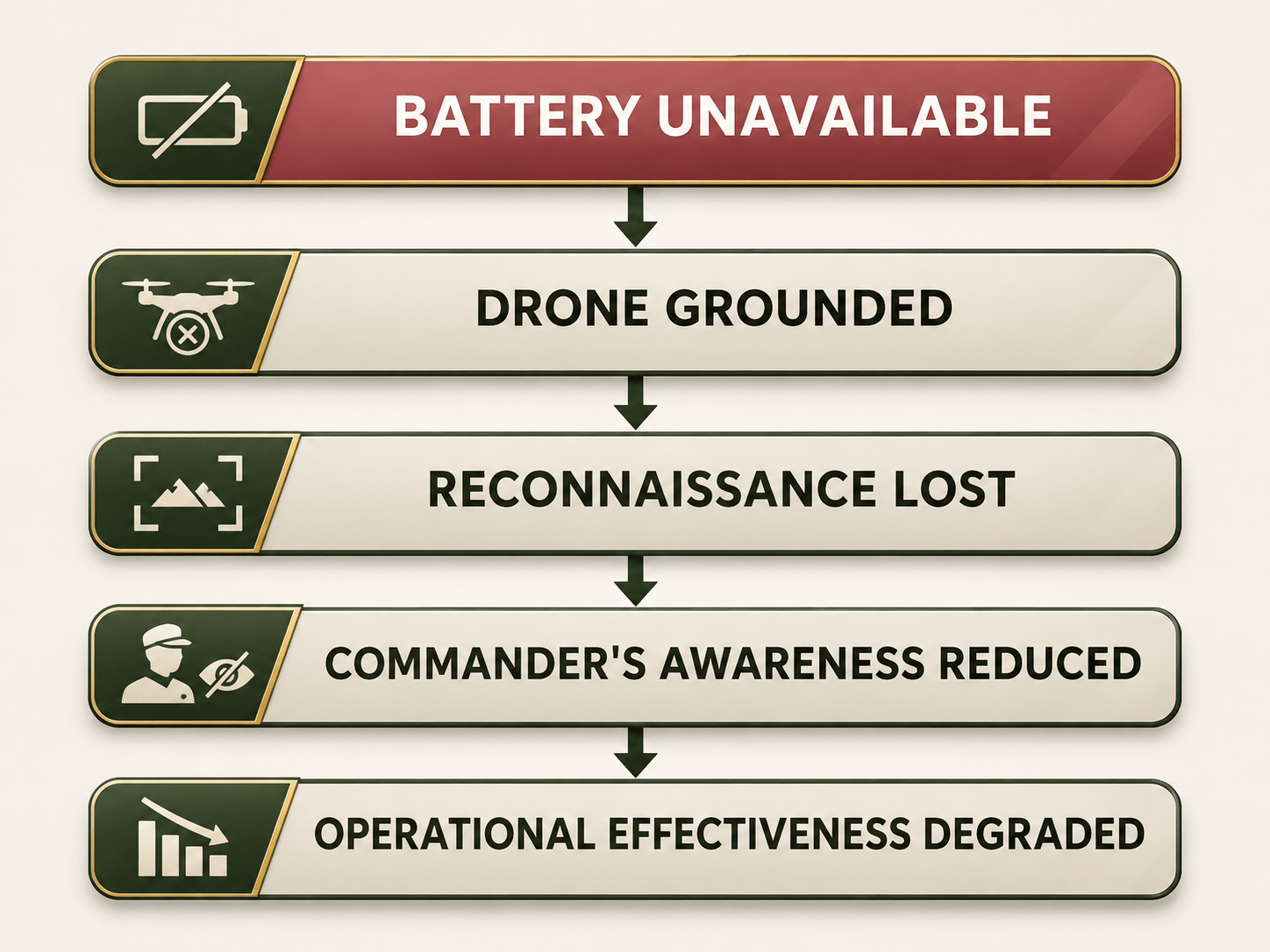
The digitised Army has an energy problem
The New Zealand Army’s Future Land Operating Concept 2035 (FLOC 35) envisages a light, agile and increasingly digitised force, with better situational awareness, networked soldiers, sensors and autonomous systems. Such capabilities matter most to a small Army seeking an advantage in information and responsiveness.[1]
Almost every one of those advantages depends on electricity. A night-vision device without power cannot help a soldier see. A drone without a charged battery cannot reconnoitre. A radio network without power cannot keep a command post connected. Buying the equipment does not keep it running. Batteries, charging infrastructure, generators, cables, and moving charged and depleted packs are part of the capability, not an afterthought.
FLOC 35 itself recognises vulnerable supply chains, the value of redundancy and the potential of tactical power generation and smart metering. Recognising the issue in a concept, however, is not the same as routinely measuring a formation’s electrical endurance and assigning responsibility for maintaining it.[2]
Therein lies the paradox. The more the Army, and the wider NZDF, relies on digital systems to compensate for its small size, the more a poorly forecast electrical requirement can erode the very advantage those systems were intended to provide. A force can possess sophisticated equipment and still lose its effectiveness for want of the energy to use it.
Project Convergence brings the issue home
New Zealand’s participation in Project Convergence Capstone 6 (PCC6) in 2026 adds a local dimension. In his post-activity report of 18 August 2026, Deputy Chief of Army Brigadier Hamish Gibbons identified power generation and energy resilience as increasingly important operational considerations. Paragraph 17 describes power as a finite resource that requires deliberate planning and management by commanders, with decisions on consumption, battery replacement, charging cycles, and sustainment becoming more important at all tactical echelons.[3]

This is not evidence of an NZDF-wide battery shortage, nor proof that current supply classifications have failed. It is something more useful for the present argument: a contemporary New Zealand reason to test whether our planning, stocks and charging arrangements can sustain emerging capabilities under realistic conditions.
In August 2026, John Mabes of the US Army Center for Army Lessons Learned described electrical power as a fifth essential logistics commodity, as critical as food, water, fuel and ammunition. Drawing on observations at the Joint Readiness Training Center, he highlighted a lack of battery standardisation, poor energy planning, inadequate charging infrastructure and lithium-ion safety, as well as the practical value of a “round-robin” charging network.[4]
Mabes is not proposing a new formal supply class. His analysis does, however, reinforce a simple point: a formation needs to forecast and manage electrical endurance as seriously as traditional commodities. For New Zealand, Class XI could make that responsibility explicit.
We have run short before
During the 2003 invasion of Iraq, the US Government Accountability Office documented a near-crisis in military battery supply. Monthly worldwide demand for two military lithium-battery types, the BA-5590 and BA-5390, rose from below 20,000 before September 2001 to 330,600 in April 2003. That same month, the Marines reported only a two-day supply in theatre; by May, back orders had reached around 900,000.[5]
The failure was not simply a slow supplier. The Army’s war reserve requirement of 180,000 BA-5590s covered only the first 45 days of operations, yet nearly 620,000 were demanded in the first two months. Item managers had no wartime forecasting model; funding had fallen short for several years and industrial capacity could not increase quickly enough. With a six-month production lead time, an urgent order did not solve an immediate shortage.[6]
The problem even entered popular accounts of the war, notably Evan Wright’s Generation Kill. The more important lesson, however, lies in the documented mismatch between peacetime assumptions and operational consumption.[7]
New Zealand is not immune to the difficulties of distant sustainment. Contemporary reporting identified equipment delays associated with East Timor. A shelved draft review of the Bamiyan Provincial Reconstruction Team in Afghanistan later described substandard boots, faulty rifle components and too few infrared sights, although the commander who shelved it disputed its accuracy.[8]
Veterans of those deployments have also described battery shortages in discussions with the author. Recollections from East Timor suggest that planners expected batteries to be readily available in Darwin, without sufficiently accounting for local availability or replenishment times. Afghanistan veterans recall reliance on American stocks and attempts to source replacements locally, including less suitable carbon-zinc batteries obtained through Pakistan.[9]
These are personal recollections, not independently verified official findings on consumption or shortages. Their warning is nonetheless worth hearing: neither the local market nor an allied supply system can be treated as a substitute for a tested sustainment plan.
Batteries are not just another item of stores
The word “battery” conceals a wide range of commodities, from specialist military packs to ordinary AA cells. Different chemistries, shelf lives, voltages, performance limits and transport requirements all affect what can safely and reliably replace what.
Consider specialist military batteries such as the disposable BA-5590 and rechargeable BB-2590 used with military communications equipment. They are not interchangeable with whatever happens to be available on a supermarket shelf. The battery choice affects not only cost but also weight carried, charging requirements and the entire replenishment cycle.[10]
A 2009 US Army comparison shows how much that choice matters. For a seven-day mission, one SINCGARS radio needed seven disposable BA-5590s but only three of the higher-capacity BA-5390s, cutting the soldier’s load by around 3 kilograms and battery cost by 60 per cent. Among rechargeables, three BB-2590s did the work of five older BB-390s. Yet, as the article’s title noted, the improved batteries were sitting unordered in Army inventory.[11] Rechargeable options can reduce what is carried and discarded, but they depend on functioning chargers, power generation and a reliable rotation of charged and depleted packs.
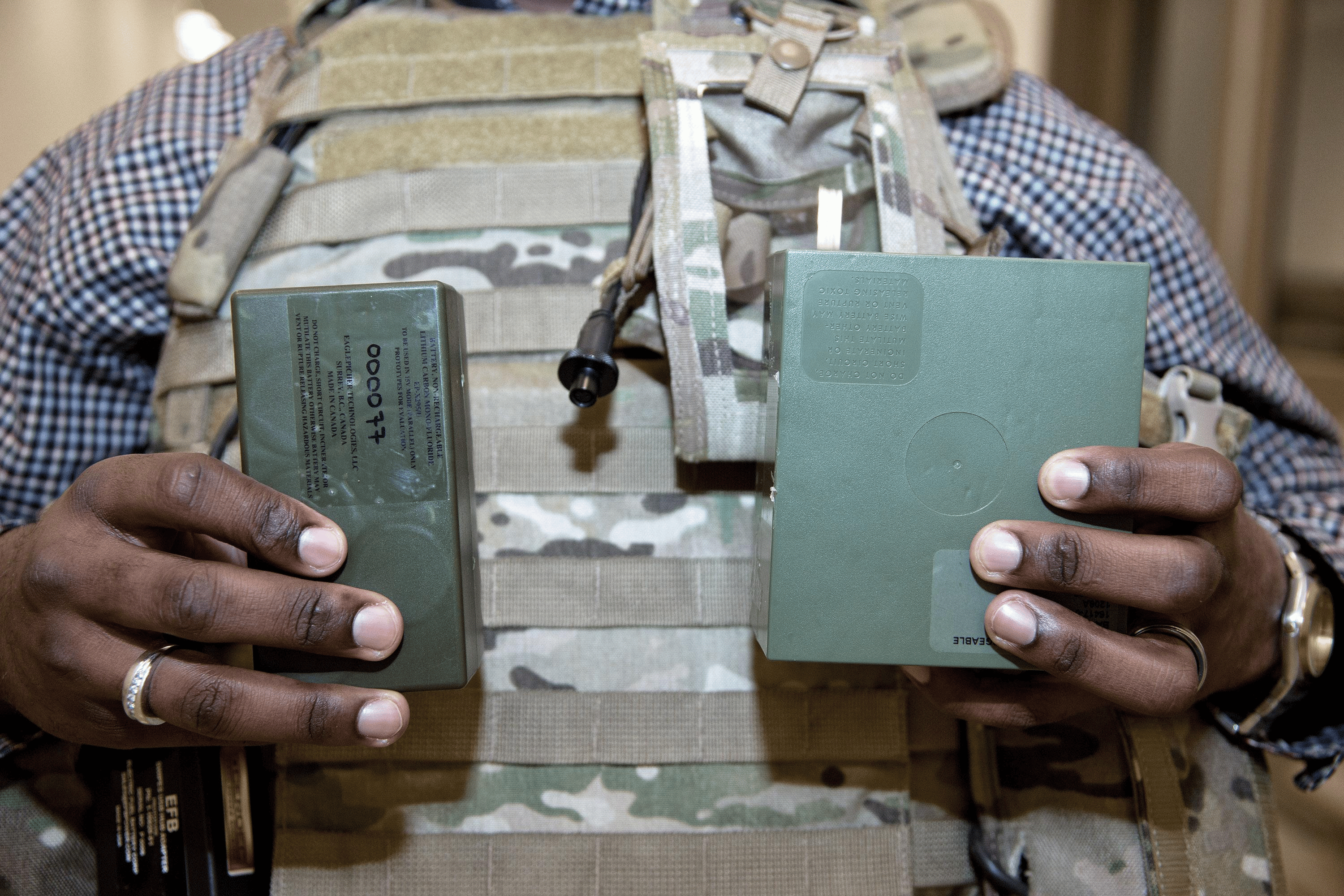
Ordinary commercial cells matter as well. The AN/PVS-14 night-vision monocular uses one AA battery, and similar cells support a variety of smaller sensors, sights and receivers. Their availability and quality can be just as consequential to an individual soldier as the supply of specialised packs.[12]
The accumulated burden can be substantial. Recent US reporting describes soldiers carrying 7 to 9 kilograms of batteries on a 72-hour mission, with some specialists carrying nearly 14 kilograms. A 2011 US Army account put the figure at around 70 individual batteries on a typical 72-hour mission in Afghanistan.[13] Because devices from different manufacturers often use different battery types, that burden is both a supply problem and a physical one.
Treating commercial cells as trivial general stores is therefore a mistake. A lithium AA and a carbon-zinc AA may look alike but perform very differently under load or in cold conditions. The real requirement extends beyond counting boxes: the right energy must be available, in a usable state, for the right equipment and at the right time.
Supply classes follow the battlefield
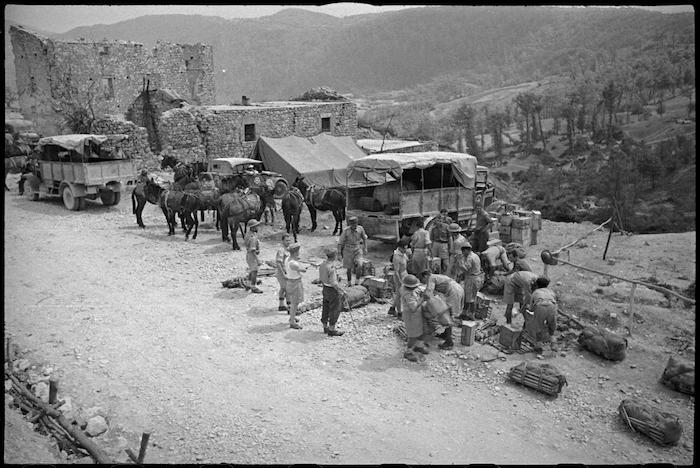
Supply classes are tools for organising responsibility and understanding demand, not sacred categories. When mechanisation made petroleum indispensable, fuel required distinct doctrine, forecasting and distribution. Wartime US quartermaster arrangements reflected the transition from horses to motor transport, while post-war cataloguing had to account for expanding inventories of equipment and spares.[14]
NATO uses five broad classes, which allies have agreed to provide to one another. The familiar ten-class scheme derives from US Army doctrine, and the additional classes remain national. Australian and New Zealand doctrine follows this pattern: Land Warfare Doctrine 4-0 identifies ten classes, including petroleum, ammunition, major equipment and repair parts.[15] National adaptation therefore has a precedent, although any new class must be mapped clearly to allied reporting.
| Class | Category | Examples |
| I | Subsistence | Food, drinking water and forage |
| II | Clothing, individual equipment and general stores | Uniforms, personal equipment, tentage, tools and administrative supplies |
| III | Petroleum, oils and lubricants | Bulk and packaged fuel, oils, hydraulic fluids and greases (IIIa: aviation fuel) |
| IV | Construction and barrier materials | Timber, sandbags, barbed wire and fortification stores |
| V | Ammunition and explosives | Small-arms ammunition, artillery and mortar rounds, missiles, mines and pyrotechnics |
| VI | Personal-demand items | Toiletries, snacks and other personal items, usually sold through canteens or exchanges |
| VII | Major end items | Complete equipment such as vehicles, artillery and weapon systems |
| VIII | Medical materiel | Pharmaceuticals, medical equipment and blood products |
| IX | Repair parts and components | Spare parts, assemblies and maintenance kits |
| X | Non-military programmes | Materiel for civil affairs, reconstruction and humanitarian support |
| XI (proposed) | Battlefield energy | Operational batteries and energy-storage modules, managed by charge state and serviceability and linked to charging and generation |
Classes of supply as set out in Australian Army doctrine, with the proposed Class XI added. NATO’s five-class system uses the same numbers for Classes I–V but defines some differently: its Class II, for example, covers all items with an authorised allowance, including weapons, vehicles and spare parts. Classes VI–X are national extensions, and definitions vary between nations. Source: adapted from Australian Army, Land Warfare Doctrine 4-0: Logistics (2018), 25–26.
A proposed Class XI would not turn batteries into ammunition or alter Class V. The analogy is one of operational consequence: like ammunition, electrical energy may be exhausted at a predictable or unexpectedly rapid rate, and shortages can have immediate consequences. Batteries also require attention to charging, serviceability, storage, safety, and disposal.
The case for a distinct class is strongest when an essential resource is scattered across existing categories and becomes difficult to forecast as a whole. Class XI should not create duplicate catalogue items. It should make the operational dependency on stored energy visible across units, equipment types and Services.
What others are learning
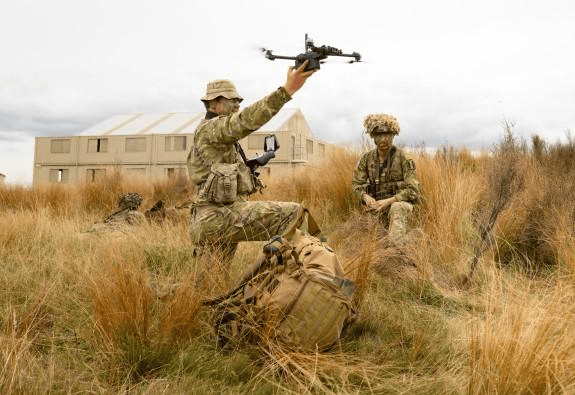
Ukraine shows the scale and urgency of demand for drone batteries, and what can go wrong when they are treated as ordinary commodities. One Ukrainian manufacturer aims to produce up to 10,000 battery units a day across dispersed, protected sites, while acknowledging that imported components still play a role. In May 2026, a National Guard soldier reported that drone batteries for his unit had been classed as non-military goods and bought through a lowest-price tender. The winning supplier allegedly substituted cheaper, lower-rated cells that risked thermal runaway when charged to specification. These accounts do not provide a complete, audited picture of consumption, but the lesson is clear: how a battery is classified can shape how it is bought, and quality, traceability and assured access matter as much as quantity.[16]
The United States has also moved towards a department-wide battery strategy, mandated by Congress, with standardisation a primary focus. The US Army’s Small Tactical Universal Battery offers eight capacities in a single physical and electrical design, reducing the weight and tracking burden of multiple battery types. These efforts suggest that interoperability is not only about communications or information systems; common power arrangements can matter too.[17]
Australia’s Guided Weapons and Explosive Ordnance Enterprise offers a parallel in thinking about resilience. Batteries and munitions are different industries, but both raise questions about assured stocks, domestic capacity and acceptable dependence on international suppliers. Self-reliance need not mean making everything ourselves. For New Zealand, it means deciding which battery types it can safely rely on allies or markets to provide, and which it must hold or be able to source with confidence.[18]
New Zealand should learn from such work without waiting for NATO to create a Class XI designation. National classification and coalition interoperability are compatible, provided existing codes and reporting requirements remain intact.
Allies and markets have their own priorities
The deterioration of New Zealand’s defence relationship with the United States after the 1985 nuclear-ships dispute demonstrated that political circumstances can affect defence access. By late 1986, the military reported that spare parts for US-made aircraft were taking significantly longer to obtain and that, although a logistics agreement remained in force, New Zealand no longer received the priority given to allies. Today’s relationships are different, and batteries are not a treaty obligation, but assured priority in another country’s supply system should never be assumed.[19]
The COVID-19 pandemic provided a more recent reminder: governments restricted exports of critical goods when domestic requirements became urgent. Long-standing trading relationships did not remove the pressure to prioritise national needs.[20]
Battery and drone supply chains are exposed to comparable industrial and political disruption. In 2024, China restricted exports of key drone components to Ukraine and Russia, and separately halted battery sales to a US drone maker over its dealings with Taiwan. Controls also run in the other direction: the United States has legislated to exclude Chinese batteries from its military systems from 2028. In a regional crisis, partners, civilian industry and emergency services might all seek the same components. Allied support remains essential, but it should complement a planned national reserve rather than replace it.[21]
Why this matters for New Zealand
New Zealand already applies a reserve principle to liquid fuels. Its minimum stockholding obligation, in force since January 2025, requires fuel importers to hold 28 days of petrol, 24 days of jet fuel and 21 days of diesel, rising to 28 days of diesel for importers with more than 10 per cent market share from July 2028.[22]
Batteries are not bulk diesel, and a fixed national days-of-cover target cannot simply be copied across. The underlying question is nevertheless familiar: how long must an essential service or deployed force operate when overseas replenishment cannot be relied upon? New Zealand’s distance from suppliers and its Pacific operating environment make that a practical question, not an academic one.
A small force can also be more disciplined about this problem. Demand can be assessed by equipment, mission, operating tempo and unit, while new procurement can reduce unnecessary proliferation of incompatible battery families. Build that assessment into capability introduction, rather than leaving it until a system reaches its first demanding exercise or deployment. Making it routine is precisely what a Class XI framework would be for.
The case for Class XI

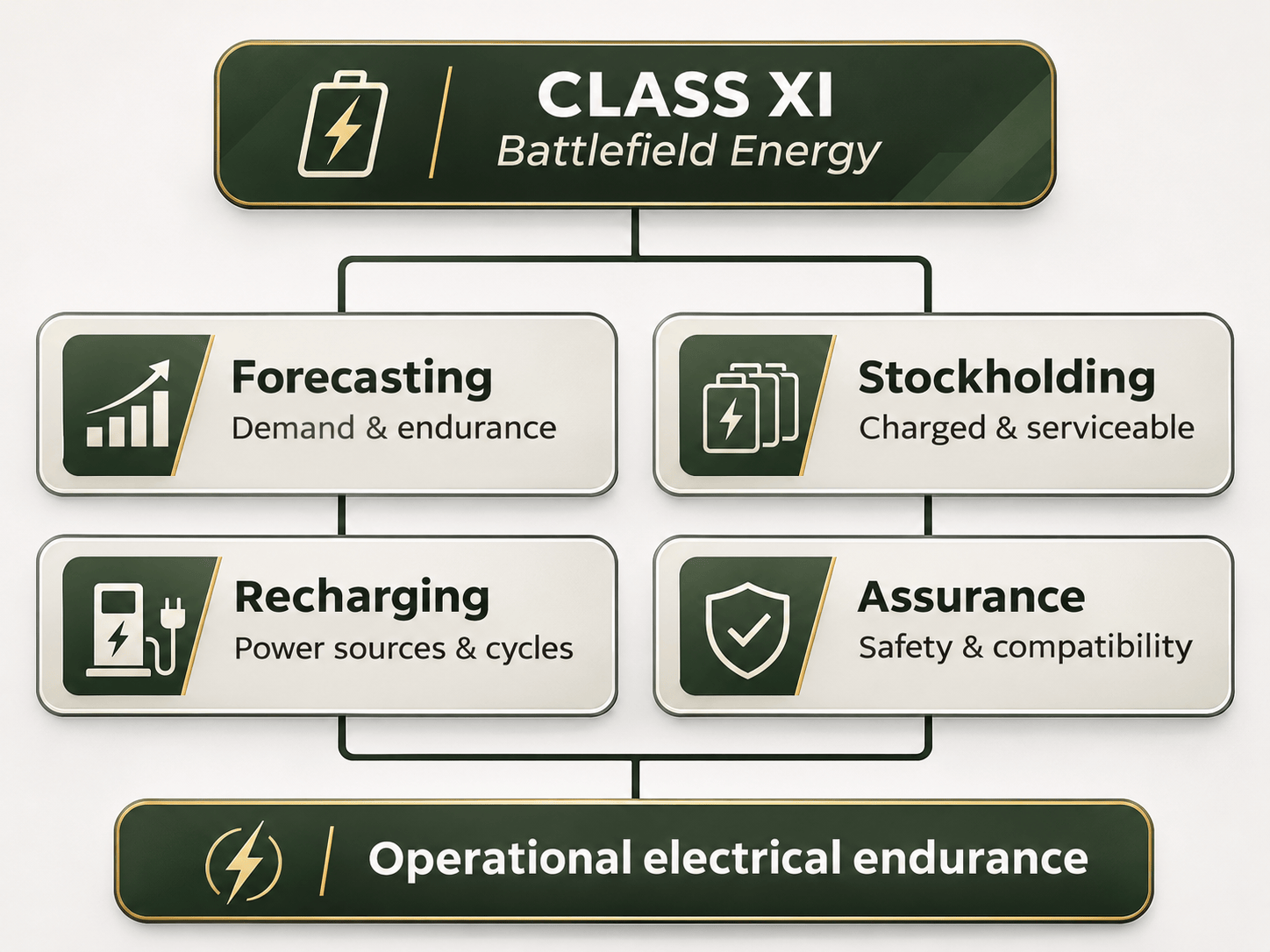
The NZDF should test establishing Class XI, Battlefield Energy, as a national supply class with a responsible policy owner and an agreed scope. It would bring operational batteries and stored-energy modules into a common planning and reporting view, including charge state, serviceability and likely endurance. Generators, fuel and major equipment would retain their established identities; the new class would connect their energy dependencies rather than catalogue the same assets twice.
- Recognition and ownership. Set clear boundaries for Class XI and map every affected item to the existing allied supply framework. Assign ownership for policy, forecasting and reserves, with defined responsibilities across the three Services and deployed units. The objective is not another headquarters organisation but a clear answer to the question: who is responsible for electrical endurance?
- Forecasting and visibility. Plan energy demand by equipment, battery type, mission duration, operating conditions and expected activity. Report charged, discharged, serviceable and unavailable stocks, and forecast hours, days or sorties of electrical endurance where practical. The important measure is usable energy, not simply the number of packages on a shelf.
- Quality, resilience and compatibility. Treat operational batteries as controlled items, procured against specification with quality assurance and supplier traceability rather than bought as general stores. Determine reserves from realistic scenarios without allied or commercial resupply, rather than arbitrary warehouse targets. Prefer qualified common interfaces and battery families where appropriate, and protect charging, power conversion and distribution. Consider domestic testing, servicing and recycling where safe and economically sensible, without assuming that New Zealand can manufacture every cell.
- National resilience. Share the NZDF’s critical battery requirements with whole-of-government fuel security and emergency management planning, so that defence, emergency services and essential industries are not unknowingly competing for the same stocks in a crisis.
- Trial, measure and refine. Building on lessons from Project Convergence, test the arrangements in realistic land and joint exercises, recording actual use, recharge times, stock-outs, failures and administrative effort. Use existing digital logistics systems wherever possible. A new class that merely generates another spreadsheet will have failed its own purpose.
The strongest objection: do we need another class?
The obvious objection is that the NZDF already catalogues and manages batteries. They can be identified by stock number, equipment application and existing supply arrangements. Why introduce another class instead of improving the systems we already have? That objection deserves a serious answer.
Identification is not the same as operational visibility. A stock system may show how many batteries are held without revealing whether a formation can sustain a week of radio operation, drone sorties or night surveillance. If existing arrangements already provide that view, a new classification may be unnecessary. If they do not, Class XI offers a way to make demand, reserves, serviceability and command responsibility visible together. Its value must be demonstrated in use, not asserted through a new label.
A sharper version of the objection is that a battery management policy within existing classes would achieve the same result at less cost. Perhaps it would. But classification is not merely a label: it shapes who owns a resource, how it is forecast and how it is bought. The Ukrainian drone batteries bought by lowest-price tender were reportedly procured that way because they had been classed as non-military goods. A policy without a category depends on continued attention; a class builds that attention into planning, reporting and procurement. A trial is the proper way to establish which approach works better.
Several narrower objections have already been addressed. Class XI would not make batteries legally or technically ammunition, nor require allies to adopt a New Zealand category. It does not assume that New Zealand can manufacture every specialist battery. It should draw on existing inventory and logistics data, adding new measures only where charge state, battery health, and electrical endurance genuinely require them. If Class XI adds administrative effort without improving readiness, it should be changed or abandoned.
Conclusion: the nail has changed
New Zealand’s military logisticians have long adapted to changes in what an Army consumes. Fodder gave way to fuel; complex equipment brought ever more demanding requirements for specialist parts and maintenance. Electrical endurance is the next challenge, already shaping how soldiers see, communicate and operate sophisticated systems.
FLOC 35 envisaged a more technologically enabled Army. PCC6 has now given New Zealand practical reasons to examine the energy arrangements needed to sustain it. Class XI would not produce a single watt of electricity, but, properly designed, it could give commanders a clearer view of their available power, likely consumption and capacity to keep operating. It could also give the wider government a clearer picture of which battery dependencies matter in a national crisis.
A small Army cannot afford to rediscover the cost of an overlooked commodity each time it introduces new equipment. The requirement is straightforward: electrical endurance must be as visible, measurable and accountable as fuel and ammunition. The proposal for Class XI deserves to be tested against that requirement.
For want of a nail, a kingdom was lost. The nail has changed, but the lesson has not. Better to find the missing battery in an exercise than to have an operation find it for us.
The views expressed in this article are the author’s own and do not represent those of the New Zealand Defence Force.
Notes
[1] New Zealand Army, Future Land Operating Concept 2035: Integrated Land Missions, 2nd ed. (Wellington: New Zealand Defence Force, 2017), 10–11, 16–17, 75–78. The concept is a statement of future capability direction, not evidence that every system described had entered service.
[2] New Zealand Army, Future Land Operating Concept 2035, 76–78, sections “Equipment Redundancy” and “Combat Services: Fielding the Force.”
[3] New Zealand Army, “Post Activity Report: Deputy Chief of Army Visit to United States (Project Convergence Capstone 6), 24–27 July 2026,” DCA Minute 086/2026, 18 August 2026, para. 17, 3 (PDF p. 4), in New Zealand Defence Force, OIA-2026-5916 Convergence Capstone (official-information release, 29 October 2026), https://www.nzdf.mil.nz/assets/Uploads/DocumentLibrary/OIA-2026-5916-Convergence-Capstone.pdf; Phil Pennington, “Desert Wargames Tax Batteries, Feed Tech Wishlist,” RNZ, 3 November 2026, https://www.rnz.co.nz/news/politics/2306252/desert-wargames-tax-batteries-feed-tech-wishlist.
[4] John Mabes, “Powering the Digitized Battlefield,” US Army Center for Army Lessons Learned, 28 August 2026, https://www.army.mil/article/294958/powering_the_digitized_battlefield. The publication refers to electrical power as a fifth essential commodity; it does not propose a formally numbered fifth class of supply.
[5] US Government Accountability Office, Defense Logistics: Actions Needed to Improve the Availability of Critical Items during Current and Future Operations, GAO-05-275 (Washington, DC: GAO, 8 April 2005), https://www.gao.gov/assets/a245975.html.
[6] GAO, Defense Logistics.
[7] Evan Wright, Generation Kill (New York: Berkley Caliber, 2004); Generation Kill, written by David Simon, Ed Burns and Evan Wright, aired 2008 on HBO, television miniseries; “Review: Generation Kill—The Iraq War, Batteries Not Included,” Gizmodo, July 2008, https://gizmodo.com/review-generation-kill-the-iraq-war-batteries-not-inc-5025094.
[8] “Our Faulty War: The Afghanistan Report They Fought to Keep Secret,” New Zealand Herald, 26 March 2017, https://www.nzherald.co.nz/nz/our-faulty-war-the-afghanistan-report-they-fought-to-keep-secret/KASEQM27OIATWFRQ3VRVR2Q47Q.
[9] New Zealand Defence Force veterans of the East Timor and Afghanistan deployments, interviews and discussions with the author, 2014–2026; names withheld.
[10] Jeff Shepard, “EaglePicher Releases BA-5590 Battery with SOCI,” EEPower, 31 January 2005, https://eepower.com/new-industry-products/eaglepicher-releases-ba-5590-battery-with-soci/; “BA 5590 Lithium Battery,” Defense Update, 2 January 2004, https://defense-update.com/20040102_ba-5590-lithium-battery.html; “BA-5390/U Lithium Battery,” Defense Update, accessed 15 November 2026, https://defense-update.com/?p=9581.
[11] Edric Thompson, “Improved Battery Technology Sitting Unordered in Army Inventory,” US Army (CERDEC Public Affairs), 18 June 2009, https://www.army.mil/article/22916/improved_battery_technology_sitting_unordered_in_army_inventory.
[12] Program Executive Office Soldier, “Monocular Night Vision Device (MNVD), AN/PVS-14,” PEO Soldier Portfolio, accessed 15 November 2026, https://peo360portfolio.com/product-details/product/175; Sydney J. Freedberg Jr., “Army Lab Pushes Standardized Batteries for Frontline Soldiers: STUB and OSCAR,” Breaking Defense, 10 November 2023, https://breakingdefense.com/?p=21564.
[13] Freedberg, “Army Lab Pushes Standardized Batteries”; T’Jae Gibson, “Army Unburdens Soldiers through Battery Innovations,” US Army, 16 June 2011, https://www.army.mil/article-amp/53283/army_unburdens_soldiers_through_battery_innovations.
[14] US War Department, Field Manual 10-10 (Washington, DC: War Department, n.d.), table of contents, HyperWar, https://ibiblio.org/hyperwar/USA/ref/FM/PDFs/FM10-10.PDF; Joint Chiefs of Staff, Joint Bulk Petroleum and Water Doctrine, Joint Publication 4-03 (Washington, DC: Joint Chiefs of Staff, 11 January 2016; validated 30 November 2017), I-1, https://irp.fas.org/doddir/dod/jp4_03.pdf; Defense Logistics Agency, “History of the Federal Catalog System,” DLA News, accessed 15 November 2026, https://www.dla.mil/About-DLA/News/Energy/Article/1098692/history-of-the-federal-catalog-system/.
[15] Australian Army, Land Warfare Doctrine 4-0: Logistics (2018), 25–26, “Classes of Supply”; North Atlantic Treaty Organization, NATO Logistics Handbook (Brussels: NATO, November 2012), 27, annex to chap. 2, “Classes of Supply.” Australian Classes I–V are based on NATO standardisation arrangements; Classes VI–X extend the system for national requirements.
[16] Julia Struck-Feshchenko, “More Range, More Payload: Ukraine’s Race to Build Better Drone Batteries,” Kyiv Post, 23 September 2026, https://www.kyivpost.com/post/85244; “Taiwan Becomes Third-Largest Supplier of Batteries for Ukrainian Drones,” Militarnyi, accessed 15 November 2026, https://militarnyi.com/?p=484626; Olena Mukhina, “Ukrainian Soldier Says Supplier Swapped Ordered Drone Batteries for Cheaper Cells That Risk Thermal Runaway at Front,” Euromaidan Press, 19 May 2026, https://euromaidanpress.com/?p=406983.
[17] Lauren C. Williams, “Pentagon Readies New Battery Strategy amid Growing Drone Demands,” Defense One, 18 August 2025, https://www.defenseone.com/technology/2025/08/pentagon-readies-new-battery-strategy-amid-growing-drone-demands/407502/; Dan Lafontaine, “Army Accelerates Adoption of Advanced Batteries through S&T Integration,” US Army, 18 August 2025, https://www.army.mil/article/287894; Sean McLachlan and Todd Goodson, “Best Practices on Operationalizing Battlefield Energy,” US Army, 18 August 2025, https://www.army.mil/article-amp/287897/best_practices_on_operationalizing_battlefield_energy.
[18] Pat Conroy, “Address to the National Press Club” (speech, Canberra, 30 October 2024), Australian Government Defence Ministers, https://minister.defence.gov.au/speeches/2024-10-30/address-national-press-club; Alice Nason and Tom Corben, “GWEO Rockets Up the US Alliance Agenda, but Australia Isn’t Close to Self-Sufficiency,” The Strategist (Australian Strategic Policy Institute), 3 September 2024, https://www.aspistrategist.org.au/gweo-rockets-up-the-us-alliance-agenda-but-australia-isnt-close-to-self-sufficiency/.
[19] David Barber, “New Zealand Military Says Defense Rift with US Hurts,” Christian Science Monitor, 14 October 1986, https://www.csmonitor.com/1986/1014/opact-f.html; “Australia, New Zealand, United States (ANZUS),” GlobalSecurity.org, accessed 15 November 2026, https://www.globalsecurity.org/military/world/int/anzus.htm.
[20] Congressional Research Service, Export Restrictions in Response to the COVID-19 Pandemic, IF11551 (Washington, DC: Congressional Research Service, updated 25 August 2020), https://sgp.fas.org/crs/natsec/IF11551.pdf; Krzysztof Pelc, “Can COVID-Era Export Restrictions Be Deterred?” Canadian Journal of Political Science 53, no. 2 (2020): 349–56, https://doi.org/10.1017/S0008423920000578.
[21] Aosheng Pusztaszeri, “Why China’s UAV Supply Chain Restrictions Weaken Ukraine’s Negotiating Power,” Center for Strategic and International Studies, 16 December 2024, https://www.csis.org/analysis/why-chinas-uav-supply-chain-restrictions-weaken-ukraines-negotiating-power; Associated Press, “Ukraine Is a Global Leader in Drone Wars—with One Big Vulnerability,” 1News, 18 October 2026, https://www.1news.co.nz/2026/10/18/ukraine-is-a-global-leader-in-drone-wars-with-one-big-vulnerability/; James Trevey, Adrian Yao, and Samm Gillard, “Why the Pentagon’s Drone Revolution Could Run Out of Power,” RealClearDefense, 29 September 2026, https://www.realcleardefense.com/military-strategy/articles/why-the-pentagons-drone-revolution-could-run-out-of-power-2026-09-29.
[22] Ministry of Business, Innovation and Employment, “Minimum Stockholding Obligation,” accessed 15 November 2026, https://www.mbie.govt.nz/building-and-energy/energy-and-natural-resources/energy-generation-and-markets/liquid-fuel-market/fuel-security-in-new-zealand/minimum-stockholding-obligation; Fuel Industry (Improving Fuel Resilience) Amendment Act 2023.
