
A Commonwealth Drinking Hole in Post-war Japan.
Two recently located photographs offer a rare glimpse of Roy’s Log Cabin, a beer hall in Hiro, near Kure, Hiroshima Prefecture. Although little documentary information about the establishment has yet been found, the photographs and a surviving veteran’s recollection confirm that it catered to Allied servicemen during the early 1950s.
One photograph shows a large display of Commonwealth regimental and corps insignia inside the premises. An identifiable Royal New Zealand Army Ordnance Corps badge is included, while what appears to be a Royal New Zealand Artillery badge can be seen in ther lower right of the board. Other badges may possibly represent the Royal New Zealand Army Service Corps and Royal New Zealand Electrical and Mechanical Engineers, although these identifications remain provisional.
The display provides tangible evidence that New Zealand servicemen were among the patrons of Roy’s Log Cabin and probably contributed insignia to its collection.
From occupation to the Korean War
The British Commonwealth Occupation Force arrived in Japan during 1946. Comprising formations and personnel from Australia, Britain, India and New Zealand, it supervised demilitarisation and maintained military control across a large area of western Japan. Its headquarters and principal administrative facilities were centred upon Kure, while substantial Army camps were established at nearby Hiro.
New Zealand’s contribution was known as Jayforce. More than 4,200 New Zealand soldiers arrived in Japan during March 1946, accompanied by approximately 280 personnel of No. 14 Squadron RNZAF. Jayforce was principally stationed in Yamaguchi Prefecture, but its personnel arrived through Kure and operated within the wider Commonwealth network of bases, transport routes and administrative organisations.
New Zealand withdrew Jayforce in 1948, but Hiro’s military importance did not end with the occupation. Following the outbreak of the Korean War in June 1950, the Kure–Hiro area became an important rear base supporting Commonwealth operations in Korea.
Kayforce established its New Zealand base at Hiro in June 1951. New Zealand personnel passed through the camp while travelling to and from Korea, receiving reinforcements, taking leave, undergoing treatment or awaiting repatriation. The expansion of Kayforce also included 10 Company RNZASC, which joined the Commonwealth Division in Korea during October 1951.
Hiro also housed the Japan Reinforcement Base Depot, or JRBD, which received and prepared British reinforcements for service in Korea. The depot occupied the former camp of 3rd Battalion, Royal Australian Regiment and operated alongside separate Australian and New Zealand reinforcement organisations.
Hiro consequently became a crossroads for British, Australian, Canadian and New Zealand servicemen. Around the military camps developed a collection of shops, laundries, restaurants and beer halls catering to this transient Commonwealth population.

The exterior photograph shows a plain, two-storey, timber-clad building. Despite its name, it was not a log cabin in the conventional architectural sense. Its identity and intended clientele were proclaimed in large English lettering.
A badge or emblem appears above the lettering, although it cannot be identified confidently from the available image.
Roy’s Log Cabin was probably a Japanese-owned commercial beer hall close to the military camp rather than an official service canteen. Establishments of this kind offered servicemen somewhere to drink and socialise beyond the more regulated surroundings of their camps.
British Royal Signals soldier John Boyd provides the clearest surviving description. Boyd arrived in Japan in September 1952 and was taken to A Company, JRBD, at Hiro-machi. When he returned approximately a year later, he remembered:
“Nearby was the ‘Uncle Roys Log Cabin’ beer hall, with a laundry alongside which had the mispelt ‘Lanudry’ down its side.”
Boyd also recalled visiting other beer halls in Hiro and Kure, where he and his companions drank Kirin beer and Akadama wine.
His reference to “Uncle Roy’s Log Cabin” may preserve the establishment’s colloquial name, while the exterior photograph shows that its formal sign read simply “Roy’s Log Cabin”. His account confirms that the beer hall operated during 1952 and probably remained open in 1953.
It may have existed during the earlier occupation period, but no evidence has yet been located that securely places it in the late 1940s.
A wall of Commonwealth badges

The interior photograph shows a large shield-shaped display headed “Roy’s Logcabin”. The words “Commonwealth Forces” surround an oversized central crown, while an assortment of cap badges, collar badges, shoulder titles and buttons fills the board.
Several British and Australian badges are recognisable. The words “Australia”, “REME” and “KSLI”—the King’s Shropshire Light Infantry—are visible, together with insignia belonging to artillery, engineer, infantry and service corps.
The identifiable New Zealand Artillery badge accords with Hiro’s role as Kayforce’s rear base. Personnel of 16th Field Regiment and its supporting organisations passed through the camp while travelling between New Zealand and Korea.
Towards the upper-right of the display is a badge that appears consistent with that of the Royal New Zealand Army Ordnance Corps. Less distinct insignia may represent the Royal New Zealand Army Service Corps and Royal New Zealand Electrical and Mechanical Engineers.
Caution is required because New Zealand corps badges were frequently derived from, and closely resembled, their British equivalents. Until a higher-resolution copy or the original display can be examined, the possible RNZASC and RNZEME badges should not be regarded as conclusively identified.
The origin of the collection is unknown. The badges may have been donated by visiting servicemen, exchanged as souvenirs or collected by the proprietor to decorate the establishment. Whatever the method, the board became an informal record of the regiments, corps and national contingents represented among Roy’s customers.
The logisticians behind Kayforce
Although the 16th Field Regiment was New Zealand’s principal combat formation in Korea, it depended upon a logistic system extending from New Zealand through Japan and into the Korean Peninsula. Guns, vehicles, ammunition, fuel, rations, clothing and technical stores all had to pass through this network.
The RNZASC connection is particularly credible because 10 Company RNZASC formed part of Kayforce’s expanded contribution to the Commonwealth Division. RNZAOC personnel provided ordnance stores, clothing, equipment and ammunition support, while RNZEME tradesmen maintained and repaired vehicles, weapons and technical equipment.
Members of these corps had ample reason to pass through the camps, depots and workshops of Hiro and Kure. The possible presence of their badges at Roy’s Log Cabin would therefore reflect the range of combat and supporting organisations required to sustain New Zealand’s contribution to the Korean War.
The badge display also illustrates an aspect of service life rarely captured in official histories. Soldiers did not exist only within unit lines, workshops and depots. They also occupied a wider social world of canteens, cinemas, restaurants and local bars. Roy’s Log Cabin was one such meeting place.
An informal military archive
The display at Roy’s Log Cabin can be compared with the better-known Hong Kong Bar in Chulia Street, George Town, Penang. The two establishments were separated by distance and circumstance, but both became drinking places for generations of British and Commonwealth servicemen.
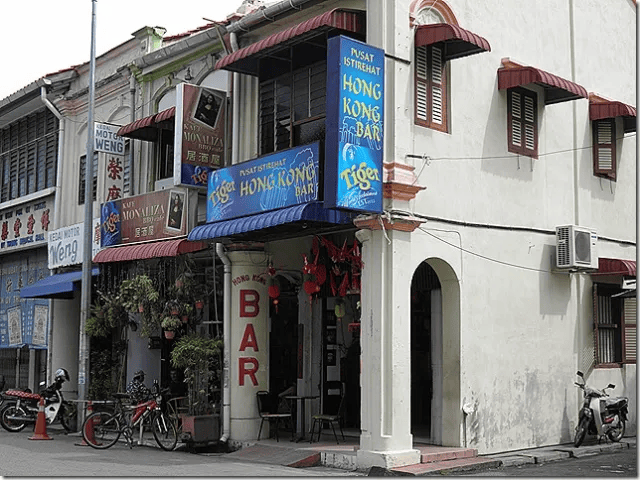
The Hong Kong Bar opened in 1920 and became particularly associated with personnel serving at RAF and RAAF Butterworth, as well as visiting soldiers and sailors. The same family has operated it since the 1950s, and it has long displayed plaques, photographs, badges, medals, postcards, and other items left by its military patrons.
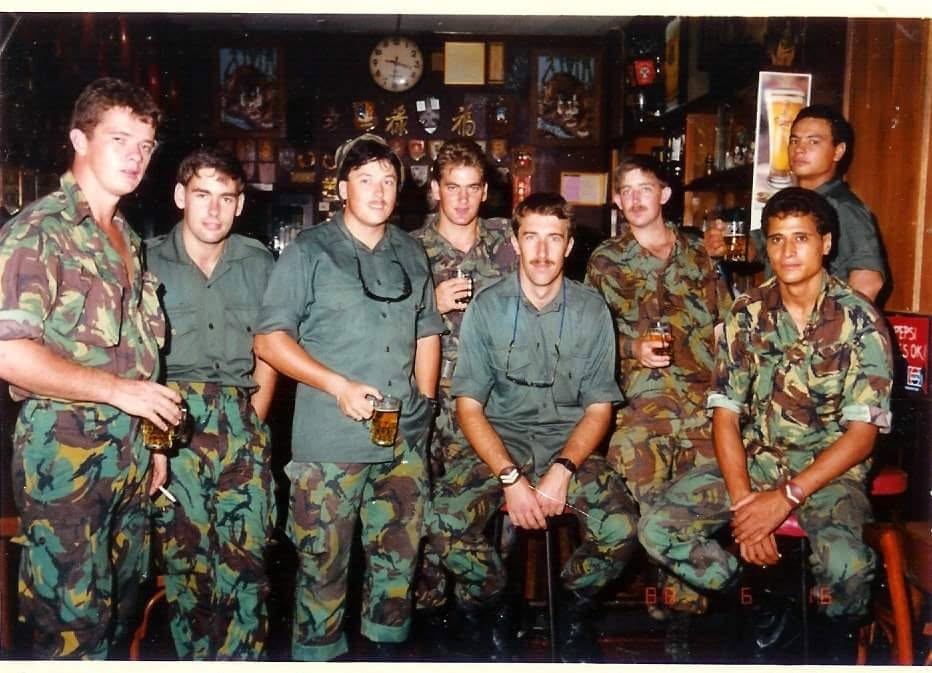
The proprietors of the Hong Kong Bar also created a photographic record of visiting groups. Thousands of photographs of servicemen and their families were collected, arranged in albums and displayed alongside unit plaques and other mementoes. Although many were lost when fire damaged the bar in 2004, the surviving collection has led to the establishment being described as an unofficial museum of the military presence in Penang.
For more than eighty years, the Hong Kong Bar has marked the passage of military visitors not through formal nominal rolls but through photographs, plaques and objects left behind. Personnel returned years later to find their younger selves, former comrades or unit insignia preserved within the bar.
Roy’s Log Cabin appears to have served a comparable purpose on a smaller scale. Its badge board did not simply decorate the premises. It created a visual record of the Commonwealth units whose members had visited Hiro. Each badge represented an individual or group that had passed through the establishment, even though their names and the circumstances of their visits were not recorded.
The comparison demonstrates how an ordinary drinking establishment can unintentionally become an archive. Official records document formations, movements and operations; places such as Roy’s Log Cabin and the Hong Kong Bar preserve something different: the social memory of service, comradeship and time spent away from home.
A place between two worlds
To its customers, Roy’s Log Cabin was probably remembered primarily as somewhere to drink, meet friends and escape temporarily from military routine. Yet establishments of this kind occupied an important social space between the Allied forces and the local population.
Many of the servicemen passing through Hiro were young, far from home and either preparing for war or returning from active operations. Inside Roy’s Log Cabin, distinctions between regiments, corps and national contingents became temporarily less important. British, Australian, Canadian and New Zealand soldiers could meet beneath a shared display of badges in a Japanese establishment only a few years after the end of the Pacific War.
Beer halls were an established part of servicemen’s recreational life in the Kure–Hiro area. Veterans recalled visiting establishments in both towns, while official BCOF installations also contained regulated canteens, recreation rooms and beer halls. Kure, as the larger centre, offered restaurants, cinemas, shops and Kure House, whereas Hiro possessed its own smaller entertainment district serving the military camps.
Roy’s badge board captures the transition from occupation to alliance. The insignia represented armed forces assembled first to occupy a defeated Japan and subsequently to fight together in Korea. Arranged around the words “Commonwealth Forces”, they became an unofficial monument to the servicemen who passed through its doors.
A surviving fragment of social history
The later history of Roy’s Log Cabin is presently unknown. It is not known who “Roy” was, whether he was Japanese or a Commonwealth national, when the beer hall opened, or when it closed. Its exact location within Hiro has also yet to be established.
The photographs nevertheless confirm that Roy’s Log Cabin existed near the Commonwealth military camps, openly catered to Allied personnel and contained an extensive collection of military insignia. John Boyd’s recollection establishes that it operated during the early 1950s, while the New Zealand Artillery badge provides a direct connection to New Zealand service at Hiro.
Like the Hong Kong Bar in Penang, Roy’s Log Cabin preserved the memory of its military patrons through objects left behind. The Penang establishment survived to become a recognised repository of Commonwealth service memories; Roy’s appears to have disappeared, leaving only these photographs and scattered recollections.
That makes the surviving images particularly valuable. They record one of the informal places in which Commonwealth military life was lived during the transition from the occupation of Japan to the Korean War. They also provide a rare reminder that history survives not only in official files and unit war diaries, but on the walls of the bars where servicemen met, drank and left small traces of their passing.
