From Wartime Expansion to Civilianisation

The New Zealand Army Ordnance Corps, 1917-1938.

The inter-war period remains a relatively little-known chapter in New Zealand military logistics history. Accounts of the Army often note retrenchment, the suspension of compulsory military training and the limited state of preparedness before the Second World War, but devote less attention to the depots, workshops, stores personnel and technical specialists who kept the support system functioning. By examining the NZAOC’s organisation, workforce and daily work between 1917 and 1938, this article seeks to fill some of those gaps.

The New Zealand Army Ordnance Department (NZAOD) and New Zealand Army Ordnance Corps (NZAOC) were formally established in 1917 as part of the Quartermaster-General’s branch. The original arrangement distinguished between the Department’s commissioned officers and the Corps’ soldiers. Its officers were divided among directing, executive and inspectorate functions and were drawn from the Defence Stores, Royal New Zealand Artillery, New Zealand Staff Corps and New Zealand Permanent Staff. In 1924 the NZAOD was absorbed into the NZAOC, ending the formal departmental distinction and creating a single Corps organisation.[1]

This article combines the annual reports of the New Zealand Defence Department with a collective examination of 523 recorded service entries reconstructed from individual military personnel files held by Archives New Zealand. The files contain inconsistencies in names, dates and service details, and some individuals appear in more than one record. The figures should therefore be read as evidence of recorded service cases rather than as a perfectly complete nominal roll.[2]

Official returns and personnel files record strength and institutional change, but they reveal less about the physical work that allowed a reduced organisation to function. At Burnham, small staffs faced truckloads of returned stores; at Trentham, salvaged buildings were turned into workshops; and across the country, a handful of artificers carried specialist responsibilities. These working conditions are essential to distinguishing institutional survival from operational readiness.[3]

Taken together, the sources reveal more than a simple sequence of staff reductions. They show how a wartime labour force was demobilised, how a smaller professional and technical cadre was retained, and how transferring soldiers to civil employment helped preserve skills the Army would need again as rearmament gathered pace.

A Wartime Corps

The home-service ordnance organisation expanded rapidly after 1917. Of the 452 recorded cases for which a joining date can be established, 365 – 80.8 per cent – entered the NZAOC between 1917 and 1919. The annual personnel pattern reached its wartime high in 1918-19, when 329 of the recorded service cases were active. This workforce was created to receive, store, account for, maintain, and distribute the enormous quantities of equipment required by mobilisation, training, hospitals, demobilisation, and the return of military stores from overseas.[4]

The Corps was predominantly composed of soldiers in general ordnance employment, but its rank structure also exposes the technical hierarchy required to manage weapons, armament, workshops and large stores depots. The most frequently recorded ranks were as follows:

Recorded rank categoryCases
Private271
Lance corporal51
Corporal47
Sergeant25
Staff sergeant16
Specialist, warrant officer, commissioned or unclassified ranks113
Total recorded service entries523
Source: individual military personnel files held by Archives New Zealand. Rank is the rank recorded in the compiled service evidence and is not necessarily each person’s final rank.[5]

Technical appointments included armourers, armament artificers, store accounting specialists, conductors and armament warrant officers. These comparatively small groups were disproportionately important: the loss of a private reduced labour, but the loss of a trained artificer or senior storeman could remove knowledge that took years to replace.

Financial accountability expanded alongside the wartime organisation. A report dated 22 October 1918 recorded recoveries of more than £15,100 (about NZ$2.2 million in 2026 dollars) for losses of stores and equipment in NZEF camps, districts and troopships following the introduction of ordnance regulations. Wartime expansion therefore involved more than receiving and distributing equipment: the Corps was also expected to enforce responsibility for its custody and loss.[6][7]

The First Post-war Reduction, 1920-1922

Demobilisation did not immediately remove the need for a large ordnance organisation. In June 1920 the General Officer Commanding reported that personnel were still handling hospital equipment, vocational-training stores and military equipment arriving from overseas. Further reductions, he warned, could not be imposed without risking inefficiency and loss of stores. Renovation of part-worn uniforms alone was credited with saving approximately £90,000 (about NZ$10.8 million in 2026 dollars) during the reporting year.[8]

Nevertheless, the contraction was dramatic. The comparative returns show the NZAOC falling from 391 officers and other ranks in June 1920 to 174 in June 1921 and 111 in June 1922. Personnel-file dates tell a similar story: 307 of the 463 recorded departures occurred between 1918 and 1921. What had been created as an emergency wartime establishment was being converted into a small permanent service.[9]

The 1922 report records the closure of the Dunedin depot and the merger of the Palmerston North depot with the Main Ordnance Depot at Trentham. Yet it also stated plainly that the financial situation had forced a reduction ‘far larger’ than the operational economies warranted. The Corps still had to examine stores received from Britain, issue new guns and rifles, dispose of surplus equipment and introduce cost accounting. Any further immediate reduction, the report warned, would lead to neglect and the consequent depreciation of stores.[10]

The reductions were accompanied by deliberate changes in employment and control. Maintenance personnel at Trentham and Featherston were transferred to the New Zealand Engineers Works Section in November 1920; temporary hiring was reviewed by a board that gave preference to returned soldiers; and permanent non-commissioned vacancies were filled by examination and merit. Disposal was itself a major undertaking: sales of clothing and miscellaneous stores realised £177,346 (about NZ$22.7 million in 2026 dollars) in the year ending 31 March 1922. Retrenchment was therefore also an administrative reform involving labour policy, accounting discipline and the conversion of wartime surpluses into revenue.[11]

Burnham: The Work Behind the Reductions

Burnham illustrates what consolidation meant for the men receiving the stores. The former industrial school became a military camp formally on 31 May 1921, with Captain A. R. C. White arriving four days earlier to establish the ordnance organisation. It became the principal South Island depot, though it still lacked suitable storage and staff accommodation. Alongside new equipment, it received obsolete holdings from disbanded units and, following the closure of the Otago District Ordnance Depot, that depot’s stocks. Concentrating the stores did not immediately make them easier to manage.[12]

A report of 7 November 1921 criticised units for returning unserviceable material that should have been disposed of locally, thereby overwhelming the limited staff with avoidable work. The ordnance officer estimated the burden at nearly 100 truckloads. Burnham initially had only one officer and twelve other ranks; clerks and armourers had to leave their specialist work to help unload and stack stores. Equipment was carried by hand, sometimes to upper floors, while unsuitable accommodation forced repeated handling.[13]

The arrival of Captain O. P. McGuigan and five staff from Otago eased the pressure, but White also had to supervise the camp farm and prepare accommodation for schools and courses. Kerosene lighting remained in use until May 1923, and there was no direct telephone connection to Christchurch until 1924. These details explain why a depot could appear slow or overstaffed in an establishment review while its remaining personnel struggled with a substantial physical and administrative workload. The episode also shows how logistic workload can move differently from force size: demobilisation reduced the establishment while increasing the stores to be received, sorted, repaired and disposed of.[14]

From Contraction to a Stable Inter-war Establishment

After the severe reductions of 1920-22, the official establishment stabilised. Between 1923 and 1930 the NZAOC generally remained between 108 and 122 personnel. This was not a return to wartime scale; it was the creation of a compact national organisation responsible for the Main Ordnance Depot at Trentham, command depots, workshops, ammunition inspection, equipment accounting and mobilisation stocks.

YearOfficial strengthYearOfficial strength
1919493*1929122
19203911930120
1921174193121
1922111193220
1923109193320
1924108193426
1925114193529
1926118193630
1927119193734
1928117193834
Source: annual reports of the New Zealand Defence Department, AJHR, H-19. *The 1919 return records 18 officers and 475 other ranks, which total 493, although the printed report gives 486. The 1920 report also contains a separate 1 June snapshot of 362; the comparative series uses the 30 June return of 391.[15]

The administrative logic behind later civilianisation was already visible in 1921. Defence policy required administrative establishments to be reduced to the lowest strength compatible with efficiency and directed that employees not needed in a military capacity on mobilisation should be placed on a civil basis. The reorganisation of 1931 therefore accelerated an existing policy rather than introducing a wholly new idea.[16]

Major-General Edward Chaytor’s 1921-22 plan placed this policy within a wider model for the Army. It advocated a small, highly trained body of officers and non-commissioned officers to administer and train the Territorial Force, while the remaining permanent services were to retain only enough personnel to care for defence works, war material and stores. For Ordnance, the post-war reduction was therefore not an isolated economy: it was the logistical expression of a cadre system in which readiness was stored in specialist knowledge, maintained equipment and mobilisation stocks rather than a large standing force.[17]

The depot system also took its recognisable inter-war form during this period. Wellington ordnance activities were concentrated at Trentham, while Burnham developed as the principal South Island depot and training centre. Work continued on magazines, fire protection, workshops and improved storage at Trentham, Burnham, Auckland and Waikato. The annual reports repeatedly show that the Corps’ small establishment had to manage buildings and stocks dispersed nationally, often housed in temporary or unsuitable accommodation.[18]

Building a Three-Command Depot System

In 1921 the Army possessed established command depots at Trentham and Burnham, but Northern Command’s mobilisation equipment was still divided between Mount Eden, Trentham and Featherston. Temporary wooden buildings created high maintenance and freight costs, exposed valuable stores to deterioration and fire, and made supervision difficult. Ngāruawāhia was the solution. Work began in the mid-1920s on a large store, railway sidings, workshops, ammunition magazines, an office and married quarters. The depot was largely complete by 1929-30; Mount Eden’s stores had moved south, Featherston had been emptied and closed, and Burnham had gained a strong-room and workshop.[19]

1938 Military Camp, Hopuhopu, Waikato. Whites Aviation Ltd: Photographs. Ref: WA-55972-G. Alexander Turnbull Library, Wellington, New Zealand. /records/23181165

This physical consolidation matters to the personnel story. The post-war Army did not simply cut the number of ordnance employees; it concentrated dispersed stocks into a three-command system that a smaller staff could supervise. Capital works partly substituted for wartime labour, although inadequate storage at Trentham would remain a recurring problem into the late 1930s. The burden was not confined to store work. Trentham detachment orders in November 1930 rostered non-commissioned officers and men for daily lock-up and fire-prevention rounds, two night-watch shifts and fire drill. These routines show how the condition and dispersal of the accommodation imposed a recurrent manpower cost on an already lean depot organisation. Consolidation reduced duplication, but it also made the condition, location and resilience of a smaller number of depots more consequential.[20]

Workshop Consolidation at Trentham

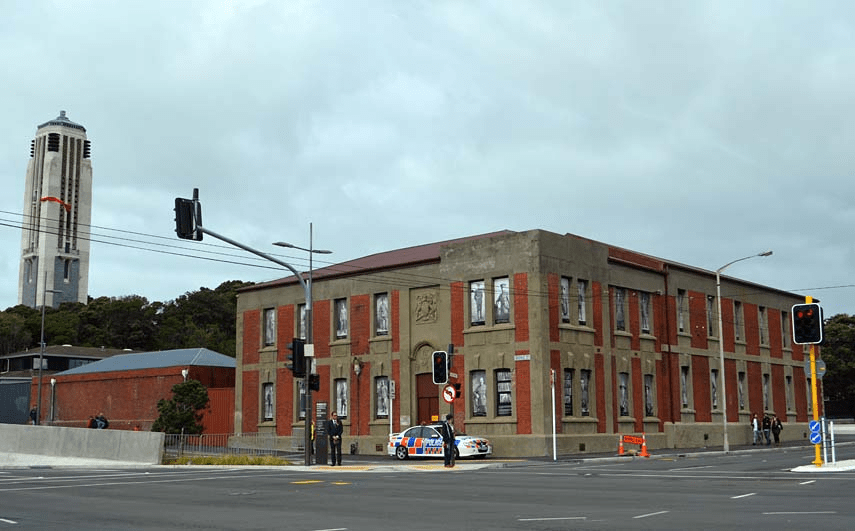
The relocation of the Wellington workshops to Trentham shows how financial constraint shaped consolidation. Development of the Mount Cook site for the national museum and civic complex required the Army to vacate buildings that included the Ordnance Workshops. A proposal for purpose-built workshops at Trentham was estimated at £10,000 (about NZ$1.33 million in 2026 dollars) and rejected. Instead, the existing buildings were moved and reconstructed under a ceiling of £1,000 (about NZ$133,000 in 2026 dollars) for materials. Workshop capacity was preserved by reusing old structures rather than providing the modern facilities originally proposed.[21]

Salvage and improvisation reduced the reported cash expenditure to £649 1s. 4d. (about NZ$86,000 in 2026 dollars). Workshop staff dismantled and reused buildings and second-hand materials, turning their hands to construction work for which most had not been trained. Major W. Ivory later stressed that the resulting buildings were an expedient rather than his preferred workshop design. The move preserved capability at very low immediate cost, but also embedded narrow buildings, salvaged foundations and other compromises in the inter-war system. The immediate saving therefore exchanged capital cost for continuing demands on labour, maintenance and adaptability.[22]

Professionalising the Technical Cadre

The 1927 Army Regulations defined the Corps as six occupational sections: clerks and ledger-keepers; armament artificers; armourers; tradesmen and specialists; storeholders and storemen; and ammunition details. Promotion in the clerical, stores and ammunition sections required examinations, while the technical sections also required trade tests.

Workshop practice mirrored these regulations. Standing orders issued in 1924 treated each workshop as a separately administered unit and required time-sheets, work cards, indents, pricing and personnel classification. Major Ivory’s 1926 report argued that trade ability was the first requirement: skilled fitters could learn armament work but using artificers as general handymen degraded their trades. Wellington then had ten artificers and the country eighteen, whose work included general engineering, battery equipment and approved modifications. A 1930 return counted only 28 workshop artificers and armourers nationwide, a specialist subset rather than the Corps’ total establishment.[23]

Ivory’s 1929 recommendations also exposed the vulnerability of that small cadre. One officer was carrying both inspection and mechanical-engineering duties across the country. Ivory urged the training of a scientifically inclined officer and proposed sending a capable New Zealand NCO to Woolwich for an Ordnance Mechanical Engineer course, preferring local knowledge to continued dependence on imported expertise. Technical education was therefore more than career development; it was succession planning for a service with little higher technical authority available in New Zealand. For a small technical service, training also created organisational depth that numbers alone could not provide.[24]

Corps Orders show that the system operated throughout the Dominion, not merely on paper. A corps-wide promotion examination was announced in May 1926. Detailed programmes for November 1928 and June 1930 prescribed separate papers for the technical armament, store, ammunition and clerical sections; arithmetic for all sections; and, at staff-sergeant level and above, accounting for stores and discipline. At Trentham eight NZAOC armourers attended a course from 4 to 22 February 1929; four subsequently passed the examination for armourers’ duties in a higher rank, with marks between 72 and 79 per cent. These arrangements turned experience into a regulated career structure and helped explain why artificers were later protected from general civilianisation.[25]

Professional identity developed alongside occupational specialisation. In 1920 the NZAOC entered formal alliances with the Royal Army Ordnance Corps and the ordnance corps of Australia, Canada and South Africa, and adopted the motto Sua Tela Tonanti – ‘To the thunderer his arms’. The connection offered a common professional model even as New Zealand maintained a very small establishment.[26]

Where the Corps Served

The personnel files identify a departure location in 241 usable cases. They confirm the dominance of the Wellington-Trentham complex, which accounted for 180 of those cases – almost 75 per cent. Burnham was the next largest concentration, while smaller groups maintained the northern depot, harbour defences, ammunition functions and regional stores.

Recorded location on leavingCases
Trentham103
Wellington77
Burnham18
Waikato Camp11
Auckland9
Christchurch6
Dunedin4
Devonport3
Fort Ballance3
Featherston3
Other recorded locations4
Source: individual military personnel files held by Archives New Zealand.[27]

Service length varied enormously. Among 372 cases with exact joining and leaving dates, the median recorded service was approximately two and a half years. One hundred and five served for less than a year, reflecting wartime expansion and rapid demobilisation, while thirteen recorded careers of fifteen years or more. The latter group formed part of the experienced core that carried technical and institutional knowledge into the inter-war Army.[28]

The Depression and the 1931 Reorganisation

The second great reduction came during the Depression. Section 39 of the Finance Act 1930 (No. 2) allowed the compulsory retirement of personnel who could be treated as if five years had been added to their age or service. Across the Defence Department, 76 officers and other ranks were retired on superannuation from 31 March 1931, while the services of another 67 people without entitlement to a superannuation allowance were terminated. The official reduction table attributed 44 reductions to the NZAOC – six officers and 38 other ranks – but that table combined superannuated, non-superannuated and earlier reductions. It should not be read as meaning that all 44 were compulsory superannuation retirements on the same date.[29]

The NZAOC reduction formed part of an Army-wide shock. Once compulsory military training was suspended, Territorial strength fell from about 17,000 to between 3,000 and 3,700, while the Regular Force was reduced to fewer than 600. Many Ordnance personnel were transferred to the civilian staff. The Corps’ fall from 120 personnel in 1930 to 21 in 1931 was therefore unusually severe, but it followed the same policy that replaced mass compulsory training with a much smaller permanent and voluntary structure.[30]

The individual files show one part of this process at a personal level. They identify the following outcomes:

Outcome identified in personnel filesCases
Transferred to the Civil Service49
Compulsorily retired26
Compulsorily released4
Retained in military service20
Returned to the Royal Army Ordnance Corps in Britain1
Total identified outcomes100
Source: individual military personnel files held by Archives New Zealand.[31]

The dates demonstrate that this was a planned administrative conversion. All 49 identified civil transfers took effect on 31 January 1931; the four compulsory releases were recorded on 11 February; and all 26 identified compulsory retirements occurred on 31 March. These are identified cases, not complete official totals, and must not be substituted for the Defence Department’s wider figures.

The official report stated that NZAOC personnel – except officers and artificers – and members of the New Zealand Army Pay Corps, ‘to a total of seventy-four’, were transferred to the civil staff. The number 74 was therefore a combined Ordnance and Pay Corps figure, not the total number of NZAOC soldiers. The 49 named ordnance transfers found in the personnel files represent an identifiable portion of that broader transfer.[32]

Leadership through Contraction

The reduction did not eliminate the Corps’ military command structure. The personnel files identify Lieutenant-Colonel Thomas Joseph King and Lieutenant Henry Ernest Erridge among the twenty NZAOC members retained, together with eighteen other ranks. King had been Chief Ordnance Officer since 1920 and Director of Ordnance Services since 1924. Erridge, who had served in several depot and staff appointments, continued as Ordnance Officer Southern Command. Their retention provided continuity at the head of a radically reduced Corps.[33]

The official strength for 1931 was two officers and nineteen other ranks, a total of 21. The personnel evidence provides a close reconciliation: King and Erridge account for the two NZAOC officers, while the eighteen retained other ranks, together with Staff Sergeant Roy Ronald Grieve of the Royal Army Ordnance Corps, who remained in New Zealand until returning to Britain on 29 June 1931, account for the nineteen other ranks present at the March reporting point. This also explains why the following year’s official strength fell to twenty.[34]

The officers list contains more names than the two officers carried on the NZAOC strength because a number of ordnance appointments were filled by officers seconded from the New Zealand Staff Corps, Royal New Zealand Artillery or New Zealand Permanent Staff. Appointment and establishment were not the same thing. Corps Orders make the distinction concrete: in 1929 Captain W. M. Bell transferred to the NZAOC as supernumerary to establishment; Captain W. R. Burge of the New Zealand Staff Corps and Lieutenant I. R. Withell of the Royal New Zealand Artillery were formally seconded to the NZAOC; and Lieutenant H. E. Erridge received an ordnance appointment. An officer could therefore perform ordnance duties, or even be posted within the Corps, without occupying one of the established NZAOC officer positions.[35]

Operational Demand Did Not Disappear

The timing of the reductions was stark. On 3 February 1931, while the reorganisation was being implemented, the Hawke’s Bay earthquake devastated Napier and Hastings. The Defence Department was required, at short notice, to provide tents, blankets, bedding, cooking equipment, and eating utensils. Stores valued at £35,000 (about NZ$4.93 million in 2026 dollars) were issued from Trentham, and the annual report specifically praised the Ordnance staff for dispatching them. The episode demonstrated that reduced peacetime numbers did not remove the requirement for immediate national support.[36]

Relief camp in Nelson Park, Napier, after the 1931 earthquake. Alexander Turnbull Library, Wellington, New Zealand. /records/23061357

Civilianisation as Institutional Preservation

Civilianisation changed employment status, but it did not necessarily remove people or knowledge from the ordnance system. Officers and artificers were expressly excepted from the general transfer, while many storemen and clerks continued the same work as civil employees. The resulting organisation was a hybrid: a very small military cadre directed a substantially civilian workforce that preserved stores expertise and the day-to-day operation of depots and workshops.

The employment consequences are described differently in the surviving accounts. The official report records a transfer to the civil staff, while the later Corps history characterises the process as dismissal followed by re-employment at cheaper civilian rates. Continued work in a depot did not mean that a man’s military status or conditions of employment remained unchanged. The reorganisation preserved much of the workforce and its expertise but shifted a substantial part of the cost and employment relationship onto a civilian basis; the precise effect on individual pay would require examination of the relevant employment records.[37]

Seen from a later perspective, inter-war civilianisation may be understood as a comparatively lower-risk form of retrenchment. It reduced the uniformed establishment and its immediate cost, but generally retained the people, workshops, stores and technical knowledge within the Defence Department. The change was principally one of employment status rather than the transfer of the function itself. This differed from aspects of the commercialisation pursued by the NZDF during the 1990s and early 2000s, when some support activities became dependent on external providers and contractual relationships. Civilianisation still reduced military depth and limited deployability and surge capacity, but it preserved a greater measure of institutional control and made subsequent expansion more readily reversible. The comparison suggests that economies achieved by retaining a function in civilian form carry a different risk from economies achieved by transferring that function beyond the organisation.

The later careers of David Llewellyn Lewis and David Nicol provide strong evidence of this continuity. Lewis had been an NZAOC soldier transferred to the Civil Service in 1931 and was commissioned into the Corps in 1934. Nicol was likewise commissioned from civilian ordnance employment and appointed in the Southern Command. Men placed outside the military establishment during retrenchment could therefore return to it as officers when the organisation began to expand.[38]

A local snapshot from Burnham shows the scale of this mixed workforce. When Nicol took over from Erridge in 1934, the depot had five soldiers and 26 civilians. Civilians therefore formed the clear majority of the workforce described at the depot. This is a 1934 local figure rather than a national return for 1931, but it demonstrates why logistic capacity is best understood across the whole support system, rather than through uniformed establishment alone.[39]

Recovery, 1934-1938

The official figures show how cautiously the Corps recovered. Strength remained at twenty in 1932 and 1933, increased to 26 in 1934, and reached 34 by 1937. Growth was modest, but it was accompanied by renewed attention to technical training, armourers, workshops and depot accommodation.[40]

The military strength return did not capture the whole support establishment. A separate 1937 establishment record listed 44 military personnel and 122 civilians. That March, the Director of Ordnance Services warned that substantial growth in mechanisation would probably render the Ordnance Workshop establishment inadequate. Establishment, actual strength and usable technical capacity were therefore related, but they were not interchangeable measures.[41]

The reports of the later 1930s make clear why this recovery mattered. The Corps remained responsible for the provision, receipt, storage, distribution, repair, examination and maintenance of weapons, vehicles, clothing, equipment and general stores; ammunition inspection and testing; and the control of ordnance workshops. In 1933 artificers completed the annual inspection of about 9,000 rifles, machine guns and other weapons in approximately two months. By 1935 older small-arms ammunition was showing serious deterioration, requiring careful testing before it could be issued, diverted to machine-gun use or broken up.[42]

Technical rebuilding followed. Four NZAOC armourer recruits and two Royal New Zealand Air Force recruits were trained in 1936-37, while a new instrument workshop at Trentham expanded repair capacity. Work nevertheless remained in arrears because staff were scarce, including the stripping, cleaning and preservation of Short Magazine Lee-Enfield rifles held since their arrival from Britain in 1920. By 1938 increasing equipment holdings and the wider distribution of mobilisation equipment required more armament personnel, armourers, clerks, storemen and tradesmen. Construction was planned or underway at Trentham, Ngāruawāhia, Burnham and Devonport.[43]

The personnel behind this technical recovery show how much depended on a few specialists. S. B. Wallace, an engineer commissioned into the NZAOC in December 1933, became the first Ordnance officer to hold the combined assistant inspection and mechanical-engineering appointments and later undertook extensive technical training in Britain. A. H. Andrews, also an engineer, was commissioned in 1935. Yet the geographic burden remained out of proportion to the cadre: in 1937 Burnham’s two armament artificers and one carpenter-wheelwright, supported by a small-arms section, were responsible for the field and coastal guns of the entire South Island. Recovery depended on technical leverage, not abundant manpower. Such technical reach gave the small organisation national effect, while making continuity dependent on the development and availability of very few specialists.[44]

Recovery should not be confused with adequacy. In 1935 the Army reported that financial limits had prevented it from building or maintaining sufficient reserves of equipment that could not be obtained in New Zealand and might take at least six months to arrive after war began. Two years later mobilisation storage at Trentham was still unsatisfactory. The evidence supports a qualified interpretation: the NZAOC preserved a framework for mobilisation and continued to modernise, but with serious shortages of people, stores, and suitable accommodation.[45]

The pattern is therefore not one of institutional disappearance followed by recreation. The Corps survived the Depression because its military cadre, specialist trades and civilianised workforce maintained the organisational skeleton and practical knowledge needed for renewed expansion.

Recovery did not amount to readiness. By September 1939, modest growth and limited mechanisation had not produced the capacity required to support a much larger wartime Army. Preserved experience and functioning depots gave expansion a starting point, but shortages of staff, suitable accommodation and modern equipment meant that converting the surviving organisation into an effective wartime support service would be difficult and slow.[46]

The wider Army picture points to the same distinction. New Zealand entered 1939 less ready for war than it had been in 1914, and the 1938 ‘Colonels’ Revolt’ publicly challenged official claims of combat efficiency. Yet late additional resources made despatching an expeditionary force a realistic capability. Technical workshops had preserved legacy guns that could be assembled on mobilisation, but recommendations to expand vehicle-repair capacity were not accepted. The ability to begin mobilisation was therefore not the same as the capacity to sustain a larger, increasingly mechanised army.[47]

Major-General P. J. Mackesy’s May 1939 report treated personnel, training, ammunition reserves, storage, transport, maintenance and mobilisation as parts of the same problem. His analysis reinforced the distinction between possessing modern equipment and sustaining it as an operational capability.[48]

Conclusion

The personnel files and official reports reveal two distinct post-war contractions. The first, from 1920 to 1922, dismantled the emergency wartime establishment and reduced the Corps from several hundred personnel to little more than one hundred. The second, in 1931, reduced an already compact organisation from 120 to 21 – a fall of 82.5 per cent in a single reporting year.

Yet the figure 21 should not be mistaken for the total human capacity available to ordnance. It was the remaining military establishment within a wider system that included civilian employees and seconded officers. King and Erridge preserved military leadership; artificers preserved specialist knowledge; transferred soldiers continued as civil employees; and men such as Lewis and Nicol later moved back into commissioned military appointments.

Seen in this way, the 1931 reductions transformed the NZAOC rather than extinguishing it. Civilianisation reduced the number of uniformed soldiers but preserved much of the Corps’ practical experience. That hybrid arrangement enabled the ordnance service to continue supporting the Army, respond to national emergencies and rebuild as the strategic situation deteriorated during the late 1930s. Continuity, however, was not adequacy. Expertise survived and mobilisation remained possible, but staff shortages, improvised accommodation and limited mechanisation left the technical support system much thinner than the scale of the impending war required. The surviving organisation provided a basis for rapid expansion, not a ready-made capacity to sustain a large modern force.

Notes

[1] Robert McKie, “Officers of the NZAOC 1917-1939,” To the Warriors Their Arms, January 18, 2019, https://rnzaoc.com/2019/01/18/nzaoc-officers-1917-1939/; “Regulations for the Military Forces of the Dominion of New Zealand,” New Zealand Gazette, no. 6 (January 23, 1914), 237, para. 62.

[2] Individual military personnel files relating to members of the New Zealand Army Ordnance Department and New Zealand Army Ordnance Corps, 1917-1931, Archives New Zealand, Wellington. No archival series or item references were supplied with the working data, so the collection is cited here at aggregate level.

[3] J. S. Bolton, A History of the Royal New Zealand Army Ordnance Corps (Trentham: Royal New Zealand Army Ordnance Corps, 1992), 80-85; Peter Cape, Craftsmen in Uniform: The Corps of Royal New Zealand Electrical and Mechanical Engineers: An Account (Wellington: Corps of Royal New Zealand Electrical and Mechanical Engineers, 1976), 16-34.

[4] Individual military personnel files, Archives New Zealand. The 365 cases represent 80.8 per cent of the 452 recorded entries for which a joining date could be established.

[5] Individual military personnel files, Archives New Zealand.

[6] Report dated October 22, 1918, quoted in Bolton, History of the Royal New Zealand Army Ordnance Corps, 80.

[7] Unless otherwise stated, modern equivalents are approximate June 2026 New Zealand dollars calculated from the Reserve Bank of New Zealand’s general consumer price index. The calculator treats pre-July 1967 amounts as pounds and uses £1 = NZ$2 at decimalisation. The calculator uses the quarter nearest the dated event; figures are rounded, and interpolated CPI values are required for some years before 1925. Reserve Bank of New Zealand, “Inflation Calculator,” last updated 21 July 2026, https://www.rbnz.govt.nz/monetary-policy/about-monetary-policy/inflation-calculator.

[8] New Zealand Defence Department, “Military: Annual Report of the General Officer Commanding the New Zealand Military Forces,” Appendices to the Journals of the House of Representatives (AJHR), 1920, H-19, 8.

[9] New Zealand Defence Department, “Military: Annual Report,” AJHR, 1921, H-19, 2-4; New Zealand Defence Department, “Military: Annual Report,” AJHR, 1922, H-19, 2.

[10] New Zealand Defence Department, “Military: Annual Report,” AJHR, 1922, H-19, 2.

[11] New Zealand Defence Department, “Military: Annual Report,” AJHR, 1921, H-19, 2-4; New Zealand Defence Department, “Military: Annual Report,” AJHR, 1922, H-19, 2; Robert McKie, “NZAOC July 1920 to June 1921,” To the Warriors Their Arms, August 29, 2017, https://rnzaoc.com/2017/08/29/nzaoc-july-1920-to-june-1921/; Robert McKie, “NZAOC July 1921 to June 1922,” To the Warriors Their Arms, August 29, 2017, https://rnzaoc.com/2017/08/29/nzaoc-july-1921-to-june-1922/.

[12] Bolton, History of the Royal New Zealand Army Ordnance Corps, 80-82.

[13] Bolton, History of the Royal New Zealand Army Ordnance Corps, 81-82; the report of November 7, 1921, is quoted on page 82.

[14] Bolton, History of the Royal New Zealand Army Ordnance Corps, 82-83.

[15] New Zealand Defence Department, annual reports, AJHR, H-19, 1920-1938, comparative strength tables and appendices; Robert McKie, “The 1931 Reductions of the New Zealand Military: A Historical Analysis,” To the Warriors Their Arms, July 13, 2024, https://rnzaoc.com/2024/07/13/the-1931-reductions-of-the-new-zealand-military-a-historical-analysis/. Bolton dates the same figures of 18 officers and 475 other ranks to 1918; this table retains the 1919 date of the official return used in the article. See Bolton, History of the Royal New Zealand Army Ordnance Corps, 80.

[16] New Zealand Defence Department, “Military: Annual Report,” AJHR, 1921, H-19, 2.

[17] G. J. Clayton, The New Zealand Army: A History from the 1840s to the 1990s ([Wellington]: New Zealand Army, 1990), 105-106.

[18] New Zealand Defence Department, annual reports, AJHR, H-19, 1921-1925, sections concerning Ordnance Services, mobilisation stores, buildings and depots.

[19] New Zealand Defence Department, annual reports, AJHR, H-19, 1921-1930, sections concerning command depots, buildings and magazines; Robert McKie, “NZAOC Between the Wars: 1918 to 1939,” To the Warriors Their Arms, August 31, 2017, https://rnzaoc.com/2017/08/31/nzaoc-between-the-wars/.

[20] New Zealand Army Ordnance Corps, Detachment Orders no. 48, November 14, 1930; and Detachment Orders no. 49, November 21, 1930, compiled primary-source collection supplied by the author.

[21] Bolton, History of the Royal New Zealand Army Ordnance Corps, 84.

[22] Peter Cape, Craftsmen in Uniform: The Corps of Royal New Zealand Electrical and Mechanical Engineers: An Account (Wellington: Corps of Royal New Zealand Electrical and Mechanical Engineers, 1976), 25-26.

[23] Peter Cape, Craftsmen in Uniform: The Corps of Royal New Zealand Electrical and Mechanical Engineers: An Account (Wellington: Corps of Royal New Zealand Electrical and Mechanical Engineers, 1976), 18-19, 27.

[24] Peter Cape, Craftsmen in Uniform: The Corps of Royal New Zealand Electrical and Mechanical Engineers: An Account (Wellington: Corps of Royal New Zealand Electrical and Mechanical Engineers, 1976), 20-21.

[25] “Regulations for the Military Forces of the Dominion of New Zealand,” New Zealand Gazette, May 19, 1927; New Zealand Army Ordnance Corps, Corps Orders no. 5, May 31, 1926; Corps Orders no. 10, November 1, 1928; Corps Orders no. 2, March 1, 1929; Corps Orders no. 3, pt. 2, April 1, 1929; and Corps Orders no. 3, May 1, 1930, compiled primary-source collection supplied by the author.

[26] New Zealand Defence Department, “Military: Annual Report,” AJHR, 1921, H-19; Robert McKie, “NZAOC July 1920 to June 1921,” To the Warriors Their Arms, August 29, 2017, https://rnzaoc.com/2017/08/29/nzaoc-july-1920-to-june-1921/.

[27] Individual military personnel files, Archives New Zealand.

[28] Individual military personnel files, Archives New Zealand. The service-length analysis is limited to the 372 recorded cases with usable exact joining and leaving dates.

[29] Finance Act 1930 (No. 2), sec. 39; New Zealand Defence Department, “Military: Annual Report,” AJHR, 1931, H-19, 2.

[30] G. J. Clayton, The New Zealand Army: A History from the 1840s to the 1990s ([Wellington]: New Zealand Army, 1990), 106; M. R. Wicksteed, The New Zealand Army: A History from the 1840s to the 1980s (Wellington: Ministry of Defence, 1982), 31. The two summaries give different endpoints for Territorial strength, 3,000 and 3,700 respectively.

[31] Individual military personnel files, Archives New Zealand. The categories reproduce the outcomes recorded in the files and do not constitute a complete official return.

[32] New Zealand Defence Department, “Military: Annual Report,” AJHR, 1931, H-19, 2.

[33] Individual military personnel files, Archives New Zealand; New Zealand Army Ordnance Corps, Corps Orders no. 12, October 31, 1924, compiled primary-source collection supplied by the author; McKie, “Officers of the NZAOC 1917-1939.”

[34] Personnel file of Staff Sergeant Roy Ronald Grieve, Archives New Zealand; New Zealand Army Ordnance Corps, Corps Orders no. 3, pt. 2, April 1, 1929, and Detachment Orders no. 48, November 14, 1930, compiled primary-source collection supplied by the author; New Zealand Defence Department, annual reports, AJHR, 1931 and 1932, H-19, permanent-force strength appendices. The reconciliation is an inference from the dates and the official strength categories.

[35] New Zealand Army Ordnance Corps, Corps Orders no. 3, April 1, 1929, and Corps Orders no. 6, July 1, 1929, compiled primary-source collection supplied by the author.

[36] New Zealand Defence Department, “Military: Annual Report,” AJHR, 1931, H-19, 2.

[37] Bolton, History of the Royal New Zealand Army Ordnance Corps, 84; New Zealand Defence Department, “Military: Annual Report,” AJHR, 1931, H-19, 2.

[38] McKie, “Officers of the NZAOC 1917-1939”; New Zealand Defence Department, “Military: Annual Report,” AJHR, 1934, H-19, 1.

[39] Bolton, History of the Royal New Zealand Army Ordnance Corps, 83.

[40] New Zealand Defence Department, annual reports, AJHR, H-19, 1932-1938, permanent-force strength appendices.

[41]          “Establishments – Ordnance corps,” Archives New Zealand No R22441743 (9 January 1937–1946).

[42] New Zealand Defence Department, annual reports, AJHR, H-19, 1933-1935, sections on Ordnance Services, small-arms inspection, ammunition, equipment and stores; Robert McKie, “NZAOC July 1933 to June 1934,” To the Warriors Their Arms, January 15, 2019, https://rnzaoc.com/2019/01/15/nzaoc-july-1933-to-june-1934/.

[43] New Zealand Defence Department, annual reports, AJHR, H-19, 1936-1938, sections on Ordnance personnel, arms, accommodation, stores and workshops; Robert McKie, “NZAOC June 1936 to May 1937,” To the Warriors Their Arms, August 30, 2017, https://rnzaoc.com/2017/08/30/nzaoc-june-1936-to-1937/; Robert McKie, “NZAOC June 1937 to May 1938,” To the Warriors Their Arms, August 30, 2017, https://rnzaoc.com/2017/08/30/nzaoc-june-1937-to-may-1938/.

[44] Peter Cape, Craftsmen in Uniform: The Corps of Royal New Zealand Electrical and Mechanical Engineers: An Account (Wellington: Corps of Royal New Zealand Electrical and Mechanical Engineers, 1976), 29, 31, 33.

[45] New Zealand Defence Department, “Military: Annual Report,” AJHR, 1935, H-19, sections on Ordnance Services, equipment and stores; New Zealand Defence Department, “Military: Annual Report,” AJHR, 1937, H-19, sections on Ordnance accommodation and workshops; Robert McKie, “Debunking the Myth of New Zealand’s Military Unpreparedness During the Interwar Period,” To the Warriors Their Arms, July 21, 2024, https://rnzaoc.com/2024/07/21/debunking-the-myth-of-new-zealands-military-unpreparedness-during-the-interwar-period/.

[46] Bolton, History of the Royal New Zealand Army Ordnance Corps, 80, 84-85.

[47] M. R. Wicksteed, The New Zealand Army: A History from the 1840s to the 1980s (Wellington: Ministry of Defence, 1982), 31; G. J. Clayton, The New Zealand Army: A History from the 1840s to the 1990s ([Wellington]: New Zealand Army, 1990), 110-111; Peter Cape, Craftsmen in Uniform: The Corps of Royal New Zealand Electrical and Mechanical Engineers: An Account (Wellington: Corps of Royal New Zealand Electrical and Mechanical Engineers, 1976), 31, 34.

[48]          “NZ Forces – Army -Report on the military forces of NZ by Major-General Mackesy (22 May 1939),” Archives New Zealand No R18871665 (1939).


An essential but largely anonymous service

A Collective Profile of NZEF Ordnance Personnel, 1914–1920

No disasters, no glory, just competence. The New Zealand Army Ordnance Corps of the New Zealand Expeditionary Force remained largely anonymous for a century, not because it was secret, but because it succeeded so thoroughly that history forgot to notice.

The New Zealand Army Ordnance Corps was one of the smallest but most important components of the New Zealand Expeditionary Force during the First World War. Its personnel supplied and maintained the weapons, ammunition, clothing and equipment upon which the NZEF depended. Their responsibilities extended beyond managing military stores to include workshops, battlefield salvage, clothing and boot repair, baths and laundries, depot administration and, eventually, the demobilisation of the NZEF.[1]

Despite the importance of this work, the NZAOC remained largely anonymous. It was a small organisation embedded within divisional and NZEF headquarters and, in most accounts, overshadowed by the much larger New Zealand Army Service Corps. An examination of the individual military personnel files of 75 men associated with the wartime NZAOC provides an opportunity to look beyond the organisation and consider the men who made it work.[2]

Collectively, their files show that the NZAOC was built largely from soldiers transferred from elsewhere in the NZEF. Forty-four had served at Gallipoli, many possessed valuable technical or commercial skills, and six died before completing their military service.

The origins of the NZEF Ordnance Service

New Zealand did not possess a uniformed Army Ordnance Corps when war was declared in August 1914. The formation of such a corps had been debated since the beginning of the century and limited ordnance training had been undertaken, but no permanent organisation existed. General Order 312 established Ordnance Services as part of the NZEF. Its initial establishment was remarkably small: a Deputy Assistant Director of Ordnance Services, one clerk and a horse.[3]

Honorary Captain William Thomas Beck of the New Zealand Staff Corps was appointed Deputy Assistant Director of Ordnance Services. Sergeant Norman Joseph Levien, a general storekeeper who had enlisted in the Auckland Infantry Regiment, became his clerk. Beck and Levien helped equip the Main Body before leaving New Zealand. After arriving in Egypt in December 1914, they began constructing an ordnance system based upon British procedures adapted to New Zealand requirements.[4]

NZAOC Captain W T Beck, Ordnance Depot Shrapnel Gully Gallipoli 1915

They established a shared depot with the New Zealand Army Service Corps at Zeitoun. Six additional soldiers were transferred to the depot on 28 December 1914. The organisation did not begin as a formed corps with its own recruiting system; it expanded by selecting suitable soldiers from infantry, mounted rifles, artillery and other NZEF units.[5]

Gallipoli and the expansion of the organisation

Preparations for the Dardanelles campaign required a larger ordnance system. Alexandria became the principal base, while the cargo ship SS Umsinga, loaded with ordnance stores, operated as a forward depot. Beck served as DADOS of the New Zealand and Australian Division and landed at Gallipoli on 25 April 1915. He established an ordnance depot at Anzac under almost continuous danger from Turkish artillery and rifle fire.[6]

Levien managed ordnance activities in Egypt, Alexandria and later Lemnos, while Lieutenant Thomas Joseph King commanded the depot at Zeitoun. King and Levien became the first officers commissioned specifically for New Zealand ordnance duties in April 1915.

Following the evacuation from Gallipoli, the NZEF was reorganised into the New Zealand Division, which moved to the Western Front, and the Mounted Rifles Brigade, which remained in the Middle East. Lieutenant-Colonel Alfred Henry Herbert, DSO, assumed control of the divisional ordnance organisation in January 1916. Additional officers, warrant officers and soldiers were transferred into what was becoming the NZAOC. The overseas establishment was formalised in NZEF orders during February 1916; the permanent New Zealand Army Ordnance Department and Corps at home followed in 1917.[7]

Lieutenant-Colonel Alfred Henry Herbert, NZAOC. aucklandmuseum/Public Domain

Who were the NZAOC men?

The collective analysis that follows is derived from the service details recorded in the 75 individual personnel files. It considers year of birth, civilian employment, original unit, enlistment, age, entry into and departure from the NZAOC, discharge from the NZEF, total service and Gallipoli experience. [8]

Age and year of birth

The men were born between 1866 and 1897. The oldest was William Thomas Beck, born in 1866, who was 48 when he enlisted. The youngest included Edwin Stanley Green and John William Hoffman, both of whom enlisted at 19. The average age on enlistment was approximately 27, and the median was 25.

Age on enlistmentNumber
19-2437
25-2918
30-347
35-399
40-484

Source: Author’s analysis of individual NZEF personnel files held by Archives New Zealand.

Fifty-five of the 75 men were under 30. Nevertheless, the presence of four men aged 40 or older demonstrates that technical experience, commercial knowledge and administrative ability could be as important to the ordnance service as youth and physical fitness. Beck was the clearest example: his pre-war service as Northern District Defence Storekeeper made him a logical choice to establish the NZEF’s first overseas ordnance organisation.

Civilian occupations

The NZAOC drew upon a broad range of civilian experience. Clerks formed the largest single occupational group, with 12 recorded as clerks and another four as bank clerks. The files also identify cashiers, commercial agents, a railway clerk and a mercantile clerk. Technical and trade occupations included:

  • five armourers and two gunsmiths;
  • four motor mechanics, one mechanic and one fitter;
  • three engineers and one linotype engineer;
  • three carpenters, two coachbuilders and one farrier.

At least 23 men had recognisably technical or trade-related backgrounds. Others had worked as farmers, labourers, soldiers, teachers, printers, seamen, warehousemen and commercial employees. The range reflects the breadth of the NZAOC’s duties. It needed men who could repair weapons, maintain accounts, supervise workshops, operate depots, manage inventories, examine demands and control the movement of equipment. Only seven had specifically been civilian armourers or gunsmiths; most acquired ordnance knowledge during military service.

Original NZEF units

Most did not enlist directly into an ordnance organisation. They were selected and transferred from units throughout the NZEF.

Original unit or formationNumber
Auckland Infantry Regiment8
New Zealand Field Artillery8
Permanent Forces7
Wellington Infantry Regiment7
New Zealand Rifle Brigade6
Canterbury Mounted Rifles6
Wellington Mounted Rifles6
Divisional Headquarters Staff5
Otago Infantry Regiment5
Auckland Mounted Rifles3
Otago Mounted Rifles3
Canterbury Infantry Regiment3
Samoa Relief Force2
Other units and formations6

Source: Author’s analysis of individual NZEF personnel files held by Archives New Zealand.

Fifty-one came from infantry or mounted-rifle units. Others had served with the artillery, Permanent Forces, Divisional Headquarters, Army Service Corps, Engineers, Specialist Company or Home Service Branch. The diversity of their origins demonstrates how the wartime NZAOC developed: not through a single stream of recruitment, but by drawing personnel from across the NZEF.

Enlistment in the NZEF

Forty-one men enlisted in 1914 and another 21 in 1915. Therefore, 62 of the 75 men, almost 83 per cent, had joined the NZEF by the end of 1915. Arthur Fred Varcoe recorded the earliest enlistment, on 1 August 1914. Charles Slattery was the latest, enlisting on 5 April 1918.

Enlistment yearNumber
191441
191521
19168
19173
19182

Source: Author’s analysis of individual NZEF personnel files held by Archives New Zealand.

The predominance of early enlistments helps explain the group’s considerable operational experience. Many had already served in Egypt, at Gallipoli or on the Western Front before being selected for ordnance employment.

Joining the NZAOC

The files record entry into the ordnance organisation between August 1914 and January 1920.

Year joined the NZAOCNumber
19143
191511
191637
19176
191815
19192
19201

Source: Author’s analysis of individual NZEF personnel files held by Archives New Zealand.

The concentration in 1916 is particularly significant. Thirty-seven men, almost half the group, entered the NZAOC during that year. This coincided with the post-Gallipoli reorganisation and the deployment of the New Zealand Division to France. A further 15 joined in 1918 as the organisation expanded to meet the demands of repair, salvage, administration and eventual demobilisation.

Armourers, repair and salvage

Armourer Sergeant was the most common final NZAOC rank, held by 22 men. Another two became Armourer Staff Sergeants. Armourers had initially been attached to infantry battalions, but experience demonstrated that concentrating them in a divisional workshop was more efficient. The centralised shop repaired small arms, machine guns, bicycles, primus stoves, steel helmets and other equipment, enabling serviceable items to be returned quickly to units.[9]

Armourer Sergeant, From 1914. Robert McKie Collection

The divisional ordnance staff also supervised battlefield salvage. Formed in May 1916, the Divisional Salvage Company cared for packs during offensive operations, managed tents and canvas, recovered government and enemy property, sorted salvaged material and dispatched it to base. Kenneth Bruce MacRae, one of the officers in the study, served as a New Zealand Divisional Salvage Officer.[10]

The scale of salvage could be substantial. During April 1918 the company recovered, among other items, an aircraft, four motorcycles, 285 enemy rifles, machine-gun equipment, steel helmets and gas respirators. Salvage reduced waste, returned valuable equipment to use and created credits against the Division’s expenditure.[11]

From December 1916 the Divisional Baths and Laundry also came under the DADOS. The intention was to provide every soldier with a bath and change of clothing approximately every ten days. Dirty uniforms were washed, inspected, repaired where necessary and returned to stock. These duties demonstrate the degree to which ordnance support affected the health, efficiency and fighting ability of the Division.[12]

Ranks and leadership

The final ranks included 22 Armourer Sergeants, 13 Sergeants, five Conductors, four Sub-Conductors, four Staff Sergeants, four Corporals, four Lieutenants, four Second Lieutenants, two Armourer Staff Sergeants, two Captains, two Majors and two Lieutenant-Colonels. Fifteen men held commissioned rank. Conductors and Sub-Conductors occupied especially important appointments, requiring technical knowledge, administrative competence and authority over valuable stores, workshops and personnel.

Several of the men were central to the organisation’s development. Beck established the original Ordnance Service. Levien managed depots in Egypt, Lemnos and Britain and developed a standardised stores-accounting system. Herbert commanded the divisional organisation during its expansion on the Western Front. Charles Ingram Gossage later became DADOS of the New Zealand Division, Herbert Edward Pilkington became the senior NZEF ordnance officer in 1918, and William Henchcliffe Simmons supervised the final stages of demobilisation.[13]

Levien’s work in Britain was particularly influential. He established the Sling Ordnance Depot and sub-depots at NZEF camps and hospitals, created an ordnance depot in London, improved purchasing and introduced a uniform system of stores accounting. That system was retained by the post-war NZAOC and reduced losses to comparatively negligible levels.[14]

Length of NZAOC service

The average period of NZAOC service was approximately two years and two months; the median was about one year and nine months. Service ranged from 15 days to five years. Temporary Sergeant Thomas Christopher Golins had the shortest recorded period, joining on 5 January 1920 and leaving on 20 January. Major Norman Joseph Levien recorded the longest period, serving exactly five years from 1 November 1914 until 1 November 1919.

Year left the NZAOCNumber
19154
19163
191712
19183
191936
192017

Source: Author’s analysis of individual NZEF personnel files held by Archives New Zealand.

More than 70 per cent remained associated with the NZAOC until 1919 or 1920. These late departures were not simply administrative delays. The Armistice ended the fighting, but it did not end the Corps’ work.

Occupation and demobilisation

Following the Armistice, the New Zealand Division advanced into Germany and undertook occupation duties at Cologne. The NZAOC closed or handed over stores in France and Belgium before establishing the arrangements needed to support the Division in Germany. Although the Division was disbanded in March 1919, ordnance personnel remained to return equipment to British depots and dispose of stores that could not be returned.[15]

New Zealand Ordnance Corps demobilisation Staff at Mulheim, Germany, February 1919. Alexander Turnbull Library/Public Domain

At the same time, the organisation in Britain changed from equipping the NZEF to dismantling it. Weapons, clothing, vehicles and equipment had to be accounted for, repaired, returned, transferred, sold or destroyed. The NZAOC also arranged the shipment of captured artillery, weapons and other war trophies to New Zealand. Under Temporary Captain William Henchcliffe Simmons, the final remnants of the NZEF NZAOC were demobilised in October 1920.[16]

Discharge and total NZEF service

Forty men were discharged during 1919 and another 18 during 1920. For 61 men, the date they left the NZAOC was also their discharge date from the NZEF. The remaining 14 continued serving elsewhere or had transferred before final discharge. Their later employment included transfers to the Royal Flying Corps and Royal Naval Volunteer Reserve, attachment to the British Army Ordnance Department and service in other NZEF appointments.

The average total period of NZEF service was approximately three years and eleven months, while the median was just over four years and two months. William Henchcliffe Simmons recorded the longest service within this group, six years and 66 days, ending on 13 October 1920. Arthur Fred Varcoe had the shortest total service: 275 days ending with his death at Gallipoli.

Gallipoli service

Forty-four of the men served at Gallipoli, representing nearly three-fifths of the group. Gallipoli veterans were found throughout the NZAOC, from armourers and storemen to Conductors and senior officers. Their experience was more than a biographical distinction: they understood the consequences of damaged weapons, difficult supply routes, ammunition shortages and supporting troops from improvised coastal depots. When Herbert assumed control in early 1916, this operational knowledge formed a significant part of the foundation upon which the expanded NZAOC was built.

Honours and awards

At least 14 men possessed recorded decorations, awards or mentions. These included two Distinguished Service Orders, two appointments as Officers of the Order of the British Empire, one Military Medal, six Meritorious Service Medals and five Mentions in Despatches. Some men received more than one distinction. Charles Ingram Gossage was appointed OBE and mentioned in despatches; Clarence Adrian Seay received the MSM and was also mentioned in despatches. Levien received both the MBE and OBE for his work in developing the NZEF’s ordnance administration.[17]

Men who died while serving

Six men died before completing their military service. In every case, the recorded date of leaving the NZAOC or being discharged from the NZEF corresponds with the date of death. Their deaths encompassed combat, disease and accidental or self-inflicted wounds.

Service no.NameRankDateCircumstances and commemoration
8/499Arthur Fred VarcoeArmourer Sergeant3 May 1915Killed in action at Gallipoli; commemorated on the Lone Pine Memorial.
23/1318John William AlldayArmourer Sergeant9 Jan 1917Died from a self-inflicted gunshot wound; buried in Tidworth Military Cemetery, England.
23/1457Percy Clarence O’HaraSergeant11 Apr 1917Died of broncho-pneumonia; buried in Bailleul Communal Cemetery Extension, France.
11/1612Alexander Charles WisnofskiSergeant6 Nov 1918Contemporary notice recorded accidental wounds; buried in Ramleh War Cemetery, Palestine.
6/3459Clarence Adrian SeayConductor20 Feb 1919Died of influenza during the occupation; buried in Cologne Southern Cemetery, Germany.
66613Charles SlatteryConductor25 Feb 1919Died of influenza during the occupation; buried in Cologne Southern Cemetery, Germany.

Sources: Individual personnel files; Commonwealth War Graves Commission; New Zealand War Graves; contemporary notices and the references cited in the footnotes.

Varcoe was killed while serving with the Otago Infantry Regiment and is commemorated under that unit. Allday is likewise commemorated by the Commonwealth War Graves Commission under the New Zealand Rifle Brigade, although his personal file records his subsequent ordnance service.

The deaths of Seay and Slattery are particularly notable. Both survived the fighting but died of influenza in Germany only five days apart. Their deaths demonstrate that active service continued to carry serious risks after the Armistice.

The men behind the organisation

The personnel files reveal the range of experience upon which the wartime NZAOC depended. Its ranks included combat veterans, armourers, engineers, clerks, mechanics, accountants, salvage officers, ammunition specialists and senior staff officers. Infantrymen and mounted riflemen contributed operational knowledge; skilled tradesmen provided technical expertise; and men from commercial and administrative backgrounds brought the organisational ability required to manage an increasingly complex supply system.

These men served across every major part of the New Zealand war effort—from the depots at Zeitoun and Alexandria and the exposed stores at Anzac to the workshops of the Western Front, the training camps in Britain and, after the Armistice, the occupation stores at Cologne. Their varied skills enabled the NZAOC to adapt continually as the scale and demands of the war increased.

Conclusion

The NZEF Ordnance Service began the war with an establishment of an officer, a clerk and a horse. By 1916 it had developed into a modest but effective organisation supporting the New Zealand Division, the Mounted Rifles and the wider NZEF. Its responsibilities eventually extended from weapons, ammunition, clothing and equipment to workshops, salvage, baths, laundries, depot administration and demobilisation.

The personal histories of the 75 men explain how they achieved that expansion. Most were drawn from elsewhere in the NZEF, 44 had served at Gallipoli, and many brought valuable civilian trades or commercial experience. Their average NZEF service approached four years, and more than 70 per cent remained associated with the NZAOC until 1919 or 1920.

Six died before they could complete their service. Others remained in Germany or Britain long after the fighting had ceased, disposing of stores and dismantling the logistical organisation that had sustained the NZEF. The success of the wartime NZAOC did not rest upon its size. It rested upon the experience, adaptability and professionalism of the men who served within it.

Notes

[1] Major J.S Bolton, A History of the Royal New Zealand Army Ordnance Corps (Trentham: RNZAOC, 1992), 52-53.

[2] Unless otherwise stated, the quantitative findings in this article are the author’s analysis of the individual military personnel files of the 75 men concerned, held by Archives New Zealand.

[3] “Troopships; Embarkation Orders; Daily Field States; and a large chart of ‘New Zealand Expeditionary Forces – Personnel’ as at 1 June 1915),” Archives New Zealand Item ID R23486740 (Wellington) 1914; Bolton, A History of the Royal New Zealand Army Ordnance Corps, 52-53.

[4] “Levien, Norman Joseph,” Personal File, Archives New Zealand Record R24169998 & R10919227 (Wellington) 1914; “Beck, William Thomas,” Personal File, Archives New Zealand (Wellington) 1914, http://ndhadeliver.natlib.govt.nz/delivery/DeliveryManagerServlet?dps_pid=IE24368600.

[5]  Divisional Order 210 of 28 December 1914 transferred six soldiers to the Ordnance Depot.  “Appendices to War Diaries, I – LXII,” Archives New Zealand Item ID R23486739 (Wellington) 1914, http://ndhadeliver.natlib.govt.nz/delivery/DeliveryManagerServlet?dps_pid=IE28730233.

[6] Christopher Pugsley, Gallipoli: The New Zealand Story (Auckland [N.Z.] : Sceptre, 1990, 1990), 111; “Brave New Zealanders,” The Hawera and Normanby Star, Volume LXXI, Issue LXXI, (Hawera), 24 June 1916, https://paperspast.natlib.govt.nz/newspapers/HNS19160624.2.26.

[7] “New Zealand Expeditionary Force – Army Ordnance Corps Daily Order No. 1 “, Archives New Zealand Item No R25958433  (1916); Ian McGibbon, New Zealand’s Western Front Campaign (Bateman, 2016), .

[8] The service-file analysis records year of birth, civilian occupation, original NZEF unit, enlistment date and age, dates of entry into and departure from the NZAOC, NZAOC service, NZEF discharge, total NZEF service and Gallipoli service. Unresolved Gallipoli marks were treated as affirmative where the associated service evidence supported that interpretation.

[9] Arthur Forbes, A history of the Army Ordnance Services (London: The Medici society, ltd., 1929); Philip Hamlyn Williams, Ordnance: Equipping the British Army for the Great War (History Press, 2018).

[10] Headquarters New Zealand and Australian Division, “New Zealand Division – Administration – War Diary, 1 May – 26 May 1916,” Archives New Zealand Item No R23487546  (1916), http://ndhadeliver.natlib.govt.nz/delivery/DeliveryManagerServlet?dps_pid=IE36206656.

[11] “Deputy Assistant Director of Ordnance Services (DADOS) – War Diary, 1 April – 30 April 1918,” Archives New Zealand Item No R23487665  (1918).

[12] “An account of the working of the Baths established in the Divisional areas in France,” Archives New Zealand Item No R24428508  (1918); “Gossage, Charles Ingram,” Personal File, Archives New Zealand (Wellington) 1914; Glyn Harper, Johnny Enzed: the New Zealand soldier in the First World War 1914-1918 (Exisle Publishing Limited, 2015), 315-54.

[13] “Pilkington,Herbert Edward “, Personal File, Archives New Zealand (Wellington) 1914; “Pilkington, Herbert Edward,” Personal File, Archives New Zealand 1896 – 1930, http://ndhadeliver.natlib.govt.nz/delivery/DeliveryManagerServlet?dps_pid=IE20557145.;”Levien, Norman Joseph.”; “Beck, William Thomas.”;”Simmons, William Henchcliffe “, Personal File, Archives New Zealand (Wellington) 1914.

[14] Equipment and ordnance depot, Farringdon Road, London – Administration reports etc., 18 October 1916 – 8 August 1918 Archives New Zealand Item ID R25102951, (1918).;”H-19 Defence Forces of New Zealand, Annual report of the General Officer Commanding the Forces from 1 July 1922 to 30 June 1923,” Appendix to the Journals of the House of Representatives  (1923), https://paperspast.natlib.govt.nz/parliamentary/AJHR1923-I-II.2.2.5.21; “Levien, Norman Joseph.”

[15] “Gossage, Charles Ingram.”; McGibbon, New Zealand’s Western Front Campaign.

[16] “Trophies and historical material – [War] Trophies – New Zealand Expeditionary Force [NZEF] – Shipment of to New Zealand, 21 September 1917 – 24 November 1919,” Archives New Zealand Item No R25103019  (1919); “Simmons, William Henchcliffe “.

[17] Wayne McDonald, Honours and awards to the New Zealand Expeditionary Force in the Great War 1914-1918, 3rd edition ed. (Richard Stowers, 2013), Directories, Non-fiction, 146. h. relevant individual personnel files, Archives New Zealand.


Honi Soit Qui Mal Y Pense

A poem written by Dave Morris approximately twenty years ago

Dave Morris served in the Royal New Zealand Army Ordnance Corps from 6 May 1963 until 29 July 1985. He has also been a longstanding supporter of this website since its inception, generously sharing his knowledge, recollections and contributions to help preserve the history and traditions of the RNZAOC.

King Edward the Third, he uttered this phrase,
Back in the day when chivalry’s the craze.
Adding, one day you will wear it proud,
I will make it official: Wear it endowed.

‘Evil to him thinks evil who of it’,
Wear it with camos, Number Ones or mess-kit.
Wear it with pride so others see envy,
Remember your Corps and course, spirit esprit.

Remember it’s French and is not Latin,
And lead by example—you carry the baton.
Stand tall; stand proud and show good bearing,
‘Honi soit qui mal y pense’ is what you’re wearing.

The story behind the words

Dave Morris’s poem reflects upon the words Honi soit qui mal y pense and their place within military tradition. Although written in a light-hearted style, its references draw upon a history extending back to medieval England and the foundation of the Order of the Garter.

The phrase is Anglo-Norman French rather than Latin. It is generally translated as:

“Shame on anyone who thinks ill of it.”

Alternative translations include “Shame be to him who thinks evil of it” and the more literal, although awkwardly expressed, “Evil to him who thinks evil of it.” The first probably conveys the intended meaning most clearly to a modern reader.

Edward III and the Order of the Garter

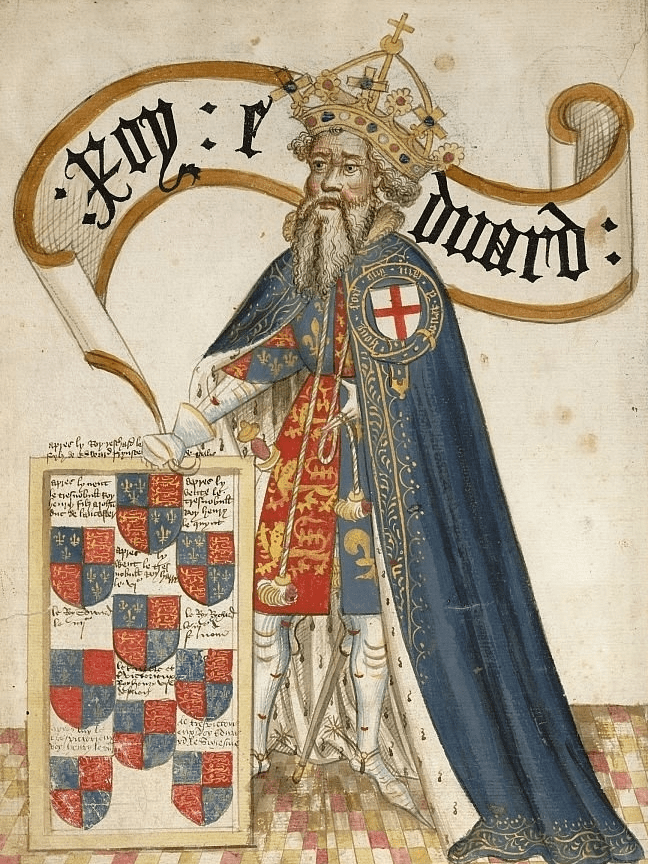
The motto is associated with King Edward III, who founded the Most Noble Order of the Garter in about 1348.

Edward III in the Garter Book, portrait of King Edward III of England (founder of the Order of the Garter) in the Garter Book, an illuminated manuscript likely commissioned by William Bruges to commemorate restoration of the armorial decoration in St George’s Chapel at Windsor Castle. Image courtesy of the British Library, London.

According to tradition, a lady lost her garter during a court function. When those present laughed, the King retrieved it and placed it around his own leg, declaring:

Honi soit qui mal y pense.

He is also said to have warned that those laughing would one day consider it an honour to wear the garter. This tradition is reflected in the poem:

Adding, one day you will wear it proud,
I will make it official: Wear it endowed.

The story captures the chivalric sentiment associated with the motto, but it should not be treated as established historical fact. The surviving accounts were written well after Edward III’s reign, and historians generally regard the dropped-garter incident as a later legend.

An alternative explanation is that the motto referred to Edward III’s claim to the French throne and condemned anyone who thought badly of, or questioned, his intentions.

Whatever its precise origin, the phrase became the enduring motto of the Order of the Garter, Britain’s oldest and most senior order of chivalry.

From the Garter to military badges

The Garter and its motto became familiar elements of British royal and military heraldry. When incorporated into a badge, the garter normally forms a circle around its central device. Its presence signifies a royal association; it does not necessarily represent the individual motto of the corps or regiment wearing the badge.

This distinction is particularly important when considering the badge of the Royal New Zealand Army Ordnance Corps.

After the New Zealand Army Ordnance Corps was granted the title “Royal” on 12 July 1947, its new badge incorporated a crown and the Royal Garter. The words Honi soit qui mal y pense appeared around the garter, surrounding the traditional shield of the Board of Ordnance.

Beneath it was a separate riband bearing the Corps motto:

Sua Tela Tonanti — “To the Warrior His Arms.”

Therefore, Honi soit qui mal y pense appeared prominently on the RNZAOC badge, but it was not the distinctive motto of the Corps. That distinction belonged to Sua Tela Tonanti. The former represented the Order of the Garter and the Corps’ royal status; the latter expressed the purpose and identity of Ordnance.

The same heraldic convention appeared in the badges of several other British and Commonwealth corps and regiments. This is why the words may be encountered on military insignia without being the organisation’s principal motto.

Wearing the tradition

Dave’s references to wearing the words with camouflage uniform, Number Ones and mess dress reflect the different occasions on which soldiers displayed their Corps insignia:

Wear it with camos, Number Ones or mess-kit.
Wear it with pride so others see envy.

For the wearer, the badge was more than an item of dress. It represented membership of the Corps, successful completion of training, pride in one’s trade and an obligation to uphold the standards inherited from those who had worn it before.

The poem’s reference to carrying the baton captures this continuity. Each generation temporarily holds the Corps’ traditions in trust before passing them to the next. Wearing the badge therefore carried an expectation of good bearing, professional competence and leadership by example.

Two mottos, one badge

InscriptionLanguageMeaningSignificance
Honi soit qui mal y penseAnglo-Norman French“Shame on anyone who thinks ill of it”Motto of the Order of the Garter, representing royal association
Sua Tela TonantiLatinTraditionally, “To the Warrior His Arms”Distinctive motto of the RNZAOC

Understanding this distinction does not diminish Dave Morris’s poem. Instead, it provides the historical context through which its meaning can be more fully appreciated. The poem is about the words worn around the badge, but its deeper message concerns pride, bearing, professional identity and the responsibility of carrying Corps traditions forward.

As Dave concludes:

Stand tall; stand proud and show good bearing,
Honi soit qui mal y pense is what you’re wearing.

Further information can be found in New Zealand Army Ordnance Corps Badges, 1916–1996 and Sua Tela Tonanti: The Story Behind the RNZAOC Motto.


The Invisible Sergeant

Why Military History Forgets the Men Who Keep Armies Running.

Military history has a well-established bias. We remember generals, battles and strategic triumphs. We write biographies of commanders, chronicle decisive moments and construct narratives around the famous and powerful. Somewhere within that emphasis, however, the people who kept armies functioning have often been rendered nearly invisible: the ordnance sergeants, transport specialists, storemen, tradesmen and support personnel whose largely unseen work sustained every operation.

When Sergeant Sidney Stewart ‘Sid’ Bourne passed away in 2026, his death did not prompt a lengthy published obituary or formal account of his service. Instead, news of his passing spread through the informal spaces where New Zealand veterans gather: Facebook groups associated with the Royal New Zealand Army Ordnance Corps, the Royal New Zealand Electrical and Mechanical Engineers, the Royal New Zealand Army Service Corps. Royal New Zeland Corps of Transport and infantry.

Sergeant Sidney Stewart Bourne, Long Service and Good Conduct Medal Presentation. Steve Hollett Collection

Former soldiers who had served alongside Sid, or under his supervision, shared their memories. What emerged was far richer than a formal notice of death. Collectively, their recollections created a portrait of a dependable soldier, a generous mentor and, as one colleague described him, ‘one of the great characters of his generation’.

Sid’s life was not marked by strategic command or battlefield heroics. It was defined instead by 27 years of Regular Force service in logistics, followed by more than eight years as a New Zealand Defence Force civilian. In total, he spent more than 35 years helping to keep the New Zealand Army equipped and functioning.

Official records preserved his enlistment, postings, promotions and dates of service. They could not preserve his familiar chuckle, his Muppet performances after formal dinners, the young soldiers he took under his wing or the professional trust placed in him when controlled weapons stores required a safe pair of hands.

Those details survived only because the people who knew Sid remembered them.

His story therefore reveals something important about how military organisations function and how military service is remembered. It also highlights a persistent weakness in military history: the tendency to treat logistics and support as the backdrop to the story rather than part of the story itself.

A Career Behind the Front Line

Walk into a New Zealand bookshop with a military history section and the broad pattern is unmistakable. The shelves contain biographies of Bernard Freyberg, studies of Gallipoli and Crete, and analyses of the campaigns in North Africa, Italy and the Pacific. Historians have devoted considerable effort to understanding the decisions of senior commanders and the major operations that defined New Zealand’s military contribution.

Far fewer histories have examined, with the same depth, how the New Zealand Army kept itself equipped, supplied, transported and maintained across decades of organisational change. Ordnance depots, transport platoons, workshops and supply chains appear in campaign histories, but usually only when they fail, constrain an operation or become relevant to a commander’s decision.

Sid’s career was spent within this less visible part of the Army.

He enlisted in the New Zealand Army on 23 October 1962, beginning his service at Papakura as a Private and Storeman Clerk in the Royal New Zealand Army Ordnance Corps. He was promoted to Lance Corporal on 6 July 1969, Corporal on 6 July 1970 and Sergeant on 3 October 1974.

Lance Corporal Sidney Stewart ‘Sid’ Bourne, Terendak 1969. Steve Hollett Collection

Across his career, he served at many of the Army’s principal logistics establishments and units, including Papakura, Trentham, Waiouru and Linton, as well as in Malaysia and Singapore. His postings included 1 Field Workshop, 1 RNZIR, 1 Base Ordnance Depot and 1 Composite Ordnance Company.

These organisations generated official records, but they have seldom attracted the sustained historical attention given to combat formations and commanders. Their work was routine by design. Stores were received, accounted for, inspected, maintained and issued. Weapons were controlled. Demands were processed. Units received what they needed. When the system worked, little drama resulted. That is precisely why its people are so easily overlooked.

Promotion records show Sid’s progression through the ranks, but they cannot explain why his superiors trusted him, why younger soldiers remembered his guidance decades later or why his name remained familiar across several Corps and regimental communities. Those qualities appear only in the memories of the people with whom he served.

The Sergeant as Mentor

One important period in Sid’s early career was his service with 1st Battalion, Royal New Zealand Infantry Regiment, at Terendak Barracks in Malaysia during 1968–69. Serving as a Transport Platoon storeman, he became part of a battalion community far removed from the formal boundaries suggested by Corps badges and trade classifications. Those who remembered Sid from this period described him as a solid member of the battalion and a man whose sense of humour was never far from the surface.

Lance Corporal Sidney Stewart ‘Sid’ Bourne (Centre Soldier), Terendak 1969. Steve Hollett Collection

His influence became particularly apparent at Trentham after a group of young soldiers arrived at 1 Base Ordnance Depot in August 1973. Newly graduated from their initial training, they were posted into the Army’s ordnance system and placed under the supervision of more experienced soldiers.

Sid was serving in Motor Transport Spares and, as one former soldier recalled, was ‘in charge of we minions’. He was also the barrack commander of the infamous Block 186, where the young soldiers lived.

His responsibilities included supervision, discipline and the enforcement of standards. Yet those who served under him remembered that his support extended well beyond working hours. Sid took the young soldiers to the movies in his ‘mighty Vauxhall Cresta’ and generally took them under his wing.

These recollections reveal an aspect of military leadership that is difficult to capture through establishment tables, doctrine manuals or posting records. Sid was not merely administering accommodation or supervising junior staff. He was helping young soldiers adjust to Army life, understand the expectations of their Corps and develop the habits that would shape their future careers.

One of those soldiers later recalled: ‘Every position Sid held in the Corps, Sid committed and applied himself to the fullest extent.’

Sid’s influence endured long after those young soldiers had moved to other units, gained promotion and assumed leadership responsibilities of their own. Through his example, his standards and his personal interest in their welfare, he contributed to the development of the next generation of Army logisticians.

This is where much of an Army’s cohesion actually resides: in the relationships built between experienced non-commissioned officers and the soldiers entrusted to their care.

Formal training can teach procedures, duties and technical knowledge. It cannot fully replicate the daily example of a competent Sergeant who knows when to enforce discipline, when to offer advice and when to take a group of young soldiers to the pictures.

Professional Trust

Sid’s reputation as a colourful character should not obscure his professional ability.

Beneath the humour and easy-going manner was an experienced ordnance soldier with particular competence in controlled stores, especially weapons. One colleague recalled that Sid was particularly capable in this demanding area and was later brought back to manage weapons because of his discipline and reliability.

The accurate receipt, storage, accounting and issue of weapons carried substantial institutional responsibility. Commanders required confidence that every weapon could be accounted for, that discrepancies would be identified and that the standards governing security and control would be applied without compromise. This was not glamorous work, but it was consequential.

A weapon store could not operate on personality alone. It required technical knowledge, methodical administration, integrity and attention to detail. Sid’s recall to this work demonstrated the degree of professional trust placed in him.

Lance Corporal Sidney Stewart ‘Sid’ Bourne, Kuala Terengganu. Steve Hollett Collection

Military histories frequently compress such duties into broad terms such as ‘logistics’, ‘supply’ or ‘ordnance’. In doing so, they can obscure the actual work involved: the judgement exercised, the standards maintained and the responsibility carried by the individuals performing it.

Sid’s contribution lay not in combat, but in the sustained professional work that made military readiness possible. Weapons had to be correctly identified, secured and accounted for. Units had to receive the stores they required. Records had to be accurate. Errors could have operational, disciplinary or security consequences.

The Character of the Corps

Sid was widely remembered as one of the best-known characters within the Royal New Zealand Army Ordnance Corps. Former colleagues consistently mentioned his distinctive chuckle, his jokes and the antics that made him entertaining company.

At formal dinners he became something of a legend. Steve Driver recalled: ‘RIP Sid. A well-known character within the Corps. Always looked forward to his Muppet re-enactment after a formal dinner.’

The performance became part of Corps folklore, remaining vivid in the memories of those who witnessed it decades earlier.

Sid’s contribution to Sergeants’ Mess life extended beyond his performances. At Trentham he also became the unofficial ‘Guardian of the Goldfish’, accepting responsibility for the aquarium in the old Sergeants’ Mess. The position was informal and comical, yet it became almost as memorable as some of his official duties. These details may appear trivial when compared with campaigns, deployments or organisational reforms. They nevertheless reveal something essential about military life.

Sid Bourne, then a corporal and on duty as Orderly Corporal, casting a doubtful eye on proceedings, 1 Inf Wksps Stores Section, Annual Camp Waiouru Airfield

An Army is not sustained by regulations and equipment alone. It is also sustained by humour, friendship, shared rituals and the personalities that give units and Corps their identity. Formal dinners, mess traditions, practical jokes and familiar characters help create the sense of belonging that binds soldiers together.

Sid appears to have understood the boundary between humour and responsibility. One tribute described him as possessing ‘a great sense of humour and annoying all wrapped in one’, while adding that when it came to work, ‘it was work’. That distinction mattered. Sid could be entertaining without being unreliable. His humour did not undermine his professionalism; it made the routines of Army life more human.

The social bonds he helped create were part of how support soldiers maintained morale and cohesion while performing work that was necessary, repetitive and seldom celebrated.

What Official Records Cannot Capture

Sid’s story is remarkable not because official records failed to record him altogether, but because those records could preserve only the administrative outline of his life. They documented when he enlisted, where he served, the trades he held, the ranks he attained and when his Regular Force service ended. They could not record why soldiers remembered him with affection, how he treated his subordinates or how his personality influenced the units in which he served.

Those elements survived in informal digital spaces. The posts that followed had no central coordination and no official remembrance process behind them. They were personal tributes written by people who felt compelled to record what they remembered before those memories disappeared.

Together they preserved the Sergeant who supervised Block 186, the owner of the Vauxhall Cresta, the controlled-stores specialist, the Muppet performer, the Guardian of the Goldfish and the friend whose familiar laugh remained recognisable decades later.

Lance Corporal Sidney Stewart ‘Sid’ Bourne, Terendak 1969. Steve Hollett Collection

This raises a wider question. How many other Sergeants, Corporals and Privates shaped military institutions through their expertise, mentorship and professionalism but left little evidence beyond a service file? How many taught younger soldiers, upheld standards, solved practical problems and gave character to their units without ever appearing in a published history?

Sid’s story survives because his former comrades cared enough to remember him publicly. Many others may not have been so fortunate.

The increasing use of social media by veterans has created an informal repository of military memory. Such sources must be approached carefully. Recollections can be incomplete, selective or affected by the passage of time. Nevertheless, they preserve forms of evidence that official correspondence, establishment tables and personnel records rarely provide. They show what individuals meant to the people around them.

Lance Corporal Sidney Stewart ‘Sid’ Bourne, Terendak 1969. Steve Hollett Collection

More Than 35 Years of Service

Sid’s Regular Force service ended on 30 March 1990 after more than 27 years in uniform. He then continued serving as a New Zealand Defence Force civilian until July 1998. His combined military and civilian career spanned more than 35 years.

During that time the Army and its logistics organisations underwent repeated change. Sid served through alterations in structure, trade responsibilities, unit designations and methods of support. He worked at major Army establishments and served both in New Zealand and overseas.

Through all of this, the fundamental requirement remained unchanged: soldiers and units needed weapons, equipment and stores, and somebody had to ensure that they were properly managed. Sid was one of those people.

His career illustrates that military organisations depend upon continuity as much as change. Headquarters may be reorganised, units renamed and policies rewritten, but institutions continue to function because experienced people retain practical knowledge of how the system actually works.

That knowledge is often held by senior non-commissioned officers and long-serving civilians. It exists partly in regulations and standing orders, but also in professional memory, personal networks and the ability to recognise problems before they become failures.

The support system was not merely an auxiliary component of the Army. It was part of the Army’s operating substance. Units could train and deploy because logisticians managed the countless practical requirements upon which readiness depended.

Sid’s service represented one small but essential part of that system.

Remembering the Man

When Sid’s colleagues reflected on his life, they did not speak primarily about policy, organisational design or military theory. They remembered the man himself. He was described as a ‘top bloke’, a ‘great soldier’ and a ‘colourful guy’. Others remembered someone who always had kind words for people, who never hesitated to help his fellow soldiers and who served his country with quiet grace.

Lance Corporal Sidney Stewart ‘Sid’ Bourne, Terendak 1969. Steve Hollett Collection

One colleague recalled his practical talents and described him as a ‘wallpaperer extraordinaire’. Another remembered the balance of humour and professionalism that defined him.

One of the young soldiers from Block 186, looking back across more than five decades, offered a particularly personal farewell: ‘Thanks for your friendship and guidance, Squidly Didley. Rest in peace, old friend.’

That simple tribute captures something military history often struggles to convey: the meaning of service as experienced by those who lived it.

Sid mattered because he was reliable. He mattered because he looked after younger soldiers. He mattered because his commanders trusted him with demanding responsibilities. He mattered because he brought humour and humanity to work that rarely attracted public attention.

Sergeant Sidney Stewart Bourne, NZAOD, Singapore 1989. Steve Hollett Collection

His influence did not depend upon high rank, strategic command or battlefield recognition. It lay in the people he supported, the standards he upheld and the communities of which he became part.

Making the Invisible Visible

Sid Bourne’s memorial poses a challenge to military historians. What would military history look like if support roles were treated as central subjects rather than background functions? What might be learned from studying ordnance depots, transport units, workshops and supply organisations with the same seriousness applied to regiments and campaigns? How might our understanding change if the professional development of non-commissioned officers received attention comparable to officer education and senior command?

Such an approach would reveal military institutions not simply as hierarchies directed from above, but as networks of people, knowledge, relationships and practical systems. It would show that military effectiveness depends upon competent and reliable soldiers who know their trade, uphold standards and care for the people around them. It would also recognise that culture, cohesion and institutional memory are frequently created in informal spaces: barrack blocks, stores, workshops, vehicle parks and Sergeants’ Messes.

The unseen effort that keeps armies equipped and functioning is not incidental to military history. It is military history.

Over more than 35 years, Sergeant Sidney Stewart Bourne served in roles that conventional historical narratives might easily overlook. He was one of thousands of ordnance, transport, engineering and logistics personnel whose work allowed the Army to function.

His story reminds us that the everyday life of a military institution is shaped not only by generals and operations, but by the people who maintain its standards, preserve its knowledge and support its soldiers. Sid’s former comrades made the invisible Sergeant visible.

Their recollections preserved a dependable professional, an influential mentor, a memorable character and a loyal friend. In doing so, they demonstrated that the history of an Army is richer and more human when it includes those who kept it running.

The Sid Bournes of military history have remained invisible for too long. It is time to look harder.

Sua Tela Tonanti — To the Warriors Their Arms.


More Than Bricks and Mortar

The Defence Stores Building, Memory and Military Identity

The former Defence Stores building at Pukeahu is more than an old military office. It is one of the last surviving physical links with the organisation that equipped and sustained New Zealand’s soldiers during the formative years of the modern Army.

The Government is considering removing the Wellington District Plan heritage listing from the building commonly known as the former General Headquarters Building at 213A Taranaki Street. If approved, delisting would remove an important layer of protection and make the building’s eventual demolition considerably more likely.

For New Zealand’s military logistics community, this is not simply a debate about retaining an old office building. The structure was originally constructed for the Defence Stores and is one of the last surviving physical links with the organisation that equipped and sustained New Zealand’s soldiers during the formative years of the modern Army.

It is, in a very real sense, the historic home of New Zealand Army logistics.

At Buckle Street, Wellington, during the 1913 waterfront strike. Smith, Sydney Charles, 1888-1972: Photographs of New Zealand. Ref: 1/2-048786-G. Alexander Turnbull Library, Wellington, New Zealand. /records/22820606

The Defence Stores—not originally General Headquarters

The name ‘General Headquarters Building’ describes only one comparatively brief period in the building’s history.

Mount Cook had been used for military purposes since the arrival of British troops in Wellington during the 1840s. In 1850, land was granted to the Imperial Ordnance Department for military storage and the mounting of guns. After the withdrawal of the Imperial forces, the site continued to support New Zealand’s developing colonial defence system. From the 1860s onwards, the Defence Stores became a permanent part of this military landscape.[1]

Plan of Mount Cook Barracks, as planned c.1845 and largely as built by 1852.

By the beginning of the twentieth century, the collection of converted barracks, storehouses, sheds and workshops at Mount Cook was no longer adequate. The South African War had demonstrated the importance of having mobilisation equipment readily available, while the introduction of universal military training and the establishment of the Territorial Force created a much larger Army requiring uniforms, weapons, ammunition, vehicles, camp equipment and stores.[2]

The first phase of the surviving brick building on Buckle Street was constructed in 1911–12. Designed under the direction of Government Architect John Campbell, it provided accommodation for the Director of Stores, stores offices, clothing and other military equipment. The connected Taranaki Street section reflects the subsequent expansion of the complex as the requirements placed upon the Defence Stores increased.[3]

Its architecture still reveals its original purpose. Large internal spaces, an upper-floor loading doorway and winch, substantial entrances for carts and extensive storage areas belong to a working military store rather than merely an administrative headquarters. The Royal cypher above the Buckle Street entrance and the restrained Edwardian Baroque façade gave dignity to what remained an essentially practical building.[4]

General Headquarters Building (Former) Taken during Wellington’s First World War Centenary commemorations, Alision Dangerfield, 18/04/2015, Heritage New Zealand Pouhere Taonga

Part of a national logistics building programme

The construction of the Buckle Street Defence Stores should not be viewed as an isolated Wellington building project. It formed part of a national programme intended to provide New Zealand’s expanding military forces with modern mobilisation infrastructure.

In 1900, Parliament provided funding for Defence Stores buildings in the principal centres. A mobilisation store was completed within King Edward Barracks in Christchurch in 1905, followed by the Dunedin Mobilisation Store in St Andrew Street in 1907 and the new Wellington store at Buckle Street in 1911. Auckland’s requirements were initially met through the existing Defence Store and magazines at O’Rourke Street and Mount Eden.[5]

Together, these buildings created the beginnings of a national logistics network. They allowed equipment to be received, inspected, stored, maintained and issued closer to the units that would require it. They also reduced reliance upon unsuitable barracks rooms, rented sheds and other improvised accommodation.

The change was as much organisational as physical. By 1914, the Defence Stores Department had become a cohesive national organisation with relatively modern infrastructure in Wellington, Christchurch and Dunedin. Its Director of Equipment and Stores was integrated into the Quartermaster-General’s Branch alongside the Director of Supplies and Transport. Storage, accounting, inspection, maintenance and distribution were increasingly treated as connected parts of a national military logistics system.[6]

As discussed in the earlier RNZAOC.com article, ‘Built for Purpose’, these early mobilisation stores formed part of the long development from an inherited collection of Imperial buildings towards a New Zealand logistics estate designed around the requirements of its own defence force.[7]

The logistics infrastructure programme of its generation

The early twentieth-century building programme has a direct parallel in the infrastructure renewal being undertaken by the New Zealand Defence Force today.

The NZDF’s Consolidated Logistics Project includes Maintenance Support Facilities at Linton and Burnham, Regional Supply Facilities at both camps and a Regional Vehicle Storage Facility at Linton. The programme is intended to replace ageing and dispersed buildings with modern, purpose-designed facilities that improve safety, efficiency, equipment availability and operational readiness.[8]

The first Maintenance Support Facility at Linton has been delivered. The Burnham Maintenance Support Facility represents an investment of approximately $58 million, while construction of the Burnham Regional Supply Facility—a project valued at $82.7 million—commenced in November 2025. The new facilities bring storage, distribution and maintenance functions together and support the NZDF’s transition towards an ‘Equip the Force’ model.[9]

The comparison with the Defence Stores programme of the early twentieth century is striking.

New Zealand’s expanding defence forces could no longer rely upon converted barracks, rented warehouses and scattered sheds. Purpose-built infrastructure was needed to support the Territorial Force, hold mobilisation equipment and enable the rapid preparation of forces for deployment. The Defence Stores building at Buckle Street formed part of the response to that need.

The modern facilities at Linton and Burnham are being constructed to support the force of the twenty-first century. Buckle Street was constructed to support the force of the early twentieth century. The technologies, equipment and operating environments are different, but the strategic purpose is fundamentally the same: to provide the physical logistics backbone needed to generate and sustain military capability.

Just as today’s Maintenance Support and Regional Supply Facilities will represent the NZDF logistics system of their generation, the Buckle Street Defence Stores represents the infrastructure programme that prepared New Zealand’s Army for the First World War.

The difference is that the modern programme is being documented and celebrated as a major investment in Defence capability. Much of the infrastructure created by earlier generations has already disappeared. The former Defence Stores building is one of the few surviving places through which that earlier transformation can still be seen and understood.

Mobilising a nation

When war began in August 1914, the Defence Stores Department faced an extraordinary task. It had to provide the uniforms, boots, web equipment, weapons, ammunition, saddlery, camp equipment and innumerable other stores needed to establish mobilisation camps and equip the Samoa Advance Party and the New Zealand Expeditionary Force. At the same time, it had to continue supporting the Territorial Force, coastal defences and reinforcement drafts.

The scale of this effort is easily overlooked. Armies are usually remembered through their regiments, battles and commanders, but none can operate without the people who receive, inspect, account for, maintain and distribute their equipment.

Between 5 August 1914 and 31 March 1915, the Defence Stores Department received more than half a million individual items from eighty-four suppliers. These stores were delivered to the Defence Stores premises in Buckle Street, where they were inspected before being distributed to mobilisation camps and district stores around the country.[10]

The volume soon overwhelmed the available accommodation. The 1915 Defence report recorded that Wellington’s store buildings had been ‘taxed to the utmost’ by the quantity and variety of equipment required for troops proceeding overseas. A nearby commercial store in Taranaki Street had to be leased to relieve congestion and provide additional space for receiving and examining saddlery and supplies.[11]

The Defence Stores building was therefore not a passive witness to the First World War. It formed part of the machinery of mobilisation. Equipment passed through the complex before being issued to soldiers who trained in New Zealand and embarked for Samoa, Egypt, Gallipoli, France and Palestine.

Pukeahu National War Memorial Park commemorates those who served and those who did not return. The former Defence Stores building helps explain how they were prepared and equipped to serve. The memorial and the store tell different but complementary parts of the same national story.

From stores to headquarters

General Headquarters was not originally located in the building at the corner of Buckle and Taranaki Streets. It occupied Alexandra Barracks higher on Mount Cook, near the site now occupied by the former Dominion Museum.

When the upper Mount Cook site was selected for the National War Memorial, National Art Gallery and Dominion Museum, Alexandra Barracks was demolished. By this time, much of the Defence Stores organisation had transferred from Buckle Street to Trentham and other military locations. The former stores building was consequently altered in 1929 to accommodate Defence Headquarters.[12]

Alexandra Barracks, Mount Cook Wellington (Colourised). Credit: Alexander Turnbull Library.

Materials from Alexandra Barracks, including timber partitions, were reused during the conversion. Something of the former headquarters was therefore physically carried into its replacement. Defence Headquarters remained in the building until 1938, when it moved to Featherston Street while awaiting more permanent accommodation.[13]

The building’s headquarters period was historically important, but it should not obscure its original purpose. Its complete history encompasses military logistics, mobilisation, administration and command.

The building is currently recognised by Heritage New Zealand Pouhere Taonga as a Category 2 historic place. Its assessed significance includes its architectural character, association with the 1913 waterfront strike, use as Army headquarters and place within the wider military landscape of Mount Cook.[14]

Space, memory and identity

Why should the physical building matter when its history could be preserved in photographs, plans, publications and digital records?

The answer lies in the relationship between space, memory and identity.

History is not carried by documents alone. Places provide scale, texture and context. They allow people to stand where earlier generations stood and to recognise that historical events occurred in real rooms, streets and landscapes. A surviving building makes the past tangible in a way that a plaque attached to a replacement development rarely can.

The historian Pierre Nora described such places as lieux de mémoire—sites where memory becomes anchored because the living environment that originally sustained it is disappearing. Buildings, memorials, landscapes and objects can become repositories of collective memory, particularly when the organisations or communities associated with them have changed or moved elsewhere.[15]

Military identity is especially dependent upon such places. Barracks, drill halls, depots, workshops, magazines and headquarters connect generations who may never have met but who performed comparable duties within the same institutional tradition. The buildings become part of the organisation’s accumulated memory.

For New Zealand’s military logistics community, the former Defence Stores building gives physical form to a history that has often remained invisible. The soldiers who passed through Pukeahu are commemorated; the organisation that armed, clothed and equipped them is much less apparent. If the building disappears, that imbalance will become greater.

The loss would also weaken the historical coherence of Pukeahu. The National War Memorial does not stand in an empty landscape. It occupies a place shaped by Māori, colonial, military, policing, educational and civic histories. The former Defence Stores building helps anchor that layered landscape at street level.

Remove enough of these physical anchors and the landscape ceases to explain itself. Memory becomes detached from place, while history is reduced to interpretation panels describing buildings and activities that no longer exist.

The historic home of Army logistics

The Defence Stores Department was an institutional ancestor of the New Zealand Army Ordnance Corps, the Royal New Zealand Army Ordnance Corps and, ultimately, today’s Royal New Zealand Army Logistic Regiment.

From Mount Cook, the Defence Stores supported the colonial forces, Permanent Militia, Volunteers, Territorial Force and mobilisation of the New Zealand Expeditionary Force. The work conducted there established principles of accountability, inspection, maintenance and distribution that remain recognisable to military logisticians today.

Very few substantial buildings associated with this early logistics system survive. Depots have been closed, stores demolished and military land redeveloped. The former Defence Stores building is therefore important not because every old military building must be retained, but because this particular building represents a nationally significant and increasingly rare part of New Zealand’s defence history.

Its survival offers an opportunity to broaden the way military service is remembered. Warfare is not sustained by courage alone. It depends upon preparation, administration, transport, supply and maintenance—the largely unseen labour behind the fighting soldier.

The old ordnance motto, Sua Tela Tonanti—freely rendered as ‘To the warrior his arms’—captures that relationship. The former Defence Stores building is one of the few surviving places where that duty can still be physically understood.

Protection does not mean preventing development

The need for housing, economic development and earthquake resilience is genuine. However, retaining heritage protection does not require that the building remain empty or unchanged.

Adaptive reuse can give historic structures a viable modern purpose while retaining the features that communicate their history. The building could support public, community, educational, commemorative, office or mixed-use activities. Sensitive new development could potentially be incorporated around it without erasing the original structure.

There are other sites in upper Taranaki Street with little or no comparable heritage value. Development pressure alone does not establish that one of the country’s oldest surviving military logistics and administrative buildings should lose its protection.

Delisting is not a neutral procedural adjustment. Once statutory protection is removed and demolition occurs, the building’s heritage fabric, spatial character and connection with Pukeahu cannot be recreated.

The danger of institutional amnesia

There is also a wider question for the NZDF, New Zealand Army and the Royal New Zealand Army Logistic Regiment.

All three organisations are understandably focused on present capability, operational readiness and the delivery of the new logistics infrastructure at Linton and Burnham. However, that focus creates a risk that an important part of the institution’s history could be lost almost unnoticed.

The danger is not deliberate disregard. It is institutional inattention: responsibility for the building sits between Defence, heritage, planning and property interests, while those who understand its historical significance may assume that someone else is protecting it. In those circumstances, an organisation can effectively sleepwalk through the loss of its own heritage.

The irony would be considerable. At the same time as the NZDF is investing hundreds of millions of dollars in a new generation of logistics facilities, the surviving representative of an earlier, equally significant logistics building programme could lose its heritage protection without its importance to the Defence community being fully recognised.

The former Defence Stores building is not merely part of the history of a discontinued department. It belongs within the institutional lineage of the modern NZDF logistics system and the Royal New Zealand Army Logistic Regiment. Its story connects today’s supply, maintenance and distribution organisations with the people who performed the same essential functions more than a century ago.

This does not mean that the NZDF or the Regiment must become property developers or assume responsibility for restoring the building themselves. It does mean that they have an important voice. A formal acknowledgement of the building’s historical significance, support for retaining its heritage protection, and participation in discussions about interpretation and adaptive reuse would help ensure that decisions are made with an understanding of what the building represents.

The RNZALR has a particular opportunity to advocate for this history. Regimental identity is built not only through badges, mottos, anniversaries and operational service, but also through the preservation of the places associated with its predecessors. If the Regiment does not recognise the former Defence Stores as part of its inheritance, it is unlikely that others will fully understand its significance.

There is still time for Defence and the logistics community to engage constructively. The purpose is not to criticise current leadership or obstruct development. It is to ensure that a nationally important part of New Zealand’s military logistics story is not lost simply because its significance fell between organisational responsibilities.

Have your say

The Government is consulting on proposed changes to heritage provisions at five Wellington locations, including the former General Headquarters Building at 213A Taranaki Street. The consultation follows an investigation undertaken under section 360I of the Resource Management Act 1991.[16]

Submissions close on 19 August 2026.

https://consult.environment.govt.nz/resource-management/wellington-district-plan-heritage-provisions

Those who value New Zealand’s military, logistics, architectural and urban heritage are encouraged to provide feedback through the official consultation.

The heritage listing should be retained. The Government, Wellington City Council, NZDF, mana whenua, heritage specialists and interested communities should work together to identify a viable programme of strengthening, interpretation and adaptive reuse.

We cannot preserve every building from the past. Nor should we try. But we should recognise those rare places where national history, collective memory and institutional identity meet.

The former Defence Stores building has stood at Pukeahu for more than a century, linking the colonial Defence Stores, the mobilisation of 1914, Army command and the modern New Zealand military logistics tradition.

The NZDF is now constructing the next generation of facilities needed to equip and sustain the force. That investment makes this an appropriate moment to recognise—not inadvertently discard—the surviving landmark of an earlier generation’s logistics transformation.

The building should not be allowed to disappear through institutional silence or the assumption that someone else will protect it. Its future should be one of renewed purpose, interpretation and adaptive reuse—not demolition.

Notes

[1] Paul Joseph Spyve, “The Barracks on the Hill: A History of the Army’s Presence at Mount Cook, Wellington 1843-1979″ (1982), Chapter 1.;”General Headquarters Building (Former) 213-215 Taranaki Street and Buckle Street, Mt Cook, WELLINGTON, Historic Place Category 2, List No. 7518,” 2003, 2026, https://www.heritage.org.nz/list-details/7518/General%20Headquarters%20Building%20%28Former%29#details.

[2] Robert McKie, “Unappreciated duty: the forgotten contribution of New Zealand’s Defence Stores Department in mobilising the New Zealand Expeditionary Force in 1914: a thesis presented in partial fulfilment of the requirements for the degree of Master of Arts in History at Massey University, Manawatu, New Zealand” (Massey University, 2022), 44-72.

[3] Zealand, “General Headquarters Building (Former) 213-215 Taranaki Street and Buckle Street, Mt Cook, WELLINGTON, Historic Place Category 2, List No. 7518.”; McKie, “Unappreciated duty: the forgotten contribution of New Zealand’s Defence Stores Department in mobilising the New Zealand Expeditionary Force in 1914: a thesis presented in partial fulfilment of the requirements for the degree of Master of Arts in History at Massey University, Manawatu, New Zealand.”

[4] Zealand, “General Headquarters Building (Former) 213-215 Taranaki Street and Buckle Street, Mt Cook, WELLINGTON, Historic Place Category 2, List No. 7518.”

[5] McKie, “Unappreciated duty: the forgotten contribution of New Zealand’s Defence Stores Department in mobilising the New Zealand Expeditionary Force in 1914: a thesis presented in partial fulfilment of the requirements for the degree of Master of Arts in History at Massey University, Manawatu, New Zealand,” 54-55.

[6] McKie, “Unappreciated duty: the forgotten contribution of New Zealand’s Defence Stores Department in mobilising the New Zealand Expeditionary Force in 1914: a thesis presented in partial fulfilment of the requirements for the degree of Master of Arts in History at Massey University, Manawatu, New Zealand,” 64-72.

[7] “Built for Purpose: From Barracks Scraps to Purpose-Built Hubs—150+ Years of Building the Army’s Logistic Backbone,” “To the Warrior his Arms” History of the Royal New Zealand Army Ordnance Corps and its predecessors, 2025, accessed 8 Aug, 2026, https://rnzaoc.com/2025/10/25/built-for-purpose/.

[8] New Zealand Defence Force, New Zealand Defence Force: Building the Linton Maintenance Support Facility (Wellington: New Zealand Defence Force, 2021), paras. 16–17; New Zealand Defence Force, New Zealand Defence Force: Building the Burnham Maintenance Support Facility (Wellington: New Zealand Defence Force, 2023).

[9] New Zealand Defence Force, ‘Significant Milestone for NZDF Logistics’, 21 February 2025; New Zealand Defence Force, ‘Major Milestone for South Island Logistic Resilience’, 27 November 2025.

[10] McKie, “Unappreciated duty: the forgotten contribution of New Zealand’s Defence Stores Department in mobilising the New Zealand Expeditionary Force in 1914: a thesis presented in partial fulfilment of the requirements for the degree of Master of Arts in History at Massey University, Manawatu, New Zealand,” 82-84.

[11] “H-19 Defence Forces of New Zealand, Report of the General Officer Commanding the Forces from 25th June 1914 to 26th June 1915,” Appendix to the Journals of the House of Representatives  (1915): 14.

[12] Spyve, “The Barracks on the Hill: A History of the Army’s Presence at Mount Cook, Wellington 1843-1979,” Chapter 9.

[13] Zealand, “General Headquarters Building (Former) 213-215 Taranaki Street and Buckle Street, Mt Cook, WELLINGTON, Historic Place Category 2, List No. 7518.”

[14] Zealand, “General Headquarters Building (Former) 213-215 Taranaki Street and Buckle Street, Mt Cook, WELLINGTON, Historic Place Category 2, List No. 7518.”

[15] Pierre Nora, ‘Between Memory and History: Les Lieux de Mémoire’, trans. Marc Roudebush, Representations, no. 26 (Spring 1989): 7–24.

[16] Ministry for Cities, Environment, Regions and Transport, ‘Consultation on Wellington District Plan Heritage Provisions’, opened 5 August 2026, https://consult.environment.govt.nz/resource-management/wellington-district-plan-heritage-provisions/.