
Why Military History Forgets the Men Who Keep Armies Running.
Military history has a well-established bias. We remember generals, battles and strategic triumphs. We write biographies of commanders, chronicle decisive moments and construct narratives around the famous and powerful. Somewhere within that emphasis, however, the people who kept armies functioning have often been rendered nearly invisible: the ordnance sergeants, transport specialists, storemen, tradesmen and support personnel whose largely unseen work sustained every operation.
When Sergeant Sidney Stewart ‘Sid’ Bourne passed away in 2026, his death did not prompt a lengthy published obituary or formal account of his service. Instead, news of his passing spread through the informal spaces where New Zealand veterans gather: Facebook groups associated with the Royal New Zealand Army Ordnance Corps, the Royal New Zealand Electrical and Mechanical Engineers, the Royal New Zealand Army Service Corps. Royal New Zeland Corps of Transport and infantry.

Former soldiers who had served alongside Sid, or under his supervision, shared their memories. What emerged was far richer than a formal notice of death. Collectively, their recollections created a portrait of a dependable soldier, a generous mentor and, as one colleague described him, ‘one of the great characters of his generation’.
Sid’s life was not marked by strategic command or battlefield heroics. It was defined instead by 27 years of Regular Force service in logistics, followed by more than eight years as a New Zealand Defence Force civilian. In total, he spent more than 35 years helping to keep the New Zealand Army equipped and functioning.
Official records preserved his enlistment, postings, promotions and dates of service. They could not preserve his familiar chuckle, his Muppet performances after formal dinners, the young soldiers he took under his wing or the professional trust placed in him when controlled weapons stores required a safe pair of hands.
Those details survived only because the people who knew Sid remembered them.
His story therefore reveals something important about how military organisations function and how military service is remembered. It also highlights a persistent weakness in military history: the tendency to treat logistics and support as the backdrop to the story rather than part of the story itself.
A Career Behind the Front Line
Walk into a New Zealand bookshop with a military history section and the broad pattern is unmistakable. The shelves contain biographies of Bernard Freyberg, studies of Gallipoli and Crete, and analyses of the campaigns in North Africa, Italy and the Pacific. Historians have devoted considerable effort to understanding the decisions of senior commanders and the major operations that defined New Zealand’s military contribution.
Far fewer histories have examined, with the same depth, how the New Zealand Army kept itself equipped, supplied, transported and maintained across decades of organisational change. Ordnance depots, transport platoons, workshops and supply chains appear in campaign histories, but usually only when they fail, constrain an operation or become relevant to a commander’s decision.
Sid’s career was spent within this less visible part of the Army.
He enlisted in the New Zealand Army on 23 October 1962, beginning his service at Papakura as a Private and Storeman Clerk in the Royal New Zealand Army Ordnance Corps. He was promoted to Lance Corporal on 6 July 1969, Corporal on 6 July 1970 and Sergeant on 3 October 1974.

Across his career, he served at many of the Army’s principal logistics establishments and units, including Papakura, Trentham, Waiouru and Linton, as well as in Malaysia and Singapore. His postings included 1 Field Workshop, 1 RNZIR, 1 Base Ordnance Depot and 1 Composite Ordnance Company.
These organisations generated official records, but they have seldom attracted the sustained historical attention given to combat formations and commanders. Their work was routine by design. Stores were received, accounted for, inspected, maintained and issued. Weapons were controlled. Demands were processed. Units received what they needed. When the system worked, little drama resulted. That is precisely why its people are so easily overlooked.
Promotion records show Sid’s progression through the ranks, but they cannot explain why his superiors trusted him, why younger soldiers remembered his guidance decades later or why his name remained familiar across several Corps and regimental communities. Those qualities appear only in the memories of the people with whom he served.
The Sergeant as Mentor
One important period in Sid’s early career was his service with 1st Battalion, Royal New Zealand Infantry Regiment, at Terendak Barracks in Malaysia during 1968–69. Serving as a Transport Platoon storeman, he became part of a battalion community far removed from the formal boundaries suggested by Corps badges and trade classifications. Those who remembered Sid from this period described him as a solid member of the battalion and a man whose sense of humour was never far from the surface.

His influence became particularly apparent at Trentham after a group of young soldiers arrived at 1 Base Ordnance Depot in August 1973. Newly graduated from their initial training, they were posted into the Army’s ordnance system and placed under the supervision of more experienced soldiers.
Sid was serving in Motor Transport Spares and, as one former soldier recalled, was ‘in charge of we minions’. He was also the barrack commander of the infamous Block 186, where the young soldiers lived.
His responsibilities included supervision, discipline and the enforcement of standards. Yet those who served under him remembered that his support extended well beyond working hours. Sid took the young soldiers to the movies in his ‘mighty Vauxhall Cresta’ and generally took them under his wing.
These recollections reveal an aspect of military leadership that is difficult to capture through establishment tables, doctrine manuals or posting records. Sid was not merely administering accommodation or supervising junior staff. He was helping young soldiers adjust to Army life, understand the expectations of their Corps and develop the habits that would shape their future careers.
One of those soldiers later recalled: ‘Every position Sid held in the Corps, Sid committed and applied himself to the fullest extent.’
Sid’s influence endured long after those young soldiers had moved to other units, gained promotion and assumed leadership responsibilities of their own. Through his example, his standards and his personal interest in their welfare, he contributed to the development of the next generation of Army logisticians.
This is where much of an Army’s cohesion actually resides: in the relationships built between experienced non-commissioned officers and the soldiers entrusted to their care.
Formal training can teach procedures, duties and technical knowledge. It cannot fully replicate the daily example of a competent Sergeant who knows when to enforce discipline, when to offer advice and when to take a group of young soldiers to the pictures.
Professional Trust
Sid’s reputation as a colourful character should not obscure his professional ability.
Beneath the humour and easy-going manner was an experienced ordnance soldier with particular competence in controlled stores, especially weapons. One colleague recalled that Sid was particularly capable in this demanding area and was later brought back to manage weapons because of his discipline and reliability.
The accurate receipt, storage, accounting and issue of weapons carried substantial institutional responsibility. Commanders required confidence that every weapon could be accounted for, that discrepancies would be identified and that the standards governing security and control would be applied without compromise. This was not glamorous work, but it was consequential.
A weapon store could not operate on personality alone. It required technical knowledge, methodical administration, integrity and attention to detail. Sid’s recall to this work demonstrated the degree of professional trust placed in him.

Military histories frequently compress such duties into broad terms such as ‘logistics’, ‘supply’ or ‘ordnance’. In doing so, they can obscure the actual work involved: the judgement exercised, the standards maintained and the responsibility carried by the individuals performing it.
Sid’s contribution lay not in combat, but in the sustained professional work that made military readiness possible. Weapons had to be correctly identified, secured and accounted for. Units had to receive the stores they required. Records had to be accurate. Errors could have operational, disciplinary or security consequences.
The Character of the Corps
Sid was widely remembered as one of the best-known characters within the Royal New Zealand Army Ordnance Corps. Former colleagues consistently mentioned his distinctive chuckle, his jokes and the antics that made him entertaining company.
At formal dinners he became something of a legend. Steve Driver recalled: ‘RIP Sid. A well-known character within the Corps. Always looked forward to his Muppet re-enactment after a formal dinner.’
The performance became part of Corps folklore, remaining vivid in the memories of those who witnessed it decades earlier.
Sid’s contribution to Sergeants’ Mess life extended beyond his performances. At Trentham he also became the unofficial ‘Guardian of the Goldfish’, accepting responsibility for the aquarium in the old Sergeants’ Mess. The position was informal and comical, yet it became almost as memorable as some of his official duties. These details may appear trivial when compared with campaigns, deployments or organisational reforms. They nevertheless reveal something essential about military life.
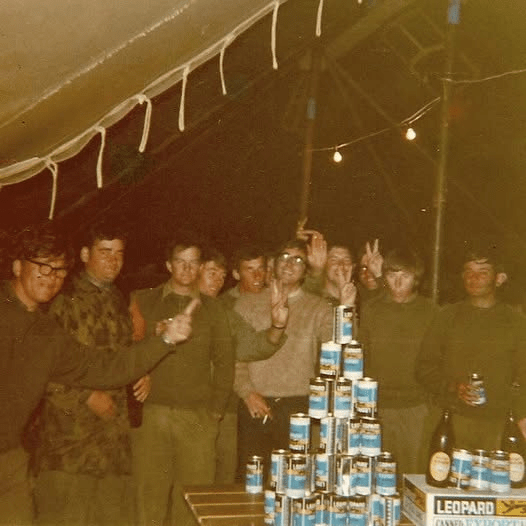
An Army is not sustained by regulations and equipment alone. It is also sustained by humour, friendship, shared rituals and the personalities that give units and Corps their identity. Formal dinners, mess traditions, practical jokes and familiar characters help create the sense of belonging that binds soldiers together.
Sid appears to have understood the boundary between humour and responsibility. One tribute described him as possessing ‘a great sense of humour and annoying all wrapped in one’, while adding that when it came to work, ‘it was work’. That distinction mattered. Sid could be entertaining without being unreliable. His humour did not undermine his professionalism; it made the routines of Army life more human.
The social bonds he helped create were part of how support soldiers maintained morale and cohesion while performing work that was necessary, repetitive and seldom celebrated.
What Official Records Cannot Capture
Sid’s story is remarkable not because official records failed to record him altogether, but because those records could preserve only the administrative outline of his life. They documented when he enlisted, where he served, the trades he held, the ranks he attained and when his Regular Force service ended. They could not record why soldiers remembered him with affection, how he treated his subordinates or how his personality influenced the units in which he served.
Those elements survived in informal digital spaces. The posts that followed had no central coordination and no official remembrance process behind them. They were personal tributes written by people who felt compelled to record what they remembered before those memories disappeared.
Together they preserved the Sergeant who supervised Block 186, the owner of the Vauxhall Cresta, the controlled-stores specialist, the Muppet performer, the Guardian of the Goldfish and the friend whose familiar laugh remained recognisable decades later.

This raises a wider question. How many other Sergeants, Corporals and Privates shaped military institutions through their expertise, mentorship and professionalism but left little evidence beyond a service file? How many taught younger soldiers, upheld standards, solved practical problems and gave character to their units without ever appearing in a published history?
Sid’s story survives because his former comrades cared enough to remember him publicly. Many others may not have been so fortunate.
The increasing use of social media by veterans has created an informal repository of military memory. Such sources must be approached carefully. Recollections can be incomplete, selective or affected by the passage of time. Nevertheless, they preserve forms of evidence that official correspondence, establishment tables and personnel records rarely provide. They show what individuals meant to the people around them.

More Than 35 Years of Service
Sid’s Regular Force service ended on 30 March 1990 after more than 27 years in uniform. He then continued serving as a New Zealand Defence Force civilian until July 1998. His combined military and civilian career spanned more than 35 years.
During that time the Army and its logistics organisations underwent repeated change. Sid served through alterations in structure, trade responsibilities, unit designations and methods of support. He worked at major Army establishments and served both in New Zealand and overseas.
Through all of this, the fundamental requirement remained unchanged: soldiers and units needed weapons, equipment and stores, and somebody had to ensure that they were properly managed. Sid was one of those people.
His career illustrates that military organisations depend upon continuity as much as change. Headquarters may be reorganised, units renamed and policies rewritten, but institutions continue to function because experienced people retain practical knowledge of how the system actually works.
That knowledge is often held by senior non-commissioned officers and long-serving civilians. It exists partly in regulations and standing orders, but also in professional memory, personal networks and the ability to recognise problems before they become failures.
The support system was not merely an auxiliary component of the Army. It was part of the Army’s operating substance. Units could train and deploy because logisticians managed the countless practical requirements upon which readiness depended.
Sid’s service represented one small but essential part of that system.
Remembering the Man
When Sid’s colleagues reflected on his life, they did not speak primarily about policy, organisational design or military theory. They remembered the man himself. He was described as a ‘top bloke’, a ‘great soldier’ and a ‘colourful guy’. Others remembered someone who always had kind words for people, who never hesitated to help his fellow soldiers and who served his country with quiet grace.

One colleague recalled his practical talents and described him as a ‘wallpaperer extraordinaire’. Another remembered the balance of humour and professionalism that defined him.
One of the young soldiers from Block 186, looking back across more than five decades, offered a particularly personal farewell: ‘Thanks for your friendship and guidance, Squidly Didley. Rest in peace, old friend.’
That simple tribute captures something military history often struggles to convey: the meaning of service as experienced by those who lived it.
Sid mattered because he was reliable. He mattered because he looked after younger soldiers. He mattered because his commanders trusted him with demanding responsibilities. He mattered because he brought humour and humanity to work that rarely attracted public attention.

His influence did not depend upon high rank, strategic command or battlefield recognition. It lay in the people he supported, the standards he upheld and the communities of which he became part.
Making the Invisible Visible
Sid Bourne’s memorial poses a challenge to military historians. What would military history look like if support roles were treated as central subjects rather than background functions? What might be learned from studying ordnance depots, transport units, workshops and supply organisations with the same seriousness applied to regiments and campaigns? How might our understanding change if the professional development of non-commissioned officers received attention comparable to officer education and senior command?
Such an approach would reveal military institutions not simply as hierarchies directed from above, but as networks of people, knowledge, relationships and practical systems. It would show that military effectiveness depends upon competent and reliable soldiers who know their trade, uphold standards and care for the people around them. It would also recognise that culture, cohesion and institutional memory are frequently created in informal spaces: barrack blocks, stores, workshops, vehicle parks and Sergeants’ Messes.
The unseen effort that keeps armies equipped and functioning is not incidental to military history. It is military history.
Over more than 35 years, Sergeant Sidney Stewart Bourne served in roles that conventional historical narratives might easily overlook. He was one of thousands of ordnance, transport, engineering and logistics personnel whose work allowed the Army to function.
His story reminds us that the everyday life of a military institution is shaped not only by generals and operations, but by the people who maintain its standards, preserve its knowledge and support its soldiers. Sid’s former comrades made the invisible Sergeant visible.
Their recollections preserved a dependable professional, an influential mentor, a memorable character and a loyal friend. In doing so, they demonstrated that the history of an Army is richer and more human when it includes those who kept it running.
The Sid Bournes of military history have remained invisible for too long. It is time to look harder.
