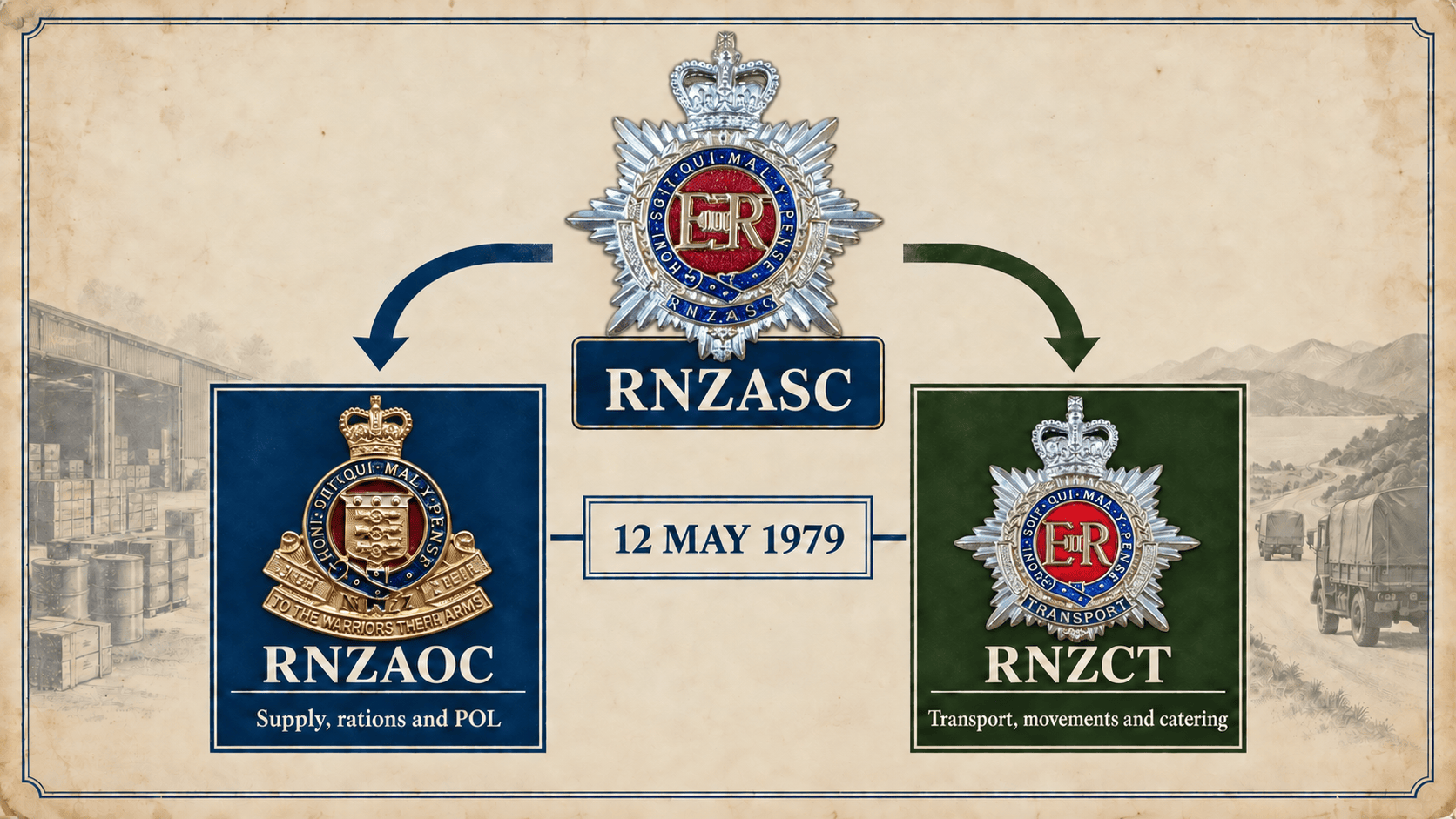
How the 1978 to 1979 Reorganisation Reshaped RNZAOC Supply.
Military logistics must adapt to new equipment, changing force structures, financial constraints and operational demands. The practical test of any change, however, is whether it sustains support to the force throughout. The 1978 to 1979 reorganisation of the Royal New Zealand Army Ordnance Corps (RNZAOC) is a clear New Zealand example. It changed the Corps’ responsibilities, units, establishments, stock accounts, and training role, while food, fuel, and stores still had to reach the Army.
The change made the RNZAOC the Army’s principal supply Corps. From 12 May 1979, it became responsible not only for ordnance stores, ammunition, and technical materiel, but also for foodstuffs, rations, and petroleum, oils and lubricants (POL).[1]
Change was already underway
The formal 1979 transfer was the second stage of a process already underway within the RNZAOC. In July 1978, Pataka described a proposed reorganisation intended to “rationalise the supply chain”. Central Ordnance Depots and Ordnance Field Parks were to be grouped into regional organisations, reducing duplicated stockholding and simplifying the movement of stores from demand to delivery.[2]
The proposal did not promise large Regular Force savings. Its main benefits were expected to be fewer stocking points, lower inventory and storage costs, simpler accounting and better use of people and infrastructure. In October 1978, former RNZASC supply organisations began coming under RNZAOC command for command purposes, and the February 1979 Pataka recorded the practical changes: new titles, altered establishments, repainted signs and the arrival of new personnel.[3]
Why the Army reorganised
The 1978 Defence Review required a rearrangement of Army logistic functions. New Zealand followed the broad direction already adopted in Australia: transport, movements and catering would be grouped in a Corps of Transport, while supply would sit with the RNZAOC.[4]
The date itself carried deliberate symbolism. Major W. Fraser recommended 12 May 1979 because it coincided with the anniversary of the 1910 New Zealand Gazette notice that established the Army Service Corps. The change was therefore both an organisational break and a carefully marked transition from a long-standing corps tradition.[5]
Organisation from 12 May 1979
Principal responsibilities
Royal New Zealand Corps of Transport
Transport, Defence movements, catering and postal functions.
Royal New Zealand Army Ordnance Corps
Supply, including food, rations, POL, ordnance stores, ammunition and related technical responsibilities.
This division did not separate supply from transport in the field. The RNZAOC held, managed and provided the stocks; the RNZCT provided transport and much of the distribution capability. The implementation order expressly allowed RNZAOC Combat Supplies Platoons to be placed under command of an RNZCT unit when operational circumstances required supplies to be distributed from second-line transport.[6]
What the RNZAOC gained
From 12 May 1979, responsibility for the provision and storage of all foodstuffs and POL, together with the development, evaluation and provision of ration packs, passed from the RNZASC to the RNZAOC. The accompanying equipment sponsorship was broad: refrigeration and air-conditioning equipment, packaging and packing materials, POL storage and quality-control equipment, water containers, agricultural supplies, and specialist camp and religious stores.[7][8]
The transfer also made clerk/storekeeper and butcher training an RNZAOC School responsibility. It affirmed that food, rations and fuel were technical supply functions requiring professional knowledge, not simply commodities to be bought and issued.
The RNZAOC after 12 May 1979
The new directorates at Headquarters New Zealand Land Force were implemented on 9 April 1979, before the field transfer on 12 May. This enabled the Director of Ordnance Services to assume the necessary policy, technical-control and force-management responsibilities before the new unit structure took effect.[9]
The RNZAOC Directorate controlled a national supply system comprising a base supply battalion, four regional Supply Companies, the New Zealand Advanced Ordnance Depot in Singapore and the RNZAOC School.
This table shows the principal RNZAOC supply organisation following the 1979 reorganisation. It does not attempt to list every RNZAOC technical, ammunition or workshop-stores appointment and element.
The structure combined static and regional supply, base-level bulk holdings and deployable field capability. It was therefore more than a renaming of RNZASC camp supply depots.
The units transferred to the Corps
Former RNZASC sub-unit
New RNZAOC sub-unit
Location
Composite Platoon, 1 Transport Company
13 Combat Supplies Platoon, 1 Supply Company
Papakura
Supply Section, Papakura Platoon, Northern Company
14 Supply Platoon, 1 Supply Company
Papakura
Headquarters 21 Supply Company
Headquarters 21 Supply Company, 4 Supply Company
Waiouru
4 Platoon, 21 Supply Company
43 Combat Supplies Platoon, 4 Supply Company
Waiouru
Supply Platoon, Waiouru Company
44 Supply Platoon, 4 Supply Company
Waiouru
7 Platoon, 21 Supply Company
47 Petroleum Platoon, 4 Supply Company
Waiouru
New sub-unit
23 Combat Supplies Platoon, 2 Supply Company
Linton
Supply Section, Linton Platoon, Central Company
24 Supply Platoon, 2 Supply Company
Linton
Wellington Supply Platoon, Central Company
54 Supply Platoon, 1 Base Supply Battalion
Trentham
Composite Platoon, 3 Transport Company
33 Combat Supplies Platoon, 3 Supply Company
Burnham
Burnham Supply Platoon, Southern Company
34 Supply Platoon, 3 Supply Company
Burnham
Supply Platoon, New Zealand Transport Company
New Zealand Supply Platoon, NZAOD
Singapore
The revised numbering made the national pattern clearer. The 14, 24, 34, 44 and 54 Supply Platoons corresponded to Papakura, Linton, Burnham, Waiouru and Trentham. The specialist exception was 47 Petroleum Platoon, which retained the petroleum function of former 7 Platoon, 21 Supply Company, while adopting the Waiouru prefix. Headquarters 21 Supply Company remained as a Territorial Force sub-unit of 4 Supply Company, capable of commanding up to five supply sub-units for training and exercises.[10]
People and capability transferred with the units
The establishment papers show that the reorganisation was not merely an exercise in moving existing posts. Eighty Regular Force supply posts and two civilian posts were transferred to the RNZAOC. There was no increase in the Regular Force establishment, but the Territorial Force supply establishment rose from 123 to 158 posts, a net gain of 35. The increase was required to establish 23 Combat Supplies Platoon at Linton, an entirely new sub-unit.[11]
This demonstrates that rationalisation and capability growth occurred together. Former RNZASC composite platoons became RNZAOC Combat Supplies Platoons; the existing combat-supply and petroleum capabilities of 21 Supply Company were retained, and a new platoon was raised for 2 Task Force Region.
Continuity of expertise was protected. RNZASC personnel employed in supply units were to remain in those units until the RNZAOC had sufficient trained personnel to replace them. They were also required to indicate whether they wished to join the RNZCT or RNZAOC.[12]
The transfer was also a lived transition, not merely an establishment change. Contemporary accounts suggest that some RNZASC and RNZAOC personnel expected difficulties, particularly in the continued supply of rations. In practice, the handover of tasks and the incorporation of transferees proceeded smoothly. The result supports the central lesson of the reorganisation: adaptation was judged not by creating new titles or badges, but by whether the Army continued to receive essential support without interruption.[13]
Accounts, responsibility and continuity
The change was embedded in the accounting system. Northern Company RNZASC’s supply-depot bulk-stock account became that of 1 Supply Company; Waiouru Company’s became 4 Supply Company; the Linton and Trentham Central Company accounts transferred to 2 Supply Company and 1 Base Supply Battalion; and Southern Company’s became 3 Supply Company.[14]
This mattered because stock accounts represented formal custody and accountability. New badges and unit titles could be introduced quickly; transferring account responsibility changed the organisation answerable for receipt, storage, demand, issue and reconciliation of the stores that sustained the Army.
Adaptation without interruption
The 1978 to 1979 reorganisation fundamentally widened the RNZAOC’s role. It placed food, fuel, rations and supply support alongside ordnance stores, ammunition and technical materiel. At the same time, it preserved the interdependence of supply and transport, retained specialist knowledge during the transfer and added a new Territorial Force combat-supply capability at Linton.
The contemporary details differ, but the lesson remains relevant. Logistics must adapt to new systems, new equipment and new operating demands while continuing to sustain the force. In 1979, the decisive measure was not whether the chart changed; it was whether the Army could still feed, fuel and equip its units. That remains the proper measure of logistic adaptation today.[15]
Notes
[1] Army General Staff, Army Reorganisation Instruction No. 11: RNZASC Reorganisation, Army 209/1/142/SD, 24 April 1979, paras. 1-5
[2] The RNZAOC Reorganisation,” Pataka, July 1978, 10-12.
[4] Julia Millen, Salute to Service: A History of the Royal New Zealand Corps of Transport and Its Predecessors, 1860-1996 (Wellington: Victoria University Press, 1997), 415-16
[5] Julia Millen, Salute to Service: A History of the Royal New Zealand Corps of Transport and Its Predecessors, 1860-1996 (Wellington: Victoria University Press, 1997), 415-16
[9] Headquarters New Zealand Defence Force, Army General Staff, Army Reorganisation Establishments, Volume 3, Army 1920/1, April 1979, paras. 3 and 10-15
[10] Army General Staff, Army Reorganisation Instruction No. 11, Annexes D and F, paras. 6-7.
[11] Headquarters New Zealand Defence Force, Army General Staff, Army Reorganisation Establishments, Volume 3, Annex F, “Supply Posts for RNZAOC.”
[12] Army General Staff, Army Reorganisation Instruction No. 11, para. 6c.
[13] Major J. S. Bolton, A History of the Royal New Zealand Army Ordnance Corps (Trentham: RNZAOC, 1992), 224-25
[14] Army General Staff, Army Reorganisation Instruction No. 11, Annex F, para. 8.
[15] Ministry of Defence, Defence Capability Plan 2025 (Wellington: Ministry of Defence, 2025), 39.
Today, 12 July, would have been Corps Day for the Royal New Zealand Army Ordnance Corps. It also marks thirty years since the formation of the Royal New Zealand Army Logistic Regiment and, with it, the disestablishment of the RNZAOC. It is a fitting moment to look back, not with sentimentality but with appreciation for what the Corps actually was and what it left behind.
The RNZAOC was not lost so much as it moved into its next form. From the days of Henry Tucker onwards, the work of the Ordnance soldier was defined by one constant: continual adaptation. Its history is best understood not as that of a fixed institution that came to an end, but as one long process of change that continues today, under a different name.
Formed in war, tested by peace
The role of the Ordnance soldier expanded and contracted as the Army’s needs shifted around it. During the First World War, New Zealand Ordnance personnel served both at home and overseas, in Egypt, Gallipoli, Palestine, France, Belgium and the United Kingdom.
The interwar years brought progress alongside considerable uncertainty, including a period when the New Zealand Army Ordnance Corps came close to ceasing to exist altogether.
Mechanisation and a widening trade
The Second World War forced rapid adaptation once more. Ordnance soldiers served in every theatre in which New Zealand forces took part, adjusting to the demands of increasingly mechanised warfare. Bath and laundry services, ammunition support and specialist technical functions all became central to the Corps’ work during this period.
The later transfer of the Technical Trades to the New Zealand Electrical and Mechanical Engineers fits the same pattern rather than breaking from it. As military technology and technical specialisation advanced, responsibilities moved to where they made most sense — a recurring feature of the Corps’ story, not an exception to it.
A peacetime Corps that kept changing
Adaptation did not stop when the wars ended. Territorial Force personnel became an integral part of the RNZAOC, and the increasingly specialised management of technical stores gave rise to the Auto Parts trade. The Ammunition Technician trade evolved alongside the operational environment and, by the 1970s, had become the Army’s centre of expertise in explosive ordnance disposal.
Further change followed: the integration of women from the Women’s Royal New Zealand Army Corps, and then the transfer of the RNZASC supply trades into the RNZAOC in 1979. Less visibly, Ordnance personnel also adapted to the gradual introduction of electronic stores-management systems, progressing from early mainframe systems to the networked logistics systems in use by 1996.
The Corps at its height
By the mid-1980s, the RNZAOC had reached its peak. 1 Base Supply Battalion was, at the time, regarded as one of the most complex warehouse operations in New Zealand. Supply Companies were located at Hopuhopu, Waiouru, Linton and Burnham. Separately, stores sections were integrated within each RNZEME workshop, while an Advance Ordnance Depot maintained a New Zealand presence in Singapore. It was a Corps operating at scale, both at home and abroad.
That scale did not last. With the end of the Cold War came a peace dividend, and with it a gradual reduction in the size and reach of the Corps through the late 1980s and into the 1990s. This, too, was adaptation rather than decline for its own sake, the Corps reshaping itself to match a changed strategic environment, as it always had.
Towards Formed Deployments
RNZAOC soldiers had already deployed on operations in Korea, Malaya, Malaysia and South Vietnam, and others had served individually on peacekeeping missions. The 1990s added a further dimension, as Ordnance soldiers began deploying on operations as formed contingents, beginning with a Supply Detachment to Somalia, followed by two platoons, a shift that reflected both New Zealand’s changing military commitments and the increasingly integrated role of logistics support.
A Corps Spanning Generations
When the RNZAOC was disestablished in 1996, its youngest member was 17 years old and its oldest was 55. That span was more than a statistic. It represented a Corps that connected multiple generations of officers and soldiers, from those trained in long-established manual systems to those entering an increasingly digital and integrated logistics environment, within a single institution, at a single moment.
Continuity, Not Loss
The formation of the RNZALR did not erase the RNZAOC’s history; it became the next stage in a much longer process of adaptation. Titles, structures and trades changed, but the essential purpose held: to provide the Army with the equipment, ammunition, technical support and supply services needed to train, deploy and operate.
Thirty years on, the most fitting way to remember the RNZAOC is not to mourn its passing, but to recognise its enduring legacy, carried forward today within the RNZALR, particularly through its Supply trade. Adaptation was never evidence of weakness or decline. It was, and remains, one of the Corps’ defining strengths.
Logistics for New Zealand’s Motorised Infantry Future
From 1845 to the present, New Zealand’s military logistics system has continually adapted under pressure. Across the history of the Defence Stores Department, the New Zealand Army Service Corps, the New Zealand Army Ordnance Corps, the Royal New Zealand Army Ordnance Corps, Royal New Zealand Electrical and Mechanical Engineers and Royal New Zealand Corps of Transport and today’s Royal New Zealand Army Logistic Regiment, the pattern is consistent. Each generation entered conflict organised for one set of assumptions, then adapted its structures, equipment, trades and methods as war exposed the limits of the old system.
That pattern is visible across the long history of New Zealand military logistics. Colonial forces moved from ad hoc local supply to centralised control of stores. The late nineteenth century saw the creation of a system capable of supporting breech-loading artillery, harbour defence, and increasingly complex imported weapons. The First and Second World Wars forced expeditionary supply, transport, ordnance, movement control, field catering, mobile repair and ammunition systems to mature at scale. Later reforms adjusted stores accounting, entitlement control, field-force logistics, ration packs, mechanical support, combat clothing, and digital supply systems to suit new technology and new structures.
The lesson is simple. New Zealand Army logistics has rarely succeeded because it possessed mass. It has succeeded when it adapted faster than its circumstances collapsed around it.
That lesson now matters again.
In December 2025, the New Zealand Army formally amalgamated 1st Battalion, Royal New Zealand Infantry Regiment and Queen Alexandra’s Mounted Rifles at Linton Military Camp. The new unit retained the name 1 RNZIR and was organised as a Motorised Infantry Battalion, with one sub-unit retaining the QAMR name. NZDF described the change as enhancing the combat readiness of one of the Army’s key outputs, the Motorised Infantry Battle Group.[1]
The formation of 1 RNZIR as a Motorised Infantry Battalion at Linton provides the organisational trigger for rethinking how New Zealand Army logistics supports a more dispersed and agile force.
This is more than a unit name change. It is a force design signal. If the combat arm is reorganising around a motorised infantry model, then the sustainment system must be examined with the same seriousness. A motorised infantry battalion can only be as agile, lethal and survivable as the logistics system that fuels it, arms it, repairs it, feeds it, moves it and replenishes it.
The danger is that the Army could create a modern combat structure sustained by an older, more predictable and increasingly vulnerable distribution model.
The Future Battlefield and the Logistic Problem
The Future Land Operating Concept 2035 anticipated many of the challenges now visible in Ukraine and other contemporary theatres. It described the future land environment as increasingly connected and monitored, crowded, partnered, lethal and complex. It also acknowledged that, by international standards, the New Zealand Army would remain a small army with limited firepower and protection compared with medium or heavy forces. To remain relevant, it would need a qualitative edge built around agility, precision, interoperability, information advantage and force-multiplier strategies.[2]
That description fits the logistics problem exactly.
The modern battlefield is becoming more transparent. Drones, commercial satellites, electronic surveillance, social media, signals intelligence and persistent sensors make movement easier to detect. Convoys, vehicle parks, fuel points, ammunition dumps, replenishment points and headquarters are no longer safely “behind” the front line. They are part of the target set.
At the same time, forces are becoming more dispersed. Lethality drives dispersion, and dispersion drives logistic complexity. Smaller groups need to operate further apart, for longer, with fewer opportunities for large-scale replenishment. This increases demand for batteries, water, medical stores, ammunition, repair parts, communications equipment, drone components, fuel and specialist technical support at the tactical edge.
Ministry of Defence images of NZ Army personnel testing small UAS at Waiouru
For a large army, this problem may be partly solved by mass. For New Zealand, mass is not available. The answer must be a more intelligent, distributed and layered sustainment system.
Logistic drones should be part of that system.
But none of this is one-directional. A battlefield transparent enough to expose a fuel point is also transparent enough to reveal a drone charging station, an unmanned ground vehicle route, or a field 3D-printing node. Ukraine’s experience since 2022 shows how quickly forces adapt counter-drone measures, including layered air defence, electronic warfare, decoys and dedicated drone-hunting teams. Any New Zealand logistic drone system must therefore assume that the enemy will adapt to it, just as quickly as it seeks to outmanoeuvre the enemy.
Illya Sekirin makes the same point in Rise of the Machines. His central argument is not simply that drones are important, but that technology only becomes decisive when tactics, organisation, procurement, training and strategy are adapted around it. He compares the drone to the tank, noting that tanks existed in the First World War but did not become operationally decisive until armies learned how to organise and fight around them. The same warning applies to logistics. A drone purchased as equipment is not a capability. A drone integrated into sustainment, reconnaissance, protection, maintenance, counter-drone defence and command arrangements may become one.[3]
This is not theoretical. In March 2025, Reuters reported that the commander of Ukraine’s Unmanned Systems Forces warned that NATO armies were not ready for the scale and character of modern drone warfare. His warning was not simply about owning enough drones. It was about the way drones had overturned established doctrine, created a new cost-exchange problem, and forced rapid adaptation in electronic warfare, counter-drone defence, automated targeting and battlefield logistics.[4]
That matters for New Zealand because the point is not the size of Ukraine’s drone programme, which New Zealand cannot and need not copy. The point is the speed of adaptation. Drone warfare is not developing at the pace of traditional platform acquisition. It is developing at the pace of software, commercial manufacturing, field improvisation and battlefield feedback.
A Historical Parallel: The Ordnance Field Park
The New Zealand Divisional Ordnance Field Park of the Second World War provides a useful historical comparison. Formed in July 1941 after the lessons of Greece and Crete, the NZ OFP was a mobile mini ordnance depot supporting the 2nd New Zealand Division. It held spares for the Divisional Workshops and moved forward when workshop elements deployed to support brigades. Its stockholding included motor transport spares, weapon spares and signal stores, carried on vehicles and scaled to support a highly motorised division.[5]
The OFP was not a rear-area warehouse. It was a forward, mobile stockholding system designed to place repair parts and critical stores close enough to the point of need to sustain tempo. When the Division became more mechanised and incorporated an armoured brigade, the OFP reorganised to include separate infantry and armoured sections, later adding reserve vehicle and mobile advanced ordnance depot functions.[6]
The parallel is not exact. The OFP moved spares within a Second World War divisional system. It did not operate through contested, observed airspace under the kind of persistent surveillance now assumed for the future battlefield. Drone logistics inherits the OFP’s logic of forward, mobile stockholding, but it must solve for exposure in a way the OFP never had to.
That principle remains relevant. The OFP solved a problem created by mechanisation, how to keep a mobile force supplied with the spares and controlled stores it needed without waiting for the base depot. Drone logistics solves a related problem created by dispersion and battlefield transparency, how to move small, urgent and high-value items across the last tactical mile without exposing larger vehicles, drivers and replenishment points.
NZ Division OFP on the Move. Noel Kreegher Collection
In that sense, logistic drones are not a rejection of New Zealand Army logistics history. They are a modern expression of it.
Drones Are Not a Replacement for Trucks
The first point must be clear. Logistical drones will not replace trucks, containers, aircraft, ships, fuel tankers, forklifts, ammunition vehicles, recovery vehicles, or logistics specialists. Nor should they be presented as a miracle technology.
Their value lies elsewhere.
Drones offer a way to move small, urgent and high-value loads across the “last tactical mile”, the dangerous and inefficient gap between a combat service support node and the soldier, crew, section, troop or detachment that needs something now. A drone does not need to carry everything. It only needs to carry the thing that prevents the task from failing.
Logistic drones should not be seen as truck replacements. Their value lies in moving small, urgent and mission-critical loads across the final exposed gap.
That might be radio batteries, a replacement optic, a drone battery, a medical pack, blood products, morphine, water, rations, a weapon spare, a fuse, a small quantity of ammunition, a repair component, a cable, a cryptographic item or technical documentation.
Even here, the detail matters. Carrying medical items and ammunition as interchangeable small loads on the same platform class is not a purely logistical choice. Blood products and medical stores carried under recognised medical markings have a different legal status to ammunition. Any drone tasked across both roles will need clear rules on marking, tasking and interchangeability before it reaches the field.
Ukraine also shows that drone logistics is not theoretical. Sekirin notes that larger multirotor drones have been used to carry water, food and ammunition to encircled soldiers, while unmanned ground vehicles have been used to bring supplies forward, evacuate wounded, clear routes and reduce direct exposure of troops. These examples do not remove the need for conventional logistics, but they show how unmanned systems can fill dangerous gaps where trucks, soldiers or stretcher parties would otherwise be exposed.[7]
The scale of this shift should not be understated. General David Petraeus, drawing on repeated visits to Ukrainian units, has observed that armoured vehicles and infantry fighting vehicles are increasingly unable to survive if spotted by an observation drone, prompting some Ukrainian units to stop using human drivers on resupply routes altogether. Remotely driven vehicles instead carry ammunition, food, water and blood products forward and return with casualties.[8] This is not simply a refinement of last-mile delivery. It suggests that on the most exposed routes, the choice may shift from “driver plus drone support” to “no driver at all.”
In this sense, logistic drones are not bulk transport. They are precision distribution.
This has another historical echo. During the Second World War, New Zealand’s movement control system managed the complex movement of troops, stores and equipment by road, rail, sea and air. The 3rd Division’s Movement Control Unit in the Pacific handled 476 ships, averaging 20 vessels per week, with a staff that never exceeded 17 men. It operated in difficult conditions, often with limited port infrastructure, and adapted its methods to local circumstances.[9]
The modern equivalent is not simply moving more tonnage. It is using every available mode intelligently. Trucks, ships, aircraft, landing craft, forklifts, movement operators and drones all become part of a wider distribution network. The principle is not “drone instead of truck”. It is the right mode for the right load, at the right time, with the least exposure.
Logistic Drones as Multi-Role Systems
Logistic drones should not be thought of only as flying delivery vehicles. In many cases, the same platform that carries a small load can also provide information. A drone sent forward with batteries, medical stores or repair parts can confirm the condition of the route, identify damage to tracks or bridges, observe the proposed delivery point, check whether the receiving element has moved, and provide immediate feedback to the combat service support commander.
This gives logistic drones an ISTAR value. They can contribute to local intelligence, surveillance, target acquisition and reconnaissance by observing the ground over which replenishment must occur. Before a vehicle convoy moves, a drone could check a route. Before a replenishment point is opened, a drone could confirm whether the area is clear, concealed and usable. During replenishment, a drone could provide overwatch, detect movement, and warn of threats to the supported force or the logistic element.
Sekirin identifies four characteristics that make drones militarily disruptive: omnipresence, accurate direct fires, discardability and mobility. For logistics, the most important of these is not necessarily direct fire, but omnipresence and mobility. A logistic drone can move a small load, but it can also observe, confirm, warn and report. That means its value lies not only in what it carries, but in what it sees and how quickly it can be repositioned.[10]
This does not mean that every logistic drone should become a strike platform. The more useful model is a family of systems with common components, training, batteries, software and payload standards, but different payload options. Some drones would be optimised for carriage. Some would be optimised for surveillance. Some might carry electronic-warfare or communications relay payloads. A smaller number, under clear command authority, could be armed or fitted for suppressive fire against targets of opportunity that threaten a replenishment operation.
That distinction matters. A drone carrying blood products, medical stores or marked medical supplies raises different legal and ethical issues from a drone carrying ammunition or a weapon payload. Mixing those roles without clear rules would create confusion and risk. If the Army adopts multi-role logistic drones, it will need clear procedures for tasking, marking, payload changeover, authority to arm, control of fires, recovery of unused munitions and post-mission accountability.
For a Motorised Infantry Battalion Group, the most immediate value is probably not in turning supply drones into routine attack drones. It is in using them to support replenishment by seeing first, warning early and reducing exposure. A resupply task could therefore be supported by three drone functions: a reconnaissance drone to check the route and delivery point, a logistic drone to move the load, and, where the threat justifies it, an overwatch or armed drone controlled through normal command and fire-control arrangements.
The Australian-designed SYPAQ Corvo Precision Payload Delivery System provides a useful example of this logic. Developed as a low-cost fixed-wing payload-delivery system, the Corvo PPDS has been supplied to Ukraine and reportedly adapted for reconnaissance and attack roles as well as delivery. Its significance is not that New Zealand should simply buy the same system, but that the design of logistics drones should preserve modularity. Airframes, payload bays, mission software, batteries, training systems, and repair arrangements should enable controlled adaptation rather than lock a platform into a single, narrow role.[11]
A constructed SYPAQ Corvo PPDS drone, sitting atop a stack of flat-packed ones. SYPAQ
The broader lesson is that a drone designed only as a small flying box may quickly become obsolete. A drone family designed around carriage, observation, communications relay and controlled payload change may remain useful for longer.
This would fit the wider argument of this article. Drone logistics is not simply about moving small loads. It is about making sustainment less predictable, less exposed and better informed. A drone that delivers a battery is useful. A drone that delivers a battery and confirms the replenishment route is still usable is more useful. A drone system that can integrate carriage, reconnaissance, communications relay, and protective overwatch is even more useful, provided the roles are controlled rather than improvised.
Logistics in a Contested Drone Environment
Much is now said about operating in a contested environment, but the phrase needs to be understood in practical logistic terms. A contested environment is one in which friendly forces cannot assume that movement, communications, concealment, airspace, supply or evacuation will be uncontested. The enemy is not simply waiting to be engaged by combat troops. It is actively trying to find, disrupt and destroy the systems that allow those combat troops to keep fighting.
For logistics, this changes the problem. A replenishment point is no longer just a place where stores are issued. It is a potential target. A vehicle harbour is not just an administrative pause. It is a detectable pattern. A fuel point, ammunition transfer point, repair team, drone charging site, casualty collection point or field 3D-printing node may all become part of the enemy’s target list. The more predictable the logistic system becomes, the easier it is to find and attack.
Drones intensify this problem because both sides can use them. If friendly forces are sending drones forward to check routes, confirm delivery points, carry stores, and provide overwatch, the opposing force is likely to do the same. Enemy drones may be searching for logistic vehicles, identifying resupply nodes, tracking movement between hides and distribution points, locating command posts, observing unloading activity or waiting for troops to concentrate during replenishment. The danger is not only that a logistic drone may be shot down. The greater danger is that enemy drones may exploit the replenishment process itself to locate and attack the logistics system.
Sekirin describes this as the emergence of battlefield transparency, an operational condition in which movement near the front can be observed and countered. Although his analysis is drawn from Ukraine, the implication for logistics is clear. Supply points, repair nodes, ammunition transfer points, casualty collection points and drone launch sites are all exposed by the same transparency that allows friendly drones to find enemy targets. In that setting, concealment, dispersion and deception are no longer optional fieldcraft. They are logistic survival measures.[12]
The problem is already visible in Ukraine. Reuters has described drone-dominated areas of the front as a “kill zone”, with drones complicating movement, evacuation and routine battlefield activity.[13] Surveillance drones, bomber drones, kamikaze drones and drone-killing drones are all part of the same ecosystem. Both sides use them to find targets, disrupt movement and make routine activity dangerous. For logistics, that means the most dangerous moment may not be the fighting itself, but the pause when vehicles, stores and soldiers concentrate long enough to be seen.
This is why counter-drone protection cannot be treated as someone else’s problem. If logistics units are using drones to find routes and delivery points, enemy drones will look for the same patterns in reverse.
This makes counter-drone protection a logistic requirement. It cannot be treated only as an air defence or combat arms problem. Logistic units will need the ability to detect, avoid, deceive and, where authorised, defeat enemy drones. This may include camouflage, concealment, dispersion, movement discipline, electronic emission control, decoy positions, rapid unloading drills, hardened or concealed charging points, alternate replenishment sites, passive warning systems, electronic countermeasures and short-range physical protection.
Ukraine’s efforts against Shahed-type drones also show the cost-exchange problem. Reuters reported on Ukraine’s layered counter-Shahed effort, highlighting the growing importance of interceptor drones, electronic warfare, and lower-cost countermeasures, as using expensive missiles against cheap drones is economically unsustainable over time.[14] The tactical lesson is clear. Logistic units cannot rely only on high-end air defence. They need low-cost options for warning, concealment, deception, dispersion, and defeat built into their routine.
Physical hardening of routes is another low-cost measure now in routine use. Petraeus has described the main supply routes in Ukraine, which are covered with mesh netting along their entire length to stop drones from striking resupply vehicles, though footage has already shown drones penetrating gaps beneath the mesh.[15] The lesson for New Zealand is not that mesh tunnels are the answer, but that even improvised physical countermeasures are being defeated within months, reinforcing the assumption that any logistic counter-drone measure adopted now must be treated as temporary rather than final.
The old habit of building a replenishment point around convenience will not survive on a monitored battlefield. Logistic sites will need to be selected as tactical positions rather than administrative locations. They will need overhead concealment, covered approaches, rapid entry and exit routes, emission control, and protection against observation from above. Replenishment drills will need to be fast, rehearsed and dispersed, with vehicles and troops spending as little time as possible in one place.
This also affects the design of logistic drone operations. A drone launch site, recovery point or charging location must not become a fixed signature. Batteries, controllers, antennas, maintenance benches, spare parts, and additive manufacturing equipment all create detectable patterns. If these are concentrated in one obvious place, the drone system intended to reduce exposure may instead create a new target.
For the Motorised Infantry Battalion Group, the implication is clear. Drone logistics and counter-drone measures must be developed together. A battalion that can send a drone forward with medical stores but cannot detect an enemy drone observing its replenishment point has only solved half the problem. Likewise, a logistic element that can move stores by drone but cannot conceal, protect or rapidly displace its launch and recovery points may become more vulnerable, not less.
The answer is not to avoid drones. It is to integrate them properly into a contested logistic system. Friendly drones should help logistics see first, move smarter and reduce exposure. Counter-drone measures should help logistics survive when the enemy is trying to do the same. In the future battlefield, every logistics drone sortie should be planned with two questions in mind: what can we see, and what can the enemy see of us?
A Three-Tier Model for New Zealand
The New Zealand Army does not need to copy the drone logistics model of a much larger ally. It needs a small-army model suited to limited people, limited equipment, dispersed operations and an Indo-Pacific operating environment.
In outline, that model runs across three tiers. At the company and combat-team levels, small tactical drones would carry radio batteries, medical supplies, repair parts, documents, small rations, and lightweight ammunition, and would confirm local routes and delivery points. At the Motorised Infantry Battalion Group level, medium-lift drones would move ammunition boxes, larger medical loads, tools, replacement sights, and drone batteries, while also providing route reconnaissance, replenishment overwatch, and communications relay. At brigade or joint level, larger cargo drones and unmanned ground vehicles would move stores between dispersed logistic nodes, reinforce isolated detachments, support forward arming and refuelling, and provide emergency movement when roads are blocked, mined, flooded, observed or under fire.
None of this needs to be built alone. New Zealand’s coalition-dependent posture is exactly the setting in which interoperability multiplies a small army’s reach. Where Australian, United States, British, or Indo-Pacific partners already field logistics drone systems, New Zealand should first look to adopt or adapt those platforms, payload standards, and data links, rather than developing a bespoke architecture from scratch. A small army’s advantage lies in plugging into someone else’s scale, not in reinventing it.
This tiered approach would enable drone logistics to support both warfighting and population-support missions. In the Indo-Pacific, the same systems could assist after cyclones, earthquakes, floods, or volcanic activity, particularly where roads, bridges, wharves, or landing sites are damaged. For New Zealand, this dual-use value matters.
An Indo-Pacific Intra-Theatre Layer
The three-tier model should not exclude larger fixed-wing logistics drones. For New Zealand, the Indo-Pacific operating environment makes them a serious consideration. Many likely tasks will occur across wide maritime distances, dispersed islands, limited ports, short or damaged airstrips, and communities isolated by cyclones, flooding, earthquakes or volcanic activity. In those conditions, a fixed-wing logistic drone may provide a useful bridge between strategic lift and local tactical distribution.
The same geographic logic appears in U.S. Army thinking on Indo-Pacific sustainment. The region’s distances, limited infrastructure, reliance on maritime access and exposure to anti-access/area denial systems mean that ports, airfields and supply depots can no longer be treated as secure or guaranteed. In such an environment, unmanned aerial and ground systems, supported by AI-enabled route planning and predictive logistics, become part of a wider answer to distance, disruption and denied access.[16]
Its value would not lie in replacing C-130s, NH90s, ships, landing craft, or truck movements. It would be in filling the gap between them. A larger fixed-wing drone could move urgent, lightweight, high-value stores between islands, from a main support base to a forward relief point, or from ship to shore, where landing sites are constrained. Loads such as medical stores, radio batteries, water testing kits, satellite communications equipment, repair parts, blood products, mapping equipment or small command-and-control stores are exactly the type of items where speed and reach may matter more than weight.
For that reason, New Zealand should consider a fourth layer in the longer-term model: an intra-theatre fixed-wing logistics drone capability held at joint or operational level. This would sit above the Motorised Infantry Battalion Group model, but should be considered early so that payload standards, charging or fuel arrangements, data links, airspace control, maintenance and interoperability are not designed only around short-range tactical drones.
Tier
Echelon
Platform type
Example loads/roles
1
Company/combat team
Small tactical drones
Radio batteries, medical items, repair parts, documents, small rations, lightweight ammunition, local route checks and delivery-point confirmation
2
Motorised Infantry Battalion Group
Medium-lift drones
Ammunition boxes, larger medical loads, tools, replacement sights, drone batteries, ration modules, route reconnaissance, replenishment overwatch and communications relay
3
Brigade/joint
Larger cargo drones and unmanned ground vehicles
Movement between dispersed logistic nodes, reinforcement of isolated detachments, forward arming and refuelling support, emergency movement when roads are blocked, mined, flooded, observed or under fire
4
Joint/operational intra-theatre
Larger fixed-wing logistics drones
Inter-island movement of urgent medical stores, communications equipment, repair parts, water purification items, batteries, lightweight relief stores and wide-area route or landing-site reconnaissance
This does not change the starting point. The immediate trial should still focus on tier-one and tier-two systems capable of supporting the Motorised Infantry Battalion Group. However, the Indo-Pacific layer should shape the architecture from the beginning. If New Zealand starts with only short-range tactical drones in mind, it may later discover that its payload standards, batteries, data links, training systems and maintenance arrangements do not scale to the very environment in which New Zealand is most likely to operate.
Classes of Supply and the Distribution Network
Coalition logistics doctrine gives this model a sharper edge. The Australian Army’s Land Warfare Doctrine 4-0, Logistics, built on the NATO framework familiar to New Zealand logisticians, divides supply into ten classes, from subsistence through to ammunition, medical stores, repair parts and disaster-relief materiel.[17] That framework is a useful test of where drones add real value and where they do not.
Class
Description
Drone suitability
Comment
I
Subsistence, rations, water and welfare items
Good, limited
Useful for urgent top-ups to isolated posts, but not a substitute for bulk feeding
II
General stores, clothing, individual equipment, tools and maps
Good
Light items can be moved easily, although priority may be lower
III
Fuel and lubricants
Poor
Weight, volume and fire risk make this primarily a truck, tanker or pipeline task
IV
Construction and fortification materials
Poor
Usually too bulky or heavy, except for small tools or fixings
V
Ammunition and explosive ordnance
Good, controlled
Suitable for small urgent natures, not bulk ammunition resupply
VI
Personal demand items
Good, low priority
Light and low risk, but usually less urgent than medical, repair or ammunition loads
VII
Major end items, vehicles, weapons and major equipment
Not suitable
Beyond drone payload limits
VIII
Medical and dental stores
Strong
Often light, urgent and operationally critical
IX
Repair parts
Strong
Well suited to small, forecast-difficult, mission-critical items
X
Non-military programme materiel, including humanitarian and disaster relief stores
Good, selective
Useful in Indo-Pacific relief tasks where access is constrained
The pattern is clear. Drones earn their place where the load is light, time-critical and difficult to forecast. They have little to offer for loads that are heavy, bulky, or hazardous. That is not a weakness in the concept. It is the division of labour the model assumes: trucks and ships carry the mass, drones carry the urgent exception that would otherwise stop the mission.
Doctrine also describes the distribution network as a system of nodes and links, using both automatic “push” replenishment and demand-driven “pull” replenishment. Traditional delivery methods include direct delivery, unit collection, distribution or exchange points, and dumping. Drone delivery is best understood as an additional direct-delivery option layered onto that network. For predictable bulk flows, drones add little. For demand-driven requests for medical stores, repair parts or critical small stores, they may close the gap between the node and the soldier without committing a vehicle or establishing another exposed distribution point.
Aligning Drone Logistics with Doctrine
The case for drone logistics should not rest on novelty. It should be tested against the doctrinal architecture that already governs logistics, including the support dimensions, the functions of combat service support, the types of support, and the enduring principles of logistics.
Doctrine separates logistics into two dimensions. Capability support manages equipment and systems across their life cycle, including acquisition, in-service management, sustainment and disposal. Operations support, delivered as combat service support, provides the tailored resources a force requires to achieve a mission.[18]
Logistic drones sit across both dimensions. In operations, they are combat service support assets that move stores to soldiers. Before operations, they are capability systems that require proper acquisition, training, maintenance, configuration control, cyber protection, spares and disposal plans. A drone fleet that fails in capability support will eventually fail in operations support.
Within the functions of combat service support, drones do not contribute equally. Their strongest relevance is to supply support, maintenance support and health support. They can distribute selected classes of supplies, move urgent repair parts, and deliver time-sensitive medical supplies. They contribute to transport and movement as one mode among many, but they do not replace movement control. Their contribution to personnel services is limited, perhaps small urgent documents or low-volume welfare items. Their contribution to engineer sustainability is also limited, with drones able to move small tools or survey items but not bulk construction materials.
This unevenness is useful. It checks enthusiasm. Drone logistics is not a universal solution. It is a specific tool for supply, maintenance and health support at the tactical edge.
The three-tier model also maps onto doctrinal types of support. Company-level drones resemble integral support, held and operated within the sub-unit. Battalion-group drones provide close support, linking companies to the battalion’s combat service support system. Brigade or joint-level drones provide general support across a wider force. The proposed Indo-Pacific intra-theatre layer sits above this tactical model and belongs more naturally at joint or operational level. It would support movement between islands, bases, ships and forward relief points rather than provide immediate company-level resupply.
Drone logistics should also be judged against the enduring principles of logistics: responsiveness, simplicity, economy, flexibility, balance, foresight, sustainability, survivability and integration.[19]
Drones can improve responsiveness by closing the last tactical mile faster than a scheduled vehicle run. They support economy when they avoid committing a vehicle and crew to a very small load. They improve flexibility when a tiered model allows company, battalion and brigade options. They can improve survivability by reducing exposure of drivers and vehicles on dangerous routes.
But each advantage has a tension. A poorly standardised fleet adds complexity rather than simplicity. Battery, spares and training overheads may erode economy. Over-investment in drones at the expense of trucks and drivers would break balance. A drone charging site becomes a new target set. Integration with RNZALR structures, airspace control, allied data links, and maintenance systems must be deliberately designed.
Read this way, drone logistics is not a departure from established logistic principles. It is a test of whether those principles can be applied to a new technology before the battlefield forces the issue.
Risks and Limits
The risks are real, and they deserve more than a token mention.
Drones can be jammed, hacked, intercepted, shot down, misrouted or grounded by weather. They may expose friendly locations through electronic signatures or predictable flight paths. Payloads are limited. Batteries create their own resupply burden. Maintenance, software updates, cyber protection and operator training all require discipline.
Airspace control is not a footnote. Logistic drones will need to be deconflicted with artillery, aviation, allied forces and, in Indo-Pacific contingencies, civil air traffic. That is an institutional problem as much as a technical one, and it needs to be solved before fleets grow, not after.
Multi-role systems also create command and legal complexity. A drone used for logistics, ISTAR, and strike cannot be treated as a simple store-delivery platform. The Army would need clear rules for payload configuration, authority to arm, control of fires, medical marking, target confirmation, airspace coordination and accountability after the mission. Without those controls, the flexibility of a multi-role drone could become a source of confusion rather than advantage.
Sekirin’s analysis also reinforces the need to develop drone and counter-drone systems together. He argues that UAS and counter-UAS activity must be coordinated so that friendly drones are not jammed or shot down by friendly systems, and that enemy drones are consistently detected and defeated. For logistics, that means counter-drone measures cannot be excluded from the sustainment plan. They must be integrated into replenishment points, repair nodes, drone launch sites, charging areas and movement routes from the beginning.[20]
The contested drone environment also means that logistic units must be given active counter-drone responsibilities. It will not be enough to rely on higher-level air defence or assume that combat units will always provide protection. Replenishment points, repair nodes, casualty collection points, drone launch sites and charging areas will all need organic or closely integrated counter-drone measures. These do not need to begin as complex systems. They may start with detection, warning, concealment, decoys, drills, emission control and simple defeat options. But they must be built into logistic structures from the start, because the enemy’s drones will be hunting the same logistic patterns that friendly drones are trying to exploit.
The Indo-Pacific layer adds further risks. Long-distance fixed-wing drones require navigation resilience, weather tolerance, recovery options, airspace permissions, communications coverage, maintenance depth and reliable launch and recovery procedures. These are not simple tactical systems. They would require joint-level oversight, but the need to solve those problems is precisely why they should be considered early.
But these are not arguments against drone logistics. They are arguments for starting early, deliberately and with realistic expectations of what the first systems will and will not do.
Scaling the Capability
History warns that equipment alone is not capability. Major-General Mackesy’s 1939 report made this point before the language of modern Integrated Logistics Support existed. He was not simply asking whether New Zealand had enough weapons. He was asking whether equipment, ammunition, people, storage, workshops, transport, training and mobilisation arrangements could function as a wartime system.[21]
The same test should be applied to drones.
A drone without trained operators, maintainers, batteries, charging systems, spares, airspace procedures, payload packaging, electronic protection, safety rules and logistic doctrine is not a capability. It is an item on charge.
To avoid this, drone logistics must be scaled properly. The Army should define standard drone loads, standard packaging, standard carriage methods and standard replenishment tasks.
Load type
Possible contents
Platoon emergency resupply
Batteries, water, medical stores and ammunition
Casualty support
Dressings, analgesia, blood products and evacuation aids
Ammunition support
Fuzes, tools, packaging material, labels and inspection equipment
Maintenance support
Belts, filters, cables, optics, lubricants and small assemblies
Signals support
Batteries, antennas, handsets, cables and replacement components
Disaster-relief support
Water purification items, medical stores, communications equipment and lightweight relief supplies
Indo-Pacific intra-theatre support
Medical stores, satellite communications equipment, water testing kits, mapping equipment, repair parts, batteries and small command-and-control stores
This would move drone logistics from novelty to system. It would allow the Army to plan, train, account for, package, prioritise and replenish using drones as part of the sustainment architecture.
Dispersed Logistics for a Transparent Battlefield
A motorised infantry force will require fuel, ammunition, spares, water and maintenance. These are heavy, visible and predictable demands. On a monitored battlefield, predictability is dangerous.
The answer is not to abandon conventional replenishment, but to reduce concentration and increase options. Stores should be held in smaller, dispersed nodes. Replenishment should be more frequent, more varied and less predictable. Some movement should still be by truck, some by protected vehicle, some by foot, some by air, some by water and some by drone.
Drone logistics supports this by enabling smaller quantities to be moved as needed without committing a vehicle column to every task. It can reduce the number of soldiers exposed on routine but dangerous runs. It can support units operating away from main routes. It can help sustain dispersed observation posts, sensor teams, anti-armour teams, engineers, medical teams, communications detachments and dismounted infantry.
It also supports the logic of a motorised infantry battalion. The battalion’s combat power will depend on the ability to shift between mounted and dismounted activity. Its logistics must be able to do the same. Trucks and protected mobility vehicles can move bulk forward. Drones can then move selected stores across the final exposed gap.
In the Indo-Pacific, the same logic applies across distance rather than across the battlefield. A community cut off by a cyclone, an airstrip damaged by flooding or a small island with limited landing options presents the same basic logistic problem: a gap between where stores are held and where they are urgently needed. Fixed-wing logistics drones may help close that gap for selected loads, while ships, aircraft and landing craft continue to move the mass.
Reverse Logistics and the Return Journey
Drone logistics should not be thought of only as forward delivery. It also has a reverse logistics role.
The withdrawal of the 3rd New Zealand Division from the Pacific between 1944 and 1945 showed the scale and complexity of bringing equipment, stores and vehicles home. More than 50,000 ordnance items, 3,274 vehicles, 25 tanks, tonnes of ammunition and large quantities of NZASC supplies had to be recovered, inspected, sorted, repaired, redistributed or disposed of. This was achieved without modern material-handling equipment or information technology, relying instead on infrastructure, discipline, labour, and determined logistical control.[22]
Modern forces must still recover, inspect and redistribute equipment. In a future conflict, drones could assist with the small but urgent reverse movement of repairable components, classified stores, medical samples, damaged optics, electronic modules, batteries, intelligence items and technical evidence. They could also assist ammunition technical staff by moving small components, samples or documentation from forward locations to specialist support nodes.
This reverse flow matters. A distribution system that only pushes stores forward, but cannot recover repairable or accountable items, soon becomes wasteful and blind.
Procurement, Experimentation and Environmental Fit
The Army should not wait for a perfect drone logistics programme.
The history of New Zealand military logistics shows that wartime adaptation often compressed years of development into months. During the Second World War, New Zealand absorbed new vehicles, created workshop systems, expanded ammunition infrastructure, built depots, trained tradesmen, introduced ration systems and deployed new support organisations at a pace that would challenge modern peacetime procurement processes.
Nor was interwar New Zealand simply asleep before 1939. The Army had been updating doctrine, conducting training exercises, experimenting with motor vehicles and artillery modifications, ordering modern equipment and developing mobilisation scales. Its problem was not total ignorance, but the limits imposed by money, personnel and time.[23]
There is another lesson from New Zealand’s post-war history of clothing and equipment. The Army did not always get new equipment right the first time. Combat clothing, tropical uniforms and camouflage shelters were repeatedly trialled, modified, accepted, rejected or left to waste out as experience showed whether they suited New Zealand, Southeast Asia or operational conditions. The development of Drill Green uniforms, tropical combat clothing, DPM, and camouflaged lightweight shelters demonstrates that equipment had to be tested for climate, terrain, user acceptance, durability, camouflage value, local manufacture, and sustainment cost.[24]
That same principle applies to drones. A logistic drone that performs well on a manufacturer’s demonstration field may fail in the wind, rain, bush, dust, humidity, salt air, electromagnetic clutter or austere conditions in which New Zealand forces may operate. Payload claims may not survive rough handling. Battery endurance may collapse in cold weather. Noise and visual signature may expose supported units. A system that appears efficient in a trial may prove difficult to repair, recharge, transport, account for or integrate with existing logistic procedures.
The camouflage shelter trials of the 1960s offer a useful model. The Army did not simply select a pattern from a catalogue. Samples were tested in New Zealand and then by 1 RNZIR and 161 Battery in Southeast Asia under varying terrain, light and climate conditions. User feedback shaped the final direction of the project.[25]
The same method should be used for drone logistics. Soldiers and logisticians should test systems in the field, report what works, identify what fails and force the support system to adapt before procurement locks the Army into the wrong answer.
A better approach would be controlled risk. The Army should buy small numbers of different systems, test them hard, break them, discard weak options, adapt useful ones and scale what works. Trials should not be confined to demonstrations. They should be embedded in field exercises, live firing, logistic rehearsals, disaster relief training and Motorised Infantry Battalion Group development.
Ukraine’s procurement experience reinforces this point. In March 2025, Reuters reported that Ukraine planned to sharply increase purchases of domestically produced FPV drones in 2025, after purchasing more than 1.5 million the previous year. The important lesson for New Zealand is not mass for its own sake. It is the procurement rhythm: domestic adaptation, rapid production, battlefield feedback and the willingness to modify quickly when the enemy adapts.[26]
That procurement rhythm is now visible in Ukraine’s daily logistics and in its factories. Petraeus has described a Ministry of Defence–linked ordering platform, built with limited nonprofit funding rather than a major defence contract, through which units can order drones, components and optics from several hundred pages of listings and receive delivery within days.[27] Whatever New Zealand builds does not need to match this scale, but the underlying model, a fast, unit-facing ordering system tied directly to field feedback, is closer to the procurement rhythm this article is arguing for than a traditional annual bulk-buy cycle.
European militaries are drawing similar conclusions. Reuters reported in June 2026 that European defence leaders were calling for a shift toward mass-produced, lower-cost systems such as drones and interceptors, alongside electromagnetic warfare, air defence and faster procurement.[28] For a small army, that reinforces the need to buy small numbers early, test hard, avoid bespoke over-complexity and keep the learning cycle short.
Most importantly, logisticians and technical trades must be central to the process. New Zealand’s armourers evolved from civilian gunsmiths and part-time artificers into disciplined technical specialists because changing weapons technology demanded inspection, repair, maintenance and local expertise.[29] Drone logistics will require the same kind of technical foundation. Operators, maintainers, battery managers, electronic technicians, payload packers, software support personnel, ammunition specialists, movements staff and supply personnel must all be involved from the beginning.
Whether this becomes a distinct trade, an added skill set within the RNZALR, or a task shared across existing corps is a structural choice the Army will need to make early, before procurement, not after it. That choice will determine who trains whom, which units own the capability, and what current roles absorb the extra load.
Drone logistics is not just an aviation issue. It is a sustainment issue.
Maintenance, Additive Manufacturing and Repair Thresholds
Maintenance support must be integrated into RNZALR and unit support processes, including additive manufacturing where it is safe, economical, and tactically useful.
Drone fleets consume propellers, motors, bearings, arms, connectors, antennas, batteries, housings, landing skids, payload brackets and software updates at a tempo very different from traditional vehicle maintenance. Many of these items are light, fragile, frequently damaged and difficult to forecast accurately. A small stock of controlled spares will still be essential, but 3D printing could reduce downtime by allowing units to produce selected non-critical parts, such as protective housings, battery trays, cable clips, antenna mounts, payload adaptors, guards, brackets, training aids and repair jigs, without waiting for the normal supply chain.
This is not speculative. The United States Army has introduced drone training that includes 3D printing, printer maintenance, CAD and STL file handling, and building and repairing drones using printed components.[30] The United States Marine Corps has also demonstrated the potential of in-house drone production through its HANX project, a modular 3D-printed drone developed by 2nd Maintenance Battalion. Reporting on the project also notes that specialist infrastructure, assembly skills and calibration remain limiting factors.[31] More broadly, additive manufacturing is increasingly being treated as a way to shorten lead times, reduce dependence on long supply chains, and improve the availability of spare parts, particularly where the right digital files, materials, and quality controls are in place.[32]
For the New Zealand Army, the practical model should be controlled and tiered. At operator level, small systems should be maintained by trained users with controlled spares packs and simple replacement thresholds. At the battalion or brigade level, RNZALR-supported drone maintenance cells should carry field printers, approved print files, materials, inspection tools, and standard repair procedures. More complex parts, structural components, and any safety-critical items should remain under technical control, whether produced by an approved workshop, purchased through the supply system, or replaced as an assembly.
New Zealand should not attempt to maintain every cheap drone like a major fleet asset. Many smaller drones should be treated as semi-expendable, with rapid repair or replacement taking priority over prolonged workshop recovery.
Additive manufacturing also introduces risks that must be managed. A printed part is only as good as its material, file, printer settings, operator skill and inspection process. Research into additive manufacturing cyber risk has shown that compromised print files or printer firmware can weaken parts without obvious visual signs, including drone components.[33] For that reason, the Army would need an approved digital parts library, controlled printer settings, material traceability, basic inspection standards and clear rules on what may, and may not, be printed in the field.
Used properly, 3D printing would not be a shortcut around engineering discipline. It would be a way of pushing limited, controlled manufacturing closer to the tactical edge.
What This Would Take
None of this needs to wait for a perfect programme, but it does need a practical starting point.
A realistic first step would be a battalion-level trial of tier-one and tier-two systems within the next one to two years, run alongside Motorised Infantry Battalion Group training and Indo-Pacific disaster-relief exercises rather than as a standalone activity. It would need a small standing cell, likely single figures of trained operators and maintainers per battalion group initially, drawn from existing RNZALR and combat trades rather than a large new establishment. Numbers should be scaled only as trial results justify them.
It would also need a procurement approach that buys several competing systems in small numbers, rather than a single system in bulk, so the Army learns what breaks down before it commits to a fleet.
Australian experience is also relevant. The ADF’s recent investment in small uncrewed aerial systems indicates that regional partners are already moving toward broader adoption of tactical drones.[34] Australia is also investing in counter-drone systems, including low-cost interceptor drones and directed-energy options, in response to lessons from Ukraine and the Middle East.[35] New Zealand should use that momentum. The aim should be interoperability where possible, shared payload standards where practical, and sustainment arrangements that do not isolate New Zealand from the systems its closest partners are already adopting.
At the same time, the joint force should begin a parallel concept trial for larger fixed-wing logistics drones in Indo-Pacific-style scenarios. This does not need to be a major acquisition. It could begin as a proof-of-concept activity using a small number of systems to test inter-island payload movement, ship-to-shore delivery, airspace coordination, communication range, weather tolerance, and recovery procedures. The purpose would be to understand whether such systems can fill a genuine gap between strategic lift and local distribution, not to create another fleet before the requirement is proven.
Multi-role employment should also be included in the trial design. A replenishment serial should not only ask whether a drone can carry the load. It should ask whether the drone system can locate the delivery point, confirm the route, provide overwatch, relay communications, and, under controlled conditions, support the protection of the replenishment activity. The purpose would be to develop procedures before the pressure of operations forces improvisation.
Trial activity should also include enemy drone play. The trial should also include AI-enabled sustainment planning. The U.S. Army article notes that AI can assist logisticians by forecasting demand for fuel, ammunition, medical supplies and spare parts, integrating threat intelligence, terrain and weather data, optimising delivery routes, and helping planners model sustainment under contested conditions.[36]
This direction of travel matters specifically for logistics. Petraeus has argued that unmanned systems in Ukraine are moving from being remotely piloted to being algorithmically piloted, with the operator shifting from controlling each action to approving actions an AI system proposes under a given set of conditions.[37] For sustainment, that trajectory points toward logistics drones that increasingly plan their own routing and flag risks without a human directing every movement, which is a further reason for New Zealand to build its data links, payload standards, and command arrangements to accommodate more autonomy than today’s tactical drones require.
For New Zealand, the practical starting point need not be a large AI programme. It could begin with simple decision-support tools that help a battalion group compare replenishment routes, predict consumption, identify exposed nodes and test whether drone delivery, vehicle movement or pre-positioning is the better option.
Every replenishment serial should assume that opposing forces are using drones to locate, track and target the logistic system. This would force the trial to test concealment, dispersion, counter-drone warning, launch-site protection, rapid displacement and the discipline of operating without creating obvious patterns.
This is a modest first commitment, not a re-equipment programme. Its purpose is to generate the field evidence, on payload, endurance, maintainability, integration, trust, command arrangements, role separation and survivability in a contested drone environment, that the Army cannot get from a concept document alone.
Conclusion
There is a deeper continuity here. Colonial armourers, Defence Stores clerks, wartime ordnance parks, movement control teams and reverse logistics units all did more with less by adapting before failure became visible. Drone logistics is the next step in that same habit, not a break from it.
The creation of the Motorised Infantry Battalion at Linton gives the New Zealand Army an opportunity to rethink both sustainment and combat organisation.
If 1 RNZIR is to be more agile, adaptable, lethal and survivable, then its logistics must be more agile, adaptable, distributed and survivable as well. A motorised infantry force sustained only by predictable vehicle movement, centralised stockholding and traditional replenishment habits risks being organised for yesterday’s battlefield.
Drones will not solve every logistic problem. They will not replace the logistician, the combat driver, the storeman, the ammunition technician, the maintainer, the medic or the movement operator. But they can extend their reach. They can reduce exposure. They can increase responsiveness. They can help a small army make limited resources go further.
They can also make logistics better informed. A drone that delivers stores may also confirm the route, observe the delivery point, warn of threats and support the protection of the replenishment task. Under strict control, selected systems may also provide suppressive or defensive effect against threats of opportunity. That potential should be explored, but not confused with routine carriage. A medical drone, a supply drone and an armed overwatch drone are not the same thing simply because they may share airframes, batteries or software.
In the Indo-Pacific, larger fixed-wing logistics drones may also help close the gap between strategic lift and the final point of need. They should not distract from the immediate tactical requirement, but they should be considered early, as New Zealand’s most likely operating environment is maritime, dispersed, and infrastructure-limited.
But the most important point is that drones are not only a friendly advantage. If New Zealand can use drones to find routes, confirm delivery points and support replenishment, so can an adversary. Future logistic structures must therefore include counter-drone measures as part of their own survival. The logistician of the future will not only move stores. They will have to protect the movement, conceal the node, manage signatures, and understand what the enemy can see from above.
Sekirin’s argument that the drone is the new tank is a useful warning, but the New Zealand lesson is slightly different. The issue is not whether drones alone will decide wars. It is whether the Army can reorganise enough of its sustainment system to exploit them before an adversary exploits them against us. In that sense, the logistic drone is not merely a new delivery method. It is a test of whether a small army can adapt its doctrine, structures, trades, procurement and training quickly enough for the next battlefield.
The next adaptation should also be digital. Drones, counter-drone measures and AI-enabled sustainment should not be treated as separate projects. In a contested Pacific environment, they are connected parts of the same problem: how to move, protect, predict and prioritise sustainment when ports, airfields, roads, communications and supply chains are under pressure.
New Zealand’s logistic advantage has never been mass. It has been adaptation.
[15] David Petraeus, “David Petraeus on What Taiwan Can Learn from Ukraine’s Battlefield Experience” (event transcript, Hudson Institute, July 28, 2025).”
[20] Sekirin and Simms, Rise of the Machines: Drone Warfare in the Russia-Ukraine War – Tactics, Operations, Strategy.
[21] “Mackesy’s Warning: Modernisation, Mobilisation, and Early Integrated Logistics Thinking in the New Zealand Army,” “To the Warrior his Arms” History of the Royal New Zealand Army Ordnance Corps and its predecessors, 2026, accessed 1 July, 2026, https://rnzaoc.com/2026/05/10/mackesys-warning/.
[27] David Petraeus, “David Petraeus on What Taiwan Can Learn from Ukraine’s Battlefield Experience” (event transcript, Hudson Institute, July 28, 2025).”
[32] F. Marinho de Brito et al., “Design Approach for Additive Manufacturing in Spare Part Supply Chains,” IEEE Transactions on Industrial Informatics 17, no. 2 (2021),https://doi.org/10.1109/TII.2020.3029541.
[33] Hammond Pearce et al., “Flaw3d: A trojan-based cyber attack on the physical outcomes of additive manufacturing,” IEEE/ASME Transactions on Mechatronics 27, no. 6 (2022); Sofia Belikovetsky et al., “dr0wned–{Cyber-Physical} attack with additive manufacturing” (paper presented at the 11th USENIX workshop on offensive technologies (WOOT 17), 2017).
[36] Lydia Aguirre, “AI-Driven Sustainment in Contested Logistics — Preparing for LSCO in the Indo-Pacific.”
[37] David Petraeus, “David Petraeus on What Taiwan Can Learn from Ukraine’s Battlefield Experience” (event transcript, Hudson Institute, July 28, 2025).”
On 4 December each year, soldiers, gunners, and explosive specialists around the world pause to mark Saint Barbara’s Day. For New Zealand’s military ammunition community, the day has a special resonance. Saint Barbara was the patron saint of the Royal New Zealand Army Ordnance Corps (RNZAOC). Although the Corps was disestablished in 1996, she remains the spiritual patron of those whose work brings them closest to explosive risk, especially the current generation of Royal New Zealand Army Logistic Regiment (RNZALR) Ammunition Technicians.
This commemoration is not about imposing religious belief or expecting devotion in a modern, pluralist Army. Instead, it is about recognising shared values. Saint Barbara’s story, whether read as faith, legend, or metaphor, offers a powerful way of talking about courage, duty of care, and professionalism in dangerous work.
From Heliopolis to the Ordnance Corps
According to tradition, Barbara lived in the late Roman Empire at Heliopolis in Phoenicia, now associated with Baalbek in modern Lebanon. Born into a wealthy pagan household, she questioned the gods she had been taught to worship when she looked out from the tower in which her father kept her secluded and reflected on the ordered beauty of the world around her. In time, she converted to Christianity in secret. When her father discovered this, he handed her over to the authorities and ultimately carried out her execution himself.
Her refusal to renounce her convictions, even under torture, and the lightning that, according to legend, later killed her father and the official who condemned her, led to Barbara being associated with sudden death, lightning, and fire. As warfare evolved and gunpowder weapons became central to battle, she was adopted as patroness of artillerymen, armourers, military engineers, miners, tunnellers, and anyone whose livelihood involved explosives and the possibility of instant, catastrophic harm. The Legend of Saint Barbara
When the Royal Army Ordnance Corps (RAOC) adopted Saint Barbara as its patron, that tradition passed into the wider family of Commonwealth ordnance corps. The RNZAOC, with its own responsibility for ammunition supply, storage, and maintenance in New Zealand, in turn adopted her as patron saint.
Beyond 1996: Saint Barbara and the RNZALR
The disestablishment of the RNZAOC in 1996 and the formation of the RNZALR did not diminish Saint Barbara’s relevance to New Zealand soldiers. The work did not change; only the cap badge did. Ammunition Technicians, in particular, continue to live daily with the realities that made Barbara a symbolic figure in the first place: sudden danger, technical complexity, and the need for calm, disciplined action when things go wrong.
On paper, Saint Barbara is a figure from late antiquity. In practice, her patronage captures something very contemporary about the RNZALR Ammunition Technician trade:
Technical mastery under pressure – handling, inspecting, and disposing of explosive ordnance where a single lapse can have irreversible consequences.
Quiet, unshowy bravery – the kind that rarely makes headlines but underpins every live-fire activity, every range practice, and every deployment where ammunition is moved, stored, or rendered safe.
Duty of care to others – ensuring that everyone else can train and fight in relative safety because someone has accepted responsibility for the dangerous end of the supply chain.
In that sense, Saint Barbara’s Day is as much about the living as it is about any distant martyr. It is an opportunity for the wider Army to pause and acknowledge that the safe availability of ammunition, which is often taken for granted, depends on a small community of specialists and their support teams.
A Day Of Tradition, Not Testimony
In a modern New Zealand Army, not everyone is religious, and fewer still are likely to be familiar with the details of early Christian hagiography. That is not the point. Commemorations like Saint Barbara’s Day function as regimental and professional traditions, not as tests of personal belief.
Marking the day can mean different things to different people:
For some, it may be a genuine act of faith, honouring a saint whose story inspires them.
For others, it is a way of respecting the heritage of their trade and the generations of RNZAOC and now RNZALR personnel who have done this work before them.
For many, it is simply a moment to reflect on the risks inherent in explosive work, to remember colleagues injured or killed in training and operations, and to recommit to doing the job as safely and professionally as possible.
In that sense, the story’s religious origins are less important than the shared meaning it has acquired over time. Saint Barbara becomes a symbol of the values that matter in ammunition work: integrity, courage, vigilance, and loyalty to those you serve alongside.
Contemporary Relevance: Commitment In A Dangerous Trade
In the modern world, the management of ammunition and explosives is governed by detailed regulations, sophisticated science, and digital systems, ranging from hazard classifications and compatibility groups to electronic inventory control and safety management frameworks. Yet, at its core, it still depends on human judgment and ethical commitment.
Saint Barbara’s Day offers a valuable lens for talking about that commitment:
Commitment to safety – understanding procedures not as bureaucracy, but as the accumulated lessons, sometimes paid for in blood, of those who went before.
Commitment to team – recognising that no Ammunition Technician works alone, and that a strong safety culture depends on everyone feeling empowered to speak up, check, and challenge.
Commitment to service – remembering that, whether in training at home or on operations overseas, the work is ultimately about enabling others to succeed and come home alive.
When Ammunition Technicians and their colleagues mark Saint Barbara’s Day, they are not stepping out of the modern world into a medieval one. They are taking a moment within a busy, technologically advanced, secular military environment to acknowledge that some fundamentals have not changed: courage, conscience, and care for others still matter.
Keeping The Flame Alive
Although the RNZAOC passed into history in 1996, its traditions did not vanish. They were carried forward into the RNZALR and live on in the customs, stories, and professional identities of those who wear the uniform today. Saint Barbara is one of those enduring threads.
On 4 December, when a small group gathers in an Ammuniton depot, unit lines, a mess, or a deployed location to raise a glass or share a few words in her honour, they are standing in continuity with generations of ordnance soldiers, armourers, gunners, and explosive specialists across time and across the Commonwealth. They are also quietly affirming something vital about themselves.
In the end, Saint Barbara’s Day is less about religion and more about recognition: recognition of a demanding craft, of the people who practise it, and of the responsibility they carry on behalf of the wider Army. For the RNZALR Ammunition Technicians of today, as for the RNZAOC of yesterday, she remains a fitting patron for those who work, quite literally, at the explosive edge of military service.
In the popular telling of New Zealand’s military history, the country is often cast as a recipient of overseas innovation, dependent on British or Allied designs to meet its military needs. However, overlooked in the archives is the story of Charles Loomes, a Defence Stores official whose early 20th-century inventions demonstrated both ingenuity and a deep understanding of local operational conditions.
In 1910, as New Zealand established a modest domestic military manufacturing base—primarily focused on converting local wool into standard British-pattern uniforms—Loomes submitted two proposals to the War Office in London: one for a new entrenching tool and another for an improved infantry equipment system. Both designs were intended to enhance the practicality and comfort of New Zealand soldiers in the field.
Although his ideas were ultimately not adopted, Loomes’s efforts exemplify a quiet but essential tradition of military innovation in New Zealand—one that deserves far greater recognition.
A Life of Service and Practical Insight
Charles Loomes was born in 1857 in Whittlesey, England, and emigrated to New Zealand, where he entered public service. By the early 1900s, he was working with the New Zealand Defence Stores Department in Wellington, a precursor to today’s logistical branches of the NZDF. He was not a military commander or weapons engineer, but rather a public servant embedded in the practicalities of supply and equipment. His proximity to returning troops from the South African War (1899–1902) gave him rare insight into the shortcomings of British military kit in colonial conditions. This combination of technical competence and frontline empathy shaped his two major design proposals.
The Entrenching Tool: A Tool for the Dominion, Not the Empire
At a time when British military orthodoxy remained firmly anchored in European conditions, Charles Loomes’ 1910 entrenching tool design stood out as a locally informed innovation. New Zealand troops had just returned from the South African War, bringing lessons hard learned in the scrublands and semi-arid terrain—lessons not adequately reflected in British-issue tools. The shortcomings of the British entrenching tool were increasingly evident: it was heavy, ill-suited for bush work, and cumbersome in combat conditions that demanded speed, versatility, and improvisation.
Loomes, drawing upon feedback from returning veterans and his knowledge, designed a hybrid tool that merged the capabilities of a spade and a tomahawk. His model featured a shorter shaft for easier handling in confined environments and a reinforced blade capable of cutting through vegetation and lifting compact earth. He noted that the tool was designed to remove intact clumps of soil, making it ideal for quickly constructing makeshift sangars, foxholes, or low parapets. This capacity reflected an understanding of the semi-permanent, fast-moving trench systems standard in irregular warfare and mobile operations environments where New Zealand soldiers often found themselves.[1]
According to the 1910 Defence Council report, New Zealand was reforming its defence organisation in anticipation of Lord Kitchener’s review. This included transitioning to a field force more attuned to national conditions. Loomes’ proposal arrived at a critical moment—just as local military leaders and policymakers were beginning to contemplate how New Zealand’s needs might diverge from Britain’s. The fact that the War Office in London reviewed and formally responded to Loomes’ tool submission, thanking him and returning the sample, underscores the event’s rarity. Colonial submissions were often ignored or lost in bureaucracy; Loomes’ treatment was an outlier.
This modest response, while not leading to adoption, highlights the credibility of the proposal and its alignment with growing imperial awareness of environment-specific military needs. The reality, however, was stark: New Zealand had little indigenous arms production capability at the time, and the cost of tooling up to produce such implements locally was seen as prohibitive. The result was that practicality bowed to imperial standardisation.
Nonetheless, Loomes’ design prefigures later developments. As early as the Second World War, entrenching tools would again be reconceptualised for jungle, bush, and close terrain operations, validating Loomes’ insight.
Reimagining Load Carriage: A Soldier-Centred, Modular System
In December 1910, Loomes followed up with a second design submission: improved infantry and mounted infantry equipment to address the long-standing challenge of balancing soldier load, accessibility, and operational effectiveness. This system is compelling because of its technical design and thought, which were born from operational realities and adapted to New Zealand’s hybrid mounted-infantry character.
Loomes proposed a “heads and tails” ammunition pouch system capable of carrying 200 rounds of rifle ammunition—120 in the front, 80 in the rear. Unlike the British webbing designs of the time, which often created imbalance or restricted movement, Loomes’ design allowed soldiers to access ammunition from either end of each pouch. Rounds could be withdrawn in prone and standing positions without awkward adjustments. Once the front pouches were emptied, reserve pouches could be rotated forward, maintaining weight balance and ensuring the soldier remained combat-effective throughout prolonged engagements.[2]
This solution anticipated later 20th-century load-carrying principles—particularly modularity, distributed weight, and quick-access ammunition positioning. Loomes’ notes also specify that his design intentionally left the chest and upper arms unencumbered. This would have improved ventilation and mobility—vital in warm or uneven terrain—and eased firing in prone positions.
Just as important was the equipment’s versatility. Loomes’ harness could be configured for:
Light marching order (with minimal ammunition and essentials)
Full field service (including blanket, water bottle, greatcoat, and rations)
Mounted use (tailored to New Zealand’s mounted rifle units)
Loomes understood that mounted infantry—New Zealand’s dominant expeditionary force model at the time—required unobtrusive, stable, and balanced carriage. This was vital for the rider’s comfort and maintaining combat readiness while mounted. Unlike the clumsy Slade-Wallace or even early Mills webbing gear, which could interfere with movement on horseback, Loomes’ system was designed with the horse in mind.
His proposal was technically sound, cost-conscious, and straightforward to manufacture using leather or woven webbing. Though not accepted, the offer to supply working samples reflected his confidence in the design’s utility.
The Defence Reports of 1911 and 1912 offer valuable context here. The reorganisation of the New Zealand Military Forces was in full swing: the new Territorial system was replacing the old Volunteer model, a permanent instructional staff was being built, and procurement systems were beginning to prioritise local efficiency.[3] Yet, despite a growing awareness of the need for New Zealand-specific solutions, structural constraints—particularly reliance on British-standardised procurement—remained a barrier. The Quartermaster-General’s 1912 report notes that equipment tenders were focused on uniformity and scale, with mills’ pattern marching-order sets being bulk-ordered from the UK.[4]
In short, while Loomes’ system was conceptually ahead of its time, the institutional apparatus to support its adoption did not yet exist.
Innovation Ahead of Infrastructure
Though neither of Loomes’ designs entered service, their rejection reflected institutional inertia rather than any lack of merit. Britain retained tight control over military equipment standardisation, and New Zealand, then a Dominion with no significant defence manufacturing base, had little ability to produce its designs at scale. Loomes was ahead of his time: his submissions anticipated the kind of adaptations that would only become common decades later.
His submissions challenged the notion that innovation flowed from the metropole to the periphery. Loomes proved that original thought could emerge from within New Zealand’s institutions—even if the machinery to adopt it lagged.
A Precursor to Later Innovations: A Quiet Tradition of New Zealand Military Ingenuity
Charles Loomes was not alone in his efforts to design military equipment better suited to New Zealand’s conditions and constraints. While his 1910 submissions may be among the earliest formal proposals from within New Zealand’s defence establishment, they were by no means the last. His spirit of pragmatic, ground-up innovation reappeared throughout the 20th century in a series of unique, often overlooked, and sometimes extraordinary developments—each born of necessity, local ingenuity, and limited resources.
Among the most celebrated examples of New Zealand military innovation was the Roberts Travelling Kitchen, developed on the eve of the First World War by Captain W.G. Roberts of the New Zealand Army Service Corps. Designed in direct response to the challenges of feeding troops in dispersed, mobile operations, the Roberts Kitchen was a self-contained, horse-drawn field kitchen capable of preparing hot meals under austere and constantly shifting field conditions. Constructed with a robust metal chassis and mounted stoves, it could boil water, cook stews, or heat rations while on the move or in static positions without requiring a fixed base of operations. Its compact and modular layout allowed it to be easily deployed by small support teams, providing a dependable solution at a time when maintaining nutrition and morale was often as critical to battlefield effectiveness as ammunition and arms.
What set the Roberts Kitchen apart was not just its portability, but its simplicity, durability, and adaptability—qualities that earned it significant praise both within New Zealand and abroad. It was exported to Australia and trialled by the Australian Army, where it was quickly recognised for its practicality and efficiency. In theatres where standard British Army cookhouses were too bulky or unsuitable for forward areas, the Roberts Kitchen filled a critical gap. It supported mobile columns and supply echelons across difficult terrain and under variable weather, making it ideal for forces operating far from fixed infrastructure. Though mechanised and industrially mass-produced wartime kitchens would later overshadow it, the Roberts Travelling Kitchen stands as a pioneering achievement that anticipated modern mobile field catering and embodied the soldier-centred ethos of New Zealand’s approach to military logistics.[5]
Roberts 2a Oven (Travelling) for 250 Men. Archives New Zealand R22432833 Cookers – Field- Roberts travelling
Then came the New Zealand Battle Ration, one of the most straightforward and most successful examples of locally designed and manufactured military innovation explicitly tailored to the needs of New Zealand troops. Developed during the Second World War, the Battle Ration emerged in response to a growing awareness that the ration packs issued by Britain and the United States were ill-suited to the operational conditions of the Pacific theatre, where New Zealand soldiers were increasingly deployed.
New Zealand forces faced extreme humidity, dense jungle environments, and logistical constraints during campaigns in the Solomon Islands, New Caledonia, and other island chains. Standard British rations—often based on tinned meats, hard biscuits, and fatty components—were prone to spoilage, hard to digest in hot climates, and culturally misaligned with New Zealanders’ eating habits. Similarly, early U.S. C-Rations were heavy and included items with unfamiliar or unpalatable flavours. Soldiers frequently discarded parts of these rations, resulting in unnecessary waste and reduced nutritional intake.
In contrast, the New Zealand Battle Ration was designed from the ground up with science, environment, and soldier morale in mind. Drawing on nutritional research and advice from local food technologists and military dieticians, the ration incorporated lightweight, dehydrated components that could be quickly reconstituted with water. This made the ration more portable and shelf-stable and reduced the bulk of what troops had to carry on long patrols or amphibious movements.
Typical components included:
Compressed or dehydrated vegetables, often in powder or cube form;
High-calorie itemssuch as chocolate, sweetened condensed milk powder, and dried fruit;
New Zealand-produced biscuitsformulated to remain edible in heat and humidity;
Beef extract or bouillon tablets, providing both flavour and salts for hydration;
Tea and sugar, consistent with New Zealand soldiers’ dietary and morale preferences.
The result was a compact, nutritionally complete, and culturally familiar ration pack that troops could rely on. Its ease of carriage and reduced spoilage rates made it ideal for small-unit operations, reconnaissance patrols, and units cut off from resupply in remote jungle areas.
The Battle Ration was also locally produced, reducing dependency on vulnerable international supply chains. New Zealand manufacturers, working with the Defence Department and scientific institutions, were able to source, process, and package the components within the country. This had the dual benefit of supporting the national economy during wartime and ensuring higher quality control for frontline provisioning.
The Battle Rations’ success did not go unnoticed. It earned positive recognition from allied observers, particularly American nutritionists and quartermasters who saw in it a viable model for regional adaptation. In some cases, its components were studied as part of broader Allied efforts to improve ration systems in the Pacific, and small-scale adoption of similar food technologies followed.
More than a stopgap solution, the New Zealand Battle Ration represented a fully integrated, homegrown logistical system that placed the soldier’s lived experience at the centre of its design. It remains a landmark example of how a small nation, facing unique environmental and operational challenges, could outpace its larger allies in terms of applied military food science and practical innovation.[6]
But New Zealand’s ingenuity extended beyond food and field comforts.
In 1941, as global supply chains strained and frontline weapons were scarce, Philip Charlton devised the Charlton Automatic Rifle—a fully automatic conversion of obsolete bolt-action Lee–Metford and Lee–Enfield rifles. Intended as a stopgap substitute for the unavailable Bren and Lewis light machine guns, the Charlton was produced primarily for the New Zealand Home Guard. Its rugged construction, semi-automatic default operation, forward pistol grip and bipod (in the New Zealand model) made it an effective emergency solution.[7] Around 1,500 were produced; today, surviving examples are exceedingly rare, but they remain a testament to New Zealand’s wartime adaptation amid global resource shortages.
Charlton Automatic Rifle. 1941, New Zealand, by Charlton Motor Workshops. Gift of Mr Philip Charlton, 1965. CC BY-NC-ND 4.0. Te Papa (DM000451/1-3)
Less successful, but no less revealing, was the Mitchell Machine Carbine, a prototype submachine gun developed by New Zealander Allen Mitchell and submitted for testing in Britain in 1943. Though ultimately rejected due to faults in the trigger mechanism, stock, and excessive barrel heating, the weapon represented an attempt to produce a cost-effective domestic submachine gun using local materials and simple blowback operation. A second, improved prototype was submitted in 1944 but was again declined. Only four Mitchell SMGs were ever built; all remain in New Zealand collections. Despite its flaws, the project underscored the determination to establish a sovereign capacity for weapons development, however limited.[8]
Perhaps the most striking and tragic example of New Zealand’s wartime ingenuity is the story of Colonel John Owen Kelsey and the Kelsey Swivel-Stock Rifle. Drawing from his extensive service as an ordnance and engineering officer during the Second World War, Kelsey developed a novel modification of the Sten submachine gun in the early 1950s. Rather than attempting a curved barrel like the German Krummlauf, Kelsey’s design allowed the weapon to be fired around corners via a swivel-stock and periscopic sight, enabling an operator to shoot while remaining in cover. The concept was tested successfully at Waiouru and forwarded to the War Office in London.[9]
Shooting around a corner from cover with he experimental Mk5 Sten “Swivel Butt Carbiner”. Courtesy MoD Pattern Room Library
Kelsey believed the design could be adapted to other weapons and took out international patents. However, he received no further response, and amid growing personal hardship, he died by suicide in 1954.[10] Though the design never progressed beyond a prototype, it serves as a sobering reminder of the often-overlooked costs of service and the post-war fate of veterans whose talents went underutilised.
Perhaps the most unusual case in New Zealand’s military innovation archive is that of Victor Penny, an Auckland bus mechanic and amateur radio enthusiast who, in the years before the Second World War, persuaded defence authorities that he could build a “death ray” capable of disabling enemy vehicles, aircraft, and electronics. Penny’s device, reportedly a directed electromagnetic energy weapon, earned him state support and near-total secrecy. He was relocated to Somes Island in Wellington Harbour—used during the war as an internment and quarantine facility—where a laboratory was constructed solely for his use. Though the project yielded no proven battlefield capability, it remains an intriguing episode in the country’s history of experimental defence projects and an indicator of how seriously New Zealand’s government once considered homegrown science and technology, even of the most speculative kind.[11]
Radio enthusiast Victor Penny was kept under guard on Matiu Somes Island in Wellington Harbour in 1935 as he worked on his mysterious invention.FILE / Dominion-Post
An Innovation Ethos Born of Need
What binds together the remarkable and diverse stories of Charles Loomes’ entrenching tool and load-carrying equipment, the Roberts Travelling Kitchen, the New Zealand Battle Ration, the Charlton automatic rifle, the Mitchell submachine gun, Victor Penny’s speculative “death ray,” and Colonel Kelsey’s swivel-stock rifle is not institutional power, budgetary scale, or industrial might. Instead, they emerged from a humbler yet uniquely resilient source: necessity—the mother of invention in a small, geographically isolated nation.
These were not the products of a formal military-industrial complex. They came from soldiers, field engineers, ordnance officers, public servants, hobbyists, and workshop innovators. Each worked from within or alongside New Zealand’s military system, often without formal research backing, institutional commissions, or manufacturing infrastructure. They responded to pressing operational needs, adapting or reinventing equipment that didn’t suit the environment or realities faced by New Zealand troops—whether in the South African veldt, the Italian alleys of WWII, the Pacific or the cold training grounds of Waiouru.
Despite the quality and relevance of these designs, many were either dismissed by imperial authorities or faded from memory in the post-war era, overshadowed by the need to adhere to British and later American standardisation. Yet many were contextually brilliant. The Roberts Kitchen and Battle Ration were internationally recognised. The Charlton rifle filled a vital gap in local defence. Kelsey’s adapted Sten gun may not have been adopted, but it represented forward-thinking soldier survivability in urban combat. Even Victor Penny’s electromagnetic weapon, though more speculative, illustrates the willingness of New Zealand’s authorities to explore radical ideas when the stakes were high.
Together, these stories reflect a recurring national pattern: when strategic isolation, global conflict, or supply chain fragility forced New Zealand to look inward, the country proved more than capable of producing its answers. Innovation in New Zealand has historically been less about prestige and more about practicality—a can-do, field-driven ingenuity that quietly delivered effective solutions under adverse conditions.
Charles Loomes, then, should not be seen as a lone innovator ahead of his time, but rather as the first in a long and under-recognised lineage. This lineage stretches from the trenches of South Africa and Gallipoli, through the fields of Italy, and into workshops, depots, and paddocks across the country. These innovators turned limitations into opportunities and ensured New Zealand could solve its military problems independently despite its small population and modest resources.
The legacy of this ethos remains deeply relevant today. New Zealand’s past offers historical insight and a blueprint for future resilience as the global security environment becomes more uncertain and supply chains more contested.
Notes
[1]From: Charles Loomes, Defence Stores Date: 1 August 1910 Subject: Entrenching tool invented by himself, asks that it be forwarded to Imperial, Archives New Zealand Item ID R24759083, (Wellington: New Zealand Archives, 1910).
[2]Charles Loomes, Wellington Date: 24 December 1910 Subject: Improved Equipment for use of Infantry and Mounted Infantry, Archives New Zealand Item ID R24759941, (Wellington: New Zealand Archives, 1910).
[3] “H-19 Defence Forces of New Zealand: Report of the General Officer Commanding the Forces for the period from 7th December 1910 to 27th July 1911,” Appendix to the Journals of the House of Representatives (1 January 1911), https://paperspast.natlib.govt.nz/parliamentary/AJHR1911-I.2.4.2.30.
[4] “Defence Forces of New Zealand: Report of the General Officer Commanding the Forces for the period 28 July 1911 to 27th June 1912,” Appendix to the Journals of the House of Representatives, 1912 Session II, H-19 (27 June 1912), https://paperspast.natlib.govt.nz/parliamentary/AJHR1912-II.2.4.2.37.
[5] “Cookers – Field- Roberts travelling,” Archives New Zealand Item No R22432833 (1915).
[6] “DSIR [Department of Scientific and Industrial Research] World War 2 Narratives. No. 10. Dehydrated Foods and Ration Packs. Copy No. 1,” Archives New Zealand Item No R1768268 (1948).
[11] D. Downs and J. Bridges, No. 8 Re-wired: 202 New Zealand Inventions That Changed the World: 202 New Zealand Inventions That Changed the World (Penguin Random House New Zealand, 2014).
As 12 May 2025 marks the 115th anniversary of the New Zealand Army Service Corps (NZASC), it is fitting to reflect on the pioneering figures who laid its foundations and shaped New Zealand’s military logistics capability. Although New Zealand had established military logistics organisations as early as 1862, the formation of the NZASC in 1910 represented the first uniformed logistics branch within the New Zealand military, laying the groundwork for a more structured and professional approach to sustainment and support. This foundational move was later followed by the creation of the New Zealand Army Ordnance Corps (NZAOC) in 1917 and the New Zealand Electrical and Mechanical Engineers (NZEME) in 1942, further expanding and diversifying the nation’s military logistics capabilities.
Originally published in the July 2024 issue of the New Zealand Journal of Military History, this article explores the life and enduring legacy of Brigadier General Henry Owen Knox. It traces his journey from the ranks of the British Army to his critical role in the early development of the NZASC, highlighting his pivotal leadership in reorganising and modernising New Zealand’s military logistics. Knox’s contributions provided a lasting legacy that continues to influence the structure and effectiveness of the Royal New Zealand Army Logistic Regiment (RNZALR) today.
Brigadier General Henry Owen Knox: The Architect of New Zealand Military Logistics and the Formation of the NZASC
The inception of the Royal New Zealand Army Logistic Regiment (RNZALR) in 1996 serves as a testament to the visionary decisions made in 1909, a pivotal moment when the New Zealand Military underwent a comprehensive reorganisation and reequipping initiative under the guidance of Major General Alexander Godley. The primary objective was to elevate the New Zealand Military into a capable, modern force ready to contribute to a broader Imperial defence scheme.
Brigadier General Henry Owen Knox: The Architect of New Zealand Military Logistics and the Formation of the NZASC
Major Henry Owen Knox emerged as a central figure in this transformative journey, leaving an indelible mark on the logistics landscape of the New Zealand Army. Serving under the leadership of Godley, Knox, in collaboration with a cadre of seconded imperial officers, elevated New Zealand’s military capabilities to align with those of the United Kingdom, Australia and Canada. Major Knox’s noteworthy contributions include the establishment of the New Zealand Army Service Corps (NZASC), aligning it with the latest British military logistics innovations.
This article explores the life and enduring legacy of Knox, an esteemed military figure whose unwavering commitment to service and leadership left an indelible mark on the British, Indian, and New Zealand Armies. Knox’s remarkable journey unfolded amidst a dynamic world, spanning continents and pivotal historical periods. His significant contribution in laying the foundations of the NZASC initiated a series of transformative changes, shifting New Zealand Military Logistics from a static to an operational model. This operational framework proved crucial in sustaining New Zealand’s Forces throughout the conflicts of the 20th century, ultimately culminating in the establishment of the Royal New Zealand Army Logistic Regiment (RNZALR). Major Knox’s enduring impact on New Zealand’s military logistics history is firmly solidified through these historical developments.
Henry Owen Knox, born on 16 January 1874 in Lambeth, Surrey, was the eldest son of the Rt Hon Ralph Knox, later Sir Ralph Knox KCB, who served as the Permanent Under-Secretary of State for War from 1897 to 1901, and Georgina Augustus Chance. Educated at Dulwich, Knox commenced his military journey by being commissioned as Second Lieutenant in the 4th Battalion South Staffordshire Regiment on 8 April 1893.
Transitioning to the Army Service Corps (ASC) as a Probationary Second Lieutenant from the South Staffordshire Regiment in 1896, Knox’s career saw swift advancements, with promotion to Lieutenant on 21 October 1897. While stationed at the ASC’s Portsmouth’s Colewort Barracks, he married Muriel Lucy Roberts, the daughter of Sir Owen Roberts, at London Paddington’s Christ Church on 6 July 1899.
Knox’s commitment extended to the South African War, where he earned promotions and commendations, achieving the rank of captain on 1 January 1901 and receiving the Queen’s South Africa Medal with four clasps on 1 September 1901. His journey led him to the Indian Supply and Transport Corps, where, in 1903, he assumed the role of officer in charge of supplies at Rawul Pindee, now Rawalpindi, Pakistan, often likened to the Aldershot of India. Accompanied by his wife, Knox welcomed the birth of their first son, Ralph Peter Owen Knox, on 5 August 1903.
Returning to the United Kingdom in 1907 after completing his five-year term in India, Knox resumed duties as a peacetime ASC officer. However, amidst what should have been a joyous period, tragedy struck with the birth of his second son, Henry Owen Murray Knox on 5 March 1909, followed by the untimely passing of Knox’s wife the next day. Despite this heart-wrenching loss, Knox found solace in a new chapter of his life, remarrying Elsie Caroline Harker on 28 May 1910.
New Zealand
After the conclusion of the South African War, the Military Forces in New Zealand embarked on a series of reforms to enhance the organisation and capability of the nation’s military, enabling it to contribute effectively to a broader Imperial Defence scheme. In 1910, at the request of the New Zealand Government, Field Marshal Viscount Kitchener inspected New Zealand’s Forces. Kitchener provided several recommendations concerning the ongoing reforms, emphasising the need for a professional Staff Corps to administer the force.
The momentum for these reforms gained further impetus with the appointment of Major General Alexander Godley as the New Zealand Military Forces Commandant in December 1910. Godley was pivotal in revitalising New Zealand’s military organisational framework in his first year, making critical command and staff appointments, promulgating the (Provisional) Regulations for the Military Forces of New Zealand, and making plans to build up the NZASC, which, although gazetted on 12 May 1910 as a designated component of the Defence Forces of New Zealand, remained a paper corps.[1]
The proposed NZASC envisaged eight Transport and Supply Columns, comprising four Mounted Brigade and four Mixed Brigade Transport and Supply Columns, one of each earmarked for allocation to one of New Zealand’s four Military Districts. Despite the existence of the Defence Stores Department, which had fulfilled commissariat functions in New Zealand since 1869, there was a lack of an ASC nucleus from which these new units could evolve.
Acknowledging the highly specialised nature of ASC duties, distinct from combatant staff and regimental officers, and the absence of suitably qualified officers in New Zealand, Godley recommended to the Minister of Defence on 4 January 1911 the lending of services of an experienced Imperial ASC Senior Captain or Major to organise and train New Zealand’s transport and supply services for three years. The Minister of Defence endorsed this recommendation with the Prime Minister cabling the New Zealand High Commissioner in London on 10 January 1910 to approach the Army Council for the:
Services of experienced Army Service Corps major or senior captain required to organise New Zealand Army Service Corps. Engagement for three years. Salary £600 a year consolidated. Pay to include house allowance. Travelling allowance of 12/6d a day and allowance for one horse if kept, will also be granted. [2]
Within two months of receiving New Zealand’s request for an ASC Officer, the Army Council promptly and affirmatively responded to the call. Having already sanctioned nine additional officers to assist Godley, the Council selected Knox, then serving in C (Depot) Company ASC at Aldershot, for service in New Zealand to organise the NZASC. New Zealand agreed to cover the costs of Knox’s secondment, encompassing first-class travel and accommodation for his family. Despite this, Knox, with a desire for a nurse for his children and a motorcar as part of his household, accepted the responsibility for these supplementary expenses. Anticipating the scale of the work required, Knox approached the New Zealand High Commissioner and requested that an ASC Clerk accompany him to assist with the upcoming tasks. However, the New Zealand High Commissioner declined this request. Bestowed with the rank of Temporary Major during his tenure as the Director of Supplies and Transport (DST), New Zealand Forces, Knox departed London with his family, nurse and a motorcar on 13 April 1911 aboard the SS Turakina, arriving in Wellington on 31 May 1911.
Under the guidance of New Zealand Adjutant and Quartermaster-General Colonel Alfred Robin, Knox assumed his duties as the New Zealand DST at the Army General Staff Offices on Wellington’s Buckle Street. His responsibilities encompassed a wide range of functions, including quarters, tender and contracts, personal and freight movement, and presidency on two standing committees related to Drill sheds and the storage and distribution of clothing and equipment to the forces.[3]
Recognising Knox’s extensive duties, he was granted the Temporary Rank of Lieutenant Colonel on 6 September 1911. With Colonel Robin’s appointment as the New Zealand representative at the War Office in London in 1912, Knox assumed the additional role of Quartermaster General (QMG).[4] Despite Knox diligently fulfilling the role of QMG and DST, progress on the formation of the NZASC was slow.
During his tenure as QMG and DST, Knox maintained a functional and collegial relationship with the New Zealand Director of Equipment and Ordnance Stores (DEOS) and head of the Defence Stores Department, Major H. James O’Sullivan. Unlike Knox, O’Sullivan was not an imported Imperial Officer but a long-serving member of the New Zealand Defence Department who had progressed through the ranks from Armed Constabulary Trooper to DEOS. It is assumed that O’Sullivan offered Knox valuable advice on the New Zealand approach to various matters.
Despite Knox’s initial request for an ASC clerk being declined, in September 1912, Knox approached Godley, suggesting the enhancement of the NZASC formation by sending four New Zealand Warrant Officers to England for training or seconding four ASC Warrant Officers to the New Zealand Forces. The latter option was accepted, and four ASC Senior Non-Commissioned Officers (SNCOs) were chosen and dispatched to New Zealand in time for the 1913 Easter camps. [5] These camps were acclaimed as the most administratively and economically successful thanks to Knox and his four ASC NCOs.
With an additional four ASC officers approved for secondment arriving in New Zealand in February 1914, Knox, having completed twenty years of service and with his three-year secondment nearing its end, began preparations for his return to the United Kingdom in June 1913.
By 1914, Knox had established 16 NZASC companies of approximately 30 men each across the four New Zealand Military Districts, with the new ASC officers serving as Assistant Directors of Supply and Transport (ADST) in each District Headquarters. [6] Although Knox had departed by the time of the 1914 divisional camps, the Inspector General of Imperial Forces, General Sir Ian Hamilton, noted following his inspection that:
The very highest credit is due to the Army Service Corps officers and their men. They have done a first-class service, although as a rule undermanned to an extent that would fill a labor union with horror. When the Army Service Corps units are up to their normal strengths, a suitable system of calling the men up to camp in relays will enable the necessary duties to be carried out as efficiently and with much less strain on the personnel.[7]
Upon departing New Zealand on 13 February 1914, concluding his three-year tour of duty, Knox left behind an uncertain legacy. Possibly due to his commitment as Quartermaster General, Knox had not significantly improved the staffing levels of the NZASC. However, he had laid a framework for improvement, passing the leadership and future growth of the NZASC to the cadre of ASC Officers and NCOs who prepared the NZASC for the challenges of the 1914-18 war. The NZASC emerged from the war with an exemplary record of service.
Knox left New Zealand with a testimonial from New Zealand’s Governor General, acknowledging his “entire satisfaction in the execution of his duties as Quartermaster General and done valuable work during the time that he has been employed by the New Zealand government.”[8]
War Service
After returning home to the United Kingdom via the United States and taking a brief leave of absence, Knox officially retired from the British Army with the rank of Major on 22 July 1914. However, the United Kingdom’s declaration of war upon Germany on 4 August 1914 prompted Knox’s recall to the colours. He was appointed to command the British Expeditionary Force (BEF) Advance Base Depot, to be stationed at Le Havre, France, where he would achieve the lasting honour of being the first soldier of the BEF to set foot in France.[9]
Departing from Newhaven on the SS Brighton at 2 pm on 9 August 1914, Knox, accompanied by five Officers and 13 Other Ranks of ASC Depot of Supply unit No 14, arrived off Boulogne at 6:15 am on 10 August Faced with the absence of a pilot and uncertainty about their identity, the SS Brighton’s Captain, who had never entered that harbour before, was assisted by Knox’s 2IC, Captain C.E. Terry, an enthusiastic yachtsman familiar with the landmarks.[10] As later recalled by Lieutenant (QM) C. Bagg in 1940, as soon as the SS Brighton was tied up, Knox swiftly disembarked, heading for unknown destinations, making him the first British soldier of the BEF to set foot onshore in France.[11]
Knox continued his service in France until he was invalided to England on 1 December 1914 due to bronchitis. Following a swift recovery, Knox then deployed to Egypt. On 4 January 1914, he was appointed to the General Staff as AQMG (Assistant Quartermaster General) to the Australian and New Zealand (ANZAC) Corps. Knox undoubtedly resumed and utilised the many connections he had established during his three years in New Zealand.
Gazetted as a Temporary Lieutenant Colonel on 1 February 1915, Knox retained the position of ANZAC Corps AQMG throughout the ill-fated operations on Gallipoli. Despite being wounded in action on 11 August, he remained present during the evacuation. Mentioned in Dispatches twice, Knox was awarded the Most Distinguished Order of Saint Michael and Saint George Third Class (CMG) on 8 November 1915.
Gallipoli Peninsula, Turkey. c May 1915. An officer, believed to be Colonel H. O. Knox sitting outside two dugouts smoking a cigarette. The dugout on the right belongs to the Assistant Quartermaster General. AWM P02648.002.
Following a stint on the staff of General Headquarters (GHQ) Home Forces, Knox was dispatched to Mesopotamia on 18 August 1916 as the DQMG (Deputy Quartermaster General) with the rank of Temporary Brigadier General of the Mesopotamian Relief Force. This force successfully recaptured Kut and captured Baghdad. Knox received mention twice in dispatches and was appointed as an additional Companion to the Most Eminent Order of the Indian Empire (CIE) on 25 August 1917. On 13 November 1917, Knox was promoted to Lieutenant Colonel in the Regular Army with the Honorary Rank of Brigadier General.
Postwar
Upon Knox’s return home in 1918, he joined the Civil Engineer-in-Chief’s department at the Admiralty. He represented the department on the Naval Inter-Allied Commission, overseeing the dismantling of fortifications on Heligoland.
In recognition of his services during the war, Knox was appointed to the Most Excellent Order of the British Empire (CBE) on 17 October 1919.
Knox experienced another joyous occasion with the birth of a daughter on 23 June 1921. Returning to the retired list as a Colonel (Honorary Brigadier General) on 1 March 1922, limited information about Knox’s post-war life is available. On 16 January 1929, having reached the age limit exempting him from recall, he ceased to belong to the Reserve of Officers.
On 5 May 1955, at a nursing home in Tonbridge, Kent, England, Knox passed away at the age of 81.[12]
Conclusion
In conclusion, Brigadier General Henry Owen Knox is an influential architect of transformation in New Zealand military logistics, leaving an enduring legacy that shaped the evolution of the RNZALR. His journey, spanning continents and crucial historical periods, reflects a life dedicated to unwavering service and leadership across the British, Indian, and New Zealand Armies.
Knox’s crucial involvement in forming the NZASC amid extensive military reorganisation highlights his visionary contributions. Despite enduring personal tragedies, including the untimely loss of his wife, Knox’s resilience solidified his unwavering commitment to service. His leadership in New Zealand from 1911 to 1914 was central in shaping the NZASC and aligning it with cutting-edge British military logistics innovations. Despite initial challenges and a gradual beginning, Knox’s dedication and collaboration with local and imperial officers ultimately resulted in the successful establishment of the NZASC.
Knox’s return to active duty during World War I showcased his continued commitment, where he played a crucial role in the BEF as the ANZAC Corps AQMG at Gallipoli and later as DQMS in Mesopotamia, his services recognised with numerous commendations, including the CMG, CIE and CBE.
[1] Based on the British logistics system the NZASC was to be responsible for the Transport and the supply of forage, rations and fuel. The supply and maintenance of all small-arms, ammunition, accoutrements, clothing, and field equipment Stores was to remain a responsibility of the Defence Stores Department which in 1917 became the New Zealand Army Ordnance Corps. Robert McKie, “Unappreciated duty: the forgotten contribution of New Zealand’s Defence Stores Department in mobilising the New Zealand Expeditionary Force in 1914: a thesis presented in partial fulfilment of the requirements for the degree of Master of Arts in History at Massey University, Manawatu, New Zealand” (Massey University, 2022).
[2] “Henry Owen Knox – Major, New Zealand Staff Corps [Army Service Corps] “, Archives New Zealand – R22203157 (Wellington) 1911.
[3] Julia Millen, Salute to service: a history of the Royal New Zealand Corps of Transport and its predecessors, 1860-1996 (Wellington: Victoria University Press, 1997, 1997), 44.
[4] The Quartermaster-General was the appointment responsible in the British Army of the early 20th century for those activities, which provided support to combat forces in the fields of administration and logistics. In the 21st Century these activities are described as Combat Service Support (CSS) and comprise Logistic Support, Equipment Support, Medical Support, Administrative Support and Logistic Engineering. In Hierarchical terms a Quartermaster General (QMG) was placed at the Army level, A Deputy Quartermaster General (DQMG) at Corps with Assistant Quartermaster General (AQMG) supporting both QMG and DQMG. Clem Maginniss, An unappreciated field of Endeavour Logistics and the British Expeditionary Force on the Western Front 1914-1918 (Helion, 2018), xxiii.
[5] The ASC SNCOs were; Quartermaster Sergeant John Wass and Staff Sergeant Major John Walter Frederick Cahill from the Horse Transport Branch and Staff Quartermaster Sergeant Philip Petty and Staff Sergeant Frank Ostler of the Supply Branch. Millen, Salute to service: a history of the Royal New Zealand Corps of Transport and its predecessors, 1860-1996, 45-46.
[6] The ASC Officers that arrive in 1914 were; Captain Norman Chivas Hamilton, Captain Annesley Craven Robinson, Lieutenant Hubert Harvard Wright and Captain Hector Gowans Reid. Millen, Salute to service: a history of the Royal New Zealand Corps of Transport and its predecessors, 1860-1996, 48.
[8] “Henry Owen Knox – Major, New Zealand Staff Corps [Army Service Corps] “.
[9] According to the Entente Cordiale, the United Kingdom had a diplomatic agreement with France to jointly address potential military aggression from the German Empire in Europe. In anticipation of a conflict between the UK and Germany, comprehensive plans were formulated for the British Army to send a “British Expeditionary Force” to France. This force would initially comprise of six infantry divisions and five cavalry brigades with the main body disembarking in France from 13 August 1914.
[10] C.E Terry, “The Britannia Monument,” RASC Journal, September, 1938.
[11] C. Bagg, “Correspondence ” RASC Journal, January, 1941.
“Wars are won by logistics.” – General Omar Bradley, United States Army
Lightsabers and Supply Chains
Every saga needs heroes. In the Star Wars universe, our gaze is drawn to the Jedi’s calm resolve, the roar of X-Wings in formation, and the clash of empires in the stars. But behind every act of heroism lies a less glamorous, often invisible force—logistics. Whether it’s fuelling starfighters, feeding battalions, or evacuating casualties under fire, logistics is the backbone of every conflict in the galaxy.
This reality mirrors our own. Logistics has always underwritten armies ‘ success from ancient campaigns to modern joint operations. Star Wars, while fantastical, often reflects the unspoken truth of warfare: that victory depends not just on courage and firepower but also on the capacity to sustain the fight.
Galactic Warfare Demands Galactic Logistics
Star Wars operates on a staggering scale. Fleets traverse parsecs in seconds. Planetary invasions occur with blitzkrieg speed. Yet such operations imply a logistical tail that’s as complex as it is colossal.
Star Destroyers the size of cities require fuel, oxygen, food, and spare parts.
Stormtrooper legions need rations, ammunition, transport, and medical support.
Rebel bases operate in secrecy but still need to power life support, fabricate equipment, and plan for evacuation.
Without the effort of countless anonymous logisticians—pilots, engineers, technicians, clerks, and droids—the machinery of war grinds to a halt. The unsung heroes of Star Wars are not only those who fly or fight, but those who fix, move, and sustain.
The Empire: Industrial Efficiency and Fragile Overreach
The Galactic Empire reflects the classic paradigm of a centralised military machine—impressive in might, but vulnerable in complexity. Its logistics system is massive, standardised, and heavily dependent on control of infrastructure.
Centralised Production: Planets like Kuat, Fondor, and Corellia are naval shipyards, constructing capital ships on assembly lines.
Fleet Supply Chains: Star Destroyers often act as autonomous bases, capable of deploying TIE squadrons, supporting troops, and conducting repairs. Yet they still rely on regular resupply convoys, garrison worlds, and fuel stations.
Clone and Conscription Models: The transition from the clone army to a conscripted stormtrooper corps signals a shift from precision to scale. Training, equipping, and deploying millions requires standardised logistics, but at the cost of adaptability.
Ultimately, the Empire’s strength is also its weakness. Like any overstretched power, it struggles with local unrest, regional shortages, and bureaucratic inflexibility. The Death Star—icon of ultimate control—was a logistical black hole, requiring vast resources to build, man, and maintain. Its destruction at Yavin wasn’t just symbolic—it devastated Imperial supply planning and morale.
The Rebellion: Logistics by Necessity
The Rebel Alliance, by contrast, is a textbook case in asymmetric logistics. Operating with limited resources, it employs decentralised, improvised, and resilient methods to survive and strike back.
Patchwork Fleets: Rebel ships are a mix of old models, captured craft, and converted civilian freighters. Their maintenance depends on scavenging, skilled technicians, and a culture of adaptability.
Mobile Bases: From Dantooine to Hoth, rebel headquarters are short-term, self-contained hubs. They must be defensible, resource-accessible, and easily evacuated.
Underground Supply Networks: Smugglers, sympathetic systems, and covert contractors serve as lifelines. Think of it as a galaxy-wide version of the WWII French Resistance’s logistics web.
These constraints breed innovation. At Scarif, rebel logisticians coordinate a high-risk infiltration to secure the Death Star plans. At Endor, limited forces are supported by maximum terrain exploitation. The Rebellion’s logistical doctrine is fluid, mission-specific, and centred on sustaining morale and momentum over material supremacy.
Case Study: The Battle of Hoth
The Rebel base on Hoth provides a rich example of the interplay between logistics, terrain, and combat.
Environmental Adaptation: The extreme cold forces unique solutions, such as thermal regulation, environmental suits, and animal transport (tauntauns) due to droid freezing.
Sustainment: Every supply item had to be brought in by smuggling freighters. Food, fuel, spare parts, and medical supplies were constantly in short supply.
Evacuation Planning: Using GR-75 transports with fighter escorts, the escape plan exemplifies prioritised withdrawal under duress—a classic logistician’s challenge.
Hoth is a triumph of ingenuity but also a reminder of risk. Without enough time or redundancy, even the best-laid logistical plans can be scuppered by surprise, attrition, or weather.
Droid Labour and Supply Chain Automation
Droid labour is one of the most understated but powerful assets in the Star Wars universe. Logistics droids serve in roles from inventory control and loading to starship maintenance and medical triage.
MSE-6 Mouse Droids scurry about starships with repair orders or encrypted data.
Gonk Droids serve as portable power units, sustaining machinery in remote environments.
Protocol and Astromech Droids assist with translation, navigation, and tactical computing—functions akin to modern command support tools.
This automation enables leaner human footprints, faster operations, and reduced fatigue. In modern military terms, this parallels using autonomous vehicles, digital inventory systems, and AI-powered logistics forecasting.
The Clone Wars: Large-Scale Conventional Logistics
During the Clone Wars, the Grand Army of the Republic represents conventional logistics on a galaxy-wide scale. Its campaigns mirror real-world total war scenarios, such as WWII or Cold War-era NATO doctrine.
Standardisation: Clones used the same kit, flew standardised craft, and operated under unified command. This enabled predictability in supply, training, and repairs.
Integrated Support: Republic naval forces functioned as mobile forward operating bases. Venator-class Star Destroyers provided logistics, medical aid, and reinforcements.
Contract Manufacturing: Systems like Kamino and Geonosis provided clone soldiers and droid enemies on industrial scales, raising ethical supply chains and issues of military-industrial dependence.
One aspect that is often overlooked is the role of medical and recovery operations. Scenes of med stations, bacta tanks, and casualty evacuation by LAATs reveal the vital role of health services in sustained operations.
Strategic Vulnerabilities: Logistics as a Target
Throughout Star Wars, we witness the targeting of logistics as a strategic priority:
Rogue One’s mission to steal the Death Star plans was a classic case of logistics intelligence gathering.
The Rebel assault on the Death Star’s exhaust port targeted a vulnerability in systems design.
In The Last Jedi, the First Order’s hyperspace tracking depleted the Resistance’s fuel reserves, cutting off their mobility and forcing attritional withdrawal.
Disruption of supply, denial of movement, and exploitation of logistical weaknesses are hallmarks of effective strategy. Star Wars echoes timeless truths from Hannibal’s destruction of Roman depots to the modern doctrine of Anti-Access/Area Denial (A2/AD).
Moral Logistics: Sustaining Sentients, Not Just Systems
Military logistics is not just about materiel—it’s about people. Troopers need food, shelter, rest, and psychological support. Fighters, medics, engineers, and even commanders need more than blasters to endure campaigns.
Casualty Care: Scenes of bacta tanks, surgical droids, and field hospitals show a robust but underrepresented aspect of war.
Morale and Rotation: Clone troopers often fought long campaigns without leave, while rebels rotated between fronts and support tasks. Sustaining morale is a strategic imperative.
Civilian Impact: Wars fought across star systems disrupt trade, displace populations, and trigger humanitarian crises. Relief logistics—though seldom depicted—are implied by the political backdrop.
Modern logisticians understand that sustainability includes welfare, ethics, and long-term planning. This is the soul of responsible operations.
The Forgotten Heroes of the Galaxy
Behind every cockpit and command post stands a silent corps of logisticians. They don’t feature on posters but keep ships flying and armies moving.
The deck chief who patches an X-Wing.
The loader who moves a crate onto a freighter.
The technician who calibrates hyperspace coordinates under fire.
The pilot flying an unarmed supply run through a contested sector.
These figures echo real-world logisticians—from Monte Cassino’s mule drivers to today’s digital supply coordinators. They are the pulse of operations, embodying flexibility, precision, and resolve.
Conclusion: May the Force Sustain You
Star Wars dazzles with spectacle. But underneath the lightsabers and blaster fire lies a truth every military professional knows: you cannot win what you cannot supply.
The galaxy’s wars are not just tales of good and evil—they’re narratives of fuel lines, convoy routes, maintenance bays, and depot clerks. Here, in the shadows of strategy, logistics quietly writes the outcome of every battle.
On this Star Wars Day, let us honour the unseen—the quartermasters, the movement controllers, the fixers and feeders, both fictional and real. Whether in a galaxy far, far away or on Earth today, their mission is the same:
“Actions speak louder than words; let your words teach and your actions speak.” – Anthony of Padua
Across the military world, mottos occupy a special place in a unit’s identity. Far more than decorative phrases, they encapsulate ethos, tradition, pride, and mission. New Zealand’s Army logistic corps have long embraced this tradition, each adopting a motto that speaks to their distinct contributions to sustaining and enabling military operations. Together, these mottos form a vital cultural bridge to the Royal New Zealand Army Logistic Regiment (RNZALR) of today.
This article explores the historic mottos of New Zealand’s logistic corps — the Royal New Zealand Army Service Corps (RNZASC), Royal New Zealand Corps of Transport (RNZCT), Royal New Zealand Army Ordnance Corps (RNZAOC), and Royal New Zealand Electrical and Mechanical Engineers (RNZEME) — and how their spirit continues in the RNZALR’s regimental motto.
The RNZASC and RNZCT: “Nil Sine Labore” — Nothing Without Labour
The Royal New Zealand Army Service Corps (RNZASC), formed in 1910 and later reorganised into the Royal New Zealand Corps of Transport (RNZCT) in 1979, adopted the Latin motto “Nil Sine Labore”, meaning “Nothing Without Labour.”
Meaning and Significance: “Nil Sine Labore” captured the essential reality of logistics: success in battle is impossible without the unceasing work of those who provide transport, fuel, rations, and supplies.
Wider Context: Like the mottos of other Commonwealth service corps (e.g., British Army Service Corps), it stresses the indispensable nature of effort behind the scenes. While combat might capture glory, labour — the unseen supply chain — sustains the force.
Legacy: The RNZCT’s adoption of the same motto ensured continuity, even as functions evolved from general service to highly mobile modern transport operations.
The RNZAOC: “Sua Tela Tonanti” — To the Warrior Their Arms
The Royal New Zealand Army Ordnance Corps (RNZAOC) proudly carried the Latin motto “Sua Tela Tonanti”, traditionally translated as “To the Warrior His Arms”, though now often rendered as “To the Warrior Their Arms” for inclusiveness.
Meaning and Significance: This motto embodies the RNZAOC’s role in arming the Army, providing everything from ammunition and weapons to clothing and technical stores. It positions the Corps not as passive administrators, but as an essential enabler of combat power.
Wider Context: Inherited from the historic British Board of Ordnance, the motto ties the RNZAOC directly to a centuries-old tradition of sustaining armies through mastery over materiel — arms to the Thunderer (Jove), or in modern terms, arms to the Warrior.
Legacy: The RNZAOC’s operational support philosophy — rapid, flexible, forward-moving supply and repair — deeply influenced New Zealand’s logistic identity into the RNZALR era.
The RNZEME: “Arte et Marte” — By Skill and Fighting
The Royal New Zealand Electrical and Mechanical Engineers (RNZEME) chose the Latin motto “Arte et Marte”, meaning “By Skill and Fighting” or “By Craft and Combat.”
Meaning and Significance: “Arte et Marte” speaks to the technical excellence demanded of soldiers who kept vehicles, weapons, and equipment operational in all conditions, often under fire. It acknowledges that engineering support is not a civilian function, but a battlefield art practised in war.
Wider Context: Similar mottos appear across the engineer and technical corps throughout the Commonwealth, blending pride in professionalism with recognition of the combat environment they work within.
Legacy: RNZEME’s ethos of skilled technical intervention in the face of adversity feeds directly into the RNZALR’s emphasis on innovation, adaptability, and operational effectiveness today.
The RNZALR: “Mā Ngā Hua Tu Tangata” — By Our Actions We Are Known
When the Royal New Zealand Army Logistic Regiment (RNZALR) was formed in 1996 through the amalgamation of the RNZCT, RNZAOC, RNZEME, and the All-Arms Quartermaster functions, it needed a new motto — one that would respect its heritage while uniting its many trades and traditions.
The selected motto, in Te Reo Māori, is “Mā Ngā Hua Tu Tangata”, which translates as “By Our Actions We Are Known.”
Meaning and Significance: This motto synthesises the underlying spirit of the earlier corps mottos. Labour, provision of arms, technical skill, and combat support all manifest through actions — actions that sustain the force and ultimately define success.
Wider Context: By choosing a motto in Te Reo Māori, the RNZALR affirmed its place within a distinctly New Zealand military culture. This reflected the nation’s commitment to multiculturalism and honoured Māori and Western traditions.
Continuity and Evolution: While the words changed, the spirit endures.
“Nil Sine Labore” – Nothing is possible without action.
“Sua Tela Tonanti” – The arms are provided through action.
“Arte et Marte” – Action is both skilled and courageous.
“Mā Ngā Hua Tu Tangata” – Actions define reputation.
Thus, the RNZALR motto is not a break with the past but the culmination of it — a living link between generations of logisticians who have sustained New Zealand’s Army from the earliest days to the present.
Conclusion: Living the Legacy
Military mottos are far more than slogans; they are declarations of identity, values, and purpose. In the case of New Zealand’s Army logistics corps, each motto reflects a vital facet of the broader logistics enterprise — from hard work and skilled maintenance to the critical task of arming and equipping the warfighter.
Through “Mā Ngā Hua Tu Tangata”, the RNZALR carries forward these proud traditions, reminding every Logistic Specialist, Movements Operator, Caterer, Maintainer, and Combat Driver that it is through their actions — perhaps unseen by many, but vital to all — that the Army stands strong.
ANZAC Day is a sacred day of remembrance and gratitude in New Zealand. It is a day when we pause to honour the breadth of military service—those who stormed the beaches and scaled the ridgelines, and those who sustained them from behind the lines. Among these often-unsung heroes are the men and women of the Ordnance Corps. Ordnance soldiers have provided the New Zealand Army with the weapons, ammunition, equipment, and logistical support necessary to fight, survive, and succeed for over a century. Their role has always been vital, even if it has been carried out of the limelight.
But what exactly is an Ordnance soldier?
At their core, Ordnance soldiers are Logistics Specialists and Ammunition Technicians—responsible for ensuring that every frontline soldier has what they need, when they need it. They manage everything from the smallest screw in a field weapon to the vast stocks of food, clothing, and ammunition that sustain entire armies. Their work includes storage, distribution, accounting, repair, salvage, and technical inspection. In short: if it moves, fires, feeds, or protects, it likely passed through the hands of Ordnance personnel.
The roots of military ordnance stretch deep into history. The first recorded Ordnance Officer in the British military was appointed in 1299 to manage siege equipment, such as catapults and battering rams. Over time, these responsibilities evolved into a professional and structured system of military storekeeping and supply, one that reached New Zealand in the 1840s with the arrival of British Imperial forces.
By the 1860s, as the Imperial presence waned, the responsibility for military logistics was gradually handed over to New Zealand personnel. The Defence Stores Department was formally established in 1869 to oversee the nation’s military stores. This marked the beginning of New Zealand’s independent ordnance tradition. In 1917, during the First World War, the New Zealand Army Ordnance Corps (NZAOC) was officially formed, taking over duties from the Defence Stores Department. The Corps provided critical support throughout the war and maintained the Army through the interwar years.
With the Second World War outbreak, the Ordnance Corps expanded dramatically. To support 2NZEF, the New Zealand Ordnance Corps (NZOC) was raised for overseas service, while a separate NZOC served as the NZAOCs Territorial element. In 1942, the engineering and maintenance functions of the NZOC operating in the Middle East were separated to form the New Zealand Electrical and Mechanical Engineers (NZEME). This change was mirrored in New Zealand in 1946, when workshops were transferred from the NZAOC to the newly created NZEME.
In recognition of its wartime service, King George VI granted the “Royal” prefix to the Corps on 12 July 1947, making it the Royal New Zealand Army Ordnance Corps (RNZAOC). That same year, the territorial and regular elements were merged into a single corps that would serve with distinction for the next half-century.
Every ANZAC Day, we reflect on the legacy of the Ordnance soldier—from the dusty cliffs of Gallipoli and the battlefields of North Africa to the supply depots of World War II, the jungles of Southeast Asia, and the humanitarian missions of the late 20th century. Their story did not end with the close of the Cold War. In 1996, the RNZAOC was amalgamated with the Royal New Zealand Corps of Transport (RNZCT) and the Royal New Zealand Electrical and Mechanical Engineers (RNZEME) to form the Royal New Zealand Army Logistic Regiment (RNZALR)—a unified, modern logistics formation designed to meet the evolving demands of military operations in the 21st century.
The legacy of the Ordnance soldier lives on today in every RNZALR Logistic Specialist and Ammunition Technician. Their story is not just a historical record—it is the very foundation of the RNZALR. Their values of resilience, quiet courage, and professional excellence continue to shape the New Zealand Army’s ability to sustain and succeed at home and abroad.
Gallipoli and the First World War: The Storekeeper on Anzac Beach
The story of the New Zealand ordnance soldier begins amid the brutal landing at Gallipoli on 25 April 1915. Captain William Beck, a New Zealand Staff Corps officer, was appointed Deputy Assistant Director of Ordnance Services (DADOS) for the New Zealand and Australian Division. According to several accounts, Beck was the first New Zealander ashore at ANZAC Cove, leading the landing of Godley’s divisional headquarters under intense fire.
His task was immense. Amid the beachhead’s chaos, confusion, and carnage, Beck quickly set about establishing a makeshift ordnance dump right on the shoreline—improvising with salvaged crates, scattered supplies, and a growing stream of urgently needed materiel. As soldiers surged inland and casualties mounted, Beck and his small team organised the distribution of ammunition, rations, clothing, and basic field stores to units already under fire in the hills above. Without shelter, maps, or proper infrastructure, this operation became a lifeline to the forward troops.
Supplies on the beach at ANZAC Cove 1915. Athol Williams Collection, Alexander Turnbull Library
Beck worked under relentless fire, including from a remarkably accurate Turkish artillery piece that pounded the beachhead daily. Nicknamed “Beachy Bill” by the troops, the gun became infamous for zeroing in on the supply areas, and Beck’s improvised depot was one of its most frequent targets. The name, according to some accounts, was given in ironic tribute to Captain Beck himself, whose unwavering presence under fire seemed to draw the enemy’s attention as reliably as the tides. Despite the danger, Beck remained calm and courteous, continuing to perform his duties in conditions that would have driven many to cover. His efforts earned him the enduring moniker “the brave storekeeper on Anzac Beach.” He became a quiet legend among his peers. General Sir William Birdwood, commanding the ANZAC forces, was said to personally check on Beck during his rounds, out of admiration and concern. Beck’s courage and composure under fire became emblematic of the Ordnance Corps’ ethos: professionalism in adversity, and mission before self.
Though he was later evacuated due to illness caused by the stress of battle in August 1915, Captain Beck’s role at Gallipoli demonstrated how critical logistics were to the survival and sustainment of fighting troops—and that the Ordnance soldier was not a rear-echelon presence, but a frontline enabler in every sense.
Following the Gallipoli campaign, the New Zealand Expeditionary Force (NZEF) was reorganised and redeployed to the Western Front in France and Belgium, as well as to the Sinai and Palestine campaigns in the Middle East. What began in 1914 as a two-man effort—Beck and Sergeant Norman Levien—expanded rapidly into a structured logistics organisation. In 1917, the New Zealand Army Ordnance Corps (NZAOC) was formally established as a dedicated branch of service, recognising its work’s increasingly specialised and essential nature.
On the Western Front, Ordnance personnel established and managed supply dumps and armourers’ workshops across the scarred landscapes of the Somme, Messines, and Passchendaele. They worked in trenches, mud, and snow—often within range of enemy artillery—ensuring that troops had the bullets, boots, tools, and trench stores required to sustain a static war of attrition.
Their responsibilities went well beyond basic supply. Ordnance units also operated salvage sections to recover, repair, and repurpose battlefield equipment—a critical function in conserving resources and maintaining operational tempo. They ran mobile repair facilities and oversaw essential services like bath and laundry units, which not only preserved hygiene in the harsh conditions of trench warfare but also boosted morale and prevented disease. These services reflected the Ordnance Corps’ holistic approach to sustaining soldiers, not just with materiel, but with cleanliness, comfort, and care in brutal circumstances.
In the Middle East, NZAOC detachments supported mounted operations across the harsh deserts of Sinai and Palestine. Operating in support of the New Zealand Mounted Rifles Brigade, Ordnance soldiers adapted their methods to suit long, exposed supply lines and the mobile nature of desert warfare. They managed camel trains, improvised field depots, and operated forward repair points—often little more than canvas shelters in the sand—to keep men and animals in the fight. Salvage and maintenance tasks were equally essential here, where resupply could be days away and every item had to be made to last.
By the end of the First World War, the NZAOC had grown into a compact, disciplined, and highly respected corps. From the mud of Flanders to the sands of Beersheba, their work underpinned New Zealand’s military effort. Though rarely seen in official war photographs or commemorated in mainstream histories, their contributions were vital. They demonstrated that logistics was not a sideline to combat—it was its backbone. They also laid the foundation for a professional military logistics tradition in the RNZALR today.
The Second World War and Beyond: Backbone of the Battlefield
During the Second World War, the NZAOC matured into a seasoned and indispensable pillar of military capability. Whether supporting the fight abroad or maintaining the war effort at home, Ordnance personnel were the engine behind the Army’s ability to project and sustain force across multiple theatres of war.
North Africa and Italy: Desert Sands and Mountain Passes
In the North African campaigns of 1941–42, Ordnance units operated across Egypt and Libya’s vast, unforgiving deserts, supplying the 2nd New Zealand Division during pivotal battles such as Operation Crusader and El Alamein. Supply depots were often under canvas, exposed to enemy air raids and desert winds. Light Aid Detachments worked tirelessly in the blistering heat to keep tanks, trucks, and artillery in the fight, repairing on the move and recovering damaged equipment under fire.
A dedicated Ordnance Convoy Section was raised to support the increasing volume and complexity of operations. Its task was to move stores and equipment from rear areas to forward supply points, filling a critical gap when the New Zealand Army Service Corps (NZASC) could not meet demand. These convoys ensured a continuous flow of tools, spare parts, and personal equipment to the front, often through contested or poorly marked desert tracks.
The NZ Divisional Salvage Company also operated until late 1941, recovering and repurposing valuable battlefield materials—everything from damaged vehicles to discarded equipment. This function saved resources and contributed to operational sustainability by rapidly recycling assets back into the supply chain.
Ordnance support also extended to troop welfare. Mobile Bath and Laundry Sections accompanied the Division to provide frontline hygiene services, which were essential in preventing disease, exchanging clothing, maintaining morale, and improving the force’s overall combat effectiveness. Their presence in forward areas helped ensure that troops remained as healthy and combat-ready as conditions allowed.
Fred Kreegher, New Zealand Ordnance Field Park, sorting out stores in the rear of his Bin Truck. The Noel Kreegher collection
When the Division redeployed to Italy in late 1943, the harsh desert gave way to snow-covered mountains and treacherous river valleys. But the demands on Ordnance personnel did not ease. During gruelling campaigns at Monte Cassino and through the Po Valley, the NZOC once again delivered. Ordnance Field Parks and dumps were established within range of enemy guns, and equipment was recovered, repaired, and reissued under complex and often perilous conditions.
These layered capabilities—convoy operations, salvage and recovery, technical maintenance, and personal support—ensured the Division could manoeuvre and fight confidently, knowing its logistical tail was secure. The Ordnance Corps wasn’t simply supporting the fight—it was integral to sustaining it.
The Pacific Theatre: Islands of Sustained Effort
While New Zealand’s main expeditionary force focused on Europe and the Mediterranean, many New Zealand troops were also deployed to the Pacific. Here, the NZAOC supported the 3rd New Zealand Division across island bases in New Caledonia, the Solomon Islands, Tonga, and Fiji. These were remote and logistically challenging environments—characterised by tropical diseases, heavy rain, mud, and dense jungle.
Ordnance detachments established supply points, maintained stores, repaired equipment, and ensured operational readiness across scattered islands. These locations often lacked established infrastructure, requiring personnel to be resourceful and adaptable. Camp maintenance, local procurement, and even salvaging enemy materiel became part of the day-to-day tasks.
Although the 3rd Division never saw major set-piece battles like those in North Africa or Italy, it did undertake several opposed amphibious operations and complex island-clearing operations, most notably in the Solomon Islands campaigns at Vella Lavella, Treasury Islands, and Green Island. These landings were tactically complex and logistically demanding, requiring close coordination between combat troops and supporting elements. The Division’s presence helped safeguard New Zealand’s Pacific interests and contributed meaningfully to the broader Allied campaign in the South-West Pacific Area. The Ordnance Corps was instrumental in keeping this contribution viable—its soldiers operated under arduous conditions, far from public view but never from operational necessity.
The Home Front: Sustaining the War Machine
Back in New Zealand, the Ordnance Corps played an equally vital—if often overlooked—role in sustaining the nation’s war effort. Depots at Trentham, Hopuhopu, Burnham, Palmerston North and Waiouru became crucial hubs for receiving, inspecting, storing, and distributing supplies to deployed units. The scale of this effort was immense: weapons, uniforms, vehicle parts, ammunition, and medical supplies flowed in and out of these depots on a daily basis.
Ordnance staff oversaw procurement, stock accounting, and quality control, ensuring that New Zealand’s contribution to the global conflict was met efficiently and precisely. In addition to servicing the expeditionary forces, these depots supported the Home Guard, Territorial units, and mobilisation centres. When new battalions were raised or re-equipped, Ordnance issued the kit and ensured everything was fit for purpose. This included the units of the 2nd New Zealand Expeditionary Force deployed overseas, as well as the three Divisions and supporting arms raised for home defence. These domestic formations—charged with protecting New Zealand from possible invasion—required full logistical support, from uniforms and webbing to weapons, ammunition and transport. Ordnance Corps personnel were central to ensuring these forces were ready to respond, maintaining a continuous flow of supplies while adapting to changing wartime demands.
“Repairing despatch riders’ motor-cycles. Photo of mechanics and motorcyclists repairing motorcycles at a field workshop during military manoeuvres in Northland.” Auckland Weekly News, 23 December 1942, p.14
Auckland Libraries Heritage Collections AWNS-19421223-14-03
The wartime workforce also included women, with members of the New Zealand Women’s Army Auxiliary Corps (NZWAAC) taking on duties in Ordnance depots, handling clerical tasks, managing stores, and supporting logistics operations nationwide. Their involvement further highlights the adaptability and inclusivity of the Ordnance mission in meeting the demands of total war.
Post-war Transition
Post-war deployments saw Ordnance personnel serve in Japan, Korea, Malaysia, Vietnam, and beyond—often integrated within British, Australian, or Commonwealth logistics formations. Though New Zealand’s contribution to these conflicts was modest in size, the professionalism and impact of its Ordnance soldiers were significant. In the Korean War (1950–53), New Zealand’s primary combat force—16th Field Regiment—was supported by a small but capable number of logistics specialists. Ordnance staff embedded within allied supply chains, managing stores, issuing ammunition, and repairing equipment under the demanding conditions of the Korean Peninsula’s harsh winters and mountainous terrain.
During the Malayan Emergency (1948–1960) and the subsequent Indonesian Confrontation (1962–1966), New Zealand troops operated in dense jungle environments that tested their combat and logistics capabilities. Ordnance soldiers were seconded as individuals to the New Zealand Battalion or British units, where they maintained supply lines through monsoon rains, oppressive humidity, and remote jungle bases. Their tasks ranged from maintaining small arms and issuing jungle kit to managing the complex movement of stores between staging areas and patrol bases—a vital function in an environment where regular resupply was challenging and sometimes depended on airdrops or riverine transport.
Although New Zealand did not deploy a complete Ordnance unit in Vietnam, RNZAOC personnel were seconded individually to Australian and United States forces. These included roles such as supply officers, ammunition controllers, and non-commissioned officers (NCOS) stationed at key logistics hubs like Nui Dat and Vung Tau. Working in a high-tempo combat zone, they handled everything from weapons and clothing to fuel, spare parts, and ammunition—often under the threat of enemy attack. The complexity of the Vietnam conflict demanded rapid response times, adaptability, and technical proficiency, all of which the Ordnance soldiers delivered in spades.
Beyond direct deployments, Ordnance personnel were also deeply involved in supporting the considerable effort required to sustain a deployable division maintained under New Zealand’s national service and conscription scheme during the Cold War. This mobilisation model meant that the RNZAOC was responsible for equipping, maintaining, and provisioning a standing force-in-being that could be rapidly expanded in times of crisis. Warehouses and mobilisation stores across the country were stocked with weapons, webbing, clothing, communications equipment, and general supplies—ready to be issued to citizen-soldiers if called upon. The planning, accounting, and logistical foresight required to maintain this latent capability were immense, and it stood as a testament to the professionalism of the Corps.
Across these theatres and responsibilities, Ordnance personnel served in austere and unpredictable environments. Whether embedded with an allied supply unit in the jungle or managing stockpiles for national mobilisation, they maintained the flow of materiel that kept New Zealand’s military effort credible and ready. Though they rarely received public recognition, their contribution was the vital connective tissue that made readiness a reality.
Peacekeeping and Modern Missions: From Mogadishu to the Pacific
In the late 20th century, as New Zealand’s defence priorities shifted toward peacekeeping and international humanitarian support, Ordnance soldiers once again rose to meet the challenge—this time under the flag of the United Nations. The 1992 deployment to Somalia marked a pivotal moment in New Zealand’s operational history and the modern evolution of the RNZAOC. In response to a deteriorating humanitarian crisis fuelled by civil war and famine, the UN launched a multinational intervention to secure aid routes and stabilise the region. New Zealand’s initial contribution to this effort—the New Zealand Supply Detachment—consisted primarily of 28 RNZAOC personnel, marking the first time in decades that an Ordnance-led contingent was deployed operationally in its own right.
Arriving in Mogadishu in December 1992 as part of the Unified Task Force (UNITAF), the detachment was tasked with establishing a functioning logistics capability in a highly hostile and volatile environment. Somalia’s capital had no functioning government, no stable infrastructure, and was riddled with armed factions. Despite the risks, the RNZAOC personnel immediately began establishing supply chains, securing local procurement channels, and distributing food, water, and stores to support the broader UN mission. They set up New Zealand’s main camp at the now well-known base called “Taniwha Hill,” which would symbolise Kiwi resilience amid chaos.
New Zealand soldiers leave their camp to conduct a patrol. NZDF Offical
Working out of hastily converted shipping containers and tents in the sweltering heat, the team operated under constant threat of gunfire, looting, and militia activity. Despite the mission’s peacekeeping label, it quickly became apparent that they were operating in a conflict zone. Convoys were escorted, personal weapons were always carried, and supply runs often meant travelling at high speed through hostile streets to avoid ambush. One RNZAOC NCO recalled travelling with a rifle propped between his knees, ready to return fire if necessary—a stark contrast to the logistics roles typically performed at home.
As the situation deteriorated, a second and larger contingent of 43 logistics personnel (including reinforcements from the RNZAOC and other corps) deployed in 1993 as the New Zealand Supply Platoon. This platoon was accompanied by an infantry protection element from 1 RNZIR, marking New Zealand’s first combat deployment of infantry since the Vietnam War. This reinforced the seriousness of the mission and highlighted the increasing danger and the blurred lines between combat and combat service support. Operating as an integrated platoon, the team performed with professionalism and efficiency, earning the respect of allied forces for their adaptability, calm under pressure, and ability to keep essential supplies flowing under fire.
The New Zealanders remained through some of the mission’s most violent episodes, including the events surrounding the infamous “Black Hawk Down” incident in October 1993. Positioned nearby, the RNZAOC soldiers bore witness to the heavy fighting yet carried on their duties with unwavering determination. When many international contingents began withdrawing, the New Zealand logistics team continued to operate until mid-1994, one of the last Western elements to depart the theatre.
The Somalia deployment reaffirmed the modern Ordnance soldier’s place at the heart of New Zealand’s deployable military capability. It demonstrated that RNZAOC personnel were not only logisticians, but also frontline enablers—capable of operating in fluid, high-risk environments and delivering under extreme pressure. “Taniwha Hill,” New Zealand’s base in Mogadishu, was regularly subjected to gunfire and mortar attacks, and Kiwis operated in volatile zones with little margin for error. Yet the RNZAOC platoon carried out their duties with quiet professionalism and resolve, ensuring UN and coalition forces remained supplied and mission capable.
This ongoing legacy of service continues under a new banner. In 1996, the RNZAOC was formally disestablished as part of an Army logistics reorganisation. Its personnel, functions, and traditions were integrated into the newly formed RNZALR, uniting the RNZAOC, RNZCT, RNZEME, and Quartermaster staff into a single, cohesive regimental structure. This transformation ensured that the enduring values and capabilities of the Ordnance Corps would carry forward into a modern, agile logistics force aligned with contemporary operational requirements.
Since then, RNZALR Logistic Specialists and Ammunition Technicians have continued to support peacekeeping and humanitarian operations in theatres such as Bosnia, the Sinai, East Timor, and Afghanistan. During the East Timor operation (1999–2002), logistics units played a crucial role in sustaining one of New Zealand’s largest overseas deployments since the Korean War. Their work—whether managing supply convoys, setting up field depots, or coordinating humanitarian assistance—underscored the critical importance of logistics as an enabler and a key factor in mission success.
Domestically, RNZALR Logistics personnel have remained indispensable. From supporting civil defence during the Canterbury earthquakes to managing logistics and providing personnel to support Managed Isolation and Quarantine (MIQ) facilities during the COVID-19 pandemic, and maintaining daily sustainment across Defence camps and bases, they remain central to New Zealand’s readiness and resilience. In every setting, whether at home or abroad, the legacy of the Ordnance soldier lives on through the actions and professionalism of the RNZALR.
Roll of Honour: Service Remembered, Sacrifice Recognised
The story of the Ordnance Corps is also one of loss. The New Zealand Ordnance Roll of Honour lists 63 names of those who died while serving in our logistics and stores organisations—from the Defence Stores Department of 1862 to the RNZAOC’s integration into the RNZALR in 1996. Among them:
Captain Sam Anderson (1899), Defence Storekeeper
Captain Arthur Duvall (1919), New Zealand Army Ordnance Department
Temporary Major William Knox (1941), Divisional Ordnance Field Park, North Africa
Private Russell John Casey (1994), 1 Logistic Regiment, RNZAOC
Each of these individuals—and the many others on the Roll—represents a life dedicated to service, often given in conditions far from home and with little fanfare.
Remembrance and Honour
Each ANZAC Day, we renew our vow: “We will remember them.” In remembering, we broaden our gaze to include those who served without seeking recognition—those who issued the boots, drove the convoys, repaired the radios, and ensured that the warriors had their arms.
The Ordnance Corps soldiers were not mere auxiliaries but the enablers of victory, the sustainers of peace, and the standard-bearers of discipline and duty. Their legacy is not just one of historical interest, but a living ethos that endures in the RNZALR.
As the Last Post echoes and the nation falls silent, let us remember the battles won and the thousands of acts behind the lines that made those victories possible. The story of the Ordnance soldier is one of dedication, innovation, and unheralded bravery.
At the going down of the sun, and in the morning— We will remember them. Lest we forget.
Effective military logistics are essential to operational success, particularly in challenging environments such as the tropical conditions faced by Allied forces in the Pacific during the Second World War. New Zealand’s experience during this period highlighted significant logistical and nutritional challenges, prompting innovative approaches to ensure its soldiers’ health and combat effectiveness. Among the most notable developments was the creation of the New Zealand Battle Ration—a specialised field ration explicitly designed to sustain troops operating in harsh tropical climates. This article explores the rapid development, innovative design features, practical testing, international recognition, and lasting legacy of the New Zealand Battle Ration. It underscores its wartime significance and the missed opportunities in the post-war period.
Soldiers eating a meal outdoors, Egypt. New Zealand. Department of Internal Affairs. War History Branch: Ref: DA-00816-F. Alexander Turnbull Library, Wellington, New Zealand. /records/23083314
Development of the New Zealand Battle Ration
During the Second World War, New Zealand maintained generous and robust ration scales for troops stationed in camps. However, the army initially lacked a dedicated field ration tailored to tropical environments. Early deployments to remote Pacific garrisons, including Fanning Island and Fiji, revealed significant deficiencies in existing rations. This highlights an urgent requirement for a nutritionally balanced, durable field ration for prolonged use under tropical conditions.
The urgency to address this shortfall became critical following Japan’s entry into the war in December 1941. Colonel Salmon, Deputy Quartermaster-General, promptly sought assistance from New Zealand’s Department of Scientific and Industrial Research (DSIR) to develop specialised emergency rations. The DSIR rapidly prioritised this task, leading to the swift development of the New Zealand Battle Ration starting in late 1941. By early 1943, after rigorous scientific research and testing, practical field trials demonstrated the effectiveness of this innovative ration in sustaining troops operating under challenging tropical conditions.[1]
Before this development, troops deployed in the field relied predominantly on standard camp-scale rations composed mainly of canned goods and easily portable items requiring minimal preparation. Recognising the inadequacy of these provisions for tropical operations, substantial scientific and developmental efforts were initiated to create a specialised and practical solution, culminating in the New Zealand Battle Ration.
Vitamin Content in Service Diets
To ensure that the New Zealand Battle Ration met stringent nutritional requirements, a dedicated team comprising Mr L.W. Tiller, Dr J.C. Andrews, and Dr B.W. Doak conducted extensive research into vitamin fortification. In October 1942, Tiller and Andrews travelled to Australia to study advancements in vitamin fortification techniques, particularly the extraction and application of vitamin C from lucerne (alfalfa). This international collaboration provided critical insights into effectively incorporating vitamins into field rations.
Meanwhile, Dr Doak carried out comprehensive analyses of the vitamin content in potential ration ingredients, explicitly targeting key nutrients such as ascorbic acid (Vitamin C), thiamine (Vitamin B1), and carotene (Vitamin A precursor). He meticulously evaluated these vitamins in various ratios before and after exposure to tropical storage conditions. His work extended to examining army rations’ mineral composition and moisture levels, crucial in determining their durability and nutritional viability in hot, humid climates. The outcome of this rigorous research directly informed the formulation of the New Zealand Battle Ration, ensuring it could maintain nutritional integrity under demanding tropical conditions.
Composition and Features of the New Zealand Battle Ration
The resultant ration was meticulously designed for emergency use during assaults rather than for continuous consumption. Each daily ration was divided into three meals—breakfast, lunch, and tea—offering a well-balanced combination of calories, minerals, and vitamins in a compact and appetising form. The key principle underpinning the ration was to provide sufficient nutrition and energy, maintain troop morale, and ensure practicality under challenging field conditions.
Key features of the New Zealand Battle Ration included:
Minimal weight and bulk, specifically designed to fit comfortably into standard-issue haversacks without causing excessive fatigue or restricting mobility.
Meals packaged individually, with each meal fully self-contained, eliminating the need for additional utensils beyond mess tins and spoons.
Comprehensive inclusion of necessary items such as fuel blocks, waterproof matches, cigarette tobacco, and water sterilisation tablets to ensure self-sufficiency.
Robust packaging impervious to water and gases, ensuring durability in tropical environments.
Clear instructions printed on toilet paper included in each meal, ensuring ease of preparation under challenging conditions.
Detailed Meal Breakdown:
Breakfast:
Meat and gravy (3 dehydrated blocks)
Curry powder (2 tablets for added flavour)
Milk and sugar block (1)
Salt tablets (2)
Tea tablets (2)
Sweet biscuits (1 packet)
Mixed fruit block (1)
Chewing gum fortified with Vitamins B1 and C (1 packet)
Cigarette tobacco and papers (1 packet)
Waterproof matches (1 packet)
Smokeless fuel blocks for cooking (3)
Water sterilising tablets (1 packet)
Toilet paper printed with cooking instructions (2 sheets)
Lunch:
Savoury biscuits (1 packet)
Sweet biscuits (1 packet)
Cheese block (1)
Fruit block (apricots, 1)
Barley sugar sweets (1 packet for energy boost)
Chewing gum (1 packet)
Tea tablets (3)
Milk and sugar block (1)
Cigarette tobacco and papers (1 packet)
Waterproof matches (1 packet)
Water sterilising tablets (1 packet)
Toilet paper printed with instructions (2 sheets)
Tea:
Meat and gravy (3 dehydrated blocks)
Vegetable block (1, providing essential dietary fibre and nutrients)
Sweet biscuits (1 packet)
Mixed fruit block (1)
Milk and sugar block (1)
Salt tablets (2)
Tea tablets (3)
Chewing gum (1 packet)
Cigarette tobacco and papers (1 packet)
Waterproof matches (1 packet)
Smokeless fuel blocks (3)
Water sterilising tablets (1 packet)
Toilet paper printed with cooking instructions (2 sheets)
Including cooking items, specifically meat-and-gravy blocks, vegetable blocks, curry powder, and smokeless fuel, was informed by detailed operational feedback stressing hot meals’ positive psychological and physical impact during strenuous operations. In contrast, American forces primarily relied on cold rations like the K-ration at this time, highlighting New Zealand’s unique approach and emphasis on troop welfare.
Packaging Innovations
Given the tropical environment’s challenges—humidity, torrential rains, heat, and rough handling—advanced packaging solutions were essential to preserving the integrity of the New Zealand Battle Ration. Metal containers, traditionally robust, were impractical due to their excessive weight, scarcity during wartime, and difficulty of transport in challenging conditions. Consequently, an innovative approach to packaging materials was crucial, requiring solutions that provided robust protection while maintaining minimal weight and bulk.
A significant breakthrough came with adopting Pliofilm, a flexible and moisture-vapour-proof material suited to wrapping individual food items. This advanced material prevented moisture ingress, significantly extending the shelf life and maintaining the nutritional quality of dehydrated ration components. Wellington-based stationery and publishing firm Coulls Somerville Wilkie Ltd. was commissioned to implement this cutting-edge packaging approach. The company employed a comprehensive, multi-layered packaging strategy:
First layer: Individual food items were carefully heat-sealed within Pliofilm wrappers, shielding them from moisture and humidity.
Second layer: Each meal was packed into wax-dipped cartons, providing an additional protective barrier against environmental factors such as water and vapour penetration.
Third layer: These individually wrapped meals were consolidated into a robust outer wax-dipped carton containing a full day’s ration (breakfast, lunch, and tea). This outer packaging ensured the ration packs remained intact and dry, even under the harshest tropical conditions.
Extensive and rigorous testing validated the effectiveness of this packaging system. Notably, ration packs successfully passed stringent immersion tests, including one severe test involving a 56-hour water submersion after being transported to and from New Caledonia. The exceptional durability and resilience of the packaging conclusively demonstrated its suitability and practicality for tropical military operations, significantly enhancing troop morale and operational effectiveness.
Field Trials and Reception
Initial trials of the New Zealand Battle Ration commenced in early 1943 under the oversight of Major Yerex, Director of Bush Warfare Training. Conducted in New Zealand’s dense bush terrain, these early trials involved experienced troops familiar with operational challenges, providing critical feedback on the ration’s nutritional adequacy, ease of preparation, and practicality under field conditions. The rapid initiation of these trials, within approximately a year after the ration’s development began, highlighted the efficiency and effectiveness of DSIR and military personnel collaboration.
Extensive trials were conducted in New Caledonia, where 200 Battle Ration packs were tested under realistic and demanding conditions, simulating prolonged jungle warfare. Troops participating in these exercises consistently reported high satisfaction with the ration. They highlighted the significant morale boost and physiological benefits of including hot meals. Soldiers appreciated the straightforward preparation process, noting that hot, nutritious meals substantially improved energy levels, reduced fatigue, and positively influenced performance during rigorous physical exertion.
New Zealand soldiers opening boxes of supplies. New Zealand. Department of Internal Affairs. War History Branch: Ref: 1/2-041657-F. Alexander Turnbull Library, Wellington, New Zealand. /records/22388214
Detailed feedback from troops indicated that the ration’s composition, including dehydrated meats, gravy, vegetables, and flavour-enhancing items such as curry powder, significantly contributed to their operational effectiveness. Moreover, troops valued the thoughtful inclusion of supplementary items like fortified chewing gum, waterproof matches, smokeless fuel blocks, and water sterilisation tablets, recognising these as vital components that enhanced self-sufficiency and operational readiness.
Administrative evaluations were more mixed, with some senior officers expressing reservations about the practicality of rations requiring cooking. These critics favoured simpler, non-cookable rations such as the American K-ration, which was readily available through U.S. supply channels and did not require cooking, thus simplifying logistics. Despite these critiques, the consensus from troops who directly utilised the New Zealand Battle Rations in operational settings was predominantly positive, emphasising the ration’s practical advantages and clear operational benefits. This direct troop feedback ultimately reinforced the ration’s effectiveness and underscored its suitability for field deployment in challenging tropical environments.
Soldiers loading rations into small landing craft, Vella Lavella Island, Solomon Islands. New Zealand. Department of Internal Affairs. War History Branch. Ref: 1/2-044802-F. Alexander Turnbull Library, Wellington, New Zealand. /records/22493249
International Recognition and Legacy
The innovative New Zealand Battle Ration attracted considerable international acclaim from Allied nations during and immediately after the Second World War. The U.S. Quartermaster Corps Subsistence Laboratory in Chicago conducted extensive comparative analyses of emergency rations from various countries. Their findings praised the New Zealand Battle Ration for its superior compact design, lightweight characteristics, nutritional variety, and effectiveness in tropical climates, positioning it as an exemplar among contemporary Allied rations.
British military authorities were equally impressed, showing substantial interest in adopting New Zealand’s advancements in ration technology. The British War Office requested detailed documentation and insights into the ration’s design, packaging, and nutritional composition, reflecting a clear recognition of its innovative attributes and potential for broader military applications.[2]
Despite the enthusiastic international response, the widespread operational deployment of the New Zealand Battle Ration was ultimately restricted by logistical constraints, predominantly due to the dominance of the American supply chain in the Pacific Theatre. The ready availability of the American K-ration and other U.S.-supplied rations made it challenging for the New Zealand Battle Ration to gain broader traction and regular use.
Regrettably, despite its early wartime innovation, the New Zealand Army did not capitalise upon these significant advancements in packaged nutrition in the immediate post-war years. Instead, they reverted to the pre-war practice of issuing soldiers portable rations equivalent to the in-camp ration scales, overlooking the potential benefits demonstrated during the war.
It was not until 1958 that the New Zealand Army revisited the idea of specialised ration packs, developing a new four-person, 24-hour ration pack specifically designed to streamline food supplies for armoured units. This pack was assembled using readily available commercial products and successfully trialled by the 1 and 4 Armoured Regiments during their 1959 annual camps.[3]
The operational experiences of the New Zealand Special Air Service (NZ SAS) and regular regiments during jungle operations in Malaya further emphasised the necessity for a lightweight, convenient, and nutritionally balanced 24-hour ration pack. Recognising this evolving operational requirement, the New Zealand Army undertook fresh efforts to develop such a pack, incorporating lessons learned from the field and responding to the practical needs of soldiers operating in challenging environments.[4] This renewed approach eventually laid the groundwork for modern ration packs, leaving a lasting legacy that underscores New Zealand’s contributions to innovation and adaptability in military logistics and field nutrition.
Conclusion
The New Zealand Battle Ration represented a remarkable wartime innovation, effectively addressing the’ critical logistical and nutritional challenges of tropical conditions. Its development showcased rapid scientific advancement, practical ingenuity in packaging, and a focus on troop welfare. Although its immediate post-war potential was not fully realised due to logistical constraints, its pioneering legacy eventually informed later ration developments within the New Zealand Army and internationally, cementing its status as a significant contribution to military logistics and field nutrition. Nevertheless, the decision by the New Zealand Army to revert to pre-war rationing practices in the immediate post-war years represented a missed opportunity to stay at the forefront of ration pack innovation. It was not until the late 1950s, influenced by operational experiences overseas, that the New Zealand Army resumed developing modern, specialised ration packs, highlighting the delayed recognition of the long-term value of their wartime innovations.
[2] “DSIR [Department of Scientific and Industrial Research] World War 2 Narratives. No. 10. Dehydrated Foods and Ration Packs. Copy No. 1,” Archives New Zealand Item No R1768268 (1948).
[3] “H-19 Military Forces of New Zealand Annual Report of the General Officer Commanding, for period 1 April 1958 to 31 March 1959,” Appendix to the Journals of the House of Representatives (22 June 1959 1959).
[4] “Supplies: General- Ration Packs: Development and Production,” Archives New Zealand Item No R17189341 (1958 -1967).