How the 1978 to 1979 Reorganisation Reshaped RNZAOC Supply.
Military logistics must adapt to new equipment, changing force structures, financial constraints and operational demands. The practical test of any change, however, is whether it sustains support to the force throughout. The 1978 to 1979 reorganisation of the Royal New Zealand Army Ordnance Corps (RNZAOC) is a clear New Zealand example. It changed the Corps’ responsibilities, units, establishments, stock accounts, and training role, while food, fuel, and stores still had to reach the Army.
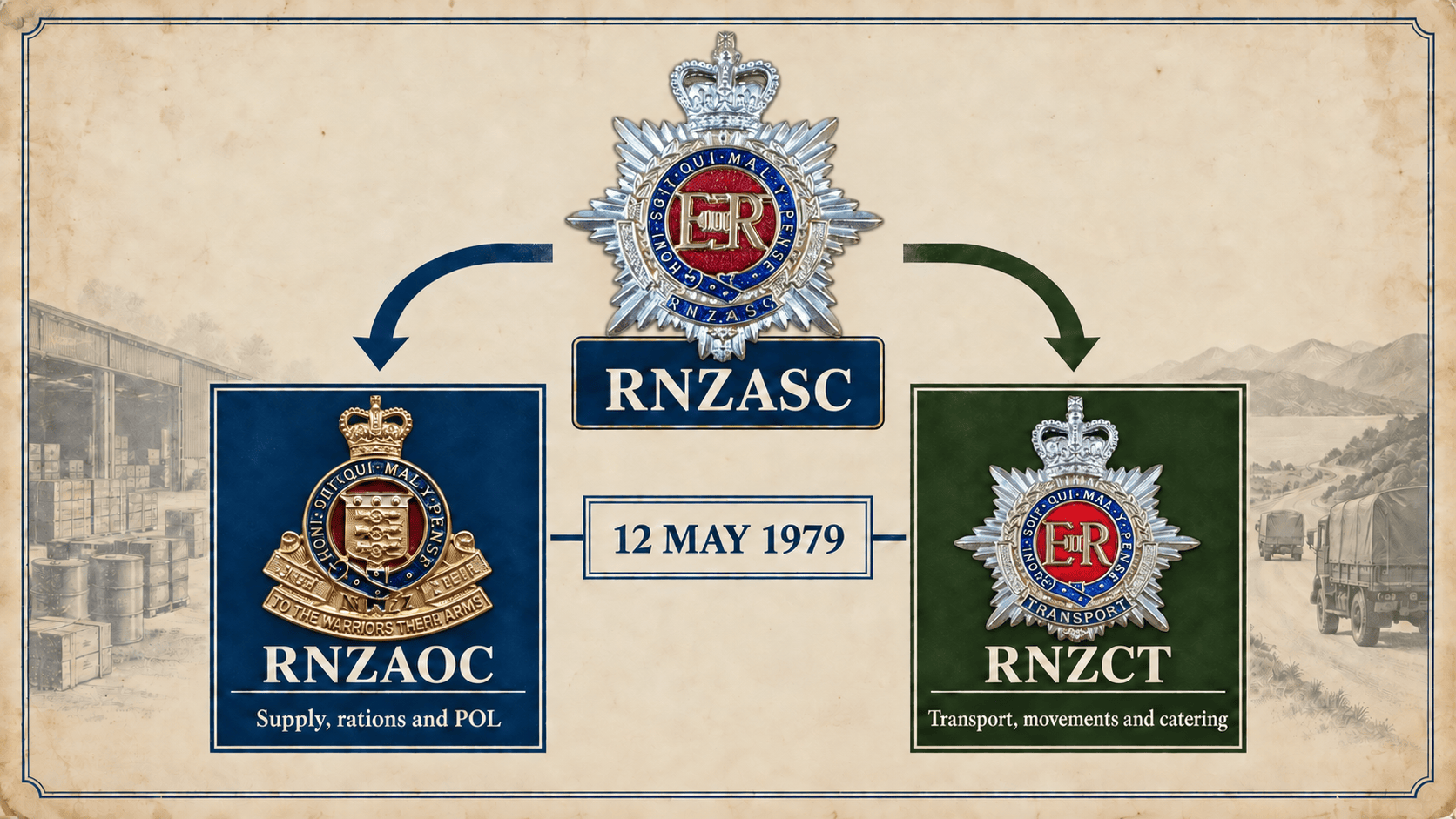
The change made the RNZAOC the Army’s principal supply Corps. From 12 May 1979, it became responsible not only for ordnance stores, ammunition, and technical materiel, but also for foodstuffs, rations, and petroleum, oils and lubricants (POL).[1]
Change was already underway
The formal 1979 transfer was the second stage of a process already underway within the RNZAOC. In July 1978, Pataka described a proposed reorganisation intended to “rationalise the supply chain”. Central Ordnance Depots and Ordnance Field Parks were to be grouped into regional organisations, reducing duplicated stockholding and simplifying the movement of stores from demand to delivery.[2]
The proposal did not promise large Regular Force savings. Its main benefits were expected to be fewer stocking points, lower inventory and storage costs, simpler accounting and better use of people and infrastructure. In October 1978, former RNZASC supply organisations began coming under RNZAOC command for command purposes, and the February 1979 Pataka recorded the practical changes: new titles, altered establishments, repainted signs and the arrival of new personnel.[3]
Why the Army reorganised
The 1978 Defence Review required a rearrangement of Army logistic functions. New Zealand followed the broad direction already adopted in Australia: transport, movements and catering would be grouped in a Corps of Transport, while supply would sit with the RNZAOC.[4]
The date itself carried deliberate symbolism. Major W. Fraser recommended 12 May 1979 because it coincided with the anniversary of the 1910 New Zealand Gazette notice that established the Army Service Corps. The change was therefore both an organisational break and a carefully marked transition from a long-standing corps tradition.[5]
Organisation from 12 May 1979
Principal responsibilities
Royal New Zealand Corps of Transport
Transport, Defence movements, catering and postal functions.
Royal New Zealand Army Ordnance Corps
Supply, including food, rations, POL, ordnance stores, ammunition and related technical responsibilities.
This division did not separate supply from transport in the field. The RNZAOC held, managed and provided the stocks; the RNZCT provided transport and much of the distribution capability. The implementation order expressly allowed RNZAOC Combat Supplies Platoons to be placed under command of an RNZCT unit when operational circumstances required supplies to be distributed from second-line transport.[6]
What the RNZAOC gained
From 12 May 1979, responsibility for the provision and storage of all foodstuffs and POL, together with the development, evaluation and provision of ration packs, passed from the RNZASC to the RNZAOC. The accompanying equipment sponsorship was broad: refrigeration and air-conditioning equipment, packaging and packing materials, POL storage and quality-control equipment, water containers, agricultural supplies, and specialist camp and religious stores.[7][8]
The transfer also made clerk/storekeeper and butcher training an RNZAOC School responsibility. It affirmed that food, rations and fuel were technical supply functions requiring professional knowledge, not simply commodities to be bought and issued.
The RNZAOC after 12 May 1979
The new directorates at Headquarters New Zealand Land Force were implemented on 9 April 1979, before the field transfer on 12 May. This enabled the Director of Ordnance Services to assume the necessary policy, technical-control and force-management responsibilities before the new unit structure took effect.[9]
The RNZAOC Directorate controlled a national supply system comprising a base supply battalion, four regional Supply Companies, the New Zealand Advanced Ordnance Depot in Singapore and the RNZAOC School.
This table shows the principal RNZAOC supply organisation following the 1979 reorganisation. It does not attempt to list every RNZAOC technical, ammunition or workshop-stores appointment and element.
The structure combined static and regional supply, base-level bulk holdings and deployable field capability. It was therefore more than a renaming of RNZASC camp supply depots.
The units transferred to the Corps
Former RNZASC sub-unit
New RNZAOC sub-unit
Location
Composite Platoon, 1 Transport Company
13 Combat Supplies Platoon, 1 Supply Company
Papakura
Supply Section, Papakura Platoon, Northern Company
14 Supply Platoon, 1 Supply Company
Papakura
Headquarters 21 Supply Company
Headquarters 21 Supply Company, 4 Supply Company
Waiouru
4 Platoon, 21 Supply Company
43 Combat Supplies Platoon, 4 Supply Company
Waiouru
Supply Platoon, Waiouru Company
44 Supply Platoon, 4 Supply Company
Waiouru
7 Platoon, 21 Supply Company
47 Petroleum Platoon, 4 Supply Company
Waiouru
New sub-unit
23 Combat Supplies Platoon, 2 Supply Company
Linton
Supply Section, Linton Platoon, Central Company
24 Supply Platoon, 2 Supply Company
Linton
Wellington Supply Platoon, Central Company
54 Supply Platoon, 1 Base Supply Battalion
Trentham
Composite Platoon, 3 Transport Company
33 Combat Supplies Platoon, 3 Supply Company
Burnham
Burnham Supply Platoon, Southern Company
34 Supply Platoon, 3 Supply Company
Burnham
Supply Platoon, New Zealand Transport Company
New Zealand Supply Platoon, NZAOD
Singapore
The revised numbering made the national pattern clearer. The 14, 24, 34, 44 and 54 Supply Platoons corresponded to Papakura, Linton, Burnham, Waiouru and Trentham. The specialist exception was 47 Petroleum Platoon, which retained the petroleum function of former 7 Platoon, 21 Supply Company, while adopting the Waiouru prefix. Headquarters 21 Supply Company remained as a Territorial Force sub-unit of 4 Supply Company, capable of commanding up to five supply sub-units for training and exercises.[10]
People and capability transferred with the units
The establishment papers show that the reorganisation was not merely an exercise in moving existing posts. Eighty Regular Force supply posts and two civilian posts were transferred to the RNZAOC. There was no increase in the Regular Force establishment, but the Territorial Force supply establishment rose from 123 to 158 posts, a net gain of 35. The increase was required to establish 23 Combat Supplies Platoon at Linton, an entirely new sub-unit.[11]
This demonstrates that rationalisation and capability growth occurred together. Former RNZASC composite platoons became RNZAOC Combat Supplies Platoons; the existing combat-supply and petroleum capabilities of 21 Supply Company were retained, and a new platoon was raised for 2 Task Force Region.
Continuity of expertise was protected. RNZASC personnel employed in supply units were to remain in those units until the RNZAOC had sufficient trained personnel to replace them. They were also required to indicate whether they wished to join the RNZCT or RNZAOC.[12]
The transfer was also a lived transition, not merely an establishment change. Contemporary accounts suggest that some RNZASC and RNZAOC personnel expected difficulties, particularly in the continued supply of rations. In practice, the handover of tasks and the incorporation of transferees proceeded smoothly. The result supports the central lesson of the reorganisation: adaptation was judged not by creating new titles or badges, but by whether the Army continued to receive essential support without interruption.[13]
Accounts, responsibility and continuity
The change was embedded in the accounting system. Northern Company RNZASC’s supply-depot bulk-stock account became that of 1 Supply Company; Waiouru Company’s became 4 Supply Company; the Linton and Trentham Central Company accounts transferred to 2 Supply Company and 1 Base Supply Battalion; and Southern Company’s became 3 Supply Company.[14]
This mattered because stock accounts represented formal custody and accountability. New badges and unit titles could be introduced quickly; transferring account responsibility changed the organisation answerable for receipt, storage, demand, issue and reconciliation of the stores that sustained the Army.
Adaptation without interruption
The 1978 to 1979 reorganisation fundamentally widened the RNZAOC’s role. It placed food, fuel, rations and supply support alongside ordnance stores, ammunition and technical materiel. At the same time, it preserved the interdependence of supply and transport, retained specialist knowledge during the transfer and added a new Territorial Force combat-supply capability at Linton.
The contemporary details differ, but the lesson remains relevant. Logistics must adapt to new systems, new equipment and new operating demands while continuing to sustain the force. In 1979, the decisive measure was not whether the chart changed; it was whether the Army could still feed, fuel and equip its units. That remains the proper measure of logistic adaptation today.[15]
Notes
[1] Army General Staff, Army Reorganisation Instruction No. 11: RNZASC Reorganisation, Army 209/1/142/SD, 24 April 1979, paras. 1-5
[2] The RNZAOC Reorganisation,” Pataka, July 1978, 10-12.
[4] Julia Millen, Salute to Service: A History of the Royal New Zealand Corps of Transport and Its Predecessors, 1860-1996 (Wellington: Victoria University Press, 1997), 415-16
[5] Julia Millen, Salute to Service: A History of the Royal New Zealand Corps of Transport and Its Predecessors, 1860-1996 (Wellington: Victoria University Press, 1997), 415-16
[9] Headquarters New Zealand Defence Force, Army General Staff, Army Reorganisation Establishments, Volume 3, Army 1920/1, April 1979, paras. 3 and 10-15
[10] Army General Staff, Army Reorganisation Instruction No. 11, Annexes D and F, paras. 6-7.
[11] Headquarters New Zealand Defence Force, Army General Staff, Army Reorganisation Establishments, Volume 3, Annex F, “Supply Posts for RNZAOC.”
[12] Army General Staff, Army Reorganisation Instruction No. 11, para. 6c.
[13] Major J. S. Bolton, A History of the Royal New Zealand Army Ordnance Corps (Trentham: RNZAOC, 1992), 224-25
[14] Army General Staff, Army Reorganisation Instruction No. 11, Annex F, para. 8.
[15] Ministry of Defence, Defence Capability Plan 2025 (Wellington: Ministry of Defence, 2025), 39.
The Royal New Zealand Army Ordnance Corps did not deploy a formed unit to South Vietnam. There was no RNZAOC depot, field park or company bearing the Corps’ badge. Instead, small numbers of RNZAOC officers, warrant officers, non-commissioned officers and soldiers served throughout the New Zealand and Australian command and logistic systems.
They worked at Headquarters New Zealand V Force in Saigon, Headquarters 1st Australian Task Force at Nui Dat, the 1st Australian Logistic Support Group at Vung Tau, and in the Logistic Support Element originally attached to 161 Battery, Royal New Zealand Artillery. At any one time, the RNZAOC presence was usually only a handful of personnel—approximately two officers and four other ranks—but their responsibilities connected New Zealand units with an extensive multinational supply network.[1]
This was a corps without a unit, but not without a function. Its personnel helped manage the flow of weapons, ammunition, vehicles, technical stores, clothing, equipment and distinctly New Zealand items through a logistic system spanning New Zealand, Australia, South Vietnam and the vast American supply establishment.
Designing the support system
When 161 Battery was selected for service in South Vietnam in 1965, one option considered was to re-equip the battery completely from United States Army stocks. That would have simplified some aspects of supply, but it would also have required the battery to abandon much of its established equipment and procedures.[2]
The arrangements negotiated in Saigon during May and June 1965 instead produced a hybrid system. Colonel Leo Kermode and the Director of Equipment, Lieutenant-Colonel Ron Hassett, worked with Australian and American authorities to divide responsibility for supporting the New Zealand force.[3]
Broadly, the system operated as follows:
Supply source
Principal responsibilities
New Zealand
New Zealand-owned weapons and vehicles, national items, badges, shoulder titles, distinctive clothing and equipment not available from allied sources
United States
Most ammunition, petrol, oils and lubricants, rations, medical supplies, fire-control equipment and other commonly used operational stores
Australia
Clothing, vehicle spares, general stores, technical support, medical support and access to Australian supply and maintenance organisations[4]
A sixteen-man Logistic Support Element was formed under Lieutenant Piers Martin Reid. It contained personnel from several New Zealand corps and was intended to connect 161 Battery with the Australian logistic company supporting the 1st Battalion, Royal Australian Regiment, at Bien Hoa.[5]
The arrangement gave the small New Zealand force access to a logistic establishment far beyond anything it could have deployed independently. It also created an enduring administrative challenge: responsibility for an item depended on who owned it, who normally supplied it, whether it was common to allied forces and which nation was expected to pay for it.
Bien Hoa: making the system work
The New Zealand Logistic Support Element was divided between Saigon and Bien Hoa. Some personnel served at Headquarters New Zealand V Force, while the remainder formed a battery section of the Light Aid Detachment and an augmented stores section supporting 161 Battery.
The original intention was to integrate the New Zealand element with the Australian Logistic Support Company. This did not happen immediately. The stores and workshop personnel initially moved into the Australian area but were subsequently accommodated with the battery, creating a small and comparatively independent New Zealand support organisation.
That arrangement was not entirely satisfactory. On 9 January 1966, the original policy was restored: the New Zealand element was placed under the Australian company’s operational and technical control, its personnel moved into the Australian area, and its stores were amalgamated with Australian holdings.[6]
The integration was important because 161 Battery arrived with several items that were not standard Australian or American equipment. Its Land Rovers, for example, were too small and underpowered for some of the tasks demanded of them, while replacement parts generally had to come from New Zealand. An American depot might hold thousands of vehicle components, but it could not supply a part for a vehicle that the United States Army did not use.
There were also substantial differences in scale. American depots operated in tons, pallet loads and large standard packs. New Zealand might require only a carton or a single component. The American system increasingly relied on computerised accounting, while New Zealand procedures remained largely manual. Requisitions therefore had to be translated not only between national organisations, but between fundamentally different concepts of scale and stock control.[7]
The L5 105-mm pack howitzer created further demands. It was light enough to be carried by helicopter, but tropical conditions reduced helicopter lifting capacity. Trials established that four sorties were required to move one gun, its detachment and twenty-five rounds. The weapon’s light construction also made it susceptible to damage when repeatedly fired at high charges. Maintaining the battery’s operational availability consequently depended upon an effective combination of engineering maintenance and ordnance supply.[8]
From Bien Hoa to Vung Tau and Nui Dat
The Australian commitment expanded from a battalion group into the brigade-sized 1st Australian Task Force during 1966. The task force established its operational base at Nui Dat in Phuoc Tuy Province, while its main logistic base was built approximately thirty-five kilometres away at Vung Tau.
161 Battery moved to Nui Dat on 16 May 1966. Its Logistic Support Element was detached and established within the 1st Australian Logistic Support Group at Vung Tau.[9]
Vung Tau offered port facilities, an airfield and a comparatively secure location, but the logistic base had to be developed on sand hills and a former rubbish tip. From primitive beginnings it grew into a large complex containing more than 1,300 service personnel and approximately 500 locally employed civilians.
Entrance to 1st Australian Logistic Support Group, Vung Tau.
The sand was a constant adversary. Tent pegs worked loose, trenches collapsed, vehicles bogged down and furniture sank into the ground. Fine sand entered weapons, engines, typewriters, stores, food, clothing and bedding. Maintaining an accurate and serviceable stockholding in such conditions required continual preservation, inspection and housekeeping.
At Nui Dat, second-line ordnance support was provided by an Ordnance Field Park. The initial element became the 6th Ordnance Field Park Detachment and, on 1 February 1968, was redesignated as the 1st Ordnance Field Park.
Ordnance Field Park (Det) location on Hill ‘Nui Dat 2’
1967 – New Store Sheds and Control Office HQ Building OFP Nui Dat
At Vung Tau, third-line support was provided successively by the 1st Composite Ordnance Company, the 2nd Composite Ordnance Depot and, from 16 November 1967, the 2nd Advanced Ordnance Depot.[10]
The 2nd Advanced Ordnance Depot included supply-control, stores, ammunition, vehicle, laundry and bath elements. It held approximately 15,000 line items, generally based on ninety days of operating stock together with theatre reserves. New Zealand ordnance personnel posted to the Australian system could therefore find themselves working within an organisation of a scale not encountered at home.[11]
1st Australian Logistic Support Group, Vung Tau, 1971. The former improvised base had developed into a large theatre logistic complex.
The supply chain
New Zealand’s supply system in Vietnam was not a single pipeline. It was a network.
Headquarters New Zealand V Force in Saigon managed national requirements, financial arrangements, local purchase and liaison with allied headquarters. New Zealand-specific stores were forwarded through national channels, while Australian and American organisations supplied most common operational requirements.
Members of V Force HQ in Saigon, 1971. Back row (Left to Right): Sgt Derek Cain RNZEME, Cpl Alby Bron RNZEME, LBdr Bruce Tutauha RNZA, LCpl A Rendell RNZASC, Cpl Bruce Isbister RNZIR, Bdr Tony Hulme? RNZA, Dvr Greg Hutton RNZASC, LCpl Terry Burch RNZSigs, Cpl Pat Cranston RNZIR, Cpl Doug Waugh RNZAOC Front row (Left to Right): Ssgt Ces Hughes RNZIR, WO2 Jack Bingham RNZE, WO2 Cliff Lindsay RNZIR, Capt Buster Hornbrook RNZIR, Lt Col Val Brown RNZIR, Maj Bruce Meldrum RNZAC, WO A. McAsey RNZAF, WO2 Lofty Keys RNZIR
Urgent stores, mail and personnel could be moved by air. RNZAF and allied aircraft connected New Zealand, Singapore, Saigon and Vung Tau. Routine Australian flights also linked Saigon, Vung Tau and Nui Dat.
The principal daily connection between the logistic base and the task force was the road convoy from Vung Tau to Nui Dat. Priority demands, ice and perishables normally moved each day. Ammunition and petroleum products were carried forward three times a week, while ordnance and engineer stores generally moved twice weekly. Including the various classes of supply, 1st Australian Logistic Support Group could be tasked with approximately forty-six truckloads each day, seven days a week.
Each convoy was affected by road conditions, vehicle availability and enemy activity. Daily logistic conferences at Vung Tau considered demands, priorities, transport, road closures, intelligence and the back-loading of salvage. Operationally urgent items could be carried by special vehicle, aircraft, helicopter or watercraft when the normal system was too slow.[12]
Bulk resupply arrived by sea. HMAS Jeparit normally visited at intervals of about six weeks and was frequently loaded close to its 4,300-ton capacity. Ammunition, explosives and vehicles were discharged into barges before the ship came alongside to unload the remainder of its cargo. Other vessels, including HMAS Sydney, supplemented this service during unit rotations and major movements.
The system was vast compared with the number of New Zealanders it supported. Its size offered considerable advantages, but it also made New Zealand-owned equipment difficult to track. An item might pass through a New Zealand headquarters, an Australian depot, an American support unit and a forward Australian ordnance installation before reaching its user.[13]
Ammunition
Ammunition supply was one of the clearest examples of coalition dependence. Approximately ninety per cent of Australian and New Zealand ammunition requirements came from United States sources. The remainder came from Australia and included 105-mm artillery ammunition, 20-pounder ammunition for Centurion tanks and some small-arms ammunition.
Australian ammunition was initially held at a sub-depot at Vung Tau. It was later moved to the United States ammunition establishment at Long Binh, allowing both American- and Australian-supplied ammunition to be issued through one location. Australian and New Zealand ammunition technicians were attached at various times to undertake identification, safety, quality surveillance and disposal duties.
The United States Army logistics complex at Long Binh, 1967. Australian and New Zealand ammunition supply increasingly drew on the American depot system.
American road transport delivered ammunition for the task force directly to the Task Force Maintenance Area at Nui Dat. This reduced double handling, but it did not remove the need for ordnance oversight. Different manufacturers, markings, lots, fuzes and national accounting arrangements still had to be reconciled.[14]
Ammuniton stored in the 1 ALSG by the American bunker system, which was used throughout Vietnam. The ammunition point at Nui Dat contained seven such bunkers cut into the side of a hill. Ammunition was stored in two-point dispersion, and usually only vulnerable items such as pyrotechnics were stored covered because the turnover of stock was rapid. Photo RNZAOC School
Payment arrangements were equally complex. New Zealand initially paid a fixed monthly charge for American support. From 1967, artillery ammunition was charged according to recorded expenditure. A 105-mm round was priced at US$25.62, increasing to US$31.49 in March 1969.
Fuzes became the subject of separate negotiation. New Zealand was presented with a retrospective account of approximately $567,000, but the United States agreed not to charge for the fuzes fitted to more than 120,000 shells fired between 1965 and 1968. At approximately nine dollars per fuze, this represented a substantial saving. The episode nevertheless demonstrated that coalition logistics involved finance and accounting as well as the physical delivery of ammunition.[15]
The wider Australian ordnance framework
The Royal Australian Army Ordnance Corps provided the organisational framework within which most New Zealand ordnance personnel worked. The system included the 2nd Advanced Ordnance Depot at Vung Tau, the Ordnance Field Park at Nui Dat and numerous specialist stores sections supporting workshops, engineer units, armoured units and communications organisations.
Ordnance soldiers did not remain permanently behind wire. Field Park personnel provided forward detachments during major operations, operated bath and water-point equipment, assisted with patrols and perimeter defence, guarded stores and accompanied convoys. At Fire Support Base Coral in May 1968, the forward Task Force Maintenance Area group operated in a position repeatedly attacked by rockets and mortars. Stores and records were damaged, and a complete stocktake was required after the detachment returned.
Even fixed installations remained within range of enemy action. The Ordnance Field Park area at Nui Dat came under mortar fire, while personnel at both Nui Dat and Vung Tau were required to maintain defensive positions and perform sentry and local-security duties. Logistic service in Vietnam could not be separated completely from the operational environment.[16]
New Zealanders in the wider system
Approximately five per cent of New Zealand V Force was employed in the supply chain. At the peak of the New Zealand commitment in November 1968, thirty of the 543 New Zealand personnel in South Vietnam were serving with the 1st Australian Logistic Support Group. Across the entire deployment, 137 New Zealanders from all corps and services served with the group.
These figures must not be mistaken for RNZAOC strength. New Zealanders in 1st Australian Logistic Support Group included personnel from many corps and services. The RNZAOC component was only one part of that wider national contribution.
Some RNZAOC personnel also served at American installations. Corporal Frankie Te Waru Hohepa, for example, worked at the United States Army depot at Long Binh. Such attachments provided direct access to the American supply system and gave New Zealand personnel experience with methods, stock levels and accounting procedures far larger than those normally encountered in New Zealand.[17]
A contemporary Corps newsletter provides a particularly clear picture of this dispersed presence. In 1970, Major Malcolm Ross was serving at Headquarters 1st Australian Logistic Support Group; Lieutenant Maxwell Newnham and Sergeants Rex Pennell and Terence Morrissey were attached to the 2nd Advanced Ordnance Depot at Vung Tau; Corporal Brian Moore was attached to 161 Battery at Nui Dat; and Corporals Ronald Henderson and Joseph Bolton were at Headquarters New Zealand V Force in Saigon. They did not constitute an RNZAOC unit, but collectively formed a small network of ordnance specialists distributed across the principal New Zealand and Australian logistic organisations.[18]
The surviving reports also reveal what these arrangements meant at the individual level. Corporal Joseph Bolton reported that he was attached to the Australians as a local-purchase clerk in the United States Supply Office in Saigon. The appointment placed him at the intersection of the New Zealand, Australian and American supply systems. He also hoped to gain an attachment to the United States Army ammunition sub-depot at Long Binh so that he could return to ammunition work.[19]
The New Zealand headquarters in Saigon underwent several changes of title:
Headquarters New Zealand Army Detachment, 29 June 1964–1 July 1965
Headquarters New Zealand V Force, 2 July 1965–5 March 1972
Headquarters New Zealand Army Training Group Vietnam, 6 March–21 December 1972
Published nominal rolls sometimes combine these headquarters under the general title ‘HQ V Force’. The distinction is nevertheless useful when establishing when and under what organisation an individual served.[20]
RNZAOC personnel in the ordnance and logistic system
The following register is confined to personnel who served in South Vietnam as members of the RNZAOC, in RNZAOC appointments or in direct ordnance-support roles.
It does not include soldiers who served in the New Zealand rifle companies or Army training teams as members of other corps and transferred to the RNZAOC after their Vietnam service. Those personnel are covered in the earlier V Force Ordnance article.
Headquarters New Zealand V Force
Corporal Joseph Seymour Bolton
Sergeant John Walter ‘Boots’ Byrom
Corporal Ronald John Henderson
Warrant Officer Class Two John Edward Hancox
Corporal James Nelson Harvey
Corporal Frankie Te Waru Hohepa
Lance Corporal Kevin Gerard Moriarty
Lance Corporal Colin William Roulston
Lieutenant Mark David Stuart
Sergeant Bruce Raymond Swain
Corporal Barry James Taylor
Corporal William Douglas Waugh
Headquarters 1st Australian Task Force
Corporal Michael Maurice Barker
Private Colin Robert Von Richenbach
1st Australian Logistic Support Group
Corporal Brian William Calvey
Major Arthur John Campbell
Corporal Ernest Reichter Clegg
Captain Gary Malcolm Corkin
Lieutenant Ronald Leslie Cross
Staff Sergeant Alfred Stephenson Day
Captain Kevin John Dreyer
Lieutenant James Bernard Finnerty
Sergeant Dennis Leslie Goldfinch
Corporal Laurence Roy Hawkins
Staff Sergeant Tamamarakau Te Kingi Hiini
Sergeant Arthur James Keeler
Staff Sergeant Derek John Keen
Lieutenant Terence David McBeth
Corporal Phillip Ross Miller
Sergeant Terence Norman Morrissey
Lieutenant Maxwell Frederick Newnham
Staff Sergeant Rex Pennell
Lieutenant Piers Martin Reid
Major Malcolm John Ross
Staff Sergeant Roy Harold Staniford
Sergeant Barry Thomas Thompson
Sergeant Darrell Samuel Todd
Staff Sergeant James William Twist
The New Zealand Governor-General Sir Arthur Porritt chats with Staff Sergeant Rex Pennell during his visit to New Zeland troops in Vung Tau. Captain M.F Newnham is to the right of SSgt Pennell. RNZAOC School
161 Battery Logistic Support Element and attachments
Corporal Laurence Charles Collier
Staff Sergeant Ronald Albert Eveleigh
Lieutenant David Ralph Hughes
Sergeant Maurice John Lynch
Corporal Brian David Moore
Corporal Wilford Stuart Neshausen
Private Stephen Rex Shepherd
Private Stephen Shepherd was an RNZAOC storeman attached to 161 Battery. Although he has sometimes been recorded as a gunner because of that attachment, he remained a member of the RNZAOC throughout his service.
The register reflects the dispersed nature of RNZAOC service in South Vietnam. These personnel did not belong to a single corps unit. They occupied appointments across headquarters, depots, field installations and the logistic element supporting the New Zealand artillery battery.[21]
Withdrawal
The withdrawal of 161 Battery in May 1971 began another demanding phase for the logistic system. Weapons, vehicles, technical equipment and stores had to be identified as New Zealand-owned, Australian-supplied, American-supplied, leased, expendable or suitable for disposal in theatre.
The work could also extend an individual’s service in Vietnam. Sergeant John Byrom’s one-year tour was prolonged specifically so that he could assist with the withdrawal of stores from South Vietnam. His extended tour provides a personal example of the additional accounting, identification and disposal work generated as the New Zealand commitment contracted.[22]
The battery’s non-standard and borrowed holdings, including its M2A2 105-mm howitzers, had to be returned through the appropriate channels. Serviceable New Zealand equipment was prepared for shipment, while surplus and unserviceable stores were accounted for, transferred or disposed of.
The Australian withdrawal required ordnance personnel to maintain support while simultaneously reducing the organisation that provided it. During 1971, the 1st Ordnance Field Park moved most of its organisation from Nui Dat to Vung Tau, leaving a detachment to operate controlled stores, the self-service store, the monthly bulk break and the equipment wash point.
Quarantine regulations required vehicles and equipment returning to Australia to be thoroughly cleaned. Tanks, vehicles and stores exposed to Vietnamese soil had to pass inspection before loading. Other material, including deteriorated tentage, webbing and tarpaulins, could be written off, destroyed or transferred rather than shipped home.
On 15 September 1971, the 1st Ordnance Field Park at Vung Tau assumed responsibility for supporting the remaining Australian forces from the 2nd Advanced Ordnance Depot. Its personnel had to determine a final stock scaling that would meet every remaining operational demand without leaving a large surplus when the force closed.
This required continuous stocktaking, outscaling and reconciliation. The field park still received and issued stores, but its holdings had to decline in step with the force. It closed for business on 31 January 1972. Personnel and equipment then returned to Australia, where the final reconciliation of stock and records continued until June.[23]
New Zealand’s headquarters and training commitment continued until December 1972. Personnel who served with the training teams as members of other corps and subsequently transferred to the RNZAOC fall outside the scope of this article.
Conclusion
The RNZAOC contribution in South Vietnam cannot be measured by unit titles or the size of a formed deployment. There was no New Zealand ordnance depot and no RNZAOC field park. Instead, individual corps personnel were inserted into a multinational system and expected to make it work for a small national force.
They translated New Zealand requirements into Australian and American supply procedures, maintained national accountability, handled technical and general stores, supported ammunition supply, assisted with local purchase and helped sustain 161 Battery and the wider New Zealand contingent.
The arrangement offered New Zealand access to a supply chain of immense capacity, but it also exposed the difficulties of relying on allies whose equipment, accounting systems, stock scales and administrative practices differed from its own.
The achievement of the RNZAOC personnel in Vietnam was therefore one of professional adaptability. Dispersed across Saigon, Vung Tau, Nui Dat and allied installations, they ensured that New Zealand soldiers received the stores, weapons, ammunition and equipment they required. The Corps went to Vietnam without a unit of its own, yet its purpose—providing the warrior with the means to fight—remained unmistakable.
Notes
[1]J. S. Bolton, A History of the Royal New Zealand Army Ordnance Corps (Trentham, New Zealand: Royal New Zealand Army Ordnance Corps, 1992), 193; Ministry for Culture and Heritage, ‘Unit Notes—Vietnam Veterans List,’ VietnamWar.govt.nz, accessed 1 September 2026, https://vietnamwar.govt.nz/unit-notes-vietnam-veterans-list.
[2]Ian McGibbon, New Zealand’s Vietnam War: A History of Combat, Commitment and Controversy (Auckland: Exisle Publishing, 2010), 80–81.
[6]Ian R. Finlayson, Supporting the Commitment: Australian Army Logistics in South Vietnam, 1962–1973 (Cambridge: Cambridge University Press, 2026), 72–73; McGibbon, New Zealand’s Vietnam War, 95–97.
[7]Bolton, History of the Royal New Zealand Army Ordnance Corps, 194.
[11]Bolton, History of the Royal New Zealand Army Ordnance Corps, 194–96.
[12]Bolton, History of the Royal New Zealand Army Ordnance Corps, 196–98; Ordnance Field Park Vietnam Association, ‘About Us,’ accessed 1 September 2026, https://ofpvietnam.wordpress.com/about-us/.
[13]Bolton, History of the Royal New Zealand Army Ordnance Corps, 196–98.
[14]Bolton, History of the Royal New Zealand Army Ordnance Corps, 196.
Today, 12 July, would have been Corps Day for the Royal New Zealand Army Ordnance Corps. It also marks thirty years since the formation of the Royal New Zealand Army Logistic Regiment and, with it, the disestablishment of the RNZAOC. It is a fitting moment to look back, not with sentimentality but with appreciation for what the Corps actually was and what it left behind.
The RNZAOC was not lost so much as it moved into its next form. From the days of Henry Tucker onwards, the work of the Ordnance soldier was defined by one constant: continual adaptation. Its history is best understood not as that of a fixed institution that came to an end, but as one long process of change that continues today, under a different name.
Formed in war, tested by peace
The role of the Ordnance soldier expanded and contracted as the Army’s needs shifted around it. During the First World War, New Zealand Ordnance personnel served both at home and overseas, in Egypt, Gallipoli, Palestine, France, Belgium and the United Kingdom.
The interwar years brought progress alongside considerable uncertainty, including a period when the New Zealand Army Ordnance Corps came close to ceasing to exist altogether.
Mechanisation and a widening trade
The Second World War forced rapid adaptation once more. Ordnance soldiers served in every theatre in which New Zealand forces took part, adjusting to the demands of increasingly mechanised warfare. Bath and laundry services, ammunition support and specialist technical functions all became central to the Corps’ work during this period.
The later transfer of the Technical Trades to the New Zealand Electrical and Mechanical Engineers fits the same pattern rather than breaking from it. As military technology and technical specialisation advanced, responsibilities moved to where they made most sense — a recurring feature of the Corps’ story, not an exception to it.
A peacetime Corps that kept changing
Adaptation did not stop when the wars ended. Territorial Force personnel became an integral part of the RNZAOC, and the increasingly specialised management of technical stores gave rise to the Auto Parts trade. The Ammunition Technician trade evolved alongside the operational environment and, by the 1970s, had become the Army’s centre of expertise in explosive ordnance disposal.
Further change followed: the integration of women from the Women’s Royal New Zealand Army Corps, and then the transfer of the RNZASC supply trades into the RNZAOC in 1979. Less visibly, Ordnance personnel also adapted to the gradual introduction of electronic stores-management systems, progressing from early mainframe systems to the networked logistics systems in use by 1996.
The Corps at its height
By the mid-1980s, the RNZAOC had reached its peak. 1 Base Supply Battalion was, at the time, regarded as one of the most complex warehouse operations in New Zealand. Supply Companies were located at Hopuhopu, Waiouru, Linton and Burnham. Separately, stores sections were integrated within each RNZEME workshop, while an Advance Ordnance Depot maintained a New Zealand presence in Singapore. It was a Corps operating at scale, both at home and abroad.
That scale did not last. With the end of the Cold War came a peace dividend, and with it a gradual reduction in the size and reach of the Corps through the late 1980s and into the 1990s. This, too, was adaptation rather than decline for its own sake, the Corps reshaping itself to match a changed strategic environment, as it always had.
Towards Formed Deployments
RNZAOC soldiers had already deployed on operations in Korea, Malaya, Malaysia and South Vietnam, and others had served individually on peacekeeping missions. The 1990s added a further dimension, as Ordnance soldiers began deploying on operations as formed contingents, beginning with a Supply Detachment to Somalia, followed by two platoons, a shift that reflected both New Zealand’s changing military commitments and the increasingly integrated role of logistics support.
A Corps Spanning Generations
When the RNZAOC was disestablished in 1996, its youngest member was 17 years old and its oldest was 55. That span was more than a statistic. It represented a Corps that connected multiple generations of officers and soldiers, from those trained in long-established manual systems to those entering an increasingly digital and integrated logistics environment, within a single institution, at a single moment.
Continuity, Not Loss
The formation of the RNZALR did not erase the RNZAOC’s history; it became the next stage in a much longer process of adaptation. Titles, structures and trades changed, but the essential purpose held: to provide the Army with the equipment, ammunition, technical support and supply services needed to train, deploy and operate.
Thirty years on, the most fitting way to remember the RNZAOC is not to mourn its passing, but to recognise its enduring legacy, carried forward today within the RNZALR, particularly through its Supply trade. Adaptation was never evidence of weakness or decline. It was, and remains, one of the Corps’ defining strengths.
Logistics for New Zealand’s Motorised Infantry Future
From 1845 to the present, New Zealand’s military logistics system has continually adapted under pressure. Across the history of the Defence Stores Department, the New Zealand Army Service Corps, the New Zealand Army Ordnance Corps, the Royal New Zealand Army Ordnance Corps, Royal New Zealand Electrical and Mechanical Engineers and Royal New Zealand Corps of Transport and today’s Royal New Zealand Army Logistic Regiment, the pattern is consistent. Each generation entered conflict organised for one set of assumptions, then adapted its structures, equipment, trades and methods as war exposed the limits of the old system.
That pattern is visible across the long history of New Zealand military logistics. Colonial forces moved from ad hoc local supply to centralised control of stores. The late nineteenth century saw the creation of a system capable of supporting breech-loading artillery, harbour defence, and increasingly complex imported weapons. The First and Second World Wars forced expeditionary supply, transport, ordnance, movement control, field catering, mobile repair and ammunition systems to mature at scale. Later reforms adjusted stores accounting, entitlement control, field-force logistics, ration packs, mechanical support, combat clothing, and digital supply systems to suit new technology and new structures.
The lesson is simple. New Zealand Army logistics has rarely succeeded because it possessed mass. It has succeeded when it adapted faster than its circumstances collapsed around it.
That lesson now matters again.
In December 2025, the New Zealand Army formally amalgamated 1st Battalion, Royal New Zealand Infantry Regiment and Queen Alexandra’s Mounted Rifles at Linton Military Camp. The new unit retained the name 1 RNZIR and was organised as a Motorised Infantry Battalion, with one sub-unit retaining the QAMR name. NZDF described the change as enhancing the combat readiness of one of the Army’s key outputs, the Motorised Infantry Battle Group.[1]
The formation of 1 RNZIR as a Motorised Infantry Battalion at Linton provides the organisational trigger for rethinking how New Zealand Army logistics supports a more dispersed and agile force.
This is more than a unit name change. It is a force design signal. If the combat arm is reorganising around a motorised infantry model, then the sustainment system must be examined with the same seriousness. A motorised infantry battalion can only be as agile, lethal and survivable as the logistics system that fuels it, arms it, repairs it, feeds it, moves it and replenishes it.
The danger is that the Army could create a modern combat structure sustained by an older, more predictable and increasingly vulnerable distribution model.
The Future Battlefield and the Logistic Problem
The Future Land Operating Concept 2035 anticipated many of the challenges now visible in Ukraine and other contemporary theatres. It described the future land environment as increasingly connected and monitored, crowded, partnered, lethal and complex. It also acknowledged that, by international standards, the New Zealand Army would remain a small army with limited firepower and protection compared with medium or heavy forces. To remain relevant, it would need a qualitative edge built around agility, precision, interoperability, information advantage and force-multiplier strategies.[2]
That description fits the logistics problem exactly.
The modern battlefield is becoming more transparent. Drones, commercial satellites, electronic surveillance, social media, signals intelligence and persistent sensors make movement easier to detect. Convoys, vehicle parks, fuel points, ammunition dumps, replenishment points and headquarters are no longer safely “behind” the front line. They are part of the target set.
At the same time, forces are becoming more dispersed. Lethality drives dispersion, and dispersion drives logistic complexity. Smaller groups need to operate further apart, for longer, with fewer opportunities for large-scale replenishment. This increases demand for batteries, water, medical stores, ammunition, repair parts, communications equipment, drone components, fuel and specialist technical support at the tactical edge.
Ministry of Defence images of NZ Army personnel testing small UAS at Waiouru
For a large army, this problem may be partly solved by mass. For New Zealand, mass is not available. The answer must be a more intelligent, distributed and layered sustainment system.
Logistic drones should be part of that system.
But none of this is one-directional. A battlefield transparent enough to expose a fuel point is also transparent enough to reveal a drone charging station, an unmanned ground vehicle route, or a field 3D-printing node. Ukraine’s experience since 2022 shows how quickly forces adapt counter-drone measures, including layered air defence, electronic warfare, decoys and dedicated drone-hunting teams. Any New Zealand logistic drone system must therefore assume that the enemy will adapt to it, just as quickly as it seeks to outmanoeuvre the enemy.
Illya Sekirin makes the same point in Rise of the Machines. His central argument is not simply that drones are important, but that technology only becomes decisive when tactics, organisation, procurement, training and strategy are adapted around it. He compares the drone to the tank, noting that tanks existed in the First World War but did not become operationally decisive until armies learned how to organise and fight around them. The same warning applies to logistics. A drone purchased as equipment is not a capability. A drone integrated into sustainment, reconnaissance, protection, maintenance, counter-drone defence and command arrangements may become one.[3]
This is not theoretical. In March 2025, Reuters reported that the commander of Ukraine’s Unmanned Systems Forces warned that NATO armies were not ready for the scale and character of modern drone warfare. His warning was not simply about owning enough drones. It was about the way drones had overturned established doctrine, created a new cost-exchange problem, and forced rapid adaptation in electronic warfare, counter-drone defence, automated targeting and battlefield logistics.[4]
That matters for New Zealand because the point is not the size of Ukraine’s drone programme, which New Zealand cannot and need not copy. The point is the speed of adaptation. Drone warfare is not developing at the pace of traditional platform acquisition. It is developing at the pace of software, commercial manufacturing, field improvisation and battlefield feedback.
A Historical Parallel: The Ordnance Field Park
The New Zealand Divisional Ordnance Field Park of the Second World War provides a useful historical comparison. Formed in July 1941 after the lessons of Greece and Crete, the NZ OFP was a mobile mini ordnance depot supporting the 2nd New Zealand Division. It held spares for the Divisional Workshops and moved forward when workshop elements deployed to support brigades. Its stockholding included motor transport spares, weapon spares and signal stores, carried on vehicles and scaled to support a highly motorised division.[5]
The OFP was not a rear-area warehouse. It was a forward, mobile stockholding system designed to place repair parts and critical stores close enough to the point of need to sustain tempo. When the Division became more mechanised and incorporated an armoured brigade, the OFP reorganised to include separate infantry and armoured sections, later adding reserve vehicle and mobile advanced ordnance depot functions.[6]
The parallel is not exact. The OFP moved spares within a Second World War divisional system. It did not operate through contested, observed airspace under the kind of persistent surveillance now assumed for the future battlefield. Drone logistics inherits the OFP’s logic of forward, mobile stockholding, but it must solve for exposure in a way the OFP never had to.
That principle remains relevant. The OFP solved a problem created by mechanisation, how to keep a mobile force supplied with the spares and controlled stores it needed without waiting for the base depot. Drone logistics solves a related problem created by dispersion and battlefield transparency, how to move small, urgent and high-value items across the last tactical mile without exposing larger vehicles, drivers and replenishment points.
NZ Division OFP on the Move. Noel Kreegher Collection
In that sense, logistic drones are not a rejection of New Zealand Army logistics history. They are a modern expression of it.
Drones Are Not a Replacement for Trucks
The first point must be clear. Logistical drones will not replace trucks, containers, aircraft, ships, fuel tankers, forklifts, ammunition vehicles, recovery vehicles, or logistics specialists. Nor should they be presented as a miracle technology.
Their value lies elsewhere.
Drones offer a way to move small, urgent and high-value loads across the “last tactical mile”, the dangerous and inefficient gap between a combat service support node and the soldier, crew, section, troop or detachment that needs something now. A drone does not need to carry everything. It only needs to carry the thing that prevents the task from failing.
Logistic drones should not be seen as truck replacements. Their value lies in moving small, urgent and mission-critical loads across the final exposed gap.
That might be radio batteries, a replacement optic, a drone battery, a medical pack, blood products, morphine, water, rations, a weapon spare, a fuse, a small quantity of ammunition, a repair component, a cable, a cryptographic item or technical documentation.
Even here, the detail matters. Carrying medical items and ammunition as interchangeable small loads on the same platform class is not a purely logistical choice. Blood products and medical stores carried under recognised medical markings have a different legal status to ammunition. Any drone tasked across both roles will need clear rules on marking, tasking and interchangeability before it reaches the field.
Ukraine also shows that drone logistics is not theoretical. Sekirin notes that larger multirotor drones have been used to carry water, food and ammunition to encircled soldiers, while unmanned ground vehicles have been used to bring supplies forward, evacuate wounded, clear routes and reduce direct exposure of troops. These examples do not remove the need for conventional logistics, but they show how unmanned systems can fill dangerous gaps where trucks, soldiers or stretcher parties would otherwise be exposed.[7]
The scale of this shift should not be understated. General David Petraeus, drawing on repeated visits to Ukrainian units, has observed that armoured vehicles and infantry fighting vehicles are increasingly unable to survive if spotted by an observation drone, prompting some Ukrainian units to stop using human drivers on resupply routes altogether. Remotely driven vehicles instead carry ammunition, food, water and blood products forward and return with casualties.[8] This is not simply a refinement of last-mile delivery. It suggests that on the most exposed routes, the choice may shift from “driver plus drone support” to “no driver at all.”
In this sense, logistic drones are not bulk transport. They are precision distribution.
This has another historical echo. During the Second World War, New Zealand’s movement control system managed the complex movement of troops, stores and equipment by road, rail, sea and air. The 3rd Division’s Movement Control Unit in the Pacific handled 476 ships, averaging 20 vessels per week, with a staff that never exceeded 17 men. It operated in difficult conditions, often with limited port infrastructure, and adapted its methods to local circumstances.[9]
The modern equivalent is not simply moving more tonnage. It is using every available mode intelligently. Trucks, ships, aircraft, landing craft, forklifts, movement operators and drones all become part of a wider distribution network. The principle is not “drone instead of truck”. It is the right mode for the right load, at the right time, with the least exposure.
Logistic Drones as Multi-Role Systems
Logistic drones should not be thought of only as flying delivery vehicles. In many cases, the same platform that carries a small load can also provide information. A drone sent forward with batteries, medical stores or repair parts can confirm the condition of the route, identify damage to tracks or bridges, observe the proposed delivery point, check whether the receiving element has moved, and provide immediate feedback to the combat service support commander.
This gives logistic drones an ISTAR value. They can contribute to local intelligence, surveillance, target acquisition and reconnaissance by observing the ground over which replenishment must occur. Before a vehicle convoy moves, a drone could check a route. Before a replenishment point is opened, a drone could confirm whether the area is clear, concealed and usable. During replenishment, a drone could provide overwatch, detect movement, and warn of threats to the supported force or the logistic element.
Sekirin identifies four characteristics that make drones militarily disruptive: omnipresence, accurate direct fires, discardability and mobility. For logistics, the most important of these is not necessarily direct fire, but omnipresence and mobility. A logistic drone can move a small load, but it can also observe, confirm, warn and report. That means its value lies not only in what it carries, but in what it sees and how quickly it can be repositioned.[10]
This does not mean that every logistic drone should become a strike platform. The more useful model is a family of systems with common components, training, batteries, software and payload standards, but different payload options. Some drones would be optimised for carriage. Some would be optimised for surveillance. Some might carry electronic-warfare or communications relay payloads. A smaller number, under clear command authority, could be armed or fitted for suppressive fire against targets of opportunity that threaten a replenishment operation.
That distinction matters. A drone carrying blood products, medical stores or marked medical supplies raises different legal and ethical issues from a drone carrying ammunition or a weapon payload. Mixing those roles without clear rules would create confusion and risk. If the Army adopts multi-role logistic drones, it will need clear procedures for tasking, marking, payload changeover, authority to arm, control of fires, recovery of unused munitions and post-mission accountability.
For a Motorised Infantry Battalion Group, the most immediate value is probably not in turning supply drones into routine attack drones. It is in using them to support replenishment by seeing first, warning early and reducing exposure. A resupply task could therefore be supported by three drone functions: a reconnaissance drone to check the route and delivery point, a logistic drone to move the load, and, where the threat justifies it, an overwatch or armed drone controlled through normal command and fire-control arrangements.
The Australian-designed SYPAQ Corvo Precision Payload Delivery System provides a useful example of this logic. Developed as a low-cost fixed-wing payload-delivery system, the Corvo PPDS has been supplied to Ukraine and reportedly adapted for reconnaissance and attack roles as well as delivery. Its significance is not that New Zealand should simply buy the same system, but that the design of logistics drones should preserve modularity. Airframes, payload bays, mission software, batteries, training systems, and repair arrangements should enable controlled adaptation rather than lock a platform into a single, narrow role.[11]
A constructed SYPAQ Corvo PPDS drone, sitting atop a stack of flat-packed ones. SYPAQ
The broader lesson is that a drone designed only as a small flying box may quickly become obsolete. A drone family designed around carriage, observation, communications relay and controlled payload change may remain useful for longer.
This would fit the wider argument of this article. Drone logistics is not simply about moving small loads. It is about making sustainment less predictable, less exposed and better informed. A drone that delivers a battery is useful. A drone that delivers a battery and confirms the replenishment route is still usable is more useful. A drone system that can integrate carriage, reconnaissance, communications relay, and protective overwatch is even more useful, provided the roles are controlled rather than improvised.
Logistics in a Contested Drone Environment
Much is now said about operating in a contested environment, but the phrase needs to be understood in practical logistic terms. A contested environment is one in which friendly forces cannot assume that movement, communications, concealment, airspace, supply or evacuation will be uncontested. The enemy is not simply waiting to be engaged by combat troops. It is actively trying to find, disrupt and destroy the systems that allow those combat troops to keep fighting.
For logistics, this changes the problem. A replenishment point is no longer just a place where stores are issued. It is a potential target. A vehicle harbour is not just an administrative pause. It is a detectable pattern. A fuel point, ammunition transfer point, repair team, drone charging site, casualty collection point or field 3D-printing node may all become part of the enemy’s target list. The more predictable the logistic system becomes, the easier it is to find and attack.
Drones intensify this problem because both sides can use them. If friendly forces are sending drones forward to check routes, confirm delivery points, carry stores, and provide overwatch, the opposing force is likely to do the same. Enemy drones may be searching for logistic vehicles, identifying resupply nodes, tracking movement between hides and distribution points, locating command posts, observing unloading activity or waiting for troops to concentrate during replenishment. The danger is not only that a logistic drone may be shot down. The greater danger is that enemy drones may exploit the replenishment process itself to locate and attack the logistics system.
Sekirin describes this as the emergence of battlefield transparency, an operational condition in which movement near the front can be observed and countered. Although his analysis is drawn from Ukraine, the implication for logistics is clear. Supply points, repair nodes, ammunition transfer points, casualty collection points and drone launch sites are all exposed by the same transparency that allows friendly drones to find enemy targets. In that setting, concealment, dispersion and deception are no longer optional fieldcraft. They are logistic survival measures.[12]
The problem is already visible in Ukraine. Reuters has described drone-dominated areas of the front as a “kill zone”, with drones complicating movement, evacuation and routine battlefield activity.[13] Surveillance drones, bomber drones, kamikaze drones and drone-killing drones are all part of the same ecosystem. Both sides use them to find targets, disrupt movement and make routine activity dangerous. For logistics, that means the most dangerous moment may not be the fighting itself, but the pause when vehicles, stores and soldiers concentrate long enough to be seen.
This is why counter-drone protection cannot be treated as someone else’s problem. If logistics units are using drones to find routes and delivery points, enemy drones will look for the same patterns in reverse.
This makes counter-drone protection a logistic requirement. It cannot be treated only as an air defence or combat arms problem. Logistic units will need the ability to detect, avoid, deceive and, where authorised, defeat enemy drones. This may include camouflage, concealment, dispersion, movement discipline, electronic emission control, decoy positions, rapid unloading drills, hardened or concealed charging points, alternate replenishment sites, passive warning systems, electronic countermeasures and short-range physical protection.
Ukraine’s efforts against Shahed-type drones also show the cost-exchange problem. Reuters reported on Ukraine’s layered counter-Shahed effort, highlighting the growing importance of interceptor drones, electronic warfare, and lower-cost countermeasures, as using expensive missiles against cheap drones is economically unsustainable over time.[14] The tactical lesson is clear. Logistic units cannot rely only on high-end air defence. They need low-cost options for warning, concealment, deception, dispersion, and defeat built into their routine.
Physical hardening of routes is another low-cost measure now in routine use. Petraeus has described the main supply routes in Ukraine, which are covered with mesh netting along their entire length to stop drones from striking resupply vehicles, though footage has already shown drones penetrating gaps beneath the mesh.[15] The lesson for New Zealand is not that mesh tunnels are the answer, but that even improvised physical countermeasures are being defeated within months, reinforcing the assumption that any logistic counter-drone measure adopted now must be treated as temporary rather than final.
The old habit of building a replenishment point around convenience will not survive on a monitored battlefield. Logistic sites will need to be selected as tactical positions rather than administrative locations. They will need overhead concealment, covered approaches, rapid entry and exit routes, emission control, and protection against observation from above. Replenishment drills will need to be fast, rehearsed and dispersed, with vehicles and troops spending as little time as possible in one place.
This also affects the design of logistic drone operations. A drone launch site, recovery point or charging location must not become a fixed signature. Batteries, controllers, antennas, maintenance benches, spare parts, and additive manufacturing equipment all create detectable patterns. If these are concentrated in one obvious place, the drone system intended to reduce exposure may instead create a new target.
For the Motorised Infantry Battalion Group, the implication is clear. Drone logistics and counter-drone measures must be developed together. A battalion that can send a drone forward with medical stores but cannot detect an enemy drone observing its replenishment point has only solved half the problem. Likewise, a logistic element that can move stores by drone but cannot conceal, protect or rapidly displace its launch and recovery points may become more vulnerable, not less.
The answer is not to avoid drones. It is to integrate them properly into a contested logistic system. Friendly drones should help logistics see first, move smarter and reduce exposure. Counter-drone measures should help logistics survive when the enemy is trying to do the same. In the future battlefield, every logistics drone sortie should be planned with two questions in mind: what can we see, and what can the enemy see of us?
A Three-Tier Model for New Zealand
The New Zealand Army does not need to copy the drone logistics model of a much larger ally. It needs a small-army model suited to limited people, limited equipment, dispersed operations and an Indo-Pacific operating environment.
In outline, that model runs across three tiers. At the company and combat-team levels, small tactical drones would carry radio batteries, medical supplies, repair parts, documents, small rations, and lightweight ammunition, and would confirm local routes and delivery points. At the Motorised Infantry Battalion Group level, medium-lift drones would move ammunition boxes, larger medical loads, tools, replacement sights, and drone batteries, while also providing route reconnaissance, replenishment overwatch, and communications relay. At brigade or joint level, larger cargo drones and unmanned ground vehicles would move stores between dispersed logistic nodes, reinforce isolated detachments, support forward arming and refuelling, and provide emergency movement when roads are blocked, mined, flooded, observed or under fire.
None of this needs to be built alone. New Zealand’s coalition-dependent posture is exactly the setting in which interoperability multiplies a small army’s reach. Where Australian, United States, British, or Indo-Pacific partners already field logistics drone systems, New Zealand should first look to adopt or adapt those platforms, payload standards, and data links, rather than developing a bespoke architecture from scratch. A small army’s advantage lies in plugging into someone else’s scale, not in reinventing it.
This tiered approach would enable drone logistics to support both warfighting and population-support missions. In the Indo-Pacific, the same systems could assist after cyclones, earthquakes, floods, or volcanic activity, particularly where roads, bridges, wharves, or landing sites are damaged. For New Zealand, this dual-use value matters.
An Indo-Pacific Intra-Theatre Layer
The three-tier model should not exclude larger fixed-wing logistics drones. For New Zealand, the Indo-Pacific operating environment makes them a serious consideration. Many likely tasks will occur across wide maritime distances, dispersed islands, limited ports, short or damaged airstrips, and communities isolated by cyclones, flooding, earthquakes or volcanic activity. In those conditions, a fixed-wing logistic drone may provide a useful bridge between strategic lift and local tactical distribution.
The same geographic logic appears in U.S. Army thinking on Indo-Pacific sustainment. The region’s distances, limited infrastructure, reliance on maritime access and exposure to anti-access/area denial systems mean that ports, airfields and supply depots can no longer be treated as secure or guaranteed. In such an environment, unmanned aerial and ground systems, supported by AI-enabled route planning and predictive logistics, become part of a wider answer to distance, disruption and denied access.[16]
Its value would not lie in replacing C-130s, NH90s, ships, landing craft, or truck movements. It would be in filling the gap between them. A larger fixed-wing drone could move urgent, lightweight, high-value stores between islands, from a main support base to a forward relief point, or from ship to shore, where landing sites are constrained. Loads such as medical stores, radio batteries, water testing kits, satellite communications equipment, repair parts, blood products, mapping equipment or small command-and-control stores are exactly the type of items where speed and reach may matter more than weight.
For that reason, New Zealand should consider a fourth layer in the longer-term model: an intra-theatre fixed-wing logistics drone capability held at joint or operational level. This would sit above the Motorised Infantry Battalion Group model, but should be considered early so that payload standards, charging or fuel arrangements, data links, airspace control, maintenance and interoperability are not designed only around short-range tactical drones.
Tier
Echelon
Platform type
Example loads/roles
1
Company/combat team
Small tactical drones
Radio batteries, medical items, repair parts, documents, small rations, lightweight ammunition, local route checks and delivery-point confirmation
2
Motorised Infantry Battalion Group
Medium-lift drones
Ammunition boxes, larger medical loads, tools, replacement sights, drone batteries, ration modules, route reconnaissance, replenishment overwatch and communications relay
3
Brigade/joint
Larger cargo drones and unmanned ground vehicles
Movement between dispersed logistic nodes, reinforcement of isolated detachments, forward arming and refuelling support, emergency movement when roads are blocked, mined, flooded, observed or under fire
4
Joint/operational intra-theatre
Larger fixed-wing logistics drones
Inter-island movement of urgent medical stores, communications equipment, repair parts, water purification items, batteries, lightweight relief stores and wide-area route or landing-site reconnaissance
This does not change the starting point. The immediate trial should still focus on tier-one and tier-two systems capable of supporting the Motorised Infantry Battalion Group. However, the Indo-Pacific layer should shape the architecture from the beginning. If New Zealand starts with only short-range tactical drones in mind, it may later discover that its payload standards, batteries, data links, training systems and maintenance arrangements do not scale to the very environment in which New Zealand is most likely to operate.
Classes of Supply and the Distribution Network
Coalition logistics doctrine gives this model a sharper edge. The Australian Army’s Land Warfare Doctrine 4-0, Logistics, built on the NATO framework familiar to New Zealand logisticians, divides supply into ten classes, from subsistence through to ammunition, medical stores, repair parts and disaster-relief materiel.[17] That framework is a useful test of where drones add real value and where they do not.
Class
Description
Drone suitability
Comment
I
Subsistence, rations, water and welfare items
Good, limited
Useful for urgent top-ups to isolated posts, but not a substitute for bulk feeding
II
General stores, clothing, individual equipment, tools and maps
Good
Light items can be moved easily, although priority may be lower
III
Fuel and lubricants
Poor
Weight, volume and fire risk make this primarily a truck, tanker or pipeline task
IV
Construction and fortification materials
Poor
Usually too bulky or heavy, except for small tools or fixings
V
Ammunition and explosive ordnance
Good, controlled
Suitable for small urgent natures, not bulk ammunition resupply
VI
Personal demand items
Good, low priority
Light and low risk, but usually less urgent than medical, repair or ammunition loads
VII
Major end items, vehicles, weapons and major equipment
Not suitable
Beyond drone payload limits
VIII
Medical and dental stores
Strong
Often light, urgent and operationally critical
IX
Repair parts
Strong
Well suited to small, forecast-difficult, mission-critical items
X
Non-military programme materiel, including humanitarian and disaster relief stores
Good, selective
Useful in Indo-Pacific relief tasks where access is constrained
The pattern is clear. Drones earn their place where the load is light, time-critical and difficult to forecast. They have little to offer for loads that are heavy, bulky, or hazardous. That is not a weakness in the concept. It is the division of labour the model assumes: trucks and ships carry the mass, drones carry the urgent exception that would otherwise stop the mission.
Doctrine also describes the distribution network as a system of nodes and links, using both automatic “push” replenishment and demand-driven “pull” replenishment. Traditional delivery methods include direct delivery, unit collection, distribution or exchange points, and dumping. Drone delivery is best understood as an additional direct-delivery option layered onto that network. For predictable bulk flows, drones add little. For demand-driven requests for medical stores, repair parts or critical small stores, they may close the gap between the node and the soldier without committing a vehicle or establishing another exposed distribution point.
Aligning Drone Logistics with Doctrine
The case for drone logistics should not rest on novelty. It should be tested against the doctrinal architecture that already governs logistics, including the support dimensions, the functions of combat service support, the types of support, and the enduring principles of logistics.
Doctrine separates logistics into two dimensions. Capability support manages equipment and systems across their life cycle, including acquisition, in-service management, sustainment and disposal. Operations support, delivered as combat service support, provides the tailored resources a force requires to achieve a mission.[18]
Logistic drones sit across both dimensions. In operations, they are combat service support assets that move stores to soldiers. Before operations, they are capability systems that require proper acquisition, training, maintenance, configuration control, cyber protection, spares and disposal plans. A drone fleet that fails in capability support will eventually fail in operations support.
Within the functions of combat service support, drones do not contribute equally. Their strongest relevance is to supply support, maintenance support and health support. They can distribute selected classes of supplies, move urgent repair parts, and deliver time-sensitive medical supplies. They contribute to transport and movement as one mode among many, but they do not replace movement control. Their contribution to personnel services is limited, perhaps small urgent documents or low-volume welfare items. Their contribution to engineer sustainability is also limited, with drones able to move small tools or survey items but not bulk construction materials.
This unevenness is useful. It checks enthusiasm. Drone logistics is not a universal solution. It is a specific tool for supply, maintenance and health support at the tactical edge.
The three-tier model also maps onto doctrinal types of support. Company-level drones resemble integral support, held and operated within the sub-unit. Battalion-group drones provide close support, linking companies to the battalion’s combat service support system. Brigade or joint-level drones provide general support across a wider force. The proposed Indo-Pacific intra-theatre layer sits above this tactical model and belongs more naturally at joint or operational level. It would support movement between islands, bases, ships and forward relief points rather than provide immediate company-level resupply.
Drone logistics should also be judged against the enduring principles of logistics: responsiveness, simplicity, economy, flexibility, balance, foresight, sustainability, survivability and integration.[19]
Drones can improve responsiveness by closing the last tactical mile faster than a scheduled vehicle run. They support economy when they avoid committing a vehicle and crew to a very small load. They improve flexibility when a tiered model allows company, battalion and brigade options. They can improve survivability by reducing exposure of drivers and vehicles on dangerous routes.
But each advantage has a tension. A poorly standardised fleet adds complexity rather than simplicity. Battery, spares and training overheads may erode economy. Over-investment in drones at the expense of trucks and drivers would break balance. A drone charging site becomes a new target set. Integration with RNZALR structures, airspace control, allied data links, and maintenance systems must be deliberately designed.
Read this way, drone logistics is not a departure from established logistic principles. It is a test of whether those principles can be applied to a new technology before the battlefield forces the issue.
Risks and Limits
The risks are real, and they deserve more than a token mention.
Drones can be jammed, hacked, intercepted, shot down, misrouted or grounded by weather. They may expose friendly locations through electronic signatures or predictable flight paths. Payloads are limited. Batteries create their own resupply burden. Maintenance, software updates, cyber protection and operator training all require discipline.
Airspace control is not a footnote. Logistic drones will need to be deconflicted with artillery, aviation, allied forces and, in Indo-Pacific contingencies, civil air traffic. That is an institutional problem as much as a technical one, and it needs to be solved before fleets grow, not after.
Multi-role systems also create command and legal complexity. A drone used for logistics, ISTAR, and strike cannot be treated as a simple store-delivery platform. The Army would need clear rules for payload configuration, authority to arm, control of fires, medical marking, target confirmation, airspace coordination and accountability after the mission. Without those controls, the flexibility of a multi-role drone could become a source of confusion rather than advantage.
Sekirin’s analysis also reinforces the need to develop drone and counter-drone systems together. He argues that UAS and counter-UAS activity must be coordinated so that friendly drones are not jammed or shot down by friendly systems, and that enemy drones are consistently detected and defeated. For logistics, that means counter-drone measures cannot be excluded from the sustainment plan. They must be integrated into replenishment points, repair nodes, drone launch sites, charging areas and movement routes from the beginning.[20]
The contested drone environment also means that logistic units must be given active counter-drone responsibilities. It will not be enough to rely on higher-level air defence or assume that combat units will always provide protection. Replenishment points, repair nodes, casualty collection points, drone launch sites and charging areas will all need organic or closely integrated counter-drone measures. These do not need to begin as complex systems. They may start with detection, warning, concealment, decoys, drills, emission control and simple defeat options. But they must be built into logistic structures from the start, because the enemy’s drones will be hunting the same logistic patterns that friendly drones are trying to exploit.
The Indo-Pacific layer adds further risks. Long-distance fixed-wing drones require navigation resilience, weather tolerance, recovery options, airspace permissions, communications coverage, maintenance depth and reliable launch and recovery procedures. These are not simple tactical systems. They would require joint-level oversight, but the need to solve those problems is precisely why they should be considered early.
But these are not arguments against drone logistics. They are arguments for starting early, deliberately and with realistic expectations of what the first systems will and will not do.
Scaling the Capability
History warns that equipment alone is not capability. Major-General Mackesy’s 1939 report made this point before the language of modern Integrated Logistics Support existed. He was not simply asking whether New Zealand had enough weapons. He was asking whether equipment, ammunition, people, storage, workshops, transport, training and mobilisation arrangements could function as a wartime system.[21]
The same test should be applied to drones.
A drone without trained operators, maintainers, batteries, charging systems, spares, airspace procedures, payload packaging, electronic protection, safety rules and logistic doctrine is not a capability. It is an item on charge.
To avoid this, drone logistics must be scaled properly. The Army should define standard drone loads, standard packaging, standard carriage methods and standard replenishment tasks.
Load type
Possible contents
Platoon emergency resupply
Batteries, water, medical stores and ammunition
Casualty support
Dressings, analgesia, blood products and evacuation aids
Ammunition support
Fuzes, tools, packaging material, labels and inspection equipment
Maintenance support
Belts, filters, cables, optics, lubricants and small assemblies
Signals support
Batteries, antennas, handsets, cables and replacement components
Disaster-relief support
Water purification items, medical stores, communications equipment and lightweight relief supplies
Indo-Pacific intra-theatre support
Medical stores, satellite communications equipment, water testing kits, mapping equipment, repair parts, batteries and small command-and-control stores
This would move drone logistics from novelty to system. It would allow the Army to plan, train, account for, package, prioritise and replenish using drones as part of the sustainment architecture.
Dispersed Logistics for a Transparent Battlefield
A motorised infantry force will require fuel, ammunition, spares, water and maintenance. These are heavy, visible and predictable demands. On a monitored battlefield, predictability is dangerous.
The answer is not to abandon conventional replenishment, but to reduce concentration and increase options. Stores should be held in smaller, dispersed nodes. Replenishment should be more frequent, more varied and less predictable. Some movement should still be by truck, some by protected vehicle, some by foot, some by air, some by water and some by drone.
Drone logistics supports this by enabling smaller quantities to be moved as needed without committing a vehicle column to every task. It can reduce the number of soldiers exposed on routine but dangerous runs. It can support units operating away from main routes. It can help sustain dispersed observation posts, sensor teams, anti-armour teams, engineers, medical teams, communications detachments and dismounted infantry.
It also supports the logic of a motorised infantry battalion. The battalion’s combat power will depend on the ability to shift between mounted and dismounted activity. Its logistics must be able to do the same. Trucks and protected mobility vehicles can move bulk forward. Drones can then move selected stores across the final exposed gap.
In the Indo-Pacific, the same logic applies across distance rather than across the battlefield. A community cut off by a cyclone, an airstrip damaged by flooding or a small island with limited landing options presents the same basic logistic problem: a gap between where stores are held and where they are urgently needed. Fixed-wing logistics drones may help close that gap for selected loads, while ships, aircraft and landing craft continue to move the mass.
Reverse Logistics and the Return Journey
Drone logistics should not be thought of only as forward delivery. It also has a reverse logistics role.
The withdrawal of the 3rd New Zealand Division from the Pacific between 1944 and 1945 showed the scale and complexity of bringing equipment, stores and vehicles home. More than 50,000 ordnance items, 3,274 vehicles, 25 tanks, tonnes of ammunition and large quantities of NZASC supplies had to be recovered, inspected, sorted, repaired, redistributed or disposed of. This was achieved without modern material-handling equipment or information technology, relying instead on infrastructure, discipline, labour, and determined logistical control.[22]
Modern forces must still recover, inspect and redistribute equipment. In a future conflict, drones could assist with the small but urgent reverse movement of repairable components, classified stores, medical samples, damaged optics, electronic modules, batteries, intelligence items and technical evidence. They could also assist ammunition technical staff by moving small components, samples or documentation from forward locations to specialist support nodes.
This reverse flow matters. A distribution system that only pushes stores forward, but cannot recover repairable or accountable items, soon becomes wasteful and blind.
Procurement, Experimentation and Environmental Fit
The Army should not wait for a perfect drone logistics programme.
The history of New Zealand military logistics shows that wartime adaptation often compressed years of development into months. During the Second World War, New Zealand absorbed new vehicles, created workshop systems, expanded ammunition infrastructure, built depots, trained tradesmen, introduced ration systems and deployed new support organisations at a pace that would challenge modern peacetime procurement processes.
Nor was interwar New Zealand simply asleep before 1939. The Army had been updating doctrine, conducting training exercises, experimenting with motor vehicles and artillery modifications, ordering modern equipment and developing mobilisation scales. Its problem was not total ignorance, but the limits imposed by money, personnel and time.[23]
There is another lesson from New Zealand’s post-war history of clothing and equipment. The Army did not always get new equipment right the first time. Combat clothing, tropical uniforms and camouflage shelters were repeatedly trialled, modified, accepted, rejected or left to waste out as experience showed whether they suited New Zealand, Southeast Asia or operational conditions. The development of Drill Green uniforms, tropical combat clothing, DPM, and camouflaged lightweight shelters demonstrates that equipment had to be tested for climate, terrain, user acceptance, durability, camouflage value, local manufacture, and sustainment cost.[24]
That same principle applies to drones. A logistic drone that performs well on a manufacturer’s demonstration field may fail in the wind, rain, bush, dust, humidity, salt air, electromagnetic clutter or austere conditions in which New Zealand forces may operate. Payload claims may not survive rough handling. Battery endurance may collapse in cold weather. Noise and visual signature may expose supported units. A system that appears efficient in a trial may prove difficult to repair, recharge, transport, account for or integrate with existing logistic procedures.
The camouflage shelter trials of the 1960s offer a useful model. The Army did not simply select a pattern from a catalogue. Samples were tested in New Zealand and then by 1 RNZIR and 161 Battery in Southeast Asia under varying terrain, light and climate conditions. User feedback shaped the final direction of the project.[25]
The same method should be used for drone logistics. Soldiers and logisticians should test systems in the field, report what works, identify what fails and force the support system to adapt before procurement locks the Army into the wrong answer.
A better approach would be controlled risk. The Army should buy small numbers of different systems, test them hard, break them, discard weak options, adapt useful ones and scale what works. Trials should not be confined to demonstrations. They should be embedded in field exercises, live firing, logistic rehearsals, disaster relief training and Motorised Infantry Battalion Group development.
Ukraine’s procurement experience reinforces this point. In March 2025, Reuters reported that Ukraine planned to sharply increase purchases of domestically produced FPV drones in 2025, after purchasing more than 1.5 million the previous year. The important lesson for New Zealand is not mass for its own sake. It is the procurement rhythm: domestic adaptation, rapid production, battlefield feedback and the willingness to modify quickly when the enemy adapts.[26]
That procurement rhythm is now visible in Ukraine’s daily logistics and in its factories. Petraeus has described a Ministry of Defence–linked ordering platform, built with limited nonprofit funding rather than a major defence contract, through which units can order drones, components and optics from several hundred pages of listings and receive delivery within days.[27] Whatever New Zealand builds does not need to match this scale, but the underlying model, a fast, unit-facing ordering system tied directly to field feedback, is closer to the procurement rhythm this article is arguing for than a traditional annual bulk-buy cycle.
European militaries are drawing similar conclusions. Reuters reported in June 2026 that European defence leaders were calling for a shift toward mass-produced, lower-cost systems such as drones and interceptors, alongside electromagnetic warfare, air defence and faster procurement.[28] For a small army, that reinforces the need to buy small numbers early, test hard, avoid bespoke over-complexity and keep the learning cycle short.
Most importantly, logisticians and technical trades must be central to the process. New Zealand’s armourers evolved from civilian gunsmiths and part-time artificers into disciplined technical specialists because changing weapons technology demanded inspection, repair, maintenance and local expertise.[29] Drone logistics will require the same kind of technical foundation. Operators, maintainers, battery managers, electronic technicians, payload packers, software support personnel, ammunition specialists, movements staff and supply personnel must all be involved from the beginning.
Whether this becomes a distinct trade, an added skill set within the RNZALR, or a task shared across existing corps is a structural choice the Army will need to make early, before procurement, not after it. That choice will determine who trains whom, which units own the capability, and what current roles absorb the extra load.
Drone logistics is not just an aviation issue. It is a sustainment issue.
Maintenance, Additive Manufacturing and Repair Thresholds
Maintenance support must be integrated into RNZALR and unit support processes, including additive manufacturing where it is safe, economical, and tactically useful.
Drone fleets consume propellers, motors, bearings, arms, connectors, antennas, batteries, housings, landing skids, payload brackets and software updates at a tempo very different from traditional vehicle maintenance. Many of these items are light, fragile, frequently damaged and difficult to forecast accurately. A small stock of controlled spares will still be essential, but 3D printing could reduce downtime by allowing units to produce selected non-critical parts, such as protective housings, battery trays, cable clips, antenna mounts, payload adaptors, guards, brackets, training aids and repair jigs, without waiting for the normal supply chain.
This is not speculative. The United States Army has introduced drone training that includes 3D printing, printer maintenance, CAD and STL file handling, and building and repairing drones using printed components.[30] The United States Marine Corps has also demonstrated the potential of in-house drone production through its HANX project, a modular 3D-printed drone developed by 2nd Maintenance Battalion. Reporting on the project also notes that specialist infrastructure, assembly skills and calibration remain limiting factors.[31] More broadly, additive manufacturing is increasingly being treated as a way to shorten lead times, reduce dependence on long supply chains, and improve the availability of spare parts, particularly where the right digital files, materials, and quality controls are in place.[32]
For the New Zealand Army, the practical model should be controlled and tiered. At operator level, small systems should be maintained by trained users with controlled spares packs and simple replacement thresholds. At the battalion or brigade level, RNZALR-supported drone maintenance cells should carry field printers, approved print files, materials, inspection tools, and standard repair procedures. More complex parts, structural components, and any safety-critical items should remain under technical control, whether produced by an approved workshop, purchased through the supply system, or replaced as an assembly.
New Zealand should not attempt to maintain every cheap drone like a major fleet asset. Many smaller drones should be treated as semi-expendable, with rapid repair or replacement taking priority over prolonged workshop recovery.
Additive manufacturing also introduces risks that must be managed. A printed part is only as good as its material, file, printer settings, operator skill and inspection process. Research into additive manufacturing cyber risk has shown that compromised print files or printer firmware can weaken parts without obvious visual signs, including drone components.[33] For that reason, the Army would need an approved digital parts library, controlled printer settings, material traceability, basic inspection standards and clear rules on what may, and may not, be printed in the field.
Used properly, 3D printing would not be a shortcut around engineering discipline. It would be a way of pushing limited, controlled manufacturing closer to the tactical edge.
What This Would Take
None of this needs to wait for a perfect programme, but it does need a practical starting point.
A realistic first step would be a battalion-level trial of tier-one and tier-two systems within the next one to two years, run alongside Motorised Infantry Battalion Group training and Indo-Pacific disaster-relief exercises rather than as a standalone activity. It would need a small standing cell, likely single figures of trained operators and maintainers per battalion group initially, drawn from existing RNZALR and combat trades rather than a large new establishment. Numbers should be scaled only as trial results justify them.
It would also need a procurement approach that buys several competing systems in small numbers, rather than a single system in bulk, so the Army learns what breaks down before it commits to a fleet.
Australian experience is also relevant. The ADF’s recent investment in small uncrewed aerial systems indicates that regional partners are already moving toward broader adoption of tactical drones.[34] Australia is also investing in counter-drone systems, including low-cost interceptor drones and directed-energy options, in response to lessons from Ukraine and the Middle East.[35] New Zealand should use that momentum. The aim should be interoperability where possible, shared payload standards where practical, and sustainment arrangements that do not isolate New Zealand from the systems its closest partners are already adopting.
At the same time, the joint force should begin a parallel concept trial for larger fixed-wing logistics drones in Indo-Pacific-style scenarios. This does not need to be a major acquisition. It could begin as a proof-of-concept activity using a small number of systems to test inter-island payload movement, ship-to-shore delivery, airspace coordination, communication range, weather tolerance, and recovery procedures. The purpose would be to understand whether such systems can fill a genuine gap between strategic lift and local distribution, not to create another fleet before the requirement is proven.
Multi-role employment should also be included in the trial design. A replenishment serial should not only ask whether a drone can carry the load. It should ask whether the drone system can locate the delivery point, confirm the route, provide overwatch, relay communications, and, under controlled conditions, support the protection of the replenishment activity. The purpose would be to develop procedures before the pressure of operations forces improvisation.
Trial activity should also include enemy drone play. The trial should also include AI-enabled sustainment planning. The U.S. Army article notes that AI can assist logisticians by forecasting demand for fuel, ammunition, medical supplies and spare parts, integrating threat intelligence, terrain and weather data, optimising delivery routes, and helping planners model sustainment under contested conditions.[36]
This direction of travel matters specifically for logistics. Petraeus has argued that unmanned systems in Ukraine are moving from being remotely piloted to being algorithmically piloted, with the operator shifting from controlling each action to approving actions an AI system proposes under a given set of conditions.[37] For sustainment, that trajectory points toward logistics drones that increasingly plan their own routing and flag risks without a human directing every movement, which is a further reason for New Zealand to build its data links, payload standards, and command arrangements to accommodate more autonomy than today’s tactical drones require.
For New Zealand, the practical starting point need not be a large AI programme. It could begin with simple decision-support tools that help a battalion group compare replenishment routes, predict consumption, identify exposed nodes and test whether drone delivery, vehicle movement or pre-positioning is the better option.
Every replenishment serial should assume that opposing forces are using drones to locate, track and target the logistic system. This would force the trial to test concealment, dispersion, counter-drone warning, launch-site protection, rapid displacement and the discipline of operating without creating obvious patterns.
This is a modest first commitment, not a re-equipment programme. Its purpose is to generate the field evidence, on payload, endurance, maintainability, integration, trust, command arrangements, role separation and survivability in a contested drone environment, that the Army cannot get from a concept document alone.
Conclusion
There is a deeper continuity here. Colonial armourers, Defence Stores clerks, wartime ordnance parks, movement control teams and reverse logistics units all did more with less by adapting before failure became visible. Drone logistics is the next step in that same habit, not a break from it.
The creation of the Motorised Infantry Battalion at Linton gives the New Zealand Army an opportunity to rethink both sustainment and combat organisation.
If 1 RNZIR is to be more agile, adaptable, lethal and survivable, then its logistics must be more agile, adaptable, distributed and survivable as well. A motorised infantry force sustained only by predictable vehicle movement, centralised stockholding and traditional replenishment habits risks being organised for yesterday’s battlefield.
Drones will not solve every logistic problem. They will not replace the logistician, the combat driver, the storeman, the ammunition technician, the maintainer, the medic or the movement operator. But they can extend their reach. They can reduce exposure. They can increase responsiveness. They can help a small army make limited resources go further.
They can also make logistics better informed. A drone that delivers stores may also confirm the route, observe the delivery point, warn of threats and support the protection of the replenishment task. Under strict control, selected systems may also provide suppressive or defensive effect against threats of opportunity. That potential should be explored, but not confused with routine carriage. A medical drone, a supply drone and an armed overwatch drone are not the same thing simply because they may share airframes, batteries or software.
In the Indo-Pacific, larger fixed-wing logistics drones may also help close the gap between strategic lift and the final point of need. They should not distract from the immediate tactical requirement, but they should be considered early, as New Zealand’s most likely operating environment is maritime, dispersed, and infrastructure-limited.
But the most important point is that drones are not only a friendly advantage. If New Zealand can use drones to find routes, confirm delivery points and support replenishment, so can an adversary. Future logistic structures must therefore include counter-drone measures as part of their own survival. The logistician of the future will not only move stores. They will have to protect the movement, conceal the node, manage signatures, and understand what the enemy can see from above.
Sekirin’s argument that the drone is the new tank is a useful warning, but the New Zealand lesson is slightly different. The issue is not whether drones alone will decide wars. It is whether the Army can reorganise enough of its sustainment system to exploit them before an adversary exploits them against us. In that sense, the logistic drone is not merely a new delivery method. It is a test of whether a small army can adapt its doctrine, structures, trades, procurement and training quickly enough for the next battlefield.
The next adaptation should also be digital. Drones, counter-drone measures and AI-enabled sustainment should not be treated as separate projects. In a contested Pacific environment, they are connected parts of the same problem: how to move, protect, predict and prioritise sustainment when ports, airfields, roads, communications and supply chains are under pressure.
New Zealand’s logistic advantage has never been mass. It has been adaptation.
[15] David Petraeus, “David Petraeus on What Taiwan Can Learn from Ukraine’s Battlefield Experience” (event transcript, Hudson Institute, July 28, 2025).”
[20] Sekirin and Simms, Rise of the Machines: Drone Warfare in the Russia-Ukraine War – Tactics, Operations, Strategy.
[21] “Mackesy’s Warning: Modernisation, Mobilisation, and Early Integrated Logistics Thinking in the New Zealand Army,” “To the Warrior his Arms” History of the Royal New Zealand Army Ordnance Corps and its predecessors, 2026, accessed 1 July, 2026, https://rnzaoc.com/2026/05/10/mackesys-warning/.
[27] David Petraeus, “David Petraeus on What Taiwan Can Learn from Ukraine’s Battlefield Experience” (event transcript, Hudson Institute, July 28, 2025).”
[32] F. Marinho de Brito et al., “Design Approach for Additive Manufacturing in Spare Part Supply Chains,” IEEE Transactions on Industrial Informatics 17, no. 2 (2021),https://doi.org/10.1109/TII.2020.3029541.
[33] Hammond Pearce et al., “Flaw3d: A trojan-based cyber attack on the physical outcomes of additive manufacturing,” IEEE/ASME Transactions on Mechatronics 27, no. 6 (2022); Sofia Belikovetsky et al., “dr0wned–{Cyber-Physical} attack with additive manufacturing” (paper presented at the 11th USENIX workshop on offensive technologies (WOOT 17), 2017).
[36] Lydia Aguirre, “AI-Driven Sustainment in Contested Logistics — Preparing for LSCO in the Indo-Pacific.”
[37] David Petraeus, “David Petraeus on What Taiwan Can Learn from Ukraine’s Battlefield Experience” (event transcript, Hudson Institute, July 28, 2025).”
Modernisation, Mobilisation, and Early Integrated Logistics Thinking in the New Zealand Army
In May 1939, Major-General P. J. Mackesy, C.B., D.S.O., M.C., submitted his report on the Military Forces of New Zealand. Prepared after a short but intensive inspection, the report has not acquired the same place in New Zealand defence history as the earlier assessments associated with Scratchley, Jervois, Fox, Babington, or Kitchener. Those reports, and the reforms or controversies that followed them, are comparatively well recorded. Mackesy’s report, by contrast, remains less visible, despite being written only months before the outbreak of the Second World War and despite its clear relevance to New Zealand’s final pre-war military preparations.
Read in isolation, Mackesy’s report appears to belong to the pre-war world of Imperial defence planning, Territorial Force mobilisation, coast defence, ammunition reserves, mechanisation, and ordnance services. Yet when considered against the principles of modern capability management and Integrated Logistics Support (ILS), it reveals something more enduring. Mackesy did not create integrated logistics thinking in the New Zealand Army, nor did he use the terminology of modern ILS. Rather, his report provides an early and clear example of the same underlying logic, that equipment, ammunition, personnel, training, storage, mobilisation, reserves, finance, procurement lead times, accommodation, and technical support had to be treated as connected parts of one military capability system.
This distinction matters. Mackesy was not arriving to modernise an entirely dormant Army. By 1939, the New Zealand Army was already in the throes of modernisation. Modern equipment had been ordered, some had arrived, and the Army staff were attempting to keep pace with contemporary British doctrine, mechanisation, mobilisation planning, and the implications of modern weapons. The problem was not total inactivity, but incompleteness. Mackesy’s significance lay in reinforcing an existing direction of travel, exposing the remaining gaps, and turning modernisation from a matter of equipment acquisition into a whole-force capability problem.
The later expansion of the New Zealand Army Ordnance Corps (NZAOC) demonstrates why that distinction matters. By 1942, the Ordnance Depot and Ordnance Workshops establishments had both been expanded and treated as Dominion establishments. In other words, manpower was managed nationally across New Zealand rather than permanently assigned to a single depot or workshop. The depot system provided the national machinery for receipt, accounting, storage, issue, and distribution, while the workshop system provided the technical capacity for inspection, repair, modification, maintenance, and specialist support. This wartime growth shows that the support problem Mackesy identified was not theoretical. Once modern equipment, ammunition, vehicles, and technical stores entered service, the Army had to build the support organisation beneath them. In modern ILS terms, the Mission System forced the Support System to expand.
The modern NZDF ILS Capability Management Handbook describes ILS as critical to cost-effective planning, integration, optimisation of through-life support, and the sustainment of safe capability. It links ILS to affordability, Whole-of-Life Cost awareness, preparedness, availability, and Defence resilience. Mackesy was not applying that formal framework in 1939, but his method, and the Army’s subsequent treatment of Recommendations 42 and 43, anticipated many of its principles.
This article, therefore, does not argue that Mackesy invented modern ILS, nor that his report can be used as a direct measure against contemporary logistics practice. Rather, it argues that Mackesy’s report provides a historically useful example of integrated logistics thinking before the term existed. It also offers contemporary logisticians a professional reminder, not a judgment, that military capability is only credible when the support system beneath it is understood, resourced, tested, and sustained.
Put simply, Mackesy was asking whether the Army’s equipment, people, stores, transport, workshops, training and facilities could work together as a real wartime system.
For readers unfamiliar with modern logistics terminology, the central idea is simple. A military capability is more than the equipment listed on an inventory. It also depends on the people trained to use it, the ammunition and spares held for it, the facilities that store and maintain it, the transport that moves it, and the systems that account for and sustain it. Modern ILS gives that idea a formal structure. Mackesy’s report shows that the same logic was already evident in the New Zealand Army’s planning in 1939.
Major-General P. J. Mackesy and the circumstances of the report
Major-General Pierse Joseph “Pat” Mackesy, C.B., D.S.O., M.C., was a senior British Army officer of the Royal Engineers and a decorated veteran of the First World War. He was commissioned into the Royal Engineers in 1902, served in a range of operational and staff appointments, and by the late 1930s was an experienced Imperial officer with a professional background in command, training, mobilisation, and military organisation. His standing mattered because he was not a casual visitor or political commentator, but a senior officer able to assess New Zealand’s forces against contemporary British military practice.
Major-General Pierse Joseph “Pat” Mackesy, C.B., D.S.O., M.C., photographed in 1937, two years before he was asked to report on the Military Forces of New Zealand. Image: Walter Stoneman, National Portrait Gallery, London
His report on the Military Forces of New Zealand was prepared at the request of His Majesty’s Government in New Zealand after the Pacific Defence Conference. The United Kingdom authorities made his services available to the New Zealand Government for a few weeks, and he began his investigations in Auckland on Monday, 1 May 1939. By 22 May 1939, he had submitted his report to Army Headquarters, Wellington.[1]
Mackesy was careful to acknowledge the limits of his inquiry. He stated that it was impossible for one individual, in only three weeks, to investigate in detail all the activities and points of importance connected with the military forces of a country the size of New Zealand. Nevertheless, he had sought to obtain a fair and thorough general view of the problems involved. He also emphasised that his recommendations would require careful investigation before any action could be taken.[2]
He also made clear that the report was not an official British Government or War Office directive. The opinions, views, and recommendations were his own, and he alone was responsible for them. This gave the report a direct and candid tone. Mackesy told the Prime Minister that he understood plain and honest words were required, but he also stressed that where he criticised what he found, he did not intend criticism of individuals or groups. His purpose was to look at conditions as they existed and suggest how they could reasonably be improved.[3]
The timing was significant. The report was written only months before the outbreak of the Second World War, at a moment when the deteriorating international situation was testing New Zealand’s defence assumptions. Mackesy’s task was therefore not academic. He was examining whether the New Zealand Army, particularly its Territorial Force, mobilisation arrangements, equipment, ammunition reserves, training system, accommodation, and ordnance services, could meet the demands likely to be placed upon it in war.
Mackesy in the tradition of British defence inspection reports
Mackesy’s 1939 report also sits within a longer tradition of British officers inspecting, advising upon, and reporting on New Zealand’s defences. He was not the first senior Imperial or British officer to examine the country’s military arrangements, nor was his report an isolated event. From the late nineteenth century onward, New Zealand had repeatedly looked to British professional military expertise to assess its defence organisation, coastal protection, volunteer forces, mobilisation arrangements, and military efficiency.
Among the better-known examples were Major-General Sir Peter Henry Scratchley and Major-General Sir William Francis Drummond Jervois, whose work on colonial defence helped shape the port and coastal defence systems of Australia and New Zealand in the late nineteenth century.[4]
The pattern continued with Lieutenant-Colonel Francis John Fox, appointed Commandant of the New Zealand Permanent Militia in 1892. Fox inspected the Volunteer Force and produced a highly critical 1893 report, which caused a public and political stir for its uncompromising comments on the force’s condition and officers’ fitness for command.[5] Major-General Sir James Melville Babington, Commandant of the New Zealand Defence Forces from 1902, also produced formal reports on the Defence Forces of New Zealand.[6] Field Marshal Horatio Herbert Kitchener, 1st Earl Kitchener, later inspected New Zealand’s forces during his 1910 tour, contributing to the defence reform debate around compulsory military training and the wider reorganisation of Dominion defence.[7]
These earlier inspections and reports are reasonably well recorded in New Zealand defence history. Their recommendations, political reception, and subsequent reforms are traceable through parliamentary papers, newspapers, biographies, and later historical writing.
Mackesy’s report is different. Although it was prepared at a critical moment, only months before the outbreak of the Second World War, it appears to have attracted comparatively little sustained attention. The surviving archival record confirms that Mackesy submitted a formal report on the Military Forces of New Zealand on 22 May 1939, and that a later file addressed Recommendations 42 and 43, concerning modern equipment and ammunition reserves. Yet compared with Scratchley, Jervois, Fox, Babington, and Kitchener, there is a noticeable dearth of readily accessible secondary discussion on Mackesy’s findings and their subsequent influence. One possible reason is timing: war intervened almost immediately, shifting attention from broad reform to urgent mobilisation. Another may lie in Mackesy’s later wartime reputation. Within a year of advising New Zealand, Mackesy was associated with the controversial Norwegian campaign and was recalled after his handling of the Narvik operation enraged Prime Minister Winston Churchill. According to later accounts, Mackesy refused to commit his troops to what he considered “the sheer bloody murder” of an “arctic Gallipoli”, prompting Churchillian accusations of “feebleness and downright cowardice”. Although he avoided court-martial, Mackesy never again held field command.[8] While there is no clear evidence that New Zealand consciously suppressed or distanced itself from Mackesy’s report for that reason, his subsequent fall from favour may have made him a less convenient figure to acknowledge publicly.
That relative silence is significant. Mackesy’s report came at the hinge point between peacetime economy and wartime mobilisation. Unlike some earlier reports, it was not followed by a long period of public debate or gradual reform. The declaration of war rapidly overshadowed the broader recommendations, and attention appears to have narrowed to the most immediately actionable parts of the report, especially Recommendations 42 and 43 on modern equipment and ammunition reserves.[9] The follow-up papers show that these recommendations were implemented as a programme covering ammunition reserves, modern fighting and technical equipment, and the magazine, garage, and storage accommodation required to support them.[10]
For that reason, Mackesy’s report deserves to be recovered and re-examined. It belongs in the same broad tradition as Scratchley, Jervois, Fox, Babington, and Kitchener, but its significance lies in its timing. It was a final pre-war external assessment of the New Zealand Army before the demands of the Second World War forced theory into action. Its relative neglect has obscured the degree to which the Army’s wartime mobilisation priorities, especially modern equipment, ammunition reserves, mechanisation, and storage, were already being framed through a recognisably integrated logistics lens.
A report on the Army as a system
The structure of Mackesy’s report is revealing. Its table of contents moved beyond narrow questions of manpower or equipment and examined Regular Forces, the Territorial Force, the Special Reserve, Cadet Units, training, accommodation, mobilisation preparations, mechanisation, modern fighting equipment, ammunition, trained reserves, publicity, ordnance services, and financial administration.[11]
This breadth is important. In modern capability language, Mackesy was examining a range of inputs that would now be recognised across the PRICIE construct. The NZDF ILS Handbook describes PRICIE as the fundamental inputs to capability, covering Personnel, Research and development, Infrastructure and organisation, Concepts, doctrine and collective training, Information technology, and Equipment, logistics and resources.[12]
Mackesy did not use that vocabulary, but his report covered many of the same areas. He did not treat modern equipment as a stand-alone answer. He saw that equipment without trained personnel, ammunition, storage, transport, maintenance, and mobilisation arrangements did not constitute real military capability.
Mackesy’s central concern was that New Zealand’s military arrangements gave the appearance of a force without necessarily providing the substance of one. His analysis was rooted in a simple but enduring question:
Could the New Zealand Army actually perform the tasks expected of it in war?
He concluded that, under existing conditions, it could not do so with confidence.
Mission System and Support System
The modern NZDF ILS Handbook describes capability from an ILS perspective as the combination of a Mission System and a Support System. The Mission System is the part of the capability that directly performs the operational function, such as aircraft, ships, armour, communications, or, in Mackesy’s case, modern weapons and vehicles. The Support System is the totality of support infrastructure, resources, services, people, processes, and systems that enable the Mission System to be supported and operational objectives to be achieved.[13]
This distinction helps explain why Mackesy’s report remains relevant. His concern was not only that the New Zealand Army lacked sufficient modern Mission Systems, such as contemporary weapons, vehicles, and technical equipment, but also that the supporting system around them was incomplete. Ammunition reserves, trained personnel, mobilisation depth, magazines, garages, stores, training arrangements, and sources of supply all had to be provided if modernisation was to become a real capability.
In modern ILS terms, Mackesy was not simply asking, “What equipment does the Army need?” He was asking, “What system of support is required to make that equipment usable, sustainable, and available in war?”
The modern ILS view of capability as a Mission System supported by an integrated Support System. Although Mackesy did not use this terminology in 1939, his report considered many of the same elements, including personnel, training, equipment, ammunition, reserves, storage, transport, facilities, and supply.
Not modernisation from a standing start
It is important not to overstate Mackesy’s role as though he arrived in New Zealand to instruct an entirely dormant Army to modernise from scratch. By 1939, the New Zealand Army was already in the throes of modernisation. The process was slow, constrained by finance, dependent on British supply, and uneven in its results, but it was real. Since the mid-1930s, the Army had been placing orders for modern equipment, updating mobilisation planning, experimenting with mechanisation, and attempting to keep pace with contemporary British doctrine.
This is an important qualification to the common claim that New Zealand entered the Second World War wholly unprepared and equipped no better than it had been in 1918. The reality was more complex. Material deficiencies remained serious, but the Army was not intellectually or administratively stagnant. From 1934, the Director of Ordnance Services, Major Thomas Joseph King, worked to ensure that key ordnance positions were held by competent and experienced personnel. At the same time, New Zealand staff followed British doctrinal developments as closely as practicable, including changes in Field Service Regulations, mechanisation, training, mobilisation planning, and the implications of modern weapons.[14]
The same was true in the Army Service Corps. Although New Zealand’s transition from horse transport to motor transport was slow, it was already underway by the time Mackesy arrived. As late as the mid-1930s, each military district still retained one horse transport section and only one motor transport section, yet the direction of travel was clear. Major-General J. E. Duigan reported in 1937 that successful wartime transportation depended upon the efficient employment of civil resources and that the Army was now dependent on the motor industry for its mobility. Trials conducted in 1936 and 1937 had shown that motor transport could replace horse-drawn unit transport, and Duigan stated that this would be universally adopted in future. By 1938, despite the limited number of trucks and lorries held by the New Zealand Military Forces, Territorial Army Service Corps units were already conducting increasingly motorised convoy training.[15]
The archival record supports this more nuanced interpretation across both equipment and logistics. A 1938–39 Ordnance file shows a range of modern stores and equipment either on order, received, or being managed through requisition. These included Bren guns and components, Bren gun maintenance spares, 3-inch mortars, 2-pounder anti-tank guns and equipment, wireless sets No. 9 and No. 11, anti-gas equipment, Boys anti-tank rifles, portable cookers, tentage, medical equipment, signalling equipment, and large quantities of ammunition.[16]
The follow-up material to Mackesy’s report makes the same point. In relation to specialised vehicles, it noted that equipment requirements had to be considered as a whole and obtained from the most suitable source. It also recorded that the Army Department’s existing programme already provided for 39 Bren carriers, with six received and a further twelve on order, and eighteen six-wheeled field artillery tractors, with twelve previously ordered tractors already received.
Mackesy’s significance, therefore, was not that he invented the requirement for modernisation. Rather, he validated and sharpened it. He exposed the scale of the gap between partial modernisation and a force capable of mobilisation to the war establishment. The Army had begun to move beyond its First World War equipment base, and its staff were attempting to keep abreast of modern doctrine and equipment trends. Still, the process remained incomplete, under-resourced, and insufficient for the demands that war would impose.
A fair reading is that Mackesy reinforced an existing direction of travel and gave it strategic urgency. He turned modernisation from a series of equipment orders, doctrinal updates, and mobilisation preparations into a whole-force capability problem. The issue was no longer simply whether New Zealand had begun ordering modern equipment. It was a question of whether that equipment, together with trained personnel, ammunition reserves, storage, transport, maintenance, mobilisation depth, and supporting infrastructure, could be integrated into a force ready for war.
The iceberg effect
The modern ILS Handbook uses the “iceberg effect” to explain why ILS is necessary. It notes that capability planning and procurement have traditionally focused on equipment acquisition, while failing to account for Whole of Life Cost and Through Life Management. The visible acquisition cost is on the surface, while beneath it lie the larger, often less visible costs and requirements associated with operations, distribution, maintenance, training, technical data, supply support, test and support equipment, software, and disposal. The Handbook states that all these elements should now be considered early and planned across the life cycle, from policy and strategy to disposal.[17]
The ILS “iceberg effect”, showing how acquisition cost is only the visible portion of capability cost. Mackesy’s 1939 report anticipated this logic by linking modern weapons and vehicles to ammunition reserves, storage, magazines, garages, training, personnel, and procurement lead times.
Mackesy’s report and the follow-up work on Recommendations 42 and 43 show that the Army was already grappling with a similar problem in 1939. Modern weapons could not be considered in isolation. They required ammunition reserves, practice stocks, storage, magazines, garages, trained personnel, replacement depth, and a procurement plan that recognised lead times and sources of supply.
In other words, Mackesy saw beneath the surface of acquisition. He understood that the mere purchase of modern equipment would not solve the Army’s problem unless the less visible support system was also resourced.
The danger of paper capability
One of Mackesy’s most powerful themes was the difference between paper strength and usable strength. His examination of the Auckland defences showed this clearly. The 13th Heavy Battery required 338 all ranks for war manning of the fixed defences, but at the time of his visit, it had only a fraction of that number available. The Fortress Battalion had a war establishment of 773 all ranks, but a strength of only 320, of whom about sixty were considered physically unfit for war service.[18]
This was more than a manpower complaint. Mackesy was testing the force against its assigned task. A unit might exist on paper, but if it could not be manned, trained, equipped, and mobilised when required, it was not a real capability. This is directly comparable with modern capability assurance. Modern ILS and capability management similarly ask whether a capability is available, supportable, deployable, and sustainable, not merely whether it exists on an equipment register or establishment table.
Mackesy’s criticism was especially relevant because the Army’s mobilisation model relied heavily on the Territorial Force expanding rapidly in an emergency. He saw that this expansion would not be simple. Men might have little or no training. Units would need to be built up from inadequate peacetime strengths. Composite units would disintegrate on mobilisation into their component regiments. The gap between peacetime organisation and wartime effectiveness was therefore not administrative. It was operational.
Normalisation of deviance and the acceptance of military risk
A further way to read Mackesy’s report is as an early warning against what would now be called the normalisation of deviance.[19] The New Zealand Army had not suddenly become under-prepared in 1939. Rather, the condition Mackesy described had developed over time. Reduced establishments, obsolete equipment, inadequate reserves, limited training opportunities, insufficient accommodation, and reliance on rapid improvisation had gradually become accepted as normal peacetime conditions.
This was not necessarily the result of neglect by any one individual. Mackesy himself was careful not to criticise individuals or bodies of individuals, and he acknowledged that earlier decisions may have appeared necessary at the time. The problem was more systemic. Successive economies, assumptions, and deferrals had created a situation in which the Army’s deficiencies were visible but had not yet forced decisive correction.[20]
The extent to which these deficiencies had already become visible was demonstrated by the so-called “Four Colonels’ Revolt” of May 1938. Colonels Neil Lloyd Macky, C. R. Spragg, A. S. Wilder, and F. R. Gambrill publicly challenged official assurances about the state of the Territorial Force, arguing that New Zealand’s citizen army had been reduced below what was required for national defence, that recruiting and training were inadequate, and that morale had suffered. Their action breached military regulations and led to their posting to the retired list, but it also exposed the depth of professional unease within the senior Territorial leadership. Mackesy’s report should therefore be read against this background. He was not the first to identify the Army’s weaknesses.[21] Still, his external assessment gave formal shape to concerns that experienced New Zealand officers had already risked their careers to express.
In modern ILS terms, Mackesy was forcing decision-makers to confirm the impact of inaction. The ILS Handbook states that ILS principles include recognising constraints, focusing ILS effort where it will deliver the greatest benefit, and confirming the impact of any inaction.[22] Mackesy’s report did precisely that. He showed that what had become administratively familiar in peace would become dangerous on mobilisation.
The Army could still parade, train, administer, and maintain the outward form of a military system, but the underlying support structure was fragile. It lacked sufficient trained personnel, modern equipment, ammunition reserves, replacement weapons, accommodation, and mobilisation depth. Because those weaknesses had existed for some time without immediate disaster, they risked being accepted as the norm.
The declaration of war changed the calculation. What had been tolerable as a peacetime economy became a mobilisation risk. Mackesy’s report, therefore, demonstrates the danger of treating chronic under-resourcing as an acceptable condition. The absence of an immediate crisis had made shortages familiar, and that familiarity had made them appear manageable. Yet war removes the margin that peacetime under-resourcing depends upon.
Mackesy’s anti-improvisation principle
Mackesy’s report contains one of the clearest statements of the principle that underpins modern ILS. He warned that unless matters had been studied in peace, confusion and unnecessary loss of life and treasure would result when war forced unexpected action. He accepted that improvisation in war was possible but added that improvisation without previous thought and training was a costly expedient.[23]
This is, in essence, the logic of ILS. It exists to prevent an organisation from discovering too late that the ammunition reserve is inadequate, the spares are unavailable, the technical documentation is missing, the training pipeline is incomplete, the facilities are unsuitable, the supply chain lead time is too long, or the force cannot be sustained under operational conditions.
Mackesy’s language was that of 1939. The principle was timeless. A capability must be prepared before it is required. It cannot be wished into existence on mobilisation.
Recommendations 42 and 43, from report to action
The strongest evidence of ILS-like thinking appears in the follow-up work on Mackesy’s Recommendations 42 and 43, concerning the supply of modern equipment for the Army and the provision of ammunition reserves. The memorandum submitted by Major-General J. E. Duigan, Chief of the General Staff, in August 1939 divided the matter into three connected parts.
Part A dealt with the provision of reserve ammunition for weapons already in possession or already ordered. Part B dealt with the provision of modern fighting and technical equipment for the Territorial Force, together with the necessary ammunition reserves for new weapons. Part C addressed the magazine, garage, and storage accommodation required to house the equipment and ammunition covered by Parts A and B.
This structure is crucial. The Army was not simply proposing to buy modern weapons. It was linking weapons to ammunition, reserves, accommodation, garages, magazines, and storage. It also recommended that the projects be considered as a whole and that, if approved in principle, provision be made over a period of years, in line with the time required to obtain the various types of equipment and ammunition. Immediate local expenditure on accommodation was recommended, while enquiries were to be made into the most satisfactory sources of supply, taking account of both cost and delivery date.
This is ILS in all but name. Modern ILS would frame the same issue in terms of supportability, facilities, supply support, support equipment, training consumption, war reserves, procurement phasing, and whole-of-life cost. The 1939 language was different, but the logic was closely aligned.
The same logic is evident in the wartime expansion of the NZAOC. In 1937, the Ordnance establishment was still being framed around peacetime assumptions, limited mechanisation, and a relatively small depot and workshop structure. The Director of Ordnance Services had warned that if any great development of mechanisation occurred during the next five years, the Ordnance Workshop establishment would probably prove inadequate.
By 1942, that warning had become reality. The scale of mobilisation, equipment receipt, ammunition storage, inspection, accounting, repair, and issue had made the pre-war structure insufficient. War Cabinet approved an amended Ordnance Depot establishment of 30 officers and 1,019 other ranks, distributed across Trentham, Northern District, Central District, and Southern District. In parallel, it authorised a revised Ordnance Workshops establishment of 425 all ranks, comprising 15 officers and 410 other ranks, covering the workshops at Trentham, Devonport, and Burnham. Both the Ordnance Depot and Ordnance Workshops establishments were to be treated as Dominion establishments, rather than as separate fixed establishments for each depot or workshop.[24]
The scale of that support system is clearer when the pre-war and wartime establishments are placed side by side.
Ordnance function
Pre-war establishment position, 1937–38
1942 wartime establishment
What changed
Ordnance Depots
Small mixed military and civil establishment, framed around peacetime assumptions and the existing Territorial Force
30 officers and 1,019 other ranks, a total of 1,049, across Trentham, Northern District, Central District, and Southern District
Depot support became a national supply, storage, accounting, receipt, issue, and distribution system
Ordnance Workshops
The limited workshop structure was considered vulnerable if mechanisation expanded. The 1938 Armament Section proposal included 3 officers, 9 WO1 artificers, and 25 other ranks across Trentham, Devonport, and Burnham
15 officers and 410 other ranks, a total of 425, covering Trentham, Devonport, and Burnham
Technical repair, inspection, modification, and maintenance became a national sustainment function
Establishment principle
Localised peacetime structure
Both depot and workshop establishments are treated as Dominion establishments.
This was significant. It meant that NZAOC manpower was being managed as a national support capability, adaptable and transferable in response to the changing pressures of mobilisation, storage, repair, inspection, and distribution. The depots represented the system’s supply, accounting, storage, receipt, issue, and distribution functions. The workshops represented the technical sustainment arm, including armament artificers, instrument artificers, wireless artificers, carpenters and joiners, painters, plumbers and tinsmiths, blacksmiths and welders, electricians, clerks, storemen, and labourers.
Taken together, these two NZAOC establishments show that modernisation did not stop at acquisition. Modern equipment had to be received, inspected, accounted for, stored, issued, repaired, modified, maintained, and technically supported. In modern ILS terms, the Mission System had forced the expansion of the Support System beneath it.
Equipment, ammunition, reserves, and war wastage
The follow-up paper on Recommendations 42 and 43 showed that the Army was already thinking in terms of holdings, orders, war reserves, and annual practice expenditure. In Part A, the schedules showed ammunition held in the Dominion or on order, what was considered necessary as a war reserve, and what expenditure was required for annual practice.[25]
Part B extended this logic to modern weapons and technical equipment. It identified the nature and number of modern weapons and equipment required to replace or supplement obsolete or obsolescent equipment, to complete the Territorial Force war establishment, and to provide a 25 per cent reserve. It also calculated the ammunition required for those new weapons on a similar scale. [26]
This was not a narrow procurement. It was capability planning. It connected equipment to force structure, reserves, ammunition, training, and replacement needs. The inclusion of a 25 per cent reserve reflected an understanding that war consumes equipment as well as ammunition. Weapons break, vehicles wear out, losses occur, and reinforcements require training and equipping. The Army was therefore not planning merely for possession, but for endurance.
The scale of the problem is clearer when the weapon and ammunition returns are viewed across the period from 1939 to 1944. In August 1939, New Zealand’s modernisation remained uneven. Older weapons such as the 18-pounder, 4.5-inch howitzer, 60-pounder, and 6-inch howitzer still formed part of the artillery inventory, while modern weapons such as the 25-pounder, 2-pounder anti-tank gun, Bren gun, Bofors 40-mm anti-aircraft gun, and 3.7-inch anti-aircraft gun were either on order or still being discussed. By March 1944, the position had changed dramatically. Quartermaster General returns show 255 25-pounders, 219 2-pounder anti-tank guns, 226 6-pounder anti-tank guns, 10,991 Bren guns, and very large ammunition holdings, including 920,701 rounds for the 25-pounder, 423,259 rounds for the 2-pounder anti-tank gun, 428,023 rounds for the 3.7-inch anti-aircraft gun, and 608,984 rounds for the Bofors 40-mm. These figures show that Mackesy’s concern was not theoretical. Modernisation required not only weapons, but reserves, ammunition, storage, distribution, trained personnel, and a system capable of sustaining war consumption.
Weapon or ammunition type
1939 position
Later wartime position
Significance
25-pounder guns
Requirement identified
255 by 1944
Modern field artillery standard
2-pounder anti-tank guns
16 On order against 90 required
219 by 1944
Early anti-tank modernisation
6-pounder anti-tank guns
At the prototype stage
226 by 1944
Later response to armour threat
Bren guns
40 available, 312 on order
10,991 by 1944
Expansion of modern infantry firepower
25-pounder ammunition
Initial Requirement of 58000 rounds identified
920,701 rounds by 1944
Shows ammunition burden of modernisation
Bofors 40-mm ammunition
Initial Requirement of 10000 rounds identified
608,984 rounds by 1944
Reflects growth of AA defence requirements
The problem of obsolete equipment
The need for this enlarged Ordnance support system was reinforced by the condition of the equipment itself. The follow-up material to Mackesy’s report made clear that the Territorial Force remained heavily dependent on old equipment. Apart from coastal defences and a few items of modern equipment already obtained or on order for the Field Force, much of the Territorial Force’s equipment remained of the pattern used in the previous war. Existing small arms were insufficient to equip the Territorial Force at war strength, and, except for rifles, there were no reserve weapons to replace war wastage or train reinforcements. [27]
This was a strikingly modern supportability problem. A force may possess equipment, but if that equipment is obsolete, insufficient, unsupported, or lacks reserves, the capability remains fragile. Mackesy and the Army Board understood that modernisation had to address both first-line equipment and depth. It was not enough to equip the first increment of a force. The system had to be capable of replacing losses, training reinforcements, and sustaining the force over time.
Lead time, source of supply, and industrial reality
The follow-up paper also recognised the hard limits imposed by procurement lead times and industrial capacity. It noted that new equipment could not be obtained from Great Britain until more than twelve months after the outbreak of war, and that even if ordered immediately under peace conditions, delivery would take place only over several years, depending on manufacturing time and the priority given to New Zealand’s orders. It also observed that ordering requirements in instalments were uneconomical and would not necessarily produce earlier or more uniform delivery.[28]
This is another point of strong alignment with modern ILS and capability management. Today, this would be described as supply chain risk, industrial capacity, source-of-supply analysis, procurement phasing, delivery risk assessment, and schedule dependency. In 1939, it was practical military administration. New Zealand could not assume that equipment would be available when war came. It had to consider where equipment could be sourced, how long it would take to arrive, what priority New Zealand would receive, and whether local expenditure could begin immediately on the supporting infrastructure.
Facilities as part of the capability
Part C of the follow-up paper addressed magazine, garage, and storage accommodation. It estimated the additional accommodation needed for ammunition already on order, ammunition under Part A, ammunition under Part B, vehicle garage accommodation, and general storage.
This is one of the clearest examples of the programme’s support logic. Modernisation was not treated as complete once weapons or vehicles had been ordered. The Army needed somewhere to store ammunition safely, somewhere to garage vehicles, and somewhere to hold equipment. The capability, therefore, depended on the estate as much as on the equipment itself.
This point is reinforced by the 1940 summary of estimated Army expenditure. Although prepared before Japan entered the war, the report is significant because it was already looking beyond immediate equipment purchases to the infrastructure required for mobilisation, home defence, training, storage, maintenance, and sustainment. In that sense, it anticipated many of the pressures that would later become urgent after the Pacific War began. Alongside weapons, ammunition, vehicles, and general equipment, the summary included provision for buildings, water supply, roads, hospital accommodation, officers’ quarters, ordnance stores, garages, and workshops.[29]
The range of facilities identified in the 1940 expenditure summary shows that infrastructure was being treated as a mobilisation requirement.
Facility or infrastructure item
Evidence from the 1940 expenditure summary
Capability significance
Buildings and camp infrastructure
Buildings, water supply, roads, hospital accommodation, officers’ quarters, and other camp works were included
Shows that mobilisation required a physical estate able to house, train, administer, and sustain an expanded force
Ordnance stores
Provision was included for Ordnance stores
Equipment and ammunition required controlled storage, accounting, preservation, and issue facilities
Weapons, vehicles, instruments, and technical stores required repair, modification, maintenance, and inspection facilities
Magazine and ammunition accommodation
The wider Mackesy follow-up programme identified magazine, garage, and storage accommodation as part of the equipment and ammunition problem
Ammunition reserves were only useful if they could be safely stored, managed, protected, and issued
Roads and water supply
Roads and water supply were included as expenditure items
Camps, depots, magazines, and workshops required basic infrastructure before they could function as military facilities
The table illustrates that facilities were not an administrative afterthought. They were part of the support system that allowed weapons, ammunition, vehicles, stores, and personnel to become usable military capability. The timing sharpens the significance. In 1940, New Zealand was not yet at war with Japan, but the Army was already identifying the estate and infrastructure requirements that would underpin mobilisation and home defence. When the Pacific War later made the threat to New Zealand more immediate, many of these requirements were no longer theoretical.
Training and the human system
Mackesy also understood that trained people were central to capability. His report criticised the absence of regular units, the scattering of regular personnel across instructional and administrative duties, and the lack of a trained force available for mobilisation to protect while the Territorial Force prepared itself. He also noted that officers lacked opportunities to exercise tactical command in peace.[30]
Again, this reflects a whole-system view. Equipment required trained operators, trained commanders, trained instructors, and training areas. The Army’s problem was not merely material. It was institutional. Modern weapons, vehicles, ammunition, stores, workshops, garages, and magazines could not generate capability unless trained personnel existed to use, account for, maintain, repair, distribute, and command them.
The wartime expansion of the NZAOC reinforces this point. By 1942, the Ordnance Depot and Ordnance Workshops establishments had both become Dominion establishments, reflecting the need to manage trained manpower nationally rather than as a series of isolated local appointments. The depots required personnel able to handle receipt, accounting, storage, issue, and distribution, while the workshops required armament artificers, instrument artificers, wireless artificers, tradesmen, clerks, storemen, and labourers able to support increasingly technical equipment. The growth of the NZAOC was therefore not simply an increase in numbers. It was the creation of a trained human support system beneath modernisation.
The modern ILS Handbook identifies training support as one of the 10 ILS elements, involving the resources, skills, and competencies necessary to acquire, operate, support, and dispose of a capability system. It also identifies personnel as a separate ILS element, covering human resources and the prerequisite training, skills, and competencies required to acquire, install, test, train, operate, and support the capability system throughout its life cycle. Mackesy’s concern with Regular Forces, Territorial training, instructors, officers, cadets, and reserves fits closely with that logic.
Mapping Mackesy against the modern 10 ILS elements
The NZDF ILS Handbook lists 10 ILS elements: engineering support, maintenance support, supply support, packaging, handling, storage and transportation, training support, facilities, support and test equipment, personnel, technical data, and computer support.[31] Mackesy’s report and the follow-up work do not align with all these equally, but the comparison is revealing.
NZDF ILS element
The Mackesy-era equivalent visible in the reports
Alignment
Engineering support
Modern equipment selection, mechanisation, suitability of weapons and vehicles
Partial
Maintenance support
Garages, stores, vehicle support implications, mechanisation
Partial
Supply support
Ammunition reserves, war reserve stocks, replacement weapons, source of supply
This mapping helps keep the argument balanced. Mackesy was not applying modern ILS in full. There is little visible evidence of what would now be called technical data management, configuration management, Reliability, Availability, and Maintainability analysis, Level of Repair Analysis, Failure Modes, Effects, and Criticality Analysis, or computer support. But the strongest areas of alignment, supply support, training support, facilities, personnel, storage, transportation, and supportability planning, are precisely the areas most central to whether a mobilisation force could be made real in 1939.
Whole-of-life awareness, not modern Whole of Life Costing
The ILS Handbook states that Whole of Life Cost incorporates all costs attributable to a capability throughout its life cycle, and that many of these costs are incurred during the In-Service phase, even though key cost decisions are made much earlier.[32] Mackesy’s work should not be described as Whole of Life Costing in that modern technical sense. It did not model all costs across acquisition, operation, support, upgrade, and disposal.
However, it did move well beyond simple purchase cost. The follow-up work considered capital costs, ammunition reserves, annual practice expenditure, magazines, garages, storage accommodation, delivery times, sources of supply, and phased expenditure over several years.[33] That was not modern Whole-of-Life Costing, but it was a clear form of whole-of-support awareness.
This distinction matters. It avoids anachronism while preserving the core argument. Mackesy was not using a modern costing model, but he was applying the broader principle that capability costs do not end with equipment acquisition.
Was Mackesy’s report parked?
It would be fair to say that Mackesy’s report was initially parked, but that phrase needs careful handling. It was not simply ignored. Mackesy himself stated that his suggestions would require careful investigation before action could be taken. That gave the Government and the Army Department room to treat the report as a major advisory document rather than to implement it in full immediately.
In May 1939, New Zealand was still technically at peace. Mackesy’s broader recommendations, covering the Regular Force, Territorial Force, training, pay, prestige, reserves, cadets, accommodation, mobilisation, equipment, ammunition, ordnance services, and financial administration, represented a substantial reform agenda. It was unlikely that such a programme would be adopted in its entirety within weeks.
Once war was imminent, however, the position changed. The report appears to have been used selectively, with attention narrowing to those parts that could be translated most directly into urgent military preparedness. Recommendations 42 and 43, dealing with modern equipment and ammunition reserves, received particular attention. A memorandum of 22 September 1939 confirms this shift, noting that the original estimates had been prepared on a peacetime basis and that urgent orders had since been placed for 18-pounder gun ammunition, 4.5-inch howitzer ammunition, and 100 Marmon-Herrington adapters fitted to vehicles.[34]
Mackesy’s report, therefore, became less a comprehensive reform blueprint and more a menu of urgent war-preparedness measures. The deeper structural issues, such as the creation of regular units, institutional training reform, and the broader status of the Army, did not receive the same immediate attention. What moved first were the recommendations most directly connected to mobilisation, equipment, ammunition, mechanisation, storage, and mobility.
ILS as formalised old-fashioned military planning
The comparison with modern ILS should not be overstated. Mackesy was not applying a formal ILS framework. His report does not show modern logistics support analysis records, reliability and maintainability modelling, configuration management databases, digital technical data, performance-based support contracts, or through-life governance structures.
The ILS Handbook describes modern ILS as structured, iterative, life cycle-based, and linked to Through Life Support, Systems Engineering, Logistics Support Analysis, Whole of Life Costing, supportability testing, configuration management, RAM, and other technical disciplines. Mackesy’s 1939 work was not that.
Yet the underlying method is unmistakably aligned. Mackesy and the subsequent Army Board work treated capability as an integrated system. They considered personnel, training, equipment, ammunition, reserves, accommodation, storage, mobilisation, source of supply, lead time, cost, and delivery. The later expansion of the NZAOC Depot and Workshops establishments as Dominion establishments, together with the 1940 expenditure planning for buildings, roads, water supply, ordnance stores, garages, and workshops, shows that this logic moved beyond paper analysis into practical mobilisation planning. The Army understood that a force could not be judged by its nominal existence, or by equipment on order, but by its ability to mobilise, train, store, issue, repair, move, reinforce, and sustain itself under wartime conditions.
This is the essential point. Modern ILS did not invent the idea that a military capability must be supportable. It formalised an older military truth.
Contemporary reflections for logisticians
Mackesy’s report should not be read as a simple checklist against which to judge contemporary logistics practice. The strategic setting, technology, force structure, governance, and scale of modern defence capability are vastly different from those of 1939. Nor should the report be used to imply that modern logisticians are repeating the failures of an earlier generation. Its value lies elsewhere. It provides a historical case study in how supportability, preparedness, and sustainment can determine whether military capability is real or merely assumed.
For contemporary logisticians, the first reflection is that capability must be understood as a system. Mackesy’s report did not treat weapons, vehicles, ammunition, personnel, training, storage, accommodation, and mobilisation as separate subjects. He examined them as interdependent parts of one military problem. The subsequent wartime expansion of NZAOC depots and workshops, and the inclusion of facilities such as stores, garages, workshops, roads, water supply, and accommodation in 1940 planning, reinforce the same point. A capability may be acquired through equipment, but it is delivered through the support system that allows it to be stored, issued, maintained, repaired, moved, supplied, trained, and sustained.
The second reflection is that gaps are easiest to tolerate when they have become familiar. Mackesy did not describe an Army that had suddenly become deficient. He described a force that had adapted over time to shortages, workarounds, obsolescence, limited reserves, inadequate establishments, and constrained training. In modern terms, this highlights the importance of identifying the impact of inaction. A shortage that has been managed for years may still be a real operational risk when circumstances change.
The third reflection is that mobilisation and sustainment cannot be improvised at the point of crisis. Mackesy’s warning about improvisation without previous thought and training remains relevant, not because the conditions of 1939 are directly comparable to today, but because the principle is enduring. Supply chains, storage, maintenance arrangements, trained personnel, technical data, contracts, transport, infrastructure, workshops, and reserves all require time, investment, facilities, and deliberate planning before they are needed.
The fourth reflection is that modernisation is not complete when equipment is ordered. New Zealand was already modernising before Mackesy arrived, with modern equipment received, further items on order, and staff attempting to remain current with British doctrine. Yet Mackesy’s report showed that partial modernisation was not enough. Equipment had to be connected to ammunition reserves, trained users, storage, transport, maintenance, repair, mobilisation depth, and supporting infrastructure. The 1942 Ordnance establishments and the 1940 facilities planning show the practical consequence of that principle: modernisation created a support burden that had to be manned, housed, equipped, and sustained.
Finally, Mackesy’s report demonstrates the value of honest external examination. His assessment was not perfect, nor was it a full implementation plan, but it forced attention onto the relationship between stated capability and actual readiness. For logisticians, that is perhaps the most useful enduring point. The purpose of logistics advice is not simply to support decisions already made, but to clarify what those decisions require if the capability is to be safe, available, supportable, repairable, and sustainable.
Read this way, Mackesy’s report is not a judgment on the present. It is a reminder that logistics has always been central to the credibility of military capability. The language has changed, and modern ILS has formalised the process, but the professional obligation remains familiar: to ensure that capability can be generated, supported, and sustained when required.
Conclusion
Major-General Mackesy’s 1939 report should be read not simply as a criticism of the New Zealand Army, but as a whole-force capability assessment. He arrived when the Army was already modernising, but that modernisation remained incomplete. His value lay in exposing the gap between equipment acquisition and usable military capability.
The follow-up work on Recommendations 42 and 43, together with the later expansion of Ordnance Depot and Ordnance Workshops establishments, demonstrates that this was not an abstract concern. Modern weapons, vehicles, ammunition, and technical stores required reserves, storage, magazines, garages, workshops, trained personnel, accounting systems, repair capacity, and distribution arrangements. The 1940 facilities planning reinforces the same point. Before the Pacific War made the threat to New Zealand more immediate, the Army was already identifying the estate and infrastructure needed to support mobilisation and home defence.
Measured against the modern NZDF ILS Handbook, Mackesy’s work was not ILS in the contemporary technical sense. It lacked the formal structures, terminology, analytical tools, and governance of modern capability management. Yet it clearly reflected the principles that ILS now formalises; early attention to supportability, recognition of whole-of-support requirements, integration of Mission System and Support System considerations, and the need to design capability that can actually be prepared, used, maintained, repaired, and sustained.
For contemporary logisticians, Mackesy’s report is best read as a historical reflection rather than a judgement. It reminds us that logistics is not a secondary activity performed after capability decisions have been made. It is part of the capability itself. Equipment without trained people, ammunition, spares, storage, transport, maintenance, infrastructure, workshops, repair capacity, and mobilisation depth is not a complete military capability.
The terminology has changed, the governance has become more formal, and the tools have become more sophisticated, but the underlying principle remains the same:
A capability is not real until it can be trained, equipped, supplied, stored, moved, maintained, repaired, reinforced, and sustained when required.
Notes
[1] “NZ Forces – Army -Report on the military forces of NZ by Major-General Mackesy (22 May 1939),” Archives New Zealand No R18871665 (1939).
[2] “NZ Forces – Army -Report on the military forces of NZ by Major-General Mackesy (22 May 1939).”
[3] “NZ Forces – Army -Report on the military forces of NZ by Major-General Mackesy (22 May 1939).”
[4] Roderick MacIvor, Citizen Army: The New Zeland Wars Lost Official History (Wellington: Defence of New Zealand Study Group, 2025), 214-15.
[5] Paul William Gladstone Ian McGibbon, The Oxford companion to New Zealand Military History (Auckland; Melbourne; Oxford: Oxford University Press, 2000, 2000), , 180.
[8] N. Smart, Biographical Dictionary of British Generals of the Second World War (Pen & Sword Military, 2005).
[9] “Organisation for National Security, Chiefs of Staff Committee – Recommendations No 42 – 43 of Mackesy report – Supply of modern equipment for the army and the provision of reserves of ammunition, September 1939,” Archives New Zealand No R16640388 (1939).
[10] “Organisation for National Security, Chiefs of Staff Committee – Recommendations No 42 – 43 of Mackesy report – Supply of modern equipment for the army and the provision of reserves of ammunition, September 1939.”
[11] “NZ Forces – Army -Report on the military forces of NZ by Major-General Mackesy (22 May 1939).”
[12] Defence Logistic Command – Integrated Logistics Support Centre of Expertise, Integrated Logistics Support in Capability Management Handbook Third Edition (New Zealand Defence Force, 2022).
[13] Defence Logistic Command – Integrated Logistics Support Centre of Expertise, Integrated Logistics Support in Capability Management Handbook Third Edition.
[15] James Russell, “Brigadier Stanley Crump – An Underappreciated New Zealand Military Logistics Commander: a thesis presented in partial fulfilment of the requirements for the degree of Master of Arts in History at Massey University, Manawatu, New Zealand” (Massey University, 2022).
[16] “QMG (Quartermaster General) – Ordnance “, Archives New Zealand No R18527870 (9 January 1937 – 1939).
[17] Defence Logistic Command – Integrated Logistics Support Centre of Expertise, Integrated Logistics Support in Capability Management Handbook Third Edition.
[18] “NZ Forces – Army -Report on the military forces of NZ by Major-General Mackesy (22 May 1939).”
[19] D. Vaughan, The Challenger Launch Decision: Risky Technology, Culture, and Deviance at NASA (University of Chicago Press, 1996).
[20] “NZ Forces – Army -Report on the military forces of NZ by Major-General Mackesy (22 May 1939).”
[21] Ian McGibbon, The Oxford Companion to New Zealand Military History, 179-80.
[22] Defence Logistic Command – Integrated Logistics Support Centre of Expertise, Integrated Logistics Support in Capability Management Handbook Third Edition.
[23] Defence Logistic Command – Integrated Logistics Support Centre of Expertise, Integrated Logistics Support in Capability Management Handbook Third Edition.
[24] “Establishments – Ordnance corps,” Archives New Zealand No R22441743 (1937-1968).
[25] “Organisation for National Security, Chiefs of Staff Committee – Recommendations No 42 – 43 of Mackesy report – Supply of modern equipment for the army and the provision of reserves of ammunition, September 1939.”
[26] “Organisation for National Security, Chiefs of Staff Committee – Recommendations No 42 – 43 of Mackesy report – Supply of modern equipment for the army and the provision of reserves of ammunition, September 1939.”
[27] “NZ Forces – Army -Report on the military forces of NZ by Major-General Mackesy (22 May 1939).”
[28] “NZ Forces – Army -Report on the military forces of NZ by Major-General Mackesy (22 May 1939).”
[29] “Chief of the General Staff: Gun Ammunition, general army equipment and New Zealand Force numbers,” Archives New Zealand No R22849606 (1940).
[30] “NZ Forces – Army -Report on the military forces of NZ by Major-General Mackesy (22 May 1939).”
[31] Defence Logistic Command – Integrated Logistics Support Centre of Expertise, Integrated Logistics Support in Capability Management Handbook Third Edition.
[32] Defence Logistic Command – Integrated Logistics Support Centre of Expertise, Integrated Logistics Support in Capability Management Handbook Third Edition.
[33] “Organisation for National Security, Chiefs of Staff Committee – Recommendations No 42 – 43 of Mackesy report – Supply of modern equipment for the army and the provision of reserves of ammunition, September 1939.”
[34] The reference to “100 Marmon-Herrington adapters fitted to vehicles” appears to relate to four-wheel-drive conversion equipment supplied by the American firm Marmon-Herrington. These adapters were not simply minor spare parts, but conversion assemblies that allowed standard commercial vehicles, usually built as two-wheel-drive trucks, to be adapted for military use with improved cross-country mobility. Such kits typically involved the fitting of a driven front axle, transfer case, driveline modifications, and associated mounting components. Their inclusion alongside urgent ammunition orders shows that, by September 1939, New Zealand’s preparations were extending beyond stockpiling munitions to improving the field mobility of its vehicle fleet; “Trucks converted with Marmon-Herrington All-Wheel Drive Conversion Kits,” Marmon-Herrington military vehicles, 2002, 2026, https://www.mapleleafup.nl/marmonherrington/truck.html
Fred Kreegher and the 2 NZEF Ordnance Field Park, 1941–1944
Fred Kreegher served for forty-three months with the 2nd New Zealand Division Ordnance Field Park (OFP), from its formation in the Western Desert in 1941 through to the Italian campaign in 1944. Of that service, very little survives.
There are photographs, a scattering of names, and a sequence of locations that trace his movement across North Africa, the Middle East, and into Italy. But there is no personal diary, no letters that describe the experience, and no narrative in his own words that explains what those years meant or how they were lived. What remains instead is the record of the system he served within.
Lemon Squeezer as worn my members of the 2nd NZEF NZOC, 1939-44.
The war diaries of the Divisional OFP provide a continuous, if impersonal, account of daily activity, movements, shortages, recoveries, and adaptation under pressure. They do not describe Kreegher directly, but they describe, in detail, the work he was part of, the environment he operated in, and the conditions that shaped his service. This account draws on those records.
It presents a month-by-month reconstruction of events within the OFP, with gaps where no diary survives, and uses them to build an interpretative narrative of Kreegher’s service. It does not attempt to recreate his personal voice, which is lost, but instead situates him within the system that defined his war.
That system was central to the way the 2nd New Zealand Division fought. From Greece and Crete, through the desert war, El Alamein, the advance across North Africa, and into Italy, the Division operated as a highly mobile formation dependent on vehicles and equipment, and on continuous resupply. Its effectiveness relied not only on combat units but on the ability of its supporting elements to sustain movement, recover losses, and adapt across multiple theatres.
The OFP was part of that capability. Its role was not simply to hold stores, but to ensure that the Division’s workshops had the parts required to keep vehicles running, weapons functioning, and units operational. It operated forward, often close behind the fighting troops, and its work expanded or contracted with the tempo of operations.
For men like Kreegher, the war was experienced not through set-piece battles alone, but through the continuous demands of that system. Checking, loading, issuing, recovering, and accounting, carried out in camps, in convoys, at roadheads, and under fire.
This account reconstructs that experience as closely as the surviving record allows. It follows the movement of the system, and places Kreegher within it, not as an observer, but as one of the men who made it work.
Because while his individual voice is absent, the system he served in leaves a clear trace. And through it, his war can still be understood.
The photographs that accompany this account have been kindly provided by Fred’s family. Some are captioned, while others are not. Several appear to be personal photographs taken by Fred and his colleagues, while others are images that could be purchased by servicemen in theatre. Where possible, these images have been integrated into the narrative to support the account. Those that could not be confidently placed have been included in a gallery at the end.
Nothing Stays Still
Ferdinand Charles Kreegher was not, at first glance, the sort of man who seemed destined for war.
He was born on 21 October 1911 at Cunninghams, a small farming district in the Kiwitea country north of Feilding in the Manawatu, and by the late 1930s had settled into a life that was orderly, predictable, and rooted in routine. By 1938, he was working as a clerk with Dalgety & Company at their Kaikohe branch, part of a business that sat at the centre of rural New Zealand’s commercial life.
It was steady work, built on records, accuracy, and trust, the careful management of goods, accounts, and relationships.
Outside of work, he was part of the local community. A volunteer firefighter who was awarded the United Fire Brigades Association Long Service medal for five years of service.
He was also a keen golfer, with newspaper notices regularly placing him on the golf course, a familiar name in club competitions and results columns, and a photo of his collection showing one of his trophies.
It was a life that followed a rhythm: work, community, sport. A pattern that made sense and required no explanation, nothing in it suggested what was coming.
When war came, it did not immediately overturn that world, but it began to pull at it.
Kreegher enlisted in July 1940, his name appearing among those from Northland stepping forward for service. At that stage, the war still carried a sense of distance. There remained an unspoken hope that it might be contained or at least understood in familiar terms. But by the time he mobilised with the 5th Reinforcements and trained at Papakura, that distance had already begun to close. The war was no longer something observed; it was something entered.
Leaving New Zealand aboard the Mauretania on 1 April 1941, Kreegher moved from a known world into one already under strain.
By the time he disembarked in Egypt on 15 May 1941, he was not arriving at the beginning of a campaign, but into the aftermath of Greece and Crete, where the New Zealand Division was rebuilding itself after hard fighting and heavy losses. At first, he was absorbed into the rear of the system, posted to a Base Ordnance Depot.
There, the work would have looked familiar in structure, records, stock, and controlled issue, but on a scale that dwarfed anything he had known before. It was orderly, but distant, with his thoughts recorded in a letter home to his parents in Taihape.
In August, he moved forward and stepped into the New Zealand Divisional OFP, something very different.
The Divisional OFP had only just been formed in July 1941. It was a response to a changing kind of war, one that depended on vehicles, machinery, and constant movement.
Organised with a headquarters and three sections, its purpose was not simply to hold stores, but to keep the Division moving by supplying the spares its workshops needed, wherever they were operating. It was, in effect, a system designed for motion, and when Kreegher joined it, it was still learning how to work.
September 1941 – “Routine work.”
At Bagush, it appeared settled. Stores were checked, vehicles maintained, and inspections carried out. The diary records it all in the language of routine, a steady sequence of tasks completed as expected, but beneath that surface, it was still forming.
Loads were shifted and reshaped
Vehicles repacked and reorganised
Orders arrived, changed, and returned again in altered form
The unit had structure, but not yet experience. For Kreegher, the work would have felt familiar in principle, but different in practice.
There were still stores to manage and vehicles to load, still the same underlying problem of keeping track of goods within a system, but here, nothing remained in place for long. Items moved constantly, forward, back, and forward again and already, one difference would have been clear. In civilian life, delays were inconvenient. Here, they mattered.
November 1941 – “Warning order received… prepare to move.”
Then came Operation Crusader, and with it, the moment the system was tested for the first time.
The OFP ceased to be a rear organisation and became part of the operation itself. It moved forward in sections alongside workshops, supporting brigades as they advanced and manoeuvred across the desert.
The idea behind it, holding the right spares and getting them forward quickly, was now being applied under real conditions and it began, slowly, to work.
Late November 1941 – “Short notice to move… one hour.”
The pace changed completely. There was no longer time to prepare once an order was given. Everything had to be ready in advance, loads pre-configured, vehicles maintained to a standard that assumed immediate movement.
Convoys formed quickly and moved out across the desert, often at short notice. Vehicles broke down, were recovered, repaired, and sent forward again. Stores were issued in response to unpredictable demand.
For Kreegher, the work shifted from structured to immediate; it was no longer enough to know what was held, he had to know where it was, how quickly it could move, and what mattered most when everything was urgent.
December 1941 – “Sea water entered camp… stores damaged.”
December brought both confirmation and cost.
By now, the OFP had been fully committed to operations, functioning as intended, organised with its headquarters and three sections, moving with the Division and supporting it under pressure. Like any unit of the Division, it was not immune to loss.
Major William Knox, the OFP Officer Commanding, had been injured after his vehicle struck a landmine during operations. Evacuated through Tobruk, he was lost at sea when the vessel carrying him was sunk. The loss does not appear in the daily rhythm of the diary, but it sits behind it, shaping the experience of those who remained.
At the same time, a storm flooded the camp. Stores were damaged, and work halted while everything was shifted to higher ground. It was a different kind of disruption, but just as real.
The system was exposed to everything and had to continue regardless; by the end of the month, the Division withdrew to Egypt. The OFP went with it, no longer untested but already altered by its first experience of war.
January 1942 – “Routine work.”
The new year begins with the same phrase, but it carries a different meaning now. Routine no longer suggests stability. It means the system is still functioning.
Day after day, the diary repeats it: “Routine work and maintenance of vehicles and stocks.” But underneath that repetition, the strain is visible.
Personnel are constantly moving in and out. Men are detached to workshops, others to salvage work, others to Cairo. Vehicles and drivers are sent forward. Others are loaned out to keep other parts of the system running. Even in “routine”, the unit is being pulled in multiple directions. There is also uncertainty, and it sits just below the surface.
Movement orders are issued, then questioned, then delayed. Advance parties are warned off, then stood down. Plans are made, then cancelled with little notice. At one point, the unit is preparing to move, lifting stores and coordinating transport, only to be told the move will not proceed: “Movement cancelled.”
That matters because movement is not just relocation; it is disruption. It means breaking down a functioning system and reassembling it somewhere else, often under pressure. By the end of the month, the movement will finally happen.
Sections begin to disperse. Transport is allocated to support infantry movement. One section moves forward to Mersa Matruh. The rest follow in stages, moving from Bagush through Amiriya and Mena, finally arriving at Fayid.
It is not a single move. It is a staggered, uncertain progression, shaped as much by changing orders as by intent and when they arrive, the final entry says it plainly: “Routine and camp duties. Erection of camp.”
Back to routine, but now in a different place.
February 1942 – “Routine, under pressure”
If January is uncertainty, February is pressure. The month opens exactly as the last one ended: “Routine work.” But almost immediately, the cracks show. There is a warning order to move to Tel el Kebir. A liaison is sent forward. Then the move is cancelled.
This pattern repeats. Orders are issued. Adjusted. Withdrawn. The system never quite settles.
At the same time, leadership and personnel are shifting. Command changes hands. Officers are sent forward or to Cairo. Sections operate semi-independently. The OFP is not acting as a single, stable entity; it is being stretched across tasks and locations, with the cost becoming;
“Pte. Condon killed in Matruh.” “Sgt. Moore killed – result of motor accident.”
These are not battle casualties in the traditional sense. They are the cost of movement, of vehicles, of long distances, of a system operating under constant strain. At the same time, the work does not slow. Trucks are moving constantly, to Tel el Kebir, to Abbassia, collecting parts, building up scales, trying to complete holdings. Engines are already appearing as a recurring requirement, being brought back in loads to keep vehicles operational.
Training begins to reassert itself. Courses are planned, cancelled, and then replaced with structured syllabi. Rifle practice is carried out. Maintenance and interior economy are scheduled. This is important, even in instability, the Division is trying to impose structure.
But by the end of the month, the underlying reality returns. A warning order of movement is received.
March 1942 – “Move ordered.”
When the Division moves to Syria, the system is stretched again, this time by distance rather than tempo.
The convoy north is long and deliberate, moving through Palestine and Lebanon into Syria. It is not a quick repositioning, but a sustained movement across a wide theatre, and in that movement, the OFP changes again.
Sections are attached to brigades and workshops, operating independently while remaining linked. The unit is no longer defined by location, but by the flow of stores and support across distance; it becomes, in effect, a network.
April 1942 – “Routine, across distance”
By April, the word “routine” is still there, but it no longer describes a single place. It describes a system spread across the Middle East with the month opening with what looks familiar: “Routine – settling in new area.”
But almost immediately, the scale becomes apparent. Trucks are moving not just locally, but across the theatre:
To Aleppo.
To Beirut.
To Haifa.
To Damascus.
This is not one OFP in one location. It is a network.
Sections are operating forward and rearward at the same time. “A” Section is forward at Aleppo. “C” Section moves through Damascus. Other elements are tied into Base Ordnance Depots and Advanced Depots, collecting, returning, redistributing. The system is no longer just moving. It is stretched, and at the centre of it, the same pressure point is emerging, more clearly now: Engines.
Requests go to ADOS. Trucks are sent to Advanced Ordnance Depots. Engines are collected, allocated, and sent forward again. There are moments where the scale becomes visible.
Eighteen Ford engines collected.
Fourteen engines issued forward to units.
Even then, it is not enough with a constant flow because the demand is constant. Around that, everything else continues. Oxygen and acetylene are being sourced from Beirut to support workshop output. Electrolyte is sought, but unavailable. Tyres require authorisation. “Quick moving parts” are identified and prioritised.
Fred and the remains of a Vichy French Aircaft somewhere in Lebanon
This is a system trying to define what matters most. At the same time, administration is catching up. Lists of dead stock are compiled for return to depots. Personnel rotate through “tours of duty” at Base Ordnance Depots. Sections report, detach, and re-form.
It is no longer just about issuing it is about controlling the flow, and then there is another layer: The routine orders. On paper, they look like administrative detail, but they tell you something about the environment the system is operating in.
A vehicle left unattended is stripped almost completely before it can be recovered, radiator, carburettor, wiring, even seats and glass.
Anti-malarial discipline is being enforced because units are not taking it seriously enough.
Even ice cream is banned, not as a comfort issue, but as a disease risk.
These are not side notes. They are reminders that the system is operating in an environment where:
equipment disappears if not secured,
disease is a constant threat,
and small failures quickly become bigger ones.
Through it all, the diary still returns to the same word: “Routine.”
Fed Kreeeger Checking stores in his truck
But by April, that word has changed again. It no longer means the system is simply functioning. It means it is functioning across distance, under constraint, and with no single point of control.
May 1942 – “Trucks away to Haifa… Beirut… Aleppo.”
By mid-1942, that network is fully established. Vehicles move constantly between depots and forward elements. Engines circulate through repair and reissue. Stores move forward, are consumed or damaged, and then re-enter the system through recovery and repair. The distances are greater, the coordination more complex. And at the centre of it all is the same constraint: engines.
The Division’s mobility depends entirely on them. Without engines, vehicles stop. Without vehicles, movement stops. And without movement, operations stall.
Yet even amid this relentless tempo of war, there were brief moments where time could be found to step beyond the immediate demands of operations. In those intervals, however rare, it was possible to take in the history of the region, to observe the landscape not just as ground to be traversed or fought over, but as a place shaped by those who had come before. These moments did not diminish the intensity of the campaign but rather provided a quiet counterpoint, a reminder of the broader world beyond the machinery of war.
Group photo from Fred Kreegers’ collection taken at the Dome of the Rock in Jerusalem
June 1942 – “Engines short.”
By June, the pressure is constant. There are never enough engines. Deliveries arrive slowly, demands increase, and the system is forced to adapt.
For Kreegher, this marks another shift. The work is no longer simply about handling stores. It becomes about judgment. Deciding what moves first, what can wait, and how to keep the system functioning when it cannot meet every demand.
July–November 1942 – El Alamein
The Division returns to the desert, first at Mersa Matruh and then at El Alamein. By now, the OFP is no longer learning how to operate. It is operating. What had been a system still forming in early 1942 is now functioning under pressure, and at scale. The diaries begin to read differently. Less about arrangements, more about execution.
In July, there had still been signs of friction, reorganisation, and uncertainty. Convoys arrived, loads were redistributed, and the question of how stores should flow through the system was still being worked out.
By August, that friction was being resolved. Vehicle holdings increased, bin trucks were introduced, and coordination with workshops, Base Ordnance Depots, and transport units became routine rather than negotiated.
By November, at El Alamein and during the advance that followed, the difference is clear.
The system holds. Stocks are described as good, sustained by the regular arrival of convoys from the rear. Sections move forward, split, and rejoin without disrupting output. Stores are received, broken down, and issued forward almost as soon as they arrive. The OFP is no longer tied to a place. It moves with the Division, and the tempo reflects that.
Orders to move come with little notice. Positions change frequently. The unit advances forward through Sidi Haneish, toward Sidi Barrani, and beyond, at times halted by enemy movement, traffic congestion, or uncertainty ahead, then moving again as soon as routes open. Even in those moments, the work does not stop. Convoys are met. Stores are offloaded. Loads are prepared for issue. Units arrive to collect what they need, and are turned around quickly. The system continues, even while in transit.
There are small details that reveal the scale of what is happening. Engines arrive and are issued immediately. Oxygen and acetylene are collected to sustain workshop output. Tyres, springs, and vehicle components move continuously through the system. Controlled stores are tracked, returned, and reissued.
Nothing sits still, and the volume is increasing.
By late November, the unit had recorded over 2,000 issues in two weeks, compared with a previous peak of 1,565 during operations in Syria. The demand is higher, the flow faster, and the consequences of delay more immediate. There is also strain.
Routes are blocked. Movement is delayed. Units stage overnight waiting for orders or clearance forward. At Halfaya Pass, traffic and congestion slow movement to a crawl before the unit pushes through and rejoins the advance. But the system adapts.
Loads are rearranged. Trucks are redirected. Sections move independently and then reform. Indents are pushed back through Corps channels, and stores continue to flow forward. It does not break, and for Kreegher, this is the point where the nature of the work settles into something constant. There is no longer a distinction between routine and operation. This is both.
The work is the same, checking, loading, issuing, accounting, but now it is done:
on the move,
at short notice,
and with no margin for delay.
By the time the fighting at El Alamein gives way to pursuit, the OFP has reached a point of quiet competence. It is no longer reacting to the war. It is keeping pace with it.
December 1942 – “Packed up… moved… issues only.”
After the advance from El Alamein, the movement does not stop. If anything, it becomes more complicated.
The Marble Arch (Arch of the Philaeni) and its adjacent airfield in Libya, which the New Zeland Division captured on December 1942
December is defined by constant displacement. The unit moves repeatedly, sometimes by day, sometimes at night, often covering significant distances before halting, only to move again shortly after. Convoys stretch out, break, reform, and push on. Breakdowns occur. Vehicles are taken in tow. Routes are blocked and reopened.
There is no fixed position. Even when halted, the work continues. The diary captures it in fragments:
“Moved 70 miles…” “20 miles night move…” “Broke down and stayed put…” “Issues only…”
That last line matters.
“Issues only” does not mean less work. It means the system has no time for anything else.
Stores are coming forward from 30 Corps. Trucks are being sent back to Benghazi and Corps depots. Engines arrive in small numbers and are immediately allocated. Tyres, springs, and general stores move through as quickly as they can be handled.
There is also a noticeable shift as stocks begin to build again. Late in the month, the diary notes engines arriving in quantity, Bedford engines, Chevrolet engines, stores accumulating to a point where the unit is no longer operating hand-to-mouth but beginning to regain depth, but that does not reduce the pressure. It changes it.
Now the problem is not simply receiving stores but controlling them, allocating them, and pushing them forward quickly enough to meet demand. By the end of December, the OFP is busy, continuously issuing, receiving, and already preparing for the next move.
January 1943 – Movement Without Pause
January opens the same way December ends. Movement orders. Convoys. Repositioning. The OFP shifts repeatedly as part of Administrative Groups, moving tens of miles at a time along the Divisional axis, often delayed, sometimes held up for an entire day, then pushed forward again.
The diary reflects a system in motion, but not always smoothly: “Very poor run… held up most of day… only 17 miles.” Distance is no longer the only problem.
Congestion, coordination, and timing now shape movement just as much as terrain. At the same time, the work continues.
Trucks move constantly between Corps depots, vehicle parks, and the unit. Engines are collected, returned, reallocated. Vehicles are issued forward and recovered back. Sections split across groups, then rejoin. There is also a growing administrative load.
Courts of inquiry. Conferences with ADOS. Reorganisation discussions. Selection of personnel for return to Base or continuation of service. The system is no longer just moving stores.
It is managing itself and running through it all, unchanged, and the same constraint is Engines. They are collected from Corps and returned when unserviceable. Reissued when available. Allocated carefully, often in small numbers, always with demand exceeding supply.
For Kreegher, this is where the work becomes sharper. It is no longer about keeping up. It is about making decisions inside a system that cannot satisfy every requirement.
February 1943 – Pressure Becomes Routine
By February, the character of the work changes again, no because the pressure lifts, but because it settles.
The diary becomes repetitive in a different way:
“Engines issued…”
“Engines received…”
“Allocated to units…”
“Routine…”
But that “routine” is deceptive.
Engines are still arriving from Corps and Advanced Ordnance Depots and are being issued forward immediately. Repairable engines are returned. Indents continue. Demand remains constant. What has changed is the system’s ability to absorb it.
The opening of 557 Advanced Ordnance Depot for issue marks a shift. Indents are now directed through a more structured channel. Stock flow becomes more predictable, even if still insufficient. At the same time, the scale remains high. Vehicles and guns are collected and redistributed. Infantry sections are busy. Engine issues for the month are recorded as high, and there is another subtle development.The system is being adjusted.
Conferences are held on establishments. Changes are made to include Reserve Vehicle Park (RVP) functions within the OFP structure. Roles are refined, not in response to a crisis, but in anticipation of what is next.
By now, the OFP is no longer reacting to the campaign. It is sustaining it, and for the men inside it, the work has settled into something constant, not easier, but understood.
24 February 1943 – Promoted Lance Corporal
The promotion reflects what has already happened. Kreegher is no longer new to the system. He understands it.
5 March 1943 – “Engine situation still acute… not good.”
The strain continues into 1943. Supply struggles to keep up, and the system remains under pressure, but it holds, and by now, Kreegher is part of the reason it holds, and by March, he is no longer simply receiving instructions; he is inside the machinery of it. At the corporal level, and moving toward greater responsibility, his world is not the broader strategy of the campaign, but the immediate, relentless problem of making the system function when it is short of everything that matters, and nothing matters more than engines.
The war diary records the problem in blunt, almost repetitive language: “Supply very slow… not up to figures expected.” “Engine situation still acute… not too good.”
For Kreegher, this is not an abstract shortage. It is practical, daily friction, it is vehicles waiting in lines that cannot be issued forward. It is workshops demanding engines that have not arrived.It is checking manifests against reality and finding gaps that cannot be closed. It is loading trucks with what is available, knowing it is not enough.His work sits at the point where paper meets reality. Indents say one thing, stock on hand says another, and it is the NCOs who reconcile the difference.
Day after day, that means:
organising collection parties,
supervising loading and unloading,
tracking controlled stores,
and reallocating what little is available to the units that need it most.
There is no single moment of decision; there is only constant adjustment, and when engines do arrive, the pressure does not ease. It shifts.
“Received 40 engines, all allocated.”
For Kreegher, that means the work accelerates.
Forty engines do not sit in a yard.
They are immediately broken down into tasks:
identifying allocations,
matching engines to vehicle types,
organising transport forward,
and ensuring that nothing is lost, miscounted, or misdirected in the process.
Mistakes here do not stay local. An incorrectly issued engine can immobilise a unit miles ahead. So the work is careful, even when it is rushed. Especially when it is rushed. At the same time, the unit is moving, and movement multiplies the difficulty. Convoys form at short notice. Orders change. Sections are split and recombined. Some elements move forward while others remain back to rebuild stocks.
For Kreegher, that means doing the same work, but now:
in transit,
in new locations,
often in the dark,
and with incomplete information.
The diary notes: “Very slow moving… everything came through satisfactorily.”
That “satisfactorily” is earned, it reflects the work of men like him, ensuring that stores are accounted for, loads are secured, and nothing critical is left behind in a system that is constantly on the move. There is no space for failure. Only for recovery.
April 1943 – “Working at scale”
By April 1943, the word “routine” still appears, but now, it means something very different. The OFP is no longer struggling to function, it is working, and working at scale. The month opens with movement, but it is controlled movement.
The unit shifts with Workshops to a new location near Divisional Headquarters, immediately issuing engines and dispatching loaded trucks forward. There is no pause.
Engines arrive, are allocated, and disappear into the system almost as quickly as they come in.
Trucks are sent back to Tripoli for stores. Others return from Corps units loaded with engines, vehicles, and controlled stores. The flow is constant, and now, it is organised.
Even when the unit is not advancing, it is not static. Orders to move come, are acted on, and executed with little disruption.
The OFP packs, moves, and re-establishes itself as part of a larger formation movement, covering significant distances in a single day: “Moved at 0700 hrs… run for day 85 miles.” Then again:
Night moves.
Short bounds.
Repeated relocations along the Divisional axis.
But unlike 1942, the movement does not break the system; it is part of it. Stores continue to arrive from Tripoli. Engines continue to be collected from 10 Corps. Trucks continue to be loaded, unloaded, and turned around. The system moves and continues to function while moving. By now, the central constraint is unmistakable. Everything revolves around engines. They are:
Collected from 10 Corps depots
Returned when unserviceable
Allocated centrally through ADOS
Distributed immediately to units
At one point, the scale becomes explicit: “Total of 40 engines allocated and distribution made out.”
That is not incidental. That is the system operating at volume and yet, even here, supply is uneven. On some days engines arrive in quantity and are issued out immediately. On others: “No engines received.” The flow is constant but never assured.
What sets April 1943 apart is not just activity but control. The system is now managing itself.
Controlled stores are tracked and redistributed
Vehicles are collected from Corps parks and issued forward
Dead stock is identified and returned
Personnel are reassigned between sections to meet demand
Census of controlled stores is conducted under ADOS direction
Even the structure is being adjusted. Sections are reorganised. Personnel move between Reserve Vehicle Platoon (RVP), Holding, and operational sections. Additional tradesmen are brought in from NZEME. This is no longer a system reacting, it is a system refining itself.
By the end of the month, the scale of output is clear. Issues are running at: “approximately 200 per day.” That is sustained throughput. Not a surge. Not a peak. Routine.
Stocks are building gradually. Supply lines from Tripoli are functioning. Vehicles, carriers, and equipment are being pushed forward continuously, but the system is not yet comfortable. Tyres remain low, engines remain the constraint, future movement is still uncertain: “Unit still static with no information re moving.”
Even at this stage, there is no sense of permanence.
May 1943 – “Issues easing off as unit stocks improve.”
After Tunisia, the pressure begins to ease. Stocks improve, and the flow of stores becomes more predictable. For the first time in months, the system feels as though it is catching up with itself and for Kreegher, that changes the nature of the work.
The tempo drops, but the responsibility does not if anything, it becomes more visible.
The diary clearly reflects the shift: “Issues easing off as unit stocks improve.” “Things very quiet generally… issues slackening off.”
Where March had been defined by shortage and urgency, May is defined by consolidation.
But consolidation is not passive, it is detailed work.
For Kreegher, this is where his pre-war skills begin to reassert themselves more clearly.
Stocktaking
Sorting
Balancing holdings
Ensuring that what is on hand matches what is recorded
After months of operating at the edge of capacity, the system now has space to correct itself and that work falls heavily on NCOs. Stores are no longer just issued as they arrive. They are:
counted
inspected
repacked
and redistributed
Captured equipment is processed and handed over. Vehicles are returned, repaired, or reallocated. Summer clothing is issued, requiring organisation, sizing, and controlled distribution across units. None of it is dramatic but all of it is necessary.
The unit is described as “generally quiet,” transport “mainly static,” but that quiet reflects control, not inactivity, it means that work is being done properly, deliberately, with time to get it right and beyond the immediate tasks, there is a growing awareness of transition.
“North African campaign over. Warning order to move…”
For Kreegher, this is another shift from sustaining a campaign to closing it down. Stores are sorted for return.Salvage is processed. Loads are reconfigured for movement back to Egypt.
The same skills apply, but the purpose is different. Taken together, these months mark a turning point in his war. In March, he is working inside a system under strain, learning to operate under pressure, making decisions in the moment, and keeping things moving with limited resources.
By May, he is part of a system regaining control, applying discipline, restoring balance, and preparing for what comes next. The work has not become easier, It has become clearer and that is the quiet transformation not from chaos to order, but from survival to control.
And Kreegher is now firmly in the middle of it.
June 1943 – “Setting things straight”
By June, the movement has stopped not completely, but enough that something else can begin. The unit comes through from Amiriya and settles into a new position. Vehicles are in. Camp is established. Tents go up. For the first time in months, there is time to lay things out properly.
The diary captures it in a tone that feels almost unfamiliar: “Great day’s work… moved camp site and all tents erected.” That line says more than it appears to, this is not a convoy halt, this is a position, and with that comes a different kind of work.
Personnel changes begin immediately. Men move out to Base Ordnance Depot under exchange schemes. Others arrive. Leave programmes are worked through. Promotions are processed. The unit is being reset, not just physically, but administratively. There is also an effort to impose order.
Parades are held. Equipment is checked. Camp is “generally straightened out.” The language is telling and after months of movement, the priority is no longer speed, it is control. But even in this quieter phase, the underlying pressure does not disappear.
Stores are still being sorted. Tyres are still being accounted for. Issues may be fewer, but demand remains, and running through it, unchanged: Engines. The diary notes discussions with ADOS on engine requirements, anticipated collections, and ongoing shortages. By mid-month, the unit finally comes back together.
The Armoured Section rejoins from 4 NZ Armoured Brigade. For the first time since its formation in 1941, the OFP is concentrated in one place. That matters because it allows the system to function as a whole again. From there, the tempo begins to build, but in a different way.
Trips are made to Base Ordnance Depots, particularly Tel el Kebir, to collect engines, Ford engines, Bedford engines, whatever can be obtained. Trucks go out loaded with demands and return loaded with what can be secured. By the end of the month, a pattern is clear: “Trucks from Tel el Kebir with engines… issuing… stocks building up.” It is not abundance, but it is enough to start building depth. June is not a pause. It is a reset.
July 1943 – Work Resumes, Properly
If June is about getting ready, July is about getting back to work. The diary opens simply: “Collecting engines and stores from Tel el Kebir.” That is the month in a sentence.
Men return from leave. The unit is again at full strength, and the tone shifts immediately. There is no more settling in. The system is expected to function. Stores are now flowing steadily. Engines continue to arrive, still insufficient, still in demand. Requests go back to ADOS for more. Every arrival is allocated. Every allocation leaves a gap somewhere else but the key difference from earlier in the campaign is this: The system is no longer improvised it is organised.
Sections are issuing regularly. The Infantry Section takes over responsibility for issuing to divisional units. Workshops are engaged, welding, fitting, repairing. Vehicles are inspected, recovered, and redistributed. There is structure to the work now. There is also discipline.
Lectures are given. Parades held. Training introduced, even night exercises. Inspections take place. Conferences with ADOS shape how the system will operate going forward and still, through it all, the same constraint remains: Engines, tyres, springs. Collected from Tel el Kebir. From Abbassia. From wherever they can be obtained. Loaded onto trucks, brought forward, issued out.
Even the quieter entries reinforce it: “Routine only” by now, that phrase carries weight.
Routine means engines are still being chased.
Routine means vehicles are still short.
Routine means the system is still under pressure.
But it also means something else iIt means the system is working.
7 August 1943 – Promoted Corporal
The promotions come quickly now. They reflect both experience and necessity. The system is expanding, and it needs people who understand how it works.
August 1943 is not a dramatic month in the way the desert fighting had been, but it is no less important. The Division is no longer fighting for survival, it is reorganising for what comes next, and the OFP is right at the centre of that process. At first glance, the war diary reads almost casually: “Unit picnic at Barrage… skeleton staff left to picquet the lines.” There is rifle drill in the afternoons, inspections arranged, cricket matches played against rear units. It would be easy to read it as a period of rest, it isn’t.
Beneath that surface, the system is being adjusted, tightened, and reworked. Indents are reviewed, delivery systems questioned, and priorities argued through with Base Ordnance and ADOS. There is a constant thread of meetings, discussions, and quiet friction, not about whether stores exist, but about how fast they can move, and who gets them first. By mid-month, that work sharpens.
Conferences are held on the reorganisation of the OFP itself, including proposals to operate its own forward distribution, a recognition that the existing system is not fast enough for what lies ahead. Vehicles and personnel are reviewed, redistributed, and re-tasked.
“Conference… re-organisation of Ord. Fd. Pk… for more efficient service to Units.”
This is the moment when the OFP begins to shift from a supporting unit to something closer to a forward logistics node, integrated into the Division’s tempo rather than trailing behind it and running through it all is one very specific problem: engines.
Day after day, the diary returns to them. Chevrolet engines, Ford engines, Albion engines, controlled stores tied to them, allocations, collections, deliveries. Officers moving between depots, chasing availability, arguing allocations, arranging transport. “Collected engines and delivered as allocated… system now working.”
It is not just a supply issue.It is a readiness issue. Vehicles are the Division’s mobility, and mobility is its survival. Keeping engines flowing forward is not background work; it is an operational necessity.
By the end of August, the system is beginning to settle into a pattern. Stores’ positions are described as “good”, arrangements are in place, and the engine recovery and distribution system is functioning with some consistency. At the same time, there are clear signs of what is coming next.
Discussions about reinforcements, promotions, and the movement of sections begin to appear more frequently. The unit is not just sustaining the Division; it is preparing to move with it.
1 September 1943 – Promoted Sergeant
September 1943 brings that shift into focus as the tone changes immediately: “Stores coming through and issues heavy.” There is no longer any pretence of a lull. Volume increases, and with it, pressure. Engines continue to arrive from Base Ordnance Depots, now in larger numbers. Tank scaling for Sherman units is being issued. Ford scout car components, tyres, and controlled stores all begin to move through the system in parallel.
The problem is no longer a shortage alone. It is capacity. There is simply more to handle than the system was originally designed for. Even the diary notes it indirectly: “Impossible to carry same with present transport.”
Scaling, entitlement, and physical lift are misaligned. The system is being stretched, and adjustments have to be made in real time. At the same time, personnel turnover increases. Reinforcements arrive, postings change, and conferences focus as much on people as on stores. This is where Kreegher’s promotion to Sergeant on 1 September sits. It is not ceremonial, it is functional. The system needs NCOs who can run sections, interpret orders, manage priorities, and make decisions without waiting for direction. The flow of stores is now complex and continuous, and relies on the experienced men.
Mid-month, movement begins. Orders are issued. Sections are prepared to deploy. Vehicles are loaded, stores consolidated, accommodation equipment handed in, and the unit begins to break down its static footprint.
“Issued movement order… Armd Section packing up prior to move.” The move to Burg el Arab is deliberate, controlled, and tightly planned. Convoys are timed, routes specified, halts limited, spacing enforced. This is not just a relocation, it is a rehearsal. The OFP is learning to move as part of a larger operational system, not just as a unit changing camps.
Once in position, the work resumes immediately. The recovery and delivery sections are busy collecting and issuing vehicles. Controlled stores are distributed as units arrive. Base vehicles are received, processed, and pushed forward. The language of the diary becomes familiar again: issues, allocations, conferences, inspections. But the context has changed. By late September, there is a noticeable shift in tone: “Issues still high, although easing off slightly.”
The surge is stabilising, and stocks are building. Plans for the future begin to appear more frequently in discussions. Swimming parties start. Inoculations are carried out. Conferences are held to discuss what comes next, not just what is happening now. The system is no longer reacting, it is preparing. For Kreegher, this is the period where everything comes together.
By August, he understands the system, by September, he is helping run it. His promotions reflect that, but more importantly, they are a recognition that the war, at this stage, is being sustained not just by supply, but by organisation, adaptation, and control. The desert had demanded endurance. Italy would demand precision.
And the OFP is quietly reshaping itself to meet that demand.
October 1943 – “The system unwinds”
For Kreegher, October begins as it has for months: “Routine. Issues still heavy.”
Engines are still being issued. Stores are still moving. Vehicles still going back and forward to Base Ordnance Depots.
On the surface, it is familiar work, the same tasks, the same rhythm, but he would have recognised what was happening underneath.
The system was no longer building forward. It was being cleared.
Stocks pushed through.
Stores tidied and accounted for.
Supply lines are beginning to close down.
For someone who had spent the past year learning how to keep that system moving, this is something different, not sustainment, closure. Then the scale shifts: “27 truck loads of stores arrived…”
Kreegher is now part of the effort to concentrate what remains.
Sorting
Loading
Clearing
Not building a system, but dismantling it in an orderly way. Then, abruptly, the break.
Transit camps
Embarkation
Sailing
“Embarked… Sailed… At sea…”
For the first time since arriving in theatre, the work disappears. No engines to issue, no stores to account for, Just waiting, boat drill and routine at sea. A pause, but not a rest. More the absence of something that has become constant. Then: “Arrived TARANTO.” And whatever comes next, he will have to learn it again.
November 1943 – “Starting again, but not from nothing”
November does not begin with pressure, it begins with something quieter: “Routine. Foot drill. Rifle exercises.” For Kreegher, this is a shift. After months of continuous operational work, he is back on parade, back in training cycles, back in something that looks like structure. But it is not a return to the beginning. It is preparation. Movement returns, but it feels different now. More deliberate and less uncertain.
Advance elements move
The rest follow
Arrival near San Severo
Kreegher moves with the unit, but there is nothing familiar waiting for them. No established base system and no known flow of supply, just ground,l so the work begins again.
Kreegher is now part of a system that no longer sits in one place. It is spread out, attached, moving in parts rather than as a whole. That changes how the work feels.It is less central., more immediate and more dependent on what is happening around him, and almost immediately, the pressure returns.
“Innumerable enquiries for stores.” Units are asking, and the system is not ready. Kreegher is no longer just processing stores. He is part of a system that is trying to catch up. By the end of the month, it begins to take shape. Not stable, but functioning.
He knows the work now, but the system around him is still settling.
December 1943 – “Learning a different kind of difficulty”
By December, the work is fully back, but it feels different.Movement is no longer just movement it is difficult.
Rain turns roads into mud.
Vehicles struggle to get through.
Recovery becomes constant.
The Diary notes “Road in was in a bad state… recovery indispensable.” For Kreegher, this changes the day, what was once routine movement now takes time, effort, and coordination. Nothing is simple.
Supply tightens and Depots restrict what can be drawn with only priority demands are met with “Only VOR indents getting any action.” He is still issuing and still accounting, but now, not everything can be satisfied. Distance changes the work. “Trip to Foggia takes practically three days.”
For Kreegher, that means delay and what is needed now will not arrive today or tomorrow. The system is no longer immediate and stocks become uneven, some things arrive, some do not. Engines still dominate demand, fast-moving parts remain short.
The work becomes more deliberate with more decisions and more prioritisation, so the system adapts, and Kreegher adapts with it.
Unserviceable engines gathered at road junctions
Recovery vehicles kept in constant use
Trucks sent out for days to find what is needed
This is not the system he learned in North Africa, but the work is still recognisable and the scope widens.
Weapons
Ammunition
Blankets
Stretchers
Mule equipment
For Kreegher, the realisation is quiet but important, this is not just about vehicles, it never was. By the end of December, something settles. Not easy to understand; he knows the work, he understands the system, but the system itself has changed and is slower, more fragile, and more dependent on everything around it. By the end of 1943, Kreegher had learned how the system worked. What he was now learning was how easily it could be made to struggle.
January 1944 – “Heavy snow… roads impassable.”
The year does not begin with movement, it begins with weather, with the diary noting “Heavy fall of snow… tried to make the main road, but failed.” For Kreegher, this is something new. In the desert, distance had been the problem here, it is access. The system cannot move because the ground will not allow it.So it adapts.
A dump is established near the main road
Stores are offloaded and sorted forward
Loads are broken down where they can be reached, not where they were intended to go
Kreegher is no longer working in a flowing system, he is working in fragments as conditions worsen.
Mud
Snow
Sleet
“Sorting continues in the rain and sleet… a very sorry spectacle for valuable stores.” This is not inefficiency, it is a necessity.By the end of the month, the pattern is clear.
Forward dumps
Controlled movement
Short-haul distribution
The system is no longer pushing forward. It is feeding forward.
29 January 1944 – Promoted to Staff Sergeant
The promotion reflects more than experience.Kreegher has moved with the system through every stage:
From formation
to function
to maturity
Now, he is part of how it is controlled.
February 1944 – “Arranging supply… not sufficient”
February brings structure, but not relief. Trips to Naples, Salerno, and forward depots become routine. Contacts are established, and supply chains begin to take shape. For Kreegher, the system is becoming visible again. Not as movement, but as a network. But the limits are already clear.“Monthly allocation… will not suffice.” Supply exists but not in the quantities required. The work becomes one of arrangement with less physical effort and more coordination. Movement continues, but in smaller bounds.
Short displacements
Advance parties
Rear parties left behind
The system is no longer continuous. It is staged. For Kreegher, this changes the work. Not just issuing, but deciding what can be issued.
March 1944 – “Area cutting up badly… all transport in and out.”
By March, the problem is no longer a shortage; it is congestion with too many vehicles and too little ground. The diary noting : “AOD area cutting up badly… all transport coming in and out.” Kreegher is now working inside a system at capacity. Transport is not lacking.It is competing. Bulk breaking becomes constant. Stores arriving from multiple depots. Sorted, divided, and pushed forward again. The system is functioning. But only because everything is being managed closely and the structure continues to evolve.
Vehicles are split between Armoured and Infantry OFP Sections with new establishments adopted and roles refined. This is no longer an adaptation. It is optimisation under pressure.
April 1944 – “Engines going out slowly…”
April brings a different problem, not congestion but flow: “Engines going out slowly… ahead of arriving stores.” Demand is ahead of supply. For Kreegher, this means working with imbalance. Issuing what is available and managing what is not. Large quantities begin to move again.
Tyres in bulk
Major assemblies
RVP vehicles supporting distribution
The system has depth again, but not consistency. Movement resumes in a more deliberate form.
Packing
Loading
Relocation across rivers and choke points
This is controlled mobility and still, the same underlying constraint:
Manpower
Time
Flow
May 1944 – “Engine releases to hand…”
By May, the system begins to ease.Engine releases arrive and stocks begin to clear. For the first time in months, Kreegher is working with supply that is catching up. But the work does not slow.
Monthly returns
Policy discussions
Coordination with Corps and Brigade Ordnance elements
The system is now administrative as much as physical. New relationships form as South African Ordnance elements arrive with shared arrangements are agreed. The system is no longer purely New Zealand. It is part of a wider structure.
Shortages remain: “Oxygen in short supply.” Even as some constraints ease, others emerge. For Kreegher, the work is now balanced between:
Issuing
coordinating
and managing expectations
June 1944 – “Hostile shelling… vehicles dispersed.”
By June, the system moves forward again and with it, Kreegher. Movement to forward areas is rapid.
Convoys in
Stores offloaded
Sections pushed forward
But now, there is something new.Threat. “Hostile shelling… vehicles dispersed… camouflage precautions taken.”
The OFP is no longer behind the war It is inside it. This changes everything. Vehicles cannot concentrate, stores cannot be held in one place, movement must be controlled and concealed. At the same time, demand increases. The system is under pressure from both sides: Enemy action and operational demand.
For Kreegher, this is the most complex phase yet: movement, supply, and threat all at once.
July 1944 – “Move commenced 0200 hrs… 105 miles.”
By July, the system moves again, north. Convoys form and night movement begins with long distances covered. Kreegher is back in motion, but this is not the desert, movement now includes:
Forward supply
Rearward recovery
Return of stores
Redistribution of equipment
August 1944 – “Engines allocated and delivered… trucks to roadhead.”
The system is no longer one-directional; it is circular. The system is repositioning itself, but even in this, the work continues, Stores arriving from Naples. from Bari, from railheads. The flow never stops for Kreegher, this is now familiar, movement, pause, reorganisation, continuation. By mid-1944, Kreegher was no longer adapting to the system, he was part of how it adapted to everything placed against it.
By late 1944, the system was operating at full tempo. Engines were being allocated, issued, and moved forward continuously. Trucks ran to roadheads, often returning partially loaded, sometimes empty, but always moving. The work was constant, defined less by individual tasks than by the flow itself.
Even routine entries reveal the scale of effort, vehicles cycling through, stores arriving unevenly, and controlled items being tracked carefully across multiple nodes.
September 1944 – “Thirty-six trucks in… tyres and stores… issues slow.”
Volume became the defining challenge. Large numbers of vehicles arrived with stores, but distribution struggled to keep pace. Issues slowed, not due to shortage, but due to the difficulty of handling and moving what was already available.
Movement orders came and went, sections repositioned, and the system adjusted again.
October 1944 – “Heavy issues… winter clothing… vehicles delayed.”
Seasonal change brought its own demands. Winter clothing and equipment were issued in bulk, adding pressure to an already stretched system. Vehicles struggled to reach forward areas due to terrain and congestion, and the simple act of getting stores into position became increasingly difficult. Even so, the system held.
November 1944 – “Quiet day… stores loaded… vehicles returning.”
By November, a different rhythm begins to emerge. There are still movements, still issues, still recoveries, but the intensity begins to ease. More vehicles return than depart. Backloading increases. Controlled stores are redistributed rather than urgently demanded. It is not a pause.But it is a shift.
December 1944 – “Stores slow… little activity… conference on organisation.”
By December, the tempo drops noticeably. Stores arrive more slowly. Issues are lighter. Conferences begin to focus on organisation rather than immediate demand. Sections are reviewed, roles adjusted, and the structure refined. The system is no longer reacting. It is stabilising.
January 1945 – “Stores becoming available… sections quiet… snow heavy.”
The new year begins quietly. There is work, but it lacks the urgency of earlier periods. Stores are now available in greater quantity, and the system shifts from managing shortage to managing distribution and storage. Snow and weather restrict movement, reinforcing a slower tempo.
Conferences with senior ordnance officers become more frequent, focusing on policy, organisation, and future structure rather than immediate operational demands.
February 1945 – “Reorganisation going to plan… issues low… quiet day.”
By February, the change is clear. Reorganisation is underway. Sections are adjusted. Personnel are reviewed. Reinforcements arrive, though not always to immediate effect.
Issues are low. Activity is steady but subdued. The system is no longer under strain. It is being reshaped.
March 1945 – “Salvage still rolling… sections packing to move… general quiet.”
March brings a sense of transition. Salvage operations continue, clearing equipment, recovering stores, and closing out areas. Sections are being prepared to move, packing, reorganising, and shifting locations. There is still work, but it is different work.
Less forward movement, more consolidation, more preparation for what comes next. The diary speaks of routine, but it is a quieter routine now, punctuated by conferences, inspections, and the gradual winding down of activity.
March–May 1945 – “Returned, but not yet finished”
Kreegher left the theatre before the war formally ended. He returned to New Zealand aboard the Tongariro, departing in late March 1945 and disembarking at Wellington on 21 April.
But the return did not mark an immediate end to his service. He was not released on arrival. Instead, he remained under military care, undergoing rehabilitation and minor surgery for a hernia, a condition he had been unaware of during his time overseas.
Like much of his war, it passed without comment. There was no clear moment that marked the transition from soldier to civilian.
October 1945 – Discharge
His final discharge came in October 1945. By then, the war had ended, and the system he had spent four years inside had begun to unwind. The urgency, the movement, the constant demand, all of it was gone.
He returned to Northland. To the same world he had left in 1940.
In December 1949, he married Enid Jean Chatfield in Remuera, Auckland. Together, they began building a life that, on the surface, reflected the same order and structure that had defined his pre-war years.
Fred Kreegher died at his home in Mount Albert, Auckland, on 26 May 1956. He was forty-four.
Closing Reflection
Like many men of his generation, he did not speak much about the war. There are no detailed personal accounts, no reflections in his own words that explain what those years meant. What remains are fragments:
A few photographs
A handful of names
A sequence of places
He was not a prominent figure. He did not command units or shape strategy. But he was part of something larger. He was one of the men who kept the system working. One of the clerks, storemen, NCOs, and technicians who ensured that vehicles moved, that weapons functioned, and that the Division could continue to fight.
Work that rarely appears in history. But without which the war could not have been sustained. He left behind little in the way of personal record. But the system he served in, and helped keep moving, leaves a clear trace. And through it, his war can still be understood.
The period from 1946 to 1948 represents one of the least understood, yet most consequential phases in the history of the Royal New Zealand Army Ordnance Corps (RNZAOC), not because of what it achieved, but because of what it resolved.
What emerged was not a finished system, but an Army still taking shape. The post-war force was, in effect, an interim army, suspended between wartime structures and peacetime requirements, retaining elements of one while attempting to define the other.
Demobilisation had been rapid, but the future force remained undefined. Establishments were provisional, organisations were in flux, and there was no settled view of scale or role. For the RNZAOC, this meant operating a logistics system built for global war within a smaller, resource-constrained environment increasingly focused on efficiency and control.
At the same time, responsibility between corps and units remained unsettled. Wartime practice had pushed holdings and authority forward to units; post-war thinking sought to reassert centralised control. The balance between the two was neither clear nor stable, resulting in ongoing adjustment across supply, accounting, and distribution.
The outcome was a system in transition. Depot structures were reorganised, trade roles adapted, and establishments repeatedly revised, all reflecting deeper, unresolved questions about control, capability, and scale.
This article examines how the RNZAOC navigated this interim phase through organisation, depots, trades, and the evolving relationship between corps and unit responsibility, a period in which the foundations of the post-war Army were not inherited but worked out in practice.
Pre-war Decline and Wartime Rebuilding
Before the Second World War, the NZAOC had been significantly hollowed out. The economic pressures of the interwar period, particularly the effects of the Depression, saw the Corps reduced to a minimal military presence. Much of its traditional supply function was civilianised, with depot operations, accounting, and store management largely undertaken by civil staff. Uniformed personnel were limited to officers and a small number of technical specialists.[1]
This reflected a prevailing belief that large-scale military logistics systems were unnecessary in peacetime. The outbreak of war in 1939 completely overturned this assumption.
The demands of mobilisation, overseas deployment, and sustained operations required the rapid expansion of a military-controlled logistics system. The RNZAOC was rebuilt into a large, uniformed organisation responsible for supporting both expeditionary forces and home defence. Depots expanded, new facilities were established, and personnel increased significantly.[2]
By 1945, the Corps had regained both scale and operational relevance. The wartime experience demonstrated that military-controlled supply was essential, and there was little appetite to return to the pre-war model. The RNZAOC was not rebuilding from scratch; it was preserving the relevance it had regained during the war.
NZAOC Badge 1937-47
From Wartime Expansion to Peacetime Reality
The transition to peace introduced a different set of challenges. The wartime logistics system was too large to sustain, yet too valuable to dismantle. The Army, therefore, faced a balancing act, reducing size while attempting to retain capability.
This was neither a clean nor a coordinated reform. It was a gradual process of adjustment in which wartime structures were reshaped rather than replaced.
New Zealand’s continued overseas commitments, including the occupation of Japan, ensured that ordnance services remained operationally relevant even in peacetime.[3] The system was therefore neither fully wartime nor fully peacetime, but something in between.
Lt Col A.H Andrews. OBE, RNZAOC Director of Ordnance Services, 1 Oct 1947 – 11 Nov 1949. RNZAOC School
The Impact of RNZEME Formation
A major structural change occurred on 1 September 1946 with the formation of the New Zealand Electrical and Mechanical Engineers (NZEME).[4] This brought together mechanical transport, ordnance workshops, and technical repair functions under a single corps.
For the NZAOC, this marked a significant shift. Repair and maintenance functions began moving out of the Corps, but the transition was incomplete. Equipment, personnel, and responsibilities remained interdependent.
1946 establishment proposals note that Mechanical Transport holding units were under NZEME control, with the expectation of later transfer to Ordnance.[5] This highlights the reality that the separation between supply and repair was still evolving.
Reorganisation of the Ordnance System
At the same time, the RNZAOC underwent internal reorganisation. Wartime expansion had created parallel structures, which now required integration.
Regular and non-Regular personnel were brought together into a single Corps, and control of ordnance services was centralised under Army Headquarters.[6] The resulting structure included Headquarters New Zealand Ordnance Services, an Inspecting Ordnance Officer Group, the Main Ordnance Depot at Trentham, and a system of district sub-depots and ammunition sections.[7]
This represented a shift toward a more coordinated national system, although the reality remained more fluid than the structure suggested.
Identity and Recognition: Becoming “Royal”
In 1947, the Corps was granted the prefix “Royal,” becoming the RNZAOC.[8] This recognised its wartime service and reinforced its position within the Army. At a time of organisational change, this provided continuity and strengthened the Corps’ identity.
1947-54 RNZAOC Badge. Robert McKie Collection
Depots, Distribution, and Control
The depot system remained the foundation of RNZAOC operations in the immediate post-war period, providing the physical and administrative framework through which the Army was sustained. However, this system did not operate in isolation. Rather, it formed part of a broader ordnance structure directed from Headquarters, New Zealand Ordnance Services, under the Director of Army Equipment. This was not simply a continuation of wartime arrangements, but a deliberate reorganisation into a coordinated national system designed to balance centralised control, technical oversight, and regional responsiveness. Within this framework, two principal functional groupings can be identified:
Main Ordnance Depot (MOD), Trentham. The Main Ordnance Depot (MOD) at Trentham formed the core of the national supply system. It held the Army’s primary reserve of ordnance stores, managed procurement and stock control policy, and acted as the principal interface with Army Headquarters. The MOD was responsible for bulk storage, cataloguing, and redistribution of stores to subordinate elements. It also retained accounting authority for much of the Army’s inventory, ensuring that financial and materiel control remained centralised even as physical distribution was decentralised.
Inspecting Ordnance Officer (IOO) Group. Alongside the supply system, the IOO Group provided technical oversight across the entire ordnance structure. Incorporating ammunition inspection and repair functions, it maintained a presence both centrally and within each military district, linking local activity to central technical authority. Its responsibilities included the inspection of ammunition, enforcement of technical standards, and assurance of safety and serviceability. This arrangement highlights that RNZAOC’s role extended beyond supply to include technical control, particularly in relation to ammunition condition and safety.
District-Controlled Supply and Ammunition System
Beneath this national framework, the system was implemented through district-controlled elements, in which general supply and ammunition were managed in parallel rather than as a single unified chain.
Sub-Depots (General Supply)
The sub-depots formed the primary regional distribution layer for general stores:
No. 1 Sub-Depot (Hopuhopu, Northern District) supported formations and units in the Auckland and Northern military districts. It received stores from Trentham, maintained regional holdings, and issued equipment to units, ensuring responsiveness to both routine requirements and operational contingencies.
No. 2 Sub-Depot (Linton, Central District, including Waiouru) occupied a particularly significant role, supporting the Army’s principal training area. Its responsibilities extended beyond routine supply to include provisioning for major exercises, maintenance of field stocks, and the rapid issue and recovery of equipment.
No. 3 Sub-Depot (Burnham, Southern District) supported forces across the lower North Island and South Island. Its role was shaped by distance and dispersion, requiring an emphasis on distribution efficiency and continuity of supply to smaller, geographically separated units.
District Ammunition Sections
Operating alongside, but not subordinate to, the sub-depots were the District Ammunition Sections. These existed as a distinct and tightly controlled system under district authority, reflecting the specialised and hazardous nature of ammunition management.
Each District Ammunition Section was responsible for:
the storage and accounting of ammunition stocks
inspection and maintenance in accordance with technical standards
issue to units and recovery of ammunition
enforcement of safety regulations and handling procedures
This arrangement reflects the fundamentally different nature of ammunition within the logistics system. Unlike general stores, ammunition required specialised handling, stricter accounting, and continuous technical oversight. As a result, it was managed through a parallel structure, linked to but not absorbed within the general depot network.
Together, these elements formed a layered and functionally divided national system. General stores flowed from central procurement and bulk storage at Trentham through the sub-depots to units. Ammunition followed a parallel pathway through District Ammunition Sections, governed by tighter technical and safety controls. Oversight, inspection, and policy direction remained centralised through Headquarters and the Inspecting Ordnance Officer.
Just as importantly, information flowed in the opposite direction. Demands, returns, inspection reports, and accounting data fed back into the central system, ensuring visibility and control across both supply and ammunition functions.
This structure reflects a conscious attempt to balance three competing imperatives:
Centralised authority, ensuring control over procurement, accounting, and technical standards
Technical assurance, maintaining oversight of equipment condition and ammunition safety
Regional responsiveness, allowing units to be supported quickly and efficiently
What emerged was neither a purely wartime expeditionary system nor a fully developed peacetime bureaucracy, but a hybrid. It retained the scale, discipline, and functional separation developed during the war while adapting to the realities of a smaller, permanent force.
In doing so, the RNZAOC avoided a return to the fragmented, partially civilianised structures of the pre-war period. Instead, it established a controlled, professional, and distinctly military system of national sustainment, one capable of supporting both routine operations and future mobilisation. This dual structure of centralised control, regional distribution, and parallel ammunition management did not disappear with post-war reform but remained a defining feature of New Zealand Army logistics as it evolved through the later twentieth century into the integrated systems of the RNZALR.
Personnel, Trades, and Overlapping Responsibility
The RNZAOC of the immediate post-war period was defined less by a clean, corps-based trade structure and more by a functional mix of personnel drawn from across the Army. Within ordnance units and depots, storemen, clerks, ammunition specialists, technical tradesmen, and general labour staff often worked alongside or in parallel with personnel from other corps.[9]
This reflected the legacy of wartime expansion, in which capability had been built rapidly and pragmatically rather than along strictly defined corps boundaries.
In formal terms, RNZAOC responsibilities centred on a recognisable, though not exclusive, group of trades. Based on Army Order 60 of 1947, these included:
Storeman (general and technical)
Clerk (including specialist and accounting clerks)
Ammunition Examiner
Munition Examiner (WAAC)
Tailor
Shoemaker (Class I)
Clothing Repairer / Textile Re-fitter
Saddler and Harness Maker
Barrack and general support roles (e.g. barrack orderly, store labour staff)
These trades broadly reflect the traditional functions of the Corps, supply, storage, accounting, inspection, and the maintenance of clothing and general equipment. However, this list reflects RNZAOC-associated trades rather than RNZAOC-exclusive trades.
In practice, roles such as storeman and clerk were distributed across multiple corps and at unit level, often performing similar functions under different organisational control.
The introduction of Army Order 60 of 1947 was a significant attempt to formalise this situation by creating a structured trade classification system. The order established a comprehensive framework of trade groups (A–D), star classifications, and promotion pathways, linking technical proficiency to advancement and standardising training across the Army.[10]
However, the detail of the order reveals the extent to which trades remained distributed rather than corps-specific. Trades such as fitters, electricians, clerks, storemen, and even ammunition-related roles were not confined to a single corps but were found across RNZAOC, RNZASC, RNZEME, RNZE, WAAC, and others.
For example:
“Storeman” appears in multiple contexts, including RNZASC (supplies) and RNZEME (technical stores)
Clerks remained an “All Arms” function rather than an ordnance-specific trade
Ammunition-related roles existed alongside both ordnance and technical organisations
Technical trades such as fitters, electricians, and instrument mechanics were shared across engineering and transport organisations
This distribution reflects a Commonwealth-wide approach, in which capability was grouped by function rather than by rigid corps ownership. In the New Zealand context, it also highlights a system still settling after wartime expansion, in which RNZAOC’s responsibility was defined more by what it did than by what it exclusively owned.
Crucially, while AO 60/47 imposed a formal structure, its implementation lagged behind in its intent. Training was conducted through district schools and correspondence systems, promotion required both academic and trade testing, and classification was tied to star grading. Yet this system was still bedding in and far from universally applied in practice.
At the unit level, older Quartermaster-based arrangements remained firmly in place. The persistence of roles such as “Storeman, Technical”, explicitly noted as being assessed at the unit level rather than centrally, is particularly revealing. These positions indicate that units retained direct responsibility for certain categories of stores, especially technical and operational equipment, outside the fully centralised ordnance system.
This created a layered system of responsibility:
RNZAOC depots and organisations held national stocks, managed accounting, and controlled distribution
Other corps, particularly RNZEME and RNZASC, held and managed specialist or functional stocks aligned to their roles
Units retained immediate control over equipment required for training and operations, often through Quartermaster systems.
The boundary between these layers was not clearly defined. Instead, it was negotiated in practice, shaped by availability, geography, and operational need.
The result was a system that was centralised in intent but decentralised in execution.
Rather than a clean division between Corps responsibility and unit responsibility, the post-war RNZAOC operated within a hybrid framework:
formal trade structures existed, but were not yet fully embedded
corps responsibilities were defined, but not exclusive
unit-level systems persisted alongside centralised control
This overlap was not simply inefficiency; it was a transitional phase. The Army was moving from a wartime model, built on rapid expansion and functional necessity, toward a peacetime system based on standardisation, professionalisation, and clearer institutional boundaries.
A System in Transition
The NZAOC had been hollowed out before the war, rapidly expanded to meet wartime demands, and was now adapting to the requirements of a smaller, permanent force.
At the same time, it was resisting a return to the pre-war model of civilianisation, retaining military control over supply functions that had previously been outsourced. This placed it at the centre of a broader institutional shift toward professionalised, uniformed logistics.
Complicating this transition was the emergence of new corps boundaries, particularly with the formation of RNZEME, which began to draw clear lines around technical responsibilities that had previously, at least in part, sat within ordnance structures.
Beneath this, however, the system remained far from fully integrated. Unit-level Quartermaster arrangements persisted, local equipment holdings continued, and roles such as “Storeman, Technical” demonstrated that responsibility for stores was still distributed across corps and units rather than cleanly centralised.
The introduction of formal trade classification under Army Order 60 of 1947 provided a framework for standardisation, but its implementation lagged behind intent. Trades remained dispersed across corps, training systems were still bedding in, and practical responsibility continued to be shaped by function rather than doctrine.
The result was a system that was centralised in design but decentralised in execution.
Rather than a stable, clearly bounded organisation, the RNZAOC of this period operated within a hybrid framework, part wartime legacy, part peacetime reform. Its structures, responsibilities, and professional identity were still being defined.
Comparative Context: British and Commonwealth Ordnance Systems
The experience of the RNZAOC during this period reflects a broader Commonwealth pattern. Other ordnance corps faced similar challenges in transitioning from wartime expansion to peacetime structure.
In the United Kingdom, the Royal Army Ordnance Corps (RAOC) underwent large-scale wartime expansion and subsequent post-war rationalisation. At the same time, the formation of the Royal Electrical and Mechanical Engineers (REME) in 1942 formalised the division between supply and repair earlier than in New Zealand. While the conceptual separation was clear, practical implementation still took time, particularly in overseas commands.[11]
In Australia, the Royal Australian Army Ordnance Corps (RAAOC) experienced a similar pattern of wartime growth followed by contraction. Like New Zealand, Australia faced the challenge of maintaining capability within a reduced peacetime force, resulting in continued overlap between unit Quartermaster systems and Corps-level supply structures.[12]
Canada’s Royal Canadian Ordnance Corps (RCOC) followed a comparable trajectory, integrating wartime expansion into a smaller peacetime establishment while redefining responsibilities between supply and maintenance.[13]
What distinguishes the New Zealand experience is not the nature of the challenges, but their scale. With limited resources and a smaller force, the RNZAOC had less capacity to maintain parallel systems, making the tensions between centralisation and decentralisation more pronounced.
Conclusion
The RNZAOC of 1946–1948 represents a critical transitional phase in New Zealand’s military logistics history. It was neither a simple contraction from wartime expansion nor a return to the pre-war, partially civilianised model. Instead, it was a deliberate and, at times, uneasy reconfiguration of a system that had proven its value in war and could not be allowed to regress.
What emerged was not a settled organisation, but a hybrid. Centralised structures were established at the national level, yet unit-level Quartermaster systems persisted. Formal trade frameworks were introduced, yet practical responsibility remained distributed. The separation between supply and maintenance was defined in principle, but evolving in practice.
These tensions were not signs of failure, but of transition. The Army was moving from a system built on wartime necessity toward one grounded in peacetime efficiency and professionalisation, without losing the capability that war had demanded.
In this sense, the RNZAOC was not simply adapting to peace; it was redefining its role within a modern Army. The structures, relationships, and compromises established during this period would endure, shaping the evolution of New Zealand’s military logistics system well beyond the immediate post-war years.
Footnotes
[1] Major J.S Bolton, A History of the Royal New Zealand Army Ordnance Corps (Trentham: RNZAOC, 1992).
[2] Bolton, A History of the Royal New Zealand Army Ordnance Corps.
[4] Peter Cooke, Warrior Craftsmen, RNZEME 1942-1996 (Wellington: Defense of New Zealand Study Group, 2017).
[5] New Zealand Army, Establishments: Ordnance Services, 1 October 1946″Organisation – Policy and General – RNZAOC “, Archives New Zealand No R17311537 (1946 – 1984).
[9] “Organisation – Policy and General – RNZAOC “.
[10] “Special New Zealand Army Order 60/1947 – The Star Classification and promotion of other ranks of ther Regular Force,”(1 August 1947).
[11] L.T.H. Phelps and Great Britain. Army. Royal Army Ordnance Corps. Trustees, A History of the Royal Army Ordnance Corps, 1945-1982 (Trustees of the Royal Army Ordnance Corps, 1991).
[12] John D Tilbrook, To the warrior his arms: A History of the Ordnance Services in the Australian Army (Royal Australian Army Ordnance Corps Committee, 1989).
[13] W.F. Rannie, To the Thunderer His Arms: The Royal Canadian Ordnance Corps (W.F. Rannie, 1984).
There’s a certain kind of photo that makes you pause.
Not because anything dramatic is happening, but because of the faces. A group of New Zealand Advanced Ordnance Depot men in Italy in 1944, sitting in a camp, vehicles behind them, gear stacked nearby. It looks ordinary enough.
But the longer you look, the more you notice it.
The eyes aren’t relaxed. The expressions aren’t hard, but they aren’t easy either. No one’s really performing for the camera. There’s a weariness in them, the sort that comes from long days, short nights, and work that never really stops.
They look.… settled into it. Used to it.
A group of NZAOD personnel in Italy, 1944. Front Row: H.D Bremmer, R.G James, 2nd Lieutenant H.J. Mackridge, N.G Hogg, G.P Seymour. Back Row: WO2 Worth, D.S Munroe, G Caroll, Charles Joseph Moulder, Francis William Thomas Barnes, H Rogers, C.W Holmes, W Wallace, N Denery. Photo: Defence Archive Collection, Alexander Turnbull Library.
From a modern perspective, that’s not something we instinctively recognise.
Today, deployments are six or nine months, maybe twelve, but there’s a clear start and a clear end, and a system built around that cycle, reliefs, leave, welfare, recovery. Even in demanding environments, there’s an understanding that you won’t be there indefinitely.
And, just as importantly, most modern deployments aren’t sustained warfighting campaigns as in the Second World War.
They’re serious. They matter. But they’re different.
Some of the men in units like the Ordnance Field Park had been overseas since 1940. By 1944, they’d been living and working in a war zone for four years.
Not deploying to war—living in it.
And for ordnance soldiers, that didn’t mean moments of intensity followed by rest. It meant a constant, grinding responsibility.
Vehicles had to move, so engines had to be found. Stores had to be received, tracked, and issued. Equipment had to be repaired, recovered, and pushed forward again.
In the desert, it was heat, dust, and distance. In Italy, it was mud, snow, and roads that couldn’t cope.
But the pattern didn’t change, the work just kept coming.
There were quieter moments, of course. The war diaries mention picnics, sports, inspections, and the odd “quiet day.”
But even then, the system never really stopped. Work didn’t disappear—it just slowed long enough to catch up.
That’s what you’re seeing in those faces.
Not fear. Not drama. But endurance.
A kind of steady, worn-in professionalism that comes from doing the same demanding job, day after day, year after year, without a clear break in sight.
For a modern soldier, that’s probably the biggest difference; they know when they are coming home.
The soldier of 1944 didn’t.
The war just… continued.
That doesn’t make one experience better than the other.
But it does explain that look.
And maybe that’s the real takeaway.
Behind every operation, then and now, there’s a system that must keep moving. Supplies, equipment, vehicles, all of it has to be in the right place at the right time.
The difference is that for those men, that system ran without pause for years.
To a civilian, it is often said that you cannot smell a photograph. Yet to a servicemember who has spent time living under canvas, the image of an Army tent will immediately bring back the memory of wet, musty canvas, shaped by rain, earth, and long use in the field.
Tentage rarely features prominently in military history. It is usually treated as little more than camp equipment, a background detail to more visible systems such as weapons, vehicles, and communications. Yet the history of tentage in the New Zealand Army reveals something far more significant. It exposes persistent tensions in logistics, recurring problems of standardisation, and, ultimately, a fundamental shift in how the Army understood its own infrastructure.
From the late nineteenth century through to the Cold War, tentage evolved from a loosely managed collection of stores into a structured, scalable capability. That evolution was not driven primarily by innovation in design, but by the gradual recognition that shelter, like any other military function, required system-level thinking.
The Wellington Regiment encamped at Lake Wairarapa, with a Vickers machine gun 1957. Evening post (Newspaper. 1865-2002) :Photographic negatives and prints of the Evening Post newspaper. Ref: EP/1957/0455-F. Alexander Turnbull Library, Wellington, New Zealand. /records/23162008
Origins: Camp Equipment Without Structure
In the late nineteenth century, tentage in New Zealand was not treated as a defined capability. It existed within the broad administrative category of “camp equipment,” grouped alongside cooking utensils, tools, and general field stores.[1] It was something to be issued when required, not something to be structured or scaled.
By 1902, the Defence Forces held approximately 1,650 tents and 70 marquees.[2] These holdings were sufficient for volunteer camps, but they reveal little evidence of systemisation.
New Zealand also remained dependent on British supply. Tents were largely imported as “Imperial pattern” equipment, and attempts at local manufacture failed to meet the required standards, particularly in waterproofing and material quality.[3]
Tentage at this stage was therefore not only unstructured, but also externally dependent.
Expansion Without Integration: The Territorial Era
The introduction of universal training and the Territorial Force in the early 1910s transformed both the scale and visibility of the tentage problem.[4] Camps grew larger, more frequent, and more organised, exposing the limitations of an unstandardised system.
By 1914, tentage holdings had expanded significantly. The Army held
This reflects a layered system, better understood through British doctrine.
NZ Army. Camp. Soldiers in Bell Tents: Note Wooden Flooring and Canvas Rolled Up for Ventilation. New Zealand.; Unknown Photographer; c1920s; Canterbury Photography Museum 2022.2.1.336
Bell tents remained the core accommodation system, forming the basis of a wider and increasingly complex tentage ecosystem. The circular tents recorded in official returns, almost certainly bell tents or their C.S. (Circular, Single) variants, provided the primary shelter for soldiers and remained dominant into the early twentieth century, evolving through successive marks and continuing in service into the Second World War. Alongside these were marquees, which served as headquarters, mess, and storage, and a range of specialised tents supporting medical and field roles. Additional tentage, including recreation marquees provided by organisations such as the YMCA and Salvation Army, further expanded the scale and diversity of camp infrastructure.[6]
Beneath this apparent variety lay a more structured yet still evolving nomenclature, inherited from British practice. Tentage increasingly came to be defined by systems such as General Service (GS), Indian Pattern (IP), and Universal marquee designations, reflecting distinctions in role, construction, and weight. Indian Pattern tents, in particular, introduced weight-based classifications such as 40-lb, 80-lb, 160-lb, and 180-lb designs, which signalled a move toward scalable and role-specific shelter systems, from small command tents through to large accommodation structures. The 180-lb and 160-lb tents were especially significant, as they were designed as versatile general-purpose shelters and progressively replaced a range of earlier specialist tents, including telegraph, wireless, and ridge types.
Environmental and medical considerations also exerted a strong influence on tent design and use. Flysheets were introduced to mitigate heat build-up in tropical climates, while mosquito- and sandfly-proof tents were developed in response to the persistent threat of disease. Space allocation reflected similar concerns. Whereas barracks allowed approximately 60 square feet per man, this was reduced to as little as 12 square feet under canvas, significantly increasing the risk of disease transmission in crowded camps.
Taken together, these developments demonstrate that pressures toward rationalisation, standardisation, and functional differentiation were already present within British and New Zealand tentage systems. Yet despite this growing sophistication, tentage remained fundamentally unstructured. It existed as a collection of types, however refined, rather than as an integrated and scalable system of capability.
War as a Stress Test
The First World War placed this arrangement under sustained pressure. Large training camps relied heavily on tentage to accommodate thousands of troops, while mobilisation and reinforcement flows demanded rapid expansion and redistribution of equipment.[7]
What the war revealed was not a lack of tents, but a lack of structure. The Army could enumerate and issue tentage but could not always ensure completeness or functionality.
Interwar Stagnation and Wartime Repetition
The interwar period did little to resolve the underlying weaknesses in Army tentage. Financial constraints limited training, curtailed camps, and left little opportunity for systematic reform.[8] Tentage remained a mixture of inherited patterns, repaired stocks, limited specialist types, and small-scale additions rather than a rationalised field accommodation system.
The position on 31 May 1940 illustrates both the scale of the inherited problem and the way in which wartime pressure forced immediate expansion. On that date, the Army held 3,112 tents and marquees of all types, of which 2,885 were recorded as serviceable. The largest category remained the Colonial Service tent, with 1,195 serviceable examples distributed across Trentham, Ngāruawāhia, Burnham, Waiouru, and units in the Northern and Southern Districts. A further 1,391 Colonial Service tents were considered serviceable after repair, while 108 were unserviceable and 114 were listed as EY, indicating that a substantial proportion of the tentage reserve depended on repair, reconditioning, or classification before it could be relied upon for general use.[9]
The distribution also shows how widely scattered these holdings were. Burnham and Waiouru held significant numbers of Colonial Service tents, while Trentham, Ngāruawāhia, and district units also retained important stocks. Specialist tentage was present but limited. The Army held only 100 large Hospital Pattern marquees, 18 operating tents, 14 store tents, and small numbers of shelter, Indian Pattern General Service, Royal Artillery shelter, and General Service marquee types. This was not a modern standardised tentage system, but a patchwork of types accumulated over time and allocated across camps, depots, and districts according to need.
Wartime expansion was therefore achieved by using existing stocks intensively, repairing older tentage, supplementing holdings through local manufacture, and placing further orders overseas. The 1940 return records 1,800 Colonial Service tents made up in New Zealand by 31 October 1940, while 150 General Service single marquees were on order from the United Kingdom, arriving by 31 March 1941.[10] This combination of repair, local manufacture, and overseas procurement enabled the Army to meet immediate mobilisation demands, but it also repeated the familiar pattern of wartime improvisation.
Despite the increase in numbers, the underlying system remained largely unchanged. New Zealand entered the Second World War with a tentage inventory that was numerically expanding but still administratively and technically rooted in older practices. The problem was not simply a shortage of tents. It was the absence of a coherent peacetime system for standardising, maintaining, scaling, and replacing tentage before mobilisation made the issue urgent.
Waiouru Camp 1940
The Shift to System Thinking
The decisive transformation occurred in the decades following the Second World War. By the 1950s, the limitations of the existing approach were increasingly apparent.
The traditional model, based on enumerating equipment against establishments, could not ensure that equipment formed a complete or functional capability.
The introduction of structured entitlement systems, including the New Zealand Entitlement Tables (NZET), New Zealand Complete Equipment Scales (NZCES), and New Zealand Block Scales (NZBS), marked a fundamental shift. Tentage was no longer treated as an isolated item, but as part of a defined system.[11]
This shift is reflected in the formalisation and refinement of NZBS, which defined holdings as integrated capability groupings rather than individual items.
Modularity and the Australian System
The adoption of the Australian modular tent system in the 1960s and 1970s provided the physical expression of this new approach and marked the transition into the tentage systems that would remain in service for the next fifty years. Where earlier tentage had consisted of bell tents, marquees, and weight-classified Indian Pattern designs, each treated as discrete types, the new system defined tents by standardised dimensions and by their ability to be combined into larger configurations.
A rationalised range of tent sizes was introduced, typically:
11 × 11 feet
14 × 14 feet
30 × 20 feet
40 × 20 feet
This replaced earlier arrangements built around named tent types with a scalable, dimension-based framework. Under this model, tentage was no longer treated as discrete items, but as modular components within a wider camp system, enabling deliberate planning and repeatable layouts.
Standard functional allocation became possible:
11 × 11 ft – administrative and office functions
14 × 14 ft – personnel accommodation
30 × 20 ft – messing, medical, and communal facilities
40 × 20 ft – workshops, maintenance, and technical spaces
This modularity allowed camps to be scaled, reconfigured, and adapted to operational requirements, rather than constrained by the limitations of specific tent types.
Exercise Sothern Katipo 2017
Critically, this development aligned with the introduction of structured entitlement systems such as NZET, NZCES and NZBS. Within these frameworks, tentage was no longer accounted for simply as quantities held, but as part of a defined capability set incorporating:
The effect was a fundamental conceptual shift, from asking “How many tents are held?” to “What complete camp capability can be generated?” In this sense, the modular tent system represented not just a change in equipment design but a visible expression of a broader transition in military logistics, from enumeration to system-based capability management.
The significance of this system lies not simply in standardised sizes but in its inherent modularity. As set out in contemporary Australian Army instructions, tents such as the extendable 30 × 20 general-purpose designs were engineered to be expanded and linked through additional panels and structural components, allowing multiple tents to be joined into continuous covered spaces.
NZDF tents on Whanganui Hospital’s front lawn. Photo Eva de Jong
In practical terms, this enabled the creation of integrated field facilities rather than isolated structures. Headquarters could be expanded laterally to incorporate planning and communications areas; medical facilities could be connected to form treatment and ward spaces; and workshop complexes could be developed as continuous covered environments for maintenance and storage. Tentage was no longer a collection of shelters but a field infrastructure system that could be configured to meet specific operational requirements.
30 x 20 Utilised as a hospital ward
The introduction of blackout liners further enhanced this capability, allowing internal lighting to be used during hours of darkness with minimal light leakage. This enabled sustained night-time command, administrative, and maintenance activity while maintaining light discipline and reducing visual signature.[12]
30 x 20 Utilised as a Mess tent
This transition did not occur in isolation. Weapons and Equipment Policy Committee (WEPC) records from the mid-1960s demonstrate that camp equipment, including tentage, was considered within broader equipment-planning and capability frameworks rather than as standalone stores.[13] At the same time, RNZAOC organisational reporting reflects a growing emphasis on structured provisioning, centralised control, and the alignment of equipment holdings with defined operational roles and unit requirements.[14]
The modular tent system, therefore, aligned directly with the evolving entitlement framework during this period. Tentage was no longer issued as individual items, but as part of a coherent, scalable capability. In doing so, it replaced the earlier type-based approach with one built on structure, adaptability, and interoperability, a framework that underpinned New Zealand Army tentage well into the late twentieth century.
Evolution in Practice: Overlap Rather Than Replacement
The transition from traditional tentage to modular systems was gradual and characterised by sustained overlap rather than replacement. British-pattern tents, including General Service and Indian Pattern designs, remained in use alongside newer modular systems, reflecting both the durability of earlier equipment and the practical realities of military provisioning.
30×20 and marquee used as officers’ tents during No. 75 Squadron Exercise Waltz Time at Kaikohe and Kerikeri 1968. Crown Copyright 1968, New Zealand Defence Force
Legacy tents were not immediately withdrawn with the introduction of modular designs. Instead, they continued to serve in training environments, reserve holdings, and secondary roles, where their limitations were less critical. In some cases, lighter General Service tents remained in service into the late 1980s, illustrating that replacement was governed as much by condition and utility as by doctrinal change.
Operational experience also shaped retention. Heavier canvas tents, particularly the 180 lb Indian Pattern design fitted with flysheets, were often found to be better suited to tropical and monsoon conditions in Southeast Asia. Their durability, ventilation, and ability to shed heavy rainfall made them more practical in theatre than some newer designs. As a result, these tents remained in use in operational contexts, particularly in Malaysia and Singapore, until New Zealand’s withdrawal in 1989.
This overlap highlights a consistent feature of New Zealand Army logistics: adaptation through retention. Capability was not built through wholesale replacement, but through layering. New systems were introduced alongside existing holdings, progressively reshaping capability without disrupting it.
This pattern sits within a broader transformation. For much of its history, tentage existed as a collection of stores, sufficient in quantity but lacking the structure required to generate coherent capability. The introduction of entitlement systems and modular tentage fundamentally altered this, reframing tentage as part of an integrated system aligned to operational requirements rather than simply holdings on charge.
Even so, the shift was evolutionary. Older systems persisted alongside new ones, and improvement was incremental rather than immediate. This pragmatic approach ensured continuity while allowing the Army to progressively develop a more flexible and effective field infrastructure.
In the end, tentage ceased to be merely equipment held in store and became a deliberate, scalable capability. Through modular design and system-based management, it enabled the Army to generate protected, interconnected, and sustainable working environments capable of supporting operations continuously, day and night.
And for those who have lived under canvas, it remains more than a system or a capability. The image of an Army tent still carries the unmistakable memory of wet, musty canvas, a reminder that behind every logistics system lies the lived experience of those it sustains.
On 4 December each year, soldiers, gunners, and explosive specialists around the world pause to mark Saint Barbara’s Day. For New Zealand’s military ammunition community, the day has a special resonance. Saint Barbara was the patron saint of the Royal New Zealand Army Ordnance Corps (RNZAOC). Although the Corps was disestablished in 1996, she remains the spiritual patron of those whose work brings them closest to explosive risk, especially the current generation of Royal New Zealand Army Logistic Regiment (RNZALR) Ammunition Technicians.
This commemoration is not about imposing religious belief or expecting devotion in a modern, pluralist Army. Instead, it is about recognising shared values. Saint Barbara’s story, whether read as faith, legend, or metaphor, offers a powerful way of talking about courage, duty of care, and professionalism in dangerous work.
From Heliopolis to the Ordnance Corps
According to tradition, Barbara lived in the late Roman Empire at Heliopolis in Phoenicia, now associated with Baalbek in modern Lebanon. Born into a wealthy pagan household, she questioned the gods she had been taught to worship when she looked out from the tower in which her father kept her secluded and reflected on the ordered beauty of the world around her. In time, she converted to Christianity in secret. When her father discovered this, he handed her over to the authorities and ultimately carried out her execution himself.
Her refusal to renounce her convictions, even under torture, and the lightning that, according to legend, later killed her father and the official who condemned her, led to Barbara being associated with sudden death, lightning, and fire. As warfare evolved and gunpowder weapons became central to battle, she was adopted as patroness of artillerymen, armourers, military engineers, miners, tunnellers, and anyone whose livelihood involved explosives and the possibility of instant, catastrophic harm. The Legend of Saint Barbara
When the Royal Army Ordnance Corps (RAOC) adopted Saint Barbara as its patron, that tradition passed into the wider family of Commonwealth ordnance corps. The RNZAOC, with its own responsibility for ammunition supply, storage, and maintenance in New Zealand, in turn adopted her as patron saint.
Beyond 1996: Saint Barbara and the RNZALR
The disestablishment of the RNZAOC in 1996 and the formation of the RNZALR did not diminish Saint Barbara’s relevance to New Zealand soldiers. The work did not change; only the cap badge did. Ammunition Technicians, in particular, continue to live daily with the realities that made Barbara a symbolic figure in the first place: sudden danger, technical complexity, and the need for calm, disciplined action when things go wrong.
On paper, Saint Barbara is a figure from late antiquity. In practice, her patronage captures something very contemporary about the RNZALR Ammunition Technician trade:
Technical mastery under pressure – handling, inspecting, and disposing of explosive ordnance where a single lapse can have irreversible consequences.
Quiet, unshowy bravery – the kind that rarely makes headlines but underpins every live-fire activity, every range practice, and every deployment where ammunition is moved, stored, or rendered safe.
Duty of care to others – ensuring that everyone else can train and fight in relative safety because someone has accepted responsibility for the dangerous end of the supply chain.
In that sense, Saint Barbara’s Day is as much about the living as it is about any distant martyr. It is an opportunity for the wider Army to pause and acknowledge that the safe availability of ammunition, which is often taken for granted, depends on a small community of specialists and their support teams.
A Day Of Tradition, Not Testimony
In a modern New Zealand Army, not everyone is religious, and fewer still are likely to be familiar with the details of early Christian hagiography. That is not the point. Commemorations like Saint Barbara’s Day function as regimental and professional traditions, not as tests of personal belief.
Marking the day can mean different things to different people:
For some, it may be a genuine act of faith, honouring a saint whose story inspires them.
For others, it is a way of respecting the heritage of their trade and the generations of RNZAOC and now RNZALR personnel who have done this work before them.
For many, it is simply a moment to reflect on the risks inherent in explosive work, to remember colleagues injured or killed in training and operations, and to recommit to doing the job as safely and professionally as possible.
In that sense, the story’s religious origins are less important than the shared meaning it has acquired over time. Saint Barbara becomes a symbol of the values that matter in ammunition work: integrity, courage, vigilance, and loyalty to those you serve alongside.
Contemporary Relevance: Commitment In A Dangerous Trade
In the modern world, the management of ammunition and explosives is governed by detailed regulations, sophisticated science, and digital systems, ranging from hazard classifications and compatibility groups to electronic inventory control and safety management frameworks. Yet, at its core, it still depends on human judgment and ethical commitment.
Saint Barbara’s Day offers a valuable lens for talking about that commitment:
Commitment to safety – understanding procedures not as bureaucracy, but as the accumulated lessons, sometimes paid for in blood, of those who went before.
Commitment to team – recognising that no Ammunition Technician works alone, and that a strong safety culture depends on everyone feeling empowered to speak up, check, and challenge.
Commitment to service – remembering that, whether in training at home or on operations overseas, the work is ultimately about enabling others to succeed and come home alive.
When Ammunition Technicians and their colleagues mark Saint Barbara’s Day, they are not stepping out of the modern world into a medieval one. They are taking a moment within a busy, technologically advanced, secular military environment to acknowledge that some fundamentals have not changed: courage, conscience, and care for others still matter.
Keeping The Flame Alive
Although the RNZAOC passed into history in 1996, its traditions did not vanish. They were carried forward into the RNZALR and live on in the customs, stories, and professional identities of those who wear the uniform today. Saint Barbara is one of those enduring threads.
On 4 December, when a small group gathers in an Ammuniton depot, unit lines, a mess, or a deployed location to raise a glass or share a few words in her honour, they are standing in continuity with generations of ordnance soldiers, armourers, gunners, and explosive specialists across time and across the Commonwealth. They are also quietly affirming something vital about themselves.
In the end, Saint Barbara’s Day is less about religion and more about recognition: recognition of a demanding craft, of the people who practise it, and of the responsibility they carry on behalf of the wider Army. For the RNZALR Ammunition Technicians of today, as for the RNZAOC of yesterday, she remains a fitting patron for those who work, quite literally, at the explosive edge of military service.