
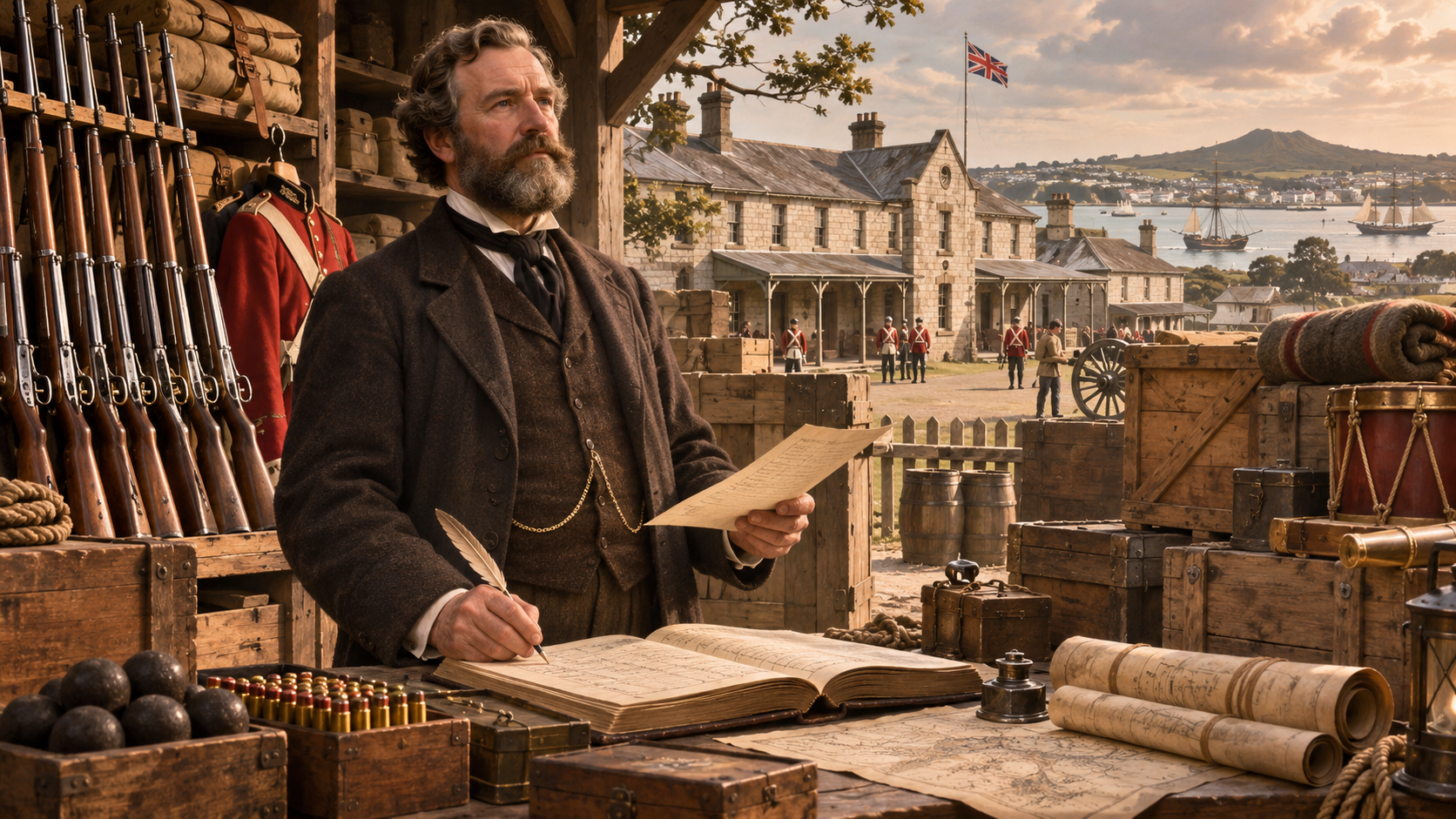
James Blomfield and the Auckland Defence Store, 1861–1888
The establishment of an independent military supply system in nineteenth-century New Zealand owed much to the experience and continuity of a small group of civilian and military personnel. Among them was James Blomfield, whose association with the Auckland Defence Stores extended across a period of profound change in the colony’s military administration.
Blomfield entered government service on 21 October 1861 as a clerk in the Auckland Defence Stores. Promoted to Defence Storekeeper at Auckland on 10 January 1877, he remained in the post until the retrenchments of 1888.[1]
Like most civilian storekeepers of his day, Blomfield left no personal account of his work. Unlike senior military officers, such men rarely appear in memoirs or private papers, and their careers must be reconstructed from nominal rolls, official appointments, financial returns and family notices.

Source: Te Ara – Auckland showing the Albert Barracks, 1859
Early life and family
Family history research identifies James Blomfield as the son of James Blomfield (1799–1846) and Anna Muskett (1803–1865). The family tree gives his birth as 6 December 1825 at Barton Bendish, Norfolk, and records him living in the parish in 1841 and 1851. That date sits uneasily with the age of 78 given in his death and cemetery records, which points to a birth around 1824. On 12 September 1855, he married Sarah Ann Augusta Ward in Norfolk.[2]
James and Sarah began married life in Norfolk, where their first three children, Arthur James (1856), Anna Mary (1857) and Kate (1858), were born. The family emigrated aboard the Frenchman, and a fourth child, Emily Edith, was born at sea on 5 January 1860. The ship reached Auckland on 22 March 1860 after a voyage reported as 113 days from London, and smallpox aboard led to her quarantine off North Head. Contemporary shipping reports list five members of the family under the surname Bloomfield, one of several variants of the name found in the records. The Blomfields arrived at the outset of the First Taranaki War, some eighteen months before James entered government service.[3]

Source: DigitalNZ – Auckland Harbour from Barrack Hill, 1860s.
Seven more children followed in New Zealand: Herbert (1862), Edith Sarah (1864), Edward Clare (1867), William (1869), Frank (1870 or 1871), Henry Andrew (1873) and Sarah Ethel (1876). Henry Andrew died at Albert Barracks on 25 November 1873, only weeks old; his place of death suggests the family was living within the military precinct at the time. Sarah Ethel was born on 21 March 1876, and five days later, on 26 March, her mother died, aged 44. The circumstances of Sarah Ann’s death are not known.
On 28 November 1877, the year of his promotion, James married Phoebe Jane Beamish (née Hobbs, 1835–1914), widow of Richard Beamish. The Reverend W. Gittos conducted the ceremony at the Beresford Street home of the bride’s father, the Reverend John Hobbs, and the marriage was announced in the New Zealand Herald on 3 December. Two sons followed, both born in Auckland: Harry Robert on 17 September 1878 and Frederick Wilcox on 2 September 1880. This second marriage and growing household formed the domestic background to Blomfield’s years as Auckland Defence Storekeeper.[4]
Arrival during the New Zealand Wars
Blomfield joined the Defence Stores as the colonial military establishment was expanding. The outbreak of war in Taranaki in 1860, and the conflict in Waikato that followed, increased the demand for locally administered military resources. Alongside Imperial supply arrangements, the colonial government needed its own way to equip the militia, volunteers, and other locally raised forces.

Source: Alexander Turnbull Library – The 58th Regiment at parade, Auckland, 1858
The organisation he joined had roots reaching back to the foundation of colonial government in 1840, when Henry Tucker administered colonial supplies, including those for the local militia, separately from the Imperial stores. Tucker’s office was abolished in 1844 but had been revived by March 1862. Following the Colonial Defence Act 1862, a Superintendent of Militia Stores supported the colonial forces until those functions passed to Captain John Mitchell in 1865. Blomfield’s appointment in 1861 therefore coincided with the emergence of a permanent local supply establishment rather than the creation of an entirely new function.[5]
Auckland, then a major centre of Imperial and colonial military administration, was central to this work. The colonial and militia stores first operated from offices in Princes Street, but in October 1863 approval was given for a store beside the Imperial Armoury at the Symonds Street entrance to Albert Barracks. There, administrative and technical staff worked side by side to maintain and distribute military stores.[6]
Storekeeping involved far more than the physical custody of equipment. Receipts and issues had to be recorded, stocks reconciled, correspondence maintained and deficiencies reported. Accurate records were essential both to account for public property and to keep the forces supplied.
Those duties were complicated by the variety of arms in colonial hands. Orders for Enfield rifles had been placed in 1859, with the colony’s agent selecting the .577 Hay Pattern medium rifle. Alongside these, the colonial forces held Enfield short rifles and carbines, Calisher and Terry and Westley Richards breech-loading carbines, and Sharps and Colt carbines. Many were second-hand, obtained from Imperial units leaving or re-equipping during the wars, and true standardisation remained elusive. Each pattern brought its own ammunition and spares to be accounted for.[7]
The transition to colonial responsibility
The withdrawal of Imperial troops in the late 1860s fundamentally changed New Zealand’s defence arrangements, as the colonial government took on growing responsibility for military administration, equipment and infrastructure. The appointment of Lieutenant-Colonel Edward Gorton as Inspector of Defence Stores in 1869 was part of a wider move towards centralised oversight and accountability.

Auckland Libraries Heritage Collections, Map 5729.
In the same year, following the suspension and resignation of Captain Mitchell, Major William St Clair Tisdall took charge of the Auckland store. By 1872 its staff comprised two clerks, James Blomfield and John Price, Armourer Sergeant David Evitt, three arms cleaners and a magazine keeper. Records of the period variously name him John Blomfield, John Bloomfield or James Bloomfield, but research has established that these references concern the same man, and the spelling James Blomfield is used throughout this article.[8]
Clerks and technical staff performed complementary roles: the clerks kept the records needed to account for the stores, while the armourers preserved and repaired equipment. Custody of the magazine was a further specialist responsibility. Together they gave Auckland an integrated local support capability, small though the establishment was by the standards of later military logistics organisations.
In the same years, the colony received its first breech-loading rifles in quantity. In November 1869 W. Gisborne, Commissioner of the Armed Constabulary, reported the arrival of 2,000 Snider rifles for government service: 1,832 converted arms lent from England and 168 handed over from the Imperial stores in Auckland. Auckland also played a part in New Zealand’s own conversion contract. In January 1869, Captain Mitchell had 500 Hay Pattern rifles packed at Auckland for shipment to England, where they were converted to the Snider system before returning to Wellington aboard the Melita that December. Further contract Sniders followed in the early 1870s, including 600 carbines from the Birmingham maker W. H. Tisdall to replace the Calisher and Terry, and 2,000 short rifles fitted for sawback bayonets.[9]
When the Imperial Military Store Department departed in July 1870, the colony took full responsibility for military stores. At first, Samuel Anderson administered the Armed Constabulary stores while Gorton’s Defence Stores supported the Militia and Volunteers. Permanent establishments in Auckland and Wellington were complemented by district sub-storekeepers, many of whom combined storekeeping with other duties, and the Public Stores Act 1871 extended Gorton’s inspection responsibilities across government. Within this framework, accurate local accounts, and the clerks who kept them, were central to the system’s accountability.[10]
In Auckland, the change was physical and administrative. When the Imperial storekeeper, Joseph Osbertus Hamley, left in July 1870, the Auckland Defence Store took over the armoury and magazines at Albert Barracks. As the barracks precinct shrank, and with the old powder magazine judged unsafe in a built-up area, munitions storage moved to a new magazine reserve at Mount Eden, where magazines were erected from 1871 and the first stocks arrived in September that year. Separating explosives from the main store increased administrative and accountability demands. In July 1873 the store itself moved into the former barracks hospital, a stone building with workshops and a forge.[11]
The nominal roll of the civil establishment as at 30 June 1875 records Blomfield as Clerk, Store Department, Auckland, on an annual salary of £185, first appointed on 21 October 1861 and with thirteen years and eight months’ service. The roll confirms the start of his government career and shows his position and pay shortly before his promotion.[12]
Auckland Defence Storekeeper
The New Zealand Gazette of 1878 published Blomfield’s appointment as Defence Storekeeper in Auckland, effective 10 January 1877. The promotion crowned just over fifteen years in government service.[13]

Source: New Zealand Gazette, 1878, No. 47, p. 647
As storekeeper, Blomfield would have administered and safeguarded military property and supervised subordinate staff. The post sat between the central Defence administration and the local military authorities: while policy and expenditure were increasingly decided centrally, their practical implementation depended on district establishments such as Auckland. No record of his personal duties survives, so they can only be inferred from the general functions of the appointment.
He served during the Snider era. By 1885 some 11,000 Snider rifles were in New Zealand service, a mixed inventory of long and short rifles, carbines and contract patterns, while older muzzle-loaders remained in second-line use with volunteer and cadet units. In 1887 the government briefly adopted the Remington-Lee M1885 rifle in .43 Spanish calibre, only to withdraw it little more than a year later because of ammunition problems. Each change meant fresh receipts, issues and returns, and obsolete arms still had to be held and accounted for until they were disposed of.[14]

Second: New Zealand Contract 1874 Snider Short Rifle, Bar on Band
Third: New Zealand Contract 1874 Snider Short Rifle, Bar on Barrel
Lower: New Zealand Contract 1872 Tisdall Snider Carbine. Images of arms & bayonets – Paul Farmer
Blomfield’s district role should be distinguished from Samuel Cosgrave Anderson’s national responsibilities, whose career followed a similar path through clerical and storekeeping work. Anderson served in the Waikato Militia and the Commissariat, joined Gorton’s Wellington office in 1869, and became Armed Constabulary Storekeeper. When the two stores organisations were later consolidated, Anderson took over national administration. His responsibilities during the 1881 Parihaka campaign and the later development of coastal defences illustrate the changing demands on the department during Blomfield’s tenure.[15]
From Albert Barracks to O’Rorke Street
The redevelopment of the former Albert Barracks precinct gradually displaced the military establishments that had remained after the Imperial withdrawal, and in 1883 the Auckland Defence Store moved to O’Rorke Street, near the present-day University of Auckland.[16]

Source: Te Papa collection, reproduced in Auckland Defence Store, 1861–1903
The move took place during Blomfield’s tenure. Tenders called on 10 May 1883 were for a two-storey brick building, with a gun-carriage shed, coal shed and armourer’s shop at the rear. Relocating a working store also meant a full stocktake, supervised by Captain Sam Anderson as Chief Defence Storekeeper, in which surplus stores were sold or redistributed. More than 2,000 obsolete muzzle-loading muskets went to the Wellington Defence Store, a clear marker of how far the colony’s arms had moved on since the 1860s. The O’Rorke Street building served until 1903, when the store and an armourer’s shop were re-established at Mount Eden, bringing Auckland’s ordnance functions together on the magazine site.[17]
Retrenchment and retirement
The later 1880s brought heavy pressure to cut government spending. The Defence Act 1886 and the departmental reorganisations that followed changed the framework within which military stores were administered, and provincial establishments came under scrutiny as the government sought economies.
The proposed reductions affected both Auckland and Dunedin. The department intended to concentrate its main depot at Mount Cook in Wellington and leave volunteer stocks in the care of magazine keepers, exposing the tension between economy and local readiness.[18]
Blomfield appears as a Defence Storekeeper in the 1888 parliamentary return of civil servants entitled to pensions. Opposition to the cuts won the Auckland establishment a short reprieve, but Blomfield retired in December 1888, and responsibility passed to Major John William Gascoyne of the Permanent Militia.[19]
The handover reflected a wider change in how local military support was organised: functions once carried out by dedicated civilian staff could now be combined with other military appointments. Gascoyne’s appointment nonetheless shows that Auckland still needed a local storekeeper after the civilian establishment was reduced. Nothing in the available evidence suggests that Blomfield’s departure reflected any shortcoming in his performance.
The 1896 parliamentary pension return lists Blomfield as a former Storekeeper in the Defence Department, receiving an annual pension of £101 15s 0d from 21 March 1889 under the Civil Service Act 1866, some three months after his retirement. That he was pensioned under civil service rather than military legislation reflects the civilian character of his employment.[20]
Later life and death
Family loss continued into his retirement. On 27 August 1900, his youngest daughter, Sarah Ethel, died suddenly at Paerata, aged 24. The Auckland Star notice naming her as James Blomfield’s youngest daughter corroborates the relationship recorded in the family history.[21]
Blomfield spent his retirement in Auckland, latterly in Fernleigh Street, Ponsonby, and died at Te Aroha on 28 November 1902. The death notice in the New Zealand Herald on 11 December described him as the former Defence Storekeeper at Auckland and stated that he was in his seventy-ninth year.[22]

Source: New Zealand Herald, 11 December 1902 – Deaths
A similar notice appeared in the Auckland Star on 10 December. Although both may derive from the same family announcement, the notices provide published confirmation of his name and former occupation. The Symonds Street (Grafton) cemetery transcription corroborates his date of death and age of 78, and records his wife and daughter in the same entry.[23]
Blomfield’s place in New Zealand’s logistics heritage
James Blomfield died fifteen years before the New Zealand Army Ordnance Corps was formed in 1917. Yet the functions carried out by the colonial Defence Stores, the combination of technical, administrative and custodial responsibilities that defined his career, form part of the institutional history from which the later ordnance organisation grew.
His contribution lay less in individual prominence than in continuity. His career spanned the transition from reliance on Imperial support to an increasingly independent colonial defence establishment, and from the muzzle-loading Enfield to the breech-loading Snider; the Martini-Henry followed in 1890, two years after he retired. As Auckland Defence Storekeeper he was responsible for the local working of a system that depended on reliable records, careful custody and the availability of equipment.[24]
James O’Sullivan’s career shows where that system led. Recruited by Anderson into the Defence Stores clerical staff in 1885, O’Sullivan gained practical storekeeping experience and succeeded Anderson on his death in December 1899. His later work equipping contingents, modernising the stores and developing quartermaster training shows how the functions performed by earlier district storekeepers evolved into a more professional military logistics system. Blomfield belonged to the preceding generation, and the comparison points to institutional continuity rather than any documented association between the two men.[25]
The history of New Zealand military logistics is as much the history of individuals like these as of the organisations in which they served. James Blomfield deserves recognition as an early practitioner of military storekeeping and as representative of the civilian staff whose work sustained the nineteenth-century defence establishment.
Notes
[1] New Zealand Gazette, 1878, no. 47, p. 647, https://gazette.howison.co.nz/nzg/1878/issue/47/page/647; Robert McKie, ‘Auckland Defence Store, 1861–1903’, RNZAOC.com, 11 December 2021, https://rnzaoc.com/2021/12/11/auckland-defence-store-1861-1903/. New Zealand, “Nominal Roll of the Civil Establishment of New Zealand on the 30th June, 1875,” Appendix to the Journals of the House of Representatives, 1875, H-11, 4, https://paperspast.natlib.govt.nz/parliamentary/AJHR1875-I.2.2.4.16.
[2] Ancestry, user-contributed James Blomfield family tree, supplied life-story transcript and screenshots; FamilySearch, “James Blomfield,” https://ancestors.familysearch.org/en/G1ZN-BWQ/james-blomfield-1825-1902. Original English parish, census and marriage records not inspected.
[3] “Shipping Record,” Auckland Examiner, 24 March 1860, 2, https://paperspast.natlib.govt.nz/newspapers/AKEXAM18600324.2.4; “Monthly Maritime Record,” New Zealander, 28 March 1860, https://paperspast.natlib.govt.nz/newspapers/NZ18600328.2.25; Ancestry, supplied family-tree transcript, entry for Emily Edith.
[4] “Marriages,” New Zealand Herald, 3 December 1877, 2, Bloomfield–Beamish announcement (user-supplied newspaper image); Ancestry, supplied family-tree transcript, entries for Harry Robert and Frederick Wilcox/Willcox. The newspaper establishes the marriage date and venue, rather than the publication date or previously suggested church venue.
[5] Robert McKie, ‘Colonial Storekeeper 1840–1871’, To the Warriors Their Arms, 2 April 2018, https://rnzaoc.com/2018/04/02/colonial-storekeeper-1840-1871/.
[6] McKie, ‘Auckland Defence Store, 1861–1903’, cited above.
[7] Robert McKie, ‘From Flintlock to Modular Assault Rifle’, To the Warriors Their Arms, 25 February 2026, https://rnzaoc.com/2026/02/25/from-flintlock-to-modular-assault-rifle/.
[8] Robert McKie, ‘NZ Defence Stores July 1869 – June 1870’, https://rnzaoc.com/2021/01/01/1869-1870/ ; ‘NZ Defence Stores July 1870 – June 1871’, https://rnzaoc.com/2023/08/13/nz-defence-stores-july-1870-june-1871/; McKie, ‘Auckland Defence Store, 1861–1903’.
[9] Paul Farmer, ‘New Zealand Contract Sniders’, To the Warriors Their Arms, 10 April 2026, https://rnzaoc.com/2026/04/10/new-zealand-contract-sniders/; McKie, ‘From Flintlock to Modular Assault Rifle’.
[10] Robert McKie, ‘Defence Stores Department 1862–1917’, To the Warriors Their Arms, 1 August 2017, https://rnzaoc.com/2017/08/01/defence-stores-department-1862-1917/; McKie, ‘Colonial Storekeeper 1840–1871’.
[11] McKie, ‘Auckland Defence Store, 1861–1903’; Robert McKie, ‘Built for Purpose’, To the Warriors Their Arms, 25 October 2025, https://rnzaoc.com/2025/10/25/built-for-purpose/.
[12] AJHR, 1872, ‘Nominal Roll of the Civil Establishment of New Zealand’, https://paperspast.natlib.govt.nz/parliamentary/AJHR1872-I.2.3.2.61; AJHR, 1873, H-24a, ‘Nominal Return of Officers in Defence Department’, https://paperspast.natlib.govt.nz/parliamentary/AJHR1873-I.2.3.3.31. New Zealand, “Nominal Roll of the Civil Establishment of New Zealand on the 30th June, 1875,” Appendix to the Journals of the House of Representatives, 1875, H-11, 4, https://paperspast.natlib.govt.nz/parliamentary/AJHR1875-I.2.2.4.16.
[13] New Zealand Gazette, 1878, no. 47, p. 647, https://gazette.howison.co.nz/nzg/1878/issue/47/page/647.
[14] Farmer, ‘New Zealand Contract Sniders’; McKie, ‘From Flintlock to Modular Assault Rifle’.
[15] Robert McKie, ‘Captain Sam Cosgrave Anderson, Defence Storekeeper 1879–1899: A Life of Service and Dedication’, To the Warriors Their Arms, 19 August 2023, https://rnzaoc.com/2023/08/19/captain-sam-cosgrave-anderson-defence-storekeeper-1879-1899-a-life-of-service-and-dedication/; McKie, ‘Defence Stores Department 1862–1917’. The Anderson biography contains an inconsistent appointment-date statement; no precise national succession date is asserted here.
[16] McKie, ‘Auckland Defence Store, 1861–1903’; Archives New Zealand, item R24280543 (archival lead, not directly inspected).
[17] McKie, ‘Auckland Defence Store, 1861–1903’; Archives New Zealand, item R24280543 (not directly inspected); McKie, ‘Built for Purpose’.
[18] McKie, ‘Defence Stores Department 1862–1917’.
[19] AJHR, 1888, B-18a, ‘Civil Servants Entitled to Pensions’, https://paperspast.natlib.govt.nz/parliamentary/AJHR1888-I.2.1.3.27 ; AJHR, 1888, H-30, ‘Reductions in Civil Service’, https://paperspast.natlib.govt.nz/parliamentary/AJHR1888-I.2.3.2.31 ; McKie, ‘Auckland Defence Store, 1861–1903’.
[20] New Zealand, ‘Pensions: Nominal Roll and Details of Pensions Paid by the New Zealand Government’, Appendix to the Journals of the House of Representatives (AJHR), 1896, H-26, p. 1, entry for J. Blomfield. Treasury return dated 13 October 1896.
[21] “Deaths,” Auckland Star, 28 August 1900, 8, https://paperspast.natlib.govt.nz/newspapers/AS19000828.2.61.
[22] ‘Deaths’, New Zealand Herald, 11 December 1902, https://paperspast.natlib.govt.nz/newspapers/NZH19021211.2.77.21.4.
[23] ‘Deaths’, Auckland Star, 10 December 1902, https://paperspast.natlib.govt.nz/newspapers/AS19021210.2.67.4 ; Ancestry, Auckland–Symonds St/Grafton cemetery transcription, p. 6, cited above.
[24] McKie, ‘From Flintlock to Modular Assault Rifle’.
[25] Robert McKie, ‘Major James O’Sullivan: A Life Devoted to Service and Change’, To the Warriors Their Arms, 6 September 2023, https://rnzaoc.com/2023/09/06/major-james-osullivan-a-life-devoted-to-service-and-change/.
