The Defence Stores Building, Memory and Military Identity
The former Defence Stores building at Pukeahu is more than an old military office. It is one of the last surviving physical links with the organisation that equipped and sustained New Zealand’s soldiers during the formative years of the modern Army.
The Government is considering removing the Wellington District Plan heritage listing from the building commonly known as the former General Headquarters Building at 213A Taranaki Street. If approved, delisting would remove an important layer of protection and make the building’s eventual demolition considerably more likely.
For New Zealand’s military logistics community, this is not simply a debate about retaining an old office building. The structure was originally constructed for the Defence Stores and is one of the last surviving physical links with the organisation that equipped and sustained New Zealand’s soldiers during the formative years of the modern Army.
It is, in a very real sense, the historic home of New Zealand Army logistics.
At Buckle Street, Wellington, during the 1913 waterfront strike. Smith, Sydney Charles, 1888-1972: Photographs of New Zealand. Ref: 1/2-048786-G. Alexander Turnbull Library, Wellington, New Zealand. /records/22820606
The Defence Stores—not originally General Headquarters
The name ‘General Headquarters Building’ describes only one comparatively brief period in the building’s history.
Mount Cook had been used for military purposes since the arrival of British troops in Wellington during the 1840s. In 1850, land was granted to the Imperial Ordnance Department for military storage and the mounting of guns. After the withdrawal of the Imperial forces, the site continued to support New Zealand’s developing colonial defence system. From the 1860s onwards, the Defence Stores became a permanent part of this military landscape.[1]
Plan of Mount Cook Barracks, as planned c.1845 and largely as built by 1852.
By the beginning of the twentieth century, the collection of converted barracks, storehouses, sheds and workshops at Mount Cook was no longer adequate. The South African War had demonstrated the importance of having mobilisation equipment readily available, while the introduction of universal military training and the establishment of the Territorial Force created a much larger Army requiring uniforms, weapons, ammunition, vehicles, camp equipment and stores.[2]
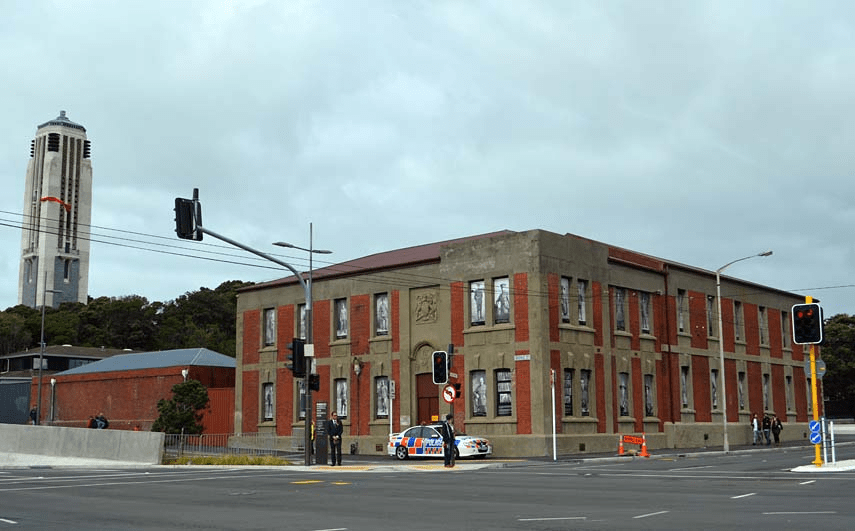
The first phase of the surviving brick building on Buckle Street was constructed in 1911–12. Designed under the direction of Government Architect John Campbell, it provided accommodation for the Director of Stores, stores offices, clothing and other military equipment. The connected Taranaki Street section reflects the subsequent expansion of the complex as the requirements placed upon the Defence Stores increased.[3]
Its architecture still reveals its original purpose. Large internal spaces, an upper-floor loading doorway and winch, substantial entrances for carts and extensive storage areas belong to a working military store rather than merely an administrative headquarters. The Royal cypher above the Buckle Street entrance and the restrained Edwardian Baroque façade gave dignity to what remained an essentially practical building.[4]
General Headquarters Building (Former) Taken during Wellington’s First World War Centenary commemorations, Alision Dangerfield, 18/04/2015, Heritage New Zealand Pouhere Taonga
Part of a national logistics building programme
The construction of the Buckle Street Defence Stores should not be viewed as an isolated Wellington building project. It formed part of a national programme intended to provide New Zealand’s expanding military forces with modern mobilisation infrastructure.
In 1900, Parliament provided funding for Defence Stores buildings in the principal centres. A mobilisation store was completed within King Edward Barracks in Christchurch in 1905, followed by the Dunedin Mobilisation Store in St Andrew Street in 1907 and the new Wellington store at Buckle Street in 1911. Auckland’s requirements were initially met through the existing Defence Store and magazines at O’Rourke Street and Mount Eden.[5]
Together, these buildings created the beginnings of a national logistics network. They allowed equipment to be received, inspected, stored, maintained and issued closer to the units that would require it. They also reduced reliance upon unsuitable barracks rooms, rented sheds and other improvised accommodation.
The change was as much organisational as physical. By 1914, the Defence Stores Department had become a cohesive national organisation with relatively modern infrastructure in Wellington, Christchurch and Dunedin. Its Director of Equipment and Stores was integrated into the Quartermaster-General’s Branch alongside the Director of Supplies and Transport. Storage, accounting, inspection, maintenance and distribution were increasingly treated as connected parts of a national military logistics system.[6]
As discussed in the earlier RNZAOC.com article, ‘Built for Purpose’, these early mobilisation stores formed part of the long development from an inherited collection of Imperial buildings towards a New Zealand logistics estate designed around the requirements of its own defence force.[7]
The logistics infrastructure programme of its generation
The early twentieth-century building programme has a direct parallel in the infrastructure renewal being undertaken by the New Zealand Defence Force today.
The NZDF’s Consolidated Logistics Project includes Maintenance Support Facilities at Linton and Burnham, Regional Supply Facilities at both camps and a Regional Vehicle Storage Facility at Linton. The programme is intended to replace ageing and dispersed buildings with modern, purpose-designed facilities that improve safety, efficiency, equipment availability and operational readiness.[8]
The first Maintenance Support Facility at Linton has been delivered. The Burnham Maintenance Support Facility represents an investment of approximately $58 million, while construction of the Burnham Regional Supply Facility—a project valued at $82.7 million—commenced in November 2025. The new facilities bring storage, distribution and maintenance functions together and support the NZDF’s transition towards an ‘Equip the Force’ model.[9]
The comparison with the Defence Stores programme of the early twentieth century is striking.
New Zealand’s expanding defence forces could no longer rely upon converted barracks, rented warehouses and scattered sheds. Purpose-built infrastructure was needed to support the Territorial Force, hold mobilisation equipment and enable the rapid preparation of forces for deployment. The Defence Stores building at Buckle Street formed part of the response to that need.
The modern facilities at Linton and Burnham are being constructed to support the force of the twenty-first century. Buckle Street was constructed to support the force of the early twentieth century. The technologies, equipment and operating environments are different, but the strategic purpose is fundamentally the same: to provide the physical logistics backbone needed to generate and sustain military capability.
Just as today’s Maintenance Support and Regional Supply Facilities will represent the NZDF logistics system of their generation, the Buckle Street Defence Stores represents the infrastructure programme that prepared New Zealand’s Army for the First World War.
The difference is that the modern programme is being documented and celebrated as a major investment in Defence capability. Much of the infrastructure created by earlier generations has already disappeared. The former Defence Stores building is one of the few surviving places through which that earlier transformation can still be seen and understood.
Mobilising a nation
When war began in August 1914, the Defence Stores Department faced an extraordinary task. It had to provide the uniforms, boots, web equipment, weapons, ammunition, saddlery, camp equipment and innumerable other stores needed to establish mobilisation camps and equip the Samoa Advance Party and the New Zealand Expeditionary Force. At the same time, it had to continue supporting the Territorial Force, coastal defences and reinforcement drafts.
The scale of this effort is easily overlooked. Armies are usually remembered through their regiments, battles and commanders, but none can operate without the people who receive, inspect, account for, maintain and distribute their equipment.
Between 5 August 1914 and 31 March 1915, the Defence Stores Department received more than half a million individual items from eighty-four suppliers. These stores were delivered to the Defence Stores premises in Buckle Street, where they were inspected before being distributed to mobilisation camps and district stores around the country.[10]
The volume soon overwhelmed the available accommodation. The 1915 Defence report recorded that Wellington’s store buildings had been ‘taxed to the utmost’ by the quantity and variety of equipment required for troops proceeding overseas. A nearby commercial store in Taranaki Street had to be leased to relieve congestion and provide additional space for receiving and examining saddlery and supplies.[11]
The Defence Stores building was therefore not a passive witness to the First World War. It formed part of the machinery of mobilisation. Equipment passed through the complex before being issued to soldiers who trained in New Zealand and embarked for Samoa, Egypt, Gallipoli, France and Palestine.
Pukeahu National War Memorial Park commemorates those who served and those who did not return. The former Defence Stores building helps explain how they were prepared and equipped to serve. The memorial and the store tell different but complementary parts of the same national story.
From stores to headquarters
General Headquarters was not originally located in the building at the corner of Buckle and Taranaki Streets. It occupied Alexandra Barracks higher on Mount Cook, near the site now occupied by the former Dominion Museum.
When the upper Mount Cook site was selected for the National War Memorial, National Art Gallery and Dominion Museum, Alexandra Barracks was demolished. By this time, much of the Defence Stores organisation had transferred from Buckle Street to Trentham and other military locations. The former stores building was consequently altered in 1929 to accommodate Defence Headquarters.[12]
Alexandra Barracks, Mount Cook Wellington (Colourised). Credit: Alexander Turnbull Library.
Materials from Alexandra Barracks, including timber partitions, were reused during the conversion. Something of the former headquarters was therefore physically carried into its replacement. Defence Headquarters remained in the building until 1938, when it moved to Featherston Street while awaiting more permanent accommodation.[13]
The building’s headquarters period was historically important, but it should not obscure its original purpose. Its complete history encompasses military logistics, mobilisation, administration and command.
The building is currently recognised by Heritage New Zealand Pouhere Taonga as a Category 2 historic place. Its assessed significance includes its architectural character, association with the 1913 waterfront strike, use as Army headquarters and place within the wider military landscape of Mount Cook.[14]
Space, memory and identity
Why should the physical building matter when its history could be preserved in photographs, plans, publications and digital records?
The answer lies in the relationship between space, memory and identity.
History is not carried by documents alone. Places provide scale, texture and context. They allow people to stand where earlier generations stood and to recognise that historical events occurred in real rooms, streets and landscapes. A surviving building makes the past tangible in a way that a plaque attached to a replacement development rarely can.
The historian Pierre Nora described such places as lieux de mémoire—sites where memory becomes anchored because the living environment that originally sustained it is disappearing. Buildings, memorials, landscapes and objects can become repositories of collective memory, particularly when the organisations or communities associated with them have changed or moved elsewhere.[15]
Military identity is especially dependent upon such places. Barracks, drill halls, depots, workshops, magazines and headquarters connect generations who may never have met but who performed comparable duties within the same institutional tradition. The buildings become part of the organisation’s accumulated memory.
For New Zealand’s military logistics community, the former Defence Stores building gives physical form to a history that has often remained invisible. The soldiers who passed through Pukeahu are commemorated; the organisation that armed, clothed and equipped them is much less apparent. If the building disappears, that imbalance will become greater.
The loss would also weaken the historical coherence of Pukeahu. The National War Memorial does not stand in an empty landscape. It occupies a place shaped by Māori, colonial, military, policing, educational and civic histories. The former Defence Stores building helps anchor that layered landscape at street level.
Remove enough of these physical anchors and the landscape ceases to explain itself. Memory becomes detached from place, while history is reduced to interpretation panels describing buildings and activities that no longer exist.
The historic home of Army logistics
The Defence Stores Department was an institutional ancestor of the New Zealand Army Ordnance Corps, the Royal New Zealand Army Ordnance Corps and, ultimately, today’s Royal New Zealand Army Logistic Regiment.
From Mount Cook, the Defence Stores supported the colonial forces, Permanent Militia, Volunteers, Territorial Force and mobilisation of the New Zealand Expeditionary Force. The work conducted there established principles of accountability, inspection, maintenance and distribution that remain recognisable to military logisticians today.
Very few substantial buildings associated with this early logistics system survive. Depots have been closed, stores demolished and military land redeveloped. The former Defence Stores building is therefore important not because every old military building must be retained, but because this particular building represents a nationally significant and increasingly rare part of New Zealand’s defence history.
Its survival offers an opportunity to broaden the way military service is remembered. Warfare is not sustained by courage alone. It depends upon preparation, administration, transport, supply and maintenance—the largely unseen labour behind the fighting soldier.
The old ordnance motto, Sua Tela Tonanti—freely rendered as ‘To the warrior his arms’—captures that relationship. The former Defence Stores building is one of the few surviving places where that duty can still be physically understood.
Protection does not mean preventing development
The need for housing, economic development and earthquake resilience is genuine. However, retaining heritage protection does not require that the building remain empty or unchanged.
Adaptive reuse can give historic structures a viable modern purpose while retaining the features that communicate their history. The building could support public, community, educational, commemorative, office or mixed-use activities. Sensitive new development could potentially be incorporated around it without erasing the original structure.
There are other sites in upper Taranaki Street with little or no comparable heritage value. Development pressure alone does not establish that one of the country’s oldest surviving military logistics and administrative buildings should lose its protection.
Delisting is not a neutral procedural adjustment. Once statutory protection is removed and demolition occurs, the building’s heritage fabric, spatial character and connection with Pukeahu cannot be recreated.
The danger of institutional amnesia
There is also a wider question for the NZDF, New Zealand Army and the Royal New Zealand Army Logistic Regiment.
All three organisations are understandably focused on present capability, operational readiness and the delivery of the new logistics infrastructure at Linton and Burnham. However, that focus creates a risk that an important part of the institution’s history could be lost almost unnoticed.
The danger is not deliberate disregard. It is institutional inattention: responsibility for the building sits between Defence, heritage, planning and property interests, while those who understand its historical significance may assume that someone else is protecting it. In those circumstances, an organisation can effectively sleepwalk through the loss of its own heritage.
The irony would be considerable. At the same time as the NZDF is investing hundreds of millions of dollars in a new generation of logistics facilities, the surviving representative of an earlier, equally significant logistics building programme could lose its heritage protection without its importance to the Defence community being fully recognised.
The former Defence Stores building is not merely part of the history of a discontinued department. It belongs within the institutional lineage of the modern NZDF logistics system and the Royal New Zealand Army Logistic Regiment. Its story connects today’s supply, maintenance and distribution organisations with the people who performed the same essential functions more than a century ago.
This does not mean that the NZDF or the Regiment must become property developers or assume responsibility for restoring the building themselves. It does mean that they have an important voice. A formal acknowledgement of the building’s historical significance, support for retaining its heritage protection, and participation in discussions about interpretation and adaptive reuse would help ensure that decisions are made with an understanding of what the building represents.
The RNZALR has a particular opportunity to advocate for this history. Regimental identity is built not only through badges, mottos, anniversaries and operational service, but also through the preservation of the places associated with its predecessors. If the Regiment does not recognise the former Defence Stores as part of its inheritance, it is unlikely that others will fully understand its significance.
There is still time for Defence and the logistics community to engage constructively. The purpose is not to criticise current leadership or obstruct development. It is to ensure that a nationally important part of New Zealand’s military logistics story is not lost simply because its significance fell between organisational responsibilities.
Have your say
The Government is consulting on proposed changes to heritage provisions at five Wellington locations, including the former General Headquarters Building at 213A Taranaki Street. The consultation follows an investigation undertaken under section 360I of the Resource Management Act 1991.[16]
Those who value New Zealand’s military, logistics, architectural and urban heritage are encouraged to provide feedback through the official consultation.
The heritage listing should be retained. The Government, Wellington City Council, NZDF, mana whenua, heritage specialists and interested communities should work together to identify a viable programme of strengthening, interpretation and adaptive reuse.
We cannot preserve every building from the past. Nor should we try. But we should recognise those rare places where national history, collective memory and institutional identity meet.
The former Defence Stores building has stood at Pukeahu for more than a century, linking the colonial Defence Stores, the mobilisation of 1914, Army command and the modern New Zealand military logistics tradition.
The NZDF is now constructing the next generation of facilities needed to equip and sustain the force. That investment makes this an appropriate moment to recognise—not inadvertently discard—the surviving landmark of an earlier generation’s logistics transformation.
The building should not be allowed to disappear through institutional silence or the assumption that someone else will protect it. Its future should be one of renewed purpose, interpretation and adaptive reuse—not demolition.
[2] Robert McKie, “Unappreciated duty: the forgotten contribution of New Zealand’s Defence Stores Department in mobilising the New Zealand Expeditionary Force in 1914: a thesis presented in partial fulfilment of the requirements for the degree of Master of Arts in History at Massey University, Manawatu, New Zealand” (Massey University, 2022), 44-72.
[3] Zealand, “General Headquarters Building (Former) 213-215 Taranaki Street and Buckle Street, Mt Cook, WELLINGTON, Historic Place Category 2, List No. 7518.”; McKie, “Unappreciated duty: the forgotten contribution of New Zealand’s Defence Stores Department in mobilising the New Zealand Expeditionary Force in 1914: a thesis presented in partial fulfilment of the requirements for the degree of Master of Arts in History at Massey University, Manawatu, New Zealand.”
[4] Zealand, “General Headquarters Building (Former) 213-215 Taranaki Street and Buckle Street, Mt Cook, WELLINGTON, Historic Place Category 2, List No. 7518.”
[5] McKie, “Unappreciated duty: the forgotten contribution of New Zealand’s Defence Stores Department in mobilising the New Zealand Expeditionary Force in 1914: a thesis presented in partial fulfilment of the requirements for the degree of Master of Arts in History at Massey University, Manawatu, New Zealand,” 54-55.
[6] McKie, “Unappreciated duty: the forgotten contribution of New Zealand’s Defence Stores Department in mobilising the New Zealand Expeditionary Force in 1914: a thesis presented in partial fulfilment of the requirements for the degree of Master of Arts in History at Massey University, Manawatu, New Zealand,” 64-72.
[7] “Built for Purpose: From Barracks Scraps to Purpose-Built Hubs—150+ Years of Building the Army’s Logistic Backbone,” “To the Warrior his Arms” History of the Royal New Zealand Army Ordnance Corps and its predecessors, 2025, accessed 8 Aug, 2026, https://rnzaoc.com/2025/10/25/built-for-purpose/.
[8] New Zealand Defence Force, New Zealand Defence Force: Building the Linton Maintenance Support Facility (Wellington: New Zealand Defence Force, 2021), paras. 16–17; New Zealand Defence Force, New Zealand Defence Force: Building the Burnham Maintenance Support Facility (Wellington: New Zealand Defence Force, 2023).
[9] New Zealand Defence Force, ‘Significant Milestone for NZDF Logistics’, 21 February 2025; New Zealand Defence Force, ‘Major Milestone for South Island Logistic Resilience’, 27 November 2025.
[10] McKie, “Unappreciated duty: the forgotten contribution of New Zealand’s Defence Stores Department in mobilising the New Zealand Expeditionary Force in 1914: a thesis presented in partial fulfilment of the requirements for the degree of Master of Arts in History at Massey University, Manawatu, New Zealand,” 82-84.
[11] “H-19 Defence Forces of New Zealand, Report of the General Officer Commanding the Forces from 25th June 1914 to 26th June 1915,” Appendix to the Journals of the House of Representatives (1915): 14.
[12] Spyve, “The Barracks on the Hill: A History of the Army’s Presence at Mount Cook, Wellington 1843-1979,” Chapter 9.
[13] Zealand, “General Headquarters Building (Former) 213-215 Taranaki Street and Buckle Street, Mt Cook, WELLINGTON, Historic Place Category 2, List No. 7518.”
[14] Zealand, “General Headquarters Building (Former) 213-215 Taranaki Street and Buckle Street, Mt Cook, WELLINGTON, Historic Place Category 2, List No. 7518.”
[15] Pierre Nora, ‘Between Memory and History: Les Lieux de Mémoire’, trans. Marc Roudebush, Representations, no. 26 (Spring 1989): 7–24.
Building and Sustaining the Crown’s Parihaka Operation, 1879–1881
A note on scope
The terminology in this article is modern. The logistical problems were not. Every logistician who has sat through a briefing on the five Ds — destination, demand, distance, duration and dependency — or heard the principle of centralised control and decentralised execution, might assume these are recent inventions. Parihaka shows they are not: the same problems, solutions and trade-offs are visible in an operation conducted a century before they were formalised in doctrine manuals.
This article treats Parihaka as a logistics case study on how the Crown decided where supplies would enter the district, how a rapidly expanding force would be fed and equipped, how far men and matériel had to travel, how long the commitment might last, and how dependent it would be on shipping, contractors, roads, horses and weather. It does not attempt to retell the wider history of the occupation, or to reach a new judgement on it; that remains the proper work of historians and bodies such as the Waitangi Tribunal. But the analytical focus should not be mistaken for neutrality about what the system did. The roads, stores, transport and supply arrangements examined below were the means by which the Crown concentrated an armed force, occupied Parihaka, arrested its leaders, dispersed its people and dismantled the community’s ability to sustain itself. The logistics cannot be separated from the purpose they served.
Parihaka is well suited to this kind of analysis because it is comparatively well documented and involved a support system that can still be reconstructed from official reports, tenders and contemporary newspapers. Central direction came from Wellington; execution was delegated to district commanders, Defence Stores staff, camp officers, shipmasters, contractors and local non-commissioned officers.
This piece follows that system, not the men who directed it or the people it was directed against, but the roads, ships, stores and contracts that connected the two.
The occupation of Parihaka on 5 November 1881 is generally examined through the colonial government’s decisions, the leadership of Te Whiti-o-Rongomai and Tohu Kākahi, and the peaceful resistance of the people gathered at the settlement. Less attention has been given to the physical and administrative system that made the operation possible.
The force that entered Parihaka did not appear suddenly in November 1881. It was the culmination of more than two years of military preparation on the Taranaki coast. Between 1879 and 1881 the government enlarged the Armed Constabulary, transferred trained personnel into the district, accumulated weapons and ammunition, developed Opunake as a coastal supply point, constructed roads and telegraph lines, established a chain of camps, developed local forage resources and arranged contracts for provisions, transport, fuel and other support.
By November 1881 this system enabled 1,589 members of the Armed Constabulary and Volunteer Force to be assembled, equipped and sustained near Parihaka. It also enabled the government to arrest the settlement’s leaders, disperse much of its population and dismantle houses, fences and cultivations.
The visible event was the advance of 5 November. The less visible story was the logistical network built between Wellington, New Plymouth, Opunake, Rahotu, Pungarehu and the approaches to Parihaka.
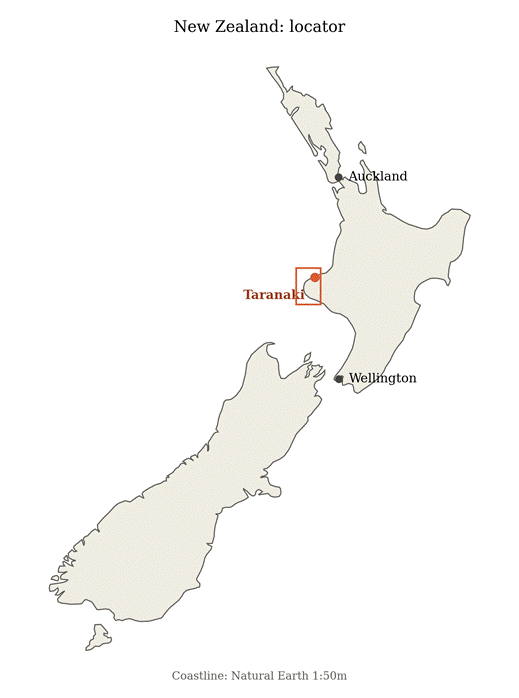
Figure 1. Taranaki within New Zealand.
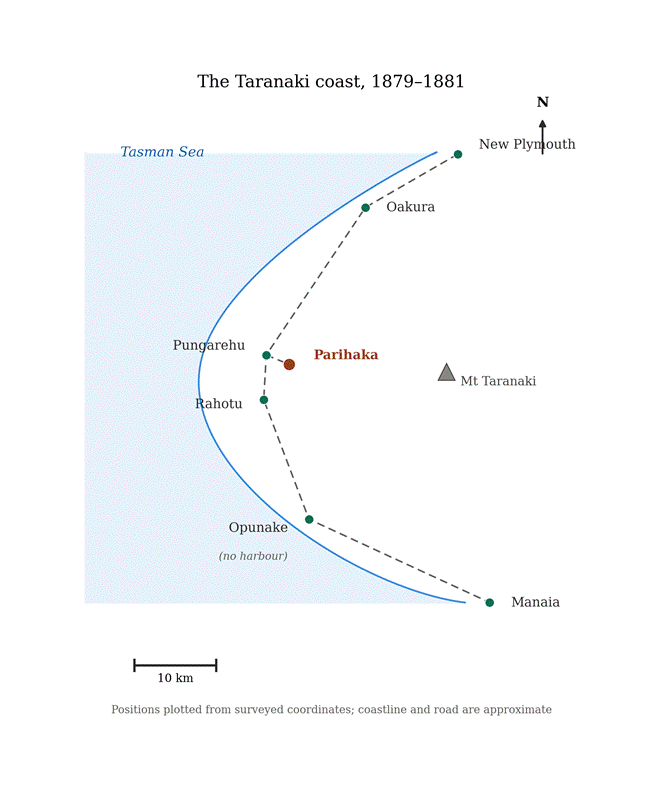
Figure 2. The Taranaki coast, plotted from surveyed coordinates.
Parihaka as a logistical operation
Although New Zealand officials did not employ the term “logistics” in its modern, comprehensive sense, the Parihaka operation required nearly all the functions now associated with military logistics. It involved the acquisition, storage, and issue of supplies; the movement of personnel and matériel; the construction and maintenance of roads and camps; medical support; contracted services; ammunition control; communications; and the recovery or disposal of stores after the operation.
Modern military doctrine defines logistics and sustainment as the planning and execution of support necessary to provide forces with freedom of action, operational reach and prolonged endurance. It encompasses supply, transportation, maintenance, personnel services, health support and associated field services.[1] These later definitions cannot be imposed directly upon an operation conducted in 1881, but they provide a useful framework for interpreting the surviving evidence.
Viewed in this way, the preparations for Parihaka were not a collection of unrelated administrative actions. Roads, camps, stores, ships, contractors, paddocks, telegraph lines and medical arrangements formed an interconnected support system.
The land dispute and the road through Parihaka
The logistical build-up cannot be separated from the dispute over confiscated land.
Parihaka had been established in the midst of the Taranaki confiscation area. Te Whiti and Tohu rejected the justice and legality of the confiscations and objected particularly to the failure to define and protect promised reserves. In 1878 the government began systematic surveys north of the Waingongoro River and advertised land for settlement.
Parihaka responded through peaceful civil disobedience. Survey pegs were removed and, from May 1879, parties began ploughing land claimed by settlers. Later protests included rebuilding fences across the projected coastal road after government parties removed them.
The road was therefore not neutral infrastructure. Its surveyed route cut through Parihaka’s cultivations, while proposed subdivisions between the road and the sea threatened to separate the promised reserve from coastal access. The fences across the road represented both physical boundaries and assertions of ownership.[2]
By April 1881 Parihaka’s population had grown to more than 1,300, making it one of New Zealand’s largest Māori communities. Its inhabitants included people from throughout Taranaki, upper Whanganui, Waikato, Ngāti Maniapoto and Tai Tokerau. The settlement was supported by fertile gardens, pastures and organised communal labour.[3]
The operation therefore brought two sustainment systems into conflict. One supported a colonial force through government stores, contractors, shipping, roads and military camps. The other supported a peaceful Māori community through cultivation, collective labour and regional networks.
Preparing for a West Coast emergency
The government’s logistical build-up began during the West Coast emergency of 1879, and as tensions increased, the Armed Constabulary Reserve was rapidly expanded. By July 1879 it consisted of 870 officers and men, of whom 600 were stationed on the West Coast and another 100 at Wellington. The men were armed with short Snider rifles and described as fully equipped for active service. Large reserves of ammunition and stores were accumulated at the principal stations.[4]
This concentration required considerably more than recruiting additional constables. Each man had to be selected, trained, clothed, armed and equipped before being sent to Taranaki. The Wellington Constabulary depot therefore became an important rear base, preparing personnel for service and issuing the equipment required in the field.
The scale of the preparations was also evident in the arms reserve. In June 1879 Colonel George Whitmore stated that 1,500 stand of arms were held in Wellington, packed in groups of fifty and ready for rapid despatch. Each group was reportedly accompanied by ammunition calculated at 100 rounds per weapon.[5]
This was effectively a pre-positioned mobilisation reserve. The weapons were not merely stored centrally; they had been packaged in quantities suitable for rapid issue or shipment.
The build-up also affected other commands. During June and July 1879 an officer, six non-commissioned officers and fifty-three constables were transferred from the Waikato to meet the demand for trained men on the West Coast. Their departure forced the Waikato command to recruit and train replacements.[6]
Preparation for Parihaka therefore extended beyond Taranaki. It affected recruiting, depot training and the distribution of experienced manpower throughout New Zealand.
Mobilising the Volunteer Force
The Volunteer Force provided a second source of manpower.
During the West Coast alarm of 1879, approximately 1,500 local Volunteers were under arms and training within ten days. Corps from Thames, Wellington, Christchurch, Timaru, Oamaru, Temuka, Picton, Cromwell and Queenstown offered to serve should an outbreak occur.[7]
The response demonstrated enthusiasm, but it exposed a fundamental logistical problem. The Volunteer Force consisted of separate corps scattered across New Zealand. Mobilising them required coordinating unit rolls, arms, ammunition, clothing, rail journeys, coastal shipping, accommodation, food, and baggage.
The colonial arms inventory was mixed. In 1879, 6,053 Snider rifles were already on issue, leaving only 866 in store, although another 3,400 were expected from Britain. At the same time, 9,642 older Enfield rifles remained in store, and another 1,788 were on issue.[8]
By April 1881 the position had improved. The Volunteer Force reported 6,883 Snider rifles on issue and 3,595 in store, with another 500 recently received from Britain. The ammunition reserve included 1,265,884 Snider cartridges and 204,592 rounds for Enfield rifles.[9]
The government therefore possessed sufficient arms and ammunition for a major mobilisation, but only because weapons had been accumulated, maintained and accounted for during the preceding years.
The permanent West Coast force
The Volunteer concentration of November 1881 was superimposed upon a substantial permanent Armed Constabulary presence.
On 31 March 1881 the Armed Constabulary Reserve numbered 717 officers and men throughout New Zealand. Of these, 522 were stationed in the Patea and Taranaki districts, principally at Pungarehu, Rahotu, Opunake, Manaia and other posts along the coast.[10]
The final mobilisation did not create a field organisation from nothing. It expanded an existing network of camps, roads, stores, paddocks and communications.
The permanent force also provided the skilled core needed to absorb the Volunteer contingents. Armed Constabulary personnel knew the roads, camp locations, landing arrangements and local terrain. They served as guides, guards, mounted orderlies, transport workers and store handlers.
Building the road to Parihaka
The military concentration could not be sustained without a reliable road along the Taranaki coast.
During 1879 and 1880 the Armed Constabulary was used extensively as a road-building force. Existing tracks were widened, gradients reduced, bridges and culverts repaired and sections gravelled. The objective was not simply to provide a path for infantry to march. The road had to carry drays, wagons, construction materials, provisions, baggage and ammunition.
Between the Waingongoro River and the western side of the Warmate Plains, approximately fifteen miles of existing road were repaired and widened. Bridges and culverts were substantially improved, nearly three miles were gravelled, and additional contracts were arranged for further gravelling.
On the Stony River–Opunake section, portions of the old road were repaired and new formation constructed. Sections were specifically prepared for dray traffic. The Public Works Statement of 1880 reported that road parties advancing from opposite directions across the Waimate Plains were close to meeting.
Colonel John Mackintosh Roberts organised the work as a military advance rather than as an ordinary civil engineering project. The constables moved cautiously and built defended encampments as the road progressed. Engineering work and operational reach therefore advanced together.[11]
By 1881 the coast road through the Waimate Plains and Parihaka Block had been completed sufficiently for wheeled traffic and more than half had been gravelled. The Public Works Statement openly described it as possessing special political importance.[12]
The distinction between a foot track and a dray road was critical. Infantry could march over ground unsuitable for bulk transport, but a force could not live indefinitely upon what its members carried. Food, ammunition, tents, blankets, tools, fuel and medical stores required wheeled or animal transport.
Road width, gradient, drainage and surface determined how heavily a vehicle could be loaded, how quickly it could travel and whether it could continue after rain. Culverts and bridges were therefore as important to the operation as rifles and ammunition.
Engineer Volunteers
The build-up also drew upon specialist Volunteer engineers.
As tensions increased, redoubts were reoccupied or built, more defensible posts were established at places including Opunake, and the engineer corps offered its services for Parihaka. Wellington submarine-mining engineer volunteers travelled north aboard the government steamer Hinemoa. Twenty-four Hauraki Engineers from Thames reached Auckland before their onward movement was cancelled.[13]
Their mobilisation reflected the anticipated need for personnel familiar with field works, tools, camp construction and technical duties. The precise specialist work performed by the Wellington engineers at Parihaka remains uncertain, but their inclusion demonstrates that the mobilisation was expected to require more than infantry manpower.
The chain of forward camps
Figure 3. Volunteer camp, Rahotu, Taranaki. Collis, William Andrews, 1853-1920 :Negatives of Taranaki. Ref: 10×8-1075-G. Alexander Turnbull Library, Wellington, New Zealand. /records/23030347
The advance towards Parihaka was supported through a succession of temporary camps.
During 1879 and 1880 the Armed Constabulary occupied positions at Kaipipi, Otakeho, Oeo, Oakura, Bayley’s Farm and Werekino. At each site, the men cleared flax, toetoe, and scrub, raised earthworks, dug rifle pits, and prepared the camp for defence. Cookhouses were constructed at Oeo and Oakura.[14]
A field camp required much more than tents. Ground had to be cleared and drained, water sources identified, latrines dug, cooking arrangements established and stores protected from weather and theft. Defensive works had to be completed before the camp could serve as a secure base for road parties, patrols and transport.
Once the force advanced farther along the coast, some camps were abandoned or reduced and the work repeated at a new location. The result was a moving system of temporary bases that progressively extended the government’s operational reach.
Pungarehu developed as the principal forward post. By 1881 it contained huts, tents, cookhouses, store buildings and defensive works. It stood approximately one and a half miles from Parihaka and was being strengthened by the construction of a blockhouse. Rahotu, five miles farther south, occupied a naturally strong position and became the principal concentration area for many of the Volunteer contingents.
Opunake possessed a redoubt capable of accommodating approximately 100 men, while Manaia had accommodation for about eighty.[15]
Opunake as the coastal supply hub
Figure 4. The coast road and forward camps supporting the advance on Parihaka.
The road system depended upon a maritime entry point, and Opunake became the principal coastal logistics hub for the forward area.
Roberts reported that a considerable amount of Armed Constabulary labour was consumed in discharging steamers there. Their cargoes consisted chiefly of stores for the Armed Constabulary, the Telegraph Department, and the Public Works Department. The ration contractor also landed several cargoes at Opunake.[16]
This reveals the interdepartmental character of the supply chain. The same landing operation handled military equipment, food, road-building material and telegraph stores.
Opunake lacked a sheltered harbour. Steamers anchored offshore and passengers and cargo had to be transferred into smaller boats before being taken through the surf. The operation depended upon weather, sea conditions, suitable boats and sufficient labour ashore.
By 1881 the landing arrangement had become a regular government function. A boat manned by Armed Constabulary personnel met arriving vessels and landed both government and civilian stores.[17]
After landing, cargo had to be sorted and loaded onto drays, wagons, or pack animals for inland transport. Every box of ammunition, bag of provisions, bundle of blankets, tent, coil of telegraph wire and road-building tool used in the forward area had to pass through this vulnerable transfer point unless it arrived overland.
Later military terminology described the place where bulk supplies were unloaded and reorganised into unit loads as a bulk-breaking point. A delivery point was the location where loads were transferred from one mode or level of transport to another.[18]
These terms were not used in 1881, but they accurately describe Opunake’s function.
The efficiency of the entire operation depended upon this transfer. Cargo could reach the Taranaki coast on time and still be delayed if the surf was too rough, boats were unavailable, landing parties were insufficient, or inland transport had not arrived.
Opunake was therefore not simply a port of arrival. It was the critical transfer point between the maritime and land components of the supply chain.
Samuel Cosgrave Anderson and Defence Stores
Samuel Cosgrave Anderson, the Defence Storekeeper, provides the clearest connection between the government’s central reserves and the field operation.
Anderson had been Defence Storekeeper since January 1877. His Wellington responsibilities included the custody and issue of arms, ammunition, accoutrements, clothing and other military equipment. He also became involved in wider supply arrangements for the Constabulary.
In July 1880 Anderson invited tenders for oats, bran, carrots, chaff, hay and straw, together with the supply and replacement of horseshoes, for the Wellington Armed Constabulary establishment.[19] Although the tender concerned Wellington, it illustrates the breadth of the Defence Storekeeper’s responsibilities and the range of commodities required to maintain a mounted force.
During the final concentration at Opunake in 1881, Anderson was directly involved in forwarding troops and stores. A contemporary report stated that Captain Taylor of the Armed Constabulary and Anderson were efficiently carrying out arrangements for landing and sending men and matériel towards the camps.[20]
This placed Anderson at the most vulnerable point in the operational supply chain. Stores and personnel arriving by sea had to be landed, sorted and moved inland before congestion developed on the beach. Delays at Opunake could affect the entire mobilisation.
Anderson’s subsequent recognition for clothing and rationing the Volunteers and Constabulary, and for assisting with the transport of Māori removed from Parihaka, reflected the breadth of his contribution.
Contractors as part of the operational system
The colonial government did not possess a permanent organisation large enough to provide every ration, horse, dray, item of forage or temporary service required by the field force.
Private contractors therefore became an extension of the military establishment.
Ration contractors supplied food to the camps. Farmers and merchants supplied forage. Shipowners and coastal shipping companies moved personnel and stores. Carriers provided horses, carts and drays. Local tradesmen supplied farriery and other services.
Contracts reduced the quantity that had to be permanently held in government stores, but they also created dependency. The operation relied upon local availability, commercial performance, contract supervision and private suppliers’ ability to meet a sudden increase in demand.
Modern doctrine recognises contracted support as a means of increasing a deployed force’s capacity without transporting every requirement from its permanent base.[21] The same principle was visible at Parihaka, although expressed through nineteenth-century government tenders and local purchasing.
Supplying food to the camps
Feeding the West Coast force was a continuous requirement from 1879 onwards.
The government relied upon ration contractors for much of the food required by the Armed Constabulary. Roberts confirmed that the contractor landed several cargoes at Opunake, although the surviving report does not identify the individual or firm involved.[22]
Bread or biscuit, meat, tea, sugar and other staples had to be delivered regularly. Fresh meat required local slaughtering or prompt distribution. Flour, biscuits, tea and sugar had to be protected from damp, vermin and loss.
The contractor system did not remove government responsibility. Officials still had to estimate requirements, inspect deliveries, verify quantities and arrange emergency supply when weather prevented a steamer from landing.
The supply chain remained vulnerable at several points:
vessels could be delayed by weather;
surf conditions could prevent unloading;
insufficient drays might be available at Opunake;
roads could deteriorate after rain;
stores could be delayed between the beach and the camps;
food could be present in bulk but fail to reach individuals in a usable form.
What did it take to supply 1,589 men?
The surviving records do not provide a complete manifest of every ration, blanket, cartridge or tent issued for the operation. Nevertheless, the official strength of 1,589 officers and men, combined with contemporary ration and ammunition practices, permits an estimate of the scale of the operation.
These calculations are not surviving issue totals. They indicate the probable order of magnitude.
Two days’ rations
Contemporary New Zealand Volunteer ration scales varied. Some camps provided approximately one and a half pounds each of bread and meat per man daily, while later scales were closer to one pound of bread, three-quarters of a pound of meat and one pound of potatoes.
Applying these ranges to 1,589 men for two days produces the following estimate:
Commodity
Estimated requirement for two days
Bread or biscuit
3,178–4,767 lb, approximately 1.44–2.16 tonnes
Meat
2,384–4,767 lb, approximately 1.08–2.16 tonnes
Potatoes
approximately 3,178 lb, or 1.44 tonnes
Sugar, at 3 oz per man daily
approximately 596 lb, or 270 kg
Tea, at ½ oz per man daily
approximately 99 lb, or 45 kg
Coffee, if issued at ½ oz daily
approximately 99 lb, or 45 kg
Salt, at 1 oz per man daily
approximately 199 lb, or 90 kg
Even the lower estimate represents more than four tonnes of bread, meat and potatoes. Once sugar, tea, salt, packaging, officers’ mess supplies and reserve provisions were included, the two-day food load may have approached five or six tonnes.
Not all of this necessarily travelled in one convoy. Contemporary reports state that the men carried two days’ provisions during the advance, while additional supplies were left in camp or transported.
Ammunition
The ammunition requirement can be estimated more firmly.
A report from Rahotu stated that Volunteers received eighty rounds of ball ammunition each. The official account recorded that the men carried forty additional rounds during the advance. A likely explanation is that forty rounds formed the normal pouch issue and another forty were added as an operational reserve.[23]
For 1,589 men:
forty rounds each represented 63,560 cartridges;
eighty rounds each represented 127,120 cartridges.
Not every member necessarily carried a rifle. Staff, medical, mounted and transport personnel may have held different scales. Even so, more than 120,000 rounds is a reasonable estimate of the personal ammunition issued or immediately available.
This was not the whole operational reserve. Additional ammunition accompanied the columns on packhorses, while a larger reserve remained at Pungarehu.
The total number of cartridges positioned in the operational area was therefore probably greater than 127,120.
The colonial reserve could support this demand. In April 1881 the Volunteer Force held 1,265,884 Snider rounds in store.[24] An issue of 127,120 rounds represented approximately one-tenth of that reserve.
Tents and accommodation
The exact number of tents sent to Taranaki has not been identified.
At a reasonable field scale of six to eight men per bell tent, accommodating all 1,589 personnel under canvas would have required:
approximately 199 tents at eight men per tent;
approximately 265 tents at six men per tent.
These figures cover sleeping accommodation only. Additional tents or marquees were needed for headquarters, officers, medical treatment, guards, stores, kitchens, messes and ammunition.
Allowing another ten to fifteen per cent for these functions raises the estimated requirement to approximately 220–300 tents and marquees.
Not all had to be newly issued. Huts, redoubts, cookhouses and store buildings at Pungarehu, Rahotu, Opunake and Manaia reduced the number sleeping under canvas.
Nevertheless, evidence indicates that the available camp equipment did not meet the theoretical requirement. A history of the Volunteer Force describes a serious shortage of camp equipment. The Nelson contingent arrived without its own camp gear and received only one blanket per man and tents that were far from watertight.[25]
The shortage was therefore not merely numerical. Some of the canvas supplied was unsuitable for prolonged exposure to Taranaki weather.
Blankets and waterproof sheets
Reports stated that the advancing troops carried a blanket, a coat or greatcoat and a waterproof sheet.
At a minimum scale of one per man, the force required:
1,589 blankets;
1,589 waterproof or ground sheets.
A ten per cent reserve for hospital use, damage, loss and late reinforcements would raise each requirement to approximately 1,750.
The Nelson experience demonstrates that even the one-blanket scale may have represented the maximum actually available rather than a comfortable allocation.
Blankets and waterproof sheets were bulky. Once wet, they became much heavier and required drying before they could be packed or reissued. The collapse of tents in bad weather placed bedding and clothing at particular risk.
Cooking and mess equipment
A force of 1,589 men could not be efficiently fed from individual cooking fires.
At a notional company or mess strength of eighty to one hundred men, at least sixteen to twenty cooking and ration-distribution groups were required. Each needed:
camp kettles or boilers;
meat hooks and knives;
cutting surfaces;
buckets and water containers;
ration bags and boxes;
fuel;
serving utensils;
pannikins, plates and cutlery.
Cookhouses had already been built at Oeo and Oakura, while Pungarehu contained cookhouses, storehouses and mess facilities. The permanent camp network therefore provided a foundation for the expanded force.
Contemporary complaints that some Volunteers lacked plates, pannikins, knives and forks show that mess equipment did not always match the number of men assembled.[26]
Food could be present within the supply system yet remain difficult to distribute or consume.
Water
The sources provide no formal daily water allowance, and even a restricted estimate of three to five litres per man for drinking and cooking would require approximately 4,800 to 7,900 litres each day.
This excludes water needed for washing, hospitals, cooking losses and animals.
For 1,589 men, one week of drinking and cooking water would therefore amount to approximately 34,000–55,000 litres.
Camp selection had to take account of reliable streams or other sources. The division of the force between Rahotu, Pungarehu and positions around Parihaka may partly have reflected the limits of local water supply as well as tactical requirements.
The thirty-three Volunteer corps
On 28 October 1881 the Governor’s proclamation called out no fewer than thirty-three Volunteer corps from the North Island and Nelson. So many additional offers were received that the government rejected some.[27]
This fragmented structure created a considerable administrative burden. The government was not receiving a single homogeneous formation but more than thirty separately organised units, each with its own officers, rolls, uniforms, arms, baggage, and standards of camp equipment.
The forward camps had to receive these corps, confirm their strength, complete equipment issues and integrate them into the two operational columns.
The Wellington contingent alone numbered 231. At a scale of six to eight men per tent, it required between twenty-nine and thirty-nine sleeping tents, in addition to at least 231 blankets, ground sheets and sets of eating equipment.[28]
Horses, forage and local military agriculture
Horses were essential to the operation.
Mounted constables carried messages, patrolled roads and escorted prisoners. Officers required mounts, packhorses carried reserve ammunition and draught animals hauled wagons and drays loaded with provisions, tentage and baggage.
The precise number of horses is unknown, so forage can only be presented as an illustrative scenario.
At approximately twenty-four pounds of combined hay, chaff and grain per horse daily:
Horses
Daily forage requirement
100
approximately 2,400 lb, or 1.09 tonnes
150
approximately 3,600 lb, or 1.63 tonnes
200
approximately 4,800 lb, or 2.18 tonnes
A force using 150 horses could therefore consume more than eleven tonnes of forage in one week if grazing did not reduce the requirement.
The 1881 Constabulary report shows that the government had deliberately developed local forage production:
twenty-three acres of oats at Waihi were cut for hay, converted into chaff and distributed among coastal stations;
thirty-four acres at Manaia were prepared for cultivation;
twenty-acre paddocks were established at Opunake and Pungarehu;
further paddocks were maintained or developed at Egmont, Okato and Pukearuhe.[29]
This amounted to a small military agricultural system. It reduced dependence upon stores landed at Opunake and provided grazing and fodder close to the camps.
The paddocks were as much a part of the military infrastructure as redoubts and magazines.
Wagons, drays and pack animals
The number of vehicles employed is also uncertain, but the estimated ration load helps convey the likely scale.
If a dray could carry between ten and fifteen hundredweight over imperfect roads, five tonnes of provisions alone required approximately seven to eleven dray loads.
That calculation excludes:
tents and marquees;
blankets and ground sheets;
ammunition reserves;
officers’ baggage;
camp tools;
cooking equipment;
hospital stores;
forage;
telegraph and engineering material.
The total number of vehicle movements required for mobilisation and continued occupation must have been considerably greater.
Some stores travelled in repeated shuttle runs between Opunake, Rahotu, and Pungarehu. Packhorses carried high-priority loads, including reserve ammunition, while wagons and drays handled bulk provisions and baggage.
Other vehicles had to remain available for casualties, prisoners, water and the removal of Māori from Parihaka.
A layered distribution system
Later military manuals described supply systems based upon depots, delivery points, pack trains and mobile reserves.[30] Although the terminology belongs to a later period, the surviving evidence suggests that the Parihaka system operated in comparable layers:
central reserves and procurement at Wellington and other districts;
coastal shipping to Opunake or New Plymouth;
transfer through the surf and sorting ashore;
forward stocks at Rahotu and Pungarehu;
mobile wagon and packhorse loads;
personal issues carried by each man.
This structure allowed the force to advance without carrying everything needed for a prolonged occupation. It also preserved reserves behind the columns.
The same arrangement created risk. A delay at any layer could affect the others. Coastal weather could interrupt shipping, insufficient drays could delay inland movement and poor unit distribution could create shortages even when bulk stocks were available.
Telegraph and information logistics
The telegraph was another component of the physical support system.
Telegraph communication required poles, wire, insulators, batteries, tools and trained operators. Roberts’s report that Telegraph Department cargo was landed at Opunake confirms that these materials passed through the same maritime supply chain as rations and military stores.[31]
By 1880 the coastal telegraph had connected the forward district more closely with New Plymouth, Hawera and Wellington.
The telegraph reduced the time required to request supplies, report developments and transmit orders, but it did not remove the need for mounted messengers and local orderlies. Messages still had to be distributed from telegraph offices to camp headquarters, detachments and road parties.
Information was another commodity that had to be moved, received and delivered.
Medical support
The permanent medical organisation was comparatively thin.
Serious cases from the West Coast camps were sent to a hospital established in part of the Immigration Barracks at New Plymouth. The hospital treated an average of approximately fourteen cases a month, while one medical officer supported the West Coast force.[32]
The temporary increase from 522 Armed Constabulary personnel in the district to a combined force of 1,589 placed additional pressure on this limited arrangement.
A later history of the Volunteer Force describes the medical support available during the occupation as rudimentary and unlikely to have coped with a significant number of casualties.[33]
Medical support required hospital tents or buildings, bedding, medicines, dressings, transport for the sick or injured, clean water, suitable food and attendants.
The medical organisation proved adequate principally because no battle occurred. Men nevertheless collapsed during the marches, and prolonged exposure to wet weather created risks of fever and respiratory illness.
Life under canvas
Much of the permanent West Coast force had already spent long periods under canvas.
The 1880 Constabulary report recorded that more than 700 men had been exposed to very wet weather while living largely in tents. Despite this, only one death from sickness was reported.[34]
Maintaining troops under canvas required tent poles, pegs, ropes, blankets, ground sheets and constant repair. Camps needed drainage, latrines, cooking areas and dry storage for provisions and ammunition.
The construction of cookhouses at Oeo and Oakura, and huts at Pungarehu, reflected the limitations of prolonged tented accommodation.
The final mobilisation intensified the problem. Newspaper reports described difficulty obtaining sufficient tents for the arriving Volunteers. A gale at Opunake reportedly flattened many of the Wellington Naval Volunteers’ tents shortly before the march.[35]
Such incidents increased the troops’ workload and put bedding, clothing, and equipment at risk.
Reception, staging and onward movement
Landing the Volunteers was only the first stage of mobilisation.
Units had to be reunited with baggage, supplied with ammunition and camp equipment, assigned accommodation and incorporated into the two operational columns.
In modern terminology this process would be described as reception, staging and onward movement.[36] The terminology is much later, but it accurately describes the sequence.
Opunake and New Plymouth received the units from coastal shipping. Rahotu and Pungarehu staged them while their equipment and ammunition issues were completed. The camps then released formed columns for the movement towards Parihaka.
These camps were not merely sleeping areas. They converted separately raised and transported corps into an organised field force.
Coastal shipping and the Hinemoa
Figure 5. The government steamer Hinemoa, Painting by Frank Barnes, 1911 -Online collections of the Museum of New Zealand (Te Papa Tongarewa), at: http://collections.tepapa.govt.nz/
During October and early November 1881, government and commercial vessels, including the Hinemoa, Stella, Huia and Manawatu, transported men and equipment to Taranaki.
On 25 October the Hinemoa embarked 205 personnel from Nelson and Marlborough, together with a six-pounder Armstrong gun. Approximately 4,000 people attended their departure from Nelson.
The vessel was intended to land the contingent at Opunake but was diverted to New Plymouth. The Volunteers then had to march south towards the front.[37]
The incident illustrates the flexibility required of the transport system. A change of landing place affected not only the troops but their baggage, rifles, ammunition, camp equipment and the field gun.
The six-pounder also confirms that the material burden was greater than rifles and personal baggage alone. The gun required its own crew, ammunition, equipment and transport.
Equipping the Volunteers
The rapid mobilisation produced inconsistencies in equipment.
Some corps arrived with complete local issues, while others required additional ammunition, blankets, clothing or camp equipment. One newspaper report alleged that Wellington Volunteers left the government store only partly equipped and that they initially held 40 rounds in their ball bags.[38]
A later account from Rahotu stated that eighty rounds of ball cartridge were issued to each Volunteer.[39]
The reports show that equipping the force was not a single event completed at the home station. Stores continued to be inspected, supplemented and redistributed after the contingents reached Taranaki.
The final concentration
The final force totalled 1,589 officers and men.
Major Charles Pitt commanded a Volunteer column of approximately 945, while Major Arthur Tuke commanded approximately 644 Armed Constabulary and Taranaki Volunteers.[40]
The force was broadly comparable in size to the population of Parihaka, which had exceeded 1,300 earlier in the year. This comparison helps explain the government’s intention to dominate the settlement through overwhelming numbers.
By late October the force had converged upon Rahotu and Pungarehu. The Volunteer component had been drawn from thirty-three separately administered corps and integrated into two battalions supporting the Armed Constabulary.
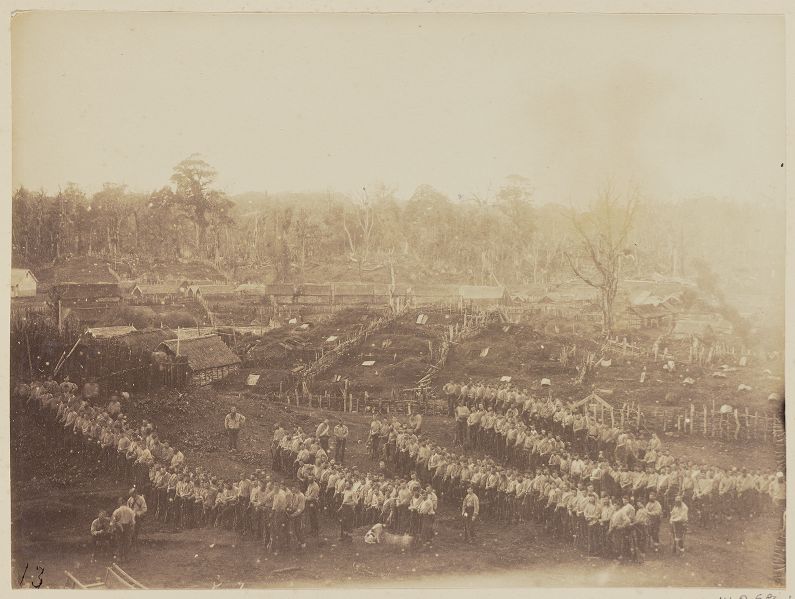
Figure 6.Armed Constabulary awaiting orders to advance on Parihaka Pa. Parihaka album 1. Ref: PA1-q-183-19. Alexander Turnbull Library, Wellington, New Zealand. /records/23044695.
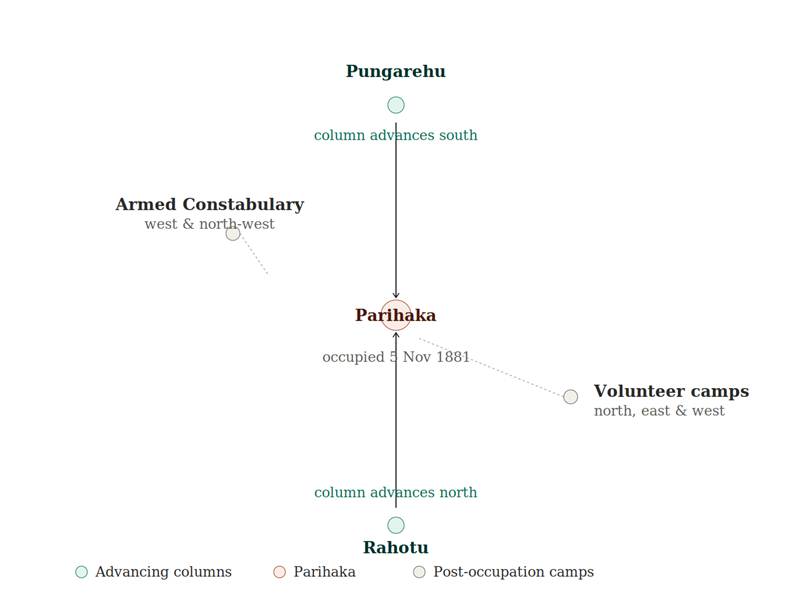
Figure 7. The two columns converging on Parihaka, 5 November 1881.
On 5 November 1881, the two principal columns advanced from Pungarehu and Rahotu.
Contemporary reports stated that the men carried two days’ provisions, blankets, coats or greatcoats, waterproof sheets and ammunition. The official account recorded an additional forty rounds per man.[41]
The load was considerable. A rifle and eighty Snider cartridges represented significant weight. When food, bedding, clothing and personal equipment were added, the march became physically demanding.
Observers described Volunteers struggling in warm weather beneath heavy swags. Several men collapsed or required medical attention.
The individual load was only the first layer of supply. Reserve ammunition travelled on packhorses with the columns, while a larger reserve remained at Pungarehu.
The two days’ provisions represented only the initial operational load. They allowed the columns to leave camp without depending upon immediate replenishment, but they did not sustain the subsequent occupation.
Once the force dispersed around Parihaka, daily delivery of food, forage, fuel, water and other supplies again became necessary.
Friction within the system
The force reached Parihaka and completed its encirclement, but the mobilisation was not seamless.
One newspaper account claimed that seventy-eight Naval Volunteers received only about ten pounds of meat during part of their transport and that plates, pannikins, knives and forks had not been provided. Another contingent reportedly found only about twenty bunks for fifty-eight men.[42]
Such complaints require caution, but they illustrate the difference between holding supplies and delivering them effectively.
A successful system had to provide the right commodity, in the right quantity, at the right place and time, together with the means to use it.
Meat was of limited value without cooking facilities or utensils. Blankets offered little protection if tentage failed and became soaked. Ammunition at a rear depot could not support the force unless transport remained available.
The operation succeeded because the system possessed sufficient overall capacity, not because every part worked efficiently.
Sustaining the occupation
The logistical requirement continued after the troops entered Parihaka.
The force was dispersed among several camps around the settlement. Headquarters and Armed Constabulary elements occupied positions to the west and north-west, while Volunteer camps were established to the north, east and west.
The dispersed arrangement improved control but complicated supply. Provisions, fuel, water and orders had to be distributed among several positions. Ammunition and baggage left at Pungarehu and Rahotu remained under guard.
Fuel was partly obtained locally. In the days following the occupation, men were reported collecting firewood around the camps.[43]
The force also required working parties for searches, guards, escorts and demolition. Horses, carts and personnel had to be allocated among competing requirements.
Transporting prisoners and displaced families
The same transport network that brought troops and stores to Parihaka was also used to remove people from the settlement.
Te Whiti and Tohu were taken by wagon to Pungarehu under mounted escort. During November nearly 1,600 Māori men, women and children were sent under escort towards their home districts.[44]
Some groups were marched overland. Others were taken to Opunake and transported by sea.
The movement required:
groups to be organised by district;
escorts to be detailed;
routes to be selected;
wagons and drays to be allocated;
vessels to be scheduled;
provisions to be supplied during movement.
The transport burden therefore extended beyond supporting the colonial force. It included the coercive dispersal of a civilian population similar in size to the force itself.
Anderson’s recognised involvement in these arrangements demonstrates how closely Defence Stores and transport became connected with government policy.
Demolition as a logistical operation
During November and December 1881 Crown forces dismantled houses and destroyed fences and cultivations at Parihaka.
These actions required logistical organisation. Working parties needed axes, crowbars and other tools. Guards and supervisors had to be provided. Men required rations while engaged in the work, and transport had to remain available.
The destruction of crops was particularly significant. Parihaka’s population had been sustained through extensive gardens, pastures and communal production.
The government therefore sustained its own force while deliberately degrading the system by which Parihaka sustained itself.
Logistics at Parihaka had both a sustaining and a destructive dimension.
Demobilisation and the reverse supply chain
Once the settlement had been occupied and much of its population dispersed, the Volunteer contingents were progressively released.
The process reversed mobilisation. Units returned to Rahotu or Opunake, baggage was assembled, vessels allocated, troops embarked, and weapons, ammunition and equipment accounted for.
Rifles, unused ammunition, tents, blankets and other government property had to be returned, transferred to permanent posts or written off if lost or damaged.
By 20 November only the Taranaki Mounted Rifles remained on active service.[45] In approximately two weeks the support system had to reverse the concentration and return hundreds of Volunteers to their home districts.
Later ordnance manuals described return, inspection, repair, salvage and disposal as integral parts of the supply system.[46] The same principle is evident in contemporary financial records.
The 1880–81 public accounts recorded recoveries from the sale of Constabulary stores, clothing, accoutrements, troop horses and forage, as well as proceeds from Militia and Volunteer arms, ammunition and stores.[47]
Demobilisation therefore created a reverse supply chain. Equipment moved from units to camp stores, from the camps to Opunake and from the coast back to district or central custody.
The permanent Armed Constabulary remained, occupying posts and resuming road construction and patrol duties.
Destination, demand, distance, duration and dependency
The logistical difficulty can be summarised through five connected factors identified in later doctrine: destination, demand, distance, duration and dependency.[48]
Destination: Parihaka lay beyond the colony’s principal ports and railways. Final movement depended upon surf-landings, roads, drays and packhorses.
Demand: The supported military population increased from 522 Armed Constabulary personnel in Patea and Taranaki to 1,589 officers and men. The force also had to control and disperse a Parihaka population of more than 1,300.
Distance: Personnel and stores travelled from Wellington and other districts by rail and sea before transfer to road transport.
Duration: The requirement extended far beyond the two-day march. It included preparation since 1879, the November concentration, the occupation and the continuing Constabulary presence.
Dependency: The system depended upon commercial shipping, contractors, horses, roads, paddocks, telegraph communications and favourable weather at Opunake.
A failure in any one area could affect the whole operation.
The financial framework
The cost of preparing for and occupying Parihaka cannot be found in one account.
For 1880–81 the Consolidated Fund appropriations allocated £163,446 11s. 3d. to the Minister of Defence.[49] At the same time, the Public Works Fund included £154,000 for contingent defence, together with substantial votes for roads, telegraph extensions and public buildings.[50]
For 1881–82 the gross Defence vote was £217,014 12s. 2d., of which £75,000 was recoverable from loan funds, leaving a net Consolidated Fund charge of £142,014 12s. 2d.[51]
These figures did not represent Parihaka alone. They included wider expenditure on the Militia, Volunteer, Police, and Armed Constabulary. Nevertheless, they show that the operation drew upon both ordinary Defence appropriations and loan-funded infrastructure.
Its costs were dispersed among:
Armed Constabulary pay and allowances;
Militia and Volunteer expenditure;
arms and ammunition;
Defence Stores;
coastal shipping;
road construction;
telegraph extension;
public buildings and redoubts;
provisions and forage;
contingent defence;
transport and miscellaneous services.
The administrative separation concealed the extent to which these activities formed a single operational system.
Parihaka viewed as a logistical system
The operation can be understood as a series of connected support nodes.
Wellington provided personnel, arms, ammunition and central administration. Coastal shipping moved units and bulk supplies to Taranaki. Opunake acted as the maritime transfer and bulk-breaking point. New Plymouth served as an alternative landing point when weather prevented the use of Opunake. Rahotu and Pungarehu provided accommodation, staging and forward stores. Wagons and packhorses carried reserves towards the columns, while individual men carried the final personal load.
The system displayed considerable foresight. Arms were packed for rapid despatch, ammunition and stores were accumulated at principal stations, roads were opened for wheeled traffic, camps were established progressively along the coast, telegraph communications were extended, and paddocks were developed near the forward posts.
By November 1881, the government no longer needed to create a supply system from scratch. It enlarged and accelerated a network that had been under development since 1879.
The force’s operational reach was determined by the network’s reach.
Conclusion
The occupation of Parihaka on 5 November 1881 was not an isolated or improvised military event. It was the culmination of a logistical build-up that began during the West Coast emergency of 1879: two years spent concentrating personnel, accumulating weapons and ammunition, building roads, establishing camps, developing forage resources, extending telegraph communications and turning Opunake into a coastal supply point. By November 1881 the government did not need to build a supply system from nothing — only to enlarge and accelerate one already two years in development.
That system is why the numbers in this article are worth taking seriously, even as estimates rather than surviving issue totals. A force of 1,589 men required tonnes of food and forage, hundreds of tents, thousands of blankets, more than 100,000 rounds of ammunition, and a coastal supply chain that ran through open surf at Opunake. None of it arrived by accident, and none of it was inevitable — it was the product of deliberate choices made over two years, by identifiable officials, using identifiable roads and ships and contracts.
It was also, on its own terms, an imperfect system. The Nelson contingent, leaky tents, the diverted Hinemoa, and the missing plates and cutlery were all signs of a system under strain. It succeeded not because every part worked smoothly, but because it had enough capacity to absorb the parts that didn’t.
None of that capacity was neutral. The same roads that carried rations and ammunition to Rahotu and Pungarehu carried the wagons that took Te Whiti and Tohu into custody and dispersed nearly 1,600 people from their homes. The same working parties that built cookhouses and redoubts later dismantled houses and destroyed the gardens that had sustained Parihaka’s own, larger population. The government sustained its force and dismantled the community’s capacity to sustain itself using the same logistical apparatus, often the same men, in the same weeks.
That is the lesson Parihaka offers for New Zealand’s military logistics history: the systems that feed, clothe, transport and equip a force are never separate from the policy that force carries out. At Parihaka, that apparatus made possible not a battle, but the systematic occupation and dismantling of a peaceful community.
A note on the present
The five factors that shaped the Parihaka operation- destination, demand, distance, duration and dependency are not confined to 1881. They describe a structural problem New Zealand’s military still faces in its most probable operating environment: the Pacific.
Opunake had no harbour. Steamers anchored offshore, and every box of ammunition, bag of rations and coil of telegraph wire had to pass through surf boats before it reached dry land. That transfer point, not the road or the rifle, was the operation’s real constraint. The same problem persists in the Pacific today in different form: American logistics remain unmatched but depend on deep ports and long runways, both of which are scarce across the region, and current commentary on New Zealand’s defence posture argues this is precisely where investment should be directed — vehicles, ships and capabilities built for Pacific conditions rather than for the ports New Zealand’s larger partners can rely on elsewhere.[52] Anderson’s beach parties at Opunake and a modern sealift or littoral capability designed for undeveloped Pacific coastlines are answers to the same question, asked 140 years apart.
The Crown’s advantage in 1881 was not the size of the force it could raise in a crisis, but the network it had already built before the crisis arrived — camps, roads, forage paddocks and standing contracts, developed over two years so that the final concentration was an acceleration rather than a creation. Current strategic writing on New Zealand’s regional posture makes a comparable argument at Pacific scale: with the South China Sea heavily fortified, the less congested Pacific has become a more attractive arena for influence, and whoever secures logistics hubs there first will hold the advantage.[53] Read against Parihaka, this is not a new insight so much as a familiar one restated for a different theatre — pre-positioning and regional access are usually worth more than surge capacity assembled after the fact.
The paper’s account of the Defence Storekeeper’s dependence on contractors, forage, and shipping he did not control has a direct present-day analogue as well. New Zealand’s Defence Industry Strategy now explicitly builds toward shared regional repair capacity through the Partnership for Indo-Pacific Industrial Resilience, on the reasoning that the ability to repair equipment without returning to New Zealand is critical to operational effectiveness.[54] Contracted and locally sourced support extended the Crown’s reach at Opunake in exactly the way it is meant to extend the NZDF’s reach across the Pacific now — and it carried the same trade-off then as it does today: capacity gained through dependency is only as reliable as the party it depends upon.
None of this suggests a direct institutional lineage between the Armed Constabulary’s supply arrangements and NZDF planning today. The doctrine, the technology and the strategic context are entirely different. What carries over is the underlying structure of the problem: a small force, operating at the end of a long and interruptible supply chain, in a theatre with few deep harbours and fewer long runways, dependent on contractors, shipping and weather it cannot control. Parihaka is a reminder that this is not a new condition for New Zealand’s military to solve — only the latest occasion for solving it again.
Notes
[1] Australian Army, “Logistics,” Land Warfare Doctrine 4.0 (2018): 5, 9; U.S.G.U. Army, Field Manual FM 4-0 Sustainment Operations July 2019 (Washington, DC: Department of the Army, 2019), 1-1–1-8.
[2] Judith Binney and Aroha Harris Atholl Anderson, Tangata Whenua: An Illustrated History (Bridget Williams Books, 2014), 264-65.
[3] Atholl Anderson, Tangata Whenua: An Illustrated History, 264.
[11] Garry Clayton, The New Zealand Army: A history from the 1840’s to the 1990’s ([Wellington, N.Z.]: New Zealand Army, 1990, 1990), , 34-39; Paul William Gladstone Ian McGibbon, The Oxford companion to New Zealand Military History (Auckland; Melbourne; Oxford: Oxford University Press, 2000, 2000), .
[12] “Public Works Statement by the Honourable Minister for Public Works,” Appendix to the Journals of the House of Representatives 1881 Session I, D-01 (10 August 1881).
[13] Peter D. F. Cooke, Won by the spade: how the Royal New Zealand Engineers built a nation (Exisle Publishing Ltd, 2019), Bibliographies, Non-fiction, 114-15; Peter Cooke and John Crawford, The Territorials (Wellington: Random House New Zealand Ltd, 2011), 78-80.
[47] “Public Accounts of the General Government of New Zealand, for the Financial Year 1880-81 Commencing 1 April 1880 and Ending 31 March 1881,” Appendix to the Journals of the House of Representatives 1881 Session I, B-01 (9 October 1881), https://paperspast.natlib.govt.nz/parliamentary/AJHR1881-I.2.1.3.1.
[49] The Honourable J Ballance, The Colonial Treasurer, “Financial Statement By the Colonial Treasurer the Hon Major Atkinson 6th July 1881,” Appendix to the Journals of the House of Representatives, 1881 Session I, B-02 (1881), https://paperspast.natlib.govt.nz/parliamentary/AJHR1881-I.2.1.3.2.
Ian McGibbon, Paul William Gladstone. The Oxford Companion to New Zealand Military History. Auckland; Melbourne; Oxford: Oxford University Press, 2000, 2000. .
“Public Accounts of the General Government of New Zealand, for the Financial Year 1880-81 Commencing 1 April 1880 and Ending 31 March 1881.” Appendix to the Journals of the House of Representatives 1881 Session I, B-01 (9 October 1881). https://paperspast.natlib.govt.nz/parliamentary/AJHR1881-I.2.1.3.1.
“Public Works Statement by the Honourable Minister for Public Works.” Appendix to the Journals of the House of Representatives 1881 Session I, D-01 (10 August 1881).
The Colonial Treasurer, The Honourable J Ballance. “Financial Statement by the Colonial Treasurer the Hon Major Atkinson 6th Ju;Y 1881.” Appendix to the Journals of the House of Representatives, 1881 Session I, B-02 (1881). https://paperspast.natlib.govt.nz/parliamentary/AJHR1881-I.2.1.3.2.
Where the year to June 1871 was one of consolidation after Imperial withdrawal, the financial year 1871–72 was one of settling routine. The Store Department now had a full year of independent colonial operation behind it. Its small body of storekeepers, clerks, armourers, arms cleaners and magazine keepers continued to support the Armed Constabulary, Militia and Volunteers, while the Inspector of Stores maintained the wider system of inspection and accountability.
The surviving accounts show that this activity was conducted on a more modest financial footing than the earlier draft suggested. The Store Department spent £2,607 2s. during the year, while the separate Inspector’s Department spent £1,244 7s. 6d. The distinction matters: inspection and departmental storekeeping were related functions, but Parliament accounted for them under separate votes.
Legislative and Financial Setting
The financial framework for 1871–72 continued under the Defence and Other Purposes Loan Act 1870. Its schedule authorised up to £160,000 for colonial defence costs, charges, expenses and liabilities for the year ending 30 June 1872, approximately NZ$28.8 million using the article’s working conversion of £1 = NZ$180 in 2026 values.[1]
The Appropriation Act 1871 applied funds to the service of the year ending 30 June 1872. The detailed outturn was subsequently published in the Public Accounts for 1871–72 and summarised in the Colonial Treasurer’s Financial Statement of 20 August 1872.[2]
The conversion to 2026 New Zealand dollars is indicative only. It is used to convey scale rather than to imply a precise modern purchasing-power equivalence.
Confirmed Store Department Expenditure
Vote 62, Store Department, recorded the following expenditure for the twelve months from 1 July 1871 to 30 June 1872:
Category
Actual expenditure
Approx. 2026 NZD
Storekeepers and clerks
£995 16s. 8d.
$179,250
Armourers and arms cleaners
£1,321 1s. 6d.
$237,794
Magazine keepers
£147 11s. 0d.
$26,559
Rent, advertising and contingencies
£142 12s. 10d.
$25,675
Total actual expenditure
£2,607 2s. 0d.
$469,278
The account is significant because it shows where the department’s effort was concentrated. Armourers and arms cleaners accounted for just over half of Vote 62, reflecting the labour required to inspect, clean and repair weapons distributed throughout the colony. Storekeepers and clerks formed the next-largest component, while magazine keeping and general operating expenses were comparatively small.[3]
Appropriation Compared with Expenditure
Measure
Amount
Approx. 2026 NZD
Original appropriation
£2,641 17s. 6d.
$475,538
Additional liabilities
£15 4s. 2d.
$2,738
Total authority
£2,657 1s. 8d.
$478,275
Actual expenditure
£2,607 2s. 0d.
$469,278
Saving
£49 19s. 8d.
$8,997
The department therefore finished the year £49 19s. 8d. below its total spending authority. This was a small saving of about 1.9 per cent, suggesting close alignment between the provision approved by Parliament and the expenditure actually incurred.
The Separate Inspector’s Department
The Inspector of Stores was not charged to Vote 62. The inspection function appeared under Vote 61, the Militia and Volunteers Inspector’s Department. The Public Accounts recorded:
Inspector’s Department
Actual expenditure
Approx. 2026 NZD
Salaries
£960 0s. 0d.
$172,800
Travelling expenses and contingencies
£284 7s. 6d.
$51,188
Gross expenditure
£1,244 7s. 6d.
$223,988
Amount of main vote
£1,160 0s. 0d.
$208,800
Excess transferred to supplementary authority
£84 7s. 6d.
$15,188
The £284 7s. 6d. spent on travelling and contingencies is firmer evidence of an active inspection function than the provisional £100 allowance used in the earlier draft. The accounts do not, however, identify the individual journeys made during the year, so any detailed itinerary must be supported from correspondence, Gazette notices or newspaper reports rather than inferred from the expenditure alone.[4]
Personnel and the Limits of the Accounts
The Public Accounts group salaries by occupational category and do not identify the individual recipients. It is therefore safer to present the names below as personnel associated with the Defence Stores during the period, rather than as a salary establishment reconstructed from Vote 62.
Appointment
Personnel identified
Location or function
Inspector of Stores
Lieutenant-Colonel Edward Gorton
National inspection and oversight
Officer in charge, Auckland Store
Major William St Clair Tisdall
Auckland Defence Store
Officer in charge, Wellington Store
Lieutenant-Colonel Henry Elmhirst Reader
Wellington and Mount Cook stores
Armed Constabulary Storekeeper
Sam Cosgrave Anderson
Armed Constabulary storekeeping, Wellington
Clerk
John Blomfield
Auckland Defence Store
Clerk
John Price
Auckland Defence Store
Clerk
Alexander Crowe
Wellington Defence Store
Armourer
David Evitt, until his death on 23 February 1872; succeeded by his son, George Evitt
Auckland
Armourer
Edward Metcalf Smith
Wellington
Armourer
Edwin Henry Bradford
Wellington
Arms Cleaner
Thomas Gibbins
Auckland
Arms Cleaner
John Penligen
Auckland
Arms Cleaner
Charles Philips
Auckland
Arms Cleaner
William Cook Rockley
Auckland
Arms Cleaner
William Warren
Wellington
Arms Cleaner
John Shaw
Wellington
Arms Cleaner
James Smith
Wellington
Arms Cleaner
Walter Christie
Wellington
Magazine Keeper
John Broughton
Auckland
Magazine Keeper
William Corliss
Wellington
Sub-storekeepers and officers performing store duties
Names not yet fully identified
Wanganui, Patea and other district centres
This nominal roll should not be read as proof that every person served for the full twelve months or that each salary came from Vote 62. In particular, the Inspector’s establishment was separately accounted for, and Armed Constabulary appointments could be charged elsewhere. The named roll is useful for institutional history, while the aggregate Public Accounts provide the reliable financial totals.
Armourer succession at Auckland: David Evitt, a former British Military Stores Armourer and long-serving government gunsmith, remained responsible for Auckland’s arms until his death on 23 February 1872. Although seriously ill, he reportedly completed the repair of one final rifle shortly before his death. His son, George Evitt, succeeded him as Government Armourer and held the appointment until 1888.
Arms, Carbines and the Technical Workload
The 1872 Annual Report of the Inspector of Militia and Volunteers provides direct evidence of the condition of the weapons that the Store Department’s armourers and arms cleaners had to support. The Inspector reported that the breech-loading cavalry carbines were generally in a very bad state. Five hundred Snider carbines had been ordered from England, but had not arrived by the date of the report.
The Enfield rifles issued to infantry corps were, with few exceptions, in indifferent condition after prolonged use. Their barrel grooves were becoming worn and would deteriorate further until the weapons became unserviceable. The Inspector warned that British manufacture of Enfield rifles and ammunition was declining and that failure to replace the existing stock progressively could result in a very large future rearmament cost.
Targets were another supply problem. Imported targets had been ordered but had not arrived, while targets manufactured locally for immediate use had proved far inferior to those made in England. These observations show that the Defence Stores were supporting not merely an accounting system but also an ageing weapons inventory, delayed overseas procurement, and the uneven quality of colonial substitutes.[5]
Auckland Defence Store and Magazine Arrangements
The Auckland establishment continued under Major William St Clair Tisdall with John Blomfield and John Price as clerks, George Evitt as armourer, Thomas Gibbins, John Penligen, Charles Philips and William Cook Rockley as arms cleaners, and John Broughton as magazine keeper.
The movement away from the magazine arrangements at Albert Barracks and the development of the Mount Eden site were part of a broader effort to place powder storage on a safer, more controlled footing. The Regulations for Gunpowder Magazines issued in 1872 established formal rules for the custody, storage and handling of gunpowder. The uploaded financial and militia reports do not, by themselves, establish the precise completion date of the Mount Eden works, so the physical development of the site should continue to be sourced from the Gazette, tenders, and contemporary newspaper reports.
Wellington Defence Stores, Mount Cook
At Wellington, the Mount Cook Depot on Buckle Street remained the principal southern store. Existing research identifies Henry Elmhirst Reader as Storekeeper, Alexander Crowe as clerk, Edward Metcalf Smith and Edwin Henry Bradford as armourers, William Warren, John Shaw, James Smith and Walter Christie as arms cleaners, and William Corliss as magazine keeper. Anderson’s Armed Constabulary storekeeping duties were closely connected with this establishment, although the accounts do not demonstrate that his salary formed part of Vote 62.
The large aggregate expenditure on armourers and arms cleaners in 1871–72 confirms that technical weapon maintenance was not a peripheral activity, but the highest single cost within the Store Department vote.
Volunteers, Cadets and Continuing Demand
The 1872 report recorded 6,042 enrolled adult Volunteers at 31 March 1872, of whom 5,101 were classed as efficient. The North Island accounted for 4,038 enrolled and 3,584 efficient Volunteers, while the South Island had 2,004 enrolled and 1,517 efficient. A further 1,443 Cadets were enrolled, of whom 1,222 were efficient.
Force category
Enrolled
Efficient
Efficiency rate
North Island adult Volunteers
4,038
3,584
88%
South Island adult Volunteers
2,004
1,517
75%
All adult Volunteers
6,042
5,101
84%
Cadets
1,443
1,222
85%
The adult Volunteer total was lower than the 6,568 enrolled in the previous year, but it still represented a large and geographically dispersed body requiring rifles, carbines, ammunition, targets, accoutrements, repairs and accounting support. The Store Department had to sustain this demand with a central vote of only £2,607 2s. and a small network of permanent and part-time store personnel.[6]
Conclusion
The financial year from 1 July 1871 to 30 June 1872 was not a year of dramatic institutional change. It was a year in which colonial defence storekeeping became routine. The accounts show a compact Store Department that spent £2,607 2s., slightly below its authorised provision, while the separate Inspector’s Department spent £1,244 7s. 6d. and required supplementary authority for an £84 7s. 6d. excess.
The operational context was demanding. Cavalry carbines were in poor condition, Enfield rifles were wearing out, replacement Snider carbines and imported targets had not arrived, and locally made targets were unsatisfactory. At the same time, more than 6,000 adult Volunteers and 1,400 Cadets formed a dispersed customer base for arms, ammunition and equipment.
The department’s achievement lay in sustaining this system with limited resources. Storekeepers and clerks maintained custody and accounts; magazine keepers safeguarded ammunition; armourers and arms cleaners absorbed the largest share of departmental expenditure as they kept an ageing inventory serviceable. Rather than the provisional salary establishment of more than £3,400 suggested in the earlier draft, the confirmed record reveals a leaner organisation whose value rested in the technical and administrative work it performed across the colony.
[3] “Public Accounts of the General Government of New Zealand, for the Financial Year 1871-72, Commencing 1 July 1871 and ending 30 June 1872,” Appendix to the Journals of the House of Representatives 1873 Session I, B-01 (9 October 1873), https://paperspast.natlib.govt.nz/parliamentary/AJHR1873-I.2.1.3.1.
[4] “Public Accounts of the General Government of New Zealand, for the Financial Year 1871-72, Commencing 1 July 1871 and ending 30 June 1872.”
[5] “Annual Report of the Inspector of Militia and Volunteers,” Appendix to the Journals of the House of Representatives, 1872 Session I, G-14a ( 1872), .
[6] “Annual Report of the Inspector of Militia and Volunteers.”
Today, 12 July, would have been Corps Day for the Royal New Zealand Army Ordnance Corps. It also marks thirty years since the formation of the Royal New Zealand Army Logistic Regiment and, with it, the disestablishment of the RNZAOC. It is a fitting moment to look back, not with sentimentality but with appreciation for what the Corps actually was and what it left behind.
The RNZAOC was not lost so much as it moved into its next form. From the days of Henry Tucker onwards, the work of the Ordnance soldier was defined by one constant: continual adaptation. Its history is best understood not as that of a fixed institution that came to an end, but as one long process of change that continues today, under a different name.
Formed in war, tested by peace
The role of the Ordnance soldier expanded and contracted as the Army’s needs shifted around it. During the First World War, New Zealand Ordnance personnel served both at home and overseas, in Egypt, Gallipoli, Palestine, France, Belgium and the United Kingdom.
The interwar years brought progress alongside considerable uncertainty, including a period when the New Zealand Army Ordnance Corps came close to ceasing to exist altogether.
Mechanisation and a widening trade
The Second World War forced rapid adaptation once more. Ordnance soldiers served in every theatre in which New Zealand forces took part, adjusting to the demands of increasingly mechanised warfare. Bath and laundry services, ammunition support and specialist technical functions all became central to the Corps’ work during this period.
The later transfer of the Technical Trades to the New Zealand Electrical and Mechanical Engineers fits the same pattern rather than breaking from it. As military technology and technical specialisation advanced, responsibilities moved to where they made most sense — a recurring feature of the Corps’ story, not an exception to it.
A peacetime Corps that kept changing
Adaptation did not stop when the wars ended. Territorial Force personnel became an integral part of the RNZAOC, and the increasingly specialised management of technical stores gave rise to the Auto Parts trade. The Ammunition Technician trade evolved alongside the operational environment and, by the 1970s, had become the Army’s centre of expertise in explosive ordnance disposal.
Further change followed: the integration of women from the Women’s Royal New Zealand Army Corps, and then the transfer of the RNZASC supply trades into the RNZAOC in 1979. Less visibly, Ordnance personnel also adapted to the gradual introduction of electronic stores-management systems, progressing from early mainframe systems to the networked logistics systems in use by 1996.
The Corps at its height
By the mid-1980s, the RNZAOC had reached its peak. 1 Base Supply Battalion was, at the time, regarded as one of the most complex warehouse operations in New Zealand. Supply Companies were located at Hopuhopu, Waiouru, Linton and Burnham. Separately, stores sections were integrated within each RNZEME workshop, while an Advance Ordnance Depot maintained a New Zealand presence in Singapore. It was a Corps operating at scale, both at home and abroad.
That scale did not last. With the end of the Cold War came a peace dividend, and with it a gradual reduction in the size and reach of the Corps through the late 1980s and into the 1990s. This, too, was adaptation rather than decline for its own sake, the Corps reshaping itself to match a changed strategic environment, as it always had.
Towards Formed Deployments
RNZAOC soldiers had already deployed on operations in Korea, Malaya, Malaysia and South Vietnam, and others had served individually on peacekeeping missions. The 1990s added a further dimension, as Ordnance soldiers began deploying on operations as formed contingents, beginning with a Supply Detachment to Somalia, followed by two platoons, a shift that reflected both New Zealand’s changing military commitments and the increasingly integrated role of logistics support.
A Corps Spanning Generations
When the RNZAOC was disestablished in 1996, its youngest member was 17 years old and its oldest was 55. That span was more than a statistic. It represented a Corps that connected multiple generations of officers and soldiers, from those trained in long-established manual systems to those entering an increasingly digital and integrated logistics environment, within a single institution, at a single moment.
Continuity, Not Loss
The formation of the RNZALR did not erase the RNZAOC’s history; it became the next stage in a much longer process of adaptation. Titles, structures and trades changed, but the essential purpose held: to provide the Army with the equipment, ammunition, technical support and supply services needed to train, deploy and operate.
Thirty years on, the most fitting way to remember the RNZAOC is not to mourn its passing, but to recognise its enduring legacy, carried forward today within the RNZALR, particularly through its Supply trade. Adaptation was never evidence of weakness or decline. It was, and remains, one of the Corps’ defining strengths.
New Zealand Army Ammunition Technical Investigation from Shelly Bay to the Ammunition Technician Trade
Training with ammunition has always carried risk. Whether on a rifle range, during grenade training, in artillery practice, during demolition work, or while handling explosives in a depot or field environment, ammunition must function as designed, and soldiers must use it as directed. When either of those things goes wrong, the consequences can be serious and, in the worst cases, fatal.
For the New Zealand Army, the investigation of ammunition-related incidents is one of the important roles performed by Ammunition Technical Officers and Ammunition Technicians. Their purpose is not to assign blame. It is to conduct a technical appraisal of the ammunition, explosives, weapons, stores, and procedures involved, and to determine, as far as the evidence allows, what happened and why.
That distinction matters.
This is a historical and institutional narrative, not a technical investigation report. It draws on inquest records, commission findings and newspaper accounts to trace how the investigative function evolved. It does not attempt to reconstruct failure mechanisms to modern forensic standards, and readers with an Ammunition Technical trade background should read the technical detail in each case as illustrative of the investigative principle at work, not as a substitute for the original findings.
In the aftermath of an ammunition incident, particularly one involving injury or death, there is a natural desire to find an immediate cause. Was the ammunition faulty? Did the weapon fail? Did the operator make a mistake? Was supervision inadequate? Was the drill wrong? These are necessary questions, but they must be answered carefully. The role of the ammunition specialist is to establish the technical facts before drawing conclusions.
A sound ammunition investigation seeks to determine whether the ammunition was serviceable, whether it was being used within its design limitations, whether storage or handling may have affected its condition, whether a batch or lot may require restriction, and whether procedures, training, or equipment need to be amended. It is an evidence-based process, not an exercise in blame.
This article follows two connected stories. The first is the history of selected incidents involving the New Zealand Army and New Zealand military ammunition. The second is the evolution of the specialist technical structure needed to investigate them. Before New Zealand had Ammunition Technical Officers and Ammunition Technicians, accident investigation relied on commissions, coroners, artillery officers, submarine mining specialists, Defence Department officials, police and expert witnesses. Over time, those ad hoc arrangements gave way to formal inspection, proof (test-firing to confirm a batch is safe to use), surveillance (ongoing monitoring of the condition of stored ammunition), and technical control of ammunition.
Where the names of those killed are known, they are included. This is not to sensationalise the incidents, but to ensure that the technical lessons are anchored in the lives of the people who were lost. Ammunition accidents are often discussed in terms of natures (in ammunition terminology, a “nature” is a specific type or mark of munition, tracked separately from other types), batches or lots (ammunition manufactured together and tracked as a group, so a defect found in one can be traced to the rest), fuzes (mechanical or electronic devices that initiate a munition, as distinct from a burning safety fuse), guns, drills and procedures. Those details matter, but they should not obscure the human cost that gave urgency to each investigation.
Before the Ammunition Trade
The early New Zealand ammunition and explosives accidents of the 1890s and early 1900s occurred before the Army had a dedicated technical ammunition trade. These incidents were not investigated by Ammunition Technical Officers or Ammunition Technicians in the modern sense, because that professional structure did not yet exist.
Instead, investigations were conducted through the mechanisms then available: formal commissions, coroners’ inquests, police representation, Defence Department oversight, and the evidence of officers and men with practical experience in artillery, submarine mining, torpedo work, engineering and explosives.
This does not mean that the investigations lacked technical content. On the contrary, the evidence from Shelly Bay, Mahanga Bay and Fort Ballance shows that the inquiries were often highly technical. They examined explosive preparation, initiation, storage, testing, drill, gun mechanisms, breech closure, cartridge case behaviour, detonators, guncotton sensitivity, and the transmission of regulations. What was missing was not technical curiosity, but a permanent New Zealand military organisation whose standing function was to own ammunition inspection, investigation, records, testing and technical assurance.
The significance of the 1891, 1899 and 1904 inquiries is therefore not that they were conducted by ammunition specialists. They were not. Their significance lies in showing why ammunition specialists became necessary.
Shelly Bay, 1891: A Technical Inquiry Before a Technical Trade
On 5 March 1891, a guncotton explosion (guncotton being a nitrocellulose-based high explosive then used in mines and demolition charges) occurred at Shelly Bay during submarine mining work, killing Torpedomen William Densem, aged 22, and William Horrocks Heighton, known as William Ross, aged 35. Torpedoman Cornwall was also seriously injured in the blast.[1] The subsequent inquiry was conducted by two Royal Navy officers, appointed by the Governor through the Admiral commanding the Australian Squadron, who acted as Royal Commissioners tasked with determining the cause of the explosion.[2] The Commissioners found that the accident was caused by the overheating of a loaded primer tin (a sealed container holding percussion primers — small explosive charges used to initiate a larger charge) while its lid was being soldered on. Their report reconstructed the sequence of events in technical detail, identifying the location of the primer tins, the use and reheating of the soldering iron, the presence of dry guncotton, and the way heated gases and flame caused successive detonations.[3]
The Commissioners did not simply ask who was at fault. They examined the process, the workplace, the explosive stores, the instructions in force, and whether War Office memoranda had been properly circulated. Their findings were direct. They stated that solder should not be applied to cases containing guncotton, whether wet or dry, and that live charges fitted with detonators should not be stored in the mine store. They also observed that cases containing guncotton were not properly covered, that periodical testing had not been consistently recorded, and that there was a need for a “permanent responsible head” who could account for torpedo stores and other warlike material in the colony.[4]
That recommendation is especially important. Decades before New Zealand developed the Ammunition Technical Officer and Ammunition Technician structure, the Shelly Bay inquiry had identified the need for centralised technical responsibility for explosives, testing, records, and regulatory compliance.
Submarine and Torpedo Mining Corps annual camp, Shelly Bay, Wellington, c.1899. Photos Ref: 091774-F, Alexander Turnbull Library.
The Commission’s report also demonstrates the value of investigation beyond blame. Captain Falconer, the officer responsible for the submarine mining operations at Shelly Bay, had his practice criticised, but the report also acknowledged his experience and familiarity with submarine mining.[5] The issue was not simply one man’s conduct. It was the wider system: how instructions were issued, how stores were controlled, how testing was recorded, and how dangerous processes were supervised.
In that sense, Shelly Bay stands as an early example of technical investigation into ammunition before there was an ammunition technical branch.
The following year’s Defence report confirms that two separate inquiries ran in parallel: the naval Royal Commission and a distinct civil court process, with the findings of both forwarded to the Government.[6] That dual-track approach, with military and civil investigations running side by side, is itself an early precursor to the layered, multi-source technical investigation later formalised under the Ammunition Technical Officer structure.
Mahanga Bay, 1899: When Experience Was Not Enough
On 7 August 1899, a fatal guncotton explosion occurred at Mahanga Bay during the demolition of an old electric searchlight pedestal at Point Gordon. The inquest into the deaths of Sergeant Octavius Olive, aged 38, Corporal Henry Blick, aged 53, and Sapper William Teague, aged 25, was opened at Mahanga Bay.[7] A fourth man, Sapper John James Head, was also injured in the explosion. Inspector Pender represented the police, Commissioner Tunbridge, Colonel Penton, Commandant of the New Zealand Defence Forces, and other military officers were present, and legal representatives appeared for the relatives of Corporal Blick and Sergeant Olive.[8]
Captain Falconer gave evidence that he had ordered the destruction of the old pedestal and that a guncotton mine had prematurely exploded while the work was being carried out. Sergeant Olive was tamping (packing the explosive firmly into place) the guncotton into a hole in the concrete, Blick was holding the box containing broken guncotton, and Teague was taking guncotton from the box and placing it into the hole. The main wires were reportedly not connected, and the detonators were later found intact, suggesting that the charge had not been fired electrically.[9]
The evidence was technically complex. Captain Falconer stated that he had no theory to explain the explosion and that similar methods had been used many times before without mishap. Torpedo Gunner Broderick of HMS Mildura, who had experience with naval explosives, examined the guncotton and found it satisfactory. Witnesses considered whether the explosion could have been caused by ignition, confinement, friction, percussion, a spark, faulty guncotton, or heating from the sun. Colonel Penton, while unable at that stage to attribute blame, stated that after the accident he would issue instructions that guncotton should be used in a damp state wherever available.[10]
The coronial inquest ultimately absolved the officer in charge of blame. The case was also referred to the Home Office in London for an independent scientific opinion, which upheld the jury’s finding. Following the accident, Penton ordered that all future demolitions be carried out only under “service” conditions and with “service” stores.[11] That sequence- inquest, independent expert review, and a resulting change to procedure- is the technical investigation cycle the modern Ammunition Technical Officer trade was later built to carry out as a matter of course.
Mahanga Bay is valuable because it shows the limits of experience and routine practice. Those involved were trained, experienced, and working according to methods they believed were accepted. Yet an unexplained premature explosion still occurred. The lesson for ammunition specialists is clear: repeated safe use does not prove that a practice is safe in all conditions. Technical investigation must consider not only whether the people were competent, but whether the explosive system, environment, method of preparation, and method of initiation provided adequate safety margins.
Mahanga Bay also reinforces a theme that runs through the history of ammunition incidents: when the technical cause is uncertain, the investigation must resist the temptation to settle too quickly on blame. Colonel Penton’s evidence, that he could not attribute blame at that stage, is precisely the approach later embodied in formal ammunition technical investigation.
Fort Ballance, 1904: Weapon, Ammunition and Drill
On 2 November 1904, Gunner John Amos Palmer of the Royal New Zealand Artillery was killed during firing practice at Fort Ballance when the breech-block of a 12-pounder quick-firer blew out. Several other members of the detachment were injured. The adjourned inquest was resumed at the hospital, with Inspector Ellison appearing for the police, Mr Levi for Palmer’s widow, and Mr Myers watching the case for the Defence Department.[12]
Fort Ballance (including associated positions at Fort Gordon). Permission of the Alexander Turnbull Library, Wellington, New Zealand,
The inquest evidence concentrated on the weapon mechanism, the breech, the firing drill, the cartridge case, gas escape, heating, the number of rounds fired, and whether the gun could have fired unless the breech was properly closed. Members of the gun detachment repeatedly stated that the gun appeared to be in proper order, that the breech was properly closed, and that the correct firing drill had been followed. Bombardier Petersen, Gunner Slines, Gunner Sweeney and Gunner O’Neill each gave evidence from within the gun detachment.[13]
This was not an ammunition-branch technical inquiry. It was a coronial inquiry that relied heavily on practical artillery evidence. In a breech-loading gun of this kind, the cartridge case, expanding under firing pressure, seals the rear of the barrel; if that seal fails, hot gas can escape backwards toward the gun crew, which is why the questions below focus so heavily on the case and the breech. Yet the questions it asked were recognisably ammunition-technical questions. Did the cartridge case expand correctly to seal the breech? Was gas able to escape to the rear? Did electric or percussion firing have any bearing? Was the breech properly closed? Could drill or mechanism have allowed a dangerous condition to develop?
A later report on the inquest into the suicide of Gunner John Hay in 1906 is relevant to the theme of blame. Hay had apparently believed that others blamed him for Palmer’s death, but witnesses stated that they had not heard such blame and that Palmer’s death had been purely accidental.[14]That sad aftermath reinforces why technical investigation must be careful, evidence-based and clearly communicated. When the causes of an ammunition or weapon accident are uncertain, rumour and blame can fill the gap. That is why establishing what happened is only half the task; the other half is preventing unsupported assumptions from hardening into accepted truth.
From Magazine Keepers to Ammunition Technical Specialists
The early inquiries at Shelly Bay, Mahanga Bay, and Fort Ballance show why New Zealand eventually needed a dedicated technical ammunition function. In the nineteenth century, responsibility for ammunition and explosives sat largely with those who managed powder magazines, artillery stores, submarine mining stores and Defence Stores Department holdings.
Ammunition and explosives were imported from Britain and Australia, with powder magazines established at Mount Cook in Wellington and Mount Albert in Auckland. Responsibility for handling and storing these stocks sat with qualified individuals from the British Military Stores Department, Royal Artillery and Royal Engineers. After the withdrawal of Imperial forces in 1870, responsibility for New Zealand’s magazines and ammunition transferred to the Defence Stores Department, with later facilities established at Mount Eden in Auckland and Kaiwharawhara in Wellington.[15]
This early system provided practical control of magazines and ammunition, but it was not yet a specialist ammunition technical branch in the modern sense. When something went wrong, expertise had to be assembled from artillery officers, submarine mining personnel, naval torpedo specialists, police, coroners, commissions and Defence Department representatives.
By the late nineteenth century, New Zealand had also developed local ammunition manufacture. Major John Whitney’s ammunition interests evolved into the Colonial Ammunition Company in 1888, which produced small-arms ammunition for the New Zealand Government. Under the government contract, the state supplied powder while the company manufactured the cartridges. Each batch then underwent government inspection and testing before acceptance.[16]
That inspection process is significant. It shows that the principles later associated with ammunition technical work, inspection, proof, surveillance, testing and acceptance were already present before the formal trade structure existed. However, they were dispersed across different responsibilities rather than held by a single dedicated ammunition technical organisation.
The First World War and its aftermath accelerated the need for specialist technical control. The organisational titles below changed more than once over the following decades, but the underlying job, technical control of ammunition, stayed essentially the same throughout; readers mainly need the end point, that the modern Ammunition Technical Officer and Ammunition Technician titles arrived in 1961. Administrative control of the New Zealand Army Ordnance Section of the Royal New Zealand Artillery passed to the New Zealand Army Ordnance Corps (NZAOC) on its formation in 1917. Concurrently, technical control of ammunition passed to the Inspection Ordnance Officer of the NZAOC.
During the interwar period, the Inspecting Ordnance Officers Branch consisted of only a small number of staff officers. These included Major William Ivory, RNZA, who served from 2 January 1921 to 6 April 1933, and Captain I. R. Withell, B.Sc., RNZA, who served from 1933. The branch expanded rapidly during the Second World War as ammunition depots were established at locations including Ngaruawahia, Waiouru, Makomako, Kuku Valley, Belmont, Mount Somers, Alexandra, Glentunnel and Fairlie. Post-war, the ordnance ammunition trades comprised Inspecting Ordnance Officers and Ammunition Examiners.
In 1961, following United Kingdom practice, the titles changed. The Chief Inspecting Ordnance Officer became the Chief Ammunition Technical Officer; the Senior Inspecting Ordnance Officer became the Senior Ammunition Technical Officer; District Inspecting Ordnance Officers became District Ammunition Technical Officers; Inspecting Ordnance Officers became Ammunition Technical Officers; and Ammunition Examiners became Ammunition Technicians.
Modern NZ Army Ammunition Technician Badge. Dave Theyers Collection
The modern Ammunition Technical Officer and Ammunition Technician structure, therefore, did not appear out of nowhere. It grew out of decades of experience in magazine management, ordnance inspection and proof, ammunition manufacture, explosive accidents, unexploded ordnance, and the need for independent technical advice. The Flaming “A” badge, adopted in 1971, symbolises the hazardous and highly skilled trade, but the professional roots of the role reach much further back to the early colonial handling of powder, guncotton, shells, and small-arms ammunition.
The 1932 Marton bus bombing also illustrates the development of the technical role beyond conventional ammunition.[17] Long before modern Explosive Ordnance Disposal existed as a military speciality, the Inspecting Ordnance Officer was called upon to examine a suspicious explosive device and later give expert evidence in court. The case has been described as a proto-EOD moment because it shows the State turning to a recognised military explosives authority to identify, reconstruct, control and report on an improvised explosive incident.[18]
Brocton Camp, 1918: When the Ammunition Works as Designed
Not every ammunition accident is caused by faulty ammunition.
On 19 April 1918, Lieutenant Randolph Gordon Ridling, New Zealand Rifle Brigade, was instructing reinforcement troops in the use of the Mills bomb at Brocton Camp, Staffordshire. A nervous trainee fumbled a live grenade after removing the pin, panicked, and dived into the corner of the bombing bay. Ridling pulled the man to shelter and was wounded when the grenade exploded. He was later awarded the Albert Medal for his actions.[19]
Public accounts of the incident point to panic and drill breakdown rather than a munition defect. That is exactly why the case is instructive. Even where an initial account suggests operator error, an ammunition technical investigation must still exclude ammunition failure.
Was the grenade correctly issued? Was it serviceable? Was the fuze operating within expected timing? Was the correct type of grenade being used for the training activity? Did the layout of the throwing bay allow an error to become fatal? Were the instructor and trainee positioned so that a failed throw or hesitation could be managed safely?
The ammunition may have functioned exactly as designed, but the incident still required technical understanding. Ammunition investigation is not limited to proving that a round, grenade, shell or fuze failed. It also helps establish when the ammunition did not fail, and when the true lesson lies in training design, supervision, safety margins or drills.
Trentham, 1942: Variability, Realism and Fatal Consequence
The best New Zealand example of the complexity of ammunition investigation is the grenade fatality at Trentham Military Camp on 7 February 1942.
During grenade instruction at the Army School of Instruction, an “emergency grenade” prematurely detonated. The incident resulted in the deaths of Major Richard James Dunlop Davis, New Zealand Staff Corps; Sergeant Robert Andrew Peters; Acting-Sergeant Roland Stephens Thomson; Corporal Richard Mark Geard; and Acting-Sergeant Herbert Henry Wood. Davis, Peters, Thomson and Geard died on 7 February. Wood died of his injuries on 8 February.[20]
Major Richard “Dickie” Davis who, along with four soldiers, died after a grenade detonated during an army training session at the Trentham Army Camp 75 years ago. Photo: Supplied / Upper-Hutt-Leader
The grenade was not a standard factory-produced munition. It was an expedient design based on components of the Mills grenade, adapted for local manufacture. Instead of an integrated, mechanically controlled fuze system, it used a short length of commercial safety fuse, approximately 3 inches long.
The training sequence followed accepted practice at the time. After trainees threw live grenades, the instructor assembled and demonstrated the emergency grenade in front of the class. The fuse was ignited and began to burn. Witnesses observed irregular behaviour, with the fuse appearing to falter or extinguish momentarily. The instructor intervened, flicking the fuse, after which it resumed burning from a lower point. Seconds later, the grenade detonated while still in his hand.
The technical evidence, as reported at the time, did not point neatly to a single simple cause. Lieutenant Colonel I. R. Withell, Chief Inspector of Munitions, gave evidence that the design was not considered inherently unsafe. The nominal burn time was approximately seven seconds, inspection procedures were in place, and instructors were trained to check components before use. Post-incident testing suggested that even damaged or kinked fuses generally burned within expected tolerances.
Yet the system still failed.
The danger lay not necessarily in a single defective item, but in the interaction of several factors: a short, manually prepared length of commercial fuse, variability in fuse burn behaviour, a close-proximity demonstration, and human intervention after ignition. Each factor could be understood in isolation. Together, they eliminated the margin for error.
Cases like this are why technical investigation of ammunition is essential. The question is not simply, “Who made a mistake?” It is, “What combination of design, material, preparation, drill, environment and human intervention allowed a fatal outcome?”
The Trentham case also demonstrates the danger of judging earlier practice only by modern standards. During the Second World War, training placed a premium on realism. Soldiers were expected to handle live munitions and to understand their weight, timing and effect. Modern simulation systems and high-fidelity inert training aids did not exist. In that environment, live and expedient training systems could be considered necessary and reasonable.
The lesson, however, was clear. Realism without adequate control can become unacceptable risk. Modern explosive ordnance training seeks to eliminate unnecessary variability, separate training from explosive hazard wherever possible, use inert or simulated systems when appropriate, and ensure that live ammunition is used only under tightly controlled conditions.
Wartime Unexploded Ammunition: Foxton, Hastings and Napier
Ammunition danger does not end when a range practice or training activity finishes. In January 1945, public warnings were issued after serious accidents involving old ammunition, including a fatal accident to one child and injuries to others at Foxton, and a serious accident to a schoolboy at Napier. The Minister of Defence warned the public, particularly children, not to handle shells, bombs or ammunition of any kind, and to notify the police or nearest army authority instead.[21]
A related Hastings report identified the shell involved in an accident as a six-pounder manufactured in 1902. Although it was described as a “dud”, an Army official pointed out that the projectile still contained a charge and could not be treated as harmless simply because it was old or had apparently failed to function when fired.[22]
These reports are important because they show another side of ammunition technical work: public safety and the management of unexploded ordnance. The Minister noted that live ammunition was being found in former live-firing areas, bombing ranges, sea beaches and other locations. He also acknowledged that, despite stringent regulations and post-practice searches, some unexploded projectiles could remain unrecovered, especially in sandy country.
For Ammunition Technical Officers and Ammunition Technicians, such incidents underscore the enduring principle that ammunition must be treated as dangerous until it has been technically assessed. Age, corrosion, previous handling, or apparent failure do not make ammunition safe. A shell, bomb, grenade or cartridge may remain hazardous long after its original military use has been forgotten.
Waiouru, 1959: Freezing a Nature Pending Technical Findings
On 14 February 1959, two Territorial gunners, Gary Winston Churchill and Brian Roland Haskell, were killed during exercises at Waiouru when a shell apparently exploded in the breech of a 25-pounder gun. Three others were injured. The New Zealand Army withdrew that type of 25-pounder ammunition from use and kept it “frozen” pending receipt of the court of inquiry’s accident report from the United Kingdom, from where the ammunition had been supplied.[23]
The Army’s response shows ammunition control in action at its strongest. It did not simply treat the event as an isolated gun accident. It restricted the ammunition nature pending technical investigation. That decision reflects the core logic of ammunition safety: when there is a possibility of a technical defect, similar ammunition must be controlled until the risk is understood.
The 1959 Waiouru accident sits naturally beside the later FH-2000 accident of 1997. Both involved artillery ammunition, both required technical investigation, and both raised the possibility that the incident was connected to ammunition or fuze performance rather than solely to operator action. Together they show why ammunition investigations must look beyond the individual round and ask whether a wider batch, lot, nature or supply source may be affected.
Waiouru, 1974: The Human Factor in Grenade Training
On 13 February 1974, Sergeant Murray Ken Hudson, Royal New Zealand Infantry Regiment, was killed during grenade training at Waiouru Military Camp. Hudson was supervising a training exercise when Sergeant G. Ferguson accidentally armed a grenade and froze. Hudson ordered him to throw it, then attempted to force the throw by grasping Ferguson’s hand. The grenade exploded, killing both men. Hudson was posthumously awarded the George Cross.[24]
As with Brocton in 1918, the public record points to operator failure and drill breakdown rather than an ammunition defect. But again, this does not remove the need for technical investigation.
In any such incident, an ammunition specialist would still need to confirm the nature of the grenade, its serviceability, the condition and function of the fuze, the timing sequence, and whether any batch- or storage-related concerns existed. Only once those technical questions were answered could the Army properly conclude that the ammunition functioned as designed and that the lesson lay in training, procedure, supervision or range layout.
This distinction is important. A soldier’s hesitation or error may be the visible event, but the purpose of investigation is to identify the system conditions that allowed that error to become fatal. Was the training layout adequate? Was there enough physical separation? Were instructor intervention drills realistic? Were the commands clear? Were safety arcs, pits, bays and emergency actions designed to preserve life once a grenade was armed?
Establishing what failed is not the end of the job. The specialist also helps commanders understand whether the ammunition, the weapon system, the training design and the human factors combined safely, or whether the system relied too heavily on perfect human performance.
Waiouru, 1982: Blind Ammunition and the Continuing Hazard
On 26 June 1982, Army Regular Force cadet Bryce Gawler, aged seventeen, of Rotorua, was killed at a Waiouru training area in an accident involving “blind”, or unexploded, ammunition. Two other cadets were injured: Philip Koziel, aged seventeen, of Nuhaka, near Wairoa, seriously; and Paul Clarkin, aged seventeen, of Hamilton. The injured cadets were taken to Taumarunui Hospital, and the Army convened a court of inquiry to investigate the accident.[25]
This incident connects the wartime warnings about unexploded ammunition in 1945 to the modern training environment. Even on an established military training area, unexploded ammunition remains a serious hazard. The issue is not only whether ammunition functions correctly when fired, but what happens when it fails to function and remains in the field.
Blind ammunition creates a delayed risk. It may be encountered by later users of the range, by soldiers conducting unrelated training, or by personnel who do not recognise the item or understand its condition. The technical questions are therefore broader than the immediate accident: what nature of ammunition was involved, why had it failed to function, how had it remained undetected, what range clearance procedures were in place, and what controls were needed to prevent recurrence?
For ammunition specialists, the 1982 Waiouru incident reinforces the importance of range clearance, reporting of blinds, explosive ordnance recognition, and the principle that unexploded ammunition must be left to qualified personnel.
Waiouru, 1997: Faulty Fuze, Batch Risk and Technical Control
The 9 March 1997 FH-2000 artillery accident at Waiouru provides a modern example of the technical investigation function.
During a live-firing exercise conducted by the 23rd Battalion, Singapore Artillery, at Waiouru Army Camp, a 155 mm artillery round exploded in the barrel of an FH-2000-gun howitzer. Two Singaporean servicemen, Third Sergeant Ronnie Tan Han Chong and Lance Corporal Low Yin Tit, were killed. A further twelve servicemen were injured, including a New Zealand Defence Force staff sergeant who was present as a liaison officer and observer.
A Committee of Inquiry convened by Singapore’s Ministry of Defence found that the most probable cause of the accident was a defective fuze fitted to the 155 mm projectile, according to the published findings; this account does not go further into the specific fault mode than that Committee’s public report does. The defective fuze resulted in the premature explosion of the round. Following the incident, the lot of fuzes from which the defective fuze had come was X-rayed, with approximately 1.3 per cent found to be defective.[26]
The case shows clearly why ammunition technical investigation extends beyond the immediate accident scene. Once a faulty fuze was identified as the likely cause, the question became much wider than the damaged gun and the casualties. Were other fuzes from the same lot unsafe? Had the defect been introduced during manufacture? Was the fault visible through inspection? Had acceptance testing, supplier assurance or sub-contractor control failed? Should the lot be withdrawn, screened, restricted or destroyed?
The technical response had to connect the failed component, the batch, the weapon system and the method of loading. That is the heart of ammunition technical work. It is not enough to know that an explosion occurred. The specialist must determine whether the same conditions exist elsewhere in the stockpile and whether other personnel could be exposed to the same risk.
The Investigative Role of the Ammunition Specialist
Across these incidents, the recurring theme is not blame but understanding.
Ammunition Technical Officers and Ammunition Technicians bring a particular form of expertise to post-incident investigation. They understand ammunition design, fuzing systems, explosives, propellants, packaging, surveillance, storage, deterioration, compatibility, handling and disposal. They are trained to look at the technical system as a whole.
In a post-incident setting, their work may include:
preserving technical evidence before it is disturbed;
identifying the ammunition nature, lot, batch and condition;
examining fragments, fuzes, cartridge cases, propellant, packaging and weapons;
determining whether the ammunition functioned as designed;
assessing whether storage, transport, age, environmental exposure or handling may have affected performance;
considering whether similar ammunition should be quarantined, restricted, inspected, tested or withdrawn;
advising commanders on whether training may continue and under what controls; and
recommending changes to drills, range procedures, supervision, equipment or technical instructions.
In some cases, the finding may be that the ammunition failed. In others, the ammunition may have functioned correctly, and the cause may lie in procedure, handling, supervision or human performance. Frequently, the answer is a combination of factors.
That is why premature blame is dangerous. If investigators assume the operator was at fault, a defective batch may remain in service. If they assume the ammunition was defective, a dangerous training practice may continue unchanged. The technical investigation must remain open to both possibilities until the evidence is understood.
Inspection Before Incident
Technical ammunition work is also preventative.
Inspections can identify deterioration, incorrect packaging, damaged stores, environmental effects, suspect lots, or unsafe conditions before an incident occurs. Ammunition surveillance and technical inspection allow commanders to make informed decisions about what may be issued, what must be restricted, and what should be destroyed.
The 1959 Waiouru and 1997 FH-2000 accidents both show this principle in practice, the first at the level of a single ammunition nature, the second at the level of a fuze batch. In each case, the investigation did not stop with the failed item; it asked whether the same defect existed elsewhere in the stockpile.
The Trentham case shows a different but equally important lesson. Even if individual components appear to function within tolerances, the design of the training system may still be unsafe if it contains uncontrolled variability and depends on human intervention after initiation. Technical safety is not only about whether a component passes inspection. It is also about whether the complete system provides enough margin for error.
From Accident to Doctrine
The development of modern ammunition practice has been shaped by incidents such as these. Every serious occurrence forces the Army to:
Ask whether existing procedures are sufficient.
The lessons are consistent.
Live ammunition must be used only where the training value justifies the risk.
Realism must be subordinate to control.
Systems should not rely on human correction after initiation.
Training design must assume that people may hesitate, misread, freeze or make mistakes.
Unexploded ammunition must be treated as dangerous until technically assessed.
Ammunition defects must be investigated at the batch and stockpile levels, not only at the incident level.
Technical findings must be translated into practical changes.
These principles are now embedded in modern ammunition and explosive ordnance practice. They are the result of experience, investigation and institutional learning.
Conclusion
Ammunition incidents are rarely simple. A primer may explode because heat was applied during preparation. Guncotton may detonate during demolition work despite the presence of experienced personnel and apparently familiar procedures. A breech may fail even when the gun crew believes the weapon is correctly prepared. A grenade may function correctly and still kill because the drill failed. A fuze may be defective, but only reveal itself when combined with a particular loading force. A shell fired decades earlier may still kill or injure because it remains live as unexploded ordnance.
This is why New Zealand Army Ammunition Technical Officers and Ammunition Technicians remain essential.
Their role after an incident is not to ask, “Who is to blame?” Their task is to ask, “What happened, why did it happen, and what must be changed to prevent it happening again?”
That approach honours those who have been injured or killed in ammunition incidents far more effectively than blame ever could. It turns loss into evidence, evidence into lessons, and lessons into safer training for those who follow, just as it has done for more than a century of New Zealand ammunition history.
The history of ammunition accidents in New Zealand military service, from Shelly Bay, Mahanga Bay and Fort Ballance, through Trentham and Waiouru, shows that ammunition safety has always depended on technical knowledge, disciplined investigation, accurate reporting and the willingness to learn from failure. That is the lesson history keeps repeating: each generation encounters its own version of the same failure, sometimes at fatal cost, and each generation has had to relearn that understanding, not blame, is what actually prevents the next one.
For the Ammunition Technical Officer and Ammunition Technician, that remains one of the most important duties of all.
The Trentham 1942 grenade fatality currently provides the strongest New Zealand historical example for explaining the complexity of ammunition technical investigation. The Waiouru 1959 25-pounder accident and the Waiouru 1997 FH-2000 accident provide strong examples of technical control, suspect ammunition, and batch or nature-level risk.
Notes
[1] In Military service, William Horrocks Heighton was known as William Ross. Ross was adopted as a nom de theatre by the deceased when he was following the profession of an actor, and it was by this name that he was universally known among his companions. “An explosion at the forts,” New Zealand Mail, Issue 993, 13 March 1891, https://paperspast.natlib.govt.nz/newspapers/NZMAIL18910313.2.156.17.
[2] “Report on the New Zealand Forces,” Appendix to the Journals of the House of Representatives, 1891 Session II, H-12 (1891).
[26] The 155mm Gun Howitzer Chamber Explosion on 9 Mar 97 in New Zealand “, Mindef News Release (28 June 1997), chrome-extension://efaidnbmnnnibpcajpcglclefindmkaj/https://www.nas.gov.sg/archivesonline/data/pdfdoc/MINDEF_19970628001.pdf.
How an 1840 Equipment Return Set the Pattern for 180 Years
In January and March 1840, a small detachment of Mounted Police accompanied Governor William Hobson from Sydney to New Zealand. They did not simply step off the ship with their arms and bedding and get on with the job. Someone, somewhere, sat down and wrote out exactly what they had brought with them.
What survives of that paperwork is plain, almost to the point of dullness: carbines, pistols, swords, belts, ammunition, accoutrements. Cross-cut saws, felling axes, tomahawks. Tin lanterns, lamps, camp kettles, iron pots, tin dishes, tin plates, iron candlesticks. Water casks, frying pans, stable shovels, stable forks. Palliasses, pillows, bolsters, blankets, rugs, corn sacks. A marquee complete for one officer, a tent complete for the soldiers, camp tables, camp stools, and tin pints. And alongside all of it, clothing, the items each man was issued to wear and to keep wearing, every bit as much a part of the return as the carbine on his shoulder. Nothing in that list describes a battle, a strategy, or a politician’s decision. It describes a small group of men preparing to live, work, and fight in a new colony, and someone making sure that preparation was recorded.
It is worth taking this list seriously rather than skimming past it, because almost everything that New Zealand’s military logistics system would become over the following century and a half is already implied within it.
Look at the categories rather than the individual items, and a structure emerges that no one in 1840 would have called a “system,” but which functions like one.[1]
There is armament: carbines, pistols, swords, ammunition and accoutrements — the obvious, expected core of a mounted detachment’s kit. But armament on its own is useless. Issuing a carbine without ammunition is not really issuing a weapon at all, it is issuing an inert object. The return does not separate the two; it treats them as a pair because whoever compiled it understood, without needing to articulate it, that a weapon and its consumable are a single entitlement, not two unrelated line items.
Qty
Item
Price Each
Total
9
Carbines, Cavalry
£2 2s 0d
£18 18s 0d
20
Pistols
£1 7s 1¾d
£27 2s 11¾d
10
Pouches & Pouch Belts
£0 3s 8d
£1 16s 8d
10
Swords
£1 5s 0d
£12 10s 0d
10
Scabbards
£0 5s 0d
£2 10s 0d
10
Sword Belts & Carriages [Slings?]
£0 4s 2¼d
£2 1s 10½d
10
Swivels and Ts
£0 3s 0d
£1 10s 0d
500
Rounds of Carbine Ball Cartridge
2s 2d per 1,000
£1 1s 0d
1,000
Rounds of Pistol Ball Cartridge
1s 9d per 1,000
£1 9s 0d
1,000
Rounds of Carbine Blank Cartridge
£1 12s 0d per 1,000
£1 12s 0d
2,000
Rounds of Pistol Blank Cartridge
19s 0d per 1,000
£1 18s 0d
30
Carbine Flints
22s 6d per 500
£0 6s 9d
60
Pistol Flints
21s 6d per 500
£0 12s 10¾d
SUB TOTAL
£73 9s 1d
Return No. 1 — Arms, Accoutrements and Ammunition- Return of Arms, Accoutrements and Ammunition taken by the Mounted Police from Sydney to New Zealand, 19th January and 2nd March 1840.
There is mobility support: saddlery and stable equipment for the horses — shovels, forks, the gear that keeps an animal fed, shod, and working. A mounted detachment without functioning stable equipment is, within a short time, simply a detachment on foot.
Qty
Item
Price Each
Total
10
Saddles
}
10
Snaffles
}
10
Surcingles
}
10
Breast Plates
}£5 4s 6d
£52 5s 0d
10
Pair[s] of Stirrup Leathers
}
10
Sets of Baggage Straps
}
10
Sets of Cloak Strap
}
10
Pair[s] of Holsters and Flounces
18s 0d
£9 0s 0d
10
Carbine Buckets and Straps
4s 0d
£2 0s 0d
10
Carbine Slay Straps
2s 0d
£1 0s 0d
10
Bits & Bridoons
}
10
Head Stalls
}18s 0d
£9 0s 0d
10
Reins
}
10
Curb Chains
2s 6d
£1 5s 0d
10
Head Collars & Chain Reins
10s 0d
£5 0s 0d
10
Valises
15s 0d
£7 10s 0d
10
Mane Combs
1s 0d
£0 10s 0d
10
Sponges
2s 6d
£1 5s 0d
10
Curry Combs
2s 6d
£1 5s 0d
10
Horse Brushes
3s 6d
£1 15s 0d
10
Nose Bags
}2s 0d
£1 0s 0d
10
Tether Ropes
}
10
Shackles
10s 0d
£5 0s 0d
10
Pair[s] of Buckle Spurs
7s 6d
£3 15s 0d
10
Pair[s] of Hand Cuffs
3s 6d
£1 15s 0d
1
Pack Saddles, Complete
£2 17s 6d
£2 17s 6d
SUB TOTAL
£106 2s 6d
Return No. 2 — Saddlery and Equipment – Return of Saddlery, Equipment &c taken by the Mounted Police from Sydney to New Zealand, 19 January & 22nd March 1840.
There is shelter and domestic sustenance: tents, a marquee, camp tables and stools, palliasses, blankets, and rugs. None of these fights anyone. All of it determines whether the men who do the fighting are rested, dry, and able to function the next day. Included are the means of living day to day: kettles, pots, dishes, plates, candlesticks, water casks, and frying pans. The unglamorous, consumable, constantly handled stuff of camp life, which nobody writes histories about, but which determines whether a detachment can actually sustain itself for more than a few days in the field.
Qty
Item
Price Each
Total
2
Crosscut Saws
18s 0d
£1 16s 0d
2
Felling Axes
3s 2d
£0 6s 4d
9
Tomahawks
2s 6d
£1 2s 6d
2
Tin Lanterns
3s 6d
£0 7s 0d
2
Lamps
3s 6d
£0 7s 0d
2
Camp Kettles
9s 0d
£0 18s 0d
3
Iron Pots
5s 0d
£0 15s 0d
3
Tin Dishes, 17 x 14
2s 3d
£0 6s 9d
2
Tin Dishes, 12 x 4
1s 4d
£0 2s 8d
2
Tin Plates
8s 0d
£0 16s 0d
9
Tin Cook Pots
2s 0d
£0 18s 0d
2
Iron Candlesticks
2s 0d
£0 4s 0d
3
Water Pails
3s 3d
£0 9s 9d
2
Frying Pans
4s 0d
£0 8s 0d
3
Stable Shovels
3s 9d
£0 11s 3d
3
Stable Forks
2s 0d
£0 6s 0d
10
Palliasses
4s 6d
£2 5s 0d
10
Pillows
1s 4d
£0 13s 4d
10
Bolsters
2s 0d
£1 0s 0d
10
Blankets
6s 9d
£3 7s 6d
10
Rugs
4s 6d
£2 5s 0d
6
Corn Sacks
4s 6d
£1 7s 0d
1
Marquee, Complete (Officers)
£13 0s 0d
£13 0s 0d
1
Tent, Complete (Soldiers)
£7 10s 0d
£7 10s 0d
1
Camp Table
£1 6s 0d
£1 6s 0d
1
Camp Stool
7s 6d
£0 7s 6d
10
Tin Pints
0s 6d
£0 5s 0d
SUB TOTAL
£43 0s 7d
Return No. 3 — Bedding and Utensils – Return of Bedding, Utensils &c taken by the Mounted Police from Sydney to New Zealand, 19th January & 2nd March 1840.
There is clothing: the items issued to each man so that he could actually wear, and keep wearing, what the climate and the work demanded. It sits apart from armament and shelter in the return, but it answers the same kind of question. A man without serviceable clothing is no more capable of sustained duty than a man without ammunition or a tent — he simply fails by a slower and less dramatic route.
Qty
Item
Price Each
Total
10
Blue Cloth Cloaks
£3 3s 7d
£31 15s 10d
10
Jackets, Blue Cloth
}£3 7s 6¼d
£33 15s 2d
10
Pair[s] of Cloth Trousers
}
10
Pair[s] of Shoulder Braces
13s 0d
£6 10s 0d
10
Pair[s] of Boots, Wellington
£1 5s 0d
£12 10s 0d
10
Bush Jackets, Green Cloth
12s 0¾d
£6 0s 7½d
10
Pair[s] of Bush Trousers, Green Cloth
17s 10d
£8 18s 4d
10
Pair of Gloves
1s 9d
£0 17s 6d
SUB TOTAL
£100 7s 5½d
Return No. 4 — Clothing – Return of Clothing taken by the Mounted Police from Sydney to New Zealand, 19th January and 2nd March 1840.
Four categories, each with its own internal logic, each dependent on the others, all bundled together into a single return. That is not an accident of what happened to be on the ship. It is, in miniature, a complete account of what it takes to deploy and sustain a force, recorded in 1840, almost three decades before that practice would be given any legal force, and well over a century before anyone built a formal system for defining “complete equipment.”
The Question Embedded in the Return
The deeper point is this: the 1840 return is not simply a list of objects. It is the earliest visible evidence of a question that New Zealand’s military forces have had to keep re-asking, in steadily more demanding forms, ever since: what do we actually have, is it complete enough to function as intended, and what will be needed to keep it that way?
A commander reading that 1840 return could answer all three parts of that question. He knew the carbines were accompanied by ammunition. He knew the horses had saddlery and the means to be fed and shod. He knew the men had shelter, bedding, and the equipment to cook and carry water. Nothing on the list existed in isolation; everything was there because something else on the list needed it. That is the foundation. Everything that came afterward, stocktake, statute, ledger card, entitlement table, electronic record, is simply a more formal, more enforceable, and eventually more technically demanding way of keeping that same question answerable as the equipment, the force, and the institution around it grew too large and too complicated to hold in one officer’s head.
1870: The Same Logic, Made Explicit
It would take another thirty years for that instinct to be tested at the scale of the whole colonial military, rather than a single detachment’s kit, and when it was, the result reads almost like a direct continuation of the 1840 return, not a break from it.
The same Colonial Storekeeper’s office that had its origins in 1840 had, by 1869, become the Defence Stores under Lieutenant Colonel Edward Gorton as Inspector of Stores, operating under the framework introduced by the Public Stores Act of 1867. On 17 August 1870, Gorton presented the Minister of Defence with the first comprehensive stocktake of New Zealand’s military stock, arms, ordnance, ammunition, camp equipment, entrenching tools, and saddlery, set out across three handwritten tables, recording quantity, location, and serviceability for every item checked.[2]
1870 Defence Stores Stocktake
What makes the 1870 stocktake such a striking echo of 1840 is not its scale, but its logic. The return of camp equipment did not simply count tents and saddles as single items. A circular tent was recorded as a complete set of pins, poles, a mallet, a pin bag, and a valise. A pack saddle was recorded as straps and bridles, a waterproof cover, a horse blanket, a surcingle, and pads. In other words, thirty years on, a clerk filling in a government stocktake table was applying exactly the same principle that had governed the 1840 Mounted Police return: a tent is not a tent without its pins and poles, and a saddle is not a saddle without its straps and blanket. The instinct that had been informal good sense in a quartermaster’s handwritten list was now being applied, methodically and at colony-wide scale, under a legislated accounting framework with an officer whose specific job was to enforce it.
This is the first real hinge point in the story, and it is worth being precise about what changed and what didn’t. What didn’t change was the underlying question. What changed was the seriousness with which the institution treated it, and the durability of the system built to satisfy it. A return written for a sergeant’s own purposes is a different thing from a stocktake presented to a Minister of Defence, cross-checked against ledgers, and kept as an official archival record. The principle survived intact from 1840 to 1870. The surrounding architecture had been rebuilt to carry far more weight.
When Counting Stopped Being Enough
The next real hinge point did not arrive for nearly another century, and it arrived for a different reason again.
By the late 1950s, the New Zealand Army was facing a problem that simple counting, even careful counting, of the kind Gorton had institutionalised in 1870, could not solve. It was still operating large amounts of Second World War-era equipment while simultaneously absorbing genuinely new and far more complicated equipment: armoured vehicles, wireless sets, technical systems that bore no resemblance to a carbine or a tent peg. Army Headquarters drew an explicit distinction between “simple equipment,” like a Bren gun, and “complex equipment,” like a Centurion tank, because a tank is not one thing to be counted; it is dozens of interdependent things: armament, communications fittings, ancillary equipment, specialist tools, defined spares, and the manuals needed to operate and repair it.
Example of the equipment included in a Centurion Tank, a type of tank used by NZ in the 1950s/60s. 1965, Regiment Huzaren Prins Alexander, 101st Tank Battalion of the Dutch Army
This was, again, the same problem the 1840 return and the 1870 stocktake had quietly solved by instinct and then by method: a carbine implies ammunition, a tent implies pegs and poles, except that by 1959 the “system” behind a single piece of equipment had grown far too large and too technical to hold in a stocktake table. What had once been common sense for a quartermaster, and then a checkable line item for a stocktaking clerk, now had to be engineered directly into the structure of the records themselves.[3]
Between 1960 and 1966, the Army did exactly that, replacing flat quantity entitlement with a layered system: the New Zealand Entitlement Table as the master ledger, the New Zealand Complete Equipment Schedule defining what “complete” meant for a given piece of equipment; principal item, ancillaries, special tools, defined spares, consumables, even the technical manuals, and the New Zealand Block Scale for controlled, traceable scaling between peacetime holdings and a war footing. It was, in essence, an attempt to write the 1840 and 1870 logic into a structure robust enough to survive equipment too complicated for anyone stocktake table to hold.[4]
The Form Becomes Electronic
The form changed once more, and far faster than anyone training as a Data Operator in 1965 could have predicted.
From 1964, the Army began replacing handwritten ledger cards with electric accounting machines, feeding punched paper tape to a borrowed Treasury mainframe.[5] By the late 1980s, it had moved through several generations of computerised supply systems, DSSR, DSSD, and eventually enterprise platforms, each one promising, in its own way, exactly what Gorton’s 1870 stocktake tables had promised: an up-to-date central overview of what was actually held, fewer discrepancies, faster identification of shortfalls.[6] Even the entitlement architecture built in the 1960s was eventually automated this way: the New Zealand Army Scales and Documentation Centre’s Scales and Entitlements System, introduced in 1986 to computerise the production of equipment-scaling documents, had a 1985 budget of $0.579 million, roughly $1,835,000 in 2023 terms.[7] That is a sizeable sum to spend purely on keeping the paperwork of completeness up to date, and it says something about how much weight, by the 1980s, the institution was prepared to put behind a question a sergeant had once answered for free with a pencil. The technology bore no resemblance to a handwritten return or a stocktake ledger. The job it was built to do had not moved an inch.
It would be a mistake to read the 1840 Mounted Police returns as a quaint prelude to the “real” history of New Zealand military accounting, which only properly begins with Gorton’s stocktake, or matures with the 1960s entitlement reforms, or modernises with the arrival of computers. The returns are not a footnote to that story. They are its foundation, in the fullest sense of the word, the first surviving demonstration, plain and unglamorous as it is, that a deploying force has never been just men and weapons moving from one place to another. It has always been an accounted-for system of armament, mobility, shelter, clothing, and sustenance, bundled together because each part depends on the others.
What changed after 1840 was not the question. It was the scale of effort required to keep answering it. A sergeant’s handwritten return was sufficient when the force was a few dozen mounted men and the equipment was carbines and tents. A stocktake table, cross-checked against a ledger and signed off by an Inspector of Stores, was sufficient when the force was a young colony’s standing militia. Neither was sufficient once the force became a citizen army equipping itself with tanks and radios, and none of the analogue tools was sufficient once the sheer volume of line items outgrew what a roomful of clerks could keep current by hand. At each point where the old method failed, someone had to build a more demanding one: first, a statute and a stocktake; then a ledger system; then a serialised entitlement architecture; then a machine.
None of those later systems invented the underlying principle. They rediscovered it, under pressure, and rebuilt it to suit the world they were now operating in.
The tin pints and tomahawks of 1840 are not where this story starts, because they are the oldest surviving paperwork. They are where it starts because they already contain, in complete and recognisable form, the question every later system, handwritten, legislated, serialised, or electronic, would spend the next century and a half learning to answer at greater and greater scale.
Notes
[1] “From: E. Deas Thomson, Colonial Secretary’s Office, Sydney, NSW To: Colonial Secretary,
New Zealand Date: 17 September 1844 Subject: Disposal of £100 placed in his hands on account of this Government.,” Archives New Zealand Item No R24709027 (1844).
[2] Inspector of Stores Edward Gorton, Reporting on system of Store Accounts and with returns of Arms Ordnance Ammunition and various Stores, Archives New Zealand Item ID R24174887, (Wellington: New Zealand Archives, 17 August, 1870).
[3] “Conferences and Committees: Committee Stores Accounting Establishment of Minutes Meetings,” Archives New Zealand Item No R22497304 (1947-1953).
[4] “Account for Stores “, Archives New Zealand Item No R17188986 (1957 – 1964).
[5] Army 246/1/12 Introduction of Electronic Data Processing into Stores Accounting Systems-NZ Army Dates 30 Sept 1965.”Stores – Account for General Instructions,” Archives New Zealand Item No R17188987 (1964 – 1967).
[6] Frank Ryan, “DSSR Implentation Update,” RNZAOC Pataka Magazine (8 March 1984).
New Zealand’s woollen mills reached their operational peak during the First and Second World Wars, running at full capacity to meet the demands of a nation at war. Kem Ormond’s recent “Pastures Past” column in the NZ Herald draws on contemporary newspaper reports from 1915 and 1922 to revisit that era, noting that New Zealand’s first commercial weaving enterprise was established in Brook Valley, Nelson, in 1845, with the industry growing steadily alongside the expansion of sheep farming across the country. By the time war came in 1914, the mills were a well-established feature of New Zealand’s manufacturing landscape, and the military had first call on everything they could produce.
A 1915 newspaper report captures the situation clearly. A Sydney firm had approached New Zealand’s mills with very large orders for knitted woollens. The response from mill management was straightforward: “Present activity in the woollen industry prohibits the undertaking of any outside orders.”
The mills, including those at Onehunga and the Bruce Woollen Manufacturing Company, were already working at the full capacity of the available labour supply. Australian buyers would have to look elsewhere. New Zealand’s soldiers came first.
What the NZ Herald article does not explore, however, is the institutional machinery that connected those busy looms to the men who wore the cloth. That story belongs to the Defence Stores Department, a small, civilian-staffed organisation that has remained largely absent from the New Zealand military historical narrative, despite playing a decisive role in making the mobilisation of 1914 possible.
The Defence Stores Department and the Woollen Trade
The relationship between the Defence Stores and New Zealand’s manufacturing industry was not born of wartime necessity alone. It had been built deliberately and incrementally over several decades. As early as the 1870s and 1880s, the Defence Stores Department was purchasing bolts of cloth in standardised colours so that volunteer units could have uniforms manufactured to a consistent specification, rather than importing finished garments from England.
By the time of the South African War at the turn of the century, this approach had evolved into a mature system of competitive tendering. The Department advertised in newspapers across the country, inviting local manufacturers to supply everything from blankets and shirts to boots and saddlery. The system worked well enough that New Zealand’s contingents were repeatedly praised as the best-dressed and best-equipped colonial troops in the South African theatre, a distinction attributed directly to the leadership of Defence Storekeeper Major James O’Sullivan and his staff.
As the New Zealand Times recorded in 1901: “Our men were the ‘best dressed and equipped’ of all the colonial troops in the field.” [1]
Clothing for a New Zealand Contingent being distributed at the Defence Stores, Wellington. Auckland Libraries Heritage Images Collection
Following South Africa, the Defence Stores Department continued to deepen its ties with New Zealand’s manufacturing sector. Mobilisation stores were established in Wellington, Christchurch, Auckland and Dunedin, with tenders sought from local industry for the manufacture and supply of uniforms and boots. The relationship between the Department and manufacturers such as the woollen mills was, by 1914, well-tested and capable of scaling quickly to meet a sudden surge in demand.
August 1914: The Supply Chain Under Pressure
When New Zealand’s parliament announced on 7 August 1914 that an expeditionary force of 7,000 to 8,000 men was to be mobilised, the Defence Stores Department had days, not months, to clothe and equip them. The mobilisation camps at Alexandra Park in Auckland, Addington Park in Christchurch, Tahuna Park in Dunedin, and Trentham in Wellington were established almost immediately, with District Storekeepers responsible for ensuring that clothing and equipment reached recruits as they arrived.
The scale of the supply challenge was considerable. The History of the Canterbury Regiment recorded how “equipment such as uniforms, boots, blankets, rifles, and Mill’s web arrived in small lots, and was issued immediately.” [2] Men arrived at camps as civilians and departed as soldiers, the transformation made possible in large part by the supply chain the Defence Stores had spent years constructing.
Between 5 August 1914 and 31 March 1915, the Defence Stores Department received fifty-three different categories of goods, totalling more than half a million individual line items — from eighty-four different suppliers.[3] [3] The woollen mills, now running at full capacity and unable to accept orders from Australian buyers, were firmly within that network.
Demand continued to grow as the war lengthened. In July 1915, the 7th Wellington West Coast Regiment alone submitted a requisition for clothing that included:
Multiply that requisition across seventeen infantry regiments, twelve mounted rifle regiments, and the artillery, engineer, medical and Army Service Corps units all drawing on the Defence Stores simultaneously, and the demand placed on New Zealand’s woollen mills becomes vivid. The press reports Ormond cites, of mills turning away outside orders and Sydney buyers being politely refused, reflect not simply commercial busyness, but the direct pressure of the Defence Stores’ supply programme.
An Industry’s Peak and Subsequent Decline
The NZ Herald article notes that after their wartime peak, New Zealand’s woollen mills faced a long, difficult adjustment. Growing competition from synthetic fibres and cheaper imported materials gradually eroded the large-scale apparel production that had defined the industry at its height. Today, as Ormond observes, the industry has evolved toward specialised niche manufacturing and premium artisan yarns, a far cry from the loom-thumping urgency of 1915.
The Defence Stores Department, too, was eventually superseded. Gazetted on 1 February 1917, the New Zealand Army Ordnance Corps assumed the responsibilities of the civilian Defence Stores, with the militarisation of logistics services reflecting lessons drawn from the war and the practices of Australia and Canada. The Department that had clothed the NZEF gave way to a uniformed corps better suited to the demands of modern military logistics.
Conclusion
Kem Ormond’s “Pastures Past” column offers a valuable window into an industrial world that has largely disappeared, the sound of New Zealand’s woollen mills at full stretch, producing the cloth that kept the country’s soldiers dressed and equipped for war. That story, however, is incomplete without an understanding of the institutional bridge between mill and battlefield: the Defence Stores Department, whose decades of careful relationship-building with New Zealand’s manufacturing sector made it possible to mobilise at speed in 1914.
Military historians have largely focused on commanders, campaigns and the combat experience of the New Zealand soldier. The contribution of the men and women who kept the supply chain functioning, from the District Storekeepers working through the night to issue uniforms to incoming drafts, to the civilian clerks managing ledgers of half a million line items, remains underappreciated. The woollen mills could not have served the army without someone to place the orders, inspect the goods, and ensure delivery to the right camp at the right time. That was the unappreciated duty of the Defence Stores Department.
[2] O. E. Burton, The Auckland Regiment (Whitcombe and Tombs, 1922), 2; and the History of the Canterbury Regiment, as cited in McKie, R. (2022). Unappreciated Duty. Massey University, p. 82
[3] Defence Storekeeper, “Defence Store Commission (Commission of Inquiry re Defence Stores), July 1915 – September 1915,” as cited in McKie (2022), p. 91.
[4] Defence Storekeeper, “Defence Store Commission (Commission of Inquiry re Defence Stores), July 1915 – September 1915,” Form G12 – Territorials: Requisition for Clothing, 7th Wellington West Coast Regiment, July 1915, as cited in McKie (2022), p. 92.
As explored in From Flintlock to Modular Assault Rifle, the development of New Zealand’s military capability has never been a simple story of adoption. It is a story of adaptation, of modification, and at times of quiet innovation driven not by doctrine, but by necessity. Geography, terrain, and the demands of irregular warfare forced colonial authorities to think differently about equipment, often well ahead of formal Imperial acceptance.
This article is reproduced with the kind permission of Paul Farmer, whose extensive research into early New Zealand military firearms has significantly advanced the understanding of colonial small arms and locally adapted weapon systems. His work, grounded in detailed examination of surviving examples and primary sources, provides an authoritative foundation for interpreting the unique characteristics of New Zealand contract Snider arms.
Paul Farmer’s examination of the New Zealand contract Sniders sits squarely within that tradition. The Snider system itself was an Imperial solution to a global problem, the rapid conversion of muzzle-loading rifles to breech-loading capability. Yet, as this article demonstrates, New Zealand did not simply accept the standard pattern. Instead, it selected, modified, commissioned, and in some cases effectively designed variants tailored to its own operational environment.
What emerges is not just a catalogue of weapons, but a case study in colonial procurement and adaptation. The preference for shorter, more manoeuvrable arms, the willingness to convert existing stocks, and the commissioning of non-ordnance pattern weapons all reflect a force operating under constraints, but thinking with a degree of independence that is often overlooked.
In that sense, these rifles are more than artefacts. They represent an early expression of a recurring theme in New Zealand’s military history, the tension between standardisation and suitability, between what is issued and what is actually needed in the field.
Seen through that lens, Farmer’s work does more than document four unique weapon types. It reinforces a broader point, that New Zealand’s military effectiveness has often depended less on what it was given, and more on how it chose to adapt it.
New Zealand Contract Sniders
by Paul Farmer – April 2026
Introduction
The Snider breech-loading system was introduced into British Army service by converting existing .577 calibre muzzle-loading rifles and carbines to the new breech-loading design, each brought into conformity with an approved Sealed Pattern. Once the supply of suitable arms for conversion was exhausted, a further Sealed Pattern was established, and newly manufactured Sniders were produced to that standard.
New Zealand, however, commissioned four distinct Snider variants. As these were non-Ordnance, trade-made arms, they were not assigned formal pattern designations. Although widely used in New Zealand service, they were referred to only in generic terms: Snider medium rifle, Snider short rifle, and Snider carbine. In the following ‘New Zealand contract Sniders’, to simplify identification, I have added a descriptive designation that reflects their origin and development.
New Zealand Contract Sniders
The first Sniders to enter New Zealand Government service were reported by the Hon. W. Gisborne, Commissioner of the Armed Constabulary, on 29 November 1869[1]. Gisborne noted:
“The Imperial Government have sent from England on loan, and for use of the Colony, 1832 converted Sniders, and have also handed over from Imperial stores in Auckland 168 more making a total of 2000, all excepting 100 being of the long Enfield pattern and therefore unfitted for bush warfare; the 100 being sword-rifle pattern may be considered suitable and are now being issued to the Armed Constabulary.”
These converted Sniders would have had the MK II** breech as the MK III breech system was not approved until January 1869.[2] Gisborne further reported:
“There are also 500 medium rifles converted to Snider shortly expected by the Melita. These, however, being longer than the sword-rifle referred to above, are not suitable, but they will be temporarily issued to the Armed Constabulary.”
The Melita arrived in Wellington on 15 December 1869, bringing with it 500 Hay medium rifles converted to the Snider system.[3]
Over the following two decades, multiple shipments of Sniders of various types arrived from England, including long and short rifles, as well as artillery, cavalry, and yeomanry carbines. Supplies were drawn both from the commercial trade and from ex-ordnance pattern arms sold out of Imperial service. These were the arms of the Armed Constabulary and the New Zealand Militia.
By 1885, approximately 11000 Snider rifles were in service,[4] increasing to around 14000 by 1891.[5] Sniders served New Zealand effectively from 1869 through to the 1890s, after which their gradual replacement began with the introduction of Martini-Henry rifles and carbines.
Amongst all the Sniders ordered, New Zealand commissioned four unique Sniders to be produced. These will not be found in references on British ordnance Sniders because they are not ordnance pattern arms. The following sections will describe these four Snider arms and explain why each represents a uniquely New Zealand Snider variation.
Top: New Zealand Contract 1869 Hay-Snider Medium Rifle Second: New Zealand Contract 1874 Snider Short Rifle, Bar on Band Third: New Zealand Contract 1874 Snider Short Rifle, Bar on Barrel Lower: New Zealand Contract 1872 Tisdall Snider Carbine. Images of arms & bayonets – Paul Farmer
1. New Zealand Contract 1869 Hay-Snider Medium Rifle
Development: The Hay medium rifle originated with the 1858 design developed by General Hay of the School of Musketry at Hythe, England. Hay sought to produce a rifle offering greater accuracy than the then-current service 2-band short rifle, which featured a 33-inch barrel with 3 groove rifling and a 1 in 78-inch twist. Comparative trials demonstrated that altering the rifling twist from 1 in 78″ to 1 in 48″ significantly increased muzzle velocity and, correspondingly, improved accuracy. Further gains were achieved by extending the barrel length to 36″, which produced a muzzle velocity comparable to that of the accurate 3 band long rifle, fitted with a 39″ barrel and 3 groove rifling with 1 in 78″ twist.
Despite these advantages, the Hay medium rifle was never accepted as an ordnance pattern arm. The British Army retained the established 3-band long rifle and adopted the new Pattern 1858 short rifle, bar on band, also rifled with a 3 groove, 1 in 78″ twist.
Consequently, no medium rifle entered Imperial service.
New Zealand, however, embraced the Hay medium rifle. The Colonial Government initially placed two contracts for this arm, each for 5,000 rifles.[6]
The first contract, supplied by Hollis & Sheath, arrived in New Zealand in February 1861.[7] These rifles were fitted with undated lock plates and rear sights graduated to 1,150 yards. Upon entry into colonial service, they were stamped “NZ” and issued with consecutive numbers from 1 to 5,000 on the butt tang.
The second contract was supplied by Calisher & Terry.[8] Rifles from this contract were also stamped “NZ” on the butt tang, but incorporated a letter prefix preceding the issue number. Each letter series ran consecutively from 1 to 1,000, after which a new prefix was introduced, and numbering recommenced at 1. I have sighted Calisher & Terry made Hay rifles bearing the letter prefixes G, I, J, and K. Presumably, the complete prefix sequence was G, H, I, J, and K, representing 1,000 arms per prefix and a total production of 5,000 rifles. These rifles were fitted with rear sights graduated to 1,200 yards, and the lock plates were stamped TOWER over 1865. (It is reported that some rifles have lock plates with Tower over 1874)
From the perspective of the New Zealand Colonial forces, the Hay medium rifle represented the principal muzzle-loading percussion arm of the Second New Zealand Wars.
The Conversion of Hay Medium Rifles to Snider
New Zealand initiated the conversion of the Hay medium rifle to the Snider system. It is recorded that as on 14 January 1869, “500 new Medium Rifles are packed ready for shipment”.[9] These rifles were supplied by the Auckland Colonial Storekeeper, Captain Mitchell, and packed in 25 cases. They departed Auckland aboard the Countess of Kintore on 11 March 1869, bound for London.[10] Conversion was undertaken by the trade using the Mk III Snider breech, producing what are properly described as the 1869 Hay-Snider Medium Rifle. These converted rifles returned to New Zealand aboard the Melita, arriving in Wellington on 15 December 1869.[11]
Available evidence suggests that the “new Hay Medium Rifles” shipped for conversion comprised the final batch of 500 unissued Calisher & Terry made medium rifles from the K series with 1865 dated locks. Support for this interpretation rests on the fact that all converted examples observed fall within the upper half of the 1–1,000 numbering range and bear both the NZ mark and the K prefix.
The conversion process involved removing 2½” from the barrel at the percussion knuckle end. The shortened barrel was then threaded to accept the receiver body, or shoe, carrying the Snider Mk III breech block. Once fitted, the overall length of the rifle remained at 36″, but the effective barrel length was reduced to 33.5″. Reduced muzzle performance necessitated the replacement of the original 1,200-yard graduated rear sight with one graduated to 1,050 yards. The ramrod was reduced in diameter and weight, effectively becoming a cleaning rod. The redundant ramrod retention spoon was removed, and an internal cleaning-rod retaining nut was fitted forward of the trigger plate. The K prefix and issue number of the butt tang were duplicated on the shoe. New commercial inspection marks and proof stamps were applied. All original markings not affected by the conversion process were retained. The butt tang may or may not have an “s” stamp, indicating a short stock. When measured, the stock was much the same length, regardless of the “S” stamp.
Conversions were carried out by both the London Small Arms Company (L.S.A. Co.) and the Birmingham Small Arms Company (B.S.A. Co.). B.S.A. Co. undertook the majority of the Hay conversions. Their Mk III breech and shoe assemblies appear newly manufactured, presenting a cleaner overall appearance. The K prefix issue number of the butt tang was duplicated on the shoe. The Snider patent mark was in a lozenge-shaped stamp. Proof and inspection marks are of Birmingham origin, and the hammer face is flat.
The L.S.A. Co. conversions, of which I have sighted two examples, are characterised by extensive numbering, with new proofs and inspection marks of London origin. In these examples, the shoe—originally an Mk II**—was modified by stamping “III” to denote Mk III, while retaining the original ** marking, and fitting a Mk III breech block. The K prefix and issue number on the butt tang were duplicated on the shoe.The Snider patent mark is stamped in-line, rather than lozenge-shaped. L.S.A. logo and proof marks were applied to the breech. The hammer face remained cupped. The abundance of numbering and cross-marking leaves little doubt that all components were matched to a single rifle during conversion.
An additional “AC” stamp was applied to the butt tang in New Zealand when the rifles were issued to, and deployed with, the Armed Constabulary in 1870.
Summary: The 1858 Hay medium rifle had extensive use in New Zealand, but was never used in Imperial service. With the advent of the Snider system, New Zealand contracted to have 500 of its own “N Z” marked, K prefix percussion Hay medium rifles converted to the Snider in England, to become the New Zealand contract 1869 Hay-Snider medium rifle.
There was no ordnance Snider medium rifle in Imperial service.
The New Zealand Hay-Snider medium rifle is a uniquely New Zealand arm.
Today, it is still largely unknown outside of New Zealand. In an updated 2025 reference, it is still referred to as “the unidentified Snider Medium rifle”. [12][13]
Description of the New Zealand Contract 1869 Hay-Snider Medium Rifle
Overall Length:
51 7/8“
Barrel Length:
33 1/2”
Calibre:
25 bore .577
Rifling:
3 groove 1 in 48″
Lock Plate:
TOWER over 1865, stamped ‘Terrys’ inside
Breech 1:
III** Snider patent mark & in line name, LSA Logo, K & issue number
Breen 2:
Mk III, Snider patent mark & name logo, B.S.A. Co. K & issue number
Sight:
Bed 100 to 400 yards, leaf 500 to 1050 yards
Furniture:
Bronze
Barrell Retention:
3 bands & breech tang screw
Stock:
Stock to within 3 ¼” of the muzzle
Butt Tang:
S K NZ AC issue number
Stock Cartouche:
Birmingham 1865
Bayonet:
Pattern 1853 socket, trade-made, no ordnance marks
Both sides of the New Zealand Contract Hay-Snider Medium Rifle. Images of arms & bayonets – Paul Farmer
Piled arms of New Zealand, 1869 Hay-Snider Medium rifle. In service with the Taranaki Armed Constabulary at rest (Image from private source).
2. New Zealand Contract 1872 Tisdall Snider Carbine
The Hay medium rifle represented the most prominent and widely issued muzzle-loading percussion rifle employed by the colonial forces. Bush fighting, however, favoured shorter and more manoeuvrable arms, and in that role the percussion breech-loading Calisher & Terry carbine proved the preferred weapon, with approximately 1,700 issued.[14]
In 1871, Colonel Whitmore, Commandant of the Armed Constabulary, initiated a Snider replacement of the existing Calisher & Terry carbine.[15] The resulting weapon was a compact saddle-ring carbine fitted with an 18½” barrel, rifled with 5 groove 1 in 48″ twist, and with a Snider Mk III breech. The carbine was full stocked to within 1⅛” of the muzzle, and the hammer has a cupped face. The butt tang was stamped with “N^Z” and the issue number. Evidence suggests that this represents the first use of this now familiar broad arrow N^Z marking on a New Zealand-issued arm. A total of 600 carbines were manufactured by W. H. Tisdall of Birmingham for issue to the Armed Constabulary. During subsequent service, many examples had the saddle bar cut off, leaving residual distinctive flat, steel, teardrop-shaped side nail plates.
Summary: No percussion predecessor existed for this carbine, nor was there a comparable arm in Imperial service. The New Zealand 1872 contract Tisdall Snider Carbine represents a uniquely New Zealand development, produced specifically to meet local operational requirements.
Description of the New Zealand Contract 1872 Tisdall Snider Carbine
Overall Length:
37″
Barrel Length:
18 ½”
Calibre:
25 bore .577
Rifling:
5 groove 1 in 48″
Lock Plate:
Crown over 1872
Engraved:
W. H. TISDALL 47 Whittall ST. BIRMINGHAM
Breech:
Mk III, Snider patent mark & logo
Sight:
Ramp 100 to 300 yards. Leaf: 400 to 600 yards
Furniture:
Brass
Barrell Retention:
2 bands & breech tang screw
Stock:
Stock to within 1 1/8″ of the muzzle
Butt Tang:
N^Z issue number
Both sides of the New Zealand Contract 1872 Tisdall Snider Carbine. Images of arms & bayonets – Paul Farmer
New Zealand 1872 Tisdall Snider carbine, in service with Taranaki Armed Constabulary (Image source: Puki Ariki).
3. New Zealand Contract 1874 Snider Short Rifle, Bar on Band
Among New Zealand Snider arms, the 1874 Snider Short Rifle, bar on band, remains one of the most enigmatic. Photographic evidence documents its issue and deployment with the Armed Constabulary in Taranaki, at Mount Cook in Wellington, and at Parihaka.
By August 1871, New Zealand held approximately 2,500 Sniders either on issue or in store.[16] In the same year, a new colonial order was placed through the War Office for 2,000 Snider short rifles with saw-backed bayonets.[17] The arrival of part of this order was reported and discussed in the 1875 Armed Constabulary Force Annual Report.[18] For example, Lieutenant-Colonel William C. Lyon, Acting Commissioner of the Armed Constabulary, reported: “Seven hundred short Snider rifles with saw-backed bayonets have arrived, and are now being issued to the Force.”
Captain W. G. Stack, Instructor of Musketry, commented further: “The new rifles have one very noticeable defect as a military weapon, which is that, as they are stocked up to within one and a half inches of the muzzle, it is impossible to ‘pile arms’ with them. The short saw-backed sword bayonet, with which the new rifle is fitted, is much more suited to the requirements of the force than the old bayonet served out with the medium rifle…”
The 700 Snider short rifles referred to were bar on band rifles with brass furniture and locks dated 1874. The stock extended to approximately 1⅜” from the muzzle, a configuration that prevented the traditional military practice of ‘piling arms’, in which rifles are leaned together muzzle-up to form a stable pyramid when troops are at rest or at camp. The ‘short saw-backed sword bayonet’ issued with these rifles was the New Zealand contract 1874 18″ sawback bar on band bayonet.
The most obvious percussion precedent, the ordnance Pattern 1858 bar on band short rifle, was only experimentally converted to the Snider system and was neither accepted as a pattern nor entered service.[19] British ordnance Snider conversions were instead limited to the Pattern 1860 and 1861 bar on barrel short rifles with steel furnature, converted to Snider with Mk II** breech.[20] New Zealand had in its possession 100 such rifles as part of the 2,000 Sniders loaned from England in 1869. Once stocks suitable for conversion were exhausted, a new sealed-pattern Snider short rifle with Mk III breech, bar on barrel with steel furniture was adopted into Imperial service.
Contemporary criticism of the first portion of the New Zealand colonial order—namely, the 700 bar on band Snider short rifles—focused on their practical limitations. These concerns were addressed in the second portion of the order, which comprised 1,300 Snider short rifles in the standard bar on barrel configuration, fitted with brass furniture and issued with a matching New Zealand 18-inch saw-back bar-on-barrel bayonet. All subsequent shipments, totalling more than 6,000 Snider short rifles, followed the Imperial standard bar on barrel configuration with steel furniture. If bayonets were supplied, they were the yataghan sword bayonets.
Terminology:
Bar on band refers to rifles stocked to within approximately 1⅜ inches of the muzzle, leaving very little barrel exposed (as illustrated in Image a). In this configuration, the bayonet bar (lug) is mounted on the forward barrel band.
Bar on barrel describes rifles in which the stock terminates approximately 5⅜ inches from the muzzle, leaving a greater length of barrel exposed (as illustrated in Image b). In this case, the bayonet bar is mounted directly on the barrel.
Bayonets are not interchangeable between these two configurations. All ordnance Snider short-rifle conversions followed the bar-on-barrel arrangement. The terms bar on band and bar on barrel are descriptive model designations.
NZ 1874 Snider Short rifle – bar on band. Images of arms & bayonets – Paul Farmer
NZ 1874 Snider Short rifle – bar on barrel. Images of arms & bayonets – Paul Farmer
The New Zealand 1874 Snider short rifle, bar on band, was a trade-made arm manufactured by the Birmingham Small Arms & Metals Company Ltd. It is fitted with a Mk III breech bearing Snider’s patent mark and logo. The lock plate is marked B.S.A. & M. Co. over the date 1874, without a crown. Proof and inspection marks are of Birmingham origin, and the hammer has a flat face.
Furniture is of brass and includes a short‑tang trigger guard, distinguishing the rifle from other contemporary Snider short rifles, which typically feature steel furniture and a long trigger guard. The rear sight has a fixed bed graduated from 100 to 400 yards, with a leaf graduated from 500 to 1,000 yards. The butt tang is stamped with NZ, a broad arrow, and an individual issue number, while the stock bears a cartouche of Bond & James, Birmingham.
Description of the New Zealand Contracy 1874 Snider Short Rifle, Bar on Band
Overall Length:
48 5/8“
Barrel Length:
30 5/8“
Calibre:
25 bore .577
Rifling:
5 groove 1 in 48″
Lock Plate:
B.S.A. & M. Co. over 1874 (no crown or VR)
Breech:
Mk III, Snider patent mark & logo
Sight:
Ramp 100 to 400 yards. Leaf: 500 to 1000 yards
Furniture:
Brass (Note: trigger guard, brass with no long tang)
Barrell Retention:
2 bands & breech tang screw
Stock:
Stock to within 1 3/8” of the muzzle
Butt Tang:
N^Z issue number
Stock Cartouche:
Bond & James Birmingham
Bayonet:
New Zealand 1874 18″ bar on band, sawback, trade-made MRD – 21 mm, blade 18” length 24 no NZ mark
Left Ricasso:
Crown over A.S – Solingen inspector’s mark. Knight’s helm: Kirschbaum maker mark (See Section 5, image 2)
Right Ricasso:
Blank (no markings)
Both sides of the New Zealand Contract 1874 Snider Short Rifle, Bar on Band. Images of arms & bayonets – Paul Farmer
Summary: No Snider short rifle, bar on band rifles existed in Imperial service. The New Zealand contract 1874 Snider short rifle, bar on band, was issued to the Armed Constabulary, representing another uniquely New Zealand arm. Today, evidence of these rifles survives almost entirely in the photographic record, often shown alongside bar on barrel rifles. Taken together, the New Zealand contract 1874 Snider short rifle, bar on band, and its matching bayonet must rank among the scarcest of all New Zealand-issued arms.
New Zealand 1874 Snider short rifle, bar on band with New Zealand 18″ sawback bar on band bayonet. Captain Morrison and Major Foster Goring (far right), in service with the Taranaki Armed Constabulary (Image source: Puki Ariki).
4. New Zealand Contract 1874 Short Snider Rifle, Bar on Barrel
I have only observed a single example of the New Zealand contract 1874 Snider short rifle in the bar on barrel configuration. In my opinion, this example is representative of the 1,300 rifles in this contract, for which the New Zealand 1874 18″ sawback bar on barrel bayonet was produced.
The rifle is fitted with a Mk III breech bearing Snider’s patent mark and logo. The lock plate is marked TOWER over 1874 with a crown, but without a “VR”. Proof and inspection marks are of Birmingham origin, and the hammer is cupped. The furniture is of brass with a short-tang trigger guard. The rear sight comprises a fixed bed graduated from 100 to 400 yards, with a leaf graduated from 500 to 1,000 yards. The butt tang is stamped with “A”, a broad arrow, “NZ”, and the issue number, while the stock bears the cartouche of Bond & James, Birmingham. This Snider short rifle should not be confused with the ordnance produced Mk III Snider Naval rifle of 1870-71, of which only 17 were made. [21]
Description of the New Zealand Contract 1874 Dnider Short Rifle, Bar on Barrel
Overall Length:
48 5/8“
Barrel Length:
30 5/8”
Calibre:
25 bore .577
Rifling:
5 groove 1 in 48″
Lock Plate:
Tower over 1874 Crown no V R
Breech:
Mk III, Snider patent mark & logo
Sight:
Ramp 100 to 400 yards. Leaf: 500 to 1000 yards
Furniture:
Brass (Note: trigger guard, brass with no long tang)
Barrell Retention:
2 bands & breech tang screw
Stock:
Stock to within 5 3/8″ of the muzzle
Butt Tang:
A ^ N Z issue number
Stock Cartouche:
Bond & James Birmingham
Bayonet:
New Zealand 1874 18″ bar on band, sawback. MRD – 21 mm, blade 18” length 24 ½” no NZ mark
Left Ricasso:
Inverted broad arrows over WD, (sold out of service mark, unusual for a non-war department bayonet.[22] Crown over B, 21, Birmingham inspectors mark (see section 5, image 3).
Right Ricasso:
Knight’s helm, Kirschbaum maker mark (5 image 4).
Both sides of the New Zealand Contract 1874 Snider Short Rifle, Bar on Barrel. Images of arms & bayonets – Paul Farmer
Summary: The 1874 Snider short rifle, bar on barrel, fitted with brass furniture and paired with the 18″ sawback bar on barrel bayonet, represents another uniquely New Zealand contract combination issued to the Armed Constabulary.
New Zealand Contract 1869 Hay-Snider medium rifle. Images of arms & bayonets – Paul Farmer
New Zealand Contract 1872 Contract Tisdall Snider carbine. Images of arms & bayonets – Paul Farmer
New Zealand Contract 1874 Snider short rifle, bar on band. Images of arms & bayonets – Paul Farmer
New Zealand Contract 1874 Snider short rifle, bar on barrel. Images of arms & bayonets – Paul Farmer
1874 Snider short rifle bar on band, and bar on barrel rifles, along with 1872 Tisdall carbines on issue with the Armed Constabulary in Taranaki (Image source: Puki Ariki).
5. New Zealand Contract 1874 18” Sawback Bayonets
Development: The original precedent bayonet, an 18”sawback bar on band bayonet, was made for the Irish Constabulary carbine at Enfield in 1867.[23] A similar 18” sawback bar on band bayonet, also made at Enfield, and was used in the 1869 trials of the Martini- Henry long chamber rifle. Both these bayonets had smaller MRD than the New Zealand 18”sawback bayonets.
New Zealand 18” Sawback Bayonets: When New Zealand’s order for Snider short rifles and 18” sawback bayonets was actioned in 1873, the bayonets were not in production in England. Both contracts for these two 18” sawback bayonet variants were filled by Kirschbaum of Solingen.[24] Documentation clearly shows that the 18″ sawback bar on band bayonet was produced for the 700 New Zealand 1874 dated Snider short rifle, bar on the band. These rifles were issued and in service in 1875. The remainder of the order, 1300 for the New Zealand 1874 dated Snider short rifle, bar on the barrel with an 18″ sawback bar on barrel bayonet, was on a different contract; it is not specifically recorded when they entered service.
Summary: The 18” sawback bayonets made for the New Zealand 1874 dated Snider short bar on band rifle and 1874 Snider short bar on barrel rifle are,
1. New Zealand contract 1874 18″ sawback bar on band bayonet.
2. New Zealand contract 1874 18″ sawback bar on barrel bayonet.
The two 1874 New Zealand Snider Bayonet Variants
Upper – NZ contract 1874 18″ sawback bar on band, with an elevated 21mm muzzle ring. Total length of bayonet & scabbard, 24”
Lower – NZ contract 1874 18″sawback bar on barrel, 21mm muzzle ring in line with the grip. Total length of bayonet & scabbard, 24 ½”
Note: The bar on band scabbard is ½” shorter than bar on barrel scabbard. Images of arms & bayonets – Paul Farmer
Relative elevation of the muzzle ring above the tang: bar on barrel (left), bar on band (right). Both bayonets have a 21mm MRD. Images of arms & bayonets – Paul Farmer
Bar on band. Left side: Crown over A.S. (Solingen inspector’s mark); knight’s helm, maker’s mark of Kirschbaum. Right side: blank (not illustrated).Images of arms & bayonets – Paul Farmer
Bar on barrel. Left side: inverted broad arrows over WD (sold-out-of-service; unusual, non-War Department bayonet); Crown over 21; Birmingham inspection mark.Images of arms & bayonets – Paul Farmer
Bar on barrel. Right side: Knight’s helm, the maker’s mark of Kirschbaum. Images of arms & bayonets – Paul Farmer
Conclusion
The New Zealand Colonial Government commissioned four distinct Snider arms specifically for local service.
These comprised the following, and the number produced.
500 1869 Hay–Snider Medium rifles
600 1872 Tisdall Snider carbines
700 1874 Snider short rifles, bar on band
1,300 1874 Snider short rifles, bar on barrel
In total, 3,100 New Zealand contract Sniders were produced.
In addition, 2000 18″ sawback bayonets were manufactured for the New Zealand Snider short rifles, consisting of
700 18″ bar on band bayonets
1,300 18″ bar on barrel bayonets
These New Zealand contract Sniders and their associated bayonets are not British ordnance patterns. As a result, their absence or limited treatment in standard references on British ordnance Sniders and bayonets is unsurprising. The purpose of this article has been to document and clarify these uniquely New Zealand arms, allowing them to be more clearly identified and better appreciated within the broader history of the Snider arms system.
References
[1] Appendix to the Journals of the House of Representatives, 1870 Session I, A-09
[2] Ian Skennerton. .577 Snider-Enfield Rifles & Carbines. 2003 Published Ian D Skennerton page 101
[3] Papers Past NZ, Evening Post, Volume V, issue 261, 16 Dec 1869, page 2
[4] Appendix to the Journals of the House of Representatives, 1885 Session I, H-04a
[5] Ian D Skennerton & Robert Richardson. British & Commonwealth Bayonets. 1986 Published Ian D Skennerton page 362
[6] Ian D Skennerton & Robert Richardson. British & Commonwealth Bayonets. 1986 Published Ian D Skennerton page 362
[7] Robert McKie. Hay Pattern Rifles. ‘Lessons from History: New Zealand Procurement and Logistics 1857-1861’ -rnzaoc.com/tag/hay-pattern-rifles/Hayden
[8] John Osborne, Hay Pattern Enfield Rifle, The Gazette NZAHAA June 2010 Vol. 30 No 2
[9] Reference 1869/473. 1869 Army Department Inwards Correspondence Register nzpictures.co.nz
[10] Papers Past NZ, New Zealand Herald, Volume. VI issue 1655 12 March 1869, page 2
[11] Papers Past NZ. Evening Post, Volume V, Issue 261, 16 December Page 2
[12] Ian D Skennerton & Robert Richardson. British & Commonwealth Bayonets. 1986 Published Ian D Skennerton page 360
[13] Ian Skennerton & Brian Labudda. British Commonwealth Bayonets and Fighting Knives Published in 2025 by Labudda Research / Arms & Militaria Press page 389
[14] Brian C Knapp, The Calisher & Terry in British and Colonial Military Service 1856 – 1900, 2021
[15] John Osborne, NZ P1872 25 bore Snider Carbine, The Gazette NZAHAA Dec. 2007 Vol. 27 No 4
[16] R McKie, NZ Defence Stores July 1870 – June 1871https://rnzaoc.com/2023/08/13/nz-defence-stores-july-1870-june-1871/
[17] Armed Constabulary Force (Annual Report of Commissioner). Appendix to the Journals House of Representatives, 1875 Session I, H-10
[18] Ian Skennerton. .577 Snider-Enfield Rifles & Carbines. 2003 Published Ian D Skennerton page 187
On 4 December each year, soldiers, gunners, and explosive specialists around the world pause to mark Saint Barbara’s Day. For New Zealand’s military ammunition community, the day has a special resonance. Saint Barbara was the patron saint of the Royal New Zealand Army Ordnance Corps (RNZAOC). Although the Corps was disestablished in 1996, she remains the spiritual patron of those whose work brings them closest to explosive risk, especially the current generation of Royal New Zealand Army Logistic Regiment (RNZALR) Ammunition Technicians.
This commemoration is not about imposing religious belief or expecting devotion in a modern, pluralist Army. Instead, it is about recognising shared values. Saint Barbara’s story, whether read as faith, legend, or metaphor, offers a powerful way of talking about courage, duty of care, and professionalism in dangerous work.
From Heliopolis to the Ordnance Corps
According to tradition, Barbara lived in the late Roman Empire at Heliopolis in Phoenicia, now associated with Baalbek in modern Lebanon. Born into a wealthy pagan household, she questioned the gods she had been taught to worship when she looked out from the tower in which her father kept her secluded and reflected on the ordered beauty of the world around her. In time, she converted to Christianity in secret. When her father discovered this, he handed her over to the authorities and ultimately carried out her execution himself.
Her refusal to renounce her convictions, even under torture, and the lightning that, according to legend, later killed her father and the official who condemned her, led to Barbara being associated with sudden death, lightning, and fire. As warfare evolved and gunpowder weapons became central to battle, she was adopted as patroness of artillerymen, armourers, military engineers, miners, tunnellers, and anyone whose livelihood involved explosives and the possibility of instant, catastrophic harm. The Legend of Saint Barbara
When the Royal Army Ordnance Corps (RAOC) adopted Saint Barbara as its patron, that tradition passed into the wider family of Commonwealth ordnance corps. The RNZAOC, with its own responsibility for ammunition supply, storage, and maintenance in New Zealand, in turn adopted her as patron saint.
Beyond 1996: Saint Barbara and the RNZALR
The disestablishment of the RNZAOC in 1996 and the formation of the RNZALR did not diminish Saint Barbara’s relevance to New Zealand soldiers. The work did not change; only the cap badge did. Ammunition Technicians, in particular, continue to live daily with the realities that made Barbara a symbolic figure in the first place: sudden danger, technical complexity, and the need for calm, disciplined action when things go wrong.
On paper, Saint Barbara is a figure from late antiquity. In practice, her patronage captures something very contemporary about the RNZALR Ammunition Technician trade:
Technical mastery under pressure – handling, inspecting, and disposing of explosive ordnance where a single lapse can have irreversible consequences.
Quiet, unshowy bravery – the kind that rarely makes headlines but underpins every live-fire activity, every range practice, and every deployment where ammunition is moved, stored, or rendered safe.
Duty of care to others – ensuring that everyone else can train and fight in relative safety because someone has accepted responsibility for the dangerous end of the supply chain.
In that sense, Saint Barbara’s Day is as much about the living as it is about any distant martyr. It is an opportunity for the wider Army to pause and acknowledge that the safe availability of ammunition, which is often taken for granted, depends on a small community of specialists and their support teams.
A Day Of Tradition, Not Testimony
In a modern New Zealand Army, not everyone is religious, and fewer still are likely to be familiar with the details of early Christian hagiography. That is not the point. Commemorations like Saint Barbara’s Day function as regimental and professional traditions, not as tests of personal belief.
Marking the day can mean different things to different people:
For some, it may be a genuine act of faith, honouring a saint whose story inspires them.
For others, it is a way of respecting the heritage of their trade and the generations of RNZAOC and now RNZALR personnel who have done this work before them.
For many, it is simply a moment to reflect on the risks inherent in explosive work, to remember colleagues injured or killed in training and operations, and to recommit to doing the job as safely and professionally as possible.
In that sense, the story’s religious origins are less important than the shared meaning it has acquired over time. Saint Barbara becomes a symbol of the values that matter in ammunition work: integrity, courage, vigilance, and loyalty to those you serve alongside.
Contemporary Relevance: Commitment In A Dangerous Trade
In the modern world, the management of ammunition and explosives is governed by detailed regulations, sophisticated science, and digital systems, ranging from hazard classifications and compatibility groups to electronic inventory control and safety management frameworks. Yet, at its core, it still depends on human judgment and ethical commitment.
Saint Barbara’s Day offers a valuable lens for talking about that commitment:
Commitment to safety – understanding procedures not as bureaucracy, but as the accumulated lessons, sometimes paid for in blood, of those who went before.
Commitment to team – recognising that no Ammunition Technician works alone, and that a strong safety culture depends on everyone feeling empowered to speak up, check, and challenge.
Commitment to service – remembering that, whether in training at home or on operations overseas, the work is ultimately about enabling others to succeed and come home alive.
When Ammunition Technicians and their colleagues mark Saint Barbara’s Day, they are not stepping out of the modern world into a medieval one. They are taking a moment within a busy, technologically advanced, secular military environment to acknowledge that some fundamentals have not changed: courage, conscience, and care for others still matter.
Keeping The Flame Alive
Although the RNZAOC passed into history in 1996, its traditions did not vanish. They were carried forward into the RNZALR and live on in the customs, stories, and professional identities of those who wear the uniform today. Saint Barbara is one of those enduring threads.
On 4 December, when a small group gathers in an Ammuniton depot, unit lines, a mess, or a deployed location to raise a glass or share a few words in her honour, they are standing in continuity with generations of ordnance soldiers, armourers, gunners, and explosive specialists across time and across the Commonwealth. They are also quietly affirming something vital about themselves.
In the end, Saint Barbara’s Day is less about religion and more about recognition: recognition of a demanding craft, of the people who practise it, and of the responsibility they carry on behalf of the wider Army. For the RNZALR Ammunition Technicians of today, as for the RNZAOC of yesterday, she remains a fitting patron for those who work, quite literally, at the explosive edge of military service.
On this 1 December, as we mark Saint Eligius’s Day and salute the enduring legacy of the Royal New Zealand Electrical and Mechanical Engineers (RNZEME), we commemorate more than seven decades of service under that name, and more than 150 years of New Zealand’s ordnance, mechanical and logistical tradition. Saint Eligius, long regarded as the patron of metalworkers and armourers, provides a fitting focus for honouring the craftsmen and technicians whose skill has kept New Zealand’s soldiers equipped and mobile in peace and war..
From Defence Stores to RNZEME, a long heritage
The roots of RNZEME extend deep into the nineteenth century, when the fledgling New Zealand forces began assuming responsibility for their own military stores and maintenance. The New Zealand Defence Stores Department, successor to Imperial supply and maintenance arrangements, was established in the 1860s and, by 1869, had depots in Wellington at Mount Cook and in Auckland at Albert Barracks.
Within that organisation, a small but increasingly professional cadre of armourers and artificers emerged. Between the 1860s and 1900, New Zealand’s military armourers evolved from civilian gunsmiths and part-time repairers into disciplined specialists who maintained an expanding array of weapons, from carbines and pistols to magazine rifles and early machine-guns such as the Gardner and Maxim. Their work underpinned the readiness of the colonial forces and set the technical and professional standard that later generations of ordnance and electrical and mechanical engineers would inherit.
Among these early figures, Walter Laurie Christie stands out. Serving for forty-five years in the Defence Stores Department and as a soldier during the New Zealand Wars, Christie embodied the blend of military service, technical mastery and administrative reliability that became a hallmark of New Zealand’s ordnance and maintenance tradition.
From those armourers and artisans came the artificers of the Permanent Militia in the 1880s, from which grew a tradition of maintenance and repair that would carry New Zealand forces through decades of change. By the time of the First World War, this heritage had matured into the New Zealand Army Ordnance Corps (NZAOC), gazetted on 1 February 1917, responsible for arming, equipping and maintaining New Zealand’s forces at home and abroad.
During the Great War, armourers of the NZAOC and the mechanics of the new Mechanical Transport Sections of the New Zealand Army Service Corps (NZASC) worked tirelessly behind the lines to keep weapons, vehicles and equipment in service, ensuring the steady flow of matériel to the front.
Between the wars and into the Second World War, the NZAOC and the NZASC remained the heart of New Zealand’s supply and transport capability. Yet the increasing complexity of weapons, instruments, communications equipment and mechanical transport demanded a broader, more specialised technical arm.
Mechanised mobilisation and the MT Branch
The Second World War brought that challenge into sharp focus. From September 1939 to March 1944, New Zealand’s military vehicle fleet exploded from just 62 vehicles to 22,190, a transformation that turned a largely foot-bound force into a fully motorised army in a few short years.
To manage this rapid mechanisation at home, the Mechanical Transport (MT) Branch was created within the Army system to complement the existing Ordnance Workshops. The MT Branch, working closely with the NZAOC, took responsibility for the provision, storage and issue of all classes of vehicles and spare parts, as well as the repair of those vehicles. From 1939 to 1963, MT Stores were developed and managed as a distinct but tightly integrated function, ensuring that everything from staff cars to heavy trucks and specialist vehicles could be procured, held, accounted for and kept on the road.
In parallel, New Zealand Ordnance Corps Light Aid Detachments (LADs) were established to provide first-line repair to units both overseas and in home defence roles. These small detachments, working alongside Ordnance Workshops and MT Branch organisations, formed the backbone of New Zealand’s repair and maintenance capability during the war.
The consolidated register of 2NZEF logistics units shows just how extensive this support system became, with New Zealand logistics formations sustaining the force in North Africa, the Middle East, Greece, Crete and Italy. Together, the MT Branch, MT Stores system, Ordnance Workshops and LADs created a sophisticated, layered maintenance and repair network that anticipated the later integration of these functions under NZEME and, ultimately, RNZEME.
Wartime evolution, the birth of NZEME and RNZEME
As the Second World War engulfed the globe and New Zealand raised the 2nd New Zealand Expeditionary Force (2NZEF) for overseas service, the need for dedicated mechanical and electrical maintenance became pressing. In the Middle East in 1942, New Zealand Electrical and Mechanical Engineers (NZEME) was formed within 2NZEF to align the organisation with British practice and to bring armourers, instrument repairers, vehicle mechanics and other specialists into a single technical corps.
At war’s end, in New Zealand, these arrangements were mirrored at home. On 1 September 1946, workshops and many mechanical transport functions were formally separated from the NZAOC and placed under NZEME, under the control of the Director of Mechanical Engineering, though some MT stores remained under ordnance control. In recognition of their wartime service and importance, the Royal prefix was granted in 1947, creating the Royal New Zealand Electrical and Mechanical Engineers, RNZEME.
The motto adopted by RNZEME, Arte et Marte – “By Skill and Fighting”, or “By Craft and Combat”, captures perfectly the dual calling of its tradespeople as skilled craftsmen and soldiers in uniform.
RNZEME’s role, Light Aid Detachments, workshops and beyond
Throughout its existence, RNZEME provided vital support across a broad spectrum of New Zealand Army operations. Its personnel were attached to combat units as Light Aid Detachments, backed by field workshops and, at the national level, by base workshops at Trentham. Between them, they ensured that everything from small arms and radios to trucks, armoured vehicles and heavy plant could be maintained, repaired or rebuilt when needed.
Whether on operations overseas, on exercises, or in daily training, RNZEME craftsmen stood ready, ensuring that New Zealand’s soldiers remained equipped, mobile and operational.
The legacy continues, from RNZEME to RNZALR
In 1996, the New Zealand Army undertook a significant reorganisation of its logistics and support corps. The RNZEME, the Royal New Zealand Army Ordnance Corps and the Royal New Zealand Corps of Transport, along with Quartermaster functions, were amalgamated into the Royal New Zealand Army Logistic Regiment, RNZALR.
Although RNZEME no longer exists as a separate corps, its traditions of mechanical skill, repair, readiness and technical leadership live on in every RNZALR Maintainer, in every workshop and unit, and through the repair chain that sustains the New Zealand Defence Force today.
Honour and remember
On this RNZEME Day, we recall with gratitude every craftsman-soldier, artisan-mechanic, armourer and artificer whose steady hands and often unsung labour have underpinned New Zealand’s military capability, from the Defence Stores armourers of the 1860s, through two world wars, to the modern era of integrated logistics.
We remember the nineteenth-century armourers who mastered each new generation of weapon, the long-serving servants of the Defence Stores Department, the armourers and artificers of the Permanent Militia, the NZAOC workshop staff, the mechanics of the NZASC, the MT Branch and MT Stores personnel who managed the vast wartime vehicle fleet, the NZOC Light Aid Detachments that kept front-line units moving, and the workshops and LADs of NZEME and RNZEME, which carried that tradition into the late twentieth century.
Their legacy is not only in the weapons maintained, the vehicles repaired, or the radios restored, but in the very capacity of New Zealand’s soldiers to fight, move and endure. On this day, we salute their craftsmanship, quiet dedication, and ongoing contribution to the security and strength of this nation.
Arte et Marte – by skill and by fighting, past, present and future.