
A Chronological Survey of New Zealand Military Small Arms, 1845–2026
The evolution of New Zealand’s military small arms is not merely a catalogue of changing mechanisms and calibres. It reflects the nation’s constitutional development, its shifting strategic dependencies, its industrial limitations, and its enduring commitment to alliance interoperability.
This study examines carbines, rifles and machine guns issued for military service from 1845 to 2026. It deliberately excludes pistols, revolvers, bayonets and ancillary equipment in order to focus on the principal individual and crew-served weapons that shaped New Zealand’s land combat capability. Across nearly two centuries, these weapons formed the technological core of the Army’s fighting power.
From the improvised smoothbores of the colonial era to today’s modular, optics-integrated platforms operating within digitally networked coalition environments, New Zealand’s small-arms history reveals a consistent pattern: deliberate alignment with trusted partners, measured adoption of proven systems, and avoidance of technological isolation.
New Zealand has rarely pioneered small-arms innovation. It has not sought to. Instead, it has prioritised interoperability, logistical coherence, and fiscal prudence. The result is not a history of abrupt revolutions, but of disciplined transitions — from Snider to Martini, from Lee-Enfield to L1A1, from 7.62mm to 5.56mm, and ultimately to the layered, modular ecosystem fielded today.
The central question, therefore, is not whether New Zealand invented new weapons systems. It is whether it maintained technological credibility relative to comparable Commonwealth forces.
Colonial Foundations, Smoothbores and Early Rifles, 1830s–1860s
The Smoothbore Era
In the early colonial period, armed forces in New Zealand relied largely on percussion and flintlock smoothbore muskets, typically:
- Indian Pattern Musket, approximately .760 calibre
- East India Company percussion muskets, .760 calibre, 11 bore
- Pattern 1827 Paget’s Cavalry Carbine, 11 bore flintlock
- Lovell’s Pattern Carbine (1844), 17 bore percussion
These were muzzle-loading weapons designed for short-range volley fire. Accuracy was limited to roughly 80–100 yards. In New Zealand’s close terrain, that limitation mattered.
Because police and militia functions overlapped, these arms appeared in both civil and military hands. Colonial mounted constabulary units, provincial armed police, and volunteer cavalry corps used many of the same carbines.
Rifling Arrives
The late 1850s marked a turning point. The introduction of the Pattern 1853 Enfield Rifle-Musket (.577 calibre) brought rifled accuracy to colonial service.[1] New Zealand-based British regiments, including the 65th Regiment, received these weapons in 1858.
Associated variants included:
- Pattern 1856 Enfield Short Rifle
- Pattern 1853 Enfield Artillery Carbine
- Constabulary Pattern 1840 Carbine
- Pattern 1858 Enfield carbines for colonial and Indian use.[2]
Rifling extended effective range dramatically, from under 100 yards to beyond 400 yards, fundamentally altering battlefield engagement distances during the New Zealand Wars.
Colonial Self-Provisioning and Lord Panmure’s Edict
In 1856, Secretary of State for War Lord Panmure made clear that colonial governments could not rely indefinitely on Imperial garrisons for the supply of arms and ammunition unless formally authorised by the Governor.[3] This policy shift encouraged New Zealand to begin provisioning its own military weapons.
In 1859, a significant step toward standardisation occurred when orders were placed for Enfield rifles, with the New Zealand Agent selecting the then cutting-edge Hay Pattern Medium Enfield Rifle (.577).[4]

Additional acquisitions included:
- Calisher and Terry breech-loading carbines, 30 bore (.54)
- Calisher and Terry Capping Breech-Loading Rifles
- Westley Richards breech-loading carbines
- Colt Model 1855 revolving carbines
- Percussion military rifled carbine – Royal Sappers and Miners Model – 1856
- Sharps Model 1854 breech-loading carbines

This period illustrates both experimentation and necessity. Weapons were acquired from British and commercial sources as opportunity and urgency dictated.
However, throughout the New Zealand Wars, many arms were obtained second-hand from Imperial units departing or re-equipping. True standardisation remained elusive.
Snider adoption and the Late Colonial Period, 1867–1890s
From 1869, New Zealand began transitioning to the Snider-Enfield system (.577 Snider), following the arrival of approximately 2,000 converted rifles supplied from Imperial sources. These were supplemented by further shipments over the following decades, drawn from both British ordnance stocks and commercial trade purchases.
Rather than achieving true standardisation, New Zealand operated a mixed inventory of Snider arms, including:
- Snider-Enfield Long Rifles (converted Pattern 1853)
- Snider-Enfield Short Rifles (various bar-on-barrel configurations)
- Converted Hay Medium Rifles (New Zealand contract, not an Imperial pattern)
- Cavalry, Artillery, and Yeomanry Carbines
- New Zealand Contract Snider Carbines and Short Rifles (including the Armed Constabulary patterns)

From the 1870s into the 1890s, the Armed Constabulary, Volunteer units, Militia, and Cadets were largely equipped with Snider arms. However, this was never a uniform system. Older muzzle-loading weapons persisted in second-line roles, particularly within volunteer and cadet formations, reflecting the practical realities of supply, cost, and colonial procurement.
Early Magazine Experiment
In 1887, New Zealand briefly adopted the Remington-Lee M1885 in .43 Spanish calibre, an early bolt-action magazine rifle. However, ammunition difficulties led to its withdrawal within just over a year.[6] The lesson was clear: standardisation required reliable ammunition pipelines.

Martini and Maxim, 1890s
The 1890s brought a transition to the Martini-Henry system:[7]
- .577/450 Martini-Henry Rifle Mk I–IV
- Martini Artillery and Cavalry Carbines
- Martini-Henry Artillery Carbine ACI (.303 conversion)
- Martini-Enfield Rifle Mk I (.303 conversion)

Machine guns appeared in this period:
- Maxim Machine Gun, initially in .450, later in .303
- Hotchkiss M1898 Machine Gun

This era marked New Zealand’s full integration into the .303 British system.
The Lee System and South Africa, 1899–1914
The South African War accelerated the adoption of magazine rifles:
- Magazine Lee-Metford Mk II & II* (.303)
- Magazine Lee Enfield Mk I & I *

Auckland Museum
- Carbine, Magazine Lee Enfield Mk I
- Short Magazine Lee Enfield Mk I, I *, I***
- Short Magazine Lee-Enfield Mk III / III*
The SMLE became the defining service rifle of the early twentieth century and would remain in various marks until the early 1960s.

Cadet Weapons
The early 1900s saw the formal introduction of rifles specifically designed for cadet training. These weapons were intended to support structured youth military instruction and to provide a controlled pathway into national defence preparedness. Initially regarded as a key component of the military training pipeline, cadet rifles were widely issued across participating schools and youth organisations, reflecting the belief that marksmanship and basic military skills should be developed early.
Among the principal cadet and training rifles introduced during this period were:
- Martini Cadet Rifle (.310)
- Winchester .22RF Model 1904 Boys’ Training Rifle
- BSA Co Ltd .177 Air Rifle, Improved Model “D”
- Lee-Enfield .22 Short Rifle Mk I
- Magazine Lee-Metford .22 Conversion Training Rifle
- SMLE Mk IV* or No.2 Mk IV*b (.22RF)
- 1914 Browning Semi-Automatic .22LR Takedown Rifle
- Lee-Enfield No.8 Mk I (.22RF)
- Lee-Enfield No.9 (.22RF)
These rifles institutionalised marksmanship training at a national level, embedding shooting skills within both school-based cadet units and wider military preparatory structures.
However, although cadet training remained an established feature of New Zealand’s defence culture for much of the twentieth century, participation gradually declined. Changing educational priorities, evolving societal attitudes towards military training in schools, and shifting defence policies led to a steady reduction in the prominence of cadet-issued rifles from the mid-twentieth century onwards. By the early twenty-first century, the role of firearms within cadet programmes had been significantly reduced, reflecting broader regulatory, cultural, and institutional changes.
1907 Disposal of Obsolete Arms
In 1907, as New Zealand consolidated around the Short Magazine Lee-Enfield system, a substantial disposal programme removed thousands of obsolete weapons from service. The following arms were declared surplus:
- .577 Snider rifles (short sword bayonets with scabbards) – 6,867
- .577 Snider rifles (long) – 978
- .577 Snider artillery carbines (with sword bayonets and scabbards) – 1,957
- .577 Snider cadet carbines – 849
- .577 Snider cavalry carbines – 669
- .577/450 Martini-Henry rifles (with sword bayonets and scabbards) – 4,686
- .577/450 Martini-Henry carbines – 520
- Enfield carbines (with sword bayonets and scabbards) – 103
- .340 Remington-Lee rifles – 840
In total, 17,469 rifles and carbines were withdrawn from service.
This disposal marked the definitive end of the Snider and Martini eras in New Zealand. It eliminated multiple calibres, simplified ammunition supply, reduced storage and maintenance burdens, and enabled full institutional transition to the .303 Lee-Enfield family. The 1907 rationalisation therefore, represents not merely a clearance of surplus weapons, but a deliberate logistical and organisational consolidation consistent with Dominion status and modern Imperial alignment,[8]
Support for rifle clubs and Sales to the public
From the late nineteenth century through to the inter-war period, the New Zealand Government actively supported civilian rifle clubs as an extension of national defence policy. Surplus military rifles, including Snider, Martini-Henry and later Lee-Enfield patterns, were sold or issued at subsidised rates to recognised rifle clubs to promote marksmanship and maintain a pool of partially trained manpower. Ammunition was often supplied on favourable terms, and club members were encouraged to train to military musketry standards. Periodic disposals of obsolete weapons to the public also formed part of broader re-equipment cycles, allowing the Defence Department to modernise its holdings while reinforcing a culture of civilian shooting proficiency. This policy reflected the prevailing belief that national security depended not only on a standing force but also on a rifle-trained citizenry capable of rapid mobilisation in time of crisis.
The First World War and Wartime Shortages, 1914–1918
The SMLE remained the primary rifle during the First World War. However, shortages led to supplementary adoption of:
- Enfield Pattern 1914 (No.3 Mk I/1*)
- Pattern 1914 Mk I(T) sniper variants
- Ross M1910 Mk III rifles
The First World War saw the widespread adoption of automatic support weapons, ranging from light machine guns that could move with advancing infantry, to heavier medium machine guns capable of prolonged, sustained fire. This marked a significant shift in battlefield tactics, as firepower increasingly shaped both offensive assaults and defensive positions. Support weapons included:
- Lewis Gun (.303)
- Vickers Machine Gun (.303)
- Hotchkiss light machine guns (.303)

The war confirmed the centrality of the Lee-Enfield system but demonstrated the vulnerability of supply chains.
The Interbellum Years, 1920–1938
The interwar period was defined by preservation rather than wholesale innovation in New Zealand’s small arms. Severe financial retrenchment after 1921 curtailed training, reduced establishments, and limited ammunition expenditure, but it did not fundamentally alter the weapons in service.
The Army remained standardised on the .303 British cartridge. The principal infantry rifle continued to be the Short Magazine Lee-Enfield (SMLE) No.1 Mk III and Mk III*. The Lewis gun remained the section light machine gun, while the Vickers machine gun continued in the sustained-fire role. No calibre change occurred, and no new rifle pattern was adopted during the 1920s or early 1930s.
However, the mid-1930s reveal a more nuanced picture.
Britain finalised the manufacturing licence for the Bren gun on 24 May 1935. Just over five months later, on 2 November 1935, New Zealand raised Requisition 29/35, valued at £3,364 17s 10d, including Bren guns, gauges, and side levers.[9]
The inclusion of gauges and associated components indicates armourer-level integration planning rather than experimental purchase. This was not a token acquisition. It demonstrates that New Zealand was actively monitoring British developments in automatic infantry weapons and moving early to incorporate the Bren into its ordnance system.
At this stage, the Lewis gun remained the standard light machine gun in service. The 1935 order marks the beginning of the transition, not immediate replacement.

That transition accelerated sharply in the pre-war crisis. On 23 March 1939, under Requisition D.O.S. 99/38, New Zealand ordered 248 Bren guns, equipment, and components, valued at £30,640.[10] This was no longer an exploratory procurement. It was force-wide re-equipment.
The timing is striking. Germany occupied Prague on 15 March 1939. New Zealand’s Bren order followed eight days later. This places the purchase squarely within the pre-war acceleration window.

Thus, by 1939, New Zealand’s small-arms structure was evolving from:
- SMLE rifle as the individual weapon
- Lewis and Hotchkiss light machine guns the legacy section automatic
- Vickers as the sustained-fire backbone
to a layered system in which:
- The Bren became the section light machine gun
- The Vickers retained its medium machine gun role
- The .303 calibre remained universal
The interbellum years, therefore, represent not stagnation, but controlled preservation followed by early and deliberate modernisation. New Zealand was not lagging behind British developments in light automatic fire. The 1935 requisition shows awareness. The March 1939 order shows preparation for war.

The Second World War and Industrial Adaptation, 1939–1945
The Second World War saw both continuity and diversification in New Zealand’s small arms inventory. Early in the war, older weapons, including some Lewis guns, remained in service. In addition, 24,110 older-pattern military types and privately owned firearms were impressed for service to equip Home Guard units and meet urgent defence requirements.[11]
From 1942, the Lee-Enfield No.4 Mk I was progressively standardised as the New Zealand Army’s primary rifle. This reflected a wider British Commonwealth transition from the earlier No. 1 Mk III (SMLE) to the simplified, more industrially efficient No. 4 pattern. Designed for mass wartime production in Britain, Canada, and later the United States under Lend-Lease arrangements, the No.4 Mk I featured a heavier barrel, improved aperture sights mounted on the receiver, and manufacturing adaptations intended to speed output without sacrificing battlefield performance.

New Zealand’s adoption of the No.4 Mk I maintained its alignment with the broader Commonwealth logistical system, ensuring ammunition commonality, interchangeable parts, and compatibility in training and doctrine across British and Dominion formations.
New Zealand industry also contributed directly. The Charlton Automatic Rifle (.303), an indigenous adaptation of the Lee-Enfield to provide automatic fire, demonstrated local ingenuity under wartime pressure. Although other domestic projects, such as the Mitchell Sub-Machine gun, were explored, the Charlton was the principal locally produced automatic conversion to reach service use.[12]
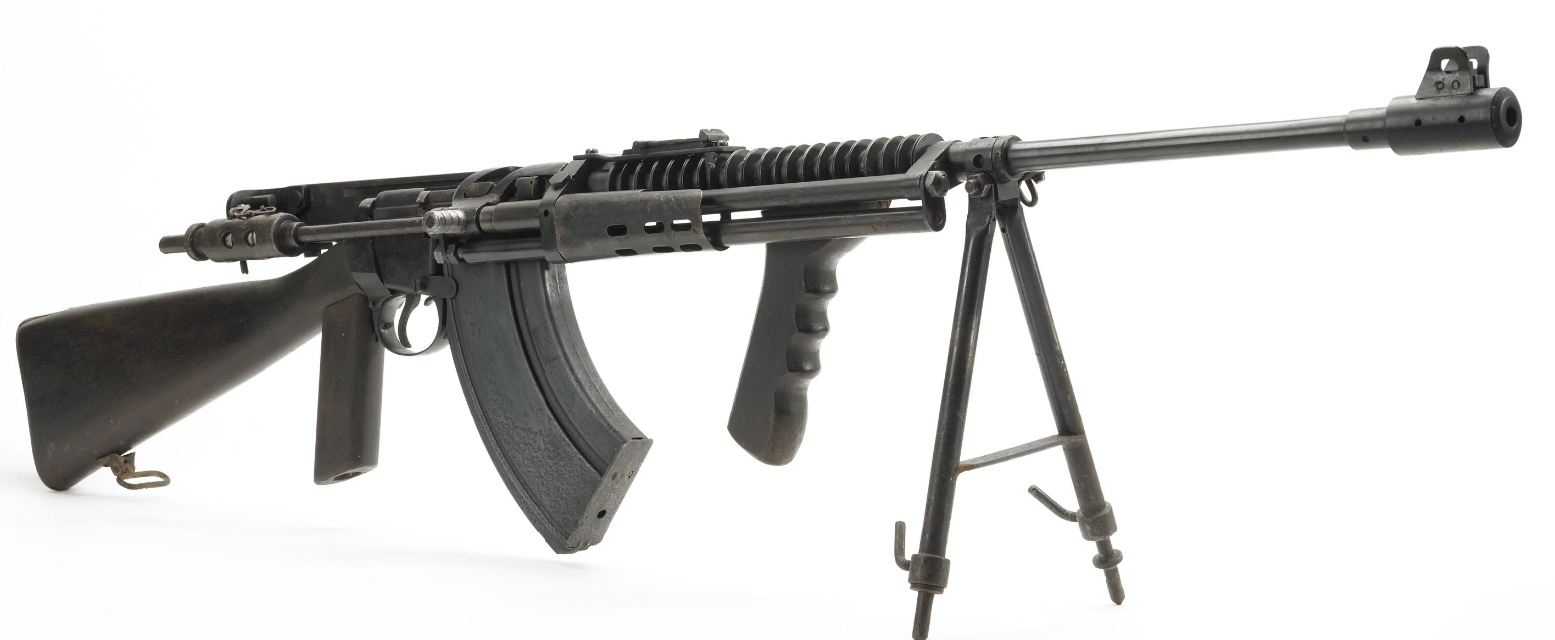
Sub-machine guns became widespread, particularly for close-range fighting and for roles where compact weapons were preferable, and by 1944 the following Had been received in New Zealand:
- 12553 Thompson M1928A1 and M1 Sub Machine Guns.
- 10000 Sten Guns manufactured in New Zealand.[13]
- 49 Austin and Owen Sub Machine Guns
- Lanchester SMG, primarily for naval use.
The Bren gun, introduced in 1939, became the principal light machine gun, serving alongside the Vickers medium machine gun carried forward from the First World War.
Additional machine guns taken into service were either supplied with or fitted to the various British and American armoured vehicles received by New Zealand during and after the war, including:
- 2973 Browning M1919 (.30-06) machine guns[14]
- 303 Besa Machine Guns (7.92mm)

Emergency Integration of .30-06 Weapons
In addition to the 30.06 Machine Guns fitted to AFVs, wartime shortages required a temporary departure from New Zealand’s standard .303 system for rifle ammunition. To supplement existing stocks, U.S. Model 1903 Springfield rifles chambered in .30-06 were introduced in limited numbers for specific roles.
This represented an emergency expedient rather than a doctrinal shift. Although used on AFV Weapons until the 1980s, the .30-06 calibre was never adopted as a standard New Zealand service round, and its use created parallel ammunition and maintenance considerations alongside the established .303 supply chain.
Following the war, these weapons were declared surplus. Approximately 16,000 .30-06 rifles, 1,450 .30-06 machine guns, and around 1,340,000 rounds of .30-06 ammunition were transferred to French forces in Indochina.[15] The disposal confirmed that .30-06 integration had been temporary, addressing immediate wartime pressures rather than signalling long-term rearmament policy.
NATO Standardisation and Consolidation of Infantry Firepower, 1950s–1973
Post-war restructuring and alliance commitments drove New Zealand’s transition from wartime diversity towards NATO-aligned standardisation.
Although New Zealand personnel used weapons such as the M1 Carbine, Owen Gun, and M3 “Grease Gun” during operations in Korea and Malaya, these were operational expedients rather than formally adopted long-term service arms. The same applied to the Lee-Enfield No.5 Mk I (Jungle Carbine), which was issued only to New Zealand troops operating in Southeast Asia and was never formally adopted as a general service weapon in New Zealand.
The use of these weapons reflected theatre availability and allied interoperability rather than a deliberate shift in New Zealand’s small-arms policy.
New Zealand progressively aligned its small-arms nomenclature with British practice, adopting the post-war “L-number” classification system. This rationalised earlier wartime designations and standardised equipment terminology across Commonwealth forces.
Under this system:
- STEN Mk II was reclassified as L50
- STEN Mk III was reclassified as L51
- STEN Mk V was reclassified as L52
Despite these formal designations, in common usage these weapons continued to be referred to collectively simply as “Stens”, particularly in unit-level documentation and everyday service parlance.

A similar process applied to Browning machine guns in New Zealand service. The M1919 series of .30-06 calibre machine guns was reclassified under British nomenclature as:
- Gun, Machine, .30 L3A3
- Gun, Machine, .30 L3A3E1
- Configured primarily for fixed turret or vehicle-mounted roles
- Gun, Machine, .30 L3A4
- The flexible variant, capable of employment in the ground role on a tripod or mounted on a flexible pintle

This reclassification reflected both technical configuration differences and doctrinal employment, distinguishing between fixed coaxial or armoured vehicle installations and flexible infantry or support weapon roles.
The adoption of the L-number system marked an important administrative and logistical shift, reinforcing interoperability with British supply chains and simplifying inventory control within the evolving post-war New Zealand Army structure.
The decisive shift began in the mid-1950s. In 1954, New Zealand began evaluating the FN FAL, with 22 examples undergoing troop trials. New Zealand troops serving in Malaya were supplied with troop trials X8E1/5 FALs by the British army in 1957. This culminated in Cabinet approval on 16 September 1958 to adopt the British-pattern 7.62mm L1A1 Self-Loading Rifle. The first 500 rifles were delivered in 1960.[16]

Alongside it, the Army examined and introduced heavy-barrel automatic variants to address section-level automatic fire requirements. References from 1960 onward identify the L1A2 heavy-barrel FN rifle, reflecting early experimentation with enhanced automatic capability within the rifle section. This evolved into the formally adopted Rifle 7.62mm L2A1, a heavy-barrel SLR configured to provide greater sustained fire and controllability in automatic mode.[17]

This adoption marked the definitive end of the .303 rifle era and placed New Zealand firmly within the 7.62×51mm NATO system.
The Lee-Enfield No.1 Mk III and No.4 After the Introduction of the L1A1
Following Cabinet approval of the L1A1 Self-Loading Rifle, Army HQ issued a formal Rifle Policy on 28 May 1959, outlining the managed relegation of the remaining .303-inch Lee-Enfield rifles
The No.1 Mk III was effectively withdrawn from front-line service:
- It was no longer to be maintained as a firing rifle.
- All No.1 rifles held by Cadet units were to be converted to Drill Purpose (DP) status.
- Stocks held in ordnance depots as a war reserve were made available for sale to the general public.
This marked the formal end of the SMLE’s operational life within the New Zealand Army. Its relegation reflects both mechanical obsolescence and the doctrinal shift to a self-loading infantry weapon.
The No.4 rifle followed a more gradual path:
- It remained in use for training within both the Regular and Territorial Forces.
- It was retained by Cadet units for live firing, although units were prohibited from holding both DP and firing No.4 rifles simultaneously for safety reasons
- Army HQ directed the maintenance of substantial war reserve holdings through to 1964.
The reserve was divided into:
- “Mobilisation serviceable” rifles for potential 3NZEF mobilisation.
- “NZ serviceable” rifles for domestic training and home defence
The minimum reserve holdings between 1959 and 1964 remained significant, beginning at 26,500 mobilisation-serviceable rifles in 1959 and tapering gradually thereafter
However, Treasury policy made clear that the Government did not intend to replace the No.4 war reserve with additional L1A1 purchases. Of the 15,000 L1A1 rifles ordered, 13,000 were for issue and only 2,000 for reserve. This decision left the Army reliant upon ageing bolt-action rifles as strategic depth.
Attempted 7.62mm Conversion
In recognition of the logistical inefficiency of maintaining .303 alongside 7.62mm NATO, the Army explored converting the No.4 rifle to 7.62mm NATO calibre.
- A Sterling Armament conversion kit was available in the early 1960s.
- Estimated cost: £15–£25 per rifle.
- The proposal was deemed not cost-effective and was abandoned
Even if the conversion proceeded, it would not have addressed the fundamental obsolescence of the bolt-action mechanism or existing wear and tear issues. Thus, the No 4 remained a diminishing war reserve rather than a viable modernised platform.
Submachine Guns: From STEN to L2A3 Sterling
The same period saw the rationalisation of the submachine gun fleet.
The 9mm Gun, Sub-Machine, L2A3 Sterling was adopted as the standard SMG, replacing the STEN series. The cabinet approved an order for 2,000 weapons on 14 January 1959, with delivery achieved within twelve months. The rapid delivery contrasted sharply with the slower production ramp-up of the L1A1 at Lithgow. Sterling’s production run for the British Army provided spare manufacturing capacity, enabling New Zealand’s order to be filled quickly.

Machine Gun Rationalisation
The Gun Machine Bren .303in remained in service during the transition but was progressively converted to 7.62mm NATO standard as the Gun Machine 7.62mm L4A4 was adopted in 1973, preserving established section tactics while standardising ammunition supply.[18]
At platoon level, the Gun Machine 7.62mm L7A1 General Purpose Machine Gun replaced the Vickers medium machine gun and became the backbone of sustained fire.

Vehicle-mounted and heavy machine-gun capability standardised around Browning-pattern weapons:
- Gun Machine .30 L3A3, L3A3E1 and L3A4, employed in both fixed and flexible mountings across armoured platforms, notably the Ferret armoured car and as secondary armament in the Centurion and M41 tanks.
- Gun Machine .50 M2, introduced into service as part of the M41 light tank and M113 acquisitions, providing heavy machine-gun capability for armoured roles.
The 5.56mm Question: Evaluation and Trials
Operational experience in South-East Asia sharpened the debate over infantry firepower. Lighter ammunition increased carried volume and improved controllability in automatic fire, making them increasingly attractive in jungle environments. However, New Zealand’s move toward 5.56mm was not driven solely by Vietnam.
In 1967, New Zealand acquired 1,800 XM16E1 rifles, later standardised as the Rifle 5.56mm M16A1.[19] While interoperability with Australian and United States forces in Vietnam was an important consideration, the purchase was also driven by an identified deficiency in submachine guns within the Combat Brigade Group, Logistic Support Group, and the British Commonwealth Strategic Reserve.
A requirement for approximately 1,800 weapons was issued to address shortfalls in Sterling SMGs across these formations. The XM16E1 was evaluated alongside:
- The Australian F1 Carbine
- The Sterling SMG (as a continuation option)
The XM16E1 was ultimately selected. It offered a greater effective range, improved ballistic performance and ammunition commonality with allied forces, while also resolving the immediate equipment deficiency.
However, the XM16E1 was not the only 5.56mm weapon examined during this period.
Throughout the late 1960s and early 1970s, New Zealand undertook a structured technical assessment of alternative small-calibre systems.[20] These included:
- The FN 5.56mm Light Automatic Carbine was formally presented in 1968.
- Comparative evaluation of magazine-fed versus belt-fed 5.56mm light machine gun concepts.
- Consideration of section weapons capable of sharing magazines with individual rifles.
- Technical comparison between 7.62mm and 5.56mm ballistic performance in jungle conditions.
Trials examined:
- Ammunition weight savings and overall soldier load.
- Controllability in burst and automatic fire.
- Reliability in tropical environments.
- Compatibility with NATO doctrine and supply systems.
- Long-term implications for section firepower structure.

The institutional tension was clear:
New Zealand did not rush to abandon 7.62mm NATO standardisation. Instead, it addressed immediate capability deficiencies through the XM16E1 purchase, while continuing structured evaluation and deferring wholesale calibre transition until the Small Arms Replacement Project of the 1980s resolved the issue institutionally.
Theatre Adaptation: The M60
For Vietnam operations, New Zealand also acquired the 7.62mm M60 machine gun for 1RNZIR to ensure interoperability with allied forces. While effective in theatre, it did not replace the L7A1 in general Army service and was withdrawn from Army use by 1974.
The distinction remained:
- The L7A1 represented doctrinal standardisation.
- The M60 represented operational interoperability.

A soldier showing the incoming Commander an M60 machine gun”
Date: 1971 Credit: RNZAF Official
Reserve and Training Weapons
Reserve stock and School Cadet Training and marksmanship were supported by:
- Rifle No.4 Mk 1/1, retained in storage
- Rifle .22 No.8 Mk 1 for school cadets
The Position by 1973
By 1973, following the introduction of the Gun Machine 7.62mm L4A4 and consolidation of NATO ammunition supply, the New Zealand Army had effectively closed around a rationalised family of weapons:[21]

Individual Rifles
- Rifle 7.62mm L1A1
- Rifle Equipment 7.62mm L2A1
- Rifle 5.56mm M16A1
- Rifle No.4 Mk 1/1 (In Storage)
- Rifle .22 No.8 Mk 1 (Cadet Forces)
Sub-Machine Gun
- Gun Sub-Machine 9mm L2A3 Sterling
Light and General-Purpose Machine Guns
- Gun Machine 7.62mm L4A4
- Gun Machine 7.62mm L7A1
- Gun Machine 7.62mm M60 (1 RNZIR theatre-specific)
- Gun Machine .303 Bren (Training only)
Vehicle and Heavy Machine Guns
- Gun Machine .30 L3A3, L3A3E1, L3A4,
- Gun Machine .50 M2, employed in both fixed and flexible configurations, providing heavy machine-gun capability for armoured vehicles and static defence roles.
This was not a period of abrupt transformation but of disciplined consolidation. The Army had completed the transition from .303 to 7.62mm NATO, cautiously explored 5.56mm systems through formal trials, and balanced operational adaptation with alliance stability.
By 1973, New Zealand had achieved a coherent, NATO-aligned small-arms structure, while quietly laying the analytical groundwork for the eventual full transition to 5.56mm in the decades that followed.
Precision Capability, SARP and the Consolidation of Layered Firepower – 1973–2010
By the early 1970s, New Zealand had completed its transition from .303 to 7.62×51mm NATO for general infantry service. Precision capability, however, required separate consideration.
Second World War–era scoped Lee-Enfield rifles were increasingly obsolete in a NATO-standard environment. The L1A1 Self-Loading Rifle was not suited to dedicated sniper employment. A purpose-built solution was required.
New Zealand adopted the Parker Hale M82, a bolt-action sniper rifle chambered in 7.62mm NATO. Its introduction represented:
- Full alignment with NATO ammunition.
- Recognition that precision shooting required specialised equipment rather than modified service rifles.
- A deliberate move away from wartime legacy systems.
Issued in limited numbers, the M82 formalised the sniper role within the 7.62mm era.

The Small Arms Replacement Project (SARP), 1984–1988
By the mid-1980s, it was clear that the existing suite of small arms was approaching the end of its institutional life. The L1A1 SLR, L2A1 heavy-barrel rifle and Sterling SMG represented a system designed in the 1950s for a different operational environment. Although the Vietnam-era introduction of the M16A1 had demonstrated the operational viability of 5.56mm, the Army had not yet formally standardised around the calibre.
The 1982 Falklands War provided additional contemporary lessons. While fought largely with 7.62mm NATO weapons, the conflict highlighted several emerging realities:
- The weight burden carried by infantry in austere environments.
- The growing importance of optics and sighting systems.
- The value of a reliable section-level automatic fire.
- The limitations of older rifle platforms when integrated with modern accessories.
The British Army’s experience underscored that small-arms effectiveness was no longer solely about calibre, but about system integration, ergonomics, and adaptability under harsh conditions. For New Zealand planners observing closely, the Falklands reinforced the need to modernise, not merely replace ageing weapons.
By the mid-1980s, these cumulative lessons, Vietnam experience, evolving NATO doctrine, and regional interoperability considerations converged.
In this context, the then Minister of Defence, Frank O’Flynn, announced that Australia and New Zealand would pursue commonality in adopting a new generation of Individual Weapons (IW). In New Zealand, this became known as the Small Arms Replacement Project (SARP).[22]
SARP was therefore not simply a procurement exercise. It reflected:
- Recognition that the 1950s small-arms ecosystem was obsolete.
- A desire for ANZAC commonality and logistical efficiency.
- Institutional acceptance that optics, modularity and weight reduction were now central to infantry effectiveness.
- The maturation of debates first sharpened in Vietnam and reinforced by Falklands.
The decision to pursue a new 5.56mm rifle and light machine gun was thus evolutionary rather than reactionary, shaped by two decades of operational observation rather than a single conflict.
Under this arrangement:
- Evaluations for a replacement rifle and light machine gun would be conducted by the Australian Defence Force (ADF).
- Results would be shared with New Zealand.
- It was agreed, in principle, that New Zealand would adopt the same weapons selected by Australia.
Because of ANZUS tensions during this period, New Zealand held only quasi-observer status in the Australian IW trials. No New Zealand personnel were directly embedded in the trial teams. Nevertheless, the strategic logic of commonality, interoperability and regional logistical efficiency prevailed.
As part of SARP, industry demonstrations were conducted in New Zealand. Omega DSE Ltd represented Fabrique Nationale Herstal, presenting:
- An FN CAR 5.56mm rifle.
- Two 5.56mm FN Minimi Light Machine Guns, one standard and one Para variant, for Light Support Weapon (LSW) evaluation.
Following Australia’s lead, New Zealand adopted:
- The Steyr AUG 5.56mm rifle.
- The C9 FN Minimi 5.56mm Light Machine Gun.
The first batch of Steyr rifles was manufactured in Austria. Subsequent batches were produced in Australia, reinforcing the ANZAC commonality objective.
SARP therefore represents more than a procurement decision. It reflects:
- Regional defence alignment.
- Practical interoperability with Australia.
- Structured transition from 7.62mm individual weapons to a fully institutionalised 5.56mm system.

5.56mm Consolidation and Section Firepower
The adoption of the Steyr AUG in 1988 marked the formal consolidation of 5.56×45mm NATO as the Army’s standard individual calibre.
The bullpup design provided:
- Compact length with a full-length barrel.
- An integrated 1.5× optical sight as standard.
- Configurable barrel lengths of 350 mm (carbine), 407 mm, and 508 mm allowed the weapon to be tailored for close-quarters operations, general infantry employment, or longer-range applications while retaining the compact advantages of the bullpup configuration.
A heavy-barrel variant of the Steyr, fitted with a bipod and 40-round magazine, was also demonstrated in New Zealand as a potential section automatic weapon. While the concept offered commonality with the standard rifle platform, it was ultimately not adopted. Instead, the Army decided on a belt-fed light machine gun solution, reflecting a preference for sustained-fire capability over magazine-fed automatic rifle concepts.
By 1990, the Steyr had replaced the L1A1 SLR, the M16A1, and residual Sterling SMG holdings in general service.
Simultaneously, the FN Minimi (C9) replaced the L2A1 heavy-barrel SLR and the L4A4 Bren conversion. For the first time, New Zealand fielded a purpose-designed belt-fed section support weapon chambered in the same calibre as the rifleman’s weapon.
The C9 offered an additional advantage in that, while primarily belt-fed, it could also be fed from M16-type 5.56mm magazines, providing a measure of ammunition commonality at the section level. However, with the adoption of the Steyr AUG, which utilised a proprietary magazine design, this magazine interchangeability became largely impracticable in New Zealand service. In effect, although the Minimi retained the technical capability for magazine feed, belt feed remained the operational norm, and the theoretical cross-compatibility with rifle magazines was not exploited.
This outcome reinforced the Army’s doctrinal preference for a dedicated belt-fed section support weapon rather than a fully interchangeable magazine-based system.
The long-standing heavy-barrel compromise ended. Section firepower was now doctrinally coherent.
Notably, .303 Brens continued in some training roles until 1983, marking the quiet end of an inter-war lineage.
Retaining 7.62mm and the Layered Model
The move to 5.56mm did not eliminate 7.62mm from the force structure. Instead, New Zealand formalised a layered model of firepower:
- 5.56mm for individual rifles and section support weapons.
- 7.62mm for sustained fire and vehicle-mounted roles.
- .50 calibre for heavy machine-gun employment.
The L7 7.62mm General Purpose Machine Gun remained in service. In armoured platforms, the L43A1 Ranging Machine Gun, a coaxial variant of the L7, was utilised in the Scorpion CVR(T) and in M113 vehicles fitted with the T50 turret.
By 1982, the final retirement of earlier post-war armoured platforms brought to a close an era in which modernised variants of the Browning M1919 machine gun, designated L3A3, L3A3A1 and L3A4, had formed the core of New Zealand’s vehicle-mounted .30 calibre capability. These variants had been fitted to:
- The Centurion tanks.
- The M41 light tank.
- Early twin mountings in the M113 T50 turret, initially configured with twin .30 calibre machine guns. New Zealand later modified the T50 turret to utilise a fixed M2 .50 calibre heavy machine gun in combination with the L43A1 7.62mm coaxial machine gun, enhancing both anti-armour and sustained-fire capability.
- The Mk 2 Ferret Armoured Car, which was withdrawn from service in 1982.
As mechanised forces modernised in the 1990s and 2000s:
- The FN MAG (7.62mm) progressively replaced earlier L7 holdings in infantry and vehicle roles, including as the coaxial weapon in the LAV fleet.
- A 7.62mm Minimi variant supplemented manoeuvre firepower where greater range and penetration were required.
- The FN M2 Browning (.50 calibre) replaced legacy M2 holdings in heavy machine-gun roles.
These were refinements within a stable doctrinal framework.
Specialist and Precision Evolution
By 1984, the Sterling SMG had been replaced within special operations elements by the Heckler & Koch MP5A3, followed by the MP5SD and MP5K variants.

Members of New Zealand’s Special Air Service have operated the M4 carbine family chambered in 5.56×45mm NATO since 1994, reflecting a shift toward modular, compact rifles in specialist roles. While public equipment lists confirm the M4’s use within NZSAS units, specific procurement details, variant designations such as M4A1 or compact “Commando” models, and formal adoption dates are not comprehensively enumerated in publicly accessible defence records.
Precision capability advanced in parallel.In 19 94, the Parker Hale M82 was replaced by Accuracy International Arctic Warfare (AW) systems in 7.62mm, offering enhanced durability, improved ergonomics and greater modularity within NATO calibres.
In 2002, New Zealand introduced the Accuracy International AW50F, chambered in 12.7×99mm NATO, providing a dedicated anti-materiel sniper capability. The AW50F significantly extended effective range and terminal performance, enabling engagement of materiel targets, fortified positions and long-range threats beyond the capability of 7.62mm systems.

Contemporary Force, 2011–2026
From 2011 onward, the New Zealand Defence Force did not undergo structural transformation in small-arms doctrine. Instead, it consolidated and refined the layered firepower model developed through the 1990s and early 2000s. Operational experience among Western militaries reinforced several trends: renewed emphasis on 7.62mm reach, limits of 5.56mm in extended engagements, the centrality of optics and night capability, and the demand for modular, adaptable weapon systems. New Zealand adjusted progressively, modernising platforms while preserving doctrinal coherence..
Operationally Informed Developments
2011 – Lewis Machine & Tool (LMT) .308 MWS
Western experience demonstrated the renewed importance of extended-range engagement within infantry sections. The LMT .308 MWS provided an organic 7.62mm precision capability, bridging the gap between standard 5.56mm rifles and dedicated sniper systems.[23]

2013 – 7.62mm Minimi
Across coalition forces, the re-emergence of longer engagement distances and barrier penetration requirements led to renewed emphasis on 7.62mm section firepower. The introduction of the 7.62mm Minimi replaced the 5.56mm C9 and restored greater reach and suppressive effect at section level.[24]

2016 – 5.56×45mm NATO Modular Assault Rifle System – Light (MARS-L)
Announced on 12 August 2015 following competitive trials (March–June 2015), the MARS-L entered service from November 2016.[25]
The MARS-L replaced the Steyr AUG after nearly three decades. Its adoption reflected broader Western trends:
- Optical integration as standard rather than optional
- Modular accessory mounting systems
- Improved ergonomics under modern load carriage
- Simplified maintenance and lifecycle management
- Enhanced interoperability with allied forces
Unlike earlier rifles adapted incrementally to modern optics, the MARS-L was designed from inception as a modular, optics-forward system suited to contemporary coalition operations.

2017 – .338 Lapua Magnum Barrett MRAD
The MRAD reflected international movement toward extended-range precision platforms beyond 7.62mm NATO. It provided modularity, calibre adaptability and enhanced reach aligned with allied sniper doctrine.[26]

2017 – 12.7×99mm NATO Barrett M107A1
Complementing existing anti-materiel capability, the M107A1 provided semi-automatic 12.7mm precision fire in line with contemporary coalition standards.[27]

Structure by the Mid-2020s
By 2026, the NZDF fields a mature and deliberately layered system shaped by observation of wider operational developments rather than reactive change.
Individual and Section Weapons
- MARS-L (5.56mm) – standard individual weapon
- LMT .308 MWS (7.62mm) – designated marksman capability
- 7.62mm Minimi – enhanced section automatic fire
Sustained and Vehicle-Mounted Systems
- FN MAG (MAG-58) – principal 7.62mm GPMG (light, DSFW, flex and coax roles)
- M2 Browning (.50 calibre) – heavy machine gun
Precision Systems
- Barrett MRAD (.338 Lapua Magnum)
- Barrett M107A1 (12.7×99mm NATO)
Contemporary Context
These weapons operate within a digitally enabled battlespace characterised by:
- Advanced day and night optics
- Thermal imaging and laser range-finding
- Integrated communications and battle management systems
- Coalition interoperability frameworks
By the mid-2020s, the NZDF’s small-arms ecosystem reflects deliberate evolution rather than disruption. The focus is no longer simply on calibre or mechanical robustness, but on modularity, precision, digital integration and coalition interoperability. In this respect, New Zealand’s contemporary force represents the culmination of nearly two centuries of adaptation, from imperial musket supply to network-enabled combined arms capability.
Comparative Assessment: Has New Zealand Lagged Behind Its Peers?
Technological relevance is best judged comparatively. For New Zealand, the most appropriate benchmarks are Australia, Canada and the United Kingdom. These nations share common doctrinal foundations, historical equipment lineages, NATO interoperability, and broadly similar operational commitments.
Commonwealth forces provide a particularly accurate comparator because, for much of New Zealand’s history, small-arms adoption followed shared British patterns. From Snider and Martini systems through Lee-Enfield, Bren, L1A1 and later NATO-standard platforms, equipment types and calibres were broadly synchronised.
The United States, while a close modern ally, historically followed a distinct developmental path — from Springfield and Garand systems to early adoption of the M16 family. Its procurement cycles and calibre transitions were often independent of Commonwealth patterns. For long-term lineage analysis, Commonwealth comparators therefore provide greater precision.
The relevant question is not whether New Zealand led in innovation. It did not. The question is whether it materially lagged behind comparable forces.
The historical record suggests it did not.
Major Service Rifle and GPMG Adoption – Comparative Overview
| Era / Weapon System | New Zealand | Australia | United Kingdom | Canada |
| Snider-Enfield (.577) | 1869 | 1867–69 | 1866 | 1867 |
| Martini-Henry (.577/450) | 1890 | 1870s | 1871 | 1870s |
| Maxim Machine Gun | 1896 | 1890s | 1891 | 1890s |
| Lee-Metford / Lee-Enfield (.303) | 1900 | 1890s–1900 | 1895 onward | 1895 onward |
| Vickers Machine Gun (.303) | 1915 | 1910s | 1912 | 1910s |
| Bren Light Machine Gun (.303) | 1935 (initial requisition), 1939 (bulk adoption) | 1939 | 1938 | 1939 |
| 7.62mm Self-Loading Rifle (FN FAL family) | 1958 | 1959 | 1957 | 1955 (C1-FAL variant) |
| 7.62mm GPMG (FN MAG / L7) | Early 1960s | Early 1960s | 1960 | 1960s (C6) |
| 5.56mm Service Rifle (first generation) | Steyr AUG adopted 1988 | F88 Austeyr adopted 1988 | L85A1 adopted 1985 | C7 adopted 1984 |
| Modern modular 5.56 platform | MARS-L adopted 2016 | EF88 adopted 2016 | L85A3 upgrade 2018 | C7A2 upgrades 2000s |
| AI Sniper Systems (7.62 / .338) | 1990s | 1990s | 1980s–2000s | 1990s–2000s |
| Anti-Materiel Rifle (.50 class) | 2000s | 1990s–2000s | 2000s | 2000s |
Generational Transitions in Context
Across major small-arms transitions, New Zealand typically adopted new systems within the same generational window as its Commonwealth peers. Where delays occurred, they were measured in years rather than decades and were shaped by fiscal scale and procurement sequencing, not institutional reluctance.
Nineteenth-Century Transitions
Technological alignment can be traced to the colonial period.
An early and instructive example is the adoption of the Hay Pattern rifle in the 1860s. At a time when military small arms were transitioning from smoothbore muskets to rifled percussion systems, New Zealand secured access to a comparatively advanced rifled arm rather than relying solely on obsolescent smoothbores. Within the constraints of imperial supply and maritime logistics, this represented adoption at the leading edge of available technology.
This pattern continued through subsequent generational shifts.
New Zealand adopted the Snider-Enfield in 1869, within three years of its British introduction and broadly aligned with other colonies. The transition to the Martini-Henry followed within the wider Imperial adoption cycle. In neither case is there evidence of prolonged technological lag.
Machine-gun adoption shows similar parity. The Maxim, and later the Vickers, entered New Zealand service in close alignment with Imperial timelines. Industrial capacity differed from Britain, but technological alignment did not. Procurement followed shipping and fiscal realities rather than doctrinal delay.
Early Twentieth Century and the World Wars
The Lee-Enfield family was adopted within the same broad timeframe as Australia and Canada. During the First World War, New Zealand fielded Vickers and Lewis guns alongside other Commonwealth forces.
Pre–Second World War adoption of the Bren gun is particularly instructive. New Zealand raised requisitions for Bren equipment in 1935 and placed substantial orders in March 1939, squarely within the pre-war acceleration window. This was not delayed rearmament; it was synchronised preparation.
Throughout both world wars, New Zealand’s small-arms structure mirrored Commonwealth doctrine and supply systems. Industrial scale differed, but technological alignment did not.
Cold War Standardisation
The transition from .303 to 7.62×51mm NATO further demonstrates continued parity. The L1A1 Self-Loading Rifle was approved for New Zealand service in 1958, within a narrow band of Commonwealth adoption:
• United Kingdom: 1957
• Canada (C1 variant): 1955
• Australia: 1959
• New Zealand: 1960
Similarly, adoption of the 7.62mm General Purpose Machine Gun occurred in the early 1960s alongside Commonwealth peers.
These timelines reflect structural alignment, not technological delay.
The 5.56mm Era
The transition to 5.56mm illustrates the same pattern. Canada adopted the C7 in 1984. The United Kingdom introduced the L85A1 in 1985. Australia and New Zealand adopted the Steyr AUG family in 1988.
New Zealand was not first. Nor was it materially late. It adopted within the same generational shift, following structured evaluation and ANZAC alignment under the Small Arms Replacement Project.
Later modernisation cycles reinforce this continuity. The MARS-L entered New Zealand service in 2016, the same year Australia adopted the EF88. The United Kingdom upgraded to the L85A3 in 2018. Canada’s C7A2 upgrades occurred in the 2000s. Again, New Zealand remained within the same generational band.
Precision and Anti-Materiel Systems
The progression from Parker Hale M82 to Accuracy International systems, and later to Barrett MRAD and M107A1, mirrors wider NATO trends. Adoption cycles were broadly consistent with Commonwealth peers.
There is no evidence of sustained technological isolation in precision capability.
Structural Patterns
Viewed across 180 years, several consistent characteristics emerge:
- Alignment Rather Than Innovation
New Zealand has adopted proven allied systems rather than pioneering indigenous small-arms development. This reflects scale and industrial realities, not strategic deficiency. - Measured Procurement Windows
Adoption cycles typically fall within the same generational shift as peer forces. Where delays occurred, they were modest and fiscally driven. - Interoperability as Strategic Priority
From Imperial Britain to NATO coalitions, interoperability has consistently shaped procurement decisions. - Absence of Technological Stagnation
At no major inflection point, Snider, Martini, Lee-Enfield, Bren, L1A1, 5.56mm transition, modular platforms, does the record demonstrate prolonged technological backwardness.
Final Assessment
New Zealand has not been a leader in small-arms innovation, nor has it sought to be. It has not required a domestic industrial base to maintain combat credibility.
Instead, it has pursued a consistent model:
• Observe allied developments
• Evaluate operational relevance
• Adopt within practical fiscal windows
• Maintain interoperability
Across two centuries, this approach has kept New Zealand technologically aligned with comparable Commonwealth forces.
The historical evidence does not support the claim that New Zealand has materially lagged behind Australia, Canada, or the United Kingdom in small-arms technology. Rather, it demonstrates a pattern of deliberate, alliance-aligned modernisation that has preserved operational credibility without unnecessary divergence.
In strategic terms, that record reflects prudence, not delay.y.
Notes
[1] “1853 Enfield Rifle(Enfield Long Rifle/ 3 band Enfield),” NZART ID: 36, Arm Type: Rifle, Date of Draft: (V1) 3 August 2012, 2012, accessed 20 Feb 2026, https://www.armsregister.com/arms_register/arms_register_documents/nzar_36_pat_53_enfield_rifle.pdf.
[2] “ Enfield P1858 carbine for Indian & Colonial use,” NZAR ID 76 ARM TYPE: Carbine. Draft date (V2) 15 August 2013, 2012, accessed 20 Feb 2026, https://www.armsregister.com/arms_register/arms_register_documents/nzar_76_enfield_p1858_colonial_carbine.pdf.
[3] Notice to Foreign Stations from War Department, 19 April 1856 Major of Brigade, Arms and ammunition issued for New Plymouth Militia are to be paid for, Archives New Zealand Item ID R24118692, (New Zealand Archives, 20 December, 1858).
[4] “Lessons from History: New Zealand Military Procurement and Logistics 1857-1861,” To The Warrior his Arms website, 2024, accessed 20 Feb, 2026, https://rnzaoc.com/2024/02/28/lessons-from-history-new-zealand-military-procurement-and-logistics-1857-1861/.
[5] “From: Granville, Downing Street, [London, England] [Governor] Date: 2 July 1869 Subject: With copy of Despatch from Secretary of State, respecting 2000 Snider Rifles and ammunition, handed over for use of Colonial Forces, New Zealand,” Archives New Zealand No R24144266 (1869).
[6] “Remington Lee M 1885,” NZART ID No: 71, Arm Type: Rifle, Date of Draft (V1) 16/7/2012, 2012, accessed 6 November 2021, http://www.armsregister.com/arms_register/arms_register_documents/nzar_71_remington_lee_m1885.pdf.
[7] “Purchase of Arms and Ammunition,” Appendix to the Journals of the House of Representatives, 1891 Session II, H-15 (1891), https://paperspast.natlib.govt.nz/parliamentary/AJHR1891-II.2.4.2.51.
[8] “Defence Forces of New Zealand: Report by the Council of Defence and extracts from the report of the Inspector-General of the NZ Defence Forces, for the year ended 28th February 1908,” Appendix to the Journals of the House of Representatives, 1909 Session II, H-19 (28 February 1909), https://paperspast.natlib.govt.nz/parliamentary/AJHR1909-II.2.4.2.28.
[9] Requisitions on Hight Commission, Schedule of Outstanding items (Mobilisation) “QMG (Quartermaster General) – Ordnance “, Archives New Zealand No R18527870 (9 January 1937 – 1939).
[10] Schedule of Stores demanded on Hight Commissioners Requestions (1/9/1938 to 1/5/1939) “QMG (Quartermaster General) – Ordnance “.
[11] “QMG (Quartermaster-Generals) Branch – September 1939 to March 1944,” Archives New Zealand Item No R25541150 (1944).
[12] Peter Cooke, Charlton’s Automatic Arms – The Rise and Fall of a WWII New Zealand Innovation (Wellington: Defense of New Zealand Study Group, 2026).
[13] “Appendices to Report on QMG (Quartermaster-General’s) Branch,” Archives New Zealand Item No R25541151 (30 June 1944), .
[14] Archival records do not show .50 Cal ammunition being imported for Army use between 1939 and 1944, so it is assumed all Browning Machine Guns were 30.06 M1919 models. However, these records do not include the RNZAF, but given the US origin of many RNZAF Aircraft, and there is no doubt that .50 Cal machine guns were used by the RNZAF “QMG (Quartermaster-Generals) Branch – September 1939 to March 1944.”
[15] “Armament Rifle Revolvers – Ammunition French Indo-China -,” Archives New Zealand Item Nor23566435 (1951 – 1953).
[16] Damien Fenton, A false sense of security: the force structure of the New Zealand Army 1946-1978, Occasional paper / Centre for Strategic Studies: New Zealand: no. 1, (Centre for Strategic Studies: New Zealand, Victoria University of Wellington, 1998).
[17] Army 246/1/176 Infantry and SAS Equipment Dated 9 Aug 1960 “Stores – New Infantry Equipment for New Zealand Army,” Archives New Zealand No R17189007 (1959-1970).
[18] Fenton, A false sense of security: the force structure of the New Zealand Army 1946-1978.
[19] Army 207/^/91/Inf & SAS Purchase of XM16E1 (Armalite) Rifles dated 25 May 1966. “G1098 War Equipment Tables 1963-68,” Archives New Zealand No R17189362 (1963 – 1968).
[20] “Stores – New Infantry Equipment for New Zealand Army.”
[21] Index to New Zealand Army Scaling Documents, vol. Issue No 7 (Trentham: Scales Section, RNZEME Directorate, 15 January, 1973). .
[22] “Equipment and Supplies – Overall Policy _ SARP (Small Arms Replkacement Project)/SA(Small Arms),” Archives New Zealand No R7934626 (1983-1991).
[23] “New Zealand’s New Designated Marksman Rifle,” Military.com, October 2011, https://www.military.com/kitup/2011/10/new-zealands-new-designated-marksman-rifle.html.
[24] “UK & NZ Adopting FN MINIMI 7.62mm,” The Firearms Blog, updated October, 2011, https://www.thefirearmblog.com/blog/2012/05/29/uk-nz-adopting-fn-minimi-7-62mm/.
[25] “New rifles for Defence Force,” Beehive.co.nz, 2015, https://www.beehive.govt.nz/release/new-rifles-defence-force?utm_source=chatgpt.com.
[26] “New Weapons for Snipers and Special Forces,” New Zealand Army News Issue 487, October 2017, https://web.archive.org/web/20200116225610/http://army.mil.nz/downloads/pdf/army-news/armynews487.pdf.
[27] “New Weapons for Snipers and Special Forces.”
