
Eighty Years of Supporting New Zealand’s Infantry Firepower.
New Zealand has contracted Saab to supply 26 Carl-Gustaf M4 weapon systems to replace the Army’s existing M3 systems, which have reached the end of their scheduled service life. Delivery is expected during the first quarter of 2027, with the new weapons intended for the units currently operating the M3, including 1 RNZIR, 2/1 RNZIR, 16 Field Regiment and the Combat School. The contract value has not been publicly disclosed.[1]
Put simply, the acquisition replaces an ageing launcher with a lighter, more capable model. Historically, however, it represents the latest stage in a New Zealand support-weapon lineage extending back to the Second World War—from the Boys anti-tank rifle and the two-pounder and six-pounder guns, through the PIAT, the Wasp-type Universal Carrier flame-thrower, M20 3.5-inch rocket launcher, No. 94 Energa rifle grenade, BAT-family and M40 106 mm recoilless rifles, to the M72, Javelin and successive generations of the 84 mm Carl-Gustaf.
This is a functional rather than strictly linear lineage. The two-pounder and six-pounder were artillery weapons; the Boys, PIAT, Energa and M72 placed anti-armour weapons progressively closer to the individual infantry soldier; the Wasp-type flame carrier provided a short-range incendiary effect from a tracked vehicle; the 120 mm BAT family and M40A1 106 mm recoilless rifle combined substantial firepower with vehicle mobility; and Javelin added a guided, medium-range precision capability. The 17-pounder also formed part of New Zealand’s wider anti-armour capability. These systems frequently overlapped rather than directly replacing one another, but together they reveal how each technological advance created a corresponding logistical transformation.
The post-war record makes that overlap especially clear. New weapons could be held back for lack of training, ammunition, or pamphlets; an infantry battalion could hold five six-pounders alongside one BAT; and allied commonality could determine whether a system was retained, restricted to one unit, or abandoned. Obsolescence was therefore not merely a question of battlefield performance. It could be created by unaffordable training, deteriorating ammunition, disappearing overseas support or insufficient storage and disposal capacity.
The enduring lesson is that introducing a weapon is never simply a matter of purchasing the launcher. The launcher is only the visible element of a much larger system encompassing ammunition, transport, storage, maintenance, technical information, training, simulation, accounting and eventual disposal.
The two-pounder: a weapon dependent upon a transport system
At the beginning of the Second World War, New Zealand intended to form an anti-tank regiment but lacked sufficient anti-tank guns with which to train it. Personnel therefore had to be trained in Britain and Egypt while equipment was progressively obtained. The resulting 7th Anti-Tank Regiment initially operated 40 mm two-pounder guns, some carried on 30-cwt trucks as portées.[2]
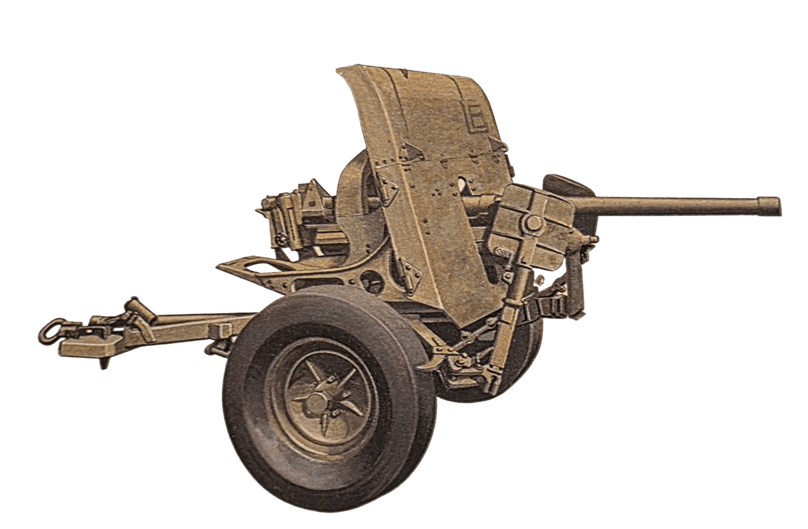
The scale of the subsequent expansion was considerable. New Zealand’s equipment and ammunition return for 31 March 1944 recorded 219 two-pounder guns and 423,259 complete rounds.[3] The gun fleet was therefore only the visible element of a much larger holding whose cartridges required depot space, transport, inspection, accounting and distribution.
Logistically, the two-pounder was not merely a gun. Each weapon required a trained detachment, sights, tools, spare parts, ammunition, a towing vehicle or portée, fuel, tyres and workshop support. Moving an anti-tank troop therefore meant moving a small fleet rather than an individual weapon.
The system also depended upon a supply chain capable of delivering heavy ammunition to gun positions. Although the guns were allocated in support of infantry brigades, their mobility and sustainment remained tied to vehicles and artillery supply arrangements. The weapon could not be separated from the transport system that carried it, its crew and its ammunition.
The Boys anti-tank rifle: anti-armour firepower at infantry level
The .55-inch Boys anti-tank rifle provided New Zealand infantry with one of its earliest man-portable anti-armour weapons. New Zealand troops were training with the Boys in Egypt by 1940, and the weapon could also be mounted on carriers and light vehicles. Its bolt-action mechanism was fed from a five-round magazine, but the rifle was heavy, awkward to carry and punishing to fire.
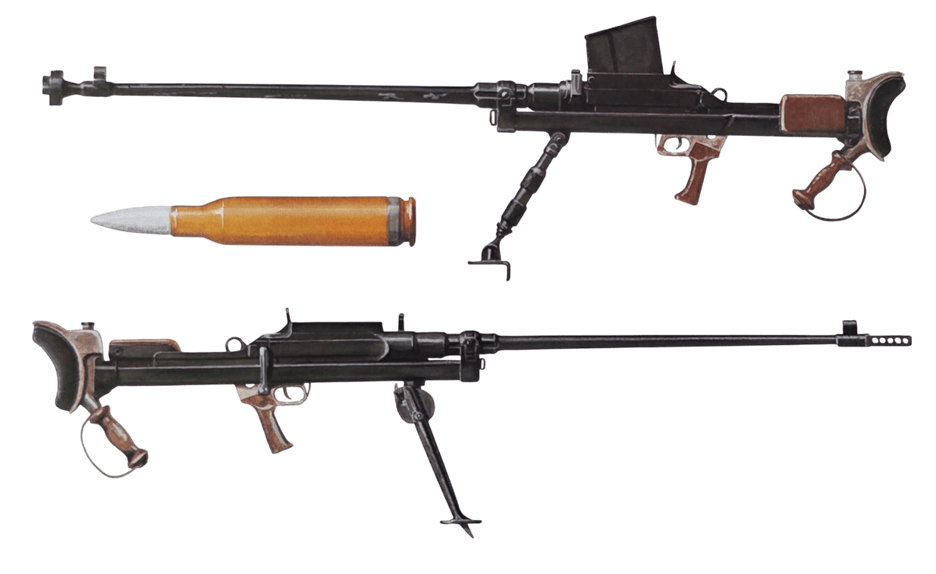
The Boys represented a different support problem from the two-pounder. It did not require a gun tractor or artillery detachment, but it introduced a specialised armour-piercing cartridge into the infantry ammunition chain. By 31 March 1944, New Zealand’s returns recorded 2,662 Boys rifles and 521,000 rounds of .55-inch armour-piercing ammunition.[4] Magazines, cleaning equipment, spare parts and cartridges had to be distributed to infantry and other units rather than concentrated solely in anti-tank artillery organisations.
Its rapid obsolescence taught another logistical lesson. As enemy armour became thicker, the Boys lost much of its effectiveness against tanks, although it retained some utility against light armour, vehicles and firing positions. A specialised weapon can therefore become operationally marginal before its physical service life or ammunition stocks have been exhausted. The supply system must then manage not only replacement equipment, but the withdrawal, storage and disposal of an ammunition type for which there was no alternative use.
The six-pounder and the danger of transitional gaps
The transition from the two-pounder to the more powerful 57 mm six-pounder during 1942 provides a particularly valuable logistical lesson.
By 31 March 1944, New Zealand’s holdings had grown to 226 six-pounders supported by 650,997 complete rounds. This new family existed alongside the 219 two-pounders and their remaining ammunition rather than immediately displacing them. Expansion consequently multiplied the calibres, cartridge types, ballistic data, spares and storage lines requiring support.
When 7th Anti-Tank Regiment was ordered back into action during the crisis in Egypt, it was part-way through re-equipping. Some two-pounders had already been returned to the ordnance depot, but the replacement six-pounders had not arrived and the associated training had not been completed. Five weapons had to be obtained from an anti-tank training school. Twelve more arrived during the fighting around Minqar Qaim, still covered in protective grease, with many lacking sights. For a time, the regiment had to operate both two-pounders and six-pounders. A photograph taken at El Alamein in October 1942 described the six-pounder as the regiment’s “new” gun.[5]

This was more than an inconvenient equipment change. Two ammunition families had to be supported simultaneously, while crews, maintainers and supply personnel adjusted to the new weapon. Sights, spares, tools and instructional material had to reach the same units as the guns. New equipment arriving without its complete range of ancillaries could not immediately deliver its intended capability.
The six-pounder remained part of the post-war infantry structure. A battalion support company’s anti-tank platoon was authorised six towed guns, while PIATs supplied close anti-armour defence within the rifle platoons. The arrangement placed two very different ammunition systems at separate echelons of the same battalion and shows why weapon lineage should be studied as overlapping layers rather than a single replacement chain.[6]
The experience demonstrates a principle still relevant to the M4 introduction: the outgoing system cannot safely be withdrawn merely because the replacement has been purchased. Withdrawal should be based on the new system achieving a defined level of operational capability, supported by ammunition, trained personnel, technical support and deployable stocks.
The PIAT moves anti-armour ammunition into the infantry system
The Projector, Infantry, Anti-Tank—or PIAT—represented a significant organisational and logistical change. New Zealand infantry battalions received the weapon as they prepared for operations in Italy during late 1943. Rather than depending entirely on specialist anti-tank artillery, infantry units now possessed their own close-range anti-armour weapon.
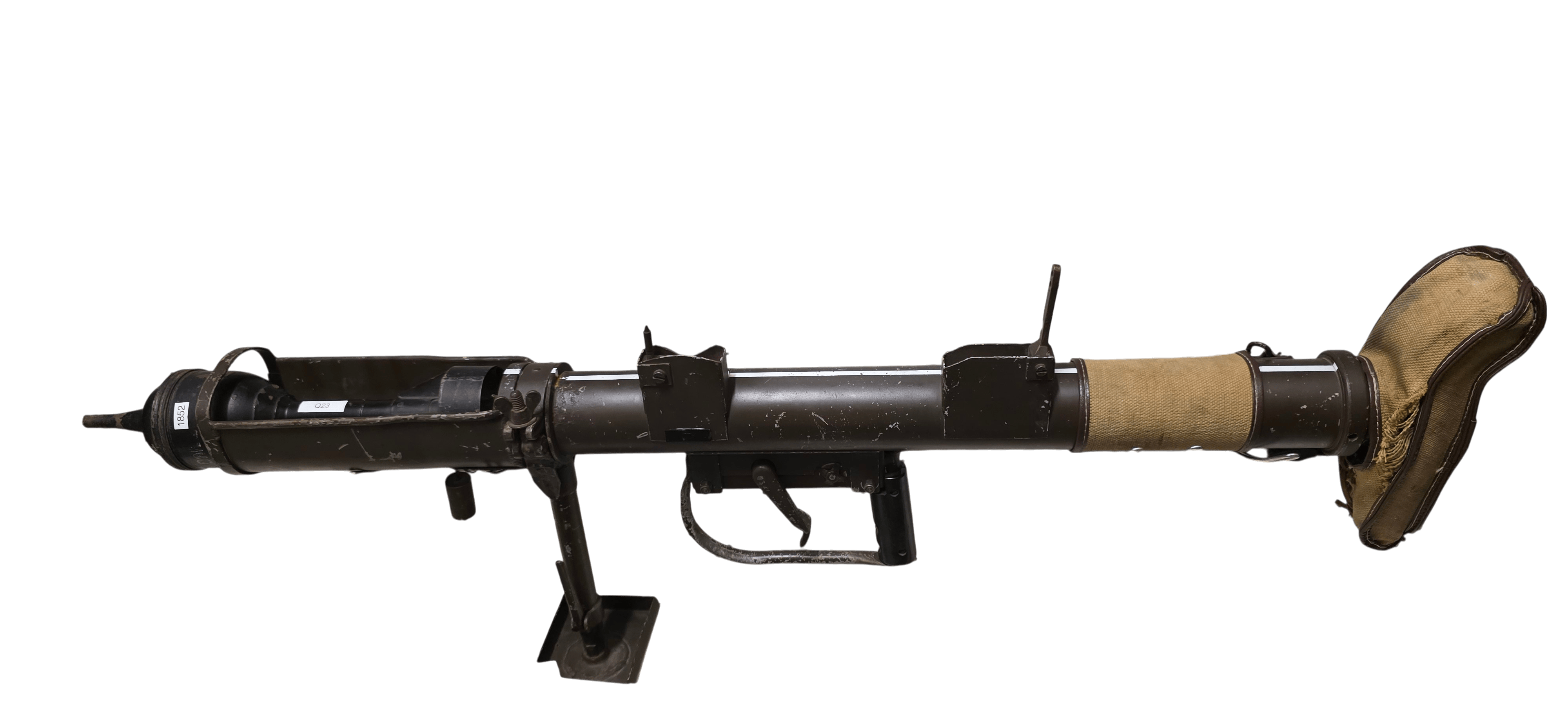
This decentralisation brought firepower closer to the soldier, but it also moved part of the anti-tank supply problem into the infantry battalion. PIAT bombs had to be stored, transported and issued through unit ammunition systems down to the companies and platoons most likely to require them. The return for 31 March 1944 recorded 190 PIAT projectors and 6,700 Mk I HEAT bombs, alongside substantial quantities of other anti-tank grenades and mines.[7]
Compared with a towed gun, the PIAT greatly reduced the requirement for specialised vehicles. It did not, however, eliminate the logistical burden. Its ammunition was bulky compared with ordinary small-arms ammunition, and every bomb carried reduced the soldier’s capacity to carry food, water, personal equipment or other ammunition.
The PIAT therefore marked an enduring shift: the infantry gained greater independence from supporting artillery, but the weight and complexity of anti-armour sustainment moved forward with it.
Anti-tank capability as an ammunition family
The PIAT formed only part of New Zealand’s wartime anti-tank system. The March 1944 return also recorded 58,000 No. 68 rifle-launched anti-tank grenades, 33,000 No. 74 sticky bombs and 98,000 No. 75 Hawkins grenades or mines. These were supplemented by 124,300 anti-tank mines of Mk I, Mk II, Mk V, Mk VC, local-pattern and American M1A1 types.[8]
These figures reveal an ammunition family rather than a simple progression of weapons. A soldier, section, platoon, battalion anti-tank detachment and specialist regiment could each employ different equipment against the same general target category. Their ammunition differed in method of initiation, explosive filling, packaging, employment, inspection and storage compatibility.
Taken together, the recorded two-pounder and six-pounder cartridges, Boys ammunition, PIAT bombs, anti-tank grenades and mines amounted to approximately 1.9 million individual items by March 1944. That total is not a measure of explosive quantity or storage volume: a rifle cartridge, PIAT bomb and anti-tank mine cannot be treated as equivalent units. Its significance lies in the number and scale of the distinct stock lines that ordnance personnel had to receive, identify, inspect, segregate, account for and eventually dispose of.
The Wasp-type flame carrier: close support with a separate fuel chain
The reconstructed post-war infantry battalion retained a specialised incendiary close-support capability. Its assault-pioneer platoon was authorised three Universal Carriers fitted with flame-throwers. New Zealand’s locally produced LP2 and LP2A carriers were adapted into machine-gun, mortar, six-pounder tractor and flame-carrier configurations. Contemporary New Zealand descriptions use both “flame carrier” and “Wasp” for a Universal Carrier fitted with a flame-thrower; because the surviving evidence does not consistently identify the exact Wasp mark installed in every post-war vehicle, “Wasp-type LP2A flame carrier” is the most defensible description.[9]
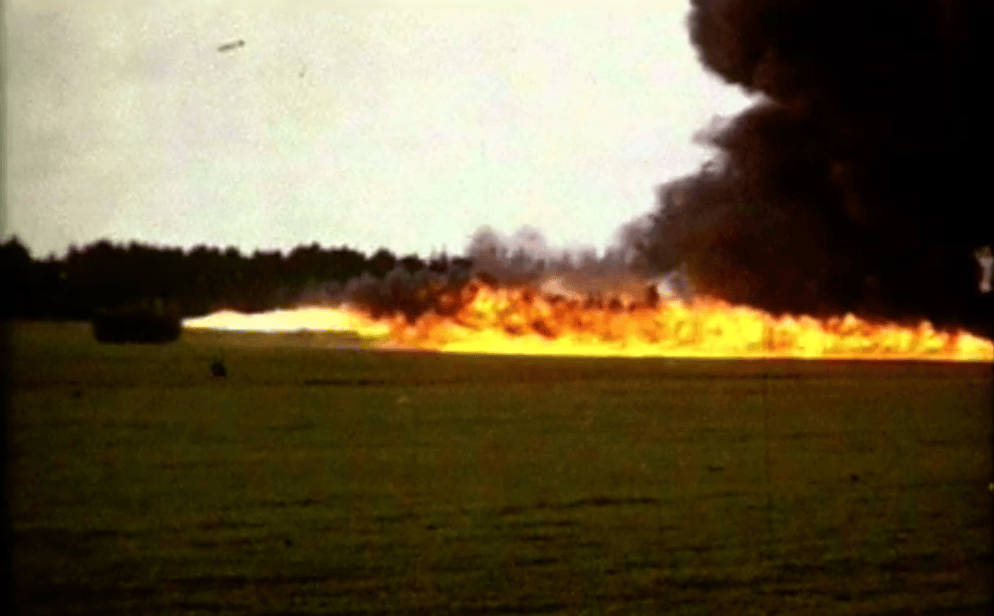
The carrier gave pioneers a short-range weapon for supporting infantry against defended buildings, field works and other positions that were difficult to clear with small arms alone. Its effect was incendiary and psychological rather than a simple extension of the anti-tank chain. The vehicle provided mobility and some protection, but the short engagement range made coordination with infantry, smoke and supporting fire essential.
From an ammunition-support perspective, the Wasp sat awkwardly between vehicle, weapon and hazardous-material system. Its consumable load was not a conventional cartridge. Depending on the fitted pattern, it comprised petroleum-based flame fuel—potentially thickened to improve range and adhesion—together with a pressure system and an ignition arrangement. Correct fuel identification, freedom from contamination, leak-free tanks and hoses, sound pressure components and serviceable igniters all affected whether the system could function safely.[10]
Responsibility consequently crossed trade boundaries. Petroleum and supply personnel had to hold and issue the flame fuel; vehicle and workshop staff maintained the carrier, tanks, valves and lines; and ordnance or ammunition personnel controlled any energetic ignition components and advised on their condition and safe handling. The interface between those responsibilities was itself a risk: a complete carrier could be unserviceable because of degraded fuel, a leaking line, an expired pressure component or an unavailable igniter.
The system also fragmented storage capacity. Bulk flame fuel belonged in controlled flammable-liquid storage rather than in a conventional ammunition magazine, while compressed-gas and ignition components required their own appropriate arrangements. Units needed protected space for filled and empty tanks, safe filling and draining, fire response, quarantine of leaking or contaminated equipment, and separation from ignition sources. Residual fuel made returned vehicles and components a continuing hazard during maintenance and disposal. When the Universal Carrier fleet was phased out between 1956 and 1958, the Army therefore had to retire not only a vehicle but a distinct fuel, pressure and ignition support chain.[11]
The 3.5-inch rocket launcher: portability with a new ammunition system
New Zealand began seeking a PIAT replacement in March 1952 and received 57 American-designed M20 Mk 2 3.5-inch rocket launchers in 1953. PIAT training ceased in late November that year and the older weapon was withdrawn. Eight M20s reached the Regular Force Depot in February 1954, but the District Training Camps and Territorial infantry could not receive their launchers until the required pamphlets and training ammunition arrived. Those conditions were not met until March 1955. The episode is a precise New Zealand example of equipment delivery preceding usable capability.[12]

The launcher was a lightweight, two-piece tube employing a magneto-type firing mechanism. Its apparent simplicity could obscure the scale of its ammunition requirement. The rocket was a complete propulsion and warhead system and therefore required protection from rough handling, moisture and temperature extremes. Technical instructions specified individual fibre or metal containers, with three rockets packed in a wooden box weighing approximately 54 pounds—about 24.5 kilograms.[13]
Consequently, a relatively light launcher could generate a disproportionately large transport and storage burden once sufficient rockets were included. The weapon also introduced American-pattern terminology, publications, spares and ammunition into a force still largely based on British equipment.
The end of the M20’s life was equally instructive. By the early 1970s it was used mainly as a lead-in training weapon. Overseas ammunition and spare parts were becoming unavailable, approximately 1,150 of the 1,500 rounds remaining in New Zealand were reported unserviceable, and the launchers had an estimated misfire rate of 40 per cent. The 39 surviving launchers were disposed of in June 1978, five being retained for the Army Museum and the remainder scrapped.[14]
The 3.5-inch launcher demonstrated that reducing launcher weight does not necessarily reduce the total system burden. The decisive measurement is not the weapon alone, but the weight, volume and condition of the complete operational load—including ammunition, sights, spares, publications and training equipment. Unsupported or unserviceable stocks can continue to occupy storage and technical effort long after their operational value has disappeared.
The No. 94 Energa: turning the service rifle into an anti-armour launcher
The 75 mm No. 94 Energa anti-tank rifle grenade was introduced alongside the M20 and provided another way to place anti-armour capability directly within the infantry. Rather than requiring a separate launcher, the shaped-charge grenade fired from an adapter fitted to the No. 4 rifle or L1A1 SLR used a special grenade cartridge. Although its theoretical maximum range was about 100 yards, the low velocity made a first-round hit unreliable and the preferred range was 25 to 50 yards.
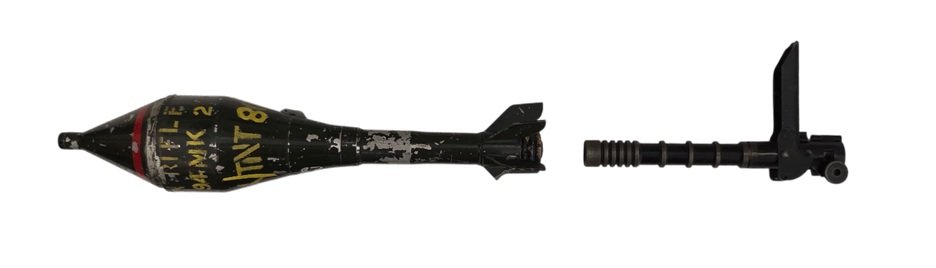
This appeared to offer considerable logistical economy because the soldier’s rifle also became the launcher. In practice, the system still required the correct projector, grenade, special launching cartridge, sights or aiming method, technical instructions and training. The grenade and its initiating components also remained an ammunition-management responsibility even though the launcher was an ordinary rifle.
The intended distribution shows the resulting ammunition burden. Two soldiers in each of an infantry platoon’s three sections carried two grenades each, while further grenades were held in the company reserve. The weapon avoided issuing a complete second launcher to every user, but depended upon the compatibility of several relatively small components. A missing cup or shortage of launching cartridges could make otherwise serviceable grenades unusable. It also spread anti-armour ammunition across more users, vehicles and storage locations, increasing the need for correct identification, accounting and handling.

The transition to the M72 did not remove the Energa everywhere at once. The Army decided to replace it in late 1968 and formally introduced the M72 in late 1970, but 1 RNZIR initially retained Energa for commonality with other forces in 28 Commonwealth Brigade. Tactical standardisation with allies could therefore prolong an ammunition line even after selecting a replacement.
The BAT, MOBAT and WOMBAT: reducing weapon weight without reducing ammunition weight
New Zealand’s post-war anti-armour inventory included the British 120 mm BAT family: the BAT L1, L4 MOBAT and L6 WOMBAT recoilless rifles. BAT—Battalion Anti-Tank—provided infantry battalions with heavy direct-fire capability without the recoil system of a conventional gun. Successive MOBAT and WOMBAT developments sought to improve mobility by reducing the weight of the mounting and carriage.

The School of Infantry received one BAT for evaluation in 1954. Approval to order 18 more followed in February 1955 at a total cost of £68,994 (approximately NZ$4.7 million in June 2026 purchasing power), but staggered shipping delayed full distribution until January 1956.[15][16] Each infantry battalion initially received only one and returned one six-pounder, leaving a mixed holding of five six-pounders and one BAT. That arrangement demanded concurrent 57 mm and 120 mm ammunition, separate technical knowledge, different handling equipment and duplicated training support—an excellent example of how transition fragments storage capacity before it produces a simpler fleet.
The system remained substantial in scale. When 1st Battalion, New Zealand Regiment trained with a 120 mm recoilless anti-tank gun in 1960, a contemporary report described each round as approximately 1.15 meters long and weighing 27 kilograms. Even if the weapon itself became lighter, a useful operational allocation of ammunition still demanded vehicles and significant handling effort.
The family therefore provides an important counterpoint to the later Carl-Gustaf. Reducing the gun’s weight improved tactical movement, particularly when the weapon could be carried or fired from a vehicle, but it did not change the physical burden of the 120 mm ammunition. BAT, MOBAT and WOMBAT also required sights, spotting weapons, mountings, specialist tools and trained crews. Their evolution shows how designers can progressively reduce one part of a system while ammunition and the support chain continue to determine its practical deployability.
The 106 mm recoilless rifle: mobility built around the vehicle
In 1961, the New Zealand Army introduced the American M40A1 106 mm recoilless rifle. Despite the designation, its bore was actually 105 mm; the 106 mm title distinguished its ammunition from an earlier, incompatible 105 mm recoilless rifle. Eighteen of the new weapons were checked by the Royal New Zealand Army Ordnance Corps at Trentham before distribution to infantry units for training. Although considerably lighter than the British 120 mm BAT-family weapons then in service, the M40A1 still weighed more than 200 kilograms and was carried on—and normally fired from—a utility vehicle.

The 106 mm RCL combined substantial direct-fire effect with greater tactical mobility than a conventional anti-tank gun. Its logistics nevertheless resembled a small vehicle-mounted weapons system rather than those of a shoulder-fired launcher. The capability depended upon the rifle, vehicle, mounting, sights, tools, crew equipment and large rounds all reaching the same place in serviceable condition. The associated spotting rifle added another weapon, ammunition nature and maintenance requirement to the system.
Mounting the recoilless rifle on a Land Rover reduced the need for a separate gun tractor, but made the vehicle integral to the capability. A vehicle fault, damaged mounting, or fuel shortage could remove the weapon from action even when the rifle itself remained serviceable. Its ammunition was also too large and heavy to be carried forward in useful quantities by the crew alone. The 106 mm RCL therefore demonstrated that vehicle mounting could increase tactical responsiveness while creating a tightly coupled weapon–vehicle–ammunition support chain.
The family transition was not immediate. In March 1968, the Army replaced the WOMBATs held by 1 RNZIR with four M40A1s. The remaining MOBATs and BATs were returned to the Main Ordnance Depot and disposed of, while use of the WOMBAT continued into 1969. The M40A1 then became the Army’s sole heavy anti-tank weapon, concentrating the heavy recoilless-rifle ammunition burden into the 106 mm system.[17]
The Carl-Gustaf M2/L14A1: a limited first introduction
The Carl-Gustaf M2—designated the L14A1 in New Zealand and wider Commonwealth service—was approved in principle in June 1965, but it did not enter New Zealand service that year. The proposed package of 120 weapons, maintenance parts and two years’ training ammunition was estimated at £304,078 (approximately NZ$16.1 million in June 2026 purchasing power) and was delayed by financial constraints before Treasury vetoed it. Only 22 weapons were eventually acquired, at £560 each (approximately NZ$26,800 in June 2026 purchasing power), and issued in September 1967 solely to 1 RNZIR for commonality with the Commonwealth brigade.[18]

Even this limited introduction brought an important change. The reloadable 84 mm weapon could fire HEAT, high-explosive, smoke, flare, or illumination ammunition. In contrast, New Zealand’s 3.5-inch launcher was restricted to HEAT. The Carl-Gustaf’s smoke and illumination effects could also assume functions previously carried by the 2-inch mortar. One launcher therefore offered a broader infantry-support system, but only if it could procure and sustain several ammunition types.
Logistically, the common launcher offered considerable flexibility. One weapon could deliver several different effects without requiring a separate launcher for every task. However, this shifted complexity into ammunition management. Commanders and logisticians now had to balance anti-armour, high-explosive, smoke, illumination, and training ammunition.
A shortage of the correct nature could leave a unit with ammunition that was technically compatible with its launcher but unsuitable for the target it faced. Supporting the Carl-Gustaf therefore required more sophisticated demand planning than simply counting “84 mm rounds”. Each type had its own tactical purpose, stockholding requirement and expenditure pattern.
The original proposal’s inclusion of two years’ training ammunition was therefore significant. Training stock was not an optional accessory; it was part of the mechanism by which weapon handling and marksmanship could be developed without consuming the war reserve or delaying issue after the launchers arrived.
The first Carl-Gustaf era also demonstrates the risks of a small, ally-dependent fleet. When 28 ANZUK Brigade was disbanded in 1974, the New Zealand system lost much of the British and Australian support it had depended on. Fenton records that a plan to withdraw the weapon was confirmed in March 1976 and was expected to be completed by 1978. That intention should not, however, be treated as evidence of complete retirement. A 1987 inventory still listed the Carl Gustaf M2, and the 2004–05 Military Balance recorded 42 84 mm Carl Gustafs in New Zealand Army service. The surviving evidence therefore suggests that use may have paused, been reduced, or later revived, but that the M2 remained in the Army’s equipment holdings until the M3 replaced it in the early 2010s. The M3 acquisition was consequently a generational replacement within an enduring 84 mm capability, rather than a reintroduction after a three-decade absence.[19]
The M72: when the launcher becomes part of the ammunition
The 66 mm M72 Light Anti-Armour Weapon introduced another model of support. The Army decided in late 1968 to replace the Energa with the single-shot system and formally introduced it in late 1970. New Zealand troops used the M72 in South Vietnam, where weapons designed for use against armour could also be employed against bunkers and field fortifications. Later versions have remained in New Zealand service as a short-range anti-armour and direct-fire weapon.
Unlike the reloadable Carl-Gustaf, the M72 is a self-contained, single-shot weapon. The rocket is issued inside its disposable telescoping launcher, and New Zealand formally classified the complete item as ammunition rather than as a weapon. This greatly simplifies unit-level maintenance: there is no reusable barrel to inspect after firing and no empty launcher awaiting its next round.

The apparent simplicity produces its own logistical demands. Every live firing consumes both rocket and launcher. At introduction, each live M72 cost about NZ$45 (approximately NZ$890 in June 2026 purchasing power)—too expensive to meet the minimum practice requirement—so a sub-calibre device was fitted to spent launchers and fired 21 mm rockets costing about NZ$4 each (approximately NZ$80 in June 2026 purchasing power). This conserved operational ammunition but added another calibre, training round, adaptor configuration and accounting problem. Readiness still depended upon holding complete serviceable weapons by lot, shelf life and condition; after firing, the discarded tube became a recovery, safety and disposal issue.
The M72 illustrates the importance of classifying equipment correctly. It looks like a weapon, but in supply terms it is also ammunition, packaging and launcher combined. Forecasting must therefore be based on anticipated expenditure rather than merely the number of soldiers or units to be equipped.[20]
Javelin: precision creates an electronic support chain
New Zealand selected the Javelin Medium Range Anti-Armour Weapon to provide a guided capability against tanks and other armoured threats at ranges beyond those of its short-range systems. Cabinet approved 24 systems in December 2003, with an approval-to-commit estimate of NZ$23.9 million (approximately NZ$43.1 million in June 2026 purchasing power), and the weapons were delivered in 2006. The acquisition included launchers, missiles, basic support equipment, spares, special tools, training material and indoor and outdoor simulators.[21]
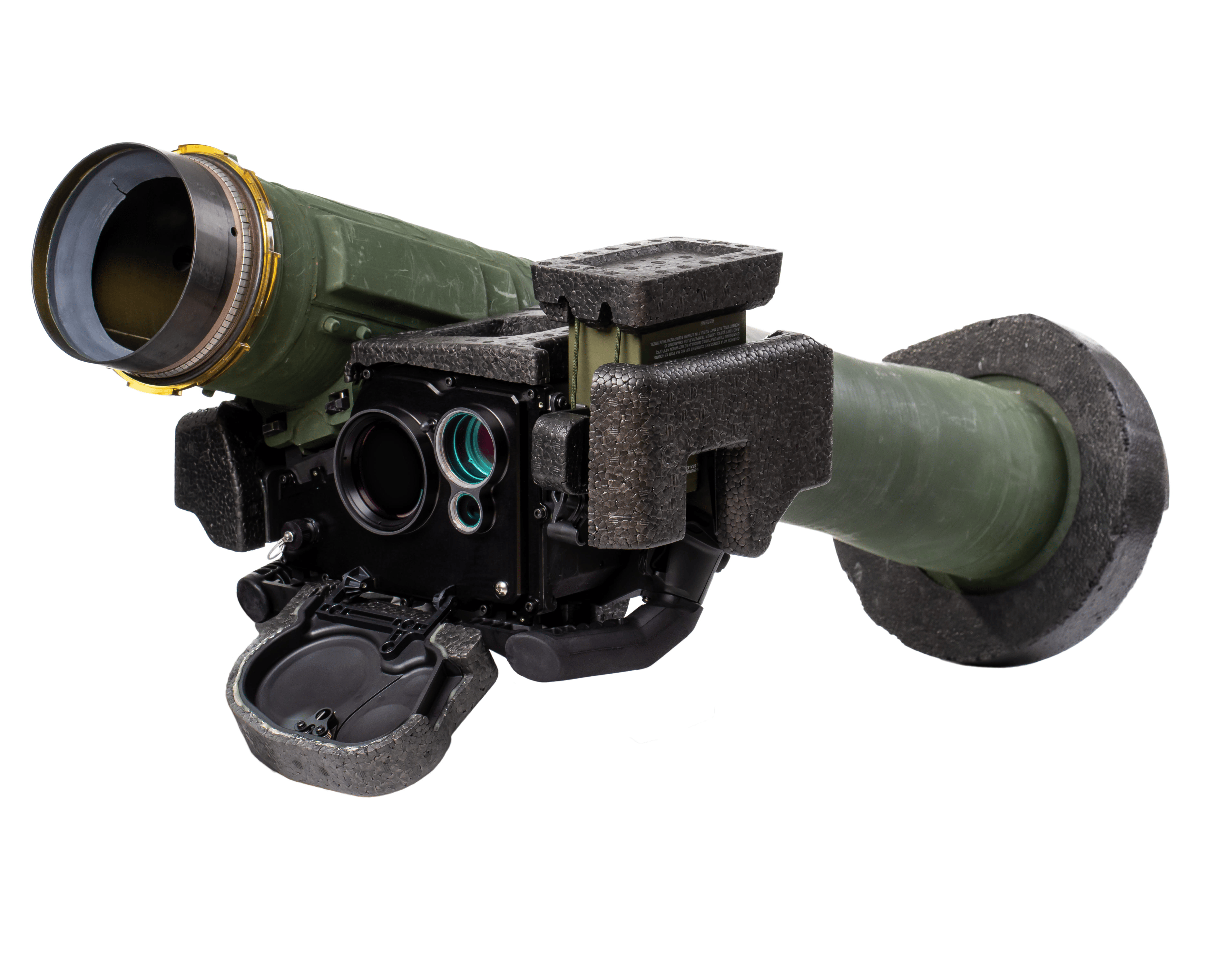
Javelin did not simply replace the M72 or Carl-Gustaf. It added another layer to the anti-armour system. The reusable Command Launch Unit provides sighting, thermal imagery and target acquisition, while each missile is carried in its own launch tube. Once fired, the missile guides itself to the selected target, allowing the crew to move or prepare another round.
The logistical burden is correspondingly different. Javelin requires managing expensive guided missiles, reusable electronic launch units, software and configuration status, power sources, specialist test equipment, spares, and simulator-based training. The thermal sight also gives the system value as a surveillance and target-identification device, which means launch-unit availability matters even when no missile is fired.
Its introduction also demonstrated the vulnerability of a sophisticated weapon to global supply constraints. A manufacturing defect delayed delivery and disrupted the international missile supply. A proposed comprehensive maintenance-support arrangement was judged prohibitively expensive, so additional spares were purchased instead.[22] The episode showed that precision weapons may reduce the number of rounds needed to achieve an effect, but increase dependence upon overseas manufacturers, specialist components and long-lead support arrangements.
Javelin is now itself entering another lifecycle phase. Current plans provide for replacement launch units that can fire newer, longer-range missiles. The system therefore demonstrates that obsolescence in modern weapons may arise not only from barrel wear or structural age, but from electronics, software, interfaces and compatibility with future ammunition.
The M3: lighter equipment, but tighter lifecycle management
New Zealand introduced the M3 during the early 2010s. The M3 retained the 84 mm calibre and multi-role characteristics of the earlier Carl-Gustaf while reducing the launcher’s weight through the use of lighter materials. The replacement did not recreate an extinct capability; it renewed the existing 84 mm system with a lighter launcher. The NZDF lists the M3 at approximately 10 kilograms and identifies high explosive, illumination, high-explosive anti-tank and sub-calibre training ammunition among the natures operated with it.[23]

The reduction in weight improved dismounted mobility, but composite construction placed greater emphasis on inspection, weapon history and barrel-life management. Unlike a simple steel launcher that might be judged largely through physical inspection, the safe life of a modern recoilless weapon also depends upon knowing how it has been used.
The M3’s replacement because it has reached the end of its scheduled life illustrates the lifecycle nature of weapons logistics. A weapon may remain outwardly serviceable while approaching a technical limit established through age, rounds fired or material condition. Accurate configuration and usage records are therefore as important as the physical spare parts held in a depot.
The M4: continuity in calibre, change in support philosophy
The M4 is shorter than one metre and weighs less than seven kilograms, making it approximately three kilograms lighter than New Zealand’s M3. It remains compatible with legacy Carl-Gustaf ammunition and can also support advanced sights and programmable ammunition.[24]
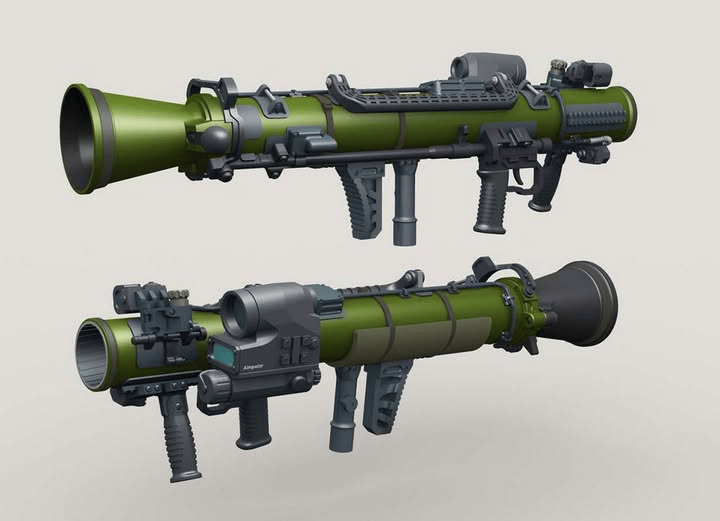
A particularly important logistical feature is its integrated fired-round counter. Earlier systems depended upon manual logbooks to record full-calibre firings. The M4 automatically records those firings and can distinguish them from sub-calibre training rounds, providing maintainers with more reliable information about remaining weapon life. The counter itself does not require a battery.[25]
This apparently small feature represents a major development in ordnance management. Weapon usage can be based on recorded evidence rather than estimates or incomplete paperwork. It should reduce the risk of either retaining a launcher beyond its safe life or prematurely withdrawing one because its firing history cannot be established.
Nevertheless, backward ammunition compatibility should not be mistaken for complete logistical commonality. The M4 will still require:
- New equipment codification and configuration records.
- Updated technical publications and maintenance procedures.
- M4-specific spares, ancillaries and inspection requirements.
- Training for operators, armourers, ammunition personnel and instructors.
- Management of sights, interfaces and any associated electronic systems.
- Confirmation of the compatibility and remaining life of each ammunition nature and lot.
- A controlled plan for withdrawing, preserving, cannibalising or disposing of the M3 fleet.
- Integration of the supplied training and simulation systems into enduring training arrangements.
Including training and simulation capabilities in the New Zealand acquisition is therefore especially important. It recognises that the operational capability is created not by the launcher alone, but by the combination of weapon, ammunition, competent personnel and a sustainable training system.
Ammunition natures: the capability behind the launcher
The history of these weapons can also be read as a history of increasingly diverse ammunition. The two-pounder was initially sustained principally with armour-piercing shot. Wartime returns already distinguished complete rounds from separately accounted shells, projectiles, charges, tubes and fuzes, while small-arms ammunition could also be recorded by belt or specialised nature. By the time of the Carl-Gustaf and Javelin, the ammunition family included anti-armour, anti-structure, high-explosive, smoke, illumination, anti-personnel and training effects, together with mechanical or electronic fuzes, rocket motors, spotting cartridges, launch tubes and simulation systems.
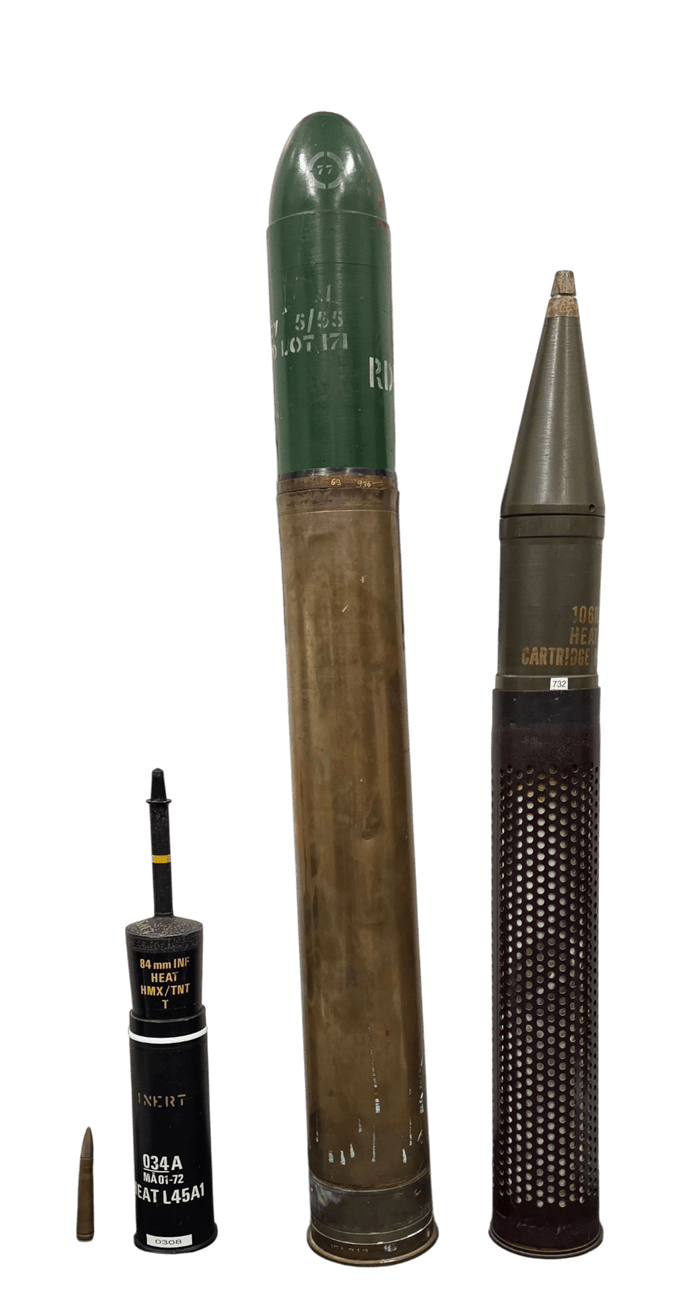
This distinction is important because calibre alone does not identify the nature of ammunition. Two rounds of the same calibre may have different projectiles, explosive fillings, propelling charges, fuzes, hazard classifications, shelf lives and storage requirements. Conversely, an ammunition system may include several calibres: the 106 mm RCL, for example, also required special .50-inch spotting ammunition, while Carl-Gustaf training could involve 7.62 mm or 20 mm sub-calibre systems. The following table is a comparative technical synthesis rather than a list of every nature ever held in New Zealand service.[26]
The table below identifies the principal ammunition families associated with each system. It does not imply that New Zealand procured every international nature or mark listed. The dated totals quoted above come from compiled equipment and ammunition returns; confirming their underlying archival provenance and establishing individual lot histories would require examining the original returns, ammunition ledgers, vocabulary records, technical publications, and disposal files.
| Weapon or ammunition system | Principal ammunition natures associated with the system | Ammunition technical challenge |
| Two-pounder | Fixed 40 mm quick-firing cartridges with armour-piercing tracer, higher-velocity armour-piercing and capped armour-piercing shot; practice shot; and, in later catalogues, high-explosive shell. | Ammunition Technicians had to distinguish solid shot from explosive shell. Solid armour-piercing shot normally had no explosive filling or conventional projectile fuze, although the complete round still contained a primer, propellant and often a tracer. High-explosive shell introduced a filled, fuzed projectile with different hazards and inspection requirements. Marks, charges and ballistic performance also had to match the gun and sighting data. |
| Boys anti-tank rifle | .55-inch armour-piercing cartridges, including improved projectile marks; armour-piercing tracer; ball or practice cartridges; proof, drill and dummy rounds. | The Boys was managed more like specialised small-arms ammunition than artillery ammunition, but its cartridges were large, heavy and unique to the weapon. Technicians needed to identify projectile marks and distinguish live, proof, practice, drill and dummy cartridges. Ageing primers and propellant, cartridge corrosion and deteriorating packaging could remain concerns after the weapon had become tactically obsolete. |
| Six-pounder | Fixed 57 mm cartridges with armour-piercing, capped armour-piercing, capped ballistic-cap and later discarding-sabot shot; high-explosive shell; and practice ammunition. | Several visually similar armour-piercing natures had different penetration and ballistic characteristics. The later discarding-sabot round introduced additional components and a different performance envelope, while high-explosive ammunition introduced a fuzed shell. Identification by complete nomenclature, mark, lot and package—not merely “six-pounder”—was essential. |
| Seventeen-pounder | Armour-piercing tracer, capped ballistic-cap, discarding-sabot, high-explosive and practice ammunition. | The 17-pounder reinforced the need to manage ammunition by effect and ballistic family. APDS offered greatly improved penetration but had different accuracy and ballistic characteristics from conventional armour-piercing ammunition. The addition of high-explosive shell required separate understanding of its explosive filling and fuze. |
| PIAT | HE/AT service bombs in successive marks; practice-inert bombs; drill bombs; reusable practice shot; propelling cartridges; and separately packed fuzes. | The PIAT was a component ammunition system. Service bombs were issued with the propelling cartridge installed but the fuze carried separately in a container attached to the bomb. Technicians had to manage the condition and compatibility of bomb, cartridge and fuze; recognise the different live, inert, drill and reusable practice configurations; and protect the damp-proof cardboard carriers. Changes to bomb filling and fuze design between marks complicated identification and surveillance. |
| Wartime anti-tank grenades and mines | No. 68 rifle-launched anti-tank grenades; No. 74 sticky bombs; No. 75 Hawkins grenades or mines; British Mk I, Mk II, Mk V and Mk VC anti-tank mines; locally produced mines; and American M1A1 mines. | Items intended for the same anti-tank role functioned very differently. Ammunition personnel had to distinguish impact-initiated rifle grenades, adhesive charges, pressure-operated mines and their training or inert equivalents. Different fuzes, safety devices, explosive fillings, package sizes and compatibility requirements prevented the family from being managed as one generic stock. |
| Wasp-type LP2A flame carrier | Bulk petroleum flame fuel, potentially thickened; pressure or propellant-gas components; and an ignition system, with the exact configuration depending on the fitted pattern. | This was not one conventional round but a cross-trade hazardous-material system. Technicians had to distinguish fuel formulations and ignition components while coordinating tank, valve, line, and pressure-system conditions with vehicle and petroleum specialists. Flammable-liquid storage, compressed-gas control, leak quarantine, residual fuel and contaminated returns consumed capacity outside the conventional explosives magazine. |
| M20 3.5-inch launcher | New Zealand’s operational holding is recorded as HEAT; the wider M20 family included M28-series HEAT, M29-series practice and M30 white-phosphorus smoke rockets, together with inert and sub-calibre training systems. | Each complete rocket combined warhead, fuze, motor, propellant and igniter. A defect in any component could make the entire round unserviceable. The reported deterioration of about 1,150 of New Zealand’s last 1,500 rounds shows the scale of the surveillance and disposal problem created by ageing motors, energetic components and packaging. Any white-phosphorus nature, if held, would have introduced separate fire, leakage and segregation requirements. |
| No. 94 Energa | HEAT rifle grenades; practice, practice-marker and drill grenades; and the dedicated grenade-launching cartridges required to project them. | The system depended upon the correct combination of rifle, adapter, grenade and launching cartridge. The normal platoon scale—two soldiers in each section, each carrying two grenades—distributed both ammunition and identification risk widely. Special grenade cartridges could be confused with blank or drill cartridges if package and marking controls failed. Service, practice and drill grenades also required positive differentiation. |
| BAT, MOBAT and WOMBAT | 120 mm HESH service ammunition; canister or flechette anti-personnel natures; practice rounds; and ammunition for the associated spotting weapon. | HESH relied upon the correct functioning of a base fuze after the explosive filling spread across the target surface, whereas canister operated in a fundamentally different manner. The large 120 mm cartridges used recoilless-rifle case arrangements that allowed propellant gases to escape through the breech. Damaged cases or closures therefore required careful assessment. The separate spotting-weapon ammunition added another nature, calibre and lot family to account for and store. |
| M40A1 106 mm RCL | M344-series HEAT; M346-series HEP-T; M581 anti-personnel flechette; M368 dummy ammunition; and special M48/M48A1 .50-inch spotter-tracer cartridges. | The 106 mm cartridges used perforated cases with internal liners and specialist fuzes. HEAT, high-explosive plastic and flechette projectiles operated differently and could not be treated as one generic nature. The special .50-inch spotter-tracer cartridge was ballistically matched to the main armament and was not ordinary .50-calibre ammunition. Case-liner condition, projectile markings, fuze type and matched spotting ammunition all required technical control. |
| Carl-Gustaf M2/L14A1 | New Zealand’s documented service family included 84 mm HEAT, high-explosive, smoke and flare or illumination ammunition; the wider family also included practice and sub-calibre training systems. | A common launcher could fire rounds producing very different effects. Technicians had to identify the projectile, cartridge, primer and fuze fitted to each nature and ensure that the correct mark was authorised. Smoke and illumination introduced pyrotechnic fillings and storage considerations different from HEAT or high-explosive rounds. If operational use paused while the M2 remained in holdings, preservation, surveillance and stock accounting still continued. Its small fleet and changing allied support arrangements also created orphan-stock risks before its eventual replacement by the M3. |
| Carl-Gustaf M3 | New Zealand publicly identifies HEAT, high-explosive, illumination and sub-calibre training ammunition; the wider family also includes HEDP, smoke and anti-structure rounds. | Retaining the same calibre did not remove the need for compatibility control. Each ammunition mark had to be checked against the launcher, sight, technical publications and approved employment. Different lots could also have different shelf-life or surveillance status. The mix of operational and training natures increased the number of stock lines and minimum holdings required. |
| M72 | The original system was a complete 66 mm HEAT round; later variants include enhanced anti-armour, blast-optimised, multi-purpose and anti-structure effects. New Zealand used 21 mm sub-calibre rockets fired from a device fitted to spent launchers for economical training. | The complete launcher is issued as ammunition: warhead, fuze, rocket motor, firing mechanism and protective tube form one round. Each variant is therefore a separate nature even when all are called “M72”. The training system added a second calibre and reusable adaptor to control. Tube damage, broken seals, corrosion, ageing propellant or unclear markings may condemn the complete live item, which also consumes considerable storage volume relative to its explosive content. |
| Javelin | Legacy missile rounds with tandem HEAT warheads; later missile variants with improved or multi-purpose warheads; inert, field-handling and simulator systems. | A Javelin round combines a guided missile, launch-tube assembly and battery-coolant unit, while the reusable Command Launch Unit is controlled separately. Ammunition management therefore extends beyond explosives into seekers, electronics, software, connectors, power and cooling components. Missile lot surveillance, environmental history, security classification and launcher–missile software compatibility are as important as visual inspection. |
| Carl-Gustaf M4 | Compatible legacy 84 mm natures plus newer HEAT, HEDP, high-explosive, smoke, illumination, anti-structure, anti-personnel and training rounds. Advanced ammunition includes programmable functions supported by modern fire-control systems. | Backward compatibility creates a broad rather than a simple ammunition family. Ammunition Technicians must know which legacy and new natures are authorised, how programmable or selectable functions are set and verified, and whether ammunition, sight and launcher configurations are compatible. Electronic or programmable fuzes add configuration data and functional status to the traditional checks of filling, fuze, cartridge, primer and packaging. |
From shot to guided missile: a changing technical vocabulary
For Ammunition Technicians, terminology is not simply historical language; it is part of the safety system. A shot is generally a solid projectile and may contain no high-explosive filling or conventional fuze, although it can still contain a tracer. A shell normally contains an explosive, smoke, illuminating or other payload. A fixed cartridge combines the projectile, cartridge case, propelling charge and primer as one loadable item. A bomb, grenade or rocket may combine these functions differently, while a guided missile adds seekers, control electronics, actuators and software.
The PIAT demonstrates the importance of this vocabulary. Its service bomb was not a single sealed round in the modern sense: it included a propelling cartridge but was transported with its fuze separate. The M72 sits at the opposite end of the spectrum. The rocket and disposable launcher together form the issued round, so no enduring weapon remains after firing. Javelin expands the definition further because the ammunition includes a guided missile in a disposable launch tube and a battery-coolant unit, but not the reusable Command Launch Unit.
Markings, colour schemes and nomenclature also changed over time and between British, American, Swedish and NATO systems. Colour provides a useful first indication, but cannot safely be the sole means of identification. The full designation, mark or model, lot number, manufacture date, filling, fuze and package markings must agree with the applicable technical publication. This becomes especially important when live, practice, drill and inert items deliberately reproduce the handling characteristics of service ammunition.
The growing challenge of cartridges, fuzes and initiation systems
The technical progression was not simply from smaller to larger warheads. It also progressed in initiation and function.
The early armour-piercing shot of the two-pounder and six-pounder relied primarily upon kinetic energy and generally did not require an explosive projectile fuze. Nevertheless, the complete cartridge still contained energetic components in its primer, propellant and tracer. The addition of high-explosive shell required Ammunition Technicians to understand projectile fillings, fuze types, arming arrangements and the effects of deterioration upon both safety and performance.
Shaped-charge ammunition such as the PIAT bomb, Energa grenade, 3.5-inch rocket, M72 and HEAT rounds for the recoilless rifles depended upon the warhead being initiated at the correct stand-off from the target. Fuze design was therefore inseparable from effectiveness. The successive PIAT bomb marks, for example, included changes intended to improve fuze functioning and reliability. A projectile could be physically complete and still fail to deliver its intended effect if the wrong fuze, deteriorated components or an incompatible mark were fitted.
HESH and HEP ammunition introduced a different mechanism. The explosive filling first spread against the target before the base fuze initiated it, producing damaging shock and spalling within the armour or structure. Flechette and canister rounds created yet another functioning sequence, dispersing large numbers of projectiles rather than forming an armour-penetrating jet or blast effect.
Modern programmable ammunition increases the burden again. The Ammunition Technician must understand not only the physical round but also the relationship between the fuze, fire-control unit, programming interface, launcher and software configuration. For Javelin, the seeker, guidance system, missile electronics and battery-coolant unit become part of ammunition serviceability. Traditional knowledge of explosives remains essential, but it must now be combined with configuration management and electronic systems assurance.
Storage capacity is more than empty floor space
Each new ammunition nature also creates a storage problem. A magazine may appear to have sufficient physical space yet still lack legal or safe capacity for the proposed stock. Explosives storage is controlled by the hazard presented by the ammunition, its Net Explosive Quantity, the Hazard Division and Compatibility Group assigned to the packaged configuration, and the quantity-distances separating the magazine from people, buildings and other explosive stores.
This means that different natures of the same calibre may not consume storage capacity in the same way. Solid armour-piercing shot presents a different hazard from fuzed high-explosive shell. Rocket motors, white-phosphorus smoke, illumination rounds, separately packed fuzes, guided missiles and damaged or suspect ammunition may have different compatibility or segregation requirements. The classification may also change depending on whether the fuze is fitted, packed separately in the same container, or held in an independent package.
New ammunition can therefore require one or more of the following:
- A new or amended explosive-limit licence and supporting safety assessment.
- Confirmation of the Hazard Division, Compatibility Group, Net Explosive Quantity and UN transport classification for each packaged configuration.
- A separate magazine, compartment or segregated stack for incompatible natures, pyrotechnics, white phosphorus, separately stored fuzes or other special-risk items.
- Controlled temperature or humidity, environmental monitoring or sealed specialist containers for missile and electronic components.
- Additional space for serviceable operational stocks, training stocks, proof or surveillance samples, returned ammunition, quarantined lots, damaged items and ammunition awaiting disposal.
- New handling equipment, stillages, pallets or racking because the package dimensions and weights differ from existing stocks.
- Updated fire plans, emergency response information, security controls and transport documentation.
The practical effect is fragmentation of capacity. A partially empty magazine cannot necessarily accept a new nature if the compatibility rules prohibit mixing, if adding the new Net Explosive Quantity exceeds the licensed limit, or if the required separation from another stack cannot be maintained. Guided weapons may add heightened physical-security requirements, while smoke and illumination natures may require arrangements different from those for conventional HEAT ammunition. The Wasp adds a useful historical reminder that a close-support system can consume hazardous-substance capacity outside the explosives estate as well as magazine space within it.[27]
The March 1944 anti-tank return provides an early example of this fragmentation. More than a million two-pounder and six-pounder cartridges coexisted with over half a million Boys rounds, 6,700 PIAT bombs, 189,000 anti-tank grenades and sticky or Hawkins bombs, and 124,300 mines of six different patterns. Even where aggregate magazine space existed, these articles could not be treated as one interchangeable holding. Each nature required its own identification, packaging, lot control, surveillance, issue arrangements and provision for segregation or separation where necessary.
Unserviceable ammunition consumes capacity too. The late M20 holding—about 1,150 unserviceable rounds within a total of approximately 1,500—is an unusually clear historical example. Until formally condemned, segregated and disposed of, those rounds still demanded secure storage, lot records, technical inspection and space that could not automatically be reassigned to a new nature. The same pressure arises from quarantined lots, misfires, returned rounds, obsolete training stocks and orphaned ammunition for which overseas support has ceased.
Transition between weapons compounds the problem. During the change from the two-pounder to the six-pounder, both ammunition families had to be held concurrently. In 1956 a battalion’s five six-pounders and one BAT required simultaneous 57 mm and 120 mm support; in 1970 Energa stocks were retained for 1 RNZIR even as the M72 entered service. The M3-to-M4 transition should benefit from 84 mm compatibility, but it may still require separate control of older and newer lots, natures cleared only for particular sights or configurations, training ammunition, and M3 stocks awaiting consumption or disposal. At the same time, the M72 and Javelin continue to occupy storage space because they provide different ranges and effects rather than being replaced by the M4.
The Ammunition Technician’s expanding responsibility
For the Ammunition Technician, the introduction of a new weapon begins well before its first live firing and continues after the launcher has been withdrawn. The technical workload includes:
- Establishing the correct nomenclature, codification, explosive classification and accounting unit for every service, practice, drill and inert nature.
- Confirming compatibility among projectile, cartridge, fuze, launcher, sight, software and training system.
- Designing storage plans around licensed explosive capacity, compatibility and segregation rather than calibre or physical volume alone.
- Conducting surveillance by lot and condition, including inspection of packaging, seals, propellant, fuzes, rocket motors, pyrotechnic fillings, electronics and environmental indicators.
- Advising commanders and logisticians on the correct mixture of natures for the expected target set and expenditure rate.
- Controlling returns from exercises, particularly opened packages, extended disposable launchers, unused fuzed ammunition, suspect misfires and ammunition exposed to adverse environments.
- Planning technical disposal for obsolete, life-expired, damaged or unsupported stocks and their associated components.
- Identifying orphan-system risk when a small national holding depends upon allied ammunition, spares, publications, proof facilities or technical advice that may be withdrawn.
The M4 introduction should therefore include a formal ammunition-support workstream. Existing 84 mm stocks need to be identified by complete nature, mark, lot, age, condition and launcher compatibility—not simply counted as “Carl-Gustaf ammunition”. Proposed new natures should be assessed for storage classification, space, surveillance, transport, training and disposal requirements before they arrive. Otherwise, New Zealand could possess a lighter and more capable launcher but lack either the correct mix of rounds or the licensed and segregated magazine capacity needed to sustain it.
Eighty years of recurring lessons
Across this lineage, the technology has changed considerably, but the fundamental logistical lessons have remained remarkably consistent.
First, replacement systems must be introduced as complete capability packages. The six-pounders arriving without sights during the fighting in Egypt remain a powerful warning against treating delivery of the principal equipment as the completion of introduction into service. The Javelin acquisition similarly shows why simulators, special tools, spares and support arrangements must be planned with the launcher and missiles rather than added later.
Second, old and new systems will normally coexist during transition. That overlap requires duplicate ammunition, spares, training and technical support. It may appear inefficient, but it provides insurance against the operational gap experienced when two-pounders were returned before sufficient six-pounders were available.
Third, portability transfers rather than eliminates the supply burden. Successive BAT, MOBAT and WOMBAT designs reduced weapon weight, yet their 120 mm rounds remained large and heavy. The Wasp had earlier shown the opposite trade: a carrier could move a large close-support load, but only by coupling the weapon to a tracked vehicle and a distinct flame-fuel chain. The later move from vehicle-mounted recoilless rifles to the Energa, M72 and other shoulder-fired weapons reduced dependence upon gun tractors, portées and dedicated weapon vehicles, but pushed increasingly powerful and varied ammunition into infantry vehicles, carriers and soldiers’ loads.
Fourth, a multi-role launcher requires ammunition planning by effect. Anti-armour, anti-structure, high-explosive, smoke and illumination rounds are not interchangeable simply because they share the same calibre. The value of the Carl-Gustaf lies in its range of effects, but that value exists only when the right mixture of ammunition reaches the user.
Fifth, disposable weapons require a different accounting model. With the M72, expenditure removes both the rocket and the launcher from stock. Demand forecasting, war-reserve calculations, training allocations and disposal planning must therefore treat the entire weapon as a consumable item.
Sixth, precision creates new dependencies. Javelin reduces the need to guide a missile after launch and may achieve an effect with fewer rounds, but it adds electronic launch units, thermal sights, software, power sources, specialist training and exposure to a narrow international supply chain.
Seventh, assess storage capacity by hazard and compatibility rather than floor space alone. A new nature may require a separate stack, compartment or magazine even when existing stores appear partly empty. Old and new stocks, training ammunition, pyrotechnics, separately packed fuzes, suspect lots and ammunition awaiting disposal can rapidly consume the usable rather than the apparent capacity of an ammunition depot.
Eighth, allied commonality is a support resource but also a dependency. Retaining Energa for brigade commonality simplified coalition operations, while the first Carl-Gustaf fleet became difficult to sustain after its British and Australian support network disappeared. Its apparent pause, reduced use or later revival also shows that a capability can remain on the equipment account even when its operational employment changes. Before adopting a nature held only in small quantities, planners need an assured route for resupply, surveillance data, technical advice and eventual disposal.
Finally, information has become part of the weapon system. For Javelin and the M4, configuration status, software and ammunition compatibility are critical; for the M4, round counts and electronic sight information will be as important to sustainment as traditional workshop tools and spare parts.
Conclusion
The Carl-Gustaf M4 is the latest expression of a requirement New Zealand soldiers have carried since the Second World War: the ability to defeat armour, fortified positions and other difficult targets with firepower available close to the infantry.
What has changed is the logistical structure surrounding that requirement. The two-pounder depended upon vehicles, gun crews and an artillery ammunition chain. The Boys, PIAT, rifle grenades and mines dispersed specialised anti-tank ammunition throughout the infantry system, while the Wasp-type flame carrier added a separate vehicle, fuel and ignition chain for close support and the Energa continued the movement of anti-armour capability towards individual soldiers after the war. The 120 mm BAT family and M40A1 106 mm RCL provided heavier recoilless firepower tied to vehicles, while the M72 made the complete launcher a consumable item. The limited L14A1 fleet introduced the multi-role possibilities of the 84 mm family. Although a withdrawal was planned after its allied support base disappeared, the M2 remained within the Army’s holdings—possibly through periods of paused or reduced use—until the lighter M3 replaced it in the early 2010s. Javelin added a guided precision layer, and the M4 adds digital lifecycle information, advanced sighting potential and simulation to the support system.
The history suggests that the success of the M4 acquisition will not ultimately be measured by the number of launchers delivered. It will be measured by whether New Zealand can maintain trained teams, position the correct ammunition natures, manage weapon and ammunition life accurately, provide sufficient licensed and appropriately segregated storage, and sustain the capability when it is deployed.
That is the logistical lineage connecting the Boys rifle and two-pounder of 1940 with the Carl-Gustaf M4 of today.
[1] Janes, “New Zealand to Procure Carl Gustaf M4 Recoilless Rifle,” accessed September 1, 2026; Defensehere, “Saab Secures New Zealand Order for Carl-Gustaf M4,” August 17, 2026. Janes reports 26 systems, first-quarter 2027 delivery, the M3’s scheduled-life status, receiving units and the undisclosed contract value; Defensehere confirms that training and simulation capabilities form part of the procurement.
[2] W. E. Murphy, 2nd New Zealand Divisional Artillery (Wellington: Historical Publications Branch, Department of Internal Affairs, 1966), 8–22.
[3] R”QMG (Quartermaster-Generals) Branch – September 1939 to March 1944,” Archives New Zealand Item No R25541150 (1944).. The file records 219 two-pounder guns and 423,259 complete two-pounder rounds.
[4] “QMG (Quartermaster-Generals) Branch – September 1939 to March 1944.”; Murphy, 2nd New Zealand Divisional Artillery, 8–22.
[5] Murphy, 2nd New Zealand Divisional Artillery, 256–75. The official history describes the incomplete transition during the 1942 crisis, including guns obtained from the training school and six-pounders arriving without all sights fitted.
[6] Damien Marc Fenton, A False Sense of Security: The Force Structure of the New Zealand Army 1946–1978, Occasional Paper no. 1 (Wellington: Centre for Strategic Studies: New Zealand, Victoria University of Wellington, 1998), 18–21.
[7] “QMG (Quartermaster-Generals) Branch – September 1939 to March 1944.”; Fenton, A False Sense of Security, 18–21.
[8] “QMG (Quartermaster-Generals) Branch – September 1939 to March 1944.”. The total comprises 2,100 Mk I, 55,000 Mk II, 39,000 Mk V, 2,000 Mk VC, 19,000 local-pattern and 7,200 M1A1 mines.
[9] Fenton, A False Sense of Security, 18, 21, 26; National Library of New Zealand, “British Commonwealth Occupation of Japan: New Zealand, J Force,” photographic collection, PAColl-4161-01-121, accessed September 1, 2026. Fenton calls the post-war New Zealand configuration a flame-thrower Universal Carrier or flame carrier and records three in the assault-pioneer platoon. The National Library caption describes a J Force demonstration by a “Wasp or Bren carrier with a flame thrower.” The exact mark should therefore not be asserted without a vehicle record or technical schedule.
[10] The Tank Museum, “Fraser Flamethrower Donation,” October 18, 2024; The Tank Museum, “Fraser Flamethrower Collection,” accessed September 1, 2026. The museum identifies the Wasp as a Universal Carrier flame-thrower variant and describes the development of thickened flame fuels and transportable, vehicle-mounted systems. The New Zealand support analysis here is functional: fuel, pressure, ignition and vehicle components had to remain compatible and serviceable even when organisational responsibility was divided among trades.
[11] Fenton, A False Sense of Security, 51. Fenton states that the Universal Carrier was phased out between 1956 and 1958.
[12] Fenton, A False Sense of Security, 53–55.
[13] United States Department of the Army, Operator and Organizational Maintenance Manual Including Repair Parts and Special Tool Lists for Launcher, Rocket, 3.5-Inch M20A1 W/E and M20A1B1 W/E, TM 9-1055-201-12 (Washington, DC: Headquarters, Department of the Army, 1968), 38–50, especially para. 4-9.
[14] Fenton, A False Sense of Security, 173–74.
[15] Fenton, A False Sense of Security, 54–55.
[16] All 2026 equivalents use the Reserve Bank of New Zealand’s all-groups consumers price index through the June 2026 quarter. For amounts before decimalisation on July 10, 1967, the Reserve Bank convention treats £1 as NZ$2. The historical amount was converted at that rate where necessary and adjusted by the CPI ratio for the relevant year or quarter; results are rounded. These figures indicate general purchasing power, not defence-sector price escalation, foreign-exchange value or a replacement-cost estimate. Reserve Bank of New Zealand, “Inflation Calculator,” updated July 21, 2026; Reserve Bank of New Zealand, “Prices (M1),” released August 19, 2026.
[17] Fenton, A False Sense of Security, 119–23, 166–71.
[18] Fenton, A False Sense of Security, 170–73.
[19] Fenton, A False Sense of Security, 173–74, records a plan confirmed in March 1976 to withdraw the Carl Gustaf by 1978, but not the completion of that plan. Peter Jennings, New Zealand Defence Policy under Labour (MA sub-thesis, Australian National University, 1987), appendix 2, still listed the Carl Gustaf M2 among Army equipment; International Institute for Strategic Studies, The Military Balance 2004–2005 (London: Routledge, 2004), 181, recorded 42 Carl Gustafs; and Janes, “New Zealand to Procure Carl Gustaf M4 Recoilless Rifle,” records that the M3 entered service in the early 2010s. Taken together, these sources support continuity of the type in Army holdings, while leaving open whether operational use was continuous, paused or later revived.
[20] Fenton, A False Sense of Security, 173–74; Nammo, “M72-Series,” accessed September 1, 2026. Nammo’s current product material confirms the continuing 66 mm single-use family and 21 mm sub-calibre training system; the New Zealand introduction costs and classification come from Fenton.
[21] Office of the Auditor-General, Reporting the Progress of Defence Acquisition Projects: Interim Report (Wellington: Office of the Auditor-General, June 2008), 21, 51–52; New Zealand Government, “Goff Announces New Army Capability,” June 29, 2006. The Auditor-General records an approval-to-commit estimate of NZ$23.9 million and two Foreign Military Sales agreements covering launchers, ammunition, basic support, simulators, training material and special tools.
[22] Office of the Auditor-General, Reporting the Progress of Defence Acquisition Projects, 21, 51–52. The report attributes the missile delay to a manufacturing defect affecting worldwide supply and records that comprehensive maintenance support was judged prohibitively expensive, leading to the purchase of additional spares.
[23] New Zealand Defence Force, “Carl Gustaf M3,” accessed September 1, 2026.
[24] Saab, “Carl-Gustaf M4,” product brochure, accessed September 1, 2026; Saab, “Saab’s Latest Carl-Gustaf M4 System Impresses Customers in Live Fire Demonstration,” September 26, 2014.
[25] Saab, “Shot Counter for Carl-Gustaf M4—What Is It?” September 4, 2017. Saab states that the maintenance-free counter requires no batteries, records full-calibre firings and distinguishes sub-calibre training rounds.
[26] Technical synthesis based on Fenton, A False Sense of Security; War Office, Text Book of Ammunition (London: His Majesty’s Stationery Office, 1936, with wartime amendments); United States Department of the Army, TM 9-1055-201-12; New Zealand Defence Force, “Carl Gustaf M3” and “Javelin Medium Range Anti-Armour Weapon”; Nammo, “M72-Series”; and Saab, “Carl-Gustaf M4.” Exact authorised natures, marks and storage classifications are time- and configuration-dependent and must be confirmed against the controlling technical publications.
[27] Environmental Protection Authority, Guide to Classifying Hazardous Substances in New Zealand (Wellington: EPA, 2025), pt. 2.1; WorkSafe New Zealand, “Separation Distances,” accessed September 1, 2026; Health and Safety at Work (Hazardous Substances) Regulations 2017. The article applies these principles analytically; military explosives facilities remain subject to their own approved classifications, licences, safety cases and defence instructions.
