
A 1949 Territorial Force Precis and its Continuing Lessons.
Among the practical training papers produced for New Zealand’s post-war Territorial Force, this 1949 Northern Military District Logistic Precis is a particularly revealing survival. Prepared for a Territorial Force Officers Refresher Course, it was not a statement of grand strategy. It was a working guide to the everyday business of keeping a unit equipped, fed, accountable and ready to move.
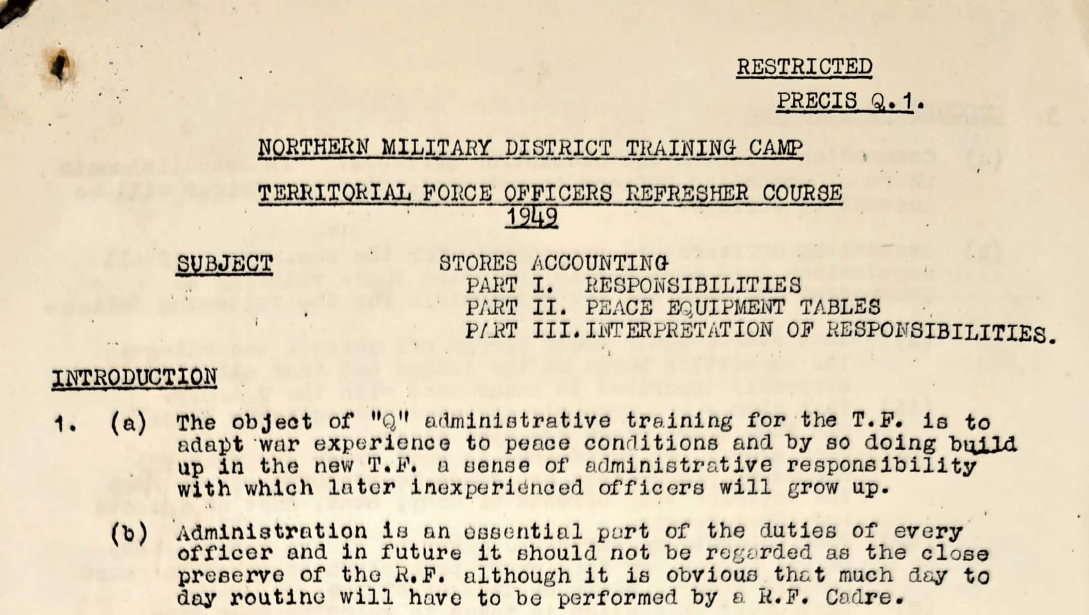
Its value lies precisely in that practicality. The document shows how the New Zealand military expected officers to translate Second World War experience into peacetime routines: responsibility for stores, correct demand procedures, secure storage, ammunition safety, movement planning, and unit messing. Much has changed in the seventy-seven years since it was issued, but its central proposition remains recognisable: logistics is a command responsibility, supported by specialists and made reliable through disciplined systems.
Not a peripheral force
Because the précis was written for Territorial Force officers, it could be dismissed as having limited relevance to the modern Regular Force. That would be a mistake. In 1949, the Territorial Force was intended to form the principal field army on mobilisation; the Regular Force was comparatively small and existed largely as a permanent training and administrative cadre. The competence of Territorial Force officers in stores, movement, ammunition, feeding and field administration was therefore central to the Army’s ability to expand and operate in war.
This gives the document a significance beyond reserve-force routine. It records the practical logistics expectations placed upon the officers who would lead the bulk of New Zealand’s wartime Army. Its insistence that command responsibility could be delegated but not avoided was directed at precisely that challenge: ensuring that a rapidly expanded force would possess officers able to account for, safeguard, maintain and employ its resources effectively.
The organisational setting is different today. The Regular Force now provides the Army’s principal full-time capability, supported by the Reserve Force. Yet the underlying lesson is, if anything, more direct for modern officers. Logistics cannot be left solely to specialists, headquarters staff or digital systems. Commanders at every level must understand the resources their people require, the controls governing them, and the risks created when those controls fail.
A post-war handbook for “Q” administration
The precis opens with a clear purpose. Administrative training was intended to adapt wartime experience to peacetime conditions and develop a sense of administrative responsibility in the new Territorial Force. It insists that administration was an essential part of every officer’s duties, rather than the exclusive preserve of Regular Force staff.¹

The use of the term “Q” reflects the contemporary language of quartermaster administration. In British and Commonwealth armies, “Q” covered the broad field of supply, accommodation, transport, equipment and administrative support. The paper’s intended audience was therefore not simply storemen or clerks. It was unit officers who would command, authorise, supervise and be responsible for the resources placed at their disposal.
This is important. The document does not treat logistics as a separate technical activity occurring somewhere behind the unit. It treats it as an integral part of command.
What the document contains
The 38-page compilation brings together several course précis and specimen forms:
- Precis Q.1: Stores Accounting – responsibilities, Peace Equipment Tables and the interpretation of command responsibility.
- Precis Q.2: Stores Accounting – procurement, financial authorities, storeholding, maintenance, loss and damage.
- Precis Q.2.5: Storage, Care and Handling of Ammunition on Unit Charge.
- Movement in Peace – movement control, rail and road movement, entraining, meals en route and movement reports.
- Precis Q.5: Unit Messing, Duties of Mess Committees and Bivouacs.
- Examples of the forms that made the system work, including indents, issue and receipt vouchers, ration indents, discrepancy reports and workshop repair documentation.²
The compilation is therefore best understood as a compact unit logistics syllabus. It covers the life cycle of resources: forecasting a requirement, demanding it, receiving it, recording it, storing it, maintaining it, moving it, accounting for loss, repairing it and, where necessary, writing it off.
Command responsibility could be delegated, but not avoided
The strongest theme in the first précis is accountability. Commanding Officers were responsible for ensuring that unit stores were maintained, held to authorised scales, correctly accounted for and supervised by properly instructed personnel. Accounting Officers had direct responsibilities for stock accuracy, storage, security, fire precautions, custody of keys, voucher control and the prevention of loss or misuse. Inspecting Officers were required to inspect and audit accounting units at least annually.³
The document accepts that a Territorial Force Commanding Officer could not personally conduct every routine transaction. Authority could be delegated to the Regular Force Adjutant, assisted by the Regimental Quartermaster Sergeant. But it makes the enduring principle explicit: delegation of authority did not absolve the Commanding Officer of general responsibility.⁴
That distinction remains highly relevant. Modern enterprise systems can provide workflow approvals, audit trails, stock visibility and exception reports, but they cannot transfer command accountability to the system itself. A digital transaction may record who approved a demand, issued an item, or confirmed receipt; it does not remove the obligation to ensure the decision was sound, the data accurate, and the equipment ready when needed.
From ledgers and vouchers to digital traceability
The 1949 system was paper-heavy by necessity. It relied upon ledgers, registers, issue vouchers, receipt vouchers, inventories, arms registers, indent registers, land cards and building cards. The process was deliberately redundant: a transaction was recorded, receipted, posted to the ledger and retained in a numbered file.⁵
It would be easy to dismiss this as cumbersome bureaucracy. That would miss the point. Each form performed a control function:
| 1949 control | Modern logistics equivalent |
| Numbered indent | Digital requisition and approval workflow |
| Correct nomenclature and indent details | Master data management and data quality controls |
| Issue and receipt voucher | Goods issue, proof of delivery and confirmation of receipt |
| Ledger card | Digital inventory and asset master record |
| Arms register | Armoury receipt and Issue book |
| Non-conformance / discrepancy process | Non-conformance / discrepancy process |
| Audit stamp and annual inspection | Audit trail, stocktake and governance assurance |
| Repair indent and voucher | Maintenance work order and asset history |
The medium has changed; the information requirement has not. Modern systems should reduce duplicate entry and improve visibility, but they still need an enduring relationship between the demand, authorisation, consignment, receipt, asset or stock record, and any subsequent maintenance or disposal action.
The paper also makes an especially modern point about data quality. It directs that stores be correctly described in accordance with the vocabulary of the day, and that indents contain the correct nomenclature, authority and explanatory remarks.⁶ In current terms, this is master-data discipline. Poor descriptions, incomplete addresses, incorrect units of measure and ambiguous item identities still create delay, rework and weak assurance.
The growth of digital systems has heightened the importance of information quality. Accurate data, standardised records and disciplined information management are now recognised as essential to operational effectiveness. In this respect, the precis’ insistence on correct descriptions, proper documentation and careful record keeping appears remarkably modern.
Forecasting, authorised scales and controlled local purchase
The procurement section defines an indent as a demand for stores, materials or services based on authorised scales or specific authority. It tells officers to appreciate the time factor in forecasting requirements; stores required in May should be demanded in April. Urgent demands were to be accompanied by an explanatory memorandum.⁷
This simple advice remains sound. Readiness is not created by raising an urgent requisition at the point of need. It depends on demand forecasting, realistic lead times, known stock positions and an understanding of what must be prepared before a deployment, exercise or routine activity begins.
The precis also provides for local purchase when the normal Ordnance system could not meet a legitimate requirement. That flexibility was not uncontrolled. It was bounded by delegated financial authority, restricted to immediate needs, required a fair market price and demanded that the purchases be brought to account immediately.⁸
The modern lesson is that agility and governance are not competing ideas. A force needs mechanisms for rapid procurement and operational exception, but these must retain delegated authority, evidence, financial control and subsequent reconciliation.
From unit administration to capability support
A notable difference between the 1949 précis and contemporary logistics practice is the breadth of the modern logistics enterprise. The precis focused primarily on unit administration and immediate equipment holdings. Contemporary logistics extends across the entire life of military capability, encompassing acquisition, sustainment, maintenance, modification and disposal.
What was once largely a unit responsibility is now part of a much wider system of capability management. The fundamental purpose remains unchanged: ensuring that people have the equipment, supplies and support they require to perform their tasks. What has evolved is the scale and complexity of the systems used to achieve that outcome.
Modern logistics also places greater emphasis on integrating support functions. Engineering support, maintenance planning, supply chains, technical information, training, infrastructure and personnel management are increasingly understood as interconnected parts of a single support system. What was implicit in the 1949 logistics syllabus has become a formal discipline concerned with sustaining capability throughout its entire life.
Storeholding: security, orderliness, accessibility and maintenance
One of the most useful parts of the document reduces good storeholding to four headings:
- Security
- Orderliness
- Accessibility
- Maintenance⁹
This is an admirably concise statement of warehouse management. The document then expands it into practical measures: protection from damp, dust, heat and pests; restricted access; controlled keys; fire precautions; stock arranged so items could be seen and checked; frequently demanded items placed in accessible locations; and regular maintenance of equipment not in constant use.¹⁰
These are not obsolete principles. Modern facilities may use barcode scanning, automated storage systems, environmental monitoring and electronic access control, but their purpose is still to achieve the same outcomes: preserve material condition, enable safe and rapid issue, prevent unauthorised access and maintain reliable inventory records.
The warning about equipment not in routine use is particularly relevant to reserve holdings and contingency stocks. Vehicles, generators, communications equipment and other technical systems cannot be assumed to be ready merely because they remain on a register. They require scheduled inspection, preservation, maintenance and functional testing.
Modern logistics also places greater emphasis on standardisation and interoperability. Equipment, supply systems and information are increasingly managed within common frameworks that allow organisations to share data, exchange support and operate together more effectively. The requirement remains the same as in 1949: accurate identification of items, consistent records, and clear accountability for resources.
Ammunition: classification, segregation and specialist advice
The ammunition precis reminds us that ammunition logistics has always been distinct from ordinary storekeeping. It emphasises storage classification, segregation, package condition, safe stacking, ventilation, temperature, handling, safety distances and explosive limits. It also directs that leaking, dropped, wet or damaged packages be set aside for action by an Inspector of Ordnance.¹¹

The particular classifications and regulations in the 1949 paper have long been superseded. It must not be used as contemporary ammunition policy or technical direction. Its continuing relevance lies in its approach:
- ammunition requires specialised controls;
- storage and transport risk depend on the nature and quantity of the explosive;
- packaging, environmental conditions and physical handling matter;
- unit personnel must recognise when an issue exceeds their authority or competence; and
- specialist technical advice must be sought early.
For a modern force introducing new munitions, loitering munitions, energetic components, counter-uncrewed-aircraft systems or novel battery and propulsion technologies, the same discipline applies. New natures cannot simply be treated as another line item in a warehouse. Their hazard classification, compatibility, storage capacity, transport arrangements, inspection regime, maintenance responsibility and disposal route must be understood before routine issue.
Movement and feeding are logistics, not administrative afterthoughts
The movement precis begins with a statement that remains apt: many details of staff work result in the movement of personnel or stores, and all officers should understand movement control and provide early, adequate warning of requirements.¹²
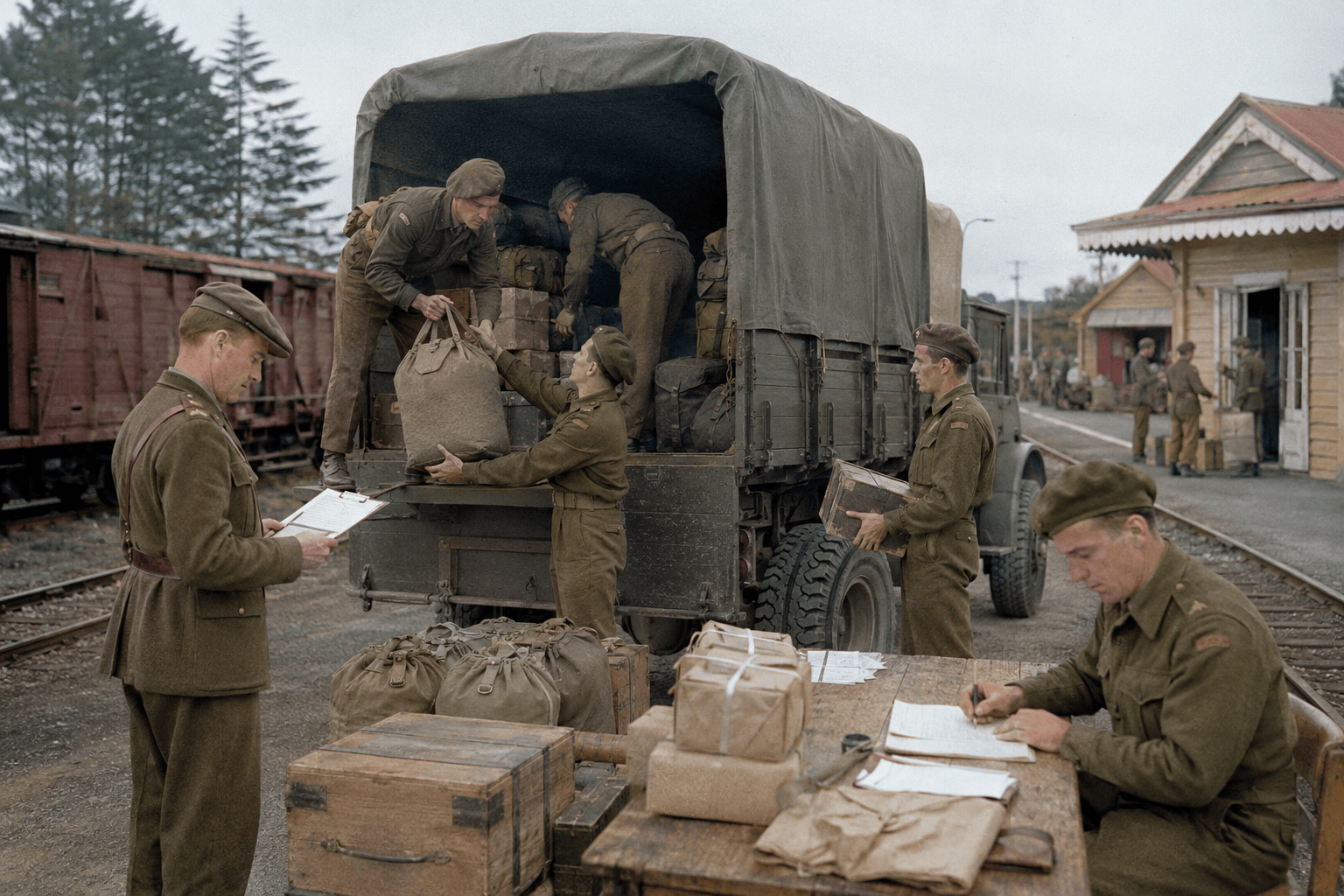
Its immediate context was rail movement. It discusses movement control, warrants, entraining, baggage, discipline en route, meals, detraining and a formal train report. Yet the core lesson applies equally to contemporary road, air and sea movements. A movement requires early notification, a named organiser, confirmed timings, an accurate manifest, suitable loading arrangements, welfare planning and reporting.
The inclusion of unit messing and bivouacs makes the same point from another direction. Feeding troops, providing water, siting a camp, arranging drainage and sanitation, and managing daily ration demands were treated as part of unit readiness.¹³ Sustainment was not an activity that began after the tactical plan was complete; it was one of the conditions that made the plan feasible.
A human lesson at the end
The first précis closes with a small but revealing section on personal contact. It says that good administration was impossible without contact with the organisations supplying the unit, and offers four “B’s”: be friendly, helpful and affable; do not be unapproachable.¹⁴
This is more than period advice on manners. Logistics is a network of relationships: users, unit headquarters, warehouses, transport providers, maintainers, finance staff, dangerous-goods specialists, contractors and supporting headquarters. Systems matter, but so do the people who identify a problem, clarify a requirement, correct poor data or make an urgent movement work.
Conclusion
The 1949 Logistic Precis is a product of its time. Its language, forms, organisations and regulations belong to the immediate post-war Territorial Force. Its procedures have been overtaken by successive policy, safety, financial and information-system reforms.
But its underlying philosophy is not outdated. It presents logistics as a command function founded on accountability, accurate records, disciplined forecasting, proper custody, maintenance, specialist advice and constructive relationships. Modern logistics systems should not be judged simply by whether they replace paper forms. They should be judged by whether they strengthen those enduring outcomes.
The most significant change since 1949 is not the replacement of ledgers with computers, but the expansion of logistics into a comprehensive discipline that supports military capability throughout its entire life. Yet the underlying principles described in the précis remain familiar. Successful logistics still depends upon accountability, planning, stewardship, accurate information, technical competence and professional relationships. The methods have evolved; the fundamentals endure.
The document’s central message is still worth repeating: readiness is built in peacetime, through the daily care, accounting, preparation and movement of the resources a unit will need when it matters.
Notes
1. Precis Q.1, Stores Accounting, Northern Military District Training Camp, Territorial Force Officers Refresher Course, 1949, pp. 1-2, “1949 Logistic Precis,” private collection.
2. “1949 Logistic Precis,” pp. 1-38.
3. Precis Q.1, pp. 1-4.
4. Precis Q.1, pp. 5-6.
5. Precis Q.1, p. 4; Precis Q.2, Stores Accounting, pp. 1-5.
6. Precis Q.1, p. 2; Precis Q.2, pp. 1-3.
7. Precis Q.2, p. 1.
8. Precis Q.2, pp. 3-5.
9. Precis Q.2, p. 7.
10. Precis Q.2, pp. 7-8.
11. Precis Q.2.5, Storage, Care and Handling of Ammunition on Unit Charge, pp. 1-6.
12. Movement in Peace, p. 1.
13. Precis Q.5, Unit Messing, Duties of Mess Committees and Bivouacs, pp. 1-2.
14. Precis Q.1, p. 6.
