The New Zealand Ordnance Corps, in its 80-year history, established and maintained Ordnance Depots in many unique locations. The Base Ordnance Depot in Trentham became acknowledged as the home of the Corps; the New Zealand Advanced Ordnance Depot in Singapore was the most exotic, and all Corps members have fond memories of the depots in Hopuhopu, Waiouru, Linton and Burnham. This article will examine one of the least known of New Zealand’s Ordnance Depots, the First World War Farringdon Road Depot.
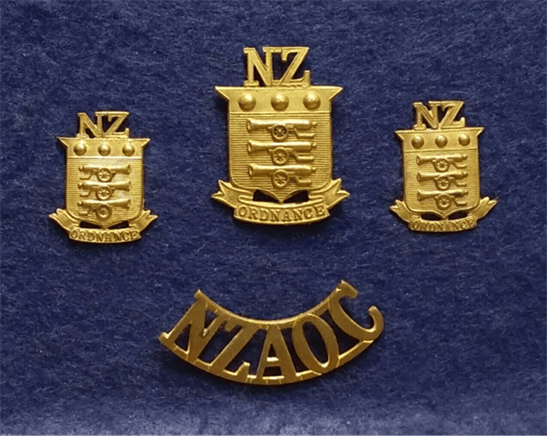
The NZEF of the 1914-1919 war was organised and equipped in such a way so that when mobilised it could comfortably fit into the British Imperial Army alongside British, Australian, Canadian and other troops from throughout the British Empire. In the early days of the war Ordnance support was provided by British AOC[1] Divisional/Corps depots, and although satisfactory the need for the NZEF to have an internal Ordnance organisation to cater for New Zealand specific items was recognised. Subsequently, regulations formally announcing the establishment of the NZAOC[2], as a unit of NZEF[3] were published in February 1916[4]. Moving with the NZEF to Europe the NZAOC consisted of three distinct elements;
NZAOC Administrative staff based at the NZEF headquarters at Bloomsbury Square, London consisting of
the NZEF Assistant ADOS[5], who was also the Officer Commanding NZEF Ordnance Corps.
Chief Ordnance Officer for the NZEF in the United Kingdom.
A staff of clerks, storekeepers and
The New Zealand Division DADOS[6] and Staff, including personnel attached to Brigades.
NZAOC Staff of the ANZAC Mounted Brigade in Palestine.
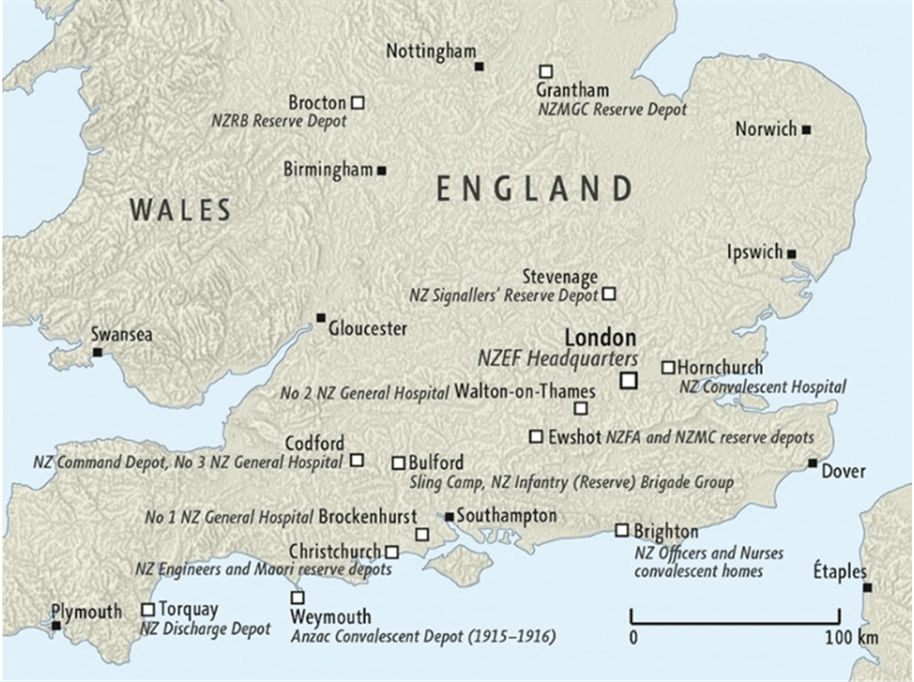
As the NZEF NZAOC staff in the United Kingdom became established, taking under its wing support responsibility for the numerous New Zealand Camps, Hospitals and convalescent facilities dispersed throughout the United Kingdom. To centralise and manage Ordnance support it became necessary to establish a New Zealand Ordnance Depot to support all New Zealand units based in the United Kingdom.
What was required was a depot in a central location, near the NZEF Headquarters and with road and railway access to the New Zealand Camps and establishments and the ability to quickly link into the AOC logistic infrastructure and RAOC depots such as;
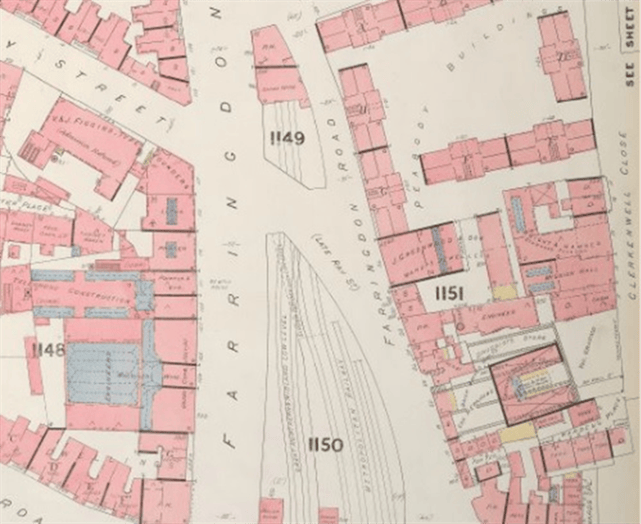
On the 25th of October 1916, the Officer Commanding, London District Authorised the NZEF, under the Defence of the Realm Act to take over the premises of Mr H Fisher and Mr J Fisher at 30 and 32 Farringdon Road[7] as an Ordnance Store. Located 1.5km from the NZEF Headquarters, the NZ Ordnance Depot was well situated on one of the leading north/south roads through London, with easy access to other arterial routes. Adjacent to the Metropolitan Railway, the Ordnance depot had easy access to Farringdon Passenger station and the Metropolitan Railway Goods Station[8]. The intent was to occupy the building from the 7th of November 1916. Still, due to issues securing the key and having the utilities such as water and electricity connected, the final occupation did not occur until the 27th of November. Records indicate the Depot started operations on the 1st of December 1916.
NOTE: Originally numbered as part of Farringdon Road, Nos 30 and 32 were renamed as 30 Farringdon Lane in 1979.
Overall command of the Depot rested with the Chief Ordnance Officer for the NZEF in the United Kingdom, Captain (later Major) Norman Levien. The Officer in charge of the Depot for most of its existence was Warrant Officer Class One (Conductor), Arthur Gilmore [9]. Posted to the Depot in November 1916, and apart from a six-month secondment to the Ordnance Depot at Sling Camp and three months of sick leave due to Influenza, Gilmore remained at the Depot until its closure in late1919[10]. Conductor Gilmore was promoted to Second Lieutenant on the 1st of February 1919.
The bulk of the stocks held by the Depot consisted of clothing and necessaries of all descriptions. Clothing was a mixture of;
New items purchased from the RACD [11] at Pimlico,
New items purchased for civilian manufacturers, often at a cheaper rate than from the RACD; in the year up to December 1917, total savings of £31532.7.10(approximately 2018 NZD$3,763,454.27) were made by establishing contracts for clothing with civilian suppliers rather than purchasing from the RACD.
Cleaned and repaired items from Salvage stocks,
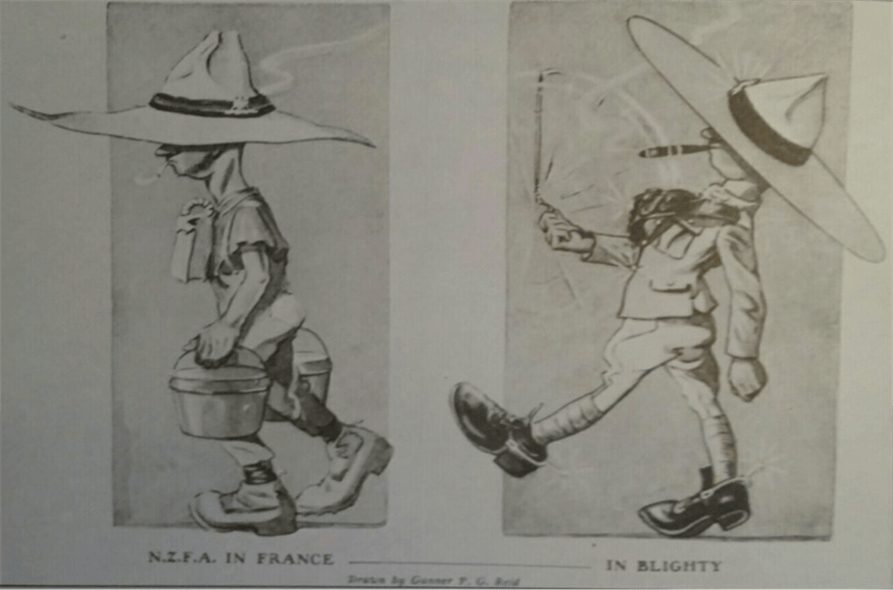
As members of the New Zealand Division started leave rotations to the United Kingdom from the front lines in Belgium and France, the condition of their clothing was found to be unsatisfactory. Under the instructions of the NZ General Officer Commanding, further accommodation for the Depot was secured for the reception of troops from the front on leave. This facility allowed troops as they arrived from the front, to rid themselves of their dirty, often vermin-infested uniforms, have a hot bath and receive a fresh issue of underwear and uniforms. As troops arrived on leave with their spare kit, ammunition, arms and equipment, A secure kit store was available for the holding of these items. As this reception store was developed, the New Zealand Soldiers Club and the New Zealand War Contingent Association set up facilities to provide hot drinks and the option to receive instruction on the use of prophylactic outfits[12].
The following items are an example of the types and quantities of the stores received by the Farringdon Road Depot over the Period 1 December 1916 to 1 August 1919;
With the Armistice in November 1918, the activities of the Depot started to wind down. Undergoing a full audit in July 1919, outstanding orders cancelled, stocks either returned to New Zealand, returned to RAOC Depots for credits, sold or destroyed with the Depot closed by November 1919 ending an early chapter of the New Zealand Ordnance story.
[7] Now Farrington Lane “Insurance Plan of London Vol. Vi: Sheet 128,” ed. British Library (Chas E Goad Limited, 1886).
[8] “Farringdon Road,” in Survey of London: Volume 46, South and East Clerkenwell, Ed. Philip Temple (London: London County Council, 2008), 358-384. British History Online, Accessed April 25, 2018, Http://Www.British-History.Ac.Uk/Survey-London/Vol46/Pp358-384..”
[9] “Personnel Records “Arthur Gilmore”,” (Wellington: Archives New Zealand, Archive Reference AABK 18805 W5568 0135616).
[10] Arthur Gilmore, “Audit Farringdon Road Ordnance Stores for Period Ended 17 July 1919,” (Wellington: Archives New Zealand Record Group WA1 Record No 2/13, 1919).
[11] The Royal Army Clothing Depot, Pimlico, was the main supplier of Uniforms for the British Army from 1855 until 1932.
[12] Captain Norman Levien, “Report of Ordnance Officer on Administration of Ordnance Department for 1917,” (Wellington: Archives New Zealand Record Group WA1 Record No 2/13, 1918).
The core responsibility of the Royal New Zealand Army Ordnance Corps and its predecessors was the supply and maintenance of arms, ammunition, accoutrements, clothing, and field equipment to New Zealand’s Military Forces. From 1840 the principal posts of the RNZAOC and its predecessors were.
Colony of New South Wales, Colonial Storekeeper for New Zealand
Mr C.H.G Logie 15 Jan 1840 – 1 Oct 1840
Colony of New Zealand, Colonial Storekeeper
Mr H Tucker 1 Oct 1840 – 30 Dec 1843
From 1844 the needs of the Militia were facilitated on an ad-hoc basis by the Colonial Secretary based upon requests from provincial magistrates.
Colonial Secretaries of New Zealand (30 Dec 1843 to 28 May 1858)
Willoughby Shortland 3 May 1841 – 31 Dec 1943
Andrew Sinclair 6 Jan 1844 – 7 May 1856
Henry Sewell 7 May 1856 – 20 May 1856
John Hall 20 May 1856 – 2 Jun 1856
William Richmond 2 Jun 1856 – 4 Nov 1856
Edward Stafford 4 Nov 1856 – 12 Jul 1861
Supporting the Imperial Forces in New Zealand since 1840, the Board of Ordnance had established offices in Auckland during 1842, ensuring the provision of Imperial military units in New Zealand with munitions, uniforms and necessities. The Board of Ordnance was reorganised on 1 February 1857 into a new organisation called the Military Store Department. Headquartered at Fort Britomart in Auckland, the Military Store Department principal role alongside the commissariat was to support the Imperial Garrison; however, it would support colonial forces on a cost-recovery basis when necessary. With the departure of the British Military Storekeeper Joseph Osbertus Hamley in July 1870, the withdrawal of Imperial Forces was completed.
Board of Ordnance, Military Storekeeper
Deputy Ordnance Storekeeper W Plummer 1842 – 1 February 1857
Military Store Department
Deputy Superintendent of Stores W. Plummer 1 February 1857 – 4 March 1879(Deceased in office)
Deputy Superintendent of Stores J.O Hamley 4 March 1858 – 30 July 1870
The passing of the Militia Act of 1858 saw the Militia reorganised, and Volunteer units were authorised to be raised. The Deputy Adjutant General of Militia and Volunteers oversaw the administration, including the supply and distribution of arms, ammunition, accoutrements, clothing, and field equipment to the Militia and Volunteers.
Deputy Adjutant General of Militia and Volunteers
Capt H.C Balneavis 28 May 1858 – 18 Sep 1862
On 18 September 1862, the Colonial Defence Act was passed, establishing the first regular military units in New Zealand. Under the Quartermaster General of the Colonial Defence Force, Captain Robert Collins, the Colonial Store Department under the Colonial Storekeeper, and the Militia Store Department under the Superintended of Militia Stores maintained a separation between the Militia/Volunteers and Regulars absorbing the rudimentary stores’ organisation of the Deputy Adjutant General of Militia and Volunteers. The two departments would be amalgamated into the Colonial Store Department in 1865.
Militia Store Department
Superintendent of Militia Stores, Capt E.D King 18 September 1862 – 30 October 1865
Colonial Store Department
Colonial Storekeeper Capt J Mitchell 18 September 1862- 1 April 1869
The Armed Constabulary Act was passed in 1867, which combined New Zealand’s police and military functions into a regular Armed Constabulary (AC) Force, supported by loyal natives, Militia and Volunteer units. The Inspector of Defence store appointment was created in 1869 to manage all New Zealand’s Defence Stores as the single New Zealand Defence Stores organisation.
Inspector of Defence Stores (Defence Stores)
Lt Col E Gorton 1 Apr 1869 – 9 Jan 1877
Lieutenant Colonel Edward Gorton
Defence Storekeeper (Defence Stores)
Capt S.C Anderson 9 Jan 1877 – 7 Dec 1899 (Deceased in office)
During the 1880s, New Zealand undertook a rearmament and fortification program that was also a technological leap forward in terms of capability. The Defence Stores armourers and Arms Cleaners had maintained the colony’s weapons since 1861. However, the new equipment included machinery that functioned through pneumatics, electricity and steam power, requiring a skilled workforce to repair and maintain, resulting in a division of responsibility between the Defence Stores and Permanent Militia. The Defence Stores would retain its core supply functions with its armourers remaining responsible for repairing Small Arms. With some civilian capacity available, the bulk of the repairs and maintenance of the new equipment would be carried out by uniformed artificers and tradespeople recruited into the Permanent Militia.
From October 1888, the Staff Officer of Artillery and Inspector of Ordnance, Stores and Equipment would be responsible for all Artillery related equipment, with the Defence Storekeeper responsible for all other Stores. However, during the late 1890s, the Defence Storekeeper would assume responsibility for some of the Artillery related stores and equipment of the Permanent Militia.
Inspector of Stores and Equipment
Maj A.P Douglas 24 Aug 1887 – 23 Jan 1891
In 1907 a significant command reorganisation of the Defence Forces defined the responsibilities of the Director of Artillery Services (Ordnance) and Director of Stores.
Director of Artillery Services (Ordnance): Responsible for:
Artillery armament,
Fixed coast defences,
Artillery ammunition, and
Supplies for ordnance.
Director of Stores: Responsible for:
Clothing and personal equipment,
Accoutrements,
Saddlery,
Harness,
Small-Arms,
Machine Guns,
Small-arms and Machine gun ammunition,
Material,
Transport,
Vehicles,
Camp Equipment,
All other stores required for the Defence Forces.
Director of Military Stores (Defence Stores)
Capt J O’Sullivan 1 Jan 1907 – 30 Mar 1911
Director of Ordnance and Artillery
Maj G.N Johnston 28 Feb 1907 – 31 May 1907
Capt G.S Richardson 31 May 1907 – 31 Jul 1908
Director of Artillery
Maj J.E Hume 31Jul 1908 – 31 Mar 1911
In 1911, provisional regulations were promogulated further detailing the division of responsibilities between the Quartermaster Generals Branch (to whom the Defence Stores was subordinate) and the Director of Ordnance and Artillery. Based on these new regulations, the Director of Artillery (Ordnance) assumed overall responsibility for managing Artillery stores and ammunition on 2 August 1911.
Director of Equipment and Stores (Defence Stores)
Maj J O’Sullivan 30 Mar 1911 – 10 Apr 1916
Director of Ordnance and Artillery
Maj G.N Johnston 11 May 1911- 8 Aug 1914
The Royal NZ Artillery established an Ordnance Section in 1915 to maintain and manufacture artillery ammunition. The section immediately transferred to the NZAOC in 1917, with the RNZA maintaining technical control. By 1929, most artificers and tradespeople had been transferred from the RNZA into the NZAOC. The final RNZA store’s function would be transferred to the NZAOC in 1946 when the RNZA Ammunition and Equipment Section based in Army Headquarters handed over responsibility for artillery ammunition, explosives, coast artillery and specialist equipment and stores, including some staffing to the NZAOC.
The Defence Stores would remain as New Zealand’s military storekeepers until 1 February 1917, when the New Zealand Army Ordnance Department (NZAOD) and the New Zealand Army Ordnance Corps (NZAOC) were established as part of the Permanent Staff of the Defence Forces of New Zealand, assuming the responsibilities Defence Stores.
The NZAOD would be reconstituted into the NZAOC on 27 June 1924.
Director of Equipment and Ordnance Stores (Defence Stores & NZAOC)
Maj T McCristell 10 Apr 1916 – 30 Jan 1920
Major Thomas James McCristell, Director of Equipment and Ordnance Stores, 10 April 1916 – 20 January 1920.
Director of Ordnance Stores (NZAOC)
Lt Col H.E Pilkington 30 Jan 1920 – 1 Oct 1924
Lt Col H.E Pilkington, CBE. Director of Ordnance Services, 30 Jan 1920 – 1 Oct 1924
Lt Col T.J King 1 Oct 1924 – 6 Jan 1940
Brigadier T J King, CBE, RNZAOC Regimental Colonel 1 Jan 1949 – 31 Mar 1961. RNZAOC School
Lt Col W.R Burge 6 Jan 1940 – 22 June 1940
Chief Ordnance Officer (NZAOC)
Maj H.E Erridge 22 Jun 1940 – 3 Aug 1941
Major H.E Erridge
Lt Col E.L.G Bown 5 Aug 1941 – 1 Oct 1947
In the Post-war era, the NZAOC would be granted Royal status on 12 July 1947, becoming the Royal New Zealand Army Ordnance Corps (RNZAOC). For the next forty-five years, the Director of Ordnance Services (DOS) would be responsible for the personnel, equipment and training of the RNZAOC.
Director of Ordnance Services (RNZAOC)
Lt Col A.H Andrews 1 Oct 1947 – 11 Nov 1949
Lt Col A.H Andrews. OBE, RNZAOC Director of Ordnance Services, 1 Oct 1947 – 11 Nov 1949.
Lt Col F Reid 12 Nov 1949 – 31 Mar 1957
Lt Col F Reid, OBE. Director of Ordnance Services 12 Nov 1949 – 31 Mar 1957
Lt Col H Mck Reid 1 Apr 1958 – 11 Nov 1960
Lt Col H McK Reid, Director of Ordnance Services , 1 Apr 1957 – 11 Nov 1960
Lt Col E Whiteacre 12 Nov 1960 – 24 May 1967
Lt Col E Whiteacre, OBE, 12 Nov 1960 – 23 May 1967
Lt Col J Harvey 24 May 1967 – 28 Aug 1968
Lt COl J Harvey, Director of Ordnance Services, 24 May 1967 – 28 Aug 1968.
Lt Col G.J.H Atkinson 29 Aug 1968 – 20 Oct 1972
Lt Col G.J.H Atkinson, Director of Ordnance Services. 29Aug 1968 – 20 Oct 1972.
Lt Col M.J Ross 21 Oct 1972 – 6 Dec 1976
Lt Col M.J Ross, Director of Ordnance Services, 21 Oct 1972 – 6 Dec 1976.
Lt Col A.J Campbell 7 Dec 1976 – 9 Apr 1979
Lt Col A.J Campbell, Director of Ordnance Services, 7 Dec 1976 – 9 Apr 1979.
Lt Col P.M Reid 10 Apr 1979 – 25 Jul 1983
Lt Col P.M Reid, Director of Ordnance Services, 10 Apr 1979 – 25 Jul 1983.
Lt Col T.D McBeth 26 Jul 1983 – 31 Jan 1986
Lt Col T.D McBeth, Director of Ordnance Services , 26 July 1983 – 31 Jan 1986.
Lt Col G.M Corkin 1 Feb 1986 – 1 Dec 1986
Lt Col G.M Corkin, Director of Ordnance Services, 1 Feb 1986 – 1 Dec 1986.
Lt Col J.F Hyde 2 Dec 1986 – 31 Oct 1987
Lt Col J.F Hyde, Director of Ordnance Services, 2 Dec 1986 – 31 Oct 1987.
Lt Col E.W.G Thomson 31 Oct 1987 – 11 Jan 1990
Lt Col W.B Squires 12 Jan 1990 – 15 Dec 1992
During the early 1990s, the New Zealand Army underwent several “rebalancing” activities, which saw the formation of regional Logistic Battalions and included the demise of the individual Corps Directorates.
Filling the void left by the demise of the Corps Directorates, the post of Regimental Colonel was approved on 12 December 1992. The role of the Regimental Colonel of the RNZAOC was to.
Provide specialist advice when called for
Maintain an overview of Corps personnel matters, and
Provide a link between the Colonel Commandant of the RNZAOC and the Corps and support the Colonel Commandant.
Regimental Colonel (RNZAOC)
Col T.D McBeth 15 Dec 1992 – 19 Sept 1994
Col L Gardiner 19 Sept 1994 – 9 Dec 1996
On 9 December 1996, the RNZAOC was amalgamated into the Royal New Zealand Army Logistic Regiment (RNZALR).
New Zealand Ordnance Corps during wartime
During the Frist World War, a New Zealand Army Ordnance Corps was established as a unit of the 1st New Zealand Expeditionary Force (NZEF)
Officer Commanding NZEF NZAOC
Capt W.T Beck, 3 Dec 1914 – 31 Jan 1916
William Thomas Beck Circa 1921
Lt Col A.H Herbert, 1 Feb 1916 – 31 Mar 1918
Lieutenant-Colonel Alfred Henry Herbert, NZAOC. aucklandmuseum/Public Domain
Lt Col H.E Pilkington, RNZA 30 Jun 1918- 22 Jan 20
Temp Capt W.H Simmons, 20 Feb 20 – 13 Oct 1920
During the Second World War, all the Ordnance functions of the 2nd NZEF were organised as the New Zealand Ordnance Corps (NZOC).
Officer Commanding 2nd NZEF NZOC in the Middle East and Europe
New Zealand’s first experience of Salvage units was during the 1914-18 war. Each British formation (including Dominion forces) was required as part of an army salvage plan to appoint a Salvage Officer for each brigade, and a Division Salvage Company, which in turn was supported a Corps Salvage Company.
Shortly after arriving in France, Lieutenant Colonel Herbert the DADOS of the New Zealand Division was directed to provide one officer, one sergeant and two corporals for the Divisional Salvage Company, with the OC of the Pioneer Battalion providing four Lance Corporals and 24 Other ranks.
Formed on 5 May 1916 the NZ Divisional Salvage Company was under the command of Lieutenant Macrae, NZAOC. The duties of the NZ Divisional Salvage Company were:
“The care and custody of packs of troops engaged in offensive operations; The care of tents and canvas of the Division; The salvage of Government property, and also enemy property, wherever found; The sorting of the stuff salved, and dispatch thereof to base.”
Headquarters New Zealand and Australian Division, “New Zealand Division – Administration – War Diary, 1 May – 26 May 1916,” Archives New Zealand Item No R23487546 (1916)
Although initially reporting to the Corps Salvage Officer, entries in the DADOS war diaries indicate that the Divisional Salvage Company was an integral part of the DADOS responsibilities. During April 1918 the NZ Div Salvage Company recovered the following items.
One Bristol Airplane
One Triumph Norton Motorcycle
Three Douglas Motorcycles
285 Rifles
10 Bayonets and scabbards
25 Steel Helmets
Four Pistol Signal
Three Mountings MG
62 Belts MG
32 Belt boxes MG
95 Gas respirators
“Deputy Assistant Director of Ordnance Services (DADOS) – War Diary, 1 April – 30 April 1918.” 1918. Archives New Zealand Item No R23487665.
This talk examines the work of the British salvage system from its small beginnings at the battalion level to the creation of a giant corporation controlled by GHQ. It deals with salvage during hostilities and the colossal often forgotten task of the clean-up afterwards.
In British and Commonwealth military doctrine, there has long been a separation of responsibility for Supplies and Stores.
Supplies – The provisioning, storing, and distributing of food for soldiers; forage for animals; Fuel, Oil, and Lubricants (FOL) for Tanks, Trucks, and other fuel-powered vehicles and equipment; and the forward transport and distribution of ammunition. In the NZ Army, Supplies were managed by the New Zealand Army Service Corps (NZASC) from 1911 to 16 October 19789.
Stores – The provisioning, storage, and distribution of weapons, munitions, and military equipment are not managed by RNZASC. Stores were the Responsibility of the Royal New Zealand Army Ordnance Corps (RNZAOC) until 1996.
Despite the separation of responsibilities, the RNZASC and RNZAOC would have a long and cooperative relationship for most of their existence.
During the early colonial days, the early actions of the New Zealand Wars proved that the New Zealand bush and the elusive tactics of the Maori presented new problems in supply and transport. An Imperial Supply and Transport Service was established and operated with the Imperial troops.
From the end of the New Zealand Wars until 1910, there was no ASC unit in New Zealand, with the supply functions required by the New Zealand Military provided by the Defence Stores Department.
After the conclusion of the South African War, the Military Forces in New Zealand embarked on a series of reforms to enhance the organisation and capability of the nation’s military, enabling it to contribute effectively to a broader Imperial Defence scheme. In 1910, at the request of the New Zealand Government, Field Marshal Viscount Kitchener inspected New Zealand’s Forces. Kitchener provided several recommendations concerning the ongoing reforms, emphasising the need for a professional Staff Corps to administer the force and confirming the requirement for a New Zealand ASC, which was gazetted on 12 May 1910 (backdated to 6 May 1910) as a designated component of the Territorial Forces of New Zealand.
The momentum for these reforms gained further impetus with the appointment of Major General Alexander Godley as the New Zealand Military Forces Commandant in December 1910. Godley was pivotal in revitalising New Zealand’s military organisational framework in his first year, making critical command and staff appointments, promulgating the (Provisional) Regulations for the Military Forces of New Zealand, and making plans to build up the NZASC, which up to this time had remained a paper corps.
Acknowledging the highly specialised nature of ASC duties, distinct from combatant staff and regimental officers, and the absence of suitably qualified officers in New Zealand, Godley recommended to the Minister of Defence on 4 January 1911 the lending of services of an experienced Imperial ASC Senior Captain or Major to organise and train New Zealand’s transport and supply services for three years. The Minister of Defence endorsed this recommendation with the Prime Minister cabling the New Zealand High Commissioner in London on 10 January 1910 to approach the Army Council for the following:
Services of experienced Army Service Corps major or senior captain required to organise New Zealand Army Service Corps. Engagement for three years. Salary £600 a year consolidated. Pay to include house allowance. Travelling allowance of 12/6d a day and allowance for one horse if kept, will also be granted.
Within two months of receiving New Zealand’s request for an ASC Officer, the Army Council promptly and affirmatively responded to the call. Having already sanctioned nine additional officers to assist Godley, the Council selected Knox, who then served in C (Depot) Company ASC at Aldershot for service in New Zealand to organise the NZASC.
Under the guidance of New Zealand Adjutant and Quartermaster-General Colonel Alfred Robin, Knox assumed his duties as the New Zealand DST at the Army General Staff Offices on Wellington’s Buckle Street. His responsibilities encompassed a wide range of functions, including quarters, tender and contracts, personal and freight movement, and presidency on two standing committees related to Drill sheds and the storage and distribution of clothing and equipment to the forces.
Recognising Knox’s extensive duties, he was granted the Temporary Rank of Lieutenant Colonel on 6 September 1911. With Colonel Robin’s appointment as the New Zealand representative at the War Office in London in 1912, Knox assumed the additional role of Quartermaster General (QMG). Despite Knox diligently fulfilling the role of QMG and DST, progress on the formation of the NZASC was slow.
By 1914, Knox had established 16 NZASC companies of approximately 30 men each across the four New Zealand Military Districts, with imported ASC officers serving as Assistant Directors of Supply and Transport (ADST) in each District Headquarters. Although Knox had departed by the time of the 1914 divisional camps, the Inspector General of Imperial Forces, General Sir Ian Hamilton, noted following his inspection that:
The very highest credit is due to the Army Service Corps officers and their men. They have done a first-class service, although as a rule undermanned to an extent that would fill a labour union with horror. When the Army Service Corps units are up to their normal strengths, a suitable system of calling the men up to camp in relays will enable the necessary duties to be carried out as efficiently and with much less strain on the personnel.
During World War One, New Zealand ASC units fulfilled crucial functions. ASC Companies supported the Territorial Infantry and Mounted Rifle Brigades. At the same time, Supply and Transport Units aided mobilisation camps within New Zealand. Overseas, the NZASC operated across all New Zealand theatres of war, delivering indispensable services. At its zenith, it managed the NZ Divisional Train, five ASC Companies, five Depot Units of Supply, the NZ Field Bakery, the NZ Field Butchery, and the NZ Motor Transport Workshop. Notably, the NZASC and NZAOC frequently shared personnel, facilities, and transportation, especially in the conflict’s early years.
In 1917 the NZAOC was established as a permanent component of the New Zealand Military Forces, however, it would not be until 1924 that the Permanent NZASC was formed.
Post-war, under the leadership of Captain Stanley Herbert Crump, the NZASC transitioned to a peacetime establishment comprising a Headquarters and three depots (Northern, Central, and Southern). In 1924, the Permanent NZASC (PNZASC) was established as part of the permanent Military Forces. Additionally, in 1925, an alliance between the NZASC and the Royal Army Service Corps (RASC) was ratified.
The RASC has its roots in history that are much more profound. Up to the time of Cromwell, armies mainly lived by plunder. The RASC came into being in 1888. but the work it now performs was being done long before that.
Cromwell and then the Duke of Marlborough, and later Napoleon, organised a system of civilian commissaries. The Duke of York established the Corps of Royal Waggoners in 1794. This purely transport organisation continued until 1869 under various names, eventually as the Military Train, fighting as light cavalry in the Indian Mutiny.
The birth of the Supplies and Transport Service dates from 1869. when supplies and transport, along with the Military Stores Department, came under one department called the Control Department, it remained for General Sir Redvers Buller in 1888 to organise the first Army Service Corps. Since its formation, the RASC has been a combatant one. Trained and armed as infantry and responsible for its own protection. Considerd a more technical Corps, the RAOC was not granted combatant status until 1942.
In 1931, under Crump’s continued leadership, the NZASC underwent a reorganisation into three Composite Companies. Each company comprised seven officers, four warrant officers, and 99 other ranks, establishing a solid foundation from which the NZASC could readily expand to meet the demands of future conflicts.
During World War Two, numerous units and establishments represented the NZASC across all New Zealand Expeditionary Force (NZEF) theatres. Similar to the previous World War, the NZASC maintained a collaborative relationship with New Zealand Ordnance Corps (NZOC) Ammunition Examiners (AEs) in the establishment of NZASC Ammunition platoons. At times, NZASC Warrant Officers were attached to the NZ Divisional Ordnance Field Park (OFP) to offer technical advice on vehicle spares. In recognition of the NZASC’s service during WW2, the title “Royal New Zealand Army Service Corps” was conferred in 1946.
In the post-war era, the NZASC and from 1946, the RNZASC would serve with distinction J Force in Japan and then contribute the second-largest New Zealand contingent to K Force in Korea by providing 10 Transport Company. Playing a pivotal role in sustaining the morale and effectiveness of New Zealand forces during these conflicts
Until 1947, NZASC units primarily handled baking bread, butchering meat, and procuring and distributing fresh and packaged provisions to frontline units, while regimental cooks and stewards were responsible for cooking and serving meals. To enhance and standardise cooking practices throughout the army, the Supplies and Transport Catering Group (STCG) was established on 15 February 1948 with the following objectives:
Training and provision of unit cooks and kitchen hands.
Instruction and supervision of the management of the Army ration scale.
Improvement of food preparation and cooking standards.
Advice on the installation and operation of cooking appliances and kitchen equipment.
Guidance on the layout of mess buildings.
In September 1948, all Regimental catering staff, except those of the New Zealand Women’s Army Corps, were transferred into the RNZASC. Throughout the 1950s, 60s, and 70s, the RNZASC played a vital role within the New Zealand Army, encompassing a wide range of functions. These included everyday tasks such as cooking and serving food, as well as more complex operations like air supply drops. To manage the procurement, storage, transportation, and distribution of essential supplies such as food, fuels, and oils for a modern Army, the RNZASC operated Supply Depots and employed various tradespeople, including butchers. Supply Depots were strategically located in Papakura, Waiouru, Linton, Trentham, and Burnham, where bulk supplies were stored and distributed as needed. Additionally, every Army camp featured a section of the RNZASC, along with smaller supply and transport depots, which were responsible for handling goods from central supply depots and providing drivers and transport services for various purposes. These smaller depots were situated in Devonport/Fort Caultley,
Following the Macleod report that recommended the streamlining of logistic support for the British Army, the RASC merged in 1965 with the Royal Engineers’ Transportation and Movement Control Service to form the Royal Corps of Transport (RCT). This would see the RASC Supply functions transferred to the Royal Army Ordnance Corps (RAOC). In 1973, following the British lead, the Australians also reformed their Royal Australian Army Service Corps (RAASC) into the Royal Australian Army Corps of Transport (RAACT).
Acknowledging the British and Australian experience, the RNZASC underwent a similar transition—operational command of the Supply function transferred to the RNZAOC on 16 October 1978. On 12 May 1979, the RNZASC ceased to exist: Supply personnel formally transferred to the RNZAOC, while Transport, Movements, and Catering were re-formed as the Royal New Zealand Corps of Transport (RNZCT)..
The RNZASC supply function would be integrated into the RNZAOC, with the Camp Supply Depots becoming NZAOC Supply Platoons numbered as.
14 Supply Platoon, Papakura/Hopuhopu
24 Supply Platoon, Linton
34 Supply Platoon, Burnham
44 Supply Platoon, Waiouru
54 Supply Platoon, Trentham
NZ Supply Platoon, Singapore
In recognition of its long RNZASC service, 21 Supply Company was retained as a Territorial unit, initially as the Territorial element of 4 Supply Company in Waiouru and later as the Territorial element of 2 Supply Company, Linton. Today, 21 Supply is the principal North Island Supply unit of the Royal New Zealand Army Logistic Regiment (RNZALR).
For a short period following the RNZAOC assumption of Supply functions, some RF and TF RNZAOC would periodically be employed within the RNZCT transport Squadrons’ Combat Supplies sections.
The RNZAOC Butcher trade inherited from the RNZASC would be discontinued in the mid-1980s, with the last of the butchers reclassifying as RNZAOC Suppliers. By the mid-1990s, it was decided as a cost-saving measure to allow the RNZCT catering staff to order directly from commercial foodstuff suppliers, effectively ending the RNZAOC foodstuffs speciality. The only RNZASC trade speciality remaining in the RNZAOC after its amalgamation into the RNZALR was that of Petroleum Operator.
The Royal NZ Army Service Corps & Corps of Transport, like the RNZAOC, have passed their combined responsibilities to the RNZALR. However, the Royal NZ Army Service Corps & Corps of Transport maintain a strong association that provides many benefits and opportunities for comradeship to RNZASC/CT Corps members and past and present members of the RNZALR. Another role of the RNZASC/CT association is to ensure that the rich and significant history of the RNZASC/CT is not lost to future generations of the RNZALR.
Serving the nation for 44 years, Henry Erridge served at Gallipoli before being invalided back to New Zealand. Continuing to serve throughout the interbellum, Erridge assisted in shaping the New Zealand Army Ordnance Corps for the Second World War. During the war, Erridge played a significant role in providing New Zealand’s contribution to the collective logistics efforts of the British Commonwealth
Henry Earnest Erridge was born in Dunedin on 18 December 1887 to Henry and Jane Erridge. The fifth of seven children, Henry was educated in Dunedin and received commercial training. A keen military volunteer Erridge had joined the Dunedin Engineer Volunteers as a Cadet in 1904, transferring into the Otago Hussars in 1909, gaining Non-Commissioned Officer (NCO) Rank. On 6 April 1914, Erridge joined the New Zealand Permanent Staff (NZPS) with the rank of Staff Sergeant Instructor as the Orderly Room and Quartermaster (QM), No 15 Area Group, Oamaru.[1]
On the outbreak of war in August 1915, Erridge was seconded for duty with the NZEF and left New Zealand with the Main Body, Otago Infantry Battalion. As a Signals Sergeant in the Otago’s, Erridge saw service during the Turkish attack on the Suez Canal in February 1915 and later took part in the landings at Gallipoli. Stuck down with enteric fever, Erridge was evacuated from Gallipoli to Alexandria in June and, in August, invalided back to New Zealand for further convalescence.
Returning to duty as a Warrant Officer in the QM Department at Featherston Camp on 10 January 1916, Erridge was appointed Stores Forman responsible for managing the QM Stores accounts for Featherston and its subsidiary camps. Reclassified as Class “A” fit for overseas service on 5 July 1918, it was intended to attach Erridge to a reinforcement draft and returned to the front. Deemed as essential, the Director of Equipment and Ordnance (DEOS) Stores appealed to the Chief of the General Staff, stating that
The accounts of the Camp Quartermaster, Featherston Camp, have not been completed and balanced. The principle causes for this state of affairs are:
(1) The inferior class of clerks posted for Home Service duties. (2) And ever-changing staff, thus throwing the bulk of work on SSM Erridge, who has been employed in the capacity of foreman.
It is essential that SSM Erridge be retained until 1 November at least
Director of Equipment and Ordnance Stores to Chief of the General Staff. 14 August 1918
The DEOS appeal was successful, and Erridge was granted authority to delay his placement into a reinforcement draft until November on the proviso that every endeavour was to be made to have all accounts in connection with the QM Branch Featherston and subsidiary camps completed to the satisfaction of the proper authority. Following the Armistice of 11 November 1918, Erridge’s employment was reassessed, and he was provided orders to remain with the QM Department at Featherston. Seconded to the Ordnance Stores in Wellington in June 1919, Erridge was permanently transferred into the New Zealand Army Ordnance Corps (NZAOC) with Conductor rank on 1 October 1919.
Recommended for the Supplies and Purchasing Officer position with the civil administration in Samoa, Erridge was accepted for service with the Samoan Administration for three years from 24 May 1920. Due to a misunderstanding of the secondment rules, Erridge was discharged from the New Zealand Military. However, this was reviewed, and the discharge was rescinded, allowing Erridge to retain his rank and seniority on his return to New Zealand.
`Administration Headquarters. “Apia”‘. Moore, Robert Percy, 1881-1948 :Panoramic photographs of New Zealand. Ref: Pan-0422-F. Alexander Turnbull Library, Wellington, New Zealand. /records/32050069
Completing his service in Samoa in August 1923, Erridge returned to New Zealand and, following three months leave, resumed duty with the NZAOC, where he was posted to the Main Ordnance Depot (MOD) and placed in charge of the Stores on 1 December 1923. In an example of his experience and utility, Erridge temporarily relieved Captain F.E Ford, the Ordnance Officer of Featherston Camp, from 4-31 Jan 1924.
During the 1920s, the Quartermaster General (QMG) vested command of the NZAOC to the Director of Ordnance Service (DOS). Assisted by the Chief Ordnance Officer (COO), the Inspecting Ordnance Officer (IOO), and the Ordnance Mechanical Engineer (OME), the DOS was responsible for:[2]
The provision, receipt, storage, distribution, repair, examination, and maintenance of small-arms, machine guns, vehicles, clothing and necessaries, equipment and general stores (including medical and veterinary), and camp and barrack equipment,
The inspection and repair of armament and warlike stores, and the inspection of gun ammunition.
The provision, receipt, storage, and distribution of small arms ammunition.
The receipt, storage, issue, and repair of fixed armament, field armament, and artillery vehicles.
The organisation and control of ordnance workshops
The preparation and periodic revision of Equipment Regulations and barrack and hospital schedules
The organisation, administration, and training of the NZ Army Ordnance Corps Forces
The maintenance of statistics of the Ordnance Department.
The DOS was also the Commanding Officer (CO) of the NZAOC and was responsible for the interior economy, including enlistment, training, pay, promotion, postings transfers, clothing, equipment, and discharges within the unit.
In 1924, the incumbent DOS, Lt Col Pilkington, was appointed QMG in Army Headquarters. Major T.J King, then acting COO, was appointed DOS, with Major William Ivory as the IOO and OME. By 1925, King recognised that he could not provide complete justice to the DOS and COO posts. Still, with no Ordnance Officers immediately available to fill the COO position, he recommended that the QMG give some relief by granting Erridge an officer’s commission. In his recommendation to the QMG, King noted that
Conductor Erridge is a man of wide experience in Ordnance duties and stores works generally and is eminently fitted for appointment as Ordnance Officer with the rank of lieutenant. He is a man of unblemished character, with a very high regard for the interests of the Corps and the services, and in the last few months gained sufficient insight into the duties I propose transferring him to.
Director of Ordnance Stores to Quartermaster General 11 December 1925
The QMG supported King’s recommendation on the proviso that Erridge pass all the required commissioning examinations. After passing the examinations, Erridge was commissioned as a lieutenant in the NZAOC on 23 July 1926.[3] However, the question arose of where to place Erridge on the Army List. Technically, the COO appointment was still vacant, with Erridge, for all intents, acting as King’s assistant and only performing part of the COO duties, with the work of the COO divided between King and Erridge. It was not desired that an Assistant COO be added to the establishment, so it was decided to show Erridge as Ordnance Officer (Provision). After several years as the Ordnance Officer (Provision), Erridge was appointed to the dual roles of Ordnance Officer MOD and Ordnance Officer Central Military District (CMD) on 14 May 1929.[4]
In December 1930, the incumbent Ordnance Officer Southern Military District (SMD)and Camp Commandant of Burnham Camp, Captain A.R.C White, faced compulsory retirement. To allow some continuity while White’s replacement was decided, Erridge was temporarily sent to Burnham. Although initially only a temporary posting, Erridge remained at Burnham until 1934 in the dual roles of Ordnance Officer SMD and Officer in Charge Burnham Camp (Camp Commandant).[5]
By 1935 in his role of DOS, King was looking forward and preparing his organisation for war. In a submission to the General Headquarters, King requested authority to reorganise his staff. Regarding Erridge, King started.
Owing to the large amount of new equipment that is on order and is likely to be ordered soon, it is essential that the staff of the Ordnance Depot, Trentham, be strengthened to the extent that I should again have the assistance of my most experienced Ordnance Officer.
There is a great deal of work of a technical nature in connection with mobilisation, rewriting of Regulations, etc., which I am unable to find time to carry out myself, and which Mr Erridge, by virtue of his long experience and training, is well qualified to undertake. This work is most necessary and should be put in hand as soon as possible; I have no other Officer to whom I could delegate it.
Again, King’s recommendations were accepted, and on 30 June 1934, Erridge relinquished his Burnham appointments and was appointed as the Ordnance Officer (Provision) at the MOD, with promotion to Captain following on 1 December 1934.[6]
When the war was declared in September 1939, the NZAOC underwent a significant transformation as its mobilisation plans were implemented. The DOS, Lieutenant Colonel King, was seconded to the 2nd NZEF as the Deputy Director of Ordnance Services (DDOS). Accompanying King was a small staff drawn from the military and civilian staff of the NZAOC who formed the nucleus of the Ordnance Corps in the 2nd NZEF. Kings’ responsibilities of DOS and COO were handed over to the Ordnance Officer CMD, Lt Col Burge.
On 2 December 1939, Erridge relinquished the appointment of Ordnance Officer (Provision), was granted the Rank of temporary Major and posted to Army HQ with substantive Major confirmed in February 1940.[7] In June 1940, the NZAOC underwent further reorganisation when Lt Col Burge relinquished the appointment of DOS when he was appointed as Deputy QMG in Army HQ with the position of DOS placed into abeyance for the duration of the war. Appointed as Staff Officer Ordnance and CO of the NZAOC, Erridge took over responsibility for the NZAOC.[8]
With the national economy transitioning from peacetime to a war footing, the Government took a series of initiatives to ensure international trade and commerce security. Representing the New Zealand Military, Erridge accompanied the New Zealand Minister of Supply and a small entourage of officials of the New Zealand Munitions and Supply Delegation on a tour of Australia for a series of talks with their Australian counterparts in July/August 1940.[9]
While the mission of the New Zealand Munitions and Supply Delegation to Australia was focused on strengthening cooperation between New Zealand and Australia, the Eastern Group Conference held in Delhi in October 1940 had the broader goal of organising a joint war supply policy for the countries of the “Eastern Group.” The countries represented at the Eastern Group Conference included the United Kingdom, Australia, India, South Africa, New Zealand, East Africa, Palestine, Ceylon, Burma, Malaya, and Hong Kong, with the Government of the Netherlands East Indies attending as observers.[10] The New Zealand delegation included.
The Chief of the General Staff, Major-General Sir John Duigan,
Major H. E. Erridge,
Mr F. R. Picot, Director of the Internal Marketing Department,
Mr J. R. Middleton, assistant-Secretary of supply,
Mr B. Taylor, assistant to the chief investigating officer of the Treasury Department.
As a result of the October conference, the Eastern Group Supply Council (EGSC) was established to coordinate and optimise the production and distribution of war materiel in the British colonies and dominions in the Eastern Hemisphere. The New Zealand members of the council who were to be based in New Delhi were.
Mr F.R Picot, Director of Internal Marketing and Food Controller,
Mr W.G.M Colquhoun (Munitions Department).
Mr R.J Inglis (Supply Department).
Mr R.H. Wade (of the Treasury).
A Central Provisions Office (Eastern) was also set up in Delhi, with national offices established in Australia, New Zealand, South Africa, East Africa, Southern Rhodesia and the Middle East. The Central Provision Office (Eastern) was a military organisation consisting of about 40 to 50 Army officers from all countries constituting the Eastern Group. Headed by the Controller-General of Army Provisions, who was also the military member of the EGSC and acted as the agent of the Imperial General Staff and various Commanders in Chief. The role of the Central Provision Office (Eastern) was coordinating with the controllers of the national provision offices to obtain military stores to maintain the British and Commonwealth war effort.[11] From March 1941, Two NZAOC Officers, Temporary Major D. L. Lewis and Lieutenant D.I Strickland were attached to the Central Provision Office (Eastern) staff in New Delhi.[12]
Before the Central Provision Office (Eastern) assumed complete provision control, it was necessary for all the controllers of the national provision offices to meet to ensure that uniform procedures were adopted. A coordination conference for the various Provision Group Controllers was held at New Delhi in July 1941, with Erridge attending as New Zealand’s military representative. Based on this conference, on 5 August 1941, the New Zealand War Cabinet approved the establishment of the New Zealand Defence Servicers Provision Officer (DSPO), with Erridge appointed as its Controller with the rank of Temporary Lieutenant Colonel. Relinquishing the appointment of Staff Officer Ordnance and handing over the Commanding Officer NZAOC duties to Major E.L.G Bown, the COO MOD.[13]
By April 1945, the DSPO thought Central Provision Group (Eastern) had shipped for the British Ministry of Supply equipment to the value of £10,000,000 (2021 NZD $8,988,577,362.41) with additional equipment to the value of £8,520,761 (2021 NZD $765,895,194.35) that was surplus to the requirements of NZ Forces overseas transferred to the War office.[14] During a visit to New Zealand in January 1946, Major-General R.P Pakenham-Walsh, CB, MC., a member of the Eastern Group Supply Council and the Central Provision Office(Eastern), stated that “Stores from New Zealand which had been made available to the Eastern Group Supply Council had been of great importance in the prosecution of the war” adding that “the Dominion’s contribution had compared more than favourably with that of various larger countries.”[15] Following the surrender of Germany in April and Japan’s defeat in August 1945, the Eastern Group Supply Council and Central Provision Office, although serving their purpose well, had become irrelevant and were dissolved on 31 March 1946.[16] However, it took two years for the DSPO to transition to a peacetime footing. Seconded to the War Asset Realisation Board (WARB) on 1 May 1947, Erridge started to wind down the work of the DSPO while also coordinating the disposal of equipment through the WARB. On 17 December 1948, Erridge handed over the remaining stocks to the WARB and closed the DSPO.
At 62 years of age and following 45 years of volunteer, Territorial and Regular service, Erridge retired from the New Zealand Army and was placed onto the Retired List with the rank of Lieutenant Colonel on 29 May 1949.[17] Never marrying, Erridge spent his retirement in his hometown of Dunedin. On 30 March 1962, a resident of the Dunedin’s Ross Home, Erridge, passed away at 74. Following his wishes, he was cremated, and his ashes scattered.
Throughout his service, Erridge was awarded the following decorations
OBE (1946)
NZ Long Service and Efficient Service (1925)
1914-15 Star
British War Medal
Victory Medal
War Medal 1939-45
NZ War Medal, 193-45
Notes
[1] Archives New Zealand, “Henry Earnest Erridge- Ww1 8/1004, NZAOC 888, Ww2 800245, 30293,” Personal File, Record no R24097640 (1904-1948): 2708.
[2] “Regulations for the Military Forces of the Dominion of New Zealand,” New Zealand Gazette, May 19, 1927.
[3] “Appointments, Promotions, Resignations and Transfers of Officers of the NZ Military Forces,” New Zealand Gazette No 61, 19 July 1926.
[4] “Appointments, Promotions, Resignations and Transfer of Officers of the New Zealand Military Forces,” New Zealand Gazette No 48, 27 June 1929.
[5] “Appointments, Promotions, Transfers and Retirements of Officers of the NZ Forces “, New Zealand Gazette No 16, 5 March 1931.
[6] “Appointments, Promotions, Transfers and Retirements of Officers of the NZ Forces “, New Zealand Gazette No 55, 19 July 1934.;”Appointment, Promotions, Transfers and Retirements of Officers from the NZ Forces,” New Zealand Gazette No 87, 29 November 1935.
[7] “Appointments, Promotions, Transfers and Retirements of Officers of the NZ Forces “, New Zealand Gazette No 1, 11 Jan 1940.;”Appointments, Promotions, Transfers and Retirements of Officers of the NZ Forces “, New Zealand Gazette No 75 (1940).
[8] “Appointments, Promotions, Transfers and Retirements of Officers of the NZ Forces “, New Zealand Gazette No 70 (1940).
[9] “Unity in War Effort,” Evening Star, Issue 23622, 8 July 1940.
[10] East Africa consisting of the territories of (Kenya, Uganda, Tanganyika, Zanzibar, Northern and Southern Rhodesia, Nyasaland; Bertram Stevens, “The Eastern Group Supply Council,” The Australian Quarterly 13, no. 3 (1941).
[11] “Eastern Group Supply Council,” Otago Daily Times, Issue 24640, 23 June 1941.
[12] “Appointments, Promotions, Transfers, and Retirements of Officers of the New Zealand Military Forces.,” New Zealand Gazette, No 30, 9 April 1941.
[13] “Appointments, Promotions, Transfers, and Retirements of Officers of the New Zealand Military Forces.,” New Zealand Gazette, No 74, 11 September 1941.
[14] “War Supplies,” Evening Post, Volume CXXXIX, Issue 126, 30 May 1945.
[15] “Production Problems,” Evening Star, Issue 25690, 14 January 1946.
[16] “Supplies – the Eastern Group Supply Council,” Northern Advocate, 1 April 1946, 1 April 1946.
[17] “Appointments, Promotions, Transfers, and Resignations, of Officers of the New Zealand Army “, New Zealand Gazette No 37, 16 June 1949.
One of the New Zealand military’s functions is to assist civilian organisations where no viable civilian resources are available. One such example of this support was in 1991 when the NZ Army provided expertise and personnel to help produce the movie, Chunuk Bair.
The high point of the New Zealand effort at Gallipoli was the capture of Chunuk Bair, a key feature on the Gallipoli Peninsula. Captured by the Wellington Battalion under Lieutenant-Colonel William Malone on 8 August 1915, the New Zealanders would hold the position against violent counterattacks by a motivated and well-led opponent until relieved by British Battalions on 9 August. The latter were driven off Chunuk Bair in a counterattack led by Mustafa Kemal on the early morning of 10 August.
The anti-Vietnam protest movement of the 1960s and 70s had caused anything related to the ANZAC legend to become unpopular in New Zealand, with ANZAC day commemorations mainly attended by veterans and serving military personnel. The 1981 Australian movie Gallipoli, with its powerful anti-British theme,was released and considered an ‘event of national significance in Australia. This spike of interest across the Tasman was a turning point and provided the springboard for New Zealand playwright Maurice Shadbolt to provide his contribution in enhancing the notion of Gallipoli as the birthplace of New Zealand as a nation with the events at Chunuk Bair as a source of national pride.
Shadbolt’s play Once on Chunuk Bair would open to much praise from the theatre gong public on ANZAC Day 1982 at Auckland’s Mercury Theatre and would reinforce Shadbolt’s view that Chunuk Bair marked the birth of the nation freed from the shackles of British Colonialism. Once on Chunuk Bair gave the battle of Chunuk Bair the same national significance to New Zealand that the Australians place on their magnificent debacle at Lone Pine and the Nek. Despite a short theatrical run, Shadbolt’s play would become popular in schools and universities as it was taught and performed as part of the educational experience in a similar way that the Australians use the movie Gallipoli.
With the 75th anniversary of Gallipoli observed in 1990, a shift in public consciousness toward Gallipoli was revived, and Once on Chunuk Bair was made into a movie during 1991. Produced on a low budget and aimed at a New Zealand audience. The Army Museum provided much technical advice, uniforms and props, with the Army also providing significant assistance to the production, including expertise in explosives and many Men as extras. RNZAOC ammunition technical officer (ATO) Ian Juno would be listed in the credits as providing the special effects, and a sizable quantity of soldiers from 1 Base Supply Battalion would feature in many scenes as extras.
With production compressed within four weeks, many of the Large-scale battle scenes were filmed on Wellington’s south coast, a near facsimile of the terrain of Gallipoli, with the more detailed scenes filmed in a specially constructed set at the Avalon studios.
Although the final product was disappointing and did not have the same polished attributes as the earlier Australian movie Gallipoli, it complements Christopher Pugsley’s 1984 TVNZ documentary Gallipoli: The New Zealand Story, the Voices of Gallipoli in establishing the Gallipoli Campaign and the Chunuk Bair battle as the cornerstones of the national identity.
In the years leading up to 1914, the New Zealand Military Forces underwent a significant transformation. Under the Authority of the Defence Act 1909, the old volunteer system was abolished, and a new military framework supported by universal Military Service by all males between certain ages was established. The evolution of New Zealand’s Military and how General Godley and his Cadre of Imperial and local Military Officers and Non-Commissioned Offices created a modern, well equipped Army is well recorded. However, it is the role of the Defence Stores in which has remained anonymous. A component of the New Zealand Military since the 1860’s the Defence Stores would furnish the equipment for multiple mobilisation and training camps and equip thousands of men with uniforms, arms, and ammunition on the mobilisation of New Zealand in August 1914. The culmination of the Defence Stores effort would unknowingly be validated by Military Historian Glyn Harper who in his 2003 book Johnny Enzed states; [1]
In all aspects of required military equipment, from boots and uniforms to webbing, ammunition and weaponry, in 1914 New Zealand had ample stocks on hand to fully equip the Johnny Enzed’s of the Expeditionary Force.
Although the Defence Stores was an active participant in the lead up to the First World War, it has been the victim of a pattern of amnesia which had virtual wiped its existence and contribution from the historical narrative.
Under the management of Major James O’Sullivan, the Director of Equipment and Stores, the 1914 Regulations for the New Zealand Military details that the Defence Stores were[2]
responsible for the supply of clothing, equipment, and general stores; supplies of stationery, forms, and books; supply of, all vehicles and technical equipment, excepting Artillery and Engineers; storage and distribution of small-arms, accoutrements, and camp equipment’s, Customs shipping entries, and ammunition.
The following report was produced by Major O’Sullivan and details the activities of the Defence Stores up to 31 March 1914 and provided a useful appreciation of how the Defence Stores were placed prior to the mobilisation in August 1914.
NEW ZEALAND MILITARY FORCES.
REPORT OF THE DIRECTOR OF EQUIPMENT & STORES FOR THE YEAR ENDING 31 MARCH 1914
The Quartermaster-General Headquarters N.Z. Military Forces Wellington
Sir,
I have the honour to report as follows on the Stores, Magazines and Equipment in the Dominion for the year ending 31st March 1914.
SMALL ARMS AMMUNITION
The reserve of Small Arms Ammunition .303 Ball has since my last report increased by 138,000 rounds. The quality has maintained its excellence, and no complaints of any moment have been received during the year. the increased supply of cordite ordered has been received, thus removing any danger through delays in shipment. This will build up a reserve of cordite, which will be available to keep the Factory fully employed in the event of short shipments usually caused through Strikes in gland.[3]
The question or an increased reserve of Ammunition is a policy matter, but I wish to point out that the large increase in our Smal1 Arms during the year, consequent upon the importations from Egeland md Canada, has proportionately reduced the number of rounds available per Rifle.
The total issue of .303 Ball Ammunition during the year was 4,I62,000.
SMALL ARMS
During the year, 30,000 Rifles M.LE. Long were imported into the Dominion, 15,000 being from England and 15,000 from Canada. Of the English, 5,000 were perfectly new arms, while the 10,000-part worn were in such good condition that except to an Armourer or one very familiar with Arms, they appeared to be quite new.
The former were purchased at £2 each and the later at were purchased at £1, and as the landed cost of a new M/L.E. Rifle Long has hitherto been £3/12/. it can readily be calculated what an immense saving their purchase meant to the Dominion.[4]
CANADIAN RIFLES
The Canadian Rifles arrived in various shipments, the cost in Canada to the Department being 4/2d.landed cost 5/. Each. These Arms were not, of course, expected to be in the same condition as the English Rifles, having been thoroughly oiled prior to despatch front Canada, On arrival in the Dominion, however, after being overhaled and thoroughly cleaned by the Armourers, it was found that the Ars were in excellent condition, less than 2% requiring rebarrelling, while a fair number were quite new. Sword Bayonets and Scabbards patten “88 were also supplied with these Arms, while the Arms Chests in which they were packed, were in excellent order.
At 4/2d each, these Arms were a wonderful bargain, especially when it is remembered that a Rifle Bolt alone costs in England I6/. If any more of these rifles are obtainable, I would recommend that another five thousand be purchased, as they will be required if it is intended to train the General Training Section of the Reserve, it would be a waste of money to issue new Rifles to these if they are allowed to keep them in their homes, as they would very soon go astray or become unserviceable, while even if a percentage of the Canadian Rifles were lost, the actual financial loss would no be great.
The whole of the above Arms were received during the months of January, February and March and were immediately issued to the Senior Cadets, who are now fully armed.
No Protectors, Bottle Oil, or Pullthroughs were received with the Canadian Arms, but a supply has been cabled for, which, on arrival, will be issued.
We have in stock about 8,000 new spare barrels for Rifles M.L.H. Long, which means that 13.3% of the Rifles in the Dominion could be rebarrelled at short notice. It is, perhaps, just as well that we have a good reserve, as it is very probable a number of the rifles on issue to Cadets will be neglected.
The total number of Rifles M.L.E Long at present in Store and on issue to the forces is about 46,000.
RIFLES M.L.E. SHORT
The total number of Rifles M.L.E. Short in the Dominion is 13,810. These are on issue to Mounted Rifles, Field and Garrison Artillery, Field Engineers and Coast Defence troops, except about 1,900 of the Mk I pattern on issue to Senior Cadets and which are now being recalled.
Our reserve of Barrels and Spare parts is in about the sane proportions as for the Rifles M.L.E.Long.
RIFLES MARTINI-ENFIELD
There are in all about 1,100 of these in the Dominion. They are on issue to Senior Cadets, but are being recalled, so the question of how they are to be utilised will be for your consideration.
RIFLES .310
There are 1,052 of these, which were taken over from the Education Department, and issued to Senior Cadets in Auckland District. They were, however, condemned by District Headquarters as being useless for Musketry, and are being returned to Store. The question of what is to be done with these and the 928,000 rds of .310 Ball Ammunition will have to be considered later.
CARBINES
There are in the Dominion about I,400 M.L.E and 2,500 M.E Carbines, which are principally on issue to Colleges and High School Senior Cadets. There are, however, complaints of the poor shooting made with these in comparison with that with the Rifles on issue to other Senior Cadet Companies. Demand have therefore been made for Rifles to replace the Carbines, and in some cases this has been done, while the remainder will be replaced during the current year. The question of what to do with the replaced Carbines will therefore require consideration.
REVOLVERS
We have about 900 Revolvers in stock. These are of an obsolete pattern known as Dean and Adams, which were imported about thirty years ago. In fact, it is impossible to obtain ammunition for them, as the Webley Pistol Cordite Ammunition will not fit. There is a quantity of about 9,000 rounds of powder-filled ball for these Revolvers imported in 1880, but it ss not reliable. There are also about 14,000 rds Cordite filled ball, but this does not properly fit the Revolvers.
RIFLES SOLD TO DEFENCE RIFLE CLUBS.
The aforegoing Arms do not include the 3,423 Rifles M.L.E.Long and the 2,719 Rifles M.E. sold to members of Defence Rifle C1ubs. These are the property of the members, but no doubt practically the whole of these would be available in an emergency.
ACCOUTREMENTS
As mentioned in my last annual Report, an additional supply of Mills Web equipment was required, and in September 1913 demand was made for 4,000 sets and 20,000 Tools entrenching with Carriers, but approval for the expenditure was not obtained until the end of March this year. When these arrive from England, the equipment of the Infantry Regiments will be completed.
During the year all Brown Leather Accoutrements were called in from Field Engineers and Garrison Artillery, and replaced with Mills Web Modified pattern equipment consisting of Belt, waist: 2 Pouches and Frog This was considered to be a more suitable equipment for these units, besides which a considerable saving in expenditure was effected.
The Railway and Post and Telegraph Battalions and the Army Service Corps Companies have since been similarly equipped.
So far, no improved equipment for Mounted Rifles has been devised, our own Bandolier equipment, which has given satisfaction, is still being used.
As the whole of our Bottles Water Mk.IV are unfit for further service an additional supply of Bottle Water MK.VI with sling, carriers, has been ordered to complete equipment of Mounted Regiments and Ordnance Units. A further supply of Slings, Web, is also under order.
The Belts, Waist, Web, devised for Senior Cadets, which are made in the Dominion as a cost of 6d each, are giving general satisfaction.
SWORDS, OFFICERS & SAM BROWNE BELTS.
Owing to all Officers now being given an issue of a Sword and Sam Browne Belt on First Appointment, a large number of these are annually required. Of course, the number issued this year is greater than wi1l be that of subsequent issues. Taking free issues and sales during the year, there were issued 372 Swords 800 Sam Browne Belts.
MAXIM MACHINE GUNS.
As Mentioned in my last Annual Report, one each Maxim Machine Gun mounted on Tripod with Pack saddlery complete, was issued to Mounted and Infantry Regiments, and a supply of Tripods ordered to convert the Maxim Guns mounted on Field Carriages to Pack saddlery. The Maxims on Field Carriages were called into Store, but it was ascertained before these Guns could be properly fitted to Packsaddles, a number of suitable stores were required from England. These are now under order from England and on arrival. The conversion proceeded with. The addition of one Regiment of Infantry to the original establishments leaves us deficient of two Machine Guns, as no provision j=had been made for creases, and no spare Guns had been ordered. It will therefore be necessary to consider if two more Guns with Pack saddlery complete should be ordered.
If it is intended to equip Coast Defence Infantry in Auckland, Christchurch and Dunedin, or other Units, with machine Guns, a further order will be necessary.
During the year, three of the service locks which were broken were sent to England to be repaired and reported on. The locks have been returned and re-issued, and the report from England states that the breakages due to over tempering of the steel part in construction. As no further breakages were reported, it is presumed that only these three locks were faulty.
UNIFORM EQUIPMENT 1913/14.
TERRITORAL & SENIOR CADET
During the year the clothing of territorials and Senior Cadets has been continued steadily and at the end of March, with the exception of Caps, Forage, all clothing demands were completed.
The supply of Greatcoats and Putties, which I mentioned in my last Report as being in a backward condition, has now been brought up to date, and all branches of the service have been fully suppled as demands came forward.
A considerable saving was effected through the importation from England of some 10,000pairs Imperial Service Putties at a cost of about 3/. per pair, as against the price required for a local made article – which being all wool did not give satisfaction – and which cost about 4/9d per pair.
With the exception of Greatcoats, of which some 5,500 were received from Southern Firms, a Wellington Firm secured the contract for suppliers of Territorial Clothing, and they have made deliveries without delay thus enabling the Department to issue immediately on receipt of Requestions from Regiments.
The quality of material and make of garments has been fully maintained, and no complaints whatever have been received in this respect.
The delay in delivery of Caps, Forage, has been owing to there been no Factory in the Dominion which make the waterproof material as laid down in specifications of new Contract, and the supplies of this material had therefore to be obtained from England. Owing to Strikes and other causes the Contractors experienced great difficulty in obtaining supplies in time to meet our requirements.
Every effort has been made to keep down expenditure in connection with Uniform Clothing – no order has been placed with Contractors in excess of actual requirements – and though in some items the minimum number we were required to take under the Contract has been exceeded, this was owing to short deliveries under Contracts for 1911/13, and the formation of the Army Service Corps and Railway Battalions, which necessitated distinctive Uniforms being made.
The position of Uniform Clothing for year ending 31st March 1914 is:-
When it is remembered that there are Uniforms stocked for the six branches of the service, each of which are again divided in 31 different sizes, the total number in store is not large, and unless maintained, it would be impossible to issue the particular sizes asked for on requestions received, nor would we be able on a sudden emergency to meet demands.
SENIOR CADET UNIFORMS.
The issue of Clothing to senior Cadets has been steadily maintained during the year, and on 3Int March 1914, all Requisitions for Clothing received had been supplied on that date. The quality of material and the make of the uniform reflects credit on the Contractors.
As with the Territorial Uniform, only the particular sizes of garments of which our stocks were nearly exhausted, were ordered, and the minimum quantity under contract was not taken during the year. As far as possible, all Trousers returned to Store, also old pattern Shorts, were washed, relined in bands and fork and converted at a small cost in to new pattern shorts, and are being issued ad required.
The position Senior cadet Uniforms is:-
Blouses
Shorts
Hats
Puttie Hose
Web Belts
Total Receipts to 31/3/1914
44463
43227
43150
46478
32011
Total issues
34937
39000
34845
35513
31993
Leaving in Store 31/3/1914
9326
6227
9105
7965
18
As we had a good stock of Cadet Clothing in Store on 1/4/193, only small orders were placed with Contractors last year. As under our Contract we are bound to place order for 5,000 each item per year, we will have to place larger orders this year. The Issues last year were about 8000 suits.
OFFICERS UNIFORMS
Under Circular Q.M.G 85/36 of 16/10/1912, the cash payment of £15. and £9 to Territorial and Senior Cadet Officers respectively was abolished, and a Free Issue of Jacket, Riding Pantaloons or Knicker Breeches, Putties and Cap Forage was made in lieu thereof to Officers on First Appointment on Probation, and Hat, Greatcoat &Trousers on Final Appointment after passing Examination. The cost of these uniforms being:-
Mounted Service
Dismounted Service
Without Badges of rank
£6:16:3
£6:8:9
As there were some 375 Officers clothed in this manner during the year it will be seen that a considerable saving was effected. The Contractors supplied a first-rate uniform made to special measurements of individual Officers, and no complaints were made by Officers in this respect.
A Sam Browne Belt and Officers Sword for use of Officers newly appointed are issued to the Regiment of Company to which he may be attached. These items remain the property of the Government , and are handed in when the Officer retires or is transferred.
As with Territorial Uniform, only the particular sizes of garments of which our stocks were nearly exhausted were ordered, and the minimum quantity under Contract was not taken during the year. As far as possible all Trousers returned to Store also old pattern Shorts were washed, relined in bands and forks and converted at a small cost, into new pattern shorts and are being issued as required.
The position of Senior Cadet Uniforms is:-
Blouses
Shorts
Hats
Puttie Hose
Belts Waist
Receipts
595
4408
252
0
32011
Issues
8659
9984
7570
7147
31993
In Stock
8526
6297
9705
7966
18
It will be seen that the issues last year were almost equal to our present stock, so that during the current year we shall have to provide somewhat above the minimum of Contractor, viz. 5000 each item.
UNIFORMS
It has come to my knowledge from conversations with officers and Regimental Q.M. Sergeants that there are a considerable number of part worn Uniforms in Regimental Stores, which have been returned principally by men who have been exempted from further training and by others who have 1eft the Dominion, and I understand that instructions have been issued to Regimental Q.M. Sergeants not to re-issue these part worn uniforms.
In this respect, I consider that if I could visit the Regimental Stores during the year for the purpose of examining this clothing and return to Store as ay be fir to be washed and pressed and relined where necessary, they would be as good and could be issued as new Uniforms, as is done in the case of trousers as used by Senior cadets. In this manner, instead of paying about 30/. for new Tunic and Trousers, they could be made equal to new for about four to five shillings
SERVICE BOOTS
The sale to the Defence Forces of the service Pattern Boot was well maintained. During the year some 5100 pairs were received from Contractors, of which the greater proportion were sold for cash. Owing to the increased cost to te Department (in consequence of high price of leather etc) we were forces to raise the price from 11/6 per pair to 14/. Per pair. General satisfaction has been given to all wearing these for Military duty, as the sales in Training Camps denote
In all 1arge Training Camps, an Officer is sent from Defence Stores with a good stock of Boots for sale in Camp, and in order that the men may use the boots while in Camp and to make payment easy, the amount is deducted from pay at the end of Camp.
SHEETS, GROUND, WATERPROOF.
An additional Supply of 10,000 Sheets ground was obtained during the year, bringing our equipment up to 20,282. There are always considerable losses in these as they are useful for so many purposes in private life. They disappear both in large and weekend Camps, in fact after a large camp, one can never be certain what are the losses until final check in store is made. They have been known to disappear in transit from Camps. Of course, shortages are charged against Units, but this does not entirely prevent loss/
BAGS, NOSE, HORSES.
6,000 Nose bags for feeding Horses in camps were obtained during the year. This was a very necessary item of equipment as there was considerable waste of horse feed hitherto. The saving in horse feed that will be effected in a short time will compensate for the cost of the Nose Bags. The bags are all branded ‘DEFENCE↑1914” and numbered consecutively, so that los or shortage can be traced to the
FIELD COOKERS.
In my last Report I mentioned that a supply of “Roberts” Cookers was being obtained. 24 of these, each estimated to cook for 500 men, were issued in Camps during 1913, and gave great satisfaction when occupied with the method of cooking hitherto in use. 11 additional 500 men Cookers and 16 – 250 men Cookers were obtained since January 1914, and the whole are now in use as under:-
Auckland
9
500 men
4
250 men
Wellington
10
“
4
“
Canterbury
8
“
4
“
Otago
8
“
4
“
There was also obtained from England a “Sykes” Travelling Cooker, while the 9th Regiment Mounted Rifles imported 2 Lune Valley Travelling Cookers.
Trials are now being made in Takapau Camp as to the merits of each. The landed cost of the “Sykes” Cooker was £130, whereas the local article -500men Cooker – costs £64, and the 250 men Cooker £46. I am unable to give the cost of the Lune Valley Cooker as it was imported Privately,
If the “Roberts” Cooker is to be adopted, 1 an of opinion that no more of the 500 men cookers should be obtained as they are too heavy to handle and are liable to breakage in transport. The 250-man Cooker in an ideal weight and can be easily handled by 4 men, 1ifting in or out of any conveyance, besides which double 1n or out of any conveyance, besides which, double companies under the new organization are 250 each.
CAMP KETTLES.
There is a very good supply in Ordnance Stores, but sone are getting the worse for wear. An order for 1000 has been placed in England.
MEAT DISHES, BOILERS, LANTERNS, WASH BASINS etc are all Locally made, and supply can always be ordered as required to replace
KIT BAGS.
A sum of money was placed on the estimates last year to provide Kit bags, but the late Quartermaster-General, for financial reason, deemed it advisable to let the procuring of a supply stand over for the present.
B0OKs, FORMS, STATIONARY, PAPER TARGETS ETC.
A large supply of Drill Books etc were obtained during the year and distributed to the various centres as instructed. There are now 225 NZ Military Forms and Books in use. The printing of these Forms and Books is carried out at the Government Printing Office but owing to pressure of work for the other Departments, delays in printing our demands often occur. I am of opinion that better paper in many of these forms should be used in many of these Forms, especially those which are records. There is no comparison in the quality of paper used in our Forms and that used in the Imperial Service Forms
I am certain there must be considerable waste of Forms in the Area Group Officers and also in the Regimental Offices, as the demands sometimes made are out of all proportion to the requirements. These demands haves to be cut down here and I think Staff Officers should be impressed that Forms cost money and should be used only for the purpose for which they were printed
ARMOURERS.
During the year the four senior District Armourers were brought to Wellington and put through a three weeks course of instruction in Maxim Machine Guns under Staff Sgt, Major Luckman, who, at the end of the period, examined the on the theory and practice of examination and repairs to Maxim Guns
The men took a keen interest in the work, and at the final examination passed to the satisfaction of the examiner, who reported that certificates should be given. This was approved and the certificates issued. The fact of these men holding certificat4rs will enable them to instruct their assistants in Districts, and these when they qualify, can also be issued certificates
The CADET ARMOURERS are getting on very well, and in order to give them experience in the Field, one Cadet has been temporally attached to each district.
Reports from District Armourers as to the condition of Arms on issue to Units have been, generally speaking, good, but owing to the outbreak of Smallpox in Auckland District, the inspection had to be discontinued, so that all the arms were not examined. The general strike also affected the examination especially in the North Island.
Owing to the increased number of small arms now issued to Cadets, the personnel of this branch of the service will require increasing , and the districts subdividing, as it would be impossible for an Armourer to make inspection of all the Small Arms in any one District during the year. I will later submit a proposal to meet this question.
DISTRICT STOREKEEPERS.
A conference of the three District Storekeepers was held in my Office in August 1913to discuss many matters in providing for stores not provided for in the regulations. This is far preferable to correspondence on minor matters of detail, as it was found that letters of instruction and Headquarters circulars were sometimes differently interpreted. When the occasion is deemed necessary, I will again ask for authority for a conference.
The Storekeepers are all Officers with a keen sense of their responsibility regarding Government property, and take a personal interest in their work, without which as Storekeeper or Quartermaster-Sergeant is useless.[5]
TRANSPORT WAGONS.
No additions were made to this service during the year. The late Quartermaster-General made provision in the Estimates for 32 Field Service Wagons similar in type to the colonial pattern in Store, being satisfied that with slight modification, this wagon would be very suitable for the Dominion. For financial reasons the inviting of tenders for these was held over.
No addition was made to the equipment of Water Carts during the year. The new type received with the Field Guns is far and away more expensive than that hitherto in use, and consideration will have to be given this subject for the equipment laid down is to be provided.
I am of opinion that it would pay the Department well if one Motor Wagon is provided for each of the four centres. The cost of cartage is becoming a heavy item, especially in Wellington, and if the Department had its own wagons this item would be considerably reduced. The fact that under the terms of the Public Works Contracts for Cartage the transport of one case from the Railway or Wharf is charges by time or ton weight or measurement will indicate that cartage is an expensive item, whereas if our own wagons were available, collection of parcels and cases could be made at stated time, all with greater efficiency, Other Departments of the State find it to their advantage to run their own transport Motor Wagon, and I am od opinion it would be ad advantage if we could do likewise.
MEDICAL EQUIPMENT.
During the year the Director of Medical Services laid down a list of Medical Equipment to be issued to Mounted and Field Ambulances and Regimental Medical Officers. Included in this were a new pattern Surgical Haversack and new pattern Medical Chest: these being entirely different to the pattern hitherto in use. Tenders for supply were invited. The Chests and Haversacks were made in the Dominion, but arrangements had to be made with the successful tenderers to import the supply of instruments and drugs which arrives in the Dominion at the end of March 1914. The Chests and Haversacks were then filled and issued to Districts for distribution. As the new equipment provides for one wagon only, one each was taken from the Field Ambulances and issued to the Mounted Field Ambulances. Each Regimental Medical Officer is provided with a surgical haversack, and in addition to the equipment of Stretchers of Field Ambulances, each Regiment is provided with two. These to remain as permanent equipment. I may mention that all our Field Stretchers are now made in the Dominion, and Mr Reid – the maker of same – informs me that the Department having its Stretchers made locally has been the means of St John ‘s Ambulance and others also getting their supplies locally, instead of importing as hitherto. The Stretchers are made at about the same cost as the imported ones, and the Director of Medical Services has stated that he is very satisfied with them.
VETERINARY STORES.
Hitherto no provision was made for Veterinary Chests, medicine for use in the Feld, the practice being for Veterinary Officers to obtain supplies from the nearest Chemist. This method while being expensive, was not satisfactory. During the year, the Director of Veterinary Services and the Principle Veterinary Officer, of Wellington, paid visits to the Stores, and under their supervision, a Field Veterinary Chest was devised. The necessary instruments and drugs were obtained, and the Chests filled and distributed in time for the Divisional Camps.
Twenty Chests in all were made, and it is proposed that each be retained at the Headquarters of the Field Artillery in each District, the balance to be kept in District Store for use in the Field.
STORE BUILDINGS.
The Store buildings are in good order, the only additions during the year being those to the Christchurch Store, which were very necessary. Owing to increase of Equipment and Clothing, all buildings were taxed to their utmost capacity during the year.
Arrangements have now been made for District Stores to keep a stock of Forms etc for issue, instead of having to send individual requisitions to Wellington for Supply.
If Transport Wagons and Harness are to be provided for the Army Service Corps, provision will require to be made for housing same. I am of opinion that the time has now arrived for the establishment of a District Store at Palmerston North, as it is more central for distribution, and cost or railage would be considerably reduced. The Wellington City Units could still be suppled from the Store in Wellington
MAGAZINES FOR SMALL ARMS AMMUNUITION.
Our magazines for storage of Small Arms Ammunition were taxed to their utmost capacity during the year, and indeed sone were overtaxed, as the Ammunition could not be stored in strict accordance with Magazine Regulations, If our reserve of Ammunition is increased, it will be absolutely necessary to increase the accommodation, especially in Otago. I have previously drawn attention to the inadequate Magazine accommodation in Otago, in which only 3 million rounds of Ammunition can be stored, whereas there should be accommodation for at least 5 Million rounds. At present the maximin supply that can be stored in the South Island is only 8 million rounds, which to my mind is inadequate. Provision should therefore be made in this year’s estimates for
AEROPLANE
The Bleriot Monoplane “Britannia” presented to the NZ Government by the British Aerial League was duly received during the year, and a suitable shed was erected in Defence Stores yard at a cost of about £130 for housing the same. The Machine was subsequently sent to Auckland Exhibition, but has now been received back art Wellington
According to instructions contained in a Cable from the High Commissioner, the machine requires constant attention and care and has been place under the supervision of the Armourer, who details a Mechanic to attend to the cleaning and oiling of same.
STOCKTAKING.
To comply with the provisions of the Public Service Regulations an annual Stocktaking has to be made, and this had been almost completed when the general strike took place. This necessitated the whole of the Staff being employed and the Stores and building being used for nearly three months in the housing and accommodation of the Special Mounted Constables. Immediately on their departure, the large shipments of Arms from England and Canada arrived. As preparations had then to be made for supplies and equipment for Camp for the inspection by the Inspector-General, Overseas Forces, I have been compelled to postpone the stocktaking till this year.
STAFF.
In conclusion of the Report, I have to mention that owing to increased work in the Store and yard, temporary extra labourers had to be employed. This pressure was overcome about the end of April and the men were discharged. There are other men on the temporary staff, such as Storeman, Clothier, Hatter, Packers who are experienced at his class of work, are industrious, and take special interest in the work. These men are an absolute necessity to carry on the Clothing and other ranches of the Department in which they are employed.
Finally, I wish to especially mention the permanent Staff, workmen and the office staff. To the letter, I owe the success and efficiency of this branch, as they are officer who take a special and personnel interest in their duties, and who, in addition to their own work, were called upon at the time of the Industrial troubles in Wellington, to feed, clothes and equip the Mounted Special Constables who were brought to Wellington to maintain law and order.
The controlling officers on several occasions complimented me on the efficiency of the staff.
This extra work necessitated the Office Staff returning to duty at night after the Special Constables had been disbanded in order that their work could be brought up to date. Some even had to sacrifice their Annual Leave
As I have previously stated, owing to the steady increase of work in the Office, the permanent appointment of one extra Clerk is badly needed.
Defence Stores, Wellington. 8th May, 1914.
________________________________
Note: You have been supplied confidentially with Returns of all Arms, Ammunition and Equipment in the Dominion, consequently figures are not given in this return
________________________________
Notes
[1] Glyn Harper, Johnny Enzed: the New Zealand soldier in the First World War 1914-1918, First World War centenary history, (Auckland, New Zealand: Exisle Publishing Limited, 2015, 2015), 29.
[3] The majority of Small Arms Ammunition for the New Zealand Military was manufactured in New Zealand by the Colonial Ammunition Company at their Mount Eden Factory in Auckland.
[5] The authorisation for permanent District Storekeepers was for one each at Auckland, Christchurch, and Dunedin, with the following appointments made:
Mr William Thomas Beck – District Storekeeper, Auckland
Mr Arthur Rumbold Carter White – District Storekeeper, Christchurch
Mr Owen Paul McGuigan – District Storekeeper, Dunedin
16 October 1914 was a significant day for New Zealand as the main body of the New Zealand Expeditionary Force (NZEF) sailed out of Wellington Harbour, marking the departure of the largest, best-trained and equipped Military Force ever to leave New Zealand shores. Departing in ten troopships, the 8500 men and 5000 horses of the NZEF was the second significant departure of troops from New Zealand as the 1400 strong Samoa Expeditionary Force had departed several weeks earlier on 14 August 1914, only ten days after the declaration of war on 5 August 1914.
The fleet of troopships which transported the Main Body of the NZEF and their escort in Wellington Harbour, 15 October 1914. Image courtesy of Matt Pomeroy.
The mounting of such a force within such timeframes was the culmination of years of planning, implementation and training to provide a structured, equipped and supportable force able to easily integrate into an Imperial army alongside the UK, Australia, Canada and India. While credit for the development of the New Zealand Military in the years leading up to 1914 can be accredited to Major General Godley and his staff of British Army officers seconded to the New Zealand Military Forces. Little study has been dedicated to the logistic organisation responsible for supporting the Force, the Defence Stores Department. Under the leadership of Major James O’Sullivan, the Defence Stores Department was the organisation working behind the scenes with responsibility for the supply and maintenance of clothing and personal equipment, accoutrements, saddlery, harness, small-arms and small-arms ammunition, machine guns, material, transport, vehicles, camp equipment, and all stores required by New Zealand’s Military Forces.
Major James O’Sullivan, Director of Equipment and Stores 1900 -1916
However, despite the success in providing the stores and maintenance support required for the 1914 mobilisation, the establishment of reinforcement training camps, and maintenance of the Territorial Army, the Defence Stores Department has remained an anonymous participant in New Zealand’s Military Historical narrative. So why is this so? The historical record does not record any shameful failures necessitating its historical absence. However, correspondence of the era indicates that there might have been a clash of personalities between General Godley and Major O’Sullivan, which has hidden the Defence Stores from view for over a hundred years.
General Sir Alexander Godley. S P Andrew Ltd :Portrait negatives. Ref: 1/1-013997-G. Alexander Turnbull Library, Wellington, New Zealand. /records/22715773
As the NZEF finalised its final preparations before boarding its transport ships, General Godley visited the Defence Stores on 24 September and thanked the Defence Stores Staff for their contribution to mounting the NZEF.[1]
Departing on 16 October, Godley was at sea for ten days before preparing a handwritten note to Colonel James Allen, the New Zealand Minister of Defence. Reacting to what can only be described as gossip, Godley’s note set in motion a series of events that tested the Defence Stores and lead to O’Sullivan’s resignation.[2]
Dear Colonel Allen
Just before I left Wellington and since sailing, I have heard a good deal of talk about the conduct of the Stores at Wellington and criticism of J O’Sullivan. I believe the Mayor and the ladies Committee who provided articles for the men were very disappointed with his method of costing and accounting for what they sent him for the troops.
Campbell (Coast Defence Commander) also spoke to me of irregularities which had come to his notice. I have little doubt in my own mind that O’Sullivan and probably some of his subordinates are, like all Quartermasters and Storekeepers feathering their nests to a certain extent. But against this one has to put the fact that, broadly speaking, the equipping of this Force and of the South African contingents, by O’Sullivan was extremely well done and considering the opportunities he has had, one can only be astonished at his moderation in feathering his nest.
My object in writing now, though is to suggest that it might be worth while to have some sort of special audit of the Stores accounts for the Expeditionary Force, perhaps by the Public Service Commission or somebody of the kind. I mean by this an inspection and stocktaking of the Stores in kind more than cash transactions, as the later are always taken for granted and audited by the Treasury as regards vouchers not the Audit Department. Esson tells me that whenever the question of an Army Audit has been raised, the Audit Department have made difficulties and have suggested that it clashed with their functions, but this is probably a misconception and in any case the Army system has grown so big that some more checks is I am sure required, and the departure of this Force would be a good reason for starting it now.
But, whatever happens, the good work done by O’Sullivan and his Department should not be overlooked, though it is too close a borough, and would now be all the better for shaking up and overhauling with fresh blood.
Yours Sincerely
Alex Godley
In response to Godley’s note, the Public Service Commission convened the Defence Stores Commission, which throughout 1915, examined the Defence Stores in detail, producing a comprehensive report to the Minister of Defence on 31 August 1915.
Forwarded to the Commander of NZ Forces Brigadier General A.W Robin, a reply was furnished on 9 September 1915. Admitting fault where required, Robins reply, however, counted many of the commission’s points and highlighted the success of the Defence Stores and highlighted that the Defence Stores were operating adequately under existing Military Stores and Treasury Regulations. However, O’Sullivan’s reputation had been tarnished.
A letter from Allen to Godley sent on 4 January 1916 summarises the situation [3]
The Stores Department, about which there was an enquiry have come fairly well out of it, but I gather there is a pretty strong feeling that 0’Sullivan, who is on sick leave now should not go back.
Although acquitted of any misconduct, O’Sullivan position had become untenable, and to maintain the smooth functioning of the Defence Stores, Allen outlined changes that had been made to the Defence Stores in a letter to Godley on 13 April 1916,[4]
So far as Defence is concerned, Captain McCristell has been brought in from Featherston and placed in 0’Sullivan’ s position, the latter being made Inspector of 0rdnance Stores.
I should think 0’Sullivan has been more enquired into than any other officer in the Department, but nothing very detrimental has come out about him; however, it seemed to me to be wise, especially in view of the fact that the Supplies Board -which is under the control of the Hon. Mr Myers – was so determined about it, that he should give up his position as head of the Stores Department. I have every confidence that McCristell will do well there.
Replying to Allen on 24 March, Godley was less than supportive of O’Sullivan and made clear his personal feelings. [5]
I am sorry, but not altogether surprised, to hear about 0’Sullivan. I think you know my feeling about him, which is that, considering the class of man he is, and the opportunities he has had, one can only be astonished at his moderation. Ninety nine out of a hundred in his position would have made a large fortune.
A component of the New Zealand Military establishment since the 1860s, the Defence Stores Departments’ tenure as a civilian branch of the Military was numbered. Although nothing detrimental came out of the Public Service Commission’s report, the time was deemed suitable to follow the lead of the Australian and the Canadians and militarise the Defence Stores into an Army Ordnance Corps. Gazetted on 1 February 1917, the New Zealand Army Ordnance Corps assumed the responsibilities of the Defence Stores Department, with McCristell assuming the role as the head of the Ordnance Corps. [6]
O’Sullivan retired from his Inspector of Ordnance Stores position in January 1917 to take up farming in Huntley.
The enquiry of the Defence Stores Department fell flat and found nothing detrimental, and further study will be required to determine why the Defence Stores Department became an anonymous participant in New Zealand’s Military Historical narrative. Is it linked to Goldey’s dislike of O’Sullivan and his belief that Quartermasters and Storekeepers were only interested in “feathering their own nests”, or is it part of the Kiwi Tall Poppy Syndrome where success is looked down on? The mounting of the NZEF was a monumental task, and the Defence Stores Department is well overdue for some recognition for the part that they played.
New Zealand Army Ordnance Corps Badge, 1916-1919 (Robert McKie Collection 2017)
From the turn of the twentieth century, the New Zealand Army had transformed from small permanent militia and volunteer force, into a modern citizen army, organised for integration with a much larger British Imperial Army. When New Zealand entered the First World War, the New Zealand Army did not have a Regular or Territorial Army Ordnance Corps from which to expand into a wartime Ordnance organisation. The creation of a New Zealand Army Ordnance Corps had remained a topic of discussion and indecision. Still, appetite to make a decision lacked until the war necessitated the formation of a New Zealand Army Ordnance Corps as a unit of the New Zealand Expeditionary Force (NZEF).
Ordnance functions in support of the New Zealand Forces had since 1907 been a civil/military responsibility under the control of the Defence Council with duties divided between the civilian Defence Store Department and the Royal New Zealand Artillery;[1]
The Director of Artillery Services (Ordnance): Responsible for Artillery armament, fixed coast defences, and supplies for Ordnance, and
The Director of Stores: Responsible for clothing and personal equipment, accoutrements, saddlery, harness, small-arms and small-arms ammunition, machine guns, material, transport, vehicles, camp equipment, and all stores required for the Defence Forces.
As this created a division of roles and responsibilities, there were many calls for the establishment of a New Zealand Army Ordnance Corps along the lines of;
The Army Ordnance Corps, established in Britain in 1895,
The Australian Army Ordnance Department, established in 1902, and
The Canadian Ordnance Corps, established in 1907.
On 27 December 1907, James O’Sullivan head storekeeper of the Defence Sores Department was confirmed as the Director of Stores, with the Rank of Honorary Captain in the New Zealand Staff Corps.[2][3] Further progress was made on the creation of an Army Ordnance Corps in 1913 with the selection and appointment of Brigade Ordnance Officers (Territorial) in each district with the intent of forming a Central Ordnance Depot to support each Brigade Camp during the 1913 camping season. Under the Director of Equipment and Stores,[4] a fortnight course of instruction on Ordnance duties was conducted at Alexandra Barracks in January 1913 for the selected Brigade Ordnance Officers. In the field during the 1913 Annual Camps, each Brigade Ordnance Officer was allocated a staff of 2 clerks and 4 issuers, who were also selected before the camps and had undertaken training on Ordnance duties.[5][6]]
From an Ordnance perspective, the1913 camps were a revolution in New Zealand’s Ordnance planning. For the first time, The issue of camp equipment was effectively managed with issues direct from Brigade Ordnance Depots directly to Regiments as they marched in. Issues were based against set scales, removing any doubt as to quantities taken into use and ensuring units were not holding excessive equipment and obviating any losses that were a feature of the previous system of direct consignment in small lots. On the completion of the camps, Regimental Quartermaster Sergeants assembled all equipment for return or made the necessary arrangements to rectify deficiencies without any delay. To facilitate the closing of camp stores accounts, Regimental Quartermaster Sergeants were placed under the orders of the Brigade Supply Officer. They would if necessary remain post the departure of their Regiments, remaining until the completion of checking and adjusting of accounts for rations and equipment. The Brigade Ordnance Officers would then ensure the return of all camp equipment to the respective mobilisation stores.[7] An organisational success, the 1913 Ordnance Depot concept was carried over for use in the 1914 camps. The significant difference between the 1913 and 1914 camp’s was that they were to be much larger Divisional camps. To manage the increase of dependency, the size of the Ordnance Depot Staff was increased to 6 clerks and twelve issuers.[8] Moreover, some of the regional Defence Storekeepers participated as the camp Ordnance Officers[9].
Based on many of the logistical lessons learned by the British Army in the Anglo/Boer war, the British Army published their doctrine for the provision of Ordnance Services to the British Army in the 1914′ Ordnance Manual (War)’. The concept of operations for British Ordnance Services was that they were to be organised depending upon the general nature of operations and lines of communication. Arranged within convenient distances of Corps and Divisions, Ordnance Depots would be located to allow units to draw their stores and ammunition from that source. If lines of communication became extended, the establishment of intermediate, advanced, and field depots on the lines of communication was authorised. The composition of Ordnance Depots was to consist of personnel of each trade, of sufficient numbers necessary for the operation of a small ordnance depot and workshop.[10] Assistant Directors Ordnance Services (ADOS) would be responsible for each Corps, with Deputy Assistant Directors Ordnance Services (DADOS) accountable for each Division.[11]
The doctrine Britain had in place at the beginning of the First World War was for forces to be fully equipped with everything necessary to enable them to undertake operations. [12] Included in the plan was the daily maintenance of Combat Supplies,[13][14] but no provision for the replacement of weapons, equipment or clothing was allowed. Re-equipment would happen upon the withdrawal of forces for rest[15]. New Zealand’s contribution as part of the British Empire was to be the NZEF based around an Infantry Division and a Mounted Infantry Brigade. Given the doctrine, New Zealand’s Ordnance requirements were minimal and would initially consist of no more than a DADOS, A Senior NCO clerk and a box of Stationary.[16]
Detailed in Section 5 of General Order 312 of August 1914, the initial establishment of the NZEF was; 1 Officer, 1 Clerk and a horse.[17] The NZEF DADOS was New Zealand Staff Corps Honorary Captain William Thomas Beck, Defence Storekeeper for the Northern Districts. [18][19] Beck was an experienced military storekeeper, who had been a soldier in the Permanent Militia before his appointment as Northern Districts Defence Storekeeper in 1904. Beck was the Officer in charge of the Camp Ordnance for the Auckland Divisional Camp at Hautapu near Cambridge in April 1914 so was well prepared for the role of DADOS.[20][21][22]
The Senior Non-Commissioned Officer assisting Beck was Norman Joseph Levien.[23] A general storekeeper, Levien enlisted into the 3rd Auckland Regiment immediately on the outbreak of war, appointed as a Temporary Sergeant and transferred to the Ordnance Department as the I.C. of Stores and Equipment, assisting in equipping troops for overseas service. Beck and Levien embarked with the main body of the NZEF, departing Wellington for England on the troopship TSS Maunganui on 3 December 1914.[24]
The main body of the NZEF was initially destined for England, but the Canadian Expeditionary Force had suffered an exceptionally bitter winter on Salisbury Plain resulting in a change of plans for the main body of the NZEF to spare them the rigours of an English winter. Diverted to Egypt and disembarking on 3 December 1914. The New Zealanders would join with the Australians as the ‘Australasian Army Corps’.[25] The Corps comprised two divisions; the 1st Australian Division, and the New Zealand and Australian Division. Based at Based Zeitoun Camp on the outskirts of Cairo, the New Zealanders trained and acclimatised to the local conditions, with preparations made for potential operations against the Ottoman Empire. The New Zealanders would see their first action in February 1915 when Ottoman forces raided the Suez Canal.
New Zealand Supply Depot Staff at Zeitoun Camp, 1915. Note Ordnance solder front row 3rd from left. National Army Museum of New Zealand
By 10 December Beck had established himself as the DADOS of the NZEF with an Ordnance office and a shared depot with the Army Service Corps at Zeitoun Camp. NZEF Order No 9 of 10 December 1914 stated that all indents for Ordnance Stores, including petrol and lubricants were to be submitted to the DADOS Ordnance Depot.[26] Beck and had much to work ahead to bring the New Zealand units to scale and come to terms with the British Ordnance Systems. Britain had maintained occupation forces in Egypt since the 1880s and as such had peacetime Ordnance depots in Alexandra and Cairo.[27] To understand the British systems and how best to utilise them Sergeant Levien was attached to the British Ordnance Corps Depot at the Citadel in Cairo to study the Ordnance systems in use and the Ordnance procedures the New Zealand Forces would have to adopt.[28]
Plan of Zeitoun Camp
Divisional Order 210 of 28 December transferred the following soldiers to the Ordnance Depot;
Rue de la, Porte Rosette, Alexandria, Egypt. Public Domain
By March 1915 Levien had secured premises for a New Zealand Ordnance Depot and warehouse at No. 12 Rue de la Porte Rosette and a warehouse at Shed 43, Alexandra Docks. From these premises, the New Zealand Forces would be provided support before and during the Dardanelles campaign. The Australians established a similar Depot at Mustapha Barracks and in No 12 Bond Store on Alexandra Docks.[35]
On 3 April 1915, Beck received a boost to his DADOS organisation. Commissioned to 2nd Lieutenant, Thomas Joseph King, a qualified accountant, transferred into the New Zealand Army Ordnance Corps.[36] King was appointed as the Officer in Charge of the Ordnance Depot at Zeitoun Camp,[37] and Levien, also promoted to 2nd Lieutenant assumed the position of Officer in Charge of Equipment, Small Arms and Accoutrements (SAA) and Clothing.
Order No 122 promoting King and Levien into the NZAOC on 4 April 1915
Lieutenant Thomas Joseph King, New Zealand Ordnance Corps in Egypt.National Army Museum of New Zealand
Early in January 1915 planning began for operations in the area around the Dardanelles, with the ambitious goal of forcing the Ottoman Empire out of the war. Now well known as the Gallipoli Campain, the Australians and New Zealanders were committed to being critical participants in the planned amphibious assault and ground offensive. The Ordnance plan for the campaign included the establishment of an Ordnance Base Depot in Alexandria, and a floating Ordnance Depot set up on the cargo ship the ‘SS Umsinga’. The Umsinga was fitted out in the U.K. with all the Ordnance Stores required, all carefully laid out by vocabulary with detailed plans produced to locate the stock quickly. With Lieutenant Colonel McCheane in command as the Chief Ordnance Officer, he had a complement of one hundred and fifty men of the AOC to manage the stocks.[38]
The invasion fleet loaded with the ANZAC, British and French concentrated off the Island of Lemnos from 10 April. The assault would be at two locations on the morning of 25 April. The British 29th Division would land at Cape Helles on the southern tip of the Gallipoli Penisula, and the ANZACs at locations on the west coast of the Peninsular that would become known as ANZAC Cove. The Division of the landing force made the concept of having the ‘Umsinga’ as the offshore ordnance Depot unworkable. To rectify the situation, the ‘S.S. Anglo Indian’ became the second floating Ordnance Depot. Half the stocks of the ‘Umsinga’ were cross-loaded to the ‘Anglo Indian’ on the night of 23/24 April, with British Ordnance Officer Major Basil Hill appointed as Chief Ordnance Officer on the Anglo Indian, along with haft the AOC men from the “Umsinga”.[39]
The 1st Australian Divison started landing at around 4 am on the morning of 25 April, followed by the Australian and New Zealand Division several hours later. Soon after the beachhead was secured but still under considerable enemy fire, the ‘Anglo Indian’ drew close to the shore and started to cross-load Ammunition and other Ordnance Stores for transfer to an Ordnance dump established at the southern end of the beach. Lt Col J.G Austin,[40] the 1st Australian Division DADOS, supervised the unloading of the lighters into the Ordnance dump and established forward ammunition dumps close to the front lines.[41]
Supplies on the beach at ANZAC Cove 1915. Athol Williams Collection, Alexander Turnbull Library
As DADOS of the Australian & New Zealand Division, Beck landed with Godley’s Headquarters at ANZAC Cove at Gallipoli on 25 April 1915.[42] Lieutenant Colonel Fenwick, ADMS, another New Zealander, was part of the Headquarters landing party describes the events on that day: [43]
“We were all ready to land but were kept waiting and waiting until about 9.00 a.m. Some barges were moored alongside and a string of boats outside of these on the starboard side. Colonels Braithwaite, Chaytor and Manders, Major Hughes and Captain Beck and I got into the first boat. We were frightfully hampered by our kit – overcoat, revolver, glasses, map case, haversack, three days rations, firewood, Red Cross satchel, water bottle – like elephants. It was a certainty that we would drown if we got sunk. After waiting, a steam picket boat came along in charge of a very fat rosy midshipman. He took our string of boats in tow, and we were off. Our boat grounded about 50 feet from the shore and we all hopped out. Of course, I fell into a hole up to my neck. I could hardly struggle ashore and when I did the first thing I saw was Beck sitting on a stone, roaring with laughter at us. Billy Beck was the first New Zealander of Godley’s force (New Zealanders were serving in the Australian Division) to get onto Gallipoli”.
The landings were not as successful as planned with the Ottoman troops providing a more robust defence than expected; the campaign soon developed into stalemated trench warfare. By July the Island of Lemnos 40 miles from the peninsula had become the logistics hub supporting the campaign. The Ordnance command structure underwent a shakeup, the DOS for the entire campaign was Colonel Perry of the AOD, ADOS’s were made responsible for Ordnance support in the individual Corps areas of Helles and ANZAC Cove, Lt Col Austin assumed the position of the ANZAC Corps ADOS. The much larger “S.S. Minnetonka” was charted to act as depot ship, making regular round trips from Lemnos, Helles and ANZAC. The “‘ Umsinga’ and ‘Anglo Indian’ continue to support their respective areas as ammunition tenders.
Ordnance Depot Shrapnel Gully, Gallipoli. Alexander Turnbull Libary
Beck remained as the DADOS of the Australian & New Zealand Division with staff Sergeant Major Elliot Purdom, Regimental Quartermaster Sergeant of the Auckland Mounted Rifles transferred into the division headquarters to be his assistant. For the next three months, Purdom would assist Beck with the strenuous work of landing and organising stores and managing the depot staff. It would appear that he was also a bit of a character and The Hawera & Normanby Star, 24 June 1916 had this to say about Captain Beck’s service at Gallipoli:[44]
“Finally, there was Captain William Beck, an ordinary officer. “Beachy Bill” was in charge of the store – a miserable little place – and whenever he put his nose out of the door bullets tried to hit it. The Turkish gun in Olive Grove was named after him, “Beachy Bill.” The store was simply a shot under fire, and Bill looked out and went on with his work just as if no bullets were about. He was the most courteous and humorous, and no assistant at Whiteley’s could have been more pleasing and courteous than the brave storekeeper on Anzac Beach. General Birdwood never failed to call on Captain Beck or call out as he passed on his daily rounds, asking if he were there, and they all dreaded that someday there would be no reply from a gaunt figure still in death. But Captain Beck was only concerned for the safety of his customers. He hurried them away, never himself.
Back in Egypt, with reinforcements arriving from New Zealand, King remained fully occupied at the Zeitoun Ordnance Depot. Ensuring new drafts of troops were brought up to scale and troops departing for ANZAC cove were fully equipped, on 2 May, King received additional assistance in the form of Trooper Reginald Pike. Pike 39 years old and a veteran of the Boer war was promoted to Temporary Sergeant and appointed as Ordnance Clerk. Pike would remain with Ordnance for the duration of the war.[45]
By mid-July, illness was taking its toll on Beck and Purdom. During August both men were transferred to the hospital in Alexandria, after some time in Alexandra, both would be invalided back to New Zealand.[46] Levien embarked for the Dardanelles on 2 August to replace Beck as DADOS, with King taking over the management of the Alexandra Depot on 12 August. At ANZAC Cove Private Arthur Gilmour transferred into the NZAOC as acting Sergeant on 24 August.[47]
On 6 October Levien and King, both received promotions to Lieutenant[48]. King took over as DADOS of the Division and Levien was appointed the Chief Ordnance Officer at Sarpi camp, with responsibility for re-equipping the depleted Australian & New Zealand Division. Having been in action since April, the Division required some rest and reorganisation. From mid-September 1915, most of the depleted division withdrew to the Island of Lemnos. Spending seven weeks at Sarpi Camp, the Division returned to the Gallipoli peninsula in early November with King remaining as DADOS. November also saw the promotion of Acting Sergeant Gilmour to Sergeant.
By mid-October, it was apparent that the situation in the Dardanelles had become hopeless, with operations against the enemy reaching a stalemate and offensive options exhausted. After extensive planning, evacuation orders were issued on 22 November. Starting on 15 December, withdrawing under cover of darkness, the last troops departed ANZAC Cove and Suvla Bay by dawn 20 December, with the final evacuations of the French and British forces at Helles completed by 9 January.
Returning to Egypt the Australians and New Zealand Division regrouped, and with enough New Zealand reinforcements now available to form a third Brigade, the NZEF became a standalone New Zealand Division. The bulk of the Australian and New Zealand forces separated, but the Mounted Rifle Brigade joined with the Australians to establish the Australian and New Zealand Mounted Division, which would remain in the Middle East for the remainder of the war. Elements of the New Zealand Division detached for operations against the Senussi in Western Egypt, returned to the Division in February and by March the New Zealand Division started to depart for France, joining the British Expeditionary Force on the Western Front.
Lieutenant-Colonel Alfred Henry Herbert, NZAOC. Auckland Museum/Public Domain
From late 1915 the need for a more robust NZAOC was recognised, and expansion of the NZAOC as a unit of the NZEF began in December with Private Frank Percy Hutton[49] and Sergeant Kenneth Bruce MacRae[50] transferred into the NZAOC. On 1 February 1916 Lieutenant-Colonel Alfred Henry Herbert, who had previously served as Commanding Officer of the Pioneer Battalion was transferred into NZAOC and appointed New Zealand Division, DADOS and Officer Commanding of the NZEF NZAOC.[51] Also on 1 January Staff Sergeant Geard who had been with Ordnance since December 1914 formally transferred into the NZAOC.[52]
The NZAOC would officially become a unit of the NZEF in February,[53] with a commensurate influx of personnel transferred into the NZAOC, including;
On 22 March Sergeant MacRae was commissioned as a 2nd lieutenant
A wounded Herbert with Lieutenant Colonel A.B. Chaytor April 1916.National Army Museum of New Zealand
King and Levien would not travel with the Division to France. King was struck down with Enteric (typhoid) fever and would be invalided back to New Zealand on 10 May. King would remain in the Military, initially taking up a posting in the Defence Stores and transferring into the NZAOC on its formation in New Zealand in 1917. Levien oversaw the closing down of the Alexandra depot, disposing of the vast stockpile of stores that had accumulated over the year. Levien would embark for England in May 1916, taking up the post of NZEF Chief Ordnance Officer in the U.K.
[1] “Defence Forces of New Zealand Report by the Council of Defence and by the Inspector-General of the New Zealand Defence Forces for the Year 1907.,” Appendix to the Journal of the House of Representives ( 1907).
[3] “Director of Ordnance Stores,” Dominion, Volume 9, Issue 2741 8 April 1916
[4] The Director of Stores title was changed to Director of Equipment and Stores early in 1911
[5] “H-19 Report on the Defence Forces of New Zealand for the Period 28 June 1912 to 20 June 1913,” Appendix to the Journal of the House of Representives (1913).
[6] “Territorials,” Evening Star, Issue 15018, 29 October 1912.
[7] “H-19 Report on the Defence Forces of New Zealand for the Period 28 June 1912 to 20 June 1913.”
[8] “H-19 Report on the Defence Forces of New Zealand Fir the Period 20 June 1913 to 25 June 1914,” Appendix to the Journals of the House of Representives (1914).
[9] “Auckland Territorials,” New Zealand Herald, Volume LI, Issue 15594 28 April 1915.
[10]Ordnance Manual (War), War Office (London: His Majesties Printing Office, 1914), Appendix 1.
[17] “Troopships; Embarkation Orders; Daily Field States; and a Large Chart of ‘New Zealand Expeditionary Forces – Personnel’ as at 1 June 1915),” Item ID R23486740, Archives New Zealand 1914-1915.
[18] “Main Expedition,” Evening Post, Volume LXXXVII, Issue 73, 23 September 1914.
[19] “Officers of Dominions Contingent,” Ashburton Guardian, Volume XXXIII, Issue 8951, 24 September 1914.
[21] “The Hautapu Camp,” Waikato Argus, Volume XXXV, Issue 5575, 4 April 1914.
[22] “Camp Preparations,” Evening Post, Volume LXXXVII, Issue 22 27 January 1914.
[23] “Norman Joseph Levien,” Personal File, Archives New Zealand 1914-1924.
[24] “William Thomas Beck,” Personal File, Archives New Zealand 1914.
[25] the ‘Australasian Army Corps’. The designation; Australian and New Zealand Army Corps’ was soon adopted and abbreviated to ANZAC, but would not enter the common vernacular until after the Gallipoli landings.
[26] “Appendices to War Diaries, I – Lxii,” Item ID R23486739, Archives New Zealand 1914-1915.
[27] Arthur Forbes, A History of the Army Ordnance Services (London: The Medici society, ltd., 1929), Page 211.
[29] Geard would remain with Ordnance for the duration of the war “Walter John Geard “, Personal File, Archives New Zealand 1914.
[30] Gilmour would remain with Ordnance for the duration of the war “Arthur Gilmour “, Personal File, Archives New Zealand 1914.
[31] Worked At Alexandra Depot until returned to New Zealand in October 1915 “Gavin Hamilton,” Personal File, Archives New Zealand 1914.
[32] Promoted to Sergeant 18 February 16, returned to NZ Aug 1917 “Lewis Crozier,” Personal File, Archives New Zealand 1914.
[33] Transferred to NZASC October 1917 “Horace Frederick Lofts,” Personal File, Archives New Zealand 1914.
[34] Transferred to NZASC 25 February 1916 “Joseph Roland Henderson,” Personal File, Archives New Zealand 1914.
[35] John D Tilbrook, To the Warrior His Arms: A History of the Ordnance Services in the Australian Army (Royal Australian Army Ordnance Corps Committee, 1989), Page 43.
[36] “Grants of Temporary Rank, Appointments and Promotion of Officers in the New Zealand Expeditionary Force,” New Zealand Gazette, No 81 8 July 1915.
[37] “Thomas Joseph King,” Personal File, Archives New Zealand 1914-1946.
[38] Forbes, A History of the Army Ordnance Services, Pages 221-23.
[40] Lt Col Austin was a British Army Ordnance Department officer on secondment to the Australian Army as DOS before the war and served with the AIF on Gallipoli as the DADOS 1st Australian Division.
[41] Tilbrook, To the Warrior His Arms: A History of the Ordnance Services in the Australian Army Page 45.
[42] Christopher Pugsley, Gallipoli: The New Zealand Story (Auckland [N.Z.]: Sceptre, 1990, 1990).
[43] Glyn Harper, Johnny Enzed: The New Zealand Soldier in the First World War 1914-1918, First World War Centenary History (Auckland, New Zealand: Exisle Publishing Limited, 2015, 2015).
[44] “Brave New Zealanders,” The Hawera and Normanby Star, Volume LXXI, Issue LXXI,, 24 June 1916.
[45] “Reginald Pike,” Personal File, Archives New Zealand 1914.
[48] “Grants of Temporary Rank, Appointments and Promotion of Officers in the New Zealand Expeditionary Force (Europe),” New Zealand Gazette, No 5, 20 January 1916.
[49] “Frank Percy Hutton,” Personal File, Archives New Zealand 1914.
[50] “Kenneth Bruce Macrae,” Personal File, Archives New Zealand 1914.
[51] “Alfred Henry Herbert “, Personal File, Archives New Zealand 1914.
Rickshaw Military Research specialises in the research and transcription of New Zealand Military Service Records to allow families to learn of their families military experience in peace and war. Services offered by Rickshaw Military Research include;
Interpretation of military records,
Assistance with military research,
Identification of medals, badges and insignia, and sourcing of replacements.
Regiment and unit identification.
Often, descendants of New Zealand Servicemen have some inkling that their ancestors served in the military. Knowledge of a relative’s service will often be a source of pride with some evidence such as photos of the relative in uniform, medals, unit badges, diaries, and other souvenirs existing. However, for many, any connection to their relative’s military service is long-forgotten and a mystery. For some, the only link to a relative is an inscription on one of New Zealand’s many War Memorials.
For all those interested in discovering more about their ancestors military service, accessing the individual’s service record and understanding what is written in it can be a daunting exercise,first in gaining the service record and then interpreting the peculiar language used by the military and making sense of the many abbreviations used, reading a service record often leads to more questions than answers.
Rickshaw Military Research provides a service where we work with the family and after some preliminary questions, access the relevant military service record from the archives and produce a transcript of the relative’s service record into an easy to read format, including;
Personal details of the individual.
Brief description of activities prior and after service.
Record of service, from enlistment to demobilisation, including;
Formations/Units served in.
Campaigns and battles that were participated in.
Locations visited.
Record of Promotions.
Record of Illness and Injuries.
Records of medals and awards, including citations.
Brief description of post-service activities.
Illustrations will be provided where possible and could include;
Photos of the serviceman.
Medals.
Badges and patches worn.
Maps.
Equipment used, i.e. if a serviceman was a tank driver, an illustration of the type of tank driven.
Services offered
Pre 1921 Records
Service records prior to 1921 including the South Africa and First World War.
Basic one-page summary of service: $100*
Basic service information from attestation to discharge edited to fit on a single A4 sheet.
Full transcript of service : $250*
Transcript of service relating to target serviceman with additional information on units served in and campaigns participated in presented as a booklet or interactive Web App.
Post 1921 Records
Service records from 1921 including the Second World War, Korea, Malaya, Borneo, South Vietnam, CMT & National Service, Peacekeeping and Territorial and Regular service in New Zealand)
Basic one-page summary of service: $150*
Basic service information from attestation to discharge edited to fit on a single A4 sheet.
Full transcript of service : $300*
Transcript of service relating to target serviceman with additional information on units served in and campaigns participated in presented as a booklet or interactive Web App.
Other Research
Other research outside the scope of researching Personnel Records is charged at a rate of NZD$30 per hour.
*All prices are GST inclusive.
Interested in knowing more? Feel free to contact Rickshaw Military Research and let us know how we can assist.