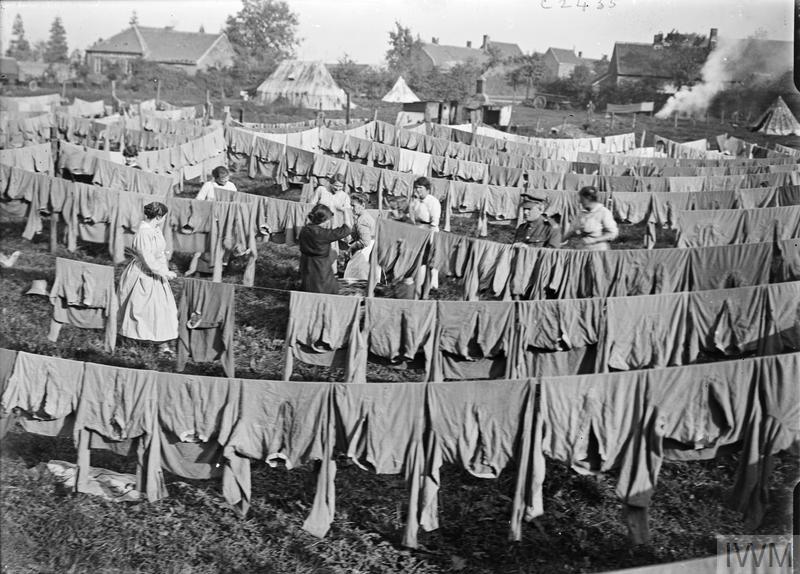
A significant function of the New Zealand Army Ordnance Corps as part of the New Zealand Expeditionary Force during the First World War was managing the New Zealand Divisional Laundries and Baths. The Laundry and Bath functions helped to maintain the New Zealand Division’s hygiene by providing the opportunity for regular bathing, the exchanging of underclothing and socks and the delousing of uniforms. Although the NZ Division s Laundry and Bath functions were interconnected with its neighbouring Divisions and supporting Corps, this article’s focus is on providing a snapshot of the NZ Divisions Laundry and Bath operations from October 1916 to June 1918.
At the onset of the First World War, partly due to the lessons learnt in the South African War and the more recent Balkan Wars, the British Army had a reasonable understanding of the importance of hygiene in the field and published The Manual of Elementary Military Hygiene in 1912.[1] However, as with any military doctrine, the practical application of the field hygiene lessons learnt took time to become effective in the early years of the War. However, by the time the New Zealand Division arrived at the Western Front in mid-1916, the British Army had a rudimentary Laundry and Bath system at the Corps and Divisional levels into which the New Zealand Division was integrated into.
Command and Control
Initially, as the New Zealand Division took over the existing Laundry and Baths from British units, these functions were initially vested as a responsibility of the New Zealand Medical Corps, who provided officers and men to supplement he existing civilian staff.[2] In line with British practice both the Divisional Laundry and Baths came under the control of the Division Headquarters “Q” Branch, and from 21 December 1916, the New Zealand Division, Deputy Assistant Director of Ordnance Services (DADOS) was the officer responsible for the running of the Divisional Laundry and Baths.[3]
Baths
The Bathing concept was that four Bathhouses were to be established in a Divisional area: usually one Bathhouse for each Infantry brigade and one Bathhouse for the rest of the Division. The concept was that Soldiers were to rotate through Bathhouse on a schedule to allow the entire Division to be bathed once every ten days. In the early years of the war, Bathing facilities were rudimentary, with Baths ranging from breweries or fabric processing plants to Beer barrels cut in half.[4]
Although initially built on an ad-hoc basis using whatever resources were available, by 1917 most Bathhouses in the New Zealand Division were built and operated on a uniform pattern: [5]
A typical Bathhouse was be operated as follows.
The men enter at 1, Undress and hand their Service Dress and valuables in at 2(Obtaining receipt) and dirty underclothes at 3.
They then have a hot shower in D
While the men are having their showers, the seams of their Service Dress Tunics and Trousers were ironed to kill lice, and small repairs were undertaken.
Upon completing the shower, the men enter F, collect a towel, clean underclothes at 4 and their Service Dress and valuables at 5. Dress and leave by 6.
All Towels and dirty underclothes are sent from the baths to the Divisional Laundry daily, and a supply of clean or new items received in exchange.
In June 1918, the system of delousing the soldier’s Service Dress clothing was improved using the Thresh Disinfector Delousing Chamber. As soldiers passed into the Bathhouse, the soldier’s Service Dress was turned inside out and handed over to the Thresh operators. The Garments were hung up inside the Thresh’s airtight chamber and sealed. Coke braziers then heated the airtight chamber, and after the garments had been treated by this method for 15 minutes, they were found to be entirely free form lice and eggs.[6]
Personnel employed in the Divisional usually consisted of
Locally employed civilian women for ironing and mending.
Depending on the ebb and flow of the battle and the New Zealand Division’s movement, between October 1916 and June 1918 the DADOS War Diary records that Bathhouses to support the NZ Division were established in over thirty-four separate locations.[8] On most occasions, existing bathhouses were taken over from other Divisions. If there were no existing Bathhouse or the ones taken over were not deemed suitable, NZ Engineers were employed to construct new bathhouses.[9]
Plan for the NZ Divisional Baths as Vauchelles. Archives New Zealand
By June 1918, the New Zealand Divisional Bathhouse system was operating effectively and bathing on average between 700 – 800 troops daily, with 46411 men passing through the Divisional Bathhouses in total.[10]
New Zealand soldiers recently in the trenches outside the Divisional Baths, France. Royal New Zealand Returned and Services’ Association :New Zealand official negatives, World War 1914-1918. Ref: 1/2-013160-G. Alexander Turnbull Library, Wellington, New Zealand. /records/23139145
Soldiers after leaving the line wait their turn for a bath. Royal New Zealand Returned and Services’ Association :New Zealand official negatives, World War 1914-1918. Ref: 1/2-012817-G. Alexander Turnbull Library, Wellington, New Zealand. /records/23097155
Laundry
On most occasions, as the Division relieved an existing Division in the area and took over the existing Divisional Laundry as a going concern. However, there were occasions when a Laundry needed to be established from the ground up, such as when the Division Laundry and Baths at Pont de Nieppe were destroyed by enemy shell fire in April 1917.[11]
The Divisional Laundry received dirty garments from the Baths, (underclothes, socks, and towels) they were disinfected, washed, and mended and placed into a reissue pool.[12]
Usually, the Divisional Laundry placed indents on the supply chain for new items to replace items beyond repair, however, in January 1918 authority was granted for the Divisional Baths to hold a pool of new clothing to me maintained consisting of: [13]
5000 shirts
13100 vests woollen
12450 Drawers Woollen
12700 Towels
19000 pairs of socks
By 1918 the average output from the New Zealand Divisional Laundry was 35,000 – 40,000 garments per week.
Personnel employed in the Divisional Laundry usually consisted of.
Between October 1916 and June 1918, as the NZ Division moved, the NZ Divisional Laundry was also relocated and established in new locations, some of the known sites were
October 1916 Located at Estaires.
Pont de Nieppe, Laundry destroyed by enemy shellfire, 12 April 1917
18 to 25 April 1917 Established at Steenwerck, Handed over to the 8th Division.
Before and during the German 1918 Spring Offensive, the Divisional Laundry was located at.
RenninghelstOuttersteene Westoutre
Abbeville
Socks
Socks were an unlikely enabler; in the extreme conditions found in the mud-filled trenches, clean, dry socks were often the difference between life and death. When feet are constantly wet, as they often were in the trenches, they begin to rot. Gangrene sets in, and often the only remedy is amputation. In the First World War, 75,000 British troops died due to complications caused by trench foot.[15]
Acutely aware of the need for clean socks, the New Zealand Division maintained a system where socks were exchanged daily. To facilitate the daily exchange, a dry sock store was run in conjunction with the Bathhouses. Here dry socks were drawn daily by units in the line in exchange for dirty socks. The dirty sock was then be backloaded to the Divisional Laundry and exchanged for clean socks.
Once received by the Divisional Laundry, the dirty socks if damaged, were mended, washed, and once dried, treated with camphor (as prevention against trench foot) before being placed into the exchange pool.
By May 1918, the disruption caused by the 1918 German Kaiserschlacht offensive had affected the supply routes with the railway service from the Laundry at Abbeville becoming irregular, and it was taking 6-7 days for trucks to travel the short distance to replenish Bathhouses with clean underclothing and socks. However, given the hygiene and morale benefits that clean socks brought, the need to maintain the sock exchange system to the forward troops was a priority. Therefore, close to the front, under the supervision of the NZAOC, a small sock washing depot was established with Sixteen men from the Divisional Employment Company in May 1918. Socks were sorted with torn or holey socks returned to the Laundry for mending, with the remainder of the socks washed by hand. In fine weather, the drying was done outside, if it was wet, the socks were hung on wires from the ceiling of a room and dried employing coke braziers. The men did excellent work, and output was 4 to 5 thousand pairs daily and kept up an adequate supply.[16]
Soldiers washing socks during World War I, Bus-les-artois, France. Royal New Zealand Returned and Services’ Association :New Zealand official negatives, World War 1914-1918. Ref: 1/2-013179-G. Alexander Turnbull Library, Wellington, New Zealand. /records/23052031
New Zealand soldiers washing socks in wooden tubs near the New Zealand Divisional Headquarters at Bus-les-artois, 7 May 1918. Photograph taken by Henry Armitage Sanders Nº H-563 Photo source – Alexander Turnbull collection at the National Library of New Zealand. (Colorized by Marina Amaral from Brazil) https://www.facebook.com/marinamaralarts/?fref=nf See less
Gumboots
As the western front settled down into the routine of trench warfare in the winter of 1915, the time spent in the saturated trenches by British troops was limited to thirty-six hours during which the wearing of gumboots became widespread in the water-soaked areas.[17] The use of gumboots helped minimise the effects of mud and water on exposed feet, thus limiting Trench foot occurrences. Based on the early success of gumboots, contracts were placed with the North British Rubber Company (now Hunter Boot Ltd) to manufacture over 1,185,000 pairs of Gumboots for the British army during WW1.[18]
Boots were classed as Trench Stores and usually only issued to a division when it was on the line. The NZ Division was typically provided with around 6000 pairs, pooled, and issued from a Gumboot Store. The Gumboot store was designed with drying racks and heaters to allow the wet gumboots to be dried and prepared for reissue.
Plan for Drying Apparatus for Rubber Boots. Australian Imperial Force Unit War Diaries, 1914-1919 – Australian Corps Baths and Laundries, 2 – June 1916 – April 1918.” Australian War Memorial Archives Collection No AWM4 18/1/1 PART 2 (1918)
This article provides a small snapshot of how the Laundry and Bath functions contributed to maintaining the New Zealand Division’s hygiene by providing the opportunity for regular bathing, the exchanging of underclothing and socks and the delousing of uniforms. Although the playing a small but significant role in maintaining the combat effectiveness of the New Zealand Division, the efforts of the NZ Division DADOS Staff, the men of the Divisional Employment Companies and the locally employed civilian staff in maintaining the Laundry and Bath operations are worthy of further study to expand the historiography of New Zealand’s First World War combat enablers.
Notes
[1] Martin C. M. Bricknell and Colonel David A. Ross, “Fit to Fight – from Military Hygiene to Wellbeing in the British Army,” Military Medical Research 7, no. 1 (2020).
[2] Major J.S Bolton, A History of the Royal New Zealand Army Ordnance Corps (Trentham: RNZAOC, 1992), 71-72.
[3] “2nd Australia & New Zealand Army Corps [2anzac], Assistant Director of Ordnance Services (Ados) – War Diary, 1 December – 31 December 1916,” Archives New Zealand Item No R23487340 (1916).
[4] Janet Macdonald, Supplying the British Army in the First World War, vol. , (Pen and Sword military, 2019), , 143.
[5] “An Account of the Working of the Baths Established in the Divisional Areas in France,” Archives New Zealand Item No R24428508 (1918).
[6] “Headquarters New Zealand and Australian Division – New Zealand Division – Deputy Assistant Director of Ordnance Services (Dados) – War Diary, 1 June – 30 June 1918,” Archives New Zealand Item No R23487667 (1918).
[7] From May 1917 drawn from No 1 NZ (Divisional) Employment Company.
[8] Based on the DADOS War Diaries Bathhouses were established at, Neuve-Eglise, Selles, Balinghem,Merck-Saint-Liévin, Watou Area, Vlamertinge, Poperinghe, Canal Bank, Bayenghem, Potijze, Hondichen, Staple, Halifax Camp, Caistre, Béthencourt, Louvencourt, Pas, Nauchelles, Pont de Nieppe, Blendecques, Café Belge
[9] Peter D. F. Cooke, Won by the Spade: How the Royal New Zealand Engineers Built a Nation (Exisle Publishing Ltd, 2019), Bibliographies, Non-fiction, 199.
[10] “Headquarters New Zealand and Australian Division – New Zealand Division – Deputy Assistant Director of Ordnance Services (Dados) – War Diary, 1 June – 30 June 1918”
[11] “Headquarters New Zealand and Australian Division – New Zealand Division – Deputy Assistant Director of Ordnance Services (Dados) – War Diary, 1 April – 30 April 1917,” Archives New Zealand Item No R23487653 (1917).
[12] “An Account of the Working of the Baths Established in the Divisional Areas in France.”
[13] “Headquarters New Zealand and Australian Division – New Zealand Division – Deputy Assistant Director of Ordnance Services (Dados) – War Diary, 1 January – 31 January 1918,” Archives New Zealand Item No R23487662 (1918).
[14] From May 1917 drawn from No 1 NZ (Divisional) Employment Company.
[16] “Headquarters New Zealand and Australian Division – New Zealand Division – Deputy Assistant Director of Ordnance Services (Dados) – War Diary, 1 June – 30 June 1918.”
[17] Susan Cohen, Medical Services in the First World War (Bloomsbury Publishing, 2014).
Nestled just north of the small Waikato town of Ngāruawāhia, Hopuhopu Military Camp served as the Upper North Island base for the Royal New Zealand Army Ordnance Corps (RNZAOC) for sixty-two years. Set along the banks of the Waikato River and adjacent to the Main Trunk Railway, Hopuhopu’s rural location south of Auckland might seem an unlikely choice for an Ordnance Depot. Yet, this site holds a special place in the RNZAOC’s history.
Hopuhopu was New Zealand’s first purpose-built Ordnance Depot for the Corps, equipped with state-of-the-art warehousing and ammunition storage facilities that were among the most advanced used by the New Zealand military. This establishment served as a key logistical hub and marked a significant evolution in the nation’s military infrastructure.
Purpose-built Military storage infrastructure had been constructed early in the 20th Century at Auckland, Wellington, Christchurch and Dunedin; however, this infrastructure had been built on a small scale to service the pre-war military districts. The Post-Bellum New Zealand Army was in an advantageous position; it had an experienced cadre of men to draw upon to train the building blocks of any future force. Additionally, the Army was flush with enough new and modern equipment to form and sustain an Expeditionary Force of at least one Infantry Division, a mounted Rifle Brigade, an Artillery Regiment and a Line of Communications troops.[1]
The bulk of the equipment was held by Ordnance at Trentham and Featherston Camps, utilising wartime infrastructure designed to accommodate soldiers and not large quantities of military material. Smaller amounts of stores to support training and initial mobilisation were distributed to the new mobilisation camp at Burnham in the South Island and the Mount Eden depot in Auckland. Whilst both Trentham and Burnham had room for expansion, the existing infrastructure at those camps was deemed, with a few additions, adequate for the time being, with no purpose-built infrastructure constructed until 1939/40. However, in Auckland, the depot at Mount Eden was inadequate and unable to support the Northern districts. More robust mobilisation and storage infrastructure were required.
Another concern was ammunition storage. Existing ammunition storage across New Zealand consisted of many 19th-century powder magazines and converted coastal defence batteries, with the bulk of New Zealand’s ammunition supply stored at Wellington’s Fort Balance. These existing ammunition storage arrangements were unsatisfactory, and a more permanent solution in the form of a purpose-built facility was needed.
By 1921, the site of a new Mobilisation and Ordnance Depot to support the Northern Districts had been decided upon. In one of the largest defence infrastructure projects undertaken in New Zealand, construction of the new camp at Hopuhopu continued throughout the 1920s, with the Ordnance Depot opening in 1927. A significant project at the time, the progress of construction at Hopuhopu was widely reported on with this Auckland Star article from 1925 describing the plans for the camp. [2]
GREAT MILITARY CAMP
WORK AT HOPUHOPU
DOMINIONS’ AMMUNITION DEPOT
A SPLENDID TRAINING GROUND
Midway between Ngaruawahia and Taupiri, bounded by the railway and the Waikato River, is a long strip of land, some 500 acres in area, level excepting for an extensive hill that rises to an elevation of some ninety feet. This is Hopuhopu, site of the old mission station of the name. Once the home of peace, it is now being transformed by the engineers and men of the Public Works Department into a camp of training for war. Acquired by the Defence Department about three years ago, the Hopuhopu mission site has already been used as a camp for trainees, but it is in the rough, and the plans on which the engineers are now working aim at its conversion into a thoroughly equipped permanent military depot, to be officially known as the Ngaruawahia Mobilisation Base. When the plans are completed, it will be the chief military magazine, for the Dominion, and probably the greatest ordnance depot.
Through the courtesy of the Defence authorities and Mr E. K. James, the engineer in charge of the work, a “Star” representative was permitted to inspect the camp in the making yesterday. The site at once suggests itself as an ideal one for the purpose intended, and this idea is backed by expert engineering and military opinion. There has been some criticism of the area on the ground that it is damp, but this has proved to be a matter that can and will be easily overcome. After heavy rain, there is a degree of surface damp, caused by the matting of thick vegetable growth, but the sinking of a number of test holes has revealed a porous, sandy soil beneath, which, when the “matting” is removed, will readily allow all moisture to percolate and leave a dry surface. In fact, the site lends itself readily to perfect draining. About one hundred men are engaged in the work of clearing and building, and they have been greatly hampered in their preliminary operations by the amount of furze and blackberry that ‘successive owners of the land (including the Government) have allowed to grow on it.[3] The furze is not so hard to clear, but an instance of the pertinacity of the blackberry was shown in a patch that was again springing to vigorous growth two months after it had been cut. Over one hundred acres have been cleared, and there remains another 150 acres to be dealt with by hook and fire.
A Varied Terrain
The great value of the Hopuhopu site is that it is adaptable to every branch of military training. A detraining platform a quarter of a mile long will be constructed on the main railway line for the embarkation and disembarkation of troops; there are large level areas for parade grounds; there are hills for reconnoitre and signalling; there is the river for bridge-train and pontoon drill, and in fact, the contour of the country will enable training in every department of military tactics. When the camp is completed, its huge stores, magazines and hutments will spread over an area of 200 acres. It is proposed to provide sanitary drainage from the latrines by a large pipe running along the railway into septic tanks, and thence into the river. The first part of the plan provides for the accommodation of a full battalion, and this will gradually be extended to mobilise and house a brigade of about 5000 men. Next year trainees of the Northern Command will sleep beneath the roofs of solid huts, instead of in tents.
In arriving at the decision to construct this great camp at Hopuhopu, the authorities were doubtless influenced by other considerations additional to the natural suitability of the site for training purposes. It is a reasonable distance from the city; yet not too near. It is not advisable that men in training should have the temptations of a city that is in too close proximity, and it is essential really that a camp containing immense stores of ammunition should be out of range of shelling by a possible hostile fleet operating, for instance, in the Hauraki Gulf. Besides, Hopuhopu is a very handy site for the mobilisation of the thousands of trainees who reside in the closely settled districts of the Waikato.
Some acres of the campsite, between the Old South Road and the river, have been reserved for residences for officers of the permanent staff, the building of which has already been commenced in the corner adjacent to the railway, line. These houses are being constructed of concrete. The whole of the ordnance department is to be transferred to the camp, which will take over a great deal of the stores now housed at Featherston. The extent of the future ordnance department at the new base may be gauged from the fact that the plans provide for five sheds measuring 40 x 500 ft, 40 x 300 ft, 40 x 200 ft, 40 x 100 ft, and 40 x 350 ft. These will lie alongside the camp railway, which runs into the camp for a distance of half a mile from, the mainline, so that stores may be received and dispatched with a minimum of labour and a maximum of speed. From the terminus of this extension, a wooden tramway is to be constructed to the foot of the hill along the base of which the magazines are being built.
The Magazine Section
No fewer than ten magazines for the storage of explosives and ammunition are provided for, and several of these are nearing completion while excavating and banking is being carried out on the site of the great laboratory to be attached to this department. The magazines are built into the hillside. They are constructed of concrete, with double walls, in between which are formed the inspecting chambers. From these chambers’ sentries may see through observation windows the thermometers which register the temperature inside and by this guide check or increase ventilation, as needed, for the explosives must be kept at a certain degree Fahrenheit. Also, the double-wall is a protection against fire. Between each magazine, a pyramid is erected from the spoil taken from the excavation. These are eave high with the roofs of the magazines and are designed to break the force of any possible explosion of one magazine, so that others may not be exploded also. The magazines are also faced by a long embankment, and are, of course, backed by the hill, so that an explosion would be confined as far as possible to the magazine area.
On top of the hill, there has been constructed an 80,000-gallon reservoir for the camp water supply. The water is pumped by a 30 hp motor from a settling tank alongside the river and ten feet below the level of its bed. The water is well filtered and regarded as pure after it has percolated into its tank, but as an additional safeguard, a chlorinating plant is to be installed.
Negotiations are proceeding with landowners on the other side of the river for the acquirement of land for a rifle range.
“Great Military Camp,” The Auckland Star, vol. LVI, no. 83, p. 5, 8 April 1925.
The Ordnance Depot opened in 1927. The original plan called for five warehouses measuring 40 x 500 ft, 40 x 300 ft, 40 x 200 ft, 40 x 100 ft, and 40 x 350 ft; what was eventually construed was a single large warehouse measuring 100 x 322 ft.
1938 Military Camp, Hopuhopu, Waikato. Whites Aviation Ltd: Photographs. Ref: WA-55972-G. Alexander Turnbull Library, Wellington, New Zealand. /records/23181165
An additional Ordnance warehouse was constructed adjacent to the original building during the Second World War. The wartime era also saw the nationwide expansion of the NZ Army’s Ammunition infrastructure with additional magazines added to the existing ten magazine at the Hopuhopu Storage area and a new Ammunition Depot established outside of Hopuhopu Camp at the nearby Kelm Road.
1961 Hopuhopu Military Camp from the air. Whites Aviation Ltd: Photographs. Ref: WA-55339-F. Alexander Turnbull Library, Wellington, New Zealand. /records/22480584
Aerial oblique view of Ngāruawāhia (Hopuhopu) Army Camp, March 1962. Image ref OhG3046-62, RNZAF Official.
Hopuhopu and its Ordnance Depot survived until 1989, when, as part of many rationalisations across the New Zealand Defence Forces, the Hopuhopu camp was closed and its functions transferred to other locations.
Hopuhopu 2020. Waikato-Tainui College for Research and Development
Notes
[1] Mark McGuire, “Equipping the Post-Bellum Army,” Forts and Works 2016.
[2] “Great Military Camp,” The Auckland Star, vol. LVI, no. 83, p. 5, 8 April 1925.
A small memorial plaque placed just below a soldier’s headstone at Palmerston North’s Terrace End Cemetery hints at a fantastic story of two brothers who served in the First World War. One, due to illness attributed to the war, had a short life, passing away seven years after the war. The other had a long and exciting life that exemplified the ideals of the American Dream.
Morgan Joseph, John Goutenoire and Mary Agatha (b April 1903) were the three children of Morgan and Isabel O’Brien and were born in Nelson between 1891 and 1903. Shortly after the birth of Mary, Morgan O’Brien took up a position as a Health Inspector in Palmerston North, which saw the O’Brien Family settle in there.
Morgan Joseph O’Brien
Born on 13 August 1891, Morgan attended Nelson College and, like most men in New Zealand at the time, undertook his compulsory military service in the Territorial Army. A foundation member of the Palmerston North J Battery of the Artillery, Morgan also served in the Poverty Bay Company of the 9th (Hawkes Bay) Infantry Regiment. Morgan was well known in Palmerston North and later Gisborne as a keen Footballer and Cricketer.
At around 1913, Morgan took up a position with the Gisborne Branch of J.J Niven, taking charge of that branch’s customs and shipping department. At the onset of the First World War, Morgan entered Trentham Camp for training with the Artillery in November 1915. Sailing with the 10 Reinforcements on 4 March 1916, Morgan joined the New Zealand Expeditionary Force (NZEF) in France in April 1916 and was posted to the Divisional Ammunition Column (DAC). It is likely that due to Morgan’s civilian clerical experience that he was involved in ammunition accounting, managing the substantial quantities of ammunition required by the New Zealand Division. Serving with the DAC for the remainder of the war, Morgan was struck down with influenza several times but finished the war in Sling Camp in the United Kingdom. Morgan was transferred into the New Zealand Army Ordnance Corps (NZAOC) on 13 February 1919. Promoted to Corporal and posted to the London Ordnance Depot, working closely with his brother John, who was the Chief Clerk of the NZAOC. Morgan’s clerical skills were recognised, and in July 1919, he was promoted to Sergeant. With the bulk of the demobilisation work required of the Ordnance Depot in London completed by August 1919, Morgan was repatriated to New Zealand in September 1919 on the SS Ruahine. After Three Years and Two Hundred- and Ninety-Seven-Day of overseas service, Morgan was struck off the strength of the NZEF on 22 January 1920, returning to his civilian employment with J.J Niven in Gisborne.[1]
Morgan only remained in Gisborne for just under two years, when in December 1921, he was promoted to be the Accountant at JJ Nivens Palmerston North Branch. Sadly, like many of his peers, Morgan’s health and been affected by the war and plagued him with continuing problems and periods in Hospital. On 24 August 1926, at the age of Thirty-Five, Morgan passed away at his parent’s home at 163 Fitzherbert Street, Palmerston North. Morgan’s funeral was held at St Patrick’s Church, with many beautiful wreaths received and representation from his former employer, and military and sporting associates.[2]
John Goutenoire O’Brien
John O’Brien was born on3 April 1895 (some sources state 1896) and attended Palmerston North High School, Nelson College, and Palmerston North Technical college.[3] Following a similar vocational path as his brother, John took up a clerical position as a Clerk with the Bank of New Zealand in Palmerston North. Called up for military service in the Territorial Army, John spent two years with the Palmerston North-based C Company of the 7th (Wellington West Coast) Regiment.
John enlisted into the NZEF on 20 April 1915, joining B Company of the 6th Infantry Reinforcements at Trentham Camp. Embarking for Egypt on 11 August 1915, the 6th reinforcements were the last to reach Egypt before the end of the 1915 Gallipoli campaign. John, as part of the Wellington Infantry Battalion, was among the last of the New Zealand Troops committed to the ill-fated Gallipoli campaign; however, after a brief period of fighting on Gallipoli, John was evacuated early in December due to suspected appendicitis and dysentery.[4]
After recuperation in Alexandra, John was posted to the New Zealand Base Depot at Ismailia as the New Zealand Division was reorganised. Possibly because of his clerical background, John did not rejoin the Wellington Infantry Battalion but instead transferred into the NZAOC. Serving with the New Zealand Division in France, John was promoted to Corporal on 4 June 1916 and then Sergeant on 31 March 1917.
On 13 February 1918, John was transferred from the New Zealand Division in France and taken on the strength of the New Zealand Ordnance Depot in London. Audits had found several inadequacies in the running of the store’s account, which John described as “a system of recording and accounting that was absolutely hopeless”.[5] Appointed as the NZAOC Chief Clerk in the United Kingdom, John was promoted to Temporary Warrant Officer Class One (Temporary Sub Conductor) on 5 October 1918.
New Zealand Army Ordnance Corps Badge, 1916-1919 (Robert McKie Collection 2017)
Promoted to Warrant Officer Class One (Sub Conductor) on 25 November 1918, the priority due to the war’s end had shifted from supporting the NZEF to demobilising the NZEF, including the closing of accounts and the final balancing of the books. Appointed as a Conductor on 1 February 1919, John, in addition to his existing staff of two, was allocated an additional six men to assist in the reorganisation and rewriting of the ledgers to an acceptable standard. John’s older brother Morgan, an accountant by trade, was, on 13 February 1919, transferred from the New Zealand Field Artillery into the NZAOC and posted to the London Ordnance Depot, where there is no doubt that his skills as an account were put to use.[6]
By the middle of 1919, John and his staff had made progress in the closing of the NZEF accounts, with the ADOS Colonel Pilkington satisfied that the whole team could be repatriated in September on the SS Ruahine. However, due to changes of Department heads in NZEF Headquarters, John elected to remain to follow through in his efforts and ensure that his responsibilities were handed over.[7]
In recognition of the valuable services rendered in connection to the war, John was awarded the Meritorious Service Medal on 9 December 1919.
In January 1920, it was anticipated that with the planned sailing of the “Corinthic” on 20 February 1920, only twenty-four members of the NZEF remained in the United Kingdom to be repatriated on the “Ionic” on 31 March 1920. However, much work remained to be done, and the three remaining Ordnance Staff, Captain Simmons, John and Sergeant Edwards, were each allocated specific tasks by the departing ADOS. John was to.
Remain to settle all claims preferred against the NZEF, by the Imperial authorities for stores and equipment issued from time to time, also to obtain credit for stores returned to Imperial Ordnance by NZEF Units and Depots. This WO will deal with all claims for outstanding stationery issued to the NZEF, and will arrange credit for all stationary etc., returned to HM Stationery Office. He will pass for payment, all accounts for goods etc., brought under this Office Local Purchase Orders Authority. All matters relating to the equipment for the Post-Bellum Army in New Zealand will be dealt with by him, and he will submit any idents which have to be preferred, and will also assist the High Commissioner with the arrangements for shipping all new equipment and stores for the Dominion.[8]
Having been overseas for over four years, John was becoming anxious about his future employment. He resigned from his position with the Bank of New Zealand in 1915, with a gentleman’s understanding that his job was to be held open for him on his return. However, after five years of military service, correspondence with the Bank of New Zealand indicated that his re-employment was not guaranteed but was to be favourably considered. With a compelling case to return to New Zealand, Johns’s demobilisation was approved. On handing his remaining duties over to Captain Simmons and the New Zealand High Commission, John departed for New Zealand on the last official troopship returning to New Zealand, the “SS Ionic”. Leaving the United Kingdom on 31 March 1920, the Ionic transited the Panama Canal, arriving back in Wellington on 28 May 1920. It is interesting to note that during Johns’s tenure in London, in addition to his military duties, he undertook a course of study at the London Hugo College of Languages.[9]
On 8 June 1920, John was stuck off the strength of the NZEF and, after five years, returned to civilian life. Concurrent to John being demobilised, the Director of Ordnance Services, Lt Col Pilkington, who, as the NZEF ADOS had intimate knowledge of John’s abilities, was working to find John employment. Early in June, Lt Col Pilkington recommended in a letter to the Chief Ordnance Officer that John was an outstanding and qualified candidate to fill the position of Chief Clerk in the Christchurch Ordnance Deport, then located at the King Edward Barracks. Accepted for this role, John was attested for service in the Temporary Section of the NZAOC as a sergeant on 8 June 1920.[10]
After five months, John decided to resign from the NZAOC and pursue other interests and was discharged at his request on 19 October 1920. John then travelled to the United States, where he studied law at DePaul University Chicago from 1921 to 1924. During his time at Chicago, John authored several articles on the peoples of the earth, articles on foreign lands and subjects in general and was one of a group that published two volumes on the recent World War.[11]
Nearing the end of his studies, John found employment with the Continental Trust and Savings Bank of Chicago, where in 1923, he was appointed as the manager of the Bond and Coupon Division.
Relocating to Shreveport, Louisiana, in 1926, John was then appointed as the Trust Officer for the Commercial National Bank.[12] Under his leadership, the trust department became recognised as one of the most outstanding in the South, with John later serving as a vice-president of the bank.
John O’Brien 1926
In 1926 John married Katharine Kramer and, in the same year, celebrated the birth of his son Joseph. However, this must have been tempered with the news of the early death of his elder brother in October 1926. Having found a career and established a family in the United States, John was naturalised as a US Citizen on 22 February 1928.[13]
Old Commercial National Bank Building in Shreveport, Louisiana. Wikimedia Commons
It is known that John made two return visits to New Zealand, the first in 1930 and, after the death of his father, the second trip in April 1941. Arriving from the United States via the American Clipper air route, John’s visit was a combined holiday and business visit that was covered widely by the press.[14]
During his visit, John described the positive reporting in the United States of the New Zealand Division in the Middle East and provided a first-hand account of the increasing amount of war material produced in the USA for export to the British Empire. John also provided insight into American insights into the war and how although the Southern States were firmly behind Britain, the Northern States, with their large immigrant populations, were less supportive, but John had confidence that President Roosevelt and United States Congress would make the right decision when the time came.[15] An astute businessman John was found to be correct in his prediction, and after the 7 December attack on Pearl Harbour, the United States committed its entire strength to the effort to defeat not only the Empire of Japan but also Nazi Germany.
As the United States mobilised, John was recalled to the colours, and on 27 July 1942, was inducted as a Major into the US Army Air Force and assigned to the Staff of General Harmon, Commanding General of US Army Forces in the South Pacific area. [16] As the US Army Forces in the South Pacific area were initially Headquartered out of Auckland, John likely spent some time in wartime in New Zealand. John’s promotion to Lieutenant Colonel in 1943 was widely covered by the New Zealand Media, which no doubt brought much pride to his New Zealand family.[17] In November 1943, after eighteen months in the Pacific, John was assigned to the Intelligence Division, Fourth Air Force, San Francisco, California, and as new regulations were put in place to start releasing personnel, John was transferred to the active reserve on 2 May 1944.[18] In regards to John’s service, Major General William Lynd, Commanding General, Fourth Air Force, stated that “Colonel O’Brien entered the service at a time when our nation faced its darkest days. The valuable experience he brought with him contributed much to our victories in the pacific”[19]
Lieutenant Colonel John O’Brien, United States Army Air Force, 1944
Returning to his pre-war position with the Commercial National Bank, John remained there for another two years before taking up another role with the industrial manufacturing company J.B Beaird. Resigning from the bank in 1946, John served as vice-president and treasurer of J.C Beaird until his retirement In November 1958.
During his lifetime, John assumed leadership roles in many charitable drives and held senior positions in many civic clubs. Posts he filled included.
Chairman of the trust division of the Louisiana Bankers Association,
Member of the executive committee and board of the Chamber of Commerce,
Chairman of the United Fund,
Chairman of the Caddo Community Chest,
President of the Caddo Chapter of the National Foundation for Infantile Paralysis,
Member of the board Caddo Chapter of the American Red Cross,
Member of the board and president of the Little Theatre,
Member of the finance committee of Centenary College.
Always keen to pass on his knowledge and experience, John was also, at times, an instructor of economics, corporate finance, and various banking subjects for.
YMCA schools,
The American College of Underwriters,
The American Institute of Banking,
The Wholesale Credit Men’s Assn
As a veteran of two wars, John was active in veteran affairs and an active member of the American Legion and held top offices in the;
Lowe-McFarlane Post 14 of the American Legion,
The Rotary Club,
Veterans of Foreign Wars.
In 1952, John was the chairman of a civilian advisory board assisting the United States Air Force in an audit of Reservists in Northwest Louisiana and Southwest Arkansas.
A year into his retirement and at the age of Sixty-Two years, John died of a heart attack on 21 October 1959.[20] Buried in the Forest Park in the centre of Shreveport, a memorial plaque was also placed below his brother’s headstone in the Terrace End cemetery in his New Zealand Hometown of Palmerston North.
Sua tela tonanti
Notes
[1] “O’brien, Morgan Joseph,” Personal File, Archives New Zealand 1916.
[3] “Nelson College School Register, 1856-1956,” Ancestry.com. New Zealand, School Registers and Lists, 1850-1967 ; ” Bank Selects Trust Officer,” The Shreveport Times, 5 March 1926; ibid.
[4] “O’brien, John Goutenoire “, Personal File, Archives New Zealand 1914.
[5] “Demobilisation – Organisation of Ordnance Service, 4 September 1918 – 8 March 1920,” Archives New Zealand Item No R25103117 (1920).
Since its inception, the New Zealand Army has relied on the expertise and dedication of Quartermasters (QMs) and support staff at the Regiment or Battalion levels to ensure effective supply operations. Initially filled by commissioned officers drawn from the ranks and supported by Quartermaster Sergeants and their teams, these roles were important and pivotal in maintaining logistical efficiency. This article traces the historical development of supply management within the New Zealand Army, from the nineteenth-century volunteer units to the professional Logistics Specialists of today. It explores key transformations, such as establishing training institutions and integrating supply and quartermaster functions, culminating in the modern Logistics Specialist trade within the Royal New Zealand Army Logistic Regiment (RNZALR).
Traditionally, the responsibility for supply at the Regiment or Battalion level has rested on the unit Quartermaster (QM) and their dedicated staff. These QMs, often commissioned from the ranks, were supported in their duties by the Regimental Quartermaster Sergeant (RQMS) alongside a team of clerks and storemen. Company Quartermaster Sergeants (CQMS) provided essential support at the sub-unit level.[1]
In practice, these QMs and their support teams were selected from within the ranks of the regiment or corps they served, giving them an intimate understanding of their units’ operations. This familiarity enabled them to provide highly effective support. During the nineteenth century, as the New Zealand Army took shape, the “Q” staff of units typically comprised older, experienced soldiers. While they may have been past their prime for active field duty, they possessed invaluable knowledge of unit operations and excelled in managing weapons and equipment.
However, in volunteer units, which often functioned like social clubs, officers and “Q” staff were elected annually. This sometimes led to disarray in unit store accounts, with discrepancies between supplies provided by the crown and actual inventory.
Efforts to enhance administrative training across the army began in 1885 with the establishment of the Army School of Instruction at military headquarters in Mt Cook, Wellington. Initially focused on musketry training, the school expanded to include courses on Tactics and Staff Duties from 1886 onward. [2] Despite these developments, the curriculum’s inclusion of basic store accounting remains unclear. [3]
In 1895, the New Zealand Defence Forces Dress Regulations officially sanctioned the use of an eight-pointed star as a distinguishing embellishment for Regimental and Company Quartermaster Sergeants.[4] This insignia remained in use until 1917.
Regimental Quartermaster Sergeant-Major, 1905-1915. Robert McKie Collection
Company Quartermaster Sergeant, 1905-1915. Robert McKie Collection
Following the South African War, the NZ Army underwent a significant transformation to enhance its readiness for the Imperial Defence Scheme. This included standardising uniforms, weapons, and equipment. The Defence Act of 1909 replaced the Volunteer forces with a robust Territorial force sustained through Compulsory Military Training.
In 1910, Lord Kitchener, renowned as “The Empire’s foremost soldier,” visited New Zealand and thoroughly reviewed its military forces. His assessment led to significant reforms within the NZ Army, including establishing the New Zealand Staff Corps (NZSC) and the New Zealand Permanent Staff (NZPS) in 1911. These changes aimed to create a professional cadre of officers (NZSC) and enlisted personnel (NZPS) capable of providing expert guidance and efficient administration to the Territorial Force units.
Unknown photographer (1910) The Empire’s foremost soldier: Field-Marshal Lord Kitchener. Auckland War Memorial Museum call no. D503 K62
Lord Kitchener’s visit critically evaluated the military’s capabilities, revealing deficiencies in equipment care, maintenance, and overall responsibility. The existing Regimental Quartermaster Sergeants (RQMS) lacked the necessary skills, underscoring the need for a professional cadre of RQMS.
In late 1911, thirty carefully selected men from various military districts undertook an intensive three-week course at the Defence Stores Department in Wellington to address this. Led by Major O’Sullivan, the Head of Defence Stores, the training covered practical and theoretical aspects of “Q” matters essential to the role of RQMS. The curriculum was comprehensive, including instruction from armourers on weapon storage, inspection, maintenance, and accounting, as well as guidance from saddlers, sailmakers, store foremen, and ledger keepers on their respective specialities.
Following rigorous examinations to assess their competence, all candidates successfully passed. They were subsequently appointed as Quartermaster Sergeants in the New Zealand Permanent Staff by General Order 112/10. This proactive training initiative ensured the NZ Military Forces had a capable and professional cadre of RQMSs ready to manage their critical responsibilities effectively.
This course of instruction represented a significant milestone in New Zealand’s military education history. Despite establishing the Army School of Instruction in 1885, it had never offered a specific program focused on training RQMS. Therefore, this course became the country’s inaugural dedicated “Q Store” trade-related training initiative.
With the declaration of war against the Central Powers in August 1914, New Zealand swiftly mobilised and dispatched an Expeditionary Force overseas. A comprehensive reinforcement plan was activated to sustain and support the New Zealand Expeditionary Force (NZEF). Trentham Camp, later followed by Featherston Camp, emerged as a primary facility for training reinforcements. In late August 1914, Lieutenant (Temporary Captain) T. McCristell NZSC was appointed the Camp Quartermaster of Trentham Camp.
As Camp Quartermaster, McCristell, supported by personnel from the Permanent Staff not deployed with the Expeditionary Force, established the Trentham “Camp Quartermaster Stores.” This distinct unit had its badge and assumed critical responsibilities to bolster the war effort.
EVERYTHING movable in Camp, except the A.S.C and its wagons, is kept track of by the Camp Quartermaster—everybody and everything, from a soldier to an electric light bulb. The Camp Quartermaster knows where they all should be; and if they aren’t where they ought to be, he generally knows where they are.”[5]
Camp Quartermaster Staff Badge. Robert McKie Collection.
The “Camp Quartermaster Stores” also played a crucial role in training individuals for overseas service as Quartermasters. According to regulations, each reinforcement draft allowed for RQMS and CQMS per company.
Under the guidance of McCristell, candidates were selected based on their civilian occupations and business acumen for training as RQMS or CQMS. The training programme was comprehensive, covering several key areas:
Stores Training: This included effective clothing and equipping of soldiers.
Camp Equipment Training: Instructions on constructing field kitchens, incinerators, latrines, washing facilities, setting up camps and bivouacs, and arranging billets.
Ammunition Organisation: Handling and organisation of ammunition.
Water Supply Management: Managing water supplies and food distribution procedures for troops.
Candidates underwent rigorous training and had to pass a comprehensive examination to qualify for appointment as either an RQMS or CQMS.
McCristell continued as Camp Quartermaster until 1916, when he was transferred to the Defence Stores Department as Director of Equipment and Ordnance Stores. In this capacity, he was pivotal in establishing the New Zealand Army Ordnance Corps (NZAOC) in 1917, serving as its Chief Ordnance Officer.
In 1918, following a Defence Department Officers’ Conference prompted by a report from the Defence Expenditure Commission, it was revealed that units had generally failed to adequately account for, care for, and secure stores as outlined in New Zealand Military Forces Regulations.[6] To address this, eleven NZAOC staff sergeants were temporarily assigned to units as quartermaster sergeants. Their task was to rectify discrepancies and ensure unit store accounts were properly managed. This initiative proved highly successful, with subsequent audits revealing few deficiencies. However, it became apparent that many units lacked adequate storage facilities, leading to the temporary storage of surplus items at regional store depots.[7]
The deployment of NZAOC Staff Sergeants as Quartermaster-Sergeants within units was so effective that it prompted an official amendment to Army regulations on October 3, 1918. This amendment transferred Quartermaster Sergeants’ management responsibility to the NZAOC and introduced several key changes.
83. Group and Unit Quartermaster-Sergeants will belong to and be trained by the New Zealand Army Ordnance Corps, and when posted for duty in districts will be borne as supernumeraries on the establishment of that corps. They will be included in the effective strength of the group or unit in which they are actually serving and will be so accounted for in periodical returns for those groups or units. In so far as the questions of efficiency, leave, and duty are concerned, Quartermaster-Sergeants will be under the direct supervision of the A.Q.M.G. of the district, and will be directly responsible to the Group or Unit Commander, as the case may be, for the performance of their respective duties as Group or Unit Accountants. They will devote the whole of their time to the accounting, care, and custody of public property on issue.[8]
In July 1920, the following NZAOC NCOs were employed as Group and Unit Quartermaster-Sergeants:
Staff Sergeant Alfred Charles Butler
Staff Sergeant Harry Harper Ekins
Staff Sergeant Donald McCaskill McIntyre
Staff Sergeant Frederick William Tavendale
Staff Sergeant John William Kirby
Staff Sergeant Leonard Robertshaw
Staff Sergeant David Llewellyn Lewis
Staff Sergeant George Quayle
Staff Sergeant George William Wright
Staff Sergeant J.R Hopkinson
Although these NZAOC NCOs achieved success in improving store accounting, the Director of Ordnance Services (DOS) argued that given the broader range of military skills, including instructional abilities required by Group and Unit Quartermaster-Sergeants, NCOs from the NZPS were more suitable for these roles than NZAOC ones.
Supporting the DOS argument, GHQ decided on 15 September 1921 that appointments of Group and Unit Quartermaster-Sergeants were to be filled by members of the NZPS. Following a short course of instruction to bring them up to speed on their additional NZPS duties, the NZAOC NCOs remaining in such appointments were transferred into the NZPS without losing seniority.[9]
With the reinstatement of unit quartermaster sergeants as a responsibility of the NZPS, the General Headquarters School (GHQ School) resumed overseeing training at Trentham camp. Officially established in 1920, the GHQ School played a crucial role in training NZSC officers and NZPS men, who were tasked with training, equipping, and administering Territorial and Senior Cadets.[10]
A significant development occurred in 1937 when the Army School in Trentham was founded. Supported by District Schools of Instruction at Narrow Neck, Trentham, and Burnham, these institutions collaborated to advance military education.[11]
The instructional staff at the Army School and the three District Schools of Instruction played pivotal roles in training various groups of servicemen, including:
Adjutants,
Quartermasters,
Regimental Sergeant Major,
Regimental Quartermaster Sergeants,
Ordnance and Company Clerks,
Storemen, Storemen-Clerks, and
Cooks.
In the lead-up to the Second World War, the Army School of Instruction established an Administrative Wing consisting of a Major, two Captains, a Warrant Officer Class One, a Staff Sergeant, and a Sergeant. This wing conducted specialised courses for officers and senior non-commissioned officers: officers attended the Senior Staff Duties and Adjutants courses, while senior non-commissioned officers participated in drill, duties, and tactical courses. Both groups also had access to the Quartermaster’s and Quartermaster Sergeant’s courses.
Post-World War II, the focus shifted to peacetime administration, primarily for the Regular Force Staff of the Army. Clerks and storemen recruited through Compulsory Military Training or National Service received basic training in their trades. As part of a decentralisation policy, training moved from a central school to District Schools of Instruction, leading to a reduction in the Administrative Wing’s establishment by 1947, now comprising a Major, a Captain or Lieutenant, a Warrant Officer Class Two, and occasionally a Corporal from the Women’s Royal Army Corps (WRAC).
In the immediate post-war period, the distinction between RNZAOC and Quartermaster responsibilities was not always clearly defined. Roles such as “Storeman, Technical”, recorded as an All Arms, unit-level function in 1947, reflect a transitional system in which unit Quartermaster organisations retained responsibility for technical and equipment stores that would later be progressively re-aligned under RNZAOC control.
In July 1950, the Administrative Wing disbanded, giving way to the School of Army Administration at Trentham. This institution continued at Trentham before relocating to Waiouru on January 31, 1952, specifically to a building on Foley Street. Initially staffed by two officers (one doubling as Staff Officer (Administration) at Headquarters Army School) and two Other Ranks, the school’s workload increased steadily, expanding from 13 courses in 1953 to 21 in 1961
From 1950 onwards, the Army Stores Audit Section meticulously reviewed all Army store accounts, with exceptions for specific Ordnance technical accounts. In 1951, they audited 87 accounts, maintaining a schedule of auditing each account in the Northern and Central Military Districts every eighteen months and in the Southern Military District every two years, despite the growing workload.
Initial assessments in 1951 found the overall standard of accounting to be satisfactory. However, deficiencies were noted in some large accounts, largely due to staff shortages and competing duties.
The following year, 91 accounts underwent an audit, revealing continued challenges in achieving higher accounting standards, primarily attributed to inadequate staffing and training. Similar findings persisted in 1953, where 87 accounts were reviewed, indicating ongoing room for improvement linked to insufficiently trained personnel.
In 1953, a pivotal conference involving the Treasury and the Audit Department sought to overhaul the Army’s accounting systems. Mechanisation and other modernisation efforts were discussed to streamline accounting tasks, pending a review of existing Store Regulations for potential simplification. Concurrently, efforts intensified to bolster administrative training at Army Schools.
By 1954, audits of 84 accounts demonstrated modest improvements in accounting standards, yet persistent shortcomings persisted, largely due to staffing issues. A joint committee comprising Army, Treasury, and Public Service Commission representatives began examining store accounting procedures with an eye towards simplification and mechanisation.
Throughout 1955, courses at the School of Army Administration focused heavily on administrative training, particularly in-store accounting, attended by both Regular and Territorial Forces. This emphasis and revised accounting procedures introduced later in the year contributed to a noticeable enhancement in store accounting standards.
The joint committee established in 1954 recommended streamlined procedures to reduce paperwork, which were implemented on a trial basis during the latter half of 1954.
To further enhance organisational efficiency, an organisation and methods officer was appointed at Army Headquarters to review store systems continuously.
In 1956, inspections expanded to 117 units, confirming a sustained improvement in accounting standards throughout 1957. This progress was linked to trial changes recommended by the special committee and endorsed by the Treasury in 1957, paving the way for the permanent adoption of a more streamlined system. This new approach aimed to refocus efforts on core accounting principles and physical store control, as highlighted in subsequent committee reports.
By 1958, departmental store inspectors extended their scrutiny to 129 accounts, marking continued advances in store management and accounting practices. This trend persisted into subsequent years, reflecting steady improvements in administrative procedures across Army storers’ accounts.
At the same time, the Army formalised and expanded its unit-level logistics capability through the development of the Storeman (All Arms) trade. Rather than relying solely on specialist corps personnel, this system provided units with an organic ability to manage their own stores, accounting, and sustainment functions.
By the mid-1960s, the Storeman (All Arms) trade had evolved into a structured four-tier classification system, progressing from One Star through to Four Star. At the entry level, soldiers were required to demonstrate competence in basic accounting, identification and handling of stores, storage practices, including dangerous goods, and fire safety and security procedures. This established a baseline of practical logistic competence at the unit level.
Progression through the trade introduced increasing levels of responsibility. At the Two Star level, Storemen were trained in ledger accounting, demand preparation, and voucher processing, supported by formal qualification on the Q Ledger Clerks Course. They were expected to manage store operations, including packing, dispatch, and staff supervision. At the Three Star level, the trade is aligned directly with the Quartermaster system, requiring completion of sub-unit Quartermaster Sergeant and Junior Clerks courses, and preparing individuals for employment as sub-unit QMS. By Four Star, Storemen were qualified at the regimental level, capable of supervising QMS staff and serving as Regimental Quartermaster Sergeant.
This progression highlights the growing professionalisation of unit-level logistics during this period. Accounting competence, documentation, and formal training were no longer secondary skills but central to effective store management. The Storeman (All Arms) trade provided a distributed logistics capability across the Army, reinforcing the broader improvements being driven through inspection, reform, and institutional oversight.
Throughout the decade, concerted efforts by various stakeholders, strategic reforms, and training initiatives steadily transformed Army store accounting into a more efficient and effective system capable of meeting evolving operational demands.
By 1967, the School of Army Administration had grown to include three officers, five other ranks, and a civilian clerical assistant.
The School of Army Administration later relocated to a site opposite the Headquarters Army Training Group in Waiouru, further expanding to accommodate three officers, seven senior non-commissioned officers, and two civilians. Its courses catered to Junior Staff Officers, Accounting Officers, Clerks, and Storemen.
From 1974, the School of Army Administration staff photographed most courses as they passed through the school. Many of these photos can be viewed by clicking on the respective course link:
The 1990s marked a significant period of change for both the Q Storeman and RNZAOC Supplier trades within the NZ Army. This change was driven by a reorganisation of logistic and support functions, culminating in the formation of the Royal New Zealand Army Logistic Regiment (RNZALR). This restructuring included a comprehensive review of the Q Storeman and RNZAOC Supplier trades, which concluded that advancements in the computerised Defence Supply System Detail (DSSD) warranted merging these roles.
The initial integration of logistic units occurred in 1993, combining units from the Royal New Zealand Corps of Transport (RNZCT), RNZAOC, and Royal New Zealand Electrical and Mechanical Engineers (RNZEME) into Logistic Regiments. Concurrently, the consolidation of logistic training functions in 1993/94 led to the establishment of the Army Logistic Centre (ALC). As part of this reorganisation, the Quartermaster Wing of The School of Army Administration joined the RNZAOC School, initially remaining in Waiouru despite the RNZAOC School being in Trentham. However, on December 13, 1993, the Quartermaster Wing rejoined the Trentham location after 41 years.
In July 1994, the RNZAOC School was disbanded, giving way to the Trade Training School (TTS). This change saw the formation of the Supply/Quartermaster (Sup/Q) Wing, integrating Supply and Quartermaster functions under one umbrella with distinct Supply and Q Sections. The primary aim of this amalgamation was to streamline training and enhance the logistical supply system across all army levels. The first combined Sup/Q Courses commenced during the 1994/95 training year.
The integration of Supply and Q training initiated personnel postings between RNZAOC and consumer units, yielding varying outcomes. While some personnel flourished in this new environment, expanding their skills, others encountered challenges as they adjusted to unfamiliar roles.
On December 4, 1996, all RNZAOC Suppliers, Auto Parts tradesmen, and Q storemen were merged into a new core trade called the Supplier/Quartermaster (Sup/QM) trade. The newly formed Sup/QM Trade included:
253 RNZAOC Suppliers and Auto Parts specialists
24 Royal New Zealand Artillery Q Storemen
21 Royal New Zealand Armoured Corps Q Storemen
14 Royal New Zealand Army Medical Corps Q Storemen
17 Royal New Zealand Corps of Transport Q Storemen
20 Royal New Zealand Engineers Q Storemen
19 Royal New Zealand Electrical and Mechanical Engineers Q Storemen
96 Royal New Zealand Infantry Regiment Q Storemen
9 Royal New Zealand Corps of Signals Q storemen
The amalgamation of the two trades was challenging and required time to consolidate. It involved 497 members from nine different Corps, represented in every unit of the New Zealand Army.
In October 2007, the Sup/QM Trade changed its name to the RNZALR Supply Technician (Sup Tech) Trade. In 2009, the top-of-the-trade Supply Technician Badge was introduced.
Effective 1 May 2023, with endorsement from the Chief of Army, the RNZALR Supply Technician trade underwent an official name change to become the Logistics Specialist (Log Spec) trade. This decision followed consultations with trade members in March 2020, who sought a new name to enhance recruitment appeal, align with civilian sector counterparts, and maintain relevance within the trade. The RNZALR Logistics Specialist trade notably retains the Supply Technician qualifications and designations.
From its origins in volunteer units, the New Zealand Army has heavily relied on Quartermasters and support staff at the Regiment or Battalion levels to ensure effective supply operations. Initially occupied by commissioned officers from within the ranks and supported by Quartermaster Sergeants, these roles have been pivotal in maintaining logistical efficiency. This article traces the evolution of supply management within the New Zealand Army, highlighting key developments such as establishing training institutions and integrating supply and quartermaster functions. Today, the Logistics Specialists within the RNZALR continue to play a crucial role in maintaining the Army’s operational readiness and effectiveness. The ongoing evolution and adaptation of the Logistics Specialist trade reflect the Army’s commitment to modernisation and efficiency in military logistics, ensuring it remains prepared for future challenges.
Notes
[1] Depending on the type of Regiment or Corps, variations of Company Quartermaster Sergeant (CQMS) could also be Battery Quartermaster Sergeant (BQMS) in artillery units or Squadron Quartermaster Sergeant (SQMS) in Mounted/Calvary units
[2] (1885). The School of Military Instruction. New Zealand Herald, Volume XXII, Issue 7328. Auckland.
[3] Ridley, G. (1994). “Quartermaster Origins.” Pataka Magazine.
[4] (1905). New Zealand Military Forces Dress Regulations. Wellington.
[5] Lawson, W. (1917). Historic Trentham, 1914-1917: The Story of a New Zealand Military Training Camp, and Some Account of the Daily Round of the Troops within Its Bounds. Wellington.
[6] (1918). “H-19d Conference of Defence Department Officers (Notes by) on criticisms, suggestions and recommendations as contained in the report of the Defence expenditure commission.” Appendix to the Journals of the House of Representatives.
[8] (1918). “Amending the Regulations for the Military Forces of New New Zealand.” New Zealand Gazette No 135.
[9] Memorandum GHQ 43/400A2 Quartermaster-Sergeant of 15 Sept 21 (1917). Harry Edkins- New Zealand Army Ordnance Corps, Nos.35. Personal File, Archives New Zealand. Wellington.
[11] (1938). “H-19 Military Forces of New Zealand, Annual report of the chief of the General Staff.” Appendix to the Journals of the House of Representatives, .
From 1920 to 1996, Trentham Camp in Wellington’s Hutt Valley was home to New Zealand’s Army’s principal Ordnance Depot. During its 76-year tenure as an Ordnance Depot, also every New Zealand Army Ordnance Officer and Soldier, at some stage of their career work at, passed through or had some interaction with the Trentham Ordnance Depot.
Using a 1983 Depot plan as a reference point, this article takes a look back at how the Trentham Ordnance Depot developed from 1920 to 1996.
Depot Plan, 1 Base Supply Battalion. Robert McKie Collection
Entrance to the Ordnance Depot 1998, Upper Hutt City Library (19th Mar 2020). Trentham Camp buildings, unidentified; barrier in fence. In Website Upper Hutt City Library. Retrieved 11th Oct 2020 08:03, from https://uhcl.recollect.co.nz/nodes/view/29474
Building 73. Upper Hutt City Library (19th Mar 2020). Trentham Camp building; multi-bay warehouse. In Website Upper Hutt City Library. Retrieved 11th Oct 2020 08:05, from https://uhcl.recollect.co.nz/nodes/view/29475
1920
In 1920 the NZAOC had its Headquarters and main depot located at Alexandra Barracks at Mount Cook, Wellington. In the regions, Ordnance Stores were maintained at Mount Eden, Palmerston North, Trentham Camp, Featherston Camp, Mount Cook, Christchurch and Dunedin.
As part of the post-war reduction of the Army and the rationalization of the Ordnance Services, the early interwar years were a transition period. In the South Island, the Dunedin and Christchurch Ordnance Stores closed and relocated to Burnham Camp. In the North Island, the Palmerston North Depot closed, and the main depot at Mount Cook relocated to Trentham Camp to establish the Main Ordnance Depot.
The Featherson Camp and Mount Eden Ordnance Stores remained in operation until 1928 when construction of a new Purpose-built Ordnance Depot at Hopuhopu in the Waikato was completed.
With no purpose-built storage accommodation, the NZAOC Main Ordnance Depot at Trentham Camp in the years leading up to the Second World War utilise up to one hundred different existing camp administrative and accommodation structures as its primary means of warehousing.
Upper Hutt City Library (31st Mar 2018). Trentham Camp 1920; aerial view looking east.. In Website Upper Hutt City Library. Retrieved 10th Oct 2020 15:04, from https://uhcl.recollect.co.nz/nodes/view/464
1940
Seen here shortly after its construction in late 1940/early 1941, this warehouse (Building 73) was constructed as part of a wider nationwide program of defence works. With the construction contracts let in 1938 and construction beginning in 1939, Building 73 was constructed using reinforced concrete and designed with nine bays that allowed the loading and unloading of Trains on one side and Motor transport on the other. The design and layout of building 73 were utilised as the model for new warehouses that were later constructed at Burnham and Waiouru.
Upper Hutt City Library (5th Mar 2018). Trentham Camp 1938-1943 (approximate). In Website Upper Hutt City Library. Retrieved 10th Oct 2020 15:28, from https://uhcl.recollect.co.nz/nodes/view/25874
1941
From this November 1941 photo, the full size of Building 73 can be appreciated in comparison to the World War One era buildings in which many of the Main Ordnance Depots Stores had been held during the inter-war years. Under construction is Building 68, which in later years became the Direct Support Section (DSS), Building 87 (Dental Stores) and Building 88 (Detention Block)
Trentham Camp, November 1941. National Archives, AAOD,W3273, Box 19, Record WDO 9811, R18059582
1943
Although Building 73 provided a huge increase in storage capability, wartime demands soon necessitated further increases in storage infrastructure; immediately obvious is Building 74. Building 74 was a near duplicate of building 73, with the main exception that due to wartime constraints, it was constructed out of wood instead of reinforced concrete.
Building 86 has been completed, and connected to it is Building 70, which later become the Textile Repair Shop.
Buildings 64, 65 and 66 have been completed, with Buildings 60 and 61 under construction.
1944
By 1944, despite the wartime expansion of the Main Ordnance Depot, storage requirements still exceeded available storage at the Main Ordnance Depot, with a large number of items held in Sub Depots at Māngere, Linton Camp, Whanganui, Waiouru, Lower Hutt and Wellington.
Twelve additional warehouses can be seen to the East of Buildings 73 and 74, and Building 26 is under construction.
Upper Hutt City Library (14th Feb 2018). Aerial view; Trentham Military Camp 1944.. In Website Upper Hutt City Library. Retrieved 10th Oct 2020 14:56, from https://uhcl.recollect.co.nz/nodes/view/625
1945
These two photos from late 1945 show the extent of the wartime expansion of the Main Ordnance Depot.
The latest additions are Buildings 27,28,29. 30 and 31. These buildings had originally been built for the United States Forces at Waterloo in Lower Hutt by the Public Works Department. Surplus to the United States requirements due to their downsizing in New Zealand, the buildings had been transferred to the NZ Army. The first building was disassembled and re-erected at Trentham by the end of September 1945, with the follow-on buildings re-erected at a rate of one per month, with all construction completed by February 1946
Upper Hutt City Library (27th Feb 2018). Trentham Camp overall view 1945; Carman block, 1945. Panoramic view.. In Website Upper Hutt City Library. Retrieved 10th Oct 2020 14:57, from https://uhcl.recollect.co.nz/nodes/view/565
1966
Twenty Years later, much of the wartime infrastructure constructed for the Main Ordnance Depot and much of the First World War camp accommodation remains in use. During the 1950s, the compound at Dante Road had been developed for the Central Districts Vehicle Depot. When that unit relocated to Linton in 1958, the compound became the Main Ordnance Depot Vehicle Sub-Depot. On the right side of the photo, the large building, the Ordnance Depot, is the General Motors Plant.
1974
By 1974, much of the central infrastructure remains, however, the eleven sheds constructed in 1943/44 have been demolished.
1980
1n 1979 the Main Ordnance Depot was renamed as 1 Base Supply Battalion, RNZOAC. There has been a slight change to the WW2 Infrastructure.
1988
In one of the largest infrastructure investments since 1939 and the first modern warehouse built for the RNZAOC since 1972, a new warehouse was opened in 1988. Designed to accommodate 3700 pallets and replace the existing WW2 Era Storage, the new award-winning warehouse was constructed for $1.6 million. In addition to the high-rise pallet racking for bulk stores, a vertical storage carousel capable of holding 12,000 detail items was installed later.
2020
On 8 December 1996, the RNZAOC was amalgamated into the Royal New Zealand Army Logistic Regiment, ending the Ordnance Corps association with Trentham Camp that had existed since 1920.
Further developments occured in January 1998 when the entire military warehousing and maintenance functions in Trentham camp were commercialised and placed under the control of civilian contractors.
The role of the New Zealand Army Ordnance Corps (NZAOC) during the First World War is one that has remained untold, if not forgotten. While the contribution of the New Zealand Expeditionary Force (NZEF), its commanders, battles and significant units is well recorded, the narrative on the Logistic Services of the NZEF has been universally biased towards the larger of the Logistic Services; the New Zealand Army Service Corps (NZASC), with the contribution of the NZAOC, seldom mentioned. The significance of the NZAOC is that from 1914 to 1919, the NZAOC was the body charged with supplying and maintaining the weapons, ammunition, clothing and equipment of the NZEF and, as such, was a key enabler towards the success of the NZEF. The main NZAOC functions were within the NZ Division under the control of the NZ Division Deputy Assistant Director of Ordnance Services (DADOS). Additionally, as part of the NZEF Headquarters in London, the NZAOC managed a range of ordnance functions in support of the NZEF. This article examines the role of the NZAOC as it grew from an initial mobilisation strength of two men in 1914 into a small but effective organisation providing Ordnance services to the NZEF.
New Zealand Army Ordnance Corps Badge, 1916-1919 (Robert McKie Collection 2017)
Unlike the Australians, who were in the early stages of establishing their Ordnance Corps under with the assistance of a British Ordnance Officer in 1914, New Zealand was without a uniformed Ordnance Corps on the declaration of war in 1914.[1] The formation of the NZAOC had been a topic of discussion and indecision from as early as 1900, and despite the transformational reforms of the New Zealand Defence Act of 1909, there was little appetite to decide on formation of the NZAOC.[2] However, the need for personnel trained in Ordnance duties was understood, with some training and experimentation in the provision of Ordnance Services carried out in the Brigade and Divisional Camps of 1913 and 1914, laying the foundation for the mobilisation of August 1914.[3]
Section 5 of General Order 312, issued in August 1914, established Ordnance Services as part of the NZEF. This order authorised as part of the Division Headquarters establishment; a DADOS, one clerk and a horse.[4] Appointed to the position of DADOS was Honorary Captain William Thomas Beck of the New Zealand Staff Corps,[5] with the position of Clerk filled by Sergeant Norman Joseph Levien, a general storekeeper who had enlisted into the 3rd Auckland Regiment on the outbreak of war.[6] Beck and Levien both assisted in equipping troops for overseas service at the Avondale camp before embarking with the main body of the NZEF.[7]
Disembarking in Egypt on 3 December 1914 and armed with The Ordnance Manual (War) of 1914, Beck was provided with the following guidance on his role as DADOS;
“To deal with all matters affecting the Ordnance services of the division. The DADOS would manage the state of the clothing and equipment on the charge of the units composing the division and would from time to time advise the officers in charge of the stores which in all probability would be required for operations”.[8]
NZAOC Captain W T Beck, Ordnance Depot Shrapnel Gully Gallipoli 1915
One of Becks first tasks was to establish a shared depot with the NZASC at Zeitoun, with NZEF Order No 9 of 10 December 1914 detailing the instructions for submitting demands to the DADOS Ordnance Depot.[9] Working alongside their Australian and British counterparts, Beck and Levien had their staff enhanced with the addition of six soldiers from 28 December 1914.[10] With no experience of the British Ordnance systems and procedures, Levien was attached for a short period to the British Army Ordnance Corps Depot at the Citadel in Cairo to study the ordnance systems in use and adapt them for use by the New Zealand Forces.[11] As the preparations for the Dardanelles campaign began to unfold, the NZAOC begin to take shape with Levien, and Sergeant King from the Wellington Regiment commissioned from the ranks to be the first NZAOC officers on 3 April 1915.[12]
To support the upcoming Dardanelles operation and ensure the flow of stores forward, Alexandra was to be the main Ordnance Base Depot. The cargo ship ‘SS Umsinga’, which had been fitted out in the United Kingdom with many of the Ordnance Stores anticipated to support the operation, acted as the forward Ordnance Depot.[13] As part of the New Zealand preparations, Beck was the DADOS for the New Zealand & Australian Division (NZ & A Div). At Alexandra, Levien secured premises at No. 12 Rue de la Porte Rosette and Shed 43, Alexandra Docks, for a New Zealand Ordnance Depot. The Australians also established a similar Depot at Mustapha Barracks and at No 12 Bond Store on Alexandra Docks.[14] King remained at Zeitoun as the Officer in Charge of the Ordnance Depot at Zeitoun Camp to manage the reception of reinforcements and bring them up to theatre scales as they arrived from New Zealand.
Rue de la, Porte Rosette, Alexandria, Egypt. Public Domain
Concentrating off the Island of Lemnos from April 10, the ANZAC, British and French invasion fleets invaded Turkey at three locations on the morning of April 25. The 1st Australian Division landed first at around 4 am on 25 April, with Godley’s Headquarters leading the NZ & A Div ashore at around 9 am, with Beck, according to Christopher Pugsley, the first New Zealander ashore as part of Godley’s Force.[15]
As Beck landed, the 1st Australian Division DADOS Lt Col J.G Austin was supervising the cross-loading of ammunition and Ordnance stores in a rudimentary Logistics Over-the-Shore (LOTS) operation using a small fleet of lighters.[16] As the lighters unloaded and the stores transferred to a hastily established ordnance dump just off the beach, issues of ammunition had begun to be issued to replenish the men fighting in the hills,[17] and Beck was immediately committed to establishing his domain as DADOS of the NZ & A Div. Under Austin, who had taken control of the Ordnance operations in the ANZAC sector,[18] Beck remained as the DADOS of the NZ & A Div until August.
Supplies on the beach at ANZAC Cove 1915. Athol Williams Collection, Alexander Turnbull Library Ordnance Depot Shrapnel Gully, Gallipolli. Alexander Turnbull Libary
Assisting Beck with the more onerous physical work and the management of the depot staff was Staff Sergeant Major Elliot Puldron.[19] Beck’s service at Gallipoli was reported in the Hawera & Normanby Star on 24 June 1916.
“Finally, there was Captain William Beck, an ordinary officer. “Beachy Bill” was in charge of the store – a miserable little place – and whenever he put his nose out of the door bullets tried to hit it. The Turkish gun in Olive Grove was named after him, “Beachy Bill.” The store was simply a shot under fire, and Bill looked out and went on with his work just as if no bullets were about. He was the most courteous and humorous, and no assistant at Whiteley’s could have been more pleasing and courteous than the brave storekeeper on Anzac Beach. General Birdwood never failed to call on Captain Beck or call out as he passed on his daily rounds, asking if he were there, and they all dreaded that someday there would be no reply from a gaunt figure still in death. But Captain Beck was only concerned for the safety of his customers. He hurried them away, never himself”.[20]
As a result of the rigours of the campaign, Beck was evacuated from Gallipoli in August, with Levien replacing him as DADOS. From mid-September, the exhausted New Zealanders withdrew to Lemnos for rest and reconstitution. King and Levien switched roles, with Levien appointed the Chief Ordnance Officer (COO) of Sarpi camp with the responsibility for re-equipping the depleted NZ & A Div. Returning to Gallipoli in November, King remained with the NZ & A Div as the DADOS and Levien remained on Lemnos. Both men returned to Egypt in December after the NZ & A Div withdrew from Gallipoli.
Now with sufficient New Zealand reinforcements available, the NZEF was expanded and reorganised into an Infantry Division, which served on the Western Front and a Mounted Rifle Brigade, which remained in the Middle East.[21] As a consequence of the logistical lessons learnt on the Western Front by the British Army Ordnance Corps(AOC), the existing NZ Ordnance cadre expanded into a modest unit of the NZEF.[22] In the NZ Division, the Staff of the DADOS expanded from the original officer, clerk and horse in 1914 into a staff of several officers, warrant officers, SNCOs, men and dedicated transport.[23] The NZAOC in the Mounted Rifle Brigade worked under the Australian DADOS of the ANZAC Mounted Division, with the Ordnance establishment for each Mounted Brigade Headquarters consisting of a warrant officer, sergeant clerk and corporal storeman.[24]
Beck had been identified to continue as the NZ Division DADOS, but continual ill-health had resulted in his return to New Zealand in November. Godley selected Lieutenant-Colonel Alfred Henry Herbert as an officer with the right business acumen to replace Beck. Herbert was the first Mayor of Eketahuna and a successful business owner who ran a chain of general stores in north Wairarapa, the challenge of managing the NZAOC well suited to his experience.[25] Herbert had previously commanded the Maori Contingent and then the Otago’s on Gallipoli, and in January 1916, was transferred into NZAOC as the NZ Division, DADOS and Officer Commanding of the NZEF NZAOC.[26] As Herbert took command, additional officers and soldiers were transferred to the NZAOC to complement the men already serving in the NZAOC.[27]
Lieutenant-Colonel Alfred Henry Herbert, NZAOC. aucklandmuseum/Public Domain
As Herbert prepared his men for the move to France, he had the formidable task of instructing them in the necessary ordnance procedures and duties that they were expected to carry out in France. Almost all of Herbert’s men had seen service on Gallipoli and adapted themselves to their new circumstances to provide their mates on the front with the best possible service. Not all the original NZAOC officers remained with the NZ Division; King became ill with enteric fever and was invalided back to New Zealand to become a foundation member of the NZAOC in New Zealand on its formation in 1917.[28] Levien (and two Other Ranks) remained in Egypt attached to NZEF Headquarters, where he closed the Alexandra Depot and disposed of the vast stockpile of stores that the NZEF had accumulated over the past year. Departing Egypt in May 1916, Levien did not rejoin the NZ Division but remained with the Headquarters NZEF as the NZEF COO in the United Kingdom.[29]
A significant duty of the DADOS and his staff was to vet all indents submitted by NZ Division units. Herbert and his staff were to check on these indents and keep records of the receipt and issues of stores to prevent placing excessive demands. Herbert’s role was not to obstruct legitimate demands but to accelerate their processing and see that the stores, when received, were issued without delay. Herbert later reminisced at a Returned Servicemen’s meeting that his role was “to see that all units were properly equipped, at the same time endeavouring to ensure that no one ” put it across him ” for extra issues”.[30] The DADOS did not typically hold stocks of any kind, but as experience grew, the DADOS held a small reserve of essential items.[31] An example of the items held by the DADOS were gumboots and socks.[32]
A crucial role of the DADOS was to ensure that all damaged or worn stores that were fit for repair were exchanged for new or refurbished items and the damaged items returned to the appropriate repair agency. Under the responsibility of the DADOS, an Armourer Staff Sergeant was attached to each infantry battalion in the early years of the war. It was later found to be a much better plan to remove the armourers from Battalions and form a division armourers shop equipped with all the tools and accessories necessary for the repair of small arms, machine guns, bicycles, primus stoves, steel helmets and other like items, allowing them to be repaired and reissued with much higher efficiency than if left with an individual Battalion armourer.[33] Also under the supervision of the DADOS were the Divisional boot repair shop and Divisional Tailors shops. These shops saved and extended the life of hundreds of pairs of boots and clothing suits.
In May 1916, shortly after arriving in France, the DADOS was directed to provide one officer, one sergeant and two corporals for the Divisional Salvage Company, with the OC of the Pioneer Battalion providing four Lance Corporals and 24 Other ranks. The duties of the NZ Divisional Salvage Company were;
“The care and custody of packs of troops engaged in offensive operations; The care of tents and canvas of the Division; The salvage of Government property, and also enemy property, wherever found; The sorting of the stuff salved, and dispatch thereof to base.”[34]
Although initially reporting to the Corps Salvage Officer, entries in the DADOS war diaries indicate that the Divisional Salvage Company was an integral part of the DADOS responsibilities.[35]
The appointment of Divisional Baths and Laundry Officer was another DADOS responsibility from December 1916.[36] The Division endeavoured to maintain facilities to provide the entire Division with a Bath and a change of clothing every ten days.[37] The Divisional Baths and Laundry provided a welcome respite for soldiers from the front; soiled clothing was handed in as soldiers arrived and undressed, provided a hot bath or shower, and soldiers were then issued a clean uniform. The soiled uniform was inspected, cleaned and repaired if necessary and placed into stock, ready for the next rotation of soldiers to pass through.[38]
9/39 Temporary Major Charles Gossage OBE. National Library of New Zealand/public domain
Herbert remained as DADOS until 31 March 1918, when he relinquished the appointment of OC NZAOC and DADOS NZ Division to be the Assistant Director of Ordnance Services (ADOS) of XI Army Corps.[39] Herbert was replaced as DADOS by Lieutenant Gossage, who had recently completed an Ordnance course at Woolwich and was granted the rank of Temporary Captain while holding the position of DADOS. The appointment of OC NZAOC was taken up by Lieutenant Colonel Herbert Edward Pilkington. Pilkington was a New Zealand Artillery Officer with a flair for administration. Pilkington had acquitted himself well as the ADOS of XIX Corps during the retreat of the British 5th Army in March 1918 and was considered the most experience Ordnance Officer in the NZEF and was appointed NZEF ADOS on 30 June 1918.[40]
Before the arrival of Pilkington as NZEF ADOS, the headquarters of the NZEF in London had evolved into a self-contained administrative unit, with capably managed departments providing the full range of medical, pay, postal, and other administrative services to maintain the NZEF training camps in the United Kingdom as well as the NZEF units in France and the Middle East.[41] In his role as the NZEF COO, Levien undertook several initiatives to improve the logistical situation of the NZEF. Levien’s initial work included the establishment of the Sling Ordnance Depot and smaller sub-depots at all of the NZEF Training Camps and Hospitals throughout the United Kingdom.[42] Levien also established an Ordnance Depot at Farringdon Road, London to support these Depots.[43] Levien was always keen to reduce costs, and an example of his cost-saving efforts is that by a combination of switching clothing suppliers from the Royal Army Clothing Department (RACD) at Pilimlco to commercial suppliers and by repairing damaged clothing, these changes resulted in savings of 2019 NZD$9,788,232.00 in the period leading up to December 1917.[44]
Levien also studied the stores accounting procedures employed by the Australians and Canadians, and after discussions with Battalion Quartermasters and the Ordnance Officer at Sling, Levien submitted a modified stores accounting system that was adopted across the NZEF to provide a uniform and efficient method of accounting for stores. So successful was this system that it was adopted by the post-war NZAOC and proved very successful, with losses becoming comparatively negligible against the previous systems.[45] Levien also instigated the establishment of an independent NZEF audit department and a purchasing board to supervise purchasing by the NZEF. Levien, who finished the war a Major, was awarded an MBE and OBE for his efforts.[46]
The armistice of 11 November 1918 brought a sudden end to the fighting on the Western Front leading to the NZ Division marching into Germany to take up occupation duties at Cologne soon afterwards. Gossage and his staff were initially concerned with closing down or handing over the ordnance stores and infrastructure in France and Belgium and establishing the ordnance mechanisms required to support the NZ Division in Germany. The New Zealand occupation was short, and the NZ Division had disbanded by 26 March 1919.[47] With all of the NZ Division’s equipment requiring disposal, Gossage and his men were ordered to remain in Germany to manage the handing back of the Divisions equipment to British ordnance and dispose of the items unable to be returned by sale or destruction. Gossage eventually marched out for England on 2 May 1919.[48] Concurrent with the mobilisation activities undertaken by Gossage in Germany, the NZAOC in the United Kingdom swiftly switched activities from equipping the NZEF to demobilising the NZEF and all the ordnance activities associated with that task.
Army clothing at a New Zealand military ordnance store, England. Alexander Turnbull Library
Additionally, the NZAOC managed the return to New Zealand of the considerable amount of war trophies that the NZEF had accumulated [49] and the indenting of new equipment to equip the New Zealand Army into the early 1940s.[50] Under Captain William Simmons, the final OC Ordnance from 20 Feb 1920, the final remnants of the NZEF NZAOC were demobilised in October 1920, closing the first chapter of the NZAOC.[51]
In conclusion, this article provides a snapshot of the role of the NZAOC and its place within the NZEF. Charged with the responsibility of supplying and maintaining the weapons, ammunition, clothing and equipment of the NZEF, the NZAOC provided the NZEF with a near-seamless link into the vast Imperial ordnance system. The responsibilities of the NZAOC as part of the NZ Division extended from the traditional ordnance supply and maintenance functions to the management of the Divisional Baths, Laundries and Savage. In the United Kingdom, the NZAOC not only provided ordnance support to the troops undertaking training and casualties in hospitals but, under a process of continual improvements, streamlined logistics procedures and processes to enable the NZEF to make considerable savings. However, despite its success as a combat enabler for the NZEF, the legacy of the NZAOC was one of anonymity. The anonymity of the NZAOC was a consequence of its small size and its place in the organisational structure as part of the NZEF and Division Headquarters.
Bibliography
Primary Sources
Australia & New Zealand Army Corps [2ANZAC], Assistant Director of Ordnance Services (ADOS) – War Diary, 1 December – 31 December 1916.” Archives New Zealand Item No R23487340 (1916). “An Account of the Working of the Baths Established in the Divisional Areas in France.” Archives New Zealand Item No R24428508 (1918). Allied and Associated Powers, Military Board of Allied Supply. Report of the Military Board of Allied Supply. Washington: Govt. Print. Off., 1924. “Appendices to War Diaries, I – Lxii.” Item ID R23486739, Archives New Zealand, 1914. “Beck, William Thomas.” Personal File, Archives New Zealand, 1914. Bond, Alfred James.” Personal File, Archives New Zealand, 1914.| “Brave New Zealanders.” The Hawera and Normanby Star, Volume LXXI, Issue LXXI, , 24 June 1916. “Coltman, William Hall Densby “. Personal File, Archives New Zealand, 1914. “Crozier, Lewis “. Personal File, Archives New Zealand, 1914. “Deputy Assistant Director of Ordnance Services (DADOS) – War Diary, 1 April – 30 April 1918.” Archives New Zealand Item No R23487665 (1918). Drew, H. T. B. The War Effort of New Zealand: A Popular (a) History of Minor Campaigns in Which New Zealanders Took Part, (B) Services Not Fully Dealt with in the Campaign Volumes, (C) the Work at the Bases. Official History of New Zealand’s Effort in the Great War: V.4. Whitcombe & Tombs, 1923. Non-fiction. Equipment and Ordnance Depot, Farringdon Road, London – Administration Reports Etc., 18 October 1916 – 8 August 1918 Item Id R25102951, Archives New Zealand. 1918. “Geard, Walter John.” Personal File, Archives New Zealand, 1914. “Gilmore, Arthur “. Personal File, Archives New Zealand, 1914. “Gossage, Charles Ingram.” Personal File, Archives New Zealand, 1914. “Grants of Temporary Rank, Appointments and Promotions of Officers of the New Zealand Expeditionary Force.” New Zealand Gazette 8 July 1915. “H-19 Defence Forces of New Zealand, Annual Report of the General Officer Commanding the Forces from 1 July 1922 to 30 June 1923.” Appendix to the Journals of the House of Representatives (1923). “H-19 Report on the Defence Forces of New Zealand for the Period 28 June 1912 to 20 June 1913.” Appendix to the Journal of the House of Representives (1 January 1913). “Hamilton, Gavin “. Personal File, Archives New Zealand, 1914. “The Hautapu Camp.” Waikato Argus, Volume XXXV, Issue 5575, 4 April 1914. Headquarters New Zealand and Australian Division. “New Zealand Division – Administration – War Diary, 1 May – 26 May 1916.” Archives New Zealand Item No R23487546 (1916). “Henderson, Joseph Roland.” Personal File, Archives New Zealand, 1914. “Herbert, Alfred Henry “. Personal File, Archives New Zealand, 1914. “Hutton, Frank Percy.” Personal File, Archives New Zealand, 1914. “King, Thomas Joseph.” Personal File, Archives New Zealand, 1914. “Levien, Norman Joseph “. Personal File, Archives New Zealand, 1914. “Little, Edward Cullen “. Personal File, Archives New Zealand, 1914. “Lofts, Horace Frederick “. Personal File, Archives New Zealand, 1914. “Macrae, Kenneth Bruce “. Personal File, Archives New Zealand, 1914. “New Zealand Army Ordnance Department and New Zealand Army Ordnance Corps Regulations.” New Zealand Gazette No 95, June 7 1917, 2292. “New Zealand Expeditionary Force – Army Ordnance Corps Daily Order No. 1 “. Archives New Zealand Item No R25958433 (1916). “O’brien, John Goutenoire “. Personal File, Archives New Zealand, 1914. “Oldbury, Charles Alfred.” Personal File, Archives New Zealand, 1914. Ordnance Manual (War). War Office. London: His Majesties Printing Office, 1914. “Pilkington, Herbert Edward “. Personal File, Archives New Zealand, 1914. “Puldron, Elliot “. Personal File, Archives New Zealand, 1914. “Returned Soldiers.” Evening Post, Volume CIII, Issue 136, 12 June 1922. “Road to Promotion.” Evening Post, Volume XCI, Issue 29, 4 February 1916. “Seay, Clarence Adrian “. Personal File, Archives New Zealand, 1914. “Simmons, William Henchcliffe “. Personal File, Archives New Zealand, 1914. “Territorials.” Evening Star, Issue 15018, 29 October 1912. “Troopships; Embarkation Orders; Daily Field States; and a Large Chart of ‘New Zealand Expeditionary Forces – Personnel’ as at 1 June 1915).” Item ID R23486740, Archives New Zealand, 1914. “Trophies and Historical Material – [War] Trophies – New Zealand Expeditionary Force [NZEF] – Shipment of to New Zealand, 21 September 1917 – 24 November 1919.” Archives New Zealand Item No R25103019 (1919).
New Zealand Ordnance Corps demobilisation Staff at Mulheim, Germany, Febuary1919. Alexander Turnbull Library/Public Domain
Secondary Sources
Australian Army. “Logistics.” Land Warfare Doctrine 4.0 (2018). Bolton, Major J.S. A History of the Royal New Zealand Army Ordnance Corps. Trentham: RNZAOC, 1992. Cooke, Peter D. F. Won by the Spade: How the Royal New Zealand Engineers Built a Nation. Exisle Publishing Ltd, 2019. Bibliographies, Non-fiction. Drew, H. T. B. The War Effort of New Zealand: A Popular (a) History of Minor Campaigns in Which New Zealanders Took Part, (B) Services Not Fully Dealt within the Campaign Volumes, (C) the Work at the Bases. Official History of New Zealand’s Effort in the Great War: V.4. Whitcombe & Tombs, 1923. Non-fiction. Forbes, Arthur. A History of the Army Ordnance Services. London: The Medici society, ltd., 1929. Harper, Glyn. Johnny Enzed: The New Zealand Soldier in the First World War 1914-1918. First World War Centenary History. Exisle Publishing Limited, 2015. Non-fiction. McGibbon, I. C. New Zealand’s Western Front Campaign. Bateman, 2016. Non-fiction. McDonald, Wayne. Honours and Awards to the New Zealand Expeditionary Force in the Great War 1914-1918. 3rd edition ed.: Richard Stowers, 2013. Directories, Non-fiction. Pugsley, Christopher. Gallipoli: The New Zealand Story. Auckland [N.Z.] : Sceptre, 1990, 1990. Soutar, M. Whitiki! Whiti! Whiti! E!: Māori in the First World War. Bateman Books, 2019. Tilbrook, John D. To the Warrior His Arms: A History of the Ordnance Services in the Australian Army Royal Australian Army Ordnance Corps Committee, 1989. Williams, P.H. Ordnance: Equipping the British Army for the Great War. History Press, 2018.
Notes
[1] Arthur Forbes, A History of the Army Ordnance Services (London: The Medici society, ltd., 1929), 229. [2] Major J.S Bolton, A History of the Royal New Zealand Army Ordnance Corps (Trentham: RNZAOC, 1992), 52-53. [3] Under the Director of Equipment and Stores, a fortnight course of instruction on ordnance duties was conducted at Alexandra Barracks in January 1913 to train selected Officers in Ordnance Duties. During the Brigade and Divisional camps of 1913 and 1914, each Brigade Ordnance Officer was allocated a staff of 2 clerks and 4 issuers, who had also undertaken training on Ordnance duties. , “Territorials,” Evening Star, Issue 15018, 29 October 1912.; “H-19 Report on the Defence Forces of New Zealand for the Period 28 June 1912 to 20 June 1913,” Appendix to the Journal of the House of Representives (1913). [4] “Troopships; Embarkation Orders; Daily Field States; and a Large Chart of ‘New Zealand Expeditionary Forces – Personnel’ as at 1 June 1915),” Item ID R23486740, Archives New Zealand 1914. [5] Beck was an experienced military storekeeper who had been a soldier in the Permanent Militia before his appointment as Northern Districts Defence Storekeeper in 1904. Beck was the Officer in charge of the Camp Ordnance for the Auckland Divisional Camp at Hautapu near Cambridge in April 1914, so he was well prepared for the role of DADOS “Beck, William Thomas,” Personal File, Archives New Zealand 1914.; “The Hautapu Camp,” Waikato Argus, Volume XXXV, Issue 5575, 4 April 1914. [6] “Levien, Norman Joseph “, Personal File, Archives New Zealand 1914. [7] “Beck, William Thomas.” [8]Ordnance Manual (War), War Office (London: His Majesties Printing Office, 1914). [9] “Appendices to War Diaries, I – Lxii,” Item ID R23486739, Archives New Zealand 1914. [10]Divisional Order 210 of 28 December transferred the following soldiers to the Ordnance Depot;
• Private Walter John Geard, Geard remained with Ordnance for the duration of the war • Private Arthur Gilmore, Gilmour remained with Ordnance for the duration of the war| • Private Gavin Hamilton, Worked At Alexandra Depot until returned to New Zealand in October 1915 • Private Lewis Crozier, Promoted to Sergeant 18 Feb 16, returned to NZ August 1917 • Private Horace Frederick Lofts, Transferred to NZASC October 1917 • Private Joseph Roland Henderson, Transferred to NZASC 25 February 1916
“Geard, Walter John,” Personal File, Archives New Zealand 1914; “Hamilton, Gavin “, Personal File, Archives New Zealand 1914; “Crozier, Lewis “, Personal File, Archives New Zealand 1914; “Lofts, Horace Frederick “, Personal File, Archives New Zealand 1914; “Henderson, Joseph Roland,” Personal File, Archives New Zealand 1914; “Gilmore, Arthur “, Personal File, Archives New Zealand 1914.[11] “Levien, Norman Joseph “. [12]Thomas Joseph King was a qualified accountant and was to be the Corps Director in the interwar period and served in the 2nd NZEF as ADOS, “King, Thomas Joseph,” Personal File, Archives New Zealand 1914.: “Grants of Temporary Rank, Appointments and Promotions of Officers of the New Zealand Expeditionary Force,” New Zealand Gazette 8 July 1915. [13] Forbes, A History of the Army Ordnance Services, 221-23. [14]“Levien, Norman Joseph “; John D Tilbrook, To the Warrior His Arms: A History of the Ordnance Services in the Australian Army (Royal Australian Army Ordnance Corps Committee, 1989), 43. [15] Christopher Pugsley, Gallipoli: The New Zealand Story (Auckland [N.Z.]: Sceptre, 1990, 1990), 111. [16] Australian Army, “Logistics,” Land Warfare Doctrine 4.0 (2018): 7. [17] Lt Col Austin was a British Army Ordnance Department officer on secondment to the Australian Army as DOS before the war and served with the AIF on Gallipoli as the DADOS 1st Australian Division and later ADOS of the ANZAC Corps. Tilbrook, To the Warrior His Arms: A History of the Ordnance Services in the Australian Army 45. [18] Forbes, A History of the Army Ordnance Services, 229-30. [19] “Puldron, Elliot “, Personal File, Archives New Zealand 1914. [20] “Brave New Zealanders,” The Hawera and Normanby Star, Volume LXXI, Issue LXXI, 24 June 1916. [21] I. C. McGibbon, New Zealand’s Western Front Campaign (Bateman, 2016), Non-fiction, 30-31. [22] “Road to Promotion,” Evening Post, Volume XCI, Issue 29, 4 February 1916.; Forbes, A History of the Army Ordnance Services, 151.[23] The NZAOC Establishment was published in the NZEF Orders of 18 Feb 1916. “New Zealand Expeditionary Force – Army Ordnance Corps Daily Order No. 1 “, Archives New Zealand Item No R25958433 (1916). [24] Tilbrook, To the Warrior His Arms: A History of the Ordnance Services in the Australian Army 55. [25] “Herbert, Alfred Henry “, Personal File, Archives New Zealand 1914. [26] M. Soutar, Whitiki! Whiti! Whiti! E!: Māori in the First World War (Bateman Books, 2019), 185. [27] The officers and men transferred into the NZAOC in the period January/March 1916 included;
• Private Frank Percy Hutton • Sergeant Kenneth Bruce MacRae • 2nd Lieutenant Alfred James Bond • Company Sergeant Major William Henchcliffe Simmons • Company Sergeant Major William Hall Densby Coltman • Temp Sergeant Edward Cullen Little • Corporal John Goutenoire O’Brien • Corporal John Joseph Roberts • Private Clarence Adrian Seay • Sergeant Charles Ingram Gossage • Armourer Charles Alfred Oldbury
“Gossage, Charles Ingram,” Personal File, Archives New Zealand 1914; “Oldbury, Charles Alfred,” Personal File, Archives New Zealand 1914; “Seay, Clarence Adrian “, Personal File, Archives New Zealand 1914; “O’Brien, John Goutenoire “, Personal File, Archives New Zealand 1914; “Little, Edward Cullen “, Personal File, Archives New Zealand 1914; “Coltman, William Hall Densby “, Personal File, Archives New Zealand 1914; “Simmons, William Henchcliffe “, Personal File, Archives New Zealand 1914; “Bond, Alfred James,” Personal File, Archives New Zealand 1914; “Macrae, Kenneth Bruce “, Personal File, Archives New Zealand 1914; “Hutton, Frank Percy,” Personal File, Archives New Zealand 1914.
[28] The New Zealand Army Ordnance Department and Corps were established as a permanent unit of the New Zealand Military Forces from 1 Feb 1917 “New Zealand Army Ordnance Department and New Zealand Army Ordnance Corps Regulations,” New Zealand Gazette No 95, June 7 1917. [29] “Levien, Norman Joseph “; “New Zealand Expeditionary Force – Army Ordnance Corps Daily Order No. 1 “. [30] “Returned Soldiers,” Evening Post, Volume CIII, Issue 136, 12 June 1922. [31] Military Board of Allied Supply Allied and Associated Powers, Report of the Military Board of Allied Supply (Washington: Govt. Print. Off., 1924). [32] Peter D. F. Cooke, Won by the Spade: How the Royal New Zealand Engineers Built a Nation (Exisle Publishing Ltd, 2019), Bibliographies, Non-fiction, 199. [33] P.H. Williams, Ordnance: Equipping the British Army for the Great War (History Press, 2018). [34] Headquarters New Zealand and Australian Division, “New Zealand Division – Administration – War Diary, 1 May – 26 May 1916,” Archives New Zealand Item No R23487546 (1916). [35] Items Salved by the NZ Div Salvage Company in April 1918 included:
• One Bristol Airplane, • One Triumph Norton Motorcycle, • Three Douglas Motorcycles, • The following enemy stores; • 285 Rifles, • 10 Bayonets and scabbards, • 25 Steel Helmets, • Four Pistol Signal, • Three Mountings MG, • 62 Belts MG, • 32 Belt boxes MG, • 95 Gas respirators
“Deputy Assistant Director of Ordnance Services (Dados) – War Diary, 1 April – 30 April 1918,” Archives New Zealand Item No R23487665 (1918).
[36] “2nd Australia & New Zealand Army Corps [2anzac], Assistant Director of Ordnance Services (Ados) – War Diary, 1 December – 31 December 1916,” Archives New Zealand Item No R23487340 (1916). [37] Ideally, baths were established for each Brigade and one for the remainder of the Division; these baths were supported by a central Laundry “An Account of the Working of the Baths Established in the Divisional Areas in France,” Archives New Zealand Item No R24428508 (1918). [38] Glyn Harper, Johnny Enzed: The New Zealand Soldier in the First World War 1914-1918, First World War Centenary History (Exisle Publishing Limited, 2015), Non-fiction, 351-54. [39] “Herbert, Alfred Henry “. [40] “Pilkington, Herbert Edward “, Personal File, Archives New Zealand 1914. [41] H. T. B. Drew, The War Effort of New Zealand: A Popular (a) History of Minor Campaigns in Which New Zealanders Took Part, (B) Services Not Fully Dealt with in the Campaign Volumes, (C) the Work at the Bases, Official History of New Zealand’s Effort in the Great War: V.4 (Whitcombe & Tombs, 1923), Non-fiction, 248. [42] “Levien, Norman Joseph “. [43]Equipment and Ordnance Depot, Farringdon Road, London – Administration Reports Etc., 18 October 1916 – 8 August 1918 Item Id R25102951, Archives New Zealand (1918). [44] Ibid. [45] “H-19 Defence Forces of New Zealand, Annual Report of the General Officer Commanding the Forces from 1 July 1922 to 30 June 1923,” Appendix to the Journals of the House of Representatives (1923). [46] Wayne McDonald, Honours and Awards to the New Zealand Expeditionary Force in the Great War 1914-1918, 3rd edition ed. (Richard Stowers, 2013), Directories, Non-fiction, 146. [47] McGibbon, New Zealand’s Western Front Campaign, 355. [48] “Gossage, Charles Ingram.” [49] “Trophies and Historical Material – [War] Trophies – New Zealand Expeditionary Force [Nzef] – Shipment of to New Zealand, 21 September 1917 – 24 November 1919,” Archives New Zealand Item No R25103019 (1919). [50] “O’brien, John Goutenoire “. [51] Simmons had served on the Samoa Advance party in 1914 and demobilised in October 1920, possibly one of the longest-serving members of the NZEF. “Simmons, William Henchcliffe “.
The Military of New Zealand has a proud sporting tradition, a tradition often touted as an example of how sport and the Military have had a complementary partnership credited with the shaping of the unique New Zealand Identify. Accounts of the 1919 “New Zealand Services” tour of the United Kingdom, France and South Africa and “Freyberg’s All Blacks” in the wake of World War Two have provided much material for articles, books and documentaries, reinforcing the New Zealand Sporting/Military tradition. However, New Zealand’s Military participation in sport in the period between the world wars is one that has remained mostly unrecorded and unknown. Using the example of the New Zealand Army Ordnance Corps (NZAOC), this essay will examine how the members of the Ordnance Corps participated as administrators and players in sporting competitions during the interwar period of 1918-1939. This participation, while a general reflection of New Zealand society of the time, was nonetheless significant because it contributed to the Military’s profile in the community and the military preparedness of the NZAOC.
Sport has been a constant companion to New Zealand’s Military endeavours. New Zealand service members are well known for taking any opportunity to put their military duties aside and, with the full encouragement of the military hierarchy, participate in sporting competitions. Sporting participation in the Military is encouraged because it is not only an easy and practical way of encouraging physical fitness but, as stated in the New Zealand Army Publication the NZP20 Sport, useful for promoting “the development of unit morale and esprit de corps, the development of leadership, teamwork, skills, dexterity, comradeship, development of personal qualities and character and the enhancement of the image of the Army in the community.”[1] Although the NZ P20 is the latest interpretation of the role of sport, it is an interpretation that has remained constant throughout all of New Zealand Military endeavours.[2] New Zealand’s final campaign of the First World War was not a military campaign but rather a nineteen-match, six-month tour of France, the United Kingdom and South Africa. The N.Z. Services team chosen from the cream of the NZEF were retrospectively considered in 1928 by Percy Day, the manager of the 1919 South African Services side “superior to the best XV the 1928 All Blacks could field. Being ex-soldiers, their teamwork and team spirit were alike admirable, and they blended into a most workmanlike side.”[3] Additional validation of the relationship between sport and military service came in 1920 as France began to rebuild their Military. Based on observations by the French of the fighting quality of British Imperial troops, the French War Minister instructed that the development of sport participation throughout the French Army be made compulsory in every regiment. The radical change was partly made by the French wish to emulate the “fine physique and fighting qualities of the Australians, New Zealanders, South Africans and Canadians, who are the greatest exponents of football, cricket and general sport in the world”.[4]
In the wake of the First World War, sport underwent a popular resurgence in New Zealand. The nation was determined to move forward to put the losses of the war behind them, and “people were determined to enjoy themselves and to forget, or pretend to forget” the traumatic events to the previous four years.[5] Sport as a national institution had already been well established in the years leading up to the First World War and considered by some in New Zealand society as “a moral and physical training ground for young men and therefore a vital component of soldier-making”. However, by 1915 participation began to decline as the war effort began to take priority. The resurgence of sporting competitions began in 1918 and by 1919 was in full swing with Rugby Union, Football, Cricket, Shooting and Bowls competitions flourishing across the nation. However, despite the post-war resurgence of sport as a national pastime, the participation of the Military and the Ordnance Corps is less clear. The focus of most contemporary histories of the New Zealand Army for the period 1918-39 is less on sport but on how, despite the high esteem of the Army, how it faced many challenges and struggled for resources. In a period of growing anti-war sentiments, faith in the League of Nations, financial austerity and global depression, the Army underwent many reorganisations, restructures and reductions so that by 1931 it had been reduced to a strength of around five hundred men.[6] However, despite the financial limitations of the era, the Ordnance Corps, under the leadership of Major Thomas Joseph King, not only conducted its military duties but also was an active participant in the sporting community.
As the Army adjusted and found its place in post-war New Zealand Society, the Ordnance Corps undertook a similar journey. In 1919 the Ordnance Corps was a relatively young military organisation, having only been formed as a component of the New Zealand Permanent Forces in 1917.[7] With its headquarters and main depot at Wellington’s Mount Cook, the Ordnance Corps was a nationwide organisation with sub-depots in Auckland, Palmerston North, Featherston, Trentham, Christchurch and Dunedin and was the defence agency vested with the responsibility for the provision, storage, maintenance and repair of all of the Defence Forces stores and equipment.[8] Reorganising to meet the need of the post-war Army, the Ordnance Corps reduced its presence at Mount Cook when it transferred its warehousing functions to Trentham in 1920, followed by the Ordnance Workshops in 1930. Not immune from the effects of the depression, the Ordnance Corps faced its most significant challenge in January 1931 when massive workforce reductions across the NZ Army saw the Ordnance Corps reduced to a strength of 21 Officers and Soldiers, with seventy-four men transferred to the Civil Staff, and the remainder retired. Few records of the sporting participation of the Ordnance Corps during the interwar period remain, with one of the few pieces of evidence a photo in Joe Bolton’s 1992 History of the Royal New Zealand Army Ordnance Corps.[9] Bolton dedicates eight pages to the interwar period but in tune with other publications covering New Zealand Military history during the same era, makes no mention of the NZAOC’s sporting participation, except for a single photograph of the 1934-35 Ordnance Cricket team at Upper Hutt’s Maidstone Park.[10] The general theme of published military history works covering the period set the narrative of the interwar period of one of the struggles of the Military with much of the focus on the Territorial Army with little written about the small Permanent Forces, leading to the assumption that the Ordnance Corps as a military entity did not participate in any sporting activities. However, newspaper archives and records held by Archives New Zealand provide ample evidence that the Ordnance Corps was the most prominent component of the Permanent Forces that participated in community-based sporting competitions, with members of the Ordnance Corps acting as either administrators or players.[11] A search of the Papers Past Database using a combination of search criteria show that the Ordnance Corps was an active participant in many sporting activities in two distinct periods during the interwar years. The first recorded period of sporting activity was from 1918 to 1920, with the second period from 1933 to 1939. The absence in the newspaper record between 1920 and 1932 of any Ordnance Corps participation in sporting competitions is unexplained. It could have been that resources and work tempo precluded participation, or it could be due to a quirk of editorial choice and sports were just not covered in detail during that period.
From 1918 to 1920, the Ordnance Corps was active in various team and individual sports, including Rugby Union, Shooting, Cricket and Bowls. The Evening Post of October 14, 1918, provides an account of a Rugby match between Ordnance and Base Records, resulting in an 11 to 3 win for Ordnance. The article describes how the winning tries were scored by Captain King and Private Batchelor, with Quartermaster-Sergeant McIntyre converting one try.[12] During 1919, prominent Wellington Newspapers such as the Evening Post and Dominion provided extensive coverage of most sporting competitions in the Wellington region which the Ordnance Corps provided teams to including the Wellington Miniature Rifle Association Osmond Challenge Cup.[13] The Osmond Challenge Cup was an intense competition between several Military and civilian teams from across the Wellington region. An exciting feature of this tournament was that the competition was mixed gender with a team of ladies competing, several of whom were the wives of some of the senior Ordnance Staff.[14] Cricket was also another popular sport, with the Ordnance Corps contributing a team to the Wellington Cricket Association Junior Men’s competition.[15] Lawn Bowls was also popular with the Ordnance Corps, maintaining a bowling club up to 1918 and participating in competitions and one-off matches. The Ordnance Bowling Club merged into the long-established Johnsonville Club in 1918, raising that club’s membership from Twenty-Four to Forty-Two.[16] Based on the newspaper records, Ordnance Corp’s participation in Wellington’s sporting competitions fell off after 1920. The likely reason for this sudden disengagement could be attributed to the move of the bulk of the Ordnance Corps to Trentham in 1920 and the reduction of Army staffing levels.
The second and most crucial period of Ordnance Corps sporting participation began in 1932 when after twelve years at Trentham, the Ordnance Corps Main Ordnance Depot (MOD) entered a team into the Upper Hutt Cricket League competition.[17] The Ordnance Corps provided a single Ordnance team from the 1933/34 season until the end of the 1938/39 season. During the duration of each season, the Evening Post Newspaper provide a summary of each game detailing the results of the matches and the high-scoring players.[18] By following the Newspaper articles, a roster of the teams participating in the competition is identified, with the Ordnance team along with Upper Hutt and Trentham teams identified as one of the anchor teams of the competition. The Newspaper articles also identify twenty of the men who played for the Ordnance team from 1934 to 1939. Having the names allows cross-referencing against other articles and military personnel files, providing further evidence that the Ordnance Cricket team was not only a sports team but an incubator for the future leaders of the Ordnance Corps. A high number of the players served in some capacity in all the different theatres that NZ Ordnance units served in during the war.[19] For example, two of the players’ Alan Andrews and Henry McKenzie Reid, then both junior officers, rose to senior Ordnance command positions during the war. Andrews in the 2nd NZEF in the Middle East and Reid in the Pacific. After the war, both became Directors of Ordnance Services (DOS) and then Colonel Commandants.[20] Other players such as Leighton, Stroud and Keegan were all commissioned during the war and ended up commanding Ordnance Subunits in Trentham, Palmerston North and Linton into the early 1950s. The war ended the Upper Hutt cricket competition with the 1938/39 season, the final season of the decade. Sports flourished in Trentham during the war years, as the camp became a major training camp and logistics centre.[21] However, the Ordnance Corps did not place any terms into the local competition until 1950, when Rugby and Cricket teams representing the MOD once again represented the Ordnance Corps in regional sporting competitions.[22]
One of the most interesting aspects of the Ordnance Cricket team is the use of symbology in the team strip. The existing photograph of the 1934/35 team picture the team dressed in a simple team strip of whites, with each member wearing a blue cheese cutter type hat with a stylised NZAOC Badge.[23] The use of the Ordnance badge is significant as symbols such as a coloured cap and a badge can represent the organisation’s values and distinguish the wearer from others.[24] The 1930s were a period of economic austerity, and the provision of a cap badge stylised badge could have been seen as a frivolous and necessary expense. However, these items existed demonstrate a level of commitment by the individual team members to represent their organisation, in this case, the Trentham Main Ordnance Depot, in the best possible light.
Brigadier T J King, CBE, RNZAOC Regimental Colonel 1 Jan 1949 – 31 Mar 1961. RNZAOC School
In addition to the Ordnance Corps personnel participating in sports throughout these two periods, two individuals are prominent in the field of sports administration, Major Thomas Joseph King and William Saul Keegan. As the DOS from 1924, King was the head of the Ordnance Corps until 1939. In addition to his military duties managing the Ordnance Corps, King was also a significant member of the Wellington Rugby Union (WRU) administration. In the lead-up to the Great War, King served in the Territorials while working as a public servant. King had a lifelong passion for sports and was an accomplished swimmer and capable rugby player. Serving in the NZEF, King was one of the first two officers promoted into the newly created NZEF Ordnance Corps. King served at Gallipoli, where he was injured and repatriated back to New Zealand early in 1916. King continued to serve in the Defence Stores in Wellington and was commissioned into the NZAOC on its formation as part of the permanent forces in 1917. He served as the second in command of the Ordnance Corps until 1924; King then assumed the appointment of DOS. As a member of the Oriental Rugby Club in Wellington, the club elections of 1923 saw King appointed as a Vice President.[25] King was elected to the WRU management committee from 1926 until 1939. King was not only involved in the day-to-day operation of Wellington Rugby; he was also one of the WRU delegates to the New Zealand Rugby Union (NZRU). [26] On one occasion, King’s WRU duties intersected with his military responsibilities when he recruited Alan Andrews into the NZAOC. Studying at Christchurch University, Andrews played rugby for Canterbury and had made the grade for selection as an All Black in 1934. However, as he was at university, Andrews made the difficult decision to forgo rugby and complete his studies. This decision was a lifelong regret. Andrews moved to Wellington to complete the practical work for his degree, and King had organised a placement for Andrews through the WRU on the proviso that Andrews played rugby for the Hutt. Upon completing his degree, King recruited Andrews into the Ordnance Corps and an Ordnance Officer in 1936.[27] King’s decision was a wise choice. Andrews had an eventful career attaining the rank of Brigadier. Andrews’s rugby career-high was being selected by General Freyberg early in the war to manage the 2nd NZEF Rugby Team on the cessation of hostilities, a task he completed with much success, with the Khaki Blacks becoming one of the most famous and successful Rugby teams produced by New Zealand.[28] Wartime service saw King resign from the management committee of the WRU. However, in recognition of his long and dedicated services to Wellington Rugby, King received the honour of life membership of the union in 1939.[29] King’s passion for rugby continued during his service in the 2nd NZEF, where in addition to his duties as the Deputy Director of Ordnance Services (DDOS), King put his skills as a rugby administrator and selector to good use organising fixtures for the various 2nd NZEF teams.[30]
Administering at the club level was William Saul Keegan. Keegan had been a regular Ordnance soldier who was transferred to the civil service in 1931 as part of cost reductions across the Army, continuing to work at the MOD as a civilian throughout the 1930s. In addition to playing cricket for the Ordnance team in the Upper Hutt competition, Keegan was also the President of the Upper Hutt Rugby Club. A legacy of Keegan’s time as club President was the institution of the Wylie-Keegan cup, which remained an annual fixture with Otaki for several years.[31] A highlight of Keegan’s tenure was that he brought the club out of the financial difficulties into a more stable position.[32] Keegan volunteered for war service, was commissioned as an officer in 1940 and served in Ordnance Command appointments until 1950.[33]
In conclusion, the participation of the Ordnance Corps in sporting competitions during the interwar years has remained anonymous in the historical narrative of the period. However, the Ordnance Corps participation was far from anonymous, with the day’s newspapers providing a record of the Ordnance Corps sporting participation with teams and individuals as players and administrators throughout the interwar period from 1918 to 1939. The single reaming team photograph offers a view of the team strip, demonstrating a level of commitment and pride in the Ordnance Corps and a desire to promote it to the local community. Given the nature of the sports, it is evident that sporting participation was useful in maintaining morale and esprit de corps during some challenging times while enhancing the image of the Ordnance Corps and the Army within the community. Finally, the leadership and teamwork that sport encourages were to provide inherent benefits to the Ordnance Corps in the World War of 1939-45. Many of the men who participated in sports as either administrators or players also held critical leadership positions within the expanded wartime Ordnance organisation.
Bibliography
Primary Sources
“Army Team Enters H.V.C.A.” Upper Hutt Leader, Volume XII, Number 40, 5 October 1950.
“Dinner and Presentation.” Upper Hutt Weekly Review, Volume III, Issue 39, 16 September 1938.
“Hutt Valley Cricket.” Evening Post, Volume CXVIII, Issue 140, , 11 December 1934.
“Johnsonville Club.” Evening Post, Volume XCVI, Issue 9, Page 5, 10 July 1918.
“Junior Competition.” Evening Post, Volume XCVII, Issue 33, 10 February 1919.
“Minature Rifleshooting.” Evening Post, Volume XCVI, Issue 14, 16 July 1918.
New Zealand Army. “Role of Army Sport.” NZ P20 Sport Chapter 1, Section 2 (2000).
“New Zealand Army Ordnance Department and New Zealand Army Ordnance Corps Regulations.” New Zealand Gazette, No 95, June 7 1917, 2292.
“Regulations for the Equipment of the New Zealand Military Forces.” New Zealand Gazette, June 14 1917, 2369-498.
“Regulations for the Military Forces of the Dominion of New Zealand.”. New Zealand Gazette, 25 May 1927, 1555-600.
“Rifle Shooting.” New Zealand Times, Volume XLIV, Issue 10310, Page 8, 19 June 1919.
“Rugby Football.” Evening Post, Volume XCVI, Issue 91, 14 October 1918.
“Rugby, the Oriental Club.” Evening Post, Volume CV, Issue 57, Page 4, 8 March 1923.
“Upper Hutt Club.” Evening Post, Volume CXXIII, Issue 63, Page 5, 16 March 1937.
“War Diary, 2nzef – Ddos [Deputy Director of Ordnance Services], June 1940 to November 1942.” Archives New Zealand Item No R20111233 (1940).
“William Saul Keegan.” Personal File, New Zealand Defence Force Archives, 1918.
Secondary Sources
Bolton, Major J.S. A History of the Royal New Zealand Army Ordnance Corps. Trentham: RNZAOC, 1992.
Cape, Peter. Craftsmen in Uniform: The Corps of Royal New Zealand Electrical and Mechanical Engineers: An Account. Corps of Royal New Zealand Electrical and Mechanical Engineers, 1976. Non-fiction.
Clayton, Garry. The New Zealand Army: A History from the 1840s to the 1990s. [Wellington, N.Z.]: New Zealand Army, 1990, 1990. Non-fiction.
Cooke, Peter. Warrior Craftsmen, Rnzeme 1942-1996. Wellington: Defense of New Zealand Study Group, 2017.
Kelleher, J. A. Upper Hutt: The History. Cape Catley, 1991. Bibliographies, Non-fiction, Government documents.
McGibbon, I. C., and Paul William Goldstone. The Oxford Companion to New Zealand Military History. Auckland; Melbourne; Oxford: Oxford University Press, 2000, 2000. Bibliographies, Non-fiction.
Ryan, Greg, and Geoff Watson. Sport and the New Zealanders: A History. Auckland University Press, 2018. Bibliographies, Non-fiction.
Swan, Arthur C., and Gordon F. W. Jackson. Wellington’s Rugby History, 1870-1950. Reed, 1952. Non-fiction.
Van Maanen, John Eastin, and Edgar Henry Schein. “Toward a Theory of Organizational Socialization.” (1977).
Weddell, Howard. Trentham Camp and Upper Hutt’s Untold Military History. Howard Weddell, 2018. Bibliographies, Non-fiction.
Whatman, Mike. Khaki All Blacks: A Tribute to the ‘Kiwis’: The 2nd Nzef Army Rugby Team. Hodder Moa Beckett, 2005. Bibliographies, Non-fiction.
Notes
[1] New Zealand Army, “Role of Army Sport,” NZ P20 Sport Chapter 1, Section 2 (2000).
[2] I. C. McGibbon and Paul William Goldstone, The Oxford Companion to New Zealand Military History (Auckland; Melbourne; Oxford: Oxford University Press, 2000, 2000), Bibliographies, Non-fiction, 506.
[3] Matt Elliott, War Blacks (HarperCollins Publishers, 2016), Bibliographies, Non-fiction, Collective biography, 274.
[5] Greg Ryan and Geoff Watson, Sport and the New Zealanders: A History (Auckland University Press, 2018), Bibliographies, Non-fiction, 151.
[6] Garry Clayton, The New Zealand Army: A History from the 1840’s to the 1990’s ([Wellington, N.Z.]: New Zealand Army, 1990, 1990), Non-fiction, 105-10.
[7] “New Zealand Army Ordnance Department and New Zealand Army Ordnance Corps Regulations,” New Zealand Gazette, No 95, June 7 1917.
[8] Less rations and Fuel “Regulations for the Equipment of the New Zealand Military Forces,” New Zealand Gazette, June 14 1917.
[9] Major J.S Bolton, A History of the Royal New Zealand Army Ordnance Corps (Trentham: RNZAOC, 1992), 80-88.
[10] Peter Capes, 1976 Craftsmen in Uniform and Peter Cooke’s 2017 Warrior Craftsmen both, cover the NZAOC during the interwar period, but similarly to the contemporary military histories any mention of the Sporting contribution of the NZAOC is absent Peter Cape, Craftsmen in Uniform: The Corps of Royal New Zealand Electrical and Mechanical Engineers: An Account (Corps of Royal New Zealand Electrical and Mechanical Engineers, 1976), Non-fiction, 16-34.; Peter Cooke, Warrior Craftsmen, Rnzeme 1942-1996 (Wellington: Defense of New Zealand Study Group, 2017), 14-17.
[11] The 1927 Regulation for NZ Military Forces details that the Permanent Forces consisted of the following elements:
NZ Staff Corps.
NZ Permanent Staff.
Royal NZ Artillery.
NZ Permanent Air Force.
NZ Permanent Army Service Corps.
NZ Army Medical Corps.
NZ Army Ordnance Corps.
NZ Army Pay Corps.
General Duty Section of the Permanent Forces.
NZ Air Force.
NZ Veterinary Corps.
NZ Dental Corps.
“Regulations for the Military Forces of the Dominion of New Zealand.,” New Zealand Gazette, 25 May 1927.
[12] “Rugby Football,” Evening Post, Volume XCVI, Issue 91, 14 October 1918.
[13] “Minature Rifleshooting,” Evening Post, Volume XCVI, Issue 14, 16 July 1918.
[14] “Rifle Shooting,” New Zealand Times, Volume XLIV, Issue 10310, Page 8, 19 June 1919.
[15] “Junior Competition,” Evening Post, Volume XCVII, Issue 33, 10 February 1919.
[16] “Johnsonville Club,” Evening Post, Volume XCVI, Issue 9, Page 5, 10 July 1918.
[17] J. A. Kelleher, Upper Hutt : The History (Cape Catley, 1991), Bibliographies, Non-fiction, Government documents, 312-13.
[18] “Hutt Valley Cricket,” Evening Post, Volume CXVIII, Issue 140, , 11 December 1934.
[20] Bolton, A History of the Royal New Zealand Army Ordnance Corps, 35-35.
[21] Howard Weddell, Trentham Camp and Upper Hutt’s Untold Military History (Howard Weddell, 2018), Bibliographies, Non-fiction, 129-67.
[22] “Army Team Enters H.V.C.A,” Upper Hutt Leader, Volume XII, Number 40, 5 October 1950.
[23] The colour of the type is badge is confirmed as an example remains on display in the NZ Army’s Trade Training School at Trentham.
[24] John Eastin Van Maanen and Edgar Henry Schein, “Toward a Theory of Organizational Socialization,” (1977): 44.
[25] “Rugby, the Oriential Club,” Evening Post, Volume CV, Issue 57, Page 4, 8 March 1923.
[26]. Arthur C. Swan and Gordon F. W. Jackson, Wellington’s Rugby History, 1870-1950 (Reed, 1952), Non-fiction, 187-88.
[27] Bolton, A History of the Royal New Zealand Army Ordnance Corps, 257.
[28] Mike Whatman, Khaki All Blacks : A Tribute to the ‘Kiwis’ : The 2nd Nzef Army Rugby Team (Hodder Moa Beckett, 2005), Bibliographies, Non-fiction, 18-26.
[29] Swan and Jackson, Wellington’s Rugby History, 1870-1950, 126.
[30] “War Diary, 2nzef – Ddos [Deputy Director of Ordnance Services], June 1940 to November 1942,” Archives New Zealand Item No R20111233 (1940).
[31] “Dinner and Presentation,” Upper Hutt Weekly Review, Volume III, Issue 39, 16 September 1938.
[32] “Upper Hutt Club,” Evening Post, Volume CXXIII, Issue 63, Page 5, 16 March 1937.
[33] “William Saul Keegan,” Personal File, New Zealand Defence Force Archives 1918.
Taking a break from telling the story of the New Zealand Ordnance Services, this article examines how the loss of war is memorialised in many New Zealand communities.
The First World War was a traumatic and defining event for the young county of New Zealand with over one hundred thousand men and women serving during the war. The effects of the war would be felt across all sectors of New Zealand society as New Zealand suffered a fifty-eight per cent casualty rate. As the nation collectively grieved, one way it came to terms with the tremendous loss of life was in the erection and dedication of war memorials across the nation. One example of such a memorial is the St Andrew’s Presbyterian Church Memorial Sunday School building at Church Street in Palmerston North, a building dedicated to the memory of the thirty-six members of the congregation that did not return from the war. The building ceased to serve its original role many years ago and is now a bridal studio located in what is now a side street adjacent to Palmerston Norths only mall. However, the memorial plaque remains as a reminder of the losses inflicted onto the local community by the First World War. This article will focus on four of the men from the St Andrews congregation, and examine their’ life geography’ to tell their story of where they came from and the community that they lived-in.
The former St Andrews Church Sunday School, Palmerston North: Bruce Ringer, 2018
In the years from 1910 to 1923, the congregation of St Andrew’s Presbyterian Church maintained an average congregation of 306. So given that the church had lost 11.6 per cent of its congregation in the war, it was a fitting and appropriate memorial to those men that the new Sunday School building was dedicated in their memory in 1923. [1] The memorial plaque is a simple marble tablet with the dedication and the names of the fallen engraved and filled in with lead lettering, parts of which are starting to deteriorate. The Names are in alphabetical order with Surnames followed by post-nominals and then initials, unfortunately not all the initials are entirely correct, leading to a disconnect between the memorial and records.
St Andrews Church Sunday School, War Memorial Plaque. Palmerston North: Bruce Ringer, 2018
To determine the correct names and to construct the comparative table below (Table 1), verification of the names on the memorial was in the first instance checked against records held online by the Commonwealth War Graves Commission (CWGC).[2] From the data held by the CWGC, the individual’s service number was identified, which in turn was then used to extract the individual’s personnel file from either Archives New Zealand,[3] or the National Archives of Australia.[4] To simplify the reading and interpretation of the Individuals service record, a search of the records held in the Auckland War Memorial Cenotaph website would often provide a transcript of the individual’s service record.[5] Although the service record is robust and provides all the essential information on a serviceman’s military service but little on the service members his life outside of the military. Two useful websites offered additional information on the civilian life of the servicemen, the National Library of New Zealand Papers Past website,[6] and the pay for use website Ancestry.com, both these sites contribute in filling in many of the gaps found in the service records.
This combination of multiple sources, which in some cases provided useful cross-referencing of information and the inclusion of new information created the table at appendix 1; providing details on the thirty-six men including;
Date and place of birth,
civilian occupations,
previous military service,
marital status,
Location on enlistment,
Enlistment date, servicer umber, rank at time of death and unit they were serving in, and
age and places of death.
Given the range of information and geographic data that can be filtered from such a table, for this research, only four servicemen were examined in detail. Table 2 details four men who based on some simple criteria, became candidates for this study. The criteria are based on their situation at the time of their enlistment, in that they; were all living in suburban Palmerston North, they were between the ages of 20 and 26, and they all belonged to the same Territorial Army Unit.[7]
Robert Carville Bett
Robert Carville Bett joined the NZEF on 10 December 1914 as part of the initial surge of enthusiastic volunteers in the early years of the war. Born in Palmerston North, Bett was the older brother of three sisters. A coachbuilder by trade, Bett was an active member of St Andrews Church Presbyterian Church, where he contributed to the church as a lay preacher and secretary and sub-leader of the Bible Class. Bett would also fulfil his compulsory military service commitment by serving in J Battery of the New Zealand Field Artillery (NZFA). Deploying on the 2nd Reinforcements of the New Zealand Expeditionary Force (NZEF), Bett would serve with the Veterinary Corps in Egypt and be invalided home in November 1915 after contracting typhoid fever. During his time in Egypt, he continued his civic spirit by contributing to the work of the Egyptian YMCA organisation in providing welfare services to the New Zealand troops.[8]
Returning to New Zealand and regaining his fitness, Bett was back in camp in March 1916 and offered a commission in both the Veterinary and Army Service Corps, Bett, however, chose to join the infantry as a private soldier. Leaving with the Fourteenth Reinforcements in June 1916, Bett wold serve with the Otago Infantry Regiment of the New Zealand Division in the Battle of the Somme and would die as a result of wounds during the Battle of Messines on 14 June 1917. Bett’s death was felt hard in Palmerston North as he was a well-admired young man. Regretfully Bett was the sole male child of his family, leaving it without a representative for the future.[9]
James Henry Carson
James Henry Carson would be called up by Ballot in April 1917 and would serve in Trentham and Featherston camps, succumbing to the Influenza in November 1918. James was born in Wellington and was the third child in a family of four boys and a girl. The Carson family had moved to Palmerston North by 1907 when the fourth child, Sydney, died at the age of thirteen in a tragic shooting incident.[10] The Carson family patriarch James Senior was a Cordial Maker and proprietor of the business of ‘Carson and Son’ which James was an also an employee. James would also meet his compulsory military service commitments by serving in J Battery of the NZFA.[11]
James married Linda Edwards at St Andres Church on 14 October 1917.[12] James was called up for Military service by Ballot, and when serving on the Artillery Details at Featherston Camp, Linda passed away after a short illness on 29 June 1918.[13] The tragedy of this death would have only compounded the family’s pain as they had only received notification that John Carson, the Oldest of the Carson children, had died in France a month earlier.[14] James continued to train at Featherston, but sadly on the day after peace was declared, Carson died of Influenza at Featherston Camp on 12 November 1918.[15]
Vernard Clifton Liddell
Vernard Clifton Liddell was from a long-established Foxton family and was the second child in a family of four boys and one girl. A competent Hockey player, Vernard had played representative hockey for both the Manawatu and Wellington districts. Meeting his compulsory military service commitments, Liddell would serve in J Battery of the NZFA.[16] At the time of his enlistment, he was working as a clerk for the agricultural sales firm of Messrs Barraud and Abraham’s on Rangitikei Street. Liddell’s sister Rita would later be working for the same firm in 1939.[17] Liddell would enlist into the NZEF in October 1915 and see service with the New Zealand Division in France until 24 April 1918 when he died of wounds as a result of combat operations.[18] Two of Liddell’s brothers would also serve in the NZEF during the war.
Owen George Whittaker Priest
Owen George Whittaker Priest was the eldest son in a family of two boys and two girls, originally from Akaroa, the Priest family would move north, first to Inglewood and the settling in Palmerston North by 1910. Like his peers, Priest would also complete his compulsory Military service obligations with J Battery NZFA and at the time of his enlistment was working as a clerk for the Stock and Station agents, Abraham and Williams Ltd.[19] Liddell would be one of the earliest volunteers for the NZEF, enlisting on 11 August 1914. Liddell would see service at Gallipoli and France. Having survived Gallipoli, Liddell was killed in action in the early days of the N.Z. Divisions actions in France on 9 July 1916.[20]
Conclusion
In this small church community of about three hundred, it is certain that almost all of these thirty-six men were acquaintances of each other, and their families were connected in some manner, with the loss of these men was felt collectively across the community. This sense of community is highlighted in the examples of Bett, Carson, Liddell and Priest. As well as their connection to the church, they all lived and worked in proximity to each other, and as Territorial soldiers would have trained and socialised together. So next time you pass a memorial such as this, please don’t ignore it as a relic of an event long forgotten but instead take the time to reflect on the men and women listed on the memorial and the supreme sacrifice that they made.
[1] 1910 congregation was 253, 1919 congregation was 422, 1923 congregation was 343. They Ventured – Who Follows?: St Andrews Presbyterian Church, Palmerston North, 1876-1976., ed. St Andrew’s Presbyterian Church (Palmerston North1976), 33-34.
[5] The Auckland War Memorial Cenotaph is essentially a simplified transcript of the individual’s service record with the inclusion of additional information such as photos, documents and family research not included on the service records. Auckland War Memorial Museum, “Online Cenotaph Search,” http://www.aucklandmuseum.com/war-memorial/online-cenotaph.
[7] J (Howitzer) Battery of the New Zealand Field Artillery. A Palmerston North Territorial Army unit that was formed in 1912. Alan Henderson, David Green, and Peter D. F. Cooke, The Gunners: A History of New Zealand Artillery (Auckland, N.Z.: Reed, 2008, 2008), Non-fiction, 67.
[8] Archives New Zealand, “Bett, Robert Carville – Ww1 17/253 “Personal File, Record no R22276304 1914-1918.
[9] “Roll of Honour (Bett),” Manawatu Times, Volume XL, Issue 137278, 26 June 1917, 26 June 1917.
[10] “Sad Affair in Palmerston North,” Manawatu Herald, Volume XXIX, Issue 3769, 22 August 1907.
[11] “Carson, James Henry – Ww1 53956 “Personal File, Record no R121892583 (1914-1918).
Emperor Haile Selassie 1935 mobilisation order to Ethiopian Forces to fight against Mussolini’s Invading Italian forces.
“Everyone will be mobilised and all boys old enough to carry a spear will be sent to Addis Ababa . Married men will take their wives to carry food and cook. Those without wives will take any woman without a husband.”
The supply of rations is not a traditional Ordnance responsibility; however, with the rationalisation of New Zealand Army Logistics in 1979, the RNZAOC assumed responsibility from the Royal New Zealand Army Service Corps (RNZASC) for the Supply of Rations and Fuel. Part of these responsibilities was the manufacture of Ration Packs, which was carried out by the Ration Pack Production Section (RPPS) in Trentham. In addition to the ration packs produced by the RPPS, the New Zealand Advanced Ordnance Depot (NZAOD) in Singapore assumed responsibility in 1979 for the production of the “Gruber Pack” a unique ration pack designed to supplement the standard ration packs in the tropical conditions of South East Asia. Never told before, this article provides the background on the “Gruber Pack”.
It is a necessity for rations to be provided to soldiers on the move or when situated away from their normal home base with the necessary to supply rations based on:
the individual,
the small group (squad, section, platoon), and
the large group (company size or larger).
Dramatic improvements have occurred over the last two hundred years that have seen the improvement of military field rations. led by the invention of the can and then preservation techniques, including drying and freeze-drying to the modern retort pouches that are now the staple of modern Military Ration packs.
New Zealand traditionally followed the British lead regarding military field rations, with the British army issue ration biscuit, the ‘Huntley & Palmers Army No 4’ and tinned bully beef the staple during the First World War. The Second World War would boost the technology of military field rations, with the United Kingdom developing military field rations for use worldwide and the United States in parallel developing 23 different military field rations and ration supplements.
New Zealand would take its first steps in developing a military field ration in 1958 when trials were conducted to develop;
24-hour, four-man ration pack for armoured units, and
a 24-hour, one-man for infantry units.
The results of these trials were the development of the following Ration packs.
One-Man 24-Hour Ration Pack (Canned) – (one man/one day) for use when individual feeding is necessary, e.g. patrols. Suitable for continuous use for up to seven days. A combination of tinned and dry items designed for reheating, although tinned food can be eaten hot or cold. There were three different menus related to this ration pack.
One-Man 24-Hour Ration Pack (Lightweight) – An individual ration (one man/one day) for use when individual feeding was necessary, e.g. patrols. Suitable for continuous use for up to seven days. As the items in this pack are dehydrated, they should not have been used in areas where water is unavailable. Designed to provide three meals per ration pack.
Ten Man Ration Pack – A composite ration of tinned foods. Designed for reheating in communal feeding in multiples of Ten.
1986 Individual Contents of the One Man, 24-Hour Ration Pack (Canned)
By 1976 these ration packs had been in service for several years with little work carried out in developing them further. To supplement these ration packs, a habit had evolved where soldiers, when deploying into the field, would take additional “Bits and Pieces” such as potatoes, onions, curry etc., to supplement the meagre “ration pack”.
In 1976, Warrant Officer Class Two J. A Gruber, the Catering Warrant Officer, 1 RNZIR in Singapore, took note and decided to design a New Zealand supplementary pack based on tropical needs to enhance the 24 Hour Ration Pack used by soldiers living in the field for weeks on end, and the “Gruber Pack” was developed.
The origins of the Gruber Pack date back to the Vietnam era when the idea of a supplementary ration pack originated. In those days, the United States Army provided a Combat Composite Pack monthly to each company. The Combat Composite Pack contained extra “goodies” such as cigarettes, gum, fruit juice, tins of fruit, etc., today termed jack rats. The supplementary pack that WO2 Gruber designed was intended to supplement the existing 24-hour ration pack and was to be consumed on the ration of one Gruber to five 24-hour packs.
The actual components of the Gruber Pack would vary from time to time but were a combination of tinned and dry items and based on the daily nation allowance for Singapore, which in 1986 was SDG $6.11.
Designed to be eaten by an individual over 24 hours, Gruber Packs needed half a litre of water to reconstitute the beverages and had a nutritional value of 2433Kcals. Given the climate and components used, a Gruber Pack had a shelf life of two years.
Gruber Packs were assembled on an as-required basis from locally purchased components by work parties from 1RNZIR, initially under the control of the NZ Supply Platoon, RNZASC until 1979 and then by the NZAOD until 1989.
The components would be carefully packed into plastic bags to keep them dry and safe, with individual packs packed, ten to a fiberboard carton.
Technical Data for the Gruber pack was;
Gross weight 10.2 Kg per carton of ten.
Individual pack measurement 40.6mm x 21.4mm x 33mm.
Herring in Tomato sauce/Pork in Tin/Luncheon Meat 98gm Tin: 1
Tea Bags Bags: 2
Instant Coffee Sachet: 3
Milo Sachet: 2
Raisins 42gm Pkt: 1
Chewing Gum Packet: 2
Non-Dairy Creamer 3gm Pkt: 6
Toilet Paper Sheets: 5
Salt Sachet: 2
Pepper Sachet: 2
Sugar Sachet: 6
Fruit Drink Container: 1
Tomato Sauce Sachet: 2
Chilli Sauce Sachet: 2
Matches Packet: 1
Kleenex Tissues Packet: 1
The Gruber Pack was unique to the New Zealand Forces in Singapore, and following the withdrawal of New Zealand Forces from Singapore in 1989, the Gruber Pack disappeared from the New Zealand Military ration menu. However, trials to upgrade the in-service ration packs had been underway since 1986, and many of the lessons learnt from the Gruber pack were absorbed into the new ration packs that began to be manufactured by the RNZAOC in 1990.
Sport within the military is promoted as a method of sustaining morale, encouraging fitness and keeping troops occupied and out of trouble. During the 1930s, when the world was in the depths of the great depression, sport became a useful distraction for the staff of the NZAOC Main Ordnance Depot (MOD) at Trentham Camp. Sport also became a useful tool for developing leadership and teamwork and as a way of contributing to the local communities that the MOD belonged to. Using the team photo of the 1934/35 Ordnance Cricket team, this article will examine the NZAOC participation in sport as a community member and look at the stories of the men in the photo.
As the anchor unit at Trentham Camp, the staff of the MOD were active participants in the sporting life of Upper Hutt and the wider Wellington Region. The Director of Ordnance Services (DOS), Major T.J King, a keen sportsman, was highly active in sports administration as a member of the Wellington Rugby Union and New Zealand Rugby Union. Most sporting codes in Upper Hutt had their membership boosted by the staff of the MOD, who individually contributed as players, coaches and administrators.
An example of the MODs participation in Upper Hutt sport is the participation of the Ordnance Cricket Team in the Upper Hutt Cricket Association competition from 1933 to 1939. With the cricket season running from October to April, the Upper Hutt Cricket Association competition consisted of average participation of six teams per season, playing at Maidstone Park on Saturdays and Sundays. The anchor teams that participated throughout the competition were Upper Hutt, Trentham and Ordnance.
The onset of war in 1939 led to the end of the Upper Hutt Cricket Association, with many of the participating clubs absorbed into the Hutt Cricket Association, and participation in local sports competitions by the MOD went into abeyance for the duration of the war. The MOD did not provide teams and re-join the local competitions until 1950.
The photo of the 1934/35 Ordnance Cricket team is one of the few remaining relics of that period and provided a snapshot of the Ordnance Team of 1934/35. They are posing before or after a match at Maidstone Park the eleven team members are in their Cricket Whites with blue caps emblazoned with an Ordnance Badge.
Based on available information, the team from left to right are:
Back Row
George Leslie
Date of Birth: 29 April 1891 – George Leslie served for two years as an Infantryman during the First World War. Wounded in action in 1917, Leslie was repatriated to New Zealand to recover from his wounds. On 1 November 1919, Leslie enrolled into the Dental Detachment of the Temporary Employment Section (TES). On 1 January 1920 was appointed as a temporary member of the New Zealand Army Medical Corps (NZAMC) at the Army Medical Stores at Wellington. On 9 June 1924, Leslie was sent to Trentham Camp to unpack the Divisional Medical Equipment received from England at the war’s end. With the closure of the Medical Stores in Wellington, the stocks at Trentham became the medical stocks for New Zealand’s Military Forces, with Leslie appointed the NCO In Charge (NCOIC).
Appointed to the NZAMC (Permanent) on 19 April 1925, Leslie remained with the MOD as the NCOIC Medical Stores until 1940, when responsibility for Army Medical Stores was Transferred from the NZAOC in November 1940 to the New Zealand Medical Corps (NZMC) and the Medical Stores at Trentham relocated to 42 Victoria Street in Wellington. Responsibility for Medical Stores returned to the Chief Ordnance Officer on 1 April 1947.
April 1942 saw Leslie promoted to Warrant Officer Class Two and transferred to the Advanced Depot Medical Stores at Palmerston North as the SNCO in charge. The Advanced Depot Medical Stores closed in 1944, and Leslie was placed under the strength of No 2 Ordnance Sub Depot at the Palmerston North Showground, supernumerary to that unit’s establishment. Promoted to Warrant Officer Class One in April 1945, Leslie transferred back to the MOD in Trentham in July 1947, taking his discharge in February 1948.
David Brown
No information other than he was employed as a civilian in the MOD.
E Hughes
Hughes was a soldier at the MOD until 1931 when his position was civilianised, and he was transferred into the Civil Service.
Lionel Herbert Stroud
Date of Birth: July 1902 – Lionel Herbert Stroud enlisted into the NZAOC as a Soldier at the MOD on 21 October 1928. Like most NZAOC Solders, his position was civilianised in January 1931, and he was transferred into the Civil Service doing the same job but at much a much-reduced rate of pay. By 1935 Stroud had been reinstated as a soldier at continued to serve at the MOD.
In 1939 Stroud was transferred into the 2nd New Zealand Expeditionary Force (NZEF) as a Warrant Officer Class One. During his time in the 2nd NZEF, Stroud served in Egypt and England, helping to establish the Ordnance systems required to support the NZEF, and for his efforts, commissioned as an officer. Returned to New Zealand and posted out of the 2nd NZEF in February 1943, Stroud was commissioned into the New Zealand Temporary Staff (NZTS) as a captain and served in various Ordnance roles for the remainder of the war. In 1947 Stroud was transferred from the NZTS into the NZAOC as a Captain and Quartermaster (Temporary Major and Quartermaster). For the remainder of his military career, Stroud served at the MOD and as the Officer Commanding of No2 Ordnance Depot at Linton. By 1954 Stroud had retired from the Army and took a new career as a wine merchant.
James Danby
Date of Birth: 17 Feb 1909 – James Danby joined the NZAOC in the early 1930s as an instrument repairer. A keen sportsman who played Cricket for the Ordnance Team, and was also a coach/player for the Upper Hutt Rugby Team. During World War Two, Danby was commissioned as an Officer in January 1943. Serving with the Divisional Workshops with the NZEF in the Pacific (NZEFIP), where he also ran the sports committee.
After the war, Danby remained in the Army as an officer in the Royal New Zealand Electrical and Mechanical Engineers (RNZEME) at Trentham.
Front Row
Edward Gavin Lake
Date of Birth: September 1907 – Edward Gavin Lake worked as a fruiter/storeman and served as an Infantryman during the war.
John Keep Wilson
Date of Birth: Jan 1888 – John Keep Wilson had been a long-term employee of the Defence Department and served as a soldier in the NZAOC until 1931, when he was transferred into the Civil Service. Reinstated as a soldier by 1935, Wilson remained at the MOD until his retirement in 1947.
Kevin Graham Keith Cropp
Date of Birth: 1916 – Kevin Graham Keith Cropp was a clerk in the MOD. He was appointed as a Warrant Officer Class One into the 2nd New Zealand Expeditionary Force (NZEF) in 1939, where he embarked with the 1st Echelon. 1941 saw Cropp Commissioned as an officer into the Artillery.
Allen Dudley Leighton
Date of Birth: 20 September 1898 – Allen Dudley Leighton served with the New Zealand Rifle Brigade in the First World War. Joining the NZAOC Permanent Staff on 17 March 1925 and was a Lance Corporal at the MOD when he was transferred to the Civil Staff on 31 January 1931. Remaining at the MOD as a civilian clerk, Leighton was appointed as the Ordnance Officer (Provision) and commissioned into the NZTS as a Lieutenant on 2 December 1939. He was promoted to Captain on 14 October 1940 and Temporary Major on 1 February 1942. Leighton assumed the appointment of Ordnance Officer Commanding and Accounting Officer of the MOD on 30 September 1946 with the rank of Major and Quartermaster. Leighton remained as the Ordnance Officer Commanding MOD until 31 March 1951, when he proceeded onto retiring leave. Recalled from his retiring leave 55 days later, Leighton retired on 20 September 1954.
Charles Fred Ecob
Date of Birth: 1908 – Charles Fred Ecob emigrated to New Zealand as an Eighteen-year-old in 1926. Ecob was a civilian clerk at the MOD during the 1930s and was later a soldier at the MOD until his retirement in the early 1950s.
Henry McKenzie Reid
Date of Birth: December 1910 – Henry McKenzie Reid was a civilian clerk at the MOD. Commissioned in 1940, Reid served as an Ordnance Officer with the 8 Brigade in Fiji. Reid saw further operational ordnance service with the NZEFIP in New Caledonia and the Solomon Islands. Reid remained in the NZAOC after the war, with Reid becoming the Director of Ordnance Services from April 1957 to November 1960.
Most of these men played for the Ordnance team all the way through to 1939. Other men who appear in the team’s records at various times throughout this period are.
Ivan Douglas Allardyce
William Saul Keegan
James Dalton
Alan Hui Andrews
Hunter
Dudding
Abbot
Harrington
During the 1930s, the MOD at Trentham was a significant contributor to the sporting community of Upper Hutt. At the individual level, men of the MOD were players, coaches and administrators for many of the sporting codes in Upper Hutt. The MOD cricket team was an anchor team in the Upper Hutt Cricket association Cricket competition, providing stability in uncertain times which contributed to the competition’s success. What is significant is that despite having no opportunity to exercise together as a unit in the inter-war years, when war came, the NZAOC had a cadre of potential leaders who had honed their skills on playing fields to help guide the NZAOC in its wartime expansion.