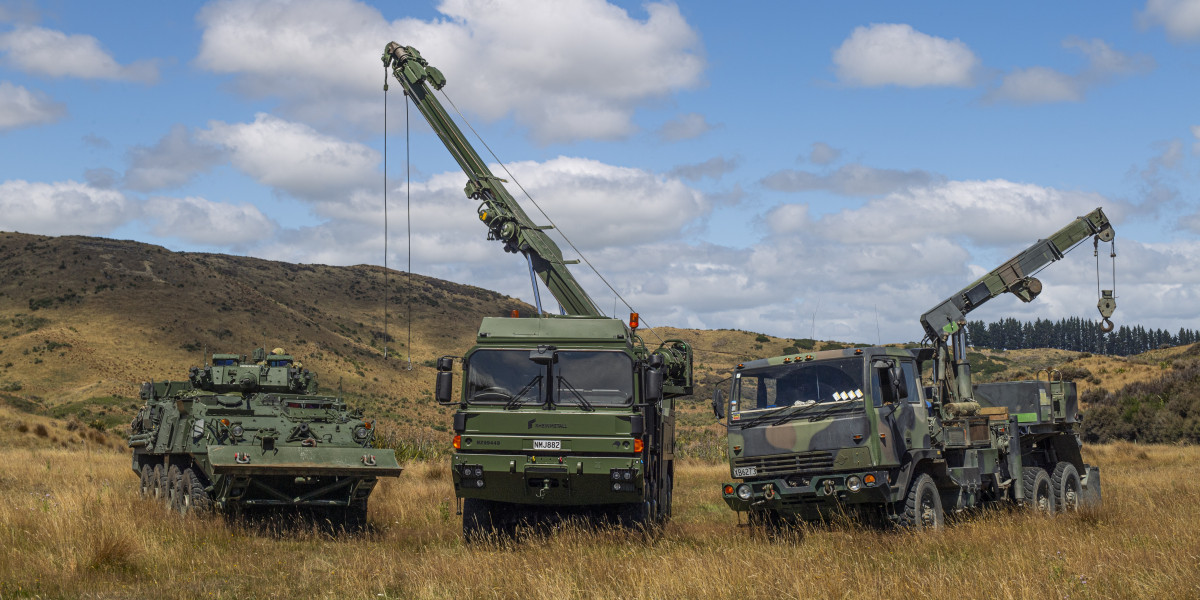
Recovering institutional knowledge, preserving the logic of military equipment entitlements, and building trust in future logistics systems
Long before computers, military organisations developed sophisticated systems to determine what was required to raise, equip, deploy, and sustain an army. These systems were recorded in War Establishments, equipment tables, scales of issue, entitlement schedules, ammunition allowances, repair parts lists and numerous other publications. Although maintained on paper and administered through manual accounting processes, they represented considerably more than inventories of military stores. Collectively, they captured generations of operational experience and provided a structured way to translate military organisation and operational requirements into personnel, equipment, and sustainment demands.
In many respects, these documents performed functions that modern information systems, including artificial intelligence (AI), are now being developed to undertake. They established relationships between military organisations, their authorised equipment, the resources required to maintain that equipment, and the consumable stores needed to sustain operations. By applying established rules and planning factors, logisticians could determine requirements, identify deficiencies and adjust support arrangements to suit particular circumstances.
It would be historically inaccurate to describe these paper-based systems as artificial intelligence in the modern technological sense. They did not learn independently, interpret unstructured information or generate new assessments. Nevertheless, they embodied a form of codified institutional intelligence in which accumulated knowledge was converted into rules, tables and procedures that could be applied consistently throughout the military organisation.
The transition from these systems to computerised logistics management has delivered substantial improvements in transactional efficiency, stock visibility and financial accountability. However, digitisation has not always preserved the relationships and underlying logic that made the earlier arrangements effective. In some instances, knowledge once contained within interconnected publications has had to be rediscovered, reconstructed or managed outside enterprise systems.
As artificial intelligence becomes increasingly capable of supporting military logistics planning and decision-making, this historical experience raises an important question: can the institutional knowledge previously captured in paper-based systems be recovered and incorporated into a trusted digital environment that can respond to changing operational requirements? This article argues that it can, and that artificial intelligence, built on a properly configured enterprise system and governed by authoritative data and human authority, should become a routine and progressively wider part of New Zealand Army logistics planning.
For more than 150 years, military logisticians have developed the knowledge, scales, tables and planning factors needed to calculate military support requirements. The next step is to make that accumulated knowledge executable within integrated enterprise systems, supported by automation and artificial intelligence, so that logisticians spend less time calculating what is required and more time ensuring that the necessary support is delivered. That knowledge must also record the risks accepted when established requirements are reduced, or delegated to allies, for political or practical reasons. Although the focus here is military, the same lessons apply to any organisation that must turn accumulated knowledge into the resources needed to sustain its people and assets.
Work to integrate AI into logistics and enterprise systems may well already be under way within the New Zealand Defence Force, including through the Future ERP programme. This article is not intended to critique or pre-empt that work. Rather, it approaches the subject from a different angle, drawing on the history of military scaling and the institutional knowledge embedded in it, to offer an additional perspective that may be useful to those designing and implementing these systems.
The Origins of Structured Military Equipment Scales
The practice of allocating equipment and supplies according to a military force’s size and composition predates the modern army. Military organisations have long recognised that a defined number of soldiers, animals, weapons or vehicles creates corresponding requirements for food, ammunition, transport, accommodation and maintenance. However, the nineteenth century saw a significant development in the formalisation of these relationships as armies expanded, military equipment became increasingly specialised, and governments sought greater consistency in providing and accounting for military stores.
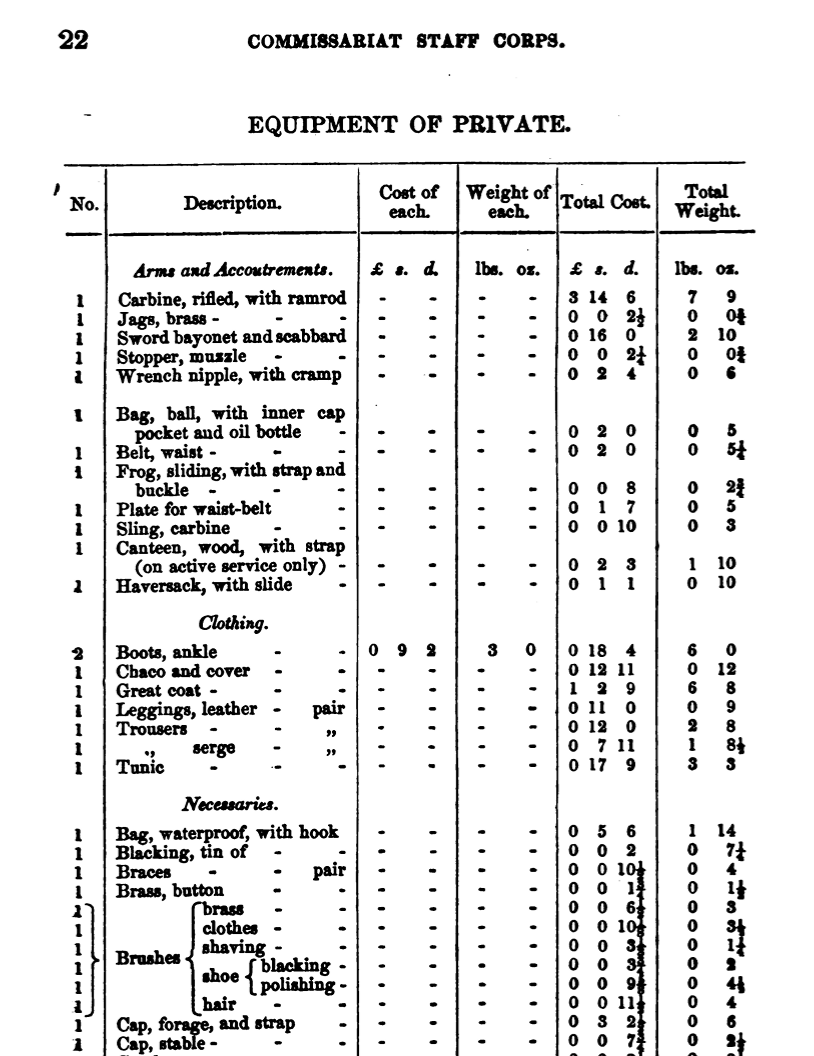
Source: Army Equipment, Part VI (1865)
A key example was the British War Office’s seven-part Army Equipment series, published during 1861–1866. The series was intended to provide comprehensive and standardised returns of the equipment authorised for the principal arms and services of the British Army. It covered cavalry, Royal Artillery, Royal Engineers, the Military Train, infantry, commissariat services and hospitals, with each volume addressing the particular equipment requirements of its respective organisation.[1]
The publications were considerably more detailed than simple inventories. They identified weapons, tools, personal equipment, saddlery, harness, camp equipment, specialist stores, and other resources needed to perform specific military functions. Where appropriate, they included quantities, weights, dimensions, and costs, allowing equipment requirements to be expressed as procurement, storage, and transportation demands. The volumes also reflected the increasingly specialised nature of military logistics, with separate provisions for the equipment required by engineers, artillerymen, transport personnel, medical services and the commissariat.
The 1865 Equipment of the Military Train, for example, addressed the resources required by the Army’s military transport organisation. Its preparation involved collecting and standardising equipment information, including determining weights and identifying costs. The compilers acknowledged possible errors and the need for later correction, showing that accurate equipment information and its maintenance were already recognised as important administrative responsibilities.[2]
The Commissariat Staff Corps’ Equipment, also published in 1865, provides an equally revealing example. In addition to describing specialist equipment used by bakers, butchers, carpenters, smiths and other trades, it included calculations for supporting an army in the field. One illustrative model considered a force comprising 10,000 infantry, 1,800 cavalry, 2,500 artillery, 600 engineers and 600 Military Train personnel, together with 400 horses. The calculations also considered the possibility of units being detached from the main force, showing an appreciation that logistics requirements could vary with the organisation and disposition of troops.[3]
Notably, some of the underlying calculations drew on experience gained during the Peninsular War. Operational knowledge accumulated decades earlier was therefore being incorporated into standardised planning arrangements that could be applied to subsequent military requirements.[4]
The Army Equipment series mattered not simply for the information in individual volumes, but for the broader principle it established. Once the composition and role of a military organisation were known, its equipment requirements could be determined by referring to an authoritative, standardised body of information. This allowed requirements to be calculated consistently, supported the preparation of stores for mobilisation, and provided a basis for assessing whether units had the resources needed to perform their assigned functions.
Although the calculations were undertaken manually and the information was maintained on paper, the underlying process was recognisably similar to modern requirements modelling. Organisational structures were linked to authorised resources, equipment characteristics supported transportation and storage calculations, and established rules enabled requirements to be adjusted according to the circumstances of the force being supported. These publications did not constitute a complete logistics information system in the modern sense, nor did they eliminate the need for professional judgement, but they demonstrate that structured data, standardised entitlements and the application of operational experience to logistics planning were well established before computers.
From Equipment Tables to Wartime Logistics Administration: The Ordnance Manuals of 1914 and 1939
By the beginning of the twentieth century, the British Army’s equipment administration had developed beyond preparing standardised equipment lists into a more comprehensive system governing the provision, issue, accounting, maintenance, and replenishment of military stores. This development is illustrated by the Ordnance Manual (War), 1914 and its later 1939 counterpart, which provide useful insights into the increasing sophistication of military logistics administration.
The Ordnance Manual (War), 1914 described the responsibilities and procedures of the Army Ordnance Department and Army Ordnance Corps during mobilisation and active service. It operated alongside the contemporary Equipment Regulations, which contained separate provisions for the equipment requirements of infantry, cavalry, artillery, engineers, the Army Service Corps, the Army Ordnance Corps and other specialist organisations. Together, these publications distinguished between the equipment a military organisation was authorised to hold and the administrative arrangements needed to provide and sustain it.[5]
The 1914 manual addressed the organisation of ordnance services in war, the maintenance of stocks, the preparation of demands and indents, the provision of ammunition and the arrangements for handling unserviceable equipment. These procedures ensured that equipment requirements could be translated into actual supplies and that the resulting transactions remained subject to administrative control. Determining an authorised requirement was only one part of logistics: the equipment also had to be available, transported to the appropriate location, issued to the correct organisation and subsequently maintained or replaced.
By the outbreak of the Second World War, the Ordnance Manual (War), 1939 reflected a further development of these principles. Its provisions addressed wartime provisioning, the supply of ordnance stores, repair and recovery arrangements, ammunition supply and the administration of the wider ordnance support system. Its detailed camp-equipment tables were particularly relevant. Table II, Camp Equipment for One Infantry Division (Manoeuvre Scale), differentiated between the arms and services forming the division, while Table III, Camp Equipment Required to Accommodate a Battalion at War Strength, provided a separate accommodation scale that expressly excluded equipment already included within the unit’s war equipment.[6]

This distinction showed that equipment requirements were not a single, fixed allocation. A unit had an authorised establishment and associated war equipment, but additional requirements could arise depending on its operating circumstances. Camp equipment, accommodation stores and other supporting resources could therefore be calculated separately from equipment necessary for the unit’s principal military role. The tables also included weights and measurements, allowing equipment quantities to be considered in relation to transportation and storage.
The progression from the nineteenth-century Army Equipment publications to the Ordnance Manuals of 1914 and 1939 illustrates a gradual development towards integrated resource management. The earlier publications standardised equipment requirements, while the later manuals described more comprehensive arrangements for administering those requirements during mobilisation and operations. New Zealand’s military administration inherited these principles and adapted them over time.
New Zealand’s Early Twentieth-Century Equipment Scales
By the beginning of the twentieth century, New Zealand’s military administration increasingly relied on formal establishments and equipment scales to support the organisation, training, and mobilisation of its forces. These arrangements became particularly important following the introduction of the Territorial Force in 1910, when the Army was required to equip and train larger numbers of personnel while maintaining effective control over limited resources.[7]
The annual training camps of the pre-war period provide useful examples. The 1913 brigade camps required accommodation, cooking equipment, camp furniture, tools, and other stores according to established scales. Temporary Ordnance Depots supported the issue and return of these items, with accounting procedures intended to ensure that equipment could be recovered, inspected and prepared for subsequent use. Once the number and composition of the participating units were known, requirements could be calculated against approved scales and the necessary holdings assembled.
The same principles applied to mobilisation. Expansion from a peacetime establishment to authorised wartime strength required corresponding increases in weapons, clothing, personal equipment, transport and supporting stores. Establishment tables identified the authorised organisation, while equipment schedules and other publications supplied the additional information needed to determine what that organisation required. Although undertaken manually, these calculations followed recognised structures and rules rather than being devised anew for every activity.
The Second World War: Establishments as Logistics Information
The rapid expansion of the New Zealand Army during the Second World War placed considerable demands upon its administrative and logistics systems. War Establishments and associated equipment tables became essential instruments for determining the personnel, vehicles, weapons, and supporting resources the expanding force required. A surviving collection of New Zealand Army Service Corps (NZASC) War Establishments for Home Defence, 1939–1945, offers a particularly useful illustration of the detail in these documents.[8]
The August 1940 War Establishment for a District Composite Company, NZASC, divided the organisation into headquarters, supply, ammunition and petrol sections, together with personnel permanently detached to support other formations and services. It recorded the authorised distribution of officers, warrant officers, non-commissioned officers, and other ranks, while separate tables identified the vehicles each element of the organisation required.[9]

The transport schedules went beyond simply allocating vehicles. They distinguished between types and carrying capacities and identified their intended employment in transporting supplies, ammunition, petrol and other military stores. Individual subsections were assigned personnel and transport appropriate to their functions, and provision was made to support formations such as infantry brigades and medical units. The establishment therefore provided a structured description of logistics capability, linking authorised resources to the tasks the organisation was expected to perform.
It is important to distinguish the War Establishment from the equipment scales and stores entitlements that complemented it. The establishment defined the authorised organisation and its principal resources, while associated equipment documentation specified additional stores required to equip and sustain that organisation. Together, these publications provided a basis for determining requirements, assembling resources and assessing deficiencies. This distinction remains relevant to modern logistics information systems: organisational structures must connect to equipment configurations, actual holdings, consumption factors, and support arrangements before they can support a meaningful readiness assessment.
An earlier establishment shows the same logic applied to an expeditionary force. The September 1939 War Establishment for the Divisional Ammunition Company, NZASC (1st Echelon), was expressly based on British War Establishment II/1931/13/3 of August 1938, adapted for the Special Force. Its transport schedule allotted vehicles by ammunition nature (18-pounder, 4.5-inch howitzer, 2-pounder anti-tank, mortar, small-arms and anti-tank rifle ammunition, grenades and mines) as well as petrol, explosives, water and workshop loads. The establishment therefore embedded the division’s weapon systems within the company that sustained them. Its trade tables and notes went further, specifying workshop tradesmen, the numbers to be trained in first aid, water duties and anti-gas work, and dependencies on other units. Distribution lists prepared for the Ngaruawahia mobilisation camp then applied a 10 per cent reinforcement factor and carry annotations where duties were still being reconciled by hand.[10] The company was scaled to the equipment of the force it supported. As the Greek campaign would show, that alignment could not be assumed for every supporting organisation.
The Importance of Accurate Scaling: Greece, 1941
Even a well-established system’s limitations become apparent when the information used to determine requirements does not reflect the force being supported. The deployment of the New Zealand Division to Greece in 1941 provides an instructive example. The Scales Branch of the British Central Provisioning Organisation scaled Divisional Ordnance Field Parks centrally against a standard Middle East scale, set to represent 2.5 per cent of the supported division’s vehicles. The British Royal Army Ordnance Corps’ 1 Ordnance Field Park, attached to support the New Zealand workshops, held adequate Ford, 25-pounder and 2-pounder spares, but its vehicle spares had been scaled for Internationals and Crossleys. The New Zealand Division had no Internationals and only two Crossleys. A lack of consultation before the operation meant a sound scaling rule was applied to a fleet the Division did not hold.[11]
Consequently, part of the repair-parts holding was unsuitable for the vehicles requiring support. The problem was not the absence of a formal scaling system, but applying incorrect assumptions to the force being sustained. Transport capacity and storage space were committed to items of limited utility, while other requirements had to be met locally. After the withdrawal from Greece and Crete, the New Zealand Division formed its own Ordnance Field Park on 28 July 1941, initially with four officers, 81 other ranks and 27 three-ton lorries, holding fast-moving and essential motor-transport, weapon and signal spares for the Division’s own equipment. Its organisation was revised as the force changed: in November 1942 it was reorganised into holding, infantry and armoured sections to support the newly formed 4th Armoured Brigade.[12]

This experience illustrates a principle fundamental to modern logistics management: a calculation can be mathematically correct, but its result operationally unsuitable if the information or assumptions on which it is based are inaccurate. Computers and AI do not remove this limitation; their speed may instead allow incorrect assumptions to be applied more widely and with greater apparent authority.
From Wartime Enumeration to Post-War Entitlement Control
After the Second World War, military equipment became increasingly complex, placing greater demands on the systems used to define and account for authorised holdings. Earlier War Equipment Tables, including the G1098 system, effectively established quantities against a unit’s authorised organisation, but were less suited to maintaining the integrity of increasingly complex equipment systems comprising components, accessories, tools, publications, and associated repair parts.[13]
By the late 1950s and early 1960s, the New Zealand Army was developing a more integrated approach to equipment entitlement and control. Drawing upon British and Commonwealth practices, the Army formalised a layered system incorporating New Zealand Entitlement Tables (NZET), New Zealand Complete Equipment Schedules (NZCES) and New Zealand Block Scales (NZBS). The NZET provided the authoritative record of a unit’s equipment entitlement, the NZCES defined components necessary to constitute complete equipment, and Block Scales enabled additional stores to be authorised according to particular roles or requirements.
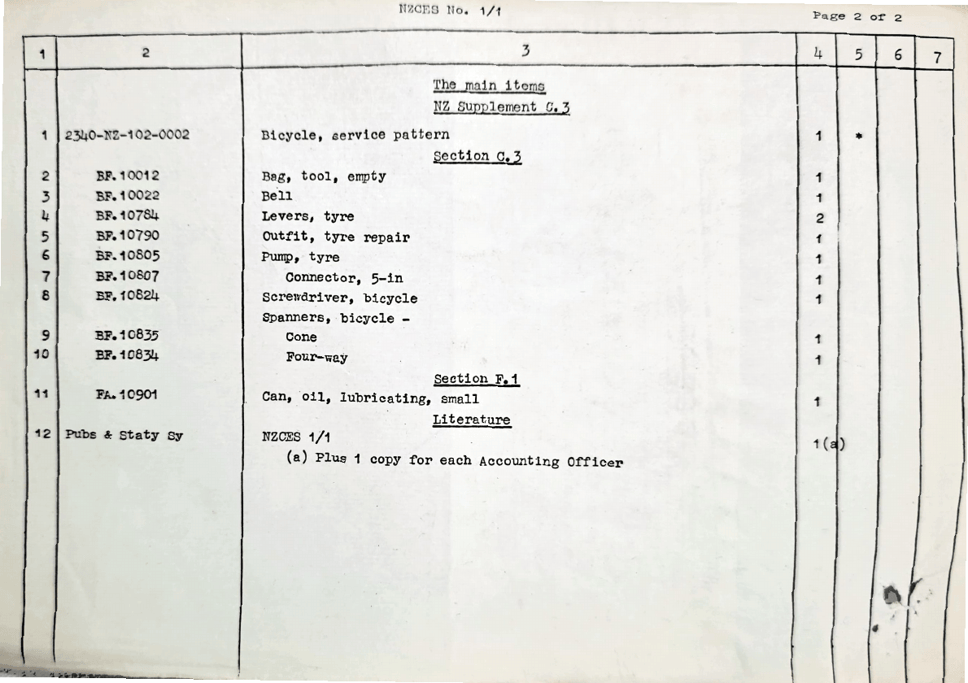
Supporting maintenance and technical stores outfits, including First Aid Mechanical Transport Outfits (FAMTO) and First Aid Technical Stores Outfits (FATSO), further recognised that equipment possession alone did not constitute a sustainable capability. A vehicle’s usefulness depended on associated tools, documentation, and maintenance support, while changes to the authorised fleet could create corresponding requirements for repair parts and workshop resources. This marked an important shift from numerical allocation to managing complete, supportable equipment systems.
The 1965 Officers’ Handbook: Connecting Combat Formations and Logistics Support
An incomplete copy of a New Zealand Army Officers’ Handbook, dating from approximately 1965, further illustrates how these principles were applied to the organisation of a military force. The handbook describes a New Zealand Infantry Brigade Group and Logistic Support Group, supported by organisational diagrams and tables that identify personnel strengths, vehicles, and principal equipment. Because the surviving copy is incomplete, it should be read as evidence of the documented force model rather than proof that every organisation was established at full strength.[14]
Within the Infantry Brigade Group, combat and combat support units were accompanied by specialist logistics organisations, including an RNZASC Transport Company, an RNZAOC Ordnance Field Park, an RNZEME workshop and an RNZAMC Field Ambulance. The handbook’s entry for the RNZASC Transport Company describes four transport platoons, a composite platoon and workshop support, with an establishment of 11 officers and 307 other ranks, together with vehicle and trailer allocations.[15]
The Logistic Support Group extended beyond the brigade’s immediate requirements. Its organisation included transport companies, supply units, petrol distribution, air supply, cold storage, field bakery facilities, engineering support and medical services. The diagrams show that a force’s requirements could not be determined solely from its combat units: these generated corresponding demands for transport, fuel, ammunition, maintenance, medical support and numerous other services.[16]

The handbook therefore provides a useful example of an interconnected military information system. A formation’s organisational structure established the basis for personnel and principal equipment requirements, while associated entitlement schedules, technical publications, and planning factors supplied the information needed to calculate its wider support needs. Although recorded on paper, these relationships can now be represented in a digital information environment.
When Established Requirements Meet Political Constraints: Australia in Vietnam
The 1965 Officers’ Handbook records the documented model of a brigade group supported by its own Logistic Support Group. The Australian deployment to South Vietnam the following year shows what can happen when a deployed force departs from such a model. The existence of an established logistics organisation and its associated equipment scales does not mean that the resources needed to sustain a force will be authorised or deployed. Governments and commanders must reconcile military requirements with political commitments, personnel ceilings, funding and competing operational priorities. A critical distinction therefore exists between the doctrinal requirement, the approved establishment and the support capability actually available.
Ian R. Finlayson’s study of Australian Army logistics in South Vietnam illustrates the consequences. In planning the deployment of the 1st Australian Task Force (1ATF) in 1966, Australia established the 1st Australian Logistic Support Group (1ALSG), rather than deploying the supporting organisation already envisaged in earlier Army force structures. Planners assumed that American logistics could supply much of the support and consequently allocated 937 positions to 1ALSG from a deployed Army strength of 4,225. The decision favoured combat manpower but left the national logistics organisation constrained and dependent on external arrangements.[17]
The difficulties were not simply a question of supply quantities. American materiel was obtained through particular depots, agreements and liaison channels; the Australian organisation still had to request, collect, move and distribute it. Finlayson also describes restrictions on 1ALSG headquarters’ authority to direct technical logistics functions. Access to allied supply therefore did not remove national responsibilities for control, distribution, maintenance, or managing shortages.[18]
The lesson is not that coalition support should be avoided. For a smaller force, it is indispensable. Rather, reductions from an established logistics scale should be explicit, with the resulting shortfalls linked to confirmed arrangements, responsible providers, delivery capacity and contingency measures. A logistics system should show both the authorised force and the support it would require under the applicable doctrinal model, rather than treating the smaller approved establishment as proof that the requirement has disappeared.
The broader failure to avoid is losing institutional memory between deployments. If force-structure decisions, supply dependencies and operational lessons remain in disconnected reports or personal experience, future planners may have to reconstruct risks already encountered. An integrated enterprise system should compare doctrinal requirements with approved and actual establishments, identify deficiencies, record whether allied or contracted support is confirmed or merely assumed, and allow logisticians to explore the consequences of support failing or operational demands increasing.
These considerations were not confined to Vietnam. New Zealand’s commitments in Malaya, Borneo, Somalia and East Timor each required logistics organisations to reconcile national requirements with the support available through allied, multinational or host-nation arrangements. The operating environments, national responsibilities and degrees of reliance upon external support differed, but the underlying planning questions remained consistent: what support must New Zealand provide itself, what can reliably be obtained from others, and what risks arise when the approved support organisation falls short of the assessed requirement? The historical record of these deployments offers an opportunity to examine whether lessons about force scaling, national support responsibilities and dependency management were carried forward into subsequent planning.
Somalia, 1992–1994: When Operational Requirements Outgrow Equipment and Support Arrangements
New Zealand’s deployment to Somalia between 1992 and 1994 further illustrates the difference between equipping a military organisation according to established arrangements and ensuring its resources remain suitable for the circumstances in which it operates. Initially deployed as a 28-person Supply Detachment, the New Zealand contribution expanded in July 1993 into a 43-person Supply Platoon, incorporating an infantry section as the security situation deteriorated. The contingent’s responsibilities included managing general stores at Mogadishu Airport and supporting food distribution through the port, in conjunction with the United Nations-contracted catering organisation.[19]

Although established primarily to perform supply functions, the contingent operated in an increasingly hostile environment. Personnel carried standard New Zealand Army small arms and light fragmentation vests, while transport relied largely on commercially derived, unarmoured vehicles. As the threat increased, restrictions upon ground movement sometimes required the use of helicopters to maintain access to United Nations locations. These circumstances show how changes in operational conditions can create requirements beyond those anticipated when a force is initially equipped and deployed.[20]
The contingent’s personal equipment provides an equally instructive example. Standard load-carrying webbing proved impractical for many vehicle-based and supply duties, encouraging personnel to adopt alternative arrangements for carrying ammunition and essential equipment. The fragmentation vest offered limited protection against the threats encountered, while some New Zealand personnel serving at United Nations headquarters from 1994 gained access to more capable body armour. Such adaptations illustrated the difference between possessing authorised equipment and having equipment appropriately configured for the actual operating environment.[21]
The broader significance lies in the relationship between force structure, equipment entitlement, operational suitability and changing circumstances. A system that compares an approved establishment with actual holdings would provide only part of the picture. Effective logistics planning must also consider the tasks personnel undertake, the threats they face, the suitability of their equipment, and the changing resources required to sustain operations. An integrated ERP environment, supported by validated rules and AI-assisted analysis, could help identify these differences, flag emerging deficiencies, and preserve the operational lessons that should inform subsequent equipment scales and deployment planning.
Beyond Equipment Tables: The Wider Science of Logistics Planning
The examples examined so far represent only a snapshot of the military’s historical system of equipment establishments and entitlements. Over time, a much wider range of specialised tables, scales and planning factors was developed to address the increasingly complex requirements of military operations. Ammunition scales established initial holdings, expenditure assumptions, and replenishment requirements; repair parts scales identified components needed to maintain equipment; and fuel consumption tables enabled estimates based on vehicle types, operating conditions, distances travelled, and anticipated activity.
Other planning instruments addressed ration requirements, water consumption, transportation capacity, accommodation, medical support and casualty estimates. Although the publications served different purposes, the underlying principle remained consistent: a known military organisation, equipped for a particular task and operating under defined conditions, generated measurable requirements that could be calculated through established relationships and assumptions.
These requirements were not necessarily fixed. They could be adjusted according to the duration of an operation, terrain, climate, anticipated intensity of activity and transport availability. This was the science and art of scaling military logistics: the science lay in applying established quantities, rates, and relationships, while the art lay in exercising professional judgement to ensure the resulting requirements reflected operational realities. This combination offers considerable potential for future AI applications.
Project Convergence 2026: Scaling the Digitised Battlefield
The development of scales and planning factors is not complete. New equipment continues to create requirements for which established scales do not yet exist, as New Zealand’s participation in Project Convergence Capstone 6 (PCC6), a US-led programme of multinational experimentation conducted in 2026, demonstrated. Newly released New Zealand Defence Force (NZDF) briefings describe a battlefield increasingly characterised by persistent surveillance, uncrewed systems, autonomous sensor fusion, machine-assisted decision-making and connected communications. They also identify specialist technical skills as necessary to employ and sustain increasingly complex autonomous capabilities. The significance for military logistics is not simply the arrival of new equipment: each additional system creates new requirements for personnel, power, repair, replacement, data connectivity and distribution.[22]
Electrical power provides a particularly clear example. The NZDF findings identify power generation and energy resilience as increasingly important operational considerations, with battery consumption, replacement, charging cycles and sustainment requiring deliberate planning at tactical levels. An August 2026 US Army study similarly describes electrical power as an emerging fifth commodity, alongside ammunition, food, fuel and water. For a force deploying uncrewed aircraft, sensors, electronic warfare equipment and networked command systems, equipment entitlements alone are insufficient. A credible support calculation must also establish electrical loads, battery endurance, the number and compatibility of spare batteries, charging capacity, power-generation fuel, movement arrangements and safe storage and handling. These are modern equivalents of the weights, capacities, repair-parts allowances and consumption factors recorded in earlier equipment scales.[23]
PCC6 also highlighted the potential to forward-produce small uncrewed aircraft systems through additive manufacturing and commercial technologies. Such arrangements might shorten the route between damage, replacement and renewed operational availability, but do not remove the need for material stocks, suitable components, skilled personnel, quality assurance and safe power supplies. The same briefings emphasise that common data standards are fundamental to meaningful interoperability, regardless of the platforms employed, and note the close alignment observed between the New Zealand and Australian armies. For logistics information systems, this reinforces the importance of consistent item identification, equipment configurations, authoritative planning factors and exchangeable information across national and allied systems.[24]
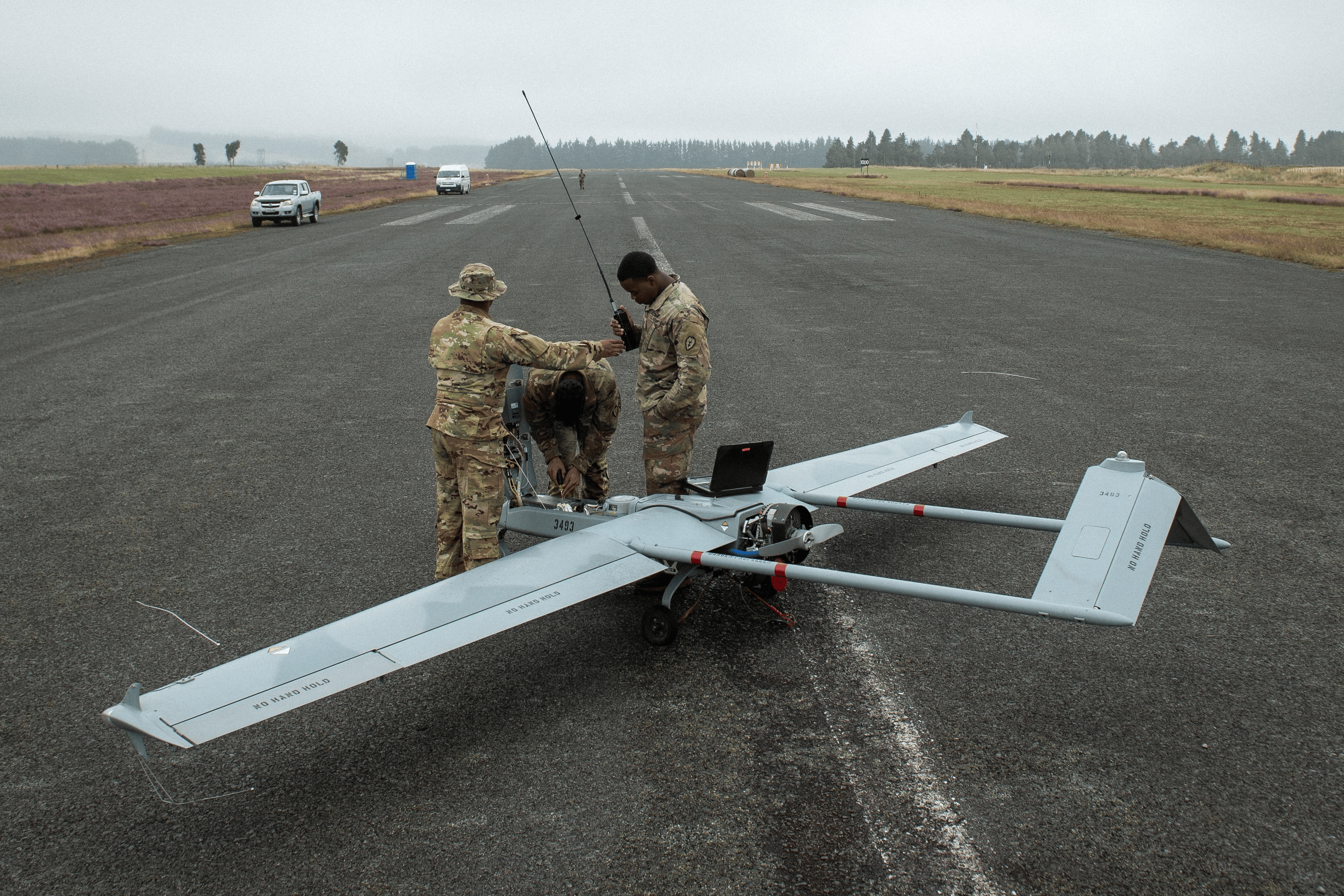
Source: NZDF, Exercise Wayfinder 24
These lessons also expose a practical distinction between acquiring a technological capability and sustaining it. The NZDF briefings recommend better alignment of robotic and autonomous-system initiatives to reduce duplication and improve supportability; they also show why experimentation should test the full support chain rather than equipment performance in isolation. The historical question remains recognisable: what resources does a specified force require, under particular operational conditions, for a defined period? The modern answer must include electricity, software-dependent systems and information exchange alongside the more familiar demands for fuel, ammunition, maintenance and transport.[25]
The same briefings also record more familiar support shortfalls. Accommodation was poorly coordinated; personnel had to buy their own cleaning materials to prepare equipment for Customs inspection on return; and the contingent lacked some of the technology needed to take full part in planned experimentation, reducing the opportunity to collect meaningful trial data. None of these requirements was novel. Cleaning stores for return inspection are precisely the kind of predictable, activity-specific need that a Block Scale or camp-equipment table was designed to capture, in the same way that the 1939 Ordnance Manual separated accommodation stores from a unit’s war equipment. The equipment, batteries, chargers and power generation needed to take part in a technology-focused exercise could likewise have been derived from the activity’s intended tasks. Had these requirements been held as an activity scale and checked against holdings before departure, with AI used to interpret the exercise plan, identify the applicable scales and flag items for which no entitlement or holding existed, many of these shortfalls could have been identified and resolved in New Zealand rather than discovered in the field. The NZDF’s own recommendation, that capabilities be tested in New Zealand before deployment, points in the same direction.[26]
Digitisation: What Was Gained and What Was Lost?
The introduction of computerised logistics systems fundamentally changed how military organisations recorded, processed and managed information. Electronic accounting systems were developed to reduce the considerable administrative burden of manual ledgers, requisitions, stock movements, and equipment reconciliation. These systems progressively evolved into enterprise resource planning (ERP) platforms, improving transaction processing, stock visibility, financial accountability and reporting.
However, the technological limitations of early systems meant that many established logistics functions were transferred into electronic form without fundamentally changing their operation. Equipment tables, entitlement schedules and accounting procedures often became electronic equivalents of their paper predecessors. Although information was easier to record and retrieve, relationships between establishments, equipment entitlements, operational requirements and sustainment calculations still required manual interpretation.
This distinction between computerisation and genuine digital transformation is important. A system might accurately record the quantity of equipment held by a unit without determining whether that equipment was complete, serviceable or sufficient for a particular mission. The information existed, but the functionality needed to turn it into an integrated assessment of operational capability was often missing.
Successive generations of ERP systems have improved database architecture, integration, workflows and reporting, enabling more dynamic relationships between inventory, procurement, maintenance and financial functions. Nevertheless, the full benefits of digitisation have not always been realised. Reports must still be downloaded, combined with other datasets and manipulated to meet mission-specific requirements, while resulting demands may require separate manual transactions.
Administrative effort has therefore been reduced, not eliminated. Tasks once performed by reconciling paper publications are now undertaken through electronic reports, spreadsheets and supplementary tools. Further integration, rules-based automation, and artificial intelligence offer the opportunity to move beyond recording and displaying information to dynamically calculating requirements, identifying deficiencies, and supporting operational decisions.
Working Around the System: The Excel Problem
A persistent feature of modern logistics information management is the reliance upon Microsoft Excel to supplement enterprise systems. Information is extracted from authoritative databases, reorganised, reconciled and manipulated in spreadsheets to produce reports and calculations suited to particular operational requirements. Spreadsheets remain valuable analytical tools, but routine extraction because the enterprise system cannot combine its own data may indicate incomplete digital integration.
For example, an ERP system may contain information on a unit’s equipment entitlements, actual holdings, serviceability, repair parts, ammunition allocations and consumption rates. Yet these datasets may be available only through separate reports rather than as a single assessment of the resources required for an exercise or deployment. Logisticians must retrieve the information, reconcile differences, apply planning factors and construct supplementary documents.
This process can create duplicate reports and standalone spreadsheets containing information already held within the enterprise environment. Locally maintained documents may incorporate assumptions and corrections that are not returned to the authoritative system. Changes in personnel strengths, equipment holdings or activity duration then require further manual reconciliation, increasing administrative effort and the possibility of inconsistencies.
The problem is not Excel itself, but the gap between information recorded in enterprise systems and the processes needed to convert it into operationally useful demands. A contemporary example is the New Zealand Army’s Catalogue Demand (CATDEM) process: its spreadsheet-based planning artefacts consolidate activity requirements, but the associated entitlement checks, demand interpretation and SAP transaction preparation remain substantially manual.[27]
AI, combined with conventional rules-based automation, could reduce repetitive data extraction, reconciliation and transaction preparation. The objective is not to eliminate spreadsheets, but to reserve them for genuine analysis rather than use them as essential workarounds for limitations in enterprise functionality.
Transferring the Burden of Logistics Calculation
The historical development of military equipment scales, entitlement tables and logistics planning factors reveals an important distinction between the knowledge contained within these publications and the effort required to apply it. The publications themselves represented accumulated institutional knowledge, progressively refined through operational experience and expressed as rules, relationships and calculations. However, the military logistician remained responsible for interpreting and applying that knowledge.
For generations, logisticians were required to consult multiple publications, establish the composition and equipment of a supported force, determine its entitlements, calculate consumption and maintenance requirements, identify deficiencies and translate the resulting information into demands for stores and services. The process required considerable professional knowledge, but much of the associated work was repetitive, administrative and computational.
In this respect, the paper-based system represented a form of institutional intelligence appropriate to its period. The rules and knowledge were already established; the human logistician supplied the processing capability necessary to apply them. As the preceding sections show, electronic accounting and ERP systems reduced this workload but did not remove it: many of the relationships between organisational structures, equipment entitlements, operational requirements and sustainment calculations still depend on manual interpretation and intervention.
The next stage in this evolution should be the progressive transfer of that computational and administrative burden to integrated enterprise systems, supported by rules-based automation and artificial intelligence. Authoritative establishments, equipment configurations, entitlement schedules, consumption factors and maintenance requirements should be maintained as connected information rather than isolated records requiring repeated manual reconciliation.
The objective should be to enable a logistician to establish the support requirements of a military activity or operation and receive a coherent assessment of the resources necessary to deliver that support. Such an assessment should identify what is authorised, what is required, what is available, what is serviceable, what remains deficient and what actions are necessary to close those deficiencies. It should also identify the transportation, maintenance, replenishment and other supporting arrangements required to sustain the force throughout the intended activity.
This does not remove the need for professional logistics judgement. Rather, it changes where that judgement is applied. Instead of spending substantial time assembling information and reconstructing established calculations, logisticians should focus on assessing the feasibility of support arrangements, resolving competing priorities, managing risk, and ensuring the required resources reach the right place at the right time.
The ultimate objective is not simply to provide more information to the logistician, but to make the full implications of an operational requirement visible, understandable and actionable.
Future ERP: Reconnecting Military Entitlements and Operational Logistics
The New Zealand Defence Force’s Future Enterprise Resource Planning (Future ERP) Programme provides a particularly relevant contemporary development in this longer history. The programme is intended to replace a fragmented ERP environment with an integrated enterprise-wide capability. In October 2026, NZDF procurement notices identified SAP S/4HANA and related SAP products as the intended solution, with separate procurement processes for systems integration, business integration and independent assurance. The transition is therefore more than a general aspiration to modernise accounting software; it is an opportunity to reconsider how information supports military readiness, deployment and sustainment.[28]
More significantly, a proactively released programme business case identifies “ERP for Defence, Paced for Success” as the preferred approach and explicitly favours SAP Defense & Security. It argues that this military-specific functionality provides operational planning, interoperability and readiness capabilities that a conventional corporate ERP solution cannot deliver. It also envisages rationalising numerous existing systems and ancillary tools. This shows a preferred programme direction, not that every module, workflow, or capability has been contracted, configured, or implemented.[29]
The distinction matters because SAP Defense & Security already contains functions closely related to the logic preserved in historical War Establishments and equipment scales. Its force-element model connects military organisational structures with authorised personnel and equipment, actual resources, maintenance, logistics and operational information. SAP’s published training materials describe authorised-versus-actual comparisons and the ability to initiate follow-on supply action from identified deficiencies. These are not speculative AI capabilities: they are established enterprise-system functions which, if properly configured and adopted, can provide much of the structured foundation on which more advanced decision support might operate.[30]
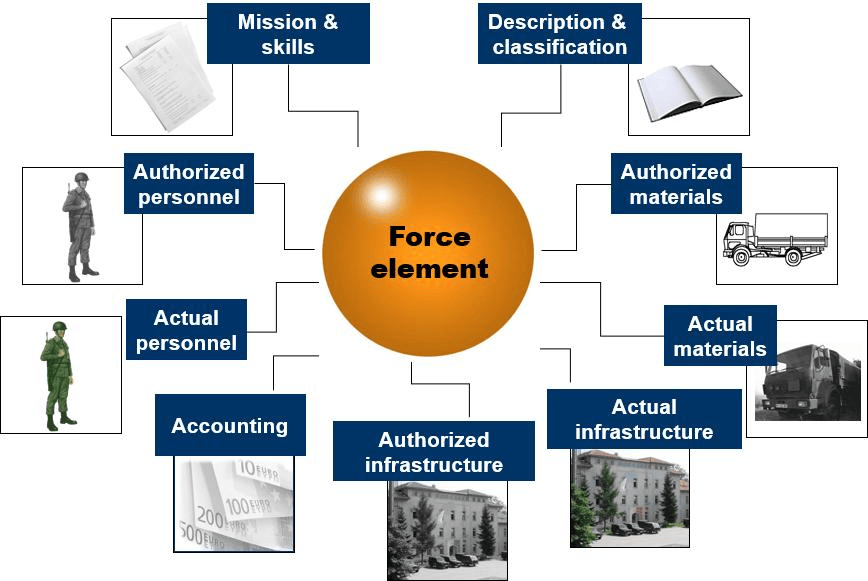
However, the existence of such functionality does not guarantee that the New Zealand Army’s entitlement policies, equipment configurations, activity-based demands, consumption factors, and deployment workflows will automatically operate as a coherent end-to-end process. Standard functionality must be mapped to national policy and military practice; master data must be corrected and governed; interfaces and workflows must be designed; and users must be trained to trust and employ the resulting system. Nor does an authorised-versus-actual equipment comparison, by itself, establish whether a force can sustain a specified operation for a given period. Serviceability, operational intensity, replenishment, maintenance capacity, transport constraints and the effects of disrupted communications must also be considered.
The system should also distinguish a doctrinal support requirement from the politically authorised establishment and the actual resources available. Allied, contracted and host-nation support should be represented as explicit dependencies, with the degree of assurance and consequences of failure visible to planners.
Future ERP therefore strengthens, rather than displaces, the argument advanced here. The rules-based foundation should be built first: the military-specific capabilities of SAP S/4HANA Defense & Security should be exploited rather than reproduced in separate applications or AI tools, so that AI can then be adopted with confidence on top of them. Artificial intelligence should be applied where it adds the most value: interpreting operational intent, retrieving relevant doctrine, exploring alternative scenarios, identifying anomalies, and explaining the consequences of changed assumptions. Approved entitlements, calculations, approvals and auditable transactions should remain under authoritative rules and human control. SAP also documents disconnected-operation capabilities, an important consideration for deployed forces, although the scope of any NZDF implementation remains to be established.[31]
Dividing Responsibilities Between ERP, Automation and AI
Realising the full potential of Future ERP will require a clear distinction between the functions performed by authoritative enterprise systems, conventional automation, artificial intelligence and military personnel. Not every logistics calculation or process requires AI. Many functions are better performed through established business rules, validated planning factors and integrated ERP workflows.
The following table illustrates how these responsibilities could be distributed within a future integrated military logistics environment.
| Capability | Principal responsibility |
| Authorised force structures and equipment entitlements | SAP Defense & Security and approved policy |
| Actual holdings, maintenance and serviceability | ERP and integrated source systems |
| Consumption factors and scaling calculations | Governed planning rules and calculation engines |
| Identifying deficiencies and initiating demands | ERP workflows and automation |
| Interpreting operational intent and exploring alternatives | AI-supported decision tools |
| Prioritising resources and approving support arrangements | Commanders and logisticians |
This division of responsibilities is important. Artificial intelligence should make the established logistics system easier to use, more responsive, and better able to support complex operational decisions. It should not become an alternative source of entitlement policy or an unaccountable calculation engine.
In this arrangement, calculation and administration increasingly shift from the individual logistician to the enterprise system, while professional judgement, prioritisation, and accountability remain firmly with military personnel.
Artificial Intelligence: Applying Institutional Logistics Knowledge
Artificial intelligence offers an opportunity to reconsider how military logistics information is organised, connected and used. Its greatest potential in this context lies not simply in producing reports, but in reducing the manual effort required to convert authoritative information into operational requirements and decisions.
A future AI-enabled environment could draw upon approved establishments, equipment entitlements, complete equipment schedules, repair parts scales, maintenance information and current holdings to develop an integrated assessment of a proposed operation.
For example, a commander planning to deploy an infantry battalion could request an assessment of the equipment, ammunition, fuel, electrical power, battery charging, repair parts, transport and other resources required for a specified period. The system could compare authorised entitlements with actual holdings and serviceability, apply validated planning factors and identify deficiencies. Changes to duration, location, force composition or operational intensity could then be assessed without reconstructing each calculation in separate spreadsheets.
AI’s particular value lies in helping users express operational intent, interrogate information across systems, identify inconsistencies, explore alternative scenarios, and understand the resulting analysis.
Adoption should therefore be progressive, starting where the benefits are clearest and the risks easiest to control. Suitable first uses include interpreting activity requirements within the CATDEM process and preparing draft demands for human approval; testing how changes in duration, force composition, or operational intensity alter requirements; checking master data for inconsistent entitlements, missing configuration records, and unsuitable planning factors; and retrieving relevant doctrine, scales, and policy for planners. Each can be trialled against existing manual practice, including technical and logistics validation before deployment, measured, and widened as it proves reliable.
The New Zealand Army is comparatively well placed to test this approach. At 30 November 2025, it comprised 4,358 Regular Force personnel; an August 2025 audit population recorded 11,908 Regular Force and civilian personnel across the wider NZDF, excluding reservists.[32] [33] These categories and reporting dates differ, but they indicate the organisation’s relatively modest scale. Its compact structure and interconnected logistics functions could allow integrated logistics processes to be developed, tested and refined through controlled trials and progressive integration at a manageable scale. A compact force is not automatically easier to transform, and resources, data quality, change management and implementation discipline remain real constraints. Nevertheless, with sustained investment, sound data governance and careful testing, a successful military-specific ERP implementation complemented by carefully governed AI could let the New Zealand Army demonstrate a digital logistics approach useful well beyond its size.
The opportunity is therefore not merely to recover institutional knowledge represented by historical paper systems, but to realise more fully the benefits that electronic accounting and ERP systems have long sought to deliver: accurate, connected and responsive logistics information with less repetitive administration and more time for professional judgement.
Accurate Data: The Essential Foundation
Wider use of AI depends upon the quality of the information available to it. A system operating with incorrect assumptions, outdated configurations, incomplete stock records or unsuitable consumption factors may produce convincing but operationally unreliable answers. The danger is particularly significant where results are presented without identifying their sources, assumptions or limitations.
Users must be able to distinguish between authorised requirements, verified holdings, calculated estimates and assumptions introduced because information is unavailable. Effective implementation requires disciplined management of organisational structures, entitlements, configuration records, item identification, maintenance information, and planning factors, along with clear responsibility for amendment, approval, and version control.
Historical equipment tables and scales required amendment to remain aligned with the organisations and equipment they described. The same principle applies to digital successors. AI can speed up and increase the flexibility of analysis, but it cannot compensate for the absence of an authoritative, well-maintained information foundation.
Data quality is not only a precondition for AI, however; it is also one of the areas where AI can help most. Checking entitlements against equipment configurations, identifying holdings with no corresponding entitlement and flagging planning factors that no longer match the equipment in service are laborious tasks when done manually, yet they are precisely the checks that would have exposed the mismatch between 1 Ordnance Field Park’s holdings and the New Zealand Division’s vehicle fleet in 1941. Used in this way, AI does not have to wait for a perfect information foundation; it helps to build one.
Building User Trust and Preserving Professional Judgement
Successful AI adoption will depend as much on organisational confidence as on technological capability. Users must understand where the information originated, how calculations were performed, and which assumptions shaped the results. When a system identifies deficiencies or recommends changes to a support plan, logisticians must be able to examine the evidence and assess its operational suitability.
Reducing manual intervention should not mean removing professional oversight. A system may identify the need for additional transport capacity, repair parts, or fuel reserves, but commanders and logisticians must decide how to meet, prioritise, or adjust those requirements. AI should improve decision support rather than transfer accountability from military personnel to a computer system.
The ultimate measure of success will be whether commanders and logisticians trust system outputs sufficiently to use them in planning and operations without routinely reconstructing the analysis in separate spreadsheets.
Lessons Beyond Defence
Although this article focuses on military logistics, the problems it describes are not unique to the armed forces. Any organisation that must equip, maintain and sustain people and assets for a defined activity faces the same task of turning institutional knowledge into requirements. Hospitals hold standard instrument sets and ward stock levels; airlines, transport operators and utilities hold recommended spares scaled to their fleets; humanitarian agencies plan against standard quantities of water, food and shelter per person. In civilian terms, a Complete Equipment Schedule is a bill of materials and a Block Scale a set of par levels.
Several of the lessons drawn here therefore apply more widely. First, a sound scaling rule applied to the wrong data produces a confident but unsuitable result: an operator that introduces a new bus, aircraft or medical-device fleet without revising its spares holdings repeats the experience of 1 Ordnance Field Park in Greece. Second, computerisation is not transformation; an ERP implementation that moves transactions without the logic that connects them leaves people to rebuild that logic in spreadsheets. Third, the persistence of spreadsheets alongside an enterprise system signals incomplete integration rather than user failure, and corrections made in those spreadsheets seldom return to the authoritative record.
Fourth, organisations adopting a standard ERP platform generally gain more by using its established functions than by reproducing them in custom applications and should build that rules-based foundation before layering AI on top of it. Fifth, the division of responsibility set out earlier between enterprise systems, governed rules, AI and people applies almost unchanged to a hospital, a port or an infrastructure operator: AI should make the established system easier to use without becoming an unaccountable source of policy or calculation. Finally, codified knowledge is vulnerable when the people who understand it retire and the systems that replace them record only transactions. Capturing the logic of scaling, not merely its outputs, matters as much to a civilian enterprise as to an army.
For New Zealand, this point is especially relevant. Many public agencies and businesses operate at a scale comparable to the NZDF, use similar enterprise platforms and face the same shortage of specialist staff. A Defence implementation that shows how institutional knowledge can be made executable, governed and trusted could offer a practical model well beyond the military.
Conclusion
The evolution of military establishments, entitlement tables and logistics planning factors demonstrates that the principles underpinning modern information systems have a long history. From nineteenth-century equipment publications and early mobilisation scales to detailed NZASC War Establishments and the layered entitlement arrangements developed during the 1960s, military organisations refined their ability to translate force structures and operational requirements into measurable logistics demands.
These arrangements were not artificial intelligence in the modern sense, but represented a substantial body of codified institutional knowledge. Their effectiveness depended on relationships among personnel, equipment, authorised holdings, consumption, maintenance, and transportation, along with professional judgement in applying those relationships to specific circumstances.
Electronic accounting systems and ERP platforms substantially improved the administration and visibility of military resources. Yet technological limitations meant that many functions were initially computerised rather than fully integrated or automated. Despite successive improvements, manual intervention remains necessary to turn enterprise information into mission-specific requirements, frequently through supplementary spreadsheets and standalone reports.
AI, combined with improved system integration and rules-based automation, offers the means to address these remaining limitations. By connecting authoritative data, established planning factors and approved business rules, future systems could reduce repetitive administrative work, dynamically calculate requirements, identify deficiencies and compare alternative support arrangements. For a comparatively small force such as the New Zealand Army, carefully governed experimentation could also demonstrate approaches transferable to larger military organisations and to civilian enterprises facing the same problems.
The underlying principle remains unchanged. Whether a requirement is calculated from a printed War Establishment, a Complete Equipment Schedule, a spreadsheet or an AI-enabled system, the result’s reliability depends on the accuracy of the information and assumptions used. The Australian experience in Vietnam adds a further requirement: institutional knowledge must preserve not only the calculation of what a force needs, but also the risks accepted when those requirements are reduced or delegated to others. The task is therefore not to invent a new method of determining support requirements, but to transfer the work of applying an established one from the individual logistician to integrated enterprise systems. The Future ERP programme makes this immediate rather than theoretical: its prospective adoption of SAP S/4HANA Defense & Security offers a practical means of rebuilding the connections between organisation, entitlement, holdings, readiness and sustainment that paper-based systems once expressed in separate but related publications. The New Zealand Army should therefore treat AI not as an optional addition to Future ERP, but as a planned layer within it: adopted progressively, under governed data and human authority, and widened as trust is earned. Success should be measured not by owning a modern ERP platform or an AI tool, but by whether logisticians can move from a validated operational requirement to a complete, intelligible, executable, and auditable logistics response without reconstructing the process outside the system.
Military logistics support knowledge has been developed and refined over generations. The challenge now is to make that knowledge accessible, connected and executable within modern information systems. The objective is not to replace the military logistician, but to remove much of the administrative and computational burden, allowing professional expertise to be directed towards what matters most: ensuring that military forces receive the support they require, when and where it is needed.
Notes
[1] War Office, Army Equipment, 7 parts (London: Her Majesty’s Stationery Office, 1861–66), especially parts 2–7. The surviving copies consulted include the volumes on artillery, engineers, Military Train, infantry, Commissariat and hospitals.
[2] War Office, Army Equipment, pt. 4, Equipment of the Military Train (London: Her Majesty’s Stationery Office, 1865), introductory material and equipment returns.
[3] War Office, Army Equipment, pt. 6, Equipment of the Commissariat Staff Corps (London: Her Majesty’s Stationery Office, 1865), illustrative field-force calculations.
[4] War Office, Equipment of the Commissariat Staff Corps, explanatory material accompanying the field-force estimates.
[5] War Office, Ordnance Manual (War), 1914 (London: His Majesty’s Stationery Office, 1914), provisions on ordnance organisation, demands, supply and accounting.
[6] War Office, Ordnance Manual (War), 1939 (Melbourne: Arbuckle Waddell Pty Ltd, 1939), tables II–III.
[7] Robert McKie, “The Science and Art of Scaling,” To the Warriors Their Arms, 6 September 2025, https://rnzaoc.com/2025/09/06/the-science-and-art-of-scaling/.
[8] New Zealand Military Forces, War Establishments, New Zealand Army Service Corps, Home Defence, 1939–1945, surviving compilation supplied for this study; archival identification on the compilation cover requires verification.
[9] New Zealand Military Forces, “A District Composite Company, N.Z. Army Service Corps: War Establishment, August 1940,” in War Establishments, NZASC, Home Defence, 1939–1945, summary of personnel and transport schedules.
[10] New Zealand Military Forces, “Divisional Ammunition Company, N.Z.A.S.C. (1st Echelon): War Establishment, September 1939,” Special Force, 1939, based on British War Establishment II/1931/13/3, 24 August 1938, parts (i) personnel, (ii) transport, (iii) distribution of rank and file by trades and duties, and notes; with “1st Echelon Divisional Ammunition Company: Distribution of Personnel,” Mobilisation Camp, Ngaruawahia.
[11] Robert McKie, “NZ Divisional Ordnance Field Park 1941–1945,” To the Warriors Their Arms, 10 December 2018, https://rnzaoc.com/2018/12/10/nz-divisional-ordnance-field-park-1941-1945/, drawing on A. H. Fernyhough, History of the Royal Army Ordnance Corps 1920–1945 (1965), and J. S. Bolton, A History of the Royal New Zealand Army Ordnance Corps (1992); see also McKie, “The Science and Art of Scaling.” The 1 OFP scaling details should be checked against Fernyhough and the underlying campaign and ordnance records before publication.
[12] McKie, “NZ Divisional Ordnance Field Park 1941–1945,” citing 2NZEF, Organisation and War Establishments – Ordnance – Field (Archives New Zealand, 1941), and Bolton, A History of the Royal New Zealand Army Ordnance Corps.
[13] Robert McKie, “From Wartime Enumeration to Layered Entitlement Control: Equipment Complexity, Scaling Logic, and the Reform of New Zealand Army Stores Accounting, 1945–1961,” To the Warriors Their Arms, 3 March 2026, https://rnzaoc.com/2026/03/03/from-wartime-enumeration-to-layered-entitlement-control/.
[14] New Zealand Army, Officers’ Handbook (undated, approximately 1965), incomplete copy supplied for this study, contents and parts 1–2. Publication date and status require verification.
[15] New Zealand Army, Officers’ Handbook, part 1, RNZASC Transport Company organisational and establishment tables.
[16] New Zealand Army, Officers’ Handbook, part 2, “NZ Logistic Support Group,” serial 31, organisation diagram and unit list.
[17] Ian R. Finlayson, Supporting the Commitment: Australian Army Logistics in South Vietnam, 1962–1973 (Cambridge: Cambridge University Press, 2026), 102–7.
[18] Finlayson, Supporting the Commitment, 153–65.
[19] Robert McKie, “New Zealand Supply Contingent Somalia,” To the Warriors Their Arms, 15 March 2017, https://rnzaoc.com/2017/03/15/new-zealand-supply-contingent-somalia/.
[20] McKie, “New Zealand Supply Contingent Somalia.”
[21] Robert McKie, “Uniforms and Equipment of the NZ Army Contingent in Somalia,” To the Warriors Their Arms, 5 February 2021, https://rnzaoc.com/2021/02/05/somalia-kit/.
[22] New Zealand Defence Force, “OIA-2026-5916 Convergence Capstone” (official information release, 2026), briefings on Project Convergence Capstone 6, https://www.nzdf.mil.nz/assets/Uploads/DocumentLibrary/OIA-2026-5916-Convergence-Capstone.pdf.
[23] New Zealand Defence Force, “OIA-2026-5916 Convergence Capstone,” findings on power generation, charging cycles and energy resilience; John Mabes, “Powering the Digitized Battlefield,” US Army Center for Army Lessons Learned, 28 August 2026, https://www.army.mil/article/294958/powering_the_digitized_battlefield.
[24] New Zealand Defence Force, “OIA-2026-5916 Convergence Capstone,” findings on common data standards, Australian interoperability and additive manufacturing for small uncrewed aircraft systems.
[25] New Zealand Defence Force, “OIA-2026-5916 Convergence Capstone,” institutional implications and recommendations concerning alignment of robotic and autonomous system initiatives and avoiding duplicated experimentation.
[26] New Zealand Defence Force, “OIA-2026-5916 Convergence Capstone,” findings and recommendations on accommodation, return-travel and Customs preparation, technology availability and pre-deployment testing; see also Phil Pennington, “Desert Wargames Tax Batteries, Feed Tech Wishlist,” RNZ, November 2026, https://www.rnz.co.nz/news/politics/2306252/desert-wargames-tax-batteries-feed-tech-wishlist.
[27] Robert McKie, Digitisation of CATDEM Within SAP to Enable Executable, Policy-Embedded Logistic Orchestration (unpublished concept paper, October 2026), secs. 3–6.
[28] New Zealand Defence Force, “Future ERP – System Integrator, Business Integrator, and Quality Assurance,” Government Electronic Tenders Service, October 2026, https://www.gets.govt.nz/NZDF/ExternalTenderDetails.htm?id=34952898.
[29] New Zealand Defence Force, “Future Enterprise Resource Planning Programme Business Case,” proactively released Cabinet material, 2025, especially the discussion of preferred Option 3 and SAP Defense & Security, https://www.nzdf.mil.nz/assets/Uploads/DocumentLibrary/EXP-25-MIN-0025_Future-Enterprise-Resource-Planning-Programme-Business-Case.pdf.
[30] SAP, “Explaining Force Elements and Force Element Structures,” SAP Learning, accessed 30 October 2026, https://learning.sap.com/courses/sap-s-4hana-defense-security-overview/explaining-force-elements-and-force-element-structures.
[31] SAP, “S/4HANA Defense & Security – Disconnected Operations,” SAP Help Portal, accessed 30 October 2026, https://help.sap.com/docs/SAP_S4HANA_ON-PREMISE/15e8d01f9c4e431a89bbb0864b47b17c/aba0ee1fee0143b68706455acbf580e2.html.
[32] New Zealand Defence Force, “Our People,” New Zealand Army, personnel figures as at 30 November 2025, https://www.nzdf.mil.nz/army/our-people/.
[33] Office of the Auditor-General, “Summary of Responses to Our Survey,” New Zealand Defence Force: Progress towards Eliminating Harmful Behaviour (2026), https://ao.parliament.nz/2026/nzdf-audit/our-survey-summary.htm.