From Paper Scales to Artificial Intelligence

Recovering institutional knowledge, preserving the logic of military equipment entitlements, and building trust in future logistics systems

Long before computers, military organisations developed sophisticated systems to determine what was required to raise, equip, deploy, and sustain an army. These systems were recorded in War Establishments, equipment tables, scales of issue, entitlement schedules, ammunition allowances, repair parts lists and numerous other publications. Although maintained on paper and administered through manual accounting processes, they represented considerably more than inventories of military stores. Collectively, they captured generations of operational experience and provided a structured way to translate military organisation and operational requirements into personnel, equipment, and sustainment demands.

In many respects, these documents performed functions that modern information systems, including artificial intelligence (AI), are now being developed to undertake. They established relationships between military organisations, their authorised equipment, the resources required to maintain that equipment, and the consumable stores needed to sustain operations. By applying established rules and planning factors, logisticians could determine requirements, identify deficiencies and adjust support arrangements to suit particular circumstances.

It would be historically inaccurate to describe these paper-based systems as artificial intelligence in the modern technological sense. They did not learn independently, interpret unstructured information or generate new assessments. Nevertheless, they embodied a form of codified institutional intelligence in which accumulated knowledge was converted into rules, tables and procedures that could be applied consistently throughout the military organisation.

The transition from these systems to computerised logistics management has delivered substantial improvements in transactional efficiency, stock visibility and financial accountability. However, digitisation has not always preserved the relationships and underlying logic that made the earlier arrangements effective. In some instances, knowledge once contained within interconnected publications has had to be rediscovered, reconstructed or managed outside enterprise systems.

As artificial intelligence becomes increasingly capable of supporting military logistics planning and decision-making, this historical experience raises an important question: can the institutional knowledge previously captured in paper-based systems be recovered and incorporated into a trusted digital environment that can respond to changing operational requirements? This article argues that it can, and that artificial intelligence, built on a properly configured enterprise system and governed by authoritative data and human authority, should become a routine and progressively wider part of New Zealand Army logistics planning.

For more than 150 years, military logisticians have developed the knowledge, scales, tables and planning factors needed to calculate military support requirements. The next step is to make that accumulated knowledge executable within integrated enterprise systems, supported by automation and artificial intelligence, so that logisticians spend less time calculating what is required and more time ensuring that the necessary support is delivered. That knowledge must also record the risks accepted when established requirements are reduced, or delegated to allies, for political or practical reasons. Although the focus here is military, the same lessons apply to any organisation that must turn accumulated knowledge into the resources needed to sustain its people and assets.

Work to integrate AI into logistics and enterprise systems may well already be under way within the New Zealand Defence Force, including through the Future ERP programme. This article is not intended to critique or pre-empt that work. Rather, it approaches the subject from a different angle, drawing on the history of military scaling and the institutional knowledge embedded in it, to offer an additional perspective that may be useful to those designing and implementing these systems.

The Origins of Structured Military Equipment Scales

The practice of allocating equipment and supplies according to a military force’s size and composition predates the modern army. Military organisations have long recognised that a defined number of soldiers, animals, weapons or vehicles creates corresponding requirements for food, ammunition, transport, accommodation and maintenance. However, the nineteenth century saw a significant development in the formalisation of these relationships as armies expanded, military equipment became increasingly specialised, and governments sought greater consistency in providing and accounting for military stores.
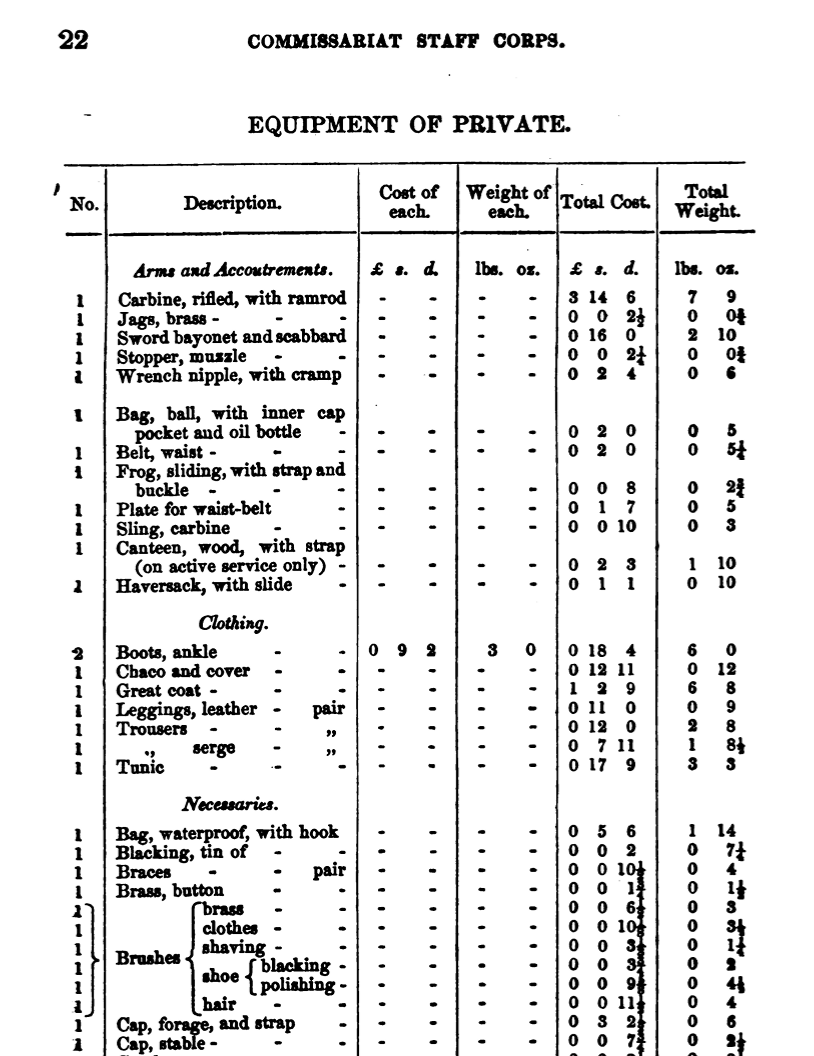
The British War Office’s Army Equipment series of the 1860s was an early attempt to standardise the equipment requirements of military organisations. Its detailed tables recorded authorised stores, quantities, weights and other information needed for provisioning and transport planning.
Source: Army Equipment, Part VI (1865)

A key example was the British War Office’s seven-part Army Equipment series, published during 1861–1866. The series was intended to provide comprehensive and standardised returns of the equipment authorised for the principal arms and services of the British Army. It covered cavalry, Royal Artillery, Royal Engineers, the Military Train, infantry, commissariat services and hospitals, with each volume addressing the particular equipment requirements of its respective organisation.[1]

The publications were considerably more detailed than simple inventories. They identified weapons, tools, personal equipment, saddlery, harness, camp equipment, specialist stores, and other resources needed to perform specific military functions. Where appropriate, they included quantities, weights, dimensions, and costs, allowing equipment requirements to be expressed as procurement, storage, and transportation demands. The volumes also reflected the increasingly specialised nature of military logistics, with separate provisions for the equipment required by engineers, artillerymen, transport personnel, medical services and the commissariat.

The 1865 Equipment of the Military Train, for example, addressed the resources required by the Army’s military transport organisation. Its preparation involved collecting and standardising equipment information, including determining weights and identifying costs. The compilers acknowledged possible errors and the need for later correction, showing that accurate equipment information and its maintenance were already recognised as important administrative responsibilities.[2]

The Commissariat Staff Corps’ Equipment, also published in 1865, provides an equally revealing example. In addition to describing specialist equipment used by bakers, butchers, carpenters, smiths and other trades, it included calculations for supporting an army in the field. One illustrative model considered a force comprising 10,000 infantry, 1,800 cavalry, 2,500 artillery, 600 engineers and 600 Military Train personnel, together with 400 horses. The calculations also considered the possibility of units being detached from the main force, showing an appreciation that logistics requirements could vary with the organisation and disposition of troops.[3]

Notably, some of the underlying calculations drew on experience gained during the Peninsular War. Operational knowledge accumulated decades earlier was therefore being incorporated into standardised planning arrangements that could be applied to subsequent military requirements.[4]

The Army Equipment series mattered not simply for the information in individual volumes, but for the broader principle it established. Once the composition and role of a military organisation were known, its equipment requirements could be determined by referring to an authoritative, standardised body of information. This allowed requirements to be calculated consistently, supported the preparation of stores for mobilisation, and provided a basis for assessing whether units had the resources needed to perform their assigned functions.

Although the calculations were undertaken manually and the information was maintained on paper, the underlying process was recognisably similar to modern requirements modelling. Organisational structures were linked to authorised resources, equipment characteristics supported transportation and storage calculations, and established rules enabled requirements to be adjusted according to the circumstances of the force being supported. These publications did not constitute a complete logistics information system in the modern sense, nor did they eliminate the need for professional judgement, but they demonstrate that structured data, standardised entitlements and the application of operational experience to logistics planning were well established before computers.

From Equipment Tables to Wartime Logistics Administration: The Ordnance Manuals of 1914 and 1939

By the beginning of the twentieth century, the British Army’s equipment administration had developed beyond preparing standardised equipment lists into a more comprehensive system governing the provision, issue, accounting, maintenance, and replenishment of military stores. This development is illustrated by the Ordnance Manual (War), 1914 and its later 1939 counterpart, which provide useful insights into the increasing sophistication of military logistics administration.

The Ordnance Manual (War), 1914 described the responsibilities and procedures of the Army Ordnance Department and Army Ordnance Corps during mobilisation and active service. It operated alongside the contemporary Equipment Regulations, which contained separate provisions for the equipment requirements of infantry, cavalry, artillery, engineers, the Army Service Corps, the Army Ordnance Corps and other specialist organisations. Together, these publications distinguished between the equipment a military organisation was authorised to hold and the administrative arrangements needed to provide and sustain it.[5]

The 1914 manual addressed the organisation of ordnance services in war, the maintenance of stocks, the preparation of demands and indents, the provision of ammunition and the arrangements for handling unserviceable equipment. These procedures ensured that equipment requirements could be translated into actual supplies and that the resulting transactions remained subject to administrative control. Determining an authorised requirement was only one part of logistics: the equipment also had to be available, transported to the appropriate location, issued to the correct organisation and subsequently maintained or replaced.

By the outbreak of the Second World War, the Ordnance Manual (War), 1939 reflected a further development of these principles. Its provisions addressed wartime provisioning, the supply of ordnance stores, repair and recovery arrangements, ammunition supply and the administration of the wider ordnance support system. Its detailed camp-equipment tables were particularly relevant. Table II, Camp Equipment for One Infantry Division (Manoeuvre Scale), differentiated between the arms and services forming the division, while Table III, Camp Equipment Required to Accommodate a Battalion at War Strength, provided a separate accommodation scale that expressly excluded equipment already included within the unit’s war equipment.[6]

The Ordnance Manual (War), 1939 distinguished between equipment carried as part of a unit’s war establishment and additional camp equipment required for accommodation and field operations. These distinctions enabled requirements to be calculated without unnecessary duplication.

This distinction showed that equipment requirements were not a single, fixed allocation. A unit had an authorised establishment and associated war equipment, but additional requirements could arise depending on its operating circumstances. Camp equipment, accommodation stores and other supporting resources could therefore be calculated separately from equipment necessary for the unit’s principal military role. The tables also included weights and measurements, allowing equipment quantities to be considered in relation to transportation and storage.

The progression from the nineteenth-century Army Equipment publications to the Ordnance Manuals of 1914 and 1939 illustrates a gradual development towards integrated resource management. The earlier publications standardised equipment requirements, while the later manuals described more comprehensive arrangements for administering those requirements during mobilisation and operations. New Zealand’s military administration inherited these principles and adapted them over time.

New Zealand’s Early Twentieth-Century Equipment Scales

By the beginning of the twentieth century, New Zealand’s military administration increasingly relied on formal establishments and equipment scales to support the organisation, training, and mobilisation of its forces. These arrangements became particularly important following the introduction of the Territorial Force in 1910, when the Army was required to equip and train larger numbers of personnel while maintaining effective control over limited resources.[7]

The annual training camps of the pre-war period provide useful examples. The 1913 brigade camps required accommodation, cooking equipment, camp furniture, tools, and other stores according to established scales. Temporary Ordnance Depots supported the issue and return of these items, with accounting procedures intended to ensure that equipment could be recovered, inspected and prepared for subsequent use. Once the number and composition of the participating units were known, requirements could be calculated against approved scales and the necessary holdings assembled.

The same principles applied to mobilisation. Expansion from a peacetime establishment to authorised wartime strength required corresponding increases in weapons, clothing, personal equipment, transport and supporting stores. Establishment tables identified the authorised organisation, while equipment schedules and other publications supplied the additional information needed to determine what that organisation required. Although undertaken manually, these calculations followed recognised structures and rules rather than being devised anew for every activity.

The Second World War: Establishments as Logistics Information

The rapid expansion of the New Zealand Army during the Second World War placed considerable demands upon its administrative and logistics systems. War Establishments and associated equipment tables became essential instruments for determining the personnel, vehicles, weapons, and supporting resources the expanding force required. A surviving collection of New Zealand Army Service Corps (NZASC) War Establishments for Home Defence, 1939–1945, offers a particularly useful illustration of the detail in these documents.[8]

The August 1940 War Establishment for a District Composite Company, NZASC, divided the organisation into headquarters, supply, ammunition and petrol sections, together with personnel permanently detached to support other formations and services. It recorded the authorised distribution of officers, warrant officers, non-commissioned officers, and other ranks, while separate tables identified the vehicles each element of the organisation required.[9]

An extract from the August 1940 War Establishment for a District Composite Company, NZASC. The establishment linked personnel, trades, vehicles and transport capacities to the organisation’s supply, ammunition and petrol distribution responsibilities, providing a structured basis for calculating its support requirements.

The transport schedules went beyond simply allocating vehicles. They distinguished between types and carrying capacities and identified their intended employment in transporting supplies, ammunition, petrol and other military stores. Individual subsections were assigned personnel and transport appropriate to their functions, and provision was made to support formations such as infantry brigades and medical units. The establishment therefore provided a structured description of logistics capability, linking authorised resources to the tasks the organisation was expected to perform.

It is important to distinguish the War Establishment from the equipment scales and stores entitlements that complemented it. The establishment defined the authorised organisation and its principal resources, while associated equipment documentation specified additional stores required to equip and sustain that organisation. Together, these publications provided a basis for determining requirements, assembling resources and assessing deficiencies. This distinction remains relevant to modern logistics information systems: organisational structures must connect to equipment configurations, actual holdings, consumption factors, and support arrangements before they can support a meaningful readiness assessment.

An earlier establishment shows the same logic applied to an expeditionary force. The September 1939 War Establishment for the Divisional Ammunition Company, NZASC (1st Echelon), was expressly based on British War Establishment II/1931/13/3 of August 1938, adapted for the Special Force. Its transport schedule allotted vehicles by ammunition nature (18-pounder, 4.5-inch howitzer, 2-pounder anti-tank, mortar, small-arms and anti-tank rifle ammunition, grenades and mines) as well as petrol, explosives, water and workshop loads. The establishment therefore embedded the division’s weapon systems within the company that sustained them. Its trade tables and notes went further, specifying workshop tradesmen, the numbers to be trained in first aid, water duties and anti-gas work, and dependencies on other units. Distribution lists prepared for the Ngaruawahia mobilisation camp then applied a 10 per cent reinforcement factor and carry annotations where duties were still being reconciled by hand.[10] The company was scaled to the equipment of the force it supported. As the Greek campaign would show, that alignment could not be assumed for every supporting organisation.

The Importance of Accurate Scaling: Greece, 1941

Even a well-established system’s limitations become apparent when the information used to determine requirements does not reflect the force being supported. The deployment of the New Zealand Division to Greece in 1941 provides an instructive example. The Scales Branch of the British Central Provisioning Organisation scaled Divisional Ordnance Field Parks centrally against a standard Middle East scale, set to represent 2.5 per cent of the supported division’s vehicles. The British Royal Army Ordnance Corps’ 1 Ordnance Field Park, attached to support the New Zealand workshops, held adequate Ford, 25-pounder and 2-pounder spares, but its vehicle spares had been scaled for Internationals and Crossleys. The New Zealand Division had no Internationals and only two Crossleys. A lack of consultation before the operation meant a sound scaling rule was applied to a fleet the Division did not hold.[11]

Consequently, part of the repair-parts holding was unsuitable for the vehicles requiring support. The problem was not the absence of a formal scaling system, but applying incorrect assumptions to the force being sustained. Transport capacity and storage space were committed to items of limited utility, while other requirements had to be met locally. After the withdrawal from Greece and Crete, the New Zealand Division formed its own Ordnance Field Park on 28 July 1941, initially with four officers, 81 other ranks and 27 three-ton lorries, holding fast-moving and essential motor-transport, weapon and signal spares for the Division’s own equipment. Its organisation was revised as the force changed: in November 1942 it was reorganised into holding, infantry and armoured sections to support the newly formed 4th Armoured Brigade.[12]

Alf Beale of the OFP sorting out his stock for the bin vehicle. Maadi Camp, October 1941. The New Zealand Divisional Ordnance Field Park was established in July 1941 to hold essential repair parts for the Division’s own vehicles, weapons and equipment. Its formation followed experience in Greece, where centrally determined spare-parts holdings did not adequately reflect the New Zealand Division’s vehicle fleet. Photo W.W Thomas.

This experience illustrates a principle fundamental to modern logistics management: a calculation can be mathematically correct, but its result operationally unsuitable if the information or assumptions on which it is based are inaccurate. Computers and AI do not remove this limitation; their speed may instead allow incorrect assumptions to be applied more widely and with greater apparent authority.

From Wartime Enumeration to Post-War Entitlement Control

After the Second World War, military equipment became increasingly complex, placing greater demands on the systems used to define and account for authorised holdings. Earlier War Equipment Tables, including the G1098 system, effectively established quantities against a unit’s authorised organisation, but were less suited to maintaining the integrity of increasingly complex equipment systems comprising components, accessories, tools, publications, and associated repair parts.[13]

By the late 1950s and early 1960s, the New Zealand Army was developing a more integrated approach to equipment entitlement and control. Drawing upon British and Commonwealth practices, the Army formalised a layered system incorporating New Zealand Entitlement Tables (NZET), New Zealand Complete Equipment Schedules (NZCES) and New Zealand Block Scales (NZBS). The NZET provided the authoritative record of a unit’s equipment entitlement, the NZCES defined components necessary to constitute complete equipment, and Block Scales enabled additional stores to be authorised according to particular roles or requirements.
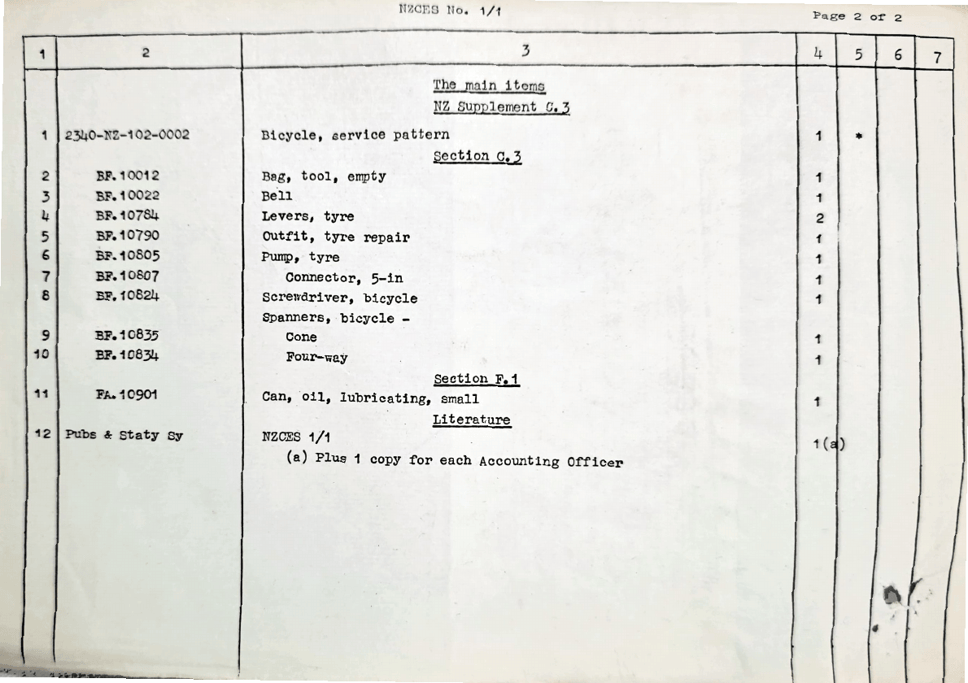
A New Zealand Complete Equipment Schedule (NZCES) defined the components, accessories and associated items necessary to constitute a complete equipment system. Alongside entitlement tables and Block Scales, these schedules helped the New Zealand Army distinguish between possessing an item and holding the complete equipment necessary for its intended use.

Supporting maintenance and technical stores outfits, including First Aid Mechanical Transport Outfits (FAMTO) and First Aid Technical Stores Outfits (FATSO), further recognised that equipment possession alone did not constitute a sustainable capability. A vehicle’s usefulness depended on associated tools, documentation, and maintenance support, while changes to the authorised fleet could create corresponding requirements for repair parts and workshop resources. This marked an important shift from numerical allocation to managing complete, supportable equipment systems.

The 1965 Officers’ Handbook: Connecting Combat Formations and Logistics Support

An incomplete copy of a New Zealand Army Officers’ Handbook, dating from approximately 1965, further illustrates how these principles were applied to the organisation of a military force. The handbook describes a New Zealand Infantry Brigade Group and Logistic Support Group, supported by organisational diagrams and tables that identify personnel strengths, vehicles, and principal equipment. Because the surviving copy is incomplete, it should be read as evidence of the documented force model rather than proof that every organisation was established at full strength.[14]

Within the Infantry Brigade Group, combat and combat support units were accompanied by specialist logistics organisations, including an RNZASC Transport Company, an RNZAOC Ordnance Field Park, an RNZEME workshop and an RNZAMC Field Ambulance. The handbook’s entry for the RNZASC Transport Company describes four transport platoons, a composite platoon and workshop support, with an establishment of 11 officers and 307 other ranks, together with vehicle and trailer allocations.[15]

The Logistic Support Group extended beyond the brigade’s immediate requirements. Its organisation included transport companies, supply units, petrol distribution, air supply, cold storage, field bakery facilities, engineering support and medical services. The diagrams show that a force’s requirements could not be determined solely from its combat units: these generated corresponding demands for transport, fuel, ammunition, maintenance, medical support and numerous other services.[16]

The New Zealand Army’s Officers’ Handbook of approximately 1965 illustrated the relationship between combat formations and the organisations required to sustain them. The documented Logistic Support Group included transport, supply, petrol distribution, bakery, maintenance and other services, demonstrating how force structure generated corresponding logistics requirements.

The handbook therefore provides a useful example of an interconnected military information system. A formation’s organisational structure established the basis for personnel and principal equipment requirements, while associated entitlement schedules, technical publications, and planning factors supplied the information needed to calculate its wider support needs. Although recorded on paper, these relationships can now be represented in a digital information environment.

When Established Requirements Meet Political Constraints: Australia in Vietnam

The 1965 Officers’ Handbook records the documented model of a brigade group supported by its own Logistic Support Group. The Australian deployment to South Vietnam the following year shows what can happen when a deployed force departs from such a model. The existence of an established logistics organisation and its associated equipment scales does not mean that the resources needed to sustain a force will be authorised or deployed. Governments and commanders must reconcile military requirements with political commitments, personnel ceilings, funding and competing operational priorities. A critical distinction therefore exists between the doctrinal requirement, the approved establishment and the support capability actually available.

Ian R. Finlayson’s study of Australian Army logistics in South Vietnam illustrates the consequences. In planning the deployment of the 1st Australian Task Force (1ATF) in 1966, Australia established the 1st Australian Logistic Support Group (1ALSG), rather than deploying the supporting organisation already envisaged in earlier Army force structures. Planners assumed that American logistics could supply much of the support and consequently allocated 937 positions to 1ALSG from a deployed Army strength of 4,225. The decision favoured combat manpower but left the national logistics organisation constrained and dependent on external arrangements.[17]

The difficulties were not simply a question of supply quantities. American materiel was obtained through particular depots, agreements and liaison channels; the Australian organisation still had to request, collect, move and distribute it. Finlayson also describes restrictions on 1ALSG headquarters’ authority to direct technical logistics functions. Access to allied supply therefore did not remove national responsibilities for control, distribution, maintenance, or managing shortages.[18]

The lesson is not that coalition support should be avoided. For a smaller force, it is indispensable. Rather, reductions from an established logistics scale should be explicit, with the resulting shortfalls linked to confirmed arrangements, responsible providers, delivery capacity and contingency measures. A logistics system should show both the authorised force and the support it would require under the applicable doctrinal model, rather than treating the smaller approved establishment as proof that the requirement has disappeared.

The broader failure to avoid is losing institutional memory between deployments. If force-structure decisions, supply dependencies and operational lessons remain in disconnected reports or personal experience, future planners may have to reconstruct risks already encountered. An integrated enterprise system should compare doctrinal requirements with approved and actual establishments, identify deficiencies, record whether allied or contracted support is confirmed or merely assumed, and allow logisticians to explore the consequences of support failing or operational demands increasing.

These considerations were not confined to Vietnam. New Zealand’s commitments in Malaya, Borneo, Somalia and East Timor each required logistics organisations to reconcile national requirements with the support available through allied, multinational or host-nation arrangements. The operating environments, national responsibilities and degrees of reliance upon external support differed, but the underlying planning questions remained consistent: what support must New Zealand provide itself, what can reliably be obtained from others, and what risks arise when the approved support organisation falls short of the assessed requirement? The historical record of these deployments offers an opportunity to examine whether lessons about force scaling, national support responsibilities and dependency management were carried forward into subsequent planning.

Somalia, 1992–1994: When Operational Requirements Outgrow Equipment and Support Arrangements

New Zealand’s deployment to Somalia between 1992 and 1994 further illustrates the difference between equipping a military organisation according to established arrangements and ensuring its resources remain suitable for the circumstances in which it operates. Initially deployed as a 28-person Supply Detachment, the New Zealand contribution expanded in July 1993 into a 43-person Supply Platoon, incorporating an infantry section as the security situation deteriorated. The contingent’s responsibilities included managing general stores at Mogadishu Airport and supporting food distribution through the port, in conjunction with the United Nations-contracted catering organisation.[19]

New Zealand Army logisticians serving with the United Nations operation in Somalia, 1992–1994, worked in an environment where changing security conditions and multinational supply responsibilities placed demands on personnel, equipment and transport beyond those initially anticipated. The deployment illustrated the importance of adapting established support arrangements to operational realities.

Although established primarily to perform supply functions, the contingent operated in an increasingly hostile environment. Personnel carried standard New Zealand Army small arms and light fragmentation vests, while transport relied largely on commercially derived, unarmoured vehicles. As the threat increased, restrictions upon ground movement sometimes required the use of helicopters to maintain access to United Nations locations. These circumstances show how changes in operational conditions can create requirements beyond those anticipated when a force is initially equipped and deployed.[20]

The contingent’s personal equipment provides an equally instructive example. Standard load-carrying webbing proved impractical for many vehicle-based and supply duties, encouraging personnel to adopt alternative arrangements for carrying ammunition and essential equipment. The fragmentation vest offered limited protection against the threats encountered, while some New Zealand personnel serving at United Nations headquarters from 1994 gained access to more capable body armour. Such adaptations illustrated the difference between possessing authorised equipment and having equipment appropriately configured for the actual operating environment.[21]

The broader significance lies in the relationship between force structure, equipment entitlement, operational suitability and changing circumstances. A system that compares an approved establishment with actual holdings would provide only part of the picture. Effective logistics planning must also consider the tasks personnel undertake, the threats they face, the suitability of their equipment, and the changing resources required to sustain operations. An integrated ERP environment, supported by validated rules and AI-assisted analysis, could help identify these differences, flag emerging deficiencies, and preserve the operational lessons that should inform subsequent equipment scales and deployment planning.

Beyond Equipment Tables: The Wider Science of Logistics Planning

The examples examined so far represent only a snapshot of the military’s historical system of equipment establishments and entitlements. Over time, a much wider range of specialised tables, scales and planning factors was developed to address the increasingly complex requirements of military operations. Ammunition scales established initial holdings, expenditure assumptions, and replenishment requirements; repair parts scales identified components needed to maintain equipment; and fuel consumption tables enabled estimates based on vehicle types, operating conditions, distances travelled, and anticipated activity.

Other planning instruments addressed ration requirements, water consumption, transportation capacity, accommodation, medical support and casualty estimates. Although the publications served different purposes, the underlying principle remained consistent: a known military organisation, equipped for a particular task and operating under defined conditions, generated measurable requirements that could be calculated through established relationships and assumptions.

These requirements were not necessarily fixed. They could be adjusted according to the duration of an operation, terrain, climate, anticipated intensity of activity and transport availability. This was the science and art of scaling military logistics: the science lay in applying established quantities, rates, and relationships, while the art lay in exercising professional judgement to ensure the resulting requirements reflected operational realities. This combination offers considerable potential for future AI applications.

Project Convergence 2026: Scaling the Digitised Battlefield

The development of scales and planning factors is not complete. New equipment continues to create requirements for which established scales do not yet exist, as New Zealand’s participation in Project Convergence Capstone 6 (PCC6), a US-led programme of multinational experimentation conducted in 2026, demonstrated. Newly released New Zealand Defence Force (NZDF) briefings describe a battlefield increasingly characterised by persistent surveillance, uncrewed systems, autonomous sensor fusion, machine-assisted decision-making and connected communications. They also identify specialist technical skills as necessary to employ and sustain increasingly complex autonomous capabilities. The significance for military logistics is not simply the arrival of new equipment: each additional system creates new requirements for personnel, power, repair, replacement, data connectivity and distribution.[22]

Electrical power provides a particularly clear example. The NZDF findings identify power generation and energy resilience as increasingly important operational considerations, with battery consumption, replacement, charging cycles and sustainment requiring deliberate planning at tactical levels. An August 2026 US Army study similarly describes electrical power as an emerging fifth commodity, alongside ammunition, food, fuel and water. For a force deploying uncrewed aircraft, sensors, electronic warfare equipment and networked command systems, equipment entitlements alone are insufficient. A credible support calculation must also establish electrical loads, battery endurance, the number and compatibility of spare batteries, charging capacity, power-generation fuel, movement arrangements and safe storage and handling. These are modern equivalents of the weights, capacities, repair-parts allowances and consumption factors recorded in earlier equipment scales.[23]

PCC6 also highlighted the potential to forward-produce small uncrewed aircraft systems through additive manufacturing and commercial technologies. Such arrangements might shorten the route between damage, replacement and renewed operational availability, but do not remove the need for material stocks, suitable components, skilled personnel, quality assurance and safe power supplies. The same briefings emphasise that common data standards are fundamental to meaningful interoperability, regardless of the platforms employed, and note the close alignment observed between the New Zealand and Australian armies. For logistics information systems, this reinforces the importance of consistent item identification, equipment configurations, authoritative planning factors and exchangeable information across national and allied systems.[24]
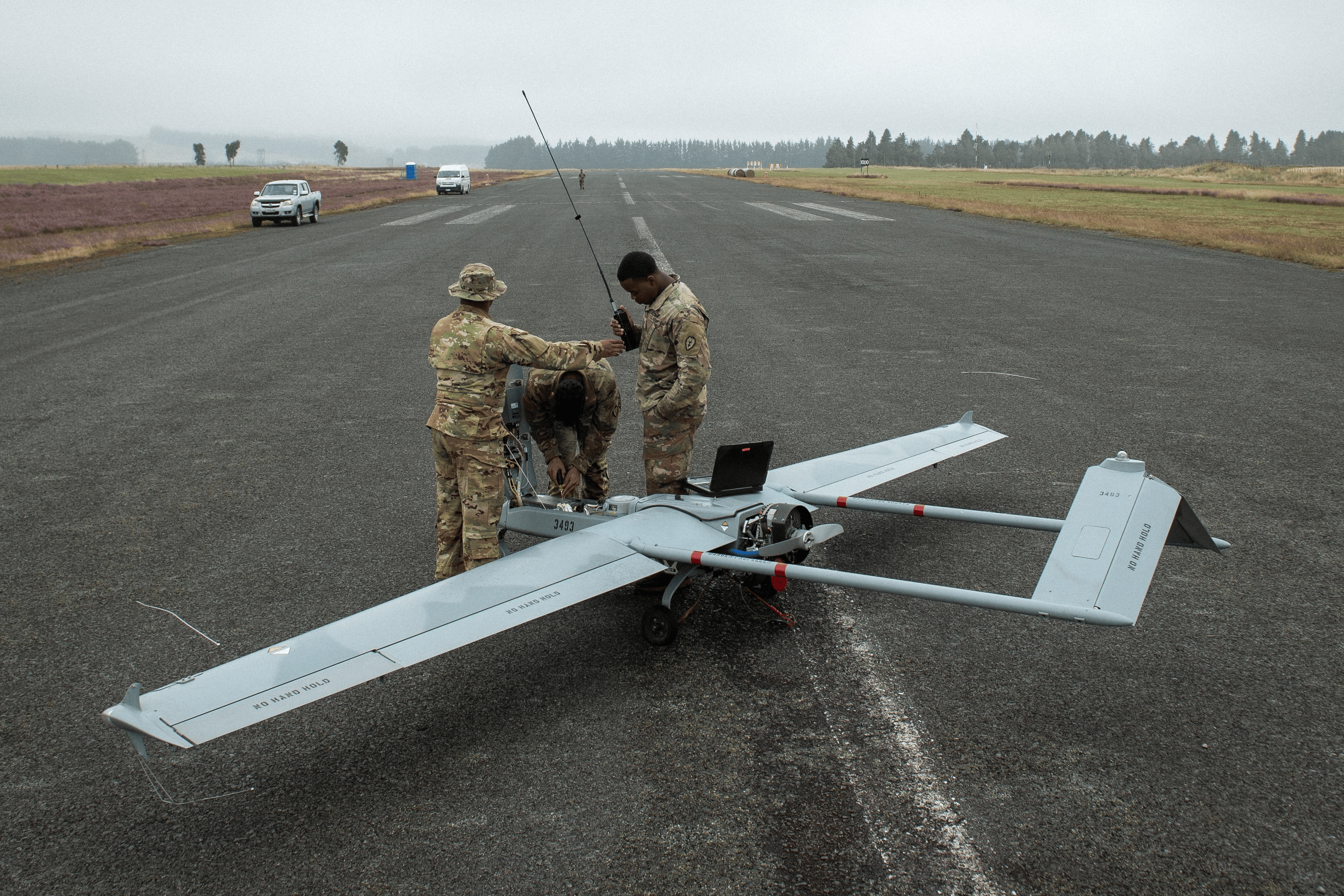
New Zealand and United States personnel prepare an RQ-7 Shadow uncrewed aircraft during Exercise Wayfinder 24 at Waiouru in 2024. Systems of this type illustrate how modern military equipment creates additional logistics requirements for electrical power, batteries, specialist maintenance, technical personnel and supporting infrastructure.
Source: NZDF, Exercise Wayfinder 24

These lessons also expose a practical distinction between acquiring a technological capability and sustaining it. The NZDF briefings recommend better alignment of robotic and autonomous-system initiatives to reduce duplication and improve supportability; they also show why experimentation should test the full support chain rather than equipment performance in isolation. The historical question remains recognisable: what resources does a specified force require, under particular operational conditions, for a defined period? The modern answer must include electricity, software-dependent systems and information exchange alongside the more familiar demands for fuel, ammunition, maintenance and transport.[25]

The same briefings also record more familiar support shortfalls. Accommodation was poorly coordinated; personnel had to buy their own cleaning materials to prepare equipment for Customs inspection on return; and the contingent lacked some of the technology needed to take full part in planned experimentation, reducing the opportunity to collect meaningful trial data. None of these requirements was novel. Cleaning stores for return inspection are precisely the kind of predictable, activity-specific need that a Block Scale or camp-equipment table was designed to capture, in the same way that the 1939 Ordnance Manual separated accommodation stores from a unit’s war equipment. The equipment, batteries, chargers and power generation needed to take part in a technology-focused exercise could likewise have been derived from the activity’s intended tasks. Had these requirements been held as an activity scale and checked against holdings before departure, with AI used to interpret the exercise plan, identify the applicable scales and flag items for which no entitlement or holding existed, many of these shortfalls could have been identified and resolved in New Zealand rather than discovered in the field. The NZDF’s own recommendation, that capabilities be tested in New Zealand before deployment, points in the same direction.[26]

Digitisation: What Was Gained and What Was Lost?

The introduction of computerised logistics systems fundamentally changed how military organisations recorded, processed and managed information. Electronic accounting systems were developed to reduce the considerable administrative burden of manual ledgers, requisitions, stock movements, and equipment reconciliation. These systems progressively evolved into enterprise resource planning (ERP) platforms, improving transaction processing, stock visibility, financial accountability and reporting.

However, the technological limitations of early systems meant that many established logistics functions were transferred into electronic form without fundamentally changing their operation. Equipment tables, entitlement schedules and accounting procedures often became electronic equivalents of their paper predecessors. Although information was easier to record and retrieve, relationships between establishments, equipment entitlements, operational requirements and sustainment calculations still required manual interpretation.

This distinction between computerisation and genuine digital transformation is important. A system might accurately record the quantity of equipment held by a unit without determining whether that equipment was complete, serviceable or sufficient for a particular mission. The information existed, but the functionality needed to turn it into an integrated assessment of operational capability was often missing.

Successive generations of ERP systems have improved database architecture, integration, workflows and reporting, enabling more dynamic relationships between inventory, procurement, maintenance and financial functions. Nevertheless, the full benefits of digitisation have not always been realised. Reports must still be downloaded, combined with other datasets and manipulated to meet mission-specific requirements, while resulting demands may require separate manual transactions.

Administrative effort has therefore been reduced, not eliminated. Tasks once performed by reconciling paper publications are now undertaken through electronic reports, spreadsheets and supplementary tools. Further integration, rules-based automation, and artificial intelligence offer the opportunity to move beyond recording and displaying information to dynamically calculating requirements, identifying deficiencies, and supporting operational decisions.

Working Around the System: The Excel Problem

A persistent feature of modern logistics information management is the reliance upon Microsoft Excel to supplement enterprise systems. Information is extracted from authoritative databases, reorganised, reconciled and manipulated in spreadsheets to produce reports and calculations suited to particular operational requirements. Spreadsheets remain valuable analytical tools, but routine extraction because the enterprise system cannot combine its own data may indicate incomplete digital integration.

For example, an ERP system may contain information on a unit’s equipment entitlements, actual holdings, serviceability, repair parts, ammunition allocations and consumption rates. Yet these datasets may be available only through separate reports rather than as a single assessment of the resources required for an exercise or deployment. Logisticians must retrieve the information, reconcile differences, apply planning factors and construct supplementary documents.

This process can create duplicate reports and standalone spreadsheets containing information already held within the enterprise environment. Locally maintained documents may incorporate assumptions and corrections that are not returned to the authoritative system. Changes in personnel strengths, equipment holdings or activity duration then require further manual reconciliation, increasing administrative effort and the possibility of inconsistencies.

The problem is not Excel itself, but the gap between information recorded in enterprise systems and the processes needed to convert it into operationally useful demands. A contemporary example is the New Zealand Army’s Catalogue Demand (CATDEM) process: its spreadsheet-based planning artefacts consolidate activity requirements, but the associated entitlement checks, demand interpretation and SAP transaction preparation remain substantially manual.[27]

AI, combined with conventional rules-based automation, could reduce repetitive data extraction, reconciliation and transaction preparation. The objective is not to eliminate spreadsheets, but to reserve them for genuine analysis rather than use them as essential workarounds for limitations in enterprise functionality.

Transferring the Burden of Logistics Calculation

The historical development of military equipment scales, entitlement tables and logistics planning factors reveals an important distinction between the knowledge contained within these publications and the effort required to apply it. The publications themselves represented accumulated institutional knowledge, progressively refined through operational experience and expressed as rules, relationships and calculations. However, the military logistician remained responsible for interpreting and applying that knowledge.

For generations, logisticians were required to consult multiple publications, establish the composition and equipment of a supported force, determine its entitlements, calculate consumption and maintenance requirements, identify deficiencies and translate the resulting information into demands for stores and services. The process required considerable professional knowledge, but much of the associated work was repetitive, administrative and computational.

In this respect, the paper-based system represented a form of institutional intelligence appropriate to its period. The rules and knowledge were already established; the human logistician supplied the processing capability necessary to apply them. As the preceding sections show, electronic accounting and ERP systems reduced this workload but did not remove it: many of the relationships between organisational structures, equipment entitlements, operational requirements and sustainment calculations still depend on manual interpretation and intervention.

The next stage in this evolution should be the progressive transfer of that computational and administrative burden to integrated enterprise systems, supported by rules-based automation and artificial intelligence. Authoritative establishments, equipment configurations, entitlement schedules, consumption factors and maintenance requirements should be maintained as connected information rather than isolated records requiring repeated manual reconciliation.

The objective should be to enable a logistician to establish the support requirements of a military activity or operation and receive a coherent assessment of the resources necessary to deliver that support. Such an assessment should identify what is authorised, what is required, what is available, what is serviceable, what remains deficient and what actions are necessary to close those deficiencies. It should also identify the transportation, maintenance, replenishment and other supporting arrangements required to sustain the force throughout the intended activity.

This does not remove the need for professional logistics judgement. Rather, it changes where that judgement is applied. Instead of spending substantial time assembling information and reconstructing established calculations, logisticians should focus on assessing the feasibility of support arrangements, resolving competing priorities, managing risk, and ensuring the required resources reach the right place at the right time.

The ultimate objective is not simply to provide more information to the logistician, but to make the full implications of an operational requirement visible, understandable and actionable.

Future ERP: Reconnecting Military Entitlements and Operational Logistics

The New Zealand Defence Force’s Future Enterprise Resource Planning (Future ERP) Programme provides a particularly relevant contemporary development in this longer history. The programme is intended to replace a fragmented ERP environment with an integrated enterprise-wide capability. In October 2026, NZDF procurement notices identified SAP S/4HANA and related SAP products as the intended solution, with separate procurement processes for systems integration, business integration and independent assurance. The transition is therefore more than a general aspiration to modernise accounting software; it is an opportunity to reconsider how information supports military readiness, deployment and sustainment.[28]

More significantly, a proactively released programme business case identifies “ERP for Defence, Paced for Success” as the preferred approach and explicitly favours SAP Defense & Security. It argues that this military-specific functionality provides operational planning, interoperability and readiness capabilities that a conventional corporate ERP solution cannot deliver. It also envisages rationalising numerous existing systems and ancillary tools. This shows a preferred programme direction, not that every module, workflow, or capability has been contracted, configured, or implemented.[29]

The distinction matters because SAP Defense & Security already contains functions closely related to the logic preserved in historical War Establishments and equipment scales. Its force-element model connects military organisational structures with authorised personnel and equipment, actual resources, maintenance, logistics and operational information. SAP’s published training materials describe authorised-versus-actual comparisons and the ability to initiate follow-on supply action from identified deficiencies. These are not speculative AI capabilities: they are established enterprise-system functions which, if properly configured and adopted, can provide much of the structured foundation on which more advanced decision support might operate.[30]
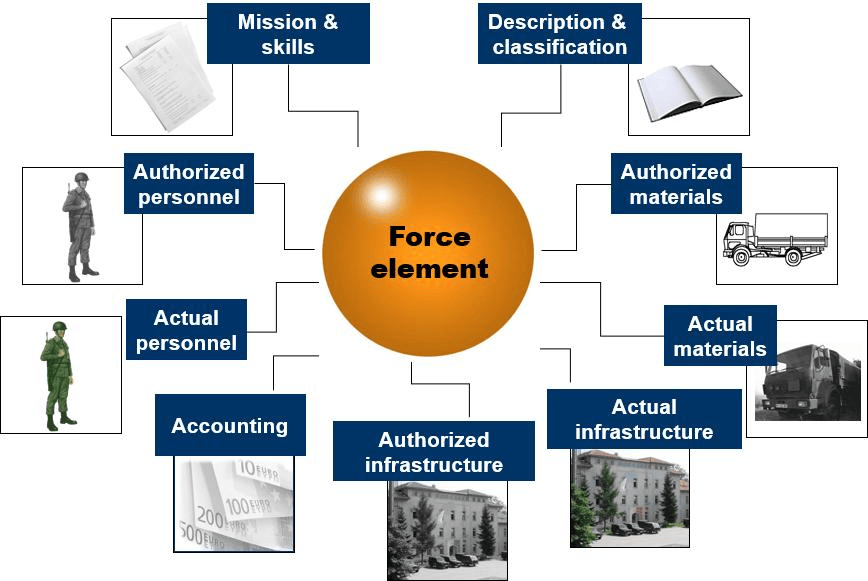
SAP S/4HANA Defense & Security provides military-specific functions for representing force structures, authorised personnel and equipment, and actual resources. Properly configured, these relationships can support readiness assessments and the identification of resource deficiencies. They also provide a structured foundation for automation and AI-supported logistics planning.

However, the existence of such functionality does not guarantee that the New Zealand Army’s entitlement policies, equipment configurations, activity-based demands, consumption factors, and deployment workflows will automatically operate as a coherent end-to-end process. Standard functionality must be mapped to national policy and military practice; master data must be corrected and governed; interfaces and workflows must be designed; and users must be trained to trust and employ the resulting system. Nor does an authorised-versus-actual equipment comparison, by itself, establish whether a force can sustain a specified operation for a given period. Serviceability, operational intensity, replenishment, maintenance capacity, transport constraints and the effects of disrupted communications must also be considered.

The system should also distinguish a doctrinal support requirement from the politically authorised establishment and the actual resources available. Allied, contracted and host-nation support should be represented as explicit dependencies, with the degree of assurance and consequences of failure visible to planners.

Future ERP therefore strengthens, rather than displaces, the argument advanced here. The rules-based foundation should be built first: the military-specific capabilities of SAP S/4HANA Defense & Security should be exploited rather than reproduced in separate applications or AI tools, so that AI can then be adopted with confidence on top of them. Artificial intelligence should be applied where it adds the most value: interpreting operational intent, retrieving relevant doctrine, exploring alternative scenarios, identifying anomalies, and explaining the consequences of changed assumptions. Approved entitlements, calculations, approvals and auditable transactions should remain under authoritative rules and human control. SAP also documents disconnected-operation capabilities, an important consideration for deployed forces, although the scope of any NZDF implementation remains to be established.[31]

Dividing Responsibilities Between ERP, Automation and AI

Realising the full potential of Future ERP will require a clear distinction between the functions performed by authoritative enterprise systems, conventional automation, artificial intelligence and military personnel. Not every logistics calculation or process requires AI. Many functions are better performed through established business rules, validated planning factors and integrated ERP workflows.

The following table illustrates how these responsibilities could be distributed within a future integrated military logistics environment.

CapabilityPrincipal responsibility
Authorised force structures and equipment entitlementsSAP Defense & Security and approved policy
Actual holdings, maintenance and serviceabilityERP and integrated source systems
Consumption factors and scaling calculationsGoverned planning rules and calculation engines
Identifying deficiencies and initiating demandsERP workflows and automation
Interpreting operational intent and exploring alternativesAI-supported decision tools
Prioritising resources and approving support arrangementsCommanders and logisticians

This division of responsibilities is important. Artificial intelligence should make the established logistics system easier to use, more responsive, and better able to support complex operational decisions. It should not become an alternative source of entitlement policy or an unaccountable calculation engine.

In this arrangement, calculation and administration increasingly shift from the individual logistician to the enterprise system, while professional judgement, prioritisation, and accountability remain firmly with military personnel.

Artificial Intelligence: Applying Institutional Logistics Knowledge

Artificial intelligence offers an opportunity to reconsider how military logistics information is organised, connected and used. Its greatest potential in this context lies not simply in producing reports, but in reducing the manual effort required to convert authoritative information into operational requirements and decisions.

A future AI-enabled environment could draw upon approved establishments, equipment entitlements, complete equipment schedules, repair parts scales, maintenance information and current holdings to develop an integrated assessment of a proposed operation.

For example, a commander planning to deploy an infantry battalion could request an assessment of the equipment, ammunition, fuel, electrical power, battery charging, repair parts, transport and other resources required for a specified period. The system could compare authorised entitlements with actual holdings and serviceability, apply validated planning factors and identify deficiencies. Changes to duration, location, force composition or operational intensity could then be assessed without reconstructing each calculation in separate spreadsheets.

AI’s particular value lies in helping users express operational intent, interrogate information across systems, identify inconsistencies, explore alternative scenarios, and understand the resulting analysis.

Adoption should therefore be progressive, starting where the benefits are clearest and the risks easiest to control. Suitable first uses include interpreting activity requirements within the CATDEM process and preparing draft demands for human approval; testing how changes in duration, force composition, or operational intensity alter requirements; checking master data for inconsistent entitlements, missing configuration records, and unsuitable planning factors; and retrieving relevant doctrine, scales, and policy for planners. Each can be trialled against existing manual practice, including technical and logistics validation before deployment, measured, and widened as it proves reliable.

The New Zealand Army is comparatively well placed to test this approach. At 30 November 2025, it comprised 4,358 Regular Force personnel; an August 2025 audit population recorded 11,908 Regular Force and civilian personnel across the wider NZDF, excluding reservists.[32] [33] These categories and reporting dates differ, but they indicate the organisation’s relatively modest scale. Its compact structure and interconnected logistics functions could allow integrated logistics processes to be developed, tested and refined through controlled trials and progressive integration at a manageable scale. A compact force is not automatically easier to transform, and resources, data quality, change management and implementation discipline remain real constraints. Nevertheless, with sustained investment, sound data governance and careful testing, a successful military-specific ERP implementation complemented by carefully governed AI could let the New Zealand Army demonstrate a digital logistics approach useful well beyond its size.

The opportunity is therefore not merely to recover institutional knowledge represented by historical paper systems, but to realise more fully the benefits that electronic accounting and ERP systems have long sought to deliver: accurate, connected and responsive logistics information with less repetitive administration and more time for professional judgement.

Accurate Data: The Essential Foundation

Wider use of AI depends upon the quality of the information available to it. A system operating with incorrect assumptions, outdated configurations, incomplete stock records or unsuitable consumption factors may produce convincing but operationally unreliable answers. The danger is particularly significant where results are presented without identifying their sources, assumptions or limitations.

Users must be able to distinguish between authorised requirements, verified holdings, calculated estimates and assumptions introduced because information is unavailable. Effective implementation requires disciplined management of organisational structures, entitlements, configuration records, item identification, maintenance information, and planning factors, along with clear responsibility for amendment, approval, and version control.

Historical equipment tables and scales required amendment to remain aligned with the organisations and equipment they described. The same principle applies to digital successors. AI can speed up and increase the flexibility of analysis, but it cannot compensate for the absence of an authoritative, well-maintained information foundation.

Data quality is not only a precondition for AI, however; it is also one of the areas where AI can help most. Checking entitlements against equipment configurations, identifying holdings with no corresponding entitlement and flagging planning factors that no longer match the equipment in service are laborious tasks when done manually, yet they are precisely the checks that would have exposed the mismatch between 1 Ordnance Field Park’s holdings and the New Zealand Division’s vehicle fleet in 1941. Used in this way, AI does not have to wait for a perfect information foundation; it helps to build one.

Building User Trust and Preserving Professional Judgement

Successful AI adoption will depend as much on organisational confidence as on technological capability. Users must understand where the information originated, how calculations were performed, and which assumptions shaped the results. When a system identifies deficiencies or recommends changes to a support plan, logisticians must be able to examine the evidence and assess its operational suitability.

Reducing manual intervention should not mean removing professional oversight. A system may identify the need for additional transport capacity, repair parts, or fuel reserves, but commanders and logisticians must decide how to meet, prioritise, or adjust those requirements. AI should improve decision support rather than transfer accountability from military personnel to a computer system.

The ultimate measure of success will be whether commanders and logisticians trust system outputs sufficiently to use them in planning and operations without routinely reconstructing the analysis in separate spreadsheets.

Lessons Beyond Defence

Although this article focuses on military logistics, the problems it describes are not unique to the armed forces. Any organisation that must equip, maintain and sustain people and assets for a defined activity faces the same task of turning institutional knowledge into requirements. Hospitals hold standard instrument sets and ward stock levels; airlines, transport operators and utilities hold recommended spares scaled to their fleets; humanitarian agencies plan against standard quantities of water, food and shelter per person. In civilian terms, a Complete Equipment Schedule is a bill of materials and a Block Scale a set of par levels.

Several of the lessons drawn here therefore apply more widely. First, a sound scaling rule applied to the wrong data produces a confident but unsuitable result: an operator that introduces a new bus, aircraft or medical-device fleet without revising its spares holdings repeats the experience of 1 Ordnance Field Park in Greece. Second, computerisation is not transformation; an ERP implementation that moves transactions without the logic that connects them leaves people to rebuild that logic in spreadsheets. Third, the persistence of spreadsheets alongside an enterprise system signals incomplete integration rather than user failure, and corrections made in those spreadsheets seldom return to the authoritative record.

Fourth, organisations adopting a standard ERP platform generally gain more by using its established functions than by reproducing them in custom applications and should build that rules-based foundation before layering AI on top of it. Fifth, the division of responsibility set out earlier between enterprise systems, governed rules, AI and people applies almost unchanged to a hospital, a port or an infrastructure operator: AI should make the established system easier to use without becoming an unaccountable source of policy or calculation. Finally, codified knowledge is vulnerable when the people who understand it retire and the systems that replace them record only transactions. Capturing the logic of scaling, not merely its outputs, matters as much to a civilian enterprise as to an army.

For New Zealand, this point is especially relevant. Many public agencies and businesses operate at a scale comparable to the NZDF, use similar enterprise platforms and face the same shortage of specialist staff. A Defence implementation that shows how institutional knowledge can be made executable, governed and trusted could offer a practical model well beyond the military.

Conclusion

The evolution of military establishments, entitlement tables and logistics planning factors demonstrates that the principles underpinning modern information systems have a long history. From nineteenth-century equipment publications and early mobilisation scales to detailed NZASC War Establishments and the layered entitlement arrangements developed during the 1960s, military organisations refined their ability to translate force structures and operational requirements into measurable logistics demands.

These arrangements were not artificial intelligence in the modern sense, but represented a substantial body of codified institutional knowledge. Their effectiveness depended on relationships among personnel, equipment, authorised holdings, consumption, maintenance, and transportation, along with professional judgement in applying those relationships to specific circumstances.

Electronic accounting systems and ERP platforms substantially improved the administration and visibility of military resources. Yet technological limitations meant that many functions were initially computerised rather than fully integrated or automated. Despite successive improvements, manual intervention remains necessary to turn enterprise information into mission-specific requirements, frequently through supplementary spreadsheets and standalone reports.

AI, combined with improved system integration and rules-based automation, offers the means to address these remaining limitations. By connecting authoritative data, established planning factors and approved business rules, future systems could reduce repetitive administrative work, dynamically calculate requirements, identify deficiencies and compare alternative support arrangements. For a comparatively small force such as the New Zealand Army, carefully governed experimentation could also demonstrate approaches transferable to larger military organisations and to civilian enterprises facing the same problems.

The underlying principle remains unchanged. Whether a requirement is calculated from a printed War Establishment, a Complete Equipment Schedule, a spreadsheet or an AI-enabled system, the result’s reliability depends on the accuracy of the information and assumptions used. The Australian experience in Vietnam adds a further requirement: institutional knowledge must preserve not only the calculation of what a force needs, but also the risks accepted when those requirements are reduced or delegated to others. The task is therefore not to invent a new method of determining support requirements, but to transfer the work of applying an established one from the individual logistician to integrated enterprise systems. The Future ERP programme makes this immediate rather than theoretical: its prospective adoption of SAP S/4HANA Defense & Security offers a practical means of rebuilding the connections between organisation, entitlement, holdings, readiness and sustainment that paper-based systems once expressed in separate but related publications. The New Zealand Army should therefore treat AI not as an optional addition to Future ERP, but as a planned layer within it: adopted progressively, under governed data and human authority, and widened as trust is earned. Success should be measured not by owning a modern ERP platform or an AI tool, but by whether logisticians can move from a validated operational requirement to a complete, intelligible, executable, and auditable logistics response without reconstructing the process outside the system.

Military logistics support knowledge has been developed and refined over generations. The challenge now is to make that knowledge accessible, connected and executable within modern information systems. The objective is not to replace the military logistician, but to remove much of the administrative and computational burden, allowing professional expertise to be directed towards what matters most: ensuring that military forces receive the support they require, when and where it is needed.

Notes

[1] War Office, Army Equipment, 7 parts (London: Her Majesty’s Stationery Office, 1861–66), especially parts 2–7. The surviving copies consulted include the volumes on artillery, engineers, Military Train, infantry, Commissariat and hospitals.

[2] War Office, Army Equipment, pt. 4, Equipment of the Military Train (London: Her Majesty’s Stationery Office, 1865), introductory material and equipment returns.

[3] War Office, Army Equipment, pt. 6, Equipment of the Commissariat Staff Corps (London: Her Majesty’s Stationery Office, 1865), illustrative field-force calculations.

[4] War Office, Equipment of the Commissariat Staff Corps, explanatory material accompanying the field-force estimates.

[5] War Office, Ordnance Manual (War), 1914 (London: His Majesty’s Stationery Office, 1914), provisions on ordnance organisation, demands, supply and accounting.

[6] War Office, Ordnance Manual (War), 1939 (Melbourne: Arbuckle Waddell Pty Ltd, 1939), tables II–III.

[7] Robert McKie, “The Science and Art of Scaling,” To the Warriors Their Arms, 6 September 2025, https://rnzaoc.com/2025/09/06/the-science-and-art-of-scaling/.

[8] New Zealand Military Forces, War Establishments, New Zealand Army Service Corps, Home Defence, 1939–1945, surviving compilation supplied for this study; archival identification on the compilation cover requires verification.

[9] New Zealand Military Forces, “A District Composite Company, N.Z. Army Service Corps: War Establishment, August 1940,” in War Establishments, NZASC, Home Defence, 1939–1945, summary of personnel and transport schedules.

[10] New Zealand Military Forces, “Divisional Ammunition Company, N.Z.A.S.C. (1st Echelon): War Establishment, September 1939,” Special Force, 1939, based on British War Establishment II/1931/13/3, 24 August 1938, parts (i) personnel, (ii) transport, (iii) distribution of rank and file by trades and duties, and notes; with “1st Echelon Divisional Ammunition Company: Distribution of Personnel,” Mobilisation Camp, Ngaruawahia.

[11] Robert McKie, “NZ Divisional Ordnance Field Park 1941–1945,” To the Warriors Their Arms, 10 December 2018, https://rnzaoc.com/2018/12/10/nz-divisional-ordnance-field-park-1941-1945/, drawing on A. H. Fernyhough, History of the Royal Army Ordnance Corps 1920–1945 (1965), and J. S. Bolton, A History of the Royal New Zealand Army Ordnance Corps (1992); see also McKie, “The Science and Art of Scaling.” The 1 OFP scaling details should be checked against Fernyhough and the underlying campaign and ordnance records before publication.

[12] McKie, “NZ Divisional Ordnance Field Park 1941–1945,” citing 2NZEF, Organisation and War Establishments – Ordnance – Field (Archives New Zealand, 1941), and Bolton, A History of the Royal New Zealand Army Ordnance Corps.

[13] Robert McKie, “From Wartime Enumeration to Layered Entitlement Control: Equipment Complexity, Scaling Logic, and the Reform of New Zealand Army Stores Accounting, 1945–1961,” To the Warriors Their Arms, 3 March 2026, https://rnzaoc.com/2026/03/03/from-wartime-enumeration-to-layered-entitlement-control/.

[14] New Zealand Army, Officers’ Handbook (undated, approximately 1965), incomplete copy supplied for this study, contents and parts 1–2. Publication date and status require verification.

[15] New Zealand Army, Officers’ Handbook, part 1, RNZASC Transport Company organisational and establishment tables.

[16] New Zealand Army, Officers’ Handbook, part 2, “NZ Logistic Support Group,” serial 31, organisation diagram and unit list.

[17] Ian R. Finlayson, Supporting the Commitment: Australian Army Logistics in South Vietnam, 1962–1973 (Cambridge: Cambridge University Press, 2026), 102–7.

[18] Finlayson, Supporting the Commitment, 153–65.

[19] Robert McKie, “New Zealand Supply Contingent Somalia,” To the Warriors Their Arms, 15 March 2017, https://rnzaoc.com/2017/03/15/new-zealand-supply-contingent-somalia/.

[20] McKie, “New Zealand Supply Contingent Somalia.”

[21] Robert McKie, “Uniforms and Equipment of the NZ Army Contingent in Somalia,” To the Warriors Their Arms, 5 February 2021, https://rnzaoc.com/2021/02/05/somalia-kit/.

[22] New Zealand Defence Force, “OIA-2026-5916 Convergence Capstone” (official information release, 2026), briefings on Project Convergence Capstone 6, https://www.nzdf.mil.nz/assets/Uploads/DocumentLibrary/OIA-2026-5916-Convergence-Capstone.pdf.

[23] New Zealand Defence Force, “OIA-2026-5916 Convergence Capstone,” findings on power generation, charging cycles and energy resilience; John Mabes, “Powering the Digitized Battlefield,” US Army Center for Army Lessons Learned, 28 August 2026, https://www.army.mil/article/294958/powering_the_digitized_battlefield.

[24] New Zealand Defence Force, “OIA-2026-5916 Convergence Capstone,” findings on common data standards, Australian interoperability and additive manufacturing for small uncrewed aircraft systems.

[25] New Zealand Defence Force, “OIA-2026-5916 Convergence Capstone,” institutional implications and recommendations concerning alignment of robotic and autonomous system initiatives and avoiding duplicated experimentation.

[26] New Zealand Defence Force, “OIA-2026-5916 Convergence Capstone,” findings and recommendations on accommodation, return-travel and Customs preparation, technology availability and pre-deployment testing; see also Phil Pennington, “Desert Wargames Tax Batteries, Feed Tech Wishlist,” RNZ, November 2026, https://www.rnz.co.nz/news/politics/2306252/desert-wargames-tax-batteries-feed-tech-wishlist.

[27] Robert McKie, Digitisation of CATDEM Within SAP to Enable Executable, Policy-Embedded Logistic Orchestration (unpublished concept paper, October 2026), secs. 3–6.

[28] New Zealand Defence Force, “Future ERP – System Integrator, Business Integrator, and Quality Assurance,” Government Electronic Tenders Service, October 2026, https://www.gets.govt.nz/NZDF/ExternalTenderDetails.htm?id=34952898.

[29] New Zealand Defence Force, “Future Enterprise Resource Planning Programme Business Case,” proactively released Cabinet material, 2025, especially the discussion of preferred Option 3 and SAP Defense & Security, https://www.nzdf.mil.nz/assets/Uploads/DocumentLibrary/EXP-25-MIN-0025_Future-Enterprise-Resource-Planning-Programme-Business-Case.pdf.

[30] SAP, “Explaining Force Elements and Force Element Structures,” SAP Learning, accessed 30 October 2026, https://learning.sap.com/courses/sap-s-4hana-defense-security-overview/explaining-force-elements-and-force-element-structures.

[31] SAP, “S/4HANA Defense & Security – Disconnected Operations,” SAP Help Portal, accessed 30 October 2026, https://help.sap.com/docs/SAP_S4HANA_ON-PREMISE/15e8d01f9c4e431a89bbb0864b47b17c/aba0ee1fee0143b68706455acbf580e2.html.

[32] New Zealand Defence Force, “Our People,” New Zealand Army, personnel figures as at 30 November 2025, https://www.nzdf.mil.nz/army/our-people/.

[33] Office of the Auditor-General, “Summary of Responses to Our Survey,” New Zealand Defence Force: Progress towards Eliminating Harmful Behaviour (2026), https://ao.parliament.nz/2026/nzdf-audit/our-survey-summary.htm.


From Cordite to Code

What Earlier Ammunition Revolutions Reveal about Sustaining Uncrewed Systems in a Small and Dispersed Force.

RQ-11B Raven complete system. “An unmanned aircraft system is more than its air vehicle: this Raven system includes aircraft, controllers, payloads, batteries, chargers, repair equipment and spares—each potentially requiring a different supply identity.”Credit: U.S. Army.

Recent RNZAOC.com articles have examined two sides of the drone problem. The first reviewed the rise of uncrewed systems as instruments of war in Ukraine, where reconnaissance, strike and electronic attack have become routine features of the battlefield.[1] The second considered drones as logistics enablers for New Zealand’s small, motorised and widely dispersed land force.[2] This paper turns the lens around. It asks what happens when the drone itself, and the network of batteries, payloads, software, spares, launchers and countermeasures around it, becomes an item of supply.

That is not a narrow cataloguing question. Classification determines who demands an item, who may hold it, where it may be stored, how it is inspected, what technical records follow it, how it is issued, when it is counted as expended and how it is recovered or disposed of. A drone can be an aircraft, a weapon platform, a sensor, a communications node, an expendable effector or a guided munition. Its batteries may be ordinary stores for one purpose and dangerous goods for another. Its payload may be ammunition even when the airframe is not. A counter-drone capability may combine radars, electronic-warfare equipment, gun ammunition, interceptor drones and missiles within one tactical system.

The question for the New Zealand Defence Force is therefore not simply, ‘Which class of supply contains drones?’ It is whether existing ammunition, equipment and stores policies can express the several identities of modern uncrewed systems clearly enough to support safe, rapid and accountable operations. The answer should be sought before mass introduction, because history suggests that organisational and technical consequences arrive soon after the new weapon, and usually sooner than the paperwork.

The historical pattern

Ordnance history is full of technologies that first appeared to be a new nature of store and then altered the surrounding logistics system. Quick-firing artillery introduced cartridge cases, more complex fuzes and new inspection and repair work. Mortars created families of bombs, propelling charges and specialised accessories. Wartime expansion turned ammunition supply into a question of magazines, depots, transport, labour and risk. Responsibility moved between artillery and ordnance organisations until duplication and ambiguity could no longer be tolerated.

Historical transitionLogistics consequenceContemporary drone parallel
Quick-firing and breech-loading artillery ammunitionSpecialist inspection, cartridge-case recovery, local repair and refurbishmentModular repair, battery management, software control and technical data
Rifle grenades to light and medium mortarsNew weapons, ammunition natures, training, production and distributionMovement from commercial systems to standardised drone families
Mackesy’s 1939 modernisation and mobilisation reviewEquipment, ammunition, reserves, storage, transport, workshops and trained personnel treated as one capability problemAcquire drones and countermeasures with the complete support system, not as stand-alone items
Wartime expansion of anti-aircraft, anti-tank and artillery ammunitionMore magazines, depots, people, transport and risk-managed storageDistributed operational holdings and much higher consumption rates
Artillery and ordnance responsibility changesDuplication, blurred boundaries and eventual consolidationPotential overlap among aviation, ammunition, signals, engineering and logistics authorities
Inspection and repair of returned ammunitionRecovery, segregation, refurbishment, condemnation and disposalPost-mission recovery, data sanitisation, battery disposal, technical investigation and demilitarisation
Synthesis of historical and contemporary logistics patterns.

The comparison is not exact. A lithium battery is not a cordite charge, and a software-defined flight controller is not a mechanical fuze. The useful historical point is institutional: each leap created new interfaces between supply, safety, maintenance, training and command. The burden was seldom carried by a single ledger category.

The First World War lesson: new technology creates a technical trade

The Royal New Zealand Artillery’s Army Ordnance Corps Section grew from the need to manage increasingly technical ammunition work. The shift to quick-firing ammunition did more than increase the rate of fire. It created recoverable cartridge cases, inspection tasks and repair activity requiring trained personnel, specialist tools and defined responsibility.[3] The ammunition remained ammunition, but the organisation supporting it acquired characteristics of a technical service.

Modern uncrewed systems pose the same organisational pressure in a different medium. Units may be able to replace a propeller or motor in minutes, but a damaged battery, corrupted flight controller, compromised datalink or unauthorised firmware build carries consequences beyond simple mechanical serviceability. The technical trade must understand configuration, electromagnetic compatibility, data security, airworthiness where applicable, payload integration and the boundary between repair and unsafe improvisation.

The lesson is not that every drone should be handed to an ammunition technician. It is that a new family of stores becomes sustainable only when technical authority, training, inspection standards, repair levels and records mature together. If those elements are separated among different branches, the interfaces must be designed rather than assumed.

The mortar lesson: standardisation eventually defeats proliferation

New Zealand’s experience with grenades and mortars during the Second World War illustrates the transition from improvisation to standardisation. Mortars offered a comparatively simple means of delivering high explosive, smoke and illumination, but their apparent simplicity concealed a system of barrels, bipods, baseplates, sights, bombs, fuzes and propelling increments.[4] A weapon family had to be selected, produced or imported, taught, distributed and supported as a whole.

Early drone adoption commonly begins in the opposite direction: many commercial makes, rapid local modification, small batches and enthusiastic unit-level experimentation. That is useful for learning. It is also the beginning of a proliferation problem. Every additional motor, battery connector, controller, datalink, camera, firmware version and payload interface multiplies the demand for spares, tools, chargers, training and technical knowledge.

The mortar experience suggests that enduring military utility arrives when the force standardises enough of the system to sustain it without extinguishing adaptation. Common interfaces, controlled software baselines, approved payloads and interchangeable consumables matter more than cosmetic uniformity. The policy aim should be disciplined modularity: a limited number of supported families with enough open architecture to accept operationally necessary change.[5]

Local production and the limits of self-sufficiency

New Zealand’s wartime manufacture of munitions demonstrated both the value and the limits of local capacity. Domestic industry could reduce dependence on vulnerable overseas supply, respond to regional demands and build useful competence. Yet production was constrained by machine tools, gauges, energetic materials, skilled labour, quality assurance and access to components.[6] Capacity was not created by declaring an item locally producible; it depended on the entire industrial chain.

New Zealand munitions-factory workers during the Second World War. “Local production required skilled labour, tooling, quality assurance and industrial organisation—not simply a decision to manufacture.”Alexander Turnbull Library record, reference PAColl-5936-43

Drones can create a misleading impression of easy sovereignty because airframes can be printed, cut or assembled locally. The most important components may still be imported: cells, magnets, semiconductors, processors, cameras, radio-frequency components, navigation devices and specialist explosives. Local assembly can provide resilience, faster modification and repair, but it does not remove external dependencies. It changes where those dependencies sit.[7]

A realistic New Zealand policy would distinguish between what must be sovereign, what should be repairable, what can be stockpiled and what will remain dependent on trusted partners. The objective is not autarky. It is the ability to understand chokepoints, substitute components deliberately and continue essential functions when normal commercial supply is interrupted.

Mackesy’s warning: procurement is not capability

Major-General P. J. Mackesy’s May 1939 review of the Military Forces of New Zealand offers a particularly useful bridge between technological modernisation and logistics policy. The Army was not starting from nothing: modern equipment had been ordered and mobilisation planning was already under way. Mackesy’s concern was that partial modernisation did not yet amount to a force that could operate confidently in war. He treated equipment, ammunition, personnel, training, reserves, accommodation, transport and ordnance services as connected parts of one military system.[8]

The response to his Recommendations 42 and 43 is instructive. Modern fighting and technical equipment was considered alongside ammunition reserves and the magazines, garages and storage accommodation needed to support it. The later expansion of the Ordnance Depot and Ordnance Workshops establishments demonstrated the practical consequence: once modern equipment and technical stores entered service, the support organisation beneath them had to grow as well.[9]

The drone parallel is direct without being exact. Buying air vehicles, interceptors or missiles is not the same as creating a sustainable capability. Supply chains, technical data, configuration control, storage, charging, maintenance, trained personnel, repair capacity, transport and reserves must be designed before a crisis. For a small force, the support system is not an administrative attachment to the weapon; it is what makes the weapon operationally real.

The Second World War lesson: quantity becomes infrastructure

Between shortage and surplus lies a logistics problem. Wartime New Zealand had to expand magazines, depots, transport and staffing as the volume and variety of ammunition increased. Once quantities rose, the supporting infrastructure—not only the item—became the limiting factor.[10] The same effect will apply if drones move from boutique capability to mass consumption.

Hopuhopu Military Camp from the air, 1961. “Rail-served warehouses and dispersed magazines at Hopuhopu illustrate how new classes and quantities of materiel create a supporting estate—not merely additional stock.” Whites Aviation Ltd, reference WA-55339-F, Alexander Turnbull Library.

A force may be able to buy a thousand small drones faster than it can create safe charging areas, technical inspection capacity, secure software management, spares holdings, trained maintainers and transport packaging. Counter-drone interceptors and missiles intensify the problem because some are explosive stores requiring established ammunition controls, while others rely on batteries, sensors or radio-frequency components with different storage and maintenance needs.

Quantity also exposes hidden labour. Batteries must be cycled, inspected and recorded. Firmware and cryptographic material must be controlled. Payloads may need separate custody. Training losses must be forecast. Returned items must be quarantined or assessed. Damaged systems may contain sensitive data even when they have little material value. These are infrastructure and workforce demands, not merely procurement line items.

Storage has always been governed by risk rather than space

Ammunition policy traditionally begins with the hazard presented by the store: explosive classification, compatibility, quantity-distance, environmental requirements, security and surveillance. Drone systems add hazards that do not align neatly with their supply identity. A reusable reconnaissance drone may be equipment, its spare lithium batteries dangerous goods, its pyrotechnic recovery device ammunition, and its detachable warhead an explosive store. A one-way attack drone with an integral charge may need to be treated as a complete munition even though much of its body resembles commercial electronics.

Lithium batteries require particular care in transport, state-of-charge management, damaged-battery segregation and fire response. International air-transport guidance treats them through a dedicated dangerous-goods framework, independent of whether the host equipment is military or civilian.[11] That is a useful reminder: supply classification should support demand and accounting, while hazard classification should govern safe handling. The two systems must connect, but they should not be confused.

The practical requirement is a component-level hazard profile linked to the configured system. Stores personnel should be able to answer not only ‘What is this item?’ but ‘What is fitted to it now, what state is the battery in, what software and cryptographic material does it contain, and what restrictions follow from that configuration?’

Dispersion as resilience

New Zealand’s geography and small force structure favour dispersion, but dispersion trades concentration risk for control complexity. Historical ammunition systems distributed holdings through magazines and depots to keep weapons supplied and reduce vulnerability. The creation and movement of those holdings demanded accurate records, inspection routines, transport discipline and clear responsibility.[12]

For drones, dispersed holdings may be essential. A unit that depends on a single central pool of batteries, controllers or payloads is fragile even if the national inventory appears adequate. Yet uncontrolled distribution creates another vulnerability: incompatible fleets, unmanaged software, exhausted batteries, unrecorded losses and technical knowledge concentrated in a few individuals.

A resilient model would combine central assurance with decentralised execution. National or formation authorities would set supported families, configuration rules, safety standards, data requirements and repair policy. Units would hold usable scales, conduct authorised field repair, manage charging and submit reliable consumption and failure data. Distribution would be planned as part of the capability rather than added after procurement.

The 1945 lesson: complexity eventually forces organisational clarity

The evolution of New Zealand Army ammunition responsibilities between 1939 and 1945 shows how growth can expose awkward boundaries. Responsibilities split across artillery, ordnance and administrative organisations produced duplication and uncertainty until wartime experience drove clearer arrangements.[13] Organisational charts eventually caught up with operational reality.

Uncrewed systems sit across similarly awkward boundaries. Aviation authorities may govern airworthiness and airspace. Signals organisations may control spectrum, datalinks and electronic protection. Engineers may support repair and fabrication. Intelligence staffs may own sensor requirements and collected data. Ammunition authorities may govern warheads, initiators and explosive interceptors. Logistics organisations must forecast, store, distribute, recover and dispose of the whole system.

No single branch needs to own every aspect. Someone must, however, own the interfaces. A useful governance model would identify a lead capability authority, supported by named technical authorities for aviation, explosives, spectrum, cyber security, batteries and maintenance. Supply policy should make those relationships visible at the item and configuration levels.

One name, several supply identities

The word ‘drone’ is too broad to function as a supply classification. NATO’s generic classes of supply place ammunition and explosives in Class V, but reusable aircraft, repair parts, fuel and general stores sit elsewhere.[14] A modern uncrewed capability can span several of those identities at the same time. Classification should therefore follow function, configuration, recoverability and hazard—not the popular name of the object.

System or componentIllustrative supply identityPrincipal logistics consideration
Reusable reconnaissance or logistics droneEquipment or major end itemFleet management, repair, software, batteries and recovery
Reusable armed or delivery droneWeapon platform and equipmentPlatform accountability plus separate control of payloads
One-way attack drone with integral high explosiveGuided munition; Class VExplosive safety, custody, surveillance, issue and expenditure
Non-explosive one-way kinetic systemExpendable weapon or controlled effectorAuthorisation, configuration, loss and expenditure accounting
Reusable counter-drone interceptorWeapon-system equipmentTurnaround, repair, battery condition and capture risk
Explosive interceptor or surface-to-air missileAmmunitionHazard division, compatibility, storage, inspection and life management
Electronic-warfare or directed-energy countermeasureEquipmentPower, spectrum, software, cooling and technical maintenance
Chaff, flares and pyrotechnic decoysAmmunition or expendable countermeasureExplosive controls, issue, carriage and expenditure
Batteries, motors, propellers, sensors and controllersGeneral stores or repair partsCompatibility, shelf life, dangerous goods and configuration
Inert, drill or training systemTraining equipment or inert representationClear marking, segregation and realistic but safe handling
Synthesis of historical and contemporary logistics patterns.

A modular system may change identity when configured. The air vehicle might be reusable equipment in reconnaissance service, an expendable effector when fitted for a one-way mission, and part of an explosive munition after a warhead and initiator are installed. Policy must state which authority approves each configuration and when the corresponding controls begin.

Supply classification is not hazard classification

Three separate questions should be asked of every system. First, what is its supply identity for cataloguing, demand, ownership and financial accounting? Second, what hazards govern storage, handling and transport? Third, what operational controls govern arming, release, spectrum use, data and employment? A single label cannot answer all three.

This distinction prevents two equal and opposite errors. The first is to call every drone ‘ammunition’, thereby applying explosive-store processes to reusable equipment and ordinary components. The second is to call drones ‘commercial off-the-shelf equipment’, thereby overlooking warheads, initiators, pyrotechnics, hazardous batteries, controlled technology and the fact that some systems are intended to be expended on a target.

The appropriate policy instrument may be a classification matrix supported by configuration codes. It should allow a system to be catalogued coherently while generating the additional handling, security, technical and operational controls that its current configuration requires.

Expendable, consumable, attritable and recoverable

Traditional accounting often distinguishes durable equipment from consumable stores. Drones introduce an important middle ground: the attritable item. An attritable system is expected to survive some missions but may be lost at a rate that would be unacceptable for conventional aircraft. It is neither a permanent fleet asset in the traditional sense nor a round of ammunition guaranteed to disappear when used.

Policy should define at least four states. Reusable items are expected to return and remain individually accountable. Recoverable items are intended for retrieval even if not immediately reusable. Attritable items are expected to return when practicable but are planned and funded for significant loss. Expendable items are intended to be consumed in use. The same airframe family may contain more than one state depending on configuration and mission.

These definitions matter because loss does not always mean expenditure. A drone that fails to return may be destroyed, captured, abandoned, missing or awaiting recovery. Each condition has different implications for security, sensitive data, stock records, investigation and replenishment.

Forecasting for attrition and obsolescence

Ammunition forecasting is shaped by rates of fire, scales, training allowances and operational reserves. Drone forecasting must add platform loss, component failure, battery degradation, software obsolescence, training damage and enemy adaptation. Ukrainian reporting has frequently described very high monthly drone losses; such estimates illustrate wartime turnover but should not be adopted as a planning figure for New Zealand without context.[15]

The important planning change is that demand may be driven by iteration as much as consumption. A technically serviceable stock can become operationally obsolete when its control links are defeated, its navigation is jammed or its software cannot accept a required payload. Holding more of one frozen design may create apparent depth without usable resilience.

Forecasts should therefore separate airframes, payloads, batteries, repair parts and mission-system configurations. They should include an innovation allowance, authorised substitution rules and production lead times. Operational data on losses, faults, repair time and mission effectiveness must feed the demand model quickly enough to change purchasing decisions.

The drone supply chain

The apparent simplicity of small drones masks a global supply chain concentrated in batteries, motors, magnets, semiconductors, cameras, processors and radio-frequency components. Recent analysis describes a contest not merely over airframes but over the chokepoints that determine whether they can be produced at scale.[16] For a distant market such as New Zealand, transport time and supplier concentration magnify those risks.

Procurement should map critical components below the level of the finished system. Approved alternatives, second sources, software escrow where appropriate, technical data rights and test procedures may be more valuable than a large holding of proprietary airframes. A component that cannot be authenticated or integrated safely is not a useful substitute merely because it fits mechanically.

The supply chain also includes knowledge. A small force cannot afford a capability whose maintenance logic, diagnostic tools or configuration data remain entirely outside Defence. Contracts should be judged partly by the degree to which they create freedom of action after delivery.

Accounting for configuration

Serial-number accounting remains necessary for valuable, sensitive or reusable systems, but serial numbers alone will not describe operational state. The record must connect the airframe to its battery condition, approved software, radio configuration, payload interface and any controlled components fitted. A practical status model should distinguish:

  1. held but unconfigured stock;
  2. training configuration;
  3. operational configuration;
  4. issued to a unit or detachment;
  5. launched on a mission;
  6. recovered serviceable;
  7. recovered unserviceable;
  8. quarantined for technical, battery, cyber or explosive reasons;
  9. lost, abandoned or captured;
  10. expended; and
  11. demilitarised or disposed of.

The aim is not to create administrative friction around every inexpensive component. It is to apply proportional control at the points where safety, security, operational value or replenishment decisions depend on accurate status. Policy should permit aggregated accounting for low-risk consumables while retaining individual control of critical systems and configured weapons.

Maintenance and the right to repair

A drone force that cannot repair at the edge will consume transport and replacement stock at an unsustainable rate. At the same time, unrestricted modification can introduce airworthiness, electromagnetic, cyber and explosive risks. The solution is a tiered repair policy: authorised operator replacement of selected modules; unit-level diagnosis and exchange; specialist workshop repair; and controlled contractor or depot intervention for tasks beyond Defence competence.

Recent United States Army discussion of a drone-dominant future emphasises rapid learning, realistic training and the practical hurdles of fielding systems at scale.[17] New Zealand should expect the same tension between central assurance and local adaptation. The repair system must be fast enough to preserve operational tempo and disciplined enough to prevent untraceable configurations.

Technical data rights are therefore a logistics requirement. Defence should know whether it can diagnose faults, obtain or manufacture selected spares, load approved software, integrate payloads and continue operating if a vendor disappears. A cheap platform with no repair pathway may be more expensive in readiness terms than a costlier system designed for modular support.

Counter-drone and missile countermeasures

Counter-uncrewed-aircraft systems make the classification problem more visible because one defensive effect can be produced through several supply chains. Detection and identification may rely on radar, electro-optical sensors, acoustic arrays and command software. Defeat may use electronic attack, cyber effects, directed energy, conventional gunfire, reusable interceptor drones, expendable kinetic drones or guided missiles. Protection may include camouflage, hardening, decoys, dispersion and emission control.

Counter-drone defence is a system of systems: detect, identify, decide and defeat. Its logistics therefore extend across sensors, software, networks, effectors and replacement interceptors. Credit: Graphic by Major Anthony R. Padalino, U.S. Army

Each method creates a different logistics signature. Electronic warfare consumes power, spectrum access, cooling capacity, software support and intelligence about threat waveforms. Directed-energy systems exchange ammunition tonnage for electrical generation, thermal management and specialist maintenance. Guns require conventional ammunition, barrels and fire-control support. Interceptor drones may be reusable, attritable or explosive. Missiles remain ammunition-intensive weapons with surveillance, storage-life and magazine requirements. Pyrotechnic decoys, chaff and flares are themselves controlled expendables.

Air and missile defence programmes demonstrate why acquisition must integrate the weapon, sensor, command system, training and sustainment plan rather than treating the interceptor as an isolated purchase.[18] For New Zealand, this is especially important because a small inventory can create a credible capability only if the complete kill chain is available and supportable. A launcher without serviceable missiles, a jammer without current threat libraries or an interceptor without charged batteries is not a partial capability; at the point of need it may be no capability at all.

Counter-drone policy should therefore avoid creating a separate administrative island. It should share a common architecture with the policy for friendly drones: configuration control, spectrum management, battery safety, software assurance, technical investigation, training expenditure and repair. Where an interceptor or missile contains explosives, established ammunition controls should apply. Where the effect is electronic or directed energy, equipment and technical-support rules should govern—but operational authorisation and reporting must still connect to the wider defensive system.

Does New Zealand need a new class of supply?

Probably not. A new universal class labelled ‘drones’ would recreate the ambiguity it seeks to solve. It would place reusable aircraft, explosive munitions, batteries, repair parts, software and electronic-warfare equipment together because they share a popular name rather than a logistics character. Existing equipment, ammunition and general-store categories can remain useful if they are connected by a coherent uncrewed-systems policy.

The stronger case is for an update to policy and process across those categories. The update could establish a common taxonomy; define reusable, recoverable, attritable and expendable states; link supply identity to hazard and operational controls; introduce configuration-aware accounting; set authorised repair levels; manage software and technical data; specify battery and damaged-item procedures; and integrate counter-drone systems and missile countermeasures into the same capability framework.

Controlled trials and policy design should answer that question, not terminology alone. A useful review would map representative systems from purchase to disposal, test the treatment of mixed configurations and identify every hand-off among capability, aviation, ammunition, signals, engineering, security and logistics authorities. The result should be simple at unit level because the complexity has been resolved in policy, data and support design.

Conclusion: the next ordnance transition

The history of New Zealand ammunition support does not provide a ready-made classification for drones. It provides something more useful: a warning about the institutional effects of new weapons. Quick-firing artillery created technical inspection and repair work. Mortars required standardised families of weapons and natures. Mackesy’s 1939 review showed that equipment orders were not capability until matched by ammunition reserves, storage, transport, workshops, trained personnel and mobilisation depth. Wartime quantities demanded depots, magazines, people and transport. Complexity forced clearer organisational responsibility.

Modern drones repeat that pattern across electronics, software, batteries, data and explosives. The central logistics error would be to treat them as either ordinary equipment or ammunition in all circumstances. They are systems whose components and configurations assume different supply, hazard and operational identities.

For a small and dispersed force, clarity matters more than administrative novelty. New Zealand does not necessarily need a new class of supply. It does need policies and processes that can recognise when a drone is equipment, when it is a munition, when its payload changes its status, when its battery creates a separate hazard, and when its loss is an expenditure, a security event, or both. The next ordnance transition will be measured not by how quickly the force buys drones, but by how reliably it can sustain, adapt, control and replace them.

Notes

[1]Robert McKie, “Review: Rise of the Machines—Drone Warfare in the Russia-Ukraine War,” To the Warriors Their Arms, April 13, 2026, https://rnzaoc.com/2026/04/13/review-rise-of-the-machines-drone-warfare-in-the-russia-ukraine-war/.

[2]Robert McKie, “Drones, Distribution and the Small Army: Logistics for New Zealand’s Motorised Infantry Future,” To the Warriors Their Arms, July 8, 2026, https://rnzaoc.com/2026/07/08/drones-distribution-and-the-small-army/.

[3]Robert McKie, “Royal New Zealand Artillery, Army Ordnance Corps Section,” To the Warriors Their Arms, March 15, 2017, https://rnzaoc.com/2017/03/15/army-ordnance-section/.

[4]Robert McKie, “Grenades and Mortars in New Zealand Service, 1944,” To the Warriors Their Arms, April 22, 2026, https://rnzaoc.com/2026/04/22/grenades-and-mortars-in-new-zealand-service-1944/.

[5]McKie, “Grenades and Mortars in New Zealand Service, 1944.”

[6]Robert McKie, “From Shortage to Surplus: Weapons, Ammunition, and the Limits of Capacity in New Zealand, 1941–1944,” To the Warriors Their Arms, April 27, 2026, https://rnzaoc.com/2026/04/27/from-shortage-to-surplus/.

[7]McKie, “From Shortage to Surplus.”

[8]“NZ Forces – Army – Report on the Military Forces of NZ by Major-General Mackesy (22 May 1939),” Archives New Zealand, R18871665 (1939).

[9]“Organisation for National Security, Chiefs of Staff Committee – Recommendations Nos. 42–43 of Mackesy Report – Supply of Modern Equipment for the Army and the Provision of Reserves of Ammunition, September 1939,” Archives New Zealand, R16640388 (1939); “Establishments – Ordnance Corps,” Archives New Zealand, R22441743 (1937–1968).

[10]McKie, “From Shortage to Surplus.”

[11]International Air Transport Association, Guidance Document for Lithium Batteries and Sodium Ion Batteries—2026, 8.

[12]McKie, “From Shortage to Surplus.”

[13]Robert McKie, “The Evolution of NZAOC Ammunition Responsibilities, 1939–1945,” To the Warriors Their Arms, May 29, 2018, https://rnzaoc.com/2018/05/29/the-evoloution-of-nzaoc-ammunition-responsibilities-1939-1945/.

[14]North Atlantic Treaty Organization, NATO Logistics Handbook (Brussels: NATO, 2012), annex to chapter 2, “Classes of Supply,” https://www.nato.int/content/dam/nato/legacy-wcm/media_pdf/pdf_2016_03/20160303_2012-logistics_hndbk-en.pdf.

[15]“Death from Above: Watch Ukraine’s Vampire Drone Take on Russian Troops,” Royal United Services Institute, May 17, 2024, https://www.rusi.org/news-and-comment/in-the-news/death-above-watch-ukraines-vampire-drone-take-russian-troops. The estimate should be understood as an indication of wartime turnover rather than a planning figure for New Zealand.

[16]Macdonald Amoah, Morgan Bazilian, Jahara Matisek, and Katrina Schweiker, “The Drone Supply Chain War: Identifying the Chokepoints to Making a Drone,” Center for Strategic and International Studies, December 9, 2025, https://www.csis.org/analysis/drone-supply-chain-war-identifying-chokepoints-making-drone.

[17]John Drew Hamilton, “Army Summit Presents Lessons Learned, Identifies Hurdles of the Drone Dominant Future,” United States Army, February 13, 2026, https://www.army.mil/article/290518/army_summit_presents_lessons_learned_identifies_hurdles_of_the_drone_dominant_future.

[18]United States Government Accountability Office, Army Modernization: Air and Missile Defense Efforts Would Benefit from Applying Leading Practices, GAO-25-107491 (Washington, DC: GAO, 2025), https://www.gao.gov/products/gao-25-107491.


12 July: Remembering the RNZAOC, Thirty Years On

Today, 12 July, would have been Corps Day for the Royal New Zealand Army Ordnance Corps. It also marks thirty years since the formation of the Royal New Zealand Army Logistic Regiment and, with it, the disestablishment of the RNZAOC. It is a fitting moment to look back, not with sentimentality but with appreciation for what the Corps actually was and what it left behind.

The RNZAOC was not lost so much as it moved into its next form. From the days of Henry Tucker onwards, the work of the Ordnance soldier was defined by one constant: continual adaptation. Its history is best understood not as that of a fixed institution that came to an end, but as one long process of change that continues today, under a different name.

Formed in war, tested by peace

The role of the Ordnance soldier expanded and contracted as the Army’s needs shifted around it. During the First World War, New Zealand Ordnance personnel served both at home and overseas, in Egypt, Gallipoli, Palestine, France, Belgium and the United Kingdom.

The interwar years brought progress alongside considerable uncertainty, including a period when the New Zealand Army Ordnance Corps came close to ceasing to exist altogether.

Mechanisation and a widening trade

The Second World War forced rapid adaptation once more. Ordnance soldiers served in every theatre in which New Zealand forces took part, adjusting to the demands of increasingly mechanised warfare. Bath and laundry services, ammunition support and specialist technical functions all became central to the Corps’ work during this period.

The later transfer of the Technical Trades to the New Zealand Electrical and Mechanical Engineers fits the same pattern rather than breaking from it. As military technology and technical specialisation advanced, responsibilities moved to where they made most sense — a recurring feature of the Corps’ story, not an exception to it.

A peacetime Corps that kept changing

Adaptation did not stop when the wars ended. Territorial Force personnel became an integral part of the RNZAOC, and the increasingly specialised management of technical stores gave rise to the Auto Parts trade. The Ammunition Technician trade evolved alongside the operational environment and, by the 1970s, had become the Army’s centre of expertise in explosive ordnance disposal.

Further change followed: the integration of women from the Women’s Royal New Zealand Army Corps, and then the transfer of the RNZASC supply trades into the RNZAOC in 1979. Less visibly, Ordnance personnel also adapted to the gradual introduction of electronic stores-management systems, progressing from early mainframe systems to the networked logistics systems in use by 1996.

The Corps at its height

By the mid-1980s, the RNZAOC had reached its peak. 1 Base Supply Battalion was, at the time, regarded as one of the most complex warehouse operations in New Zealand. Supply Companies were located at Hopuhopu, Waiouru, Linton and Burnham. Separately, stores sections were integrated within each RNZEME workshop, while an Advance Ordnance Depot maintained a New Zealand presence in Singapore. It was a Corps operating at scale, both at home and abroad.

That scale did not last. With the end of the Cold War came a peace dividend, and with it a gradual reduction in the size and reach of the Corps through the late 1980s and into the 1990s. This, too, was adaptation rather than decline for its own sake, the Corps reshaping itself to match a changed strategic environment, as it always had.

Towards Formed Deployments

RNZAOC soldiers had already deployed on operations in Korea, Malaya, Malaysia and South Vietnam, and others had served individually on peacekeeping missions. The 1990s added a further dimension, as Ordnance soldiers began deploying on operations as formed contingents, beginning with a Supply Detachment to Somalia, followed by two platoons, a shift that reflected both New Zealand’s changing military commitments and the increasingly integrated role of logistics support.

A Corps Spanning Generations

When the RNZAOC was disestablished in 1996, its youngest member was 17 years old and its oldest was 55. That span was more than a statistic. It represented a Corps that connected multiple generations of officers and soldiers, from those trained in long-established manual systems to those entering an increasingly digital and integrated logistics environment, within a single institution, at a single moment.

Continuity, Not Loss

The formation of the RNZALR did not erase the RNZAOC’s history; it became the next stage in a much longer process of adaptation. Titles, structures and trades changed, but the essential purpose held: to provide the Army with the equipment, ammunition, technical support and supply services needed to train, deploy and operate.

Thirty years on, the most fitting way to remember the RNZAOC is not to mourn its passing, but to recognise its enduring legacy, carried forward today within the RNZALR, particularly through its Supply trade. Adaptation was never evidence of weakness or decline. It was, and remains, one of the Corps’ defining strengths.


Drones, Distribution and the Small Army

Logistics for New Zealand’s Motorised Infantry Future

From 1845 to the present, New Zealand’s military logistics system has continually adapted under pressure. Across the history of the Defence Stores Department, the New Zealand Army Service Corps, the New Zealand Army Ordnance Corps, the Royal New Zealand Army Ordnance Corps, Royal New Zealand Electrical and Mechanical Engineers and Royal New Zealand Corps of Transport and today’s Royal New Zealand Army Logistic Regiment, the pattern is consistent. Each generation entered conflict organised for one set of assumptions, then adapted its structures, equipment, trades and methods as war exposed the limits of the old system.

That pattern is visible across the long history of New Zealand military logistics. Colonial forces moved from ad hoc local supply to centralised control of stores. The late nineteenth century saw the creation of a system capable of supporting breech-loading artillery, harbour defence, and increasingly complex imported weapons. The First and Second World Wars forced expeditionary supply, transport, ordnance, movement control, field catering, mobile repair and ammunition systems to mature at scale. Later reforms adjusted stores accounting, entitlement control, field-force logistics, ration packs, mechanical support, combat clothing, and digital supply systems to suit new technology and new structures.

The lesson is simple. New Zealand Army logistics has rarely succeeded because it possessed mass. It has succeeded when it adapted faster than its circumstances collapsed around it.

That lesson now matters again.

In December 2025, the New Zealand Army formally amalgamated 1st Battalion, Royal New Zealand Infantry Regiment and Queen Alexandra’s Mounted Rifles at Linton Military Camp. The new unit retained the name 1 RNZIR and was organised as a Motorised Infantry Battalion, with one sub-unit retaining the QAMR name. NZDF described the change as enhancing the combat readiness of one of the Army’s key outputs, the Motorised Infantry Battle Group.[1]

The formation of 1 RNZIR as a Motorised Infantry Battalion at Linton provides the organisational trigger for rethinking how New Zealand Army logistics supports a more dispersed and agile force.

This is more than a unit name change. It is a force design signal. If the combat arm is reorganising around a motorised infantry model, then the sustainment system must be examined with the same seriousness. A motorised infantry battalion can only be as agile, lethal and survivable as the logistics system that fuels it, arms it, repairs it, feeds it, moves it and replenishes it.

The danger is that the Army could create a modern combat structure sustained by an older, more predictable and increasingly vulnerable distribution model.

The Future Battlefield and the Logistic Problem

The Future Land Operating Concept 2035 anticipated many of the challenges now visible in Ukraine and other contemporary theatres. It described the future land environment as increasingly connected and monitored, crowded, partnered, lethal and complex. It also acknowledged that, by international standards, the New Zealand Army would remain a small army with limited firepower and protection compared with medium or heavy forces. To remain relevant, it would need a qualitative edge built around agility, precision, interoperability, information advantage and force-multiplier strategies.[2]

That description fits the logistics problem exactly.

The modern battlefield is becoming more transparent. Drones, commercial satellites, electronic surveillance, social media, signals intelligence and persistent sensors make movement easier to detect. Convoys, vehicle parks, fuel points, ammunition dumps, replenishment points and headquarters are no longer safely “behind” the front line. They are part of the target set.

At the same time, forces are becoming more dispersed. Lethality drives dispersion, and dispersion drives logistic complexity. Smaller groups need to operate further apart, for longer, with fewer opportunities for large-scale replenishment. This increases demand for batteries, water, medical stores, ammunition, repair parts, communications equipment, drone components, fuel and specialist technical support at the tactical edge.

Ministry of Defence images of NZ Army personnel testing small UAS at Waiouru

For a large army, this problem may be partly solved by mass. For New Zealand, mass is not available. The answer must be a more intelligent, distributed and layered sustainment system.

Logistic drones should be part of that system.

But none of this is one-directional. A battlefield transparent enough to expose a fuel point is also transparent enough to reveal a drone charging station, an unmanned ground vehicle route, or a field 3D-printing node. Ukraine’s experience since 2022 shows how quickly forces adapt counter-drone measures, including layered air defence, electronic warfare, decoys and dedicated drone-hunting teams. Any New Zealand logistic drone system must therefore assume that the enemy will adapt to it, just as quickly as it seeks to outmanoeuvre the enemy.

Illya Sekirin makes the same point in Rise of the Machines. His central argument is not simply that drones are important, but that technology only becomes decisive when tactics, organisation, procurement, training and strategy are adapted around it. He compares the drone to the tank, noting that tanks existed in the First World War but did not become operationally decisive until armies learned how to organise and fight around them. The same warning applies to logistics. A drone purchased as equipment is not a capability. A drone integrated into sustainment, reconnaissance, protection, maintenance, counter-drone defence and command arrangements may become one.[3]

This is not theoretical. In March 2025, Reuters reported that the commander of Ukraine’s Unmanned Systems Forces warned that NATO armies were not ready for the scale and character of modern drone warfare. His warning was not simply about owning enough drones. It was about the way drones had overturned established doctrine, created a new cost-exchange problem, and forced rapid adaptation in electronic warfare, counter-drone defence, automated targeting and battlefield logistics.[4]

That matters for New Zealand because the point is not the size of Ukraine’s drone programme, which New Zealand cannot and need not copy. The point is the speed of adaptation. Drone warfare is not developing at the pace of traditional platform acquisition. It is developing at the pace of software, commercial manufacturing, field improvisation and battlefield feedback.

A Historical Parallel: The Ordnance Field Park

The New Zealand Divisional Ordnance Field Park of the Second World War provides a useful historical comparison. Formed in July 1941 after the lessons of Greece and Crete, the NZ OFP was a mobile mini ordnance depot supporting the 2nd New Zealand Division. It held spares for the Divisional Workshops and moved forward when workshop elements deployed to support brigades. Its stockholding included motor transport spares, weapon spares and signal stores, carried on vehicles and scaled to support a highly motorised division.[5]

The OFP was not a rear-area warehouse. It was a forward, mobile stockholding system designed to place repair parts and critical stores close enough to the point of need to sustain tempo. When the Division became more mechanised and incorporated an armoured brigade, the OFP reorganised to include separate infantry and armoured sections, later adding reserve vehicle and mobile advanced ordnance depot functions.[6]

The parallel is not exact. The OFP moved spares within a Second World War divisional system. It did not operate through contested, observed airspace under the kind of persistent surveillance now assumed for the future battlefield. Drone logistics inherits the OFP’s logic of forward, mobile stockholding, but it must solve for exposure in a way the OFP never had to.

That principle remains relevant. The OFP solved a problem created by mechanisation, how to keep a mobile force supplied with the spares and controlled stores it needed without waiting for the base depot. Drone logistics solves a related problem created by dispersion and battlefield transparency, how to move small, urgent and high-value items across the last tactical mile without exposing larger vehicles, drivers and replenishment points.

NZ Division OFP on the Move. Noel Kreegher Collection

In that sense, logistic drones are not a rejection of New Zealand Army logistics history. They are a modern expression of it.

Drones Are Not a Replacement for Trucks

The first point must be clear. Logistical drones will not replace trucks, containers, aircraft, ships, fuel tankers, forklifts, ammunition vehicles, recovery vehicles, or logistics specialists. Nor should they be presented as a miracle technology.

Their value lies elsewhere.

Drones offer a way to move small, urgent and high-value loads across the “last tactical mile”, the dangerous and inefficient gap between a combat service support node and the soldier, crew, section, troop or detachment that needs something now. A drone does not need to carry everything. It only needs to carry the thing that prevents the task from failing.

Logistic drones should not be seen as truck replacements. Their value lies in moving small, urgent and mission-critical loads across the final exposed gap.

That might be radio batteries, a replacement optic, a drone battery, a medical pack, blood products, morphine, water, rations, a weapon spare, a fuse, a small quantity of ammunition, a repair component, a cable, a cryptographic item or technical documentation.

Even here, the detail matters. Carrying medical items and ammunition as interchangeable small loads on the same platform class is not a purely logistical choice. Blood products and medical stores carried under recognised medical markings have a different legal status to ammunition. Any drone tasked across both roles will need clear rules on marking, tasking and interchangeability before it reaches the field.

Ukraine also shows that drone logistics is not theoretical. Sekirin notes that larger multirotor drones have been used to carry water, food and ammunition to encircled soldiers, while unmanned ground vehicles have been used to bring supplies forward, evacuate wounded, clear routes and reduce direct exposure of troops. These examples do not remove the need for conventional logistics, but they show how unmanned systems can fill dangerous gaps where trucks, soldiers or stretcher parties would otherwise be exposed.[7]

The scale of this shift should not be understated. General David Petraeus, drawing on repeated visits to Ukrainian units, has observed that armoured vehicles and infantry fighting vehicles are increasingly unable to survive if spotted by an observation drone, prompting some Ukrainian units to stop using human drivers on resupply routes altogether. Remotely driven vehicles instead carry ammunition, food, water and blood products forward and return with casualties.[8] This is not simply a refinement of last-mile delivery. It suggests that on the most exposed routes, the choice may shift from “driver plus drone support” to “no driver at all.”

In this sense, logistic drones are not bulk transport. They are precision distribution.

This has another historical echo. During the Second World War, New Zealand’s movement control system managed the complex movement of troops, stores and equipment by road, rail, sea and air. The 3rd Division’s Movement Control Unit in the Pacific handled 476 ships, averaging 20 vessels per week, with a staff that never exceeded 17 men. It operated in difficult conditions, often with limited port infrastructure, and adapted its methods to local circumstances.[9]

The modern equivalent is not simply moving more tonnage. It is using every available mode intelligently. Trucks, ships, aircraft, landing craft, forklifts, movement operators and drones all become part of a wider distribution network. The principle is not “drone instead of truck”. It is the right mode for the right load, at the right time, with the least exposure.

Logistic Drones as Multi-Role Systems

Logistic drones should not be thought of only as flying delivery vehicles. In many cases, the same platform that carries a small load can also provide information. A drone sent forward with batteries, medical stores or repair parts can confirm the condition of the route, identify damage to tracks or bridges, observe the proposed delivery point, check whether the receiving element has moved, and provide immediate feedback to the combat service support commander.

This gives logistic drones an ISTAR value. They can contribute to local intelligence, surveillance, target acquisition and reconnaissance by observing the ground over which replenishment must occur. Before a vehicle convoy moves, a drone could check a route. Before a replenishment point is opened, a drone could confirm whether the area is clear, concealed and usable. During replenishment, a drone could provide overwatch, detect movement, and warn of threats to the supported force or the logistic element.

Sekirin identifies four characteristics that make drones militarily disruptive: omnipresence, accurate direct fires, discardability and mobility. For logistics, the most important of these is not necessarily direct fire, but omnipresence and mobility. A logistic drone can move a small load, but it can also observe, confirm, warn and report. That means its value lies not only in what it carries, but in what it sees and how quickly it can be repositioned.[10]

This does not mean that every logistic drone should become a strike platform. The more useful model is a family of systems with common components, training, batteries, software and payload standards, but different payload options. Some drones would be optimised for carriage. Some would be optimised for surveillance. Some might carry electronic-warfare or communications relay payloads. A smaller number, under clear command authority, could be armed or fitted for suppressive fire against targets of opportunity that threaten a replenishment operation.

That distinction matters. A drone carrying blood products, medical stores or marked medical supplies raises different legal and ethical issues from a drone carrying ammunition or a weapon payload. Mixing those roles without clear rules would create confusion and risk. If the Army adopts multi-role logistic drones, it will need clear procedures for tasking, marking, payload changeover, authority to arm, control of fires, recovery of unused munitions and post-mission accountability.

For a Motorised Infantry Battalion Group, the most immediate value is probably not in turning supply drones into routine attack drones. It is in using them to support replenishment by seeing first, warning early and reducing exposure. A resupply task could therefore be supported by three drone functions: a reconnaissance drone to check the route and delivery point, a logistic drone to move the load, and, where the threat justifies it, an overwatch or armed drone controlled through normal command and fire-control arrangements.

The Australian-designed SYPAQ Corvo Precision Payload Delivery System provides a useful example of this logic. Developed as a low-cost fixed-wing payload-delivery system, the Corvo PPDS has been supplied to Ukraine and reportedly adapted for reconnaissance and attack roles as well as delivery. Its significance is not that New Zealand should simply buy the same system, but that the design of logistics drones should preserve modularity. Airframes, payload bays, mission software, batteries, training systems, and repair arrangements should enable controlled adaptation rather than lock a platform into a single, narrow role.[11]

A constructed SYPAQ Corvo PPDS drone, sitting atop a stack of flat-packed ones. SYPAQ

The broader lesson is that a drone designed only as a small flying box may quickly become obsolete. A drone family designed around carriage, observation, communications relay and controlled payload change may remain useful for longer.

This would fit the wider argument of this article. Drone logistics is not simply about moving small loads. It is about making sustainment less predictable, less exposed and better informed. A drone that delivers a battery is useful. A drone that delivers a battery and confirms the replenishment route is still usable is more useful. A drone system that can integrate carriage, reconnaissance, communications relay, and protective overwatch is even more useful, provided the roles are controlled rather than improvised.

Logistics in a Contested Drone Environment

Much is now said about operating in a contested environment, but the phrase needs to be understood in practical logistic terms. A contested environment is one in which friendly forces cannot assume that movement, communications, concealment, airspace, supply or evacuation will be uncontested. The enemy is not simply waiting to be engaged by combat troops. It is actively trying to find, disrupt and destroy the systems that allow those combat troops to keep fighting.

For logistics, this changes the problem. A replenishment point is no longer just a place where stores are issued. It is a potential target. A vehicle harbour is not just an administrative pause. It is a detectable pattern. A fuel point, ammunition transfer point, repair team, drone charging site, casualty collection point or field 3D-printing node may all become part of the enemy’s target list. The more predictable the logistic system becomes, the easier it is to find and attack.

Drones intensify this problem because both sides can use them. If friendly forces are sending drones forward to check routes, confirm delivery points, carry stores, and provide overwatch, the opposing force is likely to do the same. Enemy drones may be searching for logistic vehicles, identifying resupply nodes, tracking movement between hides and distribution points, locating command posts, observing unloading activity or waiting for troops to concentrate during replenishment. The danger is not only that a logistic drone may be shot down. The greater danger is that enemy drones may exploit the replenishment process itself to locate and attack the logistics system.

Sekirin describes this as the emergence of battlefield transparency, an operational condition in which movement near the front can be observed and countered. Although his analysis is drawn from Ukraine, the implication for logistics is clear. Supply points, repair nodes, ammunition transfer points, casualty collection points and drone launch sites are all exposed by the same transparency that allows friendly drones to find enemy targets. In that setting, concealment, dispersion and deception are no longer optional fieldcraft. They are logistic survival measures.[12]

The problem is already visible in Ukraine. Reuters has described drone-dominated areas of the front as a “kill zone”, with drones complicating movement, evacuation and routine battlefield activity.[13] Surveillance drones, bomber drones, kamikaze drones and drone-killing drones are all part of the same ecosystem. Both sides use them to find targets, disrupt movement and make routine activity dangerous. For logistics, that means the most dangerous moment may not be the fighting itself, but the pause when vehicles, stores and soldiers concentrate long enough to be seen.

This is why counter-drone protection cannot be treated as someone else’s problem. If logistics units are using drones to find routes and delivery points, enemy drones will look for the same patterns in reverse.

This makes counter-drone protection a logistic requirement. It cannot be treated only as an air defence or combat arms problem. Logistic units will need the ability to detect, avoid, deceive and, where authorised, defeat enemy drones. This may include camouflage, concealment, dispersion, movement discipline, electronic emission control, decoy positions, rapid unloading drills, hardened or concealed charging points, alternate replenishment sites, passive warning systems, electronic countermeasures and short-range physical protection.

Ukraine’s efforts against Shahed-type drones also show the cost-exchange problem. Reuters reported on Ukraine’s layered counter-Shahed effort, highlighting the growing importance of interceptor drones, electronic warfare, and lower-cost countermeasures, as using expensive missiles against cheap drones is economically unsustainable over time.[14] The tactical lesson is clear. Logistic units cannot rely only on high-end air defence. They need low-cost options for warning, concealment, deception, dispersion, and defeat built into their routine.

Physical hardening of routes is another low-cost measure now in routine use. Petraeus has described the main supply routes in Ukraine, which are covered with mesh netting along their entire length to stop drones from striking resupply vehicles, though footage has already shown drones penetrating gaps beneath the mesh.[15] The lesson for New Zealand is not that mesh tunnels are the answer, but that even improvised physical countermeasures are being defeated within months, reinforcing the assumption that any logistic counter-drone measure adopted now must be treated as temporary rather than final.

The old habit of building a replenishment point around convenience will not survive on a monitored battlefield. Logistic sites will need to be selected as tactical positions rather than administrative locations. They will need overhead concealment, covered approaches, rapid entry and exit routes, emission control, and protection against observation from above. Replenishment drills will need to be fast, rehearsed and dispersed, with vehicles and troops spending as little time as possible in one place.

This also affects the design of logistic drone operations. A drone launch site, recovery point or charging location must not become a fixed signature. Batteries, controllers, antennas, maintenance benches, spare parts, and additive manufacturing equipment all create detectable patterns. If these are concentrated in one obvious place, the drone system intended to reduce exposure may instead create a new target.

For the Motorised Infantry Battalion Group, the implication is clear. Drone logistics and counter-drone measures must be developed together. A battalion that can send a drone forward with medical stores but cannot detect an enemy drone observing its replenishment point has only solved half the problem. Likewise, a logistic element that can move stores by drone but cannot conceal, protect or rapidly displace its launch and recovery points may become more vulnerable, not less.

The answer is not to avoid drones. It is to integrate them properly into a contested logistic system. Friendly drones should help logistics see first, move smarter and reduce exposure. Counter-drone measures should help logistics survive when the enemy is trying to do the same. In the future battlefield, every logistics drone sortie should be planned with two questions in mind: what can we see, and what can the enemy see of us?

A Three-Tier Model for New Zealand

The New Zealand Army does not need to copy the drone logistics model of a much larger ally. It needs a small-army model suited to limited people, limited equipment, dispersed operations and an Indo-Pacific operating environment.

In outline, that model runs across three tiers. At the company and combat-team levels, small tactical drones would carry radio batteries, medical supplies, repair parts, documents, small rations, and lightweight ammunition, and would confirm local routes and delivery points. At the Motorised Infantry Battalion Group level, medium-lift drones would move ammunition boxes, larger medical loads, tools, replacement sights, and drone batteries, while also providing route reconnaissance, replenishment overwatch, and communications relay. At brigade or joint level, larger cargo drones and unmanned ground vehicles would move stores between dispersed logistic nodes, reinforce isolated detachments, support forward arming and refuelling, and provide emergency movement when roads are blocked, mined, flooded, observed or under fire.

None of this needs to be built alone. New Zealand’s coalition-dependent posture is exactly the setting in which interoperability multiplies a small army’s reach. Where Australian, United States, British, or Indo-Pacific partners already field logistics drone systems, New Zealand should first look to adopt or adapt those platforms, payload standards, and data links, rather than developing a bespoke architecture from scratch. A small army’s advantage lies in plugging into someone else’s scale, not in reinventing it.

This tiered approach would enable drone logistics to support both warfighting and population-support missions. In the Indo-Pacific, the same systems could assist after cyclones, earthquakes, floods, or volcanic activity, particularly where roads, bridges, wharves, or landing sites are damaged. For New Zealand, this dual-use value matters.

An Indo-Pacific Intra-Theatre Layer

The three-tier model should not exclude larger fixed-wing logistics drones. For New Zealand, the Indo-Pacific operating environment makes them a serious consideration. Many likely tasks will occur across wide maritime distances, dispersed islands, limited ports, short or damaged airstrips, and communities isolated by cyclones, flooding, earthquakes or volcanic activity. In those conditions, a fixed-wing logistic drone may provide a useful bridge between strategic lift and local tactical distribution.

The same geographic logic appears in U.S. Army thinking on Indo-Pacific sustainment. The region’s distances, limited infrastructure, reliance on maritime access and exposure to anti-access/area denial systems mean that ports, airfields and supply depots can no longer be treated as secure or guaranteed. In such an environment, unmanned aerial and ground systems, supported by AI-enabled route planning and predictive logistics, become part of a wider answer to distance, disruption and denied access.[16]

Its value would not lie in replacing C-130s, NH90s, ships, landing craft, or truck movements. It would be in filling the gap between them. A larger fixed-wing drone could move urgent, lightweight, high-value stores between islands, from a main support base to a forward relief point, or from ship to shore, where landing sites are constrained. Loads such as medical stores, radio batteries, water testing kits, satellite communications equipment, repair parts, blood products, mapping equipment or small command-and-control stores are exactly the type of items where speed and reach may matter more than weight.

For that reason, New Zealand should consider a fourth layer in the longer-term model: an intra-theatre fixed-wing logistics drone capability held at joint or operational level. This would sit above the Motorised Infantry Battalion Group model, but should be considered early so that payload standards, charging or fuel arrangements, data links, airspace control, maintenance and interoperability are not designed only around short-range tactical drones.

TierEchelonPlatform typeExample loads/roles
1Company/combat teamSmall tactical dronesRadio batteries, medical items, repair parts, documents, small rations, lightweight ammunition, local route checks and delivery-point confirmation
2Motorised Infantry Battalion GroupMedium-lift dronesAmmunition boxes, larger medical loads, tools, replacement sights, drone batteries, ration modules, route reconnaissance, replenishment overwatch and communications relay
3Brigade/jointLarger cargo drones and unmanned ground vehiclesMovement between dispersed logistic nodes, reinforcement of isolated detachments, forward arming and refuelling support, emergency movement when roads are blocked, mined, flooded, observed or under fire
4Joint/operational intra-theatreLarger fixed-wing logistics dronesInter-island movement of urgent medical stores, communications equipment, repair parts, water purification items, batteries, lightweight relief stores and wide-area route or landing-site reconnaissance

This does not change the starting point. The immediate trial should still focus on tier-one and tier-two systems capable of supporting the Motorised Infantry Battalion Group. However, the Indo-Pacific layer should shape the architecture from the beginning. If New Zealand starts with only short-range tactical drones in mind, it may later discover that its payload standards, batteries, data links, training systems and maintenance arrangements do not scale to the very environment in which New Zealand is most likely to operate.

Classes of Supply and the Distribution Network

Coalition logistics doctrine gives this model a sharper edge. The Australian Army’s Land Warfare Doctrine 4-0, Logistics, built on the NATO framework familiar to New Zealand logisticians, divides supply into ten classes, from subsistence through to ammunition, medical stores, repair parts and disaster-relief materiel.[17] That framework is a useful test of where drones add real value and where they do not.

ClassDescriptionDrone suitabilityComment
ISubsistence, rations, water and welfare itemsGood, limitedUseful for urgent top-ups to isolated posts, but not a substitute for bulk feeding
IIGeneral stores, clothing, individual equipment, tools and mapsGoodLight items can be moved easily, although priority may be lower
IIIFuel and lubricantsPoorWeight, volume and fire risk make this primarily a truck, tanker or pipeline task
IVConstruction and fortification materialsPoorUsually too bulky or heavy, except for small tools or fixings
VAmmunition and explosive ordnanceGood, controlledSuitable for small urgent natures, not bulk ammunition resupply
VIPersonal demand itemsGood, low priorityLight and low risk, but usually less urgent than medical, repair or ammunition loads
VIIMajor end items, vehicles, weapons and major equipmentNot suitableBeyond drone payload limits
VIIIMedical and dental storesStrongOften light, urgent and operationally critical
IXRepair partsStrongWell suited to small, forecast-difficult, mission-critical items
XNon-military programme materiel, including humanitarian and disaster relief storesGood, selectiveUseful in Indo-Pacific relief tasks where access is constrained

The pattern is clear. Drones earn their place where the load is light, time-critical and difficult to forecast. They have little to offer for loads that are heavy, bulky, or hazardous. That is not a weakness in the concept. It is the division of labour the model assumes: trucks and ships carry the mass, drones carry the urgent exception that would otherwise stop the mission.

Doctrine also describes the distribution network as a system of nodes and links, using both automatic “push” replenishment and demand-driven “pull” replenishment. Traditional delivery methods include direct delivery, unit collection, distribution or exchange points, and dumping. Drone delivery is best understood as an additional direct-delivery option layered onto that network. For predictable bulk flows, drones add little. For demand-driven requests for medical stores, repair parts or critical small stores, they may close the gap between the node and the soldier without committing a vehicle or establishing another exposed distribution point.

Aligning Drone Logistics with Doctrine

The case for drone logistics should not rest on novelty. It should be tested against the doctrinal architecture that already governs logistics, including the support dimensions, the functions of combat service support, the types of support, and the enduring principles of logistics.

Doctrine separates logistics into two dimensions. Capability support manages equipment and systems across their life cycle, including acquisition, in-service management, sustainment and disposal. Operations support, delivered as combat service support, provides the tailored resources a force requires to achieve a mission.[18]

Logistic drones sit across both dimensions. In operations, they are combat service support assets that move stores to soldiers. Before operations, they are capability systems that require proper acquisition, training, maintenance, configuration control, cyber protection, spares and disposal plans. A drone fleet that fails in capability support will eventually fail in operations support.

Within the functions of combat service support, drones do not contribute equally. Their strongest relevance is to supply support, maintenance support and health support. They can distribute selected classes of supplies, move urgent repair parts, and deliver time-sensitive medical supplies. They contribute to transport and movement as one mode among many, but they do not replace movement control. Their contribution to personnel services is limited, perhaps small urgent documents or low-volume welfare items. Their contribution to engineer sustainability is also limited, with drones able to move small tools or survey items but not bulk construction materials.

This unevenness is useful. It checks enthusiasm. Drone logistics is not a universal solution. It is a specific tool for supply, maintenance and health support at the tactical edge.

The three-tier model also maps onto doctrinal types of support. Company-level drones resemble integral support, held and operated within the sub-unit. Battalion-group drones provide close support, linking companies to the battalion’s combat service support system. Brigade or joint-level drones provide general support across a wider force. The proposed Indo-Pacific intra-theatre layer sits above this tactical model and belongs more naturally at joint or operational level. It would support movement between islands, bases, ships and forward relief points rather than provide immediate company-level resupply.

Drone logistics should also be judged against the enduring principles of logistics: responsiveness, simplicity, economy, flexibility, balance, foresight, sustainability, survivability and integration.[19]

Drones can improve responsiveness by closing the last tactical mile faster than a scheduled vehicle run. They support economy when they avoid committing a vehicle and crew to a very small load. They improve flexibility when a tiered model allows company, battalion and brigade options. They can improve survivability by reducing exposure of drivers and vehicles on dangerous routes.

But each advantage has a tension. A poorly standardised fleet adds complexity rather than simplicity. Battery, spares and training overheads may erode economy. Over-investment in drones at the expense of trucks and drivers would break balance. A drone charging site becomes a new target set. Integration with RNZALR structures, airspace control, allied data links, and maintenance systems must be deliberately designed.

Read this way, drone logistics is not a departure from established logistic principles. It is a test of whether those principles can be applied to a new technology before the battlefield forces the issue.

Risks and Limits

The risks are real, and they deserve more than a token mention.

Drones can be jammed, hacked, intercepted, shot down, misrouted or grounded by weather. They may expose friendly locations through electronic signatures or predictable flight paths. Payloads are limited. Batteries create their own resupply burden. Maintenance, software updates, cyber protection and operator training all require discipline.

Airspace control is not a footnote. Logistic drones will need to be deconflicted with artillery, aviation, allied forces and, in Indo-Pacific contingencies, civil air traffic. That is an institutional problem as much as a technical one, and it needs to be solved before fleets grow, not after.

Multi-role systems also create command and legal complexity. A drone used for logistics, ISTAR, and strike cannot be treated as a simple store-delivery platform. The Army would need clear rules for payload configuration, authority to arm, control of fires, medical marking, target confirmation, airspace coordination and accountability after the mission. Without those controls, the flexibility of a multi-role drone could become a source of confusion rather than advantage.

Sekirin’s analysis also reinforces the need to develop drone and counter-drone systems together. He argues that UAS and counter-UAS activity must be coordinated so that friendly drones are not jammed or shot down by friendly systems, and that enemy drones are consistently detected and defeated. For logistics, that means counter-drone measures cannot be excluded from the sustainment plan. They must be integrated into replenishment points, repair nodes, drone launch sites, charging areas and movement routes from the beginning.[20]

The contested drone environment also means that logistic units must be given active counter-drone responsibilities. It will not be enough to rely on higher-level air defence or assume that combat units will always provide protection. Replenishment points, repair nodes, casualty collection points, drone launch sites and charging areas will all need organic or closely integrated counter-drone measures. These do not need to begin as complex systems. They may start with detection, warning, concealment, decoys, drills, emission control and simple defeat options. But they must be built into logistic structures from the start, because the enemy’s drones will be hunting the same logistic patterns that friendly drones are trying to exploit.

The Indo-Pacific layer adds further risks. Long-distance fixed-wing drones require navigation resilience, weather tolerance, recovery options, airspace permissions, communications coverage, maintenance depth and reliable launch and recovery procedures. These are not simple tactical systems. They would require joint-level oversight, but the need to solve those problems is precisely why they should be considered early.

But these are not arguments against drone logistics. They are arguments for starting early, deliberately and with realistic expectations of what the first systems will and will not do.

Scaling the Capability

History warns that equipment alone is not capability. Major-General Mackesy’s 1939 report made this point before the language of modern Integrated Logistics Support existed. He was not simply asking whether New Zealand had enough weapons. He was asking whether equipment, ammunition, people, storage, workshops, transport, training and mobilisation arrangements could function as a wartime system.[21]

The same test should be applied to drones.

A drone without trained operators, maintainers, batteries, charging systems, spares, airspace procedures, payload packaging, electronic protection, safety rules and logistic doctrine is not a capability. It is an item on charge.

To avoid this, drone logistics must be scaled properly. The Army should define standard drone loads, standard packaging, standard carriage methods and standard replenishment tasks.

Load typePossible contents
Platoon emergency resupplyBatteries, water, medical stores and ammunition
Casualty supportDressings, analgesia, blood products and evacuation aids
Ammunition supportFuzes, tools, packaging material, labels and inspection equipment
Maintenance supportBelts, filters, cables, optics, lubricants and small assemblies
Signals supportBatteries, antennas, handsets, cables and replacement components
Disaster-relief supportWater purification items, medical stores, communications equipment and lightweight relief supplies
Indo-Pacific intra-theatre supportMedical stores, satellite communications equipment, water testing kits, mapping equipment, repair parts, batteries and small command-and-control stores

This would move drone logistics from novelty to system. It would allow the Army to plan, train, account for, package, prioritise and replenish using drones as part of the sustainment architecture.

Dispersed Logistics for a Transparent Battlefield

A motorised infantry force will require fuel, ammunition, spares, water and maintenance. These are heavy, visible and predictable demands. On a monitored battlefield, predictability is dangerous.

The answer is not to abandon conventional replenishment, but to reduce concentration and increase options. Stores should be held in smaller, dispersed nodes. Replenishment should be more frequent, more varied and less predictable. Some movement should still be by truck, some by protected vehicle, some by foot, some by air, some by water and some by drone.

Drone logistics supports this by enabling smaller quantities to be moved as needed without committing a vehicle column to every task. It can reduce the number of soldiers exposed on routine but dangerous runs. It can support units operating away from main routes. It can help sustain dispersed observation posts, sensor teams, anti-armour teams, engineers, medical teams, communications detachments and dismounted infantry.

It also supports the logic of a motorised infantry battalion. The battalion’s combat power will depend on the ability to shift between mounted and dismounted activity. Its logistics must be able to do the same. Trucks and protected mobility vehicles can move bulk forward. Drones can then move selected stores across the final exposed gap.

In the Indo-Pacific, the same logic applies across distance rather than across the battlefield. A community cut off by a cyclone, an airstrip damaged by flooding or a small island with limited landing options presents the same basic logistic problem: a gap between where stores are held and where they are urgently needed. Fixed-wing logistics drones may help close that gap for selected loads, while ships, aircraft and landing craft continue to move the mass.

Reverse Logistics and the Return Journey

Drone logistics should not be thought of only as forward delivery. It also has a reverse logistics role.

The withdrawal of the 3rd New Zealand Division from the Pacific between 1944 and 1945 showed the scale and complexity of bringing equipment, stores and vehicles home. More than 50,000 ordnance items, 3,274 vehicles, 25 tanks, tonnes of ammunition and large quantities of NZASC supplies had to be recovered, inspected, sorted, repaired, redistributed or disposed of. This was achieved without modern material-handling equipment or information technology, relying instead on infrastructure, discipline, labour, and determined logistical control.[22]

Modern forces must still recover, inspect and redistribute equipment. In a future conflict, drones could assist with the small but urgent reverse movement of repairable components, classified stores, medical samples, damaged optics, electronic modules, batteries, intelligence items and technical evidence. They could also assist ammunition technical staff by moving small components, samples or documentation from forward locations to specialist support nodes.

This reverse flow matters. A distribution system that only pushes stores forward, but cannot recover repairable or accountable items, soon becomes wasteful and blind.

Procurement, Experimentation and Environmental Fit

The Army should not wait for a perfect drone logistics programme.

The history of New Zealand military logistics shows that wartime adaptation often compressed years of development into months. During the Second World War, New Zealand absorbed new vehicles, created workshop systems, expanded ammunition infrastructure, built depots, trained tradesmen, introduced ration systems and deployed new support organisations at a pace that would challenge modern peacetime procurement processes.

Nor was interwar New Zealand simply asleep before 1939. The Army had been updating doctrine, conducting training exercises, experimenting with motor vehicles and artillery modifications, ordering modern equipment and developing mobilisation scales. Its problem was not total ignorance, but the limits imposed by money, personnel and time.[23]

There is another lesson from New Zealand’s post-war history of clothing and equipment. The Army did not always get new equipment right the first time. Combat clothing, tropical uniforms and camouflage shelters were repeatedly trialled, modified, accepted, rejected or left to waste out as experience showed whether they suited New Zealand, Southeast Asia or operational conditions. The development of Drill Green uniforms, tropical combat clothing, DPM, and camouflaged lightweight shelters demonstrates that equipment had to be tested for climate, terrain, user acceptance, durability, camouflage value, local manufacture, and sustainment cost.[24]

That same principle applies to drones. A logistic drone that performs well on a manufacturer’s demonstration field may fail in the wind, rain, bush, dust, humidity, salt air, electromagnetic clutter or austere conditions in which New Zealand forces may operate. Payload claims may not survive rough handling. Battery endurance may collapse in cold weather. Noise and visual signature may expose supported units. A system that appears efficient in a trial may prove difficult to repair, recharge, transport, account for or integrate with existing logistic procedures.

The camouflage shelter trials of the 1960s offer a useful model. The Army did not simply select a pattern from a catalogue. Samples were tested in New Zealand and then by 1 RNZIR and 161 Battery in Southeast Asia under varying terrain, light and climate conditions. User feedback shaped the final direction of the project.[25]

The same method should be used for drone logistics. Soldiers and logisticians should test systems in the field, report what works, identify what fails and force the support system to adapt before procurement locks the Army into the wrong answer.

A better approach would be controlled risk. The Army should buy small numbers of different systems, test them hard, break them, discard weak options, adapt useful ones and scale what works. Trials should not be confined to demonstrations. They should be embedded in field exercises, live firing, logistic rehearsals, disaster relief training and Motorised Infantry Battalion Group development.

Ukraine’s procurement experience reinforces this point. In March 2025, Reuters reported that Ukraine planned to sharply increase purchases of domestically produced FPV drones in 2025, after purchasing more than 1.5 million the previous year. The important lesson for New Zealand is not mass for its own sake. It is the procurement rhythm: domestic adaptation, rapid production, battlefield feedback and the willingness to modify quickly when the enemy adapts.[26]

That procurement rhythm is now visible in Ukraine’s daily logistics and in its factories. Petraeus has described a Ministry of Defence–linked ordering platform, built with limited nonprofit funding rather than a major defence contract, through which units can order drones, components and optics from several hundred pages of listings and receive delivery within days.[27] Whatever New Zealand builds does not need to match this scale, but the underlying model, a fast, unit-facing ordering system tied directly to field feedback, is closer to the procurement rhythm this article is arguing for than a traditional annual bulk-buy cycle.

European militaries are drawing similar conclusions. Reuters reported in June 2026 that European defence leaders were calling for a shift toward mass-produced, lower-cost systems such as drones and interceptors, alongside electromagnetic warfare, air defence and faster procurement.[28] For a small army, that reinforces the need to buy small numbers early, test hard, avoid bespoke over-complexity and keep the learning cycle short.

Most importantly, logisticians and technical trades must be central to the process. New Zealand’s armourers evolved from civilian gunsmiths and part-time artificers into disciplined technical specialists because changing weapons technology demanded inspection, repair, maintenance and local expertise.[29] Drone logistics will require the same kind of technical foundation. Operators, maintainers, battery managers, electronic technicians, payload packers, software support personnel, ammunition specialists, movements staff and supply personnel must all be involved from the beginning.

Whether this becomes a distinct trade, an added skill set within the RNZALR, or a task shared across existing corps is a structural choice the Army will need to make early, before procurement, not after it. That choice will determine who trains whom, which units own the capability, and what current roles absorb the extra load.

Drone logistics is not just an aviation issue. It is a sustainment issue.

Maintenance, Additive Manufacturing and Repair Thresholds

Maintenance support must be integrated into RNZALR and unit support processes, including additive manufacturing where it is safe, economical, and tactically useful.

Drone fleets consume propellers, motors, bearings, arms, connectors, antennas, batteries, housings, landing skids, payload brackets and software updates at a tempo very different from traditional vehicle maintenance. Many of these items are light, fragile, frequently damaged and difficult to forecast accurately. A small stock of controlled spares will still be essential, but 3D printing could reduce downtime by allowing units to produce selected non-critical parts, such as protective housings, battery trays, cable clips, antenna mounts, payload adaptors, guards, brackets, training aids and repair jigs, without waiting for the normal supply chain.

This is not speculative. The United States Army has introduced drone training that includes 3D printing, printer maintenance, CAD and STL file handling, and building and repairing drones using printed components.[30] The United States Marine Corps has also demonstrated the potential of in-house drone production through its HANX project, a modular 3D-printed drone developed by 2nd Maintenance Battalion. Reporting on the project also notes that specialist infrastructure, assembly skills and calibration remain limiting factors.[31] More broadly, additive manufacturing is increasingly being treated as a way to shorten lead times, reduce dependence on long supply chains, and improve the availability of spare parts, particularly where the right digital files, materials, and quality controls are in place.[32]

For the New Zealand Army, the practical model should be controlled and tiered. At operator level, small systems should be maintained by trained users with controlled spares packs and simple replacement thresholds. At the battalion or brigade level, RNZALR-supported drone maintenance cells should carry field printers, approved print files, materials, inspection tools, and standard repair procedures. More complex parts, structural components, and any safety-critical items should remain under technical control, whether produced by an approved workshop, purchased through the supply system, or replaced as an assembly.

New Zealand should not attempt to maintain every cheap drone like a major fleet asset. Many smaller drones should be treated as semi-expendable, with rapid repair or replacement taking priority over prolonged workshop recovery.

Additive manufacturing also introduces risks that must be managed. A printed part is only as good as its material, file, printer settings, operator skill and inspection process. Research into additive manufacturing cyber risk has shown that compromised print files or printer firmware can weaken parts without obvious visual signs, including drone components.[33] For that reason, the Army would need an approved digital parts library, controlled printer settings, material traceability, basic inspection standards and clear rules on what may, and may not, be printed in the field.

Used properly, 3D printing would not be a shortcut around engineering discipline. It would be a way of pushing limited, controlled manufacturing closer to the tactical edge.

What This Would Take

None of this needs to wait for a perfect programme, but it does need a practical starting point.

A realistic first step would be a battalion-level trial of tier-one and tier-two systems within the next one to two years, run alongside Motorised Infantry Battalion Group training and Indo-Pacific disaster-relief exercises rather than as a standalone activity. It would need a small standing cell, likely single figures of trained operators and maintainers per battalion group initially, drawn from existing RNZALR and combat trades rather than a large new establishment. Numbers should be scaled only as trial results justify them.

It would also need a procurement approach that buys several competing systems in small numbers, rather than a single system in bulk, so the Army learns what breaks down before it commits to a fleet.

Australian experience is also relevant. The ADF’s recent investment in small uncrewed aerial systems indicates that regional partners are already moving toward broader adoption of tactical drones.[34] Australia is also investing in counter-drone systems, including low-cost interceptor drones and directed-energy options, in response to lessons from Ukraine and the Middle East.[35] New Zealand should use that momentum. The aim should be interoperability where possible, shared payload standards where practical, and sustainment arrangements that do not isolate New Zealand from the systems its closest partners are already adopting.

At the same time, the joint force should begin a parallel concept trial for larger fixed-wing logistics drones in Indo-Pacific-style scenarios. This does not need to be a major acquisition. It could begin as a proof-of-concept activity using a small number of systems to test inter-island payload movement, ship-to-shore delivery, airspace coordination, communication range, weather tolerance, and recovery procedures. The purpose would be to understand whether such systems can fill a genuine gap between strategic lift and local distribution, not to create another fleet before the requirement is proven.

Multi-role employment should also be included in the trial design. A replenishment serial should not only ask whether a drone can carry the load. It should ask whether the drone system can locate the delivery point, confirm the route, provide overwatch, relay communications, and, under controlled conditions, support the protection of the replenishment activity. The purpose would be to develop procedures before the pressure of operations forces improvisation.

Trial activity should also include enemy drone play. The trial should also include AI-enabled sustainment planning. The U.S. Army article notes that AI can assist logisticians by forecasting demand for fuel, ammunition, medical supplies and spare parts, integrating threat intelligence, terrain and weather data, optimising delivery routes, and helping planners model sustainment under contested conditions.[36]

This direction of travel matters specifically for logistics. Petraeus has argued that unmanned systems in Ukraine are moving from being remotely piloted to being algorithmically piloted, with the operator shifting from controlling each action to approving actions an AI system proposes under a given set of conditions.[37] For sustainment, that trajectory points toward logistics drones that increasingly plan their own routing and flag risks without a human directing every movement, which is a further reason for New Zealand to build its data links, payload standards, and command arrangements to accommodate more autonomy than today’s tactical drones require.

For New Zealand, the practical starting point need not be a large AI programme. It could begin with simple decision-support tools that help a battalion group compare replenishment routes, predict consumption, identify exposed nodes and test whether drone delivery, vehicle movement or pre-positioning is the better option.

Every replenishment serial should assume that opposing forces are using drones to locate, track and target the logistic system. This would force the trial to test concealment, dispersion, counter-drone warning, launch-site protection, rapid displacement and the discipline of operating without creating obvious patterns.

This is a modest first commitment, not a re-equipment programme. Its purpose is to generate the field evidence, on payload, endurance, maintainability, integration, trust, command arrangements, role separation and survivability in a contested drone environment, that the Army cannot get from a concept document alone.

Conclusion

There is a deeper continuity here. Colonial armourers, Defence Stores clerks, wartime ordnance parks, movement control teams and reverse logistics units all did more with less by adapting before failure became visible. Drone logistics is the next step in that same habit, not a break from it.

The creation of the Motorised Infantry Battalion at Linton gives the New Zealand Army an opportunity to rethink both sustainment and combat organisation.

If 1 RNZIR is to be more agile, adaptable, lethal and survivable, then its logistics must be more agile, adaptable, distributed and survivable as well. A motorised infantry force sustained only by predictable vehicle movement, centralised stockholding and traditional replenishment habits risks being organised for yesterday’s battlefield.

Drones will not solve every logistic problem. They will not replace the logistician, the combat driver, the storeman, the ammunition technician, the maintainer, the medic or the movement operator. But they can extend their reach. They can reduce exposure. They can increase responsiveness. They can help a small army make limited resources go further.

They can also make logistics better informed. A drone that delivers stores may also confirm the route, observe the delivery point, warn of threats and support the protection of the replenishment task. Under strict control, selected systems may also provide suppressive or defensive effect against threats of opportunity. That potential should be explored, but not confused with routine carriage. A medical drone, a supply drone and an armed overwatch drone are not the same thing simply because they may share airframes, batteries or software.

In the Indo-Pacific, larger fixed-wing logistics drones may also help close the gap between strategic lift and the final point of need. They should not distract from the immediate tactical requirement, but they should be considered early, as New Zealand’s most likely operating environment is maritime, dispersed, and infrastructure-limited.

But the most important point is that drones are not only a friendly advantage. If New Zealand can use drones to find routes, confirm delivery points and support replenishment, so can an adversary. Future logistic structures must therefore include counter-drone measures as part of their own survival. The logistician of the future will not only move stores. They will have to protect the movement, conceal the node, manage signatures, and understand what the enemy can see from above.

Sekirin’s argument that the drone is the new tank is a useful warning, but the New Zealand lesson is slightly different. The issue is not whether drones alone will decide wars. It is whether the Army can reorganise enough of its sustainment system to exploit them before an adversary exploits them against us. In that sense, the logistic drone is not merely a new delivery method. It is a test of whether a small army can adapt its doctrine, structures, trades, procurement and training quickly enough for the next battlefield.

The next adaptation should also be digital. Drones, counter-drone measures and AI-enabled sustainment should not be treated as separate projects. In a contested Pacific environment, they are connected parts of the same problem: how to move, protect, predict and prioritise sustainment when ports, airfields, roads, communications and supply chains are under pressure.

New Zealand’s logistic advantage has never been mass. It has been adaptation.

The next adaptation should begin now.

Notes

[1] “NZ Army Evolves with Creation of New Motorised Infantry Battalion at Linton Military Camp,” 2025, accessed 1 July, 2026, https://www.nzdf.mil.nz/media-centre/news/nz-army-evolves-with-creation-of-new-motorised-infantry-battalion-at-linton-military-camp/.

[2] New Zealand Army, Future Land Operating Concept 2035: Integrated Land Missions (New Zealand Defence Force, 2026). https://www.nzdf.mil.nz/assets/Uploads/DocumentLibrary/Future-Land-Operating-Concept-2035-1.pdf.

[3] I. Sekirin and A. Simms, Rise of the Machines: Drone Warfare in the Russia-Ukraine War – Tactics, Operations, Strategy (Helion, 2026).

[4] “NATO armies unprepared for drone wars, Ukraine commander warns,” Reuters, 2025, accessed 1 July, 2026, https://www.reuters.com/world/nato-armies-unprepared-drone-wars-ukraine-commander-warns-2025-03-05/.

[5] “NZ Divisional Ordnance Field Park 1941–1945,” To the Warrior His Arms, History of the Royal New Zealand Army Ordnance Corps and it predecessors, 2018, accessed 1 July, 2026, https://rnzaoc.com/2018/12/10/nz-divisional-ordnance-field-park-1941-1945/.

[6] McKie, “NZ Divisional Ordnance Field Park 1941–1945.”

[7] Sekirin and Simms, Rise of the Machines: Drone Warfare in the Russia-Ukraine War – Tactics, Operations, Strategy.

[8] “David Petraeus on What Taiwan Can Learn from Ukraine’s Battlefield Experience” (event transcript, Hudson Institute, July 28, 2025),” Hudson Institute, 2025, accessed 1 July, 2026, https://www.hudson.org/events/david-petraeus-what-taiwan-can-learn-ukraines-battlefield-experience.

[9] “Unsung Enablers: A Snapshot of New Zealand’s Army Movements Control in World War II,” To the Warrior His Arms, History of the Royal New Zealand Army Ordnance Corps and it predecessors, 2024, accessed 1 July, 2026, https://rnzaoc.com/2024/11/17/unsung-enablers-a-snapshot-of-new-zealands-army-movements-control-in-world-war-ii/.

[10] Sekirin and Simms, Rise of the Machines: Drone Warfare in the Russia-Ukraine War – Tactics, Operations, Strategy.

[11] “Sypaq Corvo Precision Payload Delivery System,” Wikipedia, The Free Encyclopedia, updated 2026/07/06, 2026, https://en.wikipedia.org/wiki/Sypaq_Corvo_Precision_Payload_Delivery_System.

[12] Sekirin and Simms, Rise of the Machines: Drone Warfare in the Russia-Ukraine War – Tactics, Operations, Strategy.

[13] “Enter the kill zone: Ukraine’s drone-infested front slows Russian advance,” Reuters, 2025, accessed 1 July, 2026, https://www.reuters.com/business/aerospace-defense/enter-kill-zone-ukraines-drone-infested-front-slows-russian-advance-2025-07-17/.

[14] “Inside Ukraine’s drive to defeat the dreaded Shahed drone,” Reuters, 2025, accessed 1 July, 2026, https://www.reuters.com/business/aerospace-defense/inside-ukraines-drive-defeat-dreaded-shahed-drone-2026-04-29/.

[15] David Petraeus, “David Petraeus on What Taiwan Can Learn from Ukraine’s Battlefield Experience” (event transcript, Hudson Institute, July 28, 2025).”

[16] “AI-Driven Sustainment in Contested Logistics — Preparing for LSCO in the Indo-Pacific,” Army Sustainment, 2026, accessed 1 July, 2026, https://www.army.mil/article/290024/?fbclid=IwY2xjawS317dleHRuA2FlbQIxMABicmlkETFWNFJxTXRXemYzbXQ4V0JTc3J0YwZhcHBfaWQQMjIyMDM5MTc4ODIwMDg5MgABHiPzttWAmnu0CoTnfavoODvZkI_UyYmc9gOH3uV14J4VOZazo9RZz8vQTLGP_aem_PbeTT4l-sv07R3nlkEtsKg.

[17] Australian Army, “Logistics,” Land Warfare Doctrine 4.0  (2018).

[18] Australian Army, “Logistics.”

[19] Australian Army, “Logistics.”

[20] Sekirin and Simms, Rise of the Machines: Drone Warfare in the Russia-Ukraine War – Tactics, Operations, Strategy.

[21] “Mackesy’s Warning: Modernisation, Mobilisation, and Early Integrated Logistics Thinking in the New Zealand Army,” “To the Warrior his Arms” History of the Royal New Zealand Army Ordnance Corps and its predecessors, 2026, accessed 1 July, 2026, https://rnzaoc.com/2026/05/10/mackesys-warning/.

[22] “Bringing the 3rd New Zealand Division Home: The Unheralded Triumph of New Zealand’s Greatest Military Reverse Logistics Operation,” “To the Warrior his Arms” History of the Royal New Zealand Army Ordnance Corps and its predecessors, 2024, accessed 1 July, 2026, https://rnzaoc.com/2024/09/05/bringing-the-3rd-new-zealand-division-home-the-unheralded-triumph-of-new-zealands-greatest-military-reverse-logistics-operation/.

[23] “Debunking the Myth of New Zealand’s Military Unpreparedness During the Interwar Period,” “To the Warrior his Arms” History of the Royal New Zealand Army Ordnance Corps and its predecessors, 2024, accessed 1 July, 2026, https://rnzaoc.com/2024/07/21/debunking-the-myth-of-new-zealands-military-unpreparedness-during-the-interwar-period/.

[24] “Development of NZ Army Combat Clothing, 1955–1980,” To the Warrior His Arms, History of the Royal New Zealand Army Ordnance Corps and it predecessors, 2023, accessed 20 March, 2026, https://rnzaoc.com/2023/02/11/development-of-nz-army-combat-clothing-1955-1980/.

[25] “NZ Army Camouflage 1949-1979,” To the Warrior His Arms, History of the Royal New Zealand Army Ordnance Corps and it predecessors, 2023, accessed 20 March, 2026, https://rnzaoc.com/2023/04/29/nz-army-camouflage-1949-1979/.

[26] “Ukraine to Sharply Raise Purchases of Home Produced FPV Drones in 2025,” Reuters, 2025, accessed 1 July, 2026, https://www.reuters.com/business/aerospace-defense/ukraine-sharply-raise-purchases-home-produced-fpv-drones-2025-2025-03-10/.

[27] David Petraeus, “David Petraeus on What Taiwan Can Learn from Ukraine’s Battlefield Experience” (event transcript, Hudson Institute, July 28, 2025).”

[28] “Europe Rethinks How It Fights War as Russian Threat Looms,” Reuters, 2025, accessed 1 July, 2026, https://www.reuters.com/business/aerospace-defense/europe-rethinks-how-it-fights-war-russian-threat-looms-2026-06-29/.

[29] “New Zealand Military Armourers, 1840–1900,” “To the Warrior his Arms” History of the Royal New Zealand Army Ordnance Corps and its predecessors, 2025, accessed 1 July, 2026, https://rnzaoc.com/2025/06/03/new-zealand-military-armourers-1840-1900/.

[30] “US Soldiers learn to 3D print and fly drones in new Army course — 3-week boot camp covers everything from printer maintenance to FPV operation,” Tom’s Hardware, 2026, accessed 1 July, 2026, https://www.tomshardware.com/3d-printing/u-s-soldiers-learn-to-3d-print-and-fly-drones-in-new-army-course-3-week-boot-camp-covers-everything-from-printer-maintenance-to-fpv-operation.

[31] “US Marine Corps develops first 3D printed drone with no China-sourced parts, dubbed HANX — modular design makes it quick to adapt from reconnaissance to one-way attack, and other duties,” Tom’s Hardware, 2026, accessed 1 July, 2026, https://www.tomshardware.com/3d-printing/us-marine-corps-develops-first-ndaa-compliant-3d-printed-drone-dubbed-hanx-modular-design-makes-it-quick-to-adapt-from-reconnaissance-to-one-way-attack-and-other-duties.

[32] F. Marinho de Brito et al., “Design Approach for Additive Manufacturing in Spare Part Supply Chains,” IEEE Transactions on Industrial Informatics 17, no. 2 (2021),https://doi.org/10.1109/TII.2020.3029541.

[33] Hammond Pearce et al., “Flaw3d: A trojan-based cyber attack on the physical outcomes of additive manufacturing,” IEEE/ASME Transactions on Mechatronics 27, no. 6 (2022); Sofia Belikovetsky et al., “dr0wned–{Cyber-Physical} attack with additive manufacturing” (paper presented at the 11th USENIX workshop on offensive technologies (WOOT 17), 2017).

[34] “Australian government supports new drone radio production line,” Army Technology, 2025, accessed 1 July, 2026, https://www.army-technology.com/news/australian-drone-radio-line/?cf-view.

[35] “Albanese Government to invest up to $7 billion in counter drone defence,” Australian Government, 2026, accessed 1 July, 2026, https://www.minister.defence.gov.au/media-releases/2026-04-21/albanese-government-invest-up-7-billion-counter-drone-defence.

[36] Lydia Aguirre, “AI-Driven Sustainment in Contested Logistics — Preparing for LSCO in the Indo-Pacific.”

[37] David Petraeus, “David Petraeus on What Taiwan Can Learn from Ukraine’s Battlefield Experience” (event transcript, Hudson Institute, July 28, 2025).”