
The Commissariat, Military Train, Defence Stores Department and the origins of New Zealand’s military logistics corps.

The thirtieth anniversary of the Royal New Zealand Army Logistic Regiment (RNZALR) in 2026 provides an opportunity to reflect not only on the Regiment’s achievements since 1996, but also on the organisations, traditions and professional experience from which it emerged.
The RNZALR was established in December 1996 by amalgamating three New Zealand Army corps: the Royal New Zealand Army Ordnance Corps (RNZAOC), the Royal New Zealand Corps of Transport (RNZCT) and the Royal New Zealand Electrical and Mechanical Engineers (RNZEME). Each brought its own history, trades and traditions to the new Regiment. The formation directive, Chief of General Staff Directive 07/96, signed on 4 April 1996, preceded the organisational transition completed in December.[1]
The history of logistics in New Zealand extends much further back. During the nineteenth century, the British Army’s Commissariat Transport Corps, Military Train and Military Store Department performed essential work in support of Imperial operations. In writing about New Zealand Army logistics, I have occasionally been criticised for not including the Commissariat and Military Train in the direct lineage of New Zealand’s military logistics corps. Both have previously been described as predecessors of the RNZASC and RNZCT, notably in Julia Millen’s Salute to Service.[2]
The criticism raises a legitimate question. There is no doubt that these Imperial services belong in New Zealand’s military history. What requires greater precision is the difference between an organisation’s place in historical heritage and its place in formal institutional lineage. The anniversary offers an opportunity to recognise both without confusing them.
The Imperial Foundations of Military Logistics
British forces brought to New Zealand a logistics system developed to serve the Army across the Empire. The Commissariat managed provisions, fuel, forage and many transport arrangements, while the Board of Ordnance and its successor, the Military Store Department, handled arms, ammunition and military equipment. Transport also depended on shipping, civilian contractors and locally obtained animals and vehicles. These services made military operations possible in difficult terrain where roads and infrastructure were limited.[3]
The Commissariat Transport Corps was organised locally in December 1861 to meet the growing transport and distribution requirements of Imperial forces, particularly along the Great South Road and during the subsequent Waikato campaign. Its two companies drew personnel from British regiments and colonial militia and employed horses, bullocks and carts. Although raised and employed in New Zealand, the Corps remained under Imperial command and authority rather than forming part of the colonial military establishment.[4]

Contemporary correspondence provides further evidence of the Corps’ Imperial status. In 1865, Commissary-General H. Stanley Jones identified the Commissariat Transport Corps as an establishment appearing in the ordinary annual British Army Estimates. He also discussed its possible reduction or disbandment as Imperial military operations were curtailed, demonstrating that its continued existence was considered within British military administrative and financial arrangements.[5]
The 4th Battalion, Military Train, arrived from India on 22 February 1864. Colonel O’Brien proposed transferring the Commissariat transport organisation into his command, but Lieutenant-General Duncan Cameron retained the existing division of responsibility. The Commissariat maintained the principal forward distribution function, while the Military Train also undertook transport, scouting and cavalry duties. Its departure in 1867 left no corresponding New Zealand Military Train establishment.[6]
Both organisations made substantial contributions to military logistics during the New Zealand Wars and are legitimate parts of New Zealand’s military heritage. Their activities provided experience and professional practices that later New Zealand logisticians could draw on. However, their service in New Zealand does not, without evidence of institutional succession, establish a direct organisational lineage to the NZASC formed in 1910.
The Colonial Stores Organisation: An Identifiable New Zealand Beginning
Alongside the Imperial forces, the colonial administration developed its own responsibility for stores required by local government and military formations. This is where a distinct New Zealand organisational history can be traced. The precise chronology of the first two Colonial Storekeepers matters.
In January 1840, Charles Hook Gordon Logie was appointed Colonial Storekeeper to Lieutenant-Governor William Hobson’s administration while New Zealand remained a dependency of New South Wales. Appointed through the colonial administration in Sydney, Logie managed government stores, including arms and equipment for the colony’s emerging military needs.[7]
In October 1840, the New South Wales Colonial Secretary approved Henry Tucker, formerly purser of HMS Buffalo, to succeed Logie as Colonial Storekeeper. During Tucker’s tenure, New Zealand became a separate Crown colony in 1841, with its administration independent of New South Wales. Tucker continued managing government stores, including the muskets, bayonets, artillery and camp ovens held against local defence requirements. Tucker’s service therefore provides a clear connection between the earlier Sydney-administered office and the stores responsibilities of New Zealand’s separate colonial government.[8]
The Colonial Storekeeper appointment was later abolished, but the responsibilities did not disappear. They continued within the colonial administration and, as militia and volunteer forces expanded, became increasingly specialised. The Colonial Defence Force Act 1862 provided a more formal military structure and organised the Colonial Store and Militia Store Departments. The two were subsequently consolidated. In April 1869, Lieutenant Colonel Edward Gorton became Inspector of Defence Stores, developing a more systematic department under the Public Stores Act 1867.[9]
The handover of material resources also illustrates the distinction. Bolton records that, after Imperial troops were withdrawn, stores from the British Military Store Department depots were handed over to colonial Defence Storekeepers for the Volunteers. This demonstrates a transfer of stores and responsibility, but not, without further documentation, the transfer or redesignation of the Imperial department itself into a New Zealand institution.[10]

This sequence should not be overstated as an unchanged office from 1840 to 1917: appointments were abolished, duties redistributed and departments reorganised. What can be demonstrated is a developing line of New Zealand colonial responsibility for military stores, increasingly institutionalised from the 1860s and eventually incorporated into the permanent military Ordnance Services.
Forty Years Without an Army Service Corps
The withdrawal of Imperial forces around 1870 and the formal creation of the New Zealand Army Service Corps (NZASC) in 1910 were separated by approximately forty years. During that period, New Zealand had no dedicated national Army Service Corps equivalent to the Imperial Commissariat Transport Corps or Military Train. In institutional terms, the 1910 NZASC was starting largely from a clean slate, rather than inheriting an intact transport and supply corps from the New Zealand Wars.
Millen’s account also records Major-General J. M. Babington’s 1906 observation that New Zealand had no transport or supply corps. Although she treats the Imperial organisations as historical predecessors in a broad professional sense, this statement reinforces the distinction between that heritage and the new national NZASC subsequently established in 1910.[11]
This was an organisational gap, not a forty-year absence of logistics. New Zealand still needed stores, rations, fuel, forage, equipment maintenance and transport. The Defence Stores Department continued to provide stores management, accountability, distribution and technical support, while other supply and movement requirements were met through military, government and contracted arrangements. Some functions previously associated with the Imperial Commissariat continued, although they were not necessarily concentrated within Defence Stores alone.[12]
By 1910 the Defence Stores Department had decades of institutional experience, personnel and procedures behind it. The new NZASC had no equivalent national Army Service Corps nucleus. This distinction explains both the value of the established Defence Stores organisation and the need to create and train a separate supply and transport organisation. It is central to distinguishing functional continuity from direct corps lineage.
Three Corps, Different Origins
The NZASC: A New Supply and Transport Organisation
The NZASC was gazetted on 12 May 1910 as part of reforms intended to establish a more effective national military organisation. Initially it existed largely on paper. New Zealand needed not merely a title but trained officers and soldiers, establishments, equipment and practical arrangements for supplying and transporting field formations.
Major Henry Owen Knox, a British Army Service Corps officer, arrived in 1911 to organise and train the new corps. He brought Imperial expertise into a New Zealand institution and helped develop companies across the military districts; by 1914 sixteen NZASC companies had been established. British practice was a strong professional influence, but the NZASC was constituted as a New Zealand organisation rather than continuing an Imperial unit under a new name.[13]
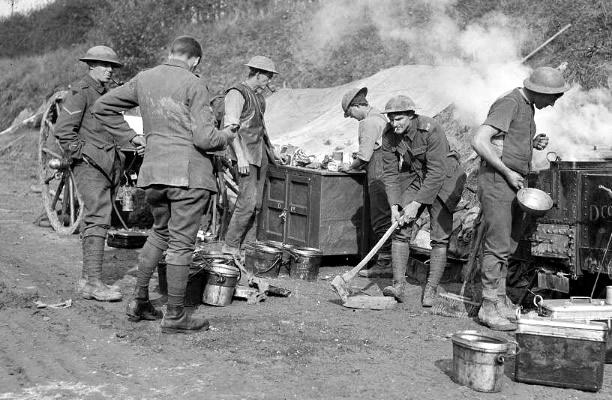
In 1947 the Royal prefix was approved in recognition of the Corps’ Second World War service, and the NZASC became the RNZASC.[14] On 12 May 1979 the RNZASC was disbanded: road transport, movements, air dispatch, postal and catering responsibilities passed to the newly formed RNZCT, while foodstuffs and petroleum, oils and lubricants passed to the RNZAOC. The RNZCT became one of the foundation corps of the RNZALR in 1996. The Commissariat and Military Train remain important to this history as earlier practitioners of comparable work; they should not be presented as proven direct organisational predecessors.[15]
The NZAOC: Defence Stores Reorganised
The New Zealand Army Ordnance Corps (NZAOC) followed a different course. Rather than being raised without an institutional foundation, the home-service NZAOC emerged from a long-established Defence Stores Department. That Department had supported the Armed Constabulary, militia and volunteers, the South Africa War contingents and, in 1914, the mobilisation of the New Zealand Expeditionary Force. Its duties included stores accounting, uniforms, arms, ammunition, equipment distribution and technical work.
The demands of a prolonged war exposed the limitations of a department structured principally for peacetime military support. On 1 February 1917, the Defence Stores Department ceased to exist as a separate organisation as the New Zealand Army Ordnance Department and NZAOC assumed its work. Contemporary regulations and documented transfers of civilian and temporary personnel into military service show a substantial organisational connection, not merely a similarity of functions. Granted the Royal prefix on 12 July 1947, the NZAOC became the RNZAOC and, through that corps, part of the RNZALR.[16]
A further distinction is necessary, because three separate Ordnance establishments existed during the war. The NZAOC formed in the New Zealand Expeditionary Force overseas in 1915 was a separate wartime organisation. Bolton also describes a specialised Army Ordnance Corps section established within the Royal New Zealand Artillery with effect from 1 April 1915, comprising a bombardier and six gunners. Neither should be automatically treated as identical to the home-service establishment that emerged from Defence Stores in 1917.[17]
The NZEME: A Technical Profession Before a Corps
The origins of the New Zealand Electrical and Mechanical Engineers (NZEME), formed in 1942, were different again. Long before a specialised corps existed, military maintenance was conducted by civilian armourers, ordnance artificers, artillery and engineer tradesmen and other technical specialists. The expansion of coastal defence systems brought increasingly complex guns, machinery, searchlights and electrical equipment, demanding skilled inspection and repair.
The Defence Stores Department employed armourers and arms cleaners, while artillery and engineer organisations sustained their own equipment. General Order 118 of 1 May 1912 placed armourers other than regimental armourers within the New Zealand Ordnance Corps. The 1917 NZAOC organisation included armourers and armament artificers, providing an identifiable connection between part of the technical maintenance establishment and Ordnance. Maintenance personnel and functions from several establishments subsequently contributed to the dedicated NZEME formed in 1946.[18]
The development of NZEME was therefore not the uninterrupted renaming of one nineteenth-century unit. It consolidated and professionalised technical capabilities previously spread across different military and civilian establishments. Its successor, the RNZEME, became a foundation corps of the RNZALR in 1996.[19]
Heritage, Function and Lineage
Three related terms help explain this history. Historical heritage encompasses the organisations, people and practices that contributed to military logistics in New Zealand. Functional continuity describes the enduring need to supply, transport, equip and maintain military forces, regardless of which establishment performed the work. Organisational lineage requires an identifiable institutional connection through formation, transfer, redesignation or amalgamation.
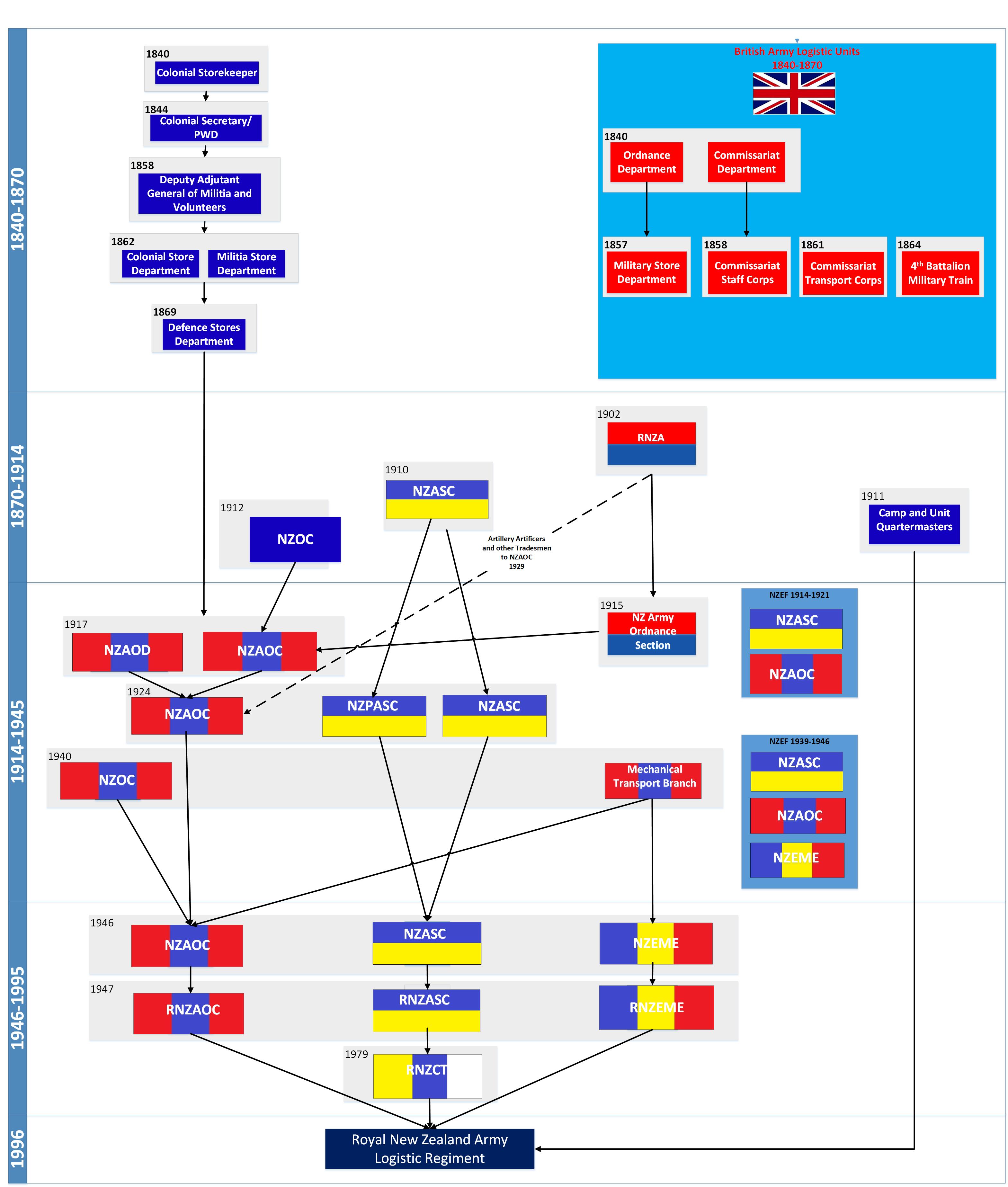
They are connected but are not interchangeable. The Imperial Commissariat and Military Train belong unquestionably to New Zealand’s military logistics heritage. The near forty-year interval before the NZASC was constituted, however, means that functional resemblance alone cannot establish an unbroken organisational lineage. The Defence Stores Department’s transition into the home-service NZAOC provides stronger evidence of institutional succession. The NZEME’s history, meanwhile, illustrates how technical trades and responsibilities could converge from several establishments into a new corps.
The term “predecessor” can legitimately describe an organisation that performed equivalent work, even if it was not formally succeeded by the later corps. In a regimental lineage chart, however, a solid line should be reserved for a documented organisational relationship; a dashed line is more suitable for Imperial influence, shared functions or wider heritage. Such care is not historical pedantry. It makes each organisation’s contribution easier to understand and harder to misrepresent.
Alliances: Kinship Without Descent
The relationship between New Zealand’s logistics corps and their British counterparts reflects the same distinction. The Imperial organisations that served in New Zealand did have institutional successors, but those successors were British. In 1869 the officers of the Commissariat and the Military Train were combined with those of the Military Store Department in a new Control Department, and in 1870 the Military Train’s other ranks were redesignated the Army Service Corps. The British Army’s own transport and supply lineage continues from there through the Royal Army Service Corps and Royal Corps of Transport to the Royal Logistic Corps, while the Military Store Department’s descends through the later Ordnance services to the Royal Army Ordnance Corps.[20]
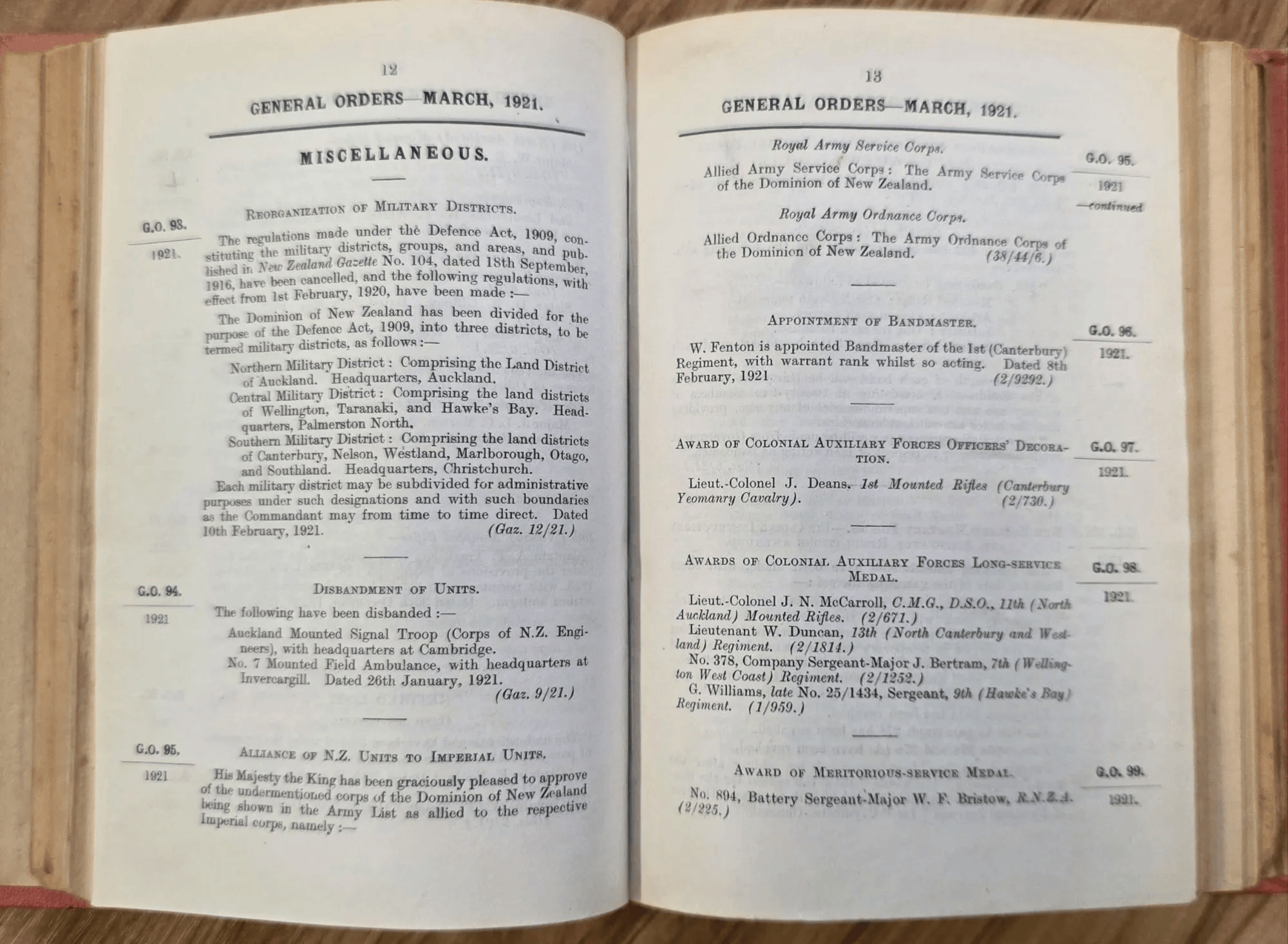
New Zealand’s formal connection with those British lines came through alliance rather than descent. General Order 95 of 1 March 1921 promulgated the alliances, approved by King George V in December 1920, between the Royal Army Ordnance Corps and the NZAOC and between the Royal Army Service Corps and the NZASC. RNZEME was allied with the Royal Electrical and Mechanical Engineers in 1949 and with the Royal Australian Electrical and Mechanical Engineers in 1970. An alliance was a bond between separate corps, sustained through the exchange of training and historical information, visits, attachments and greetings. In the terms used above, alliances were the formal expression of the dashed line: shared tradition and professional kinship, not succession.[21]
Thirty Years Together: An Inheritance Beyond 1996
Since 1996, the RNZALR has carried forward the supply, movement, transport, maintenance and related professional traditions of three formerly separate corps. Its people work with technologies and processes scarcely imaginable to their nineteenth-century counterparts, yet the underlying task is recognisable: ensuring that the force is equipped, moved, repaired and sustained when and where required.
Not every part of that inheritance survived the transition. The formation of the Royal Logistic Corps on 5 April 1993 removed the British counterparts of the RNZAOC and RNZCT alliances, and the RNZEME alliances appear to have lapsed when RNZEME was absorbed into the Regiment, even though REME and RAEME still exist. Alliances did not feature among the 1996 implementation tasks. Current regulations list an RNZALR–RLC alliance, but no supporting approval, Royal assent or UK Army Order has been located, and the Regiment’s own procedures speak of establishing alliances rather than maintaining them. Renewing these relationships remains unfinished business for the Regiment’s fourth decade.[22]
The Regiment’s history is therefore wider than thirty years, but it is not one simple uninterrupted line from the Imperial Commissariat to the modern logistics soldier. It contains the British organisations that sustained Imperial campaigns; colonial stores administration that developed into an enduring New Zealand institution; the separate creation of the NZASC in 1910; the reorganisation of Defence Stores into the NZAOC in 1917; and the consolidation of maintenance capabilities into NZEME in 1942.
Recognising these differences strengthens the Regiment’s inheritance. It allows Imperial influence to be acknowledged without obscuring the independent development of New Zealand’s own military services. It also properly recognises the civilian and military storekeepers, artificers, drivers, armourers and administrators whose work seldom dominates operational histories.
Conclusion
The thirtieth anniversary of the RNZALR is an appropriate moment to consider what the Regiment inherited. The Commissariat Transport Corps and Military Train provided essential logistics during the New Zealand Wars and are rightly included in New Zealand’s wider military heritage. Their service should be recognised, but it should not automatically be presented as formal organisational descent to the NZASC.
The approximately forty-year gap between Imperial withdrawal and the NZASC’s establishment shows why: the NZASC began as a new national corps, informed by British expertise but not formed from an Imperial transport organisation. Defence Stores, by contrast, offers a demonstrable line from colonial administration to the NZAOC in 1917, while NZEME assembled its inheritance from several technical and maintenance services. Where the British connection was formalised, it took the form of alliances between separate corps rather than succession.
There is no need to choose between Imperial heritage and New Zealand lineage. Both are essential to understanding the RNZALR. The point is to place each organisation accurately within the history: acknowledge shared professional tradition where it exists, and claim direct institutional succession only where the evidence supports it. That gives the Regiment a richer, more historically defensible account of the traditions it has carried together since 1996.
Notes
[1] New Zealand Army, “The Royal New Zealand Army Logistic Regiment,” Army News, no. 528 (2021), 14; Robert McKie, “A Snapshot of the RNZAOC – 4 December 1996,” To the Warriors Their Arms, 2 April 2023. The 4 April 1996 directive and December amalgamation are distinct milestones.
[2] Julia Millen, Salute to Service: A History of the Royal New Zealand Corps of Transport and Its Predecessors, 1860–1996 (Wellington: Victoria University Press, 1997). The designation “predecessor” in a historical account does not, by itself, establish formal organisational succession.
[3] Richard J. Taylor, British Logistics in the New Zealand Wars, 1845–66 (PhD diss., Massey University, 2004), esp. discussions of the Commissariat and transport services.
[4] Millen, Salute to Service, 24–29; M. J. S. Bolton, A History of the Royal New Zealand Army Ordnance Corps (RNZAOC, 1992), chap. 2, 47–48; Taylor, British Logistics, 38–39.
[5] New Zealand House of Representatives, “Correspondence Relative to the Employment of Imperial Troops in the Colony,” Appendix to the Journals of the House of Representatives, 1865, A–4a, correspondence of Commissary-General H. Stanley Jones, August–October 1865.
[6] Taylor, British Logistics, 171–74, drawing on British War Office papers, including WO 33/17A.
[7] Charles Logie, “Colonial Storekeeper to Willoughby Shortland, Acting Colonial Secretary,” 1840, Archives New Zealand, R23629593, record 1840/76; Robert McKie, Unappreciated Duty: The Forgotten Contribution of New Zealand’s Defence Stores Department in Mobilising the New Zealand Expeditionary Force in 1914 (MA thesis, Massey University, 2022), 10–11.
[8] McKie, Unappreciated Duty, 10–12. The New South Wales Colonial Secretary approved Henry Tucker’s replacement of Logie in October 1840; New Zealand became a separate colony in 1841, during Tucker’s tenure. For his recorded military stores, see McKie, 11.
[9] “Colonial Defence Force Act 1862”; “Public Stores Act 1867”; Edward Gorton, “Forwarding Rules and Regulations for Keeping Store Accounts,” 1869, Archives New Zealand, R24142601, record CD1869/2900; McKie, Unappreciated Duty, 15–18.
[10] Bolton, History of the RNZAOC, chap. 2, 49. This secondary account establishes the reported transfer of stores, not an institutional transfer.
[11] Millen, Salute to Service, 38–41.
[12] McKie, Unappreciated Duty, 116–17; Robert McKie, “Brigadier General Henry Owen Knox: The Architect of New Zealand Military Logistics and the Formation of the NZASC,” To the Warriors Their Arms, 12 May 2025, https://rnzaoc.com/2025/05/12/brigadier-general-henry-owen-knox-the-architect-of-new-zealand-military-logistics-and-the-formation-of-the-nzasc/.
[13] McKie, “Brigadier General Henry Owen Knox.” This published account identifies the 12 May 1910 gazetting and Knox’s subsequent work.
[14] Designation of Corps of New Zealand Military Forces altered and Title “Royal” added,” New Zealand Gazette No 39, 11 January 1947, https://gazette.howison.co.nz/nzg/1947/issue/39/page/878.
[15] Robert McKie, “Nothing Without Labour: Remembering the NZASC, RNZASC and RNZCT on 12 May,” To the Warriors Their Arms, 12 May 2026, https://rnzaoc.com/2026/05/12/nothing-without-labour-remembering-the-nzasc-rnzasc-and-rnzct-on-12-may/.
[16] McKie, Unappreciated Duty, 106–13; “New Zealand Army Ordnance Department and New Zealand Army Ordnance Corps Regulations,” New Zealand Gazette, 1917, no. 95 (7 June 1917): 2292–93; “Administration and Miscellaneous—Reorganisation Defence Stores,” 1917, Archives New Zealand, R22430541.
[17] Bolton, History of the RNZAOC, chap. 2, 53–57.
[18] “New Zealand Defence Forces General Order 118,” 1 May 1912, reproduced and discussed in McKie, Unappreciated Duty, 70; see also Robert McKie, “Keeping the Army Working,” To the Warriors Their Arms, 15 September 2026, https://rnzaoc.com/2026/09/15/keeping-the-army-working/.
[19] Peter Cape, Craftsmen in Uniform: The Corps of Royal New Zealand Electrical and Mechanical Engineers (Wellington: Corps of Royal New Zealand Electrical and Mechanical Engineers, 1976); Peter Cooke, Warrior Craftsmen: RNZEME 1942–1996 (Wellington: Defence of New Zealand Study Group, 2017); McKie, “Keeping the Army Working.”
[20] National Army Museum, “Royal Army Service Corps,” https://www.nam.ac.uk/explore/royal-army-service-corps; Royal Logistic Corps, “RCT History,” https://www.royallogisticcorps.co.uk/forming-corps/royal-corps-of-transport/rct-history/. The RLC’s own lineage dates the permanent Army Service Corps from the 1888 reorganisation, after an interval of combined supply and transport arrangements.
[21] “New Zealand Military Forces General Order 95,” 1 March 1921; Robert McKie, “General Order 95 and Its Legacy,” To the Warriors Their Arms, 16 June 2026, https://rnzaoc.com/2026/06/16/general-order-95-and-its-legacy/. The 1930 War Office Alliances Memorandum No. 1 set out the content of alliances; the approval procedure is still preserved in NZP6A, chapter 1, section 9, paragraph 1095.
[22] McKie, “General Order 95 and Its Legacy”; CGS Directive 07/96, 4 April 1996; RNZALR SOP 4.1, 28 September 2020, para. 4.36; NZP6A, chapter 1, section 9, paragraph 1095, serial 15.
