
Tracing Imperial Logistics through a Forgotten Artefact
During a recent visit to the New Zealand Army Museum, a cast-iron tub stood quietly on display—unassuming, heavily worn, and stamped with the crest of the British Board of Ordnance, along with the date 1850. At first glance, it appeared to be a utilitarian container. Yet this artefact, along with others held in storage, opens a window into the rarely told story of military logistics in colonial New Zealand—and more specifically, into the legacy of the Military Store Department and its pivotal role in sustaining Imperial operations during the New Zealand Wars.

Legacy of the Board of Ordnance
The tub bears the insignia of the Board of Ordnance, a British institution that existed from 1597 to 1855. Charged with overseeing the supply of arms, ammunition, fortifications, and barracks, the Board held enormous responsibility across the British Empire. In New Zealand, it established offices in Auckland and Wellington during the 1840s, ensuring the provisioning of Imperial forces.
The Crimean War’s administrative fallout led to the abolition of the Board in 1855. In 1857, its civil functions were reorganised under the Military Store Department. That transition extended to the colonies, including New Zealand, where ordnance officers such as William Plummer and Joseph Osbertus Hamley were reassigned to the new structure.

Ammunition box with Board of Ordnance shield, initials and broad arrow, Tower of London. https://www.wikiwand.com/en/articles/Board_of_Ordnance
The Rise of the Military Store Department in New Zealand
Between 1857 and 1870, the Military Store Department was the key body responsible for ensuring that the British soldier was “well and comfortably clad and amply supplied with the munitions of war.” Though smaller and often overshadowed by the more publicly known Commissariat, the Military Store Department played an indispensable role.
Hamley, initially arriving in New Zealand in 1847 as Deputy Ordnance Storekeeper in Wellington, assumed charge of all ordnance operations following Plummer’s death in 1859. As Deputy Superintendent of Stores, Hamley would oversee operations throughout the New Zealand Wars, including management of the extensive storage infrastructure at Fort Britomart and Albert Barracks in Auckland.
These depots housed thousands of items—uniforms, weapons, artillery fittings, ammunition, hospital comforts, and critical supplies—for an Imperial force that swelled to over 18,000 by 1864. Within this complex system of magazines and stores, the now-mysterious cast-iron tubs likely once played a humble yet vital role.
The Enigmatic Tubs
Numerous examples of these distinctive cast iron tubs are held in museums across New Zealand and abroad, yet their original function remains elusive. The New Zealand Army Museum has several, including one currently on display in a World War I diorama, likely as a generic military prop rather than with confirmed historical accuracy. This ambiguity reflects a broader uncertainty surrounding these artefacts.

Comparable tubs have been found in various settings, reinforcing the notion that their use may have extended beyond a single military function. For instance:
- MOTAT (Museum of Transport and Technology) in Auckland holds tubs dated to the 1850s that bear the crest of the Board of Ordnance. Some are marked “C. Robinson / Stourbridge,” pointing to a standard manufacturer and suggesting standardised production across the Empire.
- Similar tubs have been found in former military storage sites at Spitbank Fort in the UK and the Victoria Gunpowder Magazine in Hobart, further supporting the theory that they were initially intended for storing or transporting ammunition or other ordnance supplies.
- A blog exploring the Irish city of Cork notes the presence of a “Cannon Bath” at Murphy Barracks in Ballincollig, reputedly used to contain water for extinguishing stray gunpowder or to support artillery cleaning routines. Although anecdotal, this local adaptation echoes 19th-century military practice, where equipment was routinely repurposed in garrison life.

Beyond military institutions, these tubs have entered the antiques market with similarly varied interpretations:
- A tub advertised by Bucks Retro & Vintage is described as a 19th-century blacksmith’s quenching trough, featuring similar dimensions but no Board of Ordnance crest. This example, attributed to “Cobbs, Makers Lane End, Bucks,” hints at broader industrial uses in the same era.
- The Holloways Garden Antiques website offers a cast iron trough dated 1831, stamped with the Board of Ordnance crest and a gunner’s insignia of three cannons. Listed as a probable quenching tank, it remains watertight and is now marketed as a water feature—again showcasing the durability and adaptability of such artefacts.
A Blogsite exploring Irish city of Cork (https://corkobviously.weebly.com/chapter-11—cannons.html) has another example listed as a CANNON BATH. This example is in the old Murphy Barracks in Ballincollig and it is thought that it was used to contain water and was used over any stray gunpowder that may be dropped on the ground. If it remained dry, it might spark and create a mini-explosion.
It may be that the water was used for the sponge to cool down that inside of the cannon.
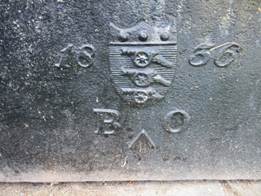
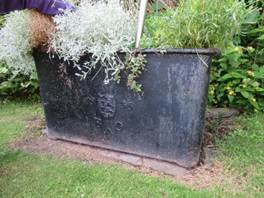
Despite these varied sightings and interpretations, no known period illustrations or photographs depict these tubs in actual use. Contemporary engravings and early photographs more commonly show cannonballs stored in open pyramids beside artillery or laid out on platforms. The absence of visual documentation neither confirms nor disproves their use as ammunition containers, but it leaves the theory unverified.
Their consistent form unites all these examples: sturdy, sealable, and enduring. While their precise military function may remain speculative, their wide geographic spread and recurrence in military and industrial contexts suggest they were a standard logistical item, adaptable to multiple roles—from transporting charge bags to holding water for artillery drills or firefighting. Their mystery lies not in their design but in the quiet versatility that saw them serve many needs, often beyond what was initially intended.
Function, Transport, and Adaptive Reuse
Given the size and design of these tubs, it is plausible they were initially intended for the bulk transport of ammunition from the United Kingdom to colonial garrisons around the globe. When packed with straw or similar material and sealed with a lid, cannonballs or shot could be safely transported by sea. Once landed in New Zealand, moving these heavy cast iron containers from the ship to the magazine would have presented logistical challenges, likely requiring lifting gear and wagons.
However, rather than for cannonballs, it is more likely that these tubs could have been used for the transport of pre-filled charge bags—a more refined and practical form of ammunition supply. A charge bag was a tightly sewn cloth bag filled with a specific weight of black powder, used to fire a gunpowder-era artillery piece. These were a safer, more manageable alternative to loose powder, allowing gunners to select a charge appropriate to the desired range and effect.
For example, in 1870, New Zealand had 16 iron garrison guns in service: three 32-pounders, eight 24-pounders, and five 12-pounders. Each gun required different charge weights depending on range and firing conditions. Charge bags for these guns could range from 2-pound to 6-pound loads of powder. The safe and dry transport of such bags would have been a priority, and the cast iron tubs—sturdy, lidded, and sealable—may have served as ideal shipping and storage containers for this purpose.
This interpretation aligns with their robust construction and the logistical emphasis on safe transport and storage of volatile materials in colonial military supply chains..
Their use in the field would have been impractical. Instead, they were more suited to coastal artillery magazines or fixed fortifications, which could be repurposed for continued storage.
One compelling theory, supported by overseas practices, is that once emptied of their contents, these tubs were reused as general-purpose water containers. In static defences such as Fort Britomart and Albert Barracks, they may have been filled with water and kept ready for two essential duties:
- Swabbing gun barrels after firing – a crucial maintenance task in artillery operations, especially in coastal and fixed defences.
- Firefighting reserve – strategically placed as an immediate water source in the event of a fire, particularly important given the proximity of powder stores and wooden infrastructure.
This theory fits within the broader ethos of 19th-century military logistics, where economy, adaptability, and reusability were central to operations, especially in isolated colonial postings.
A Tangible Link to Hamley’s Store Empire
These tubs, mundane though they may seem, reflect the layered logistical reality of Hamley’s era. Under his stewardship, the Military Store Department operated a vast system of interconnected depots, regional outposts, and forward delivery operations supporting British and colonial troops. Hamley and his officers—many of whom had risen through the ranks or transferred from other Corps—personally supervised store deliveries, field logistics, and the refurbishment of returned equipment.
For example, during the Waikato campaign, Assistant Superintendent Archibald Macduff personally oversaw the delivery of blankets and uniforms to troops at Te Awamutu. At Fort Britomart, nine storehouses, workshops, and the central magazine system formed what we might now call a logistics hub, supplying everything from rifle screws to tents and field hospital gear.
The Military Store Department continued its operations until the drawdown of Imperial forces. As British regiments departed from 1866 onwards, provincial depots were closed and centralised stores consolidated. In 1870, with the withdrawal of the final Imperial units, Fort Britomart’s contents were shipped back to Britain, and responsibility passed to the fledgling New Zealand Defence Stores.
A Legacy Worth Reclaiming
Though eclipsed in the historical record by the Commissariat, the Military Store Department—and men like Joseph Osbertus Hamley—deserve renewed attention. The effectiveness of the department was quietly acknowledged at the time. General Sir Duncan Cameron, commanding British forces in New Zealand, once remarked that no department was more efficient or less prone to conflict than the Military Store Department.
Today, the surviving tubs stamped with the Board of Ordnance crest are among the few physical relics of this largely forgotten organisation. Their survival is a testament to the robust material culture of British military supply chains and offers a rare, tangible link to the operations overseen by figures like Hamley.
Their continued presence in museum collections—despite their uncertain purpose—reminds us that every artifact holds the potential to illuminate untold stories. These “mystery tubs” are more than industrial curiosities; they are quiet witnesses to the empire’s reach and the ingenuity of those who kept its armies marching.
