In the early 1960s, the Royal New Zealand Army Ordnance Corps (RNZAOC) found itself at a crossroads, facing the pressing need for a comprehensive trade structure and a well-defined progression model. This demand for change was catalysed by a series of far-reaching reforms that the 1960 National Government had set in motion. These reforms were not merely administrative adjustments but a profound recognition of the importance of maintaining a standing army that could swiftly adapt to regional conflicts, ensuring a flexible and credible force. This transformative era marked a significant departure from the established Division-based military structure. Instead, the focus shifted towards providing a brigade group. This move demanded a new approach to logistics, support, and readiness.
At the heart of this transformation was the RNZAOC, the primary military logistics organisation entrusted with the critical responsibilities of warehousing, ammunition support, and the meticulous repair of leather and textiles for the New Zealand Army. To effectively fulfil these responsibilities in the face of sweeping changes, the RNZAOC had to recalibrate its entire trade model. This article delves into the narrative of how the RNZAOC navigated these challenges, reshaping its trade structures and progression model to meet the evolving demands of the New Zealand Army, reshaping careers, and ultimately supporting the New Zealand Army as it became involved in the post-colonial cold war South East Asian conflicts of the late 1960s.
A clear trade structure would allow the RNZAOC to allocate its human resources efficiently, as each RNZAOC trade had specific skills and tasks. For instance, those in ammunition handling focus on the safe storage and distribution of ammunition, while leather and textile repair personnel concentrate on maintaining textiles and leather goods. This specialisation ensures that RNZAOC soldiers with the right skills were positioned and assigned to appropriate roles, optimising resource utilisation.
The revised RNZAOC trade model needed to provide a progression model with a clear career path for individuals within each trade. This was designed to incentivise RNZAOC soldiers to excel in their roles, knowing they could advance in their careers by meeting specific criteria, boosting morale and motivation, and leading to higher commitment and dedication among RNZAOC personnel.
The revised RNZAOC trade models also needed to provide standardised processes and procedures with clear expectations for how tasks should be carried out. Consistent practices reduce the likelihood of errors or inconsistencies, which is particularly important when handling ammunition and ensuring the quality of leather and textile repair.
Providing a safe work environment was paramount, especially when handling ammunition and maintaining military equipment, with any revised trade structure ensuring that individuals are appropriately trained in safety protocols and are experts in their specific tasks, reduces the risk of accidents and ensures the safety of personnel and assets.
All the RNZAOC Trades require skill and attention to detail. Any new trade model must include an aspect of Quality Assurance to maintain quality standards and workmanship, ensuring that stores, ammunition, repaired equipment, and textiles meet the required standards and are fit for military use.
The significance of reshaping the RNZAOC trade structure and progression model was to enhance its contribution to the New Zealand Army’s mission success. The RNZAOC’s capability to effectively store, manage, and upkeep crucial supplies and equipment directly impacted the readiness and efficiency of the New Zealand Army. A well-structured trade system would guarantee that these vital functions could be executed with precision, dependability, and safety, consequently bolstering the overall achievement of the New Zealand Army.
At the end of 1962, RNZAOC trades comprised the following:
Storeman/Clerk
Ammunition Technician.
Tailor
Footware Repairer
Clothing Repairer (RNZAOC and NZWRAC).
Factory Inspector Clothing.
Factory Examiner SAA.
Proof Assistant SAA (RNZAOC and NZWRAC).
Saddler and Harness Maker.
Textile Refitter.
In February 1963, the RNZAOC underwent a reorganisation of its trades. This restructuring involved the cancellation of the Clothing Repairer (RNZAOC, NZWRAC). Factory Inspector Clothing (RNZAOC), Factory Examiner SAA and Proof Assistant SAA (RNZAOC and NZWRAC) trades and restructure of the RNZAOC into five core trades:
Non-core trades not included in this review and refresh were:
Clerk All Arms. Responsible for personnel administrative and clerical tasks, including record-keeping, data management, and document preparation required to maintain RNZAOC units.
Storeman All Arms. Responsible for managing and maintaining articles in use, inventory and equipment required to maintain RNZAOC units
Trade tests were updated to align the Storeman/Clerk, Ammunition Technician and Leather and Textile Refitter trades with the new trade structures.
Storeman/Clerk
One Star
To qualify as a One Star Storeman/Clerk RNZAOC, a candidate had to:
Possess basic knowledge of store accounting, including the receipt, issue, and custody of stores.
Be familiar with the location and operation of first aid firefighting appliances in their workplace.
Know unit standing orders.
Have a basic understanding of the organisation and function of their unit.
Write legibly and spell correctly.
Perform simple arithmetic calculations and have a good knowledge of weights and measures.
Qualify for or be excused from attending an RF Basic All Arms Recruit Course.
Have basic knowledge of the organisation and duties in their office.
Interpret abbreviations and common terms used in their office.
Locate information from orders, files, manuals, etc., used in their office.
Amend manuals, publications, orders, and instructions in their office.
Take messages accurately over the telephone and relay information.
Have completed six months as a Basic Storeman/Clerk RNZAOC.
Qualify at an RF RNZAOC Corps Storeman/Clerk One Star Course.
Be recommended by their CO.
Two Star
To qualify as a Two Star Storeman/Clerk RNZAOC, a candidate had to:
Complete 12 months as a Storeman/Clerk RNZAOC One Star.
Obtain 50% in English in School Certificate and pass in Mathematics in School Certificate or a higher examination or in the Army Education Certificate Class 1 or 2 or pass specific English and Mathematics papers in the trade test for Storeman All Arms Two Star.
Qualify at a Storeman/Clerk Two Star Course.
Be recommended by their CO.
Three Star
To qualify as a Three Star Storeman/Clerk RNZAOC, a candidate had to:
Complete two years as a Storeman/Clerk RNZAOC Two Star.
Qualify at a Storeman/Clerk Three Star Course.
Be recommended by their CO.
Four Star
To qualify as a Four Star Storeman/Clerk RNZAOC, a candidate had to:
Complete two years as a Storeman/Clerk RNZAOC Three Star.
Qualify at a Storeman/Clerk Four Star Course.
Be certified by their CO as capable of performing the duties of Chief Clerk or Chief Storeman and controlling, training, and directing Junior Storeman/Clerks.
Be recommended by their CO.
Ammunition Technician
The Ammunition Technician trade merged the Factory Examiner SAA (RNZAOC) and Proof Assistant SAA (RNZAOC, NZWRAC) into the existing Ammunition Technician (RNZAOC) trade established in 1960. Requirements for star classification in this trade were as follows:
One Star
To qualify as a One Star Ammunition Technician, a candidate had to:
Serve a minimum of six months as an Ammunition Technician Basic.
Qualify on specified courses.
Be recommended by their CO.
Two Star
To qualify as a Two Star Ammunition Technician, a candidate had to:
Complete at least two years of post-primary schooling or meet specific educational requirements.
Serve a minimum of fifteen months as an Ammunition Technician One Star.
Qualify at an Ammunition Technician Two Star Course.
Be recommended by their CO.
Three Star
To qualify as a Three Star Ammunition Technician, a candidate had to:
Serve a minimum of twenty-seven months as an Ammunition Technician Two Star.
Qualify at an Ammunition Technician Three Star Course.
Be recommended by their CO.
Four Star
To qualify as a Four Star Ammunition Technician, a candidate had to:
Serve a minimum of twenty-four months as an Ammunition Technician Three Star.
Qualify on the Ammunition Technician Four Star Course.
Be recommended by their CO.
Textile Refitter
The Saddler and Harness Maker (RNZAOC) and Textile Refitter (RNZAOC) trades merged into a new trade called Leather and Textile Refitter (RNZAOC). The star classification requirements for this trade were:
One Star
To qualify as a One Star Leather and Textile Refitter, a candidate must have been able to:
Make a wax thread and stitch leather neatly and securely with an awl and needle.
Undertake fine sewing in addition to sewing coarse canvas and darn neatly.
Use a sewing machine in a skilled manner.
Hand sew with palm and needle.
Identity, use, sharpen and take care of all the tools in saddlery and sailmakers trades.
Sew canvas and leather and fix rivets and dome fasteners.
Splice the rope and make the following –
Long splice.
Eye splice.
Back splice.
Make a wall and crown.
Double wall.
Common whipping.
Palm and needle whipping.
Make a buckle chafe with a leather loop.
Make a canvas seam and bind it with leather.
Undertake ordinary repairs to articles such as gun covers, sheets, blankets, flags, tentage and miscellaneous leather articles.
Be recommended by their CO.
Two Star
To qualify as a Two Star Leather and Textile Refitter, a candidate had to meet the One Star standards and additionally be able to:
Choose the most suitable leather and canvas for various classes of work and have a working knowledge of the classes of leather and textile materials used in the Service.
Undertake fine sewing in, leather and canvas.
Make simple types of cases and sheaths with square corners and straight edges under supervision. (No internal sewing).
Be competent in major repairs of gun covers, tentage, leather, and all waterproof goods.
Cut out and make trailer ‘canopies, signal flags, slide rule cases, butcher’s holsters, machete cases, and binocular cases skilfully.
Cut canvas and leather to .best advantage and a minimum of waste.
Be recommended by their CO.
Three Star
To qualify as a Three Star Leather and Textile Refitter, a candidate had to meet the Two Star standards and be able to:
Cut out and make up any leather or canvas job to specification without supervision.
Manufacture prototype of tentage, penthouse, dial sight case and holdalls with internal stitching.
Instruct others in their trade.
Have a good knowledge of canvas and leather used in the Services.
Pass a Written test in “Accounting in RNZAOC Workshops” as set out in DOS Procedures Instruction 1/C/4. This test will be set by or held at the RNZAOC School under DOS Instructions.
Be recommended by their CO.
Four Star
To qualify as a Four Star Leather and Textile Refitter, a candidate had to meet the Three Star standards, have served in the trade for at least five years, and be able to
Have a complete knowledge of canvas and leather used in the Service.
Accurately estimate quantities, time, labour and costs for major repair programmes involving bulk quantities of tentage and other stores required to be and capable of being repaired in their workshop.
Carry out in a thoroughly skilled and expeditious manner major inspection and repair programmes of tentage and other textile camp equipment items and conduct acceptance inspections against specifications for new stores purchased for the army.
Pass an oral test under DOS direction of their knowledge of factory procedure in manufacturing the army items that are frequently inspected in their workshop.
Design and draw up specifications for leather and textile items customarily dealt with by their trade.
Be recommended by their CO as –
A widely experienced, diligent and highly skilled tradesman.
Capable of instructing and supervising junior tradesmen, including journeymen, in all aspects of their trade.
The 1963 amendment to the RNZAOC trade structures was a critical step in adapting to the evolving needs and structure of the New Zealand Army. These reforms were driven by recognising the importance of maintaining Regular units to create a flexible and credible force capable of responding effectively to regional conflicts. The trade structure introduced in 1963 allowed the RNZAOC to efficiently allocate its resources, ensuring that personnel with the right skills were assigned to appropriate roles, optimising resource utilisation. Furthermore, the progression model provided a clear career path for individuals within each trade, motivating them to excel in their roles and contributing to higher commitment and dedication among RNZAOC personnel.
Ultimately, reshaping the RNZAOC trade structure and progression model aimed to enhance the organisation’s contribution to the New Zealand Army’s mission success. By efficiently storing, managing, and maintaining essential supplies and equipment, the RNZAOC played a crucial role in ensuring the readiness and effectiveness of the army. The detailed star classification criteria for each trade demonstrated the commitment to training, skill development, and the pursuit of excellence within the RNZAOC. These criteria served as a foundation for building a highly skilled and capable RNZAOC workforce to meet the demands of a rapidly changing military landscape.
In conclusion, the 1963 amendment to the RNZAOC trade structures was a vital response to the changing needs of the New Zealand Army. It streamlined the organisation’s operations and ensured that RNZAOC personnel were well-prepared, skilled, and committed to supporting the army’s mission success.
[1] “Regulations and standing orders – Army trades (NZP1-C),” Archives New Zealand No R9752752 (1959-1967).
Royal New Zealand Army Ordnance Corps, 1955-1996 Gilt, Silver & Enamel Officers Badge. Robert McKie collection
On 4 April 1996, the New Zealand Army Chief of the General Staff, Major General Piers Reid, signed a directive to establish a fully integrated logistic function in the New Zealand Army, intending to improve logistic support in both operational and operational and non-operational environments. The integrated logistic organisation would combine the three separate Corps into a single Regiment.
On 9 December 1996, Offices and Soldiers of the Royal New Zealand Corps of Transport, Royal New Zealand Army Ordnance Corps, Royal New Zealand Electrical and Mechanical Engineers and Storemen and Stores Managers of the
Royal Regiment of New Zealand Artillery
Royal New Zealand Armoured Corps
Royal New Zealand Engineers
Royal New Zealand Corps of Signals
Royal New Zealand Infantry Regiment
Royal New Zealand Army Medical Corps
marched onto parade grounds on each camp and base, where the Flags of the RNZCT, RNZAOC and RNZEME were lowered, the headdress of parading soldiers replaced, the flag of the Royal New Zealand Army Logistic Regiment (RNZALR) was raised, and all parading Officers and Soldiers marched off as members of the RNZALR.
With the formation of the RNZALR approved on 4 April 1996 and the ceremonial establishment facilitated on 9 December, the administrative changeover of Officer sand Soldier from their legacy Corps into the RNZALR had been processed as of 5 December 1996. This article provides a snapshot of the Royal New Zealand Army Ordnance Corps on 4 December 1996.
Key Appointments
RNZAOC Colonel-in-Chief
Her Majesty Queen Elizabeth II
Regimental Colonel
Col L Gardiner, 19 September
Colonel Commandant
Lieutenant Colonel AJ Campbell
Supply Wing, Army Logistic Centre
Chief Instructor
Major H.B Cockburn
Warrant Officer Supply
Warrant Officer Cass One W.N Vince
Strength
The strength of the RNZAOC on 4 December 1996 was 371 Officers and Soldiers
By Rank
By Trade
The Other Rank Trades of the RNZAOC consisted of five trades
On 5 December 1996, the RNZAOC other ranks trades were reclassified as
Suppliers, Instructor Supply, AP’s, Storemen and Store managers were reclassified as Supply Quartermasters (SupQM) RNZALR
Ammunition Technicians to Ammunition Technicians RNZALR
Clerks and Manager Administration as Administrators RNZALR
Note: The RNZAOC Motor Trimmer’s Trade was transferred to RNZEME on 7 November 1994.
Rank by Trade
Officers
Note: Ten Officers were qualified as Ammunition Technical Officers (ATOs)
By Arm
Age
Gender
Length of Service
Note: Five serving RNZOAC members had previous service in Corps, which had been previously disbanded.
One from the New Zealand Army Woman’s Corps (NZWRAC).
Five from the Royal New Zealand Army Service Corps (RNZASC).
In the New Zealand Army realm, there exists a group of exceptional individuals known as Ammunition Technical Officers (ATOs) and Ammunition Technicians (ATs). These brave men and women have adored a distinctive emblem since 1971—the Flaming “A” Badge—a symbol that embodies their trade’s hazardous and highly skilled nature. But this badge represents far more than just a visual representation of their profession. It is a tribute, recognising their trade’s extensive and illustrious heritage.
What began as the management of powder magazines in the 19th century has evolved into a responsibility encompassing the entire spectrum of ammunition and explosives available to the modern New Zealand Army. The AT trade has adapted and grown, keeping pace with the changing times and technologies. And since 1971, the Flaming “A” Badge has remained a constant, a badge of honour that signifies the dangerous nature of their work and the expertise required to execute it with precision.
Beyond its symbolism, the Flaming “A” Badge is a profound acknowledgement to those who wear it—a testament to the long and proud whakapapa (genealogy) of their trade. It is a reminder of the individuals who came before them, laying the foundation and forging the path they now tread. Each wearer of the badge carries the weight of history, embodying the spirit and dedication that has defined the AT trade over the years.
.
During the early colonial period in New Zealand, importing ammunition and explosives from the United Kingdom and Australia was necessary. Powder magazines were established at Mount Cook in Wellington and Mount Albert in Auckland to store and distribute these essential supplies safely. The responsibility of handling and storing these stocks fell upon qualified individuals from the British Military Stores Department and Royal Artillery and Engineer officers.
As the Imperial Forces gradually withdrew from New Zealand in 1870, the full responsibility for the country’s magazines and ammunition transferred to the Defence Stores Department. Subsequently, new facilities were constructed at Mount Eden in Auckland and Kaiwharawhara in Wellington, replacing the previous powder magazines at Mount Albert and Mount Cook. These new sites remained in use until the 1920s. Additionally, magazines were maintained by the Defence Stores Department in various provincial centres to support the dispersed Militia and Volunteer Forces.
In 1884, the permanent Garrison Artillery was formed, and two experienced individuals, Frederick Silver and Robert George Vinning Parker, were transferred from the Royal Marine Artillery and Royal Garrison Artillery to serve as instructors. Their expertise proved invaluable in mounting New Zealand’s Garrison Artillery, as they compiled books and manuals and managed artillery ammunition stocks in collaboration with the Defence Storekeeper.
Capitalizing on the government’s support, Major John Whitney established Whitney & Sons as an ammunition manufacturing company in Auckland. Later, with additional investors, the company evolved into the Colonial Ammunition Company (CAC) in 1888—the first ammunition manufacturer in New Zealand and Australasia. The CAC contracted with the New Zealand Government to produce Small Arms Ammunition (SAA). The agreement stipulated that the government supplied the powder while the CAC provided the components to manufacture complete cartridges. Each batch underwent government inspection and quality control checks before acceptance by the New Zealand Forces. The testing process involved firing a small percentage of the batch to determine its performance and whether it met the required standards.
By 1890, the production of .577 Snyder Ball Ammunition was underway, and the initial batches underwent testing, inspection, and acceptance under the supervision of Major John Pirie of the New Zealand Militia. Major Pirie, a former Major in the Guernsey Militia, had immigrated to New Zealand and assumed the Auckland District Musketry Instructor role in 1881. He continued to inspect manufactured ammunition until July 1891 when Major Goring, Officer Commanding the Auckland District, took over the responsibility. Lieutenant J E Hume of the Permanent Militia assumed the ammunition examination duties from 1893 while concurrently handling other responsibilities.
On 6 February 1898, a formal request was made to the United Kingdom to recruit a suitable Warrant Officer from the Royal Artillery to oversee the testing operations and supervise the manufacture of Small Arms Ammunition. Quartermaster Sergeant Instructor Arthur Duvall from the Artillery College in the Royal Garrison Artillery was selected as the Small Arms Testing Officer for the New Zealand Forces. Upon appointment, he was promoted to 3rd Class Master Gunner and engaged for three years at a rate of Nine Shillings per day, along with free quarters or a housing allowance of £50 per annum. Duvall arrived in New Zealand in July 1898 and began his work at the CAC premises in Mount Eden, Auckland. He extended his engagement every three years and completed twenty years of service with the British Army in 1911. Duvall then took his discharge in New Zealand, immediately enlisting in the New Permanent Staff as an Honorary Lieutenant on 26 April 1912, followed by a promotion to Honorary Captain on 1 April 1914.
In 1902, Frederick Silver transitioned from the Artillery and took on the role of Assistant Defence Storekeeper. While fulfilling his duties in this position, Silver managed all Artillery stores and ammunition. After implementing the Defence Act 1909 and subsequent reorganization, Silver transferred from the Defence Stores to the office of the Director of Artillery. He was appointed Quartermaster (Honorary Lieutenant) as Artillery Stores Accountant, retaining his responsibilities overseeing Artillery stores and ammunition. Silver retired in June 1913, and Robert George Vinning Parker succeeded him as Artillery Stores Accountant after being promoted from Warrant Officer to Quartermaster (Honorary Lieutenant).
Although the Colonial Ammunition Company (CAC) in Auckland provided self-sufficiency in Small Arms Ammunition (SAA) production, the same could not be said for artillery ammunition, which still had to be imported. Parker conducted a cost-benefit analysis and concluded that significant annual savings of £3,333 (2022 NZD$ 633,605) could be achieved by cleaning and refilling casings, inspecting and refurbishing propellant bags, and manufacturing new ones as needed. To realize these savings, Parker recommended the establishment of a specialized Royal New Zealand Artillery Ordnance Corps Section responsible for manufacturing and modifying ammunition. General Godley approved the proposal in mid-1914, and on 1 March 1915, under New Zealand Defence Forces General Order 90, the New Zealand Army Ordnance Section was authorized and established from 1 April 1915.
On 31 May 1917, regulations were approved and published, constituting the New Zealand Army Ordnance Department (NZAOD) and New Zealand Army Ordnance Corps (NZAOC), with retroactive effect from 1 February 1917. This marked the end of the forty-eight-year service the Defence Stores Department provided. Administrative control of the New Zealand Artillery Ordnance Section was transferred to the NZAOC, and Parker was commissioned as Captain in the NZAOD, serving as the Inspector of Ordnance Machinery. However, Parker’s tenure in this position was brief, as he retired on 30 September 1919.
On 10 January 1918, Arthur Duvall was transferred from the Permanent Staff to the NZAOD, assuming the role of Proof Officer SAA with the rank of Captain. The post of Proof Officer SAA would continue to be a continuous appointment in the New Zealand Army’s ammunition supply chain until 1968, when the CAC relocated its operations to Australia, concluding its longstanding association with the New Zealand Army.
The experiences of World War I emphasized the need for specialized officers with technical knowledge of ammunition. Captain William Ivory, RNZA, returned to New Zealand in 1919 after completing several courses of instruction in the United Kingdom and assumed the position of Inspecting Ordnance Officer (IOO). Lieutenant A de T Nevill, RNZA, served as Acting IOO in 1925, allowing Ivory to fulfil regimental duties within the RNZA. Ivory resumed the position of IOO on 2 January 1927. Upon Ivory’s retirement in 1933, Lieutenant Ivan Roberts Withell, RNZA, succeeded him as IOO, a role he held until his passing on 31 August 1946.
In 1917, the Royal New Zealand Artillery (RNZA) Ordnance Section at Fort Ballance came under NZAOC control upon the formation of the NZAOC. The section continued its responsibilities for storing, repairing, and refurbishing ammunition under the supervision of the RNZA. With the closure of the Kaiwharawhara Magazines in the early 1920s, Watts Peninsula on the north end of Wellington’s Miramar Peninsula became the primary ammunition depot of the NZAOC. This depot consisted of 19 magazines, one store, and a laboratory spread across Shelly Bay, Kau Point, Mahanaga Bay, Fort Ballance, and Fort Gordon. These facilities were repurposed submarine mining and coastal artillery fortifications dating back to the 1880s. The large six- and eight-inch disappearing guns had been removed in the early 1920s, and the gun pits were converted into makeshift magazines. However, these accommodations were not ideal as they lacked proper temperature and moisture control, posing potential risks to ammunition stocks.
A smaller Ammunition section was also maintained at Mount Eden in Auckland until 1929 when, along with some staff from Fort Ballance, the Mount Eden Ammunition Section was transferred to New Magazines at Hopuhopu Camp. Intended to serve as the principal ammunition depot for New Zealand, between 1925 and 1927, eleven magazines and a laboratory were constructed at Hopuhopu Camp. The magazines, built into the hillside to contain any blasts, were made of concrete with double walls, creating an inspecting chamber. The purpose of the inspecting chamber was to enable sentries to monitor thermometers and adjust ventilation to maintain the optimal temperature of the stocks by consulting a chart.
In 1931, the NZAOC Ammunition sections underwent civilianization, transferring nearly all the NZAOC military staff to the Public Service as civilian employees, usually at lower pay rates or placing them on superannuation due to government budgetary constraints.
When New Zealand entered the Second World War in September 1939, the responsibility for ammunition was shared between the RNZA and the NZAOC.
The Director of Artillery was responsible to the General Officer Commanding for.
The provision and allocation of gun ammunition,
The receipt, storage, and issue of gun ammunition and explosives other than small-arms ammunition
The Director of Ordnance Services, assisted by the IOO and the SAA Proof Officer, were responsible to the Quartermaster-General for.
The inspection and repair of gun ammunition,
The provision, receipt, storage and distribution of small arms ammunition.
NZAOC Ammunition facilities and personnel shared by the RNZA and NZAOC in September 1939 consisted of.
The IOO, Captain I.R Withell, RNZA
The Proof Officer, SAA Mount Eden Auckland, Honorary Lieutenant J.W Fletcher, NZPS
19 Magazines, 1 Store, and an Ammunition Laboratory at Fort Ballance managed by
an RNZA WO1 seconded to the NZAOC
five members of the NZAOC civilian staff
11 Magazines and an Ammunition Laboratory at Hopuhopu Camp managed by
an RNZA WO1 seconded to the NZAOC and
two members of the NZAOC civilian staff.
Single SAA Magazines at Trentham and Burnham Camps.
From 1940 as the New Zealand Army moved from a peacetime to a wartime footing, the Ammunition trade grew exponentially as new infrastructure was constructed to accommodate the extensive range of ammunition required for training and home defence, with Modern Explosive Store Houses built at.
Burnham – 8 Magazines
Ohakea – 6 Magazine
Papakura (Ardmore)- 28 Magazines
Hopuhopu and Kelms Road – 55 Magazines
Waiouru – 45 Magazines
Makomako – 39 Magazines
Trentham (Kuku Valley) – 22 Magazines
Belmont – 62 Magazines
Glen Tunnel – 16
Mount Somers – 10
Fairlie – 9
Alexandra – 9
In 1942 a conference of the QMG, DQMG2, AQMG5, COO, DCOO and IOO reset the wartime policy and organisation of New Zealand Military Ammunition services in which,
The COO and the Ordnance Ammunition Group were responsible for the management and storage of ammunition
the Chief IOO (CIOO) was responsible for all technical management and inspection of ammunition.
With the role of the IOO branch now defined, from January 1943, the establishment of the IOO Branch was steadily increased to more robust levels.
From mid-1945, discussions started taking place on the post-war shape of the NZAOC. Some thought was given to returning the NZAOC to its pre-war status as a predominantly civilian organisation. Reality prevailed, and the future of the NZAOC was assured as a permanent component of the post-war Army.
The Proposed establishment of NZAOC Ammunition units saw the first widespread use of Ammunition Examiner (AE) as the ammunition trade name. AEs had existed in the British Army since 1923, evolving from the trade of Military Laboratory Foreman that had been established in 1886. Although the Royal Army Ordnance Corps (RAOC) authorised the use of a specialist AE badge consisting of an ‘AE in Wreath’ in 1942, permission to wear this badge was not granted to New Zealand AEs.
RAOC Ammunition Examiner Trade Badge 1942 to 1950 with ‘homemade’ Brass Version.
The first New Zealand AE were in the 2nd New Zealand Expeditionary (2NZEF), where New Zealand Ordnance Corps (NZOC) AEs were included as part of the 2nd New Zealand Division NZASC Ammunition Company establishment. Little information is known about the 2NZEF AEs. They were likely recruited from within 2NZEF, given some rudimentary training by the RAOC and set to work.
From 1 June 1945, the Artillery Headquarters element responsible for managing Gun Ammunition, the Ammunition and Equipment Section, was transferred to the control of the Chief Ordnance Officer (COO), ending the RNZA roles in the management of ammunition that had existed since the 1880s and the employment of Parker and Silver. As a result of the transfer, 11 Officers and 175 Other Ranks of the Royal New Zealand Artillery were absorbed into the NZAOC establishment.
On 15 November 1945, the QMG directed that the care, maintenance, accounting and storage of all ammunition and explosives was the responsibility of the COO. Under the COO, these duties were to be undertaken by
The IOO Section
The NZAOC Ammunition Section
Under the CIOO, the IOO Section was responsible for.
The control of all work on ammunition for all purposes other than accounting and storage,
Maintenance of Ammunition and explosives in stock in a serviceable condition and ready for use,
Provision of personnel for inspection and repair and for working parties to carry out repairs,
Provision of all equipment and stores required for the inspection and repair of ammunition,
Provision and accounting for Motor Transport necessary for the transport of stock for inspection and repair,
Administration and control of Repair Depot Trentham,
Maintenance of buildings at Repair Depot Trentham.
The NZAOC Ammunition Section was responsible for.
The accounting, storage and care of ammunition and explosives,
Maintenance or magazines areas and of buildings and services connected with the storage of ammunition and explosives,
Administration of personnel of the IOO Section, while attached to ammunition depots concerning pay, rations, quarters, clothing and discipline,
Transport arrangements for the movement of ammunition not connected with the inspection and repair of ammunition at depots.
The provision of suitably trained personnel was a constant problem for the CIOO. A course for IOOs was conducted over November/December 1945 to provide sufficient Officers to fill the IOO establishment.
In December 1945, the results for No. 2 Course of Instruction—Inspection Ordnance Officers—were published. Of the thirty-five officers and other ranks who sat the written examination, eighteen achieved the qualifying mark of 50 per cent or better. Twelve officers were duly appointed as Inspection Ordnance Officers; from the ranks, two Warrant Officers Class I, a Staff Sergeant, a Sergeant, a Corporal, and a Private qualified as Ammunition Examiners.
On 1 September 1946, Army Headquarters “Q” Branch underwent a significant reorganisation that established the New Zealand Electrical and Mechanical Engineers (NZEME). New Zealand’s Ordnance Services were also restructured under the Director of Army Equipment (DAE), who became the senior NZAOC position.
The reorganisation led to the division of Ordnance Services under the DAE into the following roles:
COO: This role oversaw Headquarters New Zealand Ordnance Services, including the Provision Group.
CIOO: This role held responsibility for the IOO Group.
Following the retirement of Lieutenant Colonel C.S.J. Duff, DSO, RNZA, who served as the incumbent DAE, on 3 July 1947, the position was renamed Director of Ordnance Services (DOS). Lieutenant Colonel Andrew Huia Andrews, RNZAOC, assumed the role as the first post-war DOS on 1 October 1947.
By 1949 the Ammunition organisation had further evolved, combining the IOO and NZAOC Section into a single ammunition organisation, with
The CIOO and staff providing DOS with the required technical advice on ammunition
District IOOs appointed to each District Headquarters as the Ammo advisor to the District DADOS
District Ammunition Sections now renamed as
Northern District Ammunition Depot
Central District Ammunition Depot
Southern District Ammunition Depot
Army Ammunition Repair Depot
Army Ammunition Supply Depot
To facilitate the further reorganisation and refinement of the Ammunition functions, the DOS hosted the first conference of Senior Ammunition Officers at Trentham Camp from 21-24 June 1949.
RNZAOC IOOs and AEs 1949
As the role of Inspection Ordnance Officers and Ammunition Examiners became integrated into the structure of the New Zealand Army, the Ammunition trade continued to face challenges due to limited resources, despite operating at a high tempo. Throughout the 1950s, the trade supported various activities, including:
Continuous inspection of wartime ammunition held in depots.
Disposal of surplus and obsolete ammunition through methods such as dumping at sea, destruction within depots, sale to the public (SAA natures), and transfer to allied nations.
The Supply of ammunition to support Compulsory Military Training.
The Disposal of blinds and unexploded ammunition discovered in wartime training areas.
The conduct of trials and introduction of new types of ammunition into service.
The provision of technical ammunition support to the Fiji Military Forces.
Meanwhile, an exciting development occurred in the United Kingdom in 1948 when a competition was held to design a new badge for RAOC (Royal Army Ordnance Corps) Ammunition Examiners. Major Leonard Thomas Herbert Phelps submitted a design that was eventually accepted. The badge featured a 3″ x 2″ Flaming Grenade in red, black, and gold, with the letter “A” incorporated within the grenade. This symbolised the AE trade’s status as an “A” Class trade and became the British Army’s first three-colour trade badge. There were rumours that the Elizabeth Arden Cosmetics Company logo inspired the design.
.
Elizabeth Arden lipstick
The year 1950 marked a significant milestone as the British Army Dress Committee granted permission for Ammunition Examiners (AEs) with the rank of Sergeant and above to wear the esteemed ‘Flaming A’ Trade Badge as a distinguished ‘Badge of Appointment’. Although this recognition was granted, it took some time for the approval to extend to the Ammunition Trades within New Zealand. Nonetheless, the journey was underway to officially embrace the ‘Flaming A’ Badge within the ranks of New Zealand’s Ammunition Trades..
In 1959, a thorough evaluation of army dress embellishments was undertaken to establish a clear policy regarding the wear of various embellishments, including:
Shoulder titles
Formation Patches
Service Badges
Badges of Appointment
Instructors Badges
Skill-at-Arms Badges
Tradesmen’s badges
During the review of Badges of Appointment, it was noted that specific badges worn by the British Army were also authorised for wear by the New Zealand Army. These badges, such as the Gun for RNZE, Grenade for RNZA, Hammer and Pincers for RNZEME, and Lyre for Bandsmen, were worn by Warrant Officers, Staff Sergeants, and Sergeants in their respective units. Regarding the flaming “A” badge of the RAOC AE, it was recognised that it held significance and merit for adoption by the ammunition trades of the RNZAOC. Consequently, the adoption of the flaming “A” badge was recommended.
Despite the numerous recommendations during the army dress embellishment review, only decisions regarding shoulder titles and formation patches were made. The Army Dress Committee requested the Adjutant General to prepare a paper on dress embellishments and develop a policy specifically addressing Badges of Appointment, Instructors Badges, Skill-at-Arms Badges, and Tradesmen’s badges. Unfortunately, the wait for a badge for AEs was set to continue.
As the RNZAOC organisation matured in the late 1950s, it became apparent that the system in place of having separate Ordnance, Vehicle and Ammunition Depots located in the same locations but under different command arrangements was impracticable and not an efficient use of resources. Starting in 1961, a reorganisation was undertaken to consolidate administrative, accounting and store functions under one headquarters. The restructuring resulted in only one RNZAOC depot in each district, which consisting of,
Headquarters,
Stores Sub-Depot,
Ammunition Sub-Depot,
Vehicle Sub-Depot
Traffic Centre.
To achieve this, all the existing District Ammunition Depots became sub-depots of a District Ordnance Depot, designated as.
In 1960 the RAOC renamed their Ammunition Trades, and concurrent with the 1961 reorganisation, the RNZAOC decided to align the Ammunition Trade with the RAOC and adopt the same trade names, making the following changes.
Chief Inspecting Ordnance Officer became Chief Ammunition Technical Officer
Senior Inspecting Ordnance Officer became Senior Ammunition Technical Officer
District Inspecting Ordnance Officer became District Ammunition Technical Officer
Inspecting Ordnance Officer became Ammunition Technical Officer
Ammunition Examiner became Ammunition Technician
Up to 1961, Ammunition Technical Officers (ATOs) were usually only employed in Ammunition-related duties. However, as a result of this reorganisation, ATOs were now used across all of the RNZAOC and, as such, were required to balance their regular duties with their Ammunition responsibilities.
1968 saw further reorganisation with the Main Ordnance Depot at Trentham was renamed 1 Base Ordnance Depot and the District Ordnance Depots renamed
Northern District Ordnance Depot to 1 Central Ordnance Depot
Central District Ordnance Depot to 2 Central Ordnance Depot
Southern District Ordnance Depot to 3 Central Ordnance Depot
A significant aspect of the 1968 reorganisation was the Disestablishment of The Small Arms and Proof Office co-located at Mount Eden when the CAC closed down, ending the ammunition trades’ long relationship with the CAA. Additionally, the Ammunition Proof and Experimental Centre operations at Kuku Valley was closed down, and its operations moved to the new Joint Services Proof Establishment at Kauri Point in Auckland.
Keen to provide the Ammunition trade with a suitable trade identifier Major D.H Rollo, the CATO, sent a message to the New Zealand Defence Liaison Staff in London in September 1968 requesting the following information from the UK Chief Inspector of Land Service Ammunition (CILSA) on the RAOC AT Badge
Do other ranks and officers wear it
Conditions of entitlement to wear
Cost of badge
Possibility of procuring samples
Any other pertinent details which may guide in adopting a similar badge
By the end of November 1968, through the New Zealand Defence Liaison Staff, the UK CILSA provided the following information on the RAOC AT badge to the New Zealand CATO,
Worn by all Ammunition Technicians on No 1 and No2 Dress. It is not worn with any other form of dress.
Price
No1 Dress – 7/6d each,
No 2 Dress – 5.1/4d each
Samples of each badge to be provided
In April 1969, CATO submitted a proposal to the 77th meeting of the Army Dress Committee, seeking approval to introduce the Flaming “A” badge for New Zealand Ammunition Technicians (ATs). However, the submission was deemed insufficient and was ultimately declined, citing the following reasons:
Equality among trades: It was argued that other trades within the Army equally deserved a similar badge, and singling out ATs may not be justified.
Lower qualification standards: Concerns were raised regarding the perceived lower standards required to qualify for the badge than other trade badges.
The Dress Committee agreed to revisit the matter if additional justification could be provided.
During the same period, developments in the United Kingdom and the ongoing troubles in Northern Ireland led to the unofficially wearing of the RAOC AT badge by Ammunition Technical Officers (ATOs). Subsequently, in June 1971, an ATO badge was introduced through the DOS (Director of Ordnance Services) Bulletin. This badge featured a small ‘Flaming Circle’ without the superimposed letter A, distinguishing it from the badge worn by ATs.
Moving forward from Major Rollo’s initial submission, New Zealand’s CATO, Major Bob Duggan, reconsidered the earlier proposal and, on 13 July 1970, through the DOS, submitted the following for a combined AT/ATO Badge,
CONSIDERATIONS
6. R & SO Vol II provides for the wearing of qualification badges, and a study of that publication reveals that a large proportion of Army Corps already have these. Many badges require less effort for qualification than would the exacting trade of Ammunition Technician. In addition, and supporting the acceptance of an ATO/AT Badge, these technicians are frequently required to deal with other services and members of the public.
7. The low standard required to qualify for this badge has been reconsidered in light of information obtained on similar standards received from overseas. In addition, it was never the intention to cheapen the significance of this badge in the RNZAOC or those of any other Corps. The standard required to qualify for the ATO/AT badge would now be as follows:
a. Technical Officers who have practised for a minimum of one year.
b. All Ammunition Technicians, regardless of rank, who have qualified in all ways for four stars in their trade.
8. The Public Relations side of the duties of ATO/Ats, as mentioned in paragraph 6 above, is further explained. This aspect concerns the collection and disposal of stray ammunition and explosives as well as involvement with the Police and other Government Departments in bomb scares. The average annual number of items, all natures and types of stray ammunition which have been collected over the last three years is 5750, which represents approximately 450 calls by ATOs or four-star ATs. ATO/ATs are requested by Police Stations throughout New Zealand
a. To visit many private homes to identify-stray ammunition.
b. Assess whether or not the items are in a dangerous state, and
c. Remove such items for disposal. If an item is in an armed state, it could mean disposal in situ’.
9. The request is therefore not for a trade badge, but one of recognition and identification as to the dangerous and skilful nature of their specialist work.
With the Support of the Army Q Branch, the Army Dress committee approved the introduction of the AT Badge for qualified RNZAOC ATOs and ATs on 31 May 1971
The New Zealand AT badge adopted in 1971 was identical to the RAOC AT Badge. The criteria for being awarded was for Officers to have completed one year of practical experience after graduating from the ATOs Course in Australia or the United Kingdom. For ATs to qualify, they were required to be qualified in all aspects of the trade, which could take up to six years.
The New Zealand AT Badge was approved to be worn with the following orders of dress;
No 2 Dress Mess Kit, No 3 Dress Summer Mess Kit. On the left lower sleeve, 165mm above the bottom of the cuff
.No 4A Dress Service Dress. On the left lower sleeve, 165mm above the bottom of the cuff, except with warrant officers, it was worn immediately above the badge of rank on the left sleeve.
The United Kingdom continues to maintain different ATO and AT badges. The Australian Army utilises an RAOC style, ATO badge with a stylised Wattle for ATOs and ATs.
Australian Army Ammunition Technical Officer/Ammunition Technician Badge. Robert McKie Collection
Examples of New Zealand ATO/AT Badges
1st pattern Ammunition Technician Badge. Robert McKie Collection
On 24 May 1985, the Army Dress Committee endorsed a proposal that all New Zealand Army Qualification Badges eventually conform to a common heraldic motif as an initiative to develop insignia with a unique New Zealand flavour. The common heraldic motif consisted of the qualification badge surrounded by fern fronds providing a badge with a distinct national character.
Although a scroll could be included, if this was not necessary, the fronds continued and stopped just short of the centre point.
Approved for adoption by the CGS on 6 November 1985, the request went out to trade sponsors to prepare drawings of the current qualification badges encompassing a surround of fern fronds for consideration by the Army Dress Committee.
Although tasked with providing a design of the AT badge incorporating the common motif, on 1 April 1987, CATO provided a submission including the current AT Badge with the common motif, as well as an alternative design in keeping with the requirement to ‘New Zealandise’ qualification badges.
Design provided by CATO of current badge with fern fronds
Alternative design provided by CATO
At the Army Dress Committee meeting on 12 May 1987, it was agreed that to ensure uniformity of design, the AT badge design incorporating the fern fronds was recommended for approval by CGS. This badge was introduced into service in 1988.
In April 1987, the New Zealand AT Badge was approved for wear with Summer Dress (Dacrons) on the left arm 50mm below the point of the shoulder.
2nd pattern Ammunition Technician Badge. Robert McKie Collection2nd pattern Ammunition Technician Badge. Robert McKie Collection2nd pattern Ammunition Technician Badge. Robert McKie Collection
2nd pattern Ammunition Technician Badge. Robert McKie Collection
2nd pattern Ammunition Technician Badge. Robert McKie Collection
New Zealand ATOs and ATs matured into a highly specialised trade that, on the amalgamation of the RNZAOC into the Royal New Zealand Army Logistic Regiment (RNZALR) in 1996, had a wide range of responsibilities, including
The inspection, storage and maintenance of all ammunition and explosives used by the Army
The conduct of technical trials on new ammunition,
The conduct investigations into ammunition incidents and accidents,
The disposal of unserviceable or obsolete ammunition,
The management of Explosive Ordnance Devices and Improvised Explosive Devices.
New Zealand’s Ammunition trade has progressed from storing and managing black powder magazines in the 19th century to managing the many modern ammunition natures available to the 21st century New Zealand Army. Although introduced in 1971 to recognise and identify the specialist, dangerous and skilful nature of the Ammunition trade, the flaming “A” badge is a fitting symbol of the trade’s progress.
Due to the reorganisation of the New Zealand Army Headquarters “Q” branch and the formation of the New Zealand Electrical and Mechanical Engineers (NZEME), new establishment tables for the New Zealand Army Ordnance Corps (NZAOC) were approved for use from 1 October 1946.
Under discussion since 1944, the 1 October 1946 Establishments provided the New Zealand Army Ordnance Corps with a framework within the interim post-war New Zealand Army that woud allow future growth.
Responsibility for the NZ Army’s Logistic Functions fell to the Quartermaster-General who delegated responsibility for Ordnance Services to the Director of Army Equipment (DAE).
Under the DAE the NZ Army Ordnance Services were organised as;
Headquarters NZ Ordnance Services
Headquarters
Chief Ordnance Officer (COO) & Staff
Provision Group
Main Ordnance Depot, Trentham
Three District Sub-Depots
No 1 Ordnance Sub-Depot, Hopuhopu
No 2 Ordnance Sub- Depot, Linton
Sub-Depot Waiouru
No 3 Ordnance Sub-Depot, Burnham
Inspection Ordnance Group, comprising:
Headquarters, Trentham
Ammunition Repair Depot, Kuku Valley
IOO Section Northern Military District (NMD), Hopuhopu
IOO Section Central Military District (CMD), Trentham
IOO Section Southern Military District (SMD), Burnham
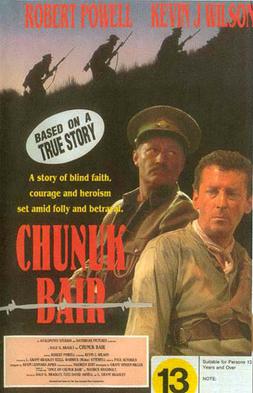
One of the New Zealand military’s functions is to assist civilian organisations where no viable civilian resources are available. One such example of this support was in 1991 when the NZ Army provided expertise and personnel to help produce the movie, Chunuk Bair.
The high point of the New Zealand effort at Gallipoli was the capture of Chunuk Bair, a key feature on the Gallipoli Peninsula. Captured by the Wellington Battalion under Lieutenant-Colonel William Malone on 8 August 1915, the New Zealanders would hold the position against violent counterattacks by a motivated and well-led opponent until relieved by British Battalions on 9 August. The latter were driven off Chunuk Bair in a counterattack led by Mustafa Kemal on the early morning of 10 August.
The anti-Vietnam protest movement of the 1960s and 70s had caused anything related to the ANZAC legend to become unpopular in New Zealand, with ANZAC day commemorations mainly attended by veterans and serving military personnel. The 1981 Australian movie Gallipoli, with its powerful anti-British theme,was released and considered an ‘event of national significance in Australia. This spike of interest across the Tasman was a turning point and provided the springboard for New Zealand playwright Maurice Shadbolt to provide his contribution in enhancing the notion of Gallipoli as the birthplace of New Zealand as a nation with the events at Chunuk Bair as a source of national pride.
Shadbolt’s play Once on Chunuk Bair would open to much praise from the theatre gong public on ANZAC Day 1982 at Auckland’s Mercury Theatre and would reinforce Shadbolt’s view that Chunuk Bair marked the birth of the nation freed from the shackles of British Colonialism. Once on Chunuk Bair gave the battle of Chunuk Bair the same national significance to New Zealand that the Australians place on their magnificent debacle at Lone Pine and the Nek. Despite a short theatrical run, Shadbolt’s play would become popular in schools and universities as it was taught and performed as part of the educational experience in a similar way that the Australians use the movie Gallipoli.
With the 75th anniversary of Gallipoli observed in 1990, a shift in public consciousness toward Gallipoli was revived, and Once on Chunuk Bair was made into a movie during 1991. Produced on a low budget and aimed at a New Zealand audience. The Army Museum provided much technical advice, uniforms and props, with the Army also providing significant assistance to the production, including expertise in explosives and many Men as extras. RNZAOC ammunition technical officer (ATO) Ian Juno would be listed in the credits as providing the special effects, and a sizable quantity of soldiers from 1 Base Supply Battalion would feature in many scenes as extras.
With production compressed within four weeks, many of the Large-scale battle scenes were filmed on Wellington’s south coast, a near facsimile of the terrain of Gallipoli, with the more detailed scenes filmed in a specially constructed set at the Avalon studios.
Although the final product was disappointing and did not have the same polished attributes as the earlier Australian movie Gallipoli, it complements Christopher Pugsley’s 1984 TVNZ documentary Gallipoli: The New Zealand Story, the Voices of Gallipoli in establishing the Gallipoli Campaign and the Chunuk Bair battle as the cornerstones of the national identity.
Of all the Ammunition magazine areas constructed in New Zealand during the Second World War, the Belmont magazine area in the hills north of Wellington between the Hutt and Porirua was the largest and closest to a large population area. In the early 1970s, following the removal, disassembly for scrap, and destruction of its stocks, Belmont’s life as a magazine area concluded with the land reverting to civilian use. As with any retired military facility kept out of the public eye during its operational life, urban legends and rumours thrive about secret tunnels and forgotten caches of buried military material. Belmont is no different in this respect, as items such as empty 3.7-inch Anti-Aircraft projectiles are occasionally discovered, fuelling such rumours. Although there is little evidence to support the stories and urban legends, Belmont does have some secrets from its wartime past. The most significant is that Belmont was the home to the bulk of New Zealand’s chemical weapon stockpile.
As the threat of war with Japan became inevitable in 1940, the New Zealand Government fully mobilised New Zealand’s home defence forces. By early 1942, this mobilisation saw two Infantry Brigades deployed to Fiji, and Three Divisions and several independent Brigades mobilised for home defence.
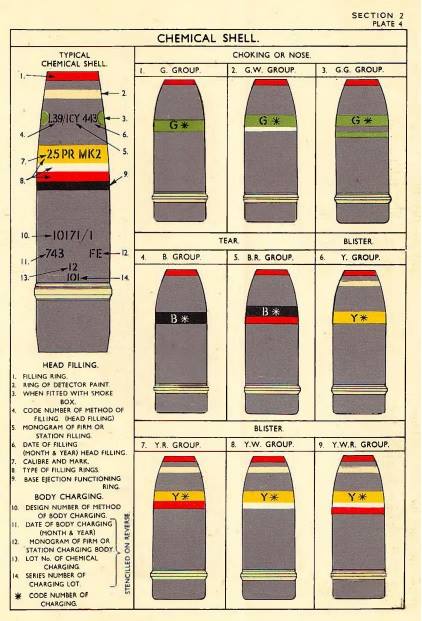
This massive mobilisation initiated a rearmament program resulting in vast amounts of war material from the United Kingdom, Canada and the United States being delivered to New Zealand. Included as part of the infusion of new weapons and equipment were the required scales of ammunition for each type of weapon system. Ammunition scales used by New Zealand were based upon the standard British scales. They included all the ammunition natures needed by New Zealand for use in the Pacific and home defence, including Anti-Tank, High-Explosive, Smoke and a stockpile of Chemical rounds consisting of,
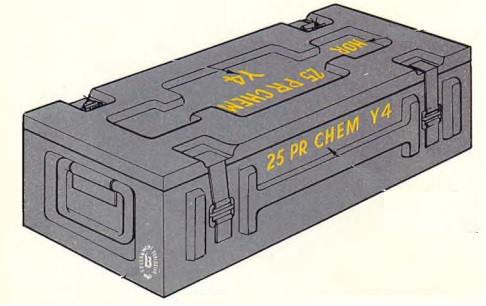
112,770 25-pounder Chemical rounds, and
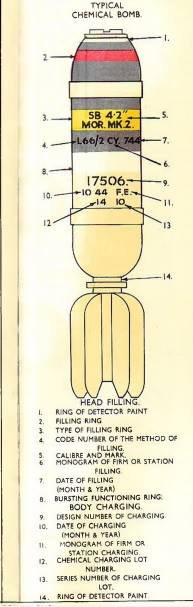
10,300 4.2-inch B4 (Tear) and Y4(Blister) chemical mortar bombs.
With consignments of ammunition, due to arrive in New Zealand in late 1942, construction of the new ammunition magazine areas was initiated in 1940, with the construction of the Belmont Magazine Area beginning in September 1942.[1] The Belmont Magazine Area consisted of sixty-two Magazine buildings, with 28 and 29 dedicated to holding chemical rounds from late 1943.
All the 4.2inch Bombs were stored at Belmont with the recommended distribution of the 25-pounder chemical rounds,[2]
30,000 rounds to the Northern Military District
30,000 rounds to the Southern Military District
52,770 rounds to the Central Military District Belmont Depot
However, records are uncertain if this distribution occurred, so it is quite probable that the entire stock of 25-pounder ammunition was held at Belmont.
The New Zealand Stockpile was significant as a lethal percutaneous dose of mustard was 4.5 gm. With 300 tons of the agent in the NZ stockpile, the potential lethal doses held in Belmont were approximately 60 million. To put the size of the stockpile in context, it was equal to 5% of the United States Stockpile in 1993.
Chemical Weapons were highly controlled and only used in retaliation if the enemy used them first. Although US forces on Guadalcanal had captured some Japanese Chemical Weapons, the NZ Deputy Chiefs of Staff were confident that there did ‘not appear to be any other or greater evidence that the Japanese propose to use gas in this area’.
4800 25-pounder chemical rounds were deployed with the 3 NZ Div, and they were returned to New Zealand in 1944 and stored at the Kelms Road Depot at Ngaruawahia alongside the other ammunition utilised by the Division.
Following the war, the disposal of wartime ammunition became a standing task for the RNZAOC Ammunition functions as various methods disposed of damaged, obsolete, and surplus stocks.
Damaged ammunition was often disposed of by demolition; for example, the destruction of 3.7-inch anti-aircraft ammunition issued to units and returned to depots took up to 1957 to complete.[3]
The stockpile of chemical munitions was dumped at sea, with two dumping operations found in archival sources.[4]
Two hundred tons of chemical shells scuttled on the tug Maui Pomare at the 100-fathom line in the Hauraki Gulf in April 1946.
One thousand five hundred tons of 25-pounder chemical shells and twenty tons of bombs had been dumped by the Marine Department steamer Matai off the Wellington coast by October 1946.
Stock from the Belmont magazine area was delivered by Army personnel to the wharf at the RNZAF base at Shelly Bay in lots of 250 Tons and loaded onto the Marine Department steamer Matai. All possible safety precautions were applied with each crew member was issued protective capes, respirators and gloves. With special chutes constructed, cases of shells were jettisoned fifty Nautical miles off the Wellington coast in the Cook Strait Canyon, which reaches depths of three kilometres.[5]
N Z Government S S Matai, on the patent slip at Evans Bay, Wellington. Smith, Sydney Charles, 1888-1972: Photographs of New Zealand. Ref: 1/2-049255-G. Alexander Turnbull Library, Wellington, New Zealand. /records/22744146
The dumping of the Chemical munitions was well publicised, with newspaper articles describing the disposal operation. [6]
Stored since 1943, 1500 tons of gas shells are to be dumped at sea by the Matai. Fuses have been removed from the 25lb shells that contain the gas, but to ensure that there is no risk to those carrying out the work, full Admiralty and War Office safeguards will, be taken. The gas is of the blister variety. The boxes containing the shells will be filled with sand to guard against possible leakages. Each box is painted with a substance that will indicate even a pinpoint of escaped gas.
Northern Advocate, 18 September 1946
Although the archival records show that at least 15,220 tons of Chemical munitions had been dumped at sea by the end of 1946, there is no accurate reconciliation of the actual number of rounds disposed of. However, it is a reasonable assumption that New Zealand had no desire to maintain a contingency stock of Chemical weapons and that all wartime stocks were disposed of by the end of 1946.
Notes
[1] F Grattan, Official War History of the Public Works Department (PWD, 1948).
[2] “Defence Works – Magazine – Belmont Hills,” Archives New Zealand Item No R22435088 (1942).
[3] “H-19 Military Forces of New Zealand Annual Report of the General Officer Commanding, for period 1 April 1957 to 31 March 1958,” Appendix to the Journals of the House of Representatives (3 July 1958 1958).
[4] “Ammunition – Disposal of unserviceable ammunition 1945-1952,” Archives New Zealand Item No R21465842 (1945).
[5] A Hubbard, “Chemical War: Our seabed legacy,” New Zeland Listener, 16 January 1993.
Today we mark the passing of a major influence on this website, Major Rtd Joseph Seymour Bolton (1947-2020).
Joe authored the History of the RNZAOC that was published 1992 and it was with his blessing and encouragement that I have continued on this webpage the expansion of his original research to unpack the history of the RNZAOC.
Joe joined the New Zealand Army as a Regular Force Cadet in the Bennett class of 1963. On completion of his RF Cadet Training, Joe graduated into the RNZAOC on 2 May 1965.
Joe would have a varied and interesting career as an RNZAOC Soldier and Officer, including;
Operational service in South Vietnam during 1970
Service in the Solomon Island with the first Tranch of RNZAOC ATO’s and AT’s clearing the islands of WW2 munitions.
Officer Commanding NZAOD, Singapore: 21 May 1982 to 10 May 1984
Chief Instructor, RNZAOC School: May 1985 to December 1986
Chief Ammunition Technical Officer: 1986 to 1988
In 1988 Joe was awarded the RNZAOC 20-year certificate for service from 2 May 1965 to 2 May 1988.
In Joe’s post-military career, he would continue to maintain an interest in the RNZAOC and manage the RNZAOC mailing list, sending out notifications on the passing of a Corps member or other such important information.
I never worked with Joe while he was serving, but got to know him when he was working a civilian in the CATO Branch. As I was working upstairs in Ops/Plans as the Policy WO, I would often refer to Joe as the expert on ammunition policy issues. Often a short question on ammunition would turn into a lengthy conversation about RNZAOC History. Many years later, as I was beginning to foray into RNZAOC research, we would catch up on the Rembermance Days in Palmerston North as the Poppy Places Charitable Trust, a passion of Joe’s in later years, unveiled their distinctive street signs. It was at these brief meeting we would discuss the progress of my research and the future direction.
RIP Joe
Sua Tele Tonnti
Major Joe Bolton Officer Commanding NZAOD receiving the Higgins Cup RFL Trophy form the New Zealand Director of Ordnance Services LtCol T.D McBeth.
Lieutenant Colonel Ron Cross is a military man through and through, A Regular Force Cadet, Artilleryman, Infantryman, a Graduate of the Officer Cadet School, Portsea and RNZAOC Officer, including a stint as Chief instructor of the Ordnance School from November 1972 to August 1974 and Officer Commanding of the NZAOD from April 1976 to May 1978, Ron is a proud soldier.
In this Memories of Service video produced by the New Zealand Returned Services Associaton. Ron recounts the experiences that shaped his life. Joining up as a regular Army Cadet, Ron served in both the Malayan conflict and the Vietnam War. From the comedy of preparing for jungle warfare in snow-covered hills around Tekapo to the tension of being fired on at close range on the roads of Vietnam, Ron’s vivid recollections are captivating.
By 1938, as Japan extended its influence into China and Europe faced looming conflicts, New Zealand’s defence forces began emerging from a period of stagnation and neglect prevalent in the early 1930s. By mid-1939, efforts to modernise and equip the military were well underway, ushering in a wave of new weaponry and the need for robust ammunition management. This responsibility was initially shared between the Royal New Zealand Artillery (RNZA) and the New Zealand Army Ordnance Corps (NZAOC). Both entities swiftly expanded their personnel and infrastructure to address the escalating demands of the New Zealand Army, culminating in their amalgamation into a unified NZAOC organisation by 1945, tasked with overseeing all ammunition depots nationwide.
Pre War Situation
Fort Ballance
Upon its establishment in 1917, the NZAOC assumed control of the Royal New Zealand Artillery (RNZA) Ordnance Section at Fort Ballance. Renamed the NZAOC Ammunition Section, it continued storing, inspecting, repairing, and refurbishing ammunition as part of the NZAOC. Situated on Watts Peninsula at the northern tip of Wellington’s Miramar Peninsula, the ammunition facilities spanned several locations, including Shelly Bay, Kau Point, Mahanga Bay, Fort Ballance, and Fort Gordon. These sites were not just former submarine mining and coastal artillery fortifications from the 1880s but now crucial ammunition magazines. However, their conversion was makeshift; former gun pits at Kau Point and Forts Ballance and Gordon had their roofs added after removing large 6 and 8-inch disappearing guns in the early 1920s. This setup lacked adequate temperature and moisture control, posing risks to the stored ammunition.[1][2][3]
Fort Ballance Ammunition Area
HopuHopu Camp
In the 1920s, Auckland hosted a smaller Ammunition section, with some personnel from the Fort Ballance Ammunition Section transferring to the newly completed magazines at Hopuhopu Camp by 1929. [4] Designed as New Zealand’s principal ammunition depot, Hopuhopu featured eleven magazines and a laboratory built between 1925 and 1927. These magazines were ingeniously constructed into the hillside using concrete with double walls, creating an inspecting chamber. The chamber allowed sentries to monitor temperatures with thermometers and adjust ventilation accordingly using a chart to maintain optimal conditions for stored stock. Positioned within the hillside and shielded by an embankment, the design of the Hopuhopu magazines ensured that any blast from an explosion would be safely contained.[6]
HopuHopu Camp Ammunition Area 1945. Public Works Department
In 1931, the NZAOC Munitions sections were disbanded due to government budgetary constraints. Nearly all NZAOC military personnel were either transferred to the Public Service as civilian staff at reduced pay rates or placed on superannuation. [7]
When New Zealand entered the war in September 1939, responsibility for ammunition was divided between the RNZA and the NZAOC.[8]
The Director of Artillery, reporting to the General Officer Commanding, oversaw:
Provision and allocation of gun ammunition,
Receipt, storage, and distribution of gun ammunition and explosives, excluding small-arms ammunition.
The Director of Ordnance Services, supported by the Inspecting Ordnance Officer and the SAA Proof Officer, reported to the Quartermaster-General and was responsible for:
Inspection and repair of gun ammunition,
Provision, receipt, storage, and distribution of small arms ammunition
Ammunition facilities shared between the RNZA and NZAOC included:
Key personnel in the NZAOC Ammunition unit included:[9]
Inspecting Ordnance Officer (IOO)
Captain I.R. Withell, R.N.Z.A.
Proof Officer, Small Arms Ammunition (SAA), Mount Eden Auckland,
Honorary Lieutenant J.W. Fletcher, N.Z.P.S.
Waikato Camp, HopuHopu- 11 magazines and an Ammunition Laboratory
RNZA WO1 seconded to the NZAOC
Mr Clifford Vernion Little
Mr Edward Ashton Waters
Fort Ballance – 19 magazines, one store, and an Ammunition Laboratory
RNZA WO1 seconded to the NZAOC
Mr Harry Harper Ekins
Mr John Dennis Anderson
Mr Earnest Fenton
Mr Frederick Eastgate
Mr Eric Baguley
Trentham Camp – Single SAA Magazine
Burnham Camps – Single SAA Magazine.
1940-41
As the New Zealand Army transitioned from peacetime to wartime footing, responsibilities for Ammunition were divided between the Assistant Quartermaster General (2) (AQMG(2)) and Assistant Quartermaster General (5) (AQMG(5)).[10]
AQMS(2)
Lieutenant Colonel T.J. King, Director of Ordnance Services (DOS), was transferred to the 2nd New Zealand Expeditionary Force (NZEF). Consequently, the position of DOS remained vacant for the duration of the war, and his responsibilities were redistributed as follows:
The Chief Ordnance Officer took over the DOS’s supply functions, including overseeing NZAOC Munitions Sections, primarily responsible for Small Arms Ammunition (SAA).
The Ordnance Mechanical Engineer (OEM) assumed responsibility for Ordnance Workshops.
The Inspecting Ordnance Officer and the Proof Officer SAA were placed under the Chief Munitions Officer within the Army Inspection Department. They were tasked with the technical management and inspection of ammunition.
AQMS(5)
The AQMS(5) was responsible for the Army Headquarters Gun Ammunition and Equipment Section.
Due to the significant influx of overseas ammunition, there was an urgent need to expand the NZAOC Ammunition section and build additional magazine storage facilities. Immediate action was taken by constructing eight magazines at Burnham Camp, acquiring six Magazines, and a Store at the Ohakea Royal New Zealand Air Force Base. These facilities were originally part of a pre-war expansion initiative. At Ohakea, ten magazines were completed by 1940, while construction of eight magazines north of Burnham Camp began in 1940 and finished by May 1941. [11]
The stock of Artillery Ammunition on hand in New Zealand on 30-Jun-41 consisted of the following natures;
Field Artillery
60 pr -. 2,704 Rounds
6″ How – 6268 Rounds
4.5″ How – 14,074 Rounds
3.7″ How – 2,589 Rounds
18 pr – 45,285 Rounds
Coast Artillery
6″ – 5,529 Rounds
6″ EOC – 310 Rounds
4″ – 4,531 Rounds
12 Pdr – 2,595 Rounds
6 Pdr Hotch – 1,775 Rounds
Anti Aircraft
3″ 20 cwt – 22,639 Rounds
By October 1941, the NZAOC Ammunition Section establishment and Magazine situation was[12]
NZAOC Staff at Army Headquarters
1 Captain
1 Lieutenant
1 Other Rank
Fort Ballance
NZAOC Strength:
4 Military Staff
Lieutenant Edkins
Staff Sergeant Eastgate
Sergeant Anderson
Corporal Bagley
10 Civilian Staff
Buildings: 19 Magazines, 1 Store, 1 Laboratory
Ammunition held: Grenades, Bombs, Pyrotechnics and explosives
Work Carried out: Receipt and Issue of Ammunition, preservation of ammunition held, major repair to Gun Ammunition, Manufacture of Blank Gun Ammunition
Fort Balance continued to be utilised as an Ammunition Depot throughout the war and, in October 1942, held the following stocks as part of the Wellington Fortress area: [13]
2″ Mortar – 288
3″ Mortar – 280
2″ Smoke Thrower – 1566
Grenades 36M – 312
18-Pdr – 15839
12-Pdr – 1035
6″ – 403
5″ How – 20035
7″ How – 172
7″ AA – 198
40mm AA – 4091
3″ AA – 5775
2-Pdr AT – 3459
Hopuhopu (including Mount Eden SAA Magazines)
NZAOC Strength:
2 Military Staff
Warrant Officer Class One Little
Sergeant Waters0
2 Civilian Staff
Buildings: 13 Magazines, 1 Laboratory
Ammunition held: Gun Ammunition, Grenades, Bombs, Pyrotechnics and explosives
Work Carried out: Receipt and Issue of all Ammunition, preservation of ammunition held, minor repair to ammunition,
Burnham
NZAOC Strength: 1 Sergeant employed as part of the New Zealand Temporary Staff
Buildings: 7 Magazines, 1 laboratory (on magazine converted to a lab, the purpose-built laboratory was not construed until 1945)
Ammunition held: Gun Ammunition, Grenades, Bombs, Pyrotechnics and explosives
Work Carried out: Receipt and Issue of Ammunition, preservation of ammunition held, major repair to Gun Ammunition,
Ohakea
NZAOC Strength: 1 Sergeant employed as part of the New Zealand Temporary Staff
Buildings: 6 magazines, 1 Store
Ammunition held: Gun Ammunition only
Work Carried out: Receipt and Issue of Ammunition, preservation of ammunition held, major repair to Gun Ammunition
Further construction of magazines was planned with the War Cabinet granting expenditure in September 1941 for an extensive magazine building programme at the following locations;
Papakura (Ardmore)- 8 Magazines
Hopuhopu – 11 Magazines, 1 Laboratory, 3 Stores
Waiouru – 13 Magazines, 1 laboratory and 1 Store
Manawatu – 10 Magazines, 1 laboratory and 1 Store
South Island – 8 Magazines, 1 laboratory and 1 Store
1941 Magazine Design
Designed by the Public Works Department in consultation with Army Headquarters, six designs were utilised, known as types A to F:[14]
Type A – 12.19m x 6.70m, double brick walls with a corrugated asbestos roof, and an entrance porch.
Type B – 12.19m x 6.70m, Double brick walls with a corrugated asbestos roof, no entrance porch.
Type C – 6.70m x 57m, Brick cavity walls with a corrugated asbestos roof.
Type D – 15.24m x 9.75m, Brick cavity walls with a corrugated asbestos roof, with an entrance porch
Type E – 15.24m x 9.75m, Single timber walls with exterior cement fibre boards and corrugated asbestos roof.
Type F – 15.24m x 9.75m, Double timber walls with exterior cement fibre boards and corrugated asbestos roof.
Significant establishment changes were also proposed, with an increase of the NZAOC establishment to 3 Officers and 62 other ranks, including all civilian ammunition staff not being placed into uniform retired.
1942
In December 1941, New Zealand had been involved in the war in Europe for over two years, but it had not yet required full mobilisation. However, Japan’s almost simultaneous attacks on Malaya and the Philippines, followed by their rapid advance southward, forced New Zealand to transition to a total war footing. This meant mobilising the territorial army and creating additional divisions for home defence and service in the Pacific.[15]
In response to the urgent need for ammunition storage at Waiouru, the construction of 16 temporary ammunition stores was authorised in April 1942. Completed by 18 July 1942, these temporary wooden stores, each measuring 9m x 6m, were situated south of the main camp..[16]
1942 Magazine Design
With Japan entering the war, new magazines were approved. Due to the increased threat posed by Japan, the latest magazines were designed with the intent of providing additional protection and were known as types M, PS, PD, R1, R2 and R3;[17]
Type M – 7.18m wide of variable length, precast concrete walls and roof supported by interior pillars.
Type PS – 7m wide of variable length, precast concrete walls and roof supported by interior pillars
Type PD – 14m wide of variable length, precast concrete walls and roof supported by interior pillars
Type R1 – 7.62m wide of variable length. Concrete walls and roof supported by interior pillars.
Type R2 – 7.62m wide of variable length, Brick walls with a Concrete roof supported by interior pillars.
Type R3 – 7m wide of variable length, Concrete outer wall with an inner brick wall with a concrete roof supported by interior pillars.
In addition to the 295 magazines that were constructed, numerous non-explosive stores, guard accommodations, garages and cookhouses, and external and internal roads were also built. The non-explosive stores were typically 6m x 9m, constructed of unlined timber walls with an asbestos roof. The laboratory was 13m x 6m with cavity walls with an asbestos roof.
With construction started in early 1942, wartime conditions, competition for material and manpower priorities and the challenging and isolated locations of some of the sites meant that the final construction was not completed until late 1944. The final tally of magazines constructed across eleven locations was[18]
Papakura (Ardmore)- 20 Magazines
Hopuhopu and Kelms Road – 55 Magazines
Waiouru – 45 Magazines
Makomako – 39 Magazines
Trentham(Kuku Valley) – 22 Magazines
Belmont – 62 Magazines
Glen Tunnel – 16
Mount Somers – 10
Fairlie – 9
Alexandra – 9
During the same period, magazines and other ammunition infrastructure were also constructed for the Navy, Air Force and United States Forces in many locations across the country, of which the NZAOC also utilised some
The increase in Ordnance Depot Establishments
As of 22 July 1942, the approved establishment of the NZAOC Depots was 435, consisting of 18 Officers, 47 other ranks and 370 civilians. Approval was granted on 8 August 1942 to increase and fully militarise the establishment of the NZAOC. The increase in the establishment was required to provide adequate staff for the four Ordnance Depots, with an ability to surge personnel into Advanced Ordnance Depots at Whangarei and Blenheim in support of the Home Defence Divisions. The authorised establishment for NZAOC Depots (including Ammunition Sections), was increased to be a fully militarised establishment of 1049 Officers and Other Ranks.[19]
Officers
Other Ranks
Total
Main Ordnance Depot
19
556
575
Ordnance Depot Northern District
4
182
186
Ordnance Depot Central District
3
81
84
Ordnance Depot Southern District
4
200
204
Total
30
1019
1049
1943
Waiouru
Construction of the following ammunition infrastructure was completed on 5 February;[20]
One type B magazine
Eleven type D magazines
Laboratory
Non-Explosive Store
Followed by the completion of the following magazines in October 1943;
Two type D magazines
Four type E magazines
Four type F magazines
Waiouru Ammunition Area C1945. Public Works Department
Makomako
The construction of Makomako was completed in March 1943.[21]
Makomako Ammunition Area C1945. Public Works Department
Mount Somers
The development of Mount Somers was completed in March 1943.[22]
Glentunnel
The development of Glentunnel was completed in August 1943.[23]
Fairlie
Development was Authorised in Decemberr1942, with development completed during 1943.[24]
Alexandra
Construction of nine 18m long R2 Type magazines, a laboratory and a non-explosive store was completed in November 1943.[25]
Kaikorai Valley (Dunedin)
Selected as the site of an ammunition Depot in early 1942. Seventeen temporary Wooden Ammunition Shelters and five temporary wooden explosive stores were constructed along with a quantity of supporting infrastructure, including a road named “Ammunition Track”, the only trace left today. Possibly due to its close proximity to the coast and the threat of Japanese Air raids, the permanent Ammunition depot was built further inland at Alexandra.[26]
Dates for the completion of the construction of the Ardmore, Ngawahiwaia, Kelm’s Road and Kuku Valley magazines are not detailed in the Public Works history but were during 1943.[27]
Army Inspection Department adopted the NZOC Badge
Due to the close association of the Army Inspection Department with Ammunition, the Chief Munitions Officer requested the Chief Ordnance Officer in 1943 that the Army Inspection Department be granted permission (granted) to wear the Cap Badge and puggaree of the New Zealand Ordnance Corps (NZOC). [28]
1944
Waiouru
Construction of the following was completed by May 1944.
Five type R1 magazines
Fourteen type R2 magazines
One type of R3 magazine
Belmont
Construction of the Belmont Ammunition area began in November 1942 and was completed by November 1944.[29]
Infrastructure at Belmont included;
Over 5 Km of roads
Cookhouse, Mess rooms, Ablutions, recreation room and sleeping accommodation
Laboratory
51 P-Type Magazines 50, 60 and 100ft in length
1 R3-Type Magazine
10 M-Type Magazines (competed post 1944)
1945
From mid-1945, discussions started to take place on the post-war shape of the NZAOC. Some thought was given to returning the NZAOC to its pre-war status as a predominantly civilian organisation. Reality prevailed, and the future of the NZAOC was assured as a feature of the post-war army. It was estimated that at least three years of work were required to inspect and refurbish ammunition returned from units that had been demobilised, in addition to maintaining existing stocks of unused ammunition.[30] The proposed establishment for NZAOC Ammunition units saw the first widespread use of the terms IOO (In the context of the modern Ammunition Technical Officer) and Ammunition Examiner (Ammunition Technician). 1945 saw the completion of the ammunition infrastructure works first authorised in 1941.
Burnham
Construction of Non-explosive store and laboratory completed
Transfer of Ammunition and Equipment Section to NZAOC
Before the Defence Act of 1909, which created the modern New Zealand Army framework, there had long been a division of responsibilities for managing Ammunition. Traditionally, the provision, allocation, receipt, storage and issue of Gun (Artillery) Ammunition had been an Artillery responsibility, with the Management of Small Arms Ammunition responsible for the Defence Stores/Ordnance Corps. 1 June 1945, the NZAOC assumed responsibility for managing all Army ammunition. The Artillery element responsible for managing Gun Ammunition, the Ammunition and Equipment Section, was transferred from the control of Army Headquarters to the Chief Ordnance Officer. As a result of the transfer, 11 Officers and 175 Other Ranks of the Royal New Zealand Artillery were absorbed into the NZAOC establishment.[31]
Ordnance Takes Full Control
On November 15, 1945, the Chief Ordnance Officer assumed responsibility for the care, maintenance, accounting, and storage of all ammunition and explosives.
Control of ammunition was to be undertaken by.
The IOO Section and
The Ammunition Section
IOO Section
The IOO Section, administered by the CIOO, was responsible for [32]
The control of all work on ammunition for all purposes other than accounting and storage,
Maintenance of ammunition and explosives in stock in a serviceable condition and ready for use,
Provision of personnel for inspection and repair and for working parties to carry out repairs,
Provision of all equipment and stores required for the inspection and repair of ammunition,
Provision and accounting for Motor Transport necessary for the transport of stock for inspection and repair,
Administration and control of Repair Depot Trentham,
Maintenance of buildings at Repair Depot Trentham.
The accounting, storage and care of ammunition and explosives
Maintenance or magazines areas and of buildings and services connected with the storage of ammunition and explosives,
Administration of personnel of the IOO Section, while attached to ammunition depots concerning pay, rations, quarters, clothing and discipline
Transport arrangements for the movement of ammunition are not connected to the inspection and repair of ammunition at depots.
Notes
[1] Russell Glackin, In Defence of Our Land: A Tour of New Zealand’s Historic Harbour Forts (Auckland, N.Z.: Penguin Group (NZ), 2009, 2009), Bibliographies
Non-fiction, 48-53.
[2] Kiri Petersen Cathryn Barr, “New Zealand Defence Force Heritage Management Plan Forts Ballance and Gordon” (Hamilton: Opus International Consultants Limited 2009), 2-5.
[3] Tony Walton, “Wellingtons’ Defences: A Reconnaissance Survey of the Fortifications or 1884-1945,” Archaeology in New Zealand 33 (1990): 87-99.
[4] At different times referred to as Waikato or Ngawahawia Camp
[5] “Modern Military Camp,” New Zealand Herald, Volume LXVI, Issue 20324, 3 August 1929.
[11] F Grattan, Official War History of the Public Works Department (PWD, 1948), 529.
[12] “Establishments – Ordnance Corps Ad1 493 / 228/2/6.”
[13] Howard Weddell, Trentham Camp and Upper Hutt’s Untold Military History (Howard Weddell, 2018), Bibliographies, Non-fiction, 160.
[14] Grattan, Official War History of the Public Works Department, 517.
[15] Peter D. F. Cooke, Defending New Zealand: Ramparts on the Sea 1840-1950s (Wellington, N.Z.: Defence of New Zealand Study Group, 2000, 2000), Bibliographies
Dictionaries
Non-fiction.
[16] Grattan, Official War History of the Public Works Department, 521.
[28] “Badges and Buttons – Regimental, Royal New Zealand Army Ordnance Corps 1936-1967, 92 / 213/12/19,” Defence Archives, Archives New Zealand (1936).
[29] Grattan, Official War History of the Public Works Department, 524-26.
[30] “Establishments – Ordnance Corps Ad1 493 / 228/2/6.”
NZ Army Ordnance Corps Badge 1917-1937. nzhistory.govt.nz/Public Domain
The Hunter Brothers’ service was unassuming, and when looked at as part of the broader history of the New Zealand Ordnance Corps, their service was uneventful. The only significant event of their service is that they are one of the few sets of brothers to be awarded the Meritorious Service Medal. What their service does provide is a snapshot of the activities of the New Zealand Army Ordnance Corps in the 1920s
The children of Irish Immigrants who were farming a small property near the Marlborough town of Tuamarina, John was born on the 13th of August 1880 and Thomas on the 20th of December 1881.
John and Thomas joined what was then the New Zealand Permeant Militia, spending considerable time as Gunners in the Artillery before transferring to the New Zealand Army Ordnance Corps soon after its formation in 1917. John’s time in Ordnance was spent in the Ammunition Section based out of Fort Balance on the Northern Miramar peninsular in Wellington. Thomas ordnance Service was at the Ordnance Store at Mount Eden and the then brand-new Waikato Camp (Hopuhopu/Ngawahawia Camp).
Both brothers served for more than 30 years and, under normal circumstances, retired at 55 with a comfortable pension, but this was not to be. Due to the worldwide depression and economic recession, the Government was forced to savagely reduce the strength of the Army by using the provisions of section 39 of the Finance Act, 1930 (No. 2), where military staff could be either;
Transferred to the Civil service, or
Retire on superannuation any member of the Permanent Force or the Permanent Staff under the Defence Act, 1909, or of the clerical staff of the Defence Department whose age or length of service was such that if five years was added thereto, they would have been enabled as of right or with the consent of the Minister of Defence to have given notice to retire voluntarily.
Using this act, on the 31st of March 1931, the NZAOC lost;
Six officers and Thirty-Eight Other Ranks were retired on superannuation
Seventy-four NZAOC staff (excluding officers and artificers) who were not eligible for retirement were transferred to the civilian staff to work in the same positions but at a lower pay rate.
Notice of Retirement sent to Serving soldiers in December 1930
For the soldiers placed on superannuation, the transition was brutal, with pensions recalculated at much lower rates and, in some cases, the loss of outstanding annual and accumulated leave. The 31st of March 1931 was the blackest day in the History of the New Zealand Army Ordnance Corps
John Francis Hunter
John Hunter attended the local school until Standard 5 and then spent a year at St Patricks College at Silverstream in Wellington. On leaving school, John Hunter took up a farming job in Bulls. At Eighteen years of age, John enlisted at Alexandra Barrack in Wellington into the New Zealand Permanent Force (NZPF) and was attested as a 3rd Class Gunner into No 1 Company in Wellington on the 23 of November 1898. John Hunter Passed the Small Arms Drill Course on the 6th of January 1899, followed by the Recruits Drill Course on the 1st of May and was promoted to 2nd Class Gunner on the 1st of September 1899.
Alexandra Barracks, Mount Cook Wellington (Colourised). Credit: Alexander Turnbull Library.
With the reorganisation of the NZPF in 1902, the small permanent artillery force was designated the Royal New Zealand Artillery (RNZA), with John Hunter remaining with the Wellington Detachment. While serving as the “Servant to the General Officer Commanding,” John Hunter unsuccessfully applied for a transfer to the New Zealand Police in 1902. John Hunter was to spend a short period detached to Lyttleton on Police duty during the New Zealand International Exhibition held in Christchurch in 1906/07. John Hunter was promoted to 1st Class Gunner on the 1st of September 1907. With the reorganisations of 1907 and 1911, John Hunter remained in the Gunnery Section of the RNZA Wellington Detachment working in the various Wellington Coast Defence Forts.
Marrying Edith Taylor in Fielding on the 28th of January 1911, John Hunter was still based in Wellington when the Great War was declared in 1914, but at 34 years old, was then considered too old for war service.
Since 1911 there had been concerns in Army Headquarters about the supply of Artillery ammunition and the associated costs of importing all of the required stocks to maintain training and operational needs. Studies had found that by refurbishing by cleaning, inspecting and refilling cartridge casings, and inspecting and refurbishing in-service propellant bags and manufacturing new ones as required, considerable savings could be made instead of importing new items. Recommendations were made that as part of the RNZA, a specialist Ordnance Stores Corps be established to manufacture and modify Ammunition. Ordnance Stores Corps was under the supervision of the Master Gunner and entitled to the same pay and allowances as other members of the RNZA, as they were just another section of the RNZA.
Although envisaged in 1911, the formation of this Ordnance Stores Corps had an extended gestation period, and it was not until mid-1914 that General Godley, the Commander of the New Zealand Forces, approved the proposal and work could begin in establishing the Artillery Ordnance Stores Corps. Orders were placed on Great Britain for the required machinery, components and most importantly, cordite, with some of the machinery received in good time, the remainder was promised to be delivered as soon as possible by the British suppliers. Given that war had broken out, setting up this capability and securing New Zealand’s immediate supply of Artillery was of the utmost importance.
The new Corps was to be another uniformed section of the RNZA, such as the Field Artillery or Electric Light Company. It was to be under the administration and control of the OC RNZA and not the Quartermaster General, and on 1 March 1915, authority was granted under New Zealand Defence Forces General Order 90 to raise the New Zealand Army Ordnance Section with effect 1 April 1915. Located at Fort Ballance at Mahanga Bay on Wellington’s Miramar Peninsula, the section’s primary duties were assembling ammunition components for the artillery, with care and upkeep of the magazines becoming part of their responsibilities. John Hunter Transferred into the RNZA Army Ordnance Section on the 1st of July 1915.
Fort Ballance (including associated positions at Fort Gordon) (Colourised). Alexander Turnbull Library, Wellington, New Zealand,
With the Formation of the New Zealand Army Ordnance Corps (NZAOC) on the 1st of February 1917, the RNZA retained operational day-to-day control of the Ammunition Section, with the NZAOC taking up administrative control of its personnel. The personnel of the Ammunition Section, including Gunner John Hunter, transferred into the NZAOC on the 15th of March 1917. On the 8th of February 1917, John Hunter was awarded the New Zealand Long Service and Good Conduct Medal.
RMS Niagara
December 1917 saw John Hunter’s experience as a gunner called upon when he was seconded to the NZEF as an Acting Corporal. Embarking on the RMS Niagara on the 13th of February 1918 as Corporal Gunner of the Gun Crew. Returning to New Zealand in September 1918 and replaced by Naval gunners, John Hunter spent a short time with the RNZA in Featherston Camp before re-joining the NZAOC in February 1919. Interestingly the RMS Niagara on which John Hunter served and disembarked in September 1918 is the vessel attributed by some sources as the source of the 1918 influenza pandemic that had a devastating effect on New Zealand.
Returning to his duties at the Ammunition Section at Fort Ballance, John Hunter was the newest member of the Ammunition Section and was identified as the only suitable understudy for the then NCO In-Charge Sergeant J Murray and was promoted to Lance Corporal on 1 November 1919. 1921 saw John Hunter awarded; the New Zealand Efficient Service Medal, and the Meritorious Service Medal and was also issued with his war service medals; the British War Service 1914-1918 Medal and the Victory 1914-1919 Medal.
Promoted to Temporary Corporal on the 1st of January 1921, John Hunter was made the NCO I/C at the Ammunition Laboratory at Shelly Bay. By August 1921, on the retirement of Sergeant Murray, Hunter was promoted to Corporal and appointed as IC of the Ammunition Section.
The immediate post-war years into the mid-1920s were a busy time for the NZAOC Ammunition Section. The Kaiwharawhara Powder Magazines close to the city were closed. The Mahanga Bay facilities expanded from the original magazine and laboratory building on the foreshore to include Fort Balance, Fort Gordon and the Kau Point Battery as their guns were decommissioned. With armaments removed, gun pits covered over with roofs and turned into additional magazines, the once impressive forts went from being Wellington’s premier defensive location to quite possibly the first large-scale ammunition depot of the NZAOC, a role held until 1929 when purpose-built facilities were constructed at Hopuhopu Camp in the Waikato.
He was promoted to Sergeant on the 1st of July 1922, further promotions followed on the 1st of June 1926 when he was promoted to Staff Sergeant and then again on the 1st of June 1929 when promotion to Staff Quarter Master Sergeant (Warrant officer Class 2) was gained.
After spending most of his 32-year career on the Miramar Peninsular of Wellington. Warrant Officer Class Two John Hunter was discharged from the Army on the 31st of March 1931 at the age of 52 under the provisions section 39 of the Finance Act, 1930 (No. 2) where members of the military were forced to retire under superannuation at a much lower rate than they should have usually been entitled too. WO2 John Hunter also lost;
· 21 days approved annual leave
· 22 days accrued leave
John Hunter’s forced retirement in 1931 might not have been his final Military service. Census and voter lists from 1935 to 1954 list his occupation as Solder, with the Census and voter from 1957 as retired. Further examination of service records is required, but an assumption is that given his ammunition experience, he was re-engaged in a lesser rank and continued in the military during the war years into the mid-1950s.
Records show that John and his wife Edith had no children and remained at the same address at 57 Kauri Street Miramar until his death on the 23rd of March 1967 at the age of 87 and is buried at Karori Cemetery, Wellington
Thomas Alexander Hunter
Completing school at Standard 4, Thomas entered the workforce and worked as a Grocers Assistant at Foxton before enlisting into the NZPF. At 18, Thomas attested into the NZPF on the 2nd of August 1900. Thomas completed the Recruit Drill and Arms Cours at Alexandra Barrack in Wellington and was posted to the Artillery as a Pre-Gunner for his probation period. On completion of probation on the 1st of February 1901, Thomas was posted to the No 1 Company in Wellington.
With the reorganisation of the NZPF in 1902, the small permanent artillery force was designated the Royal New Zealand Artillery (RNZA), with Thomas Hunter remaining with the Wellington Detachment. With the reorganisation of 1907, Thomas continued working in the Gunnery Section of the RNZA Wellington Detachment in the various Wellington Coast Defence Forts.
On the 10th of May 1908, Thomas married Maude Taylor at Newmarket in Auckland and was posted to the RNZA Auckland detachment on the 16th of November 1908. Thomas’s first child Edward was born on the 15th of February 1909. Further Children followed with the Birth of Bernard on 20 February 1910, Bambara on 28 March 1911 and Veronica on 21 November 13
Thomas was transferred into the Field Artillery Section on the 1st of August 1911 and back into the Gunnery Section on the 1st of May 1912. When the war was declared in 1914, Thomas was 33 years old and considered too old for war service. Thomas was stuck with tragedy in September 1915 when his daughter Bambara died due to illness.
Like his brother, Thomas was seconded to the NZEF in February 1918 as an Acting Corporal. Embarking on the SS Makura as gun crew. Returning to regular duty in June 1918, when the Army gunners were replaced by Naval gunners.
New Zealand Long and Efficient Service Medal, 1887-1917, New Zealand, by George White. Gift of Mr Dollimore, 1956. CC BY-NC-ND 4.0. Te Papa (NU006152)
Awarded the Permanent Forces of the Empire Beyond the Seas Medal in December 1918, with the formal presentation on the 1st of February 1919. Thomas was promoted to temporary Bombardier on the 1st of February 1920, attaining Full Bombardier rank on the 1st of February 1921. Further recognition of his service followed with the award of the Meritorious Service Medal on the 21st of November 1921 and the New Zealand Long and Efficient Service Medal on the 6th of February 1922. Thomas was also presented with British War Service 1914-1918 medal and the Victory 1914-1919 Medal.
With many of the Coastal Defenses nearing the end of their usefulness, (Fort Victoria, where Thomas had one stage been attached to, had only ever fired one proofing round and was promptly taken out of action because of complaints from its neighbours who had suffered many broken windows) resulted in the decommissioning of many of the older batteries. As Thomas was then the senior Bombardier in the Auckland region, instead of being forcibly made redundant, he was transferred to the NZAOC and posted to the Ordnance Store at Mount Eden on the 31st of July 1922. Living at Devonport at the time, the move to the new position at Mount Eden worried Thomas. As Mount Eden was then a Suburb on the far side of Auckland, the travel costs were a concern to Thomas. The strain on his family was also a concern, his children were beset with ill health, with one child passing away due to illness in 1915 and another with infantile paralysis. To make matters worse, Thomas was forced to reduce rank to Lance Corporal on the 1st of August 1922.
Disappearing Gun, North Head Auckland. Robert McKie Collection
The early 1920s were a busy time for the Mount Eden Ordnance Store. After the First World War, the New Zealand Territorial Army undertook a major re-equipment project with two Infantry Divisions and one Mounted Brigade’s worth of equipment arriving from the United Kingdom. Initially stored at Trentham and Featherston Camp, with a purpose-built Ordnance Store to service the Northern region under construction at Ngawahawia, storage space was at a premium. With Featherston Camp closing down, the Mount Eden Ordnance Store had to receive, sort and distribute much of the equipment for the Northern Region units well over its storage capacity, as well as providing support to the territorial Army Annual Camps.
By 1928 The development of Ngaruawahia Camp was now in its final stages, with the large Ordnance Store building completed and the stores from the Ordnance Depot at Mount Eden progressively being transferred to it. Two high-explosive magazines were completed, with an additional three high-explosive magazines and a laboratory, and the provision of mains and equipment for fire prevention nearing completion. With the removal of stores to Ngaruawahia Camp, the buildings at Mount Eden were no longer required, so they were disassembled and re-erected at Narrow Neck Camp.
Thomas was promoted to Temporary Corporal on the 1st of February 1926, followed by promotion to Sergeant on the 1st of March 1928. Up to June 1929, Thomas was the NOC IC Camp Equipment, but with the Ordnance Depot now at Ngawahawia, Thomas was transferred onto the Small Arms Proof Office staff, allowing him to remain at Mount Eden.
After spending the majority of his 30-year 141-day career in Auckland, Sergeant Thomas Hunter was discharged from the Army on the 31st of March 1931 at the age of 49 under the provisions section 39 of the Finance Act, 1930 (No. 2), where serving members of the military were forced to retire under superannuation at a much lower rate than normally entitled too. Sergeant Thomas Hunter was fortunate that before the notification of the redundancy on the 17th of December 1930, he had already applied for and had approved the use of his annual and accrued leave.
Moving on from a life in the military, Thomas settled at 88 Sandringham Road and took up the trade of confectioner. Thomas passed away at 84 years of age on 5 October 1965.