The passing of the Defence Act 1909 heralded a transformation of the Defence Forces of New Zealand, establishing a military system that influenced the organisation, training and recruitment of the New Zealand Army into the early 1970s. Coming into effect on 28 February 1910, The Act abolished the existing Volunteer system, in its place creating a citizen-based Territorial Army from the units, regiments and Corps of the Volunteer Army.[1] The Territorial Army’s personnel needs would be maintained by a system of Compulsory Military Training (CMT), requiring the registration of all boys and men between the ages of fourteen and twenty-one years of age.[2] The challenge for Captain James O’Sullivan and the staff of the Defence Stores, an organisation already markedly transformed since 1900, was to meet the material need needs of the growing citizen army that New Zealand was creating.
At Buckle Street, Wellington, during the 1913 waterfront strike. Smith, Sydney Charles, 1888-1972: Photographs of New Zealand. Ref: 1/2-048786-G. Alexander Turnbull Library, Wellington, New Zealand. /records/22820606
The following article published in the New Zealand Times on 8 December 1911 provides an eyewitness account of the activities of the Defence Stores in support of the growing citizen army.[3]
While politicians are prating about the cost of the defence scheme, and its more direct enemies are peregrinating from street corner to street corner with soap boxes, the scheme itself is being steadily proceeded with. Some people probably fail to realise what it means to inaugurate an entirely new system of military defence. The necessary legislation came first, then the mapping out of the requirements in men and money, then the excitement of enrolling, and now there is proceeding the part, of which the public see little and hear little, but which perhaps is the most troublesome of all, and materially the most important, viz., the arming and the equipment of themen.
This task is being carried out at the Defence Stores in Buckle Street, Wellington. It requires a visit there to realise the thought, the work, the experience, that are necessary to carry out a big work of this description. When you enter the Buckle Street stores and see the busy toilers and the preparations for the distribution of arms and clothing over the Dominion, you realise that a big work is in progress.
For instance, the uniforms for the territorials have for the past week or two been arriving. So far the outfits for about nine thousand men in a more or less state of completion, have come, to hand. These all have to be sorted out and shelved. They are in graded in sizes, an ingenious system of measurement, the product of the brain of Captain O’Sullivan, Director of Defence Stores, has been applied, whereby almost any sized youth be fitted. Measuring has been proceeding in the various centres. A form is filled up by the regimental quartermaster for each recruit, and these forms are now arriving at the depot. Next weak commences the task of sending out the uniforms. Each man also gets an overcoat, a felt hat, and a forage cap. Every branch of the service will wear putties instead of leggings. The uniforms in hand at present fill multitudes of shelves—indeed, the place wears the appearance of a busy warehouse. Every article of clothing is the product of New Zealand mills. There is a absolute uniformity of colour, so that the whole New Zealand defence force, from the North Cape to the Bluff, will on mobilisation, present no spectacle of detached units, but one uniform whole. Distinguishing colour badges and trouser stripes will mark the branches of the service, green denoting the mounted, men, and red the infantry. The senior cadets will have neat blouses and long trousers. So far the uniforms in stock comprise only a small portion of what yet remains to be handled. A new brick building is in the later stages of completion for their safer storage. The felt hats are the product of the National Hat Mills, Wellington, and are really a very excellent article. Many large packing cases are stacked in the yards waiting to be dispatched with these goods to the territorial centres.
But this is only one branch of the industry. In other sheds are stacked camp paraphernalia, tents, marching outfits of the latest pattern, containing, in addition to bayonet, water-bottle, overcoat, etc., a handy trenching tool, bandoliers, field outfits, including telephones and heliographs; much leather goods; service boots, which the department is selling, at option, to the men at a low fee, and many other requisites. Outside in the yard is a new pontoon bridge, lately come to hand, a rather bulky apparatus that has not yet been used. Elsewhere are stored transit water tanks, a sample transport waggon (from which others will be manufactured in the Dominion). Necessary appliances for the eighteen-pounder guns have also been coming to hand, though the guns themselves have not yet arrived.
In other sheds are many large black cases. These contain the service rifles. It is not permitted that the public should know what stock of these is kept. It is a state secret that not even an Opposition order for a “return” could cause to be divulged. Recently, however, ten thousand were added to the stock. Just at present workmen are spending busy hours cleaning up and inspecting the rifles that have been received from the old volunteer corps. Every Government arm in the Dominion has been called in, and as a result every, man will have issued to him a nice clean rifle. It will be a new start over the whole Dominion. It would grieve the heart of the military enthusiast to see the condition in which some of the rifles have been sent In. There is undoubtedly great need for the new quartermasters in the various regiments, to see that this sort of thing does not recur. Some of the Wellington corps have been rather bad offenders. The comparatively slow process of cleaning these arms has been the cause of the delay in their reissue. Every rifle has 104 parts, and these parts are stocked in large quantities.
Of the Dominion’s ammunition store, also, the outsider can know nothing. This much, however, is for public information, that every Saturday morning the Director of the Defence Stores produces his ammunition balance book, to the Commandant, who then known from glancing over the pages exactly how every packet has been distributed and how each part of the Dominion is served.
The Buckle Street stores do not yet present the aspect of a Woolwich Arsenal, but things are very busy there; the will of the people is being given effect to at as rapid a rate as opportunity will permit; evidences are offered of the effective defence scheme now in active operation; and pleasing, indeed, is the outstanding fact that local industries are benefiting to an enormous degree from a new departure in defence that after all, is an admitted necessity.
Arms and Uniforms,” New Zealand Times, Volume XXXIII, Issue 7978, 8 December 1911
Former Defence Stores Compound, Buckle Street, Wellington The building on the right of the photo is the original 1911 Defence Stores building. The building on the left is the 1916 extension.
Former Defence Stores Compound, Buckle Street, Wellington.
Former Defence Stores Compound, Buckle Street, Wellington The building on the right of photo is the original 1911 Defence Stores building. The building on the left is the 1916 extension.
Notes
[1] Peter Cooke and John Crawford, The Territorials (Wellington: Random House New Zealand Ltd, 2011), 153.
[2] I. C. McGibbon and Paul William Goldstone, The Oxford Companion to New Zealand Military History (Auckland; Melbourne; Oxford: Oxford University Press, 2000, 2000), Bibliographies, Non-fiction, 109-10.
[3] “Arms and Uniforms,” New Zealand Times, Volume XXXIII, Issue 7978, 8 December 1911.
This undated plan of the Mount Eden Goal Reserve provides a view of the layout of the long-forgotten Auckland Defence Stores Mount Eden location. Located between the Goal and Auckland Grammar School, this plane was drawn up sometime between 1907 and 1917
The Defence Stores footprint at Mount Eden started in 1871 when two magazines were constructed to house Defence ammunition, then stored at Albert Barracks in the centre of Auckland.
In 1903 the Defence Stores Office in O’Rourke Street (now Auckland University) was relocated to Mount Eden. Initially, the existing magazines at Mount Eden were thought to be sufficient. However, it was soon found that additional buildings were required, and a Stores building and Armourer’s shop were constructed during 1903/04. Eventually, a house was also built for Captain W.T Beck, the District Storekeeper.
In 1917 the Defence Stores were reorganised into the New Zealand Army Ordnance Corps (NZAOC), with the Mount Eden Defence Stores becoming the Northern Districts Ordnance Depot.
By 1920, with little space available for expansion to allow the storage of the large number of mobilisation stores required by the Norther District, construction of an alternative site for the Mount Eden Ordnance Depot began at Hopuhopu in the Waikato.
While the Hopuhopu site was still under construction, Stores from the Mount Eden site began to be transferred to Hopuhopu in 1927. The new depot officially opened in 1929, with the Mount Eden Depot closing.
The Store constructed in 1903 was dismantled and re-erected at the Narrow neck Camp on Auckland’s North Shore. The fate of the original magazines is unknown, but they were likely taken over for a time by the nearby Colonial Ammunition Company (CAC).
The closure of the Mount Eden Depot did not totally sever to the connection between Mount Eden and the Ordnance Corps, with Ordnance Ammunition staff remaining attached to the CAC until 1967, testing the supply of Small Arms Ammunition provided by that factory.
Throughout the early 1860s, elements from the Militia and Volunteers supported the Imperial troops undertaking the bulk of the military operations in the early years of the New Zealand Wars. In 1861 as George Grey assumed the role of Governor for a second term, Grey undertook a policy of conciliation while also preparing for war. As General Cameron built up his Imperial forces, Gray reviewed and overhauled the citizen forces of New Zealand. In January 1862, new regulations for the volunteer force were issued, followed on 18 September by the Colonial Defence Act of 1862. This Act saw the formation of the Colonial Defence Force, the first regular Force in New Zealand. Under the Quartermaster General of the Colonial Defence Force, Captain Robert Collins, the Colonial Store Department and the Militia Store Department assumed the store’s responsibility for the Militia, Volunteer and Regular Forces of New Zealand.
In Auckland, the Colonial Store Department and the Militia Store Department initially operated out of offices on Princes Street. However, approval was granted in October 1863 for the erection of a store adjacent to the Imperial Armoury near the Symonds street entrance to the Albert Barracks.[1] The two Store Departments essentially carried out the same functions, and in 1865 the post of Superintended of Militia Stores held by Mr E.D King was disestablished with the responsibility for colonial defence stores centralised under the Colonial Storekeeper, Captain John Mitchell.
Military Store Albert Barracks 1871
A review of colonial defence with a reliance on local forces taking over from Imperial Forces saw the passing of the Armed Constabulary Act of 10 October 1867. This Act combined police and military functions into the regular Armed Constabulary (AC) Force. The AC Force was supported by Maori loyal to the crown, Militia and Volunteer units, with Defence Storekeepers in Auckland, Whanganui and Wellington providing the required logistic support.[2]
In April 1869, Lieutenant Colonel Edward Gorton was appointed as the Inspector of Defence Stores, establishing his office at Molesworth Street in Wellington, bringing all New Zealand’s Defence storekeepers under his control. By January 1869, as the withdrawal of Imperial units became imminent, the dismantling of their central logistic hub at Auckland’s Fort Britomart and Albert Barracks had commenced, with military stores, including guns and ammunition that were not auctioned off to the public or purchased by the New Zealand Government, shipped to the United Kingdom. The departure of the British Military Storekeeper Joseph Osbertus Hamley in July 1870 marked the final withdrawal of Imperial Forces from New Zealand, with the Auckland Defence Store taking over ownership of the Armoury and Magazines located in Albert Barracks.
In May 1869, Captain John Mitchell was suspended as the Auckland Storekeeper due to unauthorised absences. Resigning in July, Major William St Clair Tisdall replaced Mitchell as acting Storekeeper. A small staff assisted Tisdall, some of whom had served in the stores since 1861, including
John Blomfield, Clerk
John Price, Clerk
David Evitt, Armourer Sergeant
Arms Cleaners
Mr’s F Gibbons,
J Penligan and
C.C Rockley
Following the departure of Imperial units, the future of Albert Barracks came under debate. In addition to the Defence Stores, the only other military use of the former barracks was by the local Militia and Volunteers, who retained a drill hall and utilised the parade round. The Auckland Improvement (Albert Barrack Reserves) Act of 1872 repealed previous Acts relating to the status of Albert Barracks and placed responsibility for the management and disposal of the land under the Auckland Improvement Commissioners.[3] The Auckland Improvement Commissioners drew up and oversaw plans to develop the bulk of the Barracks into a recreational reserve, with other areas subdivided into roads and plots of land for further development.
By 1871 the growth of Auckland now placed the ageing powder magazine in the centre of a built-up area, raising concerns about its safety. New powder magazines were constructed at Mount Eden, with the first stocks transferred from Albert Park to Mount Eden in September, following which the Albert Barracks magazines were demolished.[4] With the Auckland district’s supply of ammunition now safely stored at Mount Eden under the care of the Defence Stores magazine keeper, Tisdall and the remaining staff of Storemen and Armourers remained at Albert Barracks.[5] Initially located in the old Imperial Armoury building at the Symonds Street entrance of Albert Barracks, it was considered an obstruction to the Commissioner’s projected improvements.[6] To allow the extension of Princes Street and subdivision of the land between Princes and Symonds Street, in July 1873, the Defence Stores had been moved into the well-constructed stone building that had previously been the Barracks hospital.[7] The new building included ample accommodation for warlike stores, including small workshops and a forge.[8] The only remnant of the site of the old Armoury were two Russian 18-pounder guns taken at the Crimea and presented by the Imperial Government to the colony of New Zealand in the late 1850s.[9]
The Defence Stores building in Albert Park was described by the Auckland Star as the “hideous eyesore in Albert Park’ and considered a blight on the skyline as it obstructed the view from the park that had been established to replace the Barracks.[10] By 1883 an agreement was reached between the Auckland Council and the Government, with a plot of land in O’Rourke Street provided to allow the relocation of the Defence Stores.[11]
Queen St with Albert Barracks on the left hillside C1870-1979. Auckland Libraries Heritage Collections 898-9969
When the proposal was first mooted to relocate the Defence Store, plans were prepared in the Auckland Public Works office for a three-storied building equal in space to the present location. However, as it intended to centralise the operations of the Defence Stores in Wellington, the original design was countermanded with a design for a smaller building substituted. Tenders for the erection of the new Defence Stores building were published on 10 May 1883 for a building meeting the following specifications,
to be constructed of brick, two storeys in height, with a concrete foundation,
to have a frontage of 25 feet with a depth of 36 feet.
the ground floor was to have
a passage seven feet wide,
two 18×18 apartments,
a staircase leading from the ground floor to the upper storey
The upper floor subdivided into
An 18×8 office, compartment with lift,
a 14 x18 room
an 11 x 18 room
To the rear of the building
a 14×25 shed with an asphalted floor for gun carriages
a 6×14 coal shed,
a 14×20 Armourer’s shop.
Due to the considerable amount of material accumulated in the old Defence Stores over its many years of operation, Captain Sam Anderson, the Chief Defence Storekeeper, assisted in a stocktake of the old store as it was decommissioned, ensuring only essential materials were transferred to the new building. Surplus stores were disposed of by tender or redistributed, including over 2000 obsolete muzzle-loading muskets relocated to the Defence Store in Wellington.[12] The old Stores building was soon demolished with much of the material used in the construction of the new building, with the only reminder of the military’s residence of Albert Park being a small portion of the Barracks wall and a few old cannons on display in the new ornamental gardens.
The New Defence Store in O’Rourke Street was one of the earliest purpose-built Storehouses built for New Zealand’s Military. Up to this period, many of the buildings utilised by the Defence Stores were inherited from the Imperial Forces or requisitioned commercial premises.
By 1888, the cost of maintaining a peacetime military had reached the point where cutbacks and savings across the Defence budget had to be made. As part of several reductions across the Defence Department, the Auckland Defence Store was drastically downsized, resulting in the retirement or redundancy of most of the staff. The closure of the Auckland Defence Stores was met with dismay, with the press questioning it as an absurd decision, with the New Zealand Herald noting in an editorial that the closure of the Auckland Defence Store was” solely arising from the Wellington authorities having want of local knowledge and of the requirements of the place.” This pushback on the closure of the Auckland Defence Store resulted in a short reprieve for James Bloomfield, the Defence Storekeeper in Auckland, who had served since 1861, was granted a reprieve from redundancy and allowed to extend his tenure, retiring in December 1888, handing over the responsibilities of Defence Storekeeper for Auckland to Major John William Gascoyne of the New Zealand Permanent Militia.[13] Following Gascoyne’s departure in 1891, the responsibilities of Auckland Defence Storekeeper were assumed by the Adjutant of the Auckland Brigade Office, who oversaw the duties of the Magazine Keeper at Mount Eden, Mr J Hawthorn.[14]
Concurrent with the Adjutant taking over the Defence Storekeepers’ responsibilities, the Auckland Brigade Office was moved from its offices in the Auckland Supreme Court into the Defence Store O’Rourke Street building, from where the Adjutant conducted his duties related to the Auckland Volunteers and the Defence Stores.[15] This shared arrangement remained in place into the early years of the twentieth century and even saw a telephone installed in 1902.
Routine activities conducted by the Auckland Defence Stores in O’Rourke Street included various tenders to provide uniforms and repair equipment. Following the bloodless Dog Tax War of 1898, the Defence Store in O’Rourke street took custody of the surrendered arms, including [16]
one Winchester repeating rifle
one Winchester carbine
two Green’s American patent Snider breech-loading rifles
one Snider rifle
one muzzle-loading carbine
one Lee Bolt shotgun, single barrel
three breech-loading single-barrel guns.
three double-barrel breech loaders (nearly new)
ten double-barrel muzzle-loading guns
two single-barrel guns
four bundles of ammunition (various)
In 1903 the Police expressed an interest in taking over the building as accommodation for the Auckland Police Commissioner. Following an inspection by the Defence Storekeeper, Mr James O’Sullivan, arrangements were made to transfer the Defence Stores from the O’Rourke Street Property to Mount Eden and hand the building over to the Police.[17] In 1904, the Defence Stores building handover to the Police was concluded, ending the sixty-year relationship between Auckland’s Albert Park and the Military.
The Police fully refurbished the former Defence Store Building into a residential villa. The building survived into the 1960s when it was demolished to allow the construction of Auckland University.
1905 view of the refurbished Defence Store building(Center of the photo next to Police Station)
Despite the construction of new buildings for the Defence Stores in Wellington, Christchurch and Dunedin during the early 1900s, no new permanent buildings were constructed for the Auckland Defence Stores as the existing powder magazines at Mount Eden, constructed in 1871, were deemed sufficient to meet current and projected needs. Following the transition of the Defence Stores into the New Zealand Army Ordnance Corps in 1917, a new Ordnance Depot was constructed for the Northern Region to replace the infrastructure at Mount Eden in the late 1920s. However, it was not in Auckland but at Hopuhopu in the Waikato. Temporary Ordnance Stores were established in Auckland during World War Two, utilising rented commercial premises. In the post-war era, ordnance warehouses established at Syliva Park utilised buildings constructed for the United States Forces. Besides Explosive Store Houses at Ardmore, no permanent dedicated storage infrastructure was ever constructed for the RNZAOC in Auckland.
The significance of the Defence Store building in O’Rourke Street is that, excluding smaller unit storehouses and ammunition storehouses, it remains the only purpose-built military warehouse constructed for the New Zealand Army in Auckland.
Notes
[1] Queen’s Redoubt Assistant Military Secretary, “Correspondence Stating That There Is No Objection to the Erection of a Store for Colonial Purposes Adjoining Armoury Albert Barracks,” Archives New Zealand Item No R24075932 (1863).
[2] M. R. Wicksteed, The New Zealand Army: A History from the 1840s to the 1980s ([Ministry of Defence, 1982), Non-fiction, 2-3.
[3] Under the provisions of the Public Domains Act 1860, the Auckland Military Reserves Act 1871 established the land that Albert Barracks occupied as Crown land.
[4] “New Power Magazine at Mount Eden,” New Zealand Herald, Volume VIII, Issue 2377, 7 September 1871.
[5] The Magazine Keeper was Mr J Broughton; Tindall’s other staff consisted of his Clerk Mr J Blomfield. Armourer Mr D Evitt and Three Arms Cleaners Mr’s F Gibbons, J Penligan and C.C Rockley. “D-13 Nominal Roll of the Civil Establishment of New Zealand on the 1st July 1872,” Appendix to the Journals of the House of Representatives (1872); “Nominal Return of Officer in Defence Department and Armed Constabulary Force on 1 July 1872,” Appendix to the Journals of the House of Representatives, 1873 Session I, H-24a (1872).
[6] “Deputation from the Auckland Improvement Commissioners,” New Zealand Herald, Volume X, Issue 2859, 28 March 1873.
[7] “Militia Store Move,” Auckland Star, Volume IV, Issue 1087, 17 July 1873.
[8] “Wooden Building in Albert Barracks,” New Zealand Herald, Volume X, Issue 09, 30 September 1873.
[9] “Russian Guns,” New Zealand Herald, Volume XI, Issue 3927, 13 June 1874.
[10] “Albert Park Armoury,” Auckland Star, Volume XII, Issue 3523, 22 November 1881.
[11] Linking Princes and Symonds Streets, O’Rourke Street is now occupied by Auckland University, Captain Anderson, “Old Defence Store to Be Sold by Tender, All the Muzzle Loading Rifles to Be Sent by “Hinemoa”,” Archives New Zealand Item No R24280543 (1883).
[16] “The Maori Trouble,” Auckland Star, Volume XXIX, Issue 114, 16 May 1898.
[17] Wellington Defence Storekeeper, ” Subject: Report of Inspection of Defence Stores Auckland. Again Urges Removal of Store from O’Rourke [O’rorke] Street to Mount Eden Cost to Be Met by Police Department ” Archives New Zealand Item No R24743403 (1903).
Hidden among the warehouses and railway infrastructure of Clerkenwell was one of the least-known New Zealand military establishments of the First World War. Small in scale but national in purpose, the Farringdon Road depot connected the New Zealand Expeditionary Force to Britain’s immense ordnance system while retaining control of New Zealand-specific clothing, stores, accounting and soldier support.
A small depot with a national role
Across the eight decades in which New Zealand’s Army ordnance organisations existed, depots were established at places as varied as Trentham, Hopuhopu, Waiouru, Linton, Burnham and Singapore. Farringdon Road was different. It was a national logistics node located inside an allied system and more than 18,000 kilometres from New Zealand. Its importance lay not in its size, but in the control it gave the NZEF over requirements that could not simply be absorbed into the British supply chain.1
At the outbreak of war in 1914, New Zealand deployed without a fully developed uniformed ordnance corps. British Army Ordnance Corps (AOC) depots provided much of the necessary support, but experience in Egypt and during the Gallipoli campaign demonstrated a continuing need for New Zealand personnel who understood national scales, clothing patterns, accounting arrangements and special stores. The establishment of the New Zealand Army Ordnance Corps within the NZEF was published in NZEF Orders on 18 February 1916.2
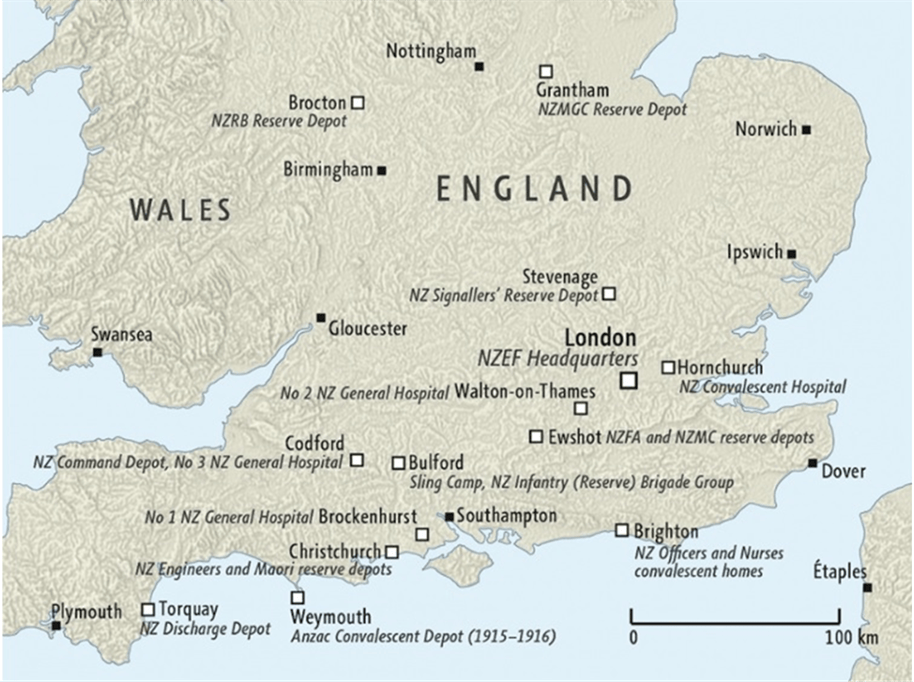
The wartime NZAOC developed around three connected elements: administrative staff at NZEF Headquarters in London; ordnance staff supporting the New Zealand Division in France and Belgium; and personnel supporting the mounted force in the Middle East. The United Kingdom element also became responsible for New Zealand camps, hospitals, convalescent facilities and other establishments dispersed across Britain. That network created the demand for a central New Zealand depot in London.3
Figure 1. NZEF establishments in England, 1916-1919. Map produced by Geographx with research assistance from Damien Fenton and Caroline Lord; originally published in Damien Fenton, New Zealand and the First World War (2013). Source: Manatu Taonga – Ministry for Culture and Heritage.
Establishing the Farringdon Road depot
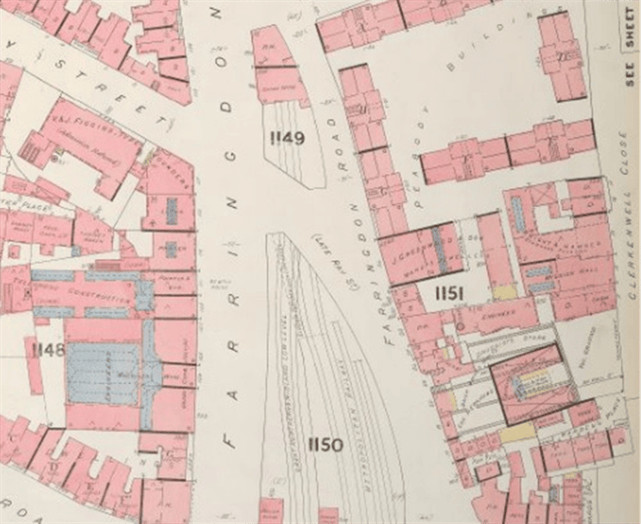
The preferred site needed to be close to NZEF Headquarters at Bloomsbury Square, accessible by road and rail, and well placed to draw on British depots and suppliers. On 25 October 1916, the Officer Commanding London District authorised the NZEF, under wartime powers, to take over the premises of H. Fisher and J. Fisher at 30 and 32 Farringdon Road for use as an ordnance store. The buildings were only about 1.5 kilometres from the New Zealand headquarters.4
The choice was practical. Farringdon Road was a major north-south route, while the nearby Metropolitan Railway provided access to both Farringdon passenger station and its goods facilities. From this point the depot could reach New Zealand establishments around Britain and connect with the British AOC network, including the Royal Arsenal at Woolwich, the Army Clothing Depot at Pimlico, and ordnance depots at Weedon and Didcot. References to these establishments as ‘RAOC’ depots are anachronistic for 1916; the British corps was then the AOC and did not receive the Royal prefix until after the war.56
Occupation was intended for 7 November 1916, but obtaining the keys and connecting water and electricity delayed the move. The NZEF finally occupied the premises on 27 November, and the depot began operating on 1 December 1916. The address was later incorporated into Farringdon Lane numbering and is now commonly identified as 30 Farringdon Lane.
Key dates
Date
Event
18 February 1916
NZAOC establishment published in NZEF Orders.
25 October 1916
London District authorised the NZEF to take over 30-32 Farringdon Road.
27 November 1916
The premises were occupied after delays with access and utilities.
1 December 1916
The New Zealand Ordnance Depot began operating.
17 July 1919
The depot’s closing audit was completed.
November 1919
The depot closed after stocks were returned, credited, sold or destroyed.
Figure 2. Farringdon Road and the Metropolitan Railway corridor. Extract from Chas E. Goad, Insurance Plan of London, vol. VI, sheet 128 (1886), British Library.
The people who ran it
Overall responsibility rested with Captain, later Major, Norman Joseph Levien, the Chief Ordnance Officer for the NZEF in the United Kingdom. Day-to-day charge of the depot for most of its existence fell to Warrant Officer Class One (Conductor) Arthur Gilmore. Posted there in November 1916, Gilmore remained closely associated with Farringdon Road apart from a six-month secondment to the Sling Camp depot and about three months of sick leave during the influenza epidemic. He was commissioned as a second lieutenant on 1 February 1919.7
The appointment of Conductor carried more authority than the modern image of a warehouse supervisor might suggest. Conductors were senior technical warrant officers responsible for stock accountability, inspection, issue discipline and the practical operation of the ordnance system. Farringdon Road depended on that combination of professional judgement and exacting administration.
Clothing, salvage and local purchasing
Most stock passing through the depot consisted of clothing and necessaries. New garments were obtained from the Army Clothing Depot at Pimlico, while other items were contracted directly from civilian manufacturers. Cleaned and repaired articles recovered through the salvage system were also returned to service. The result was a blended supply model: imperial depots provided depth, the civilian market supplied flexibility, and salvage reduced waste and relieved pressure on new production.
Levien reported that, in the year to December 1917, purchasing clothing from civilian suppliers rather than relying solely on Pimlico produced savings of £31,532 7s. 10d. The figure is best left in its contemporary form because modern currency conversions vary considerably by method. Its significance is nevertheless clear: a small New Zealand organisation was not merely drawing stores from a larger ally; it was actively managing cost, supply risk and availability.8
More than a warehouse
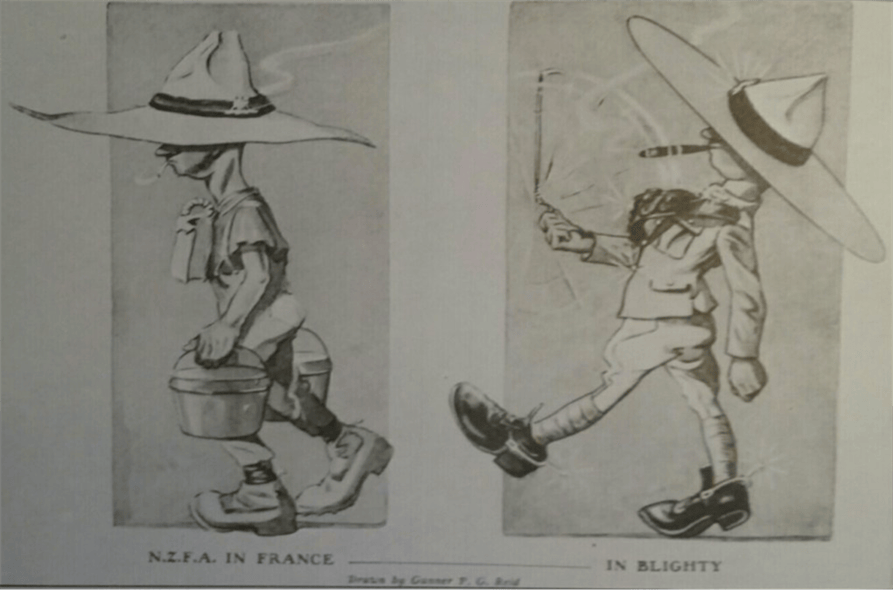
The depot also acquired a direct role in soldier welfare and readiness. Men arriving in Britain on leave from France and Belgium often wore dirty, damaged and vermin-infested clothing. Under the direction of the New Zealand General Officer Commanding, additional accommodation was secured so that they could hand in their uniforms, bathe, and receive clean underwear and a serviceable uniform before beginning leave.9
A secure kit store held spare kit, arms, ammunition and equipment while the soldiers were in London. The New Zealand Soldiers’ Club and the New Zealand War Contingent Association supported the reception facility with hot drinks and instruction on the use of prophylactic outfits. In one place, the NZEF combined hygiene, health education, clothing exchange, property security and stores control. It was a practical demonstration that logistics and personnel welfare were not separate activities.
Figure 3. A contemporary cartoon contrasting a New Zealand artilleryman’s appearance in France with his refitted appearance in Britain. Artist shown as Gunner T. C. Bell; reproduced from the original article source image.
The scale of throughput
A surviving summary of selected receipts between 1 December 1916 and 1 August 1919 gives a sense of the depot’s throughput. These figures are receipts across the period, not a snapshot of stock held on one day. The terminology has been retained, with punctuation lightly modernised.10
Item
Quantity
Item
Quantity
Hat bands (‘Hat Smasher’)
115,000
‘Hat Smasher’ hats
95,400
Boots, ankle, service
78,272
Service dress jackets
98,500
Boots, ankle, NZ pattern
58,691
P.W. jackets
68,500
Boots, ankle, part worn
24,691
Leather jerkins
20,000
Braces, pairs
78,140
B.C. pantaloons
45,500
Kit bags
27,748
Pantaloons, part worn
5,000
Hair brushes
22,000
Worsted socks
123,000
Toothbrushes
28,000
Canvas shoes
31,000
Greatcoats, D.S.
28,665
Flannel shirts
99,500
Greatcoats, part worn
10,765
Service dress trousers
77,300
Warm coats, M.S.
16,172
P.W. trousers
47,000
Comforter caps
14,699
Turkish towels
64,500
Hair combs
25,000
Cardigan waistcoats
23,000
Woollen drawers
89,000
Woollen vests
97,000
Woollen gloves
23,000
Puttees
61,300
Table 1. Selected receipts, 1 December 1916-1 August 1919. ‘Hat Smasher’ was an early term associated with the New Zealand felt hat later widely known as the lemon squeezer. Abbreviations have been retained where their expansion is uncertain.
Together, these 30 sample lines represent almost 1.6 million individual pieces or pairs. The mix is revealing. Boots, greatcoats, service dress, underwear, socks, brushes and towels show that the depot sustained the soldier as a complete system, while the repeated ‘part worn’ categories confirm that inspection, repair and reissue were routine parts of wartime supply.
Audit, demobilisation and closure
After the Armistice of 11 November 1918, demand changed from reinforcement and sustainment to recovery and demobilisation. Outstanding orders were cancelled, and Gilmore’s audit for the period ending 17 July 1919 provided the basis for closing the account. Remaining stocks were returned to New Zealand, transferred back to British ordnance depots for credit, sold locally or destroyed where no economical alternative existed. The depot closed by November 1919.11
Closure was therefore not simply a matter of locking the doors. It required the same disciplines that had sustained the depot during the war: cancellation of commitments, reconciliation of accounts, disposal decisions, return transport and evidence that public property had been properly accounted for. In modern language, Farringdon Road had to complete its reverse-logistics mission before the organisation could disappear.
Why Farringdon Road matters
Farringdon Road was never intended to rival Britain’s vast ordnance establishment. Its value was that it sat between that system and the specifically New Zealand requirements that the larger network could not see or manage on New Zealand’s behalf. It aggregated demand, maintained national accountability, exploited local purchasing, returned salvaged clothing to use, and connected supply activity with the welfare of soldiers arriving from the front.
The depot’s story is consequently more than an interesting London footnote. It illustrates an enduring principle of coalition logistics: interoperability does not remove national responsibility. Even when a small force depends on an ally’s scale and infrastructure, it still needs its own people, records and nodes to translate national demand into supply, safeguard public property and close the loop when operations end.
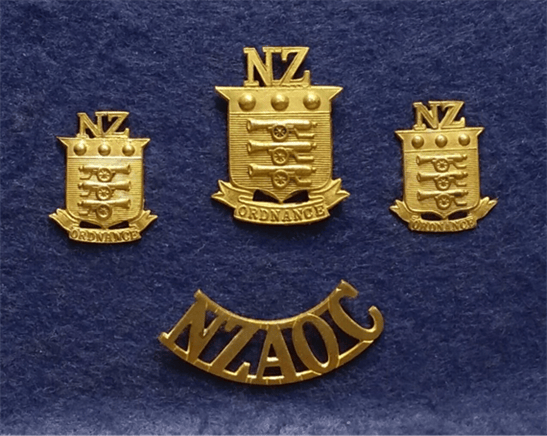
Figure 4. New Zealand Army Ordnance Corps badges, 1916-1919. Robert McKie Collection, 2017.
Notes
Joseph S. Bolton, A History of the Royal New Zealand Army Ordnance Corps (Trentham: RNZAOC, 1992), 52-53.
“New Zealand Expeditionary Force – Army Ordnance Corps Daily Order No. 1,” 1916, Archives New Zealand, item R25958433; “Road to Promotion,” Evening Post 91, no. 29 (4 February 1916).
Equipment and Ordnance Depot, Farringdon Road, London – Administration Reports Etc., 18 October 1916-8 August 1918, Archives New Zealand, item R25102951.
“Personnel Records: Arthur Gilmore,” Archives New Zealand, AABK 18805 W5568 0135616; Arthur Gilmore, “Audit Farringdon Road Ordnance Stores for Period Ended 17 July 1919,” Archives New Zealand, record group WA1, record 2/13 (1919).
Norman Levien, “Report of Ordnance Officer on Administration of Ordnance Department for 1917,” Archives New Zealand, record group WA1, record 2/13 (1918).
Levien, Report of Ordnance Officer on Administration of Ordnance Department for 1917.
Gilmore, “Audit Farringdon Road Ordnance Stores for Period Ended 17 July 1919.”
Gilmore, “Audit Farringdon Road Ordnance Stores for Period Ended 17 July 1919.”
During the Second World War, New Zealand utilised approximately one hundred and thirty British Ordnance QF 3.7-inch Mk 3 Anti-Aircraft guns.[1]
Deployed across New Zealand at fixed and mobile sites with wartime scales of ammunition totalling 428,032 rounds, these guns stood ready during the war years in anticipation of Japanese air raids. New Zealand’s anti-aircraft defences were never tested, and with the immediate threat removed, the guns were placed into storage, and the ammunition was returned to depots for refurbishment. However, due to the considerable amount of ammunition returned to New Zealand’s depots at the war’s end, storage capacity was soon outstripped, necessitating the storage of large quantities under tarpaulins in field conditions.
Valentine Tank at Trentham, stacks of Ammunition can be seen in the background. NZ National Library Ref EP/1955/1794-F
By 1954, 17,000 rounds of 3.7-inch anti-aircraft ammunition had been stored in unsuitable conditions at the Liverpool Range outside Trentham Camp. With sufficient 3.7-inch stocks available to meet training needs in other depots, the Liverpool Range stocks were considered surplus. Although initially intended for inspection and refurbishment at the Kuku Valley Ammunition Repair Depot, inspections revealed that the Liverpool Range stocks had deteriorated to the point where destruction was the only option.
Examination of a deteriorated shell at Trentham, Upper Hutt. National Library of New Zealand Ref: EP/1955/1792-F
A plan was formulated to transport the 17,000 rounds of unstable 3.7-inch ammunition from its storage area at the Liverpool Range across the valley, approximately 1.4 kilometres, to the demolition area at Seddon Range. The explosive content was destroyed there, and recoverable components, such as the brass casings, were collected and sold as scrap.
The Royal New Zealand Engineers constructed a road between the Liverpool and Seddon ranges to create a safe working area around the stacks and provide access to them.
Due to the detonation risk of the ammunition and its storage containers and the likelihood of an explosion, a modified armoured truck and trailer were constructed to facilitate the transportation.
Army vehicles at Trentham, Upper Hutt. Ref: EP/1955/1793-F. Alexander Turnbull Library, Wellington, New Zealand. /records/23078184
Demolitions – 3.7 AA Kuku Valley Trentham – RNZAOC Ammunition Collection
The 3.7-inch round was a 12.7kg single piece of ammunition consisting of a cast steel projectile with a tapered nose filled with Amatol, TNT, or RDX/TNT explosives, mounted in a brass casing. The brass casing contained an explosive primer and a cordite propellant charge that could propel the projectile to a maximum ceiling of 9,000 meters or a horizontal range of 15,000 meters. Each 3.7-inch round was packed in a fibre cylinder, with two rounds packed into a C235 steel case.[2]
Examples of 3.7-inch rounds
C235 Ammunition Tin (2 x 3.7-inch rounds per tin)
Demolitions – 3.7 AA Kuku Valley Trentham 2 – RNZAOC Ammunition Collection
With 17,000 rounds in 8,500 cases, ten cases (twenty rounds) were transported from the Liverpool Range to the demolition area at a time. The cases were then unloaded at the demolition range, and in batches of four, the rounds were detonated.
Demolitions – 3.7 AA Kuku Valley Trentham 3 – RNZAOC Ammunition CollectionDemolitions – 3.7 AA Kuku Valley Trentham 4 – RNZAOC Ammunition Collection
From June 1955, five or six detonations occurred daily, with the frequency and strength of the explosions causing some distress to residents, with the Upper Hutt Council questioning the Army on the reasons for the explosions.[3] Another resident forwarded a strongly worded protest letter to the editor of the Upper Hutt Leader Newspaper.[4]
Letters to the Editor
Dear Sir, The terrific explosions at the Trentham Camp which have wrecked our nerves for some considerable time, are the subject of this letter. Mr Editor. The world is at peace, yet we are at war (by the sound of things) in this beautiful valley in which we live. Every day these loud blasts shake our houses, waken our babies end sleeping little ones also elderly people having an afternoon nap, have a rude awakening, It takes very little imagination to realise the effect this bombing has on the nerves of bed-ridden patients at the Silverstream hospital. I ask you to publish this letter in the hope that the authorities will cease-fire, or at least explain why and how long this blasting is to be endured.
I am etc.,
ATOMIC BOMB
However, the explosive destruction of the old ammunition continued, and the daily explosions became an accepted and routine feature of life in Upper Hutt.[5]
Demolitions – 3.7 AA Kuku Valley Trentham Capt C Sanderson 6 – RNZAOC Ammunition CollectionDemolitions – Checking Continuity – Mr Loveday Kuku Valley Trentham 7 – RNZAOC Ammunition Collection
The demolition of the 17000 rounds of unsafe 3.7inch ammunition was concluded in December 1957. The destruction had proceeded without incident, with the local residents thanked for their considerable forbearance in putting up with the noise of explosions nearly every day.
Demolitions – 3.7 AA brass 1956 – Sgt Bob Handy Kuku Valley Trentham 5. RNZAOC Collection
Notes
[1] Damien Fenton, A False Sense of Security: The Force Structure of the New Zealand Army 1946-1978, Occasional Paper / Centre for Strategic Studies: New Zealand: No. 1 (Centre for Strategic Studies: New Zealand, Victoria University of Wellington, 1998), Bibliographies, Non-fiction.
[2] Great Britain. War Office, Anti-Aircraft Ammunition: User Handbook (War Office, 1949).
[3] “The “Boom” from Trentham Camp,” Upper Hutt Leader, Volume XII, Number 28, , 28 July 1955.
[4] “Letters to the Editor,” Upper Hutt Leader, Volume XII, Number 29, , 4 August 1955.
[5] Howard Weddell, Trentham Camp and Upper Hutt’s Untold Military History (Howard Weddell, 2018), Bibliographies, Non-fiction, 187-88.
In British and Commonwealth military doctrine, there has long been a separation of responsibility for Supplies and Stores.
Supplies – The provisioning, storing, and distributing of food for soldiers; forage for animals; Fuel, Oil, and Lubricants (FOL) for Tanks, Trucks, and other fuel-powered vehicles and equipment; and the forward transport and distribution of ammunition. In the NZ Army, Supplies were managed by the New Zealand Army Service Corps (NZASC) from 1911 to 16 October 19789.
Stores – The provisioning, storage, and distribution of weapons, munitions, and military equipment are not managed by RNZASC. Stores were the Responsibility of the Royal New Zealand Army Ordnance Corps (RNZAOC) until 1996.
Despite the separation of responsibilities, the RNZASC and RNZAOC would have a long and cooperative relationship for most of their existence.
During the early colonial days, the early actions of the New Zealand Wars proved that the New Zealand bush and the elusive tactics of the Maori presented new problems in supply and transport. An Imperial Supply and Transport Service was established and operated with the Imperial troops.
From the end of the New Zealand Wars until 1910, there was no ASC unit in New Zealand, with the supply functions required by the New Zealand Military provided by the Defence Stores Department.
After the conclusion of the South African War, the Military Forces in New Zealand embarked on a series of reforms to enhance the organisation and capability of the nation’s military, enabling it to contribute effectively to a broader Imperial Defence scheme. In 1910, at the request of the New Zealand Government, Field Marshal Viscount Kitchener inspected New Zealand’s Forces. Kitchener provided several recommendations concerning the ongoing reforms, emphasising the need for a professional Staff Corps to administer the force and confirming the requirement for a New Zealand ASC, which was gazetted on 12 May 1910 (backdated to 6 May 1910) as a designated component of the Territorial Forces of New Zealand.
The momentum for these reforms gained further impetus with the appointment of Major General Alexander Godley as the New Zealand Military Forces Commandant in December 1910. Godley was pivotal in revitalising New Zealand’s military organisational framework in his first year, making critical command and staff appointments, promulgating the (Provisional) Regulations for the Military Forces of New Zealand, and making plans to build up the NZASC, which up to this time had remained a paper corps.
Acknowledging the highly specialised nature of ASC duties, distinct from combatant staff and regimental officers, and the absence of suitably qualified officers in New Zealand, Godley recommended to the Minister of Defence on 4 January 1911 the lending of services of an experienced Imperial ASC Senior Captain or Major to organise and train New Zealand’s transport and supply services for three years. The Minister of Defence endorsed this recommendation with the Prime Minister cabling the New Zealand High Commissioner in London on 10 January 1910 to approach the Army Council for the following:
Services of experienced Army Service Corps major or senior captain required to organise New Zealand Army Service Corps. Engagement for three years. Salary £600 a year consolidated. Pay to include house allowance. Travelling allowance of 12/6d a day and allowance for one horse if kept, will also be granted.
Within two months of receiving New Zealand’s request for an ASC Officer, the Army Council promptly and affirmatively responded to the call. Having already sanctioned nine additional officers to assist Godley, the Council selected Knox, who then served in C (Depot) Company ASC at Aldershot for service in New Zealand to organise the NZASC.
Under the guidance of New Zealand Adjutant and Quartermaster-General Colonel Alfred Robin, Knox assumed his duties as the New Zealand DST at the Army General Staff Offices on Wellington’s Buckle Street. His responsibilities encompassed a wide range of functions, including quarters, tender and contracts, personal and freight movement, and presidency on two standing committees related to Drill sheds and the storage and distribution of clothing and equipment to the forces.
Recognising Knox’s extensive duties, he was granted the Temporary Rank of Lieutenant Colonel on 6 September 1911. With Colonel Robin’s appointment as the New Zealand representative at the War Office in London in 1912, Knox assumed the additional role of Quartermaster General (QMG). Despite Knox diligently fulfilling the role of QMG and DST, progress on the formation of the NZASC was slow.
By 1914, Knox had established 16 NZASC companies of approximately 30 men each across the four New Zealand Military Districts, with imported ASC officers serving as Assistant Directors of Supply and Transport (ADST) in each District Headquarters. Although Knox had departed by the time of the 1914 divisional camps, the Inspector General of Imperial Forces, General Sir Ian Hamilton, noted following his inspection that:
The very highest credit is due to the Army Service Corps officers and their men. They have done a first-class service, although as a rule undermanned to an extent that would fill a labour union with horror. When the Army Service Corps units are up to their normal strengths, a suitable system of calling the men up to camp in relays will enable the necessary duties to be carried out as efficiently and with much less strain on the personnel.
During World War One, New Zealand ASC units fulfilled crucial functions. ASC Companies supported the Territorial Infantry and Mounted Rifle Brigades. At the same time, Supply and Transport Units aided mobilisation camps within New Zealand. Overseas, the NZASC operated across all New Zealand theatres of war, delivering indispensable services. At its zenith, it managed the NZ Divisional Train, five ASC Companies, five Depot Units of Supply, the NZ Field Bakery, the NZ Field Butchery, and the NZ Motor Transport Workshop. Notably, the NZASC and NZAOC frequently shared personnel, facilities, and transportation, especially in the conflict’s early years.
In 1917 the NZAOC was established as a permanent component of the New Zealand Military Forces, however, it would not be until 1924 that the Permanent NZASC was formed.
Post-war, under the leadership of Captain Stanley Herbert Crump, the NZASC transitioned to a peacetime establishment comprising a Headquarters and three depots (Northern, Central, and Southern). In 1924, the Permanent NZASC (PNZASC) was established as part of the permanent Military Forces. Additionally, in 1925, an alliance between the NZASC and the Royal Army Service Corps (RASC) was ratified.
The RASC has its roots in history that are much more profound. Up to the time of Cromwell, armies mainly lived by plunder. The RASC came into being in 1888. but the work it now performs was being done long before that.
Cromwell and then the Duke of Marlborough, and later Napoleon, organised a system of civilian commissaries. The Duke of York established the Corps of Royal Waggoners in 1794. This purely transport organisation continued until 1869 under various names, eventually as the Military Train, fighting as light cavalry in the Indian Mutiny.
The birth of the Supplies and Transport Service dates from 1869. when supplies and transport, along with the Military Stores Department, came under one department called the Control Department, it remained for General Sir Redvers Buller in 1888 to organise the first Army Service Corps. Since its formation, the RASC has been a combatant one. Trained and armed as infantry and responsible for its own protection. Considerd a more technical Corps, the RAOC was not granted combatant status until 1942.
In 1931, under Crump’s continued leadership, the NZASC underwent a reorganisation into three Composite Companies. Each company comprised seven officers, four warrant officers, and 99 other ranks, establishing a solid foundation from which the NZASC could readily expand to meet the demands of future conflicts.
During World War Two, numerous units and establishments represented the NZASC across all New Zealand Expeditionary Force (NZEF) theatres. Similar to the previous World War, the NZASC maintained a collaborative relationship with New Zealand Ordnance Corps (NZOC) Ammunition Examiners (AEs) in the establishment of NZASC Ammunition platoons. At times, NZASC Warrant Officers were attached to the NZ Divisional Ordnance Field Park (OFP) to offer technical advice on vehicle spares. In recognition of the NZASC’s service during WW2, the title “Royal New Zealand Army Service Corps” was conferred in 1946.
In the post-war era, the NZASC and from 1946, the RNZASC would serve with distinction J Force in Japan and then contribute the second-largest New Zealand contingent to K Force in Korea by providing 10 Transport Company. Playing a pivotal role in sustaining the morale and effectiveness of New Zealand forces during these conflicts
Until 1947, NZASC units primarily handled baking bread, butchering meat, and procuring and distributing fresh and packaged provisions to frontline units, while regimental cooks and stewards were responsible for cooking and serving meals. To enhance and standardise cooking practices throughout the army, the Supplies and Transport Catering Group (STCG) was established on 15 February 1948 with the following objectives:
Training and provision of unit cooks and kitchen hands.
Instruction and supervision of the management of the Army ration scale.
Improvement of food preparation and cooking standards.
Advice on the installation and operation of cooking appliances and kitchen equipment.
Guidance on the layout of mess buildings.
In September 1948, all Regimental catering staff, except those of the New Zealand Women’s Army Corps, were transferred into the RNZASC. Throughout the 1950s, 60s, and 70s, the RNZASC played a vital role within the New Zealand Army, encompassing a wide range of functions. These included everyday tasks such as cooking and serving food, as well as more complex operations like air supply drops. To manage the procurement, storage, transportation, and distribution of essential supplies such as food, fuels, and oils for a modern Army, the RNZASC operated Supply Depots and employed various tradespeople, including butchers. Supply Depots were strategically located in Papakura, Waiouru, Linton, Trentham, and Burnham, where bulk supplies were stored and distributed as needed. Additionally, every Army camp featured a section of the RNZASC, along with smaller supply and transport depots, which were responsible for handling goods from central supply depots and providing drivers and transport services for various purposes. These smaller depots were situated in Devonport/Fort Caultley,
Following the Macleod report that recommended the streamlining of logistic support for the British Army, the RASC merged in 1965 with the Royal Engineers’ Transportation and Movement Control Service to form the Royal Corps of Transport (RCT). This would see the RASC Supply functions transferred to the Royal Army Ordnance Corps (RAOC). In 1973, following the British lead, the Australians also reformed their Royal Australian Army Service Corps (RAASC) into the Royal Australian Army Corps of Transport (RAACT).
Acknowledging the British and Australian experience, the RNZASC underwent a similar transition—operational command of the Supply function transferred to the RNZAOC on 16 October 1978. On 12 May 1979, the RNZASC ceased to exist: Supply personnel formally transferred to the RNZAOC, while Transport, Movements, and Catering were re-formed as the Royal New Zealand Corps of Transport (RNZCT)..
The RNZASC supply function would be integrated into the RNZAOC, with the Camp Supply Depots becoming NZAOC Supply Platoons numbered as.
14 Supply Platoon, Papakura/Hopuhopu
24 Supply Platoon, Linton
34 Supply Platoon, Burnham
44 Supply Platoon, Waiouru
54 Supply Platoon, Trentham
NZ Supply Platoon, Singapore
In recognition of its long RNZASC service, 21 Supply Company was retained as a Territorial unit, initially as the Territorial element of 4 Supply Company in Waiouru and later as the Territorial element of 2 Supply Company, Linton. Today, 21 Supply is the principal North Island Supply unit of the Royal New Zealand Army Logistic Regiment (RNZALR).
For a short period following the RNZAOC assumption of Supply functions, some RF and TF RNZAOC would periodically be employed within the RNZCT transport Squadrons’ Combat Supplies sections.
The RNZAOC Butcher trade inherited from the RNZASC would be discontinued in the mid-1980s, with the last of the butchers reclassifying as RNZAOC Suppliers. By the mid-1990s, it was decided as a cost-saving measure to allow the RNZCT catering staff to order directly from commercial foodstuff suppliers, effectively ending the RNZAOC foodstuffs speciality. The only RNZASC trade speciality remaining in the RNZAOC after its amalgamation into the RNZALR was that of Petroleum Operator.
The Royal NZ Army Service Corps & Corps of Transport, like the RNZAOC, have passed their combined responsibilities to the RNZALR. However, the Royal NZ Army Service Corps & Corps of Transport maintain a strong association that provides many benefits and opportunities for comradeship to RNZASC/CT Corps members and past and present members of the RNZALR. Another role of the RNZASC/CT association is to ensure that the rich and significant history of the RNZASC/CT is not lost to future generations of the RNZALR.
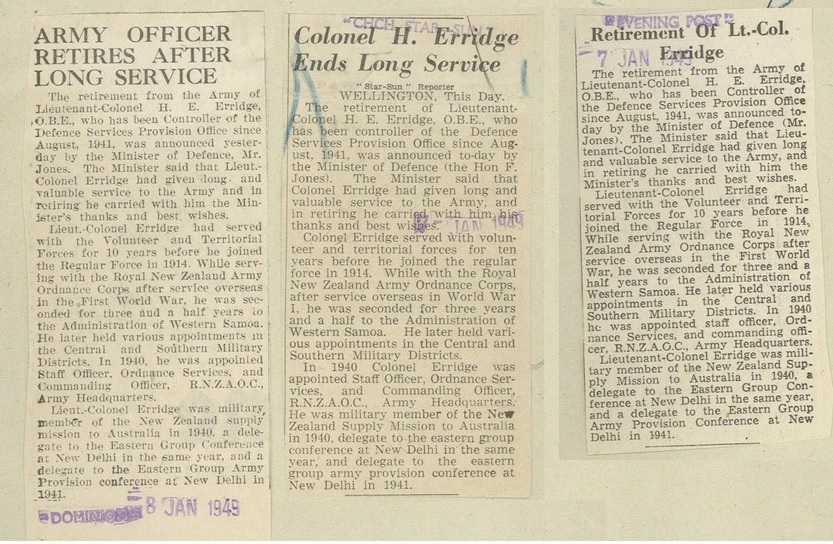
Serving the nation for 44 years, Henry Erridge served at Gallipoli before being invalided back to New Zealand. Continuing to serve throughout the interbellum, Erridge assisted in shaping the New Zealand Army Ordnance Corps for the Second World War. During the war, Erridge played a significant role in providing New Zealand’s contribution to the collective logistics efforts of the British Commonwealth
Henry Earnest Erridge was born in Dunedin on 18 December 1887 to Henry and Jane Erridge. The fifth of seven children, Henry was educated in Dunedin and received commercial training. A keen military volunteer Erridge had joined the Dunedin Engineer Volunteers as a Cadet in 1904, transferring into the Otago Hussars in 1909, gaining Non-Commissioned Officer (NCO) Rank. On 6 April 1914, Erridge joined the New Zealand Permanent Staff (NZPS) with the rank of Staff Sergeant Instructor as the Orderly Room and Quartermaster (QM), No 15 Area Group, Oamaru.[1]
On the outbreak of war in August 1915, Erridge was seconded for duty with the NZEF and left New Zealand with the Main Body, Otago Infantry Battalion. As a Signals Sergeant in the Otago’s, Erridge saw service during the Turkish attack on the Suez Canal in February 1915 and later took part in the landings at Gallipoli. Stuck down with enteric fever, Erridge was evacuated from Gallipoli to Alexandria in June and, in August, invalided back to New Zealand for further convalescence.
Returning to duty as a Warrant Officer in the QM Department at Featherston Camp on 10 January 1916, Erridge was appointed Stores Forman responsible for managing the QM Stores accounts for Featherston and its subsidiary camps. Reclassified as Class “A” fit for overseas service on 5 July 1918, it was intended to attach Erridge to a reinforcement draft and returned to the front. Deemed as essential, the Director of Equipment and Ordnance (DEOS) Stores appealed to the Chief of the General Staff, stating that
The accounts of the Camp Quartermaster, Featherston Camp, have not been completed and balanced. The principle causes for this state of affairs are:
(1) The inferior class of clerks posted for Home Service duties. (2) And ever-changing staff, thus throwing the bulk of work on SSM Erridge, who has been employed in the capacity of foreman.
It is essential that SSM Erridge be retained until 1 November at least
Director of Equipment and Ordnance Stores to Chief of the General Staff. 14 August 1918
The DEOS appeal was successful, and Erridge was granted authority to delay his placement into a reinforcement draft until November on the proviso that every endeavour was to be made to have all accounts in connection with the QM Branch Featherston and subsidiary camps completed to the satisfaction of the proper authority. Following the Armistice of 11 November 1918, Erridge’s employment was reassessed, and he was provided orders to remain with the QM Department at Featherston. Seconded to the Ordnance Stores in Wellington in June 1919, Erridge was permanently transferred into the New Zealand Army Ordnance Corps (NZAOC) with Conductor rank on 1 October 1919.
Recommended for the Supplies and Purchasing Officer position with the civil administration in Samoa, Erridge was accepted for service with the Samoan Administration for three years from 24 May 1920. Due to a misunderstanding of the secondment rules, Erridge was discharged from the New Zealand Military. However, this was reviewed, and the discharge was rescinded, allowing Erridge to retain his rank and seniority on his return to New Zealand.
`Administration Headquarters. “Apia”‘. Moore, Robert Percy, 1881-1948 :Panoramic photographs of New Zealand. Ref: Pan-0422-F. Alexander Turnbull Library, Wellington, New Zealand. /records/32050069
Completing his service in Samoa in August 1923, Erridge returned to New Zealand and, following three months leave, resumed duty with the NZAOC, where he was posted to the Main Ordnance Depot (MOD) and placed in charge of the Stores on 1 December 1923. In an example of his experience and utility, Erridge temporarily relieved Captain F.E Ford, the Ordnance Officer of Featherston Camp, from 4-31 Jan 1924.
During the 1920s, the Quartermaster General (QMG) vested command of the NZAOC to the Director of Ordnance Service (DOS). Assisted by the Chief Ordnance Officer (COO), the Inspecting Ordnance Officer (IOO), and the Ordnance Mechanical Engineer (OME), the DOS was responsible for:[2]
The provision, receipt, storage, distribution, repair, examination, and maintenance of small-arms, machine guns, vehicles, clothing and necessaries, equipment and general stores (including medical and veterinary), and camp and barrack equipment,
The inspection and repair of armament and warlike stores, and the inspection of gun ammunition.
The provision, receipt, storage, and distribution of small arms ammunition.
The receipt, storage, issue, and repair of fixed armament, field armament, and artillery vehicles.
The organisation and control of ordnance workshops
The preparation and periodic revision of Equipment Regulations and barrack and hospital schedules
The organisation, administration, and training of the NZ Army Ordnance Corps Forces
The maintenance of statistics of the Ordnance Department.
The DOS was also the Commanding Officer (CO) of the NZAOC and was responsible for the interior economy, including enlistment, training, pay, promotion, postings transfers, clothing, equipment, and discharges within the unit.
In 1924, the incumbent DOS, Lt Col Pilkington, was appointed QMG in Army Headquarters. Major T.J King, then acting COO, was appointed DOS, with Major William Ivory as the IOO and OME. By 1925, King recognised that he could not provide complete justice to the DOS and COO posts. Still, with no Ordnance Officers immediately available to fill the COO position, he recommended that the QMG give some relief by granting Erridge an officer’s commission. In his recommendation to the QMG, King noted that
Conductor Erridge is a man of wide experience in Ordnance duties and stores works generally and is eminently fitted for appointment as Ordnance Officer with the rank of lieutenant. He is a man of unblemished character, with a very high regard for the interests of the Corps and the services, and in the last few months gained sufficient insight into the duties I propose transferring him to.
Director of Ordnance Stores to Quartermaster General 11 December 1925
The QMG supported King’s recommendation on the proviso that Erridge pass all the required commissioning examinations. After passing the examinations, Erridge was commissioned as a lieutenant in the NZAOC on 23 July 1926.[3] However, the question arose of where to place Erridge on the Army List. Technically, the COO appointment was still vacant, with Erridge, for all intents, acting as King’s assistant and only performing part of the COO duties, with the work of the COO divided between King and Erridge. It was not desired that an Assistant COO be added to the establishment, so it was decided to show Erridge as Ordnance Officer (Provision). After several years as the Ordnance Officer (Provision), Erridge was appointed to the dual roles of Ordnance Officer MOD and Ordnance Officer Central Military District (CMD) on 14 May 1929.[4]
In December 1930, the incumbent Ordnance Officer Southern Military District (SMD)and Camp Commandant of Burnham Camp, Captain A.R.C White, faced compulsory retirement. To allow some continuity while White’s replacement was decided, Erridge was temporarily sent to Burnham. Although initially only a temporary posting, Erridge remained at Burnham until 1934 in the dual roles of Ordnance Officer SMD and Officer in Charge Burnham Camp (Camp Commandant).[5]
By 1935 in his role of DOS, King was looking forward and preparing his organisation for war. In a submission to the General Headquarters, King requested authority to reorganise his staff. Regarding Erridge, King started.
Owing to the large amount of new equipment that is on order and is likely to be ordered soon, it is essential that the staff of the Ordnance Depot, Trentham, be strengthened to the extent that I should again have the assistance of my most experienced Ordnance Officer.
There is a great deal of work of a technical nature in connection with mobilisation, rewriting of Regulations, etc., which I am unable to find time to carry out myself, and which Mr Erridge, by virtue of his long experience and training, is well qualified to undertake. This work is most necessary and should be put in hand as soon as possible; I have no other Officer to whom I could delegate it.
Again, King’s recommendations were accepted, and on 30 June 1934, Erridge relinquished his Burnham appointments and was appointed as the Ordnance Officer (Provision) at the MOD, with promotion to Captain following on 1 December 1934.[6]
When the war was declared in September 1939, the NZAOC underwent a significant transformation as its mobilisation plans were implemented. The DOS, Lieutenant Colonel King, was seconded to the 2nd NZEF as the Deputy Director of Ordnance Services (DDOS). Accompanying King was a small staff drawn from the military and civilian staff of the NZAOC who formed the nucleus of the Ordnance Corps in the 2nd NZEF. Kings’ responsibilities of DOS and COO were handed over to the Ordnance Officer CMD, Lt Col Burge.
On 2 December 1939, Erridge relinquished the appointment of Ordnance Officer (Provision), was granted the Rank of temporary Major and posted to Army HQ with substantive Major confirmed in February 1940.[7] In June 1940, the NZAOC underwent further reorganisation when Lt Col Burge relinquished the appointment of DOS when he was appointed as Deputy QMG in Army HQ with the position of DOS placed into abeyance for the duration of the war. Appointed as Staff Officer Ordnance and CO of the NZAOC, Erridge took over responsibility for the NZAOC.[8]
With the national economy transitioning from peacetime to a war footing, the Government took a series of initiatives to ensure international trade and commerce security. Representing the New Zealand Military, Erridge accompanied the New Zealand Minister of Supply and a small entourage of officials of the New Zealand Munitions and Supply Delegation on a tour of Australia for a series of talks with their Australian counterparts in July/August 1940.[9]
While the mission of the New Zealand Munitions and Supply Delegation to Australia was focused on strengthening cooperation between New Zealand and Australia, the Eastern Group Conference held in Delhi in October 1940 had the broader goal of organising a joint war supply policy for the countries of the “Eastern Group.” The countries represented at the Eastern Group Conference included the United Kingdom, Australia, India, South Africa, New Zealand, East Africa, Palestine, Ceylon, Burma, Malaya, and Hong Kong, with the Government of the Netherlands East Indies attending as observers.[10] The New Zealand delegation included.
The Chief of the General Staff, Major-General Sir John Duigan,
Major H. E. Erridge,
Mr F. R. Picot, Director of the Internal Marketing Department,
Mr J. R. Middleton, assistant-Secretary of supply,
Mr B. Taylor, assistant to the chief investigating officer of the Treasury Department.
As a result of the October conference, the Eastern Group Supply Council (EGSC) was established to coordinate and optimise the production and distribution of war materiel in the British colonies and dominions in the Eastern Hemisphere. The New Zealand members of the council who were to be based in New Delhi were.
Mr F.R Picot, Director of Internal Marketing and Food Controller,
Mr W.G.M Colquhoun (Munitions Department).
Mr R.J Inglis (Supply Department).
Mr R.H. Wade (of the Treasury).
A Central Provisions Office (Eastern) was also set up in Delhi, with national offices established in Australia, New Zealand, South Africa, East Africa, Southern Rhodesia and the Middle East. The Central Provision Office (Eastern) was a military organisation consisting of about 40 to 50 Army officers from all countries constituting the Eastern Group. Headed by the Controller-General of Army Provisions, who was also the military member of the EGSC and acted as the agent of the Imperial General Staff and various Commanders in Chief. The role of the Central Provision Office (Eastern) was coordinating with the controllers of the national provision offices to obtain military stores to maintain the British and Commonwealth war effort.[11] From March 1941, Two NZAOC Officers, Temporary Major D. L. Lewis and Lieutenant D.I Strickland were attached to the Central Provision Office (Eastern) staff in New Delhi.[12]
Before the Central Provision Office (Eastern) assumed complete provision control, it was necessary for all the controllers of the national provision offices to meet to ensure that uniform procedures were adopted. A coordination conference for the various Provision Group Controllers was held at New Delhi in July 1941, with Erridge attending as New Zealand’s military representative. Based on this conference, on 5 August 1941, the New Zealand War Cabinet approved the establishment of the New Zealand Defence Servicers Provision Officer (DSPO), with Erridge appointed as its Controller with the rank of Temporary Lieutenant Colonel. Relinquishing the appointment of Staff Officer Ordnance and handing over the Commanding Officer NZAOC duties to Major E.L.G Bown, the COO MOD.[13]
By April 1945, the DSPO thought Central Provision Group (Eastern) had shipped for the British Ministry of Supply equipment to the value of £10,000,000 (2021 NZD $8,988,577,362.41) with additional equipment to the value of £8,520,761 (2021 NZD $765,895,194.35) that was surplus to the requirements of NZ Forces overseas transferred to the War office.[14] During a visit to New Zealand in January 1946, Major-General R.P Pakenham-Walsh, CB, MC., a member of the Eastern Group Supply Council and the Central Provision Office(Eastern), stated that “Stores from New Zealand which had been made available to the Eastern Group Supply Council had been of great importance in the prosecution of the war” adding that “the Dominion’s contribution had compared more than favourably with that of various larger countries.”[15] Following the surrender of Germany in April and Japan’s defeat in August 1945, the Eastern Group Supply Council and Central Provision Office, although serving their purpose well, had become irrelevant and were dissolved on 31 March 1946.[16] However, it took two years for the DSPO to transition to a peacetime footing. Seconded to the War Asset Realisation Board (WARB) on 1 May 1947, Erridge started to wind down the work of the DSPO while also coordinating the disposal of equipment through the WARB. On 17 December 1948, Erridge handed over the remaining stocks to the WARB and closed the DSPO.
At 62 years of age and following 45 years of volunteer, Territorial and Regular service, Erridge retired from the New Zealand Army and was placed onto the Retired List with the rank of Lieutenant Colonel on 29 May 1949.[17] Never marrying, Erridge spent his retirement in his hometown of Dunedin. On 30 March 1962, a resident of the Dunedin’s Ross Home, Erridge, passed away at 74. Following his wishes, he was cremated, and his ashes scattered.
Throughout his service, Erridge was awarded the following decorations
OBE (1946)
NZ Long Service and Efficient Service (1925)
1914-15 Star
British War Medal
Victory Medal
War Medal 1939-45
NZ War Medal, 193-45
Notes
[1] Archives New Zealand, “Henry Earnest Erridge- Ww1 8/1004, NZAOC 888, Ww2 800245, 30293,” Personal File, Record no R24097640 (1904-1948): 2708.
[2] “Regulations for the Military Forces of the Dominion of New Zealand,” New Zealand Gazette, May 19, 1927.
[3] “Appointments, Promotions, Resignations and Transfers of Officers of the NZ Military Forces,” New Zealand Gazette No 61, 19 July 1926.
[4] “Appointments, Promotions, Resignations and Transfer of Officers of the New Zealand Military Forces,” New Zealand Gazette No 48, 27 June 1929.
[5] “Appointments, Promotions, Transfers and Retirements of Officers of the NZ Forces “, New Zealand Gazette No 16, 5 March 1931.
[6] “Appointments, Promotions, Transfers and Retirements of Officers of the NZ Forces “, New Zealand Gazette No 55, 19 July 1934.;”Appointment, Promotions, Transfers and Retirements of Officers from the NZ Forces,” New Zealand Gazette No 87, 29 November 1935.
[7] “Appointments, Promotions, Transfers and Retirements of Officers of the NZ Forces “, New Zealand Gazette No 1, 11 Jan 1940.;”Appointments, Promotions, Transfers and Retirements of Officers of the NZ Forces “, New Zealand Gazette No 75 (1940).
[8] “Appointments, Promotions, Transfers and Retirements of Officers of the NZ Forces “, New Zealand Gazette No 70 (1940).
[9] “Unity in War Effort,” Evening Star, Issue 23622, 8 July 1940.
[10] East Africa consisting of the territories of (Kenya, Uganda, Tanganyika, Zanzibar, Northern and Southern Rhodesia, Nyasaland; Bertram Stevens, “The Eastern Group Supply Council,” The Australian Quarterly 13, no. 3 (1941).
[11] “Eastern Group Supply Council,” Otago Daily Times, Issue 24640, 23 June 1941.
[12] “Appointments, Promotions, Transfers, and Retirements of Officers of the New Zealand Military Forces.,” New Zealand Gazette, No 30, 9 April 1941.
[13] “Appointments, Promotions, Transfers, and Retirements of Officers of the New Zealand Military Forces.,” New Zealand Gazette, No 74, 11 September 1941.
[14] “War Supplies,” Evening Post, Volume CXXXIX, Issue 126, 30 May 1945.
[15] “Production Problems,” Evening Star, Issue 25690, 14 January 1946.
[16] “Supplies – the Eastern Group Supply Council,” Northern Advocate, 1 April 1946, 1 April 1946.
[17] “Appointments, Promotions, Transfers, and Resignations, of Officers of the New Zealand Army “, New Zealand Gazette No 37, 16 June 1949.
Today Tikao Bay is a calm, peaceful little bay with a laid-back holiday vibe hidden away in Akaroa Harbour with few clues remaining of its military use and the tragic drowning of two Ordnance soldiers.
During World War Two, with the threat of invasion by Japan just over the horizon, the isolated Akaroa Harbour was fortified to deny its use by the enemy. However, by the time the battery of 6-inch guns, Naval Armament Depot and controlled minefield was completed in 1943, the threat had diminished, with the defences becoming an expensive white elephant. In early 1944 The controlled minefield was fired, and all the navy stores at the Tikao Bay Naval Armament Depot were transferred to other installations and facilities offered to the army.[1]
Akaroa Harbour Defences. Peter Cooke Defending New Zealand 2000
The extensive facilities at Tikao Bay, including a mine magazine, examination room, primer magazine wharf and accommodation buildings, were taken over by the Southern District’s Ordnance Depot at Burnham Camp in 1944 as a satellite storage depot for Gun and Artillery Equipment.[2] With an initial establishment of seven men in 1944, this had been reduced by 1955 to two soldiers responsible for the storage and maintenance of the equipment held at Tikao Bay.
Former Defence buildings Tikao Bay. Suff.co.nz/Ewen Sargent
Staff Sergeant Frederick Hastings Kirk aged 52, was married with three children and had been the Non-Commissioned Officer in charge of the Tikao Bay depot since 1950. Staff Sergeant Kirk had joined the Ordnance Depot at Burnham in 1939 as a civilian before enlisting into the 2nd NZEF early in 1940. As a Temporary Warrant Officer Class Two in 23 Battalion, Kirk was taken prisoner at Crete in 1941 and remained a Prisoner of War for four and a half years. On his return to New Zealand, he joined the temporary staff and was posted to the Ordnance Depot at Burnham. In 1948 he became a member of the Regular Force and transferred to Tikao Bay in 1950.
Private Donald George Dixon was aged 28 and was married with three children. Private Dixon initially served with the ammunition inspection branch after his 1953 enlistment and was transferred to the Tikao Bay Depot in October 1953.
On Tuesday, 10 March 1955, on completion of their daily duties, Kirk and Dixon left the depot at about 7 pm to check a set net approximately 200 yards (183 Meters) from the Tikao bay jetty. Having not returned by 11 pm, the police were notified, and Constable Egan of Akaroa and Mr G Brasell undertook an initial search. At 3 am Wednesday, Egan and Brasell located the missing men’s upturned dingy at the high-water mark near the set net, which was still in position. Reinforced with a party from Burnham Camp, local residents, and the police, the search for the missing men continued for the rest of the week.[3]
Private Dixon’s body was located and recovered from the harbour on Saturday morning.[4] The search for Staff Sergeants Kirks’ body continued with his body found on 18 March.[5] It was assumed that a southerly wind had risen after the two men left the depot, causing the dingy to capsize with the coroner’s report ruling the deaths as asphyxia by drowning due to misadventure.
Tikao Bay remained as an Army installation and training area into the early 1970s; however, its role as a storage depot ceased in the 1960s as the army progressively disposed of the remaining artillery equipment held there.[6]
Notes
[1] Sydney D. New Zealand Department of Internal Affairs War History Branch Waters, The Royal New Zealand Navy (Wellington, N.Z.: War History Branch, Dept of Internal Affairs, 1956), 229-36.
[2] “Establishments – Ordnance Corps “, Archives New Zealand No R22441743 (1937 – 1946).
As New Zealand’s Army’s central stock holding unit, 1 Base Supply Battalion(1BSB) was responsible for managing and providing depot-level storage of New Zealand’s Military’s stock of land equipment and spares. Despite having this responsibility since 1920, 1BSB and its predecessors had always struggled with providing suitable warehousing infrastructure and made do with the available storage infrastructure.
With no purpose-built storage accommodation, from 1920 to 1940, the NZAOC Main Ordnance Depot (MOD) utilised up to one hundred camp administrative and accommodation structures as its primary means of warehousing. Relief was provided in 1938 when contracts were issued to construct a modern warehouse utilising the most modern of methods and materials.[1] The New warehouse, later known as Building 73, was constructed using reinforced concrete and designed with nine bays that allowed the loading and unloading of Trains on one side and Motor Transport on the other. The design and layout of building 73 were utilised as the model for new warehouses constructed at Burnham, Hopuhopu and Waiouru.
Building 73
Although Building 73 provided a considerable increase in storage capability, wartime demands soon necessitated further increases in storage infrastructure, resulting in the construction of Building 74. Building 74 and the warehouses constructed in Burnham and Waiouru were close facsimiles of building 73, with the main exception that it was constructed out of wood instead of reinforced concrete due to wartime constraints.[2]
The wartime expansion of the New Zealand military saw the MOD exponentially expand to cope with the influx of military material with additional buildings constructed in Trentham and sub-depots also established a Mangere, Wanganui, Linton Camp, Gracefield and Wellington.
Peace in 1945 brought little respite as stocks were centralised at the MOD, requiring further expansion of the MOD warehousing infrastructure. To meet this need, five warehouses that were built for the United States Forces at Lower Hutt were disassembled and re-erected at Trentham by September 1945.[3] Additionally, the RNZAF Stores Depot constructed at Mangaroa in 1943 was handed over to the MOD in 1949.
Over the next forty years, the warehousing infrastructure at Trentham changed little, with a 1985 NZDF report identifying many deficiencies leading to significant upgrading of Trentham’s warehousing infrastructure.[4]
Main Ordnance Depot 1966
In one of the most significant warehousing infrastructure investments since 1939 and the first modern warehouse built for the RNZAOC since 1972, Building 75, a high stud warehouse capable of holding 3700 pallets, opened in 1988. Although a significant advancement in warehousing capability, the new warehouse had limited space for outsized items. Additionally, many other warehousing functions, such as packing and traffic, remained in Building 73, so further work was required to enhance the functionality of 1BSBs entire warehousing capability.
Building 73 (left), Building 74 (Right)
With trains no longer utilised for the delivery and dispatching of stores, the rail lines between Building 73 and 74 had long been redundant. By removing the rail line and raising the ground level between the two buildings, providing additional storage space of almost two square kilometres, protected from the elements by a 200 x 13-meter roof, was created. At the southern end, a loading ramp was constructed to allow the loading and unloading of trucks, with angled ramps at either end allowing the movement of vehicles along the length of the new storage area. Opened on 2 November 1989, the new warehouse was christened “the Cave.” The Cave allowed the more efficient transfer of stores to and from the storage areas in Buildings 73, 74 and 75 to the receipt, selecting, packing and issuing bays in Building 73.
Lieutenant Colonel P.P Martyn, Royal Australian Army Ordnance Corps. Commanding Officer 1 Base Supply Battalion January 1988 – December 1990, officially opening “The Cave”
The additional storage space allowed the storage of outsized items which had previously been stored at the Mangaroa Depot, which was subsequently decommissioned and handed over to NZDF Property Services.
The optimisation of storage space between the two buildings was so successful a similar modification was constructed between two of 21 Supply Company’s 1950s-era Warehouses at Linton, creating much-needed storage and office space.
Notes
[1] “New Army Ordnance Block Now under Construction at One of the Military Camps,” Evening Post, Volume CXXVIII, Issue 65, 14 Sept 1939.
[2] F Grattan, Official War History of the Public Works Department (PWD, 1948).
[3] “Organisation – Policy and General – Royal New Zealand Army Ordnance Corps 1946-1984,” Archives New Zealand Item No R17311537 (1946).
[4] “Assessment and Audit – Audit Files – [1995] – NZDF Bulk Warehousing,” Archives New Zealand Item No R24596003 (1985).
Publicity photos from the 1950s showing a range of portable Camp Equipment managed by the RNZAOC
Safes-Meat Portable
A required item to preserve meat in Field Kitchens in the days before portable refrigeration.
Stands Ablution Portable
This item is designed so that soldiers, when in a field camp environment, can have a place to carry out their daily ablutions.
Consisting of a sink top with a drain trough and bar to hang towels and mirrors, soldiers washed and shaved using a basin. On completion of their business, the contents of the basin were tipped into the drain from where it flowed into a sump dug into the ground
Stand Ablution Components. Robert McKie Collection
Stand Ablution laid with its compontrs laid out;
Bar Towel/Toprail, Qty 1
Leg Ablution Stand End, Qty 2
Leg Ablution Stand Center, Qty 1
Brace Ablution Stand, Qty 2
Drain Sink, Trough, Qty 1
Drain, Lavartory pipe, Qty 1
Bolt securing, Qty 4
The above picture shows the Stand Ablution in the final stages of assembly with the two soldiers about to fir the Bar Towel/Top-rail to the Leg Ablution Stand Ends. Once the Bar Towel/Top-rail was attached, the braces were bolted tight and the Drain Sink, Trough and Drain, Lavatory pipe were attached.
Mess Kit Washup
Used in conjunction with a kerosene heater, these tubs were assembled over a small trench with the chimney device drawing heated air under the tubs, heating them up.
This set-up was based on the three-pot cleaning method.
Before washing. plates and utensils were thoroughly scrapped clean into a rubbish bin.
Sink 1: Wash sink – Full of hot soapy water, utensils are given a good scrub with a brush or dishcloth.
Sink 2: Hot-rinse sink -, Filled with clear, hot water, utensils rinsed in this sink.
Sink 3: Cold-rinse sink – Utensils undergo a final rinse in water which had a few drops of bleach or other sanitising argent added to it
Field Cook House
In the background of these photos, a Field Cook House can be seen. This portable building was designed to be used as a Field Cookhouse, which could easily be assembled from components.