New Zealand Army Combat Boots – 1945 -1980


Up to the Second World War, New Zealand Army boots generally had leather-soled ankle boots whose design had only undergone minor changes since 1912. Military boot development was catapulted during the Second World War with new designs and materials providing boots suitable for all terrains and climates found on Battlefields worldwide. As the post-war New Zealand Army was reorganised and reequipped to provide a division to fight in the Middle East, the decolonisation conflicts that swept Southeast Asia drew New Zealand into an unfamiliar type of warfare. New Zealand was not experienced or equipped to fight in harsh tropical environments but adapted quickly and became experienced practitioners of Jungle warfare. Initially equipped with British and Australian stocks of tropical equipment, it soon became apparent that New Zealand troops needed modern equipment. By 1959, the New Zealand Army undertook various research and development initiatives to improve its equipment in conjunction with scientific institutions and industry. This article provides an overview of the New Zealand Army’s post-war boot development, transitioning from a boot originating in the 19th century to a modern mid-20th century Combat boot.

Flush with wartime stocks of boots, the post-war New Zealand Army had no immediate need to upgrade its boots. However, by the mid-1950s, the limitations of the current range of leather-soled boots were becoming evident, especially in the jungles of Malaya, and the search for alternatives began for an improved boot design. To achieve this, the Quarter masters branch of the army called on the New Zealand Leather and Shoe Research Association for assistance in developing a boot with increased waterproof properties that could withstand prolonged wear without undue fatigue.[1]

Jungle greens and Jungle boots as worn by New Zealand Forces in Malaya from 1955. NZ National Library Ref: EP/1956/0031-F

In conjunction with footwear manufacturers and the Department of Scientific and Industrial Research, the New Zealand Leather and Shoe Association developed four types of boots, which were trialled by the 2nd Battalion, New Zealand Regiment, in 1958. The latest type of ankle boot with a Directly Moulded Sole (DMS) from the United Kingdom was also tested alongside the four New Zealand samples.[2] From this initial user trial, feedback shaped an interim specification for two types with identical uppers but different soles, one of rubber and the other of leather. Thirty pairs of each type were made, and a further series of trials began with the 1st Battalion at Burnham Camp in early May 1960. Thirty trial subjects were chosen to wear each boot type for three days to see how easily they could be broken in. After that, they tested the boots for wear and comfort until February 1961.[3]

1956 Ankle Boots. Lee Hawkes Collection
Sole of 1956 Ankle boots. Lee Hawkes Collection

The result of the trial was the adoption of the Ankle Boot Rubber Sole (Ankle Boot RS). An ankle boot similar in design to the current boot, the Ankle Boot RS was several ounces lighter than those currently in use, also included was rotproof terylene stitching and nylon laces. The nylon laces were so popular with the troops that all the boots returned after user trials came back without laces. The new design had a “Commando” style rubber sole. The Commando style rubber sole was developed in the 1930s by English rubber maker Itshide, who switched from producing toys and brushes to producing this new kind of rubber sole for use on army boots during WWII. The benefit of the Commando sole was the grip provided by the shape of the jagged cleats on the sole, which proved ideal for providing stability on the roughest terrain. The New Zealand version of the Commando sole had slightly shallower cleats with an angled edge to prevent mud or small stones from wedging between them and was marketed as the “Kiwi Army Boot”. Production of the New Zealand Ankle Boot RS began in August 1961; however, with large quantities of the previous type of boot still in the supply system, it would take until 1964 to waste out the old stock.[4]

As with the previous boot design, the Ankle Boot RS required wearing a gaiter to prevent mud and derbies from entering the boot. The type of gaiter then in use was the 37-pattern web gaiter. Concurrent with the boot trial, thirty pairs of Australian Army gaiters were also tested. The long dark green Australian gaiter was introduced into Australian service in 1945 and had a light metal stiffener up one side to prevent wrinkling and a strap passing under the boot’s instep. Finding favour with the troops, these were also planned to be adopted for the New Zealand Army. However, problems in adopting the Australian gaiter would drive the development of the next iteration of New Zealand’s Army Boot.[5]

A pair of Australian Army canvas gaiters painted black. https://www.awm.gov.au/collection/C993356

Although the Australian gaiter could have probably been purchased off the shelf directly from Australian manufacturers, such items should have been manufactured in New Zealand. However, it was found that due to the exorbitant costs encountered in producing the Australian pattern gaiter in New Zealand, this project was abandoned, and the gaiter requirement was re-evaluated. Although no specific General Staff requirement was stated, it was decided to develop a calf-length boot to replace the Ankle Boot RS and 37-pattern gaiters with a calf-length combat boot.

New Zealand 37-pattern Gaiter. Lee Hawkes collection

Based on the new Ankle Boot Rubber Sole (Ankle Boot RS), two high boots, type A and B, were manufactured by experienced New Zealand footwear manufacturers Sargood, Son and Ewen.[6] The type A and B boots included hooks instead of eyelets and a strap and buckle arrangement similar to the American M-1943 Combat Boot.  

United States Army M-43 composition sole combat service boot, or “double buckle boot”. https://www.usww2uniforms.com/BQD_114.html

As a result of the initial user trials in New Zealand and Malaysia using the Type A and B boot, the design of the boot was refined into the Type C boot. In May 1964, ten examples of the Type C Boot were manufactured, incorporating improvements suggested by the user trials:

  • The sole and foot portion to be exactly the same as the Ankle Boot RS.
  • The height from ground level to the top of the boot was to be 101/2 inches.
  • There were to be six eyelets on the lower portion of each side of the closure and six boot hooks on the higher portion of each side (similar to the green jungle boot issued in Malaya).
  • The boot tongue was to be of a thinner variety and should not be longer than the height of the boot.
  • There were to be no straps or buckles.
  • The measurement around the top of the boot was to be no greater than 121/2 inches from edge to edge.[7]

Successful feedback on the Type C boot saw a small number purchased and introduced into service in June 1966 to enable further trials to be carried out to determine if the new pattern boots were suitable for combat in tropical conditions. Further trials by New Zealand Forces in South Vietnam and selected units in New Zealand commenced in November 1967

With the New Zealand contingent in South Vietnam serving alongside the Australians, the length of the New Zealand contingent’s supply chain and its low requirements made it necessary to modify the clothing replenishment system and link into the Australian lines of supply, resulting in New Zealand troops in Vietnam receiving Australian tropical clothing and boots.[8] This was a modification of the system used in Malaysia since 1955, when New Zealand troops in Malaysia drew their tropical clothing requirements, including jungle boots, from British sources.

Concurrent with New Zealand’s combat boot development was an Australian programme to develop a modern combat boot. Initially utilising jungle boots left over from the Second World War, the Australians soon developed and trialled a new DMS boot design with leather uppers and a moulded sole. After some initial user trials, an initial order of 10,000 pairs of the new Australian DMS Combat boot was placed in July 1956 for delivery to Australian troops in Vietnam by December 1965.[9]

Australian Black leather general purpose (GP) boots. https://www.awm.gov.au/collection/C1195209

By 1968, New Zealand troops in South Vietnam were officially utilising the trial New Zealand combat boot and the Australian DMS Combat boot. Unofficially many New Zealand troops also wore the America Jungle boot. A survey conducted at the start of the November 1967 trial showed that 108 New Zealand soldiers preferred the Australian boot and only 42 the New Zealand boot. A further survey conducted in March 1968 revealed that 121 New Zealand soldiers preferred the Australian boot. The most significant reasons given for the preference were that the Australian boot was:

  • Lighter and more robust than the NZ item.
  • Had a directly moulded sole.
  • It was made of better-quality leather.
  • Had a vastly superior appearance.
  • It had a very good and snug fit when broken in.
Private Wayne Lindsay, Whiskey One Company, inspects an RSA Christmas parcel from New Zealand circa 1968. Note that Private Lindsay is wearing the American Pattern Jungle boots, and there are Australian DMS Combat boots and New Zealand Combat boots under his bed. Image courtesy Noel Bell via https://vietnamwar.govt.nz/photo/private-wayne-lindsay-rsa-christmas-parcel

Feedback also included the increasingly evident requirement for a Jungle boot similar to the United States pattern to be provided to New Zealand Forces in tropical environments.[10]

After the November 1967 operational and training trials of the New Zealand combat boot, it was found that the recommendations of the various trial teams were not in agreement, and a Footwear Study Group was appointed to review the trial information.[11] In July 1969, the Footwear Study Group concluded that the New Zealand Combat boot, with certain modifications, was superior to the ankle Boot RS in meeting New Zealand training conditions. However, it was agreed that the New Zealand Combat Boot did not meet the tropical operational requirements, and further research was required to find a boot to meet New Zealand’s tropical requirements. US, Canadian, and UK policies supported this, concluding that one boot could not satisfy both a temperate and tropical requirement. It was noted that the Australians restricted their DMS combat boot to South Vietnam, with troops in other theatres outside Australia continuing to wear ordinary boots and gaiters; however, the US tropical combat boot was procured for issue in South Vietnam to the Australian SAS only. Overall, the New Zealand findings were that the main advantage of the New Zealand Combat Boot was that it could replace two items (Ankle boot RS and gaiter); it provided superior ankle and instep support and improved appearance, and it should be accepted as a replacement for the Ankle Boot RS. A tropical patrol boot was also recommended to be developed to meet the specific environmental conditions found in Southeast Asia.[12]

There was little doubt that the Australian DMS combat boot was more popular with New Zealand troops. It was accepted that the DMS production technique proved a superior product, but at the time, New Zealand’s footwear industry did not yet have the required technology to manufacture DMS boots, but there was no doubt that the New Zealand Combat boot would incorporate a DMS sole at a future date as New Zealand industry caught up. However, adopting the New Zealand Combat boot would be based on fiscal reasoning. Based on the 1969 production run of 2893 pairs for New Zealand Vietnam Force maintenance, the cost of a pair of New Zealand combat boots was $10.50 (2022 NZ $200.20), compared to $19.23 (2022 NZ $366.64) for the Australian DMS boots. With the Ankle Boot RS priced at $8.18 (2022 NZ $156.61) and Garters at $1 (2022 NZ $19.15), it was considered that a superior boot was replacing two items (Ankle boot RS and gaiter) with only a slight increase of the cost. [13]

On 3 December 1969, the New Zealand Combat Boot was renamed as the Boot GS (High) and formally introduced into service to progressively replace the Ankle boot RS and gaiter as existing stocks of those items wasted out and all period contracts for their manufacture terminated.[14]

With a stock of 19,120 Ankle Boots RS and 21,612 Web Anklets held in Ordnance Depots and Clothing Stores, the priority of issue for the introduction of the Boot GS (High)was to:

  • NZ Forces in Southeast Asia
  • Regular Force Recruits
  • Regular Force maintenance in New Zealand
  • The Territorial Force

The Boot GS (High) nomenclature had been changed to Boot Mans General Purpose (Boot Mans GP) by February 1971. With 12,126 pairs of Ankle Boot RS remaining in stock, it was anticipated that with issues to National Service intakes and the Territorial Force, stocks would be exhausted by the end of 1971.[15]

During the New Zealand Combat Boot trial, it was identified that cooks of the Royal New Zealand Army Service Corps (RNZASC) required a boot with a flat sole for safety on wet surfaces. Fortunately, the Government Footwear Inspector had developed Cooks Galley Boots at Royal New Zealand Navy (RNZN) instigation in the mid-1960s. First adopted by the RNZN and then the Royal New Zealand Air Force (RNZAF), consideration to issuing RNZASC Cooks Galley boots were first made in 1968.[16] With a non-skid pattern rubber sole and a continuous leather front to stop spilt boiling fat and other liquids from entering the boot, RNZASC user trials were conducted from 1970 with initial issues to all RNZASC cooks from 1972.[17]

By February 1974, New Zealand’s Forces in South Vietnam had been withdrawn, and the tripartite Australia, New Zealand and United Kingdom (ANZUK) Force based in Singapore had been dissolved. The 1st Battalion Royal New Zealand Infantry Regiment (1RNZIR) and its supporting units remained in Singapore as the New Zealand army components of the New Zealand Force Southeast Asia (NZFORSEA). Logistic arrangements in place since 1955, which allowed New Zealand to rely on the British for tropical clothing and equipment, had progressively been wound down from the late 1960s as New Zealand developed and grew its line of tropical clothing. Although the development of a tropical patrol boot had been recommended to be developed to meet the specific conditions found in Southeast Asia, the transition of New Zealand Army units in Singapore to a peacetime garrison and peacetime funding restrictions saw the requirement for a New Zealand jungle boot placed on the back burner. The Boot Man GP was found to be sufficient for most training in the tropics. Although many individuals purchased surplus American, British or Malaysian jungle boots and some small-scale unit trials did occur, the development of a New Zealand jungle boot ceased.

In 1980 the New Zealand footwear manufacturer John Bull won the contract for the supply of combat boots to the New Zealand Military. Already a manufacturer with a high reputation and experienced in producing military footwear, John Bull’s manufacturing processes were enhanced through a significant equipment and modernisation program. The John Bull-manufactured Boot Man GP was a DMS boot that retained the same style of leather uppers as the previous boot. New Zealand also supplemented stocks of the John Bull Boot GP with the Australian pattern DMS Combat Boot manufactured in New Zealand by King Leo. Both patterns of Boot GP were progressively introduced into service from 1980, with stocks of the previous Boot GP wasted out by 1985.

The New Zealand Army finished the Second World War with pretty much the same boot that had been issued to soldiers in 1912. However, the lessons of the Second World War and developments in boot technology had not gone unnoticed. With the assistance of the New Zealand Leather and Shoe Association, footwear manufacturers and the Department of Scientific and Industrial Research, a New Zealand Combat boot was developed. Due to the limitations of the technology available to New Zealand’s footwear industry, New Zealand’s efforts would always be five to ten years behind those of Australia, the United Kingdom and the United States. However, a viable and cost-effective boot that met most of the training and operational requirements of the New Zealand army throughout the 1970s and 80s resulted from New Zealand’s limited resources. Although this article only provides an overview of New Zealand’s combat boot development, it provides a starting point for further research into this overlooked aspect of New Zealand’s military history.


Notes

[1] “General News – Army Boots,” Press, Volume XCVIII, Issue 28883, 1 May 1959.

[2] Although the United Kingdom accepted and introduced it into service in 1961, the UK DMS boot was rejected by New Zealand because, at this stage, it could not be made in New Zealand. “Many Changes in Gear for Modern N.Z. Soldier,” Press, Volume XCVIII, Issue 28958, 28 July 1959.

[3] “New Army Boots Now in Production,” Press, Volume C, Issue 29594, 17 August 1961.

[4] Ibid.

[5] Army 213/19/69 Footwear for the NZ Army Dated 7 August 1969. “Boots and Shoes – Development of Combat Boots,” Archives New Zealand No R17187902  (1963-1969).

[6] 213/19/55/Q(D) Purchase of High Boots for user trials 26 May 1964. Ibid.

[7] 213/19/69 7 May 1964. Ibid.

[8] “New Combat Clothes Being Tested,” Press, Volume CIV, Issue 30802, 14 July 1965.

[9] “Boots Trouble Aust. Troops,” Press, Volume CIV, Issue 30801, 13 July 1965.

[10] HQ NZ V Force 212/19/69 Footwear Trials 9 April 1968. “Boots and Shoes – Development of Combat Boots.”

[11] Army 213/19/69/SD Footwear Study Group 23 October 1968. Ibid.

[12] Army 213/19/69 Footwear for the NZ Army 14 July 1969.Ibid.

[13] Army 213/19/69 Footwear for the NZ Army 7 August 1969. Ibid.

[14] Army 213/19/69DQ(M) dated 3 December 1969. Ibid.

[15] HQ Home Command HC 8/6/1/ORD 1 Introduction of Boots Mans GP 26 April 1971. Ibid.

[16] Army 213/19/69 Footwear for the NZ Army 7 August 1969. Ibid.

[17] HQ Home Command HC 8/6/1/ST Boots Galley Cooks 11 May 1972. Ibid.


New Zealand Military Load Carrying Equipment, 1945 – 1975

Military Personal Load Carrying Equipment, often referred to in the New Zealand vernacular as “webbing”, is the assortment of belts, straps, pouches and other accessories which, when assembled, allows an individual soldier to easily and comfortably carry the tools of their trade, such as ammunition, rations and water to sustain them for short periods. Many period photos of New Zealand soldiers on operations and training from the Vietnam War era to the 1990s provide the impression of an army equipped with an eclectic range of Australian, British and American equipment. This view of New Zealand’s army’s equipment was partly correct. To see how this view was shaped, this article provides an overview of New Zealand’s military load-carrying equipment evolution from 1945 to 1975.

Commander-in-chief, United States Army of the Pacific, General R.E Haines (right) watching weapon training at Waiouru. 2 May 1970 Evening Post

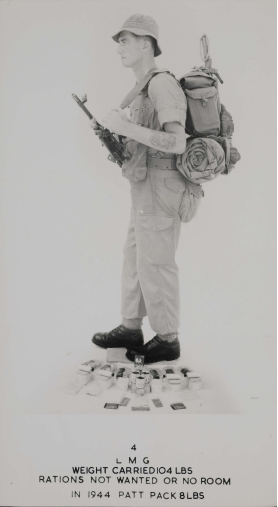
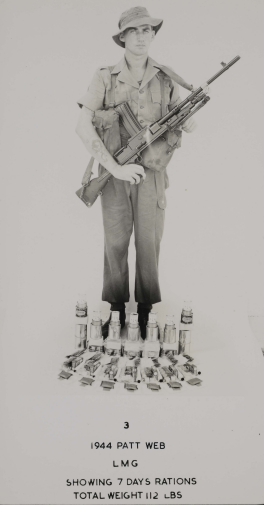
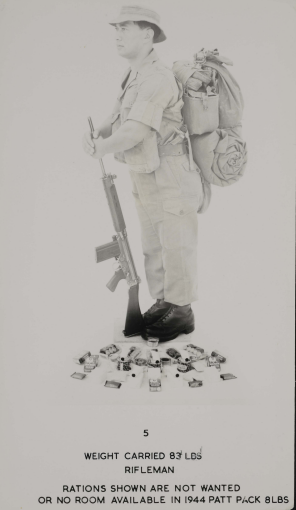
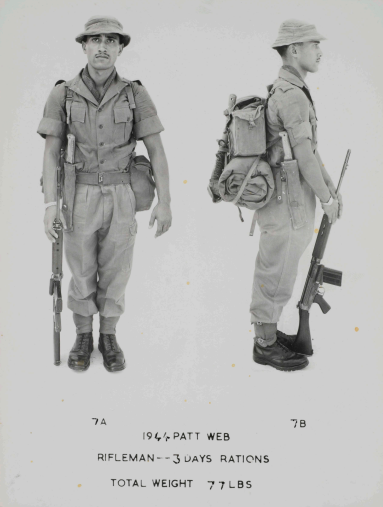
During World War Two, Operations in Malaya, Burma and the Pacific identified many shortfalls in the suitability of training, tactics and equipment, resulting in the Lethbridge Mission to the Far East during the late war. As a result of the report of the Lethbridge Mission, it was decided to modify the standard 37-pattern equipment to make it lighter in weight, rot-proof and more water-repellent and thus more suitable for use in tropical conditions. This development of the 37-pattern equipment led to the approval of a new pattern known as the 1944-pattern.[1] Post-war, further development of the 37 and 44-Pattern equipment led to troop trials of the Z2 experimental Load Carrying Equipment, which transitioned into the 1958-pattern equipment.[2]

Following World War Two, the Load Carrying Equipment in use by the New Zealand Army was the British 1937-pattern equipment. The 37-pattern equipment was introduced into New Zealand service in 1940, replacing the 1908-pattern equipment that had been in service since 1912. As 37-pattern equipment remained the standard web equipment of the New Zealand Army, the deployment of New Zealand troops to Malaya placed New Zealand in the position of deploying troops to a theatre with equipment that had long been identified as unsuitable. To maintain compatibility with other commonwealth forces in Malaya, 44-pattern equipment from British stocks in Malaya was issued to New Zealand troops in Malaya.

Example of 37-pattern equipment. Image: Simon Moore https://www.youtube.com/watch?v=NwnMIdynO8Y

. Given the environment that New Zealand troops could be expected to operate in and aware of the developments in load-carrying equipment, the New Zealand Chief of General Staff (CGS) requested and received one set of M1956 Web equipment from the United States for trials in 1959.[3]  The American M1956 Load-Carrying Equipment (LCE) had been accepted for United States Army service, with distribution well underway by 1961.

In October 1960, the New Zealand Director of Infantry and Training demonstrated the following web equipment to CGS.

  • 44-pattern Equipment
  • 58-pattern Equipment
  • M1956-pattern Equipment

A report by a New Zealand Officer attached to the Australian Jungle Training Centre at Canungra supported this demonstration with a comprehensive report describing the research and development of Infantry clothing and equipment undertaken by the Australians. The New Zealand report described the Australian trials of the M1956 LCE alongside the 58-pattern equipment. The M1956 was chosen by the Australians, who intended to manufacture it in Australia.[4] However, it was considered unlikely that either the 1956 LCE or 58-pattern equipment would be available to New Zealand until at least 1965, when the initial distribution to the United States and British armies was expected to be completed. Aware that all 44-pattern equipment had been earmarked for use in Malaysia and that it was still in production, New Zealand’s CGS approved the purchase of 6000 sets of 44-pattern equipment to re-equip elements of the New Zealand Army.[5]

Example of 44 pattern equipment, British Corporal, Malaya, Early 1950s. Image Simon Moore https://www.facebook.com/photo/?fbid=2346362332163840&set=a.421629590114595

Following advice from the UK, the 44-pattern equipment in use with the Fare East Land Forces (FARELF) was to be wasted out as the 58-pattern equipment was introduced, implying that the New Zealand Battalion would need to be equipped with the 58-pattern equipment before the ceasing of maintenance of the 44-pattern by FARELF. With this in mind, a recommendation was made to purchase 6000 sets of 58-pattern equipment instead of the 44-pattern equipment.[6]

Example of 58-pattern equipment. Image Simon Moore. https://www.facebook.com/photo?fbid=2080097568790319&set=pcb.2080098398790236

In a June 1961 memorandum to Cabinet, the Minister of Defence highlighted that the current 37-pattern equipment used by the New Zealand Army was not designed for Jungle operations and was unsuitable for carrying the extra equipment the soldier engaged in this type of warfare required. No longer used by the British Army in any part of the world, the stage had been reached where the replacement of the 37-pattern should be delayed no longer. As the 58-pattern could not be made available to New Zealand for some time and field trials had cast doubt on its suitability for use in the Southeast Asia theatre, it was considered that re-equipping of the New Zealand Army should proceed with the 44-pattern equipment. The 44-pattern equipment had proved itself and was known to be suitable in the theatre where New Zealand troops were most likely to be employed. It was assumed that by the time the 44-pattern equipment needed replacement, the full facts on the suitability of the 58-pattern and the M1956 web equipment would be available to make a more informed decision on its adoption by New Zealand. It was recommended that Cabinet approve £45645 plus freight to purchase 6000 sets of 1944 Pattern equipment. [7]

By October 1961, it became clear that the 58-pattern was to be the standard issue web equipment for all United Kingdom forces worldwide and that distribution to the forces in Malaya was to happen much earlier date than earlier expected. Because of this, the Army secretary desired further investigations on the suitability of 58-pattern web equipment and, if favourable, confirm costs and potential delivery dates. With the requirement for web equipment again in flux, the submission to purchase 6000 sets of 44-pattern equipment was withdrawn pending further research.[8]

By May 1962, plans for reorganising the New Zealand Army from a Divisional to Brigade Structure were under implementation.[9]  With approximately 50000 complete sets of 37-pattern equipment distributed to units or held in stores, this was deemed suitable to equip the bulk of the Territorial Force and Training units. The 58-pattern equipment was now in serial production and was the standard issue for all United Kingdom troops, with distribution to operational units in Malaya and Germany underway. Information received earlier was that because of limited production, stocks of 58-pattern would not be available for release to New Zealand for some years had been revised. It was now possible that the release of 58-pattern equipment to meet New Zealand’s requirements could be achieved earlier than anticipated. Based on this revised information, New Zealand’s Cabinet approved funding of £58750 on 10 October 1961 for 6000 sets of 58-pattern Web Equipment. [10]

Before placing a firm order for New Zealand’s requirements of 58-pattern equipment, reports received from Malaya in late 1962 indicated that the 58-Pattern equipment was, in its present form, unsuitable for use in operational conditions in South-East Asia.[11] It was anticipated that modifying the 58-pattern equipment to suit the conditions would take two to three years, an unacceptable delay in procurement as far as New Zealand is concerned.[12]

As the decision on New Zealand’s web equipment remained in flux, the New Zealand Battalion in Malaysia continued to be equipped with the 44-pattern equipment maintained under a capitation agreement with the United Kingdom. At New Zealand’s expense, one hundred sets of 44-pattern equipment were also maintained at New Zealand Battalion Depot at Burnham Camp to support reinforcements.

M1956 Web Equipment

As the time factor involved in modifying the 58-pattern equipment was unacceptable, and New Zealand was receiving an increasing amount of American equipment, the American M1956 pattern web equipment was decided to trial. The M1956 equipment had already been introduced into the Australian army, so twenty sets were purchased from Australian stocks for New Zealand’s trials.[13]

Following user experience in Malaya revealing that the 58-pattern equipment was falling short of the requirements for jungle operations, a series of investigations and user trials established that the US M1956 pattern equipment was suitable for use by the New Zealand Army. The funding for 6000 sets of 58-pattern Web Equipment was requested to be reprioritised to purchase 10000 sets of M1956 equipment direct from the United States and 400 sets of 44-pattern equipment to equip the increment for the FARELF held in New Zealand.[14]

With funding endorsed by the Minster of Defence and approved by the Cabinet, orders were placed for 10000 sets of M1956 web equipment direct from the United States. The first consignment arrived in New Zealand in early 1964, with 289 sets immediately issued to the New Zealand Special Air Service (NZSAS) and 16 Field Regiment, Royal New Zealand Artillery.

Instructions for distributing the M1956 web equipment were issued in June 1964 by the Quartermaster General. The initial purchase of 10000 sets of M1956 web equipment was to be issued to the Combat Brigade Group (CBG) and Logistic Support Group (LSG) units. Units of the Combat Reserve Brigade Group (CRBG) and Static Support Force (SSF) were to continue to use the 37-patten webbing.

 NMDCMDMOD (for CMD Trentham UnitsSMDMOD StockIssued SAS/ 16 Fd Regiment
CBG & LSG312230304012028310289
1st Reinforcement Reserve3162606198  
School of Infantry 40    
TOTAL343833304072226310289

As the issue of M1956 equipment progressed, units of the CBG and LSG were to hand back stocks of 37-pattern equipment to their supporting District Ordnance Depot except for

  • 08-pattern packs and straps
  • 37-pattern belt, waist web
  • Frogs bayonet No 5[15]

The 37 Pattern belt, waist web, was to be retained by all ranks as a personal issue authorised by NZP1 Scales 1, 5, 8 or 9. The belt and bayonet frog were to be worn with Nos 2A, 64, 6B, 7A and 7B orders of dress when other equipment items were not required to be worn.

Equipment Maintenance Policy Statement (EMPS) 138/67 issued by Army Headquarters on 20 November 1964 detailed that except for the CBG and LSG, 16000 sets of 37-pattern equipment were to be maintained for use by remaining elements of the New Zealand Army.[16]  EMPS 145/65 was issued on 12 February 1965, detailing the management of 44-pattern equipment in New Zealand. The First Battalion of the Royal New Zealand Infantry Regiment (1RNZIR) in Malaysia was to remain equipped with the 44-pattern web equipment maintained by the UK under the existing capitation agreement. Other than 100 sets of 44 Pattern Web equipment maintained at the Battalion Depot in Burnham, there was no provision for equipping 1RNZIR Reinforcements and increments of 31 Medium Radio Sub Troop who could be expected to deploy to Malaysia at any time. EMPS 145/65 rectified this by establishing a stockholding of 400 sets of 44-pattern equipment at the Main Ordnance Depot (MOD) at Trentham

Approval was granted in November 1965 by Army HQ for the Royal New Zealand Armoured Corps (RNZAC) and NZSAS to blacken their M1956 web equipment. The Royal New Zealand Provost Corps (RNZ Pro) was also approved to whiten their M1956 web equipment. This approval only applied to unit holdings, not RNZAC, NZSAS or NZ Pro members attached or posted to other units.[17]

By April 1967, most of the New Zealand Army was equipped with the M1956 equipment. The exceptions were.

  • The New Zealand Forces in Malaysia and South Vietnam, who used both the M1956 and 44-pattern equipment
  • The SSF, National Service Training Unit (NTSU) and New Zeeland Cadet Corps (NZCC), who still retained the 37-pattern equipment

The manufacture of 37-pattern equipment had long been discontinued, and New Zealand stocks had reached the point where although having considerable holdings of individual items, based on the belts as the critical item, only 9500 sets of 37-pattern equipment could be assembled.

Based on the projected five-year supply to the NTSU, Army Schools, Camps and the NZCC plus 10% maintenance per annum, there was a requirement for 12000 sets of 37-pattern equipment. Arranging production to meet the shortfalls was deemed cost-prohibitive, and as continued maintenance could not be guaranteed, it was decided that additional sets of M1956 equipment were to be purchased. The additional sets were to be purchased on a phased program over several financial years, with 5000 sets of 37-pattern retained for the NZCC.

Disposal of the 37-pattern was to be phased over three years.

  • 1967 all items surplus to 9500 sets
  • 1968 3000 Complete sets
  • 1969 all remaining 37 Pattern equipment less 5000 sets for the NZCC.[18]

M1967 Modernized Load-Carrying Equipment (MLCE)

In 1967 the New Zealand Army trialled three sets of the M1967 Modernized Load-Carrying Equipment (MLCE). Not specifically designed to replace the M1956 equipment, the M1967 equipment was designed for use in tropical environments and was introduced into the United States Army service in 1968.

The New Zealand trials found that the M1967 equipment was comfortable and weight-wise was similar to other web equipment in use. The pack worn on the belt was found to be heavy when fully loaded, and a pack similar in size to the 44 Pattern should be introduced, and the belt pack reduced in size by one-third.

It was identified that all the pouches required stiffening and that the plastic fasteners were not firmly attached to the pouches, although easy to operate. While using Velcro was found simple to operate, it was seen as a disadvantage due to noise and its inclination to pull apart when wet or under stress.[19]

Although the M1956 was still being introduced into the New Zealand Army, limited quantities of the M1967 equipment were introduced from 1969-72 with no plans for large-scale procurement. Nevertheless, the design of the M1972 All-Purpose Lightweight Individual Carrying Equipment (ALICE) incorporated many of the features of the M1967 equipment, and it was introduced into the New Zealand Army service in the 1980s.

Example of M-1967 MLCE. Image Simon Moore https://www.youtube.com/watch?v=Pwj59bifFMk

Although the 44-pattern web equipment continued to be used by New Zealand units in Southeast Asia, by October 1967, the decision had been made to standardise the M1956 equipment across the New Zealand Army, and no stocks of the 44-pattern equipment were to be retained in New Zealand.   All stocks of 44-pattern web equipment held by the MOD in Trentham for 1RNZIR Reinforcements and increments of 31 Medium Radio Sub Troop were issued to 1 RNZIR based at Terendak camp in Malaysia. As this stock held by 1RNZIR was wasted out, it would be replaced by M1956 web equipment. [20]

Large Ammunition Pouches

The Australian experience had shown that although the L1A1 Self Loading Rifle (SLR) Magazines fitted inside the M1956 ammunition pouch, it was a tight fit, especially when the webbing was wet. The initial solution was to modify 37-pattern pouches and fit them to the M1956 equipment. By 1967 the Australians had developed an indigenous ammunition pouch for the M1956 equipment., The Australian Ammunition Pouch Large (8465-66-026-1864) was manufactured out of cotton duck material and measured 81/4 inches high by 4 inches wide and 3 inches deep.

Australian Pouch Ammunition Large

To ascertain the suitability of the Australian large ammunition pouch for New Zealand service, fifty Australian pouches were sourced as a standardisation loan in 1968.[21] Feedback for the troop trials identified a lack of stability in the closure of the lid, causing the loss of ammunition and magazines. Following an investigation by the R&D Section, the RNZAOC Textile Repair Sections (TRS) modified the Australian pouches by replacing the lid fasteners with the same fasteners found on the standard American M1956 pouch and stiffing the fastener tabs. The modifications proved satisfactory in further Army Trials, and a new specification (DRDS-ICE-1) was produced with four Standard Samples provided to 1 Base Ordnance Depot (1 BOD).[22]  The modified New Zealand Pouch was codified in the New Zealand supply system as Pouch Ammunition Large (6746-98-103-4039).[23]

Detail of New Zealand Large Ammunition Pouch riveted lid fasteners

Although the R&D Section had ascertained that the manufacture of the pouches was possible in New Zealand using imported components, the initial production run of 20000 pouches was contracted through the Australian Department of Supply to be included in the current Australian production run.[24]  By 1974 the first production run of 20000 had been completed and returned to 1 BOD for distribution, with 2/1 RNZIR in Burnham one of the first units to receive the new pouches. In May 1974, 2/1 RNZIR submitted defect reports stating that the pouches were poorly designed, with the canvas tongue used to secure the lid failing, pouches becoming insecure, and magazines dropping out.[25]

The investigation by the Directorate of Equipment Policy and the R&D Section found that the faults were not a design problem but a quality assurance issue in that the pouches had not been manufactured following the specification.[26]   Comparing the Australian-manufactured pouches against the specification, the R&D Section identified the following visually detected defects.

  1. Canvas used to manufacture strap-holding assembly instead of webbing.
  2. Clip end strap is wrongly sized.
  3. Release tab is of incorrect thickness.
  4. Polypropylene stiffener not inserted in release tab.
  5. The male fastener is not secured to the PVC stiffener.
  6. The reinforcement piece behind the male fastener is not included (between the PVC stiffener and lining).
  7. Additional smaller reinforcement piece inserted between the outer cover and the male fastener.
  8. Broad arrow marked on the outer cover and not specified.

Of these defects, only serials 3 to 7 were directly considered to contribute to the deficiencies and the initial concerns raised by 2/1RNZIR and would require rectification, and a modification instruction was produced.[27]  Modification of the pouches would take until September 1977 to be completed.[28]

Due to the Broad Arrow Mark included on the first batch of 20000 New Zealand Large Ammunition Pouches, collectors often misidentify these items as Australian pouches.

White Web

By 1973, 37-pattern belts, rifle slings and bayonet frogs remained in use as ceremonial items. Whitened using proprietary shoe cleaner and paint, these items were badly worn with the whitener flaking easily and were easily marked by weather, fingerprints and the rubbing of other equipment. The M1956 pattern web belt was not considered suitable as a replacement as it was operational equipment requiring the breaking up of complete web sets to provide items for ceremonial events. Following the British lead, the Army Dress Committee approved a polythene, four-ply woven fabric of similar appearance and texture to the 37-pattern equipment in October 1973 as a replacement for the whitened 37-pattern equipment. The sling and bayonet frog designed for the SLR would be purchased with chromed or brass fittings. The material for the belts was provided on rolls which could be cut to the required size. Buckles and keepers were 37-pattern buckles and keepers drawn from existing stocks that had been chromed and polished.[29]

Combat Pack

By 1974, one of the few pre-1945 items of load-carrying equipment remaining in New Zealand service was the 08-pattern pack. Long identified as an unsuitable item, several trials had been conducted since the mid-1960s to find a replacement combat pack. Although a few alternative items had been investigated as a replacement, the 08-pattern pack remained the principal combat pack of the New Zealand Army.

In 1969/70, the requirement for 15000 combat packs to replace the 08-pattern pack was identified. Following evaluation by the equipment sponsor, the Australian Army Combat Pack was selected as a basis for developing a New Zealand combat pack. The Australian pack was chosen from a wide range of military and civilian packs, with the design modified to meet the particular training requirements of New Zealand. The modifications to the Australian pack were limited to comply with the following:

  • The pack must be compatible with Australian Army equipment.
  • The pack must be compatible with M1956 equipment currently in New Zealand service.

Against the advice of the R&D section, the Australian pack was modified by the New Zealand Army without a proper study being conducted.[30] The decision to bypass the R&D process resulted in a prototype process that extended from 1972 to 1974.[31] By June 1974, trials on the prototypes resulted in the setting of a standard design for a production run of one hundred packs for further trials.[32]

New Zealand modified Combat pack

The New Zealand version of the Australian combat pack was eventually accepted into service in 1975/76. Never a satisfactory pack, the R&D section began investigations to find a replacement in the early 1980s. Hoping to leverage the experience of New Zealand Mountaineers to produce a modern pack, Army R&D embarked on the Onward Pack project. Manufactured by Hallmark Industries of Hamilton, the Onward pack was an innovative modular design that allowed the main pack to be broken down into a patrol pack and a light belt order,

The Basic layout of the Onwards pack was a main compartment divided into a main compartment and a sleeping bag compartment divided by a zip-away divider. The upper compartment was divided into the main storage area and internal space for an AN/PPC-77 set. External access to the main compartment was via a large snow collar with outlets for the radio antenna and handset built into the lid. External access to the lower sleeping bag section was provided by a zip which allowed the bottom half of the compartment to drop down. Internal sleeping mat storage was included as part of the harness and backpack. Three external removal pouches were provided, one on each side attached by domes and a larger pouch mounted on the centre front of the pack by buckles body. Behind the Large centre pouch, securing straps were provided to secure an Entrenching Tool. These three external pouches were fitted with belt loops, which allowed them to be removed and fitted to either the pack’s waist belt or standard pistol belt as a light belt order.

A small patrol pack designed to hold an ANPRC-77 Set was also provided as part of the Onward pack., The patrol pack could be mounted to the top of the Onward Pack or by utilising the pack’s shoulder straps, worn as a standalone pack. The Patrol pack was also fitted with a fluorescent recognition panel in a zip-up compartment.

Despite the host of features and the additional space provided compared to the Australian pack, the Onward Pack was fraught with issues. The proprietary plastic clips were prone to failure, and the body-hugging ‘alpine’ design caused causing severe prickly heat on users in the tropics of Southeast Asia. These and other issues with the Onward Pack contributed to an extended development period as attempts were made to rectify them. As these and other minor faults were addressed to meet the immediate needs of users while the Onward Pack was perfected, the medium American ALICE pack was introduced as an interim replacement in 1984.[33] Eventually, attempts to rectify the Onward Pack were abandoned and the ALICE pack was formally adopted as the New Zealand Army pack.

Conclusion

Entering the Second World War with web equipment of the same pattern used since 1912, New Zealand’s Force soon began to be re-equipped with the most modern British web equipment, the 37-pattern from early 1940. Near the end of the war, New Zealand was kept abreast of the development of web equipment, and when New Zealand troops arrived in Malaya in the early 1950s, they were issued with the most modern type available for jungle warfare, the 44-pattern. As the New Zealand Army reorientated from providing a division to serve in the Middle East to providing a Brigade Group to serve in Southeast Asia, it could not wait for the British to develop their new 58-pattern for tropical conditions and examine other types. Following Australia’s lead, the American M1959 equipment was adopted in 1964, with components of this type serving thought to the early 2000s. With five types of web equipment either adopted or trialled between 1945 and 1974, it is no surprise that components got intermingled. This led to Kiwi soldiers’ preferences and experiences leading them to create webbing sets that they found practicable rather than options prescribed in SOPs or instruction books leading to the outside impression of the New Zealand army been one equipped with an eclectic range of Australian, British and American equipment.


Notes

[1] 86/Development/47 (SWV1) Report on the Development of Personnel Fighting and Load Carrying Equipment 1942-48 February 1949. “Cookers – Web Equipment: New Pattern,” Archives New Zealand No R17189098 (1944 -1966).

[2] 86/Dev/54 (SVW1) Instruction for troop trials of Z2 Experimental Load Carrying Equipment ibid.

[3] New Zealand Joint Services Mission Washington DC JSM 1/3/13 ARM US Army Load Carrying Equipment (Web) dated 23 September 1959ibid.

[4] Attachment to JTC – Canungra dated 21 October 1960 “Stores – New Infantry Equipment for New Zealand Army,” Archives New Zealand No R17189007 (1959-1970).

[5] Army 246/60/12/SD Web Equipment dated 20 December 1960 “Cookers – Web Equipment: New Pattern.”

[6] Army 246/60/12/SD Web Equipment dated 20 December 1960ibid.

[7] Memorandum Minister of Defence to Cabinet dated June 1961ibid.

[8] 246/60/12/adm Army Secretary to Minister of Defence 2 October 1961ibid.

[9] Damien Fenton, A False Sense of Security: The Force Structure of the New Zealand Army 1946-1978, Occasional Paper / Centre for Strategic Studies: New Zealand: No. 1 (Centre for Strategic Studies: New Zealand, Victoria University of Wellington, 1998), 111-20.

[10] Army 246/60/12/Q(E) Brigade Group Equipment Replacement Web Equipment dated 8 May 1962 “Cookers – Web Equipment: New Pattern.” -pattern equipment

[11] BM 2 to FE16002SD General HQ FELF to The War Office (Brig Q Eqpt) 1958 Pattern Web Equipment dated 4 October 1962: ibid.

[12] 57/62 NZ Army Liaison Staff, London to Army HQ dated 17 October 1962 ibid.

[13] Army 246/60/12Q(E) Sample US Pattern Web Equipment dated 12 December 1962 ibid.

[14] 246/60/12/SD Web Equipment for the Field Force dated 18 October 1963 ibid.

[15] Army Reqn 208/63/Q(E) dated 9 June 1964 -Distribution of M1956 Web Equipment “Cookers – Web Equipment: Pattern ’37,” Archives New Zealand No R17189095 (1940-1971).

[16] EMPS 138/64 of 20 Nov 1964 ibid.

[17] Army HQ Army246/60/12/PS3 of 19 Nov 1965 ibid.

[18] Defence (Army) 246/60/2 of 26 April 1967 ibid.

[19] 1 Ranger Squadron NZSAS, Trial Report US Lightweight Equipment dated 21 March 1968″Cookers – Web Equipment: New Pattern,” Archives New Zealand No R17189099 (1966 -1969).

[20] Army 246/60/12/Q(E) EMPS 145/65 Frist Revise dated 5 October 1967 ibid.

[21] “Cookers  – Web Equipment: Slings, Bandoliers, Ammunition Pouches: Development,” Archives New Zealand No R17189101 (1968-1970).

[22] Def HQ/R&D Section 82/1974 dated 28 Jun 1974.”Equipment Administration: Research & Development – Projects Personal Load Carrying Equipment: Ammunition Pouches,” Archives New Zealand No R17231111 (1972-1977).

[23] 246/60/2 of 122055ZNOV70 NZDWN to 1BOD Trentham “Cookers – Web Equipment: Pattern ’37.”

[24] Army 246/60/70 dated 9 December 1971. “Equipment Administration: Research & Development – Projects Personal Load Carrying Equipment: Ammunition Pouches.”

[25] FF 65/38/18/SD Modification of Ammunition Pouch item 10 May 1974. “Cookers – Web Equipment: New Pattern.”

[26] Army 246/60/17/EP. “Equipment Administration: Research & Development – Projects Personal Load Carrying Equipment: Ammunition Pouches.”

[27] R&D Section Minute no 160/1975 dated 21 November 1975. “Cookers – Web Equipment: New Pattern.”

[28] Army 246/60/17/SP 22 Pouches Ammunition 22 September 1977. “Cookers – Web Equipment: New Pattern.”

[29] “Army Dress Committee Decision – White Web,” Archives New Zealand No R17188112 (1973).

[30]  R&D Section 67/1974 Packs Combat date 13 June 1974. “Equipment Administration: Research & Development – Projects Personal Load Carrying Equipment: Waterproof Pack,” Archives New Zealand No R17231110 (1972-1974).

[31] Army 246/60/12/EP Sponsor Enquiry Field Pack Olive Green 2 July 1972. Ibid.

[32] Army 246/60/12/ EP Minutes of the final meeting on the acceptance of the Combat Pack held at Army General Staff on 8 June 1973. “Conferences – Policy and General – NZ Army Dress Committee 1984,” Archives New Zealand No R17311893 (1984).

[33] Inf 26.3 Minutes of a meeting to consider Project Foxhound developments held at Army General Staff 8 June 1984. Ibid.


Royal New Zealand Army Service Corps

In British and Commonwealth military doctrine, there has long been a separation of responsibility for Supplies and Stores.

  • Supplies – The provisioning, storing, and distributing of food for soldiers; forage for animals; Fuel, Oil, and Lubricants (FOL) for Tanks, Trucks, and other fuel-powered vehicles and equipment; and the forward transport and distribution of ammunition. In the NZ Army, Supplies were managed by the New Zealand Army Service Corps (NZASC) from 1911 to 16 October 19789.
  • Stores – The provisioning, storage, and distribution of weapons, munitions, and military equipment are not managed by RNZASC. Stores were the Responsibility of the Royal New Zealand Army Ordnance Corps (RNZAOC) until 1996.

Despite the separation of responsibilities, the RNZASC and RNZAOC would have a long and cooperative relationship for most of their existence.

During the early colonial days, the early actions of the New Zealand Wars proved that the New Zealand bush and the elusive tactics of the Maori presented new problems in supply and transport. An Imperial Supply and Transport Service was established and operated with the Imperial troops.

From the end of the New Zealand Wars until 1910, there was no ASC unit in New Zealand, with the supply functions required by the New Zealand Military provided by the Defence Stores Department.

After the conclusion of the South African War, the Military Forces in New Zealand embarked on a series of reforms to enhance the organisation and capability of the nation’s military, enabling it to contribute effectively to a broader Imperial Defence scheme. In 1910, at the request of the New Zealand Government, Field Marshal Viscount Kitchener inspected New Zealand’s Forces. Kitchener provided several recommendations concerning the ongoing reforms, emphasising the need for a professional Staff Corps to administer the force and confirming the requirement for a New Zealand ASC, which was gazetted on 12 May 1910 (backdated to 6 May 1910) as a designated component of the Territorial Forces of New Zealand.

The momentum for these reforms gained further impetus with the appointment of Major General Alexander Godley as the New Zealand Military Forces Commandant in December 1910. Godley was pivotal in revitalising New Zealand’s military organisational framework in his first year, making critical command and staff appointments, promulgating the (Provisional) Regulations for the Military Forces of New Zealand, and making plans to build up the NZASC, which up to this time had remained a paper corps.

Acknowledging the highly specialised nature of ASC duties, distinct from combatant staff and regimental officers, and the absence of suitably qualified officers in New Zealand, Godley recommended to the Minister of Defence on 4 January 1911 the lending of services of an experienced Imperial ASC Senior Captain or Major to organise and train New Zealand’s transport and supply services for three years. The Minister of Defence endorsed this recommendation with the Prime Minister cabling the New Zealand High Commissioner in London on 10 January 1910 to approach the Army Council for the following:

Services of experienced Army Service Corps major or senior captain required to organise New Zealand Army Service Corps. Engagement for three years. Salary £600 a year consolidated. Pay to include house allowance. Travelling allowance of 12/6d a day and allowance for one horse if kept, will also be granted. 

Within two months of receiving New Zealand’s request for an ASC Officer, the Army Council promptly and affirmatively responded to the call. Having already sanctioned nine additional officers to assist Godley, the Council selected Knox, who then served in C (Depot) Company ASC at Aldershot for service in New Zealand to organise the NZASC.

Under the guidance of New Zealand Adjutant and Quartermaster-General Colonel Alfred Robin, Knox assumed his duties as the New Zealand DST at the Army General Staff Offices on Wellington’s Buckle Street. His responsibilities encompassed a wide range of functions, including quarters, tender and contracts, personal and freight movement, and presidency on two standing committees related to Drill sheds and the storage and distribution of clothing and equipment to the forces.

Recognising Knox’s extensive duties, he was granted the Temporary Rank of Lieutenant Colonel on 6 September 1911. With Colonel Robin’s appointment as the New Zealand representative at the War Office in London in 1912, Knox assumed the additional role of Quartermaster General (QMG). Despite Knox diligently fulfilling the role of QMG and DST, progress on the formation of the NZASC was slow.

By 1914, Knox had established 16 NZASC companies of approximately 30 men each across the four New Zealand Military Districts, with imported ASC officers serving as Assistant Directors of Supply and Transport (ADST) in each District Headquarters.   Although Knox had departed by the time of the 1914 divisional camps, the Inspector General of Imperial Forces, General Sir Ian Hamilton, noted following his inspection that:

The very highest credit is due to the Army Service Corps officers and their men. They have done a first-class service, although as a rule undermanned to an extent that would fill a labour union with horror. When the Army Service Corps units are up to their normal strengths, a suitable system of calling the men up to camp in relays will enable the necessary duties to be carried out as efficiently and with much less strain on the personnel.

During World War One, New Zealand ASC units fulfilled crucial functions. ASC Companies supported the Territorial Infantry and Mounted Rifle Brigades. At the same time, Supply and Transport Units aided mobilisation camps within New Zealand. Overseas, the NZASC operated across all New Zealand theatres of war, delivering indispensable services. At its zenith, it managed the NZ Divisional Train, five ASC Companies, five Depot Units of Supply, the NZ Field Bakery, the NZ Field Butchery, and the NZ Motor Transport Workshop. Notably, the NZASC and NZAOC frequently shared personnel, facilities, and transportation, especially in the conflict’s early years.

In 1917 the NZAOC was established as a permanent component of the New Zealand Military Forces, however, it would not be until 1924 that the Permanent NZASC was formed.

Post-war, under the leadership of Captain Stanley Herbert Crump, the NZASC transitioned to a peacetime establishment comprising a Headquarters and three depots (Northern, Central, and Southern). In 1924, the Permanent NZASC (PNZASC) was established as part of the permanent Military Forces. Additionally, in 1925, an alliance between the NZASC and the Royal Army Service Corps (RASC) was ratified.

The RASC has its roots in history that are much more profound. Up to the time of Cromwell, armies mainly lived by plunder. The RASC came into being in 1888. but the work it now performs was being done long before that.

Cromwell and then the Duke of Marlborough, and later Napoleon, organised a system of civilian commissaries. The Duke of York established the Corps of Royal Waggoners in 1794. This purely transport organisation continued until 1869 under various names, eventually as the Military Train, fighting as light cavalry in the Indian Mutiny.

The birth of the Supplies and Transport Service dates from 1869. when supplies and transport, along with the Military Stores Department, came under one department called the Control Department, it remained for General Sir Redvers Buller in 1888 to organise the first Army Service Corps. Since its formation, the RASC has been a combatant one. Trained and armed as infantry and responsible for its own protection. Considerd a more technical Corps, the RAOC was not granted combatant status until 1942.

In 1931, under Crump’s continued leadership, the NZASC underwent a reorganisation into three Composite Companies. Each company comprised seven officers, four warrant officers, and 99 other ranks, establishing a solid foundation from which the NZASC could readily expand to meet the demands of future conflicts.

During World War Two, numerous units and establishments represented the NZASC across all New Zealand Expeditionary Force (NZEF) theatres. Similar to the previous World War, the NZASC maintained a collaborative relationship with New Zealand Ordnance Corps (NZOC) Ammunition Examiners (AEs) in the establishment of NZASC Ammunition platoons. At times, NZASC Warrant Officers were attached to the NZ Divisional Ordnance Field Park (OFP) to offer technical advice on vehicle spares. In recognition of the NZASC’s service during WW2, the title “Royal New Zealand Army Service Corps” was conferred in 1946.

In the post-war era, the NZASC and from 1946, the RNZASC would serve with distinction J Force in Japan and then contribute the second-largest New Zealand contingent to K Force in Korea by providing 10 Transport Company. Playing a pivotal role in sustaining the morale and effectiveness of New Zealand forces during these conflicts

Until 1947, NZASC units primarily handled baking bread, butchering meat, and procuring and distributing fresh and packaged provisions to frontline units, while regimental cooks and stewards were responsible for cooking and serving meals. To enhance and standardise cooking practices throughout the army, the Supplies and Transport Catering Group (STCG) was established on 15 February 1948 with the following objectives:

  • Training and provision of unit cooks and kitchen hands.
  • Instruction and supervision of the management of the Army ration scale.
  • Improvement of food preparation and cooking standards.
  • Advice on the installation and operation of cooking appliances and kitchen equipment.
  • Guidance on the layout of mess buildings.

In September 1948, all Regimental catering staff, except those of the New Zealand Women’s Army Corps, were transferred into the RNZASC. Throughout the 1950s, 60s, and 70s, the RNZASC played a vital role within the New Zealand Army, encompassing a wide range of functions. These included everyday tasks such as cooking and serving food, as well as more complex operations like air supply drops. To manage the procurement, storage, transportation, and distribution of essential supplies such as food, fuels, and oils for a modern Army, the RNZASC operated Supply Depots and employed various tradespeople, including butchers. Supply Depots were strategically located in Papakura, Waiouru, Linton, Trentham, and Burnham, where bulk supplies were stored and distributed as needed. Additionally, every Army camp featured a section of the RNZASC, along with smaller supply and transport depots, which were responsible for handling goods from central supply depots and providing drivers and transport services for various purposes. These smaller depots were situated in Devonport/Fort Caultley,

ANZUK Supply Platoon, Singapore – 1972 Standing L to R: Cpl Parker, RAASC. Cpl Olderman, RAASC, Cpl Mcintyre, RAOC. Sgt Frank, RAOC. Cpl Rangi, RNZASC. Sgt Locke, RNZASC. Sgt Bust, RAOC. Pte Mag, RAASC. Cpl David, RAASC. Sitting L to R: Sgt Kietelgen, RAASC. WO2 West, RAOC. Capt Mcnice, RAOC. Maj Hunt, RAASC. Lt Fynn, RAASC. WO2 Cole, RAASC. WO2 Clapton. RAASC

Following the Macleod report that recommended the streamlining of logistic support for the British Army, the RASC merged in 1965 with the Royal Engineers’ Transportation and Movement Control Service to form the Royal Corps of Transport (RCT). This would see the RASC Supply functions transferred to the Royal Army Ordnance Corps (RAOC). In 1973, following the British lead, the Australians also reformed their Royal Australian Army Service Corps (RAASC) into the Royal Australian Army Corps of Transport (RAACT).

Acknowledging the British and Australian experience, the RNZASC underwent a similar transition—operational command of the Supply function transferred to the RNZAOC on 16 October 1978. On 12 May 1979, the RNZASC ceased to exist: Supply personnel formally transferred to the RNZAOC, while Transport, Movements, and Catering were re-formed as the Royal New Zealand Corps of Transport (RNZCT)..

The RNZASC supply function would be integrated into the RNZAOC, with the Camp Supply Depots becoming NZAOC Supply Platoons numbered as.

  • 14 Supply Platoon, Papakura/Hopuhopu
  • 24 Supply Platoon, Linton
  • 34 Supply Platoon, Burnham
  • 44 Supply Platoon, Waiouru
  • 54 Supply Platoon, Trentham
  • NZ Supply Platoon, Singapore

In recognition of its long RNZASC service, 21 Supply Company was retained as a Territorial unit, initially as the Territorial element of 4 Supply Company in Waiouru and later as the Territorial element of 2 Supply Company, Linton. Today, 21 Supply is the principal North Island Supply unit of the Royal New Zealand Army Logistic Regiment (RNZALR).

For a short period following the RNZAOC assumption of Supply functions, some RF and TF RNZAOC would periodically be employed within the RNZCT transport Squadrons’ Combat Supplies sections.

The RNZAOC Butcher trade inherited from the RNZASC would be discontinued in the mid-1980s, with the last of the butchers reclassifying as RNZAOC Suppliers. By the mid-1990s, it was decided as a cost-saving measure to allow the RNZCT catering staff to order directly from commercial foodstuff suppliers, effectively ending the RNZAOC foodstuffs speciality. The only RNZASC trade speciality remaining in the RNZAOC after its amalgamation into the RNZALR was that of Petroleum Operator.

The Royal NZ Army Service Corps & Corps of Transport, like the RNZAOC, have passed their combined responsibilities to the RNZALR. However, the Royal NZ Army Service Corps & Corps of Transport maintain a strong association that provides many benefits and opportunities for comradeship to RNZASC/CT Corps members and past and present members of the RNZALR. Another role of the RNZASC/CT association is to ensure that the rich and significant history of the RNZASC/CT is not lost to future generations of the RNZALR.

Copies of the RNZASC/CT association newsletter can be viewed here


New Zealand Installation Auxiliary Police Force

The New Zealand military presence in Singapore is an established chapter of New Zealand’s military historiography. Material related to the background and history of the ANZUK Force, the New Zealand Force South East Asia, and 1 RNZIR is readily available. However, information on many of the New Zealand sub-units is more challenging to locate. One unit that was an integral component of the NZ Force of the 1970s and 80s and continues to serve as part of the residual force maintained by New Zealand in Singapore is the Installation Auxiliary Police Force (IAPF).

Upon the 1989 closure of New Zealand Force South East Asia (NZFORSEA), the New Zealand Defence Support Unit (NZDSU) was created to maintain New Zealand’s military presence in Singapore.  Located at the Sembawang Naval Installation (SNI), the NZDSU provides Singapore-based deployable support to NZ Forces throughout Southeast Asia. The NZDSU also contributes to the security of allied (US, UK and Australian) forces in Singapore through the provision of the IAPF. The NZDSU commands the IAPF, whose principal responsibility is the provision of Physical security to the SNI, including checks of all personnel and vehicles entering and leaving the Installation.

The IAPF is a small force 56 Singapore Auxiliary Police Officers (APO) and operates under the authority of Section 92(1) or (2) of the Police Force Act 2000. Under the provision of this Act the IAPF is vested with all the power, protection and immunity of a Singapore police officer of corresponding rank. As Singapore APO’s, members of the IAPF are licensed to carry firearms when carrying out their duties.

The NZ IAPF originally wore colonial-era Khaki uniforms with the iconic “Kiwi” patch. From around 2000, the uniforms of the IAPF were modernised and standard Singapore police uniforms adopted. The uniform is worn with a IAPF and Kiwi patch worn on each sleeve.

In 1987 RNZAOC Warrant Officer Class Two Wayne Le Gros, wrote the following article on the history of the IAPF for the Journal of the New Zealand Military Society, who have granted permission for it to be reprinted here .

HISTORY OF THE INSTALLATION AUXILIARY POLICE FORCE

Provided by W.Le Gros

The Installations Auxiliary Police Force was formed on I December 1971 as a result of withdrawal of UK Forces from Singapore. The creation of the lAPF was legalised vide Singapore Government Gazette Notification No. 171 dated 21 January 1972.

Prior to the creation of the IAPF, the MOD (UK) maintained huge military bases for its navy, army and air force. Each had its own police force to maintain security of the installations. Although the exact size of its own police forces is not known, it is estimated that there were about 2,000 people employed as policemen. These 2,000 policemen were not all Singapore citizens. Many were Malaysians, Indians and Pakistanis. Some possessed UK Citizenship. This was permissible because Singapore was then a British colony.

With the disbandment of MOD(UK) police forces following the withdrawal of UK Forces from Singapore, all the foreign nationals were retrenched and they either returned to UK or to their own countries. The few hundred policemen that remained were Singapore citizens and in the final stage of the military withdrawal, these Singapore citizens did not escape the retrenchment exercise which ended on 30 November 1971. Singapore citizens who were under 45 years at that time were absorbed into the newly created IAPF.

It is interesting to note here that although the Navy, Army and Air Force had its own police forces, not all police personnel received the same training. The Navy sent its police recruits to the Singapore Police Training School for 9 months of basic police training. The Army and Air Force had their own training schools, but they concentrated more on physical security. Hence when the IAPF started in 1971, IAPF personnel had different police training background. This was however streamlined when the IAPF organised refresher courses for all its personnel.

All IAPF personnel carry warrant cards issued by the Commissioner of Police Singapore. They have the same powers, protection and immunities of a Singapore police officer of corresponding rank within the area under the jurisdiction of NZ Force S.E. Asia providing also that they have the same powers etc outside the area when in fresh pursuit of or in charge of any person who has committed or is suspected of having committed an offence within the limits of such an area or within view outside such an area.

All IAPF personnel are subject to discipline under the Auxiliary Police Regulations and have a right of appeal to the Commissioner of Police, Singapore on disciplinary matters. The promotion of any IAPF personnel is subject to the approval of the Commissioner of Police. Before any personnel can be promoted, he must present himself before a 3-member Joint Promotion Board convened by the Commissioner of Police. The Chairman of the Joint Promotion Board will be a senior Singapore Police Officer while the other two members are OC IAPF and NZ CEPO, the employing authority.

The IAPF when first established in 1971 under the ANZUK Command had 400 personnel and was commanded by Supt. SK. Sundram, (equivalent to Lt. Col. Rank) a retired Singapore Police Officer. It had 1 Asst. Supt, 9 Inspectors and the rest was made up of constables, corporals and sergeants. In 1975, when Australia and UK withdrew from the ANZUK Command,  62 personnel made up of 2 officers and 60 rank and tile were transferred 10 NZ Force S.E Asia and formed the NZ IAPF. Today, the strength is reduced to 50 personnel as a result of an overall review carried out in 1984.

The NZ IAPF is responsible with the:-

  • Protection of life and property within the NZ/UK Forces installations
  • Control of entry of all persons to NZ/UK Forces installations
  •  Cash/ammunition escorts

Although the IAPF is a small auxiliary police force, it performs a variety of duties. As most of its personnel have given many years of faithful service, the loyalty and devotion of these personnel have always remained steadfast to this date.


Rickshaw Military Research

Rickshaw Military Research specialises in the research and transcription of New Zealand Military Service Records to allow families to learn of their families military experience in peace and war. Services offered by Rickshaw Military Research include;

  • Interpretation of military records,
  • Assistance with military research,
  • Identification of medals, badges and insignia, and sourcing of replacements.
  • Regiment and unit identification.

Often, descendants of New Zealand Servicemen have some inkling that their ancestors served in the military. Knowledge of a relative’s service will often be a source of pride with some evidence such as photos of the relative in uniform, medals, unit badges, diaries, and other souvenirs existing. However, for many, any connection to their relative’s military service is long-forgotten and a mystery. For some, the only link to a relative is an inscription on one of New Zealand’s many War Memorials.

For all those interested in discovering more about their ancestors military service, accessing the individual’s service record and understanding what is written in it can be a daunting exercise,first in gaining the service record and then interpreting the peculiar language used by the military and making sense of the many abbreviations used, reading a service record often leads to more questions than answers.

Rickshaw Military Research provides a service where we work with the family and after some preliminary questions, access the relevant military service record from the archives and produce a transcript of the relative’s service record into an easy to read format, including;

  • Personal details of the individual.
  • Brief description of activities prior and after service.
  • Record of service, from enlistment to demobilisation, including;
    • Formations/Units served in.
    • Campaigns and battles that were participated in.
    • Locations visited.
  • Record of Promotions.
  • Record of Illness and Injuries.
  • Records of medals and awards, including citations.
  • Brief description of post-service activities.
  • Illustrations will be provided where possible and could include;
    • Photos of the serviceman.
    • Medals.
    • Badges and patches worn.
    • Maps.
    • Equipment used, i.e. if a serviceman was a tank driver, an illustration of the type of tank driven.

Services offered

Pre 1921 Records

Service records prior to 1921 including the South Africa and First World War.

  • Basic one-page summary of service: $100*
    • Basic service information from attestation to discharge edited to fit on a single A4 sheet.
  • Full transcript of service : $250*
    • Transcript of service relating to target serviceman with additional information on units served in and campaigns participated in presented as a booklet or interactive Web App.

Post 1921 Records

Service records from 1921 including the Second World War, Korea, Malaya, Borneo, South Vietnam, CMT & National Service, Peacekeeping and Territorial and Regular service in New Zealand)

  • Basic one-page summary of service: $150*
    • Basic service information from attestation to discharge edited to fit on a single A4 sheet.
  • Full transcript of service : $300*
    • Transcript of service relating to target serviceman with additional information on units served in and campaigns participated in presented as a booklet or interactive Web App.

Other Research

Other research outside the scope of researching Personnel Records is charged at a rate of NZD$30 per hour.

*All prices are GST inclusive.

Interested in knowing more? Feel free to contact Rickshaw Military Research and let us know how we can assist.

← Back

Thank you for your response. ✨


RNZAOC 1 April 1959 to 31 March 1960

The RNZAOC experienced a momentous period marked by key developments. Establishing the RNZAOC School was a notable milestone, alongside identifying challenges related to officer recruitment. This era also witnessed the realisation of plans to modernize and equip the Army with state-of-the-art resources. The initial deliveries of new equipment arrived, replacing a significant portion of the outdated wartime equipment and contributing to the transformation of the Army into a modern and well-equipped force.

Key Appointments

Director of Ordnance Services

  • Temporary Lieutenant Colonel H. McK. Reid

Chief Inspecting Ordnance Officer

  • Major JW Marriot

Officer Commanding Main Ordnance Depot

  • Major Harry White, from 1 May 1959

RNZAOC School

  • Chief Instructor – Major Harry White
  • Regimental Sergeant Major – Warrant Officer Class One Alfred Wesseldine

2nd Battalion, the New Zealand Regiment

In July 1959, the 2nd Battalion of the New Zealand Regiment was reestablished at Waiouru. The battalion embarked on a rigorous workup and training phase, preparing them for their deployment to Malaya in November 1959, where they would relieve the 1st Battalion. To support the training and preparations of the 2nd Battalion, the RNZAOC furnished the battalion with the essential equipment it required by drawing from existing stocks. This ensured that the battalion was fully equipped from the ground up to fulfil its operational requirements.

Establishment of RNZOAC School

Upper Hutt City Library (29th Jan 2020). Trentham Camp; Royal New Zealand Army Ordnance Corps School sign.. In Website Upper Hutt City Library. Retrieved 14th Jul 2020 11:51, from https://uhcl.recollect.co.nz/nodes/view/1335

Under discussion by the Army Board since 1956, the RNZAOC School was established in September 1959. Established within the Peacetime Establishment of the Main Ordnance Depot, the RNZAOC School would be under HQ Ordnance Services’ direct control and independent of the Army Schools.[1]

The initial school organisation would be.

  • A Headquarters,
    • Chief Instructor – Major Harry White
    • School Sergeant Major – Warrant Officer Class One Wesseldine
  • Ammunition Wing
  • Stores and Vehicle Wing

The function of the RNZAOC School would be to run courses and training for RF and TF personnel of the RNZAOC, including

  • Star Classification Courses – particularly for Storeman/Clerks RNZAOC and Ammunition Examiners.
  • Promotion courses for both officers and ORs.
  • Recruit training RNZAOC Personnel, including Recruit training for Group 2 personnel.
  • Advanced training for both officers and ORs, in all types of Ordnance activities.
  • Technical training in ordnance subjects, e.g. Inspecting Ordnance Officer courses.
  • Preservations and packing etc.
  • Refresher training for qualified personnel.
  • Other courses notified in the annual Forecast of Courses.

Additionally, as directed by DOS, the RNZAOC School was required to.

  • Plan and hold conferences and training exercises.
  • Draft procedure instructions.
  • Test, or comment on new procedures, materials, or equipment.
  • Research various aspects of Ordnance activities.

The first course conducted by the RNZAOC School would be an instructor’s Course conducted in late 1959.

First Instructors Course, 1959. Chief Instructor Major Harry White is seated 3rd from left. Officer in the front Centre id Makor K.G Cropp. Robert Mckie RNZAOC Collection

Officer Shortfall

A projection of planned retirements for RNZAOC Officers up until 1962 indicated that a total of seventeen officers would be leaving the service. Historically, the main method of filling RNZAOC officer positions had been through the commissioning of Other Ranks with Quartermaster Commissions. However, since November 1956, only three officers had joined the RNZAOC directly as officers.

Upon evaluating the planned officer retirements in relation to the RNZAOC officer establishment, it was discovered that the organization faced a deficiency of six officers. This shortage highlighted two significant issues that needed to be addressed.

  • The RNZAOC Officer Corps was becoming a Corps of old men, with 83% of Officers in the 39 to 54 age group
  • The RNZAOC Other Ranks Structure was denuded of the best SNCO’s and Warrant Officers.

To rectify the situation, the following recommendations were made.

  • The RNZAOC press for an increased intake from Duntroon and Portsea of graduates to the RNZAOC.
  • Suitable officers no older than 30 years of age, and in the two to four-year Lieutenant bracket, be encouraged to change Corps to the RNZAOC.
  • Further commissioning of QM officers be strongly resisted unless there was no other alternative.

Conferences

Over the period 1 -3 September 1959, DOS hosted a conference at Army HQ for the District DADOS, Officer Commanding MOD, and the Ordnance Directorate members. The general agenda of the meeting included.[2]

  • Local purchase of stores by DADOS
  • Training of group 2 Personnel
  • RNZAOC School
  • Provision Problems
  • Surplus Stores
  • Personnel – postings and promotions
    • DADOS and OC MOD were required to provide in duplicate, personnel lists by unit containing.
      • Regimental No, rank, and name
      • Marital Status
      • Establishment statue, either PES, CSS or HSS
      • Present posting
  • Purchases for RF Brigade Group
  • District Problems

Small Arms Ammunition

With the introduction of the 7.62mm rifle, the Colonial Ammunitions Company (CAC) faced the task of transitioning its manufacturing from the existing .303 calibre to the new 7.62mm calibre. Having served as the supplier of Small Arms Ammunition to the Defence Force since 1888, the CAC was committed to maintaining this longstanding relationship. The company invested in the necessary tools and machinery to produce 7.62mm ammunition to fulfil this commitment. During this period, they successfully completed their first production run of the new calibre. While the NZ Army possessed sufficient stocks of .303 ammunition for the foreseeable future, the CAC retained the capability to manufacture .303 ammunition if needed.

Introduction of New Equipment

The RNZAOC played a vital role in the acceptance processes of newly introduced equipment. Upon arrival from the supplier, the equipment, accessories, and spare parts were received at the Main Ordnance Depot. Thorough inspections were conducted, and the equipment was outfitted with all necessary accessories before being distributed to the respective units. Depending on the equipment, a few examples might have been retained in RNZAOC Depots as War Reserve/Repair and Maintenance Stock.

RNZAOC depots maintained maintenance stocks of accessories and spare parts as operating stock to ensure operational readiness. If the new equipment included a weapon system, the RNZAOC Ammunition Depots managed the specific ammunition required. During this period, the following equipment was introduced into service;[3]

  • 110 Land Rover Series 2a 109.
  • 144 Truck 3-Ton Bedford RL, 48 fitted with a winch
  • 3 Ferret Mark 1/1 Scout Car
  • 270 Wireless Sets. C45 – VHF transceiver,
  • 2000 9mm Sub Machine Gun Sterling Mk4 L2A3.
  • 500 7.62 mm Self Loading Rifle, L1A1 (SLR).

Uniforms

The Clothing and Equipment Committee approved the adoption of a standardized training uniform for New Zealand soldiers across all conditions within New Zealand. This uniform would serve as the foundational attire for training purposes.

  • Boots (Fory types under trial and development)
  • Anklets (Australian pattern)
  • Shirt (light wool)
  • Trouser ( Green drill material cut to UK pattern)
  • Hat (Jungle Type)

Disposals

In August 1958, the Army established a new organization dedicated to handling the declaration and disposal of surplus and obsolete equipment. Since August 1959, this disposal organization has declared over 9,000 lines, encompassing thousands of items, to the Government Stores Board for Disposal.

Ammunition Disposal

The disposal process for dangerous or obsolete ammunition continued, dumping over 900 tons of outdated ammunition at sea. Approximately 130,000 rounds of hazardous artillery ammunition were also destroyed through controlled burning or detonation.

Efforts were made to salvage the maximum amount of recyclable metal whenever feasible. These salvage operations yielded around £10,000 (equivalent to NZD $243,276 in 2020) from the sale of scrap metal and containers.[4]

Ration Packs


In 1959, the Royal New Zealand Army Service Corps (RNZASC) assembled a total of 24,000 one-person 24-hour Ration Pack No. 1 following successful user trials. These ration packs, accompanied by newly introduced solid fuel cookers, were extensively utilized by the 2nd Battalion of the NZ Regiment during the build-up training for Malaya and by the Territorial Force during the Annual Camp.

Shooting Competition

Staff Sergeant I.G Campbell, RNZAOC was selected by the National Rifle Association as a team member representing New Zealand at 91st Annual Prize Meeting at Bisley in the United Kingdom, 4- 20 July 1960.

Award of Army Sports Colours

Major D.E. Roderick from Auckland was awarded the 1960 Army Sports Colours in appreciation of his notable contribution to Army Sport. Major Roderick excelled as a representative of the Army in cricket, hockey, and badminton and played a pivotal role in developing sports facilities at Trentham Camp. Additionally, within the RNZAOC, Major Roderick held a longstanding membership with the Upper Hutt Cricket Club and served as both a player and administrator for the MOD Cricket team. [5]

Honours and Awards

British Empire Medal

Sergeant (Temporary Staff Sergeant) Maurice William Loveday, Royal New Zealand Army Ordnance Corps (Regular Force), of Trentham.[6]

Appointments, Promotions, Transfers, Resignations, and Retirements of Officers of the RNZAOC

Regular Force

  • Major Ronald Geoffrey Patrick O’Connor is transferred to the Reserve of Officers, General List, Royal NZ Army Ordnance, in Major’s rank, 4 May 1959.[7]
  • Major and Quartermaster K. A. Bailey, M.M., having reached retiring age for rank, is transferred to the Supernumerary list, and granted an extension of his engagement until 12 January 1960, 11 August 1959.[8]
  • Captain Frederick George Cross is transferred to the Reserve of Officers, General List, Royal NZAOC, in the rank of Captain, 1 September 1959. [9]
  • Captain L. C. King is re-engaged for a period of one year, as from 4 October 1959.[10]
  • Captain (temp. Major) J. Harvey relinquishes the temporary rank of Major, 6 March 1960.[11]

Regular Force (Supernumerary List)

  • Major and Quartermaster K. A. Bailey, MM., is granted an extension of his engagement for one year from 13 January 1960.[12]
  • Captain and Quartermaster S. H. E. Bryant is re-engaged for one year as from 28 October 1959.[13]
  • Captain and Quartermaster R. P. Kennedy, E.D., is re-engaged for a period of one year as from 13 April 1960.[14]
  • Lieutenant and Quartermaster George Witherman McCullough is posted to the Retired List, 12 February 1960.[15]
  • 2nd Lieutenant J. T. Skedden to be Lieutenant, 12 December 1959.[16]
  • Lieutenant and Quartermaster R. H. Colwill to be temporary Captain and Quartermaster, 9 February 1960.[17]

Territorial Force

  • Captain Keith Stothard Brown relinquishes the appointment of OC, Technical Stores Platoon, 1st Divisional Ordnance Field Park, RNZAOC and is posted to the Retired List, 4 August 1959.[18]

Reserve of Officers

  • Captain Hugo Sarginsone posted to the Retired List, 10 July 1959.[19]
  • Captain Noel Lester Wallburton posted to the Retired List, 10 August 1959.[20]
  • Captain Sidney Paxton Stewart posted to the Retired List, I September 1959. [21]
  • Major Percival Nowell Erridge, MBE posted to the Retired List, 25 December 1959.[22]
  • Major Alexander Basil Owen Herd, from the British Regular Army Reserve· of Officers, to be Major, 3 October I 959.[23]
  • Major Frank Owen L’Estrange, from the British Regular Army Reserve of Officers, to be Major, 11 November 1959.[24]
  • Captain Cyril Peter Derbyshire, from the British Regular Army Reserve of Officers, to be Captain, 1 January 1960.[25]

Appointments, Promotions, Transfers, Resignations, and Retirements of Warrant Officers, Senior Non-Commissioned Officers, and men of the RNZAOC

Regular Force

  • H594833 Private David Orr NZ Regiment Transferred into the RNZAOC, November 1959.
  • B31685 Staff Sergeant Ian McDonald Russell promoted to Temporary Warrant Officer Class Two, 23 June 1959.

Notes

[1] “Charter for the Rnzaoc School,”  in Organisation – Policy and General – RNZAOC (Archives New Zealand No R173115371960); Major J.S Bolton, A History of the Royal New Zealand Army Ordnance Corps (Trentham: RNZAOC, 1992), 176-77, 252.

[2] Conferences – Ordnance Officers, Item Id R17188101 (Wellington: Archives New Zealand, 1950).

[3] “H-19 Military Forces of New Zealand Annual Report of the General Officer Commanding, for Period 1 April 1959 to 31 March 1960,” Appendix to the Journals of the House of Representatives  (1960).

[4] Ibid.

[5] “Army Sports Colours,” Upper Hutt Leader, Volume XVII, Number 11, 24 March 1960.

[6] “Appointments, Promotions, Transfers, and Resignations, of Officers of the New Zealand Army,” New Zealand Gazette, No 35, 18 June 1959.

[7] “Appointments, Promotions, Transfers, and Resignations, of Officers of the New Zealand Army,” New Zealand Gazette, No 31, 28 May 1959.

[8] “Appointments, Promotions, Transfers, and Resignations, of Officers of the New Zealand Army,” New Zealand Gazette, No 56, 17 September 1959.

[9] Ibid.

[10] “Appointments, Promotions, Transfers, and Resignations, of Officers of the New Zealand Army,” New Zealand Gazette, No 59, 1 October 1959.

[11] “Appointments, Promotions, Transfers, and Resignations, of Officers of the New Zealand Army,” New Zealand Gazette, No 23, 7 April 1960.

[12] “Appointments, Promotions, Transfers, and Resignations, of Officers of the New Zealand Army,” New Zealand Gazette, No 63, 22 October 1959.

[13] “Appointments, Promotions, Transfers, and Resignations, of Officers of the New Zealand Army,” New Zealand Gazette, No 68, 4 November 1959.

[14] “Appointments, Promotions, Transfers, and Resignations, of Officers of the New Zealand Army,” New Zealand Gazette, No 4, 21 January 1960.

[15] “Appointments, Promotions, Transfers, and Resignations, of Officers of the New Zealand Army,” New Zealand Gazette, No 15, 3 March 1960.

[16] Ibid.

[17] “Appointments, Promotions, Transfers, and Resignations, of Officers of the New Zealand Army,” New Zealand Gazette, No 41, 7 July 1960.

[18] “Appointments, Promotions, Transfers, and Resignations, of Officers of the New Zealand Army.”

[19] “Appointments, Promotions, Transfers, and Resignations, of Officers of the New Zealand Army,” New Zealand Gazette, No 51, 27 August 1959.

[20] “Appointments, Promotions, Transfers, and Resignations, of Officers of the New Zealand Army,” New Zealand Gazette, No 53, 3 September 1959.

[21] “Appointments, Promotions, Transfers, and Resignations, of Officers of the New Zealand Army.”

[22] “Appointments, Promotions, Transfers, and Resignations, of Officers of the New Zealand Army.”

[23] “Appointments, Promotions, Transfers, and Resignations, of Officers of the New Zealand Army,” New Zealand Gazette, No 70, 19 November 1959.

[24] “Appointments, Promotions, Transfers, and Resignations, of Officers of the New Zealand Army,” New Zealand Gazette, No 78, 17 December 1959.

[25] “Appointments, Promotions, Transfers, and Resignations, of Officers of the New Zealand Army,” New Zealand Gazette, No 8, 11 February 1960.


RNZAOC 1 April 1957 to 31 March 1958

This period would see the RNZAOC continue to support Regular, Territorial and Compulsory Military Training. This period would also see the formation and deployment to the 1st Battalion, the New Zealand Regiment to Malaya

Key Appointments

Director of Ordnance Services

  • Temporary Lieutenant Colonel H. McK. Reid from 1 April 1957.[1]

Commanding Officer Main Ordnance Depot

  • Major O.H Burn

Inspecting Ordnance Officer, Northern Military District

  • Captain J.H Doone, from 19 July 1957.

Inspecting Ordnance Officer, Southern Military District

  • Captain E.D Gerrard, from 19 July 1957.

Compulsory Military Training

During this period three CMT intakes marched in with the RNZAOC recruits posted to 1 (NZ) Division Ordnance Field Park on completion of initial training;[2]

  • 24th intake of 1775av recruits on 2 May 1957
  • 25th intake of 1300av recruits on 22 August 1957
  • 26th intake of 1300av recruits on 3 January 1958

1st Battalion, the New Zealand Regiment

Reformed at Waiouru in July 1957, the 1st Battalion of the New Zealand Regiment would undertake workup and training that would see the Battalion deploy on operations in Malaya on 28 November 1957.[3]

The RNZAOC would equip the Battalion from the ground up with its necessary entitlement of equipment provided from existing holdings, including Eighty-Nine vehicles and trailers. However £59000 (2020 NZD $ $2,999,351.94) was expended to procure additional theatre specific items not held in the New Zealand inventory from the United Kingdom authorities in Malaya.[4]

In addition to providing the stores and equipment for the Battalion, RNZAOC Officer Major Jack Harvey was seconded to the 1st Battalion NZ Regiment for the duration of its Malaya tour as the Officer Commanding of C Company. [5]

Major Jack Harvey, RNZAOC Officer Commanding C Company, 1st Battalion, New Zealand Regiment, 1957-59

Members of the 1st Battalion who would later serve with the RNZAOC included;

  • Brian Crafts
  • David Orr

Fiji Military Forces

Warrant Officer Class One Murray Alexander Burt was posted on 15 July 1957, on an accompanied posting with his family to the New Zealand Cadre at Queen Elizabeth Barracks in Suva. WO1 Burt and Family would depart Auckland on the Union Steam Ship Company vessel the MV Tofus on 31 August 1957. WO1 Burt would return to New Zealand on 15 December 1959 and be posted to Hopuhopu camp.[6]

Uniforms

A new Service Dress uniform similar to the Officer pattern Service Dress was approved for Other Ranks by the Army Board in 1954  had is design finalised and placed into production during this period. This uniform’s approval satisfied a long-standing requirement for a ceremonial and walking out order of dress to replace the existing Battle Dress.[7]

Manufacture of the new uniforms was well advanced by closing this period with the District Ordnance Depots in a position to issue the new uniforms by the end of 1958.

With this new Service Dress uniform, Battle Dress would become winter working dress with Khaki Drill the summer working dress.

Other Ranks Service Dress

Ammunition

The demolition of the 17000 rounds of unsafe 3.7inch Anti Aircraft Ammunition that had been initiated in June 1955 was concluded in December 1957. The destruction had proceeded without incident with the local residences thanked for their considerable forbearance in putting up with the noise of explosions nearly every day.

During this period, demolitions were also successfully conducted at the Makomako Ammunition area to dispose of a large quantity obsolete and unsafe ammunition and explosives.[8]

Move of Central Districts Vehicle Depot to Linton

The move of the Central Districts Vehicle Depot (CDVD) was planned to occur during 1958. Before the move could happen, adequate storage had to be constructed at Linton Camp, and this was to be achieved by re-locating war surplus buildings from other locations. By June 1957 the second “W” Type prefabricated building for the CDVD was re-located from Fort Dorset to Linton Camp.[9]

Construction Of New Ordnance Depot for Linton Camp

Since its establishment in 1946, the Central Districts Ordnance Depots had occupied accommodation buildings in the North West corner of Linton Camp in what had initially been the wartime RNZAF Base Linton. Two additional warehouses had been assembled in 1949; however, storage space remained at a premium. In June 1957 Army HQ authorised the expenditure of £100 (2020 NZ$5,059.84) to conduct a preliminary site investigation for a new Ordnance Depot for Linton Camp. Given the deficiencies of adequate Storage accommodation and the erection of buildings for the CDVD, the Linton Camp Command issued instructions that the CDOD were not to utilise the new buildings, even temporarily as this would become permanent and prejudice the business case for constructing a new Ordnance Depot.[10]

Honours and Awards

Meritorious Service Medal

  • Warrant Officer Class One Bernard Percy Banks, 13 June 1957. [11]
  • Warrant Officer Class One Athol Gilroy McCurdy, 10 October 1957. [12]

Appointments, Promotions, Transfers, Resignations, and Retirements of Officers of the RNZAOC

Regular Force

  • Regular Force Major H. McK. Reid to be temp. Lieutenant-Colonel, and is appointed Director of Ordnance Services, dated 1 April 1957.[13]
  • Captain E.C Green, MBE, is re-engaged for one year, as from 1 April 1957.[14]
  • Lieutenant-Colonel F. Reid, OBE, relinquished Director of Ordnance Services’ appointment, pending retirement, 31 March 1957.[15]
  • Captain P.N Erridge, MBE., transferred to the Reserve of Officers, General List, The Royal N.Z. Army Ordnance Corps, in the rank of Major, 2 May 1957.[16]
  • Captain A.B West to be Major, 1 July 1957,[17]
  • Lieutenant F.G Cross to be Captain,  13 August 1957.[18]
  • Lieutenant Colonel F Reid, O.B.E., posted to the Retired List, 16 August 1957.[19]
  • Captain H.P White to be Major. Dated 18 October 1957.[20]
  • Captain and Quartermaster R.P Kennedy, E.D., granted an extension of his engagement for a period of one year as from 13 April 1958.[21]
  • Captain (Temporary Major) F.A Bishop to be Major. Dated 12 December 1957.[22]
  • Lieutenant and Quartermaster (on probation) L.E Autridge is confirmed in his present rank and seniority.[23]
  • Lieutenant and Quartermaster (on probation) 0.C Prouse is confirmed in his present rank and seniority.[24]
  • Lieutenant and Quartermaster (on probation) D.H Rollo, MBE., is confirmed in his present rank and seniority.[25]

Regular Force (Supernumerary List)

  • Captain and Quartermaster R.P Kennedy, E.D, re-engaged in the Regular Force for one year from 13 April 1957.[26]
  • Captain and Quartermaster E.R. Hancock posted to the Retired List, 30 March 1957.[27]
  • Major and Quartermaster I.S. Miller, E.D., is posted to the Retired List, 20 April 1957.[28]
  • Captain and Quartermaster G.A Perry, E.D.,  re-engaged for one year from 1 April 1957.[29]
  • Captain and Quartermaster A.A Barwick posted to the Retired List, 3 August 1957.[30]
  • Captain and Quartermaster A Gollan granted an extension of his engagement for one year, as from 19 December 1957.[31]

Reserve of Officers

  • Lieutenant-Colonel Maurice Salam Myers. posted to the Retired List, 1 January 1958.[32]

Appointments, Promotions, Transfers, Resignations, and Retirements of Warrant Officers, Senior Non-Commissioned Officers and men of the RNZAOC

Regular Force

  • 31266 Warrant Officer Class One, Cyril Austin Baigent to be Lieutenant and Quartermaster, 15 July 1957.[33]
  • 33297 Warrant Officer Class Two, Henry Williamson to be Lieutenant and Quartermaster, 15 July 1957.[34]
  • 33635 Warrant Officer Class Two, William Edwin Smith to be Lieutenant and Quartermaster, 15 July 1957.[35]
  • 31261 Staff Sergeant Ernest Maurice Alexander Bull, Promoted to Warrant Officer Class Two, 30 October 1957.[36]
  • 31257 Warrant Officer Class Two  Murray Alexander Burt, Promoted to Warrant Officer Class One, 15 July 1957.[37]
  • B31695 Sergeant Ian McDonald Russell promoted to Staff Sergeant, 23 April 1957.[38]

Notes

[1] “Appointments, Promotions, Transfers, and Resignations, of Officers of the New Zealand Army,” New Zealand Gazette, No 35, 2 May 1957.

[2] Peter Cooke, Fit to Fight. Compulsory Military Training and National Service in New Zealand 1949-72 (Auckland: David Ling Publishing, 2013), 539.

[3] Brian Clamp and Doreen Clamp, 1st Battalion the New Zealand Regiment (1957-59) Association 50th Anniversary. The First of the First (B. Clamp, 2007), Non-fiction.

[4] “H-19 Military Forces of New Zealand Annual Report of the General Officer Commanding, for Period 1 April 1957 to 31 March 1958,” Appendix to the Journals of the House of Representatives  (1958).

[5] Clamp and Clamp, 1st Battalion the New Zealand Regiment (1957-59) Association 50th Anniversary. The First of the First.

[6] Howard E. Chamberlain, Service Lives Remembered : The Meritorious Service Medal in New Zealand and Its Recipients, 1895-1994 ([Wellington, N.Z.]: H. Chamberlain, 1995), 69-70.

[7] “H-19 Military Forces of New Zealand Annual Report of the General Officer Commanding, for Period 1 April 1957 to 31 March 1958.”

[8] Ibid.

[9] John Mitchell, Buildings, Linton Camp, Central Ordnance Depot, Item Id R9428308 (Wellington: New Zealand Archives, 1955 – 1968 ).

[10] Ibid.

[11] Chamberlain, Service Lives Remembered : The Meritorious Service Medal in New Zealand and Its Recipients, 1895-1994.

[12] Ibid., 283.

[13] “Appointments, Promotions, Transfers, and Resignations, of Officers of the New Zealand Army.”

[14] Ibid.

[15] “Appointments, Promotions, Transfers, and Resignations, of Officers of the New Zealand Army,” New Zealand Gazette, No 38, 16 May 1957.

[16] “Appointments, Promotions, Transfers, and Resignations, of Officers of the New Zealand Army,” New Zealand Gazette, No 42, 30 May 1957.

[17] “Appointments, Promotions, Transfers, and Resignations, of Officers of the New Zealand Army,” New Zealand Gazette, No 45, 1 August 1957.

[18] “Appointments, Promotions, Transfers, and Resignations, of Officers of the New Zealand Army,” New Zealand Gazette, No 62, 29 August 1957.

[19] “Appointments, Promotions, Transfers, and Resignations, of Officers of the New Zealand Army,” New Zealand Gazette, No 66, 12 September 1957.

[20] “Appointments, Promotions, Transfers, and Resignations, of Officers of the New Zealand Army,” New Zealand Gazette, No 3, 16 January 1958.

[21] Ibid.

[22] “Appointments, Promotions, Transfers, and Resignations, of Officers of the New Zealand Army,” New Zealand Gazette, No 13, 20 February 1958.

[23] Ibid.

[24] Ibid.

[25] Ibid.

[26] “Appointments, Promotions, Transfers, and Resignations, of Officers of the New Zealand Army,” New Zealand Gazette, No 27, 4 April 1957.

[27] “Appointments, Promotions, Transfers, and Resignations, of Officers of the New Zealand Army.”

[28] “Appointments, Promotions, Transfers, and Resignations, of Officers of the New Zealand Army.”

[29] “Appointments, Promotions, Transfers, and Resignations, of Officers of the New Zealand Army,” New Zealand Gazette, No 46, 20 June 1957.

[30] “Appointments, Promotions, Transfers, and Resignations, of Officers of the New Zealand Army.”

[31] “Appointments, Promotions, Transfers, and Resignations, of Officers of the New Zealand Army,” New Zealand Gazette, No 86, 14 November 1957.

[32] “Appointments, Promotions, Transfers, and Resignations, of Officers of the New Zealand Army.”

[33] “Appointments, Promotions, Transfers, and Resignations, of Officers of the New Zealand Army,” New Zealand Gazette, No 60, 15 August 1957.

[34] Ibid.

[35] Ibid.

[36] Chamberlain, Service Lives Remembered : The Meritorious Service Medal in New Zealand and Its Recipients, 1895-1994.

[37] Ibid.

[38] Ibid., 410-11.


RNZAOC 1 April 1955 to 31 March 1956

This period would see the RNZAOC undertake a range of routine activities whilst continuing to support Regular, Territorial and Compulsory Military Training. [1]

Key Appointments

Director of Ordnance Services

  • Lieutenant Colonel F Reid, OBE

Compulsory Military Training

During this period three CMT intakes marched in;[2]

  • 17th intake of 2800av recruits on 23 June 1955
  • 18th intake of 2475av recruits on 15 September 1955
  • 19th intake of 2475av recruits on 5 January 1955

Territorial Force Annual Camps

Technical Stores Sectionsd of the Divisional Ordnance Park would exerces on the following dates;

  • 11 – 30 January 1956
  • 25 January – 13 February 1956

Reorganisation of Territorial Force Units

With effect, the ORBAT Amendment of 28 June 1955, the RNZAOC Ordnance Field Park Platoons were reorganised into the 1(NZ) Division Ordnance Field Park, Organised as;[3]

  • Headquarters (Not Raised in Peace)
  • MT Stores Platoon, Lower Hutt, plus MT Stores Platoon of Independent Brigade OFP
  • Tech Stores Platoon, Christchurch, Plus Tech Stores Platoon of Independent Brigade OFP.
  • General Stores Platoon, Hopuhopu, Plus General Stores Platoon of Independent Brigade OFP.

Emergency Force (Kayforce)

The RNZAOC continued to support Kayforce with the dispatch of regular consignments of Maintenance stores and with all requests for stores by Kayforce met.

Out of Kayforce

  • Corporal Abraham Barbara, 2 May 1955
  • Gunner John Neil Campbell, 21 June 1955
  • Sergeant Joseph James Enright Cates, 9 December 1955
  • Temporary Warrant Officer Class Two Philip Hayhurst Kirkman, 2 June 1955
  • Warrant Officer Class Two Barry Stewart, 13 May 1955
  • Corporal Edward Tanguru, 21 June 1955

Small Arms Ammunition

The Manufacture of Small-Arms Ammunition by the Colonial Ammunitions Company at their Mount Eden Factory continued with delivered of first-class ammunitions being well maintained. [4]

Introduction of New Equipment

As new equipment was introduced, the RNZAOC would play an essential role in the acceptance processes. Upon delivery from the supplier, the equipment, accessories, and spares would be received into an RNZAOC Depot. The equipment would be inspected and kitted out with all its accessories before distribution to units. Several examples may have been retained in RNZAOC Depots as War Reserve/Repair and Maintenance Stock depending on the equipment. Maintenance stocks of accessories and spares were maintained as operating stock in RNZAOC depots. If the new equipment contained a weapon system, ammunition specific to the equipment was managed by RNZAOC Ammunition Depots.

During this period, the following equipment was introduced into service;[5]

  • Six 5.5in Guns
  • Three Scout Cars
  • Fifty-five Field Wireless sets
  • Fourteen cars
  • Thirty-seven commercial type trucks

Equipment Disposal

The following items were disposed of through the Government Stores Board.

  • 534 Trucks
  • 268 Motorcycles

Ammunition Disposal

With large stocks of ammunition left over for the Second World War, disposal of Unserviceable and surplus stock was authorised in 1955. Small quantities would be routinely disposed of at individual depots with a significant effort put into place to dispose of 3.7-inch Anti-Aircraft ammunition and Various types of Anti-Tank Rounds.

3.7-inch Anti-Aircraft Ammunition

Since the end of the war 17000 rounds of 3.7-inch anti-aircraft ammunition had been stored in unsuitable conditions at Kuku Valley becoming unstable and dangerous with the decision made in 1955 to destroy these stocks.

After many years of poor storage, many storage containers had deteriorated to a stage that increased the risk of explosion during transport. To facilitate the transportation of the unstable ammunition from Kuku Valley to the Demolition Range, a modified armoured truck and trailer was constructed the EME Workshops at Trentham to move the condemned shells for destruction.

Twenty shells would be transported unloaded at the demolition range and in batches of four destroyed by explosion. Destruction of the stockpile began in June 1955 and completed in December 1957.[6]

Examination of deteriorated shell at Trentham, Upper Hutt. National Library of New Zealand Ref: EP/1955/1792-F
Army vehicles at Trentham, Upper Hutt. Ref: EP/1955/1793-F. Alexander Turnbull Library, Wellington, New Zealand. /records/23078184
Valentine Tank at Trentham, stacks of Ammunition can be seen in the background. NZ National Library Ref EP/1955/1794-F

Anti-Tank Ammunition

In addition to Ammunition disposal at Trentham, The Army still held more than One and a Half Million rounds of various Anti-Tank Ammunition types. As this ammunition was surplus to requirement and belonging to obsolete weapon types, a profit-sharing contract was arranged with the Colonial Ammunition Company (CAC) to dispose of these rounds. Under the terms of the agreement, the CAC would break down and salvage recyclable materials form the wartime stocks of Anti-Tank ammunition, with the army receiving a share of the funds raised by the sale of the salvageable material.

Ammunition Examiners

During this period the following Ammunition Examiners were authorised to carry out routine inspections of ammunition and allocated Ammunition Examiner Serial Numbers.

  • Central Military District,
    • Lance Corporal G.C Gilbert, Ammunition Examiner Serial No 92.

Honours and Awards

Meritorious Service Medal

  • 31004 Warrant Officer Class One William Galloway, 10 November 1955

Long Service and Good Conduct

  • 31234 Warrant Officer Class One Athol Gilroy McCurdy, 12 April 1956

Appointments, Promotions, Transfers, Resignations, and Retirements of Officers of the RNZAOC

Regular Force

  • Captain and Quartermaster K. A. Bailey, MM, to be Major and Quartermaster. Dated 2 May 1955.[7]
  • Captain (temp. Major) K. G. K. Cropp, E.D., to be Major. Dated 26 May 1955.[8]
  • Lieutenant G. W. Peters is transferred to the Reserve of Officers, General List, The Royal N.Z. Army Ordnance Corps, with the rank of Lieutenant. Dated 18 June 1955.[9]
  • Captain (temp. Major) D. E. A. Roderick to be Major. Dated 27 May 1955. [10]
  • Captain E. W. Whitacre to be Major. Dated 30 May 1955. [11]
  • Captain 0, H. Burn to be Major. Dated 1 June 1955. [12]
  • Captain (temp. Major) C. A. Penny to be Major. Dated 30 May 1955.[13]
  • Captain H. S. Sandford to be Major. Dated 17 June 1955.[14]
  • Captain (temp. Major) H. J. Mockridge is posted to the Retired List with the rank of Major. Dated 22 September 1955.[15]
  • Lieutenant H. G. Rees is posted to the Retired· List with the ·rank of Captain. Dated 9 October 1955.[16]
  • Captain and Quartermaster G. G. W. Blandford is posted to the Retired List. ·Dated 1 November 1955.[17]
  • 31617 W.O. I Ray Henry Colwill to be Lieutenant and Quartermaster. Dated 9 January 1956.[18]
  • 31253 WO II William John McCluggage to be Lieutenant and Quartermaster. Dated 9 January 1956.[19]
  • 32171 Staff Sergeant George Witherman McCullough to be Lieutenant and Quartermaster. Dated 9 January 1956.[20]
  • 31244 WO I William John Stanley Tavendale to be Lieutenant and Quartermaster. Dated 9 January 1956.[21]

Regular Force (Supernumerary List)

  • Captain (Temp. Major) · S. A. Knight is posted ‘to the· Retired List, with Lieutenant Colonel’s rank. Dated 16 February 1956.[22]  [23]
  • Captain and Quartermaster N. C. Fisher is posted to the Retired List, with Major and Quartermaster’s rank, dated 14 March 1956.[24]

Territorial Force

  • Captain T.H. Beauchamp, from the Reserve of Officers, General List, The Royal N.Z. Army Ordnance Corps, to be Captain with seniority from 23 August 1954, and is appointed Officer Commanding, 1st Armoured Regiment, Light Aid Detachment, RNZEME Dated 1 July 1955.[25]

Appointments, Promotions, Transfers, Resignations, and Retirements of Warrant Officers, Senior Non-Commissioned Officers and men of the RNZAOC

  • 31383 Sergeant Hector Searle McLachlan, promoted to Staff Sergeant, 1 April 1955.

Notes

[1] “H-19 Military Forces of New Zealand Annual Report of the General Officer Commanding, for Period 1 April 1954 to 31 March 1955 “, Appendix to the Journals of the House of Representatives  (1955).

[2] Peter Cooke, Fit to Fight. Compulsory Military Training and National Service in New Zealand 1949-72 (Auckland: David Ling Publishing, 2013), 539.

[3] “Organisation and Administration: Units – Territorial: Formation and Organisation – 1 Divisional Officer[?] Rnzaoc [Royal New Zealand Army Ordinance Corps] M/T {Motor Transport] Stores Platoon (Lower Hutt),” Archives New Zealand Item No R22496443  (1950-55).

[4] “H-19 Military Forces of New Zealand Annual Report of the General Officer Commanding, for Period 1 April 1955 to 31 March 1956,” Appendix to the Journals of the House of Representatives  (1956).

[5] “H-19 Military Forces of New Zealand Annual Report of the General Officer Commanding, for Period 1 April 1954 to 31 March 1955 “.

[6] Howard Weddell, Trentham Camp and Upper Hutt’s Untold Military History (Howard Weddell, 2018), Bibliographies, Non-fiction, 187-88.

[7] “Appointments, Promotions, Transfers, and Resignations, of Officers of the New Zealand Army,” New Zealand Gazette No 41, 23 June 1955.

[8] Ibid.

[9] Ibid.

[10] Ibid.

[11] Ibid.

[12] Ibid.

[13] “Appointments, Promotions, Transfers, and Resignations, of Officers of the New Zealand Army,” New Zealand Gazette No 43, 7 July 1955.

[14] “Appointments, Promotions, Transfers, and Resignations, of Officers of the New Zealand Army,” New Zealand Gazette No 45, 14 July 1955.

[15] “Appointments, Promotions, Transfers, and Resignations, of Officers of the New Zealand Army,” New Zealand Gazette No 60, 22 September 1955.

[16] “Appointments, Promotions, Transfers, and Resignations, of Officers of the New Zealand Army,” New Zealand Gazette No 69, 10 November 1955.

[17] “Appointments, Promotions, Transfers, and Resignations, of Officers of the New Zealand Army,” New Zealand Gazette No 3, 19 January 1955.

[18] “Appointments, Promotions, Transfers, and Resignations, of Officers of the New Zealand Army,” New Zealand Gazette No 10, 23 February 1956.

[19] Ibid.

[20] Ibid.

[21] Ibid.

[22] “Appointments, Promotions, Transfers, and Resignations, of Officers of the New Zealand Army,” New Zealand Gazette No 13, 8 March 1956.

[23] “Appointments, Promotions, Transfers, and Resignations, of Officers of the New Zealand Army,” New Zealand Gazette No 34, 14 June 1956.

[24] “Appointments, Promotions, Transfers, and Resignations, of Officers of the New Zealand Army,” New Zealand Gazette No 23, 12 April 1956; “Appointments, Promotions, Transfers, and Resignations, of Officers of the New Zealand Army,” New Zealand Gazette No 29, 17 May 1956.

[25] “Appointments, Promotions, Transfers, and Resignations, of Officers of the New Zealand Army,” New Zealand Gazette No 48, 28 July 1955.


ANZUK: What was it?

ANZUK Flag. Wikipedia Commons

ANZUK Force is something that has a familiar ring about it, but unless you served in Singapore in the 1970s or 1980s, knowledge of it is likely to be limited.  Forty-five years after its closure, Colin Campbell a former Australian Army Officer who served in the Headquarters of the ANZUK Support Group in 1971-72 has published ANZUK What was it?, providing a long-overdue addition to the New Zealand /Australian/U.K. Military history narrative with the first comprehensive history of the ANZUK Force of 1971-74.

Since 1945 Australia, New Zealand and the United Kingdom have cooperated in providing military Forces in Japan, South Korea, Malaya, Thailand, Malaysia, and Singapore, playing an essential role in helping to stabilise the region during a time of political tension and national policy upheaval. ANZUK Force was the culmination of this post-war cooperation that for the final time in Southeast Asia, saw the Forces of these nations unified under a single tri-Service command.

Information on the ANZUK Force is sparse, for example, the New Zealand’s contribution to the ANZUK Force compressed to a single paragraph in The Oxford Companion to New Zealand Military History which acknowledges membership of ANZUK Force, however, provides few other details.

One of the few military histories dedicated to the era is H.B Eaton’s history of 28 Commonwealth Brigade, Something Extra. Eaton’s works provide a detailed history of 28 Commonwealth Brigade from 1951 to 1974, providing a chapter on the 1971-74 ANZUK, which due to the nature of Eaton’s book is focused on the 28 ANZUK Brigade which was the land component of ANZUK Force.

In telling the story of ANZUK Force, Campbell sets the scene on the ANZUK Force by providing background on the circumstances that led to the formation of the ANZUK Force. With a comprehensive but concise of the history and politics of the region, Campbell then unwraps the Commonwealth Far East Strategic Reserve, the establishment of the Five Power Defence Arrangement between Australian, Malaysia, New Zealand, Singapore and the United Kingdom and the short-lived Australian and New Zealand Force that preceded the ANZUK Force.  With three nations, each with different and at times conflicting motivations, Campbell details the planning, compromises and the final organisation and command arrangements of the ANZAC Force.

In Part Three, Campbell examines the four components of the ANZUK Force.

  • the Maritime element,
  • the Land element,
  • the Air element, and
  • the ANZUK Support Group.

Here Campbell breaks down each component and provides a useful overview of each component, their command-and-control arrangements and most importantly, their composition, roles and tasks and exercises they conducted. In describing the composition of each component, Campbell provides a roster of naval vessels Air Force Squadrons and elements assigned to the Martine and Air Components and explains the makeup of the land component, 28 ANZUK Brigade, with is Tri-nation Brigade Headquarters, Artillery and Engineer Regiments and National Infantry Battalions.

ANZUK Stores Sub Depot, April 1973. Robert McKie Collection

Not forgetting the Administrative and Logistic Elements, Campbell also dedicates space to the composition of the ANZUK Support Group and the wide ranges of services it managed and provided including, Stores and Supplies, Workshop, Transport, Provost, Police Force, Post Office, Hospitals and schools for dependent children.

ANZUK Force, Installation Auxiliary Police Badge. Robert McKie Collection

With a posting to ANZUK Force, an accompanied posting with families included as part of the experience, Campbell also dedicates space to highlighting the lifestyle and sports opportunities that life in the ANZUK Force provided.

ANZUK What was it? It could have been a bland assessment of the ANZUK Force, but Campbell has skilfully included many interesting and, at times, amusing anecdotes from the men and women who served in ANZUK Force providing a personal context to the narrative. Campbell has also ensured that the text is robustly supported by maps, tables, illustrations, Annexes and eight pages listing the sources of his extensive research.

As the first work dedicated the ANZUK Force, Campbell has resurrected the memory if this short live but significant force and although here are gaps, they are few and do not detract from the overall narrative.  ANZUK What was it? is a useful addition to the Military History narrative of Australia, New Zealand and the United Kingdom and a must-read for those with interest in this area.

Copies of ANZUK What was it? can be purchased directly from the Author through his website at https://anzukbook.com

ANZUK Force patch. Robert McKie Collection.

.

28 ANZUK Brigade patch. Robert McKie Collection

RNZAOC 1 April 1953 to 31 March 1954

This period would see the RNZAOC. Continue to support Regular, Territorial and Compulsory Military Training. Ongoing support to Kayforce would continue.[1]

Key Appointments

Directorate of Ordnance

  • Director of Ordnance Services – Lieutenant Colonel F Reid, OBE
  • DADOS 2 – Maj & QM K.A Bailey, MM
  • OOP (G) – Capt & QM R.P Kannedy

Inspection Ordnance Office

  • Technical Assistant – Captain N.C Fisher (Until 24 July 1953)
  • Technical Assistant – Warrant Officer L Smith (From 25 July 1953)

Northern Military District

District Headquarters

  • District Inspecting Ordnance Officer – Captain E.D Gerard (until 9 Aug 1953)

Northern District Ordnance Depot

  • Ordnance Officer – Maj M.R.J Keeler

Northern District Ammunition Depot

  • IOO – Captain E.D Gerard (from 28 Aug 1953)

Northern District Ammuniton Repair Depot

  • Officer Commanding – Captain C.C Pipson (From 28 Aug 1953)

Central Military District

District Headquarters

  • DADOS – Maj C.A Penny (From May 1953)
  • DIOO – Captain N.C Fisher (From 9 Aug 1953)

    Southern Military District

    Southern District Ordnance Depot

    • Ordnance Officer – Captain A.A Barwick

    Southern District Ammunition Repair Depot

    • Officer Commanding – Capt & QM G.W Dudman

    Compulsory Military Training

    During this period three CMT intakes marched in;[2]

    • 9th intake of 2954 recruits on 9 April1953
    • 10th intake of 2610 recruits on 2 July 1953
    • 11th intake of 2610 recruits on 24 September 1953
    • 12th intake of 2200 recruits on 5 January 1954

    On completion of CMT recruit training, recruits were posted to Territorial units close to their home location to complete their CMT commitment, with RNZAOC CMT recruits posted to either

    • 1st Infantry Brigade Ordnance Field Park Platoon, Hopuhopu
    • 2nd Infantry Brigade Ordnance Field Park Platoon, Mangaroa.
    • 3rd Infantry Brigade Ordnance Field Park Platoon, Burnham

    Ordnance in the New Zealand Division

    The RNZAOC elements of the Territorial Force had been reorganised in 1948, this had been a reorganisation that had taken place over three stages with Officers and then NCOs recruited, followed by the soldiers recruited through the CMT scheme to fill the ranks.[3]  By September 1953 the RNZOAC units within the Division had rapidly grown and the CRAOC of the NZ Division provided clarification in the organisation and duties of the RNZAOC units in the NZ Division.

    HQ CRAOC

    Duties included.

    • RNZAOC representative at Division Headquarters.
    • Exercised Regimental command and Technical control of RNZAOC unit in the Division.

    Divisional Ordnance Field Park

    The functions of the OFP were.

    • Park HQ – Technical Control of the OFP
    • Regimental Section – Regimental Control of the OFP
    • Delivery Section – Collects and delivers operationally urgent stores
    • MT Stores Platoon – Carried two months of frequently required spare and minor assemblies for vehicles held by the Division
    • Tech Stores Platoon – Carried two months of frequently required spares for all guns, small arms, wireless and Signals equipment of the Division.
    • Gen Stores Platoon – Carried a small range of frequently required items of clothing, general stores, and the Divisional Reserve of Industrial gases.

    Mobile Laundry and Bath Company

    The functions of the Mobile Laundry and Bath Company was to provide bathing facilities and to wash troops under clothing.

    RNZAOC Stores Sections

    One RNZAOC Store Sections was attached to each Infantry Brigade Workshop, maintaining a stock of spares required for the repair of the Divisions equipment. The Stores sections would demand direct from the Base or Advance Base Ordnance Depot not the OFP.

    Brigade Warrant Officers

    RNZAOC representative at Brigade Headquarters

    Presentation of Coronation Trophy

    In celebration to the Coronation of Queen Elizabeth II, the Coronation Trophy was presented to the Central Districts Training Depot by All Ranks of the RNZAOC from the Central Military District. The exact criteria for the presentation of the trophy has been long forgotten, however from the 11th CMT intake the Coronation Trophy would be awarded to an outstanding student of each CMT intake.  76

    Acquisition of additional Training areas by NZ Army

    To provide suitable training areas in all three military districts, firing and manoeuvre rights were obtained over 30000acres of land adjoining the Mackenzie District near lake Tekapo. The allowed all South Island units the ability to carry out realistic tactical training during their summer camps.

    Flood Relief

    In July 1953 Serious flooding affected the Waikato with soldiers from Hopuhopu Camp taking a prominent part in the relief operations. Solders from the 1st Infantry Brigade Ordnance Field Park, utilising vehicles with extended air intakes and exhausts and operating in areas that had been flooded to a depth of 1.4 meters deep assisted in rescuing families and livestock and distributing fodder to marooned animals.

    Tangiwai Railway Disaster

    The Tangiwai disaster occurred at Christmas eve 1953 when the Whangaehu River Railway bridge collapsed as the Wellington-to-Auckland express passenger train was crossing it with a loss of 151 Lives. With Waiouru in proximity, the army was quick to respond, with rescue teams deploying from Waiouru with the first survivors admitted into the Waiouru Camp Hospital by 4 am. Representing the RNZAOC in the search parties were Warrant officer Class One P Best and Corporal Eric Ray.

    Railway disaster at Tangiwai. Dominion Post (Newspaper): Photographic negatives and prints of the Evening Post and Dominion newspapers. Ref: EP-Accidents-Rail-Tangiwai rail disaster-01. Alexander Turnbull Library, Wellington, New Zealand. /records/23201427

    Royal Tour 23 December 1953 – 31 Jan 1954

    Camp Commandants Bodyguard 1954. Robert Mckie RNZAOC School Collection

    Emergency Force (Kayforce)

    The RNZAOC continued to support Kayforce with the dispatch of regular consignments of Maintenance stores and with all requests for stores by Kayforce met.

    This period saw the first RNZAOC men rotated and replaced out of Kayforce;

    Out of Kayforce

    • Private Dennis Arthur Astwood, 8 December 1953
    • Lance Corporal Thomas Joseph Fitzsimons, 6 January 1954
    • Lance Corporal Owen Fowell, 2 September 1953
    • Private Gane Cornelius Hibberd, 13 May 1953,
    • Corporal Leonard Ferner Holder, 4 September 1953
    • Corporal Wiremu Matenga, 6 January 1954

    Into Kay force

    • Private Richard John Smart, 25 June 1953
    • Private Abraham Barbara, 30 December 1953
    • Private Ernest Radnell, 29 December 1953
    • Sergeant Harold Earnest Strange Fry, 29 January 1954
    • Corporal Edward Tanguru, 25 February 1954
    • Gunner John Neil Campbell, 24 March 1954

    Seconded to Fiji Military Forces

    • Lieutenant and Quartermaster Rodger Dillon Wederell remained seconded to the Fiji Military Forces.

    Ordnance Conferences

    Ordnance Conference 18-19 August 1953

    The Director of Ordnance Services hosted a conference of the Districts DADOS and the Officer Commanding Main Ordnance Depot (MOD) at Army Headquarters over the period 21-23 April 1953. No detailed agenda remains.

    Headquarters Group, Main Ordnance Depot, 1954. Robert McKie RNZAOC School Collection
    Main Ordnance Depot, NZ Royal Womens Army Corps, 1954. Robert McKie RNZAOC School Colection

    Routine Ordnance Activities

    Over this period the RNZAOC in addition to its regular duties of provision, holding and the issue of multitudinous stores required by the Army including the additional issue of training equipment to the territorial Force allowing all unit’s enough equipment for normal training.

    Ammunition Examiner Qualification

    The following soldiers qualified as Ammunition Examiners

    • Corporal G.T Dimmock (SMD)
    • Corporal M.M Loveday (CMD)
    • Corporal Roche (MMD)
    • Lance Corporal H.E Luskie (SMD)
    • Lance Corporal Radford (NMD)

    Small Arms Ammunition

    Production of small-arms ammunition had met the monthly target, with the ammunition, fully proofed and inspected before acceptance.

    Support to the French War in Vietnam

    During this period the RNZAOC prepared a second consignment of stores and equipment for transfer to the French in Vietnam.  Transferred from surplus and obsolete stocks held in RNZAOC depots, the following items would be dispatched to Vietnam;[4]

    • 500 Revolvers,
    • 3000 Rifles,
    • 750 Machine Guns,
    • 50 Bofors anti-aircraft guns and ammunition,
    • 10000 round of 40mm armour piercing shot,[5]
    • Wireless Sets
    • Field Telephones,
    • Charging Sets
    • Assorted Uniform Items
    • 670000 rounds of small arms ammunition.
    Bofors Guns Trentham, 1 March 1954. Evening Post illustrations file and prints. 1950-2000. (PA-Group-00685). [Series]

    Introduction of New Equipment

    As new equipment was introduced, the RNZAOC would play an essential role in the acceptance processes. Upon delivery from the supplier, the equipment, its accessories and spares would be received into an RNZAOC Depot. The equipment would be inspected and kitted out with all its accessories before distribution to units. Depending on the equipment, several examples may have been retained in RNZAOC Depots as War Reserve/Repair and Maintenance Stock. Maintenance stocks of accessories and spares were maintained as operating stock in RNZAOC depots. If the new equipment was or contained a weapon system, ammunition specific to the equipment was managed by RNZAOC Ammunition Depots.

    During this period, the following equipment was introduced into service;[6]

    • 57 M20 Mk 2 3.5-inch Rocket Launchers
    • Anti-Tank Grenade No 94 Engera
    • 1 120mm BAT L1 Recoilless Rifle
    • 3 Centurion Tanks
    • 150 Series 1 80″ Land-Rovers

    Honours List

    Officer of the Most Excellent Order of the British Empire (O.B.E.)

    • Lieutenant-Colonel Francis Reid.[7]

    Promotions

    • Private George Thomas Dimmock to Lance Corporal – 1 April 1953
    • Temporary Warrant Officer Class Two Alick Claude Doyle to Substantive WO2, 1 April 1953
    • Lieutenant J. Harvey to Captain. 9 December 1953.[8]
    • Captain (temp. Major) H. McK Reid to Major. 22 January 1954.[9]
    • Lieutenant-Colonel (temp Colonel) A. H. Andrews, OBE, BE, to Colonel. 21 October 1953.[10]
    • Lieutenant and Quartermaster T Rose to be Captain and Quartermaster. 1 May 1953.[11]

    Enlistments into the RNZAOC

    • John Gunn, 21 September 1953
    • Leonard T Conlon, 16 June 1953
    • Keith A Parker, 17 July 1953

    Appointments into the RNZAOC

    • Edward Francis Lambert Russell, late Captain RAOC, appointed as Lieutenant (on prob.), with seniority from 26 November 1949, posted as Vehicle. Spares Officer, Vehicle Spares Group, Main Ordnance Depot, 26 November 1953.[12]
    • Lieutenant J. B. Glasson, 13 April 1954.[13]

    Transferred out of the RNZAOC to other Corps

    • Captain W. G. Dixon transferred to the Royal N.Z. Artillery. 6 July 1953.[14]

    Transferred to the Supplementary List, NZ Regular Force

    • Captain and Quartermaster R. P. Kennedy, E.D., having reached the normal age for retirement, 13 April 1953.[15]

    Transferred to the Reserve of Officers General List

    • Captain A. Whitehead, 17 December 1953.[16]

    Re-Engagements into the New Zealand Regular Force

    The following RNZAOC soldiers were re-engaged into the New Zealand Regular Force;

    • Sergeant W.J Smith for one year from April 1953, in the rank of Private
    • Warrant Officer Class One W.S Valentine, on a month to month basis until 31 March 1954
    • Corporal H.H Regnault, on a month to month basis until 31 March 1954

    Civic Appointments

    On 16 July 1953 Maurice Richard John Keeler, Ordnance Officer, Northern; District Ordnance Depot, RNZAOC Ngaruawahia, was authorized to take and receive statutory declarations under section 301 of the Justices of the Peace Act 1927.[17]

    Notes

    “Appointments, Promotions, Transfers, and Resignations, of Officers of the New Zealand Army.” New Zealand Gazette No 9, 4 February 1954.

    “Appointments, Promotions, Transfers, and Resignations, of Officers of the New Zealand Army.” New Zealand Gazette No 13, 25 February 1954.

    “Appointments, Promotions, Transfers, and Resignations, of Officers of the New Zealand Army.” New Zealand Gazette No 15, 11 March 1954.

    “Appointments, Promotions, Transfers, and Resignations, of Officers of the New Zealand Army.” New Zealand Gazette No 72, 17 December 1953.

    “Appointments, Promotions, Transfers, and Resignations, of Officers of the New Zealand Army.” New Zealand Gazette No 35, 3 June 1954.

    “Appointments, Promotions, Transfers, and Resignations, of Officers of the New Zealand Army.” New Zealand Gazette No 48, 20 August 1953.

    “Appointments, Promotions, Transfers, and Resignations, of Officers of the New Zealand Army.” New Zealand Gazette No 1, 7 January 1954.

    Cooke, Peter. Fit to Fight. Compulsory Military Training and National Service in New Zealand 1949-72. Auckland: David Ling Publishing, 2013.

    “Coronation Honours List.” New Zealand Gazette No 33, 11 June 1953.

    Fenton, Damien. A False Sense of Security : The Force Structure of the New Zealand Army 1946-1978. Occasional Paper / Centre for Strategic Studies: New Zealand: No. 1. Centre for Strategic Studies: New Zealand, Victoria University of Wellington, 1998. Bibliographies, Non-fiction.

    “H-19 Military Forces of New Zealand Annual Report of the General Officer Commanding, for Period 1 April 1954 to 31 March 1955 “. Appendix to the Journals of the House of Representatives  (3 July 1955 1955).

    “Officer Authorized to Take and Receive Statutory Declarations “. New Zealand Gazette No 42, 23 July 1953.

    Rabel, Roberto Giorgio. New Zealand and the Vietnam War : Politics and Diplomacy. Auckland University Press, 2005. Bibliographies, Non-fiction.


    [1] “H-19 Military Forces of New Zealand Annual Report of the General Officer Commanding, for Period 1 April 1954 to 31 March 1955 “, Appendix to the Journals of the House of Representatives  (1955).

    [2] Peter Cooke, Fit to Fight. Compulsory Military Training and National Service in New Zealand 1949-72 (Auckland: David Ling Publishing, 2013), 539.

    [3] Damien Fenton, A False Sense of Security : The Force Structure of the New Zealand Army 1946-1978, Occasional Paper / Centre for Strategic Studies: New Zealand: No. 1 (Centre for Strategic Studies: New Zealand, Victoria University of Wellington, 1998), Bibliographies, Non-fiction, 8-9.

    [4] Roberto Giorgio Rabel, New Zealand and the Vietnam War : Politics and Diplomacy (Auckland University Press, 2005), Bibliographies, Non-fiction, 16.

    [5] Possibly surplus 37mm rounds used on New Zealand’s Stuart tanks which would have been compatible with weapon platforms in use with the French

    [6] Fenton, A False Sense of Security : The Force Structure of the New Zealand Army 1946-1978, 21.

    [7] “Coronation Honours List,” New Zealand Gazette No 33, 11 June 1953, 911.

    [8] “Appointments, Promotions, Transfers, and Resignations, of Officers of the New Zealand Army,” New Zealand Gazette No 9, 4 February 1954, 180.

    [9] “Appointments, Promotions, Transfers, and Resignations, of Officers of the New Zealand Army,” New Zealand Gazette No 13, 25 February 1954, 294.

    [10] “Appointments, Promotions, Transfers, and Resignations, of Officers of the New Zealand Army,” New Zealand Gazette No 15, 11 March 1954, 384.

    [11] “Coronation Honours List,”  906.

    [12] “Appointments, Promotions, Transfers, and Resignations, of Officers of the New Zealand Army,” New Zealand Gazette No 72, 17 December 1953.

    [13] “Appointments, Promotions, Transfers, and Resignations, of Officers of the New Zealand Army,” New Zealand Gazette No 35, 3 June 1954, 678.

    [14] “Appointments, Promotions, Transfers, and Resignations, of Officers of the New Zealand Army,” New Zealand Gazette No 48, 20 August 1953, 1354.

    [15] “Appointments, Promotions, Transfers, and Resignations, of Officers of the New Zealand Army,” New Zealand Gazette No 1, 7 January 1954, 29.

    [16] Ibid.

    [17] “Officer Authorized to Take and Receive Statutory Declarations “, New Zealand Gazette No 42, 23 July 1953, 1184.