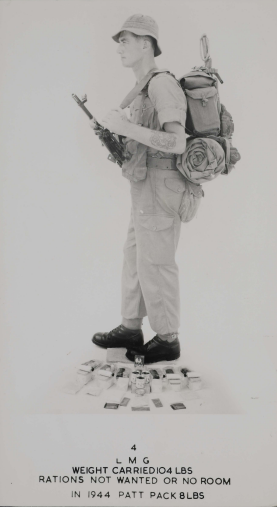
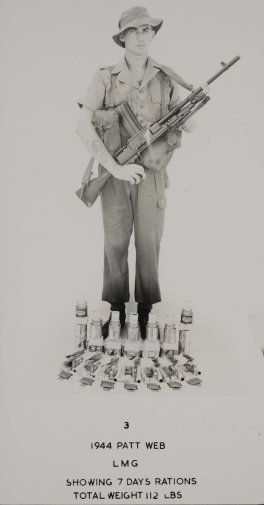
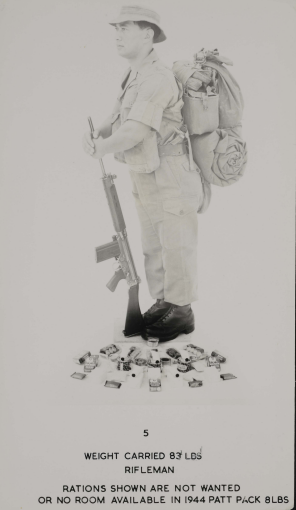
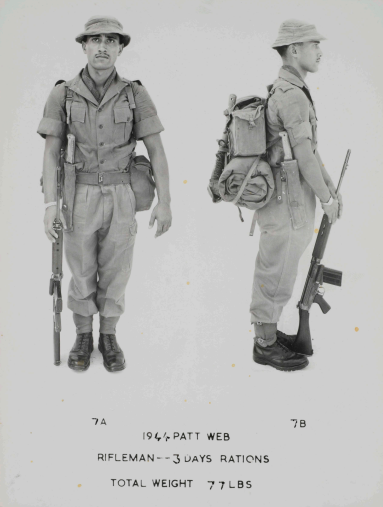
New Zealand Army Combat Boots – 1945 -1980


Up to the Second World War, New Zealand Army boots generally had leather-soled ankle boots whose design had only undergone minor changes since 1912. Military boot development was catapulted during the Second World War with new designs and materials providing boots suitable for all terrains and climates found on Battlefields worldwide. As the post-war New Zealand Army was reorganised and reequipped to provide a division to fight in the Middle East, the decolonisation conflicts that swept Southeast Asia drew New Zealand into an unfamiliar type of warfare. New Zealand was not experienced or equipped to fight in harsh tropical environments but adapted quickly and became experienced practitioners of Jungle warfare. Initially equipped with British and Australian stocks of tropical equipment, it soon became apparent that New Zealand troops needed modern equipment. By 1959, the New Zealand Army undertook various research and development initiatives to improve its equipment in conjunction with scientific institutions and industry. This article provides an overview of the New Zealand Army’s post-war boot development, transitioning from a boot originating in the 19th century to a modern mid-20th century Combat boot.

Flush with wartime stocks of boots, the post-war New Zealand Army had no immediate need to upgrade its boots. However, by the mid-1950s, the limitations of the current range of leather-soled boots were becoming evident, especially in the jungles of Malaya, and the search for alternatives began for an improved boot design. To achieve this, the Quarter masters branch of the army called on the New Zealand Leather and Shoe Research Association for assistance in developing a boot with increased waterproof properties that could withstand prolonged wear without undue fatigue.[1]

Jungle greens and Jungle boots as worn by New Zealand Forces in Malaya from 1955. NZ National Library Ref: EP/1956/0031-F

In conjunction with footwear manufacturers and the Department of Scientific and Industrial Research, the New Zealand Leather and Shoe Association developed four types of boots, which were trialled by the 2nd Battalion, New Zealand Regiment, in 1958. The latest type of ankle boot with a Directly Moulded Sole (DMS) from the United Kingdom was also tested alongside the four New Zealand samples.[2] From this initial user trial, feedback shaped an interim specification for two types with identical uppers but different soles, one of rubber and the other of leather. Thirty pairs of each type were made, and a further series of trials began with the 1st Battalion at Burnham Camp in early May 1960. Thirty trial subjects were chosen to wear each boot type for three days to see how easily they could be broken in. After that, they tested the boots for wear and comfort until February 1961.[3]

1956 Ankle Boots. Lee Hawkes Collection
Sole of 1956 Ankle boots. Lee Hawkes Collection

The result of the trial was the adoption of the Ankle Boot Rubber Sole (Ankle Boot RS). An ankle boot similar in design to the current boot, the Ankle Boot RS was several ounces lighter than those currently in use, also included was rotproof terylene stitching and nylon laces. The nylon laces were so popular with the troops that all the boots returned after user trials came back without laces. The new design had a “Commando” style rubber sole. The Commando style rubber sole was developed in the 1930s by English rubber maker Itshide, who switched from producing toys and brushes to producing this new kind of rubber sole for use on army boots during WWII. The benefit of the Commando sole was the grip provided by the shape of the jagged cleats on the sole, which proved ideal for providing stability on the roughest terrain. The New Zealand version of the Commando sole had slightly shallower cleats with an angled edge to prevent mud or small stones from wedging between them and was marketed as the “Kiwi Army Boot”. Production of the New Zealand Ankle Boot RS began in August 1961; however, with large quantities of the previous type of boot still in the supply system, it would take until 1964 to waste out the old stock.[4]

As with the previous boot design, the Ankle Boot RS required wearing a gaiter to prevent mud and derbies from entering the boot. The type of gaiter then in use was the 37-pattern web gaiter. Concurrent with the boot trial, thirty pairs of Australian Army gaiters were also tested. The long dark green Australian gaiter was introduced into Australian service in 1945 and had a light metal stiffener up one side to prevent wrinkling and a strap passing under the boot’s instep. Finding favour with the troops, these were also planned to be adopted for the New Zealand Army. However, problems in adopting the Australian gaiter would drive the development of the next iteration of New Zealand’s Army Boot.[5]

A pair of Australian Army canvas gaiters painted black. https://www.awm.gov.au/collection/C993356

Although the Australian gaiter could have probably been purchased off the shelf directly from Australian manufacturers, such items should have been manufactured in New Zealand. However, it was found that due to the exorbitant costs encountered in producing the Australian pattern gaiter in New Zealand, this project was abandoned, and the gaiter requirement was re-evaluated. Although no specific General Staff requirement was stated, it was decided to develop a calf-length boot to replace the Ankle Boot RS and 37-pattern gaiters with a calf-length combat boot.

New Zealand 37-pattern Gaiter. Lee Hawkes collection

Based on the new Ankle Boot Rubber Sole (Ankle Boot RS), two high boots, type A and B, were manufactured by experienced New Zealand footwear manufacturers Sargood, Son and Ewen.[6] The type A and B boots included hooks instead of eyelets and a strap and buckle arrangement similar to the American M-1943 Combat Boot.  

United States Army M-43 composition sole combat service boot, or “double buckle boot”. https://www.usww2uniforms.com/BQD_114.html

As a result of the initial user trials in New Zealand and Malaysia using the Type A and B boot, the design of the boot was refined into the Type C boot. In May 1964, ten examples of the Type C Boot were manufactured, incorporating improvements suggested by the user trials:

  • The sole and foot portion to be exactly the same as the Ankle Boot RS.
  • The height from ground level to the top of the boot was to be 101/2 inches.
  • There were to be six eyelets on the lower portion of each side of the closure and six boot hooks on the higher portion of each side (similar to the green jungle boot issued in Malaya).
  • The boot tongue was to be of a thinner variety and should not be longer than the height of the boot.
  • There were to be no straps or buckles.
  • The measurement around the top of the boot was to be no greater than 121/2 inches from edge to edge.[7]

Successful feedback on the Type C boot saw a small number purchased and introduced into service in June 1966 to enable further trials to be carried out to determine if the new pattern boots were suitable for combat in tropical conditions. Further trials by New Zealand Forces in South Vietnam and selected units in New Zealand commenced in November 1967

With the New Zealand contingent in South Vietnam serving alongside the Australians, the length of the New Zealand contingent’s supply chain and its low requirements made it necessary to modify the clothing replenishment system and link into the Australian lines of supply, resulting in New Zealand troops in Vietnam receiving Australian tropical clothing and boots.[8] This was a modification of the system used in Malaysia since 1955, when New Zealand troops in Malaysia drew their tropical clothing requirements, including jungle boots, from British sources.

Concurrent with New Zealand’s combat boot development was an Australian programme to develop a modern combat boot. Initially utilising jungle boots left over from the Second World War, the Australians soon developed and trialled a new DMS boot design with leather uppers and a moulded sole. After some initial user trials, an initial order of 10,000 pairs of the new Australian DMS Combat boot was placed in July 1956 for delivery to Australian troops in Vietnam by December 1965.[9]

Australian Black leather general purpose (GP) boots. https://www.awm.gov.au/collection/C1195209

By 1968, New Zealand troops in South Vietnam were officially utilising the trial New Zealand combat boot and the Australian DMS Combat boot. Unofficially many New Zealand troops also wore the America Jungle boot. A survey conducted at the start of the November 1967 trial showed that 108 New Zealand soldiers preferred the Australian boot and only 42 the New Zealand boot. A further survey conducted in March 1968 revealed that 121 New Zealand soldiers preferred the Australian boot. The most significant reasons given for the preference were that the Australian boot was:

  • Lighter and more robust than the NZ item.
  • Had a directly moulded sole.
  • It was made of better-quality leather.
  • Had a vastly superior appearance.
  • It had a very good and snug fit when broken in.
Private Wayne Lindsay, Whiskey One Company, inspects an RSA Christmas parcel from New Zealand circa 1968. Note that Private Lindsay is wearing the American Pattern Jungle boots, and there are Australian DMS Combat boots and New Zealand Combat boots under his bed. Image courtesy Noel Bell via https://vietnamwar.govt.nz/photo/private-wayne-lindsay-rsa-christmas-parcel

Feedback also included the increasingly evident requirement for a Jungle boot similar to the United States pattern to be provided to New Zealand Forces in tropical environments.[10]

After the November 1967 operational and training trials of the New Zealand combat boot, it was found that the recommendations of the various trial teams were not in agreement, and a Footwear Study Group was appointed to review the trial information.[11] In July 1969, the Footwear Study Group concluded that the New Zealand Combat boot, with certain modifications, was superior to the ankle Boot RS in meeting New Zealand training conditions. However, it was agreed that the New Zealand Combat Boot did not meet the tropical operational requirements, and further research was required to find a boot to meet New Zealand’s tropical requirements. US, Canadian, and UK policies supported this, concluding that one boot could not satisfy both a temperate and tropical requirement. It was noted that the Australians restricted their DMS combat boot to South Vietnam, with troops in other theatres outside Australia continuing to wear ordinary boots and gaiters; however, the US tropical combat boot was procured for issue in South Vietnam to the Australian SAS only. Overall, the New Zealand findings were that the main advantage of the New Zealand Combat Boot was that it could replace two items (Ankle boot RS and gaiter); it provided superior ankle and instep support and improved appearance, and it should be accepted as a replacement for the Ankle Boot RS. A tropical patrol boot was also recommended to be developed to meet the specific environmental conditions found in Southeast Asia.[12]

There was little doubt that the Australian DMS combat boot was more popular with New Zealand troops. It was accepted that the DMS production technique proved a superior product, but at the time, New Zealand’s footwear industry did not yet have the required technology to manufacture DMS boots, but there was no doubt that the New Zealand Combat boot would incorporate a DMS sole at a future date as New Zealand industry caught up. However, adopting the New Zealand Combat boot would be based on fiscal reasoning. Based on the 1969 production run of 2893 pairs for New Zealand Vietnam Force maintenance, the cost of a pair of New Zealand combat boots was $10.50 (2022 NZ $200.20), compared to $19.23 (2022 NZ $366.64) for the Australian DMS boots. With the Ankle Boot RS priced at $8.18 (2022 NZ $156.61) and Garters at $1 (2022 NZ $19.15), it was considered that a superior boot was replacing two items (Ankle boot RS and gaiter) with only a slight increase of the cost. [13]

On 3 December 1969, the New Zealand Combat Boot was renamed as the Boot GS (High) and formally introduced into service to progressively replace the Ankle boot RS and gaiter as existing stocks of those items wasted out and all period contracts for their manufacture terminated.[14]

With a stock of 19,120 Ankle Boots RS and 21,612 Web Anklets held in Ordnance Depots and Clothing Stores, the priority of issue for the introduction of the Boot GS (High)was to:

  • NZ Forces in Southeast Asia
  • Regular Force Recruits
  • Regular Force maintenance in New Zealand
  • The Territorial Force

The Boot GS (High) nomenclature had been changed to Boot Mans General Purpose (Boot Mans GP) by February 1971. With 12,126 pairs of Ankle Boot RS remaining in stock, it was anticipated that with issues to National Service intakes and the Territorial Force, stocks would be exhausted by the end of 1971.[15]

During the New Zealand Combat Boot trial, it was identified that cooks of the Royal New Zealand Army Service Corps (RNZASC) required a boot with a flat sole for safety on wet surfaces. Fortunately, the Government Footwear Inspector had developed Cooks Galley Boots at Royal New Zealand Navy (RNZN) instigation in the mid-1960s. First adopted by the RNZN and then the Royal New Zealand Air Force (RNZAF), consideration to issuing RNZASC Cooks Galley boots were first made in 1968.[16] With a non-skid pattern rubber sole and a continuous leather front to stop spilt boiling fat and other liquids from entering the boot, RNZASC user trials were conducted from 1970 with initial issues to all RNZASC cooks from 1972.[17]

By February 1974, New Zealand’s Forces in South Vietnam had been withdrawn, and the tripartite Australia, New Zealand and United Kingdom (ANZUK) Force based in Singapore had been dissolved. The 1st Battalion Royal New Zealand Infantry Regiment (1RNZIR) and its supporting units remained in Singapore as the New Zealand army components of the New Zealand Force Southeast Asia (NZFORSEA). Logistic arrangements in place since 1955, which allowed New Zealand to rely on the British for tropical clothing and equipment, had progressively been wound down from the late 1960s as New Zealand developed and grew its line of tropical clothing. Although the development of a tropical patrol boot had been recommended to be developed to meet the specific conditions found in Southeast Asia, the transition of New Zealand Army units in Singapore to a peacetime garrison and peacetime funding restrictions saw the requirement for a New Zealand jungle boot placed on the back burner. The Boot Man GP was found to be sufficient for most training in the tropics. Although many individuals purchased surplus American, British or Malaysian jungle boots and some small-scale unit trials did occur, the development of a New Zealand jungle boot ceased.

In 1980 the New Zealand footwear manufacturer John Bull won the contract for the supply of combat boots to the New Zealand Military. Already a manufacturer with a high reputation and experienced in producing military footwear, John Bull’s manufacturing processes were enhanced through a significant equipment and modernisation program. The John Bull-manufactured Boot Man GP was a DMS boot that retained the same style of leather uppers as the previous boot. New Zealand also supplemented stocks of the John Bull Boot GP with the Australian pattern DMS Combat Boot manufactured in New Zealand by King Leo. Both patterns of Boot GP were progressively introduced into service from 1980, with stocks of the previous Boot GP wasted out by 1985.

The New Zealand Army finished the Second World War with pretty much the same boot that had been issued to soldiers in 1912. However, the lessons of the Second World War and developments in boot technology had not gone unnoticed. With the assistance of the New Zealand Leather and Shoe Association, footwear manufacturers and the Department of Scientific and Industrial Research, a New Zealand Combat boot was developed. Due to the limitations of the technology available to New Zealand’s footwear industry, New Zealand’s efforts would always be five to ten years behind those of Australia, the United Kingdom and the United States. However, a viable and cost-effective boot that met most of the training and operational requirements of the New Zealand army throughout the 1970s and 80s resulted from New Zealand’s limited resources. Although this article only provides an overview of New Zealand’s combat boot development, it provides a starting point for further research into this overlooked aspect of New Zealand’s military history.


Notes

[1] “General News – Army Boots,” Press, Volume XCVIII, Issue 28883, 1 May 1959.

[2] Although the United Kingdom accepted and introduced it into service in 1961, the UK DMS boot was rejected by New Zealand because, at this stage, it could not be made in New Zealand. “Many Changes in Gear for Modern N.Z. Soldier,” Press, Volume XCVIII, Issue 28958, 28 July 1959.

[3] “New Army Boots Now in Production,” Press, Volume C, Issue 29594, 17 August 1961.

[4] Ibid.

[5] Army 213/19/69 Footwear for the NZ Army Dated 7 August 1969. “Boots and Shoes – Development of Combat Boots,” Archives New Zealand No R17187902  (1963-1969).

[6] 213/19/55/Q(D) Purchase of High Boots for user trials 26 May 1964. Ibid.

[7] 213/19/69 7 May 1964. Ibid.

[8] “New Combat Clothes Being Tested,” Press, Volume CIV, Issue 30802, 14 July 1965.

[9] “Boots Trouble Aust. Troops,” Press, Volume CIV, Issue 30801, 13 July 1965.

[10] HQ NZ V Force 212/19/69 Footwear Trials 9 April 1968. “Boots and Shoes – Development of Combat Boots.”

[11] Army 213/19/69/SD Footwear Study Group 23 October 1968. Ibid.

[12] Army 213/19/69 Footwear for the NZ Army 14 July 1969.Ibid.

[13] Army 213/19/69 Footwear for the NZ Army 7 August 1969. Ibid.

[14] Army 213/19/69DQ(M) dated 3 December 1969. Ibid.

[15] HQ Home Command HC 8/6/1/ORD 1 Introduction of Boots Mans GP 26 April 1971. Ibid.

[16] Army 213/19/69 Footwear for the NZ Army 7 August 1969. Ibid.

[17] HQ Home Command HC 8/6/1/ST Boots Galley Cooks 11 May 1972. Ibid.


New Zealand Military Load Carrying Equipment, 1945 – 1975

Military Personal Load Carrying Equipment, often referred to in the New Zealand vernacular as “webbing”, is the assortment of belts, straps, pouches and other accessories which, when assembled, allows an individual soldier to easily and comfortably carry the tools of their trade, such as ammunition, rations and water to sustain them for short periods. Many period photos of New Zealand soldiers on operations and training from the Vietnam War era to the 1990s provide the impression of an army equipped with an eclectic range of Australian, British and American equipment. This view of New Zealand’s army’s equipment was partly correct. To see how this view was shaped, this article provides an overview of New Zealand’s military load-carrying equipment evolution from 1945 to 1975.

Commander-in-chief, United States Army of the Pacific, General R.E Haines (right) watching weapon training at Waiouru. 2 May 1970 Evening Post

During World War Two, Operations in Malaya, Burma and the Pacific identified many shortfalls in the suitability of training, tactics and equipment, resulting in the Lethbridge Mission to the Far East during the late war. As a result of the report of the Lethbridge Mission, it was decided to modify the standard 37-pattern equipment to make it lighter in weight, rot-proof and more water-repellent and thus more suitable for use in tropical conditions. This development of the 37-pattern equipment led to the approval of a new pattern known as the 1944-pattern.[1] Post-war, further development of the 37 and 44-Pattern equipment led to troop trials of the Z2 experimental Load Carrying Equipment, which transitioned into the 1958-pattern equipment.[2]

Following World War Two, the Load Carrying Equipment in use by the New Zealand Army was the British 1937-pattern equipment. The 37-pattern equipment was introduced into New Zealand service in 1940, replacing the 1908-pattern equipment that had been in service since 1912. As 37-pattern equipment remained the standard web equipment of the New Zealand Army, the deployment of New Zealand troops to Malaya placed New Zealand in the position of deploying troops to a theatre with equipment that had long been identified as unsuitable. To maintain compatibility with other commonwealth forces in Malaya, 44-pattern equipment from British stocks in Malaya was issued to New Zealand troops in Malaya.

Example of 37-pattern equipment. Image: Simon Moore https://www.youtube.com/watch?v=NwnMIdynO8Y

. Given the environment that New Zealand troops could be expected to operate in and aware of the developments in load-carrying equipment, the New Zealand Chief of General Staff (CGS) requested and received one set of M1956 Web equipment from the United States for trials in 1959.[3]  The American M1956 Load-Carrying Equipment (LCE) had been accepted for United States Army service, with distribution well underway by 1961.

In October 1960, the New Zealand Director of Infantry and Training demonstrated the following web equipment to CGS.

  • 44-pattern Equipment
  • 58-pattern Equipment
  • M1956-pattern Equipment

A report by a New Zealand Officer attached to the Australian Jungle Training Centre at Canungra supported this demonstration with a comprehensive report describing the research and development of Infantry clothing and equipment undertaken by the Australians. The New Zealand report described the Australian trials of the M1956 LCE alongside the 58-pattern equipment. The M1956 was chosen by the Australians, who intended to manufacture it in Australia.[4] However, it was considered unlikely that either the 1956 LCE or 58-pattern equipment would be available to New Zealand until at least 1965, when the initial distribution to the United States and British armies was expected to be completed. Aware that all 44-pattern equipment had been earmarked for use in Malaysia and that it was still in production, New Zealand’s CGS approved the purchase of 6000 sets of 44-pattern equipment to re-equip elements of the New Zealand Army.[5]

Example of 44 pattern equipment, British Corporal, Malaya, Early 1950s. Image Simon Moore https://www.facebook.com/photo/?fbid=2346362332163840&set=a.421629590114595

Following advice from the UK, the 44-pattern equipment in use with the Fare East Land Forces (FARELF) was to be wasted out as the 58-pattern equipment was introduced, implying that the New Zealand Battalion would need to be equipped with the 58-pattern equipment before the ceasing of maintenance of the 44-pattern by FARELF. With this in mind, a recommendation was made to purchase 6000 sets of 58-pattern equipment instead of the 44-pattern equipment.[6]

Example of 58-pattern equipment. Image Simon Moore. https://www.facebook.com/photo?fbid=2080097568790319&set=pcb.2080098398790236

In a June 1961 memorandum to Cabinet, the Minister of Defence highlighted that the current 37-pattern equipment used by the New Zealand Army was not designed for Jungle operations and was unsuitable for carrying the extra equipment the soldier engaged in this type of warfare required. No longer used by the British Army in any part of the world, the stage had been reached where the replacement of the 37-pattern should be delayed no longer. As the 58-pattern could not be made available to New Zealand for some time and field trials had cast doubt on its suitability for use in the Southeast Asia theatre, it was considered that re-equipping of the New Zealand Army should proceed with the 44-pattern equipment. The 44-pattern equipment had proved itself and was known to be suitable in the theatre where New Zealand troops were most likely to be employed. It was assumed that by the time the 44-pattern equipment needed replacement, the full facts on the suitability of the 58-pattern and the M1956 web equipment would be available to make a more informed decision on its adoption by New Zealand. It was recommended that Cabinet approve £45645 plus freight to purchase 6000 sets of 1944 Pattern equipment. [7]

By October 1961, it became clear that the 58-pattern was to be the standard issue web equipment for all United Kingdom forces worldwide and that distribution to the forces in Malaya was to happen much earlier date than earlier expected. Because of this, the Army secretary desired further investigations on the suitability of 58-pattern web equipment and, if favourable, confirm costs and potential delivery dates. With the requirement for web equipment again in flux, the submission to purchase 6000 sets of 44-pattern equipment was withdrawn pending further research.[8]

By May 1962, plans for reorganising the New Zealand Army from a Divisional to Brigade Structure were under implementation.[9]  With approximately 50000 complete sets of 37-pattern equipment distributed to units or held in stores, this was deemed suitable to equip the bulk of the Territorial Force and Training units. The 58-pattern equipment was now in serial production and was the standard issue for all United Kingdom troops, with distribution to operational units in Malaya and Germany underway. Information received earlier was that because of limited production, stocks of 58-pattern would not be available for release to New Zealand for some years had been revised. It was now possible that the release of 58-pattern equipment to meet New Zealand’s requirements could be achieved earlier than anticipated. Based on this revised information, New Zealand’s Cabinet approved funding of £58750 on 10 October 1961 for 6000 sets of 58-pattern Web Equipment. [10]

Before placing a firm order for New Zealand’s requirements of 58-pattern equipment, reports received from Malaya in late 1962 indicated that the 58-Pattern equipment was, in its present form, unsuitable for use in operational conditions in South-East Asia.[11] It was anticipated that modifying the 58-pattern equipment to suit the conditions would take two to three years, an unacceptable delay in procurement as far as New Zealand is concerned.[12]

As the decision on New Zealand’s web equipment remained in flux, the New Zealand Battalion in Malaysia continued to be equipped with the 44-pattern equipment maintained under a capitation agreement with the United Kingdom. At New Zealand’s expense, one hundred sets of 44-pattern equipment were also maintained at New Zealand Battalion Depot at Burnham Camp to support reinforcements.

M1956 Web Equipment

As the time factor involved in modifying the 58-pattern equipment was unacceptable, and New Zealand was receiving an increasing amount of American equipment, the American M1956 pattern web equipment was decided to trial. The M1956 equipment had already been introduced into the Australian army, so twenty sets were purchased from Australian stocks for New Zealand’s trials.[13]

Following user experience in Malaya revealing that the 58-pattern equipment was falling short of the requirements for jungle operations, a series of investigations and user trials established that the US M1956 pattern equipment was suitable for use by the New Zealand Army. The funding for 6000 sets of 58-pattern Web Equipment was requested to be reprioritised to purchase 10000 sets of M1956 equipment direct from the United States and 400 sets of 44-pattern equipment to equip the increment for the FARELF held in New Zealand.[14]

With funding endorsed by the Minster of Defence and approved by the Cabinet, orders were placed for 10000 sets of M1956 web equipment direct from the United States. The first consignment arrived in New Zealand in early 1964, with 289 sets immediately issued to the New Zealand Special Air Service (NZSAS) and 16 Field Regiment, Royal New Zealand Artillery.

Instructions for distributing the M1956 web equipment were issued in June 1964 by the Quartermaster General. The initial purchase of 10000 sets of M1956 web equipment was to be issued to the Combat Brigade Group (CBG) and Logistic Support Group (LSG) units. Units of the Combat Reserve Brigade Group (CRBG) and Static Support Force (SSF) were to continue to use the 37-patten webbing.

 NMDCMDMOD (for CMD Trentham UnitsSMDMOD StockIssued SAS/ 16 Fd Regiment
CBG & LSG312230304012028310289
1st Reinforcement Reserve3162606198  
School of Infantry 40    
TOTAL343833304072226310289

As the issue of M1956 equipment progressed, units of the CBG and LSG were to hand back stocks of 37-pattern equipment to their supporting District Ordnance Depot except for

  • 08-pattern packs and straps
  • 37-pattern belt, waist web
  • Frogs bayonet No 5[15]

The 37 Pattern belt, waist web, was to be retained by all ranks as a personal issue authorised by NZP1 Scales 1, 5, 8 or 9. The belt and bayonet frog were to be worn with Nos 2A, 64, 6B, 7A and 7B orders of dress when other equipment items were not required to be worn.

Equipment Maintenance Policy Statement (EMPS) 138/67 issued by Army Headquarters on 20 November 1964 detailed that except for the CBG and LSG, 16000 sets of 37-pattern equipment were to be maintained for use by remaining elements of the New Zealand Army.[16]  EMPS 145/65 was issued on 12 February 1965, detailing the management of 44-pattern equipment in New Zealand. The First Battalion of the Royal New Zealand Infantry Regiment (1RNZIR) in Malaysia was to remain equipped with the 44-pattern web equipment maintained by the UK under the existing capitation agreement. Other than 100 sets of 44 Pattern Web equipment maintained at the Battalion Depot in Burnham, there was no provision for equipping 1RNZIR Reinforcements and increments of 31 Medium Radio Sub Troop who could be expected to deploy to Malaysia at any time. EMPS 145/65 rectified this by establishing a stockholding of 400 sets of 44-pattern equipment at the Main Ordnance Depot (MOD) at Trentham

Approval was granted in November 1965 by Army HQ for the Royal New Zealand Armoured Corps (RNZAC) and NZSAS to blacken their M1956 web equipment. The Royal New Zealand Provost Corps (RNZ Pro) was also approved to whiten their M1956 web equipment. This approval only applied to unit holdings, not RNZAC, NZSAS or NZ Pro members attached or posted to other units.[17]

By April 1967, most of the New Zealand Army was equipped with the M1956 equipment. The exceptions were.

  • The New Zealand Forces in Malaysia and South Vietnam, who used both the M1956 and 44-pattern equipment
  • The SSF, National Service Training Unit (NTSU) and New Zeeland Cadet Corps (NZCC), who still retained the 37-pattern equipment

The manufacture of 37-pattern equipment had long been discontinued, and New Zealand stocks had reached the point where although having considerable holdings of individual items, based on the belts as the critical item, only 9500 sets of 37-pattern equipment could be assembled.

Based on the projected five-year supply to the NTSU, Army Schools, Camps and the NZCC plus 10% maintenance per annum, there was a requirement for 12000 sets of 37-pattern equipment. Arranging production to meet the shortfalls was deemed cost-prohibitive, and as continued maintenance could not be guaranteed, it was decided that additional sets of M1956 equipment were to be purchased. The additional sets were to be purchased on a phased program over several financial years, with 5000 sets of 37-pattern retained for the NZCC.

Disposal of the 37-pattern was to be phased over three years.

  • 1967 all items surplus to 9500 sets
  • 1968 3000 Complete sets
  • 1969 all remaining 37 Pattern equipment less 5000 sets for the NZCC.[18]

M1967 Modernized Load-Carrying Equipment (MLCE)

In 1967 the New Zealand Army trialled three sets of the M1967 Modernized Load-Carrying Equipment (MLCE). Not specifically designed to replace the M1956 equipment, the M1967 equipment was designed for use in tropical environments and was introduced into the United States Army service in 1968.

The New Zealand trials found that the M1967 equipment was comfortable and weight-wise was similar to other web equipment in use. The pack worn on the belt was found to be heavy when fully loaded, and a pack similar in size to the 44 Pattern should be introduced, and the belt pack reduced in size by one-third.

It was identified that all the pouches required stiffening and that the plastic fasteners were not firmly attached to the pouches, although easy to operate. While using Velcro was found simple to operate, it was seen as a disadvantage due to noise and its inclination to pull apart when wet or under stress.[19]

Although the M1956 was still being introduced into the New Zealand Army, limited quantities of the M1967 equipment were introduced from 1969-72 with no plans for large-scale procurement. Nevertheless, the design of the M1972 All-Purpose Lightweight Individual Carrying Equipment (ALICE) incorporated many of the features of the M1967 equipment, and it was introduced into the New Zealand Army service in the 1980s.

Example of M-1967 MLCE. Image Simon Moore https://www.youtube.com/watch?v=Pwj59bifFMk

Although the 44-pattern web equipment continued to be used by New Zealand units in Southeast Asia, by October 1967, the decision had been made to standardise the M1956 equipment across the New Zealand Army, and no stocks of the 44-pattern equipment were to be retained in New Zealand.   All stocks of 44-pattern web equipment held by the MOD in Trentham for 1RNZIR Reinforcements and increments of 31 Medium Radio Sub Troop were issued to 1 RNZIR based at Terendak camp in Malaysia. As this stock held by 1RNZIR was wasted out, it would be replaced by M1956 web equipment. [20]

Large Ammunition Pouches

The Australian experience had shown that although the L1A1 Self Loading Rifle (SLR) Magazines fitted inside the M1956 ammunition pouch, it was a tight fit, especially when the webbing was wet. The initial solution was to modify 37-pattern pouches and fit them to the M1956 equipment. By 1967 the Australians had developed an indigenous ammunition pouch for the M1956 equipment., The Australian Ammunition Pouch Large (8465-66-026-1864) was manufactured out of cotton duck material and measured 81/4 inches high by 4 inches wide and 3 inches deep.

Australian Pouch Ammunition Large

To ascertain the suitability of the Australian large ammunition pouch for New Zealand service, fifty Australian pouches were sourced as a standardisation loan in 1968.[21] Feedback for the troop trials identified a lack of stability in the closure of the lid, causing the loss of ammunition and magazines. Following an investigation by the R&D Section, the RNZAOC Textile Repair Sections (TRS) modified the Australian pouches by replacing the lid fasteners with the same fasteners found on the standard American M1956 pouch and stiffing the fastener tabs. The modifications proved satisfactory in further Army Trials, and a new specification (DRDS-ICE-1) was produced with four Standard Samples provided to 1 Base Ordnance Depot (1 BOD).[22]  The modified New Zealand Pouch was codified in the New Zealand supply system as Pouch Ammunition Large (6746-98-103-4039).[23]

Detail of New Zealand Large Ammunition Pouch riveted lid fasteners

Although the R&D Section had ascertained that the manufacture of the pouches was possible in New Zealand using imported components, the initial production run of 20000 pouches was contracted through the Australian Department of Supply to be included in the current Australian production run.[24]  By 1974 the first production run of 20000 had been completed and returned to 1 BOD for distribution, with 2/1 RNZIR in Burnham one of the first units to receive the new pouches. In May 1974, 2/1 RNZIR submitted defect reports stating that the pouches were poorly designed, with the canvas tongue used to secure the lid failing, pouches becoming insecure, and magazines dropping out.[25]

The investigation by the Directorate of Equipment Policy and the R&D Section found that the faults were not a design problem but a quality assurance issue in that the pouches had not been manufactured following the specification.[26]   Comparing the Australian-manufactured pouches against the specification, the R&D Section identified the following visually detected defects.

  1. Canvas used to manufacture strap-holding assembly instead of webbing.
  2. Clip end strap is wrongly sized.
  3. Release tab is of incorrect thickness.
  4. Polypropylene stiffener not inserted in release tab.
  5. The male fastener is not secured to the PVC stiffener.
  6. The reinforcement piece behind the male fastener is not included (between the PVC stiffener and lining).
  7. Additional smaller reinforcement piece inserted between the outer cover and the male fastener.
  8. Broad arrow marked on the outer cover and not specified.

Of these defects, only serials 3 to 7 were directly considered to contribute to the deficiencies and the initial concerns raised by 2/1RNZIR and would require rectification, and a modification instruction was produced.[27]  Modification of the pouches would take until September 1977 to be completed.[28]

Due to the Broad Arrow Mark included on the first batch of 20000 New Zealand Large Ammunition Pouches, collectors often misidentify these items as Australian pouches.

White Web

By 1973, 37-pattern belts, rifle slings and bayonet frogs remained in use as ceremonial items. Whitened using proprietary shoe cleaner and paint, these items were badly worn with the whitener flaking easily and were easily marked by weather, fingerprints and the rubbing of other equipment. The M1956 pattern web belt was not considered suitable as a replacement as it was operational equipment requiring the breaking up of complete web sets to provide items for ceremonial events. Following the British lead, the Army Dress Committee approved a polythene, four-ply woven fabric of similar appearance and texture to the 37-pattern equipment in October 1973 as a replacement for the whitened 37-pattern equipment. The sling and bayonet frog designed for the SLR would be purchased with chromed or brass fittings. The material for the belts was provided on rolls which could be cut to the required size. Buckles and keepers were 37-pattern buckles and keepers drawn from existing stocks that had been chromed and polished.[29]

Combat Pack

By 1974, one of the few pre-1945 items of load-carrying equipment remaining in New Zealand service was the 08-pattern pack. Long identified as an unsuitable item, several trials had been conducted since the mid-1960s to find a replacement combat pack. Although a few alternative items had been investigated as a replacement, the 08-pattern pack remained the principal combat pack of the New Zealand Army.

In 1969/70, the requirement for 15000 combat packs to replace the 08-pattern pack was identified. Following evaluation by the equipment sponsor, the Australian Army Combat Pack was selected as a basis for developing a New Zealand combat pack. The Australian pack was chosen from a wide range of military and civilian packs, with the design modified to meet the particular training requirements of New Zealand. The modifications to the Australian pack were limited to comply with the following:

  • The pack must be compatible with Australian Army equipment.
  • The pack must be compatible with M1956 equipment currently in New Zealand service.

Against the advice of the R&D section, the Australian pack was modified by the New Zealand Army without a proper study being conducted.[30] The decision to bypass the R&D process resulted in a prototype process that extended from 1972 to 1974.[31] By June 1974, trials on the prototypes resulted in the setting of a standard design for a production run of one hundred packs for further trials.[32]

New Zealand modified Combat pack

The New Zealand version of the Australian combat pack was eventually accepted into service in 1975/76. Never a satisfactory pack, the R&D section began investigations to find a replacement in the early 1980s. Hoping to leverage the experience of New Zealand Mountaineers to produce a modern pack, Army R&D embarked on the Onward Pack project. Manufactured by Hallmark Industries of Hamilton, the Onward pack was an innovative modular design that allowed the main pack to be broken down into a patrol pack and a light belt order,

The Basic layout of the Onwards pack was a main compartment divided into a main compartment and a sleeping bag compartment divided by a zip-away divider. The upper compartment was divided into the main storage area and internal space for an AN/PPC-77 set. External access to the main compartment was via a large snow collar with outlets for the radio antenna and handset built into the lid. External access to the lower sleeping bag section was provided by a zip which allowed the bottom half of the compartment to drop down. Internal sleeping mat storage was included as part of the harness and backpack. Three external removal pouches were provided, one on each side attached by domes and a larger pouch mounted on the centre front of the pack by buckles body. Behind the Large centre pouch, securing straps were provided to secure an Entrenching Tool. These three external pouches were fitted with belt loops, which allowed them to be removed and fitted to either the pack’s waist belt or standard pistol belt as a light belt order.

A small patrol pack designed to hold an ANPRC-77 Set was also provided as part of the Onward pack., The patrol pack could be mounted to the top of the Onward Pack or by utilising the pack’s shoulder straps, worn as a standalone pack. The Patrol pack was also fitted with a fluorescent recognition panel in a zip-up compartment.

Despite the host of features and the additional space provided compared to the Australian pack, the Onward Pack was fraught with issues. The proprietary plastic clips were prone to failure, and the body-hugging ‘alpine’ design caused causing severe prickly heat on users in the tropics of Southeast Asia. These and other issues with the Onward Pack contributed to an extended development period as attempts were made to rectify them. As these and other minor faults were addressed to meet the immediate needs of users while the Onward Pack was perfected, the medium American ALICE pack was introduced as an interim replacement in 1984.[33] Eventually, attempts to rectify the Onward Pack were abandoned and the ALICE pack was formally adopted as the New Zealand Army pack.

Conclusion

Entering the Second World War with web equipment of the same pattern used since 1912, New Zealand’s Force soon began to be re-equipped with the most modern British web equipment, the 37-pattern from early 1940. Near the end of the war, New Zealand was kept abreast of the development of web equipment, and when New Zealand troops arrived in Malaya in the early 1950s, they were issued with the most modern type available for jungle warfare, the 44-pattern. As the New Zealand Army reorientated from providing a division to serve in the Middle East to providing a Brigade Group to serve in Southeast Asia, it could not wait for the British to develop their new 58-pattern for tropical conditions and examine other types. Following Australia’s lead, the American M1959 equipment was adopted in 1964, with components of this type serving thought to the early 2000s. With five types of web equipment either adopted or trialled between 1945 and 1974, it is no surprise that components got intermingled. This led to Kiwi soldiers’ preferences and experiences leading them to create webbing sets that they found practicable rather than options prescribed in SOPs or instruction books leading to the outside impression of the New Zealand army been one equipped with an eclectic range of Australian, British and American equipment.


Notes

[1] 86/Development/47 (SWV1) Report on the Development of Personnel Fighting and Load Carrying Equipment 1942-48 February 1949. “Cookers – Web Equipment: New Pattern,” Archives New Zealand No R17189098 (1944 -1966).

[2] 86/Dev/54 (SVW1) Instruction for troop trials of Z2 Experimental Load Carrying Equipment ibid.

[3] New Zealand Joint Services Mission Washington DC JSM 1/3/13 ARM US Army Load Carrying Equipment (Web) dated 23 September 1959ibid.

[4] Attachment to JTC – Canungra dated 21 October 1960 “Stores – New Infantry Equipment for New Zealand Army,” Archives New Zealand No R17189007 (1959-1970).

[5] Army 246/60/12/SD Web Equipment dated 20 December 1960 “Cookers – Web Equipment: New Pattern.”

[6] Army 246/60/12/SD Web Equipment dated 20 December 1960ibid.

[7] Memorandum Minister of Defence to Cabinet dated June 1961ibid.

[8] 246/60/12/adm Army Secretary to Minister of Defence 2 October 1961ibid.

[9] Damien Fenton, A False Sense of Security: The Force Structure of the New Zealand Army 1946-1978, Occasional Paper / Centre for Strategic Studies: New Zealand: No. 1 (Centre for Strategic Studies: New Zealand, Victoria University of Wellington, 1998), 111-20.

[10] Army 246/60/12/Q(E) Brigade Group Equipment Replacement Web Equipment dated 8 May 1962 “Cookers – Web Equipment: New Pattern.” -pattern equipment

[11] BM 2 to FE16002SD General HQ FELF to The War Office (Brig Q Eqpt) 1958 Pattern Web Equipment dated 4 October 1962: ibid.

[12] 57/62 NZ Army Liaison Staff, London to Army HQ dated 17 October 1962 ibid.

[13] Army 246/60/12Q(E) Sample US Pattern Web Equipment dated 12 December 1962 ibid.

[14] 246/60/12/SD Web Equipment for the Field Force dated 18 October 1963 ibid.

[15] Army Reqn 208/63/Q(E) dated 9 June 1964 -Distribution of M1956 Web Equipment “Cookers – Web Equipment: Pattern ’37,” Archives New Zealand No R17189095 (1940-1971).

[16] EMPS 138/64 of 20 Nov 1964 ibid.

[17] Army HQ Army246/60/12/PS3 of 19 Nov 1965 ibid.

[18] Defence (Army) 246/60/2 of 26 April 1967 ibid.

[19] 1 Ranger Squadron NZSAS, Trial Report US Lightweight Equipment dated 21 March 1968″Cookers – Web Equipment: New Pattern,” Archives New Zealand No R17189099 (1966 -1969).

[20] Army 246/60/12/Q(E) EMPS 145/65 Frist Revise dated 5 October 1967 ibid.

[21] “Cookers  – Web Equipment: Slings, Bandoliers, Ammunition Pouches: Development,” Archives New Zealand No R17189101 (1968-1970).

[22] Def HQ/R&D Section 82/1974 dated 28 Jun 1974.”Equipment Administration: Research & Development – Projects Personal Load Carrying Equipment: Ammunition Pouches,” Archives New Zealand No R17231111 (1972-1977).

[23] 246/60/2 of 122055ZNOV70 NZDWN to 1BOD Trentham “Cookers – Web Equipment: Pattern ’37.”

[24] Army 246/60/70 dated 9 December 1971. “Equipment Administration: Research & Development – Projects Personal Load Carrying Equipment: Ammunition Pouches.”

[25] FF 65/38/18/SD Modification of Ammunition Pouch item 10 May 1974. “Cookers – Web Equipment: New Pattern.”

[26] Army 246/60/17/EP. “Equipment Administration: Research & Development – Projects Personal Load Carrying Equipment: Ammunition Pouches.”

[27] R&D Section Minute no 160/1975 dated 21 November 1975. “Cookers – Web Equipment: New Pattern.”

[28] Army 246/60/17/SP 22 Pouches Ammunition 22 September 1977. “Cookers – Web Equipment: New Pattern.”

[29] “Army Dress Committee Decision – White Web,” Archives New Zealand No R17188112 (1973).

[30]  R&D Section 67/1974 Packs Combat date 13 June 1974. “Equipment Administration: Research & Development – Projects Personal Load Carrying Equipment: Waterproof Pack,” Archives New Zealand No R17231110 (1972-1974).

[31] Army 246/60/12/EP Sponsor Enquiry Field Pack Olive Green 2 July 1972. Ibid.

[32] Army 246/60/12/ EP Minutes of the final meeting on the acceptance of the Combat Pack held at Army General Staff on 8 June 1973. “Conferences – Policy and General – NZ Army Dress Committee 1984,” Archives New Zealand No R17311893 (1984).

[33] Inf 26.3 Minutes of a meeting to consider Project Foxhound developments held at Army General Staff 8 June 1984. Ibid.


Behind the scenes at Takapau

It is said that a picture says a thousand words, and this postcard of the Takapau Divisional Camp of April-May 1914 is such a picture. While it tells part of the story of the neatly 4839 Territorials who attended the camp, it also provides an insight into the tremendous logistical effort by the Defence Stores Department to provide the stores and equipment required by the largest Territorial camp ever held in New Zealand.

Between April and May 1914, 18,882 Territorial Soldiers of New Zealand’s citizen army attended five main camps across New Zealand. 

  • the Auckland Military Districts camp was at Hautapu, near Cambridge,
  • the Canterbury Military Districts camp was split between Kowai, near Springfield, with the Marlborough and Nelson units camping at Tapawera, near Nelson.
  • the Otago Military Districts Camp was at Matarae, in Central Otago
  • The Wellington Military Districts were held at Takapau in Hawkes Bay.

To oversee the management of the Camp Equipment and other Ordnance Stores required, the District Storekeepers of each Military District were appointed as Ordnance Officers for the duration of the camp and provided with a staff of eighteen Territorial Soldiers trained in the duties required of an Ordnance Depot.

The District Storekeepers were

  • Honorary Lieutenant William Thomas Beck, District Storekeeper, Auckland
  • Honorary Lieutenant Arthur Rumbold Carter White, District Storekeeper, Christchurch
  • Honorary Lieutenant Mr Owen Paul McGuigan, District Storekeeper, Dunedin
  • Mr Frank Edwin Ford District Storekeeper, Nelson
  • Honorary Major James O’Sullivan, Defence Storekeeper Wellington

Based on the numbers that attended the Takapau Camp and the Camp Equipment scale of 1913, the following quantities indicate the Camp Equipment required. Provided from the Defence Stores in Wellington, two trainloads were required to move the stores from Wellington to Takapau to pre-position before the camp.

  • Axes, felling, helved, 122
  • Axe. Pick, 160
  • Buckets, Water, 1937
  • Basins, Wash hand, 2023
  • Boilers with lid, 20 Gal, 100
  • Boilers with lid, 9 Gal, 100
  • Candlesticks, bayonet, 2023
  • Choppers, Meat, 100
  • Crowbars (if required) 190
  • Dishes, meat, 1711
  • Kettles, camp, 1543
  • Lantern s, stable, 348
  • Racks, arm, tent (Large loop), 1259
  • Spades, 274
  • Shovels, 274
  • Tents, circular, complete, 1773
  • Marquees, 65
  • Ropes, picket, 20 yards 115
  • Brooms, bass, 128
  • Sheets, ground, 8350
  • Rakes, iron 16in ,128

How much of this equipment was available in the District Storehouses is unknown. However, it is known that in 1914 the NZ Military had a sufficient stock of tents to accommodate the whole Territorial Force at the full establishment, including

  • 3651 tents (circular)
  • 181 marquees,
  • 30 operating tents, and
  • 98 bivouac tents

The concept of the Camp Ordnance Depots was that as the unit advance parties arrived, the required number of camp equipment stores were issued from the Ordnance Depot to the unit Quartermaster Staff, usually under the control of the Regimental Quartermaster Sergeant.

On completing the camp, the RQMS was required to return all the stores to the Ordnance depot and remain available to finalise any accounts for losses and damages. Following the closedown of the camp, the stores were then loaded onto trains and returned to the District Stores, ready for the next activity.

The Ordnance Depots also held a stock of clothing and equipment available as replacements or for sale. For example, the Takapau Camp Ordnance Depot sold 1000 boots and 250 blankets.

The Divisional Camps of 1914 were only the second time Ordnance Depots had been established at annual camps and proved successful. There is no doubt that they would have stood up again for the planned camps in 1915. However, the logistical framework of the 1914 Divisional Camps served as a dress rehearsal for the August 1914 mobilisation and contributed to the raising and dispatching overseas of the largest, best trained and equipped force to be dispatched from this country in the 20th century.


1950s Camp Equipment

Publicity photos from the 1950s showing a range of portable Camp Equipment managed by the RNZAOC

Safes-Meat Portable

A required item to preserve meat in Field Kitchens in the days before portable refrigeration.

1593580333743-a8c302f3-e99e-41f3-a516-2eb6c342c01c_.jpg
1593580412555-81576d0d-f35d-41e0-a835-8794273b09a2_.jpg
1593580198943-92f3ab80-c911-45f4-a56e-fa041e792d07_.jpg
1593579984661-7e02b137-700a-45f4-9298-08f6e7c3f91d_.jpg

Stands Ablution Portable

This item is designed so that soldiers, when in a field camp environment, can have a place to carry out their daily ablutions.

Consisting of a sink top with a drain trough and bar to hang towels and mirrors, soldiers washed and shaved using a basin. On completion of their business, the contents of the basin were tipped into the drain from where it flowed into a sump dug into the ground

1593580122840-9565c613-7945-4f21-a0a0-40135baa0f52_.jpg
Stand Ablution Components. Robert McKie Collection

Stand Ablution laid with its compontrs laid out;

  • Bar Towel/Toprail, Qty 1
  • Leg Ablution Stand End, Qty 2
  • Leg Ablution Stand Center, Qty 1
  • Brace Ablution Stand, Qty 2
  • Drain Sink, Trough, Qty 1
  • Drain, Lavartory pipe, Qty 1
  • Bolt securing, Qty 4
1593580055144-87079f80-679e-47de-b471-851f452a81cb_.jpg
The above picture shows the Stand Ablution in the final stages of assembly with the two soldiers about to fir the Bar Towel/Top-rail to the Leg Ablution Stand Ends. Once the Bar Towel/Top-rail was attached, the braces were bolted tight and the Drain Sink, Trough and Drain, Lavatory pipe were attached.
1593579916990-393015e9-3de4-4efb-9e1f-d0ecbbd7958e_.jpg

Mess Kit Washup

1593580567220-74e6002e-ffdd-4a48-b294-98556f2e9ef5_.jpg
1593580498450-bc21fd8a-834e-4122-8258-cdf3b2706182_.jpg

Used in conjunction with a kerosene heater, these tubs were assembled over a small trench with the chimney device drawing heated air under the tubs, heating them up.

This set-up was based on the three-pot cleaning method.

Before washing. plates and utensils were thoroughly scrapped clean into a rubbish bin.

Sink 1: Wash sink – Full of hot soapy water, utensils are given a good scrub with a brush or dishcloth.

Sink 2: Hot-rinse sink -, Filled with clear, hot water, utensils rinsed in this sink.

Sink 3: Cold-rinse sink – Utensils undergo a final rinse in water which had a few drops of bleach or other sanitising argent added to it

Field Cook House

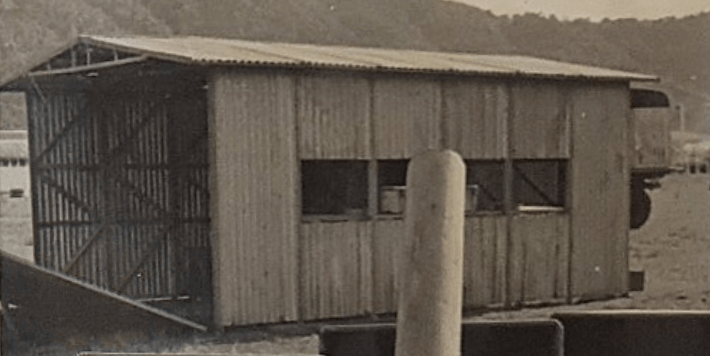
In the background of these photos, a Field Cook House can be seen. This portable building was designed to be used as a Field Cookhouse, which could easily be assembled from components.