
During the financial year from 1 July 1872 to 30 June 1873, the New Zealand Defence Stores continued its transition from a wartime supply organisation into a permanent national system for the custody, maintenance and accounting of military and government property.
The immediate pressures of the New Zealand Wars had receded, but the need to maintain arms, ammunition and equipment had not disappeared. The Armed Constabulary remained deployed across parts of the North Island, while the Militia and Volunteer forces required weapons, ammunition, accoutrements and instructional support. At the same time, the expanding machinery of colonial government was purchasing and distributing increasing quantities of public property.
Under Lieutenant-Colonel Edward Gorton, the Defence Stores organisation therefore performed two overlapping roles. It continued to support New Zealand’s military forces while also providing the inspection and accounting system through which government departments were increasingly required to safeguard public stores.
The events of the year also introduced another concern. On 17 February 1873, Auckland appeared to have been attacked and occupied by the Russian ironclad Kaskowiski. The attack was fictional, but the public alarm it caused encouraged a more serious consideration of the vulnerability of New Zealand’s ports, armouries, magazines and public stores.
The Inspector of Stores
Lieutenant-Colonel Edward Gorton continued as Inspector of Stores. From Wellington, he supervised the principal Defence Stores at Auckland and Mount Cook, district sub-stores, magazine keepers, armourers, arms cleaners and officers performing storekeeping duties alongside their other appointments.
Gorton’s responsibilities now extended considerably beyond the military stores themselves. Following the passage of the Public Stores Act 1871, he had become responsible for introducing a more uniform system of store accounting throughout the public service.
The work of the Inspector of Stores included:
- tracing articles purchased with public money to an officer who could be held accountable for them;
- examining departmental store accounts and returns;
- advising the Audit Department of money recovered from the sale of public property;
- investigating deficiencies, losses and irregularities; and
- physically inspecting stores to establish whether articles recorded in the accounts were still present.[1]
Gorton reported that the standard of accounting was gradually improving. One of the more difficult problems was overcoming the attitude that government property did not require the same degree of care as privately owned property. In some offices, officials had inherited furniture, equipment and other articles from their predecessors without knowing whether the items belonged to the Crown or to private individuals.
The system developed by the Defence Stores was also applied to the Public Works Department. This was increasingly important as railway, road and bridge construction brought large quantities of ironwork, tools, machinery and engineering material into the colony. District and resident engineers were required to account for stores passing through their hands, with their returns subject to examination through Gorton’s office.[2]
The Defence Stores was therefore becoming more than a military supply department. Its methods were providing the foundation for a broader government system of public-property accountability.
Defence Stores establishment
The authorised establishment for 1872–73 was divided between the central office of the Inspector of Stores and the military Store Department maintained under the Militia and Volunteers vote.
Office of the Inspector of Stores
A separate Store Department vote of £505 was included under Class II, Public Departments. It provided half salaries for the Inspector of Stores and three clerks, with the remaining portions of their salaries charged to other duties or departments.[3]
| Appointment | Authorised amount |
| Inspector of Stores, half salary | £250 |
| Clerk, half salary | £110 |
| Clerk, half salary | £80 |
| Clerk, half salary | £65 |
| Total | £505 |
The arrangement reflected the dual nature of Gorton’s responsibilities. Although his office originated within the Defence Stores, its inspection and accounting work now extended across the wider public service.
The officers associated with the Wellington head office included:
| Appointment | Appointment holder |
| Inspector of Stores | Lieutenant-Colonel Edward Gorton |
| Clerk | George Simpson Lockie |
| Clerical assistance | Additional clerks employed within the central Store Department establishment |
The appropriation identifies the positions but does not name each clerk. Therefore, surviving nominal and departmental records need to be used alongside the financial accounts when reconstructing the establishment.
Defence Store Department
The Defence Store Department was funded through Class VIII, Militia and Volunteers, Vote No. 54. It included the permanent stores at Auckland and Wellington, sub-stores at Wanganui and Patea, armourers, arms cleaners, magazine keepers and acting sub-storekeepers throughout New Zealand.
The Appropriation Act 1872 authorised £3,313 2s 6d for this part of the organisation.
Auckland Defence Store
| Appointment | Appointment holder |
| Storekeeper | Major William St Clair Tisdall |
| Clerk | John Blomfield |
| Armourer | George Evitt |
| Arms Cleaner | Thomas Gibbins |
| Arms Cleaner | John Penligen |
| Arms Cleaner | Charles Phillips |
| Arms Cleaner | William Cook Rockley |
| Magazine Keeper | John Broughton |
The authorised Auckland establishment consisted of a storekeeper, clerk, armourer, four arms cleaners and a magazine keeper.
Earlier records had identified both John Blomfield and John Price as clerks at Auckland. The 1872–73 estimates, however, provided for only one Auckland clerk, suggesting either a reduction in the establishment or the transfer of one clerk to other duties.
George Evitt had succeeded his father, David Evitt, as government armourer following David Evitt’s death in 1870. The younger Evitt continued a family association with the maintenance of military arms in Auckland that had begun during the Imperial period.[4]
The other members of the Auckland establishment also represented considerable accumulated experience. Several had worked with the colonial or Imperial military stores since the 1860s and were familiar with the cleaning, preservation and repair of a mixed inventory of rifles, carbines, pistols, swords and accoutrements.
Wellington Defence Store, Mount Cook
| Appointment | Appointment holder |
| Storekeeper | Lieutenant-Colonel Henry Elmhirst Reader |
| Clerk | Alexander Crowe |
| Armourer | Edwin Henry Bradford |
| Armourer | Edward Metcalf Smith, until his departure in 1873 |
| Arms Cleaner, later Armourer | Walter Christie |
| Arms Cleaner | William Warren |
| Arms Cleaner | John Shaw |
| Arms Cleaner | James Smith |
| Magazine Keeper | William Corliss |
The Wellington establishment underwent an important technical change during the year.
Edward Metcalf Smith had been appointed an armourer at Wellington in December 1868. By 1873, however, his growing interest in the development and processing of Taranaki ironsand was taking him away from routine Defence Stores work. He left the Department during the year to pursue his industrial and political interests.[5]
Walter Christie, who had joined the Wellington Defence Store as an arms cleaner, developed his technical knowledge under the experienced armourers Edwin Henry Bradford and Edward Metcalf Smith. Christie subsequently advanced into the armourer trade, illustrating the Defence Stores’ capacity to develop specialist skills internally rather than relying entirely on men trained by the Imperial Army.[6]
Bradford remained the senior and most experienced Wellington armourer. His continued service provided technical continuity while the workshop maintained a varied collection of Snider rifles and carbines, revolvers, swords and older muzzle-loading weapons.
Wanganui and Patea
| Location | Appointment |
| Wanganui | Sub-Storekeeper |
| Patea | Sub-Storekeeper |
The Wanganui and Patea sub-storekeepers each received an authorised salary of £130. Of this amount, £20 was charged against Public Works, indicating that the officers were responsible for more than military equipment alone.
This was particularly practical in smaller or more isolated districts. A government officer might simultaneously account for arms and ammunition, engineering tools, road-making equipment, camp stores and other public property.
District acting sub-storekeepers
Acting sub-storekeepers were authorised at:
- Waikato;
- Poverty Bay;
- Tauranga;
- Ōpōtiki;
- Taranaki;
- Rangitīkei;
- Napier;
- Nelson;
- Canterbury;
- Westland; and
- Otago.
The estimates allowed each acting sub-storekeeper £54 15s annually. In most districts the appointment was held by a Militia or Volunteer drill instructor, who carried out storekeeping duties in addition to military instruction.[7]
This system enabled the Government to maintain a national network of accountable officers without creating a full-time civilian storekeeping establishment in every district. The arrangement was economical, but it also meant that the quality of local storekeeping depended heavily upon officers whose primary responsibilities lay elsewhere.
Members of the Armed Constabulary also held and issued government arms and equipment at various posts. Local constables or non-commissioned officers could therefore function as custodians of Defence Stores property, subject to departmental returns and periodic inspection.
Authorised expenditure
Two appropriations supported the work of the Defence Stores during 1872–73:
| Vote | Appropriation | Approximate 2026 value |
| Central Store Department, Public Departments | £505 | NZ$88,400 |
| Military Store Department, Militia and Volunteers | £3,313 2s 6d | NZ$579,800 |
| Combined appropriation | £3,818 2s 6d | approximately NZ$668,200 |
The 2026 equivalents use an indicative project conversion of approximately £1 in 1872–73 to NZ$175 in 2026. They are intended to illustrate relative purchasing power rather than represent exact modern accounting equivalents.
Military Store Department appropriation
| Appointment or expense | Appropriation | Approximate 2026 value |
| Storekeeper, Auckland | £300 | NZ$52,500 |
| Storekeeper, Wellington | £100 | NZ$17,500 |
| Sub-Storekeeper, Wanganui | £130 | NZ$22,750 |
| Sub-Storekeeper, Patea | £130 | NZ$22,750 |
| Clerk, Auckland | £170 | NZ$29,750 |
| Clerk, Wellington | £160 | NZ$28,000 |
| Three armourers | £547 10s | NZ$95,800 |
| Eight arms cleaners | £876 | NZ$153,300 |
| Rent, advertising and contingencies | £150 | NZ$26,250 |
| Magazine Keeper, Auckland | £83 10s | NZ$14,600 |
| Magazine Keeper, Wellington | £63 17s 6d | NZ$11,200 |
| Eleven acting district sub-storekeepers | £602 5s | NZ$105,400 |
| Total | £3,313 2s 6d | approximately NZ$579,800 |
The estimates reveal the labour-intensive character of nineteenth-century military logistics. Armourers, arms cleaners and magazine keepers accounted for a substantial proportion of the vote. The preservation and repair of weapons were therefore at least as important as their physical custody and issue.
The complete Vote No. 54 listed the Auckland and Wellington storekeepers, sub-storekeepers at Wanganui and Patea, three armourers, eight arms cleaners, two magazine keepers and eleven acting district sub-storekeepers.
Actual expenditure
The Public Accounts recorded actual expenditure of £3,066 3s 7d against the military Store Department vote.[8]
| Expenditure category | Actual expenditure | Approximate 2026 value |
| Storekeepers and clerks | £1,442 14s | NZ$252,500 |
| Armourers and arms cleaners | £1,363 5s | NZ$238,600 |
| Magazine keepers | £147 7s 6d | NZ$25,800 |
| Rent, advertising and contingencies | £112 17s 1d | NZ$19,800 |
| Total | £3,066 3s 7d | approximately NZ$536,600 |
The detailed disbursement account confirms the division between storekeepers and clerks, armourers and arms cleaners, magazine keepers, and contingencies.
Actual military Store Department expenditure was therefore £246 18s 11d below the original appropriation, equivalent to an apparent saving of approximately NZ$43,200 in 2026 purchasing-power terms.
The central Store Department under Public Departments recorded expenditure of approximately £499 18s 1d against its £505 appropriation. When added to the military vote, total expenditure associated directly with the two Store Department appropriations was approximately £3,566 1s 8d, or about NZ$624,100 in 2026 terms.
The accounts group salaries by occupational category and do not identify individual recipients. The named personnel in this article should therefore be treated as the officers known to have been associated with the Defence Stores during the period, rather than as a salary roll reconstructed entirely from the Public Accounts.
Arms, equipment and maintenance
Although large-scale campaigning had ended, the Defence Stores continued to support the Armed Constabulary, Militia and Volunteers.
The Armed Constabulary began the year with 724 officers and men. During the year 138 joined or returned to the Force and 158 departed, leaving a strength of 704 on 30 June 1873. Commissioner Lieutenant-Colonel William Moule reported that the arms, accoutrements and equipment were in satisfactory condition.[9]
Maintaining that condition required a continuing programme of:
- inspection;
- cleaning and preservation;
- replacement of defective parts;
- repair of damaged weapons;
- accounting for arms held by units and posts;
- recovery of weapons from discharged personnel; and
- distribution of ammunition and accoutrements.
The work was complicated by the variety of weapons still held in government service. The inventory included older percussion rifles and carbines, converted Snider arms, purpose-built Snider rifles and carbines, revolvers, swords and weapons retained in reserve.
Each type required suitable tools, gauges, spare parts and technical knowledge. The armourers at Auckland and Wellington therefore provided an essential readiness function.
The arms cleaners also performed more than routine polishing. They stripped and cleaned weapons, removed rust, applied preservative, assisted with minor repairs and identified defects requiring the attention of a qualified armourer.
The Tisdall Snider carbine
The period also saw the issue of a carbine designed specifically for New Zealand conditions.
In 1871, Colonel George Whitmore had initiated the procurement of a Snider replacement for the Calisher and Terry percussion carbines then used by mounted members of the Armed Constabulary. The resulting weapon became known as the 1872 Tisdall Snider carbine.

Second: New Zealand Contract 1874 Snider Short Rifle, Bar on Band
Third: New Zealand Contract 1874 Snider Short Rifle, Bar on Barrel
Lower: New Zealand Contract 1872 Tisdall Snider Carbine
Manufactured by W. H. Tisdall of Birmingham, the carbine was a compact breech-loading weapon rather than a standard British War Department pattern. Approximately 600 were produced for New Zealand service.
Major William St Clair Tisdall’s position as Auckland Defence Storekeeper placed him at the centre of the colonial system responsible for receiving, accounting for, issuing and maintaining these weapons. The carbine also demonstrates that the Defence Stores was not concerned only with old or obsolete equipment. It was required to support the introduction of weapons specifically selected to meet the operational requirements of New Zealand’s forces.
Auckland Defence Store and the Mount Eden magazines
Throughout most of the financial year, the Auckland Defence Store continued to operate from the former Imperial buildings at Albert Barracks.
Major Tisdall and his staff occupied the former armoury near the Symonds Street entrance. Auckland’s ammunition, however, was increasingly stored separately in the magazines at Mount Eden.
The Mount Eden magazines had been constructed as the Albert Barracks site was progressively dismantled and released for civilian development. Ammunition began moving from Albert Barracks to Mount Eden in 1871, reducing the danger associated with retaining large quantities of powder and cartridges close to the centre of Auckland.[10]
The magazines were purpose-built for the storage of explosives and were an important early component of Auckland’s later Defence Stores complex. Their use also separated ammunition custody from the general store and armourers’ workshops.
In July 1873, shortly after the end of the financial year covered by this article, the Auckland Defence Store moved into the substantial stone building formerly used as the Albert Barracks hospital. The building provided improved accommodation for stores, offices, workshops and a forge.[11]
The move formed part of the wider redevelopment of the Albert Barracks site. It also demonstrated that, despite the decline in active campaigning, the Government still required a permanent and properly accommodated military store in Auckland.
The Russian ironclad attacks Auckland
On 17 February 1873, the vulnerability of Auckland’s defences appeared to be demonstrated in the most dramatic manner possible.
War had reportedly broken out between Britain and Russia over tensions in Central Asia. Before the news could reach New Zealand through the colony’s slow and indirect communications, the Russian ironclad cruiser Kaskowiski had entered the Waitematā Harbour and taken Auckland by surprise.
The hostile vessel was described as a formidable armoured warship carrying twelve 30-ton guns, a complement of 953 officers and men, and machinery capable of producing a mysterious and deadly “water-gas”. The cruiser had captured the British warship lying in the harbour and turned its guns against Auckland.[12]
The account claimed that the attack began shortly after midnight, when rockets fired near North Head signalled that the harbour was clear. The Kaskowiski entered without lights and launched a submarine pinnace towards the British warship. The pinnace released a paralysing gas which overcame the crew, allowing Russian marines to board and seize the vessel before its magazine could be destroyed.
Russian detachments then landed and occupied Auckland’s principal strategic points:
“These took possession of the armoury and magazines, with all the arms and ammunition in the city.”[13]
The seizure of the armoury and magazines was an essential part of the operation. By taking control of Auckland’s weapons before the Militia and Volunteers could be mobilised, the attackers prevented any organised resistance.
The telegraph offices were occupied to stop news of the attack being transmitted. Guards were reportedly placed at stations within 40 miles of Auckland, while the steamer Golden Crown was seized and an armed party sent to Thames to take possession of the gold held in the banks there.
Vice-Admiral Herodskoff, the Russian commander, established his headquarters in the Provincial Council Chamber. The Superintendent, Mayor, bankers, bank directors and members of the General Assembly were brought before him under armed guard.
Herodskoff demanded a ransom of one and a half million roubles, stated to equal £250,000, and threatened to burn Auckland if it was not paid within three hours.
The banks produced £131,096 17s 6d in gold and silver, but this was insufficient. Auckland’s leading citizens were consequently taken aboard the Kaskowiski as hostages. The cruiser then steamed from the harbour in pursuit of the coastal steamer Wonga Wonga, leaving Auckland under the guns of the captured British warship.
The report concluded with the despairing question: “WHERE IS THE BRITISH NAVY?”[14]
The account, published as news, described Auckland as being under complete Russian domination, with the city’s citizens held hostage and its gold, arms and ammunition seized.
There was, however, no Russian ironclad in the Waitematā Harbour.
The Kaskowiski hoax
The Kaskowiski did not exist. Its name, when spoken aloud, resembled “cask of whisky”.
The attack was an elaborate fictional account written by David Mitchell Luckie, editor of the Daily Southern Cross. Luckie later explained that the scenario developed from his consideration of what might happen if powerful hostile ships suddenly appeared off New Zealand’s unprotected ports.
The article contained clues to its fictional character. An asterisk in the heading referred readers to a purported newspaper issue dated May 1873, three months after the story appeared. The submarine pinnace, paralysing water-gas and the cruiser’s supposed secret construction in Alaska provided further indications that the report was not genuine.
Many readers nevertheless accepted the first part of the account as real.
Crowds gathered outside the offices of the Daily Southern Cross and discussed the attack in the streets. Some residents hid their money and jewellery, while others considered retreating into the interior. Watermen pulled their boats ashore and a school reportedly gave its pupils a holiday so that they could see the Russian warship.
One woman, attempting to save her most valuable possession, buried the washing tub by which she earned her living. An old naval man began putting on his uniform, only for his wife to discover the explanatory footnote. When told that it was merely a hoax, he reportedly continued removing his “war paint” while expressing his opinion of the deception.
The newspaper acknowledged that the alarm was deliberate:
“The pure fiction published yesterday, with its grotesque incidents and situations, its ‘water-gas’ and ‘submarine pinnace,’ created quite a commotion in town and elsewhere. We meant that it should do this.”[15]
Luckie explained that the story had been written as a warning intended to encourage future protection. The excitement in Auckland, including residents hiding money and valuables, was later described in his 1894 republication of the story.
A call for an Australasian squadron
On 18 February, the day after the fictional attack appeared, the Daily Southern Cross published a more serious discussion under the heading “Wanted—An Australasian Squadron”.
The newspaper argued that fast hostile cruisers or privateers could inflict considerable damage upon colonial shipping, particularly vessels carrying gold and wool. The experience of the Confederate cruisers Alabama, Shenandoah and Florida during the American Civil War demonstrated how a small number of fast ships could disrupt maritime trade.
The article stated that the fictional raid had been intended to create a public reaction:
“If it shall direct attention to the necessity of these Colonies being properly protected it will have served its object.”[16]
Luckie did not initially support the construction of an extensive and expensive system of coastal forts. He argued that carefully placed torpedoes could make entry into Auckland and Manukau harbours dangerous or impracticable, while a sufficiently strong Royal Navy squadron should protect the colonial seaboard and trade routes.
The Auckland Star favoured a combination of torpedoes and batteries, warning that one well-armed vessel might enter any New Zealand port and defy its inhabitants. Luckie’s response was that torpedoes should defend the harbours and the Royal Navy should protect the seaboard.
The Kaskowiski story was therefore more than a newspaper joke. It was a deliberately constructed warning about the vulnerability of Auckland’s:
- harbour;
- telegraph communications;
- banks and commercial wealth;
- armoury;
- magazines;
- military stores; and
- ability to mobilise local forces.
For the Defence Stores, the lesson was direct. Arms and ammunition were of limited value if an enemy could seize them before they were distributed. Military stores had to be protected, dispersed where necessary, properly maintained and supported by communications and mobilisation plans.
Parliament considers colonial defence
The timing of the Kaskowiski hoax was significant. Later in 1873, Parliament established a Committee on Colonial Defence.
Reporting on 24 September 1873, the committee concluded that the only effective form of external defence would be:
“a carefully devised system of Torpedoes and heavy Batteries.”
It also recommended:
- reorganising the Militia and Volunteer system;
- training a fixed proportion of the population;
- strengthening discipline;
- requiring more continuous periods of training;
- placing Volunteer corps under canvas annually where practicable; and
- maintaining adequate capitation grants.[17]
The committee’s recommendations closely reflected the issues raised by the fictional raid. Harbour defences might prevent or obstruct an enemy warship, but an organised and trained land force was also required to protect strategic sites, communications and stores.
The Kaskowiski hoax cannot by itself be credited with producing the committee’s recommendations. Nevertheless, it formed part of a wider movement towards more serious consideration of external defence. The parliamentary committee subsequently endorsed heavy batteries and torpedoes as the basis of coastal protection.
Luckie republishes the story
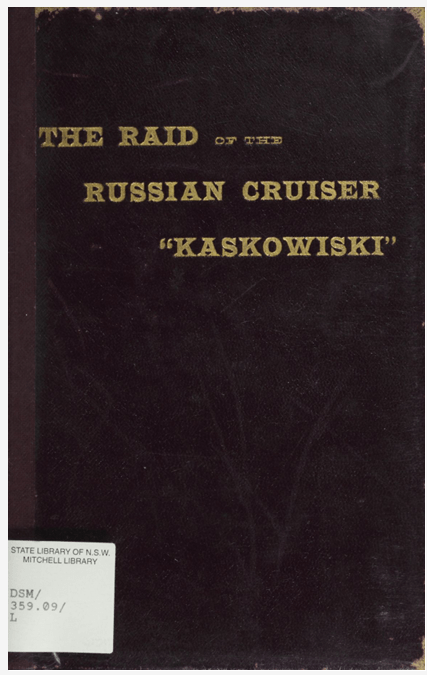
David Luckie returned to the incident in 1894, when he published The Raid of the Russian Cruiser “Kaskowiski”: An Old Story of Auckland.
The book reproduced the 1873 newspaper articles and included an extensive introduction and appendix examining:
- hostile cruiser operations;
- British and colonial naval defence;
- Australasian harbour fortifications;
- torpedoes and submarine mines;
- the Royal Australasian Squadron;
- the naval and military forces of the colonies;
- the strength of European armies and navies; and
- the protection of shipping and imperial trade routes.
The title page described it as an old Auckland story accompanied by an introduction and appendix on colonial defence. The work was dedicated to Premier Richard Seddon in his capacity as Minister of Defence.[18]
Luckie explained that the story had been reprinted periodically and that continuing international tensions made its publication in permanent form timely. In retrospect, he described the original article as an imaginative consideration of what might happen to Auckland and other undefended colonial ports if they were suddenly visited by hostile warships.
He also argued that subsequent events demonstrated that the danger was not entirely imaginary. In 1885, the Russian cruiser Vestnik entered Wellington Harbour without warning or a pilot and anchored on the man-of-war ground. Around the same period, Russian vessels at Vladivostok were reportedly being prepared for possible operations in Australasian waters should war with Britain occur.[19]
By 1894, conditions had changed considerably. Australasian cities had been fortified, harbours were protected by guns and controlled mines, and a Royal Australasian Squadron protected floating trade.
Luckie contrasted this with the almost wholly unprotected position of the colonies in 1873. He nevertheless warned that defending widely scattered colonial commerce and preventing sudden raids remained difficult.
The wider system of public accountability
While the Kaskowiski affair drew attention to the physical security of armouries and magazines, Gorton’s work addressed another form of security: the protection of public property against loss, neglect and misappropriation.
Every official receiving public stores was expected to:
- record the articles received;
- acknowledge responsibility for their custody;
- account for issues and transfers;
- report losses, damage and disposals;
- submit periodic returns; and
- produce the property during inspection.
This system could appear excessive to officers questioned about apparently minor articles. However, the cumulative value of furniture, tools, weapons, equipment and engineering stores held across numerous offices and districts was substantial.
The rapid expansion of the Public Works programme made effective control particularly important. Roads, bridges, railways and telegraph lines required large quantities of imported and locally purchased material. Without accountable officers, standard returns and physical inspections, losses could remain undetected.
The Defence Stores organisation therefore contributed to a broader development in colonial administration. It helped establish the principle that public property had to be traceable from purchase to final disposal.
Significance of the Year and Conclusion
The financial year 1872–73 was a period of consolidation and widening responsibility for the New Zealand Defence Stores. It illustrated several important developments in the evolution of the colony’s military supply, maintenance and accountability system.
The permanent Defence Stores establishment remained geographically extensive. Auckland and Wellington continued to serve as the principal stores, supported by a nationwide network of sub-storekeepers and acting sub-storekeepers operating throughout both islands. This system allowed arms, ammunition and other military equipment to be held, issued and accounted for across widely dispersed districts.
Specialist technical personnel remained essential to the operation of the Department. Armourers and arms cleaners maintained the serviceability of a mixed and increasingly ageing inventory while also supporting the introduction of weapons such as the Tisdall Snider carbine. The Department also safeguarded ammunition and explosives in purpose-built magazines, ensuring that strategically important stores remained secure and available when required.
The two principal Store Department appropriations amounted to approximately £3,818 2s 6d, equivalent to about NZ$668,200 in 2026 purchasing-power terms. Actual expenditure associated with the two votes was approximately £3,566 1s 8d, or about NZ$624,100.
At the same time, Lieutenant-Colonel Edward Gorton’s responsibilities were extending beyond the management of military arms and ammunition. The accounting and inspection procedures developed within the Defence Stores were increasingly being applied throughout the wider public service. Railway material, engineering stores, furniture, tools and other government property were becoming subject to similar systems of inspection, documentation and accountability.
The supposed Russian attack on Auckland added another dimension to the year. On 17 February 1873, the Southern Cross published an elaborate account of an attack by the ironclad Russian cruiser Kaskowiski. For a brief period, many Aucklanders believed that their city, banks, armoury, magazines and telegraph stations had fallen to an enemy force.
The fictional attackers’ immediate seizure of the armoury, magazines and communications infrastructure reflected a genuine strategic vulnerability. Control of weapons, ammunition and telegraph stations would have restricted the ability of local authorities and volunteer forces to organise resistance. Although the cruiser was imaginary, its water-gas weapon impossible and its name a play on “cask of whisky”, the weaknesses exposed by the story were real.
The hoax helped shift public discussion beyond the recent experience of internal land warfare. Increasing attention was now being paid to the defence of harbours, shipping, communications, armouries, magazines and public stores against an external enemy. It encouraged more serious debate over coastal fortifications, naval protection and the mobilisation of trained forces.
The work of the Defence Stores remained largely unseen, but its importance was enduring. During 1872–73, the Department maintained a nationally coordinated system of supply, maintenance, inspection and accountability while extending its administrative influence across the wider machinery of government. In doing so, it formed part of the foundation upon which New Zealand’s later ordnance and military logistics organisations would be built.
Notes
- Edward Gorton, “Report of the Inspector of Stores,” Appendix to the Journals of the House of Representatives [AJHR], 1873; Robert McKie, “Unappreciated Duty: The Forgotten Contribution of New Zealand’s Defence Stores Department in Mobilising the New Zealand Expeditionary Force in 1914” (MA thesis, Massey University, 2022).
- Gorton, “Report of the Inspector of Stores.”
- New Zealand, Appropriation Act 1872, 36 Vict., no. 74, Class II, Vote No. 11. The vote provided £250 for half the Inspector’s salary and £255 for the half-salaries of three clerks.
- Robert McKie, “New Zealand Military Armourers, 1840–1900,” To the Warriors Their Arms, 3 June 2025.
- McKie, “New Zealand Military Armourers, 1840–1900.”
- Robert McKie, “Walter Christie: Soldier, Armourer, and Servant of New Zealand,” To the Warriors Their Arms, 27 May 2025.
- New Zealand, Appropriation Act 1872, Class VIII, Vote No. 54.
- New Zealand Government, “Public Accounts of the Government of New Zealand for the Financial Year 1872–73,” AJHR, 1874, B-1, 54.
- W. Moule, “Armed Constabulary Force: Annual Report of Commissioner,” AJHR, 1873, H-14.
- Robert McKie, “Auckland Defence Store, 1861–1903,” To the Warriors Their Arms, 11 December 2021.
- McKie, “Auckland Defence Store, 1861–1903”; Robert McKie, “Built for Purpose,” To the Warriors Their Arms, 25 October 2025.
- D. M. Luckie, The Raid of the Russian Cruiser “Kaskowiski”: An Old Story of Auckland (Wellington: New Zealand Times Company, 1894), 15–17.
- Luckie, Raid of the Russian Cruiser, 18.
- Luckie, Raid of the Russian Cruiser, 20. The fictional raiders were said to have recovered £131,096 17s 6d from the Auckland banks before taking hostages aboard the cruiser.
- Luckie, Raid of the Russian Cruiser, 21.
- Luckie, Raid of the Russian Cruiser, 21.
- New Zealand Parliament, “Report of the Committee on Colonial Defence,” AJHR, 1873, I-3.
- Luckie, Raid of the Russian Cruiser, title page and dedication.
- Luckie, Raid of the Russian Cruiser, xi–xiv.
