Largely forgotten today, the early 1930s marked a tumultuous period for the New Zealand military which was profoundly impacted by the Great Depression. In 1931, facing unprecedented economic pressures, the military was compelled to enact severe cutbacks and reductions. The lessons drawn from these pivotal events offer invaluable insights into fortifying the resilience and adaptability of today’s military forces amidst contemporary strategic and economic uncertainties.
Establishment and Early Developments
Established in 1917, the New Zealand Army Ordnance Corps (NZAOC) quickly became integral to the country’s Permanent Military Forces. However, the onset of the global economic depression triggered substantial changes in New Zealand’s military funding and organisational structure. As the worldwide economic downturn took hold, austerity measures and restructuring became unavoidable, necessitating a comprehensive overhaul of the NZAOC to align with the new economic realities.
Badges of the New Zealand Army Ordnance Corps, 1917 -1937. Robert McKie Collection
Established in 1917, the intervening years had seen the NZAOC decline in personnel from its peak strength of 493 in 1919 to an average of 118 officers and other ranks between 1920 and 1930. Despite this reduction, significant infrastructural advancements replaced the colonial-era facilities with modern buildings across various locations. Key NZAOC establishments included:
Northern Military District:
Ordnance Depot and Workshop at Waikato Camp in Hopuhopu, constructed in 1928.
Ordnance Workshop at Devonport’s artillery yard (now the RNZN Museum).
Small Arms Ammunition Testing Staff stationed at the Colonial Ammunition Company factory in Mount Eden, Auckland.
Central Military District:
The Main Ordnance Depot and Workshop at Trentham was established as a permanent camp in 1915.
The Ammunition Section at Fort Balance.
Southern Military District:
The Ordnance Depot and Workshop at Burnham Camp was established in 1921 with the ongoing construction of new infrastructure.
These developments underscored the NZAOC’s strategic presence in the Northern, Central, and Southern Military Districts.
1938 Military Camp, Hopuhopu, Waikato. Whites Aviation Ltd: Photographs. Ref: WA-55972-G. Alexander Turnbull Library, Wellington, New Zealand. /records/23181165
Economic Downturn and Military Reorganisation
The economic downturn of the early 1930s necessitated severe cuts to government expenditure, compelling the New Zealand military to undergo substantial reorganisation. In 1930, the military’s strength stood at 555 regulars and 16,990 Territorials. By 1931, this was reduced to 349 regulars and 3,655 Territorials. These reductions were implemented under the provisions of the Finance Act, 1930 (No. 2), which facilitated compulsory retirements and transfers to civilian roles for many NZAOC personnel.
The Act authorised the retirement on superannuation of any member of the Permanent Force or the Permanent Staff under the Defence Act, 1909, or of the clerical staff of the Defence Department whose age or length of service was such that if five years had been added they would have been enabled as of right or with the consent of the Minister of Defence to have given notice to retire voluntarily. Compulsory retirement under this Act was facilitated in two tranches:
Tranche 1: Personnel Retired without Superannuation:
Servicemen eligible for retirement under the provision of the Act who were not contributing to the superannuation scheme were notified on 13 December 1930 of their impending release. They were granted six weeks of special leave, effective 31 December 1930, with their final release scheduled for 11 February 1931 after completing their notice period.
Tranche 2: Personnel Retired with Superannuation:
Servicemen eligible for retirement under the provision of the Act who were contributing to the superannuation scheme received notification on 13 December 1930. Their salary continued until 31 March 1931, with superannuation benefits commencing in April. Accrued leave entitlements were taken concurrently during this notice period, resulting in much leave accrued forfeited.
These tranches included Ordnance soldiers who had joined the NZAOC since its formation in 1917. Some had transferred directly from the Defence Stores, while others had served in the pre-war Permanent Forces or had active service with the New Zealand Expeditionary Force (NZEF). Their compulsory retirement represented a significant loss of knowledge and experience for the New Zealand military. Under the provisions of section 39 of the Finance Act, 1930 (No. 2), 44 members of the NZAOC were placed on compulsory retirement, including the following personnel who have so far been identified.
Northern Military District
948. Lieutenant Michael Joseph Lyons, MSM
968 Sergeant Thomas Alexander Hunter, MSM
62 Private Frank Jewiss
166 Sergeant William John Rabbidge
268 Staff Quartermaster Sergeant James Alexander Kenning
Captain Frank Edwin Ford
Central Military District
19 Sergeant Alfred Charles Butler
39 Corporal Simon Alexander Fraser
64 Gunner Maurice Francis Johnstone
111 Corporal John Sawyer
920 Corporal Gordon James Francis Arenas
941 Sergeant William Hans McIlraith
956 Staff Sergeant Saddler George Alexander Carter, MSM
960 Sergeant Frank William Ching
965 Corporal Philip Alexander MacKay MSM
976 Private William Valentine Wood MSM
978 Corporal Earnest John Williams MSM
1018 Sargeant Major James Oliver Pringle Southgate
1024 Armament-Artificer Eric Wallace Jepson
Lieutenant L.A Clement
Captain Alfred William Baldwin
Captain William Moody Bell
55 Staff Quartermaster Sergeant John Francis Hunter MSM
143 Armament Sergeant Major (WO1) Joseph Warren
995 Staff Sergeant Wilfred Robert White
Southern Military District
2 Armament Staff Quartermaster Sergeant John Alexander Adamson MSM
1006 Lance Corporal Norman William Wilkie
Corporal Cecil John Knight
Captain Arthur Rumbold Carter White
966 Lance Corporal William Terrington Popple, MSM
Transition to Civilian Roles
To achieve further cost savings, 74 NZAOC soldiers received notifications in December 1930 that their positions would be retained but transferred to civilian roles with civilian pay rates. This transition took effect in February 1931, causing significant disruption for those affected, including the loss of accumulated leave and adjustment to civilian life..
Some of these soldiers were transferred to other departments within the defence establishment, while the majority remained in their current roles within the NZAOC Ordnance Depots and workshops. They transitioned overnight from wearing uniforms to civilian clothes, with significantly reduced rates of pay and civil service conditions of service. The following personnel have so far been identified as being transferred to the Civil Staff.
Northern Military District
967 Corporal Robert John Gamble
974 Corporal Henry William Le Comte
983 Sergeant Clifford Verne Little
996 Lance Corporal Athol Gilroy McCurdy
202 Lance Corporal Arthur Graham Munday
Central Military District
972 Private John Dennis Anderson
35 Lance Corporal Harry Harper Ekins
1061 Lance Corporal Earnest Fenton
4 Sergeant Kenneth Olaf John Andersen
699 Corporal Oliver Avis, MM
889 Staff Sergeant George Bagnell
1004 Lance Corporal James Johnston Bolt
961 Lance Corporal Edgar Charles Boult
1000 Private George Cumming Bremner
1027 Artificer William Cowan Brizzle
1003 Lance Corporal Ernest Carr
1012 Lance Corporal Charles Fred Ecob
864 Corporal William Charles Francis
1025 Tent-Repairer-Artificer Herbert Roy Griffin
714 Lance Corporal Kenneth Hoare
1016 Private Ernest William Hughes
989 Corporal Percy Reuben Hunter
213 Lance Corporal William Saul Keegan
1019 Private Edward Gavin Lake
342 Corporal Allen Charles Leighton
998 Lance Corporal Allen Dudley Leighton
1011 Lance Corporal Geoffrey Charles Leighton
363 Staff Sergeant David Llewellyn Lewis, MSM
1007 Lance Corporal Thomas James Mclaughlin
1020 Private John Douglas Melville
894 SQMS (WO2) James Moroney Sergeant David Nicol]
1023 Lance Corporal John Nixon
467 Corporal George Wantford Pamment
1013 Private Francis Reid
1022 Private Henry McKenzie Reid
1014 Wheeler-Artificer Robert Stacey Vincent Rowe
665 Private William Alexander Sammons
927 Private Leonard William Sanders
963 Corporal Albert Edward Shadbolt
138 Lance Corporal David Henry Strickland
1017 Private Lionel Herbert Stroud
Southern Military District
970 Sergeant Edward Vincent Coleman
1028 Private Percival Nowell Erridge
959 Sergeant Charles Edward Gleeson
1276 Private Lewis Haslett
885 Corporal Charles James Johnston Storie
728 Private William Sampson Valentine
Impact on Military Preparedness and Social Consequences
The compulsory retirements and transfers to civilian roles led to a reduction in the NZAOC’s military strength, impacting its preparedness during subsequent years. However, beginning in 1934, improved government finances allowed for an increase in the army’s training tempo, despite global events hinting at looming conflict. The following personnel who have so far been identified as been retained:
Northern Military District
984 Staff Sergeant Thomas Joseph Holliday
1260 Armament Staff Quartermaster Sergeant Samuel Thomson MSM
915 Armament Staff Sergeant Eric John Hunter
141 Armourer Corporal Reginald Samuel Henry Lyons
Central Military District
14 Armament Sergeant Major Bertram Buckley
992 Armament Corporal Hilliard Charles Cooper
1029 Artificer James Dabney
964 Warrant Officer Class 1 John William Dalton
1032 Armourer Staff Sergeant Frederick Henry Dew
979 Armourer Staff Sergeant John William Evers
1026 Armament Sergeant Leo Stanley Jefcoate
Major Thomas Joseph King
945 WO2 Armament SQMS Henry Albert Wiliam Pierard
1021 Armament Staff Sergeant Arthur Sydney Richardson
1010 Lance Corporal George Frederick Robert Ware
Southern Military District
7 Corporal Percey Charles Austin
25 Armourer Staff Sargeant Francis Augustus Clapshaw
Lieutenant Henry Erridge Erridge
The reduction in the Territorial Force in 1931 resulted in decreased activity in subsequent years. However, beginning in 1934, improved government finances allowed for an increase in the army’s training tempo. Concurrently, global events in China, Ethiopia, and Germany hinted at looming conflict, prompting a gradual shift towards preparing for future mobilisation. Under the leadership of Major Thomas Joseph King, who served as Director of Ordnance Services (DOS) since 1924, the NZAOC worked diligently within its means to enhance readiness, including designing a new system of stores accounting for the emerging Royal New Zealand Air Force.
The new NZAOC Badge was approved in 1937. Robert McKie Collection
King focused on recruiting new personnel and leveraging his civilian staff, who were former NZAOC soldiers, to reenlist experienced individuals into key leadership roles at Trentham, Hopuhopu, and Burnham. When war was declared in September 1939, King successfully mobilised his small military and civilian team to form the rump of the New Zealand Ordnance Corps (NZOC) within the 2nd New Zealand Expeditionary Force (2NZEF).
During the 1938-45 war, nearly all NZAOC soldiers who had been transferred to civilian roles in 1931 found themselves back in uniform, restarting their military careers as Ordnance Officers, Warrant Officers, and Senior Non-Commissioned Officers (SNCOs) alongside their peers who had been retained. Many from this group continued to provide leadership within the RNZAOC and Royal Electrical and Mechanical Engineers (RNZEME) up to the 1960s, with several even holding the prestigious position of DOS in the post-war army.
Lieutenant Colonel Francis Reid handed over the position of DOS to his brother, Lieutenant Colonel Henry McKenzie Reid, on 31 March 1957. Both brothers joined the NZAOC as soldiers in the late 1920s, only to be transferred to the civilian staff in 1931. Commissioned during WW2, both served with distinction throughout the war.
Negative Effects and Lessons Learned
The 1931 reductions in the New Zealand military, driven by the economic pressures of the Great Depression, had profound and lasting negative effects, both socially and in terms of military preparedness. Socially, the abrupt compulsory retirements and transitions to civilian roles caused significant upheaval for the affected soldiers and their families. The loss of accumulated leave and the sudden shift from military to civilian life resulted in considerable stress and financial strain.
In terms of military preparedness, the reductions led to a substantial loss of experienced personnel and institutional knowledge. The drastic decrease in the Territorial Force and overall military strength severely hampered the country’s ability to maintain an effective and ready military force. The reduced activity and training during the early 1930s left the military less prepared for the impending global conflicts of the late 1930s and early 1940s than in 1914. This lack of preparedness could have had dire consequences had international tensions escalated more quickly.
However, subsequent efforts to rebuild, modernise, and mobilise the military demonstrated the resilience and adaptability of the New Zealand military. Starting in 1934 under the leadership of Major Thomas Joseph King, the NZAOC enhanced its readiness by recruiting new personnel and reenlisting former soldiers from the civilian staff. The return of nearly all NZAOC soldiers to uniformed service during the 1939-1945 war showcased their dedication and the critical role of experienced personnel in maintaining military effectiveness.
The 1931 reductions’ experiences highlight the importance of balancing economic constraints and the need for a capable and prepared military force. These lessons remain relevant today as modern military forces navigate similar challenges amidst strategic and economic uncertainties. Ensuring that reductions do not compromise long-term readiness and resilience is crucial for the effective functioning of any military organisation.
Notes
[1] (1930). “H-19 Defence Forces of New Zealand, Annual report of the General Officer Commanding the Forces.” Appendix to the Journals of the House of Representatives.
[2] (1931). “H-19 Defence Forces of New Zealand, Annual report of the General Officer Commanding the Forces June 1930 to May 1931.” Appendix to the Journals of the House of Representatives, 1 January 1941.
[3] (1914). King, Thomas Joseph. Personal File, Archives New Zealand. Wellington.
The history of field cooking in New Zealand’s military from the 19th to the early 20th centuries showcases a journey marked by resilience, ingenuity, and progress. Initially, the New Zealand military relied on the sometimes-questionable ability of regimental cooks, who managed to provide sustenance for the troops despite adverse conditions and makeshift equipment. However, the need for more efficient cooking solutions became apparent as the military evolved into a Territorial Force.
The introduction of mobile field kitchens, inspired by innovations such as Karl Rudolf Fissler’s “Goulash Cannon,” represented a significant advancement. Nonetheless, the ingenuity of a New Zealand Territorial Officer truly revolutionised New Zealand Military field cooking with the creation of the “Salamander” cooker. Renowned for its remarkable efficiency and versatility, this cooker enabled the preparation of large quantities of food with minimal fuel consumption.
Initially compared to other models from England, like the Lune Valley and Sykes cookers, the Salamander’s superior efficiency, fuel economy, and suitability for New Zealand’s unique conditions quickly set it apart. The New Zealand Defence Department’s subsequent procurement of additional units underscored the Salamander cooker’s pivotal role in New Zealand’s military catering capabilities.
Although the outbreak of World War I shifted priorities, the innovations and lessons from this period laid a crucial foundation for New Zealand’s future military logistics and catering practices. This commitment to enhancing soldiers’ conditions through improved field cooking solutions highlights New Zealand’s dedication to adaptability and innovation in military operations.
Volunteer to Territorial
In the 19th and early 20th centuries, participants in New Zealand’s volunteer encampments relied heavily on the unwavering dedication of regimental cooks for their sustenance. Undeterred by the elements, these cooks operated makeshift camp kitchens, often little more than shallow trenches dug into the ground over which they balanced pots and pans. Despite the challenges of these temporary structures, which required significant setup and operation time, the cooks persevered. Meals, though taking up to four hours to prepare, were a testament to their resourcefulness and commitment.
Efforts to create mobile, horse-drawn kitchens had been ongoing, with one of the earliest and most successful examples being designed in the late 1800s by a young German named Karl Rudolf Fissler. Fascinated by steam engines, Fissler developed the Feldkochherd or Feldküche by 1892, a mobile field kitchen with a unique boiler system. This innovation, quickly nicknamed the “Goulash Cannon” or ‘Gulaschkanone’ due to the furnace tube’s resemblance to a cannon barrel, allowed for the preparation of complete menus. Inspired by Fissler’s invention, France and England soon created their own versions of the Goulash Cannon.
As New Zealand’s military transitioned from a volunteer force to a Territorial Force, the lessons from the war in South Africa remained fresh. The importance of not only ammunition supply but also the supply of hot rations was crucial, as it could be the deciding factor in morale and battle effectiveness.[1] This ensured that the quest for more efficient methods of sustaining troops remained a priority. Initially looking to England for solutions, New Zealand ultimately developed a local alternative. This homegrown innovation propelled the nation to the forefront of field cooking technology, demonstrating its commitment to improving its military personnel’s conditions and its ability to adapt and innovate.
The early Territorial years
The Defence Act of 1909 disbanded the existing volunteer forces and established the Territorial Force, supported by conscription. A pivotal moment in this reform came with the appointment of Major General Alexander Godley as Commandant of the New Zealand Military Forces in December 1910. Under his leadership, the military’s organisational structure was revitalised, and key command and staff appointments were made. As the army reorganised, it became clear that a modern catering system was necessary to support the large numbers of men entering camps and training together. To manage the procurement and distribution of rations, the New Zealand Army Service Corps (NZASC) was officially designated as a unit of the Territorial Force on 12 May 1910. However, the responsibility for cooking rations remained with the regimental cooks.
Regimental cooks in the latter part of the 19th century and early 20th century were masters of improvised field cooking. They were skilled at building a remarkable range of makeshift field stoves and ovens, using wood, oil or coal for fuel. They prepared meals in Aldershot ovens and trenches, or makeshift walls constructed from bricks mortared with mud, using frying pans, 8 and 20-gallon boilers, and camp kettles.
The Camp Kettle, or “Dixie”, A Long-Serving Field-Cooking Implement
The camp kettle, more commonly known in British Army usage as the “dixie”, was one of the most enduring pieces of military field-cooking equipment. Long before the appearance of mobile cookers and travelling kitchens, it provided a simple and robust means of boiling food, heating water, carrying cooked rations, and serving meals in camp or in the field. Its continued appearance in New Zealand Defence reports and camp-equipment returns reflected its practical value. It was not a sophisticated item, but it was one of the basic implements on which regimental cooking depended.
The standard British pattern was an oval, lidded vessel of about three gallons capacity, fitted with a bail handle so that it could be carried or suspended over a fire. Earlier examples were generally made of tinned iron or tinned sheet metal, while later examples were made from aluminium. The lid increased its usefulness, as it could be used as a frying pan, platter, or serving tray. In this form the camp kettle was not merely a cooking pot, but a multi-purpose field implement suited to the realities of camp and campaign life.
In practice, camp kettles sat at the centre of the older system of improvised field cookery. They could be used in trenches, over open fires, alongside Aldershot ovens, or with makeshift field kitchens formed from earth, brick, or scrap material. They were particularly suited to boiled meals such as stews, curries, soups, vegetables, tea water, and other hot rations that could be prepared in bulk and served into soldiers’ mess tins. Their portability also allowed cooked food to be moved forward from the cookhouse or field kitchen to troops who could not easily return to the kitchen area.
The importance of the camp kettle lay in its adaptability. It could cook, carry, reheat, and serve. This made it a bridge between the improvised camp kitchens of the Volunteer period and the more formalised cooking systems of the Territorial era. Even after the adoption of Salamander, Lune Valley, Sykes, and Imperial Pattern travelling cookers, camp kettles remained necessary. The new cookers improved efficiency, fuel economy, and mobility, but they did not remove the need for simple vessels in which food and hot water could be handled at unit level.
For New Zealand’s military, the camp kettle therefore represents continuity within a period of change. The move towards purpose-built field cookers from 1912 onwards marked a major advance in military catering, but it rested on an older foundation of basic camp equipment, practical cookery skill, and adaptable implements. The camp kettle was one of those quiet constants, a practical item that had served from the nineteenth century and remained in use well into the mid-twentieth century.
In October 1912, forty-seven candidates from the Territorial Army were selected for an intensive month-long training course at Trentham to improve the standard of cooking across the New Zealand Forces. This pioneering course covered kitchen work and cooking techniques suitable for field conditions, including practical exercises. Although these methods were effective, they were also time-consuming, required considerable effort from the cooks, and were static and unsuitable for an army on the march.
Single Filed Oven (Aldershot Oven) School of Cookery Camp, Trentham 1912. Joseph Zachariah, DONZ Collection
Long trenches with camp kettles and hot plate. School of Cookery Camp, Trentham 1912. Joseph Zachariah, DONZ Collection
In March 1911, a mobile cooking solution was proposed to New Zealand when Wellington engineering firm Richardson Blair and McCabe Limited, the sole New Zealand agents for the Lune Valley Engineering Company of Lancaster, England, sent a copy of the 1910 Lune Valley Portable Field Cooker catalogue to James O’Sullivan, the New Zealand Director of Military Stores. O’Sullivan then forwarded it to the Quartermaster General (QMG) for consideration. A year later, in March 1912, Richardson Blair and McCabe Limited followed up with the 1911 Lune Valley Engineering catalogue. The QMG acknowledged receipt on 12 March 1912, noting that the catalogue’s contents had been reviewed and would be considered should the Defence Department require any of the items listed.[2] Although the New Zealand military seemed uninterested in cooking technologies, officers posted to England noted the latest innovations, which they used to develop a broad user requirement for the New Zealand Military Forces.
While attending Staff College at Camberley in 1912, Major George Spafford Richardson of the New Zealand Staff Corps (NZSC) submitted a report regarding field cooking ovens to the New Zealand Government. Richardson noted the advanced cooking arrangements at various Territorial Camps, attributing the improvement mainly to the quality of ovens. One such oven, observed with the Berks Yeomanry, particularly caught his attention — the ‘Tortoise oven,’ capable of cooking for 600 men. Its lightweight and portability, even during marches, impressed Richardson, who advocated for similar ovens in New Zealand.
Tortoise Field Cooking Ovens for Camp purposes, No 3. Archives New Zealand R11096710 Cooking equipment – Cooking ovens as used by Imperial troops re – Obtaining for use in New Zealand
On 15 August 1912, Major Richardson’s report reached the New Zealand Defence Department, prompting Major General Godley to recommend to Cabinet the acquisition of 16 ‘Tortoise Ovens’ for the Territorial Force’s Annual Training Camps. This proposal was swiftly approved on 7 September 1912, with £480 allocated for the purchase.
To expedite the acquisition process, a cable instructing the procurement of the ovens was dispatched from the Prime Minister’s office to the High Commissioner in London on 9 September. Major Richardson was tasked with determining the specific requirements, reaching out to Major Lewis Rose of the Berkshire Yeomanry for details on the ovens mentioned in his report. By 14 October 1916, Major Rose confirmed his regiment’s use of Portway’s Portable ovens, No 3, and expressed satisfaction with their performance. He provided Richardson with the manufacturer’s contact information and a catalogue.
Informed by Major Rose’s feedback, Richardson told the High Commissioner that the ‘Tortoise Ovens’ were suitable for stationary camps and marches. He cautioned against considering a wheeled cooker currently undergoing British army trials, citing its limited utility and advising awaiting improvements. Subsequently, on 18 October, Tortoise Stove Works of Halstead Essex submitted a quotation for 16 Tortoise Field Cooking Ovens, No 3, with five shelves, at a total cost of £441.13.9. They offered to conduct final inspections within six weeks of acceptance, facilitating onward delivery to New Zealand.
Despite his preferences, Richardson conceded that he would like Colonel Alfred William Robin to inspect the ovens before making any purchase decision. Colonel Robin was New Zealand’s most experienced officer at the time. He had served as a volunteer since 1878, and in September 1899, he was commissioned into the New Zealand permanent forces. Notably, he commanded the first New Zealand contingent to South Africa. In December 1906, Robin was appointed to the newly established Council of Defence as Chief of the General Staff, becoming the first colonial to hold the country’s highest military position. Upon Godley’s appointment as the commandant of the New Zealand Forces, Robin assumed the role of adjutant and QMG.
In February 1912, Robin became the New Zealand representative on the Imperial General Staff at the War Office in London. During this time, he actively participated in discussions regarding training dominion forces. Additionally, he studied ordnance, administrative services, and the movement of troops by land and sea.[3] Moreover, Robin prepared a mobilisation scheme for dominion territorial forces as part of his duties. His extensive experience and expertise made him an asset in military matters, including evaluating equipment such as ovens.
Concurrent with Richardson’s reports, Robin thoroughly evaluated cookers and travelling kitchens and their suitability for use by the New Zealand Forces. In a report sent to Headquarters New Zealand Forces on 15 November 1912, Robin identified five classes of cookers and travelling kitchens for evaluation purposes during his investigation of field cookers.
Class 1 – Cookers or Kitchens carried on “General Service” or Forage wagon, cooking while on the march.
Class 2 – Cookers, Stove or ovens for cooking while in camp, but not adapted to cook on the march.
Class 3 – Travelling Kitchens on special vehicles, either limbered or on a single wagon, cooking while on the march.
Class 4 – Cookers or Kitchens above named using oil or paraffin as a fuel.
Class 5 – Cookers or Kitchens above named using wood, coal, coke or any consumable material as fuel.
Based on these classes, Robin summarised his report and his findings as follows.
If to burn Oil Fuel, should not be sent to New Zealand.
If not suitable for cooking on the march, but only for fixed camps. What space and weight are they for Transport purposes?
There are several reputable firms in New Zealand that make all classes of fixed stoves and ranges. These could be made in New Zealand, suitable to local conditions at less cost and saving freight from England.
Are cooking utensils included in the cost?
How many men will No 3, as per tender, cook for?
These stoves are excellent for Officers and Non-Commissioned Officers Mess at Yeomanry and Territorial Camps, where even the rank and file are catered for as if in a hotel. Here, for roast purposes, they may cook for 250, but in New Zealand, where men consume more than double the quantity of meat, their capacity would only be half at most of the above.
Such stoves or cookers are not a government issue. Regiments buy for themselves.
Robins’s main contention was that New Zealand could best produce cookers for fixed camps.
Robin recommended against the ‘Tortoise Ovens,’ stating that while they were suitable for specific cooking tasks, they fell short of meeting New Zealand’s requirements. Instead, he proposed considering either the War Office pattern Traveling kitchen, which was still under development, or a similar piece of equipment developed by Captain Arthur Sykes, Quartermaster of the Princess Victoria (Royal Irish Fusiliers). In Robin’s opinion, both options offered excellent features that better suited New Zealand’s needs.[4]
As Robin’s reports underwent analysis by the Defence Staff in Wellington, attention turned to the impending Brigade camps. A December 1912 inventory of camp equipment revealed a shortage of cooking implements across all districts. Consequently, the QMG instructed the Director of Equipment and Store to seek quotations for 43 Aldershot Cooking Ovens with dishes.[5] The distribution plan allocated 12 ovens to each of the Auckland, Canterbury, and Otago Districts, with seven designated for the Wellington district. One Aldershot oven (comprising two parts with two ends) and one baking dish were dispatched from Wellington to each district as samples to facilitate the process. Additionally, quotation forms were provided to enable each district to obtain quotations from local manufacturers. However, due to some local innovation initiated by Lieutenant James Ferdinand Groom Roberts, the Quartermaster of the 5th Wellington Regiment, the requirement and request for tenders were premature and were cancelled in February 1913.[6]
The Salamander Cooker
An engineer draftsman by trade, Roberts possessed extensive military experience, including eight years of service in the 2nd Royal Warwick Volunteer Regiment in the United Kingdom, followed by service in the 1st Battalion Wellington Rifles since 1909. In February 1912, he assumed the role of Quartermaster of the 5th Wellington Regiment. Amidst his varied responsibilities as Battalion Quartermaster and later as Brigade and Coast Defence Supply Officer, Roberts dedicated considerable thought to improving the regimental kitchen. His aim was to create a solution that could efficiently boil the billy while on the march, ensuring that meals could be promptly served when the regiment halted.
To meet these objectives, Roberts sought to develop a solution that was lightweight, sturdy, fuel-efficient, powerful in cooking capabilities, simple to construct, and, above all, mobile. After careful consideration and planning, and concurrent with Richardsons and Robins’s examination of field catering solutions in England, Roberts unveiled his prototype to the Defence Force on 8 November 1912.
With tables set with black-handled knives and forks, enamel plates and mugs, jars of jam, stacks of butter, and loaves of bread, the aroma emanating from Roberts’ Camp Stove tantalised the hungry men, heightening their anticipation for the forthcoming meal. Typically, a meal in a camp setting could take up to four hours to prepare, including the time needed to construct the oven. However, the self-contained cooker that Roberts demonstrated proved remarkably efficient. In just one and a half hours, it produced a meal for an audience of 300. This efficiency was further underscored by the stove’s ability to achieve such results using only one hundred-weight of coal (equivalent to 50kg) while still preparing an impressive array of food consisting of;
Three carcases of mutton
120lbs of fore-quarter beef (approximately 55kg)
45lb of silversides (about 20kg)
Potatoes
Onions
Additionally, it kept 75 gallons (approximately 340 litres) of water boiling. Remarkably, the stove still had the capacity to accommodate another carcase of mutton for roasting easily and steamed two more pots of vegetables.[7]
The demonstration at the Buckle Street Drill Hall was well received, prompting further testing of the cooker in its mobile configuration. This test took place from 29 November to 1 December 1912, during which H Company (Victoria College) of the 5th Regiment embarked on a three-day trek through the hills east of Wellington under field conditions. When the company reached South Makara, dinner consisted of a clear soup, roast beef and mutton, boiled vegetables, boiled plum duff, and jam roll. Other meals throughout the weekend were similarly elaborate and easily digestible, demonstrating the usefulness of Roberts’ cooker.[8]
Roberts 2a Oven (Travelling) for 250 Men. Archives New Zealand R22432833 Cookers – Field- Roberts travelling
Marketed as the “Salamander”, Robert’s cooker was a marvel of simplicity and efficiency, ingeniously utilising every inch of space. Half of each side was a water reservoir, each tank holding approximately 40 gallons (181 litres). These reservoirs provided boiling water for tea and helped retain the oven’s heat. The front halves house the ovens, while on top are the steamers, resembling kerosene tins placed lengthwise in wire baskets. Potatoes and vegetables are steamed with hot water poured in, generating steam for cooking.
The process of cooking a large meal with the cooker was fascinating to observe. After filling the water reservoirs and lighting the fire, the oven was brought to the required heat in about 20 minutes. Then, trays of meat were placed inside the ovens, and pans of peeled potatoes went into the steamers. The cook’s role then mainly involved stoking the fire and occasionally checking the meat until the meal was ready, ensuring everything was cooked simultaneously.
An advantage of the cooker is its ability to prepare everything simultaneously. Thanks to the heat generated by the boiling water in the tank, preparations can be made in the morning before moving off, and the meal can be cooked as the vehicle travels.
The cooker was designed to be versatile, allowing it to be operated in various setups. It could function either dismounted in a standing kitchen, mounted on a GS Trailer in its mobile configuration, or in its most common arrangement, akin to a field gun and limber. In this configuration, the cooker replaces the gun, while the limber portion houses large food storage compartments capable of carrying up to 250 pounds (113kgs) of meat, 150 gallons (680 Litres) of water, along with provisions such as potatoes, tea, coffee, and cocoa.
When unlimbering, the limber was detached from the cooker wagon with a king bolt and split pin. A strut was then extended from under the second carriage to keep it upright. The cooker stood with its funnel facing forward, protected by a screen against cold winds. Union bolts secured the cooker in position, and footboards allowed the cook to access and operate the oven doors easily.
Behind the cooker, ample floor space allows the chef to work comfortably. Fuel storage boxes were located underneath the rear of the carriage, accessible through floor lids. Every aspect of the cooker was designed to facilitate the cook’s tasks, with easy access to all parts, even while travelling. The detachability of the limber offers advantages such as adjusting to changing wind directions and easy mobility in search of provisions. Both carriages are mounted on sturdy springs for a smooth ride, and the cooker carriage is equipped with a ratchet brake for stability on slopes.[9]
Acknowledging the diverse needs of the military and the necessity to accommodate units of various sizes, the Salamander was available in the following sizes with all models, including transport cart, larder, tank and fuel bunker:[10]
No
To Cook for
Approx Weight
Notes
0
20
1 cwt (50kg)
Without boiler
0a
20
1 cwt (50kg)
With boiler
1a
40
2 cwt (101kg)
With boiler
1b
60
21/2 cwt (127kg)
With boiler
1c
100
3 cwt (152kg)
With boiler
1d
150
4 cwt (203kg)
With boiler
2
200
5 cwt (254kg)
With boiler
2a
250
51/2 cwt (279kg)
With boiler
3
300
6 cwt (304kg)
With boiler
3a
400
7 cwt (355kg)
With boiler
4
500
9 cwt (457kg)
With boiler
5
1000
13 cwt (660kg)
With boiler
Roberts No 4 (Stationary) for 250 Men. Archives New Zealand R22432833 Cookers – Field- Roberts travelling
Headquarters of New Zealand’s Military Forces were impressed with the Salamander cookers and supported by Richardsons and Robin’s reports on developments in the United Kingdom, where units could procure items like field cookers using Regimental funds, General Godley authorised New Zealand units to purchase Salamander cookers under the same arrangement, an option which the 10th Mounted Rifles Regiment took up and acquired their own Salamander cooker. To support the Brigade camps planned for the next Easter, the Defence Department purchased 24 No 4 (500man) Salamander cookers in early 1913.[11]
The initial purchase of 24 Salamander stoves were issued on the proportion of two per regiment in preparation for the Easter Brigade Camps at Cambridge, Oringi, Yaldhurst and Matarae. These proved to be a resounding success, enabling regimental cooking to be carried out in more favourable circumstances. An additional benefit was that the Salamander cookers provided savings in labour and fuel. The savings in fuel were substantial enough to pay for the initial purchase of the cookers, leading to the recommendation that additional cookers be purchased for subsequent camps.[12]
From May 1913, Roberts undertook a series of visits to Australia to demonstrate his ovens. He provided demonstrations to Australian Officers and Quartermasters, including Colonel Selheim QMG, Colonel Dangar, Chief of Ordnance, Captain Marsh, Director of Supplies and Transport, Major Forsyth, Director of Equipment, and Mr Pethebridge, Secretary for Defence, who all expressed their satisfaction at the completeness and success of the “kitchen.”[13]
Roberts Cooker Mounted on GS Wagon for Australian Trials
With interest in the Salamander oven growing, Roberts registered the Salamander Filed Cooker Company (Australasia) in March 1913 with a capital of £3600 in £1 shares and began marketing his range of cookers not only to the New Zealand and Australian Militaries but also as a solution for railway work, contractors, shearers and flax millers’ camps, and even race meetings.[14]
As Roberts developed the Salamander cooker, this was parallel to work undertaken in Australia by Boer War veteran James F. Wiles of Ballarat. Wiles had joined the 7th Australian Infantry Regiment in 1903 and, during his time with this regiment, determined that the cooking system in the field needed improvement. This led him to invent and patent the Wiles Travelling Kitchen and enter competition with Roberts in the Australian market.
Following the success of the Salamander cookers during the 1913 Camps, an additional 11 No 4 (500 Man) and 16 2a (250 man) Salamander cookers were obtained and distributed to all the military districts with the distribution in May 1914 been;
A course of instruction conducted in October 1913, attended by sixty-two territorial soldiers, included training on the Salamander Cooker along with traditional methods.
During the 1914 camps, the Salamander cookers enabled regimental cooking to be carried out under more favourable conditions and again ensured considerable labour and fuel savings. The Salamanders also eliminated the need to provision for large numbers of camp ovens, frying pans, and boilers, the stock of which would have required considerable augmentation due to much of the pre-1914 stock having become unserviceable from past usage.
Providing an additional capability to the Salamanders were two Lune Valley travelling cookers that had been imported using Regimental funds by the 9th (Wellington East Coast) Mounted Rifles. A Sykes travelling cooker from England had also been received from England and allotted to the mounted brigade for the 1914 Takapau camp. [16]
Lune Valley Field Cooker for 500 Men. Archives New Zealand R24764956 Lune Valley Engineering Company, Lancaster – Portable field cooker
Resuming his appointment as QMG on his return from England, Robin requested that the three types of cookers (Roberts, Lune Valley and Sykes) be placed in competition during the Takapau Camp and reported on by a Board of Officers from the Army Service, Medical and Veterinary Corps. For the report, Robins’s terms of reference that the board of offices was to report on were;
Haulage and state of horses etc.
Consumption of fuel per day or meal.
Nature of meals cooked, viz stews, Boils, Roast, Vegetables etc. and state when cooked.
Time of cooking, and if meals are ready at times ordered.
General suitability of the vehicle for NZ Conditions, weight per horse, the width of the track, if suited to road track, if considered strong enough for continued work, or vehicle could be lightened.
Comparison as to ease, or otherwise, of issue of cooked meals, from the cooker to the Unit.
Facilities for carrying any cooked rations and groceries, supply of hot water. Is the stated capacity of each Cooker possible, ie, does a 250-man Cooker etc, actually cook that amount on a colonial ration?
Any other points notices.
On 9 May 1914, the board of officers assembled at Takapau Camp. The board consisted of:
President: Lt Col J Sandtmann, 9th (Wellington East Coast) Mounted Rifles
Members:
Captain N.C Hamilton, ASC
Major A.R Young, NZVC
Major P.R Cook, NZMC
The board inspected and evaluated the three types of cookers, weighing each type’s advantages and disadvantages. However, a full evaluation was not possible due to a shortage of cookers, which necessitated the reallocation of the trial Salamander cooker from the Mounted Brigade to the kitchen of the 7th (Wellington West Coast) Regiment; additionally, severe weather conditions prevented the conduct of the planned travelling trial. Regardless of this, the board’s report was nonetheless submitted to Colonel Chaytor, the Commander of the Wellington Military District. It was incomplete but based on their best observations.
Of the three cookers evaluated, the board concluded that the Lune Valley oil-fed cooker best met New Zealand’s requirements for the following reasons:
Economy of fuel and labour.
Ease of carrying 48 hours supply of fuel on the vehicle itself.
Compactness.
Freedom from risk of spilling.
Routine absence of smoke.
Facilities for adjusting the degree of heat.
Repeated reliability of cooking.
Ease of cleaning.
Despite positive feedback on the Salamander cookers since their introduction in 1913, the board concluded that the Salamander travelling cooker was unsuitable due to its weight and the lack of a mechanism to prevent food from overcooking if troops were late for set mealtimes.
Although the Salamander cooker was not trialled at Takapau Camp in its travelling configuration, D (Mountain) Battery of the Field Artillery had used one during their April camp, which included a trek from Palmerston North to Wellington. They were satisfied with its performance, preparing meals of stews and roasts that were generally ready within one and a half hours of reaching camp. The battery used a mixture of coal and wood for fuel, finding wood more satisfactory than coal for heating.[17]
The test of War
Soldier using a field oven, Egypt. Ref: DA-00639 Alexander Turnbull Library, Wellington, New Zealand. /records/23078026
The declaration of war on 4 August 1914 and subsequent mobilisation shifted all efforts towards providing trained personnel for the New Zealand Expeditionary Force (NZEF). The NZASC expanded its role at home and as part of the NZEF, taking on responsibility for bakeries and butcheries. However, despite ensuring the provision of necessary food items to units, cooking remained the responsibility of each unit. Further, Salamander cookers were purchased for the main mobilisation camp soon established at Trentham; however, it is less certain if units of the NZEF departing for overseas service deployed with Salamander cookers. General Order 312, which detailed the composition and strength of the NZEF, only provided an allocation of General Service (GS) horse-drawn wagons for the use of regimental cooks.[18] By January 1915, it became clear that the New Zealand units encamped in Egypt required field cookers. The NZEF Headquarters in Egypt placed orders through the High Commissioner in London for eight Imperial Pattern cookers. These cookers, supplied by the Lune Engineering Company, were delivered directly to the NZEF in Egypt.
Roberts’ efforts to break into the Australian market in May 1913 proved somewhat successful. The Australian military, benevolent organisations (which then gifted the cookers to individual units), and commercial organisations such as railways, all purchased Salamander Cookers. However, Roberts’ biggest success came after several trials comparing the Salamander Cooker against the Sykes Travelling Kitchen and the Australian Wiles Travelling Kitchen. Roberts won a contract to supply 40 Salamander Cookers to the Australian military.
1st order of 40 Roberts Travelling Cookers for Australia. Archives New Zealand R22432833 Cookers – Field- Roberts travelling
In the spirit of Australian sportsmanship, James Wiles was not pleased with the initial trial results. He convinced the Australian authorities to conduct a second round of trials, which eventfully led to Wiles supplying over 300 of his travelling kitchens to the Australian military during the war.[19]
By May 1915, as new battalions were formed at Trentham, there was a strong desire to equip them as thoroughly as possible, including with travelling cookers. Feedback from the Australians on their Salamander cookers was positive, noting they were satisfactory for infantry use but had limited utility for mounted units.
Robin, now commanding New Zealand forces, strongly advocated for purchasing New Zealand-made equipment, believing it would benefit the units by allowing them to become accustomed to the cookers before deployment. However, the Takapau report still influenced the decision to recommend the Lune Valley Engineeringproduct over the Salamander cooker. Additionally, eight Imperial Pattern cookers from Lune Valley Engineering were already in service with the NZEF in Egypt.
Given these factors, purchasing eight more Imperial Pattern Cookers from Lune Valley Engineering in England was approved. It must be noted that the Lune Valley Engineering Travelling cookers purchased from England in 1915 were manufactured to the Imperil Pattern standard. Not the same pattern as the Lune Valley Engineering cookers trailed in 1914. The main difference was that the cookers trailed in 1914 were oil-fired. In contrast, the Imperial Pattern cooers were multi-fuel and could be fired by wool, coal, or oil.
The Imperial Pattern Travelling Filed kitchen body consists of a rectangular-shaped steel frame covered with steel sheets. The kitchen included two 75-lb capacity Steel pots fitted with trunnion plates and pins that prevented spillage when travelling over rough ground. One steel frying pan fitted with handles was also provided for use when one of the pots was removed. The body was also fitted with two roasting or baking ovens fitted with baking tins; under each oven was a receptacle for drying green wood. It fitted with a central fire grate with two funnels that could be folded down for travelling. A shovel, rake, poker, lifting bar and stirring rake carried on buckets attached to each side of the body were also provided. A limber was also provided with an additional two stew pots and storage space for rations and condiments and could be used as a serving area.
Soldiers preparing food, 1000 yards of the front line, Colincamps, France. Ref: 1/2-013114-G. Alexander Turnbull Library, Wellington, New Zealand. /records/23131784
The failure to support the New Zealand industry by adopting the Imperial Pattern Cooker was a wise decision for New Zealand regarding training and logistics. The NZEF’s main contributions to the war effort were an Infantry Division and a Mounted Brigade. Although these formations were small and primarily equipped similarly to their British and Imperial counterparts, their contribution and quality far exceeded their size. Unlike Australia and Canada, which had the mass and industrial capacity to field national-specific equipment, New Zealand did not have this luxury.
A Wellington Regiment’s field kitchen near the front line, World War I. Ref: 1/2-013518-G. Alexander Turnbull Library, Wellington, New Zealand. /records/22696605
Roberts continued to supply cookers to the New Zealand Military throughout the war, equipping the numerous training camps, hospitals, and rehabilitation facilities necessary to support the war effort at home. However, his focus shifted from mobile kitchens to static ones. Following the war’s end in 1918 and the rapid demobilisation and reduction of forces in the interwar period, there was little need for new equipment until existing stockpiles were depleted. It is possible that some Roberts Salamander travelling cookers remained in use with New Zealand’s Territorial Regiments post-1919, but no evidence has been found to support this.
While Roberts’ Salamander Kitchen was an excellent product, it would have been logistically challenging to support it on the other side of the world during wartime. Suppose Roberts had had a few more years to market and improve his product, increase production output, or issue licences to overseas manufacturers. In that case, he might have achieved the same success as Wiles did in the 1940s with the Wiles Junior Field Kitchen, which was adopted by New Zealand in 1952 and remained in service until the 1980s.
Conclusion
In conclusion, the evolution of field cooking in New Zealand’s military from the 19th to the early 20th centuries reflects a remarkable journey of innovation, adaptation, and perseverance. Initially relying on the resourcefulness and commitment of regimental cooks, who worked under challenging conditions with makeshift equipment, the New Zealand military recognised the need for more efficient and practical solutions as they transitioned to a Territorial Force.
The introduction of mobile field kitchens, particularly inspired by Karl Rudolf Fissler’s “Goulash Cannon,” marked a significant advancement. However, New Zealand ultimately developed its own innovative solution with the “Salamander” cooker, designed by Lieutenant James Ferdinand Groom Roberts. This cooker showcased remarkable efficiency, versatility, and practicality, capable of quickly preparing large quantities of food with minimal fuel. Its success in various camps and demonstrations underscored its value and led to widespread adoption within the military.
Despite initial competition and comparisons with other cookers, such as the Lune Valley and Sykes models, the Salamander’s advantages in efficiency, fuel economy, and suitability for New Zealand’s conditions were evident. The Defence Department’s support and procurement of additional units further cemented its role in enhancing military catering capabilities.
The onset of World War I shifted priorities, yet the lessons learned and innovations developed during this period laid a foundation for future military logistics and catering practices. The dedication to improving soldiers’ conditions through better field cooking solutions exemplifies New Zealand’s commitment to adaptability and innovation in military operations.
Notes
[1] Clayton, A. (2013). Battlefield Rations: The Food Given to the British Soldier For Marching and Fighting 1900-2011, Helion.
[2] (1911). “Lune Valley Engineering Company, Lancaster – Portable field cooker.” Archives New Zealand Item No R24764956.
[4] (1912). “Cooking equipment – Cooking ovens as used by Imperial troops re – Obtaining for use in New Zealand.” Archives New Zealand Item No R11096710.
[5] The Aldershot Oven comprised two sheets of iron, approximately 1500mm long, rolled into a semi-circular shape. Each sheet is reinforced on each end and in the middle with an iron bar riveted to it. One sheet is slightly larger than the other, with a lip that slips under the rim of the other sheet. The oven includes two semi-circular ends. The Aldershot oven was a ‘ground oven’, in which the fire burns in the oven and must be raked out before the bread is put in. The bread is baked by the heat retained in the oven’s walls. (1910). Manual of military cooking, Prepared at the Army School of Cookery. London Printed under the authority of His Majesty’s Stationery Office by Harrison and sons.
[6] (1912). “Cooking equipment – Cooking ovens supply to be obtained locally.” Archives New Zealand Item No R11096711.
[8] (1912). Territorials. Evening Post, Volume LXXXIV, Issue 133. Wellington.
[9] (1915). Travelling Cooker Operated in Camp. Herald No 12149(Melbourne, Vic). Melbourne, Vic.: 1.
[10] (1915). “Cookers – Field- Roberts travelling.” Archives New Zealand Item No R22432833.
[11] (1912). “Cooking equipment – Field cooking ovens – For use of units in camp or at manoeuvres.” Archives New Zealand Item No R11096715.
[12] (1913). “H-19 Report on the Defence Forces of New Zealand for the period 28 June 1912 to 20 June 1913.” Appendix to the Journals of the House of Representatives.
[13] (1913). FEEDING AN ARMY. Age (Melbourne, Vic. : 1854 – 1954). Melbourne, Vic.: 10.
[15] O’Sullivan, J. (1914). “Report of the Director of Equipment & Stores for the year ending 31 March 1914.” Archives New Zealand Item No R22432126.
[16] (1914). “H-19 Report on the Defence Forces of New Zealand for the period 20 June 1913 to 25 June 1914.” Appendix to the Journals of the House of Representatives.
[17] (1915). “Cookers – Field- Roberts travelling.” Archives New Zealand Item No R22432833.
[18] (1914). Troopships; Embarkation Orders; Daily Field States; and a large chart of ‘New Zealand Expeditionary Forces – Personnel’ as at 1 June 1915). Archives New Zealand Item ID R23486740. Wellington.
[19] (1915). THE CAMP COOKER QUESTION. Age (Melbourne, Vic. : 1854 – 1954). Melbourne, Vic.: 6.
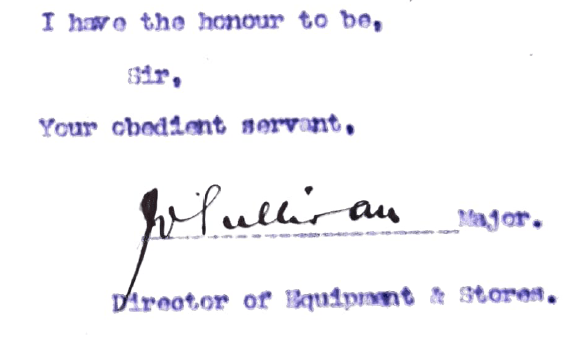
James O’Sullivan (1855 – 1925) was a dedicated civil servant whose life story embodies the resilience and adaptability of a man who rose from humble beginnings in Ireland to become a key figure in New Zealand’s Military Logistics history. He witnessed history and was a driving force behind significant changes in the country’s military logistic infrastructure. This biography examines the life of James O’Sullivan, highlighting his contributions to the Defence Stores Department and his role in providing logistic support to New Zealand’s military forces during crucial periods of conflict.
Major James O;Sullivan, November 1911
Born in Ireland in 1855, James O’Sullivan’s early life was marked by modesty and determination. His journey began when he was an agricultural student in Ireland in 1876. However, the allure of New Zealand, often described as the fortunate Isles with their golden apples, captured his imagination. He abandoned his agriculture studies and set out for New Zealand.
He spent a year on the Wild West Coast searching for gold but eventually realised that the best gold mines were not in the ground but in the government buildings in Wellington. So, he crossed Cook Strait and secured a position in the Native Office under Thomas Lewis, Under-Secretary, and the Hon. Johnny Sheehan, the Native Minister.
Office work proved challenging for someone accustomed to outdoor life, prompting O’Sullivan to apply for a transfer to the Armed Constabulary (AC). Under the guidance of Sergeant Major Coleman (later Major), he quickly adapted and became a sharp trooper, training at the Mount Cook depot alongside many future New Zealand Military and Police luminaries.
Assigned to Opotiki in 1878, O’Sullivan’s posting was short as disputes with Māori in the Taranaki in 1879 led to the Opitiki garrison’s recall to Wellington for further training. Following a short training period, O’Sullivan and 100 AC men redeployed to New Plymouth on the Government Schooner rigged steamship SS Stella.
Trooper O’Sullivan enjoyed a fulfilling four-year stint in Taranaki, which reached its pinnacle with the successful capture of Te Whiti and Tohu during the morally questionable Parihaka campaign of 1881. While some of O’Sullivan’s fellow AC troopers, including the renowned Colonel Malone of Gallipoli fame, decided to take their discharge from the AC and settle in the Taranaki, O’Sullivan remained committed to his service in the AC, proceeding to Taupo, where new challenges awaited.
The journey to Taupo involved a five-day march after a redeployment by sea to Napier. Reflecting on this experience in 1916/17, O’Sullivan could not help but smile when comparing it to the march undertaken by the New Zealand Expeditionary Forces (NZEF) over the Rimutakas from Featherston to Trentham. He especially noted the stark contrast in the burdens carried by himself and his fellow AC men as they trudged from Napier to Taupo. In those days, there was no Army Service Corps to provide support. Each man had to shoulder the responsibility of carrying his Snider rifle and 100 rounds of ball cartridge, along with two blankets, a waterproof sheet, greatcoat, haversack, and a day’s ration consisting of four biscuits, a chunk of cold boiled mutton, and some tea and sugar. [2]
During the 1880s, New Zealand grappled with concerns about a potential Russian threat. During this era, O’Sullivan collaborated with fellow AC members to construct fortifications and install artillery in Auckland, Wellington, Lyttelton and Port Chalmers. This effort laid the essential groundwork for New Zealand’s coastal defence system. In 1885, Captain Sam Anderson, who led the Defence Stores, selected O’Sullivan to replace a retiring member of the clerical staff of the Defence Stores. Despite the expectations typically associated with a clerical role, O’Sullivan immediately immersed himself in hands-on store administration. In 1886, O’Sullivan took on the role of Quartermaster for the South Island Volunteer Camp in Oamaru. With this assignment, O’Sullivan began to build his military network, initially encountering Captain Alfred Robin, who would eventually rise to Major-General and Chief of the General Staff, and Heaton Rhodes, who would later serve as a Minister of Defence.[3]
During the subsequent decade, O’Sullivan honed his skills, and following Anderson’s passing in 1899, he stepped into the position of Acting Defence Storekeeper, a role that received official confirmation in November 1900.[4]
In 1889, O’Sullivan married Jessie Hunter Mouat in Wellington. Their union began a family that would grow over the years. In October of the same year, they welcomed their first daughter, Helena Grace. Subsequently, in April 1891, their second daughter, Moya Kathleen, was born. The family continued to expand with the birth of Jessie Madeline in October 1892, followed by the arrival of a son, William Eric, in October 1894. In October 1896, another son, Leo Desmond, joined the family. Finally, on 16 October 1899, the family celebrated the birth of their son James.
During O’Sullivan’s time as Defence Storekeeper, he managed the challenges posed by significant global and domestic conflicts, including the South African War, the 1913 waterfront strikes, and the First World War. O’Sullivan was pivotal in equipping contingents for these conflicts, supporting rifle club meetings and overseeing volunteer and Territorial Force camps. Furthermore, he led the modernisation and transformation of the Defence Stores, introducing new weapons and equipment into a resurgent and growing military force.
O’Sullivan’s dedication and exceptional performance caught the attention of Prime Minister Richard Seddon. In January 1907, he was appointed Director of Ordnance Stores and commissioned into the New Zealand militia as a Quartermaster with the rank of Honorary Captain.[5]
In December 1910, Major General Alexander Godley arrived in New Zealand to assume the position of Commandant of the New Zealand Military Forces with the support of a group of seconded British officers with the mandate to revitalise New Zealand’s military’s organisational and functional framework. As part of this effort, Lieutenant Colonel Knox from the British Army Service Corps (ASC) was seconded to be the Director of Supply and Transport in New Zealand to oversee the establishment of the New Zealand Army Service Corps (NZASC).[6] However, the Director of Equipment and Stores position, held by O’Sullivan, remained without a seconded British officer.
In January 1911, Colonel J.L Wheeler, Army Ordnance Department (retired), offered his services as the Director of Equipment and Stores. After thirty-four years as an Ordnance Officer in the British Army, he had recently retired in New Zealand. Having served in various ordnance roles, including an operational post as the Chief Ordnance Officer in China during the Boxer Rebellion, participating in the relief of the British legation at Peking, Wheeler was highly experienced “in the provision, control, issue and inspection of arms, ammunition, equipment and ordnance stores of every description”.[7]
On receiving Wheeler’s application, Godley was highly positive and applied to the Minister of Defence that Wheeler be appointed as the Director of Equipment and Stores, stating that
The work and responsibilities of the Department of Equipment and Ordnance Stores will be enormously increased under the new scheme. Not only will it be our chief spending Department, but it will also, from the nature of its business, be the department which will be subject to the most searching criticism on the part of those who will make it their business to call public attention to the economy or otherwise of our administration.[8]
Godley viewed O’Sullivan’s service as Director of Equipment and Stores thus far as commendable but harboured reservations about his suitability. Despite O’Sullivan’s experience, Godley believed he lacked the necessary military background to meet the demands of the military expansion. Additionally, Godley believed that a fresh start with an experienced officer devoid of local connections would benefit the Stores Department. In his recommendation for Wheeler’s appointment, Godley emphasised to the minister that this change would not necessitate additional funding, as only nine of the ten Imperial officers originally approved had been secured, and Wheeler’s appointment would serve as a substitute for the tenth officer.[9] Despite Godley’s endorsement of Wheeler as the Director of Equipment and Ordnance Stores, the appointment did not receive approval due to the absence of budget allocation. If approved, it could have reshaped the Defense Stores Department and its response to the events 1914.
Nevertheless, in September 1911, O’Sullivan was granted the rank of Honourary Major, a decision based on the recommendation of Major General Alexander Godley, despite his earlier initial reservations.[10]
On 22 October 1911, tragedy struck O’Sullivan when a devastating drowning accident occurred at Foxton Heads, resulting in the loss of eight lives, including his daughter Grace. While all the bodies, except those of Grace and two children, were promptly recovered, extensive search efforts by O’Sullivan and volunteers eventually resulted in the discovery of Grace’s body on Otaki Beach on 27 October.
As the military transformed from a Volunteer Force to a Citizen Army, it was identified that the current Regimental Quartermaster Sergeants lacked a range of skills related to equipment care, maintenance and accounting responsibility.[11] A course of action to create a professional Regimental Quartermaster Sergeant cadre was undertaken with thirty men selected from the various military districts to undertake three weeks of intensive training at the Defence Stores Department in Wellington.[12] With instruction conducted under a curriculum developed and supervised by O’Sullivan, experienced Defence Stores Department staff conducted practical and theoretical training, providing the New Zealand military with its first logistic-centric military training course.
“Staff of the Quarter-master General—men who passed as Quarter-master instructors and are being drafted to the various districts, Colourised by Rairty Colour
The 1913 waterfront dispute saw wharf workers take over the main ports and hinder trade. Prime Minister William Massey called for farmers and rural labourers to enlist as special constables to assist the small police force in regaining control of the wharves. In what was a covert military operation, most of the mounted and foot special constables in the capital were territorial soldiers drawn from the Wellington Mounted Rifle Brigade and the 5th (Wellington) Regiment. Colonel Andrew Russell commanded the mounted special constables with the foot special constables, known as the foot special police, under Major Rawdon St John Beere of the 5th (Wellington) Regiment.[13]
Organising accommodations and arranging the commissariat provisions for a thousand men and their horses for an indeterminate period is a significant challenge that requires careful planning, swift action, and a resourceful staff capable of anticipating every need. This responsibility fell upon the Defence Stores, led by O’Sullivan. Under his direction, every inch of space in the Defence Reserve on both sides of Buckle Street was utilised, with the garrison hall transformed into a sprawling boarding facility.[14]
In addition to supplying pistols, ammunition, and batons to the special constables, O’Sullivan also arranged for various small conveniences that the men greatly appreciated. Establishing a camp post office and telephone bureau was his initiative, and he also ensured the provision of daily weather reports so that many farmers among the special constables could stay informed about the weather in their respective districts. O’Sullivan and the staff of the Stores Department worked tirelessly, often getting only two or three hours of sleep out of every twenty-four, frequently labouring from 4 a.m. until midnight nearly every day.
The mobilisation of 1914 was the acid test of the reorganisations and re-equipment of New Zealand’s military forces that Sullivan had logistically facilitated since the South African war. New Zealand’s military was required to mobilise and dispatch an expeditionary force and provide the organisational structures to maintain a sustained reinforcement programme, coastal defence and Keypoint Security trooops. Supporting this tremendous effort was O’Sullivan and his Defence Stores.
As the NZEF finalised its preparations before the departure of the NZEF Main body transport ships, General Godley visited the Defence Stores on 24 September and thanked O’Sullivan and the Defence Stores Staff for their contribution to mounting the NZEF. The Dominion reported that,
In saying “au revoir” General Godley paid tribute to the work of the store staff under Major O’Sullivan in equipping the Expeditionary Forces. The complimentary remarks of General Godley were greatly appreciated by the store staff, whose work has been extremely arduous. But there is much recompense in appreciation when none is looked for in this time of stress.[15]
From the early days of the mobilisation, gossip circulated, questioning O’Sullivan’s integrity and the Defence Stores business practices. Some business community members expressed dissatisfaction with the past and present methods of the Defence Stores. Aware of such gossip as early as October 1914, Godley departed on 16 October and had been at sea for ten days before preparing a handwritten note to Colonel James Allen, the New Zealand Minister of Defence. Reacting to what could only be described as gossip, Godley’s note set in motion a series of events that questioned the integrity and performance of the Defence Stores and led to O’Sullivan’s removal as Director of Stores. Godley wrote that he had “heard a good deal of talk about the conduct of the Stores at Wellington and criticism of J O’Sullivan”, adding that the Coast Defence Commander had spoken to him about irregularities with the Defence Stores. Opening up to Allen, Godley aired his view that he had little doubt “that O’Sullivan and probably some of his subordinates are, like all Quartermasters and Storekeepers feathering their nests to a certain extent”. However, Godley balanced this statement by stating, “the equipping of this Force and the South African contingents, by O’Sullivan, was extremely well done”. Godley recommended that it was the right time for an entity such as the Public Service Commissioner to audit the Defence Stores as the store’s accounting system had grown to the stage where he was sure more checks were required. Godley concluded his note to Allen with a caveat that whatever the end state of the Audit, “the good work done by O’Sullivan and his Department should not be overlooked.”[16]
It was not until July 1915 that pressure from outside of the military forced Allen, under the Commission of Inquiry Act 1908, to have a Commission of Inquiry (COI) appointed by the governor-general to investigate the business methods adopted by the Defence Stores, in particular procedures related to the purchase of stores. Probing the Defence Store from July through to August, the Commission questioned over forty witnesses, including General Robin, O’Sullivan, key appointment holders in the Defence Stores and representatives of many businesses with relationships with the Defence Stores.
In discussing the Director of Stores position, the Commission correctly stated that this position was not clearly defined as the appointment had dual responsibility to both the Public Service Commission and the Minister of Defence. Robin clarified O’Sullivan’s situation in that,
Except for the interference by the Public Service Commissioner, he is filling the position under the designation of QMG3. This is the pith of the whole question. This dual control cannot tend to efficiency. If the control of the Public Service Commissioner is to continue all officials under the Public Service Commissioner should only be so as regards pay and advancement; in all other matters, they must be under the Commandant under regulations, Major 0’Sullivan is under military law as an Officer.[17]
Based on Robin’s replies and remarks, it is evident that the Defence Stores Commission investigation was not impartial and poorly conducted with a lack of depth, leading to the assumption that the commission members approached the investigation with preconceived ideas about O’Sullivan and the Defence Stores. Despite the points highlighted by the report that Robin easily rebutted, it is apparent that the Defence Stores had the military’s confidence. Robin reported to Allen in December on the Defence Stores Enquiry that,
It must be satisfactory to you to note that there is no real ground for the alarmist reports which last year, and during the early part of this year, were so freely circulated. [18]
Following Robin’s correspondence, Allen updated Godley with the news that the “Stores Department, about which there was an inquiry, has come fairly well out of it”.[19] It must be remembered that Godley’s private conversations and reaction to gossip, summarised in his correspondence to Allen in October 1914, helped fuel speculation about O’Sullivan.
1915 had not been kind to O’Sullivan, and after being found at no fault following the Stores Commission enquiry, he still faced a toxic relationship with the Board of Supply, a new organisation created to relieve the Defence Stores of provisioning responsibilities. The year’s strain affected O’Sullivan’s health, and he suffered two mental breakdowns, which forced him on an extended leave break from 18 October 1915 following an inspection of the Auckland Military District.[20] On hearing that O’Sullivan was to resume work early in January 1916, the Board of Supply reacted by sending the following message to Arthur Myers, the Minister of Munitions,
We understand that O’Sullivan has been instructed to resume duty on 4 January although his leave does not expire until 18th. Our opinion is that he should not be allowed to resume duty under any circumstances. The Board are of the opinion that his reinstatement would not be to the advantage of the department and would force the Board to seriously consider its position.[21]
This ultimatum placed the military in a difficult position. O’Sullivan’s long service and experience had been highly beneficial to the Defence establishment, and based on the Stores Commission report findings, there was no justification for his removal. This impasse continued until February, when negotiations between Robin and the Board agreed upon several initiatives agreeable to both parties, allowing progress forward. Robin proposed to the Board that an “Inspecting Quartermaster” post be created to provide the Commandant with an advisor on Military equipment specifications. This post was seen as necessary due to O’Sullivan’s long service. It allowed him to remain in the service for eighteen months until his planned retirement while moving him to a post amicable to the Board.
On 8 April 1916, Captain Thomas McCristell, the Trentham Camp Quartermaster, was formally appointed to O’Sullivan’s post as the redesignated Director of Equipment and Ordnance Stores and QMG3 with the honorary rank of Major.[22] Updating Godley, Allen reported that
Captain McCristell has been placed in 0’Sullivan’s position, the latter being made Inspector of 0rdnance Stores. I should think 0’Sullivan has been more enquired into than any other officer in the department, but nothing very detrimental has come out about him; however, it seemed to me to be wise, especially in view of the fact that the Supplies Board -which is under the control of the Hon. Mr Myers, was so determined about it, that he should give up his position as head of the Stores. I have every confidence that McCristell will do well there. [23]
Although Allen still held O’Sullivan in high regard, Godley’s response was less optimistic, and he made it clear that he did not hold O’Sullivan in the same esteem as Allen replying,
I am sorry, but not altogether surprised, to hear about 0’Sullivan. I think you know my feeling about him, which is that considering the class of man he is, and the opportunities he has had, one can only be astonished at his moderation. Ninety-nine out of a hundred in his position would have made a large fortune.[24]
Signalling the end of the Defence Stores Department era was the resignation of O’Sullivan in January 1917.[25] At his request, on 31 January 1918, O’Sullivan retired from active duty after nearly thirty-nine years of continuous service, sixteen years of which he was in charge of the Defence Stores. In what must have been a bittersweet decision, O’Sullivan had provided thirty-nine years of continuous service in the Defence Department, seventeen of which were the head of the Defence Stores. Joining the service as an Armed Constabulary Trooper sent into the field with only “his Snider and 100 rounds, two blankets, waterproof sheet, greatcoat and haversack”, O’Sullivan must have been satisfied that because of his contribution, the New Zealand soldier of 1917 (including two of his sons) was as well-equipped and supported as those in any other modern army.[26]
After retiring from the service, O’Sullivan established his residence on a farm near Huntly, where he lived until he passed away on Christmas Eve 1925. His widow and two sons, James and William, who worked alongside him on the Huntly farm, and two daughters, Mrs Kathleen Lawson and Jessie, survived him. During the war, his son William served as an Armourer Sergeant in the New Zealand Army Ordnance Corps and achieved recognition as a prominent Wellington representative Rugby player. Regrettably, Lieutenant Desmond O’Sullivan, another son, tragically lost his life in the Great War.
Major O’Sullivan spent most of his working life in Wellington, where he actively participated as a member of the Hibernian Society and the Wellington Bowling Club. His funeral occurred in Wellington, and he was laid to rest next to his daughter Grace in Karori Cemetery.
Major James O’Sullivan’s life is a remarkable testament to resilience and adaptability. From humble beginnings in Ireland, his journey led him to New Zealand, where he played a pivotal role in shaping the country’s military logistics history. His dedication to the Defence Stores Department and his unwavering commitment to providing logistical support during critical periods of conflict showcased him as a dedicated civil servant. O’Sullivan’s career began in the Armed Constabulary, where he swiftly adapted to the demands of military life. His roles as Defence Stores clerk and later Defence Storekeeper highlighted his hands-on approach to store administration and his ability to build a robust military logistic network. His leadership in modernising the Defence Stores and introducing new equipment contributed significantly to New Zealand’s growing military capabilities. Despite facing personal tragedies, O’Sullivan continued to make substantial contributions. His creation of a professional Regimental Quartermaster Sergeant cadre and his pivotal role in managing the military logistics related to the 1913 waterfront dispute underscored his indispensable value to the military. When World War I erupted, O’Sullivan played a crucial part in equipping and supporting the forces. Unfortunately, he also endured controversy and unjust allegations, leading to his removal as Director of Equipment and Stores—a sombre end to an illustrious career.
While history has somewhat forgotten his contributions to New Zealand’s military logistics, this article aims to rekindle interest in O’Sullivan’s remarkable achievements.
[4] “Defence Storekeeper Appointed,” New Zealand Gazette No 98 p. 2154., 29 November 1900.
[5] “New Zealand Militia Honorary Officer appointed,” New Zealand Gazette No 45, 23 May 1907.
[6] Julia Millen, Salute to service: a history of the Royal New Zealand Corps of Transport and its predecessors, 1860-1996 (Wellington: Victoria University Press, 1997, 1997), 42-49.
[7] “Colonel J L Wheeler A O D applies for position of Director of Equipment [ and ] Ordnance Stores,” Archives New Zealand Item ID R24763490 (Wellington) 1911.
[8] “Director of Equipment and Ordnance Stores – Proposals for appointment of,” Archives New Zealand Item ID R24763374 (Wellington) 1911.
[9] “Director of Equipment and Ordnance Stores – Proposals for appointment of.”
[10] “Appointments, Promotions, Transfers, Resignations and Retirement of Staff and Territorial Force Officers,” New Zealand Gazette No 74, 21 September 1911.
[13] John Crawford, “Overt and covert military involvement in the 1890 Maritime Strike and 1913 Waterfront Strike in New Zealand,” Labour History, no. 60 (1991).
[16] “Correspondence Major General Godley to James Allen 26 October 1914,” R22319698 – Ministerial Files – Correspondence with General Godley (1914).
[17] Wellington Defence Storekeeper, “Defence Store Commission (Commission of Inquiry re Defence Stores), July 1915 – September 1915,” Archives New Zealand Item No R3898696 (1915).
[18] Defence Storekeeper, “Defence Store Commission (Commission of Inquiry re Defence Stores), July 1915 – September 1915.”
[19] “Correspondence James Allen to Major General Godley 4 January,” R22319698 – Ministerial Files – Correspondence with General Godley (1916).
[20] “Reports Report on equipment etc. Auckland District Major O’Sullivan,” Archives New Zealand Item No R22432211 (1915).
[21] “Munitions and Supplies Board, August 1915 April 1921,” Archives New Zealand Item No R3898765 (1915-21).
[22] The officer selected to replace O’Sullivan was Lieutenant (Temporary Captain) Thomas McCristell. A professional soldier with a flair for administration, McCristell had been pre-war Adjutant to the 2nd Battalion, 17th (Ruahine) Regiment before being appointed as the Camp Quartermaster at Trentham Camp. “McCristell. Thomas James,” Personal File, Archives New Zealand (Wellington) 1914.
[23] “Correspondence James Allen to Major General Godley 13 April “, R22319698 – Ministerial Files – Correspondence with General Godley (1916).
[24] “Correspondence Major General Godley to James Allen 24 March,” R22319699 – Ministerial Files – Correspondence with General Godley (1916).
Captain Sam Cosgrave Anderson, a figure often overshadowed but undeniably significant in New Zealand’s military logistics history, came into this world in 1841, born to Frank Anderson and Margaret Cosgrove in Belfast, Ireland. Although details of Anderson’s formative years and education remain elusive, a pivotal juncture emerged in 1863 when he embarked on a journey that led him to the Colony of New Zealand. This marked the genesis of a path that would shape an illustrious career, leaving an indelible mark on New Zealand’s military logistics landscape.
Upon his arrival in New Zealand, Captain Anderson’s commitment to service saw him mustered into the ranks of No 7 Company, Waikato Militia, where he served for nineteen months across the Waikato and Thames districts. Following his stint in the militia, Anderson transitioned to the Commissariat Department in Auckland as a clerk. This seemingly modest role laid the bedrock for his subsequent contributions to New Zealand’s military logistical operations.[1]
Unfazed by the challenges of his era, Captain Anderson ventured to the West Coast Goldfields on an unsuccessful quest to find his fortune. By 1868, his journey led him to Wanganui, and on 25 October that year, he assumed the role of Clerk to the Militia Quartermaster at Patea. The journey of Captain Anderson continued to unfold as he accepted the position of Clerk in Wellington under the Defence Inspector of Stores, Lieutenant Colonel. Edward Gorton, on 27 April 1869.[2]
Captain Anderson’s ambition and dedication propelled him to seek a transfer from the Inspector of Stores office to become the Defence Storekeeper in July 1869. His subsequent elevation to the role of Armed Constabulary Storekeeper on 1 December 1869 marked a pivotal point in his career trajectory. This position, equivalent in grade and compensation to the Defence Storekeepers in Auckland, Whanganui, and Wellington, was stationed at the Mount Cook Barracks on Buckle Street, serving as the epicentre of New Zealand’s Armed Constabulary and Defence Forces.
A prominent figure under the jurisdiction of the Under Secretary of Defence, Captain Anderson assumed command of the Defence Stores on 18 May 1878 to 9 January 1877. [3] This phase of Anderson’s career was one of transition for the military as it evolved from a force focused on domestic defence to one oriented towards external security, which brought new challenges and responsibilities to Anderson’s purview.[4] Notably, over the next thirty years, he spearheaded the systematic reception and distribution of weaponry, overseeing the progression from Snider rifles and carbines to the introduction of the Martini-Henry Rifle in the 1890s.[5]
Captain Anderson’s indomitable spirit and commitment were exemplified in his involvement in the closing chapters of the New Zealand Wars. The Parihaka campaign of 1881 saw him participate in a government-led expedition to restore order and conclude a period of civil disobedience. While morally dubious, this campaign ended the dispute but left enduring emotional and social scars. Captain Anderson’s logistical prowess earned acclaim, particularly in providing provisions, transportation and accommodation for the Volunteers and Constabulary.[6]
Officers of the NZ Armed Constabulary at Parihaka. Back, left to right: Captains W E Gudgeon, H Morrison, Gordon, Taylor, Powell, Fortescue, S Newall and Major A Tuke. Front, left to right: Captains Baker and Anderson, Lieutenant-Colonel John Mackintosh Roberts, Captains Gilbert Mair, Henry William Northcroft, W B Messenger and Major F Y Goring. Cowan, James, 1870-1943 :Collection of photographs. Ref: 1/1-017952-G. Alexander Turnbull Library, Wellington, New Zealand. /records/23057608
Officers of the NZ Armed Constabulary at Parihaka. Back, left to right: Captains W E Gudgeon, H Morrison, Gordon, Taylor, Powell, Fortescue, S Newall and Major A Tuke. Front, left to right: Captains Baker and Anderson, Lieutenant-Colonel John Mackintosh Roberts, Captains Gilbert Mair, Henry William Northcroft, W B Messenger and Major F Y Goring.
Captain Anderson was recommended for a commission for his exemplary efforts during the Parihaka campaign, culminating in his gazetting as a New Zealand Constabulary Quartermaster with the Rank of Captain in the New Zealand Militia in January 1882.[7] Simultaneously, he undertook the mantle of Quartermaster for the Permanent Militia, cementing his multifaceted contributions to the nation’s defence.[8]
Captain Anderson’s narrative transcends his military endeavours alone. A significant chapter unfolded with the birth of his son, Frank Lionel, on 9 February 1871 in Wellington. Frank Lionel’s arrival preceded his parents’ official marriage. It was the product of a relationship with Sarah Ann Fryson/Tyson née Gyde, which adds depth to Captain Anderson’s life story.
1872 Captain Anderson married Mary Ann White, a union that brought companionship and shared aspirations. However, life’s challenges were not far behind, and the passing of his wife on 12 September 1889 in Wellington marked a poignant moment of loss and reflection.
The evolution of the military demanded adaptive measures in logistics and management. In conjunction with Sergeant Majors Robert George Vinning Parker and Frederick Silver of the Permanent Artillery, Captain Anderson contributed to establishing a system of Artillery Stores Accounting that endured into the early 20th century, showcasing his willingness to embrace innovation and optimise resource utilisation.[9]
Despite the evolving landscape of military organisation, Captain Anderson’s role as Defence Storekeeper retained its essential structure. Delegating responsibilities to his chief Clerk, Thomas Henry Sewell, Anderson ensured the smooth operation of the Wellington Defence Stores while he focused on supporting the force on a national level.[10] Amidst economic downturns, changing armament, and a shifting military landscape, his steadfast leadership navigated challenges, fostering stability and readiness.
In 1893 the Commandant of the New Zealand Forces, Colonel Francis John Fox, commended Anderson stating that,
Captain Anderson is Storekeeper. This officer has a great deal of responsibility, keeps his stores in good order, and is thoroughly competent and to be relied on.[11]
Fox’s commendation in 1893 underscored Captain Anderson’s pivotal role as Storekeeper, a position demanding both reliability and competence. This acknowledgement resonated throughout his years of dedicated service, only interrupted by a three-month leave of absence prompted by medical advice in April 1899.
The eve of the 20th century heralded a significant test of Captain Anderson’s capabilities. With the outbreak of the South Africa war, the New Zealand Government committed a contingent to the Imperial forces. Urgent mobilisation necessitated rapid procurement and distribution of equipment and uniforms. Captain Anderson and his team worked tirelessly to meet the needs of the assembling contingent, showcasing their commitment to the nation’s defence.
Tragically, Captain Anderson’s life was cut short on 7 December 1899, succumbing to a brief illness believed to be attributed to the stress and extended work hours that characterised his dedication.[12] Captain Anderson found his final resting place alongside his wife at St. John’s Anglican Churchyard Cemetery in Johnsonville, Wellington.
His legacy is a testament to his service, leadership, and unwavering commitment to the nation’s defence, which until now has gone unrecognised. However, from now on, his story should influence and inspire future generations of New Zealand military logisticians, reflecting the epitome of selfless dedication to duty and the betterment of his country.
The year from June 1870 to June 1871 was a formative period in the development of New Zealand’s Defence Stores system. By mid-1870, the withdrawal of Imperial forces from New Zealand was effectively complete, and with it ended the practical dominance of the British military storekeeping system that had supported Imperial operations in the colony. The responsibility for military stores, arms, ammunition, magazines, repairs, inspection, and accounting now rested with New Zealand’s own colonial defence administration.
This transition did not produce a large or elaborate organisation. The Defence Stores establishment remained small, dispersed, and heavily dependent on a limited number of experienced individuals. Yet it was now indispensable. The Armed Constabulary, Militia, and Volunteers all depended on arms, accoutrements, ammunition, magazines, repairs, and accountable issue systems. In this context, the Defence Stores were not merely warehouses. They were the technical and administrative mechanism that allowed New Zealand’s colonial forces to function.
Legislative and Financial Setting
The Militia Act 1870, passed on 12 September 1870, consolidated and amended the law relating to the Militia in New Zealand. It confirmed the Governor as Commander-in-Chief, provided for militia districts, battalions, and company divisions, and included provisions requiring arms and equipment to be returned when required. It also created penalties for losing, spoiling, selling, or pawning arms. These provisions are important because they show that the control of public arms was recognised as a matter of law, not simply routine administration.[1]
The financial setting was shaped by the Defence and other Purposes Loan Act 1870, which authorised the raising of £1,000,000, approximately NZ$180 million in 2026 values, for defence and other purposes. The Act allowed money to be borrowed in Great Britain or elsewhere and provided that the annual charge for interest and sinking fund was not to exceed six per cent.[2] A further Temporary Loan Act 1870 authorised the raising of up to £500,000, approximately NZ$90 million in 2026 values, in anticipation of monies to be raised under the larger loan legislation.[3]
Within this wider financial framework, the Store Department was provided for as a distinct defence function. The Appropriation Act 1870 funded an establishment that included an Inspector of Stores, clerks, storekeepers, sub-storekeepers, armourers, arms cleaners, magazine keepers, and operating expenses.[4]
For the modern equivalents used in this article, a working conversion of £1 in 1870 ≈ NZ$180 in 2026 values has been applied. The resulting figures are rounded and should be treated as indicative rather than exact.
Store Department Establishment, 1870–71
The following table places names against appointments where possible. Some identifications remain provisional, as the Appropriation Act lists positions and salaries rather than names. The named appointments have been drawn from the 1871 Civil Establishment nominal roll, the existing Defence Stores July 1870 to June 1871 article, the Auckland Defence Store article, and the compiled Defence Stores nominal roll.
Personnel Establishment
Appointment
Probable or confirmed incumbent, 1870–71
1870–71 amount
Approx. 2026 NZD
Inspector of Stores
Lieutenant-Colonel Edward Gorton
£500 0s. 0d.
$90,000
Clerk, Head Office
George Simpson Lockie
£150 0s. 0d.
$27,000
Storekeeper, Auckland
Major William St Clair Tisdall
£250 0s. 0d.
$45,000
Storekeeper, Wellington
Lieutenant-Colonel Henry Elmhirst Reader
£100 0s. 0d.
$18,000
Sub-storekeeper, Wanganui
Charles Chalklin
£150 0s. 0d.
$27,000
Two clerks, Auckland
John Blomfield and John Price
£320 0s. 0d.
$57,600
One clerk, Wellington
Alexander Crowe
£150 0s. 0d.
$27,000
Store Department clerk, Wellington
Sam Cosgrave Anderson
Not separately listed in this vote
Not separately calculated
Sub-storekeeper, Patea
C. A. Wray
£150 0s. 0d.
$27,000
Armourer, Auckland
David Evitt
£182 0s. 0d.
$32,760
Armourer, Wellington
Edward Metcalf Smith and Edwin Henry Bradford
£182 0s. 0d.
$32,760
Arms cleaners, Auckland
Thomas Gibbons, John Penligen, Charles Phillips, William Cook Rockley
£438 0s. 0d.
$78,840
Arms cleaners, Wellington
William Warren, John Shaw, James Smith, Walter Christie
£438 0s. 0d.
$78,840
Magazine keeper, Auckland
John Broughton
£83 10s. 0d.
$15,030
Magazine keeper, Wellington
William Corliss
£63 17s. 6d.
$11,498
Personnel establishment total
£3,317 7s. 6d.
$597,128
The appropriation and Public Accounts identify appointments and expenditure categories, but not always the individual recipients. Names have therefore been matched to appointments from nominal rolls, Gazette notices and related departmental research. Unless directly confirmed, the association should not be treated as proof that the individual drew the full annual amount from that vote.
Departmental Expenses
Expense
1870–71 amount
Approx. 2026 NZD
Notes
Rent, advertising, and contingencies
£150 0s. 0d.
$27,000
General operating costs of the Store Department.
Travelling expenses of inspecting officers
£90 0s. 0d.
$16,200
Supported inspection of stores, arms, and local establishments.
Departmental expenses total
£240 0s. 0d.
$43,200
Total Store Department Vote
Category
1870–71 amount
Approx. 2026 NZD
Personnel establishment
£3,317 7s. 6d.
$597,128
Departmental expenses
£240 0s. 0d.
$43,200
Total Store Department vote
£3,557 7s. 6d.
$640,328
This named establishment shows that the Store Department was more than a paper vote. By 1870–71, it included a recognisable network of storekeepers, clerks, armourers, arms cleaners, sub-storekeepers, and magazine keepers spread across Auckland, Wellington, Wanganui, and Patea. Separate from this personnel establishment were the department’s operating expenses, including rent, advertising, contingencies, and the travelling expenses of inspecting officers. Although modest, these expenses supported the inspection and accountability system that allowed the Defence Stores to supervise arms, ammunition, magazines, and equipment across several dispersed locations.
District Sub-storekeepers and the Dispersed Store System
In addition to the main stores at Wellington and Auckland, the Defence Stores system relied on a dispersed network of district sub-storekeepers. The existing return records district sub-storekeepers at Hamilton, Tauranga, Opotiki, Te Wairoa, Napier, Marton, Wanganui, Patea, New Plymouth, Blenheim, Nelson, Christchurch, Hokitika, Dunedin, and Invercargill. This demonstrates that the Store Department’s responsibilities extended well beyond the two principal depots. Arms, ammunition, camp equipment, tools, and accoutrements had to be held, issued, recovered, and accounted for across the colony.
The district sub-storekeeper role was often held alongside other duties. Often these appointments were combined with Militia Drill Instructor duties, Public Works sub-storekeeper duties, or Armed Constabulary sub-storekeeper responsibilities. This reflected both the small scale of the establishment and the practical need for local officials to serve multiple functions.
Public Accounts and Actual Store Department Expenditure
The Public Accounts for 1870–71 record actual Store Department expenditure of £3,458 17s. 3d., approximately NZ$622,598 in 2026 values. This was slightly below the authorised vote of £3,557 7s. 6d. The expenditure included salaries for the Inspector, storekeepers, and clerks, payments for armourers and arms cleaners, rent, advertising, contingencies, travelling expenses for inspecting officers, and the salaries of the Auckland and Wellington magazine keepers.[5]
This expenditure was modest when measured against the broader defence loans of the period, but it sustained the core mechanism of colonial military materiel management. The Store Department was responsible for ensuring that arms were maintained, ammunition was secured, stores were accounted for, and technical defects were identified and corrected.
Arms, Ammunition, Repairs, and Related Defence Expenditure
In addition to the Store Department establishment and operating expenses, the 1870–71 accounts record separate expenditure on arms, ammunition, repairs, targets, freight, insurance, and other defence-related costs. These were not listed as part of the Store Department personnel vote, but they directly affected the work of the Defence Stores, armourers, arms cleaners, and magazine keepers.
Under the Defence and other Purposes Loan Act 1870, the Government was authorised to apply loan funds to colonial defence expenditure. The First Schedule allowed up to £180,000 for colonial defence costs, charges, expenses, and liabilities for the year ending 30 June 1871, approximately NZ$32.4 million in 2026 values. A further £160,000, approximately NZ$28.8 million, was authorised for the year ending 30 June 1872.[6]
The Public Accounts for 1870–71 show that defence expenditure under Schedule I of the loan included the Armed Constabulary, miscellaneous defence expenditure, the steamer Luna, and Contingent Defence. Within those categories, several items related directly to the purchase, maintenance, carriage, and use of arms and ammunition.[7]
Arms, Ammunition, and Related Defence Costs, 1870–71
Item
1870–71 amount
Approx. 2026 NZD
Notes
Armed Constabulary, arms, ammunition, etc.
£563 15s. 3d.
$101,477
Arms and ammunition expenditure within Armed Constabulary contingent expenditure.
Purchase of arms
£948 19s. 6d.
$170,816
Listed under miscellaneous defence expenditure.
Purchase of ammunition
£593 6s. 6d.
$106,799
Listed separately from purchase of arms.
Repair of arms
£21 13s. 6d.
$3,902
Small but significant evidence of ongoing armourer work.
Targets
£61 1s. 6d.
$10,994
Supports rifle practice and prize firing.
Carriage and freight
£227 15s. 7d.
$41,000
Movement of arms, ammunition, targets, or associated stores.
Insurance
£150 0s. 0d.
$27,000
Likely associated with transport or storage risk.
Contingent Defence, ammunition and accoutrements
£4,697 19s. 0d.
$845,631
The largest directly identifiable arms, ammunition, and equipment-related item.
Total directly related to arms, ammunition, repairs, targets, freight, insurance, and accoutrements
£7,264 10s. 10d.
$1,307,618
The largest single item was £4,697 19s. for ammunition and accoutrements under Contingent Defence, approximately NZ$845,631 in 2026 values. This was significantly larger than the ordinary purchase of arms and ammunition listed under miscellaneous defence expenditure, suggesting that the most substantial equipment-related costs were associated with contingent or operational defence needs rather than routine store replacement.[8]
The accounts also recorded recoveries credited against colonial defence expenditure, including £98 10s. 5d. for arms and accoutrements and £344 1s. 11d. for ammunition. This was a combined recovery of £442 12s. 4d., approximately NZ$79,666 in 2026 values. These recoveries show that some costs were offset by repayments, returns, or credits, although the accounts do not provide enough detail to identify each transaction.[9]
This detailed expenditure adds an important dimension to the Defence Stores story. The Store Department’s own vote funded the people and machinery of storekeeping, but the broader defence accounts show the flow of materiel that those people had to receive, inspect, store, issue, repair, transport, and account for. Purchases of arms and ammunition, repairs of arms, provision of targets, carriage and freight, and the large contingent defence expenditure on ammunition and accoutrements all point to an active system of military supply rather than a dormant post-war storehouse.
Defence Stores Stock Holdings, August 1870
One of the most useful surviving snapshots of the Defence Stores system is the return of small arms, ordnance, ammunition, camp equipment, implements, and saddlery in military use as at 17 August 1870. This return gives scale to the Store Department’s task. It was not simply paying clerks and storekeepers. It was managing a large and mixed inventory of modern, obsolescent, and legacy weapons. The existing post cites this return as Edward Gorton’s report on the system of store accounts and returns of arms, ordnance, ammunition, and various stores.
Arms, Ordnance, and Ammunition in Store
Category
Item
Quantity
Small arms
Snider, all patterns
2,293
Small arms
Medium Hay Pattern rifles
7,726
Small arms
Enfield Pattern 1853 rifles
1,460
Small arms
Rifle, breech, Calisher & Terry
26
Small arms
Short Enfield sword rifles, Pattern 1853
33
Small arms
Spencer rifles
4
Small arms
Mont Storm rifles
5
Small arms
Percussion muskets, Pattern 1839
222
Small arms
Carbine, breech, Calisher & Terry
284
Small arms
Muzzle-loading Enfield artillery carbines
67
Small arms
Colt revolving carbines
4
Small arms
Percussion carbines, various types
12
Small arms
Revolvers, various types
215
Edged weapons
Cavalry swords
153
Ordnance
RBL 40-pounders
2
Ordnance
RBL 6-pounders
2
Ordnance
24-pounder howitzers
3
Ordnance
4.2/5-inch mortars
11
Ordnance
6-pounder carronade
1
Ordnance
3-pounder smooth bore gun
1
Small-arms ammunition
Snider rounds
470,228
Small-arms ammunition
Enfield rounds
1,804,983
Small-arms ammunition
Breech-loading carbine rounds
251,324
Small-arms ammunition
Revolver rounds
287,148
Small-arms ammunition
Percussion musket rounds
160,152
Ordnance ammunition
Cartridges
14,145
Ordnance ammunition
Shot and shell
22,806
The in-store holdings alone show the complexity of the Defence Stores task. The department held modern Snider rifles alongside large numbers of older Enfield and Medium Hay Pattern rifles, specialist carbines, revolvers, swords, artillery pieces, mortars, and large quantities of ammunition. This mixture of current, ageing, and specialist equipment required careful accounting and technical oversight.
Arms and Ordnance on Issue
Category
Item
Quantity
Small arms
Snider, all patterns
208
Small arms
Medium Hay Pattern rifles
9,263
Small arms
Enfield Pattern 1853 rifles
6,473
Small arms
Rifle, breech, Calisher & Terry
7
Small arms
Short Enfield sword rifles, Pattern 1853
224
Small arms
Spencer rifles
4
Small arms
Percussion muskets, Pattern 1839
1,007
Small arms
Breech-loading carbines
1,271
Small arms
Muzzle-loading Enfield artillery carbines
218
Small arms
Colt revolving carbines
2
Small arms
Percussion carbines, various types
267
Small arms
Revolvers, various types
934
Edged weapons
Cavalry swords
903
Ordnance
RBL 12-pounders
6
Ordnance
RBL 6-pounders
4
Ordnance
6-pounder brass gun
1
Ordnance
24-pounder howitzers
7
Ordnance
32-pounder iron guns
3
Ordnance
24-pounder iron guns
8
Ordnance
12-pounder iron guns
5
The quantities on issue are particularly important. They show that the principal challenge was not simply holding stores in depots, but accounting for thousands of weapons already dispersed to colonial forces. More than 9,000 Medium Hay Pattern rifles, 6,400 Enfields, 1,200 breech-loading carbines, 900 revolvers, and 900 cavalry swords were already away from the main stores and in the hands of units, posts, or local authorities.
Camp Equipment, Implements, and Saddlery
The August 1870 return also recorded camp equipment, implements, and saddlery. This broadens the understanding of the Defence Stores beyond arms and ammunition. The department also held the equipment needed for colonial forces to camp, dig, build, move, and sustain themselves in the field.
Camp Equipment, Implements, and Saddlery in Store
Item
Quantity
Circular tents
326
Indian tents
30
Field officer marquees
13
Waterproof sheets
523
Blankets
647
Felling axes
166
Pick axes
1,036
Fern hooks
115
Bill hooks
91
Spades
1,298
Shovels
1,214
Wheelbarrows
413
Mattocks
111
Cross-cut saws
41
Riding saddles
285
Bridles
262
Pack saddles
101
Camp Equipment, Implements, and Saddlery on Issue
Item
Quantity
Circular tents
130
Indian tents
14
Waterproof sheets
58
Blankets
275
Felling axes
235
Pick axes
239
Fern hooks
90
Bill hooks
35
Spades
400
Shovels
291
Wheelbarrows
85
Mattocks
18
Cross-cut saws
14
Riding saddles
48
Bridles
48
Pack saddles
47
This material shows that the Defence Stores had a broader field support role. It managed not only weapons and ammunition but also tents, blankets, tools, saddlery, and pack equipment. These were the practical stores required to support movement, field works, camps, mounted activity, and local defence operations.
Gorton’s Inspection Circuit
The travelling expenses provided in the Store Department vote were not theoretical. During the year, Inspector of Stores Edward Gorton inspected Auckland in July 1870, Wanganui and Napier in August, Wanganui and Auckland in December, Christchurch in April 1871, Dunedin in May, and Auckland, Tauranga, and Thames in June. This inspection circuit demonstrates how the Store Department attempted to impose accountability across a dispersed system of depots, district stores, magazines, and issued arms.
These inspections are significant because they connect the financial vote to actual departmental activity. The Store Department was not sitting passively in Wellington and Auckland. It was inspecting, checking, and attempting to control stores across the colony.
The Albert Barracks Powder Magazine and the Move to Mount Eden
The management of powder was one of the most sensitive Defence Stores responsibilities. In February 1871, Auckland newspapers reported public concern about the powder magazine at Albert Barracks, including rumours of an attempt to ignite it and criticism that entry controls had relaxed since the departure of the British garrison. There was also concern that the quantity of powder held in the magazine exceeded what was recorded in official documents. Given the magazine’s position in a densely populated part of Auckland, this raised fears of a catastrophic explosion.
By March 1871, it was announced that the powder magazine would be transferred from Albert Barracks to Mount Eden, and by May tenders were being sought for construction of the new magazine. This episode is important because it shows that the Defence Stores’ responsibilities were not confined to accounting and issue. They included the safe custody of explosive stores, the accuracy of ammunition records, and the siting of magazines in relation to public safety.
Armourers, Arms Cleaners, and the Control of Rifles
During inspections conducted by armourers, unauthorised alterations to rifle backsights were identified, leading Lieutenant-Colonel Gorton in November 1870 to direct that altered rifles be returned to store. This incident is worth retaining and expanding, because it shows the Defence Stores acting as a technical authority, not simply as a storage office.
The issue was significant. In a militia and volunteer system, arms were widely distributed across local corps and districts. Without regular inspection, rifles could be modified, neglected, damaged, or retained without proper accountability. The presence of armourers at Auckland and Wellington, supported by arms cleaners at both centres, reflects the practical requirement to keep colonial weapons safe, serviceable, and standardised.
The wider history of New Zealand military armourers reinforces this point. Between the 1860s and 1900, New Zealand’s military armourers evolved from civilian gunsmiths and part-time artificers into a more professional group whose technical skills underpinned the readiness of the colony’s forces. The 1870–71 rifle-sight incident therefore illustrates a broader pattern: technical control of arms was becoming an essential part of colonial defence administration.
Edward Metcalf Smith and Iron-sand Experiments
Edward Metcalf Smith adds a useful technical dimension to the Defence Stores story. Smith had accumulated experience in the iron industry before undertaking a gunsmith apprenticeship at the Royal Small Arms factories in London and Enfield, followed by service at the Royal Arsenal, Woolwich. Arriving in New Zealand in 1861 as Garrison Armourer, he later served as armourer for the Taranaki Militia and Taranaki Rifle Volunteers.
By 1871, Smith had relocated to Wellington as Defence Armourer. Drawing on the resources of the armourers’ shop, he continued experimenting with Taranaki iron sand and refining his smelting process. His presence shows that the Defence Stores workshops were not merely places for routine cleaning and repair. They were also centres of practical technical knowledge, where experienced tradesmen applied workshop skills to broader colonial industrial problems.
Auckland Defence Store
The Auckland Defence Store remained one of the most important sites in the colonial storekeeping network. Auckland had been the main centre of Imperial and colonial military activity during much of the New Zealand Wars, and its storekeeping arrangements evolved from earlier Colonial Store and Militia Store systems. By 1870–71, the Auckland establishment included Major William St Clair Tisdall as Storekeeper, John Blomfield and John Price as clerks, George Evitt as armourer, Thomas Gibbins, John Penligen, Charles Philips, and William Cook Rockley as arms cleaners, and John Broughton as magazine keeper.
The later development of Auckland’s ordnance estate, including the movement of magazines to Mount Eden and the creation of more purpose-built facilities, shows that the improvised arrangements of the early 1870s were only the beginning of a longer process. New Zealand inherited a patchwork of armouries, magazines, depots, and barracks after Imperial withdrawal, and the gradual shift toward purpose-built logistics infrastructure began from this point.
Wellington Defence Stores, Mount Cook
At Wellington, the Defence Stores were centred on the Mount Cook Depot at Buckle Street. The named personnel for 1870–71 included Henry Elmhirst Reader as Storekeeper, Alexander Crowe as clerk, Edward Metcalf Smith and Edwin Henry Bradford as armourers, William Warren, John Shaw, James Smith, and Walter Christie as arms cleaners, and William Corliss as magazine keeper.
Mount Cook had previously been associated with Imperial military use, but by 1870–71 it was firmly part of the colonial defence system. Its use as a store, magazine, workshop, and later ordnance site connects the immediate post-Imperial Defence Stores establishment with the much longer history of Buckle Street as a centre of New Zealand military logistics.
The Joint Committee on Colonial Defence
In 1871, the Joint Committee on Colonial Defence examined both external and internal defence. For external defence, the committee considered the risk of sudden attack by a small cruiser or privateer against New Zealand’s harbours, but judged that the cost of large harbour defence works was too great for the time being. For internal defence, it identified the Armed Constabulary, Militia, and Volunteers as the available means of defence.[10]
Most importantly for this article, the committee recommended a reorganisation of the General Staff that included a Lieutenant-Colonel, Quartermaster-General and Colonial Storekeeper. This recommendation placed storekeeping and supply functions at the level of senior defence administration, alongside the Adjutant-General, Paymaster-General, and Inspecting Field Officer.
Although these were only recommendations, it shows that contemporaries understood the importance of stores, equipment, accounting, and supply to the effective management of colonial defence.
Armed Constabulary Readiness and Local Resources
The Armed Constabulary remained one of the main users of Defence Stores. In March 1871, the Defence Minister issued a circular to officers commanding Armed Constabulary posts, stressing that the efficiency of the standing force had to compensate for its numerical inferiority. Officers were instructed to know the country around their posts, including roads, tracks, streams, settlers, food, horses, and stores available in an emergency.[11]
This circular adds useful context to the Defence Stores story. Defence readiness was not simply a matter of men under arms. It required local knowledge, mobility, stores, transport, food, horses, ammunition, and serviceable weapons. The Defence Stores provided the materiel foundation for that system, while local officers were expected to understand how to use available resources in an emergency.
Volunteers and the Demand for Arms
The Inspector of Militia and Volunteers reported that Volunteer strength increased from 5,407 in June 1870 to 6,568 by 31 March 1871, with the number qualifying for capitation also increasing. He attributed this growth partly to increased capitation allowances and legislative encouragement.[12]
This increase placed additional pressure on the Defence Stores. More Volunteers meant more rifles, accoutrements, ammunition, inspections, repairs, accounting, and recoveries. The Store Department’s small establishment therefore supported a growing citizen-force system at the same time as New Zealand was reducing its reliance on Imperial troops.
Harbour Defence and the Limits of Resources
Papers relating to the defence of New Zealand harbours show that the Government was concerned about the risk of attack by small but heavily armed cruisers. In March 1871, Captain Hutton was asked to report on Auckland harbour defence, taking into account economy, efficiency, batteries, ordnance, and even torpedoes.[13]
This issue connects directly to the Defence Stores. Harbour defence, whether implemented immediately or deferred, required guns, carriages, ammunition, tools, storage, trained detachments, magazines, and repair capacity. Even where major expenditure was postponed, the debate reinforced the need for a reliable colonial store system capable of supporting whatever defence policy was adopted.
Conclusion
The period from June 1870 to June 1871 was a year of consolidation for New Zealand’s Defence Stores. With Imperial forces gone, New Zealand had to maintain its own arms, ammunition, stores, magazines, workshops, buildings, and accounting systems. The Store Department’s authorised vote of £3,557 7s. 6d., approximately NZ$640,328 in 2026 values, was modest, but it supported a small network of personnel whose work underpinned the readiness of the Armed Constabulary, Militia, and Volunteers.
When the wider defence accounts are included, the importance of the Defence Stores becomes even clearer. Its personnel establishment of just over £3,300 supported the management of arms, ammunition, repairs, freight, targets, magazines, and accoutrements valued at many thousands of pounds more, including over £7,200, approximately NZ$1.3 million in 2026 values, in directly identifiable arms, ammunition, repair, target, freight, insurance, and accoutrement-related expenditure during 1870–71.
The year also reveals the human foundations of the Defence Stores system. Edward Gorton provided inspection and oversight. Henry Elmhirst Reader and William St Clair Tisdall managed key store locations. Sam Cosgrave Anderson gained the experience that would later make him Defence Storekeeper. Edwin Henry Bradford, Edward Metcalf Smith, George Evitt, and Walter Christie represented the technical trades that kept weapons serviceable, while magazine keepers such as William Corliss and John Broughton provided custody of ammunition and powder.
This was not yet the New Zealand Army Ordnance Corps, but it was one of its direct administrative and technical ancestors. The Store Department inherited much from the Imperial system, including its stores, practices, responsibilities, and problems, but it also began adapting them to colonial needs. In this sense, 1870–71 was more than a quiet administrative year after the departure of Imperial troops. It marked the point at which New Zealand’s own defence storekeeping system became essential to the colony’s military independence..
[5] “Public Accounts of the General Government of New Zealand, for the Financial Year 1870-71, Commencing 1 July 1870 and ending 30 June 1874,” Appendix to the Journals of the House of Representatives 1872 Session I, B-01 (9 October 1872), https://paperspast.natlib.govt.nz/parliamentary/AJHR1872-I.2.1.3.1.
[6] Zealand, Defence and other Purposes Loan Act 1870 (33 and 34 Victoriae 1870 No 81).
[7] “Public Accounts of the General Government of New Zealand, for the Financial Year 1870-71, Commencing 1 July 1870 and ending 30 June 1874.”
[8] “Public Accounts of the General Government of New Zealand, for the Financial Year 1870-71, Commencing 1 July 1870 and ending 30 June 1874.”
[9] “Public Accounts of the General Government of New Zealand, for the Financial Year 1870-71, Commencing 1 July 1870 and ending 30 June 1874.”
[10] “Report by the Committees of the Legislative Council and House of Representatives, sitting in Conference, on the Defence of the Colony,” Appendix to the Journals of the House of Representatives 1871 Session I, H-09 (9 October 1871), https://paperspast.natlib.govt.nz/parliamentary/AJHR1871-I.2.2.5.12.
Frederick Silver was a British Royal Marine Artilleryman who settled in New Zealand, serving in the Armed Constabulary, Permanent Militia and Defence Stores Department. Silver played an instrumental role in installing and maintaining New Zealand’s early coastal defence artillery and mobilising New Zealand contingents for the war in South Africa. The following is an account of his life and achievements.
The son of William and Jane Silver, Baker and Beer Retailer of Cheshunt, England, Frederick Silver was born on 28 August 1849, in Cheshunt, near Waltham Abby Hertfordshire. Initially a baker by trade, at the age of eighteen, Silver enlisted in the Royal Marines Light Infantry (Portsmouth Division) on 9 May 1865. Transferring into the Royal Marine Artillery on 5 April 1866, Silver served on board HMS Pandora on the West Coast of Africa from March 1868 to April 1870. Silver was promoted to Bombardier and transferred on 12 November 1869, HMSSeringapatam, awaiting passage to Headquarters. On 17 April 1872, the muster roll of HMS Audacious lists Silver as a crew member, followed by a move to Headquarters on 24 September 1872.
It is possible that Silver served on board HMS Monarch, the first sea-going turret ship and the first British warship to carry 12-inch guns, for the Spithead review in 1873. He then deployed to the Gold Coast on board HMS Simoon.
During the Ashanti campaign, Silver served ashore and was in charge of all the Naval Stores landing at Elmina (capital of the Komenda/Edina/Eguafo/Abirem District on the south coast of Ghana). He was later attached to the force under Colonel (Later Field-Marshall Sir Evelyn Wood). In his memoir “From Midshipman to Field-Marshall,” Wood wrote about Silver’s courage during the heavy fire in the clearing of Faisowah.
The reference in “From Midshipman to Field-Marshall” reads,
“When we came under heavy fire in the clearing of Faisowah, I extended Woodgate’s Kossoos to the east of the track, and Richmond on the west side with the Elmina company, in which there were 25 Haussa Ashanti slaves, whom we had taken in previous reconnaissances. The Haussas I extended in line behind, intending to pass through them if I were obliged to retire. Sergeant Silver and two white Marine Artillerymen were with me, using a rocket tube, and their cool courageous bearing was an object lesson to the blacks who could see them. “
Field-Marshall Sir Evelyn Wood “From Midshipman to Field-Marshall”, (Vol 1 pages 270-271).
After his Ashanti War Service, Silver served on HMS Monarch in the Channel Fleet from April 1874 until October 1875. He was discharged, by purchase, as a sergeant, on 9 November 1875 and set out to seek a new life in the colony of New Zealand.
After a 160-day eventful voyage during which the sailing ship Bebington Silver had collided with another ship, endured a typhus and typhoid outbreak, and ran short of provisions, Silver arrived in Auckland on 15 July 1876.
Soon after he arrived in New Zealand, Silver joined the Armed Constabulary (AC) as a constable on 29 September 1876. He remained in the AC until 1886 when the Defence Act (1886) established the Permanent Militia.
Silver married Sarah Mair on 28 August 1878 in Auckland, and they had four sons.
As a result of the 1882 Russian War scare, Silver was transferred to Wellington and employed as a Drill Instructor. The Garrison Artillery was formed from the AC in 1884, and Silver was appointed Sergeant on 1 November 1884.
New Zealand had received twenty-two breech-loading, 7-ton, and 64-pdr Rifled Muzzle Loading (RML) in 1874. However, as interest had waned by the time of their arrival in 1878, they had not been mounted and were placed into storage. In conjunction with Sergeant Major Robert George Vinning Parker, formally of the Royal; Garrison Artillery, Silver helped develop a system using tackles and timber to take these guns out of storage and mount and install them in Auckland and Wellington. This system, developed by Silver and Parker, was adapted for mounting all other similar guns throughout New Zealand. In addition to mounting the guns, Silver instructed the Gunners in the various drills at Wellington before they were detailed for the four main centres.
As New Zealand modernised its coastal defences with modern 8-inch and 6-inch breech-loading guns at Wellingtons Fort Ballance, Point Halswell and Kaiwarra Batteries, Silver supervised the mounting of these guns while also providing instruction on their use to the Permanent Staff and Volunteers. Silver oversaw mounting the first Breech-loading gun at Auckland’s Fort Cautley, Auckland. Under Silver’s supervision, mounting New Zealand’s early Coast Artillery guns was achieved at no extra cost to New Zealand.
Gun emplacement at Fort Ballance, Wellington, 1884. Williams, Edgar Richard, 1891-1983: Negatives, lantern slides, stereographs, colour transparencies, monochrome prints, photographic ephemera. Ref: 1/2-140344-G. Alexander Turnbull Library, Wellington, New Zealand. /records/22917815
Establishing the Garrison Artillery and introducing new guns, equipment, ancillary equipment, and ammunition required new accounting and management procedures. As this was out of the scope and experience of the Defence Stores Department, in conjunction with the Defence Storekeeper Captain Sam Anderson, Parker instigated the system of Artillery Stores Accounting, which was to remain in place well into the early 20th Century. Silver was appointed Regimental Sergeant Major and Instructor in Gunnery on 13 March 1885. Following Parkers posting to Port Chalmers in 1889, Silver, in addition to his regimental duties, was placed in charge of all the Artillery stores at Auckland, Wellington and Lyttleton.
Following the death of the Defence Storekeeper, Captain Sam Anderson, in December 1899, Silver applied for the position of Ledger keeper in the Defence Stores. Silver had had a long association with Anderson. Although he felt he could assume the position of Defence Storekeeper, he recognised that Thomas Henry Sewell, the Assistant Storekeeper or James O’Sullivan, Chief Clerk of the Defence Stores, had a firmer claim on the appointment. By applying for the position of Ledger Keeper in the Defence Stores, he believed that it would place him in contention for the appointment of Assistant Defence Storekeeper. Ultimately Sewell was too ill to succeed Anderson, and O’Sullivan was appointed Defence Storekeeper.
Appointed as a temporary clerk in the Defence Stores, Silver was discharged from the Permanent Militia on 25 June 1900 and immediately assumed his new position in the Defence Stores. Although his new position entailed some new duties, Silver’s duties in managing the Artillery Ledgers were seamlessly carried over from the Permanent Militia to the Defence Stores.
During the South Africa war mobilisation, Silver oversaw clothing stores at Christchurch, Dunedin, Auckland and Trentham camps. The first contingent was required to supply their horses and saddlery equipment, with the remainder of their equipment supplied by the Government. Later contingents were supplied with their equipment from public subscriptions and Defence resources, putting the Defence Stores under considerable strain. However, due to the efforts of the Defence Stores, each contingent sailed well-equipped as the circumstances allowed. As Silver prepared and distributed the kit for the Eighth Contingent at their Auckland Camp, the observation was made that Silver was “as sleepless as a time-piece and as methodical as a cash register”.
Following the death of the Assistant Defence Storekeeper, John Henry Jerred, on 20 December 1902, as Silver’s current appointment was still temporary, Ministerial authority was granted for Silver to be appointed Assistant Defence Storekeeper on 27 December 1902.
1906 was a significant year of transformation for the Defence Stores Department. The Defence Act Amendment Act 1906 was passed on 28 October, establishing the Defence Council and providing the New Zealand Military Forces with a headquarters organised with specific staff functions, including
Director of Artillery Services (Ordnance): Responsible for Artillery armament, fixed coast defences, and supplies for ordnance.
Director of Stores: Responsible for clothing and personal equipment, accoutrements, saddlery, harnesses, small-arms and small-arms ammunition, machine guns, material, transport, vehicles, camp equipment, and all stores required for the Defence Forces.
On 26 December 1906, it was announced that O’Sullivan had been confirmed as the Director of Stores for the colony of New Zealand and appointed as Quartermaster and an Honorary Captain in the New Zealand Militia. For now, Silver’s appointment remained designated as the Assistant Defence Storekeeper. Although the Artillery ledgers should have reverted to the Director of Artillery Services (Ordnance), they remained a Defence Stores responsibility under Silver’s care.
The passing of the Defence Act 1909 heralded a transformation of the Defence Forces of New Zealand, establishing a military system that influenced the organisation, training and recruitment of the New Zealand army into the early 1970s. On 28 February 1910, The Act abolished the existing Volunteer system, creating a citizen-based Territorial Army from the units, regiments and Corps of the Volunteer Army. The Territorial Army’s personnel needs were to be maintained by a Compulsory Military Training (CMT) system, requiring the registration of all boys and men between the ages of fourteen and twenty-one. The challenge for O’Sullivan, Silver and the Defence Stores Department, an organisation already markedly transformed since 1900, was to continue to transform to meet the needs of the growing citizen army that New Zealand was creating. On 1 June 1910, Silver’s position was redesignated as the Assistant Director of Military Stores, and he was appointed a Quartermaster with the rank of Honorary Lieutenant in the New Zealand Militia.
On the appointment of Major General Alexander Godley as the Commandant of the NZMF in December 1910, Godley revitalised New Zealand’s military organisational framework, including the reorganisation of the Headquarters Staff. O’Sullivan’s position of Director of Stores was redesignated as the Director of Equipment and Stores (DEOS) and included as a branch in the Adjutant and Quartermaster General Branch staff. The Director of Ordnance and Artillery remained a separate branch, with the Godley’s’ new regulations detailing the division of responsibilities between the two directors. Unlike 1906 this reorganisation saw the Director of Ordnance and Artillery assert responsibility for managing Artillery Stores. On 14 July 1911, Lieutenant Colonel Johnston, the Director of Artillery, requested that Silver and the Artillery ledgers be transferred from the Defence Stores to the Director of Ordnance and Artillery Staff.
As the Artillery Ledgers had been Silver’s principal duty at the Defence Stores, the transfer between the branches was immediate and seamless, with the pressing question being the title of Silver’s new appointment. Silver’s initial designation was to be Armament Quartermaster. However, to bring Silver’s appointment into line with the Armament Ledgers in the British Army, he was redesignated as the Artillery Stores Accountant on 11 August 1911.
As Artillery Stores Accountant, Silver’s duties were:
Post up and balance the Headquarters, field and Garrison Armament ledgers.
Audit all Field Artillery Brigade District Ledgers.
Prepare annual demands for armament equipment and ammunition for the Dominion.
Prepare annual return of armament for the War Office.
Compile half-yearly returns of ammunition in stock and under order.
Check all local purchase requisitions affecting artillery stores.
Prepare circulars embodying all List of Changes in War Materiel affecting the armament of the Dominion.
Have knowledge of all technical artillery questions that may arise.
Keep corrected and up-to-date all textbooks and have all amendments duly made.
Keep records of all periodic tests of explosives and enter “sentence” in accordance with regulations.
Check stores in Districts and inspect Armament and equipment magazines, &c. , under the instructions of the Director of Ordnance.
By June 1913, Silver was 64 and had served for 47 and a half years, ten years of Royal Marine service and 37 years in the New Zealand Forces. Having suffered a physical breakdown, he recognised that he could not devote the required attention to his duties and requested permission to retire. Silver’s request to retire was granted, and on 17 June 1913, he retired with the Honorary rank of Captain. Silver’s severance date was 31 October 1913, and he was granted an annual pension of £165 (2022 NZ$31,360.16) per year commencing on 1 November 1913.
Silver died at his home at Karaka Bay, Seatoun, Wellington, on 5 May 1925 and is interned at Karori Cemetery Wellington.
Frederick Silver, a British Royal Marine Artilleryman, settled in New Zealand and served in the Armed Constabulary and later in the Permanent Militia. He was appointed Regimental Sergeant Major and Instructor in Gunnery on 13 March 1885 and played a crucial role in installing and maintaining New Zealand’s early coastal defence artillery. He supervised mounting modern 8-inch and 6-inch breech-loading guns at various locations, including Wellington’s Fort Ballance, Point Halswell, and Kaiwarra Batteries. As a foundation member of New Zealand’s Garrison Artillery, he helped to introduce new accounting and management procedures. He managed the Artillery ledger account from 1889 until his retirement in 1913. In 1900, Frederick Silver transferred to the Defence Stores Department and significantly contributed to mobilising all New Zealand contingents to the war in South Africa. He returned to the Artillery in 1911 and retired in 1913 after 47 and a half years of service, including ten years of Royal Marine service and 37 years in the New Zealand forces. Frederick Silver’s contributions to New Zealand’s early coastal defence artillery and mobilisation efforts during the South African War were invaluable. His service is a testament to his dedication and expertise.
Of all the photos published on this website, this photo is one of the most significant. First published in the New Zealand Graphic on 29 November 1911, the picture is titled ”. This photo is significant in that it is
A photographic record of the first batch of New Zealand regular soldiers to be trained explicitly in Quartermaster duties, providing one of the foundation legs of the modern Supply Technician Trade of the Royal New Zealand Army Logistic Regiment.
It is the only know photo capturing the images of the principal staff of the Defence Stores Department, who in 1917 became the foundation officers of New Zealand’s Army Ordnance Services.
Following the South Africa War, New Zealand’s military forces began to undertake a transformation into a force better trained and equipped to participate in the Imperial Defence Scheme. Uniforms, weapons and equipment were standardised, and following the Defence Act of 1909, the Volunteer forces were replaced with a robust Territorial force maintained by Compulsory Military Training.
In 1910, Field Marshall Lord Kitchener, the British Empire’s foremost soldier, reviewed New Zealand’s military forces and made several recommendations, including establishing the New Zealand Staff Corps (NZSC) and the New Zealand Permanent Staff (NZPS). Established in 1911, the NZSC and NZPS were to provide a professional cadre of officers (NZSC) and men (NZPS) able to provide guidance and administration to the units of the Territorial Force.
Since the 1860s, the Defence Stores Department provided storekeeping and maintenance support to New Zealand’s military forces from its main Depot in Wellington, supported by District Stores in Auckland, Nelson, Christchurch and Dunedin. Since the 1880s, duties had been separated between the Defence Stores and the Permanent Militia, with the Artillery maintaining Artificers and Storekeepers to manage guns, stores and ammunition of New Zealand’s Garrison and Field Artillery units. Prior to implementing the Defence Act of 1909 and the transition to the territorial army, volunteer units had maintained Quartermaster Staff to receive and manage stores issued from the Defence Stores. However, in many units, quartermaster positions were elected and varied in the value they added to the maintenance and custody of military stores under their care. As the military transitioned from Volunteer Force to Territorial Army, the existing cadre of quartermaster staff inherited from the volunteer system was identified as not up to the task, and the need for a professional quartermaster cadre was identified.
Establishing a professional quartermaster cadre with the required knowledge became a priority. By late 1911, 29 soldiers with the right qualities from the Territorial Army and Permanent Forces had been selected for training in Quartermaster duties. Reporting to the Defence Stores Department, Buckle Street Depot in Wellington in November 1911, these soldiers undertook three weeks of practical and theoretical instruction in Quartermaster duties under the Director of Stores, Honorary Major James O’Sullivan and the senior staff of the Defence Stores Department.
The course curriculum included instruction on,
Weapon storage, inspection, maintenance and accounting, supervised by Chief Armourer of the New Zealand military forces, Armourer Sergeant Major William Luckman.
The correct storage methods, inspection and maintenance of leather items such as horse saddlery and harnesses were conducted by the Defence Stores Department Saddler Mr H McComish.
The correct storage methods, inspection and maintenance of canvas and fabric items such as tents, other camp canvas, and fabric camp equipment, conducted by the Defence Stores Department Sailmaker.
Stores Packing, provided by the Defence Stores Department Foreman, Mr D McIntyre.
Keeping accounts and maintaining documentation used throughout all the departments, conducted by the Defence Stores Department Accountant Mr R.H Williams and Defence Stores Department Clerks Mr C.P Hulbert and Mr J Hopkinson
The course was not just an attendance course but one where all students were required to complete examinations on all the subjects covered.
Records indicated that all candidates completed the examinations and, under General Order 112/10, were appointed as Quartermaster Sergeants in the NZPS and posted to each various regiments of the territorial army.
“Staff of the Quarter-master General—men who passed as Quarter-master instructors and are being drafted to the various districts, Colourised by Rairty Colour
The training graduates are the soldiers standing in the three rows behind the QMG and Defence Stores Staff sitting in the front row.
4th Row (Rear) Left to Right
Quartermaster Sergeant G.C Black – 5th Mounted Rifles (Otago Hussars)
Quartermaster Sergeant J.D Stewart – 11th (North Auckland) Mounted Rifles
Quartermaster Sergeant A Collins – 11th Regiment (Taranaki Rifles)
Quartermaster Sergeant B.E Adams – 15th (North Auckland) Regiment
Mr H McComish – Saddler, Defence Stores Department
1st Row (Front)
– Clerk Defence Stores Department
Lieutenant A.R.C White – District Storekeeper, Defence Stores Department, Christchurch
Lieutenant O.P McGuigan – District Storekeeper, Defence Stores Department, Dunedin
Mr E.P Coady – Assistant Director of Stores, Defence Stores Department
Major J. O’Sullivan – Director of Stores, Defence Stores Department
Colonel H.O Knox, QMG
Captain H.H Browne – AQMG and Director of Supply and Transport
Lieutenant W.T Beck – District Storekeeper, Auckland
Mr F.E Ford – Assistant Defence Storekeeper, Nelson
Mr R.H Williams – Accountant Defence Stores Department
Significant foundation members of New Zealand’s Ordnance Services
Lieutenant Arthur Rumbold Carter White – District Storekeeper, Defence Stores Department, Christchurch
Served in the Permanent Militia from 1897 to 1907
appointed as the Defence Storekeeper for the Canterbury District in 1906
granted the Honorary Rank of Lieutenant September 1911
Reclassified as the Assistant Director of Equipment and Ordnance Stores Canterbury Military District as an Honorary Captain in the NZSC in February 1916
Commissioned as Captain in the New Zealand Army Ordnance Department (NZAOD) in 1917.
1921 Transferred the Canterbury Ordnance Stores from King Edward Barracks, Christchurch, to Burnham Camp, establishing the Southern Districts Ordnance Depot.
First Camp Commandant of Burnham Camp from 20 June 1921 until his retirement on 19 December 1930
Lieutenant Owen Paul McGuigan – District Storekeeper, Defence Stores Department, Dunedin
McGuigan was a West Coaster of considerable administrative ability, served in the Permanent Artillery from 1896 to 1908
Appointed as the District Storekeeper in Dunedin in 1908
Granted the Honorary Rank of Lieutenant in September 1911.
Reclassified as the Assistant Director of Equipment and Ordnance Stores Otago Military District as an Honorary Captain in the NZSC in February 1916,
Commissioned as Captain in the New Zealand Army Ordnance Department (NZAOD) in 1917.
Closed the Dunedin Ordnance Depot in 1921, transferring with its staff and stores to Burnham Camp.
Retired 15 October 1922
Major James O’Sullivan – Director of Stores, Defence Stores Department
Enlisted into the Armed Constabulary in 1878,
Transferred into the Defence Store as a clerk in 1884
Appointed as Defence Stores Chief Clerk in March 1886
Appointed as Defence Storekeeper in 1900
Confirmed as the Director of Stores in New Zealand’s military forces headquarters staff as Quartermaster and an Honorary Captain in the New Zealand Militia in 1906.
Promoted to Honorary Major as the Director of Equipment and Stores in September 1911 as a subordinate of the Quartermaster General
Appointment in the Quartermasters General department retitled as QMG-3
Appointed as Deputy Inspector, Equipment and Ordnance Stores in March 1916
Retired in January 1917
Lieutenant William Thomas Beck – District Storekeeper, Auckland
Entered the Torpedo Corps on 5 March 1891 and continued to serve in the Permanent Militia until 23 December 1903
Placed in charge of the Auckland Defence Stores in 1903
Appointed as the District Storekeeper in Auckland in 1908
Granted the Honorary Rank of Lieutenant in September 1911
Seconded to the NZEF as the Deputy Assistant Director of Ordnance Services in 1914 and sailed with the main body to Egypt
Was the first New Zealander of Godley’s force ashore at Gallipoli on 25 April 1915
Evacuated from Gallipoli and Repatriated to New Zealand in August 1915
Mentioned in Dispatches and awarded the DSO for his services in Gallipoli
Reclassified as the Assistant Director of Equipment and Ordnance Stores Auckland Military District as an Honorary Captain in the NZSC in February 1916
Commissioned as Captain in the New Zealand Army Ordnance Department (NZAOD) in 1917.
Retired from the NZAOC in March 1918.
Mr Frank Edwin Ford – Storekeepers Assistant, Nelson
Served in the Permanent Artillery from 1901 to 1908
Appointed as the Mobilisation Storekeeper Nelson in 1908
Reclassified as the Assistant Defence Storekeeper, Nelson in 1911
Appointed as District Storekeeper Wellington Military District, Palmerston North in 1915
Attached to the NZSC Corps as an Honorary Lieutenant on 13 February 1916,
Commissioned as Captain in the New Zealand Army Ordnance Department (NZAOD) in 1917.
Closed the Palmerston North Ordnance Depot and appointed as the Ordnance Officer Featherston Camp in 1921
The NZAOD was reconstituted into the NZAOC in 1924
Appointed as Ordnance Officer Northern Command at Mount Eden on 12 September 1926
Transferred the Norther Command Ordnance Depot from Mount Eden to Hopuhopu camp In the Waikato in1927
Remained as the first Commandant of Hopuhopu Camp until his retirement on 30 January 1931
Quartermaster General of New Zealand’s Military Forces, Colonel Henry Owen Knox.
Although an Army Service Corps Officer, Knox through his position as Quartermaster General influenced the development of New Zealand’s Army Ordnance Services. Knox was a British Army Service Corps officer seconded to New Zealand in 1911 to organise the New Zealand Army Service Corps (NZASC). Appointed as the first Director of Supply and Transport (DS&T), over the next three years, Knox laid the foundations of the NZASC so that by 1914 the NZASC was able to field ten companies and be in a position to provide a significant contribution to the NZEF. At New Zealand’s military reorganised in 1912, the position of Adjutant General and Quartermaster General was split with Knox in addition to his DS&T duties and assumed the role of Quartermaster General of New Zealand’s Military Forces.
Knox concluded his New Zealand secondment in April 1914, returning to the United Kingdom and retiring in August 1917. Still on the Reserve list, Knox was recalled for war service and was appointed as the AQMG for the Australian and New Zealand Army Corps during the Gallipoli Campaign, where he was responsible for the supply arrangement (Rations, Fuel and Forage) of the ANZAC Corps.
Following the Gallipoli Campaign, Knox served in several roles in the British Army ASC for the remainder of the war, attaining the rank of Honorary Brigadier General.
Many thanks to the relatives of Lieutenant Owen Paul McGuigan who provided me with the links to the original photo.
The passing of the Defence Act 1909 heralded a transformation of the Defence Forces of New Zealand, establishing a military system that influenced the organisation, training and recruitment of the New Zealand Army into the early 1970s. Coming into effect on 28 February 1910, The Act abolished the existing Volunteer system, in its place creating a citizen-based Territorial Army from the units, regiments and Corps of the Volunteer Army.[1] The Territorial Army’s personnel needs would be maintained by a system of Compulsory Military Training (CMT), requiring the registration of all boys and men between the ages of fourteen and twenty-one years of age.[2] The challenge for Captain James O’Sullivan and the staff of the Defence Stores, an organisation already markedly transformed since 1900, was to meet the material need needs of the growing citizen army that New Zealand was creating.
At Buckle Street, Wellington, during the 1913 waterfront strike. Smith, Sydney Charles, 1888-1972: Photographs of New Zealand. Ref: 1/2-048786-G. Alexander Turnbull Library, Wellington, New Zealand. /records/22820606
The following article published in the New Zealand Times on 8 December 1911 provides an eyewitness account of the activities of the Defence Stores in support of the growing citizen army.[3]
While politicians are prating about the cost of the defence scheme, and its more direct enemies are peregrinating from street corner to street corner with soap boxes, the scheme itself is being steadily proceeded with. Some people probably fail to realise what it means to inaugurate an entirely new system of military defence. The necessary legislation came first, then the mapping out of the requirements in men and money, then the excitement of enrolling, and now there is proceeding the part, of which the public see little and hear little, but which perhaps is the most troublesome of all, and materially the most important, viz., the arming and the equipment of themen.
This task is being carried out at the Defence Stores in Buckle Street, Wellington. It requires a visit there to realise the thought, the work, the experience, that are necessary to carry out a big work of this description. When you enter the Buckle Street stores and see the busy toilers and the preparations for the distribution of arms and clothing over the Dominion, you realise that a big work is in progress.
For instance, the uniforms for the territorials have for the past week or two been arriving. So far the outfits for about nine thousand men in a more or less state of completion, have come, to hand. These all have to be sorted out and shelved. They are in graded in sizes, an ingenious system of measurement, the product of the brain of Captain O’Sullivan, Director of Defence Stores, has been applied, whereby almost any sized youth be fitted. Measuring has been proceeding in the various centres. A form is filled up by the regimental quartermaster for each recruit, and these forms are now arriving at the depot. Next weak commences the task of sending out the uniforms. Each man also gets an overcoat, a felt hat, and a forage cap. Every branch of the service will wear putties instead of leggings. The uniforms in hand at present fill multitudes of shelves—indeed, the place wears the appearance of a busy warehouse. Every article of clothing is the product of New Zealand mills. There is a absolute uniformity of colour, so that the whole New Zealand defence force, from the North Cape to the Bluff, will on mobilisation, present no spectacle of detached units, but one uniform whole. Distinguishing colour badges and trouser stripes will mark the branches of the service, green denoting the mounted, men, and red the infantry. The senior cadets will have neat blouses and long trousers. So far the uniforms in stock comprise only a small portion of what yet remains to be handled. A new brick building is in the later stages of completion for their safer storage. The felt hats are the product of the National Hat Mills, Wellington, and are really a very excellent article. Many large packing cases are stacked in the yards waiting to be dispatched with these goods to the territorial centres.
But this is only one branch of the industry. In other sheds are stacked camp paraphernalia, tents, marching outfits of the latest pattern, containing, in addition to bayonet, water-bottle, overcoat, etc., a handy trenching tool, bandoliers, field outfits, including telephones and heliographs; much leather goods; service boots, which the department is selling, at option, to the men at a low fee, and many other requisites. Outside in the yard is a new pontoon bridge, lately come to hand, a rather bulky apparatus that has not yet been used. Elsewhere are stored transit water tanks, a sample transport waggon (from which others will be manufactured in the Dominion). Necessary appliances for the eighteen-pounder guns have also been coming to hand, though the guns themselves have not yet arrived.
In other sheds are many large black cases. These contain the service rifles. It is not permitted that the public should know what stock of these is kept. It is a state secret that not even an Opposition order for a “return” could cause to be divulged. Recently, however, ten thousand were added to the stock. Just at present workmen are spending busy hours cleaning up and inspecting the rifles that have been received from the old volunteer corps. Every Government arm in the Dominion has been called in, and as a result every, man will have issued to him a nice clean rifle. It will be a new start over the whole Dominion. It would grieve the heart of the military enthusiast to see the condition in which some of the rifles have been sent In. There is undoubtedly great need for the new quartermasters in the various regiments, to see that this sort of thing does not recur. Some of the Wellington corps have been rather bad offenders. The comparatively slow process of cleaning these arms has been the cause of the delay in their reissue. Every rifle has 104 parts, and these parts are stocked in large quantities.
Of the Dominion’s ammunition store, also, the outsider can know nothing. This much, however, is for public information, that every Saturday morning the Director of the Defence Stores produces his ammunition balance book, to the Commandant, who then known from glancing over the pages exactly how every packet has been distributed and how each part of the Dominion is served.
The Buckle Street stores do not yet present the aspect of a Woolwich Arsenal, but things are very busy there; the will of the people is being given effect to at as rapid a rate as opportunity will permit; evidences are offered of the effective defence scheme now in active operation; and pleasing, indeed, is the outstanding fact that local industries are benefiting to an enormous degree from a new departure in defence that after all, is an admitted necessity.
Arms and Uniforms,” New Zealand Times, Volume XXXIII, Issue 7978, 8 December 1911
Former Defence Stores Compound, Buckle Street, Wellington The building on the right of the photo is the original 1911 Defence Stores building. The building on the left is the 1916 extension.
Former Defence Stores Compound, Buckle Street, Wellington.
Former Defence Stores Compound, Buckle Street, Wellington The building on the right of photo is the original 1911 Defence Stores building. The building on the left is the 1916 extension.
Notes
[1] Peter Cooke and John Crawford, The Territorials (Wellington: Random House New Zealand Ltd, 2011), 153.
[2] I. C. McGibbon and Paul William Goldstone, The Oxford Companion to New Zealand Military History (Auckland; Melbourne; Oxford: Oxford University Press, 2000, 2000), Bibliographies, Non-fiction, 109-10.
[3] “Arms and Uniforms,” New Zealand Times, Volume XXXIII, Issue 7978, 8 December 1911.
Following the war in South Africa, the British Empire was at the height of its power and prestige. The Royal Navy ruled the oceans, and if British interests were threatened on land, Canada, Australia and New Zealand had proven their commitment to support the empire by contributing men and materiel. As the economic powerhouse of the empire, British India was the most significant jewel in the British Imperial crown. However, British India’s confidence that it had the support of British dominions was put to the test in 1909 when it was discovered that firearms from Australia and New Zealand were being provided to tribes on the North-West Frontier who were actively opposed to the interests of British India. So how did firearms from New Zealand end up in the hands of Pathan Tribesmen on the borders of modern-day Afghanistan and Pakistan?
As the New Zealand military reorganised and reequipped following the war in South Africa, new uniforms and equipment were introduced, and the .303inch cartridge adopted as the standard calibre for rifles, carbines and machine guns, resulting in the Defence Stores holding over 17,000 Snider, Martin-Henry and Remington Lee rifles, carbines and accoutrements and just under a million rounds of obsolete ammunition. The disposal of this stockpile was the most significant disposal of Arms and Ammunition undertaken by the Defence Stores throughout its existence which had the unintended consequence of arming Pathan tribesmen on the borders of British India.
Snider rifles were introduced into New Zealand service starting from 1868.
Top: Snider Long Rifle, Middle: Snider Medium (Hay) Rifle, Bottom: Snider Short (Sword) Rifle Photo J Osborne New Zealand Arms Register. http://www.armsregister.com/
The Sniders served thru to 1890, when they began to be superseded by Martini-Henry rifles and carbines.
Rifle, Martini-Henry, 1896, Enfield, by Royal Small Arms Factory. Gift of the Police Department, date unknown. CC BY-NC-ND 4.0. Te Papa (DM000372)
The introduction of cordite or smokeless powder ushered in the introduction of the .303 Martini-Enfield rifle leading to the progressive withdrawal of the Sniders and Martini-Henrys following the introduction of bolt action Lee Metford and Enfield rifles. With sufficient .303 calibre Martini-Enfield’s and an increasing amount of bolt action, magazine-fed Lee Metford and Enfield rifles available to arm the forces and provide a reserve, the Defence Council authorised a Board of Survey to be formed to investigate the disposal of the obsolete Sniders and Martinis in store.[1] In addition to Sniders and Martinis, there was also a quantity of .340 Remington-Lee rifles. In a bold move to provide New Zealand’s forces with the most modern of rifles, these were imported into New Zealand in 1887. However, due to unsatisfactory ammunition, the Remington-Lees were withdrawn from service in 1888.
Sitting in early 1907 and consisting of three officers, the Board of Survey weighed up the options for the disposal of the stockpile of obsolete weapons. Dumping the entire stock at sea was considered, but an anticipated outcry from the New Zealand press, as this means of disposal, would have been seen as another example of needless government waste, and this option was ruled out. A small but guaranteed financial benefit resulted in sale by tender being decided upon as the most practical means of disposal.[2]
The early 20th Century was a turbulent time in world history. The late 19th-century race by the European powers had left them all fighting colonial bush wars to suppress opposition and maintain control in their various colonial possessions. In Eastern Europe, the Balkans were aflame as the former European vassals of the Ottoman empire fought the Turks and each other as they struggled to gain their independence. Closer to New Zealand, as the emerging American and Japanese empires undertook colonial expansion in the Philippines and Korea, conflict and insurrection followed and were only quelled by the most brutal measures.
In this environment, the New Zealand Government was cognisant that there was a ready market for firearms, however as the Arms Act of New Zealand limited the bulk export of weapons from New Zealand, the conditions of the tender were clear that for any arms not purchased for use in New Zealand, the remainder were not to be exported to any country or place other than Great Britain.
The entire stock of firearms was stored at the Defence Stores at Wellington and packed 50 to 90 weapons per case. The tender terms allowed tenderers to quote for not less than 100 of any weapon. The quantities and types of weapons were,
.577 Snider rifles, short sword bayonets with scabbards – 6867
.577 Snider rifles, long – 978
.577 Snider carbines, artillery; sword bayonets with scabbards – 1957
.577 Snider carbines, cadet – 849
.577 Snider carbines, cavalry – 669
.577/450 Martini-Henry rifles, sword bayonets with scabbards – 4686
.577/450 Martini-Henry carbines – 520
Enfield carbines, Sword bayonets and scabbards – 103
.340 Remington Lee Rifles – 840
Swords, cavalry, with scabbards – 600
The ammunition was all of the black powder types, which, when fired, created a large amount of smoke exposing the rifleman’s position. An interesting ammunition type included in the tender was 106,000 rounds of Gardner-Gatling ammunition. This ammunition had been imported in the late 1880s as part of a demonstration lot, resulting in the purchase of a single Gardner Machine Gun by the New Zealand Government. The ammunition was stored in the magazines at Wellington and Auckland, with the tender terms allowing bids of less than 50,000 rounds of any mixture of ammunition. The ammunition types tendered were.
.577/450 Martini-Henry, ball, rifle, solid case – 189000 rounds
.577/450 Martini-Henry, ball, rifle, rolled case – 170000 rounds
.577/450 Martini-Henry, ball, carbine, rolled case – 120000 rounds
.577/450 Martini-Henry, blank – 240000 rounds
.577 Snider Ball – 150000 rounds
.45 Gardner Gatling, ball – 106,000 rounds
Notice of the tender was published by the Director of Military Stores, Captain James O’Sullivan, in the New Zealand press from 4 June 1907, with 14 June set as the final day for bids.[3]
The Tender Board accepted the highest tender in July 1907 with all the arms purchased by a Manchester firm through their New Zealand agents.
Much of the powder within the ammunition had caked and was unsuitable for use, leading to a significant part of the stocks being broken down into salvageable components in New Zealand. Under the supervision of Captain O’Sullivan, a record of each weapon was taken, recording the brands and serial numbers stamped on each weapon. As the weapons were packed into cases, the contents of each case were also recorded. The entire consignment was loaded onto the S.S. Mamari at Wellington, which sailed directly to London via the New Zealand Shipping Company’s usual route. Included in the mail carried on the same voyage was a notification to the War Office in England providing complete shipment details. Providing these details to the War Office was not obligatory and only made on Captain O’Sullivan initiative. Four months later, the War Office received a reply asking why they had been sent all that information.
Captain O’Sullivan’s attention to detail in dispatching the New Zealand firearms to England proved wise when in May 1909, the Calcutta Englishman, the leading daily newspaper in India, published an article stating that Weapons bearing Australian and New Zealand markings had been smuggled across the Pathan border.[4]
Rifle, Martini-Henry, 1896, Enfield, by Royal Small Arms Factory. Gift of the Police Department, date unknown. CC BY-NC-ND 4.0. Te Papa (DM000372)
While the Calcutta Englishman was accurate in its report that weapons bearing Australian and New Zeland Military markings had been found in the hands of Pathan tribesmen. The path the New Zealand weapons had taken to India was not the result of poor accounting by New Zealand’s Defence Stores, but rather the shady dealing of British second-hand arms dealers.
Notes
[1] “Defence Forces of New Zealand: Report by the Council of Defence and Extracts from the Report of the Inspector-General of the NZ Defence Forces, for the Year Ended 28th February 1908,” Appendix to the Journals of the House of Representatives, 1909 Session II, H-19 (1909).
[2] “The Smuggled Rifles,” Star (Christchurch), Issue 9546, 19 May 1909.
[3] “Obsolete Arms,” New Zealand Times, Volume XXIX, Issue 6231, 10 June 1907.
[4] “Australasian Arms Smuggled into India,” Evening News (Sydney, NSW ) 12 May 1909.
In the years leading up to 1914, the New Zealand Military Forces underwent a significant transformation. Under the Authority of the Defence Act 1909, the old volunteer system was abolished, and a new military framework supported by universal Military Service by all males between certain ages was established. The evolution of New Zealand’s Military and how General Godley and his Cadre of Imperial and local Military Officers and Non-Commissioned Offices created a modern, well equipped Army is well recorded. However, it is the role of the Defence Stores in which has remained anonymous. A component of the New Zealand Military since the 1860’s the Defence Stores would furnish the equipment for multiple mobilisation and training camps and equip thousands of men with uniforms, arms, and ammunition on the mobilisation of New Zealand in August 1914. The culmination of the Defence Stores effort would unknowingly be validated by Military Historian Glyn Harper who in his 2003 book Johnny Enzed states; [1]
In all aspects of required military equipment, from boots and uniforms to webbing, ammunition and weaponry, in 1914 New Zealand had ample stocks on hand to fully equip the Johnny Enzed’s of the Expeditionary Force.
Although the Defence Stores was an active participant in the lead up to the First World War, it has been the victim of a pattern of amnesia which had virtual wiped its existence and contribution from the historical narrative.
Under the management of Major James O’Sullivan, the Director of Equipment and Stores, the 1914 Regulations for the New Zealand Military details that the Defence Stores were[2]
responsible for the supply of clothing, equipment, and general stores; supplies of stationery, forms, and books; supply of, all vehicles and technical equipment, excepting Artillery and Engineers; storage and distribution of small-arms, accoutrements, and camp equipment’s, Customs shipping entries, and ammunition.
The following report was produced by Major O’Sullivan and details the activities of the Defence Stores up to 31 March 1914 and provided a useful appreciation of how the Defence Stores were placed prior to the mobilisation in August 1914.
NEW ZEALAND MILITARY FORCES.
REPORT OF THE DIRECTOR OF EQUIPMENT & STORES FOR THE YEAR ENDING 31 MARCH 1914
The Quartermaster-General Headquarters N.Z. Military Forces Wellington
Sir,
I have the honour to report as follows on the Stores, Magazines and Equipment in the Dominion for the year ending 31st March 1914.
SMALL ARMS AMMUNITION
The reserve of Small Arms Ammunition .303 Ball has since my last report increased by 138,000 rounds. The quality has maintained its excellence, and no complaints of any moment have been received during the year. the increased supply of cordite ordered has been received, thus removing any danger through delays in shipment. This will build up a reserve of cordite, which will be available to keep the Factory fully employed in the event of short shipments usually caused through Strikes in gland.[3]
The question or an increased reserve of Ammunition is a policy matter, but I wish to point out that the large increase in our Smal1 Arms during the year, consequent upon the importations from Egeland md Canada, has proportionately reduced the number of rounds available per Rifle.
The total issue of .303 Ball Ammunition during the year was 4,I62,000.
SMALL ARMS
During the year, 30,000 Rifles M.LE. Long were imported into the Dominion, 15,000 being from England and 15,000 from Canada. Of the English, 5,000 were perfectly new arms, while the 10,000-part worn were in such good condition that except to an Armourer or one very familiar with Arms, they appeared to be quite new.
The former were purchased at £2 each and the later at were purchased at £1, and as the landed cost of a new M/L.E. Rifle Long has hitherto been £3/12/. it can readily be calculated what an immense saving their purchase meant to the Dominion.[4]
CANADIAN RIFLES
The Canadian Rifles arrived in various shipments, the cost in Canada to the Department being 4/2d.landed cost 5/. Each. These Arms were not, of course, expected to be in the same condition as the English Rifles, having been thoroughly oiled prior to despatch front Canada, On arrival in the Dominion, however, after being overhaled and thoroughly cleaned by the Armourers, it was found that the Ars were in excellent condition, less than 2% requiring rebarrelling, while a fair number were quite new. Sword Bayonets and Scabbards patten “88 were also supplied with these Arms, while the Arms Chests in which they were packed, were in excellent order.
At 4/2d each, these Arms were a wonderful bargain, especially when it is remembered that a Rifle Bolt alone costs in England I6/. If any more of these rifles are obtainable, I would recommend that another five thousand be purchased, as they will be required if it is intended to train the General Training Section of the Reserve, it would be a waste of money to issue new Rifles to these if they are allowed to keep them in their homes, as they would very soon go astray or become unserviceable, while even if a percentage of the Canadian Rifles were lost, the actual financial loss would no be great.
The whole of the above Arms were received during the months of January, February and March and were immediately issued to the Senior Cadets, who are now fully armed.
No Protectors, Bottle Oil, or Pullthroughs were received with the Canadian Arms, but a supply has been cabled for, which, on arrival, will be issued.
We have in stock about 8,000 new spare barrels for Rifles M.L.H. Long, which means that 13.3% of the Rifles in the Dominion could be rebarrelled at short notice. It is, perhaps, just as well that we have a good reserve, as it is very probable a number of the rifles on issue to Cadets will be neglected.
The total number of Rifles M.L.E Long at present in Store and on issue to the forces is about 46,000.
RIFLES M.L.E. SHORT
The total number of Rifles M.L.E. Short in the Dominion is 13,810. These are on issue to Mounted Rifles, Field and Garrison Artillery, Field Engineers and Coast Defence troops, except about 1,900 of the Mk I pattern on issue to Senior Cadets and which are now being recalled.
Our reserve of Barrels and Spare parts is in about the sane proportions as for the Rifles M.L.E.Long.
RIFLES MARTINI-ENFIELD
There are in all about 1,100 of these in the Dominion. They are on issue to Senior Cadets, but are being recalled, so the question of how they are to be utilised will be for your consideration.
RIFLES .310
There are 1,052 of these, which were taken over from the Education Department, and issued to Senior Cadets in Auckland District. They were, however, condemned by District Headquarters as being useless for Musketry, and are being returned to Store. The question of what is to be done with these and the 928,000 rds of .310 Ball Ammunition will have to be considered later.
CARBINES
There are in the Dominion about I,400 M.L.E and 2,500 M.E Carbines, which are principally on issue to Colleges and High School Senior Cadets. There are, however, complaints of the poor shooting made with these in comparison with that with the Rifles on issue to other Senior Cadet Companies. Demand have therefore been made for Rifles to replace the Carbines, and in some cases this has been done, while the remainder will be replaced during the current year. The question of what to do with the replaced Carbines will therefore require consideration.
REVOLVERS
We have about 900 Revolvers in stock. These are of an obsolete pattern known as Dean and Adams, which were imported about thirty years ago. In fact, it is impossible to obtain ammunition for them, as the Webley Pistol Cordite Ammunition will not fit. There is a quantity of about 9,000 rounds of powder-filled ball for these Revolvers imported in 1880, but it ss not reliable. There are also about 14,000 rds Cordite filled ball, but this does not properly fit the Revolvers.
RIFLES SOLD TO DEFENCE RIFLE CLUBS.
The aforegoing Arms do not include the 3,423 Rifles M.L.E.Long and the 2,719 Rifles M.E. sold to members of Defence Rifle C1ubs. These are the property of the members, but no doubt practically the whole of these would be available in an emergency.
ACCOUTREMENTS
As mentioned in my last annual Report, an additional supply of Mills Web equipment was required, and in September 1913 demand was made for 4,000 sets and 20,000 Tools entrenching with Carriers, but approval for the expenditure was not obtained until the end of March this year. When these arrive from England, the equipment of the Infantry Regiments will be completed.
During the year all Brown Leather Accoutrements were called in from Field Engineers and Garrison Artillery, and replaced with Mills Web Modified pattern equipment consisting of Belt, waist: 2 Pouches and Frog This was considered to be a more suitable equipment for these units, besides which a considerable saving in expenditure was effected.
The Railway and Post and Telegraph Battalions and the Army Service Corps Companies have since been similarly equipped.
So far, no improved equipment for Mounted Rifles has been devised, our own Bandolier equipment, which has given satisfaction, is still being used.
As the whole of our Bottles Water Mk.IV are unfit for further service an additional supply of Bottle Water MK.VI with sling, carriers, has been ordered to complete equipment of Mounted Regiments and Ordnance Units. A further supply of Slings, Web, is also under order.
The Belts, Waist, Web, devised for Senior Cadets, which are made in the Dominion as a cost of 6d each, are giving general satisfaction.
SWORDS, OFFICERS & SAM BROWNE BELTS.
Owing to all Officers now being given an issue of a Sword and Sam Browne Belt on First Appointment, a large number of these are annually required. Of course, the number issued this year is greater than wi1l be that of subsequent issues. Taking free issues and sales during the year, there were issued 372 Swords 800 Sam Browne Belts.
MAXIM MACHINE GUNS.
As Mentioned in my last Annual Report, one each Maxim Machine Gun mounted on Tripod with Pack saddlery complete, was issued to Mounted and Infantry Regiments, and a supply of Tripods ordered to convert the Maxim Guns mounted on Field Carriages to Pack saddlery. The Maxims on Field Carriages were called into Store, but it was ascertained before these Guns could be properly fitted to Packsaddles, a number of suitable stores were required from England. These are now under order from England and on arrival. The conversion proceeded with. The addition of one Regiment of Infantry to the original establishments leaves us deficient of two Machine Guns, as no provision j=had been made for creases, and no spare Guns had been ordered. It will therefore be necessary to consider if two more Guns with Pack saddlery complete should be ordered.
If it is intended to equip Coast Defence Infantry in Auckland, Christchurch and Dunedin, or other Units, with machine Guns, a further order will be necessary.
During the year, three of the service locks which were broken were sent to England to be repaired and reported on. The locks have been returned and re-issued, and the report from England states that the breakages due to over tempering of the steel part in construction. As no further breakages were reported, it is presumed that only these three locks were faulty.
UNIFORM EQUIPMENT 1913/14.
TERRITORAL & SENIOR CADET
During the year the clothing of territorials and Senior Cadets has been continued steadily and at the end of March, with the exception of Caps, Forage, all clothing demands were completed.
The supply of Greatcoats and Putties, which I mentioned in my last Report as being in a backward condition, has now been brought up to date, and all branches of the service have been fully suppled as demands came forward.
A considerable saving was effected through the importation from England of some 10,000pairs Imperial Service Putties at a cost of about 3/. per pair, as against the price required for a local made article – which being all wool did not give satisfaction – and which cost about 4/9d per pair.
With the exception of Greatcoats, of which some 5,500 were received from Southern Firms, a Wellington Firm secured the contract for suppliers of Territorial Clothing, and they have made deliveries without delay thus enabling the Department to issue immediately on receipt of Requestions from Regiments.
The quality of material and make of garments has been fully maintained, and no complaints whatever have been received in this respect.
The delay in delivery of Caps, Forage, has been owing to there been no Factory in the Dominion which make the waterproof material as laid down in specifications of new Contract, and the supplies of this material had therefore to be obtained from England. Owing to Strikes and other causes the Contractors experienced great difficulty in obtaining supplies in time to meet our requirements.
Every effort has been made to keep down expenditure in connection with Uniform Clothing – no order has been placed with Contractors in excess of actual requirements – and though in some items the minimum number we were required to take under the Contract has been exceeded, this was owing to short deliveries under Contracts for 1911/13, and the formation of the Army Service Corps and Railway Battalions, which necessitated distinctive Uniforms being made.
The position of Uniform Clothing for year ending 31st March 1914 is:-
When it is remembered that there are Uniforms stocked for the six branches of the service, each of which are again divided in 31 different sizes, the total number in store is not large, and unless maintained, it would be impossible to issue the particular sizes asked for on requestions received, nor would we be able on a sudden emergency to meet demands.
SENIOR CADET UNIFORMS.
The issue of Clothing to senior Cadets has been steadily maintained during the year, and on 3Int March 1914, all Requisitions for Clothing received had been supplied on that date. The quality of material and the make of the uniform reflects credit on the Contractors.
As with the Territorial Uniform, only the particular sizes of garments of which our stocks were nearly exhausted, were ordered, and the minimum quantity under contract was not taken during the year. As far as possible, all Trousers returned to Store, also old pattern Shorts, were washed, relined in bands and fork and converted at a small cost in to new pattern shorts, and are being issued ad required.
The position Senior cadet Uniforms is:-
Blouses
Shorts
Hats
Puttie Hose
Web Belts
Total Receipts to 31/3/1914
44463
43227
43150
46478
32011
Total issues
34937
39000
34845
35513
31993
Leaving in Store 31/3/1914
9326
6227
9105
7965
18
As we had a good stock of Cadet Clothing in Store on 1/4/193, only small orders were placed with Contractors last year. As under our Contract we are bound to place order for 5,000 each item per year, we will have to place larger orders this year. The Issues last year were about 8000 suits.
OFFICERS UNIFORMS
Under Circular Q.M.G 85/36 of 16/10/1912, the cash payment of £15. and £9 to Territorial and Senior Cadet Officers respectively was abolished, and a Free Issue of Jacket, Riding Pantaloons or Knicker Breeches, Putties and Cap Forage was made in lieu thereof to Officers on First Appointment on Probation, and Hat, Greatcoat &Trousers on Final Appointment after passing Examination. The cost of these uniforms being:-
Mounted Service
Dismounted Service
Without Badges of rank
£6:16:3
£6:8:9
As there were some 375 Officers clothed in this manner during the year it will be seen that a considerable saving was effected. The Contractors supplied a first-rate uniform made to special measurements of individual Officers, and no complaints were made by Officers in this respect.
A Sam Browne Belt and Officers Sword for use of Officers newly appointed are issued to the Regiment of Company to which he may be attached. These items remain the property of the Government , and are handed in when the Officer retires or is transferred.
As with Territorial Uniform, only the particular sizes of garments of which our stocks were nearly exhausted were ordered, and the minimum quantity under Contract was not taken during the year. As far as possible all Trousers returned to Store also old pattern Shorts were washed, relined in bands and forks and converted at a small cost, into new pattern shorts and are being issued as required.
The position of Senior Cadet Uniforms is:-
Blouses
Shorts
Hats
Puttie Hose
Belts Waist
Receipts
595
4408
252
0
32011
Issues
8659
9984
7570
7147
31993
In Stock
8526
6297
9705
7966
18
It will be seen that the issues last year were almost equal to our present stock, so that during the current year we shall have to provide somewhat above the minimum of Contractor, viz. 5000 each item.
UNIFORMS
It has come to my knowledge from conversations with officers and Regimental Q.M. Sergeants that there are a considerable number of part worn Uniforms in Regimental Stores, which have been returned principally by men who have been exempted from further training and by others who have 1eft the Dominion, and I understand that instructions have been issued to Regimental Q.M. Sergeants not to re-issue these part worn uniforms.
In this respect, I consider that if I could visit the Regimental Stores during the year for the purpose of examining this clothing and return to Store as ay be fir to be washed and pressed and relined where necessary, they would be as good and could be issued as new Uniforms, as is done in the case of trousers as used by Senior cadets. In this manner, instead of paying about 30/. for new Tunic and Trousers, they could be made equal to new for about four to five shillings
SERVICE BOOTS
The sale to the Defence Forces of the service Pattern Boot was well maintained. During the year some 5100 pairs were received from Contractors, of which the greater proportion were sold for cash. Owing to the increased cost to te Department (in consequence of high price of leather etc) we were forces to raise the price from 11/6 per pair to 14/. Per pair. General satisfaction has been given to all wearing these for Military duty, as the sales in Training Camps denote
In all 1arge Training Camps, an Officer is sent from Defence Stores with a good stock of Boots for sale in Camp, and in order that the men may use the boots while in Camp and to make payment easy, the amount is deducted from pay at the end of Camp.
SHEETS, GROUND, WATERPROOF.
An additional Supply of 10,000 Sheets ground was obtained during the year, bringing our equipment up to 20,282. There are always considerable losses in these as they are useful for so many purposes in private life. They disappear both in large and weekend Camps, in fact after a large camp, one can never be certain what are the losses until final check in store is made. They have been known to disappear in transit from Camps. Of course, shortages are charged against Units, but this does not entirely prevent loss/
BAGS, NOSE, HORSES.
6,000 Nose bags for feeding Horses in camps were obtained during the year. This was a very necessary item of equipment as there was considerable waste of horse feed hitherto. The saving in horse feed that will be effected in a short time will compensate for the cost of the Nose Bags. The bags are all branded ‘DEFENCE↑1914” and numbered consecutively, so that los or shortage can be traced to the
FIELD COOKERS.
In my last Report I mentioned that a supply of “Roberts” Cookers was being obtained. 24 of these, each estimated to cook for 500 men, were issued in Camps during 1913, and gave great satisfaction when occupied with the method of cooking hitherto in use. 11 additional 500 men Cookers and 16 – 250 men Cookers were obtained since January 1914, and the whole are now in use as under:-
Auckland
9
500 men
4
250 men
Wellington
10
“
4
“
Canterbury
8
“
4
“
Otago
8
“
4
“
There was also obtained from England a “Sykes” Travelling Cooker, while the 9th Regiment Mounted Rifles imported 2 Lune Valley Travelling Cookers.
Trials are now being made in Takapau Camp as to the merits of each. The landed cost of the “Sykes” Cooker was £130, whereas the local article -500men Cooker – costs £64, and the 250 men Cooker £46. I am unable to give the cost of the Lune Valley Cooker as it was imported Privately,
If the “Roberts” Cooker is to be adopted, 1 an of opinion that no more of the 500 men cookers should be obtained as they are too heavy to handle and are liable to breakage in transport. The 250-man Cooker in an ideal weight and can be easily handled by 4 men, 1ifting in or out of any conveyance, besides which double 1n or out of any conveyance, besides which, double companies under the new organization are 250 each.
CAMP KETTLES.
There is a very good supply in Ordnance Stores, but sone are getting the worse for wear. An order for 1000 has been placed in England.
MEAT DISHES, BOILERS, LANTERNS, WASH BASINS etc are all Locally made, and supply can always be ordered as required to replace
KIT BAGS.
A sum of money was placed on the estimates last year to provide Kit bags, but the late Quartermaster-General, for financial reason, deemed it advisable to let the procuring of a supply stand over for the present.
B0OKs, FORMS, STATIONARY, PAPER TARGETS ETC.
A large supply of Drill Books etc were obtained during the year and distributed to the various centres as instructed. There are now 225 NZ Military Forms and Books in use. The printing of these Forms and Books is carried out at the Government Printing Office but owing to pressure of work for the other Departments, delays in printing our demands often occur. I am of opinion that better paper in many of these forms should be used in many of these Forms, especially those which are records. There is no comparison in the quality of paper used in our Forms and that used in the Imperial Service Forms
I am certain there must be considerable waste of Forms in the Area Group Officers and also in the Regimental Offices, as the demands sometimes made are out of all proportion to the requirements. These demands haves to be cut down here and I think Staff Officers should be impressed that Forms cost money and should be used only for the purpose for which they were printed
ARMOURERS.
During the year the four senior District Armourers were brought to Wellington and put through a three weeks course of instruction in Maxim Machine Guns under Staff Sgt, Major Luckman, who, at the end of the period, examined the on the theory and practice of examination and repairs to Maxim Guns
The men took a keen interest in the work, and at the final examination passed to the satisfaction of the examiner, who reported that certificates should be given. This was approved and the certificates issued. The fact of these men holding certificat4rs will enable them to instruct their assistants in Districts, and these when they qualify, can also be issued certificates
The CADET ARMOURERS are getting on very well, and in order to give them experience in the Field, one Cadet has been temporally attached to each district.
Reports from District Armourers as to the condition of Arms on issue to Units have been, generally speaking, good, but owing to the outbreak of Smallpox in Auckland District, the inspection had to be discontinued, so that all the arms were not examined. The general strike also affected the examination especially in the North Island.
Owing to the increased number of small arms now issued to Cadets, the personnel of this branch of the service will require increasing , and the districts subdividing, as it would be impossible for an Armourer to make inspection of all the Small Arms in any one District during the year. I will later submit a proposal to meet this question.
DISTRICT STOREKEEPERS.
A conference of the three District Storekeepers was held in my Office in August 1913to discuss many matters in providing for stores not provided for in the regulations. This is far preferable to correspondence on minor matters of detail, as it was found that letters of instruction and Headquarters circulars were sometimes differently interpreted. When the occasion is deemed necessary, I will again ask for authority for a conference.
The Storekeepers are all Officers with a keen sense of their responsibility regarding Government property, and take a personal interest in their work, without which as Storekeeper or Quartermaster-Sergeant is useless.[5]
TRANSPORT WAGONS.
No additions were made to this service during the year. The late Quartermaster-General made provision in the Estimates for 32 Field Service Wagons similar in type to the colonial pattern in Store, being satisfied that with slight modification, this wagon would be very suitable for the Dominion. For financial reasons the inviting of tenders for these was held over.
No addition was made to the equipment of Water Carts during the year. The new type received with the Field Guns is far and away more expensive than that hitherto in use, and consideration will have to be given this subject for the equipment laid down is to be provided.
I am of opinion that it would pay the Department well if one Motor Wagon is provided for each of the four centres. The cost of cartage is becoming a heavy item, especially in Wellington, and if the Department had its own wagons this item would be considerably reduced. The fact that under the terms of the Public Works Contracts for Cartage the transport of one case from the Railway or Wharf is charges by time or ton weight or measurement will indicate that cartage is an expensive item, whereas if our own wagons were available, collection of parcels and cases could be made at stated time, all with greater efficiency, Other Departments of the State find it to their advantage to run their own transport Motor Wagon, and I am od opinion it would be ad advantage if we could do likewise.
MEDICAL EQUIPMENT.
During the year the Director of Medical Services laid down a list of Medical Equipment to be issued to Mounted and Field Ambulances and Regimental Medical Officers. Included in this were a new pattern Surgical Haversack and new pattern Medical Chest: these being entirely different to the pattern hitherto in use. Tenders for supply were invited. The Chests and Haversacks were made in the Dominion, but arrangements had to be made with the successful tenderers to import the supply of instruments and drugs which arrives in the Dominion at the end of March 1914. The Chests and Haversacks were then filled and issued to Districts for distribution. As the new equipment provides for one wagon only, one each was taken from the Field Ambulances and issued to the Mounted Field Ambulances. Each Regimental Medical Officer is provided with a surgical haversack, and in addition to the equipment of Stretchers of Field Ambulances, each Regiment is provided with two. These to remain as permanent equipment. I may mention that all our Field Stretchers are now made in the Dominion, and Mr Reid – the maker of same – informs me that the Department having its Stretchers made locally has been the means of St John ‘s Ambulance and others also getting their supplies locally, instead of importing as hitherto. The Stretchers are made at about the same cost as the imported ones, and the Director of Medical Services has stated that he is very satisfied with them.
VETERINARY STORES.
Hitherto no provision was made for Veterinary Chests, medicine for use in the Feld, the practice being for Veterinary Officers to obtain supplies from the nearest Chemist. This method while being expensive, was not satisfactory. During the year, the Director of Veterinary Services and the Principle Veterinary Officer, of Wellington, paid visits to the Stores, and under their supervision, a Field Veterinary Chest was devised. The necessary instruments and drugs were obtained, and the Chests filled and distributed in time for the Divisional Camps.
Twenty Chests in all were made, and it is proposed that each be retained at the Headquarters of the Field Artillery in each District, the balance to be kept in District Store for use in the Field.
STORE BUILDINGS.
The Store buildings are in good order, the only additions during the year being those to the Christchurch Store, which were very necessary. Owing to increase of Equipment and Clothing, all buildings were taxed to their utmost capacity during the year.
Arrangements have now been made for District Stores to keep a stock of Forms etc for issue, instead of having to send individual requisitions to Wellington for Supply.
If Transport Wagons and Harness are to be provided for the Army Service Corps, provision will require to be made for housing same. I am of opinion that the time has now arrived for the establishment of a District Store at Palmerston North, as it is more central for distribution, and cost or railage would be considerably reduced. The Wellington City Units could still be suppled from the Store in Wellington
MAGAZINES FOR SMALL ARMS AMMUNUITION.
Our magazines for storage of Small Arms Ammunition were taxed to their utmost capacity during the year, and indeed sone were overtaxed, as the Ammunition could not be stored in strict accordance with Magazine Regulations, If our reserve of Ammunition is increased, it will be absolutely necessary to increase the accommodation, especially in Otago. I have previously drawn attention to the inadequate Magazine accommodation in Otago, in which only 3 million rounds of Ammunition can be stored, whereas there should be accommodation for at least 5 Million rounds. At present the maximin supply that can be stored in the South Island is only 8 million rounds, which to my mind is inadequate. Provision should therefore be made in this year’s estimates for
AEROPLANE
The Bleriot Monoplane “Britannia” presented to the NZ Government by the British Aerial League was duly received during the year, and a suitable shed was erected in Defence Stores yard at a cost of about £130 for housing the same. The Machine was subsequently sent to Auckland Exhibition, but has now been received back art Wellington
According to instructions contained in a Cable from the High Commissioner, the machine requires constant attention and care and has been place under the supervision of the Armourer, who details a Mechanic to attend to the cleaning and oiling of same.
STOCKTAKING.
To comply with the provisions of the Public Service Regulations an annual Stocktaking has to be made, and this had been almost completed when the general strike took place. This necessitated the whole of the Staff being employed and the Stores and building being used for nearly three months in the housing and accommodation of the Special Mounted Constables. Immediately on their departure, the large shipments of Arms from England and Canada arrived. As preparations had then to be made for supplies and equipment for Camp for the inspection by the Inspector-General, Overseas Forces, I have been compelled to postpone the stocktaking till this year.
STAFF.
In conclusion of the Report, I have to mention that owing to increased work in the Store and yard, temporary extra labourers had to be employed. This pressure was overcome about the end of April and the men were discharged. There are other men on the temporary staff, such as Storeman, Clothier, Hatter, Packers who are experienced at his class of work, are industrious, and take special interest in the work. These men are an absolute necessity to carry on the Clothing and other ranches of the Department in which they are employed.
Finally, I wish to especially mention the permanent Staff, workmen and the office staff. To the letter, I owe the success and efficiency of this branch, as they are officer who take a special and personnel interest in their duties, and who, in addition to their own work, were called upon at the time of the Industrial troubles in Wellington, to feed, clothes and equip the Mounted Special Constables who were brought to Wellington to maintain law and order.
The controlling officers on several occasions complimented me on the efficiency of the staff.
This extra work necessitated the Office Staff returning to duty at night after the Special Constables had been disbanded in order that their work could be brought up to date. Some even had to sacrifice their Annual Leave
As I have previously stated, owing to the steady increase of work in the Office, the permanent appointment of one extra Clerk is badly needed.
Defence Stores, Wellington. 8th May, 1914.
________________________________
Note: You have been supplied confidentially with Returns of all Arms, Ammunition and Equipment in the Dominion, consequently figures are not given in this return
________________________________
Notes
[1] Glyn Harper, Johnny Enzed: the New Zealand soldier in the First World War 1914-1918, First World War centenary history, (Auckland, New Zealand: Exisle Publishing Limited, 2015, 2015), 29.
[3] The majority of Small Arms Ammunition for the New Zealand Military was manufactured in New Zealand by the Colonial Ammunition Company at their Mount Eden Factory in Auckland.
[5] The authorisation for permanent District Storekeepers was for one each at Auckland, Christchurch, and Dunedin, with the following appointments made:
Mr William Thomas Beck – District Storekeeper, Auckland
Mr Arthur Rumbold Carter White – District Storekeeper, Christchurch
Mr Owen Paul McGuigan – District Storekeeper, Dunedin