The Royal New Zealand Army Ordnance Corps (RNZAOC) and its predecessors were responsible for crucial storekeeping duties, ensuring the supply of Clothing, Camp Equipment, Ammunition, Arms, and Accessories to New Zealand’s Military Forces. As the Second World War unfolded, the complexity of military storekeeping transformed dramatically, encompassing a wide array of military equipment, including vehicles, communications gear, and mechanical plant. These new assets were deployed in massive numbers and necessitated many accessories and intricate repair parts to keep them operational. To streamline control and provide an optimal system, the RNZAOC implemented significant measures in 1963. They established RNZAOC Stores Sections within the Royal New Zealand Electrical and Mechanical Engineer (RNZEME) workshops. In addition, the Auto Parts trade was initiated in 1965, reinforcing the overall process. This article offers an enlightening and sweeping overview of how the Mechanical Transport Branch (MT Branch) and the RNZAOC effectively managed Mechanical Transport Stores (MT Stores) from 1939 to 1963.
In 1939, as the New Zealand Army mobilised, it aimed to seamlessly integrate into a larger British army, much like in the First World War. The British army had already embraced modern technology, making it highly motorised and technologically advanced so that ‘By the time of the invasion of Poland, the British Army in Europe was rather more motorised than the German Army.’[1]. Some aspects of this advanced doctrine made its way to New Zealand in the late 1930s with modern equipment like Bren Guns and Universal carriers. The army had even conducted some basic experiments in motorisation. However, due to interwar defence policies and financial constraints, the New Zealand Army Ordnance Corps (NZAOC) was not efficiently organised like its counterpart, the Royal Army Ordnance Corps (RAOC), in the United Kingdom. Consequently, the NZAOC was unprepared to function effectively when the war began.
During the Second World War, it was as if New Zealand maintained two separate armies. The first was the 2nd New Zealand Expeditionary Force (2nd NZEF), fully equipped with combat units, supporting arms, and logistic units. These forces were organised according to modified War Office Establishment tables, with G1098 stores directly drawn from British stocks. [2] The second army was the NZ Army at home, also organised according to War Office Establishment tables. However, a New Zealand logistical base provided its equipment needs and G1098 Stores.
This dichotomy in organisation and preparedness highlighted New Zealand’s challenges as it strived to align itself with modern military practices while operating within the constraints of its resources and policy decisions.
In 1939, the NZAOC was constrained by interwar defence limitations, primarily focusing on supplying and maintaining clothing, equipment, ammunition, and weapons. Despite the army possessing 56 vehicles, the NZAOC lacked substantial experience in supporting Mechanical Transport (MT) at the scale the rapidly growing army required. Most senior leadership had been seconded to the 2nd NZEF, which hindered the NZAOC’s ability to expand effectively during the critical early wartime years.
Recognising the urgent need to expand and manage the Army’s MT fleet, the Quartermaster General (QMG) took a bold step away from convention and established a separate MT Branch. This move allowed the NZAOC to focus on its core responsibilities. At the same time, the MT Branch managed and maintained the multitude of purchased or impressed vehicles required by the military.
Drawing inspiration from the Royal Army Ordnance Corps (RAOC) in the United Kingdom, the MT Branch wisely leveraged the expertise of the New Zealand Motor industry. Many of its staff were directly recruited from the motor industry into the New Zealand Temporary Staff (NZTS), ensuring a wealth of specialised knowledge and experience was brought to the forefront of this critical military function. During the early years of the war, the NZ Military primarily relied on civilian vehicles impressed into service. They initially purchased existing stock from New Zealand’s motor manufacturers and dealerships to ensure an adequate supply of MT spares. However, as the war continued, the influx of new vehicles, equipment, and spares from the United Kingdom, Australia, Canada, and the United States necessitated significant expansion of the MT Branch.
New Zealand Temporary Staff. Robert McKie Collection
MT Workshops
1 MT Workshops, Trentham
2 MT Workshop, Waiouru
3 MT Workshops, Papakura
4 MT Workshops, Whangarei
5 MT Workshops, Palmerston North
6 MT Workshops, Wellington
7 MT Workshops, Blenheim
8 MT Workshops, Burnham
9 MT Workshop, Dunedin
MT Depots providing pools of vehicles.
1 MT Depot, Auckland
2 MT Depot, Hamilton
3 MT Depot, Napier
4 MT Depot, Wanganui
5 MT Deport, Christchurch
MT Stores Depots providing MT spares, tools and equipment for MT Workshops and Depots
1 Base MT Stores Depot, Wellington
2 MT Stores Depot, Auckland
3 MT Stores Depot, Wellington
4 MT Stores Depot, Christchurch
7 MT Stores Depot, Blenheim
Freed from the burden of managing MT, the Chief Ordnance Officer (COO) with NZAOC, Territorial units of the New Zealand Ordnance Corps (NZOC) and personnel from the NZTS would provide.
All natures of stores and equipment, other than rations, forage, and fuel.
The repair and maintenance of armaments and equipment, including.
Light Aid Detachments and mobile workshops to provide 1st and 2nd line support across Field Force Units
Armament and General Engineering Workshops.
Main Ordnance Workshop, Trentham
11 Ordnance Workshop, Whangarei
12 Ordnance Workshop, Devonport
13 Ordnance Workshop, Blenheim
14 Ordnance Workshop, Burnham
15 Ordnance Workshop, Dunedin
As of 31 March 1944, the MT Stores Depots had undergone significant reorganisation and successfully handled the following quantities of Tyres and MT Parts:
180 different sizes of Tyres
Purchased from overseas – 83174.
Purchased in New Zealand – 12534
Total Purchased – 95708
Transferred to Supply Department – 11018
Other issues – 28700
In stock 31/3/1944 – 55990
Reserved for Supply Department – 2000
General – 35990
Used tyres recapped and re-treaded – 9983.
Reconditioned tyres reissued – 7301.
Reconditioned tyres in stock 31 March 1944 – 2682
M.T. Parts. (Not including body-building material)
Received from overseas (Total of 9182 Tons)
Wheeled vehicles, parts- 20472 Packages
Tracked vehicles, parts – 39408 Packages.
Tracked vehicles, tracks – 8280 Bundled.
Packages broken down and binned – 23895.
Packages transferred to United States Forces – 1050
Packages in Bulk Store – 43215
Shipments of MT Parts and Tyres to the Pacific
3 Division – 1149 Tons
Fiji – 406 Tons
Tonga – 112 Tons
Norfolk – 30 Tons
1944 MT Stores Organisation
Base MT Stores Depot, Wellington.
8 Officers
103 Other Ranks
Depot No 7, 186-200 Wakefield Street, Wellington, Rented, 3353 Square Meters, Main Base Store for parts, tools, etc. Administrative Offices.
Depot No 8, 102 Wakefield Street, Wellington, Rented, 1115 Square Meters, Bulk Tyre Store.
Depot No 9, 97 Taranaki Street, Rented, 1300 Square Meters, Parts etc for AFV.
Depot No 10, Cable Street, Wellington, Rented, 1821 Square Meters, Bulk part store.
Depot No 11, George Street, Wellington Rented, 238 Square Meters, Bulk store for heavy parts, AFV.
Depot No 11, Taranaki Street, Wellington, Rented, 186 Square Meters, Bulk stores for heavy parts, AFV.
Depot No 12, Coutts Street, Kilbirnie, Rented, 232 Square Meters, Bulk store for body-building material.
Depot No 13, 129 Tory Street, Wellington, Rented, 279 Square Meters, Bulk Store – Steel
Depot No 14, Gracefield, Petone, Govt Store, 1542 Square Meters, Bulk Store – General
Depot No 15, Gracefield, Petone, Govt Store, 1579 Square Meters, Bulk Tyre Store
Depot No 15, Kent Terrace, Wellington, Rented, 881 Square Meters, Bulk Tyre Store
Depot No 16, Gracefield, Petone, Govt Store, 1412 Square Meters, Bulk Store – General
Depot No 17, Gracefield, Petone, Govt Store, 1709 Square Meters, Bulk Store – General
Depot No 18, General Motors, Petone, Special, 743 Square Meters, Parts Store – GM Products
Depot No 19, General Motors, Petone, Special, 743 Square Meters, Parts Store – Ford Products
Depot No 21, Gracefield, Petone, Govt Store, 1951 Square Meters, Bulk Store – General
“Advanced Base Stores Depot, Northern Military District
1 Officer
26 Other Ranks
Depot No 2, Hood Street, Hamilton, Rented, 809 Square Meters, Parts and Tyres
Depot No 3, Drill Hall, Hamilton, Government, 372 Square Meters, Bulk Store
Advanced Base Stores Depot, CentralMilitary District
1 Officer
17 Other Ranks
Depot No 4, 83 King Street, Palmerston North, Rented, 650 Square Meters, Parts Store
Depot No 5, Showgrounds, Palmerston North, Rented, 1338 Square Meters, Tyres and bulk parts.
Depot No 6, Palmerston North, Rented, 310 Square Meters, Bulk Parts
Advanced Base Stores Depot, Southern Military District
1 Officer
21 Other Ranks
Depot No 26, Kilmore Street, Christchurch, Rented, 986 Square Meters, Parts and Tyres
Depot No 27a, Litchfield Street, Christchurch, Rented, 418 Square Meters, AFV Parts
Depot No 27b, Christchurch, Rented, 465 Square Meters, Used Tyres.[4]
Post War
Before the war, the NZAOC was not effectively organised to fulfil its functions. However, after the war, there was an opportunity to reorganise the NZAOC to align it with the organisational structures and procedures of the RAOC (Royal Army Ordnance Corps), which included the management of vehicles and MT Spares. Originally intended as a temporary wartime organisation, the MT Branch would have its wartime responsibilities integrated into the reorganised NZAOC. Additionally, a newly established NZEME (New Zealand Electrical and Mechanical Engineers) would take on specific roles as part of the overall restructuring.[5]
MT Workshops
From 1 September 1946, the MT Branch Workshops and the Ordnance Workshops were integrated into the newly established NZEME organisation.[6]
MT Vehicle Depots
Following the return of many impressed vehicles to their original owners or their disposal during the war, the MT Vehicle Depots were left with a significant inventory of military vehicles. To streamline operations, responsibility for the MT Vehicle Depots was transferred to the RNZAOC on 1 September 1947, establishing the RNZAOC Vehicle Depots at Sylvia Park, Trentham, and Burnham.[7]
MT Spares Depots
On 1 April 1948, after conducting multiple audits and stocktakes, MT Stores handed over spare parts, tools, and accessories to the RNZAOC. To ensure smooth management of MT Stores, the RNZAOC established MT Spares Groups at the Main Ordnance Depot (MOD) in Trentham and the Northern and Southern District Ordnance Depots.
The supply system for MT Stores involved RNZEME workshops holding a small stock managed by RNZEME Stores Staff. Replenishment was through Local Purchase or the supporting District Ordnance Depot, MT Group. An exception existed with the Central Districts Workshops at Waiouru and Linton, which demanded supplies directly from the MOD MT Stores Group at Trentham. This issue was resolved in 1954 when the Central Districts Ordnance Depot at Linton was authorised to establish an MT Stores Depot, streamlining the process.
By 1961, the NZ Army vehicle fleet underwent a significant transition, with the older World War Two era vehicles, including Chevrolets, Fords, and GMCs, being replaced by a modern fleet of Bedford’s and Land Rovers. As the vehicle fleet transitioned, the management of MT Stores was also reviewed, leading to several changes implemented between 1961 and 1962.
Workshop Stores Sections
A transformative era commenced in 1962, as the RNZAOC Workshop Stores Sections emerged as integrated powerhouses within the following RNZEME Workshops:
Northern Districts Workshops
Central Districts Workshops
Central Districts Armament and General Workshops
Central Districts MT Workshops
Southern District Workshops
This momentous shift witnessed 50% of the new Stores Sections’ staff comprised of RNZEME personnel, transitioning into the RNZAOC, heralding an unparalleled synergy, propelling these sections to new heights of efficiency and effectiveness. Thus, a legacy of innovation and collaboration was born, forever changing the landscape of logistical excellence.[8]
Ordnance Deport MT Stores Groups
A transformative restructuring unfolded with the inception of RNZAOC Stores Sections, triggering a series of cascading changes. The District Ordnance Depot, MT Stores Groups, underwent a reroll, transforming into Technical Stores Groups, relinquishing their hold on MT Stores with MT Stores stocks reallocated to the new Stores Sections, initially equipped with a six-month inventory, later streamlined to three months from January 1963. Any surplus stock from the District Ordnance Depots found a new home in the MOD, optimising resource allocation.
By the close of 1963, RNZAOC Stores Sections had firmly established their presence within the RNZEME Workshops. Beyond merely providing MT Spares, they evolved to encompass a comprehensive array of repair parts and spares essential for workshop operations. Within the RNZAOC, these sections fostered their distinct identity and culture, paving the way for introducing the RNZAOC Auto Parts and Accessories trade in 1965.
Conclusion
The RNZAOC and its predecessors played a vital role in storekeeping duties, supplying essential items to New Zealand’s Military Forces, including clothing, camp equipment, ammunition, arms, and accessories. During the Second World War, military storekeeping became more complex, involving various military equipment, vehicles, communications gear, and mechanical plant.
The MT Branch had managed MT Stores during the war, but post-war reorganisation integrated these responsibilities into the RNZAOC. Additionally, the NZEME assumed specific roles within the restructuring. To streamline operations, the RNZAOC implemented significant measures in 1963. They established RNZAOC Stores Sections within the RNZEME workshops, integrating RNZEME Stores personnel into the RNZAOC. This move facilitated unmatched synergy and efficiency, transforming the logistical landscape.
Overall, the RNZAOC Stores Sections became an integral part of the RNZEME workshops, providing not only MT Spares but also a full range of repair parts and spares. This collaboration fostered a unique culture and set the stage for introducing the RNZAOC Auto Parts and Accessories trade in 1965. The RNZAOC’s evolution enhanced logistical excellence and efficiency, significantly impacting New Zealand’s military operations.
Notes
[1] Jonathan Fennell, Fighting the people’s war : the British and Commonwealth armies and the Second World War, Armies of the Second World War, (Cambridge University Press, 2019), Non-fiction, 32.
[2] Army Form G1098, the Unit Equipment Table giving the entitlement to stores and equipment.
[3] “Staff – Motor transport branch,” Archives New Zealand Item No R22438851 (1942).
[4] “Appendices to Report on QMG (Quartermaster-General’s) Branch,” Archives New Zealand Item No R25541151 (30 June 1944), .
[5] “Organisation – Policy and General – Royal New Zealand Army Ordnance Corps 1946-1984,” Archives New Zealand Item No R17311537 (1946).
[6] The NZEME would gain royal status in 1947 as the Royal New Zealand Electrical and Mechanical Engineers (RNZEME).
[7] Peter Cooke, Warrior Craftsmen, RNZEME 1942-1996 (Wellington: Defense of New Zealand Study Group, 2017), 189.
[8] “Organisation – Policy and General – Royal New Zealand Army Ordnance Corps 1946-1984.”
In the years leading up to 1914, the New Zealand Military Forces underwent a significant transformation. Under the Authority of the Defence Act 1909, the old volunteer system was abolished, and a new military framework supported by universal Military Service by all males between certain ages was established. The evolution of New Zealand’s Military and how General Godley and his Cadre of Imperial and local Military Officers and Non-Commissioned Offices created a modern, well equipped Army is well recorded. However, it is the role of the Defence Stores in which has remained anonymous. A component of the New Zealand Military since the 1860’s the Defence Stores would furnish the equipment for multiple mobilisation and training camps and equip thousands of men with uniforms, arms, and ammunition on the mobilisation of New Zealand in August 1914. The culmination of the Defence Stores effort would unknowingly be validated by Military Historian Glyn Harper who in his 2003 book Johnny Enzed states; [1]
In all aspects of required military equipment, from boots and uniforms to webbing, ammunition and weaponry, in 1914 New Zealand had ample stocks on hand to fully equip the Johnny Enzed’s of the Expeditionary Force.
Although the Defence Stores was an active participant in the lead up to the First World War, it has been the victim of a pattern of amnesia which had virtual wiped its existence and contribution from the historical narrative.
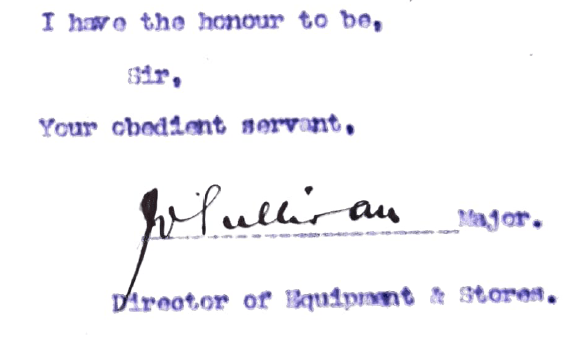
Under the management of Major James O’Sullivan, the Director of Equipment and Stores, the 1914 Regulations for the New Zealand Military details that the Defence Stores were[2]
responsible for the supply of clothing, equipment, and general stores; supplies of stationery, forms, and books; supply of, all vehicles and technical equipment, excepting Artillery and Engineers; storage and distribution of small-arms, accoutrements, and camp equipment’s, Customs shipping entries, and ammunition.
The following report was produced by Major O’Sullivan and details the activities of the Defence Stores up to 31 March 1914 and provided a useful appreciation of how the Defence Stores were placed prior to the mobilisation in August 1914.
NEW ZEALAND MILITARY FORCES.
REPORT OF THE DIRECTOR OF EQUIPMENT & STORES FOR THE YEAR ENDING 31 MARCH 1914
The Quartermaster-General Headquarters N.Z. Military Forces Wellington
Sir,
I have the honour to report as follows on the Stores, Magazines and Equipment in the Dominion for the year ending 31st March 1914.
SMALL ARMS AMMUNITION
The reserve of Small Arms Ammunition .303 Ball has since my last report increased by 138,000 rounds. The quality has maintained its excellence, and no complaints of any moment have been received during the year. the increased supply of cordite ordered has been received, thus removing any danger through delays in shipment. This will build up a reserve of cordite, which will be available to keep the Factory fully employed in the event of short shipments usually caused through Strikes in gland.[3]
The question or an increased reserve of Ammunition is a policy matter, but I wish to point out that the large increase in our Smal1 Arms during the year, consequent upon the importations from Egeland md Canada, has proportionately reduced the number of rounds available per Rifle.
The total issue of .303 Ball Ammunition during the year was 4,I62,000.
SMALL ARMS
During the year, 30,000 Rifles M.LE. Long were imported into the Dominion, 15,000 being from England and 15,000 from Canada. Of the English, 5,000 were perfectly new arms, while the 10,000-part worn were in such good condition that except to an Armourer or one very familiar with Arms, they appeared to be quite new.
The former were purchased at £2 each and the later at were purchased at £1, and as the landed cost of a new M/L.E. Rifle Long has hitherto been £3/12/. it can readily be calculated what an immense saving their purchase meant to the Dominion.[4]
CANADIAN RIFLES
The Canadian Rifles arrived in various shipments, the cost in Canada to the Department being 4/2d.landed cost 5/. Each. These Arms were not, of course, expected to be in the same condition as the English Rifles, having been thoroughly oiled prior to despatch front Canada, On arrival in the Dominion, however, after being overhaled and thoroughly cleaned by the Armourers, it was found that the Ars were in excellent condition, less than 2% requiring rebarrelling, while a fair number were quite new. Sword Bayonets and Scabbards patten “88 were also supplied with these Arms, while the Arms Chests in which they were packed, were in excellent order.
At 4/2d each, these Arms were a wonderful bargain, especially when it is remembered that a Rifle Bolt alone costs in England I6/. If any more of these rifles are obtainable, I would recommend that another five thousand be purchased, as they will be required if it is intended to train the General Training Section of the Reserve, it would be a waste of money to issue new Rifles to these if they are allowed to keep them in their homes, as they would very soon go astray or become unserviceable, while even if a percentage of the Canadian Rifles were lost, the actual financial loss would no be great.
The whole of the above Arms were received during the months of January, February and March and were immediately issued to the Senior Cadets, who are now fully armed.
No Protectors, Bottle Oil, or Pullthroughs were received with the Canadian Arms, but a supply has been cabled for, which, on arrival, will be issued.
We have in stock about 8,000 new spare barrels for Rifles M.L.H. Long, which means that 13.3% of the Rifles in the Dominion could be rebarrelled at short notice. It is, perhaps, just as well that we have a good reserve, as it is very probable a number of the rifles on issue to Cadets will be neglected.
The total number of Rifles M.L.E Long at present in Store and on issue to the forces is about 46,000.
RIFLES M.L.E. SHORT
The total number of Rifles M.L.E. Short in the Dominion is 13,810. These are on issue to Mounted Rifles, Field and Garrison Artillery, Field Engineers and Coast Defence troops, except about 1,900 of the Mk I pattern on issue to Senior Cadets and which are now being recalled.
Our reserve of Barrels and Spare parts is in about the sane proportions as for the Rifles M.L.E.Long.
RIFLES MARTINI-ENFIELD
There are in all about 1,100 of these in the Dominion. They are on issue to Senior Cadets, but are being recalled, so the question of how they are to be utilised will be for your consideration.
RIFLES .310
There are 1,052 of these, which were taken over from the Education Department, and issued to Senior Cadets in Auckland District. They were, however, condemned by District Headquarters as being useless for Musketry, and are being returned to Store. The question of what is to be done with these and the 928,000 rds of .310 Ball Ammunition will have to be considered later.
CARBINES
There are in the Dominion about I,400 M.L.E and 2,500 M.E Carbines, which are principally on issue to Colleges and High School Senior Cadets. There are, however, complaints of the poor shooting made with these in comparison with that with the Rifles on issue to other Senior Cadet Companies. Demand have therefore been made for Rifles to replace the Carbines, and in some cases this has been done, while the remainder will be replaced during the current year. The question of what to do with the replaced Carbines will therefore require consideration.
REVOLVERS
We have about 900 Revolvers in stock. These are of an obsolete pattern known as Dean and Adams, which were imported about thirty years ago. In fact, it is impossible to obtain ammunition for them, as the Webley Pistol Cordite Ammunition will not fit. There is a quantity of about 9,000 rounds of powder-filled ball for these Revolvers imported in 1880, but it ss not reliable. There are also about 14,000 rds Cordite filled ball, but this does not properly fit the Revolvers.
RIFLES SOLD TO DEFENCE RIFLE CLUBS.
The aforegoing Arms do not include the 3,423 Rifles M.L.E.Long and the 2,719 Rifles M.E. sold to members of Defence Rifle C1ubs. These are the property of the members, but no doubt practically the whole of these would be available in an emergency.
ACCOUTREMENTS
As mentioned in my last annual Report, an additional supply of Mills Web equipment was required, and in September 1913 demand was made for 4,000 sets and 20,000 Tools entrenching with Carriers, but approval for the expenditure was not obtained until the end of March this year. When these arrive from England, the equipment of the Infantry Regiments will be completed.
During the year all Brown Leather Accoutrements were called in from Field Engineers and Garrison Artillery, and replaced with Mills Web Modified pattern equipment consisting of Belt, waist: 2 Pouches and Frog This was considered to be a more suitable equipment for these units, besides which a considerable saving in expenditure was effected.
The Railway and Post and Telegraph Battalions and the Army Service Corps Companies have since been similarly equipped.
So far, no improved equipment for Mounted Rifles has been devised, our own Bandolier equipment, which has given satisfaction, is still being used.
As the whole of our Bottles Water Mk.IV are unfit for further service an additional supply of Bottle Water MK.VI with sling, carriers, has been ordered to complete equipment of Mounted Regiments and Ordnance Units. A further supply of Slings, Web, is also under order.
The Belts, Waist, Web, devised for Senior Cadets, which are made in the Dominion as a cost of 6d each, are giving general satisfaction.
SWORDS, OFFICERS & SAM BROWNE BELTS.
Owing to all Officers now being given an issue of a Sword and Sam Browne Belt on First Appointment, a large number of these are annually required. Of course, the number issued this year is greater than wi1l be that of subsequent issues. Taking free issues and sales during the year, there were issued 372 Swords 800 Sam Browne Belts.
MAXIM MACHINE GUNS.
As Mentioned in my last Annual Report, one each Maxim Machine Gun mounted on Tripod with Pack saddlery complete, was issued to Mounted and Infantry Regiments, and a supply of Tripods ordered to convert the Maxim Guns mounted on Field Carriages to Pack saddlery. The Maxims on Field Carriages were called into Store, but it was ascertained before these Guns could be properly fitted to Packsaddles, a number of suitable stores were required from England. These are now under order from England and on arrival. The conversion proceeded with. The addition of one Regiment of Infantry to the original establishments leaves us deficient of two Machine Guns, as no provision j=had been made for creases, and no spare Guns had been ordered. It will therefore be necessary to consider if two more Guns with Pack saddlery complete should be ordered.
If it is intended to equip Coast Defence Infantry in Auckland, Christchurch and Dunedin, or other Units, with machine Guns, a further order will be necessary.
During the year, three of the service locks which were broken were sent to England to be repaired and reported on. The locks have been returned and re-issued, and the report from England states that the breakages due to over tempering of the steel part in construction. As no further breakages were reported, it is presumed that only these three locks were faulty.
UNIFORM EQUIPMENT 1913/14.
TERRITORAL & SENIOR CADET
During the year the clothing of territorials and Senior Cadets has been continued steadily and at the end of March, with the exception of Caps, Forage, all clothing demands were completed.
The supply of Greatcoats and Putties, which I mentioned in my last Report as being in a backward condition, has now been brought up to date, and all branches of the service have been fully suppled as demands came forward.
A considerable saving was effected through the importation from England of some 10,000pairs Imperial Service Putties at a cost of about 3/. per pair, as against the price required for a local made article – which being all wool did not give satisfaction – and which cost about 4/9d per pair.
With the exception of Greatcoats, of which some 5,500 were received from Southern Firms, a Wellington Firm secured the contract for suppliers of Territorial Clothing, and they have made deliveries without delay thus enabling the Department to issue immediately on receipt of Requestions from Regiments.
The quality of material and make of garments has been fully maintained, and no complaints whatever have been received in this respect.
The delay in delivery of Caps, Forage, has been owing to there been no Factory in the Dominion which make the waterproof material as laid down in specifications of new Contract, and the supplies of this material had therefore to be obtained from England. Owing to Strikes and other causes the Contractors experienced great difficulty in obtaining supplies in time to meet our requirements.
Every effort has been made to keep down expenditure in connection with Uniform Clothing – no order has been placed with Contractors in excess of actual requirements – and though in some items the minimum number we were required to take under the Contract has been exceeded, this was owing to short deliveries under Contracts for 1911/13, and the formation of the Army Service Corps and Railway Battalions, which necessitated distinctive Uniforms being made.
The position of Uniform Clothing for year ending 31st March 1914 is:-
When it is remembered that there are Uniforms stocked for the six branches of the service, each of which are again divided in 31 different sizes, the total number in store is not large, and unless maintained, it would be impossible to issue the particular sizes asked for on requestions received, nor would we be able on a sudden emergency to meet demands.
SENIOR CADET UNIFORMS.
The issue of Clothing to senior Cadets has been steadily maintained during the year, and on 3Int March 1914, all Requisitions for Clothing received had been supplied on that date. The quality of material and the make of the uniform reflects credit on the Contractors.
As with the Territorial Uniform, only the particular sizes of garments of which our stocks were nearly exhausted, were ordered, and the minimum quantity under contract was not taken during the year. As far as possible, all Trousers returned to Store, also old pattern Shorts, were washed, relined in bands and fork and converted at a small cost in to new pattern shorts, and are being issued ad required.
The position Senior cadet Uniforms is:-
Blouses
Shorts
Hats
Puttie Hose
Web Belts
Total Receipts to 31/3/1914
44463
43227
43150
46478
32011
Total issues
34937
39000
34845
35513
31993
Leaving in Store 31/3/1914
9326
6227
9105
7965
18
As we had a good stock of Cadet Clothing in Store on 1/4/193, only small orders were placed with Contractors last year. As under our Contract we are bound to place order for 5,000 each item per year, we will have to place larger orders this year. The Issues last year were about 8000 suits.
OFFICERS UNIFORMS
Under Circular Q.M.G 85/36 of 16/10/1912, the cash payment of £15. and £9 to Territorial and Senior Cadet Officers respectively was abolished, and a Free Issue of Jacket, Riding Pantaloons or Knicker Breeches, Putties and Cap Forage was made in lieu thereof to Officers on First Appointment on Probation, and Hat, Greatcoat &Trousers on Final Appointment after passing Examination. The cost of these uniforms being:-
Mounted Service
Dismounted Service
Without Badges of rank
£6:16:3
£6:8:9
As there were some 375 Officers clothed in this manner during the year it will be seen that a considerable saving was effected. The Contractors supplied a first-rate uniform made to special measurements of individual Officers, and no complaints were made by Officers in this respect.
A Sam Browne Belt and Officers Sword for use of Officers newly appointed are issued to the Regiment of Company to which he may be attached. These items remain the property of the Government , and are handed in when the Officer retires or is transferred.
As with Territorial Uniform, only the particular sizes of garments of which our stocks were nearly exhausted were ordered, and the minimum quantity under Contract was not taken during the year. As far as possible all Trousers returned to Store also old pattern Shorts were washed, relined in bands and forks and converted at a small cost, into new pattern shorts and are being issued as required.
The position of Senior Cadet Uniforms is:-
Blouses
Shorts
Hats
Puttie Hose
Belts Waist
Receipts
595
4408
252
0
32011
Issues
8659
9984
7570
7147
31993
In Stock
8526
6297
9705
7966
18
It will be seen that the issues last year were almost equal to our present stock, so that during the current year we shall have to provide somewhat above the minimum of Contractor, viz. 5000 each item.
UNIFORMS
It has come to my knowledge from conversations with officers and Regimental Q.M. Sergeants that there are a considerable number of part worn Uniforms in Regimental Stores, which have been returned principally by men who have been exempted from further training and by others who have 1eft the Dominion, and I understand that instructions have been issued to Regimental Q.M. Sergeants not to re-issue these part worn uniforms.
In this respect, I consider that if I could visit the Regimental Stores during the year for the purpose of examining this clothing and return to Store as ay be fir to be washed and pressed and relined where necessary, they would be as good and could be issued as new Uniforms, as is done in the case of trousers as used by Senior cadets. In this manner, instead of paying about 30/. for new Tunic and Trousers, they could be made equal to new for about four to five shillings
SERVICE BOOTS
The sale to the Defence Forces of the service Pattern Boot was well maintained. During the year some 5100 pairs were received from Contractors, of which the greater proportion were sold for cash. Owing to the increased cost to te Department (in consequence of high price of leather etc) we were forces to raise the price from 11/6 per pair to 14/. Per pair. General satisfaction has been given to all wearing these for Military duty, as the sales in Training Camps denote
In all 1arge Training Camps, an Officer is sent from Defence Stores with a good stock of Boots for sale in Camp, and in order that the men may use the boots while in Camp and to make payment easy, the amount is deducted from pay at the end of Camp.
SHEETS, GROUND, WATERPROOF.
An additional Supply of 10,000 Sheets ground was obtained during the year, bringing our equipment up to 20,282. There are always considerable losses in these as they are useful for so many purposes in private life. They disappear both in large and weekend Camps, in fact after a large camp, one can never be certain what are the losses until final check in store is made. They have been known to disappear in transit from Camps. Of course, shortages are charged against Units, but this does not entirely prevent loss/
BAGS, NOSE, HORSES.
6,000 Nose bags for feeding Horses in camps were obtained during the year. This was a very necessary item of equipment as there was considerable waste of horse feed hitherto. The saving in horse feed that will be effected in a short time will compensate for the cost of the Nose Bags. The bags are all branded ‘DEFENCE↑1914” and numbered consecutively, so that los or shortage can be traced to the
FIELD COOKERS.
In my last Report I mentioned that a supply of “Roberts” Cookers was being obtained. 24 of these, each estimated to cook for 500 men, were issued in Camps during 1913, and gave great satisfaction when occupied with the method of cooking hitherto in use. 11 additional 500 men Cookers and 16 – 250 men Cookers were obtained since January 1914, and the whole are now in use as under:-
Auckland
9
500 men
4
250 men
Wellington
10
“
4
“
Canterbury
8
“
4
“
Otago
8
“
4
“
There was also obtained from England a “Sykes” Travelling Cooker, while the 9th Regiment Mounted Rifles imported 2 Lune Valley Travelling Cookers.
Trials are now being made in Takapau Camp as to the merits of each. The landed cost of the “Sykes” Cooker was £130, whereas the local article -500men Cooker – costs £64, and the 250 men Cooker £46. I am unable to give the cost of the Lune Valley Cooker as it was imported Privately,
If the “Roberts” Cooker is to be adopted, 1 an of opinion that no more of the 500 men cookers should be obtained as they are too heavy to handle and are liable to breakage in transport. The 250-man Cooker in an ideal weight and can be easily handled by 4 men, 1ifting in or out of any conveyance, besides which double 1n or out of any conveyance, besides which, double companies under the new organization are 250 each.
CAMP KETTLES.
There is a very good supply in Ordnance Stores, but sone are getting the worse for wear. An order for 1000 has been placed in England.
MEAT DISHES, BOILERS, LANTERNS, WASH BASINS etc are all Locally made, and supply can always be ordered as required to replace
KIT BAGS.
A sum of money was placed on the estimates last year to provide Kit bags, but the late Quartermaster-General, for financial reason, deemed it advisable to let the procuring of a supply stand over for the present.
B0OKs, FORMS, STATIONARY, PAPER TARGETS ETC.
A large supply of Drill Books etc were obtained during the year and distributed to the various centres as instructed. There are now 225 NZ Military Forms and Books in use. The printing of these Forms and Books is carried out at the Government Printing Office but owing to pressure of work for the other Departments, delays in printing our demands often occur. I am of opinion that better paper in many of these forms should be used in many of these Forms, especially those which are records. There is no comparison in the quality of paper used in our Forms and that used in the Imperial Service Forms
I am certain there must be considerable waste of Forms in the Area Group Officers and also in the Regimental Offices, as the demands sometimes made are out of all proportion to the requirements. These demands haves to be cut down here and I think Staff Officers should be impressed that Forms cost money and should be used only for the purpose for which they were printed
ARMOURERS.
During the year the four senior District Armourers were brought to Wellington and put through a three weeks course of instruction in Maxim Machine Guns under Staff Sgt, Major Luckman, who, at the end of the period, examined the on the theory and practice of examination and repairs to Maxim Guns
The men took a keen interest in the work, and at the final examination passed to the satisfaction of the examiner, who reported that certificates should be given. This was approved and the certificates issued. The fact of these men holding certificat4rs will enable them to instruct their assistants in Districts, and these when they qualify, can also be issued certificates
The CADET ARMOURERS are getting on very well, and in order to give them experience in the Field, one Cadet has been temporally attached to each district.
Reports from District Armourers as to the condition of Arms on issue to Units have been, generally speaking, good, but owing to the outbreak of Smallpox in Auckland District, the inspection had to be discontinued, so that all the arms were not examined. The general strike also affected the examination especially in the North Island.
Owing to the increased number of small arms now issued to Cadets, the personnel of this branch of the service will require increasing , and the districts subdividing, as it would be impossible for an Armourer to make inspection of all the Small Arms in any one District during the year. I will later submit a proposal to meet this question.
DISTRICT STOREKEEPERS.
A conference of the three District Storekeepers was held in my Office in August 1913to discuss many matters in providing for stores not provided for in the regulations. This is far preferable to correspondence on minor matters of detail, as it was found that letters of instruction and Headquarters circulars were sometimes differently interpreted. When the occasion is deemed necessary, I will again ask for authority for a conference.
The Storekeepers are all Officers with a keen sense of their responsibility regarding Government property, and take a personal interest in their work, without which as Storekeeper or Quartermaster-Sergeant is useless.[5]
TRANSPORT WAGONS.
No additions were made to this service during the year. The late Quartermaster-General made provision in the Estimates for 32 Field Service Wagons similar in type to the colonial pattern in Store, being satisfied that with slight modification, this wagon would be very suitable for the Dominion. For financial reasons the inviting of tenders for these was held over.
No addition was made to the equipment of Water Carts during the year. The new type received with the Field Guns is far and away more expensive than that hitherto in use, and consideration will have to be given this subject for the equipment laid down is to be provided.
I am of opinion that it would pay the Department well if one Motor Wagon is provided for each of the four centres. The cost of cartage is becoming a heavy item, especially in Wellington, and if the Department had its own wagons this item would be considerably reduced. The fact that under the terms of the Public Works Contracts for Cartage the transport of one case from the Railway or Wharf is charges by time or ton weight or measurement will indicate that cartage is an expensive item, whereas if our own wagons were available, collection of parcels and cases could be made at stated time, all with greater efficiency, Other Departments of the State find it to their advantage to run their own transport Motor Wagon, and I am od opinion it would be ad advantage if we could do likewise.
MEDICAL EQUIPMENT.
During the year the Director of Medical Services laid down a list of Medical Equipment to be issued to Mounted and Field Ambulances and Regimental Medical Officers. Included in this were a new pattern Surgical Haversack and new pattern Medical Chest: these being entirely different to the pattern hitherto in use. Tenders for supply were invited. The Chests and Haversacks were made in the Dominion, but arrangements had to be made with the successful tenderers to import the supply of instruments and drugs which arrives in the Dominion at the end of March 1914. The Chests and Haversacks were then filled and issued to Districts for distribution. As the new equipment provides for one wagon only, one each was taken from the Field Ambulances and issued to the Mounted Field Ambulances. Each Regimental Medical Officer is provided with a surgical haversack, and in addition to the equipment of Stretchers of Field Ambulances, each Regiment is provided with two. These to remain as permanent equipment. I may mention that all our Field Stretchers are now made in the Dominion, and Mr Reid – the maker of same – informs me that the Department having its Stretchers made locally has been the means of St John ‘s Ambulance and others also getting their supplies locally, instead of importing as hitherto. The Stretchers are made at about the same cost as the imported ones, and the Director of Medical Services has stated that he is very satisfied with them.
VETERINARY STORES.
Hitherto no provision was made for Veterinary Chests, medicine for use in the Feld, the practice being for Veterinary Officers to obtain supplies from the nearest Chemist. This method while being expensive, was not satisfactory. During the year, the Director of Veterinary Services and the Principle Veterinary Officer, of Wellington, paid visits to the Stores, and under their supervision, a Field Veterinary Chest was devised. The necessary instruments and drugs were obtained, and the Chests filled and distributed in time for the Divisional Camps.
Twenty Chests in all were made, and it is proposed that each be retained at the Headquarters of the Field Artillery in each District, the balance to be kept in District Store for use in the Field.
STORE BUILDINGS.
The Store buildings are in good order, the only additions during the year being those to the Christchurch Store, which were very necessary. Owing to increase of Equipment and Clothing, all buildings were taxed to their utmost capacity during the year.
Arrangements have now been made for District Stores to keep a stock of Forms etc for issue, instead of having to send individual requisitions to Wellington for Supply.
If Transport Wagons and Harness are to be provided for the Army Service Corps, provision will require to be made for housing same. I am of opinion that the time has now arrived for the establishment of a District Store at Palmerston North, as it is more central for distribution, and cost or railage would be considerably reduced. The Wellington City Units could still be suppled from the Store in Wellington
MAGAZINES FOR SMALL ARMS AMMUNUITION.
Our magazines for storage of Small Arms Ammunition were taxed to their utmost capacity during the year, and indeed sone were overtaxed, as the Ammunition could not be stored in strict accordance with Magazine Regulations, If our reserve of Ammunition is increased, it will be absolutely necessary to increase the accommodation, especially in Otago. I have previously drawn attention to the inadequate Magazine accommodation in Otago, in which only 3 million rounds of Ammunition can be stored, whereas there should be accommodation for at least 5 Million rounds. At present the maximin supply that can be stored in the South Island is only 8 million rounds, which to my mind is inadequate. Provision should therefore be made in this year’s estimates for
AEROPLANE
The Bleriot Monoplane “Britannia” presented to the NZ Government by the British Aerial League was duly received during the year, and a suitable shed was erected in Defence Stores yard at a cost of about £130 for housing the same. The Machine was subsequently sent to Auckland Exhibition, but has now been received back art Wellington
According to instructions contained in a Cable from the High Commissioner, the machine requires constant attention and care and has been place under the supervision of the Armourer, who details a Mechanic to attend to the cleaning and oiling of same.
STOCKTAKING.
To comply with the provisions of the Public Service Regulations an annual Stocktaking has to be made, and this had been almost completed when the general strike took place. This necessitated the whole of the Staff being employed and the Stores and building being used for nearly three months in the housing and accommodation of the Special Mounted Constables. Immediately on their departure, the large shipments of Arms from England and Canada arrived. As preparations had then to be made for supplies and equipment for Camp for the inspection by the Inspector-General, Overseas Forces, I have been compelled to postpone the stocktaking till this year.
STAFF.
In conclusion of the Report, I have to mention that owing to increased work in the Store and yard, temporary extra labourers had to be employed. This pressure was overcome about the end of April and the men were discharged. There are other men on the temporary staff, such as Storeman, Clothier, Hatter, Packers who are experienced at his class of work, are industrious, and take special interest in the work. These men are an absolute necessity to carry on the Clothing and other ranches of the Department in which they are employed.
Finally, I wish to especially mention the permanent Staff, workmen and the office staff. To the letter, I owe the success and efficiency of this branch, as they are officer who take a special and personnel interest in their duties, and who, in addition to their own work, were called upon at the time of the Industrial troubles in Wellington, to feed, clothes and equip the Mounted Special Constables who were brought to Wellington to maintain law and order.
The controlling officers on several occasions complimented me on the efficiency of the staff.
This extra work necessitated the Office Staff returning to duty at night after the Special Constables had been disbanded in order that their work could be brought up to date. Some even had to sacrifice their Annual Leave
As I have previously stated, owing to the steady increase of work in the Office, the permanent appointment of one extra Clerk is badly needed.
Defence Stores, Wellington. 8th May, 1914.
________________________________
Note: You have been supplied confidentially with Returns of all Arms, Ammunition and Equipment in the Dominion, consequently figures are not given in this return
________________________________
Notes
[1] Glyn Harper, Johnny Enzed: the New Zealand soldier in the First World War 1914-1918, First World War centenary history, (Auckland, New Zealand: Exisle Publishing Limited, 2015, 2015), 29.
[3] The majority of Small Arms Ammunition for the New Zealand Military was manufactured in New Zealand by the Colonial Ammunition Company at their Mount Eden Factory in Auckland.
[5] The authorisation for permanent District Storekeepers was for one each at Auckland, Christchurch, and Dunedin, with the following appointments made:
Mr William Thomas Beck – District Storekeeper, Auckland
Mr Arthur Rumbold Carter White – District Storekeeper, Christchurch
Mr Owen Paul McGuigan – District Storekeeper, Dunedin
Rickshaw Military Research specialises in the research and transcription of New Zealand Military Service Records to allow families to learn of their families military experience in peace and war. Services offered by Rickshaw Military Research include;
Interpretation of military records,
Assistance with military research,
Identification of medals, badges and insignia, and sourcing of replacements.
Regiment and unit identification.
Often, descendants of New Zealand Servicemen have some inkling that their ancestors served in the military. Knowledge of a relative’s service will often be a source of pride with some evidence such as photos of the relative in uniform, medals, unit badges, diaries, and other souvenirs existing. However, for many, any connection to their relative’s military service is long-forgotten and a mystery. For some, the only link to a relative is an inscription on one of New Zealand’s many War Memorials.
For all those interested in discovering more about their ancestors military service, accessing the individual’s service record and understanding what is written in it can be a daunting exercise,first in gaining the service record and then interpreting the peculiar language used by the military and making sense of the many abbreviations used, reading a service record often leads to more questions than answers.
Rickshaw Military Research provides a service where we work with the family and after some preliminary questions, access the relevant military service record from the archives and produce a transcript of the relative’s service record into an easy to read format, including;
Personal details of the individual.
Brief description of activities prior and after service.
Record of service, from enlistment to demobilisation, including;
Formations/Units served in.
Campaigns and battles that were participated in.
Locations visited.
Record of Promotions.
Record of Illness and Injuries.
Records of medals and awards, including citations.
Brief description of post-service activities.
Illustrations will be provided where possible and could include;
Photos of the serviceman.
Medals.
Badges and patches worn.
Maps.
Equipment used, i.e. if a serviceman was a tank driver, an illustration of the type of tank driven.
Services offered
Pre 1921 Records
Service records prior to 1921 including the South Africa and First World War.
Basic one-page summary of service: $100*
Basic service information from attestation to discharge edited to fit on a single A4 sheet.
Full transcript of service : $250*
Transcript of service relating to target serviceman with additional information on units served in and campaigns participated in presented as a booklet or interactive Web App.
Post 1921 Records
Service records from 1921 including the Second World War, Korea, Malaya, Borneo, South Vietnam, CMT & National Service, Peacekeeping and Territorial and Regular service in New Zealand)
Basic one-page summary of service: $150*
Basic service information from attestation to discharge edited to fit on a single A4 sheet.
Full transcript of service : $300*
Transcript of service relating to target serviceman with additional information on units served in and campaigns participated in presented as a booklet or interactive Web App.
Other Research
Other research outside the scope of researching Personnel Records is charged at a rate of NZD$30 per hour.
*All prices are GST inclusive.
Interested in knowing more? Feel free to contact Rickshaw Military Research and let us know how we can assist.
This post provides a chronological record of the principal Ordnance units located in the Manawatu from 1915 to 1996.
1914
In his annual report to the Quartermaster General of the New Zealand Military Forces, Major James O’Sullivan, the Director of Equipment and Stores, made the suggestion that.
the time has now arrived for the establishment of a District Store at Palmerston North, as it is more central for distribution, and cost or railage would be considerably reduced.
Report of the Director of Equipment & Stores for the year ending 31 March 1914
Early 1915
Palmerston North Ordnance Store established
21 June 1915
Mr Frank Edwin Ford, formerly the Mobilisation Storekeeper at Nelson, was appointed district storekeeper, Wellington Military District and took charge of the Palmerston North Ordnance Store.
Palmerston North Ordnance Store. Palmerston North City Library
1 July 1917
New Zealand Army Ordnance Corps was formed. The civilian staff of the Defence Stores Department staff were attested for service in the NZAOC. The Palmerston North Ordnance Store’s official designation became “Palmerston North Detachment – NZAOC”.
December 1921
Palmerston North Detachment, NZAOC disbanded
Jan – March 1942
Central Districts Ordnance Depot established at the Palmerston North showgrounds
Palmerston North Showgrounds, Cuba Street, 1939. Palmerston North Libraries and Community Services
1 March 1941
Lieutenant William Saul Keegan, New Zealand Temporary Staff (NZTS) appointed as Ordnance Officer, Central Military District and Officer Commanding, Palmerston North Detachment, NZAOC and NZOC attached.
1 August 1942
Central Districts Ordnance Depot was renamed to No 2 Ordnance Sub Depot.
1943/44
Main Ordnance Depot Trentham establishes Bulk Sub-Depot at Linton Camp
31 December 1944
Fire at 2 Ordnance Sub Depot resulting in a stock loss of £225700 ($18,639,824.86 2017 value)
No 2 Ordnance Sub Depot. Group of soldiers – Elmar Studios, 459 Main Street, Palmerston North circa 1942 to circa 1945, No Known Restrictions
14 December 1945
No 2 Ordnance Sub Depot Closes and its functions assumed by the Main Ordnance Depot at Trentham and Bulk Sub-Depot at Linton
1 October 1946
Reestablishment of No 2 Ordnance Depot at Linton Camp absorbing the Main Ordnance Depot Bulk Sub-Depot. Captain W.S Keegan Officer Commanding. Headquartered in Linton, No 2 Ordnance Depot also maintains.
Ammo Sub Depots at Belmont, Makomako and Waiouru,
a vehicle Sub Depot at Trentham, and
Stores Sub Depot at Waiouru.
26 April 1947
Captain Quartermaster L.H Stroud was appointed as Officer Commanding, No 2 Ordnance Depot
1948
Captain P.W Rennision appointed as Officer Commanding, No 2 Ordnance Depot
Central Districts Ordnance Depot, Linton Camp 1949
Reorganisation of RNZAOC Units
No 2 Ordnance Depot was renamed Central Districts Ordnance Depot (CDOD).
Central Districts Ammunition Depot (Makomako, Belmont, Waiouru) and Central Districts Vehicle Depot (Trentham) formed as standalone units.
Waiouru Ordnance Stores remain a Sub Depot of Linton until 1976.
Central Districts Ordnance Depot, Linton Camp 1949. Back Row: Private R. Pickin, Lance Corporal R Riordan, Corporal Downing, Corporal Carswell. Private Shepherd, Corporal Blanchard, Corporal Wackrow, Corporal Ayers. Center Row: Corporal Kearns, Lance Corporal Parking, Private Norris, Lance Corporal Thorn, Corporal Fry, Unidentified, Private Simpson, Lance Corporal Alger, Sergeant Whaler, Sergeant Colwill. Front Row: Sergeant Rogers, Sergeant Riordan, Lieutenant O’Connor, Captian Rennison, Warrant Officer Class Two Colwill, Sergeant Wells, Sergeant Kempthorne. Photo: E Ray
1949-50
Buildings CB26 and CB27 Constructed
1950
Captain W Ancell appointed as Officer Commanding, Central Districts Ordnance Depot
1954
Central Districts Ordnance Depot, 3 September 1954
1957
Major J Harvey appointed as Officer Commanding CDOD
Major J. Harvey . Fairfax Media New Zealand
The Central Districts Vehicle Deport (CDVD) relocated from Trentham to Linton. Buildings CB14, 15, 16 and 17 relocated from Wellington to house the CDVD.
1958
Central Districts Ordnance Depot, Linton Camp 1958
Central Districts Vehicle Depot and Central Districts Ordnance Depot, 1961 Buildings CB14, 15, 16 and 17 are the large white buildings in the lower right of the photo
1961
Reorganisation of RNZAOC Units
CDVD and CDAD cease to be standalone units and become sub-units of the CDOD
New Headquarters building constructed for CDOD (Building CB18)
Headquarters 2 Supply Company C1980. Robert McKie Collection
1962
RNZAOC Stores Sections carrying specialised spares, assemblies and workshop materials to suit the requirement of its parent RNZEME workshops were approved, and RNZEME Technical Stores personnel employed in these were transferred to the RNZAOC.
1963
Major John Barrie Glasson appointed as Officer Commanding CDOD
Construction of New Clothing Store completed (CB4)
2 Central Ordnance Depot
Back Row (Left to Right: Dave Orr, Brian Quinn, Bill Hewett, Doug Wright, ?, Albie Hough, ? , Peter Cox, Bill Mania.
3rd Row (Left to Right) Tom Woon, John McCormick, ? , Len Pratt, Tom Moore, Doug Waugh, Dave Morris, Dave Wooler
2nd Row (Left to Right) Ian Casper, Larry Aitcheson, Bob Zaloum, Les Mulane, Robbie Staines, Garth Menhnmet, Ron Tye, Entwhistle(RNZEME), Ken Wagstaff, Staffort-Lowe.
1st Row (Left to Right) Eric Ray, McKay, ?, Gordon Rowe, Barry Stewart, Pat Riordain, Capt Edwards, Elwood, Arthur Parkin, Bill Monk, Terry ?, Dawn ?.
1968
CDOD renamed 2 Central Ordnance Depot (2 COD)
1969
Major Piers Reid appointed as Officer Commanding 2 COD
Construction of 45000sq ft (reduced to 25000sq ft) extension to Clothing store began by 2 Construction Sqn RNZE.(CB4)
2 Central Ordnance Depot, C1969 5th Row, Left to Right; Ian Casper, ? , Eric Ray, Neil Walker, ? . 4th Row , Left to Right: ? , ? , ? , Bill Hewett, ? , Tony Thain, ? , ? , ? , ? , ? . 3rd Row. Left to Right: Charlie Howlett, Selwyn Manson , Morrie Connell, ?, Keith Everley, Alf Ganderton, ? , Bob Zaloum, ? , ? , ? . 2nd Row, Left to Right: ? , ? , ? , ? , ? , ? , Keith Parker , ? , ? , Keith Danby , Dave Orr, Dave Morris, Bob Duff, ? , David Ralph Hughes, ? , ?, ? Front Row, Left to right: ?, Mike Ray, ? . ? , Ash (Bones) Lewer, Ken Wagstaff, ? , Keith Watson , Piers Reid, Ted Sweet, ? , Makita, ? , Garth Menhemitt, Gordon Rowe, Noel Blanchard, George Dimmock, ? .
7 Nov 1972
2 COD New stores building completed for $134000 and 34298 manhours. (CB4)
2COD/2 Supply warehouse
1 April 1976
Reorganised with the Waiouru Sub-depot becoming the Standalone Supply Company -4 Central Ordnance Deport (4 COD).
1978
Major K.A Watson appointed as Officer Commanding 2 COD
16 October 1978
2 COD Renamed to 2 Supply Company
1 February 1979
22 OFP formed as a Subunit Capt. M Telfer (TF Officer) as Officer Commanding
12 May 1979
RNZASC Supply responsibilities Transferred to the RNZAOC. 2 Supply Company gains 24 Supply Platoon (Rations)
31 January 1980
Major S.D Hopkins appointed as Officer Commanding 2 Supply Company
7 March 1983
Major N.A Hitchings appointed as Officer Commanding 2 Supply Company
1985
2 Supply Company reorganised as 5 Composite Supply Company: Consists of two sub-units:
The Linton Sub Depot, which is drawn from 2 Supply Company, and
21 Supply Company. 21 Sup Coy was a Territorial Force unit based at Waiouru as a sub-unit of 4 Supply Company responsible for Combat Sups and Services. As a sub-unit of 5SCS it was relocated to Linton, intergrading with 22OFP. One of 21 Sup Coys principle Sub-Units was 47 Petroleum Platoon.
27 May 1985
Major Geoff Cain appointed as Officer Commanding 5 Composite Supply Company
1985
47 Pet Pl undergoes a major re-equipment, receiving a suit of kit including Fabric Tanks, Pumps, Filters, Meters and a limited pipeline capability. Under Captain Kit Carson, the profile of the Petroleum Operator Trade is increased as RF recruiting into the trade is increased and Pet Op courses run more frequently.
5 Composite Supply Company C1986
1986
Makomako Ammunition area begins refurbishment programme to upgrade ESH’s, roading and support infrastructure.
16 November 1987
Captain G.M Gregory appointed as Officer Commanding 2 Supply Company
16 APRIL 1988
Major R.J.A Smith appointed as Officer Commanding, 5 Composite Supply Company
5 Composit Supply Company 1989
1990
5CSC Reorganised as 21 Field Supply Company
Construction of New Ration Store Completed as part of Operation Kupe, the return of units from Singapore. The Old 24 Supply Platoon Ration Store that was located outside of camp by railway extension was demolished.
16 December 1991
Major C.A Tarrant appointed as Officer Commanding, 21 Field Supply Company
1992
Ready Reaction Force Ordnance Support Group (RRF OSG), transferred from 3 Supply Company Burnham and absorbed into 21 Field Supply Company. Low cost shelters CB34a,b and CB35 erected)
December 1992
NZ Supply Detachment deployed to Somalia, majority of personnel are drawn from 21 Fd Sup Coy.
June 1993
NZ Supply Platoon deployed into Somalia, relieving the NZ Supply Det.
January 1994
NZ Supply Platoon deployed into Somalia, relieving the NZ Supply Platoon. The deployment ended in June 1994
1 March 1994
Major S.A Wagner appointed as Officer Commanding, 21 Field Supply Company
May 1994
Major Chas Chalton appointed as Officer Commanding, 21 Field Supply Company
1995
RNZAOC Supplier Trade combines with the All Arms Storeman Trade as Supply Quartermasters.
December 1996
21 Field Supply Company, becomes 21 Supply Company, Royal New Zealand Army Logistic Regiment (RNZALR). Catering functions join the company as a sub-unit NOTE: this needs to be confirmed and might have happened earlier.
January 1997
Major H Duffy was appointed as Officer Commanding, 21 Field Supply Company, RNZALR.
A small memorial plaque placed just below a soldier’s headstone at Palmerston North’s Terrace End Cemetery hints at a fantastic story of two brothers who served in the First World War. One, due to illness attributed to the war, had a short life, passing away seven years after the war. The other had a long and exciting life that exemplified the ideals of the American Dream.
Morgan Joseph, John Goutenoire and Mary Agatha (b April 1903) were the three children of Morgan and Isabel O’Brien and were born in Nelson between 1891 and 1903. Shortly after the birth of Mary, Morgan O’Brien took up a position as a Health Inspector in Palmerston North, which saw the O’Brien Family settle in there.
Morgan Joseph O’Brien
Born on 13 August 1891, Morgan attended Nelson College and, like most men in New Zealand at the time, undertook his compulsory military service in the Territorial Army. A foundation member of the Palmerston North J Battery of the Artillery, Morgan also served in the Poverty Bay Company of the 9th (Hawkes Bay) Infantry Regiment. Morgan was well known in Palmerston North and later Gisborne as a keen Footballer and Cricketer.
At around 1913, Morgan took up a position with the Gisborne Branch of J.J Niven, taking charge of that branch’s customs and shipping department. At the onset of the First World War, Morgan entered Trentham Camp for training with the Artillery in November 1915. Sailing with the 10 Reinforcements on 4 March 1916, Morgan joined the New Zealand Expeditionary Force (NZEF) in France in April 1916 and was posted to the Divisional Ammunition Column (DAC). It is likely that due to Morgan’s civilian clerical experience that he was involved in ammunition accounting, managing the substantial quantities of ammunition required by the New Zealand Division. Serving with the DAC for the remainder of the war, Morgan was struck down with influenza several times but finished the war in Sling Camp in the United Kingdom. Morgan was transferred into the New Zealand Army Ordnance Corps (NZAOC) on 13 February 1919. Promoted to Corporal and posted to the London Ordnance Depot, working closely with his brother John, who was the Chief Clerk of the NZAOC. Morgan’s clerical skills were recognised, and in July 1919, he was promoted to Sergeant. With the bulk of the demobilisation work required of the Ordnance Depot in London completed by August 1919, Morgan was repatriated to New Zealand in September 1919 on the SS Ruahine. After Three Years and Two Hundred- and Ninety-Seven-Day of overseas service, Morgan was struck off the strength of the NZEF on 22 January 1920, returning to his civilian employment with J.J Niven in Gisborne.[1]
Morgan only remained in Gisborne for just under two years, when in December 1921, he was promoted to be the Accountant at JJ Nivens Palmerston North Branch. Sadly, like many of his peers, Morgan’s health and been affected by the war and plagued him with continuing problems and periods in Hospital. On 24 August 1926, at the age of Thirty-Five, Morgan passed away at his parent’s home at 163 Fitzherbert Street, Palmerston North. Morgan’s funeral was held at St Patrick’s Church, with many beautiful wreaths received and representation from his former employer, and military and sporting associates.[2]
John Goutenoire O’Brien
John O’Brien was born on3 April 1895 (some sources state 1896) and attended Palmerston North High School, Nelson College, and Palmerston North Technical college.[3] Following a similar vocational path as his brother, John took up a clerical position as a Clerk with the Bank of New Zealand in Palmerston North. Called up for military service in the Territorial Army, John spent two years with the Palmerston North-based C Company of the 7th (Wellington West Coast) Regiment.
John enlisted into the NZEF on 20 April 1915, joining B Company of the 6th Infantry Reinforcements at Trentham Camp. Embarking for Egypt on 11 August 1915, the 6th reinforcements were the last to reach Egypt before the end of the 1915 Gallipoli campaign. John, as part of the Wellington Infantry Battalion, was among the last of the New Zealand Troops committed to the ill-fated Gallipoli campaign; however, after a brief period of fighting on Gallipoli, John was evacuated early in December due to suspected appendicitis and dysentery.[4]
After recuperation in Alexandra, John was posted to the New Zealand Base Depot at Ismailia as the New Zealand Division was reorganised. Possibly because of his clerical background, John did not rejoin the Wellington Infantry Battalion but instead transferred into the NZAOC. Serving with the New Zealand Division in France, John was promoted to Corporal on 4 June 1916 and then Sergeant on 31 March 1917.
On 13 February 1918, John was transferred from the New Zealand Division in France and taken on the strength of the New Zealand Ordnance Depot in London. Audits had found several inadequacies in the running of the store’s account, which John described as “a system of recording and accounting that was absolutely hopeless”.[5] Appointed as the NZAOC Chief Clerk in the United Kingdom, John was promoted to Temporary Warrant Officer Class One (Temporary Sub Conductor) on 5 October 1918.
New Zealand Army Ordnance Corps Badge, 1916-1919 (Robert McKie Collection 2017)
Promoted to Warrant Officer Class One (Sub Conductor) on 25 November 1918, the priority due to the war’s end had shifted from supporting the NZEF to demobilising the NZEF, including the closing of accounts and the final balancing of the books. Appointed as a Conductor on 1 February 1919, John, in addition to his existing staff of two, was allocated an additional six men to assist in the reorganisation and rewriting of the ledgers to an acceptable standard. John’s older brother Morgan, an accountant by trade, was, on 13 February 1919, transferred from the New Zealand Field Artillery into the NZAOC and posted to the London Ordnance Depot, where there is no doubt that his skills as an account were put to use.[6]
By the middle of 1919, John and his staff had made progress in the closing of the NZEF accounts, with the ADOS Colonel Pilkington satisfied that the whole team could be repatriated in September on the SS Ruahine. However, due to changes of Department heads in NZEF Headquarters, John elected to remain to follow through in his efforts and ensure that his responsibilities were handed over.[7]
In recognition of the valuable services rendered in connection to the war, John was awarded the Meritorious Service Medal on 9 December 1919.
In January 1920, it was anticipated that with the planned sailing of the “Corinthic” on 20 February 1920, only twenty-four members of the NZEF remained in the United Kingdom to be repatriated on the “Ionic” on 31 March 1920. However, much work remained to be done, and the three remaining Ordnance Staff, Captain Simmons, John and Sergeant Edwards, were each allocated specific tasks by the departing ADOS. John was to.
Remain to settle all claims preferred against the NZEF, by the Imperial authorities for stores and equipment issued from time to time, also to obtain credit for stores returned to Imperial Ordnance by NZEF Units and Depots. This WO will deal with all claims for outstanding stationery issued to the NZEF, and will arrange credit for all stationary etc., returned to HM Stationery Office. He will pass for payment, all accounts for goods etc., brought under this Office Local Purchase Orders Authority. All matters relating to the equipment for the Post-Bellum Army in New Zealand will be dealt with by him, and he will submit any idents which have to be preferred, and will also assist the High Commissioner with the arrangements for shipping all new equipment and stores for the Dominion.[8]
Having been overseas for over four years, John was becoming anxious about his future employment. He resigned from his position with the Bank of New Zealand in 1915, with a gentleman’s understanding that his job was to be held open for him on his return. However, after five years of military service, correspondence with the Bank of New Zealand indicated that his re-employment was not guaranteed but was to be favourably considered. With a compelling case to return to New Zealand, Johns’s demobilisation was approved. On handing his remaining duties over to Captain Simmons and the New Zealand High Commission, John departed for New Zealand on the last official troopship returning to New Zealand, the “SS Ionic”. Leaving the United Kingdom on 31 March 1920, the Ionic transited the Panama Canal, arriving back in Wellington on 28 May 1920. It is interesting to note that during Johns’s tenure in London, in addition to his military duties, he undertook a course of study at the London Hugo College of Languages.[9]
On 8 June 1920, John was stuck off the strength of the NZEF and, after five years, returned to civilian life. Concurrent to John being demobilised, the Director of Ordnance Services, Lt Col Pilkington, who, as the NZEF ADOS had intimate knowledge of John’s abilities, was working to find John employment. Early in June, Lt Col Pilkington recommended in a letter to the Chief Ordnance Officer that John was an outstanding and qualified candidate to fill the position of Chief Clerk in the Christchurch Ordnance Deport, then located at the King Edward Barracks. Accepted for this role, John was attested for service in the Temporary Section of the NZAOC as a sergeant on 8 June 1920.[10]
After five months, John decided to resign from the NZAOC and pursue other interests and was discharged at his request on 19 October 1920. John then travelled to the United States, where he studied law at DePaul University Chicago from 1921 to 1924. During his time at Chicago, John authored several articles on the peoples of the earth, articles on foreign lands and subjects in general and was one of a group that published two volumes on the recent World War.[11]
Nearing the end of his studies, John found employment with the Continental Trust and Savings Bank of Chicago, where in 1923, he was appointed as the manager of the Bond and Coupon Division.
Relocating to Shreveport, Louisiana, in 1926, John was then appointed as the Trust Officer for the Commercial National Bank.[12] Under his leadership, the trust department became recognised as one of the most outstanding in the South, with John later serving as a vice-president of the bank.
John O’Brien 1926
In 1926 John married Katharine Kramer and, in the same year, celebrated the birth of his son Joseph. However, this must have been tempered with the news of the early death of his elder brother in October 1926. Having found a career and established a family in the United States, John was naturalised as a US Citizen on 22 February 1928.[13]
Old Commercial National Bank Building in Shreveport, Louisiana. Wikimedia Commons
It is known that John made two return visits to New Zealand, the first in 1930 and, after the death of his father, the second trip in April 1941. Arriving from the United States via the American Clipper air route, John’s visit was a combined holiday and business visit that was covered widely by the press.[14]
During his visit, John described the positive reporting in the United States of the New Zealand Division in the Middle East and provided a first-hand account of the increasing amount of war material produced in the USA for export to the British Empire. John also provided insight into American insights into the war and how although the Southern States were firmly behind Britain, the Northern States, with their large immigrant populations, were less supportive, but John had confidence that President Roosevelt and United States Congress would make the right decision when the time came.[15] An astute businessman John was found to be correct in his prediction, and after the 7 December attack on Pearl Harbour, the United States committed its entire strength to the effort to defeat not only the Empire of Japan but also Nazi Germany.
As the United States mobilised, John was recalled to the colours, and on 27 July 1942, was inducted as a Major into the US Army Air Force and assigned to the Staff of General Harmon, Commanding General of US Army Forces in the South Pacific area. [16] As the US Army Forces in the South Pacific area were initially Headquartered out of Auckland, John likely spent some time in wartime in New Zealand. John’s promotion to Lieutenant Colonel in 1943 was widely covered by the New Zealand Media, which no doubt brought much pride to his New Zealand family.[17] In November 1943, after eighteen months in the Pacific, John was assigned to the Intelligence Division, Fourth Air Force, San Francisco, California, and as new regulations were put in place to start releasing personnel, John was transferred to the active reserve on 2 May 1944.[18] In regards to John’s service, Major General William Lynd, Commanding General, Fourth Air Force, stated that “Colonel O’Brien entered the service at a time when our nation faced its darkest days. The valuable experience he brought with him contributed much to our victories in the pacific”[19]
Lieutenant Colonel John O’Brien, United States Army Air Force, 1944
Returning to his pre-war position with the Commercial National Bank, John remained there for another two years before taking up another role with the industrial manufacturing company J.B Beaird. Resigning from the bank in 1946, John served as vice-president and treasurer of J.C Beaird until his retirement In November 1958.
During his lifetime, John assumed leadership roles in many charitable drives and held senior positions in many civic clubs. Posts he filled included.
Chairman of the trust division of the Louisiana Bankers Association,
Member of the executive committee and board of the Chamber of Commerce,
Chairman of the United Fund,
Chairman of the Caddo Community Chest,
President of the Caddo Chapter of the National Foundation for Infantile Paralysis,
Member of the board Caddo Chapter of the American Red Cross,
Member of the board and president of the Little Theatre,
Member of the finance committee of Centenary College.
Always keen to pass on his knowledge and experience, John was also, at times, an instructor of economics, corporate finance, and various banking subjects for.
YMCA schools,
The American College of Underwriters,
The American Institute of Banking,
The Wholesale Credit Men’s Assn
As a veteran of two wars, John was active in veteran affairs and an active member of the American Legion and held top offices in the;
Lowe-McFarlane Post 14 of the American Legion,
The Rotary Club,
Veterans of Foreign Wars.
In 1952, John was the chairman of a civilian advisory board assisting the United States Air Force in an audit of Reservists in Northwest Louisiana and Southwest Arkansas.
A year into his retirement and at the age of Sixty-Two years, John died of a heart attack on 21 October 1959.[20] Buried in the Forest Park in the centre of Shreveport, a memorial plaque was also placed below his brother’s headstone in the Terrace End cemetery in his New Zealand Hometown of Palmerston North.
Sua tela tonanti
Notes
[1] “O’brien, Morgan Joseph,” Personal File, Archives New Zealand 1916.
[3] “Nelson College School Register, 1856-1956,” Ancestry.com. New Zealand, School Registers and Lists, 1850-1967 ; ” Bank Selects Trust Officer,” The Shreveport Times, 5 March 1926; ibid.
[4] “O’brien, John Goutenoire “, Personal File, Archives New Zealand 1914.
[5] “Demobilisation – Organisation of Ordnance Service, 4 September 1918 – 8 March 1920,” Archives New Zealand Item No R25103117 (1920).
This period would see the RNZAOC. Continue to support Regular, Territorial and Compulsory Military Training. Ongoing support to Kayforce would continue.[1]
Key Appointments
Directorate of Ordnance
Director of Ordnance Services – Lieutenant Colonel F Reid, OBE
DADOS 2– Maj & QM K.A Bailey, MM
OOP (G) – Capt & QM R.P Kannedy
Inspection Ordnance Office
Technical Assistant – Captain N.C Fisher (Until 24 July 1953)
Technical Assistant – Warrant Officer L Smith (From 25 July 1953)
Northern Military District
District Headquarters
District Inspecting Ordnance Officer – Captain E.D Gerard (until 9 Aug 1953)
Northern District Ordnance Depot
Ordnance Officer – Maj M.R.J Keeler
Northern District Ammunition Depot
IOO – Captain E.D Gerard (from 28 Aug 1953)
Northern District Ammuniton Repair Depot
Officer Commanding– Captain C.C Pipson (From 28 Aug 1953)
Central Military District
District Headquarters
DADOS – Maj C.A Penny (From May 1953)
DIOO – Captain N.C Fisher (From 9 Aug 1953)
Southern Military District
Southern District Ordnance Depot
Ordnance Officer – Captain A.A Barwick
Southern District Ammunition Repair Depot
Officer Commanding – Capt & QM G.W Dudman
Compulsory Military Training
During this period three CMT intakes marched in;[2]
9th intake of 2954 recruits on 9 April1953
10th intake of 2610 recruits on 2 July 1953
11th intake of 2610 recruits on 24 September 1953
12th intake of 2200 recruits on 5 January 1954
On completion of CMT recruit training, recruits were posted to Territorial units close to their home location to complete their CMT commitment, with RNZAOC CMT recruits posted to either
1st Infantry Brigade Ordnance Field Park Platoon, Hopuhopu
2nd Infantry Brigade Ordnance Field Park Platoon, Mangaroa.
3rd Infantry Brigade Ordnance Field Park Platoon, Burnham
Ordnance in the New Zealand Division
The RNZAOC elements of the Territorial Force had been reorganised in 1948, this had been a reorganisation that had taken place over three stages with Officers and then NCOs recruited, followed by the soldiers recruited through the CMT scheme to fill the ranks.[3] By September 1953 the RNZOAC units within the Division had rapidly grown and the CRAOC of the NZ Division provided clarification in the organisation and duties of the RNZAOC units in the NZ Division.
HQ CRAOC
Duties included.
RNZAOC representative at Division Headquarters.
Exercised Regimental command and Technical control of RNZAOC unit in the Division.
Divisional Ordnance Field Park
The functions of the OFP were.
Park HQ – Technical Control of the OFP
Regimental Section – Regimental Control of the OFP
Delivery Section – Collects and delivers operationally urgent stores
MT Stores Platoon – Carried two months of frequently required spare and minor assemblies for vehicles held by the Division
Tech Stores Platoon – Carried two months of frequently required spares for all guns, small arms, wireless and Signals equipment of the Division.
Gen Stores Platoon – Carried a small range of frequently required items of clothing, general stores, and the Divisional Reserve of Industrial gases.
Mobile Laundry and Bath Company
The functions of the Mobile Laundry and Bath Company was to provide bathing facilities and to wash troops under clothing.
RNZAOC Stores Sections
One RNZAOC Store Sections was attached to each Infantry Brigade Workshop, maintaining a stock of spares required for the repair of the Divisions equipment. The Stores sections would demand direct from the Base or Advance Base Ordnance Depot not the OFP.
Brigade Warrant Officers
RNZAOC representative at Brigade Headquarters
Presentation of Coronation Trophy
In celebration to the Coronation of Queen Elizabeth II, the Coronation Trophy was presented to the Central Districts Training Depot by All Ranks of the RNZAOC from the Central Military District. The exact criteria for the presentation of the trophy has been long forgotten, however from the 11th CMT intake the Coronation Trophy would be awarded to an outstanding student of each CMT intake. 76
Acquisition of additional Training areas by NZ Army
To provide suitable training areas in all three military districts, firing and manoeuvre rights were obtained over 30000acres of land adjoining the Mackenzie District near lake Tekapo. The allowed all South Island units the ability to carry out realistic tactical training during their summer camps.
Flood Relief
In July 1953 Serious flooding affected the Waikato with soldiers from Hopuhopu Camp taking a prominent part in the relief operations. Solders from the 1st Infantry Brigade Ordnance Field Park, utilising vehicles with extended air intakes and exhausts and operating in areas that had been flooded to a depth of 1.4 meters deep assisted in rescuing families and livestock and distributing fodder to marooned animals.
Robert McKie RNZAOC School CollectionRobert McKie RNZAOC School CollectionNDOD Flood Assist 1953. Robert McKie RNZAOC School CollectionNDOD Flood Assist 1953. Robert McKie RNZAOC School Collection
Tangiwai Railway Disaster
The Tangiwai disaster occurred at Christmas eve 1953 when the Whangaehu River Railway bridge collapsed as the Wellington-to-Auckland express passenger train was crossing it with a loss of 151 Lives. With Waiouru in proximity, the army was quick to respond, with rescue teams deploying from Waiouru with the first survivors admitted into the Waiouru Camp Hospital by 4 am. Representing the RNZAOC in the search parties were Warrant officer Class One P Best and Corporal Eric Ray.
Railway disaster at Tangiwai. Dominion Post (Newspaper): Photographic negatives and prints of the Evening Post and Dominion newspapers. Ref: EP-Accidents-Rail-Tangiwai rail disaster-01. Alexander Turnbull Library, Wellington, New Zealand. /records/23201427
Royal Tour 23 December 1953 – 31 Jan 1954
Camp Commandants Bodyguard 1954. Robert Mckie RNZAOC School Collection
Emergency Force (Kayforce)
The RNZAOC continued to support Kayforce with the dispatch of regular consignments of Maintenance stores and with all requests for stores by Kayforce met.
This period saw the first RNZAOC men rotated and replaced out of Kayforce;
Out of Kayforce
Private Dennis Arthur Astwood, 8 December 1953
Lance Corporal Thomas Joseph Fitzsimons, 6 January 1954
Lance Corporal Owen Fowell, 2 September 1953
Private Gane Cornelius Hibberd, 13 May 1953,
Corporal Leonard Ferner Holder, 4 September 1953
Corporal Wiremu Matenga, 6 January 1954
Into Kay force
Private Richard John Smart, 25 June 1953
Private Abraham Barbara, 30 December 1953
Private Ernest Radnell, 29 December 1953
Sergeant Harold Earnest Strange Fry, 29 January 1954
Corporal Edward Tanguru, 25 February 1954
Gunner John Neil Campbell, 24 March 1954
Seconded to Fiji Military Forces
Lieutenant and Quartermaster Rodger Dillon Wederell remained seconded to the Fiji Military Forces.
Ordnance Conferences
Ordnance Conference 18-19 August 1953
The Director of Ordnance Services hosted a conference of the Districts DADOS and the Officer Commanding Main Ordnance Depot (MOD) at Army Headquarters over the period 21-23 April 1953. No detailed agenda remains.
Headquarters Group, Main Ordnance Depot, 1954. Robert McKie RNZAOC School Collection
Main Ordnance Depot, NZ Royal Womens Army Corps, 1954. Robert McKie RNZAOC School Colection
Routine Ordnance Activities
Over this period the RNZAOC in addition to its regular duties of provision, holding and the issue of multitudinous stores required by the Army including the additional issue of training equipment to the territorial Force allowing all unit’s enough equipment for normal training.
Ammunition Examiner Qualification
The following soldiers qualified as Ammunition Examiners
Corporal G.T Dimmock (SMD)
Corporal M.M Loveday (CMD)
Corporal Roche (MMD)
Lance Corporal H.E Luskie (SMD)
Lance Corporal Radford (NMD)
Small Arms Ammunition
Production of small-arms ammunition had met the monthly target, with the ammunition, fully proofed and inspected before acceptance.
Support to the French War in Vietnam
During this period the RNZAOC prepared a second consignment of stores and equipment for transfer to the French in Vietnam. Transferred from surplus and obsolete stocks held in RNZAOC depots, the following items would be dispatched to Vietnam;[4]
Bofors Guns Trentham, 1 March 1954. Evening Post illustrations file and prints. 1950-2000. (PA-Group-00685). [Series]
Introduction of New Equipment
As new equipment was introduced, the RNZAOC would play an essential role in the acceptance processes. Upon delivery from the supplier, the equipment, its accessories and spares would be received into an RNZAOC Depot. The equipment would be inspected and kitted out with all its accessories before distribution to units. Depending on the equipment, several examples may have been retained in RNZAOC Depots as War Reserve/Repair and Maintenance Stock. Maintenance stocks of accessories and spares were maintained as operating stock in RNZAOC depots. If the new equipment was or contained a weapon system, ammunition specific to the equipment was managed by RNZAOC Ammunition Depots.
During this period, the following equipment was introduced into service;[6]
57 M20 Mk 2 3.5-inch Rocket Launchers
Anti-Tank Grenade No 94 Engera
1 120mm BAT L1 Recoilless Rifle
3 Centurion Tanks
150 Series 1 80″ Land-Rovers
Honours List
Officer of the Most Excellent Order of the British Empire (O.B.E.)
PrivateGeorge Thomas Dimmock to Lance Corporal – 1 April 1953
Temporary Warrant Officer Class Two Alick Claude Doyle to Substantive WO2, 1 April 1953
Lieutenant J. Harvey to Captain. 9 December 1953.[8]
Captain (temp. Major) H. McK Reid to Major. 22 January 1954.[9]
Lieutenant-Colonel (temp Colonel) A. H. Andrews, OBE, BE, to Colonel. 21 October 1953.[10]
Lieutenant and Quartermaster T Rose to be Captain and Quartermaster. 1 May 1953.[11]
Enlistments into the RNZAOC
John Gunn, 21 September 1953
Leonard T Conlon, 16 June 1953
Keith A Parker, 17 July 1953
Appointments into the RNZAOC
Edward Francis Lambert Russell, late Captain RAOC, appointed as Lieutenant (on prob.), with seniority from 26 November 1949, posted as Vehicle. Spares Officer, Vehicle Spares Group, Main Ordnance Depot, 26 November 1953.[12]
The following RNZAOC soldiers were re-engaged into the New Zealand Regular Force;
Sergeant W.J Smith for one year from April 1953, in the rank of Private
Warrant Officer Class One W.S Valentine, on a month to month basis until 31 March 1954
Corporal H.H Regnault, on a month to month basis until 31 March 1954
Civic Appointments
On 16 July 1953 Maurice Richard John Keeler, Ordnance Officer, Northern; District Ordnance Depot, RNZAOC Ngaruawahia, was authorized to take and receive statutory declarations under section 301 of the Justices of the Peace Act 1927.[17]
Notes
“Appointments, Promotions, Transfers, and Resignations, of Officers of the New Zealand Army.” New Zealand Gazette No 9, 4 February 1954.
“Appointments, Promotions, Transfers, and Resignations, of Officers of the New Zealand Army.” New Zealand Gazette No 13, 25 February 1954.
“Appointments, Promotions, Transfers, and Resignations, of Officers of the New Zealand Army.” New Zealand Gazette No 15, 11 March 1954.
“Appointments, Promotions, Transfers, and Resignations, of Officers of the New Zealand Army.” New Zealand Gazette No 72, 17 December 1953.
“Appointments, Promotions, Transfers, and Resignations, of Officers of the New Zealand Army.” New Zealand Gazette No 35, 3 June 1954.
“Appointments, Promotions, Transfers, and Resignations, of Officers of the New Zealand Army.” New Zealand Gazette No 48, 20 August 1953.
“Appointments, Promotions, Transfers, and Resignations, of Officers of the New Zealand Army.” New Zealand Gazette No 1, 7 January 1954.
Cooke, Peter. Fit to Fight. Compulsory Military Training and National Service in New Zealand 1949-72. Auckland: David Ling Publishing, 2013.
“Coronation Honours List.” New Zealand Gazette No 33, 11 June 1953.
Fenton, Damien. A False Sense of Security : The Force Structure of the New Zealand Army 1946-1978. Occasional Paper / Centre for Strategic Studies: New Zealand: No. 1. Centre for Strategic Studies: New Zealand, Victoria University of Wellington, 1998. Bibliographies, Non-fiction.
“H-19 Military Forces of New Zealand Annual Report of the General Officer Commanding, for Period 1 April 1954 to 31 March 1955 “. Appendix to the Journals of the House of Representatives (3 July 1955 1955).
“Officer Authorized to Take and Receive Statutory Declarations “. New Zealand Gazette No 42, 23 July 1953.
Rabel, Roberto Giorgio. New Zealand and the Vietnam War : Politics and Diplomacy. Auckland University Press, 2005. Bibliographies, Non-fiction.
[1] “H-19 Military Forces of New Zealand Annual Report of the General Officer Commanding, for Period 1 April 1954 to 31 March 1955 “, Appendix to the Journals of the House of Representatives (1955).
[2] Peter Cooke, Fit to Fight. Compulsory Military Training and National Service in New Zealand 1949-72 (Auckland: David Ling Publishing, 2013), 539.
[3] Damien Fenton, A False Sense of Security : The Force Structure of the New Zealand Army 1946-1978, Occasional Paper / Centre for Strategic Studies: New Zealand: No. 1 (Centre for Strategic Studies: New Zealand, Victoria University of Wellington, 1998), Bibliographies, Non-fiction, 8-9.
[4] Roberto Giorgio Rabel, New Zealand and the Vietnam War : Politics and Diplomacy (Auckland University Press, 2005), Bibliographies, Non-fiction, 16.
[5] Possibly surplus 37mm rounds used on New Zealand’s Stuart tanks which would have been compatible with weapon platforms in use with the French
[6] Fenton, A False Sense of Security : The Force Structure of the New Zealand Army 1946-1978, 21.
[7] “Coronation Honours List,” New Zealand Gazette No 33, 11 June 1953, 911.
[8] “Appointments, Promotions, Transfers, and Resignations, of Officers of the New Zealand Army,” New Zealand Gazette No 9, 4 February 1954, 180.
[9] “Appointments, Promotions, Transfers, and Resignations, of Officers of the New Zealand Army,” New Zealand Gazette No 13, 25 February 1954, 294.
[10] “Appointments, Promotions, Transfers, and Resignations, of Officers of the New Zealand Army,” New Zealand Gazette No 15, 11 March 1954, 384.
From 1920 to 1996, Trentham Camp in Wellington’s Hutt Valley was home to New Zealand’s Army’s principal Ordnance Depot. During its 76-year tenure as an Ordnance Depot, also every New Zealand Army Ordnance Officer and Soldier, at some stage of their career work at, passed through or had some interaction with the Trentham Ordnance Depot.
Using a 1983 Depot plan as a reference point, this article takes a look back at how the Trentham Ordnance Depot developed from 1920 to 1996.
Depot Plan, 1 Base Supply Battalion. Robert McKie Collection
Entrance to the Ordnance Depot 1998, Upper Hutt City Library (19th Mar 2020). Trentham Camp buildings, unidentified; barrier in fence. In Website Upper Hutt City Library. Retrieved 11th Oct 2020 08:03, from https://uhcl.recollect.co.nz/nodes/view/29474
Building 73. Upper Hutt City Library (19th Mar 2020). Trentham Camp building; multi-bay warehouse. In Website Upper Hutt City Library. Retrieved 11th Oct 2020 08:05, from https://uhcl.recollect.co.nz/nodes/view/29475
1920
In 1920 the NZAOC had its Headquarters and main depot located at Alexandra Barracks at Mount Cook, Wellington. In the regions, Ordnance Stores were maintained at Mount Eden, Palmerston North, Trentham Camp, Featherston Camp, Mount Cook, Christchurch and Dunedin.
As part of the post-war reduction of the Army and the rationalization of the Ordnance Services, the early interwar years were a transition period. In the South Island, the Dunedin and Christchurch Ordnance Stores closed and relocated to Burnham Camp. In the North Island, the Palmerston North Depot closed, and the main depot at Mount Cook relocated to Trentham Camp to establish the Main Ordnance Depot.
The Featherson Camp and Mount Eden Ordnance Stores remained in operation until 1928 when construction of a new Purpose-built Ordnance Depot at Hopuhopu in the Waikato was completed.
With no purpose-built storage accommodation, the NZAOC Main Ordnance Depot at Trentham Camp in the years leading up to the Second World War utilise up to one hundred different existing camp administrative and accommodation structures as its primary means of warehousing.
Upper Hutt City Library (31st Mar 2018). Trentham Camp 1920; aerial view looking east.. In Website Upper Hutt City Library. Retrieved 10th Oct 2020 15:04, from https://uhcl.recollect.co.nz/nodes/view/464
1940
Seen here shortly after its construction in late 1940/early 1941, this warehouse (Building 73) was constructed as part of a wider nationwide program of defence works. With the construction contracts let in 1938 and construction beginning in 1939, Building 73 was constructed using reinforced concrete and designed with nine bays that allowed the loading and unloading of Trains on one side and Motor transport on the other. The design and layout of building 73 were utilised as the model for new warehouses that were later constructed at Burnham and Waiouru.
Upper Hutt City Library (5th Mar 2018). Trentham Camp 1938-1943 (approximate). In Website Upper Hutt City Library. Retrieved 10th Oct 2020 15:28, from https://uhcl.recollect.co.nz/nodes/view/25874
1941
From this November 1941 photo, the full size of Building 73 can be appreciated in comparison to the World War One era buildings in which many of the Main Ordnance Depots Stores had been held during the inter-war years. Under construction is Building 68, which in later years became the Direct Support Section (DSS), Building 87 (Dental Stores) and Building 88 (Detention Block)
Trentham Camp, November 1941. National Archives, AAOD,W3273, Box 19, Record WDO 9811, R18059582
1943
Although Building 73 provided a huge increase in storage capability, wartime demands soon necessitated further increases in storage infrastructure; immediately obvious is Building 74. Building 74 was a near duplicate of building 73, with the main exception that due to wartime constraints, it was constructed out of wood instead of reinforced concrete.
Building 86 has been completed, and connected to it is Building 70, which later become the Textile Repair Shop.
Buildings 64, 65 and 66 have been completed, with Buildings 60 and 61 under construction.
1944
By 1944, despite the wartime expansion of the Main Ordnance Depot, storage requirements still exceeded available storage at the Main Ordnance Depot, with a large number of items held in Sub Depots at Māngere, Linton Camp, Whanganui, Waiouru, Lower Hutt and Wellington.
Twelve additional warehouses can be seen to the East of Buildings 73 and 74, and Building 26 is under construction.
Upper Hutt City Library (14th Feb 2018). Aerial view; Trentham Military Camp 1944.. In Website Upper Hutt City Library. Retrieved 10th Oct 2020 14:56, from https://uhcl.recollect.co.nz/nodes/view/625
1945
These two photos from late 1945 show the extent of the wartime expansion of the Main Ordnance Depot.
The latest additions are Buildings 27,28,29. 30 and 31. These buildings had originally been built for the United States Forces at Waterloo in Lower Hutt by the Public Works Department. Surplus to the United States requirements due to their downsizing in New Zealand, the buildings had been transferred to the NZ Army. The first building was disassembled and re-erected at Trentham by the end of September 1945, with the follow-on buildings re-erected at a rate of one per month, with all construction completed by February 1946
Upper Hutt City Library (27th Feb 2018). Trentham Camp overall view 1945; Carman block, 1945. Panoramic view.. In Website Upper Hutt City Library. Retrieved 10th Oct 2020 14:57, from https://uhcl.recollect.co.nz/nodes/view/565
1966
Twenty Years later, much of the wartime infrastructure constructed for the Main Ordnance Depot and much of the First World War camp accommodation remains in use. During the 1950s, the compound at Dante Road had been developed for the Central Districts Vehicle Depot. When that unit relocated to Linton in 1958, the compound became the Main Ordnance Depot Vehicle Sub-Depot. On the right side of the photo, the large building, the Ordnance Depot, is the General Motors Plant.
1974
By 1974, much of the central infrastructure remains, however, the eleven sheds constructed in 1943/44 have been demolished.
1980
1n 1979 the Main Ordnance Depot was renamed as 1 Base Supply Battalion, RNZOAC. There has been a slight change to the WW2 Infrastructure.
1988
In one of the largest infrastructure investments since 1939 and the first modern warehouse built for the RNZAOC since 1972, a new warehouse was opened in 1988. Designed to accommodate 3700 pallets and replace the existing WW2 Era Storage, the new award-winning warehouse was constructed for $1.6 million. In addition to the high-rise pallet racking for bulk stores, a vertical storage carousel capable of holding 12,000 detail items was installed later.
2020
On 8 December 1996, the RNZAOC was amalgamated into the Royal New Zealand Army Logistic Regiment, ending the Ordnance Corps association with Trentham Camp that had existed since 1920.
Further developments occured in January 1998 when the entire military warehousing and maintenance functions in Trentham camp were commercialised and placed under the control of civilian contractors.
Taking a break from telling the story of the New Zealand Ordnance Services, this article examines how the loss of war is memorialised in many New Zealand communities.
The First World War was a traumatic and defining event for the young county of New Zealand with over one hundred thousand men and women serving during the war. The effects of the war would be felt across all sectors of New Zealand society as New Zealand suffered a fifty-eight per cent casualty rate. As the nation collectively grieved, one way it came to terms with the tremendous loss of life was in the erection and dedication of war memorials across the nation. One example of such a memorial is the St Andrew’s Presbyterian Church Memorial Sunday School building at Church Street in Palmerston North, a building dedicated to the memory of the thirty-six members of the congregation that did not return from the war. The building ceased to serve its original role many years ago and is now a bridal studio located in what is now a side street adjacent to Palmerston Norths only mall. However, the memorial plaque remains as a reminder of the losses inflicted onto the local community by the First World War. This article will focus on four of the men from the St Andrews congregation, and examine their’ life geography’ to tell their story of where they came from and the community that they lived-in.
The former St Andrews Church Sunday School, Palmerston North: Bruce Ringer, 2018
In the years from 1910 to 1923, the congregation of St Andrew’s Presbyterian Church maintained an average congregation of 306. So given that the church had lost 11.6 per cent of its congregation in the war, it was a fitting and appropriate memorial to those men that the new Sunday School building was dedicated in their memory in 1923. [1] The memorial plaque is a simple marble tablet with the dedication and the names of the fallen engraved and filled in with lead lettering, parts of which are starting to deteriorate. The Names are in alphabetical order with Surnames followed by post-nominals and then initials, unfortunately not all the initials are entirely correct, leading to a disconnect between the memorial and records.
St Andrews Church Sunday School, War Memorial Plaque. Palmerston North: Bruce Ringer, 2018
To determine the correct names and to construct the comparative table below (Table 1), verification of the names on the memorial was in the first instance checked against records held online by the Commonwealth War Graves Commission (CWGC).[2] From the data held by the CWGC, the individual’s service number was identified, which in turn was then used to extract the individual’s personnel file from either Archives New Zealand,[3] or the National Archives of Australia.[4] To simplify the reading and interpretation of the Individuals service record, a search of the records held in the Auckland War Memorial Cenotaph website would often provide a transcript of the individual’s service record.[5] Although the service record is robust and provides all the essential information on a serviceman’s military service but little on the service members his life outside of the military. Two useful websites offered additional information on the civilian life of the servicemen, the National Library of New Zealand Papers Past website,[6] and the pay for use website Ancestry.com, both these sites contribute in filling in many of the gaps found in the service records.
This combination of multiple sources, which in some cases provided useful cross-referencing of information and the inclusion of new information created the table at appendix 1; providing details on the thirty-six men including;
Date and place of birth,
civilian occupations,
previous military service,
marital status,
Location on enlistment,
Enlistment date, servicer umber, rank at time of death and unit they were serving in, and
age and places of death.
Given the range of information and geographic data that can be filtered from such a table, for this research, only four servicemen were examined in detail. Table 2 details four men who based on some simple criteria, became candidates for this study. The criteria are based on their situation at the time of their enlistment, in that they; were all living in suburban Palmerston North, they were between the ages of 20 and 26, and they all belonged to the same Territorial Army Unit.[7]
Robert Carville Bett
Robert Carville Bett joined the NZEF on 10 December 1914 as part of the initial surge of enthusiastic volunteers in the early years of the war. Born in Palmerston North, Bett was the older brother of three sisters. A coachbuilder by trade, Bett was an active member of St Andrews Church Presbyterian Church, where he contributed to the church as a lay preacher and secretary and sub-leader of the Bible Class. Bett would also fulfil his compulsory military service commitment by serving in J Battery of the New Zealand Field Artillery (NZFA). Deploying on the 2nd Reinforcements of the New Zealand Expeditionary Force (NZEF), Bett would serve with the Veterinary Corps in Egypt and be invalided home in November 1915 after contracting typhoid fever. During his time in Egypt, he continued his civic spirit by contributing to the work of the Egyptian YMCA organisation in providing welfare services to the New Zealand troops.[8]
Returning to New Zealand and regaining his fitness, Bett was back in camp in March 1916 and offered a commission in both the Veterinary and Army Service Corps, Bett, however, chose to join the infantry as a private soldier. Leaving with the Fourteenth Reinforcements in June 1916, Bett wold serve with the Otago Infantry Regiment of the New Zealand Division in the Battle of the Somme and would die as a result of wounds during the Battle of Messines on 14 June 1917. Bett’s death was felt hard in Palmerston North as he was a well-admired young man. Regretfully Bett was the sole male child of his family, leaving it without a representative for the future.[9]
James Henry Carson
James Henry Carson would be called up by Ballot in April 1917 and would serve in Trentham and Featherston camps, succumbing to the Influenza in November 1918. James was born in Wellington and was the third child in a family of four boys and a girl. The Carson family had moved to Palmerston North by 1907 when the fourth child, Sydney, died at the age of thirteen in a tragic shooting incident.[10] The Carson family patriarch James Senior was a Cordial Maker and proprietor of the business of ‘Carson and Son’ which James was an also an employee. James would also meet his compulsory military service commitments by serving in J Battery of the NZFA.[11]
James married Linda Edwards at St Andres Church on 14 October 1917.[12] James was called up for Military service by Ballot, and when serving on the Artillery Details at Featherston Camp, Linda passed away after a short illness on 29 June 1918.[13] The tragedy of this death would have only compounded the family’s pain as they had only received notification that John Carson, the Oldest of the Carson children, had died in France a month earlier.[14] James continued to train at Featherston, but sadly on the day after peace was declared, Carson died of Influenza at Featherston Camp on 12 November 1918.[15]
Vernard Clifton Liddell
Vernard Clifton Liddell was from a long-established Foxton family and was the second child in a family of four boys and one girl. A competent Hockey player, Vernard had played representative hockey for both the Manawatu and Wellington districts. Meeting his compulsory military service commitments, Liddell would serve in J Battery of the NZFA.[16] At the time of his enlistment, he was working as a clerk for the agricultural sales firm of Messrs Barraud and Abraham’s on Rangitikei Street. Liddell’s sister Rita would later be working for the same firm in 1939.[17] Liddell would enlist into the NZEF in October 1915 and see service with the New Zealand Division in France until 24 April 1918 when he died of wounds as a result of combat operations.[18] Two of Liddell’s brothers would also serve in the NZEF during the war.
Owen George Whittaker Priest
Owen George Whittaker Priest was the eldest son in a family of two boys and two girls, originally from Akaroa, the Priest family would move north, first to Inglewood and the settling in Palmerston North by 1910. Like his peers, Priest would also complete his compulsory Military service obligations with J Battery NZFA and at the time of his enlistment was working as a clerk for the Stock and Station agents, Abraham and Williams Ltd.[19] Liddell would be one of the earliest volunteers for the NZEF, enlisting on 11 August 1914. Liddell would see service at Gallipoli and France. Having survived Gallipoli, Liddell was killed in action in the early days of the N.Z. Divisions actions in France on 9 July 1916.[20]
Conclusion
In this small church community of about three hundred, it is certain that almost all of these thirty-six men were acquaintances of each other, and their families were connected in some manner, with the loss of these men was felt collectively across the community. This sense of community is highlighted in the examples of Bett, Carson, Liddell and Priest. As well as their connection to the church, they all lived and worked in proximity to each other, and as Territorial soldiers would have trained and socialised together. So next time you pass a memorial such as this, please don’t ignore it as a relic of an event long forgotten but instead take the time to reflect on the men and women listed on the memorial and the supreme sacrifice that they made.
[1] 1910 congregation was 253, 1919 congregation was 422, 1923 congregation was 343. They Ventured – Who Follows?: St Andrews Presbyterian Church, Palmerston North, 1876-1976., ed. St Andrew’s Presbyterian Church (Palmerston North1976), 33-34.
[5] The Auckland War Memorial Cenotaph is essentially a simplified transcript of the individual’s service record with the inclusion of additional information such as photos, documents and family research not included on the service records. Auckland War Memorial Museum, “Online Cenotaph Search,” http://www.aucklandmuseum.com/war-memorial/online-cenotaph.
[7] J (Howitzer) Battery of the New Zealand Field Artillery. A Palmerston North Territorial Army unit that was formed in 1912. Alan Henderson, David Green, and Peter D. F. Cooke, The Gunners: A History of New Zealand Artillery (Auckland, N.Z.: Reed, 2008, 2008), Non-fiction, 67.
[8] Archives New Zealand, “Bett, Robert Carville – Ww1 17/253 “Personal File, Record no R22276304 1914-1918.
[9] “Roll of Honour (Bett),” Manawatu Times, Volume XL, Issue 137278, 26 June 1917, 26 June 1917.
[10] “Sad Affair in Palmerston North,” Manawatu Herald, Volume XXIX, Issue 3769, 22 August 1907.
[11] “Carson, James Henry – Ww1 53956 “Personal File, Record no R121892583 (1914-1918).
Frank Edwin Ford served in both military and civilian roles for thirty years, from 1901 to 1931. As Mobilisation Storekeeper in Nelson, Ford was at the forefront of the earliest efforts to manage Ordnance support to New Zealand’s Forces. As an Ordnance Officer from 1917, Ford was the first Officer Commanding two significant New Zealand Ordnance units; the Palmerston North Ordnance Detachment, which laid the foundations for the Linton-based Supply Company, which remains an active unit of the modern New Zealand Army, and the Hopuhopu Supply Company which provided significant support during the mobilisation of the Second New Zealand Expeditionary Force in the early years of the Second World War and to the northern region into the years leading up to the closure of Hopuhopu Camp in 1989.
Little evidence remains of Ford’s early life with records stating that he was born around 1878. Ford enlisted into the permanent Militia as an artilleryman on 1 April 1901,[1] and by 1903 had been promoted to the rank of Bombardier, attached to “H” Battery of the New Zealand Field Artillery Volunteers at Nelson.[2]
Ford married Sophia Mary Barlow at Wellington on 26 January 1904. This union resulted in one daughter, Phyllis, who was born on 4 July 1907.
Early in December 1904 while breaking the H Battery camp at the Nelson Botanical gardens, Ford was seriously injured in an accident with a piano. While moving a piano, Ford slipped resulting on the instrument falling on him breaking both his collarbones. There were initially serious concerns about internal injuries, but Ford made a full recovery. [3]
March 1908 saw Ford transferred from service with “H” Battery to the position of Mobilisation Storekeeper for the Nelson Military District.[4]
In 1911 the Nelson Military District was absorbed into the Canterbury Military District.[5] With his position now subordinate to the Defence Storekeeper for the Canterbury Military District, Ford remained at Nelson as Assistant Defence Storekeeper until 1915.
Early in 1915, Ford took up the appointment of District Storekeeper for the Wellington Military District, commencing duty and taking charge of the Defence Stores, Palmerston North, on 21 June 1915.[6] In addition to his duties as district Ordnance Officer, Ford was also the Officer Commanding of the Palmerston North Ordnance Detachment. The Palmerston North Ordnance Detachment operated from several sites in Palmerston North, including an ordnance Store at locates at 327 Main Street. The Detachment was responsible for supplying the units based in Palmerston North and districts with uniforms, equipment, arms and general stores. On 13 February 1916 Ford was attached to the New Zealand Staff Corps as an Honorary Lieutenant.[7] On the formation of the New Zealand Army Ordnance Department (NZAOD) on 1 April 1917, Ford was transferred into the NZAOD as an Ordnance Officer, 3rd class, with the rank of Captain.[8]
Ford remained at Palmerston North until 1 Dec 1921 when with the closing down of the Palmerston North Ordnance Detachment, Ford handed duties of Central Districts Ordnance Officer to Captain H. H. Whyte M.C, and took up the position of Ordnance Officer, Featherston Camp.[9]
Featherston Camp was New Zealand’s largest training camp during the First World War, where around 60,000 young men trained for overseas service between 1916 – 1918. In addition to a large amount of Military equipment accumulated during the war, enough new material to equip an Infantry Division and a Mounted Rifle Brigade had been purchased from the United Kingdom and delivered to New Zealand from 1919 to 1921. With insufficient storage infrastructure available at Mount Eden, Trentham and the new Ordnance Depot at Burnham, Featherston remained in use as an Ordnance Depot until the completion of a purpose-built Ordnance Depot at Hopuhopu. Ford commanded the Ordnance Detachment from December 1921 until September 1926. In 1924 the Ordnance Detachment at Featherston consisted of the following personnel:[10]
1 Captain (Ford)
2 Staff Sergeants
1 Sergeant
2 Corporals
The New Zealand Gazette of 3 July 1924 published regulations that revoked the 1917 regulations that established the NZAOD and NZAOC, reconstituting the Ford and the other officers of the NZAOD and the men of the NZAOC into a single NZAOC as part of the New Zealand Permanent Forces.[11]
Assuming the role of Ordnance Officer for the Northern Military Command from 1 Sept 1926.[12] In addition to his duties as Command Ordnance Officer, Ford also had the role of Officer Commanding of the Northern Ordnance Detachment operating from Mount Eden with the responsibility of supplying the Northern Command with uniforms, equipment, arms and general stores.
Following several years of construction, occupation of the new camp at Hopuhopu began 1927, Ford and the Ordnance Staff of the Northern Command vacated Mount Eden and made Hopuhopu their permanent headquarters from April 1928.[13] The work of shifting the stores from Mount Eden to Hopuhopu took close to two months and necessitated the transportation of hundreds of tons of military stores by a combination of rail and over fifty truck-loads.[14]
With the Depression affecting the New Zealand economy, the New Zealand Defence establishment, including the NZAOC took measures to reduce expenditures by the forced retrenchment of many of its staff. By using the provisions of section 39 of the Finance Act, 1930 (No. 2), staff who normally would have retired within five years were placed on superannuation, others who did not meet the criteria of the act were transferred to the Civil Service.[15] At fifty-three years of age, Ford met the retirement criteria and, along with another five officers and thirty-eight other ranks of the NZAOC, on 30 Jan 1931 were retired on superannuation.[16] By 31 March 1931, the NZAOC had been reduced to a uniformed strength of Two Officers and Eighteen Other Ranks.
After his retirement, Ford spent the remainder of his life living in the Auckland suburb of Devonport. Passing away on 10 April 1946, Ford now rests at O’Neill’s Point Cemetery, Belmont, Auckland.
F.E Ford headstone, O’Neill’s Point Cemetery (photo J. Halpin 2011) – No known copyright restrictions
[4] Established in 1908 under the provisions of the Defence Act Amendment Act 1900, New Zealand was divided into five Military Districts, Auckland, Wellington, Nelson, Canterbury and Otago. “General Order Constituting Military Districts and Sub Districts,” New Zealand Gazette No 24 1908.; “H Battery NZFAV,” Nelson Evening Mail, Volume XLII, Issue XLII, Page 3, 16 March 1908
[5] Peter D. F. Cooke, Defending New Zealand: Ramparts on the Sea 1840-1950s (Wellington, N.Z.: Defence of New Zealand Study Group, 2000, 2000), Bibliographies, Dictionaries, Non-fiction.
[6] “Personal Matters,” Evening Post, Volume XC, Issue 66, Page 6, 15 September 1915.
[7] “Appointments, Promotions, Resignations and Transfer of Officers of the New Zealand Staff and Territorial Force,” New Zealand Gazette No 47, 20 April 1916.
[8] “New Zealand Army,” Evening Post, July 28, 1917.
[10] “Appropriations Chargeable on the Consolidated Fund and Other Accounts for the Year Ending 31 March 19241923 Session I-Ii, B-07,” Appendix to the Journals of the House of Representatives, 1923 Session I-II, B-07 (1924): 134.
[11] “NZAOD and NZAOC,” New Zealand Gazette July 3, 1924.
[12] New Zealand Military districts were reduced to three and renamed Northern, Central and Southern Military Commands shortly after the First World War. I. C. McGibbon and Paul William Goldstone, The Oxford Companion to New Zealand Military History (Auckland; Melbourne; Oxford: Oxford University Press, 2000, 2000), Bibliographies, Non-fiction, 319.
[13] “The Hopuhopu Camp,” Waikato Times, Volume 103, Issue 17298, Page 7, 10 January 1928.
[14] “Large Military Camp,” Poverty Bay Herald, Volume LIV, Issue 16796, Page 12 (1928).
[15] “Attitude of Members “, New Zealand Herald, Volume LXVII, Issue 20644, 16 August 1930.
[16] “Defence Cut,” Evening Star, Issue 20766, 13 April 1931; “Appointment, Promotions, Transfers and Retirements of Officers from the NZ Forces,” New Zealand Gazette No 27, 9 April 1931.
Like many of his age group who were keen to serve, William Saul Keegan was too young to see service in the First World War but volunteered for service in the Second World War. Serving in the Permanent Forces in the early interwar era, Keegan transferred into the civil service in 1931 as part of the force reductions brought on by the great depression. Keegan continued to serve as a civilian in the Main Ordnance Depot at Trentham in the years leading up to the Second World War. Volunteering for service in the 2nd New Zealand Expeditionary Force, Keegan was found to have a medical condition which precluded overseas service but allowed him to serve at home. Commissioned into the New Zealand Temporary Staff and attached to the New Zealand Army Ordnance Corps, Keegan continued to serve until 1947. Keegan’s service is significant in the history of the Royal New Zealand Army Ordnance Corps as he was the wartime Officer Commanding of No 2 Ordnance Depot at Palmerston North and the First Officer Commanding of the Linton Camp Ordnance Depot that remained a vital unit of the Corps until 1996.
William Saul Keegan was born in Wellington on 23 February 1900 to William and Susan Keegan. Keegan had two siblings Francis Martin Keegan who was born on 10 September 1903, and Nora Constance Keegan, born on 29 December 1906 at Te Horo. Spending his early years in Wellington, Keegan moved with his parents to Otaki sometime after 1906, where he attended the Otaki State School. In 1913 Keegan came sixth in the Wellington Education Board examinations, gaining him a scholarship to Wellington College.[1] While at Wellington College, Keegan completed three years in the senior school cadets. In January 1917, Keegan passed the university matriculation examination with a pass in Matriculation, Solicitor’s general knowledge and Medical Preliminary.[2] Despite passing the university entrance exams, Keegan did not attend university but was mobilised into the Temporary Section of the New Zealand Garrison Artillery (NZGA), where he spent a year working in the Wellington forts.[3]
Keegan began his career in the Ordnance Corps on 30 August 1918, when he enlisted as a private into the Temporary Section of the New Zealand Army Ordnance Corps (NZAOC) at Wellington and was allocated the NZAOC Regimental Number 213. With the Armistice on 11 November 1918 ending the war, Keegan missed seeing active service, but with the demobilisation of men, the closing down of training camps and the arrival of New Equipment from the United Kingdom to equip the peacetime army, Keegan’s position in the NZAOC was assured for the near future. Stuck down with influenza during the 1918 outbreak, Keegan made a full recovery but later in life developed health problems which might have developed because of influenza.
The New Zealand Ordnance Corps 1918, Buckle Street Wellington. RNZAOC School
Promoted to Lance Corporal on 1 July 1919, Keegan remained at Wellington until 1 April 1921, when the NZAOC shifted the bulk of its services to Trentham Camp; Keegan was relocated to Trentham Camp. It was during this time that Lieutenant Charles Ingram Gossage returned from service as the DADOS of the NZ Division and introduced a modern cost accounting system based upon the best practices learnt during the war, and it is highly likely that in Keegan’s role in the clerical section he was involved in the introduction and upkeep of the new accounting system.
From 1919, in addition to his military duties, Keegan was also an active participant in the community by serving on the committees of the Wellington College Old Boy Cricket Club, The Wellington College Old Boys Rugby Club and the Hutt Valley Lawn Tennis Association as a member, Treasurer or Auditor.[4][5][6] In the late 1930s, Keegan was also coach and president of the Upper Hutt Rugby Club and auditor of the Upper Hutt Cricket Association. [7][8]
Promote to Corporal on 1 July 1922, Keegan remained posted to the NZAOC Temporary Section until 1 August 1924, when he was enlisted into the Permanent Section of the NZAOC. Sitting the two papers for promotion to NZAOC Sergeant (Clerical Section), Keegan attained a score of 82 and 83, leading to accelerated promotion to Sergeant on 1 October 1925. Keegan sat the four examinations for promotion to Staff Sergeant in June 1926 with a score of 78,90,89 and 68 but was not promoted to Staff Sergeant until 1 September 1929. The delay in promotion could be attributed to Keegan’s appearance in the Upper Hutt court on 18 April 1927, when he was fined £1 and costs of £10 after being found on the premises of the Provincial Hotel after opening hours by the Police.[9] Having passed the four examinations for promotion to Staff Quartermaster Sergeant(SQMS) with a score of 98,76,98, and 80 in June 1930. Keegan would not attain the rank of SQMS as on 6 June 1930, he was convicted in the Wellington Magistrates court after being found in a state of intoxication while in charge of a motor car, receiving a fine of £20, costs £10 and mileage £2. After a period, Keegan would have been promoted to SQMS, but the worldwide depression and economic recession led to the implementation of the Finance Act, 1930 would bring a sudden end to his time in uniform
Due to the worldwide depression and economic recession, the Government was forced to savagely reduce the strength of the Army by using the provisions of section 39 of the Finance Act, 1930 (No. 2) where military staff could be either.
Transferred to the Civil staff, or
Retire on superannuation any member of the Permanent Force or the Permanent Staff under the Defence Act, 1909, or of the clerical staff of the Defence Department whose age or length of service was such that if five years was added thereto, they would have been enabled as of right or with the consent of the Minister of Defence to have given the notice to retire voluntarily.
Using this act, on the 31st of March 1931, the NZAOC lost.
Six officers and Thirty-Eight Other Ranks who were retired on superannuation
Seventy-four NZAOC staff (excluding officers and artificers) who were not eligible for retirement were transferred to the civilian staff to work in the same positions but at a lower pay rate.
For the soldiers who were placed on superannuation, the transition was brutal, with pensions recalculated at much lower rates and, in some cases, the loss of outstanding annual and accumulated leave. For the Soldiers such as Keegan who were transferred to the civilian staff, the transition was just as harsh with reduced pay rates. The 31st of March 1931 was the blackest day in the New Zealand Army Ordnance Corps History.
Keegan continued to serve at the NZAOC Main Ordnance Depot (MOD) at Trentham in the role of Accountant throughout the 1930s. Keegan married Grace Helen Dalton on 27 March 1937 at St. John’s Church, Trentham. The wedding was a double wedding with Grace’s older sister Margaret.[10]
With the declaration of war in September 1939, Keegan immediate offered up his services, enlisting into the 2nd New Zealand Expeditionary Force(2NZEF) with the rank of Lieutenant t in the New Zealand Ordnance Corps (NZOC) on 5 October 1940. Selected to be the Ordnance Officer for the Base Ordnance Depot (BOD) for “B” Force (8th Brigade Group) of the NZEF, which was destined to provide the garrison in Fiji, Keegan assembled with seven other ranks at Hopuhopu Camp. A final medical board immediately before departure found evidence of a partially healed tubercular lesion in Keegan’s lungs which made him unfit for active service, and he was classified as Grade 2, fit or home service. Keegan’s appointment to Ordnance Office BOD 8 Brigade group was filled by a co-worker from the MOD, Mr Percival Nowell Erridge, who was immediately commissioned as a Lieutenant in the NZEF.
Placed into a holding pattern and still on the strength of the NZEF, Keegan was sent to Waiouru, where he was employed as an advisor on accounting matters to the newly established Motor Transport Branch (MT Branch). Unfit for active Service but with skills that were desirable to the service, Keegan ceased to be seconded to the NZEF on 28 May 1941 and transferred into the New Zealand Temporary Staff (NZTS) and attached to the branch of the Quartermaster General, Army Headquarters Wellington. By April 1942 Keegan had been appointed as the Brigade Ordnance Officer for the 7th Infantry Brigade, which had its headquarters at the Carterton showgrounds.
With Japan’s entry into the war on 7 December 1941, New Zealand mobilised as the threat of invasion loomed. To support the mobilised forces in the lower North Island, the Central Districts Ordnance Depot was established at the Palmerston North showgrounds, and as of 1 March 1942, Keegan was appointed Ordnance Officer, Central Military District and Officer Commanding, Central Districts Ordnance Depot. On 1 May 1942, Keegan was promoted to Captain (Temporary), and on 20 August 1942, the Central District Ordnance Depot has renamed No 2 Ordnance Depot with an establishment of three officers and eighty-one Other Ranks.
Palmerston North Showgrounds, Cuba Street, 1939. Palmerston North Libraries and Community Services
Keegan attended, along with one other Ordnance Officer, Two Artillery Officers, and Thirteen Infantry Officers, the General Knowledge Course7/17 in December 1942. The ten-day course run by the Amy School of Instruction covered the following subjects.
Weapon Training – Characteristics of all Infantry Weapons
Demonstrations – Field Cooking, Live fore of all Infantry Weapons
Signals – Organisation and intercommunication in the field
Movement by MT – lectures and Practical work
Security
Discipline and Military Law
Patrols
Movement by road
No 2 Ordnance Sub Depot. Group of soldiers – Elmar Studios, 459 Main Street, Palmerston North circa 1942 to circa 1945, No Known Restrictions
By the end of 1944, the threat to New Zealand had passed, the Territorial Army had been stood down, and their equipment returned to Ordnance. Much of the Central Districts’ equipment was stored at No 2 Sub Depots premises in Palmerston North when disaster struck on 31 December 1944. Just after midnight, a fire destroyed a substantial portion of the Palmerston North Showgrounds display halls, which housed much of the Ordnance Depot. This resulted in stock losses valued at £225700 ($18,639,824.86 2017 value). Keegan provided evidence to the court of enquiry in March 1945, with the court finding that with no evidence found of sabotage, incendiaries, or any interference, the cause was judged to be accidental.
The aftermath of the December 1944 Showground fire. Evening Post
With the MOD in Trentham establishing a satellite Bulk Store at the new Linton Camp a few kilometres from South of Palmerston North, No 2 Sub Depot was seen to have served its wartime purpose and was no longer necessary, and the depot was closed down on 14 December 1945, and its functions assumed by MOD Trentham, with some residual responsibility for finalising the accounts of No 2 Sub Depot, Keegan returned to Trentham as an Ordnance Officer at MOD.
From 31 July 1946, Keegan was placed in charge of four Warrant Officers from MOD, and an SNCO from No 3 Depot, Burnham, to stocktake No 10 MT Stores in Wellington before that unit’s hand over to the Rehabilitation Department on 1 September 1946. Concurrent to Keegan carrying out this work in Wellington, recommendations that the MOD Bulk Stores located in Linton and Waiouru Camps were to be combined as a standalone Ordnance Depot were made. This proposal was agreed to by Army Headquarters, and No 2 Ordnance Depot was to be reconstituted on 1 October 1946 with the responsibility to provide Ordnance Support to Linton and Waiouru. Keegan was to return to No 2 Ordnance Depot as its first Officer Commanding on 16 September 1946 while also carrying out the duties of the Ordnance Officer of Headquarters Central Military District.
Keegan’s time in Linton was short as the pressures of service since 1940 were becoming to have a toll on Keegan’s personal life and health. His wife had filed for legal separation in June 1946, and Keegan’s health was also beginning to fail. Keegan’s health issues saw him medically downgraded, and he had to spend time at Wellington hospital receiving treatment. On 26 April 1947, Keegan handed over command of No 2 Ordnance Depot to Captain Quartermaster L.H Stroud. Keegan then assumed a position with the War Asset Board on 30 April 1947 and was posted to the supernumerary List on 6 December 1947 and to the retired list with the rank of Captain on 11 November 1956.
Keegan remained in the Wellington area as a public servant and, at the time of his death, was employed as a clerk for the Ministry of Works. Keegan passed away on 24 December 1963 and was cremated at the Karori Crematorium.