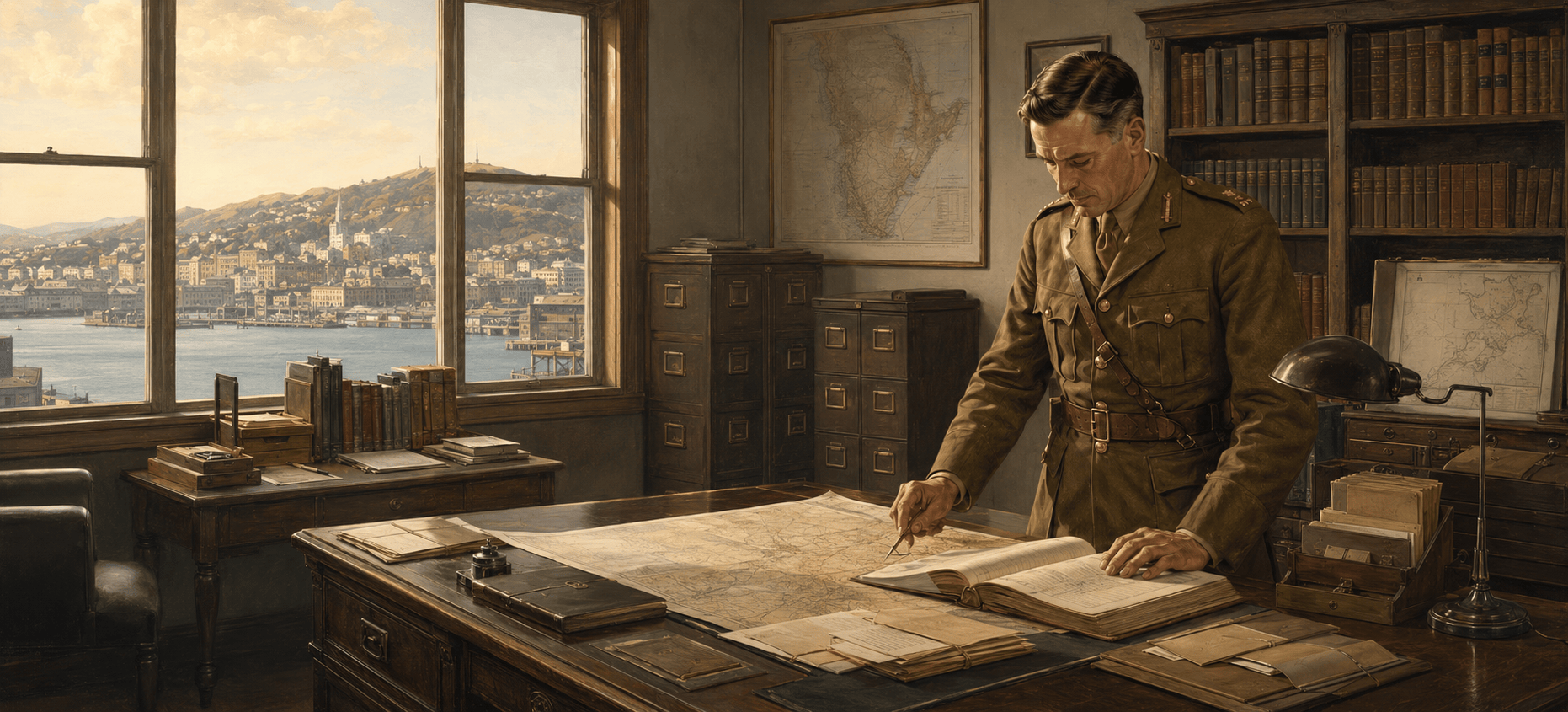
There’s a temptation, when reading something like Rise of the Machines – Drone Warfare in the Russia-Ukraine War by Illya Sekirin, to focus on the technology. The drones, the sensors, the strike capability. And to be fair, Sekirin makes a compelling case that drones have become central to modern warfare.
But if you read it as a military logistician, and especially through a New Zealand historical lens, something else stands out.
This isn’t really a book about drones, it’s a book about what happens when logistics becomes visible on a battlefield where nothing stays hidden
What comes through clearly in Sekirin’s account is just how exposed everything is. Movement is seen. Patterns are picked up. Supply routes are identified and targeted. Even something as basic as moving a casualty becomes a risk calculation. The idea of a “rear area” doesn’t really hold anymore.
For anyone who has spent time thinking about sustainment, that should land heavily. Because once logistics is constantly observed, it stops being a support function sitting behind the fight. It becomes part of the fight itself, that’s the real shift, and yet, none of this is entirely new
If you step back from the technology for a moment, the pattern is familiar.
New Zealand has been here before, not with drones, but with disruption.
In the New Zealand Wars, logistics had to adapt to terrain and isolation
In the First World War, it had to scale rapidly and integrate into something much larger
In the Second World War, it had to keep up with mechanisation and long-distance sustainment
In later operations, it learned to operate across environments, but largely with secure supply chains
Each time, the system that existed at the start wasn’t quite fit for purpose, it adapted, not perfectly, not neatly, but effectively enough.
The difference this time
Where Rise of the Machines feels different is in what it quietly exposes about the present.
For the last few decades, New Zealand, like many others, has operated in a relatively stable environment. Defence spending tightened, logistics was streamlined, and commercial practices crept in. Efficiency became the measure of success.
There’s nothing inherently wrong with that. It made sense at the time, but it did lead us somewhere to a system that is:
lean
centralised
dependent on external supply chains
and designed to run smoothly when nothing is seriously interfering with it
Reading Sekirin’s account, you can’t help but feel how exposed that kind of system would be in the environment he describes, because that environment is the opposite of lean and smooth.
The uncomfortable realisation
The most useful takeaway from this book isn’t that drones are important. It’s that they’ve accelerated something that was already happening.
They’ve made disruption constant, and that has made logistics targetable at scale, which has removed the buffer that logistics has traditionally relied on: time, space, and relative safety.
This leads to a slightly uncomfortable thought that a system that is highly efficient in peace can be surprisingly fragile in war.
So where does that leave New Zealand?
If you look at this through a historical lens, the answer isn’t to panic or to try and invent something entirely new, it is to recognise the pattern.
New Zealand has always adapted its logistics to the conditions it faced. The real question is whether it’s still set up to do that quickly enough, because adaptation requires a few things:
some depth in people and capability
some room to manoeuvre, and
systems that don’t lock you into a single way of operating
Those are precisely the things that tend to get trimmed in the name of efficiency.
Overlay that with the post-Cold War peace dividend, reduced defence investment, and the steady commercialisation of logistics functions, and the picture sharpens. The system has not just evolved, it has been deliberately streamlined to the minimum required for peacetime outputs. Efficient, yes. But also thinner and more exposed than it once was.
Looking forward, without overcomplicating it
You don’t need a grand theory to take something useful from Rise of the Machines as a few simple shifts stand out:
Accept that logistics will be contested, not protected
Be comfortable with less tidy, less centralised systems
Build in redundancy, even if it looks inefficient on paper
Think seriously about how dependent we are on external supply chains, and
perhaps most importantly, make sure the system can adapt under pressure, not just operate in ideal conditions
None of that is revolutionary. In many ways, it’s a return to fundamentals, albeit applied in a far more demanding environment.
Final thought
If you read this book purely as a story about drones, you’ll come away thinking the future is about technology, however, if you read it as a logistician, especially one interested in history, you come away with a different impression.
The tools have changed. The pressures have intensified. The pace has increased, but the underlying lesson is the same one that runs through New Zealand’s military past: “The system that works in one era rarely survives unchanged into the next”.
New Zealand has adapted before, often under pressure and at cost, and the lesson from Rise of the Machines is that the next adaptation is already underway.
Recommendation
If you take one thing away from Rise of the Machines – Drone Warfare in the Russia-Ukraine War, it should be this: it’s not just a book about a current conflict, it’s a window into how warfare is evolving in real time.
This is not a theory or retrospective analysis. It is grounded in experience and shaped by a battlefield that is changing faster than most institutions can comfortably absorb.
I would strongly recommend it to anyone interested in the development of warfare. Not because it provides neat answers, but because it highlights just how quickly the character of war can shift, and how important it is that the systems behind it, particularly logistics, can shift with it.
As explored in From Flintlock to Modular Assault Rifle, the development of New Zealand’s military capability has never been a simple story of adoption. It is a story of adaptation, of modification, and at times of quiet innovation driven not by doctrine, but by necessity. Geography, terrain, and the demands of irregular warfare forced colonial authorities to think differently about equipment, often well ahead of formal Imperial acceptance.
This article is reproduced with the kind permission of Paul Farmer, whose extensive research into early New Zealand military firearms has significantly advanced the understanding of colonial small arms and locally adapted weapon systems. His work, grounded in detailed examination of surviving examples and primary sources, provides an authoritative foundation for interpreting the unique characteristics of New Zealand contract Snider arms.
Paul Farmer’s examination of the New Zealand contract Sniders sits squarely within that tradition. The Snider system itself was an Imperial solution to a global problem, the rapid conversion of muzzle-loading rifles to breech-loading capability. Yet, as this article demonstrates, New Zealand did not simply accept the standard pattern. Instead, it selected, modified, commissioned, and in some cases effectively designed variants tailored to its own operational environment.
What emerges is not just a catalogue of weapons, but a case study in colonial procurement and adaptation. The preference for shorter, more manoeuvrable arms, the willingness to convert existing stocks, and the commissioning of non-ordnance pattern weapons all reflect a force operating under constraints, but thinking with a degree of independence that is often overlooked.
In that sense, these rifles are more than artefacts. They represent an early expression of a recurring theme in New Zealand’s military history, the tension between standardisation and suitability, between what is issued and what is actually needed in the field.
Seen through that lens, Farmer’s work does more than document four unique weapon types. It reinforces a broader point, that New Zealand’s military effectiveness has often depended less on what it was given, and more on how it chose to adapt it.
New Zealand Contract Sniders
by Paul Farmer – April 2026
Introduction
The Snider breech-loading system was introduced into British Army service by converting existing .577 calibre muzzle-loading rifles and carbines to the new breech-loading design, each brought into conformity with an approved Sealed Pattern. Once the supply of suitable arms for conversion was exhausted, a further Sealed Pattern was established, and newly manufactured Sniders were produced to that standard.
New Zealand, however, commissioned four distinct Snider variants. As these were non-Ordnance, trade-made arms, they were not assigned formal pattern designations. Although widely used in New Zealand service, they were referred to only in generic terms: Snider medium rifle, Snider short rifle, and Snider carbine. In the following ‘New Zealand contract Sniders’, to simplify identification, I have added a descriptive designation that reflects their origin and development.
New Zealand Contract Sniders
The first Sniders to enter New Zealand Government service were reported by the Hon. W. Gisborne, Commissioner of the Armed Constabulary, on 29 November 1869[1]. Gisborne noted:
“The Imperial Government have sent from England on loan, and for use of the Colony, 1832 converted Sniders, and have also handed over from Imperial stores in Auckland 168 more making a total of 2000, all excepting 100 being of the long Enfield pattern and therefore unfitted for bush warfare; the 100 being sword-rifle pattern may be considered suitable and are now being issued to the Armed Constabulary.”
These converted Sniders would have had the MK II** breech as the MK III breech system was not approved until January 1869.[2] Gisborne further reported:
“There are also 500 medium rifles converted to Snider shortly expected by the Melita. These, however, being longer than the sword-rifle referred to above, are not suitable, but they will be temporarily issued to the Armed Constabulary.”
The Melita arrived in Wellington on 15 December 1869, bringing with it 500 Hay medium rifles converted to the Snider system.[3]
Over the following two decades, multiple shipments of Sniders of various types arrived from England, including long and short rifles, as well as artillery, cavalry, and yeomanry carbines. Supplies were drawn both from the commercial trade and from ex-ordnance pattern arms sold out of Imperial service. These were the arms of the Armed Constabulary and the New Zealand Militia.
By 1885, approximately 11000 Snider rifles were in service,[4] increasing to around 14000 by 1891.[5] Sniders served New Zealand effectively from 1869 through to the 1890s, after which their gradual replacement began with the introduction of Martini-Henry rifles and carbines.
Amongst all the Sniders ordered, New Zealand commissioned four unique Sniders to be produced. These will not be found in references on British ordnance Sniders because they are not ordnance pattern arms. The following sections will describe these four Snider arms and explain why each represents a uniquely New Zealand Snider variation.
Top: New Zealand Contract 1869 Hay-Snider Medium Rifle Second: New Zealand Contract 1874 Snider Short Rifle, Bar on Band Third: New Zealand Contract 1874 Snider Short Rifle, Bar on Barrel Lower: New Zealand Contract 1872 Tisdall Snider Carbine. Images of arms & bayonets – Paul Farmer
1. New Zealand Contract 1869 Hay-Snider Medium Rifle
Development: The Hay medium rifle originated with the 1858 design developed by General Hay of the School of Musketry at Hythe, England. Hay sought to produce a rifle offering greater accuracy than the then-current service 2-band short rifle, which featured a 33-inch barrel with 3 groove rifling and a 1 in 78-inch twist. Comparative trials demonstrated that altering the rifling twist from 1 in 78″ to 1 in 48″ significantly increased muzzle velocity and, correspondingly, improved accuracy. Further gains were achieved by extending the barrel length to 36″, which produced a muzzle velocity comparable to that of the accurate 3 band long rifle, fitted with a 39″ barrel and 3 groove rifling with 1 in 78″ twist.
Despite these advantages, the Hay medium rifle was never accepted as an ordnance pattern arm. The British Army retained the established 3-band long rifle and adopted the new Pattern 1858 short rifle, bar on band, also rifled with a 3 groove, 1 in 78″ twist.
Consequently, no medium rifle entered Imperial service.
New Zealand, however, embraced the Hay medium rifle. The Colonial Government initially placed two contracts for this arm, each for 5,000 rifles.[6]
The first contract, supplied by Hollis & Sheath, arrived in New Zealand in February 1861.[7] These rifles were fitted with undated lock plates and rear sights graduated to 1,150 yards. Upon entry into colonial service, they were stamped “NZ” and issued with consecutive numbers from 1 to 5,000 on the butt tang.
The second contract was supplied by Calisher & Terry.[8] Rifles from this contract were also stamped “NZ” on the butt tang, but incorporated a letter prefix preceding the issue number. Each letter series ran consecutively from 1 to 1,000, after which a new prefix was introduced, and numbering recommenced at 1. I have sighted Calisher & Terry made Hay rifles bearing the letter prefixes G, I, J, and K. Presumably, the complete prefix sequence was G, H, I, J, and K, representing 1,000 arms per prefix and a total production of 5,000 rifles. These rifles were fitted with rear sights graduated to 1,200 yards, and the lock plates were stamped TOWER over 1865. (It is reported that some rifles have lock plates with Tower over 1874)
From the perspective of the New Zealand Colonial forces, the Hay medium rifle represented the principal muzzle-loading percussion arm of the Second New Zealand Wars.
The Conversion of Hay Medium Rifles to Snider
New Zealand initiated the conversion of the Hay medium rifle to the Snider system. It is recorded that as on 14 January 1869, “500 new Medium Rifles are packed ready for shipment”.[9] These rifles were supplied by the Auckland Colonial Storekeeper, Captain Mitchell, and packed in 25 cases. They departed Auckland aboard the Countess of Kintore on 11 March 1869, bound for London.[10] Conversion was undertaken by the trade using the Mk III Snider breech, producing what are properly described as the 1869 Hay-Snider Medium Rifle. These converted rifles returned to New Zealand aboard the Melita, arriving in Wellington on 15 December 1869.[11]
Available evidence suggests that the “new Hay Medium Rifles” shipped for conversion comprised the final batch of 500 unissued Calisher & Terry made medium rifles from the K series with 1865 dated locks. Support for this interpretation rests on the fact that all converted examples observed fall within the upper half of the 1–1,000 numbering range and bear both the NZ mark and the K prefix.
The conversion process involved removing 2½” from the barrel at the percussion knuckle end. The shortened barrel was then threaded to accept the receiver body, or shoe, carrying the Snider Mk III breech block. Once fitted, the overall length of the rifle remained at 36″, but the effective barrel length was reduced to 33.5″. Reduced muzzle performance necessitated the replacement of the original 1,200-yard graduated rear sight with one graduated to 1,050 yards. The ramrod was reduced in diameter and weight, effectively becoming a cleaning rod. The redundant ramrod retention spoon was removed, and an internal cleaning-rod retaining nut was fitted forward of the trigger plate. The K prefix and issue number of the butt tang were duplicated on the shoe. New commercial inspection marks and proof stamps were applied. All original markings not affected by the conversion process were retained. The butt tang may or may not have an “s” stamp, indicating a short stock. When measured, the stock was much the same length, regardless of the “S” stamp.
Conversions were carried out by both the London Small Arms Company (L.S.A. Co.) and the Birmingham Small Arms Company (B.S.A. Co.). B.S.A. Co. undertook the majority of the Hay conversions. Their Mk III breech and shoe assemblies appear newly manufactured, presenting a cleaner overall appearance. The K prefix issue number of the butt tang was duplicated on the shoe. The Snider patent mark was in a lozenge-shaped stamp. Proof and inspection marks are of Birmingham origin, and the hammer face is flat.
The L.S.A. Co. conversions, of which I have sighted two examples, are characterised by extensive numbering, with new proofs and inspection marks of London origin. In these examples, the shoe—originally an Mk II**—was modified by stamping “III” to denote Mk III, while retaining the original ** marking, and fitting a Mk III breech block. The K prefix and issue number on the butt tang were duplicated on the shoe.The Snider patent mark is stamped in-line, rather than lozenge-shaped. L.S.A. logo and proof marks were applied to the breech. The hammer face remained cupped. The abundance of numbering and cross-marking leaves little doubt that all components were matched to a single rifle during conversion.
An additional “AC” stamp was applied to the butt tang in New Zealand when the rifles were issued to, and deployed with, the Armed Constabulary in 1870.
Summary: The 1858 Hay medium rifle had extensive use in New Zealand, but was never used in Imperial service. With the advent of the Snider system, New Zealand contracted to have 500 of its own “N Z” marked, K prefix percussion Hay medium rifles converted to the Snider in England, to become the New Zealand contract 1869 Hay-Snider medium rifle.
There was no ordnance Snider medium rifle in Imperial service.
The New Zealand Hay-Snider medium rifle is a uniquely New Zealand arm.
Today, it is still largely unknown outside of New Zealand. In an updated 2025 reference, it is still referred to as “the unidentified Snider Medium rifle”. [12][13]
Description of the New Zealand Contract 1869 Hay-Snider Medium Rifle
Overall Length:
51 7/8“
Barrel Length:
33 1/2”
Calibre:
25 bore .577
Rifling:
3 groove 1 in 48″
Lock Plate:
TOWER over 1865, stamped ‘Terrys’ inside
Breech 1:
III** Snider patent mark & in line name, LSA Logo, K & issue number
Breen 2:
Mk III, Snider patent mark & name logo, B.S.A. Co. K & issue number
Sight:
Bed 100 to 400 yards, leaf 500 to 1050 yards
Furniture:
Bronze
Barrell Retention:
3 bands & breech tang screw
Stock:
Stock to within 3 ¼” of the muzzle
Butt Tang:
S K NZ AC issue number
Stock Cartouche:
Birmingham 1865
Bayonet:
Pattern 1853 socket, trade-made, no ordnance marks
Both sides of the New Zealand Contract Hay-Snider Medium Rifle. Images of arms & bayonets – Paul Farmer
Piled arms of New Zealand, 1869 Hay-Snider Medium rifle. In service with the Taranaki Armed Constabulary at rest (Image from private source).
2. New Zealand Contract 1872 Tisdall Snider Carbine
The Hay medium rifle represented the most prominent and widely issued muzzle-loading percussion rifle employed by the colonial forces. Bush fighting, however, favoured shorter and more manoeuvrable arms, and in that role the percussion breech-loading Calisher & Terry carbine proved the preferred weapon, with approximately 1,700 issued.[14]
In 1871, Colonel Whitmore, Commandant of the Armed Constabulary, initiated a Snider replacement of the existing Calisher & Terry carbine.[15] The resulting weapon was a compact saddle-ring carbine fitted with an 18½” barrel, rifled with 5 groove 1 in 48″ twist, and with a Snider Mk III breech. The carbine was full stocked to within 1⅛” of the muzzle, and the hammer has a cupped face. The butt tang was stamped with “N^Z” and the issue number. Evidence suggests that this represents the first use of this now familiar broad arrow N^Z marking on a New Zealand-issued arm. A total of 600 carbines were manufactured by W. H. Tisdall of Birmingham for issue to the Armed Constabulary. During subsequent service, many examples had the saddle bar cut off, leaving residual distinctive flat, steel, teardrop-shaped side nail plates.
Summary: No percussion predecessor existed for this carbine, nor was there a comparable arm in Imperial service. The New Zealand 1872 contract Tisdall Snider Carbine represents a uniquely New Zealand development, produced specifically to meet local operational requirements.
Description of the New Zealand Contract 1872 Tisdall Snider Carbine
Overall Length:
37″
Barrel Length:
18 ½”
Calibre:
25 bore .577
Rifling:
5 groove 1 in 48″
Lock Plate:
Crown over 1872
Engraved:
W. H. TISDALL 47 Whittall ST. BIRMINGHAM
Breech:
Mk III, Snider patent mark & logo
Sight:
Ramp 100 to 300 yards. Leaf: 400 to 600 yards
Furniture:
Brass
Barrell Retention:
2 bands & breech tang screw
Stock:
Stock to within 1 1/8″ of the muzzle
Butt Tang:
N^Z issue number
Both sides of the New Zealand Contract 1872 Tisdall Snider Carbine. Images of arms & bayonets – Paul Farmer
New Zealand 1872 Tisdall Snider carbine, in service with Taranaki Armed Constabulary (Image source: Puki Ariki).
3. New Zealand Contract 1874 Snider Short Rifle, Bar on Band
Among New Zealand Snider arms, the 1874 Snider Short Rifle, bar on band, remains one of the most enigmatic. Photographic evidence documents its issue and deployment with the Armed Constabulary in Taranaki, at Mount Cook in Wellington, and at Parihaka.
By August 1871, New Zealand held approximately 2,500 Sniders either on issue or in store.[16] In the same year, a new colonial order was placed through the War Office for 2,000 Snider short rifles with saw-backed bayonets.[17] The arrival of part of this order was reported and discussed in the 1875 Armed Constabulary Force Annual Report.[18] For example, Lieutenant-Colonel William C. Lyon, Acting Commissioner of the Armed Constabulary, reported: “Seven hundred short Snider rifles with saw-backed bayonets have arrived, and are now being issued to the Force.”
Captain W. G. Stack, Instructor of Musketry, commented further: “The new rifles have one very noticeable defect as a military weapon, which is that, as they are stocked up to within one and a half inches of the muzzle, it is impossible to ‘pile arms’ with them. The short saw-backed sword bayonet, with which the new rifle is fitted, is much more suited to the requirements of the force than the old bayonet served out with the medium rifle…”
The 700 Snider short rifles referred to were bar on band rifles with brass furniture and locks dated 1874. The stock extended to approximately 1⅜” from the muzzle, a configuration that prevented the traditional military practice of ‘piling arms’, in which rifles are leaned together muzzle-up to form a stable pyramid when troops are at rest or at camp. The ‘short saw-backed sword bayonet’ issued with these rifles was the New Zealand contract 1874 18″ sawback bar on band bayonet.
The most obvious percussion precedent, the ordnance Pattern 1858 bar on band short rifle, was only experimentally converted to the Snider system and was neither accepted as a pattern nor entered service.[19] British ordnance Snider conversions were instead limited to the Pattern 1860 and 1861 bar on barrel short rifles with steel furnature, converted to Snider with Mk II** breech.[20] New Zealand had in its possession 100 such rifles as part of the 2,000 Sniders loaned from England in 1869. Once stocks suitable for conversion were exhausted, a new sealed-pattern Snider short rifle with Mk III breech, bar on barrel with steel furniture was adopted into Imperial service.
Contemporary criticism of the first portion of the New Zealand colonial order—namely, the 700 bar on band Snider short rifles—focused on their practical limitations. These concerns were addressed in the second portion of the order, which comprised 1,300 Snider short rifles in the standard bar on barrel configuration, fitted with brass furniture and issued with a matching New Zealand 18-inch saw-back bar-on-barrel bayonet. All subsequent shipments, totalling more than 6,000 Snider short rifles, followed the Imperial standard bar on barrel configuration with steel furniture. If bayonets were supplied, they were the yataghan sword bayonets.
Terminology:
Bar on band refers to rifles stocked to within approximately 1⅜ inches of the muzzle, leaving very little barrel exposed (as illustrated in Image a). In this configuration, the bayonet bar (lug) is mounted on the forward barrel band.
Bar on barrel describes rifles in which the stock terminates approximately 5⅜ inches from the muzzle, leaving a greater length of barrel exposed (as illustrated in Image b). In this case, the bayonet bar is mounted directly on the barrel.
Bayonets are not interchangeable between these two configurations. All ordnance Snider short-rifle conversions followed the bar-on-barrel arrangement. The terms bar on band and bar on barrel are descriptive model designations.
NZ 1874 Snider Short rifle – bar on band. Images of arms & bayonets – Paul Farmer
NZ 1874 Snider Short rifle – bar on barrel. Images of arms & bayonets – Paul Farmer
The New Zealand 1874 Snider short rifle, bar on band, was a trade-made arm manufactured by the Birmingham Small Arms & Metals Company Ltd. It is fitted with a Mk III breech bearing Snider’s patent mark and logo. The lock plate is marked B.S.A. & M. Co. over the date 1874, without a crown. Proof and inspection marks are of Birmingham origin, and the hammer has a flat face.
Furniture is of brass and includes a short‑tang trigger guard, distinguishing the rifle from other contemporary Snider short rifles, which typically feature steel furniture and a long trigger guard. The rear sight has a fixed bed graduated from 100 to 400 yards, with a leaf graduated from 500 to 1,000 yards. The butt tang is stamped with NZ, a broad arrow, and an individual issue number, while the stock bears a cartouche of Bond & James, Birmingham.
Description of the New Zealand Contracy 1874 Snider Short Rifle, Bar on Band
Overall Length:
48 5/8“
Barrel Length:
30 5/8“
Calibre:
25 bore .577
Rifling:
5 groove 1 in 48″
Lock Plate:
B.S.A. & M. Co. over 1874 (no crown or VR)
Breech:
Mk III, Snider patent mark & logo
Sight:
Ramp 100 to 400 yards. Leaf: 500 to 1000 yards
Furniture:
Brass (Note: trigger guard, brass with no long tang)
Barrell Retention:
2 bands & breech tang screw
Stock:
Stock to within 1 3/8” of the muzzle
Butt Tang:
N^Z issue number
Stock Cartouche:
Bond & James Birmingham
Bayonet:
New Zealand 1874 18″ bar on band, sawback, trade-made MRD – 21 mm, blade 18” length 24 no NZ mark
Left Ricasso:
Crown over A.S – Solingen inspector’s mark. Knight’s helm: Kirschbaum maker mark (See Section 5, image 2)
Right Ricasso:
Blank (no markings)
Both sides of the New Zealand Contract 1874 Snider Short Rifle, Bar on Band. Images of arms & bayonets – Paul Farmer
Summary: No Snider short rifle, bar on band rifles existed in Imperial service. The New Zealand contract 1874 Snider short rifle, bar on band, was issued to the Armed Constabulary, representing another uniquely New Zealand arm. Today, evidence of these rifles survives almost entirely in the photographic record, often shown alongside bar on barrel rifles. Taken together, the New Zealand contract 1874 Snider short rifle, bar on band, and its matching bayonet must rank among the scarcest of all New Zealand-issued arms.
New Zealand 1874 Snider short rifle, bar on band with New Zealand 18″ sawback bar on band bayonet. Captain Morrison and Major Foster Goring (far right), in service with the Taranaki Armed Constabulary (Image source: Puki Ariki).
4. New Zealand Contract 1874 Short Snider Rifle, Bar on Barrel
I have only observed a single example of the New Zealand contract 1874 Snider short rifle in the bar on barrel configuration. In my opinion, this example is representative of the 1,300 rifles in this contract, for which the New Zealand 1874 18″ sawback bar on barrel bayonet was produced.
The rifle is fitted with a Mk III breech bearing Snider’s patent mark and logo. The lock plate is marked TOWER over 1874 with a crown, but without a “VR”. Proof and inspection marks are of Birmingham origin, and the hammer is cupped. The furniture is of brass with a short-tang trigger guard. The rear sight comprises a fixed bed graduated from 100 to 400 yards, with a leaf graduated from 500 to 1,000 yards. The butt tang is stamped with “A”, a broad arrow, “NZ”, and the issue number, while the stock bears the cartouche of Bond & James, Birmingham. This Snider short rifle should not be confused with the ordnance produced Mk III Snider Naval rifle of 1870-71, of which only 17 were made. [21]
Description of the New Zealand Contract 1874 Dnider Short Rifle, Bar on Barrel
Overall Length:
48 5/8“
Barrel Length:
30 5/8”
Calibre:
25 bore .577
Rifling:
5 groove 1 in 48″
Lock Plate:
Tower over 1874 Crown no V R
Breech:
Mk III, Snider patent mark & logo
Sight:
Ramp 100 to 400 yards. Leaf: 500 to 1000 yards
Furniture:
Brass (Note: trigger guard, brass with no long tang)
Barrell Retention:
2 bands & breech tang screw
Stock:
Stock to within 5 3/8″ of the muzzle
Butt Tang:
A ^ N Z issue number
Stock Cartouche:
Bond & James Birmingham
Bayonet:
New Zealand 1874 18″ bar on band, sawback. MRD – 21 mm, blade 18” length 24 ½” no NZ mark
Left Ricasso:
Inverted broad arrows over WD, (sold out of service mark, unusual for a non-war department bayonet.[22] Crown over B, 21, Birmingham inspectors mark (see section 5, image 3).
Right Ricasso:
Knight’s helm, Kirschbaum maker mark (5 image 4).
Both sides of the New Zealand Contract 1874 Snider Short Rifle, Bar on Barrel. Images of arms & bayonets – Paul Farmer
Summary: The 1874 Snider short rifle, bar on barrel, fitted with brass furniture and paired with the 18″ sawback bar on barrel bayonet, represents another uniquely New Zealand contract combination issued to the Armed Constabulary.
New Zealand Contract 1869 Hay-Snider medium rifle. Images of arms & bayonets – Paul Farmer
New Zealand Contract 1872 Contract Tisdall Snider carbine. Images of arms & bayonets – Paul Farmer
New Zealand Contract 1874 Snider short rifle, bar on band. Images of arms & bayonets – Paul Farmer
New Zealand Contract 1874 Snider short rifle, bar on barrel. Images of arms & bayonets – Paul Farmer
1874 Snider short rifle bar on band, and bar on barrel rifles, along with 1872 Tisdall carbines on issue with the Armed Constabulary in Taranaki (Image source: Puki Ariki).
5. New Zealand Contract 1874 18” Sawback Bayonets
Development: The original precedent bayonet, an 18”sawback bar on band bayonet, was made for the Irish Constabulary carbine at Enfield in 1867.[23] A similar 18” sawback bar on band bayonet, also made at Enfield, and was used in the 1869 trials of the Martini- Henry long chamber rifle. Both these bayonets had smaller MRD than the New Zealand 18”sawback bayonets.
New Zealand 18” Sawback Bayonets: When New Zealand’s order for Snider short rifles and 18” sawback bayonets was actioned in 1873, the bayonets were not in production in England. Both contracts for these two 18” sawback bayonet variants were filled by Kirschbaum of Solingen.[24] Documentation clearly shows that the 18″ sawback bar on band bayonet was produced for the 700 New Zealand 1874 dated Snider short rifle, bar on the band. These rifles were issued and in service in 1875. The remainder of the order, 1300 for the New Zealand 1874 dated Snider short rifle, bar on the barrel with an 18″ sawback bar on barrel bayonet, was on a different contract; it is not specifically recorded when they entered service.
Summary: The 18” sawback bayonets made for the New Zealand 1874 dated Snider short bar on band rifle and 1874 Snider short bar on barrel rifle are,
1. New Zealand contract 1874 18″ sawback bar on band bayonet.
2. New Zealand contract 1874 18″ sawback bar on barrel bayonet.
The two 1874 New Zealand Snider Bayonet Variants
Upper – NZ contract 1874 18″ sawback bar on band, with an elevated 21mm muzzle ring. Total length of bayonet & scabbard, 24”
Lower – NZ contract 1874 18″sawback bar on barrel, 21mm muzzle ring in line with the grip. Total length of bayonet & scabbard, 24 ½”
Note: The bar on band scabbard is ½” shorter than bar on barrel scabbard. Images of arms & bayonets – Paul Farmer
Relative elevation of the muzzle ring above the tang: bar on barrel (left), bar on band (right). Both bayonets have a 21mm MRD. Images of arms & bayonets – Paul Farmer
Bar on band. Left side: Crown over A.S. (Solingen inspector’s mark); knight’s helm, maker’s mark of Kirschbaum. Right side: blank (not illustrated).Images of arms & bayonets – Paul Farmer
Bar on barrel. Left side: inverted broad arrows over WD (sold-out-of-service; unusual, non-War Department bayonet); Crown over 21; Birmingham inspection mark.Images of arms & bayonets – Paul Farmer
Bar on barrel. Right side: Knight’s helm, the maker’s mark of Kirschbaum. Images of arms & bayonets – Paul Farmer
Conclusion
The New Zealand Colonial Government commissioned four distinct Snider arms specifically for local service.
These comprised the following, and the number produced.
500 1869 Hay–Snider Medium rifles
600 1872 Tisdall Snider carbines
700 1874 Snider short rifles, bar on band
1,300 1874 Snider short rifles, bar on barrel
In total, 3,100 New Zealand contract Sniders were produced.
In addition, 2000 18″ sawback bayonets were manufactured for the New Zealand Snider short rifles, consisting of
700 18″ bar on band bayonets
1,300 18″ bar on barrel bayonets
These New Zealand contract Sniders and their associated bayonets are not British ordnance patterns. As a result, their absence or limited treatment in standard references on British ordnance Sniders and bayonets is unsurprising. The purpose of this article has been to document and clarify these uniquely New Zealand arms, allowing them to be more clearly identified and better appreciated within the broader history of the Snider arms system.
References
[1] Appendix to the Journals of the House of Representatives, 1870 Session I, A-09
[2] Ian Skennerton. .577 Snider-Enfield Rifles & Carbines. 2003 Published Ian D Skennerton page 101
[3] Papers Past NZ, Evening Post, Volume V, issue 261, 16 Dec 1869, page 2
[4] Appendix to the Journals of the House of Representatives, 1885 Session I, H-04a
[5] Ian D Skennerton & Robert Richardson. British & Commonwealth Bayonets. 1986 Published Ian D Skennerton page 362
[6] Ian D Skennerton & Robert Richardson. British & Commonwealth Bayonets. 1986 Published Ian D Skennerton page 362
[7] Robert McKie. Hay Pattern Rifles. ‘Lessons from History: New Zealand Procurement and Logistics 1857-1861’ -rnzaoc.com/tag/hay-pattern-rifles/Hayden
[8] John Osborne, Hay Pattern Enfield Rifle, The Gazette NZAHAA June 2010 Vol. 30 No 2
[9] Reference 1869/473. 1869 Army Department Inwards Correspondence Register nzpictures.co.nz
[10] Papers Past NZ, New Zealand Herald, Volume. VI issue 1655 12 March 1869, page 2
[11] Papers Past NZ. Evening Post, Volume V, Issue 261, 16 December Page 2
[12] Ian D Skennerton & Robert Richardson. British & Commonwealth Bayonets. 1986 Published Ian D Skennerton page 360
[13] Ian Skennerton & Brian Labudda. British Commonwealth Bayonets and Fighting Knives Published in 2025 by Labudda Research / Arms & Militaria Press page 389
[14] Brian C Knapp, The Calisher & Terry in British and Colonial Military Service 1856 – 1900, 2021
[15] John Osborne, NZ P1872 25 bore Snider Carbine, The Gazette NZAHAA Dec. 2007 Vol. 27 No 4
[16] R McKie, NZ Defence Stores July 1870 – June 1871https://rnzaoc.com/2023/08/13/nz-defence-stores-july-1870-june-1871/
[17] Armed Constabulary Force (Annual Report of Commissioner). Appendix to the Journals House of Representatives, 1875 Session I, H-10
[18] Ian Skennerton. .577 Snider-Enfield Rifles & Carbines. 2003 Published Ian D Skennerton page 187
On 4 December each year, soldiers, gunners, and explosive specialists around the world pause to mark Saint Barbara’s Day. For New Zealand’s military ammunition community, the day has a special resonance. Saint Barbara was the patron saint of the Royal New Zealand Army Ordnance Corps (RNZAOC). Although the Corps was disestablished in 1996, she remains the spiritual patron of those whose work brings them closest to explosive risk, especially the current generation of Royal New Zealand Army Logistic Regiment (RNZALR) Ammunition Technicians.
This commemoration is not about imposing religious belief or expecting devotion in a modern, pluralist Army. Instead, it is about recognising shared values. Saint Barbara’s story, whether read as faith, legend, or metaphor, offers a powerful way of talking about courage, duty of care, and professionalism in dangerous work.
From Heliopolis to the Ordnance Corps
According to tradition, Barbara lived in the late Roman Empire at Heliopolis in Phoenicia, now associated with Baalbek in modern Lebanon. Born into a wealthy pagan household, she questioned the gods she had been taught to worship when she looked out from the tower in which her father kept her secluded and reflected on the ordered beauty of the world around her. In time, she converted to Christianity in secret. When her father discovered this, he handed her over to the authorities and ultimately carried out her execution himself.
Her refusal to renounce her convictions, even under torture, and the lightning that, according to legend, later killed her father and the official who condemned her, led to Barbara being associated with sudden death, lightning, and fire. As warfare evolved and gunpowder weapons became central to battle, she was adopted as patroness of artillerymen, armourers, military engineers, miners, tunnellers, and anyone whose livelihood involved explosives and the possibility of instant, catastrophic harm. The Legend of Saint Barbara
When the Royal Army Ordnance Corps (RAOC) adopted Saint Barbara as its patron, that tradition passed into the wider family of Commonwealth ordnance corps. The RNZAOC, with its own responsibility for ammunition supply, storage, and maintenance in New Zealand, in turn adopted her as patron saint.
Beyond 1996: Saint Barbara and the RNZALR
The disestablishment of the RNZAOC in 1996 and the formation of the RNZALR did not diminish Saint Barbara’s relevance to New Zealand soldiers. The work did not change; only the cap badge did. Ammunition Technicians, in particular, continue to live daily with the realities that made Barbara a symbolic figure in the first place: sudden danger, technical complexity, and the need for calm, disciplined action when things go wrong.
On paper, Saint Barbara is a figure from late antiquity. In practice, her patronage captures something very contemporary about the RNZALR Ammunition Technician trade:
Technical mastery under pressure – handling, inspecting, and disposing of explosive ordnance where a single lapse can have irreversible consequences.
Quiet, unshowy bravery – the kind that rarely makes headlines but underpins every live-fire activity, every range practice, and every deployment where ammunition is moved, stored, or rendered safe.
Duty of care to others – ensuring that everyone else can train and fight in relative safety because someone has accepted responsibility for the dangerous end of the supply chain.
In that sense, Saint Barbara’s Day is as much about the living as it is about any distant martyr. It is an opportunity for the wider Army to pause and acknowledge that the safe availability of ammunition, which is often taken for granted, depends on a small community of specialists and their support teams.
A Day Of Tradition, Not Testimony
In a modern New Zealand Army, not everyone is religious, and fewer still are likely to be familiar with the details of early Christian hagiography. That is not the point. Commemorations like Saint Barbara’s Day function as regimental and professional traditions, not as tests of personal belief.
Marking the day can mean different things to different people:
For some, it may be a genuine act of faith, honouring a saint whose story inspires them.
For others, it is a way of respecting the heritage of their trade and the generations of RNZAOC and now RNZALR personnel who have done this work before them.
For many, it is simply a moment to reflect on the risks inherent in explosive work, to remember colleagues injured or killed in training and operations, and to recommit to doing the job as safely and professionally as possible.
In that sense, the story’s religious origins are less important than the shared meaning it has acquired over time. Saint Barbara becomes a symbol of the values that matter in ammunition work: integrity, courage, vigilance, and loyalty to those you serve alongside.
Contemporary Relevance: Commitment In A Dangerous Trade
In the modern world, the management of ammunition and explosives is governed by detailed regulations, sophisticated science, and digital systems, ranging from hazard classifications and compatibility groups to electronic inventory control and safety management frameworks. Yet, at its core, it still depends on human judgment and ethical commitment.
Saint Barbara’s Day offers a valuable lens for talking about that commitment:
Commitment to safety – understanding procedures not as bureaucracy, but as the accumulated lessons, sometimes paid for in blood, of those who went before.
Commitment to team – recognising that no Ammunition Technician works alone, and that a strong safety culture depends on everyone feeling empowered to speak up, check, and challenge.
Commitment to service – remembering that, whether in training at home or on operations overseas, the work is ultimately about enabling others to succeed and come home alive.
When Ammunition Technicians and their colleagues mark Saint Barbara’s Day, they are not stepping out of the modern world into a medieval one. They are taking a moment within a busy, technologically advanced, secular military environment to acknowledge that some fundamentals have not changed: courage, conscience, and care for others still matter.
Keeping The Flame Alive
Although the RNZAOC passed into history in 1996, its traditions did not vanish. They were carried forward into the RNZALR and live on in the customs, stories, and professional identities of those who wear the uniform today. Saint Barbara is one of those enduring threads.
On 4 December, when a small group gathers in an Ammuniton depot, unit lines, a mess, or a deployed location to raise a glass or share a few words in her honour, they are standing in continuity with generations of ordnance soldiers, armourers, gunners, and explosive specialists across time and across the Commonwealth. They are also quietly affirming something vital about themselves.
In the end, Saint Barbara’s Day is less about religion and more about recognition: recognition of a demanding craft, of the people who practise it, and of the responsibility they carry on behalf of the wider Army. For the RNZALR Ammunition Technicians of today, as for the RNZAOC of yesterday, she remains a fitting patron for those who work, quite literally, at the explosive edge of military service.
From Barracks Scraps to Purpose-Built Hubs: 150+ Years of Building the Army’s Logistic Backbone
New warehouses and workshops at Linton and Burnham, together with modernised ammunition facilities at Waiouru and Glentunnel, might appear to be a sudden leap forward. In truth, they are the culmination of more than a century of steady, often unsung work to give the New Zealand Army the purpose-built logistics estate it has long needed. What began with repurposed barracks and rented sheds has matured, through wars, reorganisations, and the inevitable missteps, into integrated hubs designed from the ground up to equip the force.
This is a story of continuity as much as change. From early Defence Stores and mobilisation depots in the main centres, through the wartime booms of 1914–18 and 1939–45, logisticians learned to move faster, store safer, and repair smarter, usually in buildings never meant for the job. Sites such as Buckle Street, Mount Eden, Trentham, Hopuhopu, Dunedin, and later Linton and Burnham mark a long arc: improvisation giving way to planning; planning giving way to design.
The latest builds finally align doctrine, funding, and design. The shift to an “equip-the-force” model only works when receipt, storage, maintenance, and distribution are physically co-located and engineered to modern standards. Regional Supply Facilities (RSFs) centralise holdings with safer, climate-controlled storage and efficient yard flows; Maintenance Support Facilities (MSFs) bring high-bay capacity, test equipment, and compliance under one roof; and ammunition nodes at Waiouru and Glentunnel provide the segregation and environmental control that contemporary explosive safety demands.
Just as important is what this means for soldiers and readiness. Purpose-built hubs shorten turnaround times, reduce double-handling, and lift safety for people and materiel. They replace the “temporary” fixes that became permanent, the dispersed footprints that drained time, and the old shells that forced workarounds. In their place stands an estate that is faster to mobilise, easier to sustain, and cheaper to maintain over its life.
Recent decisions, embodied in the Defence Capability Plan 2025 and Cabinet approval for the Burnham RSF, lock in this direction. They don’t erase the past; they complete it. The spades now in the ground are finishing a project begun when New Zealand first took charge of its own stores: building a logistics backbone worthy of the force it supports.
Imperial inheritance to early New Zealand builds (1870s–1900s)
When Imperial forces departed New Zealand in 1870, New Zealand inherited more than uniforms and drill; it inherited a patchwork estate of armouries, magazines, depots and barracks.
In Wellington, the Mount Cook complex, long used by Imperial regiments and the Military Stores, passed to colonial control in 1869–70 and was promptly repurposed for colonial defence. Through the 1880s the site was expanded with new brick storehouses, sheds and workshops along the Buckle Street frontage and up the Mount Cook terraces, improving dry storage, accounting space and light-repair capacity.[1] At the same time, explosives handling was progressively decanted from the congested Mount Cook Powder Magazine to the purpose-built Kaiwharawhara Powder Magazines in 1879, providing safer segregation from central Wellington and better access to rail and wharf.[2]
Plan of Mount Cook Barracks, as planned c.1845 and largely as built by 1852.
In Auckland, as the Albert Barracks precinct shrank, munitions storage shifted to the Mount Eden magazine reserve with magazines erected from 1871.[3] A new, purpose-built Defence Store was then constructed in O’Rourke Street to handle general stores and light repair. In 1903, the store, along with an armourer’s shop, was re-established at Mount Eden, consolidating the city’s ordnance functions on the magazine site.[4] Functionally, these early builds privileged secure explosives segregation and dry, ventilated bulk storage, with on-site light repair and armouring capacity, modest in scale but a decisive break from improvised sheds and hired warehouses, and a sign that New Zealand was beginning to design for its own needs rather than simply “making do” with imperial leftovers.
Plan of the O’Rourke Street Defence Store
Operationally, the South African War exposed mobilisation friction, slow issue, scattered holdings, and too many ad hoc premises. A Joint Defence Committee in 1900 pushed for dedicated Mobilisation Stores in each main centre, so the Crown began stitching a national pattern from local threads.[5] The results arrived in quick succession: a large drill/mobilisation hall at King Edward Barracks, Christchurch (1905); a mobilisation store in St Andrew’s Street, Dunedin (1907); and, in Wellington, the new Defence Stores/Mobilisation accommodation at Buckle Street (opened 1911), while Auckland’s needs were met mainly through upgrades at Mount Eden rather than a wholly new urban depot. Individually modest, collectively these works created a basic four-centre network positioned for speed of receipt and issue, with cleaner lines of accountability between the Defence Stores Department (est. 1862) and the emerging territorial/volunteer force.
Dunedin Mobilisation Stores, 211 St Andrews Street, Dunedin. Google Maps/ Public Domain
Design language also began to standardise. Plans specified raised timber floors and generous roof ventilation to protect stores; fire-resistant construction (brick where urban fire risk warranted); covered loading and cart docks; and simple armourer’s benches with bench-power where available. None of this was glamorous, but it shortened the last tactical mile: fewer handlings, quicker turns, and fewer losses to damp or vermin. Above all, it signalled a mental shift, from occupying Imperial real estate to building a New Zealand logistics architecture that could be multiplied, upgraded and, in time, militarised for war. Those decisions in the 1870s–1900s laid the rails (figuratively and, in some centres, quite literally nearby) for the vast expansions of 1914–19 and again in 1939–45.
WWI expansion and interwar consolidation
WWI swelled requirements across every line of supply. Buckle Street in Wellington was extended, and additional inner-city warehouses were leased to keep pace with kit flowing in and out of mobilising units. After 1918, a series of ordnance reforms (1917–20) set about turning wartime improvisation into a planned peacetime estate.
In Auckland, the cramped Mount Eden magazine reserve and scattered inner-city premises were superseded by a purpose-built Northern Ordnance Depot at Hopuhopu. The decision to move was taken early in the decade; transfers from Mount Eden began in 1927, with the new depot formally opened in 1929. [6]As part of the transition, the 1903 Mount Eden stores building was dismantled and re-erected at Narrow Neck on the North Shore, an elegant example of salvaging useful fabric while shifting the centre of gravity south.
Hopuhopu represented a conscious leap from piecemeal sheds to an integrated regional hub designed for mobilisation scale. Sited just north of Ngāruawāhia, the depot sat adjacent to the North Island Main Trunk railway and on the Waikato River, with plans for a quarter-mile detraining platform and a spur running half a mile into camp so that stores could be received and dispatched with minimal handling. The original scheme envisaged multiple large warehouses aligned to the rail; what opened first was a substantial 100 × 322-ft building, with additional storage added later. Ammunition infrastructure was integral from the outset: ten reinforced hillside magazines with double walls and inspection chambers for temperature control, protective blast pyramids between magazines, and a laboratory, an engineered answer to the limitations of Mount Eden’s nineteenth-century magazines. Contemporary reporting cast Hopuhopu as the Dominion’s chief military magazine and “probably the greatest ordnance depot.”[7] Underlining the strategic intent behind the site choice: rail access, training space, and safe separation from the city while remaining close enough to Auckland’s labour and industrial base. In short, exactly what the interwar Army had lacked, a scalable, rail-served, purpose-sited depot that could receive, hold and issue mobilisation stocks for the entire northern region.
1961 Hopuhopu Military Camp from the air. Whites Aviation Ltd: Photographs. Ref: WA-55339-F. Alexander Turnbull Library, Wellington, New Zealand. /records/22480584
In Wellington, explosives storage was deliberately removed from the urban core. Defence use of the Kaiwharawhara Powder Magazines was transferred in 1920 to the more isolated Fort Ballance Magazine Area on the Miramar Peninsula, where the New Zealand Army Ordnance Corps (NZAOC) Ammunition Section operated a mix of purpose-built magazines and re-purposed gun pits across the Miramar Peninsula. Buckle Street initially remained the administrative and general stores centre; however, in 1920 the bulk stores and accounting functions were transferred to the expanding depot at Trentham.[8] In 1930, the workshops followed, consolidating ordnance administration, storage, and maintenance on the Trentham estate.[9] Fort Ballance thus became the ammunition node, segregating high-risk functions from the city, while Trentham emerged as the principal National logistics hub.
Trentham – 1941.Upper Hutt City Library (5th Mar 2018). Trentham Camp 1938-1943 (approximate). In Website Upper Hutt City Library. Retrieved 10th Oct 2020 15:28, from https://uhcl.recollect.co.nz/nodes/view/25874
In the South Island, the Dunedin Mobilisation Store/Ordnance Depot at 211 St Andrew’s Street, already constrained by its central-city site and ageing fabric, was progressively wound down after the First World War. The depot had even weathered a significant fire on 12 June 1917, which underscored both the risks of dense, multi-storey warehousing and the limits of the building itself.[10] Operations continued, but the case for a purpose-sited regional depot hardened. In 1920–21, as the southern military districts were combined into a Southern Military Command, Defence took over the former Burnham Industrial School and established a single Southern Command Ordnance Depot there, absorbing Dunedin’s people, records, and holdings (and Christchurch’s store at King Edward Barracks).[11] Early capital went into shelving and quickly erecting additional buildings, including relocated structures from Featherston and Lyttelton, to stand up the depot at pace. Concentrating stocks at Burnham rationalised rail and road movements across the island, simplified accounting and inspection, and, critically, placed the depot alongside the South Island’s principal training and mobilisation camp, creating the integrated logistics hub that Dunedin’s city site could never be.
Taken together, these reforms converted a wartime patchwork into a rationalised interwar network: a rail-served Northern Ordnance Depot at Hopuhopu; a consolidated Southern Command Ordnance Depot at Burnham; and, in the capital, a split-function arrangement with Trentham taking over administration, bulk stores and workshops while Fort Ballance provided the segregated ammunition area. Each node was purpose-sited, safety-compliant, and, crucially, scaled for regional mobilisation and routine sustainment.
WWII to Cold War: a larger, more technical estate
The Second World War triggered a nationwide building surge: new depots, sub-depots and ammunition areas were thrown up to handle an unprecedented volume of people and materiel. Crucially, the established hubs at Hopuhopu, Trentham and Burnham were not merely expanded, they underwent comprehensive upgrade programmes with new warehouses and improved materials-handling layouts, layered on top of the broader wartime construction effort. In parallel, Linton grew rapidly from a wartime bulk store into a permanent logistics location. Across the main camps, widespread leasing, alterations, and the build-out of supply depots and M.T. workshops kept pace with demand and modernised the estate.[12]
Main Ordnance Depot, Trentham Camp – 1946
Burnham-1942
By 1944, the ammunition estate had been transformed. What began as a modest pre-war holding at Fort Ballance and Hopuhopu became a fully engineered national network, with hundreds of magazines dispersed for safety, climate control and throughput, so that, for the first time, virtually all stocks could be kept under cover and managed to consistent standards.
Makomako Ammunition Area C1945. Public Works Department
The technical load expanded just as quickly. Ordnance Workshops moved beyond routine repairs into complex systems: artillery, searchlights, wireless and radar, along with the precision test equipment and spares those capabilities required. Workshop teams supervised coast-defence installations and fitted intricate fire-control instruments, high-tolerance work delivered despite shortages of publications and trained staff.
In 1945 New Zealand assumed control of Sylvia Park from the departing U.S. forces, folding a major Auckland ordnance area into the national system. The following year, Mangaroa, transferred from the RNZAF, added substantial storage capacity to the Trentham logistics cluster. By 1946, the post-war footprint was essentially set: NZAOC depots and NZEME workshops at Hopuhopu, Linton, Trentham, and Burnham, supported by a dispersed ammunition network and stores sub-depots at Waiouru, Sylvia Park (Auckland), and Mangaroa (Wellington district). The geography reflected hard-won lessons: keep heavy repair close to railheads and major camps; site explosives in segregated, engineered locations; and disperse risk while preserving rapid access.
In short, the war years forced a step-change in scale, safety and technology, and, by 1945–46, had fixed the estate’s Cold War foundations: integrated depots and workshops at the four principal hubs, sustained by a dispersed, engineered ammunition backbone capable of mobilising quickly and sustaining forces at home and abroad.
Linton, Trentham, and Burnham , parallel arcs (1915–1990s)
Linton: growth, setbacks, recovery , expanded
Linton’s logistics story is one of endurance and incremental wins. A First World War–era presence (with a Palmerston North district store and later wartime sub-depots) matured into a permanent depot from 1 October 1946, when the wartime Bulk Sub-Depot was re-established as the district’s ordnance centre. From the outset, however, demand outpaced the estate. Temporary sheds remained in place well beyond their intended lifespan; a serious fire on 31 December 1944 had already highlighted the fragility of inherited buildings.[13] Another fire in 1953 reinforced the risks posed by thinly resourced infrastructure.
The 1950s brought both growth and compromise. New warehouses (CB26/CB27) went up on Dittmer Road in 1949–50, but space was still tight. In 1957 the Central Districts Vehicle Depot shifted from Trentham to Linton, bringing prefabricated buildings from Fort Dorset (CB14–CB17) as stopgaps. A 1958 site study proposed a 125,000-sq-ft integrated depot and “logistic precinct”, but full funding never landed; instead, piecemeal extensions and relocations kept the wheels turning. The standing warning applied: “temporary” infrastructure has a habit of becoming permanent, each hut retained added compliance risk, maintenance burden and inefficiency, and locked in sub-optimal layouts that would cost more to fix later.[14]
Central Districts Ordnance Depot, Linton Camp 1958
There were bright spots. A new headquarters (CB18) opened in 1961, followed by a dedicated clothing store (CB4) in 1963. Most significantly, a new workshop completed in 1967 delivered a long-overdue lift in capacity, safety and workflow, though the surrounding warehouses and yards still betrayed the site’s improvised origins. In 1968, a 45,000 sq ft (4,181 m²) extension to the clothing store (CB4) was planned; budget cuts reduced this to 25,000 sq ft (2,323 m²). Built by 2 Construction Squadron, RNZE from 1969, the extension was completed on 7 November 1972 at a reported cost of $143,000 and 43,298 man-hours; the building now hosts 5 Movements Company, RNZALR.
2COD/2 Supply warehouse, Linton Camp
A purpose-built ration store (1990/91) replaced the old railhead site, and in 1992 the Ready Reaction Force Ordnance Support Group transferred from Burnham to Linton, concentrating readiness support alongside district supply. Yet the underlying picture remained mixed, WWII-era shells, prefabs and undersized sheds persisted, forcing logisticians to work around the estate rather than with it.
Those constraints explain the emphasis of later programmes (from the 1990s onward): replacing legacy fabric and dispersion with genuinely purpose-built supply and maintenance infrastructure. In that sense, today’s RSF/MSF era at Linton isn’t a break with the past, it is the long-deferred completion of what logisticians on the Manawatū plain have been building towards for nearly a century.
Trentham: the main depot modernises
As the Army’s principal depot for most of the twentieth century, Trentham evolved from a spread of older camp buildings into a more integrated complex. The Second World War surge added huts, sheds and workshops at pace, supplementing, but not replacing, First World War–era stock.[15] In 1945, a tranche of wartime buildings from the Hutt Valley was relocated onto Trentham, effectively locking in the depot’s footprint and circulation patterns for the next forty years.
Trentham 2020
Modernisation accelerated in the 1980s with computerised accounting, improved materials-handling flows, and expanded trade-training roles. Crucially, Trentham gained a purpose-built warehouse complex, and a new workshop building (1988) lifted maintenance, inspection and storage to contemporary standards, finally reducing reliance on ageing wartime shells.
The RNZAOC Award-winning warehouse at Trentham was constructed for $1.6 million in 1988. In addition to the high-rise pallet racking for bulk stores, a vertical storage carousel capable of holding 12,000 detail items was installed later.
However, as Trentham continued to modernise in the 1990s, much of the benefit to the Army was eroded by commercialisation. Warehousing and maintenance functions were progressively outsourced, with associated infrastructure handed over to commercial contractors under service arrangements. In practice, uniformed logistics trades at Trentham shifted from hands-on depot and workshop work to contract management and assurance, narrowing organic depth and placing greater reliance on service-level agreements, while only a core of deployable capability was retained in-house.
Burnham: consolidation and steady improvement
Following interwar consolidation, Burnham served as the South Island’s ordnance hub. The Second World War drove a major build-out on the camp: new bulk warehouses and transit sheds, extended loading banks and hardstand, additional vehicle/MT repair bays, and a suite of magazine buildings and ammunition-handling spaces to support mobilisation and training. A regional ammunition footprint in Canterbury (including the Glentunnel area) complemented Burnham’s general stores, giving the South Island a coherent stores-and-munitions arrangement anchored on the camp.[16]
The post-war decades, however, saw only limited capital development. Rationalisation pulled dispersed holdings back onto Burnham and replaced the worst of the wartime huts, but most improvements were incremental, better racking and materials-handling, selective reroofing and insulation, and small workshop upgrades rather than wholesale rebuilds. By the 1970s–90s, Burnham’s layout and building stock reflected that long, steady consolidation: fewer, better-sited stores, improved access to rail and road, and workshops lifted just enough to service heavier, more technical fleets. The result was a functional, if ageing, platform, one that sustained the South Island through the Cold War and set the stage for later purpose-built facilities under the RSF/MSF era.
Hopuhopu & Sylvia Park (Northern area): closure (1989)
As part of late–Cold War rationalisation, the Northern Ordnance Depot at Hopuhopu and its Auckland sub-depot at Sylvia Park were closed in 1989, with residual holdings and functions redistributed across the national network.
Ammunition infrastructure modernisation
The Second World War left New Zealand with a highly dispersed land-ammunition estate. By 1945, magazines and preparation points dotted all three military districts: in the Northern area at Ardmore, Kelms Road and Hopuhopu; in the Central area at Waiouru, Makomako, Belmont and Kuku Valley; and in the Southern area at Alexandra, Burnham, Glentunnel, Fairlie and Mt Somers.[17] That distribution made sense for wartime surge and local defence, but it was costly to maintain in peacetime and increasingly out of step with modern safety and environmental standards.
From the 1950s through the late Cold War, most of the WWII-era peripheral sites were either decommissioned or repurposed, with holdings progressively concentrated into a smaller number of engineered locations. Wellington’s Belmont area, for example, carried unique post-war burdens, including custody of New Zealand’s chemical munitions, before the ammunition function in the capital consolidated elsewhere and the site ceased to be part of the active Army network. By the 2000s, the Army’s land-ammunition storage posture was anchored on two purpose-sited hubs: Waiouru in the central North Island and the Southern Ammunition Node centred on Glentunnel in Canterbury.
Waiouru was rebuilt in staged programmes (Stage 1 in 2005, Stage 2 in 2014) to deliver earth-covered buildings, improved separation distances, environmental controls and safer flows for receipt, storage, conditioning and issue.[18][19]
In the South Island, the Southern Ammunition Node project (2021) upgraded explosive-store buildings and handling infrastructure to a common modern standard sized to support a year of training demand on the island, bringing a previously scattered Canterbury footprint (with Glentunnel as the core) into a coherent, compliant node. [20]
The result is a network that is smaller, safer and faster: fewer, but better, magazine areas with consistent climatic performance, modern explosive safety distances, and integrated preparation buildings that reduce handling risk and turn-times. Consolidation also simplifies inspection, surveillance and remediation, and aligns the ammunition estate with the RSF/MSF programme so storage, maintenance and distribution can be planned as one system rather than as a set of isolated sites.
The twenty-first-century shift: Equip the Force
Policy has now caught up with practice. The Consolidated Logistics Project (CLP) completes the move from “equip the unit” to “equip the force”, funding new, centralised infrastructure: an RSF at Burnham and a regional vehicle storage facility at Linton, among other builds. Cabinet has authorised the construction of the Burnham RSF, with a capital envelope of $82.7 m, and programme documents set out the CLP’s multi-site scope. Market notices show Linton-based CLP stages (RSF/RVSF) flowing through the procurement pipeline.[21]
Linton MSF (opened 2023)
A purpose-built, high-bay engineering complex that replaced the main Linton workshop, constructed in 1967, along with the patchwork of mid-century annexes and portacabin add-ons. The facility consolidates maintenance under one roof with full-height, drive-through heavy bays, overhead gantry cranes, a rolling-road/brake test lane, lifts, segregated clean/dirty workstreams, and an on-site test range for function checks. Sized for LAV and Bushmaster fleets and configured for the wider B- and C-vehicle park—from trucks and plant to engineer equipment—it also accommodates weapons, communications, and specialist systems. Designed around a diagnostics-led workflow, with adjacent tool cribs, parts kitting, and secure technical stores, it improves safety and throughput via controlled pedestrian routes, tail-gate docks, and compliant wash-down and waste systems. With environmental safeguards, provision for future power/ICT growth, and co-location within the logistic precinct, the Linton MSF shortens pull-through from supply to fit-line to road test, lifting quality assurance and return-to-service times.[22]
Sod-turned in 2023, this purpose-built maintenance complex replaces WWII-era workshops and the later patchwork of add-ons, lifting the South Island’s ability to repair and regenerate fleets to modern standards. Bringing heavy and light bays under one roof, the design provides full-height access with overhead lifting, drive-through servicing and inspection lanes, a diagnostics-led workflow with adjacent tool cribs and secure technical stores, and clearly separated clean electronics/COMMS and weapons workrooms from “dirty” vehicle and plant tasks. Compliant wash-down, waste and hazardous-stores arrangements, controlled vehicle/pedestrian flows, and modern QA points improve safety and throughput, while environmental and seismic resilience, upgraded power and ICT, and growth headroom future-proof the site. Co-located with the Burnham Regional Supply Facility, the MSF shortens pull-through from spares to fit-line to road test and builds in surge capacity for exercises, operations and civil-defence tasks—delivering a step-change from disparate WWII stock to a coherent, scalable South Island maintenance hub.[23]
Linton RSF (ground broken late 2024; works underway 2025)
The Linton RSF consolidates deployable supply, regional pooling and distribution into a single integrated warehouse—modernising Linton’s logistics model and delivering genuine “one-roof” visibility of stock and movement. It replaces the camp’s last remaining WWII-era store building and the temporary sheds erected in the 1950s, retiring decades of piecemeal add-ons in favour of a purpose-designed, high-bay facility with efficient goods-in, cross-dock, and issue flows. Provision is made for dock-high loading with canopies and levellers, narrow-aisle racking with seismic bracing, controlled stores and DG rooms, quarantine/returns and kitting/staging areas, plus temperature-managed cells for sensitive items. Traffic is segregated for safety, with MHE circulation, marshalling hardstand and clear pedestrian routes; ESFR sprinklers, spill containment and energy-efficient services (with allowance for future solar/ICT upgrades) support compliance and resilience. Co-located with the Linton MSF, the RSF shortens pull-through from receipt to fit-line to road test, and builds surge capacity for exercises, operations and civil-support tasks across the lower North Island.[24]
Cabinet’s October 2025 release confirms the Burnham RSF as CLP Build 4, centralising storage and distribution to support the South Island force and national surge. The project retires Burnham’s remaining WWII-era store buildings—plus the ad hoc sheds that accreted over the post-war decades—and replaces them with a purpose-designed, high-bay warehouse that brings deployable supply, regional pooling, and distribution under one roof, with true end-to-end visibility. Dock-high loading with canopies and levellers, cross-dock lanes, narrow-aisle racking with seismic bracing, controlled stores and DG rooms, kitting/forward staging, quarantine/returns areas, and temperature-managed cells are planned into the base build. Safety and resilience are improved through segregated pedestrian/MHE routes, generous marshalling hardstand, ESFR sprinklers, spill containment, compliant waste streams, and energy-efficient services with allowance for future solar and ICT growth. Co-located with the new Burnham MSF, the RSF shortens pull-through from receipt to fit-line to road test, and provides scalable capacity for exercises, operations, and civil-defence tasks across the South Island.[25]
Tempo & readiness: Centralised, high-bay warehouses and modern workshops cut turn-times on maintenance and issue, and make surge loads (exercises, operations, disaster response) predictable and scalable.
Safety & compliance: New ammo hangars and workshops meet contemporary explosive safety, environmental and worker standards.
Whole-of-force visibility: CLP infrastructure supports the “equip the force” model, pooling fleets and holdings where it makes sense while still serving units locally.
Life-cycle efficiency: Purpose-built layouts reduce double-handling and shrink the estate of failing legacy buildings. Cabinet’s RSF approvals and the associated business cases lock in these gains.
The long arc
From the first Defence Stores and Mobilisation Stores in Auckland, Wellington, Christchurch and Dunedin; through the interwar Hopuhopu depot; via the wartime booms and post-war improvisations; to the missteps at Linton and Trentham that left too much in “temporary” accommodation, the RSF/MSF era is the long-intended destination: fit-for-purpose logistics infrastructure, finally scaled to the mission. The spades in the ground at Linton and Burnham, and the new ammunition hangars at Waiouru and Glentunnel, are not new ideas; they are the long-delayed completion of a project that began as New Zealand took responsibility for its own military stores more than a century ago.
Notes
[1]Paul Joseph Spyve, “The Barracks on the Hill: A History of the Army’s Presence at Mount Cook, Wellington 1843-1979” (1982).
[4] Wellington Defence Storekeeper, “Report of Inspection of Defence Stores Auckland. Again Urges Removal of Store from O’Rourke [O’rorke] Street to Mount Eden Cost to Be Met by Police Department ” Archives New Zealand Item No R24743403 (1903).
[22] New Zealand Defence Force, Linton Military Camp opens state-of-the-art maintenance facility to support NZ Army equipment, (Wellington: NZDF, 2023).
New Zealand’s military logisticians are more likely to be harmed by the conditions they create than by enemy fire, and the records often don’t exist when illness appears decades later.
Introduction
We have spent years teaching soldiers to look up and out for threats. For logisticians, the danger is just as often down in the ground they’re ordered to seize and make work at speed. Bomb‑damaged ports, airheads, railheads, fuel farms, hard standing, and battered warehouses are where supply chains are wrestled back to life. They are also where dust, residues, and fluids leave a lasting fingerprint on human health.
The uncomfortable truth is latency. Low‑to‑moderate exposures, taken in with every sweep of a broom, every cut of a disc, every lift of a drum, every hour around fuels and degreasers, rarely trigger an incident report. They build quietly under heat and exertion. The bill often arrives 10–40 years later as chronic respiratory disease, cardiovascular problems, or exposure‑associated cancers (including haematological malignancies). By then, units have disbanded, notebooks have been boxed or binned, and the link between a dusty floor in a shattered shed and a midlife diagnosis is far harder to prove.
Operational realities widen this gap. Operational tempo prioritises throughput over sampling; industrial hazards are treated as background noise; and protection is a general issue, not task-specific. In many theatres, the ethos was to get the job done. Keeping the lines moving eclipsed health and safety. The result? Too many logisticians carry “silent” injuries, not the wounds of a firefight, but the legacy of the estate underfoot.
Latency‑linked conditions to flag (illustrative, not exhaustive)
Sarcoidosis (months–years; sometimes later): an inflammatory granulomatous disease with recognised associations to inhaled particulates and combustion by-products (e.g., burn-pit smoke, fuel/solvent aerosols, mineral/metallic dusts, silica). In military logistics contexts, credible exposure pathways include routine work around burn pits, JP-8/Avtur/Avgas combustion products, and dust-rich industrial sites.
Solvents & fuels (5–25 yrs): Benzene and organic solvents are associated with haematological malignancies (e.g., AML, MDS, NHL); some degreasers are linked in studies to kidney/liver effects.
PCBs/dioxins (incl. Agent Orange/TCDD) (5–30+ yrs): non‑Hodgkin lymphoma, some soft‑tissue sarcomas, type 2 diabetes, chloracne.
Metals (varies): chromium VI → lung cancer; lead → neurological/haematological effects; cadmium → renal dysfunction and some cancers.
These are associations, not diagnoses. Individual risk depends on dose, duration, task and personal factors. The point is to signpost credible possibilities so exposure logging and follow‑up aren’t dismissed as “speculative”.
Illustrative exposure pathways reported by NZ logisticians
JP-8/Avtur/Avgas used to burn excrement (latrine waste disposal) → mixed hydrocarbon and particulate inhalation.
Proximity to burn pits for waste/rubbish disposal → complex combustion plume with fine particulates and mixed toxicants.
Asbestos exposure in damaged facilities — notably Somalia and Timor-Leste.
Pyrethrin-based insecticide ‘fogging’ for mosquitoes — operators in PPE while nearby logisticians worked without task-specific respiratory protection.
Silica and heavy dusts from industrial sites — e.g., Bougainville, living/working inside a large copper-mine building.
Somalia shows how routine logistics create hidden exposures
From late 1992 to July 1994, New Zealand rotated a dedicated Supply Platoon (43-strong, with an attached infantry section) through Mogadishu. The job was prosaic and relentless: a warehouse on the airport’s north ramp, a standing stores presence inside the port, and long days pushing relief tonnage through shattered infrastructure, at one point over 1,000 tonnes in a single month.
The ground itself told the story. Movements threaded past the ruins of an oil depot and fuel farms; across coral-sand and concrete dust; through mixed cargo residues (fertiliser, cement) laminated with marine oils and solvents; past derelict aircraft still weeping fluids, plus the familiar companions of collapse: metals, asbestos fragments, and sewage-affected water.
Protection was largely standard kit, helmets, frag vests, uniforms, rather than any specialist respiratory or dermal protection you’d expect in an industrial clean-up. The then-issue light fragmentation vest was widely regarded as unsuitable for the operating environment: confidence-boosting, yes; protective against chronic industrial exposures, no. Dress and load carriage reflected the heat and tempo more than hazard control (UN blue caps/baseball caps, PASGT helmets variably covered; relaxed working dress; webbing often set aside to work in vehicles and warehouses).
That is why ordinary tasks, sweeping bays, slinging pallets, cutting and rigging, refuelling, and marshalling MHE on contaminated hard-standing, can have extraordinary consequences years later when no one records what’s in the dust.
A recurring pattern across theatres
This is not an anomaly; it is a template visible across a century of New Zealand service:
World Wars — depots, docks, railheads (1914–19; 1939–45). Coal soot, cordite fumes, leaded petrol and chlorinated solvents in workshops; asbestos in roofing and lagging; cement and lime dust from rapid rebuilds. Throughput trumped surveys: trains to marshal, ships to turn, vehicles to repair. Hygiene focused on infection and water; industrial toxicology barely featured, so exposure notes were rare.
Korea — Kure and the Commonwealth base (1950–53). A sprawling pre-existing industrial estate re-tasked for logistics: oils, solvents and paints in abundance, metals and asbestos in shipyard fabric. NZ personnel moved through a machine built for output; documentation captured receipts and readiness, not the air and dust they worked in.
Malaya, Borneo and Singapore–Malaysia (1948–66; presence to 1989). Workshops and airstrips required fuels, degreasers, and hydraulic fluids as routine background; insecticides/defoliants were widely used; accommodations and facilities were still in the asbestos era. These were “normal” garrison tasks under tropical conditions, with latency risks unrecognised, and site hazards seldom logged.
Vietnam — Vũng Tàu and beyond (1964–72). Waste burning near lines of communication, pervasive dust, fuels/solvents, and herbicide-affected environments. Integration into Australian support chains normalised the setting; recognition came decades later at the cohort level, while many individual exposure trails remained thin.
Bougainville (1990s). Accommodation and work areas inside a large copper-mine building exposed personnel to silica-rich and metallic dust under hot, enclosed conditions.
Balkans — Bosnia/Kosovo rotations (mid-1990s–2000s). Logistics hubs established inside bomb-scarred industrial zones: transformer yards with PCBs, refineries, vehicle plants; warehouses with demolition dust and solvent films. Early-entry imperatives (“get the flow moving”) routinely outpaced site characterisation.
Timor-Leste (1999–2002). Burnt-out Indonesian-era facilities with asbestos roofing, ad-hoc waste pits, and heavy cement/brick dust from rapid repairs. Logbooks recorded cargo and convoy timings; personal exposure records were typically maintained only in the event of an incident.
Afghanistan (2003–2013). High-altitude fine dusts, continuous diesel exhaust, widespread solvent degreasing, and transits through hubs with burn-adjacent histories. The hazards were familiar yet diffuse, cumulative, not catastrophic, and thus rarely captured in neat exposure sheets.
Iraq — Taji and hub transits (from 2015). Flightline dusts, fuels/solvents, and the legacy of burn pits at specific coalition bases; constant MHE movements on contaminated hard standing. Unit logs were excellent for consignments and training cycles; environmental notes were sporadic and incident-driven.
The common pattern
Occupy damaged or industrialised ground → work at pace → accept “background” contamination as the price of tempo. Ordinary logistic tasks, such as sweeping, cutting, rigging, refuelling, and marshalling MHE, become exposure pathways, and latency hides the bill until long after the paperwork stops.
Why proof is missing — and why that shouldn’t be fatal
Exposures often fail to appear in files because command salience sits with security and throughput; coalitions churn and records fragment; hygiene doctrine long prioritised infection and water over industrial toxicology; and latency outlasts memory. Compounding this, many hazards that are now recognised and routinely mitigated, legacy asbestos, diesel-exhaust particulates and cumulative solvent exposure were, even less than thirty years ago, poorly understood or not considered in planning, PPE issues, or environmental reconnaissance. That is why Parliament enacted the Veterans’ Support Act 2014 (VSA): a benevolent, merits-based scheme that requires decision-makers to act reasonably, apply natural justice, and ensure equal treatment of equal claims.
Two schemes, same principles
The VSA operates
Scheme One (older cohorts/legacy service) and
Scheme Two (modern deployments from 1 April 1974 onwards, with a stronger rehabilitation focus).
Both schemes operate under the Act’s principle of benevolence. New Zealand adopts medical-scientific Statements of Principles (SoPs) from Australia’s Repatriation Medical Authority. Each SoP lists causal factors that, if present, link a condition to service. Two standards of proof apply: Reasonable Hypothesis (RH) for warlike/non-warlike (operational) service, a pro-veteran, lower threshold; and Balance of Probabilities (BoP) for peacetime/routine service, a higher threshold.
How decisions should run in practice.
If a relevant SoP exists, Veterans’ Affairs New Zealand (VANZ) tests the claim against it.
If the RH test is met for qualifying operational service, the claim must be accepted.
If no SoP applies or a SoP cannot neatly capture cumulative exposure, **section 15** applies: VANZ must accept the claim if it is consistent with a reasonable hypothesis based on the facts, unless there are reasonable grounds to believe it is not service‑related. This is the statutory safety‑net for thin or fragmented records.
Where veterans get tripped up when making a claim
Here is where the machinery breaks down: a process that treats missing records as the veteran’s problem and turns a benevolent scheme into an adversarial grind.
Thin records → heavy proof load on the veteran. Requests for exposure logs, sampling data, or site surveys that never existed end up weaponising the gaps the system created.
SoPs treated as gates, not guides. Complex, cumulative or novel exposures (multiple deployments, solvents, PCB yards) don’t map neatly to Statements of Principles, yet section 15 isn’t used early to accept a reasonable hypothesis.
Insurer-style posture. The process can feel adversarial, with repeated demands for “more” evidence, credibility challenges, and narrow readings of medical reports, especially when records are scarce.
Delay as denial. Multi-stage reconsideration/review/appeal stretches months into years; terminally ill veterans can die before resolution, or families inherit the burden mid-grief.
The state holds the data, while the veteran bears the risk. VANZ sits within NZDF, the institution with the records and institutional knowledge; yet, the evidential burden often rests with the ill claimant.
Language and culture mismatch. Claims framed like welfare applications rather than an earned entitlement under a State-fault scheme erode trust and deter engagement (contemporary veteran uptake is reported as extremely low).
If New Zealand truly values those who keep the lines moving, Veterans’ Affairs and the NZDF must do better: shift their efforts from surge-time forms to credible post-tour evidence so that tomorrow’s veteran has a fair shot.
When proof is already thin: build a triangle of proof
Site history: industrial uses, conflict damage, spill/burn areas, foam pads, mining legacies, and why it was dirty.
Medical trajectory: onset windows, peers with similar issues, GP/specialist notes and screening results.
Conclusion
Operationally, the principal danger to military logisticians is often not incoming fire but the estate underfoot, ground that must be made serviceable at pace and under pressure. Somalia serves as a national wake-up call: ordinary logistics in extraordinary environments, mainly undertaken in general-issue kit, with little of the exposure ever documented. Many hazards now recognised and routinely mitigated, such as legacy asbestos, diesel particulates, PCB yards, and cumulative solvent loads, were poorly understood or not considered less than thirty years ago, which only widens today’s evidential gaps.
Even so, that counsel comes too late for many operations up to the early 2000s, when industrial hazards were poorly understood and exposure logs were uncommon. Even if the chaos of early entry cannot be redesigned, commanders and agencies can still complete the process correctly by creating a usable record. A succinct post-tour bundle, filed with personnel records and the unit archive, should include:
a task/location timeline,
sketch maps and photographs of sites worked,
a note of known or likely prior industrial uses,
brief witness statements,
unit diaries and load/consignment lists,
and GP/screening notes (e.g., spirometry where relevant).
Decades later, this modest package can be the difference between a fair hearing and a polite denial. Where no bundle exists for historic tours, assemble the best available reconstruction from diaries, photos, unit logs, site histories, and medical notes.
On the claims side, practice should match principle. Decision-making ought to reflect the benevolent, merits-based intent of the law; use multiple pathways (SoPs and reasonable-hypothesis routes); and adopt a culture that investigates rather than contests. Independent oversight, separate from VANZ and NZDF, would help ensure that the absence of paperwork does not become the absence of justice.
In the shadowed groves and ordered plots of Wellington’s Karori Cemetery lie men who changed the course of New Zealand military history—not by storming trenches or leading charges, but by ensuring those who did were fed, clothed, armed, and supported. These are not the generals whose names ring in history books, but the logisticians, armourers, storekeepers, and quartermasters—the architects of military sustainment.
Services section at Karori Cemetery
From the mud-soaked marches of the New Zealand Wars to the vast supply chains of the First and Second World Wars, these men represent a unique and vital lineage in New Zealand’s defence story. They operated behind the scenes, yet their influence extended across continents, shaping how the nation fought, survived, and recovered from conflict.
Buried at Karori Cemetery, they now rest together, forming a silent but powerful testimony to the enduring importance of military logistics. This narrative traces how their combined efforts established the logistical backbone that sustained generations of New Zealand soldiers through peace and war.
Lawn section at Karori Cemetery
Edwin Henry Bradford (1829–1901)
Plot: Public/L/28
New Zealand’s first Government Armourer, Edwin Bradford was appointed in 1864 during the New Zealand Wars. Trained at the Royal Small Arms Factory at Enfield, he brought with him technical expertise in weapon maintenance. Serving as Armourer Sergeant during Tītokowaru’s campaign, he ensured arms were fit for purpose in some of New Zealand’s most difficult conflicts. Bradford kept the colony’s armoury functioning for nearly four decades, a quiet sentinel of colonial firepower. His work laid the foundation for the professional military armourer trade in New Zealand. He died in service in 1901, still committed to maintaining the colony’s arsenal, and his grave at Karori is the resting place of a founding figure in New Zealand’s defence support history.
Walter Laurie Christie (1833–1917)
Plot: Ch Eng 2/A/268
Christie joined the Colonial Defence Force in 1863 and served in campaigns including Wereoa and Pātea. He was later posted to the Chatham Islands during Te Kooti’s exile and oversaw prisoner infrastructure there. After transferring to the Defence Stores Department in 1868, as Assistant Armourer, Christie became a central figure in maintaining Volunteer and early Territorial Force weapons. Rising to Foreman of Stores, he worked tirelessly to support the defence force until his retirement in 1908. In 1909, he became the first New Zealander to be awarded the Imperial Service Medal. His grave symbolises the long-serving backbone of New Zealand’s logistics and technical support personnel.
John Henry Jerred (1860–1902)
Plot: Public/N/77
An engineer turned Defence Storekeeper, Jerred joined the Armed Constabulary in 1880 but lost a leg in an accidental shooting. Undeterred, he transitioned to the Defence Stores where he contributed significantly to mobilising New Zealand’s South African War contingents. He became Assistant Defence Storekeeper and was key in outfitting troops during one of the Defence Department’s most intense periods. His death in 1902 during this mobilisation effort was a loss felt deeply by his colleagues, and his grave now stands as a reminder of the pressures borne by support staff during times of national emergency.
James O’Sullivan (1855–1925)
Plot: ROM CATH/Q/12
Beginning his military career as a trooper in the Armed Constabulary, Major James O’Sullivan rose to become Director of Military Stores, spearheading the transformation of New Zealand’s military logistics between the late 19th and early 20th centuries. Joining the Defence Stores Department in 1885, he led it through modernisation, standardising stores, improving accountability, and introducing professional quartermaster training. During the South African War, he ensured the rapid equipping of New Zealand contingents and laid the groundwork for the Territorial Force’s sustainment. O’Sullivan was instrumental in enabling New Zealand’s rapid mobilisation of the NZEF in 1914, making it the first dominion to dispatch a fully equipped expeditionary force. Despite his tireless service, he became the focus of political blame during wartime scrutiny but was later vindicated. Retiring in 1918 after over three decades of service, O’Sullivan’s legacy lives on in the professional systems and structures he helped build.
Major James O’Sullivan, November 1911
Frederick Silver (1849–1925)
Plot: Ch Eng 2/F/335
A Royal Marine Artillery veteran of the Ashanti War, Frederick Silver brought valuable British military experience to New Zealand when he emigrated in the 1870s. Joining the Permanent Militia, he helped mount and manage the colony’s first coastal defence guns, trained personnel, and ensured readiness during rising imperial tensions. In 1902, he transferred to the Defence Stores Department, becoming Assistant Director of Military Stores and later Artillery Stores Accountant. Silver was responsible for managing, accounting for, and issuing artillery supplies to an expanding territorial force. His systematic approach to ordnance helped New Zealand adopt more standardised artillery logistics. He retired in 1913, having played a significant part in the professionalisation of Defence logistics and artillery supply systems.
William Thomas Beck, DSO (1865–1947)
Plot: Soldiers/P/3/11
Captain William Beck was a seasoned Defence Storekeeper who had served as the District Storekeeper in Auckland since 1903. When the First World War began, he was appointed Deputy Assistant Director of Ordnance Services in 1914. He deployed with the NZEF and became the first New Zealander of Godley’s force ashore at Gallipoli. Known for his bravery under fire, Beck maintained the Anzac Cove beach supply point in near-constant danger from Turkish artillery. His leadership and calm demeanour earned him the Distinguished Service Order. After returning to New Zealand, he continued to serve in ordnance capacities until his retirement. Beck’s career exemplifies frontline logistics leadership, resilience, and adaptability under extreme conditions.
John Francis Hunter (1878–1967)
Plot: Ch Eng/C/253
John Hunter joined the Royal New Zealand Artillery in 1898, later transferring to the newly formed Artillery Ordnance Section in 1915. Tasked with managing ammunition manufacturing, testing, and safety, he worked to improve the reliability of New Zealand’s coastal defence munitions during and after the First World War. In 1917, he transferred to the New Zealand Army Ordnance Corps and was appointed to run the Dominion’s largest ammunition depot at Mahanga Bay. There, he implemented new ammunition storage and safety procedures that became standard across the force. Retiring in 1931 as Warrant Officer Class Two, Hunter helped usher in a modern and technically competent ammunition logistics framework in New Zealand.
Alfred William Robin, KCMG, CB (1860–1935)
Plot: Public 2/L/282
Major General Alfred Robin was pivotal in New Zealand’s transition from colonial militia to a modern expeditionary force. Commander of the First Contingent to South Africa in 1899, he returned to serve as Chief of the General Staff and later Quartermaster-General during the First World War. In these roles, Robin was responsible for the entire domestic military effort: recruitment, training, equipping, and despatch of reinforcements to the NZEF abroad. A tireless administrator, he worked without leave for the entire war and was a linchpin in ensuring New Zealand’s soldiers received the support they needed. Robin’s influence reached beyond logistics—he was an institutional leader, shaping the New Zealand Military Forces for the interwar years. He retired in 1920 and contributed to youth and veterans’ organisations until his death.
Thomas Joseph King, CBE (1891–1971)
Plot: Soldiers/W/5/19
Brigadier Thomas King began his military service in the Pay Department during the First World War before transferring to the New Zealand Army Ordnance Corps. He served as Deputy Assistant Director of Ordnance Services at Gallipoli and later became Director of Ordnance Services between 1924 and 1940. King was responsible for shaping the peacetime logistics systems that would later support wartime mobilisation. During the Second World War, he was deployed as Deputy Director of Ordnance Services for the 2nd NZEF. From 1942, he was the Deputy Director of Ordnance Services for the Ninth Army in the Middle East, managing critical supply operations across several Allied campaigns. In 1944, he led a UNRRA mission to deliver humanitarian aid to Greece. He retired as a brigadier in 1947, having served for over three decades, and was later appointed Colonel Commandant of the RNZAOC.
Henry Esau Avery, CMG, CBE, DSO (1885–1961)
Karori Crematorium and Chapels: Cremated
A Gallipoli and Western Front veteran, Brigadier Henry Avery was the NZ Division Assistant Adjutant & Quartermaster-General and remained in the UK post-war, attending the Staff College, Camberley. On return to New Zealand, he was Quartermaster-General until his retirement in 1924. Returned to high office during the Second World War, Avery served as Quartermaster-General and Third Military Member of the Army Board. In these roles, he oversaw the logistical sustainment of New Zealand’s forces at home and abroad. Avery’s command ensured that the rapid expansion of the wartime army was matched with efficient provisioning, infrastructure development, and strategic planning. He also led the post-war drawdown, managing the War Assets Realisation Board and helping repurpose military assets for civilian use. Decorated for gallantry and administration alike, Avery’s career bridged combat experience and senior strategic leadership, making him one of New Zealand’s foremost military logisticians.
Peter McIntyre painting of H E Avery, Public – Wellington museum NZ archives No known copyright restrictions.
Conclusion: A Legacy Forged in Quiet Service
Karori Cemetery holds within its grounds the quiet heartbeat of New Zealand’s military past—a lineage of logisticians whose names may not grace battlefield monuments, but whose deeds ensured those monuments could exist. These men moved the wheels behind the war effort, worked in the shadows to sustain campaigns, train forces, manage depots, and modernise the very systems by which New Zealand’s military functioned.
Their careers span the South African War through two World Wars and mirror the evolution of military logistics in New Zealand: from colonial improvisation to professionalised, global-scale sustainment. Whether maintaining arms in frontier outposts, coordinating supply landings under fire at Gallipoli, or masterminding wartime logistics from General Headquarters, they represent generations of commitment, technical skill, and leadership.
Their resting places at Karori form more than a collection of headstones—they constitute a collective chapter of military heritage written not in the language of glory but endurance, systems, foresight, and service. In remembering them, we honour the past and reaffirm that victory in war and security in peace depend as much on those who supply and sustain as on those who fight.
They were the architects of readiness. Their legacy remains the scaffold upon which today’s Defence logisticians still stand.
Between 1863 and 1900, New Zealand’s military armourers underwent a profound transformation—from civilian gunsmiths and part-time artificers to disciplined professionals whose technical skills underpinned the readiness of the colony’s armed forces. More than any other in the nation’s military history, this period saw the most sweeping changes in firearms technology: the rapid evolution from flintlocks to breech-loaders, to magazine-fed rifles and early automatic weapons such as the Maxim gun. Armourers were not merely maintaining weapons but adapting to new mechanisms, materials, and tactical requirements with each generation of arms.
Colonial Armoury Display, National Army Museum Te Mata Toa
This era’s legacy lies in its pioneering spirit and institutional foundations. Figures such as Edwin Henry Bradford, David and George Evitt, and Edward Metcalf Smith developed inspection, repair, and local training systems that would provide the backbone for future professionalisation. By the end of the century, these homegrown innovations were complemented by the arrival of British-trained armourers and standardised practices, culminating in the creation of a professional and modern military technical trade. The adaptability and precision instilled during this foundational period remain central to the identity and function of New Zealand’s military armourers today.
Colonial Foundations and Early Supply (1840–1858)
New Zealand’s military logistics began ad hoc. The first militia units, raised in the 1840s to respond to local unrest, were equipped via commercial purchases, British Army stores, and Colonial Stores in Australia. In 1845, 500 flintlock muskets were issued to the militia; by 1852, percussion muskets were held in store, though outdated flintlocks remained in circulation.[1]
In 1856, a directive from the Secretary of State for War, Lord Panmure, tempered the colony’s reliance on British stores. This directive restricted supplies to colonies unless reimbursed. This prompted New Zealand to assume greater responsibility for its military logistics, laying the groundwork for a more self-reliant arms supply chain.[2]
The Rise of the Armourer (1858–1890s)
The 1860s marked a turning point in the adoption of new firearms technologies. In 1860, New Zealand was the first nation to adopt the Hay Pattern Rifle. This was followed by widespread conversion of muzzle-loaders to the Snider pattern and adoption of the Martini-Henry rifle. These technological shifts necessitated the appointment of trained personnel to oversee weapon maintenance.
Hay Pattern Rifle. Terry Shattock Collection
Cavalry Carbine. Terry Shattock Collection
In 1866, the government appointed Edwin Henry Bradford, a former Imperial armourer, as the Chief Armourer in Wellington. Bradford served in this role for 35 years, developing systems of maintenance, inspection, and repair that laid the foundation for the armourer profession in New Zealand.[3]
From 1868, Edward Metcalf Smith, a highly experienced, Imperial-trained armourer, supported Bradford. Smith resigned in 1872 to pursue experimental work in the processing of iron sands. He was succeeded by Walter Christie, who began his service as an arms cleaner and learned his trade as an armourer on the job. Christie remained as Assistant Armourer until 1903, when a new generation of armourers assumed responsibility, and his technical skills were no longer central to the department’s evolving needs.[4]
David Evitt—a former armourer with the British Military Stores and a skilled gunsmith—played a similarly foundational role in Auckland. Upon his death in 1872, he was succeeded by his son, George Evitt, who continued as the Armourer for Auckland. George held the position until 1888, when it was abolished due to public sector redundancies.[5]
These armourers maintained an expanding array of arms: carbines for cavalry, pistols for officers and artillery, bayonets and swords for all services, and early machine guns such as the Gardner and Maxim. The armourers’ responsibilities required broad expertise and tools to match the demands of each weapon type.
Expansion and Civil-Military Collaboration
As New Zealand’s military demands grew throughout the 19th century, so did the infrastructure required to support them. Regional appointments were made in centres such as Nelson and New Plymouth, and civilian gunsmiths were authorised to repair government-owned arms, many also serving as armourers for the Volunteer Corps. Full-time Arms Cleaners were employed in Auckland (until 1888) and Wellington, while part-time Arms Cleaners were often appointed in regional areas to help maintain the serviceability of weapons, working alongside the armourers. Arms Cleaners had first formally been employed as government staff in 1860, and some, such as John Penligen in Auckland, would serve for over 25 years.
Plan of the Auckland Defence Stores Armourers’ shop, 1883
By 1893, small arms inventories reflected the mix of ageing and modern equipment: 8,400 medium Snider rifles, 3,620 Snider artillery carbines, and 1,881 Snider cavalry carbines were still on issue. The poor condition of many weapons led to calls for more robust inspection and maintenance processes and, ultimately, the adoption of the Martini-Henry as a more suitable service rifle.
Transition Towards Professionalisation (1890s–1900)
By 1900, New Zealand’s armourers had progressed from informal civilian gunsmiths and part-time military artificers to indispensable professionals. Their expertise ensured that, despite a diversity of ageing weapon stocks, New Zealand’s forces were kept at a level of readiness that inspired confidence—on the rifle range and, from 1899, on the battlefields of South Africa.
In the final decade of the 19th century, New Zealand transitioned to newer weapons: the Remington-Lee rifle was introduced in 1887, followed by the .303 Martini-Enfield in 1898 and, soon after, the Lee-Metford and Lee-Enfield bolt-action rifles. Armourers were required to master the maintenance of increasingly complex magazine-fed systems, raising the demand for skilled training. In response, Armourer Sergeants from the Army Ordnance Corps would soon be seconded to New Zealand (from 1901), signalling the beginning of a new professional era.
Government forces with a Maxim rapid-fire gun in Rawene, Northland for the 1898 Dog Tax Rebellion. Photo / Charlie Dawes, Auckland Libraries
Foundations of a Technological Profession
Compared with a similar 37-year period in the 20th century (1963–2000), the technological transformation between 1863 and 1900 stands out as significantly more profound. In that earlier period, armourers had to adapt to a wholesale revolution in firearms technology—from flintlocks and percussion muskets to breech-loaders, magazine-fed bolt-action rifles, and early automatic weapons such as the Gardner and Maxim gun. Each advance introduced new materials, mechanisms, and tactical demands, requiring armourers to reinvent their craft continually.
By contrast, the 1963–2000 era, though marked by notable refinements—including modular design, composite materials, optics, and electronic integration—did not witness such foundational changes. The key technologies of automatic weapons, metallic cartridges, and gas operation were already well established by the early 20th century. Later developments focused on improving standardisation, ergonomics, and user interfaces rather than redefining weapon function.
The foundations laid by 19th-century figures such as Bradford, Evitt, and Smith provided the institutional knowledge and organisational base for future professionalisation. This process was further formalised in 1901 with the arrival of British-trained armourers, who brought standardised training, inspection regimes, and technical doctrine shaped by the British Army. These innovations transformed the New Zealand armourer trade into a disciplined technical profession aligned with international military standards, culminating in establishing the New Zealand Army Ordnance Corps in 1912.
New Zealand Defence Forces General Order 118, 1 May 1912
In summary, the period from 1863 to 1900 was the most revolutionary era in the history of New Zealand’s military armourers. It was a time of accelerated technological advancement and professional transformation—from gunsmith to technician. The enduring systems and standards first laid down in this era, along with the adaptability and ingenuity of its practitioners, continue to shape the trade to this day.
Armourer Profiles
Edwin Henry Bradford
Edwin Henry Bradford was born on 24 June 1829 in Westminster, Middlesex, England. Trained in the trade of gun manufacturing, Bradford dedicated his entire working life to the profession. He gained valuable experience at several prominent establishments, most notably spending several years employed at the renowned Royal Small Arms Factory (RSAF) at Enfield, a centre of British military firearms production during the 19th century.
Bradford married in London on 27 June 1858. A few years later, seeking new opportunities, he emigrated to New Zealand, a colony then facing growing defence requirements amid escalating tensions between Māori and Pākehā.
On 1 January 1864, Bradford was appointed the Government Armourer in Wellington. In this role, he was responsible for inspecting, maintaining, and repairing firearms issued to military and militia units in the region—a critical function at a time when conflict was a persistent threat.
Bradford’s skills were further called upon during Tītokowaru’s War, a key campaign of the New Zealand Wars that raged through South Taranaki from June 1868 to March 1869. During this time, he was appointed Armourer Sergeant to Colonel Thomas McDonnell’s Pātea Field Force. This position placed him at the heart of frontline logistics, where the reliable upkeep of arms was vital to the effectiveness and survival of the colonial troops operating in difficult terrain under constant threat.
Following this campaign, Bradford resumed his duties in Wellington, serving as Government Armourer through the final decades of the 19th century. He remained in this post until his death on 22 April 1901, passing away in Wellington at 71.
Edwin Henry Bradford’s long and steady service as a military armourer represents an essential, though often overlooked, element of New Zealand’s colonial defence infrastructure. His technical expertise and dedication contributed significantly to the operational readiness of the forces engaged in the turbulent era of the New Zealand Wars.
Edward Metcalf Smith
Edward Metcalf Smith was born around 10 January 1839 in Bradley, Staffordshire, England, to Charles Smith, a monumental sculptor, and Maria Joiner. His early exposure to Staffordshire’s iron industry shaped his career in metalwork and military service. Smith began his apprenticeship as a gunsmith at the Royal Small Arms Factories in London and Enfield, followed by advanced work at the Royal Arsenal in Woolwich—centres of excellence in British arms manufacture.
In 1861, Smith became a Garrison Armourer for New Zealand field forces, arriving in Auckland aboard the African. That same year, on 24 December, he married Mary Ann Golding, daughter of army officer Nicholas Golding. Smith’s expertise quickly made him pivotal in colonial New Zealand’s military logistics and weapons maintenance.
During his early years in New Zealand, Smith worked in Auckland’s Military Store Department alongside armourers like David Evitt. A disciplinary incident in June 1863, where Smith assaulted Evitt over a disagreement in the armoury, resulted in his conviction and a two-month sentence of hard labour. Despite this setback, Smith’s technical skills and reputation persisted.
Returning briefly to England in 1864, Smith soon returned to New Zealand, settling in Taranaki with his wife’s family. He established a gunsmithing business on Devon Street, New Plymouth, and joined the Taranaki Militia and Taranaki Rifle Volunteers on 23 July 1864. Due to his recognised skills, he immediately rose to armourer sergeant.
Appointed Armourer at the Defence Store in Wellington on 27 December 1868, Smith continued to enhance New Zealand’s military infrastructure. Concurrently, he pursued industrial innovation to develop a local iron industry using Taranaki’s natural resources. Known as “Ironsand Smith,” he, Decimus Atkinson, and John Perry experimented with iron sand smelting processes. Smith resigned from the Defence Department in 1873 to focus on these industrial ventures.
His most ambitious project, the Titanic Iron and Steel Company, built a smelter at Te Henui in the mid-1870s. Despite significant effort, the enterprise failed commercially and dissolved in 1881. Smith remained committed to local steel production, advising on smelting projects and advocating for further research trips to Britain.
Entering politics in the 1880s, Smith was elected as the Member of the House of Representatives for Taranaki in 1890. He held the seat (except during 1896–99) until his death on 19 April 1907. Known for his eccentric dress and humorous speeches, he was a colourful figure in politics and industry.
Edward Metcalf Smith is survived by his wife Mary Ann, who passed away in 1923, and ten children, including Sydney George Smith, who also served as an MP for Taranaki.[6]
David Evitt
Born in 1817 in Armagh, Ireland, David Evitt emigrated to New Zealand in 1849 with his wife and young son George. They settled in Auckland, where he established a successful gunsmithing business in Barrack Street that later became Evitt and Son.
By 1853, David was joined in New Zealand by his half-brother, John Evitt, who opened the well-known Evitt Gunsmith shop in Queen Street. John’s son, David Evitt (1833–1888), would also enter the trade, working as an armourer for the Military Store Department at Britomart Barracks. John passed away in 1864.
From the early days of his time in New Zealand, David frequently undertook arms repair work for the government and was officially appointed Government Armourer in October 1866. Despite being unaided, he maintained all the arms of Auckland province in excellent order—a task requiring multiple armourers in other provinces. It was said that while Wellington Province required three armourers and still had to send hundreds of weapons to Auckland, Evitt managed alone.
In 1870, possibly due to the responsibility of his government armourer work, David and his son George’s partnership, Evitt and Son Gunmakers, was dissolved by mutual consent, with George taking over the business.
Yet, despite his dedication and effectiveness, he was not always treated with the respect he deserved—a fact that likely escaped the notice of senior authorities, though deeply felt by Evitt. Just a week before his passing, seriously unwell, he returned home. However, upon hearing that one rifle still required repair, he rose from his bed, completed the work, and only then returned home to die on 23 February 1872.[7]
Evitt was widely respected and admired by all who knew him. Through hard work, thrift, and quiet virtue, he amassed a modest amount of property, yet remained devoted to his workshop. He took great pride in keeping thousands of arms in serviceable condition, ready to be issued immediately in emergencies.
Those who knew him personally and appreciated his humble character and steadfast service deeply mourned his loss. His passing marked a significant loss to Auckland and the public service. His son, George Evitt, succeeded him as Government Armourer.[8]
George Evitt
George Evitt was born in Devonport, England, in 1841 and emigrated to New Zealand with his parents in 1849. He later served as a volunteer during the New Zealand Wars and remained active in the Volunteer Forces for many years. A skilled marksman, he earned a reputation as a crack shot, winning numerous prizes for his shooting.[9]
Following his father’s death in 1872, George Evitt was appointed Government Armourer—a position he held until 1888, when he was retired under the Cabinet’s retrenchment scheme. He then moved to Gisborne, where he lived for some time before relocating to Christchurch about eight years before his death. George Evitt passed away on 23 January 1905, aged 64.[10]
Notes
[1] Major of Brigade, Arms and ammunition issued for New Plymouth Militia are to be paid for, Archives New Zealand Item ID R24118692, (New Zealand Archives, 20 December 1858).
[2] Notice to Foreign Stations from War Department, 19 April 1856. Brigade, Arms and ammunition issued for New Plymouth Militia are to be paid for.
[3]Public Petitions Committee, Wellington Date: 27 September 1901 Subject: Petition of W H Bennett, as Trustee of late Armourer E. H. Bradford, for an allowance on behalf of Misses Bradford, Archives New Zealand Item ID
R24401715, (Wellington: New Zealand Archives, 1863-1901).
[4]E M Smith Esq, MHR, Wellington Date: 28 October 1895 Subject: For a record of his service in the Taranaki Military Settlers and as Armourer in Defence Stores, Archives New Zealand Item ID
R24333406, (Wellington: New Zealand Archives, 1892).
[6]E M Smith Esq, MHR, Wellington Date: 28 October 1895 Subject: For a record of his service in the Taranaki Military Settlers and as Armourer in Defence Stores.
[9]George Evitt, Armourer, Auckland Date: 28 February 1888 Subject: As to compensation on account of his services being dispensed with, Archives New Zealand Item ID
R24324370, (Wellington: New Zealand Archives, 1888).
In the popular telling of New Zealand’s military history, the country is often cast as a recipient of overseas innovation, dependent on British or Allied designs to meet its military needs. However, overlooked in the archives is the story of Charles Loomes, a Defence Stores official whose early 20th-century inventions demonstrated both ingenuity and a deep understanding of local operational conditions.
In 1910, as New Zealand established a modest domestic military manufacturing base—primarily focused on converting local wool into standard British-pattern uniforms—Loomes submitted two proposals to the War Office in London: one for a new entrenching tool and another for an improved infantry equipment system. Both designs were intended to enhance the practicality and comfort of New Zealand soldiers in the field.
Although his ideas were ultimately not adopted, Loomes’s efforts exemplify a quiet but essential tradition of military innovation in New Zealand—one that deserves far greater recognition.
A Life of Service and Practical Insight
Charles Loomes was born in 1857 in Whittlesey, England, and emigrated to New Zealand, where he entered public service. By the early 1900s, he was working with the New Zealand Defence Stores Department in Wellington, a precursor to today’s logistical branches of the NZDF. He was not a military commander or weapons engineer, but rather a public servant embedded in the practicalities of supply and equipment. His proximity to returning troops from the South African War (1899–1902) gave him rare insight into the shortcomings of British military kit in colonial conditions. This combination of technical competence and frontline empathy shaped his two major design proposals.
The Entrenching Tool: A Tool for the Dominion, Not the Empire
At a time when British military orthodoxy remained firmly anchored in European conditions, Charles Loomes’ 1910 entrenching tool design stood out as a locally informed innovation. New Zealand troops had just returned from the South African War, bringing lessons hard learned in the scrublands and semi-arid terrain—lessons not adequately reflected in British-issue tools. The shortcomings of the British entrenching tool were increasingly evident: it was heavy, ill-suited for bush work, and cumbersome in combat conditions that demanded speed, versatility, and improvisation.
Loomes, drawing upon feedback from returning veterans and his knowledge, designed a hybrid tool that merged the capabilities of a spade and a tomahawk. His model featured a shorter shaft for easier handling in confined environments and a reinforced blade capable of cutting through vegetation and lifting compact earth. He noted that the tool was designed to remove intact clumps of soil, making it ideal for quickly constructing makeshift sangars, foxholes, or low parapets. This capacity reflected an understanding of the semi-permanent, fast-moving trench systems standard in irregular warfare and mobile operations environments where New Zealand soldiers often found themselves.[1]
According to the 1910 Defence Council report, New Zealand was reforming its defence organisation in anticipation of Lord Kitchener’s review. This included transitioning to a field force more attuned to national conditions. Loomes’ proposal arrived at a critical moment—just as local military leaders and policymakers were beginning to contemplate how New Zealand’s needs might diverge from Britain’s. The fact that the War Office in London reviewed and formally responded to Loomes’ tool submission, thanking him and returning the sample, underscores the event’s rarity. Colonial submissions were often ignored or lost in bureaucracy; Loomes’ treatment was an outlier.
This modest response, while not leading to adoption, highlights the credibility of the proposal and its alignment with growing imperial awareness of environment-specific military needs. The reality, however, was stark: New Zealand had little indigenous arms production capability at the time, and the cost of tooling up to produce such implements locally was seen as prohibitive. The result was that practicality bowed to imperial standardisation.
Nonetheless, Loomes’ design prefigures later developments. As early as the Second World War, entrenching tools would again be reconceptualised for jungle, bush, and close terrain operations, validating Loomes’ insight.
Reimagining Load Carriage: A Soldier-Centred, Modular System
In December 1910, Loomes followed up with a second design submission: improved infantry and mounted infantry equipment to address the long-standing challenge of balancing soldier load, accessibility, and operational effectiveness. This system is compelling because of its technical design and thought, which were born from operational realities and adapted to New Zealand’s hybrid mounted-infantry character.
Loomes proposed a “heads and tails” ammunition pouch system capable of carrying 200 rounds of rifle ammunition—120 in the front, 80 in the rear. Unlike the British webbing designs of the time, which often created imbalance or restricted movement, Loomes’ design allowed soldiers to access ammunition from either end of each pouch. Rounds could be withdrawn in prone and standing positions without awkward adjustments. Once the front pouches were emptied, reserve pouches could be rotated forward, maintaining weight balance and ensuring the soldier remained combat-effective throughout prolonged engagements.[2]
This solution anticipated later 20th-century load-carrying principles—particularly modularity, distributed weight, and quick-access ammunition positioning. Loomes’ notes also specify that his design intentionally left the chest and upper arms unencumbered. This would have improved ventilation and mobility—vital in warm or uneven terrain—and eased firing in prone positions.
Just as important was the equipment’s versatility. Loomes’ harness could be configured for:
Light marching order (with minimal ammunition and essentials)
Full field service (including blanket, water bottle, greatcoat, and rations)
Mounted use (tailored to New Zealand’s mounted rifle units)
Loomes understood that mounted infantry—New Zealand’s dominant expeditionary force model at the time—required unobtrusive, stable, and balanced carriage. This was vital for the rider’s comfort and maintaining combat readiness while mounted. Unlike the clumsy Slade-Wallace or even early Mills webbing gear, which could interfere with movement on horseback, Loomes’ system was designed with the horse in mind.
His proposal was technically sound, cost-conscious, and straightforward to manufacture using leather or woven webbing. Though not accepted, the offer to supply working samples reflected his confidence in the design’s utility.
The Defence Reports of 1911 and 1912 offer valuable context here. The reorganisation of the New Zealand Military Forces was in full swing: the new Territorial system was replacing the old Volunteer model, a permanent instructional staff was being built, and procurement systems were beginning to prioritise local efficiency.[3] Yet, despite a growing awareness of the need for New Zealand-specific solutions, structural constraints—particularly reliance on British-standardised procurement—remained a barrier. The Quartermaster-General’s 1912 report notes that equipment tenders were focused on uniformity and scale, with mills’ pattern marching-order sets being bulk-ordered from the UK.[4]
In short, while Loomes’ system was conceptually ahead of its time, the institutional apparatus to support its adoption did not yet exist.
Innovation Ahead of Infrastructure
Though neither of Loomes’ designs entered service, their rejection reflected institutional inertia rather than any lack of merit. Britain retained tight control over military equipment standardisation, and New Zealand, then a Dominion with no significant defence manufacturing base, had little ability to produce its designs at scale. Loomes was ahead of his time: his submissions anticipated the kind of adaptations that would only become common decades later.
His submissions challenged the notion that innovation flowed from the metropole to the periphery. Loomes proved that original thought could emerge from within New Zealand’s institutions—even if the machinery to adopt it lagged.
A Precursor to Later Innovations: A Quiet Tradition of New Zealand Military Ingenuity
Charles Loomes was not alone in his efforts to design military equipment better suited to New Zealand’s conditions and constraints. While his 1910 submissions may be among the earliest formal proposals from within New Zealand’s defence establishment, they were by no means the last. His spirit of pragmatic, ground-up innovation reappeared throughout the 20th century in a series of unique, often overlooked, and sometimes extraordinary developments—each born of necessity, local ingenuity, and limited resources.
Among the most celebrated examples of New Zealand military innovation was the Roberts Travelling Kitchen, developed on the eve of the First World War by Captain W.G. Roberts of the New Zealand Army Service Corps. Designed in direct response to the challenges of feeding troops in dispersed, mobile operations, the Roberts Kitchen was a self-contained, horse-drawn field kitchen capable of preparing hot meals under austere and constantly shifting field conditions. Constructed with a robust metal chassis and mounted stoves, it could boil water, cook stews, or heat rations while on the move or in static positions without requiring a fixed base of operations. Its compact and modular layout allowed it to be easily deployed by small support teams, providing a dependable solution at a time when maintaining nutrition and morale was often as critical to battlefield effectiveness as ammunition and arms.
What set the Roberts Kitchen apart was not just its portability, but its simplicity, durability, and adaptability—qualities that earned it significant praise both within New Zealand and abroad. It was exported to Australia and trialled by the Australian Army, where it was quickly recognised for its practicality and efficiency. In theatres where standard British Army cookhouses were too bulky or unsuitable for forward areas, the Roberts Kitchen filled a critical gap. It supported mobile columns and supply echelons across difficult terrain and under variable weather, making it ideal for forces operating far from fixed infrastructure. Though mechanised and industrially mass-produced wartime kitchens would later overshadow it, the Roberts Travelling Kitchen stands as a pioneering achievement that anticipated modern mobile field catering and embodied the soldier-centred ethos of New Zealand’s approach to military logistics.[5]
Roberts 2a Oven (Travelling) for 250 Men. Archives New Zealand R22432833 Cookers – Field- Roberts travelling
Then came the New Zealand Battle Ration, one of the most straightforward and most successful examples of locally designed and manufactured military innovation explicitly tailored to the needs of New Zealand troops. Developed during the Second World War, the Battle Ration emerged in response to a growing awareness that the ration packs issued by Britain and the United States were ill-suited to the operational conditions of the Pacific theatre, where New Zealand soldiers were increasingly deployed.
New Zealand forces faced extreme humidity, dense jungle environments, and logistical constraints during campaigns in the Solomon Islands, New Caledonia, and other island chains. Standard British rations—often based on tinned meats, hard biscuits, and fatty components—were prone to spoilage, hard to digest in hot climates, and culturally misaligned with New Zealanders’ eating habits. Similarly, early U.S. C-Rations were heavy and included items with unfamiliar or unpalatable flavours. Soldiers frequently discarded parts of these rations, resulting in unnecessary waste and reduced nutritional intake.
In contrast, the New Zealand Battle Ration was designed from the ground up with science, environment, and soldier morale in mind. Drawing on nutritional research and advice from local food technologists and military dieticians, the ration incorporated lightweight, dehydrated components that could be quickly reconstituted with water. This made the ration more portable and shelf-stable and reduced the bulk of what troops had to carry on long patrols or amphibious movements.
Typical components included:
Compressed or dehydrated vegetables, often in powder or cube form;
High-calorie itemssuch as chocolate, sweetened condensed milk powder, and dried fruit;
New Zealand-produced biscuitsformulated to remain edible in heat and humidity;
Beef extract or bouillon tablets, providing both flavour and salts for hydration;
Tea and sugar, consistent with New Zealand soldiers’ dietary and morale preferences.
The result was a compact, nutritionally complete, and culturally familiar ration pack that troops could rely on. Its ease of carriage and reduced spoilage rates made it ideal for small-unit operations, reconnaissance patrols, and units cut off from resupply in remote jungle areas.
The Battle Ration was also locally produced, reducing dependency on vulnerable international supply chains. New Zealand manufacturers, working with the Defence Department and scientific institutions, were able to source, process, and package the components within the country. This had the dual benefit of supporting the national economy during wartime and ensuring higher quality control for frontline provisioning.
The Battle Rations’ success did not go unnoticed. It earned positive recognition from allied observers, particularly American nutritionists and quartermasters who saw in it a viable model for regional adaptation. In some cases, its components were studied as part of broader Allied efforts to improve ration systems in the Pacific, and small-scale adoption of similar food technologies followed.
More than a stopgap solution, the New Zealand Battle Ration represented a fully integrated, homegrown logistical system that placed the soldier’s lived experience at the centre of its design. It remains a landmark example of how a small nation, facing unique environmental and operational challenges, could outpace its larger allies in terms of applied military food science and practical innovation.[6]
But New Zealand’s ingenuity extended beyond food and field comforts.
In 1941, as global supply chains strained and frontline weapons were scarce, Philip Charlton devised the Charlton Automatic Rifle—a fully automatic conversion of obsolete bolt-action Lee–Metford and Lee–Enfield rifles. Intended as a stopgap substitute for the unavailable Bren and Lewis light machine guns, the Charlton was produced primarily for the New Zealand Home Guard. Its rugged construction, semi-automatic default operation, forward pistol grip and bipod (in the New Zealand model) made it an effective emergency solution.[7] Around 1,500 were produced; today, surviving examples are exceedingly rare, but they remain a testament to New Zealand’s wartime adaptation amid global resource shortages.
Charlton Automatic Rifle. 1941, New Zealand, by Charlton Motor Workshops. Gift of Mr Philip Charlton, 1965. CC BY-NC-ND 4.0. Te Papa (DM000451/1-3)
Less successful, but no less revealing, was the Mitchell Machine Carbine, a prototype submachine gun developed by New Zealander Allen Mitchell and submitted for testing in Britain in 1943. Though ultimately rejected due to faults in the trigger mechanism, stock, and excessive barrel heating, the weapon represented an attempt to produce a cost-effective domestic submachine gun using local materials and simple blowback operation. A second, improved prototype was submitted in 1944 but was again declined. Only four Mitchell SMGs were ever built; all remain in New Zealand collections. Despite its flaws, the project underscored the determination to establish a sovereign capacity for weapons development, however limited.[8]
Perhaps the most striking and tragic example of New Zealand’s wartime ingenuity is the story of Colonel John Owen Kelsey and the Kelsey Swivel-Stock Rifle. Drawing from his extensive service as an ordnance and engineering officer during the Second World War, Kelsey developed a novel modification of the Sten submachine gun in the early 1950s. Rather than attempting a curved barrel like the German Krummlauf, Kelsey’s design allowed the weapon to be fired around corners via a swivel-stock and periscopic sight, enabling an operator to shoot while remaining in cover. The concept was tested successfully at Waiouru and forwarded to the War Office in London.[9]
Shooting around a corner from cover with he experimental Mk5 Sten “Swivel Butt Carbiner”. Courtesy MoD Pattern Room Library
Kelsey believed the design could be adapted to other weapons and took out international patents. However, he received no further response, and amid growing personal hardship, he died by suicide in 1954.[10] Though the design never progressed beyond a prototype, it serves as a sobering reminder of the often-overlooked costs of service and the post-war fate of veterans whose talents went underutilised.
Perhaps the most unusual case in New Zealand’s military innovation archive is that of Victor Penny, an Auckland bus mechanic and amateur radio enthusiast who, in the years before the Second World War, persuaded defence authorities that he could build a “death ray” capable of disabling enemy vehicles, aircraft, and electronics. Penny’s device, reportedly a directed electromagnetic energy weapon, earned him state support and near-total secrecy. He was relocated to Somes Island in Wellington Harbour—used during the war as an internment and quarantine facility—where a laboratory was constructed solely for his use. Though the project yielded no proven battlefield capability, it remains an intriguing episode in the country’s history of experimental defence projects and an indicator of how seriously New Zealand’s government once considered homegrown science and technology, even of the most speculative kind.[11]
Radio enthusiast Victor Penny was kept under guard on Matiu Somes Island in Wellington Harbour in 1935 as he worked on his mysterious invention.FILE / Dominion-Post
An Innovation Ethos Born of Need
What binds together the remarkable and diverse stories of Charles Loomes’ entrenching tool and load-carrying equipment, the Roberts Travelling Kitchen, the New Zealand Battle Ration, the Charlton automatic rifle, the Mitchell submachine gun, Victor Penny’s speculative “death ray,” and Colonel Kelsey’s swivel-stock rifle is not institutional power, budgetary scale, or industrial might. Instead, they emerged from a humbler yet uniquely resilient source: necessity—the mother of invention in a small, geographically isolated nation.
These were not the products of a formal military-industrial complex. They came from soldiers, field engineers, ordnance officers, public servants, hobbyists, and workshop innovators. Each worked from within or alongside New Zealand’s military system, often without formal research backing, institutional commissions, or manufacturing infrastructure. They responded to pressing operational needs, adapting or reinventing equipment that didn’t suit the environment or realities faced by New Zealand troops—whether in the South African veldt, the Italian alleys of WWII, the Pacific or the cold training grounds of Waiouru.
Despite the quality and relevance of these designs, many were either dismissed by imperial authorities or faded from memory in the post-war era, overshadowed by the need to adhere to British and later American standardisation. Yet many were contextually brilliant. The Roberts Kitchen and Battle Ration were internationally recognised. The Charlton rifle filled a vital gap in local defence. Kelsey’s adapted Sten gun may not have been adopted, but it represented forward-thinking soldier survivability in urban combat. Even Victor Penny’s electromagnetic weapon, though more speculative, illustrates the willingness of New Zealand’s authorities to explore radical ideas when the stakes were high.
Together, these stories reflect a recurring national pattern: when strategic isolation, global conflict, or supply chain fragility forced New Zealand to look inward, the country proved more than capable of producing its answers. Innovation in New Zealand has historically been less about prestige and more about practicality—a can-do, field-driven ingenuity that quietly delivered effective solutions under adverse conditions.
Charles Loomes, then, should not be seen as a lone innovator ahead of his time, but rather as the first in a long and under-recognised lineage. This lineage stretches from the trenches of South Africa and Gallipoli, through the fields of Italy, and into workshops, depots, and paddocks across the country. These innovators turned limitations into opportunities and ensured New Zealand could solve its military problems independently despite its small population and modest resources.
The legacy of this ethos remains deeply relevant today. New Zealand’s past offers historical insight and a blueprint for future resilience as the global security environment becomes more uncertain and supply chains more contested.
Notes
[1]From: Charles Loomes, Defence Stores Date: 1 August 1910 Subject: Entrenching tool invented by himself, asks that it be forwarded to Imperial, Archives New Zealand Item ID R24759083, (Wellington: New Zealand Archives, 1910).
[2]Charles Loomes, Wellington Date: 24 December 1910 Subject: Improved Equipment for use of Infantry and Mounted Infantry, Archives New Zealand Item ID R24759941, (Wellington: New Zealand Archives, 1910).
[3] “H-19 Defence Forces of New Zealand: Report of the General Officer Commanding the Forces for the period from 7th December 1910 to 27th July 1911,” Appendix to the Journals of the House of Representatives (1 January 1911), https://paperspast.natlib.govt.nz/parliamentary/AJHR1911-I.2.4.2.30.
[4] “Defence Forces of New Zealand: Report of the General Officer Commanding the Forces for the period 28 July 1911 to 27th June 1912,” Appendix to the Journals of the House of Representatives, 1912 Session II, H-19 (27 June 1912), https://paperspast.natlib.govt.nz/parliamentary/AJHR1912-II.2.4.2.37.
[5] “Cookers – Field- Roberts travelling,” Archives New Zealand Item No R22432833 (1915).
[6] “DSIR [Department of Scientific and Industrial Research] World War 2 Narratives. No. 10. Dehydrated Foods and Ration Packs. Copy No. 1,” Archives New Zealand Item No R1768268 (1948).
[11] D. Downs and J. Bridges, No. 8 Re-wired: 202 New Zealand Inventions That Changed the World: 202 New Zealand Inventions That Changed the World (Penguin Random House New Zealand, 2014).
ANZAC Day is a sacred day of remembrance and gratitude in New Zealand. It is a day when we pause to honour the breadth of military service—those who stormed the beaches and scaled the ridgelines, and those who sustained them from behind the lines. Among these often-unsung heroes are the men and women of the Ordnance Corps. Ordnance soldiers have provided the New Zealand Army with the weapons, ammunition, equipment, and logistical support necessary to fight, survive, and succeed for over a century. Their role has always been vital, even if it has been carried out of the limelight.
But what exactly is an Ordnance soldier?
At their core, Ordnance soldiers are Logistics Specialists and Ammunition Technicians—responsible for ensuring that every frontline soldier has what they need, when they need it. They manage everything from the smallest screw in a field weapon to the vast stocks of food, clothing, and ammunition that sustain entire armies. Their work includes storage, distribution, accounting, repair, salvage, and technical inspection. In short: if it moves, fires, feeds, or protects, it likely passed through the hands of Ordnance personnel.
The roots of military ordnance stretch deep into history. The first recorded Ordnance Officer in the British military was appointed in 1299 to manage siege equipment, such as catapults and battering rams. Over time, these responsibilities evolved into a professional and structured system of military storekeeping and supply, one that reached New Zealand in the 1840s with the arrival of British Imperial forces.
By the 1860s, as the Imperial presence waned, the responsibility for military logistics was gradually handed over to New Zealand personnel. The Defence Stores Department was formally established in 1869 to oversee the nation’s military stores. This marked the beginning of New Zealand’s independent ordnance tradition. In 1917, during the First World War, the New Zealand Army Ordnance Corps (NZAOC) was officially formed, taking over duties from the Defence Stores Department. The Corps provided critical support throughout the war and maintained the Army through the interwar years.
With the Second World War outbreak, the Ordnance Corps expanded dramatically. To support 2NZEF, the New Zealand Ordnance Corps (NZOC) was raised for overseas service, while a separate NZOC served as the NZAOCs Territorial element. In 1942, the engineering and maintenance functions of the NZOC operating in the Middle East were separated to form the New Zealand Electrical and Mechanical Engineers (NZEME). This change was mirrored in New Zealand in 1946, when workshops were transferred from the NZAOC to the newly created NZEME.
In recognition of its wartime service, King George VI granted the “Royal” prefix to the Corps on 12 July 1947, making it the Royal New Zealand Army Ordnance Corps (RNZAOC). That same year, the territorial and regular elements were merged into a single corps that would serve with distinction for the next half-century.
Every ANZAC Day, we reflect on the legacy of the Ordnance soldier—from the dusty cliffs of Gallipoli and the battlefields of North Africa to the supply depots of World War II, the jungles of Southeast Asia, and the humanitarian missions of the late 20th century. Their story did not end with the close of the Cold War. In 1996, the RNZAOC was amalgamated with the Royal New Zealand Corps of Transport (RNZCT) and the Royal New Zealand Electrical and Mechanical Engineers (RNZEME) to form the Royal New Zealand Army Logistic Regiment (RNZALR)—a unified, modern logistics formation designed to meet the evolving demands of military operations in the 21st century.
The legacy of the Ordnance soldier lives on today in every RNZALR Logistic Specialist and Ammunition Technician. Their story is not just a historical record—it is the very foundation of the RNZALR. Their values of resilience, quiet courage, and professional excellence continue to shape the New Zealand Army’s ability to sustain and succeed at home and abroad.
Gallipoli and the First World War: The Storekeeper on Anzac Beach
The story of the New Zealand ordnance soldier begins amid the brutal landing at Gallipoli on 25 April 1915. Captain William Beck, a New Zealand Staff Corps officer, was appointed Deputy Assistant Director of Ordnance Services (DADOS) for the New Zealand and Australian Division. According to several accounts, Beck was the first New Zealander ashore at ANZAC Cove, leading the landing of Godley’s divisional headquarters under intense fire.
His task was immense. Amid the beachhead’s chaos, confusion, and carnage, Beck quickly set about establishing a makeshift ordnance dump right on the shoreline—improvising with salvaged crates, scattered supplies, and a growing stream of urgently needed materiel. As soldiers surged inland and casualties mounted, Beck and his small team organised the distribution of ammunition, rations, clothing, and basic field stores to units already under fire in the hills above. Without shelter, maps, or proper infrastructure, this operation became a lifeline to the forward troops.
Supplies on the beach at ANZAC Cove 1915. Athol Williams Collection, Alexander Turnbull Library
Beck worked under relentless fire, including from a remarkably accurate Turkish artillery piece that pounded the beachhead daily. Nicknamed “Beachy Bill” by the troops, the gun became infamous for zeroing in on the supply areas, and Beck’s improvised depot was one of its most frequent targets. The name, according to some accounts, was given in ironic tribute to Captain Beck himself, whose unwavering presence under fire seemed to draw the enemy’s attention as reliably as the tides. Despite the danger, Beck remained calm and courteous, continuing to perform his duties in conditions that would have driven many to cover. His efforts earned him the enduring moniker “the brave storekeeper on Anzac Beach.” He became a quiet legend among his peers. General Sir William Birdwood, commanding the ANZAC forces, was said to personally check on Beck during his rounds, out of admiration and concern. Beck’s courage and composure under fire became emblematic of the Ordnance Corps’ ethos: professionalism in adversity, and mission before self.
Though he was later evacuated due to illness caused by the stress of battle in August 1915, Captain Beck’s role at Gallipoli demonstrated how critical logistics were to the survival and sustainment of fighting troops—and that the Ordnance soldier was not a rear-echelon presence, but a frontline enabler in every sense.
Following the Gallipoli campaign, the New Zealand Expeditionary Force (NZEF) was reorganised and redeployed to the Western Front in France and Belgium, as well as to the Sinai and Palestine campaigns in the Middle East. What began in 1914 as a two-man effort—Beck and Sergeant Norman Levien—expanded rapidly into a structured logistics organisation. In 1917, the New Zealand Army Ordnance Corps (NZAOC) was formally established as a dedicated branch of service, recognising its work’s increasingly specialised and essential nature.
On the Western Front, Ordnance personnel established and managed supply dumps and armourers’ workshops across the scarred landscapes of the Somme, Messines, and Passchendaele. They worked in trenches, mud, and snow—often within range of enemy artillery—ensuring that troops had the bullets, boots, tools, and trench stores required to sustain a static war of attrition.
Their responsibilities went well beyond basic supply. Ordnance units also operated salvage sections to recover, repair, and repurpose battlefield equipment—a critical function in conserving resources and maintaining operational tempo. They ran mobile repair facilities and oversaw essential services like bath and laundry units, which not only preserved hygiene in the harsh conditions of trench warfare but also boosted morale and prevented disease. These services reflected the Ordnance Corps’ holistic approach to sustaining soldiers, not just with materiel, but with cleanliness, comfort, and care in brutal circumstances.
In the Middle East, NZAOC detachments supported mounted operations across the harsh deserts of Sinai and Palestine. Operating in support of the New Zealand Mounted Rifles Brigade, Ordnance soldiers adapted their methods to suit long, exposed supply lines and the mobile nature of desert warfare. They managed camel trains, improvised field depots, and operated forward repair points—often little more than canvas shelters in the sand—to keep men and animals in the fight. Salvage and maintenance tasks were equally essential here, where resupply could be days away and every item had to be made to last.
By the end of the First World War, the NZAOC had grown into a compact, disciplined, and highly respected corps. From the mud of Flanders to the sands of Beersheba, their work underpinned New Zealand’s military effort. Though rarely seen in official war photographs or commemorated in mainstream histories, their contributions were vital. They demonstrated that logistics was not a sideline to combat—it was its backbone. They also laid the foundation for a professional military logistics tradition in the RNZALR today.
The Second World War and Beyond: Backbone of the Battlefield
During the Second World War, the NZAOC matured into a seasoned and indispensable pillar of military capability. Whether supporting the fight abroad or maintaining the war effort at home, Ordnance personnel were the engine behind the Army’s ability to project and sustain force across multiple theatres of war.
North Africa and Italy: Desert Sands and Mountain Passes
In the North African campaigns of 1941–42, Ordnance units operated across Egypt and Libya’s vast, unforgiving deserts, supplying the 2nd New Zealand Division during pivotal battles such as Operation Crusader and El Alamein. Supply depots were often under canvas, exposed to enemy air raids and desert winds. Light Aid Detachments worked tirelessly in the blistering heat to keep tanks, trucks, and artillery in the fight, repairing on the move and recovering damaged equipment under fire.
A dedicated Ordnance Convoy Section was raised to support the increasing volume and complexity of operations. Its task was to move stores and equipment from rear areas to forward supply points, filling a critical gap when the New Zealand Army Service Corps (NZASC) could not meet demand. These convoys ensured a continuous flow of tools, spare parts, and personal equipment to the front, often through contested or poorly marked desert tracks.
The NZ Divisional Salvage Company also operated until late 1941, recovering and repurposing valuable battlefield materials—everything from damaged vehicles to discarded equipment. This function saved resources and contributed to operational sustainability by rapidly recycling assets back into the supply chain.
Ordnance support also extended to troop welfare. Mobile Bath and Laundry Sections accompanied the Division to provide frontline hygiene services, which were essential in preventing disease, exchanging clothing, maintaining morale, and improving the force’s overall combat effectiveness. Their presence in forward areas helped ensure that troops remained as healthy and combat-ready as conditions allowed.
Fred Kreegher, New Zealand Ordnance Field Park, sorting out stores in the rear of his Bin Truck. The Noel Kreegher collection
When the Division redeployed to Italy in late 1943, the harsh desert gave way to snow-covered mountains and treacherous river valleys. But the demands on Ordnance personnel did not ease. During gruelling campaigns at Monte Cassino and through the Po Valley, the NZOC once again delivered. Ordnance Field Parks and dumps were established within range of enemy guns, and equipment was recovered, repaired, and reissued under complex and often perilous conditions.
These layered capabilities—convoy operations, salvage and recovery, technical maintenance, and personal support—ensured the Division could manoeuvre and fight confidently, knowing its logistical tail was secure. The Ordnance Corps wasn’t simply supporting the fight—it was integral to sustaining it.
The Pacific Theatre: Islands of Sustained Effort
While New Zealand’s main expeditionary force focused on Europe and the Mediterranean, many New Zealand troops were also deployed to the Pacific. Here, the NZAOC supported the 3rd New Zealand Division across island bases in New Caledonia, the Solomon Islands, Tonga, and Fiji. These were remote and logistically challenging environments—characterised by tropical diseases, heavy rain, mud, and dense jungle.
Ordnance detachments established supply points, maintained stores, repaired equipment, and ensured operational readiness across scattered islands. These locations often lacked established infrastructure, requiring personnel to be resourceful and adaptable. Camp maintenance, local procurement, and even salvaging enemy materiel became part of the day-to-day tasks.
Although the 3rd Division never saw major set-piece battles like those in North Africa or Italy, it did undertake several opposed amphibious operations and complex island-clearing operations, most notably in the Solomon Islands campaigns at Vella Lavella, Treasury Islands, and Green Island. These landings were tactically complex and logistically demanding, requiring close coordination between combat troops and supporting elements. The Division’s presence helped safeguard New Zealand’s Pacific interests and contributed meaningfully to the broader Allied campaign in the South-West Pacific Area. The Ordnance Corps was instrumental in keeping this contribution viable—its soldiers operated under arduous conditions, far from public view but never from operational necessity.
The Home Front: Sustaining the War Machine
Back in New Zealand, the Ordnance Corps played an equally vital—if often overlooked—role in sustaining the nation’s war effort. Depots at Trentham, Hopuhopu, Burnham, Palmerston North and Waiouru became crucial hubs for receiving, inspecting, storing, and distributing supplies to deployed units. The scale of this effort was immense: weapons, uniforms, vehicle parts, ammunition, and medical supplies flowed in and out of these depots on a daily basis.
Ordnance staff oversaw procurement, stock accounting, and quality control, ensuring that New Zealand’s contribution to the global conflict was met efficiently and precisely. In addition to servicing the expeditionary forces, these depots supported the Home Guard, Territorial units, and mobilisation centres. When new battalions were raised or re-equipped, Ordnance issued the kit and ensured everything was fit for purpose. This included the units of the 2nd New Zealand Expeditionary Force deployed overseas, as well as the three Divisions and supporting arms raised for home defence. These domestic formations—charged with protecting New Zealand from possible invasion—required full logistical support, from uniforms and webbing to weapons, ammunition and transport. Ordnance Corps personnel were central to ensuring these forces were ready to respond, maintaining a continuous flow of supplies while adapting to changing wartime demands.
“Repairing despatch riders’ motor-cycles. Photo of mechanics and motorcyclists repairing motorcycles at a field workshop during military manoeuvres in Northland.” Auckland Weekly News, 23 December 1942, p.14
Auckland Libraries Heritage Collections AWNS-19421223-14-03
The wartime workforce also included women, with members of the New Zealand Women’s Army Auxiliary Corps (NZWAAC) taking on duties in Ordnance depots, handling clerical tasks, managing stores, and supporting logistics operations nationwide. Their involvement further highlights the adaptability and inclusivity of the Ordnance mission in meeting the demands of total war.
Post-war Transition
Post-war deployments saw Ordnance personnel serve in Japan, Korea, Malaysia, Vietnam, and beyond—often integrated within British, Australian, or Commonwealth logistics formations. Though New Zealand’s contribution to these conflicts was modest in size, the professionalism and impact of its Ordnance soldiers were significant. In the Korean War (1950–53), New Zealand’s primary combat force—16th Field Regiment—was supported by a small but capable number of logistics specialists. Ordnance staff embedded within allied supply chains, managing stores, issuing ammunition, and repairing equipment under the demanding conditions of the Korean Peninsula’s harsh winters and mountainous terrain.
During the Malayan Emergency (1948–1960) and the subsequent Indonesian Confrontation (1962–1966), New Zealand troops operated in dense jungle environments that tested their combat and logistics capabilities. Ordnance soldiers were seconded as individuals to the New Zealand Battalion or British units, where they maintained supply lines through monsoon rains, oppressive humidity, and remote jungle bases. Their tasks ranged from maintaining small arms and issuing jungle kit to managing the complex movement of stores between staging areas and patrol bases—a vital function in an environment where regular resupply was challenging and sometimes depended on airdrops or riverine transport.
Although New Zealand did not deploy a complete Ordnance unit in Vietnam, RNZAOC personnel were seconded individually to Australian and United States forces. These included roles such as supply officers, ammunition controllers, and non-commissioned officers (NCOS) stationed at key logistics hubs like Nui Dat and Vung Tau. Working in a high-tempo combat zone, they handled everything from weapons and clothing to fuel, spare parts, and ammunition—often under the threat of enemy attack. The complexity of the Vietnam conflict demanded rapid response times, adaptability, and technical proficiency, all of which the Ordnance soldiers delivered in spades.
Beyond direct deployments, Ordnance personnel were also deeply involved in supporting the considerable effort required to sustain a deployable division maintained under New Zealand’s national service and conscription scheme during the Cold War. This mobilisation model meant that the RNZAOC was responsible for equipping, maintaining, and provisioning a standing force-in-being that could be rapidly expanded in times of crisis. Warehouses and mobilisation stores across the country were stocked with weapons, webbing, clothing, communications equipment, and general supplies—ready to be issued to citizen-soldiers if called upon. The planning, accounting, and logistical foresight required to maintain this latent capability were immense, and it stood as a testament to the professionalism of the Corps.
Across these theatres and responsibilities, Ordnance personnel served in austere and unpredictable environments. Whether embedded with an allied supply unit in the jungle or managing stockpiles for national mobilisation, they maintained the flow of materiel that kept New Zealand’s military effort credible and ready. Though they rarely received public recognition, their contribution was the vital connective tissue that made readiness a reality.
Peacekeeping and Modern Missions: From Mogadishu to the Pacific
In the late 20th century, as New Zealand’s defence priorities shifted toward peacekeeping and international humanitarian support, Ordnance soldiers once again rose to meet the challenge—this time under the flag of the United Nations. The 1992 deployment to Somalia marked a pivotal moment in New Zealand’s operational history and the modern evolution of the RNZAOC. In response to a deteriorating humanitarian crisis fuelled by civil war and famine, the UN launched a multinational intervention to secure aid routes and stabilise the region. New Zealand’s initial contribution to this effort—the New Zealand Supply Detachment—consisted primarily of 28 RNZAOC personnel, marking the first time in decades that an Ordnance-led contingent was deployed operationally in its own right.
Arriving in Mogadishu in December 1992 as part of the Unified Task Force (UNITAF), the detachment was tasked with establishing a functioning logistics capability in a highly hostile and volatile environment. Somalia’s capital had no functioning government, no stable infrastructure, and was riddled with armed factions. Despite the risks, the RNZAOC personnel immediately began establishing supply chains, securing local procurement channels, and distributing food, water, and stores to support the broader UN mission. They set up New Zealand’s main camp at the now well-known base called “Taniwha Hill,” which would symbolise Kiwi resilience amid chaos.
New Zealand soldiers leave their camp to conduct a patrol. NZDF Offical
Working out of hastily converted shipping containers and tents in the sweltering heat, the team operated under constant threat of gunfire, looting, and militia activity. Despite the mission’s peacekeeping label, it quickly became apparent that they were operating in a conflict zone. Convoys were escorted, personal weapons were always carried, and supply runs often meant travelling at high speed through hostile streets to avoid ambush. One RNZAOC NCO recalled travelling with a rifle propped between his knees, ready to return fire if necessary—a stark contrast to the logistics roles typically performed at home.
As the situation deteriorated, a second and larger contingent of 43 logistics personnel (including reinforcements from the RNZAOC and other corps) deployed in 1993 as the New Zealand Supply Platoon. This platoon was accompanied by an infantry protection element from 1 RNZIR, marking New Zealand’s first combat deployment of infantry since the Vietnam War. This reinforced the seriousness of the mission and highlighted the increasing danger and the blurred lines between combat and combat service support. Operating as an integrated platoon, the team performed with professionalism and efficiency, earning the respect of allied forces for their adaptability, calm under pressure, and ability to keep essential supplies flowing under fire.
The New Zealanders remained through some of the mission’s most violent episodes, including the events surrounding the infamous “Black Hawk Down” incident in October 1993. Positioned nearby, the RNZAOC soldiers bore witness to the heavy fighting yet carried on their duties with unwavering determination. When many international contingents began withdrawing, the New Zealand logistics team continued to operate until mid-1994, one of the last Western elements to depart the theatre.
The Somalia deployment reaffirmed the modern Ordnance soldier’s place at the heart of New Zealand’s deployable military capability. It demonstrated that RNZAOC personnel were not only logisticians, but also frontline enablers—capable of operating in fluid, high-risk environments and delivering under extreme pressure. “Taniwha Hill,” New Zealand’s base in Mogadishu, was regularly subjected to gunfire and mortar attacks, and Kiwis operated in volatile zones with little margin for error. Yet the RNZAOC platoon carried out their duties with quiet professionalism and resolve, ensuring UN and coalition forces remained supplied and mission capable.
This ongoing legacy of service continues under a new banner. In 1996, the RNZAOC was formally disestablished as part of an Army logistics reorganisation. Its personnel, functions, and traditions were integrated into the newly formed RNZALR, uniting the RNZAOC, RNZCT, RNZEME, and Quartermaster staff into a single, cohesive regimental structure. This transformation ensured that the enduring values and capabilities of the Ordnance Corps would carry forward into a modern, agile logistics force aligned with contemporary operational requirements.
Since then, RNZALR Logistic Specialists and Ammunition Technicians have continued to support peacekeeping and humanitarian operations in theatres such as Bosnia, the Sinai, East Timor, and Afghanistan. During the East Timor operation (1999–2002), logistics units played a crucial role in sustaining one of New Zealand’s largest overseas deployments since the Korean War. Their work—whether managing supply convoys, setting up field depots, or coordinating humanitarian assistance—underscored the critical importance of logistics as an enabler and a key factor in mission success.
Domestically, RNZALR Logistics personnel have remained indispensable. From supporting civil defence during the Canterbury earthquakes to managing logistics and providing personnel to support Managed Isolation and Quarantine (MIQ) facilities during the COVID-19 pandemic, and maintaining daily sustainment across Defence camps and bases, they remain central to New Zealand’s readiness and resilience. In every setting, whether at home or abroad, the legacy of the Ordnance soldier lives on through the actions and professionalism of the RNZALR.
Roll of Honour: Service Remembered, Sacrifice Recognised
The story of the Ordnance Corps is also one of loss. The New Zealand Ordnance Roll of Honour lists 63 names of those who died while serving in our logistics and stores organisations—from the Defence Stores Department of 1862 to the RNZAOC’s integration into the RNZALR in 1996. Among them:
Captain Sam Anderson (1899), Defence Storekeeper
Captain Arthur Duvall (1919), New Zealand Army Ordnance Department
Temporary Major William Knox (1941), Divisional Ordnance Field Park, North Africa
Private Russell John Casey (1994), 1 Logistic Regiment, RNZAOC
Each of these individuals—and the many others on the Roll—represents a life dedicated to service, often given in conditions far from home and with little fanfare.
Remembrance and Honour
Each ANZAC Day, we renew our vow: “We will remember them.” In remembering, we broaden our gaze to include those who served without seeking recognition—those who issued the boots, drove the convoys, repaired the radios, and ensured that the warriors had their arms.
The Ordnance Corps soldiers were not mere auxiliaries but the enablers of victory, the sustainers of peace, and the standard-bearers of discipline and duty. Their legacy is not just one of historical interest, but a living ethos that endures in the RNZALR.
As the Last Post echoes and the nation falls silent, let us remember the battles won and the thousands of acts behind the lines that made those victories possible. The story of the Ordnance soldier is one of dedication, innovation, and unheralded bravery.
At the going down of the sun, and in the morning— We will remember them. Lest we forget.
The evolution of New Zealand Army stores accounting from 1845 to 1963 reflects the broader transformation of the nation’s military logistics from its colonial origins to a modern, structured system. This study is not a deep dive into the intricate details and complexities of New Zealand military stores accounting but rather an introductory overview of a system that has incrementally evolved over 180 years.
Initially modelled on British military accounting principles, New Zealand’s unique defence requirements—shaped by its geographical isolation, force structure, and operational demands—necessitated continuous refinement. Accounting practices have continuously evolved since the first musket was issued to the militia in 1845. However, it wasn’t until The Public Stores Act of 1867 that structured inventory control and accountability measures were formally introduced. This legislation laid the foundation for military store accounting, marking a significant step towards the professionalisation of the Defence Stores Department. These measures ensured crucial oversight and efficiency in military logistics, particularly highlighted by the demands of the South African War and the two World Wars, underscoring the need for a robust and adaptable system capable of sustaining large-scale military operations.
By the mid-20th century, New Zealand had developed a sophisticated store accounting framework. The introduction of NZP1: Volume I—Stores Accounting in 1951 marked a milestone, formalising the policy regulating the army’s store management. The subsequent 1962 revision further streamlined procedures, ensuring the system remained relevant amid evolving logistical complexities.
New Zealand’s innovations in stores accounting did not go unnoticed. In 1963, the Australian Army sought guidance from New Zealand to modernise its system, acknowledging the effectiveness of the NZ Army’s approach. This recognition underscored New Zealand’s competence in military logistics, demonstrating that despite its smaller size, its expertise had broader strategic significance.
Structure of this Study
Part One will examine the period from 1845 to 1918, tracing the evolution of New Zealand’s military stores accounting system from its British colonial origins to a structured, modern framework comparable to those of New Zealand’s allies by 1914. The demands of the First World War tested the system’s efficiency and resilience, exposing strengths and weaknesses that would shape post-war reforms.
Part Two will cover the period from 1918 to 1945, during which the lessons learned from the First World War were applied to improve inventory control, procurement efficiency, and financial oversight. Economic constraints of the interwar years prompted refinements to stores accounting, leading to the introduction of cost accounting in 1921 and the formalisation of logistical procedures in 1927. The rapid mobilisation for the Second World War tested these systems on an unprecedented scale, accelerating the adoption of modernised inventory tracking and decentralised supply chain management. By 1945, these wartime adaptations had laid the foundation for a more sophisticated and accountable military logistics system.
Part Three will examine the period from 1946 to 1963, focusing on the transition from wartime supply chains to a peacetime military logistics infrastructure. The post-war period saw efforts to streamline surplus disposal, re-establish long-term procurement strategies, and integrate emerging technologies into stores accounting. By 1963, the system had matured into a mature manual store accounting framework, ensuring greater efficiency, accountability, and interoperability.
Military Stores Accounting and Its Distinctions from Commercial Stores Accounting
The primary goal of military stores accounting is to ensure that soldiers on the frontlines, tradesmen in workshops, and medical staff in field hospitals have the necessary tools and equipment to carry out their duties effectively. This involves managing administrative burdens through the command and supply chains and ensuring all required controls are in place for the long-term sustainment and capability maintenance.
Military stores accounting is a specialised system designed to manage and track the acquisition, storage, distribution, and disposal of military supplies. Unlike commercial stores accounting, which primarily focuses on cost control and financial profitability, military stores accounting prioritises accountability, operational readiness, and the efficient utilisation of resources to meet operational outputs.[1]
Differences Between Military and Commercial Stores Accounting
Feature
Military Stores Accounting
Commercial Stores Accounting
Objective
Ensuring operational readiness and accountability
Maximising profit and minimising costs
Nature of Inventory
Includes depreciable assets, expendable, consumable, repairable, and non-expendable items
Primarily consumable and depreciable assets
Accounting System
Uses strict regulatory frameworks and controlled issue systems
Focuses on balance sheets and profit margins
Lifespan of Items
Items can remain in service for decades with periodic refurbishment
Items are typically depreciated and replaced
Valuation
Based on operational utility rather than market price
Based on market valuation and depreciation
Security and Control
Strict control due to security concerns
Less stringent control mechanisms
Classification of Military Stores
Military stores are classified into several categories based on their usage, longevity, and maintenance requirements:
Expendable Stores – Items that are used once and cannot be reused (e.g., ammunition, medical supplies, fuel). These are issued as required and accounted for under strict consumption controls.
Consumable Stores – Items that are used over time and require replenishment (e.g., rations, lubricants, batteries). While they are used up gradually, they still require accountability and stock rotation.
Repairable Stores – High-value equipment that, when damaged or worn, can be repaired and reissued rather than disposed of (e.g., weapons, radios, vehicles). These items are often tracked using maintenance logs and servicing records to maximise their lifespan.
Non-Expendable Stores – Permanent assets that remain in service for extended periods (e.g., buildings, infrastructure, large-calibre weapons). These items require detailed asset management and condition assessments.
The Long-Term Use of Military Equipment
Unlike commercial organisations, where items are often replaced once they end their economic life, military assets— from clothing to high-value or technologically complex equipment—are maintained, refurbished, and upgraded to extend their service life. For example:
Small Arms: Some rifles and sidearms remain in service for decades through regular maintenance and upgrades.
Vehicles: Military transport vehicles, such as trucks and armoured vehicles, can be refurbished multiple times before decommissioning.
Aircraft and Naval Assets: Large defence assets, including ships and aircraft, are often modernised with new technology and systems rather than being replaced outright.
Uniforms and Gear: Certain clothing items and equipment are subject to phased replacement cycles, where only components are updated as needed.
The Importance of Accountability in Military Stores Accounting
Military regulations are always subservient to Government legislation and regulations, especially Treasury rules regarding the expenditure of public monies. Military stores accounting is not a single system, but a collection of specialised accounting frameworks developed to manage different commodities such as ammunition, rations, fuel, vehicles, and technical spares. As military technology has advanced, these systems have evolved parallel to meet modern armed forces’ complex logistical demands.
Accountability is central to military stores accounting, ensuring that every piece of issued equipment is tracked to guarantee:
Proper usage and maintenance,
Prevention of loss or theft,
Compliance with operational requirements,
Efficient resource allocation during deployments.
Military store personnel are responsible for maintaining detailed records, conducting audits, and ensuring strict adherence to regulations. These rigorous accounting and inventory control measures ensure that military resources remain available and serviceable when required. Beyond merely tracking financial transactions, military stores accounting is a critical function that underpins military operations’ effectiveness, security, and sustainability.
Early Developments in Stores Accounting
From 1845, Quartermaster staff managing militia stores and then Volunteer stores from 1858 followed British military procedures. The Defence Stores were formally established in 1862, predating Lieutenant Colonel Edward Gorton’s appointment as Inspector of Defence Stores in 1869. Although Gorton assumed leadership in 1869, the Defence Stores had already been functioning, supporting the colonial military effort.[2]
Lieutenant Colonel Edward Gorton
The 1867 Public Stores Act, implemented under Gorton’s administration, introduced structured accounting procedures.[3] The Defence Stores Department issued circulars and administrative guidelines to ensure proper accountability and management of military supplies. Gorton’s rigorous approach laid the foundation for the 1871 Public Stores Act, which regulated government-wide stores management and standardised accounting practices.[4]
1870-ammunition-stocktake
Despite Gorton’s achievements in strengthening accountability, his strict enforcement and meticulous oversight drew criticism, leading to the abolition of the Stores Inspection Department in 1877.[5] However, his Defence Stores procedures remained robust, and a culture od accountability was established within Defence Stores. Thirty years later, Colonel George Macaulay Kirkpatrick of General Kitchener’s staff validated them in 1910, finding them comparable to British military standards.
Stores records were maintained by a system of indents and vouchers, with balances maintained in ledger books. The Defence Stores were required to provide annual reports of stocks on an annual basis, ensuring accountability and transparency in military logistics. These practices laid the foundation for the modern systematic inventory control and efficient stores management.
Example of a Ledger book
Development of the Artillery Stores (1880s Onwards)
As New Zealand expanded its Garrison Artillery and introduced new guns, equipment, and ammunition, additional accounting and management procedures became necessary. This was beyond the scope of the existing Defence Stores Department, requiring the expertise of military professionals.
In conjunction with Defence Storekeeper Captain Sam Anderson, Sergeant Major Robert George Vinning Parker, formerly of the Royal Garrison Artillery, developed a system of Artillery Stores Accounting. Parker was in charge of artillery ledgers and stores at Auckland, Wellington, and Lyttelton, ensuring the proper tracking and maintenance of artillery supplies. He continued in this role until 1889 when he was reassigned to Dunedin.[6]
Replacing Parker as the Artillery Ledger Keeper was Regimental Sergeant Major and Instructor in Gunnery Frederick Silver. Silver’s expertise in artillery logistics positioned him as a key figure in the continued refinement of artillery accounting systems. Following the death of Captain Sam Anderson in December 1899, Silver applied for the role of Ledger Keeper in the Defence Stores. Given his extensive experience and close working relationship with Anderson, Silver believed he was the ideal candidate.[7] However, due to his seniority, James O’Sullivan, the Chief Clerk of the Defence Stores, was awarded the role of Defence Storekeeper.[8]
Despite this, Silver was appointed as a temporary clerk in the Defence Stores, transitioning from the Permanent Militia on 25 June 1900. While his new role introduced additional responsibilities, Silver managed Artillery Ledgers seamlessly within the Defence Stores framework.[9]
The relationship between the Defence Stores and the Artillery was cooperative, with both functions operating as a single organisation. The Defence Stores was crucial in supporting the artillery’s logistical needs, ensuring that munitions, equipment, and essential supplies were readily available. The interconnected nature of these two functions allowed for a streamlined approach to military logistics, where artillery-specific requirements were integrated within the broader supply framework managed by the Defence Stores.
This integration led to an efficient system that balanced military necessity with stringent logistical oversight.
Organisational Reforms and the Defence Council (1906)
With the passage of the Defence Act Amendment Act 1906 on 28 October 1906, the Defence Council was established, providing the New Zealand Military Forces with a structured headquarters for the first time. The Act introduced specific staff functions, including:
Director of Artillery Services (Ordnance): Responsible for artillery armament, fixed coastal defences, and ordnance supplies.
Director of Stores: Responsible for clothing, personal equipment, accoutrements, saddlery, harnesses, small arms, ammunition, machine guns, transport, vehicles, camp equipment, and all stores required for the Defence Forces.[10]
As part of this reform, James O’Sullivan was confirmed as Director of Stores for New Zealand and appointed Quartermaster and Honorary Captain in the New Zealand Militia. Silver was designated as Assistant Defence Storekeeper, continuing to oversee Artillery Ledgers, which—despite falling under the purview of the Director of Artillery Services (Ordnance)—remained under Defence Stores control.
Despite these improvements, officers and Quartermaster staff in volunteer units were still elected annually, leading to inconsistency in stores management. Many units functioned more like social clubs than military organisations, resulting in disorganised stores accounts. This led to frequent discrepancies between supplies provided by the Crown and actual inventory.
The continued reliance on part-time and volunteer Quartermasters highlighted the need for further professionalisation of the quartermaster within the New Zealand Military, a challenge that would persist as the New Zealand Military transitioned into the modern era.
The Defence Act 1909 and the Transition to a Citizen Army
The Defence Act 1909 marked a significant transformation in New Zealand’s military organisation, laying the groundwork for a citizen-based Territorial Army and ending the Volunteer System.[11] This fundamental shift required extensive adjustments within the Defence Stores Department to support the expanding force structure.
For O’Sullivan, Silver, and the Defence Stores Department, the challenge was to continue modernising stores and logistics to meet the demands of a rapidly growing army. As the Territorial Force expanded, so did the logistical requirements, necessitating a more structured and professional approach to store management.
On 1 June 1910, Silver’s position was redesignated as Assistant Director of Military Stores, and he was appointed a Quartermaster with the rank of Honorary Lieutenant in the New Zealand Militia. His expertise and leadership played a crucial role in ensuring the Defence Stores Department could support the evolving needs of the New Zealand Military.
Guidance on the duties related to the management of stores
In 1910, Lord Kitchener, renowned as “The Empire’s foremost soldier,” visited New Zealand and thoroughly reviewed its military forces.[12] His assessment led to significant reforms within the NZ Military, including establishing the New Zealand Staff Corps (NZSC) and the New Zealand Permanent Staff (NZPS) in 1911. These changes aimed to create a professional cadre of officers (NZSC) and enlisted personnel (NZPS) capable of providing expert guidance and efficient administration to the Territorial Force units.
Lord Kitchener’s visit critically evaluated the military’s capabilities, revealing deficiencies in equipment care, maintenance, and overall responsibility. The existing Regimental Quartermaster Sergeants (RQMS) lacked the necessary skills, underscoring the need for a professional RQMS cadre.
The Regulations (Provisional) for the Military Forces of New Zealand, which came into effect on 5 May 1911, established the command and administrative structure of the Forces.
The overall responsibility for military stores and equipment was placed under the Commandant of the Forces, with specific duties delegated to key officers and commanders at various levels.
Senior Officers Responsible for Stores and Equipment
Quartermaster General
Managed mobilisation stores, including policies on reserves of clothing, equipment, and general stores.
Determined scales of clothing, equipment, and stores needed for troops.
Oversaw mobilisation arrangements for food, forage, clothing, stores, and equipment.
Director of Supplies and Transport
Managed the supply of food, forage, fuel, and lighting.
Responsible for Army Service Corps technical equipment.
Director of Equipment and Stores
Oversaw clothing, equipment, and general stores.
Managed supplies of stationery, forms, and books.
Provided vehicles and technical equipment, except those for Artillery and Engineers.
Supervised the storage and distribution of small arms and ammunition.
Director of Ordnance and Artillery
Established reserve scales for arms, ammunition, and technical equipment for Artillery and Engineer units.
Managed the provision and inspection of guns, small arms, and ammunition.
Oversaw machine guns, Artillery and Engineer vehicles, and technical stores.
Director of Medical Services
Provided advice on and inspected all medical equipment to ensure it met operational standards.
Director of Veterinary Services
Provided expert advice on veterinary stores and equipment.
District and Unit Responsibilities
At a regional level, Commanders of Districts were responsible for maintaining the efficiency of forts and armaments, including all associated buildings, works, stores, and equipment. They also played a key role in ensuring financial prudence by overseeing officers responsible for spending and stores management.
At the unit level, the Commanding Officer had a broad set of responsibilities, including:
Maintaining discipline, efficiency, and proper administrative systems within the unit.
Ensuring accountability for public equipment, clothing, and stores.
Overseeing the maintenance and cleanliness of all issued arms.
Managing the proper receipt and distribution of rations and fuel.
Ensuring daily ration inspections were conducted in the presence of an officer.
Other Regimental Officers, such as Company Commanders, even those in temporary appointments, were also responsible for:
The equipment, ammunition, clothing, and stores assigned to their company.
Ensuring soldiers maintained personal cleanliness and proper care of their uniforms, arms, and accoutrements.
Supervising the quality and adequacy of rations provided to troops.
Finally, the 1911 Regulations clearly stated that any officer or individual responsible for public stores was strictly forbidden from lending any article under their charge unless expressly sanctioned by their Commanding Officer (CO). This regulation reinforced strict accountability and control over military stores, ensuring that all equipment, clothing, and supplies were used solely for authorised military purposes. [13]
To maintain proper accountability and management of military stores, Defence Stores personnel and unit Quartermasters followed detailed policies and procedures outlined in official publications, including:
Regulations (Provisional) for the Military Forces of New Zealand
Financial Instructions and Allowances Regulations for NZ Military Forces
Regulations for Clothing and Equipment of NZ Military Forces
NZ Dress Regulations
Prices Vocabulary of Stores
NZ Mobilisation Regulations
Additional guidance was also found in operational reference materials, such as:
Field Service Regulations
Training Manuals
Field Service Pocket Books
The responsibilities established in 1911 laid the foundation for the structured management of military stores, setting a precedent for all future stores accounting procedures. These early frameworks ensured accountability, efficiency, and operational readiness, embedding core logistical principles underpinning military supply chain management today. While titles and organisational structures have evolved, the fundamental tenets of logistical oversight, resource management, and financial accountability have remained steadfast. Successive iterations of Defence Orders, regulations, and policies have refined and expanded these responsibilities, ensuring their continued relevance and adaptability to the evolving operational and strategic needs of the New Zealand Defence Force in the modern era.
Standardising Stores Management and Training
In November 1911, thirty young men from military districts attended an intensive three-week training course at the Defence Stores Department in Wellington to address this. This comprehensive training, overseen by O’Sullivan, included:
Weapon storage, inspection, maintenance, and accounting
Storage, inspection, and maintenance of leather items (e.g., saddlery and harnesses)
Storage and upkeep of canvas and fabric equipment
Packing procedures for stores
Maintenance of records and documentation
The candidates successfully passed the examinations and were appointed as RQMS under General Order 112/10. Notably, this was the first military trade-related stores course conducted in New Zealand.
“Staff of the Quarter-master General—men who passed as Quarter-master instructors and are being drafted to the various districts, Colourised by Rairty Colour
To ensure consistency across districts, a conference of District Storekeepers was held in Wellington in August 1913. O’Sullivan noted their dedication to maintaining accountability for government property, highlighting their investment in their work.
Historically, annual military camps were managed ad hoc with inconsistent equipment scales. With the establishment of the Territorial Army, the Defence Stores Department introduced standardised camp equipment requirements in 1913.
To streamline supply chain management, temporary Ordnance Depots were established at brigade camps in 1913. Personnel received training under the Director of Equipment and Stores, and roles were assigned as follows:
Ordnance Officer: District Storekeeper Auckland (Lieutenant Beck)
Two clerks
Four issuers
Following the success of the 1913 camps, the system was expanded in 1914, with each regional storekeeper acting as an Ordnance Officer and staff numbers increasing to six clerks and twelve issuers.
Takapau Divisional Camp, 1914. Te Papa (1362454)
Strategic Assessment, Preparedness and Mobilisation
In early 1914, General Sir Ian Hamilton inspected New Zealand’s forces, assessing approximately 70% of personnel. He noted that the Territorial Force was “well-equipped and well-armed” but recommended looking to Australian models for future Ordnance development. O’Sullivan’s annual report for 1914 confirmed that the Defence Stores Department was in a strong position, with ample stocks of small arms, ammunition, clothing, and web equipment.
The 1914 mobilisation was the first test of the reorganised and reequipped New Zealand military forces since the South African War. The challenge was immense: raising, equipping, and dispatching an expeditionary force while maintaining the coastal defence garrisons and the Territorial Army for homeland security. O’Sullivan’s Defence Stores supported this effort, which, under his leadership, played a crucial role in successfully mobilising the New Zealand Expeditionary Force (NZEF).
The groundwork for the NZEF was laid in March 1914 when General Alexander Godley issued mobilisation regulations, adapted from British Army directives, to guide the formation of an expeditionary force. New Zealand’s commitment to supporting Britain in the event of war had been reinforced at the 1907 and 1911 Imperial Conferences, yet it was only in 1912 that Godley, confident in the growth of the Territorial Army, shifted focus to preparing for an overseas force.
As part of this preparation, Godley identified three likely tasks for the NZEF:
Seizure of German Pacific possessions.
Deployment to protect Egypt from a Turkish attack.
Fighting in Europe alongside British forces.
By mid-1914, New Zealand’s military reorganisation was three years into an estimated seven-year process.
Although at full operational strength, confidence in the military’s preparedness was high. Annual training camps had been completed, and unit stores had been restocked. A major stocktake was planned for August 1914—marking the first such effort in two years, as the 1913 stocktake had been postponed due to industrial strikes.
The assassination of Archduke Franz Ferdinand on 28 June 1914 set off a chain of events leading to war. On 30 July, Defence Headquarters instructed District Headquarters to begin precautionary war preparations. By 1 August, partial mobilisation schemes were underway, and further instructions on the composition of the NZEF followed on 2 August.
Each military district contributed a fully equipped infantry battalion, a mounted rifle regiment, artillery, engineers, and medical subunits. These units were to be drawn from the permanent forces, Territorial Force, and reserves. District Storekeepers supported by unit Quartermasters were critical in equipping these units with stores drawn from existing regiments and regional mobilisation depots.
On 3 August, Quartermaster General (QMG) Colonel Alfred William Robin issued detailed instructions regarding individual equipment. Territorial soldiers were to report with their complete kit, while reservists would collect theirs from their regiments. Quartermaster staff were given guidance on recording the transfer of equipment in regimental ledgers.
With war declared, New Zealand’s government announced on 7 August that an Expeditionary Force of 7,000–8,000 men would be mobilised. The response was overwhelming, with thousands of volunteers rushing to enlist. Having had several days’ notice, District Headquarters swiftly implemented mobilisation plans.
Godley’s assumption that the NZEF’s first task would be the seizure of German Pacific territories was proven correct. By 11 August, the New Zealand force for German Samoa—comprising 1,413 personnel—was fully equipped by the Defence Stores and ready for deployment. Additional stores were assembled at Wellington’s wharf for embarkation. The force landed on 29 August, securing Samoa without resistance.
Meanwhile, mobilisation camps were established across New Zealand:
Auckland (Alexandra Park) – District Storekeeper Captain William Thomas Beck set up a mobilisation store, assisted by Sergeant Norman Joseph Levien.
Christchurch (Addington Park) – Captain Arthur Rumbold Carter White managed the Canterbury District mobilisation store.
Dunedin (Tahuna Park) – Captain Owen Paul McGuigan handled equipping recruits, many of whom had no prior military training.
Wellington (Awapuni Racecourse) – The Defence Stores in Wellington directly supported the mobilisation effort.
As the central hub for Defence Stores, Wellington managed the receipt and distribution of equipment nationwide. Public appeals were made for short-supply items like binoculars and compasses. On 14 August, approval was granted for each soldier to receive a second pair of boots—typically, the second pair had to be purchased at a reduced rate.
Mobilisation was not simply a matter of sending troops overseas; it also involved ensuring the ongoing reinforcement of the NZEF and maintaining the Territorial Army at home. Planning for NZEF reinforcements commenced alongside the main mobilisation effort to sustain the force in the field. It was determined that 20% reinforcements would be provided six weeks after the NZEF’s departure, with a further 5% arriving monthly thereafter.
Trentham Camp was selected as the primary training and equipping centre for reinforcement drafts, where the Camp Quartermaster Stores, under Lieutenant (Temporary Captain) Thomas McCristell, played a critical role in ensuring personnel were properly outfitted before deployment. The scale of this task was immense, with store personnel working late into the night to issue uniforms and equipment to the steady stream of reinforcements. While the focus remained on sustaining the NZEF, efforts were also required to maintain the Territorial Army at home, ensuring a trained force remained available for local defence and future deployments. Mobilisation was not a single event but a continuous process that demanded careful logistical planning and execution to sustain the war effort.
Beyond issuing equipment, the Camp Quartermaster Stores also served as a training ground for new Quartermasters destined for overseas service. Selected candidates underwent instruction in key logistical functions, including clothing and equipping troops, managing camp equipment, organising ammunition supplies, and overseeing water distribution and field kitchen setup. This training ensured that reinforcements were well-equipped and supported by skilled personnel capable of sustaining operations in the field.
By September 1914, the Defence Stores had successfully equipped the NZEF. On 24 September, General Godley thanked the Defence Stores staff for their efforts, acknowledging their crucial role in the mobilisation process. However, controversy soon followed.
On 26 October, after ten days at sea, Godley sent a note to Minister of Defence Colonel James Allen, alleging irregularities in Defence Stores operations and implying that O’Sullivan and his staff might be engaging in misappropriation. Despite recognising O’Sullivan’s significant contributions, Godley recommended auditing the Defence Stores’ accounting systems. This unfounded allegation ultimately led to O’Sullivan’s resignation, overshadowing the department’s achievements in successfully mobilising and equipping both the Samoa Expeditionary Force and the NZEF.
New Zealand’s largest military deployment to date placed immense logistical demands on the Defence Stores. The department leveraged pre-war procurement contracts while employing competitive tendering to secure uniforms, equipment, and supplies. This approach facilitated rapid expansion, with Buckle Street in Wellington emerging as a key logistical hub. However, the sheer volume of supplies soon exceeded capacity, necessitating the leasing of commercial storage facilities beyond the department’s central depots in Wellington, Christchurch, and Dunedin.
As military activity intensified, the establishment of the Palmerston North District Store in early 1915 significantly enhanced logistical capabilities, particularly for units stationed in the lower North Island. This expansion underscored the growing need for decentralised supply operations, improving the efficiency of equipment distribution.
The rapid wartime expansion placed immense strain on both personnel and logistics. Despite increasing responsibilities, the department received only minimal increases in permanent staff, forcing heavy reliance on temporary workers to meet operational demands.
As the war progressed, concerns over procurement methods and accounting procedures led to mounting external scrutiny. In 1915, a Commission of Inquiry was launched to examine the Defence Stores’ business practices, financial controls, and purchasing procedures. While the Commission found no evidence of misconduct, it recommended procedural improvements to enhance transparency and efficiency. In response, the government established the Ministry of Munitions, which took over procurement and supply chain management, streamlining logistical operations..
Supporting the NZEF (1915–1921)
The New Zealand Expeditionary Force (NZEF) formed its own New Zealand Army Ordnance Corps (NZAOC) in 1915, recognising the need for a more structured military logistics system. This corps provided dedicated logistical support for the NZEF and residual units until 1921. This development was critical as the demands of modern warfare required a more organised and professional approach to supply chain management, equipment maintenance, and ordnance distribution.
Initially, the NZEF relied heavily on British supply lines and logistical structures, with Quartermasters embedded within units managing day-to-day supply requirements. However, as operations expanded and the need for self-sufficiency grew, the establishment of the NZAOC provided a more formal system of procurement, storage, distribution, and maintenance of military stores. The Centre of mass for the NZAOC within the New Zealand Division was the Assistant Director of Ordnance Stores (DADOS) and his staff, who operated in concert with regimental quartermasters, who remained responsible for issuing and maintaining personal and unit equipment at the frontline.
Quartermasters played a pivotal role in ensuring that troops were properly equipped, fed, and clothed and worked closely with the NZAOC to ensure seamless logistical support across different theatres of war, from Gallipoli to the Western Front and the Middle East.
By 1918, the NZAOC had become a critical component of the NZEF’s supply chain, with depots in the UK and the DADOS operating dumps in key operational areas. As the war concluded, the Corps played a crucial role in the demobilisation process, managing the return of surplus equipment, disposal of unserviceable stores, and redistributing serviceable assets to remaining military units and government departments.
The NZAOC continued to support New Zealand’s post-war military commitments until 1921. The lessons learned during the Great War laid the foundation for future developments in ordnance and supply management, shaping the logistics framework of the post-war army.
The role of Quartermasters and the NZAOC in supporting the NZEF between 1915 and 1921 was instrumental in ensuring that New Zealand troops remained equipped and operationally effective throughout the war. Their contributions sustained the force in combat and established enduring logistical principles that continued influencing military store management in the following decades.
Home Service Stores Accounting
On the home front, military authorities pushed for the complete militarisation of stores accounting, aiming to align New Zealand’s system with British Army Ordnance practices. This led to a significant leadership change in 1916, with Major Thomas McCristell replacing James O’Sullivan as Director of Equipment and Stores. Under McCristell’s leadership, the department underwent a comprehensive reorganisation, transitioning into a formal military structure.
By 1 February 1917, the home service New Zealand Army Ordnance Department (NZAOD) and NZAOC were officially established, replacing the Defence Stores Department. This milestone ended 48 years of civilian-led military logistics, marking a shift towards a fully integrated, military-controlled Ordnance service.
Concurrent with the establishment of the Home Service NZAOC, formal Ordnance Procedures were published, and the Regulations for the Equipment of the New Zealand Military were updated. These replaced all previous instructions and formed the foundation for New Zealand’s modern military logistics system.
Conclusion: Towards a Modern Military Stores Accounting System
The period from 1845 to 1918 laid the foundational principles of New Zealand Army stores accounting, evolving from ad hoc militia supply practices to a structured, professional system aligned with British military standards. Early efforts, such as the 1867 Public Stores Act and the establishment of the Defence Stores Department, introduced much-needed oversight and accountability, ensuring military forces were adequately equipped for colonial conflicts and later global engagements.
The early 20th century saw increasing refinement in stores management, with greater formalisation under the Defence Act 1909, the creation of a structured supply organisation, and the introduction of rigorous accounting and inventory control measures. The mobilisation for World War I tested these systems on an unprecedented scale, demonstrating their strengths and the need for further development. The establishment of the NZEF NZAOC in 1915 and the home service New Zealand Army Ordnance Department and Corps in 1917 signified a pivotal transformation, shifting military logistics from civilian oversight to a dedicated military-run system. The experiences of World War I reinforced the importance of accurate, efficient, and adaptable stores accounting systems, setting the stage for continued evolution in the interwar and post-World War II periods. The next part of this study, New Zealand Army Stores Accounting: 1919–1945, will examine how the lessons learned from wartime operations influenced peacetime logistics, the modernisation of accounting frameworks, and the growing role of technology and centralised control in military supply chain management.
Notes
[1] Australian Defence Force, “Logistics Series – Supply,” Australian Defence Doctrine Publication 4.3 (2004): 1.1-1.16.
[4]“The Public Stores Act 1871,” ed. General Assembly of New Zealand (Wellington, 1871).;”Lieut-Colonel Edward Gorton,” New Zealand Gazette, Issue 1, 26 January 1872, 619.
[11] Peter Cooke and John Crawford, The Territorials (Wellington: Random House New Zealand Ltd, 2011), 153.
[12] Paul William Gladstone Ian McGibbon, The Oxford companion to New Zealand Military History (Auckland; Melbourne; Oxford: Oxford University Press, 2000, 2000), 369.
[13] “Regulations (Provisional) for the Military Forces of New Zealand “, New Zealand Gazette 5 May 1911.;