New Zealand’s first experience of Salvage units was during the 1914-18 war. Each British formation (including Dominion forces) was required as part of an army salvage plan to appoint a Salvage Officer for each brigade, and a Division Salvage Company, which in turn was supported a Corps Salvage Company.
Shortly after arriving in France, Lieutenant Colonel Herbert the DADOS of the New Zealand Division was directed to provide one officer, one sergeant and two corporals for the Divisional Salvage Company, with the OC of the Pioneer Battalion providing four Lance Corporals and 24 Other ranks.
Formed on 5 May 1916 the NZ Divisional Salvage Company was under the command of Lieutenant Macrae, NZAOC. The duties of the NZ Divisional Salvage Company were:
“The care and custody of packs of troops engaged in offensive operations; The care of tents and canvas of the Division; The salvage of Government property, and also enemy property, wherever found; The sorting of the stuff salved, and dispatch thereof to base.”
Headquarters New Zealand and Australian Division, “New Zealand Division – Administration – War Diary, 1 May – 26 May 1916,” Archives New Zealand Item No R23487546 (1916)
Although initially reporting to the Corps Salvage Officer, entries in the DADOS war diaries indicate that the Divisional Salvage Company was an integral part of the DADOS responsibilities. During April 1918 the NZ Div Salvage Company recovered the following items.
One Bristol Airplane
One Triumph Norton Motorcycle
Three Douglas Motorcycles
285 Rifles
10 Bayonets and scabbards
25 Steel Helmets
Four Pistol Signal
Three Mountings MG
62 Belts MG
32 Belt boxes MG
95 Gas respirators
“Deputy Assistant Director of Ordnance Services (DADOS) – War Diary, 1 April – 30 April 1918.” 1918. Archives New Zealand Item No R23487665.
This talk examines the work of the British salvage system from its small beginnings at the battalion level to the creation of a giant corporation controlled by GHQ. It deals with salvage during hostilities and the colossal often forgotten task of the clean-up afterwards.
Serving the nation for 44 years, Henry Erridge served at Gallipoli before being invalided back to New Zealand. Continuing to serve throughout the interbellum, Erridge assisted in shaping the New Zealand Army Ordnance Corps for the Second World War. During the war, Erridge played a significant role in providing New Zealand’s contribution to the collective logistics efforts of the British Commonwealth
Henry Earnest Erridge was born in Dunedin on 18 December 1887 to Henry and Jane Erridge. The fifth of seven children, Henry was educated in Dunedin and received commercial training. A keen military volunteer Erridge had joined the Dunedin Engineer Volunteers as a Cadet in 1904, transferring into the Otago Hussars in 1909, gaining Non-Commissioned Officer (NCO) Rank. On 6 April 1914, Erridge joined the New Zealand Permanent Staff (NZPS) with the rank of Staff Sergeant Instructor as the Orderly Room and Quartermaster (QM), No 15 Area Group, Oamaru.[1]
On the outbreak of war in August 1915, Erridge was seconded for duty with the NZEF and left New Zealand with the Main Body, Otago Infantry Battalion. As a Signals Sergeant in the Otago’s, Erridge saw service during the Turkish attack on the Suez Canal in February 1915 and later took part in the landings at Gallipoli. Stuck down with enteric fever, Erridge was evacuated from Gallipoli to Alexandria in June and, in August, invalided back to New Zealand for further convalescence.
Returning to duty as a Warrant Officer in the QM Department at Featherston Camp on 10 January 1916, Erridge was appointed Stores Forman responsible for managing the QM Stores accounts for Featherston and its subsidiary camps. Reclassified as Class “A” fit for overseas service on 5 July 1918, it was intended to attach Erridge to a reinforcement draft and returned to the front. Deemed as essential, the Director of Equipment and Ordnance (DEOS) Stores appealed to the Chief of the General Staff, stating that
The accounts of the Camp Quartermaster, Featherston Camp, have not been completed and balanced. The principle causes for this state of affairs are:
(1) The inferior class of clerks posted for Home Service duties. (2) And ever-changing staff, thus throwing the bulk of work on SSM Erridge, who has been employed in the capacity of foreman.
It is essential that SSM Erridge be retained until 1 November at least
Director of Equipment and Ordnance Stores to Chief of the General Staff. 14 August 1918
The DEOS appeal was successful, and Erridge was granted authority to delay his placement into a reinforcement draft until November on the proviso that every endeavour was to be made to have all accounts in connection with the QM Branch Featherston and subsidiary camps completed to the satisfaction of the proper authority. Following the Armistice of 11 November 1918, Erridge’s employment was reassessed, and he was provided orders to remain with the QM Department at Featherston. Seconded to the Ordnance Stores in Wellington in June 1919, Erridge was permanently transferred into the New Zealand Army Ordnance Corps (NZAOC) with Conductor rank on 1 October 1919.
Recommended for the Supplies and Purchasing Officer position with the civil administration in Samoa, Erridge was accepted for service with the Samoan Administration for three years from 24 May 1920. Due to a misunderstanding of the secondment rules, Erridge was discharged from the New Zealand Military. However, this was reviewed, and the discharge was rescinded, allowing Erridge to retain his rank and seniority on his return to New Zealand.
`Administration Headquarters. “Apia”‘. Moore, Robert Percy, 1881-1948 :Panoramic photographs of New Zealand. Ref: Pan-0422-F. Alexander Turnbull Library, Wellington, New Zealand. /records/32050069
Completing his service in Samoa in August 1923, Erridge returned to New Zealand and, following three months leave, resumed duty with the NZAOC, where he was posted to the Main Ordnance Depot (MOD) and placed in charge of the Stores on 1 December 1923. In an example of his experience and utility, Erridge temporarily relieved Captain F.E Ford, the Ordnance Officer of Featherston Camp, from 4-31 Jan 1924.
During the 1920s, the Quartermaster General (QMG) vested command of the NZAOC to the Director of Ordnance Service (DOS). Assisted by the Chief Ordnance Officer (COO), the Inspecting Ordnance Officer (IOO), and the Ordnance Mechanical Engineer (OME), the DOS was responsible for:[2]
The provision, receipt, storage, distribution, repair, examination, and maintenance of small-arms, machine guns, vehicles, clothing and necessaries, equipment and general stores (including medical and veterinary), and camp and barrack equipment,
The inspection and repair of armament and warlike stores, and the inspection of gun ammunition.
The provision, receipt, storage, and distribution of small arms ammunition.
The receipt, storage, issue, and repair of fixed armament, field armament, and artillery vehicles.
The organisation and control of ordnance workshops
The preparation and periodic revision of Equipment Regulations and barrack and hospital schedules
The organisation, administration, and training of the NZ Army Ordnance Corps Forces
The maintenance of statistics of the Ordnance Department.
The DOS was also the Commanding Officer (CO) of the NZAOC and was responsible for the interior economy, including enlistment, training, pay, promotion, postings transfers, clothing, equipment, and discharges within the unit.
In 1924, the incumbent DOS, Lt Col Pilkington, was appointed QMG in Army Headquarters. Major T.J King, then acting COO, was appointed DOS, with Major William Ivory as the IOO and OME. By 1925, King recognised that he could not provide complete justice to the DOS and COO posts. Still, with no Ordnance Officers immediately available to fill the COO position, he recommended that the QMG give some relief by granting Erridge an officer’s commission. In his recommendation to the QMG, King noted that
Conductor Erridge is a man of wide experience in Ordnance duties and stores works generally and is eminently fitted for appointment as Ordnance Officer with the rank of lieutenant. He is a man of unblemished character, with a very high regard for the interests of the Corps and the services, and in the last few months gained sufficient insight into the duties I propose transferring him to.
Director of Ordnance Stores to Quartermaster General 11 December 1925
The QMG supported King’s recommendation on the proviso that Erridge pass all the required commissioning examinations. After passing the examinations, Erridge was commissioned as a lieutenant in the NZAOC on 23 July 1926.[3] However, the question arose of where to place Erridge on the Army List. Technically, the COO appointment was still vacant, with Erridge, for all intents, acting as King’s assistant and only performing part of the COO duties, with the work of the COO divided between King and Erridge. It was not desired that an Assistant COO be added to the establishment, so it was decided to show Erridge as Ordnance Officer (Provision). After several years as the Ordnance Officer (Provision), Erridge was appointed to the dual roles of Ordnance Officer MOD and Ordnance Officer Central Military District (CMD) on 14 May 1929.[4]
In December 1930, the incumbent Ordnance Officer Southern Military District (SMD)and Camp Commandant of Burnham Camp, Captain A.R.C White, faced compulsory retirement. To allow some continuity while White’s replacement was decided, Erridge was temporarily sent to Burnham. Although initially only a temporary posting, Erridge remained at Burnham until 1934 in the dual roles of Ordnance Officer SMD and Officer in Charge Burnham Camp (Camp Commandant).[5]
By 1935 in his role of DOS, King was looking forward and preparing his organisation for war. In a submission to the General Headquarters, King requested authority to reorganise his staff. Regarding Erridge, King started.
Owing to the large amount of new equipment that is on order and is likely to be ordered soon, it is essential that the staff of the Ordnance Depot, Trentham, be strengthened to the extent that I should again have the assistance of my most experienced Ordnance Officer.
There is a great deal of work of a technical nature in connection with mobilisation, rewriting of Regulations, etc., which I am unable to find time to carry out myself, and which Mr Erridge, by virtue of his long experience and training, is well qualified to undertake. This work is most necessary and should be put in hand as soon as possible; I have no other Officer to whom I could delegate it.
Again, King’s recommendations were accepted, and on 30 June 1934, Erridge relinquished his Burnham appointments and was appointed as the Ordnance Officer (Provision) at the MOD, with promotion to Captain following on 1 December 1934.[6]
When the war was declared in September 1939, the NZAOC underwent a significant transformation as its mobilisation plans were implemented. The DOS, Lieutenant Colonel King, was seconded to the 2nd NZEF as the Deputy Director of Ordnance Services (DDOS). Accompanying King was a small staff drawn from the military and civilian staff of the NZAOC who formed the nucleus of the Ordnance Corps in the 2nd NZEF. Kings’ responsibilities of DOS and COO were handed over to the Ordnance Officer CMD, Lt Col Burge.
On 2 December 1939, Erridge relinquished the appointment of Ordnance Officer (Provision), was granted the Rank of temporary Major and posted to Army HQ with substantive Major confirmed in February 1940.[7] In June 1940, the NZAOC underwent further reorganisation when Lt Col Burge relinquished the appointment of DOS when he was appointed as Deputy QMG in Army HQ with the position of DOS placed into abeyance for the duration of the war. Appointed as Staff Officer Ordnance and CO of the NZAOC, Erridge took over responsibility for the NZAOC.[8]
With the national economy transitioning from peacetime to a war footing, the Government took a series of initiatives to ensure international trade and commerce security. Representing the New Zealand Military, Erridge accompanied the New Zealand Minister of Supply and a small entourage of officials of the New Zealand Munitions and Supply Delegation on a tour of Australia for a series of talks with their Australian counterparts in July/August 1940.[9]
While the mission of the New Zealand Munitions and Supply Delegation to Australia was focused on strengthening cooperation between New Zealand and Australia, the Eastern Group Conference held in Delhi in October 1940 had the broader goal of organising a joint war supply policy for the countries of the “Eastern Group.” The countries represented at the Eastern Group Conference included the United Kingdom, Australia, India, South Africa, New Zealand, East Africa, Palestine, Ceylon, Burma, Malaya, and Hong Kong, with the Government of the Netherlands East Indies attending as observers.[10] The New Zealand delegation included.
The Chief of the General Staff, Major-General Sir John Duigan,
Major H. E. Erridge,
Mr F. R. Picot, Director of the Internal Marketing Department,
Mr J. R. Middleton, assistant-Secretary of supply,
Mr B. Taylor, assistant to the chief investigating officer of the Treasury Department.
As a result of the October conference, the Eastern Group Supply Council (EGSC) was established to coordinate and optimise the production and distribution of war materiel in the British colonies and dominions in the Eastern Hemisphere. The New Zealand members of the council who were to be based in New Delhi were.
Mr F.R Picot, Director of Internal Marketing and Food Controller,
Mr W.G.M Colquhoun (Munitions Department).
Mr R.J Inglis (Supply Department).
Mr R.H. Wade (of the Treasury).
A Central Provisions Office (Eastern) was also set up in Delhi, with national offices established in Australia, New Zealand, South Africa, East Africa, Southern Rhodesia and the Middle East. The Central Provision Office (Eastern) was a military organisation consisting of about 40 to 50 Army officers from all countries constituting the Eastern Group. Headed by the Controller-General of Army Provisions, who was also the military member of the EGSC and acted as the agent of the Imperial General Staff and various Commanders in Chief. The role of the Central Provision Office (Eastern) was coordinating with the controllers of the national provision offices to obtain military stores to maintain the British and Commonwealth war effort.[11] From March 1941, Two NZAOC Officers, Temporary Major D. L. Lewis and Lieutenant D.I Strickland were attached to the Central Provision Office (Eastern) staff in New Delhi.[12]
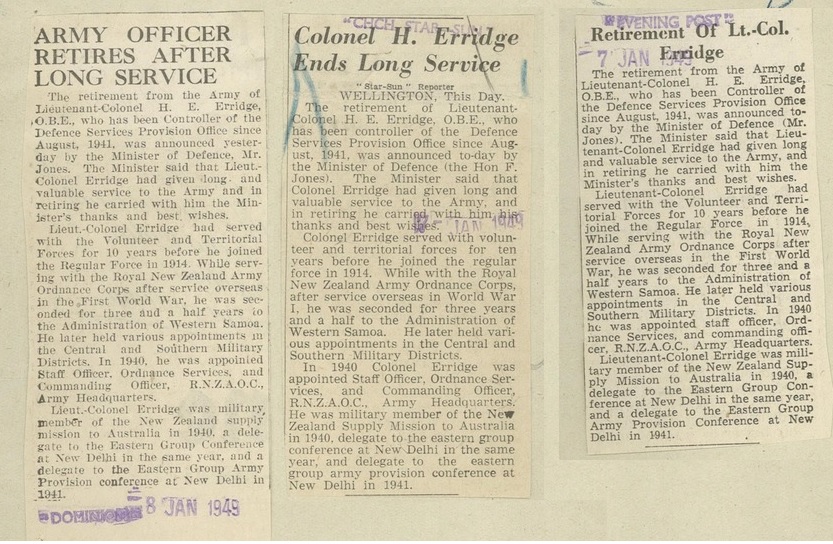
Before the Central Provision Office (Eastern) assumed complete provision control, it was necessary for all the controllers of the national provision offices to meet to ensure that uniform procedures were adopted. A coordination conference for the various Provision Group Controllers was held at New Delhi in July 1941, with Erridge attending as New Zealand’s military representative. Based on this conference, on 5 August 1941, the New Zealand War Cabinet approved the establishment of the New Zealand Defence Servicers Provision Officer (DSPO), with Erridge appointed as its Controller with the rank of Temporary Lieutenant Colonel. Relinquishing the appointment of Staff Officer Ordnance and handing over the Commanding Officer NZAOC duties to Major E.L.G Bown, the COO MOD.[13]
By April 1945, the DSPO thought Central Provision Group (Eastern) had shipped for the British Ministry of Supply equipment to the value of £10,000,000 (2021 NZD $8,988,577,362.41) with additional equipment to the value of £8,520,761 (2021 NZD $765,895,194.35) that was surplus to the requirements of NZ Forces overseas transferred to the War office.[14] During a visit to New Zealand in January 1946, Major-General R.P Pakenham-Walsh, CB, MC., a member of the Eastern Group Supply Council and the Central Provision Office(Eastern), stated that “Stores from New Zealand which had been made available to the Eastern Group Supply Council had been of great importance in the prosecution of the war” adding that “the Dominion’s contribution had compared more than favourably with that of various larger countries.”[15] Following the surrender of Germany in April and Japan’s defeat in August 1945, the Eastern Group Supply Council and Central Provision Office, although serving their purpose well, had become irrelevant and were dissolved on 31 March 1946.[16] However, it took two years for the DSPO to transition to a peacetime footing. Seconded to the War Asset Realisation Board (WARB) on 1 May 1947, Erridge started to wind down the work of the DSPO while also coordinating the disposal of equipment through the WARB. On 17 December 1948, Erridge handed over the remaining stocks to the WARB and closed the DSPO.
At 62 years of age and following 45 years of volunteer, Territorial and Regular service, Erridge retired from the New Zealand Army and was placed onto the Retired List with the rank of Lieutenant Colonel on 29 May 1949.[17] Never marrying, Erridge spent his retirement in his hometown of Dunedin. On 30 March 1962, a resident of the Dunedin’s Ross Home, Erridge, passed away at 74. Following his wishes, he was cremated, and his ashes scattered.
Throughout his service, Erridge was awarded the following decorations
OBE (1946)
NZ Long Service and Efficient Service (1925)
1914-15 Star
British War Medal
Victory Medal
War Medal 1939-45
NZ War Medal, 193-45
Notes
[1] Archives New Zealand, “Henry Earnest Erridge- Ww1 8/1004, NZAOC 888, Ww2 800245, 30293,” Personal File, Record no R24097640 (1904-1948): 2708.
[2] “Regulations for the Military Forces of the Dominion of New Zealand,” New Zealand Gazette, May 19, 1927.
[3] “Appointments, Promotions, Resignations and Transfers of Officers of the NZ Military Forces,” New Zealand Gazette No 61, 19 July 1926.
[4] “Appointments, Promotions, Resignations and Transfer of Officers of the New Zealand Military Forces,” New Zealand Gazette No 48, 27 June 1929.
[5] “Appointments, Promotions, Transfers and Retirements of Officers of the NZ Forces “, New Zealand Gazette No 16, 5 March 1931.
[6] “Appointments, Promotions, Transfers and Retirements of Officers of the NZ Forces “, New Zealand Gazette No 55, 19 July 1934.;”Appointment, Promotions, Transfers and Retirements of Officers from the NZ Forces,” New Zealand Gazette No 87, 29 November 1935.
[7] “Appointments, Promotions, Transfers and Retirements of Officers of the NZ Forces “, New Zealand Gazette No 1, 11 Jan 1940.;”Appointments, Promotions, Transfers and Retirements of Officers of the NZ Forces “, New Zealand Gazette No 75 (1940).
[8] “Appointments, Promotions, Transfers and Retirements of Officers of the NZ Forces “, New Zealand Gazette No 70 (1940).
[9] “Unity in War Effort,” Evening Star, Issue 23622, 8 July 1940.
[10] East Africa consisting of the territories of (Kenya, Uganda, Tanganyika, Zanzibar, Northern and Southern Rhodesia, Nyasaland; Bertram Stevens, “The Eastern Group Supply Council,” The Australian Quarterly 13, no. 3 (1941).
[11] “Eastern Group Supply Council,” Otago Daily Times, Issue 24640, 23 June 1941.
[12] “Appointments, Promotions, Transfers, and Retirements of Officers of the New Zealand Military Forces.,” New Zealand Gazette, No 30, 9 April 1941.
[13] “Appointments, Promotions, Transfers, and Retirements of Officers of the New Zealand Military Forces.,” New Zealand Gazette, No 74, 11 September 1941.
[14] “War Supplies,” Evening Post, Volume CXXXIX, Issue 126, 30 May 1945.
[15] “Production Problems,” Evening Star, Issue 25690, 14 January 1946.
[16] “Supplies – the Eastern Group Supply Council,” Northern Advocate, 1 April 1946, 1 April 1946.
[17] “Appointments, Promotions, Transfers, and Resignations, of Officers of the New Zealand Army “, New Zealand Gazette No 37, 16 June 1949.
The Bryan Nelson Jennings Memorial Trophy would, for a short period in the 1990s, be a coveted trophy awarded to the most outstanding Automotive Parts and Accessories Merchandising Apprentice of the Royal New Zealand Army Ordnance Corps(RNZAOC).
Apprenticeships for the Automotive Parts and Accessories Merchandising Trade (AP Trade) had been established in 1965 to provide the RNZAOC with skilled tradespeople for employment in RNZAOC Workshops Stores Sections that had been established as part of Royal New Zealand Electrical Mechanical and Electrical Engineers(RNZEME) Workshops and Light Aid Detachments in 1962.
The role of RNZAOC Stores Sections was to carry and manage the specialised holdings of spares, assemblies & workshop materials (Class 9 stores) of their parent workshops.
Administered by the New Zealand Trade Certification Board (now the New Zealand Qualifications Authority), the Automotive Parts and Accessories Merchandising apprentice training scheme consisted of 9000 working hours of study and on the job training with three Trade Board examinations required to gain the trade qualification.
Initially, apprentices would begin their training as 16-year-old Regular Force Cadets (RF Cadets), who, on graduation, would complete their apprentice training at the Main Ordnance Depot, MT Spares Section at Trentham Camp. However, during the 1970s, RNZAOC direct entry recruits were also accepted as apprentices.
Further progression in the AP trade was achieved by qualified apprentices undertaking the New Zealand Management Certificate in Automotive Parts & Accessories Merchandising. the first two Certificate level qualifications were awarded in 1988 To;
Sergeant M Wilson (0001)
Sergeant S O’Brien (0002)
The final AP Trade Apprentice would be recruited in 1996, following which the apprentice scheme would cease as the foundation for the AP Trade.
Warrant Officer Class One Bryan Nelson Jennings
Bryan was born in Wellington in 1926. Too young to see active service in WW2, Bryan served with the Melrose Battalion, Wellington South Home Guard unit from 1 April 1943 to 1 April 1944, attaining the rank of Corporal.
Volunteering for service with ‘J ‘ Force, the New Zealand component of the British Occupation Forces (BCOF) in Japan, Bryana would be posted to 4 New Zealand Base Ordnance Depot (later renamed to 4 NZ Ordnance Field Park) in August 1946. Completing his engagement, Bryan would return to New Zealand on 14 September 1947. Following a short period posted to the Main Ordnance Depot in Trentham as part of the post-war Interim Army, Bryan was soon discharged and returned to civilian life.
Enlisting into the Regular Forces RNZAXCO on1 April 1948, Bryan undertook a short period of refresher training at the Army School of Instruction at Trentham before being posted to the Main Ordnance Depot as a storeman in the Technical Spares Group and later in the Tyre Store.
Temporarily posted to 10 Coastal Regiment RNZA at Fort Dorset, Bryan, like many of his contemporaries, would be employed on the wharves during the 1951 Waterfront Workers strike.
Promoted to Temporary Sergeant on 25 November 1953, Bryan would be promoted Staff Sergeant on 13 October 1958. Poste to 1 Composite Ordnance Company n loan back in 1964, Bryan would remain at the Main Ordnance Depot.
Posted to 1 General Troops Workshops, Stores Section, Linton Camp as a Warrant Officer Class Two in 1965, Bryan would soon find himself loaned back to the Central Districts Motor Transport Workshops at Trentham.
Seconded to the New Zealand Cadre (Fiji) of the Fijian Military Forces in 1968 as a Temporary Warrant Officer Class One in 1968, Bryan would spend the next two years assisting in the training and development of the Fiji Military Forces.
Returning to New Zealand in January 1971, Bryan was posted to 1 Base Workshops, Trentham and promoted to Warrant Officer Class One. Bryan would remain at 1 Base Workshops and the IC Stores section until his release from the army on n 21 April 1981.
During Bryans more than thirty-two years of service, he was awarded the Long Service and Good Conduct medal on 25 March 1965, followed by the Meritorious Service Medal on19 April 1978.
Following his retirement, Bryan would remain in Upper Hurt. Staying engaged with the community, Bryan was an active member of the Lions organisation and a member of the School Board of the Heretaunga College.
Bryan passed away on 9 August 1989 at Upper Hurt after a long illness.
In his memory, The Bryan Nelson Jennings memorial trophy was instituted in 1991. Although not an AP Trade Apprentice himself, Bryan was a mentor to many apprentices and was described as a legend in the trade.
The object of the award was to provide a tangible mark of achievement and was intended to encourage junior soldiers of the AP trade to reach and maintain a high standard of professional competence and personnel integrity.
Nominations for the award were graded against the following attributes:
Basic Soldier Skills
Loyalty
Sportsmanship
Enthusiasm
Dress, bearing and personnel appearance
Trade Skills
Personnel eligible for consideration for the trophy were to meet the following requirements
Not be above the rank of Substantive Lance Corporal
Must have attended either 1st, 2nd or 3rd qualifying examinations in the past 12 Months
Must still be serving their apprenticeship.
The Trophy now resides at the Trade Training School of the Royal New Zealand Army Logistic Regiment.
The New Zealand military presence in Singapore is an established chapter of New Zealand’s military historiography. Material related to the background and history of the ANZUK Force, the New Zealand Force South East Asia, and 1 RNZIR is readily available. However, information on many of the New Zealand sub-units is more challenging to locate. One unit that was an integral component of the NZ Force of the 1970s and 80s and continues to serve as part of the residual force maintained by New Zealand in Singapore is the Installation Auxiliary Police Force (IAPF).
Upon the 1989 closure of New Zealand Force South East Asia (NZFORSEA), the New Zealand Defence Support Unit (NZDSU) was created to maintain New Zealand’s military presence in Singapore. Located at the Sembawang Naval Installation (SNI), the NZDSU provides Singapore-based deployable support to NZ Forces throughout Southeast Asia. The NZDSU also contributes to the security of allied (US, UK and Australian) forces in Singapore through the provision of the IAPF. The NZDSU commands the IAPF, whose principal responsibility is the provision of Physical security to the SNI, including checks of all personnel and vehicles entering and leaving the Installation.
The IAPF is a small force 56 Singapore Auxiliary Police Officers (APO) and operates under the authority of Section 92(1) or (2) of the Police Force Act 2000. Under the provision of this Act the IAPF is vested with all the power, protection and immunity of a Singapore police officer of corresponding rank. As Singapore APO’s, members of the IAPF are licensed to carry firearms when carrying out their duties.
The NZ IAPF originally wore colonial-era Khaki uniforms with the iconic “Kiwi” patch. From around 2000, the uniforms of the IAPF were modernised and standard Singapore police uniforms adopted. The uniform is worn with a IAPF and Kiwi patch worn on each sleeve.
In 1987 RNZAOC Warrant Officer Class Two Wayne Le Gros, wrote the following article on the history of the IAPF for the Journal of the New Zealand Military Society, who have granted permission for it to be reprinted here .
HISTORY OF THE INSTALLATION AUXILIARY POLICE FORCE
Provided by W.Le Gros
The Installations Auxiliary Police Force was formed on I December 1971 as a result of withdrawal of UK Forces from Singapore. The creation of the lAPF was legalised vide Singapore Government Gazette Notification No. 171 dated 21 January 1972.
Prior to the creation of the IAPF, the MOD (UK) maintained huge military bases for its navy, army and air force. Each had its own police force to maintain security of the installations. Although the exact size of its own police forces is not known, it is estimated that there were about 2,000 people employed as policemen. These 2,000 policemen were not all Singapore citizens. Many were Malaysians, Indians and Pakistanis. Some possessed UK Citizenship. This was permissible because Singapore was then a British colony.
With the disbandment of MOD(UK) police forces following the withdrawal of UK Forces from Singapore, all the foreign nationals were retrenched and they either returned to UK or to their own countries. The few hundred policemen that remained were Singapore citizens and in the final stage of the military withdrawal, these Singapore citizens did not escape the retrenchment exercise which ended on 30 November 1971. Singapore citizens who were under 45 years at that time were absorbed into the newly created IAPF.
It is interesting to note here that although the Navy, Army and Air Force had its own police forces, not all police personnel received the same training. The Navy sent its police recruits to the Singapore Police Training School for 9 months of basic police training. The Army and Air Force had their own training schools, but they concentrated more on physical security. Hence when the IAPF started in 1971, IAPF personnel had different police training background. This was however streamlined when the IAPF organised refresher courses for all its personnel.
All IAPF personnel carry warrant cards issued by the Commissioner of Police Singapore. They have the same powers, protection and immunities of a Singapore police officer of corresponding rank within the area under the jurisdiction of NZ Force S.E. Asia providing also that they have the same powers etc outside the area when in fresh pursuit of or in charge of any person who has committed or is suspected of having committed an offence within the limits of such an area or within view outside such an area.
All IAPF personnel are subject to discipline under the Auxiliary Police Regulations and have a right of appeal to the Commissioner of Police, Singapore on disciplinary matters. The promotion of any IAPFpersonnel is subject to the approval of the Commissioner of Police. Before any personnel can be promoted, he must present himself before a 3-member Joint Promotion Board convened by the Commissioner of Police. The Chairman of the Joint Promotion Board will be a senior Singapore Police Officer while the other two members are OC IAPF and NZ CEPO, the employing authority.
The IAPF when first established in 1971 under the ANZUK Command had 400 personnel and was commanded by Supt. SK. Sundram, (equivalent to Lt. Col. Rank) a retired Singapore Police Officer. It had 1 Asst. Supt, 9 Inspectors and the rest was made up of constables, corporals and sergeants. In 1975, when Australia and UK withdrew from the ANZUK Command, 62 personnel made up of 2 officers and 60 rank and tile were transferred 10 NZ Force S.E Asia and formed the NZ IAPF. Today, the strength is reduced to 50 personnel as a result of an overall review carried out in 1984.
The NZ IAPF is responsible with the:-
Protection of life and property within the NZ/UK Forces installations
Control of entry of all persons to NZ/UK Forces installations
Cash/ammunition escorts
Although the IAPF is a small auxiliary police force, it performs a variety of duties. As most of its personnel have given many years of faithful service, the loyalty and devotion of these personnel have always remained steadfast to this date.
New Zealand Army Ordnance Corps Badge, 1916-1919 (Robert McKie Collection 2017)
From the turn of the twentieth century, the New Zealand Army had transformed from small permanent militia and volunteer force, into a modern citizen army, organised for integration with a much larger British Imperial Army. When New Zealand entered the First World War, the New Zealand Army did not have a Regular or Territorial Army Ordnance Corps from which to expand into a wartime Ordnance organisation. The creation of a New Zealand Army Ordnance Corps had remained a topic of discussion and indecision. Still, appetite to make a decision lacked until the war necessitated the formation of a New Zealand Army Ordnance Corps as a unit of the New Zealand Expeditionary Force (NZEF).
Ordnance functions in support of the New Zealand Forces had since 1907 been a civil/military responsibility under the control of the Defence Council with duties divided between the civilian Defence Store Department and the Royal New Zealand Artillery;[1]
The Director of Artillery Services (Ordnance): Responsible for Artillery armament, fixed coast defences, and supplies for Ordnance, and
The Director of Stores: Responsible for clothing and personal equipment, accoutrements, saddlery, harness, small-arms and small-arms ammunition, machine guns, material, transport, vehicles, camp equipment, and all stores required for the Defence Forces.
As this created a division of roles and responsibilities, there were many calls for the establishment of a New Zealand Army Ordnance Corps along the lines of;
The Army Ordnance Corps, established in Britain in 1895,
The Australian Army Ordnance Department, established in 1902, and
The Canadian Ordnance Corps, established in 1907.
On 27 December 1907, James O’Sullivan head storekeeper of the Defence Sores Department was confirmed as the Director of Stores, with the Rank of Honorary Captain in the New Zealand Staff Corps.[2][3] Further progress was made on the creation of an Army Ordnance Corps in 1913 with the selection and appointment of Brigade Ordnance Officers (Territorial) in each district with the intent of forming a Central Ordnance Depot to support each Brigade Camp during the 1913 camping season. Under the Director of Equipment and Stores,[4] a fortnight course of instruction on Ordnance duties was conducted at Alexandra Barracks in January 1913 for the selected Brigade Ordnance Officers. In the field during the 1913 Annual Camps, each Brigade Ordnance Officer was allocated a staff of 2 clerks and 4 issuers, who were also selected before the camps and had undertaken training on Ordnance duties.[5][6]]
From an Ordnance perspective, the1913 camps were a revolution in New Zealand’s Ordnance planning. For the first time, The issue of camp equipment was effectively managed with issues direct from Brigade Ordnance Depots directly to Regiments as they marched in. Issues were based against set scales, removing any doubt as to quantities taken into use and ensuring units were not holding excessive equipment and obviating any losses that were a feature of the previous system of direct consignment in small lots. On the completion of the camps, Regimental Quartermaster Sergeants assembled all equipment for return or made the necessary arrangements to rectify deficiencies without any delay. To facilitate the closing of camp stores accounts, Regimental Quartermaster Sergeants were placed under the orders of the Brigade Supply Officer. They would if necessary remain post the departure of their Regiments, remaining until the completion of checking and adjusting of accounts for rations and equipment. The Brigade Ordnance Officers would then ensure the return of all camp equipment to the respective mobilisation stores.[7] An organisational success, the 1913 Ordnance Depot concept was carried over for use in the 1914 camps. The significant difference between the 1913 and 1914 camp’s was that they were to be much larger Divisional camps. To manage the increase of dependency, the size of the Ordnance Depot Staff was increased to 6 clerks and twelve issuers.[8] Moreover, some of the regional Defence Storekeepers participated as the camp Ordnance Officers[9].
Based on many of the logistical lessons learned by the British Army in the Anglo/Boer war, the British Army published their doctrine for the provision of Ordnance Services to the British Army in the 1914′ Ordnance Manual (War)’. The concept of operations for British Ordnance Services was that they were to be organised depending upon the general nature of operations and lines of communication. Arranged within convenient distances of Corps and Divisions, Ordnance Depots would be located to allow units to draw their stores and ammunition from that source. If lines of communication became extended, the establishment of intermediate, advanced, and field depots on the lines of communication was authorised. The composition of Ordnance Depots was to consist of personnel of each trade, of sufficient numbers necessary for the operation of a small ordnance depot and workshop.[10] Assistant Directors Ordnance Services (ADOS) would be responsible for each Corps, with Deputy Assistant Directors Ordnance Services (DADOS) accountable for each Division.[11]
The doctrine Britain had in place at the beginning of the First World War was for forces to be fully equipped with everything necessary to enable them to undertake operations. [12] Included in the plan was the daily maintenance of Combat Supplies,[13][14] but no provision for the replacement of weapons, equipment or clothing was allowed. Re-equipment would happen upon the withdrawal of forces for rest[15]. New Zealand’s contribution as part of the British Empire was to be the NZEF based around an Infantry Division and a Mounted Infantry Brigade. Given the doctrine, New Zealand’s Ordnance requirements were minimal and would initially consist of no more than a DADOS, A Senior NCO clerk and a box of Stationary.[16]
Detailed in Section 5 of General Order 312 of August 1914, the initial establishment of the NZEF was; 1 Officer, 1 Clerk and a horse.[17] The NZEF DADOS was New Zealand Staff Corps Honorary Captain William Thomas Beck, Defence Storekeeper for the Northern Districts. [18][19] Beck was an experienced military storekeeper, who had been a soldier in the Permanent Militia before his appointment as Northern Districts Defence Storekeeper in 1904. Beck was the Officer in charge of the Camp Ordnance for the Auckland Divisional Camp at Hautapu near Cambridge in April 1914 so was well prepared for the role of DADOS.[20][21][22]
The Senior Non-Commissioned Officer assisting Beck was Norman Joseph Levien.[23] A general storekeeper, Levien enlisted into the 3rd Auckland Regiment immediately on the outbreak of war, appointed as a Temporary Sergeant and transferred to the Ordnance Department as the I.C. of Stores and Equipment, assisting in equipping troops for overseas service. Beck and Levien embarked with the main body of the NZEF, departing Wellington for England on the troopship TSS Maunganui on 3 December 1914.[24]
The main body of the NZEF was initially destined for England, but the Canadian Expeditionary Force had suffered an exceptionally bitter winter on Salisbury Plain resulting in a change of plans for the main body of the NZEF to spare them the rigours of an English winter. Diverted to Egypt and disembarking on 3 December 1914. The New Zealanders would join with the Australians as the ‘Australasian Army Corps’.[25] The Corps comprised two divisions; the 1st Australian Division, and the New Zealand and Australian Division. Based at Based Zeitoun Camp on the outskirts of Cairo, the New Zealanders trained and acclimatised to the local conditions, with preparations made for potential operations against the Ottoman Empire. The New Zealanders would see their first action in February 1915 when Ottoman forces raided the Suez Canal.
New Zealand Supply Depot Staff at Zeitoun Camp, 1915. Note Ordnance solder front row 3rd from left. National Army Museum of New Zealand
By 10 December Beck had established himself as the DADOS of the NZEF with an Ordnance office and a shared depot with the Army Service Corps at Zeitoun Camp. NZEF Order No 9 of 10 December 1914 stated that all indents for Ordnance Stores, including petrol and lubricants were to be submitted to the DADOS Ordnance Depot.[26] Beck and had much to work ahead to bring the New Zealand units to scale and come to terms with the British Ordnance Systems. Britain had maintained occupation forces in Egypt since the 1880s and as such had peacetime Ordnance depots in Alexandra and Cairo.[27] To understand the British systems and how best to utilise them Sergeant Levien was attached to the British Ordnance Corps Depot at the Citadel in Cairo to study the Ordnance systems in use and the Ordnance procedures the New Zealand Forces would have to adopt.[28]
Plan of Zeitoun Camp
Divisional Order 210 of 28 December transferred the following soldiers to the Ordnance Depot;
Rue de la, Porte Rosette, Alexandria, Egypt. Public Domain
By March 1915 Levien had secured premises for a New Zealand Ordnance Depot and warehouse at No. 12 Rue de la Porte Rosette and a warehouse at Shed 43, Alexandra Docks. From these premises, the New Zealand Forces would be provided support before and during the Dardanelles campaign. The Australians established a similar Depot at Mustapha Barracks and in No 12 Bond Store on Alexandra Docks.[35]
On 3 April 1915, Beck received a boost to his DADOS organisation. Commissioned to 2nd Lieutenant, Thomas Joseph King, a qualified accountant, transferred into the New Zealand Army Ordnance Corps.[36] King was appointed as the Officer in Charge of the Ordnance Depot at Zeitoun Camp,[37] and Levien, also promoted to 2nd Lieutenant assumed the position of Officer in Charge of Equipment, Small Arms and Accoutrements (SAA) and Clothing.
Order No 122 promoting King and Levien into the NZAOC on 4 April 1915
Lieutenant Thomas Joseph King, New Zealand Ordnance Corps in Egypt.National Army Museum of New Zealand
Early in January 1915 planning began for operations in the area around the Dardanelles, with the ambitious goal of forcing the Ottoman Empire out of the war. Now well known as the Gallipoli Campain, the Australians and New Zealanders were committed to being critical participants in the planned amphibious assault and ground offensive. The Ordnance plan for the campaign included the establishment of an Ordnance Base Depot in Alexandria, and a floating Ordnance Depot set up on the cargo ship the ‘SS Umsinga’. The Umsinga was fitted out in the U.K. with all the Ordnance Stores required, all carefully laid out by vocabulary with detailed plans produced to locate the stock quickly. With Lieutenant Colonel McCheane in command as the Chief Ordnance Officer, he had a complement of one hundred and fifty men of the AOC to manage the stocks.[38]
The invasion fleet loaded with the ANZAC, British and French concentrated off the Island of Lemnos from 10 April. The assault would be at two locations on the morning of 25 April. The British 29th Division would land at Cape Helles on the southern tip of the Gallipoli Penisula, and the ANZACs at locations on the west coast of the Peninsular that would become known as ANZAC Cove. The Division of the landing force made the concept of having the ‘Umsinga’ as the offshore ordnance Depot unworkable. To rectify the situation, the ‘S.S. Anglo Indian’ became the second floating Ordnance Depot. Half the stocks of the ‘Umsinga’ were cross-loaded to the ‘Anglo Indian’ on the night of 23/24 April, with British Ordnance Officer Major Basil Hill appointed as Chief Ordnance Officer on the Anglo Indian, along with haft the AOC men from the “Umsinga”.[39]
The 1st Australian Divison started landing at around 4 am on the morning of 25 April, followed by the Australian and New Zealand Division several hours later. Soon after the beachhead was secured but still under considerable enemy fire, the ‘Anglo Indian’ drew close to the shore and started to cross-load Ammunition and other Ordnance Stores for transfer to an Ordnance dump established at the southern end of the beach. Lt Col J.G Austin,[40] the 1st Australian Division DADOS, supervised the unloading of the lighters into the Ordnance dump and established forward ammunition dumps close to the front lines.[41]
Supplies on the beach at ANZAC Cove 1915. Athol Williams Collection, Alexander Turnbull Library
As DADOS of the Australian & New Zealand Division, Beck landed with Godley’s Headquarters at ANZAC Cove at Gallipoli on 25 April 1915.[42] Lieutenant Colonel Fenwick, ADMS, another New Zealander, was part of the Headquarters landing party describes the events on that day: [43]
“We were all ready to land but were kept waiting and waiting until about 9.00 a.m. Some barges were moored alongside and a string of boats outside of these on the starboard side. Colonels Braithwaite, Chaytor and Manders, Major Hughes and Captain Beck and I got into the first boat. We were frightfully hampered by our kit – overcoat, revolver, glasses, map case, haversack, three days rations, firewood, Red Cross satchel, water bottle – like elephants. It was a certainty that we would drown if we got sunk. After waiting, a steam picket boat came along in charge of a very fat rosy midshipman. He took our string of boats in tow, and we were off. Our boat grounded about 50 feet from the shore and we all hopped out. Of course, I fell into a hole up to my neck. I could hardly struggle ashore and when I did the first thing I saw was Beck sitting on a stone, roaring with laughter at us. Billy Beck was the first New Zealander of Godley’s force (New Zealanders were serving in the Australian Division) to get onto Gallipoli”.
The landings were not as successful as planned with the Ottoman troops providing a more robust defence than expected; the campaign soon developed into stalemated trench warfare. By July the Island of Lemnos 40 miles from the peninsula had become the logistics hub supporting the campaign. The Ordnance command structure underwent a shakeup, the DOS for the entire campaign was Colonel Perry of the AOD, ADOS’s were made responsible for Ordnance support in the individual Corps areas of Helles and ANZAC Cove, Lt Col Austin assumed the position of the ANZAC Corps ADOS. The much larger “S.S. Minnetonka” was charted to act as depot ship, making regular round trips from Lemnos, Helles and ANZAC. The “‘ Umsinga’ and ‘Anglo Indian’ continue to support their respective areas as ammunition tenders.
Ordnance Depot Shrapnel Gully, Gallipoli. Alexander Turnbull Libary
Beck remained as the DADOS of the Australian & New Zealand Division with staff Sergeant Major Elliot Purdom, Regimental Quartermaster Sergeant of the Auckland Mounted Rifles transferred into the division headquarters to be his assistant. For the next three months, Purdom would assist Beck with the strenuous work of landing and organising stores and managing the depot staff. It would appear that he was also a bit of a character and The Hawera & Normanby Star, 24 June 1916 had this to say about Captain Beck’s service at Gallipoli:[44]
“Finally, there was Captain William Beck, an ordinary officer. “Beachy Bill” was in charge of the store – a miserable little place – and whenever he put his nose out of the door bullets tried to hit it. The Turkish gun in Olive Grove was named after him, “Beachy Bill.” The store was simply a shot under fire, and Bill looked out and went on with his work just as if no bullets were about. He was the most courteous and humorous, and no assistant at Whiteley’s could have been more pleasing and courteous than the brave storekeeper on Anzac Beach. General Birdwood never failed to call on Captain Beck or call out as he passed on his daily rounds, asking if he were there, and they all dreaded that someday there would be no reply from a gaunt figure still in death. But Captain Beck was only concerned for the safety of his customers. He hurried them away, never himself.
Back in Egypt, with reinforcements arriving from New Zealand, King remained fully occupied at the Zeitoun Ordnance Depot. Ensuring new drafts of troops were brought up to scale and troops departing for ANZAC cove were fully equipped, on 2 May, King received additional assistance in the form of Trooper Reginald Pike. Pike 39 years old and a veteran of the Boer war was promoted to Temporary Sergeant and appointed as Ordnance Clerk. Pike would remain with Ordnance for the duration of the war.[45]
By mid-July, illness was taking its toll on Beck and Purdom. During August both men were transferred to the hospital in Alexandria, after some time in Alexandra, both would be invalided back to New Zealand.[46] Levien embarked for the Dardanelles on 2 August to replace Beck as DADOS, with King taking over the management of the Alexandra Depot on 12 August. At ANZAC Cove Private Arthur Gilmour transferred into the NZAOC as acting Sergeant on 24 August.[47]
On 6 October Levien and King, both received promotions to Lieutenant[48]. King took over as DADOS of the Division and Levien was appointed the Chief Ordnance Officer at Sarpi camp, with responsibility for re-equipping the depleted Australian & New Zealand Division. Having been in action since April, the Division required some rest and reorganisation. From mid-September 1915, most of the depleted division withdrew to the Island of Lemnos. Spending seven weeks at Sarpi Camp, the Division returned to the Gallipoli peninsula in early November with King remaining as DADOS. November also saw the promotion of Acting Sergeant Gilmour to Sergeant.
By mid-October, it was apparent that the situation in the Dardanelles had become hopeless, with operations against the enemy reaching a stalemate and offensive options exhausted. After extensive planning, evacuation orders were issued on 22 November. Starting on 15 December, withdrawing under cover of darkness, the last troops departed ANZAC Cove and Suvla Bay by dawn 20 December, with the final evacuations of the French and British forces at Helles completed by 9 January.
Returning to Egypt the Australians and New Zealand Division regrouped, and with enough New Zealand reinforcements now available to form a third Brigade, the NZEF became a standalone New Zealand Division. The bulk of the Australian and New Zealand forces separated, but the Mounted Rifle Brigade joined with the Australians to establish the Australian and New Zealand Mounted Division, which would remain in the Middle East for the remainder of the war. Elements of the New Zealand Division detached for operations against the Senussi in Western Egypt, returned to the Division in February and by March the New Zealand Division started to depart for France, joining the British Expeditionary Force on the Western Front.
Lieutenant-Colonel Alfred Henry Herbert, NZAOC. Auckland Museum/Public Domain
From late 1915 the need for a more robust NZAOC was recognised, and expansion of the NZAOC as a unit of the NZEF began in December with Private Frank Percy Hutton[49] and Sergeant Kenneth Bruce MacRae[50] transferred into the NZAOC. On 1 February 1916 Lieutenant-Colonel Alfred Henry Herbert, who had previously served as Commanding Officer of the Pioneer Battalion was transferred into NZAOC and appointed New Zealand Division, DADOS and Officer Commanding of the NZEF NZAOC.[51] Also on 1 January Staff Sergeant Geard who had been with Ordnance since December 1914 formally transferred into the NZAOC.[52]
The NZAOC would officially become a unit of the NZEF in February,[53] with a commensurate influx of personnel transferred into the NZAOC, including;
On 22 March Sergeant MacRae was commissioned as a 2nd lieutenant
A wounded Herbert with Lieutenant Colonel A.B. Chaytor April 1916.National Army Museum of New Zealand
King and Levien would not travel with the Division to France. King was struck down with Enteric (typhoid) fever and would be invalided back to New Zealand on 10 May. King would remain in the Military, initially taking up a posting in the Defence Stores and transferring into the NZAOC on its formation in New Zealand in 1917. Levien oversaw the closing down of the Alexandra depot, disposing of the vast stockpile of stores that had accumulated over the year. Levien would embark for England in May 1916, taking up the post of NZEF Chief Ordnance Officer in the U.K.
[1] “Defence Forces of New Zealand Report by the Council of Defence and by the Inspector-General of the New Zealand Defence Forces for the Year 1907.,” Appendix to the Journal of the House of Representives ( 1907).
[3] “Director of Ordnance Stores,” Dominion, Volume 9, Issue 2741 8 April 1916
[4] The Director of Stores title was changed to Director of Equipment and Stores early in 1911
[5] “H-19 Report on the Defence Forces of New Zealand for the Period 28 June 1912 to 20 June 1913,” Appendix to the Journal of the House of Representives (1913).
[6] “Territorials,” Evening Star, Issue 15018, 29 October 1912.
[7] “H-19 Report on the Defence Forces of New Zealand for the Period 28 June 1912 to 20 June 1913.”
[8] “H-19 Report on the Defence Forces of New Zealand Fir the Period 20 June 1913 to 25 June 1914,” Appendix to the Journals of the House of Representives (1914).
[9] “Auckland Territorials,” New Zealand Herald, Volume LI, Issue 15594 28 April 1915.
[10]Ordnance Manual (War), War Office (London: His Majesties Printing Office, 1914), Appendix 1.
[17] “Troopships; Embarkation Orders; Daily Field States; and a Large Chart of ‘New Zealand Expeditionary Forces – Personnel’ as at 1 June 1915),” Item ID R23486740, Archives New Zealand 1914-1915.
[18] “Main Expedition,” Evening Post, Volume LXXXVII, Issue 73, 23 September 1914.
[19] “Officers of Dominions Contingent,” Ashburton Guardian, Volume XXXIII, Issue 8951, 24 September 1914.
[21] “The Hautapu Camp,” Waikato Argus, Volume XXXV, Issue 5575, 4 April 1914.
[22] “Camp Preparations,” Evening Post, Volume LXXXVII, Issue 22 27 January 1914.
[23] “Norman Joseph Levien,” Personal File, Archives New Zealand 1914-1924.
[24] “William Thomas Beck,” Personal File, Archives New Zealand 1914.
[25] the ‘Australasian Army Corps’. The designation; Australian and New Zealand Army Corps’ was soon adopted and abbreviated to ANZAC, but would not enter the common vernacular until after the Gallipoli landings.
[26] “Appendices to War Diaries, I – Lxii,” Item ID R23486739, Archives New Zealand 1914-1915.
[27] Arthur Forbes, A History of the Army Ordnance Services (London: The Medici society, ltd., 1929), Page 211.
[29] Geard would remain with Ordnance for the duration of the war “Walter John Geard “, Personal File, Archives New Zealand 1914.
[30] Gilmour would remain with Ordnance for the duration of the war “Arthur Gilmour “, Personal File, Archives New Zealand 1914.
[31] Worked At Alexandra Depot until returned to New Zealand in October 1915 “Gavin Hamilton,” Personal File, Archives New Zealand 1914.
[32] Promoted to Sergeant 18 February 16, returned to NZ Aug 1917 “Lewis Crozier,” Personal File, Archives New Zealand 1914.
[33] Transferred to NZASC October 1917 “Horace Frederick Lofts,” Personal File, Archives New Zealand 1914.
[34] Transferred to NZASC 25 February 1916 “Joseph Roland Henderson,” Personal File, Archives New Zealand 1914.
[35] John D Tilbrook, To the Warrior His Arms: A History of the Ordnance Services in the Australian Army (Royal Australian Army Ordnance Corps Committee, 1989), Page 43.
[36] “Grants of Temporary Rank, Appointments and Promotion of Officers in the New Zealand Expeditionary Force,” New Zealand Gazette, No 81 8 July 1915.
[37] “Thomas Joseph King,” Personal File, Archives New Zealand 1914-1946.
[38] Forbes, A History of the Army Ordnance Services, Pages 221-23.
[40] Lt Col Austin was a British Army Ordnance Department officer on secondment to the Australian Army as DOS before the war and served with the AIF on Gallipoli as the DADOS 1st Australian Division.
[41] Tilbrook, To the Warrior His Arms: A History of the Ordnance Services in the Australian Army Page 45.
[42] Christopher Pugsley, Gallipoli: The New Zealand Story (Auckland [N.Z.]: Sceptre, 1990, 1990).
[43] Glyn Harper, Johnny Enzed: The New Zealand Soldier in the First World War 1914-1918, First World War Centenary History (Auckland, New Zealand: Exisle Publishing Limited, 2015, 2015).
[44] “Brave New Zealanders,” The Hawera and Normanby Star, Volume LXXI, Issue LXXI,, 24 June 1916.
[45] “Reginald Pike,” Personal File, Archives New Zealand 1914.
[48] “Grants of Temporary Rank, Appointments and Promotion of Officers in the New Zealand Expeditionary Force (Europe),” New Zealand Gazette, No 5, 20 January 1916.
[49] “Frank Percy Hutton,” Personal File, Archives New Zealand 1914.
[50] “Kenneth Bruce Macrae,” Personal File, Archives New Zealand 1914.
[51] “Alfred Henry Herbert “, Personal File, Archives New Zealand 1914.
From 1950 to 1957, about 4700 New Zealand service personnel served with K Force, New Zealand’s contribution to the United Nations as part of the Korean War. Placed into a Commonwealth Division alongside units from the United Kingdom, Canada, Australia and India, the bulk of New Zealand’s soldiers served with the two core units that composed New Zealand contribution to the Commonwealth Division: 16 Field Regiment and 10 Transport Squadron. However, many men also served in the many administrative and support units required to maintain the Commonwealth Division.
As part of this administrative tail, from 1950 to 1956, the Royal New Zealand Army Ordnance Corps (RNZAOC) provided twenty-eight men who were distributed across the Ordnance Units of the Commonwealth Division in South Korea and Japan, including;[1]
The NZ Ordnance Section,
Base Ordnance Depot,
Ordnance Field Park and
Forward Ammunition Points.
British Commonwealth Forces Korea, Base Ordnance Depot, Pusan, South Korea on 2 October 1952.
The RAOC are in the dark berets, the RCOC in the ski caps, the RAAOC sport their familiar slouch hats and the RNZAOC are in the light-coloured uniforms.
K Force was an emergency force raised by calling for volunteers from New Zealand’s Regular Force and Civil population, with 5982 men volunteering.[2] It was a mixture of Regular Soldiers, World War Two Veterans and Civilians with little military experience. This article provides a statistical analysis of the twenty-eight RNZAOC men who served in K Force from 1950 to 1956.
The RNZAOC contribution consisted of.
Fourteen men already serving in the RNZAOC, comprising of.
Eleven Other Ranks and
Three Officers
Fourteen direct civilian entries into K Force.
Strength
The Twenty-Eight RNZAOC Men did not all serve in K Force at the same time. The peak of the RNZAOC contribution was in December 1952, when fifteen RNZAOC men were serving in K Force.
The Average annual strength of the RNZAOC in K Force was.
1950 – Six men
1951 – Six men
1952 – Twelve men
1953 – Thirteen men
1954 – Twelve men
1955 – Five men
1956 – One man
Length of RNZAOC Service in K Force
The Average RNZAOC service in K Force was One Year and Five Months
The shortest length of service in K Force by an RNZAOC soldier was ten months
Twenty RNZAOC Soldiers served in K Force for two years or less
Five RNZAOC Soldiers served in K Force for three years or less
Two RNZAOC Soldiers served in K Force for four years or less
One RNZAOC Soldier served in K Force for four years and four months
Age
On Deploying to Korea, the RNZAOC K Force soldier’s average age was twenty eight years of age. The youngest RNZAOC Soldiers were twenty-one years of age, and the oldest was thirty-eight years of age.
The break down of ages of RNZAOC Soldiers on deployment to K Force was;
21 – Six Soldiers
22– One Soldier
23– Two Soldiers
24– Four Soldiers
25– One Soldier
26– One Soldier
27– Two Soldiers
28– Four Soldiers
29– Three Soldiers
30– Two Soldiers
31– One Soldier
37– One Soldier
Martial Status
Of the Twenty eight men that served in K Force, only one man was married.
Military Experience
Fourteen had WW2 Service in the following forces
Seven in the RNZAF
One in the NZASC and RNZAF
Two in 28 Bn of the 2nd NZEF
One in the British Army
One in the British and Indian Armies
Two in the Australian Army
Seven had served in the immediate Post War Period with the British Occupation Forces in Japan (BCOF)
Six with New Zealands J Force
One with the Australian Army
One had completed Compulsory Military Training (CMT)
Three had no military experience.
The fourteen men who were regular RNZAOC Officers and Soldiers had Regular Force service from 1947;
One from 1947
Nine from 1949
Four from 1951
Civilian Occupations
The Civilian Occupations of the Civilian RNZAOC K Force recruits were;
One Clerk
One Freezing Worker
One General Duties Worker, Hydro Dept
One Grocery Manager
One Labourer
One Mill Worker
One Painter
One Railway Porter
One Shop Assistant
Three storeman
Two with Occupations Not State
Military Service After K Force
On completion of service with K Force, some men remained in the military, others returned to their civilian occupations.
Of the Fourteen Regular Force RNZAOC men who served in K Force;
The three Officers remained in the Army as career officers.
Patrick William Rennison – Retired as a Major in 1958.
Geoffrey John Hayes Atkinson – Retired as a Lieutenant Colonel in 1972.
John Barrie Glasson – Retired as a Lieutenant Colonel in 1972.
Barry Stewart remained a career soldier in the RNZAOC, retiring as a Captain in 1982
Thomas Allan (Tom) Hill remained a career soldier in the RNZEME, retiring as a Warrant Officer Class One in 1982
Desmond Mervyn (Des) Kerslake remained in the RNZAOC until 1961
Six soldiers took their discharge on completion of their 5-year engagement
Leonard Ferner (Len) Holder
Owen (Chook) Fowell
Neville Wallace Beard
James Adams (Snowy) Donaldson
Richard John Smart
Edward Tanguru
Two soldiers took their discharge on payment before the end of their 5-year engagement.
Keith Robert Meynell Gamble
Harold Ernest Strange (Harry) Fry
Of the fourteen civilians who joined the RNZAOC for service in K Force.
Twelve did not pursue military careers.
Dennis Arthur Astwood
Wiremu Matenga
Bruce Jerome Berney
Thomas Joseph Fitzsimons
Gane Cornelius Hibberd
James Russell Don
James Ivo Miller
Gordon Winstone East
Alexander George Dobbins
Abraham Barbara
John Neil Campbell
Philip Hayhurst (Tony) Kirkman
Joseph James Enright Cates joined the RNZAOC, retiring as a Sergeant in 1978
Ernest Radnell entered the Australian Army.
This is just an initial snapshot of the RNZAOC men that served in K Force from 1950 to 1956 and provides a start point for further research into this very small yet essential component of K Force.
Notes
[1] Howard E. Chamberlain, The New Zealand Korea Roll : honouring those who served in the New Zealand Armed Forces in Korea 1950-1957 ([Waikanae]: Howard Chamberlain, 2013).
[2] Michael King, New Zealanders at war, Rev. and updated ed ed. (Penguin, 2003), Non-fiction, 277.
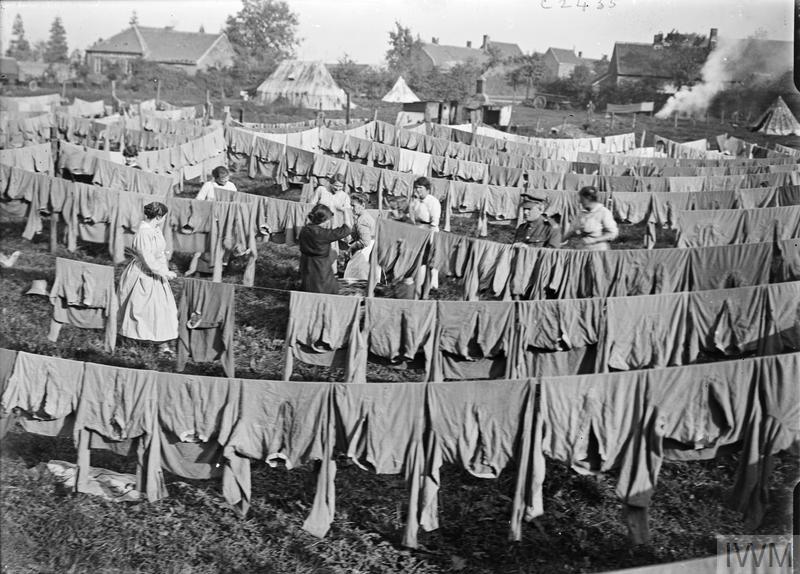
A significant function of the New Zealand Army Ordnance Corps as part of the New Zealand Expeditionary Force during the First World War was managing the New Zealand Divisional Laundries and Baths. The Laundry and Bath functions helped to maintain the New Zealand Division’s hygiene by providing the opportunity for regular bathing, the exchanging of underclothing and socks and the delousing of uniforms. Although the NZ Division s Laundry and Bath functions were interconnected with its neighbouring Divisions and supporting Corps, this article’s focus is on providing a snapshot of the NZ Divisions Laundry and Bath operations from October 1916 to June 1918.
At the onset of the First World War, partly due to the lessons learnt in the South African War and the more recent Balkan Wars, the British Army had a reasonable understanding of the importance of hygiene in the field and published The Manual of Elementary Military Hygiene in 1912.[1] However, as with any military doctrine, the practical application of the field hygiene lessons learnt took time to become effective in the early years of the War. However, by the time the New Zealand Division arrived at the Western Front in mid-1916, the British Army had a rudimentary Laundry and Bath system at the Corps and Divisional levels into which the New Zealand Division was integrated into.
Command and Control
Initially, as the New Zealand Division took over the existing Laundry and Baths from British units, these functions were initially vested as a responsibility of the New Zealand Medical Corps, who provided officers and men to supplement he existing civilian staff.[2] In line with British practice both the Divisional Laundry and Baths came under the control of the Division Headquarters “Q” Branch, and from 21 December 1916, the New Zealand Division, Deputy Assistant Director of Ordnance Services (DADOS) was the officer responsible for the running of the Divisional Laundry and Baths.[3]
Baths
The Bathing concept was that four Bathhouses were to be established in a Divisional area: usually one Bathhouse for each Infantry brigade and one Bathhouse for the rest of the Division. The concept was that Soldiers were to rotate through Bathhouse on a schedule to allow the entire Division to be bathed once every ten days. In the early years of the war, Bathing facilities were rudimentary, with Baths ranging from breweries or fabric processing plants to Beer barrels cut in half.[4]
Although initially built on an ad-hoc basis using whatever resources were available, by 1917 most Bathhouses in the New Zealand Division were built and operated on a uniform pattern: [5]
A typical Bathhouse was be operated as follows.
The men enter at 1, Undress and hand their Service Dress and valuables in at 2(Obtaining receipt) and dirty underclothes at 3.
They then have a hot shower in D
While the men are having their showers, the seams of their Service Dress Tunics and Trousers were ironed to kill lice, and small repairs were undertaken.
Upon completing the shower, the men enter F, collect a towel, clean underclothes at 4 and their Service Dress and valuables at 5. Dress and leave by 6.
All Towels and dirty underclothes are sent from the baths to the Divisional Laundry daily, and a supply of clean or new items received in exchange.
In June 1918, the system of delousing the soldier’s Service Dress clothing was improved using the Thresh Disinfector Delousing Chamber. As soldiers passed into the Bathhouse, the soldier’s Service Dress was turned inside out and handed over to the Thresh operators. The Garments were hung up inside the Thresh’s airtight chamber and sealed. Coke braziers then heated the airtight chamber, and after the garments had been treated by this method for 15 minutes, they were found to be entirely free form lice and eggs.[6]
Personnel employed in the Divisional usually consisted of
Locally employed civilian women for ironing and mending.
Depending on the ebb and flow of the battle and the New Zealand Division’s movement, between October 1916 and June 1918 the DADOS War Diary records that Bathhouses to support the NZ Division were established in over thirty-four separate locations.[8] On most occasions, existing bathhouses were taken over from other Divisions. If there were no existing Bathhouse or the ones taken over were not deemed suitable, NZ Engineers were employed to construct new bathhouses.[9]
Plan for the NZ Divisional Baths as Vauchelles. Archives New Zealand
By June 1918, the New Zealand Divisional Bathhouse system was operating effectively and bathing on average between 700 – 800 troops daily, with 46411 men passing through the Divisional Bathhouses in total.[10]
New Zealand soldiers recently in the trenches outside the Divisional Baths, France. Royal New Zealand Returned and Services’ Association :New Zealand official negatives, World War 1914-1918. Ref: 1/2-013160-G. Alexander Turnbull Library, Wellington, New Zealand. /records/23139145
Soldiers after leaving the line wait their turn for a bath. Royal New Zealand Returned and Services’ Association :New Zealand official negatives, World War 1914-1918. Ref: 1/2-012817-G. Alexander Turnbull Library, Wellington, New Zealand. /records/23097155
Laundry
On most occasions, as the Division relieved an existing Division in the area and took over the existing Divisional Laundry as a going concern. However, there were occasions when a Laundry needed to be established from the ground up, such as when the Division Laundry and Baths at Pont de Nieppe were destroyed by enemy shell fire in April 1917.[11]
The Divisional Laundry received dirty garments from the Baths, (underclothes, socks, and towels) they were disinfected, washed, and mended and placed into a reissue pool.[12]
Usually, the Divisional Laundry placed indents on the supply chain for new items to replace items beyond repair, however, in January 1918 authority was granted for the Divisional Baths to hold a pool of new clothing to me maintained consisting of: [13]
5000 shirts
13100 vests woollen
12450 Drawers Woollen
12700 Towels
19000 pairs of socks
By 1918 the average output from the New Zealand Divisional Laundry was 35,000 – 40,000 garments per week.
Personnel employed in the Divisional Laundry usually consisted of.
Between October 1916 and June 1918, as the NZ Division moved, the NZ Divisional Laundry was also relocated and established in new locations, some of the known sites were
October 1916 Located at Estaires.
Pont de Nieppe, Laundry destroyed by enemy shellfire, 12 April 1917
18 to 25 April 1917 Established at Steenwerck, Handed over to the 8th Division.
Before and during the German 1918 Spring Offensive, the Divisional Laundry was located at.
RenninghelstOuttersteene Westoutre
Abbeville
Socks
Socks were an unlikely enabler; in the extreme conditions found in the mud-filled trenches, clean, dry socks were often the difference between life and death. When feet are constantly wet, as they often were in the trenches, they begin to rot. Gangrene sets in, and often the only remedy is amputation. In the First World War, 75,000 British troops died due to complications caused by trench foot.[15]
Acutely aware of the need for clean socks, the New Zealand Division maintained a system where socks were exchanged daily. To facilitate the daily exchange, a dry sock store was run in conjunction with the Bathhouses. Here dry socks were drawn daily by units in the line in exchange for dirty socks. The dirty sock was then be backloaded to the Divisional Laundry and exchanged for clean socks.
Once received by the Divisional Laundry, the dirty socks if damaged, were mended, washed, and once dried, treated with camphor (as prevention against trench foot) before being placed into the exchange pool.
By May 1918, the disruption caused by the 1918 German Kaiserschlacht offensive had affected the supply routes with the railway service from the Laundry at Abbeville becoming irregular, and it was taking 6-7 days for trucks to travel the short distance to replenish Bathhouses with clean underclothing and socks. However, given the hygiene and morale benefits that clean socks brought, the need to maintain the sock exchange system to the forward troops was a priority. Therefore, close to the front, under the supervision of the NZAOC, a small sock washing depot was established with Sixteen men from the Divisional Employment Company in May 1918. Socks were sorted with torn or holey socks returned to the Laundry for mending, with the remainder of the socks washed by hand. In fine weather, the drying was done outside, if it was wet, the socks were hung on wires from the ceiling of a room and dried employing coke braziers. The men did excellent work, and output was 4 to 5 thousand pairs daily and kept up an adequate supply.[16]
Soldiers washing socks during World War I, Bus-les-artois, France. Royal New Zealand Returned and Services’ Association :New Zealand official negatives, World War 1914-1918. Ref: 1/2-013179-G. Alexander Turnbull Library, Wellington, New Zealand. /records/23052031
New Zealand soldiers washing socks in wooden tubs near the New Zealand Divisional Headquarters at Bus-les-artois, 7 May 1918. Photograph taken by Henry Armitage Sanders Nº H-563 Photo source – Alexander Turnbull collection at the National Library of New Zealand. (Colorized by Marina Amaral from Brazil) https://www.facebook.com/marinamaralarts/?fref=nf See less
Gumboots
As the western front settled down into the routine of trench warfare in the winter of 1915, the time spent in the saturated trenches by British troops was limited to thirty-six hours during which the wearing of gumboots became widespread in the water-soaked areas.[17] The use of gumboots helped minimise the effects of mud and water on exposed feet, thus limiting Trench foot occurrences. Based on the early success of gumboots, contracts were placed with the North British Rubber Company (now Hunter Boot Ltd) to manufacture over 1,185,000 pairs of Gumboots for the British army during WW1.[18]
Boots were classed as Trench Stores and usually only issued to a division when it was on the line. The NZ Division was typically provided with around 6000 pairs, pooled, and issued from a Gumboot Store. The Gumboot store was designed with drying racks and heaters to allow the wet gumboots to be dried and prepared for reissue.
Plan for Drying Apparatus for Rubber Boots. Australian Imperial Force Unit War Diaries, 1914-1919 – Australian Corps Baths and Laundries, 2 – June 1916 – April 1918.” Australian War Memorial Archives Collection No AWM4 18/1/1 PART 2 (1918)
This article provides a small snapshot of how the Laundry and Bath functions contributed to maintaining the New Zealand Division’s hygiene by providing the opportunity for regular bathing, the exchanging of underclothing and socks and the delousing of uniforms. Although the playing a small but significant role in maintaining the combat effectiveness of the New Zealand Division, the efforts of the NZ Division DADOS Staff, the men of the Divisional Employment Companies and the locally employed civilian staff in maintaining the Laundry and Bath operations are worthy of further study to expand the historiography of New Zealand’s First World War combat enablers.
Notes
[1] Martin C. M. Bricknell and Colonel David A. Ross, “Fit to Fight – from Military Hygiene to Wellbeing in the British Army,” Military Medical Research 7, no. 1 (2020).
[2] Major J.S Bolton, A History of the Royal New Zealand Army Ordnance Corps (Trentham: RNZAOC, 1992), 71-72.
[3] “2nd Australia & New Zealand Army Corps [2anzac], Assistant Director of Ordnance Services (Ados) – War Diary, 1 December – 31 December 1916,” Archives New Zealand Item No R23487340 (1916).
[4] Janet Macdonald, Supplying the British Army in the First World War, vol. , (Pen and Sword military, 2019), , 143.
[5] “An Account of the Working of the Baths Established in the Divisional Areas in France,” Archives New Zealand Item No R24428508 (1918).
[6] “Headquarters New Zealand and Australian Division – New Zealand Division – Deputy Assistant Director of Ordnance Services (Dados) – War Diary, 1 June – 30 June 1918,” Archives New Zealand Item No R23487667 (1918).
[7] From May 1917 drawn from No 1 NZ (Divisional) Employment Company.
[8] Based on the DADOS War Diaries Bathhouses were established at, Neuve-Eglise, Selles, Balinghem,Merck-Saint-Liévin, Watou Area, Vlamertinge, Poperinghe, Canal Bank, Bayenghem, Potijze, Hondichen, Staple, Halifax Camp, Caistre, Béthencourt, Louvencourt, Pas, Nauchelles, Pont de Nieppe, Blendecques, Café Belge
[9] Peter D. F. Cooke, Won by the Spade: How the Royal New Zealand Engineers Built a Nation (Exisle Publishing Ltd, 2019), Bibliographies, Non-fiction, 199.
[10] “Headquarters New Zealand and Australian Division – New Zealand Division – Deputy Assistant Director of Ordnance Services (Dados) – War Diary, 1 June – 30 June 1918”
[11] “Headquarters New Zealand and Australian Division – New Zealand Division – Deputy Assistant Director of Ordnance Services (Dados) – War Diary, 1 April – 30 April 1917,” Archives New Zealand Item No R23487653 (1917).
[12] “An Account of the Working of the Baths Established in the Divisional Areas in France.”
[13] “Headquarters New Zealand and Australian Division – New Zealand Division – Deputy Assistant Director of Ordnance Services (Dados) – War Diary, 1 January – 31 January 1918,” Archives New Zealand Item No R23487662 (1918).
[14] From May 1917 drawn from No 1 NZ (Divisional) Employment Company.
[16] “Headquarters New Zealand and Australian Division – New Zealand Division – Deputy Assistant Director of Ordnance Services (Dados) – War Diary, 1 June – 30 June 1918.”
[17] Susan Cohen, Medical Services in the First World War (Bloomsbury Publishing, 2014).
The RNZAOC experienced a momentous period marked by key developments. Establishing the RNZAOC School was a notable milestone, alongside identifying challenges related to officer recruitment. This era also witnessed the realisation of plans to modernize and equip the Army with state-of-the-art resources. The initial deliveries of new equipment arrived, replacing a significant portion of the outdated wartime equipment and contributing to the transformation of the Army into a modern and well-equipped force.
Key Appointments
Director of Ordnance Services
Temporary Lieutenant Colonel H. McK. Reid
Chief Inspecting Ordnance Officer
Major JW Marriot
Officer Commanding Main Ordnance Depot
Major Harry White, from 1 May 1959
RNZAOC School
Chief Instructor – Major Harry White
Regimental Sergeant Major – Warrant Officer Class One Alfred Wesseldine
2nd Battalion, the New Zealand Regiment
In July 1959, the 2nd Battalion of the New Zealand Regiment was reestablished at Waiouru. The battalion embarked on a rigorous workup and training phase, preparing them for their deployment to Malaya in November 1959, where they would relieve the 1st Battalion. To support the training and preparations of the 2nd Battalion, the RNZAOC furnished the battalion with the essential equipment it required by drawing from existing stocks. This ensured that the battalion was fully equipped from the ground up to fulfil its operational requirements.
Establishment of RNZOAC School
Upper Hutt City Library (29th Jan 2020). Trentham Camp; Royal New Zealand Army Ordnance Corps School sign.. In Website Upper Hutt City Library. Retrieved 14th Jul 2020 11:51, from https://uhcl.recollect.co.nz/nodes/view/1335
Under discussion by the Army Board since 1956, the RNZAOC School was established in September 1959. Established within the Peacetime Establishment of the Main Ordnance Depot, the RNZAOC School would be under HQ Ordnance Services’ direct control and independent of the Army Schools.[1]
The initial school organisation would be.
A Headquarters,
Chief Instructor – Major Harry White
School Sergeant Major – Warrant Officer Class One Wesseldine
Ammunition Wing
Stores and Vehicle Wing
The function of the RNZAOC School would be to run courses and training for RF and TF personnel of the RNZAOC, including
Star Classification Courses – particularly for Storeman/Clerks RNZAOC and Ammunition Examiners.
Promotion courses for both officers and ORs.
Recruit training RNZAOC Personnel, including Recruit training for Group 2 personnel.
Advanced training for both officers and ORs, in all types of Ordnance activities.
Technical training in ordnance subjects, e.g. Inspecting Ordnance Officer courses.
Preservations and packing etc.
Refresher training for qualified personnel.
Other courses notified in the annual Forecast of Courses.
Additionally, as directed by DOS, the RNZAOC School was required to.
Plan and hold conferences and training exercises.
Draft procedure instructions.
Test, or comment on new procedures, materials, or equipment.
Research various aspects of Ordnance activities.
The first course conducted by the RNZAOC School would be an instructor’s Course conducted in late 1959.
First Instructors Course, 1959.
Chief Instructor Major Harry White is seated 3rd from left.
Officer in the front Centre id Makor K.G Cropp.
Robert Mckie RNZAOC Collection
Officer Shortfall
A projection of planned retirements for RNZAOC Officers up until 1962 indicated that a total of seventeen officers would be leaving the service. Historically, the main method of filling RNZAOC officer positions had been through the commissioning of Other Ranks with Quartermaster Commissions. However, since November 1956, only three officers had joined the RNZAOC directly as officers.
Upon evaluating the planned officer retirements in relation to the RNZAOC officer establishment, it was discovered that the organization faced a deficiency of six officers. This shortage highlighted two significant issues that needed to be addressed.
The RNZAOC Officer Corps was becoming a Corps of old men, with 83% of Officers in the 39 to 54 age group
The RNZAOC Other Ranks Structure was denuded of the best SNCO’s and Warrant Officers.
To rectify the situation, the following recommendations were made.
The RNZAOC press for an increased intake from Duntroon and Portsea of graduates to the RNZAOC.
Suitable officers no older than 30 years of age, and in the two to four-year Lieutenant bracket, be encouraged to change Corps to the RNZAOC.
Further commissioning of QM officers be strongly resisted unless there was no other alternative.
Conferences
Over the period 1 -3 September 1959, DOS hosted a conference at Army HQ for the District DADOS, Officer Commanding MOD, and the Ordnance Directorate members. The general agenda of the meeting included.[2]
Local purchase of stores by DADOS
Training of group 2 Personnel
RNZAOC School
Provision Problems
Surplus Stores
Personnel – postings and promotions
DADOS and OC MOD were required to provide in duplicate, personnel lists by unit containing.
Regimental No, rank, and name
Marital Status
Establishment statue, either PES, CSS or HSS
Present posting
Purchases for RF Brigade Group
District Problems
Small Arms Ammunition
With the introduction of the 7.62mm rifle, the Colonial Ammunitions Company (CAC) faced the task of transitioning its manufacturing from the existing .303 calibre to the new 7.62mm calibre. Having served as the supplier of Small Arms Ammunition to the Defence Force since 1888, the CAC was committed to maintaining this longstanding relationship. The company invested in the necessary tools and machinery to produce 7.62mm ammunition to fulfil this commitment. During this period, they successfully completed their first production run of the new calibre. While the NZ Army possessed sufficient stocks of .303 ammunition for the foreseeable future, the CAC retained the capability to manufacture .303 ammunition if needed.
Introduction of New Equipment
The RNZAOC played a vital role in the acceptance processes of newly introduced equipment. Upon arrival from the supplier, the equipment, accessories, and spare parts were received at the Main Ordnance Depot. Thorough inspections were conducted, and the equipment was outfitted with all necessary accessories before being distributed to the respective units. Depending on the equipment, a few examples might have been retained in RNZAOC Depots as War Reserve/Repair and Maintenance Stock.
RNZAOC depots maintained maintenance stocks of accessories and spare parts as operating stock to ensure operational readiness. If the new equipment included a weapon system, the RNZAOC Ammunition Depots managed the specific ammunition required. During this period, the following equipment was introduced into service;[3]
110 Land Rover Series 2a 109.
144 Truck 3-Ton Bedford RL, 48 fitted with a winch
3 Ferret Mark 1/1 Scout Car
270 Wireless Sets. C45 – VHF transceiver,
2000 9mm Sub Machine Gun Sterling Mk4 L2A3.
500 7.62 mm Self Loading Rifle, L1A1 (SLR).
Uniforms
The Clothing and Equipment Committee approved the adoption of a standardized training uniform for New Zealand soldiers across all conditions within New Zealand. This uniform would serve as the foundational attire for training purposes.
Boots (Fory types under trial and development)
Anklets (Australian pattern)
Shirt (light wool)
Trouser ( Green drill material cut to UK pattern)
Hat (Jungle Type)
Disposals
In August 1958, the Army established a new organization dedicated to handling the declaration and disposal of surplus and obsolete equipment. Since August 1959, this disposal organization has declared over 9,000 lines, encompassing thousands of items, to the Government Stores Board for Disposal.
Ammunition Disposal
The disposal process for dangerous or obsolete ammunition continued, dumping over 900 tons of outdated ammunition at sea. Approximately 130,000 rounds of hazardous artillery ammunition were also destroyed through controlled burning or detonation.
Efforts were made to salvage the maximum amount of recyclable metal whenever feasible. These salvage operations yielded around £10,000 (equivalent to NZD $243,276 in 2020) from the sale of scrap metal and containers.[4]
Ration Packs
In 1959, the Royal New Zealand Army Service Corps (RNZASC) assembled a total of 24,000 one-person 24-hour Ration Pack No. 1 following successful user trials. These ration packs, accompanied by newly introduced solid fuel cookers, were extensively utilized by the 2nd Battalion of the NZ Regiment during the build-up training for Malaya and by the Territorial Force during the Annual Camp.
Shooting Competition
Staff Sergeant I.G Campbell, RNZAOC was selected by the National Rifle Association as a team member representing New Zealand at 91st Annual Prize Meeting at Bisley in the United Kingdom, 4- 20 July 1960.
Award of Army Sports Colours
Major D.E. Roderick from Auckland was awarded the 1960 Army Sports Colours in appreciation of his notable contribution to Army Sport. Major Roderick excelled as a representative of the Army in cricket, hockey, and badminton and played a pivotal role in developing sports facilities at Trentham Camp. Additionally, within the RNZAOC, Major Roderick held a longstanding membership with the Upper Hutt Cricket Club and served as both a player and administrator for the MOD Cricket team. [5]
Honours and Awards
British Empire Medal
Sergeant (Temporary Staff Sergeant) Maurice William Loveday, Royal New Zealand Army Ordnance Corps (Regular Force), of Trentham.[6]
Appointments, Promotions, Transfers, Resignations, and Retirements of Officers of the RNZAOC
Regular Force
Major Ronald Geoffrey Patrick O’Connor is transferred to the Reserve of Officers, General List, Royal NZ Army Ordnance, in Major’s rank, 4 May 1959.[7]
Major and Quartermaster K. A. Bailey, M.M., having reached retiring age for rank, is transferred to the Supernumerary list, and granted an extension of his engagement until 12 January 1960, 11 August 1959.[8]
Captain Frederick George Cross is transferred to the Reserve of Officers, General List, Royal NZAOC, in the rank of Captain, 1 September 1959. [9]
Captain L. C. King is re-engaged for a period of one year, as from 4 October 1959.[10]
Captain (temp. Major) J. Harvey relinquishes the temporary rank of Major, 6 March 1960.[11]
Regular Force (Supernumerary List)
Major and Quartermaster K. A. Bailey, MM., is granted an extension of his engagement for one year from 13 January 1960.[12]
Captain and Quartermaster S. H. E. Bryant is re-engaged for one year as from 28 October 1959.[13]
Captain and Quartermaster R. P. Kennedy, E.D., is re-engaged for a period of one year as from 13 April 1960.[14]
Lieutenant and Quartermaster George Witherman McCullough is posted to the Retired List, 12 February 1960.[15]
2nd Lieutenant J. T. Skedden to be Lieutenant, 12 December 1959.[16]
Lieutenant and Quartermaster R. H. Colwill to be temporary Captain and Quartermaster, 9 February 1960.[17]
Territorial Force
Captain Keith Stothard Brown relinquishes the appointment of OC, Technical Stores Platoon, 1st Divisional Ordnance Field Park, RNZAOC and is posted to the Retired List, 4 August 1959.[18]
Reserve of Officers
Captain Hugo Sarginsone posted to the Retired List, 10 July 1959.[19]
Captain Noel Lester Wallburton posted to the Retired List, 10 August 1959.[20]
Captain Sidney Paxton Stewart posted to the Retired List, I September 1959. [21]
Major Percival Nowell Erridge, MBE posted to the Retired List, 25 December 1959.[22]
Major Alexander Basil Owen Herd, from the British Regular Army Reserve· of Officers, to be Major, 3 October I 959.[23]
Major Frank Owen L’Estrange, from the British Regular Army Reserve of Officers, to be Major, 11 November 1959.[24]
Captain Cyril Peter Derbyshire, from the British Regular Army Reserve of Officers, to be Captain, 1 January 1960.[25]
Appointments, Promotions, Transfers, Resignations, and Retirements of Warrant Officers, Senior Non-Commissioned Officers, and men of the RNZAOC
Regular Force
H594833 Private David Orr NZ Regiment Transferred into the RNZAOC, November 1959.
B31685 Staff Sergeant Ian McDonald Russell promoted to Temporary Warrant Officer Class Two, 23 June 1959.
Notes
[1] “Charter for the Rnzaoc School,” in Organisation – Policy and General – RNZAOC (Archives New Zealand No R173115371960); Major J.S Bolton, A History of the Royal New Zealand Army Ordnance Corps (Trentham: RNZAOC, 1992), 176-77, 252.
[2]Conferences – Ordnance Officers, Item Id R17188101 (Wellington: Archives New Zealand, 1950).
[3] “H-19 Military Forces of New Zealand Annual Report of the General Officer Commanding, for Period 1 April 1959 to 31 March 1960,” Appendix to the Journals of the House of Representatives (1960).
This period would see the RNZAOC continue to support Regular, Territorial and Compulsory Military Training. This period would also see the formation and deployment to the 1st Battalion, the New Zealand Regiment to Malaya
Key Appointments
Director of Ordnance Services
Temporary Lieutenant Colonel H. McK. Reid from 1 April 1957.[1]
Commanding Officer Main Ordnance Depot
Major O.H Burn
Inspecting Ordnance Officer, Northern Military District
Captain J.H Doone, from 19 July 1957.
Inspecting Ordnance Officer, Southern Military District
Captain E.D Gerrard, from 19 July 1957.
Compulsory Military Training
During this period three CMT intakes marched in with the RNZAOC recruits posted to 1 (NZ) Division Ordnance Field Park on completion of initial training;[2]
24th intake of 1775av recruits on 2 May 1957
25th intake of 1300av recruits on 22 August 1957
26th intake of 1300av recruits on 3 January 1958
1st Battalion, the New Zealand Regiment
Reformed at Waiouru in July 1957, the 1st Battalion of the New Zealand Regiment would undertake workup and training that would see the Battalion deploy on operations in Malaya on 28 November 1957.[3]
The RNZAOC would equip the Battalion from the ground up with its necessary entitlement of equipment provided from existing holdings, including Eighty-Nine vehicles and trailers. However £59000 (2020 NZD $ $2,999,351.94) was expended to procure additional theatre specific items not held in the New Zealand inventory from the United Kingdom authorities in Malaya.[4]
In addition to providing the stores and equipment for the Battalion, RNZAOC Officer Major Jack Harvey was seconded to the 1st Battalion NZ Regiment for the duration of its Malaya tour as the Officer Commanding of C Company. [5]
Major Jack Harvey, RNZAOC Officer Commanding C Company, 1st Battalion, New Zealand Regiment, 1957-59
Members of the 1st Battalion who would later serve with the RNZAOC included;
Brian Crafts
David Orr
Fiji Military Forces
Warrant Officer Class One Murray Alexander Burt was posted on 15 July 1957, on an accompanied posting with his family to the New Zealand Cadre at Queen Elizabeth Barracks in Suva. WO1 Burt and Family would depart Auckland on the Union Steam Ship Company vessel the MV Tofus on 31 August 1957. WO1 Burt would return to New Zealand on 15 December 1959 and be posted to Hopuhopu camp.[6]
Uniforms
A new Service Dress uniform similar to the Officer pattern Service Dress was approved for Other Ranks by the Army Board in 1954 had is design finalised and placed into production during this period. This uniform’s approval satisfied a long-standing requirement for a ceremonial and walking out order of dress to replace the existing Battle Dress.[7]
Manufacture of the new uniforms was well advanced by closing this period with the District Ordnance Depots in a position to issue the new uniforms by the end of 1958.
With this new Service Dress uniform, Battle Dress would become winter working dress with Khaki Drill the summer working dress.
Other Ranks Service Dress
Ammunition
The demolition of the 17000 rounds of unsafe 3.7inch Anti Aircraft Ammunition that had been initiated in June 1955 was concluded in December 1957. The destruction had proceeded without incident with the local residences thanked for their considerable forbearance in putting up with the noise of explosions nearly every day.
During this period, demolitions were also successfully conducted at the Makomako Ammunition area to dispose of a large quantity obsolete and unsafe ammunition and explosives.[8]
Move of Central Districts Vehicle Depot to Linton
The move of the Central Districts Vehicle Depot (CDVD) was planned to occur during 1958. Before the move could happen, adequate storage had to be constructed at Linton Camp, and this was to be achieved by re-locating war surplus buildings from other locations. By June 1957 the second “W” Type prefabricated building for the CDVD was re-located from Fort Dorset to Linton Camp.[9]
Construction Of New Ordnance Depot for Linton Camp
Since its establishment in 1946, the Central Districts Ordnance Depots had occupied accommodation buildings in the North West corner of Linton Camp in what had initially been the wartime RNZAF Base Linton. Two additional warehouses had been assembled in 1949; however, storage space remained at a premium. In June 1957 Army HQ authorised the expenditure of £100 (2020 NZ$5,059.84) to conduct a preliminary site investigation for a new Ordnance Depot for Linton Camp. Given the deficiencies of adequate Storage accommodation and the erection of buildings for the CDVD, the Linton Camp Command issued instructions that the CDOD were not to utilise the new buildings, even temporarily as this would become permanent and prejudice the business case for constructing a new Ordnance Depot.[10]
Honours and Awards
Meritorious Service Medal
Warrant Officer Class One Bernard Percy Banks, 13 June 1957. [11]
Warrant Officer Class One Athol Gilroy McCurdy, 10 October 1957. [12]
Appointments, Promotions, Transfers, Resignations, and Retirements of Officers of the RNZAOC
Regular Force
Regular Force Major H. McK. Reid to be temp. Lieutenant-Colonel, and is appointed Director of Ordnance Services, dated 1 April 1957.[13]
Captain E.C Green, MBE, is re-engaged for one year, as from 1 April 1957.[14]
Lieutenant-Colonel F. Reid, OBE, relinquished Director of Ordnance Services’ appointment, pending retirement, 31 March 1957.[15]
Captain P.N Erridge, MBE., transferred to the Reserve of Officers, General List, The Royal N.Z. Army Ordnance Corps, in the rank of Major, 2 May 1957.[16]
Captain and Quartermaster R.P Kennedy, E.D, re-engaged in the Regular Force for one year from 13 April 1957.[26]
Captain and Quartermaster E.R. Hancock posted to the Retired List, 30 March 1957.[27]
Major and Quartermaster I.S. Miller, E.D., is posted to the Retired List, 20 April 1957.[28]
Captain and Quartermaster G.A Perry, E.D., re-engaged for one year from 1 April 1957.[29]
Captain and Quartermaster A.A Barwick posted to the Retired List, 3 August 1957.[30]
Captain and Quartermaster A Gollan granted an extension of his engagement for one year, as from 19 December 1957.[31]
Reserve of Officers
Lieutenant-Colonel Maurice Salam Myers. posted to the Retired List, 1 January 1958.[32]
Appointments, Promotions, Transfers, Resignations, and Retirements of Warrant Officers, Senior Non-Commissioned Officers and men of the RNZAOC
Regular Force
31266 Warrant Officer Class One, Cyril Austin Baigent to be Lieutenant and Quartermaster, 15 July 1957.[33]
33297 Warrant Officer Class Two, Henry Williamson to be Lieutenant and Quartermaster, 15 July 1957.[34]
33635 Warrant Officer Class Two, William Edwin Smith to be Lieutenant and Quartermaster, 15 July 1957.[35]
31261 Staff Sergeant Ernest Maurice Alexander Bull, Promoted to Warrant Officer Class Two, 30 October 1957.[36]
31257 Warrant Officer Class Two Murray Alexander Burt, Promoted to Warrant Officer Class One, 15 July 1957.[37]
B31695 Sergeant Ian McDonald Russell promoted to Staff Sergeant, 23 April 1957.[38]
Notes
[1] “Appointments, Promotions, Transfers, and Resignations, of Officers of the New Zealand Army,” New Zealand Gazette, No 35, 2 May 1957.
[2] Peter Cooke, Fit to Fight. Compulsory Military Training and National Service in New Zealand 1949-72 (Auckland: David Ling Publishing, 2013), 539.
[3] Brian Clamp and Doreen Clamp, 1st Battalion the New Zealand Regiment (1957-59) Association 50th Anniversary. The First of the First (B. Clamp, 2007), Non-fiction.
[4] “H-19 Military Forces of New Zealand Annual Report of the General Officer Commanding, for Period 1 April 1957 to 31 March 1958,” Appendix to the Journals of the House of Representatives (1958).
[5] Clamp and Clamp, 1st Battalion the New Zealand Regiment (1957-59) Association 50th Anniversary. The First of the First.
[6] Howard E. Chamberlain, Service Lives Remembered : The Meritorious Service Medal in New Zealand and Its Recipients, 1895-1994 ([Wellington, N.Z.]: H. Chamberlain, 1995), 69-70.
[7] “H-19 Military Forces of New Zealand Annual Report of the General Officer Commanding, for Period 1 April 1957 to 31 March 1958.”
This period would see the RNZAOC. Continue to support Regular, Territorial and Compulsory Military Training. This period would see the winding down and cessation of direct RNZAOC support to Kay Force.[1]
Key Appointments
Director of Ordnance Services
Lieutenant Colonel F Reid, OBE, relinquished the appointment on 31 march 1957.
Commanding Officer Main Ordnance Depot
Major O.H Burn.
Compulsory Military Training
During this period four CMT intakes marched in with the RNZAOC recruits posted to 1 (NZ) Division Ordnance Field Park on completion of initial training;[2]
20th intake of 2475av recruits on 5 April 1956
21st intake of 2475av recruits on 28 June 1956
22nd intake of 1775av recruits on 20 September 1956
23rd intake of 1775av recruits on 3 January 1957
4th New Zealand Division ordnance Field park on parade Trentham, Camp 17 October 1956.
WO In charge Gavin Lake
Right-hand rank from the from Peter Barret, Bill Smith, mauri Philips, Jim Bremner, Brian Jennings, Peter Rennie, Murray Burt, Dave Laidlaw, Jim Brown.
Middle-Rank Leading is Kevin Anderson.
Left-Rank Leading; Bert Roil followed by Tex Rickard.
Robert Mckie RNZAOC Collection
Emergency Force (Kayforce)
The RNZAOC concluded its commitment to Kayforce with the final Ordnance men’s return in the latter half of 1956.
Out of Kayforce
204459 Temporary Sergeant Gordon Winstone East, 31 August 1956
204702 Temporary Sergeant Ernest Radnell, 31 August 1956
30419 Captain John Barrie Glasson, 3-Sep-56
206870 Staff Sergeant James Russell Don, 29 December 1956
Depot Commanders to visit MOPD for local discussions,
Corps Matters,
District Problems.
DOS Conference March 1957
The Director of Ordnance Services hosted a conference of the Officer Commanding of the District Ammunition and Ordnance Depots and the District DADOS at Trentham Camp over 26 to 28 March 1957.
Ammunition Examiners Course
From April to September 1956, Warrant Officer Class Two David Gwynne Thomas attended and passed with excellent results the Ammunition Examiners Course at the RAAOC Corps School at Broadmeadows in Victoria, Australia.[4]
Metal from Condemned Ammunition
Valuable metal was to be recovered from condemned non-high explosive ammunition drawn from Army ordnance depots in the North and South Islands over the next two or three years. The Colonial Ammunition Company was awarded a contract with the Government for the breaking down of the ammunition, which was to be done in New Plymouth. Work will start in the next three months, and the brass and copper extracted will be sent to a large brass extrusion mill to be prepared for further use in industry. Any steel that is recovered and not wanted in New Zealand will be sent overseas.
Corps History
During 1956 the Royal Army Ordnance Corps in the United Kingdom established the RAOC Museum at the RAOC Training centre at Blackdown. The museum’s concept was to establish a Commonwealth Section to illustrate the links between the various commonwealth Ordnance Corps and the RAOC. In August 1956 the Director of Ordnance (UK) put out a call to the DOS’s or Australia, Canada, Ceylon, India, Pakistan and New Zealand to contribute material for the planned exhibit.
New Zealand replied on 24 January 1957 that as the RNZAOC had only been in existence for a short period, items of historical interest were not available and the RNZAOC would be unable to contribute to this project.[5]
Honours and Awards
Long Service and Good Conduct
31234 Warrant Officer Class One Athol Gilroy McCurdy, 12 April 1956.[6]
Appointments, Promotions, Transfers, Resignations, and Retirements of Officers of the RNZAOC
Regular Force
Captain F.A Bishop to be temp. Major. Dated 16 April 1956.[7]
Lieutenant and Quartermaster FG Cross is transferred to the Reserve of Officers, General List, The RNZAOC, with Lieutenant and Quartermaster’s rank. Dated 27 April 1956.[8]
Captain W.G Dixon is transferred From the Royal New Zealand Artillery to the RNZAOC· in his present rank and seniority. Dated 14 May 1956.[9]
Captain W.G Dixon, M.B.E., to be Major. Dated 15 May 1956.[11]
The under-mentioned are appointed to regular commissions in the rank of Lieutenant and Quartermaster (on probation):[12]
31002 Warrant Officer Class One, Louis Eric Autridge, from The Royal NZ Artillery.
36643 Staff Sergeant Oliver Cedric Prouse, from the New Zealand Regiment.
33842 Staff Sergeant David Halsel Rollo, M.B.E., from The Royal NZ Artillery.
31028 Warrant Officer Class Two, William Neil Stephenson, from The Royal NZ Artillery.
Captain D Sharpe is posted to the retired list with the Rank of Major. Dated 25 July 1956.[13][14]
Captain R.T Marriott to be Major. Dated 29 August 1956.[15]
Lieutenant and Quartermaster Frederick George Cross, Reserve of Officers, General List, RNZAOC is appointed to a short-service Regular commission for a term of three years, in the rank of Lieutenant, with seniority from 13 August 1951. Dated 13 August 1956.[16]
The appointment of Lieutenant and Quartermaster (on probation) W. N. Stephenson lapsed Dated 21 September 1956.[17]
Captain N.L Wallburton is transferred to the Reserve of Officers, General List, RNZAOC, in the rank of Captain. Dated 7 September 1956.[18]
Captain E.F.L Russell is re-engaged for a period of five years as from 26 November 1956.[19]
Lieutenant L.C King is re-engaged in the NZ Regular Force for the period 16 November 1956 to 3 October 1958 and promoted to Captain from 16 November 1956.[20]
Major K.G Scott, from the Reserve of Officers, Supplementary List, to be Major. Dated 1 November 1956.[21]
Temp. Captain D.R. Alexander, from the Reserve of Officers, Supplementary List, to be Captain. Dated 1 November 1956.
Captain Donald MacKenzie Robson, M.B.E., from the Regular Army Reserve of Officers, Royal Australian Army Ordnance Corps, to be Captain. Dated 7 December 1956.[22]
Temp. Lieutenant A.A Burrows, from the Reserve of Officers, Supplementary List, to be Lieutenant. Dated 1 November 1956.[23]
Temp. Lieutenant M.J Goodson, from the Reserve of Officers, Supplementary List, to be Lieutenant. Dated 1 November 1956.[24]
Regular Force (Supernumerary List)
Captain and Quartermaster R.P Kennedy, E.D, is granted a further extension of his engagement for one year from 13 April 1956.[25]
Captain and Quartermaster G.A Perry, E.D., is given an extension of his engagement for a further period of one year from 1 April 1956.[26]
Territorial Force
Captain A.W Wilkin, RNZAOC, relinquished the appointment of Brigade Ordnance Officer, Headquarters, 3rd Infantry Brigade and was posted to the Retired List on 4 November 1954.[27]
Graduates, Royal Military College, Duntroon
Lieutenant Malcolm John Ross, 12 December 1956.[28]
Appointments, Promotions, Transfers, Resignations, and Retirements of Warrant Officers, Senior Non-Commissioned Officers and men of the RNZAOC
Regular Force
Corporal J.T Skeddan from SMD was selected to attend the year long course at Portsea Officer Training establishment in Australia starting in January 1957.
31257 Temporary Warrant Officer Class Two Murray Alexander Burt promoted to substantive Warrant Officer Class Two, 10 October 1956.[29]
W920917 Corporal George Thomas Dimmock promoted to Sergeant, 1 June 1956.[30]
31004 Warrant Officer Class One William Galloway, retired 1 January 1957[31]
1185 Staff Sergeant Albert Edward “Abbie” Shadbolt retired on 25 October 1956. SSgt Shadbolt retired at the age of 69 after 49 years and ten months of service to the military in uniformed and civilian roles.
Enlisted into RNZA 26 November 1907.
Transferred to NZAOC in 1922
Transferred to civilian Staff 1931, remaining employed at the Main Ordnance Depot as a Clerk.
8 January 1942 commissioned as a Lieutenant into the NZ Temporary Staff as Ordnance Officer Main Ordnance Depot, Placed on to the retired list on 21 October 1948
Re-engaged as a Warrant Officer Class Two in 1948, Shadbolt would latter attain Warrant Officer Class One rank as the 2 I/C of the Central Districts Vehicle Depot at Trentham.
Due to his age was reverted to the Rank of Staff Sergeant on 1 April 1956 and placed on less onerous duties for his last year of service, retiring 0n 10 October 1956.
Besides his military responsibilities, Shadbolt was an outstanding Rugby Union and Rugby league player with the following credentials.
He represented Canterbury XV in 1909 and 1910
Switched to Rugby League in 1912 and would play for the St Albans and Federal Clubs
Played for the Canterbury Rugby League side from 1912 to 1920
Represented New Zealand in the Rugby League tours to Australia in 1913 and 1921
NZ Rugby League Team, 1913 Australia Tour. Abbie Shadbolt is third from right in the third row. Photo Credit: Canterbury Rugby League
Notes
[1] “H-19 Military Forces of New Zealand Annual Report of the General Officer Commanding, for Period 1 April 1954 to 31 March 1955 “, Appendix to the Journals of the House of Representatives (1955).
[2] Peter Cooke, Fit to Fight. Compulsory Military Training and National Service in New Zealand 1949-72 (Auckland: David Ling Publishing, 2013), 539.
[3]Conferences – Ordnance Officers, Item Id R17188101 (Wellington: Archives New Zealand, 1950).
[4] Howard E. Chamberlain, Service Lives Remembered : The Meritorious Service Medal in New Zealand and Its Recipients, 1895-1994 ([Wellington, NZ.]: H. Chamberlain, 1995), 466.
[5] “Organisation – Policy and General – Rnzaoc “, Archives New Zealand No R17311537 (1946 – 1984).
[6] Chamberlain, Service Lives Remembered : The Meritorious Service Medal in New Zealand and Its Recipients, 1895-1994.
[7] “Appointments, Promotions, Transfers, and Resignations, of Officers of the New Zealand Army,” New Zealand Gazette No 29, 17 May 1956.