In the historical tapestry of the Royal New Zealand Army Ordnance Corps (RNZAOC), 1972 is a pivotal year, marking twenty-two years since New Zealand’s initial involvement in combat operations in South Korea. The nation continued actively participating in conflicts such as the Malayan Emergency, the Indonesian Confrontation, and the South Vietnam War. Throughout this period, New Zealand maintained a robust part-time territorial army sustained by Compulsory Military Training, all aimed at creating a versatile, all-arms Combat Brigade Group.
However, 1972 marked a turning point. It witnessed the conclusion of Compulsory Military Training, resulting in a reduction in the Territorial Force and its transformation into a volunteer force. Concurrently, with the conclusion of New Zealand’s commitment to the Vietnam War, the country entered a phase marked by individual engagements in United Nations Peacekeeping operations, a eighty-day mission to Rhodesia, the establishment of a permanent peace monitoring force in the Sinai, and participation in exercises both in New Zealand and overseas. This era ushered in a period of peace for the New Zealand Army, with nearly two decades passing before the RNZAOC would deploy a unit into a combat environment once again.
As 1972 concluded and the New Zealand Army and the RNZAOC entered this new era, they did so with a cadre of well-trained and experienced warrant and non-commissioned officers. This article will delve into the RNZAOC Regular Officer Cadre of 1972, as documented in the New Zealand Army Graduation List Regular Officer of 31 Oct 1972.
The RNZAOC of 1972 consisted of around 350 Regular and Territorial Officers and Other Ranks, including Storeman Clerks, Ammunition Technicians, Auto Parts, Footwear Repairers, Motor Trimmers, Tailors, and Clerks across numerous units, including.
Main Ordnance Depot, Trentham
RNZAOC School, Trentham
1 Central Ordnance Depot, Hopuhopu
2 Central Ordnance Depot, Linton
3 Central Ordnance Depot, Burnham
1 Composite Ordnance Depot, Mangaroa
5 Advanced Ordnance Depot, Singapore
Workshops Stores Section in RNZEME Workshops’
As Staff in various Headquarters
At this stage, female soldiers belonged to the New Zealand Woman’s Royal Army Corps (NZWRAC), with many posted to RNZAOC units as integral members of those units.
The Graduation List Regular Officer is divided into three Parts.
Part 1 – Regular Officers
Part 2 – Regular Quartermaster Officers
Part 3 – Supernumerary List
Part 1 – RNZAOC Regular Officers
Lieutenant Colonels
Clifford Leaman Sanderson, psc
Geoffrey John Hayes Atkinson, MBE, M Inst PS
Majors
John Barrie Glasson, (T/Lt-Col 1 Jan 71)
Malcolm John Ross, psc (T/Lt-Col 20 Oct 72)
Captains
Arthur John Campbell, ANZIM, psc (T/Maj 1 Aug 68)
Piers Martin Reid, (T/Maj 1 Feb 69)
Michael Dawney Hunt, ANZIM (T/Maj 1 Feb 69)
Terence David McBeth, (T/Maj 1 Nov 69)
Ian Geoffrey Ross
Ronald Leslie Cross, psc (T/Maj 21 Jun 70)
Gary Malcolm Corkin
John Andrew Henderson
John Robert Hicks
David John Rees
Michael Joseph Cooper
Terence John Verrall
Lieutenants
Maxwell Frederick Newnham, (T/Capt 7 Mar 70)
Patrick Te Tahuri Puohotaua
Michael Alexender Cowan
John Francis Hyde, (T/Capt 1 Apr 71)
Kevin John Dreyer, (T/Capt 22 Jun 72)
Paul Edwin Dangerfield
Keith David Hansen
Mark David Stuart, BA (mil)
Peter Martin O’Brien
Grant William Blackburn
Second Lieutenants
Noel Anthony Hitchings
Allan Charles Lash
Part 2 – RNZAOC Quartermaster List
Captains and Quartermasters
William Maxwell Campbell, (T/Maj & QM 1 Aug 68)
Patrick George Burns, (T/Maj & QM 25 Apr 69)
David Ralph Hughes, T/Maj & QM 3 Jun 70)
Keith Alexander Watson
Ian Roy Larsen
Alan Paul Bezar
Lieutenants and Quartermasters
Donald Winter Stewart, (T/Capt & QM 22 Feb 71)
Hector Searle McLachlan, (T/Capt & QM 1 May 71)
Godfrey Edward Lee, (T/Capt & am 5 Apr 71)
Stewart McDonald Fussell, (T/Capt & QM 5 Apr 71)
John Edward Hancox, (T/Capt & QM 1 Jul 70)
Edward Vennell Sweet, (T/Capt & QM 11 Aug 71)
Alfred Stephenson Day, (T/Capt & QM 3 Sep 71)
James William Twist
Part 3 – RNZAOC Supernumerary List
Majors
Ronald George Henderson Golightly
Captains
Carleton Robert Duggan, (T/Maj & QM 14 Sep 68)
George Edward Butler, (QM) (T/Maj & QM 4 Aug 69)
Statistics on the RNZAOC 1972 Officers List
Duntroon Graduates- 1
Portsea Graduates -10
RF Cadets – 2
Served in other Corps before joining RNZAOC – 7
Operational Service
WW2 – 4
J Force – 2
K Force – 2
Malaya – 6
Vietnam – 15
Service and Age
1972 Average age – 36 years
Average age on leaving RNZAOC – 44 years.
Over 20 years of RNZAOC Service – 27
Cumulative amount of RNZAOC Service – 880 Years
Shortest Service in RNZAOC – 2 Years
Longest Service in RNZAOC – 36 Years
Average length of NZ Army Service – 62 Years
Average length of RNZAOC Service – 59 Years
Appointments
Chief of General Staff- 1
Director of Ordnance Services – 7
Chief Instructor RNZAO School – 8
Chief Ammunition Technical Officer – 3
Colonel-Commandant – 2
In 1972, the RNZAOC entered a transformative period, marked by changes in training, force structure, and the cessation of its involvement in the Vietnam War. The graduation list reflects a diverse group of officers, well-versed in various aspects of military service. As the RNZAOC transitioned into a new era characterised by peacekeeping missions and operational diversification, the officers of 1972 carried with them a wealth of experience and training, setting the stage for the Corps’ future endeavours. The statistical overview provides insights into the officers’ backgrounds, service history, and appointments, highlighting the depth of expertise within the RNZAOC during this pivotal time.
The Royal New Zealand Army Ordnance Corps (RNZAOC) has historically played a crucial role in ensuring the efficient supply and management of military logistics. Operating in an era far removed from today’s advanced technological landscape, the RNZAOC initially relied on manual processes for stores and inventory accounting. These methods, virtually unchanged since the 1860s, required handwritten vouchers, ledgers, and ledger cards to track all transactions. The process was time-consuming, highly labour-intensive, and error-prone, requiring exceptional accuracy. As the demands of modern logistics increased, inefficiencies in RNZAOC accounting practices became a growing concern.
By the mid-20th century, military supply chains worldwide were beginning to embrace mechanisation and digitalisation to improve operational efficiency. Therefore, the transition to computerised supply accounting was a significant and necessary evolution, aligned with broader Defence modernisation efforts.
This article traces the RNZAOC’s journey from manual record-keeping, through the early use of Hollerith punched-card records from 1958, to the introduction of electric accounting machines and, eventually, fully integrated computer-based supply systems. It covers the staged evolution of military logistics automation in New Zealand from 1958 to 1990.
The Hollerith Precursor, 1958
Recent evidence indicates that the RNZAOC’s movement towards mechanised supply accounting began earlier than previously understood. By 1958, Hollerith punched-card records were being used, serving as an important precursor to the later Electronic Accounting Machine and Electronic Data Processing systems introduced during the 1960s.
The Hollerith system did not represent computerisation in the modern sense. Rather, it was a form of mechanised data processing in which information was recorded on punched cards and then sorted, counted, or tabulated by machine. Its significance lies in the fact that it introduced the Army supply system to the idea that stores information could be standardised, encoded, machine-read, and processed in bulk. This marked a clear departure from purely handwritten ledgers and manual card systems.
The 1958 use of Hollerith records therefore suggests that the 1964 feasibility study into electronic data processing was not the beginning of automation within Army supply accounting, but a later and more ambitious stage in an already developing process. The experience gained from punched-card record-keeping would have helped shape later thinking on machine-readable stock records, standardised item identification, centralised processing, and the eventual replacement of manual ledger-card accounting.
Seen in this light, the evolution of RNZAOC supply accounting was not a sudden leap from stubby pencils and ledger cards to computers. It was a staged progression from manual accounting to punched-card mechanisation to Electronic Accounting Machines and finally to mainframe-supported Defence supply systems.
Transition to the NATO Codification System and Evolution of Stores Accounting
Owing to the historical connections between the RNZAOC and the British Army, the RNZAOC initially employed the Vocabulary of Army Ordnance Stores (VAOS) system to categorise item part numbers. Nevertheless, as the relationship with the United States deepened, and more US equipment entered into service, a pivotal decision was made in 1968 to embrace the NATO Codification System. This transition replaced VAOS numbers with universally recognised NATO Stock Numbers (NSNs). NSNs are commonly associated with the United States Military as National Stock Numbers, which evolved from the Federal Stock Numbers developed during World War II. While the United States Government created the codification system, it has long been developed and augmented into a Global System by NATO.
Each Item of Supply is identified in the National Codification System by a unique 13-digit NSN. The NSN consists of three identifying parts:
A four-digit NATO Supply Classification (NSC), also known as “Group Class,” places an item into a group classification, such as generators or aircraft engines.
A Two-digit Nation Code (NC) identifying the country assigned the NATO Stock Number. Examples of NCs are:
00 and 01 – United States.
66 – Australia.
99 – United Kingdom.
98 – New Zealand.
A seven-digit Item Identification Number (IIN), together with the NZ, is unique to that item.
Example of pre 1972 New Zealand NSN using “NZ” instead of “98”. Robert McKie Collection
With the support of the United Kingdom, New Zealand gained admission to the NATO Codification community in 1969. Although the first official “98” NATO Stock Number (NSN) was assigned in December 1972, NSNs with the “NZ” prefix had been in active use as far back as 1964. With many items still in the supply system with VAOS codes, it took time to harmonise and align the two codification systems. However, by the close of the 1970s, NATO Stock Numbers had been fully integrated into the New Zealand Army supply infrastructure.
Example of pre 1972 New Zealand NSN using “NZ” instead of “98”. Robert McKie Collection
Simultaneously, as New Zealand transitioned into the NATO Codification community, and considering that a significant portion of RNZAOC activities centred around procurement, provisioning, and store’s accounting, steps were taken in 1964 to modernise the processes related to store’s accounting.
The store’s accounting practices within the RNZAOC had evolved from the initial systems established by the New Zealand Defence Stores Department in the 1860s and incorporated lessons learned since then. The cornerstone of these records was the ledger card. In 1980, many of the ledger cards utilised by the RNZAOC had their roots in the Royal Army Ordnance Corps (RAOC) Visidex system. The Visidex system, introduced by the RAOC in the late 1930s, was designed as a straightforward ledger card system to replace complex mechanical ledger posting systems that had proven unsatisfactory.[1] Initially implemented for wartime use within Ordnance Field Parks (OFPs), the Visidex system proved ideal due to its simplicity, requiring minimal staff training. Carbon-backed posting slips were used, enabling easy checks to be conducted. Each OFP section maintained a control office where all indents from units were received. The stock record was meticulously verified, the stock’s location within the OFP (where each truck served as a stock location) was identified, and the stock record was promptly updated. If the stock was available, it was immediately issued. When the stock was unavailable, it was recorded as “Dues Out,” and an indent was placed with the supporting Depot for replenishment, marked as “Dues In.”[2] Each truck within an OFP also maintained its stock records, reconciled with each issue, receipt, and stocktake. The robustness and simplicity of the Visidex system made it the primary field stores accounting system within the New Zealand Army, a role it continued to fulfil well into the 1990s. In the context of the 1980s, the RNZAOC stores accounting system consisted of eight different ledger card systems:
MD 310 Ledger card. Used by 1 Base Supply Battalion, 1, 2, 3, and 4 Supply Companies, and the New Zealand Advanced Ordnance Depot Provision, Control and Accounts (PC&A) Sections to manage Defence Inventory, less, Ammunition, Rations and Fuel and Articles in Use (AiU).
MD 324 Loan Record Card. Used by Quartermaster Stores to manage AIU items on long term loan (7 Days or more) to individuals.
MD 329 Record of Stores Supplied on Temporary Loan. Used by Quartermaster Stores to manage AIU items on short term (7 Days or less) loan to individuals.
AFNZ 150 Stock Record Card. Used by RNZAOC Workshops Stores section to manage repair parts, assemblies and workshop material to suit the particular requirements of their parent workshops.
AFNZ 169P Ammunition Account Card and AFNZ 171P Ammunition Lot/Data Card. Used by the Ammunition Provision Control and Accounts (APCA) section to manage serviceable and unserviceable ammunition.
AFNZ 28 Supplies and FOL Ledger. Used by RNZAOC Supply Platoons to manage Foodstuffs, Fuel, oil and lubricants.
AFNZ 162 Stock and Provision Record Card. Based on the Visidex card, the AFNZ162 was used by RNZAOC Field units to manage stock in operational environments.
AFNZ 161 Store Ledger Card. Used by RNZAOC Quartermaster Stores to manage AIU items in-store or on distribution under an MD502 Distribution Record.
Journey Towards Electronic Data Processing
The journey to replace stubby pencils and erasers began in 1964 with a feasibility study on introducing electronic data processing into store accounting within the Army. By September 1965, a machine accounting system had been designed for Army use. However, the Army was not working in isolation—this was part of a broader Defence-wide initiative to introduce computerised accounting, with the Navy and Air Force developing parallel systems tailored to their specific needs.
The new system was intended to utilise electric accounting machines (EAMs) at ordnance depots and major camps. These machines updated records and punched data onto paper tape for processing at the Defence EDP Centre. However, at this stage, Defence did not yet have a central computer, so an arrangement was made to use the Treasury’s IBM 650 computer.
Treasury’s IBM 650. National Library
EAMs had arithmetic capabilities and could generate simultaneous, error-free postings, records, registers, and paper tape. Their introduction was expected to significantly reduce the number of documents required, operate much faster than manual methods, and minimise audit queries.
Once the central computer processed the information produced by the EAMs, a timely and wide range of data became available, including:
Daily provisioning information.
Quicker identification of surpluses.
Continuous extraction of shortfalls and bonuses.
Status reports on demand, including requirement-resource comparisons over any desired range.
For the first time, the system aimed to provide a more accurate prediction of stock levels, enabling faster and more efficient service to units.
Phased Introduction of the System
From November 1965, the new system was to be introduced in four phases:
Phase 1 – Main Ordnance Depot at Trentham
Phase 2 – District Ordnance Depots
Phase 3 – Main Camps and Logistic Support Group (LSG) Units
Phase 4 – Other units, either through Camp machine installations or by direct computer input
During Phases 1 and 2, the EAMs were to function as a self-contained system with central control, which would commence fully in Phase 3.
Implementation Timeline
November 1965 – Machines, ledger cards, and machine operators delivered to the Main Ordnance Depot. Card raising begins with a new type of ledger card.
June 1966 – Planning begins at District Ordnance Depots.
October 1966 – Balances machined on ledger cards at the Main Ordnance Depot. Automatic accounting commences, and output is prepared for the computer.
Early 1967 – Planning commences at Main Camps and LSG units.
June 1967 – Automatic operations begin at District Ordnance Depots.
1968 – Units outside of main camps are integrated into the system.
Training of EAM Operators
Training of EAM Operators
EAM operators were to be known as Data Operators. The RNZAF conducted a twelve-week training course for data operators. By September 1965, the Army had two trained operators, with an additional four about to commence training.[3]
Early Progress
By June 1966, the overall design of the EAM system, reporting to a central computer installation, was well advanced. The target date for the Main Ordnance Depot (MOD) was now set a month ahead of the original schedule of October 1966. Army had 6 Data Processors, 5 at the MOD and one at CDOD at Linton,
Since November 1965, MOD data processors had been raising cards using Flexowriter machines, which also produced punched paper tape for computer input. The facilities at MOD had also been upgraded, with the machine room at Trentham completed and fitted with two NCR-33 accounting machines. Additionally, machine rooms were installed at Ngāruawāhia and Burnham, while a new facility at Linton was planned for completion in July 1966. Planning for machine rooms at Papakura and Waiouru had been finalised, but installation had not yet taken place.[4]
Proposals for a Defence computer installation were deferred in 1967, as the overall defence programming capability was weakened by the resignation of experienced staff who transferred to private industry. Initially, Defence policy aimed to advance computing in personnel, pay, and supply simultaneously. However, in 1967, priorities were reassessed, with supply taking precedence, followed by personnel and then pay.
The introduction of accounting machines at the Army’s Main Ordnance Depot (MOD) and the Navy’s and Air Force’s equivalent store depots meant that all three services were now operating with standard ledger cards and uniform procedures. This was a significant step forward toward a unified Defence supply system. Reliance on a mainframe computer continued, with the Treasury’s computer—now upgraded to an IBM 360—remaining in use.[5]
In July 1967, approval was granted for a Defence computer installation, and the rental of an International Computers and Tabulators (ICT) ICT-1902 was authorised for installation at the Defence EDP Division in Porirua. This necessitated Defence staff retraining and converting projects from the Treasury’s IBM 360 system to the new system. However, the priority of EDP work remained unchanged, with supply taking precedence, followed by personnel and finance.[6]
By September 1968, Defence’s ICT-1902 computer was fully operational, supporting standard Defence systems. The following supply systems were in production:
Stores Budgetary Control – Provided monthly reports by departmental expenditure code, detailing funds committed, paid, and outstanding for the Navy, Army, and Air Force. The system tracked approximately 400 vote code items and 90,000 stock lines.
Federal Stock – Recorded receipt, issue, consumption, and provisioning data for 78,000 line items of U.S.-supplied equipment. This record was expected to expand significantly with the acquisition of A-4K Skyhawks and increasing U.S.-supplied equipment for the Army.
Class A Stores – Tracked the location of all high-value and sensitive stores issued to Army units.
Vehicles – Maintained records of all vehicles by unit, including a catalogue detailing vehicle types and associated equipment, such as tyres.[7]
At this stage, the Air Force, with a relatively new fleet of American aircraft, took the lead in developing a Defence supply system. This system was envisioned to cover approximately 200,000 line items for the Air Force alone and would gradually be extended to the Navy and Army.[8]
1970–1990: Expansion and Modernisation
The Defence Force replaced the ICT-1902 mainframe with a more capable ICL 1903 mainframe in the early 1970s, which improved the capacity for handling Defence logistics. Some key supply systems introduced during this period included:
Stores Budgetary Control System – Monthly expenditure tracking for Army, Navy, and Air Force.
Federal Stock Control System – Managed 78,000 US-supplied military items, which was set to expand significantly with the acquisition of A-4K Skyhawks.
Class A Stores System – Tracked high-value and sensitive Army inventory.
Vehicle Fleet Management System – Monitored vehicle holdings, maintenance, and associated equipment.
By 1981, the NZDF’s computing capability had fallen behind contemporary industry standards. A major overhaul took place when the ICL mainframe was replaced with a Sperry UNIVAC 1100/60E mainframe.[9] Concurrently, a comprehensive data communications network was established, connecting major Defence locations to the computer at Porirua. This network featured 550 non-programmable (dumb) workstations across the defence infrastructure, each consisting of a keyboard and terminal.
The Sperry mainframe computer became fully operational by April 1982. However, as the S2 system was developed on an ICL 1903 computer, the conversion to the Sperry system proved difficult. The system suffered severe conversion problems with the programme, paving the way for implementing the Defence Supply System Retail (DSSR) project. The full implementation of DSSR was initially forecast for 1986/87. DSSR was conceived as a project to extend the mainframe’s technology to the depot and unit level, automating the functions conducted by the ICL system with minimal enhancements. The anticipated benefits of DSSR included:
A more responsive reporting facility.
An electronic data record in place of ledger cards.
Automatic production of vouchers.
Automatic updating of stock files.
An up-to-date central overview of the stock situation.
Automated production of statistics at both HQ and unit levels.
An instantaneous enquiry system at unit level.
Less dependence by units on higher Headquarters for stock information.
By 1983, RNZAF Base Auckland had implemented the DSSR system, with 1 Supply Company at Ngāruawāhia migrating their MD310s into the DSSR system. This concerted effort positioned 1 Sup Coy to input the ledger balances into the DSSR system once the necessary hardware, including terminals, keyboards, and printers, had been installed and the personnel of 1 Sup Coy had completed their training. These milestones were successfully achieved by late March 1984. As 1 Sup Coy went live, other RNZAOC units were cleansing their records in anticipation of integration into the DSSR system. The transition from the NCR Machines to DSSR was not seamless as the NCR machines were worn out and difficult to support by the vendor. Units such as NZAOD and 4 Sup Coy had by 1984 reverted to a manual accounting system. Although labour-intensive, manual accounting using the MD310 was found to be accurate, with stock figures held in PC&A Sections not too far out.[10]
DSSR represented just one of the computer applications employed by the RNZAOC. By 1988, the SPERRY Mainframe at Porirua supported additional applications alongside DSSR. Running on a third-generation programming language known as COBOL, the most well-known COBOL programs included:
POLI (Personnel On-line Inquiry).
AIRMAIL (Personnel On-line PON Input).
DSSR (Defence Supply Systems – Detail).
LOGIC (Logistics Inventory Control).
Finance Interrogation (RI) System.
Finance Expenditure (RS) System.
Finance Commitments (RC) System.
Another mainframe application utilised by the RNZAOC was the Maintaining, Preparing, Producing Executive Report (MAPPER) application. While it could be used for programming, it was resource-intensive, making it less favoured by computer production management staff. The RNZAOC, along with the RNZEME, were significant users of MAPPER, employing it for:
1 BSB Stock Location System.
Army Defect Reporting System (ADRS).
Army Equipment Management System (AEMS).
The New Zealand Army Scales and Documentation Centre (NZASDC) Scales and Entitlements System Was introduced in 1986, automating the production of equipment scaling documents. The NZASDC system was based on a PRIME computer and incorporated data and graphics. One of the selling points for introducing this system was that it allowed the staff of NZASDC to overcome an estimated backlog of 150 man-years. The budget for this system in 1985 was $0.579m (2023 $1,835,352).
By 1988, access to the Defence Integrated Database System (DIDS)was introduced, allowing for enquiries against all overseas provided identification and technical information. This gave item managers access to other nation’s sources of supply.
Since the mainframe provided access to only limited applications and little scope for general computer familiarisation, the first Sanyo microcomputers were introduced into Defence in 1981. These offered access to programs for word processing, spreadsheets, and database access to Defence units. 1988 Defence expanded its microcomputer capability with a tender for a new range of microcomputers based on the IBM/MS-DOS standard. The selected machine was the 16-bit Compaq Deskpro 286. By the end of 1988, the number of Compaqs owned by Defence was over 700, with 140 installed within Army units. Standard software packages selected for these microcomputers include the following:
WordStar 2000 Plus (Word-processor)
dBase III Plus (Database)
Lotus 1-2-3 (Spreadsheet)
SuperCalc4 (Spreadsheet)
FrameWork 2 (Integrated package)
SideKick (Desktop assistant)
The Defence Supply System Development (DSSD) project was initiated in 1986 as the second phase to replace the NCR accounting machines and ledger cards in stockholding units, with the first phase, DSSR, implemented during 1983/5. Both DSSR and DSSD were considered interim solutions due to the urgency dictated by the inability to support the NCR accounting machines beyond 1988.
The Defence Supply Redevelopment Project (DSRP) was launched in 1986 to find a lasting solution. The goal was to replace the temporary DSSR and DSSD systems while tackling persistent issues like repairable item management and performance measurement.
Resource limitations made it impractical to develop both projects (DSSD & DSRP) in parallel and wasteful to develop both as interim solutions. Analysis of the fundamental problems with the supply system identified during the first phase of DSSR pointed to DSSD as a reasonable, simple and achievable data integrity and management solution.
DSSD was confirmed in 1987 as the baseline supply system for later enhancement by DSRP. This has involved a change in scope to allow repair processing and retail functions with DSSD replacing DSSR with more comprehensive processing. On completion of DSSD, it was intended to have a stable on-line supply system in place, containing each of the essential features required of a supply accounting and replenishment system in basic form, allowing the New Zealand military to meet its operating requirements. The planned implementation phases for DSSD were:
Construct item identification records and complete depot purification by March 1988.
1 Base Supply Battalion (1BSB) trial and conversion by March 1989.
Enhance 1 BSB office facilities and convert Air and Navy depots by January 1990.
Retail prototypes by September 1990.
Enhanced retail facilities and complete conversion by January 1991.
Develop future DSRP modules such as performance measurement starting in 1990.
With DSSR rolled out to most RNZAOC Units by 1987. However, the DSSD development team encountered difficulties with the LINC development environment, delaying the pilot system rollout at 1BSB until late 1989.
To enhance field support capabilities, the RNZAOC initiated computer experimentation in 1988. A significant milestone occurred during the 1988 Force Maintenance Group (FMG) Annual Camp when a mainframe terminal was introduced to the 21 Supply Company, granting access to the DSSR. Another notable advancement at the FMG Annual Camp involved the trial of a computer-based Frequency of Issue (FOI) calculation system designed and coded using dBase III. This system drastically improved efficiency, enabling the Ration Platoon staff to complete forty-eight man-hours of work in just four hours. Following this success, the FOI program underwent a thorough evaluation by a Quality Review Team established by the Directorate of Ordnance Services (DOS). It was subsequently extensively redeveloped and renamed COMRAT.
During the 1989 Exercise Golden Fleece, mainframe terminals were strategically placed in the exercise area to support 21 Supply Company, the Ordnance Support Group (OSG), and Workshop Stores Sections. Additional general-purpose terminals were deployed at the New Zealand Force and FMG Headquarters. Strong data communication links were established to the Defence mainframe through Telecon data circuits and RNZSigs radio relay facilities.
Furthermore, COMRAT was tested and evaluated by RNZAOC units deployed on Exercise Golden Fleece in New Zealand and on Exercise Taiaha Tombak X in Malaysia, utilising hardware in the form of a ‘ruggedised’ GRiDCASE laptop or Hewlett-Packard Portable Vectra CS laptop. These innovative approaches aimed to validate the procedures and facilities required to support logistics elements deployed alongside operational forces. However, the outcomes of these experiments were diverse, showcasing both successes and challenges. While progress was evident, it became clear that the ultimate goal of achieving a fully deployable logistics solution remained a work in progress.
NZAOD Hewlett-Packard. Portable Vectra CS, 1989. Robert McKie Collection
Conclusion: A Transformational Shift in Military Logistics
The evolution of supply accounting within the RNZAOC was not a sudden transformation that began with the electronic data processing studies of the 1960s. Evidence that Hollerith punched-card records were in use by 1958 shows that the Corps had already begun moving towards mechanised supply accounting before the formal Defence EDP programme emerged. This early use of machine-readable records provided an important bridge between manual ledger-card accounting and the electric accounting machines, paper-tape processes, and computer-based systems that followed.
From this foundation, the period from the late 1950s to 1990 saw the RNZAOC move progressively from labour-intensive manual accounting to increasingly centralised, standardised, and automated systems. Each stage reflected the same enduring requirement: to know what was held, where it was held, what was required, and how the Army could sustain itself more effectively. The adoption of NATO codification, the use of mechanised accounting methods, the development of Defence EDP, and the later introduction of more integrated computer-based supply systems were all part of this wider progression.
By 1990, the Corps had travelled a considerable distance from handwritten records, manual ledgers, and punched cards to computer-supported supply accounting. The change was not simply technical. It altered the way stores information was captured, processed, reported, and used for decision-making. In doing so, it laid the groundwork for the logistics information systems that would follow, and demonstrated the RNZAOC’s continuing ability to adapt its accounting practices to meet the changing needs of the New Zealand Army.
Notes
[1] Brigadier A.H Fernyhough C.B.E. M.C, History of the Royal Army Ordnance Corps 1920-1945 (London: Royal Army Ordnance Corps, 1965), 213.
[2] P.H. Williams, War on Wheels: The Mechanisation of the British Army in the Second World War (History Press Limited, 2016), 73.
[3] Army 246/1/12 Introduction of Electronic Data Processing into Stores Accounting Systems-NZ Army Dates 30 Sept 1965. “Stores – Account for General Instructions,” Archives New Zealand Item No R17188987 (1964 – 1967).
[4] Defence EDP Division 38/4/3 EDP Stores Accounting Systems Dated 28 June 1966. “Stores – Account for General Instructions.”
[5] “H-4 Report of the Ministry of Defence for the year ending 31 March 1967,” Appendix to the Journals of the House of Representatives (31 March 1967 1967).
[6] “H-4 Report of the Ministry of Defence for the year ending 31 March 1968,” Appendix to the Journals of the House of Representatives (31 March 1968 1968).
[7] “H-4 Report of the Ministry of Defence for the year ending 31 March 1969,” Appendix to the Journals of the House of Representatives (31 March 1969 1969).
[8] “H-4 Report of the Ministry of Defence for the year ending 31 March 1970,” Appendix to the Journals of the House of Representatives (31 March 1970 1970).
[9] New Zealand. Parliament, Parliamentary Debates: House of Representatives (1983).
[10] Major J.S Bolton, A History of the Royal New Zealand Army Ordnance Corps (Trentham: RNZAOC, 1992).
Due to the reorganisation of the New Zealand Army Headquarters “Q” branch and the formation of the New Zealand Electrical and Mechanical Engineers (NZEME), new establishment tables for the New Zealand Army Ordnance Corps (NZAOC) were approved for use from 1 October 1946.
Under discussion since 1944, the 1 October 1946 Establishments provided the New Zealand Army Ordnance Corps with a framework within the interim post-war New Zealand Army that woud allow future growth.
Responsibility for the NZ Army’s Logistic Functions fell to the Quartermaster-General who delegated responsibility for Ordnance Services to the Director of Army Equipment (DAE).
Under the DAE the NZ Army Ordnance Services were organised as;
Headquarters NZ Ordnance Services
Headquarters
Chief Ordnance Officer (COO) & Staff
Provision Group
Main Ordnance Depot, Trentham
Three District Sub-Depots
No 1 Ordnance Sub-Depot, Hopuhopu
No 2 Ordnance Sub- Depot, Linton
Sub-Depot Waiouru
No 3 Ordnance Sub-Depot, Burnham
Inspection Ordnance Group, comprising:
Headquarters, Trentham
Ammunition Repair Depot, Kuku Valley
IOO Section Northern Military District (NMD), Hopuhopu
IOO Section Central Military District (CMD), Trentham
IOO Section Southern Military District (SMD), Burnham
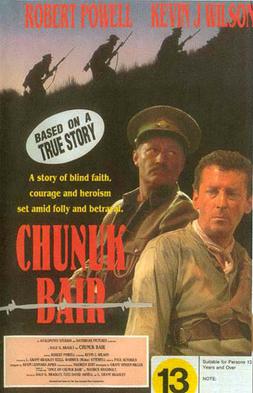
One of the New Zealand military’s functions is to assist civilian organisations where no viable civilian resources are available. One such example of this support was in 1991 when the NZ Army provided expertise and personnel to help produce the movie, Chunuk Bair.
The high point of the New Zealand effort at Gallipoli was the capture of Chunuk Bair, a key feature on the Gallipoli Peninsula. Captured by the Wellington Battalion under Lieutenant-Colonel William Malone on 8 August 1915, the New Zealanders would hold the position against violent counterattacks by a motivated and well-led opponent until relieved by British Battalions on 9 August. The latter were driven off Chunuk Bair in a counterattack led by Mustafa Kemal on the early morning of 10 August.
The anti-Vietnam protest movement of the 1960s and 70s had caused anything related to the ANZAC legend to become unpopular in New Zealand, with ANZAC day commemorations mainly attended by veterans and serving military personnel. The 1981 Australian movie Gallipoli, with its powerful anti-British theme,was released and considered an ‘event of national significance in Australia. This spike of interest across the Tasman was a turning point and provided the springboard for New Zealand playwright Maurice Shadbolt to provide his contribution in enhancing the notion of Gallipoli as the birthplace of New Zealand as a nation with the events at Chunuk Bair as a source of national pride.
Shadbolt’s play Once on Chunuk Bair would open to much praise from the theatre gong public on ANZAC Day 1982 at Auckland’s Mercury Theatre and would reinforce Shadbolt’s view that Chunuk Bair marked the birth of the nation freed from the shackles of British Colonialism. Once on Chunuk Bair gave the battle of Chunuk Bair the same national significance to New Zealand that the Australians place on their magnificent debacle at Lone Pine and the Nek. Despite a short theatrical run, Shadbolt’s play would become popular in schools and universities as it was taught and performed as part of the educational experience in a similar way that the Australians use the movie Gallipoli.
With the 75th anniversary of Gallipoli observed in 1990, a shift in public consciousness toward Gallipoli was revived, and Once on Chunuk Bair was made into a movie during 1991. Produced on a low budget and aimed at a New Zealand audience. The Army Museum provided much technical advice, uniforms and props, with the Army also providing significant assistance to the production, including expertise in explosives and many Men as extras. RNZAOC ammunition technical officer (ATO) Ian Juno would be listed in the credits as providing the special effects, and a sizable quantity of soldiers from 1 Base Supply Battalion would feature in many scenes as extras.
With production compressed within four weeks, many of the Large-scale battle scenes were filmed on Wellington’s south coast, a near facsimile of the terrain of Gallipoli, with the more detailed scenes filmed in a specially constructed set at the Avalon studios.
Although the final product was disappointing and did not have the same polished attributes as the earlier Australian movie Gallipoli, it complements Christopher Pugsley’s 1984 TVNZ documentary Gallipoli: The New Zealand Story, the Voices of Gallipoli in establishing the Gallipoli Campaign and the Chunuk Bair battle as the cornerstones of the national identity.
As New Zealand’s Army’s central stock holding unit, 1 Base Supply Battalion(1BSB) was responsible for managing and providing depot-level storage of New Zealand’s Military’s stock of land equipment and spares. Despite having this responsibility since 1920, 1BSB and its predecessors had always struggled with providing suitable warehousing infrastructure and made do with the available storage infrastructure.
With no purpose-built storage accommodation, from 1920 to 1940, the NZAOC Main Ordnance Depot (MOD) utilised up to one hundred camp administrative and accommodation structures as its primary means of warehousing. Relief was provided in 1938 when contracts were issued to construct a modern warehouse utilising the most modern of methods and materials.[1] The New warehouse, later known as Building 73, was constructed using reinforced concrete and designed with nine bays that allowed the loading and unloading of Trains on one side and Motor Transport on the other. The design and layout of building 73 were utilised as the model for new warehouses constructed at Burnham, Hopuhopu and Waiouru.
Building 73
Although Building 73 provided a considerable increase in storage capability, wartime demands soon necessitated further increases in storage infrastructure, resulting in the construction of Building 74. Building 74 and the warehouses constructed in Burnham and Waiouru were close facsimiles of building 73, with the main exception that it was constructed out of wood instead of reinforced concrete due to wartime constraints.[2]
The wartime expansion of the New Zealand military saw the MOD exponentially expand to cope with the influx of military material with additional buildings constructed in Trentham and sub-depots also established a Mangere, Wanganui, Linton Camp, Gracefield and Wellington.
Peace in 1945 brought little respite as stocks were centralised at the MOD, requiring further expansion of the MOD warehousing infrastructure. To meet this need, five warehouses that were built for the United States Forces at Lower Hutt were disassembled and re-erected at Trentham by September 1945.[3] Additionally, the RNZAF Stores Depot constructed at Mangaroa in 1943 was handed over to the MOD in 1949.
Over the next forty years, the warehousing infrastructure at Trentham changed little, with a 1985 NZDF report identifying many deficiencies leading to significant upgrading of Trentham’s warehousing infrastructure.[4]
Main Ordnance Depot 1966
In one of the most significant warehousing infrastructure investments since 1939 and the first modern warehouse built for the RNZAOC since 1972, Building 75, a high stud warehouse capable of holding 3700 pallets, opened in 1988. Although a significant advancement in warehousing capability, the new warehouse had limited space for outsized items. Additionally, many other warehousing functions, such as packing and traffic, remained in Building 73, so further work was required to enhance the functionality of 1BSBs entire warehousing capability.
Building 73 (left), Building 74 (Right)
With trains no longer utilised for the delivery and dispatching of stores, the rail lines between Building 73 and 74 had long been redundant. By removing the rail line and raising the ground level between the two buildings, providing additional storage space of almost two square kilometres, protected from the elements by a 200 x 13-meter roof, was created. At the southern end, a loading ramp was constructed to allow the loading and unloading of trucks, with angled ramps at either end allowing the movement of vehicles along the length of the new storage area. Opened on 2 November 1989, the new warehouse was christened “the Cave.” The Cave allowed the more efficient transfer of stores to and from the storage areas in Buildings 73, 74 and 75 to the receipt, selecting, packing and issuing bays in Building 73.
Lieutenant Colonel P.P Martyn, Royal Australian Army Ordnance Corps. Commanding Officer 1 Base Supply Battalion January 1988 – December 1990, officially opening “The Cave”
The additional storage space allowed the storage of outsized items which had previously been stored at the Mangaroa Depot, which was subsequently decommissioned and handed over to NZDF Property Services.
The optimisation of storage space between the two buildings was so successful a similar modification was constructed between two of 21 Supply Company’s 1950s-era Warehouses at Linton, creating much-needed storage and office space.
Notes
[1] “New Army Ordnance Block Now under Construction at One of the Military Camps,” Evening Post, Volume CXXVIII, Issue 65, 14 Sept 1939.
[2] F Grattan, Official War History of the Public Works Department (PWD, 1948).
[3] “Organisation – Policy and General – Royal New Zealand Army Ordnance Corps 1946-1984,” Archives New Zealand Item No R17311537 (1946).
[4] “Assessment and Audit – Audit Files – [1995] – NZDF Bulk Warehousing,” Archives New Zealand Item No R24596003 (1985).
Publicity photos from the 1950s showing a range of portable Camp Equipment managed by the RNZAOC
Safes-Meat Portable
A required item to preserve meat in Field Kitchens in the days before portable refrigeration.
Stands Ablution Portable
This item is designed so that soldiers, when in a field camp environment, can have a place to carry out their daily ablutions.
Consisting of a sink top with a drain trough and bar to hang towels and mirrors, soldiers washed and shaved using a basin. On completion of their business, the contents of the basin were tipped into the drain from where it flowed into a sump dug into the ground
Stand Ablution Components. Robert McKie Collection
Stand Ablution laid with its compontrs laid out;
Bar Towel/Toprail, Qty 1
Leg Ablution Stand End, Qty 2
Leg Ablution Stand Center, Qty 1
Brace Ablution Stand, Qty 2
Drain Sink, Trough, Qty 1
Drain, Lavartory pipe, Qty 1
Bolt securing, Qty 4
The above picture shows the Stand Ablution in the final stages of assembly with the two soldiers about to fir the Bar Towel/Top-rail to the Leg Ablution Stand Ends. Once the Bar Towel/Top-rail was attached, the braces were bolted tight and the Drain Sink, Trough and Drain, Lavatory pipe were attached.
Mess Kit Washup
Used in conjunction with a kerosene heater, these tubs were assembled over a small trench with the chimney device drawing heated air under the tubs, heating them up.
This set-up was based on the three-pot cleaning method.
Before washing. plates and utensils were thoroughly scrapped clean into a rubbish bin.
Sink 1: Wash sink – Full of hot soapy water, utensils are given a good scrub with a brush or dishcloth.
Sink 2: Hot-rinse sink -, Filled with clear, hot water, utensils rinsed in this sink.
Sink 3: Cold-rinse sink – Utensils undergo a final rinse in water which had a few drops of bleach or other sanitising argent added to it
Field Cook House
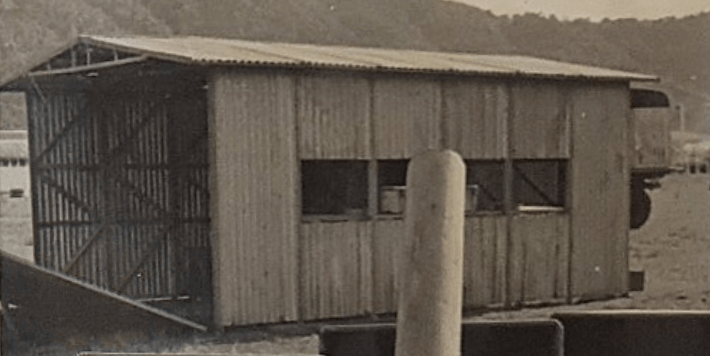
In the background of these photos, a Field Cook House can be seen. This portable building was designed to be used as a Field Cookhouse, which could easily be assembled from components.
The Bryan Nelson Jennings Memorial Trophy would, for a short period in the 1990s, be a coveted trophy awarded to the most outstanding Automotive Parts and Accessories Merchandising Apprentice of the Royal New Zealand Army Ordnance Corps(RNZAOC).
Apprenticeships for the Automotive Parts and Accessories Merchandising Trade (AP Trade) had been established in 1965 to provide the RNZAOC with skilled tradespeople for employment in RNZAOC Workshops Stores Sections that had been established as part of Royal New Zealand Electrical Mechanical and Electrical Engineers(RNZEME) Workshops and Light Aid Detachments in 1962.
The role of RNZAOC Stores Sections was to carry and manage the specialised holdings of spares, assemblies & workshop materials (Class 9 stores) of their parent workshops.
Administered by the New Zealand Trade Certification Board (now the New Zealand Qualifications Authority), the Automotive Parts and Accessories Merchandising apprentice training scheme consisted of 9000 working hours of study and on the job training with three Trade Board examinations required to gain the trade qualification.
Initially, apprentices would begin their training as 16-year-old Regular Force Cadets (RF Cadets), who, on graduation, would complete their apprentice training at the Main Ordnance Depot, MT Spares Section at Trentham Camp. However, during the 1970s, RNZAOC direct entry recruits were also accepted as apprentices.
Further progression in the AP trade was achieved by qualified apprentices undertaking the New Zealand Management Certificate in Automotive Parts & Accessories Merchandising. the first two Certificate level qualifications were awarded in 1988 To;
Sergeant M Wilson (0001)
Sergeant S O’Brien (0002)
The final AP Trade Apprentice would be recruited in 1996, following which the apprentice scheme would cease as the foundation for the AP Trade.
Warrant Officer Class One Bryan Nelson Jennings
Bryan was born in Wellington in 1926. Too young to see active service in WW2, Bryan served with the Melrose Battalion, Wellington South Home Guard unit from 1 April 1943 to 1 April 1944, attaining the rank of Corporal.
Volunteering for service with ‘J ‘ Force, the New Zealand component of the British Occupation Forces (BCOF) in Japan, Bryana would be posted to 4 New Zealand Base Ordnance Depot (later renamed to 4 NZ Ordnance Field Park) in August 1946. Completing his engagement, Bryan would return to New Zealand on 14 September 1947. Following a short period posted to the Main Ordnance Depot in Trentham as part of the post-war Interim Army, Bryan was soon discharged and returned to civilian life.
Enlisting into the Regular Forces RNZAXCO on1 April 1948, Bryan undertook a short period of refresher training at the Army School of Instruction at Trentham before being posted to the Main Ordnance Depot as a storeman in the Technical Spares Group and later in the Tyre Store.
Temporarily posted to 10 Coastal Regiment RNZA at Fort Dorset, Bryan, like many of his contemporaries, would be employed on the wharves during the 1951 Waterfront Workers strike.
Promoted to Temporary Sergeant on 25 November 1953, Bryan would be promoted Staff Sergeant on 13 October 1958. Poste to 1 Composite Ordnance Company n loan back in 1964, Bryan would remain at the Main Ordnance Depot.
Posted to 1 General Troops Workshops, Stores Section, Linton Camp as a Warrant Officer Class Two in 1965, Bryan would soon find himself loaned back to the Central Districts Motor Transport Workshops at Trentham.
Seconded to the New Zealand Cadre (Fiji) of the Fijian Military Forces in 1968 as a Temporary Warrant Officer Class One in 1968, Bryan would spend the next two years assisting in the training and development of the Fiji Military Forces.
Returning to New Zealand in January 1971, Bryan was posted to 1 Base Workshops, Trentham and promoted to Warrant Officer Class One. Bryan would remain at 1 Base Workshops and the IC Stores section until his release from the army on n 21 April 1981.
During Bryans more than thirty-two years of service, he was awarded the Long Service and Good Conduct medal on 25 March 1965, followed by the Meritorious Service Medal on19 April 1978.
Following his retirement, Bryan would remain in Upper Hurt. Staying engaged with the community, Bryan was an active member of the Lions organisation and a member of the School Board of the Heretaunga College.
Bryan passed away on 9 August 1989 at Upper Hurt after a long illness.
In his memory, The Bryan Nelson Jennings memorial trophy was instituted in 1991. Although not an AP Trade Apprentice himself, Bryan was a mentor to many apprentices and was described as a legend in the trade.
The object of the award was to provide a tangible mark of achievement and was intended to encourage junior soldiers of the AP trade to reach and maintain a high standard of professional competence and personnel integrity.
Nominations for the award were graded against the following attributes:
Basic Soldier Skills
Loyalty
Sportsmanship
Enthusiasm
Dress, bearing and personnel appearance
Trade Skills
Personnel eligible for consideration for the trophy were to meet the following requirements
Not be above the rank of Substantive Lance Corporal
Must have attended either 1st, 2nd or 3rd qualifying examinations in the past 12 Months
Must still be serving their apprenticeship.
The Trophy now resides at the Trade Training School of the Royal New Zealand Army Logistic Regiment.
Military conscription in New Zealand was first introduced in 1910 to build and maintain a credible force that would allow New Zealand to play its part in defence of the British Empire. Initially intended to feed the Territorial Army, conscription was extended in 1916 to allow men to be conscripted directly into the New Zealand Expeditionary Force (NZEF). Conscription would be suspended during the lean post-Bellum years and re-established in 1940 as a wartime measure to satisfy New Zealand’s wartime personnel commitments.
New Zealand’s 1945 post-war commitments required the raising and mounting of a Division for service in the Middle East. The only way the personnel requirements for a Division could be met would be through conscription. A referendum was conducted in1949, resulting in a yes for Compulsory Military Training (CMT), which would commence in 1950.
The CMT scheme would train 63033 men up to 1958 when the Labour Government ceased CMT. In 1961 the National Government introduced a new National Service Act, which would require all males to register with the Labour Department on or before their 20th birthday. Following registration, ballots would be conducted to select individuals to undertake military training.
Training would consist of three months of initial full-time training, during which the men would be given the choice of three weeks part-time training in a Territorial unit for three years or one year’s service in a Regular Force unit. The National Service Scheme would last until 1972, when it was discontinued due to a changing social and economic environment.
Since 1972 there has been no Military conscription in New Zealand. Since 1972 there have been many calls for the re-introduction of Military conscription to instill a sense of citizenship and discipline to reduce unemployment and youth crime. However, no major political party has made any significant policy statements on the re-introduction of military conscription.
The following are the remanences of John Mudgway, who at the age of 19, was selected by Ballot to undertake National Service as part of the first intake in 1961.
My Military Career by John Mudgway
When the National Government brought back military service in 1961 it was named National Service. We had to register with the Labour Department and the Golden Kiwi lottery marbles were used to draw certain birth dates. The “winners” of these birth dates were ordered into Waiouru Military Camp for 7 weeks basic training and were then posted to a Territorial Unit to complete their 3-year term. This was done in 3 annual camps, plus local parades. They then went to reserves for a further three years.
There was an option offered to us – which was we could serve one-year regular force and then be put on reserve for a further 3 years. I chose the latter.
Waiouru Camp 10 May 1962 – 27 June 1962
I was posted to Waiouru Military Camp and arrived on 9th May 1962, along with 549 other young lads.
Above left – Recruits leaving the train at Waiouru Camp rail siding before entering the camp to begin 14 weeks training, at the end of which they will be posted to “Territorial Force Units.” Right – Recruits E L McFeran (left) and R A Shaw sorting out equipment, clothing and bedding in their barrack room.
I did seven weeks basic training – learning the military way of life, marching, shooting, and cleaning boots and weapons etc. One lasting memory I have is of being told that – in the event of an atomic blast, lay on the ground, cover myself with my greatcoat, have no skin exposed – and I would survive!
John Mudgway (Hastings), Ned Kinita (Waipukurau) and Robyn Gunderson (Dannevirke).
Trentham Military Camp 28 June 1962 – 9 May 1963
When I arrived in camp, RSM Ordnance Schools, School Sergeant Major Alfred Wesseldine, decided they would not run the school for just me, so I was posted direct to MT Spares for the duration of my service.
Myself (Pte John Mudgway) (on left) and Dennis Leslie Goldfinch (who retired as a WO1). We are facing the main building of MT Spares in the MOD Compound. August 1962. Behind us in part of the wavy roof building, was the Uniform Store and smoko room. On our left is a large, grassed area that was covered in 25 pounder artillery pieces that were being cut up for scrap by a private contractor. Further to the left was the Tyre Store that “Goldie” was in charge of.
Below is the two of us in 2012 (50 years later)
During my service in RNZAOC I participated in several events.
I was part of a Guard of Honour for the Chief of the Imperial General Staff at Wellington Airport when he flew in. I was also in a Guard of Honour for the NZ Chief of Staff at Wellington Airport when he flew in.
I was part of the street lining contingent that paraded on the streets of Wellington City for the Queen when she visited in February 11 & 12 1964. (I saw her 23 times). We drove the streets of Wellington in 2 RL Bedfords, to places in streets she was to move through, detrucked and stood at attention on the road-sides while she passed, back to the trucks and on to our next destination. She must have thought there were a lot of handsome young lads in our army.
Escorted a prisoner the Ardmore Prison, by overnight train in 1964. I was the junior escort.
I was dragged out of the barracks at 2am one morning and trucked over to Mangaroa, Whitemans Valley Tent Loft to drag tents from a burnt-out building.
One of my jobs during my service was to sit out between two of the stores buildings and empty the brass fire extinguishers that had been returned to us from all the other stores round the country. These extinguishers were filled with carbon-tetrachloride and after spraying the contents into buckets for several days we were quite “high” ourselves. I presume the brass containers went for scrap.
During my time in M T Spares I worked with Staff Sgt Kevin Anderson, Goldie of course, and Pte’s Vic Fletcher and Tammy Tamihana. Our Stores Officer was Geoff Atkinson first, then latterly Captain R G H Golightly. Our C S M was WO 1 Maurie Bull. We also had some civilian workers in our stores, one of whom was retired Sgt Bert Royal. Also there were a group of prisoners from Waitako Prison that used to come and do the “dirty jobs” that we didn’t have to do.
I also did a couple of Camp Patrols in the MOD Compound. We had to patrol the compound several times during the night and were supposed to sleep in the Gate House.
Trentham Camp 26 July 2012
Not a bad years work for a 19/20 year old Hastings lad.
The RNZAOC experienced a momentous period marked by key developments. Establishing the RNZAOC School was a notable milestone, alongside identifying challenges related to officer recruitment. This era also witnessed the realisation of plans to modernize and equip the Army with state-of-the-art resources. The initial deliveries of new equipment arrived, replacing a significant portion of the outdated wartime equipment and contributing to the transformation of the Army into a modern and well-equipped force.
Key Appointments
Director of Ordnance Services
Temporary Lieutenant Colonel H. McK. Reid
Chief Inspecting Ordnance Officer
Major JW Marriot
Officer Commanding Main Ordnance Depot
Major Harry White, from 1 May 1959
RNZAOC School
Chief Instructor – Major Harry White
Regimental Sergeant Major – Warrant Officer Class One Alfred Wesseldine
2nd Battalion, the New Zealand Regiment
In July 1959, the 2nd Battalion of the New Zealand Regiment was reestablished at Waiouru. The battalion embarked on a rigorous workup and training phase, preparing them for their deployment to Malaya in November 1959, where they would relieve the 1st Battalion. To support the training and preparations of the 2nd Battalion, the RNZAOC furnished the battalion with the essential equipment it required by drawing from existing stocks. This ensured that the battalion was fully equipped from the ground up to fulfil its operational requirements.
Establishment of RNZOAC School
Upper Hutt City Library (29th Jan 2020). Trentham Camp; Royal New Zealand Army Ordnance Corps School sign.. In Website Upper Hutt City Library. Retrieved 14th Jul 2020 11:51, from https://uhcl.recollect.co.nz/nodes/view/1335
Under discussion by the Army Board since 1956, the RNZAOC School was established in September 1959. Established within the Peacetime Establishment of the Main Ordnance Depot, the RNZAOC School would be under HQ Ordnance Services’ direct control and independent of the Army Schools.[1]
The initial school organisation would be.
A Headquarters,
Chief Instructor – Major Harry White
School Sergeant Major – Warrant Officer Class One Wesseldine
Ammunition Wing
Stores and Vehicle Wing
The function of the RNZAOC School would be to run courses and training for RF and TF personnel of the RNZAOC, including
Star Classification Courses – particularly for Storeman/Clerks RNZAOC and Ammunition Examiners.
Promotion courses for both officers and ORs.
Recruit training RNZAOC Personnel, including Recruit training for Group 2 personnel.
Advanced training for both officers and ORs, in all types of Ordnance activities.
Technical training in ordnance subjects, e.g. Inspecting Ordnance Officer courses.
Preservations and packing etc.
Refresher training for qualified personnel.
Other courses notified in the annual Forecast of Courses.
Additionally, as directed by DOS, the RNZAOC School was required to.
Plan and hold conferences and training exercises.
Draft procedure instructions.
Test, or comment on new procedures, materials, or equipment.
Research various aspects of Ordnance activities.
The first course conducted by the RNZAOC School would be an instructor’s Course conducted in late 1959.
First Instructors Course, 1959.
Chief Instructor Major Harry White is seated 3rd from left.
Officer in the front Centre id Makor K.G Cropp.
Robert Mckie RNZAOC Collection
Officer Shortfall
A projection of planned retirements for RNZAOC Officers up until 1962 indicated that a total of seventeen officers would be leaving the service. Historically, the main method of filling RNZAOC officer positions had been through the commissioning of Other Ranks with Quartermaster Commissions. However, since November 1956, only three officers had joined the RNZAOC directly as officers.
Upon evaluating the planned officer retirements in relation to the RNZAOC officer establishment, it was discovered that the organization faced a deficiency of six officers. This shortage highlighted two significant issues that needed to be addressed.
The RNZAOC Officer Corps was becoming a Corps of old men, with 83% of Officers in the 39 to 54 age group
The RNZAOC Other Ranks Structure was denuded of the best SNCO’s and Warrant Officers.
To rectify the situation, the following recommendations were made.
The RNZAOC press for an increased intake from Duntroon and Portsea of graduates to the RNZAOC.
Suitable officers no older than 30 years of age, and in the two to four-year Lieutenant bracket, be encouraged to change Corps to the RNZAOC.
Further commissioning of QM officers be strongly resisted unless there was no other alternative.
Conferences
Over the period 1 -3 September 1959, DOS hosted a conference at Army HQ for the District DADOS, Officer Commanding MOD, and the Ordnance Directorate members. The general agenda of the meeting included.[2]
Local purchase of stores by DADOS
Training of group 2 Personnel
RNZAOC School
Provision Problems
Surplus Stores
Personnel – postings and promotions
DADOS and OC MOD were required to provide in duplicate, personnel lists by unit containing.
Regimental No, rank, and name
Marital Status
Establishment statue, either PES, CSS or HSS
Present posting
Purchases for RF Brigade Group
District Problems
Small Arms Ammunition
With the introduction of the 7.62mm rifle, the Colonial Ammunitions Company (CAC) faced the task of transitioning its manufacturing from the existing .303 calibre to the new 7.62mm calibre. Having served as the supplier of Small Arms Ammunition to the Defence Force since 1888, the CAC was committed to maintaining this longstanding relationship. The company invested in the necessary tools and machinery to produce 7.62mm ammunition to fulfil this commitment. During this period, they successfully completed their first production run of the new calibre. While the NZ Army possessed sufficient stocks of .303 ammunition for the foreseeable future, the CAC retained the capability to manufacture .303 ammunition if needed.
Introduction of New Equipment
The RNZAOC played a vital role in the acceptance processes of newly introduced equipment. Upon arrival from the supplier, the equipment, accessories, and spare parts were received at the Main Ordnance Depot. Thorough inspections were conducted, and the equipment was outfitted with all necessary accessories before being distributed to the respective units. Depending on the equipment, a few examples might have been retained in RNZAOC Depots as War Reserve/Repair and Maintenance Stock.
RNZAOC depots maintained maintenance stocks of accessories and spare parts as operating stock to ensure operational readiness. If the new equipment included a weapon system, the RNZAOC Ammunition Depots managed the specific ammunition required. During this period, the following equipment was introduced into service;[3]
110 Land Rover Series 2a 109.
144 Truck 3-Ton Bedford RL, 48 fitted with a winch
3 Ferret Mark 1/1 Scout Car
270 Wireless Sets. C45 – VHF transceiver,
2000 9mm Sub Machine Gun Sterling Mk4 L2A3.
500 7.62 mm Self Loading Rifle, L1A1 (SLR).
Uniforms
The Clothing and Equipment Committee approved the adoption of a standardized training uniform for New Zealand soldiers across all conditions within New Zealand. This uniform would serve as the foundational attire for training purposes.
Boots (Fory types under trial and development)
Anklets (Australian pattern)
Shirt (light wool)
Trouser ( Green drill material cut to UK pattern)
Hat (Jungle Type)
Disposals
In August 1958, the Army established a new organization dedicated to handling the declaration and disposal of surplus and obsolete equipment. Since August 1959, this disposal organization has declared over 9,000 lines, encompassing thousands of items, to the Government Stores Board for Disposal.
Ammunition Disposal
The disposal process for dangerous or obsolete ammunition continued, dumping over 900 tons of outdated ammunition at sea. Approximately 130,000 rounds of hazardous artillery ammunition were also destroyed through controlled burning or detonation.
Efforts were made to salvage the maximum amount of recyclable metal whenever feasible. These salvage operations yielded around £10,000 (equivalent to NZD $243,276 in 2020) from the sale of scrap metal and containers.[4]
Ration Packs
In 1959, the Royal New Zealand Army Service Corps (RNZASC) assembled a total of 24,000 one-person 24-hour Ration Pack No. 1 following successful user trials. These ration packs, accompanied by newly introduced solid fuel cookers, were extensively utilized by the 2nd Battalion of the NZ Regiment during the build-up training for Malaya and by the Territorial Force during the Annual Camp.
Shooting Competition
Staff Sergeant I.G Campbell, RNZAOC was selected by the National Rifle Association as a team member representing New Zealand at 91st Annual Prize Meeting at Bisley in the United Kingdom, 4- 20 July 1960.
Award of Army Sports Colours
Major D.E. Roderick from Auckland was awarded the 1960 Army Sports Colours in appreciation of his notable contribution to Army Sport. Major Roderick excelled as a representative of the Army in cricket, hockey, and badminton and played a pivotal role in developing sports facilities at Trentham Camp. Additionally, within the RNZAOC, Major Roderick held a longstanding membership with the Upper Hutt Cricket Club and served as both a player and administrator for the MOD Cricket team. [5]
Honours and Awards
British Empire Medal
Sergeant (Temporary Staff Sergeant) Maurice William Loveday, Royal New Zealand Army Ordnance Corps (Regular Force), of Trentham.[6]
Appointments, Promotions, Transfers, Resignations, and Retirements of Officers of the RNZAOC
Regular Force
Major Ronald Geoffrey Patrick O’Connor is transferred to the Reserve of Officers, General List, Royal NZ Army Ordnance, in Major’s rank, 4 May 1959.[7]
Major and Quartermaster K. A. Bailey, M.M., having reached retiring age for rank, is transferred to the Supernumerary list, and granted an extension of his engagement until 12 January 1960, 11 August 1959.[8]
Captain Frederick George Cross is transferred to the Reserve of Officers, General List, Royal NZAOC, in the rank of Captain, 1 September 1959. [9]
Captain L. C. King is re-engaged for a period of one year, as from 4 October 1959.[10]
Captain (temp. Major) J. Harvey relinquishes the temporary rank of Major, 6 March 1960.[11]
Regular Force (Supernumerary List)
Major and Quartermaster K. A. Bailey, MM., is granted an extension of his engagement for one year from 13 January 1960.[12]
Captain and Quartermaster S. H. E. Bryant is re-engaged for one year as from 28 October 1959.[13]
Captain and Quartermaster R. P. Kennedy, E.D., is re-engaged for a period of one year as from 13 April 1960.[14]
Lieutenant and Quartermaster George Witherman McCullough is posted to the Retired List, 12 February 1960.[15]
2nd Lieutenant J. T. Skedden to be Lieutenant, 12 December 1959.[16]
Lieutenant and Quartermaster R. H. Colwill to be temporary Captain and Quartermaster, 9 February 1960.[17]
Territorial Force
Captain Keith Stothard Brown relinquishes the appointment of OC, Technical Stores Platoon, 1st Divisional Ordnance Field Park, RNZAOC and is posted to the Retired List, 4 August 1959.[18]
Reserve of Officers
Captain Hugo Sarginsone posted to the Retired List, 10 July 1959.[19]
Captain Noel Lester Wallburton posted to the Retired List, 10 August 1959.[20]
Captain Sidney Paxton Stewart posted to the Retired List, I September 1959. [21]
Major Percival Nowell Erridge, MBE posted to the Retired List, 25 December 1959.[22]
Major Alexander Basil Owen Herd, from the British Regular Army Reserve· of Officers, to be Major, 3 October I 959.[23]
Major Frank Owen L’Estrange, from the British Regular Army Reserve of Officers, to be Major, 11 November 1959.[24]
Captain Cyril Peter Derbyshire, from the British Regular Army Reserve of Officers, to be Captain, 1 January 1960.[25]
Appointments, Promotions, Transfers, Resignations, and Retirements of Warrant Officers, Senior Non-Commissioned Officers, and men of the RNZAOC
Regular Force
H594833 Private David Orr NZ Regiment Transferred into the RNZAOC, November 1959.
B31685 Staff Sergeant Ian McDonald Russell promoted to Temporary Warrant Officer Class Two, 23 June 1959.
Notes
[1] “Charter for the Rnzaoc School,” in Organisation – Policy and General – RNZAOC (Archives New Zealand No R173115371960); Major J.S Bolton, A History of the Royal New Zealand Army Ordnance Corps (Trentham: RNZAOC, 1992), 176-77, 252.
[2]Conferences – Ordnance Officers, Item Id R17188101 (Wellington: Archives New Zealand, 1950).
[3] “H-19 Military Forces of New Zealand Annual Report of the General Officer Commanding, for Period 1 April 1959 to 31 March 1960,” Appendix to the Journals of the House of Representatives (1960).
This period would see the RNZAOC continue to support Regular, Territorial and Compulsory Military Training. This period would also see the formation and deployment to the 1st Battalion, the New Zealand Regiment to Malaya
Key Appointments
Director of Ordnance Services
Temporary Lieutenant Colonel H. McK. Reid from 1 April 1957.[1]
Commanding Officer Main Ordnance Depot
Major O.H Burn
Inspecting Ordnance Officer, Northern Military District
Captain J.H Doone, from 19 July 1957.
Inspecting Ordnance Officer, Southern Military District
Captain E.D Gerrard, from 19 July 1957.
Compulsory Military Training
During this period three CMT intakes marched in with the RNZAOC recruits posted to 1 (NZ) Division Ordnance Field Park on completion of initial training;[2]
24th intake of 1775av recruits on 2 May 1957
25th intake of 1300av recruits on 22 August 1957
26th intake of 1300av recruits on 3 January 1958
1st Battalion, the New Zealand Regiment
Reformed at Waiouru in July 1957, the 1st Battalion of the New Zealand Regiment would undertake workup and training that would see the Battalion deploy on operations in Malaya on 28 November 1957.[3]
The RNZAOC would equip the Battalion from the ground up with its necessary entitlement of equipment provided from existing holdings, including Eighty-Nine vehicles and trailers. However £59000 (2020 NZD $ $2,999,351.94) was expended to procure additional theatre specific items not held in the New Zealand inventory from the United Kingdom authorities in Malaya.[4]
In addition to providing the stores and equipment for the Battalion, RNZAOC Officer Major Jack Harvey was seconded to the 1st Battalion NZ Regiment for the duration of its Malaya tour as the Officer Commanding of C Company. [5]
Major Jack Harvey, RNZAOC Officer Commanding C Company, 1st Battalion, New Zealand Regiment, 1957-59
Members of the 1st Battalion who would later serve with the RNZAOC included;
Brian Crafts
David Orr
Fiji Military Forces
Warrant Officer Class One Murray Alexander Burt was posted on 15 July 1957, on an accompanied posting with his family to the New Zealand Cadre at Queen Elizabeth Barracks in Suva. WO1 Burt and Family would depart Auckland on the Union Steam Ship Company vessel the MV Tofus on 31 August 1957. WO1 Burt would return to New Zealand on 15 December 1959 and be posted to Hopuhopu camp.[6]
Uniforms
A new Service Dress uniform similar to the Officer pattern Service Dress was approved for Other Ranks by the Army Board in 1954 had is design finalised and placed into production during this period. This uniform’s approval satisfied a long-standing requirement for a ceremonial and walking out order of dress to replace the existing Battle Dress.[7]
Manufacture of the new uniforms was well advanced by closing this period with the District Ordnance Depots in a position to issue the new uniforms by the end of 1958.
With this new Service Dress uniform, Battle Dress would become winter working dress with Khaki Drill the summer working dress.
Other Ranks Service Dress
Ammunition
The demolition of the 17000 rounds of unsafe 3.7inch Anti Aircraft Ammunition that had been initiated in June 1955 was concluded in December 1957. The destruction had proceeded without incident with the local residences thanked for their considerable forbearance in putting up with the noise of explosions nearly every day.
During this period, demolitions were also successfully conducted at the Makomako Ammunition area to dispose of a large quantity obsolete and unsafe ammunition and explosives.[8]
Move of Central Districts Vehicle Depot to Linton
The move of the Central Districts Vehicle Depot (CDVD) was planned to occur during 1958. Before the move could happen, adequate storage had to be constructed at Linton Camp, and this was to be achieved by re-locating war surplus buildings from other locations. By June 1957 the second “W” Type prefabricated building for the CDVD was re-located from Fort Dorset to Linton Camp.[9]
Construction Of New Ordnance Depot for Linton Camp
Since its establishment in 1946, the Central Districts Ordnance Depots had occupied accommodation buildings in the North West corner of Linton Camp in what had initially been the wartime RNZAF Base Linton. Two additional warehouses had been assembled in 1949; however, storage space remained at a premium. In June 1957 Army HQ authorised the expenditure of £100 (2020 NZ$5,059.84) to conduct a preliminary site investigation for a new Ordnance Depot for Linton Camp. Given the deficiencies of adequate Storage accommodation and the erection of buildings for the CDVD, the Linton Camp Command issued instructions that the CDOD were not to utilise the new buildings, even temporarily as this would become permanent and prejudice the business case for constructing a new Ordnance Depot.[10]
Honours and Awards
Meritorious Service Medal
Warrant Officer Class One Bernard Percy Banks, 13 June 1957. [11]
Warrant Officer Class One Athol Gilroy McCurdy, 10 October 1957. [12]
Appointments, Promotions, Transfers, Resignations, and Retirements of Officers of the RNZAOC
Regular Force
Regular Force Major H. McK. Reid to be temp. Lieutenant-Colonel, and is appointed Director of Ordnance Services, dated 1 April 1957.[13]
Captain E.C Green, MBE, is re-engaged for one year, as from 1 April 1957.[14]
Lieutenant-Colonel F. Reid, OBE, relinquished Director of Ordnance Services’ appointment, pending retirement, 31 March 1957.[15]
Captain P.N Erridge, MBE., transferred to the Reserve of Officers, General List, The Royal N.Z. Army Ordnance Corps, in the rank of Major, 2 May 1957.[16]
Captain and Quartermaster R.P Kennedy, E.D, re-engaged in the Regular Force for one year from 13 April 1957.[26]
Captain and Quartermaster E.R. Hancock posted to the Retired List, 30 March 1957.[27]
Major and Quartermaster I.S. Miller, E.D., is posted to the Retired List, 20 April 1957.[28]
Captain and Quartermaster G.A Perry, E.D., re-engaged for one year from 1 April 1957.[29]
Captain and Quartermaster A.A Barwick posted to the Retired List, 3 August 1957.[30]
Captain and Quartermaster A Gollan granted an extension of his engagement for one year, as from 19 December 1957.[31]
Reserve of Officers
Lieutenant-Colonel Maurice Salam Myers. posted to the Retired List, 1 January 1958.[32]
Appointments, Promotions, Transfers, Resignations, and Retirements of Warrant Officers, Senior Non-Commissioned Officers and men of the RNZAOC
Regular Force
31266 Warrant Officer Class One, Cyril Austin Baigent to be Lieutenant and Quartermaster, 15 July 1957.[33]
33297 Warrant Officer Class Two, Henry Williamson to be Lieutenant and Quartermaster, 15 July 1957.[34]
33635 Warrant Officer Class Two, William Edwin Smith to be Lieutenant and Quartermaster, 15 July 1957.[35]
31261 Staff Sergeant Ernest Maurice Alexander Bull, Promoted to Warrant Officer Class Two, 30 October 1957.[36]
31257 Warrant Officer Class Two Murray Alexander Burt, Promoted to Warrant Officer Class One, 15 July 1957.[37]
B31695 Sergeant Ian McDonald Russell promoted to Staff Sergeant, 23 April 1957.[38]
Notes
[1] “Appointments, Promotions, Transfers, and Resignations, of Officers of the New Zealand Army,” New Zealand Gazette, No 35, 2 May 1957.
[2] Peter Cooke, Fit to Fight. Compulsory Military Training and National Service in New Zealand 1949-72 (Auckland: David Ling Publishing, 2013), 539.
[3] Brian Clamp and Doreen Clamp, 1st Battalion the New Zealand Regiment (1957-59) Association 50th Anniversary. The First of the First (B. Clamp, 2007), Non-fiction.
[4] “H-19 Military Forces of New Zealand Annual Report of the General Officer Commanding, for Period 1 April 1957 to 31 March 1958,” Appendix to the Journals of the House of Representatives (1958).
[5] Clamp and Clamp, 1st Battalion the New Zealand Regiment (1957-59) Association 50th Anniversary. The First of the First.
[6] Howard E. Chamberlain, Service Lives Remembered : The Meritorious Service Medal in New Zealand and Its Recipients, 1895-1994 ([Wellington, N.Z.]: H. Chamberlain, 1995), 69-70.
[7] “H-19 Military Forces of New Zealand Annual Report of the General Officer Commanding, for Period 1 April 1957 to 31 March 1958.”