New Zealand Contract Sniders

As explored in From Flintlock to Modular Assault Rifle, the development of New Zealand’s military capability has never been a simple story of adoption. It is a story of adaptation, of modification, and at times of quiet innovation driven not by doctrine, but by necessity. Geography, terrain, and the demands of irregular warfare forced colonial authorities to think differently about equipment, often well ahead of formal Imperial acceptance.

This article is reproduced with the kind permission of Paul Farmer, whose extensive research into early New Zealand military firearms has significantly advanced the understanding of colonial small arms and locally adapted weapon systems. His work, grounded in detailed examination of surviving examples and primary sources, provides an authoritative foundation for interpreting the unique characteristics of New Zealand contract Snider arms.

Paul Farmer’s examination of the New Zealand contract Sniders sits squarely within that tradition. The Snider system itself was an Imperial solution to a global problem, the rapid conversion of muzzle-loading rifles to breech-loading capability. Yet, as this article demonstrates, New Zealand did not simply accept the standard pattern. Instead, it selected, modified, commissioned, and in some cases effectively designed variants tailored to its own operational environment.

What emerges is not just a catalogue of weapons, but a case study in colonial procurement and adaptation. The preference for shorter, more manoeuvrable arms, the willingness to convert existing stocks, and the commissioning of non-ordnance pattern weapons all reflect a force operating under constraints, but thinking with a degree of independence that is often overlooked.

In that sense, these rifles are more than artefacts. They represent an early expression of a recurring theme in New Zealand’s military history, the tension between standardisation and suitability, between what is issued and what is actually needed in the field.

Seen through that lens, Farmer’s work does more than document four unique weapon types. It reinforces a broader point, that New Zealand’s military effectiveness has often depended less on what it was given, and more on how it chose to adapt it.


New Zealand Contract Sniders

by Paul Farmer – April 2026

Introduction

The Snider breech-loading system was introduced into British Army service by converting existing .577 calibre muzzle-loading rifles and carbines to the new breech-loading design, each brought into conformity with an approved Sealed Pattern. Once the supply of suitable arms for conversion was exhausted, a further Sealed Pattern was established, and newly manufactured Sniders were produced to that standard.

New Zealand, however, commissioned four distinct Snider variants. As these were non-Ordnance, trade-made arms, they were not assigned formal pattern designations. Although widely used in New Zealand service, they were referred to only in generic terms: Snider medium rifle, Snider short rifle, and Snider carbine. In the following ‘New Zealand contract Sniders’, to simplify identification, I have added a descriptive designation that reflects their origin and development.

New Zealand Contract Sniders

The first Sniders to enter New Zealand Government service were reported by the Hon. W. Gisborne, Commissioner of the Armed Constabulary, on 29 November 1869[1]. Gisborne noted:

“The Imperial Government have sent from England on loan, and for use of the Colony, 1832 converted Sniders, and have also handed over from Imperial stores in Auckland 168 more making a total of 2000, all excepting 100 being of the long Enfield pattern and therefore unfitted for bush warfare; the 100 being sword-rifle pattern may be considered suitable and are now being issued to the Armed Constabulary.”

These converted Sniders would have had the MK II** breech as the MK III breech system was not approved until January 1869.[2] Gisborne further reported:

“There are also 500 medium rifles converted to Snider shortly expected by the Melita. These, however, being longer than the sword-rifle referred to above, are not suitable, but they will be temporarily issued to the Armed Constabulary.”

The Melita arrived in Wellington on 15 December 1869, bringing with it 500 Hay medium rifles converted to the Snider system.[3]  

Over the following two decades, multiple shipments of Sniders of various types arrived from England, including long and short rifles, as well as artillery, cavalry, and yeomanry carbines. Supplies were drawn both from the commercial trade and from ex-ordnance pattern arms sold out of Imperial service. These were the arms of the Armed Constabulary and the New Zealand Militia.

By 1885, approximately 11000 Snider rifles were in service,[4] increasing to around 14000 by 1891.[5] Sniders served New Zealand effectively from 1869 through to the 1890s, after which their gradual replacement began with the introduction of Martini-Henry rifles and carbines.

Amongst all the Sniders ordered, New Zealand commissioned four unique Sniders to be produced. These will not be found in references on British ordnance Sniders because they are not ordnance pattern arms. The following sections will describe these four Snider arms and explain why each represents a uniquely New Zealand Snider variation.

Top: New Zealand Contract 1869 Hay-Snider Medium Rifle
Second: New Zealand Contract 1874 Snider Short Rifle, Bar on Band
Third: New Zealand Contract 1874 Snider Short Rifle, Bar on Barrel
Lower: New Zealand Contract 1872 Tisdall Snider Carbine. Images of arms & bayonets – Paul Farmer

1. New Zealand Contract 1869 Hay-Snider Medium Rifle

Development: The Hay medium rifle originated with the 1858 design developed by General Hay of the School of Musketry at Hythe, England. Hay sought to produce a rifle offering greater accuracy than the then-current service 2-band short rifle, which featured a 33-inch barrel with 3 groove rifling and a 1 in 78-inch twist. Comparative trials demonstrated that altering the rifling twist from 1 in 78″ to 1 in 48″ significantly increased muzzle velocity and, correspondingly, improved accuracy. Further gains were achieved by extending the barrel length to 36″, which produced a muzzle velocity comparable to that of the accurate 3 band long rifle, fitted with a 39″ barrel and 3 groove rifling with 1 in 78″ twist.

Despite these advantages, the Hay medium rifle was never accepted as an ordnance pattern arm. The British Army retained the established 3-band long rifle and adopted the new Pattern 1858 short rifle, bar on band, also rifled with a 3 groove, 1 in 78″ twist.

Consequently, no medium rifle entered Imperial service.

New Zealand, however, embraced the Hay medium rifle. The Colonial Government initially placed two contracts for this arm, each for 5,000 rifles.[6]

The first contract, supplied by Hollis & Sheath, arrived in New Zealand in February 1861.[7] These rifles were fitted with undated lock plates and rear sights graduated to 1,150 yards. Upon entry into colonial service, they were stamped “NZ” and issued with consecutive numbers from 1 to 5,000 on the butt tang.

The second contract was supplied by Calisher & Terry.[8]  Rifles from this contract were also stamped “NZ” on the butt tang, but incorporated a letter prefix preceding the issue number. Each letter series ran consecutively from 1 to 1,000, after which a new prefix was introduced, and numbering recommenced at 1. I have sighted Calisher & Terry made Hay rifles bearing the letter prefixes G,  I, J, and K. Presumably, the complete prefix sequence was G, H, I, J, and K, representing 1,000 arms per prefix and a total production of 5,000 rifles. These rifles were fitted with rear sights graduated to 1,200 yards, and the lock plates were stamped TOWER over 1865. (It is reported that some rifles have lock plates with Tower over 1874)

From the perspective of the New Zealand Colonial forces, the Hay medium rifle represented the principal muzzle-loading percussion arm of the Second New Zealand Wars.

The Conversion of Hay Medium Rifles to Snider

New Zealand initiated the conversion of the Hay medium rifle to the Snider system. It is recorded that as on 14 January 1869, “500 new Medium Rifles are packed ready for shipment”.[9] These rifles were supplied by the Auckland Colonial Storekeeper, Captain Mitchell, and packed in 25 cases. They departed Auckland aboard the Countess of Kintore on 11 March 1869, bound for London.[10] Conversion was undertaken by the trade using the Mk III Snider breech, producing what are properly described as the 1869 Hay-Snider Medium Rifle. These converted rifles returned to New Zealand aboard the Melita, arriving in Wellington on 15 December 1869.[11]

Available evidence suggests that the “new Hay Medium Rifles” shipped for conversion comprised the final batch of 500 unissued Calisher & Terry made medium rifles from the K series with 1865 dated locks. Support for this interpretation rests on the fact that all converted examples observed fall within the upper half of the 1–1,000 numbering range and bear both the NZ mark and the K prefix.

The conversion process involved removing 2½” from the barrel at the percussion knuckle end. The shortened barrel was then threaded to accept the receiver body, or shoe, carrying the Snider Mk III breech block. Once fitted, the overall length of the rifle remained at 36″, but the effective barrel length was reduced to 33.5″. Reduced muzzle performance necessitated the replacement of the original 1,200-yard graduated rear sight with one graduated to 1,050 yards. The ramrod was reduced in diameter and weight, effectively becoming a cleaning rod. The redundant ramrod retention spoon was removed, and an internal cleaning-rod retaining nut was fitted forward of the trigger plate. The K prefix and issue number of the butt tang were duplicated on the shoe. New commercial inspection marks and proof stamps were applied. All original markings not affected by the conversion process were retained. The butt tang may or may not have an “s” stamp, indicating a short stock. When measured, the stock was much the same length, regardless of the “S” stamp.

Conversions were carried out by both the London Small Arms Company (L.S.A. Co.) and the Birmingham Small Arms Company (B.S.A. Co.). B.S.A. Co. undertook the majority of the Hay conversions. Their Mk III breech and shoe assemblies appear newly manufactured, presenting a cleaner overall appearance. The K prefix issue number of the butt tang was duplicated on the shoe. The Snider patent mark was in a lozenge-shaped stamp. Proof and inspection marks are of Birmingham origin, and the hammer face is flat.                       

The L.S.A. Co. conversions, of which I have sighted two examples, are characterised by extensive numbering, with new proofs and inspection marks of London origin. In these examples, the shoe—originally an Mk II**—was modified by stamping “III” to denote Mk III, while retaining the original ** marking, and fitting a Mk III breech block. The K prefix and issue number on the butt tang were duplicated on the shoe. The Snider patent mark is stamped in-line, rather than lozenge-shaped. L.S.A. logo and proof marks were applied to the breech. The hammer face remained cupped. The abundance of numbering and cross-marking leaves little doubt that all components were matched to a single rifle during conversion.

An additional “AC” stamp was applied to the butt tang in New Zealand when the rifles were issued to, and deployed with, the Armed Constabulary in 1870.

Summary: The 1858 Hay medium rifle had extensive use in New Zealand, but was never used in Imperial service. With the advent of the Snider system, New Zealand contracted to have 500 of its own “N Z” marked, K prefix percussion Hay medium rifles converted to the Snider in England, to become the New Zealand contract 1869 Hay-Snider medium rifle.

There was no ordnance Snider medium rifle in Imperial service.

The New Zealand Hay-Snider medium rifle is a uniquely New Zealand arm.

Today, it is still largely unknown outside of New Zealand. In an updated 2025 reference, it is still referred to as “the unidentified Snider Medium rifle”. [12] [13]

Description of the New Zealand Contract 1869 Hay-Snider Medium Rifle

Overall Length: 51 7/8
Barrel Length:33 1/2
Calibre: 25 bore     .577
Rifling:3 groove   1 in 48″
Lock Plate:TOWER over 1865, stamped ‘Terrys’ inside
Breech 1:III** Snider patent mark & in line name, LSA Logo, K & issue number                               
Breen 2:Mk III, Snider patent mark & name logo, B.S.A. Co. K & issue number
Sight:Bed 100 to 400 yards, leaf 500 to 1050 yards
Furniture:Bronze
Barrell Retention:3 bands & breech tang screw
Stock:Stock to within 3 ¼” of the muzzle
Butt Tang:S   K   NZ  AC  issue number
Stock Cartouche:Birmingham 1865
Bayonet:Pattern 1853 socket, trade-made, no ordnance marks
Both sides of the New Zealand Contract Hay-Snider Medium Rifle. Images of arms & bayonets – Paul Farmer
Piled arms of New Zealand, 1869 Hay-Snider Medium rifle. In service with the Taranaki Armed Constabulary at rest (Image from private source).

2. New Zealand Contract 1872 Tisdall Snider Carbine 

The Hay medium rifle represented the most prominent and widely issued muzzle-loading percussion rifle employed by the colonial forces. Bush fighting, however, favoured shorter and more manoeuvrable arms, and in that role the percussion breech-loading Calisher & Terry carbine proved the preferred weapon, with approximately 1,700 issued.[14]

In 1871, Colonel Whitmore, Commandant of the Armed Constabulary, initiated a Snider replacement of the existing Calisher & Terry carbine.[15] The resulting weapon was a compact saddle-ring carbine fitted with an 18½” barrel, rifled with 5 groove 1 in 48″ twist, and with a Snider Mk III breech. The carbine was full stocked to within 1⅛” of the muzzle, and the hammer has a cupped face. The butt tang was stamped with “N^Z” and the issue number. Evidence suggests that this represents the first use of this now familiar broad arrow N^Z marking on a New Zealand-issued arm. A total of 600 carbines were manufactured by W. H. Tisdall of Birmingham for issue to the Armed Constabulary. During subsequent service, many examples had the saddle bar cut off, leaving residual distinctive flat, steel, teardrop-shaped side nail plates.

Summary:  No percussion predecessor existed for this carbine, nor was there a comparable arm in Imperial service. The New Zealand 1872 contract Tisdall Snider Carbine represents a uniquely New Zealand development, produced specifically to meet local operational requirements.

Description of the New Zealand Contract 1872 Tisdall Snider Carbine 

Overall Length: 37″
Barrel Length:18 ½”
Calibre: 25 bore     .577
Rifling:5 groove   1 in 48″
Lock Plate:Crown over 1872
Engraved:W. H. TISDALL 47 Whittall ST. BIRMINGHAM                                         
Breech:Mk III, Snider patent mark & logo
Sight:Ramp 100 to 300 yards. Leaf: 400 to 600 yards
Furniture:Brass
Barrell Retention:2 bands & breech tang screw
Stock:Stock to within 1 1/8″ of the muzzle
Butt Tang:N^Z issue number   


Both sides of the New Zealand Contract 1872 Tisdall Snider Carbine. Images of arms & bayonets – Paul Farmer
New Zealand 1872 Tisdall Snider carbine, in service with Taranaki Armed Constabulary (Image source: Puki Ariki).  

3. New Zealand Contract 1874 Snider Short Rifle, Bar on Band

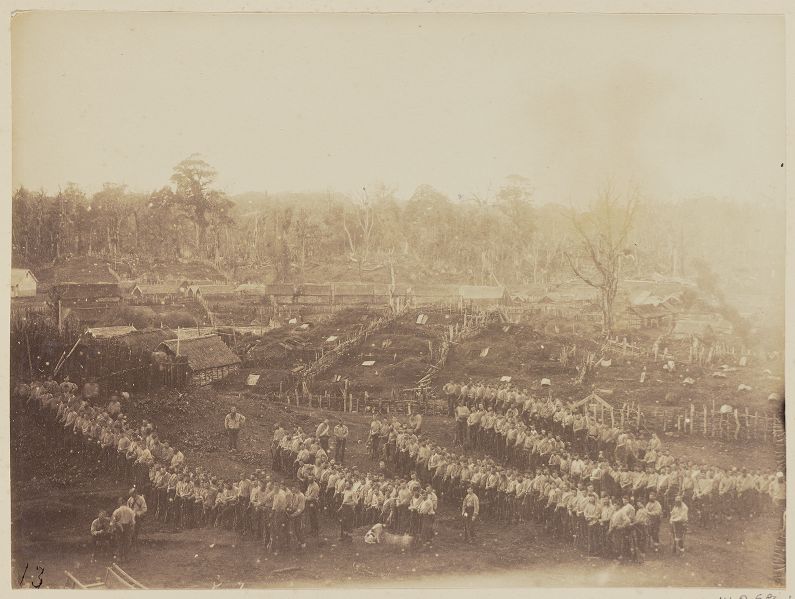
Among New Zealand Snider arms, the 1874 Snider Short Rifle, bar on band, remains one of the most enigmatic. Photographic evidence documents its issue and deployment with the Armed Constabulary in Taranaki, at Mount Cook in Wellington, and at Parihaka.

By August 1871, New Zealand held approximately 2,500 Sniders either on issue or in store.[16] In the same year, a new colonial order was placed through the War Office for 2,000 Snider short rifles with saw-backed bayonets.[17] The arrival of part of this order was reported and discussed in the 1875 Armed Constabulary Force Annual Report.[18]  For example, Lieutenant-Colonel William C. Lyon, Acting Commissioner of the Armed Constabulary, reported: “Seven hundred short Snider rifles with saw-backed bayonets have arrived, and are now being issued to the Force.”

Captain W. G. Stack, Instructor of Musketry, commented further: “The new rifles have one very noticeable defect as a military weapon, which is that, as they are stocked up to within one and a half inches of the muzzle, it is impossible to ‘pile arms’ with them. The short saw-backed sword bayonet, with which the new rifle is fitted, is much more suited to the requirements of the force than the old bayonet served out with the medium rifle…”

The 700 Snider short rifles referred to were bar on band rifles with brass furniture and locks dated 1874. The stock extended to approximately 1⅜” from the muzzle, a configuration that prevented the traditional military practice of ‘piling arms’, in which rifles are leaned together muzzle-up to form a stable pyramid when troops are at rest or at camp. The ‘short saw-backed sword bayonet’ issued with these rifles was the New Zealand contract 1874 18″ sawback bar on band bayonet.

The most obvious percussion precedent, the ordnance Pattern 1858 bar on band short rifle, was only experimentally converted to the Snider system and was neither accepted as a pattern nor entered service.[19] British ordnance Snider conversions were instead limited to the Pattern 1860 and 1861 bar on barrel short rifles with steel furnature, converted to Snider with Mk II** breech.[20]  New Zealand had in its possession 100 such rifles as part of the 2,000 Sniders loaned from England in 1869.  Once stocks suitable for conversion were exhausted, a new sealed-pattern Snider short rifle with Mk III breech, bar on barrel with steel furniture was adopted into Imperial service.

Contemporary criticism of the first portion of the New Zealand colonial order—namely, the 700 bar on band Snider short rifles—focused on their practical limitations. These concerns were addressed in the second portion of the order, which comprised 1,300 Snider short rifles in the standard bar on barrel configuration, fitted with brass furniture and issued with a matching New Zealand 18-inch saw-back bar-on-barrel bayonet. All subsequent shipments, totalling more than 6,000 Snider short rifles, followed the Imperial standard bar on barrel configuration with steel furniture. If bayonets were supplied, they were the yataghan sword bayonets.

Terminology:   

  • Bar on band refers to rifles stocked to within approximately 1⅜ inches of the muzzle, leaving very little barrel exposed (as illustrated in Image a). In this configuration, the bayonet bar (lug) is mounted on the forward barrel band.                                                                                                                                                                              
  • Bar on barrel describes rifles in which the stock terminates approximately 5⅜ inches from the muzzle, leaving a greater length of barrel exposed (as illustrated in Image b). In this case, the bayonet bar is mounted directly on the barrel.

Bayonets are not interchangeable between these two configurations. All ordnance Snider short-rifle conversions followed the bar-on-barrel arrangement. The terms bar on band and bar on barrel are descriptive model designations.

NZ 1874 Snider Short rifle – bar on band. Images of arms & bayonets – Paul Farmer
NZ 1874 Snider Short rifle – bar on barrel. Images of arms & bayonets – Paul Farmer

The New Zealand 1874 Snider short rifle, bar on band, was a trade-made arm manufactured by the Birmingham Small Arms & Metals Company Ltd. It is fitted with a Mk III breech bearing Snider’s patent mark and logo. The lock plate is marked B.S.A. & M. Co. over the date 1874, without a crown. Proof and inspection marks are of Birmingham origin, and the hammer has a flat face.

Furniture is of brass and includes a short‑tang trigger guard, distinguishing the rifle from other contemporary Snider short rifles, which typically feature steel furniture and a long trigger guard. The rear sight has a fixed bed graduated from 100 to 400 yards, with a leaf graduated from 500 to 1,000 yards. The butt tang is stamped with NZ, a broad arrow, and an individual issue number, while the stock bears a cartouche of Bond & James, Birmingham.

Description of the New Zealand Contracy 1874 Snider Short Rifle, Bar on Band

Overall Length:48 5/8
Barrel Length:30 5/8
Calibre:25 bore     .577
Rifling:5 groove   1 in 48″
Lock Plate:B.S.A. & M. Co. over 1874 (no crown or VR)                                       
Breech:Mk III, Snider patent mark & logo
Sight:Ramp 100 to 400 yards. Leaf: 500 to 1000 yards
Furniture:Brass (Note: trigger guard, brass with no long tang)             
Barrell Retention:2 bands & breech tang screw
Stock:Stock to within 1 3/8” of the muzzle
Butt Tang:N^Z issue number   
Stock Cartouche:      Bond & James Birmingham
  
Bayonet:New Zealand 1874 18″ bar on band, sawback, trade-made MRD – 21 mm, blade 18” length 24 no NZ mark
Left Ricasso:Crown over A.S – Solingen inspector’s mark. Knight’s helm: Kirschbaum maker mark (See Section 5, image 2)           
Right Ricasso:Blank (no markings)
Both sides of the New Zealand Contract 1874 Snider Short Rifle, Bar on Band. Images of arms & bayonets – Paul Farmer

Summary: No Snider short rifle, bar on band rifles existed in Imperial service. The New Zealand contract 1874 Snider short rifle, bar on band, was issued to the Armed Constabulary, representing another uniquely New Zealand arm. Today, evidence of these rifles survives almost entirely in the photographic record, often shown alongside bar on barrel rifles. Taken together, the New Zealand contract 1874 Snider short rifle, bar on band, and its matching bayonet must rank among the scarcest of all New Zealand-issued arms.

 New Zealand 1874 Snider short rifle, bar on band with New Zealand 18″ sawback bar on band bayonet. Captain Morrison and Major Foster Goring (far right), in service with the Taranaki Armed Constabulary (Image source: Puki Ariki).

4. New Zealand Contract 1874 Short Snider Rifle, Bar on Barrel   

I have only observed a single example of the New Zealand contract 1874 Snider short rifle in the bar on barrel configuration. In my opinion, this example is representative of the 1,300 rifles in this contract, for which the New Zealand 1874 18″ sawback bar on barrel bayonet was produced.

The rifle is fitted with a Mk III breech bearing Snider’s patent mark and logo. The lock plate is marked TOWER over 1874 with a crown, but without a “VR”. Proof and inspection marks are of Birmingham origin, and the hammer is cupped. The furniture is of brass with a short-tang trigger guard. The rear sight comprises a fixed bed graduated from 100 to 400 yards, with a leaf graduated from 500 to 1,000 yards. The butt tang is stamped with “A”, a broad arrow, “NZ”, and the issue number, while the stock bears the cartouche of Bond & James, Birmingham. This Snider short rifle should not be confused with the ordnance produced Mk III Snider Naval rifle of 1870-71, of which only 17 were made. [21]

Description of the New Zealand Contract 1874 Dnider Short Rifle, Bar on Barrel

Overall Length: 48 5/8
Barrel Length:30 5/8
Calibre:25 bore     .577
Rifling:5 groove   1 in 48″
Lock Plate:Tower over 1874          Crown no V R                                                
Breech:Mk III, Snider patent mark & logo
Sight:Ramp 100 to 400 yards. Leaf: 500 to 1000 yards
Furniture:Brass (Note: trigger guard, brass with no long tang)    
Barrell Retention:2 bands & breech tang screw
Stock:Stock to within 5 3/8″ of the muzzle
Butt Tang:A ^  N Z     issue number   
Stock Cartouche:Bond & James Birmingham
  
Bayonet:New Zealand 1874 18″ bar on band, sawback. MRD – 21 mm, blade 18” length 24 ½” no NZ mark
Left Ricasso:Inverted broad arrows over WD, (sold out of service mark, unusual for a non-war department bayonet.[22] Crown over B, 21, Birmingham inspectors mark (see section 5, image 3).             
Right Ricasso:Knight’s helm, Kirschbaum maker mark (5 image 4).
Both sides of the New Zealand Contract 1874 Snider Short Rifle, Bar on Barrel. Images of arms & bayonets – Paul Farmer

Summary: The 1874 Snider short rifle, bar on barrel, fitted with brass furniture and paired with the 18″ sawback bar on barrel bayonet, represents another uniquely New Zealand contract combination issued to the Armed Constabulary.

New Zealand Contract 1869 Hay-Snider medium rifle. Images of arms & bayonets – Paul Farmer
New Zealand Contract 1872 Contract Tisdall Snider carbine. Images of arms & bayonets – Paul Farmer
New Zealand Contract 1874 Snider short rifle, bar on band. Images of arms & bayonets – Paul Farmer
New Zealand Contract 1874 Snider short rifle, bar on barrel. Images of arms & bayonets – Paul Farmer
1874 Snider short rifle bar on band, and bar on barrel rifles, along with 1872 Tisdall carbines on issue with the Armed Constabulary in Taranaki (Image source:  Puki Ariki).

5. New Zealand Contract 1874 18” Sawback Bayonets

Development: The original precedent bayonet, an 18”sawback bar on band bayonet, was made for the Irish Constabulary carbine at Enfield in 1867.[23] A similar 18” sawback bar on band bayonet, also made at Enfield, and was used in the 1869 trials of the Martini- Henry long chamber rifle. Both these bayonets had smaller MRD than the New Zealand 18”sawback bayonets.

New Zealand 18” Sawback Bayonets: When New Zealand’s order for Snider short rifles and 18” sawback bayonets was actioned in 1873, the bayonets were not in production in England. Both contracts for these two 18” sawback bayonet variants were filled by  Kirschbaum of Solingen.[24] Documentation clearly shows that the 18″ sawback bar on band bayonet was produced for the 700 New Zealand 1874 dated Snider short rifle, bar on the band. These rifles were issued and in service in 1875. The remainder of the order, 1300 for the New Zealand 1874 dated Snider short rifle, bar on the barrel with an 18″ sawback bar on barrel bayonet, was on a different contract; it is not specifically recorded when they entered service.

Summary: The 18” sawback bayonets made for the New Zealand 1874 dated Snider short bar on band rifle and 1874 Snider short bar on barrel rifle are,

  • 1.  New Zealand contract 1874 18″ sawback bar on band bayonet.   
  • 2.  New Zealand contract 1874 18″ sawback bar on barrel bayonet.

The two 1874 New Zealand Snider Bayonet Variants

Upper – NZ contract 1874 18″ sawback bar on band, with an elevated 21mm muzzle ring. Total length of bayonet & scabbard, 24”

Lower – NZ contract 1874 18″sawback bar on barrel, 21mm muzzle ring in line with the grip. Total length of bayonet & scabbard, 24 ½”

Note: The bar on band scabbard is ½” shorter than bar on barrel scabbard. Images of arms & bayonets – Paul Farmer
Relative elevation of the muzzle ring above the tang: bar on barrel (left), bar on band (right). Both bayonets have a 21mm MRD. Images of arms & bayonets – Paul Farmer
Bar on band. Left side: Crown over A.S. (Solingen inspector’s mark); knight’s helm, maker’s mark of Kirschbaum. Right side: blank (not illustrated).Images of arms & bayonets – Paul Farmer
Bar on barrel. Left side: inverted broad arrows over WD (sold-out-of-service; unusual, non-War Department bayonet); Crown over 21; Birmingham inspection mark.Images of arms & bayonets – Paul Farmer
Bar on barrel. Right side: Knight’s helm, the maker’s mark of Kirschbaum. Images of arms & bayonets – Paul Farmer

 Conclusion

The New Zealand Colonial Government commissioned four distinct Snider arms specifically for local service.

These comprised the following, and the number produced.

  • 500     1869 Hay–Snider Medium rifles
  • 600     1872 Tisdall Snider carbines
  • 700     1874 Snider short rifles, bar on band
  • 1,300  1874 Snider short rifles, bar on barrel

In total, 3,100 New Zealand contract Sniders were produced.

In addition, 2000 18″ sawback bayonets were manufactured for the New Zealand Snider short rifles, consisting of

700    18″ bar on band bayonets

1,300 18″ bar on barrel bayonets

These New Zealand contract Sniders and their associated bayonets are not British ordnance patterns. As a result, their absence or limited treatment in standard references on British ordnance Sniders and bayonets is unsurprising. The purpose of this article has been to document and clarify these uniquely New Zealand arms, allowing them to be more clearly identified and better appreciated within the broader history of the Snider arms system.

References

[1]  Appendix to the Journals of the House of Representatives, 1870 Session I, A-09

[2]  Ian Skennerton. .577 Snider-Enfield Rifles & Carbines. 2003 Published Ian D Skennerton page 101

[3]  Papers Past NZ, Evening Post, Volume V,  issue 261, 16 Dec 1869, page 2

[4]  Appendix to the Journals of the House of Representatives, 1885 Session I, H-04a

[5]  Ian D Skennerton & Robert Richardson. British & Commonwealth Bayonets. 1986 Published Ian D Skennerton  page 362

[6]  Ian D Skennerton & Robert Richardson. British & Commonwealth Bayonets. 1986 Published Ian D Skennerton  page 362

[7]  Robert McKie. Hay Pattern Rifles. ‘Lessons from History: New Zealand Procurement and Logistics 1857-1861’ -rnzaoc.com/tag/hay-pattern-rifles/Hayden

[8]  John Osborne, Hay Pattern Enfield Rifle, The Gazette NZAHAA June 2010 Vol. 30 No 2

[9]  Reference 1869/473. 1869 Army Department Inwards Correspondence Register nzpictures.co.nz

[10]   Papers Past NZ, New Zealand Herald, Volume. VI issue 1655 12 March 1869, page 2

[11]   Papers Past NZ. Evening Post, Volume V, Issue 261, 16 December Page 2

[12]   Ian D Skennerton & Robert Richardson. British & Commonwealth Bayonets. 1986 Published Ian D Skennerton  page 360

[13]   Ian Skennerton & Brian Labudda. British Commonwealth Bayonets and Fighting Knives Published in 2025 by Labudda Research / Arms & Militaria Press  page 389

[14]   Brian C Knapp, The Calisher & Terry in British and Colonial Military Service 1856 – 1900, 2021

[15]   John Osborne, NZ P1872 25  bore Snider Carbine, The Gazette NZAHAA Dec. 2007 Vol. 27 No 4

[16]   R McKie, NZ Defence Stores July 1870 – June 1871https://rnzaoc.com/2023/08/13/nz-defence-stores-july-1870-june-1871/

[17]   Armed Constabulary Force (Annual Report of Commissioner). Appendix to the Journals House of Representatives, 1875 Session I, H-10

[18]   Ian Skennerton. .577 Snider-Enfield Rifles & Carbines. 2003 Published Ian D Skennerton page 187

[19]   “Ibid., page 123

[20]   “Ibid., page 140

[21]   Brian C. Knapp, A Catalogue of British Military Longarms 1730 to 1930, Published Tower Heritage Publications, 2025, page 167

[22]   Ian D Skennerton & Robert Richardson. British & Commonwealth Bayonets. 1986 Published Ian D Skennerton  page 357

[23]  Ibid., page 243

[24]  Ibid., page 386


The Hammer and Pincer Badge in New Zealand Service

From Ordnance Craft to Artificer Mastery

The crossed hammer and pincers, often referred to as the “hammer and tongs,” is one of the oldest and most enduring symbols of technical service in the New Zealand Army. Its history reflects more than a century of change in military organisation, moving from a craft-based system of trades to a professionalised and qualification-driven technical corps. In that evolution, the badge itself did not remain static. Rather, its meaning shifted from a simple indicator of trade to a recognised mark of technical mastery.

The origins of the badge in New Zealand can be traced to the arrival of British Army Ordnance Corps armourers at the turn of the twentieth century. In 1901, Armourer Sergeants Bertram Buckley and John Hunter were recruited to support the developing New Zealand military system, followed shortly after by Armourer Sergeant William Edward Luckman.[1]  These men brought with them a long-established British tradition in which armourers, blacksmiths, and artificers formed the technical backbone of the Army.

Their work extended well beyond routine maintenance. In addition to sustaining weapons and equipment, they played a central role in training the first locally raised armourers and embedding the trade within the New Zealand forces as a recognised military function. By 1911, Luckman, whose secondment had been extended several times, was firmly established as Chief Armourer of the New Zealand Military Forces, overseeing inspection, maintenance, and repair activities across workshops in Auckland, Wellington, Christchurch, and Dunedin. Although serving in New Zealand, these men remained members of the Army Ordnance Corps and were required to maintain their professional proficiency, ensuring that New Zealand practice remained aligned with British standards.

Worsted Hammer and Pincer badge. Robert McKie Collection

Although the badge was already in use within the wider British military system, it did not formally appear in New Zealand dress regulations until 1912, when it was codified as part of the official system of distinguishing trade badges.[2] This reflects a broader pattern in early New Zealand military development, where established practice was often formalised only after it had become embedded.

The formalisation of the badge in New Zealand dress regulations reveals how its role evolved, as shown below:

YearRegulation ContextWho Wore ItBadge DescriptionPlacement
1912First formal appearance in NZ Dress RegulationsArmourers and senior NCOsHammer and PincerIncorporated within rank insignia
1923Expanded trade badge systemMultiple technical trades across ranksHammer and PincerAbove chevrons (NCOs), below rank badges (WOs)
1927Badge of appointment systemArmourers, artificers, machinery tradesHammer and PincerStandardised placement by rank
1960RNZEME badge of appointmentSergeants and Staff Sergeants RNZEMEHammer and PincerCorps-level appointment badge
Table 1: Dress Regulations Timeline

As locally trained armourers developed under Luckman’s supervision, the need for a formal structure became increasingly apparent. This was addressed through General Order 118 of 1 May 1912, which established the New Zealand Ordnance Corps and provided a defined career pathway from apprentice to Armourer Sergeant Major.[3] At the same time, regimental armourers remained within their parent units, creating a dual system that balanced centralised expertise with unit-level support. The scope of the trade was already expanding, extending beyond small arms to include bicycle maintenance and even the maintenance of New Zealand’s first military aircraft, the Blériot monoplane Britannia.

Within this early system, the hammer-and-pincers badge served as a straightforward trade identifier. Dress regulations from 1912 and 1923 show that it was worn by armourers, machinery artificers, and smiths across multiple ranks, from privates through to warrant officers.[4] Its placement on the sleeve, above chevrons for non-commissioned officers and below rank badges for warrant officers, reinforced its role as a marker of function rather than status. In this context, the badge simply identified the soldier as a skilled tradesman, part of a wider system of craft specialisations that included farriers, wheelwrights, and saddlers.

Contemporary regulations demonstrate that the badge was not confined to a single trade, but applied across a wide range of technical roles:

Trade CategorySpecific TradesBadge
ArmourersArmourer Sergeant, Armourer Staff SergeantHammer and Pincer
ArtificersSergeant Artificer, Staff Sergeant ArtificerHammer and Pincer
Mechanical TradesFitters, MechanistsHammer and Pincer
Metal TradesSmithsHammer and Pincer
Weapons TradesArmament Staff SergeantHammer and Pincer
Equine TradesFarriersHorseshoe
Leather TradesSaddlersBit
Transport / Construction TradesWheelersWheel
Table 2: Trades Authorised to Wear the Badge

During the interwar period, the badge’s meaning began to evolve. As military equipment became more complex, the role of the artificer emerged as a distinct and increasingly important technical appointment. The hammer and pincers became more closely associated with these higher-level trades and senior technical roles, although this association remained informal. The badge continued to denote employment and function rather than qualification, and it was still worn broadly across the technical workforce.

The formation of the New Zealand Electrical and Mechanical Engineers (NZEME) during the Second World War marked a further stage in this evolution. Technical trades were consolidated into a single corps, and training systems became more structured. Within the post-war Royal New Zealand Electrical and Mechanical Engineers (RNZEME), the hammer and pincers took on an additional layer of meaning, reflecting not only trade identity but also a shared professional culture. This was captured in later descriptions of the corps as a body of “warrior craftsmen,” linking modern technicians to a long lineage of armourers and artisans.[5]

Brass Hammer and Pincer badge. Robert McKie Collection

By 1960, the badge had been formally defined within New Zealand Army dress regulations as a badge of appointment for RNZEME Sergeants and Staff Sergeants, worn irrespective of trade or qualification.[6] Its function at this stage was clearly aligned with the corps’ identity and rank rather than with technical distinction.

At the same time, the Army considered a broader initiative to introduce trade badges across all corps. As part of this proposal, it was suggested that all RNZEME trades, across all ranks, be authorised to wear the hammer and pincers as a universal trade badge. This would have effectively returned the badge to its earlier role as a general identifier of technical function. The proposal was not adopted, largely due to cost, and the Army retained its existing approach, favouring a simplified system based on corps and rank rather than trade differentiation.

From the late 1960s, however, a different dynamic emerged within RNZEME itself. The Artificer Course had become the recognised benchmark of professional excellence within the corps, mirroring developments in both British REME and the Royal Australian Electrical and Mechanical Engineers, where artificer status represented the highest level of technical competence short of commissioning. Selection for the course was rigorous, involving formal boards and demanding assessments of both technical and personal qualities. An artificer was defined as a higher technician who, in addition to proven trade skills, possessed the ability to lead, train, advise, and coordinate at a high level.[7]

Formally, the badge remained a corps badge worn by all RNZEME Sergeants and Staff Sergeants. In reality, it was increasingly associated with those who had attained artificer status, particularly within the corps’ culture and internal recognition systems. By the early 1970s, this divergence prompted RNZEME to propose a formal change, seeking to restrict the badge to those who had successfully completed the Artificer Course. The intention was to align official entitlement with professional reality, recognising the badge as a symbol of technical mastery rather than simply a corps identifier. The proposal was not approved.[8] The Army maintained its long-standing position that the hammer and pincers were primarily a corps insignia, and that introducing qualification-based badges risked creating a broader system of trade distinctions across the Army.

Despite this, the underlying trend could not be entirely contained. By the mid-1980s, the hammer and pincers had been formally adopted within RNZEME as an artificer qualification badge.[9] This brought policy into line with the practice that had already developed within the corps. From that point, the badge clearly signified not merely affiliation with RNZEME, but the attainment of advanced technical proficiency and leadership within the maintenance system.

The evolution of the badge can be summarised as a transition from a broad trade identifier to a symbol of technical mastery:

PeriodSystem TypeMeaning of Badge
Pre-1912Informal / British systemTrade craft identifier
1912–1930sFormal trade structureBroad technical trade badge
1940s–1950sCorps consolidation (RNZEME)Corps identity + technical role
1960s–1980sProfessionalisationIncreasing association with artificers
Post-1980sQualification systemArtificer qualification badge
Modern RNZALRIntegrated logistics systemSymbol of advanced technical mastery
Table 3: Evolution of Meaning

This evolution was not unique to New Zealand. Across the Commonwealth, the hammer and pincers followed a similar trajectory, originating as a general tradesman’s badge before becoming associated with artificers and eventually formalised as a qualification insignia. In each case, the badge reflected broader changes in military organisation, particularly the transition from craft-based systems to a professional technical corps.

Gold Bullion on Black Mess Kit Hammer and Pincer badge. Robert McKie Collection

The legacy of this development continues within the Royal New Zealand Army Logistic Regiment (RNZALR). Following the integration of RNZEME into RNZALR in 1996, the traditions and professional standards of the technical trades were retained within a unified logistic structure. Today, upon successful completion of the RNZALR Artificer Course, qualified maintainers are entitled to wear the hammer and pincers as the RNZALR Artificer Badge, formally recognising their advanced technical training and professional competence.

The history of the hammer and pincers badge is not simply the story of a piece of insignia. It is a reflection of how the New Zealand Army has understood, organised, and recognised technical expertise over time. From its origins as a practical trade identifier, through its gradual association with the artificer, to its formal adoption as a qualification badge, the symbol charts a clear transition from craft to profession.

Gold Bullion on Red Mess Kit Hammer and Pincer badge. Robert McKie Collection

What makes the badge distinctive is not that its meaning changed, but that it accumulated meaning. It has remained rooted in the craftsman’s identity, even as the system around it shifted towards structured training, formal selection, and professional recognition. In this sense, the badge represents continuity as much as change.

Today, within the RNZALR, the hammer and pincers endure as the Artificer Badge, awarded to those who have demonstrated advanced technical proficiency and leadership. Its modern meaning is therefore inseparable from its past. It still speaks to the same underlying idea that defined its earliest use:

The effectiveness of an army depends not only on those who fight, but on those who possess the skill, judgement, and discipline to maintain it.

Footnotes


[1] “Luckman, William Edward,” Personal File, Archives New Zealand (Wellington) 1902, https://ndhadeliver.natlib.govt.nz/delivery/DeliveryManagerServlet?dps_pid=IE21154244.

[2] New Zealand Military Forces Dress Regulations, ed. New Zealand Military Forces (Wellington, 1912). https://rnzaoc.files.wordpress.com/2018/08/1923-nz-army-dress-regs.pdf.

[3] NZ Armourers, New Zealand Military Forces, General Order 118/12, (Wellington, 1 May 1912). .

[4] New Zealand Military Forces Dress Regulations, ed. New Zealand Military Forces (Wellington, 1923). https://rnzaoc.files.wordpress.com/2018/08/1923-nz-army-dress-regs.pdf.

[5] Peter Cooke, Warrior Craftsmen, RNZEME 1942-1996 (Wellington: Defense of New Zealand Study Group, 2017).

[6] “Clothing – Dress Embellishments: General 1960-1976,” Archives New Zealand No R17187826  (1960).

[7] Cooke, Warrior Craftsmen, RNZEME 1942-1996.

[8] “Clothing – Dress Army Committee – Reports etc,” Archives New Zealand No R9753141  (1954-1973).

[9] Malcolm Thomas and Cliff Lord, New Zealand Army distinguishing patches, 1911-1991 (Wellington, N.Z. : M. Thomas and C. Lord, 1995, 1995), Bibliographies, Non-fiction.


Between War and Peace

The RNZAOC, 1946–1948

The period from 1946 to 1948 represents one of the least understood, yet most consequential phases in the history of the Royal New Zealand Army Ordnance Corps (RNZAOC), not because of what it achieved, but because of what it resolved.

What emerged was not a finished system, but an Army still taking shape. The post-war force was, in effect, an interim army, suspended between wartime structures and peacetime requirements, retaining elements of one while attempting to define the other.

Demobilisation had been rapid, but the future force remained undefined. Establishments were provisional, organisations were in flux, and there was no settled view of scale or role. For the RNZAOC, this meant operating a logistics system built for global war within a smaller, resource-constrained environment increasingly focused on efficiency and control.

At the same time, responsibility between corps and units remained unsettled. Wartime practice had pushed holdings and authority forward to units; post-war thinking sought to reassert centralised control. The balance between the two was neither clear nor stable, resulting in ongoing adjustment across supply, accounting, and distribution.

The outcome was a system in transition. Depot structures were reorganised, trade roles adapted, and establishments repeatedly revised, all reflecting deeper, unresolved questions about control, capability, and scale.

This article examines how the RNZAOC navigated this interim phase through organisation, depots, trades, and the evolving relationship between corps and unit responsibility, a period in which the foundations of the post-war Army were not inherited but worked out in practice.

Pre-war Decline and Wartime Rebuilding

Before the Second World War, the NZAOC had been significantly hollowed out. The economic pressures of the interwar period, particularly the effects of the Depression, saw the Corps reduced to a minimal military presence. Much of its traditional supply function was civilianised, with depot operations, accounting, and store management largely undertaken by civil staff. Uniformed personnel were limited to officers and a small number of technical specialists.[1]

This reflected a prevailing belief that large-scale military logistics systems were unnecessary in peacetime. The outbreak of war in 1939 completely overturned this assumption.

The demands of mobilisation, overseas deployment, and sustained operations required the rapid expansion of a military-controlled logistics system. The RNZAOC was rebuilt into a large, uniformed organisation responsible for supporting both expeditionary forces and home defence. Depots expanded, new facilities were established, and personnel increased significantly.[2]

By 1945, the Corps had regained both scale and operational relevance. The wartime experience demonstrated that military-controlled supply was essential, and there was little appetite to return to the pre-war model. The RNZAOC was not rebuilding from scratch; it was preserving the relevance it had regained during the war.

NZAOC Badge 1937-47

From Wartime Expansion to Peacetime Reality

The transition to peace introduced a different set of challenges. The wartime logistics system was too large to sustain, yet too valuable to dismantle. The Army, therefore, faced a balancing act, reducing size while attempting to retain capability.

This was neither a clean nor a coordinated reform. It was a gradual process of adjustment in which wartime structures were reshaped rather than replaced.

New Zealand’s continued overseas commitments, including the occupation of Japan, ensured that ordnance services remained operationally relevant even in peacetime.[3] The system was therefore neither fully wartime nor fully peacetime, but something in between.

Lt Col A.H Andrews. OBE, RNZAOC Director of Ordnance Services, 1 Oct 1947 – 11 Nov 1949. RNZAOC School

The Impact of RNZEME Formation

A major structural change occurred on 1 September 1946 with the formation of the New Zealand Electrical and Mechanical Engineers (NZEME).[4] This brought together mechanical transport, ordnance workshops, and technical repair functions under a single corps.

For the NZAOC, this marked a significant shift. Repair and maintenance functions began moving out of the Corps, but the transition was incomplete. Equipment, personnel, and responsibilities remained interdependent.

1946 establishment proposals note that Mechanical Transport holding units were under NZEME control, with the expectation of later transfer to Ordnance.[5] This highlights the reality that the separation between supply and repair was still evolving.

Reorganisation of the Ordnance System

At the same time, the RNZAOC underwent internal reorganisation. Wartime expansion had created parallel structures, which now required integration.

Regular and non-Regular personnel were brought together into a single Corps, and control of ordnance services was centralised under Army Headquarters.[6] The resulting structure included Headquarters New Zealand Ordnance Services, an Inspecting Ordnance Officer Group, the Main Ordnance Depot at Trentham, and a system of district sub-depots and ammunition sections.[7]

This represented a shift toward a more coordinated national system, although the reality remained more fluid than the structure suggested.

Identity and Recognition: Becoming “Royal”

In 1947, the Corps was granted the prefix “Royal,” becoming the RNZAOC.[8] This recognised its wartime service and reinforced its position within the Army. At a time of organisational change, this provided continuity and strengthened the Corps’ identity.

1947-54 RNZAOC Badge. Robert McKie Collection

Depots, Distribution, and Control

The depot system remained the foundation of RNZAOC operations in the immediate post-war period, providing the physical and administrative framework through which the Army was sustained. However, this system did not operate in isolation. Rather, it formed part of a broader ordnance structure directed from Headquarters, New Zealand Ordnance Services, under the Director of Army Equipment. This was not simply a continuation of wartime arrangements, but a deliberate reorganisation into a coordinated national system designed to balance centralised control, technical oversight, and regional responsiveness. Within this framework, two principal functional groupings can be identified:

  • Main Ordnance Depot (MOD), Trentham. The Main Ordnance Depot (MOD) at Trentham formed the core of the national supply system. It held the Army’s primary reserve of ordnance stores, managed procurement and stock control policy, and acted as the principal interface with Army Headquarters. The MOD was responsible for bulk storage, cataloguing, and redistribution of stores to subordinate elements. It also retained accounting authority for much of the Army’s inventory, ensuring that financial and materiel control remained centralised even as physical distribution was decentralised.
  • Inspecting Ordnance Officer (IOO) Group. Alongside the supply system, the IOO Group provided technical oversight across the entire ordnance structure. Incorporating ammunition inspection and repair functions, it maintained a presence both centrally and within each military district, linking local activity to central technical authority. Its responsibilities included the inspection of ammunition, enforcement of technical standards, and assurance of safety and serviceability. This arrangement highlights that RNZAOC’s role extended beyond supply to include technical control, particularly in relation to ammunition condition and safety.

District-Controlled Supply and Ammunition System

Beneath this national framework, the system was implemented through district-controlled elements, in which general supply and ammunition were managed in parallel rather than as a single unified chain.

Sub-Depots (General Supply)

The sub-depots formed the primary regional distribution layer for general stores:

  • No. 1 Sub-Depot (Hopuhopu, Northern District) supported formations and units in the Auckland and Northern military districts. It received stores from Trentham, maintained regional holdings, and issued equipment to units, ensuring responsiveness to both routine requirements and operational contingencies.
  • No. 2 Sub-Depot (Linton, Central District, including Waiouru) occupied a particularly significant role, supporting the Army’s principal training area. Its responsibilities extended beyond routine supply to include provisioning for major exercises, maintenance of field stocks, and the rapid issue and recovery of equipment.
  • No. 3 Sub-Depot (Burnham, Southern District) supported forces across the lower North Island and South Island. Its role was shaped by distance and dispersion, requiring an emphasis on distribution efficiency and continuity of supply to smaller, geographically separated units.

District Ammunition Sections

Operating alongside, but not subordinate to, the sub-depots were the District Ammunition Sections. These existed as a distinct and tightly controlled system under district authority, reflecting the specialised and hazardous nature of ammunition management.

Each District Ammunition Section was responsible for:

  • the storage and accounting of ammunition stocks
  • inspection and maintenance in accordance with technical standards
  • issue to units and recovery of ammunition
  • enforcement of safety regulations and handling procedures

This arrangement reflects the fundamentally different nature of ammunition within the logistics system. Unlike general stores, ammunition required specialised handling, stricter accounting, and continuous technical oversight. As a result, it was managed through a parallel structure, linked to but not absorbed within the general depot network.

Together, these elements formed a layered and functionally divided national system. General stores flowed from central procurement and bulk storage at Trentham through the sub-depots to units. Ammunition followed a parallel pathway through District Ammunition Sections, governed by tighter technical and safety controls. Oversight, inspection, and policy direction remained centralised through Headquarters and the Inspecting Ordnance Officer.

Just as importantly, information flowed in the opposite direction. Demands, returns, inspection reports, and accounting data fed back into the central system, ensuring visibility and control across both supply and ammunition functions.

This structure reflects a conscious attempt to balance three competing imperatives:

  • Centralised authority, ensuring control over procurement, accounting, and technical standards
  • Technical assurance, maintaining oversight of equipment condition and ammunition safety
  • Regional responsiveness, allowing units to be supported quickly and efficiently

What emerged was neither a purely wartime expeditionary system nor a fully developed peacetime bureaucracy, but a hybrid. It retained the scale, discipline, and functional separation developed during the war while adapting to the realities of a smaller, permanent force.

In doing so, the RNZAOC avoided a return to the fragmented, partially civilianised structures of the pre-war period. Instead, it established a controlled, professional, and distinctly military system of national sustainment, one capable of supporting both routine operations and future mobilisation. This dual structure of centralised control, regional distribution, and parallel ammunition management did not disappear with post-war reform but remained a defining feature of New Zealand Army logistics as it evolved through the later twentieth century into the integrated systems of the RNZALR.

Personnel, Trades, and Overlapping Responsibility

The RNZAOC of the immediate post-war period was defined less by a clean, corps-based trade structure and more by a functional mix of personnel drawn from across the Army. Within ordnance units and depots, storemen, clerks, ammunition specialists, technical tradesmen, and general labour staff often worked alongside or in parallel with personnel from other corps.[9]

This reflected the legacy of wartime expansion, in which capability had been built rapidly and pragmatically rather than along strictly defined corps boundaries.

In formal terms, RNZAOC responsibilities centred on a recognisable, though not exclusive, group of trades. Based on Army Order 60 of 1947, these included:

  • Storeman (general and technical)
  • Clerk (including specialist and accounting clerks)
  • Ammunition Examiner
  • Munition Examiner (WAAC)
  • Tailor
  • Shoemaker (Class I)
  • Clothing Repairer / Textile Re-fitter
  • Saddler and Harness Maker
  • Barrack and general support roles (e.g. barrack orderly, store labour staff)

These trades broadly reflect the traditional functions of the Corps, supply, storage, accounting, inspection, and the maintenance of clothing and general equipment. However, this list reflects RNZAOC-associated trades rather than RNZAOC-exclusive trades.

In practice, roles such as storeman and clerk were distributed across multiple corps and at unit level, often performing similar functions under different organisational control.

The introduction of Army Order 60 of 1947 was a significant attempt to formalise this situation by creating a structured trade classification system. The order established a comprehensive framework of trade groups (A–D), star classifications, and promotion pathways, linking technical proficiency to advancement and standardising training across the Army.[10]

However, the detail of the order reveals the extent to which trades remained distributed rather than corps-specific. Trades such as fitters, electricians, clerks, storemen, and even ammunition-related roles were not confined to a single corps but were found across RNZAOC, RNZASC, RNZEME, RNZE, WAAC, and others.

For example:

  • “Storeman” appears in multiple contexts, including RNZASC (supplies) and RNZEME (technical stores)
  • Clerks remained an “All Arms” function rather than an ordnance-specific trade
  • Ammunition-related roles existed alongside both ordnance and technical organisations
  • Technical trades such as fitters, electricians, and instrument mechanics were shared across engineering and transport organisations

This distribution reflects a Commonwealth-wide approach, in which capability was grouped by function rather than by rigid corps ownership. In the New Zealand context, it also highlights a system still settling after wartime expansion, in which RNZAOC’s responsibility was defined more by what it did than by what it exclusively owned.

Crucially, while AO 60/47 imposed a formal structure, its implementation lagged behind in its intent. Training was conducted through district schools and correspondence systems, promotion required both academic and trade testing, and classification was tied to star grading. Yet this system was still bedding in and far from universally applied in practice.

At the unit level, older Quartermaster-based arrangements remained firmly in place. The persistence of roles such as “Storeman, Technical”, explicitly noted as being assessed at the unit level rather than centrally, is particularly revealing. These positions indicate that units retained direct responsibility for certain categories of stores, especially technical and operational equipment, outside the fully centralised ordnance system.

This created a layered system of responsibility:

  • RNZAOC depots and organisations held national stocks, managed accounting, and controlled distribution
  • Other corps, particularly RNZEME and RNZASC, held and managed specialist or functional stocks aligned to their roles
  • Units retained immediate control over equipment required for training and operations, often through Quartermaster systems.

The boundary between these layers was not clearly defined. Instead, it was negotiated in practice, shaped by availability, geography, and operational need.

The result was a system that was centralised in intent but decentralised in execution.

Rather than a clean division between Corps responsibility and unit responsibility, the post-war RNZAOC operated within a hybrid framework:

  • formal trade structures existed, but were not yet fully embedded
  • corps responsibilities were defined, but not exclusive
  • unit-level systems persisted alongside centralised control

This overlap was not simply inefficiency; it was a transitional phase. The Army was moving from a wartime model, built on rapid expansion and functional necessity, toward a peacetime system based on standardisation, professionalisation, and clearer institutional boundaries.

A System in Transition

The NZAOC had been hollowed out before the war, rapidly expanded to meet wartime demands, and was now adapting to the requirements of a smaller, permanent force.

At the same time, it was resisting a return to the pre-war model of civilianisation, retaining military control over supply functions that had previously been outsourced. This placed it at the centre of a broader institutional shift toward professionalised, uniformed logistics.

Complicating this transition was the emergence of new corps boundaries, particularly with the formation of RNZEME, which began to draw clear lines around technical responsibilities that had previously, at least in part, sat within ordnance structures.

Beneath this, however, the system remained far from fully integrated. Unit-level Quartermaster arrangements persisted, local equipment holdings continued, and roles such as “Storeman, Technical” demonstrated that responsibility for stores was still distributed across corps and units rather than cleanly centralised.

The introduction of formal trade classification under Army Order 60 of 1947 provided a framework for standardisation, but its implementation lagged behind intent. Trades remained dispersed across corps, training systems were still bedding in, and practical responsibility continued to be shaped by function rather than doctrine.

The result was a system that was centralised in design but decentralised in execution.

Rather than a stable, clearly bounded organisation, the RNZAOC of this period operated within a hybrid framework, part wartime legacy, part peacetime reform. Its structures, responsibilities, and professional identity were still being defined.

Comparative Context: British and Commonwealth Ordnance Systems

The experience of the RNZAOC during this period reflects a broader Commonwealth pattern. Other ordnance corps faced similar challenges in transitioning from wartime expansion to peacetime structure.

In the United Kingdom, the Royal Army Ordnance Corps (RAOC) underwent large-scale wartime expansion and subsequent post-war rationalisation. At the same time, the formation of the Royal Electrical and Mechanical Engineers (REME) in 1942 formalised the division between supply and repair earlier than in New Zealand. While the conceptual separation was clear, practical implementation still took time, particularly in overseas commands.[11]

In Australia, the Royal Australian Army Ordnance Corps (RAAOC) experienced a similar pattern of wartime growth followed by contraction. Like New Zealand, Australia faced the challenge of maintaining capability within a reduced peacetime force, resulting in continued overlap between unit Quartermaster systems and Corps-level supply structures.[12]

Canada’s Royal Canadian Ordnance Corps (RCOC) followed a comparable trajectory, integrating wartime expansion into a smaller peacetime establishment while redefining responsibilities between supply and maintenance.[13]

What distinguishes the New Zealand experience is not the nature of the challenges, but their scale. With limited resources and a smaller force, the RNZAOC had less capacity to maintain parallel systems, making the tensions between centralisation and decentralisation more pronounced.

Conclusion

The RNZAOC of 1946–1948 represents a critical transitional phase in New Zealand’s military logistics history. It was neither a simple contraction from wartime expansion nor a return to the pre-war, partially civilianised model. Instead, it was a deliberate and, at times, uneasy reconfiguration of a system that had proven its value in war and could not be allowed to regress.

What emerged was not a settled organisation, but a hybrid. Centralised structures were established at the national level, yet unit-level Quartermaster systems persisted. Formal trade frameworks were introduced, yet practical responsibility remained distributed. The separation between supply and maintenance was defined in principle, but evolving in practice.

These tensions were not signs of failure, but of transition. The Army was moving from a system built on wartime necessity toward one grounded in peacetime efficiency and professionalisation, without losing the capability that war had demanded.

In this sense, the RNZAOC was not simply adapting to peace; it was redefining its role within a modern Army. The structures, relationships, and compromises established during this period would endure, shaping the evolution of New Zealand’s military logistics system well beyond the immediate post-war years.

Footnotes

[1] Major J.S Bolton, A History of the Royal New Zealand Army Ordnance Corps (Trentham: RNZAOC, 1992).

[2] Bolton, A History of the Royal New Zealand Army Ordnance Corps.

[3] “NZAOC June 1945 to May 1946,” To the Warrior His Arms, History of the Royal New Zealand Army Ordnance Corps and it predecessors, 2017, accessed 1 March, 2026, https://rnzaoc.com/2017/07/10/nzaoc-june-1945-to-may-1946/.

[4] Peter Cooke, Warrior Craftsmen, RNZEME 1942-1996 (Wellington: Defense of New Zealand Study Group, 2017).

[5] New Zealand Army, Establishments: Ordnance Services, 1 October 1946″Organisation – Policy and General – RNZAOC “, Archives New Zealand No R17311537  (1946 – 1984).

[6] “NZAOC June 1946 to May 1947,” To the Warrior His Arms, History of the Royal New Zealand Army Ordnance Corps and it predecessors, 2017, accessed 1 March, 2026, https://rnzaoc.com/2017/07/10/nzaoc-june-1946-to-may-1947/.

[7] “Organisation – Policy and General – RNZAOC “.

[8] “Designation of Gorps of New Zealand Military Forces altered and Title ” Royal ” added,” New Zealand Gazette No 39, 17 July 1947, http://www.nzlii.org/nz/other/nz_gazette/1947/39.pdf.

[9] “Organisation – Policy and General – RNZAOC “.

[10] “Special New Zealand Army Order 60/1947 – The Star Classification and promotion of other ranks of ther Regular Force,”(1 August 1947).

[11] L.T.H. Phelps and Great Britain. Army. Royal Army Ordnance Corps. Trustees, A History of the Royal Army Ordnance Corps, 1945-1982 (Trustees of the Royal Army Ordnance Corps, 1991).

[12] John D Tilbrook, To the warrior his arms: A History of the Ordnance Services in the Australian Army (Royal Australian Army Ordnance Corps Committee, 1989).

[13] W.F. Rannie, To the Thunderer His Arms: The Royal Canadian Ordnance Corps (W.F. Rannie, 1984).


The Thirty Minute Club

Camaraderie, Endurance, and Esprit de Corps

Among the informal traditions recorded in the Royal New Zealand Army Ordnance Corps magazine Pataka, the “Thirty Minute Club” stands out as a vivid example of RNZAOC camaraderie in the field. As referenced in editions of Pataka from 1984 and 1987, it reflects a period of Army life in which informal challenges played a visible role in building cohesion.

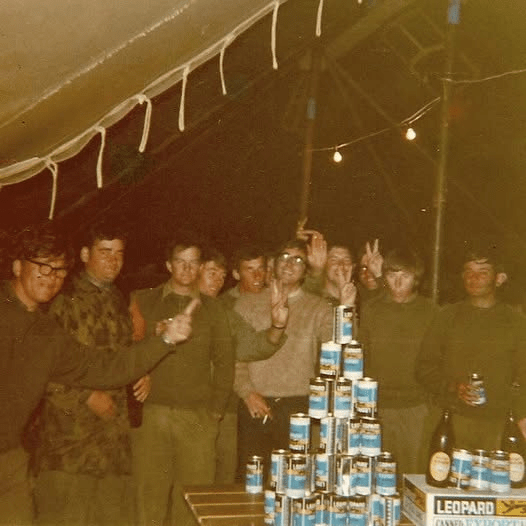
At its core, the Thirty Minute Club was a simple but demanding test: complete a set of physical tasks and consume some beers within a strict thirty-minute time limit, all while maintaining control.

The origins of the “tactical” version of the Club during Exercise TAIAHA TOMBAK are particularly revealing. As one account describes:

Because the camp was tactical, it was initially thought that running the 30 Minute Club might present difficulties. In response, Sgt “Biscuit” proposed adapting it into a “tactical” version. The idea was taken forward through the chain of command to the 2IC of the BMA, who approved it and directed that a formal challenge be issued to all units.

The resulting instruction read:

“TO ALL UNITS – THE NOTORIOUS EX TAIAHA TOMBAK 30 MINUTE CLUB STRIKES AGAIN.
The abovementioned club challenges all Big Brave Kiwis in the BMA to attempt the now Tactical 30 Minute Club, which consists of 3 laps of the BMA (a sand/mud road) in boots, JG’s, shirt or no bloody shirt, rifle (M16 or SLR), complete 3 push ups, 3 chin ups, 3 cold cans of beer. To be completed and held (no spewing) in 30 minutes.”

At 1600 hours, with everything set, the first event saw twelve participants, described as “burly blokes at various stages of unfitness”, assemble at the start line. Drawn from MPs, ordnance personnel, and others across the force, they represented a broad cross-section of the deployed unit.

This passage captures the essence of the activity, informal in origin, but quickly formalised through initiative, humour, and a degree of command tolerance.

While the Thirty Minute Club appears distinctive, it did not emerge in isolation. It sits within a broader tradition of the Hash House Harriers, humorously known as “A Drinking Club with A Running Problem,” which originated in Malaya during the colonial period. These informal running clubs, formed by British expatriates and soldiers, combined cross-country running with social interaction, irreverence, and beer. The emphasis was on participation, shared experience, and post-run camaraderie rather than competition.

By the time New Zealand forces were operating in South-East Asia, this culture was well established across Commonwealth militaries. The Thirty Minute Club can be seen as a distinctly military adaptation of that tradition, compressing the run, formalising the challenge, and integrating it into the rhythm of field exercises.

Comparable practices existed in both the British and Australian Armies. British units, particularly those long stationed in Malaya, Singapore, and Hong Kong, maintained strong links to Hash House Harriers culture, often organising unit runs that blended physical activity with social rituals. Similarly, Australian units deployed in the region developed their own versions of endurance-and-drinking challenges, reflecting a shared Commonwealth approach to building cohesion through informal, physically demanding, and often irreverent activities. While the exact format varied, the underlying principles were consistent: shared hardship, humour, and the deliberate breaking down of barriers between ranks and trades.

The requirements of the Thirty Minute Club itself were deliberately straightforward and brutally honest:

  • Running multiple laps of a set route
  • Completing basic physical tasks such as push-ups and chin-ups
  • Carrying a personal weapon, such as an SLR or M16
  • Consuming a set number of beers, commonly three
  • Completing everything within thirty minutes, with the added condition of “no spewing”

It was not simply a race or a drinking contest; it was both, conducted under fatigue and in field conditions.

The physical component of the challenge was deliberately simple, but physically taxing in context. Participants were required to run multiple laps of a defined circuit, typically a loop established within the exercise area. In this case, the route consisted of three laps of a sand or mud road, where uneven footing, heat, humidity, and loose terrain combined to significantly increase the physical demand.

Importantly, this activity took place within the New Zealand Advanced Ordnance Depot (NZAOD) environment. RNZAOC personnel were operating in a forward-deployed logistics setting, and the challenge arose directly from that context. It was not a barracks activity, but one shaped by the realities of field operations, limited infrastructure, and a demanding operational tempo.

The run was conducted carrying personal weapon systems, reinforcing the expectation that this was a soldier’s activity rather than a purely athletic one. Interspersed within the running were push-ups and chin-ups, performed in small sets, typically three of each, at designated points. These were not designed to test strength in isolation, but to disrupt rhythm, increase fatigue, and complicate pacing.

Participation was broad and inclusive. Personnel from multiple trades and units took part, including ordnance soldiers, MPs, and others, cutting across normal organisational boundaries. It was not an elite event, but one open to anyone willing to step forward.

A later reference in Pataka (June 1987) described the Thirty Minute Club as “a test of physical exertion and drinking skills,” confirming that it was recognised and repeated across exercises. Notably, this 1987 reference likely represents one of the final recorded instances of the tradition, occurring shortly before the withdrawal of New Zealand forces from South-East Asia in 1989, marking the end of a distinct operational environment in which such practices flourished.

What made the Thirty Minute Club significant was not the task itself, but what it produced. It created a shared experience that cut across ranks and trades, reinforcing cohesion through hardship, humour, and competition.

At the same time, it reflects a different era of military culture. It is a tradition that has not stood the test of time, and one that would not be considered appropriate in today’s environment, where standards around health, safety, and alcohol use are far more clearly defined. Its value now lies in what it reveals about the character, culture, and lived experience of the Corps during that period.

Within the RNZAOC, a Corps defined by its role in sustaining others, traditions like the Thirty Minute Club reinforced identity and pride. They demonstrated that behind the logistics system stood soldiers capable of endurance, resilience, and teamwork.

In the end, the Thirty Minute Club was less about the thirty minutes and more about what happened within them, a brief, intense expression of camaraderie that reflected the wider spirit of the Corps.


Repairs on Wheels: New Zealand’s Second World War Technical Vehicles

During the Second World War, the New Zealand Army underwent a remarkable transformation. From a force equipped with just 62 vehicles in 1939, it expanded to more than 22,000 by 1944. This rapid mechanisation did not simply increase mobility; it created an entirely new logistical problem: how to sustain, repair, and recover that fleet across dispersed and often austere operational environments.

The answer lay in the development of mobile technical vehicles, purpose-built workshop lorries that brought engineering and technical capability forward to the point of need. Initially managed under the Mechanical Transport (MT) Branch, this capability was formalised post-war with the establishment of the New Zealand Electrical and Mechanical Engineers (NZEME) in 1946, which became the Royal New Zealand Electrical and Mechanical Engineers (RNZEME) in 1947.

It is important to note that this discussion primarily reflects the development of the New Zealand Army within New Zealand itself. At the same time, the 2nd New Zealand Expeditionary Force (2NZEF) was undergoing a concurrent and equally significant transformation in the Middle East and, later, in Italy, developing its own workshop systems and technical capabilities in response to operational demands in those theatres.

These vehicles, and the system behind them, formed the backbone of field maintenance and technical support.

From Introduction to Deployment: A Compressed Timeline

The technical vehicles described in this article were largely received into New Zealand service between 1941 and 1942, as part of the broader influx of modern equipment from Britain, Canada, and the United States.[1]

What followed was a remarkable achievement as within a period of roughly 12 to 24 months, New Zealand:

  • Absorbed an entirely new class of specialised vehicles
  • Developed training systems for their operation and maintenance
  • Built the trade structure required to employ them effectively
  • Deployed them on active operations with the 3rd New Zealand Division by 1943

This stands in stark contrast to modern capability introduction timelines, where the fielding of new equipment, training, and integration can take many years.[2]

In wartime conditions, necessity compressed what would now be a decade-long capability development cycle into little more than a year.

A Modular System Built for War

New Zealand’s technical vehicle fleet was built on a simple but highly effective principle, common across the British Commonwealth: the machinery type defined the capability, while the chassis provided the mobility.[3]

Workshop bodies were standardised and coded (A, B, D, F, H, I, J, K, L, M, Z), while chassis varied depending on availability. Vehicles in New Zealand service included Ford, Chevrolet, GMC, Leyland, Crossley, Karrier, Austin, and later Bedford and Commer. This modular system allowed:

  • Rapid integration of Allied-supplied vehicles
  • Standardisation of workshop capability
  • Reuse of workshop bodies across multiple vehicle generations

Machinery Types

The Machinery Type system defined both the physical configuration and the technical role of each vehicle.

Type A – General Fitter’s Workshop

Lorry, 3-ton, 6×4

Body: Steel, house-type (14 ft), front-side access, drop sides forming workbenches

Equipment: Lathe (hollow spindle, taper attachment), drills, bench grinder, battery charging panel, generator (via trailer), hand tools

Role: First-line mechanical repair and light machining at LAD level.

Type A in use by 3 NZ Div in New Caledonia

Type B – Machine Workshop (Mk I / Mk II)

Lorry, 3-ton, 6×4

Body: Steel, house-type (14 ft), side access, drop sides

Equipment: Universal horizontal milling machine, powered pedestal drill, grinder, tool sets, and distribution panel

Role: Precision machining and component manufacture.

Type D – Precision Instrument Workshop

Lorry, 3-ton

Body: Steel, house-type (12 ft), rear access, ventilated

Equipment: Precision and watchmaker’s lathes, drill press, vices, fine tools

Role: Repair of instruments and precision components.

Type F – Electrical and Armature Workshop

Lorry, 3-ton, 6×4

Body: Steel, house-type (14 ft), rear access, ventilated

Equipment: DC generator, control panel, meters, specialised electrical test equipment, armature baking oven

Role: Repair and testing of electrical systems and components.

Type H – Heavy Machine Workshop

Lorry, 4-ton, 6×4

Body: 15 ft GS body, tubular frame, tarpaulin, drop-side benches

Equipment: Heavy-duty lathe, grinder, vices, hand tools

Role: Heavy machining and second-line repair.

Type I – Battery Charging Vehicle

Lorry, 3-ton

Body: 12 ft GS body, screened, tarpaulin, blackout curtain

Equipment: Battery charging generator, bus-bars, connectors, acid/water containers

Role: Battery maintenance and electrical support.

Type J – Compressed Air Workshop

Lorry, 3-ton

Body: 12 ft steel body, tubular superstructure, screened

Equipment: Three-stage compressor, petrol engine drive, cylinders, gauges, adapters

Role: Provision of compressed air for maintenance operations.

Type K (KL) – Light Welding Vehicle

Truck, 15-cwt

Body: Tubular frame with tarpaulin

Equipment: 300-amp welder, engine drive, grinder, welding table, screen, accessories

Role: Forward welding and light fabrication.

Type L – Carpentry Workshop

Lorry, 3-ton, 6×4

Body: Steel (14 ft), drop sides, superstructure, two penthouses

Equipment: Woodworking machine, saw-setter, benches, vices

Role: Carpentry and fabrication of wooden components.

Type M – General Workshop System

4-ton Variant

Body: Steel, house-type (15 ft), rear access

Equipment: Bench lathe, valve grinder/refacer, paint sprayer, brake reliner, battery charger, generator

Mk II Variant (3-ton)

Body: GS-type (12 ft), drop sides, penthouses

Equipment: 7.5 kW generator, lathe, drill, grinder, valve tools, spark plug cleaner

Role: Versatile repair and reconditioning across multiple echelons.

Type Z – Wireless and Electronics Workshop

Type Z (14 ft)

Body: Steel, house-type, interference-screened

Equipment: Generator, selenium charger, transformer, wavemeter, oscillograph, signal generators

Type Z Mk II (12 ft)

Equipment: Onan generator, oscilloscope, valve test sets, control panels, diagnostic tools

Type Z Light

Body: Heavy utility vehicle with screened windows

Equipment: Generator, transformer, test panels, megger, electrical bridges

Role (All Type Z): Testing, calibration, and repair of wireless and electronic equipment.

Evidence from the Field

Photographic evidence from the 3rd New Zealand Division in the Pacific confirms how these vehicles were used in practice.

  • A vehicle clearly marked “Machinery Lorry Type A” shows a fully deployed fitter’s workshop, complete with pedestal drill, bench tools, and fold-out work surfaces.
  • The adjacent vehicle, equipped with machinery, is likely a Type M or Type M, indicating layered repair capability.
World War 2 soldiers in front of lorries, New Caledonia. New Zealand. Department of Internal Affairs. War History Branch: Photographs relating to World War I (1914-1918, World War II (1939-1945, the occupation of Japan, the Korean War, and the Malayan Emergency. Ref: 1/4-020408-F. Alexander Turnbull Library, Wellington, New Zealand. /records/22314626

Other images show workshop vehicles expanded with tented extensions, creating enclosed working environments.

ew Zealand Expeditionary Force in the Pacific during World War II; shows a staff of a battery repair plant at an ordnance workshop in New Caledonia. New Zealand. Department of Internal Affairs. War History Branch: Ref: WH-0304-F. Alexander Turnbull Library, Wellington, New Zealand. /records/23015721

In more established locations, workshop vehicles were positioned under locally constructed shelters, forming semi-permanent repair facilities.

View of Naub Divisional Ordnance Workshop at Moindah, New Caledonia. New Zealand. Department of Internal Affairs. War History Branch Ref: F20406. Alexander Turnbull Library, Wellington, New Zealand.

These images demonstrate that the system was not static. It was designed to scale from mobile repair to fully developed workshop installations.

Confirmed New Zealand Fleet (1950)

A 1950 Return of Military Vehicles (Form MT 18A) confirms types A, F, H, I, K, M & Z in New Zealand service across a wide range of chassis, including Austin, GMC, Leyland (including Leyland NZ), Crossley, Karrier, Ford, and Chevrolet.[4]

Excerpt of Form MT 18A Return of Military Vehicles submitted by HQ Central Military District 30 July 1950

This demonstrates that New Zealand operated a fully developed, multi-echelon technical support system, aligned with Commonwealth practice and sustained into the post-war period.

Post-War Evolution

With the establishment of RNZEME in 1947, this system became institutionalised.

  • 1950s: Introduction of Commer G4 chassis fitted with specialist workshop bodies
  • 1960s–1970s: Transfer of workshop bodies onto Bedford RL trucks, extending service life
  • 1980s: Replacement by 13-foot containerised workshop shelters, marking the shift to modular, platform-independent systems

Conclusion

The technical vehicles of the New Zealand Army during the Second World War represent far more than a collection of specialised lorries. They formed part of a deliberately structured and rapidly developed system of battlefield sustainment, built around the Machinery Type concept and adapted to the realities of global war.

Within New Zealand, this system was introduced between 1941 and 1942, absorbed and operationalised in an exceptionally short period, and deployed with the 3rd New Zealand Division by 1943. At the same time, the 2nd New Zealand Expeditionary Force was undergoing a parallel transformation in the Middle East and Italy, developing its own workshop capabilities under different operational pressures. Together, these efforts reflect a wider national adaptation to mechanised warfare, achieved at a pace that remains striking by modern standards.

What emerged was not simply a fleet of workshop vehicles, but a layered, multi-trade capability integrating mechanical, electrical, fabrication, and electronic support. The system was inherently modular, separating function from platform, and scalable, able to transition from forward repair elements to fully developed semi-permanent workshop installations as operations evolved.

Its longevity reinforces its effectiveness. From wartime deployment through post-war refinement under RNZEME, to re-platforming on Commer and Bedford RL chassis, and ultimately to containerised workshop systems in the 1980s, the underlying principles endured even as the technology changed.

As demonstrated throughout this article, and supported by photographic and documentary evidence, these vehicles ensured that New Zealand’s mechanised force could not only move but also endure, adapt, and remain operational under demanding conditions.

At the same time, this study represents only an initial snapshot of New Zealand’s technical vehicle capability during the period. Much remains to be explored, particularly in linking specific Machinery Types to trades, units, and operational employment, and in tracing the full evolution of these systems across both theatres of war. Further research will continue to refine and expand this picture, contributing to a more complete understanding of how New Zealand sustained its forces in the field.

Notes:

[1] “QMG (Quartermaster-Generals) Branch – September 1939 to March 1944,” Archives New Zealand Item No R25541150  (1944).

[2] UK National Audit Office, The Equipment Plan 2023–2033 (London, 2023).

[3] P.J. Montague, Canada. Canadian Military Headquarters, and Canadian Military Historical Society, Vehicle Data Book: Canadian Army Overseas: Armoured Tracked Vehicles, Armoured Wheeled Vehicles, Tractors, Transporters, “B” Vehicles, Trailers (Branch of QMG, Canadian Military Headquarters, 1944).

[4] HQ CMD 47/2/08 Register of Arms – Instruments & Vehicles dated 5 July 1950 “Conferences and Committees: Committee Stores Accounting Establishment of Minutes Meetings,” Archives New Zealand Item No R22497304  (1947-1953). HQ


Can You Help?

RNZAOC.com exists to preserve and share the history of New Zealand’s military logistics, the systems, equipment, and people that sustain operations but are rarely recorded in detail.

Much of this history does not sit in official records. It exists in fragments, in unit knowledge, in personal experience, and in equipment that quietly disappears from service. If it is not captured and brought together, it is lost.

This site is an ongoing effort to record that history properly and to provide a structured, accessible reference for those who served, those still serving, and those interested in understanding how the Army is sustained.

It is not a commercial venture. It is built through research, writing, and engagement with the logistics community, and is intended to stand as an enduring record over time.

Since launch, RNZAOC.com has grown into a substantial body of work:

  • 313 articles and research pieces published
  • 201,526 total views across the site
  • 120,304 individual visitors reached
  • 231 reader comments and contributions
  • Coverage spanning New Zealand military logistics from 1845 to the present day

The site now reaches readers in over 100 countries, with a core audience in New Zealand and sustained engagement across the United States, Australia, the United Kingdom, and Singapore, alongside a broad international readership across Europe, Asia, the Middle East, and the Pacific.

This work is now also contributing to wider efforts, including RNZALR historical material and engagement with the Army Museum.

Supporting the Work

As the site continues to grow, so do the practical costs of hosting, maintenance, and development.

If you find value in the content and believe preserving this history matters, you can support the site with a small donation via the link at the bottom of each page.

There is no expectation to contribute. But for those who choose to do so, your support directly enables this work to continue.

Because once this history is lost, it does not come back.


From Static Storage to Mobile Systems

To most people, a warehouse is simply a place where goods are stored. As long as they receive what they have purchased, few give any thought to the systems and processes operating behind the scenes to ensure the right items arrive at the right time, in the right condition, and, where necessary, without spoilage.

This is doubly true in the military context. Unlike commercial organisations with relatively predictable product lines, military logistics must support a vast and constantly shifting range of demands, from food, water, and fuel to ammunition, vehicles, spare parts, medical supplies, and specialised equipment. The scale and diversity of these requirements create a level of complexity far beyond that of most civilian supply chains.

To manage this, militaries have, over time, developed highly structured and disciplined systems to control the storage, handling, and distribution of every conceivable commodity. Despite their complexity, these systems are fundamentally grounded in the same core principles that underpin all warehousing: accuracy, accountability, preservation, and the timely movement of goods.[1]

What further distinguishes military warehousing from its civilian counterpart is that it cannot remain purely static. While elements of the system may be based in fixed depots and established infrastructure, large parts of it must be capable of moving with the ebb and flow of operations and campaigns. Warehousing, in a military sense, is therefore not simply about storage; it is about the controlled projection of sustainment forward.[2]

As forces deploy, advance, or withdraw, the supporting warehousing system must adapt accordingly. Stocks may be held in rear areas, pushed forward to intermediate depots, or broken down into smaller, mobile holdings to support units in the field. This requires not only physical movement, but constant visibility, control, and accountability across the entire supply chain, often under conditions of uncertainty, disruption, and threat.[3]

In the New Zealand context, this complexity was formalised through a functional division of responsibilities from the 1950s. The Royal New Zealand Army Service Corps was responsible for the provision and management of foodstuffs and fuels, while the Royal New Zealand Army Ordnance Corps was responsible for all other classes of supply. Medical supplies were managed by the Royal New Zealand Army Medical Corps.[4]

Together, these functions, now consolidated under the Royal New Zealand Army Logistic Regiment, demonstrate that military warehousing is not a single system, but a coordinated network of specialist capabilities, unified by common principles but adapted to the demands of different commodities and operational environments.

The Emergence of Mobile Field Warehousing

Field warehousing differs fundamentally from its static counterpart. It must be established rapidly, often in austere environments, and operate under conditions where infrastructure is minimal or non-existent. Storage may take place in open areas, tentage, temporary structures, or vehicles, with the overriding requirement being flexibility and survivability.[5]

Even in these conditions, the core warehousing processes remain unchanged: receipt, storage, maintenance, selection, and dispatch. However, the means by which these are achieved must be adapted to support mobility.[6]

The field warehouse, therefore, becomes a deployable function rather than a fixed location, capable of expanding, contracting, or relocating as operations evolve.

Second World War Developments: The Rise of Mobile Storage

Before the Second World War, field storage relied heavily on crates, cases, and manual handling. While effective at a small scale, these systems struggled to support the demands of modern, mechanised warfare.

The war drove innovation. Within formations such as the New Zealand Divisional Ordnance Field Park, storage became increasingly integrated into mobile platforms through the use of stores trucks.[7]

Fred Kreegher New Zealand Ordnance Field Park sorting out stores in the rear of his Bin Truck. the.Noel Kreegher collection

These vehicles functioned as mobile warehouses, fitted internally with shelving and bins that allowed stores to be organised, accounted for, and issued directly from the vehicle. By 1944, New Zealand had approximately 178 such vehicles in service, reflecting a significant shift towards mobile, structured storage.[8]

Bin Lorry of the Polish Corps Italy 1943-45. The Polish Institute and Sikorski Museum

This marked a fundamental transition; the warehouse was no longer tied to a location but could move with the force.

Post-War Continuity and Modular Storage

Following the war, these systems remained in service, with vehicles such as the GMC CCKW gradually being replaced by platforms like the Bedford RL, while retaining the same underlying storage concept. The transition in vehicle types did not immediately change how stores were handled, but it provided a more reliable and standardised platform on which further refinements could develop.

1 Comp Ord Coy Exerces 1960 with bot RL and GMC Bin Trucks

A key refinement was the transition to modular bin box systems. These wooden bin boxes, internally subdivided and increasingly standardised, could be efficiently stacked in vehicles for transport or lifted out and re-established in tents or field storage areas without repacking. This reduced handling, improved organisation, and maintained the integrity of detailed stores.

Three Soldiers of the 1st Composite Ordnance Company in the mid 1960s, next to a Binner Three ton RL Bedford Truck. From Left Mike Barker, Dave Smith, Denis Kingi.

More significantly, this approach enabled the separation of storage from transport. Vehicles were no longer tied to their loads and could be quickly redeployed once unloaded, while the bin system remained intact as a functioning storage solution on the ground. This represented a clear conceptual shift, from vehicle-bound carriage to modular, location-independent warehousing, laying the groundwork for the later adoption of palletisation and containerisation.

Dismounted Bin Boxes used in a static location 5 Advance Ordnance Depot, Singapore 19671

The Transition to Palletisation and Containerisation

The post-war period saw broader changes in military logistics. Palletisation and containerisation became increasingly standard, particularly following their successful use by the United States in Vietnam.[9]

New Zealand began modernising its systems in the 1960s, adopting electronic data processing for stock control and introducing standard pallets and rough-terrain forklifts, such as the RT-25, in the 1970s.

RT-25 Loading a pallet of Ration Packs, Annual Camp 1985

Despite these advances, bin-based systems persisted for detailed storage until the 1980s, when the 13-foot Binned Storage Container was introduced.

NZ Army 13′ Container

These containers represented a significant step forward in field warehousing capability. Internally, they were fitted with four rows of shelving divided into bays, with secure, lockable doors and adjustable shelves designed to accommodate a wide range of items. Stores could be held loose, in cardboard bins, or in later plastic containers, providing a flexible and scalable storage solution.

The containers were designed for sustained field use. They incorporated fixed lighting with blackout capability, small heaters to maintain internal conditions, and equipment such as microfiche readers to support administrative functions in the pre-digital era. Power could be supplied from generators or mains, with onboard battery systems enabling limited independent operation when disconnected.

Ancillary equipment, including first-aid kits, fire extinguishers, levelling gear, and ladders, enabled the container to be safely set up and operated in a variety of environments. The containers could be mounted on vehicles such as the Unimog or on 6-tonne trailers using twist-lock systems, providing mobility and flexibility in deployment.

These containers were widely used across Royal New Zealand Army Ordnance Corps units, including Supply Companies and Workshop Stores Sections. However, their utility extended beyond their original purpose. Their robust, weatherproof construction and integrated power made them highly adaptable, and many were modified in the field. In some cases, shelving was removed or reconfigured, and the containers were repurposed as ad hoc field headquarters, technical workspaces, or general-purpose shelters. While this demonstrated their versatility, it also diminished their effectiveness as dedicated storage systems and, in some instances, reduced their original warehousing capability.

At the peak of their use in the mid-1990s, these containers formed a key component of field logistics support. For example, 21 Supply Company managed up to 12 of the 13-foot binned storage containers, fully loaded with a range of stores, alongside an additional 20–30 pallets of bulk general stores. Frequently deploying from Linton to Waiouru, this capability supported major exercises and training activities, providing a scalable and responsive mix of detailed and bulk storage within a deployable field environment.

However, while the New Zealand Army adopted containerisation in form, it did not fully adopt the supporting systems required to maximise its effectiveness. Purpose-built materials handling equipment capable of lifting fully loaded containers was not introduced at scale. Instead, lifting sets were issued on a limited basis, typically one per four containers to enable mounting and dismounting.

In practice, this meant that container handling remained labour-intensive and often imprecise, particularly in field conditions. On soft, uneven, or wet ground, the process could become slow and difficult, reducing the efficiency gains that containerisation was intended to deliver.

Post-Cold War Change and Decline

The 1990s marked a period of significant change in military logistics. Like many Western militaries, New Zealand sought to realise the benefits of the post-Cold War peace dividend, reducing costs and adopting commercially influenced supply chain practices.

Concepts such as just-in-time logistics reduced stockholding in favour of efficiency. However, for a small, geographically isolated force operating at the end of a long supply chain, this approach introduced risk. Stock reserves declined, and sustainment depth was reduced, while organisational changes further centralised logistics functions.[10]

Within this environment, deployable storage systems such as binned containers became less relevant. Their use became increasingly confined to specialist functions, and their broader role in field warehousing diminished.

Conclusion: From Place to System, and the Loss of Capability

The evolution of military field warehousing reflects a clear trajectory. From static depots to mobile vehicles, from fixed shelving to modular systems, and from unit-level storage to containerised solutions, the direction of change is consistent.

Warehousing has shifted from being defined by place to being defined by system.

However, in the New Zealand context, this evolution has not been without consequence. The field storage capability, as it was understood and practised from the 1960s through to the 1990s, has largely been lost. The ability to deploy, establish, and operate structured, forward storage systems at the second line has diminished alongside reductions in stockholding and an increased reliance on centralised, commercially aligned supply chains.

Yet the operational environment is once again changing. The emergence of distributed operations, autonomous systems, and technologies such as drones is placing renewed emphasis on dispersion, resilience, and forward sustainment. In this context, the principles that underpinned earlier field storage systems, modularity, mobility, and local control, remain highly relevant.

Rather than representing an obsolete practice, field warehousing may in fact be an area requiring rediscovery and adaptation. Rebuilt for the modern operating environment and integrated with contemporary technologies, it has the potential to once again provide the depth, flexibility, and resilience required to sustain operations in an increasingly complex battlespace.

Footnotes

[1] Martin Van Creveld, Supplying war: logistics from Wallenstein to Patton (Cambridge University Press, 2004), 1-20.

[2] Defence Logistics NZDDP-4.0 (Second Edition), New Zealand Defence Doctrine Publication: NZDDP, (New Zealand Defence Force, 2020), Non-fiction, Government documents.

[3] U.S.G.U. Army, Field Manual FM 4-0 Sustainment Operations July 2019 (Independently Published, 2019).

[4] “NZ P106 DOS Procedure Instructions, Part 1 Static Support Force. Annex F to Chapter 1, RNZAOC Director of Ordnance Services,”  (1978).

[5] Defence Logistics NZDDP-4.0 (Second Edition).

[6] Defence Logistics NZDDP-4.0 (Second Edition).

[7] “NZ Divisional Ordnance Field Park 1941-1945,” “To the Warrior his Arms” History of the Royal New Zealand Army Ordnance CCorps and its predecessors, 2018, accessed 11 December, 2018, https://wp.me/p4YOZp-4aH.

[8] “QMG (Quartermaster-Generals) Branch – September 1939 to March 1944,” Archives New Zealand Item No R25541150  (1944).

[9] N.S. Nash, Logistics in the Vietnam Wars, 1945-1975 (Pen & Sword Military, 2020); M.L. Bradley, J.D. Meyerson, and Center of Military History, Logistics at War: The Buildup, 1962-1967 (United States Army Military History Institute Library, 2025).

[10] M. Christopher, Logistics and Supply Chain Management: Logistics & Supply Chain Management (Pearson Education, 2016), 200–20.


1959: A System Under Strain

What the RNZAOC’s Officer Crisis Reveals About Logistics Then, and Now

There was no single moment when it became obvious.

No depot failed, no supply chain collapsed, and no operation ground to a halt. On the surface, the Royal New Zealand Army Ordnance Corps in 1959 was doing what it had always done, issuing, accounting, repairing, and sustaining, and in many respects, it appeared stable.

But beneath that system, something was beginning to give.

The Warning Signs in 1959

A 1959 Army Headquarters minute, “Retirement and Replacement of Officers,” laid out the situation with clarity and without exaggeration.[1]

On paper, the Corps appeared to be in a position of strength, with an officer establishment of 44 and an actual strength of 49 officers, suggesting a modest surplus. This margin, however, proved misleading once operational commitments were taken into account, as officers employed outside core appointments reduced that surplus to a net deficiency of six officers against requirement.

More concerning was what lay ahead. The Corps faced a concentrated wave of retirements, with seventeen officers due to leave within the following three years, a loss that would reduce the available pool to roughly 32 officers to fill 49 positions if unaddressed. These were not isolated departures but the loss of a cohort, a single generation moving through the system together.

This was not an abstract projection. The minute identified, by name, the officers expected to retire, including Majors Y.A. Bailey, O.H. Burn, R.T. Marriott, H.S. Sandford, M.R.J. Keeler, and D.E.A. Roderick; Captains C.G. Gibson, A.G. Perry, B.P. Kennedy, B.J. Crossman, G.W. Dunham, J. Rose, F.G. Cross, W.C. Ancell, and R.O. Widdowson; alongside Lieutenant Colonel H.W.E. Reid and Lieutenant L.B. Attridge.

What is striking is not only the number, but the rank distribution. This was not a thinning at the top, but the scheduled loss of the Corps’ working leadership, the Majors and Captains who underpinned depot command, staff functions, and the daily execution of the ordnance system.

This was not a temporary fluctuation but a structural condition already in motion and visible.

Lt Col H McK Reid, Director of Ordnance Services , 1 Apr 1957 – 11 Nov 1960

The Age Profile: A Structural Fault Line

The underlying issue was not simply numerical, but demographic.

By 1959, the RNZAOC officer corps displayed a pronounced imbalance, with an average age of 43 years and approximately 83% of officers aged between 39 and 54, many of whom were drawn from the 1911–1920 birth cohort. This concentration within a narrow age band reflected a Corps shaped by wartime commissioning patterns, but insufficiently renewed in the years that followed.

What emerged was a compressed structure, dominated by a single generation and lacking depth beneath it. Rather than a balanced progression from junior to mid-level to senior officers, the Corps had become top-heavy, relying on accumulated experience without a corresponding pipeline of successors.

Such a structure can remain effective for a time, but only so long as that experience remains in place. Once it begins to depart, continuity is not gradually reduced but lost in blocks.

Why This Mattered

At first glance, an officer shortage might appear manageable. Within the RNZAOC system of 1959, however, it represented something more significant. The ordnance system depended on officer oversight at every level, from enforcing stockholding policy and validating demand to maintaining accounting discipline and supervising issue and distribution processes, all of which assumed a consistent level of professional competence.

Without that layer of oversight, the system did not immediately fail but instead began to drift from its intended design. The 1959 minute recognised this risk directly, noting both the difficulty of sourcing suitable replacements and the danger of further weakening the structure through internal commissioning. This was therefore not simply a shortage, but a loss of continuity within the system itself.

Holding It Together

In response to these pressures, the Corps increasingly relied on commissioning from within its own ranks. Experienced senior non-commissioned officers and warrant officers were promoted into officer roles, bringing with them deep knowledge of the system and enabling the Corps to maintain capability in the short term.

However, this approach came at a cost. As one contemporary observation noted: “We are becoming a nation of old men, and we are denuding our OR structure of our best senior NCOs and WOs.”

By drawing from its most experienced soldiers to sustain the officer cadre, the Corps risked weakening the technical and supervisory foundation that underpinned its day-to-day functioning. At the same time, external intake remained limited, further constraining the ability to regenerate the structure and restore balance.

The system, in effect, was no longer renewing itself.

Headquarters Group, Main Ordnance Depot, Trentham 1954

A System That Still Worked

What makes 1959 particularly instructive is that nothing had visibly failed. The system continued to function, units were supported, equipment was issued, and stores were properly accounted for, giving little outward indication of the structural pressures beneath it.

This is how such problems tend to present themselves in logistics systems, not through sudden breakdown, but through an increasing reliance on experience, informal workarounds, and individuals carrying a disproportionate share of responsibility.

By the late 1950s, the RNZAOC was supporting a broader and more complex set of commitments than earlier in the decade. While the system itself had evolved to meet these demands, the structure underpinning it had not kept pace.

The Real Point of Failure

The lesson of 1959 is not ultimately about establishment figures or officer numbers, but about where control within a logistics system actually resides. It does not sit in policy alone, nor in depots or even in the structure of the system itself, but with the individual responsible for applying it.

The RNZAOC system could define demand pathways, enforce stockholding policy, and structure accountability across the force, yet it still depended on individuals to raise demands correctly, interpret and apply entitlement scales, maintain accurate records, and enforce discipline in execution.

As experience became concentrated within a shrinking cohort, this reliance became increasingly fragile. The risk was not one of immediate failure, but of gradual degradation, inconsistent demand, reduced oversight, growing reliance on informal practices, and the steady loss of institutional knowledge.

Under such conditions, the system would continue to function, but no longer as designed.

Lessons for Modern Logistics Systems

It would be easy to see 1959 as a product of its time, yet the pattern it reveals is not confined to a single corps, force, or era. Modern logistics systems are far more advanced, increasingly digitised and integrated, and capable of providing near-real-time visibility across complex supply chains, but the underlying dependency remains unchanged.

Every logistics system still relies on the same foundations: accurate demand at the point of entry, a clear understanding of entitlement and policy, discipline in execution, and, critically, the experience of the people applying them.

The difference today is not in principle, but in scale. Where earlier systems might have contained the impact of error within a single unit or transaction, modern interconnected systems allow those same errors to propagate rapidly across the enterprise, amplifying the consequences of misinterpretation, inexperience, or poor application.

What the 1959 experience highlights is that such systems are sustained not by process alone but by the balance of the workforce operating them. When experience becomes concentrated within a narrow cohort, when too few individuals hold institutional knowledge, and when insufficient depth exists beneath them, the system becomes inherently fragile.

It is under these conditions that what organisational theorist Diane Vaughan described as the normalisation of deviance can begin to emerge, as practices that fall outside formal policy become accepted over time simply because they appear to work.[2] In a logistics context, this may manifest as informal demand practices, shortcuts in entitlement interpretation, or workarounds in accounting and tracking, none of which immediately break the system, but all of which gradually widen the gap between design and execution.

Under such conditions, the system does not fail immediately but begins to degrade.

Technology has increased capability, but it has not removed the need for a balanced, experienced workforce to sustain it.

Conclusion

The 1959 officer crisis within the RNZAOC was not a failure, but a warning that even a well-designed logistics system cannot compensate indefinitely for an imbalance in its human structure. The age profile exposed that imbalance clearly, revealing a Corps dominated by a single generation, with insufficient depth beneath it and continuity increasingly at risk.

Crucially, the risk was recognised early, and measures were identified to increase intake, broaden recruitment, and restore balance to the officer structure, steps aimed not simply at filling vacancies, but at rebuilding resilience within the system itself.

Although the breaking point had not yet been reached in 1959, it was already visible. The enduring lesson is that while systems can be designed, refined, and digitised, they remain dependent on the people who operate them, and when that human structure falls out of balance, the system does not fail outright but gradually drifts away from its intended design until the gap between expectation and reality can no longer be ignored.

Footnotes

[1] “Organisation – Policy and General – RNZAOC “, Archives New Zealand No R17311537  (1946 – 1984).

[2] D. Vaughan, The Challenger Launch Decision: Risky Technology, Culture, and Deviance at NASA (University of Chicago Press, 1996).


New Zealand Army Ration Packs, 1945–1987

By the end of the Second World War in 1945, New Zealand had demonstrated a clear capacity not only to design, but to innovate in operational feeding systems suited to modern warfare. Wartime developments, drawing on both British and American models but adapted to New Zealand conditions, produced a battle ration system capable of supporting dispersed, mobile, and tropical operations. These systems addressed mobility, environmental challenges, and the requirement for compact, durable, and nutritionally adequate food.

Yet this wartime momentum was not sustained. In the post-war period, the urgency that had driven innovation dissipated, and no structured research and development programme emerged to carry those advances forward. As a result, between 1945 and 1987, the evolution of New Zealand Army ration packs was shaped less by continuous scientific development than by institutional adaptation, procurement constraints, and operational necessity.

Responsibility for ration packs reflects this shift. From approximately 1950 to 1979, they were managed by the Royal New Zealand Army Service Corps (RNZASC) as part of the wider feeding system. Following the 1979 reorganisation of supply responsibilities, this function transferred to the Royal New Zealand Army Ordnance Corps (RNZAOC), aligning ration packs more closely with materiel management and procurement systems.

Throughout this period, the terminology remained simple. In New Zealand service practice, they were known as ration packs, often informally abbreviated to “rat pack”. The latter term, Operational Ration Pack (ORP), did not enter common usage until the late 1980s. The term “Meal Ready to Eat (MRE)” was not part of New Zealand military usage in this period and is not a term traditionally used in the context of field rations, its appearance in New Zealand discourse being a relatively recent development reflecting the influence, and in some cases the Americanisation, of certain military functions and language.

While formally described in administrative and doctrinal terms, ration packs were experienced very differently by users. For the soldiers who carried and consumed them, they were not simply a feeding system, but a daily reality shaped by weight, taste, routine, and necessity. Alongside the issued ration pack, soldiers often supplemented their diet with “jack rations”, small unofficial or semi-official additions such as chocolate, biscuits, or other comfort items carried or acquired separately, reflecting both personal preference and the limitations of the issued scale. Across the period, a consistent pattern emerges in recollections: the issued pack was only the starting point. What mattered was how it was adapted in the field.

New Zealand soldiers in the 5th Army in Italy preparing a meal, 15 February 1944 by George Frederick Kaye.

1945–1955: Continuity and Administrative Stability

The decade following the war was characterised by continuity rather than innovation. The Army’s focus lay in rebuilding a peacetime force, integrating Regular and Territorial components, and implementing compulsory military training from 1950.[1]

Within this framework, feeding remained an administrative function under the RNZASC. The system relied on fresh ration supply, centralised kitchens, and bulk provisioning. Ration packs existed, but only as ad hoc assemblies drawn from existing stores rather than as formally designed or standardised systems.[2]

There is little evidence of systematic ration development during this period. Instead, the wartime model gave way to a stable but essentially static approach suited to peacetime conditions.

1955–1962: Operational Pressures and the Trial Phase

From the mid-1950s, operational commitments in Southeast Asia, particularly in Malaya, exposed the limitations of traditional feeding systems. The 1958 Defence Review reinforced the requirement for a Regular force capable of limited war, emphasising mobility, dispersion, and independence from fixed infrastructure.[3]

These demands drove the first deliberate experimentation with modern ration packs. Between approximately 1958 and 1962, the Army trialled both four-man and one-man pack concepts.

The four-man pack retained group-feeding principles and proved unsuitable in operational conditions due to its weight, bulk, and inflexibility. By contrast, the one-man pack represented a conceptual shift. Although initially assembled from existing components, it demonstrated the practicality of individual sustainment, portability, and operational independence.

This period marked the transition from improvised feeding solutions to the requirement for a standardised individual ration system.

1962–1967: System Formation and the No.2 Pack

Between 1962 and 1967, the one-man concept was formalised into the No.2 ration pack, representing the first coherent system of its kind in New Zealand service.

By the mid-1960s, contents had been standardised, packaging had been improved, and issue procedures had been simplified. Archival evidence shows that development was deliberate but constrained, shaped by cost considerations and existing supply arrangements.[4] At the same time, inherent limitations in canned systems, particularly weight and packaging inefficiencies, were already recognised.[5]

At the user level, these limitations were not theoretical but immediate. The weight and bulk of canned components directly influenced how soldiers interacted with the system. Packs were routinely modified before use, with items removed, redistributed, or discarded entirely. Although the ration pack was designed as a complete, balanced unit, it was rarely carried or consumed in that form once issued.

This phase established the structural foundation of the New Zealand ration pack system, even as its limitations were becoming apparent.

Contents of a 1960s era Ration Pack laid out

The Mk 1–8 Ration Pack Series

The development of the No.2 pack is best understood through the Mk 1–8 series, introduced between 1959 and 1965. These marks reflect a process of controlled refinement rather than fundamental redesign.

This process of refinement occurred within a relatively fixed structural framework and did not fully account for user preference. In practice, menu acceptability varied widely. Certain items became consistently unpopular and were carried but not consumed, while others were prioritised, traded, or hoarded. The intended nutritional balance of the ration pack was therefore rarely fully realised, as individual preferences and informal exchange shaped consumption patterns within units.

Adjustments across the series focused on improving menus, refining packaging, and modifying contents in response to cost and supply constraints. While these changes enhanced usability and practicality, they did not alter the system’s underlying structure, which remained centred on canned components in a fixed format.

The Mk 1–8 series established a stable and reliable baseline that would remain in service, largely unchanged in concept, into the 1970s.

1960s–1970s: Parallel Development and System Expansion

Alongside the Mk series, the Army explored lightweight, dehydrated ration packs in the early 1960s. These offered advantages in reduced weight and bulk but introduced new constraints, particularly reliance on water and increased preparation time.[6]

As a result, they were adopted selectively rather than as replacements.

By the early 1970s, this experimentation had produced a three-tier ration system: the one-man pack as the primary self-contained system; the 10-man composite pack, derived from group-feeding concepts; and lightweight or dehydrated packs for specific operational contexts.

This layered structure reflects adaptation through addition rather than replacement, with new systems augmenting, rather than displacing, established ones.

This layered system also reflected how soldiers used ration packs in the field. Rather than adhering strictly to a single ration type, personnel often combined elements from different systems, supplementing issued packs with alternative components where available. The formal structure defined categories of use, but in practice these boundaries were fluid, shaped by operational context and individual adaptation.

1970–1985: Stagnation and the Limits of Incremental Development

Following the system formation of the 1960s, ration pack development entered a prolonged period of stagnation. Between approximately 1970 and 1985, there is little evidence of major redesign, doctrinal reassessment, or structured research and development.

Instead, changes were incremental and driven by practical considerations, including menu variation, packaging refinement, and substitution based on cost or availability. While these adjustments-maintained functionality, they did not address underlying structural limitations.

By this stage, the divergence between system design and user experience had become pronounced. Soldiers routinely adapted ration packs through what would later be termed “field stripping”, removing unwanted components and reducing weight before operations. Informal trading systems were well established, allowing individuals to reshape their ration into a more usable form. These practices were not formally recognised within the system but were widespread and effectively became an unofficial layer of ration management. This divergence is explored further in “Voices from the Field”.

Alongside these practices, soldiers frequently carried what were informally known as “Jack rations”, privately obtained or retained food items intended for personal use. The term, derived from the expression “I’m alright Jack”, reflects both individual provision and the expectation that such items might be shared within the group.

Jack rations functioned as an unofficial extension of the ration system, compensating for perceived shortfalls in variety, acceptability, or energy content. Their widespread use underscores that the issued ration pack, while structurally complete, was not considered sufficient in isolation under operational conditions.

Over time, these limitations became increasingly apparent. Issues such as limited variety, menu fatigue, declining acceptability, and nutritional imbalance emerged under sustained operational use.

In many respects, the Gruber pack can be understood as a response not only to operational conditions but to observed user behaviour. Issues such as menu fatigue, selective consumption, and the informal modification of ration packs had already been evident for years. The Gruber pack addressed these indirectly, improving variety and usability, but without fundamentally altering the underlying system structure.

1986 Individual One-Man, 24 Hour Ration Pack (Canned)

1976: The Gruber Pack as a Corrective Measure

The introduction of the Gruber ration pack in 1976 provides clear evidence of these pressures. Developed in response to operational conditions experienced by 1st Battalion, Royal New Zealand Infantry Regiment (1 RNZIR) in Singapore, it was designed to supplement, rather than replace, the existing system.

Its purpose was to improve variety, nutritional intake, and overall acceptability, particularly in tropical conditions and during prolonged field use. Its introduction reflects a consistent pattern: where structural redesign was not feasible, adaptation occurred through supplementation.

The Gruber pack, therefore, highlights both the resilience and the limitations of the established system.

1RNZIR Soldiers moving Rat Packs following an air drop, C1985

1979: Transition to RNZAOC

The transfer of responsibility for ration packs to the RNZAOC in 1979 marked a shift towards system-based materiel management. Ration packs were increasingly treated as part of a broader supply and procurement framework.

However, this institutional change did not immediately produce a technical redesign. The underlying structure of the ration system remained largely unchanged.

1985–1987: Transition to Scientific Design

By the mid-1980s, the cumulative limitations of the existing system prompted a renewed focus on structured research. Between 1985 and 1987, modern approaches to ration design were introduced, incorporating nutritional modelling, user feedback, and integrated system design.[7]

These developments confirmed long-recognised shortcomings and marked the beginning of a transition towards a more scientific, user-focused approach to ration development. Flowing directly from this work, a new generation of ration packs began to emerge, moving away from traditional tinned components towards modern packaging solutions. From the early 1990s, retort packaging, flexible heat-sterilised pouches, increasingly replaced cans, offering significant reductions in weight and bulk, improved durability, and enhanced operational suitability for dismounted and mobile forces.

1986 Individual Contents of the One-Man, 24 Hour Ration Pack (Canned)

Voices from the Field – Soldier Commentary to c.1990

(Insights drawn from retrospective commentary across social media forums and veteran discussion groups)

A review of discussions across social media platforms, including veteran forums and New Zealand military history groups, reveals a consistent body of informal feedback on ration pack use during the period up to 1990. While anecdotal in nature, these perspectives are notably consistent and provide valuable insight into how ration packs were actually used in practice.

“You never carried a full rat pack if you didn’t have to.”
Ration packs were routinely modified prior to deployment. Soldiers commonly removed tinned items, excess packaging, and non-essential components to reduce weight and bulk, indicating that the issued configuration was rarely carried intact.

“Some meals just stayed at the bottom of the pack.”
Menu acceptability varied significantly. Certain items were consistently avoided, sometimes carried for extended periods without consumption, while others were prioritised or traded. The intended nutritional balance was therefore frequently altered in practice.

“You’d swap half your pack before you even left.”
Informal trading was widespread. Soldiers exchanged components to assemble preferred combinations, creating an unofficial redistribution system operating alongside the formal ration scale.

“Tea was gold.”
Small comfort items, particularly tea and sugar, are consistently described as disproportionately important. Their value extended beyond nutrition, contributing to morale, routine, and a sense of normality in field conditions.

“Those tins were a mission on their own.”
Canned rations, while durable and reliable, are frequently described as heavy, awkward, and logistically inconvenient, particularly during dismounted operations.

“You could make it last longer if you had to.”
Ration packs were often extended beyond their intended duration. Consumption patterns were shaped by operational necessity rather than formal feeding cycles.

“Everyone had their own way of doing it.”
Despite standardisation in design and issue, there was no single method of use. Individual adaptation was universal, with soldiers developing personal approaches to carrying, preparing, and consuming rations.

Closely related to this was the widespread use of “Jack rations”, privately held food items carried in addition to issued packs. These typically included sweets, chocolate, and other high-energy or comfort foods. While not part of the formal ration scale, they were widely recognised and often subject to the same informal expectations of sharing and exchange.

Taken collectively, this commentary reinforces a consistent conclusion: ration packs, as designed, represented only the baseline system. Their effectiveness in the field depended on a layer of user-driven adaptation that was informal, unrecorded, and largely unaccounted for in formal development processes. This included not only the modification and redistribution of issued rations, but also their supplementation through privately held “Jack rations”, extending the system beyond its formal design.

Conclusion

Between 1945 and 1987, the development of New Zealand Army ration packs followed a clear but constrained trajectory. The 1950s were defined by experimentation, the 1960s by system formation, and the 1970s by stabilisation through incremental adaptation. By the mid-1980s, the limitations of this approach necessitated a return to structured, scientific design.

However, as both the formal development record and the user perspectives outlined in Voices from the Field demonstrate, this evolution cannot be understood solely through official pathways. Alongside design, procurement, and doctrinal intent existed a persistent and largely undocumented layer of user-driven adaptation.

In practice, the ration system operated across multiple layers. The issued ration pack provided the formal structure, but this was routinely modified through selective consumption and “field stripping”, reshaped through informal trading, and supplemented through privately held “Jack rations”. Together, these behaviours formed an unofficial but essential extension of the system, allowing it to function under real operational conditions.

Soldiers did not passively consume ration packs as designed. They actively interpreted, adjusted, and augmented them to meet the demands of weight, acceptability, and operational tempo. In doing so, they exposed both the strengths and the limitations of the system, often anticipating issues that would only later be addressed through formal development.

The history of New Zealand Army ration packs in this period is therefore not simply one of technical evolution, but of continuous interaction between system design and human use. The system defined what was issued; soldiers determined how it functioned.

This evolution was not one of continuous innovation, but of adaptation within constraint. Operational demands, procurement realities, and institutional structures shaped development at every stage. Only when these constraints became untenable did a more deliberate and analytical approach re-emerge.

Footnotes

[1] “H-19 Military Forces of New Zealand Annual Report of the General Officer Commanding, for period 1 June 1949 to 31 March 1950 “, Appendix to the Journals of the House of Representatives  (24 May 1950 1950).

[2] “Military Forces of New Zealand Annual Report of the General Officer Commanding, for period 1 April 1955 to 31 March 1956,” Appendix to the Journals of the House of Representatives, 1956 Session I, H-19  (3 July 1956 1956).

[3] “H-19 Military Forces of New Zealand Annual Report of the General Officer Commanding, for period 1 April 1957 to 31 March 1958,” Appendix to the Journals of the House of Representatives  (3 July 1958 1958).

[4] “Supplies: General- Ration Packs: Development and Production,” Archives New Zealand Item No R17189341  (1958 -1967).

[5] “Supplies: General- Ration Packs: Development and Production.”

[6] “Supplies: General- Ration Packs: Development and Production.”

[7] Bing David Soo, “Development of nutritionally balanced and acceptable army ration packs: a thesis presented in partial fulfilment of the requirements for the degree of Master of Technology in Product Development at Massey University” (Massey University, 1987).


The Long War Face

There’s a certain kind of photo that makes you pause.

Not because anything dramatic is happening, but because of the faces. A group of New Zealand Advanced Ordnance Depot men in Italy in 1944, sitting in a camp, vehicles behind them, gear stacked nearby. It looks ordinary enough.

But the longer you look, the more you notice it.

The eyes aren’t relaxed. The expressions aren’t hard, but they aren’t easy either. No one’s really performing for the camera. There’s a weariness in them, the sort that comes from long days, short nights, and work that never really stops.

They look.… settled into it. Used to it.

A group of NZAOD personnel in Italy, 1944. Front Row: H.D Bremmer, R.G James, 2nd Lieutenant H.J. Mackridge, N.G Hogg, G.P Seymour. Back Row: WO2 Worth, D.S Munroe, G Caroll, Charles Joseph Moulder, Francis William Thomas Barnes, H Rogers, C.W Holmes, W Wallace, N Denery. Photo: Defence Archive Collection, Alexander Turnbull Library.

From a modern perspective, that’s not something we instinctively recognise.

Today, deployments are six or nine months, maybe twelve, but there’s a clear start and a clear end, and a system built around that cycle, reliefs, leave, welfare, recovery. Even in demanding environments, there’s an understanding that you won’t be there indefinitely.

And, just as importantly, most modern deployments aren’t sustained warfighting campaigns as in the Second World War.

They’re serious. They matter. But they’re different.

Some of the men in units like the Ordnance Field Park had been overseas since 1940. By 1944, they’d been living and working in a war zone for four years.

Not deploying to war—living in it.

And for ordnance soldiers, that didn’t mean moments of intensity followed by rest. It meant a constant, grinding responsibility.

Vehicles had to move, so engines had to be found. Stores had to be received, tracked, and issued. Equipment had to be repaired, recovered, and pushed forward again.

In the desert, it was heat, dust, and distance.
In Italy, it was mud, snow, and roads that couldn’t cope.

But the pattern didn’t change, the work just kept coming.

There were quieter moments, of course. The war diaries mention picnics, sports, inspections, and the odd “quiet day.”

But even then, the system never really stopped. Work didn’t disappear—it just slowed long enough to catch up.

That’s what you’re seeing in those faces.

Not fear.
Not drama.
But endurance.

A kind of steady, worn-in professionalism that comes from doing the same demanding job, day after day, year after year, without a clear break in sight.

For a modern soldier, that’s probably the biggest difference; they know when they are coming home.

The soldier of 1944 didn’t.

The war just… continued.

That doesn’t make one experience better than the other.

But it does explain that look.

And maybe that’s the real takeaway.

Behind every operation, then and now, there’s a system that must keep moving. Supplies, equipment, vehicles, all of it has to be in the right place at the right time.

The difference is that for those men, that system ran without pause for years.

And they carried it the whole way.

You can see it in the photo.

Not in what they’re doing—but in how they look.

They’re not at rest.

They’re just between tasks.