New Zealand Army Combat Boots – 1945 -1980


Up to the Second World War, New Zealand Army boots generally had leather-soled ankle boots whose design had only undergone minor changes since 1912. Military boot development was catapulted during the Second World War with new designs and materials providing boots suitable for all terrains and climates found on Battlefields worldwide. As the post-war New Zealand Army was reorganised and reequipped to provide a division to fight in the Middle East, the decolonisation conflicts that swept Southeast Asia drew New Zealand into an unfamiliar type of warfare. New Zealand was not experienced or equipped to fight in harsh tropical environments but adapted quickly and became experienced practitioners of Jungle warfare. Initially equipped with British and Australian stocks of tropical equipment, it soon became apparent that New Zealand troops needed modern equipment. By 1959, the New Zealand Army undertook various research and development initiatives to improve its equipment in conjunction with scientific institutions and industry. This article provides an overview of the New Zealand Army’s post-war boot development, transitioning from a boot originating in the 19th century to a modern mid-20th century Combat boot.

Flush with wartime stocks of boots, the post-war New Zealand Army had no immediate need to upgrade its boots. However, by the mid-1950s, the limitations of the current range of leather-soled boots were becoming evident, especially in the jungles of Malaya, and the search for alternatives began for an improved boot design. To achieve this, the Quarter masters branch of the army called on the New Zealand Leather and Shoe Research Association for assistance in developing a boot with increased waterproof properties that could withstand prolonged wear without undue fatigue.[1]

Jungle greens and Jungle boots as worn by New Zealand Forces in Malaya from 1955. NZ National Library Ref: EP/1956/0031-F

In conjunction with footwear manufacturers and the Department of Scientific and Industrial Research, the New Zealand Leather and Shoe Association developed four types of boots, which were trialled by the 2nd Battalion, New Zealand Regiment, in 1958. The latest type of ankle boot with a Directly Moulded Sole (DMS) from the United Kingdom was also tested alongside the four New Zealand samples.[2] From this initial user trial, feedback shaped an interim specification for two types with identical uppers but different soles, one of rubber and the other of leather. Thirty pairs of each type were made, and a further series of trials began with the 1st Battalion at Burnham Camp in early May 1960. Thirty trial subjects were chosen to wear each boot type for three days to see how easily they could be broken in. After that, they tested the boots for wear and comfort until February 1961.[3]

1956 Ankle Boots. Lee Hawkes Collection
Sole of 1956 Ankle boots. Lee Hawkes Collection

The result of the trial was the adoption of the Ankle Boot Rubber Sole (Ankle Boot RS). An ankle boot similar in design to the current boot, the Ankle Boot RS was several ounces lighter than those currently in use, also included was rotproof terylene stitching and nylon laces. The nylon laces were so popular with the troops that all the boots returned after user trials came back without laces. The new design had a “Commando” style rubber sole. The Commando style rubber sole was developed in the 1930s by English rubber maker Itshide, who switched from producing toys and brushes to producing this new kind of rubber sole for use on army boots during WWII. The benefit of the Commando sole was the grip provided by the shape of the jagged cleats on the sole, which proved ideal for providing stability on the roughest terrain. The New Zealand version of the Commando sole had slightly shallower cleats with an angled edge to prevent mud or small stones from wedging between them and was marketed as the “Kiwi Army Boot”. Production of the New Zealand Ankle Boot RS began in August 1961; however, with large quantities of the previous type of boot still in the supply system, it would take until 1964 to waste out the old stock.[4]

As with the previous boot design, the Ankle Boot RS required wearing a gaiter to prevent mud and derbies from entering the boot. The type of gaiter then in use was the 37-pattern web gaiter. Concurrent with the boot trial, thirty pairs of Australian Army gaiters were also tested. The long dark green Australian gaiter was introduced into Australian service in 1945 and had a light metal stiffener up one side to prevent wrinkling and a strap passing under the boot’s instep. Finding favour with the troops, these were also planned to be adopted for the New Zealand Army. However, problems in adopting the Australian gaiter would drive the development of the next iteration of New Zealand’s Army Boot.[5]

A pair of Australian Army canvas gaiters painted black. https://www.awm.gov.au/collection/C993356

Although the Australian gaiter could have probably been purchased off the shelf directly from Australian manufacturers, such items should have been manufactured in New Zealand. However, it was found that due to the exorbitant costs encountered in producing the Australian pattern gaiter in New Zealand, this project was abandoned, and the gaiter requirement was re-evaluated. Although no specific General Staff requirement was stated, it was decided to develop a calf-length boot to replace the Ankle Boot RS and 37-pattern gaiters with a calf-length combat boot.

New Zealand 37-pattern Gaiter. Lee Hawkes collection

Based on the new Ankle Boot Rubber Sole (Ankle Boot RS), two high boots, type A and B, were manufactured by experienced New Zealand footwear manufacturers Sargood, Son and Ewen.[6] The type A and B boots included hooks instead of eyelets and a strap and buckle arrangement similar to the American M-1943 Combat Boot.  

United States Army M-43 composition sole combat service boot, or “double buckle boot”. https://www.usww2uniforms.com/BQD_114.html

As a result of the initial user trials in New Zealand and Malaysia using the Type A and B boot, the design of the boot was refined into the Type C boot. In May 1964, ten examples of the Type C Boot were manufactured, incorporating improvements suggested by the user trials:

  • The sole and foot portion to be exactly the same as the Ankle Boot RS.
  • The height from ground level to the top of the boot was to be 101/2 inches.
  • There were to be six eyelets on the lower portion of each side of the closure and six boot hooks on the higher portion of each side (similar to the green jungle boot issued in Malaya).
  • The boot tongue was to be of a thinner variety and should not be longer than the height of the boot.
  • There were to be no straps or buckles.
  • The measurement around the top of the boot was to be no greater than 121/2 inches from edge to edge.[7]

Successful feedback on the Type C boot saw a small number purchased and introduced into service in June 1966 to enable further trials to be carried out to determine if the new pattern boots were suitable for combat in tropical conditions. Further trials by New Zealand Forces in South Vietnam and selected units in New Zealand commenced in November 1967

With the New Zealand contingent in South Vietnam serving alongside the Australians, the length of the New Zealand contingent’s supply chain and its low requirements made it necessary to modify the clothing replenishment system and link into the Australian lines of supply, resulting in New Zealand troops in Vietnam receiving Australian tropical clothing and boots.[8] This was a modification of the system used in Malaysia since 1955, when New Zealand troops in Malaysia drew their tropical clothing requirements, including jungle boots, from British sources.

Concurrent with New Zealand’s combat boot development was an Australian programme to develop a modern combat boot. Initially utilising jungle boots left over from the Second World War, the Australians soon developed and trialled a new DMS boot design with leather uppers and a moulded sole. After some initial user trials, an initial order of 10,000 pairs of the new Australian DMS Combat boot was placed in July 1956 for delivery to Australian troops in Vietnam by December 1965.[9]

Australian Black leather general purpose (GP) boots. https://www.awm.gov.au/collection/C1195209

By 1968, New Zealand troops in South Vietnam were officially utilising the trial New Zealand combat boot and the Australian DMS Combat boot. Unofficially many New Zealand troops also wore the America Jungle boot. A survey conducted at the start of the November 1967 trial showed that 108 New Zealand soldiers preferred the Australian boot and only 42 the New Zealand boot. A further survey conducted in March 1968 revealed that 121 New Zealand soldiers preferred the Australian boot. The most significant reasons given for the preference were that the Australian boot was:

  • Lighter and more robust than the NZ item.
  • Had a directly moulded sole.
  • It was made of better-quality leather.
  • Had a vastly superior appearance.
  • It had a very good and snug fit when broken in.
Private Wayne Lindsay, Whiskey One Company, inspects an RSA Christmas parcel from New Zealand circa 1968. Note that Private Lindsay is wearing the American Pattern Jungle boots, and there are Australian DMS Combat boots and New Zealand Combat boots under his bed. Image courtesy Noel Bell via https://vietnamwar.govt.nz/photo/private-wayne-lindsay-rsa-christmas-parcel

Feedback also included the increasingly evident requirement for a Jungle boot similar to the United States pattern to be provided to New Zealand Forces in tropical environments.[10]

After the November 1967 operational and training trials of the New Zealand combat boot, it was found that the recommendations of the various trial teams were not in agreement, and a Footwear Study Group was appointed to review the trial information.[11] In July 1969, the Footwear Study Group concluded that the New Zealand Combat boot, with certain modifications, was superior to the ankle Boot RS in meeting New Zealand training conditions. However, it was agreed that the New Zealand Combat Boot did not meet the tropical operational requirements, and further research was required to find a boot to meet New Zealand’s tropical requirements. US, Canadian, and UK policies supported this, concluding that one boot could not satisfy both a temperate and tropical requirement. It was noted that the Australians restricted their DMS combat boot to South Vietnam, with troops in other theatres outside Australia continuing to wear ordinary boots and gaiters; however, the US tropical combat boot was procured for issue in South Vietnam to the Australian SAS only. Overall, the New Zealand findings were that the main advantage of the New Zealand Combat Boot was that it could replace two items (Ankle boot RS and gaiter); it provided superior ankle and instep support and improved appearance, and it should be accepted as a replacement for the Ankle Boot RS. A tropical patrol boot was also recommended to be developed to meet the specific environmental conditions found in Southeast Asia.[12]

There was little doubt that the Australian DMS combat boot was more popular with New Zealand troops. It was accepted that the DMS production technique proved a superior product, but at the time, New Zealand’s footwear industry did not yet have the required technology to manufacture DMS boots, but there was no doubt that the New Zealand Combat boot would incorporate a DMS sole at a future date as New Zealand industry caught up. However, adopting the New Zealand Combat boot would be based on fiscal reasoning. Based on the 1969 production run of 2893 pairs for New Zealand Vietnam Force maintenance, the cost of a pair of New Zealand combat boots was $10.50 (2022 NZ $200.20), compared to $19.23 (2022 NZ $366.64) for the Australian DMS boots. With the Ankle Boot RS priced at $8.18 (2022 NZ $156.61) and Garters at $1 (2022 NZ $19.15), it was considered that a superior boot was replacing two items (Ankle boot RS and gaiter) with only a slight increase of the cost. [13]

On 3 December 1969, the New Zealand Combat Boot was renamed as the Boot GS (High) and formally introduced into service to progressively replace the Ankle boot RS and gaiter as existing stocks of those items wasted out and all period contracts for their manufacture terminated.[14]

With a stock of 19,120 Ankle Boots RS and 21,612 Web Anklets held in Ordnance Depots and Clothing Stores, the priority of issue for the introduction of the Boot GS (High)was to:

  • NZ Forces in Southeast Asia
  • Regular Force Recruits
  • Regular Force maintenance in New Zealand
  • The Territorial Force

The Boot GS (High) nomenclature had been changed to Boot Mans General Purpose (Boot Mans GP) by February 1971. With 12,126 pairs of Ankle Boot RS remaining in stock, it was anticipated that with issues to National Service intakes and the Territorial Force, stocks would be exhausted by the end of 1971.[15]

During the New Zealand Combat Boot trial, it was identified that cooks of the Royal New Zealand Army Service Corps (RNZASC) required a boot with a flat sole for safety on wet surfaces. Fortunately, the Government Footwear Inspector had developed Cooks Galley Boots at Royal New Zealand Navy (RNZN) instigation in the mid-1960s. First adopted by the RNZN and then the Royal New Zealand Air Force (RNZAF), consideration to issuing RNZASC Cooks Galley boots were first made in 1968.[16] With a non-skid pattern rubber sole and a continuous leather front to stop spilt boiling fat and other liquids from entering the boot, RNZASC user trials were conducted from 1970 with initial issues to all RNZASC cooks from 1972.[17]

By February 1974, New Zealand’s Forces in South Vietnam had been withdrawn, and the tripartite Australia, New Zealand and United Kingdom (ANZUK) Force based in Singapore had been dissolved. The 1st Battalion Royal New Zealand Infantry Regiment (1RNZIR) and its supporting units remained in Singapore as the New Zealand army components of the New Zealand Force Southeast Asia (NZFORSEA). Logistic arrangements in place since 1955, which allowed New Zealand to rely on the British for tropical clothing and equipment, had progressively been wound down from the late 1960s as New Zealand developed and grew its line of tropical clothing. Although the development of a tropical patrol boot had been recommended to be developed to meet the specific conditions found in Southeast Asia, the transition of New Zealand Army units in Singapore to a peacetime garrison and peacetime funding restrictions saw the requirement for a New Zealand jungle boot placed on the back burner. The Boot Man GP was found to be sufficient for most training in the tropics. Although many individuals purchased surplus American, British or Malaysian jungle boots and some small-scale unit trials did occur, the development of a New Zealand jungle boot ceased.

In 1980 the New Zealand footwear manufacturer John Bull won the contract for the supply of combat boots to the New Zealand Military. Already a manufacturer with a high reputation and experienced in producing military footwear, John Bull’s manufacturing processes were enhanced through a significant equipment and modernisation program. The John Bull-manufactured Boot Man GP was a DMS boot that retained the same style of leather uppers as the previous boot. New Zealand also supplemented stocks of the John Bull Boot GP with the Australian pattern DMS Combat Boot manufactured in New Zealand by King Leo. Both patterns of Boot GP were progressively introduced into service from 1980, with stocks of the previous Boot GP wasted out by 1985.

The New Zealand Army finished the Second World War with pretty much the same boot that had been issued to soldiers in 1912. However, the lessons of the Second World War and developments in boot technology had not gone unnoticed. With the assistance of the New Zealand Leather and Shoe Association, footwear manufacturers and the Department of Scientific and Industrial Research, a New Zealand Combat boot was developed. Due to the limitations of the technology available to New Zealand’s footwear industry, New Zealand’s efforts would always be five to ten years behind those of Australia, the United Kingdom and the United States. However, a viable and cost-effective boot that met most of the training and operational requirements of the New Zealand army throughout the 1970s and 80s resulted from New Zealand’s limited resources. Although this article only provides an overview of New Zealand’s combat boot development, it provides a starting point for further research into this overlooked aspect of New Zealand’s military history.


Notes

[1] “General News – Army Boots,” Press, Volume XCVIII, Issue 28883, 1 May 1959.

[2] Although the United Kingdom accepted and introduced it into service in 1961, the UK DMS boot was rejected by New Zealand because, at this stage, it could not be made in New Zealand. “Many Changes in Gear for Modern N.Z. Soldier,” Press, Volume XCVIII, Issue 28958, 28 July 1959.

[3] “New Army Boots Now in Production,” Press, Volume C, Issue 29594, 17 August 1961.

[4] Ibid.

[5] Army 213/19/69 Footwear for the NZ Army Dated 7 August 1969. “Boots and Shoes – Development of Combat Boots,” Archives New Zealand No R17187902  (1963-1969).

[6] 213/19/55/Q(D) Purchase of High Boots for user trials 26 May 1964. Ibid.

[7] 213/19/69 7 May 1964. Ibid.

[8] “New Combat Clothes Being Tested,” Press, Volume CIV, Issue 30802, 14 July 1965.

[9] “Boots Trouble Aust. Troops,” Press, Volume CIV, Issue 30801, 13 July 1965.

[10] HQ NZ V Force 212/19/69 Footwear Trials 9 April 1968. “Boots and Shoes – Development of Combat Boots.”

[11] Army 213/19/69/SD Footwear Study Group 23 October 1968. Ibid.

[12] Army 213/19/69 Footwear for the NZ Army 14 July 1969.Ibid.

[13] Army 213/19/69 Footwear for the NZ Army 7 August 1969. Ibid.

[14] Army 213/19/69DQ(M) dated 3 December 1969. Ibid.

[15] HQ Home Command HC 8/6/1/ORD 1 Introduction of Boots Mans GP 26 April 1971. Ibid.

[16] Army 213/19/69 Footwear for the NZ Army 7 August 1969. Ibid.

[17] HQ Home Command HC 8/6/1/ST Boots Galley Cooks 11 May 1972. Ibid.


RNZAOC School Instructor armlet

Established at Trentham in 1958 and formalised by charter on 5 September 1960, the RNZAOC school’s initial function was to”Conduct courses as directed by Army HQ, to recommend personnel for re-employment within the Corps, to assess and test personnel for star classification (later called Band courses) and to recommend improvements in methods and procedures affecting the Corps.” [1]

Over the years, the school developed into one of the most important units of the Corps, with responsibility for

  • RNZAOC Supply Training,
  • RNZAOC Ammunition Training,
  • Tri-Service IED/EOD Training,
  • Hosting of major Corps Conferences,
  • The development and maintenance of the Corps technical publications,
  • The development and conduct of training in all aspects of Corps activities,
  • The maintenance of the Corp’s history and heritage.

It is known that two armlets were worn by RNZAOC School Instructors during the school’s existence.

With Instructors of the Royal New Zealand Artillery and Royal New Zealand Engineers approved to wear distinguishing armlets, the Army Dress Committee recommended to the New Zealand Chief of General Staff (CGS), Major General Robin Guy Williams, that permission be granted to allow all instructors of the Army Schools to wear distinguishing armlets. This permission was granted on 9 July 1984, subject to the armlet being a standard size and composition.

On 2 October 1985, the Director of Ordnance Services (DOS), Lieutenant Colonel Terence David McBeth submitted a proposal to the Army Dress Committee that dress regulations be amended to permit the wearing of armlets by RNZAOC School Instructors.

The justification by DOS was that with an instructional staff of fourteen, who as well as working within the environs of the school, were also required to conduct instruction:

  • At other military units
  • At civilian institutions
  • To the personnel of other services

required a distinction such as an armlet to readily distinguish RNZAOC School Instructional staff from not instructional staff.

If approved, the RNZAOC Instructors Armlet was to be

  • A 100mm red band (later adjusted to a 90mm band) with a 32mm blue stripe sewn centrally around the band, with
  • An RNZAOC Badge sewn centrally over the blue strip and worn facing outwards.

The manufacturing costs were minimal as the material and tailoring could be provided by RNZAOC Tailors, and the badge provided by the RNZAOC Directorate.[2]

At the meeting of the Army Dress Committee on 6 November 1985, as authority for Army School instructors to wear armlets had already been granted by the CGS in 1984, the committee endorsed the RNZAOC submission and it allowed DOS to arrange production of the armlet.[3]

RNZAOC School Instructors armlet (First Pattern). Malcolm Thomas Collection

Introduced into use by RNZAOC school Instructors, the armlet was worn until 1994, when the RNZAOC School became the Supply and Ammunition wings of the Army Logistic Centre.

With the reorganisation of the RNZAOC School into the Army Logistic Centre in 1994, a new armlet was introduced. Worn by instructors of the Supply and Ammunition wings of the Army Logistic Center, this armlet was the exact dimensions as the original armlet but with the Crest of the Earl of Liverpool in place of the Ordnance Shield. This armet remained in use until RNZAOC was disestablished and the Trade Training School was established as part of the RNZALR.

RNZAOC School Instructors armlet (Second Pattern). Malcolm Thomas Collection


Notes

[1] “Charter for the RNZAOC School,”  in Organisation – Policy and General – RNZAOC (Archives New Zealand No R173115371960).

[2] RNZAOC Directorate 18400/12/ord/1 Instructor armlet – RNZAOC School, dated 2 October 1985. “Conferences – Policy and General – NZ Army Dress Committee 1985-86,” Archives New Zealand No R17311895  (1985 – 1986).

[3] Army General Staff, Army 220/5/103 Minutes of a meeting of the Army Dress Committee 6 November 1985.Ibid.


New Zealand Military Load Carrying Equipment, 1945 – 1975

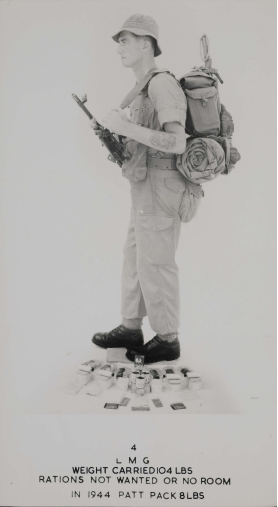
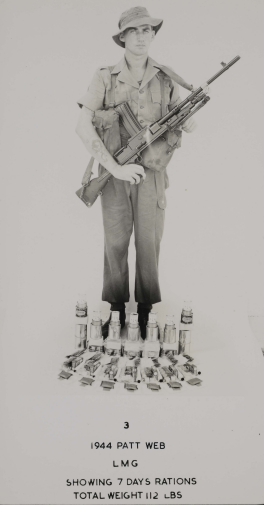
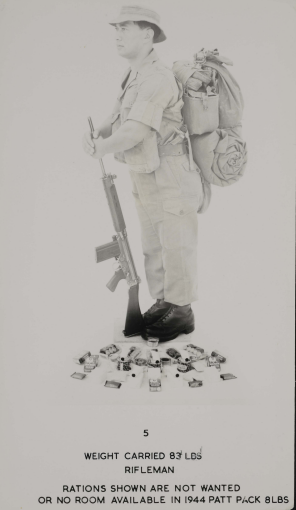
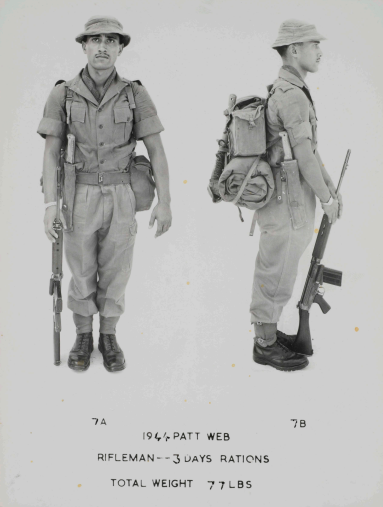
Military Personal Load Carrying Equipment, often referred to in the New Zealand vernacular as “webbing”, is the assortment of belts, straps, pouches and other accessories which, when assembled, allows an individual soldier to easily and comfortably carry the tools of their trade, such as ammunition, rations and water to sustain them for short periods. Many period photos of New Zealand soldiers on operations and training from the Vietnam War era to the 1990s provide the impression of an army equipped with an eclectic range of Australian, British and American equipment. This view of New Zealand’s army’s equipment was partly correct. To see how this view was shaped, this article provides an overview of New Zealand’s military load-carrying equipment evolution from 1945 to 1975.

Commander-in-chief, United States Army of the Pacific, General R.E Haines (right) watching weapon training at Waiouru. 2 May 1970 Evening Post

During World War Two, Operations in Malaya, Burma and the Pacific identified many shortfalls in the suitability of training, tactics and equipment, resulting in the Lethbridge Mission to the Far East during the late war. As a result of the report of the Lethbridge Mission, it was decided to modify the standard 37-pattern equipment to make it lighter in weight, rot-proof and more water-repellent and thus more suitable for use in tropical conditions. This development of the 37-pattern equipment led to the approval of a new pattern known as the 1944-pattern.[1] Post-war, further development of the 37 and 44-Pattern equipment led to troop trials of the Z2 experimental Load Carrying Equipment, which transitioned into the 1958-pattern equipment.[2]

Following World War Two, the Load Carrying Equipment in use by the New Zealand Army was the British 1937-pattern equipment. The 37-pattern equipment was introduced into New Zealand service in 1940, replacing the 1908-pattern equipment that had been in service since 1912. As 37-pattern equipment remained the standard web equipment of the New Zealand Army, the deployment of New Zealand troops to Malaya placed New Zealand in the position of deploying troops to a theatre with equipment that had long been identified as unsuitable. To maintain compatibility with other commonwealth forces in Malaya, 44-pattern equipment from British stocks in Malaya was issued to New Zealand troops in Malaya.

Example of 37-pattern equipment. Image: Simon Moore https://www.youtube.com/watch?v=NwnMIdynO8Y

. Given the environment that New Zealand troops could be expected to operate in and aware of the developments in load-carrying equipment, the New Zealand Chief of General Staff (CGS) requested and received one set of M1956 Web equipment from the United States for trials in 1959.[3]  The American M1956 Load-Carrying Equipment (LCE) had been accepted for United States Army service, with distribution well underway by 1961.

In October 1960, the New Zealand Director of Infantry and Training demonstrated the following web equipment to CGS.

  • 44-pattern Equipment
  • 58-pattern Equipment
  • M1956-pattern Equipment

A report by a New Zealand Officer attached to the Australian Jungle Training Centre at Canungra supported this demonstration with a comprehensive report describing the research and development of Infantry clothing and equipment undertaken by the Australians. The New Zealand report described the Australian trials of the M1956 LCE alongside the 58-pattern equipment. The M1956 was chosen by the Australians, who intended to manufacture it in Australia.[4] However, it was considered unlikely that either the 1956 LCE or 58-pattern equipment would be available to New Zealand until at least 1965, when the initial distribution to the United States and British armies was expected to be completed. Aware that all 44-pattern equipment had been earmarked for use in Malaysia and that it was still in production, New Zealand’s CGS approved the purchase of 6000 sets of 44-pattern equipment to re-equip elements of the New Zealand Army.[5]

Example of 44 pattern equipment, British Corporal, Malaya, Early 1950s. Image Simon Moore https://www.facebook.com/photo/?fbid=2346362332163840&set=a.421629590114595

Following advice from the UK, the 44-pattern equipment in use with the Fare East Land Forces (FARELF) was to be wasted out as the 58-pattern equipment was introduced, implying that the New Zealand Battalion would need to be equipped with the 58-pattern equipment before the ceasing of maintenance of the 44-pattern by FARELF. With this in mind, a recommendation was made to purchase 6000 sets of 58-pattern equipment instead of the 44-pattern equipment.[6]

Example of 58-pattern equipment. Image Simon Moore. https://www.facebook.com/photo?fbid=2080097568790319&set=pcb.2080098398790236

In a June 1961 memorandum to Cabinet, the Minister of Defence highlighted that the current 37-pattern equipment used by the New Zealand Army was not designed for Jungle operations and was unsuitable for carrying the extra equipment the soldier engaged in this type of warfare required. No longer used by the British Army in any part of the world, the stage had been reached where the replacement of the 37-pattern should be delayed no longer. As the 58-pattern could not be made available to New Zealand for some time and field trials had cast doubt on its suitability for use in the Southeast Asia theatre, it was considered that re-equipping of the New Zealand Army should proceed with the 44-pattern equipment. The 44-pattern equipment had proved itself and was known to be suitable in the theatre where New Zealand troops were most likely to be employed. It was assumed that by the time the 44-pattern equipment needed replacement, the full facts on the suitability of the 58-pattern and the M1956 web equipment would be available to make a more informed decision on its adoption by New Zealand. It was recommended that Cabinet approve £45645 plus freight to purchase 6000 sets of 1944 Pattern equipment. [7]

By October 1961, it became clear that the 58-pattern was to be the standard issue web equipment for all United Kingdom forces worldwide and that distribution to the forces in Malaya was to happen much earlier date than earlier expected. Because of this, the Army secretary desired further investigations on the suitability of 58-pattern web equipment and, if favourable, confirm costs and potential delivery dates. With the requirement for web equipment again in flux, the submission to purchase 6000 sets of 44-pattern equipment was withdrawn pending further research.[8]

By May 1962, plans for reorganising the New Zealand Army from a Divisional to Brigade Structure were under implementation.[9]  With approximately 50000 complete sets of 37-pattern equipment distributed to units or held in stores, this was deemed suitable to equip the bulk of the Territorial Force and Training units. The 58-pattern equipment was now in serial production and was the standard issue for all United Kingdom troops, with distribution to operational units in Malaya and Germany underway. Information received earlier was that because of limited production, stocks of 58-pattern would not be available for release to New Zealand for some years had been revised. It was now possible that the release of 58-pattern equipment to meet New Zealand’s requirements could be achieved earlier than anticipated. Based on this revised information, New Zealand’s Cabinet approved funding of £58750 on 10 October 1961 for 6000 sets of 58-pattern Web Equipment. [10]

Before placing a firm order for New Zealand’s requirements of 58-pattern equipment, reports received from Malaya in late 1962 indicated that the 58-Pattern equipment was, in its present form, unsuitable for use in operational conditions in South-East Asia.[11] It was anticipated that modifying the 58-pattern equipment to suit the conditions would take two to three years, an unacceptable delay in procurement as far as New Zealand is concerned.[12]

As the decision on New Zealand’s web equipment remained in flux, the New Zealand Battalion in Malaysia continued to be equipped with the 44-pattern equipment maintained under a capitation agreement with the United Kingdom. At New Zealand’s expense, one hundred sets of 44-pattern equipment were also maintained at New Zealand Battalion Depot at Burnham Camp to support reinforcements.

M1956 Web Equipment

As the time factor involved in modifying the 58-pattern equipment was unacceptable, and New Zealand was receiving an increasing amount of American equipment, the American M1956 pattern web equipment was decided to trial. The M1956 equipment had already been introduced into the Australian army, so twenty sets were purchased from Australian stocks for New Zealand’s trials.[13]

Following user experience in Malaya revealing that the 58-pattern equipment was falling short of the requirements for jungle operations, a series of investigations and user trials established that the US M1956 pattern equipment was suitable for use by the New Zealand Army. The funding for 6000 sets of 58-pattern Web Equipment was requested to be reprioritised to purchase 10000 sets of M1956 equipment direct from the United States and 400 sets of 44-pattern equipment to equip the increment for the FARELF held in New Zealand.[14]

With funding endorsed by the Minster of Defence and approved by the Cabinet, orders were placed for 10000 sets of M1956 web equipment direct from the United States. The first consignment arrived in New Zealand in early 1964, with 289 sets immediately issued to the New Zealand Special Air Service (NZSAS) and 16 Field Regiment, Royal New Zealand Artillery.

Instructions for distributing the M1956 web equipment were issued in June 1964 by the Quartermaster General. The initial purchase of 10000 sets of M1956 web equipment was to be issued to the Combat Brigade Group (CBG) and Logistic Support Group (LSG) units. Units of the Combat Reserve Brigade Group (CRBG) and Static Support Force (SSF) were to continue to use the 37-patten webbing.

 NMDCMDMOD (for CMD Trentham UnitsSMDMOD StockIssued SAS/ 16 Fd Regiment
CBG & LSG312230304012028310289
1st Reinforcement Reserve3162606198  
School of Infantry 40    
TOTAL343833304072226310289

As the issue of M1956 equipment progressed, units of the CBG and LSG were to hand back stocks of 37-pattern equipment to their supporting District Ordnance Depot except for

  • 08-pattern packs and straps
  • 37-pattern belt, waist web
  • Frogs bayonet No 5[15]

The 37 Pattern belt, waist web, was to be retained by all ranks as a personal issue authorised by NZP1 Scales 1, 5, 8 or 9. The belt and bayonet frog were to be worn with Nos 2A, 64, 6B, 7A and 7B orders of dress when other equipment items were not required to be worn.

Equipment Maintenance Policy Statement (EMPS) 138/67 issued by Army Headquarters on 20 November 1964 detailed that except for the CBG and LSG, 16000 sets of 37-pattern equipment were to be maintained for use by remaining elements of the New Zealand Army.[16]  EMPS 145/65 was issued on 12 February 1965, detailing the management of 44-pattern equipment in New Zealand. The First Battalion of the Royal New Zealand Infantry Regiment (1RNZIR) in Malaysia was to remain equipped with the 44-pattern web equipment maintained by the UK under the existing capitation agreement. Other than 100 sets of 44 Pattern Web equipment maintained at the Battalion Depot in Burnham, there was no provision for equipping 1RNZIR Reinforcements and increments of 31 Medium Radio Sub Troop who could be expected to deploy to Malaysia at any time. EMPS 145/65 rectified this by establishing a stockholding of 400 sets of 44-pattern equipment at the Main Ordnance Depot (MOD) at Trentham

Approval was granted in November 1965 by Army HQ for the Royal New Zealand Armoured Corps (RNZAC) and NZSAS to blacken their M1956 web equipment. The Royal New Zealand Provost Corps (RNZ Pro) was also approved to whiten their M1956 web equipment. This approval only applied to unit holdings, not RNZAC, NZSAS or NZ Pro members attached or posted to other units.[17]

By April 1967, most of the New Zealand Army was equipped with the M1956 equipment. The exceptions were.

  • The New Zealand Forces in Malaysia and South Vietnam, who used both the M1956 and 44-pattern equipment
  • The SSF, National Service Training Unit (NTSU) and New Zeeland Cadet Corps (NZCC), who still retained the 37-pattern equipment

The manufacture of 37-pattern equipment had long been discontinued, and New Zealand stocks had reached the point where although having considerable holdings of individual items, based on the belts as the critical item, only 9500 sets of 37-pattern equipment could be assembled.

Based on the projected five-year supply to the NTSU, Army Schools, Camps and the NZCC plus 10% maintenance per annum, there was a requirement for 12000 sets of 37-pattern equipment. Arranging production to meet the shortfalls was deemed cost-prohibitive, and as continued maintenance could not be guaranteed, it was decided that additional sets of M1956 equipment were to be purchased. The additional sets were to be purchased on a phased program over several financial years, with 5000 sets of 37-pattern retained for the NZCC.

Disposal of the 37-pattern was to be phased over three years.

  • 1967 all items surplus to 9500 sets
  • 1968 3000 Complete sets
  • 1969 all remaining 37 Pattern equipment less 5000 sets for the NZCC.[18]

M1967 Modernized Load-Carrying Equipment (MLCE)

In 1967 the New Zealand Army trialled three sets of the M1967 Modernized Load-Carrying Equipment (MLCE). Not specifically designed to replace the M1956 equipment, the M1967 equipment was designed for use in tropical environments and was introduced into the United States Army service in 1968.

The New Zealand trials found that the M1967 equipment was comfortable and weight-wise was similar to other web equipment in use. The pack worn on the belt was found to be heavy when fully loaded, and a pack similar in size to the 44 Pattern should be introduced, and the belt pack reduced in size by one-third.

It was identified that all the pouches required stiffening and that the plastic fasteners were not firmly attached to the pouches, although easy to operate. While using Velcro was found simple to operate, it was seen as a disadvantage due to noise and its inclination to pull apart when wet or under stress.[19]

Although the M1956 was still being introduced into the New Zealand Army, limited quantities of the M1967 equipment were introduced from 1969-72 with no plans for large-scale procurement. Nevertheless, the design of the M1972 All-Purpose Lightweight Individual Carrying Equipment (ALICE) incorporated many of the features of the M1967 equipment, and it was introduced into the New Zealand Army service in the 1980s.

Example of M-1967 MLCE. Image Simon Moore https://www.youtube.com/watch?v=Pwj59bifFMk

Although the 44-pattern web equipment continued to be used by New Zealand units in Southeast Asia, by October 1967, the decision had been made to standardise the M1956 equipment across the New Zealand Army, and no stocks of the 44-pattern equipment were to be retained in New Zealand.   All stocks of 44-pattern web equipment held by the MOD in Trentham for 1RNZIR Reinforcements and increments of 31 Medium Radio Sub Troop were issued to 1 RNZIR based at Terendak camp in Malaysia. As this stock held by 1RNZIR was wasted out, it would be replaced by M1956 web equipment. [20]

Large Ammunition Pouches

The Australian experience had shown that although the L1A1 Self Loading Rifle (SLR) Magazines fitted inside the M1956 ammunition pouch, it was a tight fit, especially when the webbing was wet. The initial solution was to modify 37-pattern pouches and fit them to the M1956 equipment. By 1967 the Australians had developed an indigenous ammunition pouch for the M1956 equipment., The Australian Ammunition Pouch Large (8465-66-026-1864) was manufactured out of cotton duck material and measured 81/4 inches high by 4 inches wide and 3 inches deep.

Australian Pouch Ammunition Large

To ascertain the suitability of the Australian large ammunition pouch for New Zealand service, fifty Australian pouches were sourced as a standardisation loan in 1968.[21] Feedback for the troop trials identified a lack of stability in the closure of the lid, causing the loss of ammunition and magazines. Following an investigation by the R&D Section, the RNZAOC Textile Repair Sections (TRS) modified the Australian pouches by replacing the lid fasteners with the same fasteners found on the standard American M1956 pouch and stiffing the fastener tabs. The modifications proved satisfactory in further Army Trials, and a new specification (DRDS-ICE-1) was produced with four Standard Samples provided to 1 Base Ordnance Depot (1 BOD).[22]  The modified New Zealand Pouch was codified in the New Zealand supply system as Pouch Ammunition Large (6746-98-103-4039).[23]

Detail of New Zealand Large Ammunition Pouch riveted lid fasteners

Although the R&D Section had ascertained that the manufacture of the pouches was possible in New Zealand using imported components, the initial production run of 20000 pouches was contracted through the Australian Department of Supply to be included in the current Australian production run.[24]  By 1974 the first production run of 20000 had been completed and returned to 1 BOD for distribution, with 2/1 RNZIR in Burnham one of the first units to receive the new pouches. In May 1974, 2/1 RNZIR submitted defect reports stating that the pouches were poorly designed, with the canvas tongue used to secure the lid failing, pouches becoming insecure, and magazines dropping out.[25]

The investigation by the Directorate of Equipment Policy and the R&D Section found that the faults were not a design problem but a quality assurance issue in that the pouches had not been manufactured following the specification.[26]   Comparing the Australian-manufactured pouches against the specification, the R&D Section identified the following visually detected defects.

  1. Canvas used to manufacture strap-holding assembly instead of webbing.
  2. Clip end strap is wrongly sized.
  3. Release tab is of incorrect thickness.
  4. Polypropylene stiffener not inserted in release tab.
  5. The male fastener is not secured to the PVC stiffener.
  6. The reinforcement piece behind the male fastener is not included (between the PVC stiffener and lining).
  7. Additional smaller reinforcement piece inserted between the outer cover and the male fastener.
  8. Broad arrow marked on the outer cover and not specified.

Of these defects, only serials 3 to 7 were directly considered to contribute to the deficiencies and the initial concerns raised by 2/1RNZIR and would require rectification, and a modification instruction was produced.[27]  Modification of the pouches would take until September 1977 to be completed.[28]

Due to the Broad Arrow Mark included on the first batch of 20000 New Zealand Large Ammunition Pouches, collectors often misidentify these items as Australian pouches.

White Web

By 1973, 37-pattern belts, rifle slings and bayonet frogs remained in use as ceremonial items. Whitened using proprietary shoe cleaner and paint, these items were badly worn with the whitener flaking easily and were easily marked by weather, fingerprints and the rubbing of other equipment. The M1956 pattern web belt was not considered suitable as a replacement as it was operational equipment requiring the breaking up of complete web sets to provide items for ceremonial events. Following the British lead, the Army Dress Committee approved a polythene, four-ply woven fabric of similar appearance and texture to the 37-pattern equipment in October 1973 as a replacement for the whitened 37-pattern equipment. The sling and bayonet frog designed for the SLR would be purchased with chromed or brass fittings. The material for the belts was provided on rolls which could be cut to the required size. Buckles and keepers were 37-pattern buckles and keepers drawn from existing stocks that had been chromed and polished.[29]

Combat Pack

By 1974, one of the few pre-1945 items of load-carrying equipment remaining in New Zealand service was the 08-pattern pack. Long identified as an unsuitable item, several trials had been conducted since the mid-1960s to find a replacement combat pack. Although a few alternative items had been investigated as a replacement, the 08-pattern pack remained the principal combat pack of the New Zealand Army.

In 1969/70, the requirement for 15000 combat packs to replace the 08-pattern pack was identified. Following evaluation by the equipment sponsor, the Australian Army Combat Pack was selected as a basis for developing a New Zealand combat pack. The Australian pack was chosen from a wide range of military and civilian packs, with the design modified to meet the particular training requirements of New Zealand. The modifications to the Australian pack were limited to comply with the following:

  • The pack must be compatible with Australian Army equipment.
  • The pack must be compatible with M1956 equipment currently in New Zealand service.

Against the advice of the R&D section, the Australian pack was modified by the New Zealand Army without a proper study being conducted.[30] The decision to bypass the R&D process resulted in a prototype process that extended from 1972 to 1974.[31] By June 1974, trials on the prototypes resulted in the setting of a standard design for a production run of one hundred packs for further trials.[32]

New Zealand modified Combat pack

The New Zealand version of the Australian combat pack was eventually accepted into service in 1975/76. Never a satisfactory pack, the R&D section began investigations to find a replacement in the early 1980s. Hoping to leverage the experience of New Zealand Mountaineers to produce a modern pack, Army R&D embarked on the Onward Pack project. Manufactured by Hallmark Industries of Hamilton, the Onward pack was an innovative modular design that allowed the main pack to be broken down into a patrol pack and a light belt order,

The Basic layout of the Onwards pack was a main compartment divided into a main compartment and a sleeping bag compartment divided by a zip-away divider. The upper compartment was divided into the main storage area and internal space for an AN/PPC-77 set. External access to the main compartment was via a large snow collar with outlets for the radio antenna and handset built into the lid. External access to the lower sleeping bag section was provided by a zip which allowed the bottom half of the compartment to drop down. Internal sleeping mat storage was included as part of the harness and backpack. Three external removal pouches were provided, one on each side attached by domes and a larger pouch mounted on the centre front of the pack by buckles body. Behind the Large centre pouch, securing straps were provided to secure an Entrenching Tool. These three external pouches were fitted with belt loops, which allowed them to be removed and fitted to either the pack’s waist belt or standard pistol belt as a light belt order.

A small patrol pack designed to hold an ANPRC-77 Set was also provided as part of the Onward pack., The patrol pack could be mounted to the top of the Onward Pack or by utilising the pack’s shoulder straps, worn as a standalone pack. The Patrol pack was also fitted with a fluorescent recognition panel in a zip-up compartment.

Despite the host of features and the additional space provided compared to the Australian pack, the Onward Pack was fraught with issues. The proprietary plastic clips were prone to failure, and the body-hugging ‘alpine’ design caused causing severe prickly heat on users in the tropics of Southeast Asia. These and other issues with the Onward Pack contributed to an extended development period as attempts were made to rectify them. As these and other minor faults were addressed to meet the immediate needs of users while the Onward Pack was perfected, the medium American ALICE pack was introduced as an interim replacement in 1984.[33] Eventually, attempts to rectify the Onward Pack were abandoned and the ALICE pack was formally adopted as the New Zealand Army pack.

Conclusion

Entering the Second World War with web equipment of the same pattern used since 1912, New Zealand’s Force soon began to be re-equipped with the most modern British web equipment, the 37-pattern from early 1940. Near the end of the war, New Zealand was kept abreast of the development of web equipment, and when New Zealand troops arrived in Malaya in the early 1950s, they were issued with the most modern type available for jungle warfare, the 44-pattern. As the New Zealand Army reorientated from providing a division to serve in the Middle East to providing a Brigade Group to serve in Southeast Asia, it could not wait for the British to develop their new 58-pattern for tropical conditions and examine other types. Following Australia’s lead, the American M1959 equipment was adopted in 1964, with components of this type serving thought to the early 2000s. With five types of web equipment either adopted or trialled between 1945 and 1974, it is no surprise that components got intermingled. This led to Kiwi soldiers’ preferences and experiences leading them to create webbing sets that they found practicable rather than options prescribed in SOPs or instruction books leading to the outside impression of the New Zealand army been one equipped with an eclectic range of Australian, British and American equipment.


Notes

[1] 86/Development/47 (SWV1) Report on the Development of Personnel Fighting and Load Carrying Equipment 1942-48 February 1949. “Cookers – Web Equipment: New Pattern,” Archives New Zealand No R17189098 (1944 -1966).

[2] 86/Dev/54 (SVW1) Instruction for troop trials of Z2 Experimental Load Carrying Equipment ibid.

[3] New Zealand Joint Services Mission Washington DC JSM 1/3/13 ARM US Army Load Carrying Equipment (Web) dated 23 September 1959ibid.

[4] Attachment to JTC – Canungra dated 21 October 1960 “Stores – New Infantry Equipment for New Zealand Army,” Archives New Zealand No R17189007 (1959-1970).

[5] Army 246/60/12/SD Web Equipment dated 20 December 1960 “Cookers – Web Equipment: New Pattern.”

[6] Army 246/60/12/SD Web Equipment dated 20 December 1960ibid.

[7] Memorandum Minister of Defence to Cabinet dated June 1961ibid.

[8] 246/60/12/adm Army Secretary to Minister of Defence 2 October 1961ibid.

[9] Damien Fenton, A False Sense of Security: The Force Structure of the New Zealand Army 1946-1978, Occasional Paper / Centre for Strategic Studies: New Zealand: No. 1 (Centre for Strategic Studies: New Zealand, Victoria University of Wellington, 1998), 111-20.

[10] Army 246/60/12/Q(E) Brigade Group Equipment Replacement Web Equipment dated 8 May 1962 “Cookers – Web Equipment: New Pattern.” -pattern equipment

[11] BM 2 to FE16002SD General HQ FELF to The War Office (Brig Q Eqpt) 1958 Pattern Web Equipment dated 4 October 1962: ibid.

[12] 57/62 NZ Army Liaison Staff, London to Army HQ dated 17 October 1962 ibid.

[13] Army 246/60/12Q(E) Sample US Pattern Web Equipment dated 12 December 1962 ibid.

[14] 246/60/12/SD Web Equipment for the Field Force dated 18 October 1963 ibid.

[15] Army Reqn 208/63/Q(E) dated 9 June 1964 -Distribution of M1956 Web Equipment “Cookers – Web Equipment: Pattern ’37,” Archives New Zealand No R17189095 (1940-1971).

[16] EMPS 138/64 of 20 Nov 1964 ibid.

[17] Army HQ Army246/60/12/PS3 of 19 Nov 1965 ibid.

[18] Defence (Army) 246/60/2 of 26 April 1967 ibid.

[19] 1 Ranger Squadron NZSAS, Trial Report US Lightweight Equipment dated 21 March 1968″Cookers – Web Equipment: New Pattern,” Archives New Zealand No R17189099 (1966 -1969).

[20] Army 246/60/12/Q(E) EMPS 145/65 Frist Revise dated 5 October 1967 ibid.

[21] “Cookers  – Web Equipment: Slings, Bandoliers, Ammunition Pouches: Development,” Archives New Zealand No R17189101 (1968-1970).

[22] Def HQ/R&D Section 82/1974 dated 28 Jun 1974.”Equipment Administration: Research & Development – Projects Personal Load Carrying Equipment: Ammunition Pouches,” Archives New Zealand No R17231111 (1972-1977).

[23] 246/60/2 of 122055ZNOV70 NZDWN to 1BOD Trentham “Cookers – Web Equipment: Pattern ’37.”

[24] Army 246/60/70 dated 9 December 1971. “Equipment Administration: Research & Development – Projects Personal Load Carrying Equipment: Ammunition Pouches.”

[25] FF 65/38/18/SD Modification of Ammunition Pouch item 10 May 1974. “Cookers – Web Equipment: New Pattern.”

[26] Army 246/60/17/EP. “Equipment Administration: Research & Development – Projects Personal Load Carrying Equipment: Ammunition Pouches.”

[27] R&D Section Minute no 160/1975 dated 21 November 1975. “Cookers – Web Equipment: New Pattern.”

[28] Army 246/60/17/SP 22 Pouches Ammunition 22 September 1977. “Cookers – Web Equipment: New Pattern.”

[29] “Army Dress Committee Decision – White Web,” Archives New Zealand No R17188112 (1973).

[30]  R&D Section 67/1974 Packs Combat date 13 June 1974. “Equipment Administration: Research & Development – Projects Personal Load Carrying Equipment: Waterproof Pack,” Archives New Zealand No R17231110 (1972-1974).

[31] Army 246/60/12/EP Sponsor Enquiry Field Pack Olive Green 2 July 1972. Ibid.

[32] Army 246/60/12/ EP Minutes of the final meeting on the acceptance of the Combat Pack held at Army General Staff on 8 June 1973. “Conferences – Policy and General – NZ Army Dress Committee 1984,” Archives New Zealand No R17311893 (1984).

[33] Inf 26.3 Minutes of a meeting to consider Project Foxhound developments held at Army General Staff 8 June 1984. Ibid.


Operation Dragon Rouge – The Stanleyville Hostage Rescue Operation

Following the Congo’s independence from Belgium in 1960 and encouraged by the competition between the West and the Soviet Union, a large portion of the eastern Congo was conquered by the Soviet-backed Conseil National de Libération(CNL), better known by their nickname “Simbas”. Routing the government forces in a series of offensives from January 1964, the Simba victory was short-lived. By August 1964, the Simba forces were starting to face effective counterattacks and loss of territory to Government Forces. Desperate to force the government into a negotiated settlement and limit the involvement of the United States, the Simbas decided to use the white population as hostages. The fate of the hostages was becoming more uncertain as negotiations faltered. Concerned, the United States and Belgium planned and conducted a series of joint operations from 24 to 26 November 1964 to secure, rescue and evacuate over 1800 European and 400 Congolese civilians. This essay will provide background on the conflict and examine ‘Operation Dragon Rouge’ the rescue of hostages at Stanleyville, and how this operation demonstrated how hurriedly improvised combined forces of well-trained troops could conduct successful operations over large distances under adverse conditions.

Congo Crisis. (2022, November 29). In Wikipedia. https://en.wikipedia.org/wiki/Congo_Crisis

The speed of decolonisation of the Belgium Congo in 1960 resulted in a system unprepared to govern effectively.[1] The post-colonial government was beset by corruption and struggles by economic, political and tribal factions competing for dominance, fueled by the need to control the considerable natural resources within the Congo[2]. Caught between economic and geopolitical manipulations of Belgium, who had a strong desire to retain mining rights, and the United States, who wished to remove communist sympathisers from the region[3], the resource-rich provinces of Katanga and South Kasai declared succession from the Congo. The United Nations eventually stabilised the confusing and chaotic situation between 1960 and 1964 and undertook a complex peacekeeping mission to stabilise the Congo[4].

Shortly after the bulk of the United Nations Forces withdrew in 1964, the CNL, Backed by the Soviet Union and China, launched its rebellion from their political heartland of the western Congo[5]. Known as “Simbas”, the CNL troops were a mixture of young men, teenagers and children supposedly inspired by Maoist ideas.[6]

In reality, the political Ideology of the Simbas was much more complex. As noted by the Cuban revolutionary Che Guevara, most Simba fighters were not inspired by Maoist ideas but instead motivated by traditional beliefs and were often observed to be under the influence of illicit substances[7]. Many Simbas believed that magic water called “Dawa” applied by a Shaman left them impervious to bullets[8]. The Simba’s astounding early successes encouraged this belief, often forcing the opposing Armée Nationale Congolaise(ANC) soldiers to retreat without a fight. By August 1964, the Simbas had much of the eastern Congo under their control, including the provincial capital Stanleyville, where they had ejected a large government garrison without a fight, obtaining a large amount of modern war material. The Simba’s success soon degraded with a loss of discipline, resulting in acts of violence becoming common with thousands of Congolese who were considered westernised, executed with extreme cruelty[9].

ANC forces backed by CIA Aircraft and western mercenaries soon counterattacked, resulting in the Simba defeats and much of the territory they had recently gained lost.[10] By August 1964, concerned by the Simba reversals, the Soviet Union and Cuba took a more active role by trucking supplies from Tanzania and attempting to train the Simba’s in small unit tactics[11]. Fearing defeat, the Simbas chose to use the remaining westerners trapped in their territories as hostages and bargaining chips in the ongoing negotiations with the government, broadcasting over Stanleyville Radio that the lives of western citizens could no longer be guaranteed if the ANC advance on Stanleyville continued.[12]  These threats, matched by emerging horror stories of Simba atrocities by witnesses, forced Belgium and the United States to act.[13]

From August 1964, the United States and Belgium had been working on several plans to enable the release of the hostages, and Operation Dragon Rouge was authorised on 10 November 1964 as OPLAN 319/64 Dragon Rouge. [14]  The concept of the plan was for a joint United States/Belgium operation, utilising United States Air Force (USAF) C130 Hercules aircraft to insert a Belgium Para Commando force directly into Stanleyville. [15]

On 18 November, the Dragon Force assembled on Ascension Island. Intelligence reports necessitated planning for follow-on hostage rescue operations for Bunia, Paulis and Watsa, and to leverage maximum effect; the operation was to be timed to coincide with an ANC/mercenary ground and air offensive operation[16]. Dragon Force deployed to Kamina airfield in the Congo on 22 November, confirmation of the approval for the conduct of Operation Dragon Rouge was received, and the mission was set to go on 23 November.

Airborne at 0045 hours, five C130s carrying the first chalk of 320 Belgium Para Commandos arrived at the drop zone ten minutes before daylight at 0400 hours. On the receiving end of ineffective rifle and machinegun fire, the airfield was secured within 32 minutes, obstacles cleared within 45 minutes, allowing the first aircraft to land at 0540 Hours with the remainder of the force. During the operations to secure the airfield objectives, the chance answering of a telephone provided timely intelligence confirming that the hostages were at the Victoria Hotel[17]. Acting on this intelligence, the Belgians rushed towards the town in armoured jeeps and motorised tricycles, quickly pushing aside any resistance.

Belgian Paras ride in a FN AS 24 tricycle during Operation Dragon Rouge. Stanleyville, Congo-Léopoldville, November 1964.

As the Belgium troops were within a block of the hotel, gunfire was heard. The Simbas had gathered 400 to 600 of the hostages in the square outside the hotel and opened fire, killing twenty-eight hostages before running away[18]. Within three hours of the initial jump, the first rescued hostages had been moved to the airfield and evacuated to safe areas, with the evacuations continuing for two days. The Belgium troops cleared the city, rescuing more hostages and whites that had been hiding, sustaining three minor casualties in firefights with the few remaining Simbas.

U.S. Air Force photos. Some of the hostages after the terrible shooting by the rebels.
http://www-cgsc.army.mil/carl/resources/csi/odom/odom.asp

By 1100 hours, the lead elements of the ANC mercenary forces linked up with the Belgium troops taking over responsibility for the city, allowing the Belgians to withdraw from the city. After conducting one more jump into Paulis, the Dragon Operations were concluded, and the Belgium troops returned to Belgium within five days. With their will to fight broken by the sudden and decisive action of the Belgium forces, the Simba’s melted away and within six months, their Soviet and Cuban supporters moved on to more reliable clients.[19] With little or no local support, the Simba leadership snuck across the borders into exile, and the rebellion was effectively finished[20].

Congo Crisis. (2022, November 29). In Wikipedia. https://en.wikipedia.org/wiki/Congo_Crisis

The Simba rebellion initially successfully conquered a large portion of the eastern Congo and routed the government forces, often with no resistance. Success brought overconfidence, and the new order soon degraded into an orgy of killing as acts of violence became common with thousands of Congolese who had been considered westernised were executed with extreme cruelty, and it was only a matter of time before the orgy of killing extended into the remaining western citizens. Although the United States and Belgium had differing strategic objectives, the need to rescue the western hostages became paramount. The United States and Belgium military planners demonstrated how a hurriedly improvised combined force of professional and well-trained troops could conduct successful operations over large distances under adverse conditions.


[1] Lt Col W. H. Glasgow, “Operation Dragon Rouge,” Historical Office of United States Army in Europe, https://history.army.mil/documents/glasgow/glas-fm.htm.

[2] Erik Davis, “The United States and the Congo, 1960-1965: Containment, Minerals and Strategic Location” (University of Kentucky, 2013).

[3] Thomas Odom, Dragon Operations: Hostage Rescues in the Congo, 1964-1965 (Fort Leavenworth, KS: Combat Studies Institute., 1988).

[4] Henry Longstreet, Congo Rescue, vol. 8, The Elite (London: Orbis Publishing, 1986).

[5] F.R. Villafana, Cold War in the Congo: The Confrontation of Cuban Military Forces, 1960-1967 (Transaction Publishers, 2011).

[6] The Swahili word for Lion in the African Great Lakes region from where the majority of fighters were recruited: Godfrey Mwakikagile, Congo in the Sixties (Da es Salaam, Tanzania: New Africa Press, 2014).

[7] Ernesto Che Guevara, Congo Diary: The Story of Che Guevara’s “Lost” Year in Africa (Centro De Estudios Che Guevara) (Melbourne: Ocean Press, 2011); William E. Schaufele, “Operation Dragon Rouge,”  http://adst.org/2012/09/operation-dragon-rouge/.

[8] Richard Petraitis, “From Simbas to Ninjas: Congo’s Magic Warriors,”  https://infidels.org/library/modern/richard_petraitis/simbas-ninjas.html.

[9] Odom, Dragon Operations: Hostage Rescues in the Congo, 1964-1965.

[10] Lt Col W. H. Glasgow, “Operation Dragon Rouge”.

[11] Ernesto Che Guevara, Congo Diary: The Story of Che Guevara’s “Lost” Year in Africa (Centro De Estudios Che Guevara) (Melbourne: Ocean Press, 2011).

[12] Robert Krott, “Airborne Rescue Mission to Stanleyville,” Military History 21, no. 7 (2005).

[13] Fred Wagoner, Dragon Rouge: The Rescue of Hostages in the Congo ( Washington, DC National Defense University Research Directorate, 1980).

[14] Odom, Dragon Operations: Hostage Rescues in the Congo, 1964-1965.

[15] Lt Col W. H. Glasgow, “Operation Dragon Rouge”.

[16] Odom, Dragon Operations: Hostage Rescues in the Congo, 1964-1965.

[17] Lt Col W. H. Glasgow, “Operation Dragon Rouge”.

[18] Wagoner, Dragon Rouge: The Rescue of Hostages in the Congo.

[19] Villafana, Cold War in the Congo: The Confrontation of Cuban Military Forces, 1960-1967.

[20] Odom, Dragon Operations: Hostage Rescues in the Congo, 1964-1965.


Kelsey swivel-stock rifle

Due to its isolated location at the culmination of international trade routes, New Zealand has become a well-known centre of resourcefulness and innovation, inventing leading-edge and world-changing products. Some notable examples are Disposable syringes and tranquilliser guns, the referee whistle, the eggbeater, the electric fence, jet boats, flexible plastic ear tags for livestock, bungy jumping, flat whites and pavlova. While these products have all had a peaceful intent and provided a valuable contribution to the world, New Zealand’s war experience in the twentieth century has also contributed to military innovation. The Kelsey swivel-stock rifle is discussed here,  a New Zealand invention from the 1950s that allowed a Sten Sub Machin Gun to be fired from behind cover and around corners.

Shooting around a corner from cover with he experimental Mk5 Sten “Swivel Butt Carbiner”. Courtesy MoD Pattern Room Library

During the latter stages of the Second World War, based on the lessons learned on the Eastern Front, the German military identified a requirement for aiming and firing weapons around corners and from within Armoured Fighting Vehicles (AFVs). The Germans developed the Krummlauf barrel attachment for the Sturmgewehr 44 (StG 44) and Maschinengewehr 42 (MG 42) to meet this requirement.

The Krummlauf was produced in two variants:

  • The “I” variant for infantry use,
  • The “P” variant for use in AFVs to provide cover over blind spots to defend against assaulting infantry

The “I” and “P” barrels for the StG 44 and  MG 42 were produced with bends of 30°, 45°, 60° and 90°. However, only the “I” 30° Barrell for the StG 44  was produced in quantity.

Krummlauf “I” version. (2022, October 28). In Wikipedia. https://en.wikipedia.org/wiki/Krummlauf
Krummlauf “P” variant. (2022, October 28). In Wikipediahttps://en.wikipedia.org/wiki/Krummlauf

With a very short lifespan—approximately 300 rounds for the 30° variant and 160 rounds for the 45° variant—the Krummlauf barrel was under great stress. Additionally, due to the barrel bend, bullets shattered as they exited the barrel, producing an unintended shotgun effect. Developed too late in the war for testing and refinement by the Germans, postwar testing by the United States Army resulted in some modifications; however, the Krummlauf remained unreliable despite these modifications. The Soviets also experimented with a curved barrel, producing an Experimental PPSh with a curved barrel. However, with the curved barrel seen as a novelty, interest in the concept was soon lost.

Despite the concept of a bent barrel to allow the firing around corners, proving impracticable, Lieutenant Colonel John Owen Kelsey had seen the need for such a capability during New Zealand’s streetfighting in Italy and set about finding a solution.

Colonel Kelsey was born in New Plymouth in November 1904. Before World War II, he served as an Engineering Officer with the Royal Navy for two years. This engineering background led to his first New Zealand Army Ordnance posting in 1939 as a 2nd Lieutenant with the 13th LAD New Zealand Ordnance Corps (NZOC). Shortly after he arrived in Egypt in 1940, he was promoted to Lieutenant and posted as the Assistant Senior Ordnance Mechanical Engineer (SOME). He became the SOME and was promoted to Temporary Captain a few months later. In November of the same year, he became the Deputy Assistant Director of Ordnance Services (Equipment) (DADOS E) HQ 2NZ Division. He was also promoted to Temporary Major while holding this position and, in April and May 1941, took part in the campaigns in Greece and Crete. On return from Crete, he was transferred to the British Royal Army Ordnance Corps (RAOC) Deputy Director Ordnance Services(DDOS) office for a few months and then returned to 2NZEF as the Chief Ordnance Mechanical Engineer (COME) in August 1941. His duties were extended a year later when he became the Assistant Director of Ordnance Services (ADOS) and COME 2NZEF.

After forming a separate Corps of New Zealand Electrical and Mechanical Engineers (NZEME) in December 1942, Colonel Kelsey relinquished the appointment of COME and became the ADOS 2NZEF/ADOS 2NZ Division and was promoted to Lieutenant Colonel.

Lieutenant Colonel J O Kelsey, MBE August 1943- Ref: DA-04363-F. Alexander Turnbull Library, Wellington, New Zealand. /records/22681005

A temporary promotion to Colonel followed from February to March 1944, when Colonel Kelsey was appointed as the DDOS of a Corps for operations in Italy.

He returned home on well-earned leave in April 1944 after four and a half years away but returned to the Middle East in September 1944. He resumed the ADOS 2NZEF and 2NZ Division appointments and maintained these responsibilities until the war ended, completing six years with the division and participating in every campaign. For distinguished service, Colonel Kelsey was Mentioned in Despatches.

On his discharge, Colonel Kelsey went into business as an accountant at Whakatane but was not very successful. He relocated to Auckland, where he obtained a post in the Public Relations Office but was subsequently asked to leave. Setting up a public relations office in Devonport, where he slept on a couch in the office because he could not afford to board, Colonel Kelsey set to work developing his Sten Gun adapted to fire around corners.

In June 1953, The Press announced that a Sten gun adapted to shoot round corners had been developed by Colonel Kelsey, known as the Kelsey swivel-stock rifle and that the army had tested it at Waiouru Military Camp. Following the success of these tests, the device was sent to the War Office in London for further examination.

Colonel Kelsey had adapted the Sten gun to have a swivel butt and a unique sight. Unlike the wartime Krummlauf, it was not a weapon with a bent barrel but a standard Sten Gun. The weapon could be used in the usual way, with shooting a round left or right corners enabled by simply resetting the butt to 90°to the parrel and sighted using a unique sight. The sight was based on the principle of the periscope, using prisms with exact details placed on the secret list.

With no reply from the War Office by the end of 1953 and confident with his design and that it could be adapted for other firearms, Colonel Kelsey took out world patent rights and intended to fly to England or America to try to sell the invention to armaments firms. However, despite being optimistic about his future, Colonel Kelsey struggled with the toll of adjusting to peacetime life, business failures, financial difficulties, a failed marriage and some unhappy love affairs and was discovered by the police on the floor of his office in Clarence Street, Devonport, at 5.30 pm. on 8 February 1954. Under his body was a .22 calibre rifle, which he appeared to have been holding.

A letter on the table addressed to whom it may concern said he was experimenting “to try to find the reason for dissipation of recoil in a rifle or submachine gun. This is immensely important to me now that the Kelsey swivel-stock rifle has proved successful.” He added “that there was considerable risk in the experiments,” with a footnote adding that the tests were to be made at training grounds near Whenuapai.

After reading some of Colonel Kelsey’s letters in chambers, the Coroner found that there was ample evidence that Colonel Kelsey had many personal difficulties. If he had intended to test the rifle at the time of his death, he would not have needed to write the letters, in one of which Kelsey stated he was “going to die,” The Coroner said he was forced to conclude that the cause of death was suicide by a self-inflicted bullet wound in the head.

With Colonel Kelsey’s passing, the development of the Kelsey swivel-stock rifle progressed no further.

In Leroy Thompson’s 2012 history of the Sten Gun, a variant of the Sten Gun matching Colonel Kelsey’s device is precisely described. This indicates that the weapon was tested and, although never progressing past the prototype stage, a record of its existence, along with some photos, was kept.

L. Thompson, M. Stacey, and A. Gilliland, The Sten Gun (Bloomsbury Publishing, 2012).

No other New Zealand Ordnance Officer has held such a variety of appointments on active service. Colonel Kelsey was an OME, SOME, DADOS(Equipment), COME, ADOS, DDOS, and acting CREME. Despite his wartime service and the award of the MBE and Mention in Dispatches, there was no place for Colonel Kelsey in the regular post-war army. Despite his optimistic belief in the success of the Kelsey swivel-stock rifle, Colonel Kelsey struggled to adjust to the post-war world. Without understanding the effects of wartime stress that exist today now, he fell through the gaps and took his own life. Additionally, given the stigma surrounding suicide that has existed for many years, his wartime service and potential achievement as an inventor have never fully been recognised.


10 LAD, Water Supply – Operation Compass, December 1940 – January 1941

Accounts of New Zealand Ordnance Units’ wartime activities are rare, with one of the few accounts from the Second World War found in the wartime publication Prelude to War.

Prelude To Battle was the first of ten surveys on the 2nd New Zealand Expeditionary Forces (2 NZEF) produced by the New Zealand Army Board during the Second World War to provide short articles on the activities of 2 NZEF.

Prelude To Battle was published by Whitcombe & Tombs, in 1942 and covers the first Libyan Campaign of June -December 1940. Prelude To Battle includes chapters on

  • the LRDG,
  • Divisional Signals,
  • NZASC, 4th NZ Mechanical Transport Company (4RMT), and
  • New Zealand Ordnance Corps (NZOC), 10 Light Aid Detachment (10 LAD) attached to New Zealand Engineers (NZE), 5 Field Park Company

The chapter Water Supplies covers explicitly the activities 10 LAD during  Operation Compass, which was the first significant British military operation of the Western Desert Campaign (1940–1943), during which British, Empire and Commonwealth forces attacked Italian forces in western Egypt and Cyrenaica, the eastern province of Libya, from December 1940 to February 1941.

10 LAD was one of 11 LADs, numbered 9 to 19, raised as part of the NZOC in late 1939 to render assistance and repair mechanic transport and the anti-tank units of 2 NZEF. Raised at Hopuhopu Camp, 10 LAD was commanded by Second Lieutenant George D Pollock, and attached to 5 Field Park Company, NZE. 10 LAD sailed as part of the Main Body of 2 NZEF in January 1940, Disembarking in Egypt in February 1940.

In late 1940 New Zealand units, including the Fifth Field Park Company, with 10 LAD attached, Divisional Signals, 4 RMT and other specialist troops, had been seconded to General Archibald Wavell for Operation Compass. The official War History New Zealand Engineers, Middle East states, “but beyond guarding the water pipeline and establishing water points and forward dumps at Charing Cross, the Company was not much affected. The British Army seemed to do very well without its assistance”. However, as this Prelude To Battle chapter describes, 10 LAD played a critical role in ensuring water supply to the advancing allied units.

A Light Aid Detachment, Water Colour by Captain Peter McIntyre

The Prelude to Battle chapter, Water Supplies, reads:

Concerned with the maintenance of water plants to supply the troops advancing into Cyrenaica and the servicing of Royal Engineers’ equipment, the 10th Light Aid Detachment of the New Zealand Ordnance Corps entered each town almost immediately after its capture to attend to the water installations and pumping appliances.

Before the British assumed the offensive, the 10th LAD has succeeded in drawing water from about ten feet below the surface at Burbeita and in the sandhills at Baggush. When Fort Nibeiwa was attacked on 8 December, the 10th LAD were in caves in the escarpment at Charing Cross, several miles inland from Mersa Matruh. As soon as the last of the Sisi Barrano forts was captured, Major G. D. Pollock, who commanded the 10th LAD went to Sidi Barrani to attend to the water works there. He found in perfect order a Fiat diesel pumping engine capable of 250 litres an hour and a plant for distilling salt water. The remainder of the 10th LAD entered Sidi Barrani two days later. The Italians also left a large pumping station almost at Buqbuq, half way between Sidi Barrani and Sollum .

As the Australians concentrated for the Battle of Bardia, the 10th LAD were filling and working water wagons for Sollim. At this stage they began to operate closely with the 5th Field Park Company and on 10 January they moved with them to the harbour at Bardia. A fortnight later they were in Tobruk at work on the large distilling plant. After the Battle of Derna and the subsequent Italian withdrawal towards Benghazi, the 10th LAD were given a special job. The British command had made the decision to cut across the plateau south of Benghazi: the success of this plan depended on getting a supply of water quickly to Msus, some 500 miles south-west of Derna. it was the responsibility of the 1Oth LAD to have ninety-five tons of water at this point for the armoured division. This was accomplished. The operation succeeded, Benghazi fell, and the whole of Cyrenaica was subsequently occupied. In northern Cyrenaica, the water problem ceased. West of Derna lies a region of small streams, trees and green countryside decorated with fresh white buildings. When the British consolidated in this area in February 1941 the work of the 10th LAD ended and they followed the New Zealand signallers. Transport driver and engineers back to Helwan, where the New Zealand Division had taken up its station preparatory to its departure for Greece.

Prelude to Battle Page 32-34

Following this brief excursion into Libya, 10 LAD continued to be attached to 5 Field Park, NZE for the remainder of the war. In November 1942, the New Zealand Electrical and Mechanical Engineers (NZEME) was formed as part of 2 NZEF and 10 LAD transferred from the NZOC to the NZEME. 10 LAD was disestablished in late 1945.

“Arte et Marte”
By Skill and By Fighting


The identity of Ngāti Tumatauenga

Met by a combination of mutual mistrust on the one hand and a sense of opportunity on the other, the earliest contacts between Māori and Europeans would grow into a mutually beneficial economic relationship by the 1840s and 1850s. The Treaty of Waitangi sealed the relationship, with a vital element becoming amalgamation. Māori were granted the rights and privileges of British subjects under a universal system under the treaty’s terms and early colonial laws. Unfortunately, the relationship was often one-sided, favouring the Crown and settlers who would set the terms of the amalgamation process into one of assimilation, intending to absorb Māori into the white settler world. This path led to conflict, followed by erecting barriers between Māori and Settlers that would endure for generations. One hundred and seventy-nine years after the treaty’s signing, the relationship between Māori and Europeans has matured, with many colonial-era grievances reconciled or on the path of reconciliation. A sign of how far the nation’s relationship between Māori and Europeans has matured is found in one of the institutions of the state, the Army, now recognised as the standalone iwi: Ngāti Tumatauenga – ‘Tribe of the God of War’.

Ngāti Tumatauenga is the youngest iwi of New Zealand, established in 1994 as the result of an initiative by the Chief of General Staff (CGS), Major General Anthony Leonard Birks, CB, OBE. The CGS intended to regenerate the Army’s culture into a “uniquely New Zealand Military culture by combining appropriate aspects of European and Māori heritage to enhance further the cohesion, morale and esprit de corps of the Army”.[1]Established with the blessing of the veterans of the 28th Māori Battalion, the Māori Queen and iwi surrounding Waiouru; Ngāti Tūwharetoa, Ngāti Kahungunu, Ngāti Maniapoto and Ngāti Tuhoe. [2] Ngāti Tumatauenga blends the customs and warrior traditions of Māori and Europeans into a fusion of both, laying the basis of the New Zealand Army’s ethos and values.[3] Although Ngāti Tumatauenga is a modern conception, it has a strong whakapapa drawn from its Māori and European ancestry, reflecting its position as the guardian of all the peoples of New Zealand regardless of race, religion or creed.[4]

The path towards Ngāti Tumatauenga has been extended, as, for most of its existence, the New Zealand Army, like those of Canada, South Africa and Australia, embraced British military traditions. Regardless of the British Military influence, there has always been a desire to identify New Zealand as a unique military entity. In World Wars, Canada, South Africa, and Australia sent expeditionary forces filled with units bearing English, Scottish and Irish names, motifs and identities to battlefields worldwide; New Zealand would be the exception. Although there were Territorial units in New Zealand with Scottish identities, the New Zealand Military authorities felt that New Zealand was too small to allow these identities to be embodied as separate units within the Expeditionary Forces. New Zealand Forces would march in one khaki uniform and wore distinctive New Zealand badges up to the Second World War, often including Māori phrases and symbology.[5]

The only logical exception to this was the Māori, who participated as a distinct subunit, representing a subset of New Zealand in a manner that the Scots or Irish did not.[6] In their quest to establish New Zealand Forces as a recognisable national entity, New Zealand Military authorities inadvertently paved the way for the eventual establishment of Ngāti Tumatauenga in later years.

In addition to the British Military traditions, Māori Tikanga (cultural customs and practices) serves as the binding force for Ngāti Tumatauenga. These distinct and unique cultural practices and traditions enhance the loyalty, cohesion, and tribal identity of the Modern New Zealand Warrior. [7] Contrary to popular belief, Māori warfare was not a permanent fixture of Māori culture and life; instead, it was a practice employed depending on circumstances, such as acquiring land, countering threats, or defending Mana (prestige and authority). Māori refined their warfighting traditions as participants on both sides of the conflicts during the nineteenth-century New Zealand land wars.

In the twentieth century, Māori leaders like Sir Apirana Ngata viewed military service for the Crown as an extension of their warrior heritage and a path to equality. In his 1943 pamphlet “Price of Citizenship,” Ngata asserted, “We are of one house, and if our Pākehā (non-Māori) brothers fall, we fall with them. How can we even hold our heads up when the struggle is over if asked, ‘Where were you when New Zealand was at war?'” [8] Māori made significant and honorable contributions during the Second World War, solidifying their place in the post-war Army. A 1977 survey indicated that Māori comprised 34 percent of the Regular Force and 16 percent of the Territorial Force, a higher proportion than Māori employment in the general civilian workforce.[9] With the Māori cultural resurgence of the late twentieth century, the Army was well-prepared to embrace change, as this resurgence brought about transformations within the Army.

The rejuvenation of the New Zealand Army’s culture, initiated by the Chief of the General Staff (CGS) in 1994, was swiftly implemented. While the Army badge retained its traditional British design, it was modified to include a taiaha (a traditional Māori weapon) instead of a sword, and a scroll was added, bearing the inscription “Ngāti Tumatauenga” at its base.[10]

The Army Marae, known as Rongomaraeroa-o-ngā-hau-e-whā, was officially dedicated during Labour Weekend in 1995. It holds a special place within the New Zealand Army, serving as the central point that all members, regardless of race, gender, or creed, pass through on their military journey. Its unique orientation, facing west towards the setting sun, sets this Marae apart. This symbolic positioning conveys a powerful message: Ngāti Tumatauenga is the nation’s guardian, protecting it day and night.

Rejuvenating the army’s culture was not without its share of challenges. The Army Marae, in contrast to traditional Maraes, has a less formal atmosphere. One recruit even commented, “The Māori culture here is quite different! I come from a place where it’s deeply ingrained. I told my dad that when we went to the Marae, they spoke English!” [11] Despite this critique, another soldier of Māori descent explained that “Ngāti Tumatauenga symbolizes the fusion of the Imperial soldier’s spirit with the Mana of the Māori warrior. This reflects the positive partnership principle of the Treaty of Waitangi and fills many with pride when including Ngāti Tumatauenga in their pepeha.”[12]

The introduction of Ngāti Tumatauenga faced initial resistance and skepticism. Its swift implementation caught many Army members off guard, leading to an abrupt and sometimes aggressive cultural shift. However, many of the original detractors and skeptics have come to embrace and appreciate the benefits of adopting Ngāti Tumatauenga.[13]

Approaching its twenty-fifth year, Ngāti Tumatauenga has gained acceptance within the community as a legitimate iwi (tribe). Māori performing arts play a significant role in promoting and preserving the Army’s cultural ethos. Ngāti Tumatauenga participates in national-level Kapa Haka competitions, sometimes with non-Māori individuals leading performances.[14] [15]Additionally, Māori performing arts, such as Kapa Haka, serve as a military and diplomatic tool on the international stage, highlighting how the shared Māori and European military heritage upholds the principles of the Treaty of Waitangi and advances the interests of the New Zealand people.[16]

In conclusion, the transformation of the New Zealand Army into Ngāti Tumatauenga, the “Tribe of the God of War,” reflects the aspirations of early Māori and European settlers in New Zealand and their vision of unity under the terms of the Treaty of Waitangi. The journey from 1840 to 1994 was marked by conflicts between Māori and the Crown, shaping the Māori and Pākehā relationship into one that acknowledges each other’s martial capabilities. The World Wars of the early twentieth century saw New Zealand Expeditionary Forces and Māori Battalions earning respect from allies and adversaries, ultimately paving the way for Māori integration into the post-war New Zealand Army. Riding the wave of a resurgent Māori culture, the leadership of the New Zealand Army took a significant risk by embarking on cultural rejuvenation. The New Zealand Army, transformed into the iwi (tribe) of Ngāti Tumatauenga, has evolved into a unique entity, shaped and defined by the influences of a resurgent Māori culture and the combined martial traditions of European soldiers and Māori warriors. Their shared history, heritage, and wartime experiences have cemented this transformation.

Bibliography

Primary Sources

Major-General A.l.Birks. “Chief of General Staff Directive 9/94; the Army’s Culture.” Wellington: Army General Staff, HQ New Zealand Defence Force, 1994.

New Zealand Army. “The Army Culture.” NZ Army Publication (NZ P77) Why? Chapter 3, Section 1  (2014).

Secondary Sources

Published

Brosnahan, Seán. “Ngāti Tūmatauenga and the Kilties: New Zealand’s Ethnic Military Traditions.” In A Global Force: War, Identities and Scotland’s Diaspora, edited by David Forsyth, 168-92: Edinburgh University Press, 2016.

Cooke, Peter, and John Crawford. The Territorials. Wellington: Random House New Zealand Ltd, 2011.

Corbett, D. A. The Regimental Badges of New Zealand: An Illustrated History of the Badges and Insignia Worn by the New Zealand Army. Auckland, N.Z. : Ray Richards, 1980, Revised Edition, 1980.

Harding, Nina Joy. “You Bring It, We will Bring It Out”: Becoming a Soldier in the New Zealand Army: A Thesis Presented in Partial Fulfilment of the Requirements for the Degree of Doctor of Philosophy in Social Anthropology at Massey University, Manawatū, New Zealand. 2016.

Hohaia, Debbie. “In Search of a Decolonised Military: MāOri Cultural Learning Experiences in the New Zealand Defence Force.” Kōtuitui (Online)  (2016).

McKenzie, Peter. “How the NZ Army Became an Iwi.”  https://www.newsroom.co.nz/2018/11/25/331569/peter-mckenzie-on-army-as-an-iwi-for-monday.

Oldham, Geoffrey P. Badges and Insignia of the New Zealand Army: An Illustrated Price Guide to Cap and Collar Badges, Insignia and Shoulder Titles of the N.Z. Army, Police & Militia, from 1847 to the Present Day. New and rev. Ed ed.: Milimem Books, 2011.

Soutar, Monty. Ngā Tama Toa = He Toto Heke, He Tipare Here Ki Te Ūkaipo : Kamupene C, Ope Taua (Maori) 28 1939-1945 : I Tuhia Tenei Pukapua I Roto I Te Reo Maori. David Bateman, 2014.

Taylor, Richard Tribe of the War God: Ngati Tumatauenga. Heritage New Zealand, 1996. .

Te Ao Māori News. “Te Matatini 2015 – Te Kapa Haka O Kairanga.”  https://www.maoritelevision.com/news/regional/te-matatini-2015-te-kapa-haka-o-kairanga.

Unpublished

“Discussions conducted by author with various members of the New Zealand  Army “. 2019.


Notes

[1] Major-General A.l.Birks, “Chief of General Staff Directive 9/94; the Army’s Culture,” (Wellington: Army General Staff, HQ New Zealand Defence Force, 1994).

[2] Peter McKenzie, “How the NZ Army Became an Iwi,”  https://www.newsroom.co.nz/2018/11/25/331569/peter-mckenzie-on-army-as-an-iwi-for-monday.

[3] New Zealand Army, “The Army Culture,” NZ Army Publication (NZ P77) Why? Chapter 3, Section 1  (2014).

[4] Richard  Taylor, Tribe of the War God : Ngati Tumatauenga (Heritage New Zealand, 1996), Bibliographies, Non-fiction, 110-11.

[5] Although many NZ badges follow British badge design conventions and in many cases are direct copies, many badges have also included many unique New Zealnd features such as the adoption of Māori iconography and symbols and use Te Reo Māori in place of the traditional English or latin for mottoes. D. A. Corbett, The Regimental Badges of New Zealand : An Illustrated History of the Badges and Insignia Worn by the New Zealand Army (Auckland, N.Z. : Ray Richards, 1980, Revised enl. edition, 1980), Non-fiction, 9-17.

[6] Seán Brosnahan, “Ngāti Tūmatauenga and the Kilties: New Zealand’s Ethnic Military Traditions,” in A Global Force: War, Identities and Scotland’s Diaspora, ed. David Forsyth (Edinburgh University Press, 2016), 168-83.

[7] New Zealand Army, “The Army Culture.”

[8] Monty Soutar, Ngā Tama Toa = He Toto Heke, He Tipare Here Ki Te Ūkaipo : Kamupene C, Ope Taua (Maori) 28 1939-1945 : I Tuhia Tenei Pukapua I Roto I Te Reo Maori (David Bateman, 2014), Bibliographies, Non-fiction, 35.

[9] Peter Cooke and John Crawford, The Territorials (Wellington: Random House New Zealand Ltd, 2011), 371.

[10] Geoffrey P. Oldham, Badges and Insignia of the New Zealand Army : An Illustrated Price Guide to Cap and Collar Badges, Insignia and Shoulder Titles of the N.Z. Army, Police & Militia, from 1847 to the Present Day, New and rev. ed ed. (Milimem Books, 2011), Bibliographies,Non-fiction, 92.

[11] Nina Joy Harding, “You Bring It, We’ll Bring It Out” : Becoming a Soldier in the New Zealand Army : A Thesis Presented in Partial Fulfilment of the Requirements for the Degree of Doctor of Philosophy in Social Anthropology at Massey University, Manawatū, New Zealand (2016), Non-fiction, 130.

[12] McKenzie, “How the NZ Army Became an Iwi”.

[13] “Discussuions Conducted by Author with Various Members of the New Zealsnd  Army Command Chain.,”  (2019).

[14] Te Ao Māori News, “Te Matatini 2015 – Te Kapa Haka O Kairanga,”  https://www.maoritelevision.com/news/regional/te-matatini-2015-te-kapa-haka-o-kairanga.

[15] Debbie Hohaia, “In Search of a Decolonised Military : MāOri Cultural Learning Experiences in the New Zealand Defence Force,” Kōtuitui (Online)  (2016): 52.

[16] Ibid.


Indonesian Counterinsurgency in West Papua

The conduct of counterinsurgency operations occurs when a government is forced to take military action to either prevent or retaliate to attacks by disaffected groups and has become the defining feature of the modern era of conflict. The focus of the study on counterinsurgency is on either historical examples such as Malaya, Algeria or Vietnam or ongoing operations in places such as Iraq and Afghanistan. From the earlier conflicts, lessons have been learnt, lost, rediscovered, and adapted for modern conflicts. A good example is the works of David Galula which, based on his observations and experiences in Indochina and Algeria, have been adapted for use in the current United States Army counterinsurgency manual. Counterinsurgencies are seldom successful and, once committed to, are painful to disengage from. An enduring example of counterinsurgency with no end state is the 55-year-old Indonesian counterinsurgency in West Papua. The West Papua counterinsurgency campaign is against a motivated and determined opponent, dispersed in small cells amongst the local population with unparalleled knowledge of the local environment of isolated and complex terrain. Fighting the insurgency is a well-trained and motivated force equipped with modern western weapons and equipment with the support of the significant regional powers, which despite these advantages, has failed to bring the insurgency to an end.

The origins of the West Papua conflict go back to December 1949, when after a short war of independence, the Dutch East Indies gained independence from the Kingdom of the Netherlands as the Republic of Indonesia. West Papua, the western half of New Guinea Island, remained under the sovereignty of the Netherlands. Due to the ethnic and geographic differences between the Indonesian Islands, the Dutch administered West Paupa separately from the Dutch East Indies and wished to prepare West Papua for independence as a separate country.[1] Indonesia argued that the Dutch occupation of West Papua was illegal and saw the territory as an integral part of the Indonesian State.[2]  From 1949 to 1961, Indonesia unsuccessfully attempted through the United Nations (UN) legal mechanisms to gain sovereignty. Dissatisfied with the UN and confident with an infusion of modern Soviet military hardware, Indonesia launched several unsuccessful military operations against the Dutch territory in 1961 and 1962.[3][4] Despite retaining the military advantage, the Dutch were not in a position to conduct a protracted military campaign in Asia without western support. Seeking to gain favour with Indonesia, the United States and Australia forced the unwilling Dutch to enter into a settlement under the auspices of the UN for a temporary transfer of sovereignty of West Papua to Indonesia. The agreement required that in 1969 the UN oversaw a referendum, which gave the people of West Papua two choices:

  • Remain as part of Indonesia, or
  • become an independent nation.

Known as the “Act of Free Choice”, the vote was to be a consensus of just over 1000 elders, who were selected by the Indonesian Military, were coerced at gunpoint and had little choice but to vote to remain as part of Indonesia as the province of Irian Jaya.[5] The UN supported Indonesian stealing of the vote only worked to stiffen the resolve of the Free Papua Movement (OPM) to resist Indonesian rule.[6]

The Indonesian provinces of West Papua and Papua. Independence activists describe the
 combined provinces as West Papua. https://www.lowyinstitute.org/publications/west-papua-issue-won-t-go-away-melanesia

With the failure to establish an independent West Papua and sovereignty turned over to Indonesia, anti-Indonesian dissidents who had been trained and armed by the Dutch immediately took up the fight to make West Papua an independent sovereign state. The granting of sovereignty over West Papua to Indonesia by the UN was intended as temporary. However, to increase its control over West Papua, Indonesia implemented a policy of forced assimilation.[7] This policy encouraged the migration of settlers from Java and Sumatra to replace Melanesians in all government, cultural, and educational institutions with non-Melanesian migrants so that by the time the “act of free choice” took place in 1969 a substantial portion of the urban population of West Papua was non-Melanesian.[8]  As the Indonesian forced incorporation continued, support for the OPM from the frustrated West Papuan community grew. Initially only considered a nuisance by the Indonesians, by 1970, the OPM benefited from the defections of Melanesians serving with the Indonesian forces, and the use of bases across the border in Papua New Guinea had become a significant annoyance to Indonesia. The OPM’s effective guerrilla force was modest in numbers, between 400 to 600 hardcore guerrillas. Initially armed with World War II vintage weapons with little ammunition, OPM forces were adaptable natural jungle fighters and, as a matter of necessity, were experts in using traditional Papuan weapons such as bows, arrows, and axes. From the first action against Indonesian Forces on the 26th of July 1964, the OPMs preferred tactic was small-scale hit-and-run operations against Indonesian patrols, installations and commercial operations. A measure of their effectiveness was that the Indonesians soon avoided patrols into the jungle and retaliated with brutality, which became the cornerstone of the Indonesian counterinsurgency policy.[9]

The Indonesian response to the insurgency has been to view West Papuan separatists as enemies of the Republic of Indonesia and adopt a military approach as the primary counterinsurgency strategy to defeat the OPM.[10] The Indonesian counterinsurgency strategy was developed based on the lessons learnt in the successful operations against the Darul Islam and Republic of South Maluku rebellions in 1948 and 1950. These rebellions had been defeated within a year by utilising a more powerful armed force using loyal troops drawn from other provinces. From the start, the Indonesian approach was flawed, and the Indonesian Government did not take into account the long-term disadvantages of relying on military power while ignoring the West Papuans’ needs which failed to establish trust in the Government, pushing the West Papuans to support the OPM. The Indonesian counterinsurgency campaign was ruthless and saw by 2018 reportedly 500,000 West Papuans killed since the assumption of Indonesian sovereignty in 1963.[11] Indonesian counterinsurgency strategy not only targeted members of the OPM, but the assault, rape and murder of the family and known associates of OPM members, was commonplace. An example from 1970 saw Indonesian soldiers reportedly shoot and kill a pregnant woman, cut the baby from the mother’s womb, dissect it in front of 80 women and children of the woman’s village, concurrently soldiers raped and killed the pregnant woman’s sister.[12] The Indonesian counterinsurgency campaign also included airpower supplied by the United States in the ground attack role.[13] Indonesian fixed and rotary wing aircraft using napalm, conventional, cluster, and chemical weapons strafed and bombed at-will villages and suspected OPM training camps in West Papua and the border areas of neighbouring Papua New Guinea.[14]

The Indonesian Military controls West Papua as a “virtually autonomous government entity” , and until 1998, information on the counterinsurgency in West Papua could be managed and conducted unseen to the eyes of the world.[15] Financial interests in the mining enterprises, such as the Freeport mine by Australian and United States interests, effectively muzzled those two countries, and Papua New Guinea had little choice but to reach an uneasy compromise with Indonesia.[16] John Pemberton described Indonesia as invisible in the international media, “…an ideal absence in which nothing…happens.”[17]  In 1998 a change in the Indonesian Government and the events in East Timor saw a significant shift in the world focus on the conduct of Indonesia’s counter Insurgency operations in West Papua. Since 2005 Indonesia has withdrawn troops and taken a more conciliatory approach to the needs of the people in West Papua, shifting from seeking a military solution to a political solution.[18] Regardless of the changes since 2005, the Indonesian Military continues to maintain its ruthless control over West Papua. With the loss of East Timor, West Papua remains a power base and a significant source of revenue for the Indonesian Military as their significant involvement in both legal and Illegal businesses provides substantial funds for the Indonesian military organisation and senior officers of the Military.[19]

Despite superiority in military technology, the tacit blessing of the United Nations, the United States and Australia and the use of extreme brutality as a tool, the 55-year Indonesian counterinsurgency in West Papua has failed. Papuan resolve for independence was not weakened but remains strong. International pressure by human rights groups highlighted Indonesian conduct in East Timor in the late 1990s, resulting in a softening of the Indonesian stance in West Papua over the last ten years. Any moral and military advantage that the Indonesians might have gained by softening their stance is negated by the generational loss of trust that is now part of the West Papuans psyche and the Indonesian belief that any separatists are enemies of the Indonesian State and, as such traitors and criminals. The lesson from the Indonesian experience in conducting an insurgency is that military power, brutality and fear are not a workable combination and that understanding and catering to the social needs of the insurgents are a more effective strategy.

Bibliography

Afriandi, Djon. “The Indonesian Coin Strategy: Failures and Alternative Approaches in Overcoming the Papuan Insurgency.” Naval Postgraduate School, 2015.

Anderson, Kjell. “Colonialism and Cold Genocide: The Case of West Papua.” Genocide Studies and Prevention: An International Journal: Vol. 9: Iss. 2: 9-25. (2015).

Brigadier E D Smith. Sukarno Rides the Tiger. War in Peace. Vol. 3, London: Orbis, 1983.

Brundige, Elizabeth, Winter King, Priyneha Vahali, Stephen Vladeck, and Xiang Yuan. “Indonesian Human Rights Abuses in West Papua: Application of the Law of Genocide to the History of Indonesian Control.” Allard K. Lowenstein International Human Rights Clinic, Yale Law School (2004).

Budiardjo, Carmel, and Liem Soei Liong. West Papua: The Obliteration of a People. Tapol Thornton Heath, 1988.

Elmslie, Jim. “West Papuan Demographic Transition and the 2010 Indonesian Census: “Slow Motion Genocide” or Not?, Cpacs Working Paper 11/1.” The University of Sydney. Centre for Peace and Conflict Studies. (2010).

“Indonesia’s 1969 Takeover of West Papua Not by “Free Choice”.” The George Washington University, https://nsarchive2.gwu.edu//NSAEBB/NSAEBB128/index.htm.

Pemberton, John. On the Subject of “Java”. Ithaca: Cornell University Press, 1994, 1994. Bibliographies, Non-fiction.

Philpott, S. “This Stillness, This Lack of Incident: Making Conflict Visible in West Papua.” [In English]. Critical Asian Studies  (03 / 09 / 2018): 1-19.

Premdas, Ralph R., and Kwasi Nyamekye. “Papua New Guinea 1978: Year of the OPM.” Asian Survey 19, no. 1 (1979): 65-71.

Simpson, Bradley R. “Denying the ‘First Right’: The United States, Indonesia, and the Ranking of Human Rights by the Carter Administration, 1976–1980.” The International History Review 31, no. 4 (2009): 798-826.

“United Nations Security Force in West New Guinea.” Department of Peacekeeping Operations, https://peacekeeping.un.org/mission/past/unsfbackgr.html.

Viartasiwi, N. “The Politics of History in West Papua – Indonesia Conflict.” [In English]. Asian Journal of Political Science 26, no. 1 (01 / 02 / 2018): 141-59.

West Papua: Plunder in Paradise. Indigenous Peoples and Development Series: Report No 6. London: Anti-Slavery Society, 1990, 1990. Non-fiction.

Notes


[1] N. Viartasiwi, “The Politics of History in West Papua – Indonesia Conflict,” Asian Journal of Political Science 26, no. 1 (2018): 142-44.

[2] West Papua: Plunder in Paradise, Indigenous Peoples and Development Series: Report No 6 (London: Anti-Slavery Society, 1990, 1990), Non-fiction, 21.

[3] Brigadier E D Smith, Sukarno Rides the Tiger, vol. 3, War in Peace (London: Orbis, 1983).

[4] Viartasiwi, “The Politics of History in West Papua – Indonesia Conflict.”; ibid., 146.

[5] “United Nations Security Force in West New Guinea,” Department of Peacekeeping Operations, https://peacekeeping.un.org/mission/past/unsfbackgr.html.

[6] “Indonesia’s 1969 Takeover of West Papua Not by “Free Choice”,” The George Washington University, https://nsarchive2.gwu.edu//NSAEBB/NSAEBB128/index.htm.

[7] Kjell Anderson, “Colonialism and Cold Genocide: The Case of West Papua,” Genocide Studies and Prevention: An International Journal: Vol. 9: Iss. 2: 9-25.  (2015): 13.

[8] Ralph R. Premdas and Kwasi Nyamekye, “Papua New Guinea 1978: Year of the OPM,” Asian Survey 19, no. 1 (1979).

[9] Djon Afriandi, “The Indonesian Coin Strategy: Failures and Alternative Approaches in Overcoming the Papuan Insurgency” (Naval Postgraduate School, 2015), 68.

[10] The military approach as the main means for destroying the OPM insurgents was used in West Papua and East Timor and Aceh, where insurgents fought against Indonesian rule.

[11] S. Philpott, “This Stillness, This Lack of Incident: Making Conflict Visible in West Papua,” Critical Asian Studies  (2018): 260.

[12] Elizabeth Brundige et al., “Indonesian Human Rights Abuses in West Papua: Application of the Law of Genocide to the History of Indonesian Control,” Allard K. Lowenstein International Human Rights Clinic, Yale Law School (2004): 63.

[13] Carmel Budiardjo and Liem Soei Liong, West Papua: The Obliteration of a People (Tapol Thornton Heath, 1988); Bradley R Simpson, “Denying the ‘First Right’: The United States, Indonesia, and the Ranking of Human Rights by the Carter Administration, 1976–1980,” The International History Review 31, no. 4 (2009).

[14] Budiardjo and Liong, West Papua: The Obliteration of a People, 68-69.

[15] Anderson, “Colonialism and Cold Genocide: The Case of West Papua,” 14.

[16] Philpott, “This Stillness, This Lack of Incident: Making Conflict Visible in West Papua,” 260-79.

[17] John Pemberton, On the Subject of “Java” (Ithaca: Cornell University Press, 1994, 1994), Bibliographies, Non-fiction, 4.

[18] Afriandi, “The Indonesian Coin Strategy: Failures and Alternative Approaches in Overcoming the Papuan Insurgency,” 25-26.

[19] Jim Elmslie, “West Papuan Demographic Transition and the 2010 Indonesian Census: “Slow Motion Genocide” or Not?, Cpacs Working Paper 11/1,” The University of Sydney. Centre for Peace and Conflict Studies.  (2010): 8.


David Galula and his influence on modern military operations

The close of the Second World War marked a significant evolution in conflict, challenging the established principles of military theorists such as Clausewitz and Jomini. While traditional battles between formed armies continued, insurgencies emerged as the predominant form of warfare in the post-1945 world. Early theorists on insurgency included Mao Zedong and Che Guevara, who promoted insurgency, and David Galula, who developed early theories and practices of counterinsurgency based on his observations and experiences in Southeast Asia. This article examines the experiences and work of David Galula and his influence on modern military operations.

David Galula was commissioned into the French Army just before the fall of France in 1940 but was dismissed because of his Jewish heritage. He subsequently joined the Free French Forces in North Africa, serving as a Battalion Intelligence officer under the mentorship of noted sinologist Jacques Guillermaz, who profoundly influenced Galula’s career.[1] Accompanying Guillermaz to China in 1945 as a military attaché, Galula closely observed the Chinese Civil War from both sides and was briefly held captive by Mao’s Communist troops.[2] After observing the Greek Civil War in 1948, Galula replaced Guillermaz as military attaché in Hong Kong from 1952 to 1956. This posting provided Galula with a strategic vantage point to study both successful counterinsurgency operations in the Philippines and Malaya and the failures in Indochina. These experiences would profoundly shape his approach in Algeria.[3]

David Galula. (2022, July 5). In Wikipedia. https://en.wikipedia.org/wiki/David_Galula

In the Philippines, Galula witnessed firsthand how a well-conceived civic action program, mobile striking forces, and psychological warfare successfully garnered the support of the population. This strategic shift caused the Hukbalahap Communist guerrilla movement to lose local protection and forced their surrender in 1954.[4].

Similarly, in Malaya, Galula observed the tide turning in favour of the British in their fight against communist insurgency. This success gave Galula valuable insights into the British approach, emphasizing precise political aims, lawful security operations, and improved governance as essential strategies to defeat insurgency by securing popular support.[5] Galula maintained close contact with fellow officers serving in Indochina, allowing him to witness firsthand the failures of French counterinsurgency efforts that ultimately led to their defeat in 1954.[6] The traumatic loss of twenty of his military academy classmates in the French defeat at Dien Bien Phu in 1954 deeply affected Galula, motivating him to translate his observations on combating insurgency into practical strategies in Algeria.[7]

As a Company Commander in Algeria in 1956, Galula had the opportunity to put his theories into practice. Assigned to the Greater Kabylia district, a National Liberation Front (FLN) activity hotbed. [8] Galula drew on his earlier experiences and observations to implement his counterinsurgency strategies. Within six to eight months, he claimed to have successfully cleared the district of FLN assets and restored government control.[9] His achievements were recognized, leading to a promotion and a transfer to the Headquarters of National Defence in Paris by 1958. However, Galula’s departure from his former command coincided with the unravelling of his proclaimed successes, raising doubts about the validity of his theories amid the broader conflict unfolding in Algeria.[10]

Despite these challenges, Galula continued to lecture on his theories and pursued further education at Staff College in the United States. He gained attention from figures like General Edward Lansdale, who had met Galula in the Philippines and admired his ideas. In 1962, Galula resigned from his military commission and entered the burgeoning counterinsurgency think tank industry in the United States. Supported by General William Westmoreland, he secured a position at Harvard’s Center for International Affairs.[11] During this period, Galula published influential works such as “Pacification in Algeria” (1962) and “Counterinsurgency Warfare: Theory and Practice” (1964).

Galula drew upon lessons from French colonisation experiences in Indochina and Africa during the 19th century in these publications. He also integrated his theories on countering communism-inspired insurgency, shaped by his experiences in Asia and Algeria. From these insights, Galula formulated his four “laws” of counterinsurgency:

  • The First Law: The support of the population is as necessary for the counterinsurgent as for the Insurgent.
  • The Second Law: Support Is gained through an active minority
  • The Third Law: Support from the population Is conditional
  • The Fourth Law: Intensity of efforts and vastness of means are essential.[12]

In 1961, the French soldier and academic Bernard Fall published his book “Street Without Joy,” an essay on the French war in Indochina. Fall’s work became prominent in US military journals, and he lectured on counterinsurgency warfare at Fort Bragg in Vietnam.[13] As a leading expert on Indochina, Fall endorsed Galula’s work as the premier “how-to” guide to counterinsurgency warfare.[14] Despite the potential for Galula to rise as a prominent counterinsurgency theorist, buoyed by the Kennedy administration’s embrace of counterinsurgency as a military doctrine, he remained overshadowed by Fall and relatively obscure.[15] Any chance for collaboration between Galula and Fall was lost with their deaths in 1967—Galula to cancer and Fall to a landmine in Vietnam, ironically in an area known by the French as the “street without joy.”[16]

For nearly forty years, Galula’s works remained overlooked mainly outside of historical circles until the United States became involved in Iraq. While the US easily won the conventional war in 2003, it was caught unprepared for the insurgency that ensued. Recognizing the inadequacy of existing resources like the Small Wars Handbook, COIN doctrine, and Special Forces doctrine in addressing the insurgency in Iraq, US forces embarked on a significant initiative. They produced FM 3-24, The US Army Counterinsurgency Field Manual. This manual emphasized that political rather than purely military solutions were essential to defeating insurgencies.[17] FM 3-24’s development was significantly influenced by adopting Galula’s theories as its foundation by the American military. The success of the 2007 counterinsurgency “surge” was directly attributed to Galula’s teachings,[18] which were applied contemporarily with limited consideration of historical discrepancies between Galula’s theoretical framework and his practical experiences in counterinsurgency.[19]

Due to the implementation of FM 3-24, the United States counterinsurgency efforts in Iraq achieved some success, giving American forces the upper hand over the insurgents. This mirrored Galula’s findings in Algeria from 1956 to 1959, marking a reversal of the situation observed just a few years earlier.[20] As stability gradually returned to Iraq, American forces were able to complete their withdrawal by 2011. However, similar to Galula’s experience in Algeria, the security and political situation deteriorated once the stabilising influence of US forces diminished. The emergence of Daesh as a regional power exacerbated the insurgency faced by the Iraqi government, highlighting the lack of a sustained plan to maintain the stability achieved through successful counterinsurgency efforts.[21]

Galula was an astute observer in pivotal places at critical times, allowing him to study insurgencies in China, Greece, the Philippines, Malaya, and French Indochina closely. These experiences profoundly shaped his theories on counterinsurgency. In Algeria, Galula had the opportunity to put these theories into practice at both company and battalion levels. However, there was a discrepancy between his theoretical framework and the complexities on the ground, a disparity that became evident after his transfer to Paris.

Endorsed by Bernard Fall as the foremost guide to counterinsurgency warfare, Galula’s theories gained significant traction, particularly within the United States Military, influencing the development of FM 3-24. Successfully employed during the 2007 surge in Iraq, Galula’s concepts garnered praise and seemed adequate in the short term. Yet, following the withdrawal of American forces in 2011, Iraq quickly descended into insurgency, facilitating the emergence of Daesh as a regional power. This outcome underscored the limitations of Galula’s theories when applied without robust field testing by their author or independent authorities.

Galula’s impact on modern military operations remains substantial. However, while his theories are beneficial in achieving immediate objectives, some view them as a transient trend rather than a comprehensive long-term strategy against insurgencies.


Notes

[1] A.A. Cohen, Galula: The Life and Writings of the French Officer Who Defined the Art of Counterinsurgency (Praeger, 2012).

[2] Ann Marlowe, David Galula: His Life and Intellectual Context (Carlisle, PA: Strategic Studies Institute, U.S. Army War College, 2010. 2010).

[3] David Galula, Pacification in Algeria, 1956-1958, Mg (Rand Corporation) (Santa Monica, CA: RAND Corporation, 2006), Book.

[4] Ryan Nebres Severo, “Philippine Counterinsurgency During the Presidencies of Magsaysay, Marcos, and Ramos: Challenges and Opportunities,” (Fort Leavenworth, Kansas: U.S. Army Command and General Staff College 2016).

[5] Galula, Pacification in Algeria, 1956-1958.

[6] Bernard B. Fall, “The Theory and Practice of Insurgency and Counterinsurgency,” (2015).

[7] Marlowe, David Galula: His Life and Intellectual Context.

[8] P.J Banyard, “FLN: The Fight for Algeria’s Independence,” War in Peace1983.

[9] Galula, Pacification in Algeria, 1956-1958.

[10] G. Mathias, Galula in Algeria: Counterinsurgency Practice Versus Theory (ABC-CLIO, 2011).

[11] Marlowe, David Galula: His Life and Intellectual Context.

[12] David Galula, Counterinsurgency Warfare: Theory and Practice (Praeger, 2006), Article.

[13] Frances Fitzgerald, “”Lost on the Street without Joy” (Re “the Reporter Who Warned Us Not to Invade Vietnam 10 Years before the Gulf of Tonkin”),” The Nation, 2015 2015.

[14] Robert Tomes, “Relearning Counterinsurgency Warfare,” US Army War College: Parameters, no. Spring 2004 (2004).

[15] Marlowe, David Galula: His Life and Intellectual Context.

[16] Fitzgerald, “”Lost on the Street without Joy” (Re “the Reporter Who Warned Us Not to Invade Vietnam 10 Years before the Gulf of Tonkin”).”

[17] Travers McLeod, Rule of Law in War: International Law and United States Counterinsurgency in Iraq and Afghanistan (Oxford: Oxford University Press, 2015, 2014).

[18] Michael Evans, “The Shirt of Nessus: The Rise and Fall of Western Counterinsurgency,”  https://quadrant.org.au/magazine/2015/01-02/shirt-nessus-rise-fall-western-counterinsurgency/.

[19] Mathias, Galula in Algeria: Counterinsurgency Practice Versus Theory.

[20] David H. Ucko, The New Counterinsurgency Era: Transforming the U.S. Military for Modern Wars (Washington, D.C.: Georgetown University Press, 2009), Book.

[21] Mathias, Galula in Algeria: Counterinsurgency Practice Versus Theory.

Bibliography

Cohen, A.A. Galula: The Life and Writings of the French Officer Who Defined the Art of Counterinsurgency. Praeger, 2012.
Evans, Michael. “The Shirt of Nessus: The Rise and Fall of Western Counterinsurgency.”
Fall, Bernard B. “The Theory and Practice of Insurgency and Counterinsurgency.” 40, 2015.
Fitzgerald, Frances. “Lost on the Street without Joy” (Re “the Reporter Who Warned Us Not to Invade Vietnam 10 Years before the Gulf of Tonkin”).” The Nation, 2015 2015.
Galula, David. Counterinsurgency Warfare: Theory and Practice. Praeger, 2006. Article.
———. Pacification in Algeria, 1956-1958. [in English] Mg (Rand Corporation). Santa Monica, CA: RAND Corporation, 2006. Book.
Marlowe, Ann. David Galula: His Life and Intellectual Context. Carlisle, PA: Strategic Studies Institute, US Army War College 2010.
Mathias, G. Galula in Algeria: Counterinsurgency Practice Versus Theory. ABC-CLIO, 2011.
McLeod, Travers. Rule of Law in War: International Law and the United States Counterinsurgency in Iraq and Afghanistan. Oxford: Oxford University Press, 2015, 2014.
PJ Banyard. “FLN: The Fight for Algeria’s Independence.” War in Peace, 1983, 594-96.
Severo, Ryan Nebres. “Philippine Counterinsurgency During the Presidencies of Magsaysay, Marcos, and Ramos: Challenges and Opportunities.” 117. Fort Leavenworth, Kansas: US Army Command and General Staff College 2016.
Tomes, Robert. “Relearning Counterinsurgency Warfare.” US Army War College: Parameters, no. Spring 2004 (2004).
Ucko, David H. The New Counterinsurgency Era: Transforming the US Military for Modern Wars. [in English] Washington, DC: Georgetown University Press, 2009. Book.