NZ Aid to French Indo China 1952-54

During World War Two, New Zealand traditionally relied on the United Kingdom for its military equipment. However, the rapid expansion of New Zealand’s military and the looming threat of invasion by Japan necessitated a shift in strategy. New Zealand needed substantial war material, and the United States became a crucial source of support. As the post-war era unfolded, the New Zealand Army underwent reorganisation. It soon became evident that the country’s military warehouses and ammunition depots were overflowing with surplus war material. In a strategic move aimed at bolstering New Zealand’s national security and supporting its allies in their efforts to contain Communism in Southeast Asia, New Zealand decided to transfer a significant number of surplus arms and ammunition held in RNZAOC Depots across the country to the French authorities in Indochina. This transfer was free of charge and represented New Zealand’s commitment to international efforts during the Cold War era.

In the post-World War II era, the NZ Army, shaped by the 2nd NZEF of WW2, comprised an Infantry Division with integrated Artillery, Armoured, and Logistics elements. The strategic thinking of the time envisioned the deployment of an NZ Division to the Middle East alongside British formations.
Despite relying on the United States for war material during the previous conflict and having significant stock of American equipment in storage, the NZ Army maintained its armament and equipment aligned with British patterns, including weapons, uniforms, and gear[1].
By 1952, France was facing challenges in retaining control over Indochina. Despite receiving a monthly supply of 7200 tons of material from the United States, it still fell short of meeting its requirements[2]. Recognizing the existence of substantial stockpiles of surplus British and American equipment across Asia and Australasia, the French initiated purchasing missions to acquire this surplus equipment.[3]

French transport regiment train ct515 Hanoi-Nam Dinh convoy 15/17 May 1950 black and white kodak film on kodak camera http://www.indochine.uqam.ca/fr/la-galerie.html

In response to French requests, New Zealand announced in September 1952 that it would provide, at no cost, weapons and ammunition of American origin, which differed in calibre from those used by New Zealand forces. This shipment comprised lend-lease weapons urgently supplied to New Zealand in 1942. These arms had been utilized by the Home Guard and some New Zealand units in the Pacific, especially in conjunction with RNZAF units co-located with American Forces. Permission for the transfer had been sought and obtained from the United States. T. C. Webb, the Minister of External Affairs, confirmed that a significant portion of this consignment was delivered to Singapore aboard HMNZS Bellona and subsequently shipped to French Indochina.[4]This initial shipment included:[5]

  • 13,000 Springfield M1903 rifles in .30-inch calibre
  • 700 machine guns in .30-inch calibre
  • 670,000 rounds of small arms ammunition in .30-inch calibre (SAA)


In early 1953, Major General Gentry, the Chief of the NZ General Staff, met with General Henri Navarre, the French Commander-in-Chief, in Saigon to discuss the transfer of surplus military equipment. Following Gentry’s report on this meeting, the New Zealand Government offered surplus equipment to the French authorities. As the situation in Indochina, notably, the Battle of Dien Bien Phu, was deteriorating for the French, a French Military mission comprising Lieutenant-Colonel Cathala and Captain Mugg arrived in Auckland on September 10, 1953, for a two-week visit to inspect the equipment and assess its suitability for use in Indochina.[6]

Reinforcements occupying positions in the dugouts during the battle of Dien Bien Phu, March 3 1954

After final inspections, the Main Ordnance Depot in Trentham consolidated the identified equipment and loaded it onto a British vessel at Wellington in early March 1954.[7] The equipment dispatched to Indochina included:[8]

  • 500 Revolvers,
  • 3000 .30inch calibre Springfield M1903 rifles
  • 750 .30inch calibre Machine Guns,
  • 50 40mm Bofors anti-aircraft guns and ammunition,
  • 10000 round of 37m armour-piercing shot,
  • Wireless Sets
  • Field Telephones,
  • Charging Sets
  • Assorted Uniform Items
  • 670000 rounds of .30inch calibre SAA
Bofors Guns Trentham, 1 March 1954. Evening Post illustrations file and prints. 1950-2000. (PA-Group-00685). [Series]

After the French surrendered at Dien Bien Phu on 7 May 1954, and the final withdrawal of French Forces from Vietnam was completed by April 1956, it is doubtful that the small New Zealand contribution of weapons and equipment provided any significant assistance to the French. Nevertheless, this equipment might have found utility in the newly formed nation of South Vietnam or on other French colonial battlefields.

Despite the modest quantity of material supplied, Mr. Noel Henry, the French Minister to New Zealand, expressed the French Government’s gratitude to New Zealand. He acknowledged that New Zealand had done all it could within its limited means.[9]


Notes

[1] Damien Fenton, A False Sense of Security: The Force Structure of the New Zealand Army 1946-1978, Occasional Paper / Centre for Strategic Studies: New Zealand: No. 1 (Centre for Strategic Studies: New Zealand, Victoria University of Wellington, 1998), Bibliographies, Non-fiction.

[2]N.S. Nash, Logistics in the Vietnam Wars, 1945-1975 (Pen & Sword Military, 2020), 63.

[3] Charles R. Shrader, A War of Logistics: Parachutes and Porters in Indochina, 1945-1954, Foreign Military Studies (University Press of Kentucky, 2015), Non-fiction, 134.

[4] “NZ Gives Arms to French,” Press, Volume LXXXVIII, Issue 26838, 17 September 1952.

[5] New Zealand Foreign Policy: Statements and Documents 1943-1957, Ministry of Foreign Affairs (Wellington: Government Printer 1972).

[6] “Arms for Indo China,” Press, Volume LXXXIX, Issue 27192, 9 November 1953.

[7] “Arms Aid for Indo-China,” Press, Volume XC, Issue 27332, 24 April 1954.

[8] Roberto Giorgio Rabel, New Zealand and the Vietnam War: Politics and Diplomacy (Auckland University Press, 2005), Bibliographies, Non-fiction.

[9]“Arms Aid for Indo-China.”


Royal New Zealand Army Service Corps

In British and Commonwealth military doctrine, there has long been a separation of responsibility for Supplies and Stores.

  • Supplies – The provisioning, storing, and distributing of food for soldiers; forage for animals; Fuel, Oil, and Lubricants (FOL) for Tanks, Trucks, and other fuel-powered vehicles and equipment; and the forward transport and distribution of ammunition. In the NZ Army, Supplies were managed by the New Zealand Army Service Corps (NZASC) from 1911 to 16 October 19789.
  • Stores – The provisioning, storage, and distribution of weapons, munitions, and military equipment are not managed by RNZASC. Stores were the Responsibility of the Royal New Zealand Army Ordnance Corps (RNZAOC) until 1996.

Despite the separation of responsibilities, the RNZASC and RNZAOC would have a long and cooperative relationship for most of their existence.

During the early colonial days, the early actions of the New Zealand Wars proved that the New Zealand bush and the elusive tactics of the Maori presented new problems in supply and transport. An Imperial Supply and Transport Service was established and operated with the Imperial troops.

From the end of the New Zealand Wars until 1910, there was no ASC unit in New Zealand, with the supply functions required by the New Zealand Military provided by the Defence Stores Department.

After the conclusion of the South African War, the Military Forces in New Zealand embarked on a series of reforms to enhance the organisation and capability of the nation’s military, enabling it to contribute effectively to a broader Imperial Defence scheme. In 1910, at the request of the New Zealand Government, Field Marshal Viscount Kitchener inspected New Zealand’s Forces. Kitchener provided several recommendations concerning the ongoing reforms, emphasising the need for a professional Staff Corps to administer the force and confirming the requirement for a New Zealand ASC, which was gazetted on 12 May 1910 (backdated to 6 May 1910) as a designated component of the Territorial Forces of New Zealand.

The momentum for these reforms gained further impetus with the appointment of Major General Alexander Godley as the New Zealand Military Forces Commandant in December 1910. Godley was pivotal in revitalising New Zealand’s military organisational framework in his first year, making critical command and staff appointments, promulgating the (Provisional) Regulations for the Military Forces of New Zealand, and making plans to build up the NZASC, which up to this time had remained a paper corps.

Acknowledging the highly specialised nature of ASC duties, distinct from combatant staff and regimental officers, and the absence of suitably qualified officers in New Zealand, Godley recommended to the Minister of Defence on 4 January 1911 the lending of services of an experienced Imperial ASC Senior Captain or Major to organise and train New Zealand’s transport and supply services for three years. The Minister of Defence endorsed this recommendation with the Prime Minister cabling the New Zealand High Commissioner in London on 10 January 1910 to approach the Army Council for the following:

Services of experienced Army Service Corps major or senior captain required to organise New Zealand Army Service Corps. Engagement for three years. Salary £600 a year consolidated. Pay to include house allowance. Travelling allowance of 12/6d a day and allowance for one horse if kept, will also be granted. 

Within two months of receiving New Zealand’s request for an ASC Officer, the Army Council promptly and affirmatively responded to the call. Having already sanctioned nine additional officers to assist Godley, the Council selected Knox, who then served in C (Depot) Company ASC at Aldershot for service in New Zealand to organise the NZASC.

Under the guidance of New Zealand Adjutant and Quartermaster-General Colonel Alfred Robin, Knox assumed his duties as the New Zealand DST at the Army General Staff Offices on Wellington’s Buckle Street. His responsibilities encompassed a wide range of functions, including quarters, tender and contracts, personal and freight movement, and presidency on two standing committees related to Drill sheds and the storage and distribution of clothing and equipment to the forces.

Recognising Knox’s extensive duties, he was granted the Temporary Rank of Lieutenant Colonel on 6 September 1911. With Colonel Robin’s appointment as the New Zealand representative at the War Office in London in 1912, Knox assumed the additional role of Quartermaster General (QMG). Despite Knox diligently fulfilling the role of QMG and DST, progress on the formation of the NZASC was slow.

By 1914, Knox had established 16 NZASC companies of approximately 30 men each across the four New Zealand Military Districts, with imported ASC officers serving as Assistant Directors of Supply and Transport (ADST) in each District Headquarters.   Although Knox had departed by the time of the 1914 divisional camps, the Inspector General of Imperial Forces, General Sir Ian Hamilton, noted following his inspection that:

The very highest credit is due to the Army Service Corps officers and their men. They have done a first-class service, although as a rule undermanned to an extent that would fill a labour union with horror. When the Army Service Corps units are up to their normal strengths, a suitable system of calling the men up to camp in relays will enable the necessary duties to be carried out as efficiently and with much less strain on the personnel.

During World War One, New Zealand ASC units fulfilled crucial functions. ASC Companies supported the Territorial Infantry and Mounted Rifle Brigades. At the same time, Supply and Transport Units aided mobilisation camps within New Zealand. Overseas, the NZASC operated across all New Zealand theatres of war, delivering indispensable services. At its zenith, it managed the NZ Divisional Train, five ASC Companies, five Depot Units of Supply, the NZ Field Bakery, the NZ Field Butchery, and the NZ Motor Transport Workshop. Notably, the NZASC and NZAOC frequently shared personnel, facilities, and transportation, especially in the conflict’s early years.

In 1917 the NZAOC was established as a permanent component of the New Zealand Military Forces, however, it would not be until 1924 that the Permanent NZASC was formed.

Post-war, under the leadership of Captain Stanley Herbert Crump, the NZASC transitioned to a peacetime establishment comprising a Headquarters and three depots (Northern, Central, and Southern). In 1924, the Permanent NZASC (PNZASC) was established as part of the permanent Military Forces. Additionally, in 1925, an alliance between the NZASC and the Royal Army Service Corps (RASC) was ratified.

The RASC has its roots in history that are much more profound. Up to the time of Cromwell, armies mainly lived by plunder. The RASC came into being in 1888. but the work it now performs was being done long before that.

Cromwell and then the Duke of Marlborough, and later Napoleon, organised a system of civilian commissaries. The Duke of York established the Corps of Royal Waggoners in 1794. This purely transport organisation continued until 1869 under various names, eventually as the Military Train, fighting as light cavalry in the Indian Mutiny.

The birth of the Supplies and Transport Service dates from 1869. when supplies and transport, along with the Military Stores Department, came under one department called the Control Department, it remained for General Sir Redvers Buller in 1888 to organise the first Army Service Corps. Since its formation, the RASC has been a combatant one. Trained and armed as infantry and responsible for its own protection. Considerd a more technical Corps, the RAOC was not granted combatant status until 1942.

In 1931, under Crump’s continued leadership, the NZASC underwent a reorganisation into three Composite Companies. Each company comprised seven officers, four warrant officers, and 99 other ranks, establishing a solid foundation from which the NZASC could readily expand to meet the demands of future conflicts.

During World War Two, numerous units and establishments represented the NZASC across all New Zealand Expeditionary Force (NZEF) theatres. Similar to the previous World War, the NZASC maintained a collaborative relationship with New Zealand Ordnance Corps (NZOC) Ammunition Examiners (AEs) in the establishment of NZASC Ammunition platoons. At times, NZASC Warrant Officers were attached to the NZ Divisional Ordnance Field Park (OFP) to offer technical advice on vehicle spares. In recognition of the NZASC’s service during WW2, the title “Royal New Zealand Army Service Corps” was conferred in 1946.

In the post-war era, the NZASC and from 1946, the RNZASC would serve with distinction J Force in Japan and then contribute the second-largest New Zealand contingent to K Force in Korea by providing 10 Transport Company. Playing a pivotal role in sustaining the morale and effectiveness of New Zealand forces during these conflicts

Until 1947, NZASC units primarily handled baking bread, butchering meat, and procuring and distributing fresh and packaged provisions to frontline units, while regimental cooks and stewards were responsible for cooking and serving meals. To enhance and standardise cooking practices throughout the army, the Supplies and Transport Catering Group (STCG) was established on 15 February 1948 with the following objectives:

  • Training and provision of unit cooks and kitchen hands.
  • Instruction and supervision of the management of the Army ration scale.
  • Improvement of food preparation and cooking standards.
  • Advice on the installation and operation of cooking appliances and kitchen equipment.
  • Guidance on the layout of mess buildings.

In September 1948, all Regimental catering staff, except those of the New Zealand Women’s Army Corps, were transferred into the RNZASC. Throughout the 1950s, 60s, and 70s, the RNZASC played a vital role within the New Zealand Army, encompassing a wide range of functions. These included everyday tasks such as cooking and serving food, as well as more complex operations like air supply drops. To manage the procurement, storage, transportation, and distribution of essential supplies such as food, fuels, and oils for a modern Army, the RNZASC operated Supply Depots and employed various tradespeople, including butchers. Supply Depots were strategically located in Papakura, Waiouru, Linton, Trentham, and Burnham, where bulk supplies were stored and distributed as needed. Additionally, every Army camp featured a section of the RNZASC, along with smaller supply and transport depots, which were responsible for handling goods from central supply depots and providing drivers and transport services for various purposes. These smaller depots were situated in Devonport/Fort Caultley,

ANZUK Supply Platoon, Singapore – 1972 Standing L to R: Cpl Parker, RAASC. Cpl Olderman, RAASC, Cpl Mcintyre, RAOC. Sgt Frank, RAOC. Cpl Rangi, RNZASC. Sgt Locke, RNZASC. Sgt Bust, RAOC. Pte Mag, RAASC. Cpl David, RAASC. Sitting L to R: Sgt Kietelgen, RAASC. WO2 West, RAOC. Capt Mcnice, RAOC. Maj Hunt, RAASC. Lt Fynn, RAASC. WO2 Cole, RAASC. WO2 Clapton. RAASC

Following the Macleod report that recommended the streamlining of logistic support for the British Army, the RASC merged in 1965 with the Royal Engineers’ Transportation and Movement Control Service to form the Royal Corps of Transport (RCT). This would see the RASC Supply functions transferred to the Royal Army Ordnance Corps (RAOC). In 1973, following the British lead, the Australians also reformed their Royal Australian Army Service Corps (RAASC) into the Royal Australian Army Corps of Transport (RAACT).

Acknowledging the British and Australian experience, the RNZASC underwent a similar transition—operational command of the Supply function transferred to the RNZAOC on 16 October 1978. On 12 May 1979, the RNZASC ceased to exist: Supply personnel formally transferred to the RNZAOC, while Transport, Movements, and Catering were re-formed as the Royal New Zealand Corps of Transport (RNZCT)..

The RNZASC supply function would be integrated into the RNZAOC, with the Camp Supply Depots becoming NZAOC Supply Platoons numbered as.

  • 14 Supply Platoon, Papakura/Hopuhopu
  • 24 Supply Platoon, Linton
  • 34 Supply Platoon, Burnham
  • 44 Supply Platoon, Waiouru
  • 54 Supply Platoon, Trentham
  • NZ Supply Platoon, Singapore

In recognition of its long RNZASC service, 21 Supply Company was retained as a Territorial unit, initially as the Territorial element of 4 Supply Company in Waiouru and later as the Territorial element of 2 Supply Company, Linton. Today, 21 Supply is the principal North Island Supply unit of the Royal New Zealand Army Logistic Regiment (RNZALR).

For a short period following the RNZAOC assumption of Supply functions, some RF and TF RNZAOC would periodically be employed within the RNZCT transport Squadrons’ Combat Supplies sections.

The RNZAOC Butcher trade inherited from the RNZASC would be discontinued in the mid-1980s, with the last of the butchers reclassifying as RNZAOC Suppliers. By the mid-1990s, it was decided as a cost-saving measure to allow the RNZCT catering staff to order directly from commercial foodstuff suppliers, effectively ending the RNZAOC foodstuffs speciality. The only RNZASC trade speciality remaining in the RNZAOC after its amalgamation into the RNZALR was that of Petroleum Operator.

The Royal NZ Army Service Corps & Corps of Transport, like the RNZAOC, have passed their combined responsibilities to the RNZALR. However, the Royal NZ Army Service Corps & Corps of Transport maintain a strong association that provides many benefits and opportunities for comradeship to RNZASC/CT Corps members and past and present members of the RNZALR. Another role of the RNZASC/CT association is to ensure that the rich and significant history of the RNZASC/CT is not lost to future generations of the RNZALR.

Copies of the RNZASC/CT association newsletter can be viewed here


Reorganisation of NZ Ordnance Services 1 October 1946

Due to the reorganisation of the New Zealand Army Headquarters “Q” branch and the formation of the New Zealand Electrical and Mechanical Engineers (NZEME), new establishment tables for the New Zealand Army Ordnance Corps (NZAOC) were approved for use from 1 October 1946.

Under discussion since 1944, the 1 October 1946 Establishments provided the New Zealand Army Ordnance Corps with a framework within the interim post-war New Zealand Army that woud allow future growth.

Responsibility for the NZ Army’s Logistic Functions fell to the Quartermaster-General who delegated responsibility for Ordnance Services to the Director of Army Equipment (DAE).

Under the DAE the NZ Army Ordnance Services were organised as;

  • Headquarters NZ Ordnance Services
    • Headquarters
      • Chief Ordnance Officer (COO) & Staff
    • Provision Group
  • Main Ordnance Depot, Trentham
  • Three District Sub-Depots
    • No 1 Ordnance Sub-Depot, Hopuhopu
    • No 2 Ordnance Sub- Depot, Linton
      • Sub-Depot Waiouru
    • No 3 Ordnance Sub-Depot, Burnham
  • Inspection Ordnance Group, comprising:
    • Headquarters, Trentham
    • Ammunition Repair Depot, Kuku Valley
    • IOO Section Northern Military District (NMD), Hopuhopu
    • IOO Section Central Military District (CMD), Trentham
    • IOO Section Southern Military District (SMD), Burnham
  • Ordnance Ammunition Group
    • NMD Ammunition Section HQ, Hopuhopu
      • Ammunition Section, Hopuhopu
      • Ammunition Section, Ardmore
      • Ammunition Section, Kelm Road
    • CMD Ammunition Section HQ, Trentham
      • Ammunition Section, Belmont
      • Ammunition Section, Makomako
      • Ammunition Section, Waiouru
    • SMD Ammunition Section HQ, Burnham
      • Ammunition Section, Glentunnel
      • Ammunition Section, Mount Somers
      • Ammunition Section, Fairlie
      • Ammunition Section, Alexandra

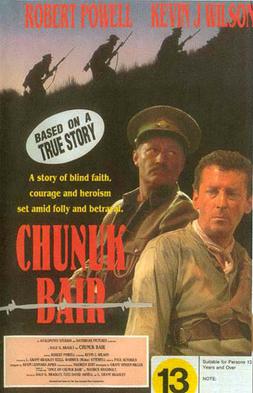
Once on Chunuk Bair

One of the New Zealand military’s functions is to assist civilian organisations where no viable civilian resources are available.  One such example of this support was in 1991 when the NZ Army provided expertise and personnel to help produce the movie, Chunuk Bair.  

The high point of the New Zealand effort at Gallipoli was the capture of Chunuk Bair, a key feature on the Gallipoli Peninsula. Captured by the Wellington Battalion under Lieutenant-Colonel William Malone on 8 August 1915, the New Zealanders would hold the position against violent counterattacks by a motivated and well-led opponent until relieved by British Battalions on 9 August. The latter were driven off Chunuk Bair in a counterattack led by Mustafa Kemal on the early morning of 10 August.

‘The Battle of Chunuk Bair, 8 August 1915, by Ion Brown’, URL: https://nzhistory.govt.nz/media/photo/battle-chunuk-bair-8-august-1915-ion-brown, (Ministry for Culture and Heritage), updated 23-May-2014

The anti-Vietnam protest movement of the 1960s and 70s had caused anything related to the ANZAC legend to become unpopular in New Zealand, with ANZAC day commemorations mainly attended by veterans and serving military personnel. The 1981 Australian movie Gallipoli, with its powerful anti-British theme,was released and considered an ‘event of national significance in Australia. This spike of interest across the Tasman was a turning point and provided the springboard for New Zealand playwright Maurice Shadbolt to provide his contribution in enhancing the notion of Gallipoli as the birthplace of New Zealand as a nation with the events at Chunuk Bair as a source of national pride.

Shadbolt’s play Once on Chunuk Bair would open to much praise from the theatre gong public on ANZAC Day 1982 at Auckland’s Mercury Theatre and would reinforce Shadbolt’s view that Chunuk Bair marked the birth of the nation freed from the shackles of British Colonialism. Once on Chunuk Bair gave the battle of Chunuk Bair the same national significance to New Zealand that the Australians place on their magnificent debacle at Lone Pine and the Nek. Despite a short theatrical run, Shadbolt’s play would become popular in schools and universities as it was taught and performed as part of the educational experience in a similar way that the Australians use the movie Gallipoli.

With the 75th anniversary of Gallipoli observed in 1990, a shift in public consciousness toward Gallipoli was revived, and Once on Chunuk Bair was made into a movie during 1991. Produced on a low budget and aimed at a New Zealand audience. The Army Museum provided much technical advice, uniforms and props, with the Army also providing significant assistance to the production, including expertise in explosives and many Men as extras. RNZAOC ammunition technical officer (ATO) Ian Juno would be listed in the credits as providing the special effects, and a sizable quantity of soldiers from 1 Base Supply Battalion would feature in many scenes as extras.

With production compressed within four weeks, many of the Large-scale battle scenes were filmed on Wellington’s south coast, a near facsimile of the terrain of Gallipoli, with the more detailed scenes filmed in a specially constructed set at the Avalon studios.

Chunuk.jpg

Although the final product was disappointing and did not have the same polished attributes as the earlier Australian movie Gallipoli, it complements Christopher Pugsley’s 1984 TVNZ documentary Gallipoli: The New Zealand Story, the Voices of Gallipoli in establishing the Gallipoli Campaign and the Chunuk Bair battle as the cornerstones of the national identity.


The Cave

As New Zealand’s Army’s central stock holding unit, 1 Base Supply Battalion(1BSB) was responsible for managing and providing depot-level storage of New Zealand’s Military’s stock of land equipment and spares. Despite having this responsibility since 1920, 1BSB and its predecessors had always struggled with providing suitable warehousing infrastructure and made do with the available storage infrastructure.

With no purpose-built storage accommodation, from 1920 to 1940, the NZAOC Main Ordnance Depot (MOD) utilised up to one hundred camp administrative and accommodation structures as its primary means of warehousing. Relief was provided in 1938 when contracts were issued to construct a modern warehouse utilising the most modern of methods and materials.[1] The New warehouse, later known as Building 73, was constructed using reinforced concrete and designed with nine bays that allowed the loading and unloading of Trains on one side and Motor Transport on the other. The design and layout of building 73 were utilised as the model for new warehouses constructed at Burnham, Hopuhopu and Waiouru.

Building 73

Although Building 73 provided a considerable increase in storage capability, wartime demands soon necessitated further increases in storage infrastructure, resulting in the construction of Building 74. Building 74 and the warehouses constructed in Burnham and Waiouru were close facsimiles of building 73, with the main exception that it was constructed out of wood instead of reinforced concrete due to wartime constraints.[2]

The wartime expansion of the New Zealand military saw the MOD exponentially expand to cope with the influx of military material with additional buildings constructed in Trentham and sub-depots also established a Mangere, Wanganui, Linton Camp, Gracefield and Wellington.

Peace in 1945 brought little respite as stocks were centralised at the MOD, requiring further expansion of the MOD warehousing infrastructure. To meet this need, five warehouses that were built for the United States Forces at Lower Hutt were disassembled and re-erected at Trentham by September 1945.[3] Additionally, the RNZAF Stores Depot constructed at Mangaroa in 1943 was handed over to the MOD in 1949.

Over the next forty years, the warehousing infrastructure at Trentham changed little, with a 1985 NZDF report identifying many deficiencies leading to significant upgrading of Trentham’s warehousing infrastructure.[4]

Main Ordnance Depot 1966

In one of the most significant warehousing infrastructure investments since 1939 and the first modern warehouse built for the RNZAOC since 1972, Building 75, a high stud warehouse capable of holding 3700 pallets, opened in 1988. Although a significant advancement in warehousing capability, the new warehouse had limited space for outsized items. Additionally, many other warehousing functions, such as packing and traffic, remained in Building 73, so further work was required to enhance the functionality of 1BSBs entire warehousing capability.

Building 73 (left), Building 74 (Right)

With trains no longer utilised for the delivery and dispatching of stores, the rail lines between Building 73 and 74 had long been redundant. By removing the rail line and raising the ground level between the two buildings, providing additional storage space of almost two square kilometres, protected from the elements by a 200 x 13-meter roof, was created. At the southern end, a loading ramp was constructed to allow the loading and unloading of trucks, with angled ramps at either end allowing the movement of vehicles along the length of the new storage area.  Opened on 2 November 1989, the new warehouse was christened “the Cave.” The Cave allowed the more efficient transfer of stores to and from the storage areas in Buildings 73, 74 and 75 to the receipt, selecting, packing and issuing bays in Building 73.

Lieutenant Colonel P.P Martyn, Royal Australian Army Ordnance Corps. Commanding Officer 1 Base Supply Battalion January 1988 – December 1990, officially opening “The Cave”

The additional storage space allowed the storage of outsized items which had previously been stored at the Mangaroa Depot, which was subsequently decommissioned and handed over to NZDF Property Services.

The optimisation of storage space between the two buildings was so successful a similar modification was constructed between two of 21 Supply Company’s 1950s-era Warehouses at Linton, creating much-needed storage and office space.


Notes

[1] “New Army Ordnance Block Now under Construction at One of the Military Camps,” Evening Post, Volume CXXVIII, Issue 65, 14 Sept 1939.

[2] F Grattan, Official War History of the Public Works Department (PWD, 1948).

[3] “Organisation – Policy and General – Royal New Zealand Army Ordnance Corps 1946-1984,” Archives New Zealand Item No R17311537 (1946).

[4] “Assessment and Audit – Audit Files – [1995] – NZDF Bulk Warehousing,” Archives New Zealand Item No R24596003 (1985).


1950s Camp Equipment

Publicity photos from the 1950s showing a range of portable Camp Equipment managed by the RNZAOC

Safes-Meat Portable

A required item to preserve meat in Field Kitchens in the days before portable refrigeration.

1593580333743-a8c302f3-e99e-41f3-a516-2eb6c342c01c_.jpg
1593580412555-81576d0d-f35d-41e0-a835-8794273b09a2_.jpg
1593580198943-92f3ab80-c911-45f4-a56e-fa041e792d07_.jpg
1593579984661-7e02b137-700a-45f4-9298-08f6e7c3f91d_.jpg

Stands Ablution Portable

This item is designed so that soldiers, when in a field camp environment, can have a place to carry out their daily ablutions.

Consisting of a sink top with a drain trough and bar to hang towels and mirrors, soldiers washed and shaved using a basin. On completion of their business, the contents of the basin were tipped into the drain from where it flowed into a sump dug into the ground

1593580122840-9565c613-7945-4f21-a0a0-40135baa0f52_.jpg
Stand Ablution Components. Robert McKie Collection

Stand Ablution laid with its compontrs laid out;

  • Bar Towel/Toprail, Qty 1
  • Leg Ablution Stand End, Qty 2
  • Leg Ablution Stand Center, Qty 1
  • Brace Ablution Stand, Qty 2
  • Drain Sink, Trough, Qty 1
  • Drain, Lavartory pipe, Qty 1
  • Bolt securing, Qty 4
1593580055144-87079f80-679e-47de-b471-851f452a81cb_.jpg
The above picture shows the Stand Ablution in the final stages of assembly with the two soldiers about to fir the Bar Towel/Top-rail to the Leg Ablution Stand Ends. Once the Bar Towel/Top-rail was attached, the braces were bolted tight and the Drain Sink, Trough and Drain, Lavatory pipe were attached.
1593579916990-393015e9-3de4-4efb-9e1f-d0ecbbd7958e_.jpg

Mess Kit Washup

1593580567220-74e6002e-ffdd-4a48-b294-98556f2e9ef5_.jpg
1593580498450-bc21fd8a-834e-4122-8258-cdf3b2706182_.jpg

Used in conjunction with a kerosene heater, these tubs were assembled over a small trench with the chimney device drawing heated air under the tubs, heating them up.

This set-up was based on the three-pot cleaning method.

Before washing. plates and utensils were thoroughly scrapped clean into a rubbish bin.

Sink 1: Wash sink – Full of hot soapy water, utensils are given a good scrub with a brush or dishcloth.

Sink 2: Hot-rinse sink -, Filled with clear, hot water, utensils rinsed in this sink.

Sink 3: Cold-rinse sink – Utensils undergo a final rinse in water which had a few drops of bleach or other sanitising argent added to it

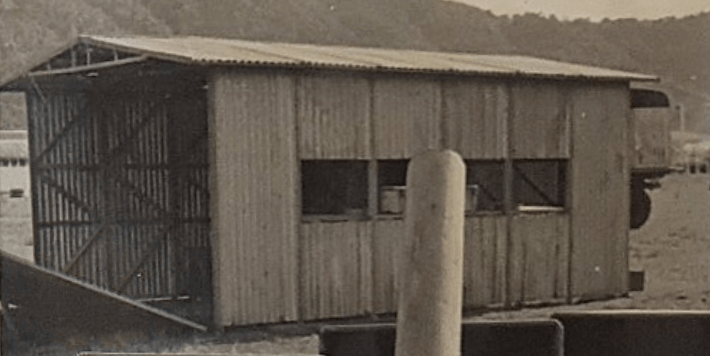
Field Cook House

In the background of these photos, a Field Cook House can be seen. This portable building was designed to be used as a Field Cookhouse, which could easily be assembled from components.


Bryan Nelson Jennings Memorial Trophy

The Bryan Nelson Jennings Memorial Trophy would, for a short period in the 1990s, be a coveted trophy awarded to the most outstanding Automotive Parts and Accessories Merchandising Apprentice of the Royal New Zealand Army Ordnance Corps(RNZAOC).

Apprenticeships for the Automotive Parts and Accessories Merchandising Trade (AP Trade) had been established in 1965 to provide the RNZAOC with skilled tradespeople for employment in RNZAOC Workshops Stores Sections that had been established as part of Royal New Zealand Electrical Mechanical and Electrical Engineers(RNZEME) Workshops and Light Aid Detachments in 1962.

The role of RNZAOC Stores Sections was to carry and manage the specialised holdings of spares, assemblies & workshop materials (Class 9 stores) of their parent workshops.

Administered by the New Zealand Trade Certification Board (now the New Zealand Qualifications Authority), the Automotive Parts and Accessories Merchandising apprentice training scheme consisted of 9000 working hours of study and on the job training with three Trade Board examinations required to gain the trade qualification.

Initially, apprentices would begin their training as 16-year-old Regular Force Cadets (RF Cadets), who, on graduation, would complete their apprentice training at the Main Ordnance Depot, MT Spares Section at Trentham Camp. However, during the 1970s, RNZAOC direct entry recruits were also accepted as apprentices.

Further progression in the AP trade was achieved by qualified apprentices undertaking the New Zealand Management Certificate in Automotive Parts & Accessories Merchandising. the first two Certificate level qualifications were awarded in 1988 To;

  • Sergeant M Wilson (0001)
  • Sergeant S O’Brien (0002)

The final AP Trade Apprentice would be recruited in 1996, following which the apprentice scheme would cease as the foundation for the AP Trade.

Warrant Officer Class One Bryan Nelson Jennings

Bryan was born in Wellington in 1926. Too young to see active service in WW2, Bryan served with the Melrose Battalion, Wellington South Home Guard unit from 1 April 1943 to 1 April 1944, attaining the rank of Corporal.

Volunteering for service with ‘J ‘ Force, the New Zealand component of the British Occupation Forces (BCOF) in Japan, Bryana would be posted to 4 New Zealand Base Ordnance Depot (later renamed to 4 NZ Ordnance Field Park) in August 1946. Completing his engagement, Bryan would return to New Zealand on 14 September 1947. Following a short period posted to the Main Ordnance Depot in Trentham as part of the post-war Interim Army, Bryan was soon discharged and returned to civilian life.

Enlisting into the Regular Forces RNZAXCO on1 April 1948, Bryan undertook a short period of refresher training at the Army School of Instruction at Trentham before being posted to the Main Ordnance Depot as a storeman in the Technical Spares Group and later in the Tyre Store.

Temporarily posted to 10 Coastal Regiment RNZA at Fort Dorset, Bryan, like many of his contemporaries, would be employed on the wharves during the 1951 Waterfront Workers strike.

Promoted to Temporary Sergeant on 25 November 1953, Bryan would be promoted Staff Sergeant on 13 October 1958. Poste to 1 Composite Ordnance Company n loan back in 1964, Bryan would remain at the Main Ordnance Depot.

Posted to 1 General Troops Workshops, Stores Section, Linton Camp as a Warrant Officer Class Two in 1965, Bryan would soon find himself loaned back to the Central Districts Motor Transport Workshops at Trentham.

Seconded to the New Zealand Cadre (Fiji) of the Fijian Military Forces in 1968 as a Temporary Warrant Officer Class One in 1968, Bryan would spend the next two years assisting in the training and development of the Fiji Military Forces.

Returning to New Zealand in January 1971, Bryan was posted to 1 Base Workshops, Trentham and promoted to Warrant Officer Class One. Bryan would remain at 1 Base Workshops and the IC Stores section until his release from the army on n 21 April 1981.

During Bryans more than thirty-two years of service, he was awarded the Long Service and Good Conduct medal on 25 March 1965, followed by the Meritorious Service Medal on19 April 1978.

Following his retirement, Bryan would remain in Upper Hurt. Staying engaged with the community, Bryan was an active member of the Lions organisation and a member of the School Board of the Heretaunga College.

Bryan passed away on 9 August 1989 at Upper Hurt after a long illness.

In his memory, The Bryan Nelson Jennings memorial trophy was instituted in 1991. Although not an AP Trade Apprentice himself, Bryan was a mentor to many apprentices and was described as a legend in the trade.

The object of the award was to provide a tangible mark of achievement and was intended to encourage junior soldiers of the AP trade to reach and maintain a high standard of professional competence and personnel integrity.

Nominations for the award were graded against the following attributes:

  • Basic Soldier Skills
  • Loyalty
  • Sportsmanship
  • Enthusiasm
  • Dress, bearing and personnel appearance
  • Trade Skills

Personnel eligible for consideration for the trophy were to meet the following requirements

  • Not be above the rank of Substantive Lance Corporal
  • Must have attended either 1st, 2nd or 3rd qualifying examinations in the past 12 Months
  • Must still be serving their apprenticeship.

The Trophy now resides at the Trade Training School of the Royal New Zealand Army Logistic Regiment.


National Service Reminiscences

Military conscription in New Zealand was first introduced in 1910 to build and maintain a credible force that would allow New Zealand to play its part in defence of the British Empire.  Initially intended to feed the Territorial Army, conscription was extended in 1916 to allow men to be conscripted directly into the New Zealand Expeditionary Force (NZEF). Conscription would be suspended during the lean post-Bellum years and re-established in 1940 as a wartime measure to satisfy New Zealand’s wartime personnel commitments.

New Zealand’s 1945 post-war commitments required the raising and mounting of a Division for service in the Middle East. The only way the personnel requirements for a Division could be met would be through conscription. A referendum was conducted in1949, resulting in a yes for Compulsory Military Training (CMT), which would commence in 1950.

The CMT scheme would train 63033 men up to 1958 when the Labour Government ceased CMT. In 1961 the National Government introduced a new National Service Act, which would require all males to register with the Labour Department on or before their 20th birthday. Following registration, ballots would be conducted to select individuals to undertake military training.

Training would consist of three months of initial full-time training, during which the men would be given the choice of three weeks part-time training in a Territorial unit for three years or one year’s service in a Regular Force unit. The National Service Scheme would last until 1972, when it was discontinued due to a changing social and economic environment.  

Since 1972 there has been no Military conscription in New Zealand. Since 1972 there have been many calls for the re-introduction of Military conscription to instill a sense of citizenship and discipline to reduce unemployment and youth crime. However, no major political party has made any significant policy statements on the re-introduction of military conscription.

The following are the remanences of John Mudgway, who at the age of 19, was selected by Ballot to undertake National Service as part of the first intake in 1961.

My Military Career by John Mudgway

When the National Government brought back military service in 1961 it was named National Service. We had to register with the Labour Department and the Golden Kiwi lottery marbles were used to draw certain birth dates. The “winners” of these birth dates were ordered into Waiouru Military Camp for 7 weeks basic training and were then posted to a Territorial Unit to complete their 3-year term. This was done in 3 annual camps, plus local parades. They then went to reserves for a further three years.

There was an option offered to us – which was we could serve one-year regular force and then be put on reserve for a further 3 years. I chose the latter.

Waiouru Camp
10 May 1962 – 27 June 1962

I was posted to Waiouru Military Camp and arrived on 9th May 1962, along with 549 other young lads.

Above left – Recruits leaving the train at Waiouru Camp rail siding before entering the camp to begin 14 weeks
training, at the end of which they will be posted to “Territorial Force Units.”
Right – Recruits E L McFeran (left) and R A Shaw sorting out equipment, clothing and bedding in their barrack
room.

I did seven weeks basic training – learning the military way of life, marching, shooting, and cleaning boots and weapons etc. One lasting memory I have is of being told that – in the event of an atomic blast, lay on the ground, cover myself with my greatcoat, have no skin exposed – and I would survive!

John Mudgway (Hastings), Ned Kinita (Waipukurau)
and Robyn Gunderson (Dannevirke).

Trentham Military Camp
28 June 1962 – 9 May 1963

When I arrived in camp, RSM Ordnance Schools, School Sergeant Major Alfred Wesseldine, decided they would not run the school for just me, so I was posted direct to MT Spares for the duration of my service.

Myself (Pte John Mudgway) (on left) and Dennis Leslie Goldfinch (who retired as a WO1). We are facing the main building of MT Spares in the MOD Compound. August 1962. Behind us in part of the wavy roof building, was the Uniform Store and smoko room.
On our left is a large, grassed area that was covered in 25 pounder artillery pieces that were being cut up for scrap by a private contractor. Further to the left was the Tyre Store that “Goldie” was in charge of.

Below is the two of us in 2012 (50 years later)

During my service in RNZAOC I participated in several events.

I was part of a Guard of Honour for the Chief of the Imperial General Staff at Wellington Airport when he flew in.
I was also in a Guard of Honour for the NZ Chief of Staff at Wellington Airport when he flew in.

I was part of the street lining contingent that paraded on the streets of Wellington City for the Queen when she visited in February 11 & 12 1964. (I saw her 23 times). We drove the streets of Wellington in 2 RL Bedfords, to places in streets she was to move through, detrucked and stood at attention on the road-sides while she passed, back to the trucks and on to our next destination. She must have thought there were a lot of handsome young lads in our army.

Escorted a prisoner the Ardmore Prison, by overnight train in 1964. I was the junior escort.

I was dragged out of the barracks at 2am one morning and trucked over to Mangaroa, Whitemans Valley Tent Loft to drag tents from a burnt-out building.

One of my jobs during my service was to sit out between two of the stores buildings and empty the brass fire extinguishers that had been returned to us from all the other stores round the country. These extinguishers were filled with carbon-tetrachloride and after spraying the contents into buckets for several days we were quite “high” ourselves. I presume the brass containers went for scrap.

During my time in M T Spares I worked with Staff Sgt Kevin Anderson, Goldie of course, and Pte’s Vic Fletcher and Tammy Tamihana. Our Stores Officer was Geoff Atkinson first, then latterly Captain R G H Golightly. Our C S M was WO 1 Maurie Bull. We also had some civilian workers in our stores, one of whom was retired Sgt Bert Royal. Also there were a group of prisoners from Waitako Prison that used to come and do the “dirty jobs” that we didn’t have to do.

I also did a couple of Camp Patrols in the MOD Compound. We had to patrol the compound several times during the night and were supposed to sleep in the Gate House.

Trentham Camp 26 July 2012

Not a bad years work for a 19/20 year old Hastings lad.


581769 Private Mudgway J W.


MT Stores – 1939-1963

The Royal New Zealand Army Ordnance Corps (RNZAOC) and its predecessors were responsible for crucial storekeeping duties, ensuring the supply of Clothing, Camp Equipment, Ammunition, Arms, and Accessories to New Zealand’s Military Forces. As the Second World War unfolded, the complexity of military storekeeping transformed dramatically, encompassing a wide array of military equipment, including vehicles, communications gear, and mechanical plant. These new assets were deployed in massive numbers and necessitated many accessories and intricate repair parts to keep them operational. To streamline control and provide an optimal system, the RNZAOC implemented significant measures in 1963. They established RNZAOC Stores Sections within the Royal New Zealand Electrical and Mechanical Engineer (RNZEME) workshops. In addition, the Auto Parts trade was initiated in 1965, reinforcing the overall process. This article offers an enlightening and sweeping overview of how the Mechanical Transport Branch (MT Branch) and the RNZAOC effectively managed Mechanical Transport Stores (MT Stores) from 1939 to 1963.

In 1939, as the New Zealand Army mobilised, it aimed to seamlessly integrate into a larger British army, much like in the First World War. The British army had already embraced modern technology, making it highly motorised and technologically advanced so that ‘By the time of the invasion of Poland, the British Army in Europe was rather more motorised than the German Army.’[1]. Some aspects of this advanced doctrine made its way to New Zealand in the late 1930s with modern equipment like Bren Guns and Universal carriers. The army had even conducted some basic experiments in motorisation. However, due to interwar defence policies and financial constraints, the New Zealand Army Ordnance Corps (NZAOC) was not efficiently organised like its counterpart, the Royal Army Ordnance Corps (RAOC), in the United Kingdom. Consequently, the NZAOC was unprepared to function effectively when the war began.

During the Second World War, it was as if New Zealand maintained two separate armies. The first was the 2nd New Zealand Expeditionary Force (2nd NZEF), fully equipped with combat units, supporting arms, and logistic units. These forces were organised according to modified War Office Establishment tables, with G1098 stores directly drawn from British stocks. [2]  The second army was the NZ Army at home, also organised according to War Office Establishment tables. However, a New Zealand logistical base provided its equipment needs and G1098 Stores.

This dichotomy in organisation and preparedness highlighted New Zealand’s challenges as it strived to align itself with modern military practices while operating within the constraints of its resources and policy decisions.

In 1939, the NZAOC was constrained by interwar defence limitations, primarily focusing on supplying and maintaining clothing, equipment, ammunition, and weapons. Despite the army possessing 56 vehicles, the NZAOC lacked substantial experience in supporting Mechanical Transport (MT) at the scale the rapidly growing army required. Most senior leadership had been seconded to the 2nd NZEF, which hindered the NZAOC’s ability to expand effectively during the critical early wartime years.

Recognising the urgent need to expand and manage the Army’s MT fleet, the Quartermaster General (QMG) took a bold step away from convention and established a separate MT Branch. This move allowed the NZAOC to focus on its core responsibilities. At the same time, the MT Branch managed and maintained the multitude of purchased or impressed vehicles required by the military.

Drawing inspiration from the Royal Army Ordnance Corps (RAOC) in the United Kingdom, the MT Branch wisely leveraged the expertise of the New Zealand Motor industry. Many of its staff were directly recruited from the motor industry into the New Zealand Temporary Staff (NZTS), ensuring a wealth of specialised knowledge and experience was brought to the forefront of this critical military function. During the early years of the war, the NZ Military primarily relied on civilian vehicles impressed into service. They initially purchased existing stock from New Zealand’s motor manufacturers and dealerships to ensure an adequate supply of MT spares. However, as the war continued, the influx of new vehicles, equipment, and spares from the United Kingdom, Australia, Canada, and the United States necessitated significant expansion of the MT Branch.

By December 1942, the MT Branch consisted of,[3]

New Zealand Temporary Staff. Robert McKie Collection
  • MT Workshops
    • 1 MT Workshops, Trentham
    • 2 MT Workshop, Waiouru
    • 3 MT Workshops, Papakura
    • 4 MT Workshops, Whangarei
    • 5 MT Workshops, Palmerston North
    • 6 MT Workshops, Wellington
    • 7 MT Workshops, Blenheim
    • 8 MT Workshops, Burnham
    • 9 MT Workshop, Dunedin
  • MT Depots providing pools of vehicles.
    • 1 MT Depot, Auckland
    • 2 MT Depot, Hamilton
    • 3 MT Depot, Napier
    • 4 MT Depot, Wanganui
    • 5 MT Deport, Christchurch
  • MT Stores Depots providing MT spares, tools and equipment for MT Workshops and Depots
    • 1 Base MT Stores Depot, Wellington
    • 2 MT Stores Depot, Auckland
    • 3 MT Stores Depot, Wellington
    • 4 MT Stores Depot, Christchurch
    • 7 MT Stores Depot, Blenheim

Freed from the burden of managing MT, the Chief Ordnance Officer (COO) with NZAOC, Territorial units of the New Zealand Ordnance Corps (NZOC) and personnel from the NZTS would provide.

  •  All natures of stores and equipment, other than rations, forage, and fuel.
  • The repair and maintenance of armaments and equipment, including.
    • Light Aid Detachments and mobile workshops to provide 1st and 2nd line support across Field Force Units
    • Armament and General Engineering Workshops.
      • Main Ordnance Workshop, Trentham
      • 11 Ordnance Workshop, Whangarei
      • 12 Ordnance Workshop, Devonport
      • 13 Ordnance Workshop, Blenheim
      • 14 Ordnance Workshop, Burnham
      • 15 Ordnance Workshop, Dunedin

As of 31 March 1944, the MT Stores Depots had undergone significant reorganisation and successfully handled the following quantities of Tyres and MT Parts:

180 different sizes of Tyres

  • Purchased from overseas – 83174.
  • Purchased in New Zealand – 12534
  • Total Purchased – 95708
  • Transferred to Supply Department – 11018
  • Other issues – 28700
  • In stock 31/3/1944 – 55990
    • Reserved for Supply Department – 2000
    • General – 35990
  • Used tyres recapped and re-treaded – 9983.
  • Reconditioned tyres reissued – 7301.
  • Reconditioned tyres in stock 31 March 1944 – 2682

M.T. Parts. (Not including body-building material)

  • Received from overseas (Total of 9182 Tons)
    • Wheeled vehicles, parts- 20472 Packages
    • Tracked vehicles, parts – 39408 Packages.
    • Tracked vehicles, tracks – 8280 Bundled.
  • Packages broken down and binned – 23895.
  • Packages transferred to United States Forces – 1050
  • Packages in Bulk Store – 43215

Shipments of MT Parts and Tyres to the Pacific

  • 3 Division – 1149 Tons
  • Fiji – 406 Tons
  • Tonga – 112 Tons
  • Norfolk – 30 Tons

1944 MT Stores Organisation

  • Base MT Stores Depot, Wellington.
    • 8 Officers
    • 103 Other Ranks
      • Depot No 7, 186-200 Wakefield Street, Wellington, Rented, 3353 Square Meters, Main Base Store for parts, tools, etc. Administrative Offices.
      • Depot No 8, 102 Wakefield Street, Wellington, Rented, 1115 Square Meters, Bulk Tyre Store.
      • Depot No 9, 97 Taranaki Street, Rented, 1300 Square Meters, Parts etc for AFV.
      • Depot No 10, Cable Street, Wellington, Rented, 1821 Square Meters, Bulk part store.
      • Depot No 11, George Street, Wellington Rented, 238 Square Meters, Bulk store for heavy parts, AFV.
      • Depot No 11, Taranaki Street, Wellington, Rented, 186 Square Meters, Bulk stores for heavy parts, AFV.
      • Depot No 12, Coutts Street, Kilbirnie, Rented, 232 Square Meters, Bulk store for body-building material.
      • Depot No 13, 129 Tory Street, Wellington, Rented, 279 Square Meters,  Bulk Store – Steel
      • Depot No 14, Gracefield, Petone, Govt Store, 1542 Square Meters, Bulk Store – General
      • Depot No 15, Gracefield, Petone, Govt Store, 1579 Square Meters, Bulk Tyre Store
      • Depot No 15, Kent Terrace, Wellington, Rented, 881 Square Meters, Bulk Tyre Store
      • Depot No 16, Gracefield, Petone, Govt Store, 1412 Square Meters, Bulk Store – General
      • Depot No 17, Gracefield, Petone, Govt Store, 1709 Square Meters, Bulk Store – General
      • Depot No 18, General Motors, Petone, Special, 743 Square Meters, Parts Store – GM Products
      • Depot No 19, General Motors, Petone, Special, 743 Square Meters, Parts Store – Ford Products
      • Depot No 20, Luke’s Lane, Wellington, Rented, 409 Square Meters, Body-building material.
      • Depot No 21, Gracefield, Petone, Govt Store, 1951 Square Meters, Bulk Store – General
  • Advanced Base Stores Depot, Northern Military District
    • 1 Officer
    • 26 Other Ranks
      • Depot No 2, Hood Street, Hamilton, Rented, 809 Square Meters, Parts and Tyres
      • Depot No 3, Drill Hall, Hamilton, Government, 372 Square Meters, Bulk Store
  • Advanced Base Stores Depot, Central Military District
    • 1 Officer
    • 17 Other Ranks
      • Depot No 4, 83 King Street, Palmerston North, Rented, 650 Square Meters, Parts Store
      • Depot No 5, Showgrounds, Palmerston North, Rented, 1338 Square Meters, Tyres and bulk parts.
      • Depot No 6, Palmerston North, Rented, 310 Square Meters, Bulk Parts
  • Advanced Base Stores Depot, Southern Military District
    • 1 Officer
    • 21 Other Ranks
      • Depot No 26, Kilmore Street, Christchurch, Rented, 986 Square Meters, Parts and Tyres
      • Depot No 27a, Litchfield Street, Christchurch, Rented, 418 Square Meters, AFV Parts
      • Depot No 27b, Christchurch, Rented, 465 Square Meters, Used Tyres.[4]

Post War

Before the war, the NZAOC was not effectively organised to fulfil its functions. However, after the war, there was an opportunity to reorganise the NZAOC to align it with the organisational structures and procedures of the RAOC (Royal Army Ordnance Corps), which included the management of vehicles and MT Spares. Originally intended as a temporary wartime organisation, the MT Branch would have its wartime responsibilities integrated into the reorganised NZAOC. Additionally, a newly established NZEME (New Zealand Electrical and Mechanical Engineers) would take on specific roles as part of the overall restructuring.[5]

MT Workshops

From 1 September 1946, the MT Branch Workshops and the Ordnance Workshops were integrated into the newly established NZEME organisation.[6]

MT Vehicle Depots

Following the return of many impressed vehicles to their original owners or their disposal during the war, the MT Vehicle Depots were left with a significant inventory of military vehicles. To streamline operations, responsibility for the MT Vehicle Depots was transferred to the RNZAOC on 1 September 1947, establishing the RNZAOC Vehicle Depots at Sylvia Park, Trentham, and Burnham.[7]

MT Spares Depots

On 1 April 1948, after conducting multiple audits and stocktakes, MT Stores handed over spare parts, tools, and accessories to the RNZAOC. To ensure smooth management of MT Stores, the RNZAOC established MT Spares Groups at the Main Ordnance Depot (MOD) in Trentham and the Northern and Southern District Ordnance Depots.

The supply system for MT Stores involved RNZEME workshops holding a small stock managed by RNZEME Stores Staff. Replenishment was through Local Purchase or the supporting District Ordnance Depot, MT Group. An exception existed with the Central Districts Workshops at Waiouru and Linton, which demanded supplies directly from the MOD MT Stores Group at Trentham. This issue was resolved in 1954 when the Central Districts Ordnance Depot at Linton was authorised to establish an MT Stores Depot, streamlining the process.

By 1961, the NZ Army vehicle fleet underwent a significant transition, with the older World War Two era vehicles, including Chevrolets, Fords, and GMCs, being replaced by a modern fleet of Bedford’s and Land Rovers. As the vehicle fleet transitioned, the management of MT Stores was also reviewed, leading to several changes implemented between 1961 and 1962.

Workshop Stores Sections

A transformative era commenced in 1962, as the RNZAOC Workshop Stores Sections emerged as integrated powerhouses within the following RNZEME Workshops:

  • Northern Districts Workshops
  • Central Districts Workshops
  • Central Districts Armament and General Workshops
  • Central Districts MT Workshops
  • Southern District Workshops

This momentous shift witnessed 50% of the new Stores Sections’ staff comprised of RNZEME personnel, transitioning into the RNZAOC, heralding an unparalleled synergy, propelling these sections to new heights of efficiency and effectiveness. Thus, a legacy of innovation and collaboration was born, forever changing the landscape of logistical excellence.[8]

Ordnance Deport MT Stores Groups

A transformative restructuring unfolded with the inception of RNZAOC Stores Sections, triggering a series of cascading changes. The District Ordnance Depot, MT Stores Groups, underwent a reroll, transforming into Technical Stores Groups, relinquishing their hold on MT Stores with MT Stores stocks reallocated to the new Stores Sections, initially equipped with a six-month inventory, later streamlined to three months from January 1963. Any surplus stock from the District Ordnance Depots found a new home in the MOD, optimising resource allocation.

By the close of 1963, RNZAOC Stores Sections had firmly established their presence within the RNZEME Workshops. Beyond merely providing MT Spares, they evolved to encompass a comprehensive array of repair parts and spares essential for workshop operations. Within the RNZAOC, these sections fostered their distinct identity and culture, paving the way for introducing the RNZAOC Auto Parts and Accessories trade in 1965.

Conclusion

The RNZAOC and its predecessors played a vital role in storekeeping duties, supplying essential items to New Zealand’s Military Forces, including clothing, camp equipment, ammunition, arms, and accessories. During the Second World War, military storekeeping became more complex, involving various military equipment, vehicles, communications gear, and mechanical plant.

The MT Branch had managed MT Stores during the war, but post-war reorganisation integrated these responsibilities into the RNZAOC. Additionally, the NZEME assumed specific roles within the restructuring. To streamline operations, the RNZAOC implemented significant measures in 1963. They established RNZAOC Stores Sections within the RNZEME workshops, integrating RNZEME Stores personnel into the RNZAOC. This move facilitated unmatched synergy and efficiency, transforming the logistical landscape.

Overall, the RNZAOC Stores Sections became an integral part of the RNZEME workshops, providing not only MT Spares but also a full range of repair parts and spares. This collaboration fostered a unique culture and set the stage for introducing the RNZAOC Auto Parts and Accessories trade in 1965. The RNZAOC’s evolution enhanced logistical excellence and efficiency, significantly impacting New Zealand’s military operations.


Notes

[1] Jonathan Fennell, Fighting the people’s war : the British and Commonwealth armies and the Second World War, Armies of the Second World War, (Cambridge University Press, 2019), Non-fiction, 32.

[2]  Army Form G1098, the Unit Equipment Table giving the entitlement to stores and equipment.

[3] “Staff – Motor transport branch,” Archives New Zealand Item No R22438851  (1942).

[4] “Appendices to Report on QMG (Quartermaster-General’s) Branch,” Archives New Zealand Item No R25541151  (30 June 1944), .

[5] “Organisation – Policy and General – Royal New Zealand Army Ordnance Corps 1946-1984,” Archives New Zealand Item No R17311537  (1946).

[6] The NZEME would gain royal status in 1947 as the Royal New Zealand Electrical and Mechanical Engineers (RNZEME).

[7] Peter Cooke, Warrior Craftsmen, RNZEME 1942-1996 (Wellington: Defense of New Zealand Study Group, 2017), 189.

[8] “Organisation – Policy and General – Royal New Zealand Army Ordnance Corps 1946-1984.”


Rickshaw Military Research

Rickshaw Military Research specialises in the research and transcription of New Zealand Military Service Records to allow families to learn of their families military experience in peace and war. Services offered by Rickshaw Military Research include;

  • Interpretation of military records,
  • Assistance with military research,
  • Identification of medals, badges and insignia, and sourcing of replacements.
  • Regiment and unit identification.

Often, descendants of New Zealand Servicemen have some inkling that their ancestors served in the military. Knowledge of a relative’s service will often be a source of pride with some evidence such as photos of the relative in uniform, medals, unit badges, diaries, and other souvenirs existing. However, for many, any connection to their relative’s military service is long-forgotten and a mystery. For some, the only link to a relative is an inscription on one of New Zealand’s many War Memorials.

For all those interested in discovering more about their ancestors military service, accessing the individual’s service record and understanding what is written in it can be a daunting exercise,first in gaining the service record and then interpreting the peculiar language used by the military and making sense of the many abbreviations used, reading a service record often leads to more questions than answers.

Rickshaw Military Research provides a service where we work with the family and after some preliminary questions, access the relevant military service record from the archives and produce a transcript of the relative’s service record into an easy to read format, including;

  • Personal details of the individual.
  • Brief description of activities prior and after service.
  • Record of service, from enlistment to demobilisation, including;
    • Formations/Units served in.
    • Campaigns and battles that were participated in.
    • Locations visited.
  • Record of Promotions.
  • Record of Illness and Injuries.
  • Records of medals and awards, including citations.
  • Brief description of post-service activities.
  • Illustrations will be provided where possible and could include;
    • Photos of the serviceman.
    • Medals.
    • Badges and patches worn.
    • Maps.
    • Equipment used, i.e. if a serviceman was a tank driver, an illustration of the type of tank driven.

Services offered

Pre 1921 Records

Service records prior to 1921 including the South Africa and First World War.

  • Basic one-page summary of service: $100*
    • Basic service information from attestation to discharge edited to fit on a single A4 sheet.
  • Full transcript of service : $250*
    • Transcript of service relating to target serviceman with additional information on units served in and campaigns participated in presented as a booklet or interactive Web App.

Post 1921 Records

Service records from 1921 including the Second World War, Korea, Malaya, Borneo, South Vietnam, CMT & National Service, Peacekeeping and Territorial and Regular service in New Zealand)

  • Basic one-page summary of service: $150*
    • Basic service information from attestation to discharge edited to fit on a single A4 sheet.
  • Full transcript of service : $300*
    • Transcript of service relating to target serviceman with additional information on units served in and campaigns participated in presented as a booklet or interactive Web App.

Other Research

Other research outside the scope of researching Personnel Records is charged at a rate of NZD$30 per hour.

*All prices are GST inclusive.

Interested in knowing more? Feel free to contact Rickshaw Military Research and let us know how we can assist.

← Back

Thank you for your response. ✨