As a result of service during the First World War, twelve Warrant Officers, Norn-Commissioned Officers and Men of the New Zealand Army Ordnance Corps (NZAOC) were awarded the Meritorious Service Medal.
The Meritorious Service Medal was initially instituted by British Royal Warrant on 28 April 1898 as an award for Warrant Officers and Senior Non-Commissioned Officers. Nearly all recipients of this medal have been of the rank of Sergeant or above. However, in the early 20th Century, some awards were made to lower ranks.
In the London Gazette of 9 December 1919, it was announced that His Majesty the King was graciously pleased to approve the awarding of the Meritorious Service Medal (MSM) to fifty-six Warrant Officers, Norn-Commissioned Officers and Men of the New Zealand Forces, including two men of the NZAOC.
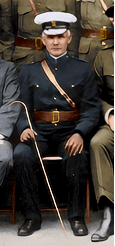
Conductor John Goutenoire O’Brien, and
Conductor Mark Leonard Hathaway
O’Brien’s service would be with the NZEF, serving at Gallipoli, France and the United Kingdom from 1916 until 1920. In contrast to O’Brien’s long service, Hathaway would only serve in Home Service for one year and 274 days, but with his conduct and character described as “Very Good”, he had been recognised for his contribution.
John Goutenoire O’Brien
John O’Brien left New Zealand with the New Zealand Expeditionary Force (NZEF) 6th Reinforcements on 14 August 1915. After service in the Dardanelles, O’Brien was transferred into the NZAOC in February 1916. Serving in France for two years, O’Brien was assigned to London Headquarters in March 1918 as the Chief Clerk. Staff Sergeant John O’Brien was Promoted to Temporary Warrant Officer Class 1 with the Appointment of Acting Sub-Conductor on the 18 October 1918. Gaining Substantive rank as a Warrant Officer Class 1 with Sub-Conductor appointment on 25 November 1918. O’Brien was appointed as a Conductor on 1 February 1919. O’Brien was awarded the MSM and was the senior Warrant Officer NZEF NZAOC when he was demobilised in March 1920. His final duties included indenting new equipment for two divisions and a Mounted brigade that would equip the New Zealand Army until the late 1930s.
After a short stint serving in the NZAOC in New Zealand, O’Brien would return to his pre-war trade of banker. Immigrating to the United States, O’Brien attended De Paul University Law School in Chicago from 1921 to 1924. In 1926 O’Brien took up the appointment of vice-president of the Commercial National Bank in Shreveport, Louisiana. During the Second World War, O’Brien, then a US Citizen, served in the United States Army Air Force as a Lieutenant Colonel in the South-West Pacific Theatre of Operations.
Mark Leonard Hathaway
Little is known of Mark Leonard Hathaway’s early life. Born at St Pancras, Middlesex, England, on 31 August 1875, Hathaway married Ethel Ellen Davis in 1903. Census records show that Hathaway was still residing in England in 1911, migrating to New Zealand with his family prior to1915.
On the outbreak of World War One, Hathaway attempted to join the NZEF. However, he was rejected as unfit due to heart troubles. Hathaway then joined the Defence Department as a civilian clerk/typist in the Defence Stores on 5 February 1915. When the Defence Stores Department transitioned into the New Zealand Army Ordnance Corps (NZAOC) in 1917, Hathaway was allotted the Regimental number of NZAOC 48 and appointed a Staff Quartermaster Sergeant. His NZAOC enlistment document states that he had no other previous military service.
Promoted to (Temporary) Conductor on 1 November 1918, Hathaway service file indicated that he was awarded the MSM in 1918. However, his award was not gazetted until 1919. Hathaway was released at his request on 31 March 1919. Working as an accountant, Hathaway passed away on 10 July 1928. Following his death, his wife made inquiries about eligibility to get a military pension and how to apply for a replacement MSM as her husband’s original medal had been lost.
Meritorious Service Medal (Obverse) awarded to 48 Conductor M.L Hathaway, NZAOC. Courtesy of the Trembath CollectionMeritorious Service Medal (Reverse) awarded to 48 Conductor M.L Hathaway, NZAOC. Courtesy of the Trembath Collection
Hidden among the warehouses and railway infrastructure of Clerkenwell was one of the least-known New Zealand military establishments of the First World War. Small in scale but national in purpose, the Farringdon Road depot connected the New Zealand Expeditionary Force to Britain’s immense ordnance system while retaining control of New Zealand-specific clothing, stores, accounting and soldier support.
A small depot with a national role
Across the eight decades in which New Zealand’s Army ordnance organisations existed, depots were established at places as varied as Trentham, Hopuhopu, Waiouru, Linton, Burnham and Singapore. Farringdon Road was different. It was a national logistics node located inside an allied system and more than 18,000 kilometres from New Zealand. Its importance lay not in its size, but in the control it gave the NZEF over requirements that could not simply be absorbed into the British supply chain.1
At the outbreak of war in 1914, New Zealand deployed without a fully developed uniformed ordnance corps. British Army Ordnance Corps (AOC) depots provided much of the necessary support, but experience in Egypt and during the Gallipoli campaign demonstrated a continuing need for New Zealand personnel who understood national scales, clothing patterns, accounting arrangements and special stores. The establishment of the New Zealand Army Ordnance Corps within the NZEF was published in NZEF Orders on 18 February 1916.2
The wartime NZAOC developed around three connected elements: administrative staff at NZEF Headquarters in London; ordnance staff supporting the New Zealand Division in France and Belgium; and personnel supporting the mounted force in the Middle East. The United Kingdom element also became responsible for New Zealand camps, hospitals, convalescent facilities and other establishments dispersed across Britain. That network created the demand for a central New Zealand depot in London.3
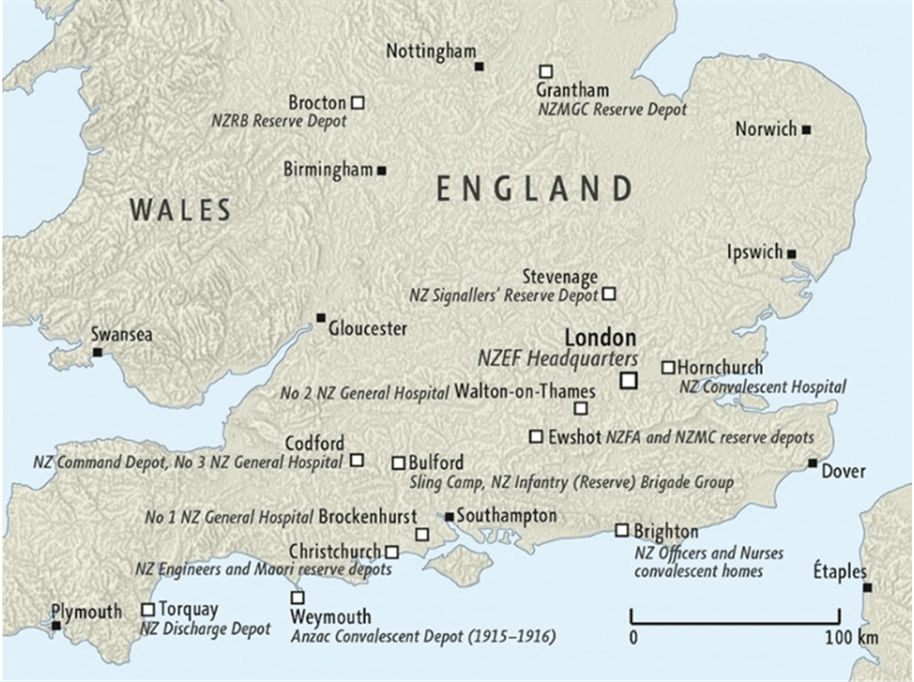
Figure 1. NZEF establishments in England, 1916-1919. Map produced by Geographx with research assistance from Damien Fenton and Caroline Lord; originally published in Damien Fenton, New Zealand and the First World War (2013). Source: Manatu Taonga – Ministry for Culture and Heritage.
Establishing the Farringdon Road depot
The preferred site needed to be close to NZEF Headquarters at Bloomsbury Square, accessible by road and rail, and well placed to draw on British depots and suppliers. On 25 October 1916, the Officer Commanding London District authorised the NZEF, under wartime powers, to take over the premises of H. Fisher and J. Fisher at 30 and 32 Farringdon Road for use as an ordnance store. The buildings were only about 1.5 kilometres from the New Zealand headquarters.4
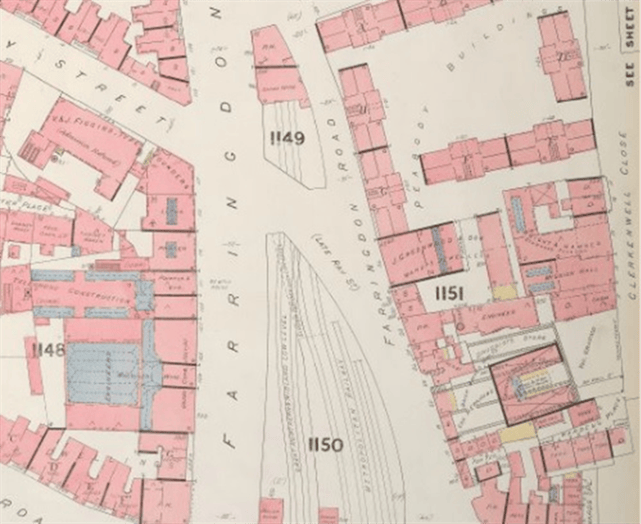
The choice was practical. Farringdon Road was a major north-south route, while the nearby Metropolitan Railway provided access to both Farringdon passenger station and its goods facilities. From this point the depot could reach New Zealand establishments around Britain and connect with the British AOC network, including the Royal Arsenal at Woolwich, the Army Clothing Depot at Pimlico, and ordnance depots at Weedon and Didcot. References to these establishments as ‘RAOC’ depots are anachronistic for 1916; the British corps was then the AOC and did not receive the Royal prefix until after the war.56
Occupation was intended for 7 November 1916, but obtaining the keys and connecting water and electricity delayed the move. The NZEF finally occupied the premises on 27 November, and the depot began operating on 1 December 1916. The address was later incorporated into Farringdon Lane numbering and is now commonly identified as 30 Farringdon Lane.
Key dates
Date
Event
18 February 1916
NZAOC establishment published in NZEF Orders.
25 October 1916
London District authorised the NZEF to take over 30-32 Farringdon Road.
27 November 1916
The premises were occupied after delays with access and utilities.
1 December 1916
The New Zealand Ordnance Depot began operating.
17 July 1919
The depot’s closing audit was completed.
November 1919
The depot closed after stocks were returned, credited, sold or destroyed.
Figure 2. Farringdon Road and the Metropolitan Railway corridor. Extract from Chas E. Goad, Insurance Plan of London, vol. VI, sheet 128 (1886), British Library.
The people who ran it
Overall responsibility rested with Captain, later Major, Norman Joseph Levien, the Chief Ordnance Officer for the NZEF in the United Kingdom. Day-to-day charge of the depot for most of its existence fell to Warrant Officer Class One (Conductor) Arthur Gilmore. Posted there in November 1916, Gilmore remained closely associated with Farringdon Road apart from a six-month secondment to the Sling Camp depot and about three months of sick leave during the influenza epidemic. He was commissioned as a second lieutenant on 1 February 1919.7
The appointment of Conductor carried more authority than the modern image of a warehouse supervisor might suggest. Conductors were senior technical warrant officers responsible for stock accountability, inspection, issue discipline and the practical operation of the ordnance system. Farringdon Road depended on that combination of professional judgement and exacting administration.
Clothing, salvage and local purchasing
Most stock passing through the depot consisted of clothing and necessaries. New garments were obtained from the Army Clothing Depot at Pimlico, while other items were contracted directly from civilian manufacturers. Cleaned and repaired articles recovered through the salvage system were also returned to service. The result was a blended supply model: imperial depots provided depth, the civilian market supplied flexibility, and salvage reduced waste and relieved pressure on new production.
Levien reported that, in the year to December 1917, purchasing clothing from civilian suppliers rather than relying solely on Pimlico produced savings of £31,532 7s. 10d. The figure is best left in its contemporary form because modern currency conversions vary considerably by method. Its significance is nevertheless clear: a small New Zealand organisation was not merely drawing stores from a larger ally; it was actively managing cost, supply risk and availability.8
More than a warehouse
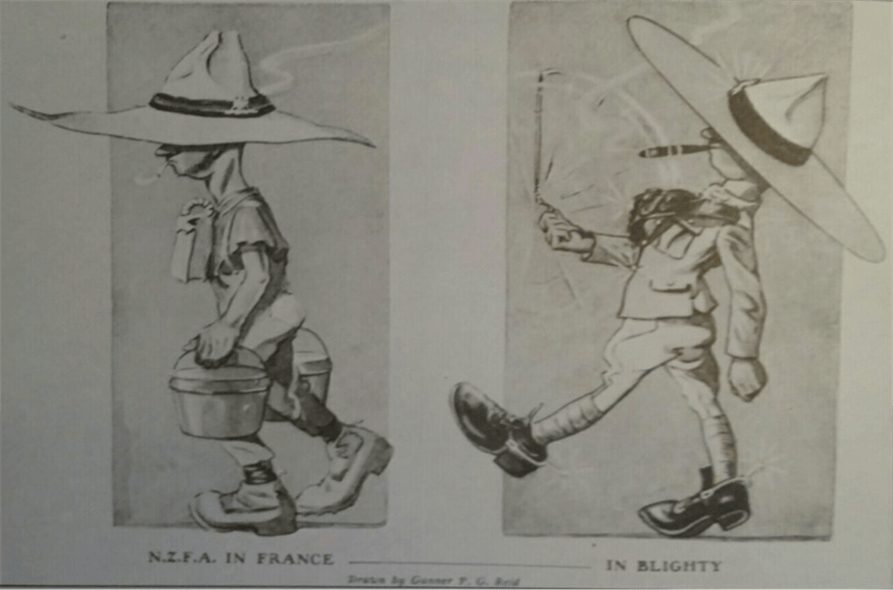
The depot also acquired a direct role in soldier welfare and readiness. Men arriving in Britain on leave from France and Belgium often wore dirty, damaged and vermin-infested clothing. Under the direction of the New Zealand General Officer Commanding, additional accommodation was secured so that they could hand in their uniforms, bathe, and receive clean underwear and a serviceable uniform before beginning leave.9
A secure kit store held spare kit, arms, ammunition and equipment while the soldiers were in London. The New Zealand Soldiers’ Club and the New Zealand War Contingent Association supported the reception facility with hot drinks and instruction on the use of prophylactic outfits. In one place, the NZEF combined hygiene, health education, clothing exchange, property security and stores control. It was a practical demonstration that logistics and personnel welfare were not separate activities.
Figure 3. A contemporary cartoon contrasting a New Zealand artilleryman’s appearance in France with his refitted appearance in Britain. Artist shown as Gunner T. C. Bell; reproduced from the original article source image.
The scale of throughput
A surviving summary of selected receipts between 1 December 1916 and 1 August 1919 gives a sense of the depot’s throughput. These figures are receipts across the period, not a snapshot of stock held on one day. The terminology has been retained, with punctuation lightly modernised.10
Item
Quantity
Item
Quantity
Hat bands (‘Hat Smasher’)
115,000
‘Hat Smasher’ hats
95,400
Boots, ankle, service
78,272
Service dress jackets
98,500
Boots, ankle, NZ pattern
58,691
P.W. jackets
68,500
Boots, ankle, part worn
24,691
Leather jerkins
20,000
Braces, pairs
78,140
B.C. pantaloons
45,500
Kit bags
27,748
Pantaloons, part worn
5,000
Hair brushes
22,000
Worsted socks
123,000
Toothbrushes
28,000
Canvas shoes
31,000
Greatcoats, D.S.
28,665
Flannel shirts
99,500
Greatcoats, part worn
10,765
Service dress trousers
77,300
Warm coats, M.S.
16,172
P.W. trousers
47,000
Comforter caps
14,699
Turkish towels
64,500
Hair combs
25,000
Cardigan waistcoats
23,000
Woollen drawers
89,000
Woollen vests
97,000
Woollen gloves
23,000
Puttees
61,300
Table 1. Selected receipts, 1 December 1916-1 August 1919. ‘Hat Smasher’ was an early term associated with the New Zealand felt hat later widely known as the lemon squeezer. Abbreviations have been retained where their expansion is uncertain.
Together, these 30 sample lines represent almost 1.6 million individual pieces or pairs. The mix is revealing. Boots, greatcoats, service dress, underwear, socks, brushes and towels show that the depot sustained the soldier as a complete system, while the repeated ‘part worn’ categories confirm that inspection, repair and reissue were routine parts of wartime supply.
Audit, demobilisation and closure
After the Armistice of 11 November 1918, demand changed from reinforcement and sustainment to recovery and demobilisation. Outstanding orders were cancelled, and Gilmore’s audit for the period ending 17 July 1919 provided the basis for closing the account. Remaining stocks were returned to New Zealand, transferred back to British ordnance depots for credit, sold locally or destroyed where no economical alternative existed. The depot closed by November 1919.11
Closure was therefore not simply a matter of locking the doors. It required the same disciplines that had sustained the depot during the war: cancellation of commitments, reconciliation of accounts, disposal decisions, return transport and evidence that public property had been properly accounted for. In modern language, Farringdon Road had to complete its reverse-logistics mission before the organisation could disappear.
Why Farringdon Road matters
Farringdon Road was never intended to rival Britain’s vast ordnance establishment. Its value was that it sat between that system and the specifically New Zealand requirements that the larger network could not see or manage on New Zealand’s behalf. It aggregated demand, maintained national accountability, exploited local purchasing, returned salvaged clothing to use, and connected supply activity with the welfare of soldiers arriving from the front.
The depot’s story is consequently more than an interesting London footnote. It illustrates an enduring principle of coalition logistics: interoperability does not remove national responsibility. Even when a small force depends on an ally’s scale and infrastructure, it still needs its own people, records and nodes to translate national demand into supply, safeguard public property and close the loop when operations end.
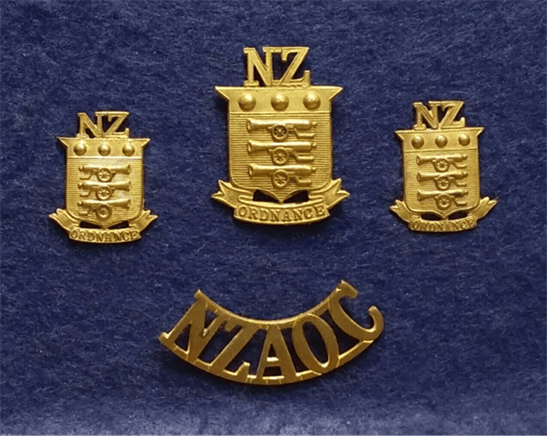
Figure 4. New Zealand Army Ordnance Corps badges, 1916-1919. Robert McKie Collection, 2017.
Notes
Joseph S. Bolton, A History of the Royal New Zealand Army Ordnance Corps (Trentham: RNZAOC, 1992), 52-53.
“New Zealand Expeditionary Force – Army Ordnance Corps Daily Order No. 1,” 1916, Archives New Zealand, item R25958433; “Road to Promotion,” Evening Post 91, no. 29 (4 February 1916).
Equipment and Ordnance Depot, Farringdon Road, London – Administration Reports Etc., 18 October 1916-8 August 1918, Archives New Zealand, item R25102951.
“Personnel Records: Arthur Gilmore,” Archives New Zealand, AABK 18805 W5568 0135616; Arthur Gilmore, “Audit Farringdon Road Ordnance Stores for Period Ended 17 July 1919,” Archives New Zealand, record group WA1, record 2/13 (1919).
Norman Levien, “Report of Ordnance Officer on Administration of Ordnance Department for 1917,” Archives New Zealand, record group WA1, record 2/13 (1918).
Levien, Report of Ordnance Officer on Administration of Ordnance Department for 1917.
Gilmore, “Audit Farringdon Road Ordnance Stores for Period Ended 17 July 1919.”
Gilmore, “Audit Farringdon Road Ordnance Stores for Period Ended 17 July 1919.”
The core responsibility of the Royal New Zealand Army Ordnance Corps and its predecessors was the supply and maintenance of arms, ammunition, accoutrements, clothing, and field equipment to New Zealand’s Military Forces. From 1840 the principal posts of the RNZAOC and its predecessors were.
Colony of New South Wales, Colonial Storekeeper for New Zealand
Mr C.H.G Logie 15 Jan 1840 – 1 Oct 1840
Colony of New Zealand, Colonial Storekeeper
Mr H Tucker 1 Oct 1840 – 30 Dec 1843
From 1844 the needs of the Militia were facilitated on an ad-hoc basis by the Colonial Secretary based upon requests from provincial magistrates.
Colonial Secretaries of New Zealand (30 Dec 1843 to 28 May 1858)
Willoughby Shortland 3 May 1841 – 31 Dec 1943
Andrew Sinclair 6 Jan 1844 – 7 May 1856
Henry Sewell 7 May 1856 – 20 May 1856
John Hall 20 May 1856 – 2 Jun 1856
William Richmond 2 Jun 1856 – 4 Nov 1856
Edward Stafford 4 Nov 1856 – 12 Jul 1861
Supporting the Imperial Forces in New Zealand since 1840, the Board of Ordnance had established offices in Auckland during 1842, ensuring the provision of Imperial military units in New Zealand with munitions, uniforms and necessities. The Board of Ordnance was reorganised on 1 February 1857 into a new organisation called the Military Store Department. Headquartered at Fort Britomart in Auckland, the Military Store Department principal role alongside the commissariat was to support the Imperial Garrison; however, it would support colonial forces on a cost-recovery basis when necessary. With the departure of the British Military Storekeeper Joseph Osbertus Hamley in July 1870, the withdrawal of Imperial Forces was completed.
Board of Ordnance, Military Storekeeper
Deputy Ordnance Storekeeper W Plummer 1842 – 1 February 1857
Military Store Department
Deputy Superintendent of Stores W. Plummer 1 February 1857 – 4 March 1879(Deceased in office)
Deputy Superintendent of Stores J.O Hamley 4 March 1858 – 30 July 1870
The passing of the Militia Act of 1858 saw the Militia reorganised, and Volunteer units were authorised to be raised. The Deputy Adjutant General of Militia and Volunteers oversaw the administration, including the supply and distribution of arms, ammunition, accoutrements, clothing, and field equipment to the Militia and Volunteers.
Deputy Adjutant General of Militia and Volunteers
Capt H.C Balneavis 28 May 1858 – 18 Sep 1862
On 18 September 1862, the Colonial Defence Act was passed, establishing the first regular military units in New Zealand. Under the Quartermaster General of the Colonial Defence Force, Captain Robert Collins, the Colonial Store Department under the Colonial Storekeeper, and the Militia Store Department under the Superintended of Militia Stores maintained a separation between the Militia/Volunteers and Regulars absorbing the rudimentary stores’ organisation of the Deputy Adjutant General of Militia and Volunteers. The two departments would be amalgamated into the Colonial Store Department in 1865.
Militia Store Department
Superintendent of Militia Stores, Capt E.D King 18 September 1862 – 30 October 1865
Colonial Store Department
Colonial Storekeeper Capt J Mitchell 18 September 1862- 1 April 1869
The Armed Constabulary Act was passed in 1867, which combined New Zealand’s police and military functions into a regular Armed Constabulary (AC) Force, supported by loyal natives, Militia and Volunteer units. The Inspector of Defence store appointment was created in 1869 to manage all New Zealand’s Defence Stores as the single New Zealand Defence Stores organisation.
Inspector of Defence Stores (Defence Stores)
Lt Col E Gorton 1 Apr 1869 – 9 Jan 1877
Lieutenant Colonel Edward Gorton
Defence Storekeeper (Defence Stores)
Capt S.C Anderson 9 Jan 1877 – 7 Dec 1899 (Deceased in office)
During the 1880s, New Zealand undertook a rearmament and fortification program that was also a technological leap forward in terms of capability. The Defence Stores armourers and Arms Cleaners had maintained the colony’s weapons since 1861. However, the new equipment included machinery that functioned through pneumatics, electricity and steam power, requiring a skilled workforce to repair and maintain, resulting in a division of responsibility between the Defence Stores and Permanent Militia. The Defence Stores would retain its core supply functions with its armourers remaining responsible for repairing Small Arms. With some civilian capacity available, the bulk of the repairs and maintenance of the new equipment would be carried out by uniformed artificers and tradespeople recruited into the Permanent Militia.
From October 1888, the Staff Officer of Artillery and Inspector of Ordnance, Stores and Equipment would be responsible for all Artillery related equipment, with the Defence Storekeeper responsible for all other Stores. However, during the late 1890s, the Defence Storekeeper would assume responsibility for some of the Artillery related stores and equipment of the Permanent Militia.
Inspector of Stores and Equipment
Maj A.P Douglas 24 Aug 1887 – 23 Jan 1891
In 1907 a significant command reorganisation of the Defence Forces defined the responsibilities of the Director of Artillery Services (Ordnance) and Director of Stores.
Director of Artillery Services (Ordnance): Responsible for:
Artillery armament,
Fixed coast defences,
Artillery ammunition, and
Supplies for ordnance.
Director of Stores: Responsible for:
Clothing and personal equipment,
Accoutrements,
Saddlery,
Harness,
Small-Arms,
Machine Guns,
Small-arms and Machine gun ammunition,
Material,
Transport,
Vehicles,
Camp Equipment,
All other stores required for the Defence Forces.
Director of Military Stores (Defence Stores)
Capt J O’Sullivan 1 Jan 1907 – 30 Mar 1911
Director of Ordnance and Artillery
Maj G.N Johnston 28 Feb 1907 – 31 May 1907
Capt G.S Richardson 31 May 1907 – 31 Jul 1908
Director of Artillery
Maj J.E Hume 31Jul 1908 – 31 Mar 1911
In 1911, provisional regulations were promogulated further detailing the division of responsibilities between the Quartermaster Generals Branch (to whom the Defence Stores was subordinate) and the Director of Ordnance and Artillery. Based on these new regulations, the Director of Artillery (Ordnance) assumed overall responsibility for managing Artillery stores and ammunition on 2 August 1911.
Director of Equipment and Stores (Defence Stores)
Maj J O’Sullivan 30 Mar 1911 – 10 Apr 1916
Director of Ordnance and Artillery
Maj G.N Johnston 11 May 1911- 8 Aug 1914
The Royal NZ Artillery established an Ordnance Section in 1915 to maintain and manufacture artillery ammunition. The section immediately transferred to the NZAOC in 1917, with the RNZA maintaining technical control. By 1929, most artificers and tradespeople had been transferred from the RNZA into the NZAOC. The final RNZA store’s function would be transferred to the NZAOC in 1946 when the RNZA Ammunition and Equipment Section based in Army Headquarters handed over responsibility for artillery ammunition, explosives, coast artillery and specialist equipment and stores, including some staffing to the NZAOC.
The Defence Stores would remain as New Zealand’s military storekeepers until 1 February 1917, when the New Zealand Army Ordnance Department (NZAOD) and the New Zealand Army Ordnance Corps (NZAOC) were established as part of the Permanent Staff of the Defence Forces of New Zealand, assuming the responsibilities Defence Stores.
The NZAOD would be reconstituted into the NZAOC on 27 June 1924.
Director of Equipment and Ordnance Stores (Defence Stores & NZAOC)
Maj T McCristell 10 Apr 1916 – 30 Jan 1920
Major Thomas James McCristell, Director of Equipment and Ordnance Stores, 10 April 1916 – 20 January 1920.
Director of Ordnance Stores (NZAOC)
Lt Col H.E Pilkington 30 Jan 1920 – 1 Oct 1924
Lt Col H.E Pilkington, CBE. Director of Ordnance Services, 30 Jan 1920 – 1 Oct 1924
Lt Col T.J King 1 Oct 1924 – 6 Jan 1940
Brigadier T J King, CBE, RNZAOC Regimental Colonel 1 Jan 1949 – 31 Mar 1961. RNZAOC School
Lt Col W.R Burge 6 Jan 1940 – 22 June 1940
Chief Ordnance Officer (NZAOC)
Maj H.E Erridge 22 Jun 1940 – 3 Aug 1941
Major H.E Erridge
Lt Col E.L.G Bown 5 Aug 1941 – 1 Oct 1947
In the Post-war era, the NZAOC would be granted Royal status on 12 July 1947, becoming the Royal New Zealand Army Ordnance Corps (RNZAOC). For the next forty-five years, the Director of Ordnance Services (DOS) would be responsible for the personnel, equipment and training of the RNZAOC.
Director of Ordnance Services (RNZAOC)
Lt Col A.H Andrews 1 Oct 1947 – 11 Nov 1949
Lt Col A.H Andrews. OBE, RNZAOC Director of Ordnance Services, 1 Oct 1947 – 11 Nov 1949.
Lt Col F Reid 12 Nov 1949 – 31 Mar 1957
Lt Col F Reid, OBE. Director of Ordnance Services 12 Nov 1949 – 31 Mar 1957
Lt Col H Mck Reid 1 Apr 1958 – 11 Nov 1960
Lt Col H McK Reid, Director of Ordnance Services , 1 Apr 1957 – 11 Nov 1960
Lt Col E Whiteacre 12 Nov 1960 – 24 May 1967
Lt Col E Whiteacre, OBE, 12 Nov 1960 – 23 May 1967
Lt Col J Harvey 24 May 1967 – 28 Aug 1968
Lt COl J Harvey, Director of Ordnance Services, 24 May 1967 – 28 Aug 1968.
Lt Col G.J.H Atkinson 29 Aug 1968 – 20 Oct 1972
Lt Col G.J.H Atkinson, Director of Ordnance Services. 29Aug 1968 – 20 Oct 1972.
Lt Col M.J Ross 21 Oct 1972 – 6 Dec 1976
Lt Col M.J Ross, Director of Ordnance Services, 21 Oct 1972 – 6 Dec 1976.
Lt Col A.J Campbell 7 Dec 1976 – 9 Apr 1979
Lt Col A.J Campbell, Director of Ordnance Services, 7 Dec 1976 – 9 Apr 1979.
Lt Col P.M Reid 10 Apr 1979 – 25 Jul 1983
Lt Col P.M Reid, Director of Ordnance Services, 10 Apr 1979 – 25 Jul 1983.
Lt Col T.D McBeth 26 Jul 1983 – 31 Jan 1986
Lt Col T.D McBeth, Director of Ordnance Services , 26 July 1983 – 31 Jan 1986.
Lt Col G.M Corkin 1 Feb 1986 – 1 Dec 1986
Lt Col G.M Corkin, Director of Ordnance Services, 1 Feb 1986 – 1 Dec 1986.
Lt Col J.F Hyde 2 Dec 1986 – 31 Oct 1987
Lt Col J.F Hyde, Director of Ordnance Services, 2 Dec 1986 – 31 Oct 1987.
Lt Col E.W.G Thomson 31 Oct 1987 – 11 Jan 1990
Lt Col W.B Squires 12 Jan 1990 – 15 Dec 1992
During the early 1990s, the New Zealand Army underwent several “rebalancing” activities, which saw the formation of regional Logistic Battalions and included the demise of the individual Corps Directorates.
Filling the void left by the demise of the Corps Directorates, the post of Regimental Colonel was approved on 12 December 1992. The role of the Regimental Colonel of the RNZAOC was to.
Provide specialist advice when called for
Maintain an overview of Corps personnel matters, and
Provide a link between the Colonel Commandant of the RNZAOC and the Corps and support the Colonel Commandant.
Regimental Colonel (RNZAOC)
Col T.D McBeth 15 Dec 1992 – 19 Sept 1994
Col L Gardiner 19 Sept 1994 – 9 Dec 1996
On 9 December 1996, the RNZAOC was amalgamated into the Royal New Zealand Army Logistic Regiment (RNZALR).
New Zealand Ordnance Corps during wartime
During the Frist World War, a New Zealand Army Ordnance Corps was established as a unit of the 1st New Zealand Expeditionary Force (NZEF)
Officer Commanding NZEF NZAOC
Capt W.T Beck, 3 Dec 1914 – 31 Jan 1916
William Thomas Beck Circa 1921
Lt Col A.H Herbert, 1 Feb 1916 – 31 Mar 1918
Lieutenant-Colonel Alfred Henry Herbert, NZAOC. aucklandmuseum/Public Domain
Lt Col H.E Pilkington, RNZA 30 Jun 1918- 22 Jan 20
Temp Capt W.H Simmons, 20 Feb 20 – 13 Oct 1920
During the Second World War, all the Ordnance functions of the 2nd NZEF were organised as the New Zealand Ordnance Corps (NZOC).
Officer Commanding 2nd NZEF NZOC in the Middle East and Europe
New Zealand’s first experience of Salvage units was during the 1914-18 war. Each British formation (including Dominion forces) was required as part of an army salvage plan to appoint a Salvage Officer for each brigade, and a Division Salvage Company, which in turn was supported a Corps Salvage Company.
Shortly after arriving in France, Lieutenant Colonel Herbert the DADOS of the New Zealand Division was directed to provide one officer, one sergeant and two corporals for the Divisional Salvage Company, with the OC of the Pioneer Battalion providing four Lance Corporals and 24 Other ranks.
Formed on 5 May 1916 the NZ Divisional Salvage Company was under the command of Lieutenant Macrae, NZAOC. The duties of the NZ Divisional Salvage Company were:
“The care and custody of packs of troops engaged in offensive operations; The care of tents and canvas of the Division; The salvage of Government property, and also enemy property, wherever found; The sorting of the stuff salved, and dispatch thereof to base.”
Headquarters New Zealand and Australian Division, “New Zealand Division – Administration – War Diary, 1 May – 26 May 1916,” Archives New Zealand Item No R23487546 (1916)
Although initially reporting to the Corps Salvage Officer, entries in the DADOS war diaries indicate that the Divisional Salvage Company was an integral part of the DADOS responsibilities. During April 1918 the NZ Div Salvage Company recovered the following items.
One Bristol Airplane
One Triumph Norton Motorcycle
Three Douglas Motorcycles
285 Rifles
10 Bayonets and scabbards
25 Steel Helmets
Four Pistol Signal
Three Mountings MG
62 Belts MG
32 Belt boxes MG
95 Gas respirators
“Deputy Assistant Director of Ordnance Services (DADOS) – War Diary, 1 April – 30 April 1918.” 1918. Archives New Zealand Item No R23487665.
This talk examines the work of the British salvage system from its small beginnings at the battalion level to the creation of a giant corporation controlled by GHQ. It deals with salvage during hostilities and the colossal often forgotten task of the clean-up afterwards.
In British and Commonwealth military doctrine, there has long been a separation of responsibility for Supplies and Stores.
Supplies – The provisioning, storing, and distributing of food for soldiers; forage for animals; Fuel, Oil, and Lubricants (FOL) for Tanks, Trucks, and other fuel-powered vehicles and equipment; and the forward transport and distribution of ammunition. In the NZ Army, Supplies were managed by the New Zealand Army Service Corps (NZASC) from 1911 to 16 October 19789.
Stores – The provisioning, storage, and distribution of weapons, munitions, and military equipment are not managed by RNZASC. Stores were the Responsibility of the Royal New Zealand Army Ordnance Corps (RNZAOC) until 1996.
Despite the separation of responsibilities, the RNZASC and RNZAOC would have a long and cooperative relationship for most of their existence.
During the early colonial days, the early actions of the New Zealand Wars proved that the New Zealand bush and the elusive tactics of the Maori presented new problems in supply and transport. An Imperial Supply and Transport Service was established and operated with the Imperial troops.
From the end of the New Zealand Wars until 1910, there was no ASC unit in New Zealand, with the supply functions required by the New Zealand Military provided by the Defence Stores Department.
After the conclusion of the South African War, the Military Forces in New Zealand embarked on a series of reforms to enhance the organisation and capability of the nation’s military, enabling it to contribute effectively to a broader Imperial Defence scheme. In 1910, at the request of the New Zealand Government, Field Marshal Viscount Kitchener inspected New Zealand’s Forces. Kitchener provided several recommendations concerning the ongoing reforms, emphasising the need for a professional Staff Corps to administer the force and confirming the requirement for a New Zealand ASC, which was gazetted on 12 May 1910 (backdated to 6 May 1910) as a designated component of the Territorial Forces of New Zealand.
The momentum for these reforms gained further impetus with the appointment of Major General Alexander Godley as the New Zealand Military Forces Commandant in December 1910. Godley was pivotal in revitalising New Zealand’s military organisational framework in his first year, making critical command and staff appointments, promulgating the (Provisional) Regulations for the Military Forces of New Zealand, and making plans to build up the NZASC, which up to this time had remained a paper corps.
Acknowledging the highly specialised nature of ASC duties, distinct from combatant staff and regimental officers, and the absence of suitably qualified officers in New Zealand, Godley recommended to the Minister of Defence on 4 January 1911 the lending of services of an experienced Imperial ASC Senior Captain or Major to organise and train New Zealand’s transport and supply services for three years. The Minister of Defence endorsed this recommendation with the Prime Minister cabling the New Zealand High Commissioner in London on 10 January 1910 to approach the Army Council for the following:
Services of experienced Army Service Corps major or senior captain required to organise New Zealand Army Service Corps. Engagement for three years. Salary £600 a year consolidated. Pay to include house allowance. Travelling allowance of 12/6d a day and allowance for one horse if kept, will also be granted.
Within two months of receiving New Zealand’s request for an ASC Officer, the Army Council promptly and affirmatively responded to the call. Having already sanctioned nine additional officers to assist Godley, the Council selected Knox, who then served in C (Depot) Company ASC at Aldershot for service in New Zealand to organise the NZASC.
Under the guidance of New Zealand Adjutant and Quartermaster-General Colonel Alfred Robin, Knox assumed his duties as the New Zealand DST at the Army General Staff Offices on Wellington’s Buckle Street. His responsibilities encompassed a wide range of functions, including quarters, tender and contracts, personal and freight movement, and presidency on two standing committees related to Drill sheds and the storage and distribution of clothing and equipment to the forces.
Recognising Knox’s extensive duties, he was granted the Temporary Rank of Lieutenant Colonel on 6 September 1911. With Colonel Robin’s appointment as the New Zealand representative at the War Office in London in 1912, Knox assumed the additional role of Quartermaster General (QMG). Despite Knox diligently fulfilling the role of QMG and DST, progress on the formation of the NZASC was slow.
By 1914, Knox had established 16 NZASC companies of approximately 30 men each across the four New Zealand Military Districts, with imported ASC officers serving as Assistant Directors of Supply and Transport (ADST) in each District Headquarters. Although Knox had departed by the time of the 1914 divisional camps, the Inspector General of Imperial Forces, General Sir Ian Hamilton, noted following his inspection that:
The very highest credit is due to the Army Service Corps officers and their men. They have done a first-class service, although as a rule undermanned to an extent that would fill a labour union with horror. When the Army Service Corps units are up to their normal strengths, a suitable system of calling the men up to camp in relays will enable the necessary duties to be carried out as efficiently and with much less strain on the personnel.
During World War One, New Zealand ASC units fulfilled crucial functions. ASC Companies supported the Territorial Infantry and Mounted Rifle Brigades. At the same time, Supply and Transport Units aided mobilisation camps within New Zealand. Overseas, the NZASC operated across all New Zealand theatres of war, delivering indispensable services. At its zenith, it managed the NZ Divisional Train, five ASC Companies, five Depot Units of Supply, the NZ Field Bakery, the NZ Field Butchery, and the NZ Motor Transport Workshop. Notably, the NZASC and NZAOC frequently shared personnel, facilities, and transportation, especially in the conflict’s early years.
In 1917 the NZAOC was established as a permanent component of the New Zealand Military Forces, however, it would not be until 1924 that the Permanent NZASC was formed.
Post-war, under the leadership of Captain Stanley Herbert Crump, the NZASC transitioned to a peacetime establishment comprising a Headquarters and three depots (Northern, Central, and Southern). In 1924, the Permanent NZASC (PNZASC) was established as part of the permanent Military Forces. Additionally, in 1925, an alliance between the NZASC and the Royal Army Service Corps (RASC) was ratified.
The RASC has its roots in history that are much more profound. Up to the time of Cromwell, armies mainly lived by plunder. The RASC came into being in 1888. but the work it now performs was being done long before that.
Cromwell and then the Duke of Marlborough, and later Napoleon, organised a system of civilian commissaries. The Duke of York established the Corps of Royal Waggoners in 1794. This purely transport organisation continued until 1869 under various names, eventually as the Military Train, fighting as light cavalry in the Indian Mutiny.
The birth of the Supplies and Transport Service dates from 1869. when supplies and transport, along with the Military Stores Department, came under one department called the Control Department, it remained for General Sir Redvers Buller in 1888 to organise the first Army Service Corps. Since its formation, the RASC has been a combatant one. Trained and armed as infantry and responsible for its own protection. Considerd a more technical Corps, the RAOC was not granted combatant status until 1942.
In 1931, under Crump’s continued leadership, the NZASC underwent a reorganisation into three Composite Companies. Each company comprised seven officers, four warrant officers, and 99 other ranks, establishing a solid foundation from which the NZASC could readily expand to meet the demands of future conflicts.
During World War Two, numerous units and establishments represented the NZASC across all New Zealand Expeditionary Force (NZEF) theatres. Similar to the previous World War, the NZASC maintained a collaborative relationship with New Zealand Ordnance Corps (NZOC) Ammunition Examiners (AEs) in the establishment of NZASC Ammunition platoons. At times, NZASC Warrant Officers were attached to the NZ Divisional Ordnance Field Park (OFP) to offer technical advice on vehicle spares. In recognition of the NZASC’s service during WW2, the title “Royal New Zealand Army Service Corps” was conferred in 1946.
In the post-war era, the NZASC and from 1946, the RNZASC would serve with distinction J Force in Japan and then contribute the second-largest New Zealand contingent to K Force in Korea by providing 10 Transport Company. Playing a pivotal role in sustaining the morale and effectiveness of New Zealand forces during these conflicts
Until 1947, NZASC units primarily handled baking bread, butchering meat, and procuring and distributing fresh and packaged provisions to frontline units, while regimental cooks and stewards were responsible for cooking and serving meals. To enhance and standardise cooking practices throughout the army, the Supplies and Transport Catering Group (STCG) was established on 15 February 1948 with the following objectives:
Training and provision of unit cooks and kitchen hands.
Instruction and supervision of the management of the Army ration scale.
Improvement of food preparation and cooking standards.
Advice on the installation and operation of cooking appliances and kitchen equipment.
Guidance on the layout of mess buildings.
In September 1948, all Regimental catering staff, except those of the New Zealand Women’s Army Corps, were transferred into the RNZASC. Throughout the 1950s, 60s, and 70s, the RNZASC played a vital role within the New Zealand Army, encompassing a wide range of functions. These included everyday tasks such as cooking and serving food, as well as more complex operations like air supply drops. To manage the procurement, storage, transportation, and distribution of essential supplies such as food, fuels, and oils for a modern Army, the RNZASC operated Supply Depots and employed various tradespeople, including butchers. Supply Depots were strategically located in Papakura, Waiouru, Linton, Trentham, and Burnham, where bulk supplies were stored and distributed as needed. Additionally, every Army camp featured a section of the RNZASC, along with smaller supply and transport depots, which were responsible for handling goods from central supply depots and providing drivers and transport services for various purposes. These smaller depots were situated in Devonport/Fort Caultley,
Following the Macleod report that recommended the streamlining of logistic support for the British Army, the RASC merged in 1965 with the Royal Engineers’ Transportation and Movement Control Service to form the Royal Corps of Transport (RCT). This would see the RASC Supply functions transferred to the Royal Army Ordnance Corps (RAOC). In 1973, following the British lead, the Australians also reformed their Royal Australian Army Service Corps (RAASC) into the Royal Australian Army Corps of Transport (RAACT).
Acknowledging the British and Australian experience, the RNZASC underwent a similar transition—operational command of the Supply function transferred to the RNZAOC on 16 October 1978. On 12 May 1979, the RNZASC ceased to exist: Supply personnel formally transferred to the RNZAOC, while Transport, Movements, and Catering were re-formed as the Royal New Zealand Corps of Transport (RNZCT)..
The RNZASC supply function would be integrated into the RNZAOC, with the Camp Supply Depots becoming NZAOC Supply Platoons numbered as.
14 Supply Platoon, Papakura/Hopuhopu
24 Supply Platoon, Linton
34 Supply Platoon, Burnham
44 Supply Platoon, Waiouru
54 Supply Platoon, Trentham
NZ Supply Platoon, Singapore
In recognition of its long RNZASC service, 21 Supply Company was retained as a Territorial unit, initially as the Territorial element of 4 Supply Company in Waiouru and later as the Territorial element of 2 Supply Company, Linton. Today, 21 Supply is the principal North Island Supply unit of the Royal New Zealand Army Logistic Regiment (RNZALR).
For a short period following the RNZAOC assumption of Supply functions, some RF and TF RNZAOC would periodically be employed within the RNZCT transport Squadrons’ Combat Supplies sections.
The RNZAOC Butcher trade inherited from the RNZASC would be discontinued in the mid-1980s, with the last of the butchers reclassifying as RNZAOC Suppliers. By the mid-1990s, it was decided as a cost-saving measure to allow the RNZCT catering staff to order directly from commercial foodstuff suppliers, effectively ending the RNZAOC foodstuffs speciality. The only RNZASC trade speciality remaining in the RNZAOC after its amalgamation into the RNZALR was that of Petroleum Operator.
The Royal NZ Army Service Corps & Corps of Transport, like the RNZAOC, have passed their combined responsibilities to the RNZALR. However, the Royal NZ Army Service Corps & Corps of Transport maintain a strong association that provides many benefits and opportunities for comradeship to RNZASC/CT Corps members and past and present members of the RNZALR. Another role of the RNZASC/CT association is to ensure that the rich and significant history of the RNZASC/CT is not lost to future generations of the RNZALR.
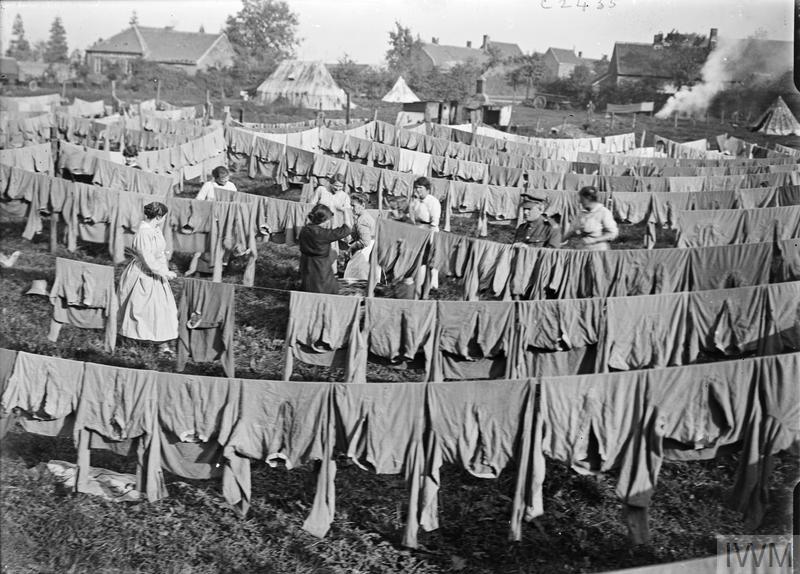
A significant function of the New Zealand Army Ordnance Corps as part of the New Zealand Expeditionary Force during the First World War was managing the New Zealand Divisional Laundries and Baths. The Laundry and Bath functions helped to maintain the New Zealand Division’s hygiene by providing the opportunity for regular bathing, the exchanging of underclothing and socks and the delousing of uniforms. Although the NZ Division s Laundry and Bath functions were interconnected with its neighbouring Divisions and supporting Corps, this article’s focus is on providing a snapshot of the NZ Divisions Laundry and Bath operations from October 1916 to June 1918.
At the onset of the First World War, partly due to the lessons learnt in the South African War and the more recent Balkan Wars, the British Army had a reasonable understanding of the importance of hygiene in the field and published The Manual of Elementary Military Hygiene in 1912.[1] However, as with any military doctrine, the practical application of the field hygiene lessons learnt took time to become effective in the early years of the War. However, by the time the New Zealand Division arrived at the Western Front in mid-1916, the British Army had a rudimentary Laundry and Bath system at the Corps and Divisional levels into which the New Zealand Division was integrated into.
Command and Control
Initially, as the New Zealand Division took over the existing Laundry and Baths from British units, these functions were initially vested as a responsibility of the New Zealand Medical Corps, who provided officers and men to supplement he existing civilian staff.[2] In line with British practice both the Divisional Laundry and Baths came under the control of the Division Headquarters “Q” Branch, and from 21 December 1916, the New Zealand Division, Deputy Assistant Director of Ordnance Services (DADOS) was the officer responsible for the running of the Divisional Laundry and Baths.[3]
Baths
The Bathing concept was that four Bathhouses were to be established in a Divisional area: usually one Bathhouse for each Infantry brigade and one Bathhouse for the rest of the Division. The concept was that Soldiers were to rotate through Bathhouse on a schedule to allow the entire Division to be bathed once every ten days. In the early years of the war, Bathing facilities were rudimentary, with Baths ranging from breweries or fabric processing plants to Beer barrels cut in half.[4]
Although initially built on an ad-hoc basis using whatever resources were available, by 1917 most Bathhouses in the New Zealand Division were built and operated on a uniform pattern: [5]
A typical Bathhouse was be operated as follows.
The men enter at 1, Undress and hand their Service Dress and valuables in at 2(Obtaining receipt) and dirty underclothes at 3.
They then have a hot shower in D
While the men are having their showers, the seams of their Service Dress Tunics and Trousers were ironed to kill lice, and small repairs were undertaken.
Upon completing the shower, the men enter F, collect a towel, clean underclothes at 4 and their Service Dress and valuables at 5. Dress and leave by 6.
All Towels and dirty underclothes are sent from the baths to the Divisional Laundry daily, and a supply of clean or new items received in exchange.
In June 1918, the system of delousing the soldier’s Service Dress clothing was improved using the Thresh Disinfector Delousing Chamber. As soldiers passed into the Bathhouse, the soldier’s Service Dress was turned inside out and handed over to the Thresh operators. The Garments were hung up inside the Thresh’s airtight chamber and sealed. Coke braziers then heated the airtight chamber, and after the garments had been treated by this method for 15 minutes, they were found to be entirely free form lice and eggs.[6]
Personnel employed in the Divisional usually consisted of
Locally employed civilian women for ironing and mending.
Depending on the ebb and flow of the battle and the New Zealand Division’s movement, between October 1916 and June 1918 the DADOS War Diary records that Bathhouses to support the NZ Division were established in over thirty-four separate locations.[8] On most occasions, existing bathhouses were taken over from other Divisions. If there were no existing Bathhouse or the ones taken over were not deemed suitable, NZ Engineers were employed to construct new bathhouses.[9]
Plan for the NZ Divisional Baths as Vauchelles. Archives New Zealand
By June 1918, the New Zealand Divisional Bathhouse system was operating effectively and bathing on average between 700 – 800 troops daily, with 46411 men passing through the Divisional Bathhouses in total.[10]
New Zealand soldiers recently in the trenches outside the Divisional Baths, France. Royal New Zealand Returned and Services’ Association :New Zealand official negatives, World War 1914-1918. Ref: 1/2-013160-G. Alexander Turnbull Library, Wellington, New Zealand. /records/23139145
Soldiers after leaving the line wait their turn for a bath. Royal New Zealand Returned and Services’ Association :New Zealand official negatives, World War 1914-1918. Ref: 1/2-012817-G. Alexander Turnbull Library, Wellington, New Zealand. /records/23097155
Laundry
On most occasions, as the Division relieved an existing Division in the area and took over the existing Divisional Laundry as a going concern. However, there were occasions when a Laundry needed to be established from the ground up, such as when the Division Laundry and Baths at Pont de Nieppe were destroyed by enemy shell fire in April 1917.[11]
The Divisional Laundry received dirty garments from the Baths, (underclothes, socks, and towels) they were disinfected, washed, and mended and placed into a reissue pool.[12]
Usually, the Divisional Laundry placed indents on the supply chain for new items to replace items beyond repair, however, in January 1918 authority was granted for the Divisional Baths to hold a pool of new clothing to me maintained consisting of: [13]
5000 shirts
13100 vests woollen
12450 Drawers Woollen
12700 Towels
19000 pairs of socks
By 1918 the average output from the New Zealand Divisional Laundry was 35,000 – 40,000 garments per week.
Personnel employed in the Divisional Laundry usually consisted of.
Between October 1916 and June 1918, as the NZ Division moved, the NZ Divisional Laundry was also relocated and established in new locations, some of the known sites were
October 1916 Located at Estaires.
Pont de Nieppe, Laundry destroyed by enemy shellfire, 12 April 1917
18 to 25 April 1917 Established at Steenwerck, Handed over to the 8th Division.
Before and during the German 1918 Spring Offensive, the Divisional Laundry was located at.
RenninghelstOuttersteene Westoutre
Abbeville
Socks
Socks were an unlikely enabler; in the extreme conditions found in the mud-filled trenches, clean, dry socks were often the difference between life and death. When feet are constantly wet, as they often were in the trenches, they begin to rot. Gangrene sets in, and often the only remedy is amputation. In the First World War, 75,000 British troops died due to complications caused by trench foot.[15]
Acutely aware of the need for clean socks, the New Zealand Division maintained a system where socks were exchanged daily. To facilitate the daily exchange, a dry sock store was run in conjunction with the Bathhouses. Here dry socks were drawn daily by units in the line in exchange for dirty socks. The dirty sock was then be backloaded to the Divisional Laundry and exchanged for clean socks.
Once received by the Divisional Laundry, the dirty socks if damaged, were mended, washed, and once dried, treated with camphor (as prevention against trench foot) before being placed into the exchange pool.
By May 1918, the disruption caused by the 1918 German Kaiserschlacht offensive had affected the supply routes with the railway service from the Laundry at Abbeville becoming irregular, and it was taking 6-7 days for trucks to travel the short distance to replenish Bathhouses with clean underclothing and socks. However, given the hygiene and morale benefits that clean socks brought, the need to maintain the sock exchange system to the forward troops was a priority. Therefore, close to the front, under the supervision of the NZAOC, a small sock washing depot was established with Sixteen men from the Divisional Employment Company in May 1918. Socks were sorted with torn or holey socks returned to the Laundry for mending, with the remainder of the socks washed by hand. In fine weather, the drying was done outside, if it was wet, the socks were hung on wires from the ceiling of a room and dried employing coke braziers. The men did excellent work, and output was 4 to 5 thousand pairs daily and kept up an adequate supply.[16]
Soldiers washing socks during World War I, Bus-les-artois, France. Royal New Zealand Returned and Services’ Association :New Zealand official negatives, World War 1914-1918. Ref: 1/2-013179-G. Alexander Turnbull Library, Wellington, New Zealand. /records/23052031
New Zealand soldiers washing socks in wooden tubs near the New Zealand Divisional Headquarters at Bus-les-artois, 7 May 1918. Photograph taken by Henry Armitage Sanders Nº H-563 Photo source – Alexander Turnbull collection at the National Library of New Zealand. (Colorized by Marina Amaral from Brazil) https://www.facebook.com/marinamaralarts/?fref=nf See less
Gumboots
As the western front settled down into the routine of trench warfare in the winter of 1915, the time spent in the saturated trenches by British troops was limited to thirty-six hours during which the wearing of gumboots became widespread in the water-soaked areas.[17] The use of gumboots helped minimise the effects of mud and water on exposed feet, thus limiting Trench foot occurrences. Based on the early success of gumboots, contracts were placed with the North British Rubber Company (now Hunter Boot Ltd) to manufacture over 1,185,000 pairs of Gumboots for the British army during WW1.[18]
Boots were classed as Trench Stores and usually only issued to a division when it was on the line. The NZ Division was typically provided with around 6000 pairs, pooled, and issued from a Gumboot Store. The Gumboot store was designed with drying racks and heaters to allow the wet gumboots to be dried and prepared for reissue.
Plan for Drying Apparatus for Rubber Boots. Australian Imperial Force Unit War Diaries, 1914-1919 – Australian Corps Baths and Laundries, 2 – June 1916 – April 1918.” Australian War Memorial Archives Collection No AWM4 18/1/1 PART 2 (1918)
This article provides a small snapshot of how the Laundry and Bath functions contributed to maintaining the New Zealand Division’s hygiene by providing the opportunity for regular bathing, the exchanging of underclothing and socks and the delousing of uniforms. Although the playing a small but significant role in maintaining the combat effectiveness of the New Zealand Division, the efforts of the NZ Division DADOS Staff, the men of the Divisional Employment Companies and the locally employed civilian staff in maintaining the Laundry and Bath operations are worthy of further study to expand the historiography of New Zealand’s First World War combat enablers.
Notes
[1] Martin C. M. Bricknell and Colonel David A. Ross, “Fit to Fight – from Military Hygiene to Wellbeing in the British Army,” Military Medical Research 7, no. 1 (2020).
[2] Major J.S Bolton, A History of the Royal New Zealand Army Ordnance Corps (Trentham: RNZAOC, 1992), 71-72.
[3] “2nd Australia & New Zealand Army Corps [2anzac], Assistant Director of Ordnance Services (Ados) – War Diary, 1 December – 31 December 1916,” Archives New Zealand Item No R23487340 (1916).
[4] Janet Macdonald, Supplying the British Army in the First World War, vol. , (Pen and Sword military, 2019), , 143.
[5] “An Account of the Working of the Baths Established in the Divisional Areas in France,” Archives New Zealand Item No R24428508 (1918).
[6] “Headquarters New Zealand and Australian Division – New Zealand Division – Deputy Assistant Director of Ordnance Services (Dados) – War Diary, 1 June – 30 June 1918,” Archives New Zealand Item No R23487667 (1918).
[7] From May 1917 drawn from No 1 NZ (Divisional) Employment Company.
[8] Based on the DADOS War Diaries Bathhouses were established at, Neuve-Eglise, Selles, Balinghem,Merck-Saint-Liévin, Watou Area, Vlamertinge, Poperinghe, Canal Bank, Bayenghem, Potijze, Hondichen, Staple, Halifax Camp, Caistre, Béthencourt, Louvencourt, Pas, Nauchelles, Pont de Nieppe, Blendecques, Café Belge
[9] Peter D. F. Cooke, Won by the Spade: How the Royal New Zealand Engineers Built a Nation (Exisle Publishing Ltd, 2019), Bibliographies, Non-fiction, 199.
[10] “Headquarters New Zealand and Australian Division – New Zealand Division – Deputy Assistant Director of Ordnance Services (Dados) – War Diary, 1 June – 30 June 1918”
[11] “Headquarters New Zealand and Australian Division – New Zealand Division – Deputy Assistant Director of Ordnance Services (Dados) – War Diary, 1 April – 30 April 1917,” Archives New Zealand Item No R23487653 (1917).
[12] “An Account of the Working of the Baths Established in the Divisional Areas in France.”
[13] “Headquarters New Zealand and Australian Division – New Zealand Division – Deputy Assistant Director of Ordnance Services (Dados) – War Diary, 1 January – 31 January 1918,” Archives New Zealand Item No R23487662 (1918).
[14] From May 1917 drawn from No 1 NZ (Divisional) Employment Company.
[16] “Headquarters New Zealand and Australian Division – New Zealand Division – Deputy Assistant Director of Ordnance Services (Dados) – War Diary, 1 June – 30 June 1918.”
[17] Susan Cohen, Medical Services in the First World War (Bloomsbury Publishing, 2014).
A small memorial plaque placed just below a soldier’s headstone at Palmerston North’s Terrace End Cemetery hints at a fantastic story of two brothers who served in the First World War. One, due to illness attributed to the war, had a short life, passing away seven years after the war. The other had a long and exciting life that exemplified the ideals of the American Dream.
Morgan Joseph, John Goutenoire and Mary Agatha (b April 1903) were the three children of Morgan and Isabel O’Brien and were born in Nelson between 1891 and 1903. Shortly after the birth of Mary, Morgan O’Brien took up a position as a Health Inspector in Palmerston North, which saw the O’Brien Family settle in there.
Morgan Joseph O’Brien
Born on 13 August 1891, Morgan attended Nelson College and, like most men in New Zealand at the time, undertook his compulsory military service in the Territorial Army. A foundation member of the Palmerston North J Battery of the Artillery, Morgan also served in the Poverty Bay Company of the 9th (Hawkes Bay) Infantry Regiment. Morgan was well known in Palmerston North and later Gisborne as a keen Footballer and Cricketer.
At around 1913, Morgan took up a position with the Gisborne Branch of J.J Niven, taking charge of that branch’s customs and shipping department. At the onset of the First World War, Morgan entered Trentham Camp for training with the Artillery in November 1915. Sailing with the 10 Reinforcements on 4 March 1916, Morgan joined the New Zealand Expeditionary Force (NZEF) in France in April 1916 and was posted to the Divisional Ammunition Column (DAC). It is likely that due to Morgan’s civilian clerical experience that he was involved in ammunition accounting, managing the substantial quantities of ammunition required by the New Zealand Division. Serving with the DAC for the remainder of the war, Morgan was struck down with influenza several times but finished the war in Sling Camp in the United Kingdom. Morgan was transferred into the New Zealand Army Ordnance Corps (NZAOC) on 13 February 1919. Promoted to Corporal and posted to the London Ordnance Depot, working closely with his brother John, who was the Chief Clerk of the NZAOC. Morgan’s clerical skills were recognised, and in July 1919, he was promoted to Sergeant. With the bulk of the demobilisation work required of the Ordnance Depot in London completed by August 1919, Morgan was repatriated to New Zealand in September 1919 on the SS Ruahine. After Three Years and Two Hundred- and Ninety-Seven-Day of overseas service, Morgan was struck off the strength of the NZEF on 22 January 1920, returning to his civilian employment with J.J Niven in Gisborne.[1]
Morgan only remained in Gisborne for just under two years, when in December 1921, he was promoted to be the Accountant at JJ Nivens Palmerston North Branch. Sadly, like many of his peers, Morgan’s health and been affected by the war and plagued him with continuing problems and periods in Hospital. On 24 August 1926, at the age of Thirty-Five, Morgan passed away at his parent’s home at 163 Fitzherbert Street, Palmerston North. Morgan’s funeral was held at St Patrick’s Church, with many beautiful wreaths received and representation from his former employer, and military and sporting associates.[2]
John Goutenoire O’Brien
John O’Brien was born on3 April 1895 (some sources state 1896) and attended Palmerston North High School, Nelson College, and Palmerston North Technical college.[3] Following a similar vocational path as his brother, John took up a clerical position as a Clerk with the Bank of New Zealand in Palmerston North. Called up for military service in the Territorial Army, John spent two years with the Palmerston North-based C Company of the 7th (Wellington West Coast) Regiment.
John enlisted into the NZEF on 20 April 1915, joining B Company of the 6th Infantry Reinforcements at Trentham Camp. Embarking for Egypt on 11 August 1915, the 6th reinforcements were the last to reach Egypt before the end of the 1915 Gallipoli campaign. John, as part of the Wellington Infantry Battalion, was among the last of the New Zealand Troops committed to the ill-fated Gallipoli campaign; however, after a brief period of fighting on Gallipoli, John was evacuated early in December due to suspected appendicitis and dysentery.[4]
After recuperation in Alexandra, John was posted to the New Zealand Base Depot at Ismailia as the New Zealand Division was reorganised. Possibly because of his clerical background, John did not rejoin the Wellington Infantry Battalion but instead transferred into the NZAOC. Serving with the New Zealand Division in France, John was promoted to Corporal on 4 June 1916 and then Sergeant on 31 March 1917.
On 13 February 1918, John was transferred from the New Zealand Division in France and taken on the strength of the New Zealand Ordnance Depot in London. Audits had found several inadequacies in the running of the store’s account, which John described as “a system of recording and accounting that was absolutely hopeless”.[5] Appointed as the NZAOC Chief Clerk in the United Kingdom, John was promoted to Temporary Warrant Officer Class One (Temporary Sub Conductor) on 5 October 1918.
New Zealand Army Ordnance Corps Badge, 1916-1919 (Robert McKie Collection 2017)
Promoted to Warrant Officer Class One (Sub Conductor) on 25 November 1918, the priority due to the war’s end had shifted from supporting the NZEF to demobilising the NZEF, including the closing of accounts and the final balancing of the books. Appointed as a Conductor on 1 February 1919, John, in addition to his existing staff of two, was allocated an additional six men to assist in the reorganisation and rewriting of the ledgers to an acceptable standard. John’s older brother Morgan, an accountant by trade, was, on 13 February 1919, transferred from the New Zealand Field Artillery into the NZAOC and posted to the London Ordnance Depot, where there is no doubt that his skills as an account were put to use.[6]
By the middle of 1919, John and his staff had made progress in the closing of the NZEF accounts, with the ADOS Colonel Pilkington satisfied that the whole team could be repatriated in September on the SS Ruahine. However, due to changes of Department heads in NZEF Headquarters, John elected to remain to follow through in his efforts and ensure that his responsibilities were handed over.[7]
In recognition of the valuable services rendered in connection to the war, John was awarded the Meritorious Service Medal on 9 December 1919.
In January 1920, it was anticipated that with the planned sailing of the “Corinthic” on 20 February 1920, only twenty-four members of the NZEF remained in the United Kingdom to be repatriated on the “Ionic” on 31 March 1920. However, much work remained to be done, and the three remaining Ordnance Staff, Captain Simmons, John and Sergeant Edwards, were each allocated specific tasks by the departing ADOS. John was to.
Remain to settle all claims preferred against the NZEF, by the Imperial authorities for stores and equipment issued from time to time, also to obtain credit for stores returned to Imperial Ordnance by NZEF Units and Depots. This WO will deal with all claims for outstanding stationery issued to the NZEF, and will arrange credit for all stationary etc., returned to HM Stationery Office. He will pass for payment, all accounts for goods etc., brought under this Office Local Purchase Orders Authority. All matters relating to the equipment for the Post-Bellum Army in New Zealand will be dealt with by him, and he will submit any idents which have to be preferred, and will also assist the High Commissioner with the arrangements for shipping all new equipment and stores for the Dominion.[8]
Having been overseas for over four years, John was becoming anxious about his future employment. He resigned from his position with the Bank of New Zealand in 1915, with a gentleman’s understanding that his job was to be held open for him on his return. However, after five years of military service, correspondence with the Bank of New Zealand indicated that his re-employment was not guaranteed but was to be favourably considered. With a compelling case to return to New Zealand, Johns’s demobilisation was approved. On handing his remaining duties over to Captain Simmons and the New Zealand High Commission, John departed for New Zealand on the last official troopship returning to New Zealand, the “SS Ionic”. Leaving the United Kingdom on 31 March 1920, the Ionic transited the Panama Canal, arriving back in Wellington on 28 May 1920. It is interesting to note that during Johns’s tenure in London, in addition to his military duties, he undertook a course of study at the London Hugo College of Languages.[9]
On 8 June 1920, John was stuck off the strength of the NZEF and, after five years, returned to civilian life. Concurrent to John being demobilised, the Director of Ordnance Services, Lt Col Pilkington, who, as the NZEF ADOS had intimate knowledge of John’s abilities, was working to find John employment. Early in June, Lt Col Pilkington recommended in a letter to the Chief Ordnance Officer that John was an outstanding and qualified candidate to fill the position of Chief Clerk in the Christchurch Ordnance Deport, then located at the King Edward Barracks. Accepted for this role, John was attested for service in the Temporary Section of the NZAOC as a sergeant on 8 June 1920.[10]
After five months, John decided to resign from the NZAOC and pursue other interests and was discharged at his request on 19 October 1920. John then travelled to the United States, where he studied law at DePaul University Chicago from 1921 to 1924. During his time at Chicago, John authored several articles on the peoples of the earth, articles on foreign lands and subjects in general and was one of a group that published two volumes on the recent World War.[11]
Nearing the end of his studies, John found employment with the Continental Trust and Savings Bank of Chicago, where in 1923, he was appointed as the manager of the Bond and Coupon Division.
Relocating to Shreveport, Louisiana, in 1926, John was then appointed as the Trust Officer for the Commercial National Bank.[12] Under his leadership, the trust department became recognised as one of the most outstanding in the South, with John later serving as a vice-president of the bank.
John O’Brien 1926
In 1926 John married Katharine Kramer and, in the same year, celebrated the birth of his son Joseph. However, this must have been tempered with the news of the early death of his elder brother in October 1926. Having found a career and established a family in the United States, John was naturalised as a US Citizen on 22 February 1928.[13]
Old Commercial National Bank Building in Shreveport, Louisiana. Wikimedia Commons
It is known that John made two return visits to New Zealand, the first in 1930 and, after the death of his father, the second trip in April 1941. Arriving from the United States via the American Clipper air route, John’s visit was a combined holiday and business visit that was covered widely by the press.[14]
During his visit, John described the positive reporting in the United States of the New Zealand Division in the Middle East and provided a first-hand account of the increasing amount of war material produced in the USA for export to the British Empire. John also provided insight into American insights into the war and how although the Southern States were firmly behind Britain, the Northern States, with their large immigrant populations, were less supportive, but John had confidence that President Roosevelt and United States Congress would make the right decision when the time came.[15] An astute businessman John was found to be correct in his prediction, and after the 7 December attack on Pearl Harbour, the United States committed its entire strength to the effort to defeat not only the Empire of Japan but also Nazi Germany.
As the United States mobilised, John was recalled to the colours, and on 27 July 1942, was inducted as a Major into the US Army Air Force and assigned to the Staff of General Harmon, Commanding General of US Army Forces in the South Pacific area. [16] As the US Army Forces in the South Pacific area were initially Headquartered out of Auckland, John likely spent some time in wartime in New Zealand. John’s promotion to Lieutenant Colonel in 1943 was widely covered by the New Zealand Media, which no doubt brought much pride to his New Zealand family.[17] In November 1943, after eighteen months in the Pacific, John was assigned to the Intelligence Division, Fourth Air Force, San Francisco, California, and as new regulations were put in place to start releasing personnel, John was transferred to the active reserve on 2 May 1944.[18] In regards to John’s service, Major General William Lynd, Commanding General, Fourth Air Force, stated that “Colonel O’Brien entered the service at a time when our nation faced its darkest days. The valuable experience he brought with him contributed much to our victories in the pacific”[19]
Lieutenant Colonel John O’Brien, United States Army Air Force, 1944
Returning to his pre-war position with the Commercial National Bank, John remained there for another two years before taking up another role with the industrial manufacturing company J.B Beaird. Resigning from the bank in 1946, John served as vice-president and treasurer of J.C Beaird until his retirement In November 1958.
During his lifetime, John assumed leadership roles in many charitable drives and held senior positions in many civic clubs. Posts he filled included.
Chairman of the trust division of the Louisiana Bankers Association,
Member of the executive committee and board of the Chamber of Commerce,
Chairman of the United Fund,
Chairman of the Caddo Community Chest,
President of the Caddo Chapter of the National Foundation for Infantile Paralysis,
Member of the board Caddo Chapter of the American Red Cross,
Member of the board and president of the Little Theatre,
Member of the finance committee of Centenary College.
Always keen to pass on his knowledge and experience, John was also, at times, an instructor of economics, corporate finance, and various banking subjects for.
YMCA schools,
The American College of Underwriters,
The American Institute of Banking,
The Wholesale Credit Men’s Assn
As a veteran of two wars, John was active in veteran affairs and an active member of the American Legion and held top offices in the;
Lowe-McFarlane Post 14 of the American Legion,
The Rotary Club,
Veterans of Foreign Wars.
In 1952, John was the chairman of a civilian advisory board assisting the United States Air Force in an audit of Reservists in Northwest Louisiana and Southwest Arkansas.
A year into his retirement and at the age of Sixty-Two years, John died of a heart attack on 21 October 1959.[20] Buried in the Forest Park in the centre of Shreveport, a memorial plaque was also placed below his brother’s headstone in the Terrace End cemetery in his New Zealand Hometown of Palmerston North.
Sua tela tonanti
Notes
[1] “O’brien, Morgan Joseph,” Personal File, Archives New Zealand 1916.
[3] “Nelson College School Register, 1856-1956,” Ancestry.com. New Zealand, School Registers and Lists, 1850-1967 ; ” Bank Selects Trust Officer,” The Shreveport Times, 5 March 1926; ibid.
[4] “O’brien, John Goutenoire “, Personal File, Archives New Zealand 1914.
[5] “Demobilisation – Organisation of Ordnance Service, 4 September 1918 – 8 March 1920,” Archives New Zealand Item No R25103117 (1920).
The role of the New Zealand Army Ordnance Corps (NZAOC) during the First World War is one that has remained untold, if not forgotten. While the contribution of the New Zealand Expeditionary Force (NZEF), its commanders, battles and significant units is well recorded, the narrative on the Logistic Services of the NZEF has been universally biased towards the larger of the Logistic Services; the New Zealand Army Service Corps (NZASC), with the contribution of the NZAOC, seldom mentioned. The significance of the NZAOC is that from 1914 to 1919, the NZAOC was the body charged with supplying and maintaining the weapons, ammunition, clothing and equipment of the NZEF and, as such, was a key enabler towards the success of the NZEF. The main NZAOC functions were within the NZ Division under the control of the NZ Division Deputy Assistant Director of Ordnance Services (DADOS). Additionally, as part of the NZEF Headquarters in London, the NZAOC managed a range of ordnance functions in support of the NZEF. This article examines the role of the NZAOC as it grew from an initial mobilisation strength of two men in 1914 into a small but effective organisation providing Ordnance services to the NZEF.
New Zealand Army Ordnance Corps Badge, 1916-1919 (Robert McKie Collection 2017)
Unlike the Australians, who were in the early stages of establishing their Ordnance Corps under with the assistance of a British Ordnance Officer in 1914, New Zealand was without a uniformed Ordnance Corps on the declaration of war in 1914.[1] The formation of the NZAOC had been a topic of discussion and indecision from as early as 1900, and despite the transformational reforms of the New Zealand Defence Act of 1909, there was little appetite to decide on formation of the NZAOC.[2] However, the need for personnel trained in Ordnance duties was understood, with some training and experimentation in the provision of Ordnance Services carried out in the Brigade and Divisional Camps of 1913 and 1914, laying the foundation for the mobilisation of August 1914.[3]
Section 5 of General Order 312, issued in August 1914, established Ordnance Services as part of the NZEF. This order authorised as part of the Division Headquarters establishment; a DADOS, one clerk and a horse.[4] Appointed to the position of DADOS was Honorary Captain William Thomas Beck of the New Zealand Staff Corps,[5] with the position of Clerk filled by Sergeant Norman Joseph Levien, a general storekeeper who had enlisted into the 3rd Auckland Regiment on the outbreak of war.[6] Beck and Levien both assisted in equipping troops for overseas service at the Avondale camp before embarking with the main body of the NZEF.[7]
Disembarking in Egypt on 3 December 1914 and armed with The Ordnance Manual (War) of 1914, Beck was provided with the following guidance on his role as DADOS;
“To deal with all matters affecting the Ordnance services of the division. The DADOS would manage the state of the clothing and equipment on the charge of the units composing the division and would from time to time advise the officers in charge of the stores which in all probability would be required for operations”.[8]
NZAOC Captain W T Beck, Ordnance Depot Shrapnel Gully Gallipoli 1915
One of Becks first tasks was to establish a shared depot with the NZASC at Zeitoun, with NZEF Order No 9 of 10 December 1914 detailing the instructions for submitting demands to the DADOS Ordnance Depot.[9] Working alongside their Australian and British counterparts, Beck and Levien had their staff enhanced with the addition of six soldiers from 28 December 1914.[10] With no experience of the British Ordnance systems and procedures, Levien was attached for a short period to the British Army Ordnance Corps Depot at the Citadel in Cairo to study the ordnance systems in use and adapt them for use by the New Zealand Forces.[11] As the preparations for the Dardanelles campaign began to unfold, the NZAOC begin to take shape with Levien, and Sergeant King from the Wellington Regiment commissioned from the ranks to be the first NZAOC officers on 3 April 1915.[12]
To support the upcoming Dardanelles operation and ensure the flow of stores forward, Alexandra was to be the main Ordnance Base Depot. The cargo ship ‘SS Umsinga’, which had been fitted out in the United Kingdom with many of the Ordnance Stores anticipated to support the operation, acted as the forward Ordnance Depot.[13] As part of the New Zealand preparations, Beck was the DADOS for the New Zealand & Australian Division (NZ & A Div). At Alexandra, Levien secured premises at No. 12 Rue de la Porte Rosette and Shed 43, Alexandra Docks, for a New Zealand Ordnance Depot. The Australians also established a similar Depot at Mustapha Barracks and at No 12 Bond Store on Alexandra Docks.[14] King remained at Zeitoun as the Officer in Charge of the Ordnance Depot at Zeitoun Camp to manage the reception of reinforcements and bring them up to theatre scales as they arrived from New Zealand.
Rue de la, Porte Rosette, Alexandria, Egypt. Public Domain
Concentrating off the Island of Lemnos from April 10, the ANZAC, British and French invasion fleets invaded Turkey at three locations on the morning of April 25. The 1st Australian Division landed first at around 4 am on 25 April, with Godley’s Headquarters leading the NZ & A Div ashore at around 9 am, with Beck, according to Christopher Pugsley, the first New Zealander ashore as part of Godley’s Force.[15]
As Beck landed, the 1st Australian Division DADOS Lt Col J.G Austin was supervising the cross-loading of ammunition and Ordnance stores in a rudimentary Logistics Over-the-Shore (LOTS) operation using a small fleet of lighters.[16] As the lighters unloaded and the stores transferred to a hastily established ordnance dump just off the beach, issues of ammunition had begun to be issued to replenish the men fighting in the hills,[17] and Beck was immediately committed to establishing his domain as DADOS of the NZ & A Div. Under Austin, who had taken control of the Ordnance operations in the ANZAC sector,[18] Beck remained as the DADOS of the NZ & A Div until August.
Supplies on the beach at ANZAC Cove 1915. Athol Williams Collection, Alexander Turnbull Library Ordnance Depot Shrapnel Gully, Gallipolli. Alexander Turnbull Libary
Assisting Beck with the more onerous physical work and the management of the depot staff was Staff Sergeant Major Elliot Puldron.[19] Beck’s service at Gallipoli was reported in the Hawera & Normanby Star on 24 June 1916.
“Finally, there was Captain William Beck, an ordinary officer. “Beachy Bill” was in charge of the store – a miserable little place – and whenever he put his nose out of the door bullets tried to hit it. The Turkish gun in Olive Grove was named after him, “Beachy Bill.” The store was simply a shot under fire, and Bill looked out and went on with his work just as if no bullets were about. He was the most courteous and humorous, and no assistant at Whiteley’s could have been more pleasing and courteous than the brave storekeeper on Anzac Beach. General Birdwood never failed to call on Captain Beck or call out as he passed on his daily rounds, asking if he were there, and they all dreaded that someday there would be no reply from a gaunt figure still in death. But Captain Beck was only concerned for the safety of his customers. He hurried them away, never himself”.[20]
As a result of the rigours of the campaign, Beck was evacuated from Gallipoli in August, with Levien replacing him as DADOS. From mid-September, the exhausted New Zealanders withdrew to Lemnos for rest and reconstitution. King and Levien switched roles, with Levien appointed the Chief Ordnance Officer (COO) of Sarpi camp with the responsibility for re-equipping the depleted NZ & A Div. Returning to Gallipoli in November, King remained with the NZ & A Div as the DADOS and Levien remained on Lemnos. Both men returned to Egypt in December after the NZ & A Div withdrew from Gallipoli.
Now with sufficient New Zealand reinforcements available, the NZEF was expanded and reorganised into an Infantry Division, which served on the Western Front and a Mounted Rifle Brigade, which remained in the Middle East.[21] As a consequence of the logistical lessons learnt on the Western Front by the British Army Ordnance Corps(AOC), the existing NZ Ordnance cadre expanded into a modest unit of the NZEF.[22] In the NZ Division, the Staff of the DADOS expanded from the original officer, clerk and horse in 1914 into a staff of several officers, warrant officers, SNCOs, men and dedicated transport.[23] The NZAOC in the Mounted Rifle Brigade worked under the Australian DADOS of the ANZAC Mounted Division, with the Ordnance establishment for each Mounted Brigade Headquarters consisting of a warrant officer, sergeant clerk and corporal storeman.[24]
Beck had been identified to continue as the NZ Division DADOS, but continual ill-health had resulted in his return to New Zealand in November. Godley selected Lieutenant-Colonel Alfred Henry Herbert as an officer with the right business acumen to replace Beck. Herbert was the first Mayor of Eketahuna and a successful business owner who ran a chain of general stores in north Wairarapa, the challenge of managing the NZAOC well suited to his experience.[25] Herbert had previously commanded the Maori Contingent and then the Otago’s on Gallipoli, and in January 1916, was transferred into NZAOC as the NZ Division, DADOS and Officer Commanding of the NZEF NZAOC.[26] As Herbert took command, additional officers and soldiers were transferred to the NZAOC to complement the men already serving in the NZAOC.[27]
Lieutenant-Colonel Alfred Henry Herbert, NZAOC. aucklandmuseum/Public Domain
As Herbert prepared his men for the move to France, he had the formidable task of instructing them in the necessary ordnance procedures and duties that they were expected to carry out in France. Almost all of Herbert’s men had seen service on Gallipoli and adapted themselves to their new circumstances to provide their mates on the front with the best possible service. Not all the original NZAOC officers remained with the NZ Division; King became ill with enteric fever and was invalided back to New Zealand to become a foundation member of the NZAOC in New Zealand on its formation in 1917.[28] Levien (and two Other Ranks) remained in Egypt attached to NZEF Headquarters, where he closed the Alexandra Depot and disposed of the vast stockpile of stores that the NZEF had accumulated over the past year. Departing Egypt in May 1916, Levien did not rejoin the NZ Division but remained with the Headquarters NZEF as the NZEF COO in the United Kingdom.[29]
A significant duty of the DADOS and his staff was to vet all indents submitted by NZ Division units. Herbert and his staff were to check on these indents and keep records of the receipt and issues of stores to prevent placing excessive demands. Herbert’s role was not to obstruct legitimate demands but to accelerate their processing and see that the stores, when received, were issued without delay. Herbert later reminisced at a Returned Servicemen’s meeting that his role was “to see that all units were properly equipped, at the same time endeavouring to ensure that no one ” put it across him ” for extra issues”.[30] The DADOS did not typically hold stocks of any kind, but as experience grew, the DADOS held a small reserve of essential items.[31] An example of the items held by the DADOS were gumboots and socks.[32]
A crucial role of the DADOS was to ensure that all damaged or worn stores that were fit for repair were exchanged for new or refurbished items and the damaged items returned to the appropriate repair agency. Under the responsibility of the DADOS, an Armourer Staff Sergeant was attached to each infantry battalion in the early years of the war. It was later found to be a much better plan to remove the armourers from Battalions and form a division armourers shop equipped with all the tools and accessories necessary for the repair of small arms, machine guns, bicycles, primus stoves, steel helmets and other like items, allowing them to be repaired and reissued with much higher efficiency than if left with an individual Battalion armourer.[33] Also under the supervision of the DADOS were the Divisional boot repair shop and Divisional Tailors shops. These shops saved and extended the life of hundreds of pairs of boots and clothing suits.
In May 1916, shortly after arriving in France, the DADOS was directed to provide one officer, one sergeant and two corporals for the Divisional Salvage Company, with the OC of the Pioneer Battalion providing four Lance Corporals and 24 Other ranks. The duties of the NZ Divisional Salvage Company were;
“The care and custody of packs of troops engaged in offensive operations; The care of tents and canvas of the Division; The salvage of Government property, and also enemy property, wherever found; The sorting of the stuff salved, and dispatch thereof to base.”[34]
Although initially reporting to the Corps Salvage Officer, entries in the DADOS war diaries indicate that the Divisional Salvage Company was an integral part of the DADOS responsibilities.[35]
The appointment of Divisional Baths and Laundry Officer was another DADOS responsibility from December 1916.[36] The Division endeavoured to maintain facilities to provide the entire Division with a Bath and a change of clothing every ten days.[37] The Divisional Baths and Laundry provided a welcome respite for soldiers from the front; soiled clothing was handed in as soldiers arrived and undressed, provided a hot bath or shower, and soldiers were then issued a clean uniform. The soiled uniform was inspected, cleaned and repaired if necessary and placed into stock, ready for the next rotation of soldiers to pass through.[38]
9/39 Temporary Major Charles Gossage OBE. National Library of New Zealand/public domain
Herbert remained as DADOS until 31 March 1918, when he relinquished the appointment of OC NZAOC and DADOS NZ Division to be the Assistant Director of Ordnance Services (ADOS) of XI Army Corps.[39] Herbert was replaced as DADOS by Lieutenant Gossage, who had recently completed an Ordnance course at Woolwich and was granted the rank of Temporary Captain while holding the position of DADOS. The appointment of OC NZAOC was taken up by Lieutenant Colonel Herbert Edward Pilkington. Pilkington was a New Zealand Artillery Officer with a flair for administration. Pilkington had acquitted himself well as the ADOS of XIX Corps during the retreat of the British 5th Army in March 1918 and was considered the most experience Ordnance Officer in the NZEF and was appointed NZEF ADOS on 30 June 1918.[40]
Before the arrival of Pilkington as NZEF ADOS, the headquarters of the NZEF in London had evolved into a self-contained administrative unit, with capably managed departments providing the full range of medical, pay, postal, and other administrative services to maintain the NZEF training camps in the United Kingdom as well as the NZEF units in France and the Middle East.[41] In his role as the NZEF COO, Levien undertook several initiatives to improve the logistical situation of the NZEF. Levien’s initial work included the establishment of the Sling Ordnance Depot and smaller sub-depots at all of the NZEF Training Camps and Hospitals throughout the United Kingdom.[42] Levien also established an Ordnance Depot at Farringdon Road, London to support these Depots.[43] Levien was always keen to reduce costs, and an example of his cost-saving efforts is that by a combination of switching clothing suppliers from the Royal Army Clothing Department (RACD) at Pilimlco to commercial suppliers and by repairing damaged clothing, these changes resulted in savings of 2019 NZD$9,788,232.00 in the period leading up to December 1917.[44]
Levien also studied the stores accounting procedures employed by the Australians and Canadians, and after discussions with Battalion Quartermasters and the Ordnance Officer at Sling, Levien submitted a modified stores accounting system that was adopted across the NZEF to provide a uniform and efficient method of accounting for stores. So successful was this system that it was adopted by the post-war NZAOC and proved very successful, with losses becoming comparatively negligible against the previous systems.[45] Levien also instigated the establishment of an independent NZEF audit department and a purchasing board to supervise purchasing by the NZEF. Levien, who finished the war a Major, was awarded an MBE and OBE for his efforts.[46]
The armistice of 11 November 1918 brought a sudden end to the fighting on the Western Front leading to the NZ Division marching into Germany to take up occupation duties at Cologne soon afterwards. Gossage and his staff were initially concerned with closing down or handing over the ordnance stores and infrastructure in France and Belgium and establishing the ordnance mechanisms required to support the NZ Division in Germany. The New Zealand occupation was short, and the NZ Division had disbanded by 26 March 1919.[47] With all of the NZ Division’s equipment requiring disposal, Gossage and his men were ordered to remain in Germany to manage the handing back of the Divisions equipment to British ordnance and dispose of the items unable to be returned by sale or destruction. Gossage eventually marched out for England on 2 May 1919.[48] Concurrent with the mobilisation activities undertaken by Gossage in Germany, the NZAOC in the United Kingdom swiftly switched activities from equipping the NZEF to demobilising the NZEF and all the ordnance activities associated with that task.
Army clothing at a New Zealand military ordnance store, England. Alexander Turnbull Library
Additionally, the NZAOC managed the return to New Zealand of the considerable amount of war trophies that the NZEF had accumulated [49] and the indenting of new equipment to equip the New Zealand Army into the early 1940s.[50] Under Captain William Simmons, the final OC Ordnance from 20 Feb 1920, the final remnants of the NZEF NZAOC were demobilised in October 1920, closing the first chapter of the NZAOC.[51]
In conclusion, this article provides a snapshot of the role of the NZAOC and its place within the NZEF. Charged with the responsibility of supplying and maintaining the weapons, ammunition, clothing and equipment of the NZEF, the NZAOC provided the NZEF with a near-seamless link into the vast Imperial ordnance system. The responsibilities of the NZAOC as part of the NZ Division extended from the traditional ordnance supply and maintenance functions to the management of the Divisional Baths, Laundries and Savage. In the United Kingdom, the NZAOC not only provided ordnance support to the troops undertaking training and casualties in hospitals but, under a process of continual improvements, streamlined logistics procedures and processes to enable the NZEF to make considerable savings. However, despite its success as a combat enabler for the NZEF, the legacy of the NZAOC was one of anonymity. The anonymity of the NZAOC was a consequence of its small size and its place in the organisational structure as part of the NZEF and Division Headquarters.
Bibliography
Primary Sources
Australia & New Zealand Army Corps [2ANZAC], Assistant Director of Ordnance Services (ADOS) – War Diary, 1 December – 31 December 1916.” Archives New Zealand Item No R23487340 (1916). “An Account of the Working of the Baths Established in the Divisional Areas in France.” Archives New Zealand Item No R24428508 (1918). Allied and Associated Powers, Military Board of Allied Supply. Report of the Military Board of Allied Supply. Washington: Govt. Print. Off., 1924. “Appendices to War Diaries, I – Lxii.” Item ID R23486739, Archives New Zealand, 1914. “Beck, William Thomas.” Personal File, Archives New Zealand, 1914. Bond, Alfred James.” Personal File, Archives New Zealand, 1914.| “Brave New Zealanders.” The Hawera and Normanby Star, Volume LXXI, Issue LXXI, , 24 June 1916. “Coltman, William Hall Densby “. Personal File, Archives New Zealand, 1914. “Crozier, Lewis “. Personal File, Archives New Zealand, 1914. “Deputy Assistant Director of Ordnance Services (DADOS) – War Diary, 1 April – 30 April 1918.” Archives New Zealand Item No R23487665 (1918). Drew, H. T. B. The War Effort of New Zealand: A Popular (a) History of Minor Campaigns in Which New Zealanders Took Part, (B) Services Not Fully Dealt with in the Campaign Volumes, (C) the Work at the Bases. Official History of New Zealand’s Effort in the Great War: V.4. Whitcombe & Tombs, 1923. Non-fiction. Equipment and Ordnance Depot, Farringdon Road, London – Administration Reports Etc., 18 October 1916 – 8 August 1918 Item Id R25102951, Archives New Zealand. 1918. “Geard, Walter John.” Personal File, Archives New Zealand, 1914. “Gilmore, Arthur “. Personal File, Archives New Zealand, 1914. “Gossage, Charles Ingram.” Personal File, Archives New Zealand, 1914. “Grants of Temporary Rank, Appointments and Promotions of Officers of the New Zealand Expeditionary Force.” New Zealand Gazette 8 July 1915. “H-19 Defence Forces of New Zealand, Annual Report of the General Officer Commanding the Forces from 1 July 1922 to 30 June 1923.” Appendix to the Journals of the House of Representatives (1923). “H-19 Report on the Defence Forces of New Zealand for the Period 28 June 1912 to 20 June 1913.” Appendix to the Journal of the House of Representives (1 January 1913). “Hamilton, Gavin “. Personal File, Archives New Zealand, 1914. “The Hautapu Camp.” Waikato Argus, Volume XXXV, Issue 5575, 4 April 1914. Headquarters New Zealand and Australian Division. “New Zealand Division – Administration – War Diary, 1 May – 26 May 1916.” Archives New Zealand Item No R23487546 (1916). “Henderson, Joseph Roland.” Personal File, Archives New Zealand, 1914. “Herbert, Alfred Henry “. Personal File, Archives New Zealand, 1914. “Hutton, Frank Percy.” Personal File, Archives New Zealand, 1914. “King, Thomas Joseph.” Personal File, Archives New Zealand, 1914. “Levien, Norman Joseph “. Personal File, Archives New Zealand, 1914. “Little, Edward Cullen “. Personal File, Archives New Zealand, 1914. “Lofts, Horace Frederick “. Personal File, Archives New Zealand, 1914. “Macrae, Kenneth Bruce “. Personal File, Archives New Zealand, 1914. “New Zealand Army Ordnance Department and New Zealand Army Ordnance Corps Regulations.” New Zealand Gazette No 95, June 7 1917, 2292. “New Zealand Expeditionary Force – Army Ordnance Corps Daily Order No. 1 “. Archives New Zealand Item No R25958433 (1916). “O’brien, John Goutenoire “. Personal File, Archives New Zealand, 1914. “Oldbury, Charles Alfred.” Personal File, Archives New Zealand, 1914. Ordnance Manual (War). War Office. London: His Majesties Printing Office, 1914. “Pilkington, Herbert Edward “. Personal File, Archives New Zealand, 1914. “Puldron, Elliot “. Personal File, Archives New Zealand, 1914. “Returned Soldiers.” Evening Post, Volume CIII, Issue 136, 12 June 1922. “Road to Promotion.” Evening Post, Volume XCI, Issue 29, 4 February 1916. “Seay, Clarence Adrian “. Personal File, Archives New Zealand, 1914. “Simmons, William Henchcliffe “. Personal File, Archives New Zealand, 1914. “Territorials.” Evening Star, Issue 15018, 29 October 1912. “Troopships; Embarkation Orders; Daily Field States; and a Large Chart of ‘New Zealand Expeditionary Forces – Personnel’ as at 1 June 1915).” Item ID R23486740, Archives New Zealand, 1914. “Trophies and Historical Material – [War] Trophies – New Zealand Expeditionary Force [NZEF] – Shipment of to New Zealand, 21 September 1917 – 24 November 1919.” Archives New Zealand Item No R25103019 (1919).
New Zealand Ordnance Corps demobilisation Staff at Mulheim, Germany, Febuary1919. Alexander Turnbull Library/Public Domain
Secondary Sources
Australian Army. “Logistics.” Land Warfare Doctrine 4.0 (2018). Bolton, Major J.S. A History of the Royal New Zealand Army Ordnance Corps. Trentham: RNZAOC, 1992. Cooke, Peter D. F. Won by the Spade: How the Royal New Zealand Engineers Built a Nation. Exisle Publishing Ltd, 2019. Bibliographies, Non-fiction. Drew, H. T. B. The War Effort of New Zealand: A Popular (a) History of Minor Campaigns in Which New Zealanders Took Part, (B) Services Not Fully Dealt within the Campaign Volumes, (C) the Work at the Bases. Official History of New Zealand’s Effort in the Great War: V.4. Whitcombe & Tombs, 1923. Non-fiction. Forbes, Arthur. A History of the Army Ordnance Services. London: The Medici society, ltd., 1929. Harper, Glyn. Johnny Enzed: The New Zealand Soldier in the First World War 1914-1918. First World War Centenary History. Exisle Publishing Limited, 2015. Non-fiction. McGibbon, I. C. New Zealand’s Western Front Campaign. Bateman, 2016. Non-fiction. McDonald, Wayne. Honours and Awards to the New Zealand Expeditionary Force in the Great War 1914-1918. 3rd edition ed.: Richard Stowers, 2013. Directories, Non-fiction. Pugsley, Christopher. Gallipoli: The New Zealand Story. Auckland [N.Z.] : Sceptre, 1990, 1990. Soutar, M. Whitiki! Whiti! Whiti! E!: Māori in the First World War. Bateman Books, 2019. Tilbrook, John D. To the Warrior His Arms: A History of the Ordnance Services in the Australian Army Royal Australian Army Ordnance Corps Committee, 1989. Williams, P.H. Ordnance: Equipping the British Army for the Great War. History Press, 2018.
Notes
[1] Arthur Forbes, A History of the Army Ordnance Services (London: The Medici society, ltd., 1929), 229. [2] Major J.S Bolton, A History of the Royal New Zealand Army Ordnance Corps (Trentham: RNZAOC, 1992), 52-53. [3] Under the Director of Equipment and Stores, a fortnight course of instruction on ordnance duties was conducted at Alexandra Barracks in January 1913 to train selected Officers in Ordnance Duties. During the Brigade and Divisional camps of 1913 and 1914, each Brigade Ordnance Officer was allocated a staff of 2 clerks and 4 issuers, who had also undertaken training on Ordnance duties. , “Territorials,” Evening Star, Issue 15018, 29 October 1912.; “H-19 Report on the Defence Forces of New Zealand for the Period 28 June 1912 to 20 June 1913,” Appendix to the Journal of the House of Representives (1913). [4] “Troopships; Embarkation Orders; Daily Field States; and a Large Chart of ‘New Zealand Expeditionary Forces – Personnel’ as at 1 June 1915),” Item ID R23486740, Archives New Zealand 1914. [5] Beck was an experienced military storekeeper who had been a soldier in the Permanent Militia before his appointment as Northern Districts Defence Storekeeper in 1904. Beck was the Officer in charge of the Camp Ordnance for the Auckland Divisional Camp at Hautapu near Cambridge in April 1914, so he was well prepared for the role of DADOS “Beck, William Thomas,” Personal File, Archives New Zealand 1914.; “The Hautapu Camp,” Waikato Argus, Volume XXXV, Issue 5575, 4 April 1914. [6] “Levien, Norman Joseph “, Personal File, Archives New Zealand 1914. [7] “Beck, William Thomas.” [8]Ordnance Manual (War), War Office (London: His Majesties Printing Office, 1914). [9] “Appendices to War Diaries, I – Lxii,” Item ID R23486739, Archives New Zealand 1914. [10]Divisional Order 210 of 28 December transferred the following soldiers to the Ordnance Depot;
• Private Walter John Geard, Geard remained with Ordnance for the duration of the war • Private Arthur Gilmore, Gilmour remained with Ordnance for the duration of the war| • Private Gavin Hamilton, Worked At Alexandra Depot until returned to New Zealand in October 1915 • Private Lewis Crozier, Promoted to Sergeant 18 Feb 16, returned to NZ August 1917 • Private Horace Frederick Lofts, Transferred to NZASC October 1917 • Private Joseph Roland Henderson, Transferred to NZASC 25 February 1916
“Geard, Walter John,” Personal File, Archives New Zealand 1914; “Hamilton, Gavin “, Personal File, Archives New Zealand 1914; “Crozier, Lewis “, Personal File, Archives New Zealand 1914; “Lofts, Horace Frederick “, Personal File, Archives New Zealand 1914; “Henderson, Joseph Roland,” Personal File, Archives New Zealand 1914; “Gilmore, Arthur “, Personal File, Archives New Zealand 1914.[11] “Levien, Norman Joseph “. [12]Thomas Joseph King was a qualified accountant and was to be the Corps Director in the interwar period and served in the 2nd NZEF as ADOS, “King, Thomas Joseph,” Personal File, Archives New Zealand 1914.: “Grants of Temporary Rank, Appointments and Promotions of Officers of the New Zealand Expeditionary Force,” New Zealand Gazette 8 July 1915. [13] Forbes, A History of the Army Ordnance Services, 221-23. [14]“Levien, Norman Joseph “; John D Tilbrook, To the Warrior His Arms: A History of the Ordnance Services in the Australian Army (Royal Australian Army Ordnance Corps Committee, 1989), 43. [15] Christopher Pugsley, Gallipoli: The New Zealand Story (Auckland [N.Z.]: Sceptre, 1990, 1990), 111. [16] Australian Army, “Logistics,” Land Warfare Doctrine 4.0 (2018): 7. [17] Lt Col Austin was a British Army Ordnance Department officer on secondment to the Australian Army as DOS before the war and served with the AIF on Gallipoli as the DADOS 1st Australian Division and later ADOS of the ANZAC Corps. Tilbrook, To the Warrior His Arms: A History of the Ordnance Services in the Australian Army 45. [18] Forbes, A History of the Army Ordnance Services, 229-30. [19] “Puldron, Elliot “, Personal File, Archives New Zealand 1914. [20] “Brave New Zealanders,” The Hawera and Normanby Star, Volume LXXI, Issue LXXI, 24 June 1916. [21] I. C. McGibbon, New Zealand’s Western Front Campaign (Bateman, 2016), Non-fiction, 30-31. [22] “Road to Promotion,” Evening Post, Volume XCI, Issue 29, 4 February 1916.; Forbes, A History of the Army Ordnance Services, 151.[23] The NZAOC Establishment was published in the NZEF Orders of 18 Feb 1916. “New Zealand Expeditionary Force – Army Ordnance Corps Daily Order No. 1 “, Archives New Zealand Item No R25958433 (1916). [24] Tilbrook, To the Warrior His Arms: A History of the Ordnance Services in the Australian Army 55. [25] “Herbert, Alfred Henry “, Personal File, Archives New Zealand 1914. [26] M. Soutar, Whitiki! Whiti! Whiti! E!: Māori in the First World War (Bateman Books, 2019), 185. [27] The officers and men transferred into the NZAOC in the period January/March 1916 included;
• Private Frank Percy Hutton • Sergeant Kenneth Bruce MacRae • 2nd Lieutenant Alfred James Bond • Company Sergeant Major William Henchcliffe Simmons • Company Sergeant Major William Hall Densby Coltman • Temp Sergeant Edward Cullen Little • Corporal John Goutenoire O’Brien • Corporal John Joseph Roberts • Private Clarence Adrian Seay • Sergeant Charles Ingram Gossage • Armourer Charles Alfred Oldbury
“Gossage, Charles Ingram,” Personal File, Archives New Zealand 1914; “Oldbury, Charles Alfred,” Personal File, Archives New Zealand 1914; “Seay, Clarence Adrian “, Personal File, Archives New Zealand 1914; “O’Brien, John Goutenoire “, Personal File, Archives New Zealand 1914; “Little, Edward Cullen “, Personal File, Archives New Zealand 1914; “Coltman, William Hall Densby “, Personal File, Archives New Zealand 1914; “Simmons, William Henchcliffe “, Personal File, Archives New Zealand 1914; “Bond, Alfred James,” Personal File, Archives New Zealand 1914; “Macrae, Kenneth Bruce “, Personal File, Archives New Zealand 1914; “Hutton, Frank Percy,” Personal File, Archives New Zealand 1914.
[28] The New Zealand Army Ordnance Department and Corps were established as a permanent unit of the New Zealand Military Forces from 1 Feb 1917 “New Zealand Army Ordnance Department and New Zealand Army Ordnance Corps Regulations,” New Zealand Gazette No 95, June 7 1917. [29] “Levien, Norman Joseph “; “New Zealand Expeditionary Force – Army Ordnance Corps Daily Order No. 1 “. [30] “Returned Soldiers,” Evening Post, Volume CIII, Issue 136, 12 June 1922. [31] Military Board of Allied Supply Allied and Associated Powers, Report of the Military Board of Allied Supply (Washington: Govt. Print. Off., 1924). [32] Peter D. F. Cooke, Won by the Spade: How the Royal New Zealand Engineers Built a Nation (Exisle Publishing Ltd, 2019), Bibliographies, Non-fiction, 199. [33] P.H. Williams, Ordnance: Equipping the British Army for the Great War (History Press, 2018). [34] Headquarters New Zealand and Australian Division, “New Zealand Division – Administration – War Diary, 1 May – 26 May 1916,” Archives New Zealand Item No R23487546 (1916). [35] Items Salved by the NZ Div Salvage Company in April 1918 included:
• One Bristol Airplane, • One Triumph Norton Motorcycle, • Three Douglas Motorcycles, • The following enemy stores; • 285 Rifles, • 10 Bayonets and scabbards, • 25 Steel Helmets, • Four Pistol Signal, • Three Mountings MG, • 62 Belts MG, • 32 Belt boxes MG, • 95 Gas respirators
“Deputy Assistant Director of Ordnance Services (Dados) – War Diary, 1 April – 30 April 1918,” Archives New Zealand Item No R23487665 (1918).
[36] “2nd Australia & New Zealand Army Corps [2anzac], Assistant Director of Ordnance Services (Ados) – War Diary, 1 December – 31 December 1916,” Archives New Zealand Item No R23487340 (1916). [37] Ideally, baths were established for each Brigade and one for the remainder of the Division; these baths were supported by a central Laundry “An Account of the Working of the Baths Established in the Divisional Areas in France,” Archives New Zealand Item No R24428508 (1918). [38] Glyn Harper, Johnny Enzed: The New Zealand Soldier in the First World War 1914-1918, First World War Centenary History (Exisle Publishing Limited, 2015), Non-fiction, 351-54. [39] “Herbert, Alfred Henry “. [40] “Pilkington, Herbert Edward “, Personal File, Archives New Zealand 1914. [41] H. T. B. Drew, The War Effort of New Zealand: A Popular (a) History of Minor Campaigns in Which New Zealanders Took Part, (B) Services Not Fully Dealt with in the Campaign Volumes, (C) the Work at the Bases, Official History of New Zealand’s Effort in the Great War: V.4 (Whitcombe & Tombs, 1923), Non-fiction, 248. [42] “Levien, Norman Joseph “. [43]Equipment and Ordnance Depot, Farringdon Road, London – Administration Reports Etc., 18 October 1916 – 8 August 1918 Item Id R25102951, Archives New Zealand (1918). [44] Ibid. [45] “H-19 Defence Forces of New Zealand, Annual Report of the General Officer Commanding the Forces from 1 July 1922 to 30 June 1923,” Appendix to the Journals of the House of Representatives (1923). [46] Wayne McDonald, Honours and Awards to the New Zealand Expeditionary Force in the Great War 1914-1918, 3rd edition ed. (Richard Stowers, 2013), Directories, Non-fiction, 146. [47] McGibbon, New Zealand’s Western Front Campaign, 355. [48] “Gossage, Charles Ingram.” [49] “Trophies and Historical Material – [War] Trophies – New Zealand Expeditionary Force [Nzef] – Shipment of to New Zealand, 21 September 1917 – 24 November 1919,” Archives New Zealand Item No R25103019 (1919). [50] “O’brien, John Goutenoire “. [51] Simmons had served on the Samoa Advance party in 1914 and demobilised in October 1920, possibly one of the longest-serving members of the NZEF. “Simmons, William Henchcliffe “.
In the period between the world wars, Britain analysed the lessons of the Great War and, looking forward, realised that the next war was not to be one of attrition-based warfare but a war of speed, mobility and surprise utilising modern technologies such as armoured vehicles, motorised transport and communications. By 1939 the British Army had transformed from the horse-drawn army of the previous war into a modern motorised force fielding more vehicles than their potential opponents, the Germans. Britain’s modernisation was comprehensive with new weapons and equipment and robust and up-to-date doctrine, providing the foundation for the employment of the army. The modernisation of the British Army included Logistical services, with both the Army Service Corps and the Army Ordnance Corps on the path to becoming doctrinally prepared, equipped and organised for the upcoming conflict. New Zealand took Britain’s lead and, from the mid-1930s, began reorganising and reequipping New Zealand’s Military in tune with emerging British doctrine. New Zealand’s entry into the war in September 1939 initiated a massive transformation of New Zealand’s Ordnance Services with new units raised and personnel recruited to support New Zealand’s forces at home and overseas. In addition to Ordnance Deports and Workshops, the most numerous Ordnance unit was the Light Aid Detachments (LAD). Providing first-line repair to formations and Units, LADs provided the backbone of New Zealand repair and maintenance services keeping the critical material of war operational in often extreme conditions. This article provides background on the role and function of the LAD in overseas and home defence roles between 1939 and 1945.
Throughout the interwar years, the British Military establishment analysed the lessons of the previous war and interpreted contemporary developments. Updating doctrine throughout the 1930s, the British Military progressively transformed into a mechanised force armed with some of the era’s most advanced weapons and equipment. The tactical bible of British Commonwealth armies, the Field Service Regulations (FSR), was updated with at least four editions issued, proving that the British Army was willing to learn from the mistakes learned in the previous war.[1] Concurrent to the tactical doctrine of the FSR Anticipating, the Royal Army Ordnance Corps (RAOC) spent the 1930s creating the infrastructure and doctrine to support the mechanisation of the British Army by creating essential relationships with the British motor industry that smoothed the path to mobilisation.[2] In addition to the doctrine published in the FSRs, the wartime doctrine for the operation of British and Commonwealth Ordnance Services was detailed in the Ordnance Manual (War) 1939.
Authorised for use from 13 September 1939, the Ordnance Manual (War) 1939 was intended to “Guide all concerned and particularly to assist, at the beginning of a campaign, those who have no previous war experience of the duties that they are called upon to undertake.”[3] The Ordnance Manual (War) 1939 detailed all the responsibilities that were expected of the British and Commonwealth Ordnance Services, with the repair and maintenance responsibilities as follows;[4]
8. The organisation for carrying out, in the field, repairs (including replacement of component and complete assemblies) to units’ equipment (other than ammunition) consists of:- (a) Light aid detachments, which are attached to certain units and formations to advise and assist them with their
“first line” repair and recovery duties. (b) Mobile workshop units, equipped with machinery, breakdown and store lorries, which are allotted to certain
formations for carrying out “second line” repairs and recovery. (c) Stationary base ordnance workshops, which are established on a semi-permanent basis at, or adjacent to, the
base ordnance depot or depots. (d) Ordnance field parks from which replacement of components and complete assemblies can be effected. These
ordnance field parks also hold a proportion of replacement vehicles.
The Ordnance Manual (War) 1939 then details the role of the Light Aid Detachment:
2. In order to assist units with their first line repair and recovery work, and to provide- expert diagnosis and technical experience, light aid detachments are permanently attached to certain formations and units, for example: • Artillery regiments. • Cavalry regiments and Tank battalions, Royal Armoured Corps. • Infantry brigades. • Machine-gun battalions. • Tank battalions. • Royal Engineer field parks. • Divisional Signals. The LADs. attached to RE field parks and to divisional signals (whose establishments of vehicles are comparatively small) are required to look after other small mechanised units not provided with LADs.
3. The personnel of a LAD consists of an Ordnance Mechanical Officer (OME), an armament artificer (fitter), an electrician, and a few fitters, and the necessary storemen, driver mechanics, drivers, etc., for their vehicles. Its transport usually consists of two lorries (one store and one breakdown), a car and a motorcycle.
4. Its functions are: – (a) To advise units how best to keep their equipment and vehicles in a state of mechanical efficiency; to help them to
detect the causes of any failures or breakdowns, and to assist them in carrying out first line repairs up to their full
capacity. (b) To assist units with first-line recovery of breakdowns. (c) To maintain a close liaison between the unit and formation workshop.
During rest periods LADs may be able to carry out more extensive repairs. If the time is available, the necessary parts and material can be brought up from the ordnance field park to enable them to carry out jobs which would normally be beyond their capacity when on the move.
In such circumstances, repair detachments of recovery sections may be brought up to assist them).
5. LADs do not form part of the workshops in any sense. They are definitely an integral part of “B” echelon of the unit to which they are attached, and the OME. is directly under the orders of OC unit, in the same way as the regimental medical officer. The OC unit is the accounting officer for the vehicles and stores of the LAD. When an LAD serves more than one unit, as in the case of an infantry brigade, the OME. is the accounting officer for all purposes.
Members of 10 Light Aid Detachment, NZ Electrical and Mechanical Engineers, attached to 5 NZ Fd Park Coy, changing truck engine, probably at Burbeita. Man in peaked cap identified as Lt G D Pollock, later Col Pollock. Taken circa 1941 by an official photographer. Ref: DA-01035-F. Alexander Turnbull Library, Wellington, New Zealand. /records/22485028
The New Zealand LADs
When New Zealand committed forces to the war effort in 1939, the New Zealand Army Ordnance Corps, despite having the doctrinal foundations provided by the Ordnance Manual (War), did not have the Regular or Territorial Force personnel available to provide LADs immediately. Therefore, like the United Kingdom, New Zealand relied on its civilian motor industry to provide the bulk of the tradesmen for the LADs. However, despite the challenges in forming a specialised unit from scratch, the New Zealand Army raised fifty-six LADs in three distinct tranches between 1940 and 1943, consisting of
2nd New Zealand Expeditionary Force – Ninteen LADs
2nd New Zealand Expeditionary Force in the Pacific – Seven LADs
Home Defence – Thirty-One LADs
NZEF LADS
Created as part of the newly constituted 2NZEF in 1939, the 2NZEF NZOC was described in the Evening Post newspaper as consisting of “11 Light Aid Detachments of the New Zealand Ordnance Corps. These are numbered 9 to 19, and their part is to render assistance and effect repairs to mechanic transport and the anti-tank units”[5].
The was initially some confusion between the use of the designation NZAOC and NZOC in the context of the NZEF. This was clarified in NZEF Order 221 of March 1941, which set NZOC as the title of Ordnance in the NZEF.
1942 saw the separation of maintenance and repair functions from the Royal Army Ordnance Corps (RAOC) with the formation of the Electrical and Mechanical Engineers (EME) in the Brutish Army.[6] The New Zealand Division followed suit and formed the New Zealand Electrical and Mechanical Engineers (NZEME) on 1 December 1942, separating the repair, maintenance and ordnance stores functions of the NZOC.[7]
GMC CCKW Truck modelled with the Regimental Markings of 38 LAD, 18th Armoured Regiment. Craig Paddon
NZEF NZ Tank Brigade
Formation Sign 1 NZ Tank Brigade
The New Zealand Tank Brigade was an NZEF unit formed at Waiouru in October 1941 to be deployed to the Middle East after Training in New Zealand for six months. The entry of Japan into the war in December 1941 necessitated the rerolling of the NZ Tank Brigade into a home defence role. After reorganisations, the Brigade was ordered to be redeployed in April 1942, with its Headquarters and Battalions dispersed to the South Island, Northland, Manawatu and Pukekohe.
November 1942 saw further changes which saw the gradual disestablishment of the NZ Tank Brigade.[18]
No 1 Tank Battalion and 32 LAD remained in the home defence roll in the Auckland/Northland area.
No 2 Tank Battalion, the Army Tank Ordnance Workshop and Ordnance Field Park were dissolved and became part of the 3 NZ Division Independent Tank Battalion Group for service in the Pacific.
No 3 Tank Battalion and 33 LAD were deployed to the Middle East for service with the 2nd NZ Division, where it was dissolved, forming the nucleus of the 4th NZ Armoured brigade and 38, 39 and 40 LADs.
34 LAD was stationed with the Independent Tank Squadron at Harewood in the South Island.
By June 1943, the final units of the 1st NZ Army Tank Brigade, including 32 LAD and 34 LAD, were disbanded.
Army Tank Ordnance Workshops, OFP and LAD identifying patch. Malcolm Thomas Collection
NZEF in the Pacific
NZOC units also were formed for service with the NZEF in the Pacific (NZEFIP). Initially, 20 LAD was formed to support the 8 Infantry Brigade Group in Fiji in November 1940. 14 Infantry Brigade Group reinforced the force in Fiji with 36 and 37 LAD formed to provide additional support. With the redeployment of the New Zealand Brigade from Fiji in late 1942, 36 LAD remained as the LAD for the new Fiji Brigade that was about to be formed. In March 1943, eight members of 36 LAD deployed with the Fijian Brigade to Bougainville. On 1 May 1944, 36 LAD was renamed the Recovery Section, Brigade Mobile Workshops, Fiji Military Forces.[22]
The bulk of the NZEFIP was reorganised as the 3rd New Zealand Division, with the NZOC commitment expanding into 23 units and detachments, including six LADs serving in operations in New Caledonia, The Solomon Islands and Tonga.[22] The formation of the Electrical and Mechanical Engineers in 1942 was not followed through in New Zealand and the Pacific, with repair and Maintenance functions remaining part of the Ordnance Corps for the duration of the war.
On concluding successful campaigns in the Solomon Islands in 1944, 3 NZ Division and its equipment were returned to New Zealand and formally disbanded on 20 October 1944. On return to New Zealand, many NZOC members were graded unfit due to the rigours of the tropical campaign and returned to their civilian occupations. Those fit enough were redeployed as reinforcements to 2NZEF in Italy, with the LAD men joining NZEME units.
With the NZAOC and the New Zealand Permanent Army Service Corps (NZPASC) existing as part of the Permanent Army, only the NZPASC had a Territorial Army component, known as the New Zealand Army Service Corps (NZASC). From the 1930s, workshop sections had been included on the establishments of ASC unit for activation on mobilisation. With the onset of war in 1939 and the mobilisation of the Territorial Army in 1940, the Quartermaster General, Col H.E Avery, made the decision that LADs were an Ordnance responsibility, and the NZOC was established as the Ordnance Component of Territorial Army in December 1940.[29]
By late 1943 the mobilisation of the Territorial Forces had ceased to be necessary, and most units had been stood down and placed on care and maintenance status with a small RF Cadre. By 1 April 1944, all wartime home defence units had been disbanded.[30] Although not part of the pre-war Territorial Army, the NZOC remained on establishments. In 1946 a Reorganisation of New Zealand Military Forces removed the distinction between Regular and non-Regular soldiers, and the NZOC ceased to be a separate Corps with the supply functions amalgamated into the NZAOC and the Workshops functions, including the LADs (21, 23, 25, 28, 30 and 53) amalgamated into the NZEME.[31]
Photo of mechanics and motorcyclists repairing motorcycles at a field workshop during military manoeuvres in Northland.” Auckland Weekly News, 23 December 1942, p.14 Auckland Libraries Heritage Collections AWNS-19421223-14-03
[1] This compared with the two editions of German and French doctrine produced during the same period. Jonathan Fennell, Fighting the People’s War : The British and Commonwealth Armies and the Second World War, Armies of the Second World War (Cambridge University Press, 2019), Non-fiction, 32.
[2] P.H. Williams, War on Wheels: The Mechanisation of the British Army in the Second World War (History Press Limited, 2016).
[3]Ordnance Manual (War), ed. The War Office (London: His Majestys Stationery Office, 1939), 9.
[22] Robert A. Howlett, The History of the Fiji Military Forces, 1939-1945 (Published by the Crown Agents for the Colonies on behalf of the Government of Fiji, 1948), Non-fiction, Government documents, 257-8.
[22] Oliver A. Gillespie, The Tanks : An Unofficial History of the Activities of the Third New Zealand Division Tank Squadron in the Pacific (A.H. and A.W. Reed for the Third Division Histories Committee, 1947), Non-fiction, 137-227.
[23] Peter Cooke, Warrior Craftsmen, Rnzeme 1942-1996 (Wellington: Defense of New Zealand Study Group, 2017), 55.
[31] “H-19 Military Forces of New Zealand Annual Report of the General Officer Commanding, for Period 1 June 1949 to 31 March 1950 “, Appendix to the Journals of the House of Representatives (1950).;”Reorganisation of the Territorial Force,” New Zealand Gazette No 55, 21 October 1948.
[32] “Formation of New Units, Changes in Designation, and Reorganization of Units of the Territorial Force. ,” New Zealand Gazette, No 127, 19 December 1940, 3738-39.
[34] 3 Light Armoured Fighting Vehicle Regiment (Auckland East Coast Mounted Rifles) Plowman and Thomas, New Zealand Armour in the Pacific 1939-45, 5-7.
[35] “Formation of New Units and Disbandment of Uuits of the Territorial Force and National, Military Reserve. ,” New Zealand Gazette, No 8, 22 January 1942, 351.
[45] 2 Light Armoured Fighting Vehicle Regiment (Queen Alexandra’s Mounted Rifles)Plowman and Thomas, New Zealand Armour in the Pacific 1939-45, 5-7.
[46] “Parts of the Defence Forces Called out for Military Service,” New Zealand Gazette, No 128, 19 December 1940, 3777.
[47] 9 Light Armoured Fighting Vehicle Regiment (Wellington East Coast Mounted Rifles)Plowman and Thomas, New Zealand Armour in the Pacific 1939-45, 5-7.
[48] “Formation of New Units and Disbandment of Uuits of the Territorial Force and National, Military Reserve. ,” 351.
[49] 6 Light Armoured Fighting Vehicle Regiment ( Manawatu Mounted Rifles)Plowman and Thomas, New Zealand Armour in the Pacific 1939-45, 5-7.
[50] “Formation of New Units and Disbandment of Uuits of the Territorial Force and National, Military Reserve. ,” 351.
[51] “Formation of New Units, Changes in Designation, and Reorganization of Units of the Territorial Force. ,” 3738-39.
[59] 10 Light Armoured Fighting Vehicle Regiment ( Nelson Marlbough Mounted Rifles) Plowman and Thomas, New Zealand Armour in the Pacific 1939-45, 5-7.
[60] “Formation of New Units and Disbandment of Uuits of the Territorial Force and National, Military Reserve. ,” 351.
The role of the New Zealand Army Ordnance Corps (NZAOC) as part of the New Zealand Expeditionary Force (NZEF) during the First World War from of1914 to 1919 is one that has remained untold if not forgotten. While the contribution of the NZEF, its commanders, battles and significant units are recorded in many articles, books and websites, the NZAOC has been less fortunate. When it comes to a narrative which includes the Logistic Services of the NZEF, the narrative is universally biased towards the larger of the Logistic Services; the New Zealand Army Service Corps (NZASC), and the contribution of the NZAOC has been one of an unloved redhaired stepchild and seldom mentioned. From an initial mobilisation strength of an officer and a Senior Non-Commissioned Officer (SNCO) in 1914, the NZOAC matured into a modern and effective organisation providing Ordnance services to the NZEF on par with their counterparts in the British and other Commonwealth Divisions. Using Ian McGibbon’s 2016 New Zealand’s Western Front Campaign and Peter Hamlyn Williams’s 2018 Ordnance: Equipping the British Army for the Great War, this essay will examine the representation of the NZAOC in the historiography of the NZEF from 1914 to 1919.
The official New Zealand War histories published in the 1920s often are criticised for their “inadequacy” and “turgid prose”.[1] Ian McGibbon’s 2016 book New Zealand’s Western Front Campaign goes a long way in providing a comprehensive and easy-to-read account of New Zealand’s forces on the Western Front. Although McGibbon’s focus is on the New Zealand Division on the Western Front, he does provide some broader context on the NZEF, but in a similar vein to H Stewarts, The New Zealand Division of 1921, [2] McGibbon does not acknowledge the role of the NZAOC. McGibbon cannot be faulted for neglecting to mention the NZAOC, as the NZAOD was one of several NZEF units identified at a conference of NZEF Senior Officers in 1919 as requiring the recording of their war history.[3] Despite the prompt from the wartime leaders of the NZEF, the NZAOC missed the opportunity and never followed through in the production of the NZAOC war history, leaving a significant gap in New Zealand’s historiography of the First World War.
The NZAOC was not a feature of the pre-war New Zealand Army, and on the mobilisation of the NZEF in 1914, a small Ordnance Staff consisting of the Deputy Assistant Director of Ordnance Services (DADOS) and an SNCO Clerk was formed as part of the NZEF Headquarters Administrative and Services Branch, becoming the foundation staff of the NZAOC.[4]The Ordnance Manual (War) of 1914 details the role of the DADOS as to “deal with all matters affecting the Ordnance services of the division. The DADOS would manage the state of the clothing and equipment on the charge of the units composing the division and would from time to time advise the officers in charge of the stores which in all probability would be required for operations”.[5] As the NZEF arrived in Egypt and settled down to the business of preparing itself for war, the need for a larger New Zealand Ordnance organisation must have been recognised, leading to the commissioning from the ranks of the first NZAOC officers on 3 April 1915.[6] Soldiers and NCOs were also attached to the nascent Ordnance Depots at Zeitoun, Alexandra and Gallipoli throughout 1915 and into 1916. McGibbon describes the early 1916 formation of the New Zealand Division in Egypt,[7] and although providing a paragraph on the NZASC, fails to mention the expansion of the NZAOC as a unit of the NZEF.[8] The expansion of the NZAOC in early 1916 was as a result of organisational changes across the British Army Ordnance Corps(AOC) as the scale of the war, and the support required became apparent.[9] In line with all British Divisions, the DADOS of the NZ Division assumed responsibility for a small Ordnance organisation complete with integral transport.[10]
In his brief section on Logistics, McGibbon states that “The New Zealand Division slotted into the BEF’s vast Logistic system.”[11] While this statement is correct, it does understate the role of the NZAOC in providing the linkages which enabled the NZ Division to integrate and become part of the vast and evolving British logistical system. However, the misunderstanding of the NZAOC’s contribution is one echoed in many New Zealand Histories of the First World War, including Major J.S Bolton’s A History of the Royal New Zealand Army Ordnance Corps. [12] McGibbon’s omissions of the NZAOC do not detract from the overall quality of his book but instead continues an unintentional tradition across New Zealand’s historiography of the First World War of forgetting the NZAOC. Bolton’s history of the RNZAOC, which dedicates close to ten pages to the First World War, provides few details of NZAOC activities in the NZEF. Bolton instead bases much of his narrative on Major General Forbes’s A History of the Army Ordnance Services [13] and Brigadier A. H Fernyhough’s A short history of the Royal Army Ordnance Corps [14] which, overlaid with some material from the NZ Division DADOS war diaries provide a broad overview of the NZAOC during the First World War. Likewise, Peter Cape’s Craftsmen in Uniform and Peter Cooke’s Warrior Craftsmen, both histories of the Royal Electrical And Mechanical Engineers (RNZEME), a corps that grew out of the NZAOC, fail to record the story of the NZAOC craftsmen who served in the NZEF.[15][16] The authoritative work to date on British Logistics during The First World War is Ian Malcolm Brown’s British Logistics on the Western Front 1914-1914.[17] Outstanding as Brown’s work is, it focuses on the larger logistical picture, and it is not until 2018 with Philip Williams Ordnance: Equipping the British Army for the Great War that a work dedicated to the activities the AOC during the First World War provided a narrative relatable to the NZAOC.
Although Williams’s work examines the activities of the AOC from the Ordnance factories of the United Kingdom to the trenches in all the British theatres of war, it has much relevance to the NZAOC as the New Zealand Division was just one of sixty Infantry Divisions of the British Army and therefore part of the Ordnance system that Williams describes. Williams who draws upon a combination of Forbes and Fernyhough’s histories and personal diaries to provide valuable insights into the activities of the NZAOC, which along with the Australians and Canadian Ordnance Corps, were cogs in the imperial logistical machine that was the wartime AOC.[18][19]
Britain’s war effort was vast and unprecedented, requiring a Logistical effort that grew from the pre-war industrial base to one of total war. From the Ordnance perspective, Williams lays out the Ordnance contribution from the factory to the foxhole in an uncomplicated and engaging style providing the reader with an appreciation of the scale of the Ordnance commitment to the war effort. Similarly, McGibbon also discusses the resources required to support the NZ Division on the Western Front and discusses the establishment of the NZEF Headquarters in London and training depots for reinforcements, hospitals and convalescent homes across the United Kingdom. However, McGibbon follows the established template and fails to mention the NZAOC contribution in the United Kingdom. In addition to all the other administrative branches established as part of the NZEF Headquarters, there was also an Ordnance Department responsible for “the purchase of Ordnance supplies”.[20] Under the Chief Ordnance Officer for the NZEF in the United Kingdom, Captain (later Major) Norman Levien, the NZAOC, played a significant role in supporting the NZEF. Levien introduced into the NZEF standardised stores accounting systems and reviewed purchase contracts leading to the introduction of competitive tendering for the provision of stores and services to the NZEF, leading to considerable savings.[21] To provide dedicated Ordnance Support to the NZEF, a New Zealand Ordnance Depot was also established in London.[22]
Where McGibbon’s primary effort is on the NZ Division on the Western Front, Williams provides an overview of the Ordnance support provided to all the campaigns that New Zealand participated in, which, when read in conjunction with the limited material on the NZAOC, such as the DADOS war dairies can be extrapolated to tell the story of the NZAOC. For example, Williams details the Ordnance preparations for the Mediterranean Expeditionary Force (MEF) operations at Gallipoli, the challenges faced during the campaign and how Ordnance was never to get fully organised, which corresponds to and fills out the few accounts of New Zealand’s Ordnance contribution to that campaign.[23] It is in Williams’s chapter on the Somme where he highlights the anonymity of Ordnance in the Divisional Order of Battle, which has contributed to the NZAOCs absence from the historiography. Williams finds it intriguing that despite the Order of Battle for a Division listing Divisional Headquarters, Artillery, Engineers, Infantry Brigades, Army Service Corps and all other types of integral units, Ordnance is not mentioned as such.[24] Glyn Harpers Johny Enzed does help to lift the veil of anonymity of the NZAOD in the NZEF Order of Battle for 1916 and lists Ordnance three times but provides little other information on the NZAOC.[25] Williams unpacks the role of Ordnance within an Infantry Division, explaining how under the DADOS, the Ordnance staff had multiple responsibilities. The DADOS had the responsibility of ensuring that the Divisions requirement for the accurate and precise management of Ordnance Stores, including boots, uniforms, guns and camp equipment. For example, Williams discusses the process that a DADOS followed to replace a Lewis gun buried in a mine explosion. Reporting the loss of the gun to Corps and Army Headquarters, to Ordnance Headquarters and the Quartermaster General (QMG) at General Headquarters (GHQ) and on receipt of the replacement gun, how the reporting process was repeated to acknowledge the receipt of the gun.[26] In addition to the DADOS’s stores accounting responsibilities, Williams also explains how the operation of the Divisional Laundry and Baths fell under the DADOS remit. Maintenance is another area in which the DADOS had some responsibility. Initially, craftsmen such as armourers and bootmakers belonged to the individual Regiments within the Division, but as units went into action, these men became redundant, so they were often transferred to ordnance and placed into Divisional Workshops under the DAODS. Given the broad responsibilities of the NZAOC, a hypothesis for the NZAOC’s anonymity in the historiography of the NZEF could be as simple as a case of unrecognised success. Success in that the NZAOC fulfilled its role so well with no major errors affecting the operations of the NZEF that it went unnoticed, and their continual anonymity, therefore, is a measure of the success of the NZAOC.
In conclusion, one hundred years after the end of the First World War the NZAOC remains an anonymous unit of the NZEF, and despite its small size, it is time to reconsider its place in the historiography of the NZEF. McGibbon’s New Zealand’s Western Front Campaign reinforces the anonymity of the NZAOC, but McGibbon’s omission is not intentional but a continuation of the belief that the NZEF just slotted into the British logistic system without questioning the mechanisms and the men that enabled the NZEF to do so. Williams Ordnance: Equipping the British Army for the Great War, which is an examination of the British Ordnance system, provides useful insights on how the NZEF not only received Ordnance support but provides an example of how the DADOS within the NZ Division managed the Ordnance functions within the Division, a linkage which has long been missing from the historiography.
New Zealand Army Ordnance Corps Badge, 1916-1919 (Robert McKie Collection 2017)
Notes
[1] Steven Loveridge, “New Zealand’s Bloodiest Campaign,” New Zealand Books 27, no. 118 (2017).
[2] Stewarts’ only mention of New Zealand’s Ordnance contribution to the NZ Division is on the Organisational Tables on pages 15 and 603, where he lists the DADOS as part of the organisation. H. Stewart, The New Zealand Division, 1916-1919: A Popular History Based on Official Records, Official History of New Zealand’s Effort in the Great War: V. 2 France (Whitcombe & Tombs, 1921), Non-fiction.
[3] In the Senior Officer Conference of November 1919, 22 units of the NZEF had convenors of Regimental Committees appointed with the responsibility to appoint a writer of the unit’s War History. Lt Col Herbert, who had been the NZ Division DADOS from 1916 to 1918, was appointed as the convenor for the NZAOC, but no official wartime history of the NZAOC was ever published. Conference of Senior Officers, New Zealand Expeditionary Force, (Archives New Zealand, R22550177, 1919).
[4] “Appendices to War Diaries, I – Lxii,” Item ID R23486739, Archives New Zealand 1914-1915.
[5]Ordnance Manual (War), War Office (London: His Majesties Printing Office, 1914).
[6] “Grants of Temporary Rank, Appointments and Promotions of Officers of the New Zealand Expeditionary Force,” New Zealand Gazette 8 July 1915.
[7] I. C. McGibbon, New Zealand’s Western Front Campaign (Bateman, 2016), Non-fiction, 30-31.
[8] “Road to Promotion,” Evening Post, Volume XCI, Issue 29, 4 February 1916.
[9] Arthur Forbes, A History of the Army Ordnance Services (London: The Medici society, ltd., 1929), 151.
[10] Records of the exact manning and organisation of the New Zealand Division DADOS branch have not been seen but were similar to the organisation of the Australian DADOS Divisional Ordnance Staff, which was comprised of:
1 Officer as DADOS (Maj/Capt)
1 Conductor of Ordnance Stores per Divisional HQ
1 Sergeant AAOC per Divisional HQ
1 Corporal AAOC per Divisional HQ
3 RQMS (WO1) AAOC
3 Sergeants AAOC, 1 to each of 3 Brigades
3 Corporals AAOC, 1 to each of 3 Brigades
As the war progressed, additional Ordnance Officers were included in the DADOS establishment who, along with the Warrant Officer Conductor, managed the Ordnance staff and day-to-day operations allowing the DADOS the freedom to liaise with the divisional staff, units and supporting AOC units and Ordnance Depots. John D Tilbrook, To the Warrior His Arms: A History of the Ordnance Services in the Australian Army (Royal Australian Army Ordnance Corps Committee, 1989), 78.
[11] McGibbon, New Zealand’s Western Front Campaign, 176.
[12] Major J.S Bolton, A History of the Royal New Zealand Army Ordnance Corps (Trentham: RNZAOC, 1992), 69.
[13] Forbes, A History of the Army Ordnance Services.
[14] Brigadier A H Fernyhough, A Short History of the Royal Army Ordnance Corps (First Edition) (RAOC Trust 1965), 22-26.
[15] Peter Cape, Craftsmen in Uniform: The Corps of Royal New Zealand Electrical and Mechanical Engineers: An Account (Corps of Royal New Zealand Electrical and Mechanical Engineers, 1976), Non-fiction, 13.
[16] Peter Cooke, Warrior Craftsmen, RNZAME 1942-1996 (Wellington: Defence of New Zealand Study Group, 2017), 10-13.
[17] I.M. Brown, British Logistics on the Western Front: 1914-1919 (Praeger, 1998).
[18] Colonel W.R Lang, Organisation, Administration and Equipment of His Majestys Land Force in Peace and War, Part Ii of the Guide – a Manual for the Canadian Militia (Infantry) by Major-General Sir William D Otter, KCB, CVO (Toronto: The Copp, Clarke Company Limited, 1917), 91-93.
[19] Tilbrook, To the Warrior His Arms: A History of the Ordnance Services in the Australian Army 40-95.
[20] H. T. B. Drew, The War Effort of New Zealand: A Popular (a) History of Minor Campaigns in Which New Zealanders Took Part, (B) Services Not Fully Dealt within the Campaign Volumes, (C) the Work at the Bases, Official History of New Zealand’s Effort in the Great War: V.4 (Whitcombe & Tombs, 1923), Non-fiction, 248.
[21] “Norman Joseph Levien,” Personal File, Archives New Zealand 1914-1924.
[22]Equipment and Ordnance Depot, Farringdon Road, London – Administration Reports Etc., 18 October 1916 – 8 August 1918 Item Id R25102951, Archives New Zealand (1918).
[23] P.H. Williams, Ordnance: Equipping the British Army for the Great War (History Press, 2018), 64-75.
[25] NZ Army Ordnance Details as part of the Division, An NZ Ordnance Section as part of the administrative Headquarters of NZEF in Egypt and NZ Ordnance Section as part of the administrative Headquarters of NZEF in the United Kingdom. Glyn Harper, Johnny Enzed: The New Zealand Soldier in the First World War 1914-1918, First World War Centenary History (Exisle Publishing Limited, 2015), Non-fiction, Appendix 3.
[26] Williams, Ordnance: Equipping the British Army for the Great War, 124.
Bibliography
Primary Sources
“Appendices to War Diaries, I – Lxii.” Item ID R23486739, Archives New Zealand, 1914-1915.
Conference of Senior Officers, New Zealand Expeditionary Force. Archives New Zealand, R22550177, 1919.
Equipment and Ordnance Depot, Farringdon Road, London – Administration Reports Etc., 18 October 1916 – 8 August 1918 Item Id R25102951, Archives New Zealand. 1918.
“Grants of Temporary Rank, Appointments and Promotions of Officers of the New Zealand Expeditionary Force.” New Zealand Gazette, 8 July 1915.
“Norman Joseph Levien.” Personal File, Archives New Zealand, 1914-1924.
Ordnance Manual (War). War Office. London: His Majesties Printing Office, 1914.
“Road to Promotion.” Evening Post, Volume XCI, Issue 29, 4 February 1916.
Secondary Sources
Bolton, Major J.S. A History of the Royal New Zealand Army Ordnance Corps. Trentham: RNZAOC, 1992.
Brown, I.M. British Logistics on the Western Front: 1914-1919. Praeger, 1998.
Cape, Peter. Craftsmen in Uniform: The Corps of Royal New Zealand Electrical and Mechanical Engineers: An Account. Corps of Royal New Zealand Electrical and Mechanical Engineers, 1976. Non-fiction.
Colonel W.R Lang. The Organisation, Administration and Equipment of His Majestys Land Force in Peace and War. Part Ii of the Guide – a Manual for the Canadian Militia (Infantry) by Major-General Sir William D Otter, KCB, CVC. Toronto: The Copp, Clarke Company Limited, 1917.
Cooke, Peter. Warrior Craftsmen, RNZEME 1942-1996. Wellington: Defense of New Zealand Study Group, 2017.
Drew, H. T. B. The War Effort of New Zealand: A Popular (a) History of Minor Campaigns in Which New Zealanders Took Part, (B) Services Not Fully Dealt within the Campaign Volumes, (C) the Work at the Bases. Official History of New Zealand’s Effort in the Great War: V.4. Whitcombe & Tombs, 1923. Non-fiction.
Fernyhough, Brigadier A H. A Short History of the Royal Army Ordnance Corps (First Edition). RAOC Trust, 1965.
Forbes, Arthur. A History of the Army Ordnance Services. London: The Medici society, ltd., 1929.
Harper, Glyn. Johnny Enzed: The New Zealand Soldier in the First World War 1914-1918. First World War Centenary History. Exisle Publishing Limited, 2015. Non-fiction.
McGibbon, I. C. New Zealand’s Western Front Campaign. Bateman, 2016. Non-fiction.
Stewart, H. The New Zealand Division, 1916-1919: A Popular History Based on Official Records. Official History of New Zealand’s Effort in the Great War: V. 2 France. Whitcombe & Tombs, 1921. Non-fiction.
Tilbrook, John D. To the Warrior His Arms: A History of the Ordnance Services in the Australian Army Royal Australian Army Ordnance Corps Committee, 1989.
Williams, P.H. Ordnance: Equipping the British Army for the Great War. History Press, 2018.