Largely forgotten today, the early 1930s marked a tumultuous period for the New Zealand military which was profoundly impacted by the Great Depression. In 1931, facing unprecedented economic pressures, the military was compelled to enact severe cutbacks and reductions. The lessons drawn from these pivotal events offer invaluable insights into fortifying the resilience and adaptability of today’s military forces amidst contemporary strategic and economic uncertainties.
Establishment and Early Developments
Established in 1917, the New Zealand Army Ordnance Corps (NZAOC) quickly became integral to the country’s Permanent Military Forces. However, the onset of the global economic depression triggered substantial changes in New Zealand’s military funding and organisational structure. As the worldwide economic downturn took hold, austerity measures and restructuring became unavoidable, necessitating a comprehensive overhaul of the NZAOC to align with the new economic realities.
Badges of the New Zealand Army Ordnance Corps, 1917 -1937. Robert McKie Collection
Established in 1917, the intervening years had seen the NZAOC decline in personnel from its peak strength of 493 in 1919 to an average of 118 officers and other ranks between 1920 and 1930. Despite this reduction, significant infrastructural advancements replaced the colonial-era facilities with modern buildings across various locations. Key NZAOC establishments included:
Northern Military District:
Ordnance Depot and Workshop at Waikato Camp in Hopuhopu, constructed in 1928.
Ordnance Workshop at Devonport’s artillery yard (now the RNZN Museum).
Small Arms Ammunition Testing Staff stationed at the Colonial Ammunition Company factory in Mount Eden, Auckland.
Central Military District:
The Main Ordnance Depot and Workshop at Trentham was established as a permanent camp in 1915.
The Ammunition Section at Fort Balance.
Southern Military District:
The Ordnance Depot and Workshop at Burnham Camp was established in 1921 with the ongoing construction of new infrastructure.
These developments underscored the NZAOC’s strategic presence in the Northern, Central, and Southern Military Districts.
1938 Military Camp, Hopuhopu, Waikato. Whites Aviation Ltd: Photographs. Ref: WA-55972-G. Alexander Turnbull Library, Wellington, New Zealand. /records/23181165
Economic Downturn and Military Reorganisation
The economic downturn of the early 1930s necessitated severe cuts to government expenditure, compelling the New Zealand military to undergo substantial reorganisation. In 1930, the military’s strength stood at 555 regulars and 16,990 Territorials. By 1931, this was reduced to 349 regulars and 3,655 Territorials. These reductions were implemented under the provisions of the Finance Act, 1930 (No. 2), which facilitated compulsory retirements and transfers to civilian roles for many NZAOC personnel.
The Act authorised the retirement on superannuation of any member of the Permanent Force or the Permanent Staff under the Defence Act, 1909, or of the clerical staff of the Defence Department whose age or length of service was such that if five years had been added they would have been enabled as of right or with the consent of the Minister of Defence to have given notice to retire voluntarily. Compulsory retirement under this Act was facilitated in two tranches:
Tranche 1: Personnel Retired without Superannuation:
Servicemen eligible for retirement under the provision of the Act who were not contributing to the superannuation scheme were notified on 13 December 1930 of their impending release. They were granted six weeks of special leave, effective 31 December 1930, with their final release scheduled for 11 February 1931 after completing their notice period.
Tranche 2: Personnel Retired with Superannuation:
Servicemen eligible for retirement under the provision of the Act who were contributing to the superannuation scheme received notification on 13 December 1930. Their salary continued until 31 March 1931, with superannuation benefits commencing in April. Accrued leave entitlements were taken concurrently during this notice period, resulting in much leave accrued forfeited.
These tranches included Ordnance soldiers who had joined the NZAOC since its formation in 1917. Some had transferred directly from the Defence Stores, while others had served in the pre-war Permanent Forces or had active service with the New Zealand Expeditionary Force (NZEF). Their compulsory retirement represented a significant loss of knowledge and experience for the New Zealand military. Under the provisions of section 39 of the Finance Act, 1930 (No. 2), 44 members of the NZAOC were placed on compulsory retirement, including the following personnel who have so far been identified.
Northern Military District
948. Lieutenant Michael Joseph Lyons, MSM
968 Sergeant Thomas Alexander Hunter, MSM
62 Private Frank Jewiss
166 Sergeant William John Rabbidge
268 Staff Quartermaster Sergeant James Alexander Kenning
Captain Frank Edwin Ford
Central Military District
19 Sergeant Alfred Charles Butler
39 Corporal Simon Alexander Fraser
64 Gunner Maurice Francis Johnstone
111 Corporal John Sawyer
920 Corporal Gordon James Francis Arenas
941 Sergeant William Hans McIlraith
956 Staff Sergeant Saddler George Alexander Carter, MSM
960 Sergeant Frank William Ching
965 Corporal Philip Alexander MacKay MSM
976 Private William Valentine Wood MSM
978 Corporal Earnest John Williams MSM
1018 Sargeant Major James Oliver Pringle Southgate
1024 Armament-Artificer Eric Wallace Jepson
Lieutenant L.A Clement
Captain Alfred William Baldwin
Captain William Moody Bell
55 Staff Quartermaster Sergeant John Francis Hunter MSM
143 Armament Sergeant Major (WO1) Joseph Warren
995 Staff Sergeant Wilfred Robert White
Southern Military District
2 Armament Staff Quartermaster Sergeant John Alexander Adamson MSM
1006 Lance Corporal Norman William Wilkie
Corporal Cecil John Knight
Captain Arthur Rumbold Carter White
966 Lance Corporal William Terrington Popple, MSM
Transition to Civilian Roles
To achieve further cost savings, 74 NZAOC soldiers received notifications in December 1930 that their positions would be retained but transferred to civilian roles with civilian pay rates. This transition took effect in February 1931, causing significant disruption for those affected, including the loss of accumulated leave and adjustment to civilian life..
Some of these soldiers were transferred to other departments within the defence establishment, while the majority remained in their current roles within the NZAOC Ordnance Depots and workshops. They transitioned overnight from wearing uniforms to civilian clothes, with significantly reduced rates of pay and civil service conditions of service. The following personnel have so far been identified as being transferred to the Civil Staff.
Northern Military District
967 Corporal Robert John Gamble
974 Corporal Henry William Le Comte
983 Sergeant Clifford Verne Little
996 Lance Corporal Athol Gilroy McCurdy
202 Lance Corporal Arthur Graham Munday
Central Military District
972 Private John Dennis Anderson
35 Lance Corporal Harry Harper Ekins
1061 Lance Corporal Earnest Fenton
4 Sergeant Kenneth Olaf John Andersen
699 Corporal Oliver Avis, MM
889 Staff Sergeant George Bagnell
1004 Lance Corporal James Johnston Bolt
961 Lance Corporal Edgar Charles Boult
1000 Private George Cumming Bremner
1027 Artificer William Cowan Brizzle
1003 Lance Corporal Ernest Carr
1012 Lance Corporal Charles Fred Ecob
864 Corporal William Charles Francis
1025 Tent-Repairer-Artificer Herbert Roy Griffin
714 Lance Corporal Kenneth Hoare
1016 Private Ernest William Hughes
989 Corporal Percy Reuben Hunter
213 Lance Corporal William Saul Keegan
1019 Private Edward Gavin Lake
342 Corporal Allen Charles Leighton
998 Lance Corporal Allen Dudley Leighton
1011 Lance Corporal Geoffrey Charles Leighton
363 Staff Sergeant David Llewellyn Lewis, MSM
1007 Lance Corporal Thomas James Mclaughlin
1020 Private John Douglas Melville
894 SQMS (WO2) James Moroney Sergeant David Nicol]
1023 Lance Corporal John Nixon
467 Corporal George Wantford Pamment
1013 Private Francis Reid
1022 Private Henry McKenzie Reid
1014 Wheeler-Artificer Robert Stacey Vincent Rowe
665 Private William Alexander Sammons
927 Private Leonard William Sanders
963 Corporal Albert Edward Shadbolt
138 Lance Corporal David Henry Strickland
1017 Private Lionel Herbert Stroud
Southern Military District
970 Sergeant Edward Vincent Coleman
1028 Private Percival Nowell Erridge
959 Sergeant Charles Edward Gleeson
1276 Private Lewis Haslett
885 Corporal Charles James Johnston Storie
728 Private William Sampson Valentine
Impact on Military Preparedness and Social Consequences
The compulsory retirements and transfers to civilian roles led to a reduction in the NZAOC’s military strength, impacting its preparedness during subsequent years. However, beginning in 1934, improved government finances allowed for an increase in the army’s training tempo, despite global events hinting at looming conflict. The following personnel who have so far been identified as been retained:
Northern Military District
984 Staff Sergeant Thomas Joseph Holliday
1260 Armament Staff Quartermaster Sergeant Samuel Thomson MSM
915 Armament Staff Sergeant Eric John Hunter
141 Armourer Corporal Reginald Samuel Henry Lyons
Central Military District
14 Armament Sergeant Major Bertram Buckley
992 Armament Corporal Hilliard Charles Cooper
1029 Artificer James Dabney
964 Warrant Officer Class 1 John William Dalton
1032 Armourer Staff Sergeant Frederick Henry Dew
979 Armourer Staff Sergeant John William Evers
1026 Armament Sergeant Leo Stanley Jefcoate
Major Thomas Joseph King
945 WO2 Armament SQMS Henry Albert Wiliam Pierard
1021 Armament Staff Sergeant Arthur Sydney Richardson
1010 Lance Corporal George Frederick Robert Ware
Southern Military District
7 Corporal Percey Charles Austin
25 Armourer Staff Sargeant Francis Augustus Clapshaw
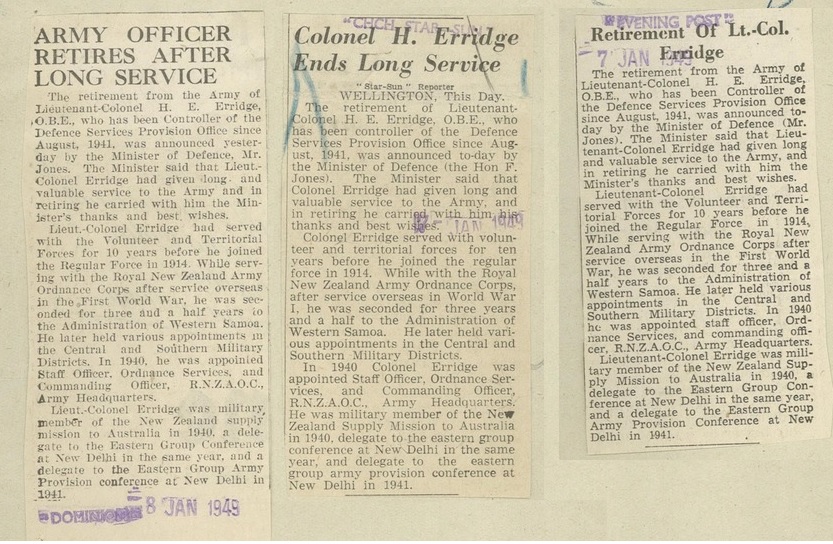
Lieutenant Henry Erridge Erridge
The reduction in the Territorial Force in 1931 resulted in decreased activity in subsequent years. However, beginning in 1934, improved government finances allowed for an increase in the army’s training tempo. Concurrently, global events in China, Ethiopia, and Germany hinted at looming conflict, prompting a gradual shift towards preparing for future mobilisation. Under the leadership of Major Thomas Joseph King, who served as Director of Ordnance Services (DOS) since 1924, the NZAOC worked diligently within its means to enhance readiness, including designing a new system of stores accounting for the emerging Royal New Zealand Air Force.
The new NZAOC Badge was approved in 1937. Robert McKie Collection
King focused on recruiting new personnel and leveraging his civilian staff, who were former NZAOC soldiers, to reenlist experienced individuals into key leadership roles at Trentham, Hopuhopu, and Burnham. When war was declared in September 1939, King successfully mobilised his small military and civilian team to form the rump of the New Zealand Ordnance Corps (NZOC) within the 2nd New Zealand Expeditionary Force (2NZEF).
During the 1938-45 war, nearly all NZAOC soldiers who had been transferred to civilian roles in 1931 found themselves back in uniform, restarting their military careers as Ordnance Officers, Warrant Officers, and Senior Non-Commissioned Officers (SNCOs) alongside their peers who had been retained. Many from this group continued to provide leadership within the RNZAOC and Royal Electrical and Mechanical Engineers (RNZEME) up to the 1960s, with several even holding the prestigious position of DOS in the post-war army.
Lieutenant Colonel Francis Reid handed over the position of DOS to his brother, Lieutenant Colonel Henry McKenzie Reid, on 31 March 1957. Both brothers joined the NZAOC as soldiers in the late 1920s, only to be transferred to the civilian staff in 1931. Commissioned during WW2, both served with distinction throughout the war.
Negative Effects and Lessons Learned
The 1931 reductions in the New Zealand military, driven by the economic pressures of the Great Depression, had profound and lasting negative effects, both socially and in terms of military preparedness. Socially, the abrupt compulsory retirements and transitions to civilian roles caused significant upheaval for the affected soldiers and their families. The loss of accumulated leave and the sudden shift from military to civilian life resulted in considerable stress and financial strain.
In terms of military preparedness, the reductions led to a substantial loss of experienced personnel and institutional knowledge. The drastic decrease in the Territorial Force and overall military strength severely hampered the country’s ability to maintain an effective and ready military force. The reduced activity and training during the early 1930s left the military less prepared for the impending global conflicts of the late 1930s and early 1940s than in 1914. This lack of preparedness could have had dire consequences had international tensions escalated more quickly.
However, subsequent efforts to rebuild, modernise, and mobilise the military demonstrated the resilience and adaptability of the New Zealand military. Starting in 1934 under the leadership of Major Thomas Joseph King, the NZAOC enhanced its readiness by recruiting new personnel and reenlisting former soldiers from the civilian staff. The return of nearly all NZAOC soldiers to uniformed service during the 1939-1945 war showcased their dedication and the critical role of experienced personnel in maintaining military effectiveness.
The 1931 reductions’ experiences highlight the importance of balancing economic constraints and the need for a capable and prepared military force. These lessons remain relevant today as modern military forces navigate similar challenges amidst strategic and economic uncertainties. Ensuring that reductions do not compromise long-term readiness and resilience is crucial for the effective functioning of any military organisation.
Notes
[1] (1930). “H-19 Defence Forces of New Zealand, Annual report of the General Officer Commanding the Forces.” Appendix to the Journals of the House of Representatives.
[2] (1931). “H-19 Defence Forces of New Zealand, Annual report of the General Officer Commanding the Forces June 1930 to May 1931.” Appendix to the Journals of the House of Representatives, 1 January 1941.
[3] (1914). King, Thomas Joseph. Personal File, Archives New Zealand. Wellington.
The Battle of Crete, fought from 20 May to 1 June 1941, was the first primarily airborne invasion in history. German paratroopers played a crucial role in the Axis assault, and despite fierce resistance from British, Australian, New Zealand, and Greek troops, the Allies were ultimately forced to evacuate. The high cost of German casualties, however, left such a mark on Hitler that he never again authorised a large-scale airborne operation.
While much has been written about the combat actions and strategic implications of the battle, the logistics behind sustaining the defence remain largely unexamined. The War Diary of the New Zealand Division Assistant Director of Ordnance Services (ADOS) offers a rare window into that story. Through its entries, we gain a ground-level view of the ammunition deliveries, supply improvisations, and quiet acts of courage that kept New Zealand troops fighting — often under relentless German air attack and with systems that were never designed for the situation they faced.
However, the War Diary of the New Zealand Division Assistant Director of Ordnance Services (ADOS) is a valuable resource for this overlooked aspect of the battle. This diary provides a rare and insightful glimpse into the New Zealand Division’s logistic efforts, revealing logistics challenges, resourcefulness, and critical role in the battle. Through the entries in this war diary, we gain a deeper understanding of the behind-the-scenes efforts that supported the front-line troops, highlighting the unsung heroes who, as far as practicable, ensured that ammunition and other stores reached those in need, often under the most perilous conditions.
This article explores the lesser-known logistical efforts that played a crucial role in the conflict. By delving into the War Diary of the New Zealand Division ADOS, we aim to provide a different understanding of the battle, understanding the resilience and ingenuity of those who worked tirelessly behind the scenes to support the New Zealand defence.
Following the disastrous Greek campaign, General Freyberg assumed command of Crete Force (Creforce) for the defence of Crete on 1 May 1941, deploying approximately 28,600 British, Australian, Greek, and New Zealand troops across four sectors: Heraklion, Retimo, Suda Bay, and Maleme. Despite the seemingly adequate size of this force, several factors significantly reduced its combat effectiveness. The Germans held complete air superiority, with only the British 14th Brigade fully equipped. A severe shortage of small-arms ammunition and a lack of vehicles rendered mobile defence impossible. Each sector had to maintain a static defence within its locality, contributing to the island’s immobility and, ultimately, the failure to repel the enemy.
Initially, the Ordnance aspects of the operation were under the command of Creforce Assistant Director of Ordnance Services (ADOS) Lieutenant-Colonel J. Hitchcock of the Royal Army Ordnance Corps (RAOC), who arrived on 24 April. However, by mid-May, he was recalled to Egypt, and the leadership was passed to Lieutenant-Colonel S. T. Rooke RAOC, who had also been evacuated from Greece.[1]
There was a small RAOC Base Ordnance Depot (BOD)depot in Canea, with a Base Ammunition Depot (BAD) established approximately two miles south at Katisfariana. Following the evacuation of forces from Greece and their immediate pivot to defend Crete, the immediate task was to supply clothing, essentials, blankets, and accommodation stores to thousands of troops who had landed from Greece. Three camps were set up:
Peribolia for 17,000 British troops
Kalibes for 12,000 men of the 6th Australian Division
Platanias for 14,000 New Zealanders
British, Australian and New Zealand troops disembark at Suda Bay, Crete, during World War II. New Zealand. Department of Internal Affairs. War History Branch. Ref: DA-01611-F. Alexander Turnbull Library, Wellington, New Zealand. /records/23172196
This number was eleven times greater than originally planned for clothing and equipment supply. Transporting stores between ports was primarily conducted by caiques under cover of night. However, the supply of weapons and ammunition remained highly problematic. The general strategy involved holding ammunition primarily in fighting sectors, with only a fifth stored in the BAD. The LADs, having been forced to abandon their equipment in Greece, were severely constrained in their ability to perform first-line repairs.
The Australians benefited from the well-trained 3 Advanced Ordnance Depot (3AOD) supporting their division, whereas New Zealand’s ordnance support was more ad hoc.[2] It relied on New Zealand Ordnance Corps (NZOC) members from the NZ Divisional staff to establish makeshift Ordnance Dumps and a distribution system. Major Allan Huia Andrews, as the New Zealand Division Assistant Director of Ordnance Services (ADOS), and Captain John Owen Kelsey, serving as DADOS Engineering (DADOS(E)), commanded these efforts. However, both Divisions struggled because the proper supply and support systems that should have been in place for such a campaign were non-existent.
The NZ Division ADOS war diary opened on 25 May 1941 as the NZ Division ADOS evacuated from Greece and arrived in Crete
25 April
At sea
Convoy attacked but raiders driven off.
Arrived at Crete
26 April
At Crete
27 April
With ADOS to see ADOS of Creforce and W/Ksps.
Issued with 1 8-cwt truck for Div HQ.
28 April
Act as Div Transport officer with 6 trucks ex Welch Regt.
Move to Div HQ location
29 April
Normal routine
30 April
To 1Fd Wksp to take OC’s orderly room in the absence of ADOS. Case of Private Burnt who discharged a rifle and killed a local inhabitant. Summary of evidence and charges read to the accused who pleads “Not Guilty”. The case is remanded. Summary of evidence submitted to ADOS.
ADOS Leave Crete, and I am temporally appointed to act for him
1 May
After the departure of Major Andrews, Major Kelsey was temporarily appointed DADOS of the Maleme Sector of Crete Force.
Collected stores and ammunition from Ordnance Dump for Div. Reserves.
To Inspect NZ Ordnance Dump.
Reported on the position of re-equipment of NZ Units to AA and QMG
2 May
Completed report of DADOS(E) on the work of Fd. Workshops, LADs. and OFP. in Greece and submitted this to DDOS, HQ 2NZEF
3 May
Normal routine
4 May
Collected supplies from BOD. Normal routine
5 May
Collected supplies from BOD. Normal routine.
6 May
Distributed shorts, shirts, hose tops, 2” and 3” Mortars, Anti-Tank Rifles and ammunition to Units.
7 May
To Canea to interview ADOS and COO of Crete Force
Further distribution of clothing and camp equipment to 5 Inf Bde
8 May
Normal Routine
10 May
Normal routine
Further distribution of stores and ammunition to units
11 May
Normal routine
12 May
To see ADOS Creforce and work with him on plan for equipping NZ units on a pro-rata basis
13 May
Fierce Air Raid over Suda Bay.
Bdes issued with 5 Carriers Bren each.
All units were requested to render deficiencies in clothing and camp equipment.
Distributed 1400 coils of wire and pickets to 5 and 10 Bdes.
14 May 1941
Further distribution of ammunition, wire, and pickets to all units.
Issue of 12 M/Cycles to NZ units.
Move with Div. HQ. to a new location 1 1/2 miles from Canea.
Heavy Air Raid.
15 May
Move the NZ Ordnance Dump to the NZ Div HQ area as there was no protection where this dump was previously located.
Prepare issue orders for all Bde Groups.
Lieut Cooper (16 LAD) was instructed to report to Suda Bay to assemble 75mm French and Italian Guns
16 May
To Canea to investigate the position of Ordnance supplies
Heavy Air raid in Suda Bay
17 May
36 15cwt trucks and 7 M/Cycles issued to NZ units
18 May
Normal routine
19 May
Normal routine
20 May
The German invasion of Crete began, and the parachutists landed.
General strafing all-day
Delivered ammunition as follows:
97250rds SAA
20000rds Stripless LMG
500rds A/Tk
Cpl Solon was taken prisoner but later recaptured.
21 May
Repetition of the previous day.
Collect ammunition reserve at dawn
Issue and blankets to German wounded
Heavy naval action at sea
Ammunition issued as follows:
110000rds SAA
100 Grenades
1100rds 75mm French and Italian
22 May
Very fierce strafing during the afternoon.
Ammunition issued as follows
97000rds SAA
6000rds Stripless LMG
340 Grenades
23 May
Very fierce strafing and bombing
Ammunition and stores issued as follows:
27000rds SAA
200 A/Tk mine
148 Grenades
700 Shovels
190 Picks
70 Coils of wire
140 Pickets
100 Local Bombs
24 May
The worst staffing so far experienced
Canea was systematically bombed.
Propose to recommend WO1 Schou for decoration for his conspicuous gallantry in delivering ammunition to units.
I was promoted to the rank of temp major while performing the duties of DADOS (E ).
Ammunition and stores issued as follows
90000rds SAA
10000rds Stripless SAA
480rds 75mm
8000rds Thompson Sub-MG
72rds Mortar 3”
60 coils wire and pickets
250 Shovels
60 Picks
25 May
Div HQ bombed
Ammunition issued as follows:
55000rds SAA
6000rds Stripless
2000rds Thompson Sub-MG
500rds A/tk
Div HQ moved to new location by wireless station outside Canea.
BAD Canea objects to the issue of ammunition after midnight as “their books were closed”. However, ammunition was obtained.
26 May
Serious strafing.
Bdes retiring
Take back 3 Ammunition lorries fully loaded to the east of Suda Bay and join Div HQ there
27 May
Move again down Sparkis Road.
Deliver Ammunition to 4 and 5 Bdes as follows:
100000rds SAA
10000rds Stripless LMG
2000rds Thompson Sub-MG
Strafed ceaselessly all day.
Move only at night.
28 May
Ammunition lorries taken by Force HQ.
Move again with Div HQ
Learn of evacuation scheme
29 May
Food and water position acute
March 12 miles to Embarkation Point but remain there.
30 May
Moral of troops getting low on account of enemy air activity and lack of food and water.
Prepare to embark
31 May
Embark with Div HQ at 2 am on destroyer “Nizam” and cross to Alexandria.
Bombed by 12 Planes en route but with only one “near miss”.
Arrive in Alexandria at 1830hrs.
ADOS NZ Div DADOS(E) War Diary for April 1941
World War II paratroopers and aeroplanes in the sky above Crete. New Zealand. Department of Internal Affairs. War History Branch : Ref: DA-12638-F. Alexander Turnbull Library, Wellington, New Zealand. /records/22913202
In conclusion, the Battle of Crete was pivotal in World War II, marked by heroic defiance and sobering logistical challenges. From May 20 to June 1, 1941, German forces conducted the first large-scale airborne invasion in history, targeting the strategically vital island defended by British, Australian, New Zealand, and Greek troops. Despite fierce resistance, the overwhelming German air superiority and logistical deficiencies amongst the Allies ultimately led to their defeat.
While the battle is often remembered for its strategic implications and high casualties, the logistical efforts behind supplying essential stores like ammunition remained largely unexamined. The NZ Division ADOS War Diary offers a glimpse into the critical logistics operations that sustained the New Zealand defence. It reveals the resourcefulness and dedication of personnel who, under extreme conditions, where practicable possible, ensured that vital supplies reached frontline troops.
The logistical challenges faced during the battle, such as ammunition shortages and makeshift supply systems, underscore the critical importance of logistics in military operations. Though overshadowed by the dramatic combat actions, these efforts were instrumental in supporting the frontline troops and mitigating the impact of German assaults.
In commemorating the Battle of Crete, it is essential to honour the valour of those who fought on the front lines and the unsung heroes who laboured tirelessly behind the scenes. Their contributions, as detailed in the War Diary and other historical records, provide a deeper understanding of the complexities and sacrifices of war. By remembering these logistical efforts, we gain a more comprehensive perspective on the battle, highlighting the resilience and ingenuity that defined the New Zealand defence on the island of Crete.
Thus, the Battle of Crete serves as a poignant reminder of the intertwined roles of combat and logistics in shaping war outcomes, leaving an enduring legacy in military history.
Notes
[1] Fernyhough, A. H. (1958). History of the Royal Army Ordnance Corps 1920-1945, Royal Army Ordnance Corps.
[2] Tilbrook, J. D. (1989). To the warrior his arms: A History of the Ordnance Services in the Australian Army Royal Australian Army Ordnance Corps Committee.
“If you were an army cook on leave and met some of the troops accompanied by their girlfriends, wives or mothers, which would you rather hear them say: “There’s the chap who turns out the great meals I’ve told you about”; or, “That’s the bloke who murders good food?”
Question placed to trainee cooks by Sergeant-Cook Instructor Bourke (Paddy to all the camp) at Waikato Camp, 1942
Over the last two hundred years, the adage attributed to Napoleon, “An army marches on its stomach,” underscored the paramount importance of sustenance in military operations. In the annals of the New Zealand army, this principle has been diligently upheld, with meticulous attention paid to ensuring soldiers are well-fed, notwithstanding the challenges posed by varying locations and conditions. Establishing the New Zealand Army Service Corps (NZASC) units during the tumultuous periods of the First and Second World Wars is a testament to this commitment. NZASC units were principally charged with baking bread, butchering meat, and procuring and distributing fresh and packaged provisions to frontline units, playing a pivotal role in sustaining the morale and effectiveness of New Zealand forces during these conflicts. Even in more recent conflicts, such as those in Southeast Asia during the 1950s and 60s, New Zealand troops operated on ration scales notably more generous than their British counterparts, a testament to the nation’s dedication to the well-being of its service members. However, despite the recognition of logistical efforts in military history, a notable gap remains in the literature concerning the contributions of New Zealand Army cooks. While Julia Millen’s comprehensive work, Salute to Service: A History of the Royal New Zealand Corps of Transport, acknowledges the significance of Cooks from when they became part of the RNZASC in 1948, scant attention has been paid to the preceding 103 years, from 1865 to 1948.
This article draws upon primary sources and aims to redress this oversight by delving into the hitherto unexplored realm of New Zealand Army catering. By shedding light on the endeavours of these unsung culinary heroes, it seeks to enrich our understanding of the multifaceted efforts required to sustain a fighting force, thereby honouring their indispensable contributions to New Zealand’s military heritage.
Since the first New Zealand Militias were created in 1845, there was always a need to feed the militias when called out for service. Given the nature of Militia service and the fact that they would not serve far from their home location, their messing requirements would have been minimal. Some individuals would likely have been selected from within the ranks to collect any rations provided and prepare meals.
With the advent of the volunteer era in 1858, the New Zealand military became a mixed force of Infantry, Cavalry and artillery who, on occasion, would assemble for annual camps where units within a district would assemble and conduct combined training. While rations were paid through District Headquarters and Defence Stores, messing arrangements would be rudimentary, with men selected from within the ranks preparing the meals from the rations sourced from local vendors. This situation was mirrored in the Permanent Militia, which had staffed coastal defence forts and the military depot at Mount Cook in Wellington since the 1880s.
During New Zealand’s involvement in the war in South Africa, the issue of messing arose as large numbers of mobilising men were stationed in camps. Messing arrangements involved a combination of civilian contractors and regimental cooks. However, an inquiry into soldiers’ comfort, housing, and victualling at the Newtown Park Camp and Volunteer Billets revealed widespread dissatisfaction. Numerous complaints were lodged regarding the quality and quantity of rations provided, the low standard, and, at times, the lack of meals prepared by contractors and regimental cooks.[1] In South Africa, rations, following the British scale, were supplied by the British Army Service Corps (ASC), supplemented by fresh mutton acquired from the enemy and cooked by members of the contingent.[2]
After the conclusion of the South Africa War, interest in the military surged, prompting a reorganisation of the volunteer movement into a more robust and structured system of regiments and battalions. Despite discussions in 1904 regarding establishing a New Zealand Army Service Corps (NZASC), no decision was indicated in the Commandant of the Forces’ annual report on its formation.[3]
Further reorganisation in 1908 saw the ASC matter addressed by the Adjutant General, with discussions continuing into 1909. The Defence Act of 1909 disbanded volunteer forces and established the Territorial Force, supported by conscription. Major General Alexander Godley’s appointment as Commandant of the New Zealand Military Forces in December 1910 provided momentum for reform. In his first year, Godley revitalised the military’s organisational structure, made crucial command and staff appointments, and laid plans to develop the NZASC, which, though officially designated in May 1910, remained only a force on paper.[4]
Despite the Defence Stores Department’s existence since 1869, an ASC nucleus was lacking for forming new units. The proposed NZASC envisioned eight Transport and Supply Columns, divided into Mounted and Mixed Brigade units allocated to each of New Zealand’s four Military Districts and was to be organised by British ASC officer Henry Owen Knox, who arrived in New Zealand in June 1911 and later supported by four ASC officers and Warrant Offices from early 1913. While the NZASC would handle the procurement and distribution of rations, receipt and cooking remained a Regimental responsibility.
Under Godley’s command, the Territorial Army underwent rapid organisation, culminating in the inaugural brigade camps held in 1913. During these camps, the newly established NZASC established its initial depots, receiving supplies previously ordered by the Quartermaster General based on expected strength states and ration scales.
Forty-seven candidates across the Territorial Army were selected in October 1912 to undergo a comprehensive month-long training at Trentham. This pioneering catering course encompassed kitchen work and cooking techniques for field conditions, including practical exercises such as constructing and operating field ovens, fry pans, 8 and 20-gallon boilers and camp kettles.
Of the initial candidates, thirty-eight successfully qualified to supervise cooking for a regiment, with an additional seven attaining certification as company cooks. Unfortunately, two candidates were unable to qualify due to illness. For the 1913 camp, the establishment allowed for a Sergeant Cook per regiment, each granted an additional allowance of 1 Shilling 6 Pence a day (equivalent to 2024 NZD $16.16), while qualified company cooks received 1 Shilling a day (equivalent to 2024 NZD $10.10). Those who served as cooks during the camps were excused from further military training for the rest of the year.[5]
At Trentham, an additional course of instruction was conducted in October 1913, attended by sixty-two territorial soldiers. Thirty-two qualified as competent to supervise cooking for a regiment, making them eligible for appointment as sergeant cooks if vacancies existed within their units. Twenty-seven soldiers qualified as assistant or company cooks; unfortunately, three did not meet the qualifications.
By the end of 1913, this initiative provided the New Zealand Military with a potential pool of 104 trained cooks. However, it was recognised that further efforts were necessary to ensure a sufficient number of cooks would be available to meet the messing needs of the Territorial Force in the event of mobilisation.[6]
A System Under Strain, Lessons Unlearned in the Interwar Years
By the late 1930s, nearly two decades after the end of the First World War, there remained a persistent unease about the Army’s ability to feed its soldiers effectively. While institutional reforms had begun, contemporary commentary suggests that many of the fundamental issues experienced during the war had not yet been fully resolved.
A 1937 article in the Auckland Star, written by W. Revell Reynolds, provides a stark and unvarnished account of army catering during the First World War. Drawing on personal experience across training camps, Egypt, and Gallipoli, Reynolds described a system characterised not by scarcity, but by failure in execution.
Food, he noted, was often adequate at the point of issue, but was rendered unpalatable or even inedible through poor preparation. Cooks were frequently untrained and, in many cases, selected from those seeking to avoid frontline duties rather than for any culinary competence. Officers, for their part, were described as largely ignorant of catering and nutrition, with institutional focus placed elsewhere.
More concerning were allegations of systemic weaknesses in control and accountability. Reynolds pointed to instances of misappropriated allowances, questionable quality of supplied goods, and the hoarding or misallocation of rations. Whether exaggerated or not, such perceptions highlight a broader lack of confidence in the integrity of the supply and catering system at the time.
Perhaps most significantly, Reynolds drew a direct connection between poor nutrition and operational effectiveness. The absence of basic dietary components such as fresh vegetables, fats, and stimulants was linked to widespread illness, particularly dysentery and other gastrointestinal conditions, which were endemic in theatres such as Gallipoli. In this sense, catering was not merely a matter of comfort, but of survival.
Reynolds’ account suggests that the issue was not supply alone, but the absence of a professional system capable of turning rations into effective sustainment.
His concluding concern was forward-looking. Writing in 1937, Reynolds questioned how the Army intended to feed its soldiers in any future conflict, suggesting that without meaningful reform, the same deficiencies would re-emerge under the pressures of mobilisation.
The outbreak of the Second World War would force that reform. Under the pressures of mobilisation, the Army moved decisively toward a more professional, standardised, and controlled system of catering and supply, laying the foundations for the modern military catering capability.
The declaration of war and subsequent mobilisation halted any plans for further peacetime training of cooks, as all efforts shifted towards providing trained personnel for the New Zealand Expeditionary Force. The NZASC expanded its role at home and as part of the NZEF, taking on responsibility for bakeries and butcheries. However, despite ensuring the provision of necessary food items to units, cooking remained the responsibility of each unit. Cooks were trained at the Army School of Instruction at Trentham, with further training conducted at NZEF camps in the United Kingdom.In New Zealand, military and civilian cooks fulfilled the necessary messing functions at various mobilisation and Territorial Camps, while unit cooks supported units in the field.
Cooks with first frozen mutton received in the desert during WWI. Hood, D : Photographs relating to World War I and II. Ref: 1/2-067444-F. Alexander Turnbull Library, Wellington, New Zealand. /records/23212994
Wellington Regiment cooker, and men, within 1000 yards of the front line, Colincamps, France. Royal New Zealand Returned and Services’ Association :New Zealand official negatives, World War 1914-1918. Ref: 1/2-013209-G. Alexander Turnbull Library, Wellington, New Zealand. /records/22604005
During the interbellum period, the Army School of Instruction in Trentham ceased operations in 1921, with few records of formal training for Army cooks until 1938.
In 1937, the Special Reserve Scheme was introduced to provide personnel for the coast defence batteries and three infantry battalions of Fortress troops. Under this scheme, single soldiers underwent three months of continuous training, followed by a three-year commitment to attend training for 10 days annually, with an obligation to report for service within New Zealand in the event of a national emergency. During their three months of training, they were also allowed to attend technical college, free of charge, on a course of their choice. Facilitating the necessary training, the Army School of Instruction (ASI) was re-established at Trentham, supported by District Schools of Instruction (DSI) at Narrow Neck, Trentham, and Burnham.[7]
The first account of cooks participating in this training scheme saw a batch of seventy-two, nine of whom were cooks, enter Trentham in August 1938 for their initial military training, beginning their vocational training in January 1939 with three of the cooks going to Narrow Neck in Auckland and the other six to Fort Dorset.[8] Reviewing the work of the officers and men under his command, the Officer Command the Central Military District, Colonel E Puttick, commented in April 1939 that “there had never been any complaint about the food, and it was clear that the special reservists who had taken cookery training as their vocational course in the Army Training School at Trentham had received excellent instruction”.[9]
While Colonel Puttick may have been satisfied with the catering arrangements in his district, there was dissatisfaction with the quality of rations and cooks in the northern and Southern Districts. In May 1939, reports of sub-standard rations, the performance of civilian cooks at territorial Camps resulting in their packing up and walking out mid camp and the refusals of Territorial soldiers to work on mess fatigue parties led the District Commander, Colonel P.H Bell to call an all-day conference with his Quartermaster and Quartermaster Sergeants to consider the Army’s food problems, including the quality of rations and most importantly how to resolve the fundamental problem that the Army had no cooks of its own, engaging civilians for the period of camps. [10] In the Northern District, a deputation of civilian cooks led by Mr W. R Connolly, a cook with 37 years’ experience of cooking in military camps, went directly to the officer of the Star Newspaper with their grievances following a ten-day camp with A Squadron of the 4th Mounted Regiment. Joining the squadron on 3 May at Cambridge, they deployed to Rotorua, Tauranga, and Paeroa, finishing up at Narrow Neck on 12 May. The cook’s issue was that they were civilians contracted to work in a fixed camp and not on the march, and they were at much reduced rates than they had received before the depression.[11]
Despite these challenges, the outbreak of the Second World War in September 1939 prompted a renewed focus on army catering. On the declaration of war, it was decided that New Zealand would contribute an Expeditionary Force. Initially, a “Special Force” was planned, with one battalion in each of the three military districts. The Special Force was later expanded into the 2nd New Zealand Expeditionary Force (2 NZEF).
Three weeks before the Special Force encamped at Trentham, Acting Prime Minister Mr Peter Fraser and Minister of Defence Mr Frederick Jones visited the site to inspect preparations for the new mobilisation camp. During their visit, the Commandant of the ASI, Major J I Brook, hosted them for lunch. Impressed by the meal, they specifically requested the Regular Force Mess diet sheet and received positive feedback from regular soldiers on the meal quality. The Ministers inquired about the possibility of providing similar meals to the men of the Special Force. In response, Major Brook suggested that providing the same meals to the Special Force could be achieved if cooks were available and ample rations were provided. Following this discussion, permission was granted to establish an Army School of Cookery under the ASI.[12]
By December 1939, under the tutelage of a fully qualified army cookery instructor, the first batch of thirty-two men had completed their training at the Army School of Cookery, with a second batch completing their training on 8 December. Initial training was on the standard equipment found in any camp, typically three ovens able to bake for 120 men. Once qualified in the basics of camp cooking, training on the Portable Cooker No. 1 and other field cookery followed.[13]
As the 2NZEF established itself in Egypt, the significance of quality cooking was duly recognised. Although the Cooks selected for the First Echelon underwent training courses at the Trentham School of Cookery, they were not qualified cooks under Middle East conditions. They required instruction on breaking down bulk rations and handling food in the field, so arrangements were made to train New Zealand cooks at the Army School of Cookery in Cairo. Additionally, the services of a non-commissioned officer (NCO) from the 7th British Armoured Division was enlisted as an instructor to the 2 NZEF under the supervision of the Divisional Supply Column officer. With the second Echelon diverted to England, General Freyberg consulted the manager of the Lyons chain of restaurants, who was an adviser to the War Office on army catering, with arrangements made with the War Office in London for the secondment of four NCOs to the 2 NZEF to form the nucleus of the 2 NZEF cookery school. These NCOs accompanied the Second Echelon troops from England to Egypt.[14]
A typical New Zealand field cookhouse in the desert during World War II. New Zealand. Department of Internal Affairs. War History Branch :Photographs relating to World War 1914-1918, World War 1939-1945, occupation of Japan, Korean War, and Malayan Emergency. Ref: DA-00798-F. Alexander Turnbull Library, Wellington, New Zealand. /records/23050225
With this reorganisation and expansion, the NZEF cookery school conducted thorough training and testing for cooks. Starting from February 1941, all cooks were required to be qualified either at the NZEF school or the Middle East school before being eligible for extra-duty pay.[15]
As the war progressed, the Army School of Cookery at Trentham continued to run regular courses. However, the demand for cooks necessitated the DSIs to conduct cookery instruction to train men as they were called up for the NZEF and Home Defence. In addition to male soldiers training as cooks, from 1939, the first females from Auckland Womans Service Corps were employed as cooks in Papakura Camp to supplement the civilian and military cooks. Although on the Army payroll, the initial female cooks were not considered serving soldiers. By June 1941, fifteen female cooks were working across all the Military districts. However, it was not until July 1942 that approval was given for the New Zealand Women’s Army Auxiliary Corps (WAAC) in New Zealand, formally establishing these female cooks as part of the military establishment.[16]
Cook from the Women’s Army Auxiliary Corps putting meat in an oven to roast, for men at a World War II military camp in New Zealand. New Zealand Free Lance : Photographic prints and negatives. Ref: PAColl-8602-40. Alexander Turnbull Library, Wellington, New Zealand. /records/22895614
By October 1942, three hundred men of the Territorial Force had received training at Ngawahiwaha Camp. The established ratio for cooks to troops was one cook for every 50 men, two for 100, three for 150, and an additional cook for every 100 additional men. Throughout the Army, the standard of cooking, in terms of variety and quality, had seen significant improvement. It was widely acknowledged that a properly trained army cook could secure employment in a civilian hotel or restaurant upon demobilisation.[17]
Sergeant “Paddy” Bourke, veteran army cook, turns the roast. He was in Egypt with the Expeditionary Force of a generation ago; (Evening Post, 13 April 1940). Alexander Turnbull Library, Wellington, New Zealand. /records/17717327
In May 1944, the use of WACs as cooks had become a normalised and essential function of the war effort, with an article in the Dominion newspaper detailing the work of the 65 WAACs on the messing staff of Trentham Camp and providing details of the training of the latest batch of eighteen female cooks who had just completed a three-week cooking course the Trentham ASI.[18]It’s essential to recognise that New Zealand was not operating in isolation but rather observing developments across the armies of the British Empire as they transitioned from the regimental cook system to a more centralised and professional model. In the United Kingdom, the Cook trade was under the control of the Army Catering Corps (ACC) upon its creation in March 1941, forming as a subsidiary element of the Royal Army Service Corps Supply Branch. Australia followed suit in 1943, establishing the Australian Army Catering Corps. Canada took a similar approach, forming the Royal Canadian Army Service Corps (RCASC) Catering Wing at No. 1 Reinforcement Unit in Britain in August 1942 to train cooks for the Army.
A cook with the 22 New Zealand Battalion, stokes up his fire in the forward areas near Rimini, Italy, 21 September 1944 during World War II. New Zealand. Department of Internal Affairs. War History Branch
The Canadian Army’s experience was that many cooks had previously been members of their unit. However, experience revealed that they were not necessarily skilled soldiers and often functioned as poor cooks tasked with feeding their comrades. Consequently, starting in 1942, all cooks were transferred to the RCASC, which then assigned them to the various units they were to serve. This change resulted in a rapid improvement in cooking standards.[19] Although New Zealand had adopted other British logistical organisational changes, such as the formation of the Electrical and Mechanical Engineers, with enthusiasm, it was more reserved about any changes to its cooks, combining cooks into a single corps was not a wartime priority.
In 1944, New Zealand commenced the demobilisation process, which included disbanding the Home Guard and the standing down of elements of the Territorial Force. By the war’s conclusion in 1945, most of the forces stationed at home underwent rapid demobilisation. The 2NZEF was disbanded by 1946, aligning with the downsizing trend seen in many Western militaries. However, despite this size reduction, the Government and the Army hesitated to revert the military to its pre-war dimensions and structure. Instead, they opted to reorganise it into what became known as the Interim Army.
New Zeland Army Order 60/1947 of 1 August 1947 detailed the trade classification and promotion requirements of the Regular Force. This order retained cooks as two specific All Arms trades;
Cooks, Hospital. A Group A trade applicable to All Arms, including the New Zealand Army Nursing Service (NZANS)
Cooks (other than hospital cook). A Group B trade applicable to All Arms, including the NZWAAC
The Commandant of the ASI set the syllabus for the Cooks, hospital, and Cooks (other than hospital cooks). During his period, there was no steward’s trade.[20]
In 1947, three officers and four NCOs were brought out from Britain to raise the standards of catering in the New Zealand Army. This task included providing training and instruction in cooking and catering and guidance on ration scales and meal planning. With the New Zealand Army perceived as too small for a stand-alone Catering Corps, considering that the NZASC was responsible for the Supply function, Butchers and Bakers, it made sense to emulate the Canadian model and bring all cooks under the umbrella of the RNZASC.
To facilitate this transition, the Army Board approved the formation of a Catering Group as a section of the RNZASC. It issued New Zealand Army Instruction (NZAI) 2049 on 15 February 1948 detailing the Supplies and Transport Catering Group (STCG) formation. Initially, the STCG comprised of;
A Staff Officer (Catering) in the Directorate of Supplies and Transport at Army Headquarters.
District Catering advisers (NC0s) on the staff of the Districts Assistant Director Supply and Transport (ADST)
Instructors on the staff of the Army School of Instruction to operate a Catering Wing.
Cooks and kitchenhands on unit peace establishments.
The function of the STCG was to
To train and provide unit cooks and kitchen hands.
Instruction in and supervision of the management of the Army ration scale.
Improvement of standard of food preparation and cooking.
Advice on the installation and instruction in the operation of cooking appliances and kitchen equipment.
Despite NZAI 2049 bringing all army catering services under the jurisdiction of the RNZASC, the Cooks trade remained dispersed among various units. However, this issue was addressed with the implementation of NZAI 2147 in September 1948.[22]
No 2147. SUPPLIES AND TRANSPORT CATERING GROUP, RNZASC NZAI 1319 and 2049 are hereby cancelled.
Approval has been given for the formation of a catering Group in RNZASC. This group will be known as the Supplies and Transport Catering Group (abbreviated title STCG).
The functions of the STCG are – a. To train and provide unit, &c, cooks and messing staffs. b. Instruction in and supervision of the management of the Army Ration Scale. c. The preparation, cooking and serving of all rations. d. Advise on the installation and instruction in the operation of cooking appliances and kitchen equipment. e. Advise on the layout of mess buildings.
Initially the STCG will comprise- a. A Staff Officer (Catering) on the Directorate of Supplies and Transport at Army HQ. b. District catering advisers (NCOs) on the staff of ADs ST District. c. Instructors on the staff of ASI to operate a “Catering Wing”. d. Messing Staff of all units
In order to implement para 3 above, the following action will be taken:- a. From the date of publication of this instruction soldiers classified as “kitchen hands” or “Mess Orderly” will be classified as “probationer cook” or “mess steward” respectively. The terms “kitchen hands” or “mess orderly” will no longer be used. NOTES: – (i) For star classification purposes “probationer cooks” will form the “learner: class of the group “B” trade of cook and will be treated as Group “D” tradesmen (ii) Whenever the term “messing staffs” is used in this instruction, it will included “cooks,” “probationary cooks,” and “mess stewards” b. All cooks, probationer cooks, and mess stewards, other than of the NZWAC, will be posted to RNZASC. c. All messing staffs. including NZWAC messing staffs, in districts will be carried on the establishments of district ASC Coys under the sub heading of STCG. d. OsC Districts will allot messing staffs to units on the recommendations of DA DsST. e. Messing staffs, including NZWAC messing staffs, of Army HQ units will be carried on the establishments of the respective units under the sub heading STCG.
STCG messing staff strengths will be assessed according to unit messing strengths as follows:- a. Unit messing strengths will be taken as establishment strength less 20 per cent (to allow for personnel Living out). b. Cooks. – Cooks will be allocated to units on the following scale: i. One cook per unit all ranks (or portion thereof) on unit messing strength up to a total of 650. ii. One extra cook p er 90 all ranks (or portion thereof) on unit messing strength in excess of 650. iii. One extra cook for each cookhouse in excess of one. iv. In addition, one chief cook (WO or NCO) for each unit. The rank of this WO or NCO shall be dependent on the strength of the messing staff serving in the unit concerned, in accordance with the scale laid down in para 6 below. c. Probationer Cooks:- i. Two probationer cooks to each kitchen where cooking is carried out for messing strength of 65 or under. ii. Four probationer cooks to each kitchen where cooking is carried out for messing strength in excess of 65 d. Mess Stewards: i. One mess steward for each 25 all ranks (or portion thereof) on unit messing strength. ii. In addition, one mess steward for each 6 officers (or portion thereof) on unit messing strength up to a total of 42 officers. iii. When the number of officers exceeds 42, one extra mess steward for each 9 officers ( or portion thereof) on unit strength in excess of 42). iv. Mess stewards in any mess to include at least one NCO, except when total number of mess stewards is less than 3.
In calculating ranks of messing staff, the following guide will be used: In every 69 messing staff OR’s carried on establishment under STCG there may be 21 NCOs from Corporal upwards on the following scale: One Warrant Officer. Two Staff Sergeants. Six Sergeants. Twelve Corporals.
The chief cook in any unit will rank as the senior member of the messing staff, irrespective of the rank of the senior mess steward. He will be responsible for: a. The proper functioning of the messing staff. b. Close co-operation with the unit messing officer. c. Training of probationer cooks.
Amended establishments will be issued shortly.
New Zealand Army Instruction 2147, 15 September 1948
With this new directive, New Zealand Army cooks (NZWAC cooks and stewards, which remained a separate corps but were under technical control of the RNZASC for catering purposes, until 1977 when they joined the RNZASC) were finally consolidated into a single corps, allowing for a standardised training syllabus. Additionally, to enhance the catering function and provide a comprehensive messing service, the Stewards trade was formalised as part of the RNZASC. By the end of 1948, the groundwork had been laid for the RNZASC Catering trade to support the evolving New Zealand army.
In conclusion, the evolution of Army catering in New Zealand from 1845 to 1948 reflects a journey marked by adaptability, innovation, and a commitment to sustaining the morale and effectiveness of New Zealand’s military forces. During this period, New Zealand’s military catering underwent a significant transformation from rudimentary messing arrangements in the early militia days. However, the importance of well-fed troops was consistently recognised, as evidenced by the efforts to improve messing arrangements, the establishment of training programs for cooks, and the integration of civilian and military personnel into the catering function. Despite challenges such as dissatisfaction with rations and the shortage of trained cooks, the New Zealand Army continually sought to enhance its catering capabilities, particularly in response to the demands of wartime mobilisation. The establishment of the Army School of Cookery, the integration of female cooks into the military establishment, and the adoption of international best practices, such as those observed in the British and Canadian armies, demonstrate New Zealand’s commitment to modernising its catering services and ensuring the provision of quality meals for its troops. By consolidating army catering services under the RNZASC umbrella and formalising the Cooks and Stewards trades, the New Zealand Army laid the groundwork for a more structured and professional catering function as the country transitioned into the post-war era. By 1948, the stage was set for the RNZASC Catering trade to play a pivotal role in supporting the evolving needs of the New Zealand army, reflecting a legacy of culinary excellence and dedication to service.
Notes
[1] “Newtown Park Camp (Inquiry into Conduct of),” Appendix to the Journals of the House of Representatives, 1901 Session I, H-19a (1901).
[2] “New Zealand Contingent (No 1): Extracts from Reports by Major Robin, Commanding New Zealand Contingent, to Officer Commanding Forces,” Appendix to the Journals of the House of Representatives, 1900 Session I, H-06a (1900).
[3] J Babington, “Defence Forces of New Zealand (Report on the) by Major General J.M Babington, Commandant of the Forces.,” Appendix to the Journals of the House of Representatives, 1904 Session I, H-19 (1904).
[4] Based on the British logistics system the NZASC was to be responsible for the Transport and the supply of forage, rations and fuel. The supply and maintenance of all small-arms, ammunition, accoutrements, clothing, and field equipment Stores was to remain a responsibility of the Defence Stores Department which in 1917 became the New Zealand Army Ordnance Corps. Robert McKie, “Unappreciated Duty: The Forgotten Contribution of New Zealand’s Defence Stores Department in Mobilising the New Zealand Expeditionary Force in 1914: A Thesis Presented in Partial Fulfilment of the Requirements for the Degree of Master of Arts in History at Massey University, Manawatu, New Zealand” (Massey University, 2022).
[5] “H-19 Report on the Defence Forces of New Zealand for the Period 28 June 1912 to 20 June 1913,” Appendix to the Journals of the House of Representatives (1913).
[6] “Military Forces of New Zealand (Report by the Inspector General of Ther Overseas Forces on the),” Appendix to the Journals of the House of Representatives, 1914 Session I, H-19a (1914).
[7] “H-19 Military Forces of New Zealand, Annual Report of the Chief of the General Staff,” Appendix to the Journals of the House of Representatives, (1938).
[8] “Vocational Training,” Wairarapa Times-Age, , 17 January 1939.
[9] “Military Camps,” Evening Post, Volume CXXVII, Issue 80, , 5 April 1939.
[11] “Walked out Army Cooks,” Auckland Star, Volume LXX, Issue 114, , 17 May 1939.
[12] “Soldier Cooks,” King Country Chronicle, Volume XXXIII, Issue 4856,, 1 November 1939.
[13] “Diet for Troops,” King Country Chronicle, Volume XXXIII, Issue 4856,, 1 December 1939.
[14] William Graham McClymont, To Greece, vol. 4 (War History Branch, Department of Internal Affairs, 1959), 23.
[15] Thomas Duncan MacGregor Stout, New Zealand Medical Services in Middle East and Italy, vol. 12 (War History Branch, Department of Internal Affairs, 1956), 47.
[16] Iris Latham, The Waac Story (Wellington, New Zealand1986), 1-4.
[17] “Moral Builders NZ Army Cooks,” Bay of Plenty Times, Volume LXXI, Issue 13760,, 1 October 1942.
[18] “Waac’s New Role,” Dominion, Volume 37, Issue 207, , 30 May 1944.
[19] Arnold Warren, Wait for the Waggon: The Story of the Royal Canadian Army Service Corps (McClelland, 1961).
[20] “Special New Zealand Army Order 60/1947 – the Star Classification and Promotion of Other Ranks of Ther Regular Force,”(1947).
[21] “New Zealand Army Instruction 2049 – Supplies and Transport Catering Group, Rnzasc,”(1948).
[22] “New Zealand Army Instruction 2147 – Supplies and Transport Catering Group, Rnzasc,”(1948).
In the historical tapestry of the Royal New Zealand Army Ordnance Corps (RNZAOC), 1972 is a pivotal year, marking twenty-two years since New Zealand’s initial involvement in combat operations in South Korea. The nation continued actively participating in conflicts such as the Malayan Emergency, the Indonesian Confrontation, and the South Vietnam War. Throughout this period, New Zealand maintained a robust part-time territorial army sustained by Compulsory Military Training, all aimed at creating a versatile, all-arms Combat Brigade Group.
However, 1972 marked a turning point. It witnessed the conclusion of Compulsory Military Training, resulting in a reduction in the Territorial Force and its transformation into a volunteer force. Concurrently, with the conclusion of New Zealand’s commitment to the Vietnam War, the country entered a phase marked by individual engagements in United Nations Peacekeeping operations, a eighty-day mission to Rhodesia, the establishment of a permanent peace monitoring force in the Sinai, and participation in exercises both in New Zealand and overseas. This era ushered in a period of peace for the New Zealand Army, with nearly two decades passing before the RNZAOC would deploy a unit into a combat environment once again.
As 1972 concluded and the New Zealand Army and the RNZAOC entered this new era, they did so with a cadre of well-trained and experienced warrant and non-commissioned officers. This article will delve into the RNZAOC Regular Officer Cadre of 1972, as documented in the New Zealand Army Graduation List Regular Officer of 31 Oct 1972.
The RNZAOC of 1972 consisted of around 350 Regular and Territorial Officers and Other Ranks, including Storeman Clerks, Ammunition Technicians, Auto Parts, Footwear Repairers, Motor Trimmers, Tailors, and Clerks across numerous units, including.
Main Ordnance Depot, Trentham
RNZAOC School, Trentham
1 Central Ordnance Depot, Hopuhopu
2 Central Ordnance Depot, Linton
3 Central Ordnance Depot, Burnham
1 Composite Ordnance Depot, Mangaroa
5 Advanced Ordnance Depot, Singapore
Workshops Stores Section in RNZEME Workshops’
As Staff in various Headquarters
At this stage, female soldiers belonged to the New Zealand Woman’s Royal Army Corps (NZWRAC), with many posted to RNZAOC units as integral members of those units.
The Graduation List Regular Officer is divided into three Parts.
Part 1 – Regular Officers
Part 2 – Regular Quartermaster Officers
Part 3 – Supernumerary List
Part 1 – RNZAOC Regular Officers
Lieutenant Colonels
Clifford Leaman Sanderson, psc
Geoffrey John Hayes Atkinson, MBE, M Inst PS
Majors
John Barrie Glasson, (T/Lt-Col 1 Jan 71)
Malcolm John Ross, psc (T/Lt-Col 20 Oct 72)
Captains
Arthur John Campbell, ANZIM, psc (T/Maj 1 Aug 68)
Piers Martin Reid, (T/Maj 1 Feb 69)
Michael Dawney Hunt, ANZIM (T/Maj 1 Feb 69)
Terence David McBeth, (T/Maj 1 Nov 69)
Ian Geoffrey Ross
Ronald Leslie Cross, psc (T/Maj 21 Jun 70)
Gary Malcolm Corkin
John Andrew Henderson
John Robert Hicks
David John Rees
Michael Joseph Cooper
Terence John Verrall
Lieutenants
Maxwell Frederick Newnham, (T/Capt 7 Mar 70)
Patrick Te Tahuri Puohotaua
Michael Alexender Cowan
John Francis Hyde, (T/Capt 1 Apr 71)
Kevin John Dreyer, (T/Capt 22 Jun 72)
Paul Edwin Dangerfield
Keith David Hansen
Mark David Stuart, BA (mil)
Peter Martin O’Brien
Grant William Blackburn
Second Lieutenants
Noel Anthony Hitchings
Allan Charles Lash
Part 2 – RNZAOC Quartermaster List
Captains and Quartermasters
William Maxwell Campbell, (T/Maj & QM 1 Aug 68)
Patrick George Burns, (T/Maj & QM 25 Apr 69)
David Ralph Hughes, T/Maj & QM 3 Jun 70)
Keith Alexander Watson
Ian Roy Larsen
Alan Paul Bezar
Lieutenants and Quartermasters
Donald Winter Stewart, (T/Capt & QM 22 Feb 71)
Hector Searle McLachlan, (T/Capt & QM 1 May 71)
Godfrey Edward Lee, (T/Capt & am 5 Apr 71)
Stewart McDonald Fussell, (T/Capt & QM 5 Apr 71)
John Edward Hancox, (T/Capt & QM 1 Jul 70)
Edward Vennell Sweet, (T/Capt & QM 11 Aug 71)
Alfred Stephenson Day, (T/Capt & QM 3 Sep 71)
James William Twist
Part 3 – RNZAOC Supernumerary List
Majors
Ronald George Henderson Golightly
Captains
Carleton Robert Duggan, (T/Maj & QM 14 Sep 68)
George Edward Butler, (QM) (T/Maj & QM 4 Aug 69)
Statistics on the RNZAOC 1972 Officers List
Duntroon Graduates- 1
Portsea Graduates -10
RF Cadets – 2
Served in other Corps before joining RNZAOC – 7
Operational Service
WW2 – 4
J Force – 2
K Force – 2
Malaya – 6
Vietnam – 15
Service and Age
1972 Average age – 36 years
Average age on leaving RNZAOC – 44 years.
Over 20 years of RNZAOC Service – 27
Cumulative amount of RNZAOC Service – 880 Years
Shortest Service in RNZAOC – 2 Years
Longest Service in RNZAOC – 36 Years
Average length of NZ Army Service – 62 Years
Average length of RNZAOC Service – 59 Years
Appointments
Chief of General Staff- 1
Director of Ordnance Services – 7
Chief Instructor RNZAO School – 8
Chief Ammunition Technical Officer – 3
Colonel-Commandant – 2
In 1972, the RNZAOC entered a transformative period, marked by changes in training, force structure, and the cessation of its involvement in the Vietnam War. The graduation list reflects a diverse group of officers, well-versed in various aspects of military service. As the RNZAOC transitioned into a new era characterised by peacekeeping missions and operational diversification, the officers of 1972 carried with them a wealth of experience and training, setting the stage for the Corps’ future endeavours. The statistical overview provides insights into the officers’ backgrounds, service history, and appointments, highlighting the depth of expertise within the RNZAOC during this pivotal time.
Accounts of New Zealand Ordnance Units’ wartime activities are rare, with one of the few accounts from the Second World War found in the wartime publication Prelude to War.
Prelude To Battle was the first of ten surveys on the 2nd New Zealand Expeditionary Forces (2 NZEF) produced by the New Zealand Army Board during the Second World War to provide short articles on the activities of 2 NZEF.
Prelude To Battle was published by Whitcombe & Tombs, in 1942 and covers the first Libyan Campaign of June -December 1940. Prelude To Battle includes chapters on
the LRDG,
Divisional Signals,
NZASC, 4th NZ Mechanical Transport Company (4RMT), and
New Zealand Ordnance Corps (NZOC), 10 Light Aid Detachment (10 LAD) attached to New Zealand Engineers (NZE), 5 Field Park Company
The chapter Water Supplies covers explicitly the activities 10 LAD during Operation Compass, which was the first significant British military operation of the Western Desert Campaign (1940–1943), during which British, Empire and Commonwealth forces attacked Italian forces in western Egypt and Cyrenaica, the eastern province of Libya, from December 1940 to February 1941.
10 LAD was one of 11 LADs, numbered 9 to 19, raised as part of the NZOC in late 1939 to render assistance and repair mechanic transport and the anti-tank units of 2 NZEF. Raised at Hopuhopu Camp, 10 LAD was commanded by Second Lieutenant George D Pollock, and attached to 5 Field Park Company, NZE. 10 LAD sailed as part of the Main Body of 2 NZEF in January 1940, Disembarking in Egypt in February 1940.
In late 1940 New Zealand units, including the Fifth Field Park Company, with 10 LAD attached, Divisional Signals, 4 RMT and other specialist troops, had been seconded to General Archibald Wavell for Operation Compass. The official War History New Zealand Engineers, Middle East states, “but beyond guarding the water pipeline and establishing water points and forward dumps at Charing Cross, the Company was not much affected. The British Army seemed to do very well without its assistance”. However, as this Prelude To Battle chapter describes, 10 LAD played a critical role in ensuring water supply to the advancing allied units.
A Light Aid Detachment, Water Colour by Captain Peter McIntyre
The Prelude to Battle chapter, Water Supplies, reads:
Concerned with the maintenance of water plants to supply the troops advancing into Cyrenaica and the servicing of Royal Engineers’ equipment, the 10th Light Aid Detachment of the New Zealand Ordnance Corps entered each town almost immediately after its capture to attend to the water installations and pumping appliances.
Before the British assumed the offensive, the 10th LAD has succeeded in drawing water from about ten feet below the surface at Burbeita and in the sandhills at Baggush. When Fort Nibeiwa was attacked on 8 December, the 10th LAD were in caves in the escarpment at Charing Cross, several miles inland from Mersa Matruh. As soon as the last of the Sisi Barrano forts was captured, Major G. D. Pollock, who commanded the 10th LAD went to Sidi Barrani to attend to the water works there. He found in perfect order a Fiat diesel pumping engine capable of 250 litres an hour and a plant for distilling salt water. The remainder of the 10th LAD entered Sidi Barrani two days later. The Italians also left a large pumping station almost at Buqbuq, half way between Sidi Barrani and Sollum .
As the Australians concentrated for the Battle of Bardia, the 10th LAD were filling and working water wagons for Sollim. At this stage they began to operate closely with the 5th Field Park Company and on 10 January they moved with them to the harbour at Bardia. A fortnight later they were in Tobruk at work on the large distilling plant. After the Battle of Derna and the subsequent Italian withdrawal towards Benghazi, the 10th LAD were given a special job. The British command had made the decision to cut across the plateau south of Benghazi: the success of this plan depended on getting a supply of water quickly to Msus, some 500 miles south-west of Derna. it was the responsibility of the 1Oth LAD to have ninety-five tons of water at this point for the armoured division. This was accomplished. The operation succeeded, Benghazi fell, and the whole of Cyrenaica was subsequently occupied. In northern Cyrenaica, the water problem ceased. West of Derna lies a region of small streams, trees and green countryside decorated with fresh white buildings. When the British consolidated in this area in February 1941 the work of the 10th LAD ended and they followed the New Zealand signallers. Transport driver and engineers back to Helwan, where the New Zealand Division had taken up its station preparatory to its departure for Greece.
Prelude to Battle Page 32-34
Following this brief excursion into Libya, 10 LAD continued to be attached to 5 Field Park, NZE for the remainder of the war. In November 1942, the New Zealand Electrical and Mechanical Engineers (NZEME) was formed as part of 2 NZEF and 10 LAD transferred from the NZOC to the NZEME. 10 LAD was disestablished in late 1945.
At approximately 2135 hours on 5 December 1941, an Italian bomber launched a torpedo sinking the SS Chakdina, a vessel evacuating 380 wounded men, including ninety-seven New Zealanders from Tobruk. Included in the list of New Zealanders lost that fateful evening was Major William Andrew Knox, the Officer Commanding of the New Zealand Divisional Ordnance Field Park.
William Andrew Knox was the second of three sons born to William and Jessie Knox in Auckland on 14 November 1893.
Portrait of Major William Andrew Knox, Auckland Weekly News, 21 January 1942. Auckland Libraries Heritage Collections AWNS-19420121-29-1. Image has no known copyright restrictions.
From 20 March 1911, Knox undertook his Compulsory Military service obligation, serving with “A” Battery of the New Zealand Field Artillery (NZFA) until his enlistment into the NZEF on 13 August 1914. Embarking on the Main Body of the NZEF on 15 October 1914, Knox served at Gallipoli, where he was slightly injured. Continuing to serve in the NZFA for the duration of the war, Knox attained the rank of Lieutenant on 16 October 1916 and was Mentioned in Dispatches. Struck off the Strength of the NZEF on22 May 1919, Knox was transferred to the Reserve of officers but did not undertake any further military training until 1939. Knox’s brother Trevor served within the NZ Rifle Brigade during this conflict and passed away due to disease on 9 July 1918.
Working as a commercial traveller during the interbellum, Knox applied and was accepted for the Special Force assembled in 1939. Posted as a troop Subaltern in the 5th Field Regiment and despite being a fit and able 46-year-old, unlike most younger officers who had remained current through Territorial service, Knox struggled to learn and adapt to the more modern weapons and gunnery practices. Unable to cope, Knox applied to be released from the Special Force and be reassigned to an administrative role.
As the Special Force was in the early stage of its training Knox was released on 6 December 1939 and was reassigned to the 7th Anti-Tank Regiment as the Quartermaster departing from New Zealand to the Middle East as part of the Second Echelon. Diverted to Britain to strengthen the invasion defences, Knox and the 7th Anti-Tank Regiment did not reach Egypt until February 1941.
Following the Greek Campaign, the New Zealand Division was concentrated together in Egypt, undertaking rebuilding and expansion. As part of the expansion of the Division was the inclusion of an Ordnance Field Park (OFP), which was formally stood up 28 July 1941. The New Zealand OFP had a strength of 4 Officers and 81 Other Ranks. Organised into a Headquarters and three sections, the NZ OFP was equipped with twenty-seven 3-ton Lorries in different configurations optimised for the carriage of OFP Stores. On 4 August 1941 Knox was transferred into the New Zealand Ordnance Corps (NZOC) as the Officer Commanding of the NZ OFP and granted the rank of Temporary Major whilst holding that appointment.
An OFP was a mobile mini Ordnance Depot with its stock held on vehicles (on wheels) consisting of;
Assemblies and spare parts of “A” and “B” vehicles and equipment’s required by mobile workshops for repair purposes, and
Advanced holdings of certain “A” and “B” vehicles for replacement purposes
An OFP’s holdings constituted a forward portion of the stocks of the Base Ordnance Depot.
The NZ OFP war diary for August and September records that those months were spent receiving intakes of scalings from various Base Ordnance Depots and receiving personnel and vehicles.
On 7 October, the NZ OFP deployed from the comfort of Maadi Camp into a new position in the location in the vicinity of Bagush. The NZ OFP undertook routine duties interspaced with rifle and Bren gun training periods for the remainder of October.
During November 1941, the NZ OFP operated in support of the NZ Division during Operation Crusader. Operation Crusade was a significant allied operation to destroy Axis armoured forces in the Cyrenaica region of Libya and lift the siege of Tobruk.
Attached to the NZ Div Workshops as part of the admin group under the NZ Div CRASC, Operation Crusader was a harsh introduction to the realities of mobile logistics in the harsh terrain and climate of the Western Desert.
NZ OFP on the move. Noel Kreggher Collection
Throughout November, the NZ OFP was on the move every couple of days, and after a final push of seven days of hard desert travel, entered the outer defences of Tobruk at 0730 on 29 November 1941. Under enemy shell fire for two days, Knox placed the NZ OPF into dispersal locations and confirmed with 70 Div HQ the final placement of the NZ OFP. At about 0930, while conducting a recce of the final dispersal area, Knox’s vehicle ran over a mine. The vehicle was a complete wreck with Knox injured in the leg and immediately evacuated to Casualty Clearing Station and then to 62 General Hospital. At about 1430, the NZ OFP moved to a new location in a derelict vehicle park on the edge of Tobruk township. The NZ OFP remained in Tobruk until 7 December, when it redeployed back to Baghish.
On 5 December 1941, alongside 380 wounded allied soldiers, of whom ninety-seven were New Zealanders, 100 German and Italian Prisoners of War and 120 crew, Knox was evacuated on the SS Chakdina. Unfortunately, several hours after clearing Tobruk, the SS Chakdina was attacked by an Italian S.79 torpedo bomber. A torpedo hit the SS Chakdina, exploding in one of the after holds sinking the vessel in three and a half minutes. Around 400 men were drowned, with only eighteen of the ninety-seven New Zealanders were rescued, with the remainder, including Knox, presumed drowned.
Lost at sea, Knox has no known grave and is commemorated at the Alamein Memorial in Egypt. Listed as a member of the New Zealand Artillery until 2019, he has been recognised as a member of the New Zealand Ordnance Corps by the Commonwealth War Graves Commission.
For his cumulative WW1 military service, Knox was awarded the following medals.
Hidden in an alcove under some stairs at New Zealand’s Army’s Trade Training School is a surprising item of memorabilia not generally associated with the Army, a Ships Bell belonging to the M.V Rangitata.
With no labels or tags identifying its origins, its mounting cradle indicates that it was mounted in a social club or smoko room and used to call the room to attention for important announcements.
The journey of this bell and why it now rests at Trentham has long been forgotten. However, it does hold a surprising place in the whakapapa of the Royal New Zealand Army Logistics Regiment.
Established in 1873, the New Zealand Shipping Company (NZSC) helped pioneer the trade of frozen goods from New Zealand to England and became one of New Zealand’s premier shipping companies with domestic and international routes.
In the late 1920s, the NZSC undertook a significant investment in its fleet for the Wellington to London route and had three modern diesel-powered passenger/cargo ships built, the Rangitane, the Rangitiki and the Rangitata.
MV Rangitata
Known as the “Rangi” ships, from 1929, these 16,737-ton diesel-powered vessels dominated the service between England and New Zealand with a four-weekly service, making the voyage via the Panama Canal and Pitcairn Island in 32 days.
All three Rangis served in various war-related roles from 1939.
The Rangitane
whilst transiting from New Zealand to England was sunk three hundred miles east of New Zealand by the German surface raiders Komet and Orion on 27 November 1940.
The Rangitiki
In November 1940, as its sister was facing German raiders in the Pacific, as the largest vessel in the thirty-eight vessel trans-Atlantic convoy HX 84, the Rangitiki encountered the German pocket battleship Admiral Scheer, and although eight merchant vessels were lost, the Rangitiki completed the voyage. In December 1940, as part of Trans-Atlantic convoy WS 5, the Rangitiki then survived an encounter with the German heavy cruiser Admiral Hipper. In 1945 the Rangitiki returned to the New Zealand -England route as it undertook repatriation voyages returning Servicemen and War brides home from Europe. Following eighty-seven peacetime return voyages between New Zealand and the United Kingdom, the Rangitiki was retired and broken up as scrap in 1962.
The Rangitata
In 1937 the Rangitata transported troops to England for the coronation of King George VI, and in 1939 was requisitioned for war service. During the war, some of the Rangitata’s eventful voyages included transporting 113 child evacuees from England to New Zealand. Later in the war, it transported United States soldiers from the USA to England. Following the war, the Rangitata was fitted out as a war-bride ship and, in 1947, transported the first post-war draft of immigrants to New Zealand. Returning to peacetime service with its sister ship, the Rangitiki, the Rangitata was also scrapped in 1962.
The wartime voyage of significance to the RNZALR is the Rangitata’s participation in carrying the First Echelon of the 2nd New Zealand Expeditionary Force (2nd NZEF) from Wellington to Egypt in January/February 1940.
Six merchant vessels made up Convoy US.1 sailing from Wellington on 4 January 1940, carrying 345 Officers and 6175 other ranks of the Second Echelon of the 2nd NZEF.
As part of Convoy US.1, the Rangitata transported the following units to Egypt.
Divisional Cavalry: A and B Sqns (369 men)
NZANS Nursing Sisters (3)
Royal Navy Volunteer Reserve ratings.
2 NZEF Overseas Base
13 Light Aid Detachment, New Zealand Ordnance Corps (1 Officer + 12 Other Ranks)
13 Light Aid Detachment, New Zealand Ordnance Corps (1 Officer + 12 Other Ranks)
The following members of the New Zealand Ordnance Corps have been identified as sailing on the Rangitata. As the war progressed, several of these men held significant positions in the NZOC and from November 1942, the New Zealand Electrical and Mechanical Engineers (NZEME). A small number continued to serve in the post-war NZ Army.
Lieutenant Donald Edward Harper, NZOC, Base Depot
finished the war as Lieutenant Colonel and the 2nd NZ Div Assistant Director of Ordnance Services.
Lieutenant Colonel Donald Harper Bull, George Robert, 1910-1996. Lieutenant Colonel D E Harper – Photograph taken by George Bull. New Zealand. Department of Internal Affairs. War History Branch:Photographs relating to World War 1914-1918, World War 1939-1945, occupation of Japan, Korean War, and Malayan Emergency. Ref: DA-05919-F. Alexander Turnbull Library, Wellington, New Zealand. /records/23233849
2nd Lieutenant John Owen Kelsey, NZOC, 13 LAD
Served as an Ordnance Mechanical Engineer (OME), Senior Ordnance Mechanical Engineer (SOME), Assistant Director of Ordnance Services (ADOS) and acting Chief Royal Electrical and Mechanical Engineers (CRÈME). Completed the war as a Colonel and was awarded an MBE and MID
2nd Lieutenant Robert Hassell England, NZOC, 14 LAD
Promoted to Captain and served as OC 3 NZ Field Workshop and NZ Divisional Ordnance Field Park
Warrant Officer Class One Kevin Graham Keith Cropp, Base Depot
Remained in the RNZAOC post-war and retired as a Major in 1955
Warrant Officer Class One Francis Reid, NZOC, Base Depot
He was commissioned and served throughout the war. Remained in the RNZAOC after the war and as a Lieutenant Colonel, was the Director of Ordnance Services from November 1949 to March 1957.
Warrant Officer Class Two Andrew Gunn, NZOC, 13 LAD
KIA Greece. 18 April 1941
Corporal Randal Martin Holmes, NZOC, 14 LAD
Corporal Robert William Watson, NZOC, Base Depot
Private Rodger Langdon Ashcroft, NZOC, Base Depot
Private John Noel Shadwell Heron, NZOC, Base Depot
Private Mark Edwin Ivey, NZOC, Base Depot
Private Edward McTavish MacPherson, NZOC, Base Depot
Private Lionel Edward Campbell, NZOC, 14 LAD
Private Lionel John McGreevy, NZOC, 14 LAD
Although this list is not exhaustive, the few highlighted names indicate the logistical talent onboard the Rangitata during its voyage as part of Convoy US.1. Officers such as Harper, Kelsey and Reid went on and play a significant role in shaping the future of New Zealand Military Supply and Maintenance Support trades.
Although the journey of the MV Rangitata’s Bell and how it ended up in Trentham may never be known, the hope is that given its relationship to the Logisticians of the First Echelon, in the future, the RNZALR will place and display this bell in a position of significance.
In British and Commonwealth military doctrine, there has long been a separation of responsibility for Supplies and Stores.
Supplies – The provisioning, storing, and distributing of food for soldiers; forage for animals; Fuel, Oil, and Lubricants (FOL) for Tanks, Trucks, and other fuel-powered vehicles and equipment; and the forward transport and distribution of ammunition. In the NZ Army, Supplies were managed by the New Zealand Army Service Corps (NZASC) from 1911 to 16 October 19789.
Stores – The provisioning, storage, and distribution of weapons, munitions, and military equipment are not managed by RNZASC. Stores were the Responsibility of the Royal New Zealand Army Ordnance Corps (RNZAOC) until 1996.
Despite the separation of responsibilities, the RNZASC and RNZAOC would have a long and cooperative relationship for most of their existence.
During the early colonial days, the early actions of the New Zealand Wars proved that the New Zealand bush and the elusive tactics of the Maori presented new problems in supply and transport. An Imperial Supply and Transport Service was established and operated with the Imperial troops.
From the end of the New Zealand Wars until 1910, there was no ASC unit in New Zealand, with the supply functions required by the New Zealand Military provided by the Defence Stores Department.
After the conclusion of the South African War, the Military Forces in New Zealand embarked on a series of reforms to enhance the organisation and capability of the nation’s military, enabling it to contribute effectively to a broader Imperial Defence scheme. In 1910, at the request of the New Zealand Government, Field Marshal Viscount Kitchener inspected New Zealand’s Forces. Kitchener provided several recommendations concerning the ongoing reforms, emphasising the need for a professional Staff Corps to administer the force and confirming the requirement for a New Zealand ASC, which was gazetted on 12 May 1910 (backdated to 6 May 1910) as a designated component of the Territorial Forces of New Zealand.
The momentum for these reforms gained further impetus with the appointment of Major General Alexander Godley as the New Zealand Military Forces Commandant in December 1910. Godley was pivotal in revitalising New Zealand’s military organisational framework in his first year, making critical command and staff appointments, promulgating the (Provisional) Regulations for the Military Forces of New Zealand, and making plans to build up the NZASC, which up to this time had remained a paper corps.
Acknowledging the highly specialised nature of ASC duties, distinct from combatant staff and regimental officers, and the absence of suitably qualified officers in New Zealand, Godley recommended to the Minister of Defence on 4 January 1911 the lending of services of an experienced Imperial ASC Senior Captain or Major to organise and train New Zealand’s transport and supply services for three years. The Minister of Defence endorsed this recommendation with the Prime Minister cabling the New Zealand High Commissioner in London on 10 January 1910 to approach the Army Council for the following:
Services of experienced Army Service Corps major or senior captain required to organise New Zealand Army Service Corps. Engagement for three years. Salary £600 a year consolidated. Pay to include house allowance. Travelling allowance of 12/6d a day and allowance for one horse if kept, will also be granted.
Within two months of receiving New Zealand’s request for an ASC Officer, the Army Council promptly and affirmatively responded to the call. Having already sanctioned nine additional officers to assist Godley, the Council selected Knox, who then served in C (Depot) Company ASC at Aldershot for service in New Zealand to organise the NZASC.
Under the guidance of New Zealand Adjutant and Quartermaster-General Colonel Alfred Robin, Knox assumed his duties as the New Zealand DST at the Army General Staff Offices on Wellington’s Buckle Street. His responsibilities encompassed a wide range of functions, including quarters, tender and contracts, personal and freight movement, and presidency on two standing committees related to Drill sheds and the storage and distribution of clothing and equipment to the forces.
Recognising Knox’s extensive duties, he was granted the Temporary Rank of Lieutenant Colonel on 6 September 1911. With Colonel Robin’s appointment as the New Zealand representative at the War Office in London in 1912, Knox assumed the additional role of Quartermaster General (QMG). Despite Knox diligently fulfilling the role of QMG and DST, progress on the formation of the NZASC was slow.
By 1914, Knox had established 16 NZASC companies of approximately 30 men each across the four New Zealand Military Districts, with imported ASC officers serving as Assistant Directors of Supply and Transport (ADST) in each District Headquarters. Although Knox had departed by the time of the 1914 divisional camps, the Inspector General of Imperial Forces, General Sir Ian Hamilton, noted following his inspection that:
The very highest credit is due to the Army Service Corps officers and their men. They have done a first-class service, although as a rule undermanned to an extent that would fill a labour union with horror. When the Army Service Corps units are up to their normal strengths, a suitable system of calling the men up to camp in relays will enable the necessary duties to be carried out as efficiently and with much less strain on the personnel.
During World War One, New Zealand ASC units fulfilled crucial functions. ASC Companies supported the Territorial Infantry and Mounted Rifle Brigades. At the same time, Supply and Transport Units aided mobilisation camps within New Zealand. Overseas, the NZASC operated across all New Zealand theatres of war, delivering indispensable services. At its zenith, it managed the NZ Divisional Train, five ASC Companies, five Depot Units of Supply, the NZ Field Bakery, the NZ Field Butchery, and the NZ Motor Transport Workshop. Notably, the NZASC and NZAOC frequently shared personnel, facilities, and transportation, especially in the conflict’s early years.
In 1917 the NZAOC was established as a permanent component of the New Zealand Military Forces, however, it would not be until 1924 that the Permanent NZASC was formed.
Post-war, under the leadership of Captain Stanley Herbert Crump, the NZASC transitioned to a peacetime establishment comprising a Headquarters and three depots (Northern, Central, and Southern). In 1924, the Permanent NZASC (PNZASC) was established as part of the permanent Military Forces. Additionally, in 1925, an alliance between the NZASC and the Royal Army Service Corps (RASC) was ratified.
The RASC has its roots in history that are much more profound. Up to the time of Cromwell, armies mainly lived by plunder. The RASC came into being in 1888. but the work it now performs was being done long before that.
Cromwell and then the Duke of Marlborough, and later Napoleon, organised a system of civilian commissaries. The Duke of York established the Corps of Royal Waggoners in 1794. This purely transport organisation continued until 1869 under various names, eventually as the Military Train, fighting as light cavalry in the Indian Mutiny.
The birth of the Supplies and Transport Service dates from 1869. when supplies and transport, along with the Military Stores Department, came under one department called the Control Department, it remained for General Sir Redvers Buller in 1888 to organise the first Army Service Corps. Since its formation, the RASC has been a combatant one. Trained and armed as infantry and responsible for its own protection. Considerd a more technical Corps, the RAOC was not granted combatant status until 1942.
In 1931, under Crump’s continued leadership, the NZASC underwent a reorganisation into three Composite Companies. Each company comprised seven officers, four warrant officers, and 99 other ranks, establishing a solid foundation from which the NZASC could readily expand to meet the demands of future conflicts.
During World War Two, numerous units and establishments represented the NZASC across all New Zealand Expeditionary Force (NZEF) theatres. Similar to the previous World War, the NZASC maintained a collaborative relationship with New Zealand Ordnance Corps (NZOC) Ammunition Examiners (AEs) in the establishment of NZASC Ammunition platoons. At times, NZASC Warrant Officers were attached to the NZ Divisional Ordnance Field Park (OFP) to offer technical advice on vehicle spares. In recognition of the NZASC’s service during WW2, the title “Royal New Zealand Army Service Corps” was conferred in 1946.
In the post-war era, the NZASC and from 1946, the RNZASC would serve with distinction J Force in Japan and then contribute the second-largest New Zealand contingent to K Force in Korea by providing 10 Transport Company. Playing a pivotal role in sustaining the morale and effectiveness of New Zealand forces during these conflicts
Until 1947, NZASC units primarily handled baking bread, butchering meat, and procuring and distributing fresh and packaged provisions to frontline units, while regimental cooks and stewards were responsible for cooking and serving meals. To enhance and standardise cooking practices throughout the army, the Supplies and Transport Catering Group (STCG) was established on 15 February 1948 with the following objectives:
Training and provision of unit cooks and kitchen hands.
Instruction and supervision of the management of the Army ration scale.
Improvement of food preparation and cooking standards.
Advice on the installation and operation of cooking appliances and kitchen equipment.
Guidance on the layout of mess buildings.
In September 1948, all Regimental catering staff, except those of the New Zealand Women’s Army Corps, were transferred into the RNZASC. Throughout the 1950s, 60s, and 70s, the RNZASC played a vital role within the New Zealand Army, encompassing a wide range of functions. These included everyday tasks such as cooking and serving food, as well as more complex operations like air supply drops. To manage the procurement, storage, transportation, and distribution of essential supplies such as food, fuels, and oils for a modern Army, the RNZASC operated Supply Depots and employed various tradespeople, including butchers. Supply Depots were strategically located in Papakura, Waiouru, Linton, Trentham, and Burnham, where bulk supplies were stored and distributed as needed. Additionally, every Army camp featured a section of the RNZASC, along with smaller supply and transport depots, which were responsible for handling goods from central supply depots and providing drivers and transport services for various purposes. These smaller depots were situated in Devonport/Fort Caultley,
Following the Macleod report that recommended the streamlining of logistic support for the British Army, the RASC merged in 1965 with the Royal Engineers’ Transportation and Movement Control Service to form the Royal Corps of Transport (RCT). This would see the RASC Supply functions transferred to the Royal Army Ordnance Corps (RAOC). In 1973, following the British lead, the Australians also reformed their Royal Australian Army Service Corps (RAASC) into the Royal Australian Army Corps of Transport (RAACT).
Acknowledging the British and Australian experience, the RNZASC underwent a similar transition—operational command of the Supply function transferred to the RNZAOC on 16 October 1978. On 12 May 1979, the RNZASC ceased to exist: Supply personnel formally transferred to the RNZAOC, while Transport, Movements, and Catering were re-formed as the Royal New Zealand Corps of Transport (RNZCT)..
The RNZASC supply function would be integrated into the RNZAOC, with the Camp Supply Depots becoming NZAOC Supply Platoons numbered as.
14 Supply Platoon, Papakura/Hopuhopu
24 Supply Platoon, Linton
34 Supply Platoon, Burnham
44 Supply Platoon, Waiouru
54 Supply Platoon, Trentham
NZ Supply Platoon, Singapore
In recognition of its long RNZASC service, 21 Supply Company was retained as a Territorial unit, initially as the Territorial element of 4 Supply Company in Waiouru and later as the Territorial element of 2 Supply Company, Linton. Today, 21 Supply is the principal North Island Supply unit of the Royal New Zealand Army Logistic Regiment (RNZALR).
For a short period following the RNZAOC assumption of Supply functions, some RF and TF RNZAOC would periodically be employed within the RNZCT transport Squadrons’ Combat Supplies sections.
The RNZAOC Butcher trade inherited from the RNZASC would be discontinued in the mid-1980s, with the last of the butchers reclassifying as RNZAOC Suppliers. By the mid-1990s, it was decided as a cost-saving measure to allow the RNZCT catering staff to order directly from commercial foodstuff suppliers, effectively ending the RNZAOC foodstuffs speciality. The only RNZASC trade speciality remaining in the RNZAOC after its amalgamation into the RNZALR was that of Petroleum Operator.
The Royal NZ Army Service Corps & Corps of Transport, like the RNZAOC, have passed their combined responsibilities to the RNZALR. However, the Royal NZ Army Service Corps & Corps of Transport maintain a strong association that provides many benefits and opportunities for comradeship to RNZASC/CT Corps members and past and present members of the RNZALR. Another role of the RNZASC/CT association is to ensure that the rich and significant history of the RNZASC/CT is not lost to future generations of the RNZALR.
Serving the nation for 44 years, Henry Erridge served at Gallipoli before being invalided back to New Zealand. Continuing to serve throughout the interbellum, Erridge assisted in shaping the New Zealand Army Ordnance Corps for the Second World War. During the war, Erridge played a significant role in providing New Zealand’s contribution to the collective logistics efforts of the British Commonwealth
Henry Earnest Erridge was born in Dunedin on 18 December 1887 to Henry and Jane Erridge. The fifth of seven children, Henry was educated in Dunedin and received commercial training. A keen military volunteer Erridge had joined the Dunedin Engineer Volunteers as a Cadet in 1904, transferring into the Otago Hussars in 1909, gaining Non-Commissioned Officer (NCO) Rank. On 6 April 1914, Erridge joined the New Zealand Permanent Staff (NZPS) with the rank of Staff Sergeant Instructor as the Orderly Room and Quartermaster (QM), No 15 Area Group, Oamaru.[1]
On the outbreak of war in August 1915, Erridge was seconded for duty with the NZEF and left New Zealand with the Main Body, Otago Infantry Battalion. As a Signals Sergeant in the Otago’s, Erridge saw service during the Turkish attack on the Suez Canal in February 1915 and later took part in the landings at Gallipoli. Stuck down with enteric fever, Erridge was evacuated from Gallipoli to Alexandria in June and, in August, invalided back to New Zealand for further convalescence.
Returning to duty as a Warrant Officer in the QM Department at Featherston Camp on 10 January 1916, Erridge was appointed Stores Forman responsible for managing the QM Stores accounts for Featherston and its subsidiary camps. Reclassified as Class “A” fit for overseas service on 5 July 1918, it was intended to attach Erridge to a reinforcement draft and returned to the front. Deemed as essential, the Director of Equipment and Ordnance (DEOS) Stores appealed to the Chief of the General Staff, stating that
The accounts of the Camp Quartermaster, Featherston Camp, have not been completed and balanced. The principle causes for this state of affairs are:
(1) The inferior class of clerks posted for Home Service duties. (2) And ever-changing staff, thus throwing the bulk of work on SSM Erridge, who has been employed in the capacity of foreman.
It is essential that SSM Erridge be retained until 1 November at least
Director of Equipment and Ordnance Stores to Chief of the General Staff. 14 August 1918
The DEOS appeal was successful, and Erridge was granted authority to delay his placement into a reinforcement draft until November on the proviso that every endeavour was to be made to have all accounts in connection with the QM Branch Featherston and subsidiary camps completed to the satisfaction of the proper authority. Following the Armistice of 11 November 1918, Erridge’s employment was reassessed, and he was provided orders to remain with the QM Department at Featherston. Seconded to the Ordnance Stores in Wellington in June 1919, Erridge was permanently transferred into the New Zealand Army Ordnance Corps (NZAOC) with Conductor rank on 1 October 1919.
Recommended for the Supplies and Purchasing Officer position with the civil administration in Samoa, Erridge was accepted for service with the Samoan Administration for three years from 24 May 1920. Due to a misunderstanding of the secondment rules, Erridge was discharged from the New Zealand Military. However, this was reviewed, and the discharge was rescinded, allowing Erridge to retain his rank and seniority on his return to New Zealand.
`Administration Headquarters. “Apia”‘. Moore, Robert Percy, 1881-1948 :Panoramic photographs of New Zealand. Ref: Pan-0422-F. Alexander Turnbull Library, Wellington, New Zealand. /records/32050069
Completing his service in Samoa in August 1923, Erridge returned to New Zealand and, following three months leave, resumed duty with the NZAOC, where he was posted to the Main Ordnance Depot (MOD) and placed in charge of the Stores on 1 December 1923. In an example of his experience and utility, Erridge temporarily relieved Captain F.E Ford, the Ordnance Officer of Featherston Camp, from 4-31 Jan 1924.
During the 1920s, the Quartermaster General (QMG) vested command of the NZAOC to the Director of Ordnance Service (DOS). Assisted by the Chief Ordnance Officer (COO), the Inspecting Ordnance Officer (IOO), and the Ordnance Mechanical Engineer (OME), the DOS was responsible for:[2]
The provision, receipt, storage, distribution, repair, examination, and maintenance of small-arms, machine guns, vehicles, clothing and necessaries, equipment and general stores (including medical and veterinary), and camp and barrack equipment,
The inspection and repair of armament and warlike stores, and the inspection of gun ammunition.
The provision, receipt, storage, and distribution of small arms ammunition.
The receipt, storage, issue, and repair of fixed armament, field armament, and artillery vehicles.
The organisation and control of ordnance workshops
The preparation and periodic revision of Equipment Regulations and barrack and hospital schedules
The organisation, administration, and training of the NZ Army Ordnance Corps Forces
The maintenance of statistics of the Ordnance Department.
The DOS was also the Commanding Officer (CO) of the NZAOC and was responsible for the interior economy, including enlistment, training, pay, promotion, postings transfers, clothing, equipment, and discharges within the unit.
In 1924, the incumbent DOS, Lt Col Pilkington, was appointed QMG in Army Headquarters. Major T.J King, then acting COO, was appointed DOS, with Major William Ivory as the IOO and OME. By 1925, King recognised that he could not provide complete justice to the DOS and COO posts. Still, with no Ordnance Officers immediately available to fill the COO position, he recommended that the QMG give some relief by granting Erridge an officer’s commission. In his recommendation to the QMG, King noted that
Conductor Erridge is a man of wide experience in Ordnance duties and stores works generally and is eminently fitted for appointment as Ordnance Officer with the rank of lieutenant. He is a man of unblemished character, with a very high regard for the interests of the Corps and the services, and in the last few months gained sufficient insight into the duties I propose transferring him to.
Director of Ordnance Stores to Quartermaster General 11 December 1925
The QMG supported King’s recommendation on the proviso that Erridge pass all the required commissioning examinations. After passing the examinations, Erridge was commissioned as a lieutenant in the NZAOC on 23 July 1926.[3] However, the question arose of where to place Erridge on the Army List. Technically, the COO appointment was still vacant, with Erridge, for all intents, acting as King’s assistant and only performing part of the COO duties, with the work of the COO divided between King and Erridge. It was not desired that an Assistant COO be added to the establishment, so it was decided to show Erridge as Ordnance Officer (Provision). After several years as the Ordnance Officer (Provision), Erridge was appointed to the dual roles of Ordnance Officer MOD and Ordnance Officer Central Military District (CMD) on 14 May 1929.[4]
In December 1930, the incumbent Ordnance Officer Southern Military District (SMD)and Camp Commandant of Burnham Camp, Captain A.R.C White, faced compulsory retirement. To allow some continuity while White’s replacement was decided, Erridge was temporarily sent to Burnham. Although initially only a temporary posting, Erridge remained at Burnham until 1934 in the dual roles of Ordnance Officer SMD and Officer in Charge Burnham Camp (Camp Commandant).[5]
By 1935 in his role of DOS, King was looking forward and preparing his organisation for war. In a submission to the General Headquarters, King requested authority to reorganise his staff. Regarding Erridge, King started.
Owing to the large amount of new equipment that is on order and is likely to be ordered soon, it is essential that the staff of the Ordnance Depot, Trentham, be strengthened to the extent that I should again have the assistance of my most experienced Ordnance Officer.
There is a great deal of work of a technical nature in connection with mobilisation, rewriting of Regulations, etc., which I am unable to find time to carry out myself, and which Mr Erridge, by virtue of his long experience and training, is well qualified to undertake. This work is most necessary and should be put in hand as soon as possible; I have no other Officer to whom I could delegate it.
Again, King’s recommendations were accepted, and on 30 June 1934, Erridge relinquished his Burnham appointments and was appointed as the Ordnance Officer (Provision) at the MOD, with promotion to Captain following on 1 December 1934.[6]
When the war was declared in September 1939, the NZAOC underwent a significant transformation as its mobilisation plans were implemented. The DOS, Lieutenant Colonel King, was seconded to the 2nd NZEF as the Deputy Director of Ordnance Services (DDOS). Accompanying King was a small staff drawn from the military and civilian staff of the NZAOC who formed the nucleus of the Ordnance Corps in the 2nd NZEF. Kings’ responsibilities of DOS and COO were handed over to the Ordnance Officer CMD, Lt Col Burge.
On 2 December 1939, Erridge relinquished the appointment of Ordnance Officer (Provision), was granted the Rank of temporary Major and posted to Army HQ with substantive Major confirmed in February 1940.[7] In June 1940, the NZAOC underwent further reorganisation when Lt Col Burge relinquished the appointment of DOS when he was appointed as Deputy QMG in Army HQ with the position of DOS placed into abeyance for the duration of the war. Appointed as Staff Officer Ordnance and CO of the NZAOC, Erridge took over responsibility for the NZAOC.[8]
With the national economy transitioning from peacetime to a war footing, the Government took a series of initiatives to ensure international trade and commerce security. Representing the New Zealand Military, Erridge accompanied the New Zealand Minister of Supply and a small entourage of officials of the New Zealand Munitions and Supply Delegation on a tour of Australia for a series of talks with their Australian counterparts in July/August 1940.[9]
While the mission of the New Zealand Munitions and Supply Delegation to Australia was focused on strengthening cooperation between New Zealand and Australia, the Eastern Group Conference held in Delhi in October 1940 had the broader goal of organising a joint war supply policy for the countries of the “Eastern Group.” The countries represented at the Eastern Group Conference included the United Kingdom, Australia, India, South Africa, New Zealand, East Africa, Palestine, Ceylon, Burma, Malaya, and Hong Kong, with the Government of the Netherlands East Indies attending as observers.[10] The New Zealand delegation included.
The Chief of the General Staff, Major-General Sir John Duigan,
Major H. E. Erridge,
Mr F. R. Picot, Director of the Internal Marketing Department,
Mr J. R. Middleton, assistant-Secretary of supply,
Mr B. Taylor, assistant to the chief investigating officer of the Treasury Department.
As a result of the October conference, the Eastern Group Supply Council (EGSC) was established to coordinate and optimise the production and distribution of war materiel in the British colonies and dominions in the Eastern Hemisphere. The New Zealand members of the council who were to be based in New Delhi were.
Mr F.R Picot, Director of Internal Marketing and Food Controller,
Mr W.G.M Colquhoun (Munitions Department).
Mr R.J Inglis (Supply Department).
Mr R.H. Wade (of the Treasury).
A Central Provisions Office (Eastern) was also set up in Delhi, with national offices established in Australia, New Zealand, South Africa, East Africa, Southern Rhodesia and the Middle East. The Central Provision Office (Eastern) was a military organisation consisting of about 40 to 50 Army officers from all countries constituting the Eastern Group. Headed by the Controller-General of Army Provisions, who was also the military member of the EGSC and acted as the agent of the Imperial General Staff and various Commanders in Chief. The role of the Central Provision Office (Eastern) was coordinating with the controllers of the national provision offices to obtain military stores to maintain the British and Commonwealth war effort.[11] From March 1941, Two NZAOC Officers, Temporary Major D. L. Lewis and Lieutenant D.I Strickland were attached to the Central Provision Office (Eastern) staff in New Delhi.[12]
Before the Central Provision Office (Eastern) assumed complete provision control, it was necessary for all the controllers of the national provision offices to meet to ensure that uniform procedures were adopted. A coordination conference for the various Provision Group Controllers was held at New Delhi in July 1941, with Erridge attending as New Zealand’s military representative. Based on this conference, on 5 August 1941, the New Zealand War Cabinet approved the establishment of the New Zealand Defence Servicers Provision Officer (DSPO), with Erridge appointed as its Controller with the rank of Temporary Lieutenant Colonel. Relinquishing the appointment of Staff Officer Ordnance and handing over the Commanding Officer NZAOC duties to Major E.L.G Bown, the COO MOD.[13]
By April 1945, the DSPO thought Central Provision Group (Eastern) had shipped for the British Ministry of Supply equipment to the value of £10,000,000 (2021 NZD $8,988,577,362.41) with additional equipment to the value of £8,520,761 (2021 NZD $765,895,194.35) that was surplus to the requirements of NZ Forces overseas transferred to the War office.[14] During a visit to New Zealand in January 1946, Major-General R.P Pakenham-Walsh, CB, MC., a member of the Eastern Group Supply Council and the Central Provision Office(Eastern), stated that “Stores from New Zealand which had been made available to the Eastern Group Supply Council had been of great importance in the prosecution of the war” adding that “the Dominion’s contribution had compared more than favourably with that of various larger countries.”[15] Following the surrender of Germany in April and Japan’s defeat in August 1945, the Eastern Group Supply Council and Central Provision Office, although serving their purpose well, had become irrelevant and were dissolved on 31 March 1946.[16] However, it took two years for the DSPO to transition to a peacetime footing. Seconded to the War Asset Realisation Board (WARB) on 1 May 1947, Erridge started to wind down the work of the DSPO while also coordinating the disposal of equipment through the WARB. On 17 December 1948, Erridge handed over the remaining stocks to the WARB and closed the DSPO.
At 62 years of age and following 45 years of volunteer, Territorial and Regular service, Erridge retired from the New Zealand Army and was placed onto the Retired List with the rank of Lieutenant Colonel on 29 May 1949.[17] Never marrying, Erridge spent his retirement in his hometown of Dunedin. On 30 March 1962, a resident of the Dunedin’s Ross Home, Erridge, passed away at 74. Following his wishes, he was cremated, and his ashes scattered.
Throughout his service, Erridge was awarded the following decorations
OBE (1946)
NZ Long Service and Efficient Service (1925)
1914-15 Star
British War Medal
Victory Medal
War Medal 1939-45
NZ War Medal, 193-45
Notes
[1] Archives New Zealand, “Henry Earnest Erridge- Ww1 8/1004, NZAOC 888, Ww2 800245, 30293,” Personal File, Record no R24097640 (1904-1948): 2708.
[2] “Regulations for the Military Forces of the Dominion of New Zealand,” New Zealand Gazette, May 19, 1927.
[3] “Appointments, Promotions, Resignations and Transfers of Officers of the NZ Military Forces,” New Zealand Gazette No 61, 19 July 1926.
[4] “Appointments, Promotions, Resignations and Transfer of Officers of the New Zealand Military Forces,” New Zealand Gazette No 48, 27 June 1929.
[5] “Appointments, Promotions, Transfers and Retirements of Officers of the NZ Forces “, New Zealand Gazette No 16, 5 March 1931.
[6] “Appointments, Promotions, Transfers and Retirements of Officers of the NZ Forces “, New Zealand Gazette No 55, 19 July 1934.;”Appointment, Promotions, Transfers and Retirements of Officers from the NZ Forces,” New Zealand Gazette No 87, 29 November 1935.
[7] “Appointments, Promotions, Transfers and Retirements of Officers of the NZ Forces “, New Zealand Gazette No 1, 11 Jan 1940.;”Appointments, Promotions, Transfers and Retirements of Officers of the NZ Forces “, New Zealand Gazette No 75 (1940).
[8] “Appointments, Promotions, Transfers and Retirements of Officers of the NZ Forces “, New Zealand Gazette No 70 (1940).
[9] “Unity in War Effort,” Evening Star, Issue 23622, 8 July 1940.
[10] East Africa consisting of the territories of (Kenya, Uganda, Tanganyika, Zanzibar, Northern and Southern Rhodesia, Nyasaland; Bertram Stevens, “The Eastern Group Supply Council,” The Australian Quarterly 13, no. 3 (1941).
[11] “Eastern Group Supply Council,” Otago Daily Times, Issue 24640, 23 June 1941.
[12] “Appointments, Promotions, Transfers, and Retirements of Officers of the New Zealand Military Forces.,” New Zealand Gazette, No 30, 9 April 1941.
[13] “Appointments, Promotions, Transfers, and Retirements of Officers of the New Zealand Military Forces.,” New Zealand Gazette, No 74, 11 September 1941.
[14] “War Supplies,” Evening Post, Volume CXXXIX, Issue 126, 30 May 1945.
[15] “Production Problems,” Evening Star, Issue 25690, 14 January 1946.
[16] “Supplies – the Eastern Group Supply Council,” Northern Advocate, 1 April 1946, 1 April 1946.
[17] “Appointments, Promotions, Transfers, and Resignations, of Officers of the New Zealand Army “, New Zealand Gazette No 37, 16 June 1949.
Today Tikao Bay is a calm, peaceful little bay with a laid-back holiday vibe hidden away in Akaroa Harbour with few clues remaining of its military use and the tragic drowning of two Ordnance soldiers.
During World War Two, with the threat of invasion by Japan just over the horizon, the isolated Akaroa Harbour was fortified to deny its use by the enemy. However, by the time the battery of 6-inch guns, Naval Armament Depot and controlled minefield was completed in 1943, the threat had diminished, with the defences becoming an expensive white elephant. In early 1944 The controlled minefield was fired, and all the navy stores at the Tikao Bay Naval Armament Depot were transferred to other installations and facilities offered to the army.[1]
Akaroa Harbour Defences. Peter Cooke Defending New Zealand 2000
The extensive facilities at Tikao Bay, including a mine magazine, examination room, primer magazine wharf and accommodation buildings, were taken over by the Southern District’s Ordnance Depot at Burnham Camp in 1944 as a satellite storage depot for Gun and Artillery Equipment.[2] With an initial establishment of seven men in 1944, this had been reduced by 1955 to two soldiers responsible for the storage and maintenance of the equipment held at Tikao Bay.
Former Defence buildings Tikao Bay. Suff.co.nz/Ewen Sargent
Staff Sergeant Frederick Hastings Kirk aged 52, was married with three children and had been the Non-Commissioned Officer in charge of the Tikao Bay depot since 1950. Staff Sergeant Kirk had joined the Ordnance Depot at Burnham in 1939 as a civilian before enlisting into the 2nd NZEF early in 1940. As a Temporary Warrant Officer Class Two in 23 Battalion, Kirk was taken prisoner at Crete in 1941 and remained a Prisoner of War for four and a half years. On his return to New Zealand, he joined the temporary staff and was posted to the Ordnance Depot at Burnham. In 1948 he became a member of the Regular Force and transferred to Tikao Bay in 1950.
Private Donald George Dixon was aged 28 and was married with three children. Private Dixon initially served with the ammunition inspection branch after his 1953 enlistment and was transferred to the Tikao Bay Depot in October 1953.
On Tuesday, 10 March 1955, on completion of their daily duties, Kirk and Dixon left the depot at about 7 pm to check a set net approximately 200 yards (183 Meters) from the Tikao bay jetty. Having not returned by 11 pm, the police were notified, and Constable Egan of Akaroa and Mr G Brasell undertook an initial search. At 3 am Wednesday, Egan and Brasell located the missing men’s upturned dingy at the high-water mark near the set net, which was still in position. Reinforced with a party from Burnham Camp, local residents, and the police, the search for the missing men continued for the rest of the week.[3]
Private Dixon’s body was located and recovered from the harbour on Saturday morning.[4] The search for Staff Sergeants Kirks’ body continued with his body found on 18 March.[5] It was assumed that a southerly wind had risen after the two men left the depot, causing the dingy to capsize with the coroner’s report ruling the deaths as asphyxia by drowning due to misadventure.
Tikao Bay remained as an Army installation and training area into the early 1970s; however, its role as a storage depot ceased in the 1960s as the army progressively disposed of the remaining artillery equipment held there.[6]
Notes
[1] Sydney D. New Zealand Department of Internal Affairs War History Branch Waters, The Royal New Zealand Navy (Wellington, N.Z.: War History Branch, Dept of Internal Affairs, 1956), 229-36.
[2] “Establishments – Ordnance Corps “, Archives New Zealand No R22441743 (1937 – 1946).