New Zealand Military Load Carrying Equipment, 1945 – 1975

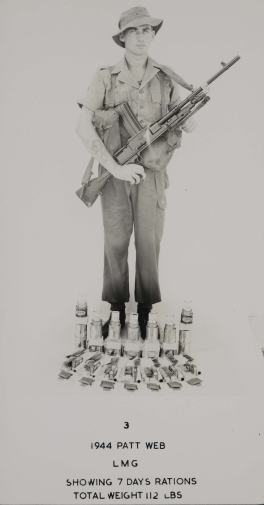
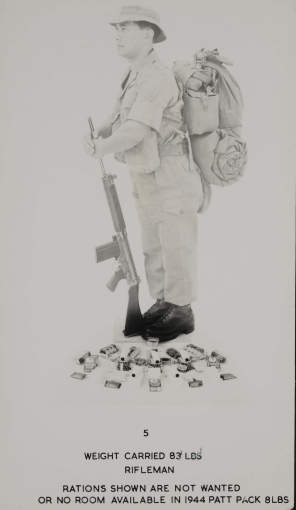
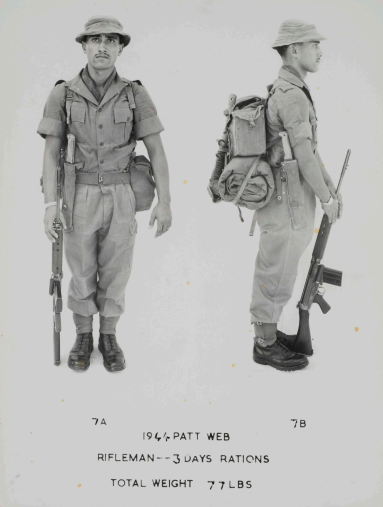
Military Personal Load Carrying Equipment, often referred to in the New Zealand vernacular as “webbing”, is the assortment of belts, straps, pouches and other accessories which, when assembled, allows an individual soldier to easily and comfortably carry the tools of their trade, such as ammunition, rations and water to sustain them for short periods. Many period photos of New Zealand soldiers on operations and training from the Vietnam War era to the 1990s provide the impression of an army equipped with an eclectic range of Australian, British and American equipment. This view of New Zealand’s army’s equipment was partly correct. To see how this view was shaped, this article provides an overview of New Zealand’s military load-carrying equipment evolution from 1945 to 1975.

Commander-in-chief, United States Army of the Pacific, General R.E Haines (right) watching weapon training at Waiouru. 2 May 1970 Evening Post

During World War Two, Operations in Malaya, Burma and the Pacific identified many shortfalls in the suitability of training, tactics and equipment, resulting in the Lethbridge Mission to the Far East during the late war. As a result of the report of the Lethbridge Mission, it was decided to modify the standard 37-pattern equipment to make it lighter in weight, rot-proof and more water-repellent and thus more suitable for use in tropical conditions. This development of the 37-pattern equipment led to the approval of a new pattern known as the 1944-pattern.[1] Post-war, further development of the 37 and 44-Pattern equipment led to troop trials of the Z2 experimental Load Carrying Equipment, which transitioned into the 1958-pattern equipment.[2]

Following World War Two, the Load Carrying Equipment in use by the New Zealand Army was the British 1937-pattern equipment. The 37-pattern equipment was introduced into New Zealand service in 1940, replacing the 1908-pattern equipment that had been in service since 1912. As 37-pattern equipment remained the standard web equipment of the New Zealand Army, the deployment of New Zealand troops to Malaya placed New Zealand in the position of deploying troops to a theatre with equipment that had long been identified as unsuitable. To maintain compatibility with other commonwealth forces in Malaya, 44-pattern equipment from British stocks in Malaya was issued to New Zealand troops in Malaya.

Example of 37-pattern equipment. Image: Simon Moore https://www.youtube.com/watch?v=NwnMIdynO8Y

. Given the environment that New Zealand troops could be expected to operate in and aware of the developments in load-carrying equipment, the New Zealand Chief of General Staff (CGS) requested and received one set of M1956 Web equipment from the United States for trials in 1959.[3]  The American M1956 Load-Carrying Equipment (LCE) had been accepted for United States Army service, with distribution well underway by 1961.

In October 1960, the New Zealand Director of Infantry and Training demonstrated the following web equipment to CGS.

  • 44-pattern Equipment
  • 58-pattern Equipment
  • M1956-pattern Equipment

A report by a New Zealand Officer attached to the Australian Jungle Training Centre at Canungra supported this demonstration with a comprehensive report describing the research and development of Infantry clothing and equipment undertaken by the Australians. The New Zealand report described the Australian trials of the M1956 LCE alongside the 58-pattern equipment. The M1956 was chosen by the Australians, who intended to manufacture it in Australia.[4] However, it was considered unlikely that either the 1956 LCE or 58-pattern equipment would be available to New Zealand until at least 1965, when the initial distribution to the United States and British armies was expected to be completed. Aware that all 44-pattern equipment had been earmarked for use in Malaysia and that it was still in production, New Zealand’s CGS approved the purchase of 6000 sets of 44-pattern equipment to re-equip elements of the New Zealand Army.[5]

Example of 44 pattern equipment, British Corporal, Malaya, Early 1950s. Image Simon Moore https://www.facebook.com/photo/?fbid=2346362332163840&set=a.421629590114595

Following advice from the UK, the 44-pattern equipment in use with the Fare East Land Forces (FARELF) was to be wasted out as the 58-pattern equipment was introduced, implying that the New Zealand Battalion would need to be equipped with the 58-pattern equipment before the ceasing of maintenance of the 44-pattern by FARELF. With this in mind, a recommendation was made to purchase 6000 sets of 58-pattern equipment instead of the 44-pattern equipment.[6]

Example of 58-pattern equipment. Image Simon Moore. https://www.facebook.com/photo?fbid=2080097568790319&set=pcb.2080098398790236

In a June 1961 memorandum to Cabinet, the Minister of Defence highlighted that the current 37-pattern equipment used by the New Zealand Army was not designed for Jungle operations and was unsuitable for carrying the extra equipment the soldier engaged in this type of warfare required. No longer used by the British Army in any part of the world, the stage had been reached where the replacement of the 37-pattern should be delayed no longer. As the 58-pattern could not be made available to New Zealand for some time and field trials had cast doubt on its suitability for use in the Southeast Asia theatre, it was considered that re-equipping of the New Zealand Army should proceed with the 44-pattern equipment. The 44-pattern equipment had proved itself and was known to be suitable in the theatre where New Zealand troops were most likely to be employed. It was assumed that by the time the 44-pattern equipment needed replacement, the full facts on the suitability of the 58-pattern and the M1956 web equipment would be available to make a more informed decision on its adoption by New Zealand. It was recommended that Cabinet approve £45645 plus freight to purchase 6000 sets of 1944 Pattern equipment. [7]

By October 1961, it became clear that the 58-pattern was to be the standard issue web equipment for all United Kingdom forces worldwide and that distribution to the forces in Malaya was to happen much earlier date than earlier expected. Because of this, the Army secretary desired further investigations on the suitability of 58-pattern web equipment and, if favourable, confirm costs and potential delivery dates. With the requirement for web equipment again in flux, the submission to purchase 6000 sets of 44-pattern equipment was withdrawn pending further research.[8]

By May 1962, plans for reorganising the New Zealand Army from a Divisional to Brigade Structure were under implementation.[9]  With approximately 50000 complete sets of 37-pattern equipment distributed to units or held in stores, this was deemed suitable to equip the bulk of the Territorial Force and Training units. The 58-pattern equipment was now in serial production and was the standard issue for all United Kingdom troops, with distribution to operational units in Malaya and Germany underway. Information received earlier was that because of limited production, stocks of 58-pattern would not be available for release to New Zealand for some years had been revised. It was now possible that the release of 58-pattern equipment to meet New Zealand’s requirements could be achieved earlier than anticipated. Based on this revised information, New Zealand’s Cabinet approved funding of £58750 on 10 October 1961 for 6000 sets of 58-pattern Web Equipment. [10]

Before placing a firm order for New Zealand’s requirements of 58-pattern equipment, reports received from Malaya in late 1962 indicated that the 58-Pattern equipment was, in its present form, unsuitable for use in operational conditions in South-East Asia.[11] It was anticipated that modifying the 58-pattern equipment to suit the conditions would take two to three years, an unacceptable delay in procurement as far as New Zealand is concerned.[12]

As the decision on New Zealand’s web equipment remained in flux, the New Zealand Battalion in Malaysia continued to be equipped with the 44-pattern equipment maintained under a capitation agreement with the United Kingdom. At New Zealand’s expense, one hundred sets of 44-pattern equipment were also maintained at New Zealand Battalion Depot at Burnham Camp to support reinforcements.

M1956 Web Equipment

As the time factor involved in modifying the 58-pattern equipment was unacceptable, and New Zealand was receiving an increasing amount of American equipment, the American M1956 pattern web equipment was decided to trial. The M1956 equipment had already been introduced into the Australian army, so twenty sets were purchased from Australian stocks for New Zealand’s trials.[13]

Following user experience in Malaya revealing that the 58-pattern equipment was falling short of the requirements for jungle operations, a series of investigations and user trials established that the US M1956 pattern equipment was suitable for use by the New Zealand Army. The funding for 6000 sets of 58-pattern Web Equipment was requested to be reprioritised to purchase 10000 sets of M1956 equipment direct from the United States and 400 sets of 44-pattern equipment to equip the increment for the FARELF held in New Zealand.[14]

With funding endorsed by the Minster of Defence and approved by the Cabinet, orders were placed for 10000 sets of M1956 web equipment direct from the United States. The first consignment arrived in New Zealand in early 1964, with 289 sets immediately issued to the New Zealand Special Air Service (NZSAS) and 16 Field Regiment, Royal New Zealand Artillery.

Instructions for distributing the M1956 web equipment were issued in June 1964 by the Quartermaster General. The initial purchase of 10000 sets of M1956 web equipment was to be issued to the Combat Brigade Group (CBG) and Logistic Support Group (LSG) units. Units of the Combat Reserve Brigade Group (CRBG) and Static Support Force (SSF) were to continue to use the 37-patten webbing.

 NMDCMDMOD (for CMD Trentham UnitsSMDMOD StockIssued SAS/ 16 Fd Regiment
CBG & LSG312230304012028310289
1st Reinforcement Reserve3162606198  
School of Infantry 40    
TOTAL343833304072226310289

As the issue of M1956 equipment progressed, units of the CBG and LSG were to hand back stocks of 37-pattern equipment to their supporting District Ordnance Depot except for

  • 08-pattern packs and straps
  • 37-pattern belt, waist web
  • Frogs bayonet No 5[15]

The 37 Pattern belt, waist web, was to be retained by all ranks as a personal issue authorised by NZP1 Scales 1, 5, 8 or 9. The belt and bayonet frog were to be worn with Nos 2A, 64, 6B, 7A and 7B orders of dress when other equipment items were not required to be worn.

Equipment Maintenance Policy Statement (EMPS) 138/67 issued by Army Headquarters on 20 November 1964 detailed that except for the CBG and LSG, 16000 sets of 37-pattern equipment were to be maintained for use by remaining elements of the New Zealand Army.[16]  EMPS 145/65 was issued on 12 February 1965, detailing the management of 44-pattern equipment in New Zealand. The First Battalion of the Royal New Zealand Infantry Regiment (1RNZIR) in Malaysia was to remain equipped with the 44-pattern web equipment maintained by the UK under the existing capitation agreement. Other than 100 sets of 44 Pattern Web equipment maintained at the Battalion Depot in Burnham, there was no provision for equipping 1RNZIR Reinforcements and increments of 31 Medium Radio Sub Troop who could be expected to deploy to Malaysia at any time. EMPS 145/65 rectified this by establishing a stockholding of 400 sets of 44-pattern equipment at the Main Ordnance Depot (MOD) at Trentham

Approval was granted in November 1965 by Army HQ for the Royal New Zealand Armoured Corps (RNZAC) and NZSAS to blacken their M1956 web equipment. The Royal New Zealand Provost Corps (RNZ Pro) was also approved to whiten their M1956 web equipment. This approval only applied to unit holdings, not RNZAC, NZSAS or NZ Pro members attached or posted to other units.[17]

By April 1967, most of the New Zealand Army was equipped with the M1956 equipment. The exceptions were.

  • The New Zealand Forces in Malaysia and South Vietnam, who used both the M1956 and 44-pattern equipment
  • The SSF, National Service Training Unit (NTSU) and New Zeeland Cadet Corps (NZCC), who still retained the 37-pattern equipment

The manufacture of 37-pattern equipment had long been discontinued, and New Zealand stocks had reached the point where although having considerable holdings of individual items, based on the belts as the critical item, only 9500 sets of 37-pattern equipment could be assembled.

Based on the projected five-year supply to the NTSU, Army Schools, Camps and the NZCC plus 10% maintenance per annum, there was a requirement for 12000 sets of 37-pattern equipment. Arranging production to meet the shortfalls was deemed cost-prohibitive, and as continued maintenance could not be guaranteed, it was decided that additional sets of M1956 equipment were to be purchased. The additional sets were to be purchased on a phased program over several financial years, with 5000 sets of 37-pattern retained for the NZCC.

Disposal of the 37-pattern was to be phased over three years.

  • 1967 all items surplus to 9500 sets
  • 1968 3000 Complete sets
  • 1969 all remaining 37 Pattern equipment less 5000 sets for the NZCC.[18]

M1967 Modernized Load-Carrying Equipment (MLCE)

In 1967 the New Zealand Army trialled three sets of the M1967 Modernized Load-Carrying Equipment (MLCE). Not specifically designed to replace the M1956 equipment, the M1967 equipment was designed for use in tropical environments and was introduced into the United States Army service in 1968.

The New Zealand trials found that the M1967 equipment was comfortable and weight-wise was similar to other web equipment in use. The pack worn on the belt was found to be heavy when fully loaded, and a pack similar in size to the 44 Pattern should be introduced, and the belt pack reduced in size by one-third.

It was identified that all the pouches required stiffening and that the plastic fasteners were not firmly attached to the pouches, although easy to operate. While using Velcro was found simple to operate, it was seen as a disadvantage due to noise and its inclination to pull apart when wet or under stress.[19]

Although the M1956 was still being introduced into the New Zealand Army, limited quantities of the M1967 equipment were introduced from 1969-72 with no plans for large-scale procurement. Nevertheless, the design of the M1972 All-Purpose Lightweight Individual Carrying Equipment (ALICE) incorporated many of the features of the M1967 equipment, and it was introduced into the New Zealand Army service in the 1980s.

Example of M-1967 MLCE. Image Simon Moore https://www.youtube.com/watch?v=Pwj59bifFMk

Although the 44-pattern web equipment continued to be used by New Zealand units in Southeast Asia, by October 1967, the decision had been made to standardise the M1956 equipment across the New Zealand Army, and no stocks of the 44-pattern equipment were to be retained in New Zealand.   All stocks of 44-pattern web equipment held by the MOD in Trentham for 1RNZIR Reinforcements and increments of 31 Medium Radio Sub Troop were issued to 1 RNZIR based at Terendak camp in Malaysia. As this stock held by 1RNZIR was wasted out, it would be replaced by M1956 web equipment. [20]

Large Ammunition Pouches

The Australian experience had shown that although the L1A1 Self Loading Rifle (SLR) Magazines fitted inside the M1956 ammunition pouch, it was a tight fit, especially when the webbing was wet. The initial solution was to modify 37-pattern pouches and fit them to the M1956 equipment. By 1967 the Australians had developed an indigenous ammunition pouch for the M1956 equipment., The Australian Ammunition Pouch Large (8465-66-026-1864) was manufactured out of cotton duck material and measured 81/4 inches high by 4 inches wide and 3 inches deep.

Australian Pouch Ammunition Large

To ascertain the suitability of the Australian large ammunition pouch for New Zealand service, fifty Australian pouches were sourced as a standardisation loan in 1968.[21] Feedback for the troop trials identified a lack of stability in the closure of the lid, causing the loss of ammunition and magazines. Following an investigation by the R&D Section, the RNZAOC Textile Repair Sections (TRS) modified the Australian pouches by replacing the lid fasteners with the same fasteners found on the standard American M1956 pouch and stiffing the fastener tabs. The modifications proved satisfactory in further Army Trials, and a new specification (DRDS-ICE-1) was produced with four Standard Samples provided to 1 Base Ordnance Depot (1 BOD).[22]  The modified New Zealand Pouch was codified in the New Zealand supply system as Pouch Ammunition Large (6746-98-103-4039).[23]

Detail of New Zealand Large Ammunition Pouch riveted lid fasteners

Although the R&D Section had ascertained that the manufacture of the pouches was possible in New Zealand using imported components, the initial production run of 20000 pouches was contracted through the Australian Department of Supply to be included in the current Australian production run.[24]  By 1974 the first production run of 20000 had been completed and returned to 1 BOD for distribution, with 2/1 RNZIR in Burnham one of the first units to receive the new pouches. In May 1974, 2/1 RNZIR submitted defect reports stating that the pouches were poorly designed, with the canvas tongue used to secure the lid failing, pouches becoming insecure, and magazines dropping out.[25]

The investigation by the Directorate of Equipment Policy and the R&D Section found that the faults were not a design problem but a quality assurance issue in that the pouches had not been manufactured following the specification.[26]   Comparing the Australian-manufactured pouches against the specification, the R&D Section identified the following visually detected defects.

  1. Canvas used to manufacture strap-holding assembly instead of webbing.
  2. Clip end strap is wrongly sized.
  3. Release tab is of incorrect thickness.
  4. Polypropylene stiffener not inserted in release tab.
  5. The male fastener is not secured to the PVC stiffener.
  6. The reinforcement piece behind the male fastener is not included (between the PVC stiffener and lining).
  7. Additional smaller reinforcement piece inserted between the outer cover and the male fastener.
  8. Broad arrow marked on the outer cover and not specified.

Of these defects, only serials 3 to 7 were directly considered to contribute to the deficiencies and the initial concerns raised by 2/1RNZIR and would require rectification, and a modification instruction was produced.[27]  Modification of the pouches would take until September 1977 to be completed.[28]

Due to the Broad Arrow Mark included on the first batch of 20000 New Zealand Large Ammunition Pouches, collectors often misidentify these items as Australian pouches.

White Web

By 1973, 37-pattern belts, rifle slings and bayonet frogs remained in use as ceremonial items. Whitened using proprietary shoe cleaner and paint, these items were badly worn with the whitener flaking easily and were easily marked by weather, fingerprints and the rubbing of other equipment. The M1956 pattern web belt was not considered suitable as a replacement as it was operational equipment requiring the breaking up of complete web sets to provide items for ceremonial events. Following the British lead, the Army Dress Committee approved a polythene, four-ply woven fabric of similar appearance and texture to the 37-pattern equipment in October 1973 as a replacement for the whitened 37-pattern equipment. The sling and bayonet frog designed for the SLR would be purchased with chromed or brass fittings. The material for the belts was provided on rolls which could be cut to the required size. Buckles and keepers were 37-pattern buckles and keepers drawn from existing stocks that had been chromed and polished.[29]

Combat Pack

By 1974, one of the few pre-1945 items of load-carrying equipment remaining in New Zealand service was the 08-pattern pack. Long identified as an unsuitable item, several trials had been conducted since the mid-1960s to find a replacement combat pack. Although a few alternative items had been investigated as a replacement, the 08-pattern pack remained the principal combat pack of the New Zealand Army.

In 1969/70, the requirement for 15000 combat packs to replace the 08-pattern pack was identified. Following evaluation by the equipment sponsor, the Australian Army Combat Pack was selected as a basis for developing a New Zealand combat pack. The Australian pack was chosen from a wide range of military and civilian packs, with the design modified to meet the particular training requirements of New Zealand. The modifications to the Australian pack were limited to comply with the following:

  • The pack must be compatible with Australian Army equipment.
  • The pack must be compatible with M1956 equipment currently in New Zealand service.

Against the advice of the R&D section, the Australian pack was modified by the New Zealand Army without a proper study being conducted.[30] The decision to bypass the R&D process resulted in a prototype process that extended from 1972 to 1974.[31] By June 1974, trials on the prototypes resulted in the setting of a standard design for a production run of one hundred packs for further trials.[32]

New Zealand modified Combat pack

The New Zealand version of the Australian combat pack was eventually accepted into service in 1975/76. Never a satisfactory pack, the R&D section began investigations to find a replacement in the early 1980s. Hoping to leverage the experience of New Zealand Mountaineers to produce a modern pack, Army R&D embarked on the Onward Pack project. Manufactured by Hallmark Industries of Hamilton, the Onward pack was an innovative modular design that allowed the main pack to be broken down into a patrol pack and a light belt order,

The Basic layout of the Onwards pack was a main compartment divided into a main compartment and a sleeping bag compartment divided by a zip-away divider. The upper compartment was divided into the main storage area and internal space for an AN/PPC-77 set. External access to the main compartment was via a large snow collar with outlets for the radio antenna and handset built into the lid. External access to the lower sleeping bag section was provided by a zip which allowed the bottom half of the compartment to drop down. Internal sleeping mat storage was included as part of the harness and backpack. Three external removal pouches were provided, one on each side attached by domes and a larger pouch mounted on the centre front of the pack by buckles body. Behind the Large centre pouch, securing straps were provided to secure an Entrenching Tool. These three external pouches were fitted with belt loops, which allowed them to be removed and fitted to either the pack’s waist belt or standard pistol belt as a light belt order.

A small patrol pack designed to hold an ANPRC-77 Set was also provided as part of the Onward pack., The patrol pack could be mounted to the top of the Onward Pack or by utilising the pack’s shoulder straps, worn as a standalone pack. The Patrol pack was also fitted with a fluorescent recognition panel in a zip-up compartment.

Despite the host of features and the additional space provided compared to the Australian pack, the Onward Pack was fraught with issues. The proprietary plastic clips were prone to failure, and the body-hugging ‘alpine’ design caused causing severe prickly heat on users in the tropics of Southeast Asia. These and other issues with the Onward Pack contributed to an extended development period as attempts were made to rectify them. As these and other minor faults were addressed to meet the immediate needs of users while the Onward Pack was perfected, the medium American ALICE pack was introduced as an interim replacement in 1984.[33] Eventually, attempts to rectify the Onward Pack were abandoned and the ALICE pack was formally adopted as the New Zealand Army pack.

Conclusion

Entering the Second World War with web equipment of the same pattern used since 1912, New Zealand’s Force soon began to be re-equipped with the most modern British web equipment, the 37-pattern from early 1940. Near the end of the war, New Zealand was kept abreast of the development of web equipment, and when New Zealand troops arrived in Malaya in the early 1950s, they were issued with the most modern type available for jungle warfare, the 44-pattern. As the New Zealand Army reorientated from providing a division to serve in the Middle East to providing a Brigade Group to serve in Southeast Asia, it could not wait for the British to develop their new 58-pattern for tropical conditions and examine other types. Following Australia’s lead, the American M1959 equipment was adopted in 1964, with components of this type serving thought to the early 2000s. With five types of web equipment either adopted or trialled between 1945 and 1974, it is no surprise that components got intermingled. This led to Kiwi soldiers’ preferences and experiences leading them to create webbing sets that they found practicable rather than options prescribed in SOPs or instruction books leading to the outside impression of the New Zealand army been one equipped with an eclectic range of Australian, British and American equipment.


Notes

[1] 86/Development/47 (SWV1) Report on the Development of Personnel Fighting and Load Carrying Equipment 1942-48 February 1949. “Cookers – Web Equipment: New Pattern,” Archives New Zealand No R17189098 (1944 -1966).

[2] 86/Dev/54 (SVW1) Instruction for troop trials of Z2 Experimental Load Carrying Equipment ibid.

[3] New Zealand Joint Services Mission Washington DC JSM 1/3/13 ARM US Army Load Carrying Equipment (Web) dated 23 September 1959ibid.

[4] Attachment to JTC – Canungra dated 21 October 1960 “Stores – New Infantry Equipment for New Zealand Army,” Archives New Zealand No R17189007 (1959-1970).

[5] Army 246/60/12/SD Web Equipment dated 20 December 1960 “Cookers – Web Equipment: New Pattern.”

[6] Army 246/60/12/SD Web Equipment dated 20 December 1960ibid.

[7] Memorandum Minister of Defence to Cabinet dated June 1961ibid.

[8] 246/60/12/adm Army Secretary to Minister of Defence 2 October 1961ibid.

[9] Damien Fenton, A False Sense of Security: The Force Structure of the New Zealand Army 1946-1978, Occasional Paper / Centre for Strategic Studies: New Zealand: No. 1 (Centre for Strategic Studies: New Zealand, Victoria University of Wellington, 1998), 111-20.

[10] Army 246/60/12/Q(E) Brigade Group Equipment Replacement Web Equipment dated 8 May 1962 “Cookers – Web Equipment: New Pattern.” -pattern equipment

[11] BM 2 to FE16002SD General HQ FELF to The War Office (Brig Q Eqpt) 1958 Pattern Web Equipment dated 4 October 1962: ibid.

[12] 57/62 NZ Army Liaison Staff, London to Army HQ dated 17 October 1962 ibid.

[13] Army 246/60/12Q(E) Sample US Pattern Web Equipment dated 12 December 1962 ibid.

[14] 246/60/12/SD Web Equipment for the Field Force dated 18 October 1963 ibid.

[15] Army Reqn 208/63/Q(E) dated 9 June 1964 -Distribution of M1956 Web Equipment “Cookers – Web Equipment: Pattern ’37,” Archives New Zealand No R17189095 (1940-1971).

[16] EMPS 138/64 of 20 Nov 1964 ibid.

[17] Army HQ Army246/60/12/PS3 of 19 Nov 1965 ibid.

[18] Defence (Army) 246/60/2 of 26 April 1967 ibid.

[19] 1 Ranger Squadron NZSAS, Trial Report US Lightweight Equipment dated 21 March 1968″Cookers – Web Equipment: New Pattern,” Archives New Zealand No R17189099 (1966 -1969).

[20] Army 246/60/12/Q(E) EMPS 145/65 Frist Revise dated 5 October 1967 ibid.

[21] “Cookers  – Web Equipment: Slings, Bandoliers, Ammunition Pouches: Development,” Archives New Zealand No R17189101 (1968-1970).

[22] Def HQ/R&D Section 82/1974 dated 28 Jun 1974.”Equipment Administration: Research & Development – Projects Personal Load Carrying Equipment: Ammunition Pouches,” Archives New Zealand No R17231111 (1972-1977).

[23] 246/60/2 of 122055ZNOV70 NZDWN to 1BOD Trentham “Cookers – Web Equipment: Pattern ’37.”

[24] Army 246/60/70 dated 9 December 1971. “Equipment Administration: Research & Development – Projects Personal Load Carrying Equipment: Ammunition Pouches.”

[25] FF 65/38/18/SD Modification of Ammunition Pouch item 10 May 1974. “Cookers – Web Equipment: New Pattern.”

[26] Army 246/60/17/EP. “Equipment Administration: Research & Development – Projects Personal Load Carrying Equipment: Ammunition Pouches.”

[27] R&D Section Minute no 160/1975 dated 21 November 1975. “Cookers – Web Equipment: New Pattern.”

[28] Army 246/60/17/SP 22 Pouches Ammunition 22 September 1977. “Cookers – Web Equipment: New Pattern.”

[29] “Army Dress Committee Decision – White Web,” Archives New Zealand No R17188112 (1973).

[30]  R&D Section 67/1974 Packs Combat date 13 June 1974. “Equipment Administration: Research & Development – Projects Personal Load Carrying Equipment: Waterproof Pack,” Archives New Zealand No R17231110 (1972-1974).

[31] Army 246/60/12/EP Sponsor Enquiry Field Pack Olive Green 2 July 1972. Ibid.

[32] Army 246/60/12/ EP Minutes of the final meeting on the acceptance of the Combat Pack held at Army General Staff on 8 June 1973. “Conferences – Policy and General – NZ Army Dress Committee 1984,” Archives New Zealand No R17311893 (1984).

[33] Inf 26.3 Minutes of a meeting to consider Project Foxhound developments held at Army General Staff 8 June 1984. Ibid.


Puggarees of New Zealand’s Logistic Corps

From 1912 to 1958, the sight of New Zealand Soldiers in felt slouch hats was commonplace. In addition to providing a practical form of headdress, the use of a coloured headband known as a Puggaree allowed easy identification of the Regiment or Corps of the wearer.

Origins

The Puggaree origins lay in the Hindu word, ‘Pagri,’ which is used to describe a wide range of traditional headwear worn by men and women throughout the Indian Sub-Continent, one of the most recognisable being the Dustaar or Sikh turban.

Soldiers, by their nature, are creatures of innovation and British troops serving India soon found that by wrapping a thin scarf of muslin around their headdress, not only could additional protection from sword blows be provided, but the thin cloth scarf could also be unravelled to provide insulation from the heat of the sun. Like many Indian words, “Pagri” became anglicised into Puggaree.

By the 1870s, the practical use of the Puggaree had become secondary, and the Puggaree evolved into a decorative item on British Army headdress, which, when used with a combination of colours, could be used to distinguish regiments and corps. First used by New Zealanders in the South African war, the use of Puggaree on slouch hats was formalised in the New Zealand Army 1912 Dress Regulations. These regulations detailed the colours of the distinctive Puggaree used to indicate different service branches. Although not stated in the 1912 regulations, the design of New Zealand puggarees was based on three pleats of Khaki/Branch colour/Khaki. The exception was the Artillery puggaree. The puggaree colours detailed in the 1912 regulations were

  • Mounted Rifles – Khaki/Green/Khaki)
  • Artillery –Blue/Red/Blue
  • Infantry – Khaki/Red/Khaki
  • Engineers – Khaki/Blue/Khaki
  • Army Service Corps – Khaki/White/Khaki
  • Medical corps –Khaki/Dull-Cheery /Khaki
  • Veterinary Corps – Khaki/Maroon/Khaki[1]

When first New Zealand troops went overseas in 1914, the NZ Slouch hat was a headdress that had been first used in the South Africa War and had a crease running down the crown from front to rear. From 1914 the Wellington Battalion wore their hats with the crown peaked, and after a short period where cork helmets were also worn, General Godley issued a directive that all troops, other than the Mounted Rifles, would wear the slouch hat with the crown peaked, in what became known as the “Lemon Squeezer”.[2]

Worn with both the Mounted Rifles Slouch hat and the Lemon Squeezer, the Puggaree became a distinctive mark of the New Zealand soldier, identifying them as distinct from soldiers from other parts of the Empire, although Australian and Canada would both use coloured Puggaree on their respective headdress, it was not to the same extent as New Zealand.[3] From 1917 the New Zealand puggaree also proved helpful in distinguishing New Zealand troops from the Americans, who wore headwear similar to the New Zealand Lemon Squeezer hat.[4]

Following the First World War, Dress regulations published in 1923 detailed an increased range of puggarees available to identify the other corps added to the army establishment during the war.

  • Permanent Staff – Scarlet
  • Mounted Rifles – Khaki/Green/Khaki)
  • Artillery –Blue/Red/Blue
  • Engineers – Khaki/Blue/Khaki
  • Signal Corps – Khaki/Light blue/Khaki
  • Infantry – Khaki/Red/Khaki
  • Army Service Corps – Khaki/White/Khaki
  • Medical Corps –Khaki/Dull-Cheery /Khaki
  • Veterinary Corps – Khaki/Maroon/Khaki
  • Ordnance Corps – Red/Blue/Red
  • Pay Corps – Khaki/Yellow/Khaki
  • Cadets – Khaki
  • Chaplains – Black/khaki/Black[5]

A common feature of military dress embellishments was that often there was a high-quality version made for officers and a lesser quality version for the Rank and file, with puggarees also adhering to this practice. Requestions for puggarees from 1943 indicate that the following corps and regiments utilised officer puggarees.

  • Artillery
  • Engineers
  • Infantry
  • Army Service Corps
  • Medical Corps
Example of Infantry Officers Puggaree (Top) and Infantry Rank and File Puggaree (Bottom)

The felt slouch hat and Puggaree would remain a fixture of the New Zealand Army until 1958, when the Lemon Squeezer was withdrawn from services and replaced with a new and unpopular Battle Dress cap. The lemon squeezer style felt hat returned serviced in 1977 as a ceremonial item with a plain red puggaree. The Mounted Rifles style slouch hat returned to service with Queen Alexandra’s Mounted Rifles (QAMR) in 1993 with the traditional Mounted Rifles khaki/green/khaki puggaree.

The Mounted Rifles hat with the Mounted Rifles khaki/green/khaki puggaree was adopted as headwear across the New Zealand Army from 1998 to 2012. However, corps puggarees were not reintroduced, becoming the standard army puggaree, with some units utilising coloured patches affixed to the Puggaree as unit identifiers.

In the forty-six years from 1912 to 1958 that puggarees were utilised as a uniform item, each corps adopted different coloured combinations. However, this article focuses on the use and history of Puggarees by New Zealand’s Logistic Corps,

•             The Royal New Zealand Army Service Corps

•             The Royal New Zealand Army Ordnance Corps,

•             The Royal New Zealand Electrical and Mechanical Engineers and

•             The Royal New Zealand Army Logistic Regiment.

Puggarees of the Royal New Zealand Army Service Corps

The origins of the Royal New Zealand Army Service Corps (RNZASC) puggarees are established in the Regulations of 1912. The RNZASC wore the Khaki/White/Khaki puggarees through the First World War and into the interbellum period.

New Zealand Army Service Corps Puggaree. Robert McKie collection

On 1 June 1924, the NZASC was split into the New Zealand Permanent Army Service Corps, consisting of the Regular ASC NCOs and soldiers, and the NZASC consisting of the Territorial Officers, NCOs and Soldiers.[6] The only uniform difference between the NZPASC and NZASC were their respective brass shoulder titles, with both branches retaining the Khaki/White/Khaki Puggaree

During the Second World War, the NZASC Khaki/White/Khaki remained in use throughout the war

In late 1942, 2NZEF placed a requisition on New Zealand to manufacture 50,000 Officer and Rank and File hat bands (puggarees) for all the different units of the NZEF. As the 3rd Division was in the process of standing up in New Zealand, the Ministry of Supply increased the requestion to 60,100, including

  • 10,000 NZASC Rank and File puggarees, and
  • 1000 NZASC Officer puggarees. [7]
NZASC Puggaree Size Ranges ordered 1943

In early 1944 the decision was made by 2NZEF to replace the lemon squeezer hat with more practical forms of dress, and the requirement for puggarees was adjusted. Considering puggarees already manufactured and the requirement for puggarees by forces in New Zealand and the Pacific, 14590 puggarees from the original order of 61,100 were cancelled.[8] 760 Rank and files NZASC puggarees had already been manufactured, so based on revised calculations, the NZASC order was reduced to 6000 Rank and file and 300 Officer puggarees. [9]

The NZPASC and NZASC were reconstituted on 12 January 1947 and a combined regular and Territorial NZASC, retaining the use of the Khaki/White/Khaki puggaree.[10]

The NZASC was granted royal status on 12 July 1947, becoming the Royal New Zealand Army Service Corps.[11]

Puggarees of the Royal New Zealand Army Ordnance Corps

The New Zealand Army Ordnance Corps (NZAOC) was formed as a unit of the NZEF in early 1915 and established as a unit of the New Zealand Permanent Forces in 1917. It is assumed that as a new unit, a distinctive puggaree was adopted for the NZAOC, but the limited photographs of NZAOC personnel are black and white, making identification of colours difficult.

A Newspaper article from December 1918 does provide evidence that an Ordnance puggaree of red/blue/red existed. The article published in the Press on 5 December 1918 stated, “There are only two units in the New Zealand Division with red in the puggaree. They are the Artillery and Ordnance, and in both units, the colours are red and blue”. This sentence identifies that the Ordnance Puggaree was red and blue.[12]

Ordnance Puggaree, RNZAOC 1947-53 Badge. Robert McKie collection

The NZAOC red/blue/red Puggaree was formalised as the Puggaree of the NZAOC in 1923 when the New Zealand Army updated its Dress Regulations for the first time since 1912.[13]

By October 1939, the expansion of the NZAOC and formation of the New Zealand Ordnance Corps (NZOC) for service with the 2nd NZEF created a requirement for NZAOC puggarees that could not be satisfied from stocks held by the Main Ordnance Depot. An urgent order was raised for 288 NZAOC puggarees

As part of the 2NZEF requestion of 1942, orders to manufacture 2200 NZAOC puggarees were raised.

NZAOC Puggaree Size Ranges ordered 1943

By 1944, 270 NZAOC puggarees had been manufactured and delivered, and despite the order quantities for other corps being reduced, some adjustment was made to the size range required, and the remaining 1930 NZAOC puggarees were manufactured.   

Puggarees of the Royal New Zealand Electrical and Mechanical Engineers

The youngest of the three New Zealand logistic corps, the Royal New Zealand Electrical and Mechanical Engineers (RNZEME), progressively evolved into a corps from 1942 in three stages.

  • The New Zealand Electrical and Mechanical Engineers (NZEME) formed as a unit of the 2nd NZEF in November 1942.[14]
  • The formation of the NZEME as a new unit of New Zealand’s Permanent Forces on 1 September 1946, amalgamating and co-ordinating ordnance workshops, mechanical transport workshops, and armourers’ workshops, which in the past have been under separate command.[15]
  • The granting of “Royal” status on 12 July 1947.[16]

As the RNZEME established itself as a Corps, it utilised three types of Puggaree.

Red/Blue/Red Puggaree

As a corps predominantly drawn from the NZAOC, on its establishment in 1946, the NZEME adopted the existing NZAOC Red/Blue/Red Puggaree and NZOC badge. This was a temporary measure until NZEME Puggaree and badges were manufactured.[17]

NZ Ordnance Puggaree with NZOC Badge

Red/Green/Red Puggaree

By 1948 a distinctive Red/Green/Red puggaree with its origins in the NZEME of 2NZEF had replaced the NZAOC Puggaree.

NZEME pattern Puggaree. Robert.McKie Collection

As part of the 2NZEF requestion of 1942, orders were raised for 3000 puggarees for the NZEME.[18]

NZAOC Puggaree Size Ranges ordered 1943

As the NZEME puggaree was a new pattern, its design was described

  • Shades of red material as per Kaiapoi pattern range 7443x (as used in Artillery and Infantry bands).
  • Shades of green material as per Kaiapoi pattern range 18153B 9 (as used in NZMR bands).

The NZEME puggarees were not included in the reduction and cancellation of the 1943 order, and it can be assumed that the complete order of 3000 was manufactured and placed into storage at the Main Ordnance Depot. [19]  A 1945 report places the cost of a dozen NZEME puggarees at £1.3.0 (2022 NZD $107.07).[20]

Blue/Yellow/ Red Puggaree

By 1948 the RNZEME decided to update their Puggaree with one that reflected their corps colours of blue, yellow and red, with an order for 4000 placed on the Kaiapoi Woollen Manufacturing Company. With competing manufacturing demands, the Kaiapoi Woollen Manufacturing Company could not satisfy this order but could provide the required materials. In June 1949, the War Asset Realisation Board District Officer in Auckland selected a Mrs V.I Banton of 117 Lynwood Road, New Lynn, to manufacture the RNZEME puggarees. At the cost of 1/6 each (2022 NZD $6.65). [21]

RNZEME Puggaree. Robert McKie collection

With the initial order for 4000 paced in June 1949, it was not until January 1950 that Mrs Banton provided suitable samples that met the required specifications to allow her to begin production, with the first batch of 704 provided in April 1950.

With the new RNZEME puggaree becoming available, the question of how to dispose of the 1800 red/green/red pattern NZEME puggarees in the Ordnance clothing stores was raised.

It would not be a case of a new pattern in, old pattern out, but one where the old pattern was to be progressively wasted out as stocks of the new pattern became available. The priority was to be RNZEME Territorials Force units first, then distributed to RNZEME Regular Forces units.[22] Photographic evidence suggests that the transition from the NZEME puggaree to the RNZEME Puggaree had been completed by 1951.

Farewell to the Puggaree

A 1947 survey of New Zealand Soldiers found that the Lemon Squeezer was the most popular form of headdress utilised by the New Zealand Army.[23] However, it was not the most suitable type of headdress, and for many of the same reasons 2NZEF discontinued its use during the war, the army began to look for a replacement.

In 1954 the Cap Battledress (Cap BD), commonly referred to as the Ski Cap, was introduced into service. The Cap BD progressively replaced the Lemon squeezer so that by 1960 except for its use by the New Zealand Artillery Band, the Lemon squeezer ceased to be an official uniform item of the New Zealand Army.[24]

NZ Army Cap Battledress (Cap BD), introduced in 1954, was withdrawn from service in 1964. Robert Mckie Collection

With several thousand unused puggarees sitting in Ordnance Depots as now dead stock, unlikely to ever be issued, Army HQ issued instructions that except for  150 RNZA Puggarees of a balanced size range, all other stocks were to be destroyed.[25]  By August 1961, all stocks of puggarees had been destroyed.[26]

The Lemon Squeezer was reintroduced as a ceremonial headdress in 1977, utilising the red Puggaree utilised by the Staff Corps, Permanent Staff and 1953 Coronation Contingent.

Puggaree of the Royal New Zealand Army Logistic Regiment

The Royal New Zealand Army Logistic Regiment (RNZALR) was established in 1996 by amalgamating the Royal New Zealand Corps of Transport, RNZAOC and RNZEME while also absorbing all the All Arms Quartermaster Storekeepers from every corps of the New Zealand Army. A diverse regiment of officers and soldiers from across the army, a means to shape the regiment’s heritage and acknowledge the importance of its and predecessors’ role, was required. An opportunity to coalesce the RNZALR was provided in 1998.

In 1998, the RNZALR was presented with a banner providing a regimental focal point. Several unique dress items, including a puggaree, were introduced to provide the RNZALR Banner escort party with distinctive RNZALR dress embellishments. Missing the opportunity to adopt a new puggaree that reflected the role that the RNZALR’s predecessors had performed with courage and resilience in the past, the leadership of the RNZALR took the cautious and lazy option of adopting a Puggaree with no connection to the legacy corps. The Puggaree adopted was a  blue puggaree, last been utilised by the NZ Provosts in the First World War.

Also, in 1998 the New Zealand Army reintroduced the Mounted Rifles Felt hat as an item of headdress across the army. Already in service with QAMR since 1993, the Mounted Rifles hat retained the Mounted Rifles Khaki/Green/Khaki puggaree. The reintroduction of the Mounted Rifles hat could also be considered a missed opportunity by the leadership of the RNZALR for not advocating the adoption of a unique RNZALR puggaree to be worn by RNZALR units. A compromise was provided through the adoption of a unit flashed affixed to the left side of the Puggaree. While retained by QAMR, the Mounted Rifles hat was withdrawn from general army use in 2012.

In conclusion, the demise of the coloured Puggaree in 1958 removed a valuable means of identifying soldiers and their units. It was an embellishment that by 1970 was missed, and to fill the gap, some corps lobbied for the introduction of corps lanyards while others introduced regimental stable belts. The opportunity was open to reintroducing regimental Puggarees between 1998 and 2022. However, this was missed. Today Puggarres are a reminder of a time of more colourful uniform embellishments and a curiosity for collectors of militaria.


Notes

[1] New Zealand Military Forces Dress Regulations, ed. New Zealand Military Forces (Wellington, 1912). https://rnzaoc.com/wp-content/uploads/2018/08/1923-nz-army-dress-regs.pdf; “Formation of New Unit and Corps, Constitution of Generals’ List and Colonels’ List, Amalgamation, Redesignation, and· Disbanding of Corps, New Zealand Military Forces,” New Zealand Gazette No 2, 11 January 1947, http://www.nzlii.org/nz/other/nz_gazette/1947/2.pdf.

[2] D. A. Corbett, The regimental badges of New Zealand: an illustrated history of the badges and insignia worn by the New Zealand Army (Auckland, NZ: Ray Richards, 1980 Revised enl. edition, 1980), Non-fiction, 47-48.

[3] “Local And General,” Dominion, Volume 9, Issue 2610,, 4 November 1915, https://paperspast.natlib.govt.nz/newspapers/DOM19151104.2.38.

[4] “Visit to Paris,” North Otago Times, Volume CV, Issue 14001, 11 December 1917, https://paperspast.natlib.govt.nz/newspapers/NOT19171211.2.58.

[5] New Zealand Military Forces Dress Regulations, ed. New Zealand Military Forces (Wellington, 1923). https://rnzaoc.com/wp-content/uploads/2018/08/1923-nz-army-dress-regs.pdf.

[6] “Formation of New Zealand Permanent Army Service Corps.,” New Zealand Gazette No 46, July 3 1924, http://www.nzlii.org/nz/other/nz_gazette/1924/46.pdf.

[7] Main Ordnance Depot O.S.56/40/1/2499 Dated 28 June 1943. “Clothing: Felt Hats, Bands: Provision,” Archives New Zealand No R17187892  (1939).

[8] Chief Ordnance Officer 56/40/1/439 Dated 14 April 1944 “Clothing: Felt Hats, Bands: Provision.”

[9] Chief Ordnance Officer 56/40/1/439 Dated 14 April 1944 “Clothing: Felt Hats, Bands: Provision.”

[10] “Formation of New Unit and Corps, Constitution of Generals’ List and Colonels’ List, Amalgamation, Redesignation, and· Disbanding of Corps, New Zealand Military Forces.”

[11] “Designation of Corps of New Zealand Military Forces altered and Title ” Royal ” added,” New Zealand Gazette No 39, 17 July 1947, http://www.nzlii.org/nz/other/nz_gazette/1947/39.pdf.

[12] “Soldiers and Dress – Ordnance Pugaree,” Press, Volume LIV, Issue 16387 (Christchurch), 5 December 1918, https://paperspast.natlib.govt.nz/newspapers/CHP19181205.2.6.1.

[13] New Zealand Military Forces Dress Regulations.

[14] Peter Cooke, Warrior Craftsmen, RNZEME 1942-1996 (Wellington: Defense of New Zealand Study Group, 2017).

[15];”Formation of Unit of the New Zealand Permanent Force,” New Zealand Gazette No 60, 29 August 1946, 1199, http://www.nzlii.org/nz/other/nz_gazette/1946/60.pdf.

[16] “Designation of Corps of New Zealand Military Forces altered and Title ” Royal ” added.”

[17] “New Unit of Permanent Forces,” Press, Volume LXXXII, Issue 24979 (Christchurch), 13 September 1946, https://paperspast.natlib.govt.nz/newspapers/CHP19460913.2.16.

[18] Main Ordnance Depot O.S.56/40/1/2499 Dated 28 June 1943. “Clothing: Felt Hats, Bands: Provision.”

[19] Chief Ordnance Officer 56/40/1/439 Dated 14 April 1944 “Clothing: Felt Hats, Bands: Provision.”

[20] Ministry of Supply 10/59/367 dated 13 September 1945 “Clothing: Felt Hats, Bands: Provision.”

[21] War Asset Realisation Board SCB.Q900 Dated 14 June 1949.”Clothing: Puggarees and Hat Bands RNZEME,” Archives New Zealand No R22496567  (1950).

[22] MOD 14/1/19 dated 22 Apr 1950.”Clothing: Puggarees and Hat Bands RNZEME.”

[23] “Lemon squeezer Most Popular NZ Army Hat,” Northern Advocate,, 22 December 1947, https://paperspast.natlib.govt.nz/newspapers/NA19471222.2.17.

[24] Malcolm Thomas and Cliff Lord, New Zealand Army distinguishing patches, 1911-1991 (Wellington, N.Z. : M. Thomas and C. Lord, 1995, 1995), Bibliographies, Non-fiction, 128-29.

[25] Army 213/15/1/OS3, dated 1 April 1961.”Clothing: Felt Hats, Bands: Provision.”

[26] SMD 5/20/1/ORD 13 July 1961, “Clothing: Felt Hats, Bands: Provision.”


RNZAOC Lanyard

New Zealand’s military usage of lanyards has been practical, with lanyards used for securing pistols, compasses and whistles to a person. Aside from the practical use of lanyards, there are also examples where lanyards have been adopted as a coloured uniform accoutrement by some New Zealand Regiments and Corps, some examples being:

  • The Regular Force Cadets’ red lanyard
  • The New Zealand Provost and Military Police white lanyard
  • The Royal New Zealand Corps of Transport blue and gold lanyard

Almost included in this short list of New Zealand Army regimental lanyards was the Royal New Zealand Army Ordnance Corps (RNZAOC), which applied for permission to adopt a regimental lanyard in the 1960s.

The word lanyard originates from the French word ‘lanière’, which means ‘strap’, with accounts from the late 15th century French describing how soldiers and privateers utilised ropes and cords found on ships to keep their swords, cutlasses and pistols close at hand whilst working in ships’ rigging and during combat.

As with any functional military kit, lanyards evolved, with French Cuirassiers using a braided lanyard to hold their swords in place, with adoption by most militaries following. In British use, lanyards became common, used to attach pistols to uniforms, and Gunners used them to fire artillery. In widespread use for practical purposes, the adoption of lanyards as a decorative uniform item soon followed, with coloured lanyards denoting regiments and corps and gold lanyards used to identify senior officers.

In 1941 the British Army introduced coloured ‘Arms of Service’ (AoS) strips to be worn on both arms of the Battle Dress uniform with the primary colour facing forward. The Royal Army Ordnance Corps (RAOC), AoS strip was initially a Dark Blue AoS strip which was hard to see, and in early 1943 it was changed to a Red/Blue/Red strip, which remained in use for the rest of the war. The RAOC adopted the AoS colours for the RAOC lanyard, which was approved for wear by all ranks on 2 June 1950.[1]  In 1960 the RAOC Lanyard was formalised for use with the 1960 Pattern No2 Dress, and within a short time, the RNZAOC applied for a similar dress distinction.

On 24 July 1962, the Colonel Commandant of the RNZAOC, Lieutenant Colonel Francis Reid, submitted a proposal to the New Zealand Army Dress Committee to adopt a unique dress embellishment for specific Regular Force RNZAOC personnel. The submission reads:

1.         R&SO Vol II paras 3359 refers

2.         I wish to refer the following proposal submitted by 4 Inf Bde Gp OFP, for consideration for the adoption of a special embellishment to the dress for specific Regular Force RNZAOC personnel.

3.        The proposal is that personnel posted to field force units, ie, 4 Inf Bde Gp OFP and 4 Inf Wksps Stores Sec be permitted to wear a lanyard on the left shoulder, with all orders of dress other than numbers 1, 4 and 5.

4.          The proposed lanyard has three cords, twisted, two scarlet and one blue, with a loop at each end. A suggested sample is enclosed.

5.         The reasons for this proposal are as follows:-

  1. 4 Inf Bde Gp OFP and 4 Inf Wksps Stores Sec are new RNZAOC RF units, in fact, it is the first time these types of units have been formed within the Regular Force in the NZ Army. The personnel have been drawn from the older District Ordnance Depots and many of them continue to think in District terms. It is considered that an embellishment such as the lanyard, would create a high unit feeling and help to raise and maintain high morale in these RNZAOC units within the field force.
  • It is anticipated that the employment of personnel in these units will occasionally be by assisting RNZAOC static depots. Under these circumstances the embellishment would maintain a unit feeling when the personnel are mixed with other RNZAOC units.
  • During Bde Gp concentrations, when summer dress is worn and thus corps shoulder titles are not worn, the lanyard would further foster unit spirit within the formation.

6.          The purchase of these lanyards, if approved, would be undertaken entirely from Unit resources, with Public Funds not being involved in any way.

7.         I strongly recommend this proposal and forward it for your favourable consideration.[1]


[1] RNZAOC Colonel Commandant, “Request to adopt special embellishment to dress,” Archives New Zealand No R17187826  (24 July 1962).

Replying to the RNZAOC Colonel Commandant on 10 October 1962, the Army Dress committed agreed to the desirability of having a unique dress embellishment to identify Regular Force Field Force Personnel. However, as a universal shoulder patch for all Field Force personnel was under consideration by the Army Clothing Development Section, approval was not granted for an RNZAOC-specific lanyard. However, the proviso was set that if shoulder patches were rejected as a dress embellishment, further consideration of lanyards was possible, and the Dress Committee welcomed the re-submission of the proposal for an RNZAOC lanyard. The Sample provided to Lt Col Reid was returned.[3]

It would take a few more years, but on 10 September 1964, approval was given for the wearing of Formation Patches by all ranks, other than 1 RNZIR and 1 Bn Depot, who continued to wear the red diamond. The approved patches were circular 11/2 inch in diameter and dived by operational grouping,

  • Combat Brigade Group – Black
  • Logistic Support Group, 3 NZEF and Base Units – Red
  • Combat Reserve Brigade Troops – Green
  • All others – Blue

The blue Formation patch for other units was discontinued on 3 December 1968. Approval for the wearing of the remaining patches was withdrawn on 6 August 1971.[4]

Regardless of this initial setback, the idea of an RNZAOC lanyard remained popular within the RNZAOC. In November 1969, the DADOS(D), on behalf of the RNZAOC, pitched to the Army Dress Committee the desire of the RNZAOC to have a lanyard as a distinctive dress distinction. By 1969 the corps had been reorganised and instead of a lanyard being an item of dress for those Regular Force personnel posted to Field Force units, it was intended to issue lanyards to all RNZAOC personnel. By 1969 Stable belts were starting to become a popular addition to the range of army dress accoutrements. However, wearing Stable belts was limited by the dress orders available, leading the RNZAOC to favour a lanyard as a dress distinction with broader utility. As in 1962, a sample was again provided.

The chairman of the Dress Committee was not in favour of lanyards as he wished to avoid a proliferation of dress embellishments. However, based on the argument put forward by the DADOS(A), he reserved his decision until a future meeting of the Army Dress Committee and invited the DOS to attend to support this item on the agenda.[5]

The next meeting of the Army Dress Committee with the discussion on an RNZAOC Lanyard was on 1 March 1971. In this meeting, the DOS again proposed an RNZAOC lanyard, mentioning that most other Corps of the NZ Army had adopted some form of distinctive dress, for example, Stable belts. However, the RNZAOC remained in favour of an RNZAOC lanyard.

The proposed lanyard was not to be purchased at public expense and was to be worn on the left shoulder of no 2,3,6 (except 6D) and 7 orders of dress. The majority approved the proposal of members of the Army Dress Committee. However, the chairman again reserved his decision until a clear policy directive on Corps Dress Distinctions was issued from Army HQ, as again, he felt that an introduction of an RNZAOC lanyard “might open the door form other corps submissions”.[6]

The proposal for an RNZAOC lanyard was not approved. In 1972 the RNZAOC reconsidered its position on Stable belts and, following a submission to the Army Dress Committee, was granted permission to adopt an RNZAOC specific Stable belt in April 1972.[7]

The sample lanyards were returned to the DOS and eventually found their way into the RNZAOC School memorabilia collection as a reminder of what could have been. Following the disestablishment of the RNZAOC in 1996, the RNZAOC School memorabilia collection was handed over to the Royal New Zealand Army Logistic Regiment (RNZALR) for safekeeping and future preservation. Unfortunately, as a nondescript item whose story had been forgotten and a lack of a robust management policy led these lanyards and many other RNZAOC items to find their way to the open market.


Notes

[1] Len Whittaker, “Lanyards,” The Military Historical Society  (November 1985).

[2] RNZAOC Colonel Commandant, “Request to adopt special embellishment to dress,” Archives New Zealand No R17187826  (24 July 1962).

[3] “Army 220/5/103/AAC Army Dress Committee Meeting 1 March 1971,” Archives New Zealand No R9753141  (July 1971).

[4] “Clothing – Dress Embellishments: General 1960-1976,” Archives New Zealand No R17187826  (1960).

[5] “Army 220/5/103/AAC Army Dress Committee Meeting 1 March 1971.”

[6] “Army 220/5/103/AAC Army Dress Committee Meeting 1 March 1971.”

[7] “Army 220/5/103/AAC Army Dress Committee Meeting 1 March 1971.”


Once on Chunuk Bair

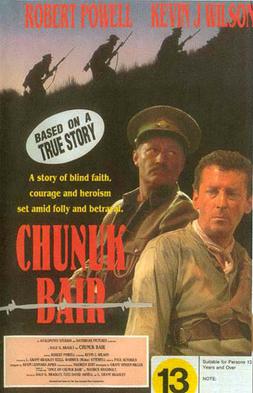
One of the New Zealand military’s functions is to assist civilian organisations where no viable civilian resources are available.  One such example of this support was in 1991 when the NZ Army provided expertise and personnel to help produce the movie, Chunuk Bair.  

The high point of the New Zealand effort at Gallipoli was the capture of Chunuk Bair, a key feature on the Gallipoli Peninsula. Captured by the Wellington Battalion under Lieutenant-Colonel William Malone on 8 August 1915, the New Zealanders would hold the position against violent counterattacks by a motivated and well-led opponent until relieved by British Battalions on 9 August. The latter were driven off Chunuk Bair in a counterattack led by Mustafa Kemal on the early morning of 10 August.

‘The Battle of Chunuk Bair, 8 August 1915, by Ion Brown’, URL: https://nzhistory.govt.nz/media/photo/battle-chunuk-bair-8-august-1915-ion-brown, (Ministry for Culture and Heritage), updated 23-May-2014

The anti-Vietnam protest movement of the 1960s and 70s had caused anything related to the ANZAC legend to become unpopular in New Zealand, with ANZAC day commemorations mainly attended by veterans and serving military personnel. The 1981 Australian movie Gallipoli, with its powerful anti-British theme,was released and considered an ‘event of national significance in Australia. This spike of interest across the Tasman was a turning point and provided the springboard for New Zealand playwright Maurice Shadbolt to provide his contribution in enhancing the notion of Gallipoli as the birthplace of New Zealand as a nation with the events at Chunuk Bair as a source of national pride.

Shadbolt’s play Once on Chunuk Bair would open to much praise from the theatre gong public on ANZAC Day 1982 at Auckland’s Mercury Theatre and would reinforce Shadbolt’s view that Chunuk Bair marked the birth of the nation freed from the shackles of British Colonialism. Once on Chunuk Bair gave the battle of Chunuk Bair the same national significance to New Zealand that the Australians place on their magnificent debacle at Lone Pine and the Nek. Despite a short theatrical run, Shadbolt’s play would become popular in schools and universities as it was taught and performed as part of the educational experience in a similar way that the Australians use the movie Gallipoli.

With the 75th anniversary of Gallipoli observed in 1990, a shift in public consciousness toward Gallipoli was revived, and Once on Chunuk Bair was made into a movie during 1991. Produced on a low budget and aimed at a New Zealand audience. The Army Museum provided much technical advice, uniforms and props, with the Army also providing significant assistance to the production, including expertise in explosives and many Men as extras. RNZAOC ammunition technical officer (ATO) Ian Juno would be listed in the credits as providing the special effects, and a sizable quantity of soldiers from 1 Base Supply Battalion would feature in many scenes as extras.

With production compressed within four weeks, many of the Large-scale battle scenes were filmed on Wellington’s south coast, a near facsimile of the terrain of Gallipoli, with the more detailed scenes filmed in a specially constructed set at the Avalon studios.

Chunuk.jpg

Although the final product was disappointing and did not have the same polished attributes as the earlier Australian movie Gallipoli, it complements Christopher Pugsley’s 1984 TVNZ documentary Gallipoli: The New Zealand Story, the Voices of Gallipoli in establishing the Gallipoli Campaign and the Chunuk Bair battle as the cornerstones of the national identity.


New Zealand Army Logistics Stable Belts

Worn by some New Zealand Army units since the mid-1960s, it was not until 1973 that the wearing of stable belts (commonly referred to as Corps or Regimental Belts in the New Zealand Army) was authorised across the New Zealand Army. In adopting a stable belt, a few units adopted belts of a unique design; however, most New Zealand corps, regiments, and infantry battalions choose designs based on the regimental colours of a parent or allied units of the British Army. The three Logistics Corps of the NZ Army adopted stable belts of a British design, and it was not until 1996 and the formation of the Royal New Zealand Army Logistic Regiment (RNZALR) that a unique New Zealand Logistic stable belt was be adopted.

Stable belts have their origins in the British Army. Cavalrymen (and ASC and AOC personnel from trades associated with horses) found that by modifying a Cavalry “Surcingle,” they had a belt that was particularly useful in providing lower back support when cleaning stables and tending horses. As British military uniforms became more utilitarian, lacking the colour and flair of earlier patterns, the wearing of coloured “stable belts” in regimental colours evolved, adding a splash of colour and individuality to the drab khaki working uniforms of the period.

The use of coloured stable belts in regimental colours spread to all branches of the British Army, becoming established as a uniform item following World War Two. Most commonwealth countries followed the example of the British Army and adopted the coloured stable belt of the Corps or Regiments to which they had links or alliances. The adoption of stable belts by the NZ Army was far from enthusiastic, and it was not until the mid-1960s that stable belts started to appear. It was not until 1973 that the Army Dress Committee officially approved the universal wearing of stable belts for all Regiments and Corps of the NZ Army.

Stable Belts are generally manufactured from a 21/2- to a 3-inch-wide belt of a heavily woven material with horizontal stripes in two or more colours. Buckle types vary with six main types used.

  • Single tongue leather buckle. In NZ only used by the 4th Otago and Southland Battalion
  • Multi tongue leather buckle. Consisting of two leather buckles
  • Single Locket
  • Triple Locket. In NZ only used on the 5th Wellington West Coast Battalion Other Ranks Stable belt.
  • Rectangular plate (Matt colour or chromed) and Cap Badge design.
  • Web Belt clasp. Used on Interim RNZALR Stable belt.

RNZASC stable belt

Photographic evidence suggests that the Royal New Zealand Army Service Corps (RNZASC) adopted the British Army Royal Army Service Corps (RASC) stable belt sometime around 1970. However, the exact year is unknown. Until its disestablishment in1965, the RASC had worn a stable belt with a blue base with two central white stripes and two yellow stripes on the borders. A stable belt with a multi-tongue leather buckle, the RASC stable belt was worn with two leather buckles worn on the right hip. The Canadian ASC wore the same pattern stable belt up to 1968 and continues to be worn by the Malaysian Kor Perkhidmatan Diraja (Royal Logistics Corps).

RASC/RNZASC stable belt. Robert McKie Collection

In June 1973 the New Zealand Director of Supply and Transport requested from the Colonel Commandant of the Royal Corps of Transport (RCT) permission for the RNZASC to adopt the RCT stable belt. Adopted by the RCT in 1965, permission for the RNZASC to adopt the RCT pattern belt was granted by the Colonel Commandant of the RCT in September 1973. Concurrent with the adoption of the RCT stable belt by the RNZASC, was the adoption of the same belt by the Royal Australian Corps of Transport (RACT) in 1973.

RCT/RNZCT stable. Robert

RNZCT stable belt

On 12 May 1979, the RNZASC ceased to exist, as its Supply functions were transferred to the Royal New Zealand Army Ordnance Corps (RNZAOC), while the Transport, Movements and Catering functions were reformed into the Royal New Zealand Corps of Transport (RNZCT). The RCT pattern stable belt continued to serve as the stable belt of the RNZCT throughout the RNZCTs existence within the NZ Army. The only change to the belt throughout its life was some subtle changes to the design of the buckle.

Early Pattern RCT/RNZASC/RNZCT stable belt. Robert McKie collection
Late Pattern RCT/RNZCT stable belt. Robert McKie collection

RNZAOC stable belt

There is much photographic evidence of RNZAOC officers and soldiers in Singapore unofficially wearing British (Single locket) and Malaysian (multi tongue leather buckle) Ordnance Corps stable belts during the 1970-72 period. The RNZAOC initially discussed introducing stable belts in 1969. However, at the time, the available orders of dress did not provide much opportunity to wear a Stable belt, and the preference of the RNZAOC was to adopt a coloured Lanyard. Approval for a Lanyard was not granted, so the Director of Ordnance Services submitted to the Amry Dress Committee on 4 April 1972 requesting authority for the RNZAOC to adopt a stable belt. Permission was granted due to the Army Dress Committee’s 4 April 1972 meeting. The RNZAOC Belt was to b the same pattern as the RAOC belt but had a rectangular chrome plate mounted with RNZAOC Badge.

RNZAOC stable belt. Robert McKie collection

RNZEME stable belt

With its distinctive dark blue background with red and yellow stripes, the stable belt of the Royal New Zealand Electrical and Mechanical Engineers (RNZEME)was introduced in 1967 and was based on the Royal and Electrical Mechanical Engineers (REME) stable belt. The upper portion of the right-hand buckle carried the Corps motto (Arte et Marte). The right-hand piece had the RNZEME badge.

RNZEME stable belt. Robert.McKie Collection

RLC stable belt

In 1993, in the most significant reorganisation of its Logistic Support since 1965, the British Army formed the Royal Logistic Regiment (RLC) by combining the RCT, RAOC, Catering and Pioneer Corps into the new Regiment. Eager to retain the values and traditions of its foundation Corps and Regiments, the RLC retained many elements of its founding corps Regimental colours and the history they represented in the design of the RLC stable belt. The REME remained a separate Corps outside of the RLC.

RLC stable belt

RNZALR stable belt

In a similar initiative to the British Army’s formation of the RLC, the NZ Army also combined its logistic functions into a single Logistic Regiment. The significant difference between the British and New Zealand logistical changes was that the RNZEME was also disestablished and included in the NZ Logistic Regiment.

On 9 December 1996, the Officers and Soldiers of the RNZCT, RNZAOC and RNZEME marched onto parade grounds on each camp and base. Corps flags were lowered, headwear and stable belts exchanged, and the Officers and Soldiers marched off as members of the Royal New Zealand Army Logistic Regiment (RNZALR).

With the colourful stable belts of three RNZALR foundation corps and the collective history of service to New Zealand since 1840 that they represented retired, the RNZALR took a different approach to the RLC in selecting a new stable belt. While the RLC had embraced its foundation Corps’ values and traditions, the RNZALR divorced itself from the past and adopted a plain navy-blue stable belt.

As stock of the new RNZALR stable belt was not available on the formation of the New Regiment, a temporary belt was issued.

Consisting of a navy-blue belt with Web Belt clasps, the interim belt was retired within a year as new RNZALR Stable belts became available.

The only distinctive feature of the RNZALRs stable belt is locket style Chrome buckle, which includes the following features

  • The RNZALR Corps badge on the male side of the buckle
  • The RNZALR motto, “Ma Nga Hua Tu Tangata”, on the female side of the buckle.


New Zealand Installation Auxiliary Police Force

The New Zealand military presence in Singapore is an established chapter of New Zealand’s military historiography. Material related to the background and history of the ANZUK Force, the New Zealand Force South East Asia, and 1 RNZIR is readily available. However, information on many of the New Zealand sub-units is more challenging to locate. One unit that was an integral component of the NZ Force of the 1970s and 80s and continues to serve as part of the residual force maintained by New Zealand in Singapore is the Installation Auxiliary Police Force (IAPF).

Upon the 1989 closure of New Zealand Force South East Asia (NZFORSEA), the New Zealand Defence Support Unit (NZDSU) was created to maintain New Zealand’s military presence in Singapore.  Located at the Sembawang Naval Installation (SNI), the NZDSU provides Singapore-based deployable support to NZ Forces throughout Southeast Asia. The NZDSU also contributes to the security of allied (US, UK and Australian) forces in Singapore through the provision of the IAPF. The NZDSU commands the IAPF, whose principal responsibility is the provision of Physical security to the SNI, including checks of all personnel and vehicles entering and leaving the Installation.

The IAPF is a small force 56 Singapore Auxiliary Police Officers (APO) and operates under the authority of Section 92(1) or (2) of the Police Force Act 2000. Under the provision of this Act the IAPF is vested with all the power, protection and immunity of a Singapore police officer of corresponding rank. As Singapore APO’s, members of the IAPF are licensed to carry firearms when carrying out their duties.

The NZ IAPF originally wore colonial-era Khaki uniforms with the iconic “Kiwi” patch. From around 2000, the uniforms of the IAPF were modernised and standard Singapore police uniforms adopted. The uniform is worn with a IAPF and Kiwi patch worn on each sleeve.

In 1987 RNZAOC Warrant Officer Class Two Wayne Le Gros, wrote the following article on the history of the IAPF for the Journal of the New Zealand Military Society, who have granted permission for it to be reprinted here .

HISTORY OF THE INSTALLATION AUXILIARY POLICE FORCE

Provided by W.Le Gros

The Installations Auxiliary Police Force was formed on I December 1971 as a result of withdrawal of UK Forces from Singapore. The creation of the lAPF was legalised vide Singapore Government Gazette Notification No. 171 dated 21 January 1972.

Prior to the creation of the IAPF, the MOD (UK) maintained huge military bases for its navy, army and air force. Each had its own police force to maintain security of the installations. Although the exact size of its own police forces is not known, it is estimated that there were about 2,000 people employed as policemen. These 2,000 policemen were not all Singapore citizens. Many were Malaysians, Indians and Pakistanis. Some possessed UK Citizenship. This was permissible because Singapore was then a British colony.

With the disbandment of MOD(UK) police forces following the withdrawal of UK Forces from Singapore, all the foreign nationals were retrenched and they either returned to UK or to their own countries. The few hundred policemen that remained were Singapore citizens and in the final stage of the military withdrawal, these Singapore citizens did not escape the retrenchment exercise which ended on 30 November 1971. Singapore citizens who were under 45 years at that time were absorbed into the newly created IAPF.

It is interesting to note here that although the Navy, Army and Air Force had its own police forces, not all police personnel received the same training. The Navy sent its police recruits to the Singapore Police Training School for 9 months of basic police training. The Army and Air Force had their own training schools, but they concentrated more on physical security. Hence when the IAPF started in 1971, IAPF personnel had different police training background. This was however streamlined when the IAPF organised refresher courses for all its personnel.

All IAPF personnel carry warrant cards issued by the Commissioner of Police Singapore. They have the same powers, protection and immunities of a Singapore police officer of corresponding rank within the area under the jurisdiction of NZ Force S.E. Asia providing also that they have the same powers etc outside the area when in fresh pursuit of or in charge of any person who has committed or is suspected of having committed an offence within the limits of such an area or within view outside such an area.

All IAPF personnel are subject to discipline under the Auxiliary Police Regulations and have a right of appeal to the Commissioner of Police, Singapore on disciplinary matters. The promotion of any IAPF personnel is subject to the approval of the Commissioner of Police. Before any personnel can be promoted, he must present himself before a 3-member Joint Promotion Board convened by the Commissioner of Police. The Chairman of the Joint Promotion Board will be a senior Singapore Police Officer while the other two members are OC IAPF and NZ CEPO, the employing authority.

The IAPF when first established in 1971 under the ANZUK Command had 400 personnel and was commanded by Supt. SK. Sundram, (equivalent to Lt. Col. Rank) a retired Singapore Police Officer. It had 1 Asst. Supt, 9 Inspectors and the rest was made up of constables, corporals and sergeants. In 1975, when Australia and UK withdrew from the ANZUK Command,  62 personnel made up of 2 officers and 60 rank and tile were transferred 10 NZ Force S.E Asia and formed the NZ IAPF. Today, the strength is reduced to 50 personnel as a result of an overall review carried out in 1984.

The NZ IAPF is responsible with the:-

  • Protection of life and property within the NZ/UK Forces installations
  • Control of entry of all persons to NZ/UK Forces installations
  •  Cash/ammunition escorts

Although the IAPF is a small auxiliary police force, it performs a variety of duties. As most of its personnel have given many years of faithful service, the loyalty and devotion of these personnel have always remained steadfast to this date.


New Zealand Defence Stores, Annual Report, 1914

In the years leading up to 1914, the New Zealand Military Forces underwent a significant transformation. Under the Authority of the Defence Act 1909, the old volunteer system was abolished, and a new military framework supported by universal Military Service by all males between certain ages was established. The evolution of New Zealand’s Military and how General Godley and his Cadre of Imperial and local Military Officers and Non-Commissioned Offices created a modern, well equipped Army is well recorded. However, it is the role of the Defence Stores in which has remained anonymous. A component of the New Zealand Military since the 1860’s the Defence Stores would furnish the equipment for multiple mobilisation and training camps and equip thousands of men with uniforms, arms, and ammunition on the mobilisation of New Zealand in August 1914. The culmination of the Defence Stores effort would unknowingly be validated by Military Historian Glyn Harper who in his 2003 book Johnny Enzed states; [1]

In all aspects of required military equipment, from boots and uniforms to webbing, ammunition and weaponry, in 1914 New Zealand had ample stocks on hand to fully equip the Johnny Enzed’s of the Expeditionary Force.     

Although the Defence Stores was an active participant in the lead up to the First World War, it has been the victim of a pattern of amnesia which had virtual wiped its existence and contribution from the historical narrative.

Under the management of Major James O’Sullivan, the Director of Equipment and Stores, the 1914 Regulations for the New Zealand Military details that the Defence Stores were[2]

responsible for the supply of clothing, equipment, and general stores; supplies of stationery, forms, and books; supply of, all vehicles and technical equipment, excepting Artillery and Engineers; storage and distribution of small-arms, accoutrements, and camp equipment’s, Customs shipping entries, and ammunition.

The following report was produced by Major O’Sullivan and details the activities of the Defence Stores up to 31 March 1914 and provided a useful appreciation of how the Defence Stores were placed prior to the mobilisation in August 1914.


NEW ZEALAND MILITARY FORCES.

REPORT OF THE DIRECTOR OF EQUIPMENT & STORES FOR THE YEAR ENDING 31 MARCH 1914

The Quartermaster-General
Headquarters N.Z. Military Forces
Wellington

Sir,

I have the honour to report as follows on the Stores, Magazines and Equipment in the Dominion for the year ending 31st March 1914.

SMALL ARMS AMMUNITION

The reserve of Small Arms Ammunition .303 Ball has since my last report increased by 138,000 rounds. The quality has maintained its excellence, and no complaints of any moment have been received during the year. the increased supply of cordite ordered has been received, thus removing any danger through delays in shipment. This will build up a reserve of cordite, which will be available to keep the Factory fully employed in the event of short shipments usually caused through Strikes in gland.[3]

The question or an increased reserve of Ammunition is a policy matter, but I wish to point out that the large increase in our Smal1 Arms during the year, consequent upon the importations from Egeland md Canada, has proportionately reduced the number of rounds available per Rifle.

The total issue of .303 Ball Ammunition during the year was 4,I62,000.

SMALL ARMS

During the year, 30,000 Rifles M.LE. Long were imported into the Dominion, 15,000 being from England and 15,000 from Canada. Of the English, 5,000 were perfectly new arms, while the 10,000-part worn were in such good condition that except to an Armourer or one very familiar with Arms, they appeared to be quite new.

The former were purchased at £2 each and the later at were purchased at £1, and as the landed cost of a new M/L.E. Rifle Long has hitherto been £3/12/. it can readily be calculated what an immense saving their purchase meant to the Dominion.[4]

CANADIAN RIFLES

The Canadian Rifles arrived in various shipments, the cost in Canada to the Department being 4/2d.landed cost 5/. Each. These Arms were not, of course, expected to be in the same condition as the English Rifles, having been thoroughly oiled prior to despatch front Canada, On arrival in the Dominion, however, after being overhaled and thoroughly cleaned by the Armourers, it was found that the Ars were in excellent condition, less than 2% requiring rebarrelling, while a fair number were quite new. Sword Bayonets and Scabbards patten “88 were also supplied with these Arms, while the Arms Chests in which they were packed, were in excellent order.

At 4/2d each, these Arms were a wonderful bargain, especially when it is remembered that a Rifle Bolt alone costs in England I6/.  If any more of these rifles are obtainable, I would recommend that another five thousand be purchased, as they will be required if it is intended to train the General Training Section of the Reserve, it would be a waste of money to issue new Rifles to these if they are allowed to keep them in their homes, as they would very soon go astray or become unserviceable, while even if a percentage of the Canadian Rifles were lost, the actual financial loss would no be great.

The whole of the above Arms were received during the months of January, February and March and were immediately issued to the Senior Cadets, who are now fully armed.

No Protectors, Bottle Oil, or Pullthroughs were received with the Canadian Arms, but a supply has been cabled for, which, on arrival, will be issued.

We have in stock about 8,000 new spare barrels for Rifles M.L.H. Long, which means that 13.3% of the Rifles in the Dominion could be rebarrelled at short notice. It is, perhaps, just as well that we have a good reserve, as it is very probable a number of the rifles on issue to Cadets will be neglected.

The total number of Rifles M.L.E Long at present in Store and on issue to the forces is about 46,000.

RIFLES M.L.E. SHORT

The total number of Rifles M.L.E. Short in the Dominion is 13,810. These are on issue to Mounted Rifles, Field and Garrison Artillery, Field Engineers and Coast Defence troops, except about 1,900 of the Mk I pattern on issue to Senior Cadets and which are now being recalled.

Our reserve of Barrels and Spare parts is in about the sane proportions as for the Rifles M.L.E.Long.

RIFLES MARTINI-ENFIELD

There are in all about 1,100 of these in the Dominion. They are on issue to Senior Cadets, but are being recalled, so the question of how they are to be utilised will be for your consideration.

RIFLES .310

There are 1,052 of these, which were taken over from the Education Department, and issued to Senior Cadets in Auckland District. They were, however, condemned by District Headquarters as being useless for Musketry, and are being returned to Store. The question of what is to be done with these and the 928,000 rds of .310 Ball Ammunition will have to be considered later.

CARBINES

There are in the Dominion about I,400 M.L.E and 2,500 M.E Carbines, which are principally on issue to Colleges and High School Senior Cadets. There are, however, complaints of the poor shooting made with these in comparison with that with the Rifles on issue to other Senior Cadet Companies. Demand have therefore been made for Rifles to replace the Carbines, and in some cases this has been done, while the remainder will be replaced during the current year. The question of what to do with the replaced Carbines will therefore require consideration.

REVOLVERS

We have about 900 Revolvers in stock. These are of an obsolete pattern known as Dean and Adams, which were imported about thirty years ago. In fact, it is impossible to obtain ammunition for them, as the Webley Pistol Cordite Ammunition will not fit. There is a quantity of about 9,000 rounds of powder-filled ball for these Revolvers imported in 1880, but it ss not reliable. There are also about 14,000 rds Cordite filled ball, but this does not properly fit the Revolvers.

RIFLES SOLD TO DEFENCE RIFLE CLUBS.

The aforegoing Arms do not include the 3,423 Rifles M.L.E.Long and the 2,719 Rifles M.E. sold to members of Defence Rifle C1ubs. These are the property of the members, but no doubt practically the whole of these would be available in an emergency.

ACCOUTREMENTS

As mentioned in my last annual Report, an additional supply of Mills Web equipment was required, and in September 1913 demand was made for 4,000 sets and 20,000 Tools entrenching with Carriers, but approval for the expenditure was not obtained until the end of March this year. When these arrive from England, the equipment of the Infantry Regiments will be completed.

During the year all Brown Leather Accoutrements were called in from Field Engineers and Garrison Artillery, and replaced with Mills Web Modified pattern equipment consisting of Belt, waist: 2 Pouches and Frog This was considered to be a more suitable equipment for these units, besides which a considerable saving in expenditure was effected.

The Railway and Post and Telegraph Battalions and the Army Service Corps Companies have since been similarly equipped.

So far, no improved equipment for Mounted Rifles has been devised, our own Bandolier equipment, which has given satisfaction, is still being used.

As the whole of our Bottles Water Mk.IV are unfit for further service an additional supply of Bottle Water MK.VI with sling, carriers, has been ordered to complete equipment of Mounted Regiments and Ordnance Units. A further supply of Slings, Web, is also under order.

The Belts, Waist, Web, devised for Senior Cadets, which are made in the Dominion as a cost of 6d each, are giving general satisfaction.

SWORDS, OFFICERS & SAM BROWNE BELTS.

Owing to all Officers now being given an issue of a Sword and Sam Browne Belt on First Appointment, a large number of these are annually required.  Of course, the number issued this year is greater than wi1l be that of subsequent issues. Taking free issues and sales during the year, there were issued 372 Swords 800 Sam Browne Belts.

MAXIM MACHINE GUNS.

As Mentioned in my last Annual Report, one each Maxim Machine Gun mounted on Tripod with Pack saddlery complete, was issued to Mounted and Infantry Regiments, and a supply of Tripods ordered to convert the Maxim Guns mounted on Field Carriages to Pack saddlery. The Maxims on Field Carriages were called into Store, but it was ascertained before these Guns could be properly fitted to Packsaddles, a number of suitable stores were required from England. These are now under order from England and on arrival. The conversion proceeded with. The addition of one Regiment of Infantry to the original establishments leaves us deficient of two Machine Guns, as no provision j=had been made for creases, and no spare Guns had been ordered. It will therefore be necessary to consider if two more Guns with Pack saddlery complete should be ordered.

If it is intended to equip Coast Defence Infantry in Auckland, Christchurch and Dunedin, or other Units, with machine Guns, a further order will be necessary.

During the year, three of the service locks which were broken were sent to England to be repaired and reported on. The locks have been returned and re-issued, and the report from England states that the breakages due to over tempering of the steel part in construction. As no further breakages were reported, it is presumed that only these three locks were faulty.

UNIFORM EQUIPMENT 1913/14.

TERRITORAL & SENIOR CADET

During the year the clothing of territorials and Senior Cadets has been continued steadily and at the end of March, with the exception of Caps, Forage, all clothing demands were completed.

The supply of Greatcoats and Putties, which I mentioned in my last Report as being in a backward condition, has now been brought up to date, and all branches of the service have been fully suppled as demands came forward.

A considerable saving was effected through the importation from England of some 10,000pairs Imperial Service Putties at a cost of about 3/. per pair, as against the price required for a local made article – which being all wool did not give satisfaction – and which cost about 4/9d per pair.

With the exception of Greatcoats, of which some 5,500 were received from Southern Firms, a Wellington Firm secured the contract for suppliers of Territorial Clothing, and they have made deliveries without delay thus enabling the Department to issue immediately on receipt of Requestions from Regiments.

The quality of material and make of garments has been fully maintained, and no complaints whatever have been received in this respect.

The delay in delivery of Caps, Forage, has been owing to there been no Factory in the Dominion which make the waterproof material as laid down in specifications of new Contract, and the supplies of this material had therefore to be obtained from England. Owing to Strikes and other causes the Contractors experienced great difficulty in obtaining supplies in time to meet our requirements.

Every effort has been made to keep down expenditure in connection with Uniform Clothing  – no order has been placed with Contractors in excess of actual requirements – and though in some items the minimum number we were required to take under the Contract has been exceeded, this was owing to short deliveries under Contracts for 1911/13, and the formation of the Army Service Corps and Railway Battalions, which necessitated distinctive Uniforms being made.

The position of Uniform Clothing for year ending 31st March 1914 is:-

TERRITORIAL UNIFORMS.

 JacketsTrousersPantaloonsHatsCapsGreatcoats Putties
      MountedDismtd 
Receipts545842981840Nil18841342767810000
Issues428226229419468224579347705748
In Stock6583672033284966320164929254258

When it is remembered that there are Uniforms stocked for the six branches of the service, each of which are again divided in 31 different sizes, the total number in store is not large, and unless maintained, it would be impossible to issue the particular sizes asked for on requestions received, nor would we be able on a sudden emergency to meet demands.

SENIOR CADET UNIFORMS.

The issue of Clothing to senior Cadets has been steadily maintained during the year, and on 3Int March 1914, all Requisitions for Clothing received had been supplied on that date. The quality of material and the make of the uniform reflects credit on the Contractors.

As with the Territorial Uniform, only the particular sizes of garments of which our stocks were nearly exhausted, were ordered, and the minimum quantity under contract was not taken during the year. As far as possible, all Trousers returned to Store, also old pattern Shorts, were washed, relined in bands and fork and converted at a small cost in to new pattern shorts, and are being issued ad required.

The position Senior cadet Uniforms is:-

 BlousesShortsHatsPuttie HoseWeb Belts
Total Receipts to 31/3/19144446343227431504647832011
Total issues3493739000348453551331993
Leaving in Store 31/3/1914932662279105796518

As we had a good stock of Cadet Clothing in Store on 1/4/193, only small orders were placed with Contractors last year. As under our Contract we are bound to place order for 5,000 each item per year, we will have to place larger orders this year. The Issues last year were about 8000 suits.

OFFICERS UNIFORMS

Under Circular Q.M.G 85/36 of 16/10/1912, the cash payment of £15. and £9 to Territorial and Senior Cadet Officers respectively was abolished, and a Free Issue of Jacket, Riding Pantaloons or Knicker Breeches, Putties and Cap Forage was made in lieu thereof to Officers on First Appointment on Probation, and Hat, Greatcoat &Trousers on Final Appointment after passing Examination. The cost of these uniforms being:-

 Mounted Service Dismounted Service
Without Badges of rank£6:16:3 £6:8:9

As there were some 375 Officers clothed in this manner during the year it will be seen that a considerable saving was effected. The Contractors supplied a first-rate uniform made to special measurements of individual Officers, and no complaints were made by Officers in this respect.

A Sam Browne Belt and Officers Sword for use of Officers newly appointed are issued to the Regiment of Company to which he may be attached. These items remain the property of the Government , and are handed in when the Officer retires or is transferred.

As with Territorial Uniform, only the particular sizes of garments of which our stocks were nearly exhausted were ordered, and the minimum quantity under Contract was not taken during the year. As far as possible all Trousers returned to Store also old pattern Shorts were washed, relined in bands and forks and converted at a small cost, into new pattern shorts and are being issued as required.

The position of Senior Cadet Uniforms is:-

 BlousesShortsHatsPuttie HoseBelts Waist
Receipts5954408252032011
Issues865999847570714731993
In Stock852662979705796618

It will be seen that the issues last year were almost equal to our present stock, so that during the current year we shall have to provide somewhat above the minimum of Contractor, viz. 5000 each item.

UNIFORMS

It has come to my knowledge from conversations with officers and Regimental Q.M. Sergeants that there are a considerable number of part worn Uniforms in Regimental Stores, which have been returned principally by men who have been exempted from further training and by others who have 1eft the Dominion, and I understand that instructions have been issued to Regimental Q.M. Sergeants not to re-issue these part worn uniforms.

In this respect, I consider that if I could visit the Regimental Stores during the year for the purpose of examining this clothing and return to Store as ay be fir to be washed and pressed and relined where necessary, they would be as good and could be issued as new Uniforms, as is done in the case of trousers as used by Senior cadets. In this manner, instead of paying about 30/. for new Tunic and Trousers, they could be made equal to new for about four to five shillings

SERVICE BOOTS

The sale to the Defence Forces of the service Pattern Boot was well maintained. During the year some 5100 pairs were received from Contractors, of which the greater proportion were sold for cash. Owing to the increased cost to te Department (in consequence of high price of leather etc) we were forces to raise the price from 11/6 per pair to 14/. Per pair. General satisfaction has been given to all wearing these for Military duty, as the sales in Training Camps denote

In all 1arge Training Camps, an Officer is sent from Defence Stores with a good stock of Boots for sale in Camp, and in order that the men may use the boots while in Camp and to make payment easy, the amount is deducted from pay at the end of Camp.

SHEETS, GROUND, WATERPROOF.

An additional Supply of 10,000 Sheets ground was obtained during the year, bringing our equipment up to 20,282. There are always considerable losses in these as they are useful for so many purposes in private life. They disappear both in large and weekend Camps, in fact after a large camp, one can never be certain what are the losses until final check in store is made. They have been known to disappear in transit from Camps. Of course, shortages are charged against Units, but this does not entirely prevent loss/

BAGS, NOSE, HORSES.

6,000 Nose bags for feeding Horses in camps were obtained during the year. This was a very necessary item of equipment as there was considerable waste of horse feed hitherto. The saving in horse feed that will be effected in a short time will compensate for the cost of the Nose Bags. The bags are all branded ‘DEFENCE↑1914” and numbered consecutively, so that los or shortage can be traced to the

FIELD COOKERS.

In my last Report I mentioned that a supply of “Roberts” Cookers was being obtained. 24 of these, each estimated to cook for 500 men, were issued in Camps during 1913, and gave great satisfaction when occupied with the method of cooking hitherto in use. 11 additional 500 men Cookers and 16 – 250 men Cookers were obtained since January 1914, and the whole are now in use as under:-

Auckland9500 men4250 men
Wellington104
Canterbury84
Otago84

There was also obtained from England a “Sykes” Travelling Cooker, while the 9th Regiment Mounted Rifles imported 2 Lune Valley Travelling Cookers.

Trials are now being made in Takapau Camp as to the merits of each. The landed cost of the “Sykes” Cooker was £130, whereas the local article -500men Cooker – costs £64, and the 250 men Cooker £46. I am unable to give the cost of the Lune Valley Cooker as it was imported Privately,

If the “Roberts” Cooker is to be adopted, 1 an of opinion that no more of the 500 men cookers should be obtained as they are too heavy to handle and are liable to breakage in transport. The 250-man Cooker in an ideal weight and can be easily handled by 4 men, 1ifting in or out of any conveyance, besides which double 1n or out of any conveyance, besides which, double companies under the new organization are 250 each.

CAMP KETTLES.

There is a very good supply in Ordnance Stores, but sone are getting the worse for wear. An order for 1000 has been placed in England.

MEAT DISHES, BOILERS, LANTERNS, WASH BASINS etc are all Locally made, and supply can always be ordered as required to replace

KIT BAGS.

A sum of money was placed on the estimates last year to provide Kit bags, but the late Quartermaster-General, for financial reason, deemed it advisable to let the procuring of a supply stand over for the present.

B0OKs, FORMS, STATIONARY, PAPER TARGETS ETC.

A large supply of Drill Books etc were obtained during the year and distributed to the various centres as instructed. There are now 225 NZ Military Forms and Books in use. The printing of these Forms and Books is carried out at the Government Printing Office but owing to pressure of work for the other Departments, delays in printing our demands often occur. I am of opinion that better paper in many of these forms should be used in many of these Forms, especially those which are records. There is no comparison in the quality of paper used in our Forms and that used in the Imperial Service Forms

I am certain there must be considerable waste of Forms in the Area Group Officers and also in the Regimental Offices, as the demands sometimes made are out of all proportion to the requirements. These demands haves to be cut down here and I think Staff Officers should be impressed that Forms cost money and should be used only for the purpose for which they were printed  

ARMOURERS.

During the year the four senior District Armourers were brought to Wellington and put through a three weeks course of instruction in Maxim Machine Guns under Staff Sgt, Major Luckman, who, at the end of the period, examined the on the theory and practice of examination and repairs to Maxim Guns

The men took a keen interest in the work, and at the final examination passed to the satisfaction of the examiner, who reported that certificates should be given. This was approved and the certificates issued. The fact of these men holding certificat4rs will enable them to instruct their assistants in Districts, and these when they qualify, can also be issued certificates

The CADET ARMOURERS are getting on very well, and in order to give them experience in the Field, one Cadet has been temporally attached to each district.

Reports from District Armourers as to the condition of Arms on issue to Units have been, generally speaking, good, but owing to the outbreak of Smallpox in Auckland District, the inspection had to be discontinued, so that all the arms were not examined. The general strike also affected the examination especially in the North Island.

Owing to the increased number of small arms now issued to Cadets, the personnel of this branch of the service will require increasing , and the districts subdividing, as it would be impossible for an Armourer to make inspection of all the Small Arms in any one District during the year. I will later submit a proposal to meet this question.

DISTRICT STOREKEEPERS.

A conference of the three District Storekeepers was held in my Office in August 1913to discuss many matters in providing for stores not provided for in the regulations. This is far preferable to correspondence on minor matters of detail, as it was found that letters of instruction and Headquarters circulars were sometimes differently interpreted. When the occasion is deemed necessary, I will again ask for authority for a conference.

The Storekeepers are all Officers with a keen sense of their responsibility regarding Government property, and take a personal interest in their work, without which as Storekeeper or Quartermaster-Sergeant is useless.[5]

TRANSPORT WAGONS.

No additions were made to this service during the year. The late Quartermaster-General made provision in the Estimates for 32 Field Service Wagons similar in type to the colonial pattern in Store, being satisfied that with slight modification, this wagon would be very suitable for the Dominion. For financial reasons the inviting of tenders for these was held over.

No addition was made to the equipment of Water Carts during the year. The new type received with the Field Guns is far and away more expensive than that hitherto in use, and consideration will have to be given this subject for the equipment laid down is to be provided.

I am of opinion that it would pay the Department well if one Motor Wagon is provided for each of the four centres. The cost of cartage is becoming a heavy item, especially in Wellington, and if the Department had its own wagons this item would be considerably reduced. The fact that under the terms of the Public Works Contracts for Cartage the transport of one case from the Railway or Wharf is charges by time or ton weight or measurement will indicate that cartage is an expensive item, whereas if our own wagons were available, collection of parcels and cases could be made at stated time, all with greater efficiency, Other Departments of the State find it to their advantage to run their own transport Motor Wagon, and I am od opinion it would be ad advantage if we could do likewise.

MEDICAL EQUIPMENT.

During the year the Director of Medical Services laid down a list of Medical Equipment to be issued to Mounted and Field Ambulances and Regimental Medical Officers. Included in this were a new pattern Surgical Haversack and new pattern Medical Chest: these being entirely different to the pattern hitherto in use. Tenders for supply were invited. The Chests and Haversacks were made in the Dominion, but arrangements had to be made with the successful tenderers to import the supply of instruments and drugs which arrives in the Dominion at the end of March 1914. The Chests and Haversacks were then filled and issued to Districts for distribution. As the new equipment provides for one wagon only, one each was taken from the Field Ambulances and issued to the Mounted Field Ambulances. Each Regimental Medical Officer is provided with a surgical haversack, and in addition to the equipment of Stretchers of Field Ambulances, each Regiment is provided with two. These to remain as permanent equipment.  I may mention that all our Field Stretchers are now made in the Dominion, and Mr Reid – the maker of same – informs me that the Department having its Stretchers made locally has been the means of St John ‘s Ambulance and others also getting their supplies locally, instead of importing as hitherto. The Stretchers are made at about the same cost as the imported ones, and the Director of Medical Services has stated that he is very satisfied with them.

VETERINARY STORES.

Hitherto no provision was made for Veterinary Chests, medicine for use in the Feld, the practice being for Veterinary Officers to obtain supplies from the nearest Chemist. This method while being expensive, was not satisfactory. During the year, the Director of Veterinary Services and the Principle Veterinary Officer, of Wellington, paid visits to the Stores, and under their supervision, a Field Veterinary Chest was devised. The necessary instruments and drugs were obtained, and the Chests filled and distributed in time for the Divisional Camps.

Twenty Chests in all were made, and it is proposed that each be retained at the Headquarters of the Field Artillery in each District, the balance to be kept in District Store for use in the Field.

STORE BUILDINGS.

The Store buildings are in good order, the only additions during the year being those to the Christchurch Store, which were very necessary. Owing to increase of Equipment and Clothing, all buildings were taxed to their utmost capacity during the year.

Arrangements have now been made for District Stores to keep a stock of Forms etc for issue, instead of having to send individual requisitions to Wellington for Supply.

If Transport Wagons and Harness are to be provided for the Army Service Corps, provision will require to be made for housing same. I am of opinion that the time has now arrived for the establishment of a District Store at Palmerston North, as it is more central for distribution, and cost or railage would be considerably reduced.  The Wellington City Units could still be suppled from the Store in Wellington

MAGAZINES FOR SMALL ARMS AMMUNUITION.

Our magazines for storage of Small Arms Ammunition were taxed to their utmost capacity during the year, and indeed sone were overtaxed, as the Ammunition could not be stored in strict accordance with Magazine Regulations, If our reserve of Ammunition is increased, it will be absolutely necessary to increase the accommodation, especially in Otago. I have previously drawn attention to the inadequate Magazine accommodation in Otago, in which only 3 million rounds of Ammunition can be stored, whereas there should be accommodation for at least 5 Million rounds. At present the maximin supply that can be stored in the South Island is only 8 million rounds, which to my mind is inadequate. Provision should therefore be made in this year’s estimates for

AEROPLANE

The Bleriot Monoplane “Britannia” presented to the NZ Government by the British Aerial League was duly received during the year, and a suitable shed was erected in Defence Stores yard at a cost of about £130 for housing the same. The Machine was subsequently sent to Auckland Exhibition, but has now been received back art Wellington

According to instructions contained in a Cable from the High Commissioner, the machine requires constant attention and care and has been place under the supervision of the Armourer, who details a Mechanic to attend to the cleaning and oiling of same.

STOCKTAKING.

To comply with the provisions of the Public Service Regulations an annual Stocktaking has to be made, and this had been almost completed when the general strike took place. This necessitated the whole of the Staff being employed and the Stores and building being used for nearly three months in the housing and accommodation of the Special Mounted Constables. Immediately on their departure, the large shipments of Arms from England and Canada arrived. As preparations had then to be made for supplies and equipment for Camp for the inspection by the Inspector-General, Overseas Forces, I have been compelled to postpone the stocktaking till this year.

STAFF.

In conclusion of the Report, I have to mention that owing to increased work in the Store and yard, temporary extra labourers had to be employed. This pressure was overcome about the end of April and the men were discharged. There are other men on the temporary staff, such as Storeman, Clothier, Hatter, Packers who are experienced at his class of work, are industrious, and take special interest in the work. These men are an absolute necessity to carry on the Clothing and other ranches of the Department in which they are employed.

Finally, I wish to especially mention the permanent Staff, workmen and the office staff. To the letter, I owe the success and efficiency of this branch, as they are officer who take a special and personnel interest in their duties, and who, in addition to their own work, were called upon at the time of the Industrial troubles in Wellington, to feed, clothes and equip the Mounted Special Constables who were brought to Wellington to maintain law and order.  

The controlling officers on several occasions complimented me on the efficiency of the staff.

This extra work necessitated the Office Staff returning to duty at night after the Special Constables had been disbanded in order that their work could be brought up to date. Some even had to sacrifice their Annual Leave

As I have previously stated, owing to the steady increase of work in the Office, the permanent appointment of one extra Clerk is badly needed.

Defence Stores,
Wellington.
8th May, 1914.

________________________________

Note: You have been supplied confidentially with Returns of all Arms, Ammunition and Equipment in the Dominion, consequently figures are not given in this return

________________________________


Notes

[1] Glyn Harper, Johnny Enzed: the New Zealand soldier in the First World War 1914-1918, First World War centenary history, (Auckland, New Zealand: Exisle Publishing Limited, 2015, 2015), 29.

[2] “Regulations for the Military Forces of New Zeland,” New Zeland Gazette, Issue 6, 26 January 1914, 237, https://rnzaoc.com/wp-content/uploads/2018/08/Regulations-for-the-Military-Forces-of-New-Zealand.-1914-1.pdf.

[3] The majority of Small Arms Ammunition for the New Zealand Military was manufactured in New Zealand by the Colonial Ammunition Company at their Mount Eden Factory in Auckland.

[4] £1 in 1914 equals NZD$167.55 in 2021

[5] The authorisation for permanent District Storekeepers was for one each at Auckland, Christchurch, and Dunedin, with the following appointments made:

  • Mr William Thomas Beck – District Storekeeper, Auckland
  • Mr Arthur Rumbold Carter White – District Storekeeper, Christchurch
  • Mr Owen Paul McGuigan – District Storekeeper, Dunedin


RNZAOC 1 April 1959 to 31 March 1960

The RNZAOC experienced a momentous period marked by key developments. Establishing the RNZAOC School was a notable milestone, alongside identifying challenges related to officer recruitment. This era also witnessed the realisation of plans to modernize and equip the Army with state-of-the-art resources. The initial deliveries of new equipment arrived, replacing a significant portion of the outdated wartime equipment and contributing to the transformation of the Army into a modern and well-equipped force.

Key Appointments

Director of Ordnance Services

  • Temporary Lieutenant Colonel H. McK. Reid

Chief Inspecting Ordnance Officer

  • Major JW Marriot

Officer Commanding Main Ordnance Depot

  • Major Harry White, from 1 May 1959

RNZAOC School

  • Chief Instructor – Major Harry White
  • Regimental Sergeant Major – Warrant Officer Class One Alfred Wesseldine

2nd Battalion, the New Zealand Regiment

In July 1959, the 2nd Battalion of the New Zealand Regiment was reestablished at Waiouru. The battalion embarked on a rigorous workup and training phase, preparing them for their deployment to Malaya in November 1959, where they would relieve the 1st Battalion. To support the training and preparations of the 2nd Battalion, the RNZAOC furnished the battalion with the essential equipment it required by drawing from existing stocks. This ensured that the battalion was fully equipped from the ground up to fulfil its operational requirements.

Establishment of RNZOAC School

Upper Hutt City Library (29th Jan 2020). Trentham Camp; Royal New Zealand Army Ordnance Corps School sign.. In Website Upper Hutt City Library. Retrieved 14th Jul 2020 11:51, from https://uhcl.recollect.co.nz/nodes/view/1335

Under discussion by the Army Board since 1956, the RNZAOC School was established in September 1959. Established within the Peacetime Establishment of the Main Ordnance Depot, the RNZAOC School would be under HQ Ordnance Services’ direct control and independent of the Army Schools.[1]

The initial school organisation would be.

  • A Headquarters,
    • Chief Instructor – Major Harry White
    • School Sergeant Major – Warrant Officer Class One Wesseldine
  • Ammunition Wing
  • Stores and Vehicle Wing

The function of the RNZAOC School would be to run courses and training for RF and TF personnel of the RNZAOC, including

  • Star Classification Courses – particularly for Storeman/Clerks RNZAOC and Ammunition Examiners.
  • Promotion courses for both officers and ORs.
  • Recruit training RNZAOC Personnel, including Recruit training for Group 2 personnel.
  • Advanced training for both officers and ORs, in all types of Ordnance activities.
  • Technical training in ordnance subjects, e.g. Inspecting Ordnance Officer courses.
  • Preservations and packing etc.
  • Refresher training for qualified personnel.
  • Other courses notified in the annual Forecast of Courses.

Additionally, as directed by DOS, the RNZAOC School was required to.

  • Plan and hold conferences and training exercises.
  • Draft procedure instructions.
  • Test, or comment on new procedures, materials, or equipment.
  • Research various aspects of Ordnance activities.

The first course conducted by the RNZAOC School would be an instructor’s Course conducted in late 1959.

First Instructors Course, 1959. Chief Instructor Major Harry White is seated 3rd from left. Officer in the front Centre id Makor K.G Cropp. Robert Mckie RNZAOC Collection

Officer Shortfall

A projection of planned retirements for RNZAOC Officers up until 1962 indicated that a total of seventeen officers would be leaving the service. Historically, the main method of filling RNZAOC officer positions had been through the commissioning of Other Ranks with Quartermaster Commissions. However, since November 1956, only three officers had joined the RNZAOC directly as officers.

Upon evaluating the planned officer retirements in relation to the RNZAOC officer establishment, it was discovered that the organization faced a deficiency of six officers. This shortage highlighted two significant issues that needed to be addressed.

  • The RNZAOC Officer Corps was becoming a Corps of old men, with 83% of Officers in the 39 to 54 age group
  • The RNZAOC Other Ranks Structure was denuded of the best SNCO’s and Warrant Officers.

To rectify the situation, the following recommendations were made.

  • The RNZAOC press for an increased intake from Duntroon and Portsea of graduates to the RNZAOC.
  • Suitable officers no older than 30 years of age, and in the two to four-year Lieutenant bracket, be encouraged to change Corps to the RNZAOC.
  • Further commissioning of QM officers be strongly resisted unless there was no other alternative.

Conferences

Over the period 1 -3 September 1959, DOS hosted a conference at Army HQ for the District DADOS, Officer Commanding MOD, and the Ordnance Directorate members. The general agenda of the meeting included.[2]

  • Local purchase of stores by DADOS
  • Training of group 2 Personnel
  • RNZAOC School
  • Provision Problems
  • Surplus Stores
  • Personnel – postings and promotions
    • DADOS and OC MOD were required to provide in duplicate, personnel lists by unit containing.
      • Regimental No, rank, and name
      • Marital Status
      • Establishment statue, either PES, CSS or HSS
      • Present posting
  • Purchases for RF Brigade Group
  • District Problems

Small Arms Ammunition

With the introduction of the 7.62mm rifle, the Colonial Ammunitions Company (CAC) faced the task of transitioning its manufacturing from the existing .303 calibre to the new 7.62mm calibre. Having served as the supplier of Small Arms Ammunition to the Defence Force since 1888, the CAC was committed to maintaining this longstanding relationship. The company invested in the necessary tools and machinery to produce 7.62mm ammunition to fulfil this commitment. During this period, they successfully completed their first production run of the new calibre. While the NZ Army possessed sufficient stocks of .303 ammunition for the foreseeable future, the CAC retained the capability to manufacture .303 ammunition if needed.

Introduction of New Equipment

The RNZAOC played a vital role in the acceptance processes of newly introduced equipment. Upon arrival from the supplier, the equipment, accessories, and spare parts were received at the Main Ordnance Depot. Thorough inspections were conducted, and the equipment was outfitted with all necessary accessories before being distributed to the respective units. Depending on the equipment, a few examples might have been retained in RNZAOC Depots as War Reserve/Repair and Maintenance Stock.

RNZAOC depots maintained maintenance stocks of accessories and spare parts as operating stock to ensure operational readiness. If the new equipment included a weapon system, the RNZAOC Ammunition Depots managed the specific ammunition required. During this period, the following equipment was introduced into service;[3]

  • 110 Land Rover Series 2a 109.
  • 144 Truck 3-Ton Bedford RL, 48 fitted with a winch
  • 3 Ferret Mark 1/1 Scout Car
  • 270 Wireless Sets. C45 – VHF transceiver,
  • 2000 9mm Sub Machine Gun Sterling Mk4 L2A3.
  • 500 7.62 mm Self Loading Rifle, L1A1 (SLR).

Uniforms

The Clothing and Equipment Committee approved the adoption of a standardized training uniform for New Zealand soldiers across all conditions within New Zealand. This uniform would serve as the foundational attire for training purposes.

  • Boots (Fory types under trial and development)
  • Anklets (Australian pattern)
  • Shirt (light wool)
  • Trouser ( Green drill material cut to UK pattern)
  • Hat (Jungle Type)

Disposals

In August 1958, the Army established a new organization dedicated to handling the declaration and disposal of surplus and obsolete equipment. Since August 1959, this disposal organization has declared over 9,000 lines, encompassing thousands of items, to the Government Stores Board for Disposal.

Ammunition Disposal

The disposal process for dangerous or obsolete ammunition continued, dumping over 900 tons of outdated ammunition at sea. Approximately 130,000 rounds of hazardous artillery ammunition were also destroyed through controlled burning or detonation.

Efforts were made to salvage the maximum amount of recyclable metal whenever feasible. These salvage operations yielded around £10,000 (equivalent to NZD $243,276 in 2020) from the sale of scrap metal and containers.[4]

Ration Packs


In 1959, the Royal New Zealand Army Service Corps (RNZASC) assembled a total of 24,000 one-person 24-hour Ration Pack No. 1 following successful user trials. These ration packs, accompanied by newly introduced solid fuel cookers, were extensively utilized by the 2nd Battalion of the NZ Regiment during the build-up training for Malaya and by the Territorial Force during the Annual Camp.

Shooting Competition

Staff Sergeant I.G Campbell, RNZAOC was selected by the National Rifle Association as a team member representing New Zealand at 91st Annual Prize Meeting at Bisley in the United Kingdom, 4- 20 July 1960.

Award of Army Sports Colours

Major D.E. Roderick from Auckland was awarded the 1960 Army Sports Colours in appreciation of his notable contribution to Army Sport. Major Roderick excelled as a representative of the Army in cricket, hockey, and badminton and played a pivotal role in developing sports facilities at Trentham Camp. Additionally, within the RNZAOC, Major Roderick held a longstanding membership with the Upper Hutt Cricket Club and served as both a player and administrator for the MOD Cricket team. [5]

Honours and Awards

British Empire Medal

Sergeant (Temporary Staff Sergeant) Maurice William Loveday, Royal New Zealand Army Ordnance Corps (Regular Force), of Trentham.[6]

Appointments, Promotions, Transfers, Resignations, and Retirements of Officers of the RNZAOC

Regular Force

  • Major Ronald Geoffrey Patrick O’Connor is transferred to the Reserve of Officers, General List, Royal NZ Army Ordnance, in Major’s rank, 4 May 1959.[7]
  • Major and Quartermaster K. A. Bailey, M.M., having reached retiring age for rank, is transferred to the Supernumerary list, and granted an extension of his engagement until 12 January 1960, 11 August 1959.[8]
  • Captain Frederick George Cross is transferred to the Reserve of Officers, General List, Royal NZAOC, in the rank of Captain, 1 September 1959. [9]
  • Captain L. C. King is re-engaged for a period of one year, as from 4 October 1959.[10]
  • Captain (temp. Major) J. Harvey relinquishes the temporary rank of Major, 6 March 1960.[11]

Regular Force (Supernumerary List)

  • Major and Quartermaster K. A. Bailey, MM., is granted an extension of his engagement for one year from 13 January 1960.[12]
  • Captain and Quartermaster S. H. E. Bryant is re-engaged for one year as from 28 October 1959.[13]
  • Captain and Quartermaster R. P. Kennedy, E.D., is re-engaged for a period of one year as from 13 April 1960.[14]
  • Lieutenant and Quartermaster George Witherman McCullough is posted to the Retired List, 12 February 1960.[15]
  • 2nd Lieutenant J. T. Skedden to be Lieutenant, 12 December 1959.[16]
  • Lieutenant and Quartermaster R. H. Colwill to be temporary Captain and Quartermaster, 9 February 1960.[17]

Territorial Force

  • Captain Keith Stothard Brown relinquishes the appointment of OC, Technical Stores Platoon, 1st Divisional Ordnance Field Park, RNZAOC and is posted to the Retired List, 4 August 1959.[18]

Reserve of Officers

  • Captain Hugo Sarginsone posted to the Retired List, 10 July 1959.[19]
  • Captain Noel Lester Wallburton posted to the Retired List, 10 August 1959.[20]
  • Captain Sidney Paxton Stewart posted to the Retired List, I September 1959. [21]
  • Major Percival Nowell Erridge, MBE posted to the Retired List, 25 December 1959.[22]
  • Major Alexander Basil Owen Herd, from the British Regular Army Reserve· of Officers, to be Major, 3 October I 959.[23]
  • Major Frank Owen L’Estrange, from the British Regular Army Reserve of Officers, to be Major, 11 November 1959.[24]
  • Captain Cyril Peter Derbyshire, from the British Regular Army Reserve of Officers, to be Captain, 1 January 1960.[25]

Appointments, Promotions, Transfers, Resignations, and Retirements of Warrant Officers, Senior Non-Commissioned Officers, and men of the RNZAOC

Regular Force

  • H594833 Private David Orr NZ Regiment Transferred into the RNZAOC, November 1959.
  • B31685 Staff Sergeant Ian McDonald Russell promoted to Temporary Warrant Officer Class Two, 23 June 1959.

Notes

[1] “Charter for the Rnzaoc School,”  in Organisation – Policy and General – RNZAOC (Archives New Zealand No R173115371960); Major J.S Bolton, A History of the Royal New Zealand Army Ordnance Corps (Trentham: RNZAOC, 1992), 176-77, 252.

[2] Conferences – Ordnance Officers, Item Id R17188101 (Wellington: Archives New Zealand, 1950).

[3] “H-19 Military Forces of New Zealand Annual Report of the General Officer Commanding, for Period 1 April 1959 to 31 March 1960,” Appendix to the Journals of the House of Representatives  (1960).

[4] Ibid.

[5] “Army Sports Colours,” Upper Hutt Leader, Volume XVII, Number 11, 24 March 1960.

[6] “Appointments, Promotions, Transfers, and Resignations, of Officers of the New Zealand Army,” New Zealand Gazette, No 35, 18 June 1959.

[7] “Appointments, Promotions, Transfers, and Resignations, of Officers of the New Zealand Army,” New Zealand Gazette, No 31, 28 May 1959.

[8] “Appointments, Promotions, Transfers, and Resignations, of Officers of the New Zealand Army,” New Zealand Gazette, No 56, 17 September 1959.

[9] Ibid.

[10] “Appointments, Promotions, Transfers, and Resignations, of Officers of the New Zealand Army,” New Zealand Gazette, No 59, 1 October 1959.

[11] “Appointments, Promotions, Transfers, and Resignations, of Officers of the New Zealand Army,” New Zealand Gazette, No 23, 7 April 1960.

[12] “Appointments, Promotions, Transfers, and Resignations, of Officers of the New Zealand Army,” New Zealand Gazette, No 63, 22 October 1959.

[13] “Appointments, Promotions, Transfers, and Resignations, of Officers of the New Zealand Army,” New Zealand Gazette, No 68, 4 November 1959.

[14] “Appointments, Promotions, Transfers, and Resignations, of Officers of the New Zealand Army,” New Zealand Gazette, No 4, 21 January 1960.

[15] “Appointments, Promotions, Transfers, and Resignations, of Officers of the New Zealand Army,” New Zealand Gazette, No 15, 3 March 1960.

[16] Ibid.

[17] “Appointments, Promotions, Transfers, and Resignations, of Officers of the New Zealand Army,” New Zealand Gazette, No 41, 7 July 1960.

[18] “Appointments, Promotions, Transfers, and Resignations, of Officers of the New Zealand Army.”

[19] “Appointments, Promotions, Transfers, and Resignations, of Officers of the New Zealand Army,” New Zealand Gazette, No 51, 27 August 1959.

[20] “Appointments, Promotions, Transfers, and Resignations, of Officers of the New Zealand Army,” New Zealand Gazette, No 53, 3 September 1959.

[21] “Appointments, Promotions, Transfers, and Resignations, of Officers of the New Zealand Army.”

[22] “Appointments, Promotions, Transfers, and Resignations, of Officers of the New Zealand Army.”

[23] “Appointments, Promotions, Transfers, and Resignations, of Officers of the New Zealand Army,” New Zealand Gazette, No 70, 19 November 1959.

[24] “Appointments, Promotions, Transfers, and Resignations, of Officers of the New Zealand Army,” New Zealand Gazette, No 78, 17 December 1959.

[25] “Appointments, Promotions, Transfers, and Resignations, of Officers of the New Zealand Army,” New Zealand Gazette, No 8, 11 February 1960.


RNZAOC 1 April 1958 to 31 March 1959

This period would see a significant shift in the focus of the Army’s effort. The Government had decided to retain the force structure to meet the requirements of a global war and transform the regular Army into a force capable of meeting the needs of limited War. This would see Compulsory Military Training end, and Territorial Training becoming Voluntary and the Regular Force’s operational framework modified, with recruiting initiated to build up the force and new equipment purchased within the limits of available finances.[1]

Key Appointments

Director of Ordnance Services

  • Lieutenant Colonel H. McK. Reid.

Commanding Officer Main Ordnance Depot

  • Major O.H Burn to 21 July 1958
  • Major G.J.H Atkinson from 21 July 1958

United Nations Posting

In July 1958, Major O.H Burn was assigned as a United Nations military observer in the Middle East, assuming the role of a Temporary Lieutenant Colonel. However, due to a typographical error, Major Burn was erroneously listed as promoted to the rank of Lieutenant General in the New Zealand gazette. This promotion would have made him New Zealand’s sole Lieutenant General during peacetime.
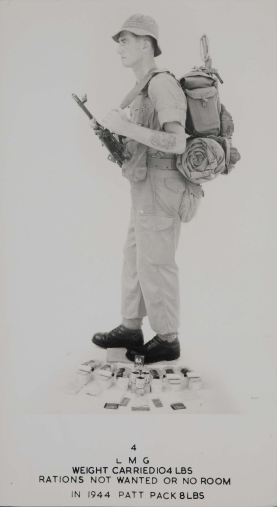
A correction stating his correct rank of temporary lieutenant colonel was scheduled to be published in the Gazette to rectify this mistake. However, before the correction could be made, numerous facetious friends sent messages of congratulations to Lt Col Burn. Unfortunately, these messages likely perplexed him as he had already departed from New Zealand before the notice appeared in the Gazette.

Compulsory Military Training

During this period one CMT intakes marched in with the RNZAOC recruits posted to 1 (NZ) Division Ordnance Field Park on completion of initial training;[2]

  • 27th intake of 1542 recruits on 1 May 1958
  • 28th intake planned for August 1958 but not held

After 63,033 men were trained under the CMT Scheme, the Labour Government halted the CMT scheme and replaced the 1949 Military Training Act with the National Service Registration Act 1958 in early 1958.

Conferences

DOS Conference 27-29 May 1958

Hosted by the DOS at Army HQ, the agenda for this meeting included.[3]

  • DOS Instructions
    • New format and reprint
    • Drafts of instructions C/1 and C/2
  • Local Purchase
    • Spares for post-war vehicles
    • Officer Commanding Depots £25 authority (2020 NZ$1250)
    • Purchase of stores by DADOS
  • Disposal of Stores
    • Produce and items from Boards of Survey
    • Survey of Stores – Army 246/37/1/Q(Org) of 6 October 57.
  • Accounting
    • Clothing
  • Demands
    • Identification of items
    • Bright Steel nuts and bolts
    • Trade names and trade equivalents
  • Finance
    • Vapour proof packaging of stores
    • Use of export cases
  • General
    • District problems
    • Further Army HQ problems if necessary

Uniforms

During this period, RNZAOC ordnance Depots and clothing stores would introduce the following new uniform types.[4]

  • Males Other Rank Service Dress – this uniform was issued to all-male soldiers of the Regular Force.
  • Jungle Green Drill – the issue of Jungle Green uniforms to replace uniforms previously produced in Khaki Drill also commenced.
  • NZWRAC Uniform – The issue of new summer dress consisting of a green short-sleeved frock commenced. Production of a new pattern green went into production.

Disposals

Vehicles

One hundred ninety-five vehicles from 5-ton trucks to motorcycles were declared surplus to the Government Stores Board.

Ammunition

By the end of December 1958, the Makomako, Waiouru and Belmont Ammunition areas had concluded the destruction of 317,440  items of ammunition ranging from detonators to 9.2in Cartridges; this included the detonation of 108 tons of Explosives with an additional 1217 tons of ammunition dumped at sea. Makomako was cleared of dangerous ammunition.

Move of Central Districts Vehicle Depot to Linton

As part of the Central Districts Vehicle Depot (CDVD) move to Linton during 1958, consideration was given to retaining some of the functions of the CDVD within the Main Ordnance Deport. To this end, the MOD Vehicle group was established. The MOD Vehicle group took over the existing CDVD compound at Trentham and had the following responsibilities:[5]

  • Receipt, processing, and issue of all new vehicles.
  • Custody of vehicles that were considered as part of the Army Reserve Stocks.
  • Custody and disposal of vehicles held by CDVD Trentham that were considered surplus or had or been declared for disposal.

This ensured that when the CDVD completed its move to Linton, only the vehicles and equipment needed to operate were transferred to Linton.

Linton Camp Ordnance Depot Issues

Since its establishment in 1946, the Central Districts Ordnance Depots had occupied accommodation buildings in the North West corner of Linton Camp in what had initially been the wartime RNZAF Base Linton. Two additional warehouses had been assembled in 1949; however, storage space remained at a premium. Some example of the issues faced by the Ordnance Depot was; [6]

  • Block 1 Clothing Store – unable to be heated and uncomfortable for staff due to the risk of fire caused by the large quantity of clothing packaged with Naphthalene. This created a potential fire risk due to the Salamander heaters used for heating buildings.
  • S&T Block Tent Store – a multi-purpose building, used as a tent Store, repair shop and Traffic Centre. This building required repairs and was in such a state that it could not be secured against illegal entry. As the MOW estimated repairs to this building to cost at least £2000 (2020 NZ$49,882.32), the authority to repair would require approval from the DCRE. However, the DCRE had advised that this building was not worth repairing, with no alternative accommodation the Ordnance Depot was in a difficult position.

It was advised in December 1958 that because of the preliminary site investigation for a new Ordnance Depot conducted the previous year, a new building covering 125,000 sq. ft be constructed for the Ordnance Depot over the next three years.

Pending decision on the new Ordnance Depot building, the decision was made that the number of prefabricated buildings then been erected for the CDVD be increased from three to Four with the additional structure allocated to the Ordnance Depot as storage accommodation.

Ration Packs

During the 1959 annual camp, the Royal New Zealand Army Service Corps (RNZASC) conducted trials of a specially designed four-person, 24-hour rations pack to streamline the Armoured units’ food supply. The pack was assembled using readily available commercial items, and feedback from both the 1 and 4 Armoured Regiments was positive.

Drawing on the experiences of the NZ SAS and NZ Regiments in Malaya, where soldiers had to carry and prepare their own rations during jungle operations, the RNZASC recognized the need for a lightweight 24-hour ration pack. To meet this emerging requirement, they were in the process of developing such a pack.[7]

Cricket Tour

In February 1959, the RNZAOC hosted a cricket tour to New Zealand by the Royal Australian Army Ordnance Corps (RAAOC). Major Derrick Roderick, a leading player for the RNZAOC tour to Australia in 1955, would act as the RNZAOC Liaison Officer for the RAAOC tour.[8]

Over a period of three weeks, the RAAOC Cricket team would tour New Zealand, playing matches at;

  • Devonport Oval vs Ordnance Northern Military District, NZ Lost by 20 Runs
  • Linton Camp vs Ordnance Central Military District, Draw
  • Trentham camp vs RNZAOC XI, NZ lost by 11 Runs
  • Burnham Camp vs Ordnance Southern Military District, NZ Lost
  • Trentham Camp vs Main Ordnance Depot, NZ lost

The tour was finalised on 19 February with a farewell Ball at the Trentham Camp Badminton Hall. The New Zealand Director of Ordnance Services, Lt-Col H. McK. Reid made presentations to all Australian tour members on behalf of the RNZAOC. The Australian team manager, Colonel C. V. Anderson, OBE, on behalf of the RAAOC team, thanked the RNZAOC for the hospitality and entertainment provided throughout the tour, presenting magnificent silver salvers to the Trentham Officers and Sergeants messes. The visitors were farewelled the following day, returning to Australia on the MS Wanganella.[9]

Honours and Awards

Long Service and Good Conduct

  • 31259 Warrant Officer Class One Maurice Sidney Phillips, 26 March 1959

Secondment to British Army

On 27 March 1958 Major Francis Anness Bishop RNZAOC began a secondment with the British Army. Attached to the 17th Gurkha Division/Overseas Commonwealth Land Forces (Malaya), Major Bishop would be the Divisions Deputy Assistant Quartermaster-General (DAQMG).[10]

Staff College, Camberley

Captain C.L Sanderson, RNZAOD represented the New Zealand Army on the 1959 Staff College Course at Camberley in the United Kingdom.[11]

Appointments, Promotions, Transfers, Resignations, and Retirements of Officers of the RNZAOC

Regular Force

  • Lieutenant and Quartermaster A.F James to be Captain and Quartermaster, 1 April 1958.[12]
  • [13]
  • Captain Ellis Charles Green MBE., is posted to the Retired List in the rank of Major, 12 May 1958.[14]
  • Lieutenant and Quartermaster J.E Hutchinson to be Captain and Quartermaster, 1 April 1958.[15]
  • Major 0.H Burn to be Temporary Lieutenant-Colonel, 26 July 1958.[16]
  • Captain G.J.H Atkinson, MBE., to be Temporary Major, 21 July 1958.[17]
  • Captain and Quartermaster S.H.E Bryant is transferred to the Supernumerary List on reaching retiring age for rank, 27 October 1958.[18]
  • Major Patrick William Rennison is transferred to the Reserve of Officers, General List, RNZAOC, with the rank of Major, 21 October 1958.[19]
  • Lieutenant and Quartermaster A. Fraser to be Temporary Captain and Quartermaster, 16 September 1958. [20]
  • Major (Temporary Lieutenant-Colonel) H McK Reid to be Lieutenant-Colonel, 30 October 1958.[21]
  • Lieutenant J.B Glasson to be Temporary Captain, 16 September 1958.[22]
  • Lieutenant (Temporary Captain) J.B Glasson to be Captain Dated 9 December 1958. [23]
  • Captain C.C Pipson is transferred to the Supernumerary List on reaching retiring age for rank and is re-engaged for a period of one year, 22 February 1959.[24]
  • Lieutenant and Quartermaster R.J Crossman to be Captain and Quartermaster, l 5 March 1959.[25]
  • Lieutenant and Quartermaster G.W Dudman to be Captain and Quartermaster, 15 March 1959.[26]
  • Lieutenant (Temporary Captain) and Quartermaster A Fraser to be Captain and Quartermaster, I 5 March 1959.[27]
  • Captain (Temporary Major) G.J.H. Atkinson, MBE., to be Major, 6 March 1959.[28]

Regular Force (Supernumerary List)

  • Captain and· Quartermaster G.A Perry, E.D., re-engaged for a period of one year, as from 1 April 1958.[29]
  • Captain and Quartermaster S.H.E Bryant re-engaged for a period of one year, 27 October 1958. [30]
  • Captain and Quartermaster Alfred Golian posted to the Retired List, 17 January l 959.[31]

RESERVE OF OFFICERS

  • Lieutenant J.H Mead relinquishes his commission, 1 July 1958.[32]
  • Major William Patrick Chester-Dixon, from the British Regular Army Reserve of Officers, to be Lieutenant-Colonel, 16 May 1958.[33]
  • Captain F.H Pike relinquishes his commission, 5 November 1958.[34]

The under-mentioned were posted from the General List to the Retired List:

  • 2nd Lieutenant Francis Edwin Clark. [35]
  • 2nd Lieutenant Ernest Ivan Meggett. [36]
  • 2nd Lieutenant Henry Charles Foster. 
  • Lieutenant Morris James Goodson.[37]
  • Lieutenant John· Clyde Graham.[38]
  • Lieutenant Frank Whittington Jull. [39]
  • Lieutenant Graham Wootton Clark.[40]
  • Lieutenant John Ivor Martin. [41]
  • Lieutenant Francis Thomas Thorpy. [42]
  • Lieutenant Albert William Buckley.[43]
  • Lieutenant Albert Arthur Burrows. [44]
  • Lieutenant James Stewart Jamieson. [45]
  • Captain William Arthur Pascoe.
  • Captain Austin Whitehead. 
  • Captain William Mervyn Rowell. 
  • Captain Stanley Copley Bracken.[46]

Territorial Force

  • Alan Ernest Osborne to be 2nd Lieutenant and is posted to the Technical Stores Platoon, 1st Divisional Ordnance Field Park, RNZAOC, 1 August 1958.[47]

Appointments, Promotions, Transfers, Resignations, and Retirements of Warrant Officers, Senior Non-Commissioned Officers, and men of the RNZAOC

  • A30054 Sergeant Bryan Nelson Jennings promoted to Staff Sergeant, 13 October 1958.[48]
  • 31383 Staff Sergeant Hector Searle McLachlan promoted to Warrant Officer Class Two, 1 April 1958.[49]
  • 31259 Warrant Officer Class Two Maurice Sidney Phillips promoted to Warrant Officer Class One, 14 October 1958.[50]
  • 31246 Warrant Officer Class Two Douglas Keep Wilson promoted to Warrant Officer Class One, 13 October 1958.[51]

Notes

[1] “H-19 Military Forces of New Zealand Annual Report of the General Officer Commanding, for Period 1 April 1958 to 31 March 1959,” Appendix to the Journals of the House of Representatives  (1959).

[2] Peter Cooke, Fit to Fight. Compulsory Military Training and National Service in New Zealand 1949-72 (Auckland: David Ling Publishing, 2013), 539.

[3] Conferences – Ordnance Officers, Item Id R17188101 (Wellington: Archives New Zealand, 1950).

[4] “H-19 Military Forces of New Zealand Annual Report of the General Officer Commanding, for Period 1 April 1958 to 31 March 1959.”

[5] “Organisation – Policy and General – Rnzaoc “, Archives New Zealand No R17311537  (1946 – 1984).

[6] Buildings, Linton Camp, Central Ordnance Depot, Item Id R9428308 (Wellington: New Zealand Archives, 1955 – 1968 ).

[7] “H-19 Military Forces of New Zealand Annual Report of the General Officer Commanding, for Period 1 April 1958 to 31 March 1959.”

[8] Major J.S Bolton, A History of the Royal New Zealand Army Ordnance Corps (Trentham: RNZAOC, 1992), 177-78.

[9] “Australian Ordnance Farwelled,” Upper Hutt Leader, Volume XVI, Number 7 26 February 1959 1959.

[10] “Recommendations for Honours or Awards,” The National Archives (UK) Ref WO 373/135/420 1960.

[11] “H-19 Military Forces of New Zealand Annual Report of the General Officer Commanding, for Period 1 April 1958 to 31 March 1959.”

[12] “Appointments, Promotions, Transfers, and Resignations, of Officers of the New Zealand Army,” New Zealand Gazette, No 28, 8 April 1958.

[13] “Appointments, Promotions, Transfers, and Resignations, of Officers of the New Zealand Army,” New Zealand Gazette, No 34, 5 june 1958.

[14] Ibid.

[15] “Appointments, Promotions, Transfers, and Resignations, of Officers of the New Zealand Army,” New Zealand Gazette, No 36, 12 june 1958.

[16] “Appointments, Promotions, Transfers, and Resignations, of Officers of the New Zealand Army,” New Zealand Gazette, No 52, 21 August 1958.;”Appointments, Promotions, Transfers, and Resignations, of Officers of the New Zealand Army,” New Zealand Gazette, No 56, 11 September 1958.

[17] “Appointments, Promotions, Transfers, and Resignations, of Officers of the New Zealand Army.”

[18] “Appointments, Promotions, Transfers, and Resignations, of Officers of the New Zealand Army,” New Zealand Gazette, No 58, 25 September 1958.

[19] “Appointments, Promotions, Transfers, and Resignations, of Officers of the New Zealand Army,” New Zealand Gazette, No 68, 6 November 1958.

[20] Ibid.

[21] “Appointments, Promotions, Transfers, and Resignations, of Officers of the New Zealand Army,” New Zealand Gazette, No 76, 11 December 1958.

[22] “Appointments, Promotions, Transfers, and Resignations, of Officers of the New Zealand Army,” New Zealand Gazette, No 8, 19 February 1959.

[23] Ibid.

[24] “Appointments, Promotions, Transfers, and Resignations, of Officers of the New Zealand Army,” New Zealand Gazette, No 19, 25 March 1959.

[25] Ibid.

[26] Ibid.

[27] “Appointments, Promotions, Transfers, and Resignations, of Officers of the New Zealand Army,” New Zealand Gazette, No 22, 16 April 1959.

[28] “Appointments, Promotions, Transfers, and Resignations, of Officers of the New Zealand Army,” New Zealand Gazette, No 25, 30 April 1959.

[29] “Appointments, Promotions, Transfers, and Resignations, of Officers of the New Zealand Army,” New Zealand Gazette, No 21, 2 April 1958.

[30] “Appointments, Promotions, Transfers, and Resignations, of Officers of the New Zealand Army.”

[31] “Appointments, Promotions, Transfers, and Resignations, of Officers of the New Zealand Army,” New Zealand Gazette, No 17, 19 March 1959.

[32] “Appointments, Promotions, Transfers, and Resignations, of Officers of the New Zealand Army,” New Zealand Gazette, No 48, 7 August 1958.

[33] “Appointments, Promotions, Transfers, and Resignations, of Officers of the New Zealand Army,” New Zealand Gazette, No 41, 3 July 1958.

[34] “Appointments, Promotions, Transfers, and Resignations, of Officers of the New Zealand Army,” New Zealand Gazette, No 2, 15 January 1959.

[35] “Appointments, Promotions, Transfers, and Resignations, of Officers of the New Zealand Army,” New Zealand Gazette, No 38, 26 June 1958.

[36] Ibid.

[37] Ibid.

[38] “Appointments, Promotions, Transfers, and Resignations, of Officers of the New Zealand Army,” New Zealand Gazette, No 43, 10 July 1958.

[39] Ibid.

[40] “Appointments, Promotions, Transfers, and Resignations, of Officers of the New Zealand Army.”

[41] Ibid.

[42] Ibid.

[43] “Appointments, Promotions, Transfers, and Resignations, of Officers of the New Zealand Army,” New Zealand Gazette, No 64, 3 October 1958.

[44] Ibid.

[45] “Appointments, Promotions, Transfers, and Resignations, of Officers of the New Zealand Army.”

[46] “Appointments, Promotions, Transfers, and Resignations, of Officers of the New Zealand Army,” New Zealand Gazette, No 71, 20 November 1958.

[47] “Appointments, Promotions, Transfers, and Resignations, of Officers of the New Zealand Army,” New Zealand Gazette, No 7, 12 February 1959.

[48] Howard E. Chamberlain, Service Lives Remembered : The Meritorious Service Medal in New Zealand and Its Recipients, 1895-1994 ([Wellington, N.Z.]: H. Chamberlain, 1995), 242.

[49] Ibid., 289.

[50] Ibid., 367-68.

[51] Ibid., 512.


Uniforms and Equipment of the NZ Army Contingent in Somalia

The New Zealand Army’s contribution to the UNITAF and UNOSOM Missions consisted of.

  • NZ Supply Detachment, November 1992 to July 1993
  • Army personnel attached to 42 Squadron RNZAF, January to May 1993
  • NZ Supply Platoon July 1993 to January 1994
  • NZ Supply Platoon January 1994 to June 1994
  • Staff attached to UN Headquarters 1992 to 1995

Uniforms worn by the NZ troops in Somalia were based around the standard NZ Army Disruptive Pattern material (DPM) temperate uniform that had been introduced in the late 1980s. Shirts were worn with sleeves rolled up and shirts untucked.

Each contingent had variations of what and how items could be worn, but, the combinations worn were not too dissimilar between contingents.

Ceremonial or Parade Dress

On rare ceremonial occasions, the DPM Uniform was worn with the shirt tucked in with.

  • Blue UN Beret
  • Blue UN cravat
  • Stable Belt of the individual’s Corps

Working Dress

Due to the harsh environment, a relaxed and comfortable working dress was adopted, which was worn in several variations, including

  • T-Shirt/Singlet, Shorts, Boots
  • T-Shirt/singlet, DPM Trouser, Boots

The Green T-Shirt was the standard issue NZ Army PT Shirt, however on occasion some individuals wore DPM T-Shirts or green civilian T-Shirts.

Although issue of the Green Single had ceased in the early 1980’s, some of the longer serving solders wore these older items.

The Black Shorts worn were either the standard NZ Army issue PT Short, “Singapore” Shorts or civilian items such as Canterbury Rugby Shorts.

Issue Green T-Shirt and Singapore Shorts
Old issue Single and DMP trou

Headdress

Headdress won by NZ Troops in Somalia consisted of.

  • NZ Army Beret with Corps Badge
  • UN Blue Beret
  • UN Blue Baseball cap
  • PASGT Kevlar Helmet

NZ Army Beret with Corps Badge

Usually only worn in transit from NZ to arrival in Somalia

UN Blue Beret

Issued from UN Stocks in Theatre, apart from Ceremonial occasions, rarely worn

UN Blue Baseball cap

Issued from UN Stocks, worn daily.

PASGT Kevlar Helmet

Worn daily. Use of covers on Kevlar helmets was not standardised, some were worn with covers others without covers.

NZ Manufactured Blue Covers designed for the PASGT helmets were utilised, these were plain blue with no markings.

Blue Covers designed for the M1 Steel helmet were also utilised, as were covers designed for the M1 Helmet in the various types of NZ DPM Pattern.

Blue UN Cover
No Cover
M1 Helmet DPM Cover

Boots

Although the DMP uniform was not designed for the climate, some consideration to climate appropriate footwear was given and Desert Boots were issued. Manufactured by New Zealand boot manufacturer John Bull, the Desert Boots were made of Tan Suede with synthetic rubber soles.

Each soldier was issued with two pairs of Desert boots; however a few individuals also wore the standard Black GP Boot.

Dress embellishments

Rank Insignia

As per the NZ Military conventions of the day, Rank insignia was worn as follows.

  • NCO Rank worn on a Brassard on the right shoulder,
  • Warrant Officer Rank on a wristband on the right wrist,
  • Officer Rank worn on a rank slide on the shoulder epaulettes of the DPM Shirt.

Mission Brassard

The Mission Brassard was worn on the Left shoulder and consisted of the UN patch above an NZ Flag. There is evident of examples of the mission Brassard worn with the badges reversed as well. As Officers and Warrant Officers wore their rank on the shoulder and wrist, there are also example of the Mission Brassard worn on the right shoulder.

National Insignia

 In addition to the NZ Flag on the Mission Brassard, a variation of the standard New Zealand shoulder tab that had been worn on overseas mission since the Second World War was worn affixed to the epaulets of each shoulder.

Trade and Appointment Badges

Some trade and appointment badges, such as the Ammunition Technician Badge and Medic Red Cross, were worn on the Mission Brassard.

Protective Vests and Body Amour

The New Zealand Army Body Armour of choice at the time was the Light Fragmentation Vest. A piece of kit unsuitable of the operating environment, which served more as confidence booster than as a practical protective measure.

From 1994 some of the Staff posted to the UN HQ were issued with the much more capable Bristol Type 23 Body Amour.

Load Carrying Equipment

Each NZ Soldier deployed to Somalia with the standard NZ Harness Webbing, being the early 90’s there was no set configurations with a variety of different pouches utilised with a basic set consisting of a minimum of Two Magazine pouches and Two Water Bottles and First Aid Pouch.

Due to the operating environment and the impartibility of wearing harness webbing in vehicles at the workplace, most individuals seldom used their webbing, with most sets spending the entire tour sitting under the individual’s cot, only to be dragged out for the occasional stand to.

Early on when the threat was perceived as low, a single spare magazine was carried in the pocket of the Frag Vest. As the treat level increased and the need to have additional ammunition at hand, many contingent members utilised a simple belt order consisting of pistol belt, Ammunition pouch and water bottle.

With the Infantry sections attached from July 93, some of the infantry lads utilised chest Rigs.

One set of unofficial purchased vest webbing was worn by a member of the Third Supply Contingent from January 1994. This vest was worn over the Frag Vest and allowed the wearer to carry additional ammunition and items with no loss of movement when in vehicle or carrying out physical tasks. This set of vest webbing become a communal set and was also utilised the Infantry Section Commander if his tasks necessitated it.

Example of Belt Order with Ammo Pouch and Water Battle, Magazine in Frag Vest pocket
Example of Vest Webbing

Weapons Systems

The New Zealand Contingents in Somalia utilised the standard range of New Zealand Small Arms, including

  • Steyr AUG 5.56mm Rifle with 508mm barrel.
  • Steyr AUG 5.56mm Carbine with 250mm barrel.
  • C9 Minimi 5.56 mm Light Machine Gun.
  • Pistol 9 mm Automatic P226, note as this weapon had only been introduced into NZ Army Service in 1992, existing holsters for the retired Browning pistols were utilised.

Gallery

Photo credits.

  • The Somalia Journal 1992-1995
  • Authors Collection