This undated plan of the Mount Eden Goal Reserve provides a view of the layout of the long-forgotten Auckland Defence Stores Mount Eden location. Located between the Goal and Auckland Grammar School, this plane was drawn up sometime between 1907 and 1917
The Defence Stores footprint at Mount Eden started in 1871 when two magazines were constructed to house Defence ammunition, then stored at Albert Barracks in the centre of Auckland.
In 1903 the Defence Stores Office in O’Rourke Street (now Auckland University) was relocated to Mount Eden. Initially, the existing magazines at Mount Eden were thought to be sufficient. However, it was soon found that additional buildings were required, and a Stores building and Armourer’s shop were constructed during 1903/04. Eventually, a house was also built for Captain W.T Beck, the District Storekeeper.
In 1917 the Defence Stores were reorganised into the New Zealand Army Ordnance Corps (NZAOC), with the Mount Eden Defence Stores becoming the Northern Districts Ordnance Depot.
By 1920, with little space available for expansion to allow the storage of the large number of mobilisation stores required by the Norther District, construction of an alternative site for the Mount Eden Ordnance Depot began at Hopuhopu in the Waikato.
While the Hopuhopu site was still under construction, Stores from the Mount Eden site began to be transferred to Hopuhopu in 1927. The new depot officially opened in 1929, with the Mount Eden Depot closing.
The Store constructed in 1903 was dismantled and re-erected at the Narrow neck Camp on Auckland’s North Shore. The fate of the original magazines is unknown, but they were likely taken over for a time by the nearby Colonial Ammunition Company (CAC).
The closure of the Mount Eden Depot did not totally sever to the connection between Mount Eden and the Ordnance Corps, with Ordnance Ammunition staff remaining attached to the CAC until 1967, testing the supply of Small Arms Ammunition provided by that factory.
It is said that a picture says a thousand words, and this postcard of the Takapau Divisional Camp of April-May 1914 is such a picture. While it tells part of the story of the neatly 4839 Territorials who attended the camp, it also provides an insight into the tremendous logistical effort by the Defence Stores Department to provide the stores and equipment required by the largest Territorial camp ever held in New Zealand.
Between April and May 1914, 18,882 Territorial Soldiers of New Zealand’s citizen army attended five main camps across New Zealand.
the Auckland Military Districts camp was at Hautapu, near Cambridge,
the Canterbury Military Districts camp was split between Kowai, near Springfield, with the Marlborough and Nelson units camping at Tapawera, near Nelson.
the Otago Military Districts Camp was at Matarae, in Central Otago
The Wellington Military Districts were held at Takapau in Hawkes Bay.
To oversee the management of the Camp Equipment and other Ordnance Stores required, the District Storekeepers of each Military District were appointed as Ordnance Officers for the duration of the camp and provided with a staff of eighteen Territorial Soldiers trained in the duties required of an Ordnance Depot.
The District Storekeepers were
Honorary Lieutenant William Thomas Beck, District Storekeeper, Auckland
Honorary Lieutenant Arthur Rumbold Carter White, District Storekeeper, Christchurch
Honorary Lieutenant Mr Owen Paul McGuigan, District Storekeeper, Dunedin
Mr Frank Edwin Ford District Storekeeper, Nelson
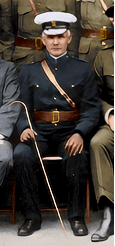
Honorary Major James O’Sullivan, Defence Storekeeper Wellington
Based on the numbers that attended the Takapau Camp and the Camp Equipment scale of 1913, the following quantities indicate the Camp Equipment required. Provided from the Defence Stores in Wellington, two trainloads were required to move the stores from Wellington to Takapau to pre-position before the camp.
Axes, felling, helved, 122
Axe. Pick, 160
Buckets, Water, 1937
Basins, Wash hand, 2023
Boilers with lid, 20 Gal, 100
Boilers with lid, 9 Gal, 100
Candlesticks, bayonet, 2023
Choppers, Meat, 100
Crowbars (if required) 190
Dishes, meat, 1711
Kettles, camp, 1543
Lantern s, stable, 348
Racks, arm, tent (Large loop), 1259
Spades, 274
Shovels, 274
Tents, circular, complete, 1773
Marquees, 65
Ropes, picket, 20 yards 115
Brooms, bass, 128
Sheets, ground, 8350
Rakes, iron 16in ,128
How much of this equipment was available in the District Storehouses is unknown. However, it is known that in 1914 the NZ Military had a sufficient stock of tents to accommodate the whole Territorial Force at the full establishment, including
3651 tents (circular)
181 marquees,
30 operating tents, and
98 bivouac tents
The concept of the Camp Ordnance Depots was that as the unit advance parties arrived, the required number of camp equipment stores were issued from the Ordnance Depot to the unit Quartermaster Staff, usually under the control of the Regimental Quartermaster Sergeant.
On completing the camp, the RQMS was required to return all the stores to the Ordnance depot and remain available to finalise any accounts for losses and damages. Following the closedown of the camp, the stores were then loaded onto trains and returned to the District Stores, ready for the next activity.
The Ordnance Depots also held a stock of clothing and equipment available as replacements or for sale. For example, the Takapau Camp Ordnance Depot sold 1000 boots and 250 blankets.
The Divisional Camps of 1914 were only the second time Ordnance Depots had been established at annual camps and proved successful. There is no doubt that they would have stood up again for the planned camps in 1915. However, the logistical framework of the 1914 Divisional Camps served as a dress rehearsal for the August 1914 mobilisation and contributed to the raising and dispatching overseas of the largest, best trained and equipped force to be dispatched from this country in the 20th century.
Throughout the early 1860s, elements from the Militia and Volunteers supported the Imperial troops undertaking the bulk of the military operations in the early years of the New Zealand Wars. In 1861 as George Grey assumed the role of Governor for a second term, Grey undertook a policy of conciliation while also preparing for war. As General Cameron built up his Imperial forces, Gray reviewed and overhauled the citizen forces of New Zealand. In January 1862, new regulations for the volunteer force were issued, followed on 18 September by the Colonial Defence Act of 1862. This Act saw the formation of the Colonial Defence Force, the first regular Force in New Zealand. Under the Quartermaster General of the Colonial Defence Force, Captain Robert Collins, the Colonial Store Department and the Militia Store Department assumed the store’s responsibility for the Militia, Volunteer and Regular Forces of New Zealand.
In Auckland, the Colonial Store Department and the Militia Store Department initially operated out of offices on Princes Street. However, approval was granted in October 1863 for the erection of a store adjacent to the Imperial Armoury near the Symonds street entrance to the Albert Barracks.[1] The two Store Departments essentially carried out the same functions, and in 1865 the post of Superintended of Militia Stores held by Mr E.D King was disestablished with the responsibility for colonial defence stores centralised under the Colonial Storekeeper, Captain John Mitchell.
Military Store Albert Barracks 1871
A review of colonial defence with a reliance on local forces taking over from Imperial Forces saw the passing of the Armed Constabulary Act of 10 October 1867. This Act combined police and military functions into the regular Armed Constabulary (AC) Force. The AC Force was supported by Maori loyal to the crown, Militia and Volunteer units, with Defence Storekeepers in Auckland, Whanganui and Wellington providing the required logistic support.[2]
In April 1869, Lieutenant Colonel Edward Gorton was appointed as the Inspector of Defence Stores, establishing his office at Molesworth Street in Wellington, bringing all New Zealand’s Defence storekeepers under his control. By January 1869, as the withdrawal of Imperial units became imminent, the dismantling of their central logistic hub at Auckland’s Fort Britomart and Albert Barracks had commenced, with military stores, including guns and ammunition that were not auctioned off to the public or purchased by the New Zealand Government, shipped to the United Kingdom. The departure of the British Military Storekeeper Joseph Osbertus Hamley in July 1870 marked the final withdrawal of Imperial Forces from New Zealand, with the Auckland Defence Store taking over ownership of the Armoury and Magazines located in Albert Barracks.
In May 1869, Captain John Mitchell was suspended as the Auckland Storekeeper due to unauthorised absences. Resigning in July, Major William St Clair Tisdall replaced Mitchell as acting Storekeeper. A small staff assisted Tisdall, some of whom had served in the stores since 1861, including
John Blomfield, Clerk
John Price, Clerk
David Evitt, Armourer Sergeant
Arms Cleaners
Mr’s F Gibbons,
J Penligan and
C.C Rockley
Following the departure of Imperial units, the future of Albert Barracks came under debate. In addition to the Defence Stores, the only other military use of the former barracks was by the local Militia and Volunteers, who retained a drill hall and utilised the parade round. The Auckland Improvement (Albert Barrack Reserves) Act of 1872 repealed previous Acts relating to the status of Albert Barracks and placed responsibility for the management and disposal of the land under the Auckland Improvement Commissioners.[3] The Auckland Improvement Commissioners drew up and oversaw plans to develop the bulk of the Barracks into a recreational reserve, with other areas subdivided into roads and plots of land for further development.
By 1871 the growth of Auckland now placed the ageing powder magazine in the centre of a built-up area, raising concerns about its safety. New powder magazines were constructed at Mount Eden, with the first stocks transferred from Albert Park to Mount Eden in September, following which the Albert Barracks magazines were demolished.[4] With the Auckland district’s supply of ammunition now safely stored at Mount Eden under the care of the Defence Stores magazine keeper, Tisdall and the remaining staff of Storemen and Armourers remained at Albert Barracks.[5] Initially located in the old Imperial Armoury building at the Symonds Street entrance of Albert Barracks, it was considered an obstruction to the Commissioner’s projected improvements.[6] To allow the extension of Princes Street and subdivision of the land between Princes and Symonds Street, in July 1873, the Defence Stores had been moved into the well-constructed stone building that had previously been the Barracks hospital.[7] The new building included ample accommodation for warlike stores, including small workshops and a forge.[8] The only remnant of the site of the old Armoury were two Russian 18-pounder guns taken at the Crimea and presented by the Imperial Government to the colony of New Zealand in the late 1850s.[9]
The Defence Stores building in Albert Park was described by the Auckland Star as the “hideous eyesore in Albert Park’ and considered a blight on the skyline as it obstructed the view from the park that had been established to replace the Barracks.[10] By 1883 an agreement was reached between the Auckland Council and the Government, with a plot of land in O’Rourke Street provided to allow the relocation of the Defence Stores.[11]
Queen St with Albert Barracks on the left hillside C1870-1979. Auckland Libraries Heritage Collections 898-9969
When the proposal was first mooted to relocate the Defence Store, plans were prepared in the Auckland Public Works office for a three-storied building equal in space to the present location. However, as it intended to centralise the operations of the Defence Stores in Wellington, the original design was countermanded with a design for a smaller building substituted. Tenders for the erection of the new Defence Stores building were published on 10 May 1883 for a building meeting the following specifications,
to be constructed of brick, two storeys in height, with a concrete foundation,
to have a frontage of 25 feet with a depth of 36 feet.
the ground floor was to have
a passage seven feet wide,
two 18×18 apartments,
a staircase leading from the ground floor to the upper storey
The upper floor subdivided into
An 18×8 office, compartment with lift,
a 14 x18 room
an 11 x 18 room
To the rear of the building
a 14×25 shed with an asphalted floor for gun carriages
a 6×14 coal shed,
a 14×20 Armourer’s shop.
Due to the considerable amount of material accumulated in the old Defence Stores over its many years of operation, Captain Sam Anderson, the Chief Defence Storekeeper, assisted in a stocktake of the old store as it was decommissioned, ensuring only essential materials were transferred to the new building. Surplus stores were disposed of by tender or redistributed, including over 2000 obsolete muzzle-loading muskets relocated to the Defence Store in Wellington.[12] The old Stores building was soon demolished with much of the material used in the construction of the new building, with the only reminder of the military’s residence of Albert Park being a small portion of the Barracks wall and a few old cannons on display in the new ornamental gardens.
The New Defence Store in O’Rourke Street was one of the earliest purpose-built Storehouses built for New Zealand’s Military. Up to this period, many of the buildings utilised by the Defence Stores were inherited from the Imperial Forces or requisitioned commercial premises.
By 1888, the cost of maintaining a peacetime military had reached the point where cutbacks and savings across the Defence budget had to be made. As part of several reductions across the Defence Department, the Auckland Defence Store was drastically downsized, resulting in the retirement or redundancy of most of the staff. The closure of the Auckland Defence Stores was met with dismay, with the press questioning it as an absurd decision, with the New Zealand Herald noting in an editorial that the closure of the Auckland Defence Store was” solely arising from the Wellington authorities having want of local knowledge and of the requirements of the place.” This pushback on the closure of the Auckland Defence Store resulted in a short reprieve for James Bloomfield, the Defence Storekeeper in Auckland, who had served since 1861, was granted a reprieve from redundancy and allowed to extend his tenure, retiring in December 1888, handing over the responsibilities of Defence Storekeeper for Auckland to Major John William Gascoyne of the New Zealand Permanent Militia.[13] Following Gascoyne’s departure in 1891, the responsibilities of Auckland Defence Storekeeper were assumed by the Adjutant of the Auckland Brigade Office, who oversaw the duties of the Magazine Keeper at Mount Eden, Mr J Hawthorn.[14]
Concurrent with the Adjutant taking over the Defence Storekeepers’ responsibilities, the Auckland Brigade Office was moved from its offices in the Auckland Supreme Court into the Defence Store O’Rourke Street building, from where the Adjutant conducted his duties related to the Auckland Volunteers and the Defence Stores.[15] This shared arrangement remained in place into the early years of the twentieth century and even saw a telephone installed in 1902.
Routine activities conducted by the Auckland Defence Stores in O’Rourke Street included various tenders to provide uniforms and repair equipment. Following the bloodless Dog Tax War of 1898, the Defence Store in O’Rourke street took custody of the surrendered arms, including [16]
one Winchester repeating rifle
one Winchester carbine
two Green’s American patent Snider breech-loading rifles
one Snider rifle
one muzzle-loading carbine
one Lee Bolt shotgun, single barrel
three breech-loading single-barrel guns.
three double-barrel breech loaders (nearly new)
ten double-barrel muzzle-loading guns
two single-barrel guns
four bundles of ammunition (various)
In 1903 the Police expressed an interest in taking over the building as accommodation for the Auckland Police Commissioner. Following an inspection by the Defence Storekeeper, Mr James O’Sullivan, arrangements were made to transfer the Defence Stores from the O’Rourke Street Property to Mount Eden and hand the building over to the Police.[17] In 1904, the Defence Stores building handover to the Police was concluded, ending the sixty-year relationship between Auckland’s Albert Park and the Military.
The Police fully refurbished the former Defence Store Building into a residential villa. The building survived into the 1960s when it was demolished to allow the construction of Auckland University.
1905 view of the refurbished Defence Store building(Center of the photo next to Police Station)
Despite the construction of new buildings for the Defence Stores in Wellington, Christchurch and Dunedin during the early 1900s, no new permanent buildings were constructed for the Auckland Defence Stores as the existing powder magazines at Mount Eden, constructed in 1871, were deemed sufficient to meet current and projected needs. Following the transition of the Defence Stores into the New Zealand Army Ordnance Corps in 1917, a new Ordnance Depot was constructed for the Northern Region to replace the infrastructure at Mount Eden in the late 1920s. However, it was not in Auckland but at Hopuhopu in the Waikato. Temporary Ordnance Stores were established in Auckland during World War Two, utilising rented commercial premises. In the post-war era, ordnance warehouses established at Syliva Park utilised buildings constructed for the United States Forces. Besides Explosive Store Houses at Ardmore, no permanent dedicated storage infrastructure was ever constructed for the RNZAOC in Auckland.
The significance of the Defence Store building in O’Rourke Street is that, excluding smaller unit storehouses and ammunition storehouses, it remains the only purpose-built military warehouse constructed for the New Zealand Army in Auckland.
Notes
[1] Queen’s Redoubt Assistant Military Secretary, “Correspondence Stating That There Is No Objection to the Erection of a Store for Colonial Purposes Adjoining Armoury Albert Barracks,” Archives New Zealand Item No R24075932 (1863).
[2] M. R. Wicksteed, The New Zealand Army: A History from the 1840s to the 1980s ([Ministry of Defence, 1982), Non-fiction, 2-3.
[3] Under the provisions of the Public Domains Act 1860, the Auckland Military Reserves Act 1871 established the land that Albert Barracks occupied as Crown land.
[4] “New Power Magazine at Mount Eden,” New Zealand Herald, Volume VIII, Issue 2377, 7 September 1871.
[5] The Magazine Keeper was Mr J Broughton; Tindall’s other staff consisted of his Clerk Mr J Blomfield. Armourer Mr D Evitt and Three Arms Cleaners Mr’s F Gibbons, J Penligan and C.C Rockley. “D-13 Nominal Roll of the Civil Establishment of New Zealand on the 1st July 1872,” Appendix to the Journals of the House of Representatives (1872); “Nominal Return of Officer in Defence Department and Armed Constabulary Force on 1 July 1872,” Appendix to the Journals of the House of Representatives, 1873 Session I, H-24a (1872).
[6] “Deputation from the Auckland Improvement Commissioners,” New Zealand Herald, Volume X, Issue 2859, 28 March 1873.
[7] “Militia Store Move,” Auckland Star, Volume IV, Issue 1087, 17 July 1873.
[8] “Wooden Building in Albert Barracks,” New Zealand Herald, Volume X, Issue 09, 30 September 1873.
[9] “Russian Guns,” New Zealand Herald, Volume XI, Issue 3927, 13 June 1874.
[10] “Albert Park Armoury,” Auckland Star, Volume XII, Issue 3523, 22 November 1881.
[11] Linking Princes and Symonds Streets, O’Rourke Street is now occupied by Auckland University, Captain Anderson, “Old Defence Store to Be Sold by Tender, All the Muzzle Loading Rifles to Be Sent by “Hinemoa”,” Archives New Zealand Item No R24280543 (1883).
[16] “The Maori Trouble,” Auckland Star, Volume XXIX, Issue 114, 16 May 1898.
[17] Wellington Defence Storekeeper, ” Subject: Report of Inspection of Defence Stores Auckland. Again Urges Removal of Store from O’Rourke [O’rorke] Street to Mount Eden Cost to Be Met by Police Department ” Archives New Zealand Item No R24743403 (1903).
Following the war in South Africa, the British Empire was at the height of its power and prestige. The Royal Navy ruled the oceans, and if British interests were threatened on land, Canada, Australia and New Zealand had proven their commitment to support the empire by contributing men and materiel. As the economic powerhouse of the empire, British India was the most significant jewel in the British Imperial crown. However, British India’s confidence that it had the support of British dominions was put to the test in 1909 when it was discovered that firearms from Australia and New Zealand were being provided to tribes on the North-West Frontier who were actively opposed to the interests of British India. So how did firearms from New Zealand end up in the hands of Pathan Tribesmen on the borders of modern-day Afghanistan and Pakistan?
As the New Zealand military reorganised and reequipped following the war in South Africa, new uniforms and equipment were introduced, and the .303inch cartridge adopted as the standard calibre for rifles, carbines and machine guns, resulting in the Defence Stores holding over 17,000 Snider, Martin-Henry and Remington Lee rifles, carbines and accoutrements and just under a million rounds of obsolete ammunition. The disposal of this stockpile was the most significant disposal of Arms and Ammunition undertaken by the Defence Stores throughout its existence which had the unintended consequence of arming Pathan tribesmen on the borders of British India.
Snider rifles were introduced into New Zealand service starting from 1868.
Top: Snider Long Rifle, Middle: Snider Medium (Hay) Rifle, Bottom: Snider Short (Sword) Rifle Photo J Osborne New Zealand Arms Register. http://www.armsregister.com/
The Sniders served thru to 1890, when they began to be superseded by Martini-Henry rifles and carbines.
Rifle, Martini-Henry, 1896, Enfield, by Royal Small Arms Factory. Gift of the Police Department, date unknown. CC BY-NC-ND 4.0. Te Papa (DM000372)
The introduction of cordite or smokeless powder ushered in the introduction of the .303 Martini-Enfield rifle leading to the progressive withdrawal of the Sniders and Martini-Henrys following the introduction of bolt action Lee Metford and Enfield rifles. With sufficient .303 calibre Martini-Enfield’s and an increasing amount of bolt action, magazine-fed Lee Metford and Enfield rifles available to arm the forces and provide a reserve, the Defence Council authorised a Board of Survey to be formed to investigate the disposal of the obsolete Sniders and Martinis in store.[1] In addition to Sniders and Martinis, there was also a quantity of .340 Remington-Lee rifles. In a bold move to provide New Zealand’s forces with the most modern of rifles, these were imported into New Zealand in 1887. However, due to unsatisfactory ammunition, the Remington-Lees were withdrawn from service in 1888.
Sitting in early 1907 and consisting of three officers, the Board of Survey weighed up the options for the disposal of the stockpile of obsolete weapons. Dumping the entire stock at sea was considered, but an anticipated outcry from the New Zealand press, as this means of disposal, would have been seen as another example of needless government waste, and this option was ruled out. A small but guaranteed financial benefit resulted in sale by tender being decided upon as the most practical means of disposal.[2]
The early 20th Century was a turbulent time in world history. The late 19th-century race by the European powers had left them all fighting colonial bush wars to suppress opposition and maintain control in their various colonial possessions. In Eastern Europe, the Balkans were aflame as the former European vassals of the Ottoman empire fought the Turks and each other as they struggled to gain their independence. Closer to New Zealand, as the emerging American and Japanese empires undertook colonial expansion in the Philippines and Korea, conflict and insurrection followed and were only quelled by the most brutal measures.
In this environment, the New Zealand Government was cognisant that there was a ready market for firearms, however as the Arms Act of New Zealand limited the bulk export of weapons from New Zealand, the conditions of the tender were clear that for any arms not purchased for use in New Zealand, the remainder were not to be exported to any country or place other than Great Britain.
The entire stock of firearms was stored at the Defence Stores at Wellington and packed 50 to 90 weapons per case. The tender terms allowed tenderers to quote for not less than 100 of any weapon. The quantities and types of weapons were,
.577 Snider rifles, short sword bayonets with scabbards – 6867
.577 Snider rifles, long – 978
.577 Snider carbines, artillery; sword bayonets with scabbards – 1957
.577 Snider carbines, cadet – 849
.577 Snider carbines, cavalry – 669
.577/450 Martini-Henry rifles, sword bayonets with scabbards – 4686
.577/450 Martini-Henry carbines – 520
Enfield carbines, Sword bayonets and scabbards – 103
.340 Remington Lee Rifles – 840
Swords, cavalry, with scabbards – 600
The ammunition was all of the black powder types, which, when fired, created a large amount of smoke exposing the rifleman’s position. An interesting ammunition type included in the tender was 106,000 rounds of Gardner-Gatling ammunition. This ammunition had been imported in the late 1880s as part of a demonstration lot, resulting in the purchase of a single Gardner Machine Gun by the New Zealand Government. The ammunition was stored in the magazines at Wellington and Auckland, with the tender terms allowing bids of less than 50,000 rounds of any mixture of ammunition. The ammunition types tendered were.
.577/450 Martini-Henry, ball, rifle, solid case – 189000 rounds
.577/450 Martini-Henry, ball, rifle, rolled case – 170000 rounds
.577/450 Martini-Henry, ball, carbine, rolled case – 120000 rounds
.577/450 Martini-Henry, blank – 240000 rounds
.577 Snider Ball – 150000 rounds
.45 Gardner Gatling, ball – 106,000 rounds
Notice of the tender was published by the Director of Military Stores, Captain James O’Sullivan, in the New Zealand press from 4 June 1907, with 14 June set as the final day for bids.[3]
The Tender Board accepted the highest tender in July 1907 with all the arms purchased by a Manchester firm through their New Zealand agents.
Much of the powder within the ammunition had caked and was unsuitable for use, leading to a significant part of the stocks being broken down into salvageable components in New Zealand. Under the supervision of Captain O’Sullivan, a record of each weapon was taken, recording the brands and serial numbers stamped on each weapon. As the weapons were packed into cases, the contents of each case were also recorded. The entire consignment was loaded onto the S.S. Mamari at Wellington, which sailed directly to London via the New Zealand Shipping Company’s usual route. Included in the mail carried on the same voyage was a notification to the War Office in England providing complete shipment details. Providing these details to the War Office was not obligatory and only made on Captain O’Sullivan initiative. Four months later, the War Office received a reply asking why they had been sent all that information.
Captain O’Sullivan’s attention to detail in dispatching the New Zealand firearms to England proved wise when in May 1909, the Calcutta Englishman, the leading daily newspaper in India, published an article stating that Weapons bearing Australian and New Zealand markings had been smuggled across the Pathan border.[4]
Rifle, Martini-Henry, 1896, Enfield, by Royal Small Arms Factory. Gift of the Police Department, date unknown. CC BY-NC-ND 4.0. Te Papa (DM000372)
While the Calcutta Englishman was accurate in its report that weapons bearing Australian and New Zeland Military markings had been found in the hands of Pathan tribesmen. The path the New Zealand weapons had taken to India was not the result of poor accounting by New Zealand’s Defence Stores, but rather the shady dealing of British second-hand arms dealers.
Notes
[1] “Defence Forces of New Zealand: Report by the Council of Defence and Extracts from the Report of the Inspector-General of the NZ Defence Forces, for the Year Ended 28th February 1908,” Appendix to the Journals of the House of Representatives, 1909 Session II, H-19 (1909).
[2] “The Smuggled Rifles,” Star (Christchurch), Issue 9546, 19 May 1909.
[3] “Obsolete Arms,” New Zealand Times, Volume XXIX, Issue 6231, 10 June 1907.
[4] “Australasian Arms Smuggled into India,” Evening News (Sydney, NSW ) 12 May 1909.
The core responsibility of the Royal New Zealand Army Ordnance Corps and its predecessors was the supply and maintenance of arms, ammunition, accoutrements, clothing, and field equipment to New Zealand’s Military Forces. From 1840 the principal posts of the RNZAOC and its predecessors were.
Colony of New South Wales, Colonial Storekeeper for New Zealand
Mr C.H.G Logie 15 Jan 1840 – 1 Oct 1840
Colony of New Zealand, Colonial Storekeeper
Mr H Tucker 1 Oct 1840 – 30 Dec 1843
From 1844 the needs of the Militia were facilitated on an ad-hoc basis by the Colonial Secretary based upon requests from provincial magistrates.
Colonial Secretaries of New Zealand (30 Dec 1843 to 28 May 1858)
Willoughby Shortland 3 May 1841 – 31 Dec 1943
Andrew Sinclair 6 Jan 1844 – 7 May 1856
Henry Sewell 7 May 1856 – 20 May 1856
John Hall 20 May 1856 – 2 Jun 1856
William Richmond 2 Jun 1856 – 4 Nov 1856
Edward Stafford 4 Nov 1856 – 12 Jul 1861
Supporting the Imperial Forces in New Zealand since 1840, the Board of Ordnance had established offices in Auckland during 1842, ensuring the provision of Imperial military units in New Zealand with munitions, uniforms and necessities. The Board of Ordnance was reorganised on 1 February 1857 into a new organisation called the Military Store Department. Headquartered at Fort Britomart in Auckland, the Military Store Department principal role alongside the commissariat was to support the Imperial Garrison; however, it would support colonial forces on a cost-recovery basis when necessary. With the departure of the British Military Storekeeper Joseph Osbertus Hamley in July 1870, the withdrawal of Imperial Forces was completed.
Board of Ordnance, Military Storekeeper
Deputy Ordnance Storekeeper W Plummer 1842 – 1 February 1857
Military Store Department
Deputy Superintendent of Stores W. Plummer 1 February 1857 – 4 March 1879(Deceased in office)
Deputy Superintendent of Stores J.O Hamley 4 March 1858 – 30 July 1870
The passing of the Militia Act of 1858 saw the Militia reorganised, and Volunteer units were authorised to be raised. The Deputy Adjutant General of Militia and Volunteers oversaw the administration, including the supply and distribution of arms, ammunition, accoutrements, clothing, and field equipment to the Militia and Volunteers.
Deputy Adjutant General of Militia and Volunteers
Capt H.C Balneavis 28 May 1858 – 18 Sep 1862
On 18 September 1862, the Colonial Defence Act was passed, establishing the first regular military units in New Zealand. Under the Quartermaster General of the Colonial Defence Force, Captain Robert Collins, the Colonial Store Department under the Colonial Storekeeper, and the Militia Store Department under the Superintended of Militia Stores maintained a separation between the Militia/Volunteers and Regulars absorbing the rudimentary stores’ organisation of the Deputy Adjutant General of Militia and Volunteers. The two departments would be amalgamated into the Colonial Store Department in 1865.
Militia Store Department
Superintendent of Militia Stores, Capt E.D King 18 September 1862 – 30 October 1865
Colonial Store Department
Colonial Storekeeper Capt J Mitchell 18 September 1862- 1 April 1869
The Armed Constabulary Act was passed in 1867, which combined New Zealand’s police and military functions into a regular Armed Constabulary (AC) Force, supported by loyal natives, Militia and Volunteer units. The Inspector of Defence store appointment was created in 1869 to manage all New Zealand’s Defence Stores as the single New Zealand Defence Stores organisation.
Inspector of Defence Stores (Defence Stores)
Lt Col E Gorton 1 Apr 1869 – 9 Jan 1877
Lieutenant Colonel Edward Gorton
Defence Storekeeper (Defence Stores)
Capt S.C Anderson 9 Jan 1877 – 7 Dec 1899 (Deceased in office)
During the 1880s, New Zealand undertook a rearmament and fortification program that was also a technological leap forward in terms of capability. The Defence Stores armourers and Arms Cleaners had maintained the colony’s weapons since 1861. However, the new equipment included machinery that functioned through pneumatics, electricity and steam power, requiring a skilled workforce to repair and maintain, resulting in a division of responsibility between the Defence Stores and Permanent Militia. The Defence Stores would retain its core supply functions with its armourers remaining responsible for repairing Small Arms. With some civilian capacity available, the bulk of the repairs and maintenance of the new equipment would be carried out by uniformed artificers and tradespeople recruited into the Permanent Militia.
From October 1888, the Staff Officer of Artillery and Inspector of Ordnance, Stores and Equipment would be responsible for all Artillery related equipment, with the Defence Storekeeper responsible for all other Stores. However, during the late 1890s, the Defence Storekeeper would assume responsibility for some of the Artillery related stores and equipment of the Permanent Militia.
Inspector of Stores and Equipment
Maj A.P Douglas 24 Aug 1887 – 23 Jan 1891
In 1907 a significant command reorganisation of the Defence Forces defined the responsibilities of the Director of Artillery Services (Ordnance) and Director of Stores.
Director of Artillery Services (Ordnance): Responsible for:
Artillery armament,
Fixed coast defences,
Artillery ammunition, and
Supplies for ordnance.
Director of Stores: Responsible for:
Clothing and personal equipment,
Accoutrements,
Saddlery,
Harness,
Small-Arms,
Machine Guns,
Small-arms and Machine gun ammunition,
Material,
Transport,
Vehicles,
Camp Equipment,
All other stores required for the Defence Forces.
Director of Military Stores (Defence Stores)
Capt J O’Sullivan 1 Jan 1907 – 30 Mar 1911
Director of Ordnance and Artillery
Maj G.N Johnston 28 Feb 1907 – 31 May 1907
Capt G.S Richardson 31 May 1907 – 31 Jul 1908
Director of Artillery
Maj J.E Hume 31Jul 1908 – 31 Mar 1911
In 1911, provisional regulations were promogulated further detailing the division of responsibilities between the Quartermaster Generals Branch (to whom the Defence Stores was subordinate) and the Director of Ordnance and Artillery. Based on these new regulations, the Director of Artillery (Ordnance) assumed overall responsibility for managing Artillery stores and ammunition on 2 August 1911.
Director of Equipment and Stores (Defence Stores)
Maj J O’Sullivan 30 Mar 1911 – 10 Apr 1916
Director of Ordnance and Artillery
Maj G.N Johnston 11 May 1911- 8 Aug 1914
The Royal NZ Artillery established an Ordnance Section in 1915 to maintain and manufacture artillery ammunition. The section immediately transferred to the NZAOC in 1917, with the RNZA maintaining technical control. By 1929, most artificers and tradespeople had been transferred from the RNZA into the NZAOC. The final RNZA store’s function would be transferred to the NZAOC in 1946 when the RNZA Ammunition and Equipment Section based in Army Headquarters handed over responsibility for artillery ammunition, explosives, coast artillery and specialist equipment and stores, including some staffing to the NZAOC.
The Defence Stores would remain as New Zealand’s military storekeepers until 1 February 1917, when the New Zealand Army Ordnance Department (NZAOD) and the New Zealand Army Ordnance Corps (NZAOC) were established as part of the Permanent Staff of the Defence Forces of New Zealand, assuming the responsibilities Defence Stores.
The NZAOD would be reconstituted into the NZAOC on 27 June 1924.
Director of Equipment and Ordnance Stores (Defence Stores & NZAOC)
Maj T McCristell 10 Apr 1916 – 30 Jan 1920
Major Thomas James McCristell, Director of Equipment and Ordnance Stores, 10 April 1916 – 20 January 1920.
Director of Ordnance Stores (NZAOC)
Lt Col H.E Pilkington 30 Jan 1920 – 1 Oct 1924
Lt Col H.E Pilkington, CBE. Director of Ordnance Services, 30 Jan 1920 – 1 Oct 1924
Lt Col T.J King 1 Oct 1924 – 6 Jan 1940
Brigadier T J King, CBE, RNZAOC Regimental Colonel 1 Jan 1949 – 31 Mar 1961. RNZAOC School
Lt Col W.R Burge 6 Jan 1940 – 22 June 1940
Chief Ordnance Officer (NZAOC)
Maj H.E Erridge 22 Jun 1940 – 3 Aug 1941
Major H.E Erridge
Lt Col E.L.G Bown 5 Aug 1941 – 1 Oct 1947
In the Post-war era, the NZAOC would be granted Royal status on 12 July 1947, becoming the Royal New Zealand Army Ordnance Corps (RNZAOC). For the next forty-five years, the Director of Ordnance Services (DOS) would be responsible for the personnel, equipment and training of the RNZAOC.
Director of Ordnance Services (RNZAOC)
Lt Col A.H Andrews 1 Oct 1947 – 11 Nov 1949
Lt Col A.H Andrews. OBE, RNZAOC Director of Ordnance Services, 1 Oct 1947 – 11 Nov 1949.
Lt Col F Reid 12 Nov 1949 – 31 Mar 1957
Lt Col F Reid, OBE. Director of Ordnance Services 12 Nov 1949 – 31 Mar 1957
Lt Col H Mck Reid 1 Apr 1958 – 11 Nov 1960
Lt Col H McK Reid, Director of Ordnance Services , 1 Apr 1957 – 11 Nov 1960
Lt Col E Whiteacre 12 Nov 1960 – 24 May 1967
Lt Col E Whiteacre, OBE, 12 Nov 1960 – 23 May 1967
Lt Col J Harvey 24 May 1967 – 28 Aug 1968
Lt COl J Harvey, Director of Ordnance Services, 24 May 1967 – 28 Aug 1968.
Lt Col G.J.H Atkinson 29 Aug 1968 – 20 Oct 1972
Lt Col G.J.H Atkinson, Director of Ordnance Services. 29Aug 1968 – 20 Oct 1972.
Lt Col M.J Ross 21 Oct 1972 – 6 Dec 1976
Lt Col M.J Ross, Director of Ordnance Services, 21 Oct 1972 – 6 Dec 1976.
Lt Col A.J Campbell 7 Dec 1976 – 9 Apr 1979
Lt Col A.J Campbell, Director of Ordnance Services, 7 Dec 1976 – 9 Apr 1979.
Lt Col P.M Reid 10 Apr 1979 – 25 Jul 1983
Lt Col P.M Reid, Director of Ordnance Services, 10 Apr 1979 – 25 Jul 1983.
Lt Col T.D McBeth 26 Jul 1983 – 31 Jan 1986
Lt Col T.D McBeth, Director of Ordnance Services , 26 July 1983 – 31 Jan 1986.
Lt Col G.M Corkin 1 Feb 1986 – 1 Dec 1986
Lt Col G.M Corkin, Director of Ordnance Services, 1 Feb 1986 – 1 Dec 1986.
Lt Col J.F Hyde 2 Dec 1986 – 31 Oct 1987
Lt Col J.F Hyde, Director of Ordnance Services, 2 Dec 1986 – 31 Oct 1987.
Lt Col E.W.G Thomson 31 Oct 1987 – 11 Jan 1990
Lt Col W.B Squires 12 Jan 1990 – 15 Dec 1992
During the early 1990s, the New Zealand Army underwent several “rebalancing” activities, which saw the formation of regional Logistic Battalions and included the demise of the individual Corps Directorates.
Filling the void left by the demise of the Corps Directorates, the post of Regimental Colonel was approved on 12 December 1992. The role of the Regimental Colonel of the RNZAOC was to.
Provide specialist advice when called for
Maintain an overview of Corps personnel matters, and
Provide a link between the Colonel Commandant of the RNZAOC and the Corps and support the Colonel Commandant.
Regimental Colonel (RNZAOC)
Col T.D McBeth 15 Dec 1992 – 19 Sept 1994
Col L Gardiner 19 Sept 1994 – 9 Dec 1996
On 9 December 1996, the RNZAOC was amalgamated into the Royal New Zealand Army Logistic Regiment (RNZALR).
New Zealand Ordnance Corps during wartime
During the Frist World War, a New Zealand Army Ordnance Corps was established as a unit of the 1st New Zealand Expeditionary Force (NZEF)
Officer Commanding NZEF NZAOC
Capt W.T Beck, 3 Dec 1914 – 31 Jan 1916
William Thomas Beck Circa 1921
Lt Col A.H Herbert, 1 Feb 1916 – 31 Mar 1918
Lieutenant-Colonel Alfred Henry Herbert, NZAOC. aucklandmuseum/Public Domain
Lt Col H.E Pilkington, RNZA 30 Jun 1918- 22 Jan 20
Temp Capt W.H Simmons, 20 Feb 20 – 13 Oct 1920
During the Second World War, all the Ordnance functions of the 2nd NZEF were organised as the New Zealand Ordnance Corps (NZOC).
Officer Commanding 2nd NZEF NZOC in the Middle East and Europe
In British and Commonwealth military doctrine, there has long been a separation of responsibility for Supplies and Stores.
Supplies – The provisioning, storing, and distributing of food for soldiers; forage for animals; Fuel, Oil, and Lubricants (FOL) for Tanks, Trucks, and other fuel-powered vehicles and equipment; and the forward transport and distribution of ammunition. In the NZ Army, Supplies were managed by the New Zealand Army Service Corps (NZASC) from 1911 to 16 October 19789.
Stores – The provisioning, storage, and distribution of weapons, munitions, and military equipment are not managed by RNZASC. Stores were the Responsibility of the Royal New Zealand Army Ordnance Corps (RNZAOC) until 1996.
Despite the separation of responsibilities, the RNZASC and RNZAOC would have a long and cooperative relationship for most of their existence.
During the early colonial days, the early actions of the New Zealand Wars proved that the New Zealand bush and the elusive tactics of the Maori presented new problems in supply and transport. An Imperial Supply and Transport Service was established and operated with the Imperial troops.
From the end of the New Zealand Wars until 1910, there was no ASC unit in New Zealand, with the supply functions required by the New Zealand Military provided by the Defence Stores Department.
After the conclusion of the South African War, the Military Forces in New Zealand embarked on a series of reforms to enhance the organisation and capability of the nation’s military, enabling it to contribute effectively to a broader Imperial Defence scheme. In 1910, at the request of the New Zealand Government, Field Marshal Viscount Kitchener inspected New Zealand’s Forces. Kitchener provided several recommendations concerning the ongoing reforms, emphasising the need for a professional Staff Corps to administer the force and confirming the requirement for a New Zealand ASC, which was gazetted on 12 May 1910 (backdated to 6 May 1910) as a designated component of the Territorial Forces of New Zealand.
The momentum for these reforms gained further impetus with the appointment of Major General Alexander Godley as the New Zealand Military Forces Commandant in December 1910. Godley was pivotal in revitalising New Zealand’s military organisational framework in his first year, making critical command and staff appointments, promulgating the (Provisional) Regulations for the Military Forces of New Zealand, and making plans to build up the NZASC, which up to this time had remained a paper corps.
Acknowledging the highly specialised nature of ASC duties, distinct from combatant staff and regimental officers, and the absence of suitably qualified officers in New Zealand, Godley recommended to the Minister of Defence on 4 January 1911 the lending of services of an experienced Imperial ASC Senior Captain or Major to organise and train New Zealand’s transport and supply services for three years. The Minister of Defence endorsed this recommendation with the Prime Minister cabling the New Zealand High Commissioner in London on 10 January 1910 to approach the Army Council for the following:
Services of experienced Army Service Corps major or senior captain required to organise New Zealand Army Service Corps. Engagement for three years. Salary £600 a year consolidated. Pay to include house allowance. Travelling allowance of 12/6d a day and allowance for one horse if kept, will also be granted.
Within two months of receiving New Zealand’s request for an ASC Officer, the Army Council promptly and affirmatively responded to the call. Having already sanctioned nine additional officers to assist Godley, the Council selected Knox, who then served in C (Depot) Company ASC at Aldershot for service in New Zealand to organise the NZASC.
Under the guidance of New Zealand Adjutant and Quartermaster-General Colonel Alfred Robin, Knox assumed his duties as the New Zealand DST at the Army General Staff Offices on Wellington’s Buckle Street. His responsibilities encompassed a wide range of functions, including quarters, tender and contracts, personal and freight movement, and presidency on two standing committees related to Drill sheds and the storage and distribution of clothing and equipment to the forces.
Recognising Knox’s extensive duties, he was granted the Temporary Rank of Lieutenant Colonel on 6 September 1911. With Colonel Robin’s appointment as the New Zealand representative at the War Office in London in 1912, Knox assumed the additional role of Quartermaster General (QMG). Despite Knox diligently fulfilling the role of QMG and DST, progress on the formation of the NZASC was slow.
By 1914, Knox had established 16 NZASC companies of approximately 30 men each across the four New Zealand Military Districts, with imported ASC officers serving as Assistant Directors of Supply and Transport (ADST) in each District Headquarters. Although Knox had departed by the time of the 1914 divisional camps, the Inspector General of Imperial Forces, General Sir Ian Hamilton, noted following his inspection that:
The very highest credit is due to the Army Service Corps officers and their men. They have done a first-class service, although as a rule undermanned to an extent that would fill a labour union with horror. When the Army Service Corps units are up to their normal strengths, a suitable system of calling the men up to camp in relays will enable the necessary duties to be carried out as efficiently and with much less strain on the personnel.
During World War One, New Zealand ASC units fulfilled crucial functions. ASC Companies supported the Territorial Infantry and Mounted Rifle Brigades. At the same time, Supply and Transport Units aided mobilisation camps within New Zealand. Overseas, the NZASC operated across all New Zealand theatres of war, delivering indispensable services. At its zenith, it managed the NZ Divisional Train, five ASC Companies, five Depot Units of Supply, the NZ Field Bakery, the NZ Field Butchery, and the NZ Motor Transport Workshop. Notably, the NZASC and NZAOC frequently shared personnel, facilities, and transportation, especially in the conflict’s early years.
In 1917 the NZAOC was established as a permanent component of the New Zealand Military Forces, however, it would not be until 1924 that the Permanent NZASC was formed.
Post-war, under the leadership of Captain Stanley Herbert Crump, the NZASC transitioned to a peacetime establishment comprising a Headquarters and three depots (Northern, Central, and Southern). In 1924, the Permanent NZASC (PNZASC) was established as part of the permanent Military Forces. Additionally, in 1925, an alliance between the NZASC and the Royal Army Service Corps (RASC) was ratified.
The RASC has its roots in history that are much more profound. Up to the time of Cromwell, armies mainly lived by plunder. The RASC came into being in 1888. but the work it now performs was being done long before that.
Cromwell and then the Duke of Marlborough, and later Napoleon, organised a system of civilian commissaries. The Duke of York established the Corps of Royal Waggoners in 1794. This purely transport organisation continued until 1869 under various names, eventually as the Military Train, fighting as light cavalry in the Indian Mutiny.
The birth of the Supplies and Transport Service dates from 1869. when supplies and transport, along with the Military Stores Department, came under one department called the Control Department, it remained for General Sir Redvers Buller in 1888 to organise the first Army Service Corps. Since its formation, the RASC has been a combatant one. Trained and armed as infantry and responsible for its own protection. Considerd a more technical Corps, the RAOC was not granted combatant status until 1942.
In 1931, under Crump’s continued leadership, the NZASC underwent a reorganisation into three Composite Companies. Each company comprised seven officers, four warrant officers, and 99 other ranks, establishing a solid foundation from which the NZASC could readily expand to meet the demands of future conflicts.
During World War Two, numerous units and establishments represented the NZASC across all New Zealand Expeditionary Force (NZEF) theatres. Similar to the previous World War, the NZASC maintained a collaborative relationship with New Zealand Ordnance Corps (NZOC) Ammunition Examiners (AEs) in the establishment of NZASC Ammunition platoons. At times, NZASC Warrant Officers were attached to the NZ Divisional Ordnance Field Park (OFP) to offer technical advice on vehicle spares. In recognition of the NZASC’s service during WW2, the title “Royal New Zealand Army Service Corps” was conferred in 1946.
In the post-war era, the NZASC and from 1946, the RNZASC would serve with distinction J Force in Japan and then contribute the second-largest New Zealand contingent to K Force in Korea by providing 10 Transport Company. Playing a pivotal role in sustaining the morale and effectiveness of New Zealand forces during these conflicts
Until 1947, NZASC units primarily handled baking bread, butchering meat, and procuring and distributing fresh and packaged provisions to frontline units, while regimental cooks and stewards were responsible for cooking and serving meals. To enhance and standardise cooking practices throughout the army, the Supplies and Transport Catering Group (STCG) was established on 15 February 1948 with the following objectives:
Training and provision of unit cooks and kitchen hands.
Instruction and supervision of the management of the Army ration scale.
Improvement of food preparation and cooking standards.
Advice on the installation and operation of cooking appliances and kitchen equipment.
Guidance on the layout of mess buildings.
In September 1948, all Regimental catering staff, except those of the New Zealand Women’s Army Corps, were transferred into the RNZASC. Throughout the 1950s, 60s, and 70s, the RNZASC played a vital role within the New Zealand Army, encompassing a wide range of functions. These included everyday tasks such as cooking and serving food, as well as more complex operations like air supply drops. To manage the procurement, storage, transportation, and distribution of essential supplies such as food, fuels, and oils for a modern Army, the RNZASC operated Supply Depots and employed various tradespeople, including butchers. Supply Depots were strategically located in Papakura, Waiouru, Linton, Trentham, and Burnham, where bulk supplies were stored and distributed as needed. Additionally, every Army camp featured a section of the RNZASC, along with smaller supply and transport depots, which were responsible for handling goods from central supply depots and providing drivers and transport services for various purposes. These smaller depots were situated in Devonport/Fort Caultley,
Following the Macleod report that recommended the streamlining of logistic support for the British Army, the RASC merged in 1965 with the Royal Engineers’ Transportation and Movement Control Service to form the Royal Corps of Transport (RCT). This would see the RASC Supply functions transferred to the Royal Army Ordnance Corps (RAOC). In 1973, following the British lead, the Australians also reformed their Royal Australian Army Service Corps (RAASC) into the Royal Australian Army Corps of Transport (RAACT).
Acknowledging the British and Australian experience, the RNZASC underwent a similar transition—operational command of the Supply function transferred to the RNZAOC on 16 October 1978. On 12 May 1979, the RNZASC ceased to exist: Supply personnel formally transferred to the RNZAOC, while Transport, Movements, and Catering were re-formed as the Royal New Zealand Corps of Transport (RNZCT)..
The RNZASC supply function would be integrated into the RNZAOC, with the Camp Supply Depots becoming NZAOC Supply Platoons numbered as.
14 Supply Platoon, Papakura/Hopuhopu
24 Supply Platoon, Linton
34 Supply Platoon, Burnham
44 Supply Platoon, Waiouru
54 Supply Platoon, Trentham
NZ Supply Platoon, Singapore
In recognition of its long RNZASC service, 21 Supply Company was retained as a Territorial unit, initially as the Territorial element of 4 Supply Company in Waiouru and later as the Territorial element of 2 Supply Company, Linton. Today, 21 Supply is the principal North Island Supply unit of the Royal New Zealand Army Logistic Regiment (RNZALR).
For a short period following the RNZAOC assumption of Supply functions, some RF and TF RNZAOC would periodically be employed within the RNZCT transport Squadrons’ Combat Supplies sections.
The RNZAOC Butcher trade inherited from the RNZASC would be discontinued in the mid-1980s, with the last of the butchers reclassifying as RNZAOC Suppliers. By the mid-1990s, it was decided as a cost-saving measure to allow the RNZCT catering staff to order directly from commercial foodstuff suppliers, effectively ending the RNZAOC foodstuffs speciality. The only RNZASC trade speciality remaining in the RNZAOC after its amalgamation into the RNZALR was that of Petroleum Operator.
The Royal NZ Army Service Corps & Corps of Transport, like the RNZAOC, have passed their combined responsibilities to the RNZALR. However, the Royal NZ Army Service Corps & Corps of Transport maintain a strong association that provides many benefits and opportunities for comradeship to RNZASC/CT Corps members and past and present members of the RNZALR. Another role of the RNZASC/CT association is to ensure that the rich and significant history of the RNZASC/CT is not lost to future generations of the RNZALR.
The recent announcement that the New Zealand Defence Force is purchasing the Australian Bushmaster 5.5 protected mobility vehicle provides the right opportunity to look back at the first generation of specialist military vehicles utilised by the New Zealand Military.
NZ Bushmaster 5.5
For many years New Zealand’s military relied upon a small number of civilian horse-drawn carts and wagons to move personnel and equipment, with the Commandant of the Forces noting in 1905 that “Supply and transport equipment was wanting.”[1]
During 1906/1907, New Zealand’s Military undertook a significant reorganisation, and for the first time a defined equipment policy was adopted. It was recommended in the Commandant’s report to Parliament that a minimum number of vehicles, including saddles and harnesses, be provided for the force, including;[2]
telegraph-carts
ambulance wagons
medical water-carts
carts for small-arms ammunition supply
General Service (GS) field service wagons
The experience gained in the recent South Africa war impressed the military with the importance of equipment standardisation. So along with the weapons, uniforms and equipment used by New Zealand, these Carts and Wagons were as much as possible to be of a standard Imperial pattern.
To initiate the purchase of Carts and Wagons, £1000 (2021 NZD 177,225.38) was provided in the 1907-08 Defence estimates for the 1908 appropriations. It was anticipated that some could be made in New Zealand with the balance purchased overseas.[3] Ongoing appropriations up to 1913 were,
1908-09 – £1500 (2021 NZD 267-986.26)
1909-10 – £1500 (2021 NZD 268-891.62)
1910-11 – £2500 (2021 NZD$451,816.08)
1911-12 – £2500 (2021 NZD$447,246.12)
1912-13 – £1841 (2021 NZD$330,242.79)
1913-14 – £2350 (2021 NZD$408,030.13)
To provide some context to these amounts, the cost of a Mark X G.S Wagon in 1905 was £61(2021 NZD$11,421.09) with a Wagon Ambulance Mark V costing £136 (NZD$25,517.45) in 1903.
The outcome of this spending was that in time for the 1908 Easter camps; the following equipment was issued to the Military Districts, complete with harnesses from the Defence Stores.[4]
Five locally made Colonial Pattern Ambulance-wagons. These were assessed to be superior to the three Mark V Imperial pattern carts already on issue, which were considered too heavy for colonial requirements.[5]
Five Colonial Pattern GS wagons
Five Small Arms Ammunition Carts
Five watercarts
To increase the range of wagons, a competitive tender was advertised in 1908 for other manufacture of;
Three Ambulance Wagons
Three General Service Wagons
Four Small-Arms Carts
Four Water Carts
Fifteen manufactures responded to the tender with the Rouse and Hurrell Carriage Building Company (Limited) of Wellington was selected as the winner in January 1909.
In 1909 a Maltese cart and a Mark V General Service Wagon were ordered from the United Kingdom. On arrival in New Zealand, these pieces of equipment were to be utilised as samples to manufacture this type in New Zealand. Arrangements for the supply of four additional local pattern water carts were also put into place.[6]
The roster of transport Vehicles available to the NZ Military in 1912 was;[7]
Five Colonial Pattern Ambulance Wagons
Three Mark V Imperial Ambulance Wagons
Five Colonial Pattern GS wagons
Five Small Arms Ammunition Carts
Nine Water Carts
One Mark V GS wagon as a sample for manufacture
One Cable Cart, with four on order
By 1913 the inventory of Transport vehicles had mildly increased with some specialist carts for the Field Engineers.[8]
Five Colonial Pattern Ambulance Wagons
Three Mark V Imperial Ambulance Wagons
Five Colonial Pattern GS Wagons
Five Small Arms Ammunition Carts
Nine Water Carts
One Mark V GS Wagon as a sample for manufacture
Four Cable Carts
Six Carts (Royal Engineer), double
Four Pontoon Wagons (Complete with pontoons)
One Maltese cart as a sample for manufacture
With the standing up of the Army Service Corps(ASC) Companys, the lack of Field Transport was highlighted in the 1913 camps. It was recognised that maintaining all of the ASC Companys with their war or even peace requirements was impossible in the current fiscal environment. To reduce the ASC reliance on hiring civilian wagons and carts, It was recommended that each ASC company have at least two wagons and carts to allow training and camp use.[9] In the Director of Stores Annual Report for 1913/14, it was noted that provision for Thirty Two Colonial Pattern GS Wagons had been made in the estimates for 1913/1914, but tenders for their purchase had not yet been issued.[10]
Following the mobilisation of the NZEF in 1914, much of the available transport was dispatched overseas. Requirements for Carts and Wagons for the NZEF and Territorial Camps were met by hiring or impressing equipment into service. By late 1916/1917, hiring and impressing of field transport had ceased with the latest pattern Horse Ambulance, Water Cart and General Service wagons in use with medical and ASC units.[11]
Examples of three types of the latest pattern Military Wagons of the New Zealand Military pictured at Trentham Camp C1917.
Mk X GS wagon
Wagons, Limbered, GS
Mark II Horse Ambulance
Mk X GS Wagon
The British military had developed the General Service wagon over many years of research and development based on operational experience with ten “marks” of General Service wagons designed between 1862 and 1905. The Mark 1 GS Wagon was a versatile platform that could easily transport 1.5 tons on fair roads with a team of two horses. If the terrain demanded it, additional horses could easily be added to assist. The final iteration before the introduction of motor transport was the Mark X GS wagon introduced in 1905. [12] The first standardised military transport vehicle, the Mark X, was manufactured in England, Australia, Canada and New Zealand.
Wagon GS
Wagons, Limbered, GS
Wagons, Limbered GS were two-wheeled carts (limbers) linked by a short pole or perch and drawn by horses. Their articulated design created an agile vehicle that, although unable to carry the same load as a GS Wagon, was the preferred cart for mobile units.[13]
Wagon Limbered GS
Mark II Horse Ambulance
Any injured horse needing care could be evacuated by this Horse Ambulance. The Mk II Horse Ambulance is a reversible vehicle, allowing loading from either end. The arch over the body is part of the axle and, when necessary, could provide sturdy support to an injured horse.[14]
[2] “Defence Forces of New Zealand report by the Council of Defence and by the Inspector-General of the New Zealand Defence Forces for the year 1907.,” Appendix to the Journal of the House of Representatives ( 1 January 1907), https://paperspast.natlib.govt.nz/parliamentary/AJHR1907-I.2.4.2.28.
[4] “Defence Forces of New Zealand: Report by the Council of Defence and extracts from the report of the Inspector-General of the NZ Defence Forces, for the year ended 28th February 1908,” Appendix to the Journal of the House of Representatives, 1909 Session II, H-19 (28 February 1909), https://paperspast.natlib.govt.nz/parliamentary/AJHR1909-II.2.4.2.28.
[5] James O’Sullivan, “Correspondence from Surgeon General, New Zealand Forces,” Archives New Zealand Item No R24752338 (8 May 1902-1908).
[7] “Defence Forces of New Zealand: Report of the General Officer Commanding the Forces for the period 28 July 1911 to 27th June 1912,” Appendix to the Journal of the House of Representatives, 1912 Session II, H-19 (27 June 1912), https://paperspast.natlib.govt.nz/parliamentary/AJHR1912-II.2.4.2.37.
[10] James O’Sullivan, “Report of the Director of Equipment & Stores for the year ending 31 March 1914,” Archives New Zealand Item No R22432126 (8 May 1914).
[11] “H-19 Defence Forces of New Zealand, Report of the General Officer Commanding the Forces, From 1st June 1916, to 31st May 1917,” Appendix to the Journals of the House of Representatives (1 January 1917).
[12] Ernest Ryan, “Army horse transport: General Service, Ambulance and other vehicles from the Crimean war to Mechanization,” Journal of the Society for Army Historical Research 42, no. 171 (1964), http://www.jstor.org.ezproxy.massey.ac.nz/stable/44223504.
[13] Ryan, “Army horse transport: General Service, Ambulance and other vehicles from the Crimean war to Mechanization.”
June 2021 was a significant month for the New Zealand Army, the Royal New Zealand Army Ordnance Corps (RNZAOC), and its successor, the Royal New Zealand Army Logistic Regiment (RNZALR). This month marks the one-hundredth anniversary of the establishment of Burnham Camp. It also celebrates the continuous presence of one unit at Burnham since 1921: the NZAOC Ordnance Depot, now 3 Catering and Supply Company, RNZALR.
The site where Burnham Camp now stands was originally the Burnham Industrial School for neglected and delinquent children, established in 1875. The Territorials used it as a training site from 1914, and it was recommended in 1918 that the school and grounds continue to be used for future Territorial Force annual camps.
Burnham Industrial School. Archives New Zealand Reference: photographs CH438/1
The Industrial School closed in 1918. With wartime training ceasing, the need for a permanent army camp to act as a mobilisation centre in the South Island was recognised. Burnham’s facilities served the Army well during the war, prompting negotiations to transfer the industrial school buildings and land from the Education Department to the Defence Department.
On 11 September 1920, the Education and Defence Departments agreed to hand over the Burnham Industrial School to the Defence Department for use as a military training camp and ordnance depot.
Since 1906, the NZAOC had maintained two mobilisation and ordnance stores in the South Island to support the southern military districts. One store was located at King Edward Barracks in Christchurch, and it was responsible for the Canterbury and Nelson Military District. The other was in St Andrew Street, Dunedin, serving the Otago and Southland Military Districts. Post-war reorganisation of the New Zealand Military Forces and the arrival of new military equipment from the UK led to the establishment of a South Island Ordnance Depot at Burnham. On 15 November 1920, the NZAOC took over the existing Education Department buildings at Burnham for an ordnance depot. Concurrently, approval was granted for a new North Island Ordnance Depot at Hopuhopu to serve the Northern Military District.
With the closure of the Dunedin store and the imminent transfer of stores from the North Island, establishing the new ordnance depot became urgent. Accordingly, £500 (2021 NZD 48,639.23) was approved in November 1920 for purchasing and erecting shelving. An additional £600 (2021 NZD 58,367.07) was approved for erecting new buildings, including twenty-five from Featherston Camp and relocating Buckley Barracks from Lyttelton for use by the ordnance depot.
As the Canterbury and Nelson Military Districts and the Otago and Southland Military Districts were combined into the Southern Military Command, Captain Arthur Rumbold Carter White was appointed Ordnance Officer Southern Command on 27 May 1921. White was appointed Defence Storekeeper for the Canterbury District in 1906. He was reclassified as the Assistant Director of Equipment and Ordnance Stores, granted honorary rank in February 1916, and commissioned as Captain in the New Zealand Army Ordnance Department (NZAOD) in 1917.
With the transfer between the Education and Defence Departments finalised on 31 May 1921, Major E. Puttick of the NZ Staff “Q” Duties formally received the property and buildings of Burnham Camp from the Education Department. Confirming Burnham’s status as a New Zealand military camp, General Order 255 of 20 June 1921 appointed Captain A.R.C. White, NZAOD, as the first Commandant of Burnham Camp, a position he would hold until 1930.
Captain A.R.C White NZAOC. M.Dart/Public Domain
The ordnance depot remained in the Industrial School buildings until 1941, when a purpose-built warehouse and ammunition area was completed. Since 1921, Burnham Camp has undergone many transformations and remains, one hundred years on, the South Island home of the NZ Army.
Despite many units coming and going from Burnham Camp, the only unit to retain a constant presence has been the Ordnance Depot. Over the past century, as the nature of logistic support and its delivery have evolved, the original Ordnance Depot has undergone many reorganisations, role, and name changes, including:
1921-1942, Southern Districts Ordnance Depot
1942-1948, No 3 Ordnance Sub Depot
1948 was renamed and split into
Southern Districts Ordnance Depot (SDOD)
Southern Districts Ammunition Depot (SDAD) and
Southern Districts Vehicle Depot (SDVD)
1961 SDOD reorganised to include the SDVD and SDAD
1968 Renamed 3 Central Ordnance Depot (2 COD)
16 October 1978 Renamed to 3 Supply Company
1990 Renamed to 3 Field Supply Company
9 December 1996 became 3 Supply Company, Royal New Zealand Army Logistic Regiment (RNZALR)., and later renamed 3 Catering and Supply Company, RNZALR
Although other corps and regiments have been tenants at Burnham Camp, the Ordnance Store has been a constant and unbroken tenant from 1921 as an NZAOC unit, then an RNZAOC unit, and now an RNZALR unit. This service record in one location is unmatched by any other unit of the New Zealand Army.
In the years leading up to 1914, the New Zealand Military Forces underwent a significant transformation. Under the Authority of the Defence Act 1909, the old volunteer system was abolished, and a new military framework supported by universal Military Service by all males between certain ages was established. The evolution of New Zealand’s Military and how General Godley and his Cadre of Imperial and local Military Officers and Non-Commissioned Offices created a modern, well equipped Army is well recorded. However, it is the role of the Defence Stores in which has remained anonymous. A component of the New Zealand Military since the 1860’s the Defence Stores would furnish the equipment for multiple mobilisation and training camps and equip thousands of men with uniforms, arms, and ammunition on the mobilisation of New Zealand in August 1914. The culmination of the Defence Stores effort would unknowingly be validated by Military Historian Glyn Harper who in his 2003 book Johnny Enzed states; [1]
In all aspects of required military equipment, from boots and uniforms to webbing, ammunition and weaponry, in 1914 New Zealand had ample stocks on hand to fully equip the Johnny Enzed’s of the Expeditionary Force.
Although the Defence Stores was an active participant in the lead up to the First World War, it has been the victim of a pattern of amnesia which had virtual wiped its existence and contribution from the historical narrative.
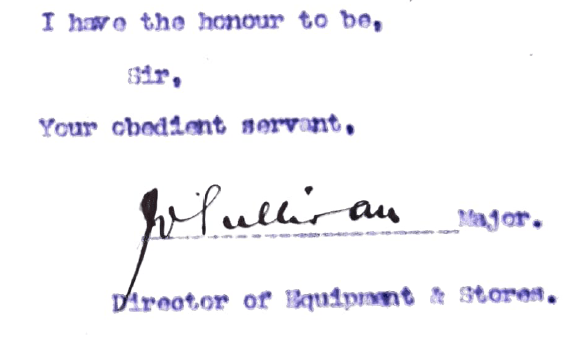
Under the management of Major James O’Sullivan, the Director of Equipment and Stores, the 1914 Regulations for the New Zealand Military details that the Defence Stores were[2]
responsible for the supply of clothing, equipment, and general stores; supplies of stationery, forms, and books; supply of, all vehicles and technical equipment, excepting Artillery and Engineers; storage and distribution of small-arms, accoutrements, and camp equipment’s, Customs shipping entries, and ammunition.
The following report was produced by Major O’Sullivan and details the activities of the Defence Stores up to 31 March 1914 and provided a useful appreciation of how the Defence Stores were placed prior to the mobilisation in August 1914.
NEW ZEALAND MILITARY FORCES.
REPORT OF THE DIRECTOR OF EQUIPMENT & STORES FOR THE YEAR ENDING 31 MARCH 1914
The Quartermaster-General Headquarters N.Z. Military Forces Wellington
Sir,
I have the honour to report as follows on the Stores, Magazines and Equipment in the Dominion for the year ending 31st March 1914.
SMALL ARMS AMMUNITION
The reserve of Small Arms Ammunition .303 Ball has since my last report increased by 138,000 rounds. The quality has maintained its excellence, and no complaints of any moment have been received during the year. the increased supply of cordite ordered has been received, thus removing any danger through delays in shipment. This will build up a reserve of cordite, which will be available to keep the Factory fully employed in the event of short shipments usually caused through Strikes in gland.[3]
The question or an increased reserve of Ammunition is a policy matter, but I wish to point out that the large increase in our Smal1 Arms during the year, consequent upon the importations from Egeland md Canada, has proportionately reduced the number of rounds available per Rifle.
The total issue of .303 Ball Ammunition during the year was 4,I62,000.
SMALL ARMS
During the year, 30,000 Rifles M.LE. Long were imported into the Dominion, 15,000 being from England and 15,000 from Canada. Of the English, 5,000 were perfectly new arms, while the 10,000-part worn were in such good condition that except to an Armourer or one very familiar with Arms, they appeared to be quite new.
The former were purchased at £2 each and the later at were purchased at £1, and as the landed cost of a new M/L.E. Rifle Long has hitherto been £3/12/. it can readily be calculated what an immense saving their purchase meant to the Dominion.[4]
CANADIAN RIFLES
The Canadian Rifles arrived in various shipments, the cost in Canada to the Department being 4/2d.landed cost 5/. Each. These Arms were not, of course, expected to be in the same condition as the English Rifles, having been thoroughly oiled prior to despatch front Canada, On arrival in the Dominion, however, after being overhaled and thoroughly cleaned by the Armourers, it was found that the Ars were in excellent condition, less than 2% requiring rebarrelling, while a fair number were quite new. Sword Bayonets and Scabbards patten “88 were also supplied with these Arms, while the Arms Chests in which they were packed, were in excellent order.
At 4/2d each, these Arms were a wonderful bargain, especially when it is remembered that a Rifle Bolt alone costs in England I6/. If any more of these rifles are obtainable, I would recommend that another five thousand be purchased, as they will be required if it is intended to train the General Training Section of the Reserve, it would be a waste of money to issue new Rifles to these if they are allowed to keep them in their homes, as they would very soon go astray or become unserviceable, while even if a percentage of the Canadian Rifles were lost, the actual financial loss would no be great.
The whole of the above Arms were received during the months of January, February and March and were immediately issued to the Senior Cadets, who are now fully armed.
No Protectors, Bottle Oil, or Pullthroughs were received with the Canadian Arms, but a supply has been cabled for, which, on arrival, will be issued.
We have in stock about 8,000 new spare barrels for Rifles M.L.H. Long, which means that 13.3% of the Rifles in the Dominion could be rebarrelled at short notice. It is, perhaps, just as well that we have a good reserve, as it is very probable a number of the rifles on issue to Cadets will be neglected.
The total number of Rifles M.L.E Long at present in Store and on issue to the forces is about 46,000.
RIFLES M.L.E. SHORT
The total number of Rifles M.L.E. Short in the Dominion is 13,810. These are on issue to Mounted Rifles, Field and Garrison Artillery, Field Engineers and Coast Defence troops, except about 1,900 of the Mk I pattern on issue to Senior Cadets and which are now being recalled.
Our reserve of Barrels and Spare parts is in about the sane proportions as for the Rifles M.L.E.Long.
RIFLES MARTINI-ENFIELD
There are in all about 1,100 of these in the Dominion. They are on issue to Senior Cadets, but are being recalled, so the question of how they are to be utilised will be for your consideration.
RIFLES .310
There are 1,052 of these, which were taken over from the Education Department, and issued to Senior Cadets in Auckland District. They were, however, condemned by District Headquarters as being useless for Musketry, and are being returned to Store. The question of what is to be done with these and the 928,000 rds of .310 Ball Ammunition will have to be considered later.
CARBINES
There are in the Dominion about I,400 M.L.E and 2,500 M.E Carbines, which are principally on issue to Colleges and High School Senior Cadets. There are, however, complaints of the poor shooting made with these in comparison with that with the Rifles on issue to other Senior Cadet Companies. Demand have therefore been made for Rifles to replace the Carbines, and in some cases this has been done, while the remainder will be replaced during the current year. The question of what to do with the replaced Carbines will therefore require consideration.
REVOLVERS
We have about 900 Revolvers in stock. These are of an obsolete pattern known as Dean and Adams, which were imported about thirty years ago. In fact, it is impossible to obtain ammunition for them, as the Webley Pistol Cordite Ammunition will not fit. There is a quantity of about 9,000 rounds of powder-filled ball for these Revolvers imported in 1880, but it ss not reliable. There are also about 14,000 rds Cordite filled ball, but this does not properly fit the Revolvers.
RIFLES SOLD TO DEFENCE RIFLE CLUBS.
The aforegoing Arms do not include the 3,423 Rifles M.L.E.Long and the 2,719 Rifles M.E. sold to members of Defence Rifle C1ubs. These are the property of the members, but no doubt practically the whole of these would be available in an emergency.
ACCOUTREMENTS
As mentioned in my last annual Report, an additional supply of Mills Web equipment was required, and in September 1913 demand was made for 4,000 sets and 20,000 Tools entrenching with Carriers, but approval for the expenditure was not obtained until the end of March this year. When these arrive from England, the equipment of the Infantry Regiments will be completed.
During the year all Brown Leather Accoutrements were called in from Field Engineers and Garrison Artillery, and replaced with Mills Web Modified pattern equipment consisting of Belt, waist: 2 Pouches and Frog This was considered to be a more suitable equipment for these units, besides which a considerable saving in expenditure was effected.
The Railway and Post and Telegraph Battalions and the Army Service Corps Companies have since been similarly equipped.
So far, no improved equipment for Mounted Rifles has been devised, our own Bandolier equipment, which has given satisfaction, is still being used.
As the whole of our Bottles Water Mk.IV are unfit for further service an additional supply of Bottle Water MK.VI with sling, carriers, has been ordered to complete equipment of Mounted Regiments and Ordnance Units. A further supply of Slings, Web, is also under order.
The Belts, Waist, Web, devised for Senior Cadets, which are made in the Dominion as a cost of 6d each, are giving general satisfaction.
SWORDS, OFFICERS & SAM BROWNE BELTS.
Owing to all Officers now being given an issue of a Sword and Sam Browne Belt on First Appointment, a large number of these are annually required. Of course, the number issued this year is greater than wi1l be that of subsequent issues. Taking free issues and sales during the year, there were issued 372 Swords 800 Sam Browne Belts.
MAXIM MACHINE GUNS.
As Mentioned in my last Annual Report, one each Maxim Machine Gun mounted on Tripod with Pack saddlery complete, was issued to Mounted and Infantry Regiments, and a supply of Tripods ordered to convert the Maxim Guns mounted on Field Carriages to Pack saddlery. The Maxims on Field Carriages were called into Store, but it was ascertained before these Guns could be properly fitted to Packsaddles, a number of suitable stores were required from England. These are now under order from England and on arrival. The conversion proceeded with. The addition of one Regiment of Infantry to the original establishments leaves us deficient of two Machine Guns, as no provision j=had been made for creases, and no spare Guns had been ordered. It will therefore be necessary to consider if two more Guns with Pack saddlery complete should be ordered.
If it is intended to equip Coast Defence Infantry in Auckland, Christchurch and Dunedin, or other Units, with machine Guns, a further order will be necessary.
During the year, three of the service locks which were broken were sent to England to be repaired and reported on. The locks have been returned and re-issued, and the report from England states that the breakages due to over tempering of the steel part in construction. As no further breakages were reported, it is presumed that only these three locks were faulty.
UNIFORM EQUIPMENT 1913/14.
TERRITORAL & SENIOR CADET
During the year the clothing of territorials and Senior Cadets has been continued steadily and at the end of March, with the exception of Caps, Forage, all clothing demands were completed.
The supply of Greatcoats and Putties, which I mentioned in my last Report as being in a backward condition, has now been brought up to date, and all branches of the service have been fully suppled as demands came forward.
A considerable saving was effected through the importation from England of some 10,000pairs Imperial Service Putties at a cost of about 3/. per pair, as against the price required for a local made article – which being all wool did not give satisfaction – and which cost about 4/9d per pair.
With the exception of Greatcoats, of which some 5,500 were received from Southern Firms, a Wellington Firm secured the contract for suppliers of Territorial Clothing, and they have made deliveries without delay thus enabling the Department to issue immediately on receipt of Requestions from Regiments.
The quality of material and make of garments has been fully maintained, and no complaints whatever have been received in this respect.
The delay in delivery of Caps, Forage, has been owing to there been no Factory in the Dominion which make the waterproof material as laid down in specifications of new Contract, and the supplies of this material had therefore to be obtained from England. Owing to Strikes and other causes the Contractors experienced great difficulty in obtaining supplies in time to meet our requirements.
Every effort has been made to keep down expenditure in connection with Uniform Clothing – no order has been placed with Contractors in excess of actual requirements – and though in some items the minimum number we were required to take under the Contract has been exceeded, this was owing to short deliveries under Contracts for 1911/13, and the formation of the Army Service Corps and Railway Battalions, which necessitated distinctive Uniforms being made.
The position of Uniform Clothing for year ending 31st March 1914 is:-
When it is remembered that there are Uniforms stocked for the six branches of the service, each of which are again divided in 31 different sizes, the total number in store is not large, and unless maintained, it would be impossible to issue the particular sizes asked for on requestions received, nor would we be able on a sudden emergency to meet demands.
SENIOR CADET UNIFORMS.
The issue of Clothing to senior Cadets has been steadily maintained during the year, and on 3Int March 1914, all Requisitions for Clothing received had been supplied on that date. The quality of material and the make of the uniform reflects credit on the Contractors.
As with the Territorial Uniform, only the particular sizes of garments of which our stocks were nearly exhausted, were ordered, and the minimum quantity under contract was not taken during the year. As far as possible, all Trousers returned to Store, also old pattern Shorts, were washed, relined in bands and fork and converted at a small cost in to new pattern shorts, and are being issued ad required.
The position Senior cadet Uniforms is:-
Blouses
Shorts
Hats
Puttie Hose
Web Belts
Total Receipts to 31/3/1914
44463
43227
43150
46478
32011
Total issues
34937
39000
34845
35513
31993
Leaving in Store 31/3/1914
9326
6227
9105
7965
18
As we had a good stock of Cadet Clothing in Store on 1/4/193, only small orders were placed with Contractors last year. As under our Contract we are bound to place order for 5,000 each item per year, we will have to place larger orders this year. The Issues last year were about 8000 suits.
OFFICERS UNIFORMS
Under Circular Q.M.G 85/36 of 16/10/1912, the cash payment of £15. and £9 to Territorial and Senior Cadet Officers respectively was abolished, and a Free Issue of Jacket, Riding Pantaloons or Knicker Breeches, Putties and Cap Forage was made in lieu thereof to Officers on First Appointment on Probation, and Hat, Greatcoat &Trousers on Final Appointment after passing Examination. The cost of these uniforms being:-
Mounted Service
Dismounted Service
Without Badges of rank
£6:16:3
£6:8:9
As there were some 375 Officers clothed in this manner during the year it will be seen that a considerable saving was effected. The Contractors supplied a first-rate uniform made to special measurements of individual Officers, and no complaints were made by Officers in this respect.
A Sam Browne Belt and Officers Sword for use of Officers newly appointed are issued to the Regiment of Company to which he may be attached. These items remain the property of the Government , and are handed in when the Officer retires or is transferred.
As with Territorial Uniform, only the particular sizes of garments of which our stocks were nearly exhausted were ordered, and the minimum quantity under Contract was not taken during the year. As far as possible all Trousers returned to Store also old pattern Shorts were washed, relined in bands and forks and converted at a small cost, into new pattern shorts and are being issued as required.
The position of Senior Cadet Uniforms is:-
Blouses
Shorts
Hats
Puttie Hose
Belts Waist
Receipts
595
4408
252
0
32011
Issues
8659
9984
7570
7147
31993
In Stock
8526
6297
9705
7966
18
It will be seen that the issues last year were almost equal to our present stock, so that during the current year we shall have to provide somewhat above the minimum of Contractor, viz. 5000 each item.
UNIFORMS
It has come to my knowledge from conversations with officers and Regimental Q.M. Sergeants that there are a considerable number of part worn Uniforms in Regimental Stores, which have been returned principally by men who have been exempted from further training and by others who have 1eft the Dominion, and I understand that instructions have been issued to Regimental Q.M. Sergeants not to re-issue these part worn uniforms.
In this respect, I consider that if I could visit the Regimental Stores during the year for the purpose of examining this clothing and return to Store as ay be fir to be washed and pressed and relined where necessary, they would be as good and could be issued as new Uniforms, as is done in the case of trousers as used by Senior cadets. In this manner, instead of paying about 30/. for new Tunic and Trousers, they could be made equal to new for about four to five shillings
SERVICE BOOTS
The sale to the Defence Forces of the service Pattern Boot was well maintained. During the year some 5100 pairs were received from Contractors, of which the greater proportion were sold for cash. Owing to the increased cost to te Department (in consequence of high price of leather etc) we were forces to raise the price from 11/6 per pair to 14/. Per pair. General satisfaction has been given to all wearing these for Military duty, as the sales in Training Camps denote
In all 1arge Training Camps, an Officer is sent from Defence Stores with a good stock of Boots for sale in Camp, and in order that the men may use the boots while in Camp and to make payment easy, the amount is deducted from pay at the end of Camp.
SHEETS, GROUND, WATERPROOF.
An additional Supply of 10,000 Sheets ground was obtained during the year, bringing our equipment up to 20,282. There are always considerable losses in these as they are useful for so many purposes in private life. They disappear both in large and weekend Camps, in fact after a large camp, one can never be certain what are the losses until final check in store is made. They have been known to disappear in transit from Camps. Of course, shortages are charged against Units, but this does not entirely prevent loss/
BAGS, NOSE, HORSES.
6,000 Nose bags for feeding Horses in camps were obtained during the year. This was a very necessary item of equipment as there was considerable waste of horse feed hitherto. The saving in horse feed that will be effected in a short time will compensate for the cost of the Nose Bags. The bags are all branded ‘DEFENCE↑1914” and numbered consecutively, so that los or shortage can be traced to the
FIELD COOKERS.
In my last Report I mentioned that a supply of “Roberts” Cookers was being obtained. 24 of these, each estimated to cook for 500 men, were issued in Camps during 1913, and gave great satisfaction when occupied with the method of cooking hitherto in use. 11 additional 500 men Cookers and 16 – 250 men Cookers were obtained since January 1914, and the whole are now in use as under:-
Auckland
9
500 men
4
250 men
Wellington
10
“
4
“
Canterbury
8
“
4
“
Otago
8
“
4
“
There was also obtained from England a “Sykes” Travelling Cooker, while the 9th Regiment Mounted Rifles imported 2 Lune Valley Travelling Cookers.
Trials are now being made in Takapau Camp as to the merits of each. The landed cost of the “Sykes” Cooker was £130, whereas the local article -500men Cooker – costs £64, and the 250 men Cooker £46. I am unable to give the cost of the Lune Valley Cooker as it was imported Privately,
If the “Roberts” Cooker is to be adopted, 1 an of opinion that no more of the 500 men cookers should be obtained as they are too heavy to handle and are liable to breakage in transport. The 250-man Cooker in an ideal weight and can be easily handled by 4 men, 1ifting in or out of any conveyance, besides which double 1n or out of any conveyance, besides which, double companies under the new organization are 250 each.
CAMP KETTLES.
There is a very good supply in Ordnance Stores, but sone are getting the worse for wear. An order for 1000 has been placed in England.
MEAT DISHES, BOILERS, LANTERNS, WASH BASINS etc are all Locally made, and supply can always be ordered as required to replace
KIT BAGS.
A sum of money was placed on the estimates last year to provide Kit bags, but the late Quartermaster-General, for financial reason, deemed it advisable to let the procuring of a supply stand over for the present.
B0OKs, FORMS, STATIONARY, PAPER TARGETS ETC.
A large supply of Drill Books etc were obtained during the year and distributed to the various centres as instructed. There are now 225 NZ Military Forms and Books in use. The printing of these Forms and Books is carried out at the Government Printing Office but owing to pressure of work for the other Departments, delays in printing our demands often occur. I am of opinion that better paper in many of these forms should be used in many of these Forms, especially those which are records. There is no comparison in the quality of paper used in our Forms and that used in the Imperial Service Forms
I am certain there must be considerable waste of Forms in the Area Group Officers and also in the Regimental Offices, as the demands sometimes made are out of all proportion to the requirements. These demands haves to be cut down here and I think Staff Officers should be impressed that Forms cost money and should be used only for the purpose for which they were printed
ARMOURERS.
During the year the four senior District Armourers were brought to Wellington and put through a three weeks course of instruction in Maxim Machine Guns under Staff Sgt, Major Luckman, who, at the end of the period, examined the on the theory and practice of examination and repairs to Maxim Guns
The men took a keen interest in the work, and at the final examination passed to the satisfaction of the examiner, who reported that certificates should be given. This was approved and the certificates issued. The fact of these men holding certificat4rs will enable them to instruct their assistants in Districts, and these when they qualify, can also be issued certificates
The CADET ARMOURERS are getting on very well, and in order to give them experience in the Field, one Cadet has been temporally attached to each district.
Reports from District Armourers as to the condition of Arms on issue to Units have been, generally speaking, good, but owing to the outbreak of Smallpox in Auckland District, the inspection had to be discontinued, so that all the arms were not examined. The general strike also affected the examination especially in the North Island.
Owing to the increased number of small arms now issued to Cadets, the personnel of this branch of the service will require increasing , and the districts subdividing, as it would be impossible for an Armourer to make inspection of all the Small Arms in any one District during the year. I will later submit a proposal to meet this question.
DISTRICT STOREKEEPERS.
A conference of the three District Storekeepers was held in my Office in August 1913to discuss many matters in providing for stores not provided for in the regulations. This is far preferable to correspondence on minor matters of detail, as it was found that letters of instruction and Headquarters circulars were sometimes differently interpreted. When the occasion is deemed necessary, I will again ask for authority for a conference.
The Storekeepers are all Officers with a keen sense of their responsibility regarding Government property, and take a personal interest in their work, without which as Storekeeper or Quartermaster-Sergeant is useless.[5]
TRANSPORT WAGONS.
No additions were made to this service during the year. The late Quartermaster-General made provision in the Estimates for 32 Field Service Wagons similar in type to the colonial pattern in Store, being satisfied that with slight modification, this wagon would be very suitable for the Dominion. For financial reasons the inviting of tenders for these was held over.
No addition was made to the equipment of Water Carts during the year. The new type received with the Field Guns is far and away more expensive than that hitherto in use, and consideration will have to be given this subject for the equipment laid down is to be provided.
I am of opinion that it would pay the Department well if one Motor Wagon is provided for each of the four centres. The cost of cartage is becoming a heavy item, especially in Wellington, and if the Department had its own wagons this item would be considerably reduced. The fact that under the terms of the Public Works Contracts for Cartage the transport of one case from the Railway or Wharf is charges by time or ton weight or measurement will indicate that cartage is an expensive item, whereas if our own wagons were available, collection of parcels and cases could be made at stated time, all with greater efficiency, Other Departments of the State find it to their advantage to run their own transport Motor Wagon, and I am od opinion it would be ad advantage if we could do likewise.
MEDICAL EQUIPMENT.
During the year the Director of Medical Services laid down a list of Medical Equipment to be issued to Mounted and Field Ambulances and Regimental Medical Officers. Included in this were a new pattern Surgical Haversack and new pattern Medical Chest: these being entirely different to the pattern hitherto in use. Tenders for supply were invited. The Chests and Haversacks were made in the Dominion, but arrangements had to be made with the successful tenderers to import the supply of instruments and drugs which arrives in the Dominion at the end of March 1914. The Chests and Haversacks were then filled and issued to Districts for distribution. As the new equipment provides for one wagon only, one each was taken from the Field Ambulances and issued to the Mounted Field Ambulances. Each Regimental Medical Officer is provided with a surgical haversack, and in addition to the equipment of Stretchers of Field Ambulances, each Regiment is provided with two. These to remain as permanent equipment. I may mention that all our Field Stretchers are now made in the Dominion, and Mr Reid – the maker of same – informs me that the Department having its Stretchers made locally has been the means of St John ‘s Ambulance and others also getting their supplies locally, instead of importing as hitherto. The Stretchers are made at about the same cost as the imported ones, and the Director of Medical Services has stated that he is very satisfied with them.
VETERINARY STORES.
Hitherto no provision was made for Veterinary Chests, medicine for use in the Feld, the practice being for Veterinary Officers to obtain supplies from the nearest Chemist. This method while being expensive, was not satisfactory. During the year, the Director of Veterinary Services and the Principle Veterinary Officer, of Wellington, paid visits to the Stores, and under their supervision, a Field Veterinary Chest was devised. The necessary instruments and drugs were obtained, and the Chests filled and distributed in time for the Divisional Camps.
Twenty Chests in all were made, and it is proposed that each be retained at the Headquarters of the Field Artillery in each District, the balance to be kept in District Store for use in the Field.
STORE BUILDINGS.
The Store buildings are in good order, the only additions during the year being those to the Christchurch Store, which were very necessary. Owing to increase of Equipment and Clothing, all buildings were taxed to their utmost capacity during the year.
Arrangements have now been made for District Stores to keep a stock of Forms etc for issue, instead of having to send individual requisitions to Wellington for Supply.
If Transport Wagons and Harness are to be provided for the Army Service Corps, provision will require to be made for housing same. I am of opinion that the time has now arrived for the establishment of a District Store at Palmerston North, as it is more central for distribution, and cost or railage would be considerably reduced. The Wellington City Units could still be suppled from the Store in Wellington
MAGAZINES FOR SMALL ARMS AMMUNUITION.
Our magazines for storage of Small Arms Ammunition were taxed to their utmost capacity during the year, and indeed sone were overtaxed, as the Ammunition could not be stored in strict accordance with Magazine Regulations, If our reserve of Ammunition is increased, it will be absolutely necessary to increase the accommodation, especially in Otago. I have previously drawn attention to the inadequate Magazine accommodation in Otago, in which only 3 million rounds of Ammunition can be stored, whereas there should be accommodation for at least 5 Million rounds. At present the maximin supply that can be stored in the South Island is only 8 million rounds, which to my mind is inadequate. Provision should therefore be made in this year’s estimates for
AEROPLANE
The Bleriot Monoplane “Britannia” presented to the NZ Government by the British Aerial League was duly received during the year, and a suitable shed was erected in Defence Stores yard at a cost of about £130 for housing the same. The Machine was subsequently sent to Auckland Exhibition, but has now been received back art Wellington
According to instructions contained in a Cable from the High Commissioner, the machine requires constant attention and care and has been place under the supervision of the Armourer, who details a Mechanic to attend to the cleaning and oiling of same.
STOCKTAKING.
To comply with the provisions of the Public Service Regulations an annual Stocktaking has to be made, and this had been almost completed when the general strike took place. This necessitated the whole of the Staff being employed and the Stores and building being used for nearly three months in the housing and accommodation of the Special Mounted Constables. Immediately on their departure, the large shipments of Arms from England and Canada arrived. As preparations had then to be made for supplies and equipment for Camp for the inspection by the Inspector-General, Overseas Forces, I have been compelled to postpone the stocktaking till this year.
STAFF.
In conclusion of the Report, I have to mention that owing to increased work in the Store and yard, temporary extra labourers had to be employed. This pressure was overcome about the end of April and the men were discharged. There are other men on the temporary staff, such as Storeman, Clothier, Hatter, Packers who are experienced at his class of work, are industrious, and take special interest in the work. These men are an absolute necessity to carry on the Clothing and other ranches of the Department in which they are employed.
Finally, I wish to especially mention the permanent Staff, workmen and the office staff. To the letter, I owe the success and efficiency of this branch, as they are officer who take a special and personnel interest in their duties, and who, in addition to their own work, were called upon at the time of the Industrial troubles in Wellington, to feed, clothes and equip the Mounted Special Constables who were brought to Wellington to maintain law and order.
The controlling officers on several occasions complimented me on the efficiency of the staff.
This extra work necessitated the Office Staff returning to duty at night after the Special Constables had been disbanded in order that their work could be brought up to date. Some even had to sacrifice their Annual Leave
As I have previously stated, owing to the steady increase of work in the Office, the permanent appointment of one extra Clerk is badly needed.
Defence Stores, Wellington. 8th May, 1914.
________________________________
Note: You have been supplied confidentially with Returns of all Arms, Ammunition and Equipment in the Dominion, consequently figures are not given in this return
________________________________
Notes
[1] Glyn Harper, Johnny Enzed: the New Zealand soldier in the First World War 1914-1918, First World War centenary history, (Auckland, New Zealand: Exisle Publishing Limited, 2015, 2015), 29.
[3] The majority of Small Arms Ammunition for the New Zealand Military was manufactured in New Zealand by the Colonial Ammunition Company at their Mount Eden Factory in Auckland.
[5] The authorisation for permanent District Storekeepers was for one each at Auckland, Christchurch, and Dunedin, with the following appointments made:
Mr William Thomas Beck – District Storekeeper, Auckland
Mr Arthur Rumbold Carter White – District Storekeeper, Christchurch
Mr Owen Paul McGuigan – District Storekeeper, Dunedin
16 October 1914 was a significant day for New Zealand as the main body of the New Zealand Expeditionary Force (NZEF) sailed out of Wellington Harbour, marking the departure of the largest, best-trained and equipped Military Force ever to leave New Zealand shores. Departing in ten troopships, the 8500 men and 5000 horses of the NZEF was the second significant departure of troops from New Zealand as the 1400 strong Samoa Expeditionary Force had departed several weeks earlier on 14 August 1914, only ten days after the declaration of war on 5 August 1914.
The fleet of troopships which transported the Main Body of the NZEF and their escort in Wellington Harbour, 15 October 1914. Image courtesy of Matt Pomeroy.
The mounting of such a force within such timeframes was the culmination of years of planning, implementation and training to provide a structured, equipped and supportable force able to easily integrate into an Imperial army alongside the UK, Australia, Canada and India. While credit for the development of the New Zealand Military in the years leading up to 1914 can be accredited to Major General Godley and his staff of British Army officers seconded to the New Zealand Military Forces. Little study has been dedicated to the logistic organisation responsible for supporting the Force, the Defence Stores Department. Under the leadership of Major James O’Sullivan, the Defence Stores Department was the organisation working behind the scenes with responsibility for the supply and maintenance of clothing and personal equipment, accoutrements, saddlery, harness, small-arms and small-arms ammunition, machine guns, material, transport, vehicles, camp equipment, and all stores required by New Zealand’s Military Forces.
Major James O’Sullivan, Director of Equipment and Stores 1900 -1916
However, despite the success in providing the stores and maintenance support required for the 1914 mobilisation, the establishment of reinforcement training camps, and maintenance of the Territorial Army, the Defence Stores Department has remained an anonymous participant in New Zealand’s Military Historical narrative. So why is this so? The historical record does not record any shameful failures necessitating its historical absence. However, correspondence of the era indicates that there might have been a clash of personalities between General Godley and Major O’Sullivan, which has hidden the Defence Stores from view for over a hundred years.
General Sir Alexander Godley. S P Andrew Ltd :Portrait negatives. Ref: 1/1-013997-G. Alexander Turnbull Library, Wellington, New Zealand. /records/22715773
As the NZEF finalised its final preparations before boarding its transport ships, General Godley visited the Defence Stores on 24 September and thanked the Defence Stores Staff for their contribution to mounting the NZEF.[1]
Departing on 16 October, Godley was at sea for ten days before preparing a handwritten note to Colonel James Allen, the New Zealand Minister of Defence. Reacting to what can only be described as gossip, Godley’s note set in motion a series of events that tested the Defence Stores and lead to O’Sullivan’s resignation.[2]
Dear Colonel Allen
Just before I left Wellington and since sailing, I have heard a good deal of talk about the conduct of the Stores at Wellington and criticism of J O’Sullivan. I believe the Mayor and the ladies Committee who provided articles for the men were very disappointed with his method of costing and accounting for what they sent him for the troops.
Campbell (Coast Defence Commander) also spoke to me of irregularities which had come to his notice. I have little doubt in my own mind that O’Sullivan and probably some of his subordinates are, like all Quartermasters and Storekeepers feathering their nests to a certain extent. But against this one has to put the fact that, broadly speaking, the equipping of this Force and of the South African contingents, by O’Sullivan was extremely well done and considering the opportunities he has had, one can only be astonished at his moderation in feathering his nest.
My object in writing now, though is to suggest that it might be worth while to have some sort of special audit of the Stores accounts for the Expeditionary Force, perhaps by the Public Service Commission or somebody of the kind. I mean by this an inspection and stocktaking of the Stores in kind more than cash transactions, as the later are always taken for granted and audited by the Treasury as regards vouchers not the Audit Department. Esson tells me that whenever the question of an Army Audit has been raised, the Audit Department have made difficulties and have suggested that it clashed with their functions, but this is probably a misconception and in any case the Army system has grown so big that some more checks is I am sure required, and the departure of this Force would be a good reason for starting it now.
But, whatever happens, the good work done by O’Sullivan and his Department should not be overlooked, though it is too close a borough, and would now be all the better for shaking up and overhauling with fresh blood.
Yours Sincerely
Alex Godley
In response to Godley’s note, the Public Service Commission convened the Defence Stores Commission, which throughout 1915, examined the Defence Stores in detail, producing a comprehensive report to the Minister of Defence on 31 August 1915.
Forwarded to the Commander of NZ Forces Brigadier General A.W Robin, a reply was furnished on 9 September 1915. Admitting fault where required, Robins reply, however, counted many of the commission’s points and highlighted the success of the Defence Stores and highlighted that the Defence Stores were operating adequately under existing Military Stores and Treasury Regulations. However, O’Sullivan’s reputation had been tarnished.
A letter from Allen to Godley sent on 4 January 1916 summarises the situation [3]
The Stores Department, about which there was an enquiry have come fairly well out of it, but I gather there is a pretty strong feeling that 0’Sullivan, who is on sick leave now should not go back.
Although acquitted of any misconduct, O’Sullivan position had become untenable, and to maintain the smooth functioning of the Defence Stores, Allen outlined changes that had been made to the Defence Stores in a letter to Godley on 13 April 1916,[4]
So far as Defence is concerned, Captain McCristell has been brought in from Featherston and placed in 0’Sullivan’ s position, the latter being made Inspector of 0rdnance Stores.
I should think 0’Sullivan has been more enquired into than any other officer in the Department, but nothing very detrimental has come out about him; however, it seemed to me to be wise, especially in view of the fact that the Supplies Board -which is under the control of the Hon. Mr Myers – was so determined about it, that he should give up his position as head of the Stores Department. I have every confidence that McCristell will do well there.
Replying to Allen on 24 March, Godley was less than supportive of O’Sullivan and made clear his personal feelings. [5]
I am sorry, but not altogether surprised, to hear about 0’Sullivan. I think you know my feeling about him, which is that, considering the class of man he is, and the opportunities he has had, one can only be astonished at his moderation. Ninety nine out of a hundred in his position would have made a large fortune.
A component of the New Zealand Military establishment since the 1860s, the Defence Stores Departments’ tenure as a civilian branch of the Military was numbered. Although nothing detrimental came out of the Public Service Commission’s report, the time was deemed suitable to follow the lead of the Australian and the Canadians and militarise the Defence Stores into an Army Ordnance Corps. Gazetted on 1 February 1917, the New Zealand Army Ordnance Corps assumed the responsibilities of the Defence Stores Department, with McCristell assuming the role as the head of the Ordnance Corps. [6]
O’Sullivan retired from his Inspector of Ordnance Stores position in January 1917 to take up farming in Huntley.
The enquiry of the Defence Stores Department fell flat and found nothing detrimental, and further study will be required to determine why the Defence Stores Department became an anonymous participant in New Zealand’s Military Historical narrative. Is it linked to Goldey’s dislike of O’Sullivan and his belief that Quartermasters and Storekeepers were only interested in “feathering their own nests”, or is it part of the Kiwi Tall Poppy Syndrome where success is looked down on? The mounting of the NZEF was a monumental task, and the Defence Stores Department is well overdue for some recognition for the part that they played.