New Zealand’s Flaming “A” Badge

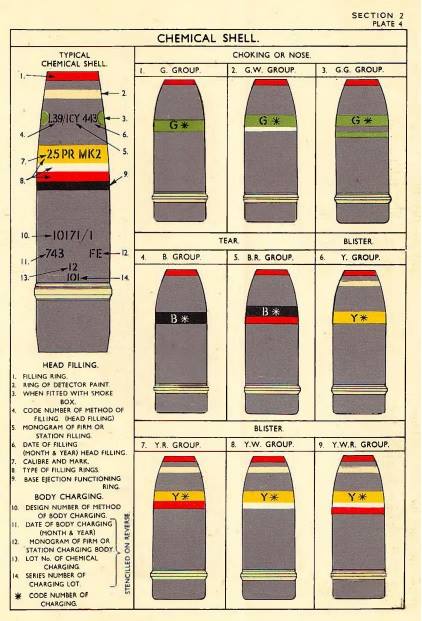
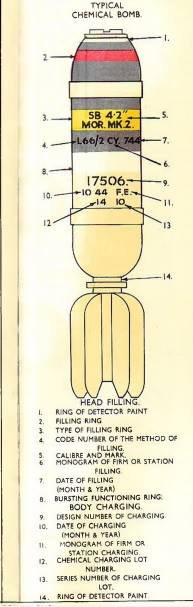
In the New Zealand Army realm, there exists a group of exceptional individuals known as Ammunition Technical Officers (ATOs) and Ammunition Technicians (ATs). These brave men and women have adored a distinctive emblem since 1971—the Flaming “A” Badge—a symbol that embodies their trade’s hazardous and highly skilled nature. But this badge represents far more than just a visual representation of their profession. It is a tribute, recognising their trade’s extensive and illustrious heritage.

What began as the management of powder magazines in the 19th century has evolved into a responsibility encompassing the entire spectrum of ammunition and explosives available to the modern New Zealand Army. The AT trade has adapted and grown, keeping pace with the changing times and technologies. And since 1971, the Flaming “A” Badge has remained a constant, a badge of honour that signifies the dangerous nature of their work and the expertise required to execute it with precision.

Beyond its symbolism, the Flaming “A” Badge is a profound acknowledgement to those who wear it—a testament to the long and proud whakapapa (genealogy) of their trade. It is a reminder of the individuals who came before them, laying the foundation and forging the path they now tread. Each wearer of the badge carries the weight of history, embodying the spirit and dedication that has defined the AT trade over the years.

.

During the early colonial period in New Zealand, importing ammunition and explosives from the United Kingdom and Australia was necessary. Powder magazines were established at Mount Cook in Wellington and Mount Albert in Auckland to store and distribute these essential supplies safely. The responsibility of handling and storing these stocks fell upon qualified individuals from the British Military Stores Department and Royal Artillery and Engineer officers.

As the Imperial Forces gradually withdrew from New Zealand in 1870, the full responsibility for the country’s magazines and ammunition transferred to the Defence Stores Department. Subsequently, new facilities were constructed at Mount Eden in Auckland and Kaiwharawhara in Wellington, replacing the previous powder magazines at Mount Albert and Mount Cook. These new sites remained in use until the 1920s. Additionally, magazines were maintained by the Defence Stores Department in various provincial centres to support the dispersed Militia and Volunteer Forces.

In 1884, the permanent Garrison Artillery was formed, and two experienced individuals, Frederick Silver and Robert George Vinning Parker, were transferred from the Royal Marine Artillery and Royal Garrison Artillery to serve as instructors. Their expertise proved invaluable in mounting New Zealand’s Garrison Artillery, as they compiled books and manuals and managed artillery ammunition stocks in collaboration with the Defence Storekeeper.

Capitalizing on the government’s support, Major John Whitney established Whitney & Sons as an ammunition manufacturing company in Auckland. Later, with additional investors, the company evolved into the Colonial Ammunition Company (CAC) in 1888—the first ammunition manufacturer in New Zealand and Australasia. The CAC contracted with the New Zealand Government to produce Small Arms Ammunition (SAA). The agreement stipulated that the government supplied the powder while the CAC provided the components to manufacture complete cartridges. Each batch underwent government inspection and quality control checks before acceptance by the New Zealand Forces. The testing process involved firing a small percentage of the batch to determine its performance and whether it met the required standards.

By 1890, the production of .577 Snyder Ball Ammunition was underway, and the initial batches underwent testing, inspection, and acceptance under the supervision of Major John Pirie of the New Zealand Militia. Major Pirie, a former Major in the Guernsey Militia, had immigrated to New Zealand and assumed the Auckland District Musketry Instructor role in 1881. He continued to inspect manufactured ammunition until July 1891 when Major Goring, Officer Commanding the Auckland District, took over the responsibility. Lieutenant J E Hume of the Permanent Militia assumed the ammunition examination duties from 1893 while concurrently handling other responsibilities.

On 6 February 1898, a formal request was made to the United Kingdom to recruit a suitable Warrant Officer from the Royal Artillery to oversee the testing operations and supervise the manufacture of Small Arms Ammunition. Quartermaster Sergeant Instructor Arthur Duvall from the Artillery College in the Royal Garrison Artillery was selected as the Small Arms Testing Officer for the New Zealand Forces. Upon appointment, he was promoted to 3rd Class Master Gunner and engaged for three years at a rate of Nine Shillings per day, along with free quarters or a housing allowance of £50 per annum. Duvall arrived in New Zealand in July 1898 and began his work at the CAC premises in Mount Eden, Auckland. He extended his engagement every three years and completed twenty years of service with the British Army in 1911. Duvall then took his discharge in New Zealand, immediately enlisting in the New Permanent Staff as an Honorary Lieutenant on 26 April 1912, followed by a promotion to Honorary Captain on 1 April 1914.

In 1902, Frederick Silver transitioned from the Artillery and took on the role of Assistant Defence Storekeeper. While fulfilling his duties in this position, Silver managed all Artillery stores and ammunition. After implementing the Defence Act 1909 and subsequent reorganization, Silver transferred from the Defence Stores to the office of the Director of Artillery. He was appointed Quartermaster (Honorary Lieutenant) as Artillery Stores Accountant, retaining his responsibilities overseeing Artillery stores and ammunition. Silver retired in June 1913, and Robert George Vinning Parker succeeded him as Artillery Stores Accountant after being promoted from Warrant Officer to Quartermaster (Honorary Lieutenant).

Although the Colonial Ammunition Company (CAC) in Auckland provided self-sufficiency in Small Arms Ammunition (SAA) production, the same could not be said for artillery ammunition, which still had to be imported. Parker conducted a cost-benefit analysis and concluded that significant annual savings of £3,333 (2022 NZD$ 633,605) could be achieved by cleaning and refilling casings, inspecting and refurbishing propellant bags, and manufacturing new ones as needed. To realize these savings, Parker recommended the establishment of a specialized Royal New Zealand Artillery Ordnance Corps Section responsible for manufacturing and modifying ammunition. General Godley approved the proposal in mid-1914, and on 1 March 1915, under New Zealand Defence Forces General Order 90, the New Zealand Army Ordnance Section was authorized and established from 1 April 1915.

On 31 May 1917, regulations were approved and published, constituting the New Zealand Army Ordnance Department (NZAOD) and New Zealand Army Ordnance Corps (NZAOC), with retroactive effect from 1 February 1917. This marked the end of the forty-eight-year service the Defence Stores Department provided. Administrative control of the New Zealand Artillery Ordnance Section was transferred to the NZAOC, and Parker was commissioned as Captain in the NZAOD, serving as the Inspector of Ordnance Machinery. However, Parker’s tenure in this position was brief, as he retired on 30 September 1919.

On 10 January 1918, Arthur Duvall was transferred from the Permanent Staff to the NZAOD, assuming the role of Proof Officer SAA with the rank of Captain. The post of Proof Officer SAA would continue to be a continuous appointment in the New Zealand Army’s ammunition supply chain until 1968, when the CAC relocated its operations to Australia, concluding its longstanding association with the New Zealand Army.

The experiences of World War I emphasized the need for specialized officers with technical knowledge of ammunition. Captain William Ivory, RNZA, returned to New Zealand in 1919 after completing several courses of instruction in the United Kingdom and assumed the position of Inspecting Ordnance Officer (IOO). Lieutenant A de T Nevill, RNZA, served as Acting IOO in 1925, allowing Ivory to fulfil regimental duties within the RNZA. Ivory resumed the position of IOO on 2 January 1927. Upon Ivory’s retirement in 1933, Lieutenant Ivan Roberts Withell, RNZA, succeeded him as IOO, a role he held until his passing on 31 August 1946.

In 1917, the Royal New Zealand Artillery (RNZA) Ordnance Section at Fort Ballance came under NZAOC control upon the formation of the NZAOC. The section continued its responsibilities for storing, repairing, and refurbishing ammunition under the supervision of the RNZA. With the closure of the Kaiwharawhara Magazines in the early 1920s, Watts Peninsula on the north end of Wellington’s Miramar Peninsula became the primary ammunition depot of the NZAOC. This depot consisted of 19 magazines, one store, and a laboratory spread across Shelly Bay, Kau Point, Mahanaga Bay, Fort Ballance, and Fort Gordon. These facilities were repurposed submarine mining and coastal artillery fortifications dating back to the 1880s. The large six- and eight-inch disappearing guns had been removed in the early 1920s, and the gun pits were converted into makeshift magazines. However, these accommodations were not ideal as they lacked proper temperature and moisture control, posing potential risks to ammunition stocks.

A smaller Ammunition section was also maintained at Mount Eden in Auckland until 1929 when, along with some staff from Fort Ballance, the Mount Eden Ammunition Section was transferred to New Magazines at Hopuhopu Camp. Intended to serve as the principal ammunition depot for New Zealand, between 1925 and 1927, eleven magazines and a laboratory were constructed at Hopuhopu Camp. The magazines, built into the hillside to contain any blasts, were made of concrete with double walls, creating an inspecting chamber. The purpose of the inspecting chamber was to enable sentries to monitor thermometers and adjust ventilation to maintain the optimal temperature of the stocks by consulting a chart.

In 1931, the NZAOC Ammunition sections underwent civilianization, transferring nearly all the NZAOC military staff to the Public Service as civilian employees, usually at lower pay rates or placing them on superannuation due to government budgetary constraints.

When New Zealand entered the Second World War in September 1939, the responsibility for ammunition was shared between the RNZA and the NZAOC.

  • The Director of Artillery was responsible to the General Officer Commanding for.
    • The provision and allocation of gun ammunition,
    • The receipt, storage, and issue of gun ammunition and explosives other than small-arms ammunition
  • The Director of Ordnance Services, assisted by the IOO and the SAA Proof Officer, were responsible to the Quartermaster-General for.
    • The inspection and repair of gun ammunition,
    • The provision, receipt, storage and distribution of small arms ammunition.

NZAOC Ammunition facilities and personnel shared by the RNZA and NZAOC in September 1939 consisted of.

  • The IOO, Captain I.R Withell, RNZA
  • The Proof Officer, SAA Mount Eden Auckland, Honorary Lieutenant J.W Fletcher, NZPS
  • 19 Magazines, 1 Store, and an Ammunition Laboratory at Fort Ballance managed by
    • an RNZA WO1 seconded to the NZAOC
    • five members of the NZAOC civilian staff
  • 11 Magazines and an Ammunition Laboratory at Hopuhopu Camp managed by
    • an RNZA WO1 seconded to the NZAOC and
    • two members of the NZAOC civilian staff.
  • Single SAA Magazines at Trentham and Burnham Camps.

From 1940 as the New Zealand Army moved from a peacetime to a wartime footing, the Ammunition trade grew exponentially as new infrastructure was constructed to accommodate the extensive range of ammunition required for training and home defence, with Modern Explosive Store Houses built at.

  • Burnham – 8 Magazines
  • Ohakea – 6 Magazine
  • Papakura (Ardmore)- 28 Magazines
  • Hopuhopu and Kelms Road – 55 Magazines
  • Waiouru – 45 Magazines
  • Makomako – 39 Magazines
  • Trentham (Kuku Valley) – 22 Magazines
  • Belmont – 62 Magazines
  • Glen Tunnel – 16
  • Mount Somers – 10
  • Fairlie – 9
  • Alexandra – 9

In 1942 a conference of the QMG, DQMG2, AQMG5, COO, DCOO and IOO reset the wartime policy and organisation of New Zealand Military Ammunition services in which,

  • The COO and the Ordnance Ammunition Group were responsible for the management and storage of ammunition
  • the Chief IOO (CIOO) was responsible for all technical management and inspection of ammunition.

With the role of the IOO branch now defined, from January 1943, the establishment of the IOO Branch was steadily increased to more robust levels.

From mid-1945, discussions started taking place on the post-war shape of the NZAOC. Some thought was given to returning the NZAOC to its pre-war status as a predominantly civilian organisation. Reality prevailed, and the future of the NZAOC was assured as a permanent component of the post-war Army.

The Proposed establishment of NZAOC Ammunition units saw the first widespread use of Ammunition Examiner (AE) as the ammunition trade name. AEs had existed in the British Army since 1923, evolving from the trade of Military Laboratory Foreman that had been established in 1886. Although the Royal Army Ordnance Corps (RAOC) authorised the use of a specialist AE badge consisting of an ‘AE in Wreath’ in 1942, permission to wear this badge was not granted to New Zealand AEs.

RAOC Ammunition Examiner Trade Badge 1942 to 1950 with ‘homemade’ Brass Version.

The first New Zealand AE were in the 2nd New Zealand Expeditionary (2NZEF), where New Zealand Ordnance Corps (NZOC) AEs were included as part of the 2nd New Zealand Division NZASC Ammunition Company establishment. Little information is known about the 2NZEF AEs. They were likely recruited from within 2NZEF, given some rudimentary training by the RAOC and set to work.

From 1 June 1945, the Artillery Headquarters element responsible for managing Gun Ammunition, the Ammunition and Equipment Section, was transferred to the control of the Chief Ordnance Officer (COO), ending the RNZA roles in the management of ammunition that had existed since the 1880s and the employment of Parker and Silver. As a result of the transfer, 11 Officers and 175 Other Ranks of the Royal New Zealand Artillery were absorbed into the NZAOC establishment.

On 15 November 1945, the QMG directed that the care, maintenance, accounting and storage of all ammunition and explosives was the responsibility of the COO. Under the COO, these duties were to be undertaken by

  • The IOO Section
  • The NZAOC Ammunition Section

Under the CIOO, the IOO Section was responsible for.

  • The control of all work on ammunition for all purposes other than accounting and storage,
  • Maintenance of Ammunition and explosives in stock in a serviceable condition and ready for use,
  • Provision of personnel for inspection and repair and for working parties to carry out repairs,
  • Provision of all equipment and stores required for the inspection and repair of ammunition,
  • Provision and accounting for Motor Transport necessary for the transport of stock for inspection and repair,
  • Administration and control of Repair Depot Trentham,
  • Maintenance of buildings at Repair Depot Trentham.

The NZAOC Ammunition Section was responsible for.

  • The accounting, storage and care of ammunition and explosives,
  • Maintenance or magazines areas and of buildings and services connected with the storage of ammunition and explosives,
  • Administration of personnel of the IOO Section, while attached to ammunition depots concerning pay, rations, quarters, clothing and discipline,
  • Transport arrangements for the movement of ammunition not connected with the inspection and repair of ammunition at depots.

The provision of suitably trained personnel was a constant problem for the CIOO. A course for IOOs was conducted over November/December 1945 to provide sufficient Officers to fill the IOO establishment.

In December 1945, the results for No. 2 Course of Instruction—Inspection Ordnance Officers—were published. Of the thirty-five officers and other ranks who sat the written examination, eighteen achieved the qualifying mark of 50 per cent or better. Twelve officers were duly appointed as Inspection Ordnance Officers; from the ranks, two Warrant Officers Class I, a Staff Sergeant, a Sergeant, a Corporal, and a Private qualified as Ammunition Examiners.

On 1 September 1946, Army Headquarters “Q” Branch underwent a significant reorganisation that established the New Zealand Electrical and Mechanical Engineers (NZEME). New Zealand’s Ordnance Services were also restructured under the Director of Army Equipment (DAE), who became the senior NZAOC position.

The reorganisation led to the division of Ordnance Services under the DAE into the following roles:

  • COO: This role oversaw Headquarters New Zealand Ordnance Services, including the Provision Group.
  • CIOO: This role held responsibility for the IOO Group.

Following the retirement of Lieutenant Colonel C.S.J. Duff, DSO, RNZA, who served as the incumbent DAE, on 3 July 1947, the position was renamed Director of Ordnance Services (DOS). Lieutenant Colonel Andrew Huia Andrews, RNZAOC, assumed the role as the first post-war DOS on 1 October 1947.

By 1949 the Ammunition organisation had further evolved, combining the IOO and NZAOC Section into a single ammunition organisation, with

  • The CIOO and staff providing DOS with the required technical advice on ammunition
  • District IOOs appointed to each District Headquarters as the Ammo advisor to the District DADOS
  • District Ammunition Sections now renamed as
    • Northern District Ammunition Depot
    • Central District Ammunition Depot
    • Southern District Ammunition Depot
  • Army Ammunition Repair Depot
  • Army Ammunition Supply Depot

To facilitate the further reorganisation and refinement of the Ammunition functions, the DOS hosted the first conference of Senior Ammunition Officers at Trentham Camp from 21-24 June 1949.

RNZAOC IOOs and AEs 1949

As the role of Inspection Ordnance Officers and Ammunition Examiners became integrated into the structure of the New Zealand Army, the Ammunition trade continued to face challenges due to limited resources, despite operating at a high tempo. Throughout the 1950s, the trade supported various activities, including:

  • Continuous inspection of wartime ammunition held in depots.
  • Disposal of surplus and obsolete ammunition through methods such as dumping at sea, destruction within depots, sale to the public (SAA natures), and transfer to allied nations.
  • The Supply of ammunition to support Compulsory Military Training.
  • The Disposal of blinds and unexploded ammunition discovered in wartime training areas.
  • The conduct of trials and introduction of new types of ammunition into service.
  • The provision of technical ammunition support to the Fiji Military Forces.

Meanwhile, an exciting development occurred in the United Kingdom in 1948 when a competition was held to design a new badge for RAOC (Royal Army Ordnance Corps) Ammunition Examiners. Major Leonard Thomas Herbert Phelps submitted a design that was eventually accepted. The badge featured a 3″ x 2″ Flaming Grenade in red, black, and gold, with the letter “A” incorporated within the grenade. This symbolised the AE trade’s status as an “A” Class trade and became the British Army’s first three-colour trade badge. There were rumours that the Elizabeth Arden Cosmetics Company logo inspired the design.

.

Elizabeth Arden lipstick

The year 1950 marked a significant milestone as the British Army Dress Committee granted permission for Ammunition Examiners (AEs) with the rank of Sergeant and above to wear the esteemed ‘Flaming A’ Trade Badge as a distinguished ‘Badge of Appointment’. Although this recognition was granted, it took some time for the approval to extend to the Ammunition Trades within New Zealand. Nonetheless, the journey was underway to officially embrace the ‘Flaming A’ Badge within the ranks of New Zealand’s Ammunition Trades..

Large ‘Ammunition Examiner’ Badge c1950, Brass and Anodized ‘Flaming A’ Badges. https://raoc.websitetoolbox.com/post/ammunition-technicians-badge-1566875?highlight=ammunition%20technician%20badge

In 1959, a thorough evaluation of army dress embellishments was undertaken to establish a clear policy regarding the wear of various embellishments, including:

  • Shoulder titles
  • Formation Patches
  • Service Badges
  • Badges of Appointment
  • Instructors Badges
  • Skill-at-Arms Badges
  • Tradesmen’s badges


During the review of Badges of Appointment, it was noted that specific badges worn by the British Army were also authorised for wear by the New Zealand Army. These badges, such as the Gun for RNZE, Grenade for RNZA, Hammer and Pincers for RNZEME, and Lyre for Bandsmen, were worn by Warrant Officers, Staff Sergeants, and Sergeants in their respective units.
Regarding the flaming “A” badge of the RAOC AE, it was recognised that it held significance and merit for adoption by the ammunition trades of the RNZAOC. Consequently, the adoption of the flaming “A” badge was recommended.

Despite the numerous recommendations during the army dress embellishment review, only decisions regarding shoulder titles and formation patches were made. The Army Dress Committee requested the Adjutant General to prepare a paper on dress embellishments and develop a policy specifically addressing Badges of Appointment, Instructors Badges, Skill-at-Arms Badges, and Tradesmen’s badges. Unfortunately, the wait for a badge for AEs was set to continue.

As the RNZAOC organisation matured in the late 1950s, it became apparent that the system in place of having separate Ordnance, Vehicle and Ammunition Depots located in the same locations but under different command arrangements was impracticable and not an efficient use of resources. Starting in 1961, a reorganisation was undertaken to consolidate administrative, accounting and store functions under one headquarters. The restructuring resulted in only one RNZAOC depot in each district, which consisting of,

  • Headquarters,
  • Stores Sub-Depot,
  • Ammunition Sub-Depot,
  • Vehicle Sub-Depot
  • Traffic Centre.

To achieve this, all the existing District Ammunition Depots became sub-depots of a District Ordnance Depot, designated as.

  • Ammunition Sub-Depot, Northern Districts Ordnance Depot (NDOD) – Ngāruawāhia,
  • Ammunition Sub-Depot Central Districts Ordnance Depot (CDOD) – Linton,
  • Ammunition Sub-Depot Southern Districts Ordnance Depot (SDOD) – Burnham

Ammunition Sub-Depots now consisted of:

  • Ammunition Inspection Section.
  • Ammunition Repair Section.
  • Non-Explosive Store.
  • NDOD Ammunition Areas.
    • Ardmore
    • Kelm road
    • Ngāruawāhia
  • CDOD Ammunition Areas
    • Waiouru
    • Makomako
    • Belmont
    • Trentham
  • SDOD Ammunition Areas
    • Burnham
    • Glentunnel
    • Fairlie
    • Mt Somers

In 1960 the RAOC renamed their Ammunition Trades, and concurrent with the 1961 reorganisation, the RNZAOC decided to align the Ammunition Trade with the RAOC and adopt the same trade names, making the following changes.

  • Chief Inspecting Ordnance Officer became Chief Ammunition Technical Officer
  • Senior Inspecting Ordnance Officer became Senior Ammunition Technical Officer
  • District Inspecting Ordnance Officer became District Ammunition Technical Officer
  • Inspecting Ordnance Officer became Ammunition Technical Officer
  • Ammunition Examiner became Ammunition Technician

Up to 1961, Ammunition Technical Officers (ATOs) were usually only employed in Ammunition-related duties. However, as a result of this reorganisation, ATOs were now used across all of the RNZAOC and, as such, were required to balance their regular duties with their Ammunition responsibilities.

1968 saw further reorganisation with the Main Ordnance Depot at Trentham was renamed 1 Base Ordnance Depot and the District Ordnance Depots renamed

  • Northern District Ordnance Depot to 1 Central Ordnance Depot
  • Central District Ordnance Depot to 2 Central Ordnance Depot
  • Southern District Ordnance Depot to 3 Central Ordnance Depot

A significant aspect of the 1968 reorganisation was the Disestablishment of The Small Arms and Proof Office co-located at Mount Eden when the CAC closed down, ending the ammunition trades’ long relationship with the CAA. Additionally, the Ammunition Proof and Experimental Centre operations at Kuku Valley was closed down, and its operations moved to the new Joint Services Proof Establishment at Kauri Point in Auckland.

Keen to provide the Ammunition trade with a suitable trade identifier Major D.H Rollo, the CATO, sent a message to the New Zealand Defence Liaison Staff in London in September 1968 requesting the following information from the UK Chief Inspector of Land Service Ammunition (CILSA) on the RAOC AT Badge

  • Do other ranks and officers wear it
  • Conditions of entitlement to wear
  • Cost of badge
  • Possibility of procuring samples
  • Any other pertinent details which may guide in adopting a similar badge

By the end of November 1968, through the New Zealand Defence Liaison Staff, the UK CILSA provided the following information on the RAOC AT badge to the New Zealand CATO,

  • Worn by all Ammunition Technicians on No 1 and No2 Dress. It is not worn with any other form of dress.
  • Price
    • No1 Dress – 7/6d each,
    • No 2 Dress – 5.1/4d each
  • Samples of each badge to be provided

In April 1969, CATO submitted a proposal to the 77th meeting of the Army Dress Committee, seeking approval to introduce the Flaming “A” badge for New Zealand Ammunition Technicians (ATs). However, the submission was deemed insufficient and was ultimately declined, citing the following reasons:

  • Equality among trades: It was argued that other trades within the Army equally deserved a similar badge, and singling out ATs may not be justified.
  • Lower qualification standards: Concerns were raised regarding the perceived lower standards required to qualify for the badge than other trade badges.

The Dress Committee agreed to revisit the matter if additional justification could be provided.

During the same period, developments in the United Kingdom and the ongoing troubles in Northern Ireland led to the unofficially wearing of the RAOC AT badge by Ammunition Technical Officers (ATOs). Subsequently, in June 1971, an ATO badge was introduced through the DOS (Director of Ordnance Services) Bulletin. This badge featured a small ‘Flaming Circle’ without the superimposed letter A, distinguishing it from the badge worn by ATs.

Moving forward from Major Rollo’s initial submission, New Zealand’s CATO, Major Bob Duggan, reconsidered the earlier proposal and, on 13 July 1970, through the DOS, submitted the following for a combined AT/ATO Badge,

CONSIDERATIONS

6.            R & SO Vol II provides for the wearing of qualification badges, and a study of that publication reveals that a large proportion of Army Corps already have these. Many badges require less effort for qualification than would the exacting trade of Ammunition Technician. In addition, and supporting the acceptance of an ATO/AT Badge, these technicians are frequently required to deal with other services and members of the public.

7.            The low standard required to qualify for this badge has been reconsidered in light of information obtained on similar standards received from overseas. In addition, it was never the intention to cheapen the significance of this badge in the RNZAOC or those of any other Corps. The standard required to qualify for the ATO/AT badge would now be as follows:

a. Technical Officers who have practised for a minimum of one year.

b. All Ammunition Technicians, regardless of rank, who have qualified in all ways for four stars in their trade.

8.            The Public Relations side of the duties of ATO/Ats, as mentioned in paragraph 6 above, is further explained. This aspect concerns the collection and disposal of stray ammunition and explosives as well as involvement with the Police and other Government Departments in bomb scares. The average annual number of items, all natures and types of stray ammunition which have been collected over the last three years is 5750, which represents approximately 450 calls by ATOs or four-star ATs. ATO/ATs are requested by Police Stations throughout New Zealand

a. To visit many private homes to identify-stray ammunition.

b. Assess whether or not the items are in a dangerous state, and

c. Remove such items for disposal. If an item is in an armed state, it could mean disposal in situ’.

9.            The request is therefore not for a trade badge, but one of recognition and identification as to the dangerous and skilful nature of their specialist work.

With the Support of the Army Q Branch, the Army Dress committee approved the introduction of the AT Badge for qualified RNZAOC ATOs and ATs on 31 May 1971

The New Zealand AT badge adopted in 1971 was identical to the RAOC AT Badge. The criteria for being awarded was for Officers to have completed one year of practical experience after graduating from the ATOs Course in Australia or the United Kingdom. For ATs to qualify, they were required to be qualified in all aspects of the trade, which could take up to six years.

The New Zealand AT Badge was approved to be worn with the following orders of dress;

  • No 2 Dress Mess Kit, No 3 Dress Summer Mess Kit. On the left lower sleeve, 165mm above the bottom of the cuff
  • .No 4A Dress Service Dress. On the left lower sleeve, 165mm above the bottom of the cuff, except with warrant officers, it was worn immediately above the badge of rank on the left sleeve.

The United Kingdom continues to maintain different ATO and AT badges. The Australian Army utilises an RAOC style, ATO badge with a stylised Wattle for ATOs and ATs.

Australian Army Ammunition Technical Officer/Ammunition Technician Badge. Robert McKie Collection

Examples of New Zealand ATO/AT Badges

1st pattern Ammunition Technician Badge. Robert McKie Collection
1st pattern Ammunition Technician Badge Mess Kit Badge. Robert McKie Collection

On 24 May 1985, the Army Dress Committee endorsed a proposal that all New Zealand Army Qualification Badges eventually conform to a common heraldic motif as an initiative to develop insignia with a unique New Zealand flavour. The common heraldic motif consisted of the qualification badge surrounded by fern fronds providing a badge with a distinct national character.

Although a scroll could be included, if this was not necessary, the fronds continued and stopped just short of the centre point.

Approved for adoption by the CGS on 6 November 1985, the request went out to trade sponsors to prepare drawings of the current qualification badges encompassing a surround of fern fronds for consideration by the Army Dress Committee.

Although tasked with providing a design of the AT badge incorporating the common motif, on 1 April 1987, CATO provided a submission including the current AT Badge with the common motif, as well as an alternative design in keeping with the requirement to ‘New Zealandise’ qualification badges.

Design provided by CATO of current badge with fern fronds
Alternative design provided by CATO

At the Army Dress Committee meeting on 12 May 1987, it was agreed that to ensure uniformity of design, the AT badge design incorporating the fern fronds was recommended for approval by CGS. This badge was introduced into service in 1988.

In April 1987, the New Zealand AT Badge was approved for wear with Summer Dress (Dacrons) on the left arm 50mm below the point of the shoulder.

2nd pattern Ammunition Technician Badge. Robert McKie Collection

New Zealand ATOs and ATs matured into a highly specialised trade that, on the amalgamation of the RNZAOC into the Royal New Zealand Army Logistic Regiment (RNZALR) in 1996, had a wide range of responsibilities, including

  • The inspection, storage and maintenance of all ammunition and explosives used by the Army
  • The conduct of technical trials on new ammunition,
  • The conduct investigations into ammunition incidents and accidents,
  • The disposal of unserviceable or obsolete ammunition,
  • The management of Explosive Ordnance Devices and Improvised Explosive Devices.

New Zealand’s Ammunition trade has progressed from storing and managing black powder magazines in the 19th century to managing the many modern ammunition natures available to the 21st century New Zealand Army. Although introduced in 1971 to recognise and identify the specialist, dangerous and skilful nature of the Ammunition trade, the flaming “A” badge is a fitting symbol of the trade’s progress.


RNZAOC Days of Significance

Most of the Corps and Regiments of the New Zealand Army observe a day significant to the respective Corps or Regiment

  • The Royal New Zealand Artillery celebrates “Gunners Day” on 26 May, marking the formation of the Royal Regiment of Artillery in 1716.
  • The Royal New Zealand Armoured Corps celebrates “Cambrai Day” on 20 November, marking the Battle of Cambrai in 1917, which saw large numbers of tanks first employed.
  • The Royal New Zealand Corps of Transport celebrated “RNZCT Corps Day” on 12 May, which marked the formation of the New Zealand Army Service Corps in 1910.

For the Royal New Zealand Army Ordnance Corps (RNZAOC), the day of significance was 12 July and as “Corps Day” commemorated the day in 1947 when the New Zealand Army Ordnance Corps (NZAOC) was granted Royal Status.

The granting of Royal Status to the NZAOC was an acknowledgement of New Zealand’s Ordnance services from 1912 and the valuable contributions of the NZAOC during the Second World War.

1 May 1912 – New Zealand Ordnance Corps

For a military force to remain effective, the ability to maintain and repair firearms is an essential function. From the 1860’s Armourers and Arms Cleaners of New Zealand’s Defence Stores Department, in conjunction with civilian gunsmiths, kept New Zealand’s stock of weapons maintained and repaired. With the introduction of Bolt Action rifles and Maxim Machine Guns, the increasing complexity and quantity of weapons systems available to New Zealand’s Military Forces required the secondment of Armourer Sergeants from the United Kingdom’s Army Ordnance Corps in 1900.[1]  Arriving in New Zealand in 1901, AOC Armourer Sergeants Bertram Buckley and John Hunter immediately set to upskilling New Zealand’s military armourers.[2]  Providing further support to Buckley and Hunter was the secondment 2nd Class Armourer Sergeant William Edward Luckman to New Zealand from the AOC in 1903, who was appointed as the Chief Armourer of New Zealand’s Military Forces.

By 1911 Armourer Sergeant Major Luckman, having had his secondment extended several times, was well established as the Chief Armourer of New Zealand’s Military Forces. His Armourers provided inspection, maintenance, and repairs in Armourers workshops in Auckland, Wellington, Christchurch and Dunedin. Although on secondment to the New Zealand military, Luckman, Buckley, and Hunter were still Armourers in the AOC and required to maintain their professional proficiency. New Zealand Armourers trained under Luckman’s supervision required a trade structure and recognition of their ability in sync with the AOC. To provide this structure, General Order 118 was released on 1 May 1912, establishing the New Zealand Ordnance Corps (NZOC) and providing a career path from Apprentice to Armourer Sergeant Major for Armourers of the Defence Stores Department. [3]

1 April 1915 – Royal New Zealand Artillery, New Zealand Army Ordnance Section

While the Defence Stores Department were responsible for Small-Arms and associated ammunition, the Royal New Zealand Artillery was responsible for supplying and maintaining the various types of Ordnance (Artillery) and associated ammunition utilised by the Regiment of New Zealand Artillery, New Zealand Garrison Artillery and New Zealand Field Artillery.[4] This functional separation between the Defence Stores Department and Artillery had existed since the 1880s, remaining extant in 1915. While the Colonial; Ammunition Company factory at Mount Eden in Auckland allowed a measure of self-sufficiency in Small Arms Ammunition, the same could not be said for artillery ammunition. In 1911 The Artillery Stores Accountant, Lieutenant Robert George Vining Parker, produced a cost-benefit analysis of the virtues of locally made-up Artillery and imported artillery ammunition. It was estimated that by cleaning and refilling casings, inspecting and refurbishing propellant bags, and manufacturing new ones as required, savings of £3,333 (2022 NZD$633,605) could be made. To achieve these savings, a recommendation that a specialist Artillery Ordnance Corps Section be established to manufacture and modify ammunition was made. [5] Approved by the Commandant of the New Zealand Military Forces, General Alexander Godley, in mid-1914, formal authority was not granted until 1 March 1915, with New Zealand Defence Forces General Order 90 authorising the raising as a component of the Royal New Zealand Artillery, the New Zealand Army Ordnance Section with effect from 1 April 1915.[6] The NCO and six Gunners of the New Zealand Army Ordnance Section were based at Wellingtons Fort Balance.

1 February 1917 – New Zealand Army Ordnance Department and New Zealand Army Ordnance Corps

On 31 May 1917, regulations constituting the New Zealand Army Ordnance Department (NZAOD) and NZAOC, backdated to 1 February 1917, were approved and published in the New Zealand Gazette on 7 June 1917, concluding forty-eight years of service provided by the Defence Stores Department.[7]

From January 1917, the legacy Defence Stores Department remained in existence only in name as the Director of Equipment and Ordnance Stores, Major Thomas James McCristell, put the pieces together for the final establishment of New Zealand’s military Ordnance Services. Ordnance Procedures for the New Zealand Defence Forces drafted in 1916 were released on 23 January 1917, providing the New Zealand military with regulations concerning Ordnance Services.[8]  These procedures were a forward-looking document and can be considered the foundation of New Zealand’s military store accounting procedures.

In line with the British AOC organisation, the New Zealand Ordnance Services were to consist of the,

  • Officers organised into the NZAOD as,
    • Directing Staff.
    • Executive Staff.
    • Inspectorial Staff.
  • Warrant Officers, Non-Commissioned Officers and soldiers organised into the NZAOC,
    • Clerical and Stores Section.
    • Armourers Section.
    • Armament Artificers Section. [9]

Included in the establishment of the NZAOC were Artificers of the Royal New Zealand Artillery, the Artillery Ordnance Corps Section and the Armourers of the NZOC.

It must be noted that from 1917 the New Zealand Military now maintained two NZAOCs whose only relationship was in name and had no technical relationship. These were,

  • The New Zealand Expeditionary Force NZAOC was formed as a unit of the NZEF in 1915 and was disestablished in 1921.[10] This NZAOC consisted of Officers, Warrant Officers, NCOs and Other Ranks.

27 June 1924 – Reconstitution of the New Zealand Army Ordnance Corps

On 3 July 1924, a notice published in the New Zealand Gazette revoked the regulations that established the NZAOD and NZAOC on 1 February 1917. Backdated to 27 June 1924, the NZAOD was reconstituted as part of the NZAOC, resulting in one Ordnance organisation serving as part of the New Zealand Permanent Forces.[11]

1 November 1940 – New Zealand Ordnance Corps

Unlike the New Zealand Army Service Corps, which consisted of the New Zealand Permanent Army Service Corps (NZPASC) as part of the Permanent Army and the NZASC as its Territorial Army component, the NZAOC did not maintain a Territorial Army component of part-time citizen-soldiers. With the onset of war in 1939 and the mobilisation of the Territorial Army in 1940, the Quartermaster General, Colonel Henry Esau Avery, decided that Light Aid Detachments were an Ordnance responsibility and established the NZOC as the NZAOC Component of Territorial Army as of 1 November 1940.[12]

As in the First World War, the 2NZEF also maintained Ordnance units. 2NZEF Order 221 of March 1941 set NZOC as the title of Ordnance in the NZEF.[13]  1942 saw the separation of maintenance and repair functions from the Royal Army Ordnance Corps (RAOC) with the formation of the Electrical and Mechanical Engineers (EME) in the Brutish Army. The New Zealand Division followed suit and formed the New Zealand Electrical and Mechanical Engineers (NZEME) on 1 December 1942, placing repair and maintenance elements into the NZEME with the Ordnance Stores and Services functions remaining as the NZOC. However, as the NZEME was a 2NZEF element and not formed as part of New Zealand’s Force at home and in the Pacific, men posted to the NZEME were still listed as part of the NZOC.

The NZEF NZOC was disestablished along with the NZEF in 1946.

1 September 1946 – NZAOC Reorganisation

On 1 September 1946, the NZAOC underwent its first major post-war reorganisation with several significant changes reshaping the NZAOC, including,

  • MT Workshops, Ordnance Workshops, and Armourers Workshops separated from the NZAOC to form the NZEME.[14]
  • The Distinction between Regular and non-Regular soldiers in place across the army since 1909 was removed. The NZOC was disestablished, and its Officers and Soldiers integrated into the NZAOC.[15]

12 July 1947 – Designation as a Royal Corps

In recognition of the valuable services provided by New Zealand’s Military Forces during the Second World War, King George VI approved in 1947 the addition of the prefix “Royal” to be granted to the following Corps of the New Zealand Military Forces

  • The New Zealand Armoured Corps
  • The New Zealand Engineers
  • The New Zealand Corps of Signals
  • The New Zealand Infantry Corps
  • The New Zealand Army Service Corps
  • The New Zealand Army Medical Corps
  • The New Zealand Army Ordnance Corps
  • The New Zealand Electrical and Mechanical Engineers
  • The New Zealand Army Dental Corps
  • The New Zealand Chaplains Department.[16]

Taking effect from 12 July 1947, the Royal New Zealand Army Ordnance Corps, further embraced this honour by adopting 12 July as the RNZAOC Corps Day.


Notes

[1] “Two armourer sergeants imported from England,” Archives New Zealand Item No R24403217  ( 1902).

[2] “Buckley, Bertram,” Personal File, Archives New Zealand (Wellington) 1900,.

[3] NZ Armourers, New Zealand Military Forces, General Order 118/12, (Wellington, 1 May 1912), 44-45. ; “Boyce, John – WWI 35094, WWII 4239 – Army,” Personal File, Archives New Zealand (Wellington) 1914.

[4] In 1914 the stocks of New Zealand Artillery consisted of a variety of obsolete, obsolescent and current field and fixed coast artillery pieces, including  6-Pounder Hotchkiss gun; QF 6 pounder Nordenfelt; QF 12 pounder 12 cwt gun; Ordnance QF 18-pounder; QF 4.5-inch howitzer; BL 6-inch Mk VII naval gun, 6-inch gun Mk V; BL 8 inch Mk VII naval gun.”(Capt J O’Sullivan Director of Stores – Return of Ordnance and Ammunition in New Zealand),” Archives New Zealand Item No R24750839  (14 March 1906), .; Peter Cooke, Defending New Zealand: Ramparts on the Sea 1840-1950s (Wellington, NZ: Defence of New Zealand Study Group, 2000, 2000), 833.

[5] Major J.S Bolton, A History of the Royal New Zealand Army Ordnance Corps (Trentham: RNZAOC, 1992), 54-56.

[6] Formation of Army Ordnance Corps Section, New Zealand Defence Forces, General Order 90, (Wellington, 1 April 1915).

[7] “New Zealand Army Ordnance Department and New Zealand Army Ordnance Corps Regulations,” New Zealand Gazette, No 95, June 7, 1917.

[8] organised into five sections covering all the Ordnance administrative and accounting required of the New Zealand Military:                Section 1 – Administration, Section 2 – Charge of Storehouses, Magazine and Workshops, Section 3 – Charge of Stores, Section 4 – Small-arms and machine guns, Section 5 Supply and Receipt of stores and clothing, Section 6 – Transmission and consignment of Stores, Section 7 – Stocktaking, survey and sales of stores, Section 8 – Receiving, issuing and Accounting “Regulations

[9] “New Zealand Army Ordnance Department and New Zealand Army Ordnance Corps Regulations,” New Zealand Gazette No 95 (Wellington), June 7 1917, 2292-93.

[10] Robert McKie, “Ordnance at the Front – The New Zealand Army Ordnance Corps in the NZEF, 1914 to1920,” The Volunteers: New Zealand Military Historical Society 46, no. 1 (2020): 7-24.

[11] “NZAOD and NZAOC,” New Zealand Gazette July 3 1924.

[12] “Formation of New Units, Changes in Designation, and Reorganization of Units of the Territorial Force. ,” New Zealand Gazette, No 127, 19 December 1940, http://www.nzlii.org/nz/other/nz_gazette/1940/127.pdf.

[13] Designation of Units – Ordnance Corps, 2NZEF Order 221, (March 1940).

[14] “Organisation – Policy and General – Royal New Zealand Army Ordnance Corps 1946-1984,” Archives New Zealand Item No R17311537  (1946).

[15] “Formation of Unit of the New Zealand Permanent Force,” New Zealand Gazette No 60, 29 August 1946, http://www.nzlii.org/nz/other/nz_gazette/1946/60.pdf.

[16] “Designation of Corps of New Zealand Military Forces altered and Title ” Royal ” added,” New Zealand Gazette No 39, 17 July 1947, http://www.nzlii.org/nz/other/nz_gazette/1947/39.pdf.


Brigadier Allan Huia Andrews, CBE

Brigadier Allan Huia Andrews, CBE, was born on 11 January 1912 in New Plymouth, New Zealand. His journey through life encompassed significant achievements and contributions to his country and the world of sports.

Education and Early Career

Andrews studied at Thames and New Plymouth Boys’ High School before pursuing higher education at Canterbury University. There, he successfully earned a Bachelor of Engineering degree. Alongside his academic pursuits, Andrews also displayed immense talent in rugby. He even earned the opportunity to represent Canterbury and was on the cusp of selection as an All-Black in 1934. However, he chose to prioritise his studies, making the difficult decision to forgo his promising rugby career and complete his degree.

Military Service

Brigadier Andrews embarked on his military journey on 7 April 1936, when he joined the New Zealand Army Permanent Force as a cadet. He was commissioned as a Lieutenant into the New Zealand Army Ordnance Corps (NZAOC) on 17 June 1936. Due to the absence of the Officer in Charge of the Ordnance Workshops, Lieutenant S.B. Wallace, who was on a course in England, Andrews took on the responsibility of leading the Ordnance Workshops. In September 1937, he was appointed Temporary Ordnance Mechanical Engineer (OME), holding this position until Wallace’s return in June 1938. Afterwards, Andrews assumed the role of Assistant Ordnance Officer at the Main Ordnance Depot (MOD), where he began work on updating equipment scales and developing plans to equip and support an expeditionary force.

On 11 December 1939, Andrews was seconded to the 2nd New Zealand Expeditionary Force (2NZEF) as the Senior OME (SOME) and promoted to Captain. That very day, he embarked on active service. His dedication led to promotions, with him becoming Deputy Assistant Director Ordnance Services (DADOS) for 2 NZEF in August 1940, followed by his appointment as Assistant Director Ordnance Services (ADOS) for 2 NZ Division in January 1941.

Upon Colonel King’s appointment as the Deputy Director of Ordnance Services (DDOS) Lines of Communication (L of C) for the 8th Army, Andrews took on the responsibilities of ADOS for 2 NZEF. When the New Zealand Electrical and Mechanical Engineers (NZEME) was formed as a unit of 2NZEF on 1 December 1942, Andrews was appointed as the Commander EME (CEME) for 2 NZ Division.

Returning to New Zealand in July 1943, Andrews was appointed Chief Ordnance Mechanical Engineer (COME) at MOD Trentham and promoted to Lieutenant Colonel. Drawing from his experience in the Middle East, he introduced All Arms Military training into the schedule of the MOD Ordnance Workshops.

Portrait of Lieutenant Colonel Allan Huia Andrews, Auckland Weekly News, 31 March 1943. Auckland Libraries Heritage Collections AWNS-19430331-19-2. Image has no known copyright restrictions.

In early 1944, Andrews undertook a tour of duty with 3 NZ Division in the Pacific, and in May of that year, he was once again posted back to 2NZEF (Middle East). There, he served as CEME for 2 NZ Division.

Management of The Kiwis Rugby Team

During the early stages of World War II, General Freyberg had handpicked Andrews to manage the 2nd NZEF Rugby Team after hostilities ceased.

In 1945, fulfilling General Freyberg’s vision and under Andrews’ adept leadership, a team was assembled, famously known as “The Kiwis.” This exceptional squad consisted of men who had completed active service in North Africa and Italy, with some having endured prolonged periods in prisoner-of-war camps in Italy, Austria and Germany.

“The Kiwis” embarked on a remarkable tour across the United Kingdom, Ireland, Germany, and France, where they participated in 33 matches. Their outstanding record included 29 victories, two draws, and only two losses. Their exceptional performance earned widespread recognition, as they triumphed over formidable international opponents, including England, Wales, and France. The complete tour results were:

  • 07 October 1945 Swansea v New Zealand Army – NZEF Win 22-6
  • 30 October 1945 Llanelli v New Zealand Army – NZEF Win 18-8
  • 03 November 1945 Neath v New Zealand Army – NZEF Win 22 – 15
  • 10 November 1945 Northern Services v New Zealand Army – NZEF Win 14-7
  • 14 November 1945 Ulster v New Zealand Army – NZEF Win 10-9
  • 17 November 1945 Leinster v New Zealand Army – Draw 10-10
  • 24 November 1945 England v New Zealand Army – NZEF Win 18-3
  • 01 December 1945 British Army v New Zealand Army – NZEF Win 25-5
  • 08 December 1945 RAF v New Zealand Army – NZEF Win 11-0
  • 15 December 1945 Royal Navy v New Zealand Army – NZEF Win 6-3
  • 22 December 1945 London Clubs v New Zealand Army – NZEF Win 30-0
  • 26 December 1945 Cardiff v New Zealand Army – NZEF Win 3-0
  • 29 December 1945 Newport v New Zealand Army – Draw 3-3
  • 05 January 1946 Wales v New Zealand Army – NZEF Win 11-3
  • 12 January 1946 Combined Services v New Zealand Army – NZEF Win 31-0
  • 19 January 1946 Scotland v New Zealand Army – NZEF Loss 11-6
  • 24 January 1946 Scottish Universities v New Zealand Army – NZEF Win 57-3
  • 26 January 1946 North Midlands v New Zealand Army – NZEF Win 24-9
  • 31 January 1946 East Midlands v New Zealand Army – NZEF Win 14-0
  • 02 February 1946 Northern Counties v New Zealand Army – NZEF Win 25-8
  • 09 February 1946 Lancs, Cheshire & Yorks v New Zealand Army – NZEF Win 41-0
  • 14 February 1946 Oxford University v New Zealand Army – NZEF Win 31-9
  • 16 February 1946 Devon & Cornwall v New Zealand Army – NZEF Win 11-3
  • 20 February 1946 Cambridge University v New Zealand Army – NZEF Win 15-7
  • 23 February 1946 Gloucs & Somerset v New Zealand Army – NZEF Win 11-0
  • 27 February 1946 Monmouthshire v New Zealand Army – NZEF Loss 0-15
  • 02 March 1946 Aberavon v New Zealand Army – NZEF Win 17-4
  • 10 March 1946 France v New Zealand Army – NZEF Win 14-9
  • 13 March 1946 BAOR v New Zealand Army – NZEF Win 12-0
  • 16 March 1946 Combined Services v New Zealand Army – NZEF Win 20-3
  • 24 March 1946 France v New Zealand Army – NZEF Win 13-10
  • 27 March 1946 France A v New Zealand Army – NZEF Win 38-9
  • 31 March 1946 Ile De France v New Zealand Army – NZEF Win 24-13

Later Career and Retirement

Upon completing his role as The Kiwis’ manager, Andrews returned to New Zealand in July 1946 and took up the appointment of Chief Ordnance Officer (COO) at MOD Trentham. He was promoted to Colonel during this period. On 1 October 1947, Andrew was appointed as the first post-war Director of Ordnance Services (DOS). After relinquishing the DOS position on 11 November 1949, Andrews attended the Joint Services Command College (JSSC) in the United Kingdom.

Upon returning to New Zealand, he assumed the Deputy Assistant Quartermaster General (DAQMG) role at Army HQ. His career continued to advance, and in 1953, he was posted to Waiouru as the Camp Commandant.

In 1955, Andrews was promoted to Brigadier and took up the position of Commander of the Central Military District. Subsequently, he embarked on another overseas assignment, becoming the Senior Army Liaison Officer at the New Zealand Embassy in London in late 1956. He returned to New Zealand in 1960 and was appointed Commander of the Southern Military District.

Wellington College cadet Corporal C A Beyer receiving the Berry Cup from Brigadier A H Andrews, OBE, for being the outstanding battalion shot. Photographed by an Evening Post staff photographer on 16 November 1955.

In January 1963, Andrews took up the position of Adjutant General at Army HQ, a role he held until his retirement in 1967. Following his retirement, he maintained a strong interest in the activities of the RNZAOC and authored his autobiography, “Allan Huia Andrews: A Distinguished Career,” in 2002.

Brigadier Allan Huia Andrews, CBE, passed away on 28 October 2002 and was laid to rest at Okato Cemetery, New Plymouth, New Zealand. Throughout his military career, he earned several accolades, including Mentioned in Dispatches while serving with 2 NZ Division and receiving the OBE in 1943. In the 1964 New Year’s honours, the CBE further recognised him for his exceptional contributions to the military and rugby.

Lt Col A.H Andrews. OBE, RNZAOC Director of Ordnance Services, 1 Oct 1947 – 11 Nov 1949. RNZAOC School

Principle posts of the RNZAOC and its predecessors

The core responsibility of the Royal New Zealand Army Ordnance Corps and its predecessors was the supply and maintenance of arms, ammunition, accoutrements, clothing, and field equipment to New Zealand’s Military Forces. From 1840 the principal posts of the RNZAOC and its predecessors were.

Colony of New South Wales, Colonial Storekeeper for New Zealand

  • Mr C.H.G Logie                                                15 Jan 1840 – 1 Oct 1840

Colony of New Zealand, Colonial Storekeeper       

  • Mr H Tucker                                                    1 Oct 1840 – 30 Dec 1843

From 1844 the needs of the Militia were facilitated on an ad-hoc basis by the Colonial Secretary based upon requests from provincial magistrates.  

Colonial Secretaries of New Zealand (30 Dec 1843 to 28 May 1858)

  • Willoughby Shortland 3 May 1841 – 31 Dec 1943
  • Andrew Sinclair                                                 6 Jan 1844 – 7 May 1856
  • Henry Sewell                                                      7 May 1856 – 20 May 1856
  • John Hall                                                           20 May 1856 – 2 Jun 1856
  • William Richmond                                           2 Jun 1856 – 4 Nov 1856
  • Edward Stafford                                               4 Nov 1856 – 12 Jul 1861

Supporting the Imperial Forces in New Zealand since 1840, the Board of Ordnance had established offices in Auckland during 1842, ensuring the provision of Imperial military units in New Zealand with munitions, uniforms and necessities. The Board of Ordnance was reorganised on 1 February 1857 into a new organisation called the Military Store Department. Headquartered at Fort Britomart in Auckland, the Military Store Department principal role alongside the commissariat was to support the Imperial Garrison; however, it would support colonial forces on a cost-recovery basis when necessary.  With the departure of the British Military Storekeeper Joseph Osbertus Hamley in July 1870, the withdrawal of Imperial Forces was completed.

Board of Ordnance, Military Storekeeper

  • Deputy Ordnance Storekeeper W Plummer              1842 – 1 February 1857

Military Store Department

  • Deputy Superintendent of Stores W. Plummer          1 February 1857 – 4 March 1879(Deceased in office)
  • Deputy Superintendent of Stores J.O Hamley           4 March 1858 – 30 July 1870

The passing of the Militia Act of 1858 saw the Militia reorganised, and Volunteer units were authorised to be raised. The Deputy Adjutant General of Militia and Volunteers oversaw the administration, including the supply and distribution of arms, ammunition, accoutrements, clothing, and field equipment to the Militia and Volunteers.

Deputy Adjutant General of Militia and Volunteers

  • Capt H.C Balneavis                                                           28 May 1858 – 18 Sep 1862

On 18 September 1862, the Colonial Defence Act was passed, establishing the first regular military units in New Zealand.  Under the Quartermaster General of the Colonial Defence Force, Captain Robert Collins, the Colonial Store Department under the Colonial Storekeeper, and the Militia Store Department under the Superintended of Militia Stores maintained a separation between the Militia/Volunteers and Regulars absorbing the rudimentary stores’ organisation of the Deputy Adjutant General of Militia and Volunteers. The two departments would be amalgamated into the Colonial Store Department in 1865.

Militia Store Department

  • Superintendent of Militia Stores, Capt E.D King              18 September 1862 – 30 October 1865

Colonial Store Department

  • Colonial Storekeeper Capt J Mitchell                    18 September 1862- 1 April 1869

The Armed Constabulary Act was passed in 1867, which combined New Zealand’s police and military functions into a regular Armed Constabulary (AC) Force, supported by loyal natives, Militia and Volunteer units. The Inspector of Defence store appointment was created in 1869 to manage all New Zealand’s Defence Stores as the single New Zealand Defence Stores organisation.

Inspector of Defence Stores (Defence Stores)                                        

  • Lt Col E Gorton                                                                  1 Apr 1869 – 9 Jan 1877
Lieutenant Colonel Edward Gorton

Defence Storekeeper (Defence Stores)

  • Capt S.C Anderson                                                                9 Jan 1877 – 7 Dec 1899 (Deceased in office)
Captain Sam Anderson
  • Mr J O’Sullivan                                                                  7 Dec 1899 – 1 Jan 1907
CAPTAIN O’SULLIVAN (Storekeeper Defence Department, Wellington).,NZ Truth, Issue 304, 22 April 1911

During the 1880s, New Zealand undertook a rearmament and fortification program that was also a technological leap forward in terms of capability. The Defence Stores armourers and Arms Cleaners had maintained the colony’s weapons since 1861. However, the new equipment included machinery that functioned through pneumatics, electricity and steam power, requiring a skilled workforce to repair and maintain, resulting in a division of responsibility between the Defence Stores and Permanent Militia. The Defence Stores would retain its core supply functions with its armourers remaining responsible for repairing Small Arms.  With some civilian capacity available, the bulk of the repairs and maintenance of the new equipment would be carried out by uniformed artificers and tradespeople recruited into the Permanent Militia.

From October 1888, the Staff Officer of Artillery and Inspector of Ordnance, Stores and Equipment would be responsible for all Artillery related equipment, with the Defence Storekeeper responsible for all other Stores. However, during the late 1890s, the Defence Storekeeper would assume responsibility for some of the Artillery related stores and equipment of the Permanent Militia.

Inspector of Stores and Equipment

  • Maj A.P Douglas                                              24 Aug 1887 – 23 Jan 1891

In 1907 a significant command reorganisation of the Defence Forces defined the responsibilities of the Director of Artillery Services (Ordnance) and Director of Stores.

  • Director of Artillery Services (Ordnance): Responsible for:
    • Artillery armament,
    • Fixed coast defences,
    • Artillery ammunition, and
    • Supplies for ordnance.
  • Director of Stores: Responsible for:
    • Clothing and personal equipment,
    • Accoutrements,
    • Saddlery,
    • Harness,
    • Small-Arms,
    • Machine Guns,
    • Small-arms and Machine gun ammunition,
    • Material,
    • Transport,
    • Vehicles,
    • Camp Equipment,
    • All other stores required for the Defence Forces.

Director of Military Stores (Defence Stores)                                                 

  • Capt J O’Sullivan                                                               1 Jan 1907 – 30 Mar 1911

Director of Ordnance and Artillery

  • Maj G.N Johnston                                                            28 Feb 1907 – 31 May 1907
  • Capt G.S Richardson                                                        31 May 1907 – 31 Jul 1908

Director of Artillery

  • Maj J.E Hume                                                                     31Jul 1908 – 31 Mar 1911

In 1911, provisional regulations were promogulated further detailing the division of responsibilities between the Quartermaster Generals Branch (to whom the Defence Stores was subordinate) and the Director of Ordnance and Artillery.  Based on these new regulations, the Director of Artillery (Ordnance) assumed overall responsibility for managing Artillery stores and ammunition on 2 August 1911.

Director of Equipment and Stores (Defence Stores)                        

  • Maj J O’Sullivan                                                 30 Mar 1911 – 10 Apr 1916

Director of Ordnance and Artillery

  • Maj G.N Johnston                                                            11 May 1911- 8 Aug 1914

The Royal NZ Artillery established an Ordnance Section in 1915 to maintain and manufacture artillery ammunition. The section immediately transferred to the NZAOC in 1917, with the RNZA maintaining technical control. By 1929, most artificers and tradespeople had been transferred from the RNZA into the NZAOC. The final RNZA store’s function would be transferred to the NZAOC in 1946 when the RNZA Ammunition and Equipment Section based in Army Headquarters handed over responsibility for artillery ammunition, explosives, coast artillery and specialist equipment and stores, including some staffing to the NZAOC.

The Defence Stores would remain as New Zealand’s military storekeepers until 1 February 1917, when the New Zealand Army Ordnance Department (NZAOD) and the New Zealand Army Ordnance Corps (NZAOC) were established as part of the Permanent Staff of the Defence Forces of New Zealand, assuming the responsibilities Defence Stores.

The NZAOD would be reconstituted into the NZAOC on 27 June 1924.

Director of Equipment and Ordnance Stores (Defence Stores & NZAOC) 

  • Maj T McCristell                                                                10 Apr 1916 – 30 Jan 1920          
Major Thomas James McCristell, Director of Equipment and Ordnance Stores, 10 April 1916 – 20 January 1920.

Director of Ordnance Stores (NZAOC)

  • Lt Col H.E Pilkington                                                        30 Jan 1920 – 1 Oct 1924
Lt Col H.E Pilkington, CBE. Director of Ordnance Services, 30 Jan 1920 – 1 Oct 1924
  • Lt Col T.J King                                                                     1 Oct 1924 – 6 Jan 1940
Brigadier T J King, CBE, RNZAOC Regimental Colonel 1 Jan 1949 – 31 Mar 1961. RNZAOC School
  • Lt Col W.R Burge                                                              6 Jan 1940 – 22 June 1940

Chief Ordnance Officer (NZAOC)

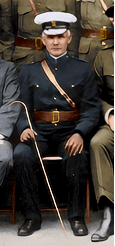
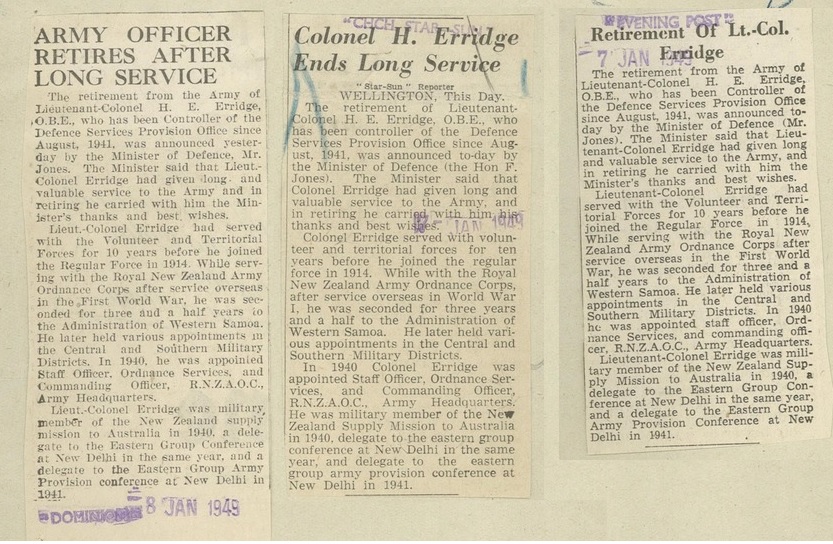
  • Maj H.E Erridge                                                                 22 Jun 1940 – 3 Aug 1941
Major H.E Erridge
  • Lt Col E.L.G Bown                                                             5 Aug 1941 – 1 Oct 1947

In the Post-war era, the NZAOC would be granted Royal status on 12 July 1947, becoming the Royal New Zealand Army Ordnance Corps (RNZAOC). For the next forty-five years, the Director of Ordnance Services (DOS) would be responsible for the personnel, equipment and training of the RNZAOC.

Director of Ordnance Services (RNZAOC)

  • Lt Col A.H Andrews                                                         1 Oct 1947 – 11 Nov 1949
Lt Col A.H Andrews. OBE, RNZAOC Director of Ordnance Services, 1 Oct 1947 – 11 Nov 1949.
  • Lt Col F Reid                                                                       12 Nov 1949 – 31 Mar 1957
Lt Col F Reid, OBE. Director of Ordnance Services 12 Nov 1949 – 31 Mar 1957
  • Lt Col H Mck Reid                                                             1 Apr 1958 – 11 Nov 1960
Lt Col H McK Reid, Director of Ordnance Services , 1 Apr 1957 – 11 Nov 1960
  • Lt Col E Whiteacre                                                           12 Nov 1960 – 24 May 1967
Lt Col E Whiteacre, OBE, 12 Nov 1960 – 23 May 1967
  • Lt Col J Harvey                                                                 24 May 1967 – 28 Aug 1968
Lt COl J Harvey, Director of Ordnance Services, 24 May 1967 – 28 Aug 1968.
  • Lt Col G.J.H Atkinson                                                     29 Aug 1968 – 20 Oct 1972
Lt Col G.J.H Atkinson, Director of Ordnance Services. 29Aug 1968 – 20 Oct 1972.
  • Lt Col M.J Ross                                                                 21 Oct 1972 – 6 Dec 1976
Lt Col M.J Ross, Director of Ordnance Services, 21 Oct 1972 – 6 Dec 1976.
  • Lt Col A.J Campbell                                                          7 Dec 1976 – 9 Apr 1979
Lt Col A.J Campbell, Director of Ordnance Services, 7 Dec 1976 – 9 Apr 1979.
  • Lt Col P.M Reid                                                                 10 Apr 1979 – 25 Jul 1983
Lt Col P.M Reid, Director of Ordnance Services, 10 Apr 1979 – 25 Jul 1983.
  • Lt Col T.D McBeth                                                            26 Jul 1983 – 31 Jan 1986
Lt Col T.D McBeth, Director of Ordnance Services , 26 July 1983 – 31 Jan 1986.
  • Lt Col G.M Corkin                                                             1 Feb 1986 – 1 Dec 1986
Lt Col G.M Corkin, Director of Ordnance Services, 1 Feb 1986 – 1 Dec 1986.
  • Lt Col J.F Hyde                                                                   2 Dec 1986 – 31 Oct 1987
Lt Col J.F Hyde, Director of Ordnance Services, 2 Dec 1986 – 31 Oct 1987.
  • Lt Col E.W.G Thomson                                                  31 Oct 1987 – 11 Jan 1990
  • Lt Col W.B Squires                                                          12 Jan 1990 – 15 Dec 1992

During the early 1990s, the New Zealand Army underwent several “rebalancing” activities, which saw the formation of regional Logistic Battalions and included the demise of the individual Corps Directorates.  

Filling the void left by the demise of the Corps Directorates, the post of Regimental Colonel was approved on 12 December 1992. The role of the Regimental Colonel of the RNZAOC was to.

  • Provide specialist advice when called for
  • Maintain an overview of Corps personnel matters, and
  • Provide a link between the Colonel Commandant of the RNZAOC and the Corps and support the Colonel Commandant.

Regimental Colonel (RNZAOC)

  • Col T.D McBeth                                                                 15 Dec 1992 – 19 Sept 1994
  • Col L Gardiner                                                                   19 Sept 1994 – 9 Dec 1996

On 9 December 1996, the RNZAOC was amalgamated into the Royal New Zealand Army Logistic Regiment (RNZALR).

New Zealand Ordnance Corps during wartime

During the Frist World War, a New Zealand Army Ordnance Corps was established as a unit of the 1st New Zealand Expeditionary Force (NZEF)  

Officer Commanding NZEF NZAOC

  • Capt W.T Beck,                                                                  3 Dec 1914 – 31 Jan 1916
William Thomas Beck Circa 1921
  • Lt Col A.H Herbert,                                                          1 Feb 1916 – 31 Mar 1918
Lieutenant-Colonel Alfred Henry Herbert, NZAOC. aucklandmuseum/Public Domain
  • Lt Col H.E Pilkington, RNZA                                           30 Jun 1918- 22 Jan 20
  • Temp Capt W.H Simmons,                                             20 Feb 20 – 13 Oct 1920

During the Second World War, all the Ordnance functions of the 2nd NZEF were organised as the New Zealand Ordnance Corps (NZOC).

Officer Commanding 2nd NZEF NZOC in the Middle East and Europe

  • Lt Col T.J King                                                                     5 Jan 1940 – 10 Jul 1942
  • Maj A.H Andrews                                                             10 Jul 1942 – 1 Dec 1942
  • Lt Col J.O Kelsey                                                              1 Dec 1942 – 1 Feb 1946

Officer Commanding 2nd NZEF in the Pacific NZOC

  • Lt P.N Erridge                                                                   22 Nov 1940 – 9 May 1941
  • Lt S.A Knight                                                                       9 May 1941 – 8 Jan 1942
Lieutenant-Colonel Stanley Arthur Knight
  • Lt Col M.S Myers                                                              8 Jan 1942 – 24 Apr 1944
  • Lt Col S.A Knight                                                             24 Apr 1944 – 30 Oct 1944                                           

The bell of the M.V Rangitata

Hidden in an alcove under some stairs at New Zealand’s Army’s Trade Training School is a surprising item of memorabilia not generally associated with the Army, a Ships Bell belonging to the M.V Rangitata.

With no labels or tags identifying its origins, its mounting cradle indicates that it was mounted in a social club or smoko room and used to call the room to attention for important announcements.

The journey of this bell and why it now rests at Trentham has long been forgotten. However, it does hold a surprising place in the whakapapa of the Royal New Zealand Army Logistics Regiment.

Established in 1873, the New Zealand Shipping Company (NZSC) helped pioneer the trade of frozen goods from New Zealand to England and became one of New Zealand’s premier shipping companies with domestic and international routes.

In the late 1920s, the NZSC undertook a significant investment in its fleet for the Wellington to London route and had three modern diesel-powered passenger/cargo ships built, the Rangitane, the Rangitiki and the Rangitata.

MV Rangitata

Known as the “Rangi” ships, from 1929, these 16,737-ton diesel-powered vessels dominated the service between England and New Zealand with a four-weekly service, making the voyage via the Panama Canal and Pitcairn Island in 32 days.

All three Rangis served in various war-related roles from 1939.

The Rangitane

whilst transiting from New Zealand to England was sunk three hundred miles east of New Zealand by the German surface raiders Komet and Orion on 27 November 1940.

The Rangitiki

In November 1940, as its sister was facing German raiders in the Pacific, as the largest vessel in the thirty-eight vessel trans-Atlantic convoy HX 84, the Rangitiki encountered the German pocket battleship Admiral Scheer, and although eight merchant vessels were lost, the Rangitiki completed the voyage. In December 1940, as part of Trans-Atlantic convoy WS 5, the Rangitiki then survived an encounter with the German heavy cruiser Admiral Hipper. In 1945 the Rangitiki returned to the New Zealand -England route as it undertook repatriation voyages returning Servicemen and War brides home from Europe. Following eighty-seven peacetime return voyages between New Zealand and the United Kingdom, the Rangitiki was retired and broken up as scrap in 1962.

The Rangitata

In 1937 the Rangitata transported troops to England for the coronation of King George VI, and in 1939 was requisitioned for war service.  During the war, some of the Rangitata’s eventful voyages included transporting 113 child evacuees from England to New Zealand. Later in the war, it transported United States soldiers from the USA to England. Following the war, the Rangitata was fitted out as a war-bride ship and, in 1947, transported the first post-war draft of immigrants to New Zealand. Returning to peacetime service with its sister ship, the Rangitiki, the Rangitata was also scrapped in 1962.

The wartime voyage of significance to the RNZALR is the Rangitata’s participation in carrying the First Echelon of the 2nd New Zealand Expeditionary Force (2nd NZEF) from Wellington to Egypt in January/February 1940.

Six merchant vessels made up Convoy US.1 sailing from Wellington on 4 January 1940, carrying 345 Officers and 6175 other ranks of the Second Echelon of the 2nd NZEF.

As part of Convoy US.1, the Rangitata transported the following units to Egypt.

  • Divisional Cavalry: A and B Sqns (369 men)
  • NZANS Nursing Sisters (3)
  • Royal Navy Volunteer Reserve ratings.
  • 2 NZEF Overseas Base
  • 13 Light Aid Detachment, New Zealand Ordnance Corps (1 Officer + 12 Other Ranks)
  • 13 Light Aid Detachment, New Zealand Ordnance Corps (1 Officer + 12 Other Ranks)

The following members of the New Zealand Ordnance Corps have been identified as sailing on the Rangitata. As the war progressed, several of these men held significant positions in the NZOC and from November 1942, the New Zealand Electrical and Mechanical Engineers (NZEME). A small number continued to serve in the post-war NZ Army.

  • Lieutenant Donald Edward Harper, NZOC, Base Depot
    • finished the war as Lieutenant Colonel and the 2nd NZ Div Assistant Director of Ordnance Services.
Lieutenant Colonel Donald Harper Bull, George Robert, 1910-1996. Lieutenant Colonel D E Harper – Photograph taken by George Bull. New Zealand. Department of Internal Affairs. War History Branch:Photographs relating to World War 1914-1918, World War 1939-1945, occupation of Japan, Korean War, and Malayan Emergency. Ref: DA-05919-F. Alexander Turnbull Library, Wellington, New Zealand. /records/23233849
  • 2nd Lieutenant John Owen Kelsey, NZOC, 13 LAD
    • Served as an Ordnance Mechanical Engineer (OME), Senior Ordnance Mechanical Engineer (SOME), Assistant Director of Ordnance Services (ADOS) and acting Chief Royal Electrical and Mechanical Engineers (CRÈME). Completed the war as a Colonel and was awarded an MBE and MID
  • 2nd Lieutenant Robert Hassell England, NZOC, 14 LAD
    • Promoted to Captain and served as OC 3 NZ Field Workshop and NZ Divisional Ordnance Field Park
  • Warrant Officer Class One Kevin Graham Keith Cropp, Base Depot
    • Remained in the RNZAOC post-war and retired as a Major in 1955
  • Warrant Officer Class One Francis Reid, NZOC, Base Depot
    • He was commissioned and served throughout the war. Remained in the RNZAOC after the war and as a Lieutenant Colonel, was the Director of Ordnance Services from November 1949 to March 1957.
  • Warrant Officer Class Two Andrew Gunn, NZOC, 13 LAD
    • KIA Greece. 18 April 1941
  • Corporal Randal Martin Holmes, NZOC, 14 LAD
  • Corporal Robert William Watson, NZOC, Base Depot
  • Private Rodger Langdon Ashcroft, NZOC, Base Depot
  • Private John Noel Shadwell Heron, NZOC, Base Depot
  • Private Mark Edwin Ivey, NZOC, Base Depot
  • Private Edward McTavish MacPherson, NZOC, Base Depot
  • Private Lionel Edward Campbell, NZOC, 14 LAD
  • Private Lionel John McGreevy, NZOC, 14 LAD

Although this list is not exhaustive, the few highlighted names indicate the logistical talent onboard the Rangitata during its voyage as part of Convoy US.1. Officers such as Harper, Kelsey and Reid went on and play a significant role in shaping the future of New Zealand Military Supply and Maintenance Support trades.

Although the journey of the MV Rangitata’s Bell and how it ended up in Trentham may never be known, the hope is that given its relationship to the Logisticians of the First Echelon, in the future, the RNZALR will place and display this bell in a position of significance.


Royal New Zealand Army Service Corps

In British and Commonwealth military doctrine, there has long been a separation of responsibility for Supplies and Stores.

  • Supplies – The provisioning, storing, and distributing of food for soldiers; forage for animals; Fuel, Oil, and Lubricants (FOL) for Tanks, Trucks, and other fuel-powered vehicles and equipment; and the forward transport and distribution of ammunition. In the NZ Army, Supplies were managed by the New Zealand Army Service Corps (NZASC) from 1911 to 16 October 19789.
  • Stores – The provisioning, storage, and distribution of weapons, munitions, and military equipment are not managed by RNZASC. Stores were the Responsibility of the Royal New Zealand Army Ordnance Corps (RNZAOC) until 1996.

Despite the separation of responsibilities, the RNZASC and RNZAOC would have a long and cooperative relationship for most of their existence.

During the early colonial days, the early actions of the New Zealand Wars proved that the New Zealand bush and the elusive tactics of the Maori presented new problems in supply and transport. An Imperial Supply and Transport Service was established and operated with the Imperial troops.

From the end of the New Zealand Wars until 1910, there was no ASC unit in New Zealand, with the supply functions required by the New Zealand Military provided by the Defence Stores Department.

After the conclusion of the South African War, the Military Forces in New Zealand embarked on a series of reforms to enhance the organisation and capability of the nation’s military, enabling it to contribute effectively to a broader Imperial Defence scheme. In 1910, at the request of the New Zealand Government, Field Marshal Viscount Kitchener inspected New Zealand’s Forces. Kitchener provided several recommendations concerning the ongoing reforms, emphasising the need for a professional Staff Corps to administer the force and confirming the requirement for a New Zealand ASC, which was gazetted on 12 May 1910 (backdated to 6 May 1910) as a designated component of the Territorial Forces of New Zealand.

The momentum for these reforms gained further impetus with the appointment of Major General Alexander Godley as the New Zealand Military Forces Commandant in December 1910. Godley was pivotal in revitalising New Zealand’s military organisational framework in his first year, making critical command and staff appointments, promulgating the (Provisional) Regulations for the Military Forces of New Zealand, and making plans to build up the NZASC, which up to this time had remained a paper corps.

Acknowledging the highly specialised nature of ASC duties, distinct from combatant staff and regimental officers, and the absence of suitably qualified officers in New Zealand, Godley recommended to the Minister of Defence on 4 January 1911 the lending of services of an experienced Imperial ASC Senior Captain or Major to organise and train New Zealand’s transport and supply services for three years. The Minister of Defence endorsed this recommendation with the Prime Minister cabling the New Zealand High Commissioner in London on 10 January 1910 to approach the Army Council for the following:

Services of experienced Army Service Corps major or senior captain required to organise New Zealand Army Service Corps. Engagement for three years. Salary £600 a year consolidated. Pay to include house allowance. Travelling allowance of 12/6d a day and allowance for one horse if kept, will also be granted. 

Within two months of receiving New Zealand’s request for an ASC Officer, the Army Council promptly and affirmatively responded to the call. Having already sanctioned nine additional officers to assist Godley, the Council selected Knox, who then served in C (Depot) Company ASC at Aldershot for service in New Zealand to organise the NZASC.

Under the guidance of New Zealand Adjutant and Quartermaster-General Colonel Alfred Robin, Knox assumed his duties as the New Zealand DST at the Army General Staff Offices on Wellington’s Buckle Street. His responsibilities encompassed a wide range of functions, including quarters, tender and contracts, personal and freight movement, and presidency on two standing committees related to Drill sheds and the storage and distribution of clothing and equipment to the forces.

Recognising Knox’s extensive duties, he was granted the Temporary Rank of Lieutenant Colonel on 6 September 1911. With Colonel Robin’s appointment as the New Zealand representative at the War Office in London in 1912, Knox assumed the additional role of Quartermaster General (QMG). Despite Knox diligently fulfilling the role of QMG and DST, progress on the formation of the NZASC was slow.

By 1914, Knox had established 16 NZASC companies of approximately 30 men each across the four New Zealand Military Districts, with imported ASC officers serving as Assistant Directors of Supply and Transport (ADST) in each District Headquarters.   Although Knox had departed by the time of the 1914 divisional camps, the Inspector General of Imperial Forces, General Sir Ian Hamilton, noted following his inspection that:

The very highest credit is due to the Army Service Corps officers and their men. They have done a first-class service, although as a rule undermanned to an extent that would fill a labour union with horror. When the Army Service Corps units are up to their normal strengths, a suitable system of calling the men up to camp in relays will enable the necessary duties to be carried out as efficiently and with much less strain on the personnel.

During World War One, New Zealand ASC units fulfilled crucial functions. ASC Companies supported the Territorial Infantry and Mounted Rifle Brigades. At the same time, Supply and Transport Units aided mobilisation camps within New Zealand. Overseas, the NZASC operated across all New Zealand theatres of war, delivering indispensable services. At its zenith, it managed the NZ Divisional Train, five ASC Companies, five Depot Units of Supply, the NZ Field Bakery, the NZ Field Butchery, and the NZ Motor Transport Workshop. Notably, the NZASC and NZAOC frequently shared personnel, facilities, and transportation, especially in the conflict’s early years.

In 1917 the NZAOC was established as a permanent component of the New Zealand Military Forces, however, it would not be until 1924 that the Permanent NZASC was formed.

Post-war, under the leadership of Captain Stanley Herbert Crump, the NZASC transitioned to a peacetime establishment comprising a Headquarters and three depots (Northern, Central, and Southern). In 1924, the Permanent NZASC (PNZASC) was established as part of the permanent Military Forces. Additionally, in 1925, an alliance between the NZASC and the Royal Army Service Corps (RASC) was ratified.

The RASC has its roots in history that are much more profound. Up to the time of Cromwell, armies mainly lived by plunder. The RASC came into being in 1888. but the work it now performs was being done long before that.

Cromwell and then the Duke of Marlborough, and later Napoleon, organised a system of civilian commissaries. The Duke of York established the Corps of Royal Waggoners in 1794. This purely transport organisation continued until 1869 under various names, eventually as the Military Train, fighting as light cavalry in the Indian Mutiny.

The birth of the Supplies and Transport Service dates from 1869. when supplies and transport, along with the Military Stores Department, came under one department called the Control Department, it remained for General Sir Redvers Buller in 1888 to organise the first Army Service Corps. Since its formation, the RASC has been a combatant one. Trained and armed as infantry and responsible for its own protection. Considerd a more technical Corps, the RAOC was not granted combatant status until 1942.

In 1931, under Crump’s continued leadership, the NZASC underwent a reorganisation into three Composite Companies. Each company comprised seven officers, four warrant officers, and 99 other ranks, establishing a solid foundation from which the NZASC could readily expand to meet the demands of future conflicts.

During World War Two, numerous units and establishments represented the NZASC across all New Zealand Expeditionary Force (NZEF) theatres. Similar to the previous World War, the NZASC maintained a collaborative relationship with New Zealand Ordnance Corps (NZOC) Ammunition Examiners (AEs) in the establishment of NZASC Ammunition platoons. At times, NZASC Warrant Officers were attached to the NZ Divisional Ordnance Field Park (OFP) to offer technical advice on vehicle spares. In recognition of the NZASC’s service during WW2, the title “Royal New Zealand Army Service Corps” was conferred in 1946.

In the post-war era, the NZASC and from 1946, the RNZASC would serve with distinction J Force in Japan and then contribute the second-largest New Zealand contingent to K Force in Korea by providing 10 Transport Company. Playing a pivotal role in sustaining the morale and effectiveness of New Zealand forces during these conflicts

Until 1947, NZASC units primarily handled baking bread, butchering meat, and procuring and distributing fresh and packaged provisions to frontline units, while regimental cooks and stewards were responsible for cooking and serving meals. To enhance and standardise cooking practices throughout the army, the Supplies and Transport Catering Group (STCG) was established on 15 February 1948 with the following objectives:

  • Training and provision of unit cooks and kitchen hands.
  • Instruction and supervision of the management of the Army ration scale.
  • Improvement of food preparation and cooking standards.
  • Advice on the installation and operation of cooking appliances and kitchen equipment.
  • Guidance on the layout of mess buildings.

In September 1948, all Regimental catering staff, except those of the New Zealand Women’s Army Corps, were transferred into the RNZASC. Throughout the 1950s, 60s, and 70s, the RNZASC played a vital role within the New Zealand Army, encompassing a wide range of functions. These included everyday tasks such as cooking and serving food, as well as more complex operations like air supply drops. To manage the procurement, storage, transportation, and distribution of essential supplies such as food, fuels, and oils for a modern Army, the RNZASC operated Supply Depots and employed various tradespeople, including butchers. Supply Depots were strategically located in Papakura, Waiouru, Linton, Trentham, and Burnham, where bulk supplies were stored and distributed as needed. Additionally, every Army camp featured a section of the RNZASC, along with smaller supply and transport depots, which were responsible for handling goods from central supply depots and providing drivers and transport services for various purposes. These smaller depots were situated in Devonport/Fort Caultley,

ANZUK Supply Platoon, Singapore – 1972 Standing L to R: Cpl Parker, RAASC. Cpl Olderman, RAASC, Cpl Mcintyre, RAOC. Sgt Frank, RAOC. Cpl Rangi, RNZASC. Sgt Locke, RNZASC. Sgt Bust, RAOC. Pte Mag, RAASC. Cpl David, RAASC. Sitting L to R: Sgt Kietelgen, RAASC. WO2 West, RAOC. Capt Mcnice, RAOC. Maj Hunt, RAASC. Lt Fynn, RAASC. WO2 Cole, RAASC. WO2 Clapton. RAASC

Following the Macleod report that recommended the streamlining of logistic support for the British Army, the RASC merged in 1965 with the Royal Engineers’ Transportation and Movement Control Service to form the Royal Corps of Transport (RCT). This would see the RASC Supply functions transferred to the Royal Army Ordnance Corps (RAOC). In 1973, following the British lead, the Australians also reformed their Royal Australian Army Service Corps (RAASC) into the Royal Australian Army Corps of Transport (RAACT).

Acknowledging the British and Australian experience, the RNZASC underwent a similar transition—operational command of the Supply function transferred to the RNZAOC on 16 October 1978. On 12 May 1979, the RNZASC ceased to exist: Supply personnel formally transferred to the RNZAOC, while Transport, Movements, and Catering were re-formed as the Royal New Zealand Corps of Transport (RNZCT)..

The RNZASC supply function would be integrated into the RNZAOC, with the Camp Supply Depots becoming NZAOC Supply Platoons numbered as.

  • 14 Supply Platoon, Papakura/Hopuhopu
  • 24 Supply Platoon, Linton
  • 34 Supply Platoon, Burnham
  • 44 Supply Platoon, Waiouru
  • 54 Supply Platoon, Trentham
  • NZ Supply Platoon, Singapore

In recognition of its long RNZASC service, 21 Supply Company was retained as a Territorial unit, initially as the Territorial element of 4 Supply Company in Waiouru and later as the Territorial element of 2 Supply Company, Linton. Today, 21 Supply is the principal North Island Supply unit of the Royal New Zealand Army Logistic Regiment (RNZALR).

For a short period following the RNZAOC assumption of Supply functions, some RF and TF RNZAOC would periodically be employed within the RNZCT transport Squadrons’ Combat Supplies sections.

The RNZAOC Butcher trade inherited from the RNZASC would be discontinued in the mid-1980s, with the last of the butchers reclassifying as RNZAOC Suppliers. By the mid-1990s, it was decided as a cost-saving measure to allow the RNZCT catering staff to order directly from commercial foodstuff suppliers, effectively ending the RNZAOC foodstuffs speciality. The only RNZASC trade speciality remaining in the RNZAOC after its amalgamation into the RNZALR was that of Petroleum Operator.

The Royal NZ Army Service Corps & Corps of Transport, like the RNZAOC, have passed their combined responsibilities to the RNZALR. However, the Royal NZ Army Service Corps & Corps of Transport maintain a strong association that provides many benefits and opportunities for comradeship to RNZASC/CT Corps members and past and present members of the RNZALR. Another role of the RNZASC/CT association is to ensure that the rich and significant history of the RNZASC/CT is not lost to future generations of the RNZALR.

Copies of the RNZASC/CT association newsletter can be viewed here


Henry Earnest Erridge

Serving the nation for 44 years, Henry Erridge served at Gallipoli before being invalided back to New Zealand. Continuing to serve throughout the interbellum, Erridge assisted in shaping the New Zealand Army Ordnance Corps for the Second World War. During the war, Erridge played a significant role in providing New Zealand’s contribution to the collective logistics efforts of the British Commonwealth

Henry Earnest Erridge was born in Dunedin on 18 December 1887 to Henry and Jane Erridge. The fifth of seven children, Henry was educated in Dunedin and received commercial training. A keen military volunteer Erridge had joined the Dunedin Engineer Volunteers as a Cadet in 1904, transferring into the Otago Hussars in 1909, gaining Non-Commissioned Officer (NCO) Rank.   On 6 April 1914, Erridge joined the New Zealand Permanent Staff (NZPS) with the rank of Staff Sergeant Instructor as the Orderly Room and Quartermaster (QM), No 15 Area Group, Oamaru.[1]

On the outbreak of war in August 1915, Erridge was seconded for duty with the NZEF and left New Zealand with the Main Body, Otago Infantry Battalion. As a Signals Sergeant in the Otago’s, Erridge saw service during the Turkish attack on the Suez Canal in February 1915 and later took part in the landings at Gallipoli. Stuck down with enteric fever, Erridge was evacuated from Gallipoli to Alexandria in June and, in August, invalided back to New Zealand for further convalescence.

Returning to duty as a Warrant Officer in the QM Department at Featherston Camp on 10 January 1916, Erridge was appointed Stores Forman responsible for managing the QM Stores accounts for Featherston and its subsidiary camps. Reclassified as Class “A” fit for overseas service on 5 July 1918, it was intended to attach Erridge to a reinforcement draft and returned to the front. Deemed as essential, the Director of Equipment and Ordnance (DEOS) Stores appealed to the Chief of the General Staff, stating that

The accounts of the Camp Quartermaster, Featherston Camp, have not been completed and balanced. The principle causes for this state of affairs are:


(1) The inferior class of clerks posted for Home Service duties.
(2) And ever-changing staff, thus throwing the bulk of work on SSM Erridge, who has been employed in the capacity of foreman.

It is essential that SSM Erridge be retained until 1 November at least

Director of Equipment and Ordnance Stores to Chief of the General Staff. 14 August 1918

The DEOS appeal was successful, and Erridge was granted authority to delay his placement into a reinforcement draft until November on the proviso that every endeavour was to be made to have all accounts in connection with the QM Branch Featherston and subsidiary camps completed to the satisfaction of the proper authority. Following the Armistice of 11 November 1918, Erridge’s employment was reassessed, and he was provided orders to remain with the QM Department at Featherston. Seconded to the Ordnance Stores in Wellington in June 1919, Erridge was permanently transferred into the New Zealand Army Ordnance Corps (NZAOC) with Conductor rank on 1 October 1919.

Recommended for the Supplies and Purchasing Officer position with the civil administration in Samoa, Erridge was accepted for service with the Samoan Administration for three years from 24 May 1920. Due to a misunderstanding of the secondment rules, Erridge was discharged from the New Zealand Military. However, this was reviewed, and the discharge was rescinded, allowing Erridge to retain his rank and seniority on his return to New Zealand.

`Administration Headquarters. “Apia”‘. Moore, Robert Percy, 1881-1948 :Panoramic photographs of New Zealand. Ref: Pan-0422-F. Alexander Turnbull Library, Wellington, New Zealand. /records/32050069

Completing his service in Samoa in August 1923, Erridge returned to New Zealand and, following three months leave, resumed duty with the NZAOC, where he was posted to the Main Ordnance Depot (MOD) and placed in charge of the Stores on 1 December 1923. In an example of his experience and utility, Erridge temporarily relieved Captain F.E Ford, the Ordnance Officer of Featherston Camp, from 4-31 Jan 1924.

During the 1920s, the Quartermaster General (QMG) vested command of the NZAOC to the Director of Ordnance Service (DOS). Assisted by the Chief Ordnance Officer (COO), the Inspecting Ordnance Officer (IOO), and the Ordnance Mechanical Engineer (OME), the DOS was responsible for:[2]

  • The provision, receipt, storage, distribution, repair, examination, and maintenance of small-arms, machine guns, vehicles, clothing and necessaries, equipment and general stores (including medical and veterinary), and camp and barrack equipment,
  • The inspection and repair of armament and warlike stores, and the inspection of gun ammunition.
  • The provision, receipt, storage, and distribution of small arms ammunition.
  • The receipt, storage, issue, and repair of fixed armament, field armament, and artillery vehicles.
  • The organisation and control of ordnance workshops
  • The preparation and periodic revision of Equipment Regulations and barrack and hospital schedules
  • The organisation, administration, and training of the NZ Army Ordnance Corps Forces
  • The maintenance of statistics of the Ordnance Department.

The DOS was also the Commanding Officer (CO) of the NZAOC and was responsible for the interior economy, including enlistment, training, pay, promotion, postings transfers, clothing, equipment, and discharges within the unit.

In 1924, the incumbent DOS, Lt Col Pilkington, was appointed QMG in Army Headquarters. Major T.J King, then acting COO, was appointed DOS, with Major William Ivory as the IOO and OME.  By 1925, King recognised that he could not provide complete justice to the DOS and COO posts. Still, with no Ordnance Officers immediately available to fill the COO position, he recommended that the QMG give some relief by granting Erridge an officer’s commission. In his recommendation to the QMG, King noted that

Conductor Erridge is a man of wide experience in Ordnance duties and stores works generally and is eminently fitted for appointment as Ordnance Officer with the rank of lieutenant. He is a man of unblemished character, with a very high regard for the interests of the Corps and the services, and in the last few months gained sufficient insight into the duties I propose transferring him to.

Director of Ordnance Stores to Quartermaster General 11 December 1925

The QMG supported King’s recommendation on the proviso that Erridge pass all the required commissioning examinations. After passing the examinations, Erridge was commissioned as a lieutenant in the NZAOC on 23 July 1926.[3] However, the question arose of where to place Erridge on the Army List. Technically, the COO appointment was still vacant, with Erridge, for all intents, acting as King’s assistant and only performing part of the COO duties, with the work of the COO divided between King and Erridge. It was not desired that an Assistant COO be added to the establishment, so it was decided to show Erridge as Ordnance Officer (Provision). After several years as the Ordnance Officer (Provision), Erridge was appointed to the dual roles of Ordnance Officer MOD and Ordnance Officer Central Military District (CMD) on 14 May 1929.[4]

In December 1930, the incumbent Ordnance Officer Southern Military District (SMD)and Camp Commandant of Burnham Camp, Captain A.R.C White, faced compulsory retirement. To allow some continuity while White’s replacement was decided, Erridge was temporarily sent to Burnham. Although initially only a temporary posting, Erridge remained at Burnham until 1934 in the dual roles of Ordnance Officer SMD and Officer in Charge Burnham Camp (Camp Commandant).[5]

By 1935 in his role of DOS, King was looking forward and preparing his organisation for war. In a submission to the General Headquarters, King requested authority to reorganise his staff. Regarding Erridge, King started.

Owing to the large amount of new equipment that is on order and is likely to be ordered soon, it is essential that the staff of the Ordnance Depot, Trentham, be strengthened to the extent that I should again have the assistance of my most experienced Ordnance Officer.

There is a great deal of work of a technical nature in connection with mobilisation, rewriting of Regulations, etc., which I am unable to find time to carry out myself, and which Mr Erridge, by virtue of his long experience and training, is well qualified to undertake. This work is most necessary and should be put in hand as soon as possible; I have no other Officer to whom I could delegate it.

Again, King’s recommendations were accepted, and on 30 June 1934, Erridge relinquished his Burnham appointments and was appointed as the Ordnance Officer (Provision) at the MOD, with promotion to Captain following on 1 December 1934.[6]

When the war was declared in September 1939, the NZAOC underwent a significant transformation as its mobilisation plans were implemented. The DOS, Lieutenant Colonel King, was seconded to the 2nd NZEF as the Deputy Director of Ordnance Services (DDOS). Accompanying King was a small staff drawn from the military and civilian staff of the NZAOC who formed the nucleus of the Ordnance Corps in the 2nd NZEF. Kings’ responsibilities of DOS and COO were handed over to the Ordnance Officer CMD, Lt Col Burge.

On 2 December 1939, Erridge relinquished the appointment of Ordnance Officer (Provision), was granted the Rank of temporary Major and posted to Army HQ with substantive Major confirmed in February 1940.[7]  In June 1940, the NZAOC underwent further reorganisation when Lt Col Burge relinquished the appointment of DOS when he was appointed as Deputy QMG in Army HQ with the position of DOS placed into abeyance for the duration of the war. Appointed as Staff Officer Ordnance and CO of the NZAOC, Erridge took over responsibility for the NZAOC.[8]

With the national economy transitioning from peacetime to a war footing, the Government took a series of initiatives to ensure international trade and commerce security.  Representing the New Zealand Military, Erridge accompanied the New Zealand Minister of Supply and a small entourage of officials of the New Zealand Munitions and Supply Delegation on a tour of Australia for a series of talks with their Australian counterparts in July/August 1940.[9]

While the mission of the New Zealand Munitions and Supply Delegation to Australia was focused on strengthening cooperation between New Zealand and Australia, the Eastern Group Conference held in Delhi in October 1940 had the broader goal of organising a joint war supply policy for the countries of the “Eastern Group.” The countries represented at the Eastern Group Conference included the United Kingdom, Australia, India, South Africa, New Zealand, East Africa, Palestine, Ceylon, Burma, Malaya, and Hong Kong, with the Government of the Netherlands East Indies attending as observers.[10]  The New Zealand delegation included.

  • The Chief of the General Staff, Major-General Sir John Duigan,
  • Major H. E. Erridge,
  • Mr F. R. Picot, Director of the Internal Marketing Department,
  • Mr J. R. Middleton, assistant-Secretary of supply,
  • Mr B. Taylor, assistant to the chief investigating officer of the Treasury Department.

As a result of the October conference, the Eastern Group Supply Council (EGSC) was established to coordinate and optimise the production and distribution of war materiel in the British colonies and dominions in the Eastern Hemisphere. The New Zealand members of the council who were to be based in New Delhi were.

  • Mr F.R Picot, Director of Internal Marketing and Food Controller,
  • Mr W.G.M Colquhoun (Munitions Department).
  • Mr R.J Inglis (Supply Department).
  • Mr R.H. Wade (of the Treasury).

A Central Provisions Office (Eastern) was also set up in Delhi, with national offices established in Australia, New Zealand, South Africa, East Africa, Southern Rhodesia and the Middle East.   The Central Provision Office (Eastern) was a military organisation consisting of about 40 to 50 Army officers from all countries constituting the Eastern Group. Headed by the Controller-General of Army Provisions, who was also the military member of the EGSC and acted as the agent of the Imperial General Staff and various Commanders in Chief. The role of the Central Provision Office (Eastern) was coordinating with the controllers of the national provision offices to obtain military stores to maintain the British and Commonwealth war effort.[11] From March 1941, Two NZAOC Officers, Temporary Major D. L. Lewis and Lieutenant D.I Strickland were attached to the Central Provision Office (Eastern) staff in New Delhi.[12]

Before the Central Provision Office (Eastern) assumed complete provision control, it was necessary for all the controllers of the national provision offices to meet to ensure that uniform procedures were adopted. A coordination conference for the various Provision Group Controllers was held at New Delhi in July 1941, with Erridge attending as New Zealand’s military representative. Based on this conference, on 5 August 1941, the New Zealand War Cabinet approved the establishment of the New Zealand Defence Servicers Provision Officer (DSPO), with Erridge appointed as its Controller with the rank of Temporary Lieutenant Colonel. Relinquishing the appointment of Staff Officer Ordnance and handing over the Commanding Officer NZAOC duties to Major E.L.G Bown, the COO MOD.[13]

By  April 1945, the DSPO thought Central Provision Group (Eastern) had shipped for the British Ministry of Supply equipment to the value of £10,000,000 (2021 NZD $8,988,577,362.41) with additional equipment to the value of  £8,520,761 (2021 NZD $765,895,194.35) that was surplus to the requirements of NZ Forces overseas transferred to the War office.[14]  During a visit to New Zealand in January 1946, Major-General R.P Pakenham-Walsh, CB, MC., a member of the Eastern Group Supply Council and the Central Provision Office(Eastern), stated that “Stores from New Zealand which had been made available to the Eastern Group Supply Council had been of great importance in the prosecution of the war” adding that “the Dominion’s contribution had compared more than favourably with that of various larger countries.”[15]  Following the surrender of Germany in April and Japan’s defeat in August 1945, the Eastern Group Supply Council and Central Provision Office, although serving their purpose well, had become irrelevant and were dissolved on 31 March 1946.[16]  However, it took two years for the DSPO to transition to a peacetime footing. Seconded to the War Asset Realisation Board (WARB) on 1 May 1947, Erridge started to wind down the work of the DSPO while also coordinating the disposal of equipment through the WARB. On 17 December 1948, Erridge handed over the remaining stocks to the WARB and closed the DSPO.

At 62 years of age and following 45 years of volunteer, Territorial and Regular service, Erridge retired from the New Zealand Army and was placed onto the Retired List with the rank of Lieutenant Colonel on 29 May 1949.[17] Never marrying, Erridge spent his retirement in his hometown of Dunedin. On 30 March 1962, a resident of the Dunedin’s Ross Home, Erridge, passed away at 74. Following his wishes, he was cremated, and his ashes scattered.

Throughout his service, Erridge was awarded the following decorations

  • OBE (1946)
  • NZ Long Service and Efficient Service (1925)
  • 1914-15 Star
  • British War Medal
  • Victory Medal
  • War Medal 1939-45
  • NZ War Medal, 193-45

Notes

[1] Archives New Zealand, “Henry Earnest Erridge- Ww1 8/1004, NZAOC 888, Ww2 800245, 30293,” Personal File, Record no R24097640 (1904-1948): 2708.

[2] “Regulations for the Military Forces of the Dominion of New Zealand,” New Zealand Gazette, May 19, 1927.

[3] “Appointments, Promotions, Resignations and Transfers of Officers of the NZ Military Forces,” New Zealand Gazette No 61, 19 July 1926.

[4] “Appointments, Promotions, Resignations and Transfer of Officers of the New Zealand Military Forces,” New Zealand Gazette No 48, 27 June 1929.

[5] “Appointments, Promotions, Transfers and Retirements of Officers of the NZ Forces “, New Zealand Gazette No 16, 5 March 1931.

[6] “Appointments, Promotions, Transfers and Retirements of Officers of the NZ Forces “, New Zealand Gazette No 55, 19 July 1934.;”Appointment, Promotions, Transfers and Retirements of Officers from the NZ Forces,” New Zealand Gazette No 87, 29 November 1935.

[7] “Appointments, Promotions, Transfers and Retirements of Officers of the NZ Forces “, New Zealand Gazette No 1, 11 Jan 1940.;”Appointments, Promotions, Transfers and Retirements of Officers of the NZ Forces “, New Zealand Gazette No 75 (1940).

[8] “Appointments, Promotions, Transfers and Retirements of Officers of the NZ Forces “, New Zealand Gazette No 70 (1940).

[9] “Unity in War Effort,” Evening Star, Issue 23622, 8 July 1940.

[10] East Africa consisting of the territories of (Kenya, Uganda, Tanganyika, Zanzibar, Northern and Southern Rhodesia, Nyasaland; Bertram Stevens, “The Eastern Group Supply Council,” The Australian Quarterly 13, no. 3 (1941).

[11] “Eastern Group Supply Council,” Otago Daily Times, Issue 24640, 23 June 1941.

[12] “Appointments, Promotions, Transfers, and Retirements of Officers of the New Zealand Military Forces.,” New Zealand Gazette, No 30, 9 April 1941.

[13] “Appointments, Promotions, Transfers, and Retirements of Officers of the New Zealand Military Forces.,” New Zealand Gazette, No 74, 11 September 1941.

[14] “War Supplies,” Evening Post, Volume CXXXIX, Issue 126, 30 May 1945.

[15] “Production Problems,” Evening Star, Issue 25690, 14 January 1946.

[16] “Supplies – the Eastern Group Supply Council,” Northern Advocate, 1 April 1946, 1 April 1946.

[17] “Appointments, Promotions, Transfers, and Resignations, of Officers of the New Zealand Army “, New Zealand Gazette No 37, 16 June 1949.


Tragedy at Tikao Bay

Today Tikao Bay is a calm, peaceful little bay with a laid-back holiday vibe hidden away in Akaroa Harbour with few clues remaining of its military use and the tragic drowning of two Ordnance soldiers.

During World War Two, with the threat of invasion by Japan just over the horizon, the isolated Akaroa Harbour was fortified to deny its use by the enemy. However, by the time the battery of 6-inch guns, Naval Armament Depot and controlled minefield was completed in 1943, the threat had diminished, with the defences becoming an expensive white elephant. In early 1944 The controlled minefield was fired, and all the navy stores at the Tikao Bay Naval Armament Depot were transferred to other installations and facilities offered to the army.[1]

Akaroa Harbour Defences. Peter Cooke Defending New Zealand 2000

The extensive facilities at Tikao Bay, including a mine magazine, examination room, primer magazine wharf and accommodation buildings, were taken over by the Southern District’s Ordnance Depot at Burnham Camp in 1944 as a satellite storage depot for Gun and Artillery Equipment.[2] With an initial establishment of seven men in 1944, this had been reduced by 1955 to two soldiers responsible for the storage and maintenance of the equipment held at Tikao Bay.

Former Defence buildings Tikao Bay. Suff.co.nz/Ewen Sargent

Staff Sergeant Frederick Hastings Kirk aged 52, was married with three children and had been the Non-Commissioned Officer in charge of the Tikao Bay depot since 1950. Staff Sergeant Kirk had joined the Ordnance Depot at Burnham in 1939 as a civilian before enlisting into the 2nd NZEF early in 1940. As a Temporary Warrant Officer Class Two in 23 Battalion, Kirk was taken prisoner at Crete in 1941 and remained a Prisoner of War for four and a half years. On his return to New Zealand, he joined the temporary staff and was posted to the Ordnance Depot at Burnham. In 1948 he became a member of the Regular Force and transferred to Tikao Bay in 1950. 

Private Donald George Dixon was aged 28 and was married with three children. Private Dixon initially served with the ammunition inspection branch after his 1953 enlistment and was transferred to the Tikao Bay Depot in October 1953.

On Tuesday, 10 March 1955, on completion of their daily duties, Kirk and Dixon left the depot at about 7 pm to check a set net approximately 200 yards (183 Meters) from the Tikao bay jetty. Having not returned by 11 pm, the police were notified, and Constable Egan of Akaroa and Mr G Brasell undertook an initial search. At 3 am Wednesday, Egan and Brasell located the missing men’s upturned dingy at the high-water mark near the set net, which was still in position. Reinforced with a party from Burnham Camp, local residents, and the police, the search for the missing men continued for the rest of the week.[3]

Private Dixon’s body was located and recovered from the harbour on Saturday morning.[4] The search for Staff Sergeants Kirks’ body continued with his body found on 18 March.[5] It was assumed that a southerly wind had risen after the two men left the depot, causing the dingy to capsize with the coroner’s report ruling the deaths as asphyxia by drowning due to misadventure.

Tikao Bay remained as an Army installation and training area into the early 1970s; however, its role as a storage depot ceased in the 1960s as the army progressively disposed of the remaining artillery equipment held there.[6]


Notes

[1] Sydney D. New Zealand Department of Internal Affairs War History Branch Waters, The Royal New Zealand Navy (Wellington, N.Z.: War History Branch, Dept of Internal Affairs, 1956), 229-36.

[2] “Establishments – Ordnance Corps “, Archives New Zealand No R22441743  (1937 – 1946).

[3] “Two Soldiers Missing,” Press, Volume XCI, Issue 27606, , 12 March 1955.

[4] “Unsuccessful Search for Body,” Press, Volume XCI, Issue 27608, , 15 March 1955.

[5] “Soldiers Body Recovered,” Press, Volume XCI, Issue 27612, , 19 March 1955.

[6] “Army Sells Guns,” Press, Volume C, Issue 29469, , 22 March 1961; “Tikao Bay Depot,” Press, Volume XCIX, Issue 29331, , 10 October  1960.


The Cave

As New Zealand’s Army’s central stock holding unit, 1 Base Supply Battalion(1BSB) was responsible for managing and providing depot-level storage of New Zealand’s Military’s stock of land equipment and spares. Despite having this responsibility since 1920, 1BSB and its predecessors had always struggled with providing suitable warehousing infrastructure and made do with the available storage infrastructure.

With no purpose-built storage accommodation, from 1920 to 1940, the NZAOC Main Ordnance Depot (MOD) utilised up to one hundred camp administrative and accommodation structures as its primary means of warehousing. Relief was provided in 1938 when contracts were issued to construct a modern warehouse utilising the most modern of methods and materials.[1] The New warehouse, later known as Building 73, was constructed using reinforced concrete and designed with nine bays that allowed the loading and unloading of Trains on one side and Motor Transport on the other. The design and layout of building 73 were utilised as the model for new warehouses constructed at Burnham, Hopuhopu and Waiouru.

Building 73

Although Building 73 provided a considerable increase in storage capability, wartime demands soon necessitated further increases in storage infrastructure, resulting in the construction of Building 74. Building 74 and the warehouses constructed in Burnham and Waiouru were close facsimiles of building 73, with the main exception that it was constructed out of wood instead of reinforced concrete due to wartime constraints.[2]

The wartime expansion of the New Zealand military saw the MOD exponentially expand to cope with the influx of military material with additional buildings constructed in Trentham and sub-depots also established a Mangere, Wanganui, Linton Camp, Gracefield and Wellington.

Peace in 1945 brought little respite as stocks were centralised at the MOD, requiring further expansion of the MOD warehousing infrastructure. To meet this need, five warehouses that were built for the United States Forces at Lower Hutt were disassembled and re-erected at Trentham by September 1945.[3] Additionally, the RNZAF Stores Depot constructed at Mangaroa in 1943 was handed over to the MOD in 1949.

Over the next forty years, the warehousing infrastructure at Trentham changed little, with a 1985 NZDF report identifying many deficiencies leading to significant upgrading of Trentham’s warehousing infrastructure.[4]

Main Ordnance Depot 1966

In one of the most significant warehousing infrastructure investments since 1939 and the first modern warehouse built for the RNZAOC since 1972, Building 75, a high stud warehouse capable of holding 3700 pallets, opened in 1988. Although a significant advancement in warehousing capability, the new warehouse had limited space for outsized items. Additionally, many other warehousing functions, such as packing and traffic, remained in Building 73, so further work was required to enhance the functionality of 1BSBs entire warehousing capability.

Building 73 (left), Building 74 (Right)

With trains no longer utilised for the delivery and dispatching of stores, the rail lines between Building 73 and 74 had long been redundant. By removing the rail line and raising the ground level between the two buildings, providing additional storage space of almost two square kilometres, protected from the elements by a 200 x 13-meter roof, was created. At the southern end, a loading ramp was constructed to allow the loading and unloading of trucks, with angled ramps at either end allowing the movement of vehicles along the length of the new storage area.  Opened on 2 November 1989, the new warehouse was christened “the Cave.” The Cave allowed the more efficient transfer of stores to and from the storage areas in Buildings 73, 74 and 75 to the receipt, selecting, packing and issuing bays in Building 73.

Lieutenant Colonel P.P Martyn, Royal Australian Army Ordnance Corps. Commanding Officer 1 Base Supply Battalion January 1988 – December 1990, officially opening “The Cave”

The additional storage space allowed the storage of outsized items which had previously been stored at the Mangaroa Depot, which was subsequently decommissioned and handed over to NZDF Property Services.

The optimisation of storage space between the two buildings was so successful a similar modification was constructed between two of 21 Supply Company’s 1950s-era Warehouses at Linton, creating much-needed storage and office space.


Notes

[1] “New Army Ordnance Block Now under Construction at One of the Military Camps,” Evening Post, Volume CXXVIII, Issue 65, 14 Sept 1939.

[2] F Grattan, Official War History of the Public Works Department (PWD, 1948).

[3] “Organisation – Policy and General – Royal New Zealand Army Ordnance Corps 1946-1984,” Archives New Zealand Item No R17311537 (1946).

[4] “Assessment and Audit – Audit Files – [1995] – NZDF Bulk Warehousing,” Archives New Zealand Item No R24596003 (1985).


Belmont’s Chemical Weapon Stockpile

Of all the Ammunition magazine areas constructed in New Zealand during the Second World War, the Belmont magazine area in the hills north of Wellington between the Hutt and Porirua was the largest and closest to a large population area. In the early 1970s, following the removal, disassembly for scrap, and destruction of its stocks, Belmont’s life as a magazine area concluded with the land reverting to civilian use.   As with any retired military facility kept out of the public eye during its operational life, urban legends and rumours thrive about secret tunnels and forgotten caches of buried military material.  Belmont is no different in this respect, as items such as empty 3.7-inch Anti-Aircraft projectiles are occasionally discovered, fuelling such rumours. Although there is little evidence to support the stories and urban legends, Belmont does have some secrets from its wartime past. The most significant is that Belmont was the home to the bulk of New Zealand’s chemical weapon stockpile.

As the threat of war with Japan became inevitable in 1940, the New Zealand Government fully mobilised New Zealand’s home defence forces. By early 1942, this mobilisation saw two Infantry Brigades deployed to Fiji, and Three Divisions and several independent Brigades mobilised for home defence.

This massive mobilisation initiated a rearmament program resulting in vast amounts of war material from the United Kingdom, Canada and the United States being delivered to New Zealand. Included as part of the infusion of new weapons and equipment were the required scales of ammunition for each type of weapon system. Ammunition scales used by New Zealand were based upon the standard British scales. They included all the ammunition natures needed by New Zealand for use in the Pacific and home defence, including Anti-Tank, High-Explosive, Smoke and a stockpile of Chemical rounds consisting of,

  • 112,770 25-pounder Chemical rounds, and
  • 10,300 4.2-inch B4 (Tear) and Y4(Blister) chemical mortar bombs.

With consignments of ammunition, due to arrive in New Zealand in late 1942, construction of the new ammunition magazine areas was initiated in 1940, with the construction of the Belmont Magazine Area beginning in September 1942.[1]  The Belmont Magazine Area consisted of sixty-two Magazine buildings, with 28 and 29 dedicated to holding chemical rounds from late 1943.

All the 4.2inch Bombs were stored at Belmont with the recommended distribution of the 25-pounder chemical rounds,[2]

  • 30,000 rounds to the Northern Military District
  • 30,000 rounds to the Southern Military District
  • 52,770 rounds to the Central Military District Belmont Depot

However, records are uncertain if this distribution occurred, so it is quite probable that the entire stock of 25-pounder ammunition was held at Belmont.

The New Zealand Stockpile was significant as a lethal percutaneous dose of mustard was 4.5 gm. With 300 tons of the agent in the NZ stockpile, the potential lethal doses held in Belmont were approximately 60 million. To put the size of the stockpile in context, it was equal to 5% of the United States Stockpile in 1993.

Chemical Weapons were highly controlled and only used in retaliation if the enemy used them first. Although US forces on Guadalcanal had captured some Japanese Chemical Weapons, the NZ Deputy Chiefs of Staff were confident that there did ‘not appear to be any other or greater evidence that the Japanese propose to use gas in this area’.

4800 25-pounder chemical rounds were deployed with the 3 NZ Div, and they were returned to New Zealand in 1944 and stored at the Kelms Road Depot at Ngaruawahia alongside the other ammunition utilised by the Division.

Following the war, the disposal of wartime ammunition became a standing task for the RNZAOC Ammunition functions as various methods disposed of damaged, obsolete, and surplus stocks.

Damaged ammunition was often disposed of by demolition; for example, the destruction of 3.7-inch anti-aircraft ammunition issued to units and returned to depots took up to 1957 to complete.[3]

The stockpile of chemical munitions was dumped at sea, with two dumping operations found in archival sources.[4]

  • Two hundred tons of chemical shells scuttled on the tug Maui Pomare at the 100-fathom line in the Hauraki Gulf in April 1946.
  • One thousand five hundred tons of 25-pounder chemical shells and twenty tons of bombs had been dumped by the Marine Department steamer Matai off the Wellington coast by October 1946.

Stock from the Belmont magazine area was delivered by Army personnel to the wharf at the RNZAF base at Shelly Bay in lots of 250 Tons and loaded onto the Marine Department steamer Matai. All possible safety precautions were applied with each crew member was issued protective capes, respirators and gloves. With special chutes constructed, cases of shells were jettisoned fifty Nautical miles off the Wellington coast in the Cook Strait Canyon, which reaches depths of three kilometres.[5]

N Z Government S S Matai, on the patent slip at Evans Bay, Wellington. Smith, Sydney Charles, 1888-1972: Photographs of New Zealand. Ref: 1/2-049255-G. Alexander Turnbull Library, Wellington, New Zealand. /records/22744146

The dumping of the Chemical munitions was well publicised, with newspaper articles describing the disposal operation. [6]

Stored since 1943, 1500 tons of gas shells are to be dumped at sea by the Matai.  Fuses have been removed from the 25lb shells that contain the gas, but to ensure that there is no risk to those carrying out the work, full Admiralty and War Office safeguards will, be taken. The gas is of the blister variety. The boxes containing the shells will be filled with sand to guard against possible leakages. Each box is painted with a substance that will indicate even a pinpoint of escaped gas.

Northern Advocate, 18 September 1946

Although the archival records show that at least 15,220 tons of Chemical munitions had been dumped at sea by the end of 1946, there is no accurate reconciliation of the actual number of rounds disposed of. However, it is a reasonable assumption that New Zealand had no desire to maintain a contingency stock of Chemical weapons and that all wartime stocks were disposed of by the end of 1946.


Notes

[1] F Grattan, Official War History of the Public Works Department (PWD, 1948).

[2] “Defence Works – Magazine – Belmont Hills,” Archives New Zealand Item No R22435088  (1942).

[3] “H-19 Military Forces of New Zealand Annual Report of the General Officer Commanding, for period 1 April 1957 to 31 March 1958,” Appendix to the Journals of the House of Representatives  (3 July 1958 1958).

[4] “Ammunition – Disposal of unserviceable ammunition 1945-1952,” Archives New Zealand Item No R21465842  (1945).

[5] A Hubbard, “Chemical War: Our seabed legacy,” New Zeland Listener, 16 January 1993.

[6] “Gas Shells to be Dumped at Sea,” Northern Advocate, 18 September 1946, https://paperspast.natlib.govt.nz/newspapers/NA19460918.2.17.