RNZAOC School – Unit History 1985

Units of the New Zealand Army must maintain a diary in which all matters connected with the unit are concisely but clearly recorded. Using Army Form New Zealand 144 (AFNZ 144), a unit provides a daily account of the unit’s activities, with entries providing the location and a brief description of the key events. Entries can be listed merely as” Ordinary Routine”, with others providing a more detailed account of the unit’s activities.

The following transcripts of the RNZAOC School have been copied from the original typed and handwritten AFNZ144 sheets. Much of the original wording has been retained, but most abbreviated words and phrases have been included in full to improve readability. Phpt

Upper Hutt City Library (29th Jan 2020). Trentham Camp; Royal New Zealand Army Ordnance Corps School sign.. In Website Upper Hutt City Library. Retrieved 14th Jul 2020 11:51, from https://uhcl.recollect.co.nz/nodes/view/1335

7 January 1985

SSgt Wayne Little posted as W02 Clerk Stores to Ordnance Directorate. He was promoted to W02 on posting.

10 January 1985

Course 11.28 Junior Supplier Marched In. Duration 10 January – 26 February 85. 14 students arrived. 2 of these were returned to unit after failing the Critical Performance Test.

14 January 1985

Maj Bolton began the Grade II Staff and Tactics Course at the Tactical School.

LCpl Marsh attended Pre-Course coaching for the Junior NCO Course at 4 Composite Squadron. Duration 14-19 Jan 85.

Course 11.26A Blinds Disposal Course Marched In. This was run for 3 Task Force personnel. Duration 15 – 18 Jan 85.

Sgt Wayne Bray arrived on Tour of Duty to the School to assist with the Blinds Disposal Course

20 January 1985

Lcpl Marsh attended the Mercedes Benz 8-tonne Familiarisation Course run by 10 Transport Squadron. Duration 20 – 25 Jan 85.

21 January 1985

Course 11.26B Blinds Disposal Marched In. This was the second of 2 courses run for 3 Task Force personnel. Duration 22 – 25 Jan 85.

28 January 1985

Sgt Bray was posted as an Instructor to Ammo Wing, RNZAOC School. He was promoted to Temporary SSgt on Posting.

LCpl Marsh commenced the Junior NCO promotion course.

31 January 1985

LCpl Marsh was ‘returned to unit’ from the Junior NCO promotion course.

1 April 1985

W02 Steed, Ssgt Armstrong, Ssgt Lush, Lcpl B. Marsh and Cpl Cole attended a 16mm Projectionist Course at the Education Section at Trentham Camp during 1-3 Apr 85.

Course 11.10 RF TF All Arms Blinds Disposal marched in. Duration 1-4 A r 85. 8 personnel qualified.

1 -2  April 1985

A series of one day Defence Supply System Retail (DSSR) Initial Training Courses were held during 1-12 Apr 85. A total of 56 military and civilian received this training (7 per course)

9 April 1985

Course 11.11 RF TF All Arms Blinds Disposal marched in. Duration 9-12 Apr 85.  8 personnel qualified.

15 April 1985

Major Bolton returned from leave after attending the Grade II Course.

Course 11. 12 RF /TF All Arms Blinds Disposal marched in Duration 16-19 Aor 85, 8 personnel qualified.

16 April 1985

Course 11.15 DSSR Conversion was held during 15-19 Apr 85. 6 students attended (4 military and 2 civilians).

22 April 1985

Course 11.16 DSSR Conversion was held during 22-26 Apr 85. 7 students attended. (5 military and 2 civilians).

29 April 1985

Warrant Officer Class Two Bill Steel arrived at the School on posting as a Supply Instructor.

Course 11.17 DSSR Initial Training Course marched in. Duration 29/30 Apr 85. 6 students attended (3 military and 3 civilian).

1-3 May 1985

An RNZAOC Head of Corps Conference was held at the School.

2-3 May 1985

A General Service Vehicle Familiarisation Course for the V8 Landrover was conducted for Military Police School and RNZAOC School staff. The newly appointed Camp RSM W01 Tiriwi acted as the senior instructor for this course. W02 Ryan, W02 Morrison, SSgt Armstrong and Lcpl Marsh attended. All qualified.

2-3 May 1985

Course 11.18 DSSR Initial Training was conducted. Four military personnel attended~

3 May 1985

Course 11.18 Blinds Disposal marched·out. Seven personnel qualified

6-24 May 1985

Course 11.19 DSSR Unit Systems Controller/Unit Systems Operator was conducted.Six· military and two civilian personnel attended.

6 May 1985

Course 11,21 Senior Ammunition Technician Band 5 marched in. Cpl Cole, Cple Cotter and Cpl Short attended.

10 May 1985

Course 11.14 Foodstuff/POL Accounting and Storage marched out. Five students attended and qualified.

15 May 1985

W01 Thorn, the School Sergeant Major (SSM) was discharged from the Army after 20 years service.

16 May 1985

Wo2 Mike Steed assumed the appointment of SSM

20 May 1985

Capt John Green arrived on posting to assume the appointment of Senior Instructor(Supply)

20-24 May 1985

The Senior Ammunition Technician Course carried out the Demolition Phase of their course at Waiouru.

23 May 1985

WO2 Steed commenced the Accounting Officers Course at the School of Army Administration. Duration 23 May -18 June 85.

25 May 1985

Captain Edwards was posted to SMSO at Defence Headquarters.

27-31 May 1985

Course 11.22 DSSR Conversion was conducted. Six military and two civilian personnel attended.

The Senior Ammunition Technician Course carried out the Repair, Inspection and Maintenance (RIMO) Phase at 3 Supply Company

2 July 1985

12 students marched in to attend course 11.26 RNZAOC Senior Supplier, duration 2 July – 14 August 1985. Our Transport NCO LCpl Brian Marsh was among the students.

8-9 July 1985

The Camp RSM conducted a V8 Land Rover familiarisation course for school staff. Among the students were Major Bolton, WO1 Steed, SSgt Bray and SSgt Lush. All qualified.

10-11 July 1985

A second VB Land Rover familiarisation course was conducted by the Camp RSM. The students were Capt Green, SSgt Driver, Sgt Hodgetts, Cpl (W) Tuhoro and Cpl Cole.

13 July 1985

School staff celebrated the RNZAOC Corps day at a dinner held at Claridges Cabaret

14-17 July 1985

Maj Bolton, Capt Green, WO1 Steed, WO2 Ryan, WO2 Steel, WO2 Morrison and SSgt Bray travelled to Sylvia Park to uplift 4 Unimog trucks on issue to the school. The Camp RSM accompanied them and conducted Unimog training during the period. All qualified as Unimog drivers

16 July 1985

Cpl Bruce Cole proceeded to Fiji as part of a training team to conduct a Blinds Disposal and Ammunition Storage Courses for the Fijian Forces. He was promoted to Acting Sergeant for the duration of his tour of duty – 16 Jul – 8 Aug 85.

21 July 1985

SSqt Driver departed for the Cook Islands to take part in Operation Raratonga.This is the New Zealand Arrnv’s support to a series of South Pacific Forums, conferences and games. Steve was employed as Rations Commander.

22 -26 July 1985

Major Thomson, the Chief Ammunition Technical Officer (CATO) and his staff ran Course 11.28 Tri-Service Improvised Explosives Devices (IED) course at the School. SA total of 7 Army students attended. This included the Chief Instructor, Major Bolton and from the Ammunition Wing W02 _Morrison and SSgt Bray.

12 – 23 August 1985

RNZAOC RF Officers Promotion Captain – Major Course Conducted.

RNZAOC RF Officers Promotion Captain – Major Course. Robert McKie Collection

14 August 1985

Course 11.26 RNZAOC Senior Supplier marched out.

RNZAOC 11.26 RNZAOC Senior Supplier Course. Robert.McKie Collection

19 August 1985

Course 11.33A Petroleum Operators Phase One marched in (7 students).

20-22 August 1985

Basic Civilian Clerical Course Conducted.

Basic Civilian Clerical Course. Robert McKie Collection

4 September 1985

Course 11.34 Supply Managers marched in ( 16 students).

16-19 September 1985

W02 Bill Stee l attended the Central Region Golf Tournament at Waiouru.

16 -20 September 1985

Capt John Green attended the Force Maintenance Group Study weekend.

18 September 1985

The Petroleum Operators Course returned from Helwan

20 September 1985

Course 11.33A Petroleum Operators Phase One marched out 7 students qualified.

RNZAOC Petroleum Operators Phase One 11.33A. Robert McKie Collection

Course  11 33 Advanced Senior Ammunition Technician marched out. Sgt Lyes passed.

20 – 22 September 1985

Major Bolton attended a Potential Officer Selection Board at Waiouru as an observer.

23 September 1985

Course 11.34A Petroleum Operators Phase One marched in (12 students).

27-29 September 1985

The Petroleum Operators Course moved to Linton to attend a 21 Supply Company Fire Fighting training weekend.

29 September 1985

The Petroleum Operators Course moved from Linton to Helwan to attend the Field Phase

30 September 1985

A Police Improvised Explosive Device Course which the School ran commenced at the Porirua Police College.

7-11 October 1985

Course 11.37 RNZAOC Advanced Supply Manager was attended by eight personnel.

RNZAOC Advanced Supply Managers Course 11.37. Robert McKie Collection

WO1 Mike Steed and SSgt Wayne Bray attended a Mess/Club Procedures Course run by the Education Winq. The Ammunition Classroom was used for this course.

8 October 1985

Course 11.34 Supply Managers Marched out. 10 failed the whole course, 3 failed one phase only and 3 qualified.

RNZAOC Supply Managers Course 11.34. Robert McKie Collection

8-10 October 1985

Course 11.37A Defence Supply System Retail Officer Familiarisation was attended by eight RNZAOC Officers.

9-13 October 1985

Capt John Green attended Exercise Hunua Pass

14 October 1985

Sgt Bob Hodqetts attended a Terminal Users Course held at EDP, Porirua.

15 October 1985

Course 11.38 Junior Supplier marched in. Duration 15 Oct 85 – 5 Dec 85. 16 students.

15-17 October 1985

An RNZAOC Warrant Officer Seminar was held at the school. This was attended by 22 Warrant Officers.

RNZAOC Warrant Officer Seminar 1985. Robert McKie Collection

21-25 October 1985

Auto Parts Coaching Stages One and Two was conducted at the School using Petone Technical Institute and Army lectures. Attendance: Stage One (6) and Stage Two (1)

Auto Parts Coaching Stages One and Two. Robert McKie Collection

21 October 1985

SSgt Ron Armstrong was awarded the Long Service and Good Conduct Medal.

23 October 1985

The Petroleum Operator Phase One Course returned from the Field Phase at Helwan, Waiouru.

25 October 1985

Course 11.34A Petroleum Operators Phase One marched out. Ten completed and qualified on the. course. Pte Kereama, a Territorial Force soldier, took his discharge from the Special Service List and did not complete the course.

RNZAOC Petroleum Operators Phase One 11.34A. Robert McKie Collection

November 1985

RNZAOC School Staff, November 1985. Robert McKie Collection

4-8 November 1985

Course 11.43 RNZAOC RF OR Auto Parts Stage One was attended by 4 Automotive Parts Apprentices.

Course 11.43 RNZAOC RF OR Auto Parts Stage One. Robert McKie Collection

4-15 November 1985

Lc pl Brian Marsh attended an M113/ Scorpion tank drivers course held at the School of Armour at Waiouru.

4-22 November 1985

Course 11.40 RNZAOC Officer/SNCO Management was attended by 12 students. This included the following Mutual Aid Programme (MAP) students – Sgt Aba Latid Biu Kadir (Malaysia), CWO R. Monokakalu (Papua New Guinea), Lt A.B. Halim Bin Muhamad (Malaysia) and Lt Ibrahim Bin Osman (Malaysia).

RNZAOC Officer/SNCO Management Course 11.40. Robert McKie Collection

6 November 1985

The Army Dress Committee endorsed wearing an Armlet by RNZAOC School instructors.

11 November 1985

SSgt Wayne Bray departed for Tonga. Wayne’s expertise was required for the demolition of ammunition in support of the Tongan Army Annual Camp.

22 November 1985

Cpl Bruce Cole. was · discharged from the Army. Bruce departed from the ammunition world to take up employment as a building inspector with the Wellington City Council.

27-29 November 1985

Course 11.42A RNZAOC Young Officers EDP utilities was attended by 8 RNZAOC Young Officers. WO2 McCulloch RNZAC, the Admin WO from 1 Base Supply Battalion also attended.

29 November 1985

LCpl Paul Gleeson was posted as an instructor to the Ammunition Wing of the school. Paul was sent on a Tour of Duty to Kauri Point.

2-5 December 1985

W02 Frank Ryan visited all RNZAOC DSSR Computer terminals around New Zealand to photograph the layouts.

5 December 1985

Course 11.38 RNZAOC RF OR Junior Supplier marched out. 15 of the 16 students who completed the course qualified. Cpl Y.K. Singh (Fiji), a Mutual Aid Programme (MAP) student, attended and qualified.

RNZAOC RF OR Junior Supplier Course 11.38. Robert McKie Collection

7 December 1985

SSgt Wayne Bray arrived from Tonga on completion of MAP assistance to the Tongan Army.

9 December 1985

LCpl Paul Gleeson arrived to take up his appointment as Assistant Instructor, Ammunition Wing.

SSgt John Jones arrived on posting from 5 Composite Supply Company, Linton Camp.

9-13 December 1985

Course 11 43A DSSR Conversion was attended by 8 students (6 military and 2 Civilian).

11 December 1985

Maj Bolton commenced Long Service Leave, and Capt Green became Acting Chief Instructor until 27 Jan 86.

10-12 December 1985

Course 11.44 Civilian Storekeepers was attended by 10 civilians.

13 December 1985

The School closed down for the year.

14 December 1985

SSgt Neville Lush and family departed for Singapore on Posting.

16 December 1985

SSgt Steve Driver was posted to 5 Composite Supply Company.


A Snapshot of the RNZAOC – 4 December 1996

Royal New Zealand Army Ordnance Corps, 1955-1996 Gilt, Silver & Enamel Officers Badge. Robert McKie collection

On 4 April 1996, the New Zealand Army Chief of the General Staff, Major General Piers Reid, signed a directive to establish a fully integrated logistic function in the New Zealand Army, intending to improve logistic support in both operational and operational and non-operational environments. The integrated logistic organisation would combine the three separate Corps into a single Regiment.

On 9 December 1996, Offices and Soldiers of the Royal New Zealand Corps of Transport, Royal New Zealand Army Ordnance Corps, Royal New Zealand Electrical and Mechanical Engineers and Storemen and Stores Managers of the

  • Royal Regiment of New Zealand Artillery
  • Royal New Zealand Armoured Corps
  • Royal New Zealand Engineers
  • Royal New Zealand Corps of Signals
  • Royal New Zealand Infantry Regiment
  • Royal New Zealand Army Medical Corps

marched onto parade grounds on each camp and base, where the Flags of the RNZCT, RNZAOC and RNZEME were lowered, the headdress of parading soldiers replaced, the flag of the Royal New Zealand Army Logistic Regiment (RNZALR) was raised, and all parading Officers and Soldiers marched off as members of the RNZALR.

With the formation of the RNZALR approved on 4 April 1996 and the ceremonial establishment facilitated on 9 December, the administrative changeover of Officer sand Soldier from their legacy Corps into the RNZALR had been processed as of 5 December 1996. This article provides a snapshot of the Royal New Zealand Army Ordnance Corps on 4 December 1996.

Key Appointments

RNZAOC Colonel-in-Chief

  • Her Majesty Queen Elizabeth II

Regimental Colonel

  • Col L Gardiner, 19 September

Colonel Commandant

  • Lieutenant Colonel AJ Campbell

Supply Wing, Army Logistic Centre

Chief Instructor

  • Major H.B Cockburn

Warrant Officer Supply

  • Warrant Officer Cass One W.N Vince

Strength

The strength of the RNZAOC on 4 December 1996 was 371 Officers and Soldiers

By Rank

By Trade

The Other Rank Trades of the RNZAOC consisted of five trades

On 5 December 1996, the RNZAOC other ranks trades were reclassified as

  • Suppliers, Instructor Supply, AP’s, Storemen and Store managers were reclassified as Supply Quartermasters (SupQM) RNZALR
  • Ammunition Technicians to Ammunition Technicians RNZALR
  • Clerks and Manager Administration as Administrators RNZALR

Note: The RNZAOC Motor Trimmer’s Trade was transferred to RNZEME on 7 November 1994.

Rank by Trade

Officers

Note: Ten Officers were qualified as Ammunition Technical Officers (ATOs)

By Arm

Age

Gender

Length of Service

Note: Five serving RNZOAC members had previous service in Corps, which had been previously disbanded.

  • One from the New Zealand Army Woman’s Corps (NZWRAC).
  • Five from the Royal New Zealand Army Service Corps (RNZASC).

RNZAOC School Instructor armlet

Established at Trentham in 1958 and formalised by charter on 5 September 1960, the RNZAOC school’s initial function was to”Conduct courses as directed by Army HQ, to recommend personnel for re-employment within the Corps, to assess and test personnel for star classification (later called Band courses) and to recommend improvements in methods and procedures affecting the Corps.” [1]

Over the years, the school developed into one of the most important units of the Corps, with responsibility for

  • RNZAOC Supply Training,
  • RNZAOC Ammunition Training,
  • Tri-Service IED/EOD Training,
  • Hosting of major Corps Conferences,
  • The development and maintenance of the Corps technical publications,
  • The development and conduct of training in all aspects of Corps activities,
  • The maintenance of the Corp’s history and heritage.

It is known that two armlets were worn by RNZAOC School Instructors during the school’s existence.

With Instructors of the Royal New Zealand Artillery and Royal New Zealand Engineers approved to wear distinguishing armlets, the Army Dress Committee recommended to the New Zealand Chief of General Staff (CGS), Major General Robin Guy Williams, that permission be granted to allow all instructors of the Army Schools to wear distinguishing armlets. This permission was granted on 9 July 1984, subject to the armlet being a standard size and composition.

On 2 October 1985, the Director of Ordnance Services (DOS), Lieutenant Colonel Terence David McBeth submitted a proposal to the Army Dress Committee that dress regulations be amended to permit the wearing of armlets by RNZAOC School Instructors.

The justification by DOS was that with an instructional staff of fourteen, who as well as working within the environs of the school, were also required to conduct instruction:

  • At other military units
  • At civilian institutions
  • To the personnel of other services

required a distinction such as an armlet to readily distinguish RNZAOC School Instructional staff from not instructional staff.

If approved, the RNZAOC Instructors Armlet was to be

  • A 100mm red band (later adjusted to a 90mm band) with a 32mm blue stripe sewn centrally around the band, with
  • An RNZAOC Badge sewn centrally over the blue strip and worn facing outwards.

The manufacturing costs were minimal as the material and tailoring could be provided by RNZAOC Tailors, and the badge provided by the RNZAOC Directorate.[2]

At the meeting of the Army Dress Committee on 6 November 1985, as authority for Army School instructors to wear armlets had already been granted by the CGS in 1984, the committee endorsed the RNZAOC submission and it allowed DOS to arrange production of the armlet.[3]

RNZAOC School Instructors armlet (First Pattern). Malcolm Thomas Collection

Introduced into use by RNZAOC school Instructors, the armlet was worn until 1994, when the RNZAOC School became the Supply and Ammunition wings of the Army Logistic Centre.

With the reorganisation of the RNZAOC School into the Army Logistic Centre in 1994, a new armlet was introduced. Worn by instructors of the Supply and Ammunition wings of the Army Logistic Center, this armlet was the exact dimensions as the original armlet but with the Crest of the Earl of Liverpool in place of the Ordnance Shield. This armet remained in use until RNZAOC was disestablished and the Trade Training School was established as part of the RNZALR.

RNZAOC School Instructors armlet (Second Pattern). Malcolm Thomas Collection


Notes

[1] “Charter for the RNZAOC School,”  in Organisation – Policy and General – RNZAOC (Archives New Zealand No R173115371960).

[2] RNZAOC Directorate 18400/12/ord/1 Instructor armlet – RNZAOC School, dated 2 October 1985. “Conferences – Policy and General – NZ Army Dress Committee 1985-86,” Archives New Zealand No R17311895  (1985 – 1986).

[3] Army General Staff, Army 220/5/103 Minutes of a meeting of the Army Dress Committee 6 November 1985.Ibid.


New Zealand’s Flaming “A” Badge

In the New Zealand Army realm, there exists a group of exceptional individuals known as Ammunition Technical Officers (ATOs) and Ammunition Technicians (ATs). These brave men and women have adored a distinctive emblem since 1971—the Flaming “A” Badge—a symbol that embodies their trade’s hazardous and highly skilled nature. But this badge represents far more than just a visual representation of their profession. It is a tribute, recognising their trade’s extensive and illustrious heritage.

What began as the management of powder magazines in the 19th century has evolved into a responsibility encompassing the entire spectrum of ammunition and explosives available to the modern New Zealand Army. The AT trade has adapted and grown, keeping pace with the changing times and technologies. And since 1971, the Flaming “A” Badge has remained a constant, a badge of honour that signifies the dangerous nature of their work and the expertise required to execute it with precision.

Beyond its symbolism, the Flaming “A” Badge is a profound acknowledgement to those who wear it—a testament to the long and proud whakapapa (genealogy) of their trade. It is a reminder of the individuals who came before them, laying the foundation and forging the path they now tread. Each wearer of the badge carries the weight of history, embodying the spirit and dedication that has defined the AT trade over the years.

.

During the early colonial period in New Zealand, importing ammunition and explosives from the United Kingdom and Australia was necessary. Powder magazines were established at Mount Cook in Wellington and Mount Albert in Auckland to store and distribute these essential supplies safely. The responsibility of handling and storing these stocks fell upon qualified individuals from the British Military Stores Department and Royal Artillery and Engineer officers.

As the Imperial Forces gradually withdrew from New Zealand in 1870, the full responsibility for the country’s magazines and ammunition transferred to the Defence Stores Department. Subsequently, new facilities were constructed at Mount Eden in Auckland and Kaiwharawhara in Wellington, replacing the previous powder magazines at Mount Albert and Mount Cook. These new sites remained in use until the 1920s. Additionally, magazines were maintained by the Defence Stores Department in various provincial centres to support the dispersed Militia and Volunteer Forces.

In 1884, the permanent Garrison Artillery was formed, and two experienced individuals, Frederick Silver and Robert George Vinning Parker, were transferred from the Royal Marine Artillery and Royal Garrison Artillery to serve as instructors. Their expertise proved invaluable in mounting New Zealand’s Garrison Artillery, as they compiled books and manuals and managed artillery ammunition stocks in collaboration with the Defence Storekeeper.

Capitalizing on the government’s support, Major John Whitney established Whitney & Sons as an ammunition manufacturing company in Auckland. Later, with additional investors, the company evolved into the Colonial Ammunition Company (CAC) in 1888—the first ammunition manufacturer in New Zealand and Australasia. The CAC contracted with the New Zealand Government to produce Small Arms Ammunition (SAA). The agreement stipulated that the government supplied the powder while the CAC provided the components to manufacture complete cartridges. Each batch underwent government inspection and quality control checks before acceptance by the New Zealand Forces. The testing process involved firing a small percentage of the batch to determine its performance and whether it met the required standards.

By 1890, the production of .577 Snyder Ball Ammunition was underway, and the initial batches underwent testing, inspection, and acceptance under the supervision of Major John Pirie of the New Zealand Militia. Major Pirie, a former Major in the Guernsey Militia, had immigrated to New Zealand and assumed the Auckland District Musketry Instructor role in 1881. He continued to inspect manufactured ammunition until July 1891 when Major Goring, Officer Commanding the Auckland District, took over the responsibility. Lieutenant J E Hume of the Permanent Militia assumed the ammunition examination duties from 1893 while concurrently handling other responsibilities.

On 6 February 1898, a formal request was made to the United Kingdom to recruit a suitable Warrant Officer from the Royal Artillery to oversee the testing operations and supervise the manufacture of Small Arms Ammunition. Quartermaster Sergeant Instructor Arthur Duvall from the Artillery College in the Royal Garrison Artillery was selected as the Small Arms Testing Officer for the New Zealand Forces. Upon appointment, he was promoted to 3rd Class Master Gunner and engaged for three years at a rate of Nine Shillings per day, along with free quarters or a housing allowance of £50 per annum. Duvall arrived in New Zealand in July 1898 and began his work at the CAC premises in Mount Eden, Auckland. He extended his engagement every three years and completed twenty years of service with the British Army in 1911. Duvall then took his discharge in New Zealand, immediately enlisting in the New Permanent Staff as an Honorary Lieutenant on 26 April 1912, followed by a promotion to Honorary Captain on 1 April 1914.

In 1902, Frederick Silver transitioned from the Artillery and took on the role of Assistant Defence Storekeeper. While fulfilling his duties in this position, Silver managed all Artillery stores and ammunition. After implementing the Defence Act 1909 and subsequent reorganization, Silver transferred from the Defence Stores to the office of the Director of Artillery. He was appointed Quartermaster (Honorary Lieutenant) as Artillery Stores Accountant, retaining his responsibilities overseeing Artillery stores and ammunition. Silver retired in June 1913, and Robert George Vinning Parker succeeded him as Artillery Stores Accountant after being promoted from Warrant Officer to Quartermaster (Honorary Lieutenant).

Although the Colonial Ammunition Company (CAC) in Auckland provided self-sufficiency in Small Arms Ammunition (SAA) production, the same could not be said for artillery ammunition, which still had to be imported. Parker conducted a cost-benefit analysis and concluded that significant annual savings of £3,333 (2022 NZD$ 633,605) could be achieved by cleaning and refilling casings, inspecting and refurbishing propellant bags, and manufacturing new ones as needed. To realize these savings, Parker recommended the establishment of a specialized Royal New Zealand Artillery Ordnance Corps Section responsible for manufacturing and modifying ammunition. General Godley approved the proposal in mid-1914, and on 1 March 1915, under New Zealand Defence Forces General Order 90, the New Zealand Army Ordnance Section was authorized and established from 1 April 1915.

On 31 May 1917, regulations were approved and published, constituting the New Zealand Army Ordnance Department (NZAOD) and New Zealand Army Ordnance Corps (NZAOC), with retroactive effect from 1 February 1917. This marked the end of the forty-eight-year service the Defence Stores Department provided. Administrative control of the New Zealand Artillery Ordnance Section was transferred to the NZAOC, and Parker was commissioned as Captain in the NZAOD, serving as the Inspector of Ordnance Machinery. However, Parker’s tenure in this position was brief, as he retired on 30 September 1919.

On 10 January 1918, Arthur Duvall was transferred from the Permanent Staff to the NZAOD, assuming the role of Proof Officer SAA with the rank of Captain. The post of Proof Officer SAA would continue to be a continuous appointment in the New Zealand Army’s ammunition supply chain until 1968, when the CAC relocated its operations to Australia, concluding its longstanding association with the New Zealand Army.

The experiences of World War I emphasized the need for specialized officers with technical knowledge of ammunition. Captain William Ivory, RNZA, returned to New Zealand in 1919 after completing several courses of instruction in the United Kingdom and assumed the position of Inspecting Ordnance Officer (IOO). Lieutenant A de T Nevill, RNZA, served as Acting IOO in 1925, allowing Ivory to fulfil regimental duties within the RNZA. Ivory resumed the position of IOO on 2 January 1927. Upon Ivory’s retirement in 1933, Lieutenant Ivan Roberts Withell, RNZA, succeeded him as IOO, a role he held until his passing on 31 August 1946.

In 1917, the Royal New Zealand Artillery (RNZA) Ordnance Section at Fort Ballance came under NZAOC control upon the formation of the NZAOC. The section continued its responsibilities for storing, repairing, and refurbishing ammunition under the supervision of the RNZA. With the closure of the Kaiwharawhara Magazines in the early 1920s, Watts Peninsula on the north end of Wellington’s Miramar Peninsula became the primary ammunition depot of the NZAOC. This depot consisted of 19 magazines, one store, and a laboratory spread across Shelly Bay, Kau Point, Mahanaga Bay, Fort Ballance, and Fort Gordon. These facilities were repurposed submarine mining and coastal artillery fortifications dating back to the 1880s. The large six- and eight-inch disappearing guns had been removed in the early 1920s, and the gun pits were converted into makeshift magazines. However, these accommodations were not ideal as they lacked proper temperature and moisture control, posing potential risks to ammunition stocks.

A smaller Ammunition section was also maintained at Mount Eden in Auckland until 1929 when, along with some staff from Fort Ballance, the Mount Eden Ammunition Section was transferred to New Magazines at Hopuhopu Camp. Intended to serve as the principal ammunition depot for New Zealand, between 1925 and 1927, eleven magazines and a laboratory were constructed at Hopuhopu Camp. The magazines, built into the hillside to contain any blasts, were made of concrete with double walls, creating an inspecting chamber. The purpose of the inspecting chamber was to enable sentries to monitor thermometers and adjust ventilation to maintain the optimal temperature of the stocks by consulting a chart.

In 1931, the NZAOC Ammunition sections underwent civilianization, transferring nearly all the NZAOC military staff to the Public Service as civilian employees, usually at lower pay rates or placing them on superannuation due to government budgetary constraints.

When New Zealand entered the Second World War in September 1939, the responsibility for ammunition was shared between the RNZA and the NZAOC.

  • The Director of Artillery was responsible to the General Officer Commanding for.
    • The provision and allocation of gun ammunition,
    • The receipt, storage, and issue of gun ammunition and explosives other than small-arms ammunition
  • The Director of Ordnance Services, assisted by the IOO and the SAA Proof Officer, were responsible to the Quartermaster-General for.
    • The inspection and repair of gun ammunition,
    • The provision, receipt, storage and distribution of small arms ammunition.

NZAOC Ammunition facilities and personnel shared by the RNZA and NZAOC in September 1939 consisted of.

  • The IOO, Captain I.R Withell, RNZA
  • The Proof Officer, SAA Mount Eden Auckland, Honorary Lieutenant J.W Fletcher, NZPS
  • 19 Magazines, 1 Store, and an Ammunition Laboratory at Fort Ballance managed by
    • an RNZA WO1 seconded to the NZAOC
    • five members of the NZAOC civilian staff
  • 11 Magazines and an Ammunition Laboratory at Hopuhopu Camp managed by
    • an RNZA WO1 seconded to the NZAOC and
    • two members of the NZAOC civilian staff.
  • Single SAA Magazines at Trentham and Burnham Camps.

From 1940 as the New Zealand Army moved from a peacetime to a wartime footing, the Ammunition trade grew exponentially as new infrastructure was constructed to accommodate the extensive range of ammunition required for training and home defence, with Modern Explosive Store Houses built at.

  • Burnham – 8 Magazines
  • Ohakea – 6 Magazine
  • Papakura (Ardmore)- 28 Magazines
  • Hopuhopu and Kelms Road – 55 Magazines
  • Waiouru – 45 Magazines
  • Makomako – 39 Magazines
  • Trentham (Kuku Valley) – 22 Magazines
  • Belmont – 62 Magazines
  • Glen Tunnel – 16
  • Mount Somers – 10
  • Fairlie – 9
  • Alexandra – 9

In 1942 a conference of the QMG, DQMG2, AQMG5, COO, DCOO and IOO reset the wartime policy and organisation of New Zealand Military Ammunition services in which,

  • The COO and the Ordnance Ammunition Group were responsible for the management and storage of ammunition
  • the Chief IOO (CIOO) was responsible for all technical management and inspection of ammunition.

With the role of the IOO branch now defined, from January 1943, the establishment of the IOO Branch was steadily increased to more robust levels.

From mid-1945, discussions started taking place on the post-war shape of the NZAOC. Some thought was given to returning the NZAOC to its pre-war status as a predominantly civilian organisation. Reality prevailed, and the future of the NZAOC was assured as a permanent component of the post-war Army.

The Proposed establishment of NZAOC Ammunition units saw the first widespread use of Ammunition Examiner (AE) as the ammunition trade name. AEs had existed in the British Army since 1923, evolving from the trade of Military Laboratory Foreman that had been established in 1886. Although the Royal Army Ordnance Corps (RAOC) authorised the use of a specialist AE badge consisting of an ‘AE in Wreath’ in 1942, permission to wear this badge was not granted to New Zealand AEs.

RAOC Ammunition Examiner Trade Badge 1942 to 1950 with ‘homemade’ Brass Version.

The first New Zealand AE were in the 2nd New Zealand Expeditionary (2NZEF), where New Zealand Ordnance Corps (NZOC) AEs were included as part of the 2nd New Zealand Division NZASC Ammunition Company establishment. Little information is known about the 2NZEF AEs. They were likely recruited from within 2NZEF, given some rudimentary training by the RAOC and set to work.

From 1 June 1945, the Artillery Headquarters element responsible for managing Gun Ammunition, the Ammunition and Equipment Section, was transferred to the control of the Chief Ordnance Officer (COO), ending the RNZA roles in the management of ammunition that had existed since the 1880s and the employment of Parker and Silver. As a result of the transfer, 11 Officers and 175 Other Ranks of the Royal New Zealand Artillery were absorbed into the NZAOC establishment.

On 15 November 1945, the QMG directed that the care, maintenance, accounting and storage of all ammunition and explosives was the responsibility of the COO. Under the COO, these duties were to be undertaken by

  • The IOO Section
  • The NZAOC Ammunition Section

Under the CIOO, the IOO Section was responsible for.

  • The control of all work on ammunition for all purposes other than accounting and storage,
  • Maintenance of Ammunition and explosives in stock in a serviceable condition and ready for use,
  • Provision of personnel for inspection and repair and for working parties to carry out repairs,
  • Provision of all equipment and stores required for the inspection and repair of ammunition,
  • Provision and accounting for Motor Transport necessary for the transport of stock for inspection and repair,
  • Administration and control of Repair Depot Trentham,
  • Maintenance of buildings at Repair Depot Trentham.

The NZAOC Ammunition Section was responsible for.

  • The accounting, storage and care of ammunition and explosives,
  • Maintenance or magazines areas and of buildings and services connected with the storage of ammunition and explosives,
  • Administration of personnel of the IOO Section, while attached to ammunition depots concerning pay, rations, quarters, clothing and discipline,
  • Transport arrangements for the movement of ammunition not connected with the inspection and repair of ammunition at depots.

The provision of suitably trained personnel was a constant problem for the CIOO. A course for IOOs was conducted over November/December 1945 to provide sufficient Officers to fill the IOO establishment.

In December 1945, the results for No. 2 Course of Instruction—Inspection Ordnance Officers—were published. Of the thirty-five officers and other ranks who sat the written examination, eighteen achieved the qualifying mark of 50 per cent or better. Twelve officers were duly appointed as Inspection Ordnance Officers; from the ranks, two Warrant Officers Class I, a Staff Sergeant, a Sergeant, a Corporal, and a Private qualified as Ammunition Examiners.

On 1 September 1946, Army Headquarters “Q” Branch underwent a significant reorganisation that established the New Zealand Electrical and Mechanical Engineers (NZEME). New Zealand’s Ordnance Services were also restructured under the Director of Army Equipment (DAE), who became the senior NZAOC position.

The reorganisation led to the division of Ordnance Services under the DAE into the following roles:

  • COO: This role oversaw Headquarters New Zealand Ordnance Services, including the Provision Group.
  • CIOO: This role held responsibility for the IOO Group.

Following the retirement of Lieutenant Colonel C.S.J. Duff, DSO, RNZA, who served as the incumbent DAE, on 3 July 1947, the position was renamed Director of Ordnance Services (DOS). Lieutenant Colonel Andrew Huia Andrews, RNZAOC, assumed the role as the first post-war DOS on 1 October 1947.

By 1949 the Ammunition organisation had further evolved, combining the IOO and NZAOC Section into a single ammunition organisation, with

  • The CIOO and staff providing DOS with the required technical advice on ammunition
  • District IOOs appointed to each District Headquarters as the Ammo advisor to the District DADOS
  • District Ammunition Sections now renamed as
    • Northern District Ammunition Depot
    • Central District Ammunition Depot
    • Southern District Ammunition Depot
  • Army Ammunition Repair Depot
  • Army Ammunition Supply Depot

To facilitate the further reorganisation and refinement of the Ammunition functions, the DOS hosted the first conference of Senior Ammunition Officers at Trentham Camp from 21-24 June 1949.

RNZAOC IOOs and AEs 1949

As the role of Inspection Ordnance Officers and Ammunition Examiners became integrated into the structure of the New Zealand Army, the Ammunition trade continued to face challenges due to limited resources, despite operating at a high tempo. Throughout the 1950s, the trade supported various activities, including:

  • Continuous inspection of wartime ammunition held in depots.
  • Disposal of surplus and obsolete ammunition through methods such as dumping at sea, destruction within depots, sale to the public (SAA natures), and transfer to allied nations.
  • The Supply of ammunition to support Compulsory Military Training.
  • The Disposal of blinds and unexploded ammunition discovered in wartime training areas.
  • The conduct of trials and introduction of new types of ammunition into service.
  • The provision of technical ammunition support to the Fiji Military Forces.

Meanwhile, an exciting development occurred in the United Kingdom in 1948 when a competition was held to design a new badge for RAOC (Royal Army Ordnance Corps) Ammunition Examiners. Major Leonard Thomas Herbert Phelps submitted a design that was eventually accepted. The badge featured a 3″ x 2″ Flaming Grenade in red, black, and gold, with the letter “A” incorporated within the grenade. This symbolised the AE trade’s status as an “A” Class trade and became the British Army’s first three-colour trade badge. There were rumours that the Elizabeth Arden Cosmetics Company logo inspired the design.

.

Elizabeth Arden lipstick

The year 1950 marked a significant milestone as the British Army Dress Committee granted permission for Ammunition Examiners (AEs) with the rank of Sergeant and above to wear the esteemed ‘Flaming A’ Trade Badge as a distinguished ‘Badge of Appointment’. Although this recognition was granted, it took some time for the approval to extend to the Ammunition Trades within New Zealand. Nonetheless, the journey was underway to officially embrace the ‘Flaming A’ Badge within the ranks of New Zealand’s Ammunition Trades..

Large ‘Ammunition Examiner’ Badge c1950, Brass and Anodized ‘Flaming A’ Badges. https://raoc.websitetoolbox.com/post/ammunition-technicians-badge-1566875?highlight=ammunition%20technician%20badge

In 1959, a thorough evaluation of army dress embellishments was undertaken to establish a clear policy regarding the wear of various embellishments, including:

  • Shoulder titles
  • Formation Patches
  • Service Badges
  • Badges of Appointment
  • Instructors Badges
  • Skill-at-Arms Badges
  • Tradesmen’s badges


During the review of Badges of Appointment, it was noted that specific badges worn by the British Army were also authorised for wear by the New Zealand Army. These badges, such as the Gun for RNZE, Grenade for RNZA, Hammer and Pincers for RNZEME, and Lyre for Bandsmen, were worn by Warrant Officers, Staff Sergeants, and Sergeants in their respective units.
Regarding the flaming “A” badge of the RAOC AE, it was recognised that it held significance and merit for adoption by the ammunition trades of the RNZAOC. Consequently, the adoption of the flaming “A” badge was recommended.

Despite the numerous recommendations during the army dress embellishment review, only decisions regarding shoulder titles and formation patches were made. The Army Dress Committee requested the Adjutant General to prepare a paper on dress embellishments and develop a policy specifically addressing Badges of Appointment, Instructors Badges, Skill-at-Arms Badges, and Tradesmen’s badges. Unfortunately, the wait for a badge for AEs was set to continue.

As the RNZAOC organisation matured in the late 1950s, it became apparent that the system in place of having separate Ordnance, Vehicle and Ammunition Depots located in the same locations but under different command arrangements was impracticable and not an efficient use of resources. Starting in 1961, a reorganisation was undertaken to consolidate administrative, accounting and store functions under one headquarters. The restructuring resulted in only one RNZAOC depot in each district, which consisting of,

  • Headquarters,
  • Stores Sub-Depot,
  • Ammunition Sub-Depot,
  • Vehicle Sub-Depot
  • Traffic Centre.

To achieve this, all the existing District Ammunition Depots became sub-depots of a District Ordnance Depot, designated as.

  • Ammunition Sub-Depot, Northern Districts Ordnance Depot (NDOD) – Ngāruawāhia,
  • Ammunition Sub-Depot Central Districts Ordnance Depot (CDOD) – Linton,
  • Ammunition Sub-Depot Southern Districts Ordnance Depot (SDOD) – Burnham

Ammunition Sub-Depots now consisted of:

  • Ammunition Inspection Section.
  • Ammunition Repair Section.
  • Non-Explosive Store.
  • NDOD Ammunition Areas.
    • Ardmore
    • Kelm road
    • Ngāruawāhia
  • CDOD Ammunition Areas
    • Waiouru
    • Makomako
    • Belmont
    • Trentham
  • SDOD Ammunition Areas
    • Burnham
    • Glentunnel
    • Fairlie
    • Mt Somers

In 1960 the RAOC renamed their Ammunition Trades, and concurrent with the 1961 reorganisation, the RNZAOC decided to align the Ammunition Trade with the RAOC and adopt the same trade names, making the following changes.

  • Chief Inspecting Ordnance Officer became Chief Ammunition Technical Officer
  • Senior Inspecting Ordnance Officer became Senior Ammunition Technical Officer
  • District Inspecting Ordnance Officer became District Ammunition Technical Officer
  • Inspecting Ordnance Officer became Ammunition Technical Officer
  • Ammunition Examiner became Ammunition Technician

Up to 1961, Ammunition Technical Officers (ATOs) were usually only employed in Ammunition-related duties. However, as a result of this reorganisation, ATOs were now used across all of the RNZAOC and, as such, were required to balance their regular duties with their Ammunition responsibilities.

1968 saw further reorganisation with the Main Ordnance Depot at Trentham was renamed 1 Base Ordnance Depot and the District Ordnance Depots renamed

  • Northern District Ordnance Depot to 1 Central Ordnance Depot
  • Central District Ordnance Depot to 2 Central Ordnance Depot
  • Southern District Ordnance Depot to 3 Central Ordnance Depot

A significant aspect of the 1968 reorganisation was the Disestablishment of The Small Arms and Proof Office co-located at Mount Eden when the CAC closed down, ending the ammunition trades’ long relationship with the CAA. Additionally, the Ammunition Proof and Experimental Centre operations at Kuku Valley was closed down, and its operations moved to the new Joint Services Proof Establishment at Kauri Point in Auckland.

Keen to provide the Ammunition trade with a suitable trade identifier Major D.H Rollo, the CATO, sent a message to the New Zealand Defence Liaison Staff in London in September 1968 requesting the following information from the UK Chief Inspector of Land Service Ammunition (CILSA) on the RAOC AT Badge

  • Do other ranks and officers wear it
  • Conditions of entitlement to wear
  • Cost of badge
  • Possibility of procuring samples
  • Any other pertinent details which may guide in adopting a similar badge

By the end of November 1968, through the New Zealand Defence Liaison Staff, the UK CILSA provided the following information on the RAOC AT badge to the New Zealand CATO,

  • Worn by all Ammunition Technicians on No 1 and No2 Dress. It is not worn with any other form of dress.
  • Price
    • No1 Dress – 7/6d each,
    • No 2 Dress – 5.1/4d each
  • Samples of each badge to be provided

In April 1969, CATO submitted a proposal to the 77th meeting of the Army Dress Committee, seeking approval to introduce the Flaming “A” badge for New Zealand Ammunition Technicians (ATs). However, the submission was deemed insufficient and was ultimately declined, citing the following reasons:

  • Equality among trades: It was argued that other trades within the Army equally deserved a similar badge, and singling out ATs may not be justified.
  • Lower qualification standards: Concerns were raised regarding the perceived lower standards required to qualify for the badge than other trade badges.

The Dress Committee agreed to revisit the matter if additional justification could be provided.

During the same period, developments in the United Kingdom and the ongoing troubles in Northern Ireland led to the unofficially wearing of the RAOC AT badge by Ammunition Technical Officers (ATOs). Subsequently, in June 1971, an ATO badge was introduced through the DOS (Director of Ordnance Services) Bulletin. This badge featured a small ‘Flaming Circle’ without the superimposed letter A, distinguishing it from the badge worn by ATs.

Moving forward from Major Rollo’s initial submission, New Zealand’s CATO, Major Bob Duggan, reconsidered the earlier proposal and, on 13 July 1970, through the DOS, submitted the following for a combined AT/ATO Badge,

CONSIDERATIONS

6.            R & SO Vol II provides for the wearing of qualification badges, and a study of that publication reveals that a large proportion of Army Corps already have these. Many badges require less effort for qualification than would the exacting trade of Ammunition Technician. In addition, and supporting the acceptance of an ATO/AT Badge, these technicians are frequently required to deal with other services and members of the public.

7.            The low standard required to qualify for this badge has been reconsidered in light of information obtained on similar standards received from overseas. In addition, it was never the intention to cheapen the significance of this badge in the RNZAOC or those of any other Corps. The standard required to qualify for the ATO/AT badge would now be as follows:

a. Technical Officers who have practised for a minimum of one year.

b. All Ammunition Technicians, regardless of rank, who have qualified in all ways for four stars in their trade.

8.            The Public Relations side of the duties of ATO/Ats, as mentioned in paragraph 6 above, is further explained. This aspect concerns the collection and disposal of stray ammunition and explosives as well as involvement with the Police and other Government Departments in bomb scares. The average annual number of items, all natures and types of stray ammunition which have been collected over the last three years is 5750, which represents approximately 450 calls by ATOs or four-star ATs. ATO/ATs are requested by Police Stations throughout New Zealand

a. To visit many private homes to identify-stray ammunition.

b. Assess whether or not the items are in a dangerous state, and

c. Remove such items for disposal. If an item is in an armed state, it could mean disposal in situ’.

9.            The request is therefore not for a trade badge, but one of recognition and identification as to the dangerous and skilful nature of their specialist work.

With the Support of the Army Q Branch, the Army Dress committee approved the introduction of the AT Badge for qualified RNZAOC ATOs and ATs on 31 May 1971

The New Zealand AT badge adopted in 1971 was identical to the RAOC AT Badge. The criteria for being awarded was for Officers to have completed one year of practical experience after graduating from the ATOs Course in Australia or the United Kingdom. For ATs to qualify, they were required to be qualified in all aspects of the trade, which could take up to six years.

The New Zealand AT Badge was approved to be worn with the following orders of dress;

  • No 2 Dress Mess Kit, No 3 Dress Summer Mess Kit. On the left lower sleeve, 165mm above the bottom of the cuff
  • .No 4A Dress Service Dress. On the left lower sleeve, 165mm above the bottom of the cuff, except with warrant officers, it was worn immediately above the badge of rank on the left sleeve.

The United Kingdom continues to maintain different ATO and AT badges. The Australian Army utilises an RAOC style, ATO badge with a stylised Wattle for ATOs and ATs.

Australian Army Ammunition Technical Officer/Ammunition Technician Badge. Robert McKie Collection

Examples of New Zealand ATO/AT Badges

1st pattern Ammunition Technician Badge. Robert McKie Collection
1st pattern Ammunition Technician Badge Mess Kit Badge. Robert McKie Collection

On 24 May 1985, the Army Dress Committee endorsed a proposal that all New Zealand Army Qualification Badges eventually conform to a common heraldic motif as an initiative to develop insignia with a unique New Zealand flavour. The common heraldic motif consisted of the qualification badge surrounded by fern fronds providing a badge with a distinct national character.

Although a scroll could be included, if this was not necessary, the fronds continued and stopped just short of the centre point.

Approved for adoption by the CGS on 6 November 1985, the request went out to trade sponsors to prepare drawings of the current qualification badges encompassing a surround of fern fronds for consideration by the Army Dress Committee.

Although tasked with providing a design of the AT badge incorporating the common motif, on 1 April 1987, CATO provided a submission including the current AT Badge with the common motif, as well as an alternative design in keeping with the requirement to ‘New Zealandise’ qualification badges.

Design provided by CATO of current badge with fern fronds
Alternative design provided by CATO

At the Army Dress Committee meeting on 12 May 1987, it was agreed that to ensure uniformity of design, the AT badge design incorporating the fern fronds was recommended for approval by CGS. This badge was introduced into service in 1988.

In April 1987, the New Zealand AT Badge was approved for wear with Summer Dress (Dacrons) on the left arm 50mm below the point of the shoulder.

2nd pattern Ammunition Technician Badge. Robert McKie Collection

New Zealand ATOs and ATs matured into a highly specialised trade that, on the amalgamation of the RNZAOC into the Royal New Zealand Army Logistic Regiment (RNZALR) in 1996, had a wide range of responsibilities, including

  • The inspection, storage and maintenance of all ammunition and explosives used by the Army
  • The conduct of technical trials on new ammunition,
  • The conduct investigations into ammunition incidents and accidents,
  • The disposal of unserviceable or obsolete ammunition,
  • The management of Explosive Ordnance Devices and Improvised Explosive Devices.

New Zealand’s Ammunition trade has progressed from storing and managing black powder magazines in the 19th century to managing the many modern ammunition natures available to the 21st century New Zealand Army. Although introduced in 1971 to recognise and identify the specialist, dangerous and skilful nature of the Ammunition trade, the flaming “A” badge is a fitting symbol of the trade’s progress.


RNZAOC Lanyard

New Zealand’s military usage of lanyards has been practical, with lanyards used for securing pistols, compasses and whistles to a person. Aside from the practical use of lanyards, there are also examples where lanyards have been adopted as a coloured uniform accoutrement by some New Zealand Regiments and Corps, some examples being:

  • The Regular Force Cadets’ red lanyard
  • The New Zealand Provost and Military Police white lanyard
  • The Royal New Zealand Corps of Transport blue and gold lanyard

Almost included in this short list of New Zealand Army regimental lanyards was the Royal New Zealand Army Ordnance Corps (RNZAOC), which applied for permission to adopt a regimental lanyard in the 1960s.

The word lanyard originates from the French word ‘lanière’, which means ‘strap’, with accounts from the late 15th century French describing how soldiers and privateers utilised ropes and cords found on ships to keep their swords, cutlasses and pistols close at hand whilst working in ships’ rigging and during combat.

As with any functional military kit, lanyards evolved, with French Cuirassiers using a braided lanyard to hold their swords in place, with adoption by most militaries following. In British use, lanyards became common, used to attach pistols to uniforms, and Gunners used them to fire artillery. In widespread use for practical purposes, the adoption of lanyards as a decorative uniform item soon followed, with coloured lanyards denoting regiments and corps and gold lanyards used to identify senior officers.

In 1941 the British Army introduced coloured ‘Arms of Service’ (AoS) strips to be worn on both arms of the Battle Dress uniform with the primary colour facing forward. The Royal Army Ordnance Corps (RAOC), AoS strip was initially a Dark Blue AoS strip which was hard to see, and in early 1943 it was changed to a Red/Blue/Red strip, which remained in use for the rest of the war. The RAOC adopted the AoS colours for the RAOC lanyard, which was approved for wear by all ranks on 2 June 1950.[1]  In 1960 the RAOC Lanyard was formalised for use with the 1960 Pattern No2 Dress, and within a short time, the RNZAOC applied for a similar dress distinction.

On 24 July 1962, the Colonel Commandant of the RNZAOC, Lieutenant Colonel Francis Reid, submitted a proposal to the New Zealand Army Dress Committee to adopt a unique dress embellishment for specific Regular Force RNZAOC personnel. The submission reads:

1.         R&SO Vol II paras 3359 refers

2.         I wish to refer the following proposal submitted by 4 Inf Bde Gp OFP, for consideration for the adoption of a special embellishment to the dress for specific Regular Force RNZAOC personnel.

3.        The proposal is that personnel posted to field force units, ie, 4 Inf Bde Gp OFP and 4 Inf Wksps Stores Sec be permitted to wear a lanyard on the left shoulder, with all orders of dress other than numbers 1, 4 and 5.

4.          The proposed lanyard has three cords, twisted, two scarlet and one blue, with a loop at each end. A suggested sample is enclosed.

5.         The reasons for this proposal are as follows:-

  1. 4 Inf Bde Gp OFP and 4 Inf Wksps Stores Sec are new RNZAOC RF units, in fact, it is the first time these types of units have been formed within the Regular Force in the NZ Army. The personnel have been drawn from the older District Ordnance Depots and many of them continue to think in District terms. It is considered that an embellishment such as the lanyard, would create a high unit feeling and help to raise and maintain high morale in these RNZAOC units within the field force.
  • It is anticipated that the employment of personnel in these units will occasionally be by assisting RNZAOC static depots. Under these circumstances the embellishment would maintain a unit feeling when the personnel are mixed with other RNZAOC units.
  • During Bde Gp concentrations, when summer dress is worn and thus corps shoulder titles are not worn, the lanyard would further foster unit spirit within the formation.

6.          The purchase of these lanyards, if approved, would be undertaken entirely from Unit resources, with Public Funds not being involved in any way.

7.         I strongly recommend this proposal and forward it for your favourable consideration.[1]


[1] RNZAOC Colonel Commandant, “Request to adopt special embellishment to dress,” Archives New Zealand No R17187826  (24 July 1962).

Replying to the RNZAOC Colonel Commandant on 10 October 1962, the Army Dress committed agreed to the desirability of having a unique dress embellishment to identify Regular Force Field Force Personnel. However, as a universal shoulder patch for all Field Force personnel was under consideration by the Army Clothing Development Section, approval was not granted for an RNZAOC-specific lanyard. However, the proviso was set that if shoulder patches were rejected as a dress embellishment, further consideration of lanyards was possible, and the Dress Committee welcomed the re-submission of the proposal for an RNZAOC lanyard. The Sample provided to Lt Col Reid was returned.[3]

It would take a few more years, but on 10 September 1964, approval was given for the wearing of Formation Patches by all ranks, other than 1 RNZIR and 1 Bn Depot, who continued to wear the red diamond. The approved patches were circular 11/2 inch in diameter and dived by operational grouping,

  • Combat Brigade Group – Black
  • Logistic Support Group, 3 NZEF and Base Units – Red
  • Combat Reserve Brigade Troops – Green
  • All others – Blue

The blue Formation patch for other units was discontinued on 3 December 1968. Approval for the wearing of the remaining patches was withdrawn on 6 August 1971.[4]

Regardless of this initial setback, the idea of an RNZAOC lanyard remained popular within the RNZAOC. In November 1969, the DADOS(D), on behalf of the RNZAOC, pitched to the Army Dress Committee the desire of the RNZAOC to have a lanyard as a distinctive dress distinction. By 1969 the corps had been reorganised and instead of a lanyard being an item of dress for those Regular Force personnel posted to Field Force units, it was intended to issue lanyards to all RNZAOC personnel. By 1969 Stable belts were starting to become a popular addition to the range of army dress accoutrements. However, wearing Stable belts was limited by the dress orders available, leading the RNZAOC to favour a lanyard as a dress distinction with broader utility. As in 1962, a sample was again provided.

The chairman of the Dress Committee was not in favour of lanyards as he wished to avoid a proliferation of dress embellishments. However, based on the argument put forward by the DADOS(A), he reserved his decision until a future meeting of the Army Dress Committee and invited the DOS to attend to support this item on the agenda.[5]

The next meeting of the Army Dress Committee with the discussion on an RNZAOC Lanyard was on 1 March 1971. In this meeting, the DOS again proposed an RNZAOC lanyard, mentioning that most other Corps of the NZ Army had adopted some form of distinctive dress, for example, Stable belts. However, the RNZAOC remained in favour of an RNZAOC lanyard.

The proposed lanyard was not to be purchased at public expense and was to be worn on the left shoulder of no 2,3,6 (except 6D) and 7 orders of dress. The majority approved the proposal of members of the Army Dress Committee. However, the chairman again reserved his decision until a clear policy directive on Corps Dress Distinctions was issued from Army HQ, as again, he felt that an introduction of an RNZAOC lanyard “might open the door form other corps submissions”.[6]

The proposal for an RNZAOC lanyard was not approved. In 1972 the RNZAOC reconsidered its position on Stable belts and, following a submission to the Army Dress Committee, was granted permission to adopt an RNZAOC specific Stable belt in April 1972.[7]

The sample lanyards were returned to the DOS and eventually found their way into the RNZAOC School memorabilia collection as a reminder of what could have been. Following the disestablishment of the RNZAOC in 1996, the RNZAOC School memorabilia collection was handed over to the Royal New Zealand Army Logistic Regiment (RNZALR) for safekeeping and future preservation. Unfortunately, as a nondescript item whose story had been forgotten and a lack of a robust management policy led these lanyards and many other RNZAOC items to find their way to the open market.


Notes

[1] Len Whittaker, “Lanyards,” The Military Historical Society  (November 1985).

[2] RNZAOC Colonel Commandant, “Request to adopt special embellishment to dress,” Archives New Zealand No R17187826  (24 July 1962).

[3] “Army 220/5/103/AAC Army Dress Committee Meeting 1 March 1971,” Archives New Zealand No R9753141  (July 1971).

[4] “Clothing – Dress Embellishments: General 1960-1976,” Archives New Zealand No R17187826  (1960).

[5] “Army 220/5/103/AAC Army Dress Committee Meeting 1 March 1971.”

[6] “Army 220/5/103/AAC Army Dress Committee Meeting 1 March 1971.”

[7] “Army 220/5/103/AAC Army Dress Committee Meeting 1 March 1971.”


1950s Camp Equipment

Publicity photos from the 1950s showing a range of portable Camp Equipment managed by the RNZAOC

Safes-Meat Portable

A required item to preserve meat in Field Kitchens in the days before portable refrigeration.

1593580333743-a8c302f3-e99e-41f3-a516-2eb6c342c01c_.jpg
1593580412555-81576d0d-f35d-41e0-a835-8794273b09a2_.jpg
1593580198943-92f3ab80-c911-45f4-a56e-fa041e792d07_.jpg
1593579984661-7e02b137-700a-45f4-9298-08f6e7c3f91d_.jpg

Stands Ablution Portable

This item is designed so that soldiers, when in a field camp environment, can have a place to carry out their daily ablutions.

Consisting of a sink top with a drain trough and bar to hang towels and mirrors, soldiers washed and shaved using a basin. On completion of their business, the contents of the basin were tipped into the drain from where it flowed into a sump dug into the ground

1593580122840-9565c613-7945-4f21-a0a0-40135baa0f52_.jpg
Stand Ablution Components. Robert McKie Collection

Stand Ablution laid with its compontrs laid out;

  • Bar Towel/Toprail, Qty 1
  • Leg Ablution Stand End, Qty 2
  • Leg Ablution Stand Center, Qty 1
  • Brace Ablution Stand, Qty 2
  • Drain Sink, Trough, Qty 1
  • Drain, Lavartory pipe, Qty 1
  • Bolt securing, Qty 4
1593580055144-87079f80-679e-47de-b471-851f452a81cb_.jpg
The above picture shows the Stand Ablution in the final stages of assembly with the two soldiers about to fir the Bar Towel/Top-rail to the Leg Ablution Stand Ends. Once the Bar Towel/Top-rail was attached, the braces were bolted tight and the Drain Sink, Trough and Drain, Lavatory pipe were attached.
1593579916990-393015e9-3de4-4efb-9e1f-d0ecbbd7958e_.jpg

Mess Kit Washup

1593580567220-74e6002e-ffdd-4a48-b294-98556f2e9ef5_.jpg
1593580498450-bc21fd8a-834e-4122-8258-cdf3b2706182_.jpg

Used in conjunction with a kerosene heater, these tubs were assembled over a small trench with the chimney device drawing heated air under the tubs, heating them up.

This set-up was based on the three-pot cleaning method.

Before washing. plates and utensils were thoroughly scrapped clean into a rubbish bin.

Sink 1: Wash sink – Full of hot soapy water, utensils are given a good scrub with a brush or dishcloth.

Sink 2: Hot-rinse sink -, Filled with clear, hot water, utensils rinsed in this sink.

Sink 3: Cold-rinse sink – Utensils undergo a final rinse in water which had a few drops of bleach or other sanitising argent added to it

Field Cook House

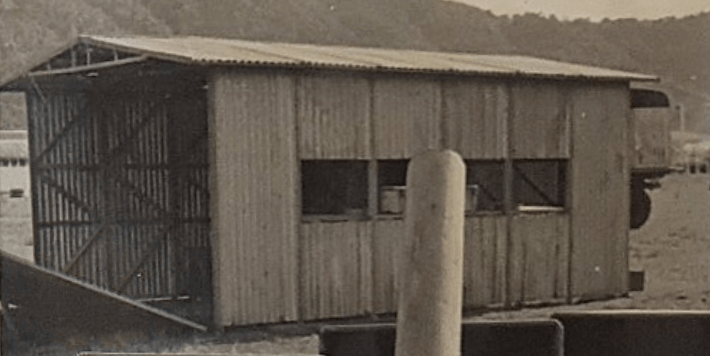
In the background of these photos, a Field Cook House can be seen. This portable building was designed to be used as a Field Cookhouse, which could easily be assembled from components.


National Service Reminiscences

Military conscription in New Zealand was first introduced in 1910 to build and maintain a credible force that would allow New Zealand to play its part in defence of the British Empire.  Initially intended to feed the Territorial Army, conscription was extended in 1916 to allow men to be conscripted directly into the New Zealand Expeditionary Force (NZEF). Conscription would be suspended during the lean post-Bellum years and re-established in 1940 as a wartime measure to satisfy New Zealand’s wartime personnel commitments.

New Zealand’s 1945 post-war commitments required the raising and mounting of a Division for service in the Middle East. The only way the personnel requirements for a Division could be met would be through conscription. A referendum was conducted in1949, resulting in a yes for Compulsory Military Training (CMT), which would commence in 1950.

The CMT scheme would train 63033 men up to 1958 when the Labour Government ceased CMT. In 1961 the National Government introduced a new National Service Act, which would require all males to register with the Labour Department on or before their 20th birthday. Following registration, ballots would be conducted to select individuals to undertake military training.

Training would consist of three months of initial full-time training, during which the men would be given the choice of three weeks part-time training in a Territorial unit for three years or one year’s service in a Regular Force unit. The National Service Scheme would last until 1972, when it was discontinued due to a changing social and economic environment.  

Since 1972 there has been no Military conscription in New Zealand. Since 1972 there have been many calls for the re-introduction of Military conscription to instill a sense of citizenship and discipline to reduce unemployment and youth crime. However, no major political party has made any significant policy statements on the re-introduction of military conscription.

The following are the remanences of John Mudgway, who at the age of 19, was selected by Ballot to undertake National Service as part of the first intake in 1961.

My Military Career by John Mudgway

When the National Government brought back military service in 1961 it was named National Service. We had to register with the Labour Department and the Golden Kiwi lottery marbles were used to draw certain birth dates. The “winners” of these birth dates were ordered into Waiouru Military Camp for 7 weeks basic training and were then posted to a Territorial Unit to complete their 3-year term. This was done in 3 annual camps, plus local parades. They then went to reserves for a further three years.

There was an option offered to us – which was we could serve one-year regular force and then be put on reserve for a further 3 years. I chose the latter.

Waiouru Camp
10 May 1962 – 27 June 1962

I was posted to Waiouru Military Camp and arrived on 9th May 1962, along with 549 other young lads.

Above left – Recruits leaving the train at Waiouru Camp rail siding before entering the camp to begin 14 weeks
training, at the end of which they will be posted to “Territorial Force Units.”
Right – Recruits E L McFeran (left) and R A Shaw sorting out equipment, clothing and bedding in their barrack
room.

I did seven weeks basic training – learning the military way of life, marching, shooting, and cleaning boots and weapons etc. One lasting memory I have is of being told that – in the event of an atomic blast, lay on the ground, cover myself with my greatcoat, have no skin exposed – and I would survive!

John Mudgway (Hastings), Ned Kinita (Waipukurau)
and Robyn Gunderson (Dannevirke).

Trentham Military Camp
28 June 1962 – 9 May 1963

When I arrived in camp, RSM Ordnance Schools, School Sergeant Major Alfred Wesseldine, decided they would not run the school for just me, so I was posted direct to MT Spares for the duration of my service.

Myself (Pte John Mudgway) (on left) and Dennis Leslie Goldfinch (who retired as a WO1). We are facing the main building of MT Spares in the MOD Compound. August 1962. Behind us in part of the wavy roof building, was the Uniform Store and smoko room.
On our left is a large, grassed area that was covered in 25 pounder artillery pieces that were being cut up for scrap by a private contractor. Further to the left was the Tyre Store that “Goldie” was in charge of.

Below is the two of us in 2012 (50 years later)

During my service in RNZAOC I participated in several events.

I was part of a Guard of Honour for the Chief of the Imperial General Staff at Wellington Airport when he flew in.
I was also in a Guard of Honour for the NZ Chief of Staff at Wellington Airport when he flew in.

I was part of the street lining contingent that paraded on the streets of Wellington City for the Queen when she visited in February 11 & 12 1964. (I saw her 23 times). We drove the streets of Wellington in 2 RL Bedfords, to places in streets she was to move through, detrucked and stood at attention on the road-sides while she passed, back to the trucks and on to our next destination. She must have thought there were a lot of handsome young lads in our army.

Escorted a prisoner the Ardmore Prison, by overnight train in 1964. I was the junior escort.

I was dragged out of the barracks at 2am one morning and trucked over to Mangaroa, Whitemans Valley Tent Loft to drag tents from a burnt-out building.

One of my jobs during my service was to sit out between two of the stores buildings and empty the brass fire extinguishers that had been returned to us from all the other stores round the country. These extinguishers were filled with carbon-tetrachloride and after spraying the contents into buckets for several days we were quite “high” ourselves. I presume the brass containers went for scrap.

During my time in M T Spares I worked with Staff Sgt Kevin Anderson, Goldie of course, and Pte’s Vic Fletcher and Tammy Tamihana. Our Stores Officer was Geoff Atkinson first, then latterly Captain R G H Golightly. Our C S M was WO 1 Maurie Bull. We also had some civilian workers in our stores, one of whom was retired Sgt Bert Royal. Also there were a group of prisoners from Waitako Prison that used to come and do the “dirty jobs” that we didn’t have to do.

I also did a couple of Camp Patrols in the MOD Compound. We had to patrol the compound several times during the night and were supposed to sleep in the Gate House.

Trentham Camp 26 July 2012

Not a bad years work for a 19/20 year old Hastings lad.


581769 Private Mudgway J W.


RNZAOC 1 April 1959 to 31 March 1960

The RNZAOC experienced a momentous period marked by key developments. Establishing the RNZAOC School was a notable milestone, alongside identifying challenges related to officer recruitment. This era also witnessed the realisation of plans to modernize and equip the Army with state-of-the-art resources. The initial deliveries of new equipment arrived, replacing a significant portion of the outdated wartime equipment and contributing to the transformation of the Army into a modern and well-equipped force.

Key Appointments

Director of Ordnance Services

  • Temporary Lieutenant Colonel H. McK. Reid

Chief Inspecting Ordnance Officer

  • Major JW Marriot

Officer Commanding Main Ordnance Depot

  • Major Harry White, from 1 May 1959

RNZAOC School

  • Chief Instructor – Major Harry White
  • Regimental Sergeant Major – Warrant Officer Class One Alfred Wesseldine

2nd Battalion, the New Zealand Regiment

In July 1959, the 2nd Battalion of the New Zealand Regiment was reestablished at Waiouru. The battalion embarked on a rigorous workup and training phase, preparing them for their deployment to Malaya in November 1959, where they would relieve the 1st Battalion. To support the training and preparations of the 2nd Battalion, the RNZAOC furnished the battalion with the essential equipment it required by drawing from existing stocks. This ensured that the battalion was fully equipped from the ground up to fulfil its operational requirements.

Establishment of RNZOAC School

Upper Hutt City Library (29th Jan 2020). Trentham Camp; Royal New Zealand Army Ordnance Corps School sign.. In Website Upper Hutt City Library. Retrieved 14th Jul 2020 11:51, from https://uhcl.recollect.co.nz/nodes/view/1335

Under discussion by the Army Board since 1956, the RNZAOC School was established in September 1959. Established within the Peacetime Establishment of the Main Ordnance Depot, the RNZAOC School would be under HQ Ordnance Services’ direct control and independent of the Army Schools.[1]

The initial school organisation would be.

  • A Headquarters,
    • Chief Instructor – Major Harry White
    • School Sergeant Major – Warrant Officer Class One Wesseldine
  • Ammunition Wing
  • Stores and Vehicle Wing

The function of the RNZAOC School would be to run courses and training for RF and TF personnel of the RNZAOC, including

  • Star Classification Courses – particularly for Storeman/Clerks RNZAOC and Ammunition Examiners.
  • Promotion courses for both officers and ORs.
  • Recruit training RNZAOC Personnel, including Recruit training for Group 2 personnel.
  • Advanced training for both officers and ORs, in all types of Ordnance activities.
  • Technical training in ordnance subjects, e.g. Inspecting Ordnance Officer courses.
  • Preservations and packing etc.
  • Refresher training for qualified personnel.
  • Other courses notified in the annual Forecast of Courses.

Additionally, as directed by DOS, the RNZAOC School was required to.

  • Plan and hold conferences and training exercises.
  • Draft procedure instructions.
  • Test, or comment on new procedures, materials, or equipment.
  • Research various aspects of Ordnance activities.

The first course conducted by the RNZAOC School would be an instructor’s Course conducted in late 1959.

First Instructors Course, 1959. Chief Instructor Major Harry White is seated 3rd from left. Officer in the front Centre id Makor K.G Cropp. Robert Mckie RNZAOC Collection

Officer Shortfall

A projection of planned retirements for RNZAOC Officers up until 1962 indicated that a total of seventeen officers would be leaving the service. Historically, the main method of filling RNZAOC officer positions had been through the commissioning of Other Ranks with Quartermaster Commissions. However, since November 1956, only three officers had joined the RNZAOC directly as officers.

Upon evaluating the planned officer retirements in relation to the RNZAOC officer establishment, it was discovered that the organization faced a deficiency of six officers. This shortage highlighted two significant issues that needed to be addressed.

  • The RNZAOC Officer Corps was becoming a Corps of old men, with 83% of Officers in the 39 to 54 age group
  • The RNZAOC Other Ranks Structure was denuded of the best SNCO’s and Warrant Officers.

To rectify the situation, the following recommendations were made.

  • The RNZAOC press for an increased intake from Duntroon and Portsea of graduates to the RNZAOC.
  • Suitable officers no older than 30 years of age, and in the two to four-year Lieutenant bracket, be encouraged to change Corps to the RNZAOC.
  • Further commissioning of QM officers be strongly resisted unless there was no other alternative.

Conferences

Over the period 1 -3 September 1959, DOS hosted a conference at Army HQ for the District DADOS, Officer Commanding MOD, and the Ordnance Directorate members. The general agenda of the meeting included.[2]

  • Local purchase of stores by DADOS
  • Training of group 2 Personnel
  • RNZAOC School
  • Provision Problems
  • Surplus Stores
  • Personnel – postings and promotions
    • DADOS and OC MOD were required to provide in duplicate, personnel lists by unit containing.
      • Regimental No, rank, and name
      • Marital Status
      • Establishment statue, either PES, CSS or HSS
      • Present posting
  • Purchases for RF Brigade Group
  • District Problems

Small Arms Ammunition

With the introduction of the 7.62mm rifle, the Colonial Ammunitions Company (CAC) faced the task of transitioning its manufacturing from the existing .303 calibre to the new 7.62mm calibre. Having served as the supplier of Small Arms Ammunition to the Defence Force since 1888, the CAC was committed to maintaining this longstanding relationship. The company invested in the necessary tools and machinery to produce 7.62mm ammunition to fulfil this commitment. During this period, they successfully completed their first production run of the new calibre. While the NZ Army possessed sufficient stocks of .303 ammunition for the foreseeable future, the CAC retained the capability to manufacture .303 ammunition if needed.

Introduction of New Equipment

The RNZAOC played a vital role in the acceptance processes of newly introduced equipment. Upon arrival from the supplier, the equipment, accessories, and spare parts were received at the Main Ordnance Depot. Thorough inspections were conducted, and the equipment was outfitted with all necessary accessories before being distributed to the respective units. Depending on the equipment, a few examples might have been retained in RNZAOC Depots as War Reserve/Repair and Maintenance Stock.

RNZAOC depots maintained maintenance stocks of accessories and spare parts as operating stock to ensure operational readiness. If the new equipment included a weapon system, the RNZAOC Ammunition Depots managed the specific ammunition required. During this period, the following equipment was introduced into service;[3]

  • 110 Land Rover Series 2a 109.
  • 144 Truck 3-Ton Bedford RL, 48 fitted with a winch
  • 3 Ferret Mark 1/1 Scout Car
  • 270 Wireless Sets. C45 – VHF transceiver,
  • 2000 9mm Sub Machine Gun Sterling Mk4 L2A3.
  • 500 7.62 mm Self Loading Rifle, L1A1 (SLR).

Uniforms

The Clothing and Equipment Committee approved the adoption of a standardized training uniform for New Zealand soldiers across all conditions within New Zealand. This uniform would serve as the foundational attire for training purposes.

  • Boots (Fory types under trial and development)
  • Anklets (Australian pattern)
  • Shirt (light wool)
  • Trouser ( Green drill material cut to UK pattern)
  • Hat (Jungle Type)

Disposals

In August 1958, the Army established a new organization dedicated to handling the declaration and disposal of surplus and obsolete equipment. Since August 1959, this disposal organization has declared over 9,000 lines, encompassing thousands of items, to the Government Stores Board for Disposal.

Ammunition Disposal

The disposal process for dangerous or obsolete ammunition continued, dumping over 900 tons of outdated ammunition at sea. Approximately 130,000 rounds of hazardous artillery ammunition were also destroyed through controlled burning or detonation.

Efforts were made to salvage the maximum amount of recyclable metal whenever feasible. These salvage operations yielded around £10,000 (equivalent to NZD $243,276 in 2020) from the sale of scrap metal and containers.[4]

Ration Packs


In 1959, the Royal New Zealand Army Service Corps (RNZASC) assembled a total of 24,000 one-person 24-hour Ration Pack No. 1 following successful user trials. These ration packs, accompanied by newly introduced solid fuel cookers, were extensively utilized by the 2nd Battalion of the NZ Regiment during the build-up training for Malaya and by the Territorial Force during the Annual Camp.

Shooting Competition

Staff Sergeant I.G Campbell, RNZAOC was selected by the National Rifle Association as a team member representing New Zealand at 91st Annual Prize Meeting at Bisley in the United Kingdom, 4- 20 July 1960.

Award of Army Sports Colours

Major D.E. Roderick from Auckland was awarded the 1960 Army Sports Colours in appreciation of his notable contribution to Army Sport. Major Roderick excelled as a representative of the Army in cricket, hockey, and badminton and played a pivotal role in developing sports facilities at Trentham Camp. Additionally, within the RNZAOC, Major Roderick held a longstanding membership with the Upper Hutt Cricket Club and served as both a player and administrator for the MOD Cricket team. [5]

Honours and Awards

British Empire Medal

Sergeant (Temporary Staff Sergeant) Maurice William Loveday, Royal New Zealand Army Ordnance Corps (Regular Force), of Trentham.[6]

Appointments, Promotions, Transfers, Resignations, and Retirements of Officers of the RNZAOC

Regular Force

  • Major Ronald Geoffrey Patrick O’Connor is transferred to the Reserve of Officers, General List, Royal NZ Army Ordnance, in Major’s rank, 4 May 1959.[7]
  • Major and Quartermaster K. A. Bailey, M.M., having reached retiring age for rank, is transferred to the Supernumerary list, and granted an extension of his engagement until 12 January 1960, 11 August 1959.[8]
  • Captain Frederick George Cross is transferred to the Reserve of Officers, General List, Royal NZAOC, in the rank of Captain, 1 September 1959. [9]
  • Captain L. C. King is re-engaged for a period of one year, as from 4 October 1959.[10]
  • Captain (temp. Major) J. Harvey relinquishes the temporary rank of Major, 6 March 1960.[11]

Regular Force (Supernumerary List)

  • Major and Quartermaster K. A. Bailey, MM., is granted an extension of his engagement for one year from 13 January 1960.[12]
  • Captain and Quartermaster S. H. E. Bryant is re-engaged for one year as from 28 October 1959.[13]
  • Captain and Quartermaster R. P. Kennedy, E.D., is re-engaged for a period of one year as from 13 April 1960.[14]
  • Lieutenant and Quartermaster George Witherman McCullough is posted to the Retired List, 12 February 1960.[15]
  • 2nd Lieutenant J. T. Skedden to be Lieutenant, 12 December 1959.[16]
  • Lieutenant and Quartermaster R. H. Colwill to be temporary Captain and Quartermaster, 9 February 1960.[17]

Territorial Force

  • Captain Keith Stothard Brown relinquishes the appointment of OC, Technical Stores Platoon, 1st Divisional Ordnance Field Park, RNZAOC and is posted to the Retired List, 4 August 1959.[18]

Reserve of Officers

  • Captain Hugo Sarginsone posted to the Retired List, 10 July 1959.[19]
  • Captain Noel Lester Wallburton posted to the Retired List, 10 August 1959.[20]
  • Captain Sidney Paxton Stewart posted to the Retired List, I September 1959. [21]
  • Major Percival Nowell Erridge, MBE posted to the Retired List, 25 December 1959.[22]
  • Major Alexander Basil Owen Herd, from the British Regular Army Reserve· of Officers, to be Major, 3 October I 959.[23]
  • Major Frank Owen L’Estrange, from the British Regular Army Reserve of Officers, to be Major, 11 November 1959.[24]
  • Captain Cyril Peter Derbyshire, from the British Regular Army Reserve of Officers, to be Captain, 1 January 1960.[25]

Appointments, Promotions, Transfers, Resignations, and Retirements of Warrant Officers, Senior Non-Commissioned Officers, and men of the RNZAOC

Regular Force

  • H594833 Private David Orr NZ Regiment Transferred into the RNZAOC, November 1959.
  • B31685 Staff Sergeant Ian McDonald Russell promoted to Temporary Warrant Officer Class Two, 23 June 1959.

Notes

[1] “Charter for the Rnzaoc School,”  in Organisation – Policy and General – RNZAOC (Archives New Zealand No R173115371960); Major J.S Bolton, A History of the Royal New Zealand Army Ordnance Corps (Trentham: RNZAOC, 1992), 176-77, 252.

[2] Conferences – Ordnance Officers, Item Id R17188101 (Wellington: Archives New Zealand, 1950).

[3] “H-19 Military Forces of New Zealand Annual Report of the General Officer Commanding, for Period 1 April 1959 to 31 March 1960,” Appendix to the Journals of the House of Representatives  (1960).

[4] Ibid.

[5] “Army Sports Colours,” Upper Hutt Leader, Volume XVII, Number 11, 24 March 1960.

[6] “Appointments, Promotions, Transfers, and Resignations, of Officers of the New Zealand Army,” New Zealand Gazette, No 35, 18 June 1959.

[7] “Appointments, Promotions, Transfers, and Resignations, of Officers of the New Zealand Army,” New Zealand Gazette, No 31, 28 May 1959.

[8] “Appointments, Promotions, Transfers, and Resignations, of Officers of the New Zealand Army,” New Zealand Gazette, No 56, 17 September 1959.

[9] Ibid.

[10] “Appointments, Promotions, Transfers, and Resignations, of Officers of the New Zealand Army,” New Zealand Gazette, No 59, 1 October 1959.

[11] “Appointments, Promotions, Transfers, and Resignations, of Officers of the New Zealand Army,” New Zealand Gazette, No 23, 7 April 1960.

[12] “Appointments, Promotions, Transfers, and Resignations, of Officers of the New Zealand Army,” New Zealand Gazette, No 63, 22 October 1959.

[13] “Appointments, Promotions, Transfers, and Resignations, of Officers of the New Zealand Army,” New Zealand Gazette, No 68, 4 November 1959.

[14] “Appointments, Promotions, Transfers, and Resignations, of Officers of the New Zealand Army,” New Zealand Gazette, No 4, 21 January 1960.

[15] “Appointments, Promotions, Transfers, and Resignations, of Officers of the New Zealand Army,” New Zealand Gazette, No 15, 3 March 1960.

[16] Ibid.

[17] “Appointments, Promotions, Transfers, and Resignations, of Officers of the New Zealand Army,” New Zealand Gazette, No 41, 7 July 1960.

[18] “Appointments, Promotions, Transfers, and Resignations, of Officers of the New Zealand Army.”

[19] “Appointments, Promotions, Transfers, and Resignations, of Officers of the New Zealand Army,” New Zealand Gazette, No 51, 27 August 1959.

[20] “Appointments, Promotions, Transfers, and Resignations, of Officers of the New Zealand Army,” New Zealand Gazette, No 53, 3 September 1959.

[21] “Appointments, Promotions, Transfers, and Resignations, of Officers of the New Zealand Army.”

[22] “Appointments, Promotions, Transfers, and Resignations, of Officers of the New Zealand Army.”

[23] “Appointments, Promotions, Transfers, and Resignations, of Officers of the New Zealand Army,” New Zealand Gazette, No 70, 19 November 1959.

[24] “Appointments, Promotions, Transfers, and Resignations, of Officers of the New Zealand Army,” New Zealand Gazette, No 78, 17 December 1959.

[25] “Appointments, Promotions, Transfers, and Resignations, of Officers of the New Zealand Army,” New Zealand Gazette, No 8, 11 February 1960.


Evolution of Supply Management in the New Zealand Army: From Quartermasters to Logistics Specialists

Since its inception, the New Zealand Army has relied on the expertise and dedication of Quartermasters (QMs) and support staff at the Regiment or Battalion levels to ensure effective supply operations. Initially filled by commissioned officers drawn from the ranks and supported by Quartermaster Sergeants and their teams, these roles were important and pivotal in maintaining logistical efficiency. This article traces the historical development of supply management within the New Zealand Army, from the nineteenth-century volunteer units to the professional Logistics Specialists of today. It explores key transformations, such as establishing training institutions and integrating supply and quartermaster functions, culminating in the modern Logistics Specialist trade within the Royal New Zealand Army Logistic Regiment (RNZALR).

Traditionally, the responsibility for supply at the Regiment or Battalion level has rested on the unit Quartermaster (QM) and their dedicated staff. These QMs, often commissioned from the ranks, were supported in their duties by the Regimental Quartermaster Sergeant (RQMS) alongside a team of clerks and storemen. Company Quartermaster Sergeants (CQMS) provided essential support at the sub-unit level.[1]

In practice, these QMs and their support teams were selected from within the ranks of the regiment or corps they served, giving them an intimate understanding of their units’ operations. This familiarity enabled them to provide highly effective support. During the nineteenth century, as the New Zealand Army took shape, the “Q” staff of units typically comprised older, experienced soldiers. While they may have been past their prime for active field duty, they possessed invaluable knowledge of unit operations and excelled in managing weapons and equipment.

However, in volunteer units, which often functioned like social clubs, officers and “Q” staff were elected annually. This sometimes led to disarray in unit store accounts, with discrepancies between supplies provided by the crown and actual inventory.

Efforts to enhance administrative training across the army began in 1885 with the establishment of the Army School of Instruction at military headquarters in Mt Cook, Wellington. Initially focused on musketry training, the school expanded to include courses on Tactics and Staff Duties from 1886 onward. [2]  Despite these developments, the curriculum’s inclusion of basic store accounting remains unclear. [3]

In 1895, the New Zealand Defence Forces Dress Regulations officially sanctioned the use of an eight-pointed star as a distinguishing embellishment for Regimental and Company Quartermaster Sergeants.[4] This insignia remained in use until 1917.

Regimental Quartermaster Sergeant-Major, 1905-1915. Robert McKie Collection
Company Quartermaster Sergeant, 1905-1915. Robert McKie Collection

Following the South African War, the NZ Army underwent a significant transformation to enhance its readiness for the Imperial Defence Scheme. This included standardising uniforms, weapons, and equipment. The Defence Act of 1909 replaced the Volunteer forces with a robust Territorial force sustained through Compulsory Military Training.

In 1910, Lord Kitchener, renowned as “The Empire’s foremost soldier,” visited New Zealand and thoroughly reviewed its military forces. His assessment led to significant reforms within the NZ Army, including establishing the New Zealand Staff Corps (NZSC) and the New Zealand Permanent Staff (NZPS) in 1911. These changes aimed to create a professional cadre of officers (NZSC) and enlisted personnel (NZPS) capable of providing expert guidance and efficient administration to the Territorial Force units.

Unknown photographer (1910) The Empire’s foremost soldier: Field-Marshal Lord Kitchener. Auckland War Memorial Museum call no. D503 K62

Lord Kitchener’s visit critically evaluated the military’s capabilities, revealing deficiencies in equipment care, maintenance, and overall responsibility. The existing Regimental Quartermaster Sergeants (RQMS) lacked the necessary skills, underscoring the need for a professional cadre of RQMS.

In late 1911, thirty carefully selected men from various military districts undertook an intensive three-week course at the Defence Stores Department in Wellington to address this. Led by Major O’Sullivan, the Head of Defence Stores, the training covered practical and theoretical aspects of “Q” matters essential to the role of RQMS. The curriculum was comprehensive, including instruction from armourers on weapon storage, inspection, maintenance, and accounting, as well as guidance from saddlers, sailmakers, store foremen, and ledger keepers on their respective specialities.

Following rigorous examinations to assess their competence, all candidates successfully passed. They were subsequently appointed as Quartermaster Sergeants in the New Zealand Permanent Staff by General Order 112/10. This proactive training initiative ensured the NZ Military Forces had a capable and professional cadre of RQMSs ready to manage their critical responsibilities effectively.

This course of instruction represented a significant milestone in New Zealand’s military education history. Despite establishing the Army School of Instruction in 1885, it had never offered a specific program focused on training RQMS. Therefore, this course became the country’s inaugural dedicated “Q Store” trade-related training initiative.

With the declaration of war against the Central Powers in August 1914, New Zealand swiftly mobilised and dispatched an Expeditionary Force overseas. A comprehensive reinforcement plan was activated to sustain and support the New Zealand Expeditionary Force (NZEF). Trentham Camp, later followed by Featherston Camp, emerged as a primary facility for training reinforcements. In late August 1914, Lieutenant (Temporary Captain) T. McCristell NZSC was appointed the Camp Quartermaster of Trentham Camp.

As Camp Quartermaster, McCristell, supported by personnel from the Permanent Staff not deployed with the Expeditionary Force, established the Trentham “Camp Quartermaster Stores.” This distinct unit had its badge and assumed critical responsibilities to bolster the war effort.

EVERYTHING movable in Camp, except the A.S.C and its wagons, is kept track of by the Camp Quartermaster—everybody and everything, from a soldier to an electric light bulb. The Camp Quartermaster knows where they all should be; and if they aren’t where they ought to be, he generally knows where they are.”[5]

Camp Quartermaster Staff Badge. Robert McKie Collection.

The “Camp Quartermaster Stores” also played a crucial role in training individuals for overseas service as Quartermasters. According to regulations, each reinforcement draft allowed for RQMS and CQMS per company.

Under the guidance of McCristell, candidates were selected based on their civilian occupations and business acumen for training as RQMS or CQMS. The training programme was comprehensive, covering several key areas:

  • Stores Training: This included effective clothing and equipping of soldiers.
  • Camp Equipment Training: Instructions on constructing field kitchens, incinerators, latrines, washing facilities, setting up camps and bivouacs, and arranging billets.
  • Ammunition Organisation: Handling and organisation of ammunition.
  • Water Supply Management: Managing water supplies and food distribution procedures for troops.

Candidates underwent rigorous training and had to pass a comprehensive examination to qualify for appointment as either an RQMS or CQMS.

McCristell continued as Camp Quartermaster until 1916, when he was transferred to the Defence Stores Department as Director of Equipment and Ordnance Stores. In this capacity, he was pivotal in establishing the New Zealand Army Ordnance Corps (NZAOC) in 1917, serving as its Chief Ordnance Officer.

In 1918, following a Defence Department Officers’ Conference prompted by a report from the Defence Expenditure Commission, it was revealed that units had generally failed to adequately account for, care for, and secure stores as outlined in New Zealand Military Forces Regulations.[6] To address this, eleven NZAOC staff sergeants were temporarily assigned to units as quartermaster sergeants. Their task was to rectify discrepancies and ensure unit store accounts were properly managed. This initiative proved highly successful, with subsequent audits revealing few deficiencies. However, it became apparent that many units lacked adequate storage facilities, leading to the temporary storage of surplus items at regional store depots.[7]

The deployment of NZAOC Staff Sergeants as Quartermaster-Sergeants within units was so effective that it prompted an official amendment to Army regulations on October 3, 1918. This amendment transferred Quartermaster Sergeants’ management responsibility to the NZAOC and introduced several key changes.

83. Group and Unit Quartermaster-Sergeants will belong to and be trained by the New Zealand Army Ordnance Corps, and when posted for duty in districts will be borne as supernumeraries on the establishment of that corps. They will be included in the effective strength of the group or unit in which they are actually serving and will be so accounted for in periodical returns for those groups or units. In so far as the questions of efficiency, leave, and duty are concerned, Quartermaster-Sergeants will be under the direct supervision of the A.Q.M.G. of the district, and will be directly responsible to the Group or Unit Commander, as the case may be, for the performance of their respective duties as Group or Unit Accountants. They will devote the whole of their time to the accounting, care, and custody of public property on issue.[8]

In July 1920, the following NZAOC NCOs were employed as Group and Unit Quartermaster-Sergeants:

  • Staff Sergeant Alfred Charles Butler
  • Staff Sergeant Harry Harper Ekins
  • Staff Sergeant Donald McCaskill McIntyre
  • Staff Sergeant Frederick William Tavendale
  • Staff Sergeant John William Kirby
  • Staff Sergeant Leonard Robertshaw
  • Staff Sergeant David Llewellyn Lewis
  • Staff Sergeant George Quayle
  • Staff Sergeant George William Wright
  • Staff Sergeant J.R Hopkinson

Although these NZAOC NCOs achieved success in improving store accounting, the Director of Ordnance Services (DOS) argued that given the broader range of military skills, including instructional abilities required by Group and Unit Quartermaster-Sergeants, NCOs from the NZPS were more suitable for these roles than NZAOC ones.

Supporting the DOS argument, GHQ decided on 15 September 1921 that appointments of Group and Unit Quartermaster-Sergeants were to be filled by members of the NZPS. Following a short course of instruction to bring them up to speed on their additional NZPS duties, the NZAOC NCOs remaining in such appointments were transferred into the NZPS without losing seniority.[9]

With the reinstatement of unit quartermaster sergeants as a responsibility of the NZPS, the General Headquarters School (GHQ School) resumed overseeing training at Trentham camp. Officially established in 1920, the GHQ School played a crucial role in training NZSC officers and NZPS men, who were tasked with training, equipping, and administering Territorial and Senior Cadets.[10]

A significant development occurred in 1937 when the Army School in Trentham was founded. Supported by District Schools of Instruction at Narrow Neck, Trentham, and Burnham, these institutions collaborated to advance military education.[11]

The instructional staff at the Army School and the three District Schools of Instruction played pivotal roles in training various groups of servicemen, including:

  • Adjutants,
  • Quartermasters,
  • Regimental Sergeant Major,
  • Regimental Quartermaster Sergeants,
  • Ordnance and Company Clerks,
  • Storemen, Storemen-Clerks, and
  • Cooks.

In the lead-up to the Second World War, the Army School of Instruction established an Administrative Wing consisting of a Major, two Captains, a Warrant Officer Class One, a Staff Sergeant, and a Sergeant. This wing conducted specialised courses for officers and senior non-commissioned officers: officers attended the Senior Staff Duties and Adjutants courses, while senior non-commissioned officers participated in drill, duties, and tactical courses. Both groups also had access to the Quartermaster’s and Quartermaster Sergeant’s courses.

Post-World War II, the focus shifted to peacetime administration, primarily for the Regular Force Staff of the Army. Clerks and storemen recruited through Compulsory Military Training or National Service received basic training in their trades. As part of a decentralisation policy, training moved from a central school to District Schools of Instruction, leading to a reduction in the Administrative Wing’s establishment by 1947, now comprising a Major, a Captain or Lieutenant, a Warrant Officer Class Two, and occasionally a Corporal from the Women’s Royal Army Corps (WRAC).

In the immediate post-war period, the distinction between RNZAOC and Quartermaster responsibilities was not always clearly defined. Roles such as “Storeman, Technical”, recorded as an All Arms, unit-level function in 1947, reflect a transitional system in which unit Quartermaster organisations retained responsibility for technical and equipment stores that would later be progressively re-aligned under RNZAOC control.

In July 1950, the Administrative Wing disbanded, giving way to the School of Army Administration at Trentham. This institution continued at Trentham before relocating to Waiouru on January 31, 1952, specifically to a building on Foley Street. Initially staffed by two officers (one doubling as Staff Officer (Administration) at Headquarters Army School) and two Other Ranks, the school’s workload increased steadily, expanding from 13 courses in 1953 to 21 in 1961

From 1950 onwards, the Army Stores Audit Section meticulously reviewed all Army store accounts, with exceptions for specific Ordnance technical accounts. In 1951, they audited 87 accounts, maintaining a schedule of auditing each account in the Northern and Central Military Districts every eighteen months and in the Southern Military District every two years, despite the growing workload.

Initial assessments in 1951 found the overall standard of accounting to be satisfactory. However, deficiencies were noted in some large accounts, largely due to staff shortages and competing duties.

The following year, 91 accounts underwent an audit, revealing continued challenges in achieving higher accounting standards, primarily attributed to inadequate staffing and training. Similar findings persisted in 1953, where 87 accounts were reviewed, indicating ongoing room for improvement linked to insufficiently trained personnel.

In 1953, a pivotal conference involving the Treasury and the Audit Department sought to overhaul the Army’s accounting systems. Mechanisation and other modernisation efforts were discussed to streamline accounting tasks, pending a review of existing Store Regulations for potential simplification. Concurrently, efforts intensified to bolster administrative training at Army Schools.

By 1954, audits of 84 accounts demonstrated modest improvements in accounting standards, yet persistent shortcomings persisted, largely due to staffing issues. A joint committee comprising Army, Treasury, and Public Service Commission representatives began examining store accounting procedures with an eye towards simplification and mechanisation.

Throughout 1955, courses at the School of Army Administration focused heavily on administrative training, particularly in-store accounting, attended by both Regular and Territorial Forces. This emphasis and revised accounting procedures introduced later in the year contributed to a noticeable enhancement in store accounting standards.

The joint committee established in 1954 recommended streamlined procedures to reduce paperwork, which were implemented on a trial basis during the latter half of 1954.

To further enhance organisational efficiency, an organisation and methods officer was appointed at Army Headquarters to review store systems continuously.

In 1956, inspections expanded to 117 units, confirming a sustained improvement in accounting standards throughout 1957. This progress was linked to trial changes recommended by the special committee and endorsed by the Treasury in 1957, paving the way for the permanent adoption of a more streamlined system. This new approach aimed to refocus efforts on core accounting principles and physical store control, as highlighted in subsequent committee reports.

By 1958, departmental store inspectors extended their scrutiny to 129 accounts, marking continued advances in store management and accounting practices. This trend persisted into subsequent years, reflecting steady improvements in administrative procedures across Army storers’ accounts.

At the same time, the Army formalised and expanded its unit-level logistics capability through the development of the Storeman (All Arms) trade. Rather than relying solely on specialist corps personnel, this system provided units with an organic ability to manage their own stores, accounting, and sustainment functions.

By the mid-1960s, the Storeman (All Arms) trade had evolved into a structured four-tier classification system, progressing from One Star through to Four Star. At the entry level, soldiers were required to demonstrate competence in basic accounting, identification and handling of stores, storage practices, including dangerous goods, and fire safety and security procedures. This established a baseline of practical logistic competence at the unit level.

Progression through the trade introduced increasing levels of responsibility. At the Two Star level, Storemen were trained in ledger accounting, demand preparation, and voucher processing, supported by formal qualification on the Q Ledger Clerks Course. They were expected to manage store operations, including packing, dispatch, and staff supervision. At the Three Star level, the trade is aligned directly with the Quartermaster system, requiring completion of sub-unit Quartermaster Sergeant and Junior Clerks courses, and preparing individuals for employment as sub-unit QMS. By Four Star, Storemen were qualified at the regimental level, capable of supervising QMS staff and serving as Regimental Quartermaster Sergeant.

This progression highlights the growing professionalisation of unit-level logistics during this period. Accounting competence, documentation, and formal training were no longer secondary skills but central to effective store management. The Storeman (All Arms) trade provided a distributed logistics capability across the Army, reinforcing the broader improvements being driven through inspection, reform, and institutional oversight.

Throughout the decade, concerted efforts by various stakeholders, strategic reforms, and training initiatives steadily transformed Army store accounting into a more efficient and effective system capable of meeting evolving operational demands.

By 1967, the School of Army Administration had grown to include three officers, five other ranks, and a civilian clerical assistant.

The School of Army Administration later relocated to a site opposite the Headquarters Army Training Group in Waiouru, further expanding to accommodate three officers, seven senior non-commissioned officers, and two civilians. Its courses catered to Junior Staff Officers, Accounting Officers, Clerks, and Storemen.

From 1974, the School of Army Administration staff photographed most courses as they passed through the school. Many of these photos can be viewed by clicking on the respective course link:

The 1990s marked a significant period of change for both the Q Storeman and RNZAOC Supplier trades within the NZ Army. This change was driven by a reorganisation of logistic and support functions, culminating in the formation of the Royal New Zealand Army Logistic Regiment (RNZALR). This restructuring included a comprehensive review of the Q Storeman and RNZAOC Supplier trades, which concluded that advancements in the computerised Defence Supply System Detail (DSSD) warranted merging these roles.

The initial integration of logistic units occurred in 1993, combining units from the Royal New Zealand Corps of Transport (RNZCT), RNZAOC, and Royal New Zealand Electrical and Mechanical Engineers (RNZEME) into Logistic Regiments. Concurrently, the consolidation of logistic training functions in 1993/94 led to the establishment of the Army Logistic Centre (ALC). As part of this reorganisation, the Quartermaster Wing of The School of Army Administration joined the RNZAOC School, initially remaining in Waiouru despite the RNZAOC School being in Trentham. However, on December 13, 1993, the Quartermaster Wing rejoined the Trentham location after 41 years.

In July 1994, the RNZAOC School was disbanded, giving way to the Trade Training School (TTS). This change saw the formation of the Supply/Quartermaster (Sup/Q) Wing, integrating Supply and Quartermaster functions under one umbrella with distinct Supply and Q Sections. The primary aim of this amalgamation was to streamline training and enhance the logistical supply system across all army levels. The first combined Sup/Q Courses commenced during the 1994/95 training year.

The integration of Supply and Q training initiated personnel postings between RNZAOC and consumer units, yielding varying outcomes. While some personnel flourished in this new environment, expanding their skills, others encountered challenges as they adjusted to unfamiliar roles.

On December 4, 1996, all RNZAOC Suppliers, Auto Parts tradesmen, and Q storemen were merged into a new core trade called the Supplier/Quartermaster (Sup/QM) trade. The newly formed Sup/QM Trade included:

  • 253 RNZAOC Suppliers and Auto Parts specialists
  • 24 Royal New Zealand Artillery Q Storemen
  • 21 Royal New Zealand Armoured Corps Q Storemen
  • 14 Royal New Zealand Army Medical Corps Q Storemen
  • 17 Royal New Zealand Corps of Transport Q Storemen
  • 20 Royal New Zealand Engineers Q Storemen
  • 19 Royal New Zealand Electrical and Mechanical Engineers Q Storemen
  • 96 Royal New Zealand Infantry Regiment Q Storemen
  • 9 Royal New Zealand Corps of Signals Q storemen

The amalgamation of the two trades was challenging and required time to consolidate. It involved 497 members from nine different Corps, represented in every unit of the New Zealand Army.

In October 2007, the Sup/QM Trade changed its name to the RNZALR Supply Technician (Sup Tech) Trade. In 2009, the top-of-the-trade Supply Technician Badge was introduced.

Effective 1 May 2023, with endorsement from the Chief of Army, the RNZALR Supply Technician trade underwent an official name change to become the Logistics Specialist (Log Spec) trade. This decision followed consultations with trade members in March 2020, who sought a new name to enhance recruitment appeal, align with civilian sector counterparts, and maintain relevance within the trade. The RNZALR Logistics Specialist trade notably retains the Supply Technician qualifications and designations.

From its origins in volunteer units, the New Zealand Army has heavily relied on Quartermasters and support staff at the Regiment or Battalion levels to ensure effective supply operations. Initially occupied by commissioned officers from within the ranks and supported by Quartermaster Sergeants, these roles have been pivotal in maintaining logistical efficiency. This article traces the evolution of supply management within the New Zealand Army, highlighting key developments such as establishing training institutions and integrating supply and quartermaster functions. Today, the Logistics Specialists within the RNZALR continue to play a crucial role in maintaining the Army’s operational readiness and effectiveness. The ongoing evolution and adaptation of the Logistics Specialist trade reflect the Army’s commitment to modernisation and efficiency in military logistics, ensuring it remains prepared for future challenges.


Notes

[1] Depending on the type of Regiment or Corps, variations of Company Quartermaster Sergeant (CQMS) could also be Battery Quartermaster Sergeant (BQMS) in artillery units or Squadron Quartermaster Sergeant (SQMS) in Mounted/Calvary units

[2] (1885). The School of Military Instruction. New Zealand Herald, Volume XXII, Issue 7328. Auckland.

[3] Ridley, G. (1994). “Quartermaster Origins.” Pataka Magazine.

[4] (1905). New Zealand Military Forces Dress Regulations. Wellington.

[5] Lawson, W. (1917). Historic Trentham, 1914-1917: The Story of a New Zealand Military Training Camp, and Some Account of the Daily Round of the Troops within Its Bounds. Wellington.

[6] (1918). “H-19d Conference of Defence Department Officers (Notes by) on criticisms, suggestions and recommendations as contained in the report of the Defence expenditure commission.” Appendix to the Journals of the House of Representatives.

[7] (1918). Defence Stores. Dominion, Volume 12, Issue 10.

[8] (1918). “Amending the Regulations for the Military Forces of New New Zealand.” New Zealand Gazette No 135.

[9] Memorandum GHQ 43/400A2 Quartermaster-Sergeant of 15 Sept 21 (1917). Harry Edkins- New Zealand Army Ordnance Corps, Nos.35. Personal File, Archives New Zealand. Wellington.

[10] (1920). GHQ School. Evening Post, Volume XCIX, Issue 23, .

[11] (1938). “H-19 Military Forces of New Zealand, Annual report of the chief of the General Staff.” Appendix to the Journals of the House of Representatives, .


RNZAOC 1 April 1953 to 31 March 1954

This period would see the RNZAOC. Continue to support Regular, Territorial and Compulsory Military Training. Ongoing support to Kayforce would continue.[1]

Key Appointments

Directorate of Ordnance

  • Director of Ordnance Services – Lieutenant Colonel F Reid, OBE
  • DADOS 2 Maj & QM K.A Bailey, MM
  • OOP (G) – Capt & QM R.P Kannedy

Inspection Ordnance Office

  • Technical Assistant – Captain N.C Fisher (Until 24 July 1953)
  • Technical Assistant – Warrant Officer L Smith (From 25 July 1953)

Northern Military District

District Headquarters

  • District Inspecting Ordnance Officer – Captain E.D Gerard (until 9 Aug 1953)

Northern District Ordnance Depot

  • Ordnance Officer – Maj M.R.J Keeler

Northern District Ammunition Depot

  • IOO – Captain E.D Gerard (from 28 Aug 1953)

Northern District Ammuniton Repair Depot

  • Officer Commanding Captain C.C Pipson (From 28 Aug 1953)

Central Military District

District Headquarters

  • DADOS – Maj C.A Penny (From May 1953)
  • DIOO – Captain N.C Fisher (From 9 Aug 1953)

    Southern Military District

    Southern District Ordnance Depot

    • Ordnance Officer – Captain A.A Barwick

    Southern District Ammunition Repair Depot

    • Officer Commanding – Capt & QM G.W Dudman

    Compulsory Military Training

    During this period three CMT intakes marched in;[2]

    • 9th intake of 2954 recruits on 9 April1953
    • 10th intake of 2610 recruits on 2 July 1953
    • 11th intake of 2610 recruits on 24 September 1953
    • 12th intake of 2200 recruits on 5 January 1954

    On completion of CMT recruit training, recruits were posted to Territorial units close to their home location to complete their CMT commitment, with RNZAOC CMT recruits posted to either

    • 1st Infantry Brigade Ordnance Field Park Platoon, Hopuhopu
    • 2nd Infantry Brigade Ordnance Field Park Platoon, Mangaroa.
    • 3rd Infantry Brigade Ordnance Field Park Platoon, Burnham

    Ordnance in the New Zealand Division

    The RNZAOC elements of the Territorial Force had been reorganised in 1948, this had been a reorganisation that had taken place over three stages with Officers and then NCOs recruited, followed by the soldiers recruited through the CMT scheme to fill the ranks.[3]  By September 1953 the RNZOAC units within the Division had rapidly grown and the CRAOC of the NZ Division provided clarification in the organisation and duties of the RNZAOC units in the NZ Division.

    HQ CRAOC

    Duties included.

    • RNZAOC representative at Division Headquarters.
    • Exercised Regimental command and Technical control of RNZAOC unit in the Division.

    Divisional Ordnance Field Park

    The functions of the OFP were.

    • Park HQ – Technical Control of the OFP
    • Regimental Section – Regimental Control of the OFP
    • Delivery Section – Collects and delivers operationally urgent stores
    • MT Stores Platoon – Carried two months of frequently required spare and minor assemblies for vehicles held by the Division
    • Tech Stores Platoon – Carried two months of frequently required spares for all guns, small arms, wireless and Signals equipment of the Division.
    • Gen Stores Platoon – Carried a small range of frequently required items of clothing, general stores, and the Divisional Reserve of Industrial gases.

    Mobile Laundry and Bath Company

    The functions of the Mobile Laundry and Bath Company was to provide bathing facilities and to wash troops under clothing.

    RNZAOC Stores Sections

    One RNZAOC Store Sections was attached to each Infantry Brigade Workshop, maintaining a stock of spares required for the repair of the Divisions equipment. The Stores sections would demand direct from the Base or Advance Base Ordnance Depot not the OFP.

    Brigade Warrant Officers

    RNZAOC representative at Brigade Headquarters

    Presentation of Coronation Trophy

    In celebration to the Coronation of Queen Elizabeth II, the Coronation Trophy was presented to the Central Districts Training Depot by All Ranks of the RNZAOC from the Central Military District. The exact criteria for the presentation of the trophy has been long forgotten, however from the 11th CMT intake the Coronation Trophy would be awarded to an outstanding student of each CMT intake.  76

    Acquisition of additional Training areas by NZ Army

    To provide suitable training areas in all three military districts, firing and manoeuvre rights were obtained over 30000acres of land adjoining the Mackenzie District near lake Tekapo. The allowed all South Island units the ability to carry out realistic tactical training during their summer camps.

    Flood Relief

    In July 1953 Serious flooding affected the Waikato with soldiers from Hopuhopu Camp taking a prominent part in the relief operations. Solders from the 1st Infantry Brigade Ordnance Field Park, utilising vehicles with extended air intakes and exhausts and operating in areas that had been flooded to a depth of 1.4 meters deep assisted in rescuing families and livestock and distributing fodder to marooned animals.

    Tangiwai Railway Disaster

    The Tangiwai disaster occurred at Christmas eve 1953 when the Whangaehu River Railway bridge collapsed as the Wellington-to-Auckland express passenger train was crossing it with a loss of 151 Lives. With Waiouru in proximity, the army was quick to respond, with rescue teams deploying from Waiouru with the first survivors admitted into the Waiouru Camp Hospital by 4 am. Representing the RNZAOC in the search parties were Warrant officer Class One P Best and Corporal Eric Ray.

    Railway disaster at Tangiwai. Dominion Post (Newspaper): Photographic negatives and prints of the Evening Post and Dominion newspapers. Ref: EP-Accidents-Rail-Tangiwai rail disaster-01. Alexander Turnbull Library, Wellington, New Zealand. /records/23201427

    Royal Tour 23 December 1953 – 31 Jan 1954

    Camp Commandants Bodyguard 1954. Robert Mckie RNZAOC School Collection

    Emergency Force (Kayforce)

    The RNZAOC continued to support Kayforce with the dispatch of regular consignments of Maintenance stores and with all requests for stores by Kayforce met.

    This period saw the first RNZAOC men rotated and replaced out of Kayforce;

    Out of Kayforce

    • Private Dennis Arthur Astwood, 8 December 1953
    • Lance Corporal Thomas Joseph Fitzsimons, 6 January 1954
    • Lance Corporal Owen Fowell, 2 September 1953
    • Private Gane Cornelius Hibberd, 13 May 1953,
    • Corporal Leonard Ferner Holder, 4 September 1953
    • Corporal Wiremu Matenga, 6 January 1954

    Into Kay force

    • Private Richard John Smart, 25 June 1953
    • Private Abraham Barbara, 30 December 1953
    • Private Ernest Radnell, 29 December 1953
    • Sergeant Harold Earnest Strange Fry, 29 January 1954
    • Corporal Edward Tanguru, 25 February 1954
    • Gunner John Neil Campbell, 24 March 1954

    Seconded to Fiji Military Forces

    • Lieutenant and Quartermaster Rodger Dillon Wederell remained seconded to the Fiji Military Forces.

    Ordnance Conferences

    Ordnance Conference 18-19 August 1953

    The Director of Ordnance Services hosted a conference of the Districts DADOS and the Officer Commanding Main Ordnance Depot (MOD) at Army Headquarters over the period 21-23 April 1953. No detailed agenda remains.

    Headquarters Group, Main Ordnance Depot, 1954. Robert McKie RNZAOC School Collection
    Main Ordnance Depot, NZ Royal Womens Army Corps, 1954. Robert McKie RNZAOC School Colection

    Routine Ordnance Activities

    Over this period the RNZAOC in addition to its regular duties of provision, holding and the issue of multitudinous stores required by the Army including the additional issue of training equipment to the territorial Force allowing all unit’s enough equipment for normal training.

    Ammunition Examiner Qualification

    The following soldiers qualified as Ammunition Examiners

    • Corporal G.T Dimmock (SMD)
    • Corporal M.M Loveday (CMD)
    • Corporal Roche (MMD)
    • Lance Corporal H.E Luskie (SMD)
    • Lance Corporal Radford (NMD)

    Small Arms Ammunition

    Production of small-arms ammunition had met the monthly target, with the ammunition, fully proofed and inspected before acceptance.

    Support to the French War in Vietnam

    During this period the RNZAOC prepared a second consignment of stores and equipment for transfer to the French in Vietnam.  Transferred from surplus and obsolete stocks held in RNZAOC depots, the following items would be dispatched to Vietnam;[4]

    • 500 Revolvers,
    • 3000 Rifles,
    • 750 Machine Guns,
    • 50 Bofors anti-aircraft guns and ammunition,
    • 10000 round of 40mm armour piercing shot,[5]
    • Wireless Sets
    • Field Telephones,
    • Charging Sets
    • Assorted Uniform Items
    • 670000 rounds of small arms ammunition.
    Bofors Guns Trentham, 1 March 1954. Evening Post illustrations file and prints. 1950-2000. (PA-Group-00685). [Series]

    Introduction of New Equipment

    As new equipment was introduced, the RNZAOC would play an essential role in the acceptance processes. Upon delivery from the supplier, the equipment, its accessories and spares would be received into an RNZAOC Depot. The equipment would be inspected and kitted out with all its accessories before distribution to units. Depending on the equipment, several examples may have been retained in RNZAOC Depots as War Reserve/Repair and Maintenance Stock. Maintenance stocks of accessories and spares were maintained as operating stock in RNZAOC depots. If the new equipment was or contained a weapon system, ammunition specific to the equipment was managed by RNZAOC Ammunition Depots.

    During this period, the following equipment was introduced into service;[6]

    • 57 M20 Mk 2 3.5-inch Rocket Launchers
    • Anti-Tank Grenade No 94 Engera
    • 1 120mm BAT L1 Recoilless Rifle
    • 3 Centurion Tanks
    • 150 Series 1 80″ Land-Rovers

    Honours List

    Officer of the Most Excellent Order of the British Empire (O.B.E.)

    • Lieutenant-Colonel Francis Reid.[7]

    Promotions

    • Private George Thomas Dimmock to Lance Corporal – 1 April 1953
    • Temporary Warrant Officer Class Two Alick Claude Doyle to Substantive WO2, 1 April 1953
    • Lieutenant J. Harvey to Captain. 9 December 1953.[8]
    • Captain (temp. Major) H. McK Reid to Major. 22 January 1954.[9]
    • Lieutenant-Colonel (temp Colonel) A. H. Andrews, OBE, BE, to Colonel. 21 October 1953.[10]
    • Lieutenant and Quartermaster T Rose to be Captain and Quartermaster. 1 May 1953.[11]

    Enlistments into the RNZAOC

    • John Gunn, 21 September 1953
    • Leonard T Conlon, 16 June 1953
    • Keith A Parker, 17 July 1953

    Appointments into the RNZAOC

    • Edward Francis Lambert Russell, late Captain RAOC, appointed as Lieutenant (on prob.), with seniority from 26 November 1949, posted as Vehicle. Spares Officer, Vehicle Spares Group, Main Ordnance Depot, 26 November 1953.[12]
    • Lieutenant J. B. Glasson, 13 April 1954.[13]

    Transferred out of the RNZAOC to other Corps

    • Captain W. G. Dixon transferred to the Royal N.Z. Artillery. 6 July 1953.[14]

    Transferred to the Supplementary List, NZ Regular Force

    • Captain and Quartermaster R. P. Kennedy, E.D., having reached the normal age for retirement, 13 April 1953.[15]

    Transferred to the Reserve of Officers General List

    • Captain A. Whitehead, 17 December 1953.[16]

    Re-Engagements into the New Zealand Regular Force

    The following RNZAOC soldiers were re-engaged into the New Zealand Regular Force;

    • Sergeant W.J Smith for one year from April 1953, in the rank of Private
    • Warrant Officer Class One W.S Valentine, on a month to month basis until 31 March 1954
    • Corporal H.H Regnault, on a month to month basis until 31 March 1954

    Civic Appointments

    On 16 July 1953 Maurice Richard John Keeler, Ordnance Officer, Northern; District Ordnance Depot, RNZAOC Ngaruawahia, was authorized to take and receive statutory declarations under section 301 of the Justices of the Peace Act 1927.[17]

    Notes

    “Appointments, Promotions, Transfers, and Resignations, of Officers of the New Zealand Army.” New Zealand Gazette No 9, 4 February 1954.

    “Appointments, Promotions, Transfers, and Resignations, of Officers of the New Zealand Army.” New Zealand Gazette No 13, 25 February 1954.

    “Appointments, Promotions, Transfers, and Resignations, of Officers of the New Zealand Army.” New Zealand Gazette No 15, 11 March 1954.

    “Appointments, Promotions, Transfers, and Resignations, of Officers of the New Zealand Army.” New Zealand Gazette No 72, 17 December 1953.

    “Appointments, Promotions, Transfers, and Resignations, of Officers of the New Zealand Army.” New Zealand Gazette No 35, 3 June 1954.

    “Appointments, Promotions, Transfers, and Resignations, of Officers of the New Zealand Army.” New Zealand Gazette No 48, 20 August 1953.

    “Appointments, Promotions, Transfers, and Resignations, of Officers of the New Zealand Army.” New Zealand Gazette No 1, 7 January 1954.

    Cooke, Peter. Fit to Fight. Compulsory Military Training and National Service in New Zealand 1949-72. Auckland: David Ling Publishing, 2013.

    “Coronation Honours List.” New Zealand Gazette No 33, 11 June 1953.

    Fenton, Damien. A False Sense of Security : The Force Structure of the New Zealand Army 1946-1978. Occasional Paper / Centre for Strategic Studies: New Zealand: No. 1. Centre for Strategic Studies: New Zealand, Victoria University of Wellington, 1998. Bibliographies, Non-fiction.

    “H-19 Military Forces of New Zealand Annual Report of the General Officer Commanding, for Period 1 April 1954 to 31 March 1955 “. Appendix to the Journals of the House of Representatives  (3 July 1955 1955).

    “Officer Authorized to Take and Receive Statutory Declarations “. New Zealand Gazette No 42, 23 July 1953.

    Rabel, Roberto Giorgio. New Zealand and the Vietnam War : Politics and Diplomacy. Auckland University Press, 2005. Bibliographies, Non-fiction.


    [1] “H-19 Military Forces of New Zealand Annual Report of the General Officer Commanding, for Period 1 April 1954 to 31 March 1955 “, Appendix to the Journals of the House of Representatives  (1955).

    [2] Peter Cooke, Fit to Fight. Compulsory Military Training and National Service in New Zealand 1949-72 (Auckland: David Ling Publishing, 2013), 539.

    [3] Damien Fenton, A False Sense of Security : The Force Structure of the New Zealand Army 1946-1978, Occasional Paper / Centre for Strategic Studies: New Zealand: No. 1 (Centre for Strategic Studies: New Zealand, Victoria University of Wellington, 1998), Bibliographies, Non-fiction, 8-9.

    [4] Roberto Giorgio Rabel, New Zealand and the Vietnam War : Politics and Diplomacy (Auckland University Press, 2005), Bibliographies, Non-fiction, 16.

    [5] Possibly surplus 37mm rounds used on New Zealand’s Stuart tanks which would have been compatible with weapon platforms in use with the French

    [6] Fenton, A False Sense of Security : The Force Structure of the New Zealand Army 1946-1978, 21.

    [7] “Coronation Honours List,” New Zealand Gazette No 33, 11 June 1953, 911.

    [8] “Appointments, Promotions, Transfers, and Resignations, of Officers of the New Zealand Army,” New Zealand Gazette No 9, 4 February 1954, 180.

    [9] “Appointments, Promotions, Transfers, and Resignations, of Officers of the New Zealand Army,” New Zealand Gazette No 13, 25 February 1954, 294.

    [10] “Appointments, Promotions, Transfers, and Resignations, of Officers of the New Zealand Army,” New Zealand Gazette No 15, 11 March 1954, 384.

    [11] “Coronation Honours List,”  906.

    [12] “Appointments, Promotions, Transfers, and Resignations, of Officers of the New Zealand Army,” New Zealand Gazette No 72, 17 December 1953.

    [13] “Appointments, Promotions, Transfers, and Resignations, of Officers of the New Zealand Army,” New Zealand Gazette No 35, 3 June 1954, 678.

    [14] “Appointments, Promotions, Transfers, and Resignations, of Officers of the New Zealand Army,” New Zealand Gazette No 48, 20 August 1953, 1354.

    [15] “Appointments, Promotions, Transfers, and Resignations, of Officers of the New Zealand Army,” New Zealand Gazette No 1, 7 January 1954, 29.

    [16] Ibid.

    [17] “Officer Authorized to Take and Receive Statutory Declarations “, New Zealand Gazette No 42, 23 July 1953, 1184.