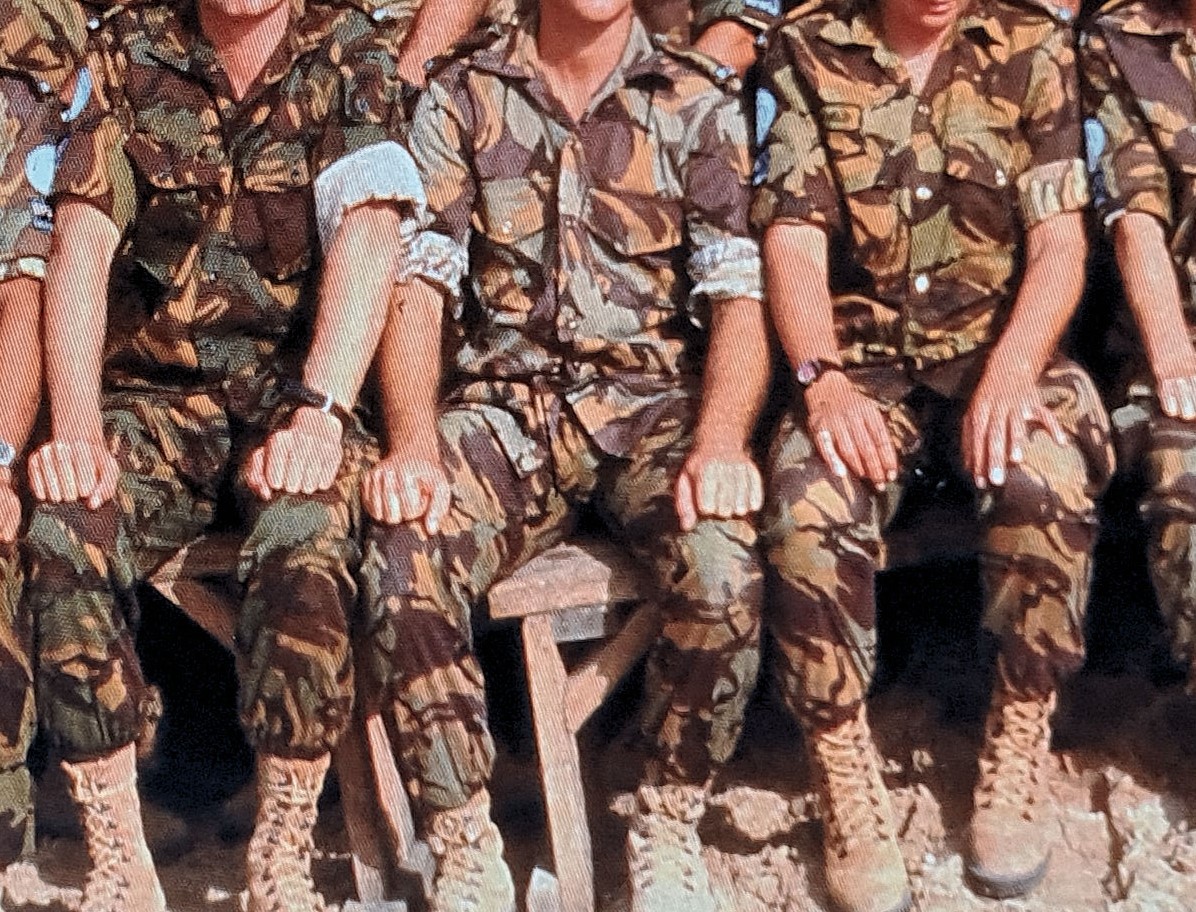
RNZAOC 1 April 1957 to 31 March 1958

This period would see the RNZAOC continue to support Regular, Territorial and Compulsory Military Training. This period would also see the formation and deployment to the 1st Battalion, the New Zealand Regiment to Malaya

Key Appointments

Director of Ordnance Services

  • Temporary Lieutenant Colonel H. McK. Reid from 1 April 1957.[1]

Commanding Officer Main Ordnance Depot

  • Major O.H Burn

Inspecting Ordnance Officer, Northern Military District

  • Captain J.H Doone, from 19 July 1957.

Inspecting Ordnance Officer, Southern Military District

  • Captain E.D Gerrard, from 19 July 1957.

Compulsory Military Training

During this period three CMT intakes marched in with the RNZAOC recruits posted to 1 (NZ) Division Ordnance Field Park on completion of initial training;[2]

  • 24th intake of 1775av recruits on 2 May 1957
  • 25th intake of 1300av recruits on 22 August 1957
  • 26th intake of 1300av recruits on 3 January 1958

1st Battalion, the New Zealand Regiment

Reformed at Waiouru in July 1957, the 1st Battalion of the New Zealand Regiment would undertake workup and training that would see the Battalion deploy on operations in Malaya on 28 November 1957.[3]

The RNZAOC would equip the Battalion from the ground up with its necessary entitlement of equipment provided from existing holdings, including Eighty-Nine vehicles and trailers. However £59000 (2020 NZD $ $2,999,351.94) was expended to procure additional theatre specific items not held in the New Zealand inventory from the United Kingdom authorities in Malaya.[4]

In addition to providing the stores and equipment for the Battalion, RNZAOC Officer Major Jack Harvey was seconded to the 1st Battalion NZ Regiment for the duration of its Malaya tour as the Officer Commanding of C Company. [5]

Major Jack Harvey, RNZAOC Officer Commanding C Company, 1st Battalion, New Zealand Regiment, 1957-59

Members of the 1st Battalion who would later serve with the RNZAOC included;

  • Brian Crafts
  • David Orr

Fiji Military Forces

Warrant Officer Class One Murray Alexander Burt was posted on 15 July 1957, on an accompanied posting with his family to the New Zealand Cadre at Queen Elizabeth Barracks in Suva. WO1 Burt and Family would depart Auckland on the Union Steam Ship Company vessel the MV Tofus on 31 August 1957. WO1 Burt would return to New Zealand on 15 December 1959 and be posted to Hopuhopu camp.[6]

Uniforms

A new Service Dress uniform similar to the Officer pattern Service Dress was approved for Other Ranks by the Army Board in 1954  had is design finalised and placed into production during this period. This uniform’s approval satisfied a long-standing requirement for a ceremonial and walking out order of dress to replace the existing Battle Dress.[7]

Manufacture of the new uniforms was well advanced by closing this period with the District Ordnance Depots in a position to issue the new uniforms by the end of 1958.

With this new Service Dress uniform, Battle Dress would become winter working dress with Khaki Drill the summer working dress.

Other Ranks Service Dress

Ammunition

The demolition of the 17000 rounds of unsafe 3.7inch Anti Aircraft Ammunition that had been initiated in June 1955 was concluded in December 1957. The destruction had proceeded without incident with the local residences thanked for their considerable forbearance in putting up with the noise of explosions nearly every day.

During this period, demolitions were also successfully conducted at the Makomako Ammunition area to dispose of a large quantity obsolete and unsafe ammunition and explosives.[8]

Move of Central Districts Vehicle Depot to Linton

The move of the Central Districts Vehicle Depot (CDVD) was planned to occur during 1958. Before the move could happen, adequate storage had to be constructed at Linton Camp, and this was to be achieved by re-locating war surplus buildings from other locations. By June 1957 the second “W” Type prefabricated building for the CDVD was re-located from Fort Dorset to Linton Camp.[9]

Construction Of New Ordnance Depot for Linton Camp

Since its establishment in 1946, the Central Districts Ordnance Depots had occupied accommodation buildings in the North West corner of Linton Camp in what had initially been the wartime RNZAF Base Linton. Two additional warehouses had been assembled in 1949; however, storage space remained at a premium. In June 1957 Army HQ authorised the expenditure of £100 (2020 NZ$5,059.84) to conduct a preliminary site investigation for a new Ordnance Depot for Linton Camp. Given the deficiencies of adequate Storage accommodation and the erection of buildings for the CDVD, the Linton Camp Command issued instructions that the CDOD were not to utilise the new buildings, even temporarily as this would become permanent and prejudice the business case for constructing a new Ordnance Depot.[10]

Honours and Awards

Meritorious Service Medal

  • Warrant Officer Class One Bernard Percy Banks, 13 June 1957. [11]
  • Warrant Officer Class One Athol Gilroy McCurdy, 10 October 1957. [12]

Appointments, Promotions, Transfers, Resignations, and Retirements of Officers of the RNZAOC

Regular Force

  • Regular Force Major H. McK. Reid to be temp. Lieutenant-Colonel, and is appointed Director of Ordnance Services, dated 1 April 1957.[13]
  • Captain E.C Green, MBE, is re-engaged for one year, as from 1 April 1957.[14]
  • Lieutenant-Colonel F. Reid, OBE, relinquished Director of Ordnance Services’ appointment, pending retirement, 31 March 1957.[15]
  • Captain P.N Erridge, MBE., transferred to the Reserve of Officers, General List, The Royal N.Z. Army Ordnance Corps, in the rank of Major, 2 May 1957.[16]
  • Captain A.B West to be Major, 1 July 1957,[17]
  • Lieutenant F.G Cross to be Captain,  13 August 1957.[18]
  • Lieutenant Colonel F Reid, O.B.E., posted to the Retired List, 16 August 1957.[19]
  • Captain H.P White to be Major. Dated 18 October 1957.[20]
  • Captain and Quartermaster R.P Kennedy, E.D., granted an extension of his engagement for a period of one year as from 13 April 1958.[21]
  • Captain (Temporary Major) F.A Bishop to be Major. Dated 12 December 1957.[22]
  • Lieutenant and Quartermaster (on probation) L.E Autridge is confirmed in his present rank and seniority.[23]
  • Lieutenant and Quartermaster (on probation) 0.C Prouse is confirmed in his present rank and seniority.[24]
  • Lieutenant and Quartermaster (on probation) D.H Rollo, MBE., is confirmed in his present rank and seniority.[25]

Regular Force (Supernumerary List)

  • Captain and Quartermaster R.P Kennedy, E.D, re-engaged in the Regular Force for one year from 13 April 1957.[26]
  • Captain and Quartermaster E.R. Hancock posted to the Retired List, 30 March 1957.[27]
  • Major and Quartermaster I.S. Miller, E.D., is posted to the Retired List, 20 April 1957.[28]
  • Captain and Quartermaster G.A Perry, E.D.,  re-engaged for one year from 1 April 1957.[29]
  • Captain and Quartermaster A.A Barwick posted to the Retired List, 3 August 1957.[30]
  • Captain and Quartermaster A Gollan granted an extension of his engagement for one year, as from 19 December 1957.[31]

Reserve of Officers

  • Lieutenant-Colonel Maurice Salam Myers. posted to the Retired List, 1 January 1958.[32]

Appointments, Promotions, Transfers, Resignations, and Retirements of Warrant Officers, Senior Non-Commissioned Officers and men of the RNZAOC

Regular Force

  • 31266 Warrant Officer Class One, Cyril Austin Baigent to be Lieutenant and Quartermaster, 15 July 1957.[33]
  • 33297 Warrant Officer Class Two, Henry Williamson to be Lieutenant and Quartermaster, 15 July 1957.[34]
  • 33635 Warrant Officer Class Two, William Edwin Smith to be Lieutenant and Quartermaster, 15 July 1957.[35]
  • 31261 Staff Sergeant Ernest Maurice Alexander Bull, Promoted to Warrant Officer Class Two, 30 October 1957.[36]
  • 31257 Warrant Officer Class Two  Murray Alexander Burt, Promoted to Warrant Officer Class One, 15 July 1957.[37]
  • B31695 Sergeant Ian McDonald Russell promoted to Staff Sergeant, 23 April 1957.[38]

Notes

[1] “Appointments, Promotions, Transfers, and Resignations, of Officers of the New Zealand Army,” New Zealand Gazette, No 35, 2 May 1957.

[2] Peter Cooke, Fit to Fight. Compulsory Military Training and National Service in New Zealand 1949-72 (Auckland: David Ling Publishing, 2013), 539.

[3] Brian Clamp and Doreen Clamp, 1st Battalion the New Zealand Regiment (1957-59) Association 50th Anniversary. The First of the First (B. Clamp, 2007), Non-fiction.

[4] “H-19 Military Forces of New Zealand Annual Report of the General Officer Commanding, for Period 1 April 1957 to 31 March 1958,” Appendix to the Journals of the House of Representatives  (1958).

[5] Clamp and Clamp, 1st Battalion the New Zealand Regiment (1957-59) Association 50th Anniversary. The First of the First.

[6] Howard E. Chamberlain, Service Lives Remembered : The Meritorious Service Medal in New Zealand and Its Recipients, 1895-1994 ([Wellington, N.Z.]: H. Chamberlain, 1995), 69-70.

[7] “H-19 Military Forces of New Zealand Annual Report of the General Officer Commanding, for Period 1 April 1957 to 31 March 1958.”

[8] Ibid.

[9] John Mitchell, Buildings, Linton Camp, Central Ordnance Depot, Item Id R9428308 (Wellington: New Zealand Archives, 1955 – 1968 ).

[10] Ibid.

[11] Chamberlain, Service Lives Remembered : The Meritorious Service Medal in New Zealand and Its Recipients, 1895-1994.

[12] Ibid., 283.

[13] “Appointments, Promotions, Transfers, and Resignations, of Officers of the New Zealand Army.”

[14] Ibid.

[15] “Appointments, Promotions, Transfers, and Resignations, of Officers of the New Zealand Army,” New Zealand Gazette, No 38, 16 May 1957.

[16] “Appointments, Promotions, Transfers, and Resignations, of Officers of the New Zealand Army,” New Zealand Gazette, No 42, 30 May 1957.

[17] “Appointments, Promotions, Transfers, and Resignations, of Officers of the New Zealand Army,” New Zealand Gazette, No 45, 1 August 1957.

[18] “Appointments, Promotions, Transfers, and Resignations, of Officers of the New Zealand Army,” New Zealand Gazette, No 62, 29 August 1957.

[19] “Appointments, Promotions, Transfers, and Resignations, of Officers of the New Zealand Army,” New Zealand Gazette, No 66, 12 September 1957.

[20] “Appointments, Promotions, Transfers, and Resignations, of Officers of the New Zealand Army,” New Zealand Gazette, No 3, 16 January 1958.

[21] Ibid.

[22] “Appointments, Promotions, Transfers, and Resignations, of Officers of the New Zealand Army,” New Zealand Gazette, No 13, 20 February 1958.

[23] Ibid.

[24] Ibid.

[25] Ibid.

[26] “Appointments, Promotions, Transfers, and Resignations, of Officers of the New Zealand Army,” New Zealand Gazette, No 27, 4 April 1957.

[27] “Appointments, Promotions, Transfers, and Resignations, of Officers of the New Zealand Army.”

[28] “Appointments, Promotions, Transfers, and Resignations, of Officers of the New Zealand Army.”

[29] “Appointments, Promotions, Transfers, and Resignations, of Officers of the New Zealand Army,” New Zealand Gazette, No 46, 20 June 1957.

[30] “Appointments, Promotions, Transfers, and Resignations, of Officers of the New Zealand Army.”

[31] “Appointments, Promotions, Transfers, and Resignations, of Officers of the New Zealand Army,” New Zealand Gazette, No 86, 14 November 1957.

[32] “Appointments, Promotions, Transfers, and Resignations, of Officers of the New Zealand Army.”

[33] “Appointments, Promotions, Transfers, and Resignations, of Officers of the New Zealand Army,” New Zealand Gazette, No 60, 15 August 1957.

[34] Ibid.

[35] Ibid.

[36] Chamberlain, Service Lives Remembered : The Meritorious Service Medal in New Zealand and Its Recipients, 1895-1994.

[37] Ibid.

[38] Ibid., 410-11.


NZAOC relief efforts, Napier earthquake 3 February 1931

For two and a half minutes from 10:47 on the morning of 3 February 1931, Napier and the surrounding province of Hawkes Bay shook as a magnitude 7.8 earthquake triggered New Zealand’s deadliest natural disaster killing 256 people.

Thankfully for Napier’s surviving citizens, HMS Veronica of the New Zealand Division of the Royal Navy had just arrived in port and was immediately able to provide Bluejackets, Marines and material towards the relief efforts. HMS Veronica also established radio communications with the outside world and hastened the dispatch of relief supplies from Auckland. HMS Dunedin and Diomede soon delivered additional Medical Staff, Bluejackets and Marines to assist. Also, the navy vessels carried much-needed medical and camp equipment, including marquees, tents, blankets, beds and hand tools.

However, additional relief supplies were urgently required, and the Main Ordnance Depot in Trentham was called upon to supply tents, blankets, bedding, cooking and eating utensils for use in the stricken areas. The total value of the stores issued from the Main Ordnance Depot at Trentham was £35,000 (2020 NZ$3,842,326.23)

The earthquake had stuck less than a week after the NZAOC had undergone a significant and extremely unpopular reduction in its military Staff, with many compulsory retired, with others retained in the same role but transferred to the civilian Staff. However, despite this recent staff reduction, the remaining Ordnance staff did outstanding work in dispatching the required stores to support the relief efforts.

An example of the contribution of the Ordnance Staff is provided by one of the Ordnance soldiers who had been transferred to the civilian staff, Gordon Bremner. s. Bremner’s skill as a lorry driver was put to full use making multiple trips delivering stores and equipment to Napier and Hastings.

Relief camp in Nelson Park, Napier, after the 1931 earthquake. Alexander Turnbull Library, Wellington, New Zealand. /records/23061357
Aerial view of Napier after the 1931 earthquake. Alexander Turnbull Library, Wellington, New Zealand. /records/22711223

All military staff in the earthquake area were detailed for relief work and other personnel from other centres. On 6 March 1931, twelve officers and forty-six other ranks were employed in connection with the relief camps. All ranks and the military and civilian staff engaged in the relief effort deserved great credit for how they carried out their duties under trying conditions.


RNZAOC 1 April 1956 to 31 March 1957

This period would see the RNZAOC. Continue to support Regular, Territorial and Compulsory Military Training. This period would see the winding down and cessation of direct RNZAOC support to Kay Force.[1]

Key Appointments

Director of Ordnance Services

  • Lieutenant Colonel F Reid, OBE, relinquished the appointment on 31 march 1957.

Commanding Officer Main Ordnance Depot

  • Major O.H Burn.

Compulsory Military Training

During this period four CMT intakes marched in with the RNZAOC recruits posted to 1 (NZ) Division Ordnance Field Park on completion of initial training;[2]

  • 20th intake of 2475av recruits on 5 April 1956
  • 21st intake of 2475av recruits on 28 June 1956
  • 22nd intake of 1775av recruits on 20 September 1956
  • 23rd intake of 1775av recruits on 3 January 1957
4th New Zealand Division ordnance Field park on parade Trentham, Camp 17 October 1956. WO In charge Gavin Lake Right-hand rank from the from Peter Barret, Bill Smith, mauri Philips, Jim Bremner, Brian Jennings, Peter Rennie, Murray Burt, Dave Laidlaw, Jim Brown. Middle-Rank Leading is Kevin Anderson. Left-Rank Leading; Bert Roil followed by Tex Rickard. Robert Mckie RNZAOC Collection

Emergency Force (Kayforce)

The RNZAOC concluded its commitment to Kayforce with the final Ordnance men’s return in the latter half of 1956.

Out of Kayforce

  • 204459  Temporary Sergeant Gordon Winstone East, 31 August 1956
  • 204702 Temporary Sergeant Ernest Radnell, 31 August 1956
  • 30419 Captain John Barrie Glasson, 3-Sep-56
  • 206870  Staff Sergeant James Russell Don, 29 December 1956

Ordnance Conferences

DOS Conference August 1956

The Director of Ordnance Services hosted a conference of the District Ammunition and Ordnance Depots’ Officer Commanding and the District DADOS at Trentham Camp over 11 – 14 August 1956.[3]  

The agenda for the conference included.

  • Modified accounting procedure,
  • Depot Commanders to visit MOPD for local discussions,
  • Corps Matters,
  • District Problems.

DOS Conference March 1957

The Director of Ordnance Services hosted a conference of the Officer Commanding of the District Ammunition and Ordnance Depots and the District DADOS at Trentham Camp over 26 to 28 March 1957.  

Ammunition Examiners Course

From April to September 1956, Warrant Officer Class Two David Gwynne Thomas attended and passed with excellent results the Ammunition Examiners Course at the RAAOC Corps School at Broadmeadows in Victoria, Australia.[4]

Metal from Condemned Ammunition

Valuable metal was to be recovered from condemned non-high explosive ammunition drawn from Army ordnance depots in the North and South Islands over the next two or three years. The Colonial Ammunition Company was awarded a contract with the Government for the breaking down of the ammunition, which was to be done in New Plymouth. Work will start in the next three months, and the brass and copper extracted will be sent to a large brass extrusion mill to be prepared for further use in industry. Any steel that is recovered and not wanted in New Zealand will be sent overseas.

Corps History

During 1956 the Royal Army Ordnance Corps in the United Kingdom established the RAOC Museum at the RAOC Training centre at Blackdown. The museum’s concept was to establish a Commonwealth Section to illustrate the links between the various commonwealth Ordnance Corps and the RAOC.  In August 1956 the Director of Ordnance (UK) put out a call to the DOS’s or Australia, Canada, Ceylon, India, Pakistan and New Zealand to contribute material for the planned exhibit.

New Zealand replied on 24 January 1957 that as the RNZAOC had only been in existence for a short period, items of historical interest were not available and the RNZAOC would be unable to contribute to this project.[5]

Honours and Awards

Long Service and Good Conduct

  • 31234 Warrant Officer Class One Athol Gilroy McCurdy, 12 April 1956.[6]

Appointments, Promotions, Transfers, Resignations, and Retirements of Officers of the RNZAOC

Regular Force

  • Captain F.A Bishop to be temp. Major. Dated 16 April 1956.[7]
  • Lieutenant and Quartermaster FG Cross is transferred to the Reserve of Officers, General List, The RNZAOC, with Lieutenant and Quartermaster’s rank. Dated 27 April 1956.[8]
  • Captain W.G Dixon is transferred From the Royal New Zealand Artillery to the RNZAOC· in his present rank and seniority. Dated 14 May 1956.[9]
  • Captain M.R.J Keeler to be Major 16 May 1956.[10]
  • Captain W.G Dixon, M.B.E., to be Major. Dated 15 May 1956.[11]
  • The under-mentioned are appointed to regular commissions in the rank of Lieutenant and Quartermaster (on probation):[12]
    • 31002 Warrant Officer Class One, Louis Eric Autridge, from The Royal NZ Artillery.
    • 36643 Staff Sergeant Oliver Cedric Prouse, from the New Zealand Regiment.
    • 33842 Staff Sergeant David Halsel Rollo, M.B.E., from The Royal NZ Artillery.
    • 31028 Warrant Officer Class Two, William Neil Stephenson, from The Royal NZ  Artillery.
  • Captain D Sharpe is posted to the retired list with the Rank of Major. Dated 25 July 1956.[13] [14]
  • Captain R.T Marriott to be Major. Dated 29 August 1956.[15]
  • Lieutenant and Quartermaster Frederick George Cross, Reserve of Officers, General List, RNZAOC is appointed to a short-service Regular commission for a term of three years, in the rank of Lieutenant, with seniority from 13 August 1951. Dated 13 August 1956.[16]
  • The appointment of Lieutenant and Quartermaster (on probation) W. N. Stephenson lapsed Dated 21 September 1956.[17]
  • Captain N.L Wallburton is transferred to the Reserve of Officers, General List, RNZAOC, in the rank of Captain. Dated 7 September 1956.[18]
  • Captain E.F.L Russell is re-engaged for a period of five years as from 26 November 1956.[19]
  • Lieutenant L.C King is re-engaged in the NZ Regular Force for the period 16 November 1956 to 3 October 1958 and promoted to Captain from 16 November 1956.[20]
  • Major K.G Scott, from the Reserve of Officers, Supplementary List, to be Major. Dated 1 November 1956.[21]
  • Temp. Captain D.R. Alexander, from the Reserve of Officers, Supplementary List, to be Captain. Dated 1 November 1956.
  • Captain Donald MacKenzie Robson, M.B.E., from the Regular Army Reserve of Officers, Royal Australian Army Ordnance Corps, to be Captain. Dated 7 December 1956.[22]
  • Temp. Lieutenant A.A Burrows, from the Reserve of Officers, Supplementary List, to be Lieutenant. Dated 1 November 1956.[23]
  • Temp. Lieutenant M.J Goodson, from the Reserve of Officers, Supplementary List, to be Lieutenant. Dated 1 November 1956.[24]

Regular Force (Supernumerary List)

  • Captain and Quartermaster R.P Kennedy, E.D, is granted a further extension of his engagement for one year from 13 April 1956.[25]
  • Captain and Quartermaster G.A Perry, E.D., is given an extension of his engagement for a further period of one year from 1 April 1956.[26]

Territorial Force

  • Captain A.W Wilkin, RNZAOC, relinquished the appointment of Brigade Ordnance Officer, Headquarters, 3rd Infantry Brigade and was posted to the Retired List on 4 November 1954.[27]

Graduates, Royal Military College, Duntroon

  • Lieutenant Malcolm John Ross, 12 December 1956.[28]

Appointments, Promotions, Transfers, Resignations, and Retirements of Warrant Officers, Senior Non-Commissioned Officers and men of the RNZAOC

Regular Force

  • Corporal J.T Skeddan from SMD was selected to attend the year long course at Portsea Officer Training establishment in Australia starting in January 1957.
  • 31257 Temporary Warrant Officer Class Two Murray Alexander Burt promoted to substantive Warrant Officer Class Two, 10 October 1956.[29]
  • W920917 Corporal George Thomas Dimmock promoted to Sergeant, 1 June 1956.[30]
  • 31004 Warrant Officer Class One William Galloway, retired 1 January 1957[31]
  • 1185 Staff Sergeant Albert Edward “Abbie” Shadbolt retired on 25 October 1956. SSgt Shadbolt retired at the age of 69 after 49 years and ten months of service to the military in uniformed and civilian roles.
    • Enlisted into RNZA 26 November 1907.
    • Transferred to NZAOC in 1922
    • Transferred to civilian Staff 1931, remaining employed at the Main Ordnance Depot as a Clerk.
    • 8 January 1942 commissioned as a Lieutenant into the NZ Temporary Staff as Ordnance Officer Main Ordnance Depot, Placed on to the retired list on 21 October 1948
    • Re-engaged as a Warrant Officer Class Two in 1948, Shadbolt would latter attain Warrant Officer Class One rank as the 2 I/C of the Central Districts Vehicle Depot at Trentham.
    • Due to his age was reverted to the Rank of Staff Sergeant on 1 April 1956 and placed on less onerous duties for his last year of service, retiring 0n 10 October 1956.
  • Besides his military responsibilities, Shadbolt was an outstanding Rugby Union and Rugby league player with the following credentials.
    • He represented Canterbury XV in 1909 and 1910
    • Switched to Rugby League in 1912 and would play for the St Albans and Federal Clubs
    • Played for the Canterbury Rugby League side from 1912 to 1920
    • Represented New Zealand in the Rugby League tours to Australia in 1913 and 1921

Notes

[1] “H-19 Military Forces of New Zealand Annual Report of the General Officer Commanding, for Period 1 April 1954 to 31 March 1955 “, Appendix to the Journals of the House of Representatives  (1955).

[2] Peter Cooke, Fit to Fight. Compulsory Military Training and National Service in New Zealand 1949-72 (Auckland: David Ling Publishing, 2013), 539.

[3] Conferences – Ordnance Officers, Item Id R17188101 (Wellington: Archives New Zealand, 1950).

[4] Howard E. Chamberlain, Service Lives Remembered : The Meritorious Service Medal in New Zealand and Its Recipients, 1895-1994 ([Wellington, NZ.]: H. Chamberlain, 1995), 466.

[5] “Organisation – Policy and General – Rnzaoc “, Archives New Zealand No R17311537  (1946 – 1984).

[6] Chamberlain, Service Lives Remembered : The Meritorious Service Medal in New Zealand and Its Recipients, 1895-1994.

[7] “Appointments, Promotions, Transfers, and Resignations, of Officers of the New Zealand Army,” New Zealand Gazette No 29, 17 May 1956.

[8] Ibid.

[9] “Appointments, Promotions, Transfers, and Resignations, of Officers of the New Zealand Army,” New Zealand Gazette No 34, 14 June 1956.

[10] “Appointments, Promotions, Transfers, and Resignations, of Officers of the New Zealand Army,” New Zealand Gazette No 36, 28 June 1956.

[11] “Appointments, Promotions, Transfers, and Resignations, of Officers of the New Zealand Army,” New Zealand Gazette No 41, 26 July 1956.

[12] “Appointments, Promotions, Transfers, and Resignations, of Officers of the New Zealand Army,” New Zealand Gazette No 45, 16 August 1956.

[13] “Appointments, Promotions, Transfers, and Resignations, of Officers of the New Zealand Army,” New Zealand Gazette No 48, 30 August 1956.

[14] “Appointments, Promotions, Transfers, and Resignations, of Officers of the New Zealand Army,” New Zealand Gazette No 68, 6 December 1956.

[15] “Appointments, Promotions, Transfers, and Resignations, of Officers of the New Zealand Army,” New Zealand Gazette No 51, 13 September 1956.

[16] Ibid.

[17] “Appointments, Promotions, Transfers, and Resignations, of Officers of the New Zealand Army,” New Zealand Gazette No 55, 11 October 1956.

[18] “Appointments, Promotions, Transfers, and Resignations, of Officers of the New Zealand Army,” New Zealand Gazette No 58, 1 November 1956.

[19] “Appointments, Promotions, Transfers, and Resignations, of Officers of the New Zealand Army,” New Zealand Gazette No 1, 10 January 1957.

[20] “Appointments, Promotions, Transfers, and Resignations, of Officers of the New Zealand Army,” New Zealand Gazette No 8, 31 January 1957.

[21] “Appointments, Promotions, Transfers, and Resignations, of Officers of the New Zealand Army,” New Zealand Gazette No 14, 27 February 1957.

[22] Ibid.

[23] Ibid.

[24] Ibid.

[25] “Appointments, Promotions, Transfers, and Resignations, of Officers of the New Zealand Army,” New Zealand Gazette No 35, 21 June 1956.

[26] “Appointments, Promotions, Transfers, and Resignations, of Officers of the New Zealand Army.”

[27] “Appointments, Promotions, Transfers, and Resignations, of Officers of the New Zealand Army.”

[28] “Appointments, Promotions, Transfers, and Resignations, of Officers of the New Zealand Army,” New Zealand Gazette No 20, 7 March 1957.

[29] Chamberlain, Service Lives Remembered : The Meritorious Service Medal in New Zealand and Its Recipients, 1895-1994.

[30] Ibid.

[31] Ibid., 175.


RNZAOC 1 April 1955 to 31 March 1956

This period would see the RNZAOC undertake a range of routine activities whilst continuing to support Regular, Territorial and Compulsory Military Training. [1]

Key Appointments

Director of Ordnance Services

  • Lieutenant Colonel F Reid, OBE

Compulsory Military Training

During this period three CMT intakes marched in;[2]

  • 17th intake of 2800av recruits on 23 June 1955
  • 18th intake of 2475av recruits on 15 September 1955
  • 19th intake of 2475av recruits on 5 January 1955

Territorial Force Annual Camps

Technical Stores Sectionsd of the Divisional Ordnance Park would exerces on the following dates;

  • 11 – 30 January 1956
  • 25 January – 13 February 1956

Reorganisation of Territorial Force Units

With effect, the ORBAT Amendment of 28 June 1955, the RNZAOC Ordnance Field Park Platoons were reorganised into the 1(NZ) Division Ordnance Field Park, Organised as;[3]

  • Headquarters (Not Raised in Peace)
  • MT Stores Platoon, Lower Hutt, plus MT Stores Platoon of Independent Brigade OFP
  • Tech Stores Platoon, Christchurch, Plus Tech Stores Platoon of Independent Brigade OFP.
  • General Stores Platoon, Hopuhopu, Plus General Stores Platoon of Independent Brigade OFP.

Emergency Force (Kayforce)

The RNZAOC continued to support Kayforce with the dispatch of regular consignments of Maintenance stores and with all requests for stores by Kayforce met.

Out of Kayforce

  • Corporal Abraham Barbara, 2 May 1955
  • Gunner John Neil Campbell, 21 June 1955
  • Sergeant Joseph James Enright Cates, 9 December 1955
  • Temporary Warrant Officer Class Two Philip Hayhurst Kirkman, 2 June 1955
  • Warrant Officer Class Two Barry Stewart, 13 May 1955
  • Corporal Edward Tanguru, 21 June 1955

Small Arms Ammunition

The Manufacture of Small-Arms Ammunition by the Colonial Ammunitions Company at their Mount Eden Factory continued with delivered of first-class ammunitions being well maintained. [4]

Introduction of New Equipment

As new equipment was introduced, the RNZAOC would play an essential role in the acceptance processes. Upon delivery from the supplier, the equipment, accessories, and spares would be received into an RNZAOC Depot. The equipment would be inspected and kitted out with all its accessories before distribution to units. Several examples may have been retained in RNZAOC Depots as War Reserve/Repair and Maintenance Stock depending on the equipment. Maintenance stocks of accessories and spares were maintained as operating stock in RNZAOC depots. If the new equipment contained a weapon system, ammunition specific to the equipment was managed by RNZAOC Ammunition Depots.

During this period, the following equipment was introduced into service;[5]

  • Six 5.5in Guns
  • Three Scout Cars
  • Fifty-five Field Wireless sets
  • Fourteen cars
  • Thirty-seven commercial type trucks

Equipment Disposal

The following items were disposed of through the Government Stores Board.

  • 534 Trucks
  • 268 Motorcycles

Ammunition Disposal

With large stocks of ammunition left over for the Second World War, disposal of Unserviceable and surplus stock was authorised in 1955. Small quantities would be routinely disposed of at individual depots with a significant effort put into place to dispose of 3.7-inch Anti-Aircraft ammunition and Various types of Anti-Tank Rounds.

3.7-inch Anti-Aircraft Ammunition

Since the end of the war 17000 rounds of 3.7-inch anti-aircraft ammunition had been stored in unsuitable conditions at Kuku Valley becoming unstable and dangerous with the decision made in 1955 to destroy these stocks.

After many years of poor storage, many storage containers had deteriorated to a stage that increased the risk of explosion during transport. To facilitate the transportation of the unstable ammunition from Kuku Valley to the Demolition Range, a modified armoured truck and trailer was constructed the EME Workshops at Trentham to move the condemned shells for destruction.

Twenty shells would be transported unloaded at the demolition range and in batches of four destroyed by explosion. Destruction of the stockpile began in June 1955 and completed in December 1957.[6]

Examination of deteriorated shell at Trentham, Upper Hutt. National Library of New Zealand Ref: EP/1955/1792-F
Army vehicles at Trentham, Upper Hutt. Ref: EP/1955/1793-F. Alexander Turnbull Library, Wellington, New Zealand. /records/23078184
Valentine Tank at Trentham, stacks of Ammunition can be seen in the background. NZ National Library Ref EP/1955/1794-F

Anti-Tank Ammunition

In addition to Ammunition disposal at Trentham, The Army still held more than One and a Half Million rounds of various Anti-Tank Ammunition types. As this ammunition was surplus to requirement and belonging to obsolete weapon types, a profit-sharing contract was arranged with the Colonial Ammunition Company (CAC) to dispose of these rounds. Under the terms of the agreement, the CAC would break down and salvage recyclable materials form the wartime stocks of Anti-Tank ammunition, with the army receiving a share of the funds raised by the sale of the salvageable material.

Ammunition Examiners

During this period the following Ammunition Examiners were authorised to carry out routine inspections of ammunition and allocated Ammunition Examiner Serial Numbers.

  • Central Military District,
    • Lance Corporal G.C Gilbert, Ammunition Examiner Serial No 92.

Honours and Awards

Meritorious Service Medal

  • 31004 Warrant Officer Class One William Galloway, 10 November 1955

Long Service and Good Conduct

  • 31234 Warrant Officer Class One Athol Gilroy McCurdy, 12 April 1956

Appointments, Promotions, Transfers, Resignations, and Retirements of Officers of the RNZAOC

Regular Force

  • Captain and Quartermaster K. A. Bailey, MM, to be Major and Quartermaster. Dated 2 May 1955.[7]
  • Captain (temp. Major) K. G. K. Cropp, E.D., to be Major. Dated 26 May 1955.[8]
  • Lieutenant G. W. Peters is transferred to the Reserve of Officers, General List, The Royal N.Z. Army Ordnance Corps, with the rank of Lieutenant. Dated 18 June 1955.[9]
  • Captain (temp. Major) D. E. A. Roderick to be Major. Dated 27 May 1955. [10]
  • Captain E. W. Whitacre to be Major. Dated 30 May 1955. [11]
  • Captain 0, H. Burn to be Major. Dated 1 June 1955. [12]
  • Captain (temp. Major) C. A. Penny to be Major. Dated 30 May 1955.[13]
  • Captain H. S. Sandford to be Major. Dated 17 June 1955.[14]
  • Captain (temp. Major) H. J. Mockridge is posted to the Retired List with the rank of Major. Dated 22 September 1955.[15]
  • Lieutenant H. G. Rees is posted to the Retired· List with the ·rank of Captain. Dated 9 October 1955.[16]
  • Captain and Quartermaster G. G. W. Blandford is posted to the Retired List. ·Dated 1 November 1955.[17]
  • 31617 W.O. I Ray Henry Colwill to be Lieutenant and Quartermaster. Dated 9 January 1956.[18]
  • 31253 WO II William John McCluggage to be Lieutenant and Quartermaster. Dated 9 January 1956.[19]
  • 32171 Staff Sergeant George Witherman McCullough to be Lieutenant and Quartermaster. Dated 9 January 1956.[20]
  • 31244 WO I William John Stanley Tavendale to be Lieutenant and Quartermaster. Dated 9 January 1956.[21]

Regular Force (Supernumerary List)

  • Captain (Temp. Major) · S. A. Knight is posted ‘to the· Retired List, with Lieutenant Colonel’s rank. Dated 16 February 1956.[22]  [23]
  • Captain and Quartermaster N. C. Fisher is posted to the Retired List, with Major and Quartermaster’s rank, dated 14 March 1956.[24]

Territorial Force

  • Captain T.H. Beauchamp, from the Reserve of Officers, General List, The Royal N.Z. Army Ordnance Corps, to be Captain with seniority from 23 August 1954, and is appointed Officer Commanding, 1st Armoured Regiment, Light Aid Detachment, RNZEME Dated 1 July 1955.[25]

Appointments, Promotions, Transfers, Resignations, and Retirements of Warrant Officers, Senior Non-Commissioned Officers and men of the RNZAOC

  • 31383 Sergeant Hector Searle McLachlan, promoted to Staff Sergeant, 1 April 1955.

Notes

[1] “H-19 Military Forces of New Zealand Annual Report of the General Officer Commanding, for Period 1 April 1954 to 31 March 1955 “, Appendix to the Journals of the House of Representatives  (1955).

[2] Peter Cooke, Fit to Fight. Compulsory Military Training and National Service in New Zealand 1949-72 (Auckland: David Ling Publishing, 2013), 539.

[3] “Organisation and Administration: Units – Territorial: Formation and Organisation – 1 Divisional Officer[?] Rnzaoc [Royal New Zealand Army Ordinance Corps] M/T {Motor Transport] Stores Platoon (Lower Hutt),” Archives New Zealand Item No R22496443  (1950-55).

[4] “H-19 Military Forces of New Zealand Annual Report of the General Officer Commanding, for Period 1 April 1955 to 31 March 1956,” Appendix to the Journals of the House of Representatives  (1956).

[5] “H-19 Military Forces of New Zealand Annual Report of the General Officer Commanding, for Period 1 April 1954 to 31 March 1955 “.

[6] Howard Weddell, Trentham Camp and Upper Hutt’s Untold Military History (Howard Weddell, 2018), Bibliographies, Non-fiction, 187-88.

[7] “Appointments, Promotions, Transfers, and Resignations, of Officers of the New Zealand Army,” New Zealand Gazette No 41, 23 June 1955.

[8] Ibid.

[9] Ibid.

[10] Ibid.

[11] Ibid.

[12] Ibid.

[13] “Appointments, Promotions, Transfers, and Resignations, of Officers of the New Zealand Army,” New Zealand Gazette No 43, 7 July 1955.

[14] “Appointments, Promotions, Transfers, and Resignations, of Officers of the New Zealand Army,” New Zealand Gazette No 45, 14 July 1955.

[15] “Appointments, Promotions, Transfers, and Resignations, of Officers of the New Zealand Army,” New Zealand Gazette No 60, 22 September 1955.

[16] “Appointments, Promotions, Transfers, and Resignations, of Officers of the New Zealand Army,” New Zealand Gazette No 69, 10 November 1955.

[17] “Appointments, Promotions, Transfers, and Resignations, of Officers of the New Zealand Army,” New Zealand Gazette No 3, 19 January 1955.

[18] “Appointments, Promotions, Transfers, and Resignations, of Officers of the New Zealand Army,” New Zealand Gazette No 10, 23 February 1956.

[19] Ibid.

[20] Ibid.

[21] Ibid.

[22] “Appointments, Promotions, Transfers, and Resignations, of Officers of the New Zealand Army,” New Zealand Gazette No 13, 8 March 1956.

[23] “Appointments, Promotions, Transfers, and Resignations, of Officers of the New Zealand Army,” New Zealand Gazette No 34, 14 June 1956.

[24] “Appointments, Promotions, Transfers, and Resignations, of Officers of the New Zealand Army,” New Zealand Gazette No 23, 12 April 1956; “Appointments, Promotions, Transfers, and Resignations, of Officers of the New Zealand Army,” New Zealand Gazette No 29, 17 May 1956.

[25] “Appointments, Promotions, Transfers, and Resignations, of Officers of the New Zealand Army,” New Zealand Gazette No 48, 28 July 1955.


RNZAOC 1 April 1954 to 31 March 1955

This period would see the RNZAOC. Continue to support Regular, Territorial and Compulsory Military Training. Ongoing support to Kayforce would continue.[1]

Key Appointments

Director of Ordnance Services

  • Lieutenant Colonel F Reid, OB

Chief Inspecting Ordnance Officer

  • Major I.S Miller

Southern Military District DADOS

  • Major H McK Reid

Southern Military District IOO

  • Captain J.H Doone

Southern District Ordnance Depot

  • Captain and Quartermaster A.A Barwick

Compulsory Military Training

During this period three CMT intakes marched in;[2]

  • 13th intake of 2200av recruits on 22 April 1954
  • 14th intake of 2200av recruits on 16 September 1954
  • 15th intake of 2200av recruits on 6 January 1955
  • 16th intake of 2966 recruits on 31 March 1955

On completion of CMT recruit training, recruits were posted to Territorial units close to their home location to complete their CMT commitment, with RNZAOC CMT recruits posted to either

  • 1st Infantry Brigade Ordnance Field Park Platoon, Hopuhopu
  • 2nd Infantry Brigade Ordnance Field Park Platoon, Mangaroa.
  • 3rd Infantry Brigade Ordnance Field Park Platoon, Burnham

Emergency Force (Kayforce)

The RNZAOC continued to support Kayforce with the dispatch of regular consignments of Maintenance stores and with all requests for stores by Kayforce met.

Out of Kayforce

  • Lance Corporal Alexander George Dobbins, 28 September 1954
  • Private James Adam (Snowy) Donaldson, 5 November 1954
  • Captain Patrick William Rennison, 10 May 1954
  • Private Richard John Smart, 5 November 1954

Into Kay force

  • Joseph James Enright Cates, 2 June 1954
  • Lieutenant John Barrie Glasson, 20 April 1954

As part of his tour of K Force units, Brigadier Weir, Quartermaster General of the NZ Army met and spoke to the men of the NZ Base Ordnance Section of the British Commonwealth Base Ordnance Depot at Kure, Japan.[3]

Seconded to Fiji Military Forces

Lieutenant and Quartermaster R. D. Wederell ceased to be seconded to the Fiji Military Forces as of 14 June 1954.[4]

Ordnance Conferences

District Vehicle Depot Conference

The Director of Ordnance Services hosted a conference of the Officer Commanding of the District Vehicle Depots and the Officer Commanding Main Ordnance Depot (MOD) at Trentham Camp over 3 – 4 August 1954.[5]  

Items discussed at the conference included;

  • Vehicle accounting,
  • Tools etc., method of Recei0pt and Issue,
  • Storage,
  • Vehicle Loans – Issue and Receipt from Units,
  • District Problems.

DADOS Conference

The Director of Ordnance Services hosted a conference of the District DADOS’s and the Officer Commanding Main Ordnance Depot (MOD) at Trentham Camp over the period 10 – 12 August 1954.[6] 

Items discussed at the conference included;

  • Corps Policy
  • Corps Establishments
  • Estimation of expenditure
  • District Vehicle Depots
    • Functions
    • Staff/Establishments
  • Audit Reports
  • Ammunition

New Cap Badge

1954 would see approval granted to update the RNZOAC Cap Badge by replacing the “Tudor” Crown with the “St Edwards Crown. The NZ Army Liaison Staff in London had provided a sample of the new badges from  J.R Gaunt of London, and on the approval of this sample in May 1954 the liaison Staff was instructed to obtain examples of Collar badges in the new design.

Routine Ordnance Activities

Over this period, the RNZAOC continued with its regular duties of provision, holding and issue of multitudinous stores required by the Army including the additional issue of training equipment to the territorial Force allowing all unit’s sufficient equipment for routine training.

Establishment of MT Stores Group at the Central Districts Ordnance Depot

Based on a series of ongoing discussions between the DOS and CDOD since 1951, in July 1953, the recommendation was made to transfer responsibility for the provision of MT Stores to CMD units (except those located at Trentham Camp) from the Main Ordnance Depot in Trentham to the CDOD at Linton Camp. Approval for establishing an MT Group at CDOD was granted in September 1953 with the transfer of stocks to begin once suitable storage in Linton Camp had been prepared to receive stocks.  

To facilitate the initial in-scaling of MT Group, 1500 Square feet of the W type Building 81 was fitted with six wooden shelves to provides storage capacity for up to 18000 lines of Stock-based on VAOS Catalogue LV6 Groups 1 to 10. LV6 Groups 1 to 10 items were small and fast-moving repair parts for Motor Transport’s current range. It was planned that once the MT Group had been established for several months’ responsibility for LV7, Larger repair parts and principle end items would also be transferred from MOD to the CDOD.

A Staff of five soldiers for the CDOD MT Group was already authorised in the CDOD Peacetime Establishment issued in 1952. However, at the time of the MT Groups establishment, The Staff of the Group consisted of one NCO assisted by the Tyre Group Storeman.

By 15 September 1954 the transfer of stock form the MOD has been sufficiently completed to allow CMD units to begin demanding MT Spares from the CDOD.[7]

Army Ammunition Stores Depot

Up to 1954, the RNZAOC maintained the Army Ammunition Stores Depot (AASD) at the Kuku Valley Ammunition Area at Trentham. The role of the AASD was to be the main bulk holding and distribution unit for Non-Explosive and Explosive stores for the regional Ammunition Repair Depots (ARD).

A review of the role and functions of AASD was conducted during a DADOS conference in 1954 with the decision made to disband the AASD and hand over its operations to the MOD and regional Ordnance and Ammunition Depots.

As part of the disbanding instructions, the regional ARDs were instructed to maintain six months working stock of non-explosive items, and sufficient explosive items to complete the current repair programme. All excess items were to be returned to the nearest Ordnance or Ammunition Depot, with all future demand for items to be forwarded to those Depots.[8]

Small Arms Ammunition

The Manufacture of Small-Arms Ammunition by the Colonial Ammunitions Company at their Mount Eden Factory continued with delivered of first-class ammunitions being well maintained. [9]

Ammunition Examiners

During this period the following Ammunition Examiners were authorised to carry out routine inspections of ammunition and allocated Ammunition Examiner Serial Numbers.

Northern Military District,

  • Corporal Radford, Ammunition Examiner Serial No 72, 29 July 1954.
  • Lance Corporal T Sweet, Ammunition Examiner Serial No 83, 13 August 1954.
  • Private Thomasson, Ammunition Examiner Serial No 82, 13 August 1954.

Introduction of New Equipment

As new equipment was introduced, the RNZAOC would play an essential role in the acceptance processes. Upon delivery from the supplier, the equipment, accessories, and spares would be received into an RNZAOC Depot. The equipment would be inspected and kitted out with all its accessories before distribution to units. Several examples may have been retained in RNZAOC Depots as War Reserve/Repair and Maintenance Stock depending on the equipment. Maintenance stocks of accessories and spares were maintained as operating stock in RNZAOC depots. If the new equipment contained a weapon system, ammunition specific to the equipment was managed by RNZAOC Ammunition Depots.

During this period, the following equipment was introduced into service;[10]

  • One L2 BAT (Battalion, Anti-Tank) was a 120 mm calibre recoilless anti-tank rifle, with Eighteen more on order
  • Twenty-Two FN FAL Rifles for troop trials
  • An extra-wide Bailey Bridge
  • Fifty Field Wireless sets

The following items were disposed of through the Government Stores Board.

  • 193 Bren Carriers
  • 25 Motor vehicles of various types

Battledress Cap

During 1954 the Cap Battledress (Cap BD) but commonly referred to as the Ski Cap was introduced into service. This type of hat was extremely unpopular, especially with the troops, especially those serving in the tropics, but would endure until 1964 when it was withdrawn from service.

NZ Army Cap Battledress (Cap BD), introduced 1954, withdrawn from service 1964. Robert Mckie Collection

Vehicle Shelters for Burnham

The Royal New Zealand Engineers commenced the erection at Burnham Military Camp of two steel prefabricated vehicle shelters in May 1954. Three such shelters were erected at the Southern District Vehicle Depot at Burnham, another three in the transport park at Burnham, and two others in two other areas. Each of the shelters was 200 feet long by 50 feet wide, and helped to overcome the serious shortage of shelters for Army vehicles at the camp. With concrete foundations and floors, the framework of the buildings consisted of steel pipes of various lengths bolted together. The exterior and roof of the shelters were of corrugated asbestos-type material.[11]

Cricket Tour to Australia

In the first tour of its kind the Main Ordnance Depot in Trentham, representing the RNZAOC undertook a Cricket tour of Australia. Departing Wellington on 1 February 1955 returning on 7 March the MOD played matched in Sydney and Melbourne against teams drawn from the Royal Australian Army Ordnance Corps.[12]

With the NZ Ordnance team winning the series successfully, reciprocal tours took place in

  • 1959, hosted by the RNZAOC.[13]
  • 1961, hosted by RAAOC.

The officials and players who participated in the 1955 tour were;[14]

  • Lieutenant Colonel L.F Reid, 0BE (Manager),
  • Major Derrick Roderick,
  • Warrant Officer Class One A Wesseldine,
  • Warrant Officer Class Two M.A Burt (Treasure and Player),
  • Warrant Officer Class Two Harry Le Comte,
  • Warrant Officer Class Two RS Perks (Assistant Manager and Player),
  • Warrant Officer Class Two Douglas Wilson,
  • Sergeant Douglas Bucknell (Official. Umpire and Player),
  • Sergeant G. McCullough,
  • Sergeant E.J Prout,
  • Corporal G Cormack,
  • Corporal J Morgan, (Official Scorer and Player),
  • Private W Bacon,
  • Private Brian Clarke,
  • Private Keith Danby,
  • Private A.N McAinch,
  • Private L Norton.

Appointments, Promotions, Transfers, Resignations, and Retirements of Officers of the RNZAOC

Regular Force

  • Lieutenant C. L. Sanderson promoted to Temporary Captain. Dated 9 December 1953. [15]
  • Captain E. C. Green granted a further extension of his short-service commission for one year from 1 April 1954.[16]
  • Lieutenant T. B. Glasson promoted to Temporary Captain whilst employed as Officer Commanding, NZ Base Ordnance Depot. Dated 8 August 1954.[17]
  • Captain N. L. Wallburton re-engaged for a period of two years as from 23 August 1954.[18]
  • Lieutenant (temp Captain) J. B. Glasson to be Captain. Dated 8 November 1954.[19]
  • Lieutenant (Temp Captain) C. L. Sanderson to be Captain. Dated 9 December 1953.[20]
  • 31264 Warrant Officer Class One Leslie Smith promoted to Lieutenant and Quartermaster. Dated 15 December 1954.[21]
  • Lieutenant L. C. King transferred from the New Zealand Regiment to the RNZAOC with his present rank and seniority. Dated 14 February 1955.[22]
  • Captain E. C. Green granted a further extension of his short-service commission to 31 March 1956.[23]
  • Lieutenant J. H. Doone to be Captain Dated 25 October 1954.[24]
  • Lieutenant and Quartermaster R. D. Wederell to be Captain and Quartermaster. Dated 31 March 1955.[25]

Appointments, Promotions, Transfers, Resignations, and Retirements of Warrant Officers, Senior Non-Commissioned Officers and men of the RNZAOC

Regular Force

  • W920917 Lance Corporal George Thomas Dimmock Promoted to Corporal, 1 April 1954. [26]
  • 31884Temporary Warrant Officer Class Two Alick Claude Doyle granted substantive Rank on 1 April 1954. [27]
  • B31695 Corporal Ian McDonald Russell promoted to Sergeant, 21 April 1954. [28]
  • 31259 Staff Sergeant Maurice Sidney Philips promoted to Warrant Officer Class Two, 12 July 1954. [29]
  • 31167 Staff Sergeant John Bernard Crawford promoted to Warrant Officer Class Two, 15 July 1954. [30]
  • 31261 Sergeant Earnest Maurice Alexander Bull promoted to Staff Sergeant, 22 October 1954.[31]

Notes

[1] “H-19 Military Forces of New Zealand Annual Report of the General Officer Commanding, for Period 1 April 1954 to 31 March 1955 “, Appendix to the Journals of the House of Representatives  (1955).

[2] Peter Cooke, Fit to Fight. Compulsory Military Training and National Service in New Zealand 1949-72 (Auckland: David Ling Publishing, 2013), 539.

[3] “Brigadier in Korea,” Press, Volume XC, Issue 27460, , 21 September 1954.

[4] “Appointments, Promotions, Transfers, and Resignations, of Officers of the New Zealand Army,” New Zealand Gazette No 41, 1 July 1954.

[5] Conferences – Ordnance Officers, Item Id R17188101 (Wellington: Archives New Zealand, 1950).

[6] Ibid.

[7] “Establishments – Ordnance Corps “, Archives New Zealand No R22441746  (1944 – 1947).

[8] Ibid.

[9] “H-19 Military Forces of New Zealand Annual Report of the General Officer Commanding, for Period 1 April 1954 to 31 March 1955 “.

[10] Ibid.

[11] “Vehicle Shelters for Burnham,” Press, Volume XC, Issue 27359, , 26 May 1954.

[12] “Trentham Army Cricket Team Australian Tour,” Upper Hutt Leader, Volume XII, Number 8, 10 March 1955.

[13] Major J.S Bolton, A History of the Royal New Zealand Army Ordnance Corps (Trentham: RNZAOC, 1992), 177.

[14] “Trentham Army Cricket Team Australian Tour.”; “Army Cricket,” Broadcaster (Fairfield, NSW : 1935 – 1978), 16 February 1955 1955.

[15] “Appointments, Promotions, Transfers, and Resignations, of Officers of the New Zealand Army,” New Zealand Gazette No 35, 3 June 1954.

[16] Ibid.

[17] “Appointments, Promotions, Transfers, and Resignations, of Officers of the New Zealand Army,” New Zealand Gazette No 55, 16 September 1954.

[18] “Appointments, Promotions, Transfers, and Resignations, of Officers of the New Zealand Army,” New Zealand Gazette No 52, 26 August 1954.

[19] “Appointments, Promotions, Transfers, and Resignations, of Officers of the New Zealand Army,” New Zealand Gazette No 13, 25 February 1954.

[20] “Appointments, Promotions, Transfers, and Resignations, of Officers of the New Zealand Army,” New Zealand Gazette No 4, 27 January 1955.

[21] Ibid.

[22] “Appointments, Promotions, Transfers, and Resignations, of Officers of the New Zealand Army,” New Zealand Gazette No 20, 17 March 1955.

[23] “Appointments, Promotions, Transfers, and Resignations, of Officers of the New Zealand Army,” New Zealand Gazette No 6, 3 February 1955.

[24] “Appointments, Promotions, Transfers, and Resignations, of Officers of the New Zealand Army,” New Zealand Gazette No 15, 3 March 1955.

[25] “Appointments, Promotions, Transfers, and Resignations, of Officers of the New Zealand Army,” New Zealand Gazette No 37, 2 June 1955.

[26] Howard E. Chamberlain, Service Lives Remembered : The Meritorious Service Medal in New Zealand and Its Recipients, 1895-1994 ([Wellington, N.Z.]: H. Chamberlain, 1995), 128-29.

[27] Ibid., 134-35.

[28] Ibid., 410-11.

[29] Ibid., 367-68.

[30] Ibid., 109-10.

[31] Ibid., 67.


NZ Defence Stores July 1869 – June 1870

Military Storekeeping has been a feature of New Zealand’s military experience since 1840, and it is well known within the military storekeeping fraternity how Governor Hobson appointed Henry Tucker as the Colonial Storekeeper.  From 1840 to 1845, Tucker, as Colonial Storekeeper, managed the Ammunition, Arms and accoutrements for the Militias hastily organised in the early days of colonial New Zealand. However, it is not until 1917, and the New Zealand Army Ordnance Corps formation that New Zealand Military Storekeeping’s history begins with the period from 1845 to 1917 remaining as an empty void in the histography of New Zealand’s Military Storekeeping.  In this article, the period from July 1869 to June 1870 is examined. In this specific period, as New Zealand’s military “Self-Reliance” policy reached its culmination with the final Imperial Forces withdrawing from New Zealand and conflict that had raged since 1860 in its last throes. The conflict had placed an enormous financial burden on the young nation as it formed and equipped Regular, Militia and Volunteer units and as the country looked forward, the Defence Stores Department was formalised as a component of the New Zealand Forces to manage the large amount of war material that had been acquired.

Initially, Militia units in New Zealand were raised and equipped under the auspice of the Colonial Secretary. As Militia units could only be used for local defence, the Militia Act of 1858 allowed Volunteer Units to be formed for service anywhere in the colony. Like Militia units, Volunteer units were administered and equipped by the Colonial Secretary.  As conflict increased in the early 1860s with Imperial troops undertaking the bulk of the military burden, a call for the colony to take on more responsibility was advocated by Francis Weld, a member of the House of Representatives. Weld’s position became known as the “self-reliant” policy.

As Weld’s “self-reliant” policy gained traction, New Zealand’s Military Forces’ shape and how they were administered and equipped undertook a transformation with the reliance on Imperial Forces gradually decreasing until they were fully withdrawn in 1870.  A regular New Zealand Military Force was initiated with the passing of the Colonial Defence Force Act 1862 by the Government in 1863. This Act created a small Regular Force and formalised the Defence Minister’s role and created a Defence Department to administer the colony’s Defence Forces. The Colonial Store Department and Militia Store Department’s role and responsibilities were formalised, maintaining the separation between the Regulars and the Militia and Volunteers.  

In 1865 with local units taking on more of the defence burden with the scaling down and withdrawal of Imperial units well underway, a review of colonial defence proposed that the shape of New Zealand’s Military be changed to an Armed Constabulary Force supported by friendly natives with Militia and Volunteer units providing additional support when required. In October 1867 the Colonial Defence Force was disbanded by the Armed Constabulary Act 1867 with the regular members of the Colonial Defence Force transferred to the Armed Constabulary.[1]  Concurrent to implementing the Armed Constabulary Act 1867, the New Zealand Government also passed the Public Stores Act of 1867. The Act provided for the first time a comprehensive policy on the responsibility for the management of Government Stores, which as Government entities the Armed Constabulary, Militia and Volunteers were required to adhere too.[2]

With the Imperial withdrawal almost completed and military operations ongoing across the North Island, the first significant changes in stores’ management did not occur until 1869 when the entire Defence Stores Structure undertook substantial changes. One of the significant changes was recognising the Defence Stores as a permanent component of the Military.  Allocated a budget as part of the Militia, Volunteer and Armed Constabulary vote in the 1870 Government Estimates passed by Parliament in 1869, the Defence Stores were budgeted to function as follows;[3]

  • Head Office, Wellington
    • Inspector of Stores @ £500 PA
    • Inspector of Stores, Clerk @ £150 PA
  • Auckland
    • Storekeeper @ £250 PA
    • 2 x Clerks @ £160 PA ea.
    • Armourer @ £182 PA
    • 4 x Arms Cleaner @ £109 PA ea.
  • Wellington
    • Storekeeper, Armed Constabulary @250bPA
    • Storekeeper, Militia and Volunteers @ £100 PA[4]
    • Clerk @ £150 PA
    • Armourer@ £182 PA
    • 4 x Arms Cleaner@ £109 PA
  • Wanganui
    • Storekeeper@ £100 PA[5]
    • Clerk @ £130 PA
  • Patea
    • Sub-Storekeeper @150 PA (from Jan 1870)[6]

With only a skeleton staff in the Auckland, Wellington and Wanganui, the Defence Stores had no presence in many parts of the nation and faced many challenges supporting its nationwide dependency.

Armed Constabulary

As of 15 June 1870, the Armed Constabulary was organised into six districts supported by a depot in Wellington.[7]

Sam Cosgrave Anderson, a clerk in the Defence Stores, was appointed as the Armed Constabulary Storekeeper late in 1869, a position equal in grade and pay to the Defence Storekeepers in Auckland, Whanganui and Wellington.

  • Waikato with 108 men, dispersed across seven stations at;
    • Hamilton
    • Cambridge
    • Ngāruawāhia
    • Kihikihi
    • Alexandra
    • Raglan
    • Auckland
  • Taranaki with 170 men, dispersed across eleven stations at;
    • Wai-iti
    • Mimu
    • Urenui
    • Tupari
    • Takapu
    • Taipikiri
    • New Plymouth
    • Tikorangi
    • Okato
    • Te Arei
    • Waitara
  • Hawke’s Bay with 273 men dispersed across six stations and a Transport Corps at;
    • Opepe
    • Napier
    • Runanga
    • Tapuarharuru
    • Tarawera
    • Te Haroto
  • Turanganui (Poverty Bay) with 95 men dispersed across four stations
    • Turanganui (Gisborne)
    • Ormond
    • Te Wairoa
    • Te Kepa
  • Wanganui-Patea, with 199 men dispersed across seven stations
    • Patea
    • Manutahi
    • Waihi
    • Hawera
    • Werorou
    • Wanganui
    • Wairoa (Waverley)
    • Wanganui
  • Bay of Plenty with 157 dispersed across seven stations
    • Tauranga
    • Maketu
    • Whakatane
    • Kaiteriria
    • Opitiki
  • Wellington Depot with 82 men.
New Zealand Armed Constabulary garrison at Ōpepe, near Taupō, early 1870s. Alexander Turnbull Library, Reference: 1/2-003116-F Artist: Samuel Carnell.

Militia and Volunteers

The Militia and Volunteers force was organised into districts and allocated a small permanent military staff to administer both the militia and volunteer units. Depending on the District’s size and the Militia and Volunteer units within the district, the permanent Military Staff consisted of an Officer Commanding or Adjutant, a Sergeant Major or Sergeant and a Bugler. Responsibility for stores issued to the Militia and Volunteers was assumed by an officer in the district appointed as Quartermaster in addition to their existing duties. In Some districts, the District Quartermaster was responsible for the Armed Constabulary, Militia and Volunteer Stores.

Militia

The Militia Act of 1870 obliged all male inhabitants of New Zealand between the ages of seventeen and fifty-five liable for service in the Militia.[8] However, due to the many exemptions allowed under the Act, the actual number available for call-up was limited, with few undertaking the necessary short training periods.  As of June 1870, approximately four thousand militiamen had been called up and participated in actual service or training. Militia Districts were.

  • Mongonui District
  • Bay of Islands District
  • Hokianga District
  • Kaipara District
  • Mangawhai District
  • Whangarei District
  • Auckland District
  • Wairoa District
  • Waiuku District
  • Wkangape District
  • Rangiriri District
  • Hamilton District
  • Raglan District
  • Alexandra District
  • Cambridge District
  • Thames District
  • Coromandel District
  • North Shore District
  • Tauranga District
  • Matala District
  • Opotiki District
  • White Cliffs District
  • New Plymouth District
  • Cape Egmont District
  • Patea District.
  • Whanganui District
  • Rangitikei District
  • Otaki District
  • Wellington District
  • Grey town District
  • Masterton District
  • East Coast (Native) District
  • Wairoa (Hawke’s Bay) District
  • North Napier District
  • South Napier District
  • South and Stewart Island District
Private of the New Zealand Militia in campaign dress. Harding, William James, 1826-1899 :Negatives of Wanganui district. Ref: 1/4-006785-G. Alexander Turnbull Library, Wellington, New Zealand. /records/22807152

Volunteer Corps

Volunteer Corps were more established and drilled and met regularly and at times, deployed on operations. As of 31 May 1870, the Volunteer Corps was reorganised into Calvary, Artillery, Engineer, Rifle, Naval and Cadet Corps.

Auckland Province

2600 men organised into 40 Adult and 13 Cadet Corps located at;

  • Auckland
    • 4 Cavalry Corps
    • 1 Artillery Corps
    • 1 Engineer Corps
    • 9 Rifle Corps
    • 2 Naval Corps
    • 11 Cadet Corps
  • Wairoa
    • 1 Cavalry Corps
    • 2 Rifle Corps
  • Waiuku
    • 1 Cavalry Corps
    • 6 Rifle Corps
  • Waikato
    • 1 Cavalry Corps
  • Thames
    • 1 Engineer Corps
    • 5 Rifle Corps
    • 1 Naval Corps
    • 2 Cadet Corps
  • Bay of Plenty
    • 2 Cavalry Corps
    • 1 Rifle Corps
  • Poverty Bay
    • 1 Cavalry Corps
    • 1 Rifle Corps

Taranaki Province

166 men organised into 4 Adult Corps located at

  • New Plymouth
    • 1 Cavalry Corps
    • 1 Rifle Corps
  • Patea
    • 1 Cavalry Corps
    • 1 Rifle Corps

Wellington Province

1821 men organised into 39 Adult and 8 Cadet Corps located at

  • Wanganui
    • 4 Cavalry Corps
    • 3 Rifle Corps
  • Rangitikei
    • 4 Cavalry Corps
    • 6 Rifle Corps
    • 2 Cadet Corps
  • Wellington
    • 1 Artillery Corps
    • 13 Rifle Corps
    • 5 Cadet Corps
  • Greytown
    • 1 Cavalry Corps
    • 2 Rifle Corps
    • 1 Cadet Corps
  • Masterton
    • 1 Cavalry Corps
    • 2 Rifle Corps

Hawkes Bay Province

304 men organised into 4 Adult and 1 Cadet Corps located at

  • Napier
    • 1 Cavalry Corps
    • 1 Artillery Corps
    • 1 Rifle Corps
    • 1 Cadet Corps
  • Wairoa
    • 1 Rifle Corps

Nelson Province

295 men organised into 3 Adult and 3 Cadet Corps

  • Nelson
    • 1 Artillery Corps
    • 2 Rifle Corps
    • 3 Cadet Corps

Marlborough Province

235 men organised into 5 Adult and 2 Cadet Corps

  • Marlborough
    • 5 Rifle Corps
    • 2 Cadet Corps

Canterbury Province

710 men organised into 13 Adult and 5 Cadet Corps

  • Canterbury
    • 1 Cavalry Corps
    • 3 Artillery Corps
    • 2 Engineer Corps
    • 7 Rifle Corps
    • 5 Cadet Corps

Otago and Southland Province

1303 men organised into 18 Adult and 3 Cadet Corps

  • Otago
    • 1 Artillery Corps
    • 13 Rifle Corps
    • 2 Naval
    • 2 Cadet Corps
  • Invercargill
    • 1 Rifle Corps
    • 1 Cadet Corps
  • Riverton
    • 1 Rifle Corps

Westland Province

207 men organised into 3 Adult Corps

  • Hokitika
    • 1 Rifle Corps
  • Ross
    • 1 Rifle Corps
  • Greymouth
    • 1 Rifle Corps

Defence Store Department

The Defence Stores was not a new organisation but an amalgamation of the Militia Stores Department and the Colonial Stores Department, which had both been created in the early 1860s. The notable change was the appointment in April 1869 of Lieutenant Colonel, Edward Gorton as Inspector of Stores. [9] Appointed as Inspector of Stores at the age of Thirty-One, Gorton had come to New Zealand with the 57th Regiment where he had spent time as Cameron’s aide-de-camp. Taking his release from Imperial service in 1863, Gorton was appointed as Major in the Militia assuming command of the Wellington Militia District. Promoted to Lieutenant Colonel, Gorton was placed in command of the Whanganui and Rangitikei Militia Districts and served as Quartermaster to General Whitmore during the Tītokowaru War of 1868/69.[10]

Lieutenant Colonel Edward Gorton

Establishing his office in Wellington, Gorton was assisted by a Clerk, Mr C.S Lockie. Shortly after his appointment, Gorton drafted new rules and regulations for keeping store accounts and the proposed forms to the defence minister for approval.[11]

Auckland Defence Stores

Located at Albert Barracks, the Auckland Defence Store was the most extensive and principal Defence Store in New Zealand.  Although the Storekeeper in Auckland was Capitan John Mitchell, he had been suspended as Colonial Storekeeper in May 1869 due to a dispute about some absences.[12] Mitchell resigned on 5 July 1869, with and Major William St Clair Tisdall was appointed as acting Sub-Storekeeper of the Auckland Defence Stores.[13]

Major Tisdall was assisted by a small, long-serving and experienced staff consisting of;[14]

  • John Blomfield, Clerk
  • John Price, Clerk
  • David Evitt, Armourer Sergeant
  • 4 x Arms Cleaners
    • Thomas Gibbons
    • Charles Phillips
    • William Cook Rockley
    • John Penligen
  • J Broughton, Magazine keeper Appointed Jan 1870

Wellington Defence Stores

The Wellington Defence Store located at Mount Cook was divided into two functions.

  • The Armed Constabulary Stores
  • The Defence Store

Storekeeper Sam Anderson controlled the Armed Constabulary Stores. Anderson’s position was paid from within the Armed Constabulary budget and, as part of the Armed Constabulary Depot, was technically not part of the Defence Store organisation. However, records indicate that the two organisations were closely associated.

The Wellington Defence Store was under Lieutenant Colonels HE Reader’s supervision who as the Commander of the Wellington District Militia was also the Wellington Defence Storekeeper. In his Defence Store duties Reader was assisted by;[15]

  • Sergeant Alexander Crowe, Clerk
  • Armourer Sergeant Edwin Henry Bradford, Armourer
  • 4 x Arms Cleaners, including
    • Mr John Shaw
    • Mr James Smith
    • Mr Walther Cristie
    • Mr W Warren
  • Magazine Keeper, W Corliss, Appointed in January 1870

Whanganui Defence Stores

Due to the Tītokowaru War, Whanganui had been a significant military hub, with the Defence Store post graded as one requiring a Storekeeper assisted by a Clerk. The Storekeeper position was filled by the Officer Commanding and Adjutant of the Wanganui Militia and Volunteers, Major Chas Chalkin. In January 1870, the military situation had changed, and the Storekeeper position in Whanganui was downgrade to that of Sub-Storekeeper.

Patea Defence Stores

With the cessation of hostilities after the Tītokowaru War, Patea prospered and became a significant regional hub. A Sub-Storekeeper was appointed to manage Defence Stores affairs in the area in January 1870

Tours of Inspection

Gorton had a tremendous job ahead in organising and transforming the Defence Stores into an effective organisation. Since 1860 the New Zealand Government had purchased thousands of weapons such as Enfield, Terry and Snider rifles and carbines, and the associated sets of accoutrements from Australia and the United Kingdom to equip the various New Zealand Forces. All this war material needed to be accounted for and redistributed to the Armed Constabulary and Volunteer units or placed into Militia storage.

Gorton was a hands-on leader and during his first year, conducted several tours of inspection to inspect the stockpiles of military material distributed across New Zealand. On one such outing, Gorton left Auckland on the Friday 13 November 1869 on the NZ Government Paddle Steamer Sturt to inspect the military depots and garrisons on the East Coast of the North Island.  Landing at Port Charles, Tauranga, Opotiki, Hicks Bay, Port Awanui, Tūpāroa, Tologa Bay, Poverty Bay Gorton found many stores that had been stockpiled as part of the recent East Coast campaign but not utilised. Gorton took the opportunity to revise the holdings at each location and redistribute as necessary, handing over the balance to Captain Bower, the District Quartermaster at Napier.[16]

The Imperial Withdraw

Since 1842, an Imperial Storekeeping organisation was based in New Zealand with the Ordnance Department establishing Store’s offices in Auckland and Wellington. The Ordnance Department was then reorganised into a new organisation called the Military Store Department on 1 February 1857. With its primary location at Fort Britomart in Auckland, the Military Store Department principal role was to support the Imperial Garrison, with support provided to colonial forces when necessary.  By 1866 the conflict in New Zealand had reached a stage where with the “Self-reliance” policy the colonial forces had reached a level of independence allowing them to conduct the bulk of military operations, resulting in a drawdown and withdrawal of Imperial units. As the Imperial commitment decreased with the departure of five Imperial Regiments in 1866, the Military Store Department also had to reduce and optimise its operations.

Further reductions of Imperial troops necessitated the closing of its regional Depots such as the Depot in Whanganui in March of 1867.[17] With the departure of four more regiments in 1867, the Tauranga Depot closure soon followed.[18]  The final Imperial Regiment departed New Zealand in February 1869.[19]

Fort Britomart’s dismantling had commenced in January 1869, with all the military content of Fort Britomart and Albert Barracks belonging to the Imperial Government, such as guns, ammunition and stores shipped to the United Kingdom on the SS Himalaya.[20]  With the withdrawal of Imperial Forces completed by July 1870.[21] Although the Military Store Department had provided valuable support and advice to the Colonial Defence Force over the years and had provided a useful logistic backstop, the New Zealand Defence Stores under Gorton were now required to stand alone.

Burglary from Wellington Militia Store

A testament to the importance and accuracy of Gorton’s stocktaking endeavours was demonstrated in August 1869. Gorton had finalised a stocktake and reorganisation of the Wellington Militia Store on 29 July 1869. Two days later the Militia Store was broken into and several items of clothing stolen. On discovery of the break-in, a quick inventory by Sergeant Crowe was able to identify the nature and quantity if the stolen items and an accurate report provided to the Wellington Police. Within a short time, the thief and his accomplices were apprehended while wearing some of the stolen items.[22]

Gorton faced many challenges in establishing Defence Stores as an organisation. Active Military Operations were still being undertaken along with a sizeable force of Militia, Volunteers and Armed Constabulary positioned in redoubts and blockhouses in the frontier regions, with each of these presenting unique logistical challenges. Concurrently the Defence Stores were required to manage Militia and Volunteers units’ stores and equipment in all parts of the country to allow them to maintain their efficiency status. However, Gorton had come into the job with the Defence Stores’ foundations already established with staff who had learned military storekeeping skills through the busy conflict years of the 1860s. To complement his team’s existing experience and strengthen to the Defence Stores’ effectiveness, early in his tenure, Gorton set new rules, regulations, and forms for keeping store accounts, beginning the journey to professionalise New Zealand’s Military Storekeeping.


Notes

[1] General Assembly of New  Zealand, “Armed Constabulary Act 1867,”  (1867).

[2] “The Public Stores Act 1967,”  (1867).Notes

[3] “Estimates for General Government Services for the Year Ending  30th June, 1870, as Voted by the General Assembly,” Appendix to the Journals of the House of Representatives, 1869, Session I, B-01d  (1869).

[4] The Storekeeper in Wellington was also the Officer Commanding and Adjutant of the Wellington Militia and Volunteers with salaries for these duties covered under another allocation of the Defence vote

[5] The Storekeeper in Wanganui was also the Officer Commanding and Adjutant of the Wanganui Militia and Volunteers with salaries for these duties covered under another allocation of the Defence vote

[6] Nominal Roll of Officers in the Store Department – August 1870 – for Printing, Item Id R24174657, Record No Cd1870/2744 (Wellington: New Zealand Archives, 1870).

[7] “Papers and Reports Relating to the Armed Constabulary,” Appendix to the Journals of the House of Representatives, 1870 Session I, D-07  (1870).

[8] General Assembly of New  Zealand, “The Militia Act 1870,”  (1870).

[9] “Estimates for General Government Services for the Year Ending  30th June, 1870, as Voted by the General Assembly.”

[10] “Colonel Gorton,” Feilding Star, Volume IV, Issue 1072, Page 2, 31 December 1909.

[11] Edward Gorton, Forwarding Rules and Regulations for Keeping Store Accounts, Also Proposed Forms for Approval of Defence Minister, Item Id R24142601 Record No Cd1869/2900               (Wellington: New Zealand Archives, 1869 ).

[12] Suspension of Captain Mitchell Colonial Storekeeper for Absence from Duty. Major Tisdall Is Placed in Temporary Charge of Stores, Item Id R24175550 Record No Cd1869/2824 (Wellington: New Zealand Archives, 1869).

[13] Gorton, Forwarding Rules and Regulations for Keeping Store Accounts, Also Proposed Forms for Approval of Defence Minister.

[14] Nominal Roll of Officers in the Store Department – August 1870 – for Printing.

[15] Ibid.

[16] “Arrival of the P.S. Sturt.,” Hawke’s Bay Herald, Volume 13, Issue 1103, 23 November 1869.

[17] “Wanganui,” Daily Southern Cross, Volume XXIII, Issue 3003, 11 March 1867.

[18] “Page 2 Advertisements Column 5,” New Zealand Herald, Volume IV, Issue 1079, 30 April 1867.

[19] A. H. McLintock, “British Troops in New Zealand,”  http://www.TeAra.govt.nz/en/1966/british-troops-in-new-zealand; “The Troops and the Home Government,” Daily Southern Cross, Volume XXV, Issue 3643, 23 March 1869.

[20] “Dismantling of Fort Britomart,” Daily Southern Cross, Volume XXV, Issue 3616, 19 February 1869.

[21] “Projected Departure of Mr Hamley,” Daily Southern Cross, Volume XXVI, Issue 4007, 25 June 1870.

[22] “Supreme Court, Criminal Sittings,” Wellington Independent, Volume XXIV, Issue 2885, Page 6, 4 September 1869.


Ordnance in the Manawatu 1915 – 1996

This post provides a chronological record of the principal Ordnance units located in the Manawatu from 1915 to 1996.

1914

In his annual report to the Quartermaster General of the New Zealand Military Forces, Major James O’Sullivan, the Director of Equipment and Stores, made the suggestion that.

the time has now arrived for the establishment of a District Store at Palmerston North, as it is more central for distribution, and cost or railage would be considerably reduced.  

Report of the Director of Equipment & Stores for the year ending 31 March 1914

Early 1915

Palmerston North Ordnance Store established

21 June 1915

Mr Frank Edwin Ford, formerly the Mobilisation Storekeeper at Nelson, was appointed district storekeeper, Wellington Military District and took charge of the Palmerston North Ordnance Store.

Palmerston North Ordnance Store. Palmerston North City Library

1 July 1917

New Zealand Army Ordnance Corps was formed. The civilian staff of the Defence Stores Department staff were attested for service in the NZAOC. The Palmerston North Ordnance Store’s official designation became “Palmerston North Detachment – NZAOC”.

December 1921

Palmerston North Detachment, NZAOC disbanded

Jan – March 1942

Central Districts Ordnance Depot established at the Palmerston North showgrounds

Palmerston North Showgrounds, Cuba Street, 1939. Palmerston North Libraries and Community Services

1 March 1941

Lieutenant William Saul Keegan, New Zealand Temporary Staff (NZTS) appointed as Ordnance Officer, Central Military District and Officer Commanding, Palmerston North Detachment, NZAOC and NZOC attached.

1 August 1942

Central Districts Ordnance Depot was renamed to No 2 Ordnance Sub Depot.

1943/44

Main Ordnance Depot Trentham establishes Bulk Sub-Depot at Linton Camp

31 December 1944

Fire at 2 Ordnance Sub Depot resulting in a stock loss of £225700 ($18,639,824.86 2017 value)

No 2 Ordnance Sub Depot. Group of soldiers – Elmar Studios, 459 Main Street, Palmerston North circa 1942 to circa 1945, No Known Restrictions

14 December 1945

No 2 Ordnance Sub Depot Closes and its functions assumed by the Main Ordnance Depot at Trentham and Bulk Sub-Depot at Linton

1 October 1946

Reestablishment of No 2 Ordnance Depot at Linton Camp absorbing the Main Ordnance Depot Bulk Sub-Depot. Captain W.S Keegan Officer Commanding. Headquartered in Linton, No 2 Ordnance Depot also maintains.

  • Ammo Sub Depots at Belmont, Makomako and Waiouru,
  • a vehicle Sub Depot at Trentham, and
  • Stores Sub Depot at Waiouru.

26 April 1947

Captain Quartermaster L.H Stroud was appointed as Officer Commanding, No 2 Ordnance Depot

1948

Captain P.W Rennision appointed as Officer Commanding, No 2 Ordnance Depot

Central Districts Ordnance Depot, Linton Camp 1949

Reorganisation of RNZAOC Units

  • No 2 Ordnance Depot was renamed Central Districts Ordnance Depot (CDOD).
  • Central Districts Ammunition Depot (Makomako, Belmont, Waiouru) and Central Districts Vehicle Depot (Trentham) formed as standalone units.
  • Waiouru Ordnance Stores remain a Sub Depot of Linton until 1976.

1949-50

Buildings CB26 and CB27 Constructed

1950

Captain W Ancell appointed as Officer Commanding, Central Districts Ordnance Depot

1954

1957

Major J Harvey appointed as Officer Commanding CDOD

Major J. Harvey . Fairfax Media New Zealand

The Central Districts Vehicle Deport (CDVD) relocated from Trentham to Linton. Buildings CB14, 15, 16 and 17 relocated from Wellington to house the CDVD.

1958

Central Districts Ordnance Depot, Linton Camp 1958
Central Districts Vehicle Depot and Central Districts Ordnance Depot, 1961 Buildings CB14, 15, 16 and 17 are the large white buildings in the lower right of the photo

1961

Reorganisation of RNZAOC Units

  • CDVD and CDAD cease to be standalone units and become sub-units of the CDOD

New Headquarters building constructed for CDOD (Building CB18)

Headquarters 2 Supply Company C1980. Robert McKie Collection

1962

RNZAOC Stores Sections carrying specialised spares, assemblies and workshop materials to suit the requirement of its parent RNZEME workshops were approved, and RNZEME Technical Stores personnel employed in these were transferred to the RNZAOC.

1963

Major John Barrie Glasson appointed as Officer Commanding CDOD

Construction of New Clothing Store completed (CB4)

2 Central Ordnance Depot Back Row (Left to Right: Dave Orr, Brian Quinn, Bill Hewett, Doug Wright, ?, Albie Hough, ? , Peter Cox, Bill Mania. 3rd Row (Left to Right) Tom Woon, John McCormick, ? , Len Pratt, Tom Moore, Doug Waugh, Dave Morris, Dave Wooler 2nd Row (Left to Right) Ian Casper, Larry Aitcheson, Bob Zaloum, Les Mulane, Robbie Staines, Garth Menhnmet, Ron Tye, Entwhistle(RNZEME), Ken Wagstaff, Staffort-Lowe. 1st Row (Left to Right) Eric Ray, McKay, ?, Gordon Rowe, Barry Stewart, Pat Riordain, Capt Edwards, Elwood, Arthur Parkin, Bill Monk, Terry ?, Dawn ?.

1968

CDOD renamed 2 Central Ordnance Depot (2 COD)

1969

Major Piers Reid appointed as Officer Commanding 2 COD

Construction of 45000sq ft (reduced to 25000sq ft) extension to Clothing store began by 2 Construction Sqn RNZE.(CB4)

2 Central Ordnance Depot, C1969 5th Row, Left to Right; Ian Casper, ? , Eric Ray, Neil Walker, ? . 4th Row , Left to Right: ? , ? , ? , Bill Hewett, ? , Tony Thain, ? , ? , ? , ? , ? . 3rd Row. Left to Right: Charlie Howlett, Selwyn Manson , Morrie Connell, ?, Keith Everley, Alf Ganderton, ? , Bob Zaloum, ? , ? , ? . 2nd Row, Left to Right: ? , ? , ? , ? , ? , ? , Keith Parker , ? , ? , Keith Danby , Dave Orr, Dave Morris, Bob Duff, ? , David Ralph Hughes, ? , ?, ? Front Row, Left to right: ?, Mike Ray, ? . ? , Ash (Bones) Lewer, Ken Wagstaff, ? , Keith Watson , Piers Reid, Ted Sweet, ? , Makita, ? , Garth Menhemitt, Gordon Rowe, Noel Blanchard, George Dimmock, ? .

7 Nov 1972

2 COD New stores building completed for $134000 and 34298 manhours. (CB4)

2COD/2 Supply warehouse

1 April 1976

Reorganised with the Waiouru Sub-depot becoming the Standalone Supply Company -4 Central Ordnance Deport (4 COD).

1978

Major K.A Watson appointed as Officer Commanding 2 COD

16 October 1978

2 COD Renamed to 2 Supply Company

1 February 1979

22 OFP formed as a Subunit Capt. M Telfer (TF Officer) as Officer Commanding

12 May 1979

RNZASC Supply responsibilities Transferred to the RNZAOC. 2 Supply Company gains 24 Supply Platoon (Rations)

31 January 1980

Major S.D Hopkins appointed as Officer Commanding 2 Supply Company

7 March 1983

Major N.A Hitchings appointed as Officer Commanding 2 Supply Company

1985

2 Supply Company reorganised as 5 Composite Supply Company: Consists of two sub-units:

  • The Linton Sub Depot, which is drawn from 2 Supply Company, and
  • 21 Supply Company. 21 Sup Coy was a Territorial Force unit based at Waiouru as a sub-unit of 4 Supply Company responsible for Combat Sups and Services. As a sub-unit of 5SCS it was relocated to Linton, intergrading with 22OFP. One of 21 Sup Coys principle Sub-Units was 47 Petroleum Platoon.

27 May 1985

Major Geoff Cain appointed as Officer Commanding 5 Composite Supply Company

1985

47 Pet Pl undergoes a major re-equipment, receiving a suit of kit including Fabric Tanks, Pumps, Filters, Meters and a limited pipeline capability. Under Captain Kit Carson, the profile of the Petroleum Operator Trade is increased as RF recruiting into the trade is increased and Pet Op courses run more frequently.

5 Composite Supply Company C1986

1986

Makomako Ammunition area begins refurbishment programme to upgrade ESH’s, roading and support infrastructure.

16 November 1987

Captain G.M Gregory appointed as Officer Commanding 2 Supply Company

16 APRIL 1988

Major R.J.A Smith appointed as Officer Commanding, 5 Composite Supply Company

5 Composit Supply Company 1989

1990

5CSC Reorganised as 21 Field Supply Company

Construction of New Ration Store Completed as part of Operation Kupe, the return of units from Singapore. The Old 24 Supply Platoon Ration Store that was located outside of camp by railway extension was demolished.

16 December 1991

Major C.A Tarrant appointed as Officer Commanding, 21 Field Supply Company

1992

Ready Reaction Force Ordnance Support Group (RRF OSG), transferred from 3 Supply Company Burnham and absorbed into 21 Field Supply Company. Low cost shelters CB34a,b and CB35 erected)

December 1992

NZ Supply Detachment deployed to Somalia, majority of personnel are drawn from 21 Fd Sup Coy.

June 1993

NZ Supply Platoon deployed into Somalia, relieving the NZ Supply Det.

January 1994

NZ Supply Platoon deployed into Somalia, relieving the NZ Supply Platoon. The deployment ended in June 1994

1 March 1994

Major S.A Wagner appointed as Officer Commanding, 21 Field Supply Company

May 1994

Major Chas Chalton appointed as Officer Commanding, 21 Field Supply Company

1995

RNZAOC Supplier Trade combines with the All Arms Storeman Trade as Supply Quartermasters.

December 1996

21 Field Supply Company, becomes 21 Supply Company, Royal New Zealand Army Logistic Regiment (RNZALR). Catering functions join the company as a sub-unit NOTE: this needs to be confirmed and might have happened earlier.


January 1997

Major H Duffy was appointed as Officer Commanding, 21 Field Supply Company, RNZALR.


High hopes for Hopuhopu

Nestled just north of the small Waikato town of Ngāruawāhia, Hopuhopu Military Camp served as the Upper North Island base for the Royal New Zealand Army Ordnance Corps (RNZAOC) for sixty-two years. Set along the banks of the Waikato River and adjacent to the Main Trunk Railway, Hopuhopu’s rural location south of Auckland might seem an unlikely choice for an Ordnance Depot. Yet, this site holds a special place in the RNZAOC’s history.

Hopuhopu was New Zealand’s first purpose-built Ordnance Depot for the Corps, equipped with state-of-the-art warehousing and ammunition storage facilities that were among the most advanced used by the New Zealand military. This establishment served as a key logistical hub and marked a significant evolution in the nation’s military infrastructure.

Purpose-built Military storage infrastructure had been constructed early in the 20th Century at Auckland, Wellington, Christchurch and Dunedin; however, this infrastructure had been built on a small scale to service the pre-war military districts. The Post-Bellum New Zealand Army was in an advantageous position; it had an experienced cadre of men to draw upon to train the building blocks of any future force. Additionally, the Army was flush with enough new and modern equipment to form and sustain an Expeditionary Force of at least one Infantry Division, a mounted Rifle Brigade, an Artillery Regiment and a Line of Communications troops.[1]

The bulk of the equipment was held by Ordnance at Trentham and Featherston Camps, utilising wartime infrastructure designed to accommodate soldiers and not large quantities of military material. Smaller amounts of stores to support training and initial mobilisation were distributed to the new mobilisation camp at Burnham in the South Island and the Mount Eden depot in Auckland. Whilst both Trentham and Burnham had room for expansion, the existing infrastructure at those camps was deemed, with a few additions, adequate for the time being, with no purpose-built infrastructure constructed until 1939/40. However, in Auckland, the depot at Mount Eden was inadequate and unable to support the Northern districts. More robust mobilisation and storage infrastructure were required.

Another concern was ammunition storage. Existing ammunition storage across New Zealand consisted of many 19th-century powder magazines and converted coastal defence batteries, with the bulk of New Zealand’s ammunition supply stored at Wellington’s Fort Balance. These existing ammunition storage arrangements were unsatisfactory, and a more permanent solution in the form of a purpose-built facility was needed.

By 1921, the site of a new Mobilisation and Ordnance Depot to support the Northern Districts had been decided upon. In one of the largest defence infrastructure projects undertaken in New Zealand, construction of the new camp at Hopuhopu continued throughout the 1920s, with the Ordnance Depot opening in 1927. A significant project at the time, the progress of construction at Hopuhopu was widely reported on with this Auckland Star article from 1925 describing the plans for the camp. [2]

GREAT MILITARY CAMP

WORK AT HOPUHOPU

DOMINIONS’ AMMUNITION DEPOT

A SPLENDID TRAINING GROUND

Midway between Ngaruawahia and Taupiri, bounded by the railway and the Waikato River, is a long strip of land, some 500 acres in area, level excepting for an extensive hill that rises to an elevation of some ninety feet. This is Hopuhopu, site of the old mission station of the name. Once the home of peace, it is now being transformed by the engineers and men of the Public Works Department into a camp of training for war. Acquired by the Defence Department about three years ago, the Hopuhopu mission site has already been used as a camp for trainees, but it is in the rough, and the plans on which the engineers are now working aim at its conversion into a thoroughly equipped permanent military depot, to be officially known as the Ngaruawahia Mobilisation Base. When the plans are completed, it will be the chief military magazine, for the Dominion, and probably the greatest ordnance depot.

Through the courtesy of the Defence authorities and Mr E. K. James, the engineer in charge of the work, a “Star” representative was permitted to inspect the camp in the making yesterday. The site at once suggests itself as an ideal one for the purpose intended, and this idea is backed by expert engineering and military opinion. There has been some criticism of the area on the ground that it is damp, but this has proved to be a matter that can and will be easily overcome. After heavy rain, there is a degree of surface damp, caused by the matting of thick vegetable growth, but the sinking of a number of test holes has revealed a porous, sandy soil beneath, which, when the “matting” is removed, will readily allow all moisture to percolate and leave a dry surface. In fact, the site lends itself readily to perfect draining. About one hundred men are engaged in the work of clearing and building, and they have been greatly hampered in their preliminary operations by the amount of furze and blackberry that ‘successive owners of the land (including the Government) have allowed to grow on it.[3] The furze is not so hard to clear, but an instance of the pertinacity of the blackberry was shown in a patch that was again springing to vigorous growth two months after it had been cut. Over one hundred acres have been cleared, and there remains another 150 acres to be dealt with by hook and fire.


A Varied Terrain

The great value of the Hopuhopu site is that it is adaptable to every branch of military training. A detraining platform a quarter of a mile long will be constructed on the main railway line for the embarkation and disembarkation of troops; there are large level areas for parade grounds; there are hills for reconnoitre and signalling; there is the river for bridge-train and pontoon drill, and in fact, the contour of the country will enable training in every department of military tactics. When the camp is completed, its huge stores, magazines and hutments will spread over an area of 200 acres. It is proposed to provide sanitary drainage from the latrines by a large pipe running along the railway into septic tanks, and thence into the river. The first part of the plan provides for the accommodation of a full battalion, and this will gradually be extended to mobilise and house a brigade of about 5000 men. Next year trainees of the Northern Command will sleep beneath the roofs of solid huts, instead of in tents.

In arriving at the decision to construct this great camp at Hopuhopu, the authorities were doubtless influenced by other considerations additional to the natural suitability of the site for training purposes. It is a reasonable distance from the city; yet not too near. It is not advisable that men in training should have the temptations of a city that is in too close proximity, and it is essential really that a camp containing immense stores of ammunition should be out of range of shelling by a possible hostile fleet operating, for instance, in the Hauraki Gulf. Besides, Hopuhopu is a very handy site for the mobilisation of the thousands of trainees who reside in the closely settled districts of the Waikato.

Some acres of the campsite, between the Old South Road and the river, have been reserved for residences for officers of the permanent staff, the building of which has already been commenced in the corner adjacent to the railway, line. These houses are being constructed of concrete. The whole of the ordnance department is to be transferred to the camp, which will take over a great deal of the stores now housed at Featherston. The extent of the future ordnance department at the new base may be gauged from the fact that the plans provide for five sheds measuring 40 x 500 ft, 40 x 300 ft, 40 x 200 ft, 40 x 100 ft, and 40 x 350 ft. These will lie alongside the camp railway, which runs into the camp for a distance of half a mile from, the mainline, so that stores may be received and dispatched with a minimum of labour and a maximum of speed. From the terminus of this extension, a wooden tramway is to be constructed to the foot of the hill along the base of which the magazines are being built.

The Magazine Section

No fewer than ten magazines for the storage of explosives and ammunition are provided for, and several of these are nearing completion while excavating and banking is being carried out on the site of the great laboratory to be attached to this department. The magazines are built into the hillside. They are constructed of concrete, with double walls, in between which are formed the inspecting chambers. From these chambers’ sentries may see through observation windows the thermometers which register the temperature inside and by this guide check or increase ventilation, as needed, for the explosives must be kept at a certain degree Fahrenheit. Also, the double-wall is a protection against fire. Between each magazine, a pyramid is erected from the spoil taken from the excavation. These are eave high with the roofs of the magazines and are designed to break the force of any possible explosion of one magazine, so that others may not be exploded also. The magazines are also faced by a long embankment, and are, of course, backed by the hill, so that an explosion would be confined as far as possible to the magazine area.

On top of the hill, there has been constructed an 80,000-gallon reservoir for the camp water supply. The water is pumped by a 30 hp motor from a settling tank alongside the river and ten feet below the level of its bed. The water is well filtered and regarded as pure after it has percolated into its tank, but as an additional safeguard, a chlorinating plant is to be installed.

Negotiations are proceeding with landowners on the other side of the river for the acquirement of land for a rifle range.

“Great Military Camp,” The Auckland Star, vol. LVI, no. 83, p. 5, 8 April 1925.

The Ordnance Depot opened in 1927. The original plan called for five warehouses measuring 40 x 500 ft, 40 x 300 ft, 40 x 200 ft, 40 x 100 ft, and 40 x 350 ft; what was eventually construed was a single large warehouse measuring 100 x 322 ft.

1938 Military Camp, Hopuhopu, Waikato. Whites Aviation Ltd: Photographs. Ref: WA-55972-G. Alexander Turnbull Library, Wellington, New Zealand. /records/23181165

An additional Ordnance warehouse was constructed adjacent to the original building during the Second World War. The wartime era also saw the nationwide expansion of the NZ Army’s Ammunition infrastructure with additional magazines added to the existing ten magazine at the Hopuhopu Storage area and a new Ammunition Depot established outside of Hopuhopu Camp at the nearby Kelm Road.

1961 Hopuhopu Military Camp from the air. Whites Aviation Ltd: Photographs. Ref: WA-55339-F. Alexander Turnbull Library, Wellington, New Zealand. /records/22480584
Aerial oblique view of Ngāruawāhia (Hopuhopu) Army Camp, March 1962. Image ref OhG3046-62, RNZAF Official.

Hopuhopu and its Ordnance Depot survived until 1989, when, as part of many rationalisations across the New Zealand Defence Forces, the Hopuhopu camp was closed and its functions transferred to other locations.

Hopuhopu 2020. Waikato-Tainui College for Research and Development

Notes

[1] Mark McGuire, “Equipping the Post-Bellum Army,” Forts and Works 2016.

[2] “Great Military Camp,” The Auckland Star, vol. LVI, no. 83, p. 5, 8 April 1925.

[3] Furze is another term for gorse.


Morgan and John O’Brien

A small memorial plaque placed just below a soldier’s headstone at Palmerston North’s Terrace End Cemetery hints at a fantastic story of two brothers who served in the First World War. One, due to illness attributed to the war, had a short life, passing away seven years after the war. The other had a long and exciting life that exemplified the ideals of the American Dream.

Morgan Joseph, John Goutenoire and Mary Agatha (b April 1903) were the three children of Morgan and Isabel O’Brien and were born in Nelson between 1891 and 1903. Shortly after the birth of Mary, Morgan O’Brien took up a position as a Health Inspector in Palmerston North, which saw the O’Brien Family settle in there.

Morgan Joseph O’Brien

Born on 13 August 1891, Morgan attended Nelson College and, like most men in New Zealand at the time, undertook his compulsory military service in the Territorial Army.  A foundation member of the Palmerston North J Battery of the Artillery, Morgan also served in the Poverty Bay Company of the 9th (Hawkes Bay) Infantry Regiment. Morgan was well known in Palmerston North and later Gisborne as a keen Footballer and Cricketer.

At around 1913, Morgan took up a position with the Gisborne Branch of J.J Niven, taking charge of that branch’s customs and shipping department.  At the onset of the First World War, Morgan entered Trentham Camp for training with the Artillery in November 1915. Sailing with the 10 Reinforcements on 4 March 1916, Morgan joined the New Zealand Expeditionary Force (NZEF) in France in April 1916 and was posted to the Divisional Ammunition Column (DAC). It is likely that due to Morgan’s civilian clerical experience that he was involved in ammunition accounting, managing the substantial quantities of ammunition required by the New Zealand Division.  Serving with the DAC for the remainder of the war, Morgan was struck down with influenza several times but finished the war in Sling Camp in the United Kingdom. Morgan was transferred into the New Zealand Army Ordnance Corps (NZAOC) on 13 February 1919. Promoted to Corporal and posted to the London Ordnance Depot, working closely with his brother John, who was the Chief Clerk of the NZAOC. Morgan’s clerical skills were recognised, and in July 1919, he was promoted to Sergeant. With the bulk of the demobilisation work required of the Ordnance Depot in London completed by August 1919, Morgan was repatriated to New Zealand in September 1919 on the SS Ruahine. After Three Years and Two Hundred- and Ninety-Seven-Day of overseas service, Morgan was struck off the strength of the NZEF on 22 January 1920, returning to his civilian employment with J.J Niven in Gisborne.[1]

Morgan only remained in Gisborne for just under two years, when in December 1921, he was promoted to be the Accountant at JJ Nivens Palmerston North Branch. Sadly, like many of his peers, Morgan’s health and been affected by the war and plagued him with continuing problems and periods in Hospital. On 24 August 1926, at the age of Thirty-Five, Morgan passed away at his parent’s home at 163 Fitzherbert Street, Palmerston North. Morgan’s funeral was held at St Patrick’s Church, with many beautiful wreaths received and representation from his former employer, and military and sporting associates.[2]

John Goutenoire O’Brien

John O’Brien was born on 3 April 1895 (some sources state 1896) and attended Palmerston North High School, Nelson College, and Palmerston North Technical college.[3] Following a similar vocational path as his brother, John took up a clerical position as a Clerk with the Bank of New Zealand in Palmerston North. Called up for military service in the Territorial Army, John spent two years with the Palmerston North-based C Company of the 7th (Wellington West Coast) Regiment.

John enlisted into the NZEF on 20 April 1915, joining B Company of the 6th Infantry Reinforcements at Trentham Camp. Embarking for Egypt on 11 August 1915, the 6th reinforcements were the last to reach Egypt before the end of the 1915 Gallipoli campaign. John, as part of the Wellington Infantry Battalion, was among the last of the New Zealand Troops committed to the ill-fated Gallipoli campaign; however, after a brief period of fighting on Gallipoli, John was evacuated early in December due to suspected appendicitis and dysentery.[4]

After recuperation in Alexandra, John was posted to the New Zealand Base Depot at Ismailia as the New Zealand Division was reorganised. Possibly because of his clerical background, John did not rejoin the Wellington Infantry Battalion but instead transferred into the NZAOC. Serving with the New Zealand Division in France, John was promoted to Corporal on 4 June 1916 and then Sergeant on 31 March 1917.

On 13 February 1918, John was transferred from the New Zealand Division in France and taken on the strength of the New Zealand Ordnance Depot in London. Audits had found several inadequacies in the running of the store’s account, which John described as “a system of recording and accounting that was absolutely hopeless”.[5] Appointed as the NZAOC Chief Clerk in the United Kingdom, John was promoted to Temporary Warrant Officer Class One (Temporary Sub Conductor) on 5 October 1918.

New Zealand Army Ordnance Corps Badge, 1916-1919 (Robert McKie Collection 2017)

Promoted to Warrant Officer Class One (Sub Conductor) on 25 November 1918, the priority due to the war’s end had shifted from supporting the NZEF to demobilising the NZEF, including the closing of accounts and the final balancing of the books. Appointed as a Conductor on 1 February 1919, John, in addition to his existing staff of two, was allocated an additional six men to assist in the reorganisation and rewriting of the ledgers to an acceptable standard. John’s older brother Morgan, an accountant by trade, was, on 13 February 1919, transferred from the New Zealand Field Artillery into the NZAOC and posted to the London Ordnance Depot, where there is no doubt that his skills as an account were put to use.[6]

New Zealand Ordnance Depot, 30-32 Farrington Road, London. Map data ©2018 Google, Imagery ©2018 Google

By the middle of 1919, John and his staff had made progress in the closing of the NZEF accounts, with the ADOS Colonel Pilkington satisfied that the whole team could be repatriated in September on the SS Ruahine. However, due to changes of Department heads in NZEF Headquarters, John elected to remain to follow through in his efforts and ensure that his responsibilities were handed over.[7]

In recognition of the valuable services rendered in connection to the war, John was awarded the Meritorious Service Medal on 9 December 1919.

In January 1920, it was anticipated that with the planned sailing of the “Corinthic” on 20 February 1920, only twenty-four members of the NZEF remained in the United Kingdom to be repatriated on the “Ionic” on 31 March 1920. However, much work remained to be done, and the three remaining Ordnance Staff, Captain Simmons, John and Sergeant Edwards, were each allocated specific tasks by the departing ADOS. John was to.

Remain to settle all claims preferred against the NZEF, by the Imperial authorities for stores and equipment issued from time to time, also to obtain credit for stores returned to Imperial Ordnance by NZEF Units and Depots. This WO will deal with all claims for outstanding stationery issued to the NZEF, and will arrange credit for all stationary etc., returned to HM Stationery Office. He will pass for payment, all accounts for goods etc., brought under this Office Local Purchase Orders Authority. All matters relating to the equipment for the Post-Bellum Army in New Zealand will be dealt with by him, and he will submit any idents which have to be preferred, and will also assist the High Commissioner with the arrangements for shipping all new equipment and stores for the Dominion.[8]

Having been overseas for over four years, John was becoming anxious about his future employment. He resigned from his position with the Bank of New Zealand in 1915, with a gentleman’s understanding that his job was to be held open for him on his return. However, after five years of military service, correspondence with the Bank of New Zealand indicated that his re-employment was not guaranteed but was to be favourably considered. With a compelling case to return to New Zealand, Johns’s demobilisation was approved. On handing his remaining duties over to Captain Simmons and the New Zealand High Commission, John departed for New Zealand on the last official troopship returning to New Zealand, the “SS Ionic”. Leaving the United Kingdom on 31 March 1920, the Ionic transited the Panama Canal, arriving back in Wellington on 28 May 1920. It is interesting to note that during Johns’s tenure in London, in addition to his military duties, he undertook a course of study at the London Hugo College of Languages.[9] 

On 8 June 1920, John was stuck off the strength of the NZEF and, after five years, returned to civilian life. Concurrent to John being demobilised, the Director of Ordnance Services, Lt Col Pilkington, who, as the NZEF ADOS had intimate knowledge of John’s abilities, was working to find John employment. Early in June, Lt Col Pilkington recommended in a letter to the Chief Ordnance Officer that John was an outstanding and qualified candidate to fill the position of Chief Clerk in the Christchurch Ordnance Deport, then located at the King Edward Barracks. Accepted for this role, John was attested for service in the Temporary Section of the NZAOC as a sergeant on 8 June 1920.[10]

After five months, John decided to resign from the NZAOC and pursue other interests and was discharged at his request on 19 October 1920. John then travelled to the United States, where he studied law at DePaul University Chicago from 1921 to 1924. During his time at Chicago, John authored several articles on the peoples of the earth, articles on foreign lands and subjects in general and was one of a group that published two volumes on the recent World War.[11]

Nearing the end of his studies, John found employment with the Continental Trust and Savings Bank of Chicago, where in 1923, he was appointed as the manager of the Bond and Coupon Division.

Relocating to Shreveport, Louisiana, in 1926, John was then appointed as the Trust Officer for the Commercial National Bank.[12] Under his leadership, the trust department became recognised as one of the most outstanding in the South, with John later serving as a vice-president of the bank.

John O’Brien 1926

In 1926 John married Katharine Kramer and, in the same year, celebrated the birth of his son Joseph. However, this must have been tempered with the news of the early death of his elder brother in October 1926. Having found a career and established a family in the United States, John was naturalised as a US Citizen on 22 February 1928.[13]

Old Commercial National Bank Building in Shreveport, Louisiana. Wikimedia Commons

It is known that John made two return visits to New Zealand, the first in 1930 and, after the death of his father, the second trip in April 1941. Arriving from the United States via the American Clipper air route, John’s visit was a combined holiday and business visit that was covered widely by the press.[14]

During his visit, John described the positive reporting in the United States of the New Zealand Division in the Middle East and provided a first-hand account of the increasing amount of war material produced in the USA for export to the British Empire. John also provided insight into American insights into the war and how although the Southern States were firmly behind Britain, the Northern States, with their large immigrant populations, were less supportive, but John had confidence that President Roosevelt and United States Congress would make the right decision when the time came.[15] An astute businessman John was found to be correct in his prediction, and after the 7 December attack on Pearl Harbour, the United States committed its entire strength to the effort to defeat not only the Empire of Japan but also Nazi Germany.

As the United States mobilised, John was recalled to the colours, and on 27 July 1942, was inducted as a Major into the US Army Air Force and assigned to the Staff of General Harmon, Commanding General of US Army Forces in the South Pacific area. [16]   As the US Army Forces in the South Pacific area were initially Headquartered out of Auckland, John likely spent some time in wartime in New Zealand. John’s promotion to Lieutenant Colonel in 1943 was widely covered by the New Zealand Media, which no doubt brought much pride to his New Zealand family.[17] In November 1943, after eighteen months in the Pacific, John was assigned to the Intelligence Division, Fourth Air Force, San Francisco, California, and as new regulations were put in place to start releasing personnel, John was transferred to the active reserve on 2 May 1944.[18]  In regards to John’s service, Major General William Lynd, Commanding General, Fourth Air Force, stated that “Colonel O’Brien entered the service at a time when our nation faced its darkest days. The valuable experience he brought with him contributed much to our victories in the pacific”[19]

Lieutenant Colonel John O’Brien, United
States Army Air Force, 1944

Returning to his pre-war position with the Commercial National Bank, John remained there for another two years before taking up another role with the industrial manufacturing company J.B Beaird. Resigning from the bank in 1946, John served as vice-president and treasurer of J.C Beaird until his retirement In November 1958.

During his lifetime, John assumed leadership roles in many charitable drives and held senior positions in many civic clubs. Posts he filled included.

  • Chairman of the trust division of the Louisiana Bankers Association,
  • Member of the executive committee and board of the Chamber of Commerce,
  • Chairman of the United Fund,
  • Chairman of the Caddo Community Chest,
  • President of the Caddo Chapter of the National Foundation for Infantile Paralysis,
  • Member of the board Caddo Chapter of the American Red Cross,
  • Member of the board and president of the Little Theatre,
  • Member of the finance committee of Centenary College.

Always keen to pass on his knowledge and experience, John was also, at times, an instructor of economics, corporate finance, and various banking subjects for.

  • YMCA schools,
  • The American College of Underwriters,
  • The American Institute of Banking,
  • The Wholesale Credit Men’s Assn

As a veteran of two wars, John was active in veteran affairs and an active member of the American Legion and held top offices in the;

  • Lowe-McFarlane Post 14 of the American Legion,
  • The Rotary Club,
  • Veterans of Foreign Wars.

In 1952, John was the chairman of a civilian advisory board assisting the United States Air Force in an audit of Reservists in Northwest Louisiana and Southwest Arkansas.

A year into his retirement and at the age of Sixty-Two years, John died of a heart attack on 21 October 1959.[20] Buried in the Forest Park in the centre of Shreveport, a memorial plaque was also placed below his brother’s headstone in the Terrace End cemetery in his New Zealand Hometown of Palmerston North.

Sua tela tonanti


Notes

[1] “O’brien, Morgan Joseph,” Personal File, Archives New Zealand 1916.

[2] “Personal,” Manawatu Standard, Volume XLVI, Issue 279, , 26 October 1926.

[3] “Nelson College School Register, 1856-1956,” Ancestry.com. New Zealand, School Registers and Lists, 1850-1967 ; ” Bank Selects Trust Officer,” The Shreveport Times, 5 March 1926; ibid.

[4] “O’brien, John Goutenoire “, Personal File, Archives New Zealand 1914.

[5] “Demobilisation – Organisation of Ordnance Service, 4 September 1918 – 8 March 1920,” Archives New Zealand Item No R25103117  (1920).

[6] “O’brien, Morgan Joseph.”

[7] “Demobilisation – Organisation of Ordnance Service, 4 September 1918 – 8 March 1920.”

[8] Ibid.

[9] ” Bank Selects Trust Officer.”

[10] “O’brien, John Goutenoire “.

[11] ” Bank Selects Trust Officer.”

[12] Ibid.

[13] “Naturalization Petitions, 1925 – 1927,” Ancestry.com. Louisiana, U.S., Naturalization Records, 1836-1998.

[14] “New Zealand Born,” Auckland Star, Volume LXXII, Issue 77, 1 April 1941.

[15] “Aid for Britian,” Evening Post, Volume CXXXI, Issue 84, , 9 April 1941.

[16] “News About Those in Military Service,” The Shreveport Journal  9 August 1943.

[17] “Personal,” Manawatu Standard, Volume LXIII, Issue 207 31 July 1943.

[18] “Army Praise Given Banker for Service,” The Shreveport Times, 2 May 1944.

[19] Ibid.

[20] “Local Civic Leader Dies,” The Shreveport Journal  22 October 1959.


Evolution of Supply Management in the New Zealand Army: From Quartermasters to Logistics Specialists

Since its inception, the New Zealand Army has relied on the expertise and dedication of Quartermasters (QMs) and support staff at the Regiment or Battalion levels to ensure effective supply operations. Initially filled by commissioned officers drawn from the ranks and supported by Quartermaster Sergeants and their teams, these roles were important and pivotal in maintaining logistical efficiency. This article traces the historical development of supply management within the New Zealand Army, from the nineteenth-century volunteer units to the professional Logistics Specialists of today. It explores key transformations, such as establishing training institutions and integrating supply and quartermaster functions, culminating in the modern Logistics Specialist trade within the Royal New Zealand Army Logistic Regiment (RNZALR).

Traditionally, the responsibility for supply at the Regiment or Battalion level has rested on the unit Quartermaster (QM) and their dedicated staff. These QMs, often commissioned from the ranks, were supported in their duties by the Regimental Quartermaster Sergeant (RQMS) alongside a team of clerks and storemen. Company Quartermaster Sergeants (CQMS) provided essential support at the sub-unit level.[1]

In practice, these QMs and their support teams were selected from within the ranks of the regiment or corps they served, giving them an intimate understanding of their units’ operations. This familiarity enabled them to provide highly effective support. During the nineteenth century, as the New Zealand Army took shape, the “Q” staff of units typically comprised older, experienced soldiers. While they may have been past their prime for active field duty, they possessed invaluable knowledge of unit operations and excelled in managing weapons and equipment.

However, in volunteer units, which often functioned like social clubs, officers and “Q” staff were elected annually. This sometimes led to disarray in unit store accounts, with discrepancies between supplies provided by the crown and actual inventory.

Efforts to enhance administrative training across the army began in 1885 with the establishment of the Army School of Instruction at military headquarters in Mt Cook, Wellington. Initially focused on musketry training, the school expanded to include courses on Tactics and Staff Duties from 1886 onward. [2]  Despite these developments, the curriculum’s inclusion of basic store accounting remains unclear. [3]

In 1895, the New Zealand Defence Forces Dress Regulations officially sanctioned the use of an eight-pointed star as a distinguishing embellishment for Regimental and Company Quartermaster Sergeants.[4] This insignia remained in use until 1917.

Regimental Quartermaster Sergeant-Major, 1905-1915. Robert McKie Collection
Company Quartermaster Sergeant, 1905-1915. Robert McKie Collection

Following the South African War, the NZ Army underwent a significant transformation to enhance its readiness for the Imperial Defence Scheme. This included standardising uniforms, weapons, and equipment. The Defence Act of 1909 replaced the Volunteer forces with a robust Territorial force sustained through Compulsory Military Training.

In 1910, Lord Kitchener, renowned as “The Empire’s foremost soldier,” visited New Zealand and thoroughly reviewed its military forces. His assessment led to significant reforms within the NZ Army, including establishing the New Zealand Staff Corps (NZSC) and the New Zealand Permanent Staff (NZPS) in 1911. These changes aimed to create a professional cadre of officers (NZSC) and enlisted personnel (NZPS) capable of providing expert guidance and efficient administration to the Territorial Force units.

Unknown photographer (1910) The Empire’s foremost soldier: Field-Marshal Lord Kitchener. Auckland War Memorial Museum call no. D503 K62

Lord Kitchener’s visit critically evaluated the military’s capabilities, revealing deficiencies in equipment care, maintenance, and overall responsibility. The existing Regimental Quartermaster Sergeants (RQMS) lacked the necessary skills, underscoring the need for a professional cadre of RQMS.

In late 1911, thirty carefully selected men from various military districts undertook an intensive three-week course at the Defence Stores Department in Wellington to address this. Led by Major O’Sullivan, the Head of Defence Stores, the training covered practical and theoretical aspects of “Q” matters essential to the role of RQMS. The curriculum was comprehensive, including instruction from armourers on weapon storage, inspection, maintenance, and accounting, as well as guidance from saddlers, sailmakers, store foremen, and ledger keepers on their respective specialities.

Following rigorous examinations to assess their competence, all candidates successfully passed. They were subsequently appointed as Quartermaster Sergeants in the New Zealand Permanent Staff by General Order 112/10. This proactive training initiative ensured the NZ Military Forces had a capable and professional cadre of RQMSs ready to manage their critical responsibilities effectively.

This course of instruction represented a significant milestone in New Zealand’s military education history. Despite establishing the Army School of Instruction in 1885, it had never offered a specific program focused on training RQMS. Therefore, this course became the country’s inaugural dedicated “Q Store” trade-related training initiative.

With the declaration of war against the Central Powers in August 1914, New Zealand swiftly mobilised and dispatched an Expeditionary Force overseas. A comprehensive reinforcement plan was activated to sustain and support the New Zealand Expeditionary Force (NZEF). Trentham Camp, later followed by Featherston Camp, emerged as a primary facility for training reinforcements. In late August 1914, Lieutenant (Temporary Captain) T. McCristell NZSC was appointed the Camp Quartermaster of Trentham Camp.

As Camp Quartermaster, McCristell, supported by personnel from the Permanent Staff not deployed with the Expeditionary Force, established the Trentham “Camp Quartermaster Stores.” This distinct unit had its badge and assumed critical responsibilities to bolster the war effort.

EVERYTHING movable in Camp, except the A.S.C and its wagons, is kept track of by the Camp Quartermaster—everybody and everything, from a soldier to an electric light bulb. The Camp Quartermaster knows where they all should be; and if they aren’t where they ought to be, he generally knows where they are.”[5]

Camp Quartermaster Staff Badge. Robert McKie Collection.

The “Camp Quartermaster Stores” also played a crucial role in training individuals for overseas service as Quartermasters. According to regulations, each reinforcement draft allowed for RQMS and CQMS per company.

Under the guidance of McCristell, candidates were selected based on their civilian occupations and business acumen for training as RQMS or CQMS. The training programme was comprehensive, covering several key areas:

  • Stores Training: This included effective clothing and equipping of soldiers.
  • Camp Equipment Training: Instructions on constructing field kitchens, incinerators, latrines, washing facilities, setting up camps and bivouacs, and arranging billets.
  • Ammunition Organisation: Handling and organisation of ammunition.
  • Water Supply Management: Managing water supplies and food distribution procedures for troops.

Candidates underwent rigorous training and had to pass a comprehensive examination to qualify for appointment as either an RQMS or CQMS.

McCristell continued as Camp Quartermaster until 1916, when he was transferred to the Defence Stores Department as Director of Equipment and Ordnance Stores. In this capacity, he was pivotal in establishing the New Zealand Army Ordnance Corps (NZAOC) in 1917, serving as its Chief Ordnance Officer.

In 1918, following a Defence Department Officers’ Conference prompted by a report from the Defence Expenditure Commission, it was revealed that units had generally failed to adequately account for, care for, and secure stores as outlined in New Zealand Military Forces Regulations.[6] To address this, eleven NZAOC staff sergeants were temporarily assigned to units as quartermaster sergeants. Their task was to rectify discrepancies and ensure unit store accounts were properly managed. This initiative proved highly successful, with subsequent audits revealing few deficiencies. However, it became apparent that many units lacked adequate storage facilities, leading to the temporary storage of surplus items at regional store depots.[7]

The deployment of NZAOC Staff Sergeants as Quartermaster-Sergeants within units was so effective that it prompted an official amendment to Army regulations on October 3, 1918. This amendment transferred Quartermaster Sergeants’ management responsibility to the NZAOC and introduced several key changes.

83. Group and Unit Quartermaster-Sergeants will belong to and be trained by the New Zealand Army Ordnance Corps, and when posted for duty in districts will be borne as supernumeraries on the establishment of that corps. They will be included in the effective strength of the group or unit in which they are actually serving and will be so accounted for in periodical returns for those groups or units. In so far as the questions of efficiency, leave, and duty are concerned, Quartermaster-Sergeants will be under the direct supervision of the A.Q.M.G. of the district, and will be directly responsible to the Group or Unit Commander, as the case may be, for the performance of their respective duties as Group or Unit Accountants. They will devote the whole of their time to the accounting, care, and custody of public property on issue.[8]

In July 1920, the following NZAOC NCOs were employed as Group and Unit Quartermaster-Sergeants:

  • Staff Sergeant Alfred Charles Butler
  • Staff Sergeant Harry Harper Ekins
  • Staff Sergeant Donald McCaskill McIntyre
  • Staff Sergeant Frederick William Tavendale
  • Staff Sergeant John William Kirby
  • Staff Sergeant Leonard Robertshaw
  • Staff Sergeant David Llewellyn Lewis
  • Staff Sergeant George Quayle
  • Staff Sergeant George William Wright
  • Staff Sergeant J.R Hopkinson

Although these NZAOC NCOs achieved success in improving store accounting, the Director of Ordnance Services (DOS) argued that given the broader range of military skills, including instructional abilities required by Group and Unit Quartermaster-Sergeants, NCOs from the NZPS were more suitable for these roles than NZAOC ones.

Supporting the DOS argument, GHQ decided on 15 September 1921 that appointments of Group and Unit Quartermaster-Sergeants were to be filled by members of the NZPS. Following a short course of instruction to bring them up to speed on their additional NZPS duties, the NZAOC NCOs remaining in such appointments were transferred into the NZPS without losing seniority.[9]

With the reinstatement of unit quartermaster sergeants as a responsibility of the NZPS, the General Headquarters School (GHQ School) resumed overseeing training at Trentham camp. Officially established in 1920, the GHQ School played a crucial role in training NZSC officers and NZPS men, who were tasked with training, equipping, and administering Territorial and Senior Cadets.[10]

A significant development occurred in 1937 when the Army School in Trentham was founded. Supported by District Schools of Instruction at Narrow Neck, Trentham, and Burnham, these institutions collaborated to advance military education.[11]

The instructional staff at the Army School and the three District Schools of Instruction played pivotal roles in training various groups of servicemen, including:

  • Adjutants,
  • Quartermasters,
  • Regimental Sergeant Major,
  • Regimental Quartermaster Sergeants,
  • Ordnance and Company Clerks,
  • Storemen, Storemen-Clerks, and
  • Cooks.

In the lead-up to the Second World War, the Army School of Instruction established an Administrative Wing consisting of a Major, two Captains, a Warrant Officer Class One, a Staff Sergeant, and a Sergeant. This wing conducted specialised courses for officers and senior non-commissioned officers: officers attended the Senior Staff Duties and Adjutants courses, while senior non-commissioned officers participated in drill, duties, and tactical courses. Both groups also had access to the Quartermaster’s and Quartermaster Sergeant’s courses.

Post-World War II, the focus shifted to peacetime administration, primarily for the Regular Force Staff of the Army. Clerks and storemen recruited through Compulsory Military Training or National Service received basic training in their trades. As part of a decentralisation policy, training moved from a central school to District Schools of Instruction, leading to a reduction in the Administrative Wing’s establishment by 1947, now comprising a Major, a Captain or Lieutenant, a Warrant Officer Class Two, and occasionally a Corporal from the Women’s Royal Army Corps (WRAC).

In the immediate post-war period, the distinction between RNZAOC and Quartermaster responsibilities was not always clearly defined. Roles such as “Storeman, Technical”, recorded as an All Arms, unit-level function in 1947, reflect a transitional system in which unit Quartermaster organisations retained responsibility for technical and equipment stores that would later be progressively re-aligned under RNZAOC control.

In July 1950, the Administrative Wing disbanded, giving way to the School of Army Administration at Trentham. This institution continued at Trentham before relocating to Waiouru on January 31, 1952, specifically to a building on Foley Street. Initially staffed by two officers (one doubling as Staff Officer (Administration) at Headquarters Army School) and two Other Ranks, the school’s workload increased steadily, expanding from 13 courses in 1953 to 21 in 1961

From 1950 onwards, the Army Stores Audit Section meticulously reviewed all Army store accounts, with exceptions for specific Ordnance technical accounts. In 1951, they audited 87 accounts, maintaining a schedule of auditing each account in the Northern and Central Military Districts every eighteen months and in the Southern Military District every two years, despite the growing workload.

Initial assessments in 1951 found the overall standard of accounting to be satisfactory. However, deficiencies were noted in some large accounts, largely due to staff shortages and competing duties.

The following year, 91 accounts underwent an audit, revealing continued challenges in achieving higher accounting standards, primarily attributed to inadequate staffing and training. Similar findings persisted in 1953, where 87 accounts were reviewed, indicating ongoing room for improvement linked to insufficiently trained personnel.

In 1953, a pivotal conference involving the Treasury and the Audit Department sought to overhaul the Army’s accounting systems. Mechanisation and other modernisation efforts were discussed to streamline accounting tasks, pending a review of existing Store Regulations for potential simplification. Concurrently, efforts intensified to bolster administrative training at Army Schools.

By 1954, audits of 84 accounts demonstrated modest improvements in accounting standards, yet persistent shortcomings persisted, largely due to staffing issues. A joint committee comprising Army, Treasury, and Public Service Commission representatives began examining store accounting procedures with an eye towards simplification and mechanisation.

Throughout 1955, courses at the School of Army Administration focused heavily on administrative training, particularly in-store accounting, attended by both Regular and Territorial Forces. This emphasis and revised accounting procedures introduced later in the year contributed to a noticeable enhancement in store accounting standards.

The joint committee established in 1954 recommended streamlined procedures to reduce paperwork, which were implemented on a trial basis during the latter half of 1954.

To further enhance organisational efficiency, an organisation and methods officer was appointed at Army Headquarters to review store systems continuously.

In 1956, inspections expanded to 117 units, confirming a sustained improvement in accounting standards throughout 1957. This progress was linked to trial changes recommended by the special committee and endorsed by the Treasury in 1957, paving the way for the permanent adoption of a more streamlined system. This new approach aimed to refocus efforts on core accounting principles and physical store control, as highlighted in subsequent committee reports.

By 1958, departmental store inspectors extended their scrutiny to 129 accounts, marking continued advances in store management and accounting practices. This trend persisted into subsequent years, reflecting steady improvements in administrative procedures across Army storers’ accounts.

At the same time, the Army formalised and expanded its unit-level logistics capability through the development of the Storeman (All Arms) trade. Rather than relying solely on specialist corps personnel, this system provided units with an organic ability to manage their own stores, accounting, and sustainment functions.

By the mid-1960s, the Storeman (All Arms) trade had evolved into a structured four-tier classification system, progressing from One Star through to Four Star. At the entry level, soldiers were required to demonstrate competence in basic accounting, identification and handling of stores, storage practices, including dangerous goods, and fire safety and security procedures. This established a baseline of practical logistic competence at the unit level.

Progression through the trade introduced increasing levels of responsibility. At the Two Star level, Storemen were trained in ledger accounting, demand preparation, and voucher processing, supported by formal qualification on the Q Ledger Clerks Course. They were expected to manage store operations, including packing, dispatch, and staff supervision. At the Three Star level, the trade is aligned directly with the Quartermaster system, requiring completion of sub-unit Quartermaster Sergeant and Junior Clerks courses, and preparing individuals for employment as sub-unit QMS. By Four Star, Storemen were qualified at the regimental level, capable of supervising QMS staff and serving as Regimental Quartermaster Sergeant.

This progression highlights the growing professionalisation of unit-level logistics during this period. Accounting competence, documentation, and formal training were no longer secondary skills but central to effective store management. The Storeman (All Arms) trade provided a distributed logistics capability across the Army, reinforcing the broader improvements being driven through inspection, reform, and institutional oversight.

Throughout the decade, concerted efforts by various stakeholders, strategic reforms, and training initiatives steadily transformed Army store accounting into a more efficient and effective system capable of meeting evolving operational demands.

By 1967, the School of Army Administration had grown to include three officers, five other ranks, and a civilian clerical assistant.

The School of Army Administration later relocated to a site opposite the Headquarters Army Training Group in Waiouru, further expanding to accommodate three officers, seven senior non-commissioned officers, and two civilians. Its courses catered to Junior Staff Officers, Accounting Officers, Clerks, and Storemen.

From 1974, the School of Army Administration staff photographed most courses as they passed through the school. Many of these photos can be viewed by clicking on the respective course link:

The 1990s marked a significant period of change for both the Q Storeman and RNZAOC Supplier trades within the NZ Army. This change was driven by a reorganisation of logistic and support functions, culminating in the formation of the Royal New Zealand Army Logistic Regiment (RNZALR). This restructuring included a comprehensive review of the Q Storeman and RNZAOC Supplier trades, which concluded that advancements in the computerised Defence Supply System Detail (DSSD) warranted merging these roles.

The initial integration of logistic units occurred in 1993, combining units from the Royal New Zealand Corps of Transport (RNZCT), RNZAOC, and Royal New Zealand Electrical and Mechanical Engineers (RNZEME) into Logistic Regiments. Concurrently, the consolidation of logistic training functions in 1993/94 led to the establishment of the Army Logistic Centre (ALC). As part of this reorganisation, the Quartermaster Wing of The School of Army Administration joined the RNZAOC School, initially remaining in Waiouru despite the RNZAOC School being in Trentham. However, on December 13, 1993, the Quartermaster Wing rejoined the Trentham location after 41 years.

In July 1994, the RNZAOC School was disbanded, giving way to the Trade Training School (TTS). This change saw the formation of the Supply/Quartermaster (Sup/Q) Wing, integrating Supply and Quartermaster functions under one umbrella with distinct Supply and Q Sections. The primary aim of this amalgamation was to streamline training and enhance the logistical supply system across all army levels. The first combined Sup/Q Courses commenced during the 1994/95 training year.

The integration of Supply and Q training initiated personnel postings between RNZAOC and consumer units, yielding varying outcomes. While some personnel flourished in this new environment, expanding their skills, others encountered challenges as they adjusted to unfamiliar roles.

On December 4, 1996, all RNZAOC Suppliers, Auto Parts tradesmen, and Q storemen were merged into a new core trade called the Supplier/Quartermaster (Sup/QM) trade. The newly formed Sup/QM Trade included:

  • 253 RNZAOC Suppliers and Auto Parts specialists
  • 24 Royal New Zealand Artillery Q Storemen
  • 21 Royal New Zealand Armoured Corps Q Storemen
  • 14 Royal New Zealand Army Medical Corps Q Storemen
  • 17 Royal New Zealand Corps of Transport Q Storemen
  • 20 Royal New Zealand Engineers Q Storemen
  • 19 Royal New Zealand Electrical and Mechanical Engineers Q Storemen
  • 96 Royal New Zealand Infantry Regiment Q Storemen
  • 9 Royal New Zealand Corps of Signals Q storemen

The amalgamation of the two trades was challenging and required time to consolidate. It involved 497 members from nine different Corps, represented in every unit of the New Zealand Army.

In October 2007, the Sup/QM Trade changed its name to the RNZALR Supply Technician (Sup Tech) Trade. In 2009, the top-of-the-trade Supply Technician Badge was introduced.

Effective 1 May 2023, with endorsement from the Chief of Army, the RNZALR Supply Technician trade underwent an official name change to become the Logistics Specialist (Log Spec) trade. This decision followed consultations with trade members in March 2020, who sought a new name to enhance recruitment appeal, align with civilian sector counterparts, and maintain relevance within the trade. The RNZALR Logistics Specialist trade notably retains the Supply Technician qualifications and designations.

From its origins in volunteer units, the New Zealand Army has heavily relied on Quartermasters and support staff at the Regiment or Battalion levels to ensure effective supply operations. Initially occupied by commissioned officers from within the ranks and supported by Quartermaster Sergeants, these roles have been pivotal in maintaining logistical efficiency. This article traces the evolution of supply management within the New Zealand Army, highlighting key developments such as establishing training institutions and integrating supply and quartermaster functions. Today, the Logistics Specialists within the RNZALR continue to play a crucial role in maintaining the Army’s operational readiness and effectiveness. The ongoing evolution and adaptation of the Logistics Specialist trade reflect the Army’s commitment to modernisation and efficiency in military logistics, ensuring it remains prepared for future challenges.


Notes

[1] Depending on the type of Regiment or Corps, variations of Company Quartermaster Sergeant (CQMS) could also be Battery Quartermaster Sergeant (BQMS) in artillery units or Squadron Quartermaster Sergeant (SQMS) in Mounted/Calvary units

[2] (1885). The School of Military Instruction. New Zealand Herald, Volume XXII, Issue 7328. Auckland.

[3] Ridley, G. (1994). “Quartermaster Origins.” Pataka Magazine.

[4] (1905). New Zealand Military Forces Dress Regulations. Wellington.

[5] Lawson, W. (1917). Historic Trentham, 1914-1917: The Story of a New Zealand Military Training Camp, and Some Account of the Daily Round of the Troops within Its Bounds. Wellington.

[6] (1918). “H-19d Conference of Defence Department Officers (Notes by) on criticisms, suggestions and recommendations as contained in the report of the Defence expenditure commission.” Appendix to the Journals of the House of Representatives.

[7] (1918). Defence Stores. Dominion, Volume 12, Issue 10.

[8] (1918). “Amending the Regulations for the Military Forces of New New Zealand.” New Zealand Gazette No 135.

[9] Memorandum GHQ 43/400A2 Quartermaster-Sergeant of 15 Sept 21 (1917). Harry Edkins- New Zealand Army Ordnance Corps, Nos.35. Personal File, Archives New Zealand. Wellington.

[10] (1920). GHQ School. Evening Post, Volume XCIX, Issue 23, .

[11] (1938). “H-19 Military Forces of New Zealand, Annual report of the chief of the General Staff.” Appendix to the Journals of the House of Representatives, .