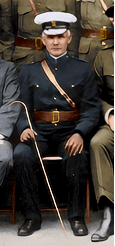
Henry Earnest Erridge

Serving the nation for 44 years, Henry Erridge served at Gallipoli before being invalided back to New Zealand. Continuing to serve throughout the interbellum, Erridge assisted in shaping the New Zealand Army Ordnance Corps for the Second World War. During the war, Erridge played a significant role in providing New Zealand’s contribution to the collective logistics efforts of the British Commonwealth

Henry Earnest Erridge was born in Dunedin on 18 December 1887 to Henry and Jane Erridge. The fifth of seven children, Henry was educated in Dunedin and received commercial training. A keen military volunteer Erridge had joined the Dunedin Engineer Volunteers as a Cadet in 1904, transferring into the Otago Hussars in 1909, gaining Non-Commissioned Officer (NCO) Rank.   On 6 April 1914, Erridge joined the New Zealand Permanent Staff (NZPS) with the rank of Staff Sergeant Instructor as the Orderly Room and Quartermaster (QM), No 15 Area Group, Oamaru.[1]

On the outbreak of war in August 1915, Erridge was seconded for duty with the NZEF and left New Zealand with the Main Body, Otago Infantry Battalion. As a Signals Sergeant in the Otago’s, Erridge saw service during the Turkish attack on the Suez Canal in February 1915 and later took part in the landings at Gallipoli. Stuck down with enteric fever, Erridge was evacuated from Gallipoli to Alexandria in June and, in August, invalided back to New Zealand for further convalescence.

Returning to duty as a Warrant Officer in the QM Department at Featherston Camp on 10 January 1916, Erridge was appointed Stores Forman responsible for managing the QM Stores accounts for Featherston and its subsidiary camps. Reclassified as Class “A” fit for overseas service on 5 July 1918, it was intended to attach Erridge to a reinforcement draft and returned to the front. Deemed as essential, the Director of Equipment and Ordnance (DEOS) Stores appealed to the Chief of the General Staff, stating that

The accounts of the Camp Quartermaster, Featherston Camp, have not been completed and balanced. The principle causes for this state of affairs are:


(1) The inferior class of clerks posted for Home Service duties.
(2) And ever-changing staff, thus throwing the bulk of work on SSM Erridge, who has been employed in the capacity of foreman.

It is essential that SSM Erridge be retained until 1 November at least

Director of Equipment and Ordnance Stores to Chief of the General Staff. 14 August 1918

The DEOS appeal was successful, and Erridge was granted authority to delay his placement into a reinforcement draft until November on the proviso that every endeavour was to be made to have all accounts in connection with the QM Branch Featherston and subsidiary camps completed to the satisfaction of the proper authority. Following the Armistice of 11 November 1918, Erridge’s employment was reassessed, and he was provided orders to remain with the QM Department at Featherston. Seconded to the Ordnance Stores in Wellington in June 1919, Erridge was permanently transferred into the New Zealand Army Ordnance Corps (NZAOC) with Conductor rank on 1 October 1919.

Recommended for the Supplies and Purchasing Officer position with the civil administration in Samoa, Erridge was accepted for service with the Samoan Administration for three years from 24 May 1920. Due to a misunderstanding of the secondment rules, Erridge was discharged from the New Zealand Military. However, this was reviewed, and the discharge was rescinded, allowing Erridge to retain his rank and seniority on his return to New Zealand.

`Administration Headquarters. “Apia”‘. Moore, Robert Percy, 1881-1948 :Panoramic photographs of New Zealand. Ref: Pan-0422-F. Alexander Turnbull Library, Wellington, New Zealand. /records/32050069

Completing his service in Samoa in August 1923, Erridge returned to New Zealand and, following three months leave, resumed duty with the NZAOC, where he was posted to the Main Ordnance Depot (MOD) and placed in charge of the Stores on 1 December 1923. In an example of his experience and utility, Erridge temporarily relieved Captain F.E Ford, the Ordnance Officer of Featherston Camp, from 4-31 Jan 1924.

During the 1920s, the Quartermaster General (QMG) vested command of the NZAOC to the Director of Ordnance Service (DOS). Assisted by the Chief Ordnance Officer (COO), the Inspecting Ordnance Officer (IOO), and the Ordnance Mechanical Engineer (OME), the DOS was responsible for:[2]

  • The provision, receipt, storage, distribution, repair, examination, and maintenance of small-arms, machine guns, vehicles, clothing and necessaries, equipment and general stores (including medical and veterinary), and camp and barrack equipment,
  • The inspection and repair of armament and warlike stores, and the inspection of gun ammunition.
  • The provision, receipt, storage, and distribution of small arms ammunition.
  • The receipt, storage, issue, and repair of fixed armament, field armament, and artillery vehicles.
  • The organisation and control of ordnance workshops
  • The preparation and periodic revision of Equipment Regulations and barrack and hospital schedules
  • The organisation, administration, and training of the NZ Army Ordnance Corps Forces
  • The maintenance of statistics of the Ordnance Department.

The DOS was also the Commanding Officer (CO) of the NZAOC and was responsible for the interior economy, including enlistment, training, pay, promotion, postings transfers, clothing, equipment, and discharges within the unit.

In 1924, the incumbent DOS, Lt Col Pilkington, was appointed QMG in Army Headquarters. Major T.J King, then acting COO, was appointed DOS, with Major William Ivory as the IOO and OME.  By 1925, King recognised that he could not provide complete justice to the DOS and COO posts. Still, with no Ordnance Officers immediately available to fill the COO position, he recommended that the QMG give some relief by granting Erridge an officer’s commission. In his recommendation to the QMG, King noted that

Conductor Erridge is a man of wide experience in Ordnance duties and stores works generally and is eminently fitted for appointment as Ordnance Officer with the rank of lieutenant. He is a man of unblemished character, with a very high regard for the interests of the Corps and the services, and in the last few months gained sufficient insight into the duties I propose transferring him to.

Director of Ordnance Stores to Quartermaster General 11 December 1925

The QMG supported King’s recommendation on the proviso that Erridge pass all the required commissioning examinations. After passing the examinations, Erridge was commissioned as a lieutenant in the NZAOC on 23 July 1926.[3] However, the question arose of where to place Erridge on the Army List. Technically, the COO appointment was still vacant, with Erridge, for all intents, acting as King’s assistant and only performing part of the COO duties, with the work of the COO divided between King and Erridge. It was not desired that an Assistant COO be added to the establishment, so it was decided to show Erridge as Ordnance Officer (Provision). After several years as the Ordnance Officer (Provision), Erridge was appointed to the dual roles of Ordnance Officer MOD and Ordnance Officer Central Military District (CMD) on 14 May 1929.[4]

In December 1930, the incumbent Ordnance Officer Southern Military District (SMD)and Camp Commandant of Burnham Camp, Captain A.R.C White, faced compulsory retirement. To allow some continuity while White’s replacement was decided, Erridge was temporarily sent to Burnham. Although initially only a temporary posting, Erridge remained at Burnham until 1934 in the dual roles of Ordnance Officer SMD and Officer in Charge Burnham Camp (Camp Commandant).[5]

By 1935 in his role of DOS, King was looking forward and preparing his organisation for war. In a submission to the General Headquarters, King requested authority to reorganise his staff. Regarding Erridge, King started.

Owing to the large amount of new equipment that is on order and is likely to be ordered soon, it is essential that the staff of the Ordnance Depot, Trentham, be strengthened to the extent that I should again have the assistance of my most experienced Ordnance Officer.

There is a great deal of work of a technical nature in connection with mobilisation, rewriting of Regulations, etc., which I am unable to find time to carry out myself, and which Mr Erridge, by virtue of his long experience and training, is well qualified to undertake. This work is most necessary and should be put in hand as soon as possible; I have no other Officer to whom I could delegate it.

Again, King’s recommendations were accepted, and on 30 June 1934, Erridge relinquished his Burnham appointments and was appointed as the Ordnance Officer (Provision) at the MOD, with promotion to Captain following on 1 December 1934.[6]

When the war was declared in September 1939, the NZAOC underwent a significant transformation as its mobilisation plans were implemented. The DOS, Lieutenant Colonel King, was seconded to the 2nd NZEF as the Deputy Director of Ordnance Services (DDOS). Accompanying King was a small staff drawn from the military and civilian staff of the NZAOC who formed the nucleus of the Ordnance Corps in the 2nd NZEF. Kings’ responsibilities of DOS and COO were handed over to the Ordnance Officer CMD, Lt Col Burge.

On 2 December 1939, Erridge relinquished the appointment of Ordnance Officer (Provision), was granted the Rank of temporary Major and posted to Army HQ with substantive Major confirmed in February 1940.[7]  In June 1940, the NZAOC underwent further reorganisation when Lt Col Burge relinquished the appointment of DOS when he was appointed as Deputy QMG in Army HQ with the position of DOS placed into abeyance for the duration of the war. Appointed as Staff Officer Ordnance and CO of the NZAOC, Erridge took over responsibility for the NZAOC.[8]

With the national economy transitioning from peacetime to a war footing, the Government took a series of initiatives to ensure international trade and commerce security.  Representing the New Zealand Military, Erridge accompanied the New Zealand Minister of Supply and a small entourage of officials of the New Zealand Munitions and Supply Delegation on a tour of Australia for a series of talks with their Australian counterparts in July/August 1940.[9]

While the mission of the New Zealand Munitions and Supply Delegation to Australia was focused on strengthening cooperation between New Zealand and Australia, the Eastern Group Conference held in Delhi in October 1940 had the broader goal of organising a joint war supply policy for the countries of the “Eastern Group.” The countries represented at the Eastern Group Conference included the United Kingdom, Australia, India, South Africa, New Zealand, East Africa, Palestine, Ceylon, Burma, Malaya, and Hong Kong, with the Government of the Netherlands East Indies attending as observers.[10]  The New Zealand delegation included.

  • The Chief of the General Staff, Major-General Sir John Duigan,
  • Major H. E. Erridge,
  • Mr F. R. Picot, Director of the Internal Marketing Department,
  • Mr J. R. Middleton, assistant-Secretary of supply,
  • Mr B. Taylor, assistant to the chief investigating officer of the Treasury Department.

As a result of the October conference, the Eastern Group Supply Council (EGSC) was established to coordinate and optimise the production and distribution of war materiel in the British colonies and dominions in the Eastern Hemisphere. The New Zealand members of the council who were to be based in New Delhi were.

  • Mr F.R Picot, Director of Internal Marketing and Food Controller,
  • Mr W.G.M Colquhoun (Munitions Department).
  • Mr R.J Inglis (Supply Department).
  • Mr R.H. Wade (of the Treasury).

A Central Provisions Office (Eastern) was also set up in Delhi, with national offices established in Australia, New Zealand, South Africa, East Africa, Southern Rhodesia and the Middle East.   The Central Provision Office (Eastern) was a military organisation consisting of about 40 to 50 Army officers from all countries constituting the Eastern Group. Headed by the Controller-General of Army Provisions, who was also the military member of the EGSC and acted as the agent of the Imperial General Staff and various Commanders in Chief. The role of the Central Provision Office (Eastern) was coordinating with the controllers of the national provision offices to obtain military stores to maintain the British and Commonwealth war effort.[11] From March 1941, Two NZAOC Officers, Temporary Major D. L. Lewis and Lieutenant D.I Strickland were attached to the Central Provision Office (Eastern) staff in New Delhi.[12]

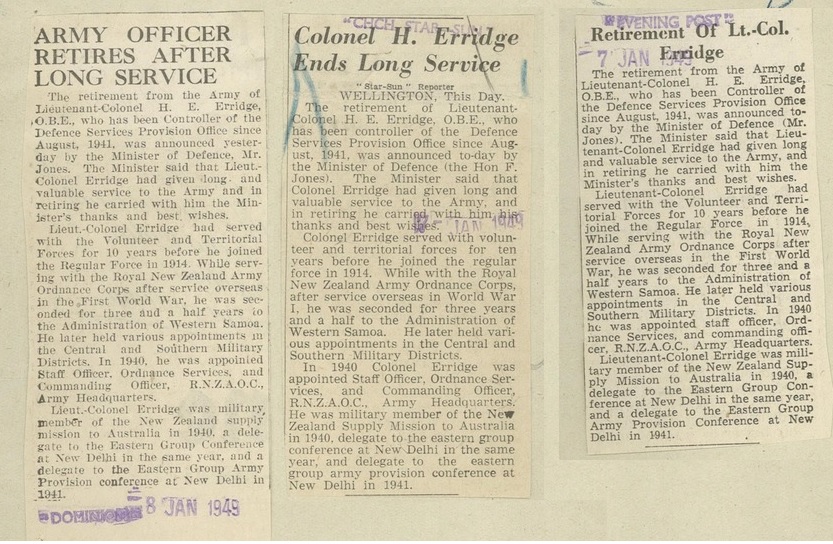
Before the Central Provision Office (Eastern) assumed complete provision control, it was necessary for all the controllers of the national provision offices to meet to ensure that uniform procedures were adopted. A coordination conference for the various Provision Group Controllers was held at New Delhi in July 1941, with Erridge attending as New Zealand’s military representative. Based on this conference, on 5 August 1941, the New Zealand War Cabinet approved the establishment of the New Zealand Defence Servicers Provision Officer (DSPO), with Erridge appointed as its Controller with the rank of Temporary Lieutenant Colonel. Relinquishing the appointment of Staff Officer Ordnance and handing over the Commanding Officer NZAOC duties to Major E.L.G Bown, the COO MOD.[13]

By  April 1945, the DSPO thought Central Provision Group (Eastern) had shipped for the British Ministry of Supply equipment to the value of £10,000,000 (2021 NZD $8,988,577,362.41) with additional equipment to the value of  £8,520,761 (2021 NZD $765,895,194.35) that was surplus to the requirements of NZ Forces overseas transferred to the War office.[14]  During a visit to New Zealand in January 1946, Major-General R.P Pakenham-Walsh, CB, MC., a member of the Eastern Group Supply Council and the Central Provision Office(Eastern), stated that “Stores from New Zealand which had been made available to the Eastern Group Supply Council had been of great importance in the prosecution of the war” adding that “the Dominion’s contribution had compared more than favourably with that of various larger countries.”[15]  Following the surrender of Germany in April and Japan’s defeat in August 1945, the Eastern Group Supply Council and Central Provision Office, although serving their purpose well, had become irrelevant and were dissolved on 31 March 1946.[16]  However, it took two years for the DSPO to transition to a peacetime footing. Seconded to the War Asset Realisation Board (WARB) on 1 May 1947, Erridge started to wind down the work of the DSPO while also coordinating the disposal of equipment through the WARB. On 17 December 1948, Erridge handed over the remaining stocks to the WARB and closed the DSPO.

At 62 years of age and following 45 years of volunteer, Territorial and Regular service, Erridge retired from the New Zealand Army and was placed onto the Retired List with the rank of Lieutenant Colonel on 29 May 1949.[17] Never marrying, Erridge spent his retirement in his hometown of Dunedin. On 30 March 1962, a resident of the Dunedin’s Ross Home, Erridge, passed away at 74. Following his wishes, he was cremated, and his ashes scattered.

Throughout his service, Erridge was awarded the following decorations

  • OBE (1946)
  • NZ Long Service and Efficient Service (1925)
  • 1914-15 Star
  • British War Medal
  • Victory Medal
  • War Medal 1939-45
  • NZ War Medal, 193-45

Notes

[1] Archives New Zealand, “Henry Earnest Erridge- Ww1 8/1004, NZAOC 888, Ww2 800245, 30293,” Personal File, Record no R24097640 (1904-1948): 2708.

[2] “Regulations for the Military Forces of the Dominion of New Zealand,” New Zealand Gazette, May 19, 1927.

[3] “Appointments, Promotions, Resignations and Transfers of Officers of the NZ Military Forces,” New Zealand Gazette No 61, 19 July 1926.

[4] “Appointments, Promotions, Resignations and Transfer of Officers of the New Zealand Military Forces,” New Zealand Gazette No 48, 27 June 1929.

[5] “Appointments, Promotions, Transfers and Retirements of Officers of the NZ Forces “, New Zealand Gazette No 16, 5 March 1931.

[6] “Appointments, Promotions, Transfers and Retirements of Officers of the NZ Forces “, New Zealand Gazette No 55, 19 July 1934.;”Appointment, Promotions, Transfers and Retirements of Officers from the NZ Forces,” New Zealand Gazette No 87, 29 November 1935.

[7] “Appointments, Promotions, Transfers and Retirements of Officers of the NZ Forces “, New Zealand Gazette No 1, 11 Jan 1940.;”Appointments, Promotions, Transfers and Retirements of Officers of the NZ Forces “, New Zealand Gazette No 75 (1940).

[8] “Appointments, Promotions, Transfers and Retirements of Officers of the NZ Forces “, New Zealand Gazette No 70 (1940).

[9] “Unity in War Effort,” Evening Star, Issue 23622, 8 July 1940.

[10] East Africa consisting of the territories of (Kenya, Uganda, Tanganyika, Zanzibar, Northern and Southern Rhodesia, Nyasaland; Bertram Stevens, “The Eastern Group Supply Council,” The Australian Quarterly 13, no. 3 (1941).

[11] “Eastern Group Supply Council,” Otago Daily Times, Issue 24640, 23 June 1941.

[12] “Appointments, Promotions, Transfers, and Retirements of Officers of the New Zealand Military Forces.,” New Zealand Gazette, No 30, 9 April 1941.

[13] “Appointments, Promotions, Transfers, and Retirements of Officers of the New Zealand Military Forces.,” New Zealand Gazette, No 74, 11 September 1941.

[14] “War Supplies,” Evening Post, Volume CXXXIX, Issue 126, 30 May 1945.

[15] “Production Problems,” Evening Star, Issue 25690, 14 January 1946.

[16] “Supplies – the Eastern Group Supply Council,” Northern Advocate, 1 April 1946, 1 April 1946.

[17] “Appointments, Promotions, Transfers, and Resignations, of Officers of the New Zealand Army “, New Zealand Gazette No 37, 16 June 1949.


General Godley and New Zealand’s Defence Stores Department

16 October 1914 was a significant day for New Zealand as the main body of the New Zealand Expeditionary Force (NZEF) sailed out of Wellington Harbour, marking the departure of the largest, best-trained and equipped Military Force ever to leave New Zealand shores. Departing in ten troopships, the 8500 men and 5000 horses of the NZEF was the second significant departure of troops from New Zealand as the 1400 strong Samoa Expeditionary Force had departed several weeks earlier on 14 August 1914, only ten days after the declaration of war on 5 August 1914.

The fleet of troopships which transported the Main Body of the NZEF and their escort in Wellington Harbour, 15 October 1914. Image courtesy of Matt Pomeroy.

The mounting of such a force within such timeframes was the culmination of years of planning, implementation and training to provide a structured, equipped and supportable force able to easily integrate into an Imperial army alongside the UK, Australia, Canada and India. While credit for the development of the New Zealand Military in the years leading up to 1914 can be accredited to Major General Godley and his staff of British Army officers seconded to the New Zealand Military Forces. Little study has been dedicated to the logistic organisation responsible for supporting the Force, the Defence Stores Department.  Under the leadership of Major James O’Sullivan, the Defence Stores Department was the organisation working behind the scenes with responsibility for the supply and maintenance of clothing and personal equipment, accoutrements, saddlery, harness, small-arms and small-arms ammunition, machine guns, material, transport, vehicles, camp equipment, and all stores required by New Zealand’s Military Forces.

Major James O’Sullivan,
Director of Equipment and Stores 1900 -1916

However, despite the success in providing the stores and maintenance support required for the 1914 mobilisation, the establishment of reinforcement training camps, and maintenance of the Territorial Army, the Defence Stores Department has remained an anonymous participant in New Zealand’s Military Historical narrative. So why is this so? The historical record does not record any shameful failures necessitating its historical absence. However, correspondence of the era indicates that there might have been a clash of personalities between General Godley and Major O’Sullivan, which has hidden the Defence Stores from view for over a hundred years.

General Sir Alexander Godley. S P Andrew Ltd :Portrait negatives. Ref: 1/1-013997-G. Alexander Turnbull Library, Wellington, New Zealand. /records/22715773

As the NZEF finalised its final preparations before boarding its transport ships, General Godley visited the Defence Stores on 24 September and thanked the Defence Stores Staff for their contribution to mounting the NZEF.[1]

Departing on 16 October, Godley was at sea for ten days before preparing a handwritten note to Colonel James Allen, the New Zealand Minister of Defence. Reacting to what can only be described as gossip, Godley’s note set in motion a series of events that tested the Defence Stores and lead to O’Sullivan’s resignation.[2]

Dear Colonel Allen

Just before I left Wellington and since sailing, I have heard a good deal of talk about the conduct of the Stores at Wellington and criticism of J O’Sullivan. I believe the Mayor and the ladies Committee who provided articles for the men were very disappointed with his method of costing and accounting for what they sent him for the troops.

Campbell (Coast Defence Commander) also spoke to me of irregularities which had come to his notice. I have little doubt in my own mind that O’Sullivan and probably some of his subordinates are, like all Quartermasters and Storekeepers feathering their nests to a certain extent. But against this one has to put the fact that, broadly speaking, the equipping of this Force and of the South African contingents, by O’Sullivan was extremely well done and considering the opportunities he has had, one can only be astonished at his moderation in feathering his nest.

My object in writing now, though is to suggest that it might be worth while to have some sort of special audit of the Stores accounts for the Expeditionary Force, perhaps by the Public Service Commission or somebody of the kind. I mean by this an inspection and stocktaking of the Stores in kind more than cash transactions, as the later are always taken for granted and audited by the Treasury as regards vouchers not the Audit Department. Esson tells me that whenever the question of an Army Audit has been raised, the Audit Department have made difficulties and have suggested that it clashed with their functions, but this is probably a misconception and in any case the Army system has grown so big that some more checks is I am sure required, and the departure of this Force would be a good reason for starting it now.

But, whatever happens, the good work done by O’Sullivan and his Department should not be overlooked, though it is too close a borough, and would now be all the better for shaking up and overhauling with fresh blood.

Yours Sincerely

Alex Godley

In response to Godley’s note, the Public Service Commission convened the Defence Stores Commission, which throughout 1915, examined the Defence Stores in detail, producing a comprehensive report to the Minister of Defence on 31 August 1915.

Forwarded to the Commander of NZ Forces Brigadier General A.W Robin, a reply was furnished on 9 September 1915. Admitting fault where required, Robins reply, however, counted many of the commission’s points and highlighted the success of the Defence Stores and highlighted that the Defence Stores were operating adequately under existing Military Stores and Treasury Regulations. However, O’Sullivan’s reputation had been tarnished.

A letter from Allen to Godley sent on 4 January 1916 summarises the situation [3]

The Stores Department, about which there was an enquiry have come fairly well out of it, but I gather there is a pretty strong feeling that 0’Sullivan, who is on sick leave now should not go back.

Although acquitted of any misconduct, O’Sullivan position had become untenable, and to maintain the smooth functioning of the Defence Stores, Allen outlined changes that had been made to the Defence Stores in a letter to Godley on 13 April 1916,[4]

So far as Defence is concerned, Captain McCristell has been brought in from Featherston and placed in 0’Sullivan’ s position, the latter being made Inspector of 0rdnance Stores.

I should think 0’Sullivan has been more enquired into than any other officer in the Department, but nothing very detrimental has come out about him; however, it seemed to me to be wise, especially in view of the fact that the Supplies Board -which is under the control of the Hon. Mr Myers – was so determined about it, that he should give up his position as head of the Stores Department. I have every confidence that McCristell will do well there.

Replying to Allen on 24 March, Godley was less than supportive of O’Sullivan and made clear his personal feelings. [5]

I am sorry, but not altogether surprised, to hear about 0’Sullivan. I think you know my feeling about him, which is that, considering the class of man he is, and the opportunities he has had, one can only be astonished at his moderation. Ninety nine out of a hundred in his position would have made a large fortune.

A component of the New Zealand Military establishment since the 1860s, the Defence Stores Departments’ tenure as a civilian branch of the Military was numbered. Although nothing detrimental came out of the Public Service Commission’s report, the time was deemed suitable to follow the lead of the Australian and the Canadians and militarise the Defence Stores into an Army Ordnance Corps. Gazetted on 1 February 1917, the New Zealand Army Ordnance Corps assumed the responsibilities of the Defence Stores Department, with McCristell assuming the role as the head of the Ordnance Corps. [6]

O’Sullivan retired from his Inspector of Ordnance Stores position in January 1917 to take up farming in Huntley.

The enquiry of the Defence Stores Department fell flat and found nothing detrimental, and further study will be required to determine why the Defence Stores Department became an anonymous participant in New Zealand’s Military Historical narrative. Is it linked to Goldey’s dislike of O’Sullivan and his belief that Quartermasters and Storekeepers were only interested in “feathering their own nests”, or is it part of the Kiwi Tall Poppy Syndrome where success is looked down on? The mounting of the NZEF was a monumental task, and the Defence Stores Department is well overdue for some recognition for the part that they played.


Notes

[1] “Defence Stores Staff,” Dominion, Volume 7, Issue 2264, , 25 September 1914, https://paperspast.natlib.govt.nz/newspapers/DOM19140925.2.47.

[2] “Correspondence Major General Godley to James Allen 26 October “, R22319698 – Ministerial Files – Correspondence with General Godley  (1914).

[3] “Correspondence James Allen to Major General Godley 4 January,” R22319698 – Ministerial Files – Correspondence with General Godley  (1916).

[4] “Correspondence James Allen to Major General Godley 13 April “, R22319698 – Ministerial Files – Correspondence with General Godley  (1916).

[5] “Correspondence Major General Godley to James Allen 24 March,” R22319699 – Ministerial Files – Correspondence with General Godley  (1916).

[6] “New Zealand Army Ordnance Department and New Zealand Army Ordnance Corps Regulations,” New Zealand Gazette No 95 (Wellington), June 7 1917.


A retrospective view of the Main Ordnance Depot, Trentham

From 1920 to 1996, Trentham Camp in Wellington’s Hutt Valley was home to New Zealand’s Army’s principal Ordnance Depot. During its 76-year tenure as an Ordnance Depot, also every New Zealand Army Ordnance Officer and Soldier, at some stage of their career work at, passed through or had some interaction with the Trentham Ordnance Depot.

Using a 1983 Depot plan as a reference point, this article takes a look back at how the Trentham Ordnance Depot developed from 1920 to 1996.

Depot Plan, 1 Base Supply Battalion. Robert McKie Collection
Entrance to the Ordnance Depot 1998, Upper Hutt City Library (19th Mar 2020). Trentham Camp buildings, unidentified; barrier in fence. In Website Upper Hutt City Library. Retrieved 11th Oct 2020 08:03, from https://uhcl.recollect.co.nz/nodes/view/29474
Building 73. Upper Hutt City Library (19th Mar 2020). Trentham Camp building; multi-bay warehouse. In Website Upper Hutt City Library. Retrieved 11th Oct 2020 08:05, from https://uhcl.recollect.co.nz/nodes/view/29475

1920

In 1920 the NZAOC had its Headquarters and main depot located at Alexandra Barracks at Mount Cook, Wellington. In the regions, Ordnance Stores were maintained at Mount Eden, Palmerston North, Trentham Camp, Featherston Camp, Mount Cook, Christchurch and Dunedin.

As part of the post-war reduction of the Army and the rationalization of the Ordnance Services, the early interwar years were a transition period. In the South Island, the Dunedin and Christchurch Ordnance Stores closed and relocated to Burnham Camp. In the North Island, the Palmerston North Depot closed, and the main depot at Mount Cook relocated to Trentham Camp to establish the Main Ordnance Depot.

The Featherson Camp and Mount Eden Ordnance Stores remained in operation until 1928 when construction of a new Purpose-built Ordnance Depot at Hopuhopu in the Waikato was completed.

With no purpose-built storage accommodation, the NZAOC Main Ordnance Depot at Trentham Camp in the years leading up to the Second World War utilise up to one hundred different existing camp administrative and accommodation structures as its primary means of warehousing.

Upper Hutt City Library (31st Mar 2018). Trentham Camp 1920; aerial view looking east.. In Website Upper Hutt City Library. Retrieved 10th Oct 2020 15:04, from https://uhcl.recollect.co.nz/nodes/view/464

1940

Seen here shortly after its construction in late 1940/early 1941, this warehouse (Building 73) was constructed as part of a wider nationwide program of defence works. With the construction contracts let in 1938 and construction beginning in 1939, Building 73 was constructed using reinforced concrete and designed with nine bays that allowed the loading and unloading of Trains on one side and Motor transport on the other. The design and layout of building 73 were utilised as the model for new warehouses that were later constructed at Burnham and Waiouru.

Upper Hutt City Library (5th Mar 2018). Trentham Camp 1938-1943 (approximate). In Website Upper Hutt City Library. Retrieved 10th Oct 2020 15:28, from https://uhcl.recollect.co.nz/nodes/view/25874

1941

From this November 1941 photo, the full size of Building 73 can be appreciated in comparison to the World War One era buildings in which many of the Main Ordnance Depots Stores had been held during the inter-war years. Under construction is Building 68, which in later years became the Direct Support Section (DSS), Building 87 (Dental Stores) and Building 88 (Detention Block)

Trentham Camp, November 1941. National Archives, AAOD,W3273, Box 19, Record WDO 9811, R18059582

1943

Although Building 73 provided a huge increase in storage capability, wartime demands soon necessitated further increases in storage infrastructure; immediately obvious is Building 74. Building 74 was a near duplicate of building 73, with the main exception that due to wartime constraints, it was constructed out of wood instead of reinforced concrete.

Building 86 has been completed, and connected to it is Building 70, which later become the Textile Repair Shop.

Buildings 64, 65 and 66 have been completed, with Buildings 60 and 61 under construction.

1944

By 1944, despite the wartime expansion of the Main Ordnance Depot, storage requirements still exceeded available storage at the Main Ordnance Depot, with a large number of items held in Sub Depots at Māngere, Linton Camp, Whanganui, Waiouru, Lower Hutt and Wellington.

Twelve additional warehouses can be seen to the East of Buildings 73 and 74, and Building 26 is under construction.

Upper Hutt City Library (14th Feb 2018). Aerial view; Trentham Military Camp 1944.. In Website Upper Hutt City Library. Retrieved 10th Oct 2020 14:56, from https://uhcl.recollect.co.nz/nodes/view/625

1945

These two photos from late 1945 show the extent of the wartime expansion of the Main Ordnance Depot.

The latest additions are Buildings 27,28,29. 30 and 31. These buildings had originally been built for the United States Forces at Waterloo in Lower Hutt by the Public Works Department. Surplus to the United States requirements due to their downsizing in New Zealand, the buildings had been transferred to the NZ Army. The first building was disassembled and re-erected at Trentham by the end of September 1945, with the follow-on buildings re-erected at a rate of one per month, with all construction completed by February 1946

Upper Hutt City Library (27th Feb 2018). Trentham Camp overall view 1945; Carman block, 1945. Panoramic view.. In Website Upper Hutt City Library. Retrieved 10th Oct 2020 14:57, from https://uhcl.recollect.co.nz/nodes/view/565

1966

Twenty Years later, much of the wartime infrastructure constructed for the Main Ordnance Depot and much of the First World War camp accommodation remains in use. During the 1950s, the compound at Dante Road had been developed for the Central Districts Vehicle Depot. When that unit relocated to Linton in 1958, the compound became the Main Ordnance Depot Vehicle Sub-Depot. On the right side of the photo, the large building, the Ordnance Depot, is the General Motors Plant.

1974

By 1974, much of the central infrastructure remains, however, the eleven sheds constructed in 1943/44 have been demolished.

1980

1n 1979 the Main Ordnance Depot was renamed as 1 Base Supply Battalion, RNZOAC. There has been a slight change to the WW2 Infrastructure.

1988

In one of the largest infrastructure investments since 1939 and the first modern warehouse built for the RNZAOC since 1972, a new warehouse was opened in 1988. Designed to accommodate 3700 pallets and replace the existing WW2 Era Storage, the new award-winning warehouse was constructed for $1.6 million. In addition to the high-rise pallet racking for bulk stores, a vertical storage carousel capable of holding 12,000 detail items was installed later.

2020

On 8 December 1996, the RNZAOC was amalgamated into the Royal New Zealand Army Logistic Regiment, ending the Ordnance Corps association with Trentham Camp that had existed since 1920.

Further developments occured in January 1998 when the entire military warehousing and maintenance functions in Trentham camp were commercialised and placed under the control of civilian contractors.


Major Oliver ‘George’ Avis, MM

This article is republished with the permission of the Facebook page “Upper Hutt War Stories“. Upper Hutt War Stories is a Facebook page dedicated to commemorating the war service of Upper Hutt’s citizens and those with strong connections to the City. It remembers those who put their lives on the line for the defence of our Nation.

A small bronze plaque in the St John’s churchyard in Trentham gives only a small hint as to the amazing story behind its epitaph. Two small brass letters were added after the plaque was cast, but sadly one has come loose and been lost. The letters MM denote the award of a military medal for gallantry in the field. But little is shown of the long and dedicated service of its recipient, and his involvement in one of the deadliest battles on the Western Front.

Born in Somerset and raised in Exeter, Devon, England, Oliver Avis had come to New Zealand when he was 20. Throughout his childhood, he was always referred to as George and used this name throughout his life. It wasn’t until he was 39 years’ old that he discovered that his name was officially Oliver. An issue which created some confusion for the Army and those now trying to interpret his service files.

George had been working as a storeman in Taranaki and enlisted into the Army on 16 November 1915. He was initially posted to the 11th Mounted Rifles reinforcements and trained with them for four months, before the New Zealand Expeditionary Force decided to change its force composition before heading to France, and he was transferred to the Infantry.

Departing Wellington on 2 April 1916, George and his reinforcement arrived in Egypt a month later. Then, after only three weeks he departed Alexandria for France with the Main contingent of the New Zealand Division. Completing further training at the New Zealand Depot at Etaples, George was posted to 4th (Otago) Company of the 2nd Otago Infantry Battalion in the frontlines at Armentieres on 7 July 1916.

The Kiwis were engaged in raids and reconnaissance activities across no-man’s land, and suffered casualties from enemy shelling. Conditions were difficult and after only four weeks in the line George was withdrawn to the New Zealand Field Ambulance station with conjunctivitis. He attempted to rejoin his unit, but was evacuated sick to the hospital at Boulogne in mid-August, just as the New Zealand Division was withdrawing from the line in preparation for a major attack.

George’s illness meant he missed the Kiwi’s first major assault on the Western Front at the Somme in mid-September. After recovering and being released from hospital, he was posted back to the New Zealand Depot at Etaples, for further recuperation and training. He finally rejoined the 2nd Otago Battalion on 18 October 1916, just as the heavily depleted New Zealand Division returned to Armentieres for another difficult winter in the frontlines.

The unit was withdrawn to rest and reorganise in March 1917, and in late May George was temporarily appointed as his Company’s Quartermaster Sergeant (QMS). He fulfilled this role during the 2nd Otago Battalion’s attack at Messines on 6 June and against the German positions at Sunken Farm eight days later. Having survived his first major battle, he relinquished the role in July, just before preceding to England on leave.

On return to the Battalion, George helped defend the Warneton sector, and when withdrawn to the Lumbres area for training was inspected on parade by Field Marshal Sir Douglas Haigh, in a ceremony watched by Winston Churchill. Then the New Zealand Division was moved into the Ypres area in preparation for their next major offensive.

After the successful but costly Divisional attack at Gravenstafel Spur towards Passchendaele on 4 October 1917, the 2nd Otago Battalion attacked up the Bellevue Spur eight days later. In what turned out to be the deadliest day of the War for the Kiwis, George was caught with many others in a murderous wall of defensive machinegun fire.

Shot through the right side of his back, he was carried to the rear through a sea of mud which now defined no-man’s land. Lucky to make it to the New Zealand Field Ambulance station, George was evacuated to No. 46 Casualty Clearing Station, before being transferred to No. 5 General Hospital at Rouen. In a serious state he was sent back to England and admitted to the Royal Victoria Hospital at Netley, near Southampton.

As George’s condition improved, he was transferred to the New Zealand General Hospital at Brockenhurst, and then to the New Zealand Convalesce Hospital at Hornchurch. After a long period in Codford and Sling Camps, he finally returned to France in mid-May 1918. The New Zealand Division had amassed a large number of reinforcements by this stage of the War, and George spent two months in an Entrenching Battalion before finally rejoining 4th Company, 2nd Otago Battalion in late July 1918.

Promoted to Lance Corporal, he was immediately thrown into the Battle for Bapaume and what would turn out to be the decisive last 100 days of the War. During an attack near the Forest of Mormal just south of Le Quesnoy on 5 November 1918, George was acting as a Company runner, carrying messages from the front lines back to Battalion Headquarters. He made several trips through heavy enemy machinegun and artillery fire and was commended for his coolness under fire.

A month later, George was notified he would be decorated with the Military Medal in recognition of his gallantry and devotion to duty, although the award wasn’t officially gazetted until after his return to New Zealand in mid-1919. By this time, he had already made the decision to try and stay in the Army. George volunteered for the temporary section of the New Zealand Army Ordnance Corps and was attested as a Private on 26 May 1919.

Promoted to Lance Corporal and posted to Trentham Camp in April 1921, George married Catherine Reid 18 months later. They settled into a house at Heretaunga and welcomed a son in September 1923. George transferred to the permanent section of the New Zealand Army Ordnance Corps in 1924 and rose quickly through the ranks, being promoted to Corporal two years later, and Sergeant two years after that.

Unfortunately, the military downsizing which accompanied the great depression saw him lose his uniformed role in January 1931. He volunteered to stay on as a civilian staff member at lower pay, and remained in that role performing critical work in the main supply depot at Trentham Camp up until New Zealand entered the Second World War.

Due to the need to rapidly expand the New Zealand Army, George was recalled to the military in December 1939 and commissioned as a Lieutenant in the New Zealand Temporary Staff. Made a temporary Captain he was appointed as the Ordnance officer in charge of Clothing in the Main Depot at Trentham. He was responsible for the management of all Army clothing and lead the transition from First World War era service dress to the new battledress uniform early in the War.

After recovering from an operation for acute appendicitis, George was promoted to temporary Major in February 1942. But the demands of his job began to take a significant toll. After 5 years’ service he was worn out and suffering ill health. At his own request he transferred to the Reserve of Officers in October 1944, and in recognition of the excellent service he had provided so far during the War was awarded another role in the Public Service.

On reaching the age of 67 in July 1955, George was posted to the retired list in the rank of Major. He passed away in Upper Hutt in November 1964 and his ashes were interned at the cemetery of St John’s Church Trentham, where his wife joined him eleven years later. His memorial plaque gives little indication of his incredible military career, gallantry, and total of 28 years’ service to the New Zealand Army. Lest we forget.

Citation for the Military Medal, London Gazette 3 July 1919.

“Operations: British front in the vicinity of the Foret de Mormal – 5th November 1918. For conspicuous gallantry and devotion to duty. During the above operations, Lance Corporal Avis, who is a runner, was engaged in carrying reports and messages between forward Companies and Battalion Headquarters. He made several trips and although the enemy machine gun and artillery fire was most intense, he delivered his reports and messages expeditiously. Throughout he showed great gallantry and continuous devotion to duty.

”References:

https://www.aucklandmuseum.com/…/online…/record/C66901
http://nzetc.victoria.ac.nz/tm/scholarly/name-418731.html


Warrant Officer Class One Douglas Keep Wilson

This article is republished with the permission of the Facebook page “Upper Hutt War Stories“. Upper Hutt War Stories is a Facebook page dedicated to commemorating the war service of Upper Hutt’s citizens and those with strong connections to the City. It remembers those who put their lives on the line for the defence of our Nation.

Buried right next to his longtime friend and fellow serviceman on the gentle slope of Wallaceville Cemetery is a soldier with nearly 40 years’ service with the New Zealand Army. Doug Wilson and Gordon Bremner served in the same unit and played cricket together for the Central Military Districts team. Like his friend, Doug Wilson’s grave gives no clue as to his time in uniform, his participation in World War Two or his extensive Regular Force service.

A local Wellington Boy, Doug was raised in Upper Hutt, attending the Silverstream and Trentham Schools. His father John was serving as a member of the New Zealand Army Ordnance Corps at Trentham Camp at the time. Unfortunately, the military downsizing which accompanied the great depression saw John Wilson lose his uniformed Army role in 1931. But he was able to stay on as a civilian member of the Civil Service at the camp, until he was reinstated as a soldier again in 1935.

Once Doug finished secondary school at Hutt Valley High, he managed to also get a job at the camp with his father, as a civilian storeman in January 1937. After working for a short period in the Main Ordnance Depot he moved into the clerical section, then volunteered to serve part-time as a soldier in the Territorial Force from mid-1938. A Gunner in the Royal New Zealand Artillery, he underwent training with an Anti-Aircraft battery at Fort Dorset as the clouds of another war in Europe began to gather.

As member of the Defence Department, Doug was not immediately called up for service when war broke out in 1939. Largely because he was already busy helping with the massive expansion of the military which occurred at this time. Starting with equipping and supplying the initial echelons of the 2nd New Zealand Expeditionary Force which began departing for Europe from 5 January 1940.

As New Zealand’s contribution to the war increased, Doug was formally drawn into the Army in September 1941 and posted to the New Zealand Temporary Staff. He served there throughout the Second World War, working in the Defence Services Provision Office, part of the Army Headquarters in Wellington. Because his role and expertise were in critical demand in New Zealand, he was never allowed to deploy to an overseas theatre of war.

This decision was lucky for Vera Rasmussen, who Doug met during the War, proposed to in 1944 and married in November 1945. As the Army reduced in size after the conflict, Doug decided to stay on, enlisting into the Regular Force in April 1947, just days before his wife gave birth to the first of their five sons. A storeman clerk in the Royal New Zealand Army Ordnance Corps he returned to Army Headquarters, and began slowly progressing up through the ranks.

By 1952 Doug was a Warrant Officer Class Two, and considered a senior and experienced member of the Ordnance Corps. Although not deploying overseas himself, he was involved in the preparation and sustainment of several operational forces, including those sent to Korea, and later Malaya, Borneo and Vietnam.

A keen sportsman he played in several Army and regional teams, including the Army Cricket team. It was here that he played alongside Gordon Bremner, who had served with Doug’s father and Doug had worked alongside during his early days at Trentham. Three years later they found themselves working within the same unit, when Doug was posted back to the Main Ordnance Deport at Trentham Camp in November 1955.

Attaining the Army’s most senior enlisted rank of Warrant Officer Class One in 1958, Doug sadly lost his wife Vera four years later, just six months after the birth of their youngest son. Despite the challenges this loss imposed on the young family, Doug was well supported by his Army colleagues and would continue to serve with the Royal New Zealand Army Ordnance Corps until February 1975.

He was awarded the New Zealand Military Long Service and Good Conduct Medal in 1964, which recognised more than 15 years’ unblemished service since gaining the Territorial Efficiency Medal, which he had qualified for at the end of the War. Then in 1969 Doug was singled out for the award of the prestigious and highly regarded Meritorious Service Medal (MSM).

An exceptionally scarce award for those with more than 21 years regular service, the MSM could be held by no more than 20 serving members of the New Zealand Army at any one time. It was generally reserved as special medallic recognition for the longest serving and most prominent Warrant Officers of the Service. With a total of 37 years uniformed service to the nation (38 years with the New Zealand Army if his time as a civilian storeman at Trentham is also included) Doug was certainly considered a worthy recipient.

Remaining in Upper Hutt after retiring from the military, Doug sadly passed away in 2012. His family laid him to rest in Wallaceville Cemetery with his wife Vera, and close to his old colleague and cricket team mate Gordon Bremner. The plain headstones giving no indication of the amazing stories of dedication and extended service to our nation of these two old soldiers. Lest we forget.

For the story of Gordon Bremner see: https://www.facebook.com/permalink.php?story_fbid=161882235428299&id=108826077400582

References

https://www.aucklandmuseum.com/war-memorial/online-cenotaph/record/C145653

https://rnzaoc.com/2020/04/19/ordnance-cricket-team-1934-35/

https://rnzaoc.com/2018/10/28/gordon-cummin-bremner/

Howard E. Chamberlain, Service lives remembered: the Meritorious Service Medal in New Zealand and its recipients, 1895-1994, H.E Chamberlain: Wellington, NZ, 1995, p. 512.

https://paperspast.natlib.govt.nz/newspapers/EP19440421.2.106.3 .


RNZAOC 1 June 1949 to 31 March 1950

Key Appointments

Director of Ordnance Services

  • Lieutenant Colonel A.H Andrews, OBE (until 11 November 1949)
  • Lieutenant Colonel F Reid, OBE (From 12 November 1949)

Chief Inspecting Ordnance Officer

  • Major I.S Millar

Senior Inspecting Ordnance Officer

  • Captain J.G.R Morley

IOO Technical Assistant

  • Captain N.C Fisher

Main Ordnance Depot, Officer Commanding

  • Major A.D Leighton

Main Ordnance Depot, Second in Command

  • Captain M.K Keeler

Northern Military District

Deputy Assistant Director of Ordnance Services

District Inspecting Ordnance Officer

  • Captain E.C Green

OC Northern District Ordnance Depot

OC Northern District Ammunition Depot

  • Captain E.C Green

OC Northern District Vehicle Depot

Central Military District

Deputy Assistant Director of Ordnance Services

District Inspecting Ordnance Officer

  • Captain G.H Perry

OC Central District Ordnance Depot

  • Captain Rennision

OC Central District Ammunition Depot

  • Captain Robert Price Kennedy

OC Central District Vehicle Depot

Southern Military District

Deputy Assistant Director of Ordnance Service

District Inspecting Ordnance Officer

  • Captain E Hancock

OC Southern District Ordnance Depot

  • Captain A.A Barwick

OC Southern District Ammunition Depot

  • Captain William Cleaver Ancell

OC Southern District Vehicle Depot

New Zealand Division

Chief of Royal New Zealand Army Ordnance Corps (CRNZAOC)

  • Lieutenant Colonel Donald Edward Harper

2nd Infantry Brigade, Ordnance Field Park Platoon

  • Lieutenant G. W. Clark

3rd Infantry Brigade, Ordnance Field Park Platoon

  • Captain K. S. Brown.[1]

Regrouping the Army

During this period, the peacetime Army undertook a reorganisation so that in the event of war it would be trained and equipped to rapidly and efficiently conduct operations. Based on this principle, units and formations of the Army were structured as follows:

  • Army Troops; including Army Headquarters, Army Schools, and base units.
  • District Troops; including District and Area Headquarters, Coast and Antiaircraft Artillery.
  • NZ Division

In general, Army Troops contained the machinery for the higher command and administration of the New Zealand Army; District Troops the home defence and elementary training element; and the NZ. Division as the mobile striking force for employment within or outside New Zealand as the situation may demand.

Compulsory Military Training

Required to build and sustain the Army’s new structure, Compulsory Military Training (CMT) was the tool utilised to provide a sustainable military force. Instituted under the provisions of the Military Training Act 1949 and supported by a public referendum, CMT was an ambitious scheme designed to turn individual recruits into capable soldiers. CMT obliged eighteen-year-old males to undertake fourteen weeks of Initial training followed by a three-year commitment to serve in the Territorial Army with a six-year reserve commitment. The CMT experience began with fourteen weeks of recruit training conducted at Papakura, Waiouru, Linton and Burnham after which recruits would spend three years posted to a Territorial unit. Unlike previous peacetime compulsory military training schemes that have been a feature of New Zealand life since 1909, the 1949 system would include Ordnance units sustained by regular intakes of recruits.[2]

Senior Ammunition Officers Conference

Over the period 21-24 June, the Director of Ordnance Services held the first conference of RNZAOC Senior Ammunition Officers.[3]

Attending the Conference were;

  • Lieutenant Colonel A.H Andrews, DOS
  • Major F Reid, DADOS (1)
  • Major I.S Miller, CIOO
  • Captain J.G.R Morley, SIOO
  • Captain N.C Fisher, Tech Assistant
  • Captain E.C Green, DIOO Northern Military District
  • Captain G.H Perry, DIOO Central Military District
  • Captain R. P Kennedy, OC Central District Ammunition Depot
  • Captain E Hancock, DIOO Southern Military District
  • Captain W Ancell, OC Southern District Ammunition Depot
  • Major M.J Leighton, OC Main Ordnance Depot
  • Captain M.J Keeler, Main Ordnance Depot
  • Captain W Langevad RNZA, OC Army Ammunition Stores Depot

Item discussed at the conference included;

  • The Ammunition Organisation in New Zealand, including;
    • Shortages of Staff
    • DIOO Office and Staff
    • Depot IOO’s
    • Accounting
    • Provision of Staff
    • Control of Ammunition personnel
    • Regimental Duties
    • Promotion – Other Ranks
    • Issues between Depots
    • General turnout of Staff at Depots
  • Demonstration of the Cordite Heat Test
  • Responsibilities, including
    • CIOO
    • SIOO
    • Army Ammunition Stores Depot
    • Inspection and Proof Section
    • District IOO’s
    • District Ammunition Repair Depots
    • Depot IOO’s
    • OC Ammunition Depots
  • Reports and Returns
  • General Ammunition Subjects, including
    • Advance information regarding dumping
    • Ammunition courses and refresher training
    • Verbal Instructions
    • Conveyance of Government Explosives by road
    • Explosive Limits NMD
    • Magazine Regulations
    • Ammunition Storage in Fiji
  • Policy, including
    • Increase of new Establishments
    • Trentham and Linton Magazines
    • Training of unit representatives
  • Visit to Army HQ Ammunition Accounts Section

Ordnance Conference

The Director of Ordnance Services hosted a conference of the Districts DADOS and the Officer Commanding Main Ordnance Depot(MOD) at Army Headquarters over the period 8-10 March 1950.[4]

Items discussed at the conference included;

  • Distribution of equipment for CMT between Districts and from the MOD to Districts,
  • Ordnance staff establishments,
  • Issue of Ammunition and explosives for CMY including priority of repair and alternatives,
  • Army estimates in relation to Ordnance
  • Submission of District concerns
  • Ammunition for Defence Rifle Clubs

Ordnance activities over the period

Over the period the RNZAOC conducted the following activities[5]

  • A large quantity of general and technical stores, weapons, ammunition and many Vehicles were overhauled, inspected, repaired where necessary, and distributed from the main depots to camps and smaller depots. Careful organisation and selection of priorities contributed to a substantial overtaking of the arrears of work which had accumulated as a result of the post-war reduction in staff.
  • The RNZAF stores depot at Mangaroa was taken over by the Army, and the extra storage space provided enabled much equipment to be moved out of the Government storage area at Seaview, where 95,000 square feet (8825 square meters) was made available to other Government Departments.
  • The Inspecting Ordnance Officers Group concentrated on the preparation of ammunition and explosives required for Territorial recruit training. In addition, the disposal of unserviceable stores by burning or detonation continued when personnel were available for this task. The service proof of all small-arms ammunition stocks had been under effective action for nine months at the Proof Office, Mount Eden. This revealed a general decline in the condition of stocks. The annual inspection and proof of ammunition were undertaken, being the basis of all operations of the Group.
  • Disposal of surplus assets (general stores) continued. A total of seventy-eight vehicles were disposed of during the period under review.
  • The general maintenance and preservation of ordnance equipment had been curtailed to some extent by staff shortage, but it was anticipated that these arrears would be overtaken soon.

New Years and Birthday Honours List

His Excellency the Governor-General announced that the King was graciously pleased, on the occasion of the New Year and Birthday, to confer the following Honours on the following members of the RNZAOC: -Military Division:

Member of the Most Excellent Order of the British Empire (MBE)

  • Warrant Officer Class One William Sampson Valentine, RNZAOC, of Christchurch.[6]

WO1 Valentine originally listed in 1915 and saw active service in Egypt, Gallipoli and France. After serving as a POW Repatriation Guard in 1919, Valentine enlisted into the Temporary Branch of the NZAOC at Featherston Camp. Transferring into the Permanent Staff of the NZAOC in 1924 and transferred to Burnham Camp. WO1 Valentine was transferred into the Civil Staff in 1931, remaining employed by the NZAOC at Burnham. Recalled to the colours in 1942, Valentine enlisted in the New Zealand Temporary Staff, remaining with the NZAOC at No 3 Ordnance Sub Depot, Burnham Camp. Transferred into the RNZAOC in 1947, WO1 Valentine was re-engaged into the NZ Regular Force in 1950. Retiring in 1954, WO1 Valentine Passed away in 1959.[7]

  • Warrant Officer Class I Edward Coleman, RNZAOC.

Transfer of IOO personnel

As a result of the raising of a new establishment for the IOO Group and the recommendations of the Senior Ammunition Conference held in June 1949 , the system of having all members of the IOO Group on the strength of Army Headquarters was changes so that were posed to the unite in which they were employed in. Accordingly, with effect 10 October 1949 the following appointments were made;

Northern Military District

  • Captain K.C Green, Struck of Strength of Army HQ to HQ Northern Military District as District IOO located at the District HQ
  • Captain C.C Pipson, Struck of Strength of Army HQ to Northern District Ammunition Depot as Depot IOO
  • Lieutenant C.L Sanderson, Remained on Strength of IOO Group Army HQ as IOO in Charge Inspection and Proof Section, NMD, Located at Hopuhopu
  • Warrant Officer Class One F.W Chambers, struck off strength Army HQ, take on strength of Northern District Ammunition Depot as Ammunition Examiner.
  • Sergeant E.C Sherman, struck off strength Army HQ, take on strength of Northern District Ammunition Depot as Ammunition Examiner.
  • Lance Corporal M.J Corcoran, struck off strength Army HQ, take on strength of Northern District Ammunition Depot as Ammunition Examiner.
  • Staff Sergeant W.H Kerr, struck off strength Army HQ, take on strength of Northern Military District Ammunition Repair Depot.
  • Sergeant E.A Clarke, struck off strength Army HQ, take on strength of Northern Military District Ammunition Repair Depot.
  • Corporal W.E Stevenson, Struck off strength Army HQ, take on strength of Northern Military District Ammunition Repair Depot.
  • Private J.R Roche, Struck off strength Army HQ, take on strength of Northen Milirary District Ammunition Repair Depot.

Central Military District

  • Captain E.D Gerard. Struck of Strength of Army HQ to HQ Central Military District as District IOO located at the District HQ
  • Captian E.T Marriot, Struck of Strength of Army HQ to Central District Ammunition Depot as Depot IOO
  • Staff Sergeant C.S Crichton, , Struck off strength Army HQ, take on strength of Central District Ammunition Depot as Ammuniton Examiner.
  • Sergant J.D Smith, Struck off strength Army HQ, take on strength of Central District Ammunition Depot as Ammuniton Examiner.
  • Sergeant K.W Kibblewhite, Struck off strength Army HQ, take on strength of Central District Ammunition Depot as Ammuniton Examiner.
  • Sergeant W Foster, Struck off strength Army HQ, take on strength of Central District Ammunition Depot as Ammuniton Examiner.
  • Corporal W.E Beasley, Struck off strength Army HQ, take on strength of Central District Ammunition Depot as Ammuniton Examiner.
  • Warrant Officer Class Two E.C.L McvKay, Struck off strength Army HQ, take on strength of Central Military District Ammunition Repair Depot,m Belmont as Laboratory Foreman.
  • Sergeant A.N.J Swain, struck off strength Army HQ, take on strength of Central Military District Ammunition Repair Depot as Ammunition Examiner.
  • Corporal J.J Hawkins, struck off strength Army HQ, take on strength of Central Military District Ammunition Repair Depot as Ammunition Examiner.
  • Corporal W.B DFoughe, struck off strength Army HQ, take on strength of Central Military District Ammunition Repair Depot as Ammunition Examiner.

Southern Military District

  • Captain E, R Hancock, Struck of Strength of Army HQ to HQ Sothern Military District as District IOO located at the District HQ
  • Captain F.J Mitchell, Captain E.T Marriot, Struck of Strength of Army HQ to Southern District Ammunition Depot as Depot IOO
  • Staff Sergeant J Leslie, struck off strength Army HQ, take on strength of Southern District Ammunition Depot as Ammunition Examiner.
  • Warrant Officer Class Two C.W Ludman, Taken in strength of Southern Ammunition Repair Depot as Laboratory Forman.
  • Sergeant G.A Bailey, struck off strength Army HQ, take on strength of Southern Military District Ammunition Repair Depot, Burnham as Ammunition Examiner.
  • Private E.A Burt, struck off strength Army HQ, take on strength of Southern Military District Ammunition Repair Depot, Burnham as Ammunition Handler.
  • Private I.E Maxwell, struck off strength Army HQ, take on strength of Southern Military District Ammunition Repair Depot, Burnham as Ammunition Handler.

Main Ordnance Depot

  • Captain L.C Williams,  Technical Assistant, AID, Remained on Strength IOO Group Army HQ, Local Admin by MOD.
  • Captain W Langevad RNZA, OC Army Ammunition Stores Depot, Remained on Strength IOO Group Army HQ, Local Admin by MOD.
  • Corporal R.C Fisher, Technical Assistant, AID, Remained on Strength IOO Group Army HQ, Local Admin by MOD.
  • Private F.W Harris NZ WAC, Technical Assistant, AID, Remained on Strength IOO Group Army HQ, Local Admin by MOD.

Re-Engagements into the New Zealand Regular Force

With effect 1 April 1950 the undermentioned members of the RNZAOC were re-engaged into the NZ Regular for a period of one year;

  • 31976    Cpl (T Sgt) G.H Bailey
  • 31964    LCpl E.A Burt
  • 31236    WO1 E.C Forgie
  • 31881    Cpl A.J Grimwood
  • 31240    WO2 (T/WO1) C.W Hall
  • 31878    Pte C.W Hindle
  • 31878    SSgt J Leslie
  • SSgt       G.J Martin
  • 31870    Cpl R. O’Keefe
  • 31241    WO2 J.L Peterson
  • 31865    LCpl CE Peach
  • 31864    Sgt S.F Pyne
  • 31247    SSgt I.F Roberts
  • 32470    Cpl E.H Regnault
  • 31233    W.S Valentine
  • 31642    W.M Wilkinson
  • 31859    E.J Wilson

Notes

[1] “Appointments, Promotions, Transfers, and Resignations, of Officers of the New Zealand Army “, New Zealand Gazette No 35, 9 June 1949, 1326.

[2] “H-19 Military Forces of New Zealand Annual Report of the General Officer Commanding, for Period 1 June 1949 to 31 March 1950 “, Appendix to the Journals of the House of Representatives  (1950).

[3] “Establishments – Ordnance Corps “, Archives New Zealand No R22441743  (1937 – 1946).

[4] Conferences – Ordnance Officers, Item Id R17188101 (Wellington: Archives New Zealand, 1950).

[5] “H-19 Military Forces of New Zealand Annual Report of the General Officer Commanding, for Period 1 June 1949 to 31 March 1950 “.

[6] “New Year Honours List “, New Zealand Gazette No 2, 12 January 1950.

[7] “William Sampson Valentine,” Personal File, Archives New Zealand 1915-1954.


Sport and the NZAOC in the Interbellum

The Military of New Zealand has a proud sporting tradition, a tradition often touted as an example of how sport and the Military have had a complementary partnership credited with the shaping of the unique New Zealand Identify. Accounts of the 1919 “New Zealand Services” tour of the United Kingdom, France and South Africa and “Freyberg’s All Blacks” in the wake of World War Two have provided much material for articles, books and documentaries, reinforcing the New Zealand Sporting/Military tradition. However, New Zealand’s Military participation in sport in the period between the world wars is one that has remained mostly unrecorded and unknown. Using the example of the New Zealand Army Ordnance Corps (NZAOC), this essay will examine how the members of the Ordnance Corps participated as administrators and players in sporting competitions during the interwar period of 1918-1939.  This participation, while a general reflection of New Zealand society of the time, was nonetheless significant because it contributed to the Military’s profile in the community and the military preparedness of the NZAOC.

NZ-Army-team-1919-800

Sport has been a constant companion to New Zealand’s Military endeavours. New Zealand service members are well known for taking any opportunity to put their military duties aside and, with the full encouragement of the military hierarchy, participate in sporting competitions. Sporting participation in the Military is encouraged because it is not only an easy and practical way of encouraging physical fitness but, as stated in the New Zealand Army Publication the NZP20 Sport, useful for promoting “the development of unit morale and esprit de corps, the development of leadership, teamwork, skills, dexterity, comradeship, development of personal qualities and character and the enhancement of the image of the Army in the community.”[1] Although the NZ P20 is the latest interpretation of the role of sport, it is an interpretation that has remained constant throughout all of New Zealand Military endeavours.[2] New Zealand’s final campaign of the First World War was not a military campaign but rather a nineteen-match, six-month tour of France, the United Kingdom and South Africa. The N.Z. Services team chosen from the cream of the NZEF were retrospectively considered in 1928 by Percy Day, the manager of the 1919 South African Services side “superior to the best XV the 1928 All Blacks could field. Being ex-soldiers, their teamwork and team spirit were alike admirable, and they blended into a most workmanlike side.”[3] Additional validation of the relationship between sport and military service came in 1920 as France began to rebuild their Military. Based on observations by the French of the fighting quality of British Imperial troops, the French War Minister instructed that the development of sport participation throughout the French Army be made compulsory in every regiment. The radical change was partly made by the French wish to emulate the “fine physique and fighting qualities of the Australians, New Zealanders, South Africans and Canadians, who are the greatest exponents of football, cricket and general sport in the world”.[4]

In the wake of the First World War, sport underwent a popular resurgence in New Zealand. The nation was determined to move forward to put the losses of the war behind them, and “people were determined to enjoy themselves and to forget, or pretend to forget” the traumatic events to the previous four years.[5] Sport as a national institution had already been well established in the years leading up to the First World War and considered by some in New Zealand society as “a moral and physical training ground for young men and therefore a vital component of soldier-making”. However, by 1915 participation began to decline as the war effort began to take priority. The resurgence of sporting competitions began in 1918 and by 1919 was in full swing with Rugby Union, Football, Cricket, Shooting and Bowls competitions flourishing across the nation. However, despite the post-war resurgence of sport as a national pastime, the participation of the Military and the Ordnance Corps is less clear. The focus of most contemporary histories of the New Zealand Army for the period 1918-39 is less on sport but on how, despite the high esteem of the Army, how it faced many challenges and struggled for resources. In a period of growing anti-war sentiments, faith in the League of Nations, financial austerity and global depression, the Army underwent many reorganisations, restructures and reductions so that by 1931 it had been reduced to a strength of around five hundred men.[6] However, despite the financial limitations of the era, the Ordnance Corps, under the leadership of Major Thomas Joseph King, not only conducted its military duties but also was an active participant in the sporting community.

As the Army adjusted and found its place in post-war New Zealand Society, the Ordnance Corps undertook a similar journey. In 1919 the Ordnance Corps was a relatively young military organisation, having only been formed as a component of the New Zealand Permanent Forces in 1917.[7] With its headquarters and main depot at Wellington’s Mount Cook, the Ordnance Corps was a nationwide organisation with sub-depots in Auckland, Palmerston North, Featherston, Trentham, Christchurch and Dunedin and was the defence agency vested with the responsibility for the provision, storage, maintenance and repair of all of the Defence Forces stores and equipment.[8] Reorganising to meet the need of the post-war Army, the Ordnance Corps reduced its presence at Mount Cook when it transferred its warehousing functions to Trentham in 1920, followed by the Ordnance Workshops in 1930. Not immune from the effects of the depression, the Ordnance Corps faced its most significant challenge in January 1931 when massive workforce reductions across the NZ Army saw the Ordnance Corps reduced to a strength of 21 Officers and Soldiers, with seventy-four men transferred to the Civil Staff, and the remainder retired. Few records of the sporting participation of the Ordnance Corps during the interwar period remain, with one of the few pieces of evidence a photo in Joe Bolton’s 1992 History of the Royal New Zealand Army Ordnance Corps. [9] Bolton dedicates eight pages to the interwar period but in tune with other publications covering New Zealand Military history during the same era, makes no mention of the NZAOC’s sporting participation, except for a single photograph of the 1934-35 Ordnance Cricket team at Upper Hutt’s Maidstone Park.[10]  The general theme of published military history works covering the period set the narrative of the interwar period of one of the struggles of the Military with much of the focus on the Territorial Army with little written about the small Permanent Forces, leading to the assumption that the Ordnance Corps as a military entity did not participate in any sporting activities. However, newspaper archives and records held by Archives New Zealand provide ample evidence that the Ordnance Corps was the most prominent component of the Permanent Forces that participated in community-based sporting competitions, with members of the Ordnance Corps acting as either administrators or players.[11] A search of the Papers Past Database using a combination of search criteria show that the Ordnance Corps was an active participant in many sporting activities in two distinct periods during the interwar years. The first recorded period of sporting activity was from 1918 to 1920, with the second period from 1933 to 1939. The absence in the newspaper record between 1920 and 1932 of any Ordnance Corps participation in sporting competitions is unexplained. It could have been that resources and work tempo precluded participation, or it could be due to a quirk of editorial choice and sports were just not covered in detail during that period.

From 1918 to 1920, the Ordnance Corps was active in various team and individual sports, including Rugby Union, Shooting, Cricket and Bowls. The Evening Post of October 14, 1918, provides an account of a Rugby match between Ordnance and Base Records, resulting in an 11 to 3 win for Ordnance. The article describes how the winning tries were scored by Captain King and Private Batchelor, with Quartermaster-Sergeant McIntyre converting one try.[12] During 1919, prominent Wellington Newspapers such as the Evening Post and Dominion provided extensive coverage of most sporting competitions in the Wellington region which the Ordnance Corps provided teams to including the Wellington Miniature Rifle Association Osmond Challenge Cup.[13] The Osmond Challenge Cup was an intense competition between several Military and civilian teams from across the Wellington region. An exciting feature of this tournament was that the competition was mixed gender with a team of ladies competing, several of whom were the wives of some of the senior Ordnance Staff.[14] Cricket was also another popular sport, with the Ordnance Corps contributing a team to the Wellington Cricket Association Junior Men’s competition.[15] Lawn Bowls was also popular with the Ordnance Corps, maintaining a bowling club up to 1918 and participating in competitions and one-off matches. The Ordnance Bowling Club merged into the long-established Johnsonville Club in 1918, raising that club’s membership from Twenty-Four to Forty-Two.[16] Based on the newspaper records, Ordnance Corp’s participation in Wellington’s sporting competitions fell off after 1920. The likely reason for this sudden disengagement could be attributed to the move of the bulk of the Ordnance Corps to Trentham in 1920 and the reduction of Army staffing levels.

Cricket 1919

The second and most crucial period of Ordnance Corps sporting participation began in 1932 when after twelve years at Trentham, the Ordnance Corps Main Ordnance Depot (MOD) entered a team into the Upper Hutt Cricket League competition.[17] The Ordnance Corps provided a single Ordnance team from the 1933/34 season until the end of the 1938/39 season. During the duration of each season, the Evening Post Newspaper provide a summary of each game detailing the results of the matches and the high-scoring players.[18] By following the Newspaper articles, a roster of the teams participating in the competition is identified, with the Ordnance team along with Upper Hutt and Trentham teams identified as one of the anchor teams of the competition. The Newspaper articles also identify twenty of the men who played for the Ordnance team from 1934 to 1939. Having the names allows cross-referencing against other articles and military personnel files, providing further evidence that the Ordnance Cricket team was not only a sports team but an incubator for the future leaders of the Ordnance Corps. A high number of the players served in some capacity in all the different theatres that NZ Ordnance units served in during the war.[19] For example, two of the players’ Alan Andrews and Henry McKenzie Reid, then both junior officers, rose to senior Ordnance command positions during the war. Andrews in the 2nd NZEF in the Middle East and Reid in the Pacific. After the war, both became Directors of Ordnance Services (DOS) and then Colonel Commandants.[20] Other players such as Leighton, Stroud and Keegan were all commissioned during the war and ended up commanding Ordnance Subunits in Trentham, Palmerston North and Linton into the early 1950s. The war ended the Upper Hutt cricket competition with the 1938/39 season, the final season of the decade. Sports flourished in Trentham during the war years, as the camp became a major training camp and logistics centre.[21] However, the Ordnance Corps did not place any terms into the local competition until 1950, when Rugby and Cricket teams representing the MOD once again represented the Ordnance Corps in regional sporting competitions.[22]

ord-cricket-team

One of the most interesting aspects of the Ordnance Cricket team is the use of symbology in the team strip. The existing photograph of the 1934/35 team picture the team dressed in a simple team strip of whites, with each member wearing a blue cheese cutter type hat with a stylised NZAOC Badge.[23] The use of the Ordnance badge is significant as symbols such as a coloured cap and a badge can represent the organisation’s values and distinguish the wearer from others.[24] The 1930s were a period of economic austerity, and the provision of a cap badge stylised badge could have been seen as a frivolous and necessary expense. However, these items existed demonstrate a level of commitment by the individual team members to represent their organisation, in this case, the Trentham Main Ordnance Depot, in the best possible light.

King

Brigadier T J King, CBE, RNZAOC Regimental Colonel 1 Jan 1949 – 31 Mar 1961. RNZAOC School

In addition to the Ordnance Corps personnel participating in sports throughout these two periods, two individuals are prominent in the field of sports administration, Major Thomas Joseph King and William Saul Keegan. As the DOS from 1924, King was the head of the Ordnance Corps until 1939. In addition to his military duties managing the Ordnance Corps, King was also a significant member of the Wellington Rugby Union (WRU) administration. In the lead-up to the Great War, King served in the Territorials while working as a public servant. King had a lifelong passion for sports and was an accomplished swimmer and capable rugby player. Serving in the NZEF, King was one of the first two officers promoted into the newly created NZEF Ordnance Corps. King served at Gallipoli, where he was injured and repatriated back to New Zealand early in 1916. King continued to serve in the Defence Stores in Wellington and was commissioned into the NZAOC on its formation as part of the permanent forces in 1917. He served as the second in command of the Ordnance Corps until 1924; King then assumed the appointment of DOS.  As a member of the Oriental Rugby Club in Wellington, the club elections of 1923 saw King appointed as a Vice President.[25] King was elected to the WRU management committee from 1926 until 1939. King was not only involved in the day-to-day operation of Wellington Rugby; he was also one of the WRU delegates to the New Zealand Rugby Union (NZRU). [26] On one occasion, King’s WRU duties intersected with his military responsibilities when he recruited Alan Andrews into the NZAOC. Studying at Christchurch University, Andrews played rugby for Canterbury and had made the grade for selection as an All Black in 1934. However, as he was at university, Andrews made the difficult decision to forgo rugby and complete his studies. This decision was a lifelong regret. Andrews moved to Wellington to complete the practical work for his degree, and King had organised a placement for Andrews through the WRU on the proviso that Andrews played rugby for the Hutt. Upon completing his degree, King recruited Andrews into the Ordnance Corps and an Ordnance Officer in 1936.[27] King’s decision was a wise choice. Andrews had an eventful career attaining the rank of Brigadier. Andrews’s rugby career-high was being selected by General Freyberg early in the war to manage the 2nd NZEF Rugby Team on the cessation of hostilities, a task he completed with much success, with the Khaki Blacks becoming one of the most famous and successful Rugby teams produced by New Zealand.[28] Wartime service saw King resign from the management committee of the WRU. However, in recognition of his long and dedicated services to Wellington Rugby, King received the honour of life membership of the union in 1939.[29] King’s passion for rugby continued during his service in the 2nd NZEF, where in addition to his duties as the Deputy Director of Ordnance Services (DDOS), King put his skills as a rugby administrator and selector to good use organising fixtures for the various 2nd NZEF teams.[30]

Administering at the club level was William Saul Keegan. Keegan had been a regular Ordnance soldier who was transferred to the civil service in 1931 as part of cost reductions across the Army, continuing to work at the MOD as a civilian throughout the 1930s. In addition to playing cricket for the Ordnance team in the Upper Hutt competition, Keegan was also the President of the Upper Hutt Rugby Club. A legacy of Keegan’s time as club President was the institution of the Wylie-Keegan cup, which remained an annual fixture with Otaki for several years.[31]  A highlight of Keegan’s tenure was that he brought the club out of the financial difficulties into a more stable position.[32] Keegan volunteered for war service, was commissioned as an officer in 1940 and served in Ordnance Command appointments until 1950.[33]

In conclusion, the participation of the Ordnance Corps in sporting competitions during the interwar years has remained anonymous in the historical narrative of the period. However, the Ordnance Corps participation was far from anonymous, with the day’s newspapers providing a record of the Ordnance Corps sporting participation with teams and individuals as players and administrators throughout the interwar period from 1918 to 1939. The single reaming team photograph offers a view of the team strip, demonstrating a level of commitment and pride in the Ordnance Corps and a desire to promote it to the local community. Given the nature of the sports, it is evident that sporting participation was useful in maintaining morale and esprit de corps during some challenging times while enhancing the image of the Ordnance Corps and the Army within the community. Finally, the leadership and teamwork that sport encourages were to provide inherent benefits to the Ordnance Corps in the World War of 1939-45. Many of the men who participated in sports as either administrators or players also held critical leadership positions within the expanded wartime Ordnance organisation.

Bibliography

Primary Sources

“Army Team Enters H.V.C.A.” Upper Hutt Leader, Volume XII, Number 40, 5 October 1950.

“Compulsory Sport.” Wairarapa Daily Times, Volume 46, Issue 14081, 23 March 1920.

“Dinner and Presentation.” Upper Hutt Weekly Review, Volume III, Issue 39, 16 September 1938.

“Hutt Valley Cricket.” Evening Post, Volume CXVIII, Issue 140, , 11 December 1934.

“Johnsonville Club.” Evening Post, Volume XCVI, Issue 9, Page 5, 10 July 1918.

“Junior Competition.” Evening Post, Volume XCVII, Issue 33, 10 February 1919.

“Minature Rifleshooting.” Evening Post, Volume XCVI, Issue 14, 16 July 1918.

New Zealand Army. “Role of Army Sport.” NZ P20 Sport Chapter 1, Section 2 (2000).

“New Zealand Army Ordnance Department and New Zealand Army Ordnance Corps Regulations.” New Zealand Gazette, No 95, June 7 1917, 2292.

“Regulations for the Equipment of the New Zealand Military Forces.” New Zealand Gazette, June 14 1917, 2369-498.

“Regulations for the Military Forces of the Dominion of New Zealand.”. New Zealand Gazette, 25 May 1927, 1555-600.

“Rifle Shooting.” New Zealand Times, Volume XLIV, Issue 10310, Page 8, 19 June 1919.

“Rugby Football.” Evening Post, Volume XCVI, Issue 91, 14 October 1918.

“Rugby, the Oriental Club.” Evening Post, Volume CV, Issue 57, Page 4, 8 March 1923.

“Upper Hutt Club.” Evening Post, Volume CXXIII, Issue 63, Page 5, 16 March 1937.

“War Diary, 2nzef – Ddos [Deputy Director of Ordnance Services], June 1940 to November 1942.” Archives New Zealand Item No R20111233  (1940).

“William Saul Keegan.” Personal File, New Zealand Defence Force Archives, 1918.

Secondary Sources

Bolton, Major J.S. A History of the Royal New Zealand Army Ordnance Corps. Trentham: RNZAOC, 1992.

Cape, Peter. Craftsmen in Uniform: The Corps of Royal New Zealand Electrical and Mechanical Engineers: An Account. Corps of Royal New Zealand Electrical and Mechanical Engineers, 1976. Non-fiction.

Clayton, Garry. The New Zealand Army: A History from the 1840s to the 1990s. [Wellington, N.Z.]: New Zealand Army, 1990, 1990. Non-fiction.

Cooke, Peter. Warrior Craftsmen, Rnzeme 1942-1996. Wellington: Defense of New Zealand Study Group, 2017.

Elliott, Matt. War Blacks. HarperCollins Publishers, 2016. Bibliographies, Non-fiction, Collective biography.

Kelleher, J. A. Upper Hutt: The History. Cape Catley, 1991. Bibliographies, Non-fiction, Government documents.

McGibbon, I. C., and Paul William Goldstone. The Oxford Companion to New Zealand Military History. Auckland; Melbourne; Oxford: Oxford University Press, 2000, 2000. Bibliographies, Non-fiction.

McKie, Robert. “Ordnance Cricket Team 1934/35.”  https://rnzaoc.com/2020/04/19/ordnance-cricket-team-1934-35/.

Ryan, Greg, and Geoff Watson. Sport and the New Zealanders: A History. Auckland University Press, 2018. Bibliographies, Non-fiction.

Swan, Arthur C., and Gordon F. W. Jackson. Wellington’s Rugby History, 1870-1950. Reed, 1952. Non-fiction.

Van Maanen, John Eastin, and Edgar Henry Schein. “Toward a Theory of Organizational Socialization.”  (1977).

Weddell, Howard. Trentham Camp and Upper Hutt’s Untold Military History. Howard Weddell, 2018. Bibliographies, Non-fiction.

Whatman, Mike. Khaki All Blacks: A Tribute to the ‘Kiwis’: The 2nd Nzef Army Rugby Team. Hodder Moa Beckett, 2005. Bibliographies, Non-fiction.

Notes

[1] New Zealand Army, “Role of Army Sport,” NZ P20 Sport Chapter 1, Section 2 (2000).

[2] I. C. McGibbon and Paul William Goldstone, The Oxford Companion to New Zealand Military History (Auckland; Melbourne; Oxford: Oxford University Press, 2000, 2000), Bibliographies, Non-fiction, 506.

[3] Matt Elliott, War Blacks (HarperCollins Publishers, 2016), Bibliographies, Non-fiction, Collective biography, 274.

[4] “Compulsory Sport,” Wairarapa Daily Times, Volume 46, Issue 14081, 23 March 1920.

[5] Greg Ryan and Geoff Watson, Sport and the New Zealanders: A History (Auckland University Press, 2018), Bibliographies, Non-fiction, 151.

[6] Garry Clayton, The New Zealand Army: A History from the 1840’s to the 1990’s ([Wellington, N.Z.]: New Zealand Army, 1990, 1990), Non-fiction, 105-10.

[7] “New Zealand Army Ordnance Department and New Zealand Army Ordnance Corps Regulations,” New Zealand Gazette, No 95, June 7 1917.

[8] Less rations and Fuel “Regulations for the Equipment of the New Zealand Military Forces,” New Zealand Gazette, June 14 1917.

[9] Major J.S Bolton, A History of the Royal New Zealand Army Ordnance Corps (Trentham: RNZAOC, 1992), 80-88.

[10]  Peter Capes, 1976 Craftsmen in Uniform and Peter Cooke’s 2017 Warrior Craftsmen both, cover the NZAOC during the interwar period, but similarly to the contemporary military histories any mention of the Sporting contribution of the NZAOC is absent  Peter Cape, Craftsmen in Uniform: The Corps of Royal New Zealand Electrical and Mechanical Engineers: An Account (Corps of Royal New Zealand Electrical and Mechanical Engineers, 1976), Non-fiction, 16-34.; Peter Cooke, Warrior Craftsmen, Rnzeme 1942-1996 (Wellington: Defense of New Zealand Study Group, 2017), 14-17.

[11] The 1927 Regulation for NZ Military Forces details that the Permanent Forces consisted of the following elements:

  • NZ Staff Corps.
  • NZ Permanent Staff.
  • Royal NZ Artillery.
  • NZ Permanent Air Force.
  • NZ Permanent Army Service Corps.
  • NZ Army Medical Corps.
  • NZ Army Ordnance Corps.
  • NZ Army Pay Corps.
  • General Duty Section of the Permanent Forces.
  • NZ Air Force.
  • NZ Veterinary Corps.
  • NZ Dental Corps.

“Regulations for the Military Forces of the Dominion of New Zealand.,” New Zealand Gazette, 25 May 1927.

[12] “Rugby Football,” Evening Post, Volume XCVI, Issue 91, 14 October 1918.

[13] “Minature Rifleshooting,” Evening Post, Volume XCVI, Issue 14, 16 July 1918.

[14] “Rifle Shooting,” New Zealand Times, Volume XLIV, Issue 10310, Page 8, 19 June 1919.

[15] “Junior Competition,” Evening Post, Volume XCVII, Issue 33, 10 February 1919.

[16] “Johnsonville Club,” Evening Post, Volume XCVI, Issue 9, Page 5, 10 July 1918.

[17] J. A. Kelleher, Upper Hutt : The History (Cape Catley, 1991), Bibliographies, Non-fiction, Government documents, 312-13.

[18] “Hutt Valley Cricket,” Evening Post, Volume CXVIII, Issue 140, , 11 December 1934.

[19] Robert McKie, “Ordnance Cricket Team 1934/35,”  https://rnzaoc.com/2020/04/19/ordnance-cricket-team-1934-35/.

[20] Bolton, A History of the Royal New Zealand Army Ordnance Corps, 35-35.

[21] Howard Weddell, Trentham Camp and Upper Hutt’s Untold Military History (Howard Weddell, 2018), Bibliographies, Non-fiction, 129-67.

[22] “Army Team Enters H.V.C.A,” Upper Hutt Leader, Volume XII, Number 40, 5 October 1950.

[23] The colour of the type is badge is confirmed as an example remains on display in the NZ Army’s Trade Training School at Trentham.

[24] John Eastin Van Maanen and Edgar Henry Schein, “Toward a Theory of Organizational Socialization,”  (1977): 44.

[25] “Rugby, the Oriential Club,” Evening Post, Volume CV, Issue 57, Page 4, 8 March 1923.

[26]. Arthur C. Swan and Gordon F. W. Jackson, Wellington’s Rugby History, 1870-1950 (Reed, 1952), Non-fiction, 187-88.

[27] Bolton, A History of the Royal New Zealand Army Ordnance Corps, 257.

[28] Mike Whatman, Khaki All Blacks : A Tribute to the ‘Kiwis’ : The 2nd Nzef Army Rugby Team (Hodder Moa Beckett, 2005), Bibliographies, Non-fiction, 18-26.

[29] Swan and Jackson, Wellington’s Rugby History, 1870-1950, 126.

[30] “War Diary, 2nzef – Ddos [Deputy Director of Ordnance Services], June 1940 to November 1942,” Archives New Zealand Item No R20111233  (1940).

[31] “Dinner and Presentation,” Upper Hutt Weekly Review, Volume III, Issue 39, 16 September 1938.

[32] “Upper Hutt Club,” Evening Post, Volume CXXIII, Issue 63, Page 5, 16 March 1937.

[33] “William Saul Keegan,” Personal File, New Zealand Defence Force Archives 1918.

Copyright © Robert McKie 2020


Ordnance Cricket Team 1934/35

Sport within the military is promoted as a method of sustaining morale, encouraging fitness and keeping troops occupied and out of trouble. During the 1930s, when the world was in the depths of the great depression, sport became a useful distraction for the staff of the NZAOC Main Ordnance Depot (MOD) at Trentham Camp. Sport also became a useful tool for developing leadership and teamwork and as a way of contributing to the local communities that the MOD belonged to. Using the team photo of the 1934/35 Ordnance Cricket team, this article will examine the NZAOC participation in sport as a community member and look at the stories of the men in the photo.

As the anchor unit at Trentham Camp, the staff of the MOD were active participants in the sporting life of Upper Hutt and the wider Wellington Region. The Director of Ordnance Services (DOS), Major T.J King, a keen sportsman, was highly active in sports administration as a member of the Wellington Rugby Union and New Zealand Rugby Union. Most sporting codes in Upper Hutt had their membership boosted by the staff of the MOD, who individually contributed as players, coaches and administrators.

An example of the MODs participation in Upper Hutt sport is the participation of the Ordnance Cricket Team in the Upper Hutt Cricket Association competition from 1933 to 1939. With the cricket season running from October to April, the Upper Hutt Cricket Association competition consisted of average participation of six teams per season, playing at Maidstone Park on Saturdays and Sundays. The anchor teams that participated throughout the competition were Upper Hutt, Trentham and Ordnance.

Upper Hutt Teams

The onset of war in 1939 led to the end of the Upper Hutt Cricket Association, with many of the participating clubs absorbed into the Hutt Cricket Association, and participation in local sports competitions by the MOD went into abeyance for the duration of the war. The MOD did not provide teams and re-join the local competitions until 1950.

The photo of the 1934/35 Ordnance Cricket team is one of the few remaining relics of that period and provided a snapshot of the Ordnance Team of 1934/35. They are posing before or after a match at Maidstone Park the eleven team members are in their Cricket Whites with blue caps emblazoned with an Ordnance Badge.

ord-cricket-team

Based on available information, the team from left to right are:

Back Row

George Leslie

Date of Birth: 29 April 1891 – George Leslie served for two years as an Infantryman during the First World War. Wounded in action in 1917, Leslie was repatriated to New Zealand to recover from his wounds. On 1 November 1919, Leslie enrolled into the Dental Detachment of the Temporary Employment Section (TES). On 1 January 1920 was appointed as a temporary member of the New Zealand Army Medical Corps (NZAMC) at the Army Medical Stores at Wellington. On 9 June 1924, Leslie was sent to Trentham Camp to unpack the Divisional Medical Equipment received from England at the war’s end. With the closure of the Medical Stores in Wellington, the stocks at Trentham became the medical stocks for New Zealand’s Military Forces, with Leslie appointed the NCO In Charge (NCOIC).

Appointed to the NZAMC (Permanent) on 19 April 1925, Leslie remained with the MOD as the NCOIC Medical Stores until 1940, when responsibility for Army Medical Stores was Transferred from the NZAOC in November 1940 to the New Zealand Medical Corps (NZMC) and the Medical Stores at Trentham relocated to 42 Victoria Street in Wellington. Responsibility for Medical Stores returned to the Chief Ordnance Officer on 1 April 1947.

April 1942 saw Leslie promoted to Warrant Officer Class Two and transferred to the Advanced Depot Medical Stores at Palmerston North as the SNCO in charge. The Advanced Depot Medical Stores closed in 1944, and Leslie was placed under the strength of No 2 Ordnance Sub Depot at the Palmerston North Showground, supernumerary to that unit’s establishment. Promoted to Warrant Officer Class One in April 1945, Leslie transferred back to the MOD in Trentham in July 1947, taking his discharge in February 1948.

David Brown

No information other than he was employed as a civilian in the MOD.

E Hughes

Hughes was a soldier at the MOD until 1931 when his position was civilianised, and he was transferred into the Civil Service.

Lionel Herbert Stroud

Date of Birth: July 1902 – Lionel Herbert Stroud enlisted into the NZAOC as a Soldier at the MOD on 21 October 1928. Like most NZAOC Solders, his position was civilianised in January 1931, and he was transferred into the Civil Service doing the same job but at much a much-reduced rate of pay. By 1935 Stroud had been reinstated as a soldier at continued to serve at the MOD.

 In 1939 Stroud was transferred into the 2nd New Zealand Expeditionary Force (NZEF) as a Warrant Officer Class One. During his time in the 2nd NZEF, Stroud served in Egypt and England, helping to establish the Ordnance systems required to support the NZEF, and for his efforts, commissioned as an officer. Returned to New Zealand and posted out of the 2nd NZEF in February 1943, Stroud was commissioned into the New Zealand Temporary Staff (NZTS) as a captain and served in various Ordnance roles for the remainder of the war. In 1947 Stroud was transferred from the NZTS into the NZAOC as a Captain and Quartermaster (Temporary Major and Quartermaster). For the remainder of his military career, Stroud served at the MOD and as the Officer Commanding of No2 Ordnance Depot at Linton. By 1954 Stroud had retired from the Army and took a new career as a wine merchant.

James Danby

Date of Birth: 17 Feb 1909 – James Danby joined the NZAOC in the early 1930s as an instrument repairer. A keen sportsman who played Cricket for the Ordnance Team, and was also a coach/player for the Upper Hutt Rugby Team. During World War Two, Danby was commissioned as an Officer in January 1943. Serving with the Divisional Workshops with the NZEF in the Pacific (NZEFIP), where he also ran the sports committee.

After the war, Danby remained in the Army as an officer in the Royal New Zealand Electrical and Mechanical Engineers (RNZEME) at Trentham.

Front Row

Edward Gavin Lake

Date of Birth: September 1907 – Edward Gavin Lake worked as a fruiter/storeman and served as an Infantryman during the war.

John Keep Wilson

Date of Birth: Jan 1888 – John Keep Wilson had been a long-term employee of the Defence Department and served as a soldier in the NZAOC until 1931, when he was transferred into the Civil Service. Reinstated as a soldier by 1935, Wilson remained at the MOD until his retirement in 1947.

Kevin Graham Keith Cropp

Date of Birth: 1916 – Kevin Graham Keith Cropp was a clerk in the MOD. He was appointed as a Warrant Officer Class One into the 2nd New Zealand Expeditionary Force (NZEF) in 1939, where he embarked with the 1st Echelon. 1941 saw Cropp Commissioned as an officer into the Artillery.

Allen Dudley Leighton

Date of Birth: 20 September 1898 – Allen Dudley Leighton served with the New Zealand Rifle Brigade in the First World War. Joining the NZAOC Permanent Staff on 17 March 1925 and was a Lance Corporal at the MOD when he was transferred to the Civil Staff on 31 January 1931. Remaining at the MOD as a civilian clerk, Leighton was appointed as the Ordnance Officer (Provision) and commissioned into the NZTS as a Lieutenant on 2 December 1939. He was promoted to Captain on 14 October 1940 and Temporary Major on 1 February 1942. Leighton assumed the appointment of Ordnance Officer Commanding and Accounting Officer of the MOD on 30 September 1946 with the rank of Major and Quartermaster. Leighton remained as the Ordnance Officer Commanding MOD until 31 March 1951, when he proceeded onto retiring leave. Recalled from his retiring leave 55 days later, Leighton retired on 20 September 1954.

Charles Fred Ecob

Date of Birth: 1908 – Charles Fred Ecob emigrated to New Zealand as an Eighteen-year-old in 1926. Ecob was a civilian clerk at the MOD during the 1930s and was later a soldier at the MOD until his retirement in the early 1950s.

Henry McKenzie Reid

Date of Birth: December 1910 – Henry McKenzie Reid was a civilian clerk at the MOD. Commissioned in 1940, Reid served as an Ordnance Officer with the 8 Brigade in Fiji. Reid saw further operational ordnance service with the NZEFIP in New Caledonia and the Solomon Islands. Reid remained in the NZAOC after the war, with Reid becoming the Director of Ordnance Services from April 1957 to November 1960.

Most of these men played for the Ordnance team all the way through to 1939. Other men who appear in the team’s records at various times throughout this period are.

    • Ivan Douglas Allardyce
    • William Saul Keegan
    • James Dalton
    • Alan Hui Andrews
    • Hunter
    • Dudding
    • Abbot
    • Harrington

During the 1930s, the MOD at Trentham was a significant contributor to the sporting community of Upper Hutt. At the individual level, men of the MOD were players, coaches and administrators for many of the sporting codes in Upper Hutt.  The MOD cricket team was an anchor team in the Upper Hutt Cricket association Cricket competition, providing stability in uncertain times which contributed to the competition’s success. What is significant is that despite having no opportunity to exercise together as a unit in the inter-war years, when war came, the NZAOC had a cadre of potential leaders who had honed their skills on playing fields to help guide the NZAOC in its wartime expansion.


Frank Edwin Ford, Ordnance Officer 1917-31

Frank Edwin Ford served in both military and civilian roles for thirty years, from 1901 to 1931. As Mobilisation Storekeeper in Nelson, Ford was at the forefront of the earliest efforts to manage Ordnance support to New Zealand’s Forces. As an Ordnance Officer from 1917, Ford was the first Officer Commanding two significant New Zealand Ordnance units; the Palmerston North Ordnance Detachment, which laid the foundations for the Linton-based Supply Company, which remains an active unit of the modern New Zealand Army, and the Hopuhopu Supply Company which provided significant support during the mobilisation of the Second New Zealand Expeditionary Force in the early years of the Second World War and to the northern region into the years leading up to the closure of Hopuhopu Camp in 1989.

Little evidence remains of Ford’s early life with records stating that he was born around 1878. Ford enlisted into the permanent Militia as an artilleryman on 1 April 1901,[1] and by 1903 had been promoted to the rank of Bombardier, attached to “H” Battery of the New Zealand Field Artillery Volunteers at Nelson.[2]

Ford married Sophia Mary Barlow at Wellington on 26 January 1904. This union resulted in one daughter, Phyllis, who was born on 4 July 1907.

Early in December 1904 while breaking the H Battery camp at the Nelson Botanical gardens, Ford was seriously injured in an accident with a piano. While moving a piano, Ford slipped resulting on the instrument falling on him breaking both his collarbones. There were initially serious concerns about internal injuries, but Ford made a full recovery. [3]

March 1908 saw Ford transferred from service with “H” Battery to the position of Mobilisation Storekeeper for the Nelson Military District.[4]

In 1911 the Nelson Military District was absorbed into the Canterbury Military District.[5] With his position now subordinate to the Defence Storekeeper for the Canterbury Military District, Ford remained at Nelson as Assistant Defence Storekeeper until 1915.

Early in 1915, Ford took up the appointment of District Storekeeper for the Wellington Military District, commencing duty and taking charge of the Defence Stores, Palmerston North, on 21 June 1915.[6] In addition to his duties as district Ordnance Officer, Ford was also the Officer Commanding of the Palmerston North Ordnance Detachment. The Palmerston North Ordnance Detachment operated from several sites in Palmerston North, including an ordnance Store at locates at 327 Main Street. The Detachment was responsible for supplying the units based in Palmerston North and districts with uniforms, equipment, arms and general stores. On 13 February 1916 Ford was attached to the New Zealand Staff Corps as an Honorary Lieutenant.[7] On the formation of the New Zealand Army Ordnance Department (NZAOD) on 1 April 1917, Ford was transferred into the NZAOD as an Ordnance Officer, 3rd class, with the rank of Captain.[8]

Ford remained at Palmerston North until 1 Dec 1921 when with the closing down of the Palmerston North Ordnance Detachment, Ford handed duties of Central Districts Ordnance Officer to Captain H. H. Whyte M.C, and took up the position of Ordnance Officer, Featherston Camp.[9]

Featherston Camp was New Zealand’s largest training camp during the First World War, where around 60,000 young men trained for overseas service between 1916 – 1918. In addition to a large amount of Military equipment accumulated during the war, enough new material to equip an Infantry Division and a Mounted Rifle Brigade had been purchased from the United Kingdom and delivered to New Zealand from 1919 to 1921. With insufficient storage infrastructure available at Mount Eden, Trentham and the new Ordnance Depot at Burnham, Featherston remained in use as an Ordnance Depot until the completion of a purpose-built Ordnance Depot at Hopuhopu. Ford commanded the Ordnance Detachment from December 1921 until September 1926. In 1924 the Ordnance Detachment at Featherston consisted of the following personnel:[10]

  • 1 Captain (Ford)
  • 2 Staff Sergeants
  • 1 Sergeant
  • 2 Corporals

The New Zealand Gazette of 3 July 1924 published regulations that revoked the 1917 regulations that established the NZAOD and NZAOC, reconstituting the Ford and the other officers of the NZAOD and the men of the NZAOC into a single NZAOC as part of the New Zealand Permanent Forces.[11]

Assuming the role of Ordnance Officer for the Northern Military Command from 1 Sept 1926.[12] In addition to his duties as Command Ordnance Officer, Ford also had the role of Officer Commanding of the Northern Ordnance Detachment operating from Mount Eden with the responsibility of supplying the Northern Command with uniforms, equipment, arms and general stores.

Following several years of construction, occupation of the new camp at Hopuhopu began 1927, Ford and the Ordnance Staff of the Northern Command vacated Mount Eden and made Hopuhopu their permanent headquarters from April 1928.[13] The work of shifting the stores from Mount Eden to Hopuhopu took close to two months and necessitated the transportation of hundreds of tons of military stores by a combination of rail and over fifty truck-loads.[14]

With the Depression affecting the New Zealand economy, the New Zealand Defence establishment, including the NZAOC took measures to reduce expenditures by the forced retrenchment of many of its staff. By using the provisions of section 39 of the Finance Act, 1930 (No. 2), staff who normally would have retired within five years were placed on superannuation, others who did not meet the criteria of the act were transferred to the Civil Service.[15] At fifty-three years of age, Ford met the retirement criteria and, along with another five officers and thirty-eight other ranks of the NZAOC, on 30 Jan 1931 were retired on superannuation.[16] By 31 March 1931, the NZAOC had been reduced to a uniformed strength of Two Officers and Eighteen Other Ranks.

After his retirement, Ford spent the remainder of his life living in the Auckland suburb of Devonport. Passing away on 10 April 1946, Ford now rests at O’Neill’s Point Cemetery, Belmont, Auckland.

Ford
F.E Ford headstone, O’Neill’s Point Cemetery (photo J. Halpin 2011) – No known copyright restrictions

Copyright © Robert McKie 2020

Notes

[1] “Fitzgerald, Denis,” Personal File, Archives New Zealand 1914.

[2] “H Battery Ball,” Nelson Evening Mail, Volume XXXVII, Issue 113, Page 2, 28 May 1903.

[3] “Page 6 Advertisements Column 2,” Colonist, Volume XLVII, Issue 11206, 12 December 1904.

[4] Established in 1908 under the provisions of the Defence Act Amendment Act 1900, New Zealand was divided into five Military Districts, Auckland, Wellington, Nelson, Canterbury and Otago. “General Order Constituting Military Districts and Sub Districts,” New Zealand Gazette No 24 1908.; “H Battery NZFAV,” Nelson Evening Mail, Volume XLII, Issue XLII, Page 3, 16 March 1908

[5] Peter D. F. Cooke, Defending New Zealand: Ramparts on the Sea 1840-1950s (Wellington, N.Z.: Defence of New Zealand Study Group, 2000, 2000), Bibliographies, Dictionaries, Non-fiction.

[6] “Personal Matters,” Evening Post, Volume XC, Issue 66, Page 6, 15 September 1915.

[7] “Appointments, Promotions, Resignations and Transfer of Officers of the New Zealand Staff and Territorial Force,” New Zealand Gazette No 47, 20 April 1916.

[8] “New Zealand Army,” Evening Post, July 28, 1917.

[9] “Untitled – Ford,” Manawatu Standard, Volume XLIII, Issue 386, 2 December 1921.

[10] “Appropriations Chargeable on the Consolidated Fund and Other Accounts for the Year Ending 31 March 19241923 Session I-Ii, B-07,” Appendix to the Journals of the House of Representatives, 1923 Session I-II, B-07 (1924): 134.

[11] “NZAOD and NZAOC,” New Zealand Gazette July 3, 1924.

[12] New Zealand Military districts were reduced to three and renamed Northern, Central and Southern Military Commands shortly after the First World War. I. C. McGibbon and Paul William Goldstone, The Oxford Companion to New Zealand Military History (Auckland; Melbourne; Oxford: Oxford University Press, 2000, 2000), Bibliographies, Non-fiction, 319.

[13] “The Hopuhopu Camp,” Waikato Times, Volume 103, Issue 17298, Page 7, 10 January 1928.

[14] “Large Military Camp,” Poverty Bay Herald, Volume LIV, Issue 16796, Page 12 (1928).

[15] “Attitude of Members “, New Zealand Herald, Volume LXVII, Issue 20644, 16 August 1930.

[16] “Defence Cut,” Evening Star, Issue 20766, 13 April 1931; “Appointment, Promotions, Transfers and Retirements of Officers from the NZ Forces,” New Zealand Gazette No 27, 9 April 1931.


William Saul Keegan

Like many of his age group who were keen to serve, William Saul Keegan was too young to see service in the First World War but volunteered for service in the Second World War. Serving in the Permanent Forces in the early interwar era, Keegan transferred into the civil service in 1931 as part of the force reductions brought on by the great depression. Keegan continued to serve as a civilian in the Main Ordnance Depot at Trentham in the years leading up to the Second World War. Volunteering for service in the 2nd New Zealand Expeditionary Force, Keegan was found to have a medical condition which precluded overseas service but allowed him to serve at home. Commissioned into the New Zealand Temporary Staff and attached to the New Zealand Army Ordnance Corps, Keegan continued to serve until 1947. Keegan’s service is significant in the history of the Royal New Zealand Army Ordnance Corps as he was the wartime Officer Commanding of No 2 Ordnance Depot at Palmerston North and the First Officer Commanding of the Linton Camp Ordnance Depot that remained a vital unit of the Corps until 1996.

William Saul Keegan was born in Wellington on 23 February 1900 to William and Susan Keegan. Keegan had two siblings Francis Martin Keegan who was born on 10 September 1903, and Nora Constance Keegan, born on 29 December 1906 at Te Horo. Spending his early years in Wellington, Keegan moved with his parents to Otaki sometime after 1906, where he attended the Otaki State School. In 1913 Keegan came sixth in the Wellington Education Board examinations, gaining him a scholarship to Wellington College.[1] While at Wellington College, Keegan completed three years in the senior school cadets. In January 1917, Keegan passed the university matriculation examination with a pass in Matriculation, Solicitor’s general knowledge and Medical Preliminary.[2] Despite passing the university entrance exams, Keegan did not attend university but was mobilised into the Temporary Section of the New Zealand Garrison Artillery (NZGA), where he spent a year working in the Wellington forts.[3]

Keegan began his career in the Ordnance Corps on 30 August 1918, when he enlisted as a private into the Temporary Section of the New Zealand Army Ordnance Corps (NZAOC) at Wellington and was allocated the NZAOC Regimental Number 213. With the Armistice on 11 November 1918 ending the war, Keegan missed seeing active service, but with the demobilisation of men, the closing down of training camps and the arrival of New Equipment from the United Kingdom to equip the peacetime army, Keegan’s position in the NZAOC was assured for the near future. Stuck down with influenza during the 1918 outbreak, Keegan made a full recovery but later in life developed health problems which might have developed because of influenza.

Ordnance 1918

The New Zealand Ordnance Corps 1918, Buckle Street Wellington. RNZAOC School

Promoted to Lance Corporal on 1 July 1919, Keegan remained at Wellington until 1 April 1921, when the NZAOC shifted the bulk of its services to Trentham Camp; Keegan was relocated to Trentham Camp. It was during this time that Lieutenant Charles Ingram Gossage returned from service as the DADOS of the NZ Division and introduced a modern cost accounting system based upon the best practices learnt during the war, and it is highly likely that in Keegan’s role in the clerical section he was involved in the introduction and upkeep of the new accounting system.

From 1919, in addition to his military duties, Keegan was also an active participant in the community by serving on the committees of the Wellington College Old Boy Cricket Club, The Wellington College Old Boys Rugby Club and the Hutt Valley Lawn Tennis Association as a member, Treasurer or Auditor.[4] [5] [6] In the late 1930s, Keegan was also coach and president of the Upper Hutt Rugby Club and auditor of the Upper Hutt Cricket Association. [7] [8]

Promote to Corporal on 1 July 1922, Keegan remained posted to the NZAOC Temporary Section until 1 August 1924, when he was enlisted into the Permanent Section of the NZAOC.  Sitting the two papers for promotion to NZAOC Sergeant (Clerical Section), Keegan attained a score of 82 and 83, leading to accelerated promotion to Sergeant on 1 October 1925. Keegan sat the four examinations for promotion to Staff Sergeant in June 1926 with a score of 78,90,89 and 68 but was not promoted to Staff Sergeant until 1 September 1929. The delay in promotion could be attributed to Keegan’s appearance in the Upper Hutt court on 18 April 1927, when he was fined £1 and costs of £10 after being found on the premises of the Provincial Hotel after opening hours by the Police.[9] Having passed the four examinations for promotion to Staff Quartermaster Sergeant(SQMS) with a score of 98,76,98, and 80 in June 1930. Keegan would not attain the rank of SQMS as on 6 June 1930, he was convicted in the Wellington Magistrates court after being found in a state of intoxication while in charge of a motor car, receiving a fine of £20, costs £10 and mileage £2.  After a period, Keegan would have been promoted to SQMS, but the worldwide depression and economic recession led to the implementation of the Finance Act, 1930 would bring a sudden end to his time in uniform

Due to the worldwide depression and economic recession, the Government was forced to savagely reduce the strength of the Army by using the provisions of section 39 of the Finance Act, 1930 (No. 2) where military staff could be either.

  • Transferred to the Civil staff, or
  • Retire on superannuation any member of the Permanent Force or the Permanent Staff under the Defence Act, 1909, or of the clerical staff of the Defence Department whose age or length of service was such that if five years was added thereto, they would have been enabled as of right or with the consent of the Minister of Defence to have given the notice to retire voluntarily.

Using this act, on the 31st of March 1931, the NZAOC lost.

  • Six officers and Thirty-Eight Other Ranks who were retired on superannuation
  • Seventy-four NZAOC staff (excluding officers and artificers) who were not eligible for retirement were transferred to the civilian staff to work in the same positions but at a lower pay rate.

For the soldiers who were placed on superannuation, the transition was brutal, with pensions recalculated at much lower rates and, in some cases, the loss of outstanding annual and accumulated leave. For the Soldiers such as Keegan who were transferred to the civilian staff, the transition was just as harsh with reduced pay rates. The 31st of March 1931 was the blackest day in the New Zealand Army Ordnance Corps History.

Keegan continued to serve at the NZAOC Main Ordnance Depot (MOD) at Trentham in the role of Accountant throughout the 1930s. Keegan married Grace Helen Dalton on 27 March 1937 at St. John’s Church, Trentham. The wedding was a double wedding with Grace’s older sister Margaret.[10]

With the declaration of war in September 1939, Keegan immediate offered up his services, enlisting into the 2nd New Zealand Expeditionary Force(2NZEF) with the rank of Lieutenant t in the New Zealand Ordnance Corps (NZOC) on 5 October 1940. Selected to be the Ordnance Officer for the Base Ordnance Depot (BOD) for “B” Force (8th Brigade Group) of the NZEF, which was destined to provide the garrison in Fiji, Keegan assembled with seven other ranks at Hopuhopu Camp.  A final medical board immediately before departure found evidence of a partially healed tubercular lesion in Keegan’s lungs which made him unfit for active service, and he was classified as Grade 2, fit or home service.  Keegan’s appointment to Ordnance Office BOD 8 Brigade group was filled by a co-worker from the MOD, Mr Percival Nowell Erridge, who was immediately commissioned as a Lieutenant in the NZEF.

Placed into a holding pattern and still on the strength of the NZEF, Keegan was sent to Waiouru, where he was employed as an advisor on accounting matters to the newly established Motor Transport Branch (MT Branch). Unfit for active Service but with skills that were desirable to the service, Keegan ceased to be seconded to the NZEF on 28 May 1941 and transferred into the New Zealand Temporary Staff (NZTS) and attached to the branch of the Quartermaster General, Army Headquarters Wellington. By April 1942 Keegan had been appointed as the Brigade Ordnance Officer for the 7th Infantry Brigade, which had its headquarters at the Carterton showgrounds.

With Japan’s entry into the war on 7 December 1941, New Zealand mobilised as the threat of invasion loomed. To support the mobilised forces in the lower North Island, the Central Districts Ordnance Depot was established at the Palmerston North showgrounds, and as of 1 March 1942, Keegan was appointed Ordnance Officer, Central Military District and Officer Commanding, Central Districts Ordnance Depot. On 1 May 1942, Keegan was promoted to Captain (Temporary), and on 20 August 1942, the Central District Ordnance Depot has renamed No 2 Ordnance Depot with an establishment of three officers and eighty-one Other Ranks.

pnorth showgrounds 2

Palmerston North Showgrounds, Cuba Street, 1939. Palmerston North Libraries and Community Services

Keegan attended, along with one other Ordnance Officer, Two Artillery Officers, and Thirteen Infantry Officers, the General Knowledge Course7/17 in December 1942. The ten-day course run by the Amy School of Instruction covered the following subjects.

  • Weapon Training – Characteristics of all Infantry Weapons
  • Anti-Gas – War gas, equipment, decontamination
  • Map reading – All lessons, night marches
  • Minor Tactics – Patrols, Day and Night
  • Fieldworks – Field Defences, Obstacles
  • P & RT – Bayonet Fighting
  • Drill – Individual, Mutual
  • Engineering – Bridging, Landmines, Traps, Demolition, Camouflage
  • Camp Sanitation – Field Hygiene
  • Demonstrations – Field Cooking, Live fore of all Infantry Weapons
  • Signals – Organisation and intercommunication in the field
  • Movement by MT – lectures and Practical work
  • Security
  • Discipline and Military Law
  • Patrols
  • Movement by road

Unknown Military Unit 2

No 2 Ordnance Sub Depot. Group of soldiers – Elmar Studios, 459 Main Street, Palmerston North circa 1942 to circa 1945, No Known Restrictions

By the end of 1944, the threat to New Zealand had passed, the Territorial Army had been stood down, and their equipment returned to Ordnance.  Much of the Central Districts’ equipment was stored at No 2 Sub Depots premises in Palmerston North when disaster struck on 31 December 1944. Just after midnight, a fire destroyed a substantial portion of the Palmerston North Showgrounds display halls, which housed much of the Ordnance Depot. This resulted in stock losses valued at £225700 ($18,639,824.86 2017 value). Keegan provided evidence to the court of enquiry in March 1945, with the court finding that with no evidence found of sabotage, incendiaries, or any interference, the cause was judged to be accidental.

pnorth showgrounds

The aftermath of the December 1944 Showground fire. Evening Post

With the MOD in Trentham establishing a satellite Bulk Store at the new Linton Camp a few kilometres from South of Palmerston North, No 2 Sub Depot was seen to have served its wartime purpose and was no longer necessary, and the depot was closed down on 14 December 1945, and its functions assumed by MOD Trentham,  with some residual responsibility for finalising the accounts of No 2 Sub Depot, Keegan returned to Trentham as an Ordnance Officer at MOD.

From 31 July 1946, Keegan was placed in charge of four Warrant Officers from MOD, and an SNCO from No 3 Depot, Burnham, to stocktake No 10 MT Stores in Wellington before that unit’s hand over to the Rehabilitation Department on 1 September 1946. Concurrent to Keegan carrying out this work in Wellington, recommendations that the MOD Bulk Stores located in Linton and Waiouru Camps were to be combined as a standalone Ordnance Depot were made. This proposal was agreed to by Army Headquarters, and No 2 Ordnance Depot was to be reconstituted on 1 October 1946 with the responsibility to provide Ordnance Support to Linton and Waiouru. Keegan was to return to No 2 Ordnance Depot as its first Officer Commanding on 16 September 1946 while also carrying out the duties of the Ordnance Officer of Headquarters Central Military District.

Keegan’s time in Linton was short as the pressures of service since 1940 were becoming to have a toll on Keegan’s personal life and health. His wife had filed for legal separation in June 1946, and Keegan’s health was also beginning to fail. Keegan’s health issues saw him medically downgraded, and he had to spend time at Wellington hospital receiving treatment. On 26 April 1947, Keegan handed over command of No 2 Ordnance Depot to Captain Quartermaster L.H Stroud. Keegan then assumed a position with the War Asset Board on 30 April 1947 and was posted to the supernumerary List on 6 December 1947 and to the retired list with the rank of Captain on 11 November 1956.

Keegan remained in the Wellington area as a public servant and, at the time of his death, was employed as a clerk for the Ministry of Works. Keegan passed away on 24 December 1963 and was cremated at the Karori Crematorium.

Copyright © Robert McKie 2019

 Notes

[1] “District News,” Dominion, Volume 7, Issue 1961, 19 January 1914.

[2] “NZ University,” Evening Post, Volume XCIII, Issue 15, 17 January 1917.

[3] “William Saul Keegan,” Personal File, New Zealand Defence Force Archives 1918.

[4] “Cricket,” New Zealand Times, Volume XLIV, Issue 10396, 29 September 1919.

[5] “Old Boys Football Club,” Evening Post, Volume CI, Issue 59, 10 March 1921.

[6] “Lawn Tennis,” Evening Post, Volume CX, Issue 68, 17 September 1930.

[7] “Annual Meeting Upper Hutt Rugby Club,” Upper Hutt Weekly Review, Volume III, Issue 14, 25 March 1938.

[8] “Upper Hutt Cricket Association Annual Meeting,” Upper Hutt Weekly Review, Volume II, Issue 43, 8 October 1937.

[9] “Upper Hutt Sitting,” Evening Post, Volume CXIII, Issue 90, 18 April 1927.

[10] “Weddings,” Evening Post, Volume CXXIII, Issue 127, 31 May 1937.