The core responsibility of the Royal New Zealand Army Ordnance Corps and its predecessors was the supply and maintenance of arms, ammunition, accoutrements, clothing, and field equipment to New Zealand’s Military Forces. From 1840 the principal posts of the RNZAOC and its predecessors were.
Colony of New South Wales, Colonial Storekeeper for New Zealand
Mr C.H.G Logie 15 Jan 1840 – 1 Oct 1840
Colony of New Zealand, Colonial Storekeeper
Mr H Tucker 1 Oct 1840 – 30 Dec 1843
From 1844 the needs of the Militia were facilitated on an ad-hoc basis by the Colonial Secretary based upon requests from provincial magistrates.
Colonial Secretaries of New Zealand (30 Dec 1843 to 28 May 1858)
Willoughby Shortland 3 May 1841 – 31 Dec 1943
Andrew Sinclair 6 Jan 1844 – 7 May 1856
Henry Sewell 7 May 1856 – 20 May 1856
John Hall 20 May 1856 – 2 Jun 1856
William Richmond 2 Jun 1856 – 4 Nov 1856
Edward Stafford 4 Nov 1856 – 12 Jul 1861
Supporting the Imperial Forces in New Zealand since 1840, the Board of Ordnance had established offices in Auckland during 1842, ensuring the provision of Imperial military units in New Zealand with munitions, uniforms and necessities. The Board of Ordnance was reorganised on 1 February 1857 into a new organisation called the Military Store Department. Headquartered at Fort Britomart in Auckland, the Military Store Department principal role alongside the commissariat was to support the Imperial Garrison; however, it would support colonial forces on a cost-recovery basis when necessary. With the departure of the British Military Storekeeper Joseph Osbertus Hamley in July 1870, the withdrawal of Imperial Forces was completed.
Board of Ordnance, Military Storekeeper
Deputy Ordnance Storekeeper W Plummer 1842 – 1 February 1857
Military Store Department
Deputy Superintendent of Stores W. Plummer 1 February 1857 – 4 March 1879(Deceased in office)
Deputy Superintendent of Stores J.O Hamley 4 March 1858 – 30 July 1870
The passing of the Militia Act of 1858 saw the Militia reorganised, and Volunteer units were authorised to be raised. The Deputy Adjutant General of Militia and Volunteers oversaw the administration, including the supply and distribution of arms, ammunition, accoutrements, clothing, and field equipment to the Militia and Volunteers.
Deputy Adjutant General of Militia and Volunteers
Capt H.C Balneavis 28 May 1858 – 18 Sep 1862
On 18 September 1862, the Colonial Defence Act was passed, establishing the first regular military units in New Zealand. Under the Quartermaster General of the Colonial Defence Force, Captain Robert Collins, the Colonial Store Department under the Colonial Storekeeper, and the Militia Store Department under the Superintended of Militia Stores maintained a separation between the Militia/Volunteers and Regulars absorbing the rudimentary stores’ organisation of the Deputy Adjutant General of Militia and Volunteers. The two departments would be amalgamated into the Colonial Store Department in 1865.
Militia Store Department
Superintendent of Militia Stores, Capt E.D King 18 September 1862 – 30 October 1865
Colonial Store Department
Colonial Storekeeper Capt J Mitchell 18 September 1862- 1 April 1869
The Armed Constabulary Act was passed in 1867, which combined New Zealand’s police and military functions into a regular Armed Constabulary (AC) Force, supported by loyal natives, Militia and Volunteer units. The Inspector of Defence store appointment was created in 1869 to manage all New Zealand’s Defence Stores as the single New Zealand Defence Stores organisation.
Inspector of Defence Stores (Defence Stores)
Lt Col E Gorton 1 Apr 1869 – 9 Jan 1877
Lieutenant Colonel Edward Gorton
Defence Storekeeper (Defence Stores)
Capt S.C Anderson 9 Jan 1877 – 7 Dec 1899 (Deceased in office)
During the 1880s, New Zealand undertook a rearmament and fortification program that was also a technological leap forward in terms of capability. The Defence Stores armourers and Arms Cleaners had maintained the colony’s weapons since 1861. However, the new equipment included machinery that functioned through pneumatics, electricity and steam power, requiring a skilled workforce to repair and maintain, resulting in a division of responsibility between the Defence Stores and Permanent Militia. The Defence Stores would retain its core supply functions with its armourers remaining responsible for repairing Small Arms. With some civilian capacity available, the bulk of the repairs and maintenance of the new equipment would be carried out by uniformed artificers and tradespeople recruited into the Permanent Militia.
From October 1888, the Staff Officer of Artillery and Inspector of Ordnance, Stores and Equipment would be responsible for all Artillery related equipment, with the Defence Storekeeper responsible for all other Stores. However, during the late 1890s, the Defence Storekeeper would assume responsibility for some of the Artillery related stores and equipment of the Permanent Militia.
Inspector of Stores and Equipment
Maj A.P Douglas 24 Aug 1887 – 23 Jan 1891
In 1907 a significant command reorganisation of the Defence Forces defined the responsibilities of the Director of Artillery Services (Ordnance) and Director of Stores.
Director of Artillery Services (Ordnance): Responsible for:
Artillery armament,
Fixed coast defences,
Artillery ammunition, and
Supplies for ordnance.
Director of Stores: Responsible for:
Clothing and personal equipment,
Accoutrements,
Saddlery,
Harness,
Small-Arms,
Machine Guns,
Small-arms and Machine gun ammunition,
Material,
Transport,
Vehicles,
Camp Equipment,
All other stores required for the Defence Forces.
Director of Military Stores (Defence Stores)
Capt J O’Sullivan 1 Jan 1907 – 30 Mar 1911
Director of Ordnance and Artillery
Maj G.N Johnston 28 Feb 1907 – 31 May 1907
Capt G.S Richardson 31 May 1907 – 31 Jul 1908
Director of Artillery
Maj J.E Hume 31Jul 1908 – 31 Mar 1911
In 1911, provisional regulations were promogulated further detailing the division of responsibilities between the Quartermaster Generals Branch (to whom the Defence Stores was subordinate) and the Director of Ordnance and Artillery. Based on these new regulations, the Director of Artillery (Ordnance) assumed overall responsibility for managing Artillery stores and ammunition on 2 August 1911.
Director of Equipment and Stores (Defence Stores)
Maj J O’Sullivan 30 Mar 1911 – 10 Apr 1916
Director of Ordnance and Artillery
Maj G.N Johnston 11 May 1911- 8 Aug 1914
The Royal NZ Artillery established an Ordnance Section in 1915 to maintain and manufacture artillery ammunition. The section immediately transferred to the NZAOC in 1917, with the RNZA maintaining technical control. By 1929, most artificers and tradespeople had been transferred from the RNZA into the NZAOC. The final RNZA store’s function would be transferred to the NZAOC in 1946 when the RNZA Ammunition and Equipment Section based in Army Headquarters handed over responsibility for artillery ammunition, explosives, coast artillery and specialist equipment and stores, including some staffing to the NZAOC.
The Defence Stores would remain as New Zealand’s military storekeepers until 1 February 1917, when the New Zealand Army Ordnance Department (NZAOD) and the New Zealand Army Ordnance Corps (NZAOC) were established as part of the Permanent Staff of the Defence Forces of New Zealand, assuming the responsibilities Defence Stores.
The NZAOD would be reconstituted into the NZAOC on 27 June 1924.
Director of Equipment and Ordnance Stores (Defence Stores & NZAOC)
Maj T McCristell 10 Apr 1916 – 30 Jan 1920
Major Thomas James McCristell, Director of Equipment and Ordnance Stores, 10 April 1916 – 20 January 1920.
Director of Ordnance Stores (NZAOC)
Lt Col H.E Pilkington 30 Jan 1920 – 1 Oct 1924
Lt Col H.E Pilkington, CBE. Director of Ordnance Services, 30 Jan 1920 – 1 Oct 1924
Lt Col T.J King 1 Oct 1924 – 6 Jan 1940
Brigadier T J King, CBE, RNZAOC Regimental Colonel 1 Jan 1949 – 31 Mar 1961. RNZAOC School
Lt Col W.R Burge 6 Jan 1940 – 22 June 1940
Chief Ordnance Officer (NZAOC)
Maj H.E Erridge 22 Jun 1940 – 3 Aug 1941
Major H.E Erridge
Lt Col E.L.G Bown 5 Aug 1941 – 1 Oct 1947
In the Post-war era, the NZAOC would be granted Royal status on 12 July 1947, becoming the Royal New Zealand Army Ordnance Corps (RNZAOC). For the next forty-five years, the Director of Ordnance Services (DOS) would be responsible for the personnel, equipment and training of the RNZAOC.
Director of Ordnance Services (RNZAOC)
Lt Col A.H Andrews 1 Oct 1947 – 11 Nov 1949
Lt Col A.H Andrews. OBE, RNZAOC Director of Ordnance Services, 1 Oct 1947 – 11 Nov 1949.
Lt Col F Reid 12 Nov 1949 – 31 Mar 1957
Lt Col F Reid, OBE. Director of Ordnance Services 12 Nov 1949 – 31 Mar 1957
Lt Col H Mck Reid 1 Apr 1958 – 11 Nov 1960
Lt Col H McK Reid, Director of Ordnance Services , 1 Apr 1957 – 11 Nov 1960
Lt Col E Whiteacre 12 Nov 1960 – 24 May 1967
Lt Col E Whiteacre, OBE, 12 Nov 1960 – 23 May 1967
Lt Col J Harvey 24 May 1967 – 28 Aug 1968
Lt COl J Harvey, Director of Ordnance Services, 24 May 1967 – 28 Aug 1968.
Lt Col G.J.H Atkinson 29 Aug 1968 – 20 Oct 1972
Lt Col G.J.H Atkinson, Director of Ordnance Services. 29Aug 1968 – 20 Oct 1972.
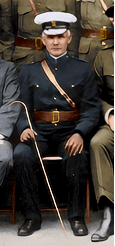
Lt Col M.J Ross 21 Oct 1972 – 6 Dec 1976
Lt Col M.J Ross, Director of Ordnance Services, 21 Oct 1972 – 6 Dec 1976.
Lt Col A.J Campbell 7 Dec 1976 – 9 Apr 1979
Lt Col A.J Campbell, Director of Ordnance Services, 7 Dec 1976 – 9 Apr 1979.
Lt Col P.M Reid 10 Apr 1979 – 25 Jul 1983
Lt Col P.M Reid, Director of Ordnance Services, 10 Apr 1979 – 25 Jul 1983.
Lt Col T.D McBeth 26 Jul 1983 – 31 Jan 1986
Lt Col T.D McBeth, Director of Ordnance Services , 26 July 1983 – 31 Jan 1986.
Lt Col G.M Corkin 1 Feb 1986 – 1 Dec 1986
Lt Col G.M Corkin, Director of Ordnance Services, 1 Feb 1986 – 1 Dec 1986.
Lt Col J.F Hyde 2 Dec 1986 – 31 Oct 1987
Lt Col J.F Hyde, Director of Ordnance Services, 2 Dec 1986 – 31 Oct 1987.
Lt Col E.W.G Thomson 31 Oct 1987 – 11 Jan 1990
Lt Col W.B Squires 12 Jan 1990 – 15 Dec 1992
During the early 1990s, the New Zealand Army underwent several “rebalancing” activities, which saw the formation of regional Logistic Battalions and included the demise of the individual Corps Directorates.
Filling the void left by the demise of the Corps Directorates, the post of Regimental Colonel was approved on 12 December 1992. The role of the Regimental Colonel of the RNZAOC was to.
Provide specialist advice when called for
Maintain an overview of Corps personnel matters, and
Provide a link between the Colonel Commandant of the RNZAOC and the Corps and support the Colonel Commandant.
Regimental Colonel (RNZAOC)
Col T.D McBeth 15 Dec 1992 – 19 Sept 1994
Col L Gardiner 19 Sept 1994 – 9 Dec 1996
On 9 December 1996, the RNZAOC was amalgamated into the Royal New Zealand Army Logistic Regiment (RNZALR).
New Zealand Ordnance Corps during wartime
During the Frist World War, a New Zealand Army Ordnance Corps was established as a unit of the 1st New Zealand Expeditionary Force (NZEF)
Officer Commanding NZEF NZAOC
Capt W.T Beck, 3 Dec 1914 – 31 Jan 1916
William Thomas Beck Circa 1921
Lt Col A.H Herbert, 1 Feb 1916 – 31 Mar 1918
Lieutenant-Colonel Alfred Henry Herbert, NZAOC. aucklandmuseum/Public Domain
Lt Col H.E Pilkington, RNZA 30 Jun 1918- 22 Jan 20
Temp Capt W.H Simmons, 20 Feb 20 – 13 Oct 1920
During the Second World War, all the Ordnance functions of the 2nd NZEF were organised as the New Zealand Ordnance Corps (NZOC).
Officer Commanding 2nd NZEF NZOC in the Middle East and Europe
In British and Commonwealth military doctrine, there has long been a separation of responsibility for Supplies and Stores.
Supplies – The provisioning, storing, and distributing of food for soldiers; forage for animals; Fuel, Oil, and Lubricants (FOL) for Tanks, Trucks, and other fuel-powered vehicles and equipment; and the forward transport and distribution of ammunition. In the NZ Army, Supplies were managed by the New Zealand Army Service Corps (NZASC) from 1911 to 16 October 19789.
Stores – The provisioning, storage, and distribution of weapons, munitions, and military equipment are not managed by RNZASC. Stores were the Responsibility of the Royal New Zealand Army Ordnance Corps (RNZAOC) until 1996.
Despite the separation of responsibilities, the RNZASC and RNZAOC would have a long and cooperative relationship for most of their existence.
During the early colonial days, the early actions of the New Zealand Wars proved that the New Zealand bush and the elusive tactics of the Maori presented new problems in supply and transport. An Imperial Supply and Transport Service was established and operated with the Imperial troops.
From the end of the New Zealand Wars until 1910, there was no ASC unit in New Zealand, with the supply functions required by the New Zealand Military provided by the Defence Stores Department.
After the conclusion of the South African War, the Military Forces in New Zealand embarked on a series of reforms to enhance the organisation and capability of the nation’s military, enabling it to contribute effectively to a broader Imperial Defence scheme. In 1910, at the request of the New Zealand Government, Field Marshal Viscount Kitchener inspected New Zealand’s Forces. Kitchener provided several recommendations concerning the ongoing reforms, emphasising the need for a professional Staff Corps to administer the force and confirming the requirement for a New Zealand ASC, which was gazetted on 12 May 1910 (backdated to 6 May 1910) as a designated component of the Territorial Forces of New Zealand.
The momentum for these reforms gained further impetus with the appointment of Major General Alexander Godley as the New Zealand Military Forces Commandant in December 1910. Godley was pivotal in revitalising New Zealand’s military organisational framework in his first year, making critical command and staff appointments, promulgating the (Provisional) Regulations for the Military Forces of New Zealand, and making plans to build up the NZASC, which up to this time had remained a paper corps.
Acknowledging the highly specialised nature of ASC duties, distinct from combatant staff and regimental officers, and the absence of suitably qualified officers in New Zealand, Godley recommended to the Minister of Defence on 4 January 1911 the lending of services of an experienced Imperial ASC Senior Captain or Major to organise and train New Zealand’s transport and supply services for three years. The Minister of Defence endorsed this recommendation with the Prime Minister cabling the New Zealand High Commissioner in London on 10 January 1910 to approach the Army Council for the following:
Services of experienced Army Service Corps major or senior captain required to organise New Zealand Army Service Corps. Engagement for three years. Salary £600 a year consolidated. Pay to include house allowance. Travelling allowance of 12/6d a day and allowance for one horse if kept, will also be granted.
Within two months of receiving New Zealand’s request for an ASC Officer, the Army Council promptly and affirmatively responded to the call. Having already sanctioned nine additional officers to assist Godley, the Council selected Knox, who then served in C (Depot) Company ASC at Aldershot for service in New Zealand to organise the NZASC.
Under the guidance of New Zealand Adjutant and Quartermaster-General Colonel Alfred Robin, Knox assumed his duties as the New Zealand DST at the Army General Staff Offices on Wellington’s Buckle Street. His responsibilities encompassed a wide range of functions, including quarters, tender and contracts, personal and freight movement, and presidency on two standing committees related to Drill sheds and the storage and distribution of clothing and equipment to the forces.
Recognising Knox’s extensive duties, he was granted the Temporary Rank of Lieutenant Colonel on 6 September 1911. With Colonel Robin’s appointment as the New Zealand representative at the War Office in London in 1912, Knox assumed the additional role of Quartermaster General (QMG). Despite Knox diligently fulfilling the role of QMG and DST, progress on the formation of the NZASC was slow.
By 1914, Knox had established 16 NZASC companies of approximately 30 men each across the four New Zealand Military Districts, with imported ASC officers serving as Assistant Directors of Supply and Transport (ADST) in each District Headquarters. Although Knox had departed by the time of the 1914 divisional camps, the Inspector General of Imperial Forces, General Sir Ian Hamilton, noted following his inspection that:
The very highest credit is due to the Army Service Corps officers and their men. They have done a first-class service, although as a rule undermanned to an extent that would fill a labour union with horror. When the Army Service Corps units are up to their normal strengths, a suitable system of calling the men up to camp in relays will enable the necessary duties to be carried out as efficiently and with much less strain on the personnel.
During World War One, New Zealand ASC units fulfilled crucial functions. ASC Companies supported the Territorial Infantry and Mounted Rifle Brigades. At the same time, Supply and Transport Units aided mobilisation camps within New Zealand. Overseas, the NZASC operated across all New Zealand theatres of war, delivering indispensable services. At its zenith, it managed the NZ Divisional Train, five ASC Companies, five Depot Units of Supply, the NZ Field Bakery, the NZ Field Butchery, and the NZ Motor Transport Workshop. Notably, the NZASC and NZAOC frequently shared personnel, facilities, and transportation, especially in the conflict’s early years.
In 1917 the NZAOC was established as a permanent component of the New Zealand Military Forces, however, it would not be until 1924 that the Permanent NZASC was formed.
Post-war, under the leadership of Captain Stanley Herbert Crump, the NZASC transitioned to a peacetime establishment comprising a Headquarters and three depots (Northern, Central, and Southern). In 1924, the Permanent NZASC (PNZASC) was established as part of the permanent Military Forces. Additionally, in 1925, an alliance between the NZASC and the Royal Army Service Corps (RASC) was ratified.
The RASC has its roots in history that are much more profound. Up to the time of Cromwell, armies mainly lived by plunder. The RASC came into being in 1888. but the work it now performs was being done long before that.
Cromwell and then the Duke of Marlborough, and later Napoleon, organised a system of civilian commissaries. The Duke of York established the Corps of Royal Waggoners in 1794. This purely transport organisation continued until 1869 under various names, eventually as the Military Train, fighting as light cavalry in the Indian Mutiny.
The birth of the Supplies and Transport Service dates from 1869. when supplies and transport, along with the Military Stores Department, came under one department called the Control Department, it remained for General Sir Redvers Buller in 1888 to organise the first Army Service Corps. Since its formation, the RASC has been a combatant one. Trained and armed as infantry and responsible for its own protection. Considerd a more technical Corps, the RAOC was not granted combatant status until 1942.
In 1931, under Crump’s continued leadership, the NZASC underwent a reorganisation into three Composite Companies. Each company comprised seven officers, four warrant officers, and 99 other ranks, establishing a solid foundation from which the NZASC could readily expand to meet the demands of future conflicts.
During World War Two, numerous units and establishments represented the NZASC across all New Zealand Expeditionary Force (NZEF) theatres. Similar to the previous World War, the NZASC maintained a collaborative relationship with New Zealand Ordnance Corps (NZOC) Ammunition Examiners (AEs) in the establishment of NZASC Ammunition platoons. At times, NZASC Warrant Officers were attached to the NZ Divisional Ordnance Field Park (OFP) to offer technical advice on vehicle spares. In recognition of the NZASC’s service during WW2, the title “Royal New Zealand Army Service Corps” was conferred in 1946.
In the post-war era, the NZASC and from 1946, the RNZASC would serve with distinction J Force in Japan and then contribute the second-largest New Zealand contingent to K Force in Korea by providing 10 Transport Company. Playing a pivotal role in sustaining the morale and effectiveness of New Zealand forces during these conflicts
Until 1947, NZASC units primarily handled baking bread, butchering meat, and procuring and distributing fresh and packaged provisions to frontline units, while regimental cooks and stewards were responsible for cooking and serving meals. To enhance and standardise cooking practices throughout the army, the Supplies and Transport Catering Group (STCG) was established on 15 February 1948 with the following objectives:
Training and provision of unit cooks and kitchen hands.
Instruction and supervision of the management of the Army ration scale.
Improvement of food preparation and cooking standards.
Advice on the installation and operation of cooking appliances and kitchen equipment.
Guidance on the layout of mess buildings.
In September 1948, all Regimental catering staff, except those of the New Zealand Women’s Army Corps, were transferred into the RNZASC. Throughout the 1950s, 60s, and 70s, the RNZASC played a vital role within the New Zealand Army, encompassing a wide range of functions. These included everyday tasks such as cooking and serving food, as well as more complex operations like air supply drops. To manage the procurement, storage, transportation, and distribution of essential supplies such as food, fuels, and oils for a modern Army, the RNZASC operated Supply Depots and employed various tradespeople, including butchers. Supply Depots were strategically located in Papakura, Waiouru, Linton, Trentham, and Burnham, where bulk supplies were stored and distributed as needed. Additionally, every Army camp featured a section of the RNZASC, along with smaller supply and transport depots, which were responsible for handling goods from central supply depots and providing drivers and transport services for various purposes. These smaller depots were situated in Devonport/Fort Caultley,
Following the Macleod report that recommended the streamlining of logistic support for the British Army, the RASC merged in 1965 with the Royal Engineers’ Transportation and Movement Control Service to form the Royal Corps of Transport (RCT). This would see the RASC Supply functions transferred to the Royal Army Ordnance Corps (RAOC). In 1973, following the British lead, the Australians also reformed their Royal Australian Army Service Corps (RAASC) into the Royal Australian Army Corps of Transport (RAACT).
Acknowledging the British and Australian experience, the RNZASC underwent a similar transition—operational command of the Supply function transferred to the RNZAOC on 16 October 1978. On 12 May 1979, the RNZASC ceased to exist: Supply personnel formally transferred to the RNZAOC, while Transport, Movements, and Catering were re-formed as the Royal New Zealand Corps of Transport (RNZCT)..
The RNZASC supply function would be integrated into the RNZAOC, with the Camp Supply Depots becoming NZAOC Supply Platoons numbered as.
14 Supply Platoon, Papakura/Hopuhopu
24 Supply Platoon, Linton
34 Supply Platoon, Burnham
44 Supply Platoon, Waiouru
54 Supply Platoon, Trentham
NZ Supply Platoon, Singapore
In recognition of its long RNZASC service, 21 Supply Company was retained as a Territorial unit, initially as the Territorial element of 4 Supply Company in Waiouru and later as the Territorial element of 2 Supply Company, Linton. Today, 21 Supply is the principal North Island Supply unit of the Royal New Zealand Army Logistic Regiment (RNZALR).
For a short period following the RNZAOC assumption of Supply functions, some RF and TF RNZAOC would periodically be employed within the RNZCT transport Squadrons’ Combat Supplies sections.
The RNZAOC Butcher trade inherited from the RNZASC would be discontinued in the mid-1980s, with the last of the butchers reclassifying as RNZAOC Suppliers. By the mid-1990s, it was decided as a cost-saving measure to allow the RNZCT catering staff to order directly from commercial foodstuff suppliers, effectively ending the RNZAOC foodstuffs speciality. The only RNZASC trade speciality remaining in the RNZAOC after its amalgamation into the RNZALR was that of Petroleum Operator.
The Royal NZ Army Service Corps & Corps of Transport, like the RNZAOC, have passed their combined responsibilities to the RNZALR. However, the Royal NZ Army Service Corps & Corps of Transport maintain a strong association that provides many benefits and opportunities for comradeship to RNZASC/CT Corps members and past and present members of the RNZALR. Another role of the RNZASC/CT association is to ensure that the rich and significant history of the RNZASC/CT is not lost to future generations of the RNZALR.
Of all the Ammunition magazine areas constructed in New Zealand during the Second World War, the Belmont magazine area in the hills north of Wellington between the Hutt and Porirua was the largest and closest to a large population area. In the early 1970s, following the removal, disassembly for scrap, and destruction of its stocks, Belmont’s life as a magazine area concluded with the land reverting to civilian use. As with any retired military facility kept out of the public eye during its operational life, urban legends and rumours thrive about secret tunnels and forgotten caches of buried military material. Belmont is no different in this respect, as items such as empty 3.7-inch Anti-Aircraft projectiles are occasionally discovered, fuelling such rumours. Although there is little evidence to support the stories and urban legends, Belmont does have some secrets from its wartime past. The most significant is that Belmont was the home to the bulk of New Zealand’s chemical weapon stockpile.
As the threat of war with Japan became inevitable in 1940, the New Zealand Government fully mobilised New Zealand’s home defence forces. By early 1942, this mobilisation saw two Infantry Brigades deployed to Fiji, and Three Divisions and several independent Brigades mobilised for home defence.
This massive mobilisation initiated a rearmament program resulting in vast amounts of war material from the United Kingdom, Canada and the United States being delivered to New Zealand. Included as part of the infusion of new weapons and equipment were the required scales of ammunition for each type of weapon system. Ammunition scales used by New Zealand were based upon the standard British scales. They included all the ammunition natures needed by New Zealand for use in the Pacific and home defence, including Anti-Tank, High-Explosive, Smoke and a stockpile of Chemical rounds consisting of,
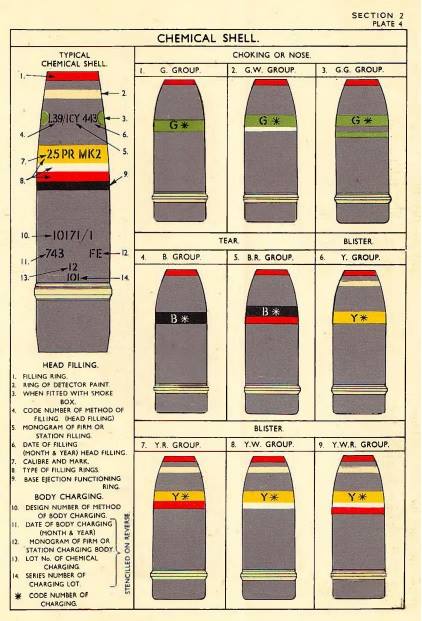
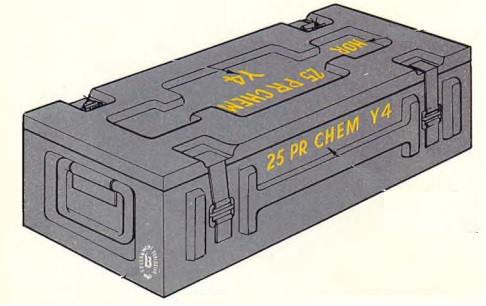
112,770 25-pounder Chemical rounds, and
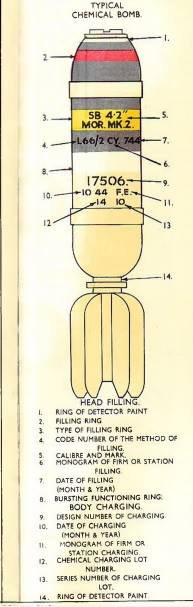
10,300 4.2-inch B4 (Tear) and Y4(Blister) chemical mortar bombs.
With consignments of ammunition, due to arrive in New Zealand in late 1942, construction of the new ammunition magazine areas was initiated in 1940, with the construction of the Belmont Magazine Area beginning in September 1942.[1] The Belmont Magazine Area consisted of sixty-two Magazine buildings, with 28 and 29 dedicated to holding chemical rounds from late 1943.
All the 4.2inch Bombs were stored at Belmont with the recommended distribution of the 25-pounder chemical rounds,[2]
30,000 rounds to the Northern Military District
30,000 rounds to the Southern Military District
52,770 rounds to the Central Military District Belmont Depot
However, records are uncertain if this distribution occurred, so it is quite probable that the entire stock of 25-pounder ammunition was held at Belmont.
The New Zealand Stockpile was significant as a lethal percutaneous dose of mustard was 4.5 gm. With 300 tons of the agent in the NZ stockpile, the potential lethal doses held in Belmont were approximately 60 million. To put the size of the stockpile in context, it was equal to 5% of the United States Stockpile in 1993.
Chemical Weapons were highly controlled and only used in retaliation if the enemy used them first. Although US forces on Guadalcanal had captured some Japanese Chemical Weapons, the NZ Deputy Chiefs of Staff were confident that there did ‘not appear to be any other or greater evidence that the Japanese propose to use gas in this area’.
4800 25-pounder chemical rounds were deployed with the 3 NZ Div, and they were returned to New Zealand in 1944 and stored at the Kelms Road Depot at Ngaruawahia alongside the other ammunition utilised by the Division.
Following the war, the disposal of wartime ammunition became a standing task for the RNZAOC Ammunition functions as various methods disposed of damaged, obsolete, and surplus stocks.
Damaged ammunition was often disposed of by demolition; for example, the destruction of 3.7-inch anti-aircraft ammunition issued to units and returned to depots took up to 1957 to complete.[3]
The stockpile of chemical munitions was dumped at sea, with two dumping operations found in archival sources.[4]
Two hundred tons of chemical shells scuttled on the tug Maui Pomare at the 100-fathom line in the Hauraki Gulf in April 1946.
One thousand five hundred tons of 25-pounder chemical shells and twenty tons of bombs had been dumped by the Marine Department steamer Matai off the Wellington coast by October 1946.
Stock from the Belmont magazine area was delivered by Army personnel to the wharf at the RNZAF base at Shelly Bay in lots of 250 Tons and loaded onto the Marine Department steamer Matai. All possible safety precautions were applied with each crew member was issued protective capes, respirators and gloves. With special chutes constructed, cases of shells were jettisoned fifty Nautical miles off the Wellington coast in the Cook Strait Canyon, which reaches depths of three kilometres.[5]
N Z Government S S Matai, on the patent slip at Evans Bay, Wellington. Smith, Sydney Charles, 1888-1972: Photographs of New Zealand. Ref: 1/2-049255-G. Alexander Turnbull Library, Wellington, New Zealand. /records/22744146
The dumping of the Chemical munitions was well publicised, with newspaper articles describing the disposal operation. [6]
Stored since 1943, 1500 tons of gas shells are to be dumped at sea by the Matai. Fuses have been removed from the 25lb shells that contain the gas, but to ensure that there is no risk to those carrying out the work, full Admiralty and War Office safeguards will, be taken. The gas is of the blister variety. The boxes containing the shells will be filled with sand to guard against possible leakages. Each box is painted with a substance that will indicate even a pinpoint of escaped gas.
Northern Advocate, 18 September 1946
Although the archival records show that at least 15,220 tons of Chemical munitions had been dumped at sea by the end of 1946, there is no accurate reconciliation of the actual number of rounds disposed of. However, it is a reasonable assumption that New Zealand had no desire to maintain a contingency stock of Chemical weapons and that all wartime stocks were disposed of by the end of 1946.
Notes
[1] F Grattan, Official War History of the Public Works Department (PWD, 1948).
[2] “Defence Works – Magazine – Belmont Hills,” Archives New Zealand Item No R22435088 (1942).
[3] “H-19 Military Forces of New Zealand Annual Report of the General Officer Commanding, for period 1 April 1957 to 31 March 1958,” Appendix to the Journals of the House of Representatives (3 July 1958 1958).
[4] “Ammunition – Disposal of unserviceable ammunition 1945-1952,” Archives New Zealand Item No R21465842 (1945).
[5] A Hubbard, “Chemical War: Our seabed legacy,” New Zeland Listener, 16 January 1993.
In the period between the world wars, Britain analysed the lessons of the Great War and, looking forward, realised that the next war was not to be one of attrition-based warfare but a war of speed, mobility and surprise utilising modern technologies such as armoured vehicles, motorised transport and communications. By 1939 the British Army had transformed from the horse-drawn army of the previous war into a modern motorised force fielding more vehicles than their potential opponents, the Germans. Britain’s modernisation was comprehensive with new weapons and equipment and robust and up-to-date doctrine, providing the foundation for the employment of the army. The modernisation of the British Army included Logistical services, with both the Army Service Corps and the Army Ordnance Corps on the path to becoming doctrinally prepared, equipped and organised for the upcoming conflict. New Zealand took Britain’s lead and, from the mid-1930s, began reorganising and reequipping New Zealand’s Military in tune with emerging British doctrine. New Zealand’s entry into the war in September 1939 initiated a massive transformation of New Zealand’s Ordnance Services with new units raised and personnel recruited to support New Zealand’s forces at home and overseas. In addition to Ordnance Deports and Workshops, the most numerous Ordnance unit was the Light Aid Detachments (LAD). Providing first-line repair to formations and Units, LADs provided the backbone of New Zealand repair and maintenance services keeping the critical material of war operational in often extreme conditions. This article provides background on the role and function of the LAD in overseas and home defence roles between 1939 and 1945.
Throughout the interwar years, the British Military establishment analysed the lessons of the previous war and interpreted contemporary developments. Updating doctrine throughout the 1930s, the British Military progressively transformed into a mechanised force armed with some of the era’s most advanced weapons and equipment. The tactical bible of British Commonwealth armies, the Field Service Regulations (FSR), was updated with at least four editions issued, proving that the British Army was willing to learn from the mistakes learned in the previous war.[1] Concurrent to the tactical doctrine of the FSR Anticipating, the Royal Army Ordnance Corps (RAOC) spent the 1930s creating the infrastructure and doctrine to support the mechanisation of the British Army by creating essential relationships with the British motor industry that smoothed the path to mobilisation.[2] In addition to the doctrine published in the FSRs, the wartime doctrine for the operation of British and Commonwealth Ordnance Services was detailed in the Ordnance Manual (War) 1939.
Authorised for use from 13 September 1939, the Ordnance Manual (War) 1939 was intended to “Guide all concerned and particularly to assist, at the beginning of a campaign, those who have no previous war experience of the duties that they are called upon to undertake.”[3] The Ordnance Manual (War) 1939 detailed all the responsibilities that were expected of the British and Commonwealth Ordnance Services, with the repair and maintenance responsibilities as follows;[4]
8. The organisation for carrying out, in the field, repairs (including replacement of component and complete assemblies) to units’ equipment (other than ammunition) consists of:- (a) Light aid detachments, which are attached to certain units and formations to advise and assist them with their
“first line” repair and recovery duties. (b) Mobile workshop units, equipped with machinery, breakdown and store lorries, which are allotted to certain
formations for carrying out “second line” repairs and recovery. (c) Stationary base ordnance workshops, which are established on a semi-permanent basis at, or adjacent to, the
base ordnance depot or depots. (d) Ordnance field parks from which replacement of components and complete assemblies can be effected. These
ordnance field parks also hold a proportion of replacement vehicles.
The Ordnance Manual (War) 1939 then details the role of the Light Aid Detachment:
2. In order to assist units with their first line repair and recovery work, and to provide- expert diagnosis and technical experience, light aid detachments are permanently attached to certain formations and units, for example: • Artillery regiments. • Cavalry regiments and Tank battalions, Royal Armoured Corps. • Infantry brigades. • Machine-gun battalions. • Tank battalions. • Royal Engineer field parks. • Divisional Signals. The LADs. attached to RE field parks and to divisional signals (whose establishments of vehicles are comparatively small) are required to look after other small mechanised units not provided with LADs.
3. The personnel of a LAD consists of an Ordnance Mechanical Officer (OME), an armament artificer (fitter), an electrician, and a few fitters, and the necessary storemen, driver mechanics, drivers, etc., for their vehicles. Its transport usually consists of two lorries (one store and one breakdown), a car and a motorcycle.
4. Its functions are: – (a) To advise units how best to keep their equipment and vehicles in a state of mechanical efficiency; to help them to
detect the causes of any failures or breakdowns, and to assist them in carrying out first line repairs up to their full
capacity. (b) To assist units with first-line recovery of breakdowns. (c) To maintain a close liaison between the unit and formation workshop.
During rest periods LADs may be able to carry out more extensive repairs. If the time is available, the necessary parts and material can be brought up from the ordnance field park to enable them to carry out jobs which would normally be beyond their capacity when on the move.
In such circumstances, repair detachments of recovery sections may be brought up to assist them).
5. LADs do not form part of the workshops in any sense. They are definitely an integral part of “B” echelon of the unit to which they are attached, and the OME. is directly under the orders of OC unit, in the same way as the regimental medical officer. The OC unit is the accounting officer for the vehicles and stores of the LAD. When an LAD serves more than one unit, as in the case of an infantry brigade, the OME. is the accounting officer for all purposes.
Members of 10 Light Aid Detachment, NZ Electrical and Mechanical Engineers, attached to 5 NZ Fd Park Coy, changing truck engine, probably at Burbeita. Man in peaked cap identified as Lt G D Pollock, later Col Pollock. Taken circa 1941 by an official photographer. Ref: DA-01035-F. Alexander Turnbull Library, Wellington, New Zealand. /records/22485028
The New Zealand LADs
When New Zealand committed forces to the war effort in 1939, the New Zealand Army Ordnance Corps, despite having the doctrinal foundations provided by the Ordnance Manual (War), did not have the Regular or Territorial Force personnel available to provide LADs immediately. Therefore, like the United Kingdom, New Zealand relied on its civilian motor industry to provide the bulk of the tradesmen for the LADs. However, despite the challenges in forming a specialised unit from scratch, the New Zealand Army raised fifty-six LADs in three distinct tranches between 1940 and 1943, consisting of
2nd New Zealand Expeditionary Force – Ninteen LADs
2nd New Zealand Expeditionary Force in the Pacific – Seven LADs
Home Defence – Thirty-One LADs
NZEF LADS
Created as part of the newly constituted 2NZEF in 1939, the 2NZEF NZOC was described in the Evening Post newspaper as consisting of “11 Light Aid Detachments of the New Zealand Ordnance Corps. These are numbered 9 to 19, and their part is to render assistance and effect repairs to mechanic transport and the anti-tank units”[5].
The was initially some confusion between the use of the designation NZAOC and NZOC in the context of the NZEF. This was clarified in NZEF Order 221 of March 1941, which set NZOC as the title of Ordnance in the NZEF.
1942 saw the separation of maintenance and repair functions from the Royal Army Ordnance Corps (RAOC) with the formation of the Electrical and Mechanical Engineers (EME) in the Brutish Army.[6] The New Zealand Division followed suit and formed the New Zealand Electrical and Mechanical Engineers (NZEME) on 1 December 1942, separating the repair, maintenance and ordnance stores functions of the NZOC.[7]
GMC CCKW Truck modelled with the Regimental Markings of 38 LAD, 18th Armoured Regiment. Craig Paddon
NZEF NZ Tank Brigade
Formation Sign 1 NZ Tank Brigade
The New Zealand Tank Brigade was an NZEF unit formed at Waiouru in October 1941 to be deployed to the Middle East after Training in New Zealand for six months. The entry of Japan into the war in December 1941 necessitated the rerolling of the NZ Tank Brigade into a home defence role. After reorganisations, the Brigade was ordered to be redeployed in April 1942, with its Headquarters and Battalions dispersed to the South Island, Northland, Manawatu and Pukekohe.
November 1942 saw further changes which saw the gradual disestablishment of the NZ Tank Brigade.[18]
No 1 Tank Battalion and 32 LAD remained in the home defence roll in the Auckland/Northland area.
No 2 Tank Battalion, the Army Tank Ordnance Workshop and Ordnance Field Park were dissolved and became part of the 3 NZ Division Independent Tank Battalion Group for service in the Pacific.
No 3 Tank Battalion and 33 LAD were deployed to the Middle East for service with the 2nd NZ Division, where it was dissolved, forming the nucleus of the 4th NZ Armoured brigade and 38, 39 and 40 LADs.
34 LAD was stationed with the Independent Tank Squadron at Harewood in the South Island.
By June 1943, the final units of the 1st NZ Army Tank Brigade, including 32 LAD and 34 LAD, were disbanded.
Army Tank Ordnance Workshops, OFP and LAD identifying patch. Malcolm Thomas Collection
NZEF in the Pacific
NZOC units also were formed for service with the NZEF in the Pacific (NZEFIP). Initially, 20 LAD was formed to support the 8 Infantry Brigade Group in Fiji in November 1940. 14 Infantry Brigade Group reinforced the force in Fiji with 36 and 37 LAD formed to provide additional support. With the redeployment of the New Zealand Brigade from Fiji in late 1942, 36 LAD remained as the LAD for the new Fiji Brigade that was about to be formed. In March 1943, eight members of 36 LAD deployed with the Fijian Brigade to Bougainville. On 1 May 1944, 36 LAD was renamed the Recovery Section, Brigade Mobile Workshops, Fiji Military Forces.[22]
The bulk of the NZEFIP was reorganised as the 3rd New Zealand Division, with the NZOC commitment expanding into 23 units and detachments, including six LADs serving in operations in New Caledonia, The Solomon Islands and Tonga.[22] The formation of the Electrical and Mechanical Engineers in 1942 was not followed through in New Zealand and the Pacific, with repair and Maintenance functions remaining part of the Ordnance Corps for the duration of the war.
On concluding successful campaigns in the Solomon Islands in 1944, 3 NZ Division and its equipment were returned to New Zealand and formally disbanded on 20 October 1944. On return to New Zealand, many NZOC members were graded unfit due to the rigours of the tropical campaign and returned to their civilian occupations. Those fit enough were redeployed as reinforcements to 2NZEF in Italy, with the LAD men joining NZEME units.
With the NZAOC and the New Zealand Permanent Army Service Corps (NZPASC) existing as part of the Permanent Army, only the NZPASC had a Territorial Army component, known as the New Zealand Army Service Corps (NZASC). From the 1930s, workshop sections had been included on the establishments of ASC unit for activation on mobilisation. With the onset of war in 1939 and the mobilisation of the Territorial Army in 1940, the Quartermaster General, Col H.E Avery, made the decision that LADs were an Ordnance responsibility, and the NZOC was established as the Ordnance Component of Territorial Army in December 1940.[29]
By late 1943 the mobilisation of the Territorial Forces had ceased to be necessary, and most units had been stood down and placed on care and maintenance status with a small RF Cadre. By 1 April 1944, all wartime home defence units had been disbanded.[30] Although not part of the pre-war Territorial Army, the NZOC remained on establishments. In 1946 a Reorganisation of New Zealand Military Forces removed the distinction between Regular and non-Regular soldiers, and the NZOC ceased to be a separate Corps with the supply functions amalgamated into the NZAOC and the Workshops functions, including the LADs (21, 23, 25, 28, 30 and 53) amalgamated into the NZEME.[31]
Photo of mechanics and motorcyclists repairing motorcycles at a field workshop during military manoeuvres in Northland.” Auckland Weekly News, 23 December 1942, p.14 Auckland Libraries Heritage Collections AWNS-19421223-14-03
[1] This compared with the two editions of German and French doctrine produced during the same period. Jonathan Fennell, Fighting the People’s War : The British and Commonwealth Armies and the Second World War, Armies of the Second World War (Cambridge University Press, 2019), Non-fiction, 32.
[2] P.H. Williams, War on Wheels: The Mechanisation of the British Army in the Second World War (History Press Limited, 2016).
[3]Ordnance Manual (War), ed. The War Office (London: His Majestys Stationery Office, 1939), 9.
[22] Robert A. Howlett, The History of the Fiji Military Forces, 1939-1945 (Published by the Crown Agents for the Colonies on behalf of the Government of Fiji, 1948), Non-fiction, Government documents, 257-8.
[22] Oliver A. Gillespie, The Tanks : An Unofficial History of the Activities of the Third New Zealand Division Tank Squadron in the Pacific (A.H. and A.W. Reed for the Third Division Histories Committee, 1947), Non-fiction, 137-227.
[23] Peter Cooke, Warrior Craftsmen, Rnzeme 1942-1996 (Wellington: Defense of New Zealand Study Group, 2017), 55.
[31] “H-19 Military Forces of New Zealand Annual Report of the General Officer Commanding, for Period 1 June 1949 to 31 March 1950 “, Appendix to the Journals of the House of Representatives (1950).;”Reorganisation of the Territorial Force,” New Zealand Gazette No 55, 21 October 1948.
[32] “Formation of New Units, Changes in Designation, and Reorganization of Units of the Territorial Force. ,” New Zealand Gazette, No 127, 19 December 1940, 3738-39.
[34] 3 Light Armoured Fighting Vehicle Regiment (Auckland East Coast Mounted Rifles) Plowman and Thomas, New Zealand Armour in the Pacific 1939-45, 5-7.
[35] “Formation of New Units and Disbandment of Uuits of the Territorial Force and National, Military Reserve. ,” New Zealand Gazette, No 8, 22 January 1942, 351.
[45] 2 Light Armoured Fighting Vehicle Regiment (Queen Alexandra’s Mounted Rifles)Plowman and Thomas, New Zealand Armour in the Pacific 1939-45, 5-7.
[46] “Parts of the Defence Forces Called out for Military Service,” New Zealand Gazette, No 128, 19 December 1940, 3777.
[47] 9 Light Armoured Fighting Vehicle Regiment (Wellington East Coast Mounted Rifles)Plowman and Thomas, New Zealand Armour in the Pacific 1939-45, 5-7.
[48] “Formation of New Units and Disbandment of Uuits of the Territorial Force and National, Military Reserve. ,” 351.
[49] 6 Light Armoured Fighting Vehicle Regiment ( Manawatu Mounted Rifles)Plowman and Thomas, New Zealand Armour in the Pacific 1939-45, 5-7.
[50] “Formation of New Units and Disbandment of Uuits of the Territorial Force and National, Military Reserve. ,” 351.
[51] “Formation of New Units, Changes in Designation, and Reorganization of Units of the Territorial Force. ,” 3738-39.
[59] 10 Light Armoured Fighting Vehicle Regiment ( Nelson Marlbough Mounted Rifles) Plowman and Thomas, New Zealand Armour in the Pacific 1939-45, 5-7.
[60] “Formation of New Units and Disbandment of Uuits of the Territorial Force and National, Military Reserve. ,” 351.
24 February is the Memorial Day, set aside as “Purple Poppy Day” the day on which we honour our war animals.
Complementing the traditional Red Poppy, which is worn on ANZAC and Remembrance Day, the Purple Poppy symbolises all animals who have served during times of conflict.
Thousands of animals have provided support to New Zealand’s Forces, either as working animals or as mascots and providing companionship and comfort to service personnel.
One of the most famous animals in New Zealand Military History is Ceaser, the bulldog who was awarded the Blue Cross Medal on 27 May 2019 for his service and bravery during the First World War.
Portrait of ‘Caesar’ (misspelt as Caeser) with ‘4th Battalion Mascot, NZ Rifle Brigade and ‘Oliver Varley, photo’ written on the photograph. Auckland War Memorial Museum – Tāmaki Paenga Hira. WW1 487.
Sergeant Two Bob
Like many other units of the 2nd New Zealand Division during the Second World War, the Divisional Ordnance Field Park (OFP) had its own mascot, a small dog. The dog had been purchased as a pup from a local vendor in Tripoli for two shillings and named “Sergeant Two Bob”.
The name “Sergeant Two Bob” was a play on the slang of the time where Bob was the common term for a shilling, with twelve shillings making up a pound, “Two Bob” equalled two shillings which at the time was a common light-hearted insult where one stated that something was worthless, in this case, it was a term of affection for a unit mascot.
Records indicate that “Sergeant Two Bob” moved with the OFP from North Africa to Italy in early 1944 and remained a member of that until the end of the war. As the NZ Division demobilised, New Zealand’s strict quarantine regulations forbade the return to New Zealand of “Sergeant Two Bob”, and it is assumed that he found a new home with some Italian owners.
Harry Gilbertson of the New Zealand Divisional Ordnance Field Park with the section mascot “Sergeant Two Bob” at Maddi September 1943. Photo H.J Gilbertson
Corporal Jenny
“Sergeant Two Bob” was not the only Ordnance Mascot during the Second World War. In the Pacific, Ordnance in the 3rd New Zealand Division adopted ‘Jenny the fawn’.
Orphaned as the result of a deer-hunting expedition, Jenny was hand-reared on a diet of powdered milk and guava leaves and soon promoted to the rank of substantive corporal.
Corporal Jenny’s duties included representing the Ordnance team at football matches, resplendent in its Khaki cover decorated in Ordnance colours and regulation corporal’s stripes. Later Jenny’s appetite extended to include tea leaves, the unit’s laundry and mail. On the NZ Divisions’ departure from New Caledonia in 1944 Jenny was presented to a local family.
Jenny the Fawn, 1943. War History Collection, Alexander Turnbull Library
The Second World War marked a period of immense growth for New Zealand’s Ordnance Services. Expanding from a strength of 6 Officers, 28 Permanent Other Ranks, and 113 Civilian Staff operating from limited infrastructure in Devonport, Hopuhopu, Trentham, and Burnham Camp in May 1939, New Zealand’s Ordnance Services had grown by 1944 into a diverse organisation supporting New Zealand’s forces both at home and abroad.
Armed with the 1939 Ordnance Manual (war), the New Zealand Expeditionary Force (NZEF) Ordnance units were established and adapted for their specific theatres of operation. In the Middle East, New Zealand Ordnance integrated into the Ordnance Services of the Royal Army Ordnance Corps. However, with a Brigade Group based in Fiji from late 1940, the Ordnance Services in the Pacific faced the most significant challenges. As the NZ Brigade Group transitioned and expanded from its garrison duties in Fiji into a Division conducting amphibious combat operations in the Solomon Islands, the supporting Ordnance Services had to anticipate the Division’s needs up to six months in advance. They also relied on fragile lines of communication stretching back to New Zealand for everyday items and to the United Kingdom for much of the military hardware held by the Division. Additionally, the tropical climate and indigenous fauna encountered in the area of operations posed additional hurdles to overcome.
After a series of actions in the Solomons, the burden of maintaining two Divisions became unsustainable for the limited resources New Zealand could provide. By October 1944, the Pacific Division had been disestablished. Its men were either demobilised to fill critical civilian roles or retained in the Army as reinforcements for the Division in Italy. Many of the Ordnance men were absorbed into New Zealand Ordnance Depots to receive and refurbish the large amounts of equipment returned from the Pacific.
3 NZ Division Tricks and Tanks parked at Main Ordnance Depot, Mangere Bulk Depot on their Return from the Pacific in 1944 (Colourised). Alexander Turnbull Library
3 NZ Division Tricks and Tanks parked at Main Ordnance Depot, Mangere Bulk Depot on their Return from the Pacific in 1944(Colourised). Alexander Turnbull Library
Based on the experience gained in operating the Base Ordnance Depot in New Caledonia and the Advanced Ordnance Depot in Guadalcanal, two Ordnance Officers who had served in the Pacific since 1940, Henry McKenzie Reid and Stanley Arthur Knight, produced reports in 1945 summarising Ordnance operations in these locations. Both Knight and Reid had been civilians in the Ordnance Corps before the war—Reid at Trentham and Knight at Hopuhopu—before being commissioned as officers in 1940. They both served in the Base Ordnance Depot in Fiji and later as Chief Ordnance Officer in the Base Ordnance Depot in New Caledonia. Knight also became the final Deputy Assistant Director of Ordnance Services (DADOS) of the 3rd NZ Division. After the war, both officers remained in the New Zealand Army Ordnance Corps (NZAOC), with Reid becoming the Director of Ordnance Services from April 1957 to November 1960.
The reports produced by Reid and Knight are similar in overall content, covering various points on storage, packing of stores, personnel, and ammunition, though each officer provides varying degrees of detail. The combined purpose of these reports is not only to provide a historical record of this aspect of New Zealand’s Ordnance Services in the Pacific but also to serve as a resource for the New Zealand Ordnance Services, aiding in planning for future operations in the tropics.
OPERATIONS OF ORDNANCE DEPOTS IN PACIFIC OBSERVATIONS AND RECOMMENDATIONS OF LIEUT-COL S.A.KNIGHT NZEFIP
Lieutenant-Colonel Stanley Arthur Knight
FORWARD
I was appointed Deputy Assistant Director of Ordnance Services immediately prior to the withdrawal of troops from forward areas to base areas in New Caledonia. Shortly after my arrival in Guadalcanal, units commenced preparations prior to evacuation, and my duties as D.A.D.O.S were not onerous since the demand for equipment had dropped to bare essentials. My observations must, therefore, be entirely concerned with an analysis of experiences gained while holding the appointment of Chief Ordnance Officer (COO), Base Ordnance Depot(BOD) New Zealand Expeditionary Force in the Pacific(NZEF IP).
ZONE OF OPERATIONS
The Base Ordnance Depor was established in New Caledonia at the beginning of the new year in 1943. Being situated some 30 miles for the port of Nepoui at which the bulk of our stores were unloaded and 100 miles from Noumea, fairly long hauls by road were necessitated.
In August of the same year, an Advanced Ordnance Depot was established in Guadalcanal, staffed by about 50% of the Base Ordnance Dept personnel. A few weeks later a Forward Ordnance Depot staffed by 2 officers and 25 ORs was established a Vella Lavella. The later depot was closed down and personnel withdrawn to Guadalcanal when Divisional Troops move forward to Green Island.
Due account must the taken of the type of operations to be undertaken, but it is my opinion that sub-division must be kept to a minimum. If the Base Depot is situated as close as possible to the fighting troops, then the necessity to establish Advanced Depots can be reduced to a minimum. Each time a Sub-Depot is established, additional personnel are required, and the total quantity of stores must necessarily be increased go provide working margins for each Depot.
STORAGE
It will be generally accepted that few if any permanent buildings will be available for the holding of ordnance store on Pacific Islands unless the Base is established at places such ad Noumea, Suva or Rabaul. Full provision must, therefore, be made for the temporary coverage to provide adequate protection for the initial shipments of stores when a Depot id being established.
Sufficient timber and tarpaulins for the erection of shelters should be forwarded with the first shipment of stores. Well constructed canvas shelters with good ventilation will give satisfactory accommodation for the storage, breaking down and issue of equipment for a period of 3 or 4 months. If the Depot is to remain in one site for a longer period, prefabricated buildings should be provided as early as possible if the loss of stores is to be kept to a minimum. Canvas coverings can only be considered a temporary measure as owing to the high humidity, together with tropical rain and cyclones, deterioration is very rapid.
The effects of a hurricane can be severe, and a poorly constructed Ordnance Depot might easily be completely wrecked with very heavy mortality to stores since hurricanes are usually accompanied by torrential downpours. I stress the fact that the best type of storage which can be procured, must go forward at the very earliest moment; otherwise, the Depot will be severely hampered, particularly in its infancy.
To meet the requirement of a Base Ordnance Depot serving a Division (including Ammunition) and to provide a small surplus for contingencies 2000 tarpaulins, preferably of the standard 180ft x 13-ft would be required.
In the initial stages of an operation, stores are usually carted to dumps from shops. Every effort should be made to provide dunnage for the stacks and tarpaulins should be arranged, allowing good air circulation.
Stacks of stores covered in this manner require constant attention. For instance, when a stack which has been properly covered allowing good air circulation, is partially broken down, the tarpaulin is allowed to drape on the ground. The air under the tarpaulin arranged in this manner is always saturated in a damp climate and rapid deterioration is the result. The same applies to tentage which should be properly erected, preferably with wooden floors, allowing free air circulation and the maximum benefit of dry sunny days used by removing and drying out damp walls.
Although 1200 Tarpaulins were placed on order for manufacture some weeks prior to the Divisions departure from New Zealand, only about 400 were to hand and available for use when the Ordnance Depot was established in New Caledonia. This number was insufficient to cover all Depot stocks and Ammunition with the result that much damage resulted. On instructions from the A.A. & Q.M.G, 80 tarpaulins had to be removed from ammunition stacks for the issue to A.S.C units. As a result of the Ammunition being exposed to heavy rains, considerable damage was done, and a repair party of 50 men was employed for many weeks at a later date, repairing and cleaning the Ammunition, while some had to be destroyed owing to its unserviceability.
When the Ammunition dump was established at Guadalcanal, every effort was made to provide the best possible storage. Ammunition was stacked on goof platforms with coconut poles for base and Tarpaulins were properly arranged, allowing free ait circulation. As a result, losses were negatable in a striking contrast to the losses in this Ammunition by U.S. Forces, who did not cover Ammunition stacks which were often in damp areas with no dunnage.
As it is not possible, without disastrous results, to open up and expose M.T parts, Signal Equipment and spares, Wireless Equipment and spares, M.G and S.A spares and certain Engineer Stores in other than dry storage, it is recommended that sufficient Stores wagons should be provided to house this equipment until such time s prefabricated buildings can be erected. It is estimated that not less than 24 well-appointed stores wagons would be required and theses should be stocked with spares, most likely to be in early demand.
I may appear to have dwelt on the question of storage, but when the Base Ordnance Depot commenced operations in NECAL, the only stores and office accommodation available in addition to Tarpau1ins, on which I have already documented were 8 I.P.P. Tents, being the balance of 110 shipped and 2 G.S Single Marquees. Although a considerable quantity of dunnage was unloaded from ships and made available to Units for camp construction, very little was made available for dunnage of stores. Timber ordered in NZ by B.O.D. for the dunnage of Ammunition was taken over by the Engineers and very little made available for Ammunition. By the same token, priority was given to the issue of I.P.P. tents for Messes, Orderly Rooms etc., 102 being used for this purpose, leaving a balance of 8 for use in our Depot as Stores and offices.
The construction of storage accommodation for Ordnance Depot should be the responsibility of the Works Construction Coy N.Z.E which in my opinion is an essential unit in any Army formation.
PERSONNEL
Personnel for an Ordnance Depot should be carefully selected to fill the various positions; the following are most suitable: –
Clerks: Men who have been clerks and accountants in civilian life are easily trained to carry out clerical duties in an Ordnance Depot. Qualified accountants are invaluable, and three or four of these in a Depot are worth their weight in gold.
Storeman-General: Men who have worked in retail stores and warehouses and who have good clerical training invariably make good storeman. Farm labourers and navvies are, almost with exception, useless as storemen and cannot be relied on to carry out other than labouring duties. It is agreed that there is a certain amount of labouring work in and Ordnance Depot, but this can be done very efficiently by an intelligent man, while on the other hand, a labourer cannot carry on with the onerous duties of a storeman, should the need arise.
Storeman-M.T: It is essential that M.T. Storeman should have had considerable experience at this trade in civilian life. It is desirable that Senior Storemen should have had at least 8 or 10 years experience in the handling of M.T spares.
Storeman-Wireless: Technical men who have a sound knowledge of wireless equipment appear to be very difficult to procure, but it is highly desirable that at least one very experienced man should be included in the staff of a Depot. It is likely that a Wireless Mechanic who could fill a storeman’s position would be more easily procured.
Storeman-Signals: Signal Storemen from the P&T Dept should prove the most suitable, but again these seem rare.
Storeman-Engineers, Arty & Armd: Key personnel to fill the positions of storemen in these sections should be from Ordnance Depots in NZ and should have some years’ experience. It is extremely unlikely that any suitable personnel could be obtained from other than Ordnance Depots to fill these positions in anything like a satisfactory manner.
The future Defence Policy of this country should include the training of men for Ordnance duties. Even if only an elementary training can be given, men so trained would he much more useful than those who had no training at all. It is also suggested that a good percentage of the men employed during peacetime in Ordnance Depots should be young men fit for Overseas Service should the need arise.
Care should be taken to ensure that the men selected for Ordnance Depots are trustworthy and of good character. It will be found that men who have filled positions of trust in civilian life can be depended upon to carry out their work in a satisfactory manner in the Army.
N.C.O.’s
Almost without exception, N. C. 0′ s are promoted on their technical ability, which naturally is of prime importance in an Ordnance Depot. Quite frequently, these N.C.O’s prove poor disciplinarians and have insufficient training in drill. It is highly desirable that all N.C.O’s should have a short course on discipline and drill, otherwise discipline within the Unit tends to become rather lax.
The importance is stressed, of making provision in the future for sufficient key personnel to be trained particularly in technical sections. In our Base Ordnance Depot with an establishment of 220 NCO’s and 0R’s, we did not have one storeman with any knowledge of Technical stores and had only two men with pre-war Ordnance training.
My experience has convinced me that No Ordnance Depot will function to its fullest capacity unless a D & E platoon is included in the establishment. This Section which should consist of 25 to 30 men including 2 carpenters, would be able to perform the following duties, Guards, Picquets, Camp Maintenance, Maintenance of Stores areas, General Fatigues, and providing working parties to relive pressure at rush periods. This would obviate the necessity of having to detail clerks and storemen, who are often key men, for such duties.
PACKING
The standard packing case used by Ordnance in New Zealand has proved quite satisfactory. A suggested improvement is that all cases should be constructed of tongue and groove timber.
Many of the cases, and in particular those constructed by Army contractors, proved unsatisfactory. Three-ply cases are poor for tropical conditions and should not be used. Cases carrying “every-ready” were not constructed stoutly enough to carry the weight packed in them, with the result that a high percentage arrived broken, with a resultant loss of the contents through pillage etc., which in some cases was very heavy. Old used cases should not be used for stores which may require many handlings. Timber used should not be less the ¾ inch, and in many cases, it is advisable to use 1-inch boards or heavier, if high weight – size ration is involved.
Waterproof lining for cases should be used wherever possible. In packing stores, it should be always born in mind that cases may have to withstand severe conditions during transit. Quite frequently during unloading of ships on beaches or in transit camps where no coverage is available, stores are subjected to torrential downpours of rain. The resultant damage is not always apparent from outside appearances when packages reach their final destinations. If not required for immediate use the total contents may be rendered unserviceable before being unpacked, perhaps some weeks later.
The use of packing such as wood-wool or straw, which retains moisture, causes rapid corrosion of metal articles, particularly if they have not been toughly treated with a rust preventive before packing. Stores packed out from Ordnance Depots in New Zealand, without any rust preventative have been received in an unserviceable condition owing to the ingress of water or moisture during transit. On occasions, the stores received unserviceable have been urgently required for maintenance. These remarks apply in the main to Artillery Stores, Small Arms parts, and tools.
The packing of Bubbles Spirt Glass, Thermometers and Artillery Packings, etc without protection from heavy articles in the same case, must be avoided at all costs. Fragile articles should be packed in a small wooden box before being included with heavy articles in a case. The use of straw or wool-wood as cushioning when packing instruments such as Binoculars, Telescopes, Periscopes, Rangefinders, etc., should be avoided. Any damage retained by such packing induces rapid mould growth.
STORES PROVISIONING
Having due regard to lines of communication, minimum require rents only should be carried forward and held until adequate storage can be arranged. This is of course entirely governed by lines of communication. During operations of 3 Div. the paucity of shipping, particularly during the first 9 months, made it essential that we should carry at least 6 months stock for all items. On some occasions, stores awaited shipment from N.Z. for 6 or 7 months owing principally to the higher priority placed on U.S. equipment.
It is recommended that in future operations where a full Division has to be maintained, consideration should be given to the chartering of a cargo ship solely for supplying such a force. A ship similar to the ‘Matua’ would do the job admirably. When making this recommendation, I am fully aware that there was a shortage of shipping during the period, but the position may not obtain on another occasion.
TENTS & TARPAULINS
Conditions in the Tropics made the lite of Tentage very short. I.P.P· and I.P. Tents were in general use and proved very suitable. However, due to the high humidity and heavy rainfall, the average life for the Outer Roof was only about 9 months and Inner Roof – 12 months. According to the location and care taken, there were variations. Tents pitched under trees were seldom, if ever, properly dried out and would be unserviceable in 6 months or less, while others pitched in dry exposed areas where the full benefit of drying breezes was obtained, would be serviceable for 12 months or even longer. In combat areas, subject to air attacks, full use has to be made of natural camouflage, and Tents have of necessity to be pitched under trees, where they are available.
Some G.S. Single Marquees which have only a single skin, were used for storage and these were not at all suitable. Besides being unbearably hot, they are not rainproof and should not be used in the Pacific.
The Pyramidal Tent, commonly used for housing troops, by the U.S. Forces is also unsuitable for the tropics, being unbearably hot.
The life of Tarpaulins is also considerably lessened, principally by the tropical heat. Waterproof dressing, which is normally wax bases, melts and runs out of the fabric with the result that frequent dressing is required.·
BOOTS
The Black R. & F. Boot used by the N.Z. Forces gave good service. Due to the conditions, wear on boots was very heavy and the average boot required re-soling every 3 or 4 weeks. Very little trouble was experienced with mould growth, except where boots had become damp during transit or through poor storage.
CLOTHING
Uniforms – Wear and tear on clothing was very heavy. In my opinion, the standard Khaki Drill shirt which can be worn with either shorts or long trousers is the most suitable. The Bush Shirt is not suitable for wear with the shorts and cannot be considered a utility garment such as the K.D. shirt is. The average soldier has to do his own laundering while on Active Service end Bush Shirts look very untidy unless they are well laundered.
Socks – Socks proved quite suitable and gave good service.
Hose, Footless – Footless Hose Proved most unsuitable being much too short and tight-fitting. Soldiers avoided wearing them whenever possible. If it is decided to continue the use of this article, liberal allowance should be made for shrinking.
Underclothing – Vests and Shorts Cotton Under gave good service, but it is suggested that for tropical use, these should be made lighter. The lighter weight garments as used by U.S. Forces are considered to be much more suitable.
Belts – A belt similar to that used by U.S. Forces for general purposes should be issued to each soldier.
Hats S.D – Due to the perspiration and rough conditions, the mortality was very high. However, this hat gave good service. The issue of a Tropical Sun Hat would be a more welcome addition to the kit of soldiers.
SMALL ARMS
I do not propose to report fully on the behaviour of S.A armament or other technical stores since a publication prepared by a Scientific Mission from Australia, who visited New Guinea, covers in detail all the difficulties which confront those who use Army Equipment in the tropics much more fully and scientifically than I could hope to do. I will refer to this publication at the conclusion of my report, but I desire to stress the heavy mortality inflicted on rifles, by the Mason Bee.
This small insect was responsible for the destruction of some hundreds of rifle barrels in the Division. The Mason. Bee will build a nest in a rifle overnight, and corrosion caused by acid immediately sets in and cannot be arrested.
To prevent the Bee entering the nuzzle of a rifle, a covering, preferably of mosquito netting or some such open texture material, should be used as this will allow breathing and thus not induce sweating of the barrel which will occur if it is completely sealed.
Mosquito netting was made available to Units in the Division, but in view of the heavy mortality, it is doubtful that the fullest use was made of this or the repeated warnings issued in Divisional Orders, rigidly enforced by all C.O’s.
LIFTING GEAR
The Depot was considerably handicapped by the total lack of lifting gear, until 3 months before the Depot closed, when a very useful Mobile Crane arrived from N.Z. This was in striking contrast to the U.S.Forces who always had an abundance of lifting gear of all types and sizes. The Depot staff had to manhandle such items as Speedway Stores weighing 1-ton and MT cases of assemblies weighing 1,100 lbs.
Every Ordnance Depot should have on its War Equipment Table three Finger Lifts and two Mobile Cranes. One of the latter should be capable of lifting 2-tons at least.
AMMUNITION
The use of other than steel boxes for the packing of Ammunition should be reduced to an absolute minimum. Wooden boxes, particularly those packed with 3.7 How. Shell and 25-pdr. Shell failed to stand up to the handling and transporting. This was mainly due of course to the deterioration caused to the woodwork by the damp, humid climate and accelerated in some instances by exposure to the weather when coverage was not available, but in any case, the life of wooden boxes is much less than that of steel boxes, which will withstand a good deal of rough handling.
AUTOMATIC MAINTENANCE
The principle of the supply of Automatic maintenance items is considered to be an excellent one. For conditions in the Pacific, there is no doubt that the scales would require a certain amount of revision but owing to the fact that supplies did not come to hand until some 6 months before the Division returned to N.Z, insufficient data was obtained, and time did not permit revision of the schedules. Had Automatic Maintenance been in operation during the whole period, some very valuable information would have been available.
LIASION WITH N.Z
It is considered that constant Liaison with N.Z. should be maintained. It is considered that an Ordnance Officer should visit the N.N Base from which supplies are drawn, every 3 or 4 months and that an Ordnance Officer from N.Z. should pay frequent visits to Depots overseas when they are so readily accessible by air transport.
GENERAL ADMINISTRATION
It is desired to place on record the valuable assistance rendered to the Base Ordnance Depot by the Officer I/C Administration, (Brig. W. W. Dove) and his staff at his H.Q. ·what was a very difficult job was made considerably lighter by the friendly co-operation and help and advice given at all times. No reasonable request was ever refused, and everything possible was done to promote efficiency in. the Depot.
The Main Depot was divided into Sections as follows:
H.Q.
General Stores and Clothing.
Armament, Engrs and Signals.
M.T.
Ammunition.
Returned Stores.
HQ was controlled by the C.O.O, assisted by an Adjutant and each Section was controlled by an Ordnance Officer.
This arrangement proved quite satisfactory and could well be adopted in future for an Ordnance Depot set up under similar circumstances with the addition of a Provision and Statistical Section, controlled by an Officer.
CONCLUSION
Following a survey carried out in New Guinea by a Scientific Mission from Australia, a pamphlet entitled “Condition of Service Material under Tropical Conditions in New Guinea” was published.
This publication deals exhaustively with the effects of tropical. Conditions or equipment in all its phases and is, in my opinion, applicable to all Pacific Islands to a greater or lesser degree.
It is recommended that the fullest possible use should be made of this publication and no Ordnance Officer proceeding to the Pacific should fail to read this valuable Pamphlet.
(sgd) S.A. KNIGHT
OPERATIONAL REPORT BASE ORDNANCE DEPOT MAJOR H.McK. REID NZEFIP
Major Henry Mckenzie Reid
The problems of the receipt, custody and issue of Ordnance Stores in the Pacific Area, is much greater than is imagined by the layman, and it is hoped that the following remarks may prove helpful should the occasion ever arise when an Ordnance Depot is again established in the Pacific.
One of the greatest problems which has to be overcome is the time lag which occurs between the placing of an order and the receipt of the stores. It was soon found that estimates had to be prepared covering supplies sufficient for six months, as this was the period which we could expect would elapse before stores would arrive. This occasionally brought about very large shipments which were more difficult to handle than would have been the case had stores arrived, say, at monthly intervals. The problem of shipping is one which would greatly improve, and I would suggest, that with a full Division to be serviced, there would be sufficient cargo to warrant the chartering of a small ship which would be at the sole disposal of NEW ZEALAND Forces. I mention this, as on numerous occasions, stores which were urgently required by us, were short shipped owing to priorities being placed on US Equipment. I would again point out, that any Ordnance Depot operating in the Island areas, should carry not less than six months supplies. For the information of any Ordnance Officers concerned, I will attach to this report, a schedule giving some idea of the quantities of popular items used by this Force. This may prove of some value both in the initial provisioning of a Depot and also in the preparation of maintenance demands.
STORAGE
Early coverage of stores after receipt is one of the greatest importance. I fully appreciate the difficulty in providing permanent or pre-fabricated buildings, but I would emphasise the fact that this type of storage is essential if the Depot is to function for any length of time. The provision of a permanent building for the handling of M.T spares and other technical stores should be an urgent priority, as, in a humid climate such as rules in the Islands, it is essential to have some areas in which these stores can be opened and handled. Loss of M.T stores through decoration was relatively light in NECAL, but this could only be attributed to the acquiring of storage space at the Gendarmerie. However, until this building became available, we found it impossible to open and supply spare parts which were urgently required for the repair of trucks which were suffering heavy damage due to the atrocious condition of the road. I would recommend the use of stores wagons both for M.T. parts and Artillery, Engineer and Signal parts. These wagons could be parked in NEW ZEALAND with a selection of parts which it could be assumed would be required soon after landing. These stores would be available for immediate issue, and when permanent storage space was available, they could be used for the distribution of small stores to Divisional units. Temporary coverage should be available immediately stores are landed, and I would suggest the 2000, 18’x13’ tarpaulins, together with a supply of timber, should be made available for the erection of temporary shelters and for the coverage of ammunition. Prior to leaving NEW ZEALAND, 1200 tarpaulins were ordered, 400 of these were received with an early consignment of stores, but the balance took many months to arrive, due either to the difficulty in obtaining these in NEW ZEALAND and the lack of shipping at that stage. Owing to this short delivery of tarpaulins, quite a quantity of precious stores suffered untold damage. This position was further aggravated by an order from a very responsible officer for the issue of a number of tarpaulins to A.S.C. It was pointed out that the only tarpaulins available were covering ammunition, with the result the considerable damage was done. Heavy repairs were necessary, and a certain amount of unserviceable ammunition had to be dumped.
Dependent on the availability of timber at the site where ammunition is to be stored, I would suggest that a large quantity of heavy dunnage should be provided from NEW ZEALAND for the purpose of correctly storing ammunition clear of ground contact. This dunnage could easily be used for the securing of M.T Trucks during the shipment.
When the Ordnance Depot arrived in NECAL, it was expected to establish itself and commence functioning with as little loss of time as possible, with the result that the Ordnance Depot was not well constructed as possible and that the men had insufficient opportunity to make themselves reasonably comfortable. Owing to the shortage of manpower, it took many months to have the same amenities as other units had in a few days. I would consequently suggest that the site for an Ordnance Depot should be levelled and roads prepared by the engineers so that the ordnance personnel could get on with the establishment their Depot. Assistance should be given by the Engineers in the erection of temporary shelters such as I have previously mentioned.
PACKING OF STORES
The packing and marking of stores received from NEW ZEALAND caused much concern to B.O.D whilst in NECAL. Some cases were much too light for the type of stores which they contained. These were mainly packages received directly from Contractors. As an example, Ever-ready Batteries invariably arrived in a damaged condition owing to the fact that they were packed in light cases. The ideal type of case is that used by the NZAOC for the packing of clothing. This is a standard case in three sizes which proved very satisfactory. The use of this principle should be extended to all types of stores being shipped overseas. It may appear costly to have to provide this type of case, but the amount of stores lost and damaged would be reduced, and would compensate for the outlay. Much damage was done to valuable stores due to faulty packing. For instance, where metal stores are being packed, care should be taken to see that bright surfaces are greased. Quite a number of shipments arrived from NEW ZEALAND in which Small Arms parts, Arty parts and other small items had been just put in a box, with the result that they arrived resembling a heap of rusty metal. Small part such as these, should be greased and packed in greased paper. Glass items such as Spirt Bubbles, should be carefully packed and not be permitted to roll in cases. The use of straw or wood-wool should not be permitted where metal items are being packed, as both of these substances attract moisture, with the result that they become damp and stores begin to sweat.
The marking of stores caused a lot of heartaches to B.O.D, the codesign “P” in a circle, was parked on each side of cases but the scheduled marking was, in many in instances only placed on the top of the case. From an identification point, the local method of marking is for the scheduled mark to be put on both ends of the case. If possible, this could also go on the top. In order to minimise the chance of pillage, I would suggest that the practice of indicating the contents on the outside of the case should cease.
Code signs were used, but were much too obvious to be misunderstood.
Good Paint should be used in marking, as cheap paint or stencil inks fade under tropical conditions. The position was complained of to D.M.T WELLINGTON and was rectified after the visit of D.M.T’s Representatives. Things such as this may appear trivial, but really important to an Ordnance man for the easy identification of stores.
SUB-DIVISION OF B.O.D
Taking into account the type of operations to expected in the Pacific where forces are liable to land on different islands, I am of the opinion that B.O.D. should not establish more than one forward base. In order to provide an Ordnance Detachment with both the 8th and 14th Brigades and to have maintained an Advanced Ordnance Depot at GUADALCANAL, it would have been necessary if these establishments were to function efficiently, to have provided approximately twice the amount of stores and 80% more men. I am of the opinion that prior to leaving NEW ZEALAND, all units should be allowed to carry a reserve stock of, say, 10 to 20% of items such as Boots, Clothing, Camp Equipment and any items considered necessary. The ideal method of supply with an Amphibious Force would be to establish an Advanced Depot such as A.O.D GUADALCANAL. From then on, all units would work on their reserve stocks. This would allow units to requisition stores and still be able to provide the immediate needs of the man. This principle was tried by the Force in GREEN ISLAND and proved very successful. Units were permitted to carry forward this reserve and from then on submitted demands back to A.O.D GUADALCANAL, which was able to forward the stores required. Any time factor due to shipping was cared for by the reserve stores held by the unit. Regarding a move from NEW ZEALAND of a Force, no unit should move without being completely equipped. If for any reason units have to move without full equipment, then it is imperative that Ordnance stores and the Ordnance unit should be one of the first to move. During the move into NECAL, Ordnance received a huge quantity of stores which were landed prior to the arrival of the main body of B.O.D. This entailed many difficulties for the two officers and 30 O.R’s of B.O.D. who had preceded the Main Body. Their worries were increased by units arriving incompletely equipped and requesting the delivery of stores direct from the Dump in the NEPOUI VALLEY. Some units arrived with men short of even clothing, and this alone should back my suggestion that, either unit’s proceed fully equipped, or that the complete Ordnance unit be one of the earliest to move.
TRANSPORT & LIFTING GEAR
Only in the later months of B.O.D’s existence was ample transport available. This in itself is inclined to hamper the activities of a Depot, and I would recommend that transport should be allowed on a very liberal scale. I would also stress the necessity of having some heavy lifting equipment such as the Mobile Crane which arrived at B.O.D about three months prior to its return to NEW ZEALAND. Such items as Speedway Stoves, M.T Engines and other heavy equipment ranging from 3 or 4 cwt, had to be manhandled and this was much more apparent under the conditions in the islands. A mobile Crane should be one of the first items on any Ordnance Depots War Equipment Table.
INSPECTING ORDNANCE OFFICER
I would strongly recommend the appointment of an Inspecting Ordnance Officer whose duties would take him to every unit, where he should be given the right to inspect equipment and report on it. A check could thus be kept on the state in which a unit kept its equipment and also on the fact that they had no more or less entitled to them.
I would also recommend that the return of unserviceable items to B.O.D should discontinue and that a travelling Board of Survey should visit units at pre-arranged times. The I.O.O could function on this board as a permanent member. Items od no Salvage value could be destroyed on the spot whilst items for repair or salvage could be returned to Ordnance. This would obviate the necessity of carting over many miles, large quantities of material whose only fate could be to end in fire. This would minimise the work of the Salvage Section of B.O.D. They would then be in a position to do more repair work than was ever accomplished.
LIASION WITH NEW ZEALAND
Liaison with NEW ZEALAND or source of supply is an extremely desirable thing, but it is suggested that from an Ordnance point of view this can most successfully be carried out by someone conversant with Ordnance. Quite apart from the Divisional Liaison Officer who made several trips to NEW ZEALAND, I am of the opinion that Ordnance should have had closer contact with NEW ZEALAND. I would suggest that an Ordnance Officer should visit NEW ZEALAND or source of supply, at least every three months. I stipulate an Ordnance Officer, as he would be conversant with the general needs of the Depot. For our dealings with U.S. Forces both in NECAL and GUADALCANAL, use was made of two excellent Warrant Officers, and their appointment was more than warranted. Being in close contact with the U.S Forces, they were many times able to procure stores which were urgently required by our Forces.
D&E SECTION
Much working time is lost in an Ordnance Depot due to the necessity of guards and fatigues. I would recommend that a D & E Section should be incorporated in the establishment. This Section need not be officered, but could be administered by Headquarters Section. under the Adjutant. The ideal section would be about 25 to 30 men strong and should include a carpenter and general maintenance man. This would allow Storemen and Clerks to continue with their duties, but I would suggest that any relief for the D & E Section should come from the general personnel during off duty periods.
AMMUNITION
The type of boxes used for the packing of ammunition could be revised. It is common knowledge now, that timber suffers more than anything in the damp, humid conditions found in the islands. I would recommend that all types of ammunition should be packed in metal containers. Not only do wooden boxes deteriorate, but in the number of times they are handled, they cannot stand up to the hard conditions. This is amply demonstrated by the condition in which small arms ammunition in particular, and 3.7 How Shell and some 25 pr Shell arrived back into NEW ZEALAND. Hardly any of the small arms ammunition is in fit condition to travel again.
SELECTION OF PERSONNEL
The selection of personnel for an Ordnance Depot should be given the greatest thought, and every endeavour should be made to ensure that the right type of personnel should be available prior to the Depot’s departure from NEW ZEALAND. The provision of a number of men to make up the full establishment is of no use if personnel with a knowledge of the duties they are expected to carry out are not available. This is stressed particularly in the Technical Sections of a Depot – namely, M. T, Arty, Sigs; Engs and Ammunition. The necessary knowledge to successfully carry out these jobs cannot be gained quickly enough whilst overseas, and an endeavour should be made to see that the bulk of each of these sections should be trained Ordnance personnel. In addition, care should be taken to ensure that men posted to an Ordnance Depot should be of good character and behaviour, as much trust has to be, of necessity, placed in them.
TRAINING OF NCO’S
Of necessity, N.C.O’s in an Ordnance unit are promoted for their ability to carry out the work which they are doing. This will sometimes result in an N.C.O. being extremely efficient at his work, but being a very poor disciplinarian. I would consequently recommend that N. C. 0’s in Ordnance be given a short course solely on drill and discipline.
AUTOMATIC MAINTENANCE
The supply of spare parts under the system of Automatic Maintenance, is, in itself, an excellent idea. The scales, however, require a certain amount of modification, in that some items are provided for in either too large or too small quantities. Unfortunately, we did not operate the scales for a long enough period to be able to correct them, but in a new Force, this could quite easily be done after, say, six months’ service. In the main, the principle is right, and only minor alterations are necessary.
CONCLUSION
I have read carefully the pamphlet prepared by the Australian Army on the “Condition of Service Material under Tropical Conditions in New Guinea”. Everything contained in this pamphlet is applicable in a greater or lesser degree to conditions as found in NEW CALEDONIA and GUADALCANAL, and I would suggest that this pamphlet should be consulted and acted upon prior to any further Force leaving NEW ZEALAND for service in the tropics. This pamphlet was prepared by a Scientific Mission for the Scientific Liaison Bureau, Melbourne, Australia.