RNZAOC 1 April 1959 to 31 March 1960

The RNZAOC experienced a momentous period marked by key developments. Establishing the RNZAOC School was a notable milestone, alongside identifying challenges related to officer recruitment. This era also witnessed the realisation of plans to modernize and equip the Army with state-of-the-art resources. The initial deliveries of new equipment arrived, replacing a significant portion of the outdated wartime equipment and contributing to the transformation of the Army into a modern and well-equipped force.

Key Appointments

Director of Ordnance Services

  • Temporary Lieutenant Colonel H. McK. Reid

Chief Inspecting Ordnance Officer

  • Major JW Marriot

Officer Commanding Main Ordnance Depot

  • Major Harry White, from 1 May 1959

RNZAOC School

  • Chief Instructor – Major Harry White
  • Regimental Sergeant Major – Warrant Officer Class One Alfred Wesseldine

2nd Battalion, the New Zealand Regiment

In July 1959, the 2nd Battalion of the New Zealand Regiment was reestablished at Waiouru. The battalion embarked on a rigorous workup and training phase, preparing them for their deployment to Malaya in November 1959, where they would relieve the 1st Battalion. To support the training and preparations of the 2nd Battalion, the RNZAOC furnished the battalion with the essential equipment it required by drawing from existing stocks. This ensured that the battalion was fully equipped from the ground up to fulfil its operational requirements.

Establishment of RNZOAC School

Upper Hutt City Library (29th Jan 2020). Trentham Camp; Royal New Zealand Army Ordnance Corps School sign.. In Website Upper Hutt City Library. Retrieved 14th Jul 2020 11:51, from https://uhcl.recollect.co.nz/nodes/view/1335

Under discussion by the Army Board since 1956, the RNZAOC School was established in September 1959. Established within the Peacetime Establishment of the Main Ordnance Depot, the RNZAOC School would be under HQ Ordnance Services’ direct control and independent of the Army Schools.[1]

The initial school organisation would be.

  • A Headquarters,
    • Chief Instructor – Major Harry White
    • School Sergeant Major – Warrant Officer Class One Wesseldine
  • Ammunition Wing
  • Stores and Vehicle Wing

The function of the RNZAOC School would be to run courses and training for RF and TF personnel of the RNZAOC, including

  • Star Classification Courses – particularly for Storeman/Clerks RNZAOC and Ammunition Examiners.
  • Promotion courses for both officers and ORs.
  • Recruit training RNZAOC Personnel, including Recruit training for Group 2 personnel.
  • Advanced training for both officers and ORs, in all types of Ordnance activities.
  • Technical training in ordnance subjects, e.g. Inspecting Ordnance Officer courses.
  • Preservations and packing etc.
  • Refresher training for qualified personnel.
  • Other courses notified in the annual Forecast of Courses.

Additionally, as directed by DOS, the RNZAOC School was required to.

  • Plan and hold conferences and training exercises.
  • Draft procedure instructions.
  • Test, or comment on new procedures, materials, or equipment.
  • Research various aspects of Ordnance activities.

The first course conducted by the RNZAOC School would be an instructor’s Course conducted in late 1959.

First Instructors Course, 1959. Chief Instructor Major Harry White is seated 3rd from left. Officer in the front Centre id Makor K.G Cropp. Robert Mckie RNZAOC Collection

Officer Shortfall

A projection of planned retirements for RNZAOC Officers up until 1962 indicated that a total of seventeen officers would be leaving the service. Historically, the main method of filling RNZAOC officer positions had been through the commissioning of Other Ranks with Quartermaster Commissions. However, since November 1956, only three officers had joined the RNZAOC directly as officers.

Upon evaluating the planned officer retirements in relation to the RNZAOC officer establishment, it was discovered that the organization faced a deficiency of six officers. This shortage highlighted two significant issues that needed to be addressed.

  • The RNZAOC Officer Corps was becoming a Corps of old men, with 83% of Officers in the 39 to 54 age group
  • The RNZAOC Other Ranks Structure was denuded of the best SNCO’s and Warrant Officers.

To rectify the situation, the following recommendations were made.

  • The RNZAOC press for an increased intake from Duntroon and Portsea of graduates to the RNZAOC.
  • Suitable officers no older than 30 years of age, and in the two to four-year Lieutenant bracket, be encouraged to change Corps to the RNZAOC.
  • Further commissioning of QM officers be strongly resisted unless there was no other alternative.

Conferences

Over the period 1 -3 September 1959, DOS hosted a conference at Army HQ for the District DADOS, Officer Commanding MOD, and the Ordnance Directorate members. The general agenda of the meeting included.[2]

  • Local purchase of stores by DADOS
  • Training of group 2 Personnel
  • RNZAOC School
  • Provision Problems
  • Surplus Stores
  • Personnel – postings and promotions
    • DADOS and OC MOD were required to provide in duplicate, personnel lists by unit containing.
      • Regimental No, rank, and name
      • Marital Status
      • Establishment statue, either PES, CSS or HSS
      • Present posting
  • Purchases for RF Brigade Group
  • District Problems

Small Arms Ammunition

With the introduction of the 7.62mm rifle, the Colonial Ammunitions Company (CAC) faced the task of transitioning its manufacturing from the existing .303 calibre to the new 7.62mm calibre. Having served as the supplier of Small Arms Ammunition to the Defence Force since 1888, the CAC was committed to maintaining this longstanding relationship. The company invested in the necessary tools and machinery to produce 7.62mm ammunition to fulfil this commitment. During this period, they successfully completed their first production run of the new calibre. While the NZ Army possessed sufficient stocks of .303 ammunition for the foreseeable future, the CAC retained the capability to manufacture .303 ammunition if needed.

Introduction of New Equipment

The RNZAOC played a vital role in the acceptance processes of newly introduced equipment. Upon arrival from the supplier, the equipment, accessories, and spare parts were received at the Main Ordnance Depot. Thorough inspections were conducted, and the equipment was outfitted with all necessary accessories before being distributed to the respective units. Depending on the equipment, a few examples might have been retained in RNZAOC Depots as War Reserve/Repair and Maintenance Stock.

RNZAOC depots maintained maintenance stocks of accessories and spare parts as operating stock to ensure operational readiness. If the new equipment included a weapon system, the RNZAOC Ammunition Depots managed the specific ammunition required. During this period, the following equipment was introduced into service;[3]

  • 110 Land Rover Series 2a 109.
  • 144 Truck 3-Ton Bedford RL, 48 fitted with a winch
  • 3 Ferret Mark 1/1 Scout Car
  • 270 Wireless Sets. C45 – VHF transceiver,
  • 2000 9mm Sub Machine Gun Sterling Mk4 L2A3.
  • 500 7.62 mm Self Loading Rifle, L1A1 (SLR).

Uniforms

The Clothing and Equipment Committee approved the adoption of a standardized training uniform for New Zealand soldiers across all conditions within New Zealand. This uniform would serve as the foundational attire for training purposes.

  • Boots (Fory types under trial and development)
  • Anklets (Australian pattern)
  • Shirt (light wool)
  • Trouser ( Green drill material cut to UK pattern)
  • Hat (Jungle Type)

Disposals

In August 1958, the Army established a new organization dedicated to handling the declaration and disposal of surplus and obsolete equipment. Since August 1959, this disposal organization has declared over 9,000 lines, encompassing thousands of items, to the Government Stores Board for Disposal.

Ammunition Disposal

The disposal process for dangerous or obsolete ammunition continued, dumping over 900 tons of outdated ammunition at sea. Approximately 130,000 rounds of hazardous artillery ammunition were also destroyed through controlled burning or detonation.

Efforts were made to salvage the maximum amount of recyclable metal whenever feasible. These salvage operations yielded around £10,000 (equivalent to NZD $243,276 in 2020) from the sale of scrap metal and containers.[4]

Ration Packs


In 1959, the Royal New Zealand Army Service Corps (RNZASC) assembled a total of 24,000 one-person 24-hour Ration Pack No. 1 following successful user trials. These ration packs, accompanied by newly introduced solid fuel cookers, were extensively utilized by the 2nd Battalion of the NZ Regiment during the build-up training for Malaya and by the Territorial Force during the Annual Camp.

Shooting Competition

Staff Sergeant I.G Campbell, RNZAOC was selected by the National Rifle Association as a team member representing New Zealand at 91st Annual Prize Meeting at Bisley in the United Kingdom, 4- 20 July 1960.

Award of Army Sports Colours

Major D.E. Roderick from Auckland was awarded the 1960 Army Sports Colours in appreciation of his notable contribution to Army Sport. Major Roderick excelled as a representative of the Army in cricket, hockey, and badminton and played a pivotal role in developing sports facilities at Trentham Camp. Additionally, within the RNZAOC, Major Roderick held a longstanding membership with the Upper Hutt Cricket Club and served as both a player and administrator for the MOD Cricket team. [5]

Honours and Awards

British Empire Medal

Sergeant (Temporary Staff Sergeant) Maurice William Loveday, Royal New Zealand Army Ordnance Corps (Regular Force), of Trentham.[6]

Appointments, Promotions, Transfers, Resignations, and Retirements of Officers of the RNZAOC

Regular Force

  • Major Ronald Geoffrey Patrick O’Connor is transferred to the Reserve of Officers, General List, Royal NZ Army Ordnance, in Major’s rank, 4 May 1959.[7]
  • Major and Quartermaster K. A. Bailey, M.M., having reached retiring age for rank, is transferred to the Supernumerary list, and granted an extension of his engagement until 12 January 1960, 11 August 1959.[8]
  • Captain Frederick George Cross is transferred to the Reserve of Officers, General List, Royal NZAOC, in the rank of Captain, 1 September 1959. [9]
  • Captain L. C. King is re-engaged for a period of one year, as from 4 October 1959.[10]
  • Captain (temp. Major) J. Harvey relinquishes the temporary rank of Major, 6 March 1960.[11]

Regular Force (Supernumerary List)

  • Major and Quartermaster K. A. Bailey, MM., is granted an extension of his engagement for one year from 13 January 1960.[12]
  • Captain and Quartermaster S. H. E. Bryant is re-engaged for one year as from 28 October 1959.[13]
  • Captain and Quartermaster R. P. Kennedy, E.D., is re-engaged for a period of one year as from 13 April 1960.[14]
  • Lieutenant and Quartermaster George Witherman McCullough is posted to the Retired List, 12 February 1960.[15]
  • 2nd Lieutenant J. T. Skedden to be Lieutenant, 12 December 1959.[16]
  • Lieutenant and Quartermaster R. H. Colwill to be temporary Captain and Quartermaster, 9 February 1960.[17]

Territorial Force

  • Captain Keith Stothard Brown relinquishes the appointment of OC, Technical Stores Platoon, 1st Divisional Ordnance Field Park, RNZAOC and is posted to the Retired List, 4 August 1959.[18]

Reserve of Officers

  • Captain Hugo Sarginsone posted to the Retired List, 10 July 1959.[19]
  • Captain Noel Lester Wallburton posted to the Retired List, 10 August 1959.[20]
  • Captain Sidney Paxton Stewart posted to the Retired List, I September 1959. [21]
  • Major Percival Nowell Erridge, MBE posted to the Retired List, 25 December 1959.[22]
  • Major Alexander Basil Owen Herd, from the British Regular Army Reserve· of Officers, to be Major, 3 October I 959.[23]
  • Major Frank Owen L’Estrange, from the British Regular Army Reserve of Officers, to be Major, 11 November 1959.[24]
  • Captain Cyril Peter Derbyshire, from the British Regular Army Reserve of Officers, to be Captain, 1 January 1960.[25]

Appointments, Promotions, Transfers, Resignations, and Retirements of Warrant Officers, Senior Non-Commissioned Officers, and men of the RNZAOC

Regular Force

  • H594833 Private David Orr NZ Regiment Transferred into the RNZAOC, November 1959.
  • B31685 Staff Sergeant Ian McDonald Russell promoted to Temporary Warrant Officer Class Two, 23 June 1959.

Notes

[1] “Charter for the Rnzaoc School,”  in Organisation – Policy and General – RNZAOC (Archives New Zealand No R173115371960); Major J.S Bolton, A History of the Royal New Zealand Army Ordnance Corps (Trentham: RNZAOC, 1992), 176-77, 252.

[2] Conferences – Ordnance Officers, Item Id R17188101 (Wellington: Archives New Zealand, 1950).

[3] “H-19 Military Forces of New Zealand Annual Report of the General Officer Commanding, for Period 1 April 1959 to 31 March 1960,” Appendix to the Journals of the House of Representatives  (1960).

[4] Ibid.

[5] “Army Sports Colours,” Upper Hutt Leader, Volume XVII, Number 11, 24 March 1960.

[6] “Appointments, Promotions, Transfers, and Resignations, of Officers of the New Zealand Army,” New Zealand Gazette, No 35, 18 June 1959.

[7] “Appointments, Promotions, Transfers, and Resignations, of Officers of the New Zealand Army,” New Zealand Gazette, No 31, 28 May 1959.

[8] “Appointments, Promotions, Transfers, and Resignations, of Officers of the New Zealand Army,” New Zealand Gazette, No 56, 17 September 1959.

[9] Ibid.

[10] “Appointments, Promotions, Transfers, and Resignations, of Officers of the New Zealand Army,” New Zealand Gazette, No 59, 1 October 1959.

[11] “Appointments, Promotions, Transfers, and Resignations, of Officers of the New Zealand Army,” New Zealand Gazette, No 23, 7 April 1960.

[12] “Appointments, Promotions, Transfers, and Resignations, of Officers of the New Zealand Army,” New Zealand Gazette, No 63, 22 October 1959.

[13] “Appointments, Promotions, Transfers, and Resignations, of Officers of the New Zealand Army,” New Zealand Gazette, No 68, 4 November 1959.

[14] “Appointments, Promotions, Transfers, and Resignations, of Officers of the New Zealand Army,” New Zealand Gazette, No 4, 21 January 1960.

[15] “Appointments, Promotions, Transfers, and Resignations, of Officers of the New Zealand Army,” New Zealand Gazette, No 15, 3 March 1960.

[16] Ibid.

[17] “Appointments, Promotions, Transfers, and Resignations, of Officers of the New Zealand Army,” New Zealand Gazette, No 41, 7 July 1960.

[18] “Appointments, Promotions, Transfers, and Resignations, of Officers of the New Zealand Army.”

[19] “Appointments, Promotions, Transfers, and Resignations, of Officers of the New Zealand Army,” New Zealand Gazette, No 51, 27 August 1959.

[20] “Appointments, Promotions, Transfers, and Resignations, of Officers of the New Zealand Army,” New Zealand Gazette, No 53, 3 September 1959.

[21] “Appointments, Promotions, Transfers, and Resignations, of Officers of the New Zealand Army.”

[22] “Appointments, Promotions, Transfers, and Resignations, of Officers of the New Zealand Army.”

[23] “Appointments, Promotions, Transfers, and Resignations, of Officers of the New Zealand Army,” New Zealand Gazette, No 70, 19 November 1959.

[24] “Appointments, Promotions, Transfers, and Resignations, of Officers of the New Zealand Army,” New Zealand Gazette, No 78, 17 December 1959.

[25] “Appointments, Promotions, Transfers, and Resignations, of Officers of the New Zealand Army,” New Zealand Gazette, No 8, 11 February 1960.


RNZAOC 1 April 1958 to 31 March 1959

This period would see a significant shift in the focus of the Army’s effort. The Government had decided to retain the force structure to meet the requirements of a global war and transform the regular Army into a force capable of meeting the needs of limited War. This would see Compulsory Military Training end, and Territorial Training becoming Voluntary and the Regular Force’s operational framework modified, with recruiting initiated to build up the force and new equipment purchased within the limits of available finances.[1]

Key Appointments

Director of Ordnance Services

  • Lieutenant Colonel H. McK. Reid.

Commanding Officer Main Ordnance Depot

  • Major O.H Burn to 21 July 1958
  • Major G.J.H Atkinson from 21 July 1958

United Nations Posting

In July 1958, Major O.H Burn was assigned as a United Nations military observer in the Middle East, assuming the role of a Temporary Lieutenant Colonel. However, due to a typographical error, Major Burn was erroneously listed as promoted to the rank of Lieutenant General in the New Zealand gazette. This promotion would have made him New Zealand’s sole Lieutenant General during peacetime.

A correction stating his correct rank of temporary lieutenant colonel was scheduled to be published in the Gazette to rectify this mistake. However, before the correction could be made, numerous facetious friends sent messages of congratulations to Lt Col Burn. Unfortunately, these messages likely perplexed him as he had already departed from New Zealand before the notice appeared in the Gazette.

Compulsory Military Training

During this period one CMT intakes marched in with the RNZAOC recruits posted to 1 (NZ) Division Ordnance Field Park on completion of initial training;[2]

  • 27th intake of 1542 recruits on 1 May 1958
  • 28th intake planned for August 1958 but not held

After 63,033 men were trained under the CMT Scheme, the Labour Government halted the CMT scheme and replaced the 1949 Military Training Act with the National Service Registration Act 1958 in early 1958.

Conferences

DOS Conference 27-29 May 1958

Hosted by the DOS at Army HQ, the agenda for this meeting included.[3]

  • DOS Instructions
    • New format and reprint
    • Drafts of instructions C/1 and C/2
  • Local Purchase
    • Spares for post-war vehicles
    • Officer Commanding Depots £25 authority (2020 NZ$1250)
    • Purchase of stores by DADOS
  • Disposal of Stores
    • Produce and items from Boards of Survey
    • Survey of Stores – Army 246/37/1/Q(Org) of 6 October 57.
  • Accounting
    • Clothing
  • Demands
    • Identification of items
    • Bright Steel nuts and bolts
    • Trade names and trade equivalents
  • Finance
    • Vapour proof packaging of stores
    • Use of export cases
  • General
    • District problems
    • Further Army HQ problems if necessary

Uniforms

During this period, RNZAOC ordnance Depots and clothing stores would introduce the following new uniform types.[4]

  • Males Other Rank Service Dress – this uniform was issued to all-male soldiers of the Regular Force.
  • Jungle Green Drill – the issue of Jungle Green uniforms to replace uniforms previously produced in Khaki Drill also commenced.
  • NZWRAC Uniform – The issue of new summer dress consisting of a green short-sleeved frock commenced. Production of a new pattern green went into production.

Disposals

Vehicles

One hundred ninety-five vehicles from 5-ton trucks to motorcycles were declared surplus to the Government Stores Board.

Ammunition

By the end of December 1958, the Makomako, Waiouru and Belmont Ammunition areas had concluded the destruction of 317,440  items of ammunition ranging from detonators to 9.2in Cartridges; this included the detonation of 108 tons of Explosives with an additional 1217 tons of ammunition dumped at sea. Makomako was cleared of dangerous ammunition.

Move of Central Districts Vehicle Depot to Linton

As part of the Central Districts Vehicle Depot (CDVD) move to Linton during 1958, consideration was given to retaining some of the functions of the CDVD within the Main Ordnance Deport. To this end, the MOD Vehicle group was established. The MOD Vehicle group took over the existing CDVD compound at Trentham and had the following responsibilities:[5]

  • Receipt, processing, and issue of all new vehicles.
  • Custody of vehicles that were considered as part of the Army Reserve Stocks.
  • Custody and disposal of vehicles held by CDVD Trentham that were considered surplus or had or been declared for disposal.

This ensured that when the CDVD completed its move to Linton, only the vehicles and equipment needed to operate were transferred to Linton.

Linton Camp Ordnance Depot Issues

Since its establishment in 1946, the Central Districts Ordnance Depots had occupied accommodation buildings in the North West corner of Linton Camp in what had initially been the wartime RNZAF Base Linton. Two additional warehouses had been assembled in 1949; however, storage space remained at a premium. Some example of the issues faced by the Ordnance Depot was; [6]

  • Block 1 Clothing Store – unable to be heated and uncomfortable for staff due to the risk of fire caused by the large quantity of clothing packaged with Naphthalene. This created a potential fire risk due to the Salamander heaters used for heating buildings.
  • S&T Block Tent Store – a multi-purpose building, used as a tent Store, repair shop and Traffic Centre. This building required repairs and was in such a state that it could not be secured against illegal entry. As the MOW estimated repairs to this building to cost at least £2000 (2020 NZ$49,882.32), the authority to repair would require approval from the DCRE. However, the DCRE had advised that this building was not worth repairing, with no alternative accommodation the Ordnance Depot was in a difficult position.

It was advised in December 1958 that because of the preliminary site investigation for a new Ordnance Depot conducted the previous year, a new building covering 125,000 sq. ft be constructed for the Ordnance Depot over the next three years.

Pending decision on the new Ordnance Depot building, the decision was made that the number of prefabricated buildings then been erected for the CDVD be increased from three to Four with the additional structure allocated to the Ordnance Depot as storage accommodation.

Ration Packs

During the 1959 annual camp, the Royal New Zealand Army Service Corps (RNZASC) conducted trials of a specially designed four-person, 24-hour rations pack to streamline the Armoured units’ food supply. The pack was assembled using readily available commercial items, and feedback from both the 1 and 4 Armoured Regiments was positive.

Drawing on the experiences of the NZ SAS and NZ Regiments in Malaya, where soldiers had to carry and prepare their own rations during jungle operations, the RNZASC recognized the need for a lightweight 24-hour ration pack. To meet this emerging requirement, they were in the process of developing such a pack.[7]

Cricket Tour

In February 1959, the RNZAOC hosted a cricket tour to New Zealand by the Royal Australian Army Ordnance Corps (RAAOC). Major Derrick Roderick, a leading player for the RNZAOC tour to Australia in 1955, would act as the RNZAOC Liaison Officer for the RAAOC tour.[8]

Over a period of three weeks, the RAAOC Cricket team would tour New Zealand, playing matches at;

  • Devonport Oval vs Ordnance Northern Military District, NZ Lost by 20 Runs
  • Linton Camp vs Ordnance Central Military District, Draw
  • Trentham camp vs RNZAOC XI, NZ lost by 11 Runs
  • Burnham Camp vs Ordnance Southern Military District, NZ Lost
  • Trentham Camp vs Main Ordnance Depot, NZ lost

The tour was finalised on 19 February with a farewell Ball at the Trentham Camp Badminton Hall. The New Zealand Director of Ordnance Services, Lt-Col H. McK. Reid made presentations to all Australian tour members on behalf of the RNZAOC. The Australian team manager, Colonel C. V. Anderson, OBE, on behalf of the RAAOC team, thanked the RNZAOC for the hospitality and entertainment provided throughout the tour, presenting magnificent silver salvers to the Trentham Officers and Sergeants messes. The visitors were farewelled the following day, returning to Australia on the MS Wanganella.[9]

Honours and Awards

Long Service and Good Conduct

  • 31259 Warrant Officer Class One Maurice Sidney Phillips, 26 March 1959

Secondment to British Army

On 27 March 1958 Major Francis Anness Bishop RNZAOC began a secondment with the British Army. Attached to the 17th Gurkha Division/Overseas Commonwealth Land Forces (Malaya), Major Bishop would be the Divisions Deputy Assistant Quartermaster-General (DAQMG).[10]

Staff College, Camberley

Captain C.L Sanderson, RNZAOD represented the New Zealand Army on the 1959 Staff College Course at Camberley in the United Kingdom.[11]

Appointments, Promotions, Transfers, Resignations, and Retirements of Officers of the RNZAOC

Regular Force

  • Lieutenant and Quartermaster A.F James to be Captain and Quartermaster, 1 April 1958.[12]
  • [13]
  • Captain Ellis Charles Green MBE., is posted to the Retired List in the rank of Major, 12 May 1958.[14]
  • Lieutenant and Quartermaster J.E Hutchinson to be Captain and Quartermaster, 1 April 1958.[15]
  • Major 0.H Burn to be Temporary Lieutenant-Colonel, 26 July 1958.[16]
  • Captain G.J.H Atkinson, MBE., to be Temporary Major, 21 July 1958.[17]
  • Captain and Quartermaster S.H.E Bryant is transferred to the Supernumerary List on reaching retiring age for rank, 27 October 1958.[18]
  • Major Patrick William Rennison is transferred to the Reserve of Officers, General List, RNZAOC, with the rank of Major, 21 October 1958.[19]
  • Lieutenant and Quartermaster A. Fraser to be Temporary Captain and Quartermaster, 16 September 1958. [20]
  • Major (Temporary Lieutenant-Colonel) H McK Reid to be Lieutenant-Colonel, 30 October 1958.[21]
  • Lieutenant J.B Glasson to be Temporary Captain, 16 September 1958.[22]
  • Lieutenant (Temporary Captain) J.B Glasson to be Captain Dated 9 December 1958. [23]
  • Captain C.C Pipson is transferred to the Supernumerary List on reaching retiring age for rank and is re-engaged for a period of one year, 22 February 1959.[24]
  • Lieutenant and Quartermaster R.J Crossman to be Captain and Quartermaster, l 5 March 1959.[25]
  • Lieutenant and Quartermaster G.W Dudman to be Captain and Quartermaster, 15 March 1959.[26]
  • Lieutenant (Temporary Captain) and Quartermaster A Fraser to be Captain and Quartermaster, I 5 March 1959.[27]
  • Captain (Temporary Major) G.J.H. Atkinson, MBE., to be Major, 6 March 1959.[28]

Regular Force (Supernumerary List)

  • Captain and· Quartermaster G.A Perry, E.D., re-engaged for a period of one year, as from 1 April 1958.[29]
  • Captain and Quartermaster S.H.E Bryant re-engaged for a period of one year, 27 October 1958. [30]
  • Captain and Quartermaster Alfred Golian posted to the Retired List, 17 January l 959.[31]

RESERVE OF OFFICERS

  • Lieutenant J.H Mead relinquishes his commission, 1 July 1958.[32]
  • Major William Patrick Chester-Dixon, from the British Regular Army Reserve of Officers, to be Lieutenant-Colonel, 16 May 1958.[33]
  • Captain F.H Pike relinquishes his commission, 5 November 1958.[34]

The under-mentioned were posted from the General List to the Retired List:

  • 2nd Lieutenant Francis Edwin Clark. [35]
  • 2nd Lieutenant Ernest Ivan Meggett. [36]
  • 2nd Lieutenant Henry Charles Foster. 
  • Lieutenant Morris James Goodson.[37]
  • Lieutenant John· Clyde Graham.[38]
  • Lieutenant Frank Whittington Jull. [39]
  • Lieutenant Graham Wootton Clark.[40]
  • Lieutenant John Ivor Martin. [41]
  • Lieutenant Francis Thomas Thorpy. [42]
  • Lieutenant Albert William Buckley.[43]
  • Lieutenant Albert Arthur Burrows. [44]
  • Lieutenant James Stewart Jamieson. [45]
  • Captain William Arthur Pascoe.
  • Captain Austin Whitehead. 
  • Captain William Mervyn Rowell. 
  • Captain Stanley Copley Bracken.[46]

Territorial Force

  • Alan Ernest Osborne to be 2nd Lieutenant and is posted to the Technical Stores Platoon, 1st Divisional Ordnance Field Park, RNZAOC, 1 August 1958.[47]

Appointments, Promotions, Transfers, Resignations, and Retirements of Warrant Officers, Senior Non-Commissioned Officers, and men of the RNZAOC

  • A30054 Sergeant Bryan Nelson Jennings promoted to Staff Sergeant, 13 October 1958.[48]
  • 31383 Staff Sergeant Hector Searle McLachlan promoted to Warrant Officer Class Two, 1 April 1958.[49]
  • 31259 Warrant Officer Class Two Maurice Sidney Phillips promoted to Warrant Officer Class One, 14 October 1958.[50]
  • 31246 Warrant Officer Class Two Douglas Keep Wilson promoted to Warrant Officer Class One, 13 October 1958.[51]

Notes

[1] “H-19 Military Forces of New Zealand Annual Report of the General Officer Commanding, for Period 1 April 1958 to 31 March 1959,” Appendix to the Journals of the House of Representatives  (1959).

[2] Peter Cooke, Fit to Fight. Compulsory Military Training and National Service in New Zealand 1949-72 (Auckland: David Ling Publishing, 2013), 539.

[3] Conferences – Ordnance Officers, Item Id R17188101 (Wellington: Archives New Zealand, 1950).

[4] “H-19 Military Forces of New Zealand Annual Report of the General Officer Commanding, for Period 1 April 1958 to 31 March 1959.”

[5] “Organisation – Policy and General – Rnzaoc “, Archives New Zealand No R17311537  (1946 – 1984).

[6] Buildings, Linton Camp, Central Ordnance Depot, Item Id R9428308 (Wellington: New Zealand Archives, 1955 – 1968 ).

[7] “H-19 Military Forces of New Zealand Annual Report of the General Officer Commanding, for Period 1 April 1958 to 31 March 1959.”

[8] Major J.S Bolton, A History of the Royal New Zealand Army Ordnance Corps (Trentham: RNZAOC, 1992), 177-78.

[9] “Australian Ordnance Farwelled,” Upper Hutt Leader, Volume XVI, Number 7 26 February 1959 1959.

[10] “Recommendations for Honours or Awards,” The National Archives (UK) Ref WO 373/135/420 1960.

[11] “H-19 Military Forces of New Zealand Annual Report of the General Officer Commanding, for Period 1 April 1958 to 31 March 1959.”

[12] “Appointments, Promotions, Transfers, and Resignations, of Officers of the New Zealand Army,” New Zealand Gazette, No 28, 8 April 1958.

[13] “Appointments, Promotions, Transfers, and Resignations, of Officers of the New Zealand Army,” New Zealand Gazette, No 34, 5 june 1958.

[14] Ibid.

[15] “Appointments, Promotions, Transfers, and Resignations, of Officers of the New Zealand Army,” New Zealand Gazette, No 36, 12 june 1958.

[16] “Appointments, Promotions, Transfers, and Resignations, of Officers of the New Zealand Army,” New Zealand Gazette, No 52, 21 August 1958.;”Appointments, Promotions, Transfers, and Resignations, of Officers of the New Zealand Army,” New Zealand Gazette, No 56, 11 September 1958.

[17] “Appointments, Promotions, Transfers, and Resignations, of Officers of the New Zealand Army.”

[18] “Appointments, Promotions, Transfers, and Resignations, of Officers of the New Zealand Army,” New Zealand Gazette, No 58, 25 September 1958.

[19] “Appointments, Promotions, Transfers, and Resignations, of Officers of the New Zealand Army,” New Zealand Gazette, No 68, 6 November 1958.

[20] Ibid.

[21] “Appointments, Promotions, Transfers, and Resignations, of Officers of the New Zealand Army,” New Zealand Gazette, No 76, 11 December 1958.

[22] “Appointments, Promotions, Transfers, and Resignations, of Officers of the New Zealand Army,” New Zealand Gazette, No 8, 19 February 1959.

[23] Ibid.

[24] “Appointments, Promotions, Transfers, and Resignations, of Officers of the New Zealand Army,” New Zealand Gazette, No 19, 25 March 1959.

[25] Ibid.

[26] Ibid.

[27] “Appointments, Promotions, Transfers, and Resignations, of Officers of the New Zealand Army,” New Zealand Gazette, No 22, 16 April 1959.

[28] “Appointments, Promotions, Transfers, and Resignations, of Officers of the New Zealand Army,” New Zealand Gazette, No 25, 30 April 1959.

[29] “Appointments, Promotions, Transfers, and Resignations, of Officers of the New Zealand Army,” New Zealand Gazette, No 21, 2 April 1958.

[30] “Appointments, Promotions, Transfers, and Resignations, of Officers of the New Zealand Army.”

[31] “Appointments, Promotions, Transfers, and Resignations, of Officers of the New Zealand Army,” New Zealand Gazette, No 17, 19 March 1959.

[32] “Appointments, Promotions, Transfers, and Resignations, of Officers of the New Zealand Army,” New Zealand Gazette, No 48, 7 August 1958.

[33] “Appointments, Promotions, Transfers, and Resignations, of Officers of the New Zealand Army,” New Zealand Gazette, No 41, 3 July 1958.

[34] “Appointments, Promotions, Transfers, and Resignations, of Officers of the New Zealand Army,” New Zealand Gazette, No 2, 15 January 1959.

[35] “Appointments, Promotions, Transfers, and Resignations, of Officers of the New Zealand Army,” New Zealand Gazette, No 38, 26 June 1958.

[36] Ibid.

[37] Ibid.

[38] “Appointments, Promotions, Transfers, and Resignations, of Officers of the New Zealand Army,” New Zealand Gazette, No 43, 10 July 1958.

[39] Ibid.

[40] “Appointments, Promotions, Transfers, and Resignations, of Officers of the New Zealand Army.”

[41] Ibid.

[42] Ibid.

[43] “Appointments, Promotions, Transfers, and Resignations, of Officers of the New Zealand Army,” New Zealand Gazette, No 64, 3 October 1958.

[44] Ibid.

[45] “Appointments, Promotions, Transfers, and Resignations, of Officers of the New Zealand Army.”

[46] “Appointments, Promotions, Transfers, and Resignations, of Officers of the New Zealand Army,” New Zealand Gazette, No 71, 20 November 1958.

[47] “Appointments, Promotions, Transfers, and Resignations, of Officers of the New Zealand Army,” New Zealand Gazette, No 7, 12 February 1959.

[48] Howard E. Chamberlain, Service Lives Remembered : The Meritorious Service Medal in New Zealand and Its Recipients, 1895-1994 ([Wellington, N.Z.]: H. Chamberlain, 1995), 242.

[49] Ibid., 289.

[50] Ibid., 367-68.

[51] Ibid., 512.


Uniforms and Equipment of the NZ Army Contingent in Somalia

The New Zealand Army’s contribution to the UNITAF and UNOSOM Missions consisted of.

  • NZ Supply Detachment, November 1992 to July 1993
  • Army personnel attached to 42 Squadron RNZAF, January to May 1993
  • NZ Supply Platoon July 1993 to January 1994
  • NZ Supply Platoon January 1994 to June 1994
  • Staff attached to UN Headquarters 1992 to 1995

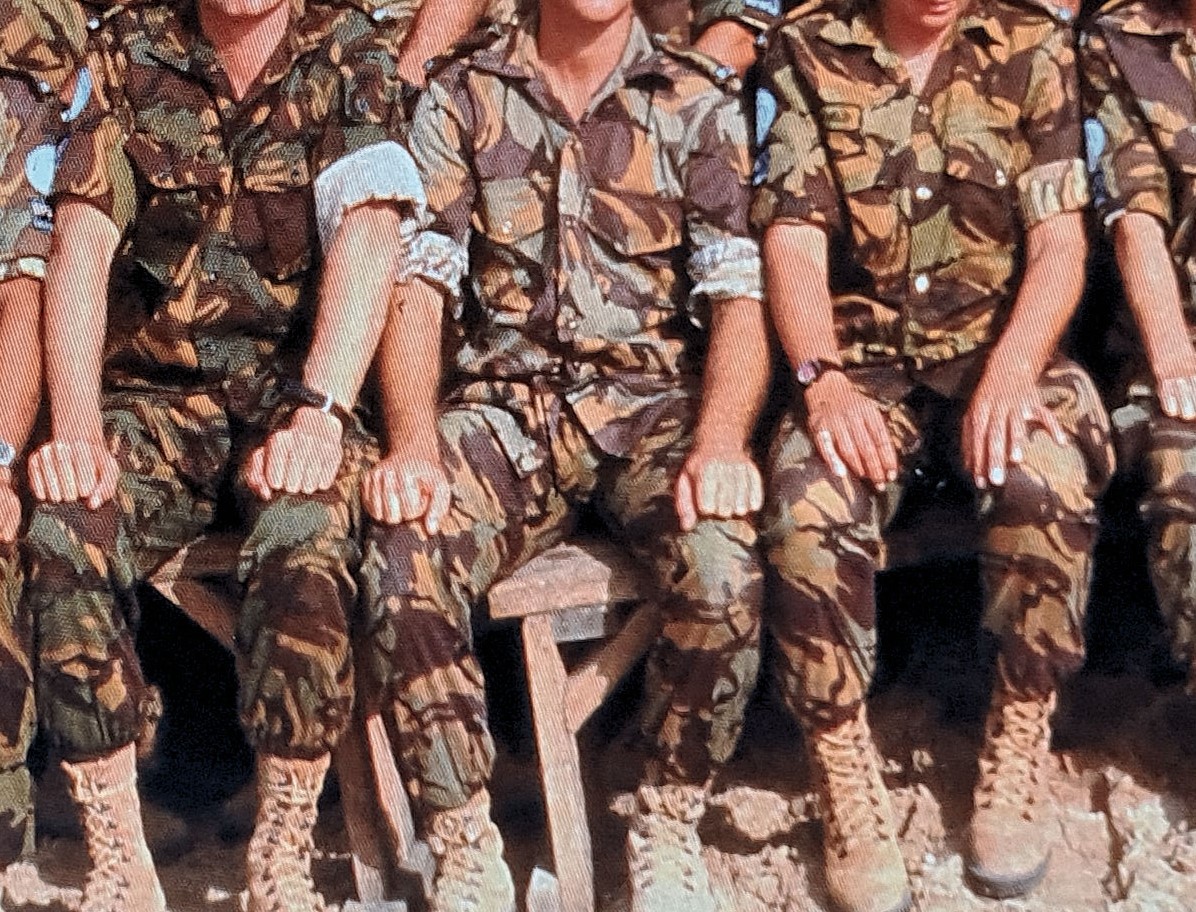
Uniforms worn by the NZ troops in Somalia were based around the standard NZ Army Disruptive Pattern material (DPM) temperate uniform that had been introduced in the late 1980s. Shirts were worn with sleeves rolled up and shirts untucked.

Each contingent had variations of what and how items could be worn, but, the combinations worn were not too dissimilar between contingents.

Ceremonial or Parade Dress

On rare ceremonial occasions, the DPM Uniform was worn with the shirt tucked in with.

  • Blue UN Beret
  • Blue UN cravat
  • Stable Belt of the individual’s Corps

Working Dress

Due to the harsh environment, a relaxed and comfortable working dress was adopted, which was worn in several variations, including

  • T-Shirt/Singlet, Shorts, Boots
  • T-Shirt/singlet, DPM Trouser, Boots

The Green T-Shirt was the standard issue NZ Army PT Shirt, however on occasion some individuals wore DPM T-Shirts or green civilian T-Shirts.

Although issue of the Green Single had ceased in the early 1980’s, some of the longer serving solders wore these older items.

The Black Shorts worn were either the standard NZ Army issue PT Short, “Singapore” Shorts or civilian items such as Canterbury Rugby Shorts.

Issue Green T-Shirt and Singapore Shorts
Old issue Single and DMP trou

Headdress

Headdress won by NZ Troops in Somalia consisted of.

  • NZ Army Beret with Corps Badge
  • UN Blue Beret
  • UN Blue Baseball cap
  • PASGT Kevlar Helmet

NZ Army Beret with Corps Badge

Usually only worn in transit from NZ to arrival in Somalia

UN Blue Beret

Issued from UN Stocks in Theatre, apart from Ceremonial occasions, rarely worn

UN Blue Baseball cap

Issued from UN Stocks, worn daily.

PASGT Kevlar Helmet

Worn daily. Use of covers on Kevlar helmets was not standardised, some were worn with covers others without covers.

NZ Manufactured Blue Covers designed for the PASGT helmets were utilised, these were plain blue with no markings.

Blue Covers designed for the M1 Steel helmet were also utilised, as were covers designed for the M1 Helmet in the various types of NZ DPM Pattern.

Blue UN Cover
No Cover
M1 Helmet DPM Cover

Boots

Although the DMP uniform was not designed for the climate, some consideration to climate appropriate footwear was given and Desert Boots were issued. Manufactured by New Zealand boot manufacturer John Bull, the Desert Boots were made of Tan Suede with synthetic rubber soles.

Each soldier was issued with two pairs of Desert boots; however a few individuals also wore the standard Black GP Boot.

Dress embellishments

Rank Insignia

As per the NZ Military conventions of the day, Rank insignia was worn as follows.

  • NCO Rank worn on a Brassard on the right shoulder,
  • Warrant Officer Rank on a wristband on the right wrist,
  • Officer Rank worn on a rank slide on the shoulder epaulettes of the DPM Shirt.

Mission Brassard

The Mission Brassard was worn on the Left shoulder and consisted of the UN patch above an NZ Flag. There is evident of examples of the mission Brassard worn with the badges reversed as well. As Officers and Warrant Officers wore their rank on the shoulder and wrist, there are also example of the Mission Brassard worn on the right shoulder.

National Insignia

 In addition to the NZ Flag on the Mission Brassard, a variation of the standard New Zealand shoulder tab that had been worn on overseas mission since the Second World War was worn affixed to the epaulets of each shoulder.

Trade and Appointment Badges

Some trade and appointment badges, such as the Ammunition Technician Badge and Medic Red Cross, were worn on the Mission Brassard.

Protective Vests and Body Amour

The New Zealand Army Body Armour of choice at the time was the Light Fragmentation Vest. A piece of kit unsuitable of the operating environment, which served more as confidence booster than as a practical protective measure.

From 1994 some of the Staff posted to the UN HQ were issued with the much more capable Bristol Type 23 Body Amour.

Load Carrying Equipment

Each NZ Soldier deployed to Somalia with the standard NZ Harness Webbing, being the early 90’s there was no set configurations with a variety of different pouches utilised with a basic set consisting of a minimum of Two Magazine pouches and Two Water Bottles and First Aid Pouch.

Due to the operating environment and the impartibility of wearing harness webbing in vehicles at the workplace, most individuals seldom used their webbing, with most sets spending the entire tour sitting under the individual’s cot, only to be dragged out for the occasional stand to.

Early on when the threat was perceived as low, a single spare magazine was carried in the pocket of the Frag Vest. As the treat level increased and the need to have additional ammunition at hand, many contingent members utilised a simple belt order consisting of pistol belt, Ammunition pouch and water bottle.

With the Infantry sections attached from July 93, some of the infantry lads utilised chest Rigs.

One set of unofficial purchased vest webbing was worn by a member of the Third Supply Contingent from January 1994. This vest was worn over the Frag Vest and allowed the wearer to carry additional ammunition and items with no loss of movement when in vehicle or carrying out physical tasks. This set of vest webbing become a communal set and was also utilised the Infantry Section Commander if his tasks necessitated it.

Example of Belt Order with Ammo Pouch and Water Battle, Magazine in Frag Vest pocket
Example of Vest Webbing

Weapons Systems

The New Zealand Contingents in Somalia utilised the standard range of New Zealand Small Arms, including

  • Steyr AUG 5.56mm Rifle with 508mm barrel.
  • Steyr AUG 5.56mm Carbine with 250mm barrel.
  • C9 Minimi 5.56 mm Light Machine Gun.
  • Pistol 9 mm Automatic P226, note as this weapon had only been introduced into NZ Army Service in 1992, existing holsters for the retired Browning pistols were utilised.

Gallery

Photo credits.

  • The Somalia Journal 1992-1995
  • Authors Collection


RNZAOC 1 April 1957 to 31 March 1958

This period would see the RNZAOC continue to support Regular, Territorial and Compulsory Military Training. This period would also see the formation and deployment to the 1st Battalion, the New Zealand Regiment to Malaya

Key Appointments

Director of Ordnance Services

  • Temporary Lieutenant Colonel H. McK. Reid from 1 April 1957.[1]

Commanding Officer Main Ordnance Depot

  • Major O.H Burn

Inspecting Ordnance Officer, Northern Military District

  • Captain J.H Doone, from 19 July 1957.

Inspecting Ordnance Officer, Southern Military District

  • Captain E.D Gerrard, from 19 July 1957.

Compulsory Military Training

During this period three CMT intakes marched in with the RNZAOC recruits posted to 1 (NZ) Division Ordnance Field Park on completion of initial training;[2]

  • 24th intake of 1775av recruits on 2 May 1957
  • 25th intake of 1300av recruits on 22 August 1957
  • 26th intake of 1300av recruits on 3 January 1958

1st Battalion, the New Zealand Regiment

Reformed at Waiouru in July 1957, the 1st Battalion of the New Zealand Regiment would undertake workup and training that would see the Battalion deploy on operations in Malaya on 28 November 1957.[3]

The RNZAOC would equip the Battalion from the ground up with its necessary entitlement of equipment provided from existing holdings, including Eighty-Nine vehicles and trailers. However £59000 (2020 NZD $ $2,999,351.94) was expended to procure additional theatre specific items not held in the New Zealand inventory from the United Kingdom authorities in Malaya.[4]

In addition to providing the stores and equipment for the Battalion, RNZAOC Officer Major Jack Harvey was seconded to the 1st Battalion NZ Regiment for the duration of its Malaya tour as the Officer Commanding of C Company. [5]

Major Jack Harvey, RNZAOC Officer Commanding C Company, 1st Battalion, New Zealand Regiment, 1957-59

Members of the 1st Battalion who would later serve with the RNZAOC included;

  • Brian Crafts
  • David Orr

Fiji Military Forces

Warrant Officer Class One Murray Alexander Burt was posted on 15 July 1957, on an accompanied posting with his family to the New Zealand Cadre at Queen Elizabeth Barracks in Suva. WO1 Burt and Family would depart Auckland on the Union Steam Ship Company vessel the MV Tofus on 31 August 1957. WO1 Burt would return to New Zealand on 15 December 1959 and be posted to Hopuhopu camp.[6]

Uniforms

A new Service Dress uniform similar to the Officer pattern Service Dress was approved for Other Ranks by the Army Board in 1954  had is design finalised and placed into production during this period. This uniform’s approval satisfied a long-standing requirement for a ceremonial and walking out order of dress to replace the existing Battle Dress.[7]

Manufacture of the new uniforms was well advanced by closing this period with the District Ordnance Depots in a position to issue the new uniforms by the end of 1958.

With this new Service Dress uniform, Battle Dress would become winter working dress with Khaki Drill the summer working dress.

Other Ranks Service Dress

Ammunition

The demolition of the 17000 rounds of unsafe 3.7inch Anti Aircraft Ammunition that had been initiated in June 1955 was concluded in December 1957. The destruction had proceeded without incident with the local residences thanked for their considerable forbearance in putting up with the noise of explosions nearly every day.

During this period, demolitions were also successfully conducted at the Makomako Ammunition area to dispose of a large quantity obsolete and unsafe ammunition and explosives.[8]

Move of Central Districts Vehicle Depot to Linton

The move of the Central Districts Vehicle Depot (CDVD) was planned to occur during 1958. Before the move could happen, adequate storage had to be constructed at Linton Camp, and this was to be achieved by re-locating war surplus buildings from other locations. By June 1957 the second “W” Type prefabricated building for the CDVD was re-located from Fort Dorset to Linton Camp.[9]

Construction Of New Ordnance Depot for Linton Camp

Since its establishment in 1946, the Central Districts Ordnance Depots had occupied accommodation buildings in the North West corner of Linton Camp in what had initially been the wartime RNZAF Base Linton. Two additional warehouses had been assembled in 1949; however, storage space remained at a premium. In June 1957 Army HQ authorised the expenditure of £100 (2020 NZ$5,059.84) to conduct a preliminary site investigation for a new Ordnance Depot for Linton Camp. Given the deficiencies of adequate Storage accommodation and the erection of buildings for the CDVD, the Linton Camp Command issued instructions that the CDOD were not to utilise the new buildings, even temporarily as this would become permanent and prejudice the business case for constructing a new Ordnance Depot.[10]

Honours and Awards

Meritorious Service Medal

  • Warrant Officer Class One Bernard Percy Banks, 13 June 1957. [11]
  • Warrant Officer Class One Athol Gilroy McCurdy, 10 October 1957. [12]

Appointments, Promotions, Transfers, Resignations, and Retirements of Officers of the RNZAOC

Regular Force

  • Regular Force Major H. McK. Reid to be temp. Lieutenant-Colonel, and is appointed Director of Ordnance Services, dated 1 April 1957.[13]
  • Captain E.C Green, MBE, is re-engaged for one year, as from 1 April 1957.[14]
  • Lieutenant-Colonel F. Reid, OBE, relinquished Director of Ordnance Services’ appointment, pending retirement, 31 March 1957.[15]
  • Captain P.N Erridge, MBE., transferred to the Reserve of Officers, General List, The Royal N.Z. Army Ordnance Corps, in the rank of Major, 2 May 1957.[16]
  • Captain A.B West to be Major, 1 July 1957,[17]
  • Lieutenant F.G Cross to be Captain,  13 August 1957.[18]
  • Lieutenant Colonel F Reid, O.B.E., posted to the Retired List, 16 August 1957.[19]
  • Captain H.P White to be Major. Dated 18 October 1957.[20]
  • Captain and Quartermaster R.P Kennedy, E.D., granted an extension of his engagement for a period of one year as from 13 April 1958.[21]
  • Captain (Temporary Major) F.A Bishop to be Major. Dated 12 December 1957.[22]
  • Lieutenant and Quartermaster (on probation) L.E Autridge is confirmed in his present rank and seniority.[23]
  • Lieutenant and Quartermaster (on probation) 0.C Prouse is confirmed in his present rank and seniority.[24]
  • Lieutenant and Quartermaster (on probation) D.H Rollo, MBE., is confirmed in his present rank and seniority.[25]

Regular Force (Supernumerary List)

  • Captain and Quartermaster R.P Kennedy, E.D, re-engaged in the Regular Force for one year from 13 April 1957.[26]
  • Captain and Quartermaster E.R. Hancock posted to the Retired List, 30 March 1957.[27]
  • Major and Quartermaster I.S. Miller, E.D., is posted to the Retired List, 20 April 1957.[28]
  • Captain and Quartermaster G.A Perry, E.D.,  re-engaged for one year from 1 April 1957.[29]
  • Captain and Quartermaster A.A Barwick posted to the Retired List, 3 August 1957.[30]
  • Captain and Quartermaster A Gollan granted an extension of his engagement for one year, as from 19 December 1957.[31]

Reserve of Officers

  • Lieutenant-Colonel Maurice Salam Myers. posted to the Retired List, 1 January 1958.[32]

Appointments, Promotions, Transfers, Resignations, and Retirements of Warrant Officers, Senior Non-Commissioned Officers and men of the RNZAOC

Regular Force

  • 31266 Warrant Officer Class One, Cyril Austin Baigent to be Lieutenant and Quartermaster, 15 July 1957.[33]
  • 33297 Warrant Officer Class Two, Henry Williamson to be Lieutenant and Quartermaster, 15 July 1957.[34]
  • 33635 Warrant Officer Class Two, William Edwin Smith to be Lieutenant and Quartermaster, 15 July 1957.[35]
  • 31261 Staff Sergeant Ernest Maurice Alexander Bull, Promoted to Warrant Officer Class Two, 30 October 1957.[36]
  • 31257 Warrant Officer Class Two  Murray Alexander Burt, Promoted to Warrant Officer Class One, 15 July 1957.[37]
  • B31695 Sergeant Ian McDonald Russell promoted to Staff Sergeant, 23 April 1957.[38]

Notes

[1] “Appointments, Promotions, Transfers, and Resignations, of Officers of the New Zealand Army,” New Zealand Gazette, No 35, 2 May 1957.

[2] Peter Cooke, Fit to Fight. Compulsory Military Training and National Service in New Zealand 1949-72 (Auckland: David Ling Publishing, 2013), 539.

[3] Brian Clamp and Doreen Clamp, 1st Battalion the New Zealand Regiment (1957-59) Association 50th Anniversary. The First of the First (B. Clamp, 2007), Non-fiction.

[4] “H-19 Military Forces of New Zealand Annual Report of the General Officer Commanding, for Period 1 April 1957 to 31 March 1958,” Appendix to the Journals of the House of Representatives  (1958).

[5] Clamp and Clamp, 1st Battalion the New Zealand Regiment (1957-59) Association 50th Anniversary. The First of the First.

[6] Howard E. Chamberlain, Service Lives Remembered : The Meritorious Service Medal in New Zealand and Its Recipients, 1895-1994 ([Wellington, N.Z.]: H. Chamberlain, 1995), 69-70.

[7] “H-19 Military Forces of New Zealand Annual Report of the General Officer Commanding, for Period 1 April 1957 to 31 March 1958.”

[8] Ibid.

[9] John Mitchell, Buildings, Linton Camp, Central Ordnance Depot, Item Id R9428308 (Wellington: New Zealand Archives, 1955 – 1968 ).

[10] Ibid.

[11] Chamberlain, Service Lives Remembered : The Meritorious Service Medal in New Zealand and Its Recipients, 1895-1994.

[12] Ibid., 283.

[13] “Appointments, Promotions, Transfers, and Resignations, of Officers of the New Zealand Army.”

[14] Ibid.

[15] “Appointments, Promotions, Transfers, and Resignations, of Officers of the New Zealand Army,” New Zealand Gazette, No 38, 16 May 1957.

[16] “Appointments, Promotions, Transfers, and Resignations, of Officers of the New Zealand Army,” New Zealand Gazette, No 42, 30 May 1957.

[17] “Appointments, Promotions, Transfers, and Resignations, of Officers of the New Zealand Army,” New Zealand Gazette, No 45, 1 August 1957.

[18] “Appointments, Promotions, Transfers, and Resignations, of Officers of the New Zealand Army,” New Zealand Gazette, No 62, 29 August 1957.

[19] “Appointments, Promotions, Transfers, and Resignations, of Officers of the New Zealand Army,” New Zealand Gazette, No 66, 12 September 1957.

[20] “Appointments, Promotions, Transfers, and Resignations, of Officers of the New Zealand Army,” New Zealand Gazette, No 3, 16 January 1958.

[21] Ibid.

[22] “Appointments, Promotions, Transfers, and Resignations, of Officers of the New Zealand Army,” New Zealand Gazette, No 13, 20 February 1958.

[23] Ibid.

[24] Ibid.

[25] Ibid.

[26] “Appointments, Promotions, Transfers, and Resignations, of Officers of the New Zealand Army,” New Zealand Gazette, No 27, 4 April 1957.

[27] “Appointments, Promotions, Transfers, and Resignations, of Officers of the New Zealand Army.”

[28] “Appointments, Promotions, Transfers, and Resignations, of Officers of the New Zealand Army.”

[29] “Appointments, Promotions, Transfers, and Resignations, of Officers of the New Zealand Army,” New Zealand Gazette, No 46, 20 June 1957.

[30] “Appointments, Promotions, Transfers, and Resignations, of Officers of the New Zealand Army.”

[31] “Appointments, Promotions, Transfers, and Resignations, of Officers of the New Zealand Army,” New Zealand Gazette, No 86, 14 November 1957.

[32] “Appointments, Promotions, Transfers, and Resignations, of Officers of the New Zealand Army.”

[33] “Appointments, Promotions, Transfers, and Resignations, of Officers of the New Zealand Army,” New Zealand Gazette, No 60, 15 August 1957.

[34] Ibid.

[35] Ibid.

[36] Chamberlain, Service Lives Remembered : The Meritorious Service Medal in New Zealand and Its Recipients, 1895-1994.

[37] Ibid.

[38] Ibid., 410-11.


NZAOC relief efforts, Napier earthquake 3 February 1931

For two and a half minutes from 10:47 on the morning of 3 February 1931, Napier and the surrounding province of Hawkes Bay shook as a magnitude 7.8 earthquake triggered New Zealand’s deadliest natural disaster killing 256 people.

Thankfully for Napier’s surviving citizens, HMS Veronica of the New Zealand Division of the Royal Navy had just arrived in port and was immediately able to provide Bluejackets, Marines and material towards the relief efforts. HMS Veronica also established radio communications with the outside world and hastened the dispatch of relief supplies from Auckland. HMS Dunedin and Diomede soon delivered additional Medical Staff, Bluejackets and Marines to assist. Also, the navy vessels carried much-needed medical and camp equipment, including marquees, tents, blankets, beds and hand tools.

However, additional relief supplies were urgently required, and the Main Ordnance Depot in Trentham was called upon to supply tents, blankets, bedding, cooking and eating utensils for use in the stricken areas. The total value of the stores issued from the Main Ordnance Depot at Trentham was £35,000 (2020 NZ$3,842,326.23)

The earthquake had stuck less than a week after the NZAOC had undergone a significant and extremely unpopular reduction in its military Staff, with many compulsory retired, with others retained in the same role but transferred to the civilian Staff. However, despite this recent staff reduction, the remaining Ordnance staff did outstanding work in dispatching the required stores to support the relief efforts.

An example of the contribution of the Ordnance Staff is provided by one of the Ordnance soldiers who had been transferred to the civilian staff, Gordon Bremner. s. Bremner’s skill as a lorry driver was put to full use making multiple trips delivering stores and equipment to Napier and Hastings.

Relief camp in Nelson Park, Napier, after the 1931 earthquake. Alexander Turnbull Library, Wellington, New Zealand. /records/23061357
Aerial view of Napier after the 1931 earthquake. Alexander Turnbull Library, Wellington, New Zealand. /records/22711223

All military staff in the earthquake area were detailed for relief work and other personnel from other centres. On 6 March 1931, twelve officers and forty-six other ranks were employed in connection with the relief camps. All ranks and the military and civilian staff engaged in the relief effort deserved great credit for how they carried out their duties under trying conditions.


RNZAOC 1 April 1956 to 31 March 1957

This period would see the RNZAOC. Continue to support Regular, Territorial and Compulsory Military Training. This period would see the winding down and cessation of direct RNZAOC support to Kay Force.[1]

Key Appointments

Director of Ordnance Services

  • Lieutenant Colonel F Reid, OBE, relinquished the appointment on 31 march 1957.

Commanding Officer Main Ordnance Depot

  • Major O.H Burn.

Compulsory Military Training

During this period four CMT intakes marched in with the RNZAOC recruits posted to 1 (NZ) Division Ordnance Field Park on completion of initial training;[2]

  • 20th intake of 2475av recruits on 5 April 1956
  • 21st intake of 2475av recruits on 28 June 1956
  • 22nd intake of 1775av recruits on 20 September 1956
  • 23rd intake of 1775av recruits on 3 January 1957
4th New Zealand Division ordnance Field park on parade Trentham, Camp 17 October 1956. WO In charge Gavin Lake Right-hand rank from the from Peter Barret, Bill Smith, mauri Philips, Jim Bremner, Brian Jennings, Peter Rennie, Murray Burt, Dave Laidlaw, Jim Brown. Middle-Rank Leading is Kevin Anderson. Left-Rank Leading; Bert Roil followed by Tex Rickard. Robert Mckie RNZAOC Collection

Emergency Force (Kayforce)

The RNZAOC concluded its commitment to Kayforce with the final Ordnance men’s return in the latter half of 1956.

Out of Kayforce

  • 204459  Temporary Sergeant Gordon Winstone East, 31 August 1956
  • 204702 Temporary Sergeant Ernest Radnell, 31 August 1956
  • 30419 Captain John Barrie Glasson, 3-Sep-56
  • 206870  Staff Sergeant James Russell Don, 29 December 1956

Ordnance Conferences

DOS Conference August 1956

The Director of Ordnance Services hosted a conference of the District Ammunition and Ordnance Depots’ Officer Commanding and the District DADOS at Trentham Camp over 11 – 14 August 1956.[3]  

The agenda for the conference included.

  • Modified accounting procedure,
  • Depot Commanders to visit MOPD for local discussions,
  • Corps Matters,
  • District Problems.

DOS Conference March 1957

The Director of Ordnance Services hosted a conference of the Officer Commanding of the District Ammunition and Ordnance Depots and the District DADOS at Trentham Camp over 26 to 28 March 1957.  

Ammunition Examiners Course

From April to September 1956, Warrant Officer Class Two David Gwynne Thomas attended and passed with excellent results the Ammunition Examiners Course at the RAAOC Corps School at Broadmeadows in Victoria, Australia.[4]

Metal from Condemned Ammunition

Valuable metal was to be recovered from condemned non-high explosive ammunition drawn from Army ordnance depots in the North and South Islands over the next two or three years. The Colonial Ammunition Company was awarded a contract with the Government for the breaking down of the ammunition, which was to be done in New Plymouth. Work will start in the next three months, and the brass and copper extracted will be sent to a large brass extrusion mill to be prepared for further use in industry. Any steel that is recovered and not wanted in New Zealand will be sent overseas.

Corps History

During 1956 the Royal Army Ordnance Corps in the United Kingdom established the RAOC Museum at the RAOC Training centre at Blackdown. The museum’s concept was to establish a Commonwealth Section to illustrate the links between the various commonwealth Ordnance Corps and the RAOC.  In August 1956 the Director of Ordnance (UK) put out a call to the DOS’s or Australia, Canada, Ceylon, India, Pakistan and New Zealand to contribute material for the planned exhibit.

New Zealand replied on 24 January 1957 that as the RNZAOC had only been in existence for a short period, items of historical interest were not available and the RNZAOC would be unable to contribute to this project.[5]

Honours and Awards

Long Service and Good Conduct

  • 31234 Warrant Officer Class One Athol Gilroy McCurdy, 12 April 1956.[6]

Appointments, Promotions, Transfers, Resignations, and Retirements of Officers of the RNZAOC

Regular Force

  • Captain F.A Bishop to be temp. Major. Dated 16 April 1956.[7]
  • Lieutenant and Quartermaster FG Cross is transferred to the Reserve of Officers, General List, The RNZAOC, with Lieutenant and Quartermaster’s rank. Dated 27 April 1956.[8]
  • Captain W.G Dixon is transferred From the Royal New Zealand Artillery to the RNZAOC· in his present rank and seniority. Dated 14 May 1956.[9]
  • Captain M.R.J Keeler to be Major 16 May 1956.[10]
  • Captain W.G Dixon, M.B.E., to be Major. Dated 15 May 1956.[11]
  • The under-mentioned are appointed to regular commissions in the rank of Lieutenant and Quartermaster (on probation):[12]
    • 31002 Warrant Officer Class One, Louis Eric Autridge, from The Royal NZ Artillery.
    • 36643 Staff Sergeant Oliver Cedric Prouse, from the New Zealand Regiment.
    • 33842 Staff Sergeant David Halsel Rollo, M.B.E., from The Royal NZ Artillery.
    • 31028 Warrant Officer Class Two, William Neil Stephenson, from The Royal NZ  Artillery.
  • Captain D Sharpe is posted to the retired list with the Rank of Major. Dated 25 July 1956.[13] [14]
  • Captain R.T Marriott to be Major. Dated 29 August 1956.[15]
  • Lieutenant and Quartermaster Frederick George Cross, Reserve of Officers, General List, RNZAOC is appointed to a short-service Regular commission for a term of three years, in the rank of Lieutenant, with seniority from 13 August 1951. Dated 13 August 1956.[16]
  • The appointment of Lieutenant and Quartermaster (on probation) W. N. Stephenson lapsed Dated 21 September 1956.[17]
  • Captain N.L Wallburton is transferred to the Reserve of Officers, General List, RNZAOC, in the rank of Captain. Dated 7 September 1956.[18]
  • Captain E.F.L Russell is re-engaged for a period of five years as from 26 November 1956.[19]
  • Lieutenant L.C King is re-engaged in the NZ Regular Force for the period 16 November 1956 to 3 October 1958 and promoted to Captain from 16 November 1956.[20]
  • Major K.G Scott, from the Reserve of Officers, Supplementary List, to be Major. Dated 1 November 1956.[21]
  • Temp. Captain D.R. Alexander, from the Reserve of Officers, Supplementary List, to be Captain. Dated 1 November 1956.
  • Captain Donald MacKenzie Robson, M.B.E., from the Regular Army Reserve of Officers, Royal Australian Army Ordnance Corps, to be Captain. Dated 7 December 1956.[22]
  • Temp. Lieutenant A.A Burrows, from the Reserve of Officers, Supplementary List, to be Lieutenant. Dated 1 November 1956.[23]
  • Temp. Lieutenant M.J Goodson, from the Reserve of Officers, Supplementary List, to be Lieutenant. Dated 1 November 1956.[24]

Regular Force (Supernumerary List)

  • Captain and Quartermaster R.P Kennedy, E.D, is granted a further extension of his engagement for one year from 13 April 1956.[25]
  • Captain and Quartermaster G.A Perry, E.D., is given an extension of his engagement for a further period of one year from 1 April 1956.[26]

Territorial Force

  • Captain A.W Wilkin, RNZAOC, relinquished the appointment of Brigade Ordnance Officer, Headquarters, 3rd Infantry Brigade and was posted to the Retired List on 4 November 1954.[27]

Graduates, Royal Military College, Duntroon

  • Lieutenant Malcolm John Ross, 12 December 1956.[28]

Appointments, Promotions, Transfers, Resignations, and Retirements of Warrant Officers, Senior Non-Commissioned Officers and men of the RNZAOC

Regular Force

  • Corporal J.T Skeddan from SMD was selected to attend the year long course at Portsea Officer Training establishment in Australia starting in January 1957.
  • 31257 Temporary Warrant Officer Class Two Murray Alexander Burt promoted to substantive Warrant Officer Class Two, 10 October 1956.[29]
  • W920917 Corporal George Thomas Dimmock promoted to Sergeant, 1 June 1956.[30]
  • 31004 Warrant Officer Class One William Galloway, retired 1 January 1957[31]
  • 1185 Staff Sergeant Albert Edward “Abbie” Shadbolt retired on 25 October 1956. SSgt Shadbolt retired at the age of 69 after 49 years and ten months of service to the military in uniformed and civilian roles.
    • Enlisted into RNZA 26 November 1907.
    • Transferred to NZAOC in 1922
    • Transferred to civilian Staff 1931, remaining employed at the Main Ordnance Depot as a Clerk.
    • 8 January 1942 commissioned as a Lieutenant into the NZ Temporary Staff as Ordnance Officer Main Ordnance Depot, Placed on to the retired list on 21 October 1948
    • Re-engaged as a Warrant Officer Class Two in 1948, Shadbolt would latter attain Warrant Officer Class One rank as the 2 I/C of the Central Districts Vehicle Depot at Trentham.
    • Due to his age was reverted to the Rank of Staff Sergeant on 1 April 1956 and placed on less onerous duties for his last year of service, retiring 0n 10 October 1956.
  • Besides his military responsibilities, Shadbolt was an outstanding Rugby Union and Rugby league player with the following credentials.
    • He represented Canterbury XV in 1909 and 1910
    • Switched to Rugby League in 1912 and would play for the St Albans and Federal Clubs
    • Played for the Canterbury Rugby League side from 1912 to 1920
    • Represented New Zealand in the Rugby League tours to Australia in 1913 and 1921

Notes

[1] “H-19 Military Forces of New Zealand Annual Report of the General Officer Commanding, for Period 1 April 1954 to 31 March 1955 “, Appendix to the Journals of the House of Representatives  (1955).

[2] Peter Cooke, Fit to Fight. Compulsory Military Training and National Service in New Zealand 1949-72 (Auckland: David Ling Publishing, 2013), 539.

[3] Conferences – Ordnance Officers, Item Id R17188101 (Wellington: Archives New Zealand, 1950).

[4] Howard E. Chamberlain, Service Lives Remembered : The Meritorious Service Medal in New Zealand and Its Recipients, 1895-1994 ([Wellington, NZ.]: H. Chamberlain, 1995), 466.

[5] “Organisation – Policy and General – Rnzaoc “, Archives New Zealand No R17311537  (1946 – 1984).

[6] Chamberlain, Service Lives Remembered : The Meritorious Service Medal in New Zealand and Its Recipients, 1895-1994.

[7] “Appointments, Promotions, Transfers, and Resignations, of Officers of the New Zealand Army,” New Zealand Gazette No 29, 17 May 1956.

[8] Ibid.

[9] “Appointments, Promotions, Transfers, and Resignations, of Officers of the New Zealand Army,” New Zealand Gazette No 34, 14 June 1956.

[10] “Appointments, Promotions, Transfers, and Resignations, of Officers of the New Zealand Army,” New Zealand Gazette No 36, 28 June 1956.

[11] “Appointments, Promotions, Transfers, and Resignations, of Officers of the New Zealand Army,” New Zealand Gazette No 41, 26 July 1956.

[12] “Appointments, Promotions, Transfers, and Resignations, of Officers of the New Zealand Army,” New Zealand Gazette No 45, 16 August 1956.

[13] “Appointments, Promotions, Transfers, and Resignations, of Officers of the New Zealand Army,” New Zealand Gazette No 48, 30 August 1956.

[14] “Appointments, Promotions, Transfers, and Resignations, of Officers of the New Zealand Army,” New Zealand Gazette No 68, 6 December 1956.

[15] “Appointments, Promotions, Transfers, and Resignations, of Officers of the New Zealand Army,” New Zealand Gazette No 51, 13 September 1956.

[16] Ibid.

[17] “Appointments, Promotions, Transfers, and Resignations, of Officers of the New Zealand Army,” New Zealand Gazette No 55, 11 October 1956.

[18] “Appointments, Promotions, Transfers, and Resignations, of Officers of the New Zealand Army,” New Zealand Gazette No 58, 1 November 1956.

[19] “Appointments, Promotions, Transfers, and Resignations, of Officers of the New Zealand Army,” New Zealand Gazette No 1, 10 January 1957.

[20] “Appointments, Promotions, Transfers, and Resignations, of Officers of the New Zealand Army,” New Zealand Gazette No 8, 31 January 1957.

[21] “Appointments, Promotions, Transfers, and Resignations, of Officers of the New Zealand Army,” New Zealand Gazette No 14, 27 February 1957.

[22] Ibid.

[23] Ibid.

[24] Ibid.

[25] “Appointments, Promotions, Transfers, and Resignations, of Officers of the New Zealand Army,” New Zealand Gazette No 35, 21 June 1956.

[26] “Appointments, Promotions, Transfers, and Resignations, of Officers of the New Zealand Army.”

[27] “Appointments, Promotions, Transfers, and Resignations, of Officers of the New Zealand Army.”

[28] “Appointments, Promotions, Transfers, and Resignations, of Officers of the New Zealand Army,” New Zealand Gazette No 20, 7 March 1957.

[29] Chamberlain, Service Lives Remembered : The Meritorious Service Medal in New Zealand and Its Recipients, 1895-1994.

[30] Ibid.

[31] Ibid., 175.


RNZAOC 1 April 1955 to 31 March 1956

This period would see the RNZAOC undertake a range of routine activities whilst continuing to support Regular, Territorial and Compulsory Military Training. [1]

Key Appointments

Director of Ordnance Services

  • Lieutenant Colonel F Reid, OBE

Compulsory Military Training

During this period three CMT intakes marched in;[2]

  • 17th intake of 2800av recruits on 23 June 1955
  • 18th intake of 2475av recruits on 15 September 1955
  • 19th intake of 2475av recruits on 5 January 1955

Territorial Force Annual Camps

Technical Stores Sectionsd of the Divisional Ordnance Park would exerces on the following dates;

  • 11 – 30 January 1956
  • 25 January – 13 February 1956

Reorganisation of Territorial Force Units

With effect, the ORBAT Amendment of 28 June 1955, the RNZAOC Ordnance Field Park Platoons were reorganised into the 1(NZ) Division Ordnance Field Park, Organised as;[3]

  • Headquarters (Not Raised in Peace)
  • MT Stores Platoon, Lower Hutt, plus MT Stores Platoon of Independent Brigade OFP
  • Tech Stores Platoon, Christchurch, Plus Tech Stores Platoon of Independent Brigade OFP.
  • General Stores Platoon, Hopuhopu, Plus General Stores Platoon of Independent Brigade OFP.

Emergency Force (Kayforce)

The RNZAOC continued to support Kayforce with the dispatch of regular consignments of Maintenance stores and with all requests for stores by Kayforce met.

Out of Kayforce

  • Corporal Abraham Barbara, 2 May 1955
  • Gunner John Neil Campbell, 21 June 1955
  • Sergeant Joseph James Enright Cates, 9 December 1955
  • Temporary Warrant Officer Class Two Philip Hayhurst Kirkman, 2 June 1955
  • Warrant Officer Class Two Barry Stewart, 13 May 1955
  • Corporal Edward Tanguru, 21 June 1955

Small Arms Ammunition

The Manufacture of Small-Arms Ammunition by the Colonial Ammunitions Company at their Mount Eden Factory continued with delivered of first-class ammunitions being well maintained. [4]

Introduction of New Equipment

As new equipment was introduced, the RNZAOC would play an essential role in the acceptance processes. Upon delivery from the supplier, the equipment, accessories, and spares would be received into an RNZAOC Depot. The equipment would be inspected and kitted out with all its accessories before distribution to units. Several examples may have been retained in RNZAOC Depots as War Reserve/Repair and Maintenance Stock depending on the equipment. Maintenance stocks of accessories and spares were maintained as operating stock in RNZAOC depots. If the new equipment contained a weapon system, ammunition specific to the equipment was managed by RNZAOC Ammunition Depots.

During this period, the following equipment was introduced into service;[5]

  • Six 5.5in Guns
  • Three Scout Cars
  • Fifty-five Field Wireless sets
  • Fourteen cars
  • Thirty-seven commercial type trucks

Equipment Disposal

The following items were disposed of through the Government Stores Board.

  • 534 Trucks
  • 268 Motorcycles

Ammunition Disposal

With large stocks of ammunition left over for the Second World War, disposal of Unserviceable and surplus stock was authorised in 1955. Small quantities would be routinely disposed of at individual depots with a significant effort put into place to dispose of 3.7-inch Anti-Aircraft ammunition and Various types of Anti-Tank Rounds.

3.7-inch Anti-Aircraft Ammunition

Since the end of the war 17000 rounds of 3.7-inch anti-aircraft ammunition had been stored in unsuitable conditions at Kuku Valley becoming unstable and dangerous with the decision made in 1955 to destroy these stocks.

After many years of poor storage, many storage containers had deteriorated to a stage that increased the risk of explosion during transport. To facilitate the transportation of the unstable ammunition from Kuku Valley to the Demolition Range, a modified armoured truck and trailer was constructed the EME Workshops at Trentham to move the condemned shells for destruction.

Twenty shells would be transported unloaded at the demolition range and in batches of four destroyed by explosion. Destruction of the stockpile began in June 1955 and completed in December 1957.[6]

Examination of deteriorated shell at Trentham, Upper Hutt. National Library of New Zealand Ref: EP/1955/1792-F
Army vehicles at Trentham, Upper Hutt. Ref: EP/1955/1793-F. Alexander Turnbull Library, Wellington, New Zealand. /records/23078184
Valentine Tank at Trentham, stacks of Ammunition can be seen in the background. NZ National Library Ref EP/1955/1794-F

Anti-Tank Ammunition

In addition to Ammunition disposal at Trentham, The Army still held more than One and a Half Million rounds of various Anti-Tank Ammunition types. As this ammunition was surplus to requirement and belonging to obsolete weapon types, a profit-sharing contract was arranged with the Colonial Ammunition Company (CAC) to dispose of these rounds. Under the terms of the agreement, the CAC would break down and salvage recyclable materials form the wartime stocks of Anti-Tank ammunition, with the army receiving a share of the funds raised by the sale of the salvageable material.

Ammunition Examiners

During this period the following Ammunition Examiners were authorised to carry out routine inspections of ammunition and allocated Ammunition Examiner Serial Numbers.

  • Central Military District,
    • Lance Corporal G.C Gilbert, Ammunition Examiner Serial No 92.

Honours and Awards

Meritorious Service Medal

  • 31004 Warrant Officer Class One William Galloway, 10 November 1955

Long Service and Good Conduct

  • 31234 Warrant Officer Class One Athol Gilroy McCurdy, 12 April 1956

Appointments, Promotions, Transfers, Resignations, and Retirements of Officers of the RNZAOC

Regular Force

  • Captain and Quartermaster K. A. Bailey, MM, to be Major and Quartermaster. Dated 2 May 1955.[7]
  • Captain (temp. Major) K. G. K. Cropp, E.D., to be Major. Dated 26 May 1955.[8]
  • Lieutenant G. W. Peters is transferred to the Reserve of Officers, General List, The Royal N.Z. Army Ordnance Corps, with the rank of Lieutenant. Dated 18 June 1955.[9]
  • Captain (temp. Major) D. E. A. Roderick to be Major. Dated 27 May 1955. [10]
  • Captain E. W. Whitacre to be Major. Dated 30 May 1955. [11]
  • Captain 0, H. Burn to be Major. Dated 1 June 1955. [12]
  • Captain (temp. Major) C. A. Penny to be Major. Dated 30 May 1955.[13]
  • Captain H. S. Sandford to be Major. Dated 17 June 1955.[14]
  • Captain (temp. Major) H. J. Mockridge is posted to the Retired List with the rank of Major. Dated 22 September 1955.[15]
  • Lieutenant H. G. Rees is posted to the Retired· List with the ·rank of Captain. Dated 9 October 1955.[16]
  • Captain and Quartermaster G. G. W. Blandford is posted to the Retired List. ·Dated 1 November 1955.[17]
  • 31617 W.O. I Ray Henry Colwill to be Lieutenant and Quartermaster. Dated 9 January 1956.[18]
  • 31253 WO II William John McCluggage to be Lieutenant and Quartermaster. Dated 9 January 1956.[19]
  • 32171 Staff Sergeant George Witherman McCullough to be Lieutenant and Quartermaster. Dated 9 January 1956.[20]
  • 31244 WO I William John Stanley Tavendale to be Lieutenant and Quartermaster. Dated 9 January 1956.[21]

Regular Force (Supernumerary List)

  • Captain (Temp. Major) · S. A. Knight is posted ‘to the· Retired List, with Lieutenant Colonel’s rank. Dated 16 February 1956.[22]  [23]
  • Captain and Quartermaster N. C. Fisher is posted to the Retired List, with Major and Quartermaster’s rank, dated 14 March 1956.[24]

Territorial Force

  • Captain T.H. Beauchamp, from the Reserve of Officers, General List, The Royal N.Z. Army Ordnance Corps, to be Captain with seniority from 23 August 1954, and is appointed Officer Commanding, 1st Armoured Regiment, Light Aid Detachment, RNZEME Dated 1 July 1955.[25]

Appointments, Promotions, Transfers, Resignations, and Retirements of Warrant Officers, Senior Non-Commissioned Officers and men of the RNZAOC

  • 31383 Sergeant Hector Searle McLachlan, promoted to Staff Sergeant, 1 April 1955.

Notes

[1] “H-19 Military Forces of New Zealand Annual Report of the General Officer Commanding, for Period 1 April 1954 to 31 March 1955 “, Appendix to the Journals of the House of Representatives  (1955).

[2] Peter Cooke, Fit to Fight. Compulsory Military Training and National Service in New Zealand 1949-72 (Auckland: David Ling Publishing, 2013), 539.

[3] “Organisation and Administration: Units – Territorial: Formation and Organisation – 1 Divisional Officer[?] Rnzaoc [Royal New Zealand Army Ordinance Corps] M/T {Motor Transport] Stores Platoon (Lower Hutt),” Archives New Zealand Item No R22496443  (1950-55).

[4] “H-19 Military Forces of New Zealand Annual Report of the General Officer Commanding, for Period 1 April 1955 to 31 March 1956,” Appendix to the Journals of the House of Representatives  (1956).

[5] “H-19 Military Forces of New Zealand Annual Report of the General Officer Commanding, for Period 1 April 1954 to 31 March 1955 “.

[6] Howard Weddell, Trentham Camp and Upper Hutt’s Untold Military History (Howard Weddell, 2018), Bibliographies, Non-fiction, 187-88.

[7] “Appointments, Promotions, Transfers, and Resignations, of Officers of the New Zealand Army,” New Zealand Gazette No 41, 23 June 1955.

[8] Ibid.

[9] Ibid.

[10] Ibid.

[11] Ibid.

[12] Ibid.

[13] “Appointments, Promotions, Transfers, and Resignations, of Officers of the New Zealand Army,” New Zealand Gazette No 43, 7 July 1955.

[14] “Appointments, Promotions, Transfers, and Resignations, of Officers of the New Zealand Army,” New Zealand Gazette No 45, 14 July 1955.

[15] “Appointments, Promotions, Transfers, and Resignations, of Officers of the New Zealand Army,” New Zealand Gazette No 60, 22 September 1955.

[16] “Appointments, Promotions, Transfers, and Resignations, of Officers of the New Zealand Army,” New Zealand Gazette No 69, 10 November 1955.

[17] “Appointments, Promotions, Transfers, and Resignations, of Officers of the New Zealand Army,” New Zealand Gazette No 3, 19 January 1955.

[18] “Appointments, Promotions, Transfers, and Resignations, of Officers of the New Zealand Army,” New Zealand Gazette No 10, 23 February 1956.

[19] Ibid.

[20] Ibid.

[21] Ibid.

[22] “Appointments, Promotions, Transfers, and Resignations, of Officers of the New Zealand Army,” New Zealand Gazette No 13, 8 March 1956.

[23] “Appointments, Promotions, Transfers, and Resignations, of Officers of the New Zealand Army,” New Zealand Gazette No 34, 14 June 1956.

[24] “Appointments, Promotions, Transfers, and Resignations, of Officers of the New Zealand Army,” New Zealand Gazette No 23, 12 April 1956; “Appointments, Promotions, Transfers, and Resignations, of Officers of the New Zealand Army,” New Zealand Gazette No 29, 17 May 1956.

[25] “Appointments, Promotions, Transfers, and Resignations, of Officers of the New Zealand Army,” New Zealand Gazette No 48, 28 July 1955.


RNZAOC 1 April 1954 to 31 March 1955

This period would see the RNZAOC. Continue to support Regular, Territorial and Compulsory Military Training. Ongoing support to Kayforce would continue.[1]

Key Appointments

Director of Ordnance Services

  • Lieutenant Colonel F Reid, OB

Chief Inspecting Ordnance Officer

  • Major I.S Miller

Southern Military District DADOS

  • Major H McK Reid

Southern Military District IOO

  • Captain J.H Doone

Southern District Ordnance Depot

  • Captain and Quartermaster A.A Barwick

Compulsory Military Training

During this period three CMT intakes marched in;[2]

  • 13th intake of 2200av recruits on 22 April 1954
  • 14th intake of 2200av recruits on 16 September 1954
  • 15th intake of 2200av recruits on 6 January 1955
  • 16th intake of 2966 recruits on 31 March 1955

On completion of CMT recruit training, recruits were posted to Territorial units close to their home location to complete their CMT commitment, with RNZAOC CMT recruits posted to either

  • 1st Infantry Brigade Ordnance Field Park Platoon, Hopuhopu
  • 2nd Infantry Brigade Ordnance Field Park Platoon, Mangaroa.
  • 3rd Infantry Brigade Ordnance Field Park Platoon, Burnham

Emergency Force (Kayforce)

The RNZAOC continued to support Kayforce with the dispatch of regular consignments of Maintenance stores and with all requests for stores by Kayforce met.

Out of Kayforce

  • Lance Corporal Alexander George Dobbins, 28 September 1954
  • Private James Adam (Snowy) Donaldson, 5 November 1954
  • Captain Patrick William Rennison, 10 May 1954
  • Private Richard John Smart, 5 November 1954

Into Kay force

  • Joseph James Enright Cates, 2 June 1954
  • Lieutenant John Barrie Glasson, 20 April 1954

As part of his tour of K Force units, Brigadier Weir, Quartermaster General of the NZ Army met and spoke to the men of the NZ Base Ordnance Section of the British Commonwealth Base Ordnance Depot at Kure, Japan.[3]

Seconded to Fiji Military Forces

Lieutenant and Quartermaster R. D. Wederell ceased to be seconded to the Fiji Military Forces as of 14 June 1954.[4]

Ordnance Conferences

District Vehicle Depot Conference

The Director of Ordnance Services hosted a conference of the Officer Commanding of the District Vehicle Depots and the Officer Commanding Main Ordnance Depot (MOD) at Trentham Camp over 3 – 4 August 1954.[5]  

Items discussed at the conference included;

  • Vehicle accounting,
  • Tools etc., method of Recei0pt and Issue,
  • Storage,
  • Vehicle Loans – Issue and Receipt from Units,
  • District Problems.

DADOS Conference

The Director of Ordnance Services hosted a conference of the District DADOS’s and the Officer Commanding Main Ordnance Depot (MOD) at Trentham Camp over the period 10 – 12 August 1954.[6] 

Items discussed at the conference included;

  • Corps Policy
  • Corps Establishments
  • Estimation of expenditure
  • District Vehicle Depots
    • Functions
    • Staff/Establishments
  • Audit Reports
  • Ammunition

New Cap Badge

1954 would see approval granted to update the RNZOAC Cap Badge by replacing the “Tudor” Crown with the “St Edwards Crown. The NZ Army Liaison Staff in London had provided a sample of the new badges from  J.R Gaunt of London, and on the approval of this sample in May 1954 the liaison Staff was instructed to obtain examples of Collar badges in the new design.

Routine Ordnance Activities

Over this period, the RNZAOC continued with its regular duties of provision, holding and issue of multitudinous stores required by the Army including the additional issue of training equipment to the territorial Force allowing all unit’s sufficient equipment for routine training.

Establishment of MT Stores Group at the Central Districts Ordnance Depot

Based on a series of ongoing discussions between the DOS and CDOD since 1951, in July 1953, the recommendation was made to transfer responsibility for the provision of MT Stores to CMD units (except those located at Trentham Camp) from the Main Ordnance Depot in Trentham to the CDOD at Linton Camp. Approval for establishing an MT Group at CDOD was granted in September 1953 with the transfer of stocks to begin once suitable storage in Linton Camp had been prepared to receive stocks.  

To facilitate the initial in-scaling of MT Group, 1500 Square feet of the W type Building 81 was fitted with six wooden shelves to provides storage capacity for up to 18000 lines of Stock-based on VAOS Catalogue LV6 Groups 1 to 10. LV6 Groups 1 to 10 items were small and fast-moving repair parts for Motor Transport’s current range. It was planned that once the MT Group had been established for several months’ responsibility for LV7, Larger repair parts and principle end items would also be transferred from MOD to the CDOD.

A Staff of five soldiers for the CDOD MT Group was already authorised in the CDOD Peacetime Establishment issued in 1952. However, at the time of the MT Groups establishment, The Staff of the Group consisted of one NCO assisted by the Tyre Group Storeman.

By 15 September 1954 the transfer of stock form the MOD has been sufficiently completed to allow CMD units to begin demanding MT Spares from the CDOD.[7]

Army Ammunition Stores Depot

Up to 1954, the RNZAOC maintained the Army Ammunition Stores Depot (AASD) at the Kuku Valley Ammunition Area at Trentham. The role of the AASD was to be the main bulk holding and distribution unit for Non-Explosive and Explosive stores for the regional Ammunition Repair Depots (ARD).

A review of the role and functions of AASD was conducted during a DADOS conference in 1954 with the decision made to disband the AASD and hand over its operations to the MOD and regional Ordnance and Ammunition Depots.

As part of the disbanding instructions, the regional ARDs were instructed to maintain six months working stock of non-explosive items, and sufficient explosive items to complete the current repair programme. All excess items were to be returned to the nearest Ordnance or Ammunition Depot, with all future demand for items to be forwarded to those Depots.[8]

Small Arms Ammunition

The Manufacture of Small-Arms Ammunition by the Colonial Ammunitions Company at their Mount Eden Factory continued with delivered of first-class ammunitions being well maintained. [9]

Ammunition Examiners

During this period the following Ammunition Examiners were authorised to carry out routine inspections of ammunition and allocated Ammunition Examiner Serial Numbers.

Northern Military District,

  • Corporal Radford, Ammunition Examiner Serial No 72, 29 July 1954.
  • Lance Corporal T Sweet, Ammunition Examiner Serial No 83, 13 August 1954.
  • Private Thomasson, Ammunition Examiner Serial No 82, 13 August 1954.

Introduction of New Equipment

As new equipment was introduced, the RNZAOC would play an essential role in the acceptance processes. Upon delivery from the supplier, the equipment, accessories, and spares would be received into an RNZAOC Depot. The equipment would be inspected and kitted out with all its accessories before distribution to units. Several examples may have been retained in RNZAOC Depots as War Reserve/Repair and Maintenance Stock depending on the equipment. Maintenance stocks of accessories and spares were maintained as operating stock in RNZAOC depots. If the new equipment contained a weapon system, ammunition specific to the equipment was managed by RNZAOC Ammunition Depots.

During this period, the following equipment was introduced into service;[10]

  • One L2 BAT (Battalion, Anti-Tank) was a 120 mm calibre recoilless anti-tank rifle, with Eighteen more on order
  • Twenty-Two FN FAL Rifles for troop trials
  • An extra-wide Bailey Bridge
  • Fifty Field Wireless sets

The following items were disposed of through the Government Stores Board.

  • 193 Bren Carriers
  • 25 Motor vehicles of various types

Battledress Cap

During 1954 the Cap Battledress (Cap BD) but commonly referred to as the Ski Cap was introduced into service. This type of hat was extremely unpopular, especially with the troops, especially those serving in the tropics, but would endure until 1964 when it was withdrawn from service.

NZ Army Cap Battledress (Cap BD), introduced 1954, withdrawn from service 1964. Robert Mckie Collection

Vehicle Shelters for Burnham

The Royal New Zealand Engineers commenced the erection at Burnham Military Camp of two steel prefabricated vehicle shelters in May 1954. Three such shelters were erected at the Southern District Vehicle Depot at Burnham, another three in the transport park at Burnham, and two others in two other areas. Each of the shelters was 200 feet long by 50 feet wide, and helped to overcome the serious shortage of shelters for Army vehicles at the camp. With concrete foundations and floors, the framework of the buildings consisted of steel pipes of various lengths bolted together. The exterior and roof of the shelters were of corrugated asbestos-type material.[11]

Cricket Tour to Australia

In the first tour of its kind the Main Ordnance Depot in Trentham, representing the RNZAOC undertook a Cricket tour of Australia. Departing Wellington on 1 February 1955 returning on 7 March the MOD played matched in Sydney and Melbourne against teams drawn from the Royal Australian Army Ordnance Corps.[12]

With the NZ Ordnance team winning the series successfully, reciprocal tours took place in

  • 1959, hosted by the RNZAOC.[13]
  • 1961, hosted by RAAOC.

The officials and players who participated in the 1955 tour were;[14]

  • Lieutenant Colonel L.F Reid, 0BE (Manager),
  • Major Derrick Roderick,
  • Warrant Officer Class One A Wesseldine,
  • Warrant Officer Class Two M.A Burt (Treasure and Player),
  • Warrant Officer Class Two Harry Le Comte,
  • Warrant Officer Class Two RS Perks (Assistant Manager and Player),
  • Warrant Officer Class Two Douglas Wilson,
  • Sergeant Douglas Bucknell (Official. Umpire and Player),
  • Sergeant G. McCullough,
  • Sergeant E.J Prout,
  • Corporal G Cormack,
  • Corporal J Morgan, (Official Scorer and Player),
  • Private W Bacon,
  • Private Brian Clarke,
  • Private Keith Danby,
  • Private A.N McAinch,
  • Private L Norton.

Appointments, Promotions, Transfers, Resignations, and Retirements of Officers of the RNZAOC

Regular Force

  • Lieutenant C. L. Sanderson promoted to Temporary Captain. Dated 9 December 1953. [15]
  • Captain E. C. Green granted a further extension of his short-service commission for one year from 1 April 1954.[16]
  • Lieutenant T. B. Glasson promoted to Temporary Captain whilst employed as Officer Commanding, NZ Base Ordnance Depot. Dated 8 August 1954.[17]
  • Captain N. L. Wallburton re-engaged for a period of two years as from 23 August 1954.[18]
  • Lieutenant (temp Captain) J. B. Glasson to be Captain. Dated 8 November 1954.[19]
  • Lieutenant (Temp Captain) C. L. Sanderson to be Captain. Dated 9 December 1953.[20]
  • 31264 Warrant Officer Class One Leslie Smith promoted to Lieutenant and Quartermaster. Dated 15 December 1954.[21]
  • Lieutenant L. C. King transferred from the New Zealand Regiment to the RNZAOC with his present rank and seniority. Dated 14 February 1955.[22]
  • Captain E. C. Green granted a further extension of his short-service commission to 31 March 1956.[23]
  • Lieutenant J. H. Doone to be Captain Dated 25 October 1954.[24]
  • Lieutenant and Quartermaster R. D. Wederell to be Captain and Quartermaster. Dated 31 March 1955.[25]

Appointments, Promotions, Transfers, Resignations, and Retirements of Warrant Officers, Senior Non-Commissioned Officers and men of the RNZAOC

Regular Force

  • W920917 Lance Corporal George Thomas Dimmock Promoted to Corporal, 1 April 1954. [26]
  • 31884Temporary Warrant Officer Class Two Alick Claude Doyle granted substantive Rank on 1 April 1954. [27]
  • B31695 Corporal Ian McDonald Russell promoted to Sergeant, 21 April 1954. [28]
  • 31259 Staff Sergeant Maurice Sidney Philips promoted to Warrant Officer Class Two, 12 July 1954. [29]
  • 31167 Staff Sergeant John Bernard Crawford promoted to Warrant Officer Class Two, 15 July 1954. [30]
  • 31261 Sergeant Earnest Maurice Alexander Bull promoted to Staff Sergeant, 22 October 1954.[31]

Notes

[1] “H-19 Military Forces of New Zealand Annual Report of the General Officer Commanding, for Period 1 April 1954 to 31 March 1955 “, Appendix to the Journals of the House of Representatives  (1955).

[2] Peter Cooke, Fit to Fight. Compulsory Military Training and National Service in New Zealand 1949-72 (Auckland: David Ling Publishing, 2013), 539.

[3] “Brigadier in Korea,” Press, Volume XC, Issue 27460, , 21 September 1954.

[4] “Appointments, Promotions, Transfers, and Resignations, of Officers of the New Zealand Army,” New Zealand Gazette No 41, 1 July 1954.

[5] Conferences – Ordnance Officers, Item Id R17188101 (Wellington: Archives New Zealand, 1950).

[6] Ibid.

[7] “Establishments – Ordnance Corps “, Archives New Zealand No R22441746  (1944 – 1947).

[8] Ibid.

[9] “H-19 Military Forces of New Zealand Annual Report of the General Officer Commanding, for Period 1 April 1954 to 31 March 1955 “.

[10] Ibid.

[11] “Vehicle Shelters for Burnham,” Press, Volume XC, Issue 27359, , 26 May 1954.

[12] “Trentham Army Cricket Team Australian Tour,” Upper Hutt Leader, Volume XII, Number 8, 10 March 1955.

[13] Major J.S Bolton, A History of the Royal New Zealand Army Ordnance Corps (Trentham: RNZAOC, 1992), 177.

[14] “Trentham Army Cricket Team Australian Tour.”; “Army Cricket,” Broadcaster (Fairfield, NSW : 1935 – 1978), 16 February 1955 1955.

[15] “Appointments, Promotions, Transfers, and Resignations, of Officers of the New Zealand Army,” New Zealand Gazette No 35, 3 June 1954.

[16] Ibid.

[17] “Appointments, Promotions, Transfers, and Resignations, of Officers of the New Zealand Army,” New Zealand Gazette No 55, 16 September 1954.

[18] “Appointments, Promotions, Transfers, and Resignations, of Officers of the New Zealand Army,” New Zealand Gazette No 52, 26 August 1954.

[19] “Appointments, Promotions, Transfers, and Resignations, of Officers of the New Zealand Army,” New Zealand Gazette No 13, 25 February 1954.

[20] “Appointments, Promotions, Transfers, and Resignations, of Officers of the New Zealand Army,” New Zealand Gazette No 4, 27 January 1955.

[21] Ibid.

[22] “Appointments, Promotions, Transfers, and Resignations, of Officers of the New Zealand Army,” New Zealand Gazette No 20, 17 March 1955.

[23] “Appointments, Promotions, Transfers, and Resignations, of Officers of the New Zealand Army,” New Zealand Gazette No 6, 3 February 1955.

[24] “Appointments, Promotions, Transfers, and Resignations, of Officers of the New Zealand Army,” New Zealand Gazette No 15, 3 March 1955.

[25] “Appointments, Promotions, Transfers, and Resignations, of Officers of the New Zealand Army,” New Zealand Gazette No 37, 2 June 1955.

[26] Howard E. Chamberlain, Service Lives Remembered : The Meritorious Service Medal in New Zealand and Its Recipients, 1895-1994 ([Wellington, N.Z.]: H. Chamberlain, 1995), 128-29.

[27] Ibid., 134-35.

[28] Ibid., 410-11.

[29] Ibid., 367-68.

[30] Ibid., 109-10.

[31] Ibid., 67.


NZ Defence Stores July 1869 – June 1870

Military Storekeeping has been a feature of New Zealand’s military experience since 1840, and it is well known within the military storekeeping fraternity how Governor Hobson appointed Henry Tucker as the Colonial Storekeeper.  From 1840 to 1845, Tucker, as Colonial Storekeeper, managed the Ammunition, Arms and accoutrements for the Militias hastily organised in the early days of colonial New Zealand. However, it is not until 1917, and the New Zealand Army Ordnance Corps formation that New Zealand Military Storekeeping’s history begins with the period from 1845 to 1917 remaining as an empty void in the histography of New Zealand’s Military Storekeeping.  In this article, the period from July 1869 to June 1870 is examined. In this specific period, as New Zealand’s military “Self-Reliance” policy reached its culmination with the final Imperial Forces withdrawing from New Zealand and conflict that had raged since 1860 in its last throes. The conflict had placed an enormous financial burden on the young nation as it formed and equipped Regular, Militia and Volunteer units and as the country looked forward, the Defence Stores Department was formalised as a component of the New Zealand Forces to manage the large amount of war material that had been acquired.

Initially, Militia units in New Zealand were raised and equipped under the auspice of the Colonial Secretary. As Militia units could only be used for local defence, the Militia Act of 1858 allowed Volunteer Units to be formed for service anywhere in the colony. Like Militia units, Volunteer units were administered and equipped by the Colonial Secretary.  As conflict increased in the early 1860s with Imperial troops undertaking the bulk of the military burden, a call for the colony to take on more responsibility was advocated by Francis Weld, a member of the House of Representatives. Weld’s position became known as the “self-reliant” policy.

As Weld’s “self-reliant” policy gained traction, New Zealand’s Military Forces’ shape and how they were administered and equipped undertook a transformation with the reliance on Imperial Forces gradually decreasing until they were fully withdrawn in 1870.  A regular New Zealand Military Force was initiated with the passing of the Colonial Defence Force Act 1862 by the Government in 1863. This Act created a small Regular Force and formalised the Defence Minister’s role and created a Defence Department to administer the colony’s Defence Forces. The Colonial Store Department and Militia Store Department’s role and responsibilities were formalised, maintaining the separation between the Regulars and the Militia and Volunteers.  

In 1865 with local units taking on more of the defence burden with the scaling down and withdrawal of Imperial units well underway, a review of colonial defence proposed that the shape of New Zealand’s Military be changed to an Armed Constabulary Force supported by friendly natives with Militia and Volunteer units providing additional support when required. In October 1867 the Colonial Defence Force was disbanded by the Armed Constabulary Act 1867 with the regular members of the Colonial Defence Force transferred to the Armed Constabulary.[1]  Concurrent to implementing the Armed Constabulary Act 1867, the New Zealand Government also passed the Public Stores Act of 1867. The Act provided for the first time a comprehensive policy on the responsibility for the management of Government Stores, which as Government entities the Armed Constabulary, Militia and Volunteers were required to adhere too.[2]

With the Imperial withdrawal almost completed and military operations ongoing across the North Island, the first significant changes in stores’ management did not occur until 1869 when the entire Defence Stores Structure undertook substantial changes. One of the significant changes was recognising the Defence Stores as a permanent component of the Military.  Allocated a budget as part of the Militia, Volunteer and Armed Constabulary vote in the 1870 Government Estimates passed by Parliament in 1869, the Defence Stores were budgeted to function as follows;[3]

  • Head Office, Wellington
    • Inspector of Stores @ £500 PA
    • Inspector of Stores, Clerk @ £150 PA
  • Auckland
    • Storekeeper @ £250 PA
    • 2 x Clerks @ £160 PA ea.
    • Armourer @ £182 PA
    • 4 x Arms Cleaner @ £109 PA ea.
  • Wellington
    • Storekeeper, Armed Constabulary @250bPA
    • Storekeeper, Militia and Volunteers @ £100 PA[4]
    • Clerk @ £150 PA
    • Armourer@ £182 PA
    • 4 x Arms Cleaner@ £109 PA
  • Wanganui
    • Storekeeper@ £100 PA[5]
    • Clerk @ £130 PA
  • Patea
    • Sub-Storekeeper @150 PA (from Jan 1870)[6]

With only a skeleton staff in the Auckland, Wellington and Wanganui, the Defence Stores had no presence in many parts of the nation and faced many challenges supporting its nationwide dependency.

Armed Constabulary

As of 15 June 1870, the Armed Constabulary was organised into six districts supported by a depot in Wellington.[7]

Sam Cosgrave Anderson, a clerk in the Defence Stores, was appointed as the Armed Constabulary Storekeeper late in 1869, a position equal in grade and pay to the Defence Storekeepers in Auckland, Whanganui and Wellington.

  • Waikato with 108 men, dispersed across seven stations at;
    • Hamilton
    • Cambridge
    • Ngāruawāhia
    • Kihikihi
    • Alexandra
    • Raglan
    • Auckland
  • Taranaki with 170 men, dispersed across eleven stations at;
    • Wai-iti
    • Mimu
    • Urenui
    • Tupari
    • Takapu
    • Taipikiri
    • New Plymouth
    • Tikorangi
    • Okato
    • Te Arei
    • Waitara
  • Hawke’s Bay with 273 men dispersed across six stations and a Transport Corps at;
    • Opepe
    • Napier
    • Runanga
    • Tapuarharuru
    • Tarawera
    • Te Haroto
  • Turanganui (Poverty Bay) with 95 men dispersed across four stations
    • Turanganui (Gisborne)
    • Ormond
    • Te Wairoa
    • Te Kepa
  • Wanganui-Patea, with 199 men dispersed across seven stations
    • Patea
    • Manutahi
    • Waihi
    • Hawera
    • Werorou
    • Wanganui
    • Wairoa (Waverley)
    • Wanganui
  • Bay of Plenty with 157 dispersed across seven stations
    • Tauranga
    • Maketu
    • Whakatane
    • Kaiteriria
    • Opitiki
  • Wellington Depot with 82 men.
New Zealand Armed Constabulary garrison at Ōpepe, near Taupō, early 1870s. Alexander Turnbull Library, Reference: 1/2-003116-F Artist: Samuel Carnell.

Militia and Volunteers

The Militia and Volunteers force was organised into districts and allocated a small permanent military staff to administer both the militia and volunteer units. Depending on the District’s size and the Militia and Volunteer units within the district, the permanent Military Staff consisted of an Officer Commanding or Adjutant, a Sergeant Major or Sergeant and a Bugler. Responsibility for stores issued to the Militia and Volunteers was assumed by an officer in the district appointed as Quartermaster in addition to their existing duties. In Some districts, the District Quartermaster was responsible for the Armed Constabulary, Militia and Volunteer Stores.

Militia

The Militia Act of 1870 obliged all male inhabitants of New Zealand between the ages of seventeen and fifty-five liable for service in the Militia.[8] However, due to the many exemptions allowed under the Act, the actual number available for call-up was limited, with few undertaking the necessary short training periods.  As of June 1870, approximately four thousand militiamen had been called up and participated in actual service or training. Militia Districts were.

  • Mongonui District
  • Bay of Islands District
  • Hokianga District
  • Kaipara District
  • Mangawhai District
  • Whangarei District
  • Auckland District
  • Wairoa District
  • Waiuku District
  • Wkangape District
  • Rangiriri District
  • Hamilton District
  • Raglan District
  • Alexandra District
  • Cambridge District
  • Thames District
  • Coromandel District
  • North Shore District
  • Tauranga District
  • Matala District
  • Opotiki District
  • White Cliffs District
  • New Plymouth District
  • Cape Egmont District
  • Patea District.
  • Whanganui District
  • Rangitikei District
  • Otaki District
  • Wellington District
  • Grey town District
  • Masterton District
  • East Coast (Native) District
  • Wairoa (Hawke’s Bay) District
  • North Napier District
  • South Napier District
  • South and Stewart Island District
Private of the New Zealand Militia in campaign dress. Harding, William James, 1826-1899 :Negatives of Wanganui district. Ref: 1/4-006785-G. Alexander Turnbull Library, Wellington, New Zealand. /records/22807152

Volunteer Corps

Volunteer Corps were more established and drilled and met regularly and at times, deployed on operations. As of 31 May 1870, the Volunteer Corps was reorganised into Calvary, Artillery, Engineer, Rifle, Naval and Cadet Corps.

Auckland Province

2600 men organised into 40 Adult and 13 Cadet Corps located at;

  • Auckland
    • 4 Cavalry Corps
    • 1 Artillery Corps
    • 1 Engineer Corps
    • 9 Rifle Corps
    • 2 Naval Corps
    • 11 Cadet Corps
  • Wairoa
    • 1 Cavalry Corps
    • 2 Rifle Corps
  • Waiuku
    • 1 Cavalry Corps
    • 6 Rifle Corps
  • Waikato
    • 1 Cavalry Corps
  • Thames
    • 1 Engineer Corps
    • 5 Rifle Corps
    • 1 Naval Corps
    • 2 Cadet Corps
  • Bay of Plenty
    • 2 Cavalry Corps
    • 1 Rifle Corps
  • Poverty Bay
    • 1 Cavalry Corps
    • 1 Rifle Corps

Taranaki Province

166 men organised into 4 Adult Corps located at

  • New Plymouth
    • 1 Cavalry Corps
    • 1 Rifle Corps
  • Patea
    • 1 Cavalry Corps
    • 1 Rifle Corps

Wellington Province

1821 men organised into 39 Adult and 8 Cadet Corps located at

  • Wanganui
    • 4 Cavalry Corps
    • 3 Rifle Corps
  • Rangitikei
    • 4 Cavalry Corps
    • 6 Rifle Corps
    • 2 Cadet Corps
  • Wellington
    • 1 Artillery Corps
    • 13 Rifle Corps
    • 5 Cadet Corps
  • Greytown
    • 1 Cavalry Corps
    • 2 Rifle Corps
    • 1 Cadet Corps
  • Masterton
    • 1 Cavalry Corps
    • 2 Rifle Corps

Hawkes Bay Province

304 men organised into 4 Adult and 1 Cadet Corps located at

  • Napier
    • 1 Cavalry Corps
    • 1 Artillery Corps
    • 1 Rifle Corps
    • 1 Cadet Corps
  • Wairoa
    • 1 Rifle Corps

Nelson Province

295 men organised into 3 Adult and 3 Cadet Corps

  • Nelson
    • 1 Artillery Corps
    • 2 Rifle Corps
    • 3 Cadet Corps

Marlborough Province

235 men organised into 5 Adult and 2 Cadet Corps

  • Marlborough
    • 5 Rifle Corps
    • 2 Cadet Corps

Canterbury Province

710 men organised into 13 Adult and 5 Cadet Corps

  • Canterbury
    • 1 Cavalry Corps
    • 3 Artillery Corps
    • 2 Engineer Corps
    • 7 Rifle Corps
    • 5 Cadet Corps

Otago and Southland Province

1303 men organised into 18 Adult and 3 Cadet Corps

  • Otago
    • 1 Artillery Corps
    • 13 Rifle Corps
    • 2 Naval
    • 2 Cadet Corps
  • Invercargill
    • 1 Rifle Corps
    • 1 Cadet Corps
  • Riverton
    • 1 Rifle Corps

Westland Province

207 men organised into 3 Adult Corps

  • Hokitika
    • 1 Rifle Corps
  • Ross
    • 1 Rifle Corps
  • Greymouth
    • 1 Rifle Corps

Defence Store Department

The Defence Stores was not a new organisation but an amalgamation of the Militia Stores Department and the Colonial Stores Department, which had both been created in the early 1860s. The notable change was the appointment in April 1869 of Lieutenant Colonel, Edward Gorton as Inspector of Stores. [9] Appointed as Inspector of Stores at the age of Thirty-One, Gorton had come to New Zealand with the 57th Regiment where he had spent time as Cameron’s aide-de-camp. Taking his release from Imperial service in 1863, Gorton was appointed as Major in the Militia assuming command of the Wellington Militia District. Promoted to Lieutenant Colonel, Gorton was placed in command of the Whanganui and Rangitikei Militia Districts and served as Quartermaster to General Whitmore during the Tītokowaru War of 1868/69.[10]

Lieutenant Colonel Edward Gorton

Establishing his office in Wellington, Gorton was assisted by a Clerk, Mr C.S Lockie. Shortly after his appointment, Gorton drafted new rules and regulations for keeping store accounts and the proposed forms to the defence minister for approval.[11]

Auckland Defence Stores

Located at Albert Barracks, the Auckland Defence Store was the most extensive and principal Defence Store in New Zealand.  Although the Storekeeper in Auckland was Capitan John Mitchell, he had been suspended as Colonial Storekeeper in May 1869 due to a dispute about some absences.[12] Mitchell resigned on 5 July 1869, with and Major William St Clair Tisdall was appointed as acting Sub-Storekeeper of the Auckland Defence Stores.[13]

Major Tisdall was assisted by a small, long-serving and experienced staff consisting of;[14]

  • John Blomfield, Clerk
  • John Price, Clerk
  • David Evitt, Armourer Sergeant
  • 4 x Arms Cleaners
    • Thomas Gibbons
    • Charles Phillips
    • William Cook Rockley
    • John Penligen
  • J Broughton, Magazine keeper Appointed Jan 1870

Wellington Defence Stores

The Wellington Defence Store located at Mount Cook was divided into two functions.

  • The Armed Constabulary Stores
  • The Defence Store

Storekeeper Sam Anderson controlled the Armed Constabulary Stores. Anderson’s position was paid from within the Armed Constabulary budget and, as part of the Armed Constabulary Depot, was technically not part of the Defence Store organisation. However, records indicate that the two organisations were closely associated.

The Wellington Defence Store was under Lieutenant Colonels HE Reader’s supervision who as the Commander of the Wellington District Militia was also the Wellington Defence Storekeeper. In his Defence Store duties Reader was assisted by;[15]

  • Sergeant Alexander Crowe, Clerk
  • Armourer Sergeant Edwin Henry Bradford, Armourer
  • 4 x Arms Cleaners, including
    • Mr John Shaw
    • Mr James Smith
    • Mr Walther Cristie
    • Mr W Warren
  • Magazine Keeper, W Corliss, Appointed in January 1870

Whanganui Defence Stores

Due to the Tītokowaru War, Whanganui had been a significant military hub, with the Defence Store post graded as one requiring a Storekeeper assisted by a Clerk. The Storekeeper position was filled by the Officer Commanding and Adjutant of the Wanganui Militia and Volunteers, Major Chas Chalkin. In January 1870, the military situation had changed, and the Storekeeper position in Whanganui was downgrade to that of Sub-Storekeeper.

Patea Defence Stores

With the cessation of hostilities after the Tītokowaru War, Patea prospered and became a significant regional hub. A Sub-Storekeeper was appointed to manage Defence Stores affairs in the area in January 1870

Tours of Inspection

Gorton had a tremendous job ahead in organising and transforming the Defence Stores into an effective organisation. Since 1860 the New Zealand Government had purchased thousands of weapons such as Enfield, Terry and Snider rifles and carbines, and the associated sets of accoutrements from Australia and the United Kingdom to equip the various New Zealand Forces. All this war material needed to be accounted for and redistributed to the Armed Constabulary and Volunteer units or placed into Militia storage.

Gorton was a hands-on leader and during his first year, conducted several tours of inspection to inspect the stockpiles of military material distributed across New Zealand. On one such outing, Gorton left Auckland on the Friday 13 November 1869 on the NZ Government Paddle Steamer Sturt to inspect the military depots and garrisons on the East Coast of the North Island.  Landing at Port Charles, Tauranga, Opotiki, Hicks Bay, Port Awanui, Tūpāroa, Tologa Bay, Poverty Bay Gorton found many stores that had been stockpiled as part of the recent East Coast campaign but not utilised. Gorton took the opportunity to revise the holdings at each location and redistribute as necessary, handing over the balance to Captain Bower, the District Quartermaster at Napier.[16]

The Imperial Withdraw

Since 1842, an Imperial Storekeeping organisation was based in New Zealand with the Ordnance Department establishing Store’s offices in Auckland and Wellington. The Ordnance Department was then reorganised into a new organisation called the Military Store Department on 1 February 1857. With its primary location at Fort Britomart in Auckland, the Military Store Department principal role was to support the Imperial Garrison, with support provided to colonial forces when necessary.  By 1866 the conflict in New Zealand had reached a stage where with the “Self-reliance” policy the colonial forces had reached a level of independence allowing them to conduct the bulk of military operations, resulting in a drawdown and withdrawal of Imperial units. As the Imperial commitment decreased with the departure of five Imperial Regiments in 1866, the Military Store Department also had to reduce and optimise its operations.

Further reductions of Imperial troops necessitated the closing of its regional Depots such as the Depot in Whanganui in March of 1867.[17] With the departure of four more regiments in 1867, the Tauranga Depot closure soon followed.[18]  The final Imperial Regiment departed New Zealand in February 1869.[19]

Fort Britomart’s dismantling had commenced in January 1869, with all the military content of Fort Britomart and Albert Barracks belonging to the Imperial Government, such as guns, ammunition and stores shipped to the United Kingdom on the SS Himalaya.[20]  With the withdrawal of Imperial Forces completed by July 1870.[21] Although the Military Store Department had provided valuable support and advice to the Colonial Defence Force over the years and had provided a useful logistic backstop, the New Zealand Defence Stores under Gorton were now required to stand alone.

Burglary from Wellington Militia Store

A testament to the importance and accuracy of Gorton’s stocktaking endeavours was demonstrated in August 1869. Gorton had finalised a stocktake and reorganisation of the Wellington Militia Store on 29 July 1869. Two days later the Militia Store was broken into and several items of clothing stolen. On discovery of the break-in, a quick inventory by Sergeant Crowe was able to identify the nature and quantity if the stolen items and an accurate report provided to the Wellington Police. Within a short time, the thief and his accomplices were apprehended while wearing some of the stolen items.[22]

Gorton faced many challenges in establishing Defence Stores as an organisation. Active Military Operations were still being undertaken along with a sizeable force of Militia, Volunteers and Armed Constabulary positioned in redoubts and blockhouses in the frontier regions, with each of these presenting unique logistical challenges. Concurrently the Defence Stores were required to manage Militia and Volunteers units’ stores and equipment in all parts of the country to allow them to maintain their efficiency status. However, Gorton had come into the job with the Defence Stores’ foundations already established with staff who had learned military storekeeping skills through the busy conflict years of the 1860s. To complement his team’s existing experience and strengthen to the Defence Stores’ effectiveness, early in his tenure, Gorton set new rules, regulations, and forms for keeping store accounts, beginning the journey to professionalise New Zealand’s Military Storekeeping.


Notes

[1] General Assembly of New  Zealand, “Armed Constabulary Act 1867,”  (1867).

[2] “The Public Stores Act 1967,”  (1867).Notes

[3] “Estimates for General Government Services for the Year Ending  30th June, 1870, as Voted by the General Assembly,” Appendix to the Journals of the House of Representatives, 1869, Session I, B-01d  (1869).

[4] The Storekeeper in Wellington was also the Officer Commanding and Adjutant of the Wellington Militia and Volunteers with salaries for these duties covered under another allocation of the Defence vote

[5] The Storekeeper in Wanganui was also the Officer Commanding and Adjutant of the Wanganui Militia and Volunteers with salaries for these duties covered under another allocation of the Defence vote

[6] Nominal Roll of Officers in the Store Department – August 1870 – for Printing, Item Id R24174657, Record No Cd1870/2744 (Wellington: New Zealand Archives, 1870).

[7] “Papers and Reports Relating to the Armed Constabulary,” Appendix to the Journals of the House of Representatives, 1870 Session I, D-07  (1870).

[8] General Assembly of New  Zealand, “The Militia Act 1870,”  (1870).

[9] “Estimates for General Government Services for the Year Ending  30th June, 1870, as Voted by the General Assembly.”

[10] “Colonel Gorton,” Feilding Star, Volume IV, Issue 1072, Page 2, 31 December 1909.

[11] Edward Gorton, Forwarding Rules and Regulations for Keeping Store Accounts, Also Proposed Forms for Approval of Defence Minister, Item Id R24142601 Record No Cd1869/2900               (Wellington: New Zealand Archives, 1869 ).

[12] Suspension of Captain Mitchell Colonial Storekeeper for Absence from Duty. Major Tisdall Is Placed in Temporary Charge of Stores, Item Id R24175550 Record No Cd1869/2824 (Wellington: New Zealand Archives, 1869).

[13] Gorton, Forwarding Rules and Regulations for Keeping Store Accounts, Also Proposed Forms for Approval of Defence Minister.

[14] Nominal Roll of Officers in the Store Department – August 1870 – for Printing.

[15] Ibid.

[16] “Arrival of the P.S. Sturt.,” Hawke’s Bay Herald, Volume 13, Issue 1103, 23 November 1869.

[17] “Wanganui,” Daily Southern Cross, Volume XXIII, Issue 3003, 11 March 1867.

[18] “Page 2 Advertisements Column 5,” New Zealand Herald, Volume IV, Issue 1079, 30 April 1867.

[19] A. H. McLintock, “British Troops in New Zealand,”  http://www.TeAra.govt.nz/en/1966/british-troops-in-new-zealand; “The Troops and the Home Government,” Daily Southern Cross, Volume XXV, Issue 3643, 23 March 1869.

[20] “Dismantling of Fort Britomart,” Daily Southern Cross, Volume XXV, Issue 3616, 19 February 1869.

[21] “Projected Departure of Mr Hamley,” Daily Southern Cross, Volume XXVI, Issue 4007, 25 June 1870.

[22] “Supreme Court, Criminal Sittings,” Wellington Independent, Volume XXIV, Issue 2885, Page 6, 4 September 1869.


Coronation Trophy

Compulsory Military Training (CMT) was the tool utilised to build and sustain the New Zealand Army Divisional structure from 1950 to 1958. Instituted under the provisions of the Military Training Act 1949 and supported by a public referendum, CMT was an ambitious scheme designed to turn individual recruits into capable soldiers. CMT obliged eighteen-year-old males to undertake fourteen weeks (later reduced to ten weeks) of Initial training followed by a three-year commitment to serve in the Territorial Army, with a six-year reserve commitment. The CMT experience began with fourteen weeks of recruit training conducted at Papakura, Waiouru, Linton and Burnham, after which recruits spent three years posted to a Territorial unit. Unlike previous peacetime compulsory military training schemes that have been a feature of New Zealand life since 1909, the 1949 system trained personnel for postings to Territorial Ordnance units.

By 1953, over 28000 young men had been called up and trained in ten CMT intakes with the scheme becoming an accepted feature of life in post-war New Zealand.[2]

As a practical way of celebrating the Coronation of Queen Elizabeth II and the achievement of men completing their CMT recruit course, All Ranks of the Royal New Zealand Army Ordnance Corps (RNZAOC) of the Central Military District presented to the Central Districts Training Depot at Linton Camp the Coronation Trophy.

Taken into use from the 11th CMT intake which marched into Linton Camp in September 1953, the exact criteria for the presentation of the trophy have been long forgotten, and it is assumed that it was awarded to an outstanding student of each CMT intake.

A simple trophy based on a 25-Pounder Cartridge Case mounted on a wooden base, the Coronation Trophy consists of the following elements.

  • The Badge of the New Zealand Regiment, which provided the instructors to conduct the CMT intakes.
  • NZ Fernleaf collar badges which was the insignia the CMT recruits wore.
  • The Badge of the RNZAOC, who donated the trophy.
  • A plaque describing the trophy.
  • The names of the trophy recipients engraved directly on to the shell case.

Trophy Recipients

11th Intake, 24 September to 8 December 1953

  • 378410 Private H Maniopoto, D Coy

12th Intake, 5 January to 19 March 1954

  • 552311 Private R.J.W Oakden, E Coy

13th Intake, 22 April to 6 July 1954

  • 461942 Driver C.R Beamish, F Coy

14th Intake,19 September to 30 November 1954

  • 690997 Private M.E Barnes, F Coy

15th Intake, 6 January to 22 March 1955

  • 912767 Sapper W.G Draper, E Coy

16th Intake, 31 March to 15 June 1955

  •             676652 Private D.H Hart, D Coy

17th Intake 23 June 1955 to 6 September 1955

  • 528553 Private J.H.S Courlay, E Coy    

18th Intake, 15 September to 29 November 1955

  • 424424 Private  J.R Davis, D Coy   

19th Intake, 5 January to 20 March 1956

  • 623237 Private S Bartlett, E Coy

20th Intake, 5 April to 19 June 1956

  • 593901 Private J Allison, D Coy   

21st Intake, 28 June to 11 September 1956

  • 825647 Sapper T.C Thomas, School of Military Engineering

22nd Intake, 20 September to 4 December 1956

  • 624612 Private D.H Chase, D Coy 22 Intake

23rd Intake, 3 January to 19 March 1957

  • 522938 Private M.D McConachie, D Coy

24th Intake, 2 May to 16 July 1957

  • 579858 Private D.T.T Buchanan, D Coy

25th Intake, 22 August to 5 November 1957

  • 827130 LCpl P.A Gill, Training Squadron, Royal New Zealand Engineers

26th Intake, 3 January to 19 March 1958

  • 915184 Sapper I.R McEwen, Training Squadron, Royal New Zealand Engineers

27th Intake, 1 May to 15 July 1958

  • 827495 Sapper B.R Smart, Training Squadron, Royal New Zealand Engineers

A changing political landscape brought an end to CMT in 1958, with the men who had completed the final intakes having a reserve commitment until 1966. No longer required, the Coronation Trophy was quietly retired and forgotten about.

Today the Coronation Trophy is now included in the extensive collection held by the Royal New Zealand Engineer Corps and on display at the RNZE Corps Memorial Centre (ECMC) Museum at Linton Camp.

NZE Corps Memorial Centre (ECMC), Linton Camp. © 2020 Royal New Zealand Engineer Charitable Trust (RNZE CT)