On 4 December each year, soldiers, gunners, and explosive specialists around the world pause to mark Saint Barbara’s Day. For New Zealand’s military ammunition community, the day has a special resonance. Saint Barbara was the patron saint of the Royal New Zealand Army Ordnance Corps (RNZAOC). Although the Corps was disestablished in 1996, she remains the spiritual patron of those whose work brings them closest to explosive risk, especially the current generation of Royal New Zealand Army Logistic Regiment (RNZALR) Ammunition Technicians.
This commemoration is not about imposing religious belief or expecting devotion in a modern, pluralist Army. Instead, it is about recognising shared values. Saint Barbara’s story, whether read as faith, legend, or metaphor, offers a powerful way of talking about courage, duty of care, and professionalism in dangerous work.
From Heliopolis to the Ordnance Corps
According to tradition, Barbara lived in the late Roman Empire at Heliopolis in Phoenicia, now associated with Baalbek in modern Lebanon. Born into a wealthy pagan household, she questioned the gods she had been taught to worship when she looked out from the tower in which her father kept her secluded and reflected on the ordered beauty of the world around her. In time, she converted to Christianity in secret. When her father discovered this, he handed her over to the authorities and ultimately carried out her execution himself.
Her refusal to renounce her convictions, even under torture, and the lightning that, according to legend, later killed her father and the official who condemned her, led to Barbara being associated with sudden death, lightning, and fire. As warfare evolved and gunpowder weapons became central to battle, she was adopted as patroness of artillerymen, armourers, military engineers, miners, tunnellers, and anyone whose livelihood involved explosives and the possibility of instant, catastrophic harm. The Legend of Saint Barbara
When the Royal Army Ordnance Corps (RAOC) adopted Saint Barbara as its patron, that tradition passed into the wider family of Commonwealth ordnance corps. The RNZAOC, with its own responsibility for ammunition supply, storage, and maintenance in New Zealand, in turn adopted her as patron saint.
Beyond 1996: Saint Barbara and the RNZALR
The disestablishment of the RNZAOC in 1996 and the formation of the RNZALR did not diminish Saint Barbara’s relevance to New Zealand soldiers. The work did not change; only the cap badge did. Ammunition Technicians, in particular, continue to live daily with the realities that made Barbara a symbolic figure in the first place: sudden danger, technical complexity, and the need for calm, disciplined action when things go wrong.
On paper, Saint Barbara is a figure from late antiquity. In practice, her patronage captures something very contemporary about the RNZALR Ammunition Technician trade:
Technical mastery under pressure – handling, inspecting, and disposing of explosive ordnance where a single lapse can have irreversible consequences.
Quiet, unshowy bravery – the kind that rarely makes headlines but underpins every live-fire activity, every range practice, and every deployment where ammunition is moved, stored, or rendered safe.
Duty of care to others – ensuring that everyone else can train and fight in relative safety because someone has accepted responsibility for the dangerous end of the supply chain.
In that sense, Saint Barbara’s Day is as much about the living as it is about any distant martyr. It is an opportunity for the wider Army to pause and acknowledge that the safe availability of ammunition, which is often taken for granted, depends on a small community of specialists and their support teams.
A Day Of Tradition, Not Testimony
In a modern New Zealand Army, not everyone is religious, and fewer still are likely to be familiar with the details of early Christian hagiography. That is not the point. Commemorations like Saint Barbara’s Day function as regimental and professional traditions, not as tests of personal belief.
Marking the day can mean different things to different people:
For some, it may be a genuine act of faith, honouring a saint whose story inspires them.
For others, it is a way of respecting the heritage of their trade and the generations of RNZAOC and now RNZALR personnel who have done this work before them.
For many, it is simply a moment to reflect on the risks inherent in explosive work, to remember colleagues injured or killed in training and operations, and to recommit to doing the job as safely and professionally as possible.
In that sense, the story’s religious origins are less important than the shared meaning it has acquired over time. Saint Barbara becomes a symbol of the values that matter in ammunition work: integrity, courage, vigilance, and loyalty to those you serve alongside.
Contemporary Relevance: Commitment In A Dangerous Trade
In the modern world, the management of ammunition and explosives is governed by detailed regulations, sophisticated science, and digital systems, ranging from hazard classifications and compatibility groups to electronic inventory control and safety management frameworks. Yet, at its core, it still depends on human judgment and ethical commitment.
Saint Barbara’s Day offers a valuable lens for talking about that commitment:
Commitment to safety – understanding procedures not as bureaucracy, but as the accumulated lessons, sometimes paid for in blood, of those who went before.
Commitment to team – recognising that no Ammunition Technician works alone, and that a strong safety culture depends on everyone feeling empowered to speak up, check, and challenge.
Commitment to service – remembering that, whether in training at home or on operations overseas, the work is ultimately about enabling others to succeed and come home alive.
When Ammunition Technicians and their colleagues mark Saint Barbara’s Day, they are not stepping out of the modern world into a medieval one. They are taking a moment within a busy, technologically advanced, secular military environment to acknowledge that some fundamentals have not changed: courage, conscience, and care for others still matter.
Keeping The Flame Alive
Although the RNZAOC passed into history in 1996, its traditions did not vanish. They were carried forward into the RNZALR and live on in the customs, stories, and professional identities of those who wear the uniform today. Saint Barbara is one of those enduring threads.
On 4 December, when a small group gathers in an Ammuniton depot, unit lines, a mess, or a deployed location to raise a glass or share a few words in her honour, they are standing in continuity with generations of ordnance soldiers, armourers, gunners, and explosive specialists across time and across the Commonwealth. They are also quietly affirming something vital about themselves.
In the end, Saint Barbara’s Day is less about religion and more about recognition: recognition of a demanding craft, of the people who practise it, and of the responsibility they carry on behalf of the wider Army. For the RNZALR Ammunition Technicians of today, as for the RNZAOC of yesterday, she remains a fitting patron for those who work, quite literally, at the explosive edge of military service.
From Barracks Scraps to Purpose-Built Hubs: 150+ Years of Building the Army’s Logistic Backbone
New warehouses and workshops at Linton and Burnham, together with modernised ammunition facilities at Waiouru and Glentunnel, might appear to be a sudden leap forward. In truth, they are the culmination of more than a century of steady, often unsung work to give the New Zealand Army the purpose-built logistics estate it has long needed. What began with repurposed barracks and rented sheds has matured, through wars, reorganisations, and the inevitable missteps, into integrated hubs designed from the ground up to equip the force.
This is a story of continuity as much as change. From early Defence Stores and mobilisation depots in the main centres, through the wartime booms of 1914–18 and 1939–45, logisticians learned to move faster, store safer, and repair smarter, usually in buildings never meant for the job. Sites such as Buckle Street, Mount Eden, Trentham, Hopuhopu, Dunedin, and later Linton and Burnham mark a long arc: improvisation giving way to planning; planning giving way to design.
The latest builds finally align doctrine, funding, and design. The shift to an “equip-the-force” model only works when receipt, storage, maintenance, and distribution are physically co-located and engineered to modern standards. Regional Supply Facilities (RSFs) centralise holdings with safer, climate-controlled storage and efficient yard flows; Maintenance Support Facilities (MSFs) bring high-bay capacity, test equipment, and compliance under one roof; and ammunition nodes at Waiouru and Glentunnel provide the segregation and environmental control that contemporary explosive safety demands.
Just as important is what this means for soldiers and readiness. Purpose-built hubs shorten turnaround times, reduce double-handling, and lift safety for people and materiel. They replace the “temporary” fixes that became permanent, the dispersed footprints that drained time, and the old shells that forced workarounds. In their place stands an estate that is faster to mobilise, easier to sustain, and cheaper to maintain over its life.
Recent decisions, embodied in the Defence Capability Plan 2025 and Cabinet approval for the Burnham RSF, lock in this direction. They don’t erase the past; they complete it. The spades now in the ground are finishing a project begun when New Zealand first took charge of its own stores: building a logistics backbone worthy of the force it supports.
Imperial inheritance to early New Zealand builds (1870s–1900s)
When Imperial forces departed New Zealand in 1870, New Zealand inherited more than uniforms and drill; it inherited a patchwork estate of armouries, magazines, depots and barracks.
In Wellington, the Mount Cook complex, long used by Imperial regiments and the Military Stores, passed to colonial control in 1869–70 and was promptly repurposed for colonial defence. Through the 1880s the site was expanded with new brick storehouses, sheds and workshops along the Buckle Street frontage and up the Mount Cook terraces, improving dry storage, accounting space and light-repair capacity.[1] At the same time, explosives handling was progressively decanted from the congested Mount Cook Powder Magazine to the purpose-built Kaiwharawhara Powder Magazines in 1879, providing safer segregation from central Wellington and better access to rail and wharf.[2]
Plan of Mount Cook Barracks, as planned c.1845 and largely as built by 1852.
In Auckland, as the Albert Barracks precinct shrank, munitions storage shifted to the Mount Eden magazine reserve with magazines erected from 1871.[3] A new, purpose-built Defence Store was then constructed in O’Rourke Street to handle general stores and light repair. In 1903, the store, along with an armourer’s shop, was re-established at Mount Eden, consolidating the city’s ordnance functions on the magazine site.[4] Functionally, these early builds privileged secure explosives segregation and dry, ventilated bulk storage, with on-site light repair and armouring capacity, modest in scale but a decisive break from improvised sheds and hired warehouses, and a sign that New Zealand was beginning to design for its own needs rather than simply “making do” with imperial leftovers.
Plan of the O’Rourke Street Defence Store
Operationally, the South African War exposed mobilisation friction, slow issue, scattered holdings, and too many ad hoc premises. A Joint Defence Committee in 1900 pushed for dedicated Mobilisation Stores in each main centre, so the Crown began stitching a national pattern from local threads.[5] The results arrived in quick succession: a large drill/mobilisation hall at King Edward Barracks, Christchurch (1905); a mobilisation store in St Andrew’s Street, Dunedin (1907); and, in Wellington, the new Defence Stores/Mobilisation accommodation at Buckle Street (opened 1911), while Auckland’s needs were met mainly through upgrades at Mount Eden rather than a wholly new urban depot. Individually modest, collectively these works created a basic four-centre network positioned for speed of receipt and issue, with cleaner lines of accountability between the Defence Stores Department (est. 1862) and the emerging territorial/volunteer force.
Dunedin Mobilisation Stores, 211 St Andrews Street, Dunedin. Google Maps/ Public Domain
Design language also began to standardise. Plans specified raised timber floors and generous roof ventilation to protect stores; fire-resistant construction (brick where urban fire risk warranted); covered loading and cart docks; and simple armourer’s benches with bench-power where available. None of this was glamorous, but it shortened the last tactical mile: fewer handlings, quicker turns, and fewer losses to damp or vermin. Above all, it signalled a mental shift, from occupying Imperial real estate to building a New Zealand logistics architecture that could be multiplied, upgraded and, in time, militarised for war. Those decisions in the 1870s–1900s laid the rails (figuratively and, in some centres, quite literally nearby) for the vast expansions of 1914–19 and again in 1939–45.
WWI expansion and interwar consolidation
WWI swelled requirements across every line of supply. Buckle Street in Wellington was extended, and additional inner-city warehouses were leased to keep pace with kit flowing in and out of mobilising units. After 1918, a series of ordnance reforms (1917–20) set about turning wartime improvisation into a planned peacetime estate.
In Auckland, the cramped Mount Eden magazine reserve and scattered inner-city premises were superseded by a purpose-built Northern Ordnance Depot at Hopuhopu. The decision to move was taken early in the decade; transfers from Mount Eden began in 1927, with the new depot formally opened in 1929. [6]As part of the transition, the 1903 Mount Eden stores building was dismantled and re-erected at Narrow Neck on the North Shore, an elegant example of salvaging useful fabric while shifting the centre of gravity south.
Hopuhopu represented a conscious leap from piecemeal sheds to an integrated regional hub designed for mobilisation scale. Sited just north of Ngāruawāhia, the depot sat adjacent to the North Island Main Trunk railway and on the Waikato River, with plans for a quarter-mile detraining platform and a spur running half a mile into camp so that stores could be received and dispatched with minimal handling. The original scheme envisaged multiple large warehouses aligned to the rail; what opened first was a substantial 100 × 322-ft building, with additional storage added later. Ammunition infrastructure was integral from the outset: ten reinforced hillside magazines with double walls and inspection chambers for temperature control, protective blast pyramids between magazines, and a laboratory, an engineered answer to the limitations of Mount Eden’s nineteenth-century magazines. Contemporary reporting cast Hopuhopu as the Dominion’s chief military magazine and “probably the greatest ordnance depot.”[7] Underlining the strategic intent behind the site choice: rail access, training space, and safe separation from the city while remaining close enough to Auckland’s labour and industrial base. In short, exactly what the interwar Army had lacked, a scalable, rail-served, purpose-sited depot that could receive, hold and issue mobilisation stocks for the entire northern region.
1961 Hopuhopu Military Camp from the air. Whites Aviation Ltd: Photographs. Ref: WA-55339-F. Alexander Turnbull Library, Wellington, New Zealand. /records/22480584
In Wellington, explosives storage was deliberately removed from the urban core. Defence use of the Kaiwharawhara Powder Magazines was transferred in 1920 to the more isolated Fort Ballance Magazine Area on the Miramar Peninsula, where the New Zealand Army Ordnance Corps (NZAOC) Ammunition Section operated a mix of purpose-built magazines and re-purposed gun pits across the Miramar Peninsula. Buckle Street initially remained the administrative and general stores centre; however, in 1920 the bulk stores and accounting functions were transferred to the expanding depot at Trentham.[8] In 1930, the workshops followed, consolidating ordnance administration, storage, and maintenance on the Trentham estate.[9] Fort Ballance thus became the ammunition node, segregating high-risk functions from the city, while Trentham emerged as the principal National logistics hub.
Trentham – 1941.Upper Hutt City Library (5th Mar 2018). Trentham Camp 1938-1943 (approximate). In Website Upper Hutt City Library. Retrieved 10th Oct 2020 15:28, from https://uhcl.recollect.co.nz/nodes/view/25874
In the South Island, the Dunedin Mobilisation Store/Ordnance Depot at 211 St Andrew’s Street, already constrained by its central-city site and ageing fabric, was progressively wound down after the First World War. The depot had even weathered a significant fire on 12 June 1917, which underscored both the risks of dense, multi-storey warehousing and the limits of the building itself.[10] Operations continued, but the case for a purpose-sited regional depot hardened. In 1920–21, as the southern military districts were combined into a Southern Military Command, Defence took over the former Burnham Industrial School and established a single Southern Command Ordnance Depot there, absorbing Dunedin’s people, records, and holdings (and Christchurch’s store at King Edward Barracks).[11] Early capital went into shelving and quickly erecting additional buildings, including relocated structures from Featherston and Lyttelton, to stand up the depot at pace. Concentrating stocks at Burnham rationalised rail and road movements across the island, simplified accounting and inspection, and, critically, placed the depot alongside the South Island’s principal training and mobilisation camp, creating the integrated logistics hub that Dunedin’s city site could never be.
Taken together, these reforms converted a wartime patchwork into a rationalised interwar network: a rail-served Northern Ordnance Depot at Hopuhopu; a consolidated Southern Command Ordnance Depot at Burnham; and, in the capital, a split-function arrangement with Trentham taking over administration, bulk stores and workshops while Fort Ballance provided the segregated ammunition area. Each node was purpose-sited, safety-compliant, and, crucially, scaled for regional mobilisation and routine sustainment.
WWII to Cold War: a larger, more technical estate
The Second World War triggered a nationwide building surge: new depots, sub-depots and ammunition areas were thrown up to handle an unprecedented volume of people and materiel. Crucially, the established hubs at Hopuhopu, Trentham and Burnham were not merely expanded, they underwent comprehensive upgrade programmes with new warehouses and improved materials-handling layouts, layered on top of the broader wartime construction effort. In parallel, Linton grew rapidly from a wartime bulk store into a permanent logistics location. Across the main camps, widespread leasing, alterations, and the build-out of supply depots and M.T. workshops kept pace with demand and modernised the estate.[12]
Main Ordnance Depot, Trentham Camp – 1946
Burnham-1942
By 1944, the ammunition estate had been transformed. What began as a modest pre-war holding at Fort Ballance and Hopuhopu became a fully engineered national network, with hundreds of magazines dispersed for safety, climate control and throughput, so that, for the first time, virtually all stocks could be kept under cover and managed to consistent standards.
Makomako Ammunition Area C1945. Public Works Department
The technical load expanded just as quickly. Ordnance Workshops moved beyond routine repairs into complex systems: artillery, searchlights, wireless and radar, along with the precision test equipment and spares those capabilities required. Workshop teams supervised coast-defence installations and fitted intricate fire-control instruments, high-tolerance work delivered despite shortages of publications and trained staff.
In 1945 New Zealand assumed control of Sylvia Park from the departing U.S. forces, folding a major Auckland ordnance area into the national system. The following year, Mangaroa, transferred from the RNZAF, added substantial storage capacity to the Trentham logistics cluster. By 1946, the post-war footprint was essentially set: NZAOC depots and NZEME workshops at Hopuhopu, Linton, Trentham, and Burnham, supported by a dispersed ammunition network and stores sub-depots at Waiouru, Sylvia Park (Auckland), and Mangaroa (Wellington district). The geography reflected hard-won lessons: keep heavy repair close to railheads and major camps; site explosives in segregated, engineered locations; and disperse risk while preserving rapid access.
In short, the war years forced a step-change in scale, safety and technology, and, by 1945–46, had fixed the estate’s Cold War foundations: integrated depots and workshops at the four principal hubs, sustained by a dispersed, engineered ammunition backbone capable of mobilising quickly and sustaining forces at home and abroad.
Linton, Trentham, and Burnham , parallel arcs (1915–1990s)
Linton: growth, setbacks, recovery , expanded
Linton’s logistics story is one of endurance and incremental wins. A First World War–era presence (with a Palmerston North district store and later wartime sub-depots) matured into a permanent depot from 1 October 1946, when the wartime Bulk Sub-Depot was re-established as the district’s ordnance centre. From the outset, however, demand outpaced the estate. Temporary sheds remained in place well beyond their intended lifespan; a serious fire on 31 December 1944 had already highlighted the fragility of inherited buildings.[13] Another fire in 1953 reinforced the risks posed by thinly resourced infrastructure.
The 1950s brought both growth and compromise. New warehouses (CB26/CB27) went up on Dittmer Road in 1949–50, but space was still tight. In 1957 the Central Districts Vehicle Depot shifted from Trentham to Linton, bringing prefabricated buildings from Fort Dorset (CB14–CB17) as stopgaps. A 1958 site study proposed a 125,000-sq-ft integrated depot and “logistic precinct”, but full funding never landed; instead, piecemeal extensions and relocations kept the wheels turning. The standing warning applied: “temporary” infrastructure has a habit of becoming permanent, each hut retained added compliance risk, maintenance burden and inefficiency, and locked in sub-optimal layouts that would cost more to fix later.[14]
Central Districts Ordnance Depot, Linton Camp 1958
There were bright spots. A new headquarters (CB18) opened in 1961, followed by a dedicated clothing store (CB4) in 1963. Most significantly, a new workshop completed in 1967 delivered a long-overdue lift in capacity, safety and workflow, though the surrounding warehouses and yards still betrayed the site’s improvised origins. In 1968, a 45,000 sq ft (4,181 m²) extension to the clothing store (CB4) was planned; budget cuts reduced this to 25,000 sq ft (2,323 m²). Built by 2 Construction Squadron, RNZE from 1969, the extension was completed on 7 November 1972 at a reported cost of $143,000 and 43,298 man-hours; the building now hosts 5 Movements Company, RNZALR.
2COD/2 Supply warehouse, Linton Camp
A purpose-built ration store (1990/91) replaced the old railhead site, and in 1992 the Ready Reaction Force Ordnance Support Group transferred from Burnham to Linton, concentrating readiness support alongside district supply. Yet the underlying picture remained mixed, WWII-era shells, prefabs and undersized sheds persisted, forcing logisticians to work around the estate rather than with it.
Those constraints explain the emphasis of later programmes (from the 1990s onward): replacing legacy fabric and dispersion with genuinely purpose-built supply and maintenance infrastructure. In that sense, today’s RSF/MSF era at Linton isn’t a break with the past, it is the long-deferred completion of what logisticians on the Manawatū plain have been building towards for nearly a century.
Trentham: the main depot modernises
As the Army’s principal depot for most of the twentieth century, Trentham evolved from a spread of older camp buildings into a more integrated complex. The Second World War surge added huts, sheds and workshops at pace, supplementing, but not replacing, First World War–era stock.[15] In 1945, a tranche of wartime buildings from the Hutt Valley was relocated onto Trentham, effectively locking in the depot’s footprint and circulation patterns for the next forty years.
Trentham 2020
Modernisation accelerated in the 1980s with computerised accounting, improved materials-handling flows, and expanded trade-training roles. Crucially, Trentham gained a purpose-built warehouse complex, and a new workshop building (1988) lifted maintenance, inspection and storage to contemporary standards, finally reducing reliance on ageing wartime shells.
The RNZAOC Award-winning warehouse at Trentham was constructed for $1.6 million in 1988. In addition to the high-rise pallet racking for bulk stores, a vertical storage carousel capable of holding 12,000 detail items was installed later.
However, as Trentham continued to modernise in the 1990s, much of the benefit to the Army was eroded by commercialisation. Warehousing and maintenance functions were progressively outsourced, with associated infrastructure handed over to commercial contractors under service arrangements. In practice, uniformed logistics trades at Trentham shifted from hands-on depot and workshop work to contract management and assurance, narrowing organic depth and placing greater reliance on service-level agreements, while only a core of deployable capability was retained in-house.
Burnham: consolidation and steady improvement
Following interwar consolidation, Burnham served as the South Island’s ordnance hub. The Second World War drove a major build-out on the camp: new bulk warehouses and transit sheds, extended loading banks and hardstand, additional vehicle/MT repair bays, and a suite of magazine buildings and ammunition-handling spaces to support mobilisation and training. A regional ammunition footprint in Canterbury (including the Glentunnel area) complemented Burnham’s general stores, giving the South Island a coherent stores-and-munitions arrangement anchored on the camp.[16]
The post-war decades, however, saw only limited capital development. Rationalisation pulled dispersed holdings back onto Burnham and replaced the worst of the wartime huts, but most improvements were incremental, better racking and materials-handling, selective reroofing and insulation, and small workshop upgrades rather than wholesale rebuilds. By the 1970s–90s, Burnham’s layout and building stock reflected that long, steady consolidation: fewer, better-sited stores, improved access to rail and road, and workshops lifted just enough to service heavier, more technical fleets. The result was a functional, if ageing, platform, one that sustained the South Island through the Cold War and set the stage for later purpose-built facilities under the RSF/MSF era.
Hopuhopu & Sylvia Park (Northern area): closure (1989)
As part of late–Cold War rationalisation, the Northern Ordnance Depot at Hopuhopu and its Auckland sub-depot at Sylvia Park were closed in 1989, with residual holdings and functions redistributed across the national network.
Ammunition infrastructure modernisation
The Second World War left New Zealand with a highly dispersed land-ammunition estate. By 1945, magazines and preparation points dotted all three military districts: in the Northern area at Ardmore, Kelms Road and Hopuhopu; in the Central area at Waiouru, Makomako, Belmont and Kuku Valley; and in the Southern area at Alexandra, Burnham, Glentunnel, Fairlie and Mt Somers.[17] That distribution made sense for wartime surge and local defence, but it was costly to maintain in peacetime and increasingly out of step with modern safety and environmental standards.
From the 1950s through the late Cold War, most of the WWII-era peripheral sites were either decommissioned or repurposed, with holdings progressively concentrated into a smaller number of engineered locations. Wellington’s Belmont area, for example, carried unique post-war burdens, including custody of New Zealand’s chemical munitions, before the ammunition function in the capital consolidated elsewhere and the site ceased to be part of the active Army network. By the 2000s, the Army’s land-ammunition storage posture was anchored on two purpose-sited hubs: Waiouru in the central North Island and the Southern Ammunition Node centred on Glentunnel in Canterbury.
Waiouru was rebuilt in staged programmes (Stage 1 in 2005, Stage 2 in 2014) to deliver earth-covered buildings, improved separation distances, environmental controls and safer flows for receipt, storage, conditioning and issue.[18][19]
In the South Island, the Southern Ammunition Node project (2021) upgraded explosive-store buildings and handling infrastructure to a common modern standard sized to support a year of training demand on the island, bringing a previously scattered Canterbury footprint (with Glentunnel as the core) into a coherent, compliant node. [20]
The result is a network that is smaller, safer and faster: fewer, but better, magazine areas with consistent climatic performance, modern explosive safety distances, and integrated preparation buildings that reduce handling risk and turn-times. Consolidation also simplifies inspection, surveillance and remediation, and aligns the ammunition estate with the RSF/MSF programme so storage, maintenance and distribution can be planned as one system rather than as a set of isolated sites.
The twenty-first-century shift: Equip the Force
Policy has now caught up with practice. The Consolidated Logistics Project (CLP) completes the move from “equip the unit” to “equip the force”, funding new, centralised infrastructure: an RSF at Burnham and a regional vehicle storage facility at Linton, among other builds. Cabinet has authorised the construction of the Burnham RSF, with a capital envelope of $82.7 m, and programme documents set out the CLP’s multi-site scope. Market notices show Linton-based CLP stages (RSF/RVSF) flowing through the procurement pipeline.[21]
Linton MSF (opened 2023)
A purpose-built, high-bay engineering complex that replaced the main Linton workshop, constructed in 1967, along with the patchwork of mid-century annexes and portacabin add-ons. The facility consolidates maintenance under one roof with full-height, drive-through heavy bays, overhead gantry cranes, a rolling-road/brake test lane, lifts, segregated clean/dirty workstreams, and an on-site test range for function checks. Sized for LAV and Bushmaster fleets and configured for the wider B- and C-vehicle park—from trucks and plant to engineer equipment—it also accommodates weapons, communications, and specialist systems. Designed around a diagnostics-led workflow, with adjacent tool cribs, parts kitting, and secure technical stores, it improves safety and throughput via controlled pedestrian routes, tail-gate docks, and compliant wash-down and waste systems. With environmental safeguards, provision for future power/ICT growth, and co-location within the logistic precinct, the Linton MSF shortens pull-through from supply to fit-line to road test, lifting quality assurance and return-to-service times.[22]
Sod-turned in 2023, this purpose-built maintenance complex replaces WWII-era workshops and the later patchwork of add-ons, lifting the South Island’s ability to repair and regenerate fleets to modern standards. Bringing heavy and light bays under one roof, the design provides full-height access with overhead lifting, drive-through servicing and inspection lanes, a diagnostics-led workflow with adjacent tool cribs and secure technical stores, and clearly separated clean electronics/COMMS and weapons workrooms from “dirty” vehicle and plant tasks. Compliant wash-down, waste and hazardous-stores arrangements, controlled vehicle/pedestrian flows, and modern QA points improve safety and throughput, while environmental and seismic resilience, upgraded power and ICT, and growth headroom future-proof the site. Co-located with the Burnham Regional Supply Facility, the MSF shortens pull-through from spares to fit-line to road test and builds in surge capacity for exercises, operations and civil-defence tasks—delivering a step-change from disparate WWII stock to a coherent, scalable South Island maintenance hub.[23]
Linton RSF (ground broken late 2024; works underway 2025)
The Linton RSF consolidates deployable supply, regional pooling and distribution into a single integrated warehouse—modernising Linton’s logistics model and delivering genuine “one-roof” visibility of stock and movement. It replaces the camp’s last remaining WWII-era store building and the temporary sheds erected in the 1950s, retiring decades of piecemeal add-ons in favour of a purpose-designed, high-bay facility with efficient goods-in, cross-dock, and issue flows. Provision is made for dock-high loading with canopies and levellers, narrow-aisle racking with seismic bracing, controlled stores and DG rooms, quarantine/returns and kitting/staging areas, plus temperature-managed cells for sensitive items. Traffic is segregated for safety, with MHE circulation, marshalling hardstand and clear pedestrian routes; ESFR sprinklers, spill containment and energy-efficient services (with allowance for future solar/ICT upgrades) support compliance and resilience. Co-located with the Linton MSF, the RSF shortens pull-through from receipt to fit-line to road test, and builds surge capacity for exercises, operations and civil-support tasks across the lower North Island.[24]
Cabinet’s October 2025 release confirms the Burnham RSF as CLP Build 4, centralising storage and distribution to support the South Island force and national surge. The project retires Burnham’s remaining WWII-era store buildings—plus the ad hoc sheds that accreted over the post-war decades—and replaces them with a purpose-designed, high-bay warehouse that brings deployable supply, regional pooling, and distribution under one roof, with true end-to-end visibility. Dock-high loading with canopies and levellers, cross-dock lanes, narrow-aisle racking with seismic bracing, controlled stores and DG rooms, kitting/forward staging, quarantine/returns areas, and temperature-managed cells are planned into the base build. Safety and resilience are improved through segregated pedestrian/MHE routes, generous marshalling hardstand, ESFR sprinklers, spill containment, compliant waste streams, and energy-efficient services with allowance for future solar and ICT growth. Co-located with the new Burnham MSF, the RSF shortens pull-through from receipt to fit-line to road test, and provides scalable capacity for exercises, operations, and civil-defence tasks across the South Island.[25]
Tempo & readiness: Centralised, high-bay warehouses and modern workshops cut turn-times on maintenance and issue, and make surge loads (exercises, operations, disaster response) predictable and scalable.
Safety & compliance: New ammo hangars and workshops meet contemporary explosive safety, environmental and worker standards.
Whole-of-force visibility: CLP infrastructure supports the “equip the force” model, pooling fleets and holdings where it makes sense while still serving units locally.
Life-cycle efficiency: Purpose-built layouts reduce double-handling and shrink the estate of failing legacy buildings. Cabinet’s RSF approvals and the associated business cases lock in these gains.
The long arc
From the first Defence Stores and Mobilisation Stores in Auckland, Wellington, Christchurch and Dunedin; through the interwar Hopuhopu depot; via the wartime booms and post-war improvisations; to the missteps at Linton and Trentham that left too much in “temporary” accommodation, the RSF/MSF era is the long-intended destination: fit-for-purpose logistics infrastructure, finally scaled to the mission. The spades in the ground at Linton and Burnham, and the new ammunition hangars at Waiouru and Glentunnel, are not new ideas; they are the long-delayed completion of a project that began as New Zealand took responsibility for its own military stores more than a century ago.
Notes
[1]Paul Joseph Spyve, “The Barracks on the Hill: A History of the Army’s Presence at Mount Cook, Wellington 1843-1979” (1982).
[4] Wellington Defence Storekeeper, “Report of Inspection of Defence Stores Auckland. Again Urges Removal of Store from O’Rourke [O’rorke] Street to Mount Eden Cost to Be Met by Police Department ” Archives New Zealand Item No R24743403 (1903).
[22] New Zealand Defence Force, Linton Military Camp opens state-of-the-art maintenance facility to support NZ Army equipment, (Wellington: NZDF, 2023).
When Britain declared war on Germany on 4 August 1914, New Zealand’s response was immediate and unequivocal. With a telegram from the Governor confirming that war had commenced, New Zealand pledged support to the Empire. But this was no symbolic gesture: within ten days, a force was deployed to seize German Samoa; within two months, New Zealand’s main contribution to the war effort—the New Zealand Expeditionary Force (NZEF)—was fully raised, equipped, and en route to war. This seemingly seamless mobilisation was the product of years of systemic reform and logistical groundwork. It was a moment that tested the capabilities of New Zealand’s small, professional cadre of military logisticians and civilian staff, marking a defining chapter in the nation’s military support systems.
The rapid mobilisation of New Zealand’s military in 1914 was not spontaneous. It was the result of reforms begun in 1909, when the Defence Act abolished the fragmented volunteer system and replaced it with a modern, structured Territorial Force sustained by compulsory military training. Guided by Lieutenant General Alexander Godley and supported by a cadre of experienced Imperial officers, New Zealand’s army was transformed into a capable, British-modelled force prepared to contribute to imperial operations.
Key to this transformation was Colonel Alfred Robin, the Quartermaster General. A veteran of the South African War and the first New Zealander to serve as Chief of General Staff, Robin was a logistician of rare foresight. Having travelled to Britain in 1912 to study mobilisation planning, transportation, and ordnance systems, Robin returned with a comprehensive understanding of what would be required in a future European conflict. He resumed his role as QMG in early 1914 with a clear vision: ensure that New Zealand could deploy an expeditionary force of at least 10,000 men with minimal disruption.
The Machinery of Mobilisation
By the time war broke out, the New Zealand Military Forces had grown to 54,843 personnel, including the Regular Cadre, Territorial Force, Senior Cadets, and rifle club affiliates. Supporting this force was a modest but highly organised logistical apparatus comprised of fewer than 200 permanent staff: officers of the New Zealand Staff Corps, soldiers of the New Zealand Permanent Staff, the Defence Stores Department, and emerging corps such as the New Zealand Army Service Corps (NZASC) and New Zealand Ordnance Corps (NZOC).
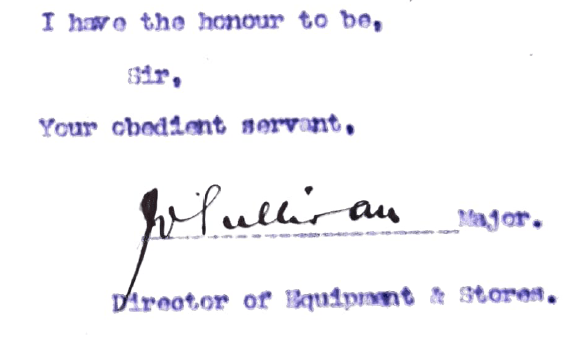
The organisational architecture for logistics was clearly delineated. Robin, as QMG, held overall authority. Reporting to him were the Director of Supplies and Transport (DST) and the Director of Equipment and Stores (DoES). While the DST focused on the provisioning of rations, forage, fuel, and transport (including civilian wagons and horses), the DoES—Honorary Major James O’Sullivan—was responsible for uniforms, weapons, camp equipment, and general stores. These functions were coordinated across four military districts, each with Assistant Quartermasters General, District Storekeepers, and supply officers working in tight concert.
Mobilisation in Action: July–October 1914
The countdown to war began in earnest on 28 June 1914 with the assassination of Archduke Franz Ferdinand. As diplomatic tensions rose, the New Zealand Defence Headquarters quietly initiated precautionary planning. On 30 July, district headquarters were alerted to begin preparing mobilisation schemes. When war was officially declared, Robin and his team acted swiftly.
The Defence Stores had already printed 1,000 copies of the Mobilisation Regulations earlier that year—adapted from British Army doctrine and distributed across districts and units. These instructions detailed every phase of mobilisation: from calling up men, issuing equipment, and drawing rations to recording transfers of kit and managing railway logistics. On 3 August, final mobilisation orders were issued: each district would raise a full infantry battalion, mounted rifles regiment, artillery and engineers, all equipped to war establishment standards.
The Wairarapa contingent departing via Wellington’s Basin Reserve, accompanied by military bands—a scene highlighting community involvement in mobilisation. Source: WW100 New Zealand
The Role of the Defence Stores and Logistics Staff
Behind the scenes, the Defence Stores Department under James O’Sullivan proved indispensable. Based in Wellington but operating nationwide, O’Sullivan’s team managed inventories of arms, uniforms, tents, and accoutrements, many of which had been stockpiled or ordered in the years prior. His leadership ensured that even in the absence of a standing army, the Territorial Force could be swiftly converted into an expeditionary force ready for war.
District Storekeepers in Auckland, Christchurch, and Dunedin oversaw the draw and issue of equipment from local mobilisation stores. Artillery and engineer supplies were managed through separate channels, but coordinated with the central Quartermaster staff. Horses were registered and requisitioned, rail transport timetabled, rations sourced, and ammunition checked for quality and quantity. The precision of this undertaking cannot be overstated.
The Departure of the NZEF and the Samoa Expeditionary Force
Perhaps the most significant measure of New Zealand’s logistical success was the speed with which it deployed forces. The Samoa Expeditionary Force—a smaller contingent sent to capture German Samoa—departed just ten days after the war was declared. This rapid deployment was made possible entirely by pre-war logistical preparations.
By mid-October, the main body of the NZEF—8,500 men with artillery, horses, and all necessary equipment—was loaded onto transports and departed from Wellington. Despite the complexities of coordinating embarkation across multiple ships and railheads, the operation proceeded without major delay. The expeditionary force was, by contemporary standards, exceptionally well provisioned and trained.
Local residents gathered to bid farewell to the advance guard at Wellington on 14 August 1914 at the Basin Reserve—highlighting early stages of mobilisation. Courtesy of NZHistory / WW100
Legacy and Lessons
The logistics achievements of 1914 laid the foundation for a professional logistics corps within the New Zealand Army. In time, the NZASC and NZOC would be formally established, playing vital roles through two world wars and beyond. But their roots lay in the efforts of Colonel Robin, James O’Sullivan, and their small cadre of clerks, storekeepers, instructors, and officers.
These men operated in relative obscurity, yet they enabled the visible face of New Zealand’s war effort—the soldiers who marched, sailed, and fought. The transformation of New Zealand’s military logistics between 1900 and 1914 is one of the outstanding administrative achievements in the country’s early military history. It reveals that victory does not begin on the battlefield, but in the warehouses, ledgers, and transport schedules of those who sustain the fight.
Reflecting on the mobilisation of 1914 from the vantage point of today’s strategic landscape, one cannot help but recognise the profound contrast—and the urgent relevance. Fiscal constraint, recruitment shortfalls, and increasing geopolitical complexity in the Indo-Pacific shape New Zealand’s modern defence environment. In 1914, a small, under-resourced logistic force achieved immense outcomes through unity of effort, clarity of purpose, and deliberate planning. In contrast, today’s New Zealand Defence Force, though more technologically capable, often finds itself constrained by fragmented processes and underinvestment. The 1914 experience serves as a reminder: effective defence is not simply about platforms or personnel numbers—it is about institutional preparedness, inter-agency cohesion, and the political will to invest early in the unseen structures that sustain operations. Colonel Alfred Robin and his team demonstrated that foresight, not size, can be the decisive factor in national readiness. It is a lesson well worth revisiting.
ANZAC Day is a sacred day of remembrance and gratitude in New Zealand. It is a day when we pause to honour the breadth of military service—those who stormed the beaches and scaled the ridgelines, and those who sustained them from behind the lines. Among these often-unsung heroes are the men and women of the Ordnance Corps. Ordnance soldiers have provided the New Zealand Army with the weapons, ammunition, equipment, and logistical support necessary to fight, survive, and succeed for over a century. Their role has always been vital, even if it has been carried out of the limelight.
But what exactly is an Ordnance soldier?
At their core, Ordnance soldiers are Logistics Specialists and Ammunition Technicians—responsible for ensuring that every frontline soldier has what they need, when they need it. They manage everything from the smallest screw in a field weapon to the vast stocks of food, clothing, and ammunition that sustain entire armies. Their work includes storage, distribution, accounting, repair, salvage, and technical inspection. In short: if it moves, fires, feeds, or protects, it likely passed through the hands of Ordnance personnel.
The roots of military ordnance stretch deep into history. The first recorded Ordnance Officer in the British military was appointed in 1299 to manage siege equipment, such as catapults and battering rams. Over time, these responsibilities evolved into a professional and structured system of military storekeeping and supply, one that reached New Zealand in the 1840s with the arrival of British Imperial forces.
By the 1860s, as the Imperial presence waned, the responsibility for military logistics was gradually handed over to New Zealand personnel. The Defence Stores Department was formally established in 1869 to oversee the nation’s military stores. This marked the beginning of New Zealand’s independent ordnance tradition. In 1917, during the First World War, the New Zealand Army Ordnance Corps (NZAOC) was officially formed, taking over duties from the Defence Stores Department. The Corps provided critical support throughout the war and maintained the Army through the interwar years.
With the Second World War outbreak, the Ordnance Corps expanded dramatically. To support 2NZEF, the New Zealand Ordnance Corps (NZOC) was raised for overseas service, while a separate NZOC served as the NZAOCs Territorial element. In 1942, the engineering and maintenance functions of the NZOC operating in the Middle East were separated to form the New Zealand Electrical and Mechanical Engineers (NZEME). This change was mirrored in New Zealand in 1946, when workshops were transferred from the NZAOC to the newly created NZEME.
In recognition of its wartime service, King George VI granted the “Royal” prefix to the Corps on 12 July 1947, making it the Royal New Zealand Army Ordnance Corps (RNZAOC). That same year, the territorial and regular elements were merged into a single corps that would serve with distinction for the next half-century.
Every ANZAC Day, we reflect on the legacy of the Ordnance soldier—from the dusty cliffs of Gallipoli and the battlefields of North Africa to the supply depots of World War II, the jungles of Southeast Asia, and the humanitarian missions of the late 20th century. Their story did not end with the close of the Cold War. In 1996, the RNZAOC was amalgamated with the Royal New Zealand Corps of Transport (RNZCT) and the Royal New Zealand Electrical and Mechanical Engineers (RNZEME) to form the Royal New Zealand Army Logistic Regiment (RNZALR)—a unified, modern logistics formation designed to meet the evolving demands of military operations in the 21st century.
The legacy of the Ordnance soldier lives on today in every RNZALR Logistic Specialist and Ammunition Technician. Their story is not just a historical record—it is the very foundation of the RNZALR. Their values of resilience, quiet courage, and professional excellence continue to shape the New Zealand Army’s ability to sustain and succeed at home and abroad.
Gallipoli and the First World War: The Storekeeper on Anzac Beach
The story of the New Zealand ordnance soldier begins amid the brutal landing at Gallipoli on 25 April 1915. Captain William Beck, a New Zealand Staff Corps officer, was appointed Deputy Assistant Director of Ordnance Services (DADOS) for the New Zealand and Australian Division. According to several accounts, Beck was the first New Zealander ashore at ANZAC Cove, leading the landing of Godley’s divisional headquarters under intense fire.
His task was immense. Amid the beachhead’s chaos, confusion, and carnage, Beck quickly set about establishing a makeshift ordnance dump right on the shoreline—improvising with salvaged crates, scattered supplies, and a growing stream of urgently needed materiel. As soldiers surged inland and casualties mounted, Beck and his small team organised the distribution of ammunition, rations, clothing, and basic field stores to units already under fire in the hills above. Without shelter, maps, or proper infrastructure, this operation became a lifeline to the forward troops.
Supplies on the beach at ANZAC Cove 1915. Athol Williams Collection, Alexander Turnbull Library
Beck worked under relentless fire, including from a remarkably accurate Turkish artillery piece that pounded the beachhead daily. Nicknamed “Beachy Bill” by the troops, the gun became infamous for zeroing in on the supply areas, and Beck’s improvised depot was one of its most frequent targets. The name, according to some accounts, was given in ironic tribute to Captain Beck himself, whose unwavering presence under fire seemed to draw the enemy’s attention as reliably as the tides. Despite the danger, Beck remained calm and courteous, continuing to perform his duties in conditions that would have driven many to cover. His efforts earned him the enduring moniker “the brave storekeeper on Anzac Beach.” He became a quiet legend among his peers. General Sir William Birdwood, commanding the ANZAC forces, was said to personally check on Beck during his rounds, out of admiration and concern. Beck’s courage and composure under fire became emblematic of the Ordnance Corps’ ethos: professionalism in adversity, and mission before self.
Though he was later evacuated due to illness caused by the stress of battle in August 1915, Captain Beck’s role at Gallipoli demonstrated how critical logistics were to the survival and sustainment of fighting troops—and that the Ordnance soldier was not a rear-echelon presence, but a frontline enabler in every sense.
Following the Gallipoli campaign, the New Zealand Expeditionary Force (NZEF) was reorganised and redeployed to the Western Front in France and Belgium, as well as to the Sinai and Palestine campaigns in the Middle East. What began in 1914 as a two-man effort—Beck and Sergeant Norman Levien—expanded rapidly into a structured logistics organisation. In 1917, the New Zealand Army Ordnance Corps (NZAOC) was formally established as a dedicated branch of service, recognising its work’s increasingly specialised and essential nature.
On the Western Front, Ordnance personnel established and managed supply dumps and armourers’ workshops across the scarred landscapes of the Somme, Messines, and Passchendaele. They worked in trenches, mud, and snow—often within range of enemy artillery—ensuring that troops had the bullets, boots, tools, and trench stores required to sustain a static war of attrition.
Their responsibilities went well beyond basic supply. Ordnance units also operated salvage sections to recover, repair, and repurpose battlefield equipment—a critical function in conserving resources and maintaining operational tempo. They ran mobile repair facilities and oversaw essential services like bath and laundry units, which not only preserved hygiene in the harsh conditions of trench warfare but also boosted morale and prevented disease. These services reflected the Ordnance Corps’ holistic approach to sustaining soldiers, not just with materiel, but with cleanliness, comfort, and care in brutal circumstances.
In the Middle East, NZAOC detachments supported mounted operations across the harsh deserts of Sinai and Palestine. Operating in support of the New Zealand Mounted Rifles Brigade, Ordnance soldiers adapted their methods to suit long, exposed supply lines and the mobile nature of desert warfare. They managed camel trains, improvised field depots, and operated forward repair points—often little more than canvas shelters in the sand—to keep men and animals in the fight. Salvage and maintenance tasks were equally essential here, where resupply could be days away and every item had to be made to last.
By the end of the First World War, the NZAOC had grown into a compact, disciplined, and highly respected corps. From the mud of Flanders to the sands of Beersheba, their work underpinned New Zealand’s military effort. Though rarely seen in official war photographs or commemorated in mainstream histories, their contributions were vital. They demonstrated that logistics was not a sideline to combat—it was its backbone. They also laid the foundation for a professional military logistics tradition in the RNZALR today.
The Second World War and Beyond: Backbone of the Battlefield
During the Second World War, the NZAOC matured into a seasoned and indispensable pillar of military capability. Whether supporting the fight abroad or maintaining the war effort at home, Ordnance personnel were the engine behind the Army’s ability to project and sustain force across multiple theatres of war.
North Africa and Italy: Desert Sands and Mountain Passes
In the North African campaigns of 1941–42, Ordnance units operated across Egypt and Libya’s vast, unforgiving deserts, supplying the 2nd New Zealand Division during pivotal battles such as Operation Crusader and El Alamein. Supply depots were often under canvas, exposed to enemy air raids and desert winds. Light Aid Detachments worked tirelessly in the blistering heat to keep tanks, trucks, and artillery in the fight, repairing on the move and recovering damaged equipment under fire.
A dedicated Ordnance Convoy Section was raised to support the increasing volume and complexity of operations. Its task was to move stores and equipment from rear areas to forward supply points, filling a critical gap when the New Zealand Army Service Corps (NZASC) could not meet demand. These convoys ensured a continuous flow of tools, spare parts, and personal equipment to the front, often through contested or poorly marked desert tracks.
The NZ Divisional Salvage Company also operated until late 1941, recovering and repurposing valuable battlefield materials—everything from damaged vehicles to discarded equipment. This function saved resources and contributed to operational sustainability by rapidly recycling assets back into the supply chain.
Ordnance support also extended to troop welfare. Mobile Bath and Laundry Sections accompanied the Division to provide frontline hygiene services, which were essential in preventing disease, exchanging clothing, maintaining morale, and improving the force’s overall combat effectiveness. Their presence in forward areas helped ensure that troops remained as healthy and combat-ready as conditions allowed.
Fred Kreegher, New Zealand Ordnance Field Park, sorting out stores in the rear of his Bin Truck. The Noel Kreegher collection
When the Division redeployed to Italy in late 1943, the harsh desert gave way to snow-covered mountains and treacherous river valleys. But the demands on Ordnance personnel did not ease. During gruelling campaigns at Monte Cassino and through the Po Valley, the NZOC once again delivered. Ordnance Field Parks and dumps were established within range of enemy guns, and equipment was recovered, repaired, and reissued under complex and often perilous conditions.
These layered capabilities—convoy operations, salvage and recovery, technical maintenance, and personal support—ensured the Division could manoeuvre and fight confidently, knowing its logistical tail was secure. The Ordnance Corps wasn’t simply supporting the fight—it was integral to sustaining it.
The Pacific Theatre: Islands of Sustained Effort
While New Zealand’s main expeditionary force focused on Europe and the Mediterranean, many New Zealand troops were also deployed to the Pacific. Here, the NZAOC supported the 3rd New Zealand Division across island bases in New Caledonia, the Solomon Islands, Tonga, and Fiji. These were remote and logistically challenging environments—characterised by tropical diseases, heavy rain, mud, and dense jungle.
Ordnance detachments established supply points, maintained stores, repaired equipment, and ensured operational readiness across scattered islands. These locations often lacked established infrastructure, requiring personnel to be resourceful and adaptable. Camp maintenance, local procurement, and even salvaging enemy materiel became part of the day-to-day tasks.
Although the 3rd Division never saw major set-piece battles like those in North Africa or Italy, it did undertake several opposed amphibious operations and complex island-clearing operations, most notably in the Solomon Islands campaigns at Vella Lavella, Treasury Islands, and Green Island. These landings were tactically complex and logistically demanding, requiring close coordination between combat troops and supporting elements. The Division’s presence helped safeguard New Zealand’s Pacific interests and contributed meaningfully to the broader Allied campaign in the South-West Pacific Area. The Ordnance Corps was instrumental in keeping this contribution viable—its soldiers operated under arduous conditions, far from public view but never from operational necessity.
The Home Front: Sustaining the War Machine
Back in New Zealand, the Ordnance Corps played an equally vital—if often overlooked—role in sustaining the nation’s war effort. Depots at Trentham, Hopuhopu, Burnham, Palmerston North and Waiouru became crucial hubs for receiving, inspecting, storing, and distributing supplies to deployed units. The scale of this effort was immense: weapons, uniforms, vehicle parts, ammunition, and medical supplies flowed in and out of these depots on a daily basis.
Ordnance staff oversaw procurement, stock accounting, and quality control, ensuring that New Zealand’s contribution to the global conflict was met efficiently and precisely. In addition to servicing the expeditionary forces, these depots supported the Home Guard, Territorial units, and mobilisation centres. When new battalions were raised or re-equipped, Ordnance issued the kit and ensured everything was fit for purpose. This included the units of the 2nd New Zealand Expeditionary Force deployed overseas, as well as the three Divisions and supporting arms raised for home defence. These domestic formations—charged with protecting New Zealand from possible invasion—required full logistical support, from uniforms and webbing to weapons, ammunition and transport. Ordnance Corps personnel were central to ensuring these forces were ready to respond, maintaining a continuous flow of supplies while adapting to changing wartime demands.
“Repairing despatch riders’ motor-cycles. Photo of mechanics and motorcyclists repairing motorcycles at a field workshop during military manoeuvres in Northland.” Auckland Weekly News, 23 December 1942, p.14
Auckland Libraries Heritage Collections AWNS-19421223-14-03
The wartime workforce also included women, with members of the New Zealand Women’s Army Auxiliary Corps (NZWAAC) taking on duties in Ordnance depots, handling clerical tasks, managing stores, and supporting logistics operations nationwide. Their involvement further highlights the adaptability and inclusivity of the Ordnance mission in meeting the demands of total war.
Post-war Transition
Post-war deployments saw Ordnance personnel serve in Japan, Korea, Malaysia, Vietnam, and beyond—often integrated within British, Australian, or Commonwealth logistics formations. Though New Zealand’s contribution to these conflicts was modest in size, the professionalism and impact of its Ordnance soldiers were significant. In the Korean War (1950–53), New Zealand’s primary combat force—16th Field Regiment—was supported by a small but capable number of logistics specialists. Ordnance staff embedded within allied supply chains, managing stores, issuing ammunition, and repairing equipment under the demanding conditions of the Korean Peninsula’s harsh winters and mountainous terrain.
During the Malayan Emergency (1948–1960) and the subsequent Indonesian Confrontation (1962–1966), New Zealand troops operated in dense jungle environments that tested their combat and logistics capabilities. Ordnance soldiers were seconded as individuals to the New Zealand Battalion or British units, where they maintained supply lines through monsoon rains, oppressive humidity, and remote jungle bases. Their tasks ranged from maintaining small arms and issuing jungle kit to managing the complex movement of stores between staging areas and patrol bases—a vital function in an environment where regular resupply was challenging and sometimes depended on airdrops or riverine transport.
Although New Zealand did not deploy a complete Ordnance unit in Vietnam, RNZAOC personnel were seconded individually to Australian and United States forces. These included roles such as supply officers, ammunition controllers, and non-commissioned officers (NCOS) stationed at key logistics hubs like Nui Dat and Vung Tau. Working in a high-tempo combat zone, they handled everything from weapons and clothing to fuel, spare parts, and ammunition—often under the threat of enemy attack. The complexity of the Vietnam conflict demanded rapid response times, adaptability, and technical proficiency, all of which the Ordnance soldiers delivered in spades.
Beyond direct deployments, Ordnance personnel were also deeply involved in supporting the considerable effort required to sustain a deployable division maintained under New Zealand’s national service and conscription scheme during the Cold War. This mobilisation model meant that the RNZAOC was responsible for equipping, maintaining, and provisioning a standing force-in-being that could be rapidly expanded in times of crisis. Warehouses and mobilisation stores across the country were stocked with weapons, webbing, clothing, communications equipment, and general supplies—ready to be issued to citizen-soldiers if called upon. The planning, accounting, and logistical foresight required to maintain this latent capability were immense, and it stood as a testament to the professionalism of the Corps.
Across these theatres and responsibilities, Ordnance personnel served in austere and unpredictable environments. Whether embedded with an allied supply unit in the jungle or managing stockpiles for national mobilisation, they maintained the flow of materiel that kept New Zealand’s military effort credible and ready. Though they rarely received public recognition, their contribution was the vital connective tissue that made readiness a reality.
Peacekeeping and Modern Missions: From Mogadishu to the Pacific
In the late 20th century, as New Zealand’s defence priorities shifted toward peacekeeping and international humanitarian support, Ordnance soldiers once again rose to meet the challenge—this time under the flag of the United Nations. The 1992 deployment to Somalia marked a pivotal moment in New Zealand’s operational history and the modern evolution of the RNZAOC. In response to a deteriorating humanitarian crisis fuelled by civil war and famine, the UN launched a multinational intervention to secure aid routes and stabilise the region. New Zealand’s initial contribution to this effort—the New Zealand Supply Detachment—consisted primarily of 28 RNZAOC personnel, marking the first time in decades that an Ordnance-led contingent was deployed operationally in its own right.
Arriving in Mogadishu in December 1992 as part of the Unified Task Force (UNITAF), the detachment was tasked with establishing a functioning logistics capability in a highly hostile and volatile environment. Somalia’s capital had no functioning government, no stable infrastructure, and was riddled with armed factions. Despite the risks, the RNZAOC personnel immediately began establishing supply chains, securing local procurement channels, and distributing food, water, and stores to support the broader UN mission. They set up New Zealand’s main camp at the now well-known base called “Taniwha Hill,” which would symbolise Kiwi resilience amid chaos.
New Zealand soldiers leave their camp to conduct a patrol. NZDF Offical
Working out of hastily converted shipping containers and tents in the sweltering heat, the team operated under constant threat of gunfire, looting, and militia activity. Despite the mission’s peacekeeping label, it quickly became apparent that they were operating in a conflict zone. Convoys were escorted, personal weapons were always carried, and supply runs often meant travelling at high speed through hostile streets to avoid ambush. One RNZAOC NCO recalled travelling with a rifle propped between his knees, ready to return fire if necessary—a stark contrast to the logistics roles typically performed at home.
As the situation deteriorated, a second and larger contingent of 43 logistics personnel (including reinforcements from the RNZAOC and other corps) deployed in 1993 as the New Zealand Supply Platoon. This platoon was accompanied by an infantry protection element from 1 RNZIR, marking New Zealand’s first combat deployment of infantry since the Vietnam War. This reinforced the seriousness of the mission and highlighted the increasing danger and the blurred lines between combat and combat service support. Operating as an integrated platoon, the team performed with professionalism and efficiency, earning the respect of allied forces for their adaptability, calm under pressure, and ability to keep essential supplies flowing under fire.
The New Zealanders remained through some of the mission’s most violent episodes, including the events surrounding the infamous “Black Hawk Down” incident in October 1993. Positioned nearby, the RNZAOC soldiers bore witness to the heavy fighting yet carried on their duties with unwavering determination. When many international contingents began withdrawing, the New Zealand logistics team continued to operate until mid-1994, one of the last Western elements to depart the theatre.
The Somalia deployment reaffirmed the modern Ordnance soldier’s place at the heart of New Zealand’s deployable military capability. It demonstrated that RNZAOC personnel were not only logisticians, but also frontline enablers—capable of operating in fluid, high-risk environments and delivering under extreme pressure. “Taniwha Hill,” New Zealand’s base in Mogadishu, was regularly subjected to gunfire and mortar attacks, and Kiwis operated in volatile zones with little margin for error. Yet the RNZAOC platoon carried out their duties with quiet professionalism and resolve, ensuring UN and coalition forces remained supplied and mission capable.
This ongoing legacy of service continues under a new banner. In 1996, the RNZAOC was formally disestablished as part of an Army logistics reorganisation. Its personnel, functions, and traditions were integrated into the newly formed RNZALR, uniting the RNZAOC, RNZCT, RNZEME, and Quartermaster staff into a single, cohesive regimental structure. This transformation ensured that the enduring values and capabilities of the Ordnance Corps would carry forward into a modern, agile logistics force aligned with contemporary operational requirements.
Since then, RNZALR Logistic Specialists and Ammunition Technicians have continued to support peacekeeping and humanitarian operations in theatres such as Bosnia, the Sinai, East Timor, and Afghanistan. During the East Timor operation (1999–2002), logistics units played a crucial role in sustaining one of New Zealand’s largest overseas deployments since the Korean War. Their work—whether managing supply convoys, setting up field depots, or coordinating humanitarian assistance—underscored the critical importance of logistics as an enabler and a key factor in mission success.
Domestically, RNZALR Logistics personnel have remained indispensable. From supporting civil defence during the Canterbury earthquakes to managing logistics and providing personnel to support Managed Isolation and Quarantine (MIQ) facilities during the COVID-19 pandemic, and maintaining daily sustainment across Defence camps and bases, they remain central to New Zealand’s readiness and resilience. In every setting, whether at home or abroad, the legacy of the Ordnance soldier lives on through the actions and professionalism of the RNZALR.
Roll of Honour: Service Remembered, Sacrifice Recognised
The story of the Ordnance Corps is also one of loss. The New Zealand Ordnance Roll of Honour lists 63 names of those who died while serving in our logistics and stores organisations—from the Defence Stores Department of 1862 to the RNZAOC’s integration into the RNZALR in 1996. Among them:
Captain Sam Anderson (1899), Defence Storekeeper
Captain Arthur Duvall (1919), New Zealand Army Ordnance Department
Temporary Major William Knox (1941), Divisional Ordnance Field Park, North Africa
Private Russell John Casey (1994), 1 Logistic Regiment, RNZAOC
Each of these individuals—and the many others on the Roll—represents a life dedicated to service, often given in conditions far from home and with little fanfare.
Remembrance and Honour
Each ANZAC Day, we renew our vow: “We will remember them.” In remembering, we broaden our gaze to include those who served without seeking recognition—those who issued the boots, drove the convoys, repaired the radios, and ensured that the warriors had their arms.
The Ordnance Corps soldiers were not mere auxiliaries but the enablers of victory, the sustainers of peace, and the standard-bearers of discipline and duty. Their legacy is not just one of historical interest, but a living ethos that endures in the RNZALR.
As the Last Post echoes and the nation falls silent, let us remember the battles won and the thousands of acts behind the lines that made those victories possible. The story of the Ordnance soldier is one of dedication, innovation, and unheralded bravery.
At the going down of the sun, and in the morning— We will remember them. Lest we forget.
The evolution of New Zealand Army stores accounting from 1845 to 1963 reflects the broader transformation of the nation’s military logistics from its colonial origins to a modern, structured system. This study is not a deep dive into the intricate details and complexities of New Zealand military stores accounting but rather an introductory overview of a system that has incrementally evolved over 180 years.
Initially modelled on British military accounting principles, New Zealand’s unique defence requirements—shaped by its geographical isolation, force structure, and operational demands—necessitated continuous refinement. Accounting practices have continuously evolved since the first musket was issued to the militia in 1845. However, it wasn’t until The Public Stores Act of 1867 that structured inventory control and accountability measures were formally introduced. This legislation laid the foundation for military store accounting, marking a significant step towards the professionalisation of the Defence Stores Department. These measures ensured crucial oversight and efficiency in military logistics, particularly highlighted by the demands of the South African War and the two World Wars, underscoring the need for a robust and adaptable system capable of sustaining large-scale military operations.
By the mid-20th century, New Zealand had developed a sophisticated store accounting framework. The introduction of NZP1: Volume I—Stores Accounting in 1951 marked a milestone, formalising the policy regulating the army’s store management. The subsequent 1962 revision further streamlined procedures, ensuring the system remained relevant amid evolving logistical complexities.
New Zealand’s innovations in stores accounting did not go unnoticed. In 1963, the Australian Army sought guidance from New Zealand to modernise its system, acknowledging the effectiveness of the NZ Army’s approach. This recognition underscored New Zealand’s competence in military logistics, demonstrating that despite its smaller size, its expertise had broader strategic significance.
Structure of this Study
Part One will examine the period from 1845 to 1918, tracing the evolution of New Zealand’s military stores accounting system from its British colonial origins to a structured, modern framework comparable to those of New Zealand’s allies by 1914. The demands of the First World War tested the system’s efficiency and resilience, exposing strengths and weaknesses that would shape post-war reforms.
Part Two will cover the period from 1918 to 1945, during which the lessons learned from the First World War were applied to improve inventory control, procurement efficiency, and financial oversight. Economic constraints of the interwar years prompted refinements to stores accounting, leading to the introduction of cost accounting in 1921 and the formalisation of logistical procedures in 1927. The rapid mobilisation for the Second World War tested these systems on an unprecedented scale, accelerating the adoption of modernised inventory tracking and decentralised supply chain management. By 1945, these wartime adaptations had laid the foundation for a more sophisticated and accountable military logistics system.
Part Three will examine the period from 1946 to 1963, focusing on the transition from wartime supply chains to a peacetime military logistics infrastructure. The post-war period saw efforts to streamline surplus disposal, re-establish long-term procurement strategies, and integrate emerging technologies into stores accounting. By 1963, the system had matured into a mature manual store accounting framework, ensuring greater efficiency, accountability, and interoperability.
Military Stores Accounting and Its Distinctions from Commercial Stores Accounting
The primary goal of military stores accounting is to ensure that soldiers on the frontlines, tradesmen in workshops, and medical staff in field hospitals have the necessary tools and equipment to carry out their duties effectively. This involves managing administrative burdens through the command and supply chains and ensuring all required controls are in place for the long-term sustainment and capability maintenance.
Military stores accounting is a specialised system designed to manage and track the acquisition, storage, distribution, and disposal of military supplies. Unlike commercial stores accounting, which primarily focuses on cost control and financial profitability, military stores accounting prioritises accountability, operational readiness, and the efficient utilisation of resources to meet operational outputs.[1]
Differences Between Military and Commercial Stores Accounting
Feature
Military Stores Accounting
Commercial Stores Accounting
Objective
Ensuring operational readiness and accountability
Maximising profit and minimising costs
Nature of Inventory
Includes depreciable assets, expendable, consumable, repairable, and non-expendable items
Primarily consumable and depreciable assets
Accounting System
Uses strict regulatory frameworks and controlled issue systems
Focuses on balance sheets and profit margins
Lifespan of Items
Items can remain in service for decades with periodic refurbishment
Items are typically depreciated and replaced
Valuation
Based on operational utility rather than market price
Based on market valuation and depreciation
Security and Control
Strict control due to security concerns
Less stringent control mechanisms
Classification of Military Stores
Military stores are classified into several categories based on their usage, longevity, and maintenance requirements:
Expendable Stores – Items that are used once and cannot be reused (e.g., ammunition, medical supplies, fuel). These are issued as required and accounted for under strict consumption controls.
Consumable Stores – Items that are used over time and require replenishment (e.g., rations, lubricants, batteries). While they are used up gradually, they still require accountability and stock rotation.
Repairable Stores – High-value equipment that, when damaged or worn, can be repaired and reissued rather than disposed of (e.g., weapons, radios, vehicles). These items are often tracked using maintenance logs and servicing records to maximise their lifespan.
Non-Expendable Stores – Permanent assets that remain in service for extended periods (e.g., buildings, infrastructure, large-calibre weapons). These items require detailed asset management and condition assessments.
The Long-Term Use of Military Equipment
Unlike commercial organisations, where items are often replaced once they end their economic life, military assets— from clothing to high-value or technologically complex equipment—are maintained, refurbished, and upgraded to extend their service life. For example:
Small Arms: Some rifles and sidearms remain in service for decades through regular maintenance and upgrades.
Vehicles: Military transport vehicles, such as trucks and armoured vehicles, can be refurbished multiple times before decommissioning.
Aircraft and Naval Assets: Large defence assets, including ships and aircraft, are often modernised with new technology and systems rather than being replaced outright.
Uniforms and Gear: Certain clothing items and equipment are subject to phased replacement cycles, where only components are updated as needed.
The Importance of Accountability in Military Stores Accounting
Military regulations are always subservient to Government legislation and regulations, especially Treasury rules regarding the expenditure of public monies. Military stores accounting is not a single system, but a collection of specialised accounting frameworks developed to manage different commodities such as ammunition, rations, fuel, vehicles, and technical spares. As military technology has advanced, these systems have evolved parallel to meet modern armed forces’ complex logistical demands.
Accountability is central to military stores accounting, ensuring that every piece of issued equipment is tracked to guarantee:
Proper usage and maintenance,
Prevention of loss or theft,
Compliance with operational requirements,
Efficient resource allocation during deployments.
Military store personnel are responsible for maintaining detailed records, conducting audits, and ensuring strict adherence to regulations. These rigorous accounting and inventory control measures ensure that military resources remain available and serviceable when required. Beyond merely tracking financial transactions, military stores accounting is a critical function that underpins military operations’ effectiveness, security, and sustainability.
Early Developments in Stores Accounting
From 1845, Quartermaster staff managing militia stores and then Volunteer stores from 1858 followed British military procedures. The Defence Stores were formally established in 1862, predating Lieutenant Colonel Edward Gorton’s appointment as Inspector of Defence Stores in 1869. Although Gorton assumed leadership in 1869, the Defence Stores had already been functioning, supporting the colonial military effort.[2]
Lieutenant Colonel Edward Gorton
The 1867 Public Stores Act, implemented under Gorton’s administration, introduced structured accounting procedures.[3] The Defence Stores Department issued circulars and administrative guidelines to ensure proper accountability and management of military supplies. Gorton’s rigorous approach laid the foundation for the 1871 Public Stores Act, which regulated government-wide stores management and standardised accounting practices.[4]
1870-ammunition-stocktake
Despite Gorton’s achievements in strengthening accountability, his strict enforcement and meticulous oversight drew criticism, leading to the abolition of the Stores Inspection Department in 1877.[5] However, his Defence Stores procedures remained robust, and a culture od accountability was established within Defence Stores. Thirty years later, Colonel George Macaulay Kirkpatrick of General Kitchener’s staff validated them in 1910, finding them comparable to British military standards.
Stores records were maintained by a system of indents and vouchers, with balances maintained in ledger books. The Defence Stores were required to provide annual reports of stocks on an annual basis, ensuring accountability and transparency in military logistics. These practices laid the foundation for the modern systematic inventory control and efficient stores management.
Example of a Ledger book
Development of the Artillery Stores (1880s Onwards)
As New Zealand expanded its Garrison Artillery and introduced new guns, equipment, and ammunition, additional accounting and management procedures became necessary. This was beyond the scope of the existing Defence Stores Department, requiring the expertise of military professionals.
In conjunction with Defence Storekeeper Captain Sam Anderson, Sergeant Major Robert George Vinning Parker, formerly of the Royal Garrison Artillery, developed a system of Artillery Stores Accounting. Parker was in charge of artillery ledgers and stores at Auckland, Wellington, and Lyttelton, ensuring the proper tracking and maintenance of artillery supplies. He continued in this role until 1889 when he was reassigned to Dunedin.[6]
Replacing Parker as the Artillery Ledger Keeper was Regimental Sergeant Major and Instructor in Gunnery Frederick Silver. Silver’s expertise in artillery logistics positioned him as a key figure in the continued refinement of artillery accounting systems. Following the death of Captain Sam Anderson in December 1899, Silver applied for the role of Ledger Keeper in the Defence Stores. Given his extensive experience and close working relationship with Anderson, Silver believed he was the ideal candidate.[7] However, due to his seniority, James O’Sullivan, the Chief Clerk of the Defence Stores, was awarded the role of Defence Storekeeper.[8]
Despite this, Silver was appointed as a temporary clerk in the Defence Stores, transitioning from the Permanent Militia on 25 June 1900. While his new role introduced additional responsibilities, Silver managed Artillery Ledgers seamlessly within the Defence Stores framework.[9]
The relationship between the Defence Stores and the Artillery was cooperative, with both functions operating as a single organisation. The Defence Stores was crucial in supporting the artillery’s logistical needs, ensuring that munitions, equipment, and essential supplies were readily available. The interconnected nature of these two functions allowed for a streamlined approach to military logistics, where artillery-specific requirements were integrated within the broader supply framework managed by the Defence Stores.
This integration led to an efficient system that balanced military necessity with stringent logistical oversight.
Organisational Reforms and the Defence Council (1906)
With the passage of the Defence Act Amendment Act 1906 on 28 October 1906, the Defence Council was established, providing the New Zealand Military Forces with a structured headquarters for the first time. The Act introduced specific staff functions, including:
Director of Artillery Services (Ordnance): Responsible for artillery armament, fixed coastal defences, and ordnance supplies.
Director of Stores: Responsible for clothing, personal equipment, accoutrements, saddlery, harnesses, small arms, ammunition, machine guns, transport, vehicles, camp equipment, and all stores required for the Defence Forces.[10]
As part of this reform, James O’Sullivan was confirmed as Director of Stores for New Zealand and appointed Quartermaster and Honorary Captain in the New Zealand Militia. Silver was designated as Assistant Defence Storekeeper, continuing to oversee Artillery Ledgers, which—despite falling under the purview of the Director of Artillery Services (Ordnance)—remained under Defence Stores control.
Despite these improvements, officers and Quartermaster staff in volunteer units were still elected annually, leading to inconsistency in stores management. Many units functioned more like social clubs than military organisations, resulting in disorganised stores accounts. This led to frequent discrepancies between supplies provided by the Crown and actual inventory.
The continued reliance on part-time and volunteer Quartermasters highlighted the need for further professionalisation of the quartermaster within the New Zealand Military, a challenge that would persist as the New Zealand Military transitioned into the modern era.
The Defence Act 1909 and the Transition to a Citizen Army
The Defence Act 1909 marked a significant transformation in New Zealand’s military organisation, laying the groundwork for a citizen-based Territorial Army and ending the Volunteer System.[11] This fundamental shift required extensive adjustments within the Defence Stores Department to support the expanding force structure.
For O’Sullivan, Silver, and the Defence Stores Department, the challenge was to continue modernising stores and logistics to meet the demands of a rapidly growing army. As the Territorial Force expanded, so did the logistical requirements, necessitating a more structured and professional approach to store management.
On 1 June 1910, Silver’s position was redesignated as Assistant Director of Military Stores, and he was appointed a Quartermaster with the rank of Honorary Lieutenant in the New Zealand Militia. His expertise and leadership played a crucial role in ensuring the Defence Stores Department could support the evolving needs of the New Zealand Military.
Guidance on the duties related to the management of stores
In 1910, Lord Kitchener, renowned as “The Empire’s foremost soldier,” visited New Zealand and thoroughly reviewed its military forces.[12] His assessment led to significant reforms within the NZ Military, including establishing the New Zealand Staff Corps (NZSC) and the New Zealand Permanent Staff (NZPS) in 1911. These changes aimed to create a professional cadre of officers (NZSC) and enlisted personnel (NZPS) capable of providing expert guidance and efficient administration to the Territorial Force units.
Lord Kitchener’s visit critically evaluated the military’s capabilities, revealing deficiencies in equipment care, maintenance, and overall responsibility. The existing Regimental Quartermaster Sergeants (RQMS) lacked the necessary skills, underscoring the need for a professional RQMS cadre.
The Regulations (Provisional) for the Military Forces of New Zealand, which came into effect on 5 May 1911, established the command and administrative structure of the Forces.
The overall responsibility for military stores and equipment was placed under the Commandant of the Forces, with specific duties delegated to key officers and commanders at various levels.
Senior Officers Responsible for Stores and Equipment
Quartermaster General
Managed mobilisation stores, including policies on reserves of clothing, equipment, and general stores.
Determined scales of clothing, equipment, and stores needed for troops.
Oversaw mobilisation arrangements for food, forage, clothing, stores, and equipment.
Director of Supplies and Transport
Managed the supply of food, forage, fuel, and lighting.
Responsible for Army Service Corps technical equipment.
Director of Equipment and Stores
Oversaw clothing, equipment, and general stores.
Managed supplies of stationery, forms, and books.
Provided vehicles and technical equipment, except those for Artillery and Engineers.
Supervised the storage and distribution of small arms and ammunition.
Director of Ordnance and Artillery
Established reserve scales for arms, ammunition, and technical equipment for Artillery and Engineer units.
Managed the provision and inspection of guns, small arms, and ammunition.
Oversaw machine guns, Artillery and Engineer vehicles, and technical stores.
Director of Medical Services
Provided advice on and inspected all medical equipment to ensure it met operational standards.
Director of Veterinary Services
Provided expert advice on veterinary stores and equipment.
District and Unit Responsibilities
At a regional level, Commanders of Districts were responsible for maintaining the efficiency of forts and armaments, including all associated buildings, works, stores, and equipment. They also played a key role in ensuring financial prudence by overseeing officers responsible for spending and stores management.
At the unit level, the Commanding Officer had a broad set of responsibilities, including:
Maintaining discipline, efficiency, and proper administrative systems within the unit.
Ensuring accountability for public equipment, clothing, and stores.
Overseeing the maintenance and cleanliness of all issued arms.
Managing the proper receipt and distribution of rations and fuel.
Ensuring daily ration inspections were conducted in the presence of an officer.
Other Regimental Officers, such as Company Commanders, even those in temporary appointments, were also responsible for:
The equipment, ammunition, clothing, and stores assigned to their company.
Ensuring soldiers maintained personal cleanliness and proper care of their uniforms, arms, and accoutrements.
Supervising the quality and adequacy of rations provided to troops.
Finally, the 1911 Regulations clearly stated that any officer or individual responsible for public stores was strictly forbidden from lending any article under their charge unless expressly sanctioned by their Commanding Officer (CO). This regulation reinforced strict accountability and control over military stores, ensuring that all equipment, clothing, and supplies were used solely for authorised military purposes. [13]
To maintain proper accountability and management of military stores, Defence Stores personnel and unit Quartermasters followed detailed policies and procedures outlined in official publications, including:
Regulations (Provisional) for the Military Forces of New Zealand
Financial Instructions and Allowances Regulations for NZ Military Forces
Regulations for Clothing and Equipment of NZ Military Forces
NZ Dress Regulations
Prices Vocabulary of Stores
NZ Mobilisation Regulations
Additional guidance was also found in operational reference materials, such as:
Field Service Regulations
Training Manuals
Field Service Pocket Books
The responsibilities established in 1911 laid the foundation for the structured management of military stores, setting a precedent for all future stores accounting procedures. These early frameworks ensured accountability, efficiency, and operational readiness, embedding core logistical principles underpinning military supply chain management today. While titles and organisational structures have evolved, the fundamental tenets of logistical oversight, resource management, and financial accountability have remained steadfast. Successive iterations of Defence Orders, regulations, and policies have refined and expanded these responsibilities, ensuring their continued relevance and adaptability to the evolving operational and strategic needs of the New Zealand Defence Force in the modern era.
Standardising Stores Management and Training
In November 1911, thirty young men from military districts attended an intensive three-week training course at the Defence Stores Department in Wellington to address this. This comprehensive training, overseen by O’Sullivan, included:
Weapon storage, inspection, maintenance, and accounting
Storage, inspection, and maintenance of leather items (e.g., saddlery and harnesses)
Storage and upkeep of canvas and fabric equipment
Packing procedures for stores
Maintenance of records and documentation
The candidates successfully passed the examinations and were appointed as RQMS under General Order 112/10. Notably, this was the first military trade-related stores course conducted in New Zealand.
“Staff of the Quarter-master General—men who passed as Quarter-master instructors and are being drafted to the various districts, Colourised by Rairty Colour
To ensure consistency across districts, a conference of District Storekeepers was held in Wellington in August 1913. O’Sullivan noted their dedication to maintaining accountability for government property, highlighting their investment in their work.
Historically, annual military camps were managed ad hoc with inconsistent equipment scales. With the establishment of the Territorial Army, the Defence Stores Department introduced standardised camp equipment requirements in 1913.
To streamline supply chain management, temporary Ordnance Depots were established at brigade camps in 1913. Personnel received training under the Director of Equipment and Stores, and roles were assigned as follows:
Ordnance Officer: District Storekeeper Auckland (Lieutenant Beck)
Two clerks
Four issuers
Following the success of the 1913 camps, the system was expanded in 1914, with each regional storekeeper acting as an Ordnance Officer and staff numbers increasing to six clerks and twelve issuers.
Takapau Divisional Camp, 1914. Te Papa (1362454)
Strategic Assessment, Preparedness and Mobilisation
In early 1914, General Sir Ian Hamilton inspected New Zealand’s forces, assessing approximately 70% of personnel. He noted that the Territorial Force was “well-equipped and well-armed” but recommended looking to Australian models for future Ordnance development. O’Sullivan’s annual report for 1914 confirmed that the Defence Stores Department was in a strong position, with ample stocks of small arms, ammunition, clothing, and web equipment.
The 1914 mobilisation was the first test of the reorganised and reequipped New Zealand military forces since the South African War. The challenge was immense: raising, equipping, and dispatching an expeditionary force while maintaining the coastal defence garrisons and the Territorial Army for homeland security. O’Sullivan’s Defence Stores supported this effort, which, under his leadership, played a crucial role in successfully mobilising the New Zealand Expeditionary Force (NZEF).
The groundwork for the NZEF was laid in March 1914 when General Alexander Godley issued mobilisation regulations, adapted from British Army directives, to guide the formation of an expeditionary force. New Zealand’s commitment to supporting Britain in the event of war had been reinforced at the 1907 and 1911 Imperial Conferences, yet it was only in 1912 that Godley, confident in the growth of the Territorial Army, shifted focus to preparing for an overseas force.
As part of this preparation, Godley identified three likely tasks for the NZEF:
Seizure of German Pacific possessions.
Deployment to protect Egypt from a Turkish attack.
Fighting in Europe alongside British forces.
By mid-1914, New Zealand’s military reorganisation was three years into an estimated seven-year process.
Although at full operational strength, confidence in the military’s preparedness was high. Annual training camps had been completed, and unit stores had been restocked. A major stocktake was planned for August 1914—marking the first such effort in two years, as the 1913 stocktake had been postponed due to industrial strikes.
The assassination of Archduke Franz Ferdinand on 28 June 1914 set off a chain of events leading to war. On 30 July, Defence Headquarters instructed District Headquarters to begin precautionary war preparations. By 1 August, partial mobilisation schemes were underway, and further instructions on the composition of the NZEF followed on 2 August.
Each military district contributed a fully equipped infantry battalion, a mounted rifle regiment, artillery, engineers, and medical subunits. These units were to be drawn from the permanent forces, Territorial Force, and reserves. District Storekeepers supported by unit Quartermasters were critical in equipping these units with stores drawn from existing regiments and regional mobilisation depots.
On 3 August, Quartermaster General (QMG) Colonel Alfred William Robin issued detailed instructions regarding individual equipment. Territorial soldiers were to report with their complete kit, while reservists would collect theirs from their regiments. Quartermaster staff were given guidance on recording the transfer of equipment in regimental ledgers.
With war declared, New Zealand’s government announced on 7 August that an Expeditionary Force of 7,000–8,000 men would be mobilised. The response was overwhelming, with thousands of volunteers rushing to enlist. Having had several days’ notice, District Headquarters swiftly implemented mobilisation plans.
Godley’s assumption that the NZEF’s first task would be the seizure of German Pacific territories was proven correct. By 11 August, the New Zealand force for German Samoa—comprising 1,413 personnel—was fully equipped by the Defence Stores and ready for deployment. Additional stores were assembled at Wellington’s wharf for embarkation. The force landed on 29 August, securing Samoa without resistance.
Meanwhile, mobilisation camps were established across New Zealand:
Auckland (Alexandra Park) – District Storekeeper Captain William Thomas Beck set up a mobilisation store, assisted by Sergeant Norman Joseph Levien.
Christchurch (Addington Park) – Captain Arthur Rumbold Carter White managed the Canterbury District mobilisation store.
Dunedin (Tahuna Park) – Captain Owen Paul McGuigan handled equipping recruits, many of whom had no prior military training.
Wellington (Awapuni Racecourse) – The Defence Stores in Wellington directly supported the mobilisation effort.
As the central hub for Defence Stores, Wellington managed the receipt and distribution of equipment nationwide. Public appeals were made for short-supply items like binoculars and compasses. On 14 August, approval was granted for each soldier to receive a second pair of boots—typically, the second pair had to be purchased at a reduced rate.
Mobilisation was not simply a matter of sending troops overseas; it also involved ensuring the ongoing reinforcement of the NZEF and maintaining the Territorial Army at home. Planning for NZEF reinforcements commenced alongside the main mobilisation effort to sustain the force in the field. It was determined that 20% reinforcements would be provided six weeks after the NZEF’s departure, with a further 5% arriving monthly thereafter.
Trentham Camp was selected as the primary training and equipping centre for reinforcement drafts, where the Camp Quartermaster Stores, under Lieutenant (Temporary Captain) Thomas McCristell, played a critical role in ensuring personnel were properly outfitted before deployment. The scale of this task was immense, with store personnel working late into the night to issue uniforms and equipment to the steady stream of reinforcements. While the focus remained on sustaining the NZEF, efforts were also required to maintain the Territorial Army at home, ensuring a trained force remained available for local defence and future deployments. Mobilisation was not a single event but a continuous process that demanded careful logistical planning and execution to sustain the war effort.
Beyond issuing equipment, the Camp Quartermaster Stores also served as a training ground for new Quartermasters destined for overseas service. Selected candidates underwent instruction in key logistical functions, including clothing and equipping troops, managing camp equipment, organising ammunition supplies, and overseeing water distribution and field kitchen setup. This training ensured that reinforcements were well-equipped and supported by skilled personnel capable of sustaining operations in the field.
By September 1914, the Defence Stores had successfully equipped the NZEF. On 24 September, General Godley thanked the Defence Stores staff for their efforts, acknowledging their crucial role in the mobilisation process. However, controversy soon followed.
On 26 October, after ten days at sea, Godley sent a note to Minister of Defence Colonel James Allen, alleging irregularities in Defence Stores operations and implying that O’Sullivan and his staff might be engaging in misappropriation. Despite recognising O’Sullivan’s significant contributions, Godley recommended auditing the Defence Stores’ accounting systems. This unfounded allegation ultimately led to O’Sullivan’s resignation, overshadowing the department’s achievements in successfully mobilising and equipping both the Samoa Expeditionary Force and the NZEF.
New Zealand’s largest military deployment to date placed immense logistical demands on the Defence Stores. The department leveraged pre-war procurement contracts while employing competitive tendering to secure uniforms, equipment, and supplies. This approach facilitated rapid expansion, with Buckle Street in Wellington emerging as a key logistical hub. However, the sheer volume of supplies soon exceeded capacity, necessitating the leasing of commercial storage facilities beyond the department’s central depots in Wellington, Christchurch, and Dunedin.
As military activity intensified, the establishment of the Palmerston North District Store in early 1915 significantly enhanced logistical capabilities, particularly for units stationed in the lower North Island. This expansion underscored the growing need for decentralised supply operations, improving the efficiency of equipment distribution.
The rapid wartime expansion placed immense strain on both personnel and logistics. Despite increasing responsibilities, the department received only minimal increases in permanent staff, forcing heavy reliance on temporary workers to meet operational demands.
As the war progressed, concerns over procurement methods and accounting procedures led to mounting external scrutiny. In 1915, a Commission of Inquiry was launched to examine the Defence Stores’ business practices, financial controls, and purchasing procedures. While the Commission found no evidence of misconduct, it recommended procedural improvements to enhance transparency and efficiency. In response, the government established the Ministry of Munitions, which took over procurement and supply chain management, streamlining logistical operations..
Supporting the NZEF (1915–1921)
The New Zealand Expeditionary Force (NZEF) formed its own New Zealand Army Ordnance Corps (NZAOC) in 1915, recognising the need for a more structured military logistics system. This corps provided dedicated logistical support for the NZEF and residual units until 1921. This development was critical as the demands of modern warfare required a more organised and professional approach to supply chain management, equipment maintenance, and ordnance distribution.
Initially, the NZEF relied heavily on British supply lines and logistical structures, with Quartermasters embedded within units managing day-to-day supply requirements. However, as operations expanded and the need for self-sufficiency grew, the establishment of the NZAOC provided a more formal system of procurement, storage, distribution, and maintenance of military stores. The Centre of mass for the NZAOC within the New Zealand Division was the Assistant Director of Ordnance Stores (DADOS) and his staff, who operated in concert with regimental quartermasters, who remained responsible for issuing and maintaining personal and unit equipment at the frontline.
Quartermasters played a pivotal role in ensuring that troops were properly equipped, fed, and clothed and worked closely with the NZAOC to ensure seamless logistical support across different theatres of war, from Gallipoli to the Western Front and the Middle East.
By 1918, the NZAOC had become a critical component of the NZEF’s supply chain, with depots in the UK and the DADOS operating dumps in key operational areas. As the war concluded, the Corps played a crucial role in the demobilisation process, managing the return of surplus equipment, disposal of unserviceable stores, and redistributing serviceable assets to remaining military units and government departments.
The NZAOC continued to support New Zealand’s post-war military commitments until 1921. The lessons learned during the Great War laid the foundation for future developments in ordnance and supply management, shaping the logistics framework of the post-war army.
The role of Quartermasters and the NZAOC in supporting the NZEF between 1915 and 1921 was instrumental in ensuring that New Zealand troops remained equipped and operationally effective throughout the war. Their contributions sustained the force in combat and established enduring logistical principles that continued influencing military store management in the following decades.
Home Service Stores Accounting
On the home front, military authorities pushed for the complete militarisation of stores accounting, aiming to align New Zealand’s system with British Army Ordnance practices. This led to a significant leadership change in 1916, with Major Thomas McCristell replacing James O’Sullivan as Director of Equipment and Stores. Under McCristell’s leadership, the department underwent a comprehensive reorganisation, transitioning into a formal military structure.
By 1 February 1917, the home service New Zealand Army Ordnance Department (NZAOD) and NZAOC were officially established, replacing the Defence Stores Department. This milestone ended 48 years of civilian-led military logistics, marking a shift towards a fully integrated, military-controlled Ordnance service.
Concurrent with the establishment of the Home Service NZAOC, formal Ordnance Procedures were published, and the Regulations for the Equipment of the New Zealand Military were updated. These replaced all previous instructions and formed the foundation for New Zealand’s modern military logistics system.
Conclusion: Towards a Modern Military Stores Accounting System
The period from 1845 to 1918 laid the foundational principles of New Zealand Army stores accounting, evolving from ad hoc militia supply practices to a structured, professional system aligned with British military standards. Early efforts, such as the 1867 Public Stores Act and the establishment of the Defence Stores Department, introduced much-needed oversight and accountability, ensuring military forces were adequately equipped for colonial conflicts and later global engagements.
The early 20th century saw increasing refinement in stores management, with greater formalisation under the Defence Act 1909, the creation of a structured supply organisation, and the introduction of rigorous accounting and inventory control measures. The mobilisation for World War I tested these systems on an unprecedented scale, demonstrating their strengths and the need for further development. The establishment of the NZEF NZAOC in 1915 and the home service New Zealand Army Ordnance Department and Corps in 1917 signified a pivotal transformation, shifting military logistics from civilian oversight to a dedicated military-run system. The experiences of World War I reinforced the importance of accurate, efficient, and adaptable stores accounting systems, setting the stage for continued evolution in the interwar and post-World War II periods. The next part of this study, New Zealand Army Stores Accounting: 1919–1945, will examine how the lessons learned from wartime operations influenced peacetime logistics, the modernisation of accounting frameworks, and the growing role of technology and centralised control in military supply chain management.
Notes
[1] Australian Defence Force, “Logistics Series – Supply,” Australian Defence Doctrine Publication 4.3 (2004): 1.1-1.16.
[4]“The Public Stores Act 1871,” ed. General Assembly of New Zealand (Wellington, 1871).;”Lieut-Colonel Edward Gorton,” New Zealand Gazette, Issue 1, 26 January 1872, 619.
[11] Peter Cooke and John Crawford, The Territorials (Wellington: Random House New Zealand Ltd, 2011), 153.
[12] Paul William Gladstone Ian McGibbon, The Oxford companion to New Zealand Military History (Auckland; Melbourne; Oxford: Oxford University Press, 2000, 2000), 369.
[13] “Regulations (Provisional) for the Military Forces of New Zealand “, New Zealand Gazette 5 May 1911.;
Serving the nation for 44 years, Henry Erridge served at Gallipoli before being invalided back to New Zealand. Continuing to serve throughout the interbellum, Erridge assisted in shaping the New Zealand Army Ordnance Corps for the Second World War. During the war, Erridge played a significant role in providing New Zealand’s contribution to the collective logistics efforts of the British Commonwealth
Henry Earnest Erridge was born in Dunedin on 18 December 1887 to Henry and Jane Erridge. The fifth of seven children, Henry was educated in Dunedin and received commercial training. A keen military volunteer Erridge had joined the Dunedin Engineer Volunteers as a Cadet in 1904, transferring into the Otago Hussars in 1909, gaining Non-Commissioned Officer (NCO) Rank. On 6 April 1914, Erridge joined the New Zealand Permanent Staff (NZPS) with the rank of Staff Sergeant Instructor as the Orderly Room and Quartermaster (QM), No 15 Area Group, Oamaru.[1]
On the outbreak of war in August 1915, Erridge was seconded for duty with the NZEF and left New Zealand with the Main Body, Otago Infantry Battalion. As a Signals Sergeant in the Otago’s, Erridge saw service during the Turkish attack on the Suez Canal in February 1915 and later took part in the landings at Gallipoli. Stuck down with enteric fever, Erridge was evacuated from Gallipoli to Alexandria in June and, in August, invalided back to New Zealand for further convalescence.
Returning to duty as a Warrant Officer in the QM Department at Featherston Camp on 10 January 1916, Erridge was appointed Stores Forman responsible for managing the QM Stores accounts for Featherston and its subsidiary camps. Reclassified as Class “A” fit for overseas service on 5 July 1918, it was intended to attach Erridge to a reinforcement draft and returned to the front. Deemed as essential, the Director of Equipment and Ordnance (DEOS) Stores appealed to the Chief of the General Staff, stating that
The accounts of the Camp Quartermaster, Featherston Camp, have not been completed and balanced. The principle causes for this state of affairs are:
(1) The inferior class of clerks posted for Home Service duties. (2) And ever-changing staff, thus throwing the bulk of work on SSM Erridge, who has been employed in the capacity of foreman.
It is essential that SSM Erridge be retained until 1 November at least
Director of Equipment and Ordnance Stores to Chief of the General Staff. 14 August 1918
The DEOS appeal was successful, and Erridge was granted authority to delay his placement into a reinforcement draft until November on the proviso that every endeavour was to be made to have all accounts in connection with the QM Branch Featherston and subsidiary camps completed to the satisfaction of the proper authority. Following the Armistice of 11 November 1918, Erridge’s employment was reassessed, and he was provided orders to remain with the QM Department at Featherston. Seconded to the Ordnance Stores in Wellington in June 1919, Erridge was permanently transferred into the New Zealand Army Ordnance Corps (NZAOC) with Conductor rank on 1 October 1919.
Recommended for the Supplies and Purchasing Officer position with the civil administration in Samoa, Erridge was accepted for service with the Samoan Administration for three years from 24 May 1920. Due to a misunderstanding of the secondment rules, Erridge was discharged from the New Zealand Military. However, this was reviewed, and the discharge was rescinded, allowing Erridge to retain his rank and seniority on his return to New Zealand.
`Administration Headquarters. “Apia”‘. Moore, Robert Percy, 1881-1948 :Panoramic photographs of New Zealand. Ref: Pan-0422-F. Alexander Turnbull Library, Wellington, New Zealand. /records/32050069
Completing his service in Samoa in August 1923, Erridge returned to New Zealand and, following three months leave, resumed duty with the NZAOC, where he was posted to the Main Ordnance Depot (MOD) and placed in charge of the Stores on 1 December 1923. In an example of his experience and utility, Erridge temporarily relieved Captain F.E Ford, the Ordnance Officer of Featherston Camp, from 4-31 Jan 1924.
During the 1920s, the Quartermaster General (QMG) vested command of the NZAOC to the Director of Ordnance Service (DOS). Assisted by the Chief Ordnance Officer (COO), the Inspecting Ordnance Officer (IOO), and the Ordnance Mechanical Engineer (OME), the DOS was responsible for:[2]
The provision, receipt, storage, distribution, repair, examination, and maintenance of small-arms, machine guns, vehicles, clothing and necessaries, equipment and general stores (including medical and veterinary), and camp and barrack equipment,
The inspection and repair of armament and warlike stores, and the inspection of gun ammunition.
The provision, receipt, storage, and distribution of small arms ammunition.
The receipt, storage, issue, and repair of fixed armament, field armament, and artillery vehicles.
The organisation and control of ordnance workshops
The preparation and periodic revision of Equipment Regulations and barrack and hospital schedules
The organisation, administration, and training of the NZ Army Ordnance Corps Forces
The maintenance of statistics of the Ordnance Department.
The DOS was also the Commanding Officer (CO) of the NZAOC and was responsible for the interior economy, including enlistment, training, pay, promotion, postings transfers, clothing, equipment, and discharges within the unit.
In 1924, the incumbent DOS, Lt Col Pilkington, was appointed QMG in Army Headquarters. Major T.J King, then acting COO, was appointed DOS, with Major William Ivory as the IOO and OME. By 1925, King recognised that he could not provide complete justice to the DOS and COO posts. Still, with no Ordnance Officers immediately available to fill the COO position, he recommended that the QMG give some relief by granting Erridge an officer’s commission. In his recommendation to the QMG, King noted that
Conductor Erridge is a man of wide experience in Ordnance duties and stores works generally and is eminently fitted for appointment as Ordnance Officer with the rank of lieutenant. He is a man of unblemished character, with a very high regard for the interests of the Corps and the services, and in the last few months gained sufficient insight into the duties I propose transferring him to.
Director of Ordnance Stores to Quartermaster General 11 December 1925
The QMG supported King’s recommendation on the proviso that Erridge pass all the required commissioning examinations. After passing the examinations, Erridge was commissioned as a lieutenant in the NZAOC on 23 July 1926.[3] However, the question arose of where to place Erridge on the Army List. Technically, the COO appointment was still vacant, with Erridge, for all intents, acting as King’s assistant and only performing part of the COO duties, with the work of the COO divided between King and Erridge. It was not desired that an Assistant COO be added to the establishment, so it was decided to show Erridge as Ordnance Officer (Provision). After several years as the Ordnance Officer (Provision), Erridge was appointed to the dual roles of Ordnance Officer MOD and Ordnance Officer Central Military District (CMD) on 14 May 1929.[4]
In December 1930, the incumbent Ordnance Officer Southern Military District (SMD)and Camp Commandant of Burnham Camp, Captain A.R.C White, faced compulsory retirement. To allow some continuity while White’s replacement was decided, Erridge was temporarily sent to Burnham. Although initially only a temporary posting, Erridge remained at Burnham until 1934 in the dual roles of Ordnance Officer SMD and Officer in Charge Burnham Camp (Camp Commandant).[5]
By 1935 in his role of DOS, King was looking forward and preparing his organisation for war. In a submission to the General Headquarters, King requested authority to reorganise his staff. Regarding Erridge, King started.
Owing to the large amount of new equipment that is on order and is likely to be ordered soon, it is essential that the staff of the Ordnance Depot, Trentham, be strengthened to the extent that I should again have the assistance of my most experienced Ordnance Officer.
There is a great deal of work of a technical nature in connection with mobilisation, rewriting of Regulations, etc., which I am unable to find time to carry out myself, and which Mr Erridge, by virtue of his long experience and training, is well qualified to undertake. This work is most necessary and should be put in hand as soon as possible; I have no other Officer to whom I could delegate it.
Again, King’s recommendations were accepted, and on 30 June 1934, Erridge relinquished his Burnham appointments and was appointed as the Ordnance Officer (Provision) at the MOD, with promotion to Captain following on 1 December 1934.[6]
When the war was declared in September 1939, the NZAOC underwent a significant transformation as its mobilisation plans were implemented. The DOS, Lieutenant Colonel King, was seconded to the 2nd NZEF as the Deputy Director of Ordnance Services (DDOS). Accompanying King was a small staff drawn from the military and civilian staff of the NZAOC who formed the nucleus of the Ordnance Corps in the 2nd NZEF. Kings’ responsibilities of DOS and COO were handed over to the Ordnance Officer CMD, Lt Col Burge.
On 2 December 1939, Erridge relinquished the appointment of Ordnance Officer (Provision), was granted the Rank of temporary Major and posted to Army HQ with substantive Major confirmed in February 1940.[7] In June 1940, the NZAOC underwent further reorganisation when Lt Col Burge relinquished the appointment of DOS when he was appointed as Deputy QMG in Army HQ with the position of DOS placed into abeyance for the duration of the war. Appointed as Staff Officer Ordnance and CO of the NZAOC, Erridge took over responsibility for the NZAOC.[8]
With the national economy transitioning from peacetime to a war footing, the Government took a series of initiatives to ensure international trade and commerce security. Representing the New Zealand Military, Erridge accompanied the New Zealand Minister of Supply and a small entourage of officials of the New Zealand Munitions and Supply Delegation on a tour of Australia for a series of talks with their Australian counterparts in July/August 1940.[9]
While the mission of the New Zealand Munitions and Supply Delegation to Australia was focused on strengthening cooperation between New Zealand and Australia, the Eastern Group Conference held in Delhi in October 1940 had the broader goal of organising a joint war supply policy for the countries of the “Eastern Group.” The countries represented at the Eastern Group Conference included the United Kingdom, Australia, India, South Africa, New Zealand, East Africa, Palestine, Ceylon, Burma, Malaya, and Hong Kong, with the Government of the Netherlands East Indies attending as observers.[10] The New Zealand delegation included.
The Chief of the General Staff, Major-General Sir John Duigan,
Major H. E. Erridge,
Mr F. R. Picot, Director of the Internal Marketing Department,
Mr J. R. Middleton, assistant-Secretary of supply,
Mr B. Taylor, assistant to the chief investigating officer of the Treasury Department.
As a result of the October conference, the Eastern Group Supply Council (EGSC) was established to coordinate and optimise the production and distribution of war materiel in the British colonies and dominions in the Eastern Hemisphere. The New Zealand members of the council who were to be based in New Delhi were.
Mr F.R Picot, Director of Internal Marketing and Food Controller,
Mr W.G.M Colquhoun (Munitions Department).
Mr R.J Inglis (Supply Department).
Mr R.H. Wade (of the Treasury).
A Central Provisions Office (Eastern) was also set up in Delhi, with national offices established in Australia, New Zealand, South Africa, East Africa, Southern Rhodesia and the Middle East. The Central Provision Office (Eastern) was a military organisation consisting of about 40 to 50 Army officers from all countries constituting the Eastern Group. Headed by the Controller-General of Army Provisions, who was also the military member of the EGSC and acted as the agent of the Imperial General Staff and various Commanders in Chief. The role of the Central Provision Office (Eastern) was coordinating with the controllers of the national provision offices to obtain military stores to maintain the British and Commonwealth war effort.[11] From March 1941, Two NZAOC Officers, Temporary Major D. L. Lewis and Lieutenant D.I Strickland were attached to the Central Provision Office (Eastern) staff in New Delhi.[12]
Before the Central Provision Office (Eastern) assumed complete provision control, it was necessary for all the controllers of the national provision offices to meet to ensure that uniform procedures were adopted. A coordination conference for the various Provision Group Controllers was held at New Delhi in July 1941, with Erridge attending as New Zealand’s military representative. Based on this conference, on 5 August 1941, the New Zealand War Cabinet approved the establishment of the New Zealand Defence Servicers Provision Officer (DSPO), with Erridge appointed as its Controller with the rank of Temporary Lieutenant Colonel. Relinquishing the appointment of Staff Officer Ordnance and handing over the Commanding Officer NZAOC duties to Major E.L.G Bown, the COO MOD.[13]
By April 1945, the DSPO thought Central Provision Group (Eastern) had shipped for the British Ministry of Supply equipment to the value of £10,000,000 (2021 NZD $8,988,577,362.41) with additional equipment to the value of £8,520,761 (2021 NZD $765,895,194.35) that was surplus to the requirements of NZ Forces overseas transferred to the War office.[14] During a visit to New Zealand in January 1946, Major-General R.P Pakenham-Walsh, CB, MC., a member of the Eastern Group Supply Council and the Central Provision Office(Eastern), stated that “Stores from New Zealand which had been made available to the Eastern Group Supply Council had been of great importance in the prosecution of the war” adding that “the Dominion’s contribution had compared more than favourably with that of various larger countries.”[15] Following the surrender of Germany in April and Japan’s defeat in August 1945, the Eastern Group Supply Council and Central Provision Office, although serving their purpose well, had become irrelevant and were dissolved on 31 March 1946.[16] However, it took two years for the DSPO to transition to a peacetime footing. Seconded to the War Asset Realisation Board (WARB) on 1 May 1947, Erridge started to wind down the work of the DSPO while also coordinating the disposal of equipment through the WARB. On 17 December 1948, Erridge handed over the remaining stocks to the WARB and closed the DSPO.
At 62 years of age and following 45 years of volunteer, Territorial and Regular service, Erridge retired from the New Zealand Army and was placed onto the Retired List with the rank of Lieutenant Colonel on 29 May 1949.[17] Never marrying, Erridge spent his retirement in his hometown of Dunedin. On 30 March 1962, a resident of the Dunedin’s Ross Home, Erridge, passed away at 74. Following his wishes, he was cremated, and his ashes scattered.
Throughout his service, Erridge was awarded the following decorations
OBE (1946)
NZ Long Service and Efficient Service (1925)
1914-15 Star
British War Medal
Victory Medal
War Medal 1939-45
NZ War Medal, 193-45
Notes
[1] Archives New Zealand, “Henry Earnest Erridge- Ww1 8/1004, NZAOC 888, Ww2 800245, 30293,” Personal File, Record no R24097640 (1904-1948): 2708.
[2] “Regulations for the Military Forces of the Dominion of New Zealand,” New Zealand Gazette, May 19, 1927.
[3] “Appointments, Promotions, Resignations and Transfers of Officers of the NZ Military Forces,” New Zealand Gazette No 61, 19 July 1926.
[4] “Appointments, Promotions, Resignations and Transfer of Officers of the New Zealand Military Forces,” New Zealand Gazette No 48, 27 June 1929.
[5] “Appointments, Promotions, Transfers and Retirements of Officers of the NZ Forces “, New Zealand Gazette No 16, 5 March 1931.
[6] “Appointments, Promotions, Transfers and Retirements of Officers of the NZ Forces “, New Zealand Gazette No 55, 19 July 1934.;”Appointment, Promotions, Transfers and Retirements of Officers from the NZ Forces,” New Zealand Gazette No 87, 29 November 1935.
[7] “Appointments, Promotions, Transfers and Retirements of Officers of the NZ Forces “, New Zealand Gazette No 1, 11 Jan 1940.;”Appointments, Promotions, Transfers and Retirements of Officers of the NZ Forces “, New Zealand Gazette No 75 (1940).
[8] “Appointments, Promotions, Transfers and Retirements of Officers of the NZ Forces “, New Zealand Gazette No 70 (1940).
[9] “Unity in War Effort,” Evening Star, Issue 23622, 8 July 1940.
[10] East Africa consisting of the territories of (Kenya, Uganda, Tanganyika, Zanzibar, Northern and Southern Rhodesia, Nyasaland; Bertram Stevens, “The Eastern Group Supply Council,” The Australian Quarterly 13, no. 3 (1941).
[11] “Eastern Group Supply Council,” Otago Daily Times, Issue 24640, 23 June 1941.
[12] “Appointments, Promotions, Transfers, and Retirements of Officers of the New Zealand Military Forces.,” New Zealand Gazette, No 30, 9 April 1941.
[13] “Appointments, Promotions, Transfers, and Retirements of Officers of the New Zealand Military Forces.,” New Zealand Gazette, No 74, 11 September 1941.
[14] “War Supplies,” Evening Post, Volume CXXXIX, Issue 126, 30 May 1945.
[15] “Production Problems,” Evening Star, Issue 25690, 14 January 1946.
[16] “Supplies – the Eastern Group Supply Council,” Northern Advocate, 1 April 1946, 1 April 1946.
[17] “Appointments, Promotions, Transfers, and Resignations, of Officers of the New Zealand Army “, New Zealand Gazette No 37, 16 June 1949.
The Royal New Zealand Army Ordnance Corps (RNZAOC) and its predecessors were responsible for crucial storekeeping duties, ensuring the supply of Clothing, Camp Equipment, Ammunition, Arms, and Accessories to New Zealand’s Military Forces. As the Second World War unfolded, the complexity of military storekeeping transformed dramatically, encompassing a wide array of military equipment, including vehicles, communications gear, and mechanical plant. These new assets were deployed in massive numbers and necessitated many accessories and intricate repair parts to keep them operational. To streamline control and provide an optimal system, the RNZAOC implemented significant measures in 1963. They established RNZAOC Stores Sections within the Royal New Zealand Electrical and Mechanical Engineer (RNZEME) workshops. In addition, the Auto Parts trade was initiated in 1965, reinforcing the overall process. This article offers an enlightening and sweeping overview of how the Mechanical Transport Branch (MT Branch) and the RNZAOC effectively managed Mechanical Transport Stores (MT Stores) from 1939 to 1963.
In 1939, as the New Zealand Army mobilised, it aimed to seamlessly integrate into a larger British army, much like in the First World War. The British army had already embraced modern technology, making it highly motorised and technologically advanced so that ‘By the time of the invasion of Poland, the British Army in Europe was rather more motorised than the German Army.’[1]. Some aspects of this advanced doctrine made its way to New Zealand in the late 1930s with modern equipment like Bren Guns and Universal carriers. The army had even conducted some basic experiments in motorisation. However, due to interwar defence policies and financial constraints, the New Zealand Army Ordnance Corps (NZAOC) was not efficiently organised like its counterpart, the Royal Army Ordnance Corps (RAOC), in the United Kingdom. Consequently, the NZAOC was unprepared to function effectively when the war began.
During the Second World War, it was as if New Zealand maintained two separate armies. The first was the 2nd New Zealand Expeditionary Force (2nd NZEF), fully equipped with combat units, supporting arms, and logistic units. These forces were organised according to modified War Office Establishment tables, with G1098 stores directly drawn from British stocks. [2] The second army was the NZ Army at home, also organised according to War Office Establishment tables. However, a New Zealand logistical base provided its equipment needs and G1098 Stores.
This dichotomy in organisation and preparedness highlighted New Zealand’s challenges as it strived to align itself with modern military practices while operating within the constraints of its resources and policy decisions.
In 1939, the NZAOC was constrained by interwar defence limitations, primarily focusing on supplying and maintaining clothing, equipment, ammunition, and weapons. Despite the army possessing 56 vehicles, the NZAOC lacked substantial experience in supporting Mechanical Transport (MT) at the scale the rapidly growing army required. Most senior leadership had been seconded to the 2nd NZEF, which hindered the NZAOC’s ability to expand effectively during the critical early wartime years.
Recognising the urgent need to expand and manage the Army’s MT fleet, the Quartermaster General (QMG) took a bold step away from convention and established a separate MT Branch. This move allowed the NZAOC to focus on its core responsibilities. At the same time, the MT Branch managed and maintained the multitude of purchased or impressed vehicles required by the military.
Drawing inspiration from the Royal Army Ordnance Corps (RAOC) in the United Kingdom, the MT Branch wisely leveraged the expertise of the New Zealand Motor industry. Many of its staff were directly recruited from the motor industry into the New Zealand Temporary Staff (NZTS), ensuring a wealth of specialised knowledge and experience was brought to the forefront of this critical military function. During the early years of the war, the NZ Military primarily relied on civilian vehicles impressed into service. They initially purchased existing stock from New Zealand’s motor manufacturers and dealerships to ensure an adequate supply of MT spares. However, as the war continued, the influx of new vehicles, equipment, and spares from the United Kingdom, Australia, Canada, and the United States necessitated significant expansion of the MT Branch.
New Zealand Temporary Staff. Robert McKie Collection
MT Workshops
1 MT Workshops, Trentham
2 MT Workshop, Waiouru
3 MT Workshops, Papakura
4 MT Workshops, Whangarei
5 MT Workshops, Palmerston North
6 MT Workshops, Wellington
7 MT Workshops, Blenheim
8 MT Workshops, Burnham
9 MT Workshop, Dunedin
MT Depots providing pools of vehicles.
1 MT Depot, Auckland
2 MT Depot, Hamilton
3 MT Depot, Napier
4 MT Depot, Wanganui
5 MT Deport, Christchurch
MT Stores Depots providing MT spares, tools and equipment for MT Workshops and Depots
1 Base MT Stores Depot, Wellington
2 MT Stores Depot, Auckland
3 MT Stores Depot, Wellington
4 MT Stores Depot, Christchurch
7 MT Stores Depot, Blenheim
Freed from the burden of managing MT, the Chief Ordnance Officer (COO) with NZAOC, Territorial units of the New Zealand Ordnance Corps (NZOC) and personnel from the NZTS would provide.
All natures of stores and equipment, other than rations, forage, and fuel.
The repair and maintenance of armaments and equipment, including.
Light Aid Detachments and mobile workshops to provide 1st and 2nd line support across Field Force Units
Armament and General Engineering Workshops.
Main Ordnance Workshop, Trentham
11 Ordnance Workshop, Whangarei
12 Ordnance Workshop, Devonport
13 Ordnance Workshop, Blenheim
14 Ordnance Workshop, Burnham
15 Ordnance Workshop, Dunedin
As of 31 March 1944, the MT Stores Depots had undergone significant reorganisation and successfully handled the following quantities of Tyres and MT Parts:
180 different sizes of Tyres
Purchased from overseas – 83174.
Purchased in New Zealand – 12534
Total Purchased – 95708
Transferred to Supply Department – 11018
Other issues – 28700
In stock 31/3/1944 – 55990
Reserved for Supply Department – 2000
General – 35990
Used tyres recapped and re-treaded – 9983.
Reconditioned tyres reissued – 7301.
Reconditioned tyres in stock 31 March 1944 – 2682
M.T. Parts. (Not including body-building material)
Received from overseas (Total of 9182 Tons)
Wheeled vehicles, parts- 20472 Packages
Tracked vehicles, parts – 39408 Packages.
Tracked vehicles, tracks – 8280 Bundled.
Packages broken down and binned – 23895.
Packages transferred to United States Forces – 1050
Packages in Bulk Store – 43215
Shipments of MT Parts and Tyres to the Pacific
3 Division – 1149 Tons
Fiji – 406 Tons
Tonga – 112 Tons
Norfolk – 30 Tons
1944 MT Stores Organisation
Base MT Stores Depot, Wellington.
8 Officers
103 Other Ranks
Depot No 7, 186-200 Wakefield Street, Wellington, Rented, 3353 Square Meters, Main Base Store for parts, tools, etc. Administrative Offices.
Depot No 8, 102 Wakefield Street, Wellington, Rented, 1115 Square Meters, Bulk Tyre Store.
Depot No 9, 97 Taranaki Street, Rented, 1300 Square Meters, Parts etc for AFV.
Depot No 10, Cable Street, Wellington, Rented, 1821 Square Meters, Bulk part store.
Depot No 11, George Street, Wellington Rented, 238 Square Meters, Bulk store for heavy parts, AFV.
Depot No 11, Taranaki Street, Wellington, Rented, 186 Square Meters, Bulk stores for heavy parts, AFV.
Depot No 12, Coutts Street, Kilbirnie, Rented, 232 Square Meters, Bulk store for body-building material.
Depot No 13, 129 Tory Street, Wellington, Rented, 279 Square Meters, Bulk Store – Steel
Depot No 14, Gracefield, Petone, Govt Store, 1542 Square Meters, Bulk Store – General
Depot No 15, Gracefield, Petone, Govt Store, 1579 Square Meters, Bulk Tyre Store
Depot No 15, Kent Terrace, Wellington, Rented, 881 Square Meters, Bulk Tyre Store
Depot No 16, Gracefield, Petone, Govt Store, 1412 Square Meters, Bulk Store – General
Depot No 17, Gracefield, Petone, Govt Store, 1709 Square Meters, Bulk Store – General
Depot No 18, General Motors, Petone, Special, 743 Square Meters, Parts Store – GM Products
Depot No 19, General Motors, Petone, Special, 743 Square Meters, Parts Store – Ford Products
Depot No 21, Gracefield, Petone, Govt Store, 1951 Square Meters, Bulk Store – General
“Advanced Base Stores Depot, Northern Military District
1 Officer
26 Other Ranks
Depot No 2, Hood Street, Hamilton, Rented, 809 Square Meters, Parts and Tyres
Depot No 3, Drill Hall, Hamilton, Government, 372 Square Meters, Bulk Store
Advanced Base Stores Depot, CentralMilitary District
1 Officer
17 Other Ranks
Depot No 4, 83 King Street, Palmerston North, Rented, 650 Square Meters, Parts Store
Depot No 5, Showgrounds, Palmerston North, Rented, 1338 Square Meters, Tyres and bulk parts.
Depot No 6, Palmerston North, Rented, 310 Square Meters, Bulk Parts
Advanced Base Stores Depot, Southern Military District
1 Officer
21 Other Ranks
Depot No 26, Kilmore Street, Christchurch, Rented, 986 Square Meters, Parts and Tyres
Depot No 27a, Litchfield Street, Christchurch, Rented, 418 Square Meters, AFV Parts
Depot No 27b, Christchurch, Rented, 465 Square Meters, Used Tyres.[4]
Post War
Before the war, the NZAOC was not effectively organised to fulfil its functions. However, after the war, there was an opportunity to reorganise the NZAOC to align it with the organisational structures and procedures of the RAOC (Royal Army Ordnance Corps), which included the management of vehicles and MT Spares. Originally intended as a temporary wartime organisation, the MT Branch would have its wartime responsibilities integrated into the reorganised NZAOC. Additionally, a newly established NZEME (New Zealand Electrical and Mechanical Engineers) would take on specific roles as part of the overall restructuring.[5]
MT Workshops
From 1 September 1946, the MT Branch Workshops and the Ordnance Workshops were integrated into the newly established NZEME organisation.[6]
MT Vehicle Depots
Following the return of many impressed vehicles to their original owners or their disposal during the war, the MT Vehicle Depots were left with a significant inventory of military vehicles. To streamline operations, responsibility for the MT Vehicle Depots was transferred to the RNZAOC on 1 September 1947, establishing the RNZAOC Vehicle Depots at Sylvia Park, Trentham, and Burnham.[7]
MT Spares Depots
On 1 April 1948, after conducting multiple audits and stocktakes, MT Stores handed over spare parts, tools, and accessories to the RNZAOC. To ensure smooth management of MT Stores, the RNZAOC established MT Spares Groups at the Main Ordnance Depot (MOD) in Trentham and the Northern and Southern District Ordnance Depots.
The supply system for MT Stores involved RNZEME workshops holding a small stock managed by RNZEME Stores Staff. Replenishment was through Local Purchase or the supporting District Ordnance Depot, MT Group. An exception existed with the Central Districts Workshops at Waiouru and Linton, which demanded supplies directly from the MOD MT Stores Group at Trentham. This issue was resolved in 1954 when the Central Districts Ordnance Depot at Linton was authorised to establish an MT Stores Depot, streamlining the process.
By 1961, the NZ Army vehicle fleet underwent a significant transition, with the older World War Two era vehicles, including Chevrolets, Fords, and GMCs, being replaced by a modern fleet of Bedford’s and Land Rovers. As the vehicle fleet transitioned, the management of MT Stores was also reviewed, leading to several changes implemented between 1961 and 1962.
Workshop Stores Sections
A transformative era commenced in 1962, as the RNZAOC Workshop Stores Sections emerged as integrated powerhouses within the following RNZEME Workshops:
Northern Districts Workshops
Central Districts Workshops
Central Districts Armament and General Workshops
Central Districts MT Workshops
Southern District Workshops
This momentous shift witnessed 50% of the new Stores Sections’ staff comprised of RNZEME personnel, transitioning into the RNZAOC, heralding an unparalleled synergy, propelling these sections to new heights of efficiency and effectiveness. Thus, a legacy of innovation and collaboration was born, forever changing the landscape of logistical excellence.[8]
Ordnance Deport MT Stores Groups
A transformative restructuring unfolded with the inception of RNZAOC Stores Sections, triggering a series of cascading changes. The District Ordnance Depot, MT Stores Groups, underwent a reroll, transforming into Technical Stores Groups, relinquishing their hold on MT Stores with MT Stores stocks reallocated to the new Stores Sections, initially equipped with a six-month inventory, later streamlined to three months from January 1963. Any surplus stock from the District Ordnance Depots found a new home in the MOD, optimising resource allocation.
By the close of 1963, RNZAOC Stores Sections had firmly established their presence within the RNZEME Workshops. Beyond merely providing MT Spares, they evolved to encompass a comprehensive array of repair parts and spares essential for workshop operations. Within the RNZAOC, these sections fostered their distinct identity and culture, paving the way for introducing the RNZAOC Auto Parts and Accessories trade in 1965.
Conclusion
The RNZAOC and its predecessors played a vital role in storekeeping duties, supplying essential items to New Zealand’s Military Forces, including clothing, camp equipment, ammunition, arms, and accessories. During the Second World War, military storekeeping became more complex, involving various military equipment, vehicles, communications gear, and mechanical plant.
The MT Branch had managed MT Stores during the war, but post-war reorganisation integrated these responsibilities into the RNZAOC. Additionally, the NZEME assumed specific roles within the restructuring. To streamline operations, the RNZAOC implemented significant measures in 1963. They established RNZAOC Stores Sections within the RNZEME workshops, integrating RNZEME Stores personnel into the RNZAOC. This move facilitated unmatched synergy and efficiency, transforming the logistical landscape.
Overall, the RNZAOC Stores Sections became an integral part of the RNZEME workshops, providing not only MT Spares but also a full range of repair parts and spares. This collaboration fostered a unique culture and set the stage for introducing the RNZAOC Auto Parts and Accessories trade in 1965. The RNZAOC’s evolution enhanced logistical excellence and efficiency, significantly impacting New Zealand’s military operations.
Notes
[1] Jonathan Fennell, Fighting the people’s war : the British and Commonwealth armies and the Second World War, Armies of the Second World War, (Cambridge University Press, 2019), Non-fiction, 32.
[2] Army Form G1098, the Unit Equipment Table giving the entitlement to stores and equipment.
[3] “Staff – Motor transport branch,” Archives New Zealand Item No R22438851 (1942).
[4] “Appendices to Report on QMG (Quartermaster-General’s) Branch,” Archives New Zealand Item No R25541151 (30 June 1944), .
[5] “Organisation – Policy and General – Royal New Zealand Army Ordnance Corps 1946-1984,” Archives New Zealand Item No R17311537 (1946).
[6] The NZEME would gain royal status in 1947 as the Royal New Zealand Electrical and Mechanical Engineers (RNZEME).
[7] Peter Cooke, Warrior Craftsmen, RNZEME 1942-1996 (Wellington: Defense of New Zealand Study Group, 2017), 189.
[8] “Organisation – Policy and General – Royal New Zealand Army Ordnance Corps 1946-1984.”
June 2021 was a significant month for the New Zealand Army, the Royal New Zealand Army Ordnance Corps (RNZAOC), and its successor, the Royal New Zealand Army Logistic Regiment (RNZALR). This month marks the one-hundredth anniversary of the establishment of Burnham Camp. It also celebrates the continuous presence of one unit at Burnham since 1921: the NZAOC Ordnance Depot, now 3 Catering and Supply Company, RNZALR.
The site where Burnham Camp now stands was originally the Burnham Industrial School for neglected and delinquent children, established in 1875. The Territorials used it as a training site from 1914, and it was recommended in 1918 that the school and grounds continue to be used for future Territorial Force annual camps.
Burnham Industrial School. Archives New Zealand Reference: photographs CH438/1
The Industrial School closed in 1918. With wartime training ceasing, the need for a permanent army camp to act as a mobilisation centre in the South Island was recognised. Burnham’s facilities served the Army well during the war, prompting negotiations to transfer the industrial school buildings and land from the Education Department to the Defence Department.
On 11 September 1920, the Education and Defence Departments agreed to hand over the Burnham Industrial School to the Defence Department for use as a military training camp and ordnance depot.
Since 1906, the NZAOC had maintained two mobilisation and ordnance stores in the South Island to support the southern military districts. One store was located at King Edward Barracks in Christchurch, and it was responsible for the Canterbury and Nelson Military District. The other was in St Andrew Street, Dunedin, serving the Otago and Southland Military Districts. Post-war reorganisation of the New Zealand Military Forces and the arrival of new military equipment from the UK led to the establishment of a South Island Ordnance Depot at Burnham. On 15 November 1920, the NZAOC took over the existing Education Department buildings at Burnham for an ordnance depot. Concurrently, approval was granted for a new North Island Ordnance Depot at Hopuhopu to serve the Northern Military District.
With the closure of the Dunedin store and the imminent transfer of stores from the North Island, establishing the new ordnance depot became urgent. Accordingly, £500 (2021 NZD 48,639.23) was approved in November 1920 for purchasing and erecting shelving. An additional £600 (2021 NZD 58,367.07) was approved for erecting new buildings, including twenty-five from Featherston Camp and relocating Buckley Barracks from Lyttelton for use by the ordnance depot.
As the Canterbury and Nelson Military Districts and the Otago and Southland Military Districts were combined into the Southern Military Command, Captain Arthur Rumbold Carter White was appointed Ordnance Officer Southern Command on 27 May 1921. White was appointed Defence Storekeeper for the Canterbury District in 1906. He was reclassified as the Assistant Director of Equipment and Ordnance Stores, granted honorary rank in February 1916, and commissioned as Captain in the New Zealand Army Ordnance Department (NZAOD) in 1917.
With the transfer between the Education and Defence Departments finalised on 31 May 1921, Major E. Puttick of the NZ Staff “Q” Duties formally received the property and buildings of Burnham Camp from the Education Department. Confirming Burnham’s status as a New Zealand military camp, General Order 255 of 20 June 1921 appointed Captain A.R.C. White, NZAOD, as the first Commandant of Burnham Camp, a position he would hold until 1930.
Captain A.R.C White NZAOC. M.Dart/Public Domain
The ordnance depot remained in the Industrial School buildings until 1941, when a purpose-built warehouse and ammunition area was completed. Since 1921, Burnham Camp has undergone many transformations and remains, one hundred years on, the South Island home of the NZ Army.
Despite many units coming and going from Burnham Camp, the only unit to retain a constant presence has been the Ordnance Depot. Over the past century, as the nature of logistic support and its delivery have evolved, the original Ordnance Depot has undergone many reorganisations, role, and name changes, including:
1921-1942, Southern Districts Ordnance Depot
1942-1948, No 3 Ordnance Sub Depot
1948 was renamed and split into
Southern Districts Ordnance Depot (SDOD)
Southern Districts Ammunition Depot (SDAD) and
Southern Districts Vehicle Depot (SDVD)
1961 SDOD reorganised to include the SDVD and SDAD
1968 Renamed 3 Central Ordnance Depot (2 COD)
16 October 1978 Renamed to 3 Supply Company
1990 Renamed to 3 Field Supply Company
9 December 1996 became 3 Supply Company, Royal New Zealand Army Logistic Regiment (RNZALR)., and later renamed 3 Catering and Supply Company, RNZALR
Although other corps and regiments have been tenants at Burnham Camp, the Ordnance Store has been a constant and unbroken tenant from 1921 as an NZAOC unit, then an RNZAOC unit, and now an RNZALR unit. This service record in one location is unmatched by any other unit of the New Zealand Army.
In the years leading up to 1914, the New Zealand Military Forces underwent a significant transformation. Under the Authority of the Defence Act 1909, the old volunteer system was abolished, and a new military framework supported by universal Military Service by all males between certain ages was established. The evolution of New Zealand’s Military and how General Godley and his Cadre of Imperial and local Military Officers and Non-Commissioned Offices created a modern, well equipped Army is well recorded. However, it is the role of the Defence Stores in which has remained anonymous. A component of the New Zealand Military since the 1860’s the Defence Stores would furnish the equipment for multiple mobilisation and training camps and equip thousands of men with uniforms, arms, and ammunition on the mobilisation of New Zealand in August 1914. The culmination of the Defence Stores effort would unknowingly be validated by Military Historian Glyn Harper who in his 2003 book Johnny Enzed states; [1]
In all aspects of required military equipment, from boots and uniforms to webbing, ammunition and weaponry, in 1914 New Zealand had ample stocks on hand to fully equip the Johnny Enzed’s of the Expeditionary Force.
Although the Defence Stores was an active participant in the lead up to the First World War, it has been the victim of a pattern of amnesia which had virtual wiped its existence and contribution from the historical narrative.
Under the management of Major James O’Sullivan, the Director of Equipment and Stores, the 1914 Regulations for the New Zealand Military details that the Defence Stores were[2]
responsible for the supply of clothing, equipment, and general stores; supplies of stationery, forms, and books; supply of, all vehicles and technical equipment, excepting Artillery and Engineers; storage and distribution of small-arms, accoutrements, and camp equipment’s, Customs shipping entries, and ammunition.
The following report was produced by Major O’Sullivan and details the activities of the Defence Stores up to 31 March 1914 and provided a useful appreciation of how the Defence Stores were placed prior to the mobilisation in August 1914.
NEW ZEALAND MILITARY FORCES.
REPORT OF THE DIRECTOR OF EQUIPMENT & STORES FOR THE YEAR ENDING 31 MARCH 1914
The Quartermaster-General Headquarters N.Z. Military Forces Wellington
Sir,
I have the honour to report as follows on the Stores, Magazines and Equipment in the Dominion for the year ending 31st March 1914.
SMALL ARMS AMMUNITION
The reserve of Small Arms Ammunition .303 Ball has since my last report increased by 138,000 rounds. The quality has maintained its excellence, and no complaints of any moment have been received during the year. the increased supply of cordite ordered has been received, thus removing any danger through delays in shipment. This will build up a reserve of cordite, which will be available to keep the Factory fully employed in the event of short shipments usually caused through Strikes in gland.[3]
The question or an increased reserve of Ammunition is a policy matter, but I wish to point out that the large increase in our Smal1 Arms during the year, consequent upon the importations from Egeland md Canada, has proportionately reduced the number of rounds available per Rifle.
The total issue of .303 Ball Ammunition during the year was 4,I62,000.
SMALL ARMS
During the year, 30,000 Rifles M.LE. Long were imported into the Dominion, 15,000 being from England and 15,000 from Canada. Of the English, 5,000 were perfectly new arms, while the 10,000-part worn were in such good condition that except to an Armourer or one very familiar with Arms, they appeared to be quite new.
The former were purchased at £2 each and the later at were purchased at £1, and as the landed cost of a new M/L.E. Rifle Long has hitherto been £3/12/. it can readily be calculated what an immense saving their purchase meant to the Dominion.[4]
CANADIAN RIFLES
The Canadian Rifles arrived in various shipments, the cost in Canada to the Department being 4/2d.landed cost 5/. Each. These Arms were not, of course, expected to be in the same condition as the English Rifles, having been thoroughly oiled prior to despatch front Canada, On arrival in the Dominion, however, after being overhaled and thoroughly cleaned by the Armourers, it was found that the Ars were in excellent condition, less than 2% requiring rebarrelling, while a fair number were quite new. Sword Bayonets and Scabbards patten “88 were also supplied with these Arms, while the Arms Chests in which they were packed, were in excellent order.
At 4/2d each, these Arms were a wonderful bargain, especially when it is remembered that a Rifle Bolt alone costs in England I6/. If any more of these rifles are obtainable, I would recommend that another five thousand be purchased, as they will be required if it is intended to train the General Training Section of the Reserve, it would be a waste of money to issue new Rifles to these if they are allowed to keep them in their homes, as they would very soon go astray or become unserviceable, while even if a percentage of the Canadian Rifles were lost, the actual financial loss would no be great.
The whole of the above Arms were received during the months of January, February and March and were immediately issued to the Senior Cadets, who are now fully armed.
No Protectors, Bottle Oil, or Pullthroughs were received with the Canadian Arms, but a supply has been cabled for, which, on arrival, will be issued.
We have in stock about 8,000 new spare barrels for Rifles M.L.H. Long, which means that 13.3% of the Rifles in the Dominion could be rebarrelled at short notice. It is, perhaps, just as well that we have a good reserve, as it is very probable a number of the rifles on issue to Cadets will be neglected.
The total number of Rifles M.L.E Long at present in Store and on issue to the forces is about 46,000.
RIFLES M.L.E. SHORT
The total number of Rifles M.L.E. Short in the Dominion is 13,810. These are on issue to Mounted Rifles, Field and Garrison Artillery, Field Engineers and Coast Defence troops, except about 1,900 of the Mk I pattern on issue to Senior Cadets and which are now being recalled.
Our reserve of Barrels and Spare parts is in about the sane proportions as for the Rifles M.L.E.Long.
RIFLES MARTINI-ENFIELD
There are in all about 1,100 of these in the Dominion. They are on issue to Senior Cadets, but are being recalled, so the question of how they are to be utilised will be for your consideration.
RIFLES .310
There are 1,052 of these, which were taken over from the Education Department, and issued to Senior Cadets in Auckland District. They were, however, condemned by District Headquarters as being useless for Musketry, and are being returned to Store. The question of what is to be done with these and the 928,000 rds of .310 Ball Ammunition will have to be considered later.
CARBINES
There are in the Dominion about I,400 M.L.E and 2,500 M.E Carbines, which are principally on issue to Colleges and High School Senior Cadets. There are, however, complaints of the poor shooting made with these in comparison with that with the Rifles on issue to other Senior Cadet Companies. Demand have therefore been made for Rifles to replace the Carbines, and in some cases this has been done, while the remainder will be replaced during the current year. The question of what to do with the replaced Carbines will therefore require consideration.
REVOLVERS
We have about 900 Revolvers in stock. These are of an obsolete pattern known as Dean and Adams, which were imported about thirty years ago. In fact, it is impossible to obtain ammunition for them, as the Webley Pistol Cordite Ammunition will not fit. There is a quantity of about 9,000 rounds of powder-filled ball for these Revolvers imported in 1880, but it ss not reliable. There are also about 14,000 rds Cordite filled ball, but this does not properly fit the Revolvers.
RIFLES SOLD TO DEFENCE RIFLE CLUBS.
The aforegoing Arms do not include the 3,423 Rifles M.L.E.Long and the 2,719 Rifles M.E. sold to members of Defence Rifle C1ubs. These are the property of the members, but no doubt practically the whole of these would be available in an emergency.
ACCOUTREMENTS
As mentioned in my last annual Report, an additional supply of Mills Web equipment was required, and in September 1913 demand was made for 4,000 sets and 20,000 Tools entrenching with Carriers, but approval for the expenditure was not obtained until the end of March this year. When these arrive from England, the equipment of the Infantry Regiments will be completed.
During the year all Brown Leather Accoutrements were called in from Field Engineers and Garrison Artillery, and replaced with Mills Web Modified pattern equipment consisting of Belt, waist: 2 Pouches and Frog This was considered to be a more suitable equipment for these units, besides which a considerable saving in expenditure was effected.
The Railway and Post and Telegraph Battalions and the Army Service Corps Companies have since been similarly equipped.
So far, no improved equipment for Mounted Rifles has been devised, our own Bandolier equipment, which has given satisfaction, is still being used.
As the whole of our Bottles Water Mk.IV are unfit for further service an additional supply of Bottle Water MK.VI with sling, carriers, has been ordered to complete equipment of Mounted Regiments and Ordnance Units. A further supply of Slings, Web, is also under order.
The Belts, Waist, Web, devised for Senior Cadets, which are made in the Dominion as a cost of 6d each, are giving general satisfaction.
SWORDS, OFFICERS & SAM BROWNE BELTS.
Owing to all Officers now being given an issue of a Sword and Sam Browne Belt on First Appointment, a large number of these are annually required. Of course, the number issued this year is greater than wi1l be that of subsequent issues. Taking free issues and sales during the year, there were issued 372 Swords 800 Sam Browne Belts.
MAXIM MACHINE GUNS.
As Mentioned in my last Annual Report, one each Maxim Machine Gun mounted on Tripod with Pack saddlery complete, was issued to Mounted and Infantry Regiments, and a supply of Tripods ordered to convert the Maxim Guns mounted on Field Carriages to Pack saddlery. The Maxims on Field Carriages were called into Store, but it was ascertained before these Guns could be properly fitted to Packsaddles, a number of suitable stores were required from England. These are now under order from England and on arrival. The conversion proceeded with. The addition of one Regiment of Infantry to the original establishments leaves us deficient of two Machine Guns, as no provision j=had been made for creases, and no spare Guns had been ordered. It will therefore be necessary to consider if two more Guns with Pack saddlery complete should be ordered.
If it is intended to equip Coast Defence Infantry in Auckland, Christchurch and Dunedin, or other Units, with machine Guns, a further order will be necessary.
During the year, three of the service locks which were broken were sent to England to be repaired and reported on. The locks have been returned and re-issued, and the report from England states that the breakages due to over tempering of the steel part in construction. As no further breakages were reported, it is presumed that only these three locks were faulty.
UNIFORM EQUIPMENT 1913/14.
TERRITORAL & SENIOR CADET
During the year the clothing of territorials and Senior Cadets has been continued steadily and at the end of March, with the exception of Caps, Forage, all clothing demands were completed.
The supply of Greatcoats and Putties, which I mentioned in my last Report as being in a backward condition, has now been brought up to date, and all branches of the service have been fully suppled as demands came forward.
A considerable saving was effected through the importation from England of some 10,000pairs Imperial Service Putties at a cost of about 3/. per pair, as against the price required for a local made article – which being all wool did not give satisfaction – and which cost about 4/9d per pair.
With the exception of Greatcoats, of which some 5,500 were received from Southern Firms, a Wellington Firm secured the contract for suppliers of Territorial Clothing, and they have made deliveries without delay thus enabling the Department to issue immediately on receipt of Requestions from Regiments.
The quality of material and make of garments has been fully maintained, and no complaints whatever have been received in this respect.
The delay in delivery of Caps, Forage, has been owing to there been no Factory in the Dominion which make the waterproof material as laid down in specifications of new Contract, and the supplies of this material had therefore to be obtained from England. Owing to Strikes and other causes the Contractors experienced great difficulty in obtaining supplies in time to meet our requirements.
Every effort has been made to keep down expenditure in connection with Uniform Clothing – no order has been placed with Contractors in excess of actual requirements – and though in some items the minimum number we were required to take under the Contract has been exceeded, this was owing to short deliveries under Contracts for 1911/13, and the formation of the Army Service Corps and Railway Battalions, which necessitated distinctive Uniforms being made.
The position of Uniform Clothing for year ending 31st March 1914 is:-
When it is remembered that there are Uniforms stocked for the six branches of the service, each of which are again divided in 31 different sizes, the total number in store is not large, and unless maintained, it would be impossible to issue the particular sizes asked for on requestions received, nor would we be able on a sudden emergency to meet demands.
SENIOR CADET UNIFORMS.
The issue of Clothing to senior Cadets has been steadily maintained during the year, and on 3Int March 1914, all Requisitions for Clothing received had been supplied on that date. The quality of material and the make of the uniform reflects credit on the Contractors.
As with the Territorial Uniform, only the particular sizes of garments of which our stocks were nearly exhausted, were ordered, and the minimum quantity under contract was not taken during the year. As far as possible, all Trousers returned to Store, also old pattern Shorts, were washed, relined in bands and fork and converted at a small cost in to new pattern shorts, and are being issued ad required.
The position Senior cadet Uniforms is:-
Blouses
Shorts
Hats
Puttie Hose
Web Belts
Total Receipts to 31/3/1914
44463
43227
43150
46478
32011
Total issues
34937
39000
34845
35513
31993
Leaving in Store 31/3/1914
9326
6227
9105
7965
18
As we had a good stock of Cadet Clothing in Store on 1/4/193, only small orders were placed with Contractors last year. As under our Contract we are bound to place order for 5,000 each item per year, we will have to place larger orders this year. The Issues last year were about 8000 suits.
OFFICERS UNIFORMS
Under Circular Q.M.G 85/36 of 16/10/1912, the cash payment of £15. and £9 to Territorial and Senior Cadet Officers respectively was abolished, and a Free Issue of Jacket, Riding Pantaloons or Knicker Breeches, Putties and Cap Forage was made in lieu thereof to Officers on First Appointment on Probation, and Hat, Greatcoat &Trousers on Final Appointment after passing Examination. The cost of these uniforms being:-
Mounted Service
Dismounted Service
Without Badges of rank
£6:16:3
£6:8:9
As there were some 375 Officers clothed in this manner during the year it will be seen that a considerable saving was effected. The Contractors supplied a first-rate uniform made to special measurements of individual Officers, and no complaints were made by Officers in this respect.
A Sam Browne Belt and Officers Sword for use of Officers newly appointed are issued to the Regiment of Company to which he may be attached. These items remain the property of the Government , and are handed in when the Officer retires or is transferred.
As with Territorial Uniform, only the particular sizes of garments of which our stocks were nearly exhausted were ordered, and the minimum quantity under Contract was not taken during the year. As far as possible all Trousers returned to Store also old pattern Shorts were washed, relined in bands and forks and converted at a small cost, into new pattern shorts and are being issued as required.
The position of Senior Cadet Uniforms is:-
Blouses
Shorts
Hats
Puttie Hose
Belts Waist
Receipts
595
4408
252
0
32011
Issues
8659
9984
7570
7147
31993
In Stock
8526
6297
9705
7966
18
It will be seen that the issues last year were almost equal to our present stock, so that during the current year we shall have to provide somewhat above the minimum of Contractor, viz. 5000 each item.
UNIFORMS
It has come to my knowledge from conversations with officers and Regimental Q.M. Sergeants that there are a considerable number of part worn Uniforms in Regimental Stores, which have been returned principally by men who have been exempted from further training and by others who have 1eft the Dominion, and I understand that instructions have been issued to Regimental Q.M. Sergeants not to re-issue these part worn uniforms.
In this respect, I consider that if I could visit the Regimental Stores during the year for the purpose of examining this clothing and return to Store as ay be fir to be washed and pressed and relined where necessary, they would be as good and could be issued as new Uniforms, as is done in the case of trousers as used by Senior cadets. In this manner, instead of paying about 30/. for new Tunic and Trousers, they could be made equal to new for about four to five shillings
SERVICE BOOTS
The sale to the Defence Forces of the service Pattern Boot was well maintained. During the year some 5100 pairs were received from Contractors, of which the greater proportion were sold for cash. Owing to the increased cost to te Department (in consequence of high price of leather etc) we were forces to raise the price from 11/6 per pair to 14/. Per pair. General satisfaction has been given to all wearing these for Military duty, as the sales in Training Camps denote
In all 1arge Training Camps, an Officer is sent from Defence Stores with a good stock of Boots for sale in Camp, and in order that the men may use the boots while in Camp and to make payment easy, the amount is deducted from pay at the end of Camp.
SHEETS, GROUND, WATERPROOF.
An additional Supply of 10,000 Sheets ground was obtained during the year, bringing our equipment up to 20,282. There are always considerable losses in these as they are useful for so many purposes in private life. They disappear both in large and weekend Camps, in fact after a large camp, one can never be certain what are the losses until final check in store is made. They have been known to disappear in transit from Camps. Of course, shortages are charged against Units, but this does not entirely prevent loss/
BAGS, NOSE, HORSES.
6,000 Nose bags for feeding Horses in camps were obtained during the year. This was a very necessary item of equipment as there was considerable waste of horse feed hitherto. The saving in horse feed that will be effected in a short time will compensate for the cost of the Nose Bags. The bags are all branded ‘DEFENCE↑1914” and numbered consecutively, so that los or shortage can be traced to the
FIELD COOKERS.
In my last Report I mentioned that a supply of “Roberts” Cookers was being obtained. 24 of these, each estimated to cook for 500 men, were issued in Camps during 1913, and gave great satisfaction when occupied with the method of cooking hitherto in use. 11 additional 500 men Cookers and 16 – 250 men Cookers were obtained since January 1914, and the whole are now in use as under:-
Auckland
9
500 men
4
250 men
Wellington
10
“
4
“
Canterbury
8
“
4
“
Otago
8
“
4
“
There was also obtained from England a “Sykes” Travelling Cooker, while the 9th Regiment Mounted Rifles imported 2 Lune Valley Travelling Cookers.
Trials are now being made in Takapau Camp as to the merits of each. The landed cost of the “Sykes” Cooker was £130, whereas the local article -500men Cooker – costs £64, and the 250 men Cooker £46. I am unable to give the cost of the Lune Valley Cooker as it was imported Privately,
If the “Roberts” Cooker is to be adopted, 1 an of opinion that no more of the 500 men cookers should be obtained as they are too heavy to handle and are liable to breakage in transport. The 250-man Cooker in an ideal weight and can be easily handled by 4 men, 1ifting in or out of any conveyance, besides which double 1n or out of any conveyance, besides which, double companies under the new organization are 250 each.
CAMP KETTLES.
There is a very good supply in Ordnance Stores, but sone are getting the worse for wear. An order for 1000 has been placed in England.
MEAT DISHES, BOILERS, LANTERNS, WASH BASINS etc are all Locally made, and supply can always be ordered as required to replace
KIT BAGS.
A sum of money was placed on the estimates last year to provide Kit bags, but the late Quartermaster-General, for financial reason, deemed it advisable to let the procuring of a supply stand over for the present.
B0OKs, FORMS, STATIONARY, PAPER TARGETS ETC.
A large supply of Drill Books etc were obtained during the year and distributed to the various centres as instructed. There are now 225 NZ Military Forms and Books in use. The printing of these Forms and Books is carried out at the Government Printing Office but owing to pressure of work for the other Departments, delays in printing our demands often occur. I am of opinion that better paper in many of these forms should be used in many of these Forms, especially those which are records. There is no comparison in the quality of paper used in our Forms and that used in the Imperial Service Forms
I am certain there must be considerable waste of Forms in the Area Group Officers and also in the Regimental Offices, as the demands sometimes made are out of all proportion to the requirements. These demands haves to be cut down here and I think Staff Officers should be impressed that Forms cost money and should be used only for the purpose for which they were printed
ARMOURERS.
During the year the four senior District Armourers were brought to Wellington and put through a three weeks course of instruction in Maxim Machine Guns under Staff Sgt, Major Luckman, who, at the end of the period, examined the on the theory and practice of examination and repairs to Maxim Guns
The men took a keen interest in the work, and at the final examination passed to the satisfaction of the examiner, who reported that certificates should be given. This was approved and the certificates issued. The fact of these men holding certificat4rs will enable them to instruct their assistants in Districts, and these when they qualify, can also be issued certificates
The CADET ARMOURERS are getting on very well, and in order to give them experience in the Field, one Cadet has been temporally attached to each district.
Reports from District Armourers as to the condition of Arms on issue to Units have been, generally speaking, good, but owing to the outbreak of Smallpox in Auckland District, the inspection had to be discontinued, so that all the arms were not examined. The general strike also affected the examination especially in the North Island.
Owing to the increased number of small arms now issued to Cadets, the personnel of this branch of the service will require increasing , and the districts subdividing, as it would be impossible for an Armourer to make inspection of all the Small Arms in any one District during the year. I will later submit a proposal to meet this question.
DISTRICT STOREKEEPERS.
A conference of the three District Storekeepers was held in my Office in August 1913to discuss many matters in providing for stores not provided for in the regulations. This is far preferable to correspondence on minor matters of detail, as it was found that letters of instruction and Headquarters circulars were sometimes differently interpreted. When the occasion is deemed necessary, I will again ask for authority for a conference.
The Storekeepers are all Officers with a keen sense of their responsibility regarding Government property, and take a personal interest in their work, without which as Storekeeper or Quartermaster-Sergeant is useless.[5]
TRANSPORT WAGONS.
No additions were made to this service during the year. The late Quartermaster-General made provision in the Estimates for 32 Field Service Wagons similar in type to the colonial pattern in Store, being satisfied that with slight modification, this wagon would be very suitable for the Dominion. For financial reasons the inviting of tenders for these was held over.
No addition was made to the equipment of Water Carts during the year. The new type received with the Field Guns is far and away more expensive than that hitherto in use, and consideration will have to be given this subject for the equipment laid down is to be provided.
I am of opinion that it would pay the Department well if one Motor Wagon is provided for each of the four centres. The cost of cartage is becoming a heavy item, especially in Wellington, and if the Department had its own wagons this item would be considerably reduced. The fact that under the terms of the Public Works Contracts for Cartage the transport of one case from the Railway or Wharf is charges by time or ton weight or measurement will indicate that cartage is an expensive item, whereas if our own wagons were available, collection of parcels and cases could be made at stated time, all with greater efficiency, Other Departments of the State find it to their advantage to run their own transport Motor Wagon, and I am od opinion it would be ad advantage if we could do likewise.
MEDICAL EQUIPMENT.
During the year the Director of Medical Services laid down a list of Medical Equipment to be issued to Mounted and Field Ambulances and Regimental Medical Officers. Included in this were a new pattern Surgical Haversack and new pattern Medical Chest: these being entirely different to the pattern hitherto in use. Tenders for supply were invited. The Chests and Haversacks were made in the Dominion, but arrangements had to be made with the successful tenderers to import the supply of instruments and drugs which arrives in the Dominion at the end of March 1914. The Chests and Haversacks were then filled and issued to Districts for distribution. As the new equipment provides for one wagon only, one each was taken from the Field Ambulances and issued to the Mounted Field Ambulances. Each Regimental Medical Officer is provided with a surgical haversack, and in addition to the equipment of Stretchers of Field Ambulances, each Regiment is provided with two. These to remain as permanent equipment. I may mention that all our Field Stretchers are now made in the Dominion, and Mr Reid – the maker of same – informs me that the Department having its Stretchers made locally has been the means of St John ‘s Ambulance and others also getting their supplies locally, instead of importing as hitherto. The Stretchers are made at about the same cost as the imported ones, and the Director of Medical Services has stated that he is very satisfied with them.
VETERINARY STORES.
Hitherto no provision was made for Veterinary Chests, medicine for use in the Feld, the practice being for Veterinary Officers to obtain supplies from the nearest Chemist. This method while being expensive, was not satisfactory. During the year, the Director of Veterinary Services and the Principle Veterinary Officer, of Wellington, paid visits to the Stores, and under their supervision, a Field Veterinary Chest was devised. The necessary instruments and drugs were obtained, and the Chests filled and distributed in time for the Divisional Camps.
Twenty Chests in all were made, and it is proposed that each be retained at the Headquarters of the Field Artillery in each District, the balance to be kept in District Store for use in the Field.
STORE BUILDINGS.
The Store buildings are in good order, the only additions during the year being those to the Christchurch Store, which were very necessary. Owing to increase of Equipment and Clothing, all buildings were taxed to their utmost capacity during the year.
Arrangements have now been made for District Stores to keep a stock of Forms etc for issue, instead of having to send individual requisitions to Wellington for Supply.
If Transport Wagons and Harness are to be provided for the Army Service Corps, provision will require to be made for housing same. I am of opinion that the time has now arrived for the establishment of a District Store at Palmerston North, as it is more central for distribution, and cost or railage would be considerably reduced. The Wellington City Units could still be suppled from the Store in Wellington
MAGAZINES FOR SMALL ARMS AMMUNUITION.
Our magazines for storage of Small Arms Ammunition were taxed to their utmost capacity during the year, and indeed sone were overtaxed, as the Ammunition could not be stored in strict accordance with Magazine Regulations, If our reserve of Ammunition is increased, it will be absolutely necessary to increase the accommodation, especially in Otago. I have previously drawn attention to the inadequate Magazine accommodation in Otago, in which only 3 million rounds of Ammunition can be stored, whereas there should be accommodation for at least 5 Million rounds. At present the maximin supply that can be stored in the South Island is only 8 million rounds, which to my mind is inadequate. Provision should therefore be made in this year’s estimates for
AEROPLANE
The Bleriot Monoplane “Britannia” presented to the NZ Government by the British Aerial League was duly received during the year, and a suitable shed was erected in Defence Stores yard at a cost of about £130 for housing the same. The Machine was subsequently sent to Auckland Exhibition, but has now been received back art Wellington
According to instructions contained in a Cable from the High Commissioner, the machine requires constant attention and care and has been place under the supervision of the Armourer, who details a Mechanic to attend to the cleaning and oiling of same.
STOCKTAKING.
To comply with the provisions of the Public Service Regulations an annual Stocktaking has to be made, and this had been almost completed when the general strike took place. This necessitated the whole of the Staff being employed and the Stores and building being used for nearly three months in the housing and accommodation of the Special Mounted Constables. Immediately on their departure, the large shipments of Arms from England and Canada arrived. As preparations had then to be made for supplies and equipment for Camp for the inspection by the Inspector-General, Overseas Forces, I have been compelled to postpone the stocktaking till this year.
STAFF.
In conclusion of the Report, I have to mention that owing to increased work in the Store and yard, temporary extra labourers had to be employed. This pressure was overcome about the end of April and the men were discharged. There are other men on the temporary staff, such as Storeman, Clothier, Hatter, Packers who are experienced at his class of work, are industrious, and take special interest in the work. These men are an absolute necessity to carry on the Clothing and other ranches of the Department in which they are employed.
Finally, I wish to especially mention the permanent Staff, workmen and the office staff. To the letter, I owe the success and efficiency of this branch, as they are officer who take a special and personnel interest in their duties, and who, in addition to their own work, were called upon at the time of the Industrial troubles in Wellington, to feed, clothes and equip the Mounted Special Constables who were brought to Wellington to maintain law and order.
The controlling officers on several occasions complimented me on the efficiency of the staff.
This extra work necessitated the Office Staff returning to duty at night after the Special Constables had been disbanded in order that their work could be brought up to date. Some even had to sacrifice their Annual Leave
As I have previously stated, owing to the steady increase of work in the Office, the permanent appointment of one extra Clerk is badly needed.
Defence Stores, Wellington. 8th May, 1914.
________________________________
Note: You have been supplied confidentially with Returns of all Arms, Ammunition and Equipment in the Dominion, consequently figures are not given in this return
________________________________
Notes
[1] Glyn Harper, Johnny Enzed: the New Zealand soldier in the First World War 1914-1918, First World War centenary history, (Auckland, New Zealand: Exisle Publishing Limited, 2015, 2015), 29.
[3] The majority of Small Arms Ammunition for the New Zealand Military was manufactured in New Zealand by the Colonial Ammunition Company at their Mount Eden Factory in Auckland.
[5] The authorisation for permanent District Storekeepers was for one each at Auckland, Christchurch, and Dunedin, with the following appointments made:
Mr William Thomas Beck – District Storekeeper, Auckland
Mr Arthur Rumbold Carter White – District Storekeeper, Christchurch
Mr Owen Paul McGuigan – District Storekeeper, Dunedin
Rickshaw Military Research specialises in the research and transcription of New Zealand Military Service Records to allow families to learn of their families military experience in peace and war. Services offered by Rickshaw Military Research include;
Interpretation of military records,
Assistance with military research,
Identification of medals, badges and insignia, and sourcing of replacements.
Regiment and unit identification.
Often, descendants of New Zealand Servicemen have some inkling that their ancestors served in the military. Knowledge of a relative’s service will often be a source of pride with some evidence such as photos of the relative in uniform, medals, unit badges, diaries, and other souvenirs existing. However, for many, any connection to their relative’s military service is long-forgotten and a mystery. For some, the only link to a relative is an inscription on one of New Zealand’s many War Memorials.
For all those interested in discovering more about their ancestors military service, accessing the individual’s service record and understanding what is written in it can be a daunting exercise,first in gaining the service record and then interpreting the peculiar language used by the military and making sense of the many abbreviations used, reading a service record often leads to more questions than answers.
Rickshaw Military Research provides a service where we work with the family and after some preliminary questions, access the relevant military service record from the archives and produce a transcript of the relative’s service record into an easy to read format, including;
Personal details of the individual.
Brief description of activities prior and after service.
Record of service, from enlistment to demobilisation, including;
Formations/Units served in.
Campaigns and battles that were participated in.
Locations visited.
Record of Promotions.
Record of Illness and Injuries.
Records of medals and awards, including citations.
Brief description of post-service activities.
Illustrations will be provided where possible and could include;
Photos of the serviceman.
Medals.
Badges and patches worn.
Maps.
Equipment used, i.e. if a serviceman was a tank driver, an illustration of the type of tank driven.
Services offered
Pre 1921 Records
Service records prior to 1921 including the South Africa and First World War.
Basic one-page summary of service: $100*
Basic service information from attestation to discharge edited to fit on a single A4 sheet.
Full transcript of service : $250*
Transcript of service relating to target serviceman with additional information on units served in and campaigns participated in presented as a booklet or interactive Web App.
Post 1921 Records
Service records from 1921 including the Second World War, Korea, Malaya, Borneo, South Vietnam, CMT & National Service, Peacekeeping and Territorial and Regular service in New Zealand)
Basic one-page summary of service: $150*
Basic service information from attestation to discharge edited to fit on a single A4 sheet.
Full transcript of service : $300*
Transcript of service relating to target serviceman with additional information on units served in and campaigns participated in presented as a booklet or interactive Web App.
Other Research
Other research outside the scope of researching Personnel Records is charged at a rate of NZD$30 per hour.
*All prices are GST inclusive.
Interested in knowing more? Feel free to contact Rickshaw Military Research and let us know how we can assist.